AB 1975: Nuisance: odors.
- Session Year: 2017-2018
- House: Assembly
- Latest Version Date: 2018-05-01
(1)Existing law prohibits, with specified exceptions, the discharge of any air contaminant or other material that causes injury, detriment, nuisance, or annoyance to or that endangers the public. Existing law exempts from that prohibition, among other things, all odors emanating from agricultural operations necessary for the growing of crops or the raising of fowl or animals; odors emanating directly from a facility or operation that produces, manufactures, or handles compost, as defined; and odors emanating from operations that compost green material or animal waste products derived from agricultural operations, as specified.
Existing law also requires an air pollution control or air quality management district that receives a complaint regarding an odor emanating from an exempt composting operation to refer the complaint to an enforcement agency with jurisdiction pursuant to the California Integrated Waste Management Act of 1989, and requires that agency to take appropriate enforcement action.
This bill would require the Department of Resources Recycling and Recovery, no later than July 1, 2019, to establish the South Bay Interagency Odor Taskforce, with a specified membership, to identify sources of odor emissions and nuisance complaints based on odor emissions received by the Bay Area Air Quality Management District and the City of Milpitas, the City of Fremont, the City of Santa Clara, and the City of San Jose. The bill would require the taskforce, no later than January 1, 2020, to take specified actions, including, among others, developing and implementing a protocol for joint inspections of odor complaints by the air district and the enforcement agency represented on the taskforce. identifying sources of odor emissions in the region represented by the taskforce representatives, and providing updates on inspections and enforcement actions conducted by each enforcement agency represented on the taskforce. This bill would also require each agency represented on the taskforce to develop and implement procedures to receive and investigate odor complaints in its jurisdiction. By adding to the duties of local agencies, this bill would impose a state-mandated local program.
This bill would make these provisions inoperative on July 1, 2022, and repeal them on January 1, 2023.
(2)This bill would make legislative findings and declarations as to the necessity of a special statute for certain cities in the County of Santa Clara.
(3)The California Constitution requires the state to reimburse local agencies and school districts for certain costs mandated by the state. Statutory provisions establish procedures for making that reimbursement.
This bill would provide that, if the Commission on State Mandates determines that the bill contains costs mandated by the state, reimbursement for those costs shall be made pursuant to the statutory provisions noted above.
(1)Existing law prohibits, with specified exceptions, the discharge of any air contaminant or other material that causes injury, detriment, nuisance, or annoyance to, to or that endangers, endangers the public. Existing law exempts from that prohibition, among other things, all odors emanating from agricultural operations necessary for the growing of crops or the raising of fowl or animals; odors emanating directly from a facility or operation that produces, manufactures, or handles compost, as defined; and odors emanating from operations that compost green material or animal waste products derived from agricultural operations, as specified.
Existing law also requires an air pollution control or air quality management district that receives a complaint regarding an odor emanating from an exempt composting operation to refer the complaint to an enforcement agency with jurisdiction pursuant to the California Integrated Waste Management Act of 1989, and requires that agency to take appropriate enforcement action.
This bill would require the Department of Resources Recycling and Recovery, no later than July 1, 2019, to establish the South Bay Interagency Odor Taskforce, with a specified membership, to identify sources of odor emissions and nuisance complaints based on odor emissions received by the Bay Area Air Quality Management District and the City of Milpitas, the City of Fremont, the City of Santa Clara, and the City of San Jose. The bill would require the taskforce, no later than January 1, 2020, to take specified actions, including, among others, developing and implementing a protocol for joint inspections of odor complaints by the air district and the enforcement agency represented on the taskforce. By adding to the duties of local agencies, this bill would impose a state-mandated local program.
This bill would make these provisions inoperative on July 1, 2022, and repeal them on January 1, 2023.
(2)This bill would make legislative findings and declarations as to the necessity of a special statute for certain cities in the County of Santa Clara.
(3)The California Constitution requires the state to reimburse local agencies and school districts for certain costs mandated by the state. Statutory provisions establish procedures for making that reimbursement.
This bill would provide that, if the Commission on State Mandates determines that the bill contains costs mandated by the state, reimbursement for those costs shall be made pursuant to the statutory provisions noted above.
(1)Existing law prohibits, with specified exceptions, the discharge of any air contaminant or other material that causes injury, detriment, nuisance, or annoyance to, or that endangers, the public. Existing law exempts from that prohibition, among other things, all odors emanating from agricultural operations necessary for the growing of crops or the raising of fowl or animals; odors emanating directly from a facility or operation that produces, manufactures, or handles compost, as defined; and odors emanating from operations that compost green material or animal waste products derived from agricultural operations, as specified.
Existing law also requires an air pollution control or air quality management district that receives a complaint regarding an odor emanating from an exempt composting operation to refer the complaint to an enforcement agency with jurisdiction pursuant to the California Integrated Waste Management Act of 1989, and requires that agency to take appropriate enforcement action.
This bill would require the Department of Resources Recycling and Recovery, no later than July 1, 2019, to establish the South Bay Interagency Odor Taskforce, with a specified membership, to identify sources of odor emissions and nuisance complaints based on odor emissions received by the Bay Area Air Quality Management District and the City of Milpitas, the City of Fremont, the City of Santa Clara, and the City of San Jose. The bill would require the taskforce, no later than January 1, 2020, to take specified actions, including, among others, developing and implementing a protocol for joint inspections by the air district and the enforcement agency represented on the taskforce. By adding to the duties of local agencies, this bill would impose a state-mandated local program.
(2)This bill would make legislative findings and declarations as to the necessity of a special statute for certain cities in the County of Santa Clara.
(3)The California Constitution requires the state to reimburse local agencies and school districts for certain costs mandated by the state. Statutory provisions establish procedures for making that reimbursement.
This bill would provide that, if the Commission on State Mandates determines that the bill contains costs mandated by the state, reimbursement for those costs shall be made pursuant to the statutory provisions noted above.
(a)(1)No later than July 1, 2019, the department shall establish the South Bay Interagency Odor Taskforce to identify sources of odor emissions and nuisance complaints based on odor emissions received by the Bay Area Air Quality Management District and the City of Milpitas, City of Fremont, City of Santa Clara, and City of San Jose.
(2)The taskforce established pursuant to this subdivision shall be comprised of the following:
(A)One representative from the Bay Area Air Quality Management District.
(B)One representative from the City of Milpitas.
(C)One representative from the City of Fremont.
(D)One representative from the City of Santa Clara.
(E)One representative from the City of San Jose.
(F)One representative from each facility identified by the department, in consultation with the Bay Area Air Quality Management District, as a potential source of odor emissions.
(G)One representative from the enforcement agency.
(b)No later than July 1, 2020, and notwithstanding Section 41705 of the Health and Safety Code, the South Bay Interagency Taskforce shall do all of the following:
(1)Identify sources of odor emissions in the region represented by the taskforce representatives.
(2)To the extent feasible, develop and implement a protocol to coordinate joint inspections of odor complaints by the Bay Area Air Quality Management District and the enforcement agency represented on the taskforce.(3)Provide updates on inspections and enforcement conducted by the Bay Area Air Quality Management District and the enforcement agency represented on the taskforce.(2)Provide updates on inspections and enforcement actions conducted by each enforcement agency represented on the taskforce.
(4)(3)Identify best management practices that may be implemented to reduce odor emissions.
(5)(4)Make publicly available on the departments Internet Web site taskforce meeting agendas, minutes, recommendations, and findings.
(6)(5)Provide opportunities for public participation.
(c)An agency represented on the taskforce, with jurisdiction and authority over an area in the region, shall develop and implement procedures to receive and investigate odor complaints in its jurisdiction.
(c)(d)This section shall become inoperative on July 1, 2022, and, as of January 1, 2023, is repealed.
SEC. 2.The Legislature finds and declares that a special statute is necessary and that a general statute cannot be made applicable within the meaning of Section 16 of Article IV of the California Constitution because of the unique odors that emanate from various locations in the County of Santa Clara.
SEC. 3.If the Commission on State Mandates determines that this act contains costs mandated by the state, reimbursement to local agencies and school districts for those costs shall be made pursuant to Part 7 (commencing with Section 17500) of Division 4 of Title 2 of the Government Code.
(a)(1)No later than July 1, 2019, the department shall establish the South Bay Interagency Odor Taskforce to identify sources of odor emissions and nuisance complaints based on odor emissions received by the Bay Area Air Quality Management District and the City of Milpitas, City of Fremont, City of Santa Clara, and City of San Jose.
(2)The taskforce established pursuant to this subdivision shall be comprised of the following:
(A)One representative from the Bay Area Air Quality Management District.
(B)One representative from the City of Milpitas.
(C)One representative from the City of Fremont.
(D)One representative from the City of Santa Clara.
(E)One representative from the City of San Jose.
(F)One representative from each facility identified by the department, in consultation with the Bay Area Air Quality Management District, as a potential source of odor emissions.
(G)One representative from the local enforcement agency.
(b)No later than July 1, 2020, and notwithstanding Section 41705 of the Health and Safety Code, the South Bay Interagency Taskforce shall do all of the following:
(1)Identify sources of odor emissions in the region represented by the taskforce representatives.
(2)To the extent feasible, develop and implement a protocol to coordinate joint inspections of odor complaints by the Bay Area Air Quality Management District and the enforcement agency represented on the taskforce.
(3)Receive reports Provide updates on inspections and enforcement conducted by the Bay Area Air Quality Management District and the enforcement agency represented on the taskforce.
(4)Identify best management practices that may be implemented to reduce odor emissions.
(5)Make publicly available on the departments Internet Web site taskforce meeting agendas, minutes, recommendations, and findings.
(6)Provide opportunities for public participation.
(c)This section shall become inoperative on July 1, 2022, and, as of January 1, 2023, is repealed.
SEC. 2.The Legislature finds and declares that a special statute is necessary and that a general statute cannot be made applicable within the meaning of Section 16 of Article IV of the California Constitution because of the because of the unique odors that emanate from various locations in the County of Santa Clara.
SEC. 3.If the Commission on State Mandates determines that this act contains costs mandated by the state, reimbursement to local agencies and school districts for those costs shall be made pursuant to Part 7 (commencing with Section 17500) of Division 4 of Title 2 of the Government Code.
(a)(1)No later than July 1, 2019, the department shall establish the South Bay Interagency Odor Taskforce to identify sources of odor emissions and nuisance complaints based on odor emissions received by the Bay Area Air Quality Management District and the City of Milpitas, City of Fremont, City of Santa Clara, and City of San Jose.
(2)The taskforce established pursuant to this subdivision shall be comprised of the following:
(A)One representative from the Bay Area Air Quality Management District.
(B)One representative from the City of Milpitas.
(C)One representative from the City of Fremont.
(D)One representative from the City of Santa Clara.
(E)One representative from the City of San Jose.
(F)One representative from each facility identified by the department department, in consultation with the Bay Area Air Quality Management District, as a potential source of odor emissions.
(G)One representative from the local enforcement agency.
(b)No later than July 1, 2020, and notwithstanding Section 41705 of the Health and Safety Code, the South Bay Interagency Taskforce shall do all of the following:
(1)Identify and quantify sources of odor emissions in the region represented by the taskforce representatives.
(2)Develop and implement a protocol for To the extent feasible, develop and implement a protocol to coordinate joint inspections of odor complaints by the Bay Area Air Quality Management District and the enforcement agency represented on the taskforce.
(3)Receive reports on inspections and enforcement conducted by the Bay Area Air Quality Management District and the enforcement agency represented on the taskforce.
(3)(4)Identify best management practices that may be implemented to reduce odor emissions.
(4)(5)Make publicly available on the departments Internet Web site taskforce meeting agendas, minutes, recommendations, and findings.
(5)(6)Provide opportunities for public participation.
(c)This section shall become inoperative on July 1, 2022, and, as of January 1, 2023, is repealed.
SEC. 2.The Legislature finds and declares that a special statute is necessary and that a general statute cannot be made applicable within the meaning of Section 16 of Article IV of the California Constitution because of the because of the unique odors that emanate from various locations in the County of Santa Clara.
SEC. 3.If the Commission on State Mandates determines that this act contains costs mandated by the state, reimbursement to local agencies and school districts for those costs shall be made pursuant to Part 7 (commencing with Section 17500) of Division 4 of Title 2 of the Government Code.
(a)(1)No later than July 1, 2019, the department shall establish the South Bay Interagency Odor Taskforce to identify sources of odor emissions and nuisance complaints based on odor emissions received by the Bay Area Air Quality Management District and the City of Milpitas, City of Fremont, City of Santa Clara, and City of San Jose.
(2)The taskforce established pursuant to this subdivision shall be comprised of the following:
(A)One representative from the Bay Area Air Quality Management District.
(B)One representative from the City of Milpitas.
(C)One representative from the City of Fremont.
(D)One representative from the City of Santa Clara.
(E)One representative from the City of San Jose.
(F)One representative from each facility identified by the department as a potential source of odor emissions.
(G)One representative from the local enforcement agency.
(b)No later than July 1, 2020, and notwithstanding Section 41705 of the Health and Safety Code, the South Bay Interagency Taskforce shall do all of the following:
(1)Identify and quantify sources of odor emissions in the region represented by the taskforce representatives.
(2)Develop and implement a protocol for joint inspections by the Bay Area Air Quality Management District and the enforcement agency represented on the taskforce.
(3)Identify best management practices that may be implemented to reduce odor emissions.
(4)Make publicly available on the departments Internet Web site taskforce meeting agendas, minutes, recommendations, and findings.
(5)Provide opportunities for public participation.
SEC. 2.The Legislature finds and declares that a special statute is necessary and that a general statute cannot be made applicable within the meaning of Section 16 of Article IV of the California Constitution because of the because of the unique odors that emanate from various locations in the County of Santa Clara.
SEC. 3.If the Commission on State Mandates determines that this act contains costs mandated by the state, reimbursement to local agencies and school districts for those costs shall be made pursuant to Part 7 (commencing with Section 17500) of Division 4 of Title 2 of the Government Code.
|
Date
|
Status
|
|---|---|
| Jun 4, 2018 | Reconsideration granted. |
| May 29, 2018 | Read third time. Refused passage. |
| May 25, 2018 | From committee: Do pass. (Ayes 12. Noes 3.) (May 25). |
| May 9, 2018 | In committee: Set, first hearing. Referred to APPR. suspense file. |
| May 2, 2018 | Re-referred to Com. on APPR. |
| May 1, 2018 | From committee chair, with author's amendments: Amend, and re-refer to Com. on APPR. Read second time and amended. |
| Apr 17, 2018 | Re-referred to Com. on APPR. |
| Apr 16, 2018 | Read second time and amended. |
| Apr 12, 2018 | From committee: Amend, and do pass as amended and re-refer to Com. on APPR. (Ayes 6. Noes 4.) (April 9). |
| Apr 3, 2018 | Re-referred to Com. on NAT. RES. |
| Apr 2, 2018 | From committee chair, with author's amendments: Amend, and re-refer to Com. on NAT. RES. Read second time and amended. |
| Feb 8, 2018 | Referred to Com. on NAT. RES. |
| Feb 1, 2018 | From printer. May be heard in committee March 3. |
| Jan 31, 2018 | Read first time. To print. |
|
Date
|
Description
|
Location
|
Votes
|
|
|---|---|---|---|---|
| May 29, 2018 | AB 1975 CHU Assembly Third Reading | Assembly Floor |
Passed |
|
| May 25, 2018 | Do pass. | Assembly Standing Committee on Appropriations |
Passed |
|
| Apr 9, 2018 | Do pass as amended and be re-referred to the Committee on [Appropriations] | Assembly Standing Committee on Natural Resources |
Passed |
This list shows positions taken on this bill by organizations on the date displayed, which is linked to the original source.
Positions by individuals are not included.
ASSEMBLY THIRD READING
ATR Bill Id:AB 1975
Author:(Chu)
As Amended Ver:May 1, 2018
Majority vote
Committee | Votes | Ayes | Noes |
Natural Resources | 6-4 | Muratsuchi, Chau, Limón, McCarty, Mark Stone, Bloom | Acosta, Eggman, Flora, Melendez |
Appropriations | 12-3 | Gonzalez Fletcher, Bloom, Bonta, Calderon, Carrillo, Chau, Friedman, Eduardo Garcia, Nazarian, Obernolte, Quirk, Reyes | Bigelow, Eggman, Fong |
SUMMARY: Establishes the South Bay Interagency Odor Taskforce (Taskforce) to identify sources of odor emissions in the South Bay and directs the Taskforce to take specified actions to address odors. Specifically, this bill:
- Requires CalRecycle to establish the Taskforce by July 1, 2019 to identify sources of odor emissions and nuisance complaints based on odor emissions received by the Bay Area Air Quality Management District (BAAQMD) and the Cities of Milpitas, Fremont, Santa Clara, and San Jose.
- Specifies that membership of the Taskforce be comprised of one representative each from:
- BAAQMD;
- City of Milpitas;
- City of Fremont;
- City of Santa Clara;
- City of San Jose;
- Each facility identified by the Department of Resources Recycling and Recovery (CalRecycle), in consultation with the BAAQMD, as a potential source of odor emissions; and
- The local enforcement agency (LEA).
- By July 1, 2020, requires the Taskforce to do all of the following:
- Identify and quantify sources of odor emissions in the region represented by the Taskforce representatives;
- Provide updates on inspections and enforcement conducted by each enforcement agency represented on the Taskforce;
- Identify best management practices that may be implemented to reduce odor emissions;
- Make publicly available on CalRecycle's website Taskforce meeting agendas, minutes, recommendations, and findings; and,
- Provide opportunities for public participation.
- Requires an agency represented on the Taskforce with jurisdiction and authority over an area in the region to do develop and implement procedures to receive and investigate odor complaints in its jurisdiction.
- States legislative findings and declares that this bill is a special statute and that a general statute cannot be made applicable because of the unique odors in the area.
- Sunsets the bill's provisions in July 1, 2022.
EXISTING LAW, pursuant to the Integrated Waste Management Act of 1989 (Act):
- Requires local agencies to divert, through source reduction, recycling, and composting, 50% of solid waste disposed by their jurisdictions by the year 2000. Establishes a statewide diversion goal of 75% by 2020.
- Requires LEAs authorized by CalRecycle to enforce statewide minimum standards for solid waste handling and disposal.
- Prohibits CalRecycle from establishing or enforcing odor standards (or any air quality standards) at solid waste facilities and exclusively grants this authority to the Air Resources Board (ARB) and local air districts. Authorizes LEAs to investigate and respond to odor issues at compost facilities.
FISCAL EFFECT: According to the Assembly Appropriations Committee, this bill has the following costs:
- Increased CalRecycle costs of approximately $115,000 per year for three years to form and coordinate the Taskforce and facilitate its meetings and work products.
- Reimbursable state-mandated local costs, likely in the range of $10,000 to $30,000, for each local agency to participate per year on the Taskforce.
COMMENTS:
According to CalRecycle, the Newby Island Landfill, operated by Republic Services, is located in the City of San Jose, and has been used as a landfill since the 1930s. It was annexed into the City of San Jose as an operating landfill in 1968. The solid waste facilities permit (SWFP), issued on March 14, 1997, allows for a maximum receipt of 4,000 tons per day (TPD) of waste disposed and an equivalent of 4,000 TPD maximum traffic volume. Materials that pass through the gate of the landfill include waste that is disposed in the landfill; clean soil that is used for cover and for temporary roadways; construction and demolition debris that is sorted, recycled and processed for re-use both onsite and elsewhere; and, materials that are used for alternative daily cover (ADC). ADC materials can include biosolids, processed C&D debris, contaminated soil, green waste, and organic material from the onsite composting operation. The facility also accepts recyclables, including appliances, tires, carpet, and cardboard, which are sent to the landfill and either recycled or diverted for beneficial use. Incoming organics received at the landfill are processed and utilized as mulch for erosion control on-site and ADC or are sent off-site to be anaerobically digested or composted.
CalRecycle received an application for a permit expansion from the LEA on December 9, 2014. According to the CalRecycle staff report, the landfill and proposed expansion comply with state minimum standards, and staff determined that the California Environmental Quality Act requirements have been met to support concurrence. The LEA provided a finding that the proposed permit was consistent with and supported by the cited environmental document. On February 5, 2015, CalRecycle concurred with the issuance of a Revised SWFP for the Newby Island Landfill. The SWFP allowed the landfill to increase elevation while decreasing its footprint and extending its closure date from 2025 to 2041.
The Act prohibits CalRecycle from regulating or enforcing odor standards. This provision was designed to eliminate regulatory overlap, conflict, and duplication between state agencies and state and local agencies. Public Resources Code Section 43020 states that CalRecycle "shall not include [in its regulations] any requirements that are already under the authority of the State Air Resources Board for the prevention of air pollution or of the state water board for the prevention of water pollution." Public Resources Code Section 43021 states that CalRecycle's regulations "shall not include aspects of solid waste handling of disposal which are solely of local concern or which are within the jurisdiction of the State Air Resources Board, air pollution control districts and air quality management districts." However, Public Resources Code Section 42309.1 grants authority over odors from compost facilities to the LEA.
According to CalRecycle, odor complaints are handled by first verifying the odor and its source, which is often the most difficult step. The investigation should begin immediately to verity that the odor exists where the complaint originated. CalRecycle states "complaint investigations should take priority over any other routine work." Because the verification of odor violations is so complex, it can be a frustrating process for the complainant. LEAs are instructed to provide complainants with a direct number for the operator of the facility emitting the odor and the LEA and to encourage complainants to call immediately whenever the odor occurs. LEAs have different requirements for issuing violations.
CalRecycle has established the Operational Challenges Assessment Procedure, which offers operators and LEAs a procedure to follow to assist in site evaluation to mitigate odors caused by on-site operational practices. Additionally, operators are encouraged to implement routine on-site odor monitoring to provide information about potential nuisance odors before complaints are received.
The California Environmental Protection Agency (CalEPA), which includes CalRecycle and ARB, recommends that LEAs and local air districts develop working relationships to investigate and coordinate inspections regarding odor complaints. Air districts are encouraged to refer compost odor complaints to the LEA, and LEAs are encouraged to refer all non-compost odor complaints to the local air district. Moreover, CalEPA recommends that LEAs contact local air districts regarding compost odor complaints, as they may have additional knowledge of odor minimization or verification techniques.
According to a presentation of the BAAQMD Stationary Source Committee on March 20, 2017, there are several odor sources in the area that could be causing odor problems, including Newby Island Landfill, Newby Island Compost Facility, Zero Waste Energy Development Company, the San Jose/Santa Clara Regional Wastewater Facility, and surrounding bay lands, which include salt ponds, marshes, and conservation areas. There is a complaint process in place with a hotline (1-800-334-ODOR). All complaints are responded to by an inspector. According to the BAAQMD, complaints dropped from 3,500 in 2015 to 2,800 in 2016.
The South Bay Odor Stakeholders Group (SBOG) was formed in 2015 to serve as a forum for municipal leaders, private industry, state and local regulators and members of the community to collaborate in identifying and resolving odor issues in the South Bay Area. Currently, members include the Cities of Fremont and Milpitas, the office of Assemblymember Chu, the office of Senator Wieckowski, the BAAQMD, CalRecycle, San Jose LEA, Santa Clara Valley Water District, Newby Island Resource Recovery Park, US Fish and Wildlife Service – Don Edwards San Francisco Bay National Wildlife Refuge, California Coastal Conservancy, and the South Bay Salt Pond Restoration Project. Initially, SBOG also included the City of San Jose, State Water Resources Control Board, and Zero Waste Energy Development. It last met on January 18th of this year and is scheduled to meet again on April 19th in Milpitas. This bill would codify the SBOG as the Taskforce, specify membership, and establish Taskforce duties.
In response to the numerous odor complaints from the communities near the landfill, Republic Services has implemented a number of changes at the facility, including: implementing new best management practices to reduce odors from waste stockpiling and processing; improving its landfill gas collection system; ending the use of biosolids as ADC; switched to a new, more effective odor neutralizer; and, the compost facility was scheduled to move completely away from open windrow composting to covered aerated static pile (CASP) composting by the end of March 2018, which is expected to reduce emissions up to 90%. As a condition of the local development permit for the Newby Island expansion, Republic Services is tasked with funding a regional odor study. According to the minutes of the last group meeting, SBOG members opted to "keep [Republic Services] out of the process in order to ensure there was no potential for bias." SBOG has not yet developed the scope of the study or selected a consultant. It is clear from the minutes of the last meeting that SBOG is hindered by the nonparticipation of some key stakeholders in the South Bay, including the City of San Jose.
This bill codifies the Taskforce to ensure the participation of all stakeholders and to require them to jointly address odor concerns in the area.
Analysis Prepared by: Elizabeth MacMillan / NAT. RES. / (916) 319-2092 FN: 0003041
Date of Hearing: May 9, 2018
ASSEMBLY COMMITTEE ON APPROPRIATIONS
Lorena Gonzalez Fletcher, Chair
ABPCA Bill Id:AB 1975
Author:(Chu) – As Amended Ver:May 1, 2018
Policy Committee: | Natural Resources | Vote: | 6 - 4 |
|
| ||
|
|
Urgency: No State Mandated Local Program: Yes Reimbursable: Yes
SUMMARY:
This bill requires CalRecycle to establish the South Bay Odor Taskforce (Taskforce) by July 1, 2019, to identify sources of odor emissions and nuisance complaints based on odor emissions received by the Bay Area Air Quality Management District (BAAQMD) and the cities of Milpitas, Fremont, Santa Clara, and San Jose.
In addition to CalRecycle, the BAAQMD, and the four cities, this bill requires membership on the Taskforce to include a representative from the local enforcement agency (LEA) and one representative from each of the facilities identified by CalRecyle in consultation with the BAAQMD. This bill requires an agency represented on the task force to develop and implement procedures to receive and investigate odor complaints in its jurisdiction. This bill requires the Taskforce to do all of the following by July 1, 2020:
- Identify and quantify sources of odor emissions in the region represented by the Taskforce membership.
- Provide updates on inspections and enforcement actions conducted by each enforcement agency represented on the taskforce.
- Identify best management practices that may be implemented to reduce odor emissions;
- Make publicly available on CalRecycle's website Taskforce meeting agendas, minutes, recommendations, and findings.
- Provide opportunities for public participation.
This bill becomes inoperative on July 1, 2022 and is repealed on January 1, 2023.
FISCAL EFFECT:
- Increased CalRecycle costs of approximately $115,000 per year for three years to form and , coordinate the Taskforce and facilitate its meetings and work products.
- Reimbursable state-mandated local costs, likely in the range of $10,000 to $30,000 for each local agency to participate per year on the Taskforce.
COMMENTS:
- Purpose. The South Bay Odor Stakeholders Group (SBOG) was formed in 2015 to provide a forum for municipal leaders, private industry, state and local regulators, and members of the community to identify and resolve odor issues in the South Bay Area. Currently, members include the cities of Fremont and Milpitas, the office of Assemblymember Chu, the office of Senator Wieckowski, the BAAQMD, CalRecycle, San Jose LEA, Santa Clara Valley Water District, Newby Island Resource Recovery Park, US Fish and Wildlife Service – Don Edwards San Francisco Bay National Wildlife Refuge, California Coastal Conservancy, and the South Bay Salt Pond Restoration Project. Initially, SBOG also included the City of San Jose, the State Water Resources Control Board, and Zero Waste Energy Development Co.
This bill codifies the SBOG as the Taskforce, specifies membership, and establishes Taskforce duties.
- Odor Enforcement. The Integrated Waste Management Act (Act) prohibits CalRecycle from regulating or enforcing odor standards. This provision was designed to eliminate regulatory overlap, conflict, and duplication between state agencies and state and local agencies. However, the LEAs, rather local air districts, have authority over odors from compost facilities.
According to CalRecycle, odor complaints are handled by first verifying the odor and its source, which is often the most difficult step. Because the verification of odor violations is so complex, it can be a frustrating process for the complainant. LEAs are instructed to provide complainants with a direct number for the operator of the facility emitting the odor and the LEA and to encourage complainants to call immediately whenever the odor occurs. LEAs have different requirements for issuing violations.
CalRecycle established the Operational Challenges Assessment Procedure, which offers operators and LEAs a procedure to follow to assist with site evaluation to mitigate odors caused by on-site operational practices. Additionally, operators are encouraged to implement routine on-site odor monitoring to provide information about potential nuisance odors before complaints are received.
CalEPA recommends LEAs and local air districts develop working relationships to investigate and coordinate inspections regarding odor complaints. Local air districts are encouraged to refer compost odor complaints to the LEA, and LEAs are encouraged to refer all non-compost odor complaints to the local air district. Moreover, CalEPA recommends that LEAs also contact local air districts regarding compost odor complaints, as they may have additional knowledge of odor minimization or verification techniques.
- South Bay Odors. According to CalRecycle, the Newby Island Landfill, operated by Republic Services, is located in the City of San Jose, and has been used as a landfill since the 1930s. It was annexed into the City of San Jose as an operating landfill in 1968. Materials that pass through the gate of the landfill include waste that is disposed in the landfill; clean soil that is used for cover and for temporary roadways; construction and demolition debris that is sorted, recycled and processed for re-use both onsite and elsewhere; and, materials that are used for alternative daily cover (ADC). ADC materials can include biosolids, processed construction and demolition debris, contaminated soil, green waste, and organic material from the onsite composting operation. The facility also accepts recyclables, including appliances, tires, carpet, and cardboard, which are sent to the landfill and either recycled or diverted for beneficial use. Incoming organics received at the landfill are processed and utilized as mulch for erosion control on-site and ADC or are sent off-site to be anaerobically digested or composted.
On February 5, 2015, CalRecycle concurred with the issuance of a Revised solid waste facilities permit (SWFP) for the Newby Island Landfill. The SWFP allowed the landfill to increase elevation while decreasing its footprint and extending its closure date from 2025 to 2041.
According to a presentation of the BAAQMD Stationary Source Committee on March 20, 2017, there are several other odor sources in the area that could also be causing problems, including the Newby Island Compost Facility, Zero Waste Energy Development Company, the San Jose/Santa Clara Regional Wastewater Facility, and surrounding bay lands, which include salt ponds, marshes, and conservation areas.
Analysis Prepared by: Jennifer Galehouse / APPR. / (916) 319-2081
Date of Hearing: April 9, 2018
ASSEMBLY COMMITTEE ON NATURAL RESOURCES
Al Muratsuchi, Acting Chair
ABPCA Bill Id:AB 1975 (
Author:Chu) – As Amended Ver:April 2, 2018
SUBJECT: Nuisance: odors
SUMMARY: Establishes the South Bay Interagency Odor Taskforce (Taskforce) to identify sources of odor emissions in the South Bay and directs the Taskforce to take specified actions to address odors.
EXISTING LAW:
- Pursuant to the Integrated Waste Management Act of 1989 (Act):
- Requires local agencies to divert, through source reduction, recycling, and composting, 50% of solid waste disposed by their jurisdictions by the year 2000;
- Establishes a statewide diversion goal of 75% by 2020; and,
- Requires local enforcement agencies (LEAs) authorized by the Department of Resources Recycling and Recovery (CalRecycle) to enforce statewide minimum standards for solid waste handling and disposal.
- Requires local agencies to divert, through source reduction, recycling, and composting, 50% of solid waste disposed by their jurisdictions by the year 2000;
- Requires an LEA to issue, and CalRecycle to concur with, a solid waste facilities permit (SWFP) if the permit complies with state minimum standards for solid waste facilities.
- Prohibits a solid waste facility from operating without an SWFP and requires an LEA to issue a cease and desist order for any facility operating in violation of this provision.
- Prohibits CalRecycle from establishing or enforcing odor standards (or any air quality standards) at solid waste facilities and exclusively grants this authority to the Air Resources Board (ARB) and local air districts. Authorizes LEAs to investigate and respond to odor issues at compost facilities only.
- Defines solid waste facility to include a solid waste transfer or processing station, a composting facility, a gasification facility, a transformation facility, an engineered municipal solid waste conversion facility, and a disposal facility.
THIS BILL:
- Requires CalRecycle to establish the Taskforce by July 1, 2019 to identify sources of odor emissions and nuisance complaints based on odor emissions received by the Bay Area Air Quality Management District (BAAQMD) and the Cities of Milpitas, Fremont, Santa Clara, and San Jose.
- Specifies that membership of the Taskforce be comprised of one representative each from:
- BAAQMD;
- City of Milpitas;
- City of Fremont;
- City of Santa Clara;
- City of San Jose;
- Each facility identified by CalRecycle, in consultation with the BAAQMD, as a potential source of odor emissions; and
- The LEA.
- By July 1, 2020, requires the Taskforce to do all of the following:
- Identify and quantify sources of odor emissions in the region represented by the Taskforce representatives;
- To the extent feasible, develop and implement a protocol for joint inspections of odor complaints by the BAAQMD and the LEA;
- Receive reports on inspections and enforcement conducted by the BAAQMD and the LEA;
- Identify best management practices that may be implemented to reduce odor emissions;
- Make publicly available on CalRecycle's website Taskforce meeting agendas, minutes, recommendations, and findings; and,
- Provide opportunities for public participation.
- States legislative findings and declares that this bill is a special statute and that a general statute cannot be made applicable because of the unique odors in the area.
- Sunsets the bill's provisions in July 1, 2022.
FISCAL EFFECT: Unknown
COMMENTS:
- Background on the Newby Island Landfill. According to CalRecycle, the Newby Island Landfill, operated by Republic Services, is located in the City of San Jose, and has been used as a landfill since the 1930s. It was annexed into the City of San Jose as an operating landfill in 1968. The SWFP, issued on March 14, 1997, allows for a maximum receipt of 4,000 tons per day (TPD) of waste disposed and an equivalent of 4,000 TPD maximum traffic volume. Materials that pass through the gate of the landfill include waste that is disposed in the landfill; clean soil that is used for cover and for temporary roadways; construction and demolition debris that is sorted, recycled and processed for re-use both onsite and elsewhere; and, materials that are used for alternative daily cover (ADC). ADC materials can include biosolids, processed C&D debris, contaminated soil, green waste, and organic material from the onsite composting operation. The facility also accepts recyclables, including appliances, tires, carpet, and cardboard, which are sent to the landfill and either recycled or diverted for beneficial use. Incoming organics received at the landfill are processed and utilized as mulch for erosion control on-site and ADC or are sent off-site to be anaerobically digested or composted.
CalRecycle received an application for a permit expansion from the LEA on December 9, 2014. According to the CalRecycle staff report, the landfill and proposed expansion comply with state minimum standards, and staff determined that the California Environmental Quality Act requirements have been met to support concurrence. The LEA provided a finding that the proposed permit was consistent with and supported by the cited environmental document. On February 5, 2015, CalRecycle concurred with the issuance of a Revised SWFP for the Newby Island Landfill. The SWFP allowed the landfill to increase elevation while decreasing its footprint and extending its closure date from 2025 to 2041. - Odors and odor enforcement. The Act prohibits CalRecycle from regulating or enforcing odor standards. This provision was designed to eliminate regulatory overlap, conflict, and duplication between state agencies and state and local agencies. Public Resources Code Section 43020 states that CalRecycle "shall not include [in its regulations] any requirements that are already under the authority of the State Air Resources Board for the prevention of air pollution or of the state water board for the prevention of water pollution." Public Resources Code Section 43021 states that CalRecycle's regulations "shall not include aspects of solid waste handling of disposal which are solely of local concern or which are within the jurisdiction of the State Air Resources Board, air pollution control districts and air quality management districts." However, Public Resources Code Section 42309.1 grants authority over odors from compost facilities to the LEA.
According to CalRecycle, odor complaints are handled by first verifying the odor and its source, which is often the most difficult step. The investigation should begin immediately to verity that the odor exists where the complaint originated. CalRecycle states "complaint investigations should take priority over any other routine work." Because the verification of odor violations is so complex, it can be a frustrating process for the complainant. LEAs are instructed to provide complainants with a direct number for the operator of the facility emitting the odor and the LEA and to encourage complainants to call immediately whenever the odor occurs. LEAs have different requirements for issuing violations.
CalRecycle has established the Operational Challenges Assessment Procedure, which offers operators and LEAs a procedure to follow to assist in site evaluation to mitigate odors caused by on-site operational practices. Additionally, operators are encouraged to implement routine on-site odor monitoring to provide information about potential nuisance odors before complaints are received.
The California Environmental Protection Agency (CalEPA), which includes CalRecycle and ARB, recommends that LEAs and local air districts develop working relationships to investigate and coordinate inspections regarding odor complaints. Air districts are encouraged to refer compost odor complaints to the LEA, and LEAs are encouraged to refer all non-compost odor complaints to the local air district. Moreover, CalEPA recommends that LEAs contact local air districts regarding compost odor complaints, as they may have additional knowledge of odor minimization or verification techniques.
According to a presentation of the BAAQMD Stationary Source Committee on March 20, 2017, there are several odor sources in the area that could be causing odor problems, including Newby Island Landfill, Newby Island Compost Facility, Zero Waste Energy Development Company, the San Jose/Santa Clara Regional Wastewater Facility, and surrounding bay lands, which include salt ponds, marshes, and conservation areas. There is a complaint process in place with a hotline (1-800-334-ODOR). All complaints are responded to by an inspector. According to the BAAQMD, complaints dropped from 3,500 in 2015 to 2,800 in 2016.
The South Bay Odor Stakeholders Group (SBOG) was formed in 2015 to serve as a forum for municipal leaders, private industry, state and local regulators and members of the community to collaborate in identifying and resolving odor issues in the South Bay Area. Currently, members include the Cities of Fremont and Milpitas, the office of Assemblymember Chu, the office of Senator Wieckowski, the BAAQMD, CalRecycle, San Jose LEA, Santa Clara Valley Water District, Newby Island Resource Recovery Park, US Fish and Wildlife Service – Don Edwards San Francisco Bay National Wildlife Refuge, California Coastal Conservancy, and the South Bay Salt Pond Restoration Project. Initially, SBOG also included the City of San Jose, State Water Resources Control Board, and Zero Waste Energy Development. It last met on January 18th of this year and is scheduled to meet again on April 19th in Milpitas. This bill would codify the SBOG as the Taskforce, specify membership, and establish Taskforce duties.
In response to the numerous odor complaints from the communities near the landfill, Republic Services has implemented a number of changes at the facility, including: implementing new best management practices to reduce odors from waste stockpiling and processing; improving its landfill gas collection system; ending the use of biosolids as ADC; switched to a new, more effective odor neutralizer; and, the compost facility was scheduled to move completely away from open windrow composting to covered aerated static pile (CASP) composting by the end of March 2018, which is expected to reduce emissions up to 90%. As a condition of the local development permit for the Newby Island expansion, Republic Services is tasked with funding a regional odor study. According to the minutes of the last group meeting, SBOG members opted to "keep [Republic Services] out of the process in order to ensure there was no potential for bias." SBOG has not yet developed the scope of the study or selected a consultant. It is clear from the minutes of the last meeting that SBOG is hindered by the nonparticipation of some key stakeholders in the South Bay, including the City of San Jose.
This bill codifies the Taskforce to ensure the participation of all stakeholders and to require them to jointly address odor concerns in the area.
- Previous legislation. AB 385 (Chu), 2015, would have required the LEA of any jurisdiction that has a solid waste facility located within one-quarter of a mile of another municipality or municipalities to hold a public meeting, at least every six months, to report violations, investigations, and remedial actions that have occurred since the previous meeting and to receive information regarding odor and other nuisance impacts of the facility, unless waived in writing by the other municipalities. This bill was subsequently amended to relate to Daylight Savings Time.
- Suggested amendment. In order to ensure the protection of confidential information, the committee may wish to amend the bill to require the LEA and BAAQMD to "provide updates" on inspections.
REGISTERED SUPPORT / OPPOSITION:
Support
52 Individuals
Opposition
Athens Services
California Refuse Recycling Council
California State Association of Counties
Inland Empire Disposal Association
Los Angeles County Waste Management Association
Republic Services
Rural County Representatives of California
Solid Waste Association of Orange County
Analysis Prepared by: Elizabeth MacMillan / NAT. RES. /
Discussed in Hearing
View Older Hearings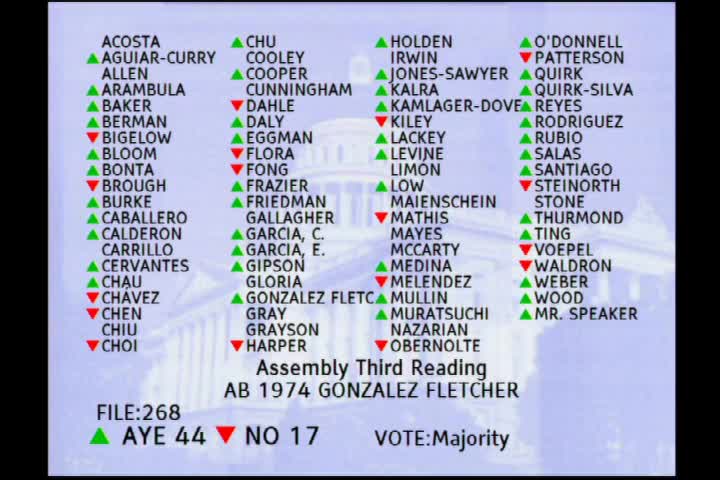
Bill Author

Bill Co-Author(s):