AB 2: Hate crimes: peace officers.
- Session Year: 2017-2018
- House: Assembly
- Latest Version Date: 2017-02-28
Existing law prohibits committing a battery upon another person. Violation of this prohibition is punishable as a misdemeanor or felony, depending on the extent of injury. Under existing law, there is a penalty enhancement for a battery committed against a peace officer who is engaged in the performance of his or her duties.
Existing law defines hate crime as a criminal act committed, in whole or in part, because of actual or perceived characteristics of the victim, including, among other things, race, religion, disability, and sexual orientation. Under existing law, that definition applies unless an explicit provision of law or the context clearly requires a different meaning. Existing law provides punishments for hate crimes that range from misdemeanors with specified penalties to felonies with additional terms of one to 3 years in state prison, depending on the underlying criminal act and other circumstances. Existing law requires, with conditions, the Attorney General to direct local law enforcement agencies to report specified information relative to hate crimes to the Department of Justice. Local law enforcement entities are required by existing law to provide a brochure on hate crimes to victims of these crimes and to the public, and the Department of Fair Employment and Housing is required by existing law to revise those brochures as needed and to provide those brochures to local law enforcement agencies upon request.
This bill would add the status as a peace officer to the list of actual or perceived characteristics necessary to determine whether a criminal act qualifies as a hate crime. ByThis bill would make any criminal act, except the crime of resisting, delaying, or obstructing an officer, committed in whole or in part because of the victims status as a peace officer, as defined, a hate crime.
By expanding the scope of an existing crime, this bill would impose a state-mandated local program. By expanding the information that law enforcement agencies report to the Department of Justice and disseminate to crime victims and the public, this bill imposes a state-mandated local program.
The California Constitution requires the state to reimburse local agencies and school districts for certain costs mandated by the state. Statutory provisions establish procedures for making that reimbursement.
This bill would provide that with regard to certain mandates no reimbursement is required by this act for a specified reason.
With regard to any other mandates, this bill would provide that, if the Commission on State Mandates determines that the bill contains costs so mandated by the state, reimbursement for those costs shall be made pursuant to the statutory provisions noted above.
Existing law defines hate crime as a criminal act committed, in whole or in part, because of actual or perceived characteristics of the victim, including, among other things, race, religion, disability, and sexual orientation. Under existing law, that definition applies unless an explicit provision of law or the context clearly requires a different meaning. Existing law provides punishments for hate crimes that range from misdemeanors with specified penalties to felonies with additional terms of one to 3 years in state prison, depending on the underlying criminal act and other circumstances. Existing law requires, with conditions, the Attorney General to direct local law enforcement agencies to report specified information relative to hate crimes to the Department of Justice. Local law enforcement entities are required by existing law to provide a brochure on hate crimes to victims of these crimes and to the public, and the Department of Fair Employment and Housing is required by existing law to revise those brochures as needed and to provide those brochures to local law enforcement agencies upon request.
This bill would add the status as a peace officer to the list of actual or perceived characteristics necessary to determine whether a criminal act qualifies as a hate crime. By expanding the scope of an existing crime, this bill would impose a state-mandated local program. By expanding the information that law enforcement agencies report to the Department of Justice and disseminate to crime victims and the public, this bill imposes a state-mandated local program.
The California Constitution requires the state to reimburse local agencies and school districts for certain costs mandated by the state. Statutory provisions establish procedures for making that reimbursement.
This bill would provide that with regard to certain mandates no reimbursement is required by this act for a specified reason.
With regard to any other mandates, this bill would provide that, if the Commission on State Mandates determines that the bill contains costs so mandated by the state, reimbursement for those costs shall be made pursuant to the statutory provisions noted above.
Except for an act punishable under Section 148, a hate crime, for purposes of this title, includes a criminal act committed, in whole or in part, because of the victims status as a peace officer, as defined in Section 830.
SEC. 2.No reimbursement is required by this act pursuant to Section 6 of Article XIIIB of the California Constitution for certain costs that may be incurred by a local agency or school district because, in that regard, this act creates a new crime or infraction, eliminates a crime or infraction, or changes the penalty for a crime or infraction, within the meaning of Section 17556 of the Government Code, or changes the definition of a crime within the meaning of Section 6 of Article XIIIB of the California Constitution.
However, if the Commission on State Mandates determines that this act contains other costs mandated by the state, reimbursement to local agencies and school districts for those costs shall be made pursuant to Part 7 (commencing with Section 17500) of Division 4 of Title 2 of the Government Code.
For purposes of this title, and for purposes of all other state law unless an explicit provision of law or the context clearly requires a different meaning, the following shall apply:
(a)Hate crime means a criminal act committed, in whole or in part, because of one or more of the following actual or perceived characteristics of the victim:
(1)Disability.
(2)Gender.
(3)Nationality.
(4)Race or ethnicity.
(5)Religion.
(6)Sexual orientation.
(7)Status as a peace officer as defined in Section 830.
(7)(8)Association with a person or group with one or more of these actual or perceived characteristics.
(b)Hate crime includes, but is not limited to, a violation of Section 422.6.
SEC. 2.No reimbursement is required by this act pursuant to Section 6 of Article XIIIB of the California Constitution for certain costs that may be incurred by a local agency or school district because, in that regard, this act creates a new crime or infraction, eliminates a crime or infraction, or changes the penalty for a crime or infraction, within the meaning of Section 17556 of the Government Code, or changes the definition of a crime within the meaning of Section 6 of Article XIIIB of the California Constitution.
However, if the Commission on State Mandates determines that this act contains other costs mandated by the state, reimbursement to local agencies and school districts for those costs shall be made pursuant to Part 7 (commencing with Section 17500) of Division 4 of Title 2 of the Government Code.
|
Date
|
Status
|
|---|---|
| Feb 1, 2018 | From committee: Filed with the Chief Clerk pursuant to Joint Rule 56. |
| Jan 31, 2018 | Died pursuant to Art. IV, Sec. 10(c) of the Constitution. |
| Mar 14, 2017 | In committee: Set, second hearing. Failed passage. |
| Mar 1, 2017 | Re-referred to Com. on PUB. S. |
| Feb 28, 2017 | In committee: Set, first hearing. Hearing canceled at the request of author. |
| Feb 13, 2017 | In committee: Hearing postponed by committee. |
| Jan 19, 2017 | Referred to Com. on PUB. S. |
| Dec 6, 2016 | From printer. May be heard in committee January 5. |
| Dec 5, 2016 | Read first time. To print. |
|
Date
|
Description
|
Location
|
Votes
|
|
|---|---|---|---|---|
| Mar 14, 2017 | Reconsideration. | Assembly Standing Committee on Public Safety |
Passed |
|
| Mar 14, 2017 | Do pass and be re-referred to the Committee on [Appropriations] | Assembly Standing Committee on Public Safety |
Failed |
This list shows positions taken on this bill by organizations on the date displayed, which is linked to the original source.
Positions by individuals are not included.
Date of Hearing:
Counsel: Sandra Uribe
ASSEMBLY COMMITTEE ON PUBLIC SAFETY
Reginald Byron Jones-Sawyer, Sr., Chair
ABPCA Bill Id:
Author:() – As Amended Ver:
SUMMARY:
Makes any crime, except the crime of resisting arrest, a hate crime if it was committed in whole or in part because of the victim’s status as a peace officer.
EXISTING LAW:
- Defines "hate crime" as any criminal act committed, in whole or in part, because of one or more of the following actual or perceived characteristics of the victim:
- Disability;
- Gender;
- Nationality;
- Race or ethnicity;
- Religion;
- Sexual orientation; and,
- Association with a person or group with one or more of these actual or perceived characteristics. (Pen. Code, § 422.55, subd. (a).)
- Disability;
- Provides that a hate crime includes, but is not limited to, a violation of interference with the exercise of civil rights because of actual or perceived characteristics of the victim. (Pen. Code, § 422.55, subd. (b).)
- Provides that a person who commits a felony motived by bias, or attempts to commit a bias-motivated felony, except as specified, shall receive an additional term of one, two, or three years in the state prison, at the court's discretion. (Pen. Code, § 422.75, subd. (a).)
- Provides that a person who commits a felony motived by bias, or attempts to commit a bias-motivated felony, except as specified, and who voluntarily acted in concert with another person in the commission of the crime shall receive an additional term of two, three, or four years in the state prison, at the court's discretion. (Pen. Code, § 422.75, subd. (b).)
- Provides that a person who commits first-degree murder that is a hate crime shall be punished by imprisonment in the state prison for life without the possibility of parole. (Pen. Code, § 190.03, subd. (a).)
- Punishes an assault on a peace officer by a by imprisonment in the county jail not exceeding one year, whereas an assault is generally punished by imprisonment in the county jail not exceeding six months. (Pen. Code, § 241, subds. (a) & (c).)
- Provides that any person who commits an assault against a peace officer in retaliation for, or to prevent the performance of, the officer’s official duties shall be punished by imprisonment not exceeding one year in the county jail, or as a felony under the provisions of realignment. (Pen. Code, § 217.1, subd. (a).)
- Punishes a battery upon a peace officer by a by imprisonment in the county jail not exceeding one year, except if the officer is engaged in the performance of his or her duties, in which case the punishment is imprisonment in the county jail not exceeding one year, or 16 months or two, or three years in the county jail. In contrast, battery is generally punished by imprisonment in the county jail not exceeding six months.. (Pen. Code, § 243, subds. (a), (b) & (c)(2).)
- Provides that any person who assaults a peace officer with a deadly weapon by means of force likely to produce great bodily injury when the officer is engaged in the performance of his or her duties is punishable by three, four, or five years in state prison, whereas assault with a deadly weapon is generally punishable by up to one year in the county jail, or two, three, or four years in state prison. (Pen. Code, § 245, subds. (a)(1) & (c).)
- Provides that any person who assaults a peace officer with a firearm while the officer is engaged in the performance of his duties is punishable by four, six, or eight years in state prison, whereas assault with a firearm is generally punishable by up to one year in the county jail or two, three, or four years in state prison. (Pen. Code, § 245, subds. (a)(2) & (d)(1).)
- Provides that the penalty for the attempted murder of a peace officer engaged in the performance of his or her duties, is imprisonment in the state prison for life with the possibility of parole. (Pen. Code, § 664, subd. (e).)
- Provides that the penalty for a defendant who is found guilty of murder in the first degree is death or imprisonment in the state prison for life without the possibility of parole if 1 or more than 20 special circumstances is found to be true, including:
- The victim was a peace officer who, while engaged in the course of the performance of his or her duties, was intentionally killed, and the defendant knew, or reasonably should have known, that the victim was a peace officer engaged in the performance of his or her duties; or the victim was a peace officer, as defined in the above-enumerated sections, or a former peace officer under any of those sections, and was intentionally killed in retaliation for the performance of his or her official duties;
- The victim was a federal law enforcement officer or agent who, while engaged in the course of the performance of his or her duties, was intentionally killed, and the defendant knew, or reasonably should have known, that the victim was a federal law enforcement officer or agent engaged in the performance of his or her duties; or the victim was a federal law enforcement officer or agent, and was intentionally killed in retaliation for the performance of his or her official duties;
- The murder was committed for the purpose of avoiding or preventing a lawful arrest, or perfecting or attempting to perfect, an escape from lawful custody;
- The defendant intentionally killed the victim by means of lying in wait; and
- The victim was intentionally killed because of his or her race, color, religion, nationality, or country of origin. (Pen. Code, § 190.2.)
- The victim was a peace officer who, while engaged in the course of the performance of his or her duties, was intentionally killed, and the defendant knew, or reasonably should have known, that the victim was a peace officer engaged in the performance of his or her duties; or the victim was a peace officer, as defined in the above-enumerated sections, or a former peace officer under any of those sections, and was intentionally killed in retaliation for the performance of his or her official duties;
FISCAL EFFECT:
Unknown
COMMENTS:
- Author's Statement: According to the author, "One of the most important responsibilities of all levels of government is to provide public safety. To ensure that we live in a safe society, law enforcement officers across the country put their lives on the line to serve and protect our communities. In return, the government has a responsibility and obligation to protect those officers who risk their lives every time they put on their uniform.
“Last year, a disturbing number of attacks targeting law enforcement officers have swept through the country. On July 7, 2016, five police officers who were protecting a protest march were killed in Dallas, Texas, while nine other officers were wounded. A mere 10 days later, three officers were killed in Baton Rouge, Louisiana, with three more officers injured.
“Assembly Bill 2 is a simple, common-sense bill that will classify acts of violence that intentionally target peace officers as hate crimes. To be clear, most violence that is committed against peace officers in the course of their duties will not be classified as a hate crime under this bill. But criminals who attack police officers specifically because they serve in law enforcement will face enhanced penalties and longer prison sentences.
“This bill is important to send a message to criminals who intentionally target peace officers that this behavior will not be tolerated.”
- Hate Crimes: Hate crimes, referred to by some jurisdictions as "bias crimes," are generally defined as crimes that are "committed not out of animosity toward the victim as an individual, but out of hostility toward the group to which the victim belongs." (Pendo, Recognizing Violence Against Women: Gender and the Hate Crimes Statistics Act (1994) 17 Harv. Women's L.J. 157, 159.) Looking at a more specific definition, a hate crime is defined as "a crime in which the defendant intentionally selects a victim because of the actual or perceived race, color, religion, national origin, ethnicity, gender, disability, or sexual orientation of any person." (Violent Crime Control and Law Enforcement Act of 1994, Pub. L. 103-322, 108 Stat. 1796 Section 280003 (1994) emphasis added (codified in part at 28 U.S.C. Section 994 (1994).)
Hate crime perpetrators target their victims based on discrimination against immutable characteristics such as age, color, disability, gender, gender identity, national origin, race, sex, and sexual orientation. Immutability can be characterized in one of two ways. Some characteristics, such as age, disability, and race, cannot be altered by an individual's voluntary act. However, other characteristics, such as religion and gender, can only be altered with substantial cost or difficulty to the individual. Although not literally immutable, scholars contend that "the power of a constructed category can be so overwhelming, and its terms, assumptions, and normative social requirements so deeply ingrained into the members of society, that it is experienced at the individual level as immutable." [Marcosson, Constructive Immutability (2001) 3 U. Pa. J. Const. L. 646, 650.] This implies that some characteristics that are entirely possible for individuals to change, such as religion, have such a powerful impact on the construction of individual identity that they effectively operate as if they were unchangeable.
This bill does not add "peace-officer status" to the list of actual or perceived characteristics of a victim for determining whether a criminal act qualifies as a hate crime. Rather, it makes any crime, except the crime of resisting arrest, a hate crime if it was committed in whole, or simply in part, because of the victim’s status as a peace officer.
- Potential Sentencing Issues: The proscription against double punishment may likely apply to a crime committed against a peace officer and the enhancement proposed by this bill. (Pen. Code, § 654.) Penal Code section 654, subdivision (a), provides: “An act or omission that is punishable in different ways by different provisions of law shall be punished under the provision that provides for the longest potential term of imprisonment, but in no case shall the act or omission be punished under more than one provision.” There are two steps for a section 654 analysis. First, a court considers whether the different crimes were completed by a single physical act. If there was only a single act, the defendant may not be punished more than once for the act. If the case involves more than a single act, the court moves on to the second step: whether that course of conduct reflects a single intent and objective, or multiple intents and objectives. (People v. Jones (2012) 54 Cal.4th 350, 358-359.)
In People v. Ahmed (2011) 53 Cal.4th 156, the Supreme Court held that section 654's prohibition against multiple punishments for a single crime does not apply to sentence enhancements which go to the nature of the offender, but it does apply to enhancements which go to the nature of the offense. Offense-related enhancements focus on aspects of the criminal act that are not always present and warrant additional punishment.
People v. Calles (2012) is illustrative 209 Cal.App.4th 1200. In Calles, supra, the appellate court held section 654 applied to bar imposition of both a prison term for leaving the scene of an accident and a sentence enhancement for leaving the scene of the same accident that attached to a gross vehicular manslaughter conviction. (Id. at pp. 1215–1217.) As the Calles court explained, section 654 applies because “[t]here was only one act of leaving the scene of an accident.” (Id. at p. 1217.)
Similarly, in a situation where a defendant commits a crime against a peace officer, which has peace officer status as an element of the offense, and that act is committed in whole or in part because the person was a peace officer, the defendant can be charged with both the substantive crime and under the hate crime statute proposed by this bill. The defendant can also be convicted of both. However, under the Calles rationale, the court may be limited in imposing punishment on both charges as a violation of Penal Code section 654. The only way the offense and the hate crime enhancement could be simultaneously punished under section 654 is if they concern different “aspects” of the criminal act. (People v. Ahmed, supra, 53 Cal.4th at p. 164.)
In addition to the prohibition against double punishment under Penal Code section 654, a trial court “is prohibited to some extent” from using the same factor to support more than one sentencing choice. (People v. Scott (1994) 9 Cal.4th 331, 350 & fn. 12.) The court is prohibited from using the same fact twice to impose the upper term and an enhancement. (Pen. Code, § 1170, subd. (b) [“The court may not impose an upper term by using the fact of an enhancement upon which sentence is imposed”].) “To comply with section 1170, subdivision (b), a fact charged and found as an enhancement may be used as a reason for imposing the upper term only if the court has discretion to strike the punishment for the enhancement and does so.” (Cal. Rules of Court, rule rule 4.420 (c).) Thus, for example, where the underlying offense includes peace officer status as an element, the court would be prohibited from both imposing the upper term based on the officer’s status, and also impose the sentence on the hate crime enhancement created by this bill. - Trends in Killing of Police: Recently there have been several intentional shootings committed against peace officers, some of which, tragically, have resulted in the deaths of the officers.
Nevertheless, according to a March 2017 article in the Huffington Post, “Despite these high-profile shootings and the push to make violent attacks on police officers a hate crime, on-duty officers are safer today than they were in the 1980s. The FBI declared 2015 one of the safest years on record for police. And, though the official numbers for 2016 won’t be available until mid-2017, the unofficial total of 64 officers who were feloniously killed would be significantly below a peak of 134 in 1973.” (http://www.huffingtonpost.com/entry/blue-black-lives-matter-police-bills-states_us_58b61488e4b0780bac2e31b8)
Similarly, a recent study conducted by Franklin Zimring, Professor of Law at the University of California at Berkeley, found that in the past four decades, there has been a downward trend in the number of killings both of, and by, police. Although the number of people employed as peace officers has increased in the last generation, the violent killing of officers has deceased by more than half. Since 1976, the number of on-duty police officers killed in the United States has dropped somewhere between 69 and 75 percent. This is partly attributable to the use of the Kevlar vest. "Urban policing is a substantially less dangerous job in 2015 than in 1975." (Zimring and Arsiniega, Trends in Killings of and by Police: A Preliminary Analysis, 2015, Ohio State Journal of Criminal Law, Vol. 13.) - Potential for Abuse: In May 2016, Louisiana became the first state to make public safety workers a protected class under hate crime laws. (https://www.washingtonpost.com/news/post-nation/wp/2016/05/26/louisianas-blue-lives-matter-bill-just-became-law/?utm_term=.7f23058a7ab9.) In September 2016, a New Orleans man was the first one charge under the new law for yelling racial and sexual slurs at police while being arrested on other charges. (http://www.nola.com/crime/index.ssf/2016/09/nopd_hate_crime_blue_lives_mat.html) Yelling offensive slurs does not make a hate crime, and is protected under the First Amendment. Ultimately the district attorney refused the charge, and the New Orleans police department acknowledged that it wrongly applied the new hate crime statute.
More recently, a Louisiana police chief claimed any offender who resists, or gets physical, with an officer can be charged with a felony hate crime. (http://www.nydailynews.com/news/national/king-louisiana-resisting-arrest-hate-crime-cops-article-1.2955185) The Louisiana Governor’s office subsequently noted that resisting arrest does not amount to hate crime. (http://www.katc.com/story/34310586/st-martinville-police-hope-change-comes-with-states-new-hate-crime-law)
This bill excludes the crime of resisting arrest from classification of a hate crime. However, as any other criminal act can be classified as a hate crime as long as it is committed at least in part because the victim was a peace officer, does potential for abuse remain? - Argument in Support: The California Coalition of Law Enforcement Associations states, “Although peace officers have always been in danger because of the challenges of interactions with persons in the process of committing a crime, in the last several years we have seen a deeply disturbing trend where officers are being targeted just because they are peace officers. In fact, in the last year, there have been at least 20 incidents where officers were harmed and even killed through deliberate ambushes. These are ‘lying in wait’ crimes that are unrelated to a criminal transaction contact between the officer and a suspect.”
- Arguments in Opposition:
- The National Center for Lesbian Rights writes, “The purpose of the hate crime law is to target violence based on personal characteristics, such as disability, gender, nationality, race or ethnicity, religion, and sexual orientation. Those categories are specified in the law because of disturbing, historical trends of violence against those groups. Indeed, the protected categories enumerated in the hate crime law are the same as those contained in state antidiscrimination laws related to housing, employment, and public accommodations. In combination, the civil rights laws and the hate crime law recognize that violence and discrimination against a person based on religion, sexual orientation, or race violate the core principles of our democratic society.
“While other forms of violence are similarly odious, including violence that targets police officers, they are not entrenched in the history of our country. In particular, there is a long a brutal history of racism in this country that continues to this day, and there is a national movement to oppose acts of police brutality, over-policing, and criminalization of black communities and other communities of color. In short, there are ways to address crimes against peace officers without utilizing laws that are focused on the distinct civil and human rights struggles of communities of color and other marginalized groups.” - According to the American Civil Liberties Union, “AB 2’s expansion is superfluous. California law already provides countless sentence enhancements for individuals convicted of violent crimes against peace officers. Under current law there is already an enhancement for personally using a firearm in the commission of an assault on a peace officer.
“Likewise, under current law, it is a crime to commit battery by gassing upon the person of a peace officer (Penal Code, § 243.9); assault on a peace officer with a firearm (Penal Code, § 245, subd. (d)); assault a peace officer in retaliation or to prevent the performance of the peace officer’s official duties (Penal Code, § 217.1, subd. (a)); attempt to commit murder against a peace officer in retaliation for or to prevent the performance of the peace officer’s official duties, which carries a 15 years-to-life sentence (Penal Code, § 217.1, subd. (b)); use tear gas or any tear gas weapon against a peace officer (Penal Code, § 22810, subd. (g)(2)); assault a peace officer (Penal Code, § 241, subd. (c)); assault a peace officer with a stun gun (Penal Code, § 244.5, subd. (b)); or commit battery against a peace officer (Penal Code, § 243, subds. (b), (c)(2).) ….
“There is no need to provide additional sentence enhancements when California’s criminal statutes already amply and explicitly address crimes against peace officers.”
- The National Center for Lesbian Rights writes, “The purpose of the hate crime law is to target violence based on personal characteristics, such as disability, gender, nationality, race or ethnicity, religion, and sexual orientation. Those categories are specified in the law because of disturbing, historical trends of violence against those groups. Indeed, the protected categories enumerated in the hate crime law are the same as those contained in state antidiscrimination laws related to housing, employment, and public accommodations. In combination, the civil rights laws and the hate crime law recognize that violence and discrimination against a person based on religion, sexual orientation, or race violate the core principles of our democratic society.
- Prior Legislation:
- AB 242 (Salas) of the 2015-2016 Legislative Session, would have added employment as a peace officer to the list of actual or perceived characteristics qualifying for hate crime status. AB 242 was never heard in committee.
- AB 246 (Hernández) of the 2015-2016 Legislative Session, would have broadened the definition of a hate crime to include the assassination, or attempted assassination, of a peace officer. AB 246 was held on the Assembly Appropriations Suspense File.
- AB 1206 (Miller), of the 2009-2010 Legislative Session, would have added political affiliation to the list of actual or perceived characteristics qualifying for hate crime status. AB 1206 was never heard in committee.
- SB 122 (Steinberg), of the 2007-2008 Legislative Session, would have added homelessness to the list of actual or perceived characteristics qualifying for hate crime status. SB 122 was held in the Senate Public Safety Committee.
- AB 242 (Salas) of the 2015-2016 Legislative Session, would have added employment as a peace officer to the list of actual or perceived characteristics qualifying for hate crime status. AB 242 was never heard in committee.
REGISTERED SUPPORT / OPPOSITION:
Support
America First Latinos
Association for Los Angeles Deputy Sheriffs
Association of Deputy District Attorneys
California Association of Code Enforcement Officers
California Coalition of Law Enforcement Association
California College and University Police Chiefs Association
California Correctional Supervisors Organization
California Narcotics Officers Association
California Peace Officers’ Association
County of San Bernardino
Los Angeles County Probation Officers Union
Los Angeles County Professional Peace Officers Association
Los Angeles Police Protective League
Peace Officers Research Association of California
Riverside Sheriffs’ Association
San Bernardino County Sheriff’s Department
San Diego County Sheriff’s Department
We The People Rising
Opposition
American Civil Liberties Union
Anti-Defamation League
Bend the Arc
California Attorneys for Criminal Justice
California Civil Liberties Advocacy
California Public Defenders Association
Equality California
Hindu American Foundation
Jewish Public Affairs Committee of California
National Association for the Advancement of Colored People- Santa Maria-Lompoc Branch
National Center for Lesbian Rights
Analysis Prepared by:
Sandy Uribe / PUB. S. /
Discussed in Hearing
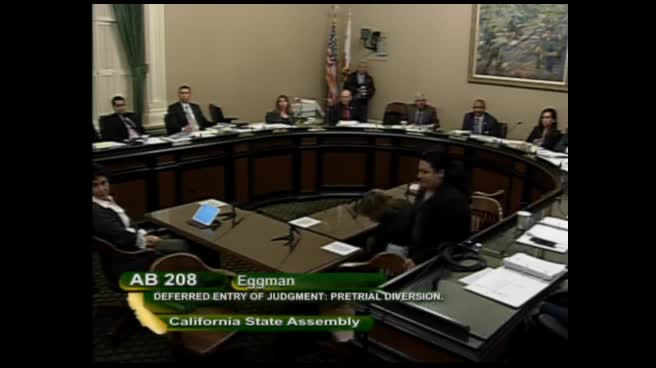 24MIN
Assembly Standing Committee on Public Safety
Bill Author



