AB 2011: Charter schools: facilities used for fulfilling state educational mandates: geographical restrictions.
- Session Year: 2017-2018
- House: Assembly
- Latest Version Date: 2018-02-01
Existing law generally requires a charter school to operate within the geographic boundaries of the school district that authorized its charter, unless otherwise specified.
This bill would exempt a charter school facility from the geographical restrictions that would otherwise apply if all of the pupils attending the charter school attend through nonclassroom-based instruction and the facility is used for purposes of fulfilling state educational mandates, as specified.
Notwithstanding any other law, a charter school in which all pupils attend the charter school through nonclassroom-based instruction shall not be subject to the geographical restrictions specified in Section 47605 and 47605.1 for a charter school facility used for the purpose of fulfilling state educational mandates, including, but not limited to, administering academic assessments and state-mandated tests, delivering special education and related services and assessments to individuals with exceptional needs, as defined in Section 56026, English language development programs, and for conducting laboratory science courses required for graduation or fulfilling AG course requirements for admission to the University of California and the California State University.
|
Date
|
Status
|
|---|---|
| Jun 19, 2018 | From committee: Without further action pursuant to Joint Rule 62(a). |
| May 9, 2018 | In committee: Set, first hearing. Failed passage. |
| Feb 12, 2018 | Referred to Com. on ED. |
| Feb 2, 2018 | From printer. May be heard in committee March 4. |
| Feb 1, 2018 | Read first time. To print. |
|
Date
|
Description
|
Location
|
Votes
|
|
|---|---|---|---|---|
| May 9, 2018 | Do pass. | Assembly Standing Committee on Education |
Failed |
This list shows positions taken on this bill by organizations on the date displayed, which is linked to the original source.
Positions by individuals are not included.
Date of Hearing: March 21, 2018
ASSEMBLY COMMITTEE ON EDUCATION
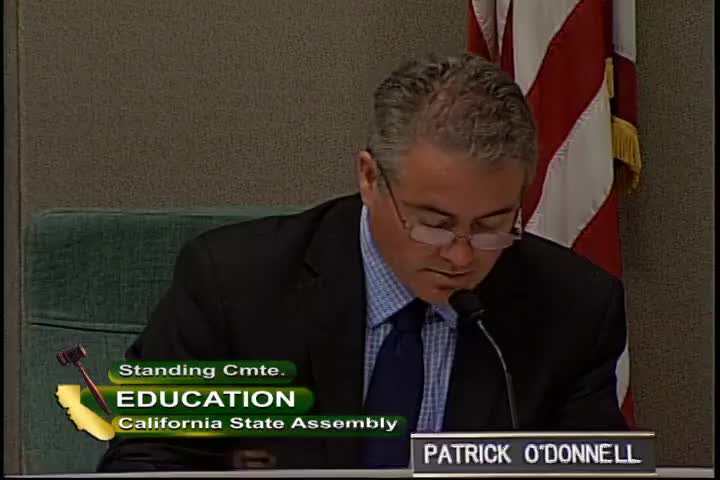
Patrick O'Donnell, Chair
ABPCA Bill Id:AB 2011 (
Author:Kiley) – As Introduced Ver:February 1, 2018
SUBJECT: Charter schools: facilities used for fulfilling state educational mandates: geographical restrictions
SUMMARY: Authorizes nonclassroom-based charter schools to enroll students anywhere in the state by exempting them from existing geographical restrictions. Specifically, this bill exempts a charter school in which all pupils attend through nonclassroom-based instruction from existing geographical restrictions for purposes of locating a facility used for fulfilling state educational mandates, including, but not limited to, administering academic assessments and state-mandated tests, delivering special education and related services and assessments to individuals with exceptional needs, English language development programs, and for conducting laboratory science courses required for graduation or fulfilling A–G course requirements for admission to the University of California and the California State University.
EXISTING LAW: Authorizes a charter school to establish a resource center, meeting space, or other satellite facility located in a county adjacent to that in which the charter school is authorized if the following conditions are met:
- The facility is used exclusively for the educational support of pupils who are enrolled in nonclassroom-based independent study of the charter school; and
- The charter school provides its primary educational services in, and a majority of the pupils it serves are residents of, the county in which the charter school is authorized.
FISCAL EFFECT: This bill is keyed nonfiscal
COMMENTS: Existing law allows a charter school to establish a satellite facility in the district in which it is authorized or in an adjacent county only if the facility is used exclusively for pupils who are enrolled in nonclassroom-based independent study and most of the school's students are residents of and receive primary education services in the county in which the school is authorized. This bill exempts all nonclassroom-based charter schools from all of these restrictions and requirements. In other words, such a school would be allowed to enroll pupils and provide educational services in any part of the state even if the school does not meet the existing requirements for locating a facility beyond adjacent counties. This change would benefit "virtual" schools, because they provide instruction through an online Internet connection, making physical proximity unnecessary.
What is nonclassroom-based instruction? Existing law defines charter school nonclassroom-based instruction as instruction that does not meet the requirements of classroom-based instruction. Those requirements are:
- Charter school pupils are engaged in required educational activities and are under the immediate supervision and control of a certificated teacher;
- At least 80% of the instructional time offered by the charter school is at the schoolsite (defined as a facility that is used primarily for classroom instruction); and
- Pupil attendance at the schoolsite is required for at least 80% of the minimum instructional time.
Existing law specifies that nonclassroom-based instruction includes, but is not limited to, independent study, home study, work study, and distance and computer-based education.
Location of charter school satellite facilities. In general, brick-and-mortar charter schools must be located within the boundaries of the chartering authority. However, a charter school may locate outside of the boundaries of the chartering authority, but within the same county, if either of the following conditions occurs:
- A site or facility is not available in the area in which the school chooses to locate; or
- The site is needed for temporary use during a construction or expansion project.
If a charter school submits its petition directly to a county office of education (COE) and the petition is approved by the COE, then it may locate only within the geographic boundaries of that county.
The rules for the location of facilities for a nonclassroom-based charter schools are different. Specifically, a nonclassroom-based charter school may establish a resource center, meeting space, or other satellite facility in a county adjacent to the county in which the school was approved if the following apply:
- The facility is used exclusively for the educational support of pupils who are enrolled in nonclassroom-based independent study; and
- The charter school provides its primary educational services in, and a majority of the pupils it serves are residents of, the county in which the charter was authorized.
These geographic restrictions were enacted in 2002 by AB 1994 (Reyes, Chapter 1058, Statutes of 2002) partly in response to the activities of the Gateway Academy Charter School, which was approved by the Fresno Unified School District. After receiving its charter, Gateway established "satellite" facilities (actually, additional schools) in other areas of the state, including Oakland (where it claimed state funding for private school enrollment) and Sunnyvale (where it allegedly provided sectarian instruction and charged tuition). The school's charter was eventually revoked by Fresno and its founder was sentenced to 14 years in prison for financial fraud associated with the operation of the charter school. In the meantime, Fresno claimed that it was difficult to exercise its oversight role over schools that were located so far outside its jurisdiction. AB 2002 addressed this problem by restricting the location of charter school facilities to only adjacent counties and only under specific circumstances.
This bill removes all of these restrictions and allows nonclassroom-based charter schools to locate facilities anywhere in the state without meeting any of the current requirements for locating outside of the jurisdiction of the chartering authority. This also exempts nonclassroom-based charter schools from the requirement that the charter petition identify multiple sites (if any) within the boundaries of the authorizing entity.
Reason for this bill. A 2016 court decision in Anderson Union High School District v. Shasta Secondary Home School, upheld the geographic restrictions on the location of satellite facilities. The specific issue was the provision in existing law whereby a nonclassroom-based charter can locate a facility in a county that is adjacent to the county in which the authorizer is located, but not in another district within the same county as the authorizing district.
Information provided by the author's office and arguments expressed in letters of support for this bill speak to the desire to address the Anderson decision by providing statutory authority to locate in the same county as the authorizing district. However, this bill does more than that; it allows the establishment of satellite facilities anywhere in the state, well beyond contiguous counties. This would essentially repeal the AB 1994 restrictions for nonclassroom-based charter schools. Accordingly, not only would a charter school be able to locate a facility anywhere in the state, it would not be bound by existing requirements that must be met in order to do so. Specifically, the facility would not need to be for the exclusive use of pupils enrolled in the nonclassroom-based instructional program, nor would the majority of the pupils enrolled in the charter school need to be in the county in which it was authorized.
Unlimited expansion of virtual schools. The ability to enroll pupils and locate satellite facilities anywhere in the state is especially beneficial to virtual schools, which offer instruction online. However, numerous studies indicate online instruction is not as effective as regular classroom instruction:
- A 2011 study of charter school performance in Pennsylvania by the Center for Research on Education Outcomes (CREDO) at Stanford University found that each of that state's 8 online charter schools ("cyber schools") significantly underperformed brick and mortar schools and regular (non-virtual) charter schools in reading and math.
- Another CREDO study in 2015 concluded that the learning deficit of virtual schools is equivalent to receiving 180 fewer days of math instruction and 72 fewer days of reading instruction. The study's author said that the learning in math was so small that it was "literally as though the student did not go to school for the entire year."
- A review of virtual schools in Wisconsin by the Gannett Wisconsin Media Investigative Team found that students receiving online instruction "often struggle to complete their degrees and repeat grades four times as often as their brick-and-mortar counterparts," and they "trail traditional students in every subject but reading."
- A 2011 report from the Office of the Legislative Auditor in Minnesota reported that full-time online students were more likely to completely drop out of school and made less progress on state standardized math tests than students in traditional schools.
- A 2011 report from the Ohio Department of Education rated only three of Ohio's 27 virtual schools as "effective" or "excellent."
- A 2006 performance audit by the Colorado Department of Education of that state's virtual schools found that, "in the aggregate, online students performed poorly on the CSAP (Colorado State Assessment Program) exams and had higher repeater, attrition, and dropout rates."
- The Florida Virtual Academy, a statewide virtual school, reports that 81% of its students who complete their courses receive a passing grade. However, the Tampa Bay Times reports that the Virtual Academy's records show that two-thirds of students who enroll in a course don't finish it. When dropouts are included, the actual pass rate is 28%. The Times was unable to get Virtual School Florida Comprehensive Assessment Test scores from either the Virtual School or the Florida Department of Education.
A report by In the Public Interest ("Virtual Public Education in California," 2015) focused specifically on California Virtual Academy (CAVA) schools, and concluded that "students at CAVA are at risk of low quality educational outcomes, and some are falling through the cracks entirely, in a poorly resourced and troubled educational environment." Among the concerns identified by the report are the following:
- In every year since it began graduating students, except 2013, CAVA has had more dropouts than graduates.
- Students are eligible to be counted as having attended with as little as one minute of log in time each day.
- K12 California (the California subsidiary of K-12, Inc.) pays itself for services out of CAVA school bank accounts that it (K12 California) manages.
- Competitive bidding is prohibited: K12 California contractually prohibits CAVA schools from seeking another vendor for services that K12 California is willing and able to perform.
- CAVA teachers report that the "vast majority" of the work they do is clerical, preventing them from spending sufficient time of teaching.
- Limited local control: individual CAVA location governing boards operate under contract to K12 California and do not "have much leeway in terms of budget, program and contracting decisions independent from K12 California."
- K12, Inc. charges CAVA schools more than they can reasonably pay for administrative and technology services. The shortfall is covered by "budget credits" that are extended by K12, Inc., which results in a "perpetual debt" relationship between CAVA schools and K12, Inc.
- CAVA students have lower academic achievement, higher dropout rates, and higher turnover than students in brick-and-mortar schools.
Many virtual schools in California use a curriculum provided by K12, Inc., a private, for-profit company headquartered in Virginia. In 2014, the NCAA recently announced that it will stop accepting coursework from 24 schools nationwide (13 in California) that use the K12, Inc. curriculum at any Division I or Division II college or university, because "their courses were found to not comply with the NCAA's nontraditional course requirements." Other K12, Inc. schools are currently being evaluated by the NCAA for compliance with its "core course and nontraditional course requirements." A 2012 report by the National Education Policy Center ("Understanding and Improving Full-Time Virtual Schools: A Study of Student Characteristics, School Finance, and School Performance in Schools Operated by K12, Inc.") found that students in K12, Inc. schools have lower academic achievement, higher dropout rates, and higher turnover than students in brick-and-mortar schools.
On every measure of student performance, virtual schools have been shown to consistently underperform brick-and-mortar schools by wide margins. At the same time, pursuant to legislative direction, California has invested heavily in policies to improve student outcomes, including the adoption of rigorous academic content standards, assessments aligned to those standards, and the use of evaluation rubrics (the "Dashboard") to monitor school and district performance and identify districts for targeted assistance. The committee may wish to consider whether facilitating the growth of virtual schools is consistent with the goal of improving outcomes for all students.
Arguments in support. Supporters argue that this bill "solves the current fundamental disconnect problem that currently exists between state mandated educational services that must be administered in school facilities and current state policy that restricts where our independent study public charter school facilities may be located." Proponents also argue that California law should encourage the growth of nonclassroom-based charter schools.
Arguments in opposition. Opponents argue that existing restrictions on the location of satellite facilities are "critical to the chartering authority's ability to hold charter schools accountable and ensure a safe and legally compliant public education for California's students." They also argue that allowing nonclassroom-based charter schools "to encroach upon the boundaries of other school districts is bad policy that disadvantages the other school district, and the students they serve," and that "a charter school should be authorized by local communities and should [be] located and operate within the boundaries of an authorizing district."
REGISTERED SUPPORT / OPPOSITION:
Support
Alder Grove Charter School
Aplus+
California Charter Schools Association
California Parents for Virtual Public Education
Charter Schools Development Center
Choices Charter School
Compass Charter Schools
Connecting Waters Charter Schools
CORE Butte Charter School
Delta Managed Solutions
EdVoice
Forest Charter Academy
Gateway Community Charters
Gorman Learning Charter Network
New Day Academy Shasta
Olive Grove Charter School
Opportunities for Learning Public Charter Schools
Pacific Charter Institute
Pathways Charter School
Phoenix Charter Academy
R & B Communications
Sage Oak Charter School
Shasta Charter Academy
Slavic-American Chamber of Commerce
The Classical Academies
The Learning Choice Academy
Trivium Charter School
Twin Ridges Home Study Charter School
Visions in Education
W.E.B. DuBois Public Charter School
Opposition
AFSCME
California Federation of Teachers
California Labor Federation
California State NAACP
California School Boards Association
California School Employees Association
California Teachers Association
Analysis Prepared by: Rick Pratt / ED. / (916) 319-2087
Bill Author

Bill Co-Author(s):