AB 2016: Labor Code Private Attorneys General Act of 2004: civil actions.
- Session Year: 2017-2018
- House: Assembly
- Latest Version Date: 2018-02-05
(1)The Labor Code Private Attorneys General Act of 2004 (act) authorizes an aggrieved employee who complies with specified notice and filing requirements to bring a civil action to recover specified civil penalties that would otherwise be assessed and collected by the Labor and Workforce Development Agency (agency). The act requires that the aggrieved employee or representative give written notice, as provided, to the agency and the employer of the specific provisions of the Labor Code alleged to have been violated, including the facts and theories to support the alleged violation.
This bill would instead require the notice to include a statement setting forth the relevant facts, legal contentions, and authorities supporting each alleged violation and an estimate of the number of current and former employees against whom the alleged violation or violations were committed and on whose behalf relief is sought. If the aggrieved employee or representative seeks relief on behalf of 10 or more employees, the bill would require that the notice be verified in a manner prescribed by other law and that a copy of the proposed complaint be attached to the notice.
By requiring the notice to be verified as provided, thereby expanding the scope of the crime of perjury, this bill would impose a state-mandated local program.
(2)The act provides an employer a right to cure violations under its provisions before the aggrieved employee may bring a civil action. The act excludes from the right to cure various specified violations and other specified health and safety violations. The act requires the employer to cure a violation within 33 calendar days of the postmark date of the notice sent by the aggrieved employee or representative.
This bill would instead exclude only the health and safety violations from the right to cure provisions. The bill would also extend the period of time in which the employer may cure the violation from 33 to 65 calendar days.
(3)The act provides that an employee who prevails in an action under its provisions is entitled to recover his or her filing fees and reasonable attorneys fees and costs. Existing law provides that civil penalties may be assessed against the employer, as provided.
This bill would provide that an aggrieved employee may be awarded civil penalties based only upon a violation by the employer actually suffered by that employee.
(4)The California Constitution requires the state to reimburse local agencies and school districts for certain costs mandated by the state. Statutory provisions establish procedures for making that reimbursement.
This bill would provide that no reimbursement is required by this act for a specified reason.
(a)A civil action by an aggrieved employee pursuant to subdivision (a) or (f) of Section 2699 alleging a violation of any provision listed in Section 2699.5 shall commence only after the following requirements have been met:
(1)(A)The aggrieved employee or representative shall give written notice by online filing with the Labor and Workforce Development Agency and by certified mail to the employer of the specific provisions of this code alleged to have been violated, including the facts and theories to support the alleged violation. a statement setting forth the relevant facts, legal contentions, and authorities supporting each alleged violation. The notice shall also include an estimate of the number of current and former employees against whom the alleged violation or violations were committed and on whose behalf relief is sought.
(B)If the aggrieved employee or representative seeks relief on behalf of 10 or more employees, the notice shall be verified in the manner prescribed by Section 446 of the Code of Civil Procedure and a copy of the proposed complaint shall be attached to the notice.
(B)(C)A notice filed with the Labor and Workforce Development Agency pursuant to subparagraph (A) and any employer response to that notice shall be accompanied by a filing fee of seventy-five dollars ($75). The fees required by this subparagraph are subject to waiver in accordance with the requirements of Sections 68632 and 68633 of the Government Code.
(C)(D)The fees paid pursuant to subparagraph (B) (C) shall be paid into the Labor and Workforce Development Fund and used for the purposes specified in subdivision (j) of Section 2699.
(2)(A)The agency shall notify the employer and the aggrieved employee or representative by certified mail that it does not intend to investigate the alleged violation within 60 calendar days of the postmark date of the notice received pursuant to paragraph (1). Upon receipt of that notice or if no notice is provided within 65 calendar days of the postmark date of the notice given pursuant to paragraph (1), the aggrieved employee may commence a civil action pursuant to Section 2699.
(B)If the agency intends to investigate the alleged violation, it shall notify the employer and the aggrieved employee or representative by certified mail of its decision within 65 calendar days of the postmark date of the notice received pursuant to paragraph (1). Within 120 calendar days of that decision, the agency may investigate the alleged violation and issue any appropriate citation. If the agency, during the course of its investigation, determines that additional time is necessary to complete the investigation, it may extend the time by not more than 60 additional calendar days and shall issue a notice of the extension. If the agency determines that no citation will be issued, it shall notify the employer and aggrieved employee of that decision within five business days thereof by certified mail. Upon receipt of that notice or if no citation is issued by the agency within the time limits prescribed by subparagraph (A) and this subparagraph or if the agency fails to provide timely or any notification, the aggrieved employee may commence a civil action pursuant to Section 2699.
(C)Notwithstanding any other provision of law, a plaintiff may as a matter of right amend an existing complaint to add a cause of action arising under this part at any time within 60 days of the time periods specified in this part.
(D)The time limits prescribed by this paragraph shall only apply if the notice required by paragraph (1) is filed with the agency on or after July 1, 2016. For notices submitted prior to July 1, 2016, the time limits in effect on the postmark date of the notice shall apply.
(b)A civil action by an aggrieved employee pursuant to subdivision (a) or (f) of Section 2699 alleging a violation of any provision of Division 5 (commencing with Section 6300) other than those listed in Section 2699.5 shall commence only after the following requirements have been met:
(1)(A)The aggrieved employee or representative shall give notice by online filing with the Division of Occupational Safety and Health and by certified mail to the employer, with a copy to the Labor and Workforce Development Agency, of the specific provisions of Division 5 (commencing with Section 6300) alleged to have been violated, including the facts and theories to support the alleged violation. a statement setting forth the relevant facts, legal contentions, and authorities supporting each alleged violation. The notice shall also include an estimate of the number of current and former employees against whom the alleged violation or violations were committed and on whose behalf relief is sought.
(B)If the aggrieved employee or representative seeks relief on behalf of 10 or more employees, the notice shall be verified in the manner prescribed by Section 446 of the Code of Civil Procedure and a copy of the proposed complaint shall be attached to the notice.
(2)(A)The division shall inspect or investigate the alleged violation pursuant to the procedures specified in Division 5 (commencing with Section 6300).
(i)If the division issues a citation, the employee may not commence an action pursuant to Section 2699. The division shall notify the aggrieved employee and employer in writing within 14 calendar days of certifying that the employer has corrected the violation.
(ii)If by the end of the period for inspection or investigation provided for in Section 6317, the division fails to issue a citation and the aggrieved employee disputes that decision, the employee may challenge that decision in the superior court. In such an action, the superior court shall follow precedents of the Occupational Safety and Health Appeals Board. If the court finds that the division should have issued a citation and orders the division to issue a citation, then the aggrieved employee may not commence a civil action pursuant to Section 2699.
(iii)A complaint in superior court alleging a violation of Division 5 (commencing with Section 6300) other than those listed in Section 2699.5 shall include therewith a copy of the notice of violation provided to the division and employer pursuant to paragraph (1).
(iv)The superior court shall not dismiss the action for nonmaterial differences in facts or theories between those contained in the notice of violation provided to the division and employer pursuant to paragraph (1) and the complaint filed with the court.
(B)If the division fails to inspect or investigate the alleged violation as provided by Section 6309, the provisions of subdivision (c) shall apply to the determination of the alleged violation.
(3)(A)Nothing in this subdivision shall be construed to alter the authority of the division to permit long-term abatement periods or to enter into memoranda of understanding or joint agreements with employers in the case of long-term abatement issues.
(B)Nothing in this subdivision shall be construed to authorize an employee to file a notice or to commence a civil action pursuant to Section 2699 during the period that an employer has voluntarily entered into consultation with the division to ameliorate a condition in that particular worksite.
(C)An employer who has been provided notice pursuant to this section may not then enter into consultation with the division in order to avoid an action under this section.
(4)The superior court shall review and approve any proposed settlement of alleged violations of the provisions of Division 5 (commencing with Section 6300) to ensure that the settlement provisions are at least as effective as the protections or remedies provided by state and federal law or regulation for the alleged violation. The provisions of the settlement relating to health and safety laws shall be submitted to the division at the same time that they are submitted to the court. This requirement shall be construed to authorize and permit the division to comment on those settlement provisions, and the court shall grant the divisions commentary the appropriate weight.
(c)A civil action by an aggrieved employee pursuant to subdivision (a) or (f) of Section 2699 alleging a violation of any provision other than those listed in Section 2699.5 or Division 5 (commencing with Section 6300) shall commence only after the following requirements have been met:
(1)(A)The aggrieved employee or representative shall give written notice by online filing with the Labor and Workforce Development Agency and by certified mail to the employer of the specific provisions of this code alleged to have been violated, including the facts and theories to support the alleged violation. a statement setting forth the relevant facts, legal contentions, and authorities supporting each alleged violation. The notice shall also include an estimate of the number of current and former employees against whom the alleged violation or violations were committed and on whose behalf relief is sought.
(B)If the aggrieved employee or representative seeks relief on behalf of 10 or more employees, the notice shall be verified in the manner prescribed by Section 446 of the Code of Civil Procedure and a copy of the proposed complaint shall be attached to the notice.
(B)(C)A notice filed with the Labor and Workforce Development Agency pursuant to subparagraph (A) and any employer response to that notice shall be accompanied by a filing fee of seventy-five dollars ($75). The fees required by this subparagraph are subject to waiver in accordance with the requirements of Sections 68632 and 68633 of the Government Code.
(C)(D)The fees paid pursuant to subparagraph (B) (C) shall be paid into the Labor and Workforce Development Fund and used for the purposes specified in subdivision (j) of Section 2699.
(2)(A)The employer may cure the alleged violation within 33 65 calendar days of the postmark date of the notice sent by the aggrieved employee or representative. The employer shall give written notice within that period of time by certified mail to the aggrieved employee or representative and by online filing with the agency if the alleged violation is cured, including a description of actions taken, and no civil action pursuant to Section 2699 may commence. If the alleged violation is not cured within the 33-day 65-day period, the employee may commence a civil action pursuant to Section 2699.
(B)(i)Subject to the limitation in clause (ii), no employer may avail himself or herself of the notice and cure provisions of this subdivision more than three times in a 12-month period for the same violation or violations contained in the notice, regardless of the location of the worksite.
(ii)No employer may avail himself or herself of the notice and cure provisions of this subdivision with respect to alleged violations of paragraph (6) or (8) of subdivision (a) of Section 226 more than once in a 12-month period for the same violation or violations contained in the notice, regardless of the location of the worksite.
(3)If the aggrieved employee disputes that the alleged violation has been cured, the aggrieved employee or representative shall provide written notice by online filing with the agency and by certified mail to the employer, including specified grounds to support that dispute, to the employer and the agency. Within 17 calendar days of the receipt of that notice, the agency shall review the actions taken by the employer to cure the alleged violation, and provide written notice of its decision by certified mail to the aggrieved employee and the employer. The agency may grant the employer three additional business days to cure the alleged violation. If the agency determines that the alleged violation has not been cured or if the agency fails to provide timely or any notification, the employee may proceed with the civil action pursuant to Section 2699. If the agency determines that the alleged violation has been cured, but the employee still disagrees, the employee may appeal that determination to the superior court.
(d)The periods specified in this section are not counted as part of the time limited for the commencement of the civil action to recover penalties under this part.
(e)This section shall remain in effect only until July 1, 2021, and as of that date is repealed, unless a later enacted statute, that is enacted before July 1, 2021, deletes or extends that date. repealed.
SEC. 2.Section 2699.3 of the Labor Code, as added by Section 191 of Chapter 31 of the Statutes of 2016, is amended to read:2699.3.(a)A civil action by an aggrieved employee pursuant to subdivision (a) or (f) of Section 2699 alleging a violation of any provision listed in Section 2699.5 shall commence only after the following requirements have been met:
(1)(A)The aggrieved employee or representative shall give written notice by online filing with the Labor and Workforce Development Agency and by certified mail to the employer of the specific provisions of this code alleged to have been violated, including the facts and theories to support the alleged violation. a statement setting forth the relevant facts, legal contentions, and authorities supporting each alleged violation. The notice shall also include an estimate of the number of current and former employees against whom the alleged violation or violations were committed and on whose behalf relief is sought.
(B)If the aggrieved employee or representative seeks relief on behalf of 10 or more employees, the notice shall be verified in the manner prescribed by Section 446 of the Code of Civil Procedure and a copy of the proposed complaint shall be attached to the notice.
(B)(C)A notice filed with the Labor and Workforce Development Agency pursuant to subparagraph (A) and any employer response to that notice shall be accompanied by a filing fee of seventy-five dollars ($75). The fees required by this subparagraph are subject to waiver in accordance with the requirements of Sections 68632 and 68633 of the Government Code.
(C)(D)The fees paid pursuant to subparagraph (B) (C) shall be paid into the Labor and Workforce Development Fund and used for the purposes specified in subdivision (j) of Section 2699.
(2)(A)The agency shall notify the employer and the aggrieved employee or representative by certified mail that it does not intend to investigate the alleged violation within 60 calendar days of the postmark date of the notice received pursuant to paragraph (1). Upon receipt of that notice or if no notice is provided within 65 calendar days of the postmark date of the notice given pursuant to paragraph (1), the aggrieved employee may commence a civil action pursuant to Section 2699.
(B)If the agency intends to investigate the alleged violation, it shall notify the employer and the aggrieved employee or representative by certified mail of its decision within 65 calendar days of the postmark date of the notice received pursuant to paragraph (1). Within 120 calendar days of that decision, the agency may investigate the alleged violation and issue any appropriate citation. If the agency determines that no citation will be issued, it shall notify the employer and aggrieved employee of that decision within five business days thereof by certified mail. Upon receipt of that notice or if no citation is issued by the agency within the time limits prescribed by subparagraph (A) and this subparagraph or if the agency fails to provide timely or any notification, the aggrieved employee may commence a civil action pursuant to Section 2699.
(C)Notwithstanding any other provision of law, a plaintiff may as a matter of right amend an existing complaint to add a cause of action arising under this part at any time within 60 days of the time periods specified in this part.
(b)A civil action by an aggrieved employee pursuant to subdivision (a) or (f) of Section 2699 alleging a violation of any provision of Division 5 (commencing with Section 6300) other than those listed in Section 2699.5 shall commence only after the following requirements have been met:
(1)(A)The aggrieved employee or representative shall give notice by online filing with the Division of Occupational Safety and Health and by certified mail to the employer, with a copy to the Labor and Workforce Development Agency, of the specific provisions of Division 5 (commencing with Section 6300) alleged to have been violated, including the facts and theories to support the alleged violation. a statement setting forth the relevant facts, legal contentions, and authorities supporting each alleged violation. The notice shall also include an estimate of the number of current and former employees against whom the alleged violation or violations were committed and on whose behalf relief is sought.
(B)If the aggrieved employee or representative seeks relief on behalf of 10 or more employees, the notice shall be verified in the manner prescribed by Section 446 of the Code of Civil Procedure and a copy of the proposed complaint shall be attached to the notice.
(2)(A)The division shall inspect or investigate the alleged violation pursuant to the procedures specified in Division 5 (commencing with Section 6300).
(i)If the division issues a citation, the employee may not commence an action pursuant to Section 2699. The division shall notify the aggrieved employee and employer in writing within 14 calendar days of certifying that the employer has corrected the violation.
(ii)If by the end of the period for inspection or investigation provided for in Section 6317, the division fails to issue a citation and the aggrieved employee disputes that decision, the employee may challenge that decision in the superior court. In such an action, the superior court shall follow precedents of the Occupational Safety and Health Appeals Board. If the court finds that the division should have issued a citation and orders the division to issue a citation, then the aggrieved employee may not commence a civil action pursuant to Section 2699.
(iii)A complaint in superior court alleging a violation of Division 5 (commencing with Section 6300) other than those listed in Section 2699.5 shall include therewith a copy of the notice of violation provided to the division and employer pursuant to paragraph (1).
(iv)The superior court shall not dismiss the action for nonmaterial differences in facts or theories between those contained in the notice of violation provided to the division and employer pursuant to paragraph (1) and the complaint filed with the court.
(B)If the division fails to inspect or investigate the alleged violation as provided by Section 6309, the provisions of subdivision (c) shall apply to the determination of the alleged violation.
(3)(A)Nothing in this subdivision shall be construed to alter the authority of the division to permit long-term abatement periods or to enter into memoranda of understanding or joint agreements with employers in the case of long-term abatement issues.
(B)Nothing in this subdivision shall be construed to authorize an employee to file a notice or to commence a civil action pursuant to Section 2699 during the period that an employer has voluntarily entered into consultation with the division to ameliorate a condition in that particular worksite.
(C)An employer who has been provided notice pursuant to this section may not then enter into consultation with the division in order to avoid an action under this section.
(4)The superior court shall review and approve any proposed settlement of alleged violations of the provisions of Division 5 (commencing with Section 6300) to ensure that the settlement provisions are at least as effective as the protections or remedies provided by state and federal law or regulation for the alleged violation. The provisions of the settlement relating to health and safety laws shall be submitted to the division at the same time that they are submitted to the court. This requirement shall be construed to authorize and permit the division to comment on those settlement provisions, and the court shall grant the divisions commentary the appropriate weight.
(c)A civil action by an aggrieved employee pursuant to subdivision (a) or (f) of Section 2699 alleging a violation of any provision other than those listed in Section 2699.5 or Division 5 (commencing with Section 6300) shall commence only after the following requirements have been met:
(1)(A)The aggrieved employee or representative shall give written notice by online filing with the Labor and Workforce Development Agency and by certified mail to the employer of the specific provisions of this code alleged to have been violated, including the facts and theories to support the alleged violation. a statement setting forth the relevant facts, legal contentions, and authorities supporting each alleged violation. The notice shall also include an estimate of the number of current and former employees against whom the alleged violation or violations were committed and on whose behalf relief is sought.
(B)If the aggrieved employee or representative seeks relief on behalf of 10 or more employees, the notice shall be verified in the manner prescribed by Section 446 of the Code of Civil Procedure and a copy of the proposed complaint shall be attached to the notice.
(B)(C)A notice filed with the Labor and Workforce Development Agency pursuant to subparagraph (A) and any employer response to that notice shall be accompanied by a filing fee of seventy-five dollars ($75). The fees required by this subparagraph are subject to waiver in accordance with the requirements of Sections 68632 and 68633 of the Government Code.
(C)(D)The fees paid pursuant to subparagraph (B) (C) shall be paid into the Labor and Workforce Development Fund and used for the purposes specified in subdivision (j) of Section 2699.
(2)(A)The employer may cure the alleged violation within 33 65 calendar days of the postmark date of the notice sent by the aggrieved employee or representative. The employer shall give written notice within that period of time by certified mail to the aggrieved employee or representative and by online filing with the agency if the alleged violation is cured, including a description of actions taken, and no civil action pursuant to Section 2699 may commence. If the alleged violation is not cured within the 33-day 65-day period, the employee may commence a civil action pursuant to Section 2699.
(B)(i)Subject to the limitation in clause (ii), no employer may avail himself or herself of the notice and cure provisions of this subdivision more than three times in a 12-month period for the same violation or violations contained in the notice, regardless of the location of the worksite.
(ii)No employer may avail himself or herself of the notice and cure provisions of this subdivision with respect to alleged violations of paragraph (6) or (8) of subdivision (a) of Section 226 more than once in a 12-month period for the same violation or violations contained in the notice, regardless of the location of the worksite.
(3)If the aggrieved employee disputes that the alleged violation has been cured, the aggrieved employee or representative shall provide written notice by online filing with the agency and by certified mail to the employer, including specified grounds to support that dispute, to the employer and the agency. Within 17 calendar days of the receipt of that notice, the agency shall review the actions taken by the employer to cure the alleged violation, and provide written notice of its decision by certified mail to the aggrieved employee and the employer. The agency may grant the employer three additional business days to cure the alleged violation. If the agency determines that the alleged violation has not been cured or if the agency fails to provide timely or any notification, the employee may proceed with the civil action pursuant to Section 2699. If the agency determines that the alleged violation has been cured, but the employee still disagrees, the employee may appeal that determination to the superior court.
(d)The periods specified in this section are not counted as part of the time limited for the commencement of the civil action to recover penalties under this part.
(e)This section shall become operative on July 1, 2021.
SEC. 3.Section 2699.4 is added to the Labor Code, to read:2699.4.An aggrieved employee who brings an action pursuant to this part shall be awarded penalties based only upon violations by the employer actually suffered by that employee.
SEC. 4.No reimbursement is required by this act pursuant to Section 6 of Article XIIIB of the California Constitution because the only costs that may be incurred by a local agency or school district will be incurred because this act creates a new crime or infraction, eliminates a crime or infraction, or changes the penalty for a crime or infraction, within the meaning of Section 17556 of the Government Code, or changes the definition of a crime within the meaning of Section 6 of Article XIIIB of the California Constitution.
|
Date
|
Status
|
|---|---|
| Apr 18, 2018 | In committee: Set, second hearing. Failed passage. Reconsideration granted. |
| Apr 2, 2018 | In committee: Set, first hearing. Hearing canceled at the request of author. |
| Feb 12, 2018 | Referred to Coms. on L. & E. and JUD. |
| Feb 6, 2018 | From printer. May be heard in committee March 8. |
| Feb 5, 2018 | Read first time. To print. |
|
Date
|
Description
|
Location
|
Votes
|
|
|---|---|---|---|---|
| Apr 18, 2018 | Reconsideration. | Assembly Standing Committee on Labor and Employment |
Passed |
|
| Apr 18, 2018 | Do pass and be re-referred to the Committee on [Judiciary] | Assembly Standing Committee on Labor and Employment |
Failed |
This list shows positions taken on this bill by organizations on the date displayed, which is linked to the original source.
Positions by individuals are not included.
Date of Hearing: April 18, 2018
ASSEMBLY COMMITTEE ON LABOR AND EMPLOYMENT
Tony Thurmond, Chair
ABPCA Bill Id:AB 2016 (
Author:Fong) – As Introduced Ver:February 5, 2018
SUBJECT: Labor Code Private Attorneys General Act of 2004: civil actions
SUMMARY: Modifies the procedures for bringing a civil action under the Labor Code Private Attorneys General Act of 2004 (PAGA), what violations may be cured, the time line for curing those violation and the remedies available to aggrieved employees. Specifically, this bill:
- Requires the notice and filing requirements to bring a civil action under PAGA to include a statement setting forth the relevant facts, legal contentions, and authorities supporting each alleged violation and an estimate of the number of current and former employees against whom the alleged violation or violations were committed and on whose behalf relief is sought.
- Requires that, if the aggrieved employee or representative seeks relief on behalf of ten or more employees, that the notice must be verified in a manner prescribed by Section 446 of the Code of Civil Procedure and that a copy of the proposed complaint be attached to the notice.
- Provides an employer a right to cure all violations under PAGA, except for health and safety violations, before the aggrieved employee may bring a civil action.
- Extends the time an employer may cure a violation from within 33 calendar days to 65 calendar days of the postmark date of the notice sent by the aggrieved employee or representative.
- Provides that an aggrieved employee may be awarded civil penalties based only upon a violation by the employer actually suffered by that employee.
EXISTING LAW:
- Authorizes, through PAGA, an aggrieved employee who complies with specified notice and filing requirements to bring a civil action to recover specified civil penalties that would otherwise be assessed and collected by the LWDA.
- Provides an employer a right to cure certain violations under PAGA before the aggrieved employee may bring a civil action.
- Excludes from the right to cure various specified violations and other specified health and safety violations.
- Requires the employer to cure a violation within 33 calendar days of the postmark date of the notice sent by the aggrieved employee or representative.
- Provides that an employee who prevails in an action under these provisions is entitled to recover his or her filing fees and reasonable attorney’s fees and costs.
- Provides that civil penalties may be assessed against the employer, as provided.
- Excludes from the right to cure provisions, under PAGA, various specified violations and other specified health and safety violations.
FISCAL EFFECT: Unknown
COMMENTS: The author asserts that though PAGA is well intended, “thousands of questionable lawsuits have been filed against employers large and small. As a result, many businesses have been forced to close down or move out of state due to the high cost of defending against these lawsuits, ultimately harming the very employees PAGA intended to assist.”
General Background on PAGA
PAGA was enacted pursuant to SB 796 (Dunn), Chapter 906, Statutes of 2003, and went into effect on January 1, 2004. SB 796 assigned civil fine amounts to the large number of Labor Code provisions, which previously carried prohibitions or criminal fines, but not civil penalties. It also authorized the filing of civil actions to recover civil penalties by aggrieved workers acting as private attorneys general.
The next year, PAGA was further refined by SB 1809 (Dunn), Chapter 221, Statutes of 2004. SB 1809 significantly revised the provisions of the PAGA by enacting specified procedural and administrative requirements that must be met prior to bringing a private action to recover civil penalties. SB 1809 essentially enacted three different procedural requirements depending on the type of violation; occupational safety and health violations, “serious” Labor Code violations, and a notice and cure provision for the other Labor Code violations not considered serious or related to occupational safety and health.
The provisions of SB 1809 also expanded judicial review of PAGA claims by requiring courts to review and approve any penalties sought as part of a proposed settlement agreement, and those portions of settlements concerning violations of health and safety laws. In addition, courts were authorized to award a lesser amount if to do so otherwise would result in an award that is unjust, arbitrary and oppressive, or confiscatory.
SB 1809 also provided that no action shall be brought for a posting, notice, agency reporting, or filing requirement, except as specified.
Finally, SB 1809 appropriated $150,000 from the General Fund to the LWDA for the purposes of implementing its provisions, and changed the prior penalty formula to provide that 75 percent of most civil penalties recovered pursuant to PAGA shall go to the LWDA for labor law enforcement and education.
Recent PAGA Reform
In 2015, the Governor signed AB 1506 (R. Hernández), Chapter 445, Statutes of 2015, which provides an employer with the right to cure a violation of failing to provide its employees with a wage statement containing the inclusive dates of the pay period and the name and address of the legal entity that is the employer.
In 2016, a budget trailer bill, SB 836 (Committee on Budget), Chapter 31, Statutes of 2016, made further revisions to PAGA and increased enforcement funding for the Labor Commissioner. That legislation required a copy of a proposed settlement to be submitted to LWDA at same that it is submitted to court, and requires parties to provide the LWDA with a copy of the court’s judgement. SB 836 also extended various time lines, including the time LWDA reviews new cases from 30 to 60 days and the time for LWDA to notify parties of intent to investigate violation from 33 to 65 days. It also provided LWDA with an option to send notice to extend the 120 day time limit for investigating and citing the employer by an additional 60 days and sunsets the 60 day extension on July 1, 2021. The measure also included a $75 filing fee for new case notices and any employer responses to such notices, and required online filing and transmission of all items submitted to the LWDA.
Arguments in Support
The California Chamber of Commerce and others write in support, “California has some of the most onerous and complex labor laws in the country. This complexity is exemplified by PAGA, which essentially allows an individual to pursue a “representative action” on behalf of similarly aggrieved employees without being subject to the strict filing requirements of a class action. The employee can pursue a claim against an employer for almost any Labor Code violation. PAGA requires a $100 penalty per employee, per pay period for the first violation, and $200 per employee, per pay period for each subsequent violation. If there are multiple Labor Code violations, then these penalties are stacked. In addition, if the employee recovers any dollar amount, the employee is entitled to attorney’s fees, which adds another layer of cost onto the employer. “
The Chamber and others continue, “With this statutory scheme, one unintentional and minor violation of the Labor Code can result in the threat of financially devastating civil litigation against an employer, which the plaintiff’s bar has utilized to leverage quick monetary settlements. As noted in the Governor’s 2016-2017 Budget, the Labor and Workforce Development Agency (LWDA) indicated that it receives over 6,000 PAGA notices a year. While not all of those notices result in an actual civil complaint being filed, a significant portion are leveraged for quick settlements from employers with the threat of costly litigation and/or actual civil litigation if a settlement is not reached.”
The Greater Bakersfield Chamber of Commerce writes in support that this measure “would mitigate this financial threat of frivolous litigation by requiring that plaintiffs provide a more detailed account of the allegations in the required PAGA notice. Currently, a PAGA notice simply requires the employee to state the Labor Code provision alleged to have been violated. This bill would require the plaintiff to actually provide a statement setting forth the relevant facts, legal contentions, and authorities supporting each alleged violation. Additionally, the bill requires that the plaintiff provide an estimate of the number of current and former employees against whom the alleged violation or violations were committed and on whose behalf relief is sought. If the plaintiff seeks relief on behalf of 10 or more employees, the bill would require that the notice be verified.”
The Greater Bakersfield Chamber of Commerce continues, this measure, “also provides the employer with a longer opportunity to cure alleged grievances instead of current law that only provides 33 days. This is beneficial to both the employer and employee. For the employer, it eliminates the threat of costly civil litigation for an unintentional error for which it was not aware. For the employee, it provides an efficient remedy to an alleged violation. Notably, AB 2016 only impacts a PAGA claim. For many of the Labor Code violations, there would still be an individual private right of action for an employee to pursue for the alleged violation. AB 2016 creates a balance between protecting employees and their rights under the Labor Code while also protecting employers from financially devastating litigation over alleged minor violations.”
Arguments in Opposition
The Consumer Attorneys of California (CAOC) argue in opposition, “AB 2016 would weaken the protections offered by the PAGA leaving low wage workers more susceptible to wage theft and delay prosecution of key labor code violations by extending the existing right to cure provisions from 33 days to 65 days.”
CAOC asserts, that this measure “Would enact a complaint requirement and onerous pleading standards on aggrieved employees alleging labor code violations.” CAOC continues that under current law, “Complainants need not have all the facts needed to prove a case at the time of filing – that is why we have a Civil Discovery Act. Both plaintiffs and defendants have the opportunity to discover the facts that either prove or disprove a case before trial.” CAOC says the notice and filing requirements of the bill “turn notice pleading on its head and discourage the filing of legitimate complaints.” Additionally, CAOC continues, “this heightened pleading standard and complaint requirement would serve to further limit PAGA’s benefits to those workers who retain an attorney, since an average worker will not be equipped to draft a PAGA notice with the requisite “legal contentions” and legal “authorities,” let alone a complaint. These proposed requirements add more work to the investigation and increase the level of difficulty, time, and work required to draft a sufficient PAGA notice. Even if represented by an attorney, workers often lack and are unable to obtain the information that would be required under the new pleading standard, specifically an “estimate of the number of current and former employees” against whom the alleged violations were committed. In most cases, a worker would need to file a complaint and conduct discovery in order to provide such information. In short, the heightened pleading standard and complaint requirement run counter to PAGA’s fundamental goal of enabling workers to help enforce the labor code. The certification requirements in AB 2016 are meant to undermine the representative nature of PAGA actions in order to make them look more vulnerable to forced arbitration”
The California Rural Legal Assistance Foundation (CRLAF) argues, “AB 2016 undermines the fundamental purpose of PAGA, which is to allow workers to stand in the shoes of the Labor Commissioner and effectively pursue all labor law violations committed against any employee by their employer. CRLAF continues, “Since 2004, when PAGA took effect, rural legal services programs (including CRLAF) are estimated to have filed more than 100 lawsuits with PAGA causes of action on behalf of our farm worker (and other low-wage) clients. The overwhelming number of these cases have involved wage theft; the majority also include labor law violations like failure to provide meal or rest breaks. We have recovered and distributed literally millions of dollars to farm workers in wages and penalties arising from these violations, and have recovered hundreds of thousands of dollars in penalties for state enforcement agencies.
The California Professional Firefighters Association (CPFA) writes, “Nearly half of all private sector workers are forced to sign arbitration agreements that waive their right to file a claim with the Labor Commissioner and to participate collectively in a class action. However, the California Supreme Court has held that PAGA claims cannot be forced into individual arbitration. That means PAGA is often the only effective and efficient remedy available to address broad labor violations at a worksite that impacts multiple workers." CPFA continues, “AB 2016 would almost double employers’ right to cure timeframe, extending it to 65-days. This would only drag out the time period within which an employer must remedy the labor code violations and make the workers whole. A longer cure period would increase the time employers are out of compliance with the law and increase the harm to workers.” CPFA also asserts, “AB 2016 would also make it more difficult for workers to bring claims collectively by imposing unnecessary procedural hurdles designed to make workers’ claims more costly, complicated, and less likely to succeed.”
Prior and Related Legislation
AB 2907 (Flora) of 2018. Provides an employer a right to cure any specified wage statements related violations brought under the Private Attorney General Act of 2004 (PAGA) within a 33-day period after being notified of the violation. This measure is currently pending in the Assembly Committee on Labor and Employment.
AB 281 (Salas) of 2017, would have extended the period of time in which an employer may cure violations of the Labor Code enforced by PAGA from 33 to 65 calendar days. AB 281 died earlier this year.
AB 1429 (Fong) of 2017. This measure would have limited the violations for which an aggrieved employee is authorized to bring a civil action under PAGA and would have required the employee to follow specified procedures before bringing an action. The bill would have capped the civil penalties recoverable under PAGAs at $10,000 per claimant and would have excluded the recovery of filing fees by a successful claimant. The bill would have also required the superior court to review any penalties sought as part of a settlement agreement under PAGA. The measure died in the Assembly Committee on Labor and Employment without a hearing.
AB 1430 (Fong) of 2017. Would have revised PAGA to require the LWDA, after receiving notification of an alleged PAGA violation, to investigate the alleged violation and either issue a citation or determine if there is a reasonable basis for a civil action. Would have authorized an aggrieved employee to commence an action upon receipt of notice from the LWDA that there is a reasonable basis for a civil action, or if the LWDA fails to provide timely or any notification, as specified. The measure died in the Assembly Committee on Labor and Employment without a hearing.
SB 836 (Committee on Budget), Chapter 31, Statutes of 2016. Among other provisions, this budget trailer bill made several changes to PAGA, including an extension of the time period for LWDA to review and investigate PAGA claims. SB 836 also required a copy of proposed settlement of a PAGA claim to be submitted to LWDA at same that it is submitted to court, and requires parties to provide the LWDA with a copy of the court’s judgement.
AB 1506 (R. Hernández), Chapter 445, Statutes of 2015. Provides an employer with the right to cure a violation of failing to provide its employees with a wage statement containing the inclusive dates of the pay period and the name and address of the legal entity that is the employer.
SB 1255 (Wright), Chapter 843, Statutes of 2012. Provides a statutory definition of what constitutes “suffering injury” for purposes of recovering damages pursuant to the itemized wage statements requirements including failure by the employer to provide a wage statement or failure to provide accurate or complete information regarding the other specified items, as specified.
SB 899 (Poochigian), Chapter 34, Statutes of 2004. Exempted workers compensation provisions of the Labor Code from enforcement through PAGA.
SB 1809 (Dunn), Chapter 221, Statutes of 2004. Significantly amended the Labor Code Private Attorney General Act of 2004by enacting specified procedural and administrative requirements that must be met prior to bringing a private action to recover civil penalties for Labor Code violations.
SB 796 (Dunn), Chapter 906, Statutes of 2003. Created an alternative private attorney general system for labor law enforcement in order to augment the enforcement abilities of the Labor Commissioner. Allows employees to sue their employers for civil penalties for employment law violations.
This measure is double-referred to Assembly Judiciary Committee should it pass this Committee.
REGISTERED SUPPORT / OPPOSITION:
Support
Acclamation Insurance Management Services
Agricultural Council of California
Allied Managed Care
American Insurance Association
Apartment Association of Orange County
Apartment Association, California Southern Cities
Associated Builders and Contractors, Inc. – Central California Chapter
Associated Builders and Contractors, Inc. – Northern California Chapter
Associated Builders and Contractors, Inc. – San Diego Chapter
Associated Builders and Contractors, Inc. – Southern California Chapter
Associated General Contractors
Bakersfield Association of Realtors
Bakersfield Chamber of Commerce
BizFed Central Valley
Brea Chamber of Commerce
California Ambulance Association
California Apartment Association
California Association for Health Services at Home
California Association of Licensed Security Agencies, Guards & Associates
California Association of Winegrape Growers
California Bankers Association
California Beer and Beverages Distributors
California Building Industry Association
California Business Properties Association
California Chamber of Commerce
California Construction & Industrial Materials Association
California Employment Law Council
California Farm Bureau Federation
California Framing Contractors Association
California Grocers Association
California Hospital Association
California Job Creators for Workplace Fairness
California Joint Powers Authority
California League of Food Producers
California Manufacturers & Technology Association
California Professional Association of Specialty Contractors
California Restaurant Association
CSAC Excess Insurance Authority
California Retailers Association
California Ski Industry Association
California Special Districts Association
California State Association of Counties
California Travel Association
California Trucking Association
Camarillo Chamber of Commerce
Citizens Against Lawsuit Abuse
City of Bakersfield
City of Coachella
Civil Justice Association of California
Council of California Goodwill Industries
East Bay Rental Housing Association
Family Business Association of California
Family Winemakers of California
Flasher Barricade Association
Greater Bakersfield Chamber of Commerce
Kern Citizens for Energy
Kern County Builders' Exchange
Kern County Hispanic Chamber of Commerce
Kern Economic Development Corporation
League of California Cities
National Association of Mutual Insurance Companies
National Association of Theatre Owners of California/Nevada
National Federation of Independent Business
North of the River Chamber of Commerce
North Orange County Chamber
North Valley Rental Property Association
Oceanside Chamber of Commerce
Official Police Garages of Los Angeles
Personal Insurance Federation of California
Rancho Cordova Chamber of Commerce
Retail Industry Leaders Association
San Gabriel Valley Economic Partnership
Society for Human Resources Management
Tulare Chamber of Commerce
Valley Industry and Commerce Association
Western Carwash Association
Western Growers Association
Western Manufactured Housing Communities Association
Wine Institute
Opposition
American Federation of State, County and Municipal Employees
CA Conference Board of the Amalgamated Transit Union
CA Conference of Machinists
California Employment Lawyers Association
California Federation of Teachers
California Labor Federation, AFL-CIO
California Professional Firefighters
California Rural Legal Assistance Foundation
California State Association of Electrical Workers
California State Pipe Trades Council
California Teamsters Public Affairs Council
Consumer Attorneys of California
Engineers and Scientists of CA, Local 20
International Longshore & Warehouse Union
International Union of Elevator Contractors
Professional and Technical Engineers, Local 21
SEIU California
State Building and Construction Trades Council
United Farm Workers
UNITE-HERE
Utility Workers of America
Western States Council of Sheet Metal Workers
Analysis Prepared by: Jennifer Richard / L. & E. /
Discussed in Hearing
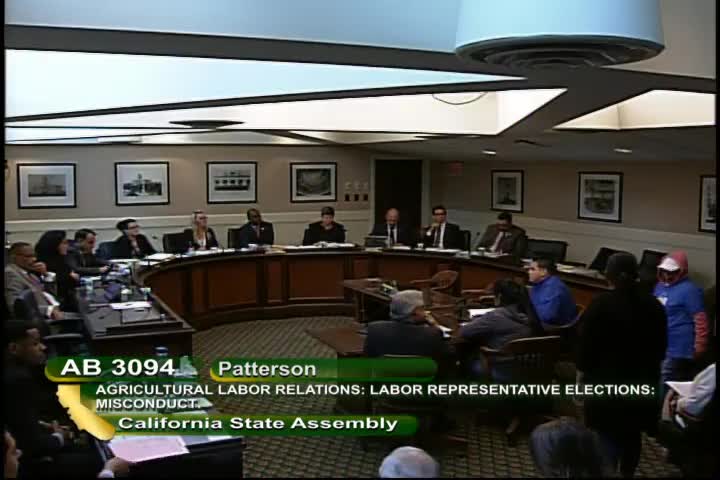 18MIN
Assembly Standing Committee on Labor and Employment
Bill Author

Bill Co-Author(s):