AB 2020: Cannabis: local jurisdiction licensees: temporary event license.
- Session Year: 2017-2018
- House: Assembly
- Latest Version Date: 2018-09-26
The Control, Regulate and Tax Adult Use of Marijuana Act of 2016 (AUMA), an initiative measure approved as Proposition 64 at the November 8, 2016, statewide general election, authorizes a person who obtains a state license under AUMA to engage in commercial adult-use cannabis activity pursuant to that license and applicable local ordinances. The Medicinal and Adult-Use Cannabis Regulation and Safety Act (MAUCRSA), among other things, consolidates the licensure and regulation of commercial medicinal and adult-use cannabis activities. MAUCRSA authorizes an applicant to apply to all applicable state licensing authorities to obtain a state license to engage in commercial adult-use cannabis activity, and requires the applicant to obtain a separate license for each location where it engages in commercial cannabis activity. MAUCRSA establishes the Cannabis Control Appeals Panel and authorizes any person aggrieved by specified decisions of a licensing authority related to disciplining any license to appeal the licensing authoritys written decision to the panel.
MAUCRSA authorizes a state licensing authority to issue a state temporary event license to a licensee authorizing onsite cannabis sales to, and consumption by, persons 21 years of age or older at a county fair or district agricultural association event, provided that certain other requirements are met, including that all participants in the event are licensed under MAUCRSA. Under existing administrative law, the Bureau of Cannabis Control has adopted regulations that govern the issuance of a state temporary cannabis event license. Under those existing regulations governing state temporary cannabis event licenses, each sale at an event under that license is required to be conducted by a licensed retailer or microbusiness. Under those existing regulations, an applicant for a state temporary event license is required to include in the application a list of all licensees who will be providing onsite sales of cannabis goods at the event, and to update that list and provide a final list to the bureau no less than 72 hours before the event. MAUCRSA requires that any person who engages in commercial cannabis activity without a license is subject to a civil penalty of up to 3 times the amount of the license fee for the violation, subject to certain requirements.
This bill would authorize a state temporary event license to be issued to a licensee for an event to be held at any other venue expressly approved by a local jurisdiction for events, as described. The bill would modify the requirements codified in MAUCRSA to include requirements that are similar to those provided in regulations adopted by the bureau described above, including requiring that all participants who are engaged in the onsite retail sale of cannabis or cannabis products at the event be licensed to engage in that activity, and requiring an applicant who submits an application for a state temporary event license to, 60 days before the event, provide the bureau a list of all licensees that will be providing onsite sales of cannabis or cannabis products at the event and to update that list in a manner similar to what is provided in existing regulations. The bill would specifically authorize the bureau to impose a civil penalty on any person who violates the requirements governing state temporary event licenses in an amount up to 3 times the amount of the license fee for each violation. The bill would authorize the bureau to require the event and all participants to cease operations without delay if in the opinion of the bureau or local law enforcement it is necessary to protect the immediate public health and safety of the people of the state. The bill would authorize the bureau to require the event organizer to immediately expel from the event any participant selling cannabis or cannabis products without a license from the bureau that authorizes the participant to sell cannabis or cannabis products and would authorize the bureau to require the event and all participants to cease operations immediately if the participant does not leave immediately. The bill would specify that an order by the bureau for the event to cease operations does not entitle the event organizer or any participant in the event to a hearing or an appeal of the decision. The bill would exempt an order by the bureau for the event to cease operations from specified provisions related to the discipline of a license and from specified provisions related to the appeal of a decision by a licensing authority.
The Control, Regulate and Tax Adult Use of Marijuana Act, an initiative measure, authorizes the Legislature to amend the act to further the purposes and intent of the act with a 2/3 vote of the membership of both houses of the Legislature.
This bill would declare that its provisions further specified purposes and intent of the act.
The Control, Regulate and Tax Adult Use of Marijuana Act of 2016 (AUMA), an initiative measure approved as Proposition 64 at the November 8, 2016, statewide general election, authorizes a person who obtains a state license under AUMA to engage in commercial adult-use cannabis activity pursuant to that license and applicable local ordinances. The Medicinal and Adult-Use Cannabis Regulation and Safety Act (MAUCRSA), among other things, consolidates the licensure and regulation of commercial medicinal and adult-use cannabis activities. MAUCRSA authorizes an applicant to apply to all applicable state licensing authorities to obtain a state license to engage in commercial adult-use cannabis activity, and requires the applicant to obtain a separate license for each location where it engages in state in commercial cannabis activity. MAUCRSA establishes the Cannabis Control Appeals Panel and authorizes any person aggrieved by specified decisions of a licensing authority related to disciplining any license to appeal the licensing authoritys written decision to the panel.
MAUCRSA authorizes a state licensing authority to issue a state temporary event license to a licensee authorizing onsite cannabis sales to, and consumption by, persons 21 years of age or older at a county fair or district agricultural association event, provided that certain other requirements are met, including that all participants in the event are licensed under MAUCRSA. Under existing administrative law, the Bureau of Cannabis Control has adopted regulations that govern the issuance of a state temporary cannabis event license. Under those existing regulations governing state temporary cannabis event licenses requires that licenses, each sale at an event under that license is required to be conducted by a licensed retailer or microbusiness. Under those existing regulations, an applicant for a state temporary event license is required to include in the application a list of all licensees who will be providing onsite sales of cannabis goods at the event, and to update that list and provide a final list to the bureau no less than 5 days 72 hours before the event. MAUCRSA requires that any person who engages in commercial cannabis activity without a license is subject to a civil penalty of up to 3 times the amount of the license fee for the violation, subject to certain requirements.
This bill would authorize a state temporary event license to be issued to a licensee for an event to be held at any other venue expressly approved by a local jurisdiction for events, as described. The bill would modify the requirements codified in MAUCRSA to include requirements that are similar to those provided in regulations adopted by the bureau described above, including requiring that all participants who are engaged in the onsite retail sale of cannabis or cannabis products at the event be licensed, and requiring an applicant who submits an application for a state temporary event license to, 60 days before the event, provide the bureau a list of all licensees that will be providing onsite sales of cannabis or cannabis products at the event and to update that list in a manner similar to what is provided in existing regulations. The bill would specifically authorize the bureau to impose a civil penalty on any person who violates the requirements governing state temporary event licenses in an amount up to 3 times the amount of the license fee for each violation. The bill would authorize the bureau to revoke a state temporary event license and order require the event and all participants to shut down cease operations without delay if in the opinion of the bureau determines that an unlicensed person is engaged in commercial cannabis activity at the event, or that the event is not in compliance with this division and any applicable regulations. or local law enforcement it is necessary to protect the immediate public health and safety of the people of the state. The bill would authorize the bureau to require the event organizer to immediately expel from the event any participant selling cannabis or cannabis products without a license from the bureau that authorizes the participant to sell cannabis or cannabis products and would authorize the bureau to require the event and all participants to cease operations immediately if the participant does not leave immediately. The bill would specify that an order by the bureau for the event to cease operations does not entitle the event organizer or any participant in the event to a hearing or an appeal of the decision. The bill would exempt an order by the bureau for the event to cease operations from specified provisions related to the discipline of a license and from specified provisions related to the appeal of a decision by a licensing authority.
The Control, Regulate and Tax Adult Use of Marijuana Act, an initiative measure, authorizes the Legislature to amend the act to further the purposes and intent of the act with a 2/3 vote of the membership of both houses of the Legislature.
This bill would declare that its provisions further specified purposes and intent of the act.
The Control, Regulate and Tax Adult Use of Marijuana Act of 2016 (AUMA), an initiative measure approved as Proposition 64 at the November 8, 2016, statewide general election, authorizes a person who obtains a state license under AUMA to engage in commercial adult-use cannabis activity pursuant to that license and applicable local ordinances. The Medicinal and Adult-Use Cannabis Regulation and Safety Act (MAUCRSA), among other things, consolidates the licensure and regulation of commercial medicinal and adult-use cannabis activities. MAUCRSA authorizes an applicant to apply to all applicable state licensing authorities to obtain a state license to engage in commercial adult-use cannabis activity, and requires the applicant to obtain a separate license for each location where it engages in state in commercial cannabis activity.
MAUCRSA authorizes a state licensing authority to issue a state temporary event license to a licensee authorizing onsite cannabis sales to, and consumption by, persons 21 years of age or older at a county fair or district agricultural association event, provided that certain other requirements are met. met, including that all participants in the event are licensed under MAUCRSA. Under existing administrative law, the Bureau of Cannabis Control has adopted regulations that govern the issuance of a state temporary cannabis event license. Under those existing regulations governing state temporary cannabis event licenses requires that each sale at an event under that license be conducted by a licensed retailer or microbusiness. Under those existing regulations, an applicant for a state temporary event license is required to include in the application a list of all licensees who will be providing onsite sales of cannabis goods at the event, and to update that list and provide a final list to the bureau no less than 5 days before the event. MAUCRSA requires that any person who engages in commercial cannabis activity without a license is subject to a civil penalty of up to 3 times the amount of the license fee for the violation, subject to certain requirements.
This bill would authorize a state temporary event license to be issued to a licensee for an event to be held at any other venue expressly approved by a local jurisdiction for events, as described. The bill would modify the requirements codified in MAUCRSA to include requirements that are similar to those provided in regulations adopted by the bureau described above, including requiring that all participants who are engaged in the onsite retail sale of cannabis or cannabis products at the event be licensed, and requiring an applicant who submits an application for a state temporary event license to, 60 days before the event, provide the bureau a list of all licensees that will be providing onsite sales of cannabis or cannabis products at the event and to update that list in a manner similar to what is provided in existing regulations. The bill would specifically authorize the bureau to impose a civil penalty on any person who violates the requirements governing state temporary event licenses in an amount up to 3 times the amount of the license fee for each violation. The bill would authorize the bureau to revoke a state temporary event license and order the event to shut down if the bureau determines that an unlicensed person is engaged in commercial cannabis activity at the event, or that the event is not in compliance with this division and any applicable regulations.
The Control, Regulate and Tax Adult Use of Marijuana Act, an initiative measure, authorizes the Legislature to amend the act to further the purposes and intent of the act with a 2/3 vote of the membership of both houses of the Legislature.
This bill would declare that its provisions further specified purposes and intent of the act.
The Control, Regulate and Tax Adult Use of Marijuana Act of 2016 (AUMA), an initiative measure approved as Proposition 64 at the November 8, 2016, statewide general election, authorizes a person who obtains a state license under AUMA to engage in commercial adult-use cannabis activity pursuant to that license and applicable local ordinances. The Medicinal and Adult-Use Cannabis Regulation and Safety Act (MAUCRSA), among other things, consolidates the licensure and regulation of commercial medicinal and adult-use cannabis activities. MAUCRSA authorizes an applicant to apply to all applicable state licensing authorities to obtain a state license to engage in commercial adult-use cannabis activity, and requires the applicant to obtain a separate license for each location where it engages in state in commercial cannabis activity.
MAUCRSA authorizes a state licensing authority to issue a state temporary event license to a licensee authorizing onsite cannabis sales to, and consumption by, persons 21 years of age or older at a county fair or district agricultural association event, provided that certain other requirements are met. Under existing administrative law, the Bureau of Cannabis Control has adopted regulations that govern the issuance of a state temporary cannabis event license.
This bill would authorize a state temporary event license to be issued to a licensee for an event to be held at any other venue expressly approved by a local jurisdiction for events, as described.
The Control, Regulate and Tax Adult Use of Marijuana Act, an initiative measure, authorizes the Legislature to amend the act to further the purposes and intent of the act with a 2/3 vote of the membership of both houses of the Legislature.
This bill would declare that its provisions further specified purposes and intent of the act.
The Control, Regulate and Tax Adult Use of Marijuana Act of 2016 (AUMA), an initiative measure approved as Proposition 64 at the November 8, 2016, statewide general election, authorizes a person who obtains a state license under AUMA to engage in commercial adult-use cannabis activity pursuant to that license and applicable local ordinances. The Medicinal and Adult-Use Cannabis Regulation and Safety Act (MAUCRSA), among other things, consolidates the licensure and regulation of commercial medicinal and adult-use cannabis activities. MAUCRSA authorizes an applicant to apply to all applicable state licensing authorities to obtain a state license to engage in commercial adult-use cannabis activity, and requires the applicant to obtain a separate license for each location where it engages in state in commercial cannabis activity. MAUCRSA defines the term applicant to mean an owner applying for a state license.
MAUCRSA authorizes a state licensing authority to issue a state temporary event license to a licensee authorizing onsite cannabis sales to, and consumption by, persons 21 years of age or older at a county fair or district agricultural association event, provided that certain other requirements are met. Under existing administrative law, the Bureau of Cannabis Control has adopted regulations that govern the issuance of a state temporary cannabis event license.
This bill would authorize a local jurisdiction to apply for a temporary event license, and would generally require that local jurisdiction to comply with all existing licensure requirements that apply to any other applicant. The bill would also authorize a state temporary event license to be issued to a licensee for an event to be held at any other venue expressly approved by the a local jurisdiction for events, as described.
The Control, Regulate and Tax Adult Use of Marijuana Act, an initiative measure, authorizes the Legislature to amend the act to further the purposes and intent of the act with a 2/3 vote of the membership of both houses of the Legislature.
This bill would declare that its provisions further specified purposes and intent of the act.
The Control, Regulate and Tax Adult Use of Marijuana Act of 2016 (AUMA), an initiative measure approved as Proposition 64 at the November 8, 2016, statewide general election, authorizes a person who obtains a state license under AUMA to engage in commercial adult-use cannabis activity pursuant to that license and applicable local ordinances. The Medicinal and Adult-Use Cannabis Regulation and Safety Act (MAUCRSA), among other things, consolidates the licensure and regulation of commercial medicinal and adult-use cannabis activities. MAUCRSA authorizes an applicant to apply to all applicable state licensing authorities to obtain a state license to engage in commercial adult-use cannabis activity, and requires the applicant to obtain a separate license for each location where here it engages in state in commercial cannabis activity. MAUCRSA defines the term applicant to mean an owner applying for a state license.
MAUCRSA authorizes a state licensing authority to issue a state temporary event license to a licensee authorizing onsite cannabis sales to, and consumption by, persons 21 years of age or older at a county fair or district agricultural association event, provided that certain other requirements are met.
This bill would authorize a local jurisdiction to apply for a temporary event license, and would generally require that local jurisdiction to comply with all existing licensure requirements that apply to any other applicant, except for specified provisions relating to background checks and prior convictions. applicant. The bill would also authorize a state temporary event license to be issued to a licensee for an event to be held at any other venue expressly approved by the local jurisdiction for events, as described.
The Control, Regulate and Tax Adult Use of Marijuana Act, an initiative measure, authorizes the Legislature to amend the act to further the purposes and intent of the act with a 2/3 vote of the membership of both houses of the Legislature.
This bill would declare that its provisions further specified purposes and intent of the act.
The Control, Regulate and Tax Adult Use of Marijuana Act of 2016 (AUMA), an initiative measure approved as Proposition 64 at the November 8, 2016, statewide general election, authorizes a person who obtains a state license under AUMA to engage in commercial adult-use cannabis activity pursuant to that license and applicable local ordinances. The Medicinal and Adult-Use Cannabis Regulation and Safety Act (MAUCRSA), among other things, consolidates the licensure and regulation of commercial medicinal and adult-use cannabis activities. MAUCRSA authorizes an applicant to apply to all applicable state licensing authorities to obtain a state license to engage in commercial adult-use cannabis activity, and requires the applicant to obtain a separate license for each location where here engages in state in commercial cannabis activity. MAUCRSA defines the term applicant to mean an owner applying for a state license.
MAUCRSA authorizes a state licensing authority to issue a state temporary event license to a licensee authorizing onsite cannabis sales to, and consumption by, persons 21 years of age or older at a county fair or district agricultural association event, provided that certain other requirements are met.
This bill would authorize a local jurisdiction to apply for a temporary event license, and would generally require that local jurisdiction to comply with all existing licensure requirements that apply to any other applicant, except for specified provisions relating to background checks and prior convictions. The bill would also authorize a state temporary event license to be issued to a licensee for an event to be held at any other venue expressly approved by the local jurisdiction for events, as described.
The Control, Regulate and Tax Adult Use of Marijuana Act, an initiative measure, authorizes the Legislature to amend the act to further the purposes and intent of the act with a 2/3 vote of the membership of both houses of the Legislature.
This bill would declare that its provisions further specified purposes and intent of the act.
(a)(1)This division shall not be interpreted to supersede or limit the authority of a local jurisdiction to adopt and enforce local ordinances to regulate businesses licensed under this division, including, but not limited to, local zoning and land use requirements, business license requirements, and requirements related to reducing exposure to secondhand smoke, or to completely prohibit the establishment or operation of one or more types of businesses licensed under this division within the local jurisdiction.
(2)This division shall not be interpreted to supersede or limit existing local authority for law enforcement activity, enforcement of local zoning requirements or local ordinances, or enforcement of local license, permit, or other authorization requirements.
(b)This division shall not be interpreted to require a licensing authority to undertake local law enforcement responsibilities, enforce local zoning requirements, or enforce local licensing, permitting, or other authorization requirements.
(c)A local jurisdiction shall notify the bureau upon revocation of any local license, permit, or authorization for a licensee to engage in commercial cannabis activity within the local jurisdiction. Within 10 days of notification, the bureau shall inform the relevant licensing authorities. Within 60 days of being so informed by the bureau, the relevant licensing authorities shall begin the process to determine whether a license issued to the licensee should be suspended or revoked pursuant to Chapter 3 (commencing with Section 26030).
(d)For facilities issued a state license that are located within the incorporated area of a city, the city shall have full power and authority to enforce this division and the regulations promulgated by the bureau or any licensing authority, if delegated by the state. Notwithstanding Sections 101375, 101400, and 101405 of the Health and Safety Code or any contract entered into pursuant thereto, or any other law, the city shall assume complete responsibility for any regulatory function pursuant to this division within the city limits that would otherwise be performed by the county or any county officer or employee, including a county health officer, without liability, cost, or expense to the county.
(e)(1)This division does not prohibit the issuance of a state temporary event license to a licensee authorizing onsite cannabis sales to, and consumption by, persons 21 years of age or older at a county fair event, district agricultural association event, or at another venue expressly approved by a local jurisdiction for the purpose of holding temporary events of this nature, provided that the activities, at a minimum, comply with all the following:
(A)The requirements of paragraphs (1) to (3), inclusive, of subdivision (g).
(B)All participants who are engaged in the onsite retail sale of cannabis or cannabis products at the event are licensed under this division to engage in that activity.
(C)The activities are otherwise consistent with regulations promulgated and adopted by the bureau governing state temporary event licenses.
(D)A state temporary event license shall only be issued in local jurisdictions that authorize such events.
(E)A licensee who submits an application for a state temporary event license shall, 60 days before the event, provide to the bureau a list of all licensees that will be providing onsite sales of cannabis or cannabis products at the event. If any changes occur in that list, the licensee shall provide the bureau with a final updated list to reflect those changes. A person shall not engage in the onsite retail sale of cannabis or cannabis products, or in any way participate in the event, who is not included in the list, including any updates, provided to the bureau.
(2)The bureau may impose a civil penalty on any person who violates this subdivision, or any regulations adopted by the bureau governing state temporary event licenses, in an amount up to three times the amount of the license fee for each violation, consistent with Sections 26018 and 26038.
(3)The bureau may require the event and all participants to cease operations without delay if in the opinion of the bureau or local law enforcement it is necessary to protect the immediate public health and safety of the people of the state. The bureau may also require the event organizer to immediately expel from the event any participant selling cannabis or cannabis products without a license from the bureau that authorizes the participant to sell cannabis or cannabis products. If the unlicensed participant does not leave the event, the bureau may require the event and all participants to cease operations immediately.
(4)The order by the bureau for the event to cease operations pursuant to paragraph (3) does not entitle the event organizer or any participant in the event to a hearing or an appeal of the decision. Chapter 3 (commencing with Section 490) of Division 1.5 and Chapter 4 (commencing with Section 26040) of this division shall not apply to the order by the bureau for the event to cease operations pursuant to paragraph (3).
(5)The smoking of cannabis or cannabis products at temporary events authorized pursuant to this subdivision is prohibited in locations where smoking is prohibited. For purposes of this section, smoking has the same meaning as defined in subdivision (c) of Section 22950.5.
(f)This division, or any regulations promulgated thereunder, shall not be deemed to limit the authority or remedies of a city, county, or city and county under any provision of law, including, but not limited to, Section 7 of Article XI of the California Constitution.
(g)Notwithstanding paragraph (1) of subdivision (a) of Section 11362.3 of the Health and Safety Code, a local jurisdiction may allow for the smoking, vaporizing, and ingesting of cannabis or cannabis products on the premises of a retailer or microbusiness licensed under this division if all of the following are met:
(1)Access to the area where cannabis consumption is allowed is restricted to persons 21 years of age or older.
(2)Cannabis consumption is not visible from any public place or nonage-restricted area.
(3)Sale or consumption of alcohol or tobacco is not allowed on the premises.
(h)This division shall not be interpreted to supersede Section 6404.5 of the Labor Code.
SEC. 2.The Legislature finds and declares that Section 1 of this act amending Section 26200 of the Business and Professions Code furthers the purposes and intent of the Control, Regulate and Tax Adult Use of Marijuana Act.
(a)(1)This division shall not be interpreted to supersede or limit the authority of a local jurisdiction to adopt and enforce local ordinances to regulate businesses licensed under this division, including, but not limited to, local zoning and land use requirements, business license requirements, and requirements related to reducing exposure to secondhand smoke, or to completely prohibit the establishment or operation of one or more types of businesses licensed under this division within the local jurisdiction.
(2)This division shall not be interpreted to supersede or limit existing local authority for law enforcement activity, enforcement of local zoning requirements or local ordinances, or enforcement of local license, permit, or other authorization requirements.
(b)This division shall not be interpreted to require a licensing authority to undertake local law enforcement responsibilities, enforce local zoning requirements, or enforce local licensing, permitting, or other authorization requirements.
(c)A local jurisdiction shall notify the bureau upon revocation of any local license, permit, or authorization for a licensee to engage in commercial cannabis activity within the local jurisdiction. Within 10 days of notification, the bureau shall inform the relevant licensing authorities. Within 60 days of being so informed by the bureau, the relevant licensing authorities shall begin the process to determine whether a license issued to the licensee should be suspended or revoked pursuant to Chapter 3 (commencing with Section 26030).
(d)For facilities issued a state license that are located within the incorporated area of a city, the city shall have full power and authority to enforce this division and the regulations promulgated by the bureau or any licensing authority, if delegated by the state. Notwithstanding Sections 101375, 101400, and 101405 of the Health and Safety Code or any contract entered into pursuant thereto, or any other law, the city shall assume complete responsibility for any regulatory function pursuant to this division within the city limits that would otherwise be performed by the county or any county officer or employee, including a county health officer, without liability, cost, or expense to the county.
(e)(1)This division does not prohibit the issuance of a state temporary event license to a licensee authorizing onsite cannabis sales to, and consumption by, persons 21 years of age or older at a county fair event, district agricultural association event, or at another venue expressly approved by a local jurisdiction for the purpose of holding temporary events of this nature, provided that the activities, at a minimum, comply with all the following:
(A)The requirements of paragraphs (1) to (3), inclusive, of subdivision (g).
(B)All participants who are engaged in the onsite retail sale of cannabis or cannabis products at the event are licensed under this division to engage in that activity.
(C)The activities are otherwise consistent with regulations promulgated and adopted by the bureau governing state temporary event licenses.
(D)A state temporary event license shall only be issued in local jurisdictions that authorize such events.
(E)A licensee who submits an application for a state temporary event license shall, 60 days before the event, provide to the bureau a list of all licensees that will be providing onsite sales of cannabis or cannabis products at the event. If any changes occur in that list, the licensee shall provide the bureau with a final updated list to reflect those changes. A person shall not engage in the onsite retail sale of cannabis or cannabis products, or in any way participate in the event, who is not included in the list, including any updates, provided to the bureau.
(2)The bureau may impose a civil penalty on any person who violates this subdivision, or any regulations adopted by the bureau governing state temporary event licenses, in an amount up to three times the amount of the license fee for each violation, consistent with Sections 26018 and 26038. The bureau may revoke a state temporary event license and order the event to shut down if the bureau determines that an unlicensed person is engaged in commercial cannabis activity at the event, or that the event is not in compliance with this division and any applicable regulations.
(3)The bureau may require the event and all participants to cease operations without delay if in the opinion of the bureau or local law enforcement it is necessary to protect the immediate public health and safety of the people of the state. The bureau may also require the event organizer to immediately expel from the event any participant selling cannabis or cannabis products without a license from the bureau that authorizes the participant to sell cannabis or cannabis products. If the unlicensed participant does not leave the event, the bureau may require the event and all participants to cease operations immediately.
(4)The order by the bureau for the event to cease operations pursuant to paragraph (3) does not entitle the event organizer or any participant in the event to a hearing or an appeal of the decision. Chapter 3 (commencing with Section 490) of Division 1.5 and Chapter 4 (commencing with Section 26040) of this division shall not apply to the order by the bureau for the event to cease operations pursuant to paragraph (3).
(3)(5)The smoking of cannabis or cannabis products at temporary events authorized pursuant to this subdivision is prohibited in locations where smoking is prohibited. For purposes of this section, smoking has the same meaning as defined in subdivision (c) of Section 22950.5.
(f)This division, or any regulations promulgated thereunder, shall not be deemed to limit the authority or remedies of a city, county, or city and county under any provision of law, including, but not limited to, Section 7 of Article XI of the California Constitution.
(g)Notwithstanding paragraph (1) of subdivision (a) of Section 11362.3 of the Health and Safety Code, a local jurisdiction may allow for the smoking, vaporizing, and ingesting of cannabis or cannabis products on the premises of a retailer or microbusiness licensed under this division if all of the following are met:
(1)Access to the area where cannabis consumption is allowed is restricted to persons 21 years of age or older.
(2)Cannabis consumption is not visible from any public place or nonage-restricted area.
(3)Sale or consumption of alcohol or tobacco is not allowed on the premises.
(h)This division shall not be interpreted to supersede Section 6404.5 of the Labor Code.
SEC. 2.The Legislature finds and declares that Section 1 of this act amending Section 26200 of the Business and Professions Code furthers the purposes and intent of the Control, Regulate and Tax Adult Use of Marijuana Act.
(a)(1)This division shall not be interpreted to supersede or limit the authority of a local jurisdiction to adopt and enforce local ordinances to regulate businesses licensed under this division, including, but not limited to, local zoning and land use requirements, business license requirements, and requirements related to reducing exposure to secondhand smoke, or to completely prohibit the establishment or operation of one or more types of businesses licensed under this division within the local jurisdiction.
(2)This division shall not be interpreted to supersede or limit existing local authority for law enforcement activity, enforcement of local zoning requirements or local ordinances, or enforcement of local license, permit, or other authorization requirements.
(b)This division shall not be interpreted to require a licensing authority to undertake local law enforcement responsibilities, enforce local zoning requirements, or enforce local licensing, permitting, or other authorization requirements.
(c)A local jurisdiction shall notify the bureau upon revocation of any local license, permit, or authorization for a licensee to engage in commercial cannabis activity within the local jurisdiction. Within 10 days of notification, the bureau shall inform the relevant licensing authorities. Within 60 days of being so informed by the bureau, the relevant licensing authorities shall begin the process to determine whether a license issued to the licensee should be suspended or revoked pursuant to Chapter 3 (commencing with Section 26030).
(d)For facilities issued a state license that are located within the incorporated area of a city, the city shall have full power and authority to enforce this division and the regulations promulgated by the bureau or any licensing authority, if delegated by the state. Notwithstanding Sections 101375, 101400, and 101405 of the Health and Safety Code or any contract entered into pursuant thereto, or any other law, the city shall assume complete responsibility for any regulatory function pursuant to this division within the city limits that would otherwise be performed by the county or any county officer or employee, including a county health officer, without liability, cost, or expense to the county.
(e)(1)This division does not prohibit the issuance of a state temporary event license to a licensee authorizing onsite cannabis sales to, and consumption by, persons 21 years of age or older at a county fair event, district agricultural association event, or at another venue expressly approved by a local jurisdiction for the purpose of holding temporary events of this nature, provided that the activities, at a minimum, comply with the all the following:
(A)The requirements of paragraphs (1) to (3), inclusive, of subdivision (g), that all (g).
(B)All participants who are engaged in the onsite retail sale of cannabis or cannabis products at the event are licensed under this division, and that the division to engage in that activity.
(C)The activities are otherwise consistent with regulations promulgated and adopted by the bureau governing state temporary event licenses. These temporary event licenses shall
(D)A state temporary event license shall only be issued in local jurisdictions that authorize such events.
(E)A licensee who submits an application for a state temporary event license shall, 60 days before the event, provide to the bureau a list of all licensees that will be providing onsite sales of cannabis or cannabis products at the event. If any changes occur in that list, the licensee shall provide the bureau with a final updated list to reflect those changes. A person shall not engage in the onsite retail sale of cannabis or cannabis products, or in any way participate in the event, who is not included in the list, including any updates, provided to the bureau.
(2)The bureau may impose a civil penalty on any person who violates this subdivision, or any regulations adopted by the bureau governing state temporary event licenses, in an amount up to three times the amount of the license fee for each violation, consistent with Sections 26018 and 26038. The bureau may revoke a state temporary event license and order the event to shut down if the bureau determines that an unlicensed person is engaged in commercial cannabis activity at the event, or that the event is not in compliance with this division and any applicable regulations.
(3)The smoking of cannabis or cannabis products at temporary events authorized pursuant to this subdivision is prohibited in locations where smoking is prohibited. For purposes of this section, smoking has the same meaning as defined in subdivision (c) of Section 22950.5.
(f)This division, or any regulations promulgated thereunder, shall not be deemed to limit the authority or remedies of a city, county, or city and county under any provision of law, including, but not limited to, Section 7 of Article XI of the California Constitution.
(g)Notwithstanding paragraph (1) of subdivision (a) of Section 11362.3 of the Health and Safety Code, a local jurisdiction may allow for the smoking, vaporizing, and ingesting of cannabis or cannabis products on the premises of a retailer or microbusiness licensed under this division if all of the following are met:
(1)Access to the area where cannabis consumption is allowed is restricted to persons 21 years of age or older.
(2)Cannabis consumption is not visible from any public place or nonage-restricted area.
(3)Sale or consumption of alcohol or tobacco is not allowed on the premises.
(h)This division shall not be interpreted to supersede Section 6404.5 of the Labor Code.
SEC. 2.The Legislature finds and declares that Section 1 of this act amending Section 26200 of the Business and Professions Code furthers the purposes and intent of the Control, Regulate and Tax Adult Use of Marijuana Act.
(a)(1)This division shall not be interpreted to supersede or limit the authority of a local jurisdiction to adopt and enforce local ordinances to regulate businesses licensed under this division, including, but not limited to, local zoning and land use requirements, business license requirements, and requirements related to reducing exposure to secondhand smoke, or to completely prohibit the establishment or operation of one or more types of businesses licensed under this division within the local jurisdiction.
(2)This division shall not be interpreted to supersede or limit existing local authority for law enforcement activity, enforcement of local zoning requirements or local ordinances, or enforcement of local license, permit, or other authorization requirements.
(b)This division shall not be interpreted to require a licensing authority to undertake local law enforcement responsibilities, enforce local zoning requirements, or enforce local licensing, permitting, or other authorization requirements.
(c)A local jurisdiction shall notify the bureau upon revocation of any local license, permit, or authorization for a licensee to engage in commercial cannabis activity within the local jurisdiction. Within 10 days of notification, the bureau shall inform the relevant licensing authorities. Within 60 days of being so informed by the bureau, the relevant licensing authorities shall begin the process to determine whether a license issued to the licensee should be suspended or revoked pursuant to Chapter 3 (commencing with Section 26030).
(d)For facilities issued a state license that are located within the incorporated area of a city, the city shall have full power and authority to enforce this division and the regulations promulgated by the bureau or any licensing authority, if delegated by the state. Notwithstanding Sections 101375, 101400, and 101405 of the Health and Safety Code or any contract entered into pursuant thereto, or any other law, the city shall assume complete responsibility for any regulatory function pursuant to this division within the city limits that would otherwise be performed by the county or any county officer or employee, including a county health officer, without liability, cost, or expense to the county.
(e)This division does not prohibit the issuance of a state temporary event license to a licensee authorizing onsite cannabis sales to, and consumption by, persons 21 years of age or older at a county fair event, district agricultural association event, or at another venue expressly approved by a local jurisdiction for the purpose of holding temporary events of this nature, provided that the activities, at a minimum, comply with the requirements of paragraphs (1) to (3), inclusive, of subdivision (g), that all participants are licensed under this division, and that the activities are otherwise consistent with regulations promulgated and adopted by the bureau governing state temporary event licenses. These temporary event licenses shall only be issued in local jurisdictions that authorize such events.
(f)This division, or any regulations promulgated thereunder, shall not be deemed to limit the authority or remedies of a city, county, or city and county under any provision of law, including, but not limited to, Section 7 of Article XI of the California Constitution.
(g)Notwithstanding paragraph (1) of subdivision (a) of Section 11362.3 of the Health and Safety Code, a local jurisdiction may allow for the smoking, vaporizing, and ingesting of cannabis or cannabis products on the premises of a retailer or microbusiness licensed under this division if all of the following are met:
(1)Access to the area where cannabis consumption is allowed is restricted to persons 21 years of age and or older.
(2)Cannabis consumption is not visible from any public place or nonage-restricted area.
(3)Sale or consumption of alcohol or tobacco is not allowed on the premises.
(h)This division shall not be interpreted to supersede Section 6404.5 of the Labor Code.
SEC. 2.The Legislature finds and declares that Section 1 of this act amending Section 26200 of the Business and Professions Code furthers the purposes and intent of the Control, Regulate and Tax Adult Use of Marijuana Act.
(a)(1)This division shall not be interpreted to supersede or limit the authority of a local jurisdiction to adopt and enforce local ordinances to regulate businesses licensed under this division, including, but not limited to, local zoning and land use requirements, business license requirements, and requirements related to reducing exposure to secondhand smoke, or to completely prohibit the establishment or operation of one or more types of businesses licensed under this division within the local jurisdiction.
(2)This division shall not be interpreted to supersede or limit existing local authority for law enforcement activity, enforcement of local zoning requirements or local ordinances, or enforcement of local license, permit, or other authorization requirements.
(b)This division shall not be interpreted to require a licensing authority to undertake local law enforcement responsibilities, enforce local zoning requirements, or enforce local licensing, permitting, or other authorization requirements.
(c)A local jurisdiction shall notify the bureau upon revocation of any local license, permit, or authorization for a licensee to engage in commercial cannabis activity within the local jurisdiction. Within 10 days of notification, the bureau shall inform the relevant licensing authorities. Within 60 days of being so informed by the bureau, the relevant licensing authorities shall begin the process to determine whether a license issued to the licensee should be suspended or revoked pursuant to Chapter 3 (commencing with Section 26030).
(d)For facilities issued a state license that are located within the incorporated area of a city, the city shall have full power and authority to enforce this division and the regulations promulgated by the bureau or any licensing authority, if delegated by the state. Notwithstanding Sections 101375, 101400, and 101405 of the Health and Safety Code or any contract entered into pursuant thereto, or any other law, the city shall assume complete responsibility for any regulatory function pursuant to this division within the city limits that would otherwise be performed by the county or any county officer or employee, including a county health officer, without liability, cost, or expense to the county.
(e)This division does not prohibit the issuance of a state temporary event license to a licensee authorizing onsite cannabis sales to, and consumption by, persons 21 years of age or older at a county fair event, district agricultural association event, or at another venue expressly approved by a local jurisdiction for the purpose of holding temporary events of this nature, provided that the activities, at a minimum, comply with the requirements of paragraphs (1) to (3), inclusive, of subdivision (g), that all participants are licensed under this division, and that the activities are otherwise consistent with regulations promulgated and adopted by the bureau governing state temporary event licenses. These temporary event licenses shall only be issued in local jurisdictions that authorize such events.
(f)This division, or any regulations promulgated thereunder, shall not be deemed to limit the authority or remedies of a city, county, or city and county under any provision of law, including, but not limited to, Section 7 of Article XI of the California Constitution.
(g)Notwithstanding paragraph (1) of subdivision (a) of Section 11362.3 of the Health and Safety Code, a local jurisdiction may allow for the smoking, vaporizing, and ingesting of cannabis or cannabis products on the premises of a retailer or microbusiness licensed under this division if all of the following are met:
(1)Access to the area where cannabis consumption is allowed is restricted to persons 21 years of age and older.
(2)Cannabis consumption is not visible from any public place or nonage-restricted area.
(3)Sale or consumption of alcohol or tobacco is not allowed on the premises.
SEC. 3.SEC. 2.The Legislature finds and declares that Sections 1 and 2 Section 1 of this act amending Sections 26001 and Section 26200 of the Business and Professions Code furthers the purposes and intent of the Control, Regulate and Tax Adult Use of Marijuana Act.
For purposes of this division, the following definitions shall apply:
(a)A-license means a state license issued under this division for cannabis or cannabis products that are intended for adults who are 21 years of age and older and who do not possess a physicians recommendation.
(b)A-licensee means any person holding a license under this division for cannabis or cannabis products that are intended for adults who are 21 years of age and older and who do not possess a physicians recommendation.
(c)(1)Applicant means an owner applying for a state license pursuant to this division.
(2)The term applicant also includes a local jurisdiction for the purpose of operating a temporary event license pursuant to subdivision (e) of Section 26200. A local jurisdiction applying for a temporary event license pursuant to that section shall comply with all requirements that apply to applicants under this division, except for the background check requirements described in paragraph (1) of subdivision (a) of Section 26051.5 and denials of a license based on a prior conviction of the applicant described in paragraph (4) of subdivision (b) of Section 26057. division.
(d)Batch means a specific quantity of homogeneous cannabis or cannabis product that is one of the following types:
(1)Harvest batch. Harvest batch means a specifically identified quantity of dried flower or trim, leaves, and other cannabis plant matter that is uniform in strain, harvested at the same time, and, if applicable, cultivated using the same pesticides and other agricultural chemicals, and harvested at the same time.
(2)Manufactured cannabis batch. Manufactured cannabis batch means either of the following:
(A)An amount of cannabis concentrate or extract that is produced in one production cycle using the same extraction methods and standard operating procedures.
(B)An amount of a type of manufactured cannabis produced in one production cycle using the same formulation and standard operating procedures.
(e)Bureau means the Bureau of Cannabis Control within the Department of Consumer Affairs, formerly named the Bureau of Marijuana Control, the Bureau of Medical Cannabis Regulation, and the Bureau of Medical Marijuana Regulation.
(f)Cannabis means all parts of the plant Cannabis sativa Linnaeus, Cannabis indica, or Cannabis ruderalis, whether growing or not; the seeds thereof; the resin, whether crude or purified, extracted from any part of the plant; and every compound, manufacture, salt, derivative, mixture, or preparation of the plant, its seeds, or resin. Cannabis also means the separated resin, whether crude or purified, obtained from cannabis. Cannabis does not include the mature stalks of the plant, fiber produced from the stalks, oil or cake made from the seeds of the plant, any other compound, manufacture, salt, derivative, mixture, or preparation of the mature stalks (except the resin extracted therefrom), fiber, oil, or cake, or the sterilized seed of the plant which is incapable of germination. For the purpose of this division, cannabis does not mean industrial hemp as defined by Section 11018.5 of the Health and Safety Code.
(g)Cannabis accessories has the same meaning as in Section 11018.2 of the Health and Safety Code.
(h)Cannabis concentrate means cannabis that has undergone a process to concentrate one or more active cannabinoids, thereby increasing the products potency. Resin from granular trichomes from a cannabis plant is a concentrate for purposes of this division. A cannabis concentrate is not considered food, as defined by Section 109935 of the Health and Safety Code, or a drug, as defined by Section 109925 of the Health and Safety Code.
(i)Cannabis products has the same meaning as in Section 11018.1 of the Health and Safety Code.
(j)Child resistant means designed or constructed to be significantly difficult for children under five years of age to open, and not difficult for normal adults to use properly.
(k)Commercial cannabis activity includes the cultivation, possession, manufacture, distribution, processing, storing, laboratory testing, packaging, labeling, transportation, delivery or sale of cannabis and cannabis products as provided for in this division.
(l)Cultivation means any activity involving the planting, growing, harvesting, drying, curing, grading, or trimming of cannabis.
(m)Cultivation site means a location where cannabis is planted, grown, harvested, dried, cured, graded, or trimmed, or a location where any combination of those activities occurs.
(n)Customer means a natural person 21 years of age or older or a natural person 18 years of age or older who possesses a physicians recommendation, or a primary caregiver.
(o)Day care center has the same meaning as in Section 1596.76 of the Health and Safety Code.
(p)Delivery means the commercial transfer of cannabis or cannabis products to a customer. Delivery also includes the use by a retailer of any technology platform.
(q)Director means the Director of Consumer Affairs.
(r)Distribution means the procurement, sale, and transport of cannabis and cannabis products between licensees.
(s)Dried flower means all dead cannabis that has been harvested, dried, cured, or otherwise processed, excluding leaves and stems.
(t)Edible cannabis product means cannabis product that is intended to be used, in whole or in part, for human consumption, including, but not limited to, chewing gum, but excluding products set forth in Division 15 (commencing with Section 32501) of the Food and Agricultural Code. An edible cannabis product is not considered food, as defined by Section 109935 of the Health and Safety Code, or a drug, as defined by Section 109925 of the Health and Safety Code.
(u)Fund means the Cannabis Control Fund established pursuant to Section 26210.
(v)Kind means applicable type or designation regarding a particular cannabis variant or cannabis product type, including, but not limited to, strain name or other grower trademark, or growing area designation.
(w)Labeling means any label or other written, printed, or graphic matter upon a cannabis product, upon its container or wrapper, or that accompanies any cannabis product.
(x)Labor peace agreement means an agreement between a licensee and any bona fide labor organization that, at a minimum, protects the states proprietary interests by prohibiting labor organizations and members from engaging in picketing, work stoppages, boycotts, and any other economic interference with the applicants business. This agreement means that the applicant has agreed not to disrupt efforts by the bona fide labor organization to communicate with, and attempt to organize and represent, the applicants employees. The agreement shall provide a bona fide labor organization access at reasonable times to areas in which the applicants employees work, for the purpose of meeting with employees to discuss their right to representation, employment rights under state law, and terms and conditions of employment. This type of agreement shall not mandate a particular method of election or certification of the bona fide labor organization.
(y)License means a state license issued under this division, and includes both an A-license and an M-license, as well as a testing laboratory license.
(z)Licensee means any person holding a license under this division, regardless of whether the license held is an A-license or an M-license, and includes the holder of a testing laboratory license.
(aa)Licensing authority means the state agency responsible for the issuance, renewal, or reinstatement of the license, or the state agency authorized to take disciplinary action against the licensee.
(ab)Live plants means living cannabis flowers and plants, including seeds, immature plants, and vegetative stage plants.
(ac)Local jurisdiction means a city, county, or city and county.
(ad)Lot means a batch or a specifically identified portion of a batch.
(ae)M-license means a state license issued under this division for commercial cannabis activity involving medicinal cannabis.
(af)M-licensee means any person holding a license under this division for commercial cannabis activity involving medicinal cannabis.
(ag)Manufacture means to compound, blend, extract, infuse, or otherwise make or prepare a cannabis product.
(ah)Manufacturer means a licensee that conducts the production, preparation, propagation, or compounding of cannabis or cannabis products either directly or indirectly or by extraction methods, or independently by means of chemical synthesis, or by a combination of extraction and chemical synthesis at a fixed location that packages or repackages cannabis or cannabis products or labels or relabels its container.
(ai)Medicinal cannabis or medicinal cannabis product means cannabis or a cannabis product, respectively, intended to be sold for use pursuant to the Compassionate Use Act of 1996 (Proposition 215), found at Section 11362.5 of the Health and Safety Code, by a medicinal cannabis patient in California who possesses a physicians recommendation.
(aj)Nursery means a licensee that produces only clones, immature plants, seeds, and other agricultural products used specifically for the propagation and cultivation of cannabis.
(ak)Operation means any act for which licensure is required under the provisions of this division, or any commercial transfer of cannabis or cannabis products.
(al)Owner means any of the following:
(1)A person with an aggregate ownership interest of 20 percent or more in the person applying for a license or a licensee, unless the interest is solely a security, lien, or encumbrance.
(2)The chief executive officer of a nonprofit or other entity.
(3)A member of the board of directors of a nonprofit.
(4)An individual who will be participating in the direction, control, or management of the person applying for a license.
(am)Package means any container or receptacle used for holding cannabis or cannabis products.
(an)Person includes any individual, firm, partnership, joint venture, association, corporation, limited liability company, estate, trust, business trust, receiver, syndicate, or any other group or combination acting as a unit, and the plural as well as the singular.
(ao)Physicians recommendation means a recommendation by a physician and surgeon that a patient use cannabis provided in accordance with the Compassionate Use Act of 1996 (Proposition 215), found at Section 11362.5 of the Health and Safety Code.
(ap)Premises means the designated structure or structures and land specified in the application that is owned, leased, or otherwise held under the control of the applicant or licensee where the commercial cannabis activity will be or is conducted. The premises shall be a contiguous area and shall only be occupied by one licensee.
(aq)Primary caregiver has the same meaning as in Section 11362.7 of the Health and Safety Code.
(ar)Purchaser means the customer who is engaged in a transaction with a licensee for purposes of obtaining cannabis or cannabis products.
(as)Sell, sale, and to sell include any transaction whereby, for any consideration, title to cannabis or cannabis products is transferred from one person to another, and includes the delivery of cannabis or cannabis products pursuant to an order placed for the purchase of the same and soliciting or receiving an order for the same, but does not include the return of cannabis or cannabis products by a licensee to the licensee from whom the cannabis or cannabis product was purchased.
(at)Testing laboratory means a laboratory, facility, or entity in the state that offers or performs tests of cannabis or cannabis products and that is both of the following:
(1)Accredited by an accrediting body that is independent from all other persons involved in commercial cannabis activity in the state.
(2)Licensed by the bureau.
(au)Unique identifier means an alphanumeric code or designation used for reference to a specific plant on a licensed premises and any cannabis or cannabis product derived or manufactured from that plant.
(av)Youth center has the same meaning as in Section 11353.1 of the Health and Safety Code.
SEC. 2.Section 26200 of the Business and Professions Code is amended to read:26200.(a)(1)This division shall not be interpreted to supersede or limit the authority of a local jurisdiction to adopt and enforce local ordinances to regulate businesses licensed under this division, including, but not limited to, local zoning and land use requirements, business license requirements, and requirements related to reducing exposure to secondhand smoke, or to completely prohibit the establishment or operation of one or more types of businesses licensed under this division within the local jurisdiction.
(2)This division shall not be interpreted to supersede or limit existing local authority for law enforcement activity, enforcement of local zoning requirements or local ordinances, or enforcement of local license, permit, or other authorization requirements.
(b)This division shall not be interpreted to require a licensing authority to undertake local law enforcement responsibilities, enforce local zoning requirements, or enforce local licensing, permitting, or other authorization requirements.
(c)A local jurisdiction shall notify the bureau upon revocation of any local license, permit, or authorization for a licensee to engage in commercial cannabis activity within the local jurisdiction. Within 10 days of notification, the bureau shall inform the relevant licensing authorities. Within 60 days of being so informed by the bureau, the relevant licensing authorities shall begin the process to determine whether a license issued to the licensee should be suspended or revoked pursuant to Chapter 3 (commencing with Section 26030).
(d)For facilities issued a state license that are located within the incorporated area of a city, the city shall have full power and authority to enforce this division and the regulations promulgated by the bureau or any licensing authority, if delegated by the state. Notwithstanding Sections 101375, 101400, and 101405 of the Health and Safety Code or any contract entered into pursuant thereto, or any other law, the city shall assume complete responsibility for any regulatory function pursuant to this division within the city limits that would otherwise be performed by the county or any county officer or employee, including a county health officer, without liability, cost, or expense to the county.
(e)This division does not prohibit the issuance of a state temporary event license to a licensee authorizing onsite cannabis sales to, and consumption by, persons 21 years of age or older at a county fair event, district agricultural association event, or at another venue expressly approved by a local jurisdiction for the purpose of holding temporary events of this nature, provided that the activities, at a minimum, comply with the requirements of paragraphs (1) to (3), inclusive, of subdivision (g), that all participants are licensed under this division, and that the activities are otherwise consistent with regulations promulgated and adopted by the bureau governing state temporary event licenses. These temporary event licenses shall only be issued in local jurisdictions that authorize such events.
(f)This division, or any regulations promulgated thereunder, shall not be deemed to limit the authority or remedies of a city, county, or city and county under any provision of law, including, but not limited to, Section 7 of Article XI of the California Constitution.
(g)Notwithstanding paragraph (1) of subdivision (a) of Section 11362.3 of the Health and Safety Code, a local jurisdiction may allow for the smoking, vaporizing, and ingesting of cannabis or cannabis products on the premises of a retailer or microbusiness licensed under this division if all of the following are met:
(1)Access to the area where cannabis consumption is allowed is restricted to persons 21 years of age and older.
(2)Cannabis consumption is not visible from any public place or nonage-restricted area.
(3)Sale or consumption of alcohol or tobacco is not allowed on the premises.
SEC. 3.The Legislature finds and declares that Sections 1 and 2 of this act amending Sections 26001 and 26200 of the Business and Professions Code furthers the purposes and intent of the Control, Regulate and Tax Adult Use of Marijuana Act.
For purposes of this division, the following definitions shall apply:
(a)A-license means a state license issued under this division for cannabis or cannabis products that are intended for adults who are 21 years of age and older and who do not possess a physicians recommendation.
(b)A-licensee means any person holding a license under this division for cannabis or cannabis products that are intended for adults who are 21 years of age and older and who do not possess a physicians recommendation.
(c)(1)Applicant means an owner applying for a state license pursuant to this division.
(2)The term applicant also includes a local jurisdiction for the purpose of operating a temporary event license pursuant to subdivision (e) of Section 26200. A local jurisdiction applying for a temporary event license pursuant to that section shall comply with all requirements that apply to applicants under this division, except for the background check requirements described in paragraph (1) of subdivision (a) of Section 26051.5 and denials of a license based on a prior conviction of the applicant described in paragraph (4) of subdivision (b) of Section 26057.
(d)Batch means a specific quantity of homogeneous cannabis or cannabis product that is one of the following types:
(1)Harvest batch. Harvest batch means a specifically identified quantity of dried flower or trim, leaves, and other cannabis plant matter that is uniform in strain, harvested at the same time, and, if applicable, cultivated using the same pesticides and other agricultural chemicals, and harvested at the same time.
(2)Manufactured cannabis batch. Manufactured cannabis batch means either of the following:
(A)An amount of cannabis concentrate or extract that is produced in one production cycle using the same extraction methods and standard operating procedures.
(B)An amount of a type of manufactured cannabis produced in one production cycle using the same formulation and standard operating procedures.
(e)Bureau means the Bureau of Cannabis Control within the Department of Consumer Affairs, formerly named the Bureau of Marijuana Control, the Bureau of Medical Cannabis Regulation, and the Bureau of Medical Marijuana Regulation.
(f)Cannabis means all parts of the plant Cannabis sativa Linnaeus, Cannabis indica, or Cannabis ruderalis, whether growing or not; the seeds thereof; the resin, whether crude or purified, extracted from any part of the plant; and every compound, manufacture, salt, derivative, mixture, or preparation of the plant, its seeds, or resin. Cannabis also means the separated resin, whether crude or purified, obtained from cannabis. Cannabis does not include the mature stalks of the plant, fiber produced from the stalks, oil or cake made from the seeds of the plant, any other compound, manufacture, salt, derivative, mixture, or preparation of the mature stalks (except the resin extracted therefrom), fiber, oil, or cake, or the sterilized seed of the plant which is incapable of germination. For the purpose of this division, cannabis does not mean industrial hemp as defined by Section 11018.5 of the Health and Safety Code.
(g)Cannabis accessories has the same meaning as in Section 11018.2 of the Health and Safety Code.
(h)Cannabis concentrate means cannabis that has undergone a process to concentrate one or more active cannabinoids, thereby increasing the products potency. Resin from granular trichomes from a cannabis plant is a concentrate for purposes of this division. A cannabis concentrate is not considered food, as defined by Section 109935 of the Health and Safety Code, or a drug, as defined by Section 109925 of the Health and Safety Code.
(i)Cannabis products has the same meaning as in Section 11018.1 of the Health and Safety Code.
(j)Child resistant means designed or constructed to be significantly difficult for children under five years of age to open, and not difficult for normal adults to use properly.
(k)Commercial cannabis activity includes the cultivation, possession, manufacture, distribution, processing, storing, laboratory testing, packaging, labeling, transportation, delivery or sale of cannabis and cannabis products as provided for in this division.
(l)Cultivation means any activity involving the planting, growing, harvesting, drying, curing, grading, or trimming of cannabis.
(m)Cultivation site means a location where cannabis is planted, grown, harvested, dried, cured, graded, or trimmed, or a location where any combination of those activities occurs.
(n)Customer means a natural person 21 years of age or older or a natural person 18 years of age or older who possesses a physicians recommendation, or a primary caregiver.
(o)Day care center has the same meaning as in Section 1596.76 of the Health and Safety Code.
(p)Delivery means the commercial transfer of cannabis or cannabis products to a customer. Delivery also includes the use by a retailer of any technology platform.
(q)Director means the Director of Consumer Affairs.
(r)Distribution means the procurement, sale, and transport of cannabis and cannabis products between licensees.
(s)Dried flower means all dead cannabis that has been harvested, dried, cured, or otherwise processed, excluding leaves and stems.
(t)Edible cannabis product means cannabis product that is intended to be used, in whole or in part, for human consumption, including, but not limited to, chewing gum, but excluding products set forth in Division 15 (commencing with Section 32501) of the Food and Agricultural Code. An edible cannabis product is not considered food, as defined by Section 109935 of the Health and Safety Code, or a drug, as defined by Section 109925 of the Health and Safety Code.
(u)Fund means the Cannabis Control Fund established pursuant to Section 26210.
(v)Kind means applicable type or designation regarding a particular cannabis variant or cannabis product type, including, but not limited to, strain name or other grower trademark, or growing area designation.
(w)Labeling means any label or other written, printed, or graphic matter upon a cannabis product, upon its container or wrapper, or that accompanies any cannabis product.
(x)Labor peace agreement means an agreement between a licensee and any bona fide labor organization that, at a minimum, protects the states proprietary interests by prohibiting labor organizations and members from engaging in picketing, work stoppages, boycotts, and any other economic interference with the applicants business. This agreement means that the applicant has agreed not to disrupt efforts by the bona fide labor organization to communicate with, and attempt to organize and represent, the applicants employees. The agreement shall provide a bona fide labor organization access at reasonable times to areas in which the applicants employees work, for the purpose of meeting with employees to discuss their right to representation, employment rights under state law, and terms and conditions of employment. This type of agreement shall not mandate a particular method of election or certification of the bona fide labor organization.
(y)License means a state license issued under this division, and includes both an A-license and an M-license, as well as a testing laboratory license.
(z)Licensee means any person holding a license under this division, regardless of whether the license held is an A-license or an M-license, and includes the holder of a testing laboratory license.
(aa)Licensing authority means the state agency responsible for the issuance, renewal, or reinstatement of the license, or the state agency authorized to take disciplinary action against the licensee.
(ab)Live plants means living cannabis flowers and plants, including seeds, immature plants, and vegetative stage plants.
(ac)Local jurisdiction means a city, county, or city and county.
(ad)Lot means a batch or a specifically identified portion of a batch.
(ae)M-license means a state license issued under this division for commercial cannabis activity involving medicinal cannabis.
(af)M-licensee means any person holding a license under this division for commercial cannabis activity involving medicinal cannabis.
(ag)Manufacture means to compound, blend, extract, infuse, or otherwise make or prepare a cannabis product.
(ah)Manufacturer means a licensee that conducts the production, preparation, propagation, or compounding of cannabis or cannabis products either directly or indirectly or by extraction methods, or independently by means of chemical synthesis, or by a combination of extraction and chemical synthesis at a fixed location that packages or repackages cannabis or cannabis products or labels or relabels its container.
(ai)Medicinal cannabis or medicinal cannabis product means cannabis or a cannabis product, respectively, intended to be sold for use pursuant to the Compassionate Use Act of 1996 (Proposition 215), found at Section 11362.5 of the Health and Safety Code, by a medicinal cannabis patient in California who possesses a physicians recommendation.
(aj)Nursery means a licensee that produces only clones, immature plants, seeds, and other agricultural products used specifically for the propagation and cultivation of cannabis.
(ak)Operation means any act for which licensure is required under the provisions of this division, or any commercial transfer of cannabis or cannabis products.
(al)Owner means any of the following:
(1)A person with an aggregate ownership interest of 20 percent or more in the person applying for a license or a licensee, unless the interest is solely a security, lien, or encumbrance.
(2)The chief executive officer of a nonprofit or other entity.
(3)A member of the board of directors of a nonprofit.
(4)An individual who will be participating in the direction, control, or management of the person applying for a license.
(am)Package means any container or receptacle used for holding cannabis or cannabis products.
(an)Person includes any individual, firm, partnership, joint venture, association, corporation, limited liability company, estate, trust, business trust, receiver, syndicate, or any other group or combination acting as a unit, and the plural as well as the singular.
(ao)Physicians recommendation means a recommendation by a physician and surgeon that a patient use cannabis provided in accordance with the Compassionate Use Act of 1996 (Proposition 215), found at Section 11362.5 of the Health and Safety Code.
(ap)Premises means the designated structure or structures and land specified in the application that is owned, leased, or otherwise held under the control of the applicant or licensee where the commercial cannabis activity will be or is conducted. The premises shall be a contiguous area and shall only be occupied by one licensee.
(aq)Primary caregiver has the same meaning as in Section 11362.7 of the Health and Safety Code.
(ar)Purchaser means the customer who is engaged in a transaction with a licensee for purposes of obtaining cannabis or cannabis products.
(as)Sell, sale, and to sell include any transaction whereby, for any consideration, title to cannabis or cannabis products is transferred from one person to another, and includes the delivery of cannabis or cannabis products pursuant to an order placed for the purchase of the same and soliciting or receiving an order for the same, but does not include the return of cannabis or cannabis products by a licensee to the licensee from whom the cannabis or cannabis product was purchased.
(at)Testing laboratory means a laboratory, facility, or entity in the state that offers or performs tests of cannabis or cannabis products and that is both of the following:
(1)Accredited by an accrediting body that is independent from all other persons involved in commercial cannabis activity in the state.
(2)Licensed by the bureau.
(au)Unique identifier means an alphanumeric code or designation used for reference to a specific plant on a licensed premises and any cannabis or cannabis product derived or manufactured from that plant.
(av)Youth center has the same meaning as in Section 11353.1 of the Health and Safety Code.
SEC. 2.Section 26200 of the Business and Professions Code is amended to read:26200.(a)(1)This division shall not be interpreted to supersede or limit the authority of a local jurisdiction to adopt and enforce local ordinances to regulate businesses licensed under this division, including, but not limited to, local zoning and land use requirements, business license requirements, and requirements related to reducing exposure to secondhand smoke, or to completely prohibit the establishment or operation of one or more types of businesses licensed under this division within the local jurisdiction.
(2)This division shall not be interpreted to supersede or limit existing local authority for law enforcement activity, enforcement of local zoning requirements or local ordinances, or enforcement of local license, permit, or other authorization requirements.
(b)This division shall not be interpreted to require a licensing authority to undertake local law enforcement responsibilities, enforce local zoning requirements, or enforce local licensing, permitting, or other authorization requirements.
(c)A local jurisdiction shall notify the bureau upon revocation of any local license, permit, or authorization for a licensee to engage in commercial cannabis activity within the local jurisdiction. Within 10 days of notification, the bureau shall inform the relevant licensing authorities. Within 60 days of being so informed by the bureau, the relevant licensing authorities shall begin the process to determine whether a license issued to the licensee should be suspended or revoked pursuant to Chapter 3 (commencing with Section 26030).
(d)For facilities issued a state license that are located within the incorporated area of a city, the city shall have full power and authority to enforce this division and the regulations promulgated by the bureau or any licensing authority, if delegated by the state. Notwithstanding Sections 101375, 101400, and 101405 of the Health and Safety Code or any contract entered into pursuant thereto, or any other law, the city shall assume complete responsibility for any regulatory function pursuant to this division within the city limits that would otherwise be performed by the county or any county officer or employee, including a county health officer, without liability, cost, or expense to the county.
(e)This division does not prohibit the issuance of a state temporary event license to a licensee authorizing onsite cannabis sales to, and consumption by, persons 21 years of age or older at a county fair or fair event, district agricultural association event, or at another venue expressly approved by a local jurisdiction for the purpose of holding temporary events of this nature, provided that the activities, at a minimum, comply with the requirements of paragraphs (1) to (3), inclusive, of subdivision (g), that all participants are licensed under this division, and that the activities are otherwise consistent with regulations promulgated and adopted by the bureau governing state temporary event licenses. These temporary event licenses shall only be issued in local jurisdictions that authorize such events.
(f)This division, or any regulations promulgated thereunder, shall not be deemed to limit the authority or remedies of a city, county, or city and county under any provision of law, including, but not limited to, Section 7 of Article XI of the California Constitution.
(g)Notwithstanding paragraph (1) of subdivision (a) of Section 11362.3 of the Health and Safety Code, a local jurisdiction may allow for the smoking, vaporizing, and ingesting of cannabis or cannabis products on the premises of a retailer or microbusiness licensed under this division if all of the following are met:
(1)Access to the area where cannabis consumption is allowed is restricted to persons 21 years of age and older.
(2)Cannabis consumption is not visible from any public place or nonage-restricted area.
(3)Sale or consumption of alcohol or tobacco is not allowed on the premises.
SEC. 3.The Legislature finds and declares that Sections 1 and 2 of this act amending Sections 26001 and 26200 of the Business and Professions Code furthers the purposes and intent of the Control, Regulate and Tax Adult Use of Marijuana Act..
|
Date
|
Status
|
|---|---|
| Sep 26, 2018 | Chaptered by Secretary of State - Chapter 749, Statutes of 2018. |
| Sep 26, 2018 | Approved by the Governor. |
| Sep 10, 2018 | Enrolled and presented to the Governor at 3:30 p.m. |
| Aug 29, 2018 | Senate amendments concurred in. To Engrossing and Enrolling. |
| Aug 27, 2018 | In Assembly. Concurrence in Senate amendments pending. May be considered on or after August 29 pursuant to Assembly Rule 77. |
| Aug 27, 2018 | Read third time. Passed. Ordered to the Assembly. |
| Aug 21, 2018 | Read second time. Ordered to third reading. |
| Aug 20, 2018 | Read third time and amended. Ordered to second reading. |
| Aug 7, 2018 | Read second time. Ordered to third reading. |
| Aug 6, 2018 | From committee: Be ordered to second reading pursuant to Senate Rule 28.8. |
| Jun 26, 2018 | From committee: Do pass and re-refer to Com. on APPR. (Ayes 8. Noes 1.) (June 25). Re-referred to Com. on APPR. |
| Jun 18, 2018 | From committee chair, with author's amendments: Amend, and re-refer to committee. Read second time, amended, and re-referred to Com. on B., P. & E.D. |
| Jun 7, 2018 | Referred to Com. on B., P. & E.D. |
| May 30, 2018 | In Senate. Read first time. To Com. on RLS. for assignment. |
| May 29, 2018 | Read third time. Passed. Ordered to the Senate. |
| May 10, 2018 | Read second time. Ordered to third reading. |
| May 9, 2018 | From committee: Do pass. (Ayes 12. Noes 4.) (May 9). |
| Apr 23, 2018 | Re-referred to Com. on APPR. |
| Apr 19, 2018 | Read second time and amended. |
| Apr 18, 2018 | From committee: Amend, and do pass as amended and re-refer to Com. on APPR. (Ayes 13. Noes 1.) (April 17). |
| Apr 11, 2018 | Re-referred to Com. on B. & P. |
| Apr 10, 2018 | From committee chair, with author's amendments: Amend, and re-refer to Com. on B. & P. Read second time and amended. |
| Apr 2, 2018 | Re-referred to Com. on B. & P. |
| Mar 23, 2018 | From committee chair, with author's amendments: Amend, and re-refer to Com. on B. & P. Read second time and amended. |
| Mar 22, 2018 | Referred to Com. on B. & P. |
| Feb 6, 2018 | From printer. May be heard in committee March 8. |
| Feb 5, 2018 | Read first time. To print. |
|
Date
|
Description
|
Location
|
Votes
|
|
|---|---|---|---|---|
| Aug 29, 2018 | AB 2020 QUIRK Concurrence in Senate Amendments | Assembly Floor |
Passed |
|
| Aug 27, 2018 | Assembly 3rd Reading AB2020 Quirk et al. By Skinner | Senate Floor |
Passed |
|
| Jun 25, 2018 | Do pass, but first be re-referred to the Committee on [Appropriations] | Senate Standing Committee on Business, Professions and Economic Development |
Passed |
|
| May 29, 2018 | AB 2020 QUIRK Assembly Third Reading | Assembly Floor |
Passed |
|
| May 9, 2018 | Do pass. | Assembly Standing Committee on Appropriations |
Passed |
|
| Apr 17, 2018 | Do pass as amended and be re-referred to the Committee on [Appropriations] | Assembly Standing Committee on Business and Professions |
Passed |
This list shows positions taken on this bill by organizations on the date displayed, which is linked to the original source.
Positions by individuals are not included.
CONCURRENCE IN SENATE AMENDMENTS
CSA1 Bill Id:AB 2020
Author:(Quirk)
As Amended Ver:August 20, 2018
2/3 vote
ASSEMBLY: | 60-16 | (May 29, 2018) | SENATE: | 30-8 | (August 27, 2018) |
Original Committee Reference: B. & P.
SUMMARY: This bill would authorize the Bureau of Cannabis Control to issue a temporary state license to provide on-site sales and consumption of cannabis at a temporary event located at a fair ground, district agricultural association event, or at another venue expressly approved by a local jurisdiction.
The Senate amendments:
- Require that all participants in onsite retail of cannabis goods be licensed to do so.
- Clarify that a state temporary event license may only be issued in local jurisdictions that authorize such events.
- Require that the licensee hosting the event shall submit to the bureau a list of all licensees that will participate in the event 60 days in advance, that the applicant must provide a final list if the list changes, and that no one shall participate in on-site sale of cannabis goods if they are not on the list.
- Allow the bureau to impose a civil penalty on any person in violation of these provisions in the amount up to three times the amount of the license fee for each violation.
- Allow for the bureau to require the event and all participants cease operations immediately if in the opinion of the bureau or local law enforcement it is necessary to protect the public health and safety of the people of the state. The bureau may also require the event organizer to expel from the event any participant selling cannabis goods without a license.
- Does not allow the event organizer to appeal the decision of the bureau to force cessation of activity at the event.
- Prohibits the smoking of cannabis at a temporary event in a location where smoking is otherwise prohibited.
EXISTING LAW:
- Establishes the Bureau of Cannabis Control (Bureau), under the Department of Consumer Affairs (DCA), to establish a comprehensive system to control and regulate the, distribution, transport, storage, processing, and sale of cannabis products. (Business and Professions Code Section (BPC) 26000 et seq.)
- Sets requirements for licensure of cannabis related businesses. (BPC 26051.5)
- Clarifies that provisions in MAUCRSA are not intended to supersede local regulations and other provisions related to local government. Additionally does not prohibit the issuance of a temporary state event license to a licensee. (BPC 26200)
- Allows for temporary cannabis event licensure by the bureau at a county fair event or district agricultural event. (BPC 26145)
FISCAL EFFECT: According to the Assembly Committee on Appropriations:
Minor and absorbable costs to the Bureau of Cannbis Control within the Department of Consumer Affairs to the extent the Bureau experiences an increase in temporary event applications (Cannabis Control Fund).
COMMENTS:
Purpose. This bill is author sponsored. According to the author, "I am happy to author AB 2020, allowing for the sale and consumption of cannabis at special temporary events. These events support local economies and small businesses. Despite the fiscal and communal benefits such events bring to a city or local community, current law prohibits local governments from approving applications for cannabis sales at special events if they are held anywhere but on county property. My office has heard from several cities, including our sponsor Oakland, who wish to allow for the sale and use of cannabis at special events, but cannot approve such permits. Under current law, Oakland could host an event at the Alameda County Fairgrounds that is nearly 45 minutes away. By adjusting the law to allow local jurisdictions to issue such permits for any venue they approve of, more communities will have the chance to take advantage of this new economic opportunity. AB 2020 will be a great partnership with local governments – it retains local control and includes mechanisms to ensure public safety."
Background. This bill would permit local jurisdictions to apply for a state temporary cannabis event license. It would also allow temporary cannabis events to be held at a venue outside of a fairground or district agricultural event that has been explicitly approved by the local jurisdiction.
History of Legal Cannabis in California. In 1996, California voters passed Proposition 215, legalizing the use of medical cannabis (MC) in the state. In October 2015, nearly 20 years after the authorization of the use of MC, Governor Jerry Brown signed into law a trio of bills [AB 243 (Wood), Chapter 688, Statutes of 2015, AB 266 (Bonta), Chapter 689, Statutes of 2015, and SB 643 (McGuire), Chapter 719, Statutes of 2015] collectively known as the Medical Cannabis Regulation and Safety Act (MCRSA). MCRSA established the state’s first comprehensive regulatory framework for MC.
In 2016, the voters of California passed Proposition 64, the Adult Use of Marijuana Act (AUMA) to legalize the recreational use of cannabis in the state by 2018. In June 2017, AUMA and MCRSA were combined via the budget process to form one system for the regulation of cannabis, MAUCRSA.
Applicants for Licensure. Current law prescribes 11 steps for licensure for cannabis-related businesses. Current law also permits the bureau to issue temporary licenses for the purpose of retailing at temporary cannabis events. The licensing requirements include transmission of fingerprints, submission to a background check, and submission of fees as well as a requirement that applicants with more than 20 employees seeking licensure to engage in cannabis related business must submit to the licensing authority a statement that the applicant will enter into or demonstrate that it has already entered into a labor peace agreement.
Temporary Cannabis Events. MAUCRSA allows for the issuance of licenses for state temporary cannabis events at a fair grounds or district agricultural grounds. These licenses can allow for retail or consumption of cannabis at the event, providing that the event is approved by the relevant local jurisdiction. It is unclear if the provisions of this section have yet been applied to a temporary cannabis event.
One of the issues behind the drafting of this legislation is that fairgrounds may not always be convenient or preferable to hold temporary cannabis events. For example, in the case of Alameda County, the fairgrounds are in Pleasanton, not in the population center of Oakland. Additionally, if a city were interested in hosting an event, they may not be able to gain permission from the jurisdiction that controls the fairgrounds, potentially leading to interagency disagreement and preventing the hosting of the event. Allowing the local jurisdiction designate a permissible location could alleviate this issue.
Analysis Prepared by: Jimmy Fremgen / B. & P. / (916) 319-3301 FN: 0004821
Office of Senate Floor Analyses (916) 651-1520 Fax: (916) 327-4478 | AB |
THIRD READING
Bill No: AB 2020
Amended: 8/20/18 in Senate
SENATE BUS., PROF. & ECON. DEV. COMMITTEE: 8-1, 6/25/18
AYES: Hill, Allen, Dodd, Galgiani, Glazer, Hernandez, Pan, Wilk
NOES: Fuller
SENATE APPROPRIATIONS COMMITTEE: Senate Rule 28.8
ASSEMBLY FLOOR: 60-16, 5/29/18 - See last page for vote
DIGEST:
This bill expands the venue options for the site of a temporary cannabis event to any location expressly approved by a local jurisdiction, as specified.
Senate Floor Amendments of 8/20/18 expand the Bureau of Cannabis Control’s (Bureau) enforcement authority to cease operations of a temporary cannabis event if, in local law enforcement’s opinion, it is necessary to protect the immediate public health and safety. The amendments also authorize the Bureau to require an event organizer to expel an unlicensed vendor and state that any order to cease operations are not subject to administrative appeal.
Existing law:
- Establishes the Medicinal and Adult-Use Cannabis Regulation and Safety Act (MAUCRSA) to regulate the cultivation, distribution, transport, storage, manufacturing, processing, and sale of both medicinal cannabis and adult-use cannabis. (Business and Professions Code (BPC) § 26000)
- Establishes the Bureau of Cannabis Control (Bureau) under the Department of Consumer Affairs to regulate cannabis by having the sole authority to create, issue, deny, renew, discipline, suspend, or revoke licenses for microbusinesses, transportation, storage unrelated to manufacturing activities, distribution, testing, and sale of cannabis and cannabis products within the state. (BPC §§ 26010, 26012 (a)(1))
- Authorizes the issuance of a state temporary event license to a licensee authorizing onsite cannabis sales to, and consumption by, persons 21 years of age or older at a county fair or district agricultural association event, provided that the activities, at a minimum, comply with requirements that all participants are licensed and that the activities are otherwise consistent with regulations promulgated and adopted by the Bureau governing state temporary event licenses. These temporary event licenses shall only be issued in local jurisdictions that authorize such events. (BPC § 26200)
This bill:
- Authorizes the issuance of a state temporary event license to a licensee authorizing onsite cannabis sales to, and consumption by, persons 21 years of age or older at venues expressly approved by a local jurisdiction for the purpose of holding temporary events of this nature, provided that the activities, at a minimum, comply with all the following:
- Access to the area where cannabis consumption is allowed is restricted to persons 21 years of age and or older.
- Cannabis consumption is not visible from any public place or nonage-restricted area.
- Sale or consumption of alcohol or tobacco is not allowed on the premises.
- All participants who are engaged in the onsite retail sale of cannabis or cannabis products at the event are licensed under MAUCRSA to engage in that activity.
- The activities are otherwise consistent with regulations promulgated and adopted by the Bureau governing state temporary event licenses.
- Allows a state temporary event license to be issued only in local jurisdictions that authorize such events.
- Requires a licensee who submits an application for a state temporary event license, 60 days before the event, to provide to the Bureau a list of all licensees that will be providing onsite sales of cannabis or cannabis products at the event. If any changes occur in that list, the licensee shall provide the Bureau with a final updated list to reflect those changes. A person shall not engage in the onsite retail sale of cannabis or cannabis products, or in any way participate in the event, who is not included in the list, including any updates, provided to the Bureau.
- Authorizes the Bureau to impose a civil penalty on any person who violates this bill, or any regulations adopted by the Bureau governing state temporary event licenses, in an amount up to three times the amount of the license fee for each violation.
- Authorizes the Bureau to require the event and all participants to cease operations if, in the opinion of the Bureau or local law enforcement, it is necessary to protect the immediate public health and safety. The Bureau may also require the event organizer to immediately expel any participant selling cannabis or cannabis products without a license, and if that person does not leave the event, the Bureau may require the event and all participants to cease operations.
- Exempts an order by the Bureau to cease operations from administrative appeal.
- Prohibits the smoking of cannabis or cannabis products at temporary events in locations where smoking is prohibited.
- Makes Legislative findings and declarations that this bill furthers the purposes and intent of the Control, Regulate and Tax Adult Use of Marijuana Act.
Background
Cannabis was first legalized in California for medical consumption by Proposition 215, also known as the Compassionate Use Act, in 1996. Proposition 215 protected qualified patients and primary caregivers from prosecution related to the possession and cultivation of cannabis for medicinal purposes.
The Legislature passed the Medical Cannabis Regulation and Safety Act (MCRSA) in 2015. MCRSA established, for the first time, a comprehensive statewide licensing and regulatory framework for the cultivation, manufacture, transportation, testing, distribution, and sale of medicinal cannabis to be administered by the Bureau within Department of Consumer Affairs, the Department of Public Health, and the Department of Food and Agriculture, with implementation relying on each agency’s area of expertise.
Shortly following the passage of MCRSA in November 2016, California voters passed Proposition 64, the "Control, Regulate and Tax Adult Use of Marijuana Act" (Prop 64), which legalized adult-use cannabis.
Less than a year later in June 2017, the California State Legislature passed a budget trailer bill, SB 94 (Committee on Budget and Fiscal Review, Chapter 27, Statutes of 2017), that integrated MCRSA with Prop 64 to create MAUCRSA.
MAUCRSA created a state temporary event license which enabled a licensee to host an event at which cannabis could be sold and consumed onsite. “Onsite,” however, was limited only to a county fair or district agricultural association event.
This bill allows temporary cannabis events at any venue expressly approved by a local jurisdiction, as long as it adheres to certain requirements.
This bill also states that it is not intended to supersede provisions of the labor code meant to protect employees from smoke at the workplace. It is unclear how these provisions can coexist, however.
FISCAL EFFECT: Appropriation: Fiscal Com.: Local:
City of Oakland (source)
Abracadabs
Automated Vendtech DBA Grasshopper
Blum Dispensaries
California Asian Pacific Chamber of Commerce
California Cannabis Delivery Alliance
California Cannabis Industry Association
California Cannabis Tourism Association
California Growers Association
California State Association of Counties
City of Emeryville
City of Los Angeles
City of Sacramento
Core Security
Cura Cannabis Solutions
Edgewater Consultant LLC
Edgewater Drive Production
Enchanted Forest Gathering
Flow Kana
Humboldt Green Events
Hush Concerts
League of California Cities
Mesh Brands
Mesh Ventures
Noise Pop Industries
Northern Nights Music Group
Rural County Representatives of California
Santa Cruz Music Festival
Sierra Gold Extracts, LLC
Terra Tech Corp
United Cannabis Business Association
Urban Counties of California
WeDrop
West Hollywood Chamber of Commerce
OPPOSITION: (Verified 8/14/18)
None received
ARGUMENTS IN SUPPORT: The City of Oakland writes, “This bill helps cities maintain local control, allows for more opportunities for small businesses, maintains critical public safety input, and allows an emerging industry the same opportunities granted to others. Current law allows for the issuance of a temporary event license to authorize onsite cannabis sales to persons 21 and older, so long as that temporary event is a county fair event or a district agricultural association event.
“AB 2020 provides a common sense, local control solution to this problem. Specifically, this bill allows local governments to grant a temporary license to allow for the purchase and consumption of cannabis at a special event held at a venue expressly permitted by a local jurisdiction. Furthermore, this legislation authorizes local jurisdictions to apply for such licenses, allowing for cannabis sales at special events put on by the city if they so choose.”
ASSEMBLY FLOOR: 60-16, 5/29/18
AYES: Acosta, Aguiar-Curry, Arambula, Baker, Berman, Bloom, Bonta, Brough, Burke, Caballero, Calderon, Carrillo, Cervantes, Chau, Chen, Chiu, Chu, Cooley, Cooper, Cunningham, Dahle, Daly, Eggman, Friedman, Cristina Garcia, Eduardo Garcia, Gipson, Gloria, Gonzalez Fletcher, Gray, Grayson, Holden, Irwin, Jones-Sawyer, Kalra, Kamlager-Dove, Lackey, Levine, Limón, Low, Mayes, McCarty, Medina, Mullin, Nazarian, Obernolte, O'Donnell, Quirk, Quirk-Silva, Reyes, Rodriguez, Rubio, Santiago, Steinorth, Mark Stone, Thurmond, Ting, Weber, Wood, Rendon
NOES: Travis Allen, Bigelow, Chávez, Choi, Flora, Fong, Gallagher, Harper, Kiley, Maienschein, Melendez, Muratsuchi, Patterson, Salas, Voepel, Waldron
NO VOTE RECORDED: Frazier, Mathis
8/21/18 18:40:06
**** END ****
Office of Senate Floor Analyses (916) 651-1520 Fax: (916) 327-4478 | AB |
THIRD READING
Bill No: AB 2020
:
SENATE BUS., PROF. & ECON. DEV. COMMITTEE: 8-1, 6/25/18
AYES: Hill, Allen, Dodd, Galgiani, Glazer, Hernandez, Pan, Wilk
NOES: Fuller
SENATE APPROPRIATIONS COMMITTEE: Senate Rule 28.8
ASSEMBLY FLOOR: 60-16, 5/29/18 - See last page for vote
DIGEST:
This bill expands the venue options for the site of a temporary cannabis event to any location expressly approved by a local jurisdiction, as specified.
Existing law:
- Establishes the Medicinal and Adult-Use Cannabis Regulation and Safety Act (MAUCRSA) to regulate the cultivation, distribution, transport, storage, manufacturing, processing, and sale of both medicinal cannabis and adult-use cannabis. (Business and Professions Code (BPC) § 26000)
- Establishes the Bureau of Cannabis Control (Bureau) under the Department of Consumer Affairs to regulate cannabis by having the sole authority to create, issue, deny, renew, discipline, suspend, or revoke licenses for microbusinesses, transportation, storage unrelated to manufacturing activities, distribution, testing, and sale of cannabis and cannabis products within the state. (BPC §§ 26010, 26012 (a)(1))
- Authorizes the issuance of a state temporary event license to a licensee authorizing onsite cannabis sales to, and consumption by, persons 21 years of age or older at a county fair or district agricultural association event, provided that the activities, at a minimum, comply with requirements that all participants are licensed and that the activities are otherwise consistent with regulations promulgated and adopted by the Bureau governing state temporary event licenses. These temporary event licenses shall only be issued in local jurisdictions that authorize such events. (BPC § 26200)
- Authorizes each licensing authority, including the Bureau, to suspend, revoke, place on probation with terms and conditions, or otherwise discipline licenses issued by that licensing authority and fine a licensee, after proper notice and hearing to the licensee, if the licensee is found to have committed any acts or omissions constituting grounds for disciplinary actions. (BPC §26031(a))
- Authorizes each licensing authority, including the Bureau, to take disciplinary action against a licensee for any violation of the Act when the violation was committed by the licensee’s officers, directors, owners, agents, or employees while acting on behalf of the licensee or engaged in commercial cannabis activity. (BPC §26031(c))
- Authorizes a licensing authority, including the Bureau, to review a penalty and reduce it at any time before a penalty is assessed. (BPC § 26018)
- Subjects a person engaging in unlicensed commercial cannabis activity to civil penalties of up to three times the amount of the license fee for each violation, and that the court may order the destruction of cannabis associated with that violation. Each day of operation shall constitute a separate violation, and all civil penalties imposed and collected by a licensing authority shall be deposited into the General Fund except as specified. A violator shall be responsible for the cost of the destruction of cannabis associated with his or her violation. (BPC § 26038)
- Defines “smoking” as inhaling, exhaling, burning, or carrying any lighted or heated cigar, cigarette, or pipe, or any other lighted or heated tobacco or plant product intended for inhalation, whether natural or synthetic, in any manner or in any form. “Smoking” includes the use of an electronic smoking device that creates an aerosol or vapor, in any manner or in any form, or the use of any oral smoking device for the purpose of circumventing the prohibition of smoking. (BPC § 22950.5)
- Authorizes the Bureau to issue a citation containing an assessment of an administrative fine of up to $5,000, and/or an order of abatement fixing a reasonable time for abatement of the violation. (Title16, California Code of Regulations (CCR) § 5802)
- Requires the Bureau to consider the “Bureau of Cannabis Control Disciplinary Guidelines November 2017,” in reaching a decision on a disciplinary action under the Act and the Administrative Procedures Act. Deviation from these guidelines and orders, including the standard terms of probation, is appropriate where the Bureau in its sole discretion determines that the facts of the particular case warrant such a deviation, e.g., the presence of mitigating factors, the age of the case, or evidentiary problems. (16 CCR § 5814).
- Establishes smoking restrictions in the workplace for purposes of occupational health and safety. (Labor Code § 6404.5)
This bill:
- Authorizes the issuance of a state temporary event license to a licensee authorizing onsite cannabis sales to, and consumption by, persons 21 years of age or older at venues expressly approved by a local jurisdiction for the purpose of holding temporary events of this nature, provided that the activities, at a minimum, comply with all the following:
- Access to the area where cannabis consumption is allowed is restricted to persons 21 years of age and or older.
- Cannabis consumption is not visible from any public place or nonage-restricted area.
- Sale or consumption of alcohol or tobacco is not allowed on the premises.
- All participants who are engaged in the onsite retail sale of cannabis or cannabis products at the event are licensed under MAUCRSA to engage in that activity.
- The activities are otherwise consistent with regulations promulgated and adopted by the Bureau governing state temporary event licenses.
- Allows a state temporary event license to be issued only in local jurisdictions that authorize such events.
- Requires a licensee who submits an application for a state temporary event license, 60 days before the event, to provide to the Bureau a list of all licensees that will be providing onsite sales of cannabis or cannabis products at the event. If any changes occur in that list, the licensee shall provide the Bureau with a final updated list to reflect those changes. A person shall not engage in the onsite retail sale of cannabis or cannabis products, or in any way participate in the event, who is not included in the list, including any updates, provided to the Bureau.
- Authorizes the Bureau to impose a civil penalty on any person who violates this bill, or any regulations adopted by the Bureau governing state temporary event licenses, in an amount up to three times the amount of the license fee for each violation. The Bureau may revoke a state temporary event license and order the event to shut down if the Bureau determines that an unlicensed person is engaged in commercial cannabis activity at the event, or that the event is not in compliance with statute and any applicable regulations.
- Prohibits the smoking of cannabis or cannabis products at temporary events in locations where smoking is prohibited.
- Makes Legislative findings and declarations that this bill furthers the purposes and intent of the Control, Regulate and Tax Adult Use of Marijuana Act.
Background
Cannabis Regulatory Background. Cannabis was first legalized in California for medical consumption by Proposition 215, also known as the Compassionate Use Act, in 1996. Proposition 215 protected qualified patients and primary caregivers from prosecution related to the possession and cultivation of cannabis for medicinal purposes.
The Legislature passed the Medical Cannabis Regulation and Safety Act (MCRSA) in 2015. MCRSA established, for the first time, a comprehensive statewide licensing and regulatory framework for the cultivation, manufacture, transportation, testing, distribution, and sale of medicinal cannabis to be administered by the Bureau within Department of Consumer Affairs, the Department of Public Health, and the Department of Food and Agriculture, with implementation relying on each agency’s area of expertise.
Shortly following the passage of MCRSA in November 2016, California voters passed Proposition 64, the "Control, Regulate and Tax Adult Use of Marijuana Act" (Prop 64), which legalized adult-use cannabis.
Less than a year later in June 2017, the California State Legislature passed a budget trailer bill, SB 94 (Committee on Budget and Fiscal Review, Chapter 27, Statutes of 2017), that integrated MCRSA with Prop 64 to create MAUCRSA.
MAUCRSA created a state temporary event license which enabled a licensee to host an event at which cannabis could be sold and consumed onsite. “Onsite,” however, was limited only to a county fair or district agricultural association event.
This bill allows temporary cannabis events at any venue expressly approved by a local jurisdiction, as long as it adheres to certain requirements.
This bill also states that it is not intended to supersede provisions of the labor code meant to protect employees from smoke at the workplace. It is unclear how these provisions can coexist, however.
FISCAL EFFECT: Appropriation: Fiscal Com.: Local:
City of Oakland (source)
Abracadabs
Automated Vendtech DBA Grasshopper
Blum Dispensaries
California Asian Pacific Chamber of Commerce
California Cannabis Delivery Alliance
California Cannabis Industry Association
California Cannabis Tourism Association
California Growers Association
California State Association of Counties
City of Emeryville
City of Sacramento
Core Security
Cura Cannabis Solutions
Edgewater Consultant LLC
Edgewater Drive Production
Enchanted Forest Gathering
Flow Kana
Humboldt Green Events
Hush Concerts
League of California Cities
Mesh Brands
Mesh Ventures
Noise Pop Industries
Northern Nights Music Group
Rural County Representatives of California
Santa Cruz Music Festival
Sierra Gold Extracts, LLC
Terra Tech Corp
United Cannabis Business Association
Urban Counties of California
WeDrop
West Hollywood Chamber of Commerce
None received
ARGUMENTS IN SUPPORT: The City of Oakland writes, “This bill helps cities maintain local control, allows for more opportunities for small businesses, maintains critical public safety input, and allows an emerging industry the same opportunities granted to others. Current law allows for the issuance of a temporary event license to authorize onsite cannabis sales to persons 21 and older, so long as that temporary event is a county fair event or a district agricultural association event.
“AB 2020 provides a common sense, local control solution to this problem. Specifically, this bill allows local governments to grant a temporary license to allow for the purchase and consumption of cannabis at a special event held at a venue expressly permitted by a local jurisdiction. Furthermore, this legislation authorizes local jurisdictions to apply for such licenses, allowing for cannabis sales at special events put on by the city if they so choose.”
ASSEMBLY FLOOR: 60-16, 5/29/18
AYES: Acosta, Aguiar-Curry, Arambula, Baker, Berman, Bloom, Bonta, Brough, Burke, Caballero, Calderon, Carrillo, Cervantes, Chau, Chen, Chiu, Chu, Cooley, Cooper, Cunningham, Dahle, Daly, Eggman, Friedman, Cristina Garcia, Eduardo Garcia, Gipson, Gloria, Gonzalez Fletcher, Gray, Grayson, Holden, Irwin, Jones-Sawyer, Kalra, Kamlager-Dove, Lackey, Levine, Limón, Low, Mayes, McCarty, Medina, Mullin, Nazarian, Obernolte, O'Donnell, Quirk, Quirk-Silva, Reyes, Rodriguez, Rubio, Santiago, Steinorth, Mark Stone, Thurmond, Ting, Weber, Wood, Rendon
NOES: Travis Allen, Bigelow, Chávez, Choi, Flora, Fong, Gallagher, Harper, Kiley, Maienschein, Melendez, Muratsuchi, Patterson, Salas, Voepel, Waldron
NO VOTE RECORDED: Frazier, Mathis
8/8/18 15:38:07
**** END ****
SENATE COMMITTEE ON
BUSINESS, PROFESSIONS AND ECONOMIC DEVELOPMENT
Senator Jerry Hill, Chair
2017 - 2018 Regular
Bill No: AB 2020 Hearing Date: June 25, 2018
Author: | Quirk | ||
Version: |
| ||
Urgency: | Fiscal: | ||
Consultant: | |||
Subject: Cannabis: local jurisdiction licensees: temporary event license
SUMMARY:
Expands the venue options for the site of a temporary cannabis event to any location expressly approved by a local jurisdiction, as specified.
Existing law:
- Establishes the Medicinal and Adult-Use Cannabis Regulation and Safety Act (MAUCRSA) to regulate the cultivation, distribution, transport, storage, manufacturing, processing, and sale of both medicinal cannabis and adult-use cannabis. (Business and Professions Code (BPC) § 26000)
- Establishes the Bureau of Cannabis Control (Bureau) under the Department of Consumer Affairs to regulate cannabis by having the sole authority to create, issue, deny, renew, discipline, suspend, or revoke licenses for microbusinesses, transportation, storage unrelated to manufacturing activities, distribution, testing, and sale of cannabis and cannabis products within the state. (BPC §§ 26010, 26012 (a)(1))
- Authorizes the issuance of a state temporary event license to a licensee authorizing onsite cannabis sales to, and consumption by, persons 21 years of age or older at a county fair or district agricultural association event, provided that the activities, at a minimum, comply with requirements that all participants are licensed and that the activities are otherwise consistent with regulations promulgated and adopted by the Bureau governing state temporary event licenses. These temporary event licenses shall only be issued in local jurisdictions that authorize such events. (BPC § 26200)
- Authorizes each licensing authority, including the Bureau, to suspend, revoke, place on probation with terms and conditions, or otherwise discipline licenses issued by that licensing authority and fine a licensee, after proper notice and hearing to the licensee, if the licensee is found to have committed any acts or omissions constituting grounds for disciplinary actions. (BPC §26031(a))
- Authorizes each licensing authority, including the Bureau, to take disciplinary action against a licensee for any violation of the Act when the violation was committed by the licensee’s officers, directors, owners, agents, or employees while acting on behalf of the licensee or engaged in commercial cannabis activity. (BPC §26031(c))
- Authorizes a licensing authority, including the Bureau, to review a penalty and reduce it at any time before a penalty is assessed. (BPC § 26018)
- Subjects a person engaging in unlicensed commercial cannabis activity to civil penalties of up to three times the amount of the license fee for each violation, and that the court may order the destruction of cannabis associated with that violation. Each day of operation shall constitute a separate violation, and all civil penalties imposed and collected by a licensing authority shall be deposited into the General Fund except as specified. A violator shall be responsible for the cost of the destruction of cannabis associated with his or her violation. (BPC § 26038)
- Defines “smoking” as inhaling, exhaling, burning, or carrying any lighted or heated cigar, cigarette, or pipe, or any other lighted or heated tobacco or plant product intended for inhalation, whether natural or synthetic, in any manner or in any form. “Smoking” includes the use of an electronic smoking device that creates an aerosol or vapor, in any manner or in any form, or the use of any oral smoking device for the purpose of circumventing the prohibition of smoking. (BPC § 22950.5)
- Authorizes the Bureau to issue a citation containing an assessment of an administrative fine of up to $5,000, and/or an order of abatement fixing a reasonable time for abatement of the violation. (Title16, California Code of Regulations (CCR) § 5802)
- Requires the Bureau to consider the “Bureau of Cannabis Control Disciplinary Guidelines November 2017,” in reaching a decision on a disciplinary action under the Act and the Administrative Procedures Act. Deviation from these guidelines and orders, including the standard terms of probation, is appropriate where the Bureau in its sole discretion determines that the facts of the particular case warrant such a deviation, e.g., the presence of mitigating factors, the age of the case, or evidentiary problems. (16 CCR § 5814).
- Establishes smoking restrictions in the workplace for purposes of occupational health and safety. (Labor Code § 6404.5)
This bill:
- Authorizes the issuance of a state temporary event license to a licensee authorizing onsite cannabis sales to, and consumption by, persons 21 years of age or older at venues expressly approved by a local jurisdiction for the purpose of holding temporary events of this nature, provided that the activities, at a minimum, comply with all the following:
- Access to the area where cannabis consumption is allowed is restricted to persons 21 years of age and or older.
- Cannabis consumption is not visible from any public place or nonage-restricted area.
- Sale or consumption of alcohol or tobacco is not allowed on the premises.
- All participants who are engaged in the onsite retail sale of cannabis or cannabis products at the event are licensed under MAUCRSA to engage in that activity.
- The activities are otherwise consistent with regulations promulgated and adopted by the Bureau governing state temporary event licenses.
- Allows a state temporary event license to be issued only in local jurisdictions that authorize such events.
- Requires a licensee who submits an application for a state temporary event license, 60 days before the event, to provide to the Bureau a list of all licensees that will be providing onsite sales of cannabis or cannabis products at the event. If any changes occur in that list, the licensee shall provide the Bureau with a final updated list to reflect those changes. A person shall not engage in the onsite retail sale of cannabis or cannabis products, or in any way participate in the event, who is not included in the list, including any updates, provided to the Bureau.
- Authorizes the Bureau to impose a civil penalty on any person who violates this bill, or any regulations adopted by the Bureau governing state temporary event licenses, in an amount up to three times the amount of the license fee for each violation. The Bureau may revoke a state temporary event license and order the event to shut down if the Bureau determines that an unlicensed person is engaged in commercial cannabis activity at the event, or that the event is not in compliance with statute and any applicable regulations.
- Prohibits the smoking of cannabis or cannabis products at temporary events in locations where smoking is prohibited.
- Makes Legislative findings and declarations that this bill furthers the purposes and intent of the Control, Regulate and Tax Adult Use of Marijuana Act.
FISCAL EFFECT:
This bill is keyed fiscal by the Legislative Counsel. According to the Assembly Appropriations analysis dated May 9, 2018, this bill has minor and absorbable costs to the Bureau to the extent the Bureau experiences an increase in temporary event applications (Cannabis Control Fund).
COMMENTS:
- Purpose. This bill is sponsored by the City of Oakland. According to the Author’s office, “The goal of AB 2020 is to give all local jurisdictions the flexibility to determine when, where, or if they want to hold a cannabis special event within their borders. Specifically, this bill grants local governments the authority to expressly select the venue/location within their city as to where a permitted cannabis special event can be held.
“This bill helps cities maintain local control, allows for more opportunities for small businesses, maintains critical public safety input, and allows an emerging industry the same opportunities granted to others. AB 2020 provides a common sense, local control solution to amend the existing, special events regulations.
“AB 2020 will also help local communities and small business owners take full advantage of this new economic opportunity.”
- Cannabis Regulatory Background. Cannabis was first legalized in California for medical consumption by Proposition 215, also known as the Compassionate Use Act, in 1996. Proposition 215 protected qualified patients and primary caregivers from prosecution related to the possession and cultivation of cannabis for medicinal purposes.
The Legislature passed the Medical Cannabis Regulation and Safety Act (MCRSA) in 2015. MCRSA established, for the first time, a comprehensive statewide licensing and regulatory framework for the cultivation, manufacture, transportation, testing, distribution, and sale of medicinal cannabis to be administered by the Bureau within Department of Consumer Affairs, the Department of Public Health, and the Department of Food and Agriculture, with implementation relying on each agency’s area of expertise.
Shortly following the passage of MCRSA in November 2016, California voters passed Proposition 64, the "Control, Regulate and Tax Adult Use of Marijuana Act" (Prop 64), which legalized adult-use cannabis.
Less than a year later in June 2017, the California State Legislature passed a budget trailer bill, SB 94 (Committee on Budget and Fiscal Review, Chapter 27, Statutes of 2017), that integrated MCRSA with Prop 64 to create MAUCRSA.
MAUCRSA created a state temporary event license which enabled a licensee to host an event at which cannabis could be sold and consumed onsite. “Onsite,” however, was limited only to a county fair or district agricultural association event.
This bill will allow temporary cannabis events at any venue expressly approved by a local jurisdiction, as long as it adheres to certain requirements.
This bill also states that it is not intended to supersede provisions of the labor code meant to protect employees from smoke at the workplace. It is unclear how these provisions can coexist, however.
- Related Legislation. AB 2641 (Wood) of 2018 authorizes a licensed cannabis cultivator or manufacturer to participate in temporary cannabis events. (Status: This bill is currently pending in the Senate Business, Professions, and Economic Development Committee).
AB 3069 (Cooper) of 2018 clarifies existing law authorizing cannabis educational, informational, or training events where cannabis or cannabis products may not be sold, distributed, or consumed. (Status: This bill is currently pending in the Senate Business, Professions, and Economic Development Committee).
- Arguments in Support. The City of Oakland writes, “This bill helps cities maintain local control, allows for more opportunities for small businesses, maintains critical public safety input, and allows an emerging industry the same opportunities granted to others. Current law allows for the issuance of a temporary event license to authorize onsite cannabis sales to persons 21 and older, so long as that temporary event is a county fair event or a district agricultural association event.
“AB 2020 provides a common sense, local control solution to this problem. Specifically, this bill allows local governments to grant a temporary license to allow for the purchase and consumption of cannabis at a special event held at a venue expressly permitted by a local jurisdiction. Furthermore, this legislation authorizes local jurisdictions to apply for such licenses, allowing for cannabis sales at special events put on by the city if they so choose.”
SUPPORT AND OPPOSITION:
Support:
City of Oakland (Sponsor)
Abracadabs
Automated Vendtech DBA Grasshopper
Blum Dispensaries
California Asian Pacific Chamber of Commerce
California Cannabis Delivery Alliance
California Cannabis Industry Association
California Cannabis Tourism Association
California Growers Association
California State Association of California
City of Emeryville
City of Sacramento
Core Security
Cura Cannabis Solutions
Edgewater Consultant LLC
Edgewater Drive Production
Enchanted Forest Gathering
Flow Kana
Humboldt Green Events
Hush Concerts
League of California Cities
Mesh Brands
Mesh Ventures
Noise Pop Industries
Northern Nights Music Group
Rural County Representatives of California
Santa Cruz Music Festival
Sierra Gold Extracts, LLC
Terra Tech Corp
United Cannabis Business Association
Urban Counties of California
WeDrop
West Hollywood Chamber of Commerce
Opposition: None on file as of June 20, 2018.
-- END --
ASSEMBLY THIRD READING
ATR Bill Id:AB 2020
Author:(Quirk)
As Amended Ver:April 19, 2018
2/3 vote
Committee | Votes | Ayes | Noes |
Business & Professions | 13-1 | Low, Brough, Arambula, Bloom, Chen, Chiu, Cunningham, Eggman, Gipson, Grayson, Holden, Mullin, Ting | Fong |
Appropriations | 12-4 | Gonzalez Fletcher, Bloom, Bonta, Brough, Calderon, Carrillo, Chau, Friedman, Eduardo Garcia, Nazarian, Quirk, Reyes | Bigelow, Fong, Gallagher, Flora |
SUMMARY: This bill would authorize the Bureau of Cannabis Control to issue a temporary state license to provide on-site sales and consumption of cannabis at a temporary event located at a fair ground, district agricultural association event, or at another venue expressly approved by a local jurisdiction. Specifically, this bill adds other venues expressly approved by a local jurisdiction to sites eligible to host a temporary cannabis event. This currently includes fairgrounds and district agricultural association event.
FISCAL EFFECT: Unknown. This bill is keyed fiscal by the Legislative Counsel.
COMMENTS:
Purpose. This bill is author sponsored. According to the author, "I am happy to author AB 2020, allowing for the sale and consumption of cannabis at special temporary events. These events support local economies and small businesses. Despite the fiscal and communal benefits such events bring to a city or local community, current law prohibits local governments from approving applications for cannabis sales at special events if they are held anywhere but on county property. My office has heard from several cities, including our sponsor Oakland, who wish to allow for the sale and use of cannabis at special events, but cannot approve such permits. Under current law, Oakland could host an event at the Alameda County Fairgrounds that is nearly 45 minutes away. By adjusting the law to allow local jurisdictions to issue such permits for any venue they approve of, more communities will have the chance to take advantage of this new economic opportunity. AB 2020 will be a great partnership with local governments – it retains local control and includes mechanisms to ensure public safety."
Background. This bill would permit local jurisdictions to apply for a state temporary cannabis event license. It would also allow temporary cannabis events to be held at a venue outside of a fairground or district agricultural event that has been explicitly approved by the local jurisdiction.
History of Legal Cannabis in California. In 1996, California voters passed Proposition 215, legalizing the use of medical cannabis (MC) in the state. In October 2015, nearly 20 years after the authorization of the use of MC, Governor Jerry Brown signed into law a trio of bills [AB 243 (Wood), Chapter 688, Statutes of 2015, AB 266 (Bonta), Chapter 689, Statutes of 2015, and SB 643 (McGuire), Chapter 719, Statutes of 2015] collectively known as the Medical Cannabis Regulation and Safety Act (MCRSA). MCRSA established the state's first comprehensive regulatory framework for MC.
In 2016, the voters of California passed Proposition 64, the Adult Use of Marijuana Act (AUMA) to legalize the recreational use of cannabis in the state by 2018. In June 2017, AUMA and MCRSA were combined via the budget process to form one system for the regulation of cannabis, MAUCRSA.
Applicants for Licensure. Current law prescribes 11 steps for licensure for cannabis-related businesses. Current law also permits the bureau to issue temporary licenses for the purpose of retailing at temporary cannabis events. The licensing requirements include transmission of fingerprints, submission to a background check, and submission of fees as well as a requirement that applicants with more than 20 employees seeking licensure to engage in cannabis related business must submit to the licensing authority a statement that the applicant will enter into or demonstrate that it has already entered into a labor peace agreement.
Temporary Cannabis Events. MAUCRSA allows for the issuance of licenses for state temporary cannabis events at a fair grounds or district agricultural grounds. These licenses can allow for retail or consumption of cannabis at the event, providing that the event is approved by the relevant local jurisdiction. It is unclear if the provisions of this section have yet been applied to a temporary cannabis event.
One of the issues behind the drafting of this legislation is that fairgrounds may not always be convenient or preferable to hold temporary cannabis events. For example, in the case of Alameda County, the fairgrounds are in Pleasanton, not in the population center of Oakland. Additionally, if a city were interested in hosting an event, they may not be able to gain permission from the jurisdiction that controls the fairgrounds, potentially leading to interagency disagreement and preventing the hosting of the event. Allowing the local jurisdiction designate a permissible location could alleviate this issue.
ARGUMENTS IN SUPPORT:
The City of Oakland writes, "AB 2020 will give cities greater flexibility to host cannabis related special events. These events support local economies, small businesses, and this bill helps maintain local control, allows for critical public safety input, and levels the playing field to allow an emerging industry the same opportunities granted to others."
"The California Cannabis Industry Association (CCIA) is pleased to support AB 2020, which expands the types of locations where cannabis businesses may hold temporary events authorizing onsite cannabis sales to, and consumption by, persons 21 years of age or older."
Automated Vendtech DBA Grasshopper writes, "By making this simple, minor change AB 2020 will give greater opportunities to small businesses, allow an emerging industry the same opportunities granted to others, and support local and regional economies."
The California Growers Association writes, "This bill gives municipalities new options and provides licensed cannabis businesses new opportunities to forge relationships with consumers in an appropriate setting."
"On behalf of Abracadabs, I want to express our support for AB 2020 (Quirk) Cannabis Sales at Special Events."
Blum Dispensaries writes, "AB 2020 provides a common sense, local control solution to this problem."
The City of Emeryville writes, "On behalf of the City of Emeryville, and our burgeoning, well-regulated cannabis industry, I thank you for your leadership and hard work on this important policy topic."
The California Cannabis Delivery Alliance writes, "By making this simple, minor change, AB 2020 will give greater opportunities to small businesses, allow an emerging industry the same opportunities granted to others, and support local and regional economies."
The Rural County Representatives of California, the Urban Counties of California, and the California State Association of Counties write, "AB 2020 helps counties maintain local control, allows for more opportunities for small businesses, maintains critical public safety input, and gives an emerging industry the same opportunities granted to others."
ARGUMENTS IN OPPOSITION:
"The American Cancer Society writes to express concern regarding AB 2020 (Quirk). California's smoke-free workplace laws are among the strongest in the country. We were neutral on Proposition 64, the Adult Use Marijuana Act (AUMA), but would have actively opposed the initiative had it not treated marijuana smoke in the same manner as secondhand tobacco smoke. California was the first state in the nation to adopt smoke-free workplaces back in 1994 with the passage of AB 13 (Friedman) [Chapter 310, Statutes of 1994]. In 2016, Governor Brown signed [AB 7 X2 (Mark Stone), Chapter 4, Statutes of 2015-16 Second Extraordinary Session] which closed most of the remaining loopholes in the secondhand smoke law. We are concerned the broad language in this bill may undermine existing secondhand smoke protections."
Analysis Prepared by: Jimmy Fremgen / B. & P. / (916) 319-3301 FN: 0002909
Date of Hearing: May 9, 2018
ASSEMBLY COMMITTEE ON APPROPRIATIONS
Lorena Gonzalez Fletcher, Chair
ABPCA Bill Id:AB 2020
Author:(Quirk) – As Amended Ver:April 19, 2018
Policy Committee: | Business and Professions | Vote: | 13 - 1 |
Urgency: No State Mandated Local Program: No Reimbursable: No
SUMMARY:
This bill allows temporary cannabis events to be held at any venue approved by a local jurisdiction and clarifies temporary cannabis events do not negate current-law smoking restrictions.
FISCAL EFFECT:
Minor and absorbable costs to the Bureau of Cannbis Control within the Department of Consumer Affairs to the extent the Bureau experiences an increase in temporary event applications (Cannabis Control Fund).
COMMENTS:
Purpose and Background. Existing law allows the Bureau to issue temporary event licenses to allow cannabis sales and consumption at special events at county fairs or district agricultural events. The sponsor of this bill, the City of Oakland, indicates this bill will allow the city to host events, given it does not have a fairground within its boundaries. Counties and cannabis industry interests support this bill and it has no opposition.
Analysis Prepared by: Lisa Murawski / APPR. / (916) 319-2081
Date of Hearing: April 17, 2018
ASSEMBLY COMMITTEE ON BUSINESS AND PROFESSIONS
Evan Low, Chair
ABPCA Bill Id:AB 2020
Author:(Quirk) – As Amended Ver:April 10, 2018
SUBJECT: Cannabis: local jurisdiction licensees: temporary event license.
SUMMARY: This bill would authorize the Bureau of Cannabis Control to issue a temporary state license to provide on-site sales and consumption of cannabis at a temporary event located at a fair ground, district agricultural association event, or at another venue expressly approved by a local jurisdiction.
EXISTING LAW:
- Establishes the Bureau of Cannabis Control (Bureau), under the Department of Consumer Affairs (DCA), to establish a comprehensive system to control and regulate the, distribution, transport, storage, , processing, and sale of cannabis products. (Business and Professions Code (BPC) Section 26000 et seq.)
- Sets requirements for licensure of cannabis related businesses. (BPC Section 26051.5)
- Clarifies that provisions in MAUCRSA are not intended to supersede local regulations and other provisions related to local government. Additionally does not prohibit the issuance of a temporary state event license to a licensee. (BPC 26200)
- Allows for temporary cannabis event licensure by the bureau at a county fair event or district agricultural event. (BPC 26145)
THIS BILL:
- Adds other venues expressly approved by a local jurisdiction to sites eligible to host a temporary cannabis event. This currently includes fairgrounds and district agricultural association event.
FISCAL EFFECT: Unknown. This bill is keyed fiscal by Legislative Counsel.
COMMENTS:
Purpose. This bill is author sponsored. According to the author, “I am happy to author AB 2020, allowing for the sale and consumption of cannabis at special temporary events. These events support local economies and small businesses. Despite the fiscal and communal benefits such events bring to a city or local community, current law prohibits local governments from approving applications for cannabis sales at special events if they are held anywhere but on county property. My office has heard from several cities, including our sponsor Oakland, who wish to allow for the sale and use of cannabis at special events, but cannot approve such permits. Under current law, Oakland could host an event at the Alameda County Fairgrounds that is nearly 45 minutes away. By adjusting the law to allow local jurisdictions to issue such permits for any venue they approve of, more communities will have the chance to take advantage of this new economic opportunity. AB 2020 will be a great partnership with local governments – it retains local control and includes mechanisms to ensure public safety.”
Background. This bill would permit local jurisdictions to apply for a state temporary cannabis event license. It would also allow temporary cannabis events to be held at a venue outside of a fairground or district agricultural event that has been explicitly approved by the local jurisdiction.
History of Legal Cannabis in California. In 1996, California voters passed Proposition 215, legalizing the use of medical cannabis (MC) in the state. In October 2015, nearly 20 years after the authorization of the use of MC, Governor Jerry Brown signed into law a trio of bills [AB 243 (Wood), Chapter 688, Statutes of 2015, AB 266 (Bonta, Cooley, Jones-Sawyer, Lackey, and Wood), Chapter 689, Statutes of 2015, and SB 643 (McGuire), Chapter 719, Statutes of 2015] collectively known as the Medical Cannabis Regulation and Safety Act (MCRSA). MCRSA established the state’s first comprehensive regulatory framework for MC.
In 2016, the voters of California passed Proposition 64, the Adult Use of Marijuana Act (AUMA) to legalize the recreational use of cannabis in the state by 2018. In June 2017, AUMA and MCRSA were combined via the budget process to form one system for the regulation of cannabis, MAUCRSA.
Applicants for Licensure. Current law prescribes 11 steps for licensure for cannabis-related businesses. Current law also permits the bureau to issue temporary licenses for the purpose of retailing at temporary cannabis events. The licensing requirements include transmission of fingerprints, submission to a background check, and submission of fees as well as a requirement that applicants with more than 20 employees seeking licensure to engage in cannabis related business must submit to the licensing authority a statement that the applicant will enter into or demonstrate that it has already entered into a labor peace agreement.
Temporary Cannabis Events. MAUCRSA allows for the issuance of licenses for state temporary cannabis events at a fair grounds or district agricultural grounds. These licenses can allow for retail or consumption of cannabis at the event, providing that the event is approved by the relevant local jurisdiction. It is unclear if the provisions of this section have yet been applied to a temporary cannabis event.
One of the issues behind the drafting of this legislation is that fairgrounds may not always be convenient or preferable to hold temporary cannabis events. For example, in the case of Alameda County, the fairgrounds are in Pleasanton, not in the population center of Oakland. Additionally, if a city were interested in hosting an event, they may not be able to gain permission from the jurisdiction that controls the fairgrounds, potentially leading to interagency disagreement and preventing the hosting of the event. Allowing the local jurisdiction designate a permissible location could alleviate this issue.
Current Related Legislation. AB 2641 (Wood) of the current legislative session, would authorize the Bureau of Cannabis Control to issue a temporary state license to a cannabis manufacturing or cultivation licensee to provide on-site sales and consumption of cannabis at a temporary event. STATUS: This bill has been set for hearing on April 24, 2018 by the Assembly Committee on Business and Professions.
Prior Related Legislation. SB 94 (Committee on Budget and Fiscal Review, Chapter 27, Statutes of 2017) of the current legislative session, combined AUMA and MCRSA into one system for the regulation of cannabis, resulting in MAUCRSA.
AB 64 (Bonta, Cooley, Jones-Sawyer, Lackey, Wood) of the current legislative session seeks to reconcile a number of differences between MCRSA and AUMA to provide clarity in regulation and enforcement of both medical and recreational cannabis. STATUS: This bill was passed by the Assembly Committee on Business and Professions on April 18, 2017 and was held in the Assembly Committee on Appropriations.
ARGUMENTS IN SUPPORT:
The City of Oakland writes, “AB 2020 will give cities greater flexibility to host cannabis related special events. These events support local economies, small businesses, and this bill helps maintain local control, allows for critical public safety input, and levels the playing field to allow an emerging industry the same opportunities granted to others.”
“The California Cannabis Industry Association (CCIA) is pleased to support AB 2020, which expands the types of locations where cannabis businesses may hold temporary events authorizing onsite cannabis sales to, and consumption by, persons 21 years of age or older.”
Automated Vendtech DBA Grasshopper writes, “By making this simple, minor change AB 2020 will give greater opportunities to small businesses, allow an emerging industry the same opportunities granted to others, and support local and regional economies.”
The California Growers Association writes, “This bill gives municipalities new options and provides licensed cannabis businesses new opportunities to forge relationships with consumers in an appropriate setting.”
“On behalf of Abracadabs , I want to express our support for AB 2020 (Quirk) Cannabis Sales at Special Events.”
Blum Dispensaries writes, “AB 2020 provides a common sense, local control solution to this problem.”
The City of Emeryville writes, “On behalf of the City of Emeryville, and our burgeoning, well-regulated cannabis industry, I thank you for your leadership and hard work on this important policy topic.”
The California Cannabis Delivery Alliance writes, “By making this simple, minor change, AB 2020 will give greater opportunities to small businesses, allow an emerging industry the same opportunities granted to others, and support local and regional economies.”
The Rural County Representatives of California, the Urban Counties of California, and the California State Association of Counties write, “AB 2020 helps counties maintain local control, allows for more opportunities for small businesses, maintains critical public safety input, and gives an emerging industry the same opportunities granted to others.”
ARGUMENTS IN OPPOSITION:
“The American Cancer Society writes to express concern regarding AB 2020 (Quirk). California’s smoke-free workplace laws are among the strongest in the country. We were neutral on Proposition 64, the Adult Use Marijuana Act (AUMA), but would have actively opposed the initiative had it not treated marijuana smoke in the same manner as secondhand tobacco smoke. California was the first state in the nation to adopt smoke-free workplaces back in 1994 with the passage of AB 13 (Friedman). In 2016, Governor Brown signed AB X2-7 (Stone) which closed most of the remaining loopholes in the secondhand smoke law. We are concerned the broad language in this bill may undermine existing secondhand smoke protections.”
AMENDMENTS:
To address the concerns of the opposition, amend as following:
This chapter shall not be interpreted to supersede California Labor Code 6404.5.
REGISTERED SUPPORT:
City of Oakland
California Cannabis Industry Association
Automated Vendtech DBA Grasshopper
California Growers Association
Abracadabs
Blum Dispensaries
City of Emeryville
California Cannabis Delivery Alliance
Core Security
Cura Cannabis Solutions
Edgewater Drive Production
Enchanted Forest Gathering
Humboldt Green Events
Hush Concerts
Mesh Brands
Mesh Ventures
Noise Pop Industries
Northern Nights Music Group
Rural County Representatives of California
Urban Counties of California
California State Association of Counties
Sierra Gold Extracts LLC
Santa Cruz Music Festival
Terra Tech Corp
WeDrop Cannabis Delivery
REGISTERED OPPOSITION:
American Cancer Society
Analysis Prepared by: Jimmy Fremgen / B. & P. / (916) 319-3301
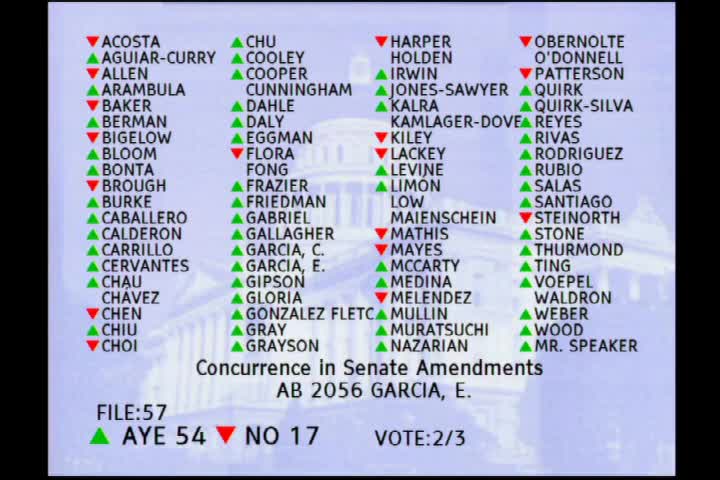
Bill Author


