AB 2063: California Financing Law: PACE program administrators.
- Session Year: 2017-2018
- House: Assembly
- Latest Version Date: 2018-09-27
(1)Existing law, known commonly as the Property Assessed Clean Energy (PACE) program, authorizes a public agency, by making specified findings, to authorize public agency officials and property owners to enter into voluntary contractual assessments to finance the installation of distributed generation renewable energy sources or energy or water efficiency improvements that are permanently fixed to real property.
Existing law, the California Financing Law (CFL), requires a program administrator who administers a PACE program on behalf of, and with the written consent of, a public agency to comply with specified requirements relating to the PACE program, including requiring, commencing on January 1, 2019, a program administrator to be licensed by the Commissioner of Business Oversight under the California Financing Law.
The CFL, commencing on January 1, 2019, requires a program administrator to establish and maintain a process for the enrollment, and for the cancellation of that enrollment, of a PACE solicitor and a PACE solicitor agent. The CFL defines the term PACE solicitor and PACE solicitor agent to not include specified persons.
This bill would clarify that the term PACE solicitor and PACE solicitor agent does not include a person who only solicits a property owner to enter into an assessment contract with a person who is not considered a program administrator within the meaning of the CFL. The bill would prohibit a person from engaging in the business of a PACE solicitor unless that person is enrolled with a program administrator. The bill would also require the program administrator to maintain the processes described above in a manner that is acceptable to the commissioner.
(2)The CFL requires a program administrator who administers a PACE program on behalf of, and with the written consent of, a public agency to comply with specified requirements relating to the PACE program, including requiring a program administrator to ensure criteria related to the assessment contract are satisfied before the contract is approved for recordation, including ensuring that the property owner has not been a party to any bankruptcy proceedings within the last 7 years and that the property owner is current on all mortgage debt on the subject property and has had no more than one late payment during the 12 months immediately preceding the application date, as provided.
This bill would, instead, prohibit a program administrator from executing an assessment contract, and would prohibit any work from commencing under a home improvement contract that is financed by that assessment contract and would prohibit that home improvement contract from being executed, unless the program administrator ensures that certain criteria related to that assessment contract are satisfied. The bill would revise the two criteria described above to require the program administrator to ensure that the property owner has not been a party to any bankruptcy proceeding within the last 4 years and to require the program administrator to ensure that the property owner is current on all mortgage debt on the subject property and has had no more than one late payment during the 6 months immediately preceding the application date.
(3)The CFL prohibits a program administrator from approving an assessment contract for funding and recording by a public agency unless the program administrator makes a reasonable good faith determination that the property owner has a reasonable ability to pay the PACE assessment, and requires that determination to include specified factors, including household income.
Existing law requires a public agency that administers a voluntary contractual assessment program under the PACE program to, with respect to each real property subject to an assessment, record a document that contains specified information related to the assessment, including, the names of all current owners of the real property subject to the assessment.
This bill would, instead, prohibit a program administrator from executing an assessment contract, and would prohibit any work from commencing under a home improvement contract that is financed by that assessment contract and would prohibit that home improvement contract from being executed, unless the program administrator makes a reasonable good faith determination that the property owner has a reasonable ability to pay the PACE assessment. The bill would authorize a program administrator when conducting this determination to utilize the income of a property owners legal spouse through marriage or domestic partnership who is not on title to the property, provided that person consents, in writing, to that effect. The bill would also provide that if the property owners legal spouse through marriage or domestic partner is used to determine the property owners income in that manner, then the public agency that administers the PACE assessment is required to include that persons name in the document recorded related to that assessment described above.
(4)The CFL requires the program administrator to be responsible for the difference between the determination of the property owner, who is obligated on the underlying home improvement contract, ability to pay the annual PACE obligations and the actual amount financed for the property owner, provided certain requirements are met.
This bill would require the program administrator in that instance to provide to the property owner a written disclosure of the methodology that the program administrator used to determine whether there was a difference between the property owners ability to pay the annual PACE obligation and the actual amount financed for the property owner. The bill would also provide that this requirement only applies to an assessment contract executed between April 1, 2018, and January 1, 2019.
(5)The CFL requires a program administrator to submit to the commissioner information beneficial to evaluating various aspects of the PACE program to be included in a specified annual report, and requires the commissioner to file an annual report with the department as a public record that is a composite of the annual reports and any comments on that report that the commissioner determines to be in the public interest. The CFL requires a program administrator to report annually to the commissioner all PACE assessments that were funded and recorded.
This bill would require the commissioner to include information on all PACE assessments that were funded and recorded into the annual composite report described above.
(6)This bill would make other clarifying changes to the provisions of the CFL relating to program administrators, PACE solicitors, and PACE solicitor agents.
(7)Existing law requires a program administrator to provide an oral confirmation of the key terms of an assessment contract with the property owner on the call, or his or her authorized representative, and to retain a copy of a recording of that confirmation for a period of 5 years after the recording is made. Existing law requires that oral confirmation to contain specified information.
This bill would also require the program administrator to include in the oral conformation that it is the responsibility of the property owner to contact the property owners home insurance provider to determine whether the efficiency improvement to be financed by the PACE assessment is covered by the property owners insurance plan.
(1)Existing law, known commonly as the Property Assessed Clean Energy (PACE) program, authorizes a public agency, by making specified findings, to authorize public agency officials and property owners to enter into voluntary contractual assessments to finance the installation of distributed generation renewable energy sources or energy or water efficiency improvements that are permanently fixed to real property.
Existing law, the California Financing Law (CFL), requires a program administrator who administers a PACE program on behalf of, and with the written consent of, a public agency to comply with specified requirements relating to the PACE program, including requiring, commencing on January 1, 2019, a program administrator to be licensed by the Commissioner of Business Oversight under the California Financing Law.
The CFL, commencing on January 1, 2019, requires a program administrator to establish and maintain a process for the enrollment, and for the cancellation of that enrollment, of a PACE solicitor and a PACE solicitor agent. The CFL defines the term PACE solicitor and PACE solicitor agent to not include specified persons.
This bill would clarify that the term PACE solicitor and PACE solicitor agent does not include a person who only solicits a property owner to enter into an assessment contract with a person who is not considered a program administrator within the meaning of the CFL. The bill would prohibit a person from engaging in the business of a PACE solicitor unless that person is enrolled with a program administrator. The bill would also require the program administrator to maintain the processes described above in a manner that is acceptable to the commissioner.
(2)The CFL requires a program administrator who administers a PACE program on behalf of, and with the written consent of, a public agency to comply with specified requirements relating to the PACE program, including requiring a program administrator to ensure criteria related to the assessment contract are satisfied before the contract is approved for recordation, including ensuring that the property owner has not been a party to any bankruptcy proceedings within the last 7 years and that the property owner is current on all mortgage debt on the subject property and has had no more than one late payment during the 12 months immediately preceding the application date, as provided.
This bill would, instead, prohibit a program administrator from executing an assessment contract, and would prohibit any work from commencing under a home improvement contract that is financed by that assessment contract and would prohibit that home improvement contract from being executed, unless the program administrator ensures that certain criteria related to that assessment contract are satisfied. The bill would revise the two criteria described above to require the program administrator to ensure that the property owner has not been a party to any bankruptcy proceeding within the last 4 years and to require the program administrator to ensure that the property owner is current on all mortgage debt on the subject property and has had no more than one late payment during the 6 months immediately preceding the application date.
(3)The CFL prohibits a program administrator from approving an assessment contract for funding and recording by a public agency unless the program administrator makes a reasonable good faith determination that the property owner has a reasonable ability to pay the PACE assessment, and requires that determination to include specified factors, including household income.
Existing law requires a public agency that administers a voluntary contractual assessment program under the PACE program to, with respect to each real property subject to an assessment, record a document that contains specified information related to the assessment, including, the names of all current owners of the real property subject to the assessment.
This bill would, instead, prohibit a program administrator from executing an assessment contract, and would prohibit any work from commencing under a home improvement contract that is financed by that assessment contract and would prohibit that home improvement contract from being executed, unless the program administrator makes a reasonable good faith determination that the property owner has a reasonable ability to pay the PACE assessment. The bill would authorize a program administrator when conducting this determination to utilize the income of a property owners legal spouse through marriage or domestic partnership who is not on title to the property, provided that person consents, in writing, to that effect. The bill would also provide that if the property owners legal spouse through marriage or domestic partner is used to determine the property owners income in that manner, then the public agency that administers the PACE assessment is required to include that persons name in the document recorded related to that assessment described above.
(4)The CFL requires the program administrator to be responsible for the difference between the determination of the property owner, who is obligated on the underlying home improvement contract, ability to pay the annual PACE obligations and the actual amount financed for the property owner, provided certain requirements are met.
This bill would require the program administrator in that instance to provide to the property owner a written disclosure of the methodology that the program administrator used to determine whether there was a difference between the property owners ability to pay the annual PACE obligation and the actual amount financed for the property owner. The bill would also provide that this requirement only applies to an assessment contract executed between April 1, 2018, and January 1, 2019.
(5)The CFL requires a program administrator to submit to the commissioner information beneficial to evaluating various aspects of the PACE program to be included in a specified annual report, and requires the commissioner to file an annual report with the department as a public record that is a composite of the annual reports and any comments on that report that the commissioner determines to be in the public interest. The CFL requires a program administrator to report annually to the commissioner all PACE assessments that were funded and recorded.
This bill would require the commissioner to include information on all PACE assessments that were funded and recorded into the annual composite report described above.
(6)This bill would make other clarifying changes to the provisions of the CFL relating to program administrators, PACE solicitors, and PACE solicitor agents.
(7)Existing law requires a program administrator to provide an oral confirmation of the key terms of an assessment contract with the property owner on the call, or his or her authorized representative, and to retain a copy of a recording of that confirmation for a period of 5 years after the recording is made. Existing law requires that oral confirmation to contain specified information.
This bill would also require the program administrator to include in the oral conformation that it is the responsibility of the property owner to contact the property owners home insurance provider to determine whether the efficiency improvement to be financed by the PACE assessment is covered by the property owners insurance plan.
(1)Existing law, known commonly as the Property Assessed Clean Energy (PACE) program, authorizes a public agency, by making specified findings, to authorize public agency officials and property owners to enter into voluntary contractual assessments to finance the installation of distributed generation renewable energy sources or energy or water efficiency improvements that are permanently fixed to real property.
Existing law, the California Financing Law (CFL), requires a program administrator who administers a PACE program on behalf of, and with the written consent of, a public agency to comply with specified requirements relating to the PACE program, including requiring, commencing on January 1, 2019, a program administrator to be licensed by the Commissioner of Business Oversight under the California Financing Law.
The CFL, commencing on January 1, 2019, requires a program administrator to establish and maintain a process for the enrollment, and for the cancellation of that enrollment, of a PACE solicitor and a PACE solicitor agent. The CFL defines the term PACE solicitor and PACE solicitor agent to not include specified persons.
This bill would clarify that the term PACE solicitor and PACE solicitor agent does not include a person who only solicits a property owner to enter into an assessment contract with a person who is not considered a program administrator within the meaning of the CFL. The bill would prohibit a person from engaging in the business of a PACE solicitor unless that person is enrolled with a program administrator. The bill would also require the program administrator to maintain the processes described above in a manner that is acceptable to the commissioner.
(2)The CFL requires a program administrator who administers a PACE program on behalf of, and with the written consent of, a public agency to comply with specified requirements relating to the PACE program, including requiring a program administrator to ensure criteria related to the assessment contract are satisfied before the contract is approved for recordation. recordation, including ensuring that the property owner has not been a party to any bankruptcy proceedings within the last 7 years and that the property owner is current on all mortgage debt on the subject property and has had no more than one late payment during the 12 months immediately preceding the application date, as provided.
This bill would, instead, prohibit a program administrator from executing an assessment contract, and would prohibit any work from commencing under a home improvement contract that is financed by that assessment contract and would prohibit that home improvement contract from being executed, unless the program administrator ensures that certain criteria related to that assessment contract are satisfied. The bill would revise the two criteria described above to require the program administrator to ensure that the property owner has not been a party to any bankruptcy proceeding within the last 4 years and to require the program administrator to ensure that the property owner is current on all mortgage debt on the subject property and has had no more than one late payment during the 6 months immediately preceding the application date.
(3)The CFL prohibits a program administrator from approving an assessment contract for funding and recording by a public agency unless the program administrator makes a reasonable good faith determination that the property owner has a reasonable ability to pay the PACE assessment, subject to specified requirements and procedures. and requires that determination to include specified factors, including household income.
Existing law requires a public agency that administers a voluntary contractual assessment program under the PACE program to, with respect to each real property subject to an assessment, record a document that contains specified information related to the assessment, including, the names of all current owners of the real property subject to the assessment.
This bill would, instead, prohibit a program administrator from executing an assessment contract, and would prohibit any work from commencing under a home improvement contract that is financed by that assessment contract and would prohibit that home improvement contract from being executed, unless the program administrator makes a reasonable good faith determination that the property owner has a reasonable ability to pay the PACE assessment. The bill would authorize a program administrator when conducting this determination to utilize the income of a property owners legal spouse through marriage or domestic partnership who is not on title to the property, provided that person consents, in writing, to that effect. The bill would also provide that if the property owners legal spouse through marriage or domestic partner is used to determine the property owners income in that manner, then the public agency that administers the PACE assessment is required to include that persons name in the document recorded related to that assessment described above.
(4)The CFL requires the program administrator to be responsible for the difference between the determination of the property owner, who is obligated on the underlying home improvement contract, ability to pay the annual PACE obligations and the actual amount financed for the property owner, provided certain requirements are met.
This bill would require the program administrator in that instance to provide to the property owner a written disclosure of the methodology that the program administrator used to determine whether there was a difference between the property owners ability to pay the annual PACE obligation and the actual amount financed for the property owner. The bill would also provide that this requirement only applies to an assessment contract executed between April 1, 2018, and January 1, 2019.
(5)The CFL requires a program administrator to submit to the commissioner information beneficial to evaluating various aspects of the PACE program to be included in a specified annual report, and requires the commissioner to file an annual report with the department as a public record that is a composite of the annual reports and any comments on that report that the commissioner determines to be in the public interest. The CFL requires a program administrator to report annually to the commissioner all PACE assessments that were funded and recorded.
This bill would require a program administrator the commissioner to include information on all PACE assessments that were funded and recorded into the annual composite report described above.
(6)This bill would make other clarifying changes to the provisions of the CFL relating to program administrators, PACE solicitors, and PACE solicitor agents.
(7)Existing law requires a program administrator to provide an oral confirmation of the key terms of an assessment contract with the property owner on the call, or his or her authorized representative, and to retain a copy of a recording of that confirmation for a period of 5 years after the recording is made. Existing law requires that oral confirmation to contain specified information.
This bill would also require the program administrator to include in the oral conformation that it is the responsibility of the property owner to contact the property owners home insurance provider to determine whether the efficiency improvement to be financed by the PACE assessment is covered by the property owners insurance plan.
(1)Existing law, known commonly as the Property Assessed Clean Energy (PACE) program, authorizes a public agency, by making specified findings, to authorize public agency officials and property owners to enter into voluntary contractual assessments to finance the installation of distributed generation renewable energy sources or energy or water efficiency improvements that are permanently fixed to real property.
Existing law, the California Financing Law (CFL), requires a program administrator who administers a PACE program on behalf of, and with the written consent of, a public agency to comply with specified requirements relating to the PACE program, including requiring, commencing on January 1, 2019, a program administrator to be licensed by the Commissioner of Business Oversight under the California Financing Law.
The CFL, commencing on January 1, 2019, requires a program administrator to establish and maintain a process for the enrollment, and for the cancellation of that enrollment, of a PACE solicitor and a PACE solicitor agent. The CFL defines the term PACE solicitor and PACE solicitor agent to not include specified persons.
This bill would clarify that the term PACE solicitor and PACE solicitor agent does not include a person who only solicits a property owner to enter into an assessment contract with a person who is not considered a program administrator within the meaning of the CFL. The bill would prohibit a person from engaging in the business of a PACE solicitor unless that person is enrolled with a program administrator. The bill would also require the program administrator to maintain the processes described above in a manner that is acceptable to the commissioner.
(2)The CFL requires a program administrator who administers a PACE program on behalf of, and with the written consent of, a public agency to comply with specified requirements relating to the PACE program, including requiring a program administrator to ensure criteria related to the assessment contract are satisfied before the contract is approved for recordation.
This bill would, instead, prohibit a program administrator from executing an assessment contract, and would prohibit any work from commencing under a home improvement contract that is financed by that assessment contract and would prohibit that home improvement contract from being executed, unless the program administrator ensures that certain criteria related to that assessment contract are satisfied.
(3)The CFL, commencing on April 1, 2018, CFL prohibits a program administrator from approving an assessment contract for funding and recording by a public agency unless the program administrator makes a reasonable good faith determination that the property owner has a reasonable ability to pay the PACE assessment, subject to specified requirements and procedures.
This bill would, instead, prohibit a program administrator from executing an assessment contract, and would prohibit any work from commencing under a home improvement contract that is financed by that assessment contract and would prohibit that home improvement contract from being executed, unless the program administrator makes a reasonable good faith determination that the property owner has a reasonable ability to pay the PACE assessment.
(4)The CFL, commencing on April 1, 2018, CFL requires the program administrator to be responsible for the difference between the determination of the property owner, who is obligated on the underlying home improvement contract, ability to pay the annual PACE obligations and the actual amount financed for the property owner, provided certain requirements are met.
This bill would require the program administrator in that instance to provide to the property owner a written disclosure of the methodology that the program administrator used to determine whether there was a difference between the property owners ability to pay the annual PACE obligation and the actual amount financed for the property owner. The bill would also provide that this requirement only applies to an assessment contract executed between April 1, 2018, and January 1, 2019.
(5)The CFL requires the commissioner to file an annual report with the department as a public record that is a composite of the annual reports and any comments on that report that the commissioner determines to be in the public interest. The CFL, commencing on April 1, 2018, CFL requires a program administrator to report annually to the commissioner all PACE assessments that were funded and recorded.
This bill would require a program administrator to include information on all PACE assessments that were funded and recorded into the annual composite report described above.
(6)This bill would make other clarifying changes to the provisions of the CFL relating to program administrators, PACE solicitors, and PACE solicitor agents.
(7)Existing law requires a program administrator to provide an oral confirmation of the key terms of an assessment contract with the property owner on the call, or his or her authorized representative, and to retain a copy of a recording of that confirmation for a period of 5 years after the recording is made. Existing law requires that oral confirmation to contain specified information.
This bill would also require the program administrator to include in the oral conformation that it is the responsibility of the property owner to contact the property owners home insurance provider to determine whether the efficiency improvement to be financed by the PACE assessment is covered by the property owners insurance plan.
(1)Existing law, known commonly as the Property Assessed Clean Energy (PACE) program, authorizes a public agency, by making specified findings, to authorize public agency officials and property owners to enter into voluntary contractual assessments to finance the installation of distributed generation renewable energy sources or energy or water efficiency improvements that are permanently fixed to real property.
Existing law, the California Financing Law (CFL), requires a program administrator who administers a PACE program on behalf of, and with the written consent of, a public agency to comply with specified requirements relating to the PACE program, including requiring, commencing on January 1, 2019, a program administrator to be licensed by the Commissioner of Business Oversight under the California Financing Law.
Existing law requires a program administrator to provide an oral confirmation of the key terms of an assessment contract with the property owner on the call, or his or her authorized representative, and to retain a copy of a recording of that confirmation for a period of five years after the recording is made. The CFL, commencing on January 1, 2019, requires a program administrator licensee to preserve certain records relating to a PACE assessment for at least 3 years after the extinguishment of that assessment is recorded in the program administrators records.This bill would, instead, require a program administrator licensee to preserve the records relating to a PACE assessment for at least 5 years after the extinguishment of that assessment is recorded in those records.(2)TheThe CFL, commencing on January 1, 2019, requires a program administrator to establish and maintain a process for the enrollment, and for the cancellation of that enrollment, of a PACE solicitor and a PACE solicitor agent.
This bill would prohibit a person from engaging in the business of a PACE solicitor unless that person is enrolled with a program administrator. The bill would also require the program administrator to maintain the processes described above in a manner that is acceptable to the commissioner.
(2)The CFL requires a program administrator who administers a PACE program on behalf of, and with the written consent of, a public agency to comply with specified requirements relating to the PACE program, including requiring a program administrator to ensure criteria related to the assessment contract are satisfied before the contract is approved for recordation.
This bill would, instead, prohibit a program administrator from executing an assessment contract, and would prohibit any work from commencing under a home improvement contract that is financed by that assessment contract and would prohibit that home improvement contract from being executed, unless the program administrator ensures that certain criteria related to that assessment contract are satisfied.
(3)The CFL, commencing on April 1, 2018, prohibits a program administrator from approving an assessment contract for funding and recording by a public agency unless the program administrator makes a reasonable good faith determination that the property owner has a reasonable ability to pay the PACE assessment, subject to specified requirements and procedures.
This bill would, instead, prohibit a program administrator from executing an assessment contract, and would prohibit any work from commencing under a home improvement contract that is financed by that assessment contract and would prohibit that home improvement contract from being executed, unless the program administrator makes a reasonable good faith determination that the property owner has a reasonable ability to pay the PACE assessment.
(4)The CFL, commencing on April 1, 2018, requires the program administrator to be responsible for the difference between the determination of the property owner, who is obligated on the underlying home improvement contract, ability to pay the annual PACE obligations and the actual amount financed for the property owner, provided certain requirements are met.
This bill would require the program administrator in that instance to provide to the property owner a written disclosure of the methodology that the program administrator used to determine whether there was a difference between the property owners ability to pay the annual PACE obligation and the actual amount financed for the property owner. The bill would also provide that this requirement only applies to an assessment contract executed between April 1, 2018, and January 1, 2019.
(3)(5)The CFL requires the commissioner to file an annual report with the department as a public record that is a composite of the annual reports and any comments on that report that the commissioner determines to be in the public interest. The CFL, commencing on April 1, 2018, requires a program administrator to report annually to the commissioner all PACE assessments that were funded and recorded.
This bill would require a program administrator to include information on all PACE assessments that were funded and recorded into the annual composite report described above.
(4)(6)This bill would make other clarifying changes to the provisions of the CFL relating to program administrators, PACE solicitors, and PACE solicitor agents.
(7)Existing law requires a program administrator to provide an oral confirmation of the key terms of an assessment contract with the property owner on the call, or his or her authorized representative, and to retain a copy of a recording of that confirmation for a period of 5 years after the recording is made. Existing law requires that oral confirmation to contain specified information.
This bill would also require the program administrator to include in the oral conformation that it is the responsibility of the property owner to contact the property owners home insurance provider to determine whether the efficiency improvement to be financed by the PACE assessment is covered by the property owners insurance plan.
(1)Existing law, known commonly as the Property Assessed Clean Energy (PACE) program, authorizes a public agency, by making specified findings, to authorize public agency officials and property owners to enter into voluntary contractual assessments to finance the installation of distributed generation renewable energy sources or energy or water efficiency improvements that are permanently fixed to real property.
Existing law, the California Financing Law (CFL), requires a program administrator who administers a PACE program on behalf of, and with the written consent of, a public agency to comply with specified requirements relating to the PACE program, including requiring, commencing on January 1, 2019, a program administrator to be licensed by the Commissioner of Business Oversight under the California Financing Law.
Existing law requires a program administrator to provide an oral confirmation of the key terms of an assessment contract with the property owner on the call, or his or her authorized representative, and to retain a copy of a recording of that confirmation for a period of five years after the recording is made. The CFL, commencing on January 1, 2019, requires a program administrator licensee to preserve certain records relating to a PACE assessment for at least 3 years after the extinguishment of that assessment is recorded in the program administrators records.
This bill would, instead, require a program administrator licensee to preserve the records relating to a PACE assessment for at least 5 years after the extinguishment of that assessment is recorded in those records.
(2)The CFL, commencing on January 1, 2019, requires a program administrator to establish and maintain a process for the enrollment, and for the cancellation of that enrollment, of a PACE solicitor and a PACE solicitor agent.
This bill would require the program administrator to maintain the processes described above in a manner that is acceptable to the commissioner.
(3)The CFL requires the commissioner to file an annual report with the department as a public record that is a composite of the annual reports and any comments on that report that the commissioner determines to be in the public interest. The CFL, commencing on April 1, 2018, requires a program administrator to report annually to the commissioner all PACE assessments that were funded and recorded.
This bill would require a program administrator to include information on all PACE assessments that were funded and recorded into the annual composite report described above.
(4)This bill would make other clarifying changes to the provisions of the CFL relating to program administrators, PACE solicitors, and PACE solicitor agents.
(a)PACE solicitor means a person authorized by a program administrator to solicit a property owner to enter into an assessment contract.
(b)PACE solicitor agent means an individual who is employed or retained by, and acts on behalf of, a PACE solicitor to solicit a property owner to enter into an assessment contract.
(c)PACE solicitor and PACE solicitor agent do not include any of the following:
(1)A person employed by a program administrator.
(2)A person, including a home improvement contractor or subcontractor, who does not solicit property owners to enter into assessment contracts.
(3)A person who performs purely administrative or clerical tasks.
(4)A person who advertises a PACE program, if the content of the advertising is created, prepared, or approved by a program administrator, and advertising is subject to, and in compliance with this division.
(5)A person who obtains information regarding prospective applicants for PACE financing, or who provides to a program administrator information regarding prospective applicants for PACE financing, if that information was not obtained in connection with advertising or soliciting a PACE program.
(6)A person who only solicits a property owner to enter into an assessment contract with a person who is not considered a program administrator within the meaning of subdivision (b) of Section 22018.
SEC. 2.Section 22018 of the Financial Code is amended to read:22018.(a)Program administrator means a person administering a PACE program on behalf of, and with the written consent of, a public agency. Program administrator does not include a public agency.
(b)For purposes of this division, program administrator does not include a person who meets both of the following conditions:
(1)The person does not administer a PACE program that provides financing for the installation of efficiency improvements on residential property with four or fewer units.
(2)The person does not administer a PACE program that provides financing for the installation of efficiency improvements on real property with a market value of less than one million dollars ($1,000,000).
SEC. 3.Section 22105 of the Financial Code, as added by Section 32 of Chapter 475 of the Statutes of 2017, is amended to read:22105.(a)Upon the filing of an application pursuant to Section 22101 and the payment of the fees, the commissioner shall investigate the applicant and its general partners and persons owning or controlling, directly or indirectly, 10 percent or more of the outstanding interests or any person responsible for the conduct of the applicants lending or program administration activities in this state, if the applicant is a partnership. If the applicant is a corporation, trust, limited liability company, or association, including an unincorporated organization, the commissioner shall investigate the applicant, its principal officers, directors, managing members, and persons owning or controlling, directly or indirectly, 10 percent or more of the outstanding equity securities or any person responsible for the conduct of the applicants lending activities or for administering PACE programs for the applicant in this state. Upon the filing of an application pursuant to Section 22102 and the payment of the fees, the commissioner shall investigate the person responsible for the lending activity of the licensee, or for administering one or more PACE programs for the licensee, at the new location described in the application. The investigation may be limited to information that was not included in prior applications filed pursuant to this division. If the commissioner determines that the applicant has satisfied this division and does not find facts constituting reasons for denial under Section 22109, the commissioner shall issue and deliver a license to the applicant.
(b)For the purposes of this section, principal officers shall mean president, chief executive officer, treasurer, and chief financial officer, as may be applicable, and any other officer with direct responsibility for the conduct of the applicants lending activities or for PACE program administration for the applicant within the state.
(c)This section shall become operative on January 1, 2019.
SEC. 4.Section 22157 of the Financial Code, as added by Section 54 of Chapter 475 of the Statutes of 2017, is amended to read:22157.(a)Finance lender, broker, and mortgage loan originator licensees shall preserve their books, accounts, and records, if any, for at least three years after making the final entry on any loan recorded therein.
(b)Except as otherwise specified by applicable law, including paragraph (3) of subdivision (b) of Section 5913 of the Streets and Highways Code, program administrator licensees shall preserve their books, accounts, and records for at least three years after the extinguishment of a PACE assessment is recorded therein.
(c)This section shall become operative on January 1, 2019.
SEC. 5.Section 22680 of the Financial Code is amended to read:22680.(a)A person shall not engage in the business of a PACE solicitor unless that person is enrolled with a program administrator pursuant to the requirements of this section.
(b)A program administrator shall establish and maintain a process for enrolling PACE solicitors that is acceptable to the commissioner. That process shall include both of the following:
(1)A written agreement between the program administrator and the PACE solicitor that shall set forth the obligations of the PACE solicitor and its PACE solicitor agents.
(2)A review of readily and publicly available information regarding each PACE solicitor.
(c)A program administrator shall establish and maintain a process for enrolling PACE solicitor agents that is acceptable to the commissioner. That process shall include a background check of each PACE solicitor agent. A program administrator may rely on a background check conducted by the Contractors State License Board to comply with this requirement.
(d)A program administrator shall not enroll a PACE solicitor or a PACE solicitor agent that does not satisfy at least one of the following criteria:
(1)Maintain in good standing a license from the Contractors State License Board.
(2)Maintain a registration in good standing with the Contractors State License Board as a home improvement salesperson.
(3)Be exempt from, or not subject to, licensure or registration under the Contractors State License Law (Chapter 9 (commencing with Section 7000) of Division 3 of the Business and Professions Code).
(e)A program administrator shall not enroll a PACE solicitor if, as a result of the review conducted as part of the program administrators enrollment process, the program administrator finds any of the following:
(1)A clear pattern of consumer complaints about the PACE solicitor regarding dishonesty, misrepresentations, or omissions.
(2)A high likelihood that the PACE solicitor will solicit assessment contracts in a manner that does not comply with applicable law.
(3)A clear pattern on the part of the PACE solicitor of failing to timely receive and respond to property owner complaints regarding the PACE solicitor.
(f)A program administrator shall establish and maintain a process to promote and evaluate the compliance of PACE solicitors and PACE solicitor agents with the requirements of applicable law that is acceptable to the commissioner. That process shall include all of the following, at a minimum:
(1)A risk-based, commercially reasonable procedure to monitor and test the compliance of PACE solicitors and PACE solicitor agents with the requirements of subdivision (a) of Section 22689.
(2)A procedure to regularly monitor the license or registration status of PACE solicitors and PACE solicitor agents.
(3)A periodic review of the solicitation activities of PACE solicitors enrolled with the program administrator, to be conducted at least once every two years.
(g)A program administrator shall establish and implement a process, which is acceptable to the commissioner, for canceling the enrollment of PACE solicitors and PACE solicitor agents who fail to maintain the minimum qualifications required by this section, or who violate any provision of this division.
SEC. 6.Section 22681 of the Financial Code is amended to read:22681.(a)A program administrator shall establish and maintain a training program for PACE solicitor agents that is acceptable to the commissioner.
(b)A program administrator shall require each PACE solicitor agent to complete an introductory training that addresses the topics listed in subdivision (c) as part of the program administrators enrollment process for PACE solicitor agents. The introductory training shall require that the PACE solicitor agent pass a test that measures the PACE solicitor agents knowledge and comprehension of the training material. The introductory training shall not be subject to any minimum duration requirements.
(c)In addition to the introductory training, a program administrator shall require that each PACE solicitor agent complete six hours of education provided by the program administrator within three months of completing the program administrators enrollment process. The training shall include the following topics:
(1)PACE programs and assessment contracts.
(2)PACE disclosures.
(3)Ethics.
(4)Fraud prevention.
(5)Consumer protection.
(6)Nondiscrimination.
(7)Senior financial abuse.
SEC. 7.Section 22682 of the Financial Code is amended to read:22682.(a)A program administrator shall, in the manner prescribed by the commissioner, timely notify the commissioner of each PACE solicitor and PACE solicitor agent enrolled by the program administrator.
(b)A program administrator shall, in the manner prescribed by the commissioner, timely notify the commissioner of each enrollment cancellation and withdrawal of a PACE solicitor or a PACE solicitor agent pursuant to subdivision (g) of Section 22680.
SEC. 8.Section 22684 of the Financial Code is amended to read:22684.A program administrator shall not execute an assessment contract, and no work shall commence under a home improvement contract that is financed by that assessment contract nor shall that home improvement contract be executed unless the following criteria are satisfied:
(a)All property taxes for the property that will be subject to the assessment contract are current. The program administrator shall ask a property owner whether there has been no more than one late payment of property taxes on the property for the previous three years or since the current owner acquired the property, whichever period is shorter.
(b)The property that will be subject to the assessment contract has no recorded and outstanding involuntary liens in excess of one thousand dollars ($1,000).
(c)The property that will be subject to the assessment contract has no notices of default currently recorded that have not been rescinded.
(d)The property owner has not been a party to any bankruptcy proceedings within the last four years, except that the property owner may have been party to a bankruptcy proceeding that was discharged or dismissed between two and four years before the application date and the property owner has had no payments more than 30 days past due on any mortgage debt or nonmortgage debt, excluding medical debt, during the 12 months immediately preceding the application date.
(e)The property owner is current on all mortgage debt on the subject property and has no more than one late payment during the six months immediately preceding the application date and if the late payment did not exceed 30 days past due.
(f)The property that will be subject to the assessment contract is within the geographical boundaries of the applicable PACE program.
(g)The measures to be installed pursuant to the assessment contract are eligible under the terms of the applicable PACE program.
(h)The financing is for less than 15 percent of the value of the property, up to the first seven hundred thousand dollars ($700,000) inclusive of the existing assessments, and is for less than 10 percent of the remaining value of the property above seven hundred thousand dollars ($700,000).
(i)The total PACE assessments and the mortgage-related debt on the property subject to the PACE assessment will not exceed 97 percent of the market value of the property as established by the valuation required by Section 22685.
(j)The term of the assessment contract shall not exceed the estimated useful life of the measure to which the greatest portion of funds disbursed under the assessment contract is attributable. The program administrator shall determine useful life for purposes of this subdivision based upon credible third-party standards or certification criteria that have been established by appropriate government agencies or nationally recognized standards and testing organizations.
(k)The program administrator shall verify the existence of recorded PACE assessments and shall ask if the property owner has authorized additional PACE assessments on the same subject property that have not yet been recorded. The failure of a property owner to comply with this subdivision shall not invalidate an assessment contract or any obligations thereunder, notwithstanding if the combined amount of the PACE assessments exceed the criteria set forth in subdivision (h) or (i). The existence of a prior PACE assessment or a prior assessment contract shall not constitute evidence that the assessment contract under consideration is affordable or meets any other program requirements.
(l)The program administrator shall use commercially reasonable and available methods to verify the above.
SEC. 9.Section 22686 of the Financial Code is amended to read:22686.A program administrator shall not execute an assessment contract, and no work shall commence under a home improvement contract that is financed by that assessment contract nor shall that home improvement contract be executed unless the program administrator makes a reasonable good faith determination that the property owner has a reasonable ability to pay the annual payment obligations for the PACE assessment.
SEC. 10.Section 22687 of the Financial Code is amended to read:22687.(a)A program administrator shall determine before executing an assessment contract, and no work shall commence under a home improvement contract that is financed by that assessment contract nor shall that home improvement contract be executed until this determination is made, that the property owner has a reasonable ability to pay the annual payment obligations for the PACE assessment based on the property owners income, assets, and current debt obligations. The determination process shall be based on the following factors:
(1)The property owner shall submit on their application their monthly income and their monthly housing expenses.
(2)Housing expenses shall include all mortgage principal and interest payments, insurance, property taxes, mortgage guaranty insurance, and other preexisting fees and assessments on the property.
(3)Household income shall include the income of the mortgagor on the subject property and may include the income of any persons 18 years of age or older who are on title to the property. In complying with this paragraph, the program administrator shall do both of the following:
(A)The program administrator may also utilize the income of a property owners legal spouse through marriage, as defined by Division 3 (commencing with Section 300) of the Family Code, or domestic partnership, as defined by Division 2.5 (commencing with Section 297) of the Family Code, who is not on title to the property. Any spouse or domestic partner who is not on title to the property shall consent, in writing, to the inclusion of his or her income and to the verification of his or income as required pursuant to this section.
(B)For any person whose income is considered, the program administrator shall also consider their debt obligations pursuant to this section. The program administrator is not required to consider more income than is necessary, nor to verify assets if verified income is sufficient to determine the ability of the property owner to pay the annual payment obligations.
(4)Debt obligations in accordance with subdivision (c).
(5)In evaluating the income, assets, and current debt obligations of the property owner, the program administrator shall not consider the equity of the property that will secure the assessment contract.
(6)Pursuant to Section 5913 of the Streets and Highways Code, the program administrator shall ask the homeowner open-ended questions during the oral confirmation of key terms call, to confirm the income provided on the application and to identify the sources of their income.
(b)(1)The program administrator shall determine and consider the current or reasonably expected income or assets of the property owner that the program administrator relies on in order to determine a property owners ability to pay the PACE assessment annual payment obligations using reasonably reliable third-party records of the property owners income or assets. The program administrator may use automated verification provided the source of that verification is specific to the income of the property owner and not based on predictive or estimation methodologies, and has been determined sufficient for those verification purposes by a federal mortgage lending authority or regulator. Examples of records the program administrator may use to verify the property owners income or assets include:
(A)A pay stub showing the most recent 30-day pay period or financial institution records showing regular deposits consistent with reported income for the most recent 60 days.
(B)Copies of the most recent tax returns the property owner filed with the Internal Revenue Service or the Franchise Tax Board.
(C)Copies of the most recent Internal Revenue Service Form W-2 (Wage and Tax Statement), or other similar Internal Revenue Service forms that are used for reporting wages or tax withholding.
(D)Payroll statements, including the Department of Defense Leave and Earnings Statement (LES).
(E)Financial institution records, such as bank statements or investment account statements reflecting the value of particular assets.
(F)Records from the property owners employer or a third party that obtained income information from the employer.
(G)Records from a federal, state, or local government agency stating the property owners income from benefits or entitlements. Income from benefits paid by a government entity shall not include any benefits for which the recipient must satisfy a means test or any cash equivalent nonmonetary benefits, such as food stamps.
(2)Income may not be derived from any of the following:
(A)Temporary sources of income.
(B)Nonliquid assets.
(C)Proceeds derived from the equity from the subject property.
(c)A program administrator shall consider the monthly debt obligations of the property owner to determine a property owners ability to pay the annual payment PACE assessment obligations using reasonably reliable third-party records, including one or more consumer credit reports from agencies that meet the requirements of Section 1681a(p) of Title 15 of the United States Code. Program administrators shall use at least a two-file Merged Credit Report (MCR) or a Residential Mortgage Credit Report (RMCR). For purposes of this subdivision, monthly debt obligations include, but are not limited to, the following:
(1)All secured and unsecured debt.
(2)Alimony.
(3)Child support.
(4)Monthly housing expenses. If property tax and insurance obligations are not included in a property owners escrow, a program administrator shall use reasonably reliable methods to determine these obligations.
(d)In calculating the ability of the property owner to pay the annual payment obligations, the program administrator shall determine that the property owners income is sufficient to meet:
(1)The PACE payment, including all interest and fees.
(2)Any mortgage payments, as defined by the higher of the borrowers self-reported housing payment or housing expenses determined in accordance with paragraphs (1) and (2) of subdivision (a).
(3)All existing debts and obligations as identified in subdivision (c).
(4)Sufficient residual income to meet basic household living expenses, defined as expected expenses which may be variable based on circumstances and consumption patterns of the household. A program administrator may make reasonable estimation of basic living expenses based on the number of persons in the household. Examples of basic living expenses include, but are not limited to, the following:
(A)Food and other necessary household consumables.
(B)Transportation costs to work or school, including fuel costs, auto insurance and maintenance costs, and public transit costs.
(C)Utilities expenses for telecommunication, water, sewage, electricity, and gas.
(e)In the case of emergency or immediate necessity, the requirements of paragraph (1) of subdivision (b) may be waived, in accordance with the requirements of Section 5940 of the Streets and Highways Code, for the funding and recordation of a PACE assessment to finance a heating, ventilation, and air conditioning (HVAC) system, boiler, or other system whose primary function is temperature regulation in a home if all of the following are met:
(1)The program administrator first attempted to use an automated means of verification as described in paragraph (1) of subdivision (b).
(2)If the program administrator was unable to verify the property owners income pursuant to paragraph (1) of subdivision (b), pursuant to Section 5913 of the Streets and Highways Code, the program administrator shall ask the property owner open-ended questions during the oral confirmation of key terms call to identify their income and the sources of their income. The program administrator shall comply with the requirements of subdivision (a), paragraph (2) of subdivision (b), and subdivisions (c) and (d).
(3)The funding is limited to the emergency or immediate necessity improvement and any required improvements directly necessary to the installation and safe operation of the improvement.
(4)Any efficiency improvement funded is eligible for PACE financing.
(5)The property owner executes a waiver of their right to cancel pursuant to subdivision (d) of Section 5940 of the Streets and Highways Code, and confirms, pursuant to Section 5913 of the Streets and Highways Code, the emergency or immediate necessity of the improvement.
(6)The amount of the assessment contract does not exceed fifteen thousand dollars ($15,000) or a monthly equivalent payment on the PACE assessment of one hundred twenty-five dollars ($125), as adjusted by any annual increase in the California Consumer Price Index as determined pursuant to Section 2212 of the Revenue and Taxation Code, whichever is greater.
(f)The program administrator shall report annually all PACE assessments that were funded and recorded pursuant to subdivision (e) in a form acceptable to the commissioner. The commissioner shall include this information in the annual composite report prepared in accordance with Section 22160.
(g)(1)If there is a difference between the determination of the property owners ability to pay the annual PACE obligations and the actual amount financed for the property owner, and the property owner is obligated on the underlying home improvement contract, the program administrator shall be responsible for that difference. This subdivision does not apply in a case of intentional misrepresentation by the property owner. If the program administrator is responsible to pay the difference under this subdivision, the program administrator shall provide to the property owner a written disclosure of the methodology that the program administrator used to determine whether that there was a difference between the property owners ability to pay the annual PACE obligation and the actual amount financed for the property owner for purposes of this subdivision.
(2)This subdivision only applies to an assessment contract that was executed between April 1, 2018, and January 1, 2019.
SEC. 11.Section 22689 of the Financial Code is amended to read:22689.(a)A program administrator shall not permit a PACE solicitor to do any of the following:
(1)Solicit a property owner to enter into an assessment contract with a program administrator, unless the PACE solicitor and the program administrator comply with the requirements of this chapter and any rules adopted by the commissioner.
(2)Engage in any act in violation of Section 5898.16 or 5898.17 of the Streets and Highways Code or Chapter 29.1 (commencing with Section 5900) of Part 3 of Division 7 of the Streets and Highways Code, including offering an assessment contract with terms, conditions, or disclosures that are not in compliance with applicable laws or that omits terms, conditions, or disclosures required by applicable law, excepting the reporting requirements of Section 5954 of the Streets and Highways Code.
(b)A program administrator shall be subject to the enforcement authority of the commissioner for any violations of this division, to the extent those violations have been committed by the program administrator or by a PACE solicitor authorized by that program administrator, in connection with activity related to that program administrator.
(c)A violation of any provision of Section 5898.16 or 5898.17 of the Streets and Highways Code or of any provision of Chapter 29.1 (commencing with Section 5900) of Part 3 of Division 7 of the Streets and Highways Code by a program administrator, excepting the reporting requirements of Section 5954 of the Streets and Highways Code, or by a PACE solicitor authorized by that program administrator in connection with activity related to that program administrator, shall be a violation of this division.
SEC. 12.Section 22691 of the Financial Code is amended to read:22691.The commissioner may by any rules he or she deems necessary or appropriate in the public interest or for the protection of property owners, either unconditionally or upon specified terms and conditions or for specified periods, exempt any class of persons specified in those rules from the provisions of Sections 22680, 22681, and 22682.
SEC. 13.Section 22693 of the Financial Code is amended to read:22693.(a)The commissioner may, by rule, require a program administrator to use a real-time registry or database system for tracking PACE assessments in order to carry out his or her regulatory duties and to support enforcement. That registry or database system shall enable the program administrator to trace PACE assessments and shall include, but not be limited to, features for providing or obtaining information about a propertys status with regard to PACE assessments placed on the property, whether recorded or not. All costs associated with the real-time registry or database system shall be apportioned among licensed program administrators based on the volume and amount of PACE assessments by each program administrator, or any other method that fairly apportions the costs, as required by rule. The commissioner may contract with an independent third party for the development and ongoing maintenance and support of the real-time registry or database system, and may require the program administrators to pay for the cost of development and ongoing maintenance and support directly to the independent third party. In no event shall the costs apportioned to a program administrator exceed a reasonable regulatory cost.
(b)On or before January 1, 2020, the commissioner shall determine whether to proceed with a rulemaking action. This subdivision shall not restrict the ability of the commissioner to proceed with a rule under this section at any time.
SEC. 14.Section 22716 of the Financial Code, as added by Section 83 of Chapter 475 of the Statutes of 2017, is amended to read:22716.(a)The revocation, suspension, expiration, or surrender of any license does not impair or affect the obligation of any preexisting lawful contract between the licensee and any borrower or property owner, nor the validity and enforceability of any bonds issued and secured by those contracts. This division does not affect the validity and enforceability of any PACE assessment contracts entered into or bonds issued and secured by those contracts.
(b)This section shall become operative on January 1, 2019.
SEC. 15.Section 5898.24 of the Streets and Highways Code is amended to read:5898.24.(a)A legislative body shall publish notice of a hearing pursuant to Section 6066 of the Government Code, and the first publication shall occur not later than 20 days before the date of the hearing.
(b)A legislative body shall provide written notice of a proposed contractual assessment program to all water or electric providers within the boundaries of the area within which voluntary contractual assessments may be entered into not less than 60 days prior to adoption of any resolution pursuant to Section 5898.26.
(c)(1)A legislative body administering a voluntary contractual assessment program shall designate an office, department, or bureau of the local agency that shall be responsible for annually preparing the current roll of assessment obligations by assessors parcel number on property subject to a voluntary contractual assessment.
(2)The designated office, department, or bureau shall establish procedures to promptly respond to inquiries concerning current and future estimated liability for a voluntary contractual assessment. Neither the designated office, department, or bureau, nor the legislative body, shall be liable if any estimate of future voluntary contractual assessment liability is inaccurate, nor for any failure of any seller to request notice pursuant to this chapter or to provide the notice to a buyer.
(d)For purposes of enabling sellers of real property subject to a voluntary contractual assessment to satisfy the notice requirements of Section 1102.6b of the Civil Code, the legislative body shall cause to be recorded in the office of the county recorder for the county in which the real property is located, concurrently with the instrument creating the voluntary contractual assessment, a separate document that meets all of the following requirements:
(1)The title of the document shall be Payment of Contractual Assessment Required in at least 14-point boldface type.
(2)The document shall include all of the following information:
(A)The names of all current owners of the real property subject to the contractual assessment and the legal description and assessors parcel number for the affected property. If a program administrator utilized the income of the property owners legal spouse or domestic partner who was not on title to the property to determine whether the property owner had a reasonable ability to pay the assessment pursuant to subparagraph (A) of paragraph (3) of subdivision (a) of Section 22687 of the Financial Code, the document shall also include the name of the property owners legal spouse or domestic partner.
(B)The annual amount of the contractual assessment.
(C)The date or circumstances under which the contractual assessment expires, or a statement that the assessment is perpetual.
(D)The purpose for which the funds from the contractual assessment will be used.
(E)The entity to which funds from the contractual assessment will be paid and specific contact information for that entity.
(F)The signature of the authorized representative of the legislative body to which funds from the contractual assessment will be paid.
(e)The recorder shall only be responsible for examining the document required by subdivision (d) and determining that it contains the information required by subparagraphs (A), (E), and (F) of paragraph (2) of subdivision (d). The recorder shall index the document under the names of the persons and entities identified in subparagraphs (A) and (E) of paragraph (2) of subdivision (d). The recorder shall not examine any other information contained in the document required by subdivision (d).
(f)In order to reduce the costs associated with contractual assessments, a legislative body may authorize the document described in subdivision (d) to be combined with the notice required by Section 5898.32, and recorded as a single document.
SEC. 16.Section 5913 of the Streets and Highways Code is amended to read:5913.(a)(1)Before a property owner executes an assessment contract the program administrator shall do the following:
(A)Make an oral confirmation that at least one owner of the property has a copy of the contract assessment documents required by paragraph (2) of subdivision (a) of Section 5898.20 or Section 5899 or 5899.3, or Section 53328.1 of the Government Code, as applicable, with all the key terms completed, the financing estimate and disclosure form specified in Section 5898.17, and the right to cancel form specified in Section 5898.16, with hard copies available upon request.
(B)Make an oral confirmation of the key terms of the assessment contract, in plain language, with the property owner on the call or to a verified authorized representative of the owner on the call and shall obtain acknowledgment from the property owner on the call to whom the oral confirmation is given.
(2)The oral confirmation required pursuant to paragraph (1) shall include, but is not limited to, all the following information:
(A)The property owner on the call has the right to have other persons present for the call, and an inquiry as to whether the property owner would like to exercise the right to include anyone else on the call. This shall occur at the onset of the call, after the determination of the preferred language of communication.
(B)The property owner on the call is informed that they should review the assessment contract and financing estimate and disclosure form with all other owners of the property.
(C)The efficiency improvement being installed is being financed by a PACE assessment.
(D)The total estimated annual costs the property owner will have to pay under the assessment contract, including applicable fees.
(E)The total estimated average monthly amount of funds the property owner would have to save in order to pay the annual costs under the PACE assessment, including applicable fees.
(F)That the county annual secured property tax bill, which will include the installment of the PACE lien, will be mailed by the county tax collector no later than November 1 each year, and that if the lien is recorded after the fiscal year closes but before the bill is mailed, the first installment may not appear on the county tax bill until the following year.
(G)The term of the assessment contract.
(H)That payments on the assessment contract will be made through an additional annual assessment on the property and paid either directly to the county tax collectors office as part of the total annual secured property tax bill, or through the property owners mortgage impound account, and that if the property owner pays his or her taxes through an impound account he or she should notify their mortgage lender to discuss adjusting his or her monthly mortgage payment by the estimated monthly cost of the PACE assessment.
(I)That the property will be subject to a lien during the term of the assessment contract and that the obligations under the assessment contract may be required to be paid in full before the property owner sells or refinances the property.
(J)That the property owner has disclosed whether the property has received or is seeking additional PACE assessments and has disclosed all other PACE assessments or special taxes that are or about to be placed on the property, if known to and understood by the property owner.
(K)That any potential utility savings are not guaranteed, and will not reduce the assessment payments or total assessment amount.
(L)That the program administrator and contractor do not provide tax advice, and that the property owner should seek professional tax advice if he or she has questions regarding tax credits, tax deductibility, or of other tax impacts on the PACE assessment or assessment contract.
(M)That if that property tax payment is delinquent within the fiscal year, the county tax collector will assess a 10-percent penalty and may assess related costs, as required by state law. A delinquent payment also subjects the property to foreclosure. If the delinquent payment continues past June 30 of a given year and defaults, the county tax collector will assess penalties at the rate of 1 12 percent per month (18 percent per year), and the property will continue to be subject to foreclosure and may become subject to the county tax collectors right to sell the property at auction.
(N)That the property owner has a three-business day right to cancel the assessment contract pursuant to subdivision (b) of Section 5898.16, and that canceling the assessment contract may also cancel the home improvement contract under Section 5940.
(O)That it is the responsibility of the property owner to contact the property owners home insurance provider to determine whether the efficiency improvement to be financed by the PACE assessment is covered by the property owners insurance plan.
(b)The program administrator shall comply with the following when giving the oral confirmation described in subdivision (a):
(1)The program administrator shall record the oral confirmation in an audio format in accordance with applicable laws.
(2)The program administrator may not comply with the requirement in subdivision (a) through the use of a prerecorded message, or other similar device or method.
(3)Recording of an oral confirmation shall be retained by the program administrator for a period of at least five years from the time of the recording.
(c)The provisions of this section shall be in addition to the documents required to be provided to the property owner under Sections 5898.16 and 5898.17.
(d)At the commencement of the oral confirmation, the program administrator shall ask if the property owner on the call would prefer to communicate during the oral confirmation primarily in a language other than English that is specified in Section 1632 of the Civil Code. If the preferred language is supported by the program administrator, the oral confirmation shall be given in that primary language, except where the property owner on the call chooses to communicate through his or her own interpreter. If the preferred language is not supported and an interpreter is not chosen by the property owner on the call, the PACE assessment transaction shall not proceed. For purposes of this subdivision, his or her own interpreter means a person, who is not a minor, is able to speak fluently and read with full understanding both the English language and any of the languages specified in Section 1632 of the Civil Code, and who is not employed by, and whose services are not made available through, the program administrator, the public agency, or the contractor.
(e)(1)Beginning on January 1, 2019, if the oral confirmation was conducted primarily in a language other than English that is specified in Section 1632 of the Civil Code, the program administrator shall deliver in writing the disclosures and contract or agreement required by law, including, but not limited to, the following:
(A)Assessment contract documents specified in paragraph (2) of subdivision (a) of Section 5898.20 or Section 5899 or 5899.3, or a special tax described in Section 53328.1 of the Government Code.
(B)The financing estimate and disclosure form specified in Section 5898.17.
(C)The right to cancel form specified in Section 5898.16.
(2)Before the execution of any contract or agreement described in paragraph (1), the program administrator shall deliver a translation of the disclosures, contract, or agreement in the language in which the oral confirmation was conducted, that includes a translation of every term and condition in that contract or agreement.
(a)PACE solicitor means a person authorized by a program administrator to solicit a property owner to enter into an assessment contract.
(b)PACE solicitor agent means an individual who is employed or retained by, and acts on behalf of, a PACE solicitor to solicit a property owner to enter into an assessment contract.
(c)PACE solicitor and PACE solicitor agent do not include any of the following:
(1)A person employed by a program administrator.
(2)A person, including a home improvement contractor or subcontractor, who does not solicit property owners to enter into assessment contracts.
(3)A person who performs purely administrative or clerical tasks.
(4)A person who advertises a PACE program, if the content of the advertising is created, prepared, or approved by a program administrator, and advertising is subject to, and in compliance with this division.
(5)A person who obtains information regarding prospective applicants for PACE financing, or who provides to a program administrator information regarding prospective applicants for PACE financing, if that information was not obtained in connection with advertising or soliciting a PACE program.
(6)A person who only solicits a property owner to enter into an assessment contract with a person who is not considered a program administrator within the meaning of subdivision (b) of Section 22018.
SEC. 2.Section 22018 of the Financial Code is amended to read:22018.(a)Program administrator means a person administering a PACE program on behalf of, and with the written consent of, a public agency. Program administrator does not include a public agency.
(b)For purposes of this division, program administrator does not include a person who meets both of the following conditions:
(1)The person does not administer a PACE program that provides financing for the installation of efficiency improvements on residential property with four or fewer units.
(2)The person does not administer a PACE program that provides financing for the installation of efficiency improvements on real property with a market value of less than one million dollars ($1,000,000).
SEC. 3.Section 22105 of the Financial Code, as added by Section 32 of Chapter 475 of the Statutes of 2017, is amended to read:22105.(a)Upon the filing of an application pursuant to Section 22101 and the payment of the fees, the commissioner shall investigate the applicant and its general partners and persons owning or controlling, directly or indirectly, 10 percent or more of the outstanding interests or any person responsible for the conduct of the applicants lending or program administration activities in this state, if the applicant is a partnership. If the applicant is a corporation, trust, limited liability company, or association, including an unincorporated organization, the commissioner shall investigate the applicant, its principal officers, directors, managing members, and persons owning or controlling, directly or indirectly, 10 percent or more of the outstanding equity securities or any person responsible for the conduct of the applicants lending activities or for administering PACE programs for the applicant in this state. Upon the filing of an application pursuant to Section 22102 and the payment of the fees, the commissioner shall investigate the person responsible for the lending activity of the licensee, or for administering one or more PACE programs for the licensee, at the new location described in the application. The investigation may be limited to information that was not included in prior applications filed pursuant to this division. If the commissioner determines that the applicant has satisfied this division and does not find facts constituting reasons for denial under Section 22109, the commissioner shall issue and deliver a license to the applicant.
(b)For the purposes of this section, principal officers shall mean president, chief executive officer, treasurer, and chief financial officer, as may be applicable, and any other officer with direct responsibility for the conduct of the applicants lending activities or for PACE program administration for the applicant within the state.
(c)This section shall become operative on January 1, 2019.
SEC. 4.Section 22157 of the Financial Code, as added by Section 54 of Chapter 475 of the Statutes of 2017, is amended to read:22157.(a)Finance lender, broker, and mortgage loan originator licensees shall preserve their books, accounts, and records, if any, for at least three years after making the final entry on any loan recorded therein.
(b)Except as otherwise specified by applicable law, including paragraph (3) of subdivision (b) of Section 5913 of the Streets and Highways Code, program administrator licensees shall preserve their books, accounts, and records for at least three years after the extinguishment of a PACE assessment is recorded therein.
(c)This section shall become operative on January 1, 2019.
SEC. 5.Section 22680 of the Financial Code is amended to read:22680.(a)A person shall not engage in the business of a PACE solicitor unless that person is enrolled with a program administrator pursuant to the requirements of this section.
(b)A program administrator shall establish and maintain a process for enrolling PACE solicitors that is acceptable to the commissioner. That process shall include both of the following:
(1)A written agreement between the program administrator and the PACE solicitor that shall set forth the obligations of the PACE solicitor and its PACE solicitor agents.
(2)A review of readily and publicly available information regarding each PACE solicitor.
(c)A program administrator shall establish and maintain a process for enrolling PACE solicitor agents that is acceptable to the commissioner. That process shall include a background check of each PACE solicitor agent. A program administrator may rely on a background check conducted by the Contractors State License Board to comply with this requirement.
(d)A program administrator shall not enroll a PACE solicitor or a PACE solicitor agent that does not satisfy at least one of the following criteria:
(1)Maintain in good standing a license from the Contractors State License Board.
(2)Maintain a registration in good standing with the Contractors State License Board as a home improvement salesperson.
(3)Be exempt from, or not subject to, licensure or registration under the Contractors State License Law (Chapter 9 (commencing with Section 7000) of Division 3 of the Business and Professions Code).
(e)A program administrator shall not enroll a PACE solicitor if, as a result of the review conducted as part of the program administrators enrollment process, the program administrator finds any of the following:
(1)A clear pattern of consumer complaints about the PACE solicitor regarding dishonesty, misrepresentations, or omissions.
(2)A high likelihood that the PACE solicitor will solicit assessment contracts in a manner that does not comply with applicable law.
(3)A clear pattern on the part of the PACE solicitor of failing to timely receive and respond to property owner complaints regarding the PACE solicitor.
(f)A program administrator shall establish and maintain a process to promote and evaluate the compliance of PACE solicitors and PACE solicitor agents with the requirements of applicable law that is acceptable to the commissioner. That process shall include all of the following, at a minimum:
(1)A risk-based, commercially reasonable procedure to monitor and test the compliance of PACE solicitors and PACE solicitor agents with the requirements of subdivision (a) of Section 22689.
(2)A procedure to regularly monitor the license or registration status of PACE solicitors and PACE solicitor agents.
(3)A periodic review of the solicitation activities of PACE solicitors enrolled with the program administrator, to be conducted at least once every two years.
(g)A program administrator shall establish and implement a process, which is acceptable to the commissioner, for canceling the enrollment of PACE solicitors and PACE solicitor agents who fail to maintain the minimum qualifications required by this section, or who violate any provision of this division.
SEC. 6.Section 22681 of the Financial Code is amended to read:22681.(a)A program administrator shall establish and maintain a training program for PACE solicitor agents that is acceptable to the commissioner.
(b)A program administrator shall require each PACE solicitor agent to complete an introductory training that addresses the topics listed in subdivision (c) as part of the program administrators enrollment process for PACE solicitor agents. The introductory training shall require that the PACE solicitor agent pass a test that measures the PACE solicitor agents knowledge and comprehension of the training material. The introductory training shall not be subject to any minimum duration requirements.
(c)In addition to the introductory training, a program administrator shall require that each PACE solicitor agent complete six hours of education provided by the program administrator within three months of completing the program administrators enrollment process. The training shall include the following topics:
(1)PACE programs and assessment contracts.
(2)PACE disclosures.
(3)Ethics.
(4)Fraud prevention.
(5)Consumer protection.
(6)Nondiscrimination.
(7)Senior financial abuse.
SEC. 7.Section 22682 of the Financial Code is amended to read:22682.(a)A program administrator shall, in the manner prescribed by the commissioner, timely notify the commissioner of each PACE solicitor and PACE solicitor agent enrolled by the program administrator.
(b)A program administrator shall, in the manner prescribed by the commissioner, timely notify the commissioner of each enrollment cancellation and withdrawal of a PACE solicitor or a PACE solicitor agent pursuant to subdivision (g) of Section 22680.
SEC. 8.Section 22684 of the Financial Code is amended to read:22684.A program administrator shall not execute an assessment contract, and no work shall commence under a home improvement contract that is financed by that assessment contract nor shall that home improvement contract be executed unless the following criteria are satisfied:
(a)All property taxes for the property that will be subject to the assessment contract are current. The program administrator shall ask a property owner whether there has been no more than one late payment of property taxes on the property for the previous three years or since the current owner acquired the property, whichever period is shorter.
(b)The property that will be subject to the assessment contract has no recorded and outstanding involuntary liens in excess of one thousand dollars ($1,000).
(c)The property that will be subject to the assessment contract has no notices of default currently recorded that have not been rescinded.
(d)The property owner has not been a party to any bankruptcy proceedings within the last four years, except that the property owner may have been party to a bankruptcy proceeding that was discharged or dismissed between two and four years before the application date and the property owner has had no payments more than 30 days past due on any mortgage debt or nonmortgage debt, excluding medical debt, during the 12 months immediately preceding the application date.
(e)The property owner is current on all mortgage debt on the subject property and has no more than one late payment during the six months immediately preceding the application date and if the late payment did not exceed 30 days past due.
(f)The property that will be subject to the assessment contract is within the geographical boundaries of the applicable PACE program.
(g)The measures to be installed pursuant to the assessment contract are eligible under the terms of the applicable PACE program.
(h)The financing is for less than 15 percent of the value of the property, up to the first seven hundred thousand dollars ($700,000) inclusive of the existing assessments, and is for less than 10 percent of the remaining value of the property above seven hundred thousand dollars ($700,000).
(i)The total PACE assessments and the mortgage-related debt on the property subject to the PACE assessment will not exceed 97 percent of the market value of the property as established by the valuation required by Section 22685.
(j)The term of the assessment contract shall not exceed the estimated useful life of the measure to which the greatest portion of funds disbursed under the assessment contract is attributable. The program administrator shall determine useful life for purposes of this subdivision based upon credible third-party standards or certification criteria that have been established by appropriate government agencies or nationally recognized standards and testing organizations.
(k)The program administrator shall verify the existence of recorded PACE assessments and shall ask if the property owner has authorized additional PACE assessments on the same subject property that have not yet been recorded. The failure of a property owner to comply with this subdivision shall not invalidate an assessment contract or any obligations thereunder, notwithstanding if the combined amount of the PACE assessments exceed the criteria set forth in subdivision (h) or (i). The existence of a prior PACE assessment or a prior assessment contract shall not constitute evidence that the assessment contract under consideration is affordable or meets any other program requirements.
(l)The program administrator shall use commercially reasonable and available methods to verify the above.
SEC. 9.Section 22686 of the Financial Code is amended to read:22686.A program administrator shall not execute an assessment contract, and no work shall commence under a home improvement contract that is financed by that assessment contract nor shall that home improvement contract be executed unless the program administrator makes a reasonable good faith determination that the property owner has a reasonable ability to pay the annual payment obligations for the PACE assessment.
SEC. 10.Section 22687 of the Financial Code is amended to read:22687.(a)A program administrator shall determine before executing an assessment contract, and no work shall commence under a home improvement contract that is financed by that assessment contract nor shall that home improvement contract be executed until this determination is made, that the property owner has a reasonable ability to pay the annual payment obligations for the PACE assessment based on the property owners income, assets, and current debt obligations. The determination process shall be based on the following factors:
(1)The property owner shall submit on their application their monthly income and their monthly housing expenses.
(2)Housing expenses shall include all mortgage principal and interest payments, insurance, property taxes, mortgage guaranty insurance, and other preexisting fees and assessments on the property.
(3)Household income shall include the income of the mortgagor on the subject property and may include the income of any persons 18 years of age or older who are on title to the property. In complying with this paragraph, the program administrator shall do both of the following:
(A)The program administrator may also utilize the income of a property owners legal spouse through marriage, as defined by Division 3 (commencing with Section 300) of the Family Code, or domestic partnership, as defined by Division 2.5 (commencing with Section 297) of the Family Code, who is not on title to the property. Any spouse or domestic partner who is not on title to the property shall consent, in writing, to the inclusion of his or her income and to the verification of his or income as required pursuant to this section.
(B)For any person whose income is considered, the program administrator shall also consider their debt obligations pursuant to this section. The program administrator is not required to consider more income than is necessary, nor to verify assets if verified income is sufficient to determine the ability of the property owner to pay the annual payment obligations.
(4)Debt obligations in accordance with subdivision (c).
(5)In evaluating the income, assets, and current debt obligations of the property owner, the program administrator shall not consider the equity of the property that will secure the assessment contract.
(6)Pursuant to Section 5913 of the Streets and Highways Code, the program administrator shall ask the homeowner open-ended questions during the oral confirmation of key terms call, to confirm the income provided on the application and to identify the sources of their income.
(b)(1)The program administrator shall determine and consider the current or reasonably expected income or assets of the property owner that the program administrator relies on in order to determine a property owners ability to pay the PACE assessment annual payment obligations using reasonably reliable third-party records of the property owners income or assets. The program administrator may use automated verification provided the source of that verification is specific to the income of the property owner and not based on predictive or estimation methodologies, and has been determined sufficient for those verification purposes by a federal mortgage lending authority or regulator. Examples of records the program administrator may use to verify the property owners income or assets include:
(A)A pay stub showing the most recent 30-day pay period or financial institution records showing regular deposits consistent with reported income for the most recent 60 days.
(B)Copies of the most recent tax returns the property owner filed with the Internal Revenue Service or the Franchise Tax Board.
(C)Copies of the most recent Internal Revenue Service Form W-2 (Wage and Tax Statement), or other similar Internal Revenue Service forms that are used for reporting wages or tax withholding.
(D)Payroll statements, including the Department of Defense Leave and Earnings Statement (LES).
(E)Financial institution records, such as bank statements or investment account statements reflecting the value of particular assets.
(F)Records from the property owners employer or a third party that obtained income information from the employer.
(G)Records from a federal, state, or local government agency stating the property owners income from benefits or entitlements. Income from benefits paid by a government entity shall not include any benefits for which the recipient must satisfy a means test or any cash equivalent nonmonetary benefits, such as food stamps.
(2)Income may not be derived from any of the following:
(A)Temporary sources of income.
(B)Nonliquid assets.
(C)Proceeds derived from the equity from the subject property.
(c)A program administrator shall consider the monthly debt obligations of the property owner to determine a property owners ability to pay the annual payment PACE assessment obligations using reasonably reliable third-party records, including one or more consumer credit reports from agencies that meet the requirements of Section 1681a(p) of Title 15 of the United States Code. Program administrators shall use at least a two-file Merged Credit Report (MCR) or a Residential Mortgage Credit Report (RMCR). For purposes of this subdivision, monthly debt obligations include, but are not limited to, the following:
(1)All secured and unsecured debt.
(2)Alimony.
(3)Child support.
(4)Monthly housing expenses. If property tax and insurance obligations are not included in a property owners escrow, a program administrator shall use reasonably reliable methods to determine these obligations.
(d)In calculating the ability of the property owner to pay the annual payment obligations, the program administrator shall determine that the property owners income is sufficient to meet:
(1)The PACE payment, including all interest and fees.
(2)Any mortgage payments, as defined by the higher of the borrowers self-reported housing payment or housing expenses determined in accordance with paragraphs (1) and (2) of subdivision (a).
(3)All existing debts and obligations as identified in subdivision (c).
(4)Sufficient residual income to meet basic household living expenses, defined as expected expenses which may be variable based on circumstances and consumption patterns of the household. A program administrator may make reasonable estimation of basic living expenses based on the number of persons in the household. Examples of basic living expenses include, but are not limited to, the following:
(A)Food and other necessary household consumables.
(B)Transportation costs to work or school, including fuel costs, auto insurance and maintenance costs, and public transit costs.
(C)Utilities expenses for telecommunication, water, sewage, electricity, and gas.
(e)In the case of emergency or immediate necessity, the requirements of paragraph (1) of subdivision (b) may be waived, in accordance with the requirements of Section 5940 of the Streets and Highways Code, for the funding and recordation of a PACE assessment to finance a heating, ventilation, and air conditioning (HVAC) system, boiler, or other system whose primary function is temperature regulation in a home if all of the following are met:
(1)The program administrator first attempted to use an automated means of verification as described in paragraph (1) of subdivision (b).
(2)If the program administrator was unable to verify the property owners income pursuant to paragraph (1) of subdivision (b), pursuant to Section 5913 of the Streets and Highways Code, the program administrator shall ask the property owner open-ended questions during the oral confirmation of key terms call to identify their income and the sources of their income. The program administrator shall comply with the requirements of subdivision (a), paragraph (2) of subdivision (b), and subdivisions (c) and (d).
(3)The funding is limited to the emergency or immediate necessity improvement and any required improvements directly necessary to the installation and safe operation of the improvement.
(4)Any efficiency improvement funded is eligible for PACE financing.
(5)The property owner executes a waiver of their right to cancel pursuant to subdivision (d) of Section 5940 of the Streets and Highways Code, and confirms, pursuant to Section 5913 of the Streets and Highways Code, the emergency or immediate necessity of the improvement.
(6)The amount of the assessment contract does not exceed fifteen thousand dollars ($15,000) or a monthly equivalent payment on the PACE assessment of one hundred twenty-five dollars ($125), as adjusted by any annual increase in the California Consumer Price Index as determined pursuant to Section 2212 of the Revenue and Taxation Code, whichever is greater.
(f)The program administrator shall report annually all PACE assessments that were funded and recorded pursuant to subdivision (e) in a form acceptable to the commissioner. The commissioner shall include this information in the annual composite report prepared in accordance with Section 22160.
(g)(1)If there is a difference between the determination of the property owners ability to pay the annual PACE obligations and the actual amount financed for the property owner, and the property owner is obligated on the underlying home improvement contract, the program administrator shall be responsible for that difference. This subdivision does not apply in a case of intentional misrepresentation by the property owner. If the program administrator is responsible to pay the difference under this subdivision, the program administrator shall provide to the property owner a written disclosure of the methodology that the program administrator used to determine whether that there was a difference between the property owners ability to pay the annual PACE obligation and the actual amount financed for the property owner for purposes of this subdivision.
(2)This subdivision only applies to an assessment contract that was executed between April 1, 2018, and January 1, 2019.
SEC. 11.Section 22689 of the Financial Code is amended to read:22689.(a)A program administrator shall not permit a PACE solicitor to do any of the following:
(1)Solicit a property owner to enter into an assessment contract with a program administrator, unless the PACE solicitor and the program administrator comply with the requirements of this chapter and any rules adopted by the commissioner.
(2)Engage in any act in violation of Section 5898.16 or 5898.17 of the Streets and Highways Code or Chapter 29.1 (commencing with Section 5900) of Part 3 of Division 7 of the Streets and Highways Code, including offering an assessment contract with terms, conditions, or disclosures that are not in compliance with applicable laws or that omits terms, conditions, or disclosures required by applicable law, excepting the reporting requirements of Section 5954 of the Streets and Highways Code.
(b)A program administrator shall be subject to the enforcement authority of the commissioner for any violations of this division, to the extent those violations have been committed by the program administrator or by a PACE solicitor authorized by that program administrator, in connection with activity related to that program administrator.
(c)A violation of any provision of Section 5898.16 or 5898.17 of the Streets and Highways Code or of any provision of Chapter 29.1 (commencing with Section 5900) of Part 3 of Division 7 of the Streets and Highways Code by a program administrator, excepting the reporting requirements of Section 5954 of the Streets and Highways Code, or by a PACE solicitor authorized by that program administrator in connection with activity related to that program administrator, shall be a violation of this division.
SEC. 12.Section 22691 of the Financial Code is amended to read:22691.The commissioner may by any rules he or she deems necessary or appropriate in the public interest or for the protection of property owners, either unconditionally or upon specified terms and conditions or for specified periods, exempt any class of persons specified in those rules from the provisions of Sections 22680, 22681, and 22682.
SEC. 13.Section 22693 of the Financial Code is amended to read:22693.(a)The commissioner may, by rule, require a program administrator to use a real-time registry or database system for tracking PACE assessments in order to carry out his or her regulatory duties and to support enforcement. That registry or database system shall enable the program administrator to trace PACE assessments and shall include, but not be limited to, features for providing or obtaining information about a propertys status with regard to PACE assessments placed on the property, whether recorded or not. All costs associated with the real-time registry or database system shall be apportioned among licensed program administrators based on the volume and amount of PACE assessments by each program administrator, or any other method that fairly apportions the costs, as required by rule. The commissioner may contract with an independent third party for the development and ongoing maintenance and support of the real-time registry or database system, and may require the program administrators to pay for the cost of development and ongoing maintenance and support directly to the independent third party. In no event shall the costs apportioned to a program administrator exceed a reasonable regulatory cost.
(b)On or before January 1, 2020, the commissioner shall determine whether to proceed with a rulemaking action. This subdivision shall not restrict the ability of the commissioner to proceed with a rule under this section at any time.
SEC. 14.Section 22716 of the Financial Code, as added by Section 83 of Chapter 475 of the Statutes of 2017, is amended to read:22716.(a)The revocation, suspension, expiration, or surrender of any license does not impair or affect the obligation of any preexisting lawful contract between the licensee and any borrower or property owner, nor the validity and enforceability of any bonds issued and secured by those contracts. This division does not affect the validity and enforceability of any PACE assessment contracts entered into or bonds issued and secured by those contracts.
(b)This section shall become operative on January 1, 2019.
SEC. 15.Section 5898.24 of the Streets and Highways Code is amended to read:5898.24.(a)A legislative body shall publish notice of a hearing pursuant to Section 6066 of the Government Code, and the first publication shall occur not later than 20 days before the date of the hearing.
(b)A legislative body shall provide written notice of a proposed contractual assessment program to all water or electric providers within the boundaries of the area within which voluntary contractual assessments may be entered into not less than 60 days prior to adoption of any resolution pursuant to Section 5898.26.
(c)(1)A legislative body administering a voluntary contractual assessment program shall designate an office, department, or bureau of the local agency that shall be responsible for annually preparing the current roll of assessment obligations by assessors parcel number on property subject to a voluntary contractual assessment.
(2)The designated office, department, or bureau shall establish procedures to promptly respond to inquiries concerning current and future estimated liability for a voluntary contractual assessment. Neither the designated office, department, or bureau, nor the legislative body, shall be liable if any estimate of future voluntary contractual assessment liability is inaccurate, nor for any failure of any seller to request notice pursuant to this chapter or to provide the notice to a buyer.
(d)For purposes of enabling sellers of real property subject to a voluntary contractual assessment to satisfy the notice requirements of Section 1102.6b of the Civil Code, the legislative body shall cause to be recorded in the office of the county recorder for the county in which the real property is located, concurrently with the instrument creating the voluntary contractual assessment, a separate document that meets all of the following requirements:
(1)The title of the document shall be Payment of Contractual Assessment Required in at least 14-point boldface type.
(2)The document shall include all of the following information:
(A)The names of all current owners of the real property subject to the contractual assessment and the legal description and assessors parcel number for the affected property. If a program administrator utilized the income of the property owners legal spouse or domestic partner who was not on title to the property to determine whether the property owner had a reasonable ability to pay the assessment pursuant to subparagraph (A) of paragraph (3) of subdivision (a) of Section 22687 of the Financial Code, the document shall also include the name of the property owners legal spouse or domestic partner.
(B)The annual amount of the contractual assessment.
(C)The date or circumstances under which the contractual assessment expires, or a statement that the assessment is perpetual.
(D)The purpose for which the funds from the contractual assessment will be used.
(E)The entity to which funds from the contractual assessment will be paid and specific contact information for that entity.
(F)The signature of the authorized representative of the legislative body to which funds from the contractual assessment will be paid.
(e)The recorder shall only be responsible for examining the document required by subdivision (d) and determining that it contains the information required by subparagraphs (A), (E), and (F) of paragraph (2) of subdivision (d). The recorder shall index the document under the names of the persons and entities identified in subparagraphs (A) and (E) of paragraph (2) of subdivision (d). The recorder shall not examine any other information contained in the document required by subdivision (d).
(f)In order to reduce the costs associated with contractual assessments, a legislative body may authorize the document described in subdivision (d) to be combined with the notice required by Section 5898.32, and recorded as a single document.
SEC. 16.Section 5913 of the Streets and Highways Code is amended to read:5913.(a)(1)Before a property owner executes an assessment contract the program administrator shall do the following:
(A)Make an oral confirmation that at least one owner of the property has a copy of the contract assessment documents required by paragraph (2) of subdivision (a) of Section 5898.20 or Section 5899 or 5899.3, or Section 53328.1 of the Government Code, as applicable, with all the key terms completed, the financing estimate and disclosure form specified in Section 5898.17, and the right to cancel form specified in Section 5898.16, with hard copies available upon request.
(B)Make an oral confirmation of the key terms of the assessment contract, in plain language, with the property owner on the call or to a verified authorized representative of the owner on the call and shall obtain acknowledgment from the property owner on the call to whom the oral confirmation is given.
(2)The oral confirmation required pursuant to paragraph (1) shall include, but is not limited to, all the following information:
(A)The property owner on the call has the right to have other persons present for the call, and an inquiry as to whether the property owner would like to exercise the right to include anyone else on the call. This shall occur at the onset of the call, after the determination of the preferred language of communication.
(B)The property owner on the call is informed that they should review the assessment contract and financing estimate and disclosure form with all other owners of the property.
(C)The efficiency improvement being installed is being financed by a PACE assessment.
(D)The total estimated annual costs the property owner will have to pay under the assessment contract, including applicable fees.
(E)The total estimated average monthly amount of funds the property owner would have to save in order to pay the annual costs under the PACE assessment, including applicable fees.
(F)That the county annual secured property tax bill, which will include the installment of the PACE lien, will be mailed by the county tax collector no later than November 1 each year, and that if the lien is recorded after the fiscal year closes but before the bill is mailed, the first installment may not appear on the county tax bill until the following year.
(G)The term of the assessment contract.
(H)That payments on the assessment contract will be made through an additional annual assessment on the property and paid either directly to the county tax collectors office as part of the total annual secured property tax bill, or through the property owners mortgage impound account, and that if the property owner pays his or her taxes through an impound account he or she should notify their mortgage lender to discuss adjusting his or her monthly mortgage payment by the estimated monthly cost of the PACE assessment.
(I)That the property will be subject to a lien during the term of the assessment contract and that the obligations under the assessment contract may be required to be paid in full before the property owner sells or refinances the property.
(J)That the property owner has disclosed whether the property has received or is seeking additional PACE assessments and has disclosed all other PACE assessments or special taxes that are or about to be placed on the property, if known to and understood by the property owner.
(K)That any potential utility savings are not guaranteed, and will not reduce the assessment payments or total assessment amount.
(L)That the program administrator and contractor do not provide tax advice, and that the property owner should seek professional tax advice if he or she has questions regarding tax credits, tax deductibility, or of other tax impacts on the PACE assessment or assessment contract.
(M)That if that property tax payment is delinquent within the fiscal year, the county tax collector will assess a 10-percent penalty and may assess related costs, as required by state law. A delinquent payment also subjects the property to foreclosure. If the delinquent payment continues past June 30 of a given year and defaults, the county tax collector will assess penalties at the rate of 1 12 percent per month (18 percent per year), and the property will continue to be subject to foreclosure and may become subject to the county tax collectors right to sell the property at auction.
(N)That the property owner has a three-business day right to cancel the assessment contract pursuant to subdivision (b) of Section 5898.16, and that canceling the assessment contract may also cancel the home improvement contract under Section 5940.
(O)That it is the responsibility of the property owner to contact the property owners home insurance provider to determine whether the efficiency improvement to be financed by the PACE assessment is covered by the property owners insurance plan.
(b)The program administrator shall comply with the following when giving the oral confirmation described in subdivision (a):
(1)The program administrator shall record the oral confirmation in an audio format in accordance with applicable laws.
(2)The program administrator may not comply with the requirement in subdivision (a) through the use of a prerecorded message, or other similar device or method.
(3)Recording of an oral confirmation shall be retained by the program administrator for a period of at least five years from the time of the recording.
(c)The provisions of this section shall be in addition to the documents required to be provided to the property owner under Sections 5898.16 and 5898.17.
(d)At the commencement of the oral confirmation, the program administrator shall ask if the property owner on the call would prefer to communicate during the oral confirmation primarily in a language other than English that is specified in Section 1632 of the Civil Code. If the preferred language is supported by the program administrator, the oral confirmation shall be given in that primary language, except where the property owner on the call chooses to communicate through his or her own interpreter. If the preferred language is not supported and an interpreter is not chosen by the property owner on the call, the PACE assessment transaction shall not proceed. For purposes of this subdivision, his or her own interpreter means a person, who is not a minor, is able to speak fluently and read with full understanding both the English language and any of the languages specified in Section 1632 of the Civil Code, and who is not employed by, and whose services are not made available through, the program administrator, the public agency, or the contractor.
(e)(1)Beginning on January 1, 2019, if the oral confirmation was conducted primarily in a language other than English that is specified in Section 1632 of the Civil Code, the program administrator shall deliver in writing the disclosures and contract or agreement required by law, including, but not limited to, the following:
(A)Assessment contract documents specified in paragraph (2) of subdivision (a) of Section 5898.20 or Section 5899 or 5899.3, or a special tax described in Section 53328.1 of the Government Code.
(B)The financing estimate and disclosure form specified in Section 5898.17.
(C)The right to cancel form specified in Section 5898.16.
(2)Before the execution of any contract or agreement described in paragraph (1), the program administrator shall deliver a translation of the disclosures, contract, or agreement in the language in which the oral confirmation was conducted, that includes a translation of every term and condition in that contract or agreement.
(a)PACE solicitor means a person authorized by a program administrator to solicit a property owner to enter into an assessment contract.
(b)PACE solicitor agent means an individual who is employed or retained by, and acts on behalf of, a PACE solicitor to solicit a property owner to enter into an assessment contract.
(c)PACE solicitor and PACE solicitor agent do not include any of the following:
(1)A person employed by a program administrator.
(2)A person, including a home improvement contractor or subcontractor, who does not solicit property owners to enter into assessment contracts.
(3)A person who performs purely administrative or clerical tasks.
(4)A person who advertises a PACE program, if the content of the advertising is created, prepared, or approved by a program administrator, and advertising is subject to, and in compliance with this division.
(5)A person who obtains information regarding prospective applicants for PACE financing, or who provides to a program administrator information regarding prospective applicants for PACE financing, if that information was not obtained in connection with advertising or soliciting a PACE program.
(6)A person who only solicits a property owner to enter into an assessment contract with a person who is not considered a program administrator within the meaning of subdivision (b) of Section 22018.
SEC. 2.Section 22018 of the Financial Code is amended to read:22018.(a)Program administrator means a person administering a PACE program on behalf of, and with the written consent of, a public agency. Program administrator does not include a public agency.
(b)For purposes of this division, program administrator does not include a person who meets both of the following conditions:
(1)The person does not administer a PACE program that provides financing for the installation of efficiency improvements on residential property with four or fewer units.
(2)The person does not administer a PACE program that provides financing for the installation of efficiency improvements on real property with a market value of less than one million dollars ($1,000,000).
SEC. 3.Section 22105 of the Financial Code, as added by Section 32 of Chapter 475 of the Statutes of 2017, is amended to read:22105.(a)Upon the filing of an application pursuant to Section 22101 and the payment of the fees, the commissioner shall investigate the applicant and its general partners and persons owning or controlling, directly or indirectly, 10 percent or more of the outstanding interests or any person responsible for the conduct of the applicants lending or program administration activities in this state, if the applicant is a partnership. If the applicant is a corporation, trust, limited liability company, or association, including an unincorporated organization, the commissioner shall investigate the applicant, its principal officers, directors, managing members, and persons owning or controlling, directly or indirectly, 10 percent or more of the outstanding equity securities or any person responsible for the conduct of the applicants lending activities or for administering PACE programs for the applicant in this state. Upon the filing of an application pursuant to Section 22102 and the payment of the fees, the commissioner shall investigate the person responsible for the lending activity of the licensee, or for administering one or more PACE programs for the licensee, at the new location described in the application. The investigation may be limited to information that was not included in prior applications filed pursuant to this division. If the commissioner determines that the applicant has satisfied this division and does not find facts constituting reasons for denial under Section 22109, the commissioner shall issue and deliver a license to the applicant.
(b)For the purposes of this section, principal officers shall mean president, chief executive officer, treasurer, and chief financial officer, as may be applicable, and any other officer with direct responsibility for the conduct of the applicants lending activities or for PACE program administration for the applicant within the state.
(c)This section shall become operative on January 1, 2019.
SEC. 4.Section 22157 of the Financial Code, as added by Section 54 of Chapter 475 of the Statutes of 2017, is amended to read:22157.(a)Finance lender, broker, and mortgage loan originator licensees shall preserve their books, accounts, and records, if any, for at least three years after making the final entry on any loan recorded therein.
(b)Except as otherwise specified by applicable law, including paragraph (3) of subdivision (b) of Section 5913 of the Streets and Highways Code, program administrator licensees shall preserve their books, accounts, and records for at least three years after the extinguishment of a PACE assessment is recorded therein.
(c)This section shall become operative on January 1, 2019.
SEC. 5.Section 22680 of the Financial Code is amended to read:22680.(a)A person shall not engage in the business of a PACE solicitor unless that person is enrolled with a program administrator pursuant to the requirements of this section.
(b)A program administrator shall establish and maintain a process for enrolling PACE solicitors that is acceptable to the commissioner. That process shall include both of the following:
(1)A written agreement between the program administrator and the PACE solicitor that shall set forth the obligations of the PACE solicitor and its PACE solicitor agents.
(2)A review of readily and publicly available information regarding each PACE solicitor.
(c)A program administrator shall establish and maintain a process for enrolling PACE solicitor agents that is acceptable to the commissioner. That process shall include a background check of each PACE solicitor agent. A program administrator may rely on a background check conducted by the Contractors State License Board to comply with this requirement.
(d)A program administrator shall not enroll a PACE solicitor or a PACE solicitor agent that does not satisfy at least one of the following criteria:
(1)Maintain in good standing a license from the Contractors State License Board.
(2)Maintain a registration in good standing with the Contractors State License Board as a home improvement salesperson.
(3)Be exempt from, or not subject to, licensure or registration under the Contractors State License Law (Chapter 9 (commencing with Section 7000) of Division 3 of the Business and Professions Code).
(e)A program administrator shall not enroll a PACE solicitor if, as a result of the review conducted as part of the program administrators enrollment process, the program administrator finds any of the following:
(1)A clear pattern of consumer complaints about the PACE solicitor regarding dishonesty, misrepresentations, or omissions.
(2)A high likelihood that the PACE solicitor will solicit assessment contracts in a manner that does not comply with applicable law.
(3)A clear pattern on the part of the PACE solicitor of failing to timely receive and respond to property owner complaints regarding the PACE solicitor.
(f)A program administrator shall establish and maintain a process to promote and evaluate the compliance of PACE solicitors and PACE solicitor agents with the requirements of applicable law that is acceptable to the commissioner. That process shall include all of the following, at a minimum:
(1)A risk-based, commercially reasonable procedure to monitor and test the compliance of PACE solicitors and PACE solicitor agents with the requirements of subdivision (a) of Section 22689.
(2)A procedure to regularly monitor the license or registration status of PACE solicitors and PACE solicitor agents.
(3)A periodic review of the solicitation activities of PACE solicitors enrolled with the program administrator, to be conducted at least once every two years.
(g)A program administrator shall establish and implement a process, which is acceptable to the commissioner, for canceling the enrollment of PACE solicitors and PACE solicitor agents who fail to maintain the minimum qualifications required by this section, or who violate any provision of this division.
SEC. 6.Section 22681 of the Financial Code is amended to read:22681.(a)A program administrator shall establish and maintain a training program for PACE solicitor agents that is acceptable to the commissioner.
(b)A program administrator shall require each PACE solicitor agent to complete an introductory training that addresses the topics listed in subdivision (c) as part of the program administrators enrollment process for PACE solicitor agents. The introductory training shall require that the PACE solicitor agent pass a test that measures the PACE solicitor agents knowledge and comprehension of the training material. The introductory training shall not be subject to any minimum duration requirements.
(c)In addition to the introductory training, a program administrator shall require that each PACE solicitor agent complete six hours of education provided by the program administrator within three months of completing the program administrators enrollment process. The training shall include the following topics:
(1)PACE programs and assessment contracts.
(2)PACE disclosures.
(3)Ethics.
(4)Fraud prevention.
(5)Consumer protection.
(6)Nondiscrimination.
(7)Senior financial abuse.
SEC. 7.Section 22682 of the Financial Code is amended to read:22682.(a)A program administrator shall, in the manner prescribed by the commissioner, timely notify the commissioner of each PACE solicitor and PACE solicitor agent enrolled by the program administrator.
(b)A program administrator shall, in the manner prescribed by the commissioner, timely notify the commissioner of each enrollment cancellation and withdrawal of a PACE solicitor or a PACE solicitor agent pursuant to subdivision (g) of Section 22680.
SEC. 8.Section 22684 of the Financial Code is amended to read:22684.A program administrator shall not execute an assessment contract, and no work shall commence under a home improvement contract that is financed by that assessment contract nor shall that home improvement contract be executed unless the following criteria are satisfied:
(a)All property taxes for the property that will be subject to the assessment contract are current. The program administrator shall ask a property owner whether there has been no more than one late payment of property taxes on the property for the previous three years or since the current owner acquired the property, whichever period is shorter.
(b)The property that will be subject to the assessment contract has no recorded and outstanding involuntary liens in excess of one thousand dollars ($1,000).
(c)The property that will be subject to the assessment contract has no notices of default currently recorded that have not been rescinded.
(d)The property owner has not been a party to any bankruptcy proceedings within the last seven four years, except that the property owner may have been party to a bankruptcy proceeding that was discharged or dismissed between two and seven four years before the application date and the property owner has had no payments more than 30 days past due on any mortgage debt or nonmortgage debt, excluding medical debt, during the 12 months immediately preceding the application date.
(e)The property owner is current on all mortgage debt on the subject property and has no more than one late payment during the 12 six months immediately preceding the application date and if the late payment did not exceed 30 days past due.
(f)The property that will be subject to the assessment contract is within the geographical boundaries of the applicable PACE program.
(g)The measures to be installed pursuant to the assessment contract are eligible under the terms of the applicable PACE program.
(h)The financing is for less than 15 percent of the value of the property, up to the first seven hundred thousand dollars ($700,000) inclusive of the existing assessments, and is for less than 10 percent of the remaining value of the property above seven hundred thousand dollars ($700,000).
(i)The total PACE assessments and the mortgage-related debt on the property subject to the PACE assessment will not exceed 97 percent of the market value of the property as established by the valuation required by Section 22685.
(j)The term of the assessment contract shall not exceed the estimated useful life of the measure to which the greatest portion of funds disbursed under the assessment contract is attributable. The program administrator shall determine useful life for purposes of this subdivision based upon credible third-party standards or certification criteria that have been established by appropriate government agencies or nationally recognized standards and testing organizations.
(k)The program administrator shall verify the existence of recorded PACE assessments and shall ask if the property owner has authorized additional PACE assessments on the same subject property that have not yet been recorded. The failure of a property owner to comply with this subdivision shall not invalidate an assessment contract or any obligations thereunder, notwithstanding if the combined amount of the PACE assessments exceed the criteria set forth in subdivision (h) or (i). The existence of a prior PACE assessment or a prior assessment contract shall not constitute evidence that the assessment contract under consideration is affordable or meets any other program requirements.
(l)The program administrator shall use commercially reasonable and available methods to verify the above.
SEC. 9.Section 22686 of the Financial Code is amended to read:22686.A program administrator shall not execute an assessment contract, and no work shall commence under a home improvement contract that is financed by that assessment contract nor shall that home improvement contract be executed unless the program administrator makes a reasonable good faith determination that the property owner has a reasonable ability to pay the annual payment obligations for the PACE assessment.
SEC. 10.Section 22687 of the Financial Code is amended to read:22687.(a)A program administrator shall determine before executing an assessment contract, and no work shall commence under a home improvement contract that is financed by that assessment contract nor shall that home improvement contract be executed until this determination is made, that the property owner has a reasonable ability to pay the annual payment obligations for the PACE assessment based on the property owners income, assets, and current debt obligations. The determination process shall be based on the following factors:
(1)The property owner shall submit on their application their monthly income and their monthly housing expenses.
(2)Housing expenses shall include all mortgage principal and interest payments, insurance, property taxes, mortgage guaranty insurance, and other preexisting fees and assessments on the property. Household
(3)Household income shall include the income of the mortgagor on the subject property and may include the income of any persons 18 years of age or older who are on title to the property. For In complying with this paragraph, the program administrator shall do both of the following:
(A)The program administrator may also utilize the income of a property owners legal spouse through marriage, as defined by Division 3 (commencing with Section 300) of the Family Code, or domestic partnership, as defined by Division 2.5 (commencing with Section 297) of the Family Code, who is not on title to the property. Any spouse or domestic partner who is not on title to the property shall consent, in writing, to the inclusion of his or her income and to the verification of his or income as required pursuant to this section.
(B)For any person whose income is considered, the program administrator shall also consider their debt obligations pursuant to the provisions of this section. The program administrator is not required to consider more income than is necessary, nor to verify assets if verified income is sufficient to determine the ability of the property owner to pay the annual payment obligations.
(3)(4)Debt obligations in accordance with subdivision (c).
(4)(5)In evaluating the income, assets, and current debt obligations of the property owner, the program administrator shall not consider the equity of the property that will secure the assessment contract.
(5)(6)Pursuant to Section 5913 of the Streets and Highways Code, the program administrator shall ask the homeowner open-ended questions during the oral confirmation of key terms call, to confirm the income provided on the application and to identify the sources of their income.
(b)(1)The program administrator shall determine and consider the current or reasonably expected income or assets of the property owner that the program administrator relies on in order to determine a property owners ability to pay the PACE assessment annual payment obligations using reasonably reliable third-party records of the property owners income or assets. The program administrator may use automated verification provided the source of that verification is specific to the income of the property owner and not based on predictive or estimation methodologies, and has been determined sufficient for those verification purposes by a federal mortgage lending authority or regulator. Examples of records the program administrator may use to verify the property owners income or assets include:
(A)A pay stub showing the most recent 30-day pay period or financial institution records showing regular deposits consistent with reported income for the most recent 60 days.
(B)Copies of the most recent tax returns the property owner filed with the Internal Revenue Service or the Franchise Tax Board.
(C)Copies of the most recent Internal Revenue Service Form W-2 (Wage and Tax Statement), or other similar Internal Revenue Service forms that are used for reporting wages or tax withholding.
(D)Payroll statements, including the Department of Defense Leave and Earnings Statement (LES).
(E)Financial institution records, such as bank statements or investment account statements reflecting the value of particular assets.
(F)Records from the property owners employer or a third party that obtained income information from the employer.
(G)Records from a federal, state, or local government agency stating the property owners income from benefits or entitlements. Income from benefits paid by a government entity shall not include any benefits for which the recipient must satisfy a means test or any cash equivalent nonmonetary benefits, such as food stamps.
(2)Income may not be derived from any of the following:
(A)Temporary sources of income.
(B)Nonliquid assets.
(C)Proceeds derived from the equity from the subject property.
(c)A program administrator shall consider the monthly debt obligations of the property owner to determine a property owners ability to pay the annual payment PACE assessment obligations using reasonably reliable third-party records, including one or more consumer credit reports from agencies that meet the requirements of Section 1681a(p) of Title 15 of the United States Code. Program administrators shall use at least a two-file Merged Credit Report (MCR) or a Residential Mortgage Credit Report (RMCR). For purposes of this subdivision, monthly debt obligations include, but are not limited to, the following:
(1)All secured and unsecured debt.
(2)Alimony.
(3)Child support.
(4)Monthly housing expenses. If property tax and insurance obligations are not included in a property owners escrow, a program administrator shall use reasonably reliable methods to determine these obligations.
(d)In calculating the ability of the property owner to pay the annual payment obligations, the program administrator shall determine that the property owners income is sufficient to meet:
(1)The PACE payment, including all interest and fees.
(2)Any mortgage payments, as defined by the higher of the borrowers self-reported housing payment or housing expenses determined in accordance with paragraphs (1) and (2) of subdivision (a).
(3)All existing debts and obligations as identified in subdivision (c).
(4)Sufficient residual income to meet basic household living expenses, defined as expected expenses which may be variable based on circumstances and consumption patterns of the household. A program administrator may make reasonable estimation of basic living expenses based on the number of persons in the household. Examples of basic living expenses include, but are not limited to, the following:
(A)Food and other necessary household consumables.
(B)Transportation costs to work or school, including fuel costs, auto insurance and maintenance costs, and public transit costs.
(C)Utilities expenses for telecommunication, water, sewage, electricity, and gas.
(e)In the case of emergency or immediate necessity, the requirements of paragraph (1) of subdivision (b) may be waived, in accordance with the requirements of Section 5940 of the Streets and Highways Code, for the funding and recordation of a PACE assessment to finance a heating, ventilation, and air conditioning (HVAC) system, boiler, or other system whose primary function is temperature regulation in a home if all of the following are met:
(1)The program administrator first attempted to use an automated means of verification as described in paragraph (1) of subdivision (b).
(2)If the program administrator was unable to verify the property owners income pursuant to paragraph (1) of subdivision (b), pursuant to Section 5913 of the Streets and Highways Code, the program administrator shall ask the property owner open-ended questions during the oral confirmation of key terms call to identify their income and the sources of their income. The program administrator shall comply with the requirements of subdivision (a), paragraph (2) of subdivision (b), and subdivisions (c) and (d).
(3)The funding is limited to the emergency or immediate necessity improvement and any required improvements directly necessary to the installation and safe operation of the improvement.
(4)Any efficiency improvement funded is eligible for PACE financing.
(5)The property owner executes a waiver of their right to cancel pursuant to subdivision (d) of Section 5940 of the Streets and Highways Code, and confirms, pursuant to Section 5913 of the Streets and Highways Code, the emergency or immediate necessity of the improvement.
(6)The amount of the assessment contract does not exceed fifteen thousand dollars ($15,000) or a monthly equivalent payment on the PACE assessment of one hundred twenty-five dollars ($125), as adjusted by any annual increase in the California Consumer Price Index as determined pursuant to Section 2212 of the Revenue and Taxation Code, whichever is greater.
(f)The program administrator shall report annually all PACE assessments that were funded and recorded pursuant to subdivision (e) in a form acceptable to the commissioner. The commissioner shall include this information in the annual composite report prepared in accordance with Section 22160.
(g)(1)If there is a difference between the determination of the property owners ability to pay the annual PACE obligations and the actual amount financed for the property owner, and the property owner is obligated on the underlying home improvement contract, the program administrator shall be responsible for that difference. This subdivision does not apply in a case of intentional misrepresentation by the property owner. If the program administrator is responsible to pay the difference under this subdivision, the program administrator shall provide to the property owner a written disclosure of the methodology that the program administrator used to determine whether that there was a difference between the property owners ability to pay the annual PACE obligation and the actual amount financed for the property owner for purposes of this subdivision.
(2)This subdivision only applies to an assessment contract that was executed between April 1, 2018, and January 1, 2019.
SEC. 11.Section 22689 of the Financial Code is amended to read:22689.(a)A program administrator shall not permit a PACE solicitor to do any of the following:
(1)Solicit a property owner to enter into an assessment contract with a program administrator, unless the PACE solicitor and the program administrator comply with the requirements of this chapter and any rules adopted by the commissioner.
(2)Engage in any act in violation of Section 5898.16 or 5898.17 of the Streets and Highways Code or Chapter 29.1 (commencing with Section 5900) of Part 3 of Division 7 of the Streets and Highways Code, including offering an assessment contract with terms, conditions, or disclosures that are not in compliance with applicable laws or that omits terms, conditions, or disclosures required by applicable law, excepting the reporting requirements of Section 5954 of the Streets and Highways Code.
(b)A program administrator shall be subject to the enforcement authority of the commissioner for any violations of this division, to the extent those violations have been committed by the program administrator or by a PACE solicitor authorized by that program administrator, in connection with activity related to that program administrator.
(c)A violation of any provision of Section 5898.16 or 5898.17 of the Streets and Highways Code or of any provision of Chapter 29.1 (commencing with Section 5900) of Part 3 of Division 7 of the Streets and Highways Code by a program administrator, excepting the reporting requirements of Section 5954 of the Streets and Highways Code, or by a PACE solicitor authorized by that program administrator in connection with activity related to that program administrator, shall be a violation of this division.
SEC. 12.Section 22691 of the Financial Code is amended to read:22691.The commissioner may by any rules he or she deems necessary or appropriate in the public interest or for the protection of property owners, either unconditionally or upon specified terms and conditions or for specified periods, exempt any class of persons specified in those rules from the provisions of Sections 22680, 22681, and 22682.
SEC. 13.Section 22693 of the Financial Code is amended to read:22693.(a)The commissioner may, by rule, require a program administrator to use a real-time registry or database system for tracking PACE assessments in order to carry out his or her regulatory duties and to support enforcement. That registry or database system shall enable the program administrator to trace PACE assessments and shall include, but not be limited to, features for providing or obtaining information about a propertys status with regard to PACE assessments placed on the property, whether recorded or not. All costs associated with the real-time registry or database system shall be apportioned among licensed program administrators based on the volume and amount of PACE assessments by each program administrator, or any other method that fairly apportions the costs, as required by rule. The commissioner may contract with an independent third party for the development and ongoing maintenance and support of the real-time registry or database system, and may require the program administrators to pay for the cost of development and ongoing maintenance and support directly to the independent third party. In no event shall the costs apportioned to a program administrator exceed a reasonable regulatory cost.
(b)On or before January 1, 2020, the commissioner shall determine whether to proceed with a rulemaking action. This subdivision shall not restrict the ability of the commissioner to proceed with a rule under this section at any time.
SEC. 14.Section 22716 of the Financial Code, as added by Section 83 of Chapter 475 of the Statutes of 2017, is amended to read:22716.(a)The revocation, suspension, expiration, or surrender of any license does not impair or affect the obligation of any preexisting lawful contract between the licensee and any borrower or property owner, nor the validity and enforceability of any bonds issued and secured by those contracts. This division does not affect the validity and enforceability of any PACE assessment contracts entered into or bonds issued and secured by those contracts.
(b)This section shall become operative on January 1, 2019.
SEC. 15.Section 5898.24 of the Streets and Highways Code is amended to read:5898.24.(a)A legislative body shall publish notice of a hearing pursuant to Section 6066 of the Government Code, and the first publication shall occur not later than 20 days before the date of the hearing.
(b)A legislative body shall provide written notice of a proposed contractual assessment program to all water or electric providers within the boundaries of the area within which voluntary contractual assessments may be entered into not less than 60 days prior to adoption of any resolution pursuant to Section 5898.26.
(c)(1)A legislative body administering a voluntary contractual assessment program shall designate an office, department, or bureau of the local agency that shall be responsible for annually preparing the current roll of assessment obligations by assessors parcel number on property subject to a voluntary contractual assessment.
(2)The designated office, department, or bureau shall establish procedures to promptly respond to inquiries concerning current and future estimated liability for a voluntary contractual assessment. Neither the designated office, department, or bureau, nor the legislative body, shall be liable if any estimate of future voluntary contractual assessment liability is inaccurate, nor for any failure of any seller to request notice pursuant to this chapter or to provide the notice to a buyer.
(d)For purposes of enabling sellers of real property subject to a voluntary contractual assessment to satisfy the notice requirements of Section 1102.6b of the Civil Code, the legislative body shall cause to be recorded in the office of the county recorder for the county in which the real property is located, concurrently with the instrument creating the voluntary contractual assessment, a separate document that meets all of the following requirements:
(1)The title of the document shall be Payment of Contractual Assessment Required in at least 14-point boldface type.
(2)The document shall include all of the following information:
(A)The names of all current owners of the real property subject to the contractual assessment and the legal description and assessors parcel number for the affected property. If a program administrator utilized the income of the property owners legal spouse or domestic partner who was not on title to the property to determine whether the property owner had a reasonable ability to pay the assessment pursuant to subparagraph (A) of paragraph (3) of subdivision (a) of Section 22687 of the Financial Code, the document shall also include the name of the property owners legal spouse or domestic partner.
(B)The annual amount of the contractual assessment.
(C)The date or circumstances under which the contractual assessment expires, or a statement that the assessment is perpetual.
(D)The purpose for which the funds from the contractual assessment will be used.
(E)The entity to which funds from the contractual assessment will be paid and specific contact information for that entity.
(F)The signature of the authorized representative of the legislative body to which funds from the contractual assessment will be paid.
(e)The recorder shall only be responsible for examining the document required by subdivision (d) and determining that it contains the information required by subparagraphs (A), (E), and (F) of paragraph (2) of subdivision (d). The recorder shall index the document under the names of the persons and entities identified in subparagraphs (A) and (E) of paragraph (2) of subdivision (d). The recorder shall not examine any other information contained in the document required by subdivision (d).
(f)In order to reduce the costs associated with contractual assessments, a legislative body may authorize the document described in subdivision (d) to be combined with the notice required by Section 5898.32, and recorded as a single document.
SEC. 15.SEC. 16.Section 5913 of the Streets and Highways Code is amended to read:5913.(a)(1)Before a property owner executes an assessment contract the program administrator shall do the following:
(A)Make an oral confirmation that at least one owner of the property has a copy of the contract assessment documents required by paragraph (2) of subdivision (a) of Section 5898.20 or Section 5899 or 5899.3, or Section 53328.1 of the Government Code, as applicable, with all the key terms completed, the financing estimate and disclosure form specified in Section 5898.17, and the right to cancel form specified in Section 5898.16, with hard copies available upon request.
(B)Make an oral confirmation of the key terms of the assessment contract, in plain language, with the property owner on the call or to a verified authorized representative of the owner on the call and shall obtain acknowledgment from the property owner on the call to whom the oral confirmation is given.
(2)The oral confirmation required pursuant to paragraph (1) shall include, but is not limited to, all the following information:
(A)The property owner on the call has the right to have other persons present for the call, and an inquiry as to whether the property owner would like to exercise the right to include anyone else on the call. This shall occur at the onset of the call, after the determination of the preferred language of communication.
(B)The property owner on the call is informed that they should review the assessment contract and financing estimate and disclosure form with all other owners of the property.
(C)The efficiency improvement being installed is being financed by a PACE assessment.
(D)The total estimated annual costs the property owner will have to pay under the assessment contract, including applicable fees.
(E)The total estimated average monthly amount of funds the property owner would have to save in order to pay the annual costs under the PACE assessment, including applicable fees.
(F)That the county annual secured property tax bill, which will include the installment of the PACE lien, will be mailed by the county tax collector no later than November 1 each year, and that if the lien is recorded after the fiscal year closes but before the bill is mailed, the first installment may not appear on the county tax bill until the following year.
(G)The term of the assessment contract.
(H)That payments on the assessment contract will be made through an additional annual assessment on the property and paid either directly to the county tax collectors office as part of the total annual secured property tax bill, or through the property owners mortgage impound account, and that if the property owner pays his or her taxes through an impound account he or she should notify their mortgage lender to discuss adjusting his or her monthly mortgage payment by the estimated monthly cost of the PACE assessment.
(I)That the property will be subject to a lien during the term of the assessment contract and that the obligations under the assessment contract may be required to be paid in full before the property owner sells or refinances the property.
(J)That the property owner has disclosed whether the property has received or is seeking additional PACE assessments and has disclosed all other PACE assessments or special taxes that are or about to be placed on the property, if known to and understood by the property owner.
(K)That any potential utility savings are not guaranteed, and will not reduce the assessment payments or total assessment amount.
(L)That the program administrator and contractor do not provide tax advice, and that the property owner should seek professional tax advice if he or she has questions regarding tax credits, tax deductibility, or of other tax impacts on the PACE assessment or assessment contract.
(M)That if that property tax payment is delinquent within the fiscal year, the county tax collector will assess a 10-percent penalty and may assess related costs, as required by state law. A delinquent payment also subjects the property to foreclosure. If the delinquent payment continues past June 30 of a given year and defaults, the county tax collector will assess penalties at the rate of 1 12 percent per month (18 percent per year), and the property will continue to be subject to foreclosure and may become subject to the county tax collectors right to sell the property at auction.
(N)That the property owner has a three-business day right to cancel the assessment contract pursuant to subdivision (b) of Section 5898.16, and that canceling the assessment contract may also cancel the home improvement contract under Section 5940.
(O)That it is the responsibility of the property owner to contact the property owners home insurance provider to determine whether the efficiency improvement to be financed by the PACE assessment is covered by the property owners insurance plan.
(b)The program administrator shall comply with the following when giving the oral confirmation described in subdivision (a):
(1)The program administrator shall record the oral confirmation in an audio format in accordance with applicable laws.
(2)The program administrator may not comply with the requirement in subdivision (a) through the use of a prerecorded message, or other similar device or method.
(3)Recording of an oral confirmation shall be retained by the program administrator for a period of at least five years from the time of the recording.
(c)The provisions of this section shall be in addition to the documents required to be provided to the property owner under Sections 5898.16 and 5898.17.
(d)At the commencement of the oral confirmation, the program administrator shall ask if the property owner on the call would prefer to communicate during the oral confirmation primarily in a language other than English that is specified in Section 1632 of the Civil Code. If the preferred language is supported by the program administrator, the oral confirmation shall be given in that primary language, except where the property owner on the call chooses to communicate through his or her own interpreter. If the preferred language is not supported and an interpreter is not chosen by the property owner on the call, the PACE assessment transaction shall not proceed. For purposes of this subdivision, his or her own interpreter means a person, who is not a minor, is able to speak fluently and read with full understanding both the English language and any of the languages specified in Section 1632 of the Civil Code, and who is not employed by, and whose services are not made available through, the program administrator, the public agency, or the contractor.
(e)(1)Beginning on January 1, 2019, if the oral confirmation was conducted primarily in a language other than English that is specified in Section 1632 of the Civil Code, the program administrator shall deliver in writing the disclosures and contract or agreement required by law, including, but not limited to, the following:
(A)Assessment contract documents specified in paragraph (2) of subdivision (a) of Section 5898.20 or Section 5899 or 5899.3, or a special tax described in Section 53328.1 of the Government Code.
(B)The financing estimate and disclosure form specified in Section 5898.17.
(C)The right to cancel form specified in Section 5898.16.
(2)Before the execution of any contract or agreement described in paragraph (1), the program administrator shall deliver a translation of the disclosures, contract, or agreement in the language in which the oral confirmation was conducted, that includes a translation of every term and condition in that contract or agreement.
(a)PACE solicitor means a person authorized by a program administrator to solicit a property owner to enter into an assessment contract.
(b)PACE solicitor agent means an individual who is employed or retained by, and acts on behalf of, a PACE solicitor to solicit a property owner to enter into an assessment contract.
(c)PACE solicitor and PACE solicitor agent do not include any of the following:
(1)A person employed by a program administrator.
(2)A person, including a home improvement contractor or subcontractor, who does not solicit property owners to enter into assessment contracts.
(3)A person who performs purely administrative or clerical tasks.
(4)A person who advertises a PACE program, if the content of the advertising is created, prepared, or approved by a program administrator, and advertising is subject to, and in compliance with this division.
(5)A person who obtains information regarding prospective applicants for PACE financing, or who provides to a program administrator information regarding prospective applicants for PACE financing, if that information was not obtained in connection with advertising or soliciting a PACE program.
(6)A person who only solicits a property owner to enter into an assessment contract with a person who is not considered a program administrator within the meaning of subdivision (b) of Section 22018.
SEC. 2.Section 22018 of the Financial Code is amended to read:22018.(a)Program administrator means a person administering a PACE program on behalf of, and with the written consent of, a public agency. Program administrator does not include a public agency.
(b)For purposes of this division, program administrator does not include a person who meets both of the following conditions:
(1)The person does not administer a PACE program that provides financing for the installation of efficiency improvements on residential property with four or fewer units.
(2)The person does not administer a PACE program that provides financing for the installation of efficiency improvements on real property with a market value of less than one million dollars ($1,000,000).
SEC. 3.Section 22105 of the Financial Code, as added by Section 32 of Chapter 475 of the Statutes of 2017, is amended to read:22105.(a)Upon the filing of an application pursuant to Section 22101 and the payment of the fees, the commissioner shall investigate the applicant and its general partners and persons owning or controlling, directly or indirectly, 10 percent or more of the outstanding interests or any person responsible for the conduct of the applicants lending or program administration activities in this state, if the applicant is a partnership. If the applicant is a corporation, trust, limited liability company, or association, including an unincorporated organization, the commissioner shall investigate the applicant, its principal officers, directors, managing members, and persons owning or controlling, directly or indirectly, 10 percent or more of the outstanding equity securities or any person responsible for the conduct of the applicants lending activities or for administering PACE programs for the applicant in this state. Upon the filing of an application pursuant to Section 22102 and the payment of the fees, the commissioner shall investigate the person responsible for the lending activity of the licensee, or for administering one or more PACE programs for the licensee, at the new location described in the application. The investigation may be limited to information that was not included in prior applications filed pursuant to this division. If the commissioner determines that the applicant has satisfied this division and does not find facts constituting reasons for denial under Section 22109, the commissioner shall issue and deliver a license to the applicant.
(b)For the purposes of this section, principal officers shall mean president, chief executive officer, treasurer, and chief financial officer, as may be applicable, and any other officer with direct responsibility for the conduct of the applicants lending activities or for PACE program administration for the applicant within the state.
(c)This section shall become operative on January 1, 2019.
SEC. 4.Section 22157 of the Financial Code, as added by Section 54 of Chapter 475 of the Statutes of 2017, is amended to read:22157.(a)Finance lender, broker, and mortgage loan originator licensees shall preserve their books, accounts, and records, if any, for at least three years after making the final entry on any loan recorded therein.
(b)Except as otherwise specified by applicable law, including paragraph (3) of subdivision (b) of Section 5913 of the Streets and Highways Code, program administrator licensees shall preserve their books, accounts, and records for at least three years after the extinguishment of a PACE assessment is recorded therein.
(c)This section shall become operative on January 1, 2019.
SEC. 5.Section 22680 of the Financial Code is amended to read:22680.(a)A person shall not engage in the business of a PACE solicitor unless that person is enrolled with a program administrator pursuant to the requirements of this section.
(b)A program administrator shall establish and maintain a process for enrolling PACE solicitors that is acceptable to the commissioner. That process shall include both of the following:
(1)A written agreement between the program administrator and the PACE solicitor that shall set forth the obligations of the PACE solicitor and its PACE solicitor agents.
(2)A review of readily and publicly available information regarding each PACE solicitor.
(c)A program administrator shall establish and maintain a process for enrolling PACE solicitor agents that is acceptable to the commissioner. That process shall include a background check of each PACE solicitor agent. A program administrator may rely on a background check conducted by the Contractors State License Board to comply with this requirement.
(d)A program administrator shall not enroll a PACE solicitor or a PACE solicitor agent that does not satisfy at least one of the following criteria:
(1)Maintain in good standing a license from the Contractors State License Board.
(2)Maintain a registration in good standing with the Contractors State License Board as a home improvement salesperson.
(3)Be exempt from, or not subject to, licensure or registration under the Contractors State License Law (Chapter 9 (commencing with Section 7000) of Division 3 of the Business and Professions Code).
(e)A program administrator shall not enroll a PACE solicitor if, as a result of the review conducted as part of the program administrators enrollment process, the program administrator finds any of the following:
(1)A clear pattern of consumer complaints about the PACE solicitor regarding dishonesty, misrepresentations, or omissions.
(2)A high likelihood that the PACE solicitor will solicit assessment contracts in a manner that does not comply with applicable law.
(3)A clear pattern on the part of the PACE solicitor of failing to timely receive and respond to property owner complaints regarding the PACE solicitor.
(f)A program administrator shall establish and maintain a process to promote and evaluate the compliance of PACE solicitors and PACE solicitor agents with the requirements of applicable law that is acceptable to the commissioner. That process shall include all of the following, at a minimum:
(1)A risk-based, commercially reasonable procedure to monitor and test the compliance of PACE solicitors and PACE solicitor agents with the requirements of subdivision (a) of Section 22689.
(2)A procedure to regularly monitor the license or registration status of PACE solicitors and PACE solicitor agents.
(3)A periodic review of the solicitation activities of PACE solicitors enrolled with the program administrator, to be conducted at least once every two years.
(g)A program administrator shall establish and implement a process, which is acceptable to the commissioner, for canceling the enrollment of PACE solicitors and PACE solicitor agents who fail to maintain the minimum qualifications required by this section, or who violate any provision of this division.
SEC. 6.Section 22681 of the Financial Code is amended to read:22681.(a)A program administrator shall establish and maintain a training program for PACE solicitor agents that is acceptable to the commissioner.
(b)A program administer administrator shall require each PACE solicitor agent to complete an introductory training that addresses the topics listed in subdivision (c) as part of the program administrators enrollment process for PACE solicitor agents. The introductory training shall require that the PACE solicitor agent pass a test that measures the PACE solicitor agents knowledge and comprehension of the training material. The introductory training shall not be subject to any minimum duration requirements.
(c)In addition to the introductory training, a program administrator shall require that each PACE solicitor agent complete six hours of education provided by the program administrator within three months of completing the program administrators enrollment process. The training shall include the following topics:
(1)PACE programs and assessment contracts.
(2)PACE disclosures.
(3)Ethics.
(4)Fraud prevention.
(5)Consumer protection.
(6)Nondiscrimination.
(7)Senior financial abuse.
SEC. 7.Section 22682 of the Financial Code is amended to read:22682.(a)A program administrator shall, in the manner prescribed by the commissioner, timely notify the commissioner of each PACE solicitor and PACE solicitor agent enrolled by the program administrator.
(b)A program administrator shall, in the manner prescribed by the commissioner, timely notify the commissioner of each enrollment cancellation and withdrawal of a PACE solicitor or a PACE solicitor agent pursuant to subdivision (g) of Section 22680.
SEC. 8.Section 22684 of the Financial Code is amended to read:22684.A program administrator shall not execute an assessment contract, and no work shall commence under a home improvement contract that is financed by that assessment contract nor shall that home improvement contract be executed unless the following criteria are satisfied:
(a)All property taxes for the property that will be subject to the assessment contract are current. The program administrator shall ask a property owner whether there has been no more than one late payment of property taxes on the property for the previous three years or since the current owner acquired the property, whichever period is shorter.
(b)The property that will be subject to the assessment contract has no recorded and outstanding involuntary liens in excess of one thousand dollars ($1,000).
(c)The property that will be subject to the assessment contract has no notices of default currently recorded that have not been rescinded.
(d)The property owner has not been a party to any bankruptcy proceedings within the last seven years, except that the property owner may have been party to a bankruptcy proceeding that was discharged or dismissed between two and seven years before the application date and the property owner has had no payments more than 30 days past due on any mortgage debt or nonmortgage debt, excluding medical debt, during the 12 months immediately preceding the application date.
(e)The property owner is current on all mortgage debt on the subject property and has no more than one late payment during the 12 months immediately preceding the application date and if the late payment did not exceed 30 days past due.
(f)The property that will be subject to the assessment contract is within the geographical boundaries of the applicable PACE program.
(g)The measures to be installed pursuant to the assessment contract are eligible under the terms of the applicable PACE program.
(h)The financing is for less than 15 percent of the value of the property, up to the first seven hundred thousand dollars ($700,000) inclusive of the existing assessments, and is for less than 10 percent of the remaining value of the property above seven hundred thousand dollars ($700,000).
(i)The total PACE assessments and the mortgage-related debt on the property subject to the PACE assessment will not exceed 97 percent of the market value of the property as established by the valuation required by Section 22685.
(j)The term of the assessment contract shall not exceed the estimated useful life of the measure to which the greatest portion of funds disbursed under the assessment contract is attributable. The program administrator shall determine useful life for purposes of this subdivision based upon credible third-party standards or certification criteria that have been established by appropriate government agencies or nationally recognized standards and testing organizations.
(k)The program administrator shall verify the existence of recorded PACE assessments and shall ask if the property owner has authorized additional PACE assessments on the same subject property that have not yet been recorded. The failure of a property owner to comply with this subdivision shall not invalidate an assessment contract or any obligations thereunder, notwithstanding if the combined amount of the PACE assessments exceed the criteria set forth in subdivision (h) or (i). The existence of a prior PACE assessment or a prior assessment contract shall not constitute evidence that the assessment contract under consideration is affordable or meets any other program requirements.
(l)The program administrator shall use commercially reasonable and available methods to verify the above.
SEC. 9.Section 22686 of the Financial Code is amended to read:22686.A program administrator shall not execute an assessment contract, and no work shall commence under a home improvement contract that is financed by that assessment contract nor shall that home improvement contract be executed unless the program administrator makes a reasonable good faith determination that the property owner has a reasonable ability to pay the annual payment obligations for the PACE assessment.
SEC. 10.Section 22687 of the Financial Code is amended to read:22687.(a)A program administrator shall determine before executing an assessment contract, and no work shall commence under a home improvement contract that is financed by that assessment contract nor shall that home improvement contract be executed until this determination is made, that the property owner has a reasonable ability to pay the annual payment obligations for the PACE assessment based on the property owners income, assets, and current debt obligations. The determination process shall be based on the following factors:
(1)The property owner shall submit on their application their monthly income and their monthly housing expenses.
(2)Housing expenses shall include all mortgage principal and interest payments, insurance, property taxes, mortgage guaranty insurance, and other preexisting fees and assessments on the property. Household income shall include the income of the mortgagor on the subject property and may include the income of any persons age 18 years of age or older who are on title to the property. For any person whose income is considered, the program administrator shall also consider their debt obligations pursuant to the provisions of this section. The program administrator is not required to consider more income than is necessary, nor to verify assets if verified income is sufficient to determine the ability of the property owner to pay the annual payment obligations.
(3)Debt obligations in accordance with subdivision (c).
(4)In evaluating the income, assets, and current debt obligations of the property owner, the program administrator shall not consider the equity of the property that will secure the assessment contract.
(5)Pursuant to Section 5913 of the Streets and Highways Code, the program administrator shall ask the homeowner open-ended questions during the oral confirmation of key terms call, to confirm the income provided on the application and to identify the sources of their income.
(b)(1)The program administrator shall determine and consider the current or reasonably expected income or assets of the property owner that the program administrator relies on in order to determine a property owners ability to pay the PACE assessment annual payment obligations using reasonably reliable third-party records of the property owners income or assets. The program administrator may use automated verification provided the source of that verification is specific to the income of the property owner and not based on predictive or estimation methodologies, and has been determined sufficient for those verification purposes by a federal mortgage lending authority or regulator. Examples of records the program administrator may use to verify the property owners income or assets include:
(A)A Pay pay stub showing the most recent 30-day pay period or financial institution records showing regular deposits consistent with reported income for the most recent 60 days.
(B)Copies of the most recent tax returns the property owner filed with the Internal Revenue Service or the Franchise Tax Board.
(C)Copies of the most recent Internal Revenue Service Form W-2 (Wage and Tax Statement), or other similar Internal Revenue Service forms that are used for reporting wages or tax withholding.
(D)Payroll statements, including the Department of Defense Leave and Earnings Statement (LES).
(E)Financial institution records, such as bank statements or investment account statements reflecting the value of particular assets.
(F)Records from the property owners employer or a third party that obtained income information from the employer.
(G)Records from a federal, state, or local government agency stating the property owners income from benefits or entitlements. Income from benefits paid by a government entity shall not include any benefits for which the recipient must satisfy a means test or any cash equivalent nonmonetary benefits, such as food stamps.
(2)Income may not be derived from any of the following:
(A)Temporary sources of income.
(B)Nonliquid assets.
(C)Proceeds derived from the equity from the subject property.
(c)A program administrator shall consider the monthly debt obligations of the property owner to determine a property owners ability to pay the annual payment PACE assessment obligations using reasonably reliable third-party records, including one or more consumer credit reports from agencies that meet the requirements of Section 1681a(p) of Title 15 of the United States Code. Program administrators shall use at least a two-file Merged Credit Report (MCR) or a Residential Mortgage Credit Report (RMCR). For purposes of this subdivision, monthly debt obligations include, but are not limited to, the following:
(1)All secured and unsecured debt.
(2)Alimony.
(3)Child support.
(4)Monthly housing expenses. If property tax and insurance obligations are not included in a property owners escrow, a program administrator shall use reasonably reliable methods to determine these obligations.
(d)In calculating the ability of the property owner to pay the annual payment obligations, the program administrator shall determine that the property owners income is sufficient to meet:
(1)The PACE payment, including all interest and fees.
(2)Any mortgage payments, as defined by the higher of the borrowers self-reported housing payment or housing expenses determined in accordance with paragraphs (1) and (2) of subdivision (a).
(3)All existing debts and obligations as identified in subdivision (c).
(4)Sufficient residual income to meet basic household living expenses, defined as expected expenses which may be variable based on circumstances and consumption patterns of the household. A program administrator may make reasonable estimation of basic living expenses based on the number of persons in the household. Examples of basic living expenses include, but are not limited to, the following:
(A)Food and other necessary household consumables.
(B)Transportation costs to work or school, including fuel costs, auto insurance and maintenance costs, and public transit costs.
(C)Utilities expenses for telecommunication, water, sewage, electricity, and gas.
(e)In the case of emergency or immediate necessity, the requirements of paragraph (1) of subdivision (b) may be waived, in accordance with the requirements of Section 5940 of the Streets and Highways Code, for the funding and recordation of a PACE assessment to finance a heating, ventilation, and air conditioning (HVAC) system, boiler, or other system whose primary function is temperature regulation in a home if all of the following are met:
(1)The program administrator first attempted to use an automated means of verification as described in paragraph (1) of subdivision (b).
(2)If the program administrator was unable to verify the property owners income pursuant to paragraph (1) of subdivision (b), pursuant to Section 5913 of the Streets and Highways Code, the program administrator shall ask the property owner open-ended questions during the oral confirmation of key terms call to identify their income and the sources of their income. The program administrator shall comply with the requirements of subdivision (a), paragraph (2) of subdivision (b), and subdivisions (c) and (d).
(3)The funding is limited to the emergency or immediate necessity improvement and any required improvements directly necessary to the installation and safe operation of the improvement.
(4)Any efficiency improvement funded is eligible for PACE financing.
(5)The property owner executes a waiver of their right to cancel pursuant to subdivision (d) of Section 5940 of the Streets and Highways Code, and confirms, pursuant to Section 5913 of the Streets and Highways Code, the emergency or immediate necessity of the improvement.
(6)The amount of the assessment contract does not exceed fifteen thousand dollars ($15,000) or a monthly equivalent payment on the PACE assessment of one hundred twenty-five dollars ($125), as adjusted by any annual increase in the California Consumer Price Index as determined pursuant to Section 2212 of the Revenue and Taxation Code, whichever is greater.
(f)The program administrator shall report annually all PACE assessments that were funded and recorded pursuant to subdivision (e) in a form acceptable to the commissioner. The commissioner shall include this information in the annual composite report prepared in accordance with Section 22160.
(g)(1)If there is a difference between the determination of the property owners ability to pay the annual PACE obligations and the actual amount financed for the property owner, and the property owner is obligated on the underlying home improvement contract, the program administrator shall be responsible for that difference. This subdivision does not apply in a case of intentional misrepresentation by the property owner. If the program administrator is responsible to pay the difference under this subdivision, the program administrator shall provide to the property owner a written disclosure of the methodology that the program administrator used to determine whether that there was a difference between the property owners ability to pay the annual PACE obligation and the actual amount financed for the property owner for purposes of this subdivision.
(2)This subdivision only applies to an assessment contract that was executed between April 1, 2018, and January 1, 2019.
SEC. 11.Section 22689 of the Financial Code is amended to read:22689.(a)A program administrator shall not permit a PACE solicitor to do any of the following:
(1)Solicit a property owner to enter into an assessment contract with a program administrator, unless the PACE solicitor and the program administrator comply with the requirements of this chapter and any rules adopted by the commissioner.
(2)Engage in any act in violation of Section 5898.16 or 5898.17 of the Streets and Highways Code or Chapter 29.1 (commencing with Section 5900) of Part 3 of Division 7 of the Streets and Highways Code, including offering an assessment contract with terms, conditions, or disclosures that are not in compliance with applicable laws or that omits terms, conditions, or disclosures required by applicable law, excepting the reporting requirements of Section 5954 of the Streets and Highways Code.
(b)A program administrator shall be subject to the enforcement authority of the commissioner for any violations of this division, to the extent those violations have been committed by the program administrator or by a PACE solicitor authorized by that program administrator, in connection with activity related to that program administrator.
(c)A violation of any provision of Section 5898.16 or 5898.17 of the Streets and Highways Code or of any provision of Chapter 29.1 (commencing with Section 5900) of Part 3 of Division 7 of the Streets and Highways Code by a program administrator, excepting the reporting requirements of Section 5954 of the Streets and Highways Code, or by a PACE solicitor authorized by that program administrator in connection with activity related to that program administrator, shall be a violation of this division.
SEC. 12.Section 22691 of the Financial Code is amended to read:22691.The commissioner may by any rules he or she deems necessary or appropriate in the public interest or for the protection of property owners, either unconditionally or upon specified terms and conditions or for specified periods, exempt any class of persons specified in those rules from the provisions of Sections 22680, 22681, and 22682.
SEC. 13.Section 22693 of the Financial Code is amended to read:22693.(a)The commissioner may, by rule, require a program administrator to use a real-time registry or database system for tracking PACE assessments in order to carry out his or her regulatory duties and to support enforcement. That registry or database system shall enable the program administrator to trace PACE assessments and shall include, but not be limited to, features for providing or obtaining information about a propertys status with regard to PACE assessments placed on the property, whether recorded or not. All costs associated with the real-time registry or database system shall be apportioned among licensed program administrators based on the volume and amount of PACE assessments by each program administrator, or any other method that fairly apportions the costs, as required by rule. The commissioner may contract with an independent third party for the development and ongoing maintenance and support of the real-time registry or database system, and may require the program administrators to pay for the cost of development and ongoing maintenance and support directly to the independent third party. In no event shall the costs apportioned to a program administrator exceed a reasonable regulatory cost.
(b)On or before January 1, 2020, the commissioner shall determine whether to proceed with a rulemaking action. This subdivision shall not restrict the ability of the commissioner to proceed with a rule under this section at any time.
SEC. 14.Section 22716 of the Financial Code, as added by Section 83 of Chapter 475 of the Statutes of 2017, is amended to read:22716.(a)The revocation, suspension, expiration, or surrender of any license does not impair or affect the obligation of any preexisting lawful contract between the licensee and any borrower or property owner, nor the validity and enforceability of any bonds issued and secured by those contracts. This division does not affect the validity and enforceability of any PACE assessment contracts entered into or bonds issued and secured by those contracts.
(b)This section shall become operative on January 1, 2019.
SEC. 15.Section 5913 of the Streets and Highways Code is amended to read:5913.(a)(1)Before a property owner executes an assessment contract the program administrator shall do the following:
(A)Make an oral confirmation that at least one owner of the property has a copy of the contract assessment documents required by paragraph (2) of subdivision (a) of Section 5898.20 or Section 5899 or 5899.3, or Section 53328.1 of the Government Code, as applicable, with all the key terms completed, the financing estimate and disclosure form specified in Section 5898.17, and the right to cancel form specified in Section 5898.16, with hard copies available upon request.
(B)Make an oral confirmation of the key terms of the assessment contract, in plain language, with the property owner on the call or to a verified authorized representative of the owner on the call and shall obtain acknowledgment from the property owner on the call to whom the oral confirmation is given.
(2)The oral confirmation required pursuant to paragraph (1) shall include, but is not limited to, all the following information:
(A)The property owner on the call has the right to have other persons present for the call, and an inquiry as to whether the property owner would like to exercise the right to include anyone else on the call. This shall occur at the onset of the call, after the determination of the preferred language of communication.
(B)The property owner on the call is informed that they should review the assessment contract and financing estimate and disclosure form with all other owners of the property.
(C)The efficiency improvement being installed is being financed by a PACE assessment.
(D)The total estimated annual costs the property owner will have to pay under the assessment contract, including applicable fees.
(E)The total estimated average monthly amount of funds the property owner would have to save in order to pay the annual costs under the PACE assessment, including applicable fees.
(F)That the county annual secured property tax bill, which will include the installment of the PACE lien, will be mailed by the county tax collector no later than November 1 each year, and that if the lien is recorded after the fiscal year closes but before the bill is mailed, the first installment may not appear on the county tax bill until the following year.
(G)The term of the assessment contract.
(H)That payments on the assessment contract will be made through an additional annual assessment on the property and paid either directly to the county tax collectors office as part of the total annual secured property tax bill, or through the property owners mortgage impound account, and that if the property owner pays his or her taxes through an impound account he or she should notify their mortgage lender to discuss adjusting his or her monthly mortgage payment by the estimated monthly cost of the PACE assessment.
(I)That the property will be subject to a lien during the term of the assessment contract and that the obligations under the assessment contract may be required to be paid in full before the property owner sells or refinances the property.
(J)That the property owner has disclosed whether the property has received or is seeking additional PACE assessments and has disclosed all other PACE assessments or special taxes that are or about to be placed on the property, if known to and understood by the property owner.
(K)That any potential utility savings are not guaranteed, and will not reduce the assessment payments or total assessment amount.
(L)That the program administrator and contractor do not provide tax advice, and that the property owner should seek professional tax advice if he or she has questions regarding tax credits, tax deductibility, or of other tax impacts on the PACE assessment or assessment contract.
(M)That if that property tax payment is delinquent within the fiscal year, the county tax collector will assess a 10-percent penalty and may assess related costs, as required by state law. A delinquent payment also subjects the property to foreclosure. If the delinquent payment continues past June 30 of a given year and defaults, the county tax collector will assess penalties at the rate of 1 12 percent per month (18 percent per year), and the property will continue to be subject to foreclosure and may become subject to the county tax collectors right to sell the property at auction.
(N)That the property owner has a three-business day right to cancel the assessment contract pursuant to subdivision (b) of Section 5898.16, and that canceling the assessment contract may also cancel the home improvement contract under Section 5940.
(O)That it is the responsibility of the property owner to contact the property owners home insurance provider to determine whether the efficiency improvement to be financed by the PACE assessment is covered by the property owners insurance plan.
(b)The program administrator shall comply with the following when giving the oral confirmation described in subdivision (a):
(1)The program administrator shall record the oral confirmation in an audio format in accordance with applicable laws.
(2)The program administrator may not comply with the requirement in subdivision (a) through the use of a prerecorded message, or other similar device or method.
(3)Recording of an oral confirmation shall be retained by the program administrator for a period of at least five years from the time of the recording.
(c)The provisions of this section shall be in addition to the documents required to be provided to the property owner under Sections 5898.16 and 5898.17.
(d)At the commencement of the oral confirmation, the program administrator shall ask if the property owner on the call would prefer to communicate during the oral confirmation primarily in a language other than English that is specified in Section 1632 of the Civil Code. If the preferred language is supported by the program administrator, the oral confirmation shall be given in that primary language, except where the property owner on the call chooses to communicate through his or her own interpreter. If the preferred language is not supported and an interpreter is not chosen by the property owner on the call, the PACE assessment transaction shall not proceed. For purposes of this subdivision, his or her own interpreter means a person, who is not a minor, is able to speak fluently and read with full understanding both the English language and any of the languages specified in Section 1632 of the Civil Code, and who is not employed by, and whose services are not made available through, the program administrator, the public agency, or the contractor.
(e)(1)Beginning on January 1, 2019, if the oral confirmation was conducted primarily in a language other than English that is specified in Section 1632 of the Civil Code, the program administrator shall deliver in writing the disclosures and contract or agreement required by law, including, but not limited to, the following:
(A)Assessment contract documents specified in paragraph (2) of subdivision (a) of Section 5898.20 or Section 5899 or 5899.3, or a special tax described in Section 53328.1 of the Government Code.
(B)The financing estimate and disclosure form specified in Section 5898.17.
(C)The right to cancel form specified in Section 5898.16.
(2)Before the execution of any contract or agreement described in paragraph (1), the program administrator shall deliver a translation of the disclosures, contract, or agreement in the language in which the oral confirmation was conducted, that includes a translation of every term and condition in that contract or agreement.
(a)PACE solicitor means a person authorized by a program administrator to solicit a property owner to enter into an assessment contract.
(b)PACE solicitor agent means an individual who is employed or retained by, and acts on behalf of, a PACE solicitor to solicit a property owner to enter into an assessment contract.
(c)PACE solicitor and PACE solicitor agent do not include any of the following:
(1)A person employed by a program administrator.
(2)A person, including a home improvement contractor or subcontractor, who does not solicit property owners to enter into assessment contracts.
(3)A person who performs purely administrative or clerical tasks.
(4)A person who advertises a PACE program, if the content of the advertising is created, prepared, or approved by a program administrator, and advertising is subject to, and in compliance with this division.
(5)A person who obtains information regarding prospective applicants for PACE financing, or who provides to a program administrator information regarding prospective applicants for PACE financing, if that information was not obtained in connection with advertising or soliciting a PACE program.
SEC. 2.Section 22018 of the Financial Code is amended to read:22018.(a)Program administrator means a person administering a PACE program on behalf of, and with the written consent of, a public agency. Program administrator does not include a public agency.
(b)For purposes of this division, program administrator does not include a person who meets both of the following conditions:
(1)The person does not administer a PACE program that provides financing for the installation of efficiency improvements on residential property with four or fewer units.
(2)The person does not administer a PACE program that provides financing for the installation of efficiency improvements on real property with a market value of less than one million dollars ($1,000,000).
SEC. 3.Section 22105 of the Financial Code, as added by Section 2 32 of Chapter 475 of the Statutes of 2017, is amended to read:22105.(a)Upon the filing of an application pursuant to Section 22101 and the payment of the fees, the commissioner shall investigate the applicant and its general partners and persons owning or controlling, directly or indirectly, 10 percent or more of the outstanding interests or any person responsible for the conduct of the applicants lending or program administration activities in this state, if the applicant is a partnership. If the applicant is a corporation, trust, limited liability company, or association, including an unincorporated organization, the commissioner shall investigate the applicant, its principal officers, directors, managing members, and persons owning or controlling, directly or indirectly, 10 percent or more of the outstanding equity securities or any person responsible for the conduct of the applicants lending activities or for administering PACE programs for the applicant in this state. Upon the filing of an application pursuant to Section 22102 and the payment of the fees, the commissioner shall investigate the person responsible for the lending activity of the licensee, or for administering one or more PACE programs for the licensee, at the new location described in the application. The investigation may be limited to information that was not included in prior applications filed pursuant to this division. If the commissioner determines that the applicant has satisfied this division and does not find facts constituting reasons for denial under Section 22109, the commissioner shall issue and deliver a license to the applicant.
(b)For the purposes of this section, principal officers shall mean president, chief executive officer, treasurer, and chief financial officer, as may be applicable, and any other officer with direct responsibility for the conduct of the applicants lending activities or for PACE program administration for the applicant within the state.
(c)This section shall become operative on January 1, 2019.
SEC. 4.Section 22157 of the Financial Code, as added by Section 2 54 of Chapter 475 of the Statutes of 2017, is amended to read:22157.(a)Finance lender, broker, and mortgage loan originator licensees shall preserve their books, accounts, and records, if any, for at least three years after making the final entry on any loan recorded therein.
(b)Except as otherwise specified by applicable law, including paragraph (3) of subdivision (b) of Section 5913 of the Streets and Highways Code, program administrator licensees shall preserve their books, accounts, and records for at least five three years after the extinguishment of a PACE assessment is recorded therein.
(c)This section shall become operative on January 1, 2019.
SEC. 5.Section 22680 of the Financial Code is amended to read:22680.(a)A person shall not engage in the business of a PACE solicitor unless that person is enrolled with a program administrator pursuant to the requirements of this section.
(b)A program administrator shall establish and maintain a process for enrolling PACE solicitors that is acceptable to the commissioner. That process shall include both of the following:
(1)A written agreement between the program administrator and the PACE solicitor that shall set forth the obligations of the PACE solicitor and its PACE solicitor agents.
(2)A review of readily and publicly available information regarding each PACE solicitor.
(b)(c)A program administrator shall establish and maintain a process for enrolling PACE solicitor agents that is acceptable to the commissioner. That process shall include a background check of each PACE solicitor agent. A program administrator may rely on a background check conducted by the Contractors State License Board to comply with this requirement.
(c)(d)A program administrator shall not enroll a PACE solicitor or a PACE solicitor agent that does not satisfy at least one of the following criteria:
(1)Maintain in good standing a license from the Contractors State License Board.
(2)Maintain a registration in good standing with the Contractors State License Board as a home improvement salesperson.
(3)Be exempt from, or not subject to, licensure or registration under the Contractors State License Law (Chapter 9 (commencing with Section 7000) of Division 3 of the Business and Professions Code).
(d)(e)A program administrator shall not enroll a PACE solicitor if, as a result of the review conducted as part of the program administrators enrollment process, the program administrator finds any of the following:
(1)A clear pattern of consumer complaints about the PACE solicitor regarding dishonesty, misrepresentations, or omissions.
(2)A high likelihood that the PACE solicitor will solicit assessment contracts in a manner that does not comply with applicable law.
(3)A clear pattern on the part of the PACE solicitor of failing to timely receive and respond to property owner complaints regarding the PACE solicitor.
(e)(f)A program administrator shall establish and maintain a process to promote and evaluate the compliance of PACE solicitors and PACE solicitor agents with the requirements of applicable law that is acceptable to the commissioner. That process shall include all of the following, at a minimum:
(1)A risk-based, commercially reasonable procedure to monitor and test the compliance of PACE solicitors and PACE solicitor agents with the requirements of subdivision (a) of Section 22689.
(2)A procedure to regularly monitor the license or registration status of PACE solicitors and PACE solicitor agents.
(3)A periodic review of the solicitation activities of PACE solicitors enrolled with the program administrator, to be conducted at least once every two years.
(f)(g)A program administrator shall establish and implement a process, which is acceptable to the commissioner, for canceling the enrollment of PACE solicitors and PACE solicitor agents who fail to maintain the minimum qualifications required by this section, or who violate any provision of this division.
SEC. 6.Section 22681 of the Financial Code is amended to read:22681.(a)A program administrator shall establish and maintain a training program for PACE solicitor agents that is acceptable to the commissioner.
(b)A program administer shall require each PACE solicitor agent to complete an introductory training that addresses the topics listed in subdivision (c) as part of the program administrators enrollment process for PACE solicitor agents. The introductory training shall require that the PACE solicitor agent pass a test that measures the PACE solicitor agents knowledge and comprehension of the training material. The introductory training shall not be subject to any minimum duration requirements.
(c)In addition to the introductory training, a program administrator shall require that each PACE solicitor agent complete six hours of education provided by the program administrator within three months of completing the program administrators enrollment process. The training shall include the following topics:
(1)PACE programs and assessment contracts.
(2)PACE disclosures.
(3)Ethics.
(4)Fraud prevention.
(5)Consumer protection.
(6)Nondiscrimination.
(7)Senior financial abuse.
SEC. 7.Section 22682 of the Financial Code is amended to read:22682.(a)A program administrator shall, in the manner prescribed by the commissioner, timely notify the commissioner of each PACE solicitor and PACE solicitor agent enrolled by the program administrator.
(b)A program administrator shall, in the manner prescribed by the commissioner, timely notify the commissioner of each enrollment cancellation and withdrawal of a PACE solicitor or a PACE solicitor agent pursuant to subdivision (f) (g) of Section 22680.
SEC. 8.Section 22684 of the Financial Code is amended to read:22684.A program administrator shall not submit, present, or otherwise approve for recordation by a public agency an assessment contract execute an assessment contract, and no work shall commence under a home improvement contract that is financed by that assessment contract nor shall that home improvement contract be executed unless the following criteria are satisfied:
(a)All property taxes for the property that will be subject to the assessment contract are current. The program administrator shall ask a property owner whether there has been no more than one late payment of property taxes on the property for the previous three years or since the current owner acquired the property, whichever period is shorter.
(b)The property that will be subject to the assessment contract has no recorded and outstanding involuntary liens in excess of one thousand dollars ($1,000).
(c)The property that will be subject to the assessment contract has no notices of default currently recorded that have not been rescinded.
(d)The property owner has not been a party to any bankruptcy proceedings within the last seven years, except that the property owner may have been party to a bankruptcy proceeding that was discharged or dismissed between two and seven years before the application date and the property owner has had no payments more than 30 days past due on any mortgage debt or nonmortgage debt, excluding medical debt, during the 12 months immediately preceding the application date.
(e)The property owner is current on all mortgage debt on the subject property and has no more than one late payment during the 12 months immediately preceding the application date and if the late payment did not exceed 30 days past due.
(f)The property that will be subject to the assessment contract is within the geographical boundaries of the applicable PACE program.
(g)The measures to be installed pursuant to the assessment contract are eligible under the terms of the applicable PACE program.
(h)The financing is for less than 15 percent of the value of the property, up to the first seven hundred thousand dollars ($700,000) inclusive of the existing assessments, and is for less than 10 percent of the remaining value of the property above seven hundred thousand dollars ($700,000).
(i)The total PACE assessments and the mortgage-related debt on the property subject to the PACE assessment will not exceed 97 percent of the market value of the property as established by the valuation required by Section 22685.
(j)The term of the assessment contract shall not exceed the estimated useful life of the measure to which the greatest portion of funds disbursed under the assessment contract is attributable. The program administrator shall determine useful life for purposes of this subdivision based upon credible third-party standards or certification criteria that have been established by appropriate government agencies or nationally recognized standards and testing organizations.
(k)The program administrator shall verify the existence of recorded PACE assessments and shall ask if the property owner has authorized additional PACE assessments on the same subject property that have not yet been recorded. The failure of a property owner to comply with this subdivision shall not invalidate an assessment contract or any obligations thereunder, notwithstanding if the combined amount of the PACE assessments exceed the criteria set forth in subdivision (h) or (i). The existence of a prior PACE assessment or a prior assessment contract shall not constitute evidence that the assessment contract under consideration is affordable or meets any other program requirements.
(l)The program administrator shall use commercially reasonable and available methods to verify the above.
(m)Notwithstanding Section 22696, this section shall become operative on January 1, 2018.SEC. 9.Section 22686 of the Financial Code is amended to read:22686.A program administrator shall not approve for funding, and recordation by a public agency, an assessment contract execute an assessment contract, and no work shall commence under a home improvement contract that is financed by that assessment contract nor shall that home improvement contract be executed unless the program administrator makes a reasonable good faith determination that the property owner has a reasonable ability to pay the annual payment obligations for the PACE assessment.
Notwithstanding Section 22696, this section shall become operative on April 1, 2018.SEC. 9.SEC. 10.Section 22687 of the Financial Code is amended to read:22687.(a)A program administrator shall determine, prior to funding, and recordation by a public agency of the assessment contract determine before executing an assessment contract, and no work shall commence under a home improvement contract that is financed by that assessment contract nor shall that home improvement contract be executed until this determination is made, that the property owner has a reasonable ability to pay the annual payment obligations for the PACE assessment based on the property owners income, assets, and current debt obligations. The determination process shall be based on the following factors:
(1)The property owner shall submit on their application their monthly income and their monthly housing expenses.
(2)Housing expenses shall include all mortgage principal and interest payments, insurance, property taxes, mortgage guaranty insurance, and other preexisting fees and assessments on the property. Household income shall include the income of the mortgagor on the subject property and may include the income of any persons age 18 or older who are on title to the property. For any person whose income is considered, the program administrator shall also consider their debt obligations pursuant to the provisions of this section. The program administrator is not required to consider more income than is necessary, nor to verify assets if verified income is sufficient to determine the ability of the property owner to pay the annual payment obligations.
(3)Debt obligations in accordance with subdivision (c).
(4)In evaluating the income, assets, and current debt obligations of the property owner, the program administrator shall not consider the equity of the property that will secure the assessment contract.
(5)Pursuant to Section 5913 of the Streets and Highways Code, the program administrator shall ask the homeowner open-ended questions during the oral confirmation of key terms call, to confirm the income provided on the application and to identify the sources of their income.
(b)(1)The program administrator shall determine and consider the current or reasonably expected income or assets of the property owner that the program administrator relies on in order to determine a property owners ability to pay the PACE assessment annual payment obligations using reasonably reliable third-party records of the property owners income or assets. The program administrator may use automated verification provided the source of that verification is specific to the income of the property owner and not based on predictive or estimation methodologies, and has been determined sufficient for those verification purposes by a federal mortgage lending authority or regulator. Examples of records the program administrator may use to verify the property owners income or assets include:
(A)A Pay stub showing the most recent 30-day pay period or financial institution records showing regular deposits consistent with reported income for the most recent 60 days.
(B)Copies of the most recent tax returns the property owner filed with the Internal Revenue Service or the Franchise Tax Board.
(C)Copies of the most recent Internal Revenue Service Form W-2 (Wage and Tax Statement), or other similar Internal Revenue Service forms that are used for reporting wages or tax withholding.
(D)Payroll statements, including the Department of Defense Leave and Earnings Statement (LES).
(E)Financial institution records, such as bank statements or investment account statements reflecting the value of particular assets.
(F)Records from the property owners employer or a third party that obtained income information from the employer.
(G)Records from a federal, state, or local government agency stating the property owners income from benefits or entitlements. Income from benefits paid by a government entity shall not include any benefits for which the recipient must satisfy a means test or any cash equivalent nonmonetary benefits, such as food stamps.
(2)Income may not be derived from any of the following:
(A)Temporary sources of income.
(B)Nonliquid assets.
(C)Proceeds derived from the equity from the subject property.
(c)A program administrator shall consider the monthly debt obligations of the property owner to determine a property owners ability to pay the annual payment PACE assessment obligations using reasonably reliable third-party records, including one or more consumer credit reports from agencies that meet the requirements of Section 1681a(p) of Title 15 of the United States Code. Program administrators shall use at least a two-file Merged Credit Report (MCR) or a Residential Mortgage Credit Report (RMCR). For purposes of this subdivision, monthly debt obligations include, but are not limited to, the following:
(1)All secured and unsecured debt.
(2)Alimony.
(3)Child support.
(4)Monthly housing expenses. If property tax and insurance obligations are not included in a property owners escrow, a program administrator shall use reasonably reliable methods to determine these obligations.
(d)In calculating the ability of the property owner to pay the annual payment obligations, the program administrator shall determine that the property owners income is sufficient to meet:
(1)The PACE payment, including all interest and fees.
(2)Any mortgage payments, as defined by the higher of the borrowers self-reported housing payment or housing expenses determined in accordance with paragraphs (1) and (2) of subdivision (a).
(3)All existing debts and obligations as identified in subdivision (c).
(4)Sufficient residual income to meet basic household living expenses, defined as expected expenses which may be variable based on circumstances and consumption patterns of the household. A program administrator may make reasonable estimation of basic living expenses based on the number of persons in the household. Examples of basic living expenses include, but are not limited to, the following:
(A)Food and other necessary household consumables.
(B)Transportation costs to work or school, including fuel costs, auto insurance and maintenance costs, and public transit costs.
(C)Utilities expenses for telecommunication, water, sewage, electricity, and gas.
(e)In the case of emergency or immediate necessity, the requirements of paragraph (1) of subdivision (b) may be waived, in accordance with the requirements of Section 5940 of the Streets and Highways Code, for the funding and recordation of a PACE assessment to finance a heating, ventilation, and air conditioning (HVAC) system, boiler, or other system whose primary function is temperature regulation in a home if all of the following are met:
(1)The program administrator first attempted to use an automated means of verification as described in paragraph (1) of subdivision (b).
(2)If the program administrator was unable to verify the property owners income pursuant to paragraph (1) of subdivision (b), pursuant to Section 5913 of the Streets and Highways Code, the program administrator shall ask the property owner open-ended questions during the oral confirmation of key terms call to identify their income and the sources of their income. The program administrator shall comply with the requirements of subdivision (a), paragraph (2) of subdivision (b), and subdivisions (c) and (d).
(3)The funding is limited to the emergency or immediate necessity improvement and any required improvements directly necessary to the installation and safe operation of the improvement.
(4)Any efficiency improvement funded is eligible for PACE financing.
(5)The property owner executes a waiver of their right to cancel pursuant to subdivision (d) of Section 5940 of the Streets and Highways Code, and confirms, pursuant to Section 5913 of the Streets and Highways Code, the emergency or immediate necessity of the improvement.
(6)The amount of the assessment contract does not exceed fifteen thousand dollars ($15,000) or a monthly equivalent payment on the PACE assessment of one hundred twenty-five dollars ($125), as adjusted by any annual increase in the California Consumer Price Index as determined pursuant to Section 2212 of the Revenue and Taxation Code, whichever is greater.
(f)The program administrator shall report annually all PACE assessments that were funded and recorded pursuant to subdivision (e) in a form acceptable to the commissioner. The commissioner shall include this information in the annual composite report prepared in accordance with Section 22160.
(g)(1)If there is a difference between the determination of the property owners ability to pay the annual PACE obligations and the actual amount financed for the property owner, and the property owner is obligated on the underlying home improvement contract, the program administrator shall be responsible for that difference. This subdivision does not apply in a case of intentional misrepresentation by the property owner. If the program administrator is responsible to pay the difference under this subdivision, the program administrator shall provide to the property owner a written disclosure of the methodology that the program administrator used to determine whether that there was a difference between the property owners ability to pay the annual PACE obligation and the actual amount financed for the property owner for purposes of this subdivision.
(h)Notwithstanding Section 22696, this section shall become operative on April 1, 2018.(2)This subdivision only applies to an assessment contract that was executed between April 1, 2018, and January 1, 2019.
SEC. 10.SEC. 11.Section 22689 of the Financial Code is amended to read:22689.(a)A program administrator shall not permit a PACE solicitor to do any of the following:
(1)Solicit a property owner to enter into an assessment contract with a program administrator, unless the PACE solicitor and the program administrator comply with the requirements of this chapter and any rules adopted by the commissioner.
(2)Engage in any act in violation of Section 5898.16 or 5898.17 of the Streets and Highways Code or Chapter 29.1 (commencing with Section 5900) of Part 3 of Division 7 of the Streets and Highways Code, including offering an assessment contract with terms, conditions, or disclosures that are not in compliance with applicable laws or that omits terms, conditions, or disclosures required by applicable law, excepting the reporting requirements of Section 5954 of the Streets and Highways Code.
(b)A program administrator shall be subject to the enforcement authority of the commissioner for any violations of this division, to the extent those violations have been committed by the program administrator or by a PACE solicitor authorized by that program administrator, in connection with activity related to that program administrator.
(c)A violation of any provision of Section 5898.16 or 5898.17 of the Streets and Highways Code or of any provision of Chapter 29.1 (commencing with Section 5900) of Part 3 of Division 7 of the Streets and Highways Code by a program administrator, excepting the reporting requirements of Section 5954 of the Streets and Highways Code, or by a PACE solicitor authorized by that program administrator in connection with activity related to that program administrator, shall represent be a violation of this division.
SEC. 11.SEC. 12.Section 22691 of the Financial Code is amended to read:22691.The commissioner may by any rules he or she deems necessary or appropriate in the public interest or for the protection of property owners, either unconditionally or upon specified terms and conditions or for specified periods, exempt any class of persons specified in those rules from the provisions of Sections 22680,22681, 22680, 22681, and 22682.
SEC. 12.SEC. 13.Section 22693 of the Financial Code is amended to read:22693.(a)The commissioner may, by rule, require a program administrator to use a real-time registry or database system for tracking PACE assessments in order to carry out his or her regulatory duties and to support enforcement. That registry or database system shall enable the program administrator to trace PACE assessments and shall include, but not be limited to, features for providing or obtaining information about a propertys status with regard to PACE assessments placed on the property, whether recorded or not. All costs associated with the real-time registry or database system shall be apportioned among licensed program administrators based on the volume and amount of PACE assessments by each program administrator, or any other method that fairly apportions the costs, as required by rule. The commissioner may contract with an independent third party for the development and ongoing maintenance and support of the real-time registry or database system, and may require the program administrators to pay for the cost of development and ongoing maintenance and support directly to the independent third party. In no event shall the costs apportioned to a program administrator exceed a reasonable regulatory cost.
(b)On or before January 1, 2020, the commissioner shall determine whether to proceed with a rulemaking action. This subdivision shall not restrict the ability of the commissioner to proceed with a rule under this section at any time.
SEC. 13.SEC. 14.Section 22716 of the Financial Code, as added by Section 2 83 of Chapter 475 of the Statutes of 2017, is amended to read:22716.(a)The revocation, suspension, expiration, or surrender of any license does not impair or affect the obligation of any preexisting lawful contract between the licensee and any borrower or property owner, nor the validity and enforceability of any bonds issued and secured by those contracts. This division does not affect the validity and enforceability of any PACE assessment contracts entered into or bonds issued and secured by those contracts.
(b)This section shall become operative on January 1, 2019.
SEC. 15.Section 5913 of the Streets and Highways Code is amended to read:5913.(a)(1)Before a property owner executes an assessment contract the program administrator shall do the following:
(A)Make an oral confirmation that at least one owner of the property has a copy of the contract assessment documents required by paragraph (2) of subdivision (a) of Section 5898.20 or Section 5899 or 5899.3, or Section 53328.1 of the Government Code, as applicable, with all the key terms completed, the financing estimate and disclosure form specified in Section 5898.17, and the right to cancel form specified in Section 5898.16, with hard copies available upon request.
(B)Make an oral confirmation of the key terms of the assessment contract, in plain language, with the property owner on the call or to a verified authorized representative of the owner on the call and shall obtain acknowledgment from the property owner on the call to whom the oral confirmation is given.
(2)The oral confirmation required pursuant to paragraph (1) shall include, but is not limited to, all the following information:
(A)The property owner on the call has the right to have other persons present for the call, and an inquiry as to whether the property owner would like to exercise the right to include anyone else on the call. This shall occur at the onset of the call, after the determination of the preferred language of communication.
(B)The property owner on the call is informed that they should review the assessment contract and financing estimate and disclosure form with all other owners of the property.
(C)The efficiency improvement being installed is being financed by a PACE assessment.
(D)The total estimated annual costs the property owner will have to pay under the assessment contract, including applicable fees.
(E)The total estimated average monthly amount of funds the property owner would have to save in order to pay the annual costs under the PACE assessment, including applicable fees.
(F)That the county annual secured property tax bill, which will include the installment of the PACE lien, will be mailed by the county tax collector no later than November 1 each year, and that if the lien is recorded after the fiscal year closes but before the bill is mailed, the first installment may not appear on the county tax bill until the following year.
(G)The term of the assessment contract.
(H)That payments on the assessment contract will be made through an additional annual assessment on the property and paid either directly to the county tax collectors office as part of the total annual secured property tax bill, or through the property owners mortgage impound account, and that if the property owner pays his or her taxes through an impound account he or she should notify their mortgage lender to discuss adjusting his or her monthly mortgage payment by the estimated monthly cost of the PACE assessment.
(I)That the property will be subject to a lien during the term of the assessment contract and that the obligations under the assessment contract may be required to be paid in full before the property owner sells or refinances the property.
(J)That the property owner has disclosed whether the property has received or is seeking additional PACE assessments and has disclosed all other PACE assessments or special taxes that are or about to be placed on the property, if known to and understood by the property owner.
(K)That any potential utility savings are not guaranteed, and will not reduce the assessment payments or total assessment amount.
(L)That the program administrator and contractor do not provide tax advice, and that the property owner should seek professional tax advice if he or she has questions regarding tax credits, tax deductibility, or of other tax impacts on the PACE assessment or assessment contract.
(M)That if that property tax payment is delinquent within the fiscal year, the county tax collector will assess a 10-percent penalty and may assess related costs, as required by state law. A delinquent payment also subjects the property to foreclosure. If the delinquent payment continues past June 30 of a given year and defaults, the county tax collector will assess penalties at the rate of 1 12 percent per month (18 percent per year), and the property will continue to be subject to foreclosure and may become subject to the county tax collectors right to sell the property at auction.
(N)That the property owner has a three-business day right to cancel the assessment contract pursuant to subdivision (b) of Section 5898.16, and that canceling the assessment contract may also cancel the home improvement contract under Section 5940.
(O)That it is the responsibility of the property owner to contact the property owners home insurance provider to determine whether the efficiency improvement to be financed by the PACE assessment is covered by the property owners insurance plan.
(b)The program administrator shall comply with the following when giving the oral confirmation described in subdivision (a):
(1)The program administrator shall record the oral confirmation in an audio format in accordance with applicable laws.
(2)The program administrator may not comply with the requirement in subdivision (a) through the use of a prerecorded message, or other similar device or method.
(3)Recording of an oral confirmation shall be retained by the program administrator for a period of at least five years from the time of the recording.
(c)The provisions of this section shall be in addition to the documents required to be provided to the property owner under Sections 5898.16 and 5898.17.
(d)At the commencement of the oral confirmation, the program administrator shall ask if the property owner on the call would prefer to communicate during the oral confirmation primarily in a language other than English that is specified in Section 1632 of the Civil Code. If the preferred language is supported by the program administrator, the oral confirmation shall be given in that primary language, except where the property owner on the call chooses to communicate through his or her own interpreter. If the preferred language is not supported and an interpreter is not chosen by the property owner on the call, the PACE assessment transaction shall not proceed. For purposes of this subdivision, his or her own interpreter means a person, who is not a minor, is able to speak fluently and read with full understanding both the English language and any of the languages specified in Section 1632 of the Civil Code, and who is not employed by, and whose services are not made available through, the program administrator, the public agency, or the contractor.
(e)(1)Beginning on January 1, 2019, if the oral confirmation was conducted primarily in a language other than English that is specified in Section 1632 of the Civil Code, the program administrator shall deliver in writing the disclosures and contract or agreement required by law, including, but not limited to, the following:
(A)Assessment contract documents specified in paragraph (2) of subdivision (a) of Section 5898.20 or Section 5899 or 5899.3, or a special tax described in Section 53328.1 of the Government Code.
(B)The financing estimate and disclosure form specified in Section 5898.17.
(C)The right to cancel form specified in Section 5898.16.
(2)Before the execution of any contract or agreement described in paragraph (1), the program administrator shall deliver a translation of the disclosures, contract, or agreement in the language in which the oral confirmation was conducted, that includes a translation of every term and condition in that contract or agreement.
REVISIONS: HeadingLine 3.(a)PACE solicitor means a person authorized by a program administrator to solicit a property owner to enter into an assessment contract.
(b)PACE solicitor agent means an individual who is employed or retained by, and acts on behalf of, a PACE solicitor to solicit a property owner to enter into an assessment contract.
(c)PACE solicitor and PACE solicitor agent do not include any of the following:
(1)A person employed by a program administrator.
(2)A person, including a home improvement contractor or subcontractor, who does not solicit property owners to enter into assessment contracts.
(3)A person who performs purely administrative or clerical tasks.
(4)A person who advertises a PACE program, if the content of the advertising is created, prepared, or approved by a program administrator, and advertising is subject to, and in compliance with this division.
(5)A person who obtains information regarding prospective applicants for PACE financing, or who provides to a program administrator information regarding prospective applicants for PACE financing, if such that information was not obtained in connection with advertising or soliciting a PACE program.
SEC. 2.Section 22018 of the Financial Code is amended to read:22018.(a)Program administrator means a person administering a PACE program on behalf of, and with the written consent of, a public agency. Program administrator does not include a public agency.
(a)(b)For purposes of this division, program administrator does not include a person who meets both of the following conditions:
(1)The person does not administer a PACE program that provides financing for the installation of efficiency improvements on residential property with four or fewer units.
(2)The person does not administer a PACE program that provides financing for the installation of efficiency improvements on real property with a market value of less than one million dollars ($1,000,000).
SEC. 3.Section 22105 of the Financial Code, as added by Section 2 of Chapter 475 of the Statutes of 2017, is amended to read:22105.(a)Upon the filing of an application pursuant to Section 22101 and the payment of the fees, the commissioner shall investigate the applicant and its general partners and persons owning or controlling, directly or indirectly, 10 percent or more of the outstanding interests or any person responsible for the conduct of the applicants lending or program administration activities in this state, if the applicant is a partnership. If the applicant is a corporation, trust, limited liability company, or association, including an unincorporated organization, the commissioner shall investigate the applicant, its principal officers, directors, managing members, and persons owning or controlling, directly or indirectly, 10 percent or more of the outstanding equity securities or any person responsible for the conduct of the applicants lending activities or for administering PACE programs for the applicant in this state. Upon the filing of an application pursuant to Section 22102 and the payment of the fees, the commissioner shall investigate the person responsible for the lending activity of the licensee, or for administering one or more PACE programs for the licensee, at the new location described in the application. The investigation may be limited to information that was not included in prior applications filed pursuant to this division. If the commissioner determines that the applicant has satisfied this division and does not find facts constituting reasons for denial under Section 22109, the commissioner shall issue and deliver a license to the applicant.
(b)For the purposes of this section, principal officers shall mean president, chief executive officer, treasurer, and chief financial officer, as may be applicable, and any other officer with direct responsibility for the conduct of the applicants lending activities or for PACE program administration for the applicant within the state.
(c)This section shall become operative on January 1, 2019.
SEC. 4.Section 22157 of the Financial Code, as added by Section 2 of Chapter 475 of the Statutes of 2017, is amended to read:22157.(a)Finance lender, broker, and mortgage loan originator licensees shall preserve their books, accounts, and records, if any, for at least three years after making the final entry on any loan recorded therein.
(b)Except as otherwise specified by applicable law, law, including paragraph (3) of subdivision (b) of Section 5913 of the Streets and Highways Code, program administrator licensees shall preserve their books, accounts, and records for at least three five years after the extinguishment of a PACE assessment is recorded therein.
(c)This section shall become operative on January 1, 2019.
SEC. 5.Section 22680 of the Financial Code is amended to read:22680.(a)A program administrator shall establish and maintain a process for enrolling PACE solicitors, which solicitors that is acceptable to the commissioner. That process shall include both of the following:
(1)A written agreement between the program administrator and the PACE solicitor, which solicitor that shall set forth the obligations of the PACE solicitor and its PACE solicitor agents.
(2)A review of readily and publicly available information regarding each PACE solicitor.
(b)A program administrator shall establish and maintain a process for enrolling PACE solicitor agents, which agents that is acceptable to the commissioner. That process shall include a background check of each PACE solicitor agent. A program administrator may rely on a background check conducted by the Contractors State License Board to comply with this requirement.
(c)A program administrator shall not enroll a PACE solicitor or a PACE solicitor agent that does not satisfy at least one of the following criteria:
(1)Maintain in good standing a license from the Contractors State License Board.
(2)Maintain a registration in good standing with the Contractors State License Board as a home improvement salesperson.
(3)Be exempt from, or not subject to, licensure or registration under the Contractors State License Law (Chapter 9 (commencing with Section 7000) of Division 3 of the Business and Professions Code).
(d)A program administrator shall not enroll a PACE solicitor if, as a result of the review conducted as part of the program administrators enrollment process, the program administrator finds any of the following:
(1)A clear pattern of consumer complaints about the PACE solicitor regarding dishonesty, misrepresentations, or omissions.
(2)A high likelihood that the PACE solicitor will solicit assessment contracts in a manner that does not comply with applicable law.
(3)A clear pattern on the part of the PACE solicitor of failing to timely receive and respond to property owner complaints regarding the PACE solicitor.
(e)A program administrator shall establish and maintain a process to promote and evaluate the compliance of PACE solicitors and PACE solicitor agents with the requirements of applicable law, which law that is acceptable to the commissioner. That process shall include all of the following, at a minimum:
(1)A risk-based, commercially reasonable procedure to monitor and test the compliance of PACE solicitors and PACE solicitor agents with the requirements of subdivision (a) of Section 22689.
(2)A procedure to regularly monitor the license or registration status of PACE solicitors and PACE solicitor agents.
(3)A periodic review of the solicitation activities of PACE solicitors enrolled with the program administrator, to be conducted at least once every two years.
(f)A program administrator shall establish and implement a process process, which is acceptable to the commissioner, for canceling the enrollment of PACE solicitors and PACE solicitor agents who fail to maintain the minimum qualifications required by this section, or who violate any provision of this division.
SEC. 6.Section 22681 of the Financial Code is amended to read:22681.(a)A program administrator shall establish and maintain a training program for PACE solicitor agents, which agents that is acceptable to the commissioner.
(a)(b)A program administer shall require each PACE solicitor agent to complete an introductory training that addresses the topics listed in subsection (b) subdivision (c) as part of the program administrators enrollment process for PACE solicitor agents. The introductory training shall require that the PACE solicitor agent pass a test that measures the PACE solicitor agents knowledge and comprehension of the training material. The introductory training shall not be subject to any minimum duration requirements.
(b)(c)In addition to the introductory training, a program administrator shall require that each PACE solicitor agent complete six hours of education provided by the program administrator within three months of completing the program administrators enrollment process. The training shall include the following topics:
(1)PACE programs and assessment contracts.
(2)PACE disclosures.
(3)Ethics.
(4)Fraud prevention.
(5)Consumer protection.
(6)Nondiscrimination.
(7)Senior financial abuse.
SEC. 7.Section 22682 of the Financial Code is amended to read:22682.(a)A program administrator shall, in the manner prescribed by the commissioner, timely notify the commissioner of each PACE solicitor and PACE solicitor agent enrolled by the program administrator.
(b)A program administrator shall, in the manner prescribed by the commissioner, timely notify the commissioner of each enrollment cancellation and withdrawal of a PACE solicitor or a PACE solicitor agent pursuant to subdivision (f) of Section 22680.
SEC. 8.Section 22684 of the Financial Code is amended to read:22684.A program administrator shall not submit, present, or otherwise approve for recordation by a public agency an assessment contract unless the following criteria are satisfied:
(a)All property taxes for the property that will be subject to the assessment contract are current. The program administrator shall ask a property owner whether there has been no more than one late payment of property taxes on the property for the previous three years or since the current owner acquired the property, whichever period is shorter.
(b)The property that will be subject to the assessment contract has no recorded and outstanding involuntary liens in excess of one thousand dollars ($1,000).
(c)The property that will be subject to the assessment contract has no notices of default currently recorded which that have not been rescinded.
(d)The property owner has not been a party to any bankruptcy proceedings within the last seven years, except that the property owner may have been party to a bankruptcy proceeding that was discharged or dismissed between two and seven years before the application date and the property owner has had no payments more than 30 days past due on any mortgage debt or nonmortgage debt, excluding medical debt, during the 12 months immediately preceding the application date.
(e)The property owner is current on all mortgage debt on the subject property and has no more than one late payment during the 12 months immediately preceding the application date and if the late payment did not exceed 30 days past due.
(f)The property that will be subject to the assessment contract is within the geographical boundaries of the applicable PACE program.
(g)The measures to be installed pursuant to the assessment contract are eligible under the terms of the applicable PACE program.
(h)The financing is for less than 15 percent of the value of the property, up to the first seven hundred thousand dollars ($700,000) inclusive of the existing assessments, and is for less than 10 percent of the remaining value of the property above seven hundred thousand dollars ($700,000).
(i)The total PACE assessments and the mortgage-related debt on the property subject to the PACE assessment will not exceed 97 percent of the market value of the property as established by the valuation required by Section 22685.
(j)The term of the assessment contract shall not exceed the estimated useful life of the measure to which the greatest portion of funds disbursed under the assessment contract is attributable. The program administrator shall determine useful life for purposes of this subdivision based upon credible third-party standards or certification criteria that have been established by appropriate government agencies or nationally recognized standards and testing organizations.
(k)The program administrator shall verify the existence of recorded PACE assessments and shall ask if the property owner has authorized additional PACE assessments on the same subject property that have not yet been recorded. The failure of a property owner to comply with this subdivision shall not invalidate an assessment contract or any obligations thereunder, notwithstanding where if the combined amount of the PACE assessments exceed the criteria set forth in subdivision (h) or (i). The existence of a prior PACE assessment or a prior assessment contract shall not constitute evidence that the assessment contract under consideration is affordable or meets any other program requirements.
(l)The program administrator shall use commercially reasonable and available methods to verify the above.
(m)Notwithstanding Section 22696, this section shall become operative on January 1, 2018.
SEC. 9.Section 22687 of the Financial Code is amended to read:22687.(a)A program administrator shall determine, prior to funding, and recordation by a public agency of the assessment contract that the property owner has a reasonable ability to pay the annual payment obligations for the PACE assessment based on the property owner owners income, assets, and current debt obligations. The determination process shall be based on the following factors:
(1)The property owner shall submit on their application their monthly income and their monthly housing expenses.
(2)Housing expenses shall include all mortgage principal and interest payments, insurance, property taxes, mortgage guaranty insurance, and other preexisting fees and assessments on the property. Household income shall include the income of the mortgagor on the subject property and may include the income of any persons age 18 or older who are on title to the property. For any person whose income is considered, the program administrator shall also consider their debt obligations must also be considered pursuant to the provisions of this section. There is no requirement The program administrator is not required to consider more income than is necessary, nor to verify assets if verified income is sufficient to determine the ability of the property owner to pay the annual payment obligations.
(3)Debt obligations in accordance with subdivision (c).
(4)In evaluating the income, assets assets, and current debt obligations of the property owner, the program administrator shall not consider the equity of the property that will secure the assessment shall not be considered. assessment contract.
(5)Pursuant to Section 5913 of the Streets and Highways Code, the program administrator shall ask the homeowner open-ended questions during the confirm oral confirmation of key terms call, to confirm the income provided on the application and to identify the sources of their income.
(b)(1)The program administrator shall determine and consider the current or reasonably expected income or assets of the property owner that the program administrator relies on in order to determine a property owners ability to pay the PACE assessment annual payment obligations using reasonably reliable third-party records of the property owners income or assets. The program administrator may use automated verification provided the source of that verification is specific to the income of the property owner and not based on predictive or estimation methodologies, and has been determined sufficient for such those verification purposes by a federal mortgage lending authority or regulator. Examples of records the program administrator may use to verify the property owners income or assets include:
(A)A Pay stub showing the most recent 30-day pay period or financial institution records showing regular deposits consistent with reported income for the most recent 60 days.
(B)Copies of the most recent tax returns the property owner filed with the Internal Revenue Service or the Franchise Tax Board.
(C)Copies of the most recent Internal Revenue Service Form W-2 (Wage and Tax Statement), or other similar Internal Revenue Service forms that are used for reporting wages or tax withholding.
(D)Payroll statements, including the Department of Defense Leave and Earnings Statement (LES).
(E)Financial institution records, such as bank statements or investment account statements reflecting the value of particular assets.
(F)Records from the property owners employer or a third party that obtained income information from the employer.
(G)Records from a federal, state, or local government agency stating the property owners income from benefits or entitlements. Income from benefits paid by a government entity shall not include any benefits for which the recipient must satisfy a means test or any cash equivalent non-monetary nonmonetary benefits, such as food stamps.
(2)Income may not be derived from temporary any of the following:
(A)Temporary sources of income, illiquid assets, or proceeds income.
(B)Nonliquid assets.
(C)Proceeds derived from the equity from the subject property.
(c)A program administrator shall consider the monthly debt obligations of the property owner to determine a property owners ability to pay the annual payment PACE assessment obligations using reasonably reliable third-party records, including one or more consumer credit reports from agencies that meet the requirements of Section 1681a(p) of Title 15 of the United States Code. Program administrators shall use at least a two-file Merged Credit Report (MCR) or a Residential Mortgage Credit Report (RMCR). For purposes of this subdivision, monthly debt obligations include, but are not limited to, the following:
(1)All secured and unsecured debt.
(2)Alimony.
(3)Child support.
(4)Monthly housing expenses. If property tax and insurance obligations are not included in a property owners escrow, a program administrator shall use reasonably reliable methods to determine these obligations.
(d)In calculating the ability of the property owner to pay the annual payment obligations, the program administrator shall determine that the property owners income is sufficient to meet:
(1)The PACE payment, including all interest and fees.
(2)Any mortgage payments, as defined by the higher of the borrowers borrowers self-reported housing payment or housing expenses determined in accordance with paragraph paragraphs (1) and (2) of subdivision (a).
(3)All existing debts and obligations as identified in subdivision (c).
(4)Sufficient residual income to meet basic household living expenses, defined as expected expenses which may be variable based on circumstances and consumption patterns of the household. A program administrator may make reasonable estimation of basic living expenses based on the number of persons in the household. Examples of basic living expenses include, but are not limited to, categories such as food the following:
(A)Food and other necessary household consumables; transportation consumables.
(B)Transportation costs to work or school (fuel, auto insurance and maintenance, public transit, etc.); and utilities school, including fuel costs, auto insurance and maintenance costs, and public transit costs.
(C)Utilities expenses for telecommunication, water, sewage, electricity, and gas.
(e)In the case of emergency or immediate necessity, the requirements of paragraph (1) of subdivision (b) may be waived, in accordance with the requirements of Section 5940 of the Streets and Highway Highways Code, for the funding and recordation of a PACE assessment to finance a heating, ventilation, and air conditioning (HVAC) system, boiler, or other system whose primary function is temperature regulation in a home if all of the following are met:
(1)The program administrator first attempted to use an automated means of verification as described in paragraph (1) of subdivision (b).
(2)If the program administrator was unable to verify the property owners income pursuant to paragraph (1) of subdivision (b), pursuant to Section 5913 of the Streets and Highways Code, the program administrator shall ask the property owner open-ended questions during the oral confirmation of key terms call to identify their income and the sources of their income. The program administrator shall comply with the requirements of subdivision (a), paragraph (2) of subdivision (b), and subdivisions (c) and (d).
(3)The funding is limited to the emergency or immediate necessity improvement and any required improvements directly necessary to the installation and safe operation of the improvement.
(4)Any efficiency improvement funded is eligible for PACE financing.
(5)The property owner executes a waiver of their right to cancel pursuant to subdivision (d) of Section 5940 of the Streets and Highways Code, and confirms, pursuant to Section 5913 of the Streets and Highways Code, the emergency or immediate necessity of the improvement.
(6)The amount of the assessment contract does not exceed fifteen thousand dollars ($15,000) or a monthly equivalent payment on the PACE assessment of one hundred twenty-five dollars ($125), as adjusted by any annual increase in the California Consumer Price Index as determined pursuant to Section 2212 of the Revenue and Taxation Code, whichever is greater.
(f)The program administrator shall report annually all PACE assessments that were funded and recorded pursuant to subdivision (e) in a form acceptable to the commissioner. The commissioner shall include this information in the annual composite report prepared in accordance with Section 22160.
(g)If there is a difference between the determination of the property owners ability to pay the annual PACE obligations and the actual amount financed for the property owner, and the property owner is obligated on the underlying home improvement contract, the program administrator shall be responsible for that difference. This subdivision does not apply in a case of intentional misrepresentation by the property owner.
(h)Notwithstanding Section 22696, this section shall become operative on April 1, 2018.
SEC. 10.Section 22689 of the Financial Code is amended to read:22689.(a)A program administrator shall not permit a PACE solicitor to do any of the following:
(1)Solicit a property owner to enter into an assessment contract with a program administrator, unless the PACE solicitor and the program administrator comply with the requirements of this chapter and any rules adopted by the commissioner.
(2)Engage in any act in violation of Section 5898.16 or 5898.17 of the Streets and Highways Code or Chapter 29.1 (commencing with Section 5900) of Part 3 of Division 7 of the Streets and Highways Code, including offering an assessment contract with terms, conditions, or disclosures that are not in compliance with applicable laws or that omits terms, conditions, or disclosures required by applicable law, excepting the reporting requirements of Section 5954 of the Streets and Highways Code.
(b)A program administrator shall be subject to the enforcement authority of the commissioner for any violations of this division, to the extent such those violations have been committed by the program administrator or by a PACE solicitor authorized by that program administrator, in connection with activity related to that program administrator.
(c)A violation of any provision of Section 5898.16 or 5898.17 of the Streets and Highways Code or of any provision of Chapter 29.1 (commencing with Section 5900) of Part 3 of Division 7 of the Streets and Highways Code by a program administrator, excepting the reporting requirements of Section 5954, 5954 of the Streets and Highways Code, or by a PACE solicitor authorized by that program administrator in connection with activity related to that program administrator, shall represent a violation of this division.
SEC. 11.Section 22691 of the Financial Code is amended to read:22691.The commissioner may by such any rules as he or she deems necessary or appropriate in the public interest or for the protection of property owners, either unconditionally or upon specified terms and conditions or for specified periods, exempt any class of persons specified in such those rules from the provisions of Section Sections 22680, Section 22681, and Section 22682.
SEC. 12.Section 22693 of the Financial Code is amended to read:22693.(a)The commissioner may, by rule, require a program administrator to use a real-time registry or database system for tracking PACE assessments in order to carry out his or her regulatory duties and to support enforcement. That registry or database system shall enable the program administrator to trace PACE assessments and shall include, but not be limited to, features for providing or obtaining information about a propertys status with regard to PACE assessments placed on the property, whether recorded or not. All costs associated with the real-time registry or database system shall be apportioned among licensed program administrators based on the volume and amount of PACE assessments by each program administrator, or such any other method that fairly apportions the costs, as required by rule. The commissioner may contract with an independent third party for the development and ongoing maintenance and support of the real-time registry or database system, and may require the program administrators to pay for the cost of development and ongoing maintenance and support directly to the independent third party. In no event, event shall the costs apportioned to a program administrator shall not exceed a reasonable regulatory cost.
(b)On or before January 1, 2020, the commissioner shall determine whether to proceed with a rulemaking action. This subdivision shall not restrict the ability of the commissioner to proceed with a rule under this section at any time.
SEC. 13.Section 22716 of the Financial Code, as added by Section 2 of Chapter 475 of the Statutes of 2017, is amended to read:22716.(a)The revocation, suspension, expiration, or surrender of any license does not impair or affect the obligation of any preexisting lawful contract between the licensee and any borrower or property owner, nor the validity and enforceability of any bonds issued and secured by such those contracts. This division does not affect the validity and enforceability of any PACE assessment contracts entered into or bonds issues issued and secured by such those contracts.
(b)This section shall become operative on January 1, 2019.
|
Date
|
Status
|
|---|---|
| Sep 27, 2018 | Chaptered by Secretary of State - Chapter 813, Statutes of 2018. |
| Sep 27, 2018 | Approved by the Governor. |
| Sep 10, 2018 | Enrolled and presented to the Governor at 3:30 p.m. |
| Aug 30, 2018 | Senate amendments concurred in. To Engrossing and Enrolling. |
| Aug 29, 2018 | In Assembly. Concurrence in Senate amendments pending. |
| Aug 29, 2018 | Read third time. Passed. Ordered to the Assembly. |
| Aug 27, 2018 | Read second time. Ordered to third reading. |
| Aug 24, 2018 | Read third time and amended. Ordered to second reading. |
| Aug 14, 2018 | Read second time. Ordered to third reading. |
| Aug 13, 2018 | From committee: Be ordered to second reading pursuant to Senate Rule 28.8. |
| Aug 7, 2018 | From committee chair, with author's amendments: Amend, and re-refer to committee. Read second time, amended, and re-referred to Com. on APPR. |
| Aug 6, 2018 | In committee: Hearing postponed by committee. |
| Jun 21, 2018 | From committee: Do pass and re-refer to Com. on APPR. (Ayes 7. Noes 0.) (June 20). Re-referred to Com. on APPR. |
| Jun 7, 2018 | Referred to Com. on B. & F.I. |
| May 25, 2018 | In Senate. Read first time. To Com. on RLS. for assignment. |
| May 25, 2018 | Read third time. Passed. Ordered to the Senate. |
| May 17, 2018 | Read second time. Ordered to Consent Calendar. |
| May 16, 2018 | Coauthors revised. |
| Apr 24, 2018 | Coauthors revised. |
| Apr 19, 2018 | From committee: Do pass and re-refer to Com. on B. & F. (Ayes 9. Noes 0.) (April 18). Re-referred to Com. on B. & F. |
| Apr 9, 2018 | Re-referred to Com. on L. GOV. |
| Apr 5, 2018 | From committee chair, with author's amendments: Amend, and re-refer to Com. on L. GOV. Read second time and amended. |
| Mar 15, 2018 | Referred to Coms. on L. GOV. and B. & F. |
| Feb 8, 2018 | From printer. May be heard in committee March 10. |
| Feb 7, 2018 | Read first time. To print. |
|
Date
|
Description
|
Location
|
Votes
|
|
|---|---|---|---|---|
| Aug 30, 2018 | AB 2063 AGUIAR-CURRY Concurrence in Senate Amendments | Assembly Floor |
Passed |
|
| Aug 29, 2018 | Assembly 3rd Reading AB2063 Aguiar-Curry et al. By Roth | Senate Floor |
Passed |
|
| Jun 20, 2018 | Do pass, but first be re-referred to the Committee on [Appropriations] | Senate Standing Committee on Banking and Financial Institutions |
Passed |
|
| May 25, 2018 | AB 2063 AGUIAR-CURRY Consent Calendar Second Day Regular Session | Assembly Floor |
Passed |
|
| May 16, 2018 | Do pass. To Consent Calendar. | Assembly Standing Committee on Appropriations |
Passed |
|
| Apr 23, 2018 | Do pass and be re-referred to the Committee on [Appropriations] | Assembly Standing Committee on Banking and Finance |
Passed |
|
| Apr 18, 2018 | Do pass and be re-referred to the Committee on [Banking and Finance] | Assembly Standing Committee on Local Government |
Passed |
This list shows positions taken on this bill by organizations on the date displayed, which is linked to the original source.
Positions by individuals are not included.
CONCURRENCE IN SENATE AMENDMENTS
CSA1 Bill Id:AB 2063
Author:(Aguiar-Curry)
As Amended Ver:August 24, 2018
Majority vote
ASSEMBLY: | 70-0 | (May 25, 2018) | SENATE: | 37-1 | (August 29, 2018) |
Original Committee Reference: L. GOV.
SUMMARY: Establishes additional requirements for Property Assessed Clean Energy (PACE) administrators, solicitors, and consumers.
The Senate amendments:
- Clarify that this bill only applies to residential PACE improvements.
- Authorize the income of a legal spouse or domestic partner, who is not on title to the property, to be used, under specified circumstances, to determine a property owner's ability to pay.
- Reduce the requirement for a property owner to not have been a party to bankruptcy from seven to four years.
- Reduce the requirement that a property owner not have a late mortgage payment for the previous 12 months to not having a late mortgage payment to the previous six months.
EXISTING LAW:
- Authorizes the PACE program through the establishment of voluntary special assessments pursuant to rules contained in the Streets and Highways Code and through the establishment of special tax districts pursuant to the rules contained in specified sections of the Government Code.
- Imposes additional, specified requirements on local agencies that participate in the PACE program.
- Places requirements on PACE administrators that must be met before PACE assessment contracts can be funded and recorded by a local agency.
- Requires PACE administrators to be licensed under the California Financing Law (CFL).
- Establishes a regulatory scheme for oversight of PACE solicitors and PACE solicitor agents.
- Requires PACE administrators to make oral confirmation with property owners regarding the key terms of the assessment contract and the financed improvements.
- Mandates that the PACE administrator record the oral confirmation with the property owner and retain the recording for at least five years.
- Provides additional consumer protections for property owners entering into a PACE assessment contract.
AS PASSED BY THE ASSEMBLY, this bill:
- Required PACE administrators to establish a process for enrolling, promoting, and evaluating the compliance of, and for canceling the enrollment of, PACE solicitors and PACE solicitor agents that is acceptable to the Commissioner of Business Oversight.
- Required the PACE administrator to timely notify the Commissioner when a solicitor or its agent is enrolled.
- Required the Commissioner to include the administrators report on all PACE assessments in his or her annual report.
- Required that a person must not engage as a PACE solicitor unless that person is enrolled with a PACE administrator.
- Required a homeowner's ability to repay to be verified by the PACE administrator before any of the following occur:
- Execution of an assessment contract;
- Execution of home improvement contract; and,
- Commencement of work under a home improvement contract that is financed by an assessment contract.
- Specified that a PACE administrator must not execute an assessment contract, no work can commence under a home improvement contract that is financed by that assessment contract, nor can that home improvement contract be executed until the PACE administrator has made a good faith determination that the homeowner has a reasonable ability to repay the assessment.
- Required, that if the PACE administrator is responsible to pay the difference between the amount determined and the actual amount financed, the PACE administrator must provide a written explanation as to how ability to pay was determined. This provision sunsets on January 1, 2019.
- Specified, that during the oral confirmed terms call, the PACE administrator must notify the homeowner that it is their responsibility to contact their insurance provider to determine if the improvement is covered under their plan.
- Made other technical and conforming changes.
FISCAL EFFECT: According to the Senate Appropriations Committee, pursuant to Senate Rule 28.8, negligible state costs.
COMMENTS:
- History and Statutory Authorization. Utilizing the authority to create a financing district as a charter city, the City of Berkeley, in 2007, established a citywide voluntary program to allow residential and commercial property owners to install solar energy systems and make energy efficiency improvements to their buildings and to repay the cost over 20 years via an assessment on the property tax bill. In 2008, the Legislature granted the statutory authority to cities and counties to provide up-front financing to property owners to install renewable energy sources or energy efficiency improvements that are permanently fixed to their properties, which is repaid through the property tax bill.
Most PACE programs are implemented and administered under two statutory frameworks: AB 811 (Levine), Chapter 159, Statutes of 2008, which amended the Improvement Act of 1911, to allow for voluntary contractual assessments to finance PACE projects, and SB 555 (Hancock), Chapter 493, Statutes of 2011, which amended the Mello-Roos Community Facilities District Act to allow for Mello-Roos special taxes (parcel taxes) to finance PACE projects.
The Legislature has expanded PACE for residential and commercial property owners as an option to pay for renewable energy upgrades, energy and water efficiency retrofits, seismic improvements, and other specified improvements for their homes or buildings. Local agencies create PACE assessment districts under AB 811 or establish a Community Facilities District (CFD) under SB 555, allowing the local agency to issue bonds to finance the up-front costs of improvements. In turn, property owners enter into a voluntary contractual assessment agreement with the local agency or agree to annex their property into a CFD to re-pay the bonds via an assessment or special tax, secured by a priority lien, on their property tax bill. The intent of the program is that the assessment or parcel tax remains with the property even if it is sold or transferred, and the improvements must be permanently fixed to the property.
- PACE Models. In California, there are several models available to local governments in administering a PACE program. Only the counties of Sonoma and Placer administer their own PACE programs. The majority of local governments contract with a private third-party or join a JPA, which contracts with a private third-party to carry out their PACE programs. The cost of third-party administration is not borne by the local agency, but is built into PACE loan financing. Some of these programs focus on residential projects, others target commercial projects, and some handle both residential and commercial portfolios.
- Evolution of PACE. It is clear that there is an immediate need to provide additional parameters around the PACE program to ensure consumer protections. Local control of the PACE program has come at a cost. This bill seeks to provide a statewide regulatory body for PACE oversight.
At the inception of the PACE program, the presence of third party administrators and the accompanying complex financing structures were not contemplated by the Legislature. Nearly all local governments utilize the JPA and administrator model for PACE programs, and as PACE continues to evolve, the realities are very different than those imagined at the outset of legislative authorization. For example, one of the key features of the PACE program is that not only does the efficiency improvement remain with the property, but so does the obligation to repay the contractual assessment. Homeowners, mortgage and realtor industry stakeholders, PACE administrators, local governments, including tax collectors, and now consumer groups, have seen the consequences when homeowners are forced to repay the entire PACE assessment in order to sell or refinance their homes or cannot afford to make the payments on their property tax bills. The Legislature continues to grapple with laws which govern local government assessments, including lien priority, unpaid payments, foreclosure, and noticing requirements, and lending practices in determining which requirements PACE should be subject to in light of the current realities of the program.
According to a Wall Street Journal article published August 15, 2017 ("More Borrowers Are Defaulting on Their Green PACE Loans"), a Wall Street Journal analysis using tax data from 40 California counties found the number of PACE assessment delinquencies has grown by nearly 450% in the last year. Approximately 1,100 California borrowers with PACE assessments missed two consecutive payments through the tax year that ended June 30th, 2017, compared with 245 the previous year. Furthermore, because they are placed on a homeowner's property tax bill, delinquent PACE assessments accrue additional interest rapidly, at a rate of 18% annually, making delinquencies, once incurred, that much harder for property owners to cure. PACE assessments totaling nearly $3.7 million are past due across California through the 2016-17 tax year, up from about $520,000 in the 2015-16 tax year.
- Bill Summary. This bill requires that an assessment contract cannot be executed, no work can commence under a home improvement contract that is financed by that assessment contract, nor can such a home improvement contract be executed until the homeowner's ability to repay has been verified. This bill specifies that a PACE administrator must provide a written explanation as to how ability to pay was determined if there is a difference between the amount determined and the actual amount financed. Lastly, this bill states that it is the responsibility of the property owner to contact the property owner's insurance provider to determine if the improvement is covered.
Existing law requires PACE administrators to establish and maintain processes for enrolling, promoting and evaluating PACE solicitors and solicitor agents. Additionally, PACE administrators are mandated to establish and maintain a process to cancel the enrollment of PACE solicitors and solicitor agents. This bill adds to the oversight of PACE administrators by requiring that these processes are acceptable to the Commissioner of Business Oversight. This bill is sponsored by the author.
- Author's Statement. According to the author, "Residential PACE assessments are among the fastest-growing types of property-secured financing in California, with cumulative assessments growing from at least $350 million in 2014 to over $2.6 billion by the end of 2016. Recent reports indicate that default rates are rising as the PACE industry continues to grow. Defaulting on a PACE assessment can lead to foreclosure or a county tax sale that causes property owners to lose their homes. While major strides have been taken to secure statewide supervision by the Department of Business Oversight and enhance consumer protections with the adoption of both SB 242 and AB 1284 last year, more work needs to be done to ensure that property owners do not enter into an assessment contract they cannot afford.
"AB 2063 will make certain that a homeowner's ability to pay the assessment is fully verified before signing an assessment or home improvement contract and before work on the improvement actually begins. The timing of the verification is crucial to decreasing the number of assessment defaults and reducing the risk of property owners losing their homes. Additionally, with the recent fires throughout California, those homeowners whose homes were destroyed and had PACE assessments for home improvements may not carry sufficient property insurance to cover the full value of the home and the subsequent improvement. These residents may be required to continue paying for an improvement that no longer exists. This bill aims to rectify that situation for Californians who may choose PACE financing in the future. Accordingly, this bill requires PACE administrators to communicate to the property owner that they should contact their insurance provider to determine whether the efficiency improvement is covered under their insurance plan.
"At the end of the day, AB 2063 promotes accountability, fervent oversight, and responsible lending while ensuring that the PACE program and its principles of energy and water efficiency can be maximized for years to come."
- Underwriting. The underwriting provisions implemented by AB 1284 (Dababneh), Chapter 475, Statutes of 2017, do not require a PACE administrator to underwrite the property owner before that property owner obligates him or herself on a home improvement contract that will be paid for using PACE financing. Instead, existing law requires a PACE administrator to undertake an ability-to-pay determination of a property owner "prior to funding, and recordation by a public agency of the assessment contract." Funding and recordation of a PACE assessment occurs after all of the efficiency improvements are installed on a property, and the homeowner is obligated to pay for them. Essentially, a property owner can enter into an assessment or home improvement contract before ability to pay is determined, leaving the homeowner on the hook for work they potentially cannot afford.
According to conversations with interested parties who negotiated the final language of AB 1284 last year, the decision to use the "funding or recordation" language, rather than alternative language that would require underwriting much earlier in the PACE assessment process, was deliberate. In the absence of stronger language that would have required underwriting earlier in the process, consumer advocates settled for the language in Section 22687(g), which is intended to ensure that, if a property owner obligates him or herself on a home improvement contract for an amount greater than he or she is ultimately approved based on the required underwriting language, the PACE administrator is "responsible for the difference." However, AB 1284 was silent on how a program administrator is expected to comply with this requirement. AB 1284 did not require that the homeowner is provided any information as to how a program administrator, utilizing the flexibility granted to them, has determined their ability to pay. It is unclear how this section will be enforced, especially in the absence of any additional requirements that the homeowner is provided information regarding the determination of their ability to pay.
Lastly, there is no requirement that the individual property owner receiving payment from the PACE administrator has to use it to repay a portion of the assessment. Homeowners may not have a complete understanding of why they are receiving the payment, may use the payment for other purposes, and therefore still carry the risk of defaulting on the assessment.
Process in Current Law
Confirmed Terms Call
[Home Improvement work can start]
Execute PACE Contract
[Home Improvement work can start]
Meet with PACE Solicitor
Ability to Repay Verified
Funding and Recordation of PACE lien
Process contained in AB 2063
Ability to Repay Verified
Confirmed Terms Call
Execution of PACE contract
Execution of Home Improvement Contract
[Home Improvement work can start]
Funding and Recordation of PACE lien
Meet with PACE Solicitor
- Prior and Related Legislation and Hearings. AB 2693 (Dababneh), Chapter 618, Statutes of 2016, established a number of consumer notice requirements and sought to tighten financing standards for PACE assessments for residential properties. AB 2693 prohibited a local agency from allowing a homeowner to participate in PACE, unless the homeowner is provided both the right to cancel and a financing estimate and disclosure document; and, required that the financing estimate and disclosure must include specified information, including product costs, financing costs, additional information to use to compare to other financing options, and a number of statements that require the homeowner to initial. AB 2693 applied to all PACE programs, regardless of whether local agencies use a PACE administrator, for residential properties with four or fewer units.
SB 242 (Skinner), Chapter 484, Statutes of 2017, established requirements for third-party PACE administrators of PACE programs, including an oral confirmation of key terms of an assessment contract with a property owner, prohibited PACE administrators from engaging in a number of activities, required PACE administrators to biannually report to a public agency, and established requirements around home improvement contracts.
AB 1284 (Dababneh), Chapter 475, Statutes of 2017, established requirements for PACE administrators that must be met before PACE assessment contracts may be funded and recorded by a public agency, renamed the California Finance Lenders Law (CFLL) as the California Financing Law (CFL), required PACE administrators to be licensed under the CFL, and established a regulatory scheme for the oversight of PACE solicitors and PACE solicitor agents.
The Local Government Committee, jointly with the Banking and Finance Committee, held an oversight hearing, in June 2016, to provide oversight on the current administration of PACE programs and to gain a better understanding on concerns expressed over residential PACE and the impacts on the financial market.
- Arguments in Support. Supporters argue that even though strides have been made to increase transparency, accountability, and consumer protections with AB 1284 and SB 242 of last year, further steps need to be taken in order to ensure that homeowners have the ability to pay before entering into a contract that they cannot afford. Additionally, this bill requires PACE administrators to communicate to the homeowner that they should contact their insurance provider to determine whether the efficiency improvement is covered under their insurance plan. This is a critical step to ensure, that in the case of a fire or other disaster, the homeowner is not required to continue paying for an improvement that no longer exists.
- Arguments in Opposition. Opponents argue this bill will adversely impact the PACE program by effectively stopping the entire financing process until the ability to pay determination is completed and would impose hardships on PACE administrators and contractors. Further, in the immediate aftermath of a considered and comprehensive reform process that spanned two legislative sessions, opponents argue the bill unfairly subjects a small, emerging industry to renewed uncertainty as well as stacking unnecessary additional statutory and regulatory costs. As the newly minted regulator of PACE in California, the Department of Business Oversight is best positioned to develop and implement any new rules regarding PACE.
Analysis Prepared by: Jimmy MacDonald / L. GOV. / (916) 319-3958 FN: 0005041
Office of Senate Floor Analyses (916) 651-1520 Fax: (916) 327-4478 | AB |
THIRD READING
Bill No: AB 2063
:
SENATE BANKING & F.I. COMMITTEE: 7-0, 6/20/18
AYES: Bradford, Vidak, Gaines, Galgiani, Hueso, Lara, Portantino
SENATE APPROPRIATIONS COMMITTEE: Senate Rule 28.8
ASSEMBLY FLOOR: 70-0, 5/25/18 (Consent) - See last page for vote
DIGEST:
This bill modifies provisions of AB 1284 (Dababneh, Chapter 475, Statutes of 2017) and SB 242 (Skinner, Chapter 484, Statutes of 2017).
Senate Floor Amendments of 8/24/18 reduce, from seven years to four years, the length of time that must pass before a property owner who has been a party to a bankruptcy proceeding may apply for PACE financing, as specified; reduce, from twelve to six, the number of months prior to the PACE application date during which a property owner is limited to one late mortgage payment exceeding 30 days past due, in order to be eligible to apply for PACE financing; and allow a program administrator to consider the income of a property owner’s legal spouse or domestic partner, as defined, who is not on title to a property, when performing “ability-to-pay” underwriting in connection with a PACE assessment on that property, as long as that spouse or partner consents to the use of their income in writing and as long as that person’s name appears on the recorded PACE assessment.
Existing law:
- Authorizes the Property Assessed Clean Energy (PACE) program through the establishment of voluntary special assessments pursuant to rules contained in the Streets and Highways Code (SHC; Chapter 29 of Division 7, SHC Sections 5898.10 et seq.) and through the establishment of special tax districts pursuant to the rules contained in specified sections of the Government Code (Government Code Sections 53313.5, 53324, 53328.1, 53329.6, 53355.5, and 53355.7) and Section 26104 of the Public Resources Code. Streets and Highways Code Sections 5898.15, 5898.16 and 5898.17 impose additional, specified requirements on local agencies that participate in the PACE program.
- Provides for the California Financing Law (CFL), administered by the Department of Business Oversight (DBO; the Department; Financial Code Section 22000 et seq.). The CFL regulates the making and brokering of secured and unsecured, residential and commercial installment loans in California by nondepository institutions, through the licensure of finance lenders, finance brokers, and mortgage loan originators. Effective January 1, 2019, the CFL also regulates the administration of PACE programs through the licensure of PACE program administrators.
- Prohibits, effective January 1, 2018, a program administrator from submitting, presenting, or otherwise approving for recordation by a public agency an assessment contract, unless specified criteria are satisfied. Among the requirements: all property taxes on the subject property must be current; the property may not have any recorded, unrescinded notices of default or any recorded, outstanding involuntary liens in excess of $1,000; the property owner may not have been party to any bankruptcy proceedings during the prior seven years, except as specified; the property owner must be current on all mortgage debt and may not have been more than 30 days late on his or her mortgage more than once during the prior 12 months; the amount financed may not exceed certain caps (15% of the market value of the property up to $700,000 market value and 10% of the market value above $700,000); the sum of PACE assessments and mortgage-related debt on the property may not exceed 97% of the property’s market value; the term of the assessment contract may not exceed the estimated useful life of the measure to which the greatest portion of funds disbursed under the assessment contract is attributable; the property must be within the geographic boundaries of the applicable PACE program; and the installed efficiency measures must be eligible under the terms of the applicable PACE program.
- Prohibits, effective April 1, 2018, a program administrator from approving an assessment contract for funding and recordation by a public agency, unless the program administrator makes a reasonable good faith determination that the property owner has a reasonable ability to pay the annual payment obligations for the PACE assessment, based on the property owner’s income, assets, and current debt obligations, as specified. A program administrator is required to consider the debt obligations of any person whose income is considered.
Notwithstanding the requirements above, in the case of an emergency or immediate necessity involving a PACE assessment to finance a heating, ventilation, and air conditioning system, boiler, or other system whose primary function is temperature regulation, a program administrator may avoid the requirement to verify income using third-party records, as long as the amount of the assessment contract is no greater than $15,000 in total or $1,500 per year (whichever is larger) and the property owner confirms the emergency or immediate necessity of the improvement, as specified.
Provides that, in the case of all assessments (those underwritten using verified income and those underwritten using the rules applicable to emergencies), if there is a difference between the amount for which a property owner qualifies based on the ability-to-pay underwriting requirements and the actual amount for which the property owner is obligated on the underlying home improvement contract, and if the difference is not due to intentional misrepresentation by the property owner, the program administrator is responsible for the difference.
This bill:
- Requires program administrators to comply with the underwriting requirements of AB 1284 before they execute a PACE assessment contract, before a home improvement contract financed by that PACE assessment contract is executed, and before work may commence under that home improvement contract.
- Modifies PACE underwriting criteria, as follows:
- Reduces, from seven years to four years, the length of time that must pass before a property owner who has been a party to a bankruptcy proceeding may apply for PACE financing, as specified. Provides that a property owner may have been a party to a bankruptcy proceeding that was discharged or dismissed between two and four years before that property owner applies for PACE financing, as long as the property owner has had no payments more than 30 days past due on any debt other than medical debt during the 12 months immediately preceding the application date.
- Reduces, from twelve to six, the number of months prior to the PACE application date during which a property owner is limited to one late mortgage payment exceeding 30 days past due, in order to be eligible to apply for PACE financing.
- Allows a program administrator to consider the income of a property owner’s legal spouse or domestic partner, as defined, who is not on title to a property, when performing “ability-to-pay” underwriting in connection with a PACE assessment on that property, as long as that spouse or partner consents to the use of their income in writing. Provides that, if a program administrator considers the income of a property owner’s legal spouse or domestic partner who is not on title to the property to determine whether the property owner has a reasonable ability to pay the PACE assessment, the recorded assessment must include the name of the spouse or domestic partner whose income was considered.
- Reduces, from seven years to four years, the length of time that must pass before a property owner who has been a party to a bankruptcy proceeding may apply for PACE financing, as specified. Provides that a property owner may have been a party to a bankruptcy proceeding that was discharged or dismissed between two and four years before that property owner applies for PACE financing, as long as the property owner has had no payments more than 30 days past due on any debt other than medical debt during the 12 months immediately preceding the application date.
- Sunsets the provision of existing law that requires a program administrator to be responsible for the difference, in cases where there is a difference between the determination of the property owner’s ability to pay the annual PACE obligation and the actual amount financed. Requires, for assessment contracts executed between April 1, 2018 and January 1, 2019, that if there is such a difference, the program administrator must provide a written disclosure to the property owner regarding the methodology used to determine that difference.
- Prohibits a person from engaging in the business of a PACE solicitor unless that person is enrolled with a program administrator.
- Clarifies that the terms “PACE solicitor” and “PACE solicitor agent” do not include a person who only solicits a property owner to enter into an assessment contract with a person who is not considered a program administrator within the meaning of the CFL.
- Requires program administrators’ processes for enrolling and cancelling the enrollment of PACE solicitors and solicitor agents and for promoting and evaluating the compliance of PACE solicitors and solicitor agents with the requirements of applicable law to be acceptable to the Commissioner of Business Oversight (commissioner).
- Clarifies that the requirement for program administrators to notify the commissioner regarding each enrolled PACE solicitor and solicitor agent is a requirement for timely notification.
- Requires DBO to include information about funded PACE assessments in the annual report DBO is required to publish pursuant to the CFL.
- Requires program administrators to inform property owners, on the confirmation of key terms call that must be held between a program administrator and at least one owner of the property on which the energy efficiency improvement is to be installed, that it is the responsibility of the property owner to contact his or her home insurance provider to determine whether the efficiency improvement to be financed by the PACE assessment is covered by his or her property insurance plan.
- Makes other technical and clarifying changes.
Background
This bill is sponsored by the author to clarify, correct, and clean up provisions of AB 1284 and SB 242. AB 1284 enacted a comprehensive set of rules intended to give DBO authority over PACE program administrators and the contractors, known as PACE solicitors and PACE solicitor agents, who those program administrators use to solicit homeowners in connection with PACE financing. Under the provisions of AB 1284, PACE program administrators are required to begin underwriting homeowners who apply for PACE financing, effective April 1, 2018, and to be licensed by DBO under the CFL, effective January 1, 2019.
Although AB 1284 contained a number of important consumer protections, the bill was hastily drafted at the end of the 2017 legislative year and contained a number of provisions on which legislators agreed that clean-up would be necessary. When AB 1284 was heard by policy committees in both houses of the Legislature on the final night of the 2017 legislative year, legislators were so concerned about the need for such cleanup that they requested the author of AB 1284 to submit a letter to the Journal committing to support a cleanup effort.
In his letter to the Assembly Journal, Assemblymember Dababneh stated, “I commit to working supportively to pass an urgency measure that addresses all of the outstanding concerns raised on pages 10 through 16 of the Senate Insurance, Banking and Financial Institutions Committee analysis of AB 1284 dated September 15. I commit to working supportively to pass a measure on the mandatory confidentiality provision in Section 71 of the bill, which requires that certain records relating to settlements with the Department are confidential. This provision, as currently drafted, contravenes the longstanding public policy of this state that public records must be open to the public. It also prevents the press and the public from engaging in meaningful oversight of the PACE program to detect and deter potential malfeasance. I commit to working with stakeholders to ensure that government openness, transparency, and protection of consumers takes precedence over the privacy interests of PACE administrators, solicitors, and agents.”
Related/Prior Legislation
SB 1087 (Roth, 2018) proposes a different set of changes intended to clarify, correct, and clean up provisions of AB 1284 and SB 242.
SB 465 (Jackson, 2018) authorizes the use of PACE in connection with wildfire safety improvements, as specified, and is contingent on enactment of the sections of AB 2063 related to underwriting.
AB 1284 (Dababneh, Chapter 475, Statutes of 2017) renamed the California Finance Lenders Law as the CFL, required program administrators, as defined, to be licensed under the CFL, established a regulatory scheme for the oversight of PACE solicitors and PACE solicitor agents, as defined; and added new underwriting rules that must be followed before PACE assessments may be recorded, as specified.
SB 242 (Skinner, Chapter 484, Statutes of 2017) made it unlawful to commence work under a home improvement contract and rendered a home improvement unenforceable, if a property owner entered into a home improvement contract based on the reasonable belief that the work would be covered by the PACE program, but the property owner cancels the PACE financing within a three-day right to cancel period; required a program administrator to conduct a “confirmed terms” call with a property owner, as specified, before that property owner could execute a PACE assessment contract; required program administrators to submit specified reports to public agencies on an annual basis; and prohibited a home improvement contractor from providing a different price to a homeowner for a project financed by a PACE assessment than the contractor would provide that homeowner for a project paid for in cash.
FISCAL EFFECT: Appropriation: Fiscal Com.: Local:
California Association of County Treasurers and Tax Collectors
California Association of Realtors
California Bankers Association
California Credit Union League
California Escrow Association
California Low-Income Consumer Coalition
California Mortgage Association
California Mortgage Bankers Association
OPPOSITION: (Verified 8/27/18)
Advanced Energy Economy
California Solar and Energy Storage Association
Cleantech San Diego
Los Angeles Business Council
Renew Financial
Renovate America
Spruce Finance
ARGUMENTS IN SUPPORT: Supporters write, “AB 2063 will require program administrators to ensure the criteria under Financial Code 22684 and underwrite homeowners earlier than required by AB 1284. This is an important public policy addition to this program to ensure that homeowners know whether they will qualify for PACE financing before they obligate themselves to the home improvement contract. With a product such as PACE that is sold door-to-door by “solicitors” or contractors who are selling both the work on the home and the financing agreement, it is important that these determinations are done prior to both contracts being executed.”
ARGUMENTS IN OPPOSITION: The two largest PACE program administrators (Renovate America and Renew Financial) are opposed to the bill, unless it is amended. Their main points: SB AB 2063 makes substantive changes that will undermine PACE. Renew Financial writes, “The proposed language in Section 22684, 22686, and 22687 altering the timing of the ability to pay determination and other criteria to contract execution essentially changes PACE into a mortgage product, which will fundamentally threaten PACE’s ability to carry out its public policy mission to expand affordable energy efficiency. The language of AB 2063 with regard to enforceability and execution of the home improvement contract is inconsistent and would endanger the use of PACE with regard to the financing of solar panel systems for property owners.”
ASSEMBLY FLOOR: 70-0, 5/25/18
AYES: Acosta, Aguiar-Curry, Baker, Berman, Bigelow, Bloom, Burke, Caballero, Calderon, Carrillo, Cervantes, Chau, Chávez, Chen, Chiu, Choi, Chu, Cooley, Cooper, Cunningham, Dahle, Daly, Eggman, Flora, Fong, Frazier, Friedman, Gallagher, Cristina Garcia, Eduardo Garcia, Gipson, Gloria, Gonzalez Fletcher, Gray, Grayson, Harper, Holden, Irwin, Jones-Sawyer, Kalra, Kamlager-Dove, Kiley, Lackey, Limón, Low, Maienschein, Mathis, Mayes, McCarty, Medina, Melendez, Muratsuchi, Nazarian, Obernolte, O'Donnell, Patterson, Quirk, Quirk-Silva, Reyes, Rodriguez, Rubio, Salas, Santiago, Mark Stone, Thurmond, Ting, Voepel, Weber, Wood, Rendon
NO VOTE RECORDED: Travis Allen, Arambula, Bonta, Brough, Levine, Mullin, Steinorth, Waldron
8/27/18 18:53:30
**** END ****
Office of Senate Floor Analyses (916) 651-1520 Fax: (916) 327-4478 | AB |
THIRD READING
Bill No: AB 2063
:
SENATE BANKING & F.I. COMMITTEE: 7-0, 6/20/18
AYES: Bradford, Vidak, Gaines, Galgiani, Hueso, Lara, Portantino
SENATE APPROPRIATIONS COMMITTEE: Senate Rule 28.8
ASSEMBLY FLOOR: 70-0, 5/25/18 (Consent) - See last page for vote
DIGEST:
This bill clarifies, corrects, and cleans up provisions of AB 1284 (Dababneh, Chapter 475, Statutes of 2017) and SB 242 (Skinner, Chapter 484, Statutes of 2017).
Existing law:
- Authorizes the Property Assessed Clean Energy (PACE) program through the establishment of voluntary special assessments pursuant to rules contained in the Streets and Highways Code (SHC; Chapter 29 of Division 7, SHC Sections 5898.10 et seq.) and through the establishment of special tax districts pursuant to the rules contained in specified sections of the Government Code (Government Code Sections 53313.5, 53324, 53328.1, 53329.6, 53355.5, and 53355.7) and Section 26104 of the Public Resources Code. Streets and Highways Code Sections 5898.15, 5898.16 and 5898.17 impose additional, specified requirements on local agencies that participate in the PACE program.
- Provides for the California Financing Law (CFL), administered by the Department of Business Oversight (DBO; the Department; Financial Code Section 22000 et seq.). The CFL regulates the making and brokering of secured and unsecured, residential and commercial installment loans in California by nondepository institutions, through the licensure of finance lenders, finance brokers, and mortgage loan originators. Effective January 1, 2019, the CFL also regulates the administration of PACE programs through the licensure of PACE program administrators.
- Prohibits, effective January 1, 2018, a program administrator from submitting, presenting, or otherwise approving for recordation by a public agency an assessment contract, unless specified criteria are satisfied. Among the requirements: all property taxes on the subject property must be current; the property may not have any recorded, unrescinded notices of default or any recorded, outstanding involuntary liens in excess of $1,000; the property owner may not have been party to any bankruptcy proceedings during the prior seven years, except as specified; the property owner must be current on all mortgage debt and may not have been more than 30 days late on his or her mortgage more than once during the prior 12 months; the amount financed may not exceed certain caps (15% of the market value of the property up to $700,000 market value and 10% of the market value above $700,000); the sum of PACE assessments and mortgage-related debt on the property may not exceed 97% of the property’s market value; the term of the assessment contract may not exceed the estimated useful life of the measure to which the greatest portion of funds disbursed under the assessment contract is attributable; the property must be within the geographic boundaries of the applicable PACE program; and the installed efficiency measures must be eligible under the terms of the applicable PACE program.
- Prohibits, effective April 1, 2018, a program administrator from approving an assessment contract for funding and recordation by a public agency, unless the program administrator makes a reasonable good faith determination that the property owner has a reasonable ability to pay the annual payment obligations for the PACE assessment, based on the property owner’s income, assets, and current debt obligations, as specified.
However, in the case of an emergency or immediate necessity involving a PACE assessment to finance a heating, ventilation, and air conditioning system, boiler, or other system whose primary function is temperature regulation, a program administrator may avoid the requirement to verify income using third-party records, as long as the amount of the assessment contract is no greater than $15,000 in total or $1,500 per year (whichever is larger) and the property owner confirms the emergency or immediate necessity of the improvement, as specified.
Provides that, in the case of all assessments (those underwritten using verified income and those underwritten using the rules applicable to emergencies), if there is a difference between the amount for which a property owner qualifies based on the ability-to-pay underwriting requirements and the actual amount for which the property owner is obligated on the underlying home improvement contract, and if the difference is not due to intentional misrepresentation by the property owner, the program administrator is responsible for the difference.
This bill:
- Requires program administrators to comply with the underwriting requirements of AB 1284 before they execute a PACE assessment contract, before the home improvement contract financed by that PACE assessment contract is executed, and before work may commence under that home improvement contract.
- Sunsets the provision of existing law that requires a program administrator to be responsible for the difference, in cases where there is a difference between the determination of the property owner’s ability to pay the annual PACE obligation and the actual amount financed. Requires, for assessment contracts executed between April 1, 2018 and January 1, 2019, that if there is such a difference, the program administrator must provide a written disclosure to the property owner regarding the methodology used to determine that difference.
- Prohibits a person from engaging in the business of a PACE solicitor unless that person is enrolled with a program administrator.
- Clarifies that the terms “PACE solicitor” and “PACE solicitor agent” do not include a person who only solicits a property owner to enter into an assessment contract with a person who is not considered a program administrator within the meaning of the CFL.
- Requires program administrators’ processes for enrolling and cancelling the enrollment of PACE solicitors and solicitor agents and for promoting and evaluating the compliance of PACE solicitors and solicitor agents with the requirements of applicable law to be acceptable to the Commissioner of Business Oversight (commissioner).
- Clarifies that the requirement for program administrators to notify the commissioner regarding each enrolled PACE solicitor and solicitor agent is a requirement for timely notification.
- Requires DBO to include information about funded PACE assessments in the annual report DBO is required to publish pursuant to the CFL.
- Requires program administrators to inform property owners, on the confirmation of key terms call that must be held between a program administrator and at least one owner of the property on which the energy efficiency improvement is to be installed, that it is the responsibility of the property owner to contact his or her home insurance provider to determine whether the efficiency improvement to be financed by the PACE assessment is covered by his or her property insurance plan.
- Makes other technical and clarifying changes.
Background
This bill is sponsored by the author to clarify, correct, and clean up provisions of AB 1284 and SB 242. AB 1284 enacted a comprehensive set of rules intended to give DBO authority over PACE program administrators and the contractors, known as PACE solicitors and PACE solicitor agents, who those program administrators use to solicit homeowners in connection with PACE financing. Under the provisions of AB 1284, PACE program administrators are required to begin underwriting homeowners who apply for PACE financing, effective April 1, 2018, and to be licensed by DBO under the CFL, effective January 1, 2019.
Although AB 1284 contained a number of important consumer protections, the bill was hastily drafted at the end of the 2017 legislative year and contained a number of provisions on which legislators agreed that clean-up would be necessary. When AB 1284 was heard by policy committees in both houses of the Legislature on the final night of the 2017 legislative year, legislators were so concerned about the need for such cleanup that they requested the author of AB 1284 to submit a letter to the Journal committing to support a cleanup effort.
In his letter to the Assembly Journal, Assemblymember Dababneh stated, “I commit to working supportively to pass an urgency measure that addresses all of the outstanding concerns raised on pages 10 through 16 of the Senate Insurance, Banking and Financial Institutions Committee analysis of AB 1284 dated September 15. I commit to working supportively to pass a measure on the mandatory confidentiality provision in Section 71 of the bill, which requires that certain records relating to settlements with the Department are confidential. This provision, as currently drafted, contravenes the longstanding public policy of this state that public records must be open to the public. It also prevents the press and the public from engaging in meaningful oversight of the PACE program to detect and deter potential malfeasance. I commit to working with stakeholders to ensure that government openness, transparency, and protection of consumers takes precedence over the privacy interests of PACE administrators, solicitors, and agents.”
Related/Prior Legislation
SB 1087 (Roth, 2018) proposes a different set of changes intended to clarify, correct, and clean up provisions of AB 1284 and SB 242.
AB 1284 (Dababneh, Chapter 475, Statutes of 2017) renamed the California Finance Lenders Law as the CFL, required program administrators, as defined, to be licensed under the CFL, established a regulatory scheme for the oversight of PACE solicitors and PACE solicitor agents, as defined; and added new underwriting rules that must be followed before PACE assessments may be recorded, as specified.
SB 242 (Skinner, Chapter 484, Statutes of 2017) made it unlawful to commence work under a home improvement contract and rendered a home improvement unenforceable, if a property owner entered into a home improvement contract based on the reasonable belief that the work would be covered by the PACE program, but the property owner cancels the PACE financing within a three-day right to cancel period; required a program administrator to conduct a “confirmed terms” call with a property owner, as specified, before that property owner could execute a PACE assessment contract; required program administrators to submit specified reports to public agencies on an annual basis; and prohibited a home improvement contractor from providing a different price to a homeowner for a project financed by a PACE assessment than the contractor would provide that homeowner for a project paid for in cash.
FISCAL EFFECT: Appropriation: Fiscal Com.: Local:
California Association of County Treasurers and Tax Collectors
California Association of Realtors
California Credit Union League
California Low-Income Consumer Coalition
OPPOSITION: (Verified 8/13/18)
Advanced Energy Economy
California Solar and Energy Storage Association
Cleantech San Diego
Los Angeles Business Council
Renew Financial
Renovate America
Spruce Finance
ARGUMENTS IN SUPPORT: The California Low-Income Consumer Coalition, California Credit Union League, California Association of Realtors, and California Association of County Treasurers and Tax Collectors support the consumer protections in AB 2063. “AB 2063 will require program administrators to ensure the criteria under Financial Code 22684 and underwrite homeowners earlier than required by AB 1284. This is an important public policy addition to this program to ensure that homeowners know whether they will qualify for PACE financing before they obligate themselves to the home improvement contract. With a product such as PACE that is sold door-to-door by “solicitors” or contractors who are selling both the work on the home and the financing agreement, it is important that these determinations are done prior to both contracts being executed.”
ARGUMENTS IN OPPOSITION: The two largest PACE program administrators (Renovate America and Renew Financial) are opposed to the bill, unless it is amended. Their main points: SB AB 2063 makes substantive changes that will undermine PACE. Renew Financial writes, “The proposed language in Section 22684, 22686, and 22687 altering the timing of the ability to pay determination and other criteria to contract execution essentially changes PACE into a mortgage product, which will fundamentally threaten PACE’s ability to carry out its public policy mission to expand affordable energy efficiency. The language of AB 2063 with regard to enforceability and execution of the home improvement contract is inconsistent and would endanger the use of PACE with regard to the financing of solar panel systems for property owners.”
ASSEMBLY FLOOR: 70-0, 5/25/18
AYES: Acosta, Aguiar-Curry, Baker, Berman, Bigelow, Bloom, Burke, Caballero, Calderon, Carrillo, Cervantes, Chau, Chávez, Chen, Chiu, Choi, Chu, Cooley, Cooper, Cunningham, Dahle, Daly, Eggman, Flora, Fong, Frazier, Friedman, Gallagher, Cristina Garcia, Eduardo Garcia, Gipson, Gloria, Gonzalez Fletcher, Gray, Grayson, Harper, Holden, Irwin, Jones-Sawyer, Kalra, Kamlager-Dove, Kiley, Lackey, Limón, Low, Maienschein, Mathis, Mayes, McCarty, Medina, Melendez, Muratsuchi, Nazarian, Obernolte, O'Donnell, Patterson, Quirk, Quirk-Silva, Reyes, Rodriguez, Rubio, Salas, Santiago, Mark Stone, Thurmond, Ting, Voepel, Weber, Wood, Rendon
NO VOTE RECORDED: Travis Allen, Arambula, Bonta, Brough, Levine, Mullin, Steinorth, Waldron
8/14/18 15:17:02
**** END ****
SENATE COMMITTEE ON
BANKING AND FINANCIAL INSTITUTIONS
Senator Steven Bradford, Chair
2017 - 2018 Regular
Bill No: AB 2063 Hearing Date: June 20, 2018
Author: | Aguiar-Curry | ||
Version: | April 5, 2018 Amended | ||
Urgency: | No | Fiscal: | Yes |
Consultant: | Eileen Newhall | ||
Subject: California Financing Law: PACE program administrators
SUMMARY
This bill clarifies, corrects, and cleans up provisions of AB 1284 (Dababneh), Chapter 475, Statutes of 2017 and SB 242 (Skinner), Chapter 484, Statutes of 2017.
EXISTING LAW
- Authorizes the PACE program through the establishment of voluntary special assessments pursuant to rules contained in the Streets and Highways Code (SHC; Chapter 29 of Division 7, SHC Sections 5898.10 et seq.) and through the establishment of special tax districts pursuant to the rules contained in specified sections of the Government Code (Government Code Sections 53313.5, 53324, 53328.1, 53329.6, 53355.5, and 53355.7) and Section 26104 of the Public Resources Code. Streets and Highways Code Sections 5898.15, 5898.16 and 5898.17 impose additional, specified requirements on local agencies that participate in the PACE program.
- Provides for the California Financing Law (CFL), administered by the Department of Business Oversight (DBO; the Department; Financial Code Section 22000 et seq.). The CFL regulates the making and brokering of secured and unsecured, residential and commercial installment loans in California by nondepository institutions, through the licensure of finance lenders, finance brokers, and mortgage loan originators. Effective January 1, 2019, the CFL also regulates the administration of PACE programs through the licensure of PACE program administrators.
- Effective January 1, 2018, prohibits a program administrator from submitting, presenting, or otherwise approving for recordation by a public agency an assessment contract, unless specified criteria are satisfied. Among the requirements: all property taxes on the subject property must be current; the property may not have any recorded, unrescinded notices of default or any recorded, outstanding involuntary liens in excess of $1,000; the property owner may not have been party to any bankruptcy proceedings during the prior seven years, except as specified; the property owner must be current on all mortgage debt and may not have been late on his or her mortgage more than once during the prior 12 months; the amount financed may not exceed certain caps (15% of the market value of the property up to $700,000 market value and 10% of the market value above $700,000); the sum of PACE assessments and mortgage-related debt on the property may not exceed 97% of the property’s market value; the term of the assessment contract may not exceed the estimated useful life of the measure to which the greatest portion of funds disbursed under the assessment contract is attributable; the property must be within the geographic boundaries of the applicable PACE program; and the installed efficiency measures must be eligible under the terms of the applicable PACE program.
- Effective April 1, 2018, prohibits a program administrator from approving an assessment contract for funding and recordation by a public agency, unless the program administrator makes a reasonable good faith determination that the property owner has a reasonable ability to pay the annual payment obligations for the PACE assessment, based on the property owner’s income, assets, and current debt obligations, as specified.
However, in the case of an emergency or immediate necessity involving a PACE assessment to finance a heating, ventilation, and air conditioning system, boiler, or other system whose primary function is temperature regulation, a program administrator may avoid the requirement to verify income using third-party records, as long as the amount of the assessment contract is no greater than $15,000 in total or $1,500 per year (whichever is larger) and the property owner confirms the emergency or immediate necessity of the improvement, as specified.
Provides that, in the case of all assessments (those underwritten using verified income and those underwritten using the rules applicable to emergencies), if there is a difference between the amount for which a property owner qualifies based on the ability-to-pay underwriting requirements and the actual amount for which the property owner is obligated on the underlying home improvement contract, and if the difference is not due to intentional misrepresentation by the property owner, the program administrator is responsible for the difference.
THIS BILL
- Prohibits a person from engaging in the business of a PACE solicitor unless that person is enrolled with a program administrator.
- Requires program administrators’ processes for enrolling and cancelling the enrollment of PACE solicitors and solicitor agents and for promoting and evaluating the compliance of PACE solicitors and solicitor agents with the requirements of applicable law to be acceptable to the Commissioner of Business Oversight (commissioner).
- Clarifies that the requirement for program administrators to notify the commissioner regarding each enrolled PACE solicitor and solicitor agent is a requirement for timely notification.
- Requires program administrators to comply with the underwriting requirements of AB 1284 before they execute a PACE assessment contract and before work may commence under a home improvement contract financed by that assessment contract.
- Sunsets the provision of existing law that requires a program administrator to be responsible for the difference, in cases where there is a difference between the determination of the property owner’s ability to pay the annual PACE obligation and the actual amount financed and requires, for assessment contracts executed between April 1, 2018 and January 1, 2019, that if there is such a difference, the program administrator must provide a written disclosure to the property owner regarding the methodology used to determine that difference.
- Requires DBO to include information about funded PACE assessments in the annual report DBO is required to publish pursuant to the CFL.
- Requires program administrators to clarify to property owners, on the confirmation of key terms call that must be held between a program administrator and at least one owner of the property on which the energy efficiency improvement is to be installed, that it is the responsibility of the property owner to contact his or her home insurance provider to determine whether the efficiency improvement to be financed by the PACE assessment is covered by his or her property insurance plan.
- Makes other technical and clarifying changes.
COMMENTS
- Purpose: This bill is sponsored by the author to clarify, correct, and clean up provisions of AB 1284 (Dababneh), Chapter 475, Statutes of 2017 and SB 242 (Skinner), Chapter 484, Statutes of 2017.
- Background: AB 1284 (Dababneh) enacted a comprehensive set of rules intended to give DBO authority over PACE program administrators and the contractors, known as PACE solicitors and PACE solicitor agents, who those program administrators use to solicit homeowners in connection with PACE financing. Under the provisions of AB 1284, PACE program administrators are required to begin underwriting homeowners who apply for PACE financing, effective April 1, 2018, and to be licensed by DBO under the CFL, effective January 1, 2019.
Although AB 1284 contained a number of important consumer protections, the bill was hastily drafted at the end of the 2017 legislative year and contained a number of provisions on which legislators agreed that clean-up would be necessary. When AB 1284 was heard by policy committees in both houses of the Legislature on the final night of the 2017 legislative year, legislators were so concerned about the need for such cleanup that they requested the author of AB 1284 to submit a letter to the Journal committing to support a cleanup effort. Because the author of the measure was an Assemblyman, the letter was submitted to the Assembly Journal.
In his letter to the Assembly Journal, Assemblymember Dababneh stated, “I commit to working supportively to pass an urgency measure that addresses all of the outstanding concerns raised on pages 10 through 16 of the Senate Insurance, Banking and Financial Institutions Committee analysis of AB 1284 dated September 15. I commit to working supportively to pass a measure on the mandatory confidentiality provision in Section 71 of the bill, which requires that certain records relating to settlements with the Department are confidential. This provision, as currently drafted, contravenes the longstanding public policy of this state that public records must be open to the public. It also prevents the press and the public from engaging in meaningful oversight of the PACE program to detect and deter potential malfeasance. I commit to working with stakeholders to ensure that government openness, transparency, and protection of consumers takes precedence over the privacy interests of PACE administrators, solicitors, and agents.”
AB 2063 contains provisions consistent with that letter to the Journal. - Discussion: According to this bill’s author, “AB 2063, among other technical and clarifying amendments, will reduce the number of property assessment defaults by making certain that a homeowner’s ability to pay the assessment is fully verified before signing an assessment or home improvement contract and before work on the improvement actually begins”.
Further, “AB 2063 requires PACE administrators to notify the property owner that it is their responsibility to contact their insurance provider to make certain that any improvement is covered by their insurance plan. With the recent fires throughout California, those homeowners whose homes were destroyed and had PACE assessments for home improvements may not carry sufficient property insurance to cover the full value of the home and the subsequent improvement. These residents may be required to continue paying for an improvement that no longer exists. This bill aims to rectify that situation for Californians who may choose PACE financing in the future.”
- Support:
- The California Low-Income Consumer Coalition, California Credit Union League, California Association of Realtors, and California Association of County Treasurers and Tax Collectors support the consumer protections in AB 2063. “AB 2063 will require program administrators to ensure the criteria under Financial Code 22684 and underwrite homeowners earlier than required by AB 1284. This is an important public policy addition to this program to ensure that homeowners know whether they will qualify for PACE financing before they obligate themselves to the home improvement contract. With a product such as PACE that is sold door-to-door by “solicitors” or contractors who are selling both the work on the home and the financing agreement, it is important that these determinations are done prior to both contracts being executed.”
- Opposition:
- The two largest PACE program administrators (Renovate America and Renew Financial) are opposed to the bill, unless it is amended. Their main points: SB AB 2063 makes substantive changes that will undermine PACE. Renew Financial writes, “The proposed language in Section 22684, 22686, and 22687 altering the timing of the ability to pay determination and other criteria to contract execution essentially changes PACE into a mortgage product, which will fundamentally threaten PACE’s ability to carry out its public policy mission to expand affordable energy efficiency. The language of AB 2063 with regard to enforceability and execution of the home improvement contract is inconsistent and would endanger the use of PACE with regard to the financing of solar panel systems for property owners.”
Renovate America echoes these points and adds, “This bill would require PACE program administrators to provide a disclosure to homeowners during the period of April 1, 2018 to January 1, 2019...this is currently within the DBO’s rulemaking authority and does not require a legislative change. Further, the time period contemplated by the bill would be before the bill’s effective date should it become law, and is therefore ineffective.”
- The two largest PACE program administrators (Renovate America and Renew Financial) are opposed to the bill, unless it is amended. Their main points: SB AB 2063 makes substantive changes that will undermine PACE. Renew Financial writes, “The proposed language in Section 22684, 22686, and 22687 altering the timing of the ability to pay determination and other criteria to contract execution essentially changes PACE into a mortgage product, which will fundamentally threaten PACE’s ability to carry out its public policy mission to expand affordable energy efficiency. The language of AB 2063 with regard to enforceability and execution of the home improvement contract is inconsistent and would endanger the use of PACE with regard to the financing of solar panel systems for property owners.”
Similar concerns are expressed in the opposition letters submitted by other opponents.
- Amendments:
- AB 2063 is one of two bills currently pending in the Legislature, with the goal of enacting cleanup to AB 1284. Since the bills’ introduction, the authors of both measures have committed to working cooperatively toward the goal of cleanup. No amendments are recommended at this time, to enable Assemblymember Aguiar-Curry to continue negotiating with the opposition. Once AB 2063 and SB 1087 are closer to their final forms, double-jointing amendments will likely be necessary.
- Prior and Related Legislation:
- SB 1087 (Roth), 2018 Legislative Session, would make a series of cleanup changes to the provisions of AB 1284 and would provide that it is unlawful for a home improvement contractor to commence work under a home improvement contract, as specified, and that a home improvement contract is unenforceable, if the property owner enters into the home improvement contract based on the reasonable belief that the work will be covered by the PACE program, and the property owner applies for but is not approved for PACE financing in the amount requested by the property owner.
- AB 1284 (Dababneh), Chapter 475, Statutes of 2017 renamed the California Finance Lenders Law as the CFL, required program administrators, as defined, to be licensed under the CFL, established a regulatory scheme for the oversight of PACE solicitors and PACE solicitor agents, as defined; and added new underwriting rules that must be followed before PACE assessments may be recorded, as specified.
- SB 242 (Skinner), Chapter 484, Statutes of 2017 made it unlawful to commence work under a home improvement contract and rendered a home improvement unenforceable, if a property owner entered into a home improvement contract based on the reasonable belief that the work would be covered by the PACE program, but the property owner cancels the PACE financing within a three-day right to cancel period; required a program administrator to conduct a “confirmed terms” call with a property owner, as specified, before that property owner could execute a PACE assessment contract; required program administrators to submit specified reports to public agencies on an annual basis; and prohibited a home improvement contractor from providing a different price to a homeowner for a project financed by a PACE assessment than the contractor would provide that homeowner for a project paid for in cash.
- AB 2693 (Dababneh), Chapter 618, Statutes of 2016 prohibited a local agency from permitting the owner of a residential property with four or fewer units from participating in a PACE assessment if the owner’s parcel or property did not comply with rules applicable to the PACE Loss Reserve program, and further prohibited such participation unless the property owner was provided with a completed financing estimate document and given a three-day right to rescind the contractual assessment without penalty.
- SB 1087 (Roth), 2018 Legislative Session, would make a series of cleanup changes to the provisions of AB 1284 and would provide that it is unlawful for a home improvement contractor to commence work under a home improvement contract, as specified, and that a home improvement contract is unenforceable, if the property owner enters into the home improvement contract based on the reasonable belief that the work will be covered by the PACE program, and the property owner applies for but is not approved for PACE financing in the amount requested by the property owner.
LIST OF REGISTERED SUPPORT/OPPOSITION
Support
California Association of Realtors
California Association of Treasurers and Tax Collectors
California Credit Union League
California Low-Income Consumer Coalition
Opposition
Advanced Energy Economy
California Solar + Solar Association
Cleantech San Diego
Renew Financial
Renovate America
-- END --
Date of Hearing: May 16, 2018
ASSEMBLY COMMITTEE ON APPROPRIATIONS
Lorena Gonzalez Fletcher, Chair
ABPCA Bill Id:AB 2063
Author:(Aguiar-Curry) – As Amended Ver:April 5, 2018
Policy Committee: | Local Government | Vote: | 9 - 0 |
Banking and Finance | 11 - 0 | ||
|
|
Urgency: No State Mandated Local Program: No Reimbursable: No
SUMMARY:
This bill establishes additional requirements for Property Assessed Clean Energy (PACE) administrators, solicitors, and consumers. Specifically, this bill:
- Requires that an assessment contract cannot be executed, no work can commence under a home improvement contract that is financed by that assessment contract, nor can such a home improvement contract be executed until the property owner’s ability to repay has been verified.
- Specifies that a PACE administrator must provide a written explanation of how a property owner’s ability to pay was determined if there is a difference between the amount the property owner is able to repay, as determined, and the actual amount financed.
- States that it is the responsibility of the property owner to contact the property owner’s insurance provider to determine if the improvement is covered.
- Adds to the oversight of PACE administrators by requiring that processes for enrolling, promoting, and evaluating PACE solicitors and solicitor agents, and for canceling enrollment of PACE solicitors and solicitor agents, be acceptable to the Commissioner of Business Oversight.
FISCAL EFFECT:
No state costs.
COMMENTS:
- Purpose. This bill seeks to enhance consumer protections under the PACE program. According to the author:
Residential PACE assessments are among the fastest-growing types of property-secured financing in California, with cumulative assessments growing from at least $350 million in 2014 to over $2.6 billion by the end of 2016. Recent reports indicate that default rates are rising as the PACE industry continues to grow. While major strides have been taken to secure statewide supervision by the Department of Business Oversight and enhance consumer protections, more work needs to be done to ensure that property owners do not enter into an assessment contract they cannot afford.
- Background. In 2008, the Legislature granted the statutory authority to cities and counties to provide up-front financing to property owners to install renewable energy sources or energy efficiency improvements that are permanently fixed to their properties, which is repaid through the property tax bill. This type of arrangement is known as PACE. The Legislature has expanded PACE for residential and commercial property owners to pay for renewable energy upgrades, energy and water efficiency retrofits, seismic improvements, and other specified improvements for their homes or buildings.
One of the key features of PACE programs is that the obligation to repay the contractual assessment remains with the property, rather than remaining with the property owner who initially agreed to the PACE assessment. Additionally, the PACE assessment has a first-lien priority over other liens on the property, including mortgages. These features complicate the sale or refinance of properties with an existing PACE assessment, which creates problems for mortgage and real estate stakeholders, as well as property owners who did not understand the terms of the PACE assessment they agreed to.
The primary issue addressed by this bill is the timing of underwriting. Existing law requires program administrators to determine a property owner’s ability to pay prior to the recordation and funding of the PACE assessment contract. The property owner, however, may obligate themselves to the underlying home improvement contract prior to completion of the underwriting process. In cases where a program administrator determines a property owner’s ability to pay is less than the amount owed on the home improvement contract, existing law makes the program administrator responsible for that difference. Existing law does not specify how the program administrator is to make up that difference.
This bill would require that the determination of a property owner’s ability to pay occur prior to execution of a PACE assessment contract. It also prohibits work from commencing or execution of a home improvement contract prior to the conclusion of the underwriting process. Program administrators oppose these changes in the underwriting process because of the length of time it can take to conduct all of the underwriting requirements established by AB 1284.
- Prior Legislation.
SB 242 (Skinner), Chapter 484, Statutes of 2017, and AB 1284 (Dababneh), Chapter 475, Statutes of 2017, were widely approved with bipartisan support from both houses of the Legislature. These bills brought sweeping changes to the regulation of program administrators and the PACE solicitors that program administrators partner with to implement the home improvement projects and arrange PACE financing with property owners.
AB 2693 (Dababneh), Chapter 618, Statutes of 2016, established a number of consumer notice requirements and tightened financing standards for PACE assessments for residential properties.
Analysis Prepared by: Jennifer Swenson / APPR. / (916) 319-2081
Date of Hearing: April 18, 2018
ASSEMBLY COMMITTEE ON LOCAL GOVERNMENT
Cecilia Aguiar-Curry, Chair
ABPCA Bill Id:AB 2063 (
Author:Aguiar-Curry) – As Amended Ver:April 5, 2018
SUBJECT: California Financing Law: PACE program administrators.
SUMMARY: Establishes additional requirements for Property Assessed Clean Energy (PACE) administrators, solicitors, and consumers. Specifically, this bill:
- Requires PACE administrators to establish a process for enrolling, promoting, and evaluating the compliance of, and for canceling the enrollment of, PACE solicitors and PACE solicitor agents that is acceptable to the Commissioner of Business Oversight.
- Requires the PACE administrator to timely notify the Commissioner when a solicitor or its agent is enrolled.
- Requires the Commissioner to include the administrators report on all PACE assessments in his or her annual report.
- Requires that a person must not engage as a PACE solicitor unless that person is enrolled with a PACE administrator.
- Requires a homeowner’s ability to repay to be verified by the PACE administrator before any of the following occur:
- Execution of an assessment contract;
- Execution of home improvement contract; and,
- Commencement of work under a home improvement contract that is financed by an assessment contract.
- Execution of an assessment contract;
- Specifies that a PACE administrator must not execute an assessment contract, no work can commence under a home improvement contract that is financed by that assessment contract, nor can that home improvement contract be executed until the PACE administrator has made a good faith determination that the homeowner has a reasonable ability to repay the assessment.
- Requires, that if the PACE administrator is responsible to pay the difference between the amount determined and the actual amount financed, the PACE administrator must provide a written explanation as to how ability to pay was determined. This provision sunsets on January 1, 2019.
- Specifies, that during the oral confirmed terms call, the PACE administrator must notify the homeowner that it is their responsibility to contact their insurance provider to determine if the improvement is covered under their plan.
- Makes other technical and conforming changes.
EXISTING LAW:
- Authorizes the PACE program through the establishment of voluntary special assessments pursuant to rules contained in the Streets and Highways Code and through the establishment of special tax districts pursuant to the rules contained in specified sections of the Government Code.
- Imposes additional, specified requirements on local agencies that participate in the PACE program.
- Places requirements on PACE administrators that must be met before PACE assessment contracts can be funded and recorded by a local agency.
- Requires PACE administrators to be licensed under the California Financing Law (CFL).
- Establishes a regulatory scheme for oversight of PACE solicitors and PACE solicitor agents.
- Requires PACE administrators to make oral confirmation with property owners regarding the key terms of the assessment contract and the financed improvements.
- Mandates that the PACE administrator record the oral confirmation with the property owner and retain the recording for at least five years.
- Provides additional consumer protections for property owners entering into a PACE assessment contract.
FISCAL EFFECT: This bill is keyed fiscal.
COMMENTS:
- History and Statutory Authorization. Utilizing the authority to create a financing district as a charter city, the City of Berkeley, in 2007, established a citywide voluntary program to allow residential and commercial property owners to install solar energy systems and make energy efficiency improvements to their buildings and to repay the cost over 20 years via an assessment on the property tax bill. In 2008, the Legislature granted the statutory authority to cities and counties to provide up-front financing to property owners to install renewable energy sources or energy efficiency improvements that are permanently fixed to their properties, which is repaid through the property tax bill.
Most PACE programs are implemented and administered under two statutory frameworks: AB 811 (Levine), Chapter 159, Statutes of 2008, which amended the Improvement Act of 1911, to allow for voluntary contractual assessments to finance PACE projects, and SB 555 (Hancock), Chapter 493, Statutes of 2011, which amended the Mello-Roos Community Facilities District Act to allow for Mello-Roos special taxes (parcel taxes) to finance PACE projects.
The Legislature has expanded PACE for residential and commercial property owners as an option to pay for renewable energy upgrades, energy and water efficiency retrofits, seismic improvements, and other specified improvements for their homes or buildings. Local agencies create PACE assessment districts under AB 811 or establish a Community Facilities District (CFD) under SB 555, allowing the local agency to issue bonds to finance the up-front costs of improvements. In turn, property owners enter into a voluntary contractual assessment agreement with the local agency or agree to annex their property into a CFD to re-pay the bonds via an assessment or special tax, secured by a priority lien, on their property tax bill. The intent of the program is that the assessment or parcel tax remains with the property even if it is sold or transferred, and the improvements must be permanently fixed to the property.
- PACE Models. In California, there are several models available to local governments in administering a PACE program. Only the counties of Sonoma and Placer administer their own PACE programs. The majority of local governments contract with a private third-party or join a JPA, which contracts with a private third-party to carry out their PACE programs. The cost of third-party administration is not borne by the local agency, but is built into PACE loan financing. Some of these programs focus on residential projects, others target commercial projects, and some handle both residential and commercial portfolios.
- Evolution of PACE. It is clear that there is an immediate need to provide additional parameters around the PACE program to ensure consumer protections. Local control of the PACE program has come at a cost. This bill seeks to provide a statewide regulatory body for PACE oversight.
At the inception of the PACE program, the presence of third party administrators and the accompanying complex financing structures were not contemplated by the Legislature. Nearly all local governments utilize the JPA and administrator model for PACE programs, and as PACE continues to evolve, the realities are very different than those imagined at the outset of legislative authorization. For example, one of the key features of the PACE program is that not only does the efficiency improvement remain with the property, but so does the obligation to repay the contractual assessment. Homeowners, mortgage and realtor industry stakeholders, PACE administrators, local governments, including tax collectors, and now consumer groups, have seen the consequences when homeowners are forced to repay the entire PACE assessment in order to sell or refinance their homes or cannot afford to make the payments on their property tax bills. The Legislature continues to grapple with laws which govern local government assessments, including lien priority, unpaid payments, foreclosure, and noticing requirements, and lending practices in determining which requirements PACE should be subject to in light of the current realities of the program.
According to a Wall Street Journal article published August 15, 2017 ("More Borrowers Are Defaulting on Their Green PACE Loans"), a Wall Street Journal analysis using tax data from 40 California counties found the number of PACE assessment delinquencies has grown by nearly 450% in the last year. Approximately 1,100 California borrowers with PACE assessments missed two consecutive payments through the tax year that ended June 30th, 2017, compared with 245 the previous year. Furthermore, because they are placed on a homeowner's property tax bill, delinquent PACE assessments accrue additional interest
rapidly, at a rate of 18% annually, making delinquencies, once incurred, that much harder for property owners to cure. PACE assessments totaling nearly $3.7 million are past due across California through the 2016-17 tax year, up from about $520,000 in the 2015-16 tax year.
- Bill Summary. This bill requires that an assessment contract cannot be executed, no work can commence under a home improvement contract that is financed by that assessment contract, nor can such a home improvement contract be executed until the homeowner’s ability to repay has been verified. This bill specifies that a PACE administrator must provide a written explanation as to how ability to pay was determined if there is a difference between the amount determined and the actual amount financed. Lastly, this bill states that it is the responsibility of the property owner to contact the property owner’s insurance provider to determine if the improvement is covered.
Existing law requires PACE administrators to establish and maintain processes for enrolling, promoting and evaluating PACE solicitors and solicitor agents. Additionally, PACE administrators are mandated to establish and maintain a process to cancel the enrollment of PACE solicitors and solicitor agents. This bill adds to the oversight of PACE administrators by requiring that these processes are acceptable to the Commissioner of Business Oversight. This bill is sponsored by the author.
- Author’s Statement. According to the author, “Residential PACE assessments are among the fastest-growing types of property-secured financing in California, with cumulative assessments growing from at least $350 million in 2014 to over $2.6 billion by the end of 2016. Recent reports indicate that default rates are rising as the PACE industry continues
to grow. Defaulting on a PACE assessment can lead to foreclosure or a county tax sale that causes property owners to lose their homes. While major strides have been taken to secure statewide supervision by the Department of Business Oversight and enhance consumer protections with the adoption of both SB 242 and AB 1284 last year, more work needs
to be done to ensure that property owners do not enter into an assessment contract they cannot afford.
“AB 2063 will make certain that a homeowner’s ability to pay the assessment is fully verified before signing an assessment or home improvement contract and before work on the improvement actually begins. The timing of the verification is crucial to decreasing the number of assessment defaults and reducing the risk of property owners losing their homes. Additionally, with the recent fires throughout California, those homeowners whose homes were destroyed and had PACE assessments for home improvements may not carry sufficient property insurance to cover the full value of the home and the subsequent improvement. These residents may be required to continue paying for an improvement that no longer exists. This bill aims to rectify that situation for Californians who may choose PACE financing in the future. Accordingly, this bill requires PACE administrators to communicate to the property owner that they should contact their insurance provider to determine whether the efficiency improvement is covered under their insurance plan.
“At the end of the day, AB 2063 promotes accountability, fervent oversight, and responsible lending while ensuring that the PACE program and its principles of energy and water efficiency can be maximized for years to come.”
- Underwriting. The underwriting provisions implemented by AB 1284 (Dababneh), Chapter 475, Statutes of 2017, do not require a PACE administrator to underwrite the property owner before that property owner obligates him or herself on a home improvement contract that will be paid for using PACE financing. Instead, existing law requires a PACE administrator to undertake an ability-to-pay determination of a property owner "prior to funding, and recordation by a public agency of the assessment contract." Funding and recordation of a PACE assessment occurs after all of the efficiency improvements are installed on a property, and the homeowner is obligated to pay for them. Essentially, a property owner can enter into an assessment or home improvement contract before ability to pay is determined, leaving the homeowner on the hook for work they potentially cannot afford.
According to conversations with interested parties who negotiated the final language of
AB 1284 last year, the decision to use the "funding or recordation" language, rather than alternative language that would require underwriting much earlier in the PACE assessment process, was deliberate. In the absence of stronger language that would have required underwriting earlier in the process, consumer advocates settled for the language in Section 22687(g), which is intended to ensure that, if a property owner obligates him or herself on a home improvement contract for an amount greater than he or she is ultimately approved based on the required underwriting language, the PACE administrator is "responsible for the difference." However, AB 1284 was silent on how a program administrator is expected to comply with this requirement. AB 1284 did not require that the homeowner is provided any information as to how a program administrator, utilizing the flexibility granted to them, has determined their ability to pay. It is unclear how this section will be enforced, especially in the absence of any additional requirements that the homeowner is provided information regarding the determination of their ability to pay.
Lastly, there is no requirement that the individual property owner receiving payment from the PACE administrator has to use it to repay a portion of the assessment. Homeowners may not have a complete understanding of why they are receiving the payment, may use the payment for other purposes, and therefore still carry the risk of defaulting on the assessment.
See the next page for a graphic representation of the current underwriting process and the process AB 2063 proposes.
Process in Current Law
Confirmed Terms Call
[Home Improvement work can start]
Execute PACE Contract
[Home Improvement work can start]
Meet with PACE Solicitor
Ability to Repay Verified
Funding and Recordation of PACE lien
Process contained in AB 2063
Ability to Repay Verified
Confirmed Terms Call
Funding and Recordation of PACE lien
Meet with PACE Solicitor
Execution of PACE contract
Execution of Home Improvement Contract
[Home Improvement work can start]
- Prior and Related Legislation and Hearings. AB 2693 (Dababneh), Chapter 618, Statutes of 2016, established a number of consumer notice requirements and sought to tighten financing standards for PACE assessments for residential properties. AB 2693 prohibited a local agency from allowing a homeowner to participate in PACE, unless the homeowner is provided both the right to cancel and a financing estimate and disclosure document; and, required that the financing estimate and disclosure must include specified information, including product costs, financing costs, additional information to use to compare to other financing options, and a number of statements that require the homeowner to initial.
AB 2693 applied to all PACE programs, regardless of whether local agencies use a PACE administrator, for residential properties with four or fewer units.
AB 242 (Skinner), Chapter 484, Statutes of 2017, established requirements for third-party PACE administrators of PACE programs, including an oral confirmation of key terms of an assessment contract with a property owner, prohibited PACE administrators from engaging in a number of activities, required PACE administrators to biannually report to a public agency, and established requirements around home improvement contracts.
AB 1284 (Dababneh), Chapter 475, Statutes of 2017, established requirements for PACE administrators that must be met before PACE assessment contracts may be funded and recorded by a public agency, renamed the California Finance Lenders Law (CFLL) as the California Financing Law (CFL), required PACE administrators to be licensed under the CFL, and established a regulatory scheme for the oversight of PACE solicitors and PACE solicitor agents.
The Local Government Committee, jointly with the Banking and Finance Committee, held an oversight hearing, in June 2016, to provide oversight on the current administration of PACE programs and to gain a better understanding on concerns expressed over residential PACE and the impacts on the financial market.
- Arguments in Support. Supporters argue that even though strides have been made to increase transparency, accountability, and consumer protections with AB 1284 and SB 242
of last year, further steps need to be taken in order to ensure that homeowners have the ability to pay before entering into a contract that they cannot afford. Additionally, this bill requires PACE administrators to communicate to the homeowner that they should contact their insurance provider to determine whether the efficiency improvement is covered under their insurance plan. This is a critical step to ensure, that in the case of a fire or other disaster, the homeowner is not required to continue paying for an improvement that no longer exists. - Arguments in Opposition. Opponents argue this bill will adversely impact the PACE program by effectively stopping the entire financing process until the ability to pay determination is completed and would impose hardships on PACE administrators and contractors. Further, in the immediate aftermath of a considered and comprehensive reform process that spanned two legislative sessions, opponents argue the bill unfairly subjects a small, emerging industry to renewed uncertainty as well as stacking unnecessary additional statutory and regulatory costs. As the newly minted regulator of PACE in California, the Department of Business Oversight is best positioned to develop and implement any new rules regarding PACE.
REGISTERED SUPPORT / OPPOSITION:
Support
California Association of County Treasurers and Tax Collectors
California Association of Realtors
California Low-Income Consumer Coalition
Opposition
California Solar and Energy Storage Association
Cleantech San Diego
Renew Financial
Renovate America (unless amended)
Analysis Prepared by: Jimmy MacDonald / L. GOV. / (916) 319-3958
Date of Hearing: April 23, 2018
ASSEMBLY COMMITTEE ON BANKING AND FINANCE
Monique Limón, Chair
ABPCA Bill Id:AB 2063 (
Author:Aguiar-Curry) – As Amended Ver:April 5, 2018
SUBJECT: California Financing Law: PACE program administrators
SUMMARY: Establishes additional requirements for Property Assessed Clean Energy (PACE) administrators, solicitors, and consumers. Specifically, this bill:
- Requires PACE administrators to establish a process for enrolling, promoting, and evaluating the compliance of, and for canceling the enrollment of, PACE solicitors and PACE solicitor agents that is acceptable to the Commissioner of Business Oversight.
- Requires the PACE administrator to timely notify the Commissioner when a solicitor or its agent is enrolled.
- Requires the Commissioner to include the administrators report on all PACE assessments in his or her annual report.
- Requires that a person must not engage as a PACE solicitor unless that person is enrolled with a PACE administrator.
- Requires the PACE administrator to timely notify the Commissioner when a solicitor or its agent is enrolled.
- Prohibits a program administrator from executing an assessment contract, including not commencing work under the home improvement contract financed by the assessment contract, unless the following are satisfied:
- A good faith determination has been made that the property owner has a reasonable ability to pay the annual payment obligations for the PACE assessment based on the property owner’s income, assets, and current debt obligations, as specified.
- All property taxes for the property that will be subject to the assessment contract are current.
- The property has no recorded and outstanding involuntary liens in excess of one thousand dollars ($1,000).
- The property has no notices of default currently recorded that have not been rescinded.
- The property owner has not been a party to any bankruptcy proceedings within the last seven years, as specified.
- The property owner is current on all mortgage debt on the property and has no more than one late mortgage payment, as specified.
- The property is within the geographical boundaries of the applicable PACE program.
- The measures to be installed are within the applicable PACE program.
- The financing is for less than 15% of the value of the property up to $700,000 and for less than 10% of the remaining value above $700,000.
- The total PACE assessments and the mortgage-related debt on the property will not exceed 97% of the market value of the property.
- The term of the assessment contract shall not exceed the estimated useful life of the installed measure, as specified.
- The program administrator shall verify the existence of any recorded, or as yet unrecorded, PACE assessments, as specified.
- The program administrator shall use commercially reasonable and available methods to verify the above.
- A good faith determination has been made that the property owner has a reasonable ability to pay the annual payment obligations for the PACE assessment based on the property owner’s income, assets, and current debt obligations, as specified.
- Requires, that if the PACE administrator is responsible to pay the difference between the amount determined and the actual amount financed, the PACE administrator must provide a written explanation as to how ability to pay was determined. This provision is only applicable to contracts executed between April 1, 2018 and January 1, 2019.
- Specifies, that during the oral confirmed terms call, the PACE administrator must notify the homeowner that it is their responsibility to contact their insurance provider to determine if the improvement is covered under their plan.
- Makes other technical and conforming changes.
EXISTING LAW:
- Authorizes the PACE program through the establishment of voluntary special assessments pursuant to rules contained in the Streets and Highways Code and through the establishment of special tax districts pursuant to the rules contained in specified sections of the Government Code.
- Imposes additional, specified requirements on local agencies that participate in the PACE program.
- Places requirements on PACE administrators that must be met before PACE assessment contracts can be funded and recorded by a local agency.
- Requires PACE administrators to be licensed under the California Financing Law (CFL).
- Establishes a regulatory scheme for oversight of PACE solicitors and PACE solicitor agents.
- Requires PACE administrators to make oral confirmation with property owners regarding the key terms of the assessment contract and the financed improvements.
- Mandates that the PACE administrator record the oral confirmation with the property owner and retain the recording for at least five years.
- Provides additional consumer protections for property owners entering into a PACE assessment contract.
FISCAL EFFECT: Unknown
COMMENTS:
- PURPOSE
The author states:
“While major strides have been taken to secure statewide supervision by the Department of Business Oversight and enhance consumer protections with the adoption of both SB 242 and AB 1284 last year, more work needs to be done to ensure that property owners do not enter into an assessment contract they cannot afford.
AB 2063 will make certain that a homeowner’s ability to pay the assessment is fully verified before signing an assessment or home improvement contract and before work on the improvement actually begins. The timing of the verification is crucial to decreasing the number of assessment defaults and reducing the risk of property owners losing their homes.”
- BACKGROUND
In 2008, the Legislature granted the statutory authority to cities and counties to provide upfront financing to property owners to install renewable energy equipment or energy efficiency improvements that are permanently fixed to their properties, which is repaid through the owner’s property tax bill. The Legislature has expanded PACE for residential and commercial property owners as an option to pay for renewable energy upgrades, energy and water efficiency retrofits, seismic improvements, and other specified improvements for their homes or buildings.
The majority of local governments either contract with a private third-party (aka program administrator) or join a Joint Powers Agreement which contracts with a private third-party to carry out their PACE programs. The cost of third-party administration is not borne by the local agency, but is built into PACE loan financing. Program administrators partner with home improvement contractors who offer PACE financing to property owners and conduct the efficiency improvement projects permitted by PACE programs.
One of the key features of the PACE program is that the obligation to repay the contractual assessment remains with the property, rather than remaining the obligation of the property owner that initially agreed to the PACE assessment. Additionally, the PACE assessment has a first-lien priority over other liens on the property, including mortgages. These features complicate the sale or refinance of properties with an existing PACE assessment, which creates problems for mortgage and real estate stakeholders, as well as property owners who did not understand the terms of the PACE assessment that they agreed to.
For consumers who understand the costs and benefits of PACE financing, PACE provides a potentially attractive financing option. There are many consumers, however, that entered into PACE assessments without a clear understanding of its terms, and the consequences of the PACE assessment have been problematic. The most severe problems occur when a consumer enters into a PACE assessment that they do have the ability to repay. Failing to repay the annual PACE assessment amount on the property owner’s property taxes can lead to large late fees and exposes the property owner to the risk of foreclosure or county tax sale if they remain in default.
- RECENT LEGISLATION
In 2017 SB 242 (Skinner) and AB 1284 (Dababneh) were widely approved with bipartisan support from both houses of the Legislature and signed into law by the Governor. These bills brought sweeping changes to the regulation of program administrators and the PACE solicitors that program administrators partner with to implement the home improvement projects and arrange PACE financing with property owners.
Last year’s legislation requires program administrators to be licensed by the Department of Business Oversight (DBO) and requires program administrators to register and oversee the activities of PACE solicitors. The legislation also provides important consumer protections, including a requirement that program administrators orally confirm the terms of a PACE assessment contract with a property owner and a requirement for program administrators to determine a property owner’s ability to pay the annual obligations of the PACE financing prior to recording the PACE assessment contract. Pursuant to the provisions of AB 1284, DBO is currently soliciting comments from stakeholders on an initial draft of PACE regulations in anticipation of initiating a formal rule-making action with the Office of Administrative Law. These regulations are expected to clarify and add further specification to the provisions of AB 1284.
- TIMING OF UNDERWRITING
The primary issue addressed by this bill is the timing of underwriting. Existing law requires that program administrators determine a property owner’s ability to pay prior to the recordation and funding of the PACE assessment contract. The property owner, however, may obligate themselves to the underlying home improvement contract prior to completion of the underwriting process. In cases where a program administrator determines a property owner’s ability to pay is less than the amount owed on the home improvement contract, existing law makes the program administrator responsible for that difference. Existing law does not provide for how the program administrator is required to make up that difference.
This bill would require that the determination of a property owner’s ability to pay occur prior to execution of a PACE assessment contract and prohibits work from commencing or execution of a home improvement contract prior to the conclusion of the underwriting process. Program administrators oppose this change in the underwriting process due to the length of time it can take to conduct all of the underwriting requirements established by AB 1284. Program administrators have expressed concern that home improvement contractors will be less inclined to offer a PACE financing option if the contractor will need to wait several days to begin work on the project.
- BALANCING CONSUMER PROTECTIONS WITH GREEN ENERGY GOALS
When initially approved by the Legislature a decade ago, the PACE program lacked important consumer protections. The Legislature did not envision the rise of a for-profit industry of program administrators that would partner with home improvement contractors to offer a complex financial product directly to consumers. For-profit businesses faced incentives that were significantly misaligned with the best interest of consumers. Program administrators made money regardless of whether consumers could pay back the PACE assessments, which caused them to aggressively pursue all consumers segments, even those in financially vulnerable situations. Home improvement contractors could convince consumers to undertake much larger, and even unnecessary, home improvement projects by misrepresenting the terms of PACE assessment contracts, even claiming that PACE was a free government program. In summary, the Legislature failed to require consumer protections; local governments outsourced the responsibility for PACE program administration to the private sector; and for-profit companies faced incentives that worked against consumers – a set of factors that exposed consumers to predatory practices by bad actors.
Over the last two years, the Legislature decided to take consumer protections in the PACE market seriously, culminating in the passing of SB 242 and AB 1284 which will empower DBO to police the industry and stamp out the bad business practices. These bills took significant strides towards better consumer protections, and after full implementation of the legislation, many of the most egregious practices should be regulated out of the market. Consumer advocates, however, have lingering concerns related to the timing of underwriting and the potential consequences when a property owner obligates themselves to a home improvement contract that they may not be able to pay back. This bill addresses those concerns. DBO is currently undertaking a rule-making process that may also allay many of those concerns.
While this analysis has focused on PACE as a financial product, the Legislature may also consider the stated intent of the program – to finance efficiency improvement projects that will conserve natural resources, generate renewable energy, and reduce greenhouse gas emissions. To the extent that PACE incentivizes the purchase of efficiency improvements that consumers would otherwise forego, this bill could negatively impact the social benefits generated by environmentally friendly upgrades. Recently published research from the Lawrence Berkeley National Lab[1] estimates that PACE programs increased solar photovoltaic systems in California over the 2010-2015 time period by 7-12% above the level of deployment that would have occurred if PACE was not an option.[2]
According to program administrators, the requirements of this bill will make PACE a less attractive financing product for contractors to offer and for consumers to choose. There is no empirical evidence to estimate the extent to which this is true. At this time, the Legislature does not know if DBO will finalize regulations that address all of the consumer protection concerns related to the underwriting process in existing law, nor is there sufficient evidence to estimate the extent to which the provisions of this bill would ultimately impact the deployment of energy efficiency improvements.
REGISTERED SUPPORT / OPPOSITION:
Support
California Association of County Treasurers and Tax Collectors
California Association of Realtors
California Credit Union League
California Low-Income Consumer Coalition
Opposition
Advanced Energy Economy
California Solar and Energy Storage Association
Cleantech San Diego
Renew Financial
Renovate America (unless amended)
Ygrene Financial (unless amended)
Analysis Prepared by: Michael Burdick / B. & F. / (916) 319-3081
http://eta-publications.lbl.gov/sites/default/files/berkeley_lab_r-pace_pv_deployment_-_final_03202018.pdf ↑
The research used econometric techniques that suggest that this increase would likely not have occurred in the absence of PACE programs. In other words, the researchers controlled for other factors that could affect solar deployment and estimated that the ability to choose PACE as a financing option increased solar deployment by 7-12%. ↑
Discussed in Hearing
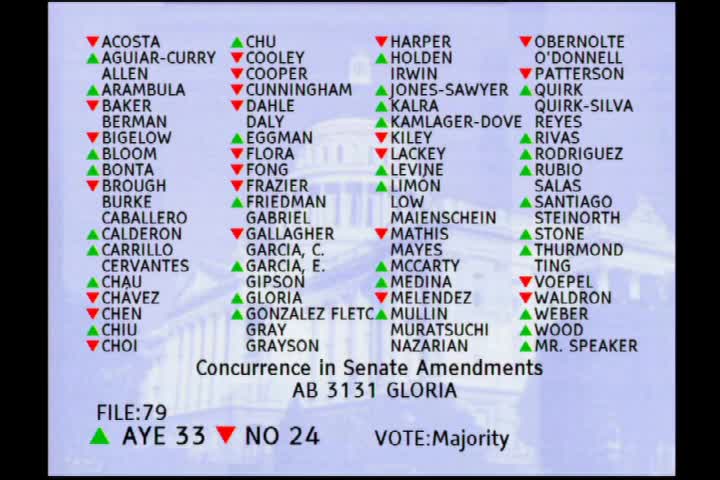 1MIN
Assembly Floor
 3MIN
Senate Floor
 24MIN
Assembly Standing Committee on Banking and Finance
 19MIN
Assembly Standing Committee on Local Government
Bill Author

Bill Co-Author(s):