AB 2077: Electricity: local government renewable energy self-generation program.
- Session Year: 2017-2018
- House: Assembly
- Latest Version Date: 2018-05-01
Under existing law, the Public Utilities Commission has regulatory authority over public utilities, including electrical corporations. The local government renewable energy self-generation program authorizes a local government to receive a bill credit to be applied to a designated benefiting account for electricity exported to the electrical grid by an eligible renewable generating facility, as defined, and requires the commission to adopt a rate tariff for the benefiting account.
If a local government in the County of Santa Barbara has committed to a policy of supplying all of its demand for electricity from generation that qualifies as an eligible renewable energy resource pursuant to the California Renewables Portfolio Standard Program, this bill would require an electrical corporation to negotiate in good faith with the local government on offering mutually agreeable rates and other terms that enable the local government to construct and operate eligible renewable generating facilities sufficient to meet the local governments 100% renewables commitment. The bill would require that any mutually agreed upon rates and terms be submitted to the commission and would require the commission to approve the rates and terms if the commission determines them to be just and reasonable. reasonable, and if the rates and other terms of the agreement, upon implementation, would not negatively affect reliability or safety, would not result in costshifting to other customers, and would not result in an increase in emissions of greenhouse gases.
Under existing law, the Public Utilities Commission has regulatory authority over public utilities, including electrical corporations. The local government renewable energy self-generation program authorizes a local government to receive a bill credit to be applied to a designated benefiting account for electricity exported to the electrical grid by an eligible renewable generating facility, as defined, and requires the commission to adopt a rate tariff for the benefiting account. Existing law requires, for these purposes, that an eligible renewable generating facility (1) have a generating capacity of no more than 5 megawatts, (2) be an eligible renewable energy resource pursuant to the California Renewables Portfolio Standard Program, (3) be located within the geographical boundary of the local government, except as specified for a campus, (4) be owned by, operated by, or on property under the control of the local government, and (5) be sized to offset all or part of the electrical demand of the benefiting account.
This bill would provide that it is not required that an eligible renewable generating facility be located on property that is contiguous with the property on which the benefiting account is located and it is permissable that the electricity generated by the eligible renewable generating facility flows through a part of the electrical transmission or distribution system of the electrical corporation that is located upon property that is under the jurisdiction of another local government or that is state-owned property.If a local government in the County of Santa Barbara has committed to a policy of supplying all of its demand for electricity from generation that qualifies as an eligible renewable energy resource pursuant to the California Renewables Portfolio Standard Program, this bill would require an electrical corporation to negotiate in good faith with the local government on offering mutually agreeable rates and other terms that enable the local government to construct and operate eligible renewable generating facilities sufficient to meet the local governments 100% renewables commitment. The bill would require that any mutually agreed upon rates and terms be submitted to the commission and would require the commission to approve the rates and terms if the commission determines them to be just and reasonable.
Under existing law, the Public Utilities Commission has regulatory authority over public utilities, including electrical corporations. The local government renewable energy self-generation program authorizes a local government to receive a bill credit to be applied to a designated benefiting account for electricity exported to the electrical grid by an eligible renewable generating facility, as defined, and requires the commission to adopt a rate tariff for the benefiting account. Existing law requires, for these purposes, that an eligible renewable generating facility (1) have a generating capacity of no more than 5 megawatts, (2) be an eligible renewable energy resource pursuant to the California Renewables Portfolio Standard Program, (3) be located within the geographical boundary of the local government, except as specified for a campus, (4) be owned by, operated by, or on property under the control of the local government, and (5) be sized to offset all or part of the electrical demand of the benefiting account.
This bill would provide that it is not required that an eligible renewable generating facility be located on property that is contiguous with the property on which the benefiting account is located and it is permissable that the electricity generated by the eligible renewable generating facility flows through a part of the electrical transmission or distribution system of the electrical corporation that is located upon property that is under the jurisdiction of another local government or that is state-owned property.
Existing law requires every electric utility, defined to include electrical corporations, local publicly owned electric utilities, and electrical cooperatives, to develop a standard contract or tariff for net energy metering, as defined, for generation by a renewable electrical generation facility, as defined, and to make this contract or tariff available to eligible customer-generators, as defined, upon request on a first-come-first-served basis until the time that the total rated generating capacity used by eligible customer generators exceeds 5% of the electric utilitys aggregate customer peak demand. For each large electrical corporation, as defined, pursuant to existing law, the commission developed a new standard contract or tariff to provide net energy metering to additional eligible customer-generators in the large electrical corporations service territory, without limitation on the number of new eligible customer-generators entitled to receive service pursuant to the new standard contract or tariff. The definition of an eligible customer-generator, for purposes of net energy metering, is limited to a residential customer, small commercial customer, or commercial, industrial, or agricultural customer of an electric utility or large electrical corporation.This bill would add a local government to the list of customers of an electric utility or large electrical corporation that are eligible for a net energy metering contract or tariff.Under existing law, a violation of any order, decision, rule, direction, demand, or requirement of the commission is a crime.Because the bill would expand eligibility for net energy metering, or its replacement, and would require a decision or order of the commission to implement this expansion with respect to electrical corporations and electrical cooperatives, the bill would impose a state-mandated local program by expanding the definition of a crime.By expanding the duties of local publicly owned electric utilities, the bill would impose a state-mandated local program.The California Constitution requires the state to reimburse local agencies and school districts for certain costs mandated by the state. Statutory provisions establish procedures for making that reimbursement.This bill would provide that no reimbursement is required by this act for specified reasons.Existing law requires every electric utility, defined to include electrical corporations, local publicly owned electric utilities, and electrical cooperatives, to develop a standard contract or tariff for net energy metering, as defined, for generation by a renewable electrical generation facility, as defined, and to make this contract or tariff available to eligible customer-generators, as defined, upon request on a first-come-first-served basis until the time that the total rated generating capacity used by eligible customer generators exceeds 5% of the electric utilitys aggregate customer peak demand. For each large electrical corporation, as defined, pursuant to existing law, the commission developed a new standard contract or tariff to provide net energy metering to additional eligible customer-generators in the large electrical corporations service territory, without limitation on the number of new eligible customer-generators entitled to receive service pursuant to the new standard contract or tariff. The definition of an eligible customer-generator, for purposes of net energy metering, is limited to a residential customer, small commercial customer, or commercial, industrial, or agricultural customer of an electric utility or large electrical corporation.
This bill would add a local government to the list of customers of an electric utility or large electrical corporation that are eligible for a net energy metering contract or tariff.
Under existing law, a violation of any order, decision, rule, direction, demand, or requirement of the commission is a crime.
Because the bill would expand eligibility for net energy metering, or its replacement, and would require a decision or order of the commission to implement this expansion with respect to electrical corporations and electrical cooperatives, the bill would impose a state-mandated local program by expanding the definition of a crime.
By expanding the duties of local publicly owned electric utilities, the bill would impose a state-mandated local program.
The California Constitution requires the state to reimburse local agencies and school districts for certain costs mandated by the state. Statutory provisions establish procedures for making that reimbursement.
This bill would provide that no reimbursement is required by this act for specified reasons.
(a)If a local government in the County of Santa Barbara has committed to a policy of supplying all of its demand for electricity from generation sources that qualify as eligible renewable energy resource pursuant to the California Renewables Portfolio Standard Program (Article 16 (commencing with Section 399.11) of Chapter 2.3 of Part 1), the electrical corporation shall negotiate in good faith with the local government on offering mutually agreeable rates and other terms that enable the local government to construct and operate eligible renewable generating facilities sufficient to meet the local governments 100 percent renewables commitment.
(b)Any rates and other terms mutually agreed upon between a local government in the County of Santa Barbara and an electrical corporation pursuant to subdivision (a) shall be submitted to the commission for approval, and the commission shall approve the agreement if the commission determines that the rates and other terms are just and reasonable. reasonable, and if the rates and other terms of the agreement, upon implementation, would not negatively affect reliability or safety, would not result in costshifting to other customers, and would not result in an increase in emissions of greenhouse gases.
(a)If a local government in the County of Santa Barbara has committed to a policy of supplying all of its demand for electricity from generation sources that qualify as eligible renewable energy resource pursuant to the California Renewables Portfolio Standard Program (Article 16 (commencing with Section 399.11) of Chapter 2.3 of Part 1), the electrical corporation shall negotiate in good faith with the local government on offering mutually agreeable rates and other terms that enable the local government to construct and operate eligible renewable generating facilities sufficient to meet the local governments 100 percent renewables commitment.
(b)Any rates and other terms mutually agreed upon between a local government in the County of Santa Barbara and an electrical corporation pursuant to subdivision (a) shall be submitted to the commission for approval, and the commission shall approve the agreement if the commission determines that the rates and other terms are just and reasonable.
SECTION 1.Section 2830 of the Public Utilities Code is amended to read:2830.(a)As used in this section, the following terms have the following meanings:(1)Benefiting account means an electricity account, or more than one account, that satisfies either of the following:(A)The account or accounts are located within the geographical boundaries of a local government or, for a campus, within the geographical boundary of the city, county, or city and county in which the campus is located, with the account or accounts being mutually agreed upon by the local government or campus and an electrical corporation.(B)The account or accounts belong to members of a joint powers authority and are located within the geographical boundaries of the group of public agencies that formed the joint powers authority, if the eligible renewable generating facility and electricity account or accounts are wholly located within the confines of a single county within which the joint powers authority is located and electric service is provided by a single electrical corporation, with the account or accounts being mutually agreed upon by the joint powers authority and the electrical corporation.(2)Bill credit means an amount of money credited to a benefiting account that is calculated based upon the time-of-use electricity generation component of the electricity usage charge of the generating account, multiplied by the quantities of electricity generated by an eligible renewable generating facility that are exported to the grid during the corresponding time period. Electricity is exported to the grid if it is generated by an eligible renewable generating facility, is not utilized onsite by the local government, and the electricity flows through the meter site and on to the electrical corporations distribution or transmission infrastructure.(3)Campus means an individual community college campus, individual California State University campus, or individual University of California campus.(4)Eligible renewable generating facility means a generation facility that meets all of the following requirements:(A)Has a generating capacity of no more than five megawatts.(B)Is an eligible renewable energy resource, as defined in Article 16 (commencing with Section 399.11) of Part 1.(C)Is located within the geographical boundary of the local government or, for a campus, within the geographical boundary of the city or city and county, if the campus is located in an incorporated area, or county, if the campus is located in an unincorporated area. This paragraph does not require that the property on which the eligible renewable generating facility is located be contiguous with the property on which the benefiting account is located and it is permissable that the electricity generated by the eligible renewable generating facility flows through a part of the electrical transmission or distribution system of the electrical corporation that is located upon property that is under the jurisdiction of another local government or that is state-owned property.(D)Is owned by, operated by, or on property under the control of the local government or campus.(E)Is sized to offset all or part of the electrical load of the benefiting account. For these purposes, premises that are leased by a local government or campus are under the control of the local government or campus.(5)Generating account means the time-of-use electric service account of the local government or campus where the eligible renewable generating facility is located.(6)Local government means a city, county, whether general law or chartered, city and county, special district, school district, political subdivision, other local public agency, or a joint powers authority formed pursuant to the Joint Exercise of Powers Act (Chapter 5 (commencing with Section 6500) of Division 7 of Title 1 of the Government Code) that has as members public agencies located within the same county and same electrical corporation service territory, but shall not mean the state, any agency or department of the state, other than an individual campus of the University of California or the California State University, or any joint powers authority that has as members public agencies located in different counties or different electrical corporation service territories, or that has as a member the federal government, any federal department or agency, this or another state, or any department or agency of this state or another state.(b)Subject to the limitation in subdivision (h), a local government may elect to receive electric service pursuant to this section if all of the following conditions are met:(1)The local government designates one or more benefiting accounts to receive a bill credit.(2)A benefiting account receives service under a time-of-use rate schedule.(3)The benefiting account is the responsibility of, and serves property that is owned, operated, or on property under the control of the same local government that owns, operates, or controls the eligible renewable generating facility.(4)The electrical output of the eligible renewable generating facility is metered for time of use to allow calculation of the bill credit based upon when the electricity is exported to the grid.(5)All costs associated with the metering requirements of paragraphs (2) and (4) are the responsibility of the local government.(6)All costs associated with interconnection are the responsibility of the local government. For purposes of this paragraph, interconnection has the same meaning as defined in Section 2803, except that it applies to the interconnection of an eligible renewable generating facility rather than the energy source of a private energy producer.(7)The local government does not sell electricity exported to the electrical grid to a third party.(8)All electricity exported to the grid by the local government that is generated by the eligible renewable generating facility becomes the property of the electrical corporation to which the facility is interconnected, but shall not be counted toward the electrical corporations total retail sales for purposes of Article 16 (commencing with Section 399.11) of Chapter 2.3 of Part 1. Ownership of the renewable energy credits, as defined in Section 399.12, shall be the same as the ownership of the renewable energy credits associated with electricity that is net metered pursuant to Section 2827.(9)An electrical corporation shall not be required to compensate a local government for electricity generated from an eligible renewable facility pursuant to this section in excess of the bill credits applied to the designated benefiting account. A local government renewable generation facility participating pursuant to this section shall not be eligible for any other tariff or program that requires an electrical corporation to purchase generation from that facility while participating in the local government renewable energy self-generation program pursuant to this section.(c)(1)A benefiting account shall be billed for all electricity usage, and for each bill component, at the rate schedule applicable to the benefiting account, including any cost-responsibility surcharge or other cost recovery mechanism, as determined by the commission, to reimburse the Department of Water Resources for purchases of electricity, pursuant to Division 27 (commencing with Section 80000) of the Water Code.(2)The bill shall then subtract the bill credit applicable to the benefiting account. The generation component credited to the benefiting account shall not include the cost-responsibility surcharge or other cost recovery mechanism, as determined by the commission, to reimburse the Department of Water Resources for purchases of electricity, pursuant to Division 27 (commencing with Section 80000) of the Water Code. The electrical corporation shall ensure that the local government receives the full bill credit.(3)If, during the billing cycle, the generation component of the electricity usage charges exceeds the bill credit, the benefiting account shall be billed for the difference.(4)If, during the billing cycle, the bill credit applied pursuant to paragraph (2) exceeds the generation component of the electricity usage charges, the difference shall be carried forward as a financial credit to the next billing cycle.(5)After the electricity usage charge pursuant to paragraph (1) and the credit pursuant to paragraph (2) are determined for the last billing cycle of a 12-month period, any remaining credit resulting from the application of this section shall be reset to zero.(d)The commission shall ensure that the transfer of a bill credit to a benefiting account does not result in a shifting of costs to bundled service subscribers. The costs associated with the transfer of a bill credit shall include all billing-related expenses.(e)Not more frequently than once per year, and upon providing the electrical corporation with a minimum of 60 days notice, the local government may elect to change a benefiting account. Any credit resulting from the application of this section earned prior to the change in a benefiting account that has not been used as of the date of the change in the benefiting account shall be applied, and may only be applied, to a benefiting account as changed.(f)A local government shall provide the electrical corporation to which the eligible renewable generating facility will be interconnected with not less than 60 days notice prior to the eligible renewable generating facility becoming operational. The electrical corporation shall file an advice letter with the commission that complies with this section not later than 30 days after receipt of the notice proposing a rate tariff for a benefiting account. The commission, within 30 days of the date of filing, shall approve the proposed tariff or specify conforming changes to be made by the electrical corporation to be filed in a new advice letter.(g)The local government may terminate its election pursuant to subdivision (b), upon providing the electrical corporation with a minimum of 60 days notice. Should the local government sell its interest in the eligible renewable generating facility, or sell the electricity generated by the eligible renewable generating facility, in a manner other than required by this section, upon the date of either event, and the earliest date if both events occur, no further bill credit pursuant to paragraph (3) of subdivision (b) may be earned. Only credit earned prior to that date shall be made to a benefiting account.(h)An electrical corporation is not obligated to provide a bill credit to a benefiting account that is not designated by a local government prior to the point in time that the combined statewide cumulative rated generating capacity of all eligible renewable generating facilities within the service territories of the states three largest electrical corporations reaches 250 megawatts. Only those eligible renewable generating facilities that are providing bill credits to benefiting accounts pursuant to this section shall count toward reaching this 250-megawatt limitation. Each electrical corporation shall only be required to offer service or contracts under this section until that electrical corporation reaches its proportionate share of the 250-megawatt limitation based on the ratio of its peak demand to the total statewide peak demand of all electrical corporations.(i)This chapter does not apply to an electrical corporation with 60,000 or fewer customer accounts.(a)As used in this section, the following terms have the following meanings:
(1)Benefiting account means an electricity account, or more than one account, that satisfies either of the following:
(A)The account or accounts are located within the geographical boundaries of a local government or, for a campus, within the geographical boundary of the city, county, or city and county in which the campus is located, with the account or accounts being mutually agreed upon by the local government or campus and an electrical corporation.
(B)The account or accounts belong to members of a joint powers authority and are located within the geographical boundaries of the group of public agencies that formed the joint powers authority, if the eligible renewable generating facility and electricity account or accounts are wholly located within the confines of a single county within which the joint powers authority is located and electric service is provided by a single electrical corporation, with the account or accounts being mutually agreed upon by the joint powers authority and the electrical corporation.
(2)Bill credit means an amount of money credited to a benefiting account that is calculated based upon the time-of-use electricity generation component of the electricity usage charge of the generating account, multiplied by the quantities of electricity generated by an eligible renewable generating facility that are exported to the grid during the corresponding time period. Electricity is exported to the grid if it is generated by an eligible renewable generating facility, is not utilized onsite by the local government, and the electricity flows through the meter site and on to the electrical corporations distribution or transmission infrastructure.
(3)Campus means an individual community college campus, individual California State University campus, or individual University of California campus.
(4)Eligible renewable generating facility means a generation facility that meets all of the following requirements:
(A)Has a generating capacity of no more than five megawatts.
(B)Is an eligible renewable energy resource, as defined in Article 16 (commencing with Section 399.11) of Part 1.
(C)Is located within the geographical boundary of the local government or, for a campus, within the geographical boundary of the city or city and county, if the campus is located in an incorporated area, or county, if the campus is located in an unincorporated area. This paragraph does not require that the property on which the eligible renewable generating facility is located be contiguous with the property on which the benefiting account is located and it is permissable that the electricity generated by the eligible renewable generating facility flows through a part of the electrical transmission or distribution system of the electrical corporation that is located upon property that is under the jurisdiction of another local government or that is state-owned property.
(D)Is owned by, operated by, or on property under the control of the local government or campus.
(E)Is sized to offset all or part of the electrical load of the benefiting account. For these purposes, premises that are leased by a local government or campus are under the control of the local government or campus.
(5)Generating account means the time-of-use electric service account of the local government or campus where the eligible renewable generating facility is located.
(6)Local government means a city, county, whether general law or chartered, city and county, special district, school district, political subdivision, other local public agency, or a joint powers authority formed pursuant to the Joint Exercise of Powers Act (Chapter 5 (commencing with Section 6500) of Division 7 of Title 1 of the Government Code) that has as members public agencies located within the same county and same electrical corporation service territory, but shall not mean the state, any agency or department of the state, other than an individual campus of the University of California or the California State University, or any joint powers authority that has as members public agencies located in different counties or different electrical corporation service territories, or that has as a member the federal government, any federal department or agency, this or another state, or any department or agency of this state or another state.
(b)Subject to the limitation in subdivision (h), a local government may elect to receive electric service pursuant to this section if all of the following conditions are met:
(1)The local government designates one or more benefiting accounts to receive a bill credit.
(2)A benefiting account receives service under a time-of-use rate schedule.
(3)The benefiting account is the responsibility of, and serves property that is owned, operated, or on property under the control of the same local government that owns, operates, or controls the eligible renewable generating facility.
(4)The electrical output of the eligible renewable generating facility is metered for time of use to allow calculation of the bill credit based upon when the electricity is exported to the grid.
(5)All costs associated with the metering requirements of paragraphs (2) and (4) are the responsibility of the local government.
(6)All costs associated with interconnection are the responsibility of the local government. For purposes of this paragraph, interconnection has the same meaning as defined in Section 2803, except that it applies to the interconnection of an eligible renewable generating facility rather than the energy source of a private energy producer.
(7)The local government does not sell electricity exported to the electrical grid to a third party.
(8)All electricity exported to the grid by the local government that is generated by the eligible renewable generating facility becomes the property of the electrical corporation to which the facility is interconnected, but shall not be counted toward the electrical corporations total retail sales for purposes of Article 16 (commencing with Section 399.11) of Chapter 2.3 of Part 1. Ownership of the renewable energy credits, as defined in Section 399.12, shall be the same as the ownership of the renewable energy credits associated with electricity that is net metered pursuant to Section 2827.
(9)An electrical corporation shall not be required to compensate a local government for electricity generated from an eligible renewable facility pursuant to this section in excess of the bill credits applied to the designated benefiting account. A local government renewable generation facility participating pursuant to this section shall not be eligible for any other tariff or program that requires an electrical corporation to purchase generation from that facility while participating in the local government renewable energy self-generation program pursuant to this section.
(c)(1)A benefiting account shall be billed for all electricity usage, and for each bill component, at the rate schedule applicable to the benefiting account, including any cost-responsibility surcharge or other cost recovery mechanism, as determined by the commission, to reimburse the Department of Water Resources for purchases of electricity, pursuant to Division 27 (commencing with Section 80000) of the Water Code.
(2)The bill shall then subtract the bill credit applicable to the benefiting account. The generation component credited to the benefiting account shall not include the cost-responsibility surcharge or other cost recovery mechanism, as determined by the commission, to reimburse the Department of Water Resources for purchases of electricity, pursuant to Division 27 (commencing with Section 80000) of the Water Code. The electrical corporation shall ensure that the local government receives the full bill credit.
(3)If, during the billing cycle, the generation component of the electricity usage charges exceeds the bill credit, the benefiting account shall be billed for the difference.
(4)If, during the billing cycle, the bill credit applied pursuant to paragraph (2) exceeds the generation component of the electricity usage charges, the difference shall be carried forward as a financial credit to the next billing cycle.
(5)After the electricity usage charge pursuant to paragraph (1) and the credit pursuant to paragraph (2) are determined for the last billing cycle of a 12-month period, any remaining credit resulting from the application of this section shall be reset to zero.
(d)The commission shall ensure that the transfer of a bill credit to a benefiting account does not result in a shifting of costs to bundled service subscribers. The costs associated with the transfer of a bill credit shall include all billing-related expenses.
(e)Not more frequently than once per year, and upon providing the electrical corporation with a minimum of 60 days notice, the local government may elect to change a benefiting account. Any credit resulting from the application of this section earned prior to the change in a benefiting account that has not been used as of the date of the change in the benefiting account shall be applied, and may only be applied, to a benefiting account as changed.
(f)A local government shall provide the electrical corporation to which the eligible renewable generating facility will be interconnected with not less than 60 days notice prior to the eligible renewable generating facility becoming operational. The electrical corporation shall file an advice letter with the commission that complies with this section not later than 30 days after receipt of the notice proposing a rate tariff for a benefiting account. The commission, within 30 days of the date of filing, shall approve the proposed tariff or specify conforming changes to be made by the electrical corporation to be filed in a new advice letter.
(g)The local government may terminate its election pursuant to subdivision (b), upon providing the electrical corporation with a minimum of 60 days notice. Should the local government sell its interest in the eligible renewable generating facility, or sell the electricity generated by the eligible renewable generating facility, in a manner other than required by this section, upon the date of either event, and the earliest date if both events occur, no further bill credit pursuant to paragraph (3) of subdivision (b) may be earned. Only credit earned prior to that date shall be made to a benefiting account.
(h)An electrical corporation is not obligated to provide a bill credit to a benefiting account that is not designated by a local government prior to the point in time that the combined statewide cumulative rated generating capacity of all eligible renewable generating facilities within the service territories of the states three largest electrical corporations reaches 250 megawatts. Only those eligible renewable generating facilities that are providing bill credits to benefiting accounts pursuant to this section shall count toward reaching this 250-megawatt limitation. Each electrical corporation shall only be required to offer service or contracts under this section until that electrical corporation reaches its proportionate share of the 250-megawatt limitation based on the ratio of its peak demand to the total statewide peak demand of all electrical corporations.
(i)This chapter does not apply to an electrical corporation with 60,000 or fewer customer accounts.
SECTION 1.Section 2827 of the Public Utilities Code is amended to read:2827.(a)The Legislature finds and declares that a program to provide net energy metering combined with net surplus compensation, co-energy metering, and wind energy co-metering for eligible customer-generators is one way to encourage substantial private investment in renewable energy resources, stimulate in-state economic growth, reduce demand for electricity during peak consumption periods, help stabilize Californias energy supply infrastructure, enhance the continued diversification of Californias energy resource mix, reduce interconnection and administrative costs for electricity suppliers, and encourage conservation and efficiency.(b)As used in this section, the following terms have the following meanings:(1)Co-energy metering means a program that is the same in all other respects as a net energy metering program, except that the local publicly owned electric utility has elected to apply a generation-to-generation energy and time-of-use credit formula as provided in subdivision (i).(2)Electrical cooperative means an electrical cooperative as defined in Section 2776.(3)Electric utility means an electrical corporation, a local publicly owned electric utility, or an electrical cooperative, or any other entity, except an electric service provider, that offers electrical service. This section shall not apply to a local publicly owned electric utility that serves more than 750,000 customers and that also conveys water to its customers.(4)(A)Eligible customer-generator means a residential customer, small commercial customer as defined in subdivision (h) of Section 331, or commercial, industrial, local government, or agricultural customer of an electric utility, who uses a renewable electrical generation facility, or a combination of those facilities, with a total capacity of not more than one megawatt, that is located on the customers owned, leased, or rented premises, and is interconnected and operates in parallel with the electrical grid, and is intended primarily to offset part or all of the customers own electrical requirements.(B)(i)Notwithstanding subparagraph (A), eligible customer-generator includes the Department of Corrections and Rehabilitation using a renewable electrical generation technology, or a combination of renewable electrical generation technologies, with a total capacity of not more than eight megawatts, that is located on the departments owned, leased, or rented premises, and is interconnected and operates in parallel with the electrical grid, and is intended primarily to offset part or all of the facilitys own electrical requirements. The amount of any wind generation exported to the electrical grid shall not exceed 1.35 megawatt at any time.(ii)Notwithstanding paragraph (2) of subdivision (e), an electrical corporation shall be afforded a prudent but necessary time, as determined by the executive director of the commission, to study the impacts of a request for interconnection of a renewable generator with a capacity of greater than one megawatt under this subparagraph. If the study reveals the need for upgrades to the transmission or distribution system arising solely from the interconnection, the electrical corporation shall be afforded the time necessary to complete those upgrades before the interconnection and those costs shall be borne by the customer-generator. Upgrade projects shall comply with applicable state and federal requirements, including requirements of the Federal Energy Regulatory Commission.(C)(i)For purposes of this subparagraph, a United States Armed Forces base or facility is an establishment under the jurisdiction of the United States Army, Navy, Air Force, Marine Corps, or Coast Guard.(ii)Notwithstanding subparagraph (A), a United States Armed Forces base or facility is an eligible customer-generator if the base or facility uses a renewable electrical generation facility, or a combination of those facilities, the renewable electrical generation facility is located on premises owned, leased, or rented by the United States Armed Forces base or facility, the renewable electrical generation facility is interconnected and operates in parallel with the electrical grid, the renewable electrical generation facility is intended primarily to offset part or all of the base or facilitys own electrical requirements, and the renewable electrical generation facility has a generating capacity that does not exceed the lesser of 12 megawatts or one megawatt greater than the minimum load of the base or facility over the prior 36 months. Unless prohibited by federal law, a renewable electrical generation facility shall not be eligible for net energy metering for privatized military housing pursuant to this subparagraph if the renewable electrical generation facility was procured using a sole source process. A renewable electrical generation facility procured using best value criteria, if otherwise eligible, may be used for net energy metering for privatized military housing pursuant to this subparagraph. For these purposes, best value criteria means a value determined by objective criteria and may include, but is not limited to, price, features, functions, and life-cycle costs.(iii)A United States Armed Forces base or facility that is an eligible customer generator pursuant to this subparagraph shall not receive compensation for exported generation.(iv)Notwithstanding paragraph (2) of subdivision (e), an electrical corporation shall be afforded a prudent but necessary time, as determined by the executive director of the commission but not less than 60 working days, to study the impacts of a request for interconnection of a renewable electrical generation facility with a capacity of greater than one megawatt pursuant to this subparagraph. If the study reveals the need for upgrades to the transmission or distribution system arising solely from the interconnection, the electrical corporation shall be afforded the time necessary to complete those upgrades before the interconnection and the costs of those upgrades shall be borne by the eligible customer-generator. Upgrade projects shall comply with applicable state and federal requirements, including requirements of the Federal Energy Regulatory Commission. For any renewable generation facility that interconnects directly to the transmission grid or that requires transmission upgrades, the United States Armed Forces base or facility shall comply with all Federal Energy Regulatory Commission interconnection procedures and requirements.(v)An electrical corporation shall make a tariff, as approved by the commission, available pursuant to this subparagraph by November 1, 2015.(5)Large electrical corporation means an electrical corporation with more than 100,000 service connections in California.(6)Net energy metering means measuring the difference between the electricity supplied through the electrical grid and the electricity generated by an eligible customer-generator and fed back to the electrical grid over a 12-month period as described in subdivisions (c) and (h).(7)Net surplus customer-generator means an eligible customer-generator that generates more electricity during a 12-month period than is supplied by the electric utility to the eligible customer-generator during the same 12-month period.(8)Net surplus electricity means all electricity generated by an eligible customer-generator measured in kilowatthours over a 12-month period that exceeds the amount of electricity consumed by that eligible customer-generator.(9)Net surplus electricity compensation means a per kilowatthour rate offered by the electric utility to the net surplus customer-generator for net surplus electricity that is set by the ratemaking authority pursuant to subdivision (h).(10)Ratemaking authority means, for an electrical corporation, the commission, for an electrical cooperative, its ratesetting body selected by its shareholders or members, and for a local publicly owned electric utility, the local elected body responsible for setting the rates of the local publicly owned utility.(11)Renewable electrical generation facility means a facility that generates electricity from a renewable source listed in paragraph (1) of subdivision (a) of Section 25741 of the Public Resources Code. A small hydroelectric generation facility is not an eligible renewable electrical generation facility if it will cause an adverse impact on instream beneficial uses or cause a change in the volume or timing of streamflow.(12)Wind energy co-metering means any wind energy project greater than 50 kilowatts, but not exceeding one megawatt, where the difference between the electricity supplied through the electrical grid and the electricity generated by an eligible customer-generator and fed back to the electrical grid over a 12-month period is as described in subdivision (h). Wind energy co-metering shall be accomplished pursuant to Section 2827.8.(c)(1)Except as provided in paragraph (4) and in Section 2827.1, every electric utility shall develop a standard contract or tariff providing for net energy metering, and shall make this standard contract or tariff available to eligible customer-generators, upon request, on a first-come-first-served basis until the time that the total rated generating capacity used by eligible customer-generators exceeds 5 percent of the electric utilitys aggregate customer peak demand. Net energy metering shall be accomplished using a single meter capable of registering the flow of electricity in two directions. An additional meter or meters to monitor the flow of electricity in each direction may be installed with the consent of the eligible customer-generator, at the expense of the electric utility, and the additional metering shall be used only to provide the information necessary to accurately bill or credit the eligible customer-generator pursuant to subdivision (h), or to collect generating system performance information for research purposes relative to a renewable electrical generation facility. If the existing electrical meter of an eligible customer-generator is not capable of measuring the flow of electricity in two directions, the eligible customer-generator shall be responsible for all expenses involved in purchasing and installing a meter that is able to measure electricity flow in two directions. If an additional meter or meters are installed, the net energy metering calculation shall yield a result identical to that of a single meter. An eligible customer-generator that is receiving service other than through the standard contract or tariff may elect to receive service through the standard contract or tariff until the electric utility reaches the generation limit set forth in this paragraph. Once the generation limit is reached, only eligible customer-generators that had previously elected to receive service pursuant to the standard contract or tariff have a right to continue to receive service pursuant to the standard contract or tariff. Eligibility for net energy metering does not limit an eligible customer-generators eligibility for any other rebate, incentive, or credit provided by the electric utility, or pursuant to any governmental program, including rebates and incentives provided pursuant to the California Solar Initiative.(2)An electrical corporation shall include a provision in the net energy metering contract or tariff requiring that any customer with an existing electrical generating facility and meter who enters into a new net energy metering contract shall provide an inspection report to the electrical corporation, unless the electrical generating facility and meter have been installed or inspected within the previous three years. The inspection report shall be prepared by a California licensed contractor who is not the owner or operator of the facility and meter. A California licensed electrician shall perform the inspection of the electrical portion of the facility and meter.(3)(A)On an annual basis, every electric utility shall make available to the ratemaking authority information on the total rated generating capacity used by eligible customer-generators that are customers of that provider in the providers service area and the net surplus electricity purchased by the electric utility pursuant to this section.(B)An electric service provider operating pursuant to Section 394 shall make available to the ratemaking authority the information required by this paragraph for each eligible customer-generator that is their customer for each service area of an electrical corporation, local publicly owned electrical utility, or electrical cooperative, in which the eligible customer-generator has net energy metering.(C)The ratemaking authority shall develop a process for making the information required by this paragraph available to electric utilities, and for using that information to determine when, pursuant to paragraphs (1) and (4), an electric utility is not obligated to provide net energy metering to additional eligible customer-generators in its service area.(4)(A)An electric utility that is not a large electrical corporation is not obligated to provide net energy metering to additional eligible customer-generators in its service area when the combined total peak demand of all electricity used by eligible customer-generators served by all the electric utilities in that service area furnishing net energy metering to eligible customer-generators exceeds 5 percent of the aggregate customer peak demand of those electric utilities.(B)The commission shall require every large electrical corporation to make the standard contract or tariff available to eligible customer-generators, continuously and without interruption, until such times as the large electrical corporation reaches its net energy metering program limit or July 1, 2017, whichever is earlier. A large electrical corporation reaches its program limit when the combined total peak demand of all electricity used by eligible customer-generators served by all the electric utilities in the large electrical corporations service area furnishing net energy metering to eligible customer-generators exceeds 5 percent of the aggregate customer peak demand of those electric utilities. For purposes of calculating a large electrical corporations program limit, aggregate customer peak demand means the highest sum of the noncoincident peak demands of all of the large electrical corporations customers that occurs in any calendar year. To determine the aggregate customer peak demand, every large electrical corporation shall use a uniform method approved by the commission. The program limit calculated pursuant to this paragraph shall not be less than the following:(i)For San Diego Gas and Electric Company, when it has made 607 megawatts of nameplate generating capacity available to eligible customer-generators.(ii)For Southern California Edison Company, when it has made 2,240 megawatts of nameplate generating capacity available to eligible customer-generators.(iii)For Pacific Gas and Electric Company, when it has made 2,409 megawatts of nameplate generating capacity available to eligible customer-generators.(C)Every large electrical corporation shall file a monthly report with the commission detailing the progress toward the net energy metering program limit established in subparagraph (B). The report shall include separate calculations on progress toward the limits based on operating solar energy systems, cumulative numbers of interconnection requests for net energy metering eligible systems, and any other criteria required by the commission.(D)Beginning July 1, 2017, or upon reaching the net metering program limit of subparagraph (B), whichever is earlier, the obligation of a large electrical corporation to provide service pursuant to a standard contract or tariff shall be pursuant to Section 2827.1 and applicable state and federal requirements.(d)Every electric utility shall make all necessary forms and contracts for net energy metering and net surplus electricity compensation service available for download from the Internet.(e)(1)Every electric utility shall ensure that requests for establishment of net energy metering and net surplus electricity compensation are processed in a time period not exceeding that for similarly situated customers requesting new electric service, but not to exceed 30 working days from the date it receives a completed application form for net energy metering service or net surplus electricity compensation, including a signed interconnection agreement from an eligible customer-generator and the electric inspection clearance from the governmental authority having jurisdiction.(2)Every electric utility shall ensure that requests for an interconnection agreement from an eligible customer-generator are processed in a time period not to exceed 30 working days from the date it receives a completed application form from the eligible customer-generator for an interconnection agreement.(3)If an electric utility is unable to process a request within the allowable timeframe pursuant to paragraph (1) or (2), it shall notify the eligible customer-generator and the ratemaking authority of the reason for its inability to process the request and the expected completion date.(f)(1)If a customer participates in direct transactions pursuant to paragraph (1) of subdivision (b) of Section 365, or Section 365.1, with an electric service provider that does not provide distribution service for the direct transactions, the electric utility that provides distribution service for the eligible customer-generator is not obligated to provide net energy metering or net surplus electricity compensation to the customer.(2)If a customer participates in direct transactions pursuant to paragraph (1) of subdivision (b) of Section 365 or 365.1 with an electric service provider, and the customer is an eligible customer-generator, the electric utility that provides distribution service for the direct transactions may recover from the customers electric service provider the incremental costs of metering and billing service related to net energy metering and net surplus electricity compensation in an amount set by the ratemaking authority.(g)Except for the time-variant kilowatthour pricing portion of any tariff adopted by the commission pursuant to paragraph (4) of subdivision (a) of Section 2851, each net energy metering contract or tariff shall be identical, with respect to rate structure, all retail rate components, and any monthly charges, to the contract or tariff to which the same customer would be assigned if the customer did not use a renewable electrical generation facility, except that eligible customer-generators shall not be assessed standby charges on the electrical generating capacity or the kilowatthour production of a renewable electrical generation facility. The charges for all retail rate components for eligible customer-generators shall be based exclusively on the customer-generators net kilowatthour consumption over a 12-month period, without regard to the eligible customer-generators choice as to from whom it purchases electricity that is not self-generated. Any new or additional demand charge, standby charge, customer charge, minimum monthly charge, interconnection charge, or any other charge that would increase an eligible customer-generators costs beyond those of other customers who are not eligible customer-generators in the rate class to which the eligible customer-generator would otherwise be assigned if the customer did not own, lease, rent, or otherwise operate a renewable electrical generation facility is contrary to the intent of this section, and shall not form a part of net energy metering contracts or tariffs.(h)For eligible customer-generators, the net energy metering calculation shall be made by measuring the difference between the electricity supplied to the eligible customer-generator and the electricity generated by the eligible customer-generator and fed back to the electrical grid over a 12-month period. The following rules shall apply to the annualized net metering calculation:(1)The eligible residential or small commercial customer-generator, at the end of each 12-month period following the date of final interconnection of the eligible customer-generators system with an electric utility, and at each anniversary date thereafter, shall be billed for electricity used during that 12-month period. The electric utility shall determine if the eligible residential or small commercial customer-generator was a net consumer or a net surplus customer-generator during that period.(2)At the end of each 12-month period, where the electricity supplied during the period by the electric utility exceeds the electricity generated by the eligible residential or small commercial customer-generator during that same period, the eligible residential or small commercial customer-generator is a net electricity consumer and the electric utility shall be owed compensation for the eligible customer-generators net kilowatthour consumption over that 12-month period. The compensation owed for the eligible residential or small commercial customer-generators consumption shall be calculated as follows:(A)For all eligible customer-generators taking service under contracts or tariffs employing baseline and over baseline rates, any net monthly consumption of electricity shall be calculated according to the terms of the contract or tariff to which the same customer would be assigned to, or be eligible for, if the customer was not an eligible customer-generator. If those same customer-generators are net generators over a billing period, the net kilowatthours generated shall be valued at the same price per kilowatthour as the electric utility would charge for the baseline quantity of electricity during that billing period, and if the number of kilowatthours generated exceeds the baseline quantity, the excess shall be valued at the same price per kilowatthour as the electric utility would charge for electricity over the baseline quantity during that billing period.(B)For all eligible customer-generators taking service under contracts or tariffs employing time-of-use rates, any net monthly consumption of electricity shall be calculated according to the terms of the contract or tariff to which the same customer would be assigned, or be eligible for, if the customer was not an eligible customer-generator. When those same customer-generators are net generators during any discrete time-of-use period, the net kilowatthours produced shall be valued at the same price per kilowatthour as the electric utility would charge for retail kilowatthour sales during that same time-of-use period. If the eligible customer-generators time-of-use electrical meter is unable to measure the flow of electricity in two directions, paragraph (1) of subdivision (c) shall apply.(C)For all eligible residential and small commercial customer-generators and for each billing period, the net balance of moneys owed to the electric utility for net consumption of electricity or credits owed to the eligible customer-generator for net generation of electricity shall be carried forward as a monetary value until the end of each 12-month period. For all eligible commercial, industrial, and agricultural customer-generators, the net balance of moneys owed shall be paid in accordance with the electric utilitys normal billing cycle, except that if the eligible commercial, industrial, or agricultural customer-generator is a net electricity producer over a normal billing cycle, any excess kilowatthours generated during the billing cycle shall be carried over to the following billing period as a monetary value, calculated according to the procedures set forth in this section, and appear as a credit on the eligible commercial, industrial, or agricultural customer-generators account, until the end of the annual period when paragraph (3) shall apply.(3)At the end of each 12-month period, where the electricity generated by the eligible customer-generator during the 12-month period exceeds the electricity supplied by the electric utility during that same period, the eligible customer-generator is a net surplus customer-generator and the electric utility, upon an affirmative election by the net surplus customer-generator, shall either (A) provide net surplus electricity compensation for any net surplus electricity generated during the prior 12-month period, or (B) allow the net surplus customer-generator to apply the net surplus electricity as a credit for kilowatthours subsequently supplied by the electric utility to the net surplus customer-generator. For an eligible customer-generator that does not affirmatively elect to receive service pursuant to net surplus electricity compensation, the electric utility shall retain any excess kilowatthours generated during the prior 12-month period. The eligible customer-generator not affirmatively electing to receive service pursuant to net surplus electricity compensation shall not be owed any compensation for the net surplus electricity unless the electric utility enters into a purchase agreement with the eligible customer-generator for those excess kilowatthours. Every electric utility shall provide notice to eligible customer-generators that they are eligible to receive net surplus electricity compensation for net surplus electricity, that they must elect to receive net surplus electricity compensation, and that the 12-month period commences when the electric utility receives the eligible customer-generators election. For an electric utility that is an electrical corporation or electrical cooperative, the commission may adopt requirements for providing notice and the manner by which eligible customer-generators may elect to receive net surplus electricity compensation.(4)(A)An eligible customer-generator with multiple meters may elect to aggregate the electrical load of the meters located on the property where the renewable electrical generation facility is located and on all property adjacent or contiguous to the property on which the renewable electrical generation facility is located, if those properties are solely owned, leased, or rented by the eligible customer-generator. If the eligible customer-generator elects to aggregate the electric load pursuant to this paragraph, the electric utility shall use the aggregated load for the purpose of determining whether an eligible customer-generator is a net consumer or a net surplus customer-generator during a 12-month period.(B)If an eligible customer-generator chooses to aggregate pursuant to subparagraph (A), the eligible customer-generator shall be permanently ineligible to receive net surplus electricity compensation, and the electric utility shall retain any kilowatthours in excess of the eligible customer-generators aggregated electrical load generated during the 12-month period.(C)If an eligible customer-generator with multiple meters elects to aggregate the electrical load of those meters pursuant to subparagraph (A), and different rate schedules are applicable to service at any of those meters, the electricity generated by the renewable electrical generation facility shall be allocated to each of the meters in proportion to the electrical load served by those meters. For example, if the eligible customer-generator receives electric service through three meters, two meters being at an agricultural rate that each provide service to 25 percent of the customers total load, and a third meter, at a commercial rate, that provides service to 50 percent of the customers total load, then 50 percent of the electrical generation of the eligible renewable generation facility shall be allocated to the third meter that provides service at the commercial rate and 25 percent of the generation shall be allocated to each of the two meters providing service at the agricultural rate. This proportionate allocation shall be computed each billing period.(D)This paragraph shall not become operative for an electrical corporation unless the commission determines that allowing eligible customer-generators to aggregate their load from multiple meters will not result in an increase in the expected revenue obligations of customers who are not eligible customer-generators. The commission shall make this determination by September 30, 2013. In making this determination, the commission shall determine if there are any public purpose or other noncommodity charges that the eligible customer-generators would pay pursuant to the net energy metering program as it exists prior to aggregation, that the eligible customer-generator would not pay if permitted to aggregate the electrical load of multiple meters pursuant to this paragraph.(E)A local publicly owned electric utility or electrical cooperative shall only allow eligible customer-generators to aggregate their load if the utilitys ratemaking authority determines that allowing eligible customer-generators to aggregate their load from multiple meters will not result in an increase in the expected revenue obligations of customers that are not eligible customer-generators. The ratemaking authority of a local publicly owned electric utility or electrical cooperative shall make this determination within 180 days of the first request made by an eligible customer-generator to aggregate their load. In making the determination, the ratemaking authority shall determine if there are any public purpose or other noncommodity charges that the eligible customer-generator would pay pursuant to the net energy metering or co-energy metering program of the utility as it exists prior to aggregation, that the eligible customer-generator would not pay if permitted to aggregate the electrical load of multiple meters pursuant to this paragraph. If the ratemaking authority determines that load aggregation will not cause an incremental rate impact on the utilitys customers that are not eligible customer-generators, the local publicly owned electric utility or electrical cooperative shall permit an eligible customer-generator to elect to aggregate the electrical load of multiple meters pursuant to this paragraph. The ratemaking authority may reconsider any determination made pursuant to this subparagraph in a subsequent public proceeding.(F)For purposes of this paragraph, parcels that are divided by a street, highway, or public thoroughfare are considered contiguous, provided they are otherwise contiguous and under the same ownership.(G)An eligible customer-generator may only elect to aggregate the electrical load of multiple meters if the renewable electrical generation facility, or a combination of those facilities, has a total generating capacity of not more than one megawatt.(H)Notwithstanding subdivision (g), an eligible customer-generator electing to aggregate the electrical load of multiple meters pursuant to this subdivision shall remit service charges for the cost of providing billing services to the electric utility that provides service to the meters.(5)(A)The ratemaking authority shall establish a net surplus electricity compensation valuation to compensate the net surplus customer-generator for the value of net surplus electricity generated by the net surplus customer-generator. The commission shall establish the valuation in a ratemaking proceeding. The ratemaking authority for a local publicly owned electric utility shall establish the valuation in a public proceeding. The net surplus electricity compensation valuation shall be established so as to provide the net surplus customer-generator just and reasonable compensation for the value of net surplus electricity, while leaving other ratepayers unaffected. The ratemaking authority shall determine whether the compensation will include, where appropriate justification exists, either or both of the following components:(i)The value of the electricity itself.(ii)The value of the renewable attributes of the electricity.(B)In establishing the rate pursuant to subparagraph (A), the ratemaking authority shall ensure that the rate does not result in a shifting of costs between eligible customer-generators and other bundled service customers.(6)(A)Upon adoption of the net surplus electricity compensation rate by the ratemaking authority, any renewable energy credit, as defined in Section 399.12, for net surplus electricity purchased by the electric utility shall belong to the electric utility. Any renewable energy credit associated with electricity generated by the eligible customer-generator that is utilized by the eligible customer-generator shall remain the property of the eligible customer-generator.(B)Upon adoption of the net surplus electricity compensation rate by the ratemaking authority, the net surplus electricity purchased by the electric utility shall count toward the electric utilitys renewables portfolio standard annual procurement targets for the purposes of paragraph (1) of subdivision (b) of Section 399.15, or for a local publicly owned electric utility, the renewables portfolio standard annual procurement targets established pursuant to Section 399.30.(7)The electric utility shall provide every eligible residential or small commercial customer-generator with net electricity consumption and net surplus electricity generation information with each regular bill. That information shall include the current monetary balance owed the electric utility for net electricity consumed, or the net surplus electricity generated, since the last 12-month period ended. Notwithstanding this subdivision, an electric utility shall permit that customer to pay monthly for net energy consumed.(8)If an eligible residential or small commercial customer-generator terminates the customer relationship with the electric utility, the electric utility shall reconcile the eligible customer-generators consumption and production of electricity during any part of a 12-month period following the last reconciliation, according to the requirements set forth in this subdivision, except that those requirements shall apply only to the months since the most recent 12-month bill.(9)If an electric service provider or electric utility providing net energy metering to a residential or small commercial customer-generator ceases providing that electric service to that customer during any 12-month period, and the customer-generator enters into a new net energy metering contract or tariff with a new electric service provider or electric utility, the 12-month period, with respect to that new electric service provider or electric utility, shall commence on the date on which the new electric service provider or electric utility first supplies electric service to the customer-generator.(i)Notwithstanding any other provisions of this section, paragraphs (1), (2), and (3) shall apply to an eligible customer-generator with a capacity of more than 10 kilowatts, but not exceeding one megawatt, that receives electric service from a local publicly owned electric utility that has elected to utilize a co-energy metering program unless the local publicly owned electric utility chooses to provide service for eligible customer-generators with a capacity of more than 10 kilowatts in accordance with subdivisions (g) and (h):(1)The eligible customer-generator shall be required to utilize a meter, or multiple meters, capable of separately measuring electricity flow in both directions. All meters shall provide time-of-use measurements of electricity flow, and the customer shall take service on a time-of-use rate schedule. If the existing meter of the eligible customer-generator is not a time-of-use meter or is not capable of measuring total flow of electricity in both directions, the eligible customer-generator shall be responsible for all expenses involved in purchasing and installing a meter that is both time-of-use and able to measure total electricity flow in both directions. This subdivision shall not restrict the ability of an eligible customer-generator to utilize any economic incentives provided by a governmental agency or an electric utility to reduce its costs for purchasing and installing a time-of-use meter.(2)The consumption of electricity from the local publicly owned electric utility shall result in a cost to the eligible customer-generator to be priced in accordance with the standard rate charged to the eligible customer-generator in accordance with the rate structure to which the customer would be assigned if the customer did not use a renewable electrical generation facility. The generation of electricity provided to the local publicly owned electric utility shall result in a credit to the eligible customer-generator and shall be priced in accordance with the generation component, established under the applicable structure to which the customer would be assigned if the customer did not use a renewable electrical generation facility.(3)All costs and credits shall be shown on the eligible customer-generators bill for each billing period. In any months in which the eligible customer-generator has been a net consumer of electricity calculated on the basis of value determined pursuant to paragraph (2), the customer-generator shall owe to the local publicly owned electric utility the balance of electricity costs and credits during that billing period. In any billing period in which the eligible customer-generator has been a net producer of electricity calculated on the basis of value determined pursuant to paragraph (2), the local publicly owned electric utility shall owe to the eligible customer-generator the balance of electricity costs and credits during that billing period. Any net credit to the eligible customer-generator of electricity costs may be carried forward to subsequent billing periods, provided that a local publicly owned electric utility may choose to carry the credit over as a kilowatthour credit consistent with the provisions of any applicable contract or tariff, including any differences attributable to the time of generation of the electricity. At the end of each 12-month period, the local publicly owned electric utility may reduce any net credit due to the eligible customer-generator to zero.(j)A renewable electrical generation facility used by an eligible customer-generator shall meet all applicable safety and performance standards established by the National Electrical Code, the Institute of Electrical and Electronics Engineers, and accredited testing laboratories, including Underwriters Laboratories Incorporated and, where applicable, rules of the commission regarding safety and reliability. A customer-generator whose renewable electrical generation facility meets those standards and rules shall not be required to install additional controls, perform or pay for additional tests, or purchase additional liability insurance.(k)If the commission determines that there are cost or revenue obligations for an electrical corporation that may not be recovered from customer-generators acting pursuant to this section, those obligations shall remain within the customer class from which any shortfall occurred and shall not be shifted to any other customer class. Net energy metering and co-energy metering customers shall not be exempt from the public goods charges imposed pursuant to Article 7 (commencing with Section 381), Article 8 (commencing with Section 385), or Article 15 (commencing with Section 399) of Chapter 2.3 of Part 1.(l)A net energy metering, co-energy metering, or wind energy co-metering customer shall reimburse the Department of Water Resources for all charges that would otherwise be imposed on the customer by the commission to recover bond-related costs pursuant to an agreement between the commission and the Department of Water Resources pursuant to Section 80110 of the Water Code, as well as the costs of the department equal to the share of the departments estimated net unavoidable power purchase contract costs attributable to the customer. The commission shall incorporate the determination into an existing proceeding before the commission, and shall ensure that the charges are nonbypassable. Until the commission has made a determination regarding the nonbypassable charges, net energy metering, co-energy metering, and wind energy co-metering shall continue under the same rules, procedures, terms, and conditions as were applicable on December 31, 2002.(m)In implementing the requirements of subdivisions (k) and (l), an eligible customer-generator shall not be required to replace its existing meter except as set forth in paragraph (1) of subdivision (c), nor shall the electric utility require additional measurement of usage beyond that which is necessary for customers in the same rate class as the eligible customer-generator.(n)It is the intent of the Legislature that the Treasurer incorporate net energy metering, including net surplus electricity compensation, co-energy metering, and wind energy co-metering projects undertaken pursuant to this section as sustainable building methods or distributive energy technologies for purposes of evaluating low-income housing projects.SEC. 2.No reimbursement is required by this act pursuant to Section 6 of Article XIIIB of the California Constitution because a local agency or school district has the authority to levy service charges, fees, or assessments sufficient to pay for the program or level of service mandated by this act or because costs that may be incurred by a local agency or school district will be incurred because this act creates a new crime or infraction, eliminates a crime or infraction, or changes the penalty for a crime or infraction, within the meaning of Section 17556 of the Government Code, or changes the definition of a crime within the meaning of Section 6 of Article XIIIB of the California Constitution.(a)The Legislature finds and declares that a program to provide net energy metering combined with net surplus compensation, co-energy metering, and wind energy co-metering for eligible customer-generators is one way to encourage substantial private investment in renewable energy resources, stimulate in-state economic growth, reduce demand for electricity during peak consumption periods, help stabilize Californias energy supply infrastructure, enhance the continued diversification of Californias energy resource mix, reduce interconnection and administrative costs for electricity suppliers, and encourage conservation and efficiency.
(b)As used in this section, the following terms have the following meanings:
(1)Co-energy metering means a program that is the same in all other respects as a net energy metering program, except that the local publicly owned electric utility has elected to apply a generation-to-generation energy and time-of-use credit formula as provided in subdivision (i).
(2)Electrical cooperative means an electrical cooperative as defined in Section 2776.
(3)Electric utility means an electrical corporation, a local publicly owned electric utility, or an electrical cooperative, or any other entity, except an electric service provider, that offers electrical service. This section shall not apply to a local publicly owned electric utility that serves more than 750,000 customers and that also conveys water to its customers.
(4)(A)Eligible customer-generator means a residential customer, small commercial customer as defined in subdivision (h) of Section 331, or commercial, industrial, local government, or agricultural customer of an electric utility, who uses a renewable electrical generation facility, or a combination of those facilities, with a total capacity of not more than one megawatt, that is located on the customers owned, leased, or rented premises, and is interconnected and operates in parallel with the electrical grid, and is intended primarily to offset part or all of the customers own electrical requirements.
(B)(i)Notwithstanding subparagraph (A), eligible customer-generator includes the Department of Corrections and Rehabilitation using a renewable electrical generation technology, or a combination of renewable electrical generation technologies, with a total capacity of not more than eight megawatts, that is located on the departments owned, leased, or rented premises, and is interconnected and operates in parallel with the electrical grid, and is intended primarily to offset part or all of the facilitys own electrical requirements. The amount of any wind generation exported to the electrical grid shall not exceed 1.35 megawatt at any time.
(ii)Notwithstanding paragraph (2) of subdivision (e), an electrical corporation shall be afforded a prudent but necessary time, as determined by the executive director of the commission, to study the impacts of a request for interconnection of a renewable generator with a capacity of greater than one megawatt under this subparagraph. If the study reveals the need for upgrades to the transmission or distribution system arising solely from the interconnection, the electrical corporation shall be afforded the time necessary to complete those upgrades before the interconnection and those costs shall be borne by the customer-generator. Upgrade projects shall comply with applicable state and federal requirements, including requirements of the Federal Energy Regulatory Commission.
(C)(i)For purposes of this subparagraph, a United States Armed Forces base or facility is an establishment under the jurisdiction of the United States Army, Navy, Air Force, Marine Corps, or Coast Guard.
(ii)Notwithstanding subparagraph (A), a United States Armed Forces base or facility is an eligible customer-generator if the base or facility uses a renewable electrical generation facility, or a combination of those facilities, the renewable electrical generation facility is located on premises owned, leased, or rented by the United States Armed Forces base or facility, the renewable electrical generation facility is interconnected and operates in parallel with the electrical grid, the renewable electrical generation facility is intended primarily to offset part or all of the base or facilitys own electrical requirements, and the renewable electrical generation facility has a generating capacity that does not exceed the lesser of 12 megawatts or one megawatt greater than the minimum load of the base or facility over the prior 36 months. Unless prohibited by federal law, a renewable electrical generation facility shall not be eligible for net energy metering for privatized military housing pursuant to this subparagraph if the renewable electrical generation facility was procured using a sole source process. A renewable electrical generation facility procured using best value criteria, if otherwise eligible, may be used for net energy metering for privatized military housing pursuant to this subparagraph. For these purposes, best value criteria means a value determined by objective criteria and may include, but is not limited to, price, features, functions, and life-cycle costs.
(iii)A United States Armed Forces base or facility that is an eligible customer generator pursuant to this subparagraph shall not receive compensation for exported generation.
(iv)Notwithstanding paragraph (2) of subdivision (e), an electrical corporation shall be afforded a prudent but necessary time, as determined by the executive director of the commission but not less than 60 working days, to study the impacts of a request for interconnection of a renewable electrical generation facility with a capacity of greater than one megawatt pursuant to this subparagraph. If the study reveals the need for upgrades to the transmission or distribution system arising solely from the interconnection, the electrical corporation shall be afforded the time necessary to complete those upgrades before the interconnection and the costs of those upgrades shall be borne by the eligible customer-generator. Upgrade projects shall comply with applicable state and federal requirements, including requirements of the Federal Energy Regulatory Commission. For any renewable generation facility that interconnects directly to the transmission grid or that requires transmission upgrades, the United States Armed Forces base or facility shall comply with all Federal Energy Regulatory Commission interconnection procedures and requirements.
(v)An electrical corporation shall make a tariff, as approved by the commission, available pursuant to this subparagraph by November 1, 2015.
(5)Large electrical corporation means an electrical corporation with more than 100,000 service connections in California.
(6)Net energy metering means measuring the difference between the electricity supplied through the electrical grid and the electricity generated by an eligible customer-generator and fed back to the electrical grid over a 12-month period as described in subdivisions (c) and (h).
(7)Net surplus customer-generator means an eligible customer-generator that generates more electricity during a 12-month period than is supplied by the electric utility to the eligible customer-generator during the same 12-month period.
(8)Net surplus electricity means all electricity generated by an eligible customer-generator measured in kilowatthours over a 12-month period that exceeds the amount of electricity consumed by that eligible customer-generator.
(9)Net surplus electricity compensation means a per kilowatthour rate offered by the electric utility to the net surplus customer-generator for net surplus electricity that is set by the ratemaking authority pursuant to subdivision (h).
(10)Ratemaking authority means, for an electrical corporation, the commission, for an electrical cooperative, its ratesetting body selected by its shareholders or members, and for a local publicly owned electric utility, the local elected body responsible for setting the rates of the local publicly owned utility.
(11)Renewable electrical generation facility means a facility that generates electricity from a renewable source listed in paragraph (1) of subdivision (a) of Section 25741 of the Public Resources Code. A small hydroelectric generation facility is not an eligible renewable electrical generation facility if it will cause an adverse impact on instream beneficial uses or cause a change in the volume or timing of streamflow.
(12)Wind energy co-metering means any wind energy project greater than 50 kilowatts, but not exceeding one megawatt, where the difference between the electricity supplied through the electrical grid and the electricity generated by an eligible customer-generator and fed back to the electrical grid over a 12-month period is as described in subdivision (h). Wind energy co-metering shall be accomplished pursuant to Section 2827.8.
(c)(1)Except as provided in paragraph (4) and in Section 2827.1, every electric utility shall develop a standard contract or tariff providing for net energy metering, and shall make this standard contract or tariff available to eligible customer-generators, upon request, on a first-come-first-served basis until the time that the total rated generating capacity used by eligible customer-generators exceeds 5 percent of the electric utilitys aggregate customer peak demand. Net energy metering shall be accomplished using a single meter capable of registering the flow of electricity in two directions. An additional meter or meters to monitor the flow of electricity in each direction may be installed with the consent of the eligible customer-generator, at the expense of the electric utility, and the additional metering shall be used only to provide the information necessary to accurately bill or credit the eligible customer-generator pursuant to subdivision (h), or to collect generating system performance information for research purposes relative to a renewable electrical generation facility. If the existing electrical meter of an eligible customer-generator is not capable of measuring the flow of electricity in two directions, the eligible customer-generator shall be responsible for all expenses involved in purchasing and installing a meter that is able to measure electricity flow in two directions. If an additional meter or meters are installed, the net energy metering calculation shall yield a result identical to that of a single meter. An eligible customer-generator that is receiving service other than through the standard contract or tariff may elect to receive service through the standard contract or tariff until the electric utility reaches the generation limit set forth in this paragraph. Once the generation limit is reached, only eligible customer-generators that had previously elected to receive service pursuant to the standard contract or tariff have a right to continue to receive service pursuant to the standard contract or tariff. Eligibility for net energy metering does not limit an eligible customer-generators eligibility for any other rebate, incentive, or credit provided by the electric utility, or pursuant to any governmental program, including rebates and incentives provided pursuant to the California Solar Initiative.
(2)An electrical corporation shall include a provision in the net energy metering contract or tariff requiring that any customer with an existing electrical generating facility and meter who enters into a new net energy metering contract shall provide an inspection report to the electrical corporation, unless the electrical generating facility and meter have been installed or inspected within the previous three years. The inspection report shall be prepared by a California licensed contractor who is not the owner or operator of the facility and meter. A California licensed electrician shall perform the inspection of the electrical portion of the facility and meter.
(3)(A)On an annual basis, every electric utility shall make available to the ratemaking authority information on the total rated generating capacity used by eligible customer-generators that are customers of that provider in the providers service area and the net surplus electricity purchased by the electric utility pursuant to this section.
(B)An electric service provider operating pursuant to Section 394 shall make available to the ratemaking authority the information required by this paragraph for each eligible customer-generator that is their customer for each service area of an electrical corporation, local publicly owned electrical utility, or electrical cooperative, in which the eligible customer-generator has net energy metering.
(C)The ratemaking authority shall develop a process for making the information required by this paragraph available to electric utilities, and for using that information to determine when, pursuant to paragraphs (1) and (4), an electric utility is not obligated to provide net energy metering to additional eligible customer-generators in its service area.
(4)(A)An electric utility that is not a large electrical corporation is not obligated to provide net energy metering to additional eligible customer-generators in its service area when the combined total peak demand of all electricity used by eligible customer-generators served by all the electric utilities in that service area furnishing net energy metering to eligible customer-generators exceeds 5 percent of the aggregate customer peak demand of those electric utilities.
(B)The commission shall require every large electrical corporation to make the standard contract or tariff available to eligible customer-generators, continuously and without interruption, until such times as the large electrical corporation reaches its net energy metering program limit or July 1, 2017, whichever is earlier. A large electrical corporation reaches its program limit when the combined total peak demand of all electricity used by eligible customer-generators served by all the electric utilities in the large electrical corporations service area furnishing net energy metering to eligible customer-generators exceeds 5 percent of the aggregate customer peak demand of those electric utilities. For purposes of calculating a large electrical corporations program limit, aggregate customer peak demand means the highest sum of the noncoincident peak demands of all of the large electrical corporations customers that occurs in any calendar year. To determine the aggregate customer peak demand, every large electrical corporation shall use a uniform method approved by the commission. The program limit calculated pursuant to this paragraph shall not be less than the following:
(i)For San Diego Gas and Electric Company, when it has made 607 megawatts of nameplate generating capacity available to eligible customer-generators.
(ii)For Southern California Edison Company, when it has made 2,240 megawatts of nameplate generating capacity available to eligible customer-generators.
(iii)For Pacific Gas and Electric Company, when it has made 2,409 megawatts of nameplate generating capacity available to eligible customer-generators.
(C)Every large electrical corporation shall file a monthly report with the commission detailing the progress toward the net energy metering program limit established in subparagraph (B). The report shall include separate calculations on progress toward the limits based on operating solar energy systems, cumulative numbers of interconnection requests for net energy metering eligible systems, and any other criteria required by the commission.
(D)Beginning July 1, 2017, or upon reaching the net metering program limit of subparagraph (B), whichever is earlier, the obligation of a large electrical corporation to provide service pursuant to a standard contract or tariff shall be pursuant to Section 2827.1 and applicable state and federal requirements.
(d)Every electric utility shall make all necessary forms and contracts for net energy metering and net surplus electricity compensation service available for download from the Internet.
(e)(1)Every electric utility shall ensure that requests for establishment of net energy metering and net surplus electricity compensation are processed in a time period not exceeding that for similarly situated customers requesting new electric service, but not to exceed 30 working days from the date it receives a completed application form for net energy metering service or net surplus electricity compensation, including a signed interconnection agreement from an eligible customer-generator and the electric inspection clearance from the governmental authority having jurisdiction.
(2)Every electric utility shall ensure that requests for an interconnection agreement from an eligible customer-generator are processed in a time period not to exceed 30 working days from the date it receives a completed application form from the eligible customer-generator for an interconnection agreement.
(3)If an electric utility is unable to process a request within the allowable timeframe pursuant to paragraph (1) or (2), it shall notify the eligible customer-generator and the ratemaking authority of the reason for its inability to process the request and the expected completion date.
(f)(1)If a customer participates in direct transactions pursuant to paragraph (1) of subdivision (b) of Section 365, or Section 365.1, with an electric service provider that does not provide distribution service for the direct transactions, the electric utility that provides distribution service for the eligible customer-generator is not obligated to provide net energy metering or net surplus electricity compensation to the customer.
(2)If a customer participates in direct transactions pursuant to paragraph (1) of subdivision (b) of Section 365 or 365.1 with an electric service provider, and the customer is an eligible customer-generator, the electric utility that provides distribution service for the direct transactions may recover from the customers electric service provider the incremental costs of metering and billing service related to net energy metering and net surplus electricity compensation in an amount set by the ratemaking authority.
(g)Except for the time-variant kilowatthour pricing portion of any tariff adopted by the commission pursuant to paragraph (4) of subdivision (a) of Section 2851, each net energy metering contract or tariff shall be identical, with respect to rate structure, all retail rate components, and any monthly charges, to the contract or tariff to which the same customer would be assigned if the customer did not use a renewable electrical generation facility, except that eligible customer-generators shall not be assessed standby charges on the electrical generating capacity or the kilowatthour production of a renewable electrical generation facility. The charges for all retail rate components for eligible customer-generators shall be based exclusively on the customer-generators net kilowatthour consumption over a 12-month period, without regard to the eligible customer-generators choice as to from whom it purchases electricity that is not self-generated. Any new or additional demand charge, standby charge, customer charge, minimum monthly charge, interconnection charge, or any other charge that would increase an eligible customer-generators costs beyond those of other customers who are not eligible customer-generators in the rate class to which the eligible customer-generator would otherwise be assigned if the customer did not own, lease, rent, or otherwise operate a renewable electrical generation facility is contrary to the intent of this section, and shall not form a part of net energy metering contracts or tariffs.
(h)For eligible customer-generators, the net energy metering calculation shall be made by measuring the difference between the electricity supplied to the eligible customer-generator and the electricity generated by the eligible customer-generator and fed back to the electrical grid over a 12-month period. The following rules shall apply to the annualized net metering calculation:
(1)The eligible residential or small commercial customer-generator, at the end of each 12-month period following the date of final interconnection of the eligible customer-generators system with an electric utility, and at each anniversary date thereafter, shall be billed for electricity used during that 12-month period. The electric utility shall determine if the eligible residential or small commercial customer-generator was a net consumer or a net surplus customer-generator during that period.
(2)At the end of each 12-month period, where the electricity supplied during the period by the electric utility exceeds the electricity generated by the eligible residential or small commercial customer-generator during that same period, the eligible residential or small commercial customer-generator is a net electricity consumer and the electric utility shall be owed compensation for the eligible customer-generators net kilowatthour consumption over that 12-month period. The compensation owed for the eligible residential or small commercial customer-generators consumption shall be calculated as follows:
(A)For all eligible customer-generators taking service under contracts or tariffs employing baseline and over baseline rates, any net monthly consumption of electricity shall be calculated according to the terms of the contract or tariff to which the same customer would be assigned to, or be eligible for, if the customer was not an eligible customer-generator. If those same customer-generators are net generators over a billing period, the net kilowatthours generated shall be valued at the same price per kilowatthour as the electric utility would charge for the baseline quantity of electricity during that billing period, and if the number of kilowatthours generated exceeds the baseline quantity, the excess shall be valued at the same price per kilowatthour as the electric utility would charge for electricity over the baseline quantity during that billing period.
(B)For all eligible customer-generators taking service under contracts or tariffs employing time-of-use rates, any net monthly consumption of electricity shall be calculated according to the terms of the contract or tariff to which the same customer would be assigned, or be eligible for, if the customer was not an eligible customer-generator. When those same customer-generators are net generators during any discrete time-of-use period, the net kilowatthours produced shall be valued at the same price per kilowatthour as the electric utility would charge for retail kilowatthour sales during that same time-of-use period. If the eligible customer-generators time-of-use electrical meter is unable to measure the flow of electricity in two directions, paragraph (1) of subdivision (c) shall apply.
(C)For all eligible residential and small commercial customer-generators and for each billing period, the net balance of moneys owed to the electric utility for net consumption of electricity or credits owed to the eligible customer-generator for net generation of electricity shall be carried forward as a monetary value until the end of each 12-month period. For all eligible commercial, industrial, and agricultural customer-generators, the net balance of moneys owed shall be paid in accordance with the electric utilitys normal billing cycle, except that if the eligible commercial, industrial, or agricultural customer-generator is a net electricity producer over a normal billing cycle, any excess kilowatthours generated during the billing cycle shall be carried over to the following billing period as a monetary value, calculated according to the procedures set forth in this section, and appear as a credit on the eligible commercial, industrial, or agricultural customer-generators account, until the end of the annual period when paragraph (3) shall apply.
(3)At the end of each 12-month period, where the electricity generated by the eligible customer-generator during the 12-month period exceeds the electricity supplied by the electric utility during that same period, the eligible customer-generator is a net surplus customer-generator and the electric utility, upon an affirmative election by the net surplus customer-generator, shall either (A) provide net surplus electricity compensation for any net surplus electricity generated during the prior 12-month period, or (B) allow the net surplus customer-generator to apply the net surplus electricity as a credit for kilowatthours subsequently supplied by the electric utility to the net surplus customer-generator. For an eligible customer-generator that does not affirmatively elect to receive service pursuant to net surplus electricity compensation, the electric utility shall retain any excess kilowatthours generated during the prior 12-month period. The eligible customer-generator not affirmatively electing to receive service pursuant to net surplus electricity compensation shall not be owed any compensation for the net surplus electricity unless the electric utility enters into a purchase agreement with the eligible customer-generator for those excess kilowatthours. Every electric utility shall provide notice to eligible customer-generators that they are eligible to receive net surplus electricity compensation for net surplus electricity, that they must elect to receive net surplus electricity compensation, and that the 12-month period commences when the electric utility receives the eligible customer-generators election. For an electric utility that is an electrical corporation or electrical cooperative, the commission may adopt requirements for providing notice and the manner by which eligible customer-generators may elect to receive net surplus electricity compensation.
(4)(A)An eligible customer-generator with multiple meters may elect to aggregate the electrical load of the meters located on the property where the renewable electrical generation facility is located and on all property adjacent or contiguous to the property on which the renewable electrical generation facility is located, if those properties are solely owned, leased, or rented by the eligible customer-generator. If the eligible customer-generator elects to aggregate the electric load pursuant to this paragraph, the electric utility shall use the aggregated load for the purpose of determining whether an eligible customer-generator is a net consumer or a net surplus customer-generator during a 12-month period.
(B)If an eligible customer-generator chooses to aggregate pursuant to subparagraph (A), the eligible customer-generator shall be permanently ineligible to receive net surplus electricity compensation, and the electric utility shall retain any kilowatthours in excess of the eligible customer-generators aggregated electrical load generated during the 12-month period.
(C)If an eligible customer-generator with multiple meters elects to aggregate the electrical load of those meters pursuant to subparagraph (A), and different rate schedules are applicable to service at any of those meters, the electricity generated by the renewable electrical generation facility shall be allocated to each of the meters in proportion to the electrical load served by those meters. For example, if the eligible customer-generator receives electric service through three meters, two meters being at an agricultural rate that each provide service to 25 percent of the customers total load, and a third meter, at a commercial rate, that provides service to 50 percent of the customers total load, then 50 percent of the electrical generation of the eligible renewable generation facility shall be allocated to the third meter that provides service at the commercial rate and 25 percent of the generation shall be allocated to each of the two meters providing service at the agricultural rate. This proportionate allocation shall be computed each billing period.
(D)This paragraph shall not become operative for an electrical corporation unless the commission determines that allowing eligible customer-generators to aggregate their load from multiple meters will not result in an increase in the expected revenue obligations of customers who are not eligible customer-generators. The commission shall make this determination by September 30, 2013. In making this determination, the commission shall determine if there are any public purpose or other noncommodity charges that the eligible customer-generators would pay pursuant to the net energy metering program as it exists prior to aggregation, that the eligible customer-generator would not pay if permitted to aggregate the electrical load of multiple meters pursuant to this paragraph.
(E)A local publicly owned electric utility or electrical cooperative shall only allow eligible customer-generators to aggregate their load if the utilitys ratemaking authority determines that allowing eligible customer-generators to aggregate their load from multiple meters will not result in an increase in the expected revenue obligations of customers that are not eligible customer-generators. The ratemaking authority of a local publicly owned electric utility or electrical cooperative shall make this determination within 180 days of the first request made by an eligible customer-generator to aggregate their load. In making the determination, the ratemaking authority shall determine if there are any public purpose or other noncommodity charges that the eligible customer-generator would pay pursuant to the net energy metering or co-energy metering program of the utility as it exists prior to aggregation, that the eligible customer-generator would not pay if permitted to aggregate the electrical load of multiple meters pursuant to this paragraph. If the ratemaking authority determines that load aggregation will not cause an incremental rate impact on the utilitys customers that are not eligible customer-generators, the local publicly owned electric utility or electrical cooperative shall permit an eligible customer-generator to elect to aggregate the electrical load of multiple meters pursuant to this paragraph. The ratemaking authority may reconsider any determination made pursuant to this subparagraph in a subsequent public proceeding.
(F)For purposes of this paragraph, parcels that are divided by a street, highway, or public thoroughfare are considered contiguous, provided they are otherwise contiguous and under the same ownership.
(G)An eligible customer-generator may only elect to aggregate the electrical load of multiple meters if the renewable electrical generation facility, or a combination of those facilities, has a total generating capacity of not more than one megawatt.
(H)Notwithstanding subdivision (g), an eligible customer-generator electing to aggregate the electrical load of multiple meters pursuant to this subdivision shall remit service charges for the cost of providing billing services to the electric utility that provides service to the meters.
(5)(A)The ratemaking authority shall establish a net surplus electricity compensation valuation to compensate the net surplus customer-generator for the value of net surplus electricity generated by the net surplus customer-generator. The commission shall establish the valuation in a ratemaking proceeding. The ratemaking authority for a local publicly owned electric utility shall establish the valuation in a public proceeding. The net surplus electricity compensation valuation shall be established so as to provide the net surplus customer-generator just and reasonable compensation for the value of net surplus electricity, while leaving other ratepayers unaffected. The ratemaking authority shall determine whether the compensation will include, where appropriate justification exists, either or both of the following components:
(i)The value of the electricity itself.
(ii)The value of the renewable attributes of the electricity.
(B)In establishing the rate pursuant to subparagraph (A), the ratemaking authority shall ensure that the rate does not result in a shifting of costs between eligible customer-generators and other bundled service customers.
(6)(A)Upon adoption of the net surplus electricity compensation rate by the ratemaking authority, any renewable energy credit, as defined in Section 399.12, for net surplus electricity purchased by the electric utility shall belong to the electric utility. Any renewable energy credit associated with electricity generated by the eligible customer-generator that is utilized by the eligible customer-generator shall remain the property of the eligible customer-generator.
(B)Upon adoption of the net surplus electricity compensation rate by the ratemaking authority, the net surplus electricity purchased by the electric utility shall count toward the electric utilitys renewables portfolio standard annual procurement targets for the purposes of paragraph (1) of subdivision (b) of Section 399.15, or for a local publicly owned electric utility, the renewables portfolio standard annual procurement targets established pursuant to Section 399.30.
(7)The electric utility shall provide every eligible residential or small commercial customer-generator with net electricity consumption and net surplus electricity generation information with each regular bill. That information shall include the current monetary balance owed the electric utility for net electricity consumed, or the net surplus electricity generated, since the last 12-month period ended. Notwithstanding this subdivision, an electric utility shall permit that customer to pay monthly for net energy consumed.
(8)If an eligible residential or small commercial customer-generator terminates the customer relationship with the electric utility, the electric utility shall reconcile the eligible customer-generators consumption and production of electricity during any part of a 12-month period following the last reconciliation, according to the requirements set forth in this subdivision, except that those requirements shall apply only to the months since the most recent 12-month bill.
(9)If an electric service provider or electric utility providing net energy metering to a residential or small commercial customer-generator ceases providing that electric service to that customer during any 12-month period, and the customer-generator enters into a new net energy metering contract or tariff with a new electric service provider or electric utility, the 12-month period, with respect to that new electric service provider or electric utility, shall commence on the date on which the new electric service provider or electric utility first supplies electric service to the customer-generator.
(i)Notwithstanding any other provisions of this section, paragraphs (1), (2), and (3) shall apply to an eligible customer-generator with a capacity of more than 10 kilowatts, but not exceeding one megawatt, that receives electric service from a local publicly owned electric utility that has elected to utilize a co-energy metering program unless the local publicly owned electric utility chooses to provide service for eligible customer-generators with a capacity of more than 10 kilowatts in accordance with subdivisions (g) and (h):
(1)The eligible customer-generator shall be required to utilize a meter, or multiple meters, capable of separately measuring electricity flow in both directions. All meters shall provide time-of-use measurements of electricity flow, and the customer shall take service on a time-of-use rate schedule. If the existing meter of the eligible customer-generator is not a time-of-use meter or is not capable of measuring total flow of electricity in both directions, the eligible customer-generator shall be responsible for all expenses involved in purchasing and installing a meter that is both time-of-use and able to measure total electricity flow in both directions. This subdivision shall not restrict the ability of an eligible customer-generator to utilize any economic incentives provided by a governmental agency or an electric utility to reduce its costs for purchasing and installing a time-of-use meter.
(2)The consumption of electricity from the local publicly owned electric utility shall result in a cost to the eligible customer-generator to be priced in accordance with the standard rate charged to the eligible customer-generator in accordance with the rate structure to which the customer would be assigned if the customer did not use a renewable electrical generation facility. The generation of electricity provided to the local publicly owned electric utility shall result in a credit to the eligible customer-generator and shall be priced in accordance with the generation component, established under the applicable structure to which the customer would be assigned if the customer did not use a renewable electrical generation facility.
(3)All costs and credits shall be shown on the eligible customer-generators bill for each billing period. In any months in which the eligible customer-generator has been a net consumer of electricity calculated on the basis of value determined pursuant to paragraph (2), the customer-generator shall owe to the local publicly owned electric utility the balance of electricity costs and credits during that billing period. In any billing period in which the eligible customer-generator has been a net producer of electricity calculated on the basis of value determined pursuant to paragraph (2), the local publicly owned electric utility shall owe to the eligible customer-generator the balance of electricity costs and credits during that billing period. Any net credit to the eligible customer-generator of electricity costs may be carried forward to subsequent billing periods, provided that a local publicly owned electric utility may choose to carry the credit over as a kilowatthour credit consistent with the provisions of any applicable contract or tariff, including any differences attributable to the time of generation of the electricity. At the end of each 12-month period, the local publicly owned electric utility may reduce any net credit due to the eligible customer-generator to zero.
(j)A renewable electrical generation facility used by an eligible customer-generator shall meet all applicable safety and performance standards established by the National Electrical Code, the Institute of Electrical and Electronics Engineers, and accredited testing laboratories, including Underwriters Laboratories Incorporated and, where applicable, rules of the commission regarding safety and reliability. A customer-generator whose renewable electrical generation facility meets those standards and rules shall not be required to install additional controls, perform or pay for additional tests, or purchase additional liability insurance.
(k)If the commission determines that there are cost or revenue obligations for an electrical corporation that may not be recovered from customer-generators acting pursuant to this section, those obligations shall remain within the customer class from which any shortfall occurred and shall not be shifted to any other customer class. Net energy metering and co-energy metering customers shall not be exempt from the public goods charges imposed pursuant to Article 7 (commencing with Section 381), Article 8 (commencing with Section 385), or Article 15 (commencing with Section 399) of Chapter 2.3 of Part 1.
(l)A net energy metering, co-energy metering, or wind energy co-metering customer shall reimburse the Department of Water Resources for all charges that would otherwise be imposed on the customer by the commission to recover bond-related costs pursuant to an agreement between the commission and the Department of Water Resources pursuant to Section 80110 of the Water Code, as well as the costs of the department equal to the share of the departments estimated net unavoidable power purchase contract costs attributable to the customer. The commission shall incorporate the determination into an existing proceeding before the commission, and shall ensure that the charges are nonbypassable. Until the commission has made a determination regarding the nonbypassable charges, net energy metering, co-energy metering, and wind energy co-metering shall continue under the same rules, procedures, terms, and conditions as were applicable on December 31, 2002.
(m)In implementing the requirements of subdivisions (k) and (l), an eligible customer-generator shall not be required to replace its existing meter except as set forth in paragraph (1) of subdivision (c), nor shall the electric utility require additional measurement of usage beyond that which is necessary for customers in the same rate class as the eligible customer-generator.
(n)It is the intent of the Legislature that the Treasurer incorporate net energy metering, including net surplus electricity compensation, co-energy metering, and wind energy co-metering projects undertaken pursuant to this section as sustainable building methods or distributive energy technologies for purposes of evaluating low-income housing projects.
SEC. 2.No reimbursement is required by this act pursuant to Section 6 of Article XIIIB of the California Constitution because a local agency or school district has the authority to levy service charges, fees, or assessments sufficient to pay for the program or level of service mandated by this act or because costs that may be incurred by a local agency or school district will be incurred because this act creates a new crime or infraction, eliminates a crime or infraction, or changes the penalty for a crime or infraction, within the meaning of Section 17556 of the Government Code, or changes the definition of a crime within the meaning of Section 6 of Article XIIIB of the California Constitution.
|
Date
|
Status
|
|---|---|
| May 25, 2018 | In committee: Held under submission. |
| May 16, 2018 | In committee: Set, first hearing. Referred to APPR. suspense file. |
| May 2, 2018 | Re-referred to Com. on APPR. |
| May 1, 2018 | Read second time and amended. |
| Apr 30, 2018 | From committee: Amend, and do pass as amended and re-refer to Com. on APPR. (Ayes 14. Noes 0.) (April 25). |
| Apr 19, 2018 | Re-referred to Com. on U. & E. |
| Apr 18, 2018 | From committee chair, with author's amendments: Amend, and re-refer to Com. on U. & E. Read second time and amended. |
| Apr 11, 2018 | In committee: Hearing postponed by committee. |
| Apr 4, 2018 | Re-referred to Com. on U. & E. |
| Apr 3, 2018 | From committee chair, with author's amendments: Amend, and re-refer to Com. on U. & E. Read second time and amended. |
| Apr 2, 2018 | In committee: Set, first hearing. Hearing canceled at the request of author. |
| Feb 16, 2018 | Referred to Com. on U. & E. |
| Feb 8, 2018 | From printer. May be heard in committee March 10. |
| Feb 7, 2018 | Read first time. To print. |
|
Date
|
Description
|
Location
|
Votes
|
|
|---|---|---|---|---|
| Apr 25, 2018 | Do pass as amended and be re-referred to the Committee on [Appropriations] | Assembly Standing Committee on Utilities and Energy |
Passed |
This list shows positions taken on this bill by organizations on the date displayed, which is linked to the original source.
Positions by individuals are not included.
Date of Hearing: May 16, 2018
ASSEMBLY COMMITTEE ON APPROPRIATIONS
Lorena Gonzalez Fletcher, Chair
ABPCA Bill Id:AB 2077
Author:(Limón) – As Amended Ver:May 1, 2018
Policy Committee: | Utilities and Energy | Vote: | 14 - 0 |
|
| ||
|
|
Urgency: No State Mandated Local Program: No Reimbursable: No
SUMMARY:
This bill requires the California Public Utilities Commission (CPUC) to approve any rates and any other terms mutually agreed upon between a local government in the County of Santa Barbara and an electrical corporation (IOU), provided the CPUC finds such rates and terms are just and reasonable and would not harm reliability or safety, would not result in cost-shifting to other customers, and would not result in an increase in emissions of greenhouse gases.
FISCAL EFFECT:
One-time special fund costs (one PY and contracting costs) of approximately $300,000 or more to the CPUC to assess any rate agreement by the two parties to determine if it is just and reasonable and meets the bill’s other criteria.
COMMENTS:
- Purpose. The author intends this bill to assist the City of Santa Barbara to achieve its goal of receiving 100% of its electricity from renewable resources by 2030.
- Background and Staff Comments. Statute charges the CPUC with approving the rates of the state’s IOUs, including electric and gas utilities. To do this the CPUC conducts a complex, multi-party legal proceeding to determine each IOU’s cost of doing business, known as the IOU’s “revenue requirement.” At the end of the proceeding, the CPUC establishes rates the IOU may charge its customers. The CPUC sets the rates at an amount sufficient to cover only the IOU’s costs, plus profit. This rate-setting activity typically takes place during a triennial general rate case (GRC) for each IOU. However, the CPUC has processes by which it may approve adjustments to an IOU’s rates outside of the GRC. Statute requires the rates approved by the CPUC to be just and reasonable.
This bill requires, in effect, the CPUC to approve any rates and any other terms mutually agreed upon between the City of Santa Barbara and Southern California Edison (SCE), provided the CPUC finds such rates and terms are just and reasonable and meet other specified requirements. Staff is unaware of any other statute requiring the CPUC to approve the rates to be charged to a specific customer of an IOU.
Also of note, this bill envisions the ratemaking process as a two-party negotiation between the customer and the IOU, for which the CPUC performs a simple ministerial review. Such a process cuts out of the ratemaking process important stakeholders, including representatives of ratepayers in general and representatives of small business and residential ratepayers specifically. Presumably, the CPUC would consult at least some of these stakeholders in reviewing a rate agreement reached by the City of Santa Barbara and SCE.
Analysis Prepared by: Jay Dickenson / APPR. / (916) 319-2081
Date of Hearing: April 25, 2018
ASSEMBLY COMMITTEE ON UTILITIES AND ENERGY
Chris Holden, Chair
ABPCA Bill Id:AB 2077 (
Author:Limón) – As Amended Ver:April 18, 2018
SUBJECT: Electricity: local government renewable energy self-generation program
SUMMARY: Requires the California Public Utilities Commission (CPUC) to approve any rates and other terms mutually agreed upon between Southern California Edison (Edison) and the County of Santa Barbara, or a local government in that county [collectively referred to as Santa Barbara]. Specifically, this bill:
- Requires, if Santa Barbara commits to a policy of supplying all of its electrical demand from eligible renewable resources under the Renewables Portfolio Standard Program (RPS), Edison to negotiate in good faith with Santa Barbara for mutually agreeable rates and other terms that enable Santa Barbara to bring RPS resources online sufficient to meet its 100 percent RPS commitment.
- Requires the CPUC to approve any rates and terms agreed upon by Edison and Santa Barbara if it determines that the rates and other terms are just and reasonable.
EXISTING LAW:
- Requires retail sellers and publicly owned utilities (POUs) to increase purchases of renewable energy such that at least 50 percent of retail sales are procured from eligible renewable energy resources by December 31, 2030. This is known as the Renewables Portfolio Standard (RPS). (Public Utilities Code § 399.11 et seq.)
- Defines a “renewable electrical generation facility” as one that, among other requirements, uses biomass, solar thermal, photovoltaic, wind, geothermal, fuel cells using renewable fuels, small hydroelectric generation of 30 megawatts or less, digester gas, municipal solid waste conversion, landfill gas, ocean wave, ocean thermal, or tidal current, and any additions or enhancements to the facility using that technology. (Public Resources Code § 25741)
- Requires the CPUC to develop a standard contract or tariff based on the costs and benefits of the renewable generation facility that provides the sustainable growth of customer sited renewable generation and ensures that the total benefits of the standard contract or tariff to all customers and the electrical system are approximately equal to the costs. This tariff is commonly referred to as NEM 2.0. (Public Utilities Code § 2827.1)
- Establishes the RES-BCT program, which provides that a city, county, city and county, special district, school district, political subdivision, or other local public agency may elect to designate another account or accounts controlled by the governmental entity to receive bill credits for electricity generated by a renewable generating facility located within the boundaries of the governmental entity. (Public Utilities Code § 2830)
- Requires participating investor owned utilities (IOUs) to file applications with the CPUC to establish a voluntary Green Tariff Shared Renewables Program in their service area. (Public Utilities Code § 2831)
- Permits cities and/or counties to implement a community choice aggregation (CCA) program under which the municipality purchases electricity for constituents within their political boundaries. A municipality may also join any other existing CCA by adoption of a resolution, without regard to geography. Two or more municipalities may also form a joint powers agency (JPA) to act as the CCA with the adoption of an ordinance by each participating municipality. (Public Utilities Code §§ 331.1, 366.2)
FISCAL EFFECT: This bill is keyed fiscal and will be referred to the Appropriations Committee for its review of the fiscal effect of this bill. It is important to note however that the Appropriations Committee limits its analysis to the impact on overall state agency impacts and cannot assess the impacts of policy on the costs of electricity or gas service to ratepayers.
BACKGROUND:
Municipalities in Santa Barbara County report that they have several major load centers that could be managed in a manner that would alleviate grid constraints as opposed to contributing to them. These include the wastewater treatment plant, water treatment plant, desalination plant and city hall. However, they find that there is little or no undeveloped real estate available within the area to build renewable energy projects and that the available tariffs do not provide effective incentives to manage electrical load and renewable energy production on a city or county-wide basis.
The City and County of Santa Barbara also have climate action plans in place that reflect a target of 100% of the load of all customers in the county be met with renewables by 2030. However, the goal is on paper, not in delivered energy on an hourly basis. Consequently they are interested in building offsite solar photovoltaic facilities to serve the load of local government facilities under different billing arrangements than currently offered.
COMMENTS:
- Author’s Statement. The author reports that in 2017 the City of Santa Barbara voted to transition entirely to clean and renewable energy, establishing 100% sustainable energy goals by 2030. Although moving to renewable energy is a challenging endeavor compared to non-renewable sources, the City of Santa Barbara has made a commitment to moving away from fossil fuels. AB 2077 will make sure the city gets closer to achieving that 100% renewable energy goal.
- It Isn’t Easy, or Cheap, Being Green. Several options are available to IOU customers that desire to procure electricity beyond the renewable and carbon free procurement available from an IOU. Tariffs and interconnection agreements are available to every IOU customer to facilitate the installation of renewable and other technologies on the customer’s side of the meter. The most common customer choices include solar, fuel cells, wind turbines, battery storage, and combined heat and power. Most of these technologies are on the customer’s side of the meter and directly offset customer load when the technology is generating electricity and when the customer is using it. For some tariffs, the customer is able to earn some form of bill credit, on paper, when the technology is generating electricity, not using it in real time, and exporting it to the grid. This is the fundamental structure of NEM 2.0 which is available to all IOU customers and the RES-BCT which is available to local government customers.
However, as the technology markets have developed and become competitive, and as the belly of the duck curve has continued to grow, the CPUC has made several policy changes that are less generous to customers. Those changes are primarily reflected in the change of peak periods from mid-day to the later afternoon and evening which will affect the credit on customer’s bills for mid-day solar. The CPUC has also modified what was once referred to as full retail net energy metering (NEM 1.0) which provided customers with a bill credit for transmission and distribution costs in addition to generation. The new NEM 2.0 tariff requires customers to be on time-of-use rates and pay other fees for interconnection and non-bypassable charges. - Local Government Goals…Who Should Pay? An increasing number of local governments are adopting renewable energy goals much like those of Santa Barbara. They intend to meet 100% of their electricity demands, at least on paper, from renewable resources.
The ability for a customer to actually be 100% renewable is somewhat of an urban myth. It is not possible for a customer to be 100% renewable with only solar, except on paper. Through net metering arrangements a customer installs enough solar generation to meet their total kilowatt hour demand for electricity. Many customers feel that because the total kilowatt hours generated matches the total kilowatt hours of electricity used, when accounted for in their monthly bill, that they are “green.” On a real-time consumption basis, this is not accurate.
For a customer to be 100% renewable, they would likely have to use fuel cells powered by renewable gas and/or a whole lot of storage (batteries) with solar. The batteries would have to have sufficient capacity to store enough excess solar generation midday to meet demand when the sun isn’t shining.
In this instance Santa Barbara wants to be green but also doesn’t want to increase utility costs. It appears that currently available programs and tariffs will not result in a reduction of utility costs for Santa Barbara. The rates and interconnection agreements do exist to allow Santa Barbara, and other customers, the ability to interconnect renewable generation and storage but monthly electric bills would appear increase.
It is extraordinary for the CPUC to be directed to approve a rate structure for one customer. However, should this bill move forward, the committee may wish to consider amending this bill to require that the CPUC’s approval of any special rate structure that Edison submits, be permitted only if the agreement does not affect reliability, safety, result in cost-shifting to other customers, or an increase in greenhouse gas emissions.
- Related Legislation. AB 2278 (Berman) modifies the rate structure of the Renewable Energy Self-Generation Bill Credit Transfer (RES-BCT) tariff available to government customers of IOUs. Status: Pending hearing in Assembly Appropriations Committee.
REGISTERED SUPPORT / OPPOSITION:
Support
American Association for Laboratory Accreditation
City of Santa Monica
Opposition
None on file.
Analysis Prepared by: Kellie Smith / U. & E. /
Discussed in Hearing
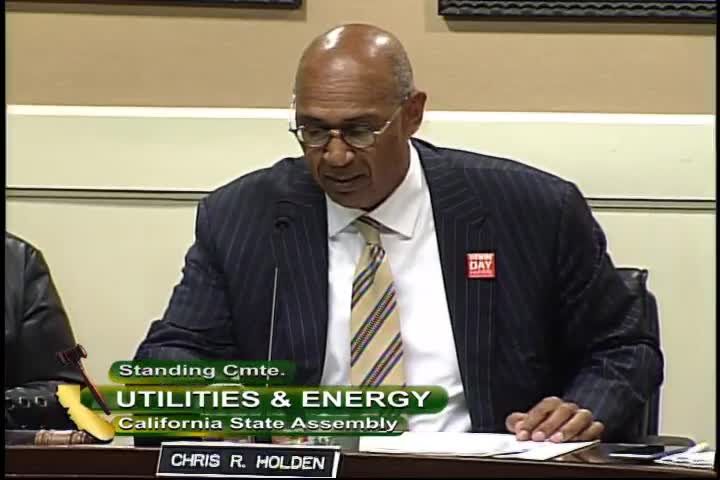 10MIN
Assembly Standing Committee on Utilities and Energy
Bill Author

Bill Co-Author(s):