AB 2162: Planning and zoning: housing development: supportive housing.
- Session Year: 2017-2018
- House: Assembly
- Latest Version Date: 2018-09-26
The Planning and Zoning Law requires the legislative body of each county and city to adopt a comprehensive, long-term general plan for the physical development of the county or city that includes, among other mandatory elements, a housing element. That law requires the housing element to contain, among other things, an assessment of housing needs and an inventory of resources and constraints relevant to meeting those needs and a program that sets forth a schedule of actions during the planning period, each with a timeline for implementation. That law specifies that transitional housing and supportive housing are a residential use of property, subject only to those restrictions that apply to other residential dwellings of the same type in the same zone.
This bill would make a nonsubstantive change to this requirement.
The Planning and Zoning Law requires the rezoning of sites identified in the inventory of sites by specific deadlines where the inventory does not identify adequate sites to accommodate the need for groups of all household income levels. That law further requires this rezoning to accommodate 100% of the need for housing for very low and low-income households, as specified, on sites zoned to permit owner-occupied and rental multifamily residential use by right during the planning period and defines the term use by right for these purposes.
This bill would require that supportive housing be a use by right in zones where multifamily and mixed uses are permitted, including nonresidential zones permitting multifamily uses, if the proposed housing development meets specified criteria, and would require a local government to approve, within specified periods, a supportive housing development that complies with these requirements. The bill would require that a developer of supportive housing provide the planning agency with a plan for providing supportive services, with documentation demonstrating that supportive services will be provided onsite to residents in the project and describing those services, as provided. The bill would prohibit the local government from imposing any minimum parking requirement for units occupied by supportive housing residents if the development is located within 12 mile of a public transit stop. The bill would specify that its provisions do not (1) preclude or limit the ability of a developer to seek a density bonus from the local government or (2) expand or contract the authority of a local government to adopt or amend an ordinance, charter, general plan, specific plan, resolution, or other land use policy or regulation that promotes the development of supportive housing.
The bill would include findings that the changes proposed by this bill address a matter of statewide concern rather than a municipal affair and, therefore, apply to all cities, including charter cities.
The California Environmental Quality Act (CEQA) requires a lead agency, as defined, to prepare, or cause to be prepared, and certify the completion of, an environmental impact report on a project that it proposes to carry out or approve that may have a significant effect on the environment or to adopt a negative declaration if it finds that the project will not have that effect. CEQA does not apply to the ministerial approval of projects.
This bill, by authorizing supportive housing as a use by right under certain circumstances, would expand the exemption for the ministerial approval of projects under CEQA.
By adding to the duties of local planning officials, this bill would impose a state-mandated local program.
This bill would incorporate additional changes to Section 65583 of the Government Code proposed by AB 686 to be operative only if this bill and AB 686 are enacted and this bill is enacted last.
The California Constitution requires the state to reimburse local agencies and school districts for certain costs mandated by the state. Statutory provisions establish procedures for making that reimbursement.
This bill would provide that no reimbursement is required by this act for a specified reason.
The Planning and Zoning Law requires the legislative body of each county and city to adopt a comprehensive, long-term general plan for the physical development of the county or city that includes, among other mandatory elements, a housing element. That law requires the housing element to contain, among other things, an assessment of housing needs and an inventory of resources and constraints relevant to meeting those needs and a program that sets forth a schedule of actions during the planning period, each with a timeline for implementation. That law specifies that transitional housing and supportive housing are a residential use of property, subject only to those restrictions that apply to other residential dwellings of the same type in the same zone.
This bill would make a nonsubstantive change to this requirement.
The Planning and Zoning Law requires the rezoning of sites identified in the inventory of sites by specific deadlines where the inventory does not identify adequate sites to accommodate the need for groups of all household income levels. That law further requires this rezoning to accommodate 100% of the need for housing for very low and low-income households, as specified, on sites zoned to permit owner-occupied and rental multifamily residential use by right during the planning period and defines the term use by right for these purposes.
This bill would require that supportive housing be a use by right in zones where multifamily and mixed uses are permitted, including commercial nonresidential zones permitting multifamily uses, if the proposed housing development meets specified criteria, and would require a local government to approve, within specified periods, a supportive housing development that complies with these requirements. The bill would require that a developer of supportive housing provide the planning agency with a plan for providing supportive services, with documentation demonstrating that supportive services will be provided onsite to residents in the project and describing those services, as provided. The bill would prohibit the local government from imposing any minimum parking requirement for units occupied by supportive housing residents if the development is located within 12 mile of a public transit stop. The bill would specify that its provisions do not (1) preclude or limit the ability of a developer to seek a density bonus from the local government or (2) expand or contract the authority of a local government to adopt or amend an ordinance, charter, general plan, specific plan, resolution, or other land use policy or regulation that promotes the development of supportive housing.
The bill would include findings that the changes proposed by this bill address a matter of statewide concern rather than a municipal affair and, therefore, apply to all cities, including charter cities.
The California Environmental Quality Act (CEQA) requires a lead agency, as defined, to prepare, or cause to be prepared, and certify the completion of, an environmental impact report on a project that it proposes to carry out or approve that may have a significant effect on the environment or to adopt a negative declaration if it finds that the project will not have that effect. CEQA does not apply to the ministerial approval of projects.
This bill, by authorizing supportive housing as a use by right under certain circumstances, would expand the exemption for the ministerial approval of projects under CEQA.
By adding to the duties of local planning officials, this bill would impose a state-mandated local program.
This bill would incorporate additional changes to Section 65583 of the Government Code proposed by AB 686 to be operative only if this bill and AB 686 are enacted and this bill is enacted last.
The California Constitution requires the state to reimburse local agencies and school districts for certain costs mandated by the state. Statutory provisions establish procedures for making that reimbursement.
This bill would provide that no reimbursement is required by this act for a specified reason.
The Planning and Zoning Law requires the legislative body of each county and city to adopt a comprehensive, long-term general plan for the physical development of the county or city that includes, among other mandatory elements, a housing element. That law requires the housing element to contain, among other things, an assessment of housing needs and an inventory of resources and constraints relevant to meeting those needs and a program that sets forth a schedule of actions during the planning period, each with a timeline for implementation. That law specifies that transitional housing and supportive housing are a residential use of property, subject only to those restrictions that apply to other residential dwellings of the same type in the same zone.
This bill would make a nonsubstantive change to this requirement.
The Planning and Zoning Law requires the rezoning of sites identified in the inventory of sites by specific deadlines where the inventory does not identify adequate sites to accommodate the need for groups of all household income levels. That law further requires this rezoning to accommodate 100% of the need for housing for very low and low-income households, as specified, on sites zoned to permit owner-occupied and rental multifamily residential use by right during the planning period and defines the term use by right for these purposes.
This bill would require that supportive housing be a use by right in zones where multifamily and mixed uses are permitted, including commercial zones permitting multifamily uses, if the proposed housing development meets specified criteria criteria, and would require a local government to approve, within specified periods, a supportive housing development that complies with these requirements. The bill would require that a developer of supportive housing provide the planning agency with a plan for providing supportive services, with documentation demonstrating that supportive services will be provided onsite to residents in the project and describing those services, as provided. The bill would prohibit the local government from imposing any minimum parking requirement for units occupied by supportive housing residents if the development is located within 12 mile of a public transit stop. The bill would specify that its provisions do not (1) preclude or limit the ability of a developer to seek a density bonus from the local government or (2) expand or contract the authority of a local government to adopt or amend an ordinance, charter, general plan, specific plan, resolution, or other land use policy or regulation that promotes the development of supportive housing.
The bill would include findings that the changes proposed by this bill address a matter of statewide concern rather than a municipal affair and, therefore, apply to all cities, including charter cities.
The California Environmental Quality Act (CEQA) requires a lead agency, as defined, to prepare, or cause to be prepared, and certify the completion of, an environmental impact report on a project that it proposes to carry out or approve that may have a significant effect on the environment or to adopt a negative declaration if it finds that the project will not have that effect. CEQA does not apply to the ministerial approval of projects.
This bill, by authorizing supportive housing as a use by right under certain circumstances, would expand the exemption for the ministerial approval of projects under CEQA.
By adding to the duties of local planning officials, this bill would impose a state-mandated local program.
The California Constitution requires the state to reimburse local agencies and school districts for certain costs mandated by the state. Statutory provisions establish procedures for making that reimbursement.
This bill would provide that no reimbursement is required by this act for a specified reason.
The Planning and Zoning Law requires the legislative body of each county and city to adopt a comprehensive, long-term general plan for the physical development of the county or city that includes, among other mandatory elements, a housing element. That law requires the housing element to contain, among other things, an assessment of housing needs and an inventory of resources and constraints relevant to meeting those needs and a program that sets forth a schedule of actions during the planning period, each with a timeline for implementation. That law specifies that transitional housing and supportive housing are a residential use of property, subject only to those restrictions that apply to other residential dwellings of the same type in the same zone.
This bill would make a nonsubstantive change to this requirement.
The Planning and Zoning Law requires the rezoning of sites identified in the inventory of sites by specific deadlines where the inventory does not identify adequate sites to accommodate the need for groups of all household income levels. That law further requires this rezoning to accommodate 100% of the need for housing for very low and low-income households, as specified, on sites zoned to permit owner-occupied and rental multifamily residential use by right during the planning period and defines the term use by right for these purposes.
This bill would require that supportive housing be a use by right in zones where multifamily and mixed uses are permitted, including commercial zones permitting multifamily uses, if the proposed housing development meets specified criteria and would require a local government to approve, within specified periods, a supportive housing development that complies with these requirements. The bill would require that a developer of supportive housing provide the planning agency with a plan for providing supportive services, with documentation demonstrating that supportive services will be provided onsite to residents in the project and describing those services, as provided. The bill would prohibit the local government from imposing any minimum parking requirement for units occupied by supportive housing residents if the development is located within 12 mile of a public transit stop. The bill would specify that its provisions do not (1) preclude or limit the ability of a developer to seek a density bonus from the local government or (2) expand or contract the authority of a local government to adopt or amend an ordinance, charter, general plan, specific plan, resolution, or other land use policy or regulation that promotes the development of supportive housing.
The bill would include findings that the changes proposed by this bill address a matter of statewide concern rather than a municipal affair and, therefore, apply to all cities, including charter cities.
By adding to the duties of local planning officials, this bill would impose a state-mandated local program.
The California Constitution requires the state to reimburse local agencies and school districts for certain costs mandated by the state. Statutory provisions establish procedures for making that reimbursement.
This bill would provide that no reimbursement is required by this act for a specified reason.
The Planning and Zoning Law requires the legislative body of each county and city to adopt a comprehensive, long-term general plan for the physical development of the county or city that includes, among other mandatory elements, a housing element. That law requires the housing element to contain contain, among other things, an assessment of housing needs and an inventory of resources and constraints relevant to meeting those needs and a program that sets forth a schedule of actions during the planning period, each with a timeline for implementation, and implementation. That law specifies that transitional housing and supportive housing are a residential use of property, subject only to those restrictions that apply to other residential dwellings of the same type in the same zone.
This bill would make a nonsubstantive change to this requirement.
The Planning and Zoning Law requires the rezoning of sites identified in the inventory of sites by specific deadlines where the inventory does not identify adequate sites to accommodate the need for groups of all household income levels. That law further requires this rezoning to accommodate 100% of the need for housing for very low and low-income households, as specified, on sites zoned to permit owner-occupied and rental multifamily residential use by right during the planning period and defines the term use by right for these purposes.
This bill would require that supportive housing be a use by right in zones where multiple dwelling multifamily and mixed uses are permitted, including commercial zones, zones permitting multifamily uses, if the proposed housing development meets specified criteria and would require a local government to approve, within specified periods, a supportive housing development that complies with these requirements. The bill would require that a developer of supportive housing provide the planning agency with a plan for providing supportive services, with documentation demonstrating that supportive services will be provided onsite to residents in the project and describing those services, as provided. The bill would prohibit the local government from imposing any minimum parking requirement, other than to require that the development include employee parking, requirement for units occupied by supportive housing residents if the development is located within 12 mile of a public transit stop. The bill would specify that its provisions do not (1) preclude or limit the ability of a developer to seek a density bonus from the local government or (2) expand or contract the authority of a local government to adopt or amend an ordinance, charter, general plan, specific plan, resolution, or other land use policy or regulation that promotes the development of supportive housing.
The bill would include findings that the changes proposed by this bill address a matter of statewide concern rather than a municipal affair and, therefore, apply to all cities, including charter cities.
By adding to the duties of local planning officials, this bill would impose a state-mandated local program.
The California Constitution requires the state to reimburse local agencies and school districts for certain costs mandated by the state. Statutory provisions establish procedures for making that reimbursement.
This bill would provide that no reimbursement is required by this act for a specified reason.
The Planning and Zoning Law requires the legislative body of each county and city to adopt a comprehensive, long-term general plan for the physical development of the county or city that includes, among other mandatory elements, a housing element. That law requires the housing element to contain a program that sets forth a schedule of actions during the planning period, each with a timeline for implementation, and requires the rezoning of sites identified in the inventory of sites by specific deadlines where the inventory does not identify adequate sites to accommodate the need for groups of all household income levels. That law further requires this rezoning to accommodate 100% of the need for housing for very low and low-income households, as specified, on sites zoned to permit owner-occupied and rental multifamily residential use by right during the planning period and defines the term use by right for these purposes.
This bill would require that supportive housing be a use by right in zones where multiple dwelling uses are permitted, including commercial zones, if the proposed housing development meets specified criteria and would require a local government to approve, within specified periods, a supportive housing development that complies with these requirements. The bill would require that a developer of supportive housing provide the planning agency with a plan for providing supportive services, with documentation demonstrating that supportive services will be provided onsite to residents in the project and describing those services, as provided. The bill would prohibit the local government from imposing any minimum parking requirement, other than to require that the development include employee parking, if the development is located within 12 mile of a public transit stop. The bill would specify that its provisions do not (1) preclude or limit the ability of a developer to seek a density bonus from the local government or (2) expand or contract the authority of a local government to adopt or amend an ordinance, charter, general plan, specific plan, resolution, or other land use policy or regulation that promotes the development of supportive housing.
The bill would include findings that the changes proposed by this bill address a matter of statewide concern rather than a municipal affair and, therefore, apply to all cities, including charter cities.
By adding to the duties of local planning officials, this bill would impose a state-mandated local program.
The California Constitution requires the state to reimburse local agencies and school districts for certain costs mandated by the state. Statutory provisions establish procedures for making that reimbursement.
This bill would provide that no reimbursement is required by this act for a specified reason.
The Legislature finds and declares the following:
(a)Californias homeless population increased by over 16,000 from 2016 to 2017, to 134,278 Californians experiencing homelessness at any point in time. Two to three times this number experienced homelessness during the course of last year. Twenty-five percent of the nations total homeless population and almost half of the nations unsheltered population reside in California. California now has one of the highest rates of homelessness per resident, twice as high as the national average.
(b)Addressing homelessness is urgent, as communities across the state face public health emergencies, including widespread Hepatitis A infection among residents experiencing homelessness in several major cities, higher mortality among homeless people with HIV and AIDS, and early mortality among people experiencing chronic homelessness.
(c)Chronic patterns of homelessnesshomelessness lasting at least a year or repeatedly over three yearsare on the rise in California, whereas decreasing elsewhere. As of 2017, 42 percent of those experiencing chronic homelessness nationwide live in California. The vast majority of these individuals and families have lived in California since well before becoming homeless.
(d)Evidence shows supportive housingan affordable rental with intensive services promoting housing stabilityworks to reduce chronic homelessness. As a result, the Legislature has invested in supportive housing, including the No Place Like Home Program, which will generate $2 billion in revenue bonds to build supportive housing for homeless Californians with serious mental illness.
(e)Studies reveal supportive housing benefits communities by reducing homelessness locally, addressing blight, and increasing property values. Yet one of the barriers to creating supportive housing has been local delays or denials of applications to build supportive housing, based on subjective local planning standards. Delays or denials of building applications add to the costs and timeline of development, affecting the effectiveness of state dollars.
(f)Given the urgent need to provide supportive housing to Californians experiencing chronic homelessness, streamlining and expediting the process of approving supportive housing applications will offer housing opportunities in communities with few or no opportunities to exit chronic homelessness. Further, it will promote progress in addressing the growing crisis of homelessness the Legislature intended through recent initiatives.
SEC. 2.Section 65583 of the Government Code is amended to read:65583.The housing element shall consist of an identification and analysis of existing and projected housing needs and a statement of goals, policies, quantified objectives, financial resources, and scheduled programs for the preservation, improvement, and development of housing. The housing element shall identify adequate sites for housing, including rental housing, factory-built housing, mobilehomes, and emergency shelters, and shall make adequate provision for the existing and projected needs of all economic segments of the community. The element shall contain all of the following:
(a)An assessment of housing needs and an inventory of resources and constraints relevant to the meeting of these needs. The assessment and inventory shall include all of the following:
(1)An analysis of population and employment trends and documentation of projections and a quantification of the localitys existing and projected housing needs for all income levels, including extremely low income households, as defined in subdivision (b) of Section 50105 and Section 50106 of the Health and Safety Code. These existing and projected needs shall include the localitys share of the regional housing need in accordance with Section 65584. Local agencies shall calculate the subset of very low income households allotted under Section 65584 that qualify as extremely low income households. The local agency may either use available census data to calculate the percentage of very low income households that qualify as extremely low income households or presume that 50 percent of the very low income households qualify as extremely low income households. The number of extremely low income households and very low income households shall equal the jurisdictions allocation of very low income households pursuant to Section 65584.
(2)An analysis and documentation of household characteristics, including level of payment compared to ability to pay, housing characteristics, including overcrowding, and housing stock condition.
(3)An inventory of land suitable and available for residential development, including vacant sites and sites having realistic and demonstrated potential for redevelopment during the planning period to meet the localitys housing need for a designated income level, and an analysis of the relationship of zoning and public facilities and services to these sites.
(4)(A)The identification of a zone or zones where emergency shelters are allowed as a permitted use without a conditional use or other discretionary permit. The identified zone or zones shall include sufficient capacity to accommodate the need for emergency shelter identified in paragraph (7), except that each local government shall identify a zone or zones that can accommodate at least one year-round emergency shelter. If the local government cannot identify a zone or zones with sufficient capacity, the local government shall include a program to amend its zoning ordinance to meet the requirements of this paragraph within one year of the adoption of the housing element. The local government may identify additional zones where emergency shelters are permitted with a conditional use permit. The local government shall also demonstrate that existing or proposed permit processing, development, and management standards are objective and encourage and facilitate the development of, or conversion to, emergency shelters. Emergency shelters may only be subject to those development and management standards that apply to residential or commercial development within the same zone except that a local government may apply written, objective standards that include all of the following:
(i)The maximum number of beds or persons permitted to be served nightly by the facility.
(ii)Off-street parking based upon demonstrated need, provided that the standards do not require more parking for emergency shelters than for other residential or commercial uses within the same zone.
(iii)The size and location of exterior and interior onsite waiting and client intake areas.
(iv)The provision of onsite management.
(v)The proximity to other emergency shelters, provided that emergency shelters are not required to be more than 300 feet apart.
(vi)The length of stay.
(vii)Lighting.
(viii)Security during hours that the emergency shelter is in operation.
(B)The permit processing, development, and management standards applied under this paragraph shall not be deemed to be discretionary acts within the meaning of the California Environmental Quality Act (Division 13 (commencing with Section 21000) of the Public Resources Code).
(C)A local government that can demonstrate to the satisfaction of the department the existence of one or more emergency shelters either within its jurisdiction or pursuant to a multijurisdictional agreement that can accommodate that jurisdictions need for emergency shelter identified in paragraph (7) may comply with the zoning requirements of subparagraph (A) by identifying a zone or zones where new emergency shelters are allowed with a conditional use permit.
(D)A local government with an existing ordinance or ordinances that comply with this paragraph shall not be required to take additional action to identify zones for emergency shelters. The housing element must only describe how existing ordinances, policies, and standards are consistent with the requirements of this paragraph.
(5)An analysis of potential and actual governmental constraints upon the maintenance, improvement, or development of housing for all income levels, including the types of housing identified in paragraph (1) of subdivision (c), and for persons with disabilities as identified in the analysis pursuant to paragraph (7), including land use controls, building codes and their enforcement, site improvements, fees and other exactions required of developers, local processing and permit procedures, and any locally adopted ordinances that directly impact the cost and supply of residential development. The analysis shall also demonstrate local efforts to remove governmental constraints that hinder the locality from meeting its share of the regional housing need in accordance with Section 65584 and from meeting the need for housing for persons with disabilities, supportive housing, transitional housing, and emergency shelters identified pursuant to paragraph (7).
(6)An analysis of potential and actual nongovernmental constraints upon the maintenance, improvement, or development of housing for all income levels, including the availability of financing, the price of land, the cost of construction, the requests to develop housing at densities below those anticipated in the analysis required by subdivision (c) of Section 65583.2, and the length of time between receiving approval for a housing development and submittal of an application for building permits for that housing development that hinder the construction of a localitys share of the regional housing need in accordance with Section 65584. The analysis shall also demonstrate local efforts to remove nongovernmental constraints that create a gap between the localitys planning for the development of housing for all income levels and the construction of that housing.
(7)An analysis of any special housing needs, such as those of the elderly; persons with disabilities, including a developmental disability, as defined in Section 4512 of the Welfare and Institutions Code; large families; farmworkers; families with female heads of households; and families and persons in need of emergency shelter. The need for emergency shelter shall be assessed based on annual and seasonal need. The need for emergency shelter may be reduced by the number of supportive housing units that are identified in an adopted 10-year plan to end chronic homelessness and that are either vacant or for which funding has been identified to allow construction during the planning period. An analysis of special housing needs by a city or county may include an analysis of the need for frequent user coordinated care housing services.
(8)An analysis of opportunities for energy conservation with respect to residential development. Cities and counties are encouraged to include weatherization and energy efficiency improvements as part of publicly subsidized housing rehabilitation projects. This may include energy efficiency measures that encompass the building envelope, its heating and cooling systems, and its electrical system.
(9)An analysis of existing assisted housing developments that are eligible to change from low-income housing uses during the next 10 years due to termination of subsidy contracts, mortgage prepayment, or expiration of restrictions on use. Assisted housing developments, for the purpose of this section, shall mean multifamily rental housing that receives governmental assistance under federal programs listed in subdivision (a) of Section 65863.10, state and local multifamily revenue bond programs, local redevelopment programs, the federal Community Development Block Grant Program, or local in-lieu fees. Assisted housing developments shall also include multifamily rental units that were developed pursuant to a local inclusionary housing program or used to qualify for a density bonus pursuant to Section 65916.
(A)The analysis shall include a listing of each development by project name and address, the type of governmental assistance received, the earliest possible date of change from low-income use, and the total number of elderly and nonelderly units that could be lost from the localitys low-income housing stock in each year during the 10-year period. For purposes of state and federally funded projects, the analysis required by this subparagraph need only contain information available on a statewide basis.
(B)The analysis shall estimate the total cost of producing new rental housing that is comparable in size and rent levels, to replace the units that could change from low-income use, and an estimated cost of preserving the assisted housing developments. This cost analysis for replacement housing may be done aggregately for each five-year period and does not have to contain a project-by-project cost estimate.
(C)The analysis shall identify public and private nonprofit corporations known to the local government which have legal and managerial capacity to acquire and manage these housing developments.
(D)The analysis shall identify and consider the use of all federal, state, and local financing and subsidy programs which can be used to preserve, for lower income households, the assisted housing developments, identified in this paragraph, including, but not limited to, federal Community Development Block Grant Program funds, tax increment funds received by a redevelopment agency of the community, and administrative fees received by a housing authority operating within the community. In considering the use of these financing and subsidy programs, the analysis shall identify the amounts of funds under each available program which have not been legally obligated for other purposes and which could be available for use in preserving assisted housing developments.
(b)(1)A statement of the communitys goals, quantified objectives, and policies relative to the maintenance, preservation, improvement, and development of housing.
(2)It is recognized that the total housing needs identified pursuant to subdivision (a) may exceed available resources and the communitys ability to satisfy this need within the content of the general plan requirements outlined in Article 5 (commencing with Section 65300). Under these circumstances, the quantified objectives need not be identical to the total housing needs. The quantified objectives shall establish the maximum number of housing units by income category, including extremely low income, that can be constructed, rehabilitated, and conserved over a five-year time period.
(c)A program which sets forth a schedule of actions during the planning period, each with a timeline for implementation, which may recognize that certain programs are ongoing, such that there will be beneficial impacts of the programs within the planning period, that the local government is undertaking or intends to undertake to implement the policies and achieve the goals and objectives of the housing element through the administration of land use and development controls, the provision of regulatory concessions and incentives, the utilization of appropriate federal and state financing and subsidy programs when available, and the utilization of moneys in a low- and moderate-income housing fund of an agency if the locality has established a redevelopment project area pursuant to the Community Redevelopment Law (Division 24 (commencing with Section 33000) of the Health and Safety Code). In order to make adequate provision for the housing needs of all economic segments of the community, the program shall do all of the following:
(1)Identify actions that will be taken to make sites available during the planning period with appropriate zoning and development standards and with services and facilities to accommodate that portion of the citys or countys share of the regional housing need for each income level that could not be accommodated on sites identified in the inventory completed pursuant to paragraph (3) of subdivision (a) without rezoning, and to comply with the requirements of Section 65584.09. Sites shall be identified as needed to facilitate and encourage the development of a variety of types of housing for all income levels, including multifamily rental housing, factory-built housing, mobilehomes, housing for agricultural employees, supportive housing, single-room occupancy units, emergency shelters, and transitional housing.
(A)Where the inventory of sites, pursuant to paragraph (3) of subdivision (a), does not identify adequate sites to accommodate the need for groups of all household income levels pursuant to Section 65584, rezoning of those sites, including adoption of minimum density and development standards, for jurisdictions with an eight-year housing element planning period pursuant to Section 65588, shall be completed no later than three years after either the date the housing element is adopted pursuant to subdivision (f) of Section 65585 or the date that is 90 days after receipt of comments from the department pursuant to subdivision (b) of Section 65585, whichever is earlier, unless the deadline is extended pursuant to subdivision (f). Notwithstanding the foregoing, for a local government that fails to adopt a housing element within 120 days of the statutory deadline in Section 65588 for adoption of the housing element, rezoning of those sites, including adoption of minimum density and development standards, shall be completed no later than three years and 120 days from the statutory deadline in Section 65588 for adoption of the housing element.
(B)Where the inventory of sites, pursuant to paragraph (3) of subdivision (a), does not identify adequate sites to accommodate the need for groups of all household income levels pursuant to Section 65584, the program shall identify sites that can be developed for housing within the planning period pursuant to subdivision (h) of Section 65583.2. The identification of sites shall include all components specified in Section 65583.2.
(C)Where the inventory of sites pursuant to paragraph (3) of subdivision (a) does not identify adequate sites to accommodate the need for farmworker housing, the program shall provide for sufficient sites to meet the need with zoning that permits farmworker housing use by right, including density and development standards that could accommodate and facilitate the feasibility of the development of farmworker housing for low- and very low income households.
(2)Assist in the development of adequate housing to meet the needs of extremely low, very low, low-, and moderate-income households.
(3)Address and, where appropriate and legally possible, remove governmental and nongovernmental constraints to the maintenance, improvement, and development of housing, including housing for all income levels and housing for persons with disabilities. The program shall remove constraints to, and provide reasonable accommodations for housing designed for, intended for occupancy by, or with supportive services for, persons with disabilities. Transitional housing and supportive housing shall be considered a residential use of property and shall be subject only to those restrictions that apply to other residential dwellings of the same type in the same zone. Supportive housing, as defined in Section 65650, shall be a use by right in all zones where multifamily and mixed uses are permitted, as provided in Article 11 (commencing with Section 65650).
(4)Conserve and improve the condition of the existing affordable housing stock, which may include addressing ways to mitigate the loss of dwelling units demolished by public or private action.
(5)Promote housing opportunities for all persons regardless of race, religion, sex, marital status, ancestry, national origin, color, familial status, or disability.
(6)Preserve for lower income households the assisted housing developments identified pursuant to paragraph (9) of subdivision (a). The program for preservation of the assisted housing developments shall utilize, to the extent necessary, all available federal, state, and local financing and subsidy programs identified in paragraph (9) of subdivision (a), except where a community has other urgent needs for which alternative funding sources are not available. The program may include strategies that involve local regulation and technical assistance.
(7)Include an identification of the agencies and officials responsible for the implementation of the various actions and the means by which consistency will be achieved with other general plan elements and community goals.
(8)Include a diligent effort by the local government to achieve public participation of all economic segments of the community in the development of the housing element, and the program shall describe this effort.
(d)(1)A local government may satisfy all or part of its requirement to identify a zone or zones suitable for the development of emergency shelters pursuant to paragraph (4) of subdivision (a) by adopting and implementing a multijurisdictional agreement, with a maximum of two other adjacent communities, that requires the participating jurisdictions to develop at least one year-round emergency shelter within two years of the beginning of the planning period.
(2)The agreement shall allocate a portion of the new shelter capacity to each jurisdiction as credit toward its emergency shelter need, and each jurisdiction shall describe how the capacity was allocated as part of its housing element.
(3)Each member jurisdiction of a multijurisdictional agreement shall describe in its housing element all of the following:
(A)How the joint facility will meet the jurisdictions emergency shelter need.
(B)The jurisdictions contribution to the facility for both the development and ongoing operation and management of the facility.
(C)The amount and source of the funding that the jurisdiction contributes to the facility.
(4)The aggregate capacity claimed by the participating jurisdictions in their housing elements shall not exceed the actual capacity of the shelter.
(e)Except as otherwise provided in this article, amendments to this article that alter the required content of a housing element shall apply to both of the following:
(1)A housing element or housing element amendment prepared pursuant to subdivision (e) of Section 65588 or Section 65584.02, when a city, county, or city and county submits a draft to the department for review pursuant to Section 65585 more than 90 days after the effective date of the amendment to this section.
(2)Any housing element or housing element amendment prepared pursuant to subdivision (e) of Section 65588 or Section 65584.02, when the city, county, or city and county fails to submit the first draft to the department before the due date specified in Section 65588 or 65584.02.
(f)The deadline for completing required rezoning pursuant to subparagraph (A) of paragraph (1) of subdivision (c) shall be extended by one year if the local government has completed the rezoning at densities sufficient to accommodate at least 75 percent of the units for low- and very low income households and if the legislative body at the conclusion of a public hearing determines, based upon substantial evidence, that any of the following circumstances exist:
(1)The local government has been unable to complete the rezoning because of the action or inaction beyond the control of the local government of any other state, federal, or local agency.
(2)The local government is unable to complete the rezoning because of infrastructure deficiencies due to fiscal or regulatory constraints.
(3)The local government must undertake a major revision to its general plan in order to accommodate the housing-related policies of a sustainable communities strategy or an alternative planning strategy adopted pursuant to Section 65080.
The resolution and the findings shall be transmitted to the department together with a detailed budget and schedule for preparation and adoption of the required rezonings, including plans for citizen participation and expected interim action. The schedule shall provide for adoption of the required rezoning within one year of the adoption of the resolution.
(g)(1)If a local government fails to complete the rezoning by the deadline provided in subparagraph (A) of paragraph (1) of subdivision (c), as it may be extended pursuant to subdivision (f), except as provided in paragraph (2), a local government may not disapprove a housing development project, nor require a conditional use permit, planned unit development permit, or other locally imposed discretionary permit, or impose a condition that would render the project infeasible, if the housing development project (A) is proposed to be located on a site required to be rezoned pursuant to the program action required by that subparagraph and (B) complies with applicable, objective general plan and zoning standards and criteria, including design review standards, described in the program action required by that subparagraph. Any subdivision of sites shall be subject to the Subdivision Map Act (Division 2 (commencing with Section 66410)). Design review shall not constitute a project for purposes of Division 13 (commencing with Section 21000) of the Public Resources Code.
(2)A local government may disapprove a housing development described in paragraph (1) if it makes written findings supported by substantial evidence on the record that both of the following conditions exist:
(A)The housing development project would have a specific, adverse impact upon the public health or safety unless the project is disapproved or approved upon the condition that the project be developed at a lower density. As used in this paragraph, a specific, adverse impact means a significant, quantifiable, direct, and unavoidable impact, based on objective, identified written public health or safety standards, policies, or conditions as they existed on the date the application was deemed complete.
(B)There is no feasible method to satisfactorily mitigate or avoid the adverse impact identified pursuant to paragraph (1), other than the disapproval of the housing development project or the approval of the project upon the condition that it be developed at a lower density.
(3)The applicant or any interested person may bring an action to enforce this subdivision. If a court finds that the local agency disapproved a project or conditioned its approval in violation of this subdivision, the court shall issue an order or judgment compelling compliance within 60 days. The court shall retain jurisdiction to ensure that its order or judgment is carried out. If the court determines that its order or judgment has not been carried out within 60 days, the court may issue further orders to ensure that the purposes and policies of this subdivision are fulfilled. In any such action, the city, county, or city and county shall bear the burden of proof.
(4)For purposes of this subdivision, housing development project means a project to construct residential units for which the project developer provides sufficient legal commitments to the appropriate local agency to ensure the continued availability and use of at least 49 percent of the housing units for very low, low-, and moderate-income households with an affordable housing cost or affordable rent, as defined in Section 50052.5 or 50053 of the Health and Safety Code, respectively, for the period required by the applicable financing.
(h)An action to enforce the program actions of the housing element shall be brought pursuant to Section 1085 of the Code of Civil Procedure.
SEC. 2.5.Section 65583 of the Government Code is amended to read:65583.The housing element shall consist of an identification and analysis of existing and projected housing needs and a statement of goals, policies, quantified objectives, financial resources, and scheduled programs for the preservation, improvement, and development of housing. The housing element shall identify adequate sites for housing, including rental housing, factory-built housing, mobilehomes, and emergency shelters, and shall make adequate provision for the existing and projected needs of all economic segments of the community. The element shall contain all of the following:
(a)An assessment of housing needs and an inventory of resources and constraints relevant to the meeting of these needs. The assessment and inventory shall include all of the following:
(1)An analysis of population and employment trends and documentation of projections and a quantification of the localitys existing and projected housing needs for all income levels, including extremely low income households, as defined in subdivision (b) of Section 50105 and Section 50106 of the Health and Safety Code. These existing and projected needs shall include the localitys share of the regional housing need in accordance with Section 65584. Local agencies shall calculate the subset of very low income households allotted under Section 65584 that qualify as extremely low income households. The local agency may either use available census data to calculate the percentage of very low income households that qualify as extremely low income households or presume that 50 percent of the very low income households qualify as extremely low income households. The number of extremely low income households and very low income households shall equal the jurisdictions allocation of very low income households pursuant to Section 65584.
(2)An analysis and documentation of household characteristics, including level of payment compared to ability to pay, housing characteristics, including overcrowding, and housing stock condition.
(3)An inventory of land suitable and available for residential development, including vacant sites and sites having realistic and demonstrated potential for redevelopment during the planning period to meet the localitys housing need for a designated income level, and an analysis of the relationship of zoning and public facilities and services to these sites.
(4)(A)The identification of a zone or zones where emergency shelters are allowed as a permitted use without a conditional use or other discretionary permit. The identified zone or zones shall include sufficient capacity to accommodate the need for emergency shelter identified in paragraph (7), except that each local government shall identify a zone or zones that can accommodate at least one year-round emergency shelter. If the local government cannot identify a zone or zones with sufficient capacity, the local government shall include a program to amend its zoning ordinance to meet the requirements of this paragraph within one year of the adoption of the housing element. The local government may identify additional zones where emergency shelters are permitted with a conditional use permit. The local government shall also demonstrate that existing or proposed permit processing, development, and management standards are objective and encourage and facilitate the development of, or conversion to, emergency shelters. Emergency shelters may only be subject to those development and management standards that apply to residential or commercial development within the same zone except that a local government may apply written, objective standards that include all of the following:
(i)The maximum number of beds or persons permitted to be served nightly by the facility.
(ii)Off-street parking based upon demonstrated need, provided that the standards do not require more parking for emergency shelters than for other residential or commercial uses within the same zone.
(iii)The size and location of exterior and interior onsite waiting and client intake areas.
(iv)The provision of onsite management.
(v)The proximity to other emergency shelters, provided that emergency shelters are not required to be more than 300 feet apart.
(vi)The length of stay.
(vii)Lighting.
(viii)Security during hours that the emergency shelter is in operation.
(B)The permit processing, development, and management standards applied under this paragraph shall not be deemed to be discretionary acts within the meaning of the California Environmental Quality Act (Division 13 (commencing with Section 21000) of the Public Resources Code).
(C)A local government that can demonstrate to the satisfaction of the department the existence of one or more emergency shelters either within its jurisdiction or pursuant to a multijurisdictional agreement that can accommodate that jurisdictions need for emergency shelter identified in paragraph (7) may comply with the zoning requirements of subparagraph (A) by identifying a zone or zones where new emergency shelters are allowed with a conditional use permit.
(D)A local government with an existing ordinance or ordinances that comply with this paragraph shall not be required to take additional action to identify zones for emergency shelters. The housing element must only describe how existing ordinances, policies, and standards are consistent with the requirements of this paragraph.
(5)An analysis of potential and actual governmental constraints upon the maintenance, improvement, or development of housing for all income levels, including the types of housing identified in paragraph (1) of subdivision (c), and for persons with disabilities as identified in the analysis pursuant to paragraph (7), including land use controls, building codes and their enforcement, site improvements, fees and other exactions required of developers, local processing and permit procedures, and any locally adopted ordinances that directly impact the cost and supply of residential development. The analysis shall also demonstrate local efforts to remove governmental constraints that hinder the locality from meeting its share of the regional housing need in accordance with Section 65584 and from meeting the need for housing for persons with disabilities, supportive housing, transitional housing, and emergency shelters identified pursuant to paragraph (7).
(6)An analysis of potential and actual nongovernmental constraints upon the maintenance, improvement, or development of housing for all income levels, including the availability of financing, the price of land, the cost of construction, the requests to develop housing at densities below those anticipated in the analysis required by subdivision (c) of Section 65583.2, and the length of time between receiving approval for a housing development and submittal of an application for building permits for that housing development that hinder the construction of a localitys share of the regional housing need in accordance with Section 65584. The analysis shall also demonstrate local efforts to remove nongovernmental constraints that create a gap between the localitys planning for the development of housing for all income levels and the construction of that housing.
(7)An analysis of any special housing needs, such as those of the elderly; persons with disabilities, including a developmental disability, as defined in Section 4512 of the Welfare and Institutions Code; large families; farmworkers; families with female heads of households; and families and persons in need of emergency shelter. The need for emergency shelter shall be assessed based on annual and seasonal need. The need for emergency shelter may be reduced by the number of supportive housing units that are identified in an adopted 10-year plan to end chronic homelessness and that are either vacant or for which funding has been identified to allow construction during the planning period. An analysis of special housing needs by a city or county may include an analysis of the need for frequent user coordinated care housing services.
(8)An analysis of opportunities for energy conservation with respect to residential development. Cities and counties are encouraged to include weatherization and energy efficiency improvements as part of publicly subsidized housing rehabilitation projects. This may include energy efficiency measures that encompass the building envelope, its heating and cooling systems, and its electrical system.
(9)An analysis of existing assisted housing developments that are eligible to change from low-income housing uses during the next 10 years due to termination of subsidy contracts, mortgage prepayment, or expiration of restrictions on use. Assisted housing developments, for the purpose of this section, shall mean multifamily rental housing that receives governmental assistance under federal programs listed in subdivision (a) of Section 65863.10, state and local multifamily revenue bond programs, local redevelopment programs, the federal Community Development Block Grant Program, or local in-lieu fees. Assisted housing developments shall also include multifamily rental units that were developed pursuant to a local inclusionary housing program or used to qualify for a density bonus pursuant to Section 65916.
(A)The analysis shall include a listing of each development by project name and address, the type of governmental assistance received, the earliest possible date of change from low-income use, and the total number of elderly and nonelderly units that could be lost from the localitys low-income housing stock in each year during the 10-year period. For purposes of state and federally funded projects, the analysis required by this subparagraph need only contain information available on a statewide basis.
(B)The analysis shall estimate the total cost of producing new rental housing that is comparable in size and rent levels, to replace the units that could change from low-income use, and an estimated cost of preserving the assisted housing developments. This cost analysis for replacement housing may be done aggregately for each five-year period and does not have to contain a project-by-project cost estimate.
(C)The analysis shall identify public and private nonprofit corporations known to the local government that have legal and managerial capacity to acquire and manage these housing developments.
(D)The analysis shall identify and consider the use of all federal, state, and local financing and subsidy programs that can be used to preserve, for lower income households, the assisted housing developments, identified in this paragraph, including, but not limited to, federal Community Development Block Grant Program funds, tax increment funds received by a redevelopment agency of the community, and administrative fees received by a housing authority operating within the community. In considering the use of these financing and subsidy programs, the analysis shall identify the amounts of funds under each available program that have not been legally obligated for other purposes and that could be available for use in preserving assisted housing developments.
(b)(1)A statement of the communitys goals, quantified objectives, and policies relative to the maintenance, preservation, improvement, and development of housing.
(2)It is recognized that the total housing needs identified pursuant to subdivision (a) may exceed available resources and the communitys ability to satisfy this need within the content of the general plan requirements outlined in Article 5 (commencing with Section 65300). Under these circumstances, the quantified objectives need not be identical to the total housing needs. The quantified objectives shall establish the maximum number of housing units by income category, including extremely low income, that can be constructed, rehabilitated, and conserved over a five-year time period.
(c)A program that sets forth a schedule of actions during the planning period, each with a timeline for implementation, that may recognize that certain programs are ongoing, such that there will be beneficial impacts of the programs within the planning period, that the local government is undertaking or intends to undertake to implement the policies and achieve the goals and objectives of the housing element through the administration of land use and development controls, the provision of regulatory concessions and incentives, the utilization of appropriate federal and state financing and subsidy programs when available, and the utilization of moneys in a low- and moderate-income housing fund of an agency if the locality has established a redevelopment project area pursuant to the Community Redevelopment Law (Division 24 (commencing with Section 33000) of the Health and Safety Code). In order to make adequate provision for the housing needs of all economic segments of the community, the program shall do all of the following:
(1)Identify actions that will be taken to make sites available during the planning period with appropriate zoning and development standards and with services and facilities to accommodate that portion of the citys or countys share of the regional housing need for each income level that could not be accommodated on sites identified in the inventory completed pursuant to paragraph (3) of subdivision (a) without rezoning, and to comply with the requirements of Section 65584.09. Sites shall be identified as needed to facilitate and encourage the development of a variety of types of housing for all income levels, including multifamily rental housing, factory-built housing, mobilehomes, housing for agricultural employees, supportive housing, single-room occupancy units, emergency shelters, and transitional housing.
(A)Where the inventory of sites, pursuant to paragraph (3) of subdivision (a), does not identify adequate sites to accommodate the need for groups of all household income levels pursuant to Section 65584, rezoning of those sites, including adoption of minimum density and development standards, for jurisdictions with an eight-year housing element planning period pursuant to Section 65588, shall be completed no later than three years after either the date the housing element is adopted pursuant to subdivision (f) of Section 65585 or the date that is 90 days after receipt of comments from the department pursuant to subdivision (b) of Section 65585, whichever is earlier, unless the deadline is extended pursuant to subdivision (f). Notwithstanding the foregoing, for a local government that fails to adopt a housing element within 120 days of the statutory deadline in Section 65588 for adoption of the housing element, rezoning of those sites, including adoption of minimum density and development standards, shall be completed no later than three years and 120 days from the statutory deadline in Section 65588 for adoption of the housing element.
(B)Where the inventory of sites, pursuant to paragraph (3) of subdivision (a), does not identify adequate sites to accommodate the need for groups of all household income levels pursuant to Section 65584, the program shall identify sites that can be developed for housing within the planning period pursuant to subdivision (h) of Section 65583.2. The identification of sites shall include all components specified in Section 65583.2.
(C)Where the inventory of sites pursuant to paragraph (3) of subdivision (a) does not identify adequate sites to accommodate the need for farmworker housing, the program shall provide for sufficient sites to meet the need with zoning that permits farmworker housing use by right, including density and development standards that could accommodate and facilitate the feasibility of the development of farmworker housing for low- and very low income households.
(2)Assist in the development of adequate housing to meet the needs of extremely low, very low, low-, and moderate-income households.
(3)Address and, where appropriate and legally possible, remove governmental and nongovernmental constraints to the maintenance, improvement, and development of housing, including housing for all income levels and housing for persons with disabilities. The program shall remove constraints to, and provide reasonable accommodations for housing designed for, intended for occupancy by, or with supportive services for, persons with disabilities. Transitional housing and supportive housing shall be considered a residential use of property and shall be subject only to those restrictions that apply to other residential dwellings of the same type in the same zone. Supportive housing, as defined in Section 65650, shall be a use by right in all zones where multifamily and mixed uses are permitted, as provided in Article 11 (commencing with Section 65650).
(4)Conserve and improve the condition of the existing affordable housing stock, which may include addressing ways to mitigate the loss of dwelling units demolished by public or private action.
(5)Promote and affirmatively further fair housing opportunities and promote housing throughout the community or communities for all persons regardless of race, religion, sex, marital status, ancestry, national origin, color, familial status, or disability, and other characteristics protected by the California Fair Employment and Housing Act (Part 2.8 (commencing with Section 12900) of Division 3 of Title 2), Section 65008, and any other state and federal fair housing and planning law.
(6)Preserve for lower income households the assisted housing developments identified pursuant to paragraph (9) of subdivision (a). The program for preservation of the assisted housing developments shall utilize, to the extent necessary, all available federal, state, and local financing and subsidy programs identified in paragraph (9) of subdivision (a), except where a community has other urgent needs for which alternative funding sources are not available. The program may include strategies that involve local regulation and technical assistance.
(7)Include an identification of the agencies and officials responsible for the implementation of the various actions and the means by which consistency will be achieved with other general plan elements and community goals.
(8)Include a diligent effort by the local government to achieve public participation of all economic segments of the community in the development of the housing element, and the program shall describe this effort.
(9)(A)Affirmatively further fair housing in accordance with Chapter 15 (commencing with Section 8899.50) of Division 1 of Title 2. The program shall include an assessment of fair housing in the jurisdiction that shall include all of the following components:
(i)A summary of fair housing issues in the jurisdiction and an assessment of the jurisdictions fair housing enforcement and fair housing outreach capacity.
(ii)An analysis of available federal, state, and local data and knowledge to identify integration and segregation patterns and trends, racially or ethnically concentrated areas of poverty, disparities in access to opportunity, and disproportionate housing needs within the jurisdiction, including displacement risk.
(iii)An assessment of the contributing factors for the fair housing issues identified under clause (ii).
(iv)An identification of the jurisdictions fair housing priorities and goals, giving highest priority to those factors identified in clause (iii) that limit or deny fair housing choice or access to opportunity, or negatively impact fair housing or civil rights compliance, and identifying the metrics and milestones for determining what fair housing results will be achieved.
(v)Strategies and actions to implement those priorities and goals, which may include, but are not limited to, enhancing mobility strategies and encouraging development of new affordable housing in areas of opportunity, as well as place-based strategies to encourage community revitalization, including preservation of existing affordable housing, and protecting existing residents from displacement.
(B)A jurisdiction that completes or revises an assessment of fair housing pursuant to Subpart A (commencing with Section 5.150) of Part 5 of Subtitle A of Title 24 of the Code of Federal Regulations, as published in Volume 80 of the Federal Register, Number 136, page 42272, dated July 16, 2015, or an analysis of impediments to fair housing choice in accordance with the requirements of Section 91.225 of Title 24 of the Code of Federal Regulations in effect prior to August 17, 2015, may incorporate relevant portions of that assessment or revised assessment of fair housing or analysis or revised analysis of impediments to fair housing into its housing element.
(C)The requirements of this paragraph shall apply to housing elements due to be revised pursuant to Section 65588 on or after January 1, 2021.
(d)(1)A local government may satisfy all or part of its requirement to identify a zone or zones suitable for the development of emergency shelters pursuant to paragraph (4) of subdivision (a) by adopting and implementing a multijurisdictional agreement, with a maximum of two other adjacent communities, that requires the participating jurisdictions to develop at least one year-round emergency shelter within two years of the beginning of the planning period.
(2)The agreement shall allocate a portion of the new shelter capacity to each jurisdiction as credit toward its emergency shelter need, and each jurisdiction shall describe how the capacity was allocated as part of its housing element.
(3)Each member jurisdiction of a multijurisdictional agreement shall describe in its housing element all of the following:
(A)How the joint facility will meet the jurisdictions emergency shelter need.
(B)The jurisdictions contribution to the facility for both the development and ongoing operation and management of the facility.
(C)The amount and source of the funding that the jurisdiction contributes to the facility.
(4)The aggregate capacity claimed by the participating jurisdictions in their housing elements shall not exceed the actual capacity of the shelter.
(e)Except as otherwise provided in this article, amendments to this article that alter the required content of a housing element shall apply to both of the following:
(1)A housing element or housing element amendment prepared pursuant to subdivision (e) of Section 65588 or Section 65584.02, when a city, county, or city and county submits a draft to the department for review pursuant to Section 65585 more than 90 days after the effective date of the amendment to this section.
(2)Any housing element or housing element amendment prepared pursuant to subdivision (e) of Section 65588 or Section 65584.02, when the city, county, or city and county fails to submit the first draft to the department before the due date specified in Section 65588 or 65584.02.
(f)The deadline for completing required rezoning pursuant to subparagraph (A) of paragraph (1) of subdivision (c) shall be extended by one year if the local government has completed the rezoning at densities sufficient to accommodate at least 75 percent of the units for low- and very low income households and if the legislative body at the conclusion of a public hearing determines, based upon substantial evidence, that any of the following circumstances exist:
(1)The local government has been unable to complete the rezoning because of the action or inaction beyond the control of the local government of any other state, federal, or local agency.
(2)The local government is unable to complete the rezoning because of infrastructure deficiencies due to fiscal or regulatory constraints.
(3)The local government must undertake a major revision to its general plan in order to accommodate the housing-related policies of a sustainable communities strategy or an alternative planning strategy adopted pursuant to Section 65080.
The resolution and the findings shall be transmitted to the department together with a detailed budget and schedule for preparation and adoption of the required rezonings, including plans for citizen participation and expected interim action. The schedule shall provide for adoption of the required rezoning within one year of the adoption of the resolution.
(g)(1)If a local government fails to complete the rezoning by the deadline provided in subparagraph (A) of paragraph (1) of subdivision (c), as it may be extended pursuant to subdivision (f), except as provided in paragraph (2), a local government may not disapprove a housing development project, nor require a conditional use permit, planned unit development permit, or other locally imposed discretionary permit, or impose a condition that would render the project infeasible, if the housing development project (A) is proposed to be located on a site required to be rezoned pursuant to the program action required by that subparagraph and (B) complies with applicable, objective general plan and zoning standards and criteria, including design review standards, described in the program action required by that subparagraph. Any subdivision of sites shall be subject to the Subdivision Map Act (Division 2 (commencing with Section 66410)). Design review shall not constitute a project for purposes of Division 13 (commencing with Section 21000) of the Public Resources Code.
(2)A local government may disapprove a housing development described in paragraph (1) if it makes written findings supported by substantial evidence on the record that both of the following conditions exist:
(A)The housing development project would have a specific, adverse impact upon the public health or safety unless the project is disapproved or approved upon the condition that the project be developed at a lower density. As used in this paragraph, a specific, adverse impact means a significant, quantifiable, direct, and unavoidable impact, based on objective, identified written public health or safety standards, policies, or conditions as they existed on the date the application was deemed complete.
(B)There is no feasible method to satisfactorily mitigate or avoid the adverse impact identified pursuant to paragraph (1), other than the disapproval of the housing development project or the approval of the project upon the condition that it be developed at a lower density.
(3)The applicant or any interested person may bring an action to enforce this subdivision. If a court finds that the local agency disapproved a project or conditioned its approval in violation of this subdivision, the court shall issue an order or judgment compelling compliance within 60 days. The court shall retain jurisdiction to ensure that its order or judgment is carried out. If the court determines that its order or judgment has not been carried out within 60 days, the court may issue further orders to ensure that the purposes and policies of this subdivision are fulfilled. In any such action, the city, county, or city and county shall bear the burden of proof.
(4)For purposes of this subdivision, housing development project means a project to construct residential units for which the project developer provides sufficient legal commitments to the appropriate local agency to ensure the continued availability and use of at least 49 percent of the housing units for very low, low-, and moderate-income households with an affordable housing cost or affordable rent, as defined in Section 50052.5 or 50053 of the Health and Safety Code, respectively, for the period required by the applicable financing.
(h)An action to enforce the program actions of the housing element shall be brought pursuant to Section 1085 of the Code of Civil Procedure.
SEC. 3.Article 11 (commencing with Section 65650) is added to Chapter 3 of Division 1 of Title 7 of the Government Code, to read:11.Supportive Housing65650.For purposes of this article, the following definitions shall apply:
(a)Supportive housing shall have the same meaning as defined in Section 50675.14 of the Health and Safety Code.
(b)Supportive services shall have the same meaning as defined in Section 65582.
(c)Target population shall have the same meaning as defined in Section 50675.14 of the Health and Safety Code.
(d)Use by right shall have the same meaning as defined in subdivision (i) of Section 65583.2.
65651.(a)Supportive housing shall be a use by right in zones where multifamily and mixed uses are permitted, including nonresidential zones permitting multifamily uses, if the proposed housing development satisfies all of the following requirements:
(1)Units within the development are subject to a recorded affordability restriction for 55 years.
(2)One hundred percent of the units, excluding managers units, within the development are dedicated to lower income households and are receiving public funding to ensure affordability of the housing to lower income Californians. For purposes of this paragraph, lower income households has the same meaning as defined in Section 50079.5 of the Health and Safety Code.
(3)At least 25 percent of the units in the development or 12 units, whichever is greater, are restricted to residents in supportive housing who meet criteria of the target population. If the development consists of fewer than 12 units, then 100 percent of the units, excluding managers units, in the development shall be restricted to residents in supportive housing.
(4)The developer provides the planning agency with the information required by Section 65652.
(5)Nonresidential floor area shall be used for onsite supportive services in the following amounts:
(A)For a development with 20 or fewer total units, at least 90 square feet shall be provided for onsite supportive services.
(B)For a development with more than 20 units, at least 3 percent of the total nonresidential floor area shall be provided for onsite supportive services that are limited to tenant use, including, but not limited to, community rooms, case management offices, computer rooms, and community kitchens.
(6)The developer replaces any dwelling units on the site of the supportive housing development in the manner provided in paragraph (3) of subdivision (c) of Section 65915.
(7)Units within the development, excluding managers units, include at least one bathroom and a kitchen or other cooking facilities, including, at minimum, a stovetop, a sink, and a refrigerator.
(b)The local government may require a supportive housing development subject to this article to comply with objective, written development standards and policies; provided, however, that the development shall only be subject to the objective standards and policies that apply to other multifamily development within the same zone.
(c)Notwithstanding any other provision of this section to the contrary, the local government shall, at the request of the project owner, reduce the number of residents required to live in supportive housing if the project-based rental assistance or operating subsidy for a supportive housing project is terminated through no fault of the project owner, but only if all of the following conditions have been met:
(1)The owner demonstrates that it has made good faith efforts to find other sources of financial support.
(2)Any change in the number of supportive service units is restricted to the minimum necessary to maintain projects financial feasibility.
(3)Any change to the occupancy of the supportive housing units is made in a manner that minimizes tenant disruption and only upon the vacancy of any supportive housing units.
(d)If the proposed housing development is located within a city with a population of fewer than 200,000 or the unincorporated area of a county with a population of fewer than 200,000, and the city or the unincorporated area of the county has a population of persons experiencing homelessness of 1,500 or fewer, according to the most recently published homeless point-in-time-count, the development, in addition to the requirements of subdivision (a), shall consist of 50 units or fewer to be a use by right pursuant to this article. A city or county described in this subdivision may develop a policy to approve as a use by right proposed housing developments with a limit higher than 50 units.
65652.A developer of supportive housing subject to this article shall provide the planning agency with a plan for providing supportive services, with documentation demonstrating that supportive services will be provided onsite to residents in the project, as required by Section 65651, and describing those services, which shall include all of the following:
(a)The name of the proposed entity or entities that will provide supportive services.
(b)The proposed funding source or sources for the provided onsite supportive services.
(c)Proposed staffing levels.
65653.(a)The local government shall approve a supportive housing development that complies with the applicable requirements of this article.
(b)The local government shall notify the developer whether the application is complete within 30 days of receipt of an application to develop supportive housing in accordance with this article. The local government shall complete its review of the application within 60 days after the application is complete for a project with 50 or fewer units, or within 120 days after the application is complete for a project with more than 50 units.
65654.If the supportive housing development is located within one-half mile of a public transit stop, the local government shall not impose any minimum parking requirements for the units occupied by supportive housing residents.
65655.This article shall not be construed to do either of the following:
(a)Preclude or limit the ability of a developer to seek a density bonus from the local government pursuant to Section 65915.
(b)Expand or contract the authority of a local government to adopt or amend an ordinance, charter, general plan, specific plan, resolution, or other land use policy or regulation that promotes the development of supportive housing.
65656.The Legislature finds and declares that the provision of adequate supportive housing to help alleviate the severe shortage of housing opportunities for people experiencing homelessness in this state and of necessary services to the target population described in Section 50675.14 of the Health and Safety Code is a matter of statewide concern and is not a municipal affair as that term is used in Section 5 of Article XI of the California Constitution. Therefore, this article applies to all cities, including charter cities.
SEC. 4.Section 2.5 of this bill incorporates amendments to Section 65583 of the Government Code proposed by both this bill and Assembly Bill 686. That section of this bill shall only become operative if (1) both bills are enacted and become effective on or before January 1, 2019, (2) each bill amends Section 65583 of the Government Code, and (3) this bill is enacted after Assembly Bill 686, in which case Section 2 of this bill shall not become operative.
SEC. 5.No reimbursement is required by this act pursuant to Section 6 of Article XIIIB of the California Constitution because a local agency or school district has the authority to levy service charges, fees, or assessments sufficient to pay for the program or level of service mandated by this act, within the meaning of Section 17556 of the Government Code.
The Legislature finds and declares the following:
(a)Californias homeless population increased by over 16,000 from 2016 to 2017, to 134,278 Californians experiencing homelessness at any point in time. Two to three times this number experienced homelessness during the course of last year. Twenty-five percent of the nations total homeless population and almost half of the nations unsheltered population reside in California. California now has one of the highest rates of homelessness per resident, twice as high as the national average.
(b)Addressing homelessness is urgent, as communities across the state face public health emergencies, including widespread Hepatitis A infection among residents experiencing homelessness in several major cities, higher mortality among homeless people with HIV and AIDS, and early mortality among people experiencing chronic homelessness.
(c)Chronic patterns of homelessnesshomelessness lasting at least a year or repeatedly over three yearsare on the rise in California, whereas decreasing elsewhere. As of 2017, 42 percent of those experiencing chronic homelessness nationwide live in California. The vast majority of these individuals and families have lived in California since well before becoming homeless.
(d)Evidence shows supportive housingan affordable rental with intensive services promoting housing stabilityworks to reduce chronic homelessness. As a result, the Legislature has invested in supportive housing, including the No Place Like Home Program, which will generate $2 billion in revenue bonds to build supportive housing for homeless Californians with serious mental illness.
(e)Studies reveal supportive housing benefits communities by reducing homelessness locally, addressing blight, and increasing property values. Yet one of the barriers to creating supportive housing has been local delays or denials of applications to build supportive housing, based on subjective local planning standards. Delays or denials of building applications add to the costs and timeline of development, affecting the effectiveness of state dollars.
(f)Given the urgent need to provide supportive housing to Californians experiencing chronic homelessness, streamlining and expediting the process of approving supportive housing applications will offer housing opportunities in communities with few or no opportunities to exit chronic homelessness. Further, it will promote progress in addressing the growing crisis of homelessness the Legislature intended through recent initiatives.
SEC. 2.Section 65583 of the Government Code is amended to read:65583.The housing element shall consist of an identification and analysis of existing and projected housing needs and a statement of goals, policies, quantified objectives, financial resources, and scheduled programs for the preservation, improvement, and development of housing. The housing element shall identify adequate sites for housing, including rental housing, factory-built housing, mobilehomes, and emergency shelters, and shall make adequate provision for the existing and projected needs of all economic segments of the community. The element shall contain all of the following:
(a)An assessment of housing needs and an inventory of resources and constraints relevant to the meeting of these needs. The assessment and inventory shall include all of the following:
(1)An analysis of population and employment trends and documentation of projections and a quantification of the localitys existing and projected housing needs for all income levels, including extremely low income households, as defined in subdivision (b) of Section 50105 and Section 50106 of the Health and Safety Code. These existing and projected needs shall include the localitys share of the regional housing need in accordance with Section 65584. Local agencies shall calculate the subset of very low income households allotted under Section 65584 that qualify as extremely low income households. The local agency may either use available census data to calculate the percentage of very low income households that qualify as extremely low income households or presume that 50 percent of the very low income households qualify as extremely low income households. The number of extremely low income households and very low income households shall equal the jurisdictions allocation of very low income households pursuant to Section 65584.
(2)An analysis and documentation of household characteristics, including level of payment compared to ability to pay, housing characteristics, including overcrowding, and housing stock condition.
(3)An inventory of land suitable and available for residential development, including vacant sites and sites having realistic and demonstrated potential for redevelopment during the planning period to meet the localitys housing need for a designated income level, and an analysis of the relationship of zoning and public facilities and services to these sites.
(4)(A)The identification of a zone or zones where emergency shelters are allowed as a permitted use without a conditional use or other discretionary permit. The identified zone or zones shall include sufficient capacity to accommodate the need for emergency shelter identified in paragraph (7), except that each local government shall identify a zone or zones that can accommodate at least one year-round emergency shelter. If the local government cannot identify a zone or zones with sufficient capacity, the local government shall include a program to amend its zoning ordinance to meet the requirements of this paragraph within one year of the adoption of the housing element. The local government may identify additional zones where emergency shelters are permitted with a conditional use permit. The local government shall also demonstrate that existing or proposed permit processing, development, and management standards are objective and encourage and facilitate the development of, or conversion to, emergency shelters. Emergency shelters may only be subject to those development and management standards that apply to residential or commercial development within the same zone except that a local government may apply written, objective standards that include all of the following:
(i)The maximum number of beds or persons permitted to be served nightly by the facility.
(ii)Off-street parking based upon demonstrated need, provided that the standards do not require more parking for emergency shelters than for other residential or commercial uses within the same zone.
(iii)The size and location of exterior and interior onsite waiting and client intake areas.
(iv)The provision of onsite management.
(v)The proximity to other emergency shelters, provided that emergency shelters are not required to be more than 300 feet apart.
(vi)The length of stay.
(vii)Lighting.
(viii)Security during hours that the emergency shelter is in operation.
(B)The permit processing, development, and management standards applied under this paragraph shall not be deemed to be discretionary acts within the meaning of the California Environmental Quality Act (Division 13 (commencing with Section 21000) of the Public Resources Code).
(C)A local government that can demonstrate to the satisfaction of the department the existence of one or more emergency shelters either within its jurisdiction or pursuant to a multijurisdictional agreement that can accommodate that jurisdictions need for emergency shelter identified in paragraph (7) may comply with the zoning requirements of subparagraph (A) by identifying a zone or zones where new emergency shelters are allowed with a conditional use permit.
(D)A local government with an existing ordinance or ordinances that comply with this paragraph shall not be required to take additional action to identify zones for emergency shelters. The housing element must only describe how existing ordinances, policies, and standards are consistent with the requirements of this paragraph.
(5)An analysis of potential and actual governmental constraints upon the maintenance, improvement, or development of housing for all income levels, including the types of housing identified in paragraph (1) of subdivision (c), and for persons with disabilities as identified in the analysis pursuant to paragraph (7), including land use controls, building codes and their enforcement, site improvements, fees and other exactions required of developers, local processing and permit procedures, and any locally adopted ordinances that directly impact the cost and supply of residential development. The analysis shall also demonstrate local efforts to remove governmental constraints that hinder the locality from meeting its share of the regional housing need in accordance with Section 65584 and from meeting the need for housing for persons with disabilities, supportive housing, transitional housing, and emergency shelters identified pursuant to paragraph (7).
(6)An analysis of potential and actual nongovernmental constraints upon the maintenance, improvement, or development of housing for all income levels, including the availability of financing, the price of land, the cost of construction, the requests to develop housing at densities below those anticipated in the analysis required by subdivision (c) of Section 65583.2, and the length of time between receiving approval for a housing development and submittal of an application for building permits for that housing development that hinder the construction of a localitys share of the regional housing need in accordance with Section 65584. The analysis shall also demonstrate local efforts to remove nongovernmental constraints that create a gap between the localitys planning for the development of housing for all income levels and the construction of that housing.
(7)An analysis of any special housing needs, such as those of the elderly; persons with disabilities, including a developmental disability, as defined in Section 4512 of the Welfare and Institutions Code; large families; farmworkers; families with female heads of households; and families and persons in need of emergency shelter. The need for emergency shelter shall be assessed based on annual and seasonal need. The need for emergency shelter may be reduced by the number of supportive housing units that are identified in an adopted 10-year plan to end chronic homelessness and that are either vacant or for which funding has been identified to allow construction during the planning period. An analysis of special housing needs by a city or county may include an analysis of the need for frequent user coordinated care housing services.
(8)An analysis of opportunities for energy conservation with respect to residential development. Cities and counties are encouraged to include weatherization and energy efficiency improvements as part of publicly subsidized housing rehabilitation projects. This may include energy efficiency measures that encompass the building envelope, its heating and cooling systems, and its electrical system.
(9)An analysis of existing assisted housing developments that are eligible to change from low-income housing uses during the next 10 years due to termination of subsidy contracts, mortgage prepayment, or expiration of restrictions on use. Assisted housing developments, for the purpose of this section, shall mean multifamily rental housing that receives governmental assistance under federal programs listed in subdivision (a) of Section 65863.10, state and local multifamily revenue bond programs, local redevelopment programs, the federal Community Development Block Grant Program, or local in-lieu fees. Assisted housing developments shall also include multifamily rental units that were developed pursuant to a local inclusionary housing program or used to qualify for a density bonus pursuant to Section 65916.
(A)The analysis shall include a listing of each development by project name and address, the type of governmental assistance received, the earliest possible date of change from low-income use, and the total number of elderly and nonelderly units that could be lost from the localitys low-income housing stock in each year during the 10-year period. For purposes of state and federally funded projects, the analysis required by this subparagraph need only contain information available on a statewide basis.
(B)The analysis shall estimate the total cost of producing new rental housing that is comparable in size and rent levels, to replace the units that could change from low-income use, and an estimated cost of preserving the assisted housing developments. This cost analysis for replacement housing may be done aggregately for each five-year period and does not have to contain a project-by-project cost estimate.
(C)The analysis shall identify public and private nonprofit corporations known to the local government which have legal and managerial capacity to acquire and manage these housing developments.
(D)The analysis shall identify and consider the use of all federal, state, and local financing and subsidy programs which can be used to preserve, for lower income households, the assisted housing developments, identified in this paragraph, including, but not limited to, federal Community Development Block Grant Program funds, tax increment funds received by a redevelopment agency of the community, and administrative fees received by a housing authority operating within the community. In considering the use of these financing and subsidy programs, the analysis shall identify the amounts of funds under each available program which have not been legally obligated for other purposes and which could be available for use in preserving assisted housing developments.
(b)(1)A statement of the communitys goals, quantified objectives, and policies relative to the maintenance, preservation, improvement, and development of housing.
(2)It is recognized that the total housing needs identified pursuant to subdivision (a) may exceed available resources and the communitys ability to satisfy this need within the content of the general plan requirements outlined in Article 5 (commencing with Section 65300). Under these circumstances, the quantified objectives need not be identical to the total housing needs. The quantified objectives shall establish the maximum number of housing units by income category, including extremely low income, that can be constructed, rehabilitated, and conserved over a five-year time period.
(c)A program which sets forth a schedule of actions during the planning period, each with a timeline for implementation, which may recognize that certain programs are ongoing, such that there will be beneficial impacts of the programs within the planning period, that the local government is undertaking or intends to undertake to implement the policies and achieve the goals and objectives of the housing element through the administration of land use and development controls, the provision of regulatory concessions and incentives, the utilization of appropriate federal and state financing and subsidy programs when available, and the utilization of moneys in a low- and moderate-income housing fund of an agency if the locality has established a redevelopment project area pursuant to the Community Redevelopment Law (Division 24 (commencing with Section 33000) of the Health and Safety Code). In order to make adequate provision for the housing needs of all economic segments of the community, the program shall do all of the following:
(1)Identify actions that will be taken to make sites available during the planning period with appropriate zoning and development standards and with services and facilities to accommodate that portion of the citys or countys share of the regional housing need for each income level that could not be accommodated on sites identified in the inventory completed pursuant to paragraph (3) of subdivision (a) without rezoning, and to comply with the requirements of Section 65584.09. Sites shall be identified as needed to facilitate and encourage the development of a variety of types of housing for all income levels, including multifamily rental housing, factory-built housing, mobilehomes, housing for agricultural employees, supportive housing, single-room occupancy units, emergency shelters, and transitional housing.
(A)Where the inventory of sites, pursuant to paragraph (3) of subdivision (a), does not identify adequate sites to accommodate the need for groups of all household income levels pursuant to Section 65584, rezoning of those sites, including adoption of minimum density and development standards, for jurisdictions with an eight-year housing element planning period pursuant to Section 65588, shall be completed no later than three years after either the date the housing element is adopted pursuant to subdivision (f) of Section 65585 or the date that is 90 days after receipt of comments from the department pursuant to subdivision (b) of Section 65585, whichever is earlier, unless the deadline is extended pursuant to subdivision (f). Notwithstanding the foregoing, for a local government that fails to adopt a housing element within 120 days of the statutory deadline in Section 65588 for adoption of the housing element, rezoning of those sites, including adoption of minimum density and development standards, shall be completed no later than three years and 120 days from the statutory deadline in Section 65588 for adoption of the housing element.
(B)Where the inventory of sites, pursuant to paragraph (3) of subdivision (a), does not identify adequate sites to accommodate the need for groups of all household income levels pursuant to Section 65584, the program shall identify sites that can be developed for housing within the planning period pursuant to subdivision (h) of Section 65583.2. The identification of sites shall include all components specified in Section 65583.2.
(C)Where the inventory of sites pursuant to paragraph (3) of subdivision (a) does not identify adequate sites to accommodate the need for farmworker housing, the program shall provide for sufficient sites to meet the need with zoning that permits farmworker housing use by right, including density and development standards that could accommodate and facilitate the feasibility of the development of farmworker housing for low- and very low income households.
(2)Assist in the development of adequate housing to meet the needs of extremely low, very low, low-, and moderate-income households.
(3)Address and, where appropriate and legally possible, remove governmental and nongovernmental constraints to the maintenance, improvement, and development of housing, including housing for all income levels and housing for persons with disabilities. The program shall remove constraints to, and provide reasonable accommodations for housing designed for, intended for occupancy by, or with supportive services for, persons with disabilities. Transitional housing and supportive housing shall be considered a residential use of property and shall be subject only to those restrictions that apply to other residential dwellings of the same type in the same zone. Supportive housing, as defined in Section 65650, shall be a use by right in all zones where multifamily and mixed uses are permitted, as provided in Article 11 (commencing with Section 65650).
(4)Conserve and improve the condition of the existing affordable housing stock, which may include addressing ways to mitigate the loss of dwelling units demolished by public or private action.
(5)Promote housing opportunities for all persons regardless of race, religion, sex, marital status, ancestry, national origin, color, familial status, or disability.
(6)Preserve for lower income households the assisted housing developments identified pursuant to paragraph (9) of subdivision (a). The program for preservation of the assisted housing developments shall utilize, to the extent necessary, all available federal, state, and local financing and subsidy programs identified in paragraph (9) of subdivision (a), except where a community has other urgent needs for which alternative funding sources are not available. The program may include strategies that involve local regulation and technical assistance.
(7)Include an identification of the agencies and officials responsible for the implementation of the various actions and the means by which consistency will be achieved with other general plan elements and community goals.
(8)Include a diligent effort by the local government to achieve public participation of all economic segments of the community in the development of the housing element, and the program shall describe this effort.
(d)(1)A local government may satisfy all or part of its requirement to identify a zone or zones suitable for the development of emergency shelters pursuant to paragraph (4) of subdivision (a) by adopting and implementing a multijurisdictional agreement, with a maximum of two other adjacent communities, that requires the participating jurisdictions to develop at least one year-round emergency shelter within two years of the beginning of the planning period.
(2)The agreement shall allocate a portion of the new shelter capacity to each jurisdiction as credit toward its emergency shelter need, and each jurisdiction shall describe how the capacity was allocated as part of its housing element.
(3)Each member jurisdiction of a multijurisdictional agreement shall describe in its housing element all of the following:
(A)How the joint facility will meet the jurisdictions emergency shelter need.
(B)The jurisdictions contribution to the facility for both the development and ongoing operation and management of the facility.
(C)The amount and source of the funding that the jurisdiction contributes to the facility.
(4)The aggregate capacity claimed by the participating jurisdictions in their housing elements shall not exceed the actual capacity of the shelter.
(e)Except as otherwise provided in this article, amendments to this article that alter the required content of a housing element shall apply to both of the following:
(1)A housing element or housing element amendment prepared pursuant to subdivision (e) of Section 65588 or Section 65584.02, when a city, county, or city and county submits a draft to the department for review pursuant to Section 65585 more than 90 days after the effective date of the amendment to this section.
(2)Any housing element or housing element amendment prepared pursuant to subdivision (e) of Section 65588 or Section 65584.02, when the city, county, or city and county fails to submit the first draft to the department before the due date specified in Section 65588 or 65584.02.
(f)The deadline for completing required rezoning pursuant to subparagraph (A) of paragraph (1) of subdivision (c) shall be extended by one year if the local government has completed the rezoning at densities sufficient to accommodate at least 75 percent of the units for low- and very low income households and if the legislative body at the conclusion of a public hearing determines, based upon substantial evidence, that any of the following circumstances exist:
(1)The local government has been unable to complete the rezoning because of the action or inaction beyond the control of the local government of any other state, federal, or local agency.
(2)The local government is unable to complete the rezoning because of infrastructure deficiencies due to fiscal or regulatory constraints.
(3)The local government must undertake a major revision to its general plan in order to accommodate the housing-related policies of a sustainable communities strategy or an alternative planning strategy adopted pursuant to Section 65080.
The resolution and the findings shall be transmitted to the department together with a detailed budget and schedule for preparation and adoption of the required rezonings, including plans for citizen participation and expected interim action. The schedule shall provide for adoption of the required rezoning within one year of the adoption of the resolution.
(g)(1)If a local government fails to complete the rezoning by the deadline provided in subparagraph (A) of paragraph (1) of subdivision (c), as it may be extended pursuant to subdivision (f), except as provided in paragraph (2), a local government may not disapprove a housing development project, nor require a conditional use permit, planned unit development permit, or other locally imposed discretionary permit, or impose a condition that would render the project infeasible, if the housing development project (A) is proposed to be located on a site required to be rezoned pursuant to the program action required by that subparagraph and (B) complies with applicable, objective general plan and zoning standards and criteria, including design review standards, described in the program action required by that subparagraph. Any subdivision of sites shall be subject to the Subdivision Map Act (Division 2 (commencing with Section 66410)). Design review shall not constitute a project for purposes of Division 13 (commencing with Section 21000) of the Public Resources Code.
(2)A local government may disapprove a housing development described in paragraph (1) if it makes written findings supported by substantial evidence on the record that both of the following conditions exist:
(A)The housing development project would have a specific, adverse impact upon the public health or safety unless the project is disapproved or approved upon the condition that the project be developed at a lower density. As used in this paragraph, a specific, adverse impact means a significant, quantifiable, direct, and unavoidable impact, based on objective, identified written public health or safety standards, policies, or conditions as they existed on the date the application was deemed complete.
(B)There is no feasible method to satisfactorily mitigate or avoid the adverse impact identified pursuant to paragraph (1), other than the disapproval of the housing development project or the approval of the project upon the condition that it be developed at a lower density.
(3)The applicant or any interested person may bring an action to enforce this subdivision. If a court finds that the local agency disapproved a project or conditioned its approval in violation of this subdivision, the court shall issue an order or judgment compelling compliance within 60 days. The court shall retain jurisdiction to ensure that its order or judgment is carried out. If the court determines that its order or judgment has not been carried out within 60 days, the court may issue further orders to ensure that the purposes and policies of this subdivision are fulfilled. In any such action, the city, county, or city and county shall bear the burden of proof.
(4)For purposes of this subdivision, housing development project means a project to construct residential units for which the project developer provides sufficient legal commitments to the appropriate local agency to ensure the continued availability and use of at least 49 percent of the housing units for very low, low-, and moderate-income households with an affordable housing cost or affordable rent, as defined in Section 50052.5 or 50053 of the Health and Safety Code, respectively, for the period required by the applicable financing.
(h)An action to enforce the program actions of the housing element shall be brought pursuant to Section 1085 of the Code of Civil Procedure.
SEC. 2.5.Section 65583 of the Government Code is amended to read:65583.The housing element shall consist of an identification and analysis of existing and projected housing needs and a statement of goals, policies, quantified objectives, financial resources, and scheduled programs for the preservation, improvement, and development of housing. The housing element shall identify adequate sites for housing, including rental housing, factory-built housing, mobilehomes, and emergency shelters, and shall make adequate provision for the existing and projected needs of all economic segments of the community. The element shall contain all of the following:
(a)An assessment of housing needs and an inventory of resources and constraints relevant to the meeting of these needs. The assessment and inventory shall include all of the following:
(1)An analysis of population and employment trends and documentation of projections and a quantification of the localitys existing and projected housing needs for all income levels, including extremely low income households, as defined in subdivision (b) of Section 50105 and Section 50106 of the Health and Safety Code. These existing and projected needs shall include the localitys share of the regional housing need in accordance with Section 65584. Local agencies shall calculate the subset of very low income households allotted under Section 65584 that qualify as extremely low income households. The local agency may either use available census data to calculate the percentage of very low income households that qualify as extremely low income households or presume that 50 percent of the very low income households qualify as extremely low income households. The number of extremely low income households and very low income households shall equal the jurisdictions allocation of very low income households pursuant to Section 65584.
(2)An analysis and documentation of household characteristics, including level of payment compared to ability to pay, housing characteristics, including overcrowding, and housing stock condition.
(3)An inventory of land suitable and available for residential development, including vacant sites and sites having realistic and demonstrated potential for redevelopment during the planning period to meet the localitys housing need for a designated income level, and an analysis of the relationship of zoning and public facilities and services to these sites.
(4)(A)The identification of a zone or zones where emergency shelters are allowed as a permitted use without a conditional use or other discretionary permit. The identified zone or zones shall include sufficient capacity to accommodate the need for emergency shelter identified in paragraph (7), except that each local government shall identify a zone or zones that can accommodate at least one year-round emergency shelter. If the local government cannot identify a zone or zones with sufficient capacity, the local government shall include a program to amend its zoning ordinance to meet the requirements of this paragraph within one year of the adoption of the housing element. The local government may identify additional zones where emergency shelters are permitted with a conditional use permit. The local government shall also demonstrate that existing or proposed permit processing, development, and management standards are objective and encourage and facilitate the development of, or conversion to, emergency shelters. Emergency shelters may only be subject to those development and management standards that apply to residential or commercial development within the same zone except that a local government may apply written, objective standards that include all of the following:
(i)The maximum number of beds or persons permitted to be served nightly by the facility.
(ii)Off-street parking based upon demonstrated need, provided that the standards do not require more parking for emergency shelters than for other residential or commercial uses within the same zone.
(iii)The size and location of exterior and interior onsite waiting and client intake areas.
(iv)The provision of onsite management.
(v)The proximity to other emergency shelters, provided that emergency shelters are not required to be more than 300 feet apart.
(vi)The length of stay.
(vii)Lighting.
(viii)Security during hours that the emergency shelter is in operation.
(B)The permit processing, development, and management standards applied under this paragraph shall not be deemed to be discretionary acts within the meaning of the California Environmental Quality Act (Division 13 (commencing with Section 21000) of the Public Resources Code).
(C)A local government that can demonstrate to the satisfaction of the department the existence of one or more emergency shelters either within its jurisdiction or pursuant to a multijurisdictional agreement that can accommodate that jurisdictions need for emergency shelter identified in paragraph (7) may comply with the zoning requirements of subparagraph (A) by identifying a zone or zones where new emergency shelters are allowed with a conditional use permit.
(D)A local government with an existing ordinance or ordinances that comply with this paragraph shall not be required to take additional action to identify zones for emergency shelters. The housing element must only describe how existing ordinances, policies, and standards are consistent with the requirements of this paragraph.
(5)An analysis of potential and actual governmental constraints upon the maintenance, improvement, or development of housing for all income levels, including the types of housing identified in paragraph (1) of subdivision (c), and for persons with disabilities as identified in the analysis pursuant to paragraph (7), including land use controls, building codes and their enforcement, site improvements, fees and other exactions required of developers, local processing and permit procedures, and any locally adopted ordinances that directly impact the cost and supply of residential development. The analysis shall also demonstrate local efforts to remove governmental constraints that hinder the locality from meeting its share of the regional housing need in accordance with Section 65584 and from meeting the need for housing for persons with disabilities, supportive housing, transitional housing, and emergency shelters identified pursuant to paragraph (7). Transitional housing and supportive housing shall be considered a residential use of property, and shall be subject only to those restrictions that apply to other residential dwellings of the same type in the same zone.
(6)An analysis of potential and actual nongovernmental constraints upon the maintenance, improvement, or development of housing for all income levels, including the availability of financing, the price of land, the cost of construction, the requests to develop housing at densities below those anticipated in the analysis required by subdivision (c) of Section 65583.2, and the length of time between receiving approval for a housing development and submittal of an application for building permits for that housing development that hinder the construction of a localitys share of the regional housing need in accordance with Section 65584. The analysis shall also demonstrate local efforts to remove nongovernmental constraints that create a gap between the localitys planning for the development of housing for all income levels and the construction of that housing.
(7)An analysis of any special housing needs, such as those of the elderly; persons with disabilities, including a developmental disability, as defined in Section 4512 of the Welfare and Institutions Code; large families; farmworkers; families with female heads of households; and families and persons in need of emergency shelter. The need for emergency shelter shall be assessed based on annual and seasonal need. The need for emergency shelter may be reduced by the number of supportive housing units that are identified in an adopted 10-year plan to end chronic homelessness and that are either vacant or for which funding has been identified to allow construction during the planning period. An analysis of special housing needs by a city or county may include an analysis of the need for frequent user coordinated care housing services.
(8)An analysis of opportunities for energy conservation with respect to residential development. Cities and counties are encouraged to include weatherization and energy efficiency improvements as part of publicly subsidized housing rehabilitation projects. This may include energy efficiency measures that encompass the building envelope, its heating and cooling systems, and its electrical system.
(9)An analysis of existing assisted housing developments that are eligible to change from low-income housing uses during the next 10 years due to termination of subsidy contracts, mortgage prepayment, or expiration of restrictions on use. Assisted housing developments, for the purpose of this section, shall mean multifamily rental housing that receives governmental assistance under federal programs listed in subdivision (a) of Section 65863.10, state and local multifamily revenue bond programs, local redevelopment programs, the federal Community Development Block Grant Program, or local in-lieu fees. Assisted housing developments shall also include multifamily rental units that were developed pursuant to a local inclusionary housing program or used to qualify for a density bonus pursuant to Section 65916.
(A)The analysis shall include a listing of each development by project name and address, the type of governmental assistance received, the earliest possible date of change from low-income use, and the total number of elderly and nonelderly units that could be lost from the localitys low-income housing stock in each year during the 10-year period. For purposes of state and federally funded projects, the analysis required by this subparagraph need only contain information available on a statewide basis.
(B)The analysis shall estimate the total cost of producing new rental housing that is comparable in size and rent levels, to replace the units that could change from low-income use, and an estimated cost of preserving the assisted housing developments. This cost analysis for replacement housing may be done aggregately for each five-year period and does not have to contain a project-by-project cost estimate.
(C)The analysis shall identify public and private nonprofit corporations known to the local government which that have legal and managerial capacity to acquire and manage these housing developments.
(D)The analysis shall identify and consider the use of all federal, state, and local financing and subsidy programs which that can be used to preserve, for lower income households, the assisted housing developments, identified in this paragraph, including, but not limited to, federal Community Development Block Grant Program funds, tax increment funds received by a redevelopment agency of the community, and administrative fees received by a housing authority operating within the community. In considering the use of these financing and subsidy programs, the analysis shall identify the amounts of funds under each available program which that have not been legally obligated for other purposes and which that could be available for use in preserving assisted housing developments.
(b)(1)A statement of the communitys goals, quantified objectives, and policies relative to the maintenance, preservation, improvement, and development of housing.
(2)It is recognized that the total housing needs identified pursuant to subdivision (a) may exceed available resources and the communitys ability to satisfy this need within the content of the general plan requirements outlined in Article 5 (commencing with Section 65300). Under these circumstances, the quantified objectives need not be identical to the total housing needs. The quantified objectives shall establish the maximum number of housing units by income category, including extremely low income, that can be constructed, rehabilitated, and conserved over a five-year time period.
(c)A program which that sets forth a schedule of actions during the planning period, each with a timeline for implementation, which that may recognize that certain programs are ongoing, such that there will be beneficial impacts of the programs within the planning period, that the local government is undertaking or intends to undertake to implement the policies and achieve the goals and objectives of the housing element through the administration of land use and development controls, the provision of regulatory concessions and incentives, the utilization of appropriate federal and state financing and subsidy programs when available, and the utilization of moneys in a low- and moderate-income housing fund of an agency if the locality has established a redevelopment project area pursuant to the Community Redevelopment Law (Division 24 (commencing with Section 33000) of the Health and Safety Code). In order to make adequate provision for the housing needs of all economic segments of the community, the program shall do all of the following:
(1)Identify actions that will be taken to make sites available during the planning period with appropriate zoning and development standards and with services and facilities to accommodate that portion of the citys or countys share of the regional housing need for each income level that could not be accommodated on sites identified in the inventory completed pursuant to paragraph (3) of subdivision (a) without rezoning, and to comply with the requirements of Section 65584.09. Sites shall be identified as needed to facilitate and encourage the development of a variety of types of housing for all income levels, including multifamily rental housing, factory-built housing, mobilehomes, housing for agricultural employees, supportive housing, single-room occupancy units, emergency shelters, and transitional housing.
(A)Where the inventory of sites, pursuant to paragraph (3) of subdivision (a), does not identify adequate sites to accommodate the need for groups of all household income levels pursuant to Section 65584, rezoning of those sites, including adoption of minimum density and development standards, for jurisdictions with an eight-year housing element planning period pursuant to Section 65588, shall be completed no later than three years after either the date the housing element is adopted pursuant to subdivision (f) of Section 65585 or the date that is 90 days after receipt of comments from the department pursuant to subdivision (b) of Section 65585, whichever is earlier, unless the deadline is extended pursuant to subdivision (f). Notwithstanding the foregoing, for a local government that fails to adopt a housing element within 120 days of the statutory deadline in Section 65588 for adoption of the housing element, rezoning of those sites, including adoption of minimum density and development standards, shall be completed no later than three years and 120 days from the statutory deadline in Section 65588 for adoption of the housing element.
(B)Where the inventory of sites, pursuant to paragraph (3) of subdivision (a), does not identify adequate sites to accommodate the need for groups of all household income levels pursuant to Section 65584, the program shall identify sites that can be developed for housing within the planning period pursuant to subdivision (h) of Section 65583.2. The identification of sites shall include all components specified in Section 65583.2.
(C)Where the inventory of sites pursuant to paragraph (3) of subdivision (a) does not identify adequate sites to accommodate the need for farmworker housing, the program shall provide for sufficient sites to meet the need with zoning that permits farmworker housing use by right, including density and development standards that could accommodate and facilitate the feasibility of the development of farmworker housing for low- and very low income households.
(2)Assist in the development of adequate housing to meet the needs of extremely low, very low, low-, and moderate-income households.
(3)Address and, where appropriate and legally possible, remove governmental and nongovernmental constraints to the maintenance, improvement, and development of housing, including housing for all income levels and housing for persons with disabilities. The program shall remove constraints to, and provide reasonable accommodations for housing designed for, intended for occupancy by, or with supportive services for, persons with disabilities. Transitional housing and supportive housing shall be considered a residential use of property and shall be subject only to those restrictions that apply to other residential dwellings of the same type in the same zone. Supportive housing, as defined in Section 65650, shall be a use by right in all zones where multifamily and mixed uses are permitted, as provided in Article 11 (commencing with Section 65650).
(4)Conserve and improve the condition of the existing affordable housing stock, which may include addressing ways to mitigate the loss of dwelling units demolished by public or private action.
(5)Promote housing opportunities and affirmatively further fair housing opportunities and promote housing throughout the community or communities for all persons regardless of race, religion, sex, marital status, ancestry, national origin, color, familial status, or disability. disability, and other characteristics protected by the California Fair Employment and Housing Act (Part 2.8 (commencing with Section 12900) of Division 3 of Title 2), Section 65008, and any other state and federal fair housing and planning law.
(6)Preserve for lower income households the assisted housing developments identified pursuant to paragraph (9) of subdivision (a). The program for preservation of the assisted housing developments shall utilize, to the extent necessary, all available federal, state, and local financing and subsidy programs identified in paragraph (9) of subdivision (a), except where a community has other urgent needs for which alternative funding sources are not available. The program may include strategies that involve local regulation and technical assistance.
(7)Include an identification of the agencies and officials responsible for the implementation of the various actions and the means by which consistency will be achieved with other general plan elements and community goals.
(8)Include a diligent effort by the local government to achieve public participation of all economic segments of the community in the development of the housing element, and the program shall describe this effort.
(9)(A)Affirmatively further fair housing in accordance with Chapter 15 (commencing with Section 8899.50) of Division 1 of Title 2. The program shall include an assessment of fair housing in the jurisdiction that shall include all of the following components:
(i)A summary of fair housing issues in the jurisdiction and an assessment of the jurisdictions fair housing enforcement and fair housing outreach capacity.
(ii)An analysis of available federal, state, and local data and knowledge to identify integration and segregation patterns and trends, racially or ethnically concentrated areas of poverty, disparities in access to opportunity, and disproportionate housing needs within the jurisdiction, including displacement risk.
(iii)An assessment of the contributing factors for the fair housing issues identified under clause (ii).
(iv)An identification of the jurisdictions fair housing priorities and goals, giving highest priority to those factors identified in clause (iii) that limit or deny fair housing choice or access to opportunity, or negatively impact fair housing or civil rights compliance, and identifying the metrics and milestones for determining what fair housing results will be achieved.
(v)Strategies and actions to implement those priorities and goals, which may include, but are not limited to, enhancing mobility strategies and encouraging development of new affordable housing in areas of opportunity, as well as place-based strategies to encourage community revitalization, including preservation of existing affordable housing, and protecting existing residents from displacement.
(B)A jurisdiction that completes or revises an assessment of fair housing pursuant to Subpart A (commencing with Section 5.150) of Part 5 of Subtitle A of Title 24 of the Code of Federal Regulations, as published in Volume 80 of the Federal Register, Number 136, page 42272, dated July 16, 2015, or an analysis of impediments to fair housing choice in accordance with the requirements of Section 91.225 of Title 24 of the Code of Federal Regulations in effect prior to August 17, 2015, may incorporate relevant portions of that assessment or revised assessment of fair housing or analysis or revised analysis of impediments to fair housing into its housing element.
(C)The requirements of this paragraph shall apply to housing elements due to be revised pursuant to Section 65588 on or after January 1, 2021.
(d)(1)A local government may satisfy all or part of its requirement to identify a zone or zones suitable for the development of emergency shelters pursuant to paragraph (4) of subdivision (a) by adopting and implementing a multijurisdictional agreement, with a maximum of two other adjacent communities, that requires the participating jurisdictions to develop at least one year-round emergency shelter within two years of the beginning of the planning period.
(2)The agreement shall allocate a portion of the new shelter capacity to each jurisdiction as credit toward its emergency shelter need, and each jurisdiction shall describe how the capacity was allocated as part of its housing element.
(3)Each member jurisdiction of a multijurisdictional agreement shall describe in its housing element all of the following:
(A)How the joint facility will meet the jurisdictions emergency shelter need.
(B)The jurisdictions contribution to the facility for both the development and ongoing operation and management of the facility.
(C)The amount and source of the funding that the jurisdiction contributes to the facility.
(4)The aggregate capacity claimed by the participating jurisdictions in their housing elements shall not exceed the actual capacity of the shelter.
(e)Except as otherwise provided in this article, amendments to this article that alter the required content of a housing element shall apply to both of the following:
(1)A housing element or housing element amendment prepared pursuant to subdivision (e) of Section 65588 or Section 65584.02, when a city, county, or city and county submits a draft to the department for review pursuant to Section 65585 more than 90 days after the effective date of the amendment to this section.
(2)Any housing element or housing element amendment prepared pursuant to subdivision (e) of Section 65588 or Section 65584.02, when the city, county, or city and county fails to submit the first draft to the department before the due date specified in Section 65588 or 65584.02.
(f)The deadline for completing required rezoning pursuant to subparagraph (A) of paragraph (1) of subdivision (c) shall be extended by one year if the local government has completed the rezoning at densities sufficient to accommodate at least 75 percent of the units for low- and very low income households and if the legislative body at the conclusion of a public hearing determines, based upon substantial evidence, that any of the following circumstances exist:
(1)The local government has been unable to complete the rezoning because of the action or inaction beyond the control of the local government of any other state, federal, or local agency.
(2)The local government is unable to complete the rezoning because of infrastructure deficiencies due to fiscal or regulatory constraints.
(3)The local government must undertake a major revision to its general plan in order to accommodate the housing-related policies of a sustainable communities strategy or an alternative planning strategy adopted pursuant to Section 65080.
The resolution and the findings shall be transmitted to the department together with a detailed budget and schedule for preparation and adoption of the required rezonings, including plans for citizen participation and expected interim action. The schedule shall provide for adoption of the required rezoning within one year of the adoption of the resolution.
(g)(1)If a local government fails to complete the rezoning by the deadline provided in subparagraph (A) of paragraph (1) of subdivision (c), as it may be extended pursuant to subdivision (f), except as provided in paragraph (2), a local government may not disapprove a housing development project, nor require a conditional use permit, planned unit development permit, or other locally imposed discretionary permit, or impose a condition that would render the project infeasible, if the housing development project (A) is proposed to be located on a site required to be rezoned pursuant to the program action required by that subparagraph and (B) complies with applicable, objective general plan and zoning standards and criteria, including design review standards, described in the program action required by that subparagraph. Any subdivision of sites shall be subject to the Subdivision Map Act (Division 2 (commencing with Section 66410)). Design review shall not constitute a project for purposes of Division 13 (commencing with Section 21000) of the Public Resources Code.
(2)A local government may disapprove a housing development described in paragraph (1) if it makes written findings supported by substantial evidence on the record that both of the following conditions exist:
(A)The housing development project would have a specific, adverse impact upon the public health or safety unless the project is disapproved or approved upon the condition that the project be developed at a lower density. As used in this paragraph, a specific, adverse impact means a significant, quantifiable, direct, and unavoidable impact, based on objective, identified written public health or safety standards, policies, or conditions as they existed on the date the application was deemed complete.
(B)There is no feasible method to satisfactorily mitigate or avoid the adverse impact identified pursuant to paragraph (1), other than the disapproval of the housing development project or the approval of the project upon the condition that it be developed at a lower density.
(3)The applicant or any interested person may bring an action to enforce this subdivision. If a court finds that the local agency disapproved a project or conditioned its approval in violation of this subdivision, the court shall issue an order or judgment compelling compliance within 60 days. The court shall retain jurisdiction to ensure that its order or judgment is carried out. If the court determines that its order or judgment has not been carried out within 60 days, the court may issue further orders to ensure that the purposes and policies of this subdivision are fulfilled. In any such action, the city, county, or city and county shall bear the burden of proof.
(4)For purposes of this subdivision, housing development project means a project to construct residential units for which the project developer provides sufficient legal commitments to the appropriate local agency to ensure the continued availability and use of at least 49 percent of the housing units for very low, low-, and moderate-income households with an affordable housing cost or affordable rent, as defined in Section 50052.5 or 50053 of the Health and Safety Code, respectively, for the period required by the applicable financing.
(h)An action to enforce the program actions of the housing element shall be brought pursuant to Section 1085 of the Code of Civil Procedure.
SEC. 3.Article 11 (commencing with Section 65650) is added to Chapter 3 of Division 1 of Title 7 of the Government Code, to read:11.Supportive Housing65650.For purposes of this article, the following definitions shall apply:
(a)Supportive housing shall have the same meaning as defined in Section 50675.14 of the Health and Safety Code.
(b)Supportive services shall have the same meaning as defined in Section 65582.
(c)Target population shall have the same meaning as defined in Section 50675.14 of the Health and Safety Code.
(c)(d)Use by right shall have the same meaning as defined in subdivision (i) of Section 65583.2.
65651.(a)Supportive housing shall be a use by right in zones where multifamily and mixed uses are permitted, including commercial nonresidential zones permitting multifamily uses, if the proposed housing development satisfies all of the following requirements:
(1)Units within the development are subject to a recorded affordability restriction for 55 years.
(2)One hundred percent of the units, excluding managers units, within the development are dedicated to lower income households and are receiving public funding to ensure affordability of the housing to lower income Californians. For purposes of this paragraph, lower income households has the same meaning as defined in Section 50079.5 of the Health and Safety Code.
(3)At least 35 25 percent of the units in the development or 15 12 units, whichever is greater, are restricted to residents in supportive housing. housing who meet criteria of the target population. If the development consists of fewer than 15 12 units, then 100 percent of the units, excluding managers units, in the development shall be restricted to residents in supportive housing.
(4)The developer provides the planning agency with the information required by Section 65652.
(5)Nonresidential floor area shall be used for onsite supportive services in the following amounts:
(A)For a development with 20 or fewer total units, at least 90 square feet shall be provided for onsite supportive services.
(B)For a development with more than 20 units, at least 3 percent of the total nonresidential floor area shall be provided for onsite supportive services that are limited to tenant use, including, but not limited to, community rooms, case management offices, computer rooms, and community kitchens.
(6)The developer replaces any dwelling units on the site of the supportive housing development in the manner provided in paragraph (3) of subdivision (c) of Section 65915.
(7)Units within the development, excluding managers units, include at least one bathroom and a kitchen or other cooking facilities, including, at minimum, a stovetop, a sink, and a refrigerator.
(8)The development is 50 or fewer units, if the development is located in a city with a population of less than 200,000 or the unincorporated area of a county with a population in the unincorporated area of less than 200,000, and the city or the unincorporated area of the county has a population of persons experiencing homelessness of 1,500 or fewer, according to the most recently published homeless point-in-time count.(b)The local government may require a supportive housing development subject to this article to comply with objective, written development standards and policies; provided, however, that the development shall only be subject to the objective standards and policies that apply to other multifamily development within the same zone.
(c)Notwithstanding any other provision of this section to the contrary, the local government shall, at the request of the project owner, reduce the number of residents required to live in supportive housing if the project-based rental assistance or operating subsidy for a supportive housing project is terminated through no fault of the project owner, but only if all of the following conditions have been met:
(1)The owner demonstrates that it has made good faith efforts to find other sources of financial support.
(2)Any change in the number of supportive service units is restricted to the minimum necessary to maintain projects financial feasibility.
(3)Any change to the occupancy of the supportive housing units is made in a manner that minimizes tenant disruption and only upon the vacancy of any supportive housing units.
(d)If the proposed housing development is located within a city with a population of fewer than 200,000 or the unincorporated area of a county with a population of fewer than 200,000, and the city or the unincorporated area of the county has a population of persons experiencing homelessness of 1,500 or fewer, according to the most recently published homeless point-in-time-count, the development, in addition to the requirements of subdivision (a), shall consist of 50 units or fewer to be a use by right pursuant to this article. A city or county described in this subdivision may develop a policy to approve as a use by right proposed housing developments with a limit higher than 50 units.
65652.A developer of supportive housing subject to this article shall provide the planning agency with a plan for providing supportive services, with documentation demonstrating that supportive services will be provided onsite to residents in the project, as required by Section 65651, and describing those services, which shall include all of the following:
(a)The name of the proposed entity or entities that will provide supportive services.
(b)The proposed funding source or sources for the provided onsite supportive services.
(c)Proposed staffing levels.
65653.(a)The local government shall approve a supportive housing development that complies with the applicable requirements of this article.
(b)The local government shall notify the developer whether the application is complete within 30 days of receipt of an application to develop supportive housing in accordance with this article. The local government shall complete its review of the application within 60 days after the application is complete for a project with 50 or fewer units, or within 120 days after the application is complete for a project with more than 50 units.
65654.If the supportive housing development is located within one-half mile of a public transit stop, the local government shall not impose any minimum parking requirements for the units occupied by supportive housing residents.
65655.This article shall not be construed to do either of the following:
(a)Preclude or limit the ability of a developer to seek a density bonus from the local government pursuant to Section 65915.
(b)Expand or contract the authority of a local government to adopt or amend an ordinance, charter, general plan, specific plan, resolution, or other land use policy or regulation that promotes the development of supportive housing.
65656.The Legislature finds and declares that the provision of adequate supportive housing to help alleviate the severe shortage of housing opportunities for people experiencing homelessness in this state and of necessary services to the target population described in Section 50675.14 of the Health and Safety Code is a matter of statewide concern and is not a municipal affair as that term is used in Section 5 of Article XI of the California Constitution. Therefore, this article applies to all cities, including charter cities.
SEC. 4.Section 2.5 of this bill incorporates amendments to Section 65583 of the Government Code proposed by both this bill and Assembly Bill 686. That section of this bill shall only become operative if (1) both bills are enacted and become effective on or before January 1, 2019, (2) each bill amends Section 65583 of the Government Code, and (3) this bill is enacted after Assembly Bill 686, in which case Section 2 of this bill shall not become operative.
SEC. 4.SEC. 5.No reimbursement is required by this act pursuant to Section 6 of Article XIIIB of the California Constitution because a local agency or school district has the authority to levy service charges, fees, or assessments sufficient to pay for the program or level of service mandated by this act, within the meaning of Section 17556 of the Government Code.
The Legislature finds and declares the following:
(a)Californias homeless population increased by over 16,000 from 2016 to 2017, to 134,278 Californians experiencing homelessness at any point in time. Two to three times this number experienced homelessness during the course of last year. Twenty-five percent of the nations total homeless population and almost half of the nations unsheltered population reside in California. California now has one of the highest rates of homelessness per resident, twice as high as the national average.
(b)Addressing homelessness is urgent, as communities across the state face public health emergencies, including widespread Hepatitis A infection among residents experiencing homelessness in several major cities, higher mortality among homeless people with HIV and AIDS, and early mortality among people experiencing chronic homelessness.
(c)Chronic patterns of homelessnesshomelessness lasting at least a year or repeatedly over three yearsare on the rise in California, whereas decreasing elsewhere. As of 2017, 42 percent of those experiencing chronic homelessness nationwide live in California. The vast majority of these individuals and families have lived in California since well before becoming homeless.
(d)Evidence shows supportive housingan affordable rental with intensive services promoting housing stabilityworks to reduce chronic homelessness. As a result, the Legislature has invested in supportive housing, including the No Place Like Home Program, which will generate $2 billion in revenue bonds to build supportive housing for homeless Californians with serious mental illness.
(e)Studies reveal supportive housing benefits communities by reducing homelessness locally, addressing blight, and increasing property values. Yet one of the barriers to creating supportive housing has been local delays or denials of applications to build supportive housing, based on subjective local planning standards. Delays or denials of building applications add to the costs and timeline of development, affecting the effectiveness of state dollars.
(f)Given the urgent need to provide supportive housing to Californians experiencing chronic homelessness, streamlining and expediting the process of approving supportive housing applications will offer housing opportunities in communities with few or no opportunities to exit chronic homelessness. Further, it will promote progress in addressing the growing crisis of homelessness the Legislature intended through recent initiatives.
SEC. 2.Section 65583 of the Government Code is amended to read:65583.The housing element shall consist of an identification and analysis of existing and projected housing needs and a statement of goals, policies, quantified objectives, financial resources, and scheduled programs for the preservation, improvement, and development of housing. The housing element shall identify adequate sites for housing, including rental housing, factory-built housing, mobilehomes, and emergency shelters, and shall make adequate provision for the existing and projected needs of all economic segments of the community. The element shall contain all of the following:
(a)An assessment of housing needs and an inventory of resources and constraints relevant to the meeting of these needs. The assessment and inventory shall include all of the following:
(1)An analysis of population and employment trends and documentation of projections and a quantification of the localitys existing and projected housing needs for all income levels, including extremely low income households, as defined in subdivision (b) of Section 50105 and Section 50106 of the Health and Safety Code. These existing and projected needs shall include the localitys share of the regional housing need in accordance with Section 65584. Local agencies shall calculate the subset of very low income households allotted under Section 65584 that qualify as extremely low income households. The local agency may either use available census data to calculate the percentage of very low income households that qualify as extremely low income households or presume that 50 percent of the very low income households qualify as extremely low income households. The number of extremely low income households and very low income households shall equal the jurisdictions allocation of very low income households pursuant to Section 65584.
(2)An analysis and documentation of household characteristics, including level of payment compared to ability to pay, housing characteristics, including overcrowding, and housing stock condition.
(3)An inventory of land suitable and available for residential development, including vacant sites and sites having realistic and demonstrated potential for redevelopment during the planning period to meet the localitys housing need for a designated income level, and an analysis of the relationship of zoning and public facilities and services to these sites.
(4)(A)The identification of a zone or zones where emergency shelters are allowed as a permitted use without a conditional use or other discretionary permit. The identified zone or zones shall include sufficient capacity to accommodate the need for emergency shelter identified in paragraph (7), except that each local government shall identify a zone or zones that can accommodate at least one year-round emergency shelter. If the local government cannot identify a zone or zones with sufficient capacity, the local government shall include a program to amend its zoning ordinance to meet the requirements of this paragraph within one year of the adoption of the housing element. The local government may identify additional zones where emergency shelters are permitted with a conditional use permit. The local government shall also demonstrate that existing or proposed permit processing, development, and management standards are objective and encourage and facilitate the development of, or conversion to, emergency shelters. Emergency shelters may only be subject to those development and management standards that apply to residential or commercial development within the same zone except that a local government may apply written, objective standards that include all of the following:
(i)The maximum number of beds or persons permitted to be served nightly by the facility.
(ii)Off-street parking based upon demonstrated need, provided that the standards do not require more parking for emergency shelters than for other residential or commercial uses within the same zone.
(iii)The size and location of exterior and interior onsite waiting and client intake areas.
(iv)The provision of onsite management.
(v)The proximity to other emergency shelters, provided that emergency shelters are not required to be more than 300 feet apart.
(vi)The length of stay.
(vii)Lighting.
(viii)Security during hours that the emergency shelter is in operation.
(B)The permit processing, development, and management standards applied under this paragraph shall not be deemed to be discretionary acts within the meaning of the California Environmental Quality Act (Division 13 (commencing with Section 21000) of the Public Resources Code).
(C)A local government that can demonstrate to the satisfaction of the department the existence of one or more emergency shelters either within its jurisdiction or pursuant to a multijurisdictional agreement that can accommodate that jurisdictions need for emergency shelter identified in paragraph (7) may comply with the zoning requirements of subparagraph (A) by identifying a zone or zones where new emergency shelters are allowed with a conditional use permit.
(D)A local government with an existing ordinance or ordinances that comply with this paragraph shall not be required to take additional action to identify zones for emergency shelters. The housing element must only describe how existing ordinances, policies, and standards are consistent with the requirements of this paragraph.
(5)An analysis of potential and actual governmental constraints upon the maintenance, improvement, or development of housing for all income levels, including the types of housing identified in paragraph (1) of subdivision (c), and for persons with disabilities as identified in the analysis pursuant to paragraph (7), including land use controls, building codes and their enforcement, site improvements, fees and other exactions required of developers, local processing and permit procedures, and any locally adopted ordinances that directly impact the cost and supply of residential development. The analysis shall also demonstrate local efforts to remove governmental constraints that hinder the locality from meeting its share of the regional housing need in accordance with Section 65584 and from meeting the need for housing for persons with disabilities, supportive housing, transitional housing, and emergency shelters identified pursuant to paragraph (7).
(6)An analysis of potential and actual nongovernmental constraints upon the maintenance, improvement, or development of housing for all income levels, including the availability of financing, the price of land, the cost of construction, the requests to develop housing at densities below those anticipated in the analysis required by subdivision (c) of Section 65583.2, and the length of time between receiving approval for a housing development and submittal of an application for building permits for that housing development that hinder the construction of a localitys share of the regional housing need in accordance with Section 65584. The analysis shall also demonstrate local efforts to remove nongovernmental constraints that create a gap between the localitys planning for the development of housing for all income levels and the construction of that housing.
(7)An analysis of any special housing needs, such as those of the elderly; persons with disabilities, including a developmental disability, as defined in Section 4512 of the Welfare and Institutions Code; large families; farmworkers; families with female heads of households; and families and persons in need of emergency shelter. The need for emergency shelter shall be assessed based on annual and seasonal need. The need for emergency shelter may be reduced by the number of supportive housing units that are identified in an adopted 10-year plan to end chronic homelessness and that are either vacant or for which funding has been identified to allow construction during the planning period. An analysis of special housing needs by a city or county may include an analysis of the need for frequent user coordinated care housing services.
(8)An analysis of opportunities for energy conservation with respect to residential development. Cities and counties are encouraged to include weatherization and energy efficiency improvements as part of publicly subsidized housing rehabilitation projects. This may include energy efficiency measures that encompass the building envelope, its heating and cooling systems, and its electrical system.
(9)An analysis of existing assisted housing developments that are eligible to change from low-income housing uses during the next 10 years due to termination of subsidy contracts, mortgage prepayment, or expiration of restrictions on use. Assisted housing developments, for the purpose of this section, shall mean multifamily rental housing that receives governmental assistance under federal programs listed in subdivision (a) of Section 65863.10, state and local multifamily revenue bond programs, local redevelopment programs, the federal Community Development Block Grant Program, or local in-lieu fees. Assisted housing developments shall also include multifamily rental units that were developed pursuant to a local inclusionary housing program or used to qualify for a density bonus pursuant to Section 65916.
(A)The analysis shall include a listing of each development by project name and address, the type of governmental assistance received, the earliest possible date of change from low-income use, and the total number of elderly and nonelderly units that could be lost from the localitys low-income housing stock in each year during the 10-year period. For purposes of state and federally funded projects, the analysis required by this subparagraph need only contain information available on a statewide basis.
(B)The analysis shall estimate the total cost of producing new rental housing that is comparable in size and rent levels, to replace the units that could change from low-income use, and an estimated cost of preserving the assisted housing developments. This cost analysis for replacement housing may be done aggregately for each five-year period and does not have to contain a project-by-project cost estimate.
(C)The analysis shall identify public and private nonprofit corporations known to the local government which have legal and managerial capacity to acquire and manage these housing developments.
(D)The analysis shall identify and consider the use of all federal, state, and local financing and subsidy programs which can be used to preserve, for lower income households, the assisted housing developments, identified in this paragraph, including, but not limited to, federal Community Development Block Grant Program funds, tax increment funds received by a redevelopment agency of the community, and administrative fees received by a housing authority operating within the community. In considering the use of these financing and subsidy programs, the analysis shall identify the amounts of funds under each available program which have not been legally obligated for other purposes and which could be available for use in preserving assisted housing developments.
(b)(1)A statement of the communitys goals, quantified objectives, and policies relative to the maintenance, preservation, improvement, and development of housing.
(2)It is recognized that the total housing needs identified pursuant to subdivision (a) may exceed available resources and the communitys ability to satisfy this need within the content of the general plan requirements outlined in Article 5 (commencing with Section 65300). Under these circumstances, the quantified objectives need not be identical to the total housing needs. The quantified objectives shall establish the maximum number of housing units by income category, including extremely low income, that can be constructed, rehabilitated, and conserved over a five-year time period.
(c)A program which sets forth a schedule of actions during the planning period, each with a timeline for implementation, which may recognize that certain programs are ongoing, such that there will be beneficial impacts of the programs within the planning period, that the local government is undertaking or intends to undertake to implement the policies and achieve the goals and objectives of the housing element through the administration of land use and development controls, the provision of regulatory concessions and incentives, the utilization of appropriate federal and state financing and subsidy programs when available, and the utilization of moneys in a low- and moderate-income housing fund of an agency if the locality has established a redevelopment project area pursuant to the Community Redevelopment Law (Division 24 (commencing with Section 33000) of the Health and Safety Code). In order to make adequate provision for the housing needs of all economic segments of the community, the program shall do all of the following:
(1)Identify actions that will be taken to make sites available during the planning period with appropriate zoning and development standards and with services and facilities to accommodate that portion of the citys or countys share of the regional housing need for each income level that could not be accommodated on sites identified in the inventory completed pursuant to paragraph (3) of subdivision (a) without rezoning, and to comply with the requirements of Section 65584.09. Sites shall be identified as needed to facilitate and encourage the development of a variety of types of housing for all income levels, including multifamily rental housing, factory-built housing, mobilehomes, housing for agricultural employees, supportive housing, single-room occupancy units, emergency shelters, and transitional housing.
(A)Where the inventory of sites, pursuant to paragraph (3) of subdivision (a), does not identify adequate sites to accommodate the need for groups of all household income levels pursuant to Section 65584, rezoning of those sites, including adoption of minimum density and development standards, for jurisdictions with an eight-year housing element planning period pursuant to Section 65588, shall be completed no later than three years after either the date the housing element is adopted pursuant to subdivision (f) of Section 65585 or the date that is 90 days after receipt of comments from the department pursuant to subdivision (b) of Section 65585, whichever is earlier, unless the deadline is extended pursuant to subdivision (f). Notwithstanding the foregoing, for a local government that fails to adopt a housing element within 120 days of the statutory deadline in Section 65588 for adoption of the housing element, rezoning of those sites, including adoption of minimum density and development standards, shall be completed no later than three years and 120 days from the statutory deadline in Section 65588 for adoption of the housing element.
(B)Where the inventory of sites, pursuant to paragraph (3) of subdivision (a), does not identify adequate sites to accommodate the need for groups of all household income levels pursuant to Section 65584, the program shall identify sites that can be developed for housing within the planning period pursuant to subdivision (h) of Section 65583.2. The identification of sites shall include all components specified in Section 65583.2.
(C)Where the inventory of sites pursuant to paragraph (3) of subdivision (a) does not identify adequate sites to accommodate the need for farmworker housing, the program shall provide for sufficient sites to meet the need with zoning that permits farmworker housing use by right, including density and development standards that could accommodate and facilitate the feasibility of the development of farmworker housing for low- and very low income households.
(2)Assist in the development of adequate housing to meet the needs of extremely low, very low, low-, and moderate-income households.
(3)Address and, where appropriate and legally possible, remove governmental and nongovernmental constraints to the maintenance, improvement, and development of housing, including housing for all income levels and housing for persons with disabilities. The program shall remove constraints to, and provide reasonable accommodations for housing designed for, intended for occupancy by, or with supportive services for, persons with disabilities. Transitional housing and supportive housing shall be considered a residential use of property and shall be subject only to those restrictions that apply to other residential dwellings of the same type in the same zone. Supportive housing, as defined in Section 65650, shall be a use by right in all zones where multifamily and mixed uses are permitted. permitted, as provided in Article 11 (commencing with Section 65650).
(4)Conserve and improve the condition of the existing affordable housing stock, which may include addressing ways to mitigate the loss of dwelling units demolished by public or private action.
(5)Promote housing opportunities for all persons regardless of race, religion, sex, marital status, ancestry, national origin, color, familial status, or disability.
(6)Preserve for lower income households the assisted housing developments identified pursuant to paragraph (9) of subdivision (a). The program for preservation of the assisted housing developments shall utilize, to the extent necessary, all available federal, state, and local financing and subsidy programs identified in paragraph (9) of subdivision (a), except where a community has other urgent needs for which alternative funding sources are not available. The program may include strategies that involve local regulation and technical assistance.
(7)Include an identification of the agencies and officials responsible for the implementation of the various actions and the means by which consistency will be achieved with other general plan elements and community goals.
(8)Include a diligent effort by the local government to achieve public participation of all economic segments of the community in the development of the housing element, and the program shall describe this effort.
(d)(1)A local government may satisfy all or part of its requirement to identify a zone or zones suitable for the development of emergency shelters pursuant to paragraph (4) of subdivision (a) by adopting and implementing a multijurisdictional agreement, with a maximum of two other adjacent communities, that requires the participating jurisdictions to develop at least one year-round emergency shelter within two years of the beginning of the planning period.
(2)The agreement shall allocate a portion of the new shelter capacity to each jurisdiction as credit toward its emergency shelter need, and each jurisdiction shall describe how the capacity was allocated as part of its housing element.
(3)Each member jurisdiction of a multijurisdictional agreement shall describe in its housing element all of the following:
(A)How the joint facility will meet the jurisdictions emergency shelter need.
(B)The jurisdictions contribution to the facility for both the development and ongoing operation and management of the facility.
(C)The amount and source of the funding that the jurisdiction contributes to the facility.
(4)The aggregate capacity claimed by the participating jurisdictions in their housing elements shall not exceed the actual capacity of the shelter.
(e)Except as otherwise provided in this article, amendments to this article that alter the required content of a housing element shall apply to both of the following:
(1)A housing element or housing element amendment prepared pursuant to subdivision (e) of Section 65588 or Section 65584.02, when a city, county, or city and county submits a draft to the department for review pursuant to Section 65585 more than 90 days after the effective date of the amendment to this section.
(2)Any housing element or housing element amendment prepared pursuant to subdivision (e) of Section 65588 or Section 65584.02, when the city, county, or city and county fails to submit the first draft to the department before the due date specified in Section 65588 or 65584.02.
(f)The deadline for completing required rezoning pursuant to subparagraph (A) of paragraph (1) of subdivision (c) shall be extended by one year if the local government has completed the rezoning at densities sufficient to accommodate at least 75 percent of the units for low- and very low income households and if the legislative body at the conclusion of a public hearing determines, based upon substantial evidence, that any of the following circumstances exist:
(1)The local government has been unable to complete the rezoning because of the action or inaction beyond the control of the local government of any other state, federal, or local agency.
(2)The local government is unable to complete the rezoning because of infrastructure deficiencies due to fiscal or regulatory constraints.
(3)The local government must undertake a major revision to its general plan in order to accommodate the housing-related policies of a sustainable communities strategy or an alternative planning strategy adopted pursuant to Section 65080.
The resolution and the findings shall be transmitted to the department together with a detailed budget and schedule for preparation and adoption of the required rezonings, including plans for citizen participation and expected interim action. The schedule shall provide for adoption of the required rezoning within one year of the adoption of the resolution.
(g)(1)If a local government fails to complete the rezoning by the deadline provided in subparagraph (A) of paragraph (1) of subdivision (c), as it may be extended pursuant to subdivision (f), except as provided in paragraph (2), a local government may not disapprove a housing development project, nor require a conditional use permit, planned unit development permit, or other locally imposed discretionary permit, or impose a condition that would render the project infeasible, if the housing development project (A) is proposed to be located on a site required to be rezoned pursuant to the program action required by that subparagraph and (B) complies with applicable, objective general plan and zoning standards and criteria, including design review standards, described in the program action required by that subparagraph. Any subdivision of sites shall be subject to the Subdivision Map Act (Division 2 (commencing with Section 66410)). Design review shall not constitute a project for purposes of Division 13 (commencing with Section 21000) of the Public Resources Code.
(2)A local government may disapprove a housing development described in paragraph (1) if it makes written findings supported by substantial evidence on the record that both of the following conditions exist:
(A)The housing development project would have a specific, adverse impact upon the public health or safety unless the project is disapproved or approved upon the condition that the project be developed at a lower density. As used in this paragraph, a specific, adverse impact means a significant, quantifiable, direct, and unavoidable impact, based on objective, identified written public health or safety standards, policies, or conditions as they existed on the date the application was deemed complete.
(B)There is no feasible method to satisfactorily mitigate or avoid the adverse impact identified pursuant to paragraph (1), other than the disapproval of the housing development project or the approval of the project upon the condition that it be developed at a lower density.
(3)The applicant or any interested person may bring an action to enforce this subdivision. If a court finds that the local agency disapproved a project or conditioned its approval in violation of this subdivision, the court shall issue an order or judgment compelling compliance within 60 days. The court shall retain jurisdiction to ensure that its order or judgment is carried out. If the court determines that its order or judgment has not been carried out within 60 days, the court may issue further orders to ensure that the purposes and policies of this subdivision are fulfilled. In any such action, the city, county, or city and county shall bear the burden of proof.
(4)For purposes of this subdivision, housing development project means a project to construct residential units for which the project developer provides sufficient legal commitments to the appropriate local agency to ensure the continued availability and use of at least 49 percent of the housing units for very low, low-, and moderate-income households with an affordable housing cost or affordable rent, as defined in Section 50052.5 or 50053 of the Health and Safety Code, respectively, for the period required by the applicable financing.
(h)An action to enforce the program actions of the housing element shall be brought pursuant to Section 1085 of the Code of Civil Procedure.
SEC. 3.Article 11 (commencing with Section 65650) is added to Chapter 3 of Division 1 of Title 7 of the Government Code, to read:11.Supportive Housing65650.For purposes of this article, the following definitions shall apply:
(a)Supportive housing shall have the same meaning as defined in Section 50675.14 of the Health and Safety Code.
(b)Supportive services shall have the same meaning as defined in Section 65582.
(c)Use by right shall have the same meaning as defined in Section 65583.2.
65651.(a)Supportive housing shall be a use by right in zones where multifamily and mixed uses are permitted, including commercial zones permitting multifamily uses, if the proposed housing development satisfies all of the following requirements:
(1)Units within the development are subject to a recorded affordability restriction for 55 years.
(2)One hundred percent of the units, excluding managers units, within the development are dedicated to lower income households and are receiving public funding to ensure affordability of the housing to lower income Californians. For purposes of this paragraph, lower income households has the same meaning as defined in Section 50079.5 of the Health and Safety Code.
(3)At least 35 percent of the units in the development or 15 units, whichever is greater, are restricted to residents in supportive housing. If the development consists of fewer than 15 units, then 100 percent of the units, excluding managers units, in the development shall be restricted to residents in supportive housing.
(4)The developer provides the planning agency with the information required by Section 65652.
(5)Nonresidential floor area shall be used for onsite supportive services in the following amounts:
(A)For a development with 20 or fewer total units, at least 90 square feet shall be provided for onsite supportive services.
(B)For a development with more than 20 units, at least 3 percent of the total nonresidential floor area shall be provided for onsite supportive services that are limited to tenant use, including, but not limited to, community rooms, case management offices, computer rooms, and community kitchens.
(6)The developer replaces any dwelling units on the site of the supportive housing development in the manner provided in paragraph (3) of subdivision (c) of Section 65915.
(7)Units within the development, excluding managers units, include at least one bathroom and a kitchen or other cooking facilities, including, at minimum, a stovetop, a sink, and a refrigerator.
(8)The development is 50 or fewer units, if the development is located in a city with a population of less than 200,000 or the unincorporated area of a county with a population in the unincorporated area of less than 200,000, and the city or the unincorporated area of the county has a population of persons experiencing homelessness of 1,500 or fewer, according to the most recently published homeless point-in-time count.
(b)The local government may require a supportive housing development subject to this article to comply with objective, written development standards and policies; provided, however, that the development shall only be subject to the objective standards and policies that apply to other multifamily development within the same zone.
(c)Notwithstanding any other provision of this section to the contrary, the local government shall, at the request of the project owner, reduce the number of residents required to live in supportive housing if the project-based rental assistance or operating subsidy for a supportive housing project is terminated through no fault of the project owner, but only if all of the following conditions have been met:
(1)The owner demonstrates that it has made good faith efforts to find other sources of financial support.
(2)Any change in the number of supportive service units is restricted to the minimum necessary to maintain projects financial feasibility.
(3)Any change to the occupancy of the supportive housing units is made in a manner that minimizes tenant disruption and only upon the vacancy of any supportive housing units.
65652.A developer of supportive housing subject to this article shall provide the planning agency with a plan for providing supportive services, with documentation demonstrating that supportive services will be provided onsite to residents in the project, as required by Section 65651, and describing those services, which shall include all of the following:
(a)The name of the proposed entity or entities that will provide supportive services.
(b)The proposed funding source or sources for the provided onsite supportive services.
(c)Proposed staffing levels.
65653.(a)The local government shall approve a supportive housing development that complies with the applicable requirements of this article.
(b)The local government shall notify the developer whether the application is complete within 30 days of receipt of an application to develop supportive housing in accordance with this article. The local government shall complete its review of the application within 60 days after the application is complete for a project with 50 or fewer units, or within 120 days after the application is complete for a project with more than 50 units.
65654.If the supportive housing development is located within one-half mile of a public transit stop, the local government shall not impose any minimum parking requirements for the units occupied by supportive housing residents.
65655.This article shall not be construed to do either of the following:
(a)Preclude or limit the ability of a developer to seek a density bonus from the local government pursuant to Section 65915.
(b)Expand or contract the authority of a local government to adopt or amend an ordinance, charter, general plan, specific plan, resolution, or other land use policy or regulation that promotes the development of supportive housing.
65656.The Legislature finds and declares that the provision of adequate supportive housing to help alleviate the severe shortage of housing opportunities for people experiencing homelessness in this state and of necessary services to the target population described in Section 50675.14 of the Health and Safety Code is a matter of statewide concern and is not a municipal affair as that term is used in Section 5 of Article XI of the California Constitution. Therefore, this article applies to all cities, including charter cities.
SEC. 4.No reimbursement is required by this act pursuant to Section 6 of Article XIIIB of the California Constitution because a local agency or school district has the authority to levy service charges, fees, or assessments sufficient to pay for the program or level of service mandated by this act, within the meaning of Section 17556 of the Government Code.
The Legislature finds and declares the following:
(a)Californias homeless population increased by over 16,000 from 2016 to 2017, to 134,278 Californians experiencing homelessness at any point in time. Two to three times this number experienced homelessness during the course of last year. Twenty-five percent of the nations total homeless population and almost half of the nations unsheltered population reside in California. California now has one of the highest rates of homelessness per resident, twice as high as the national average.
(b)Addressing homelessness is urgent, as communities across the state face public health emergencies, including widespread Hepatitis A infection among residents experiencing homelessness in several major cities, higher mortality among homeless people with HIV and AIDS, and early mortality among people experiencing chronic homelessness.
(c)Chronic patterns of homelessnesshomelessness lasting at least a year or repeatedly over three yearsare on the rise in California, whereas decreasing elsewhere. As of 2017, 42 percent of those experiencing chronic homelessness nationwide live in California. The vast majority of these individuals and families have lived in California since well before becoming homeless.
(d)Evidence shows supportive housingan affordable rental with intensive services promoting housing stabilityworks to reduce chronic homelessness. As a result, the Legislature has invested in supportive housing, including the No Place Like Home Program, which will generate $2 billion in revenue bonds to build supportive housing for homeless Californians with serious mental illness.
(e)Studies reveal supportive housing benefits communities by reducing homelessness locally, addressing blight, and increasing property values. Yet one of the barriers to creating supportive housing has been local delays or denials of applications to build supportive housing, based on subjective local planning standards. Delays or denials of building applications add to the costs and timeline of development, affecting the effectiveness of state dollars.
(f)Given the urgent need to provide supportive housing to Californians experiencing chronic homelessness, streamlining and expediting the process of approving supportive housing applications will offer housing opportunities in communities with few or no opportunities to exit chronic homelessness. Further, it will promote progress in addressing the growing crisis of homelessness the Legislature intended through recent initiatives.
SEC. 2.Section 65583 of the Government Code is amended to read:65583.The housing element shall consist of an identification and analysis of existing and projected housing needs and a statement of goals, policies, quantified objectives, financial resources, and scheduled programs for the preservation, improvement, and development of housing. The housing element shall identify adequate sites for housing, including rental housing, factory-built housing, mobilehomes, and emergency shelters, and shall make adequate provision for the existing and projected needs of all economic segments of the community. The element shall contain all of the following:
(a)An assessment of housing needs and an inventory of resources and constraints relevant to the meeting of these needs. The assessment and inventory shall include all of the following:
(1)An analysis of population and employment trends and documentation of projections and a quantification of the localitys existing and projected housing needs for all income levels, including extremely low income households, as defined in subdivision (b) of Section 50105 and Section 50106 of the Health and Safety Code. These existing and projected needs shall include the localitys share of the regional housing need in accordance with Section 65584. Local agencies shall calculate the subset of very low income households allotted under Section 65584 that qualify as extremely low income households. The local agency may either use available census data to calculate the percentage of very low income households that qualify as extremely low income households or presume that 50 percent of the very low income households qualify as extremely low income households. The number of extremely low income households and very low income households shall equal the jurisdictions allocation of very low income households pursuant to Section 65584.
(2)An analysis and documentation of household characteristics, including level of payment compared to ability to pay, housing characteristics, including overcrowding, and housing stock condition.
(3)An inventory of land suitable and available for residential development, including vacant sites and sites having realistic and demonstrated potential for redevelopment during the planning period to meet the localitys housing need for a designated income level, and an analysis of the relationship of zoning and public facilities and services to these sites.
(4)(A)The identification of a zone or zones where emergency shelters are allowed as a permitted use without a conditional use or other discretionary permit. The identified zone or zones shall include sufficient capacity to accommodate the need for emergency shelter identified in paragraph (7), except that each local government shall identify a zone or zones that can accommodate at least one year-round emergency shelter. If the local government cannot identify a zone or zones with sufficient capacity, the local government shall include a program to amend its zoning ordinance to meet the requirements of this paragraph within one year of the adoption of the housing element. The local government may identify additional zones where emergency shelters are permitted with a conditional use permit. The local government shall also demonstrate that existing or proposed permit processing, development, and management standards are objective and encourage and facilitate the development of, or conversion to, emergency shelters. Emergency shelters may only be subject to those development and management standards that apply to residential or commercial development within the same zone except that a local government may apply written, objective standards that include all of the following:
(i)The maximum number of beds or persons permitted to be served nightly by the facility.
(ii)Off-street parking based upon demonstrated need, provided that the standards do not require more parking for emergency shelters than for other residential or commercial uses within the same zone.
(iii)The size and location of exterior and interior onsite waiting and client intake areas.
(iv)The provision of onsite management.
(v)The proximity to other emergency shelters, provided that emergency shelters are not required to be more than 300 feet apart.
(vi)The length of stay.
(vii)Lighting.
(viii)Security during hours that the emergency shelter is in operation.
(B)The permit processing, development, and management standards applied under this paragraph shall not be deemed to be discretionary acts within the meaning of the California Environmental Quality Act (Division 13 (commencing with Section 21000) of the Public Resources Code).
(C)A local government that can demonstrate to the satisfaction of the department the existence of one or more emergency shelters either within its jurisdiction or pursuant to a multijurisdictional agreement that can accommodate that jurisdictions need for emergency shelter identified in paragraph (7) may comply with the zoning requirements of subparagraph (A) by identifying a zone or zones where new emergency shelters are allowed with a conditional use permit.
(D)A local government with an existing ordinance or ordinances that comply with this paragraph shall not be required to take additional action to identify zones for emergency shelters. The housing element must only describe how existing ordinances, policies, and standards are consistent with the requirements of this paragraph.
(5)An analysis of potential and actual governmental constraints upon the maintenance, improvement, or development of housing for all income levels, including the types of housing identified in paragraph (1) of subdivision (c), and for persons with disabilities as identified in the analysis pursuant to paragraph (7), including land use controls, building codes and their enforcement, site improvements, fees and other exactions required of developers, local processing and permit procedures, and any locally adopted ordinances that directly impact the cost and supply of residential development. The analysis shall also demonstrate local efforts to remove governmental constraints that hinder the locality from meeting its share of the regional housing need in accordance with Section 65584 and from meeting the need for housing for persons with disabilities, supportive housing, transitional housing, and emergency shelters identified pursuant to paragraph (7).
(6)An analysis of potential and actual nongovernmental constraints upon the maintenance, improvement, or development of housing for all income levels, including the availability of financing, the price of land, the cost of construction, the requests to develop housing at densities below those anticipated in the analysis required by subdivision (c) of Section 65583.2, and the length of time between receiving approval for a housing development and submittal of an application for building permits for that housing development that hinder the construction of a localitys share of the regional housing need in accordance with Section 65584. The analysis shall also demonstrate local efforts to remove nongovernmental constraints that create a gap between the localitys planning for the development of housing for all income levels and the construction of that housing.
(7)An analysis of any special housing needs, such as those of the elderly; persons with disabilities, including a developmental disability, as defined in Section 4512 of the Welfare and Institutions Code; large families; farmworkers; families with female heads of households; and families and persons in need of emergency shelter. The need for emergency shelter shall be assessed based on annual and seasonal need. The need for emergency shelter may be reduced by the number of supportive housing units that are identified in an adopted 10-year plan to end chronic homelessness and that are either vacant or for which funding has been identified to allow construction during the planning period. An analysis of special housing needs by a city or county may include an analysis of the need for frequent user coordinated care housing services.
(8)An analysis of opportunities for energy conservation with respect to residential development. Cities and counties are encouraged to include weatherization and energy efficiency improvements as part of publicly subsidized housing rehabilitation projects. This may include energy efficiency measures that encompass the building envelope, its heating and cooling systems, and its electrical system.
(9)An analysis of existing assisted housing developments that are eligible to change from low-income housing uses during the next 10 years due to termination of subsidy contracts, mortgage prepayment, or expiration of restrictions on use. Assisted housing developments, for the purpose of this section, shall mean multifamily rental housing that receives governmental assistance under federal programs listed in subdivision (a) of Section 65863.10, state and local multifamily revenue bond programs, local redevelopment programs, the federal Community Development Block Grant Program, or local in-lieu fees. Assisted housing developments shall also include multifamily rental units that were developed pursuant to a local inclusionary housing program or used to qualify for a density bonus pursuant to Section 65916.
(A)The analysis shall include a listing of each development by project name and address, the type of governmental assistance received, the earliest possible date of change from low-income use, and the total number of elderly and nonelderly units that could be lost from the localitys low-income housing stock in each year during the 10-year period. For purposes of state and federally funded projects, the analysis required by this subparagraph need only contain information available on a statewide basis.
(B)The analysis shall estimate the total cost of producing new rental housing that is comparable in size and rent levels, to replace the units that could change from low-income use, and an estimated cost of preserving the assisted housing developments. This cost analysis for replacement housing may be done aggregately for each five-year period and does not have to contain a project-by-project cost estimate.
(C)The analysis shall identify public and private nonprofit corporations known to the local government which have legal and managerial capacity to acquire and manage these housing developments.
(D)The analysis shall identify and consider the use of all federal, state, and local financing and subsidy programs which can be used to preserve, for lower income households, the assisted housing developments, identified in this paragraph, including, but not limited to, federal Community Development Block Grant Program funds, tax increment funds received by a redevelopment agency of the community, and administrative fees received by a housing authority operating within the community. In considering the use of these financing and subsidy programs, the analysis shall identify the amounts of funds under each available program which have not been legally obligated for other purposes and which could be available for use in preserving assisted housing developments.
(b)(1)A statement of the communitys goals, quantified objectives, and policies relative to the maintenance, preservation, improvement, and development of housing.
(2)It is recognized that the total housing needs identified pursuant to subdivision (a) may exceed available resources and the communitys ability to satisfy this need within the content of the general plan requirements outlined in Article 5 (commencing with Section 65300). Under these circumstances, the quantified objectives need not be identical to the total housing needs. The quantified objectives shall establish the maximum number of housing units by income category, including extremely low income, that can be constructed, rehabilitated, and conserved over a five-year time period.
(c)A program which sets forth a schedule of actions during the planning period, each with a timeline for implementation, which may recognize that certain programs are ongoing, such that there will be beneficial impacts of the programs within the planning period, that the local government is undertaking or intends to undertake to implement the policies and achieve the goals and objectives of the housing element through the administration of land use and development controls, the provision of regulatory concessions and incentives, the utilization of appropriate federal and state financing and subsidy programs when available, and the utilization of moneys in a low- and moderate-income housing fund of an agency if the locality has established a redevelopment project area pursuant to the Community Redevelopment Law (Division 24 (commencing with Section 33000) of the Health and Safety Code). In order to make adequate provision for the housing needs of all economic segments of the community, the program shall do all of the following:
(1)Identify actions that will be taken to make sites available during the planning period with appropriate zoning and development standards and with services and facilities to accommodate that portion of the citys or countys share of the regional housing need for each income level that could not be accommodated on sites identified in the inventory completed pursuant to paragraph (3) of subdivision (a) without rezoning, and to comply with the requirements of Section 65584.09. Sites shall be identified as needed to facilitate and encourage the development of a variety of types of housing for all income levels, including multifamily rental housing, factory-built housing, mobilehomes, housing for agricultural employees, supportive housing, single-room occupancy units, emergency shelters, and transitional housing.
(A)Where the inventory of sites, pursuant to paragraph (3) of subdivision (a), does not identify adequate sites to accommodate the need for groups of all household income levels pursuant to Section 65584, rezoning of those sites, including adoption of minimum density and development standards, for jurisdictions with an eight-year housing element planning period pursuant to Section 65588, shall be completed no later than three years after either the date the housing element is adopted pursuant to subdivision (f) of Section 65585 or the date that is 90 days after receipt of comments from the department pursuant to subdivision (b) of Section 65585, whichever is earlier, unless the deadline is extended pursuant to subdivision (f). Notwithstanding the foregoing, for a local government that fails to adopt a housing element within 120 days of the statutory deadline in Section 65588 for adoption of the housing element, rezoning of those sites, including adoption of minimum density and development standards, shall be completed no later than three years and 120 days from the statutory deadline in Section 65588 for adoption of the housing element.
(B)Where the inventory of sites, pursuant to paragraph (3) of subdivision (a), does not identify adequate sites to accommodate the need for groups of all household income levels pursuant to Section 65584, the program shall identify sites that can be developed for housing within the planning period pursuant to subdivision (h) of Section 65583.2. The identification of sites shall include all components specified in Section 65583.2.
(C)Where the inventory of sites pursuant to paragraph (3) of subdivision (a) does not identify adequate sites to accommodate the need for farmworker housing, the program shall provide for sufficient sites to meet the need with zoning that permits farmworker housing use by right, including density and development standards that could accommodate and facilitate the feasibility of the development of farmworker housing for low- and very low income households.
(2)Assist in the development of adequate housing to meet the needs of extremely low, very low, low-, and moderate-income households.
(3)Address and, where appropriate and legally possible, remove governmental and nongovernmental constraints to the maintenance, improvement, and development of housing, including housing for all income levels and housing for persons with disabilities. The program shall remove constraints to, and provide reasonable accommodations for housing designed for, intended for occupancy by, or with supportive services for, persons with disabilities. Transitional housing and supportive housing shall be considered a residential use of property and shall be subject only to those restrictions that apply to other residential dwellings of the same type in the same zone. Supportive housing, as defined in Section 65650, shall be a use by right in all zones where multifamily and mixed uses are permitted.
(4)Conserve and improve the condition of the existing affordable housing stock, which may include addressing ways to mitigate the loss of dwelling units demolished by public or private action.
(5)Promote housing opportunities for all persons regardless of race, religion, sex, marital status, ancestry, national origin, color, familial status, or disability.
(6)Preserve for lower income households the assisted housing developments identified pursuant to paragraph (9) of subdivision (a). The program for preservation of the assisted housing developments shall utilize, to the extent necessary, all available federal, state, and local financing and subsidy programs identified in paragraph (9) of subdivision (a), except where a community has other urgent needs for which alternative funding sources are not available. The program may include strategies that involve local regulation and technical assistance.
(7)Include an identification of the agencies and officials responsible for the implementation of the various actions and the means by which consistency will be achieved with other general plan elements and community goals.
(8)Include a diligent effort by the local government to achieve public participation of all economic segments of the community in the development of the housing element, and the program shall describe this effort.
(d)(1)A local government may satisfy all or part of its requirement to identify a zone or zones suitable for the development of emergency shelters pursuant to paragraph (4) of subdivision (a) by adopting and implementing a multijurisdictional agreement, with a maximum of two other adjacent communities, that requires the participating jurisdictions to develop at least one year-round emergency shelter within two years of the beginning of the planning period.
(2)The agreement shall allocate a portion of the new shelter capacity to each jurisdiction as credit toward its emergency shelter need, and each jurisdiction shall describe how the capacity was allocated as part of its housing element.
(3)Each member jurisdiction of a multijurisdictional agreement shall describe in its housing element all of the following:
(A)How the joint facility will meet the jurisdictions emergency shelter need.
(B)The jurisdictions contribution to the facility for both the development and ongoing operation and management of the facility.
(C)The amount and source of the funding that the jurisdiction contributes to the facility.
(4)The aggregate capacity claimed by the participating jurisdictions in their housing elements shall not exceed the actual capacity of the shelter.
(e)Except as otherwise provided in this article, amendments to this article that alter the required content of a housing element shall apply to both of the following:
(1)A housing element or housing element amendment prepared pursuant to subdivision (e) of Section 65588 or Section 65584.02, when a city, county, or city and county submits a draft to the department for review pursuant to Section 65585 more than 90 days after the effective date of the amendment to this section.
(2)Any housing element or housing element amendment prepared pursuant to subdivision (e) of Section 65588 or Section 65584.02, when the city, county, or city and county fails to submit the first draft to the department before the due date specified in Section 65588 or 65584.02.
(f)The deadline for completing required rezoning pursuant to subparagraph (A) of paragraph (1) of subdivision (c) shall be extended by one year if the local government has completed the rezoning at densities sufficient to accommodate at least 75 percent of the units for low- and very low income households and if the legislative body at the conclusion of a public hearing determines, based upon substantial evidence, that any of the following circumstances exist:
(1)The local government has been unable to complete the rezoning because of the action or inaction beyond the control of the local government of any other state, federal, or local agency.
(2)The local government is unable to complete the rezoning because of infrastructure deficiencies due to fiscal or regulatory constraints.
(3)The local government must undertake a major revision to its general plan in order to accommodate the housing-related policies of a sustainable communities strategy or an alternative planning strategy adopted pursuant to Section 65080.
The resolution and the findings shall be transmitted to the department together with a detailed budget and schedule for preparation and adoption of the required rezonings, including plans for citizen participation and expected interim action. The schedule shall provide for adoption of the required rezoning within one year of the adoption of the resolution.
(g)(1)If a local government fails to complete the rezoning by the deadline provided in subparagraph (A) of paragraph (1) of subdivision (c), as it may be extended pursuant to subdivision (f), except as provided in paragraph (2), a local government may not disapprove a housing development project, nor require a conditional use permit, planned unit development permit, or other locally imposed discretionary permit, or impose a condition that would render the project infeasible, if the housing development project (A) is proposed to be located on a site required to be rezoned pursuant to the program action required by that subparagraph and (B) complies with applicable, objective general plan and zoning standards and criteria, including design review standards, described in the program action required by that subparagraph. Any subdivision of sites shall be subject to the Subdivision Map Act (Division 2 (commencing with Section 66410)). Design review shall not constitute a project for purposes of Division 13 (commencing with Section 21000) of the Public Resources Code.
(2)A local government may disapprove a housing development described in paragraph (1) if it makes written findings supported by substantial evidence on the record that both of the following conditions exist:
(A)The housing development project would have a specific, adverse impact upon the public health or safety unless the project is disapproved or approved upon the condition that the project be developed at a lower density. As used in this paragraph, a specific, adverse impact means a significant, quantifiable, direct, and unavoidable impact, based on objective, identified written public health or safety standards, policies, or conditions as they existed on the date the application was deemed complete.
(B)There is no feasible method to satisfactorily mitigate or avoid the adverse impact identified pursuant to paragraph (1), other than the disapproval of the housing development project or the approval of the project upon the condition that it be developed at a lower density.
(3)The applicant or any interested person may bring an action to enforce this subdivision. If a court finds that the local agency disapproved a project or conditioned its approval in violation of this subdivision, the court shall issue an order or judgment compelling compliance within 60 days. The court shall retain jurisdiction to ensure that its order or judgment is carried out. If the court determines that its order or judgment has not been carried out within 60 days, the court may issue further orders to ensure that the purposes and policies of this subdivision are fulfilled. In any such action, the city, county, or city and county shall bear the burden of proof.
(4)For purposes of this subdivision, housing development project means a project to construct residential units for which the project developer provides sufficient legal commitments to the appropriate local agency to ensure the continued availability and use of at least 49 percent of the housing units for very low, low-, and moderate-income households with an affordable housing cost or affordable rent, as defined in Section 50052.5 or 50053 of the Health and Safety Code, respectively, for the period required by the applicable financing.
(h)An action to enforce the program actions of the housing element shall be brought pursuant to Section 1085 of the Code of Civil Procedure.
SEC. 3.Article 11 (commencing with Section 65650) is added to Chapter 3 of Division 1 of Title 7 of the Government Code, to read:11.Supportive Housing65650.For purposes of this article, the following definitions shall apply:
(a)Supportive housing shall have the same meaning as defined in Section 50675.14 of the Health and Safety Code.
(b)Supportive services shall have the same meaning as defined in Section 65582.
(c)Use by right shall have the same meaning as defined in Section 65583.2.
65651.(a)Supportive housing shall be a use by right in zones where multifamily and mixed uses are permitted, including commercial zones permitting multifamily uses, if the proposed housing development satisfies all of the following requirements:
(1)Units within the development are subject to a recorded affordability restriction for 55 years.
(2)One hundred percent of the units, excluding managers units, within the development are dedicated to lower income households and are receiving public funding to ensure affordability of the housing to lower income Californians. For purposes of this paragraph, lower income households has the same meaning as defined in Section 50079.5 of the Health and Safety Code.
(3)At least 35 percent of the units in the development or 15 units, whichever is greater, are restricted to residents in supportive housing. If the development consists of fewer than 15 units, then 100 percent of the units, excluding managers units, in the development shall be restricted to residents in supportive housing.
(4)The developer provides the planning agency with the information required by Section 65652.
(5)Nonresidential floor area shall be used for onsite supportive services in the following amounts:
(A)For a development with 20 or fewer total units, at least 90 square feet shall be provided for onsite supportive services.
(B)For a development with more than 20 units, at least 3 percent of the total nonresidential floor area shall be provided for onsite supportive services that are limited to tenant use, including, but not limited to, community rooms, case management offices, computer rooms, and community kitchens.
(6)The developer replaces any dwelling units on the site of the supportive housing development in the manner provided in paragraph (3) of subdivision (c) of Section 65915.
(7)Units within the development, excluding managers units, include at least one bathroom and a kitchen or other cooking facilities, including, at minimum, a stovetop, a sink, and a refrigerator.
(b)The local government may require a supportive housing development subject to this article to comply with objective, written development standards and policies; provided, however, that the development shall only be subject to the objective standards and policies that apply to other multifamily development within the same zone.
(c)Notwithstanding any other provision of this section to the contrary, the local government shall, at the request of the project owner, reduce the number of residents required to live in supportive housing if the project-based rental assistance or operating subsidy for a supportive housing project is terminated through no fault of the project owner, but only if all of the following conditions have been met:
(1)The owner demonstrates that it has made good faith efforts to find other sources of financial support.
(2)Any change in the number of supportive service units is restricted to the minimum necessary to maintain projects financial feasibility.
(3)Any change to the occupancy of the supportive housing units is made in a manner that minimizes tenant disruption and only upon the vacancy of any supportive housing units.
65652.A developer of supportive housing subject to this article shall provide the planning agency with a plan for providing supportive services, with documentation demonstrating that supportive services will be provided onsite to residents in the project, as required by Section 65651, and describing those services, which shall include all of the following:
(a)The name of the proposed entity or entities that will provide supportive services.
(b)The proposed funding source or sources for the provided onsite supportive services.
(c)Proposed staffing levels.
65653.(a)The local government shall approve a supportive housing development that complies with the applicable requirements of this article.
(b)The local government shall notify the developer whether the application is complete within 30 days of receipt of an application to develop supportive housing in accordance with this article. The local government shall complete its review of the application within 60 days after the application is complete, complete for a project with 25 50 or fewer units, or within 90 120 days after the application is complete, complete for a project with more than 25 50 units.
65654.If the supportive housing development is located within one-half mile of a public transit stop, the local government shall not impose any minimum parking requirements for the units occupied by supportive housing residents.
65655.This article shall not be construed to do either of the following:
(a)Preclude or limit the ability of a developer to seek a density bonus from the local government pursuant to Section 65915.
(b)Expand or contract the authority of a local government to adopt or amend an ordinance, charter, general plan, specific plan, resolution, or other land use policy or regulation that promotes the development of supportive housing.
65656.The Legislature finds and declares that the provision of adequate supportive housing to help alleviate the severe shortage of housing opportunities for people experiencing homelessness in this state and of necessary services to the target population described in Section 50675.14 of the Health and Safety Code is a matter of statewide concern and is not a municipal affair as that term is used in Section 5 of Article XI of the California Constitution. Therefore, this article applies to all cities, including charter cities.
SEC. 4.No reimbursement is required by this act pursuant to Section 6 of Article XIIIB of the California Constitution because a local agency or school district has the authority to levy service charges, fees, or assessments sufficient to pay for the program or level of service mandated by this act, within the meaning of Section 17556 of the Government Code.
The Legislature finds and declares the following:
(a)Californias homeless population increased by over 16,000 from 2016 to 2017, to 134,278 Californians experiencing homelessness at any point in time. Two to three times this number experienced homelessness during the course of last year. Twenty-five percent of the nations total homeless population and almost half of the nations unsheltered population reside in California. California now has one of the highest rates of homelessness per resident, twice as high as the national average.
(b)Addressing homelessness is urgent, as communities across the state face public health emergencies, including widespread Hepatitis A infection among residents experiencing homelessness in several major cities, higher mortality among homeless people with HIV and AIDS, and early mortality among people experiencing chronic homelessness.
(c)Chronic patterns of homelessnesshomelessness lasting at least a year or repeatedly over three yearsare on the rise in California, whereas decreasing elsewhere. As of 2017, 42 percent of those experiencing chronic homelessness nationwide live in California. The vast majority of these individuals and families have lived in California since well before becoming homeless.
(d)Evidence shows supportive housingan affordable rental with intensive services promoting housing stabilityworks to reduce chronic homelessness. As a result, the Legislature has invested in supportive housing, including the No Place Like Home Program, which will generate $2 billion in revenue bonds to build supportive housing for homeless Californians with serious mental illness.
(e)Studies reveal supportive housing benefits communities by reducing homelessness locally, addressing blight, and increasing property values. Yet one of the barriers to creating supportive housing has been local delays or denials of applications to build supportive housing, based on subjective local planning standards. Delays or denials of building applications add to the costs and timeline of development, affecting the effectiveness of state dollars.
(f)Given the urgent need to provide supportive housing to Californians experiencing chronic homelessness, streamlining and expediting the process of approving supportive housing applications will offer housing opportunities in communities with few or no opportunities to exit chronic homelessness. Further, it will promote progress in addressing the growing crisis of homelessness the Legislature intended through recent initiatives.
SEC. 2.Section 65583 of the Government Code is amended to read:65583.The housing element shall consist of an identification and analysis of existing and projected housing needs and a statement of goals, policies, quantified objectives, financial resources, and scheduled programs for the preservation, improvement, and development of housing. The housing element shall identify adequate sites for housing, including rental housing, factory-built housing, mobilehomes, and emergency shelters, and shall make adequate provision for the existing and projected needs of all economic segments of the community. The element shall contain all of the following:
(a)An assessment of housing needs and an inventory of resources and constraints relevant to the meeting of these needs. The assessment and inventory shall include all of the following:
(1)An analysis of population and employment trends and documentation of projections and a quantification of the localitys existing and projected housing needs for all income levels, including extremely low income households, as defined in subdivision (b) of Section 50105 and Section 50106 of the Health and Safety Code. These existing and projected needs shall include the localitys share of the regional housing need in accordance with Section 65584. Local agencies shall calculate the subset of very low income households allotted under Section 65584 that qualify as extremely low income households. The local agency may either use available census data to calculate the percentage of very low income households that qualify as extremely low income households or presume that 50 percent of the very low income households qualify as extremely low income households. The number of extremely low income households and very low income households shall equal the jurisdictions allocation of very low income households pursuant to Section 65584.
(2)An analysis and documentation of household characteristics, including level of payment compared to ability to pay, housing characteristics, including overcrowding, and housing stock condition.
(3)An inventory of land suitable and available for residential development, including vacant sites and sites having realistic and demonstrated potential for redevelopment during the planning period to meet the localitys housing need for a designated income level, and an analysis of the relationship of zoning and public facilities and services to these sites.
(4)(A)The identification of a zone or zones where emergency shelters are allowed as a permitted use without a conditional use or other discretionary permit. The identified zone or zones shall include sufficient capacity to accommodate the need for emergency shelter identified in paragraph (7), except that each local government shall identify a zone or zones that can accommodate at least one year-round emergency shelter. If the local government cannot identify a zone or zones with sufficient capacity, the local government shall include a program to amend its zoning ordinance to meet the requirements of this paragraph within one year of the adoption of the housing element. The local government may identify additional zones where emergency shelters are permitted with a conditional use permit. The local government shall also demonstrate that existing or proposed permit processing, development, and management standards are objective and encourage and facilitate the development of, or conversion to, emergency shelters. Emergency shelters may only be subject to those development and management standards that apply to residential or commercial development within the same zone except that a local government may apply written, objective standards that include all of the following:
(i)The maximum number of beds or persons permitted to be served nightly by the facility.
(ii)Off-street parking based upon demonstrated need, provided that the standards do not require more parking for emergency shelters than for other residential or commercial uses within the same zone.
(iii)The size and location of exterior and interior onsite waiting and client intake areas.
(iv)The provision of onsite management.
(v)The proximity to other emergency shelters, provided that emergency shelters are not required to be more than 300 feet apart.
(vi)The length of stay.
(vii)Lighting.
(viii)Security during hours that the emergency shelter is in operation.
(B)The permit processing, development, and management standards applied under this paragraph shall not be deemed to be discretionary acts within the meaning of the California Environmental Quality Act (Division 13 (commencing with Section 21000) of the Public Resources Code).
(C)A local government that can demonstrate to the satisfaction of the department the existence of one or more emergency shelters either within its jurisdiction or pursuant to a multijurisdictional agreement that can accommodate that jurisdictions need for emergency shelter identified in paragraph (7) may comply with the zoning requirements of subparagraph (A) by identifying a zone or zones where new emergency shelters are allowed with a conditional use permit.
(D)A local government with an existing ordinance or ordinances that comply with this paragraph shall not be required to take additional action to identify zones for emergency shelters. The housing element must only describe how existing ordinances, policies, and standards are consistent with the requirements of this paragraph.
(5)An analysis of potential and actual governmental constraints upon the maintenance, improvement, or development of housing for all income levels, including the types of housing identified in paragraph (1) of subdivision (c), and for persons with disabilities as identified in the analysis pursuant to paragraph (7), including land use controls, building codes and their enforcement, site improvements, fees and other exactions required of developers, local processing and permit procedures, and any locally adopted ordinances that directly impact the cost and supply of residential development. The analysis shall also demonstrate local efforts to remove governmental constraints that hinder the locality from meeting its share of the regional housing need in accordance with Section 65584 and from meeting the need for housing for persons with disabilities, supportive housing, transitional housing, and emergency shelters identified pursuant to paragraph (7). Transitional housing and supportive housing shall be considered a residential use of property, and shall be subject only to those restrictions that apply to other residential dwellings of the same type in the same zone.
(6)An analysis of potential and actual nongovernmental constraints upon the maintenance, improvement, or development of housing for all income levels, including the availability of financing, the price of land, the cost of construction, the requests to develop housing at densities below those anticipated in the analysis required by subdivision (c) of Section 65583.2, and the length of time between receiving approval for a housing development and submittal of an application for building permits for that housing development that hinder the construction of a localitys share of the regional housing need in accordance with Section 65584. The analysis shall also demonstrate local efforts to remove nongovernmental constraints that create a gap between the localitys planning for the development of housing for all income levels and the construction of that housing.
(7)An analysis of any special housing needs, such as those of the elderly; persons with disabilities, including a developmental disability, as defined in Section 4512 of the Welfare and Institutions Code; large families; farmworkers; families with female heads of households; and families and persons in need of emergency shelter. The need for emergency shelter shall be assessed based on annual and seasonal need. The need for emergency shelter may be reduced by the number of supportive housing units that are identified in an adopted 10-year plan to end chronic homelessness and that are either vacant or for which funding has been identified to allow construction during the planning period. An analysis of special housing needs by a city or county may include an analysis of the need for frequent user coordinated care housing services.
(8)An analysis of opportunities for energy conservation with respect to residential development. Cities and counties are encouraged to include weatherization and energy efficiency improvements as part of publicly subsidized housing rehabilitation projects. This may include energy efficiency measures that encompass the building envelope, its heating and cooling systems, and its electrical system.
(9)An analysis of existing assisted housing developments that are eligible to change from low-income housing uses during the next 10 years due to termination of subsidy contracts, mortgage prepayment, or expiration of restrictions on use. Assisted housing developments, for the purpose of this section, shall mean multifamily rental housing that receives governmental assistance under federal programs listed in subdivision (a) of Section 65863.10, state and local multifamily revenue bond programs, local redevelopment programs, the federal Community Development Block Grant Program, or local in-lieu fees. Assisted housing developments shall also include multifamily rental units that were developed pursuant to a local inclusionary housing program or used to qualify for a density bonus pursuant to Section 65916.
(A)The analysis shall include a listing of each development by project name and address, the type of governmental assistance received, the earliest possible date of change from low-income use, and the total number of elderly and nonelderly units that could be lost from the localitys low-income housing stock in each year during the 10-year period. For purposes of state and federally funded projects, the analysis required by this subparagraph need only contain information available on a statewide basis.
(B)The analysis shall estimate the total cost of producing new rental housing that is comparable in size and rent levels, to replace the units that could change from low-income use, and an estimated cost of preserving the assisted housing developments. This cost analysis for replacement housing may be done aggregately for each five-year period and does not have to contain a project-by-project cost estimate.
(C)The analysis shall identify public and private nonprofit corporations known to the local government which have legal and managerial capacity to acquire and manage these housing developments.
(D)The analysis shall identify and consider the use of all federal, state, and local financing and subsidy programs which can be used to preserve, for lower income households, the assisted housing developments, identified in this paragraph, including, but not limited to, federal Community Development Block Grant Program funds, tax increment funds received by a redevelopment agency of the community, and administrative fees received by a housing authority operating within the community. In considering the use of these financing and subsidy programs, the analysis shall identify the amounts of funds under each available program which have not been legally obligated for other purposes and which could be available for use in preserving assisted housing developments.
(b)(1)A statement of the communitys goals, quantified objectives, and policies relative to the maintenance, preservation, improvement, and development of housing.
(2)It is recognized that the total housing needs identified pursuant to subdivision (a) may exceed available resources and the communitys ability to satisfy this need within the content of the general plan requirements outlined in Article 5 (commencing with Section 65300). Under these circumstances, the quantified objectives need not be identical to the total housing needs. The quantified objectives shall establish the maximum number of housing units by income category, including extremely low income, that can be constructed, rehabilitated, and conserved over a five-year time period.
(c)A program which sets forth a schedule of actions during the planning period, each with a timeline for implementation, which may recognize that certain programs are ongoing, such that there will be beneficial impacts of the programs within the planning period, that the local government is undertaking or intends to undertake to implement the policies and achieve the goals and objectives of the housing element through the administration of land use and development controls, the provision of regulatory concessions and incentives, the utilization of appropriate federal and state financing and subsidy programs when available, and the utilization of moneys in a low- and moderate-income housing fund of an agency if the locality has established a redevelopment project area pursuant to the Community Redevelopment Law (Division 24 (commencing with Section 33000) of the Health and Safety Code). In order to make adequate provision for the housing needs of all economic segments of the community, the program shall do all of the following:
(1)Identify actions that will be taken to make sites available during the planning period with appropriate zoning and development standards and with services and facilities to accommodate that portion of the citys or countys share of the regional housing need for each income level that could not be accommodated on sites identified in the inventory completed pursuant to paragraph (3) of subdivision (a) without rezoning, and to comply with the requirements of Section 65584.09. Sites shall be identified as needed to facilitate and encourage the development of a variety of types of housing for all income levels, including multifamily rental housing, factory-built housing, mobilehomes, housing for agricultural employees, supportive housing, single-room occupancy units, emergency shelters, and transitional housing.
(A)Where the inventory of sites, pursuant to paragraph (3) of subdivision (a), does not identify adequate sites to accommodate the need for groups of all household income levels pursuant to Section 65584, rezoning of those sites, including adoption of minimum density and development standards, for jurisdictions with an eight-year housing element planning period pursuant to Section 65588, shall be completed no later than three years after either the date the housing element is adopted pursuant to subdivision (f) of Section 65585 or the date that is 90 days after receipt of comments from the department pursuant to subdivision (b) of Section 65585, whichever is earlier, unless the deadline is extended pursuant to subdivision (f). Notwithstanding the foregoing, for a local government that fails to adopt a housing element within 120 days of the statutory deadline in Section 65588 for adoption of the housing element, rezoning of those sites, including adoption of minimum density and development standards, shall be completed no later than three years and 120 days from the statutory deadline in Section 65588 for adoption of the housing element.
(B)Where the inventory of sites, pursuant to paragraph (3) of subdivision (a), does not identify adequate sites to accommodate the need for groups of all household income levels pursuant to Section 65584, the program shall identify sites that can be developed for housing within the planning period pursuant to subdivision (h) of Section 65583.2. The identification of sites shall include all components specified in Section 65583.2.
(C)Where the inventory of sites pursuant to paragraph (3) of subdivision (a) does not identify adequate sites to accommodate the need for farmworker housing, the program shall provide for sufficient sites to meet the need with zoning that permits farmworker housing use by right, including density and development standards that could accommodate and facilitate the feasibility of the development of farmworker housing for low- and very low income households.
(2)Assist in the development of adequate housing to meet the needs of extremely low, very low, low-, and moderate-income households.
(3)Address and, where appropriate and legally possible, remove governmental and nongovernmental constraints to the maintenance, improvement, and development of housing, including housing for all income levels and housing for persons with disabilities. The program shall remove constraints to, and provide reasonable accommodations for housing designed for, intended for occupancy by, or with supportive services for, persons with disabilities. Transitional housing and supportive housing shall be considered a residential use of property and shall be subject only to those restrictions that apply to other residential dwellings of the same type in the same zone. Supportive housing, as defined in Section 65650, shall be a use by right in all zones where multifamily and mixed uses are permitted.
(4)Conserve and improve the condition of the existing affordable housing stock, which may include addressing ways to mitigate the loss of dwelling units demolished by public or private action.
(5)Promote housing opportunities for all persons regardless of race, religion, sex, marital status, ancestry, national origin, color, familial status, or disability.
(6)Preserve for lower income households the assisted housing developments identified pursuant to paragraph (9) of subdivision (a). The program for preservation of the assisted housing developments shall utilize, to the extent necessary, all available federal, state, and local financing and subsidy programs identified in paragraph (9) of subdivision (a), except where a community has other urgent needs for which alternative funding sources are not available. The program may include strategies that involve local regulation and technical assistance.
(7)Include an identification of the agencies and officials responsible for the implementation of the various actions and the means by which consistency will be achieved with other general plan elements and community goals.
(8)Include a diligent effort by the local government to achieve public participation of all economic segments of the community in the development of the housing element, and the program shall describe this effort.
(d)(1)A local government may satisfy all or part of its requirement to identify a zone or zones suitable for the development of emergency shelters pursuant to paragraph (4) of subdivision (a) by adopting and implementing a multijurisdictional agreement, with a maximum of two other adjacent communities, that requires the participating jurisdictions to develop at least one year-round emergency shelter within two years of the beginning of the planning period.
(2)The agreement shall allocate a portion of the new shelter capacity to each jurisdiction as credit toward its emergency shelter need, and each jurisdiction shall describe how the capacity was allocated as part of its housing element.
(3)Each member jurisdiction of a multijurisdictional agreement shall describe in its housing element all of the following:
(A)How the joint facility will meet the jurisdictions emergency shelter need.
(B)The jurisdictions contribution to the facility for both the development and ongoing operation and management of the facility.
(C)The amount and source of the funding that the jurisdiction contributes to the facility.
(4)The aggregate capacity claimed by the participating jurisdictions in their housing elements shall not exceed the actual capacity of the shelter.
(e)Except as otherwise provided in this article, amendments to this article that alter the required content of a housing element shall apply to both of the following:
(1)A housing element or housing element amendment prepared pursuant to subdivision (e) of Section 65588 or Section 65584.02, when a city, county, or city and county submits a draft to the department for review pursuant to Section 65585 more than 90 days after the effective date of the amendment to this section.
(2)Any housing element or housing element amendment prepared pursuant to subdivision (e) of Section 65588 or Section 65584.02, when the city, county, or city and county fails to submit the first draft to the department before the due date specified in Section 65588 or 65584.02.
(f)The deadline for completing required rezoning pursuant to subparagraph (A) of paragraph (1) of subdivision (c) shall be extended by one year if the local government has completed the rezoning at densities sufficient to accommodate at least 75 percent of the units for low- and very low income households and if the legislative body at the conclusion of a public hearing determines, based upon substantial evidence, that any of the following circumstances exist:
(1)The local government has been unable to complete the rezoning because of the action or inaction beyond the control of the local government of any other state, federal, or local agency.
(2)The local government is unable to complete the rezoning because of infrastructure deficiencies due to fiscal or regulatory constraints.
(3)The local government must undertake a major revision to its general plan in order to accommodate the housing-related policies of a sustainable communities strategy or an alternative planning strategy adopted pursuant to Section 65080.
The resolution and the findings shall be transmitted to the department together with a detailed budget and schedule for preparation and adoption of the required rezonings, including plans for citizen participation and expected interim action. The schedule shall provide for adoption of the required rezoning within one year of the adoption of the resolution.
(g)(1)If a local government fails to complete the rezoning by the deadline provided in subparagraph (A) of paragraph (1) of subdivision (c), as it may be extended pursuant to subdivision (f), except as provided in paragraph (2), a local government may not disapprove a housing development project, nor require a conditional use permit, planned unit development permit, or other locally imposed discretionary permit, or impose a condition that would render the project infeasible, if the housing development project (A) is proposed to be located on a site required to be rezoned pursuant to the program action required by that subparagraph and (B) complies with applicable, objective general plan and zoning standards and criteria, including design review standards, described in the program action required by that subparagraph. Any subdivision of sites shall be subject to the Subdivision Map Act (Division 2 (commencing with Section 66410)). Design review shall not constitute a project for purposes of Division 13 (commencing with Section 21000) of the Public Resources Code.
(2)A local government may disapprove a housing development described in paragraph (1) if it makes written findings supported by substantial evidence on the record that both of the following conditions exist:
(A)The housing development project would have a specific, adverse impact upon the public health or safety unless the project is disapproved or approved upon the condition that the project be developed at a lower density. As used in this paragraph, a specific, adverse impact means a significant, quantifiable, direct, and unavoidable impact, based on objective, identified written public health or safety standards, policies, or conditions as they existed on the date the application was deemed complete.
(B)There is no feasible method to satisfactorily mitigate or avoid the adverse impact identified pursuant to paragraph (1), other than the disapproval of the housing development project or the approval of the project upon the condition that it be developed at a lower density.
(3)The applicant or any interested person may bring an action to enforce this subdivision. If a court finds that the local agency disapproved a project or conditioned its approval in violation of this subdivision, the court shall issue an order or judgment compelling compliance within 60 days. The court shall retain jurisdiction to ensure that its order or judgment is carried out. If the court determines that its order or judgment has not been carried out within 60 days, the court may issue further orders to ensure that the purposes and policies of this subdivision are fulfilled. In any such action, the city, county, or city and county shall bear the burden of proof.
(4)For purposes of this subdivision, housing development project means a project to construct residential units for which the project developer provides sufficient legal commitments to the appropriate local agency to ensure the continued availability and use of at least 49 percent of the housing units for very low, low-, and moderate-income households with an affordable housing cost or affordable rent, as defined in Section 50052.5 or 50053 of the Health and Safety Code, respectively, for the period required by the applicable financing.
(h)An action to enforce the program actions of the housing element shall be brought pursuant to Section 1085 of the Code of Civil Procedure.
SEC. 2.SEC. 3.Article 11 (commencing with Section 65650) is added to Chapter 3 of Division 1 of Title 7 of the Government Code, to read:11.Supportive Housing65650.For purposes of this article, the following definitions shall apply:
(a)Supportive housing shall have the same meaning as defined in Section 65582, except that supportive housing for purposes of this article shall also incorporate the core components of Housing First, as provided in subdivision (b) of Section 8255 of the Welfare and Institutions Code. 50675.14 of the Health and Safety Code.
(b)Supportive services shall have the same meaning as defined in Section 65582.
(c)Use by right shall have the same meaning as defined in Section 65583.2.
65651.(a)Supportive housing shall be a use by right in zones where multiple dwelling multifamily and mixed uses are permitted, including commercial zones, zones permitting multifamily uses, if the proposed housing development satisfies all of the following requirements:
(1)Units within the development are subject to a recorded affordability restriction for 55 years.
(2)One hundred percent of the units units, excluding managers units, within the development are dedicated to low-income lower income households and are receiving public funding to ensure affordability of the housing to low-income lower income Californians. For purposes of this paragraph, low-income lower income households means households with an income equal to or less than 80 percent of the area median income. has the same meaning as defined in Section 50079.5 of the Health and Safety Code.
(3)At least 35 percent of the units in the development or 15 units, whichever is greater, are restricted to residents in supportive housing. If the development consists of fewer than 15 units, then 100 percent of the units units, excluding managers units, in the development shall be restricted to residents in supportive housing.
(4)The developer provides the planning agency with the information required by Section 65652.
(5)Nonresidential floor area shall be used for onsite supportive services in the following amounts:
(A)For a development with 20 or fewer total units, at least 90 square feet shall be provided for onsite supportive services.
(B)For a development with more than 20 units, at least 3 percent of the total nonresidential floor area shall be provided for onsite supportive services that are limited to tenant use, including, but not limited to, community rooms, case management offices, computer rooms, and community kitchens.
(6)The developer replaces any dwelling units on the site of the supportive housing development in the manner provided in paragraph (3) of subdivision (c) of Section 65915.
(7)Units within the development development, excluding managers units, include at least one bathroom and a kitchen or other cooking facilities, including, at minimum, a stovetop, a sink, and a refrigerator.
(b)The local government may require a supportive housing development subject to this article to comply with objective and quantifiable objective, written development standards, conditions, standards and policies; provided, however, that the local government shall apply the least restrictive zoning standards or requirements applicable to the jurisdiction. development shall only be subject to the objective standards and policies that apply to other multifamily development within the same zone.
(c)Notwithstanding any other provision of this section to the contrary, the local government shall, at the request of the project owner, modify reduce the number of residents required to live in supportive housing if the project-based rental assistance or operating subsidy for a supportive housing project is terminated through no fault of the project owner, but only if all of the following conditions have been met:
(1)The owner demonstrates that it has made good faith efforts to find other sources of financial support.
(2)Any change in the number of supportive service units is restricted to the minimum necessary to maintain projects financial feasibility.
(3)Any change to the occupancy of the supportive housing units is made in a manner that minimizes tenant disruption and only upon the vacancy of any supportive housing units.
65652.A developer of supportive housing subject to this article shall provide the planning agency with a plan for providing supportive services, with documentation demonstrating that supportive services will be provided onsite to residents in the project, as required by Section 65651, and describing those services, which shall include all of the following:
(a)The name of the proposed entity or entities that will provide supportive services.
(b)The proposed funding source or sources for the provided onsite supportive services.
(c)Proposed staffing levels.
65653.(a)The local government shall approve a supportive housing development that complies with the applicable requirements of this article.
(b)The local government shall notify the developer whether the application is complete within 30 days, and shall issue final approval within 60 days, days of receipt of an application to develop supportive housing in accordance with this article. The local government shall complete its review of the application within 60 days after the application is complete, for a project with 25 or fewer units, or within 90 days after the application is complete, for a project with more than 25 units.
65654.If the supportive housing development is located within one-half mile of a public transit stop, the local government shall not impose any minimum parking requirements, except that the local government may require the supportive housing development to include employee parking. requirements for the units occupied by supportive housing residents.
65655.This article shall not be construed to do either of the following:
(a)Preclude or limit the ability of a developer to seek a density bonus from the local government pursuant to Section 65915.
(b)Expand or contract the authority of a local government to adopt or amend an ordinance, charter, general plan, specific plan, resolution, or other land use policy or regulation that promotes the development of supportive housing.
65656.The Legislature finds and declares that the provision of adequate supportive housing to help alleviate the severe shortage of housing opportunities for people experiencing homelessness in this state and of necessary services to the target population described in Section 65582 50675.14 of the Health and Safety Code is a matter of statewide concern and is not a municipal affair as that term is used in Section 5 of Article XI of the California Constitution. Therefore, this article applies to all cities, including charter cities.
SEC. 3.SEC. 4.No reimbursement is required by this act pursuant to Section 6 of Article XIIIB of the California Constitution because a local agency or school district has the authority to levy service charges, fees, or assessments sufficient to pay for the program or level of service mandated by this act, within the meaning of Section 17556 of the Government Code.
The Legislature finds and declares the following:
(a)Californias homeless population increased by over 16,000 from 2016 to 2017, to 134,278 Californians experiencing homelessness at any point in time. Two to three times this number experienced homelessness during the course of last year. Twenty-five percent of the nations total homeless population and almost half of the nations unsheltered population reside in California. California now has one of the highest rates of homelessness per resident, twice as high as the national average.
(b)Addressing homelessness is urgent, as communities across the state face public health emergencies, including widespread Hepatitis A infection among residents experiencing homelessness in several major cities, higher mortality among homeless people with HIV and AIDS, and early mortality among people experiencing chronic homelessness.
(c)Chronic patterns of homelessnesshomelessness lasting at least a year or repeatedly over three yearsare on the rise in California, whereas decreasing elsewhere. As of 2017, 42 percent of those experiencing chronic homelessness nationwide live in California. The vast majority of these individuals and families have lived in California since well before becoming homeless.
(d)Evidence shows supportive housingan affordable rental with intensive services promoting housing stabilityworks to reduce chronic homelessness. As a result, the Legislature has invested in supportive housing, including the No Place Like Home Program, which will generate $2 billion in revenue bonds to build supportive housing for homeless Californians with serious mental illness.
(e)Studies reveal supportive housing benefits communities by reducing homelessness locally, addressing blight, and increasing property values. Yet one of the barriers to creating supportive housing has been local delays or denials of applications to build supportive housing, based on subjective local planning standards. Delays or denials of building applications add to the costs and timeline of development, affecting the effectiveness of state dollars.
(f)Given the urgent need to provide supportive housing to Californians experiencing chronic homelessness, streamlining and expediting the process of approving supportive housing applications will offer housing opportunities in communities with few or no opportunities to exit chronic homelessness. Further, it will promote progress in addressing the growing crisis of homelessness the Legislature intended through recent initiatives.
SEC. 2.Article 11 (commencing with Section 65650) is added to Chapter 3 of Division 1 of Title 7 of the Government Code, to read:11.Supportive Housing65650.For purposes of this article, the following definitions shall apply:
(a)Supportive housing shall have the same meaning as defined in Section 65582, except that supportive housing for purposes of this article shall also incorporate the core components of Housing First, as provided in subdivision (b) of Section 8255 of the Welfare and Institutions Code.
(b)Supportive services shall have the same meaning as defined in Section 65582.
(c)Use by right shall have the same meaning as defined in Section 65583.2.
65651.(a)Supportive housing shall be a use by right in zones where multiple dwelling uses are permitted, including commercial zones, if the proposed housing development satisfies all of the following requirements:
(1)Units within the development are subject to a recorded affordability restriction for 55 years.
(2)One hundred percent of the units within the development are dedicated to low-income households and are receiving public funding to ensure affordability of the housing to low-income Californians. For purposes of this paragraph, low-income households means households with an income equal to or less than 80 percent of the area median income.
(3)At least 35 percent of the units in the development or 15 units, whichever is greater, are restricted to residents in supportive housing. If the development consists of fewer than 15 units, then 100 percent of the units in the development shall be restricted to residents in supportive housing.
(4)The developer provides the planning agency with the information required by Section 65652.
(5)Nonresidential floor area shall be used for onsite supportive services in the following amounts:
(A)For a development with 20 or fewer total units, at least 90 square feet shall be provided for onsite supportive services.
(B)For a development with more than 20 units, at least 3 percent of the total nonresidential floor area shall be provided for onsite supportive services that are limited to tenant use, including, but not limited to, community rooms, case management offices, computer rooms, and community kitchens.
(6)The developer replaces any dwelling units on the site of the supportive housing development in the manner provided in paragraph (3) of subdivision (c) of Section 65915.
(7)Units within the development include at least one bathroom and a kitchen or other cooking facilities, including, at minimum, a stovetop, a sink, and a refrigerator.
(b)The local government may require a supportive housing development subject to this article to comply with objective and quantifiable written development standards, conditions, and policies; provided, however, that the local government shall apply the least restrictive zoning standards or requirements applicable to the jurisdiction.
(c)Notwithstanding any other provision of this section to the contrary, the local government shall, at the request of the project owner, modify the number of residents required to live in supportive housing if the project-based rental assistance or operating subsidy for a supportive housing project is terminated through no fault of the project owner, but only if all of the following conditions have been met:
(1)The owner demonstrates that it has made good faith efforts to find other sources of financial support.
(2)Any change in the number of supportive service units is restricted to the minimum necessary to maintain projects financial feasibility.
(3)Any change to the occupancy of the supportive housing units is made in a manner that minimizes tenant disruption and only upon the vacancy of any supportive housing units.
65652.A developer of supportive housing subject to this article shall provide the planning agency with a plan for providing supportive services, with documentation demonstrating that supportive services will be provided onsite to residents in the project, as required by Section 65651, and describing those services, which shall include all of the following:
(a)The name of the proposed entity or entities that will provide supportive services.
(b)The proposed funding source or sources for the provided onsite supportive services.
(c)Proposed staffing levels.
65653.(a)The local government shall approve a supportive housing development that complies with the applicable requirements of this article.
(b)The local government shall notify the developer whether the application is complete within 30 days, and shall issue final approval within 60 days, of receipt of an application to develop supportive housing in accordance with this article.
65654.If the supportive housing development is located within one-half mile of a public transit stop, the local government shall not impose any minimum parking requirements, except that the local government may require the supportive housing development to include employee parking.
65655.This article shall not be construed to do either of the following:
(a)Preclude or limit the ability of a developer to seek a density bonus from the local government pursuant to Section 65915.
(b)Expand or contract the authority of a local government to adopt or amend an ordinance, charter, general plan, specific plan, resolution, or other land use policy or regulation that promotes the development of supportive housing.
65656.The Legislature finds and declares that the provision of adequate supportive housing to help alleviate the severe shortage of housing opportunities for people experiencing homelessness in this state and of necessary services to the target population described in Section 65582 is a matter of statewide concern and is not a municipal affair as that term is used in Section 5 of Article XI of the California Constitution. Therefore, this article applies to all cities, including charter cities.
SEC. 3.No reimbursement is required by this act pursuant to Section 6 of Article XIIIB of the California Constitution because a local agency or school district has the authority to levy service charges, fees, or assessments sufficient to pay for the program or level of service mandated by this act, within the meaning of Section 17556 of the Government Code.
|
Date
|
Status
|
|---|---|
| Sep 26, 2018 | Chaptered by Secretary of State - Chapter 753, Statutes of 2018. |
| Sep 26, 2018 | Approved by the Governor. |
| Sep 11, 2018 | Enrolled and presented to the Governor at 4:30 p.m. |
| Aug 30, 2018 | Senate amendments concurred in. To Engrossing and Enrolling. |
| Aug 29, 2018 | In Assembly. Concurrence in Senate amendments pending. |
| Aug 29, 2018 | Read third time. Passed. Ordered to the Assembly. |
| Aug 27, 2018 | Read second time. Ordered to third reading. |
| Aug 24, 2018 | Read third time and amended. Ordered to second reading. |
| Aug 7, 2018 | Read second time. Ordered to third reading. |
| Aug 6, 2018 | From committee: Be ordered to second reading pursuant to Senate Rule 28.8. |
| Jul 3, 2018 | Read second time and amended. Re-referred to Com. on APPR. |
| Jul 2, 2018 | From committee: Amend, and do pass as amended and re-refer to Com. on APPR. (Ayes 6. Noes 0.) (June 27). |
| Jun 20, 2018 | From committee: Do pass and re-refer to Com. on GOV. & F. (Ayes 8. Noes 2.) (June 19). Re-referred to Com. on GOV. & F. |
| Jun 7, 2018 | Referred to Coms. on T. & H. and GOV. & F. |
| May 30, 2018 | In Senate. Read first time. To Com. on RLS. for assignment. |
| May 29, 2018 | Read third time. Passed. Ordered to the Senate. |
| May 17, 2018 | Read second time. Ordered to third reading. |
| May 16, 2018 | From committee: Do pass. (Ayes 12. Noes 5.) (May 16). |
| May 10, 2018 | Re-referred to Com. on APPR. |
| May 9, 2018 | From committee chair, with author's amendments: Amend, and re-refer to Com. on APPR. Read second time and amended. |
| Apr 19, 2018 | From committee: Do pass and re-refer to Com. on APPR. (Ayes 6. Noes 3.) (April 18). Re-referred to Com. on APPR. |
| Apr 11, 2018 | Re-referred to Com. on L. GOV. |
| Apr 10, 2018 | From committee chair, with author's amendments: Amend, and re-refer to Com. on L. GOV. Read second time and amended. |
| Mar 21, 2018 | From committee: Do pass and re-refer to Com. on L. GOV. (Ayes 4. Noes 1.) (March 21). Re-referred to Com. on L. GOV. |
| Mar 1, 2018 | Referred to Coms. on H. & C.D. and L. GOV. |
| Feb 13, 2018 | From printer. May be heard in committee March 15. |
| Feb 12, 2018 | Read first time. To print. |
|
Date
|
Description
|
Location
|
Votes
|
|
|---|---|---|---|---|
| Aug 30, 2018 | AB 2162 CHIU Concurrence in Senate Amendments | Assembly Floor |
Passed |
|
| Aug 29, 2018 | Assembly 3rd Reading AB2162 Chiu et al. By Allen | Senate Floor |
Passed |
|
| Jun 27, 2018 | Do pass as amended, but first amend, and re-refer to the Committee on [Appropriations] | Senate Standing Committee on Governance and Finance |
Passed |
|
| Jun 19, 2018 | Do pass, but first be re-referred to the Committee on [Governance and Finance] | Senate Standing Committee on Transportation and Housing |
Passed |
|
| May 29, 2018 | AB 2162 CHIU Assembly Third Reading | Assembly Floor |
Passed |
|
| May 16, 2018 | Do pass. | Assembly Standing Committee on Appropriations |
Passed |
|
| Apr 18, 2018 | Do pass and be re-referred to the Committee on [Appropriations] | Assembly Standing Committee on Local Government |
Passed |
|
| Mar 21, 2018 | Do pass and be re-referred to the Committee on [Local Government] | Assembly Standing Committee on Housing and Community Development |
Passed |
This list shows positions taken on this bill by organizations on the date displayed, which is linked to the original source.
Positions by individuals are not included.
CONCURRENCE IN SENATE AMENDMENTS
CSA1 Bill Id:AB 2162
Author:(Chiu and Daly)
As Amended Ver:August 24, 2018
Majority vote
ASSEMBLY: | 52-22 | (May 29, 2018) | SENATE: | 26-11 | (August 29, 2018) |
Original Committee Reference: H. & C.D.
SUMMARY: Streamlines affordable housing developments that include a percentage of supportive housing units and onsite services. Specifically, this bill:
- Requires supportive housing to be a use by right in zones where multifamily and mixed uses are permitted, including in non-residential zones permitting multifamily uses, if the proposed housing development satisfies all of the following requirements:
- Units within the development are subject to a recorded affordability restriction for
55 years; - One hundred percent of the units, excluding manager's units, within the development are dedicated to lower-income households and are receiving public funding to ensure affordability of the housing to lower-income Californians;
- At least 25% of the units in the development or 12 units, whichever is greater, are restricted to residents in supportive housing. Requires, if the development consists of fewer than 15 units, then 100% of the units, excluding managers' units, in the development shall be restricted to residents in supportive housing;
- The developer provides the planning agency with the information required in 4), below;
- Nonresidential floor area shall be used for onsite supportive services in the following amounts:
- For a development with 20 or fewer total units, at least 90 square feet shall be provided for onsite supportive services;
- For a development with more than 20 units, at least three percent of the total nonresidential floor area shall be provided for onsite supportive services that are limited to tenant use, including, but not limited to, community rooms, case management offices, computer rooms, and community kitchens;
- The developer replaces any dwelling units on the site of the supportive housing development, as provided; and,
- Units within the development, excluding managers' units, include at least one bathroom and a kitchen or other cooking facilities, including, at minimum, a stovetop, a sink, and a refrigerator.
- Units within the development are subject to a recorded affordability restriction for
- Provides that in a city or the unincorporated area of the county where the population is 200,000 or less and the homeless population based on the annual point-in-time count (PIT) is 1,500 or less, by right applies to developments of 50 units or less. A city or county meeting this description may adopt a policy to approve developments by right above 50 units.
- Allows a local government to require a supportive housing development to comply with objective, written development standards and policies; provided, however, that the development shall only be subject to the objective standards and policies that apply to other multifamily development within the same zone.
- Requires the local government to, at the request of the project owner, reduce the number of residents required to live in supportive housing if the project-based rental assistance or operating subsidy for a supportive housing project is terminated through no fault of the project owner, but only if all of the following conditions have been met:
- The owner demonstrates that it has made good faith efforts to find other sources of financial support;
- Any change in the number of supportive units is restricted to the minimum necessary to maintain project's financial feasibility; and,
- Any change to the occupancy of the supportive housing units is made in a manner that minimizes tenant disruption and only upon the vacancy of any supportive housing units.
- Requires a developer of supportive housing to provide the planning agency with a plan for providing supportive services, with documentation demonstrating that supportive services will be provided onsite to residents in the project, and describing those services, which shall include the following:
- The name of the proposed entity or entities that will provide supportive services;
- The proposed funding source or sources for the provided onsite supportive services; and,
- Proposed staffing levels.
- Requires the local government to approve a supportive housing development that complies with the requirements of this bill.
- Requires the local government to notify the developer whether the application is complete within 30 days of receipt of an application to develop supportive housing. Requires the local government to complete its review of the application within 60 days after the application is complete, for a project with 50 or fewer units, or within 120 days after the application is complete, for a project with more than 50 units.
- Prohibits the local government from imposing any minimum parking requirements for the units occupied by supportive housing residents, if the supportive housing development is located within 0.5 miles of a public transit stop.
- States that the bill's provisions shall not be construed to do either of the following:
- Preclude or limit the ability of a developer to seek a density bonus from the local government; or,
- Expand or contract the authority of a local government to adopt or amend an ordinance, charter, general plan, specific plan, resolution, or other land use policy or regulation that promotes the development of supportive housing.
- Adds provisions to housing element law to specify that supportive housing, as defined in this bill, shall be a use by right in all zones where multifamily and mixed uses are permitted.
- Finds and declares that the provisions of adequate supportive housing to help alleviate the severe shortage of housing opportunities for people experiencing homelessness in this state is a matter of statewide concern and is not a municipal affair, thereby applying the bill's provisions to all cities, including charter cities.
- States that no reimbursement is required by this act because a local agency has the authority to levy service charges, fees, or assessments sufficient to pay for the program or level of service mandated by this act.
- Defines the following terms:
- "Target population" to mean persons, including persons with disabilities, and families who are "homeless," as that term is defined by Section 11302 of Title 42 of the United States Code, or who are "homeless youth," as that term is defined by Government Code Section 11139.3(e)(2).
- "Supportive housing" to mean housing with no limit on length of stay, that is occupied by the target population, and that is linked to onsite or offsite services that assist the supportive housing resident in retaining the housing, improving his or her health status, and maximizing his or her ability to live and, when possible, work in the community.
- "Supportive services" to include, but are not limited to, a combination of subsidized, permanent housing, intensive case management, medical and mental health care, substance abuse treatment, employment services, and benefits advocacy.
- "Use by right" to mean the local government's review of the owner-occupied or multifamily residential use that may not require a conditional use permit, planned unit development permit, or other discretionary local government review or approval that would constitute a "project" for purposes of the California Environmental Quality Act (CEQA), as specified.
The Senate amendment:
- Provides that in a city or the unincorporated area of the county where the population is 200,000 or less and the homeless population based on the annual point-in-time count (PIT) is 1,500 or less, by right applies to developments of 50 units or less. A city or county meeting this description may adopt a policy to approve developments by right above 50 units.
- Add a definition of "target population."
- Make technical changes.
- Add language to avoid chaptering issues with AB 686 (Santiago) of the current legislative session.
FISCAL EFFECT: According to the Assembly Appropriations Committee: Unknown state mandated local costs. These costs are covered by local fees and are not reimbursable by the state.
COMMENTS:
Purpose of this bill: This bill would prohibit local governments from applying a conditional use permit or other discretionary review to the approval of 100% affordable developments that include a percentage of supportive housing units, either 25% or 12 units whichever is greater, on sites that are zoned for residential use. Developers would be required to include facilities and onsite services for residents of the supportive housing units. In addition, developers must provide the local government the name of the service provider, staffing levels, and funding sources for the services. Local governments can apply objective and quantifiable design standards to a development and would need to notify a developer within 30 days if the project application is complete and within 60 days if the project met the requirements for streamlining.
Background: California is facing a homelessness crisis. Our state is home to 25% of our nation's homeless population and 42% of our nation's chronically homeless. Already home to the largest homeless population in the country, from 2016 to 2017 California experienced the largest increase in the number of residents experiencing homelessness – over 16,000 individuals. Virtually every community in the state has been impacted. San Diego and Los Angeles have experienced deadly Hepatitis A outbreaks and the American River has been contaminated with E. coli. Wildfires across the state have exacerbated homelessness.
Despite growing local, state, and federal recognition of supportive housing as an evidence-based intervention for homeless residents, planners and local policymakers face opposition to supportive housing projects. Under the current approval process, supportive housing projects can take up to three or more years to develop.
The state and local communities have made significant investments to increase the supply of affordable housing and housing for those who are homeless. In 2016 the Legislature passed No Place Like Home, creating $2 billion in new funding for construction of supportive housing units. On the November 2018 ballot, voters will consider approving a $4 billion bond to fund affordable housing that includes $1.5 billion for affordable housing developments. SB 2 (Atkins), Chapter 364, Statutes of 2017, will generate ongoing funding for affordable housing including significant funding in the first year to address homelessness.
Housing First model: In 2015, SB 1380 (Mitchell), Chapter 847, required state agencies and departments that administer programs that provide housing-based services to people experiencing homelessness or at risk of homelessness to adopt a Housing First model. Housing First refers to the evidence-based model that uses housing as a tool, rather than a reward, for recovery and that centers on providing or connecting homeless people to permanent housing as quickly as possible. Housing First providers offer services as needed and requested on a voluntary basis that do not make housing contingent on participation in services. Further, Housing First includes time-limited rental or services assistance, so long as the housing and service provider assists the recipient in accessing permanent housing and in securing longer-term rental assistance, income assistance, or employment. Decades of research show that supportive housing with a Housing First requirement – a stable, affordable place to live with no limit on that stay, along with services that promote housing stability – ends homelessness among people who experience chronic homelessness. Supportive housing lowers public health costs, reduces blight and improves property values, and decreases recidivism in our local jails and state prisons. For these reasons, the state has invested millions of dollars in leveraging federal and local dollars to create more supportive housing.
Use by right: Some local governments permit housing as a "use by right" which allows city and county planners to approve a housing development through an administrative process without a public hearing. However, this practice is uncommon and does not typically include supportive housing developments. By right approval does not allow for a conditional use permit, planned unit development permit, or other discretionary local government review or CEQA review which triggers public hearings and potential opposition to a housing development.
Existing streamlining requirements: SB 2 (Cedillo) Chapter 663, Statues of 2008 required counties to accommodate their need for emergency shelters on sites where the use is allowed without a conditional use permit, and requires cities and counties to treat transitional and supportive housing projects as a residential use of property. Local governments must treat supportive housing the same as other multi-family residential housing for zoning purposes and may only apply the same restrictions as multi-family housing in the same zone to supportive housing.
In 2017, SB 35 (Wiener), Chapter 336, required local jurisdictions that have not met their above moderate income (120% of AMI or above) or their lower income (80% of AMI or below) regional housing needs assessment (RHNA) to streamline certain housing developments. Jurisdictions that are not meeting their lower income RNHA numbers are required to streamline developments that restrict at least 50% of the units in a development to households earning 80% of AMI or below. SB 35 is also limited to urban, infill sites and has limited application on sites where rental housing existed with in the last 10 years. Unlike SB 35, this bill would apply to all areas of the state, urban and rural, and would apply regardless if a local government has met the RNHA.
Analysis Prepared by: Lisa Engel / H. & C.D. / (916) 319-2085 FN: 0005037
Office of Senate Floor Analyses (916) 651-1520 Fax: (916) 327-4478 | AB |
THIRD READING
Bill No: AB 2162
: 8/24/18
SENATE TRANS. & HOUSING COMMITTEE: 8-2, 6/19/18
AYES: Beall, Cannella, Allen, Dodd, Galgiani, Roth, Skinner, Wiener
NOES: Morrell, Vidak
NO VOTE RECORDED: Gaines, McGuire, Wieckowski
SENATE GOVERNANCE & FIN. COMMITTEE: 6-0, 6/27/18
AYES: McGuire, Beall, Hernandez, Hertzberg, Lara, Moorlach
NO VOTE RECORDED: Nguyen
SENATE APPROPRIATIONS COMMITTEE: Senate Rule 28.8
ASSEMBLY FLOOR: 52-22, 5/29/18 - See last page for vote
SOURCE: Corporation for Supportive Housing
Housing California
DIGEST:
This bill streamlines affordable housing projects that include supportive housing units and onsite supportive services.
Senate Floor Amendments of 8/24/18 address chaptering issues with other legislation; add clarifying language; and change the percentage of supportive housing required to qualify for by-right from 35% to 25% in order to align with existing programs.
Existing law:
- Requires a local jurisdiction to give public notice of a hearing whenever a person applies for a zoning variance, special use permit, conditional use permit, zoning ordinance amendment, or general or specific plan amendment.
- Requires the board of zoning adjustment or zoning administrator to hear and decide applications for conditional uses or other permits when the zoning ordinance provides therefor and establishes criteria for determining those matters, and applications for variances from the terms of the zoning ordinance.
- Requires cities and counties, to prepare and adopt a general plan, including a housing element, to guide the future growth of a community. The housing element shall consist of an identification and analysis of existing and projected housing needs and a statement of goals, policy objectives, financial resources, and scheduled programs for the preservation, improvement, and development of housing.
- Requires the housing element to identify adequate sites for housing and to make adequate provision for the existing and projected needs of all economic segments of the community.
- Requires, pursuant to SB 35 (Wiener, Chapter 366, Statutes of 2017), local jurisdictions that have not met their above moderate income (at or above 120% area median income, or AMI) or lower income (at or below 80% AMI) regional housing needs assessment obligation, to streamline developments that restrict at least 50% of units to households at or below 80% AMI.
This bill:
- Provides that supportive housing shall be a use by right in all zones where multifamily and mixed uses are allowed.
- Provides that supportive housing shall be a use by right in zones where multifamily and mixed uses are allowed, including non-residential zones, if the proposed housing development satisfies all of the following requirements:
- Units within the development are subject to 55 year affordability restriction.
- 100% of units are dedicated to low-income households (up to 80% AMI) and are receiving public funding to ensure affordability.
- At least 25% of units, or 15 units, whichever is greater, are restricted to residents in supportive housing. If the development consists of less than 15 units, 100% of the units, excluding managers’ units, shall be restricted to residents in supportive housing.
- The developer provides the planning agency with a plan for providing supportive services, including the name of the proposed entity or entities that will provide supportive services, the proposed funding source or sources for the provided onsite supportive services, and proposed staffing levels.
- Non-residential floor area shall be used for onsite supportive services in the following amounts:
- For a development with 20 or fewer units, at least 90 square feet shall be provided for onsite supportive services.
- For a development with more than 20 units, at least 3% of the total non-residential floor area shall be provided for onsite supportive services that are limited to tenant use, including but not limited to community rooms, case management offices, computer rooms, and community kitchens.
- The developer shall replace any dwelling units on the site of the supportive housing development consistent with state density bonus law.
- Units within the development, excluding managers’ units, include at least one bathroom and a kitchen or other cooking facility.
- Provides that in a city with a population below 200,000 or an unincorporated area of a county with a population below 200,000 that a supportive housing development is a use by right only if it is 50 units or fewer.
- Allows a local government to require a supportive housing development to comply with objective, written development standards and policies provided that the local government applies the least restrictive zoning standards or requirements applicable to the jurisdiction.
- Requires a local government, at the request of the project owner, to reduce the number of residents required to live in supportive housing if the project-based rental assistance or operating subsidy for a supportive housing project is terminated through no fault of the project owner, if the following conditions are met:
- The owner demonstrates a good faith effort to find other sources of financial support.
- Any change in the number of supportive service units is restricted to the minimum necessary to maintain the project’s financial feasibility.
- Any change to the occupancy of the supportive housing units is made in a manner that minimizes tenant disruption and only upon the vacancy of any supportive housing units.
- Requires a local government to notify the developer whether the application for streamlining supportive housing is complete within 30 days and issue a final approval within 60 days for a project of up to 50 units or 120 days for a project of more than 50 units.
- Prohibits a local government from imposing any minimum parking requirements for units occupied by supportive housing residents if the development is located within ½ mile of a public transit stop.
- Provides that this bill shall not preclude or limit a developer’s ability to seek a density bonus.
- Provides that this bill shall not expand or contract the authority of a local government to adopt or amend an ordinance, charter, general plan, specific plan, resolution, or other land use policy or regulation that promotes the development of supportive housing.
- Declares that this bill applies to all cities, including charter cities.
Background
Cities and counties enact zoning ordinances to implement their general plans. Zoning determines the type of housing that can be built. Some local ordinances provide “ministerial” processes for approving projects that are permitted “by right” — the zoning ordinance clearly states that a particular use is allowable, and local government does not have any discretion regarding approval of the permit if the application is complete. Projects reviewed ministerially require only an administrative review designed to ensure they are consistent with existing general plan and zoning rules, as well as meeting standards for building quality, health, and safety. Most large housing projects are not allowed ministerial review. Instead, these projects are vetted through both public hearings and administrative review. Most housing projects that require discretionary review and approval are subject to review under the California Environmental Quality Act (CEQA), while projects permitted ministerially generally are not.
Comments
- Purpose. The author states that our state is facing a homelessness crisis. Already home to the largest homeless population in the country, from 2016 to 2017 California experienced the largest increase in residents experiencing homelessness. Virtually every community in the state has been impacted, with devastating effects on public health. San Diego and Los Angeles have experienced deadly Hepatitis A outbreaks and the American River in Sacramento has been contaminated with E coli. Wildfires across the state have exacerbated homelessness. Decades of research show that supportive housing — a stable, affordable place to live with no limit on that stay, along with services that promote housing stability — ends homelessness for people who experience chronic homelessness. Supportive housing lowers public health costs, reduces blight, improves property values, and decreases recidivism in our local jails and state prisons. This bill responds to our homeless crisis by expediting the delivery of supportive housing around the state, by requiring developments that are 100% affordable and include a percentage of affordable housing units to be approved through a ministerial process.
- Existing streamlining requirements. SB 2 (Cedillo, Chapter 633, Statutes of 2007) required counties to accommodate their need for emergency shelters on sites where the use is allowed without a conditional use permit, and required cities and counties to treat transitional and supportive housing projects as a residential use of property. Local governments must treat supportive housing the same as other multifamily residential housing for zoning purposes, and may only apply the same restrictions as multifamily housing in the same zone to supportive housing.
In addition, SB 35 required local jurisdictions that have not met their above moderate income or lower income regional housing needs assessment (RHNA) to streamline certain developments. Jurisdictions that are not meeting their lower income RHNA numbers must streamline developments that restrict at least 50% of the units in a development to households earning up to 80% AMI. However, SB 35 is limited to urban infill sites and has limited application where rental housing existed within the last 10 years. Unlike SB 35, this bill would apply to all areas of the state, urban and rural, and would apply regardless of whether a local government has met its RHNA.
- Los Angeles’ Permanent Supportive Housing (PSH) Ordinance. The City of Los Angeles adopted an ordinance earlier this year to establish a set of standardized criteria and definitions for PSH and remove regulatory barriers that impair the construction of new supportive housing. Eligible projects must be 100% affordable and at least half the units must be dedicated to homeless individuals. PSH projects must be linked to onsite or offsite supportive services. Requirements such as parking and lot area per dwelling unit are relaxed. The approval process is intended to significantly reduce the average time it takes for a developer to begin construction. Projects must be located in high quality transit areas and must adhere to a set of design standards. This ordinance is intended to help ensure that housing built with voter-approved is built in a timely manner.
Related/Prior Legislation
SB 35 (Wiener, Chapter 366, Statutes of 2017) created a streamlined, ministerial approval process for infill developments in localities that have failed to meet their regional housing needs assessment (RHNA) numbers.
SB 2 (Cedillo, Chapter 633, Statues of 2007) required cities and counties to accommodate their need for emergency shelters on sites where the use is allowed without a conditional use permit, and required cities and counties to treat transitional and supportive housing projects as a residential use of property.
FISCAL EFFECT: Appropriation: Fiscal Com.: Local:
Corporation for Supportive Housing (co-source)
Housing California (co-source)
Abode Services
A Community of Friends
American Institute of Architects, Los Angeles Chapter
American Planning Association, California Chapter
Bay Area Council
California Apartment Association
California Food Policy Advocates
California Housing Consortium
California Housing Partnership Corporation
City of Emeryville
Destination: Home
Disability Rights California
EAH Housing
Los Angeles Homeless Services Authority
National Association of Social Workers, California Chapter
New Directions for Veterans
Non-Profit Housing Association of Northern California
office42 architecture
PATH Adventures
San Diego Housing Federation
San Francisco Bay Area Rapid Transit
Santa Clara County
Shelter Partnership
Southern California Association of Nonprofit Housing
Supportive Housing Alliance
Venice Community Housing
Weingart Center Association
1 individual
OPPOSITION: (Verified 8/24/18)
City of Camarillo
City of Chula Vista
City of Huntington Beach
ARGUMENTS IN SUPPORT: The Corporation for Supportive Housing and Housing California state that this bill will streamline development of supportive housing to further the efforts of state and local governments to reduce homelessness, expedite construction of supportive housing developments, lower development costs, and ensure that projects can be sited statewide.
ARGUMENTS IN OPPOSITION: Opponents state that this bill does not provide a dedicated and sustainable source of funding for affordable housing, dismisses the concerns of local residents who should be included in the housing development process, significantly localities’ ability to control their planning and review processes, requires onerous plan review timelines, and further restricts parking requirements.
ASSEMBLY FLOOR: 52-22, 5/29/18
AYES: Aguiar-Curry, Arambula, Berman, Bloom, Bonta, Burke, Caballero, Calderon, Carrillo, Cervantes, Chau, Chiu, Chu, Cooley, Cooper, Daly, Eggman, Frazier, Friedman, Cristina Garcia, Eduardo Garcia, Gipson, Gloria, Gonzalez Fletcher, Gray, Grayson, Holden, Irwin, Jones-Sawyer, Kalra, Kamlager-Dove, Levine, Limón, Low, McCarty, Medina, Mullin, Muratsuchi, Nazarian, Quirk, Quirk-Silva, Reyes, Rodriguez, Rubio, Salas, Santiago, Mark Stone, Thurmond, Ting, Weber, Wood, Rendon
NOES: Acosta, Travis Allen, Baker, Bigelow, Brough, Chávez, Chen, Choi, Cunningham, Dahle, Flora, Gallagher, Harper, Lackey, Maienschein, Mathis, Melendez, Obernolte, O'Donnell, Patterson, Voepel, Waldron
NO VOTE RECORDED: Fong, Kiley, Mayes, Steinorth
8/27/18 12:31:28
**** END ****
Office of Senate Floor Analyses (916) 651-1520 Fax: (916) 327-4478 | AB |
THIRD READING
Bill No: AB 2162
:
SENATE TRANS. & HOUSING COMMITTEE: 8-2, 6/19/18
AYES: Beall, Cannella, Allen, Dodd, Galgiani, Roth, Skinner, Wiener
NOES: Morrell, Vidak
NO VOTE RECORDED: Gaines, McGuire, Wieckowski
SENATE GOVERNANCE & FIN. COMMITTEE: 6-0, 6/27/18
AYES: McGuire, Beall, Hernandez, Hertzberg, Lara, Moorlach
NO VOTE RECORDED: Nguyen
SENATE APPROPRIATIONS COMMITTEE: Senate Rule 28.8
ASSEMBLY FLOOR: 52-22, 5/29/18 - See last page for vote
SOURCE: Corporation for Supportive Housing
Housing California
DIGEST:
This bill streamlines affordable housing projects that include supportive housing units and onsite supportive services.
Existing law:
- Requires a local jurisdiction to give public notice of a hearing whenever a person applies for a zoning variance, special use permit, conditional use permit, zoning ordinance amendment, or general or specific plan amendment.
- Requires the board of zoning adjustment or zoning administrator to hear and decide applications for conditional uses or other permits when the zoning ordinance provides therefor and establishes criteria for determining those matters, and applications for variances from the terms of the zoning ordinance.
- Requires cities and counties, to prepare and adopt a general plan, including a housing element, to guide the future growth of a community. The housing element shall consist of an identification and analysis of existing and projected housing needs and a statement of goals, policy objectives, financial resources, and scheduled programs for the preservation, improvement, and development of housing.
- Requires the housing element to identify adequate sites for housing and to make adequate provision for the existing and projected needs of all economic segments of the community.
- Requires, pursuant to SB 35 (Wiener, Chapter 366, Statutes of 2017), local jurisdictions that have not met their above moderate income (at or above 120% area median income, or AMI) or lower income (at or below 80% AMI) regional housing needs assessment obligation, to streamline developments that restrict at least 50% of units to households at or below 80% AMI.
This bill:
- Provides that supportive housing shall be a use by right in all zones where multifamily and mixed uses are allowed.
- Provides that supportive housing shall be a use by right in zones where multifamily and mixed uses are allowed, including commercial zones, if the proposed housing development satisfies all of the following requirements:
- Units within the development are subject to 55 year affordability restriction.
- 100% of units are dedicated to low-income households (up to 80% AMI) and are receiving public funding to ensure affordability.
- At least 35% of units, or 15 units, whichever is greater, are restricted to residents in supportive housing. If the development consists of less than 15 units, 100% of the units, excluding managers’ units, shall be restricted to residents in supportive housing.
- The developer provides the planning agency with a plan for providing supportive services, including the name of the proposed entity or entities that will provide supportive services, the proposed funding source or sources for the provided onsite supportive services, and proposed staffing levels.
- Non-residential floor area shall be used for onsite supportive services in the following amounts:
- For a development with 20 or fewer units, at least 90 square feet shall be provided for onsite supportive services.
- For a development with more than 20 units, at least 3% of the total non-residential floor area shall be provided for onsite supportive services that are limited to tenant use, including but not limited to community rooms, case management offices, computer rooms, and community kitchens.
- The developer shall replace any dwelling units on the site of the supportive housing development consistent with state density bonus law.
- Units within the development, excluding managers’ units, include at least one bathroom and a kitchen or other cooking facility.
- Allows a local government to require a supportive housing development to comply with objective, written development standards and policies provided that the local government applies the least restrictive zoning standards or requirements applicable to the jurisdiction.
- Requires a local government, at the request of the project owner, to reduce the number of residents required to live in supportive housing if the project-based rental assistance or operating subsidy for a supportive housing project is terminated through no fault of the project owner, if the following conditions are met:
- The owner demonstrates a good faith effort to find other sources of financial support.
- Any change in the number of supportive service units is restricted to the minimum necessary to maintain the project’s financial feasibility.
- Any change to the occupancy of the supportive housing units is made in a manner that minimizes tenant disruption and only upon the vacancy of any supportive housing units.
- Requires a local government to notify the developer whether the application for streamlining supportive housing is complete within 30 days and issue a final approval within 60 days for a project of up to 50 units or 120 days for a project of more than 50 units.
- Prohibits a local government from imposing any minimum parking requirements for units occupied by supportive housing residents if the development is located within ½ mile of a public transit stop.
- Provides that this bill shall not preclude or limit a developer’s ability to seek a density bonus.
- Provides that this bill shall not expand or contract the authority of a local government to adopt or amend an ordinance, charter, general plan, specific plan, resolution, or other land use policy or regulation that promotes the development of supportive housing.
- Declares that this bill applies to all cities, including charter cities.
Background
Cities and counties enact zoning ordinances to implement their general plans. Zoning determines the type of housing that can be built. Some local ordinances provide “ministerial” processes for approving projects that are permitted “by right” — the zoning ordinance clearly states that a particular use is allowable, and local government does not have any discretion regarding approval of the permit if the application is complete. Projects reviewed ministerially require only an administrative review designed to ensure they are consistent with existing general plan and zoning rules, as well as meeting standards for building quality, health, and safety. Most large housing projects are not allowed ministerial review. Instead, these projects are vetted through both public hearings and administrative review. Most housing projects that require discretionary review and approval are subject to review under the California Environmental Quality Act (CEQA), while projects permitted ministerially generally are not.
Comments
- Purpose. The author states that our state is facing a homelessness crisis. Already home to the largest homeless population in the country, from 2016 to 2017 California experienced the largest increase in residents experiencing homelessness. Virtually every community in the state has been impacted, with devastating effects on public health. San Diego and Los Angeles have experienced deadly Hepatitis A outbreaks and the American River in Sacramento has been contaminated with E coli. Wildfires across the state have exacerbated homelessness. Decades of research show that supportive housing — a stable, affordable place to live with no limit on that stay, along with services that promote housing stability — ends homelessness for people who experience chronic homelessness. Supportive housing lowers public health costs, reduces blight, improves property values, and decreases recidivism in our local jails and state prisons. This bill responds to our homeless crisis by expediting the delivery of supportive housing around the state, by requiring developments that are 100% affordable and include a percentage of affordable housing units to be approved through a ministerial process.
- Existing streamlining requirements. SB 2 (Cedillo, Chapter 633, Statutes of 2007) required counties to accommodate their need for emergency shelters on sites where the use is allowed without a conditional use permit, and required cities and counties to treat transitional and supportive housing projects as a residential use of property. Local governments must treat supportive housing the same as other multifamily residential housing for zoning purposes, and may only apply the same restrictions as multifamily housing in the same zone to supportive housing.
In addition, SB 35 required local jurisdictions that have not met their above moderate income or lower income regional housing needs assessment (RHNA) to streamline certain developments. Jurisdictions that are not meeting their lower income RHNA numbers must streamline developments that restrict at least 50% of the units in a development to households earning up to 80% AMI. However, SB 35 is limited to urban infill sites and has limited application where rental housing existed within the last 10 years. Unlike SB 35, this bill would apply to all areas of the state, urban and rural, and would apply regardless of whether a local government has met its RHNA.
- Los Angeles’ Permanent Supportive Housing (PSH) Ordinance. The City of Los Angeles adopted an ordinance earlier this year to establish a set of standardized criteria and definitions for PSH and remove regulatory barriers that impair the construction of new supportive housing. Eligible projects must be 100% affordable and at least half the units must be dedicated to homeless individuals. PSH projects must be linked to onsite or offsite supportive services. Requirements such as parking and lot area per dwelling unit are relaxed. The approval process is intended to significantly reduce the average time it takes for a developer to begin construction. Projects must be located in high quality transit areas and must adhere to a set of design standards. This ordinance is intended to help ensure that housing built with voter-approved is built in a timely manner.
- Governor’s by-right proposal. In May 2016, the Governor proposed trailer bill language designed to streamline approval processes by broadening eligibility for by-right, ministerial land use approvals for multifamily infill housing developments that include affordable housing. The Governor’s proposal sought to expedite approval processes for predominately market rate housing developments. This solution, also referred to as “filtering” or “trickle down,” assumes that, over time, older market-rate housing becomes more affordable as new units are added to the market, and is the most effective way to exit the affordable housing crisis. Unfortunately, the filtering process can take generations, meaning that units may not filter at a rate that meets needs at the market’s peak, and the property may deteriorate too much to be habitable. Further, prioritizing market rate housing could result in fewer affordable units being built. While many jurisdictions have not met their housing needs for any income level, in general the rate of production of units affordable to lower-income renters is significantly lower than that of market rate units. The Governor’s proposal was not adopted.
Related/Prior Legislation
SB 35 (Wiener, Chapter 366, Statutes of 2017) created a streamlined, ministerial approval process for infill developments in localities that have failed to meet their regional housing needs assessment (RHNA) numbers.
SB 2 (Cedillo, Chapter 633, Statues of 2007) required cities and counties to accommodate their need for emergency shelters on sites where the use is allowed without a conditional use permit, and required cities and counties to treat transitional and supportive housing projects as a residential use of property.
FISCAL EFFECT: Appropriation: Fiscal Com.: Local:
Corporation for Supportive Housing (co-source)
Housing California (co-source)
Abode Services
A Community of Friends
American Institute of Architects, Los Angeles Chapter
American Planning Association, California Chapter
Bay Area Council
California Apartment Association
California Food Policy Advocates
California Housing Consortium
California Housing Partnership Corporation
City of Emeryville
Destination: Home
Disability Rights California
EAH Housing
Los Angeles Homeless Services Authority
National Association of Social Workers, California Chapter
New Directions for Veterans
Non-Profit Housing Association of Northern California
office42 architecture
PATH Adventures
San Diego Housing Federation
San Francisco Bay Area Rapid Transit
Santa Clara County
Shelter Partnership
Southern California Association of Nonprofit Housing
Supportive Housing Alliance
Venice Community Housing
Weingart Center Association
1 individual
City of Camarillo
City of Chula Vista
City of Huntington Beach
ARGUMENTS IN SUPPORT: The Corporation for Supportive Housing and Housing California state that this bill will streamline development of supportive housing to further the efforts of state and local governments to reduce homelessness, expedite construction of supportive housing developments, lower development costs, and ensure that projects can be sited statewide.
ARGUMENTS IN OPPOSITION: Opponents state that this bill does not provide a dedicated and sustainable source of funding for affordable housing, dismisses the concerns of local residents who should be included in the housing development process, significantly localities’ ability to control their planning and review processes, requires onerous plan review timelines, and further restricts parking requirements.
ASSEMBLY FLOOR: 52-22, 5/29/18
AYES: Aguiar-Curry, Arambula, Berman, Bloom, Bonta, Burke, Caballero, Calderon, Carrillo, Cervantes, Chau, Chiu, Chu, Cooley, Cooper, Daly, Eggman, Frazier, Friedman, Cristina Garcia, Eduardo Garcia, Gipson, Gloria, Gonzalez Fletcher, Gray, Grayson, Holden, Irwin, Jones-Sawyer, Kalra, Kamlager-Dove, Levine, Limón, Low, McCarty, Medina, Mullin, Muratsuchi, Nazarian, Quirk, Quirk-Silva, Reyes, Rodriguez, Rubio, Salas, Santiago, Mark Stone, Thurmond, Ting, Weber, Wood, Rendon
NOES: Acosta, Travis Allen, Baker, Bigelow, Brough, Chávez, Chen, Choi, Cunningham, Dahle, Flora, Gallagher, Harper, Lackey, Maienschein, Mathis, Melendez, Obernolte, O'Donnell, Patterson, Voepel, Waldron
NO VOTE RECORDED: Fong, Kiley, Mayes, Steinorth
8/8/18 10:06:41
**** END ****
SENATE COMMITTEE ON GOVERNANCE AND FINANCE
Senator Mike McGuire, Chair
2017 - 2018 Regular
Bill No: | AB 2162 | Hearing Date: | 6/27/18 |
Author: | Chiu | Tax Levy: | No |
Version: | 5/9/18 | Fiscal: | Yes |
Consultant: | Favorini-Csorba | ||
Planning and zoning: housing development: supportive housing
Establishes supportive housing as a use by right in all zones where multi-family and mixed uses are permitted.
Background
Land use planning and permitting. The California Constitution allows a city to "make and enforce within its limits, all local, police, sanitary and other ordinances and regulations not in conflict with general laws." It is from this fundamental power (commonly called the police power) that local governments derive their authority to regulate behavior to preserve the health, safety, and welfare of the public—including land use authority.
The Planning and Zoning Law requires every county and city to adopt a general plan that sets out planned uses for all of the area covered by the plan. A general plan must include seven mandatory elements, including a housing element that establishes the locations and densities of housing, among other requirements, and must incorporate environmental justice concerns, either as an eighth element or throughout the other elements. Cities’ and counties’ major land use decisions—including most zoning ordinances and other aspects of development permitting—must be consistent with their general plans. In this way, the general plan is a blueprint for future development.
The Planning and Zoning Law also establishes a planning agency in each city and county, which may be a separate planning commission, administrative body, or the legislative body of the city or county itself. Public notice must be given at least 10 days in advance of hearings where most permitting decisions will be made. The law also allows residents to appeal permitting decisions and other actions to either a board of appeals or the legislative body of the city or county. Cities and counties may adopt ordinances governing the appeals process, which can entail appeals of decisions by planning officials to the planning commission and the city council or county board of supervisors.
By-right permitting. Some local ordinances provide “ministerial” processes for approving projects that are permitted “by right”—the zoning ordinance clearly states that a particular use is allowable, and local government does not have any discretion regarding approval of the permit if the application is complete. Local governments have two options for providing landowners with relief from zoning ordinances that might otherwise prohibit or restrict a particular land use: variances and conditional use permits. A variance may be granted to alleviate a unique hardship on a property owner because of the way a generally-applicable zoning ordinance affects a particular parcel, and a conditional use permit allows a land use that is not authorized by right in a zoning ordinance, but may be authorized if the property owner takes certain steps, such as to mitigate the potential impacts of the land use. Both of these processes require hearings by the local zoning board and public notice.
Some housing projects can be permitted by city or county planning staff ministerially or without further approval from elected officials. Projects reviewed ministerially require only an administrative review designed to ensure they are consistent with existing general plan and zoning rules, as well as meet standards for building quality, health, and safety. Most large housing projects are not allowed ministerial review. Instead, these projects are vetted through both public hearings and administrative review, including design review and appeals processes. Most housing projects that require discretionary review and approval are subject to California Environmental Quality Act (CEQA) review, while projects permitted ministerially are not.
Housing law. The Legislature has enacted a variety of statutes to facilitate and encourage the provision of housing, particularly affordable housing and housing to support individuals with disabilities or other needs. Among them is the Housing Accountability Act (HAA), enacted in 1982 in response to concerns over a growing rejection of housing development by local governments due to not-in-my-backyard (NIMBY) sentiments among local residents (SB 2011, Greene). The HAA, also known as the “Anti-NIMBY” legislation, restricts a local agency’s ability to disapprove, or require density reductions in, certain types of residential projects. The HAA limits the ability of local governments to reject or render infeasible housing developments based on their density without a thorough analysis of the economic, social, and environmental effects of the action. Specifically, when a proposed development complies with objective general plan and zoning standards, including design review standards, a local agency that intends to disapprove the project, or approve it on the condition that it be developed at a lower density, must make written findings based on substantial evidence that the project would have a specific, adverse impact on the public health or safety and that there are no feasible methods to mitigate or avoid those impacts other than disapproval of the project.
State housing law also provides that local governments cannot discriminate against housing projects because of specified characteristics, including the source of funding or the proposed occupants of the development.
Homelessness issue. A 2018 report by the State Auditor recently highlighted the homelessness challenge that California faces. According to the report, “based on 2017 information from the U.S. Department of Housing and Urban Development, California leads the nation with both the highest number of people experiencing homelessness—about 134,000, or 24 percent of the nation’s total—and the highest proportion of unsheltered homeless persons (68 percent) of any state. In contrast, New York City and Boston shelter all but 5 percent and 3 percent, respectively, of their homeless populations.”
Supportive housing. State law defines supportive housing to be housing with no limit on length of stay, that is occupied by homeless persons or families, and that is linked to onsite or offsite services that assist the supportive housing resident in retaining the housing, improving his or her health status, and maximizing his or her ability to live and, when possible, work in the community. Supportive housing is widely acknowledged as a cost-effective model for providing housing and services to people who would otherwise be institutionalized or at risk of institutionalization, as well as reducing chronic homelessness.
State law requires cities and counties to treat transitional and supportive housing projects as a residential use of property (SB 2, Cedillo, 2008). Local governments must also treat supportive housing the same as other multi-family residential housing for zoning purposes and may only apply the same restrictions to supportive housing as apply to multi-family housing in the same zone. Supportive housing also can qualify for an existing CEQA exemption that applies to affordable housing developments of 100 units or fewer, as long as they are consistent with local planning standards and if community-level environmental review has already been conducted.
However, supportive housing continues to face challenges. Supportive housing projects are often opposed by NIMBY groups that are concerned about the impact of such developments on the surrounding area. Because the land use approval process requires many steps and public hearings, and affords local governments a wide degree of latitude to deny or condition projects, opponents of supportive housing can use these processes to block supportive housing projects. CEQA can also be used to block projects that do not qualify for an exemption.
City of Los Angeles permanent supportive housing ordinance. Some local governments have taken steps to address the homelessness issue. In particular, the City of Los Angeles adopted an ordinance earlier this year to create a ministerial process for approving certain permanent supportive housing projects. Eligible projects must contain fewer than 120 units, or 200 units in certain more intensely developed areas. All of the units must be affordable to lower-income individuals, and at least half the units must be dedicated to homeless individuals, as well as being linked to onsite or offsite supportive services. The ordinance also relaxes certain zoning standards, such as parking and lot area per dwelling unit.
This approval process is intended to significantly reduce the average time it takes for a developer to begin construction on supportive housing. However, shortly after it was enacted, a neighborhood group challenged the ordinance on the basis that the city did not complete required CEQA analysis of the measure. That litigation is currently pending.
Despite the state laws and local efforts to remove barriers to building supportive housing, delays and costly conditions, often introduced in response to public concern, remain. Responding to these concerns, some legislators want to streamline the approval process for supportive housing.
Proposed Law
Assembly Bill 2162 establishes supportive housing as a use by right in all zones where multi-family and mixed uses are permitted, including commercial zones, if the proposed housing development satisfies specified criteria.
Qualified supportive housing. To be eligible for the bill’s streamlining, a supportive housing development must meet all of the following requirements:
- Units within the development are subject to 55-year affordability restriction;
- 100% of units are dedicated to low-income households (less than 80% of area median income) and are receiving public funding to ensure affordability;
- At least 35% of units, or 15 units, whichever is greater, are restricted to residents in supportive housing. If the development consists of less than 15 units, 100% of the units, excluding managers’ units, must be restricted to residents in supportive housing;
- The developer provides the planning agency with a plan for providing supportive services, with specified contents;
- Specified amounts of the non-residential floor area must be dedicated to providing onsite supportive services;
- Units within the development, excluding managers’ units, include at least one bathroom and a kitchen or other cooking facility; and
- The developer replaces any dwelling units on the site of the supportive housing development as provided in state Density Bonus Law.
If the project owner asks, a local government must reduce the number of residents required to live in supportive housing if the project-based rental assistance or operating subsidy for a supportive housing project is terminated through no fault of the project owner, if the following conditions are met:
- The owner demonstrates a good faith effort to find other sources of financial support;
- Any change in the number of supportive service units is restricted to the minimum necessary to maintain the project’s financial feasibility; and
- Any change to the occupancy of the supportive housing units is made in a manner that minimizes tenant disruption and only upon the vacancy of any supportive housing units.
Local approval. A local government can require a supportive housing development to comply with objective, written development standards and policies, but only those standards that apply to other multi-family development within the same zone. If the supportive housing development complies with the terms of the bill, the local government must approve it. AB 2162 also requires the local government to notify the developer whether their application for streamlining supportive housing is complete within 30 days and issue a final approval within 60 days for a project of up to 50 units or 120 days for a project of more than 50 units.
AB 2162 prohibits a local government from imposing any minimum parking requirements for units occupied by supportive housing residents if the development is located within ½ mile of a public transit stop.
The bill also states that its terms do not preclude or limit a developer’s ability to seek a density bonus and do not expand or contract the authority of a local government to adopt or amend land use policies that promotes the development of supportive housing.
AB 2162 includes findings and declarations to support its purposes.
State Revenue Impact
No estimate.
Comments
1. Purpose of the bill. According to the author, “California is facing a homelessness crisis. Our state is home to 25 percent of our nation's homeless population and 42 percent of our nation’s chronically homeless. Already home to the largest homeless population in the country, from 2016 to 2017 California experienced the largest increase in the number of residents experiencing homelessness – over 16,000 individuals. Virtually every community in the state has been impacted, with devastating effects on public health. San Diego and Los Angeles have experienced deadly Hepatitis A outbreaks and the American River has been contaminated with E. coli. Wildfires across the state have exacerbated homelessness. Decades of research show that supportive housing – a stable, affordable place to live with no limit on that stay, along with services that promote housing stability – ends homelessness among people who experience chronic homelessness. Supportive housing lowers public health costs, reduces blight and improves property values, and decreases recidivism in our local jails and state prisons. For these reasons, the state has invested millions of dollars in leveraging federal and local dollars to create more supportive housing. California needs more developers to build supportive housing to use these resources more efficiently. AB 2162 responds to our homeless crisis by expediting the delivery of supportive housing around the state by requiring developments that are 100% affordable and include a percentage of supportive housing units to be approved through a ministerial process.”
2. Home rule. Local governments must balance competing priorities when determining the conditions attached to housing developments. Cities must look at the potential impacts on the community that result from these units: impaired neighborhood character, spillover effects on nearby homes and businesses due to inadequate parking, increased traffic, and environmental impacts. Some local governments have adopted more involved processes for permitting housing developments to allow for consideration of these important factors. AB 2162 prevents local governments from placing the same types of conditions on potentially large-scale supportive housing developments by precluding the same discretionary processes that apply to other types of residential development. Without some discretion, elected local leaders will be unable to weigh the tradeoffs between the enhanced density that new housing may provide and any community problems it creates.
3. Yes minister. Ministerial review processes are typically reserved for simple, small scale development projects such as installing a fence or an appurtenant structure to an existing building that does not have widespread public impacts or high levels of community engagement. Ministerial review for large projects cuts out many key public review aspects of planning for development projects. A ministerially-approved project avoids environmental review under CEQA because the local agency has no discretion to disapprove the project. It also circumvents the notice of affected property owners and public hearings that is typically triggered by an application for conditional permits. Ministerial projects are not subject to appeal to the planning commission or city council; the only pathway for appeal is litigation. And ministerial actions are not subject to initiative or referendum. AB 2162 removes these controls. To ensure adequate review of the largest supportive housing projects, the Committee may wish to consider amending AB 2162 to limit the maximum size of projects that qualify for this process. These limits could be set: to align with the current affordable housing CEQA exemption—at 100 units; at a level comparable to what Los Angeles has already adopted—120 to 200 units, depending on location; or to scale based on the population of the jurisdiction.
4. Charter city. The California Constitution allows cities that adopt charters to control their own “municipal affairs.” In all other matters, charter cities must follow the general, statewide laws. Because the Constitution doesn't define "municipal affairs," the courts determine whether a topic is a municipal affair or whether it's an issue of statewide concern. AB 2162 says that its statutory provisions apply to charter cities. To support this assertion, the bill includes a legislative finding that the provision of adequate supportive housing for specified purposes is a matter of statewide concern.
5. Mandate. The California Constitution requires the state to reimburse local governments for the costs of new or expanded state mandated local programs. Because AB 2162 adds to the duties of local planning officials, Legislative Counsel says that the bill imposes a new state mandate. AB 2162 disclaims the state's responsibility for providing reimbursement by citing local governments’ authority to charge for the costs of implementing the bill's provisions.
6. Incoming! The Senate Transportation and Housing Committee approved AB 2162 at its June 19th hearing on a vote of 8-2. The Senate Governance and Finance Committee is hearing it as the committee of second reference.
7. Related legislation. Last year, the Legislature enacted SB 35 (Weiner) to provide for a ministerial, streamlined process for housing projects in jurisdictions that have not met their regional housing need allocation.
Assembly Actions
Assembly Housing and Community Development Committee: 4-1
Assembly Local Government Committee: 6-3
Assembly Appropriations: 12-5
Assembly Floor: 52-22
Support and Opposition
(6/22/18)
Support: Abode Services; A Community of Friends; American Planning Association, Bay Area Council; Building Industry Association; California Chapter; American Institute of Architects-Los Angeles chapter; California Apartment Association; California Food Policy Advocates; California Housing Consortium; City of Camarillo; City of Emeryville; Corporation for Supportive Housing (sponsor); County of Santa Clara; Destination Home; Disability Rights California; EAH Housing; Facebook; Los Angeles Homeless Services Authority; Mark E. Farrell, Mayor, City of San Francisco; National Association of Social Workers-California Chapter; New Directions, Inc.; Non-Profit Housing Association of Northern California; Office42 Architecture; PATH; San Diego Housing Federation; San Francisco Bay Area Rapid Transit District; Shelter Partnership; Southern California Association of Nonprofit Housing; Supportive Housing Alliance; Venice Community Housing Corporation; Weingart Center Association; 1 individual.
Opposition: City of Camarillo; City of Huntington Beach; City of Vu=ista.
-- END --
SENATE COMMITTEE ON TRANSPORTATION AND HOUSING
Senator Jim Beall, Chair
2017 - 2018 Regular
Bill No: Hearing Date: 6/19/2018
Author: | Chiu | ||
Version: | 5/9/2018 | ||
Urgency: | No | Fiscal: | Yes |
Consultant: | Erin Riches | ||
SUBJECT:
DIGEST: This bill streamlines affordable housing projects that include supportive housing units and onsite supportive services.
ANALYSIS:
- Requires a local jurisdiction to give public notice of a hearing whenever a person applies for a zoning variance, special use permit, conditional use permit, zoning ordinance amendment, or general or specific plan amendment.
- Requires the board of zoning adjustment or zoning administrator to hear and decide applications for conditional uses or other permits when the zoning ordinance provides therefor and establishes criteria for determining those matters, and applications for variances from the terms of the zoning ordinance.
- Requires cities and counties, to prepare and adopt a general plan, including a housing element, to guide the future growth of a community. The housing element shall consist of an identification and analysis of existing and projected housing needs and a statement of goals, policy objectives, financial resources, and scheduled programs for the preservation, improvement, and development of housing.
- Requires the housing element to identify adequate sites for housing and to make adequate provision for the existing and projected needs of all economic segments of the community.
- Requires, pursuant to SB 35 (Wiener, 2017), local jurisdictions that have not met their above moderate income (at or above 120% area median income, or AMI) or lower income (at or below 80% AMI) regional housing needs assessment obligation, to streamline developments that restrict at least 50% of units to households at or below 80% AMI.
This bill:
- Provides that supportive housing shall be a use by right in all zones where multifamily and mixed uses are allowed.
- Provides that supportive housing shall be a use by right in zones where multifamily and mixed uses are allowed, including commercial zones, if the proposed housing development satisfies all of the following requirements:
- Units within the development are subject to 55 year affordability restriction.
- 100% of units are dedicated to low-income households (up to 80% AMI) and are receiving public funding to ensure affordability.
- At least 35% of units, or 15 units, whichever is greater, are restricted to residents in supportive housing. If the development consists of less than 15 units, 100% of the units, excluding managers’ units, shall be restricted to residents in supportive housing.
- The developer provides the planning agency with a plan for providing supportive services, including the name of the proposed entity or entities that will provide supportive services, the proposed funding source or sources for the provided onsite supportive services, and proposed staffing levels.
- Non-residential floor area shall be used for onsite supportive services in the following amounts:
- For a development with 20 or fewer units, at least 90 square feet shall be provided for onsite supportive services.
- For a development with more than 20 units, at least 3% of the total non-residential floor area shall be provided for onsite supportive services that are limited to tenant use, including but not limited to community rooms, case management offices, computer rooms, and community kitchens.
- The developer shall replace any dwelling units on the site of the supportive housing development consistent with state density bonus law.
- Units within the development, excluding managers’ units, include at least one bathroom and a kitchen or other cooking facility.
- Allows a local government to require a supportive housing development to comply with objective, written development standards and policies provided that the local government applies the least restrictive zoning standards or requirements applicable to the jurisdiction.
- Requires a local government, at the request of the project owner, to reduce the number of residents required to live in supportive housing if the project-based rental assistance or operating subsidy for a supportive housing project is terminated through no fault of the project owner, if the following conditions are met:
- The owner demonstrates a good faith effort to find other sources of financial support.
- Any change in the number of supportive service units is restricted to the minimum necessary to maintain the project’s financial feasibility.
- Any change to the occupancy of the supportive housing units is made in a manner that minimizes tenant disruption and only upon the vacancy of any supportive housing units.
- Requires a local government to notify the developer whether the application for streamlining supportive housing is complete within 30 days and issue a final approval within 60 days for a project of up to 50 units or 120 days for a project of more than 50 units.
- Prohibits a local government from imposing any minimum parking requirements for units occupied by supportive housing residents if the development is located within ½ mile of a public transit stop.
- Provides that this bill shall not preclude or limit a developer’s ability to seek a density bonus.
- Provides that this bill shall not expand or contract the authority of a local government to adopt or amend an ordinance, charter, general plan, specific plan, resolution, or other land use policy or regulation that promotes the development of supportive housing.
- Declares that this bill applies to all cities, including charter cities.
COMMENTS
- Purpose. The author states that our state is facing a homelessness crisis. Already home to the largest homeless population in the country, from 2016 to 2017 California experienced the largest increase in residents experiencing homelessness. Virtually every community in the state has been impacted, with devastating effects on public health. San Diego and Los Angeles have experienced deadly Hepatitis A outbreaks and the American River in Sacramento has been contaminated with E coli. Wildfires across the state have exacerbated homelessness. Decades of research show that supportive housing – a stable, affordable place to live with no limit on that stay, along with services that promote housing stability – ends homelessness for people who experience chronic homelessness. Supportive housing lowers public health costs, reduces blight, improves property values, and decreases recidivism in our local jails and state prisons. This bill responds to our homeless crisis by expediting the delivery of supportive housing around the state, by requiring developments that are 100% affordable and include a percentage of affordable housing units to be approved through a ministerial process.
- Ministerial vs. by-right approvals. Cities and counties enact zoning ordinances to implement their general plans. Zoning determines the type of housing that can be built. Some local ordinances provide “ministerial” processes for approving projects that are permitted “by right” – the zoning ordinance clearly states that a particular use is allowable, and local government does not have any discretion regarding approval of the permit if the application is complete. Projects reviewed ministerially require only an administrative review designed to ensure they are consistent with existing general plan and zoning rules, as well as meeting standards for building quality, health, and safety. Most large housing projects are not allowed ministerial review. Instead, these projects are vetted through both public hearings and administrative review. Most housing projects that require discretionary review and approval are subject to review under the California Environmental Quality Act (CEQA), while projects permitted ministerially generally are not.
- Existing streamlining requirements. SB 2 (Cedillo, 2007) required counties to accommodate their need for emergency shelters on sites where the use is allowed without a conditional use permit, and requires cities and counties to treat transitional and supportive housing projects as a residential use of property. Local governments must treat supportive housing the same as other multifamily residential housing for zoning purposes, and may only apply the same restrictions as multifamily housing in the same zone to supportive housing.
In addition, SB 35 (Wiener, 2017) requires local jurisdictions that have not met their above moderate income or lower income regional housing needs assessment (RHNA) to streamline certain developments. Jurisdictions that are not meeting their lower income RHNA numbers must streamline developments that restrict at least 50% of the units in a development to households earning up to 80% AMI. However, SB 35 is limited to urban infill sites and has limited application where rental housing existed within the last 10 years. Unlike SB 35, this bill would apply to all areas of the state, urban and rural, and would apply regardless of whether a local government has met its RHNA.
- Los Angeles’ Permanent Supportive Housing (PSH) Ordinance. The City of Los Angeles adopted an ordinance earlier this year to establish a set of standardized criteria and definitions for PSH and remove regulatory barriers that impair the construction of new supportive housing. Eligible projects must be 100% affordable and at least half the units must be dedicated to homeless individuals. PSH projects must be linked to onsite or offsite supportive services. Requirements such as parking and lot area per dwelling unit are relaxed. The approval process is intended to significantly reduce the average time it takes for a developer to begin construction. Projects must be located in high quality transit areas and must adhere to a set of design standards. This ordinance is intended to help ensure that housing built with voter-approved is built in a timely manner.
- Governor’s by-right proposal. In May 2016, the Governor proposed trailer bill language designed to streamline approval processes by broadening eligibility for by-right, ministerial land use approvals for multifamily infill housing developments that include affordable housing. The Governor’s proposal sought to expedite approval processes for predominately market rate housing developments. This solution, also referred to as “filtering” or “trickle down,” assumes that, over time, older market-rate housing becomes more affordable as new units are added to the market, and is the most effective way to exit the affordable housing crisis. Unfortunately, the filtering process can take generations, meaning that units may not filter at a rate that meets needs at the market’s peak, and the property may deteriorate too much to be habitable. Further, prioritizing market rate housing could result in fewer affordable units being built. While many jurisdictions have not met their housing needs for any income level, in general the rate of production of units affordable to lower-income renters is significantly lower than that of market rate units. The Governor’s proposal was not adopted.
- Opposition arguments. Opponents argue that this bill does not provide a dedicated and sustainable source of funding for affordable housing, dismisses the concerns of local residents who should be included in the housing development process, significantly localities’ ability to control their planning and review processes, requires onerous plan review timelines, and further restricts parking requirements.
- Double referral. This bill has also been referred to the Committee on Governance and Finance.
Related Legislation:
SB 35 (Wiener, Chapter 366, Statutes of 2017) — created a streamlined, ministerial approval process for infill developments in localities that have failed to meet their regional housing needs assessment (RHNA) numbers.
SB 2 (Cedillo, Chapter 633, Statues of 2007) — required cities and counties to accommodate their need for emergency shelters on sites where the use is allowed without a conditional use permit, and requires cities and counties to treat transitional and supportive housing projects as a residential use of property.
Assembly Votes:
Floor: 52-22
Approps: 12-5
Local Govt: 6-3
H&CD: 4-1
FISCAL EFFECT: Appropriation: Fiscal Com.: Yes Local: Yes
POSITIONS: (Communicated to the committee before noon on Wednesday,
June 13, 2018.)
SUPPORT:
Corporation for Supportive Housing (co-sponsor)
Housing California (co-sponsor)
Abode Services
A Community of Friends
American Institute of Architects, Los Angeles Chapter
American Planning Association, California Chapter
Bay Area Council
California Apartment Association
California Food Policy Advocates
California Housing Consortium
California Housing Partnership Corporation
City of Emeryville
Destination: Home
Disability Rights California
EAH Housing
Los Angeles Homeless Services Authority
National Association of Social Workers, California Chapter
New Directions for Veterans
Non-Profit Housing Association of Northern California
office42 architecture
PATH Adventures
San Diego Housing Federation
Santa Clara County
Shelter Partnership
Southern California Association of Nonprofit Housing
Supportive Housing Alliance
Venice Community Housing
Weingart Center Association
1 individual
OPPOSITION:
City of Camarillo
City of Chula Vista
City of Huntington Beach
-- END --
ASSEMBLY THIRD READING
ATR Bill Id:AB 2162
Author:(Chiu and Daly)
As Amended Ver:May 9, 2018
Majority vote
Committee | Votes | Ayes | Noes |
Housing | 4-1 | Chiu, Daly, Gloria, Wood | Choi |
Local Government | 6-3 | Aguiar-Curry, Bloom, Caballero, Cooley, Grayson, Mark Stone | Waldron, Lackey, Voepel |
Appropriations | 12-5 | Gonzalez Fletcher, Bloom, Bonta, Calderon, Carrillo, Chau, Eggman, Friedman, Eduardo Garcia, Nazarian, Quirk, Reyes | Bigelow, Brough, Fong, Gallagher, Obernolte |
SUMMARY: Streamlines affordable housing developments that include a percentage of supportive housing units and onsite services. Specifically, this bill:
- Requires supportive housing to be a use by right in zones where multifamily and mixed uses are permitted, including commercial zones permitting multifamily uses, if the proposed housing development satisfies all of the following requirements:
- Units within the development are subject to a recorded affordability restriction for
55 years; - One hundred percent of the units, excluding manager's units, within the development are dedicated to lower-income households and are receiving public funding to ensure affordability of the housing to lower-income Californians;
- At least 35% of the units in the development or 15 units, whichever is greater, are restricted to residents in supportive housing. Requires, if the development consists of fewer than 15 units, then 100% of the units, excluding managers' units, in the development shall be restricted to residents in supportive housing;
- The developer provides the planning agency with the information required in 4), below;
- Nonresidential floor area shall be used for onsite supportive services in the following amounts:
- For a development with 20 or fewer total units, at least 90 square feet shall be provided for onsite supportive services;
- For a development with more than 20 units, at least 3% of the total nonresidential floor area shall be provided for onsite supportive services that are limited to tenant use, including, but not limited to, community rooms, case management offices, computer rooms, and community kitchens;
- The developer replaces any dwelling units on the site of the supportive housing development, as provided; and,
- Units within the development, excluding managers' units, include at least one bathroom and a kitchen or other cooking facilities, including, at minimum, a stovetop, a sink, and a refrigerator.
- Units within the development are subject to a recorded affordability restriction for
- Allows a local government to require a supportive housing development to comply with objective, written development standards and policies; provided, however, that the development shall only be subject to the objective standards and policies that apply to other multifamily development within the same zone.
- Requires the local government to, at the request of the project owner, reduce the number of residents required to live in supportive housing if the project-based rental assistance or operating subsidy for a supportive housing project is terminated through no fault of the project owner, but only if all of the following conditions have been met:
- The owner demonstrates that it has made good faith efforts to find other sources of financial support;
- Any change in the number of supportive units is restricted to the minimum necessary to maintain project's financial feasibility; and,
- Any change to the occupancy of the supportive housing units is made in a manner that minimizes tenant disruption and only upon the vacancy of any supportive housing units.
- Requires a developer of supportive housing to provide the planning agency with a plan for providing supportive services, with documentation demonstrating that supportive services will be provided onsite to residents in the project, and describing those services, which shall include the following:
- The name of the proposed entity or entities that will provide supportive services;
- The proposed funding source or sources for the provided onsite supportive services; and,
- Proposed staffing levels.
- Requires the local government to approve a supportive housing development that complies with the requirements of this bill.
- Requires the local government to notify the developer whether the application is complete within 30 days of receipt of an application to develop supportive housing. Requires the local government to complete its review of the application within 60 days after the application is complete, for a project with 50 or fewer units, or within 120 days after the application is complete, for a project with more than 50 units.
- Prohibits the local government from imposing any minimum parking requirements for the units occupied by supportive housing residents, if the supportive housing development is located within one-half of a mile of a public transit stop.
- States that the bill's provisions shall not be construed to do either of the following:
- Preclude or limit the ability of a developer to seek a density bonus from the local government; or,
- Expand or contract the authority of a local government to adopt or amend an ordinance, charter, general plan, specific plan, resolution, or other land use policy or regulation that promotes the development of supportive housing.
- Adds provisions to housing element law to specify that supportive housing, as defined in this bill, shall be a use by right in all zones where multifamily and mixed uses are permitted.
- Finds and declares that the provisions of adequate supportive housing to help alleviate the severe shortage of housing opportunities for people experiencing homelessness in this state is a matter of statewide concern and is not a municipal affair, thereby applying the bill's provisions to all cities, including charter cities.
- States that no reimbursement is required by this act because a local agency has the authority to levy service charges, fees, or assessments sufficient to pay for the program or level of service mandated by this act.
- Defines the following terms:
- "Supportive housing" to mean housing with no limit on length of stay, that is occupied by the target population, and that is linked to onsite or offsite services that assist the supportive housing resident in retaining the housing, improving his or her health status, and maximizing his or her ability to live and, when possible, work in the community.
- "Supportive services" to include, but are not limited to, a combination of subsidized, permanent housing, intensive case management, medical and mental health care, substance abuse treatment, employment services, and benefits advocacy.
- "Use by right" to mean the local government's review of the owner-occupied or multifamily residential use that may not require a conditional use permit, planned unit development permit, or other discretionary local government review or approval that would constitute a "project" for purposes of the California Environmental Quality Act (CEQA), as specified.
FISCAL EFFECT: According to the Assembly Appropriations Committee: Unknown state mandated local costs. These costs are covered by local fees and are not reimbursable by the state.
COMMENTS:
Purpose of this bill: This bill would prohibit local governments from applying a conditional use permit or other discretionary review to the approval of 100% affordable developments that include a percentage of supportive housing units, either 35% or 15 units whichever is greater, on sites that are zoned for residential use. Developers would be required to include facilities and onsite services for residents of the supportive housing units. In addition, developers must provide the local government the name of the service provider, staffing levels, and funding sources for the services. Local governments can apply objective and quantifiable design standards to a development and would need to notify a developer within 30 days if the project application is complete and within 60 days if the project met the requirements for streamlining.
Background: California is facing a homelessness crisis. Our state is home to 25% of our nation's homeless population and 42% of our nation's chronically homeless. Already home to the largest homeless population in the country, from 2016 to 2017 California experienced the largest increase in the number of residents experiencing homelessness – over 16,000 individuals. Virtually every community in the state has been impacted. San Diego and Los Angeles have experienced deadly Hepatitis A outbreaks and the American River has been contaminated with E. coli. Wildfires across the state have exacerbated homelessness.
Despite growing local, state, and federal recognition of supportive housing as an evidence-based intervention for homeless residents, planners and local policymakers face opposition to supportive housing projects. Under the current approval process, supportive housing projects can take up to three or more years to develop.
The state and local communities have made significant investments to increase the supply of affordable housing and housing for those who are homeless. In 2016 the Legislature passed No Place Like Home, creating $2 billion in new funding for construction of supportive housing units. On the November 2018 ballot, voters will consider approving a $4 billion bond to fund affordable housing that includes $1.5 billion for affordable housing developments. SB 2 (Atkins), Chapter 364, Statutes of 2017, will generate ongoing funding for affordable housing including significant funding in the first year to address homelessness.
Housing First model: In 2015, SB 1380 (Mitchell), Chapter 847, required state agencies and departments that administer programs that provide housing-based services to people experiencing homelessness or at risk of homelessness to adopt a Housing First model. Housing First refers to the evidence-based model that uses housing as a tool, rather than a reward, for recovery and that centers on providing or connecting homeless people to permanent housing as quickly as possible. Housing First providers offer services as needed and requested on a voluntary basis that do not make housing contingent on participation in services. Further, Housing First includes time-limited rental or services assistance, so long as the housing and service provider assists the recipient in accessing permanent housing and in securing longer-term rental assistance, income assistance, or employment. Decades of research show that supportive housing with a Housing First requirement – a stable, affordable place to live with no limit on that stay, along with services that promote housing stability – ends homelessness among people who experience chronic homelessness. Supportive housing lowers public health costs, reduces blight and improves property values, and decreases recidivism in our local jails and state prisons. For these reasons, the state has invested millions of dollars in leveraging federal and local dollars to create more supportive housing.
Use by right: Some local governments permit housing as a "use by right" which allows city and county planners to approve a housing development through an administrative process without a public hearing. However, this practice is uncommon and does not typically include supportive housing developments. By right approval does not allow for a conditional use permit, planned unit development permit, or other discretionary local government review or CEQA review which triggers public hearings and potential opposition to a housing development.
Existing streamlining requirements: SB 2 (Cedillo), Chapter 633,Statues of 2007, required counties to accommodate their need for emergency shelters on sites where the use is allowed without a conditional use permit, and requires cities and counties to treat transitional and supportive housing projects as a residential use of property. Local governments must treat supportive housing the same as other multi-family residential housing for zoning purposes and may only apply the same restrictions as multi-family housing in the same zone to supportive housing.
In 2017, SB 35 (Wiener), Chapter 366, required local jurisdictions that have not met their above moderate income (120% of area median income (AMI) or above) or their lower income (80% of AMI or below) regional housing needs assessment (RHNA) to streamline certain housing developments. Jurisdictions that are not meeting their lower income RNHA numbers are required to streamline developments that restrict at least 50% of the units in a development to households earning 80% of AMI or below. SB 35 is also limited to urban, infill sites and has limited application on sites where rental housing existed with in the last 10 years. Unlike SB 35, this bill would apply to all areas of the state, urban and rural, and would apply regardless if a local government has met the RNHA.
Analysis Prepared by: Lisa Engel / H. & C.D. / (916) 319-2085 FN: 0002981
Date of Hearing: May 16, 2018
ASSEMBLY COMMITTEE ON APPROPRIATIONS
Lorena Gonzalez Fletcher, Chair
ABPCA Bill Id:AB 2162
Author:(Chiu) – As Amended Ver:May 9, 2018
Policy Committee: | Housing and Community Development | Vote: | 4 - 1 |
Local Government | 6 - 3 | ||
|
|
Urgency: No State Mandated Local Program: Yes Reimbursable: No
SUMMARY:
This bill expedites the approval of affordable housing developments that include a percentage of supportive housing. To qualify for expedited approval, housing developments must be 100% affordable and set aside either 35% of the units or 15 units, whichever is greater, as supportive housing units. Services must be provided on site for supportive housing residents.
FISCAL EFFECT:
Unknown state mandated local costs. These costs are covered by local fees and are not reimbursable by the state.
COMMENTS:
- Purpose. This bill seeks to expedite the delivery of supportive housing by requiring supportive housing be a “use by right’ in zones where multifamily and mixed uses are permitted, if certain conditions are met. According to the author:
California is facing a homelessness crisis. Our state is home to 25% of our nation's homeless population and 42% of our nation’s chronically homeless. AB 2162 responds to our homeless crisis by expediting the delivery of supportive housing around the state by requiring developments that are 100% affordable and include a percentage of supportive housing units to be approved through a ministerial process.
- Use by Right. Some local governments permit housing as a "use by right" which allows city and county planners to approve a housing development through an administrative process without a public hearing. However, this practice is uncommon and does not typically include supportive housing developments. By-right approval does not allow for a conditional use permit, planned unit development permit, or other discretionary local government review or CEQA review that triggers public hearings and potential opposition to a housing development.
- Streamlining. SB 35 (Wiener), Chapter 336, Statutes of 2017, requires local jurisdictions that have not met their above-moderate-income (120% of area median income (AMI) or above) or their lower-income (80% of AMI or below) regional housing needs assessment (RHNA) to streamline certain housing developments. Jurisdictions that are not meeting their lower-income RNHA numbers are required to streamline developments that restrict at least 50% of the units in a development to households earning 80% of AMI or less. SB 35 is limited to urban infill sites and has limited application on sites where rental housing existed within the last 10 years. Unlike SB 35, this bill applies to all areas of the state, urban and rural, and applies regardless of whether a local government has met its RNHA.
- Supportive Housing. SB 1380 (Mitchell), Chapter 847, Statutes of 2015, requires state agencies and departments that administer programs that provide housing-based services to people experiencing homelessness or at risk of homelessness to adopt a “Housing First” model. Housing First refers to the evidence-based model that uses housing as a tool, rather than a reward, for recovery and that centers on providing or connecting homeless people to permanent housing as quickly as possible.
“Supportive housing” is housing with no limit on length of stay, that is occupied by a target population and is linked to onsite or offsite services that assist the supportive housing resident in retaining the housing, improving his or her health status, and maximizing his or her ability to live and, when possible, work in the community. Research shows that supportive housing with a Housing First requirement ends homelessness among people who experience chronic homelessness. Supportive housing lowers public health costs, reduces blight and improves property values, and decreases recidivism in our local jails and state prisons. For these reasons, the state has invested millions of dollars in leveraging federal and local dollars to create more supportive housing.
- Arguments in Support. Supporters argue that this bill responds to California’s homelessness crisis by expediting the delivery of supportive housing around the state through a more streamlined process.
- Arguments in Opposition. Opponents argue that in certain cases, this bill would require land use decision-making processes to be circumvented to streamline affordable housing projects, and that making decisions without the public’s input is a poor way to represent constituents.
- Prior Legislation. SB 2 (Cedillo), Statues of 2008, Chapter 663, requires counties to accommodate their need for emergency shelters, on sites where the use is allowed, without a conditional use permit, and requires cities and counties to treat transitional and supportive housing projects as a residential use of property.
Analysis Prepared by: Jennifer Swenson / APPR. / (916) 319-2081
Date of Hearing: April 18, 2018
ASSEMBLY COMMITTEE ON LOCAL GOVERNMENT
Cecilia Aguiar-Curry, Chair
ABPCA Bill Id:AB 2162 (
Author:Chiu) – As Amended Ver:April 10, 2018
SUBJECT: Planning and zoning: housing development: supportive housing.
SUMMARY: Requires supportive housing to be a use “by right” if the supportive housing development meets specified criteria. Specifically, this bill:
- Requires supportive housing to be a use by right in zones where multifamily and mixed uses are permitted, including commercial zones permitting multifamily uses, if the proposed housing development satisfies all of the following requirements:
- Units within the development are subject to a recorded affordability restriction for
55 years; - One hundred percent of the units, excluding manager’s units, within the development are dedicated to lower-income households and are receiving public funding to ensure affordability of the housing to lower-income Californians;
- At least 35% of the units in the development or 15 units, whichever is greater, are restricted to residents in supportive housing. Requires, if the development consists of fewer than 15 units, then 100% of the units, excluding managers’ units, in the development shall be restricted to residents in supportive housing;
- The developer provides the planning agency with the information required in 4), below;
- Nonresidential floor area shall be used for onsite supportive services in the following amounts:
- For a development with 20 or fewer total units, at least 90 square feet shall be provided for onsite supportive services;
- For a development with more than 20 units, at least three percent of the total nonresidential floor area shall be provided for onsite supportive services that are limited to tenant use, including, but not limited to, community rooms, case management offices, computer rooms, and community kitchens;
- The developer replaces any dwelling units on the site of the supportive housing development, as provided; and,
- Units within the development, excluding managers’ units, include at least one bathroom and a kitchen or other cooking facilities, including, at minimum, a stovetop, a sink, and a refrigerator.
- Units within the development are subject to a recorded affordability restriction for
- Allows a local government to require a supportive housing development to comply with objective, written development standards and policies; provided, however, that the development shall only be subject to the objective standards and policies that apply to other multifamily development within the same zone.
- Requires the local government to, at the request of the project owner, reduce the number
of residents required to live in supportive housing if the project-based rental assistance or operating subsidy for a supportive housing project is terminated through no fault of the project owner, but only if all of the following conditions have been met:- The owner demonstrates that it has made good faith efforts to find other sources of financial support;
- Any change in the number of supportive units is restricted to the minimum necessary to maintain project’s financial feasibility; and,
- Any change to the occupancy of the supportive housing units is made in a manner that minimizes tenant disruption and only upon the vacancy of any supportive housing units.
- Requires a developer of supportive housing to provide the planning agency with a plan for providing supportive services, with documentation demonstrating that supportive services will be provided onsite to residents in the project, and describing those services, which shall include the following:
- The name of the proposed entity or entities that will provide supportive services;
- The proposed funding source or sources for the provided onsite supportive services; and,
- Proposed staffing levels.
- Requires the local government to approve a supportive housing development that complies with the requirements of this bill.
- Requires the local government to notify the developer whether the application is complete within 30 days of receipt of an application to develop supportive housing. Requires the local government to complete its review of the application within 60 days after the application is complete, for a project with 25 or fewer units, or within 90 days after the application is complete, for a project with more than 25 units.
- Prohibits the local government from imposing any minimum parking requirements for the units occupied by supportive housing residents, if the supportive housing development is located within ½ mile of a public transit stop.
- States that the bill’s provisions shall not be construed to do either of the following:
- Preclude or limit the ability of a developer to seek a density bonus from the local government; or,
- Expand or contract the authority of a local government to adopt or amend an ordinance, charter, general plan, specific plan, resolution, or other land use policy or regulation that promotes the development of supportive housing.
- Adds provisions to housing element law to specify that supportive housing, as defined in this bill, shall be a use by right in all zones where multifamily and mixed uses are permitted.
- Finds and declares that the provisions of adequate supportive housing to help alleviate the severe shortage of housing opportunities for people experiencing homelessness in this state is a matter of statewide concern and is not a municipal affair, thereby applying the bill’s provisions to all cities, including charter cities.
- States that no reimbursement is required by this act because a local agency has the authority to levy service charges, fees, or assessments sufficient to pay for the program or level of service mandated by this act.
- Defines the following terms:
- “Supportive housing” to mean housing with no limit on length of stay, that is occupied by the target population, and that is linked to onsite or offsite services that assist the supportive housing resident in retaining the housing, improving his or her health status, and maximizing his or her ability to live and, when possible, work in the community.
- “Supportive services” to include, but are not limited to, a combination of subsidized, permanent housing, intensive case management, medical and mental health care, substance abuse treatment, employment services, and benefits advocacy.
- “Use by right” to mean the local government’s review of the owner-occupied or multifamily residential use that may not require a conditional use permit, planned unit development permit, or other discretionary local government review or approval that would constitute a “project” for purposes of the California Environmental Quality Act (CEQA), as specified.
EXISTING LAW:
- Requires a local jurisdiction to give public notice of a hearing whenever a person applies for a zoning variance, special use permit, conditional use permit, zoning ordinance amendment, or general or specific plan amendment.
- Requires the board of zoning adjustment or zoning administrator to hear and decide applications for conditional uses or other permits when the zoning ordinance provides therefor and establishes criteria for determining those matters, and applications for variances from the terms of the zoning ordinance.
FISCAL EFFECT: This bill is keyed fiscal and contains a state-mandated local program.
COMMENTS:
- Bill Summary. AB 2162 prohibits local governments from applying a conditional use permit or other discretionary review to the approval of 100% affordable developments that include a percentage of supportive housing units, either 35% or 15 units, whichever is greater, on sites that are zoned for residential use. Developers would be required to include facilities and onsite services for residents of the supportive housing units. In addition, developers must provide the local government the name of the service provider, staffing levels, and funding sources for the services. The bill allows local governments to apply objective and quantifiable design standards to a development, and requires local government to notify a developer within 30 days if the project application is complete and within 60 days if the project meets the requirements for streamlining.
This bill is co-sponsored by the Corporation for Supportive Housing and Housing California.
- Author’s Statement. According to the author, “California is facing a homelessness crisis. Our state is home to 25 percent of our nation's homeless population and 42 percent of our nation’s chronically homeless. Already home to the largest homeless population in the country, from 2016 to 2017 California experienced the largest increase in the number of residents experiencing homelessness – over 16,000 individuals. Virtually every community in the state has been impacted, with devastating effects on public health. San Diego and Los Angeles have experienced deadly Hepatitis A outbreaks and the American River has been contaminated with E. coli. Wildfires across the state have exacerbated homelessness. Decades of research show that supportive housing – a stable, affordable place to live with no limit on that stay, along with services that promote housing stability – ends homelessness among people who experience chronic homelessness. Supportive housing lowers public health costs, reduces blight and improves property values, and decreases recidivism in our local jails and state prisons. For these reasons, the state has invested millions of dollars in leveraging federal and local dollars to create more supportive housing. California needs more developers to build supportive housing to use these resources more efficiently.
“AB 2162 responds to our homeless crisis by expediting the delivery of supportive housing around the state by requiring developments that are 100% affordable and include a percentage of supportive housing units to be approved through a ministerial process.”
- Use by Right. Some local governments permit housing as a "use by right" which allows city and county planners to approve a housing development through an administrative process without a public hearing. However, this practice is uncommon and does not typically include supportive housing developments. By right approval does not allow for a conditional use permit, planned unit development permit, or other discretionary local government review or CEQA review which triggers public hearings and potential opposition to a housing development.
- Existing Streamlining Requirements. SB 2 (Cedillo), Chapter 663, Statues of 2008, required counties to accommodate their need for emergency shelters on sites where the use is allowed without a conditional use permit, and requires cities and counties to treat transitional and supportive housing projects as a residential use of property. Local governments must treat supportive housing the same as other multi-family residential housing for zoning purposes and may only apply the same restrictions as multi-family housing in the same zone to supportive housing.
SB 35 (Wiener), Chapter 336, Statutes of 2017, required local jurisdictions that have not met their above-moderate income (120% of AMI or above) or their lower income (80% of AMI or below) regional housing needs assessment (RHNA) to streamline certain housing developments. Jurisdictions that are not meeting their lower income RNHA numbers are required to streamline developments that restrict at least 50% of the units in a development to households earning 80% of AMI or below. SB 35 is also limited to urban, infill sites and has limited application on sites where rental housing existed within the last 10 years. Unlike
SB 35, this bill would apply to all areas of the state, urban and rural, and would apply regardless if a local government has met the RNHA.
- Arguments in Support. Supporters argue that this bill responds to California’s homelessness crisis by expediting the delivery of supportive housing around the state through a more streamlined process.
- Arguments in Opposition. Opponents argue that in certain cases, this bill would require land use decision making processes to be circumvented in order to streamline affordable housing projects, and that making decisions without the public’s input is a poor way to represent constituents.
- Double-referral. This bill was heard in the Housing and Community Development Committee on March 21, 2018, and passed on a 4-1 vote.
REGISTERED SUPPORT / OPPOSITION:
Support
Corporation for Supportive Housing [CO-SPONSOR]
Housing California [CO-SPONSOR]
Abode Services
American Planning Association, California Chapter (if amended)
A Community of Friends
California Apartment Association
California Housing Consortium
County of Santa Clara
Destination: Home
Disability Rights California
EAH Housing
National Association of Social Workers – California Chapter
Non-Profit Housing Association of Northern California
PATH
San Diego Housing Federation
Southern California Association of Nonprofit Housing
Supportive Housing Alliance
Venice Community Housing Corporation
Individual letters (1)
Opposition
Cities of Fullerton and Huntington Beach
Analysis Prepared by: Debbie Michel / L. GOV. / (916) 319-3958
Date of Hearing: March 21, 2018
ASSEMBLY COMMITTEE ON HOUSING AND COMMUNITY DEVELOPMENT
David Chiu, Chair
ABPCA Bill Id:AB 2162 (
Author:Chiu) – As Introduced Ver:February 12, 2018
SUBJECT: Planning and zoning: housing development: supportive housing
SUMMARY: Streamlines affordable housing developments that include a percentage of supportive housing units and onsite services. Specifically, this bill:
- Makes legislative findings and declarations including the following:
- California's homeless population increased by over 16,000 from 2016 to 2017, to 134,278 Californians experiencing homelessness at any point in time.
- Twenty-five percent of the nation's total homeless population and almost half of the nation's unsheltered population reside in California.
- As of 2017, 42% of those experiencing chronic homelessness nationwide live in California. The vast majority of these individuals and families have lived in California since before they became homeless.
- Includes the following definitions:
- "Supportive housing" means:
- Housing with no limit on length of stay, that is occupied by the target population, and that is linked to an onsite or offsite service that assists the supportive housing resident in retaining the housing, improving his or her health status, and maximizing his or her ability to live and, when possible, work in the community; and
- Housing that incorporates the core components of Housing First.
- "Supportive services" include, but are not limited to, a combination of subsidized, permanent housing, intensive case management, medical and mental health care, substance abuse treatment, employment services, and benefits advocacy.
- "Use by right" means that the local government’s review of the owner-occupied or multifamily residential use may not require a conditional use permit, planned unit development permit, or other discretionary local government review or approval that would constitute a “project” for purposes of the California Environmental Quality Act (CEQA). Sites are subject to the all local laws, including, but not limited to, the Subdivision Map Act.
- Makes supportive housing a use by right in zones where multiple dwelling uses are permitted,including commercial zones, if the following requirements are met:
- Units in the development are subject to a recorded affordability restriction for 55 years;
- 100% of the units are dedicated to low-income households with an income equal to or less than 80% of the area median income and are receiving public funding to ensure affordability;
- At least 35% of the units in the development or 15 units, whichever is greater, are restricted to residents in supportive housing;
- If the development consists of fewer than 15 units then 100% of the units must be restricted to residents of supportive housing;
- The developer provides the planning agency with the following information:
- The name of the proposed entity or entities that will provide supportive services;
- The proposed funding source for the provided onsite supportive services; and
- Proposed staffing levels.
- Nonresidential floor area must be used for onsite supportive services, as follows:
- For a development with 20 or fewer units, at least 90 square feet shall be provided for onsite supportive services; or
- For a development with more than 20 units, at least 3% of the total nonresidential floor area must be provided as onsite supportive services that are limited to tenant use, including but not limited to community rooms, case management offices, computer rooms, and community kitchens.
- A developer must replace any dwelling units on the site of the supportive housing units consistent with state Density Bonus Law; and
- Units within a development must include at least one bathroom and a kitchen or other cooking facility.
- Provides that a local government may require a supportive housing development to comply with objective and quantifiable written development standards, conditions, and policies provided that the local government applies the least restrictive zoning standards or requirements applicable to the jurisdiction.
- Requires a local government, at the request of the project owner, to modify the number of residents required to live in supportive housing if the project-based rental assistance or operating subsidy for a supportive housing project is terminated through no fault of the project owner if the following conditions are met:
- The owner demonstrates that it has made a good faith effort to find other sources of financial support;
- Any change in the number of supportive service units is restricted to the minimum necessary to maintain the project's financial feasibility; and
- Any change to the occupancy of the supportive housing units is made in a manner that minimizes tenant disruption and only upon the vacancy of any supportive housing units.
- Requires a local government to notify the developer as to whether the application for streamlining supportive housing is complete within 30 days and issue a final approval within 60 days of receipt of an application.
- Prohibits a local government from imposing any minimum parking requirements on supportive housing developments that are within one-half mile of a public transit stop except the local government may require the development to include employee parking.
- Provides that a developer accessing streamlining is not precluded or limited from seeking a density bonus.
- Provides that nothing in the Act expands or contradicts a local government's authority to adopt or amend an ordinance, charter, general plan, specific plan, resolution, or other land use policy or regulation that promotes the development of supportive housing.
- Declares the provision of adequate supportive housing to alleviate the severe shortage of housing opportunities for people experiencing homelessness in the state is a matter of statewide concern and is not a municipal affair and therefore applies the provisions of the bill to all cities including charter cities.
EXISTING LAW:
- Defines the core components of Housing First to include:
- Tenant screening and selection practices that promote accepting applicants regardless of their sobriety or use of substances, completion of treatment, or participation in services;
- Applicants are not rejected on the basis of poor credit or financial history, poor or lack of rental history, criminal convictions unrelated to tenancy, or behaviors that indicate a lack of “housing readiness;”
- Acceptance of referrals directly from shelters, street outreach, drop-in centers, and other parts of crisis response systems frequented by vulnerable people experiencing homelessness;
- Supportive services that emphasize engagement and problem solving over therapeutic goals and service plans that are highly tenant-driven without predetermined goals;
- Participation in services or program compliance is not a condition of permanent housing tenancy;
- Tenants have a lease and all the rights and responsibilities of tenancy, as outlined in California’s Civil, Health and Safety, and Government codes;
- The use of alcohol or drugs in and of itself, without other lease violations, is not a reason for eviction;
- In communities with coordinated assessment and entry systems, incentives for funding promote tenant selection plans for supportive housing that prioritize eligible tenants based on criteria other than “first-come-first-serve,” including, but not limited to, the duration or chronicity of homelessness, vulnerability to early mortality, or high utilization of crisis services;
- Prioritization may include triage tools, developed through local data, to identify high-cost, high-need homeless residents;
- Case managers and service coordinators who are trained in and actively employ evidence-based practices for client engagement, including, but not limited to, motivational interviewing and client-centered counseling;
- Services are informed by a harm-reduction philosophy that recognizes drug and alcohol use and addiction as a part of tenants’ lives, where tenants are engaged in nonjudgmental communication regarding drug and alcohol use, and where tenants are offered education regarding how to avoid risky behaviors and engage in safer practices, as well as connected to evidence-based treatment if the tenant so chooses; and,
- The project and specific apartment may include special physical features that accommodate disabilities, reduce harm, and promote health and community and independence among tenants. (Welfare and Institutions Code Section 8255)
- Requires a local jurisdiction to give public notice of a hearing whenever a person applies for a zoning variance, special use permit, conditional use permit, zoning ordinance amendment, or general or specific plan amendment.
- Requires the board of zoning adjustment or zoning administrator to hear and decide applications for conditional uses or other permits when the zoning ordinance provides therefor and establishes criteria for determining those matters, and applications for variances from the terms of the zoning ordinance.
FISCAL EFFECT: Unknown.
COMMENTS:
Purpose of this bill: AB 2162 would prohibit local governments from applying a conditional use permit or other discretionary review to the approval of 100% affordable developments that include a percentage of supportive housing units, either 35% or 15 units whichever is greater, on sites that are zoned for residential use. Developers would be required to include facilities and onsite services for residents of the supportive housing units. In addition, developers must provide the local government the name of the service provider, staffing levels, and funding sources for the services. Local governments can apply objective and quantifiable design standards to a development and would need to notify a developer within 30 days if the project application is complete and within 60 days if the project met the requirements for streamlining.
Background: California is facing a homelessness crisis. Our state is home to 25% of our nation's homeless population and 42% of our nation’s chronically homeless. Already home to the largest homeless population in the country, from 2016 to 2017 California experienced the largest increase in the number of residents experiencing homelessness – over 16,000 individuals. Virtually every community in the state has been impacted. San Diego and Los Angeles have experienced deadly Hepatitis A outbreaks and the American River has been contaminated with E. coli. Wildfires across the state have exacerbated homelessness.
Despite growing local, state, and federal recognition of supportive housing as an evidence-based intervention for homeless residents, planners and local policymakers face opposition to supportive housing projects. Under the current approval process, supportive housing projects can take up to three or more years to develop.
The state and local communities have made significant investments to increase the supply of affordable housing and housing for those who are homeless. In 2016 the Legislature passed No Place Like Home, creating $2 billion in new funding for construction of supportive housing units. On the November 2018 ballot, voters will consider approving a $4 billion bond to fund affordable housing that includes $1.5 billion for affordable housing developments. SB 2 (Atkins), Statutes of 2017, Chapter 364, will generate ongoing funding for affordable housing including significant funding in the first year to address homelessness.
Housing First model: In 2015, SB 1380 (Mitchell), Statutes of 2015, Chapter 847, required state agencies and departments that administer programs that provide housing-based services to people experiencing homelessness or at risk of homelessness to adopt a Housing First model. Housing First refers to the evidence-based model that uses housing as a tool, rather than a reward, for recovery and that centers on providing or connecting homeless people to permanent housing as quickly as possible. Housing First providers offer services as needed and requested on a voluntary basis that do not make housing contingent on participation in services. Further, Housing First includes time-limited rental or services assistance, so long as the housing and service provider assists the recipient in accessing permanent housing and in securing longer-term rental assistance, income assistance, or employment. Decades of research show that supportive housing with a Housing First requirement – a stable, affordable place to live with no limit on that stay, along with services that promote housing stability – ends homelessness among people who experience chronic homelessness. Supportive housing lowers public health costs, reduces blight and improves property values, and decreases recidivism in our local jails and state prisons. For these reasons, the state has invested millions of dollars in leveraging federal and local dollars to create more supportive housing.
Use by right: Some local governments permit housing as a "use by right" which allows city and county planners to approve a housing development through an administrative process without a public hearing. However, this practice is uncommon and does not typically include supportive housing developments. By right approval does not allow for a conditional use permit, planned unit development permit, or other discretionary local government review or CEQA review which triggers public hearings and potential opposition to a housing development.
Existing streamlining requirements: SB 2 (Cedillo) Statues of 2008, Chapter 663, required counties to accommodate their need for emergency shelters on sites where the use is allowed without a conditional use permit, and requires cities and counties to treat transitional and supportive housing projects as a residential use of property. Local governments must treat supportive housing the same as other multi-family residential housing for zoning purposes and may only apply the same restrictions as multi-family housing in the same zone to supportive housing.
In 2017, SB 35 (Wiener), Chapter 336, required local jurisdictions that have not met their above moderate income (120% of AMI or above) or their lower income (80% of AMI or below) regional housing needs assessment (RHNA) to streamline certain housing developments. Jurisdictions that are not meeting their lower income RNHA numbers are required to streamline developments that restrict at least 50% of the units in a development to households earning 80% of AMI or below. SB 35 is also limited to urban, infill sites and has limited application on sites where rental housing existed with in the last 10 years. Unlike SB 35, this bill would apply to all areas of the state, urban and rural, and would apply regardless if a local government has met the RNHA.
Double-Referred: If AB 2162 passes out of this committee, the bill will be referred to the Committee on Local Government.
REGISTERED SUPPORT / OPPOSITION:
Support
Corporation for Supportive Housing (co-sponsor)
Housing California (co-sponsor)
A Community of Friends
Disability Rights California
Los Angeles Homeless Services Authority
Non-Profit Housing Association of Northern California
San Diego Housing Federation
Southern Association of Nonprofit Housing
Supportive Housing Alliance
Venice Community Housing Corporation
Individuals (1)
Opposition
None on file
Analysis Prepared by: Lisa Engel / H. & C.D. / (916) 319-2085
Discussed in Hearing
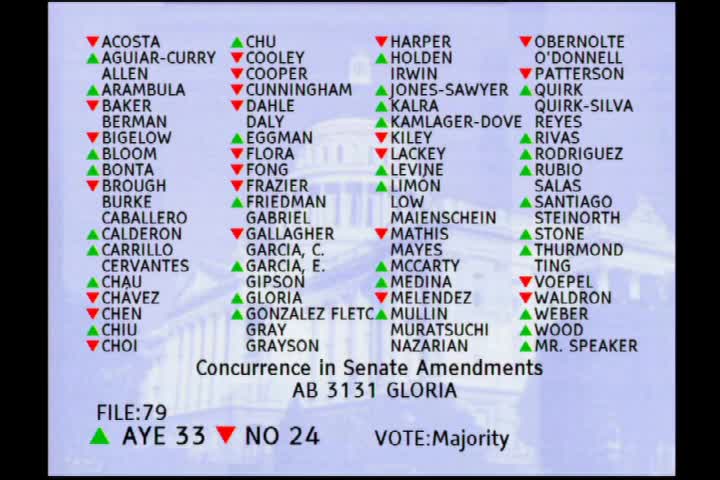 1MIN
Assembly Floor
 3MIN
Senate Floor
 7MIN
Senate Standing Committee on Governance and Finance
 12MIN
Senate Standing Committee on Transportation and Housing
 2MIN
Assembly Floor
 2MIN
Assembly Standing Committee on Appropriations
 14MIN
Assembly Standing Committee on Local Government
 35MIN






