AB 2172: Redistricting: inmates.
- Session Year: 2017-2018
- House: Assembly
- Latest Version Date: 2018-08-28
(1)The California Constitution establishes the Citizens Redistricting Commission and charges it with various responsibilities in connection with redistricting Assembly, Senate, State Board of Equalization, and congressional districts. Existing law requires the Department of Corrections and Rehabilitation to furnish to the Citizens Redistricting Commission specified information regarding the last known place of residence of each inmate incarcerated in a state adult correctional facility on April 1, 2020, and on each decennial Census Day thereafter, except an inmate in federal custody or whose last known place of residence is outside of California or unknown. Existing law requires the information furnished by the Department of Corrections and Rehabilitation to be sufficiently specific, or as specific as feasible, depending on whether the departments Statewide Offender Management System is fully operational on or before April 1, 2020.
This bill would require the Department of Corrections and Rehabilitation to furnish both the Legislature and the Citizens Redistricting Commission residential address and other information, as specified, for each inmate incarcerated in a facility under the Departments control on the dates specified above, including an inmate whose last place of residence is outside of California or unknown, but excluding an inmate who has been transferred to a facility outside of California. The bill would delete the provision described above that is contingent upon the Statewide Offender Management System being fully operational on or before April 1, 2020. The bill would also direct the Legislature to ensure that the information furnished by the Department of Corrections and Rehabilitation is included in a specified computerized database, but would prohibit publishing information regarding specific inmates.
(2)Existing law requests that the Citizens Redistricting Commission use the information furnished by the Department of Corrections and Rehabilitation in carrying out its redistricting responsibilities, and that the Commission deem each incarcerated person as residing at his or her last known place of residence rather than the institution of his or her incarceration.
This bill would provide that an inmates last known place of residence means the most recent residential address that is sufficiently specific to be assigned a census block or, if the address information is not sufficiently specific, a randomly-determined census block located within the smallest geographical area that can be identified based on the information provided by the Department of Corrections and Rehabilitation.
(1)The California Constitution establishes the Citizens Redistricting Commission and charges it with various responsibilities in connection with redistricting Assembly, Senate, State Board of Equalization, and congressional districts. Existing law requires the Department of Corrections and Rehabilitation to furnish to the Citizens Redistricting Commission, not sooner than April 1, 2020, and in each year of the decennial census thereafter not sooner than the decennial Census Day, specified information regarding the last known place of residence of each inmate incarcerated in a state adult correctional facility, facility on April 1, 2020, and on each decennial Census Day thereafter, except if an inmates last place of residence is outside of California or unknown or if an inmate is in federal custody. an inmate in federal custody or whose last known place of residence is outside of California or unknown. Existing law requires the information furnished by the Department of Corrections and Rehabilitation to be sufficiently specific, or as specific as feasible, depending on whether the departments Statewide Offender Management System is fully operational on or before April 1, 2020. Existing
This bill would require the Department of Corrections and Rehabilitation to furnish both the Legislature and the Citizens Redistricting Commission residential address and other information, as specified, for each inmate incarcerated in a facility under the Departments control on the dates specified above, including an inmate whose last place of residence is outside of California or unknown, but excluding an inmate who has been transferred to a facility outside of California. The bill would delete the provision described above that is contingent upon the Statewide Offender Management System being fully operational on or before April 1, 2020. The bill would also direct the Legislature to ensure that the information furnished by the Department of Corrections and Rehabilitation is included in a specified computerized database, but would prohibit publishing information regarding specific inmates.
(2)Existing law requests that the Citizens Redistricting Commission use the information furnished by the Department of Corrections and Rehabilitation in carrying out its redistricting responsibilities, and that the Commission deem each incarcerated person as residing at his or her last known place of residence, residence rather than at the institution of his or her incarceration, and to use the information furnished by the Department of Corrections and Rehabilitation in carrying out its redistricting responsibilities. incarceration.
This bill would require the Department of Corrections and Rehabilitation to furnish both the Legislature and the Citizens Redistricting Commission the information described above, as well as additional specified information, regarding each inmate incarcerated in a facility under the Departments control on April 1, 2020, and on each decennial Census Day thereafter. The bill would require the Department of Corrections and Rehabilitation to provide information regarding an inmate whose last place of residence is outside of California or unknown. It would delete the requirement that the Department furnish information regarding an inmate who has been transferred to a facility outside of California. The bill would also direct the Legislature to ensure that the information furnished by the Department of Corrections and Rehabilitation is included in a specified computerized database, but would prohibit publishing information regarding specific inmates. The bill also would delete the provision described above that is contingent upon the Statewide Offender Management System not being fully operational on or before April 1, 2020.This bill would provide that an inmates last known place of residence means the most recent residential address that is sufficiently specific to be assigned a census block or, if the address information is not sufficiently specific, a randomly-determined census block located within the smallest geographical area that can be identified based on the information provided by the Department of Corrections and Rehabilitation.
The California Constitution establishes the Citizens Redistricting Commission and charges it with various responsibilities in connection with redistricting Assembly, Senate, State Board of Equalization, and congressional districts. Existing law requires the Department of Corrections and Rehabilitation to furnish to the Citizens Redistricting Commission, not sooner than April 1, 2020, and in each year of the decennial census thereafter not sooner than the decennial Census Day, specified information regarding the last known place of residence of each inmate incarcerated in a state adult correctional facility, except as specified. if an inmates last place of residence is outside of California or unknown or if an inmate is in federal custody. Existing law requires the information furnished by the Department of Corrections and Rehabilitation to be sufficiently specific, or as specific as feasible, depending on whether the departments Statewide Offender Management System is fully operational on or before April 1, 2020. Existing law requests that the Citizens Redistricting Commission deem each incarcerated person as residing at his or her last known place of residence, rather than at the institution of his or her incarceration, and to use the information furnished by the Department of Corrections and Rehabilitation in carrying out its redistricting responsibilities.
This bill would specify that the information furnished by Department of Corrections and Rehabilitation regarding the last known place of residence of each inmate is the last known place of residence on April 1, 2020, and, in each year of the decennial census thereafter, the last known place of residence of each inmate on Census Day. This bill would require the Department of Corrections and Rehabilitation to furnish both the Legislature and the Citizens Redistricting Commission the information described above, as well as additional specified information, regarding each inmate incarcerated in a facility under the Departments control on April 1, 2020, and on each decennial Census Day thereafter. The bill would require the Department of Corrections and Rehabilitation to provide information regarding an inmate whose last place of residence is outside of California or unknown. It would delete the requirement that the Department furnish information regarding an inmate who has been transferred to a facility outside of California. The bill would also direct the Legislature to ensure that the information furnished by the Department of Corrections and Rehabilitation is included in a specified computerized database, but would prohibit publishing information regarding specific inmates. The bill also would delete the provision described above that is contingent upon the Statewide Offender Management System not being fully operational on or before April 1, 2020.
The California Constitution establishes the Citizens Redistricting Commission and charges it with various responsibilities in connection with redistricting Assembly, Senate, State Board of Equalization, and congressional districts. Existing law requires the Department of Corrections and Rehabilitation to furnish to the Citizens Redistricting Commission, not sooner than April 1, 2020, and in each year of the decennial census thereafter not sooner than the decennial Census Day, specified information regarding the last known place of residence of each inmate incarcerated in a state adult correctional facility, except as specified. Existing law requires the information furnished by the Department of Corrections and Rehabilitation to be sufficiently specific, or as specific as feasible, depending on whether the departments Statewide Offender Management System is fully operational on or before April 1, 2020. Existing law requests that the Citizens Redistricting Commission deem each incarcerated person as residing at his or her last known place of residence, rather than at the institution of his or her incarceration, and to use the information furnished by the Department of Corrections and Rehabilitation in carrying out its redistricting responsibilities.
This bill would specify that the information furnished by Department of Corrections and Rehabilitation regarding the last known place of residence of each inmate is the last known place of residence on April 1, 2020, and, in each year of the decennial census thereafter, the last known place of residence of each inmate on Census Day. The bill also would delete the provision described above that is contingent upon the Statewide Offender Management System not being fully operational on or before April 1, 2020.
(a)(1)Not sooner than April 1, 2020, and not later than July 1, 2020, the Department of Corrections and Rehabilitation shall furnish to the Legislature and the Citizens Redistricting Commission, in the form of a single electronic file for each database maintained by the Department, information regarding each inmate incarcerated in a state correctional facility on April 1, 2020. For purposes of this section, a state correctional facility means a facility under the control of the Department of Corrections and Rehabilitation.
(2)The information furnished by the Department of Corrections and Rehabilitation pursuant to paragraph (1) shall include the following for each inmate:
(A)A unique identifier, other than the inmates name or Department of Corrections and Rehabilitation number.
(B)Any information maintained by the Department of Corrections and Rehabilitation about the residential address or addresses at which the inmate was domiciled before the inmates most current term of incarceration, including any available information about the date on which each address was added to records maintained by the Department. If the Department of Corrections and Rehabilitation does not have any residential address information for an inmate, the information furnished by the Department shall state that fact.
(C)The inmates ethnicity, as identified by the inmate, and the inmates race, to the extent such information is maintained by the Department of Corrections and Rehabilitation.
(D)The address of the state correctional facility where the inmate is incarcerated on the decennial Census Day.
(3)In 2030 and in each year ending in the number zero thereafter, the Department of Corrections and Rehabilitation shall furnish, in the form of a single electronic file for each database maintained by the Department, the information specified in paragraphs (1) and (2) for each inmate incarcerated in a state correctional facility on the decennial Census Day to the Legislature and the Citizens Redistricting Commission not sooner than the decennial Census Day and not later than 90 days thereafter.
(4)The Department of Corrections and Rehabilitation shall exclude all inmates in federal custody in a facility within California from the information furnished pursuant to this section.
(b)In order to comply with its obligation to ensure that a complete and accurate computerized database is available for redistricting in accordance with subdivision (b) of Section 8253 of the Government Code, the Legislature, in coordination with the Citizens Redistricting Commission, shall ensure that the information provided by the Department of Corrections and Rehabilitation pursuant to subdivision (a) is included in that computerized database.
(c)Notwithstanding subdivision (b), and regardless of the form in which the information is furnished by the Department of Corrections and Rehabilitation, the Legislature or the Citizens Redistricting Commission shall not publish information regarding the race, ethnicity, or prior residential addresses of specific inmates.
(d)Consistent with Section 2025, the Legislature hereby requests the Citizens Redistricting Commission to deem each incarcerated person as residing at his or her last known place of residence, rather than at the institution of his or her incarceration, and to use the information furnished to it pursuant to subdivision (a) in carrying out its redistricting responsibilities under Article XXI of the California Constitution. The Legislature also requests the Citizens Redistricting Commission to do all of the following when it uses information regarding inmates that is furnished pursuant to this section:
(1)Deem an inmate incarcerated in a state correctional facility for whom the last known place of residence is either outside California or cannot be determined, or an inmate in federal custody in a facility within California, to reside at an unknown geographical location in the state and exclude the inmate from the population count for any district, ward, or precinct.
(2)Adjust race and ethnicity data in districts, wards, and precincts that contain prisons in a manner that reflects reductions in the local population as inmates are included in the population count of the district, ward, or precinct of their last known place of residence and, to the extent practicable, those deemed to reside at an unknown geographic location.
(e)For purposes of this section, last known place of residence means the most recent residential address of an inmate before the inmates most current term of incarceration that is sufficiently specific to be assigned to a census block, as determined from information furnished by the Department of Corrections and Rehabilitation in accordance with this section. In the case of an inmate for whom residential address information is available but is not sufficiently specific to allow the address to be assigned to a census block, the last known place of residence means a randomly-determined census block located within the smallest geographical area that can be identified based on the residential address information furnished by the Department of Corrections and Rehabilitation.
(a)(1)Not sooner than April 1, 2020, and not later than July 1, 2020, the Department of Corrections and Rehabilitation shall furnish to the Legislature and the Citizens Redistricting Commission Commission, in the form of a single electronic file for each database maintained by the Department, information regarding each inmate incarcerated in a state correctional facility on April 1, 2020. For purposes of this section, a state correctional facility means a facility under the control of the Department of Corrections and Rehabilitation.
(2)The information furnished by the Department of Corrections and Rehabilitation pursuant to paragraph (1) shall include the following for each inmate:
(A)A unique identifier, other than the inmates name or Department of Corrections and Rehabilitation number.
(B) Last known place of residence information that is sufficiently specific to determine the congressional, State Senatorial, State Assembly, or State Board of Equalization district in which the inmates last known place of residence is located. This information may include, but is not limited to, census block information, street address information, or a description of the location from which a census block can be derived. If an inmates last known place of residence is outside of California or cannot be determined, Any information maintained by the Department of Corrections and Rehabilitation about the residential address or addresses at which the inmate was domiciled before the inmates most current term of incarceration, including any available information about the date on which each address was added to records maintained by the Department. If the Department of Corrections and Rehabilitation does not have any residential address information for an inmate, the information furnished by the Department of Corrections and Rehabilitation shall state that fact, and further information regarding the inmates last known place of residence is not required. fact.
(C)The inmates ethnicity, as identified by the inmate, and the inmates race, to the extent such information is maintained by the Department of Corrections and Rehabilitation.
(D)The address of the state correctional facility where the inmate is incarcerated on the decennial Census Day.
(3)In 2030 and in each year ending in the number zero thereafter, the Department of Corrections and Rehabilitation shall furnish furnish, in the form of a single electronic file for each database maintained by the Department, the information specified in paragraphs (1) and (2) for each inmate incarcerated in a state correctional facility on the decennial Census Day to the Legislature and the Citizens Redistricting Commission not sooner than the decennial Census Day and not later than 90 days thereafter.
(4)The Department of Corrections and Rehabilitation shall exclude all inmates in federal custody in a facility within California from the information furnished pursuant to this section.
(b)In order to comply with its obligation to ensure that a complete and accurate computerized database is available for redistricting in accordance with subdivision (b) of Section 8253 of the Government Code, the Legislature, in coordination with the Citizens Redistricting Commission, shall ensure that the information provided by the Department of Corrections and Rehabilitation pursuant to subdivision (a) is included in that computerized database.
(c)Notwithstanding subdivision (b), and regardless of the form in which the information is furnished by the Department of Corrections and Rehabilitation, the Legislature or the Citizens Redistricting Commission shall not publish information regarding the race, ethnicity, or last known place of residence prior residential addresses of specific inmates.
(d)Consistent with Section 2025, the Legislature hereby requests the Citizens Redistricting Commission to deem each incarcerated person as residing at his or her last known place of residence, rather than at the institution of his or her incarceration, and to use the information furnished to it pursuant to subdivision (a) in carrying out its redistricting responsibilities under Article XXI of the California Constitution. The Legislature also requests the commission Citizens Redistricting Commission to do all of the following when it uses information regarding inmates that is furnished pursuant to this section:
(1)Deem an inmate incarcerated in a state correctional facility for whom the last known place of residence is either outside California or cannot be determined, or an inmate in federal custody in a facility within California, to reside at an unknown geographical location in the state and exclude the inmate from the population count for any district, ward, or precinct.
(2)Adjust race and ethnicity data in districts, wards, and precincts that contain prisons in a manner that reflects reductions in the local population as inmates are included in the population count of the district, ward, or precinct of their last known place of residence and, to the extent practicable, those deemed to reside at an unknown geographic location.
(e)For purposes of this section, last known place of residence means the address at which the inmate was last domiciled before his or her current term of incarceration, as determined from the court records of the county in which the inmate was sentenced to his or her current term of incarceration. most recent residential address of an inmate before the inmates most current term of incarceration that is sufficiently specific to be assigned to a census block, as determined from information furnished by the Department of Corrections and Rehabilitation in accordance with this section. In the case of an inmate for whom residential address information is available but is not sufficiently specific to allow the address to be assigned to a census block, the last known place of residence means a randomly-determined census block located within the smallest geographical area that can be identified based on the residential address information furnished by the Department of Corrections and Rehabilitation.
(a)(1)Not sooner than April 1, 2020, and not later than July 1, 2020, the Department of Corrections and Rehabilitation shall furnish to the Legislature and the Citizens Redistricting Commission information regarding the last known place of residence of each inmate incarcerated in a state adult correctional facility on April 1, 2020, except an inmate whose last known place of residence is outside of California. April 1, 2020. For purposes of this section, a state correctional facility means a facility under the control of the Department of Corrections and Rehabilitation.
(2)The information furnished by the Department of Corrections and Rehabilitation pursuant to paragraph (1) shall include the following for each inmate:
(A)A unique identifier, other than the inmates name or Department of Corrections and Rehabilitation number.
(B)Last known place of residence information that is sufficiently specific to determine the congressional, State Senatorial, State Assembly, or State Board of Equalization district in which the inmates last known place of residence is located. This information may include, but not be is not limited to, census block information or information, street address information information, or a description of the location from which a census block can be derived. If an inmates last known place of residence is outside of California or cannot be determined, the information furnished by the Department of Corrections and Rehabilitation shall state that fact, and further information regarding the inmates last known place of residence is not required.
(C)The inmates ethnicity, as identified by the inmate, and the inmates race, to the extent such information is maintained by the Department of Corrections and Rehabilitation.
(D)The address of the state correctional facility where the inmate is incarcerated on the decennial Census Day.
(3)In 2030 and in each year ending in the number zero thereafter, the Department of Corrections and Rehabilitation shall furnish the information specified in paragraphs (1) and (2) for each inmate incarcerated in a state adult correctional facility on the decennial Census Day to the Legislature and the Citizens Redistricting Commission not sooner than the decennial Census Day and not later than 90 days thereafter.
(4)For purposes of this subdivision, inmate incarcerated in a state adult correctional facility includes an inmate who, as of April 1, 2020, has been transferred to a facility outside of California to complete his or her term of incarceration. (5)(4)The Department of Corrections and Rehabilitation shall exclude all inmates in state custody for whom a last known place of residence within California cannot be determined and all inmates in federal custody in a facility within California from the information furnished pursuant to this section.
(b)In order to comply with its obligation to ensure that a complete and accurate computerized database is available for redistricting in accordance with subdivision (b) of Section 8253 of the Government Code, the Legislature, in coordination with the Citizens Redistricting Commission, shall ensure that the information provided by the Department of Corrections and Rehabilitation pursuant to subdivision (a) is included in that computerized database.
(c)Notwithstanding subdivision (b), and regardless of the form in which the information is furnished by the Department of Corrections and Rehabilitation, the Legislature or the Citizens Redistricting Commission shall not publish information regarding the race, ethnicity, or last known place of residence of specific inmates.
(b)(d)Consistent with Section 2025, the Legislature hereby requests the Citizens Redistricting Commission to deem each incarcerated person as residing at his or her last known place of residence, rather than at the institution of his or her incarceration, and to use the information furnished to it pursuant to subdivision (a) in carrying out its redistricting responsibilities under Article XXI of the California Constitution. The Legislature also requests the commission to do all of the following when it uses information regarding inmates that is furnished pursuant to this section:
(1)Regardless of the form in which the information is furnished, refrain from publishing any information regarding a specific inmates last known place of residence. (2)(1)Deem an inmate in state custody in a facility within California incarcerated in a state correctional facility for whom the last known place of residence is either outside California or cannot be determined, or an inmate in federal custody in a facility within California, to reside at an unknown geographical location in the state and exclude the inmate from the population count for any district, ward, or precinct.
(3)(2)Adjust race and ethnicity data in districts, wards, and precincts that contain prisons in a manner that reflects reductions in the local population as inmates are included in the population count of the district, ward, or precinct of their last known place of residence. residence and, to the extent practicable, those deemed to reside at an unknown geographic location.
(c)(e)For purposes of this section, last known place of residence means the address at which the inmate was last domiciled before his or her current term of incarceration, as determined from the court records of the county in which the inmate was sentenced to his or her current term of incarceration.
(a)(1)Not sooner than April 1, 2020, and not later than July 1, 2020, the Department of Corrections and Rehabilitation shall furnish to the Citizens Redistricting Commission information regarding the last known place of residence of each inmate incarcerated in a state adult correctional facility, facility on April 1, 2020, except an inmate whose last known place of residence is outside of California.
(2)The information furnished by the Department of Corrections and Rehabilitation pursuant to paragraph (1) shall include the following for each inmate:
(A)A unique identifier, other than the inmates name or Department of Corrections and Rehabilitation number.
(B)If the Statewide Offender Management System is fully operational on or before April 1, 2020, last Last known place of residence information that is sufficiently specific to determine the congressional, State Senatorial, State Assembly, or State Board of Equalization district in which the inmates last known place of residence is located. This information may include, but not be limited to, census block information or street address information from which a census block can be derived.
(C)If the Statewide Offender Management System is not fully operational on or before April 1, 2020, last known place of residence information that is as specific as feasible under the Department of Corrections and Rehabilitations database system and from which census block information can be derived.(3)In 2030 and in each year ending in the number zero thereafter, the Department of Corrections and Rehabilitation shall furnish the information specified in paragraphs (1) and (2) for each inmate incarcerated in a state adult correctional facility on the decennial Census Day to the Citizens Redistricting Commission not sooner than the decennial Census Day and not later than 90 days thereafter.
(4)For purposes of this subdivision, inmate incarcerated in a state adult correctional facility includes an inmate who, as of April 1, 2020, has been transferred to a facility outside of California to complete his or her term of incarceration.
(5)The Department of Corrections and Rehabilitation shall exclude all inmates in state custody for whom a last known place of residence within California cannot be determined and all inmates in federal custody in a facility within California from the information furnished pursuant to this section.
(b)Consistent with Section 2025, the Legislature hereby requests the Citizens Redistricting Commission to deem each incarcerated person as residing at his or her last known place of residence, rather than at the institution of his or her incarceration, and to utilize use the information furnished to it pursuant to subdivision (a) in carrying out its redistricting responsibilities under Article XXI of the California Constitution. The Legislature also requests the commission to do all of the following when it uses information regarding inmates that is furnished pursuant to this section:
(1)Regardless of the form in which the information is furnished, refrain from publishing any information regarding a specific inmates last known place of residence.
(2)Deem an inmate in state custody in a facility within California for whom the last known place of residence is either outside California or cannot be determined, or an inmate in federal custody in a facility within California, to reside at an unknown geographical location in the state and exclude the inmate from the population count for any district, ward, or precinct.
(3)Adjust race and ethnicity data in districts, wards, and precincts that contain prisons in a manner that reflects reductions in the local population as inmates are included in the population count of the district, ward, or precinct of their last known place of residence.
(c)For purposes of this section, last known place of residence means the address at which the inmate was last domiciled prior to before his or her current term of incarceration, as determined from the court records of the county in which the inmate was sentenced to his or her current term of incarceration.
|
Date
|
Status
|
|---|---|
| Aug 28, 2018 | Chaptered by Secretary of State - Chapter 232, Statutes of 2018. |
| Aug 28, 2018 | Approved by the Governor. |
| Aug 16, 2018 | Enrolled and presented to the Governor at 4 p.m. |
| Aug 13, 2018 | Senate amendments concurred in. To Engrossing and Enrolling. |
| Aug 9, 2018 | In Assembly. Concurrence in Senate amendments pending. May be considered on or after August 11 pursuant to Assembly Rule 77. |
| Aug 9, 2018 | Read third time. Passed. Ordered to the Assembly. |
| Aug 7, 2018 | Read second time. Ordered to third reading. |
| Aug 6, 2018 | From committee: Be ordered to second reading pursuant to Senate Rule 28.8. |
| Jun 26, 2018 | From committee: Do pass and re-refer to Com. on APPR. (Ayes 5. Noes 2.) (June 26). Re-referred to Com. on APPR. |
| Jun 20, 2018 | From committee: Do pass and re-refer to Com. on PUB. S. (Ayes 4. Noes 1.) (June 19). Re-referred to Com. on PUB. S. |
| Jun 12, 2018 | From committee chair, with author's amendments: Amend, and re-refer to committee. Read second time, amended, and re-referred to Com. on E. & C.A. |
| Jun 4, 2018 | In committee: Hearing postponed by committee. |
| May 17, 2018 | Referred to Coms. on E. & C.A. and PUB. S. |
| May 3, 2018 | In Senate. Read first time. To Com. on RLS. for assignment. |
| May 3, 2018 | Read third time. Passed. Ordered to the Senate. |
| Apr 26, 2018 | Read second time. Ordered to third reading. |
| Apr 25, 2018 | From committee: Do pass. (Ayes 5. Noes 2.) (April 25). |
| Apr 19, 2018 | Re-referred to Com. on E. & R. |
| Apr 18, 2018 | From committee chair, with author's amendments: Amend, and re-refer to Com. on E. & R. Read second time and amended. |
| Feb 26, 2018 | Referred to Com. on E. & R. |
| Feb 13, 2018 | From printer. May be heard in committee March 15. |
| Feb 12, 2018 | Read first time. To print. |
|
Date
|
Description
|
Location
|
Votes
|
|
|---|---|---|---|---|
| Aug 13, 2018 | AB 2172 WEBER Concurrence in Senate Amendments | Assembly Floor |
Passed |
|
| Aug 9, 2018 | Assembly 3rd Reading AB2172 Weber By Hertzberg | Senate Floor |
Passed |
|
| Jun 26, 2018 | Do pass, but first be re-referred to the Committee on [Appropriations] | Senate Standing Committee on Public Safety |
Passed |
|
| Jun 19, 2018 | Do pass, but first be re-referred to the Committee on [Public Safety] | Senate Standing Committee on Elections and Constitutional Amendments |
Passed |
|
| May 3, 2018 | AB 2172 WEBER Assembly Third Reading | Assembly Floor |
Passed |
|
| Apr 25, 2018 | Do pass. | Assembly Standing Committee on Elections and Redistricting |
Passed |
This list shows positions taken on this bill by organizations on the date displayed, which is linked to the original source.
Positions by individuals are not included.
CONCURRENCE IN SENATE AMENDMENTS
CSA1 Bill Id:AB 2172
Author:(Weber)
As Amended Ver:June 12, 2018
Majority vote
ASSEMBLY: | 47-24 | (May 3, 2018) | SENATE: | 24-12 | (August 9, 2018) |
Original Committee Reference: E. & R.
SUMMARY: Makes various changes to provisions of state law regarding the determination of where individuals who are in the custody of the California Department of Corrections and Rehabilitation (CDCR) are counted for the purposes of drawing district lines for Congress, the State Legislature, and the State Board of Equalization (BOE). Specifically, this bill:
- Requires CDCR, in addition to providing information to the Citizens Redistricting Commission (CRC) regarding the prior places of residence of each inmate who is in a facility that is under CDCR's control, as specified, to furnish that information to the Legislature. Requires the information provided to reflect the inmates that are in facilities under the control of CDCR on the federal decennial census day.
- Requires CDCR to provide information about the ethnicity of each inmate, as identified by the inmate, and any information that CDCR has about the race of the inmate.
- Requires CDCR to provide the address of the correctional facility where an inmate is incarcerated on the decennial census day.
- Requires the Legislature, in coordination with the CRC, to ensure that the information provided by CDCR is included in the computerized database that is used for redistricting.
- Updates terminology to more accurately describe those inmates who are in facilities under the control of CDCR, and makes other technical, corresponding, and clarifying changes.
The Senate amendments:
- Require CDCR to provide all information it maintains about inmates' prior residential addresses, instead of providing information only about inmates' last known places of residence. Require the CDCR to include any available information it has about the date on which an inmate's prior address was added to CDCR records. Require CDCR to provide the information in a single electronic file for each database it maintains.
- Provide that if residential information for an inmate is not sufficiently specific to allow the address to be assigned to a census block, an inmate's "last known place of residence" means a randomly-determined census block located within the smallest geographical area that can be identified based on the residential address information furnished by CDCR.
- Make technical and corresponding changes.
EXISTING LAW:
- Requires CDCR to furnish information to the CRC regarding the last known place of residence of each inmate incarcerated in a state adult correctional facility, except an inmate whose last known place of residence is outside of California, as specified.
- Requests the CRC to deem each incarcerated person as residing at his or her last known place of residence, rather than at the institution of his or her incarceration, using the information provided to it by CDCR, for the purposes of adjusting the boundary lines of congressional, State Senate, Assembly, and BOE districts.
FISCAL EFFECT: According to the Senate Appropriations Committee, pursuant to Senate Rule 28.8, negligible state costs.
COMMENTS: According to the author, "In 2011, Governor Brown signed AB 420 [(Davis), Chapter 548]. This bill required that, sometime between April 1, 2020 and July 1, 2020, the CDCR share a list noting the last known residences for inmates who are incarcerated in a state facility to the CRC. It also requested that the CRC use that information to consider incarcerated persons as residing in their last known place of residence during the 2020 Census for the purposes of statewide redistricting instead of as residing at the state facility as the Federal Census Bureau currently regards them. Assembly Bill 2172 updates Elections Code Section 21003 to better facilitate the changes to the 2020 Census for counting inmates. It cleans-up conditional language regarding the Statewide Offender Management System and specifies that [CDCR] must give the [CRC] data reflecting the prison population on April 1, 2020. Ultimately, this bill will ensure the smooth implementation of AB 420 for the 2020 Census."
AB 420 (Davis), Chapter 548, Statutes of 2011, requested the CRC, when adjusting district boundaries for state Legislature, Congress, and the BOE, to deem an incarcerated person as residing at his or her last known residence, rather than the institution of his or her incarceration. AB 420 was intended to end the practice whereby incarcerated individuals are counted, for redistricting purposes, as residing at the prison in which they are incarcerated, instead of at the locations where they last resided prior to incarceration. The following year, the Legislature approved and the Governor signed AB 1986 (Davis), Chapter 318, Statutes of 2012, which made a number of changes to the provisions of AB 420 in an attempt to allow for that bill to be more effectively implemented.
As the 2020 census and the 2021 redistricting process approach, it has become apparent that some modifications are required to state law in order to implement AB 420 and AB 1986 as originally envisioned. This bill makes various changes to existing law, as enacted by AB 420 and AB 1986, in order to ensure that those bills can be enacted in a manner consistent with the original legislative intent. The Senate amendments make further changes needed to ensure that AB 420 and AB 1986 can be enacted as envisioned. This bill, as amended in the Senate, is generally consistent with prior Assembly actions.
Please see the policy committee analysis for a full discussion of this bill.
Analysis Prepared by: Ethan Jones / E. & R. / (916) 319-2094 FN: 0003779
Office of Senate Floor Analyses (916) 651-1520 Fax: (916) 327-4478 | AB |
THIRD READING
Bill No: AB 2172
:
SENATE ELECTIONS & C.A. COMMITTEE: 4-1, 6/19/18
AYES: Stern, Allen, Hertzberg, Leyva
NOES: Anderson
SENATE PUBLIC SAFETY COMMITTEE: 5-2, 6/26/18
AYES: Skinner, Bradford, Jackson, Mitchell, Wiener
NOES: Anderson, Stone
SENATE APPROPRIATIONS COMMITTEE: Senate Rule 28.8
ASSEMBLY FLOOR: 47-24, 5/3/18 - See last page for vote
DIGEST:
This bill requires the California Department of Corrections and Rehabilitation (CDCR) to provide the Legislature with information regarding the race, ethnicity, and the last known place of residence, as specified, of each inmate in a facility under the CDCR’s control for purposes of redistricting.
Existing law:
- Creates the California Citizens Redistricting Commission (CCRC) and makes it responsible for adjusting the boundary lines of Assembly, State Senate, Board of Equalization (BOE), and congressional districts in the year following the year in which the national census is taken at the beginning of each decade, as specified.
- Requires the Legislature to take all steps necessary to ensure that a complete and accurate computerized database is available for redistricting, and that procedures are in place to provide the public ready access to redistricting data and computer software for drawing maps. Requires the Legislature to coordinate these efforts with the CCRC, as specified.
- Requires CDCR, not sooner than April 1, 2020, and not later than July 1, 2020, to furnish information to the CCRC regarding the last known place of residence of each inmate incarcerated in a state adult correctional facility, except an inmate whose last known place of residence is outside of California. Additionally, in 2030 and each year ending in the number zero thereafter, requires this information be furnished not sooner than the decennial census day and not later than 90 days thereafter.
- Requires the information provided from CDCR to the CCRC to include the following information for each inmate:
- A unique identifier other than the inmate’s name or CDCR number.
- Information about the inmate’s last known place of residence.
- Requires, if the Statewide Offender Management System (SOMS) is fully operational on or before April 1, 2020, that the residence information be sufficiently specific to determine the congressional, Senate, Assembly, or State BOE district in which the inmate’s last known place of residence is located and provides that the information may include census block information or street address information from which a census block can be derived.
- Requires, if SOMS is not fully operational on or before April 1, 2020, that the place of residence information be as specific as feasible under the CDCR’s database system and from which a census block can be derived.
- Requires CDCR to exclude inmates in state custody for whom a last known place of residence within California cannot be determined, and all inmates in federal custody in a facility within California, from the information furnished to the CCRC.
- Requests the CCRC to deem each incarcerated person as residing at his or her last known place of residence, rather than at the institution of his or her incarceration, using the information provided by CDCR. Additionally, requests the CCRC to do all of the following when using the information provided by the CDCR:
- Refrain from publishing information regarding a specific inmate’s last known place of residence.
- Deem an inmate in state custody in a facility within California for whom the last known place of residence is either outside California or cannot be determined, or an inmate in federal custody in a facility within California, to reside at an unknown geographical location in the state and exclude the inmate from the population count for any district, ward, or precinct.
- Adjust race and ethnicity data in districts, wards, and precincts that contain prisons in a manner that reflects reductions in the local population as inmates are included in the population count of the district, ward, or precinct of their last known place of residence.
- Defines “last known place of residence,” for the purposes of the provisions detailed above, as the address at which the inmate was last domiciled before his or her current term of incarceration, as determined from the court records of the county in which the inmate was sentenced to his or her current term of incarceration.
This bill:
- Requires that the information provided from CDCR to the CCRC be additionally provided to the Legislature regarding each inmate incarcerated in a state correctional facility. Requires the information submitted be in the form of a single electronic file for each database maintained by CDCR.
- Requires the information provided to reflect the inmates that are in facilities under the control of CDCR on April 1, 2020, and on every decennial Census Day beginning in 2030.
- Defines “state correctional facility” as a facility under the control of CDCR.
- Deletes provisions of law pertaining to SOMS not being operational before April 1, 2020. SOMS is currently operational.
- Provides that the information from CDCR to the Legislature and the CCRC, in addition to information already provided, include any information maintained by CDCR about the residential address or addresses at which the inmate was domiciled before the inmate’s more current term of incarceration, including any available information about the date on which each address was added to records maintained by CDCR.
- Provides that if CDCR does not have any residential address information for an inmate, then the information provided by CDCR states that fact.
- Requires CDCR to provide information about the ethnicity, as identified by the inmate, and any information about the race of the inmate to the extent such information is maintained by CDCR.
- Requires CDCR to provide the address of the correctional facility where an inmate is incarcerated on the decennial Census Day.
- Requires the Legislature, in coordination with the CCRC, to ensure that the information provided by CDCR is included in the computerized database that is used for redistricting. Requires the Legislature to refrain from publishing information regarding the race, ethnicity, or prior residential addresses of specific inmates.
- Defines “last known place of residence” to mean the most recent residential address of an inmate before the inmate’s most current term of incarceration that is sufficiently specific to be assigned to a census block, as determined from the information provided by CDCR. Additionally, in the case of an inmate for whom residential address information is available but is not sufficiently specific to allow the address to be assigned to a census block, the “last know place of residence” means a randomly-determined census block located within the smallest geographical area that can be identified based on the residential address information provided by CDCR.
- Updates terminology to more accurately describe those inmates who are in facilities under the control of CDCR, and makes other technical, corresponding, and clarifying changes.
Background
Census Bureau Policy Regarding Prison Inmates. According to information from the United States Census Bureau (Bureau), planners of the first decennial census in 1790 established the concept of a "usual residence" to determine where people would be counted. A person's “usual residence” is the place where the person lives and sleeps most of the time. As a result of the "usual residence" rule, a person who is on vacation on Census Day (April 1 of each year ending in "0") is not counted as living at the place where he or she is vacationing, but rather where that person usually lives. The “usual residence” policy has been used for every decennial census since the first census, including the 2010 census.
The Bureau's policy for counting people in correctional facilities on Census Day is that those individuals are to be counted at the facility of incarceration. This is true for individuals incarcerated in federal prisons or detention centers, state prisons, and local jails or confinement facilities. Although the Bureau received a large number of comments encouraging it to change the residence criteria for incarcerated individuals for the 2020 census, it announced earlier this year that it would continue to count prisoners at the correctional facility at which they are incarcerated on Census Day. However, following the 2020 census, the Bureau announced that it would offer a new product in order to assist states that decided to reallocate prisoner population counts.
California uses population data from the Bureau for redistricting purposes. As a result, individuals who are incarcerated in California traditionally have been counted at the place of incarceration when district lines are drawn for the Legislature, Congress, and the BOE.
Previous Legislation. Due to the Bureau’s policy for counting people in correctional facilities on Census Day at their facilities of incarceration following the 2010 census, the Legislature approved and the Governor signed AB 420 (Davis, Chapter 548, Statutes of 2011). AB 420 requested the CCRC, when adjusting district boundaries for the Assembly, State Senate, House of Representatives, and BOE, to deem an incarcerated person as residing at his or her last known residence, rather than the institution of his or her incarceration. AB 420 was intended to end the practice whereby incarcerated individuals are counted as residing at the prison in which they are incarcerated, instead of at the locations where they last resided prior to incarceration for redistricting purposes. Critics of counting incarcerated individuals at the prison where they are incarcerated argue that it artificially inflates the political influence of districts where prisons are located, at the expense of other voters. The following year, the Legislature approved and the Governor signed AB 1986 (Davis, Chapter 318, Statutes of 2012), which made a number of changes to the provisions of AB 420 in an attempt to allow for that bill to be more effectively implemented.
As the 2020 census and the 2021 redistricting process nears, some modifications to state law are required in order to implement AB 420 and AB 1986 as originally envisioned. While state law requires CDCR to provide information about the last known residence of incarcerated individuals during a specified window of time, it does not specify the date that the information should reflect. If census data is to be adjusted for redistricting purposes, it is important that the information provided by CDCR reflect those individuals who were incarcerated in state correctional facilities on Census Day. Additionally, while AB 420 and AB 1986 call for race and ethnicity data to be adjusted based on the information provided by CDCR, existing law does not explicitly require CDCR to provide information about the race and ethnicity of inmates. Furthermore, while existing law requires the Legislature to prepare and maintain the database used for redistricting purposes in coordination with the CCRC, AB 420 and AB 1986 did not provide for the relevant information from CDCR to be provided to the Legislature for that purpose. Finally, at the time that AB 420 and AB 1986 were enacted, CDCR was in the process of developing SOMS, a system for tracking and managing inmates under the jurisdiction of CDCR. AB 420 and AB 1986 had contingency language if SOMS was not operational for the 2020 census. However, CDCR has fully implemented SOMS and the contingency language is now unnecessary.
CCRC. In November 2008, California voters passed Proposition 11 and authorized the creation of the CCRC. The CCRC consists of 14 registered voters and is tasked with establishing district lines for the Assembly, Senate, and BOE. In 2010, voters passed Proposition 20 which, among other provisions, gave the CCRC the responsibility of establishing lines for California’s congressional districts and made other changes to the procedures and criteria to be used by the CCRC.
Since Propositions 11 and 20 established the CCRC in the California Constitution and gave it the independent authority to draw district lines for Assembly, Senate, Congress, and BOE, it is unclear whether the Legislature can require the CCRC to use adjusted census figures for redistricting purposes. Accordingly, AB 420 and AB 1986 did not require the CCRC to use adjusted census figures, but rather requested that it do so.
Legislature’s Role in Maintaining the Redistricting Dataset. Since 1993, the University of California (UC) system has housed the Statewide Database, which is the official redistricting database for California.
Since voting to house the Statewide Database in the UC system, the Legislature has played an ongoing role in ensuring that the state’s redistricting database remains complete and accurate. Even as Propositions 11 and 20 eliminated the Legislature’s authority to establish the boundaries for legislative, congressional, and BOE districts, Proposition 11 also required the Legislature to continue its role in preparing and maintaining the database that is used for redistricting purposes, and further required the Legislature to provide ready access to redistricting data and computer software for drawing maps. Under Proposition 11, those efforts are required to be coordinated with the CCRC.
Due to the Legislature’s responsibility for maintaining the redistricting database, AB 2172 requires CDCR to provide information about inmates in facilities under the CDCR’s control to the Legislature, in addition to providing the information to the CCRC. This bill will allow the Legislature to fulfill its responsibilities under Proposition 11 by ensuring that information from CDCR is provided to the staff of the Statewide Database promptly in order for the adjusted data to be available to the new members of the CCRC selected in 2021. However, AB 2172 will continue to give the CCRC the authority to decide whether to use the adjusted data for redistricting purposes.
Comments
- According to the author, AB 2172 cleans up the Election Code Section 21003 to facilitate changes to the 2020 Census for counting inmates adopted by AB 420 (Davis). While AB 420 set the policy precedent describing how to count inmates for the 2020 Census, it warrants a few technical clarifications.
AB 2172 specifies that the data CDCR provides to the CCRC and the Legislature must reflect the prison statewide population on April 1, 2020 (and on each decennial Census Day thereafter) in order to comport with the Census data. In addition, since SOMS is now operational, this bill cleans up the code by redacting the conditional language specifying how to proceed if the SOMS did not become operational by 2020. These technical changes will clarify existing code and facilitate a smoother process of reallocating prison inmates to their place of last known residence.
Related/Prior Legislation
AB 1986 (Davis, Chapter 318, Statutes of 2012) made various modifications to a provision of existing law that CDCR provide information to the CCRC regarding the last known residence of each inmate incarcerated in a state adult correctional facility.
AB 420 (Davis, Chapter 548, Statutes of 2011), among other provisions, requested the CCRC, when adjusting district boundaries for state Legislature, Congress, and the BOE, to deem an incarcerated person as residing at his or her last known residence, rather than the institution of his or her incarceration.
FISCAL EFFECT: Appropriation: Fiscal Com.: Local:
American Civil Liberties Union of California
League of Women Voters of California
None received
ASSEMBLY FLOOR: 47-24, 5/3/18
AYES: Aguiar-Curry, Arambula, Berman, Bloom, Bonta, Burke, Calderon, Carrillo, Cervantes, Chau, Chiu, Chu, Cooley, Cooper, Daly, Eggman, Frazier, Friedman, Eduardo Garcia, Gipson, Gloria, Gonzalez Fletcher, Holden, Irwin, Jones-Sawyer, Kalra, Kamlager-Dove, Levine, Limón, Low, Medina, Mullin, Muratsuchi, Nazarian, O'Donnell, Quirk, Reyes, Rodriguez, Rubio, Salas, Santiago, Mark Stone, Thurmond, Ting, Weber, Wood, Rendon
NOES: Acosta, Baker, Bigelow, Brough, Chávez, Chen, Choi, Cunningham, Dahle, Flora, Fong, Gray, Harper, Kiley, Lackey, Maienschein, Mathis, Mayes, Melendez, Obernolte, Patterson, Steinorth, Voepel, Waldron
NO VOTE RECORDED: Travis Allen, Caballero, Gallagher, Cristina Garcia, Grayson, McCarty, Quirk-Silva
8/8/18 10:29:30
SENATE COMMITTEE ON PUBLIC SAFETY
Senator Nancy Skinner, Chair
2017 - 2018 Regular
Bill No: AB 2172 Hearing Date: June 26, 2018
Author: | Weber | ||
Version: | June 12, 2018 | ||
Urgency: | No | Fiscal: | Yes |
Consultant: | SJ | ||
Subject: Redistricting: Inmates
HISTORY
Source: Author
Prior Legislation: AB 1986 (Davis), Ch. 318, Stats. of 2012
AB 420 (Davis), Ch. 548, Stats. of 2011
Proposition 20, as approved by the voters on November 2, 2010
Proposition 11, as approved by the voters on November 4, 2008
Support: Unknown
Opposition: None known
Assembly Floor Vote: 47 - 24
PURPOSE
The purpose of this bill is to require the California Department of Corrections and Rehabilitation (CDCR) to provide the Legislature with information regarding the race and ethnicity as well as information regarding the last known place of residence of each inmate in a facility under the CDCR’s control for purposes of redistricting.
Existing law creates the California Citizens Redistricting Commission (CCRC) and makes it responsible for adjusting the boundary lines of congressional, State Senate, Assembly, and Board of Equalization (BOE) districts in the year following the year in which the national census is taken at the beginning of each decade, as specified. (Cal. Const., art. XXI, §§ 1, 2(a).)
Existing law requires CDCR, not sooner than April 1, 2020, and not later than July 1, 2020, to furnish information to the CCRC regarding the last known place of residence of each inmate incarcerated in a state adult correctional facility, except an inmate whose last known place of residence is outside of California. Additionally, in 2030 and each year ending in the number zero thereafter, requires this information be furnished not sooner than the decennial census day and not later than 90 days thereafter. (Elec. Code, § 21003, subd. (a)(1) & (3).)
Existing law requires the information provided from CDCR to the CCRC to include the following information for each inmate:
- A unique identifier other than the inmate’s name or CDCR number.
- Information about the inmate’s last known place of residence. (Elec. Code, § 21003, subd. (a)(2)(A) & (B).)
Existing law requires, if the Statewide Offender Management System (SOMS) is fully operational on or before April 1, 2020, that the residence information be sufficiently specific to determine the congressional, Senate, Assembly, or State BOE district in which the inmate’s last known place of residence is located and provides that the information may include census block information or street address information from which a census block can be derived. (Elec. Code, § 21003, subd. (a)(2)(B).)
Existing law requires, if SOMS is not fully operational on or before April 1, 2020, that the place of residence information be as specific as feasible under the CDCR’s database system and from which a census block can be derived. (Elec. Code, § 21003, subd. (a)(2)(C).)
Existing law requires CDCR to exclude inmates in state custody for whom a last known place of residence within California cannot be determined, and all inmates in federal custody in a facility within California, from the information furnished to the CCRC. (Elec. Code, § 21003, subd. (a)(5).)
Existing law requests the CCRC to deem each incarcerated person as residing at his or her last known place of residence, rather than at the institution of his or her incarceration, using the information provided by CDCR. Additionally, requests the CCRC to do all of the following when using the information provided by the CDCR:
- Refrain from publishing information regarding a specific inmate’s last known place of residence.
- Deem an inmate in state custody in a facility within California for whom the last known place of residence is either outside California or cannot be determined, or an inmate in federal custody in a facility within California, to reside at an unknown geographical location in the state and exclude the inmate from the population count for any district, ward, or precinct.
- Adjust race and ethnicity data in districts, wards, and precincts that contain prisons in a manner that reflects reductions in the local population as inmates are included in the population count of the district, ward, or precinct of their last known place of residence. (Elec. Code, § 21003, subd. (b)(1)-(3).)
Existing law defines “last known place of residence,” for the purposes of the provisions detailed above, as the address at which the inmate was last domiciled before his or her current term of incarceration, as determined from the court records of the county in which the inmate was sentenced to his or her current term of incarceration. (Elec. Code, § 21003, subd. (c).)
This bill requires that the information provided from CDCR to the CCRC be additionally provided to the Legislature regarding each inmate incarcerated in a state correctional facility. Requires the information submitted be in the form of a single electronic file for each database maintained by CDCR.
This bill requires the information provided to reflect the inmates that are in facilities under the control of CDCR on April 1, 2020 and on every decennial Census Day beginning in 2030.
This bill defines “state correctional facility” as a facility under the control of CDCR.
This bill deletes provisions of law pertaining to SOMS not being operational before April 1, 2020.
This bill provides that the information from CDCR to the Legislature and the CCRC, in addition to information already provided, include any information maintained by CDCR about the residential address or addresses at which the inmate was domiciled before the inmate’s more current term of incarceration, including any available information about the date on which each address was added to records maintained by CDCR.
This bill provides that if CDCR does not have any residential address information for an inmate, then the information provided by CDCR states that fact.
This bill requires CDCR to provide information about the ethnicity, as identified by the inmate, and any information about the race of the inmate to the extent such information is maintained by CDCR.
This bill requires CDCR to provide the address of the correctional facility where an inmate is incarcerated on the decennial census day.
This bill requires the Legislature, in coordination with the CCRC, to ensure that the information provided by CDCR is included in the computerized database that is used for redistricting.
This bill requires the Legislature to refrain from publishing information regarding the race, ethnicity, or last known place of residence of specific inmates.
This bill defines “last known place of residence” to mean the most recent residential address of an inmate before the inmate’s most current term of incarceration that is sufficiently specific to be assigned to a census block, as determined from the information provided by CDCR. Provides that in the case of an inmate for whom residential address information is available but is not sufficiently specific to allow the address to be assigned to a census block, the “last known place of residence” means a randomly-determined census block located within the smallest geographical area that can be identified based on the residential address information provided by CDCR.
COMMENTS
- Need for This Bill
According to the author:
Assembly Bill 2172 cleans up the Election Code Section 21003 to facilitate changes to the 2020 Census for counting inmates adopted by AB 420 (Davis, 2011). AB 420 requires that, sometime between April 1, 2020 and July 1, 2020, the California Department of Corrections (CDCR) share a list of the last known residences for inmates who are incarcerated in a state facility to the Citizen’s Redistricting Commission (CRC) and the legislature. It also requests that the CRC use that information to consider incarcerated persons as residing at their last known place of residence from the Census for the purposes of statewide redistricting instead of as residing at the state facility. While that bill set the policy precedent describing how to count inmates for the 2020 Census, it warrants a few technical clarifications.
This bill specifies that the data—including an anonymous identifier, inmates’ last known address, race/ethnicity, and facility where they are incarcerated—CDCR provides to the CRC must reflect the prison statewide population on April 1, 2020 (and on each decennial Census day thereafter) in order to comport with the Census data. It also cleans up the code by redacting the conditional language specifying how to proceed if the Statewide Offender Management System did not become operational by 2020. As that system is now operational, that part of the law is extraneous. These technical changes will clarify existing code and facilitate a smoother process of reallocating prison inmates to their place of last known residence.
- Census Bureau Policy Regarding Prison Inmates
According to information from the United States Census Bureau (Bureau), planners of the first decennial census in 1790 established the concept of a "usual residence" to determine where people would be counted. A person’s “usual residence” is the place where the person lives and sleeps most of the time. As a result of the “usual residence” rule, a person who is on vacation on census day (April 1 of each year ending in “0”) is not counted as living at the place where he or she is vacationing, but rather where that person usually lives. The “usual residence” policy has been used for every decennial census since the first census, including the 2010 census.
While it is easy to determine the “usual residence” of most people, the determination of the “usual residence” for people living in non-traditional living situations can be more complex. For example, the Bureau announced earlier this year that it was changing its policy for determining the “usual residence” for certain US military personnel. For the 2010 Census, the Bureau counted all military personnel who were deployed or stationed overseas as residing in the state of the person’s “home of record” (generally, the home of the person at the time he or she enlisted or reenlisted in the Armed Forces) for the purposes of the apportionment of congressional seats only. For the 2020 Census, however, the Bureau has announced that it will distinguish between military personnel who are deployed overseas and those who are stationed overseas. Those who are stationed overseas (generally those who are overseas on a longer-term basis) will continue to be recorded as residing in the state of their “home of record” for apportionment purposes only. However, military personnel who are deployed overseas on a short-term basis will be counted for Census purposes as having a usual residence at the location where they are stationed in the US.
The Bureau’s policy for counting people in correctional facilities on Census Day is that those individuals are to be counted at the facility of incarceration. This is true for individuals incarcerated in federal prisons or detention centers, state prisons, and local jails or confinement facilities. Although the Bureau received a large number of comments encouraging it to change the residence criteria for incarcerated individuals for the 2020 census, it announced earlier this year that it would continue to count prisoners at the correctional facility at which they are incarcerated on Census Day. (https://www.federalregister.gov/documents/2018/02/08/2018-02370/final-2020-census-residence-criteria-and-residence-situations.) However, following the 2020 census, the Bureau announced that it would offer a new product in order to assist states that decided to reallocate prisoner population counts.
California uses population data from the Bureau for redistricting purposes. As a result, individuals who are incarcerated in California traditionally have been counted at the place of incarceration when district lines are drawn for the state Legislature, Congress, and the BOE.
Due to the Bureau’s policy for counting people in correctional facilities on Census Day at their facilities of incarceration following the 2010 census, the Legislature approved and the Governor signed AB 420 (Davis), Chapter 548, Statutes of 2011. AB 420 requested the CCRC, when adjusting district boundaries for state Legislature, Congress, and the BOE, to deem an incarcerated person as residing at his or her last known residence, rather than the institution of his or her incarceration. AB 420 was intended to end the practice whereby incarcerated individuals are counted as residing at the prison in which they are incarcerated, instead of at the locations where they last resided prior to incarceration for redistricting purposes. Critics of counting incarcerated individuals at the prison where they are incarcerated argue that it artificially inflates the political influence of districts where prisons are located, at the expense of other voters. The following year, the Legislature approved and the Governor signed AB 1986 (Davis), Chapter 318, Statutes of 2012, which made a number of changes to the provisions of AB 420 in an attempt to allow for that bill to be more effectively implemented.
As the 2020 census and the 2021 redistricting process nears, some modifications to state law are required in order to implement AB 420 and AB 1986 as originally envisioned. While state law requires CDCR to provide information about the last known residence of incarcerated individuals during a specified window of time, it does not specify the date that the information should reflect. If census data is to be adjusted for redistricting purposes, it is important that the information provided by CDCR reflect those individuals who were incarcerated in state correctional facilities on Census Day. Additionally, while AB 420 and AB 1986 call for race and ethnicity data to be adjusted based on the information provided by CDCR, existing law does not explicitly require CDCR to provide information about the race and ethnicity of inmates. In addition, while existing law requires the Legislature to prepare and maintain the database that is used for redistricting purposes in coordination with the CCRC, AB 420 and AB 1986 did not provide for the relevant information from CDCR to be provided to the Legislature for that purpose. Finally, at the time that AB 420 and AB 1986 were enacted, CDCR was in the process of developing a new system for tracking and managing inmates under the jurisdiction of CDCR, also known as SOMS. At the time, it was uncertain whether SOMS would be deployed in time for the 2020 census and AB 420 and AB 1986 included contingency language for how CDCR was to provide information if the SOMS was not yet in use. Since the passage of both bills, CDCR has fully implemented SOMS and that contingency language is now unnecessary.
AB 2172 makes various changes to existing law to address the issues detailed above to ensure that AB 420 and AB 1986 can be enacted in a manner consistent with the original legislative intent. Additionally, this bill makes various other minor, technical, and clarifying changes to facilitate the implementation of AB 420 and AB 1986.
- Redistricting in California
- California Citizens Redistricting Commission
In November 2008, California voters passed Proposition 11 and authorized the creation of the CCRC. The commission consisted of 14 registered voters and is tasked with establishing district lines for the Assembly, Senate, and BOE. In 2010, voters passed Proposition 20 which, among other things, gave the commission the responsibility of establishing lines for California’s congressional districts and made other changes to the procedures and criteria to be used by the CCRC.
Since Propositions 11 and 20 established the CCRC in the California Constitution and gave it the independent authority to draw district lines for Assembly, Senate, Congress, and BOE, it is unclear whether the Legislature can require the CCRC to use adjusted census figures for redistricting purposes. Accordingly, AB 420 and AB 1986 did not require the CCRC to use adjusted census figures, but rather requested that it do so.
- Legislature’s Role in Maintaining the Redistricting Dataset
Since 1993, the University of California (UC) system has housed the Statewide Database, which is the official redistricting database for California. According to information from the Statewide Database, it originally emerged from a database that was created by the Assembly for the 1981 redistricting process. In 1993, the state budget included funding to the UC system for the purpose of transferring the Assembly’s redistricting database to the Institute of Governmental Studies (IGS) at UC Berkeley, and for maintaining that database. The Statewide Database subsequently has moved and is now housed at the UC Berkeley School of Law.
Since voting to house the Statewide Database in the UC system, the Legislature has played an ongoing role in ensuring that the state’s redistricting database remains complete and accurate. Section 21000 of the Elections Code requires county elections officials to make relevant information available to the Legislature for use in redrawing legislative and congressional districts, including precinct maps and election returns. The Legislature regularly works with the Secretary of State and county elections officials to collect that information and to ensure that it is provided to the Statewide Database for inclusion in the redistricting dataset.
AB 2172 requires CDCR to provide information about inmates in facilities under the control of CDCR to the Legislature, in addition to providing the information to the CCRC. This will ensure that information from CDCR is provided to the staff of the Statewide Database promptly, and that the redistricting data files provided by the Bureau can be adjusted in a timely manner, in order for the adjusted data to be available to the new members of the CCRC selected in 2021. AB 2172 will continue to give the CCRC the authority to decide whether to use the adjusted data for redistricting purposes.
- Treatment of Inmates for Redistricting Purposes in Other States
During the 2011 redistricting process, Maryland and New York adjusted their census data so that incarcerated individuals were reallocated to their last known place of residence for redistricting purposes, rather than being counted as residing at the prison in which they were incarcerated on Census Day. (https://www.nytimes.com/2011/09/30/us/for-redistricting-texas-counts-prisoners-where-they-sleep.html?mtrref=www.google.com.) In New York, the adjusted data was used for drawing state legislative districts. In Maryland, the adjusted data was used both for congressional and legislative districts.
In both states, lawsuits were filed challenging the reallocation of incarcerated individuals from the prisons at which they were incarcerated to the last known addresses of those individuals. In Maryland, the challenge was filed in federal court. In New York, the challenge was filed in state court. In both cases, the lawsuits were unsuccessful.
In addition to Maryland and New York, in 2010, Delaware enacted a law to require census data to be adjusted so that prisoners were reallocated to their last known address for redistricting purposes. (https://www.brennancenter.org/analysis/us-census-and-incarceration.) However, Delaware delayed the implementation of that law until the 2021 redistricting process. California is the only other state that has enacted legislation to adjust census data so that inmates may be reallocated to their last known addresses for the purpose of redistricting of state legislative districts. According to the Prison Gerrymandering Project, a project of the Prison Policy Initiative, legislation was introduced in at least three states (Illinois, Louisiana, and Rhode Island) during the current legislative sessions to enact similar policies.
-- END --
SENATE COMMITTEE ON
ELECTIONS AND CONSTITUTIONAL AMENDMENTS
Senator Henry Stern, Chair
2017 - 2018 Regular
Bill No: AB Hearing Date: 6/19/18
Author: | |||
Version: | 6/12/18 | ||
Urgency: | No | Fiscal: | Yes |
Consultant: | Scott Matsumoto | ||
Subject: Redistricting: inmates
DIGEST
This bill requires the California Department of Corrections and Rehabilitation (CDCR) to provide the Legislature with information regarding the race and ethnicity as well as information regarding the last known place of residence of each inmate in a facility under the CDCR’s control for purposes of redistricting.
ANALYSIS
Existing law:
- Creates the California Citizens Redistricting Commission (CCRC) and makes it responsible for adjusting the boundary lines of congressional, State Senate, Assembly, and Board of Equalization (BOE) districts in the year following the year in which the national census is taken at the beginning of each decade, as specified.
- Requires the Legislature to take all steps necessary to ensure that a complete and accurate computerized database is available for redistricting, and that procedures are in place to provide the public ready access to redistricting data and computer software for drawing maps. Requires the Legislature to coordinate these efforts with the CCRC, as specified.
- Requires CDCR, not sooner than April 1, 2020, and not later than July 1, 2020, to furnish information to the CCRC regarding the last known place of residence of each inmate incarcerated in a state adult correctional facility, except an inmate whose last known place of residence is outside of California. Additionally, in 2030 and each year ending in the number zero thereafter, requires this information be furnished not sooner than the decennial census day and not later than 90 days thereafter.
- Requires the information provided from CDCR to the CCRC to include the following information for each inmate:
- A unique identifier other than the inmate’s name or CDCR number.
- Information about the inmate’s last known place of residence.
- Requires, if the Statewide Offender Management System (SOMS) is fully operational on or before April 1, 2020, that the residence information be sufficiently specific to determine the congressional, Senate, Assembly, or State BOE district in which the inmate’s last known place of residence is located and provides that the information may include census block information or street address information from which a census block can be derived.
- Requires, if SOMS is not fully operational on or before April 1, 2020, that the place of residence information be as specific as feasible under the CDCR’s database system and from which a census block can be derived.
- Requires CDCR to exclude inmates in state custody for whom a last known place of residence within California cannot be determined, and all inmates in federal custody in a facility within California, from the information furnished to the CCRC.
- Requests the CCRC to deem each incarcerated person as residing at his or her last known place of residence, rather than at the institution of his or her incarceration, using the information provided by CDCR. Additionally, requests the CCRC to do all of the following when using the information provided by the CDCR:
- Refrain from publishing information regarding a specific inmate’s last known place of residence.
- Deem an inmate in state custody in a facility within California for whom the last known place of residence is either outside California or cannot be determined, or an inmate in federal custody in a facility within California, to reside at an unknown geographical location in the state and exclude the inmate from the population count for any district, ward, or precinct.
- Adjust race and ethnicity data in districts, wards, and precincts that contain prisons in a manner that reflects reductions in the local population as inmates are included in the population count of the district, ward, or precinct of their last known place of residence.
- Defines “last known place of residence,” for the purposes of the provisions detailed above, as the address at which the inmate was last domiciled before his or her current term of incarceration, as determined from the court records of the county in which the inmate was sentenced to his or her current term of incarceration.
This bill:
- Requires that the information provided from CDCR to the CCRC be additionally provided to the Legislature regarding each inmate incarcerated in a state correctional facility. Requires the information submitted be in the form of a single electronic file for each database maintained by CDCR.
- Requires the information provided to reflect the inmates that are in facilities under the control of CDCR on April 1, 2020 and on every decennial Census Day beginning in 2030.
- Defines “state correctional facility” as a facility under the control of CDCR.
- Deletes provisions of law pertaining to SOMS not being operational before April 1, 2020. SOMS is currently operational.
- Provides that the information from CDCR to the Legislature and the CCRC, in addition to information already provided, include any information maintained by CDCR about the residential address or addresses at which the inmate was domiciled before the inmate’s more current term of incarceration, including any available information about the date on which each address was added to records maintained by CDCR.
- Provides that if CDCR does not have any residential address information for an inmate, then the information provided by CDCR states that fact.
- Requires CDCR to provide information about the ethnicity, as identified by the inmate, and any information about the race of the inmate to the extent such information is maintained by CDCR.
- Requires CDCR to provide the address of the correctional facility where an inmate is incarcerated on the decennial census day.
- Requires the Legislature, in coordination with the CCRC, to ensure that the information provided by CDCR is included in the computerized database that is used for redistricting. Requires the Legislature to refrain from publishing information regarding the race, ethnicity, or last known place of residence of specific inmates.
- Defines “last known place of residence” to mean the most recent residential address of an inmate before the inmate’s most current term of incarceration that is sufficiently specific to be assigned to a census block, as determined from the information provided by CDCR. Additionally, in the case of an inmate for whom residential address information is available but is not sufficiently specific to allow the address to be assigned to a census block, the “last know place of residence” means a randomly-determined census block located within the smallest geographical area that can be identified based on the residential address information provided by CDCR.
- Updates terminology to more accurately describe those inmates who are in facilities under the control of CDCR, and makes other technical, corresponding, and clarifying changes.
BACKGROUND
Census Bureau Policy Regarding Prison Inmates: According to information from the United States Census Bureau (Bureau), planners of the first decennial census in 1790 established the concept of a "usual residence" to determine where people would be counted. A person's “usual residence” is the place where the person lives and sleeps most of the time. As a result of the "usual residence" rule, a person who is on vacation on census day (April 1 of each year ending in "0") is not counted as living at the place where he or she is vacationing, but rather where that person usually lives. The “usual residence” policy has been used for every decennial census since the first census, including the 2010 census.
While it is easy to determine the "usual residence" of most people, the determination of the “usual residence” for people living in non-traditional living situations can be more complex. For example, the Bureau announced earlier this year that it was changing its policy for determining the “usual residence” for certain US military personnel. For the 2010 Census, the Bureau counted all military personnel who were deployed or stationed overseas as residing in the state of the person’s “home of record” (generally, the home of the person at the time he or she enlisted or reenlisted in the Armed Forces) for the purposes of the apportionment of congressional seats only. For the 2020 Census, however, the Bureau has announced that it will distinguish between military personnel who are deployed overseas and those who are stationed overseas. Those who are stationed overseas (generally those who are overseas on a longer-term basis) will continue to be recorded as residing in the state of their “home of record” for apportionment purposes only. However, military personnel who are deployed overseas on a short-term basis will be counted for Census purposes as having a usual residence at the location where they are stationed in the US.
The Bureau's policy for counting people in correctional facilities on Census Day is that those individuals are to be counted at the facility of incarceration. This is true for individuals incarcerated in federal prisons or detention centers, state prisons, and local jails or confinement facilities. Although the Bureau received a large number of comments encouraging it to change the residence criteria for incarcerated individuals for the 2020 census, it announced earlier this year that it would continue to count prisoners at the correctional facility at which they are incarcerated on Census Day. However, following the 2020 census, the Bureau announced that it would offer a new product in order to assist states that decided to reallocate prisoner population counts.
California uses population data from the Bureau for redistricting purposes. As a result, individuals who are incarcerated in California traditionally have been counted at the place of incarceration when district lines are drawn for the state Legislature, Congress, and the BOE.
Previous Legislation: Due to the Bureau’s policy for counting people in correctional facilities on Census Day at their facilities of incarceration following the 2010 census, the Legislature approved and the Governor signed AB 420 (Davis), Chapter 548, Statutes of 2011. AB 420 requested the CCRC, when adjusting district boundaries for state Legislature, Congress, and the BOE, to deem an incarcerated person as residing at his or her last known residence, rather than the institution of his or her incarceration. AB 420 was intended to end the practice whereby incarcerated individuals are counted as residing at the prison in which they are incarcerated, instead of at the locations where they last resided prior to incarceration for redistricting purposes. Critics of counting incarcerated individuals at the prison where they are incarcerated argue that it artificially inflates the political influence of districts where prisons are located, at the expense of other voters. The following year, the Legislature approved and the Governor signed AB 1986 (Davis), Chapter 318, Statutes of 2012, which made a number of changes to the provisions of AB 420 in an attempt to allow for that bill to be more effectively implemented.
As the 2020 census and the 2021 redistricting process nears, some modifications to state law are required in order to implement AB 420 and AB 1986 as originally envisioned. While state law requires CDCR to provide information about the last known residence of incarcerated individuals during a specified window of time, it does not specify the date that the information should reflect. If census data is to be adjusted for redistricting purposes, it is important that the information provided by CDCR reflect those individuals who were incarcerated in state correctional facilities on Census Day. Additionally, while AB 420 and AB 1986 call for race and ethnicity data to be adjusted based on the information provided by CDCR, existing law does not explicitly require CDCR to provide information about the race and ethnicity of inmates. In addition, while existing law requires the Legislature to prepare and maintain the database that is used for redistricting purposes in coordination with the CCRC, AB 420 and AB 1986 did not provide for the relevant information from CDCR to be provided to the Legislature for that purpose. Finally, at the time that AB 420 and AB 1986 were enacted, CDCR was in the process of developing a new system for tracking and managing inmates under the jurisdiction of CDCR, also known as SOMS. At the time, it was uncertain whether SOMS would be deployed in time for the 2020 census and AB 420 and AB 1986 included contingency language for how CDCR was to provide information if the SOMS was not yet in use. Since the passage of both bills, CDCR has fully implemented SOMS and that contingency language is now unnecessary.
AB 2172 makes various changes to existing law to address the issues detailed above to ensure that AB 420 and AB 1986 can be enacted in a manner consistent with the original legislative intent. Additionally, this bill makes various other minor, technical, and clarifying changes to facilitate the implementation of AB 420 and AB 1986.
California Citizens Redistricting Commission: In November 2008, California voters passed Proposition 11 and authorized the creation of the CCRC. The commission consisted of 14 registered voters and is tasked with establishing district lines for the Assembly, Senate, and BOE. In 2010, voters passed Proposition 20 which, among other provisions, gave the commission the responsibility of establishing lines for California’s congressional districts and made other changes to the procedures and criteria to be used by the CCRC.
Since Propositions 11 and 20 established the CCRC in the California Constitution and gave it the independent authority to draw district lines for Assembly, Senate, Congress, and BOE, it is unclear whether the Legislature can require the CCRC to use adjusted census figures for redistricting purposes. Accordingly, AB 420 and AB 1986 did not require the CCRC to use adjusted census figures, but rather requested that it do so.
Legislature’s Role in Maintaining the Redistricting Dataset: Since 1993, the University of California (UC) system has housed the Statewide Database, which is the official redistricting database for California. According to information from the Statewide Database, it originally emerged from a database that was created by the Assembly for the 1981 redistricting process. In 1993, the state budget included funding to the UC system for the purpose of transferring the Assembly’s redistricting database to the Institute of Governmental Studies (IGS) at UC Berkeley, and for maintaining that database. The Statewide Database subsequently has moved and is now housed at the UC Berkeley School of Law.
Since voting to house the Statewide Database in the UC system, the Legislature has played an ongoing role in ensuring that the state’s redistricting database remains complete and accurate. Section 21000 of the Elections Code requires county elections officials to make relevant information available to the Legislature for use in redrawing legislative and congressional districts, including precinct maps and election returns. The Legislature regularly works with the Secretary of State and county elections officials to collect that information and to ensure that it is provided to the Statewide Database for inclusion in the redistricting dataset.
Additionally, even as Propositions 11 and 20 eliminated the Legislature’s authority to establish the boundaries for legislative, congressional, and BOE districts, Proposition 11 also required the Legislature to continue its role in preparing and maintaining the database that is used for redistricting purposes, and further required the Legislature to provide ready access to redistricting data and computer software for drawing maps. Under Proposition 11, those efforts are required to be coordinated with the CCRC.
Due to the Legislature’s responsibility for maintaining the redistricting database, AB 2172 requires CDCR to provide information about inmates in facilities under the control of CDCR to the Legislature, in addition to providing the information to the CCRC. This will allow the Legislature to fulfill its responsibilities under Proposition 11 by ensuring that information from CDCR is provided to the staff of the Statewide Database promptly, and that the redistricting data files provided by the Bureau can be adjusted in a timely manner, in order for the adjusted data to be available to the new members of the CCRC selected in 2021. AB 2172 will continue to give the CCRC the authority to decide whether to use the adjusted data for redistricting purposes.
Other States: During the 2011 redistricting process, Maryland and New York adjusted their census data so that incarcerated individuals were reallocated to their last known place of residence for redistricting purposes, rather than being counted as residing at the prison in which they were incarcerated on Census Day. In New York, the adjusted data was used for drawing state legislative districts. In Maryland, the adjusted data was used both for congressional and legislative districts.
In both states, lawsuits were filed challenging the reallocation of incarcerated individuals from the prisons at which they were incarcerated to the last known addresses of those individuals. In Maryland, the challenge was filed in federal court. In New York, the challenge was filed in state court. In both cases, the lawsuits were unsuccessful.
In addition to Maryland and New York, in 2010, Delaware enacted a law to require census data to be adjusted so that prisoners were reallocated to their last known address for redistricting purposes. However, Delaware delayed the implementation of that law until the 2021 redistricting process. California is the only other state that has enacted legislation to adjust census data so that inmates may be reallocated to their last known addresses for the purpose of redistricting of state legislative districts. According to the Prison Gerrymandering Project, a project of the Prison Policy Initiative, legislation was introduced in at least three states (Illinois, Louisiana, and Rhode Island) during the current legislative sessions to enact similar policies.
COMMENTS
- According to the author: AB 2172 cleans up the Election Code Section 21003 to facilitate changes to the 2020 Census for counting inmates adopted by AB 420 (Davis). AB 420 requires that, sometime between April 1, 2020 and July 1, 2020, the CDCR share a list of the last known residences for inmates who are incarcerated in a state facility to the CCRC and the legislature. It also requests that the CCRC use that information to consider incarcerated persons as residing at their last known place of residence from the Census for the purposes of statewide redistricting instead of as residing at the state facility. While that bill set the policy precedent describing how to count inmates for the 2020 Census, it warrants a few technical clarifications.
This bill specifies that the data—including an anonymous identifier, inmates’ prior addresses, race/ethnicity, and facility where they are incarcerated—CDCR provides to the CCRC and the legislature must reflect the prison statewide population on April 1, 2020 (and on each decennial Census Day thereafter) in order to comport with the Census data. It also cleans up the code by redacting the conditional language specifying how to proceed if the SOMS did not become operational by 2020. As that system is now operational, that part of the law is extraneous. These technical changes will clarify existing code and facilitate a smoother process of reallocating prison inmates to their place of last known residence.
Double-referred. The Senate Rules Committee ordered a double-referral of AB 2172, first to this committee, and second to the Committee on Public Safety.
RELATED/PRIOR LEGISLATION
AB 420 (Davis), Chapter 548, Statutes of 2011, among other provisions, requested the CCRC, when adjusting district boundaries for state Legislature, Congress, and the BOE, to deem an incarcerated person as residing at his or her last known residence, rather than the institution of his or her incarceration.
AB 1986 (Davis), Chapter 318, Statutes of 2012, made various modifications to a provision of existing law that CDCR to provide information to the CCRC regarding the last known residence of each inmate incarcerated in a state adult correctional facility.
PRIOR ACTION
Assembly Floor: | |
Assembly Elections and Redistricting Committee: |
|
POSITIONS
Sponsor: Author
Support: American Civil Liberties Union of California (prior version)
League of Women Voters of California (prior version)
Oppose: None received
-- END --
SENATE COMMITTEE ON
ELECTIONS AND CONSTITUTIONAL AMENDMENTS
Senator Henry Stern, Chair
2017 - 2018 Regular
Bill No: 2172 Hearing Date: 6/6/18
Author: | Weber | ||
Version: |
| ||
Urgency: | Fiscal: | ||
Consultant: | |||
Subject:
DIGEST
This bill requires the California Department of Corrections and Rehabilitation (CDCR) to provide the Legislature with information regarding the race and ethnicity as well as the last known place of residence of each inmate in a facility under the CDCR’s control for purposes of redistricting.
ANALYSIS
Existing law:
- Creates the California Redistricting Commission (CRC) and makes it responsible for adjusting the boundary lines of congressional, State Senate, Assembly, and Board of Equalization (BOE) districts in the year following the year in which the national census is taken at the beginning of each decade, as specified.
- Requires the Legislature to take all steps necessary to ensure that a complete and accurate computerized database is available for redistricting, and that procedures are in place to provide the public ready access to redistricting data and computer software for drawing maps. Requires the Legislature to coordinate these efforts with the CRC, as specified.
- Requires CDCR, not sooner than April 1, 2020, and not later than July 1, 2020, to furnish information to the CRC regarding the last known place of residence of each inmate incarcerated in a state adult correctional facility, except an inmate whose last known place of residence is outside of California. Additionally, in 2030 and each year ending in the number zero thereafter, requires this information be furnished not sooner than the decennial census day and not later than 90 days thereafter.
- Requires the information provided from CDCR to the CRC to include the following information for each inmate:
- A unique identifier other than the inmate’s name or CDCR number.
- Information about the inmate’s last known place of residence.
- Requires, if the Statewide Offender Management System (SOMS) is fully operational on or before April 1, 2020, that the residence information be sufficiently specific to determine the congressional, Senate, Assembly, or State BOE district in which the inmate’s last known place of residence is located and provides that the information may include census block information or street address information from which a census block can be derived.
- Requires, if SOMS is not fully operational on or before April 1, 2020, that the place of residence information be as specific as feasible under the CDCR’s database system and from which a census block can be derived.
- Requires CDCR to exclude inmates in state custody for whom a last known place of residence within California cannot be determined, and all inmates in federal custody in a facility within California, from the information furnished to the CRC.
- Requests the CRC to deem each incarcerated person as residing at his or her last known place of residence, rather than at the institution of his or her incarceration, using the information provided by CDCR. Additionally, requests the CRC to do all of the following when using the information provided by the CDCR:
- Refrain from publishing information regarding a specific inmate’s last known place of residence.
- Deem an inmate in state custody in a facility within California for whom the last known place of residence is either outside California or cannot be determined, or an inmate in federal custody in a facility within California, to reside at an unknown geographical location in the state and exclude the inmate from the population count for any district, ward, or precinct.
- Adjust race and ethnicity data in districts, wards, and precincts that contain prisons in a manner that reflects reductions in the local population as inmates are included in the population count of the district, ward, or precinct of their last known place of residence.
- Defines “last known place of residence,” for the purposes of the provisions detailed above, as the address at which the inmate was last domiciled before his or her current term of incarceration, as determined from the court records of the county in which the inmate was sentenced to his or her current term of incarceration.
This bill:
- Requires that the information provided from CDCR to the CRC be additionally provided to the Legislature regarding each inmate incarcerated in a state correctional facility.
- Requires the information provided to reflect the inmates that are in facilities under the control of CDCR on the federal decennial census day.
- Defines “state correctional facility” as a facility under the control of CDCR.
- Deletes provisions of law that provided flexibility in the information to be provided if CDCR’s database and information system, SOMS, was not operational before April 1, 2020.
- Permits CDCR to provide a description of the location from which a census block can be derived of an inmate’s last known place of residence.
- Provides that if an inmate’s last known place of residence is outside California or cannot be determined, the information provided by CDCR shall state that fact and further information from CDCR regarding an inmate’s last known place of residence is not required.
- Requires CDCR to provide information about the ethnicity of each inmate, as identified by the inmate, and any information that CDCR has about the race of the inmate.
- Requires CDCR to provide the address of the correctional facility where an inmate is incarcerated on the decennial census day.
- Requires the Legislature, in coordination with the CRC, to ensure that the information provided by CDCR is included in the computerized database that is used for redistricting. Requires the Legislature to refrain from publishing information regarding the race, ethnicity, or last known place of residence of specific inmates.
- Updates terminology to more accurately describe those inmates who are in facilities under the control of CDCR, and makes other technical, corresponding, and clarifying changes.
BACKGROUND
Census Bureau Policy Regarding Prison Inmates: According to information from the United States Census Bureau (Bureau), planners of the first decennial census in 1790 established the concept of a "usual residence" to determine where people would be counted. A person's “usual residence” is the place where the person lives and sleeps most of the time. As a result of the "usual residence" rule, a person who is on vacation on census day (April 1 of each year ending in "0") is not counted as living at the place where he or she is vacationing, but rather where that person usually lives. The “usual residence” policy has been used for every decennial census since the first census, including the 2010 census.
While it is easy to determine the "usual residence" of most people, the determination of the “usual residence” for people living in non-traditional living situations can be more complex. For example, the Bureau announced earlier this year that it was changing its policy for determining the “usual residence” for certain US military personnel. For the 2010 Census, the Bureau counted all military personnel who were deployed or stationed overseas as residing in the state of the person’s “home of record” (generally, the home of the person at the time he or she enlisted or reenlisted in the Armed Forces) for the purposes of the apportionment of congressional seats only. For the 2020 Census, however, the Bureau has announced that it will distinguish between military personnel who are deployed overseas and those who are stationed overseas. Those who are stationed overseas (generally those who are overseas on a longer-term basis) will continue to be recorded as residing in the state of their “home of record” for apportionment purposes only. However, military personnel who are deployed overseas on a short-term basis will be counted for Census purposes as having a usual residence at the location where they are stationed in the US.
The Bureau's policy for counting people in correctional facilities on Census Day is that those individuals are to be counted at the facility of incarceration. This is true for individuals incarcerated in federal prisons or detention centers, state prisons, and local jails or confinement facilities. Although the Bureau received a large number of comments encouraging it to change the residence criteria for incarcerated individuals for the 2020 census, it announced earlier this year that it would continue to count prisoners at the correctional facility at which they are incarcerated on Census Day. However, following the 2020 census, the Bureau announced that it would offer a new product in order to assist states that decided to reallocate prisoner population counts.
California uses population data from the Bureau for redistricting purposes. As a result, individuals who are incarcerated in California traditionally have been counted at the place of incarceration when district lines are drawn for the state Legislature, Congress, and the BOE.
Previous Legislation: Due to the Bureau’s policy for counting people in correctional facilities on Census Day at their facilities of incarceration following the 2010 census, the Legislature approved and the Governor signed AB 420 (Davis), Chapter 548, Statutes of 2011. AB 420 requested the CRC, when adjusting district boundaries for state Legislature, Congress, and the BOE, to deem an incarcerated person as residing at his or her last known residence, rather than the institution of his or her incarceration. AB 420 was intended to end the practice whereby incarcerated individuals are counted as residing at the prison in which they are incarcerated, instead of at the locations where they last resided prior to incarceration for redistricting purposes. Critics of counting incarcerated individuals at the prison where they are incarcerated argue that it artificially inflates the political influence of districts where prisons are located, at the expense of other voters. The following year, the Legislature approved and the Governor signed AB 1986 (Davis), Chapter 318, Statutes of 2012, which made a number of changes to the provisions of AB 420 in an attempt to allow for that bill to be more effectively implemented.
As the 2020 census and the 2021 redistricting process nears, some modifications to state law are required in order to implement AB 420 and AB 1986 as originally envisioned. While state law requires CDCR to provide information about the last known residence of incarcerated individuals during a specified window of time, it does not specify the date that the information should reflect. If census data is to be adjusted for redistricting purposes, it is important that the information provided by CDCR reflect those individuals who were incarcerated in state correctional facilities on Census Day. Additionally, while AB 420 and AB 1986 call for race and ethnicity data to be adjusted based on the information provided by CDCR, existing law does not explicitly require CDCR to provide information about the race and ethnicity of inmates. In addition, while existing law requires the Legislature to prepare and maintain the database that is used for redistricting purposes in coordination with the CRC, AB 420 and AB 1986 did not provide for the relevant information from CDCR to be provided to the Legislature for that purpose. Finally, at the time that AB 420 and AB 1986 were enacted, CDCR was in the process of developing a new system for tracking and managing inmates under the jurisdiction of CDCR, also known as SOMS. At the time, it was uncertain whether SOMS would be deployed in time for the 2020 census and AB 420 and AB 1986 included contingency language for how CDCR was to provide information if the SOMS was not yet in use. Since the passage of both bills, CDCR has fully implemented SOMS and that contingency language is now unnecessary.
AB 2172 makes various changes to existing law to address the issues detailed above to ensure that AB 420 and AB 1986 can be enacted in a manner consistent with the original legislative intent. Additionally, this bill makes various other minor, technical, and clarifying changes to facilitate the implementation of AB 420 and AB 1986.
Citizens Redistricting Commission: In November 2008, California voters passed Proposition 11 and authorized the creation of the CRC. The commission consisted of 14 registered voters and is tasked with establishing district lines for the Assembly, Senate, and BOE. In 2010, voters passed Proposition 20 which, among other provisions, gave the commission the responsibility of establishing lines for California’s congressional districts and made other changes to the procedures and criteria to be used by the CRC.
Since Propositions 11 and 20 established the CRC in the California Constitution and gave it the independent authority to draw district lines for Assembly, Senate, Congress, and BOE, it is unclear whether the Legislature can require the CRC to use adjusted census figures for redistricting purposes. Accordingly, AB 420 and AB 1986 did not require the CRC to use adjusted census figures, but rather requested that it do so.
Legislature’s Role in Maintaining the Redistricting Dataset: Since 1993, the University of California (UC) system has housed the Statewide Database, which is the official redistricting database for California. According to information from the Statewide Database, it originally emerged from a database that was created by the Assembly for the 1981 redistricting process. In 1993, the state budget included funding to the UC system for the purpose of transferring the Assembly’s redistricting database to the Institute of Governmental Studies (IGS) at UC Berkeley, and for maintaining that database. The Statewide Database subsequently has moved and is now housed at the UC Berkeley School of Law.
According to the Statewide Database, when the Legislature decided to house the database permanently in a nonpartisan environment, it chose IGS for three primary reasons. First, the Associate Director of IGS at the time was an expert on California redistricting and was willing to handle the project. Second, the IGS library had an extensive collection of materials on California policy and politics, including redistricting maps. Finally, by housing the database at the UC system, it was believed that the database would benefit from academic input and would be openly accessible to the public.
Since voting to house the Statewide Database in the UC system, the Legislature has played an ongoing role in ensuring that the state’s redistricting database remains complete and accurate. Section 21000 of the Elections Code requires county elections officials to make relevant information available to the Legislature for use in redrawing legislative and congressional districts, including precinct maps and election returns. The Legislature regularly works with the Secretary of State and county elections officials to collect that information and to ensure that it is provided to the Statewide Database for inclusion in the redistricting dataset.
Additionally, even as Propositions 11 and 20 eliminated the Legislature’s authority to establish the boundaries for legislative, congressional, and BOE districts, Proposition 11 also required the Legislature to continue its role in preparing and maintaining the database that is used for redistricting purposes, and further required the Legislature to provide ready access to redistricting data and computer software for drawing maps. Under Proposition 11, those efforts are required to be coordinated with the CRC.
Due to the Legislature’s responsibility for maintaining the redistricting database, AB 2172 requires CDCR to provide information about inmates in facilities under the control of CDCR to the Legislature, in addition to providing the information to the CRC. This will allow the Legislature to fulfill its responsibilities under Proposition 11 by ensuring that information from CDCR is provided to the staff of the Statewide Database promptly, and that the redistricting data files provided by the Bureau can be adjusted in a timely manner, in order for the adjusted data to be available to the new members of the CRC selected in 2021. AB 2172 will continue to give the CRC the authority to decide whether to use the adjusted data for redistricting purposes.
Other States: During the 2011 redistricting process, Maryland and New York adjusted their census data so that incarcerated individuals were reallocated to their last known place of residence for redistricting purposes, rather than being counted as residing at the prison in which they were incarcerated on Census Day. In New York, the adjusted data was used for drawing state legislative districts. In Maryland, the adjusted data was used both for congressional and legislative districts.
In both states, lawsuits were filed challenging the reallocation of incarcerated individuals from the prisons at which they were incarcerated to the last known addresses of those individuals. In Maryland, the challenge was filed in federal court. In New York, the challenge was filed in state court. In both cases, the lawsuits were unsuccessful.
In addition to Maryland and New York, in 2010, Delaware enacted a law to require census data to be adjusted so that prisoners were reallocated to their last known address for redistricting purposes. However, Delaware delayed the implementation of that law until the 2021 redistricting process. California is the only other state that has enacted legislation to adjust census data so that prisoners are reallocated to their last known addresses for the purpose of redistricting of state legislative districts. According to the Prison Gerrymandering Project, a project of the Prison Policy Initiative, legislation was introduced in at least three states (Illinois, Louisiana, and Rhode Island) during the current legislative sessions to enact similar policies.
COMMENTS
- According to the Author: AB 2172 cleans up the Election Code Section 21003 to facilitate changes to the 2020 Census for counting inmates adopted by AB 420. AB 420 requires that, sometime between April 1, 2020 and July 1, 2020, CDCR share a list of the last known residences for inmates who are incarcerated in a state facility to the CRC and the Legislature. It also requests that the CRC use that information to consider incarcerated persons as residing at their last known place of residence from the Census for the purposes of statewide redistricting instead of as residing at the state facility. While that bill set the policy precedent describing how to count inmates for the 2020 Census, it warrants a few technical clarifications.
This bill specifies that the data—including an anonymous identifier, inmates’ last known address, race/ethnicity, and facility where they are incarcerated—CDCR provides to the CRC must reflect the prison statewide population on April 1, 2020 (and on each decennial Census Day thereafter) in order to comport with the Census data. It also cleans up the code by redacting the conditional language specifying how to proceed if the SOMS did not become operational by 2020. As that system is now operational, that part of the law is extraneous. These technical changes will clarify existing code and facilitate a smoother process of reallocating prison inmates to their place of last known residence.
- Double-referred. The Senate Rules Committee ordered a double-referral of AB 2172, first to this committee, and second to the Committee on Public Safety.
RELATED/PRIOR LEGISLATION
AB 420 (Davis), Chapter 548, Statutes of 2011, among other provisions, requested the CRC, when adjusting district boundaries for state Legislature, Congress, and the BOE, to deem an incarcerated person as residing at his or her last known residence, rather than the institution of his or her incarceration.
AB 1986 (Davis), Chapter 318, Statutes of 2012, made various modifications to a provision of existing law that CDCR to provide information to the CRC regarding the last known residence of each inmate incarcerated in a state adult correctional facility.
PRIOR ACTION
Assembly Floor: | 47 - 24 |
Assembly Committee: | 5 - 2 |
POSITIONS
Sponsor: Author
Support: American Civil Liberties Union of California
League of Women Voters of California
Oppose: None Received
-- END --
ASSEMBLY THIRD READING
ATR Bill Id:AB 2172
Author:(Weber)
As Amended Ver:April 18, 2018
Majority vote
Committee | Votes | Ayes | Noes |
Elections | 5-2 | Berman, Calderon, Low, Mullin, Weber | Harper, Obernolte |
SUMMARY: Makes various changes to provisions of state law regarding the determination of where individuals who are in the custody of the California Department of Corrections and Rehabilitation (CDCR) are counted for the purposes of drawing district lines for Congress, the State Legislature, and the State Board of Equalization (BOE). Specifically, this bill:
- Requires CDCR, in addition to providing information to the Citizens Redistricting Commission (CRC) regarding the last known place of residence of each inmate who is in a facility that is under CDCR's control, as specified, to furnish that information to the Legislature. Requires the information provided to reflect the inmates that are in facilities under the control of CDCR on the federal decennial census day.
- Permits CDCR to provide a description of the location from which a census block can be derived of an inmate's last known place of residence, if CDCR does not have street address information or census block information for that inmate's last known place of residence.
- Provides that if an inmate's last known place of residence is outside California, the information provided by CDCR shall indicate that fact and is not required to provide more detailed information about the last known place of residence for the inmate.
- Requires CDCR to provide information about the ethnicity of each inmate, as identified by the inmate, and any information that CDCR has about the race of the inmate.
- Requires CDCR to provide the address of the correctional facility where an inmate is incarcerated on the decennial census day.
- Requires the Legislature, in coordination with the CRC, to ensure that the information provided by CDCR is included in the computerized database that is used for redistricting.
- Updates terminology to more accurately describe those inmates who are in facilities under the control of CDCR, and makes other technical, corresponding, and clarifying changes.
EXISTING LAW:
- Requires CDCR to furnish information to the CRC regarding the last known place of residence of each inmate incarcerated in a state adult correctional facility, except an inmate whose last known place of residence is outside of California, as specified. Requires, in 2030 and each year ending in the number zero thereafter, that this information be furnished not sooner than the decennial census day and not later than 90 days thereafter.
- Requests the CRC to deem each incarcerated person as residing at his or her last known place of residence, rather than at the institution of his or her incarceration, using the information provided to it by CDCR, for the purposes of adjusting the boundary lines of congressional, State Senate, Assembly, and BOE districts.
FISCAL EFFECT: None. This bill is keyed non-fiscal by the Legislative Counsel.
COMMENTS: According to the author, "In 2011, Governor Brown signed AB 420 [(Davis), Chapter 548]. This bill required that, sometime between April 1, 2020 and July 1, 2020, the CDCR share a list noting the last known residences for inmates who are incarcerated in a state facility to the CRC. It also requested that the CRC use that information to consider incarcerated persons as residing in their last known place of residence during the 2020 Census for the purposes of statewide redistricting instead of as residing at the state facility as the Federal Census Bureau currently regards them. Assembly Bill 2172 updates Elections Code section 21003 to better facilitate the changes to the 2020 Census for counting inmates. It cleans-up conditional language regarding the Statewide Offender Management System and specifies that [CDCR] must give the [CRC] data reflecting the prison population on April 1, 2020. Ultimately, this bill will ensure the smooth implementation of AB 420 for the 2020 Census."
AB 420 (Davis), Chapter 548, Statutes of 2011, requested the CRC, when adjusting district boundaries for state Legislature, Congress, and the BOE, to deem an incarcerated person as residing at his or her last known residence, rather than the institution of his or her incarceration. AB 420 was intended to end the practice whereby incarcerated individuals are counted, for redistricting purposes, as residing at the prison in which they are incarcerated, instead of at the locations where they last resided prior to incarceration. The following year, the Legislature approved and the Governor signed AB 1986 (Davis), Chapter 318, Statutes of 2012, which made a number of changes to the provisions of AB 420 in an attempt to allow for that bill to be more effectively implemented.
As the 2020 census and the 2021 redistricting process approach, it has become apparent that some modifications are required to state law in order to implement AB 420 and AB 1986 as originally envisioned. This bill makes various changes to existing law, as enacted by AB 420 and AB 1986, in order to ensure that those bills can be enacted in a manner consistent with the original legislative intent.
Please see the policy committee analysis for a full discussion of this bill.
Analysis Prepared by: Ethan Jones / E. & R. / (916) 319-2094 FN: 0002744
Date of Hearing: April 25, 2018
ASSEMBLY COMMITTEE ON ELECTIONS AND REDISTRICTING
Marc Berman, Chair
ABPCA Bill Id:AB 2172 (
Author:Weber) – As Amended Ver:April 18, 2018
SUBJECT: Redistricting: inmates.
SUMMARY: Makes various changes to provisions of state law regarding the determination of where individuals who are in the custody of the California Department of Corrections and Rehabilitation (CDCR) are counted for the purposes of drawing district lines for Congress, the State Legislature, and the State Board of Equalization (BOE). Specifically, this bill:
- Requires CDCR, in addition to providing information to the Citizens Redistricting Commission (CRC) regarding the last known place of residence of each inmate who is in a facility that is under CDCR’s control, as specified, to furnish that information to the Legislature. Requires the information provided to reflect the inmates that are in facilities under the control of CDCR on the federal decennial census day.
- Deletes obsolete provisions of law that provided flexibility in the information to be provided if CDCR’s Statewide Offender Management System (SOMS) was not operational before April 1, 2020. That system is now operational.
- Permits CDCR to provide a description of the location from which a census block can be derived of an inmate’s last known place of residence, if CDCR does not have street address information or census block information for that inmate’s last known place of residence.
- Provides that if an inmate’s last known place of residence is outside California, the information provided by CDCR shall indicate that fact and is not required to provide more detailed information about the last known place of residence for the inmate.
- Requires CDCR to provide information about the ethnicity of each inmate, as identified by the inmate, and any information that CDCR has about the race of the inmate.
- Requires CDCR to provide the address of the correctional facility where an inmate is incarcerated on the decennial census day.
- Requires the Legislature, in coordination with the CRC, to ensure that the information provided by CDCR is included in the computerized database that is used for redistricting. Requires the Legislature to refrain from publishing information regarding the race, ethnicity, or last known place of residence of specific inmates.
- Updates terminology to more accurately describe those inmates who are in facilities under the control of CDCR, and makes other technical, corresponding, and clarifying changes.
EXISTING LAW:
- Requires CDCR, not sooner than April 1, 2020, and not later than July 1, 2020, to furnish information to the CRC regarding the last known place of residence of each inmate incarcerated in a state adult correctional facility, except an inmate whose last known place of residence is outside of California. Requires, in 2030 and each year ending in the number zero thereafter, that this information be furnished not sooner than the decennial census day and not later than 90 days thereafter.
- Requires the information provided from CDCR to the CRC to include the following information for each inmate:
- A unique identifier other than the inmate’s name or CDCR number; and,
- Information about the inmate’s last known place of residence.
- Requires, if SOMS is fully operational on or before April 1, 2020, that the residence information be sufficiently specific to determine the congressional, Senate, Assembly, or State BOE district in which the inmate’s last known place of residence is located and provides that the information may include census block information or street address information from which a census block can be derived.
- Requires, if SOMS is not fully operational on or before April 1, 2020, that the place of residence information be as specific as feasible under the CDCR’s database system.
- Requires CDCR to exclude inmates in state custody for whom a last known place of residence within California cannot be determined, and all inmates in federal custody in a facility within California, from the information furnished to the CRC.
- Requests the CRC to deem each incarcerated person as residing at his or her last known place of residence, rather than at the institution of his or her incarceration, using the information provided to it by CDCR. Requests the CRC to do all of the following when using the information provided by the CDCR:
- Refrain from publishing information regarding a specific inmate’s last known place of residence;
- Deem an inmate in state custody in a facility within California for whom the last known place of residence is either outside California or cannot be determined, or an inmate in federal custody in a facility within California, to reside at an unknown geographical location in the state and exclude the inmate from the population count for any district, ward, or precinct; and,
- Adjust race and ethnicity data in districts, wards, and precincts that contain prisons in a manner that reflects reductions in the local population as inmates are included in the population count of the district, ward, or precinct of their last known place of residence.
- Refrain from publishing information regarding a specific inmate’s last known place of residence;
- Defines “last known place of residence,” for the purposes of the provisions detailed above, as the address at which the inmate was last domiciled before his or her current term of incarceration, as determined from the court records of the county in which the inmate was sentenced to his or her current term of incarceration.
- Creates the CRC and makes it responsible for adjusting the boundary lines of congressional, State Senate, Assembly, and BOE districts in the year following the year in which the national census is taken at the beginning of each decade, as specified.
- Requires the Legislature to take all steps necessary to ensure that a complete and accurate computerized database is available for redistricting, and that procedures are in place to provide the public ready access to redistricting data and computer software for drawing maps. Requires the Legislature to coordinate these efforts with the CRC, as specified.
FISCAL EFFECT: None. This bill is keyed non-fiscal by the Legislative Counsel.
COMMENTS:
- Purpose of the Bill: According to the author:
In 2011, Governor Brown signed AB 420. This bill required that, sometime between April 1, 2020 and July 1, 2020, the CDCR share a list noting the last known residences for inmates who are incarcerated in a state facility to the CRC. It also requested that the CRC use that information to consider incarcerated persons as residing in their last known place of residence during the 2020 Census for the purposes of statewide redistricting instead of as residing at the state facility as the Federal Census Bureau currently regards them.
Assembly Bill 2172 updates Elections Code section 21003 to better facilitate the changes to the 2020 Census for counting inmates. It cleans-up conditional language regarding the Statewide Offender Management System and specifies that [CDCR] must give the [CRC] data reflecting the prison population on April 1, 2020. Ultimately, this bill will ensure the smooth implementation of AB 420 for the 2020 Census.
- Census Bureau Policy Regarding Prison Inmates: According to information from the United States (US) Census Bureau (Bureau), planners of the first decennial census in 1790 established the concept of a "usual residence" to determine where people would be counted. A person's usual residence is the place where the person lives and sleeps most of the time. Because of the "usual residence" rule, a person who is on vacation on census day (April 1 of each year ending in "0") is not counted as living at the place where he or she is vacationing, but rather where that person usually lives. The usual residence policy has been used for every decennial census since the first census, including the 2010 census.
While it is easy to determine the "usual residence" of most people, the determination of the usual residence for people living in non-traditional living situations can be more complex. For example, the Bureau announced earlier this year that it was changing its policy for determining the “usual residence” for certain US military personnel. For the 2010 Census, the Bureau counted all military personnel who were deployed or stationed overseas as residing in the state of the person’s “home of record” (generally, the home of the person at the time he or she enlisted or reenlisted in the Armed Forces) for the purposes of the apportionment of congressional seats only. For the 2020 Census, however, the Bureau has announced that it will distinguish between military personnel who are deployed overseas and those who are stationed overseas. Those who are stationed overseas (generally those who are overseas on a longer-term basis) will continue to be recorded as residing in the state of their “home of record” for apportionment purposes only. Military personnel who are deployed overseas on a short-term basis, however, will be counted for Census purposes as having a usual residence at the location where they are stationed in the US.
The Bureau's policy for counting people in correctional facilities on census day is that those individuals are to be counted at the facility of incarceration. This is true for adults and juveniles and is true for people who are incarcerated in federal prisons or detention centers, state prisons, and local jails and confinement facilities. Although the Bureau received a large number of comments encouraging it to change the residence criteria for incarcerated individuals for the 2020 census, it announced earlier this year that it would continue to count prisoners at the correctional facility at which they are incarcerated on census day. The Bureau also announced, however, that it would offer a new product following the 2020 Census in order to assist states that decided to reallocate prisoner population counts.
Because the state uses population data from the Bureau for redistricting purposes, individuals who are incarcerated in California traditionally have been counted at the place of incarceration when district lines are drawn for the state Legislature, Congress, and the BOE. - Previous Legislation: In light of the Bureau’s policy for counting people in correctional facilities on census day at their facilities of incarceration, after the 2010 census, the Legislature approved and the Governor signed AB 420 (Davis), Chapter 548, Statutes of 2011. AB 420 requested the CRC, when adjusting district boundaries for state Legislature, Congress, and the BOE, to deem an incarcerated person as residing at his or her last known residence, rather than the institution of his or her incarceration. AB 420 was intended to end the practice whereby incarcerated individuals are counted, for redistricting purposes, as residing at the prison in which they are incarcerated, instead of at the locations where they last resided prior to incarceration. Critics of that practice argue that it artificially inflates the political influence of districts where prisons are located, at the expense of other voters. The following year, the Legislature approved and the Governor signed AB 1986 (Davis), Chapter 318, Statutes of 2012, which made a number of changes to the provisions of AB 420 in an attempt to allow for that bill to be more effectively implemented.
As the 2020 census and the 2021 redistricting process approach, it has become apparent that some modifications are required to state law in order to implement AB 420 and AB 1986 as originally envisioned. Notably, while state law requires CDCR to provide information about the last known residence of incarcerated individuals during a specified window of time, it does not specify the date that the information should reflect. If census data is to be adjusted for redistricting purposes, it is important that the information provided by CDCR reflect those individuals who were incarcerated in state correctional facilities on census day. Additionally, while AB 420 and AB 1986 call for race and ethnicity data to be adjusted based on the information provided by CDCR, existing law does not explicitly require CDCR to provide information that it has about the race and ethnicity of inmates. Furthermore, while existing law requires the Legislature to prepare and maintain the database that is used for redistricting purposes in coordination with the CRC, AB 420 and AB 1986 did not provide for the relevant information from CDCR to be provided to the Legislature for that purpose. Finally, at the time that AB 420 and AB 1986 were enacted, CDCR was in the process of developing SOMS—a new system for tracking and managing inmates under the jurisdiction of CDCR. Because it was uncertain whether SOMS would be deployed in time for the 2020 census, AB 420 and AB 1986 included contingency language for how CDCR was to provide information if the SOMS was not yet in use. CDCR has fully implemented SOMS, so that contingency language is now unnecessary.
This bill makes various changes to existing law, as enacted by AB 420 and AB 1986, to address these issues detailed above, in order to ensure that those bills can be enacted in a manner consistent with the original legislative intent. Additionally, this bill makes various other minor, technical, and clarifying changes to facilitate the implementation of those bills. - Citizens Redistricting Commission: Proposition 11, which was approved by the voters at the 2008 statewide general election, created the CRC, and gave it the responsibility for establishing district lines for Assembly, Senate, and the BOE. Proposition 11 also modified the criteria to be used when drawing district lines. Proposition 20, which was approved by the voters at the 2010 statewide general election, gave the CRC the responsibility for establishing lines for California's congressional districts, and made other changes to the procedures and criteria to be used by the CRC.
Because Propositions 11 and 20 established the CRC in the constitution and gave it the independent authority to draw district lines for Assembly, Senate, Congress, and BOE, it is unclear whether the Legislature can require the CRC to use adjusted census figures for redistricting purposes. Accordingly, AB 420 and AB 1986 did not require the CRC to use adjusted census figures, but rather requested that it do so. - Legislature’s Role in Maintaining the Redistricting Dataset: Since 1993, the University of California (UC) system has housed the Statewide Database, which is the official redistricting database for California. According to information from the Statewide Database, it originally emerged from a database that was created by the Assembly for the 1981 redistricting process. In 1993, the state budget included funding to the UC system for the purpose of transferring the Assembly’s redistricting database to the Institute of Governmental Studies (IGS) at UC Berkeley, and for maintaining that database. The Statewide Database subsequently has moved and is now housed at the UC Berkeley School of Law.
According to the Statewide Database, when the Legislature decided to house the database permanently in a nonpartisan environment, it chose IGS for three primary reasons. First, the Associate Director of IGS at the time was an expert on California redistricting and was willing to handle the project. Second, the IGS library had an extensive collection of materials on California policy and politics, including redistricting maps. Finally, by housing the database at the UC system, it was believed that the database would benefit from academic input and would be openly accessible to the public.
Since voting to house the Statewide Database in the UC system, the Legislature has played an ongoing role in ensuring that the state’s redistricting database remains complete and accurate. Section 21000 of the Elections Code requires county elections officials to make relevant information available to the Legislature for use in redrawing legislative and congressional districts, including precinct maps and election returns. The Legislature regularly works with the Secretary of State and county elections officials to collect that information and to ensure that it is provided to the Statewide Database for inclusion in the redistricting dataset.
Additionally, even as Propositions 11 and 20 eliminated the Legislature’s authority to establish the boundaries for legislative, congressional, and BOE districts, Proposition 11 also required the Legislature to continue its role in preparing and maintaining the database that is used for redistricting purposes, and further required the Legislature to provide ready access to redistricting data and computer software for drawing maps. Under Proposition 11, those efforts are required to be coordinated with the CRC.
In light of the Legislature’s responsibility for maintaining the redistricting database, this bill requires CDCR to provide information about inmates in facilities under the control of CDCR to the Legislature, in addition to providing the information to the CRC. This will allow the Legislature to fulfill its responsibilities under Proposition 11 by ensuring that information from CDCR is provided to the staff of the Statewide Database promptly, and that the redistricting data files provided by the Bureau can be adjusted in a timely manner, so that the adjusted data is available to the new members of the CRC who are selected to adopt new legislative, congressional, and BOE districts in 2021. As is the case under existing law, this bill will continue to give the CRC the authority to decide whether to use the adjusted data for redistricting purposes. - Other States: During the 2011 redistricting process, two states—Maryland and New York—adjusted their census data so that incarcerated individuals were reallocated to their last known place of residence for redistricting purposes, rather than being counted as residing at the prison in which they were incarcerated on census day. In New York, the adjusted data was used for drawing state legislative districts. In Maryland, the adjusted data was used both for congressional and legislative districts. In both states, lawsuits were filed challenging the reallocation of incarcerated individuals from the prisons at which they were incarcerated to the last known addresses of those individuals. In Maryland, the challenge was filed in federal court while in New York, the challenge was filed in state court. In both cases, the lawsuits were unsuccessful.
In addition to Maryland and New York, Delaware enacted a law in 2010 to require census data to be adjusted so that prisoners were reallocated to their last known address for redistricting purposes, though Delaware subsequently delayed the implementation of that law until the 2021 redistricting process. California is the only other state that has enacted legislation to adjust census data so that prisoners are reallocated to their last known addresses for the purpose of redistricting of state legislative districts. According to the Prison Gerrymandering Project—a project of the Prison Policy Initiative—legislation was introduced in at least three states (Illinois, Louisiana, and Rhode Island) during the current legislative sessions to enact similar policies.
REGISTERED SUPPORT / OPPOSITION:
Support
League of Women Voters of California (prior version)
Opposition
None on file.
Analysis Prepared by: Ethan Jones / E. & R. / (916) 319-2094
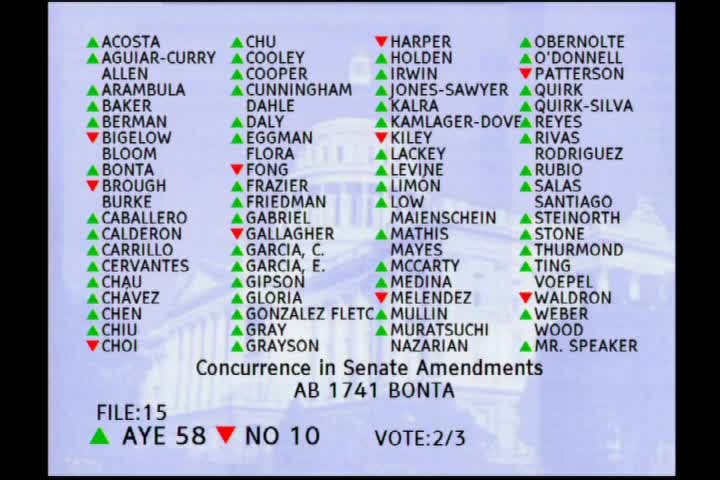
Bill Author

Bill Co-Author(s):