AB 2219: Landlord-tenant: 3rd-party payments.
- Session Year: 2017-2018
- House: Assembly
- Latest Version Date: 2018-08-28
Existing law regulates the terms and conditions of residential tenancies. Existing law requires a landlord or his or her agent to allow a tenant to pay rent or a security deposit by at least one form of payment that is neither cash nor electronic funds transfer, except as specified.
This bill would require, subject to specified limitations, a landlord or a landlords agent to allow a tenant to pay rent through a third party.
Existing law regulates the terms and conditions of residential tenancies. Existing law requires a landlord or his or her agent to allow a tenant to pay rent or a security deposit by at least one form of payment that is neither cash nor electronic funds transfer, except as specified.
This bill would prohibit require, subject to specified limitations, a landlord or a landlords agent from refusing to accept payment from a third party of a tenants rent if the third party does not reside on the premises and provides the landlord or agent with a signed acknowledgment that acceptance of the rent does not establish a landlord-tenant relationship between the landlord and the to allow a tenant to pay rent through a third party.
Existing law regulates the terms and conditions of residential tenancies. Existing law requires a landlord or his or her agent to allow a tenant to pay rent or a security deposit by at least one form of payment that is neither cash nor electronic funds transfer, except as specified.
This bill would prohibit a landlord or a landlords agent from refusing to accept payment from a third party of a tenants rent if the third party does not reside on the premises and provides the landlord or agent with a signed acknowledgment that acceptance of the rent does not establish a landlord-tenant relationship between the landlord and the third party.
(a)(1)Except as provided in paragraph (2), a landlord or a landlords agent shall allow a tenant to pay rent and deposit of security by at least one form of payment that is neither cash nor electronic funds transfer.
(2)A landlord or a landlords agent may demand or require cash as the exclusive form of payment of rent or deposit of security if the tenant has previously attempted to pay the landlord or landlords agent with a check drawn on insufficient funds or the tenant has instructed the drawee to stop payment on a check, draft, or order for the payment of money. The landlord may demand or require cash as the exclusive form of payment only for a period not exceeding three months following an attempt to pay with a check on insufficient funds or following a tenants instruction to stop payment. If the landlord chooses to demand or require cash payment under these circumstances, the landlord shall give the tenant a written notice stating that the payment instrument was dishonored and informing the tenant that the tenant shall pay in cash for a period determined by the landlord, not to exceed three months, and attach a copy of the dishonored instrument to the notice. The notice shall comply with Section 827 if demanding or requiring payment in cash constitutes a change in the terms of the lease.
(3)Subject to the limitations below, a landlord or a landlords agent shall allow a tenant to pay rent through a third party.
(A)A landlord or landlords agent is not required to accept the rent payment tendered by a third party unless the third party has provided to the landlord or landlords agent a signed acknowledgment stating that they are not currently a tenant of the premises for which the rent payment is being made and that acceptance of the rent payment does not create a new tenancy with the third party.
(B)Failure by a third party to provide the signed acknowledgment to the landlord or landlords agent shall void the obligation of a landlord or landlords agent to accept a tenants rent tendered by a third party.
(C)The landlord or landlords agent may, but is not required to, provide a form acknowledgment to be used by third parties, as provided for in subparagraph (A), provided however that a landlord shall accept as sufficient for compliance with subparagraph (A) an acknowledgment in substantially the following form:
I, [insert name of third party], state as follows:
I am not currently a tenant of the premises located at [insert address of premises].
I acknowledge that acceptance of the rent payment I am offering for the premises does not create a new tenancy.
(signature of third party) | (date) |
(D)A landlord or landlords agent may require a signed acknowledgment for each rent payment made by the third party. A landlord or landlords agent and the third party may agree that one acknowledgment shall be sufficient for when the third party makes more than one rent payment during a period of time.
(E)Nothing in this paragraph shall be construed to require a landlord or landlords agent to enter into a contract in connection with a federal, state, or local housing assistance program, including, but not limited to, the federal housing assistance voucher programs under Section 8 of the United States Housing Act of 1937 (42 U.S.C. Sec. 1437f).
(4)Paragraphs (2) and (3) do not enlarge or diminish a landlords or landlords agents legal right to terminate a tenancy. Nothing in paragraph (3) is intended to extend the due date for any rent payment or require a landlord or landlords agent to accept tender of rent beyond the expiration of the period stated in paragraph (2) of Section 1161 of the Code of Civil Procedure.
(b)For the purposes of this section, the issuance of a money order or a cashiers check is direct evidence only that the instrument was issued.
(c)For purposes of this section, electronic funds transfer means any transfer of funds, other than a transaction originated by check, draft, or similar paper instrument, that is initiated through an electronic terminal, telephonic instrument, computer, or magnetic tape so as to order, instruct, or authorize a financial institution to debit or credit an account. Electronic funds transfer includes, but is not limited to, point-of-sale transfers, direct deposits or withdrawals of funds, transfers initiated by telephone, transfers via an automated clearinghouse, transfers initiated electronically that deliver a paper instrument, and transfers authorized in advance to recur at substantially regular intervals.
(d)Nothing in this section shall be construed to prohibit the tenant and landlord or agent to mutually agree that rent payments may be made in cash or by electronic funds transfer, so long as another form of payment is also authorized, subject to the requirements of subdivision (a).
(e)A waiver of the provisions of this section is contrary to public policy, and is void and unenforceable.
(a)(1)Except as provided in paragraph (2), a landlord or a landlords agent shall allow a tenant to pay rent and deposit of security by at least one form of payment that is neither cash nor electronic funds transfer.
(2)A landlord or a landlords agent may demand or require cash as the exclusive form of payment of rent or deposit of security if the tenant has previously attempted to pay the landlord or landlords agent with a check drawn on insufficient funds or the tenant has instructed the drawee to stop payment on a check, draft, or order for the payment of money. The landlord may demand or require cash as the exclusive form of payment only for a period not exceeding three months following an attempt to pay with a check on insufficient funds or following a tenants instruction to stop payment. If the landlord chooses to demand or require cash payment under these circumstances, the landlord shall give the tenant a written notice stating that the payment instrument was dishonored and informing the tenant that the tenant shall pay in cash for a period determined by the landlord, not to exceed three months, and attach a copy of the dishonored instrument to the notice. The notice shall comply with Section 827 if demanding or requiring payment in cash constitutes a change in the terms of the lease.
(3)Subject to the limitations below, a landlord or a landlords agent shall allow a tenant to pay rent through a third party.
(A)A landlord or landlords agent is not required to accept a the rent payment tendered by a third party unless the third party has provided to the landlord or landlords agent a signed acknowledgment stating that they are not currently a tenant of the premises for which the rent payment is being made and that acceptance of the rent payment does not create a new tenancy with the third party.
(B)Failure by a third party to provide the signed acknowledgment to the landlord or landlords agent shall void the obligation of a landlord or landlords agent to accept a tenants rent tendered by a third party.
(C)The landlord or landlords agent may, but is not required to, provide a form acknowledgment to be used by third parties, as provided for in subparagraph (A), provided however that a landlord shall accept as sufficient for compliance with subparagraph (A) an acknowledgment in substantially the following form:
I, [insert name of third party], state as follows:
I am not currently a tenant of the premises located at [insert address of premises].
I acknowledge that acceptance of the rent payment I am offering for the premises does not create a new tenancy.
(signature of third party) | (date) |
(D)A landlord or landlords agent may require a signed acknowledgment for each rent payment made by the third party. A landlord or landlords agent and the third party may agree that one acknowledgment shall be sufficient for when the third party makes more than one rent payment during a period of time.
(E)Nothing in this paragraph shall be construed to require a landlord or landlords agent to enter into a contract in connection with a federal, state, or local housing assistance program, including, but not limited to, the federal housing assistance voucher programs under Section 8 of the United States Housing Act of 1937 (42 U.S.C. Sec. 1437f).
(4)Paragraphs (2) and (3) do not enlarge or diminish a landlords or landlords agents legal right to terminate a tenancy. Nothing in paragraph (3) is intended to extend the due date for any rent payment or require a landlord or landlords agent to accept tender of rent beyond the expiration of the period stated in paragraph (2) of Section 1161 of the Code of Civil Procedure.
(b)For the purposes of this section, the issuance of a money order or a cashiers check is direct evidence only that the instrument was issued.
(c)For purposes of this section, electronic funds transfer means any transfer of funds, other than a transaction originated by check, draft, or similar paper instrument, that is initiated through an electronic terminal, telephonic instrument, computer, or magnetic tape so as to order, instruct, or authorize a financial institution to debit or credit an account. Electronic funds transfer includes, but is not limited to, point-of-sale transfers, direct deposits or withdrawals of funds, transfers initiated by telephone, transfers via an automated clearinghouse, transfers initiated electronically that deliver a paper instrument, and transfers authorized in advance to recur at substantially regular intervals.
(d)Nothing in this section shall be construed to prohibit the tenant and landlord or agent to mutually agree that rent payments may be made in cash or by electronic funds transfer, so long as another form of payment is also authorized, subject to the requirements of subdivision (a).
(e)A waiver of the provisions of this section is contrary to public policy, and is void and unenforceable.
(a)(1)Except as provided in paragraph (2), a landlord or a landlords agent shall allow a tenant to pay rent and deposit of security by at least one form of payment that is neither cash nor electronic funds transfer.
(2)A landlord or a landlords agent may demand or require cash as the exclusive form of payment of rent or deposit of security if the tenant has previously attempted to pay the landlord or landlords agent with a check drawn on insufficient funds or the tenant has instructed the drawee to stop payment on a check, draft, or order for the payment of money. The landlord may demand or require cash as the exclusive form of payment only for a period not exceeding three months following an attempt to pay with a check on insufficient funds or following a tenants instruction to stop payment. If the landlord chooses to demand or require cash payment under these circumstances, the landlord shall give the tenant a written notice stating that the payment instrument was dishonored and informing the tenant that the tenant shall pay in cash for a period determined by the landlord, not to exceed three months, and attach a copy of the dishonored instrument to the notice. The notice shall comply with Section 827 if demanding or requiring payment in cash constitutes a change in the terms of the lease.
(3)Subject to the limitations below, a landlord or a landlords agent shall allow a tenant to pay rent through a third party.
(A)A landlord or landlords agent is not required to accept a rent payment tendered by a third party unless the third party has provided to the landlord or landlords agent a signed acknowledgment stating that they are not currently a tenant of the premises for which the rent payment is being made and that acceptance of the rent payment does not create a new tenancy with the third party.
(B)Failure by a third party to sign and return provide the signed acknowledgment to the landlord or landlords agent shall void the obligation of a landlord or landlords agent to accept a tenants rent tendered by a third party.
(C)The landlord or landlords agent may, but is not required to, provide a form acknowledgment to be used by third parties, as provided for in subparagraph (A), provided however that a landlord shall accept as sufficient for compliance with subparagraph (A) an acknowledgment in substantially the following form:
I, [insert name of third party], state as follows:
I am not currently a tenant of the premises located at [insert address of premises].
I acknowledge that acceptance of the rental rent payment I am offering for the premises does not create a new tenancy.
(signature of third party) | (date) |
(D)A landlord or landlords agent may require a signed acknowledgment for each rent payment made by the third party. A landlord or landlords agent and the third party may agree that one acknowledgment shall be sufficient for when the third party will be making makes more than one rent payment during a period of time.
(E)Nothing in this paragraph shall be construed to require a landlord or landlords agent to participate in, or enter into, a into a contract in connection with a federal, state, or local housing assistance program, including, but not limited to, the federal housing assistance voucher programs under Section 8 of the United States Housing Act of 1937 (42 U.S.C. Sec. 1437f).
(4)Paragraphs (2) and (3) do not enlarge or diminish a landlords or landlords agents legal right to terminate a tenancy. Nothing in paragraph (3) is intended to extend the due date for any rent payment or require a landlord or landlords agent to accept tender of rent beyond the expiration of the period stated in paragraph (2) of Section 1161 of the Code of Civil Procedure.
(b)For the purposes of this section, the issuance of a money order or a cashiers check is direct evidence only that the instrument was issued.
(c)For purposes of this section, electronic funds transfer means any transfer of funds, other than a transaction originated by check, draft, or similar paper instrument, that is initiated through an electronic terminal, telephonic instrument, computer, or magnetic tape so as to order, instruct, or authorize a financial institution to debit or credit an account. Electronic funds transfer includes, but is not limited to, point-of-sale transfers, direct deposits or withdrawals of funds, transfers initiated by telephone, transfers via an automated clearinghouse, transfers initiated electronically that deliver a paper instrument, and transfers authorized in advance to recur at substantially regular intervals.
(d)Nothing in this section shall be construed to prohibit the tenant and landlord or agent to mutually agree that rent payments may be made in cash or by electronic funds transfer, so long as another form of payment is also authorized, subject to the requirements of subdivision (a).
(e)A waiver of the provisions of this section is contrary to public policy, and is void and unenforceable.
(a)(1)Except as provided in paragraph (2), a landlord or a landlords agent shall allow a tenant to pay rent and deposit of security by at least one form of payment that is neither cash nor electronic funds transfer.
(2)A landlord or a landlords agent may demand or require cash as the exclusive form of payment of rent or deposit of security if the tenant has previously attempted to pay the landlord or landlords agent with a check drawn on insufficient funds or the tenant has instructed the drawee to stop payment on a check, draft, or order for the payment of money. The landlord may demand or require cash as the exclusive form of payment only for a period not exceeding three months following an attempt to pay with a check on insufficient funds or following a tenants instruction to stop payment. If the landlord chooses to demand or require cash payment under these circumstances, the landlord shall give the tenant a written notice stating that the payment instrument was dishonored and informing the tenant that the tenant shall pay in cash for a period determined by the landlord, not to exceed three months, and attach a copy of the dishonored instrument to the notice. The notice shall comply with Section 827 if demanding or requiring payment in cash constitutes a change in the terms of the lease.
(3)Paragraph (2) does(3)Subject to the limitations below, a landlord or a landlords agent shall allow a tenant to pay rent through a third party.
(A)A landlord or landlords agent is not required to accept a rent payment tendered by a third party unless the third party has provided to the landlord or landlords agent a signed acknowledgment stating that they are not currently a tenant of the premises for which the rent payment is being made and that acceptance of the rent payment does not create a new tenancy with the third party.
(B)Failure by a third party to sign and return the acknowledgment to the landlord or landlords agent shall void the obligation of a landlord or landlords agent to accept a tenants rent tendered by a third party.
(C)The landlord or landlords agent may, but is not required to, provide a form acknowledgment to be used by third parties, as provided for in subparagraph (A), provided however that a landlord shall accept as sufficient for compliance with subparagraph (A) an acknowledgment in substantially the following form:
I, [insert name of third party], state as follows:
I am not currently a tenant of the premises located at [insert address of premises].
I acknowledge that acceptance of the rental payment I am offering for the premises does not create a new tenancy.
(signature of third party) | (date) |
(D)A landlord or landlords agent may require a signed acknowledgment for each rent payment made by the third party. A landlord or landlords agent and the third party may agree that one acknowledgment shall be sufficient for when the third party will be making more than one rent payment during a period of time.
(E)Nothing in this paragraph shall be construed to require a landlord or landlords agent to participate in, or enter into, a contract in connection with a federal, state, or local housing assistance program, including, but not limited to, the federal housing assistance voucher programs under Section 8 of the United States Housing Act of 1937 (42 U.S.C. Sec. 1437f).
(4)Paragraphs (2) and (3) do not enlarge or diminish a landlords or landlords agents legal right to terminate a tenancy. Nothing in paragraph (3) is intended to extend the due date for any rent payment or require a landlord or landlords agent to accept tender of rent beyond the expiration of the period stated in paragraph (2) of Section 1161 of the Code of Civil Procedure.
(b)For the purposes of this section, the issuance of a money order or a cashiers check is direct evidence only that the instrument was issued.
(c)For purposes of this section, electronic funds transfer means any transfer of funds, other than a transaction originated by check, draft, or similar paper instrument, that is initiated through an electronic terminal, telephonic instrument, computer, or magnetic tape so as to order, instruct, or authorize a financial institution to debit or credit an account. Electronic funds transfer includes, but is not limited to, point-of-sale transfers, direct deposits or withdrawals of funds, transfers initiated by telephone, transfers via an automated clearinghouse, transfers initiated electronically that deliver a paper instrument, and transfers authorized in advance to recur at substantially regular intervals.
(d)Nothing in this section shall be construed to prohibit the tenant and landlord or agent to mutually agree that rent payments may be made in cash or by electronic funds transfer, so long as another form of payment is also authorized, subject to the requirements of subdivision (a).
(e)A waiver of the provisions of this section is contrary to public policy, and is void and unenforceable.
SECTION 1.Section 1947.4 is added to the Civil Code, to read:1947.4.A landlord or a landlords agent may not refuse to accept payment from a third party of a tenants rent if the third party does not reside on the premises and provides the landlord or landlords agent with a written acknowledgment that the acceptance of the rent does not establish a landlord-tenant relationship between the third party and the landlord.A landlord or a landlords agent may not refuse to accept payment from a third party of a tenants rent if the third party does not reside on the premises and provides the landlord or landlords agent with a written acknowledgment that the acceptance of the rent does not establish a landlord-tenant relationship between the third party and the landlord.
|
Date
|
Status
|
|---|---|
| Aug 28, 2018 | Chaptered by Secretary of State - Chapter 233, Statutes of 2018. |
| Aug 28, 2018 | Approved by the Governor. |
| Aug 16, 2018 | Enrolled and presented to the Governor at 4 p.m. |
| Aug 13, 2018 | Senate amendments concurred in. To Engrossing and Enrolling. |
| Jul 3, 2018 | In Assembly. Concurrence in Senate amendments pending. May be considered on or after July 5 pursuant to Assembly Rule 77. |
| Jul 2, 2018 | Read third time. Passed. Ordered to the Assembly. |
| Jun 21, 2018 | Read second time. Ordered to Consent Calendar. |
| Jun 20, 2018 | From committee: Do pass. To Consent Calendar. (Ayes 7. Noes 0.) (June 19). |
| Jun 7, 2018 | From committee chair, with author's amendments: Amend, and re-refer to committee. Read second time, amended, and re-referred to Com. on JUD. |
| May 30, 2018 | Referred to Com. on JUD. |
| May 17, 2018 | In Senate. Read first time. To Com. on RLS. for assignment. |
| May 17, 2018 | Read third time. Passed. Ordered to the Senate. |
| May 14, 2018 | Read second time. Ordered to third reading. |
| May 10, 2018 | Read second time and amended. Ordered returned to second reading. |
| May 9, 2018 | From committee: Amend, and do pass as amended. (Ayes 10. Noes 0.) (May 8). |
| May 2, 2018 | Re-referred to Com. on JUD. |
| May 1, 2018 | From committee chair, with author's amendments: Amend, and re-refer to Com. on JUD. Read second time and amended. |
| Apr 30, 2018 | In committee: Hearing postponed by committee. |
| Mar 15, 2018 | In committee: Set, first hearing. Hearing canceled at the request of author. |
| Mar 1, 2018 | Referred to Com. on JUD. |
| Feb 13, 2018 | From printer. May be heard in committee March 15. |
| Feb 12, 2018 | Read first time. To print. |
|
Date
|
Description
|
Location
|
Votes
|
|
|---|---|---|---|---|
| Aug 13, 2018 | AB 2219 TING Concurrence in Senate Amendments | Assembly Floor |
Passed |
|
| Jul 2, 2018 | Consent Calendar AB2219 Ting | Senate Floor |
Passed |
|
| Jun 19, 2018 | Do pass and be ordered to the Consent Calendar | Senate Standing Committee on Judiciary |
Passed |
|
| May 17, 2018 | AB 2219 TING Assembly Third Reading | Assembly Floor |
Passed |
|
| May 8, 2018 | Do pass as amended. | Assembly Standing Committee on Judiciary |
Passed |
This list shows positions taken on this bill by organizations on the date displayed, which is linked to the original source.
Positions by individuals are not included.
CONCURRENCE IN SENATE AMENDMENTS
CSA1 Bill Id:AB 2219
Author:(Ting)
As Amended Ver:June 7, 2018
Majority vote
ASSEMBLY: | 68-0 | (May 17, 2018) | SENATE: | 37-0 | (July 2, 2018) |
Original Committee Reference: JUD.
SUMMARY: Requires landlords to allow a tenant to pay rent through a third party, subject to specified limitations. Specifically, this bill:
- Requires a landlord or landlord's agent to allow a tenant to pay rent through a third party, except there is no requirement to accept the rent payment tendered by a third party, unless the third party has provided a signed acknowledgment stating that they are not currently a tenant of the premises for which the rent payment is being made, and that acceptance of the rent payment does not create a new tenancy with the third party.
- Specifies the language of a form acknowledgment that landlords may, but are not required, to provide for use by third parties when rent is tendered to a landlord on behalf of a tenant.
- Provides that failure by a third party to provide a signed acknowledgment to the landlord or landlord's agent shall void the obligation of a landlord or landlord's agent to accept a tenant's rent tendered by a third party.
- Allows a landlord or the landlord's agent to require a signed acknowledgment for each rent payment made by the third party, and to agree with the third party that one acknowledgment shall be sufficient for when the third party will be making more than one rent payment during a period of time.
- Clarifies that none of these provisions shall be construed to require a landlord or landlord's agent to enter into a contract in connection with a federal, state, or local housing assistance program, including, but not limited to, the federal housing assistance voucher programs under Section 8 of the United States Housing Act of 1937 (42 United States Code (U.S.C.) Section 1437f).
- Clarifies that none of the above provisions enlarge or diminish a landlord's or landlord's agent's legal right to terminate a tenancy, nor are intended to extend the due date for any rent payment or require a landlord or landlord's agent to accept tender of rent beyond the expiration of the 3-day period to pay or quit under Code of Civil Procedure Section 1161(2).
- Clarifies that none of these provisions shall be construed to prohibit the tenant and landlord or agent to mutually agree that the rent payments may be made in cash or by electronic funds transfer, so long as another form of payment is also authorized that is neither cash nor electronic funds transfer.
- Provides that a waiver of these provisions is contrary to public policy, and is void and unenforceable.
The Senate amendments make a technical, non-substantive amendment by changing the word "a" to "the" in Civil Code Section 1947.3 (a)(3).
FISCAL EFFECT: None
COMMENTS: According to a 2017 report by California's Department of Housing and Community Development (HCD), the majority of California renters – over 3 million households – pay more than 30% of their income towards rent, and nearly one-third of California renters– over 1.5 million households – pay more than 50% toward rent. According to the author, studies show that renters are also more likely than homeowners to say their housing costs cause them financial strain, and more than a third of renters say they currently face a lot of financial strain.
Given the growing crisis of skyrocketing rents and lack of affordable rental housing in California, the author and Western Center on Law and Poverty, the sponsor of this legislation, are understandably concerned with finding ways to preserve existing tenancies wherever possible. According to the author:
Current law does not prohibit or require a landlord to accept payment of rent from someone other than their tenant. In the absence of the law requiring landlords to accept such third party rent payments, some landlords have refused to accept rent payments from anyone other than the tenant. Such refusals needlessly put some renters in financial peril and could lead to their potential eviction.
Finding and keeping affordable housing in California can be very challenging. If a renter needs some assistance, and another person or party is able to assist, the law should ensure that the renter can stay in their home. This bill allows people to benefit from the support of others and seeks to keep people from experiencing homelessness.
Rental assistance programs can help vulnerable tenants stay in their homes. According to Western Center, in light of the affordable housing crisis, a growing number of jurisdictions and nonprofits have created programs to help lower-income tenants afford their rent and prevent evictions for nonpayment, which often lead to homelessness. These programs include ongoing rental assistance provided by mental health and social service agencies and one-time grants of rental assistance to help a tenant remain housed. In addition, many tenants rely on less formal arrangements to ensure that their rent gets paid, such as a caretaker who manages the finances of a disabled tenant, or a religious institution willing to pay accrued rent for a tenant who has fallen behind on payments.
According to the author and sponsor, these assistance programs and arrangements are critical to preventing homelessness, yet a growing number of landlords refuse to accept such payments. They contend such refusal has severe impacts on highly vulnerable tenants, such as disabled renters and seniors, who may lack the ability or capacity to manage funds or make rental payments on their own.
Proponents note that existing law does not clearly require the acceptance of a rental payment made by someone other than the tenant, and consequently many landlords maintain a policy of refusing payments that are not made directly by a tenant. However, homelessness prevention programs generally do not provide funds directly to tenants; instead they typically arrange to make the payment directly to the landlord on behalf of the tenant. As a result of landlords refusing to accept rent from third parties, vulnerable tenants may end up facing evictions for nonpayment of rent despite the availability of funds specifically intended to pay their rent and prevent homelessness.
This bill requires acceptance of rent tendered by third party, but no right of tenancy is created by acceptance. This bill simply requires a landlord or a landlord's agent to allow a tenant to pay rent through a third party, subject to certain limitations. Although landlords generally do not want to turn down any payment of rent being offered by a tenant or someone on behalf of the tenant, they have also expressed concern that they don't want the acceptance of a third-party payment to confer any right of tenancy upon the third party. This is because existing law provides that if a tenant holds over after expiration of the term and the landlord accepts rent from the tenant, it is presumed that they have renewed the rental on the same terms and for the same length of time as under the original lease. (Civil Code Section 1945.)
The May 1 amendments to the bill address landlords' concerns by providing that no landlord-tenant relationship is established with a third party by accepting tendered rent from the third party. The bill provides that the landlord is not required to accept a rent payment tendered by a third party unless the third party has provided to the landlord or landlord's agent a signed acknowledgment explicitly stating that they are not currently a tenant of the premises for which the rent payment is being made; and that acceptance of the rent payment does not create a new tenancy with the third party. With respect to the signed acknowledgment, this bill: 1) specifies a form acknowledgment that landlords can, but are not required to, use for this purpose; 2) clarifies that failure to provide the acknowledgment voids the landlord's obligation to accept the rent from the third party; and 3) clarifies that the landlord can require a separate acknowledgement for each rent payment made for the third party, or alternatively, that the landlord can elect to accept a single acknowledgement to cover multiple payments by the third party.
Acceptance of rent from a third party does not create other obligations for the landlord. In addition to requiring a signed acknowledgement that no rights of tenancy are created as a condition of accepting rent from a third party, the author has taken several amendments negotiated with apartment associations and the Realtors to clarify that acceptance of rent under this bill does not create other unwanted or unintended obligations for the landlord. These amendments clarify that the bill does not extend the due date for any rental payment, nor requires the landlord to accept rent beyond the three-day pay-or-quit notice for terminating a tenancy. This bill also specifically provides that nothing in the bill shall be construed to require a landlord or landlord's agent "to enter into a contract in connection with a federal, state, or local housing assistance program, including, but not limited to, the federal housing assistance voucher programs under Section 8 of the United States Housing Act of 1937 (42 U.S.C. Section 1437(f))." This is important to landlords who want to reinforce their right under current law not to accept government-sponsored rental housing vouchers (i.e. federal "Section 8" vouchers), and to ensure that nothing in this bill interferes with that right, which otherwise could be construed to force landlords to contract with governmental rent subsidy programs should they accept the rental assistance payment.
Analysis Prepared by: Anthony Lew / JUD. / (916) 319-2334 FN: 0003574
Office of Senate Floor Analyses (916) 651-1520 Fax: (916) 327-4478 | AB |
CONSENT
Bill No: AB 2219
:
SENATE JUDICIARY COMMITTEE: 7-0, 6/19/18
AYES: Jackson, Moorlach, Anderson, Hertzberg, Monning, Stern, Wieckowski
ASSEMBLY FLOOR: 68-0, 5/17/18 - See last page for vote
SOURCE: California Rural Legal Assistance Foundation
Western Center on Law and Poverty
DIGEST:
This bill requires residential landlords to accept rent payments from third parties, provided that the third party acknowledges that the payment does not confirm nor create a tenancy.
Existing law:
- Provides that a landlord may seek an order for a tenant’s eviction from the courts through the unlawful detainer process when that tenant has failed to pay rent on time, the landlord has served the tenant with a three-day notice to pay the amount due or leave, the three days have passed, and the tenant remains in the property without the landlord’s permission. (Code Civ. Proc. Sec. 1161(2).)
- Requires a landlord or a landlord’s agent to allow a tenant to pay rent and deposit of security by at least one form of payment that is neither cash nor electronic funds transfer, except in limited circumstances where the tenant previously tried to pay with a check drawn on insufficient funds or that was the subject of a stop payment order. (Civ. Code Sec. 1947.3(a).)
This bill:
- Requires a landlord to allow a tenant to pay rent through a third party, except there is no requirement to accept a rent payment tendered by a third party, unless the third party has provided a signed acknowledgment stating that they are not currently a tenant of the premises for which the rent payment is being made, and that acceptance of the rent payment does not create a new tenancy with the third party.
- Provides model language that landlords may, but are not required to, provide for use by third parties when those third parties tender rent to a landlord on behalf of a tenant.
- Specifies that failure by a third party to provide a signed acknowledgment to the landlord shall void the obligation of a landlord or landlord’s agent to accept a tenant’s rent tendered by a third party.
- Allows a landlord to require a signed acknowledgment for each rent payment made by the third party, and to agree with the third party that one acknowledgment shall be sufficient for when the third party will be making more than one rent payment during a period of time.
- Clarifies that none of the bill’s provisions shall be construed to require a landlord to enter into a contract in connection with a federal, state, or local housing assistance program, including, but not limited to, the federal housing assistance voucher programs under Section 8 of the United States Housing Act of 1937 (42 U.S.C. Sec. 1437(f).
- Clarifies that none of the above provisions enlarge or diminish a landlord’s legal right to terminate a tenancy, nor are intended to extend the due date for any rent payment or require a landlord to accept tender of rent beyond the expiration of the three-day period to pay or quit under Code of Civil Procedure Section 1161(2).
Usually, the tenant pays the rent to the landlord. Sometimes, however, someone else pays all or part of the rent. This can occur regularly, as when someone else is handling the tenant’s financial arrangements, or it may be a one-time occurrence, as when a tenant falls on hard times and seeks emergency rental assistance from family, friends, or charitable resources.
Typically, so long as the rent is paid in full, it is not of great concern to the landlord what the source of the money is. Occasionally, however, landlords object and refuse third-party payments. Often, such a refusal is based on the landlord’s fear that if they accept rent money from a third party, that third party will obtain the rights of a tenant in exchange, including the right to occupy the property. At the same time, if the tenant is unable to find a way to pay the rent directly, the landlord’s refusal to accept the third party’s payment may lead to default and, ultimately, the tenant’s eviction.
This bill addresses this problem by requiring residential landlords to accept rent payments from third parties; provided that the third party provides a written and signed acknowledgment that the payment neither confirms the existence of a current tenancy between the landlord and the third party nor creates a new one.
Comments
Example of the problem that the bill is intended to address
As an example of the problem that this bill is intended to address, the sponsors of the bill offer the following account:
“George” and his two daughters have experienced the consequences of this type of action by landlords. His family was the victim of a domestic violence incident that resulted in George being temporarily unable to work, and momentarily unable to pay his rent. A local nonprofit group that provides assistance to people who are in need of funds to help pay rent and avoid homelessness stepped in to help George and his family. However, George’s landlord refused to accept rent from the agency. As a result, George and his young daughters lost their housing and ended up relocating to a homeless shelter.
Formation of a lease
It may seem exaggerated for a landlord to insist upon a statement acknowledging that no tenancy exists or is being created between the landlord and the third party in order to accept rent payments from that third party. Tenancies can be formed more easily than one might imagine, however. No written agreement is necessary. Verbal leases are legally valid in California, so long as they are not for longer than a year. (Civ. Code Sec. 1624(a)(3).) Tenancies may also be formed by implication through the actions of the parties. (Samuels v. Ottinger (1915) 169 C. 209.) It is this last manner of forming a tenancy that makes some landlords skittish about receiving rental payments from a third party. The concern is that accepting the payment could give rise to an argument that, by accepting the rent payment, the landlord was implying consent for the third party to occupy the premises.
In order to avoid this problem, the bill does not require landlords to accept rental payments from third parties unless the third party signs an acknowledgement that no tenancy is confirmed or created by the payment. Such an acknowledgement should be more than sufficient to defeat any attempt to argue that a tenancy by implication has been created between the landlord and the third party.
Why workarounds are not necessarily easy
At first blush, the problem of landlords unwilling to accept rent payments from third parties would seem easy to resolve: simply have the third party pay the money to the tenant who then turns it over to the landlord. Though simple in theory, this solution is often impossible in practice, because many third-party payers are barred from paying the money directly to the tenant or are reluctant to do so. Charitable groups, for example, often require that any rental assistance they provide goes straight to the landlord so as to ensure that unscrupulous tenants do not abscond with the money or utilize it for other priorities not approved by the charity.
Assurance to landlords that the bill does not require accepting housing vouchers
The federal Housing and Urban Development Department operates a number of subsidized housing programs through which local housing authorities pay part or all of participants rent through vouchers. Housing Choice vouchers, more often known as “Section 8” vouchers, and Veterans Affairs Supportive Housing (VASH) vouchers, are the most common forms of these rental subsidies.
Under current law, California landlords are not required to rent to tenants with subsidized housing vouchers. In 2016, then Senator Mark Leno introduced a bill, SB 1053 (Leno, 2016) which would have expanded the definition of “source of income” within the Fair Employment and Housing Act to include lawful, verifiable income paid to a housing owner or landlord on behalf of a tenant, including federal, state, or local public assistance and federal, state, or local housing subsidies. Landlord advocates objected strenuously to SB 1053 and it was ultimately held on suspense in the Senate Appropriations Committee. This year, Senator Hill introduced a narrower bill, SB 1427, which requires landlords to accept formerly homeless veterans with VASH vouchers as tenants. That bill is currently under consideration in the Assembly Committee on Appropriations.
Since this bill requires landlords to accept rental payments from third parties, it could be interpreted to require landlords to accept subsidized housing voucher holders as tenants. That is not the author’s intent. To ensure against such an unintended interpretation, this bill includes a provision explicitly clarifying that it does not require landlords to accept subsidized housing voucher holders.
FISCAL EFFECT: Appropriation: Fiscal Com.: Local:
California Rural Legal Assistance Foundation (co-source)
Western Center on Law and Poverty (co-source)
California State Association of Counties
County Behavioral Health Directors Association of California
County Welfare Directors Association of California
Disability Rights California
Housing Rights Committee of San Francisco
Los Angeles Homeless Services Authority
Non-Profit Housing Association of Northern California
San Diego County Apartment Association
Santa Monica Rent Control Board
Urban Counties of California
OPPOSITION: (Verified 6/21/18)
None received
ARGUMENTS IN SUPPORT: According to the author, “This bill clarifies that a third party may pay the rent for a tenant. Finding and keeping affordable housing in California can be very challenging. If a renter needs some assistance, and another person or party is able to assist, the law should ensure that the renter can stay in their home. According to a 2017 report by California’s Department of Housing and Community Development (HCD), the majority of California renters – over 3 million households – pay more than 30 percent of their income towards rent, and nearly one-third – over 1.5 million households – pay more than 50 percent toward rent. This bill allows people to benefit from the support of others and seeks to keep people from experiencing homelessness.”
As co-sponsors of the bill, the Western Center on Law and Poverty and California Rural Legal Assistance Foundation write:
Legal services partners report that across the state, tenants have been displaced as a result of policies maintained by their landlords that require payments to be made by the tenant on the lease, even if there is an individual, agency or charity willing to pay the tenant’s rent. These tenants, despite the willingness of a third party to pay to keep them in their homes, have been evicted for nonpayment after their landlords refuse payments from third parties.
In a time when tenants are facing rising rents and displacement pressures, and local governments and organizations are making funds available to assist, it is critical to clarify the law to ensure landlords do not refuse to accept these funds and then evict tenants for nonpayment.
In support of the bill, the California State Association of Counties, the County Welfare Directors Association of California, the County Behavioral Health Directors Association of California, and the Urban Counties of California write:
The use of subsidies to “buy down” rents for tenants at risk of losing their housing, or as a rapid rehousing strategy for households that can’t afford a full rent payment, has proven to be an effective strategy in addressing California’s housing affordability crisis. As a growing number of non-profit groups and local government agencies are adopting these strategies, it’s important for state law to ensure that landlords accept third-party rent payments without creating unintended legal consequences.
ASSEMBLY FLOOR: 68-0, 5/17/18
AYES: Acosta, Aguiar-Curry, Arambula, Baker, Berman, Bigelow, Bloom, Bonta, Burke, Caballero, Calderon, Carrillo, Cervantes, Chau, Chávez, Chen, Chiu, Choi, Chu, Cooley, Cooper, Cunningham, Dahle, Daly, Flora, Fong, Frazier, Friedman, Gallagher, Eduardo Garcia, Gipson, Gloria, Gonzalez Fletcher, Gray, Harper, Holden, Irwin, Jones-Sawyer, Kalra, Kiley, Lackey, Levine, Limón, Low, Maienschein, Mathis, Mayes, McCarty, Medina, Mullin, Nazarian, Obernolte, O'Donnell, Patterson, Quirk, Quirk-Silva, Reyes, Rodriguez, Rubio, Salas, Mark Stone, Thurmond, Ting, Voepel, Waldron, Weber, Wood, Rendon
NO VOTE RECORDED: Travis Allen, Brough, Eggman, Cristina Garcia, Grayson, Kamlager-Dove, Melendez, Muratsuchi, Santiago, Steinorth
Prepared by: Timothy Griffiths / JUD. / (916) 651-4113
6/22/18 14:09:09
**** END ****
Senator Hannah-Beth Jackson, Chair
2017-2018 Regular Session
Bill No: AB 2219 (Author:Ting)
Version: June 7, 2018
Hearing Date: June 19, 2018
Fiscal: No
Urgency: No
Consultant: TSG
SUBJECT
Landlord-tenant: 3rd-party payments
DESCRIPTION
This bill would require residential landlords to accept rent payments from third parties, provided that the third party acknowledges that the payment does not confirm nor create a tenancy.
BACKGROUND
Usually, the tenant pays the rent to the landlord. Sometimes, however, someone else pays all or part of the rent. This can occur regularly, as when someone else is handling the tenant’s financial arrangements, or it may be a one-time occurrence, as when a tenant falls on hard times and seeks emergency rental assistance from family, friends, or charitable resources.
Typically, so long as the rent is paid in full, it is not of great concern to the landlord what the source of the money is. Occasionally, however, landlords object and refuse third party payments. Often, such a refusal is based on the landlord’s fear that if they accept rent money from a third party, that third party will obtain the rights of a tenant in exchange, including the right to occupy the property. At the same time, if the tenant is unable to find a way to pay the rent directly, the landlord’s refusal to accept the third party’s payment may lead to default and, ultimately, the tenant’s eviction.
This bill would address this problem by requiring residential landlords to accept rent payments from third parties; provided that the third party provides a written and signed acknowledgment that the payment neither confirms the existence of a current tenancy between the landlord and the third party nor creates a new one.
CHANGES TO EXISTING LAW
Existing law provides that a landlord may seek an order for a tenant’s eviction from the courts through the unlawful detainer process when that tenant has failed to pay rent on time, the landlord has served the tenant with a three-day notice to pay the amount due or leave, the three days have passed, and the tenant remains in the property without the landlord’s permission. (Code Civ. Proc. Sec. 1161(2).)
Existing law requires a landlord or a landlord’s agent to allow a tenant to pay rent and deposit of security by at least one form of payment that is neither cash nor electronic funds transfer, except in limited circumstances where the tenant previously tried to pay with a check drawn on insufficient funds or that was the subject of a stop payment order. (Civ. Code Sec. 1947.3(a).)
This bill would require a landlord to allow a tenant to pay rent through a third party, except there is no requirement to accept a rent payment tendered by a third party, unless the third party has provided a signed acknowledgment stating that they are not currently a tenant of the premises for which the rent payment is being made, and that acceptance of the rent payment does not create a new tenancy with the third party.
This bill would provide model language that landlords may, but are not required, to provide for use by third parties when those third parties tender rent to a landlord on behalf of a tenant.
This bill would specify that failure by a third party to provide a signed acknowledgment to the landlord shall void the obligation of a landlord or landlord’s agent to accept a tenant’s rent tendered by a third party.
This bill would allow a landlord to require a signed acknowledgment for each rent payment made by the third party, and to agree with the third party that one acknowledgment shall be sufficient for when the third party will be making more than one rent payment during a period of time.
This bill would clarify that none of the bill’s provisions shall be construed to require a landlord to enter into a contract in connection with a federal, state, or local housing assistance program, including, but not limited to, the federal housing assistance voucher programs under Section 8 of the United States Housing Act of 1937 (42 U.S.C. Sec. 1437(f).
This bill would clarify that none of the above provisions enlarge or diminish a landlord’s legal right to terminate a tenancy, nor are intended to extend the due date for any rent payment or require a landlord to accept tender of rent beyond the expiration of the 3-day period to pay or quit under Code of Civil Procedure Section 1161(2).
COMMENT
1. Stated need for the bill
According to the author:
This bill clarifies that a third party may pay the rent for a tenant. Finding and keeping affordable housing in California can be very challenging. If a renter needs some assistance, and another person or party is able to assist, the law should ensure that the renter can stay in their home. According to a 2017 report by California’s Department of Housing and Community Development (HCD), the majority of California renters – over 3 million households – pay more than 30 percent of their income towards rent, and nearly one-third – over 1.5 million households – pay more than 50 percent toward rent. This bill allows people to benefit from the support of others and seeks to keep people from experiencing homelessness.
As co-sponsors of the bill, the Western Center on Law & Poverty and California Rural Legal Assistance Foundation, Inc., write:
Legal services partners report that across the state, tenants have been displaced as a result of policies maintained by their landlords that require payments to be made by the tenant on the lease, even if there is an individual, agency or charity willing to pay the tenant’s rent. These tenants, despite the willingness of a third party to pay to keep them in their homes, have been evicted for nonpayment after their landlords refuse payments from third parties.
Ina time when tenants are facing rising rents and displacement pressures, and local governments and organizations are making funds available to assist, it is critical to clarify the law to ensure landlords do not refuse to accept these funds and then evict tenants for nonpayment.
In support of the bill, the California State Association of Counties, the County Welfare Directors Association of California, the County Behavioral Health Directors Association of California, and the Urban Counties of California write:
The use of subsidies to “buy down” rents for tenants at risk of losing their housing, or as a rapid rehousing strategy for households that can’t afford a full rent payment, has proven to be an effective strategy in addressing California’s housing affordability crisis. As a growing number of non-profit groups and local government agencies are adopting these strategies, it’s important for state law to ensure that landlords accept third-party rent payments without creating unintended legal consequences.
2. Example of the problem that the bill is intended to address
As an example of the problem that this bill is intended to address, the sponsors of the bill offer the following account:
“George” and his two daughters have experienced the consequences of this type of action by landlords. His family was the victim of a domestic violence incident that resulted in George being temporarily unable to work, and momentarily unable to pay his rent. A local nonprofit group that provides assistance to people who are in need of funds to help pay rent and avoid homelessness stepped in to help George and his family. However, George’s landlord refused to accept rent from the agency. As a result, George and his young daughters lost their housing and ended up relocating to a homeless shelter.
3. Formation of a lease
It may seem exaggerated for a landlord to insist upon a statement acknowledging that no tenancy exists or is being created between the landlord and the third party in order to accept rent payments from that third party. Tenancies can be formed more easily than one might imagine, however. No written agreement is necessary. Verbal leases are legally valid in California, so long as they are not for longer than a year. (Civ. Code Sec. 1624(a)(3).) Tenancies may also be formed by implication through the actions of the parties. (Samuels v. Ottinger (1915) 169 C. 209.) It is this last manner of forming a tenancy that makes some landlords skittish about receiving rental payments from a third party. The concern is that accepting the payment could give rise to an argument that, by accepting the rent payment, the landlord was implying consent for the third party to occupy the premises.
In order to avoid this problem, the bill does not require landlords to accept rental payments from third parties unless the third party signs an acknowledgement that no tenancy is confirmed or created by the payment. Such an acknowledgement should be more than sufficient to defeat any attempt to argue that a tenancy by implication has been created between the landlord and the third party.
4. Why workarounds are not necessarily easy
At first blush, the problem of landlords unwilling to accept rent payments from third parties would seem easy to resolve: simply have the third party pay the money to the tenant who then turns it over to the landlord. Though simple in theory, this solution is often impossible in practice, because many third party payers are barred from paying the money directly to the tenant or are reluctant to do so. Charitable groups, for example, often require that any rental assistance they provide goes straight to the landlord so as to ensure that unscrupulous tenants do not abscond with the money or utilize it for other priorities not approved by the charity.
5. Assurance to landlords that the bill does not require accepting housing vouchers
The federal Housing and Urban Development Department operates a number of subsidized housing programs through which local housing authorities pay part or all of participants rent through vouchers. Housing Choice vouchers, more often known as “Section 8” vouchers, and Veterans Affairs Supportive Housing (VASH) vouchers, are the most common forms of these rental subsidies.
Under current law, California landlords are not required to rent to tenants with subsidized housing vouchers. In 2016, then Senator Mark Leno introduced a bill, SB 1053 (Leno, 2016) which would have expanded the definition of “source of income” within the Fair Employment and Housing Act to include lawful, verifiable income paid to a housing owner or landlord on behalf of a tenant, including federal, state, or local public assistance and federal, state, or local housing subsidies. Landlord advocates objected strenuously to SB 1053 and it was ultimately held on suspense in the Senate Appropriations Committee. This year, Senator Hill introduced a narrower bill, SB 1427, which would require landlords to accept formerly homeless veterans with VASH vouchers as tenants. That bill is currently under consideration in the Assembly Committee on Judiciary.
Since this bill would require landlords to accept rental payments from third parties, it could be interpreted to require landlords to accept subsidized housing voucher holders as tenants. That is not the author’s intent. To ensure against such an unintended interpretation, the bill includes a provision explicitly clarifying that it does not require landlords to accept subsidized housing voucher holders.
Support: California State Association of Counties; County Behavioral Health Directors Association of California; County Welfare Directors Association of California; Disability Rights California; Housing Rights Committee of San Francisco; Los Angeles Homeless Services Authority; Non-Profit Housing Association of Northern California; San Diego County Apartment Association; Santa Monica Rent Control Board; Urban Counties of California
Opposition: None known
HISTORY
Source: California Rural Legal Assistance Foundation; Western Center on Law and Poverty
Related Pending Legislation: SB 1427 (Hill, 2018) would require landlords to accept tenants who will be paying all or part of their rent using a Veterans Assistance Supportive Housing (VASH) voucher. SB 1427 is currently pending consideration before the Assembly Committee on Judiciary.
Prior Legislation:
SB 1053 (Leno, 2016) would have expanded the definition of “source of income” within FEHA to include lawful, verifiable income paid to a housing owner or landlord on behalf of a tenant, including federal, state, or local public assistance, and federal, state, or local housing subsidies. SB 1053 was held on suspense in the Senate Appropriations Committee.
SB 115 (Torlakson, Ch. 76, Stats. 2004) added Civil Code Section 1947.3 to the codes, thereby prohibiting landlords from demanding or requiring cash as the exclusive form of payment for rent or deposit of security, except in limited circumstances in which the tenant rent checks have recently bounced or the tenant has put a stop payment on the rent check.
SB 1145 (Burton, Ch. 568, Stats. 2004), among other things, removed the sunset date and thereby extended indefinitely a provision adopted in SB 1098 (Burton, Ch. 590, Stats. 1999), which prohibited discrimination under the Fair Employment and Housing Act on the basis of a person’s source of income, as specified.
SB 1098 (Burton, Ch. 590, Stats. 1999) prohibited, until January 1, 2005, discrimination under the Fair Employment and Housing Act on the basis of a person’s source of income, the failure to account for the aggregate income of co-residents, or the failure to exclude a government rent subsidy from that portion of the rent to be paid by the tenant in assessing his or her eligibility for rental housing.
Prior Vote:
Assembly Floor (Ayes 68, Noes 0)
Assembly Judiciary Committee (Ayes 10, Noes 0)
**************
ASSEMBLY THIRD READING
ATR Bill Id:AB 2219
Author:(Ting)
As Amended Ver:May 10, 2018
Majority vote
Committee | Votes | Ayes | Noes |
Judiciary | 10-0 | Mark Stone, Cunningham, Chau, Chiu, Gonzalez Fletcher, Holden, Kalra, Kiley, Maienschein, Reyes |
|
SUMMARY: Requires landlords to allow a tenant to pay rent through a third party, subject to specified limitations. Specifically, this bill:
- Requires a landlord or landlord's agent to allow a tenant to pay rent through a third party, except there is no requirement to accept a rent payment tendered by a third party, unless the third party has provided a signed acknowledgment stating that they are not currently a tenant of the premises for which the rent payment is being made, and that acceptance of the rent payment does not create a new tenancy with the third party.
- Specifies the language of a form acknowledgment that landlords may, but are not required, to provide for use by third parties when rent is tendered to a landlord on behalf of a tenant.
- Provides that failure by a third party to provide a signed acknowledgment to the landlord or landlord's agent shall void the obligation of a landlord or landlord's agent to accept a tenant's rent tendered by a third party.
- Allows a landlord or the landlord's agent to require a signed acknowledgment for each rent payment made by the third party, and to agree with the third party that one acknowledgment shall be sufficient for when the third party will be making more than one rent payment during a period of time.
- Clarifies that none of these provisions shall be construed to require a landlord or landlord's agent to enter into a contract in connection with a federal, state, or local housing assistance program, including, but not limited to, the federal housing assistance voucher programs under Section 8 of the United States Housing Act of 1937 (42 United States Code (U.S.C.) Section 1437f).
- Clarifies that none of the above provisions enlarge or diminish a landlord's or landlord's agent's legal right to terminate a tenancy, nor are intended to extend the due date for any rent payment or require a landlord or landlord's agent to accept tender of rent beyond the expiration of the 3-day period to pay or quit under Code of Civil Procedure Section 1161(2).
- Clarifies that none of these provisions shall be construed to prohibit the tenant and landlord or agent to mutually agree that the rent payments may be made in cash or by electronic funds transfer, so long as another form of payment is also authorized that is neither cash nor electronic funds transfer.
- Provides that a waiver of these provisions is contrary to public policy, and is void and unenforceable.
FISCAL EFFECT: None
COMMENTS: According to a 2017 report by California's Department of Housing and Community Development (HCD), the majority of California renters – over 3 million households – pay more than 30% of their income towards rent, and nearly one-third of California renters– over 1.5 million households – pay more than 50% toward rent. According to the author, studies show that renters are also more likely than homeowners to say their housing costs cause them financial strain, and more than a third of renters say they currently face a lot of financial strain.
Given the growing crisis of skyrocketing rents and lack of affordable rental housing in California, the author and Western Center on Law and Poverty, the sponsor of this legislation, are understandably concerned with finding ways to preserve existing tenancies wherever possible. According to the author:
Current law does not prohibit or require a landlord to accept payment of rent from someone other than their tenant. In the absence of the law requiring landlords to accept such third party rent payments, some landlords have refused to accept rent payments from anyone other than the tenant. Such refusals needlessly put some renters in financial peril and could lead to their potential eviction.
Finding and keeping affordable housing in California can be very challenging. If a renter needs some assistance, and another person or party is able to assist, the law should ensure that the renter can stay in their home. This bill allows people to benefit from the support of others and seeks to keep people from experiencing homelessness.
Rental assistance programs can help vulnerable tenants stay in their homes. According to Western Center, in light of the affordable housing crisis, a growing number of jurisdictions and nonprofits have created programs to help lower-income tenants afford their rent and prevent evictions for nonpayment, which often lead to homelessness. These programs include ongoing rental assistance provided by mental health and social service agencies and one-time grants of rental assistance to help a tenant remain housed. In addition, many tenants rely on less formal arrangements to ensure that their rent gets paid, such as a caretaker who manages the finances of a disabled tenant, or a religious institution willing to pay accrued rent for a tenant who has fallen behind on payments.
According to the author and sponsor, these assistance programs and arrangements are critical to preventing homelessness, yet a growing number of landlords refuse to accept such payments. They contend such refusal has severe impacts on highly vulnerable tenants, such as disabled renters and seniors, who may lack the ability or capacity to manage funds or make rental payments on their own.
Proponents note that existing law does not clearly require the acceptance of a rental payment made by someone other than the tenant, and consequently many landlords maintain a policy of refusing payments that are not made directly by a tenant. However, homelessness prevention programs generally do not provide funds directly to tenants; instead they typically arrange to make the payment directly to the landlord on behalf of the tenant. As a result of landlords refusing to accept rent from third parties, vulnerable tenants may end up facing evictions for nonpayment of rent despite the availability of funds specifically intended to pay their rent and prevent homelessness.
This bill requires acceptance of rent tendered by third party, but no right of tenancy is created by acceptance. This bill simply requires a landlord or a landlord's agent to allow a tenant to pay rent through a third party, subject to certain limitations. Although landlords generally do not want to turn down any payment of rent being offered by a tenant or someone on behalf of the tenant, they have also expressed concern that they don't want the acceptance of a third-party payment to confer any right of tenancy upon the third party. This is because existing law provides that if a tenant holds over after expiration of the term and the landlord accepts rent from the tenant, it is presumed that they have renewed the rental on the same terms and for the same length of time as under the original lease. (Civil Code Section 1945.)
Recent amendments to the bill address landlords' concerns by providing that no landlord-tenant relationship is established with a third party by accepting tendered rent from the third party. The bill provides that the landlord is not required to accept a rent payment tendered by a third party unless the third party has provided to the landlord or landlord's agent a signed acknowledgment explicitly stating that they are not currently a tenant of the premises for which the rent payment is being made; and that acceptance of the rent payment does not create a new tenancy with the third party. With respect to the signed acknowledgment, this bill: 1) specifies a form acknowledgment that landlords can, but are not required to, use for this purpose; 2) clarifies that failure to provide the acknowledgment voids the landlord's obligation to accept the rent from the third party; and 3) clarifies that the landlord can require a separate acknowledgement for each rent payment made for the third party, or alternatively, that the landlord can elect to accept a single acknowledgement to cover multiple payments by the third party.
Amendments clarify that acceptance of rent from a third party does not create other obligations for the landlord. In addition to requiring a signed acknowledgement that no rights of tenancy are created as a condition of accepting rent from a third party, the author has taken several amendments negotiated with apartment associations and the Realtors to clarify that acceptance of rent under this bill does not create other unwanted or unintended obligations for the landlord. As recently amended, the author has clarified that the bill does not extend the due date for any rental payment, nor requires the landlord to accept rent beyond the three-day pay-or-quit notice for terminating a tenancy. This bill also specifically provides that nothing in the bill shall be construed to require a landlord or landlord's agent "to enter into a contract in connection with a federal, state, or local housing assistance program, including, but not limited to, the federal housing assistance voucher programs under Section 8 of the United States Housing Act of 1937 (42 U.S.C. Section 1437(f))." This is important to landlords who want to reinforce their right under current law not to accept government-sponsored rental housing vouchers (i.e. federal "Section 8" vouchers), and to ensure that nothing in this bill interferes with that right, which otherwise could be construed to force landlords to contract with governmental rent subsidy programs should they accept the rental assistance payment.
Analysis Prepared by: Anthony Lew / JUD. / (916) 319-2334 FN: 0002870
Date of Hearing: May 8, 2018
ASSEMBLY COMMITTEE ON JUDICIARY
Mark Stone, Chair
ABPCA Bill Id:AB 2219
Author:(Ting) – As Amended Ver:May 1, 2018
As Proposed to be Amended
SUBJECT: LANDLORD-TENANT: THIRD PARTY PAYMENTS
KEY ISSUE: should landlords be required to accept rent payment tendered by a third party on behalf of a tenant, thus helping prevent avoidable evictions for nonpayment, as long as no right of tenancy is conferred upon the third party?
SYNOPSIS
Current law does not clearly require a landlord to accept rental payments made by third parties. According to the bill's sponsor, the Western Center on Law & Poverty, legal services partners report that across the state, tenants have been displaced as a result of policies maintained by their landlords that require payments to be made by the tenant on the lease, even if there is an individual, agency, or charity willing to pay the tenant’s rent. They report that these tenants, despite the willingness of a third party to pay to keep them in their homes, have been evicted for nonpayment after their landlords refuse payments from third parties.
Given the growing rental housing crisis in California, the author and supporters of the bill are understandably concerned with finding ways to preserve existing tenancies wherever possible. To address this narrow reported problem, this bill would simply require a landlord or the landlord's agent to allow a tenant to pay rent through a third party, subject to certain limitations. According to the author, the help may come from programs created by nonprofits or local jurisdictions and include ongoing rental assistance provided by mental health and social service agencies or one-time grants of rental assistance to help a tenant remain housed. The assistance could also come from a relative, caretaker, or church group. The bill is supported by tenant rights groups and Disability Rights California, among others.
Recent amendments to the bill seek to address the chief concerns of apartment associations and the Realtors, one of which is that acceptance of the rent from a third party does not create a new right of tenancy in the third party. A second chief concern is addressed by amendments that reinforces the landlord's right to not accept government-sponsored rental housing vouchers (i.e. federal "Section 8" vouchers), and to ensure that nothing in this bill interferes with that right, which otherwise could be construed to force landlords to contract with governmental rent subsidy programs should they accept the rental assistance payment. Proposed author's amendments to be adopted in Committee are technical and correct drafting issues from the previous set of amendments. As a result of these negotiated amendments, the California Apartment Association and the California Association of Realtors are neutral on the bill, and several other landlord groups opposed to the previous version of the bill are also believed to be neutral as a result of these amendments.
SUMMARY: Requires landlords to allow a tenant to pay rent through a third party, subject to specified limitations. Specifically, this bill:
- Requires a landlord or landlord's agent to allow a tenant to pay rent through a third party, except there is no requirement to accept a rent payment tendered by a third party, unless the third party has provided a signed acknowledgment stating that they are not currently a tenant of the premises for which the rent payment is being made, and that acceptance of the rent payment does not create a new tenancy with the third party.
- Specifies the language of a form acknowledgment that landlords may, but are not required, to provide for use by third parties when rent is tendered to a landlord on behalf of a tenant.
- Provides that failure by a third party to provide a signed acknowledgment to the landlord or landlord’s agent shall void the obligation of a landlord or landlord’s agent to accept a tenant’s rent tendered by a third party.
- Allows a landlord or the landlord’s agent to require a signed acknowledgment for each rent payment made by the third party, and to agree with the third party that one acknowledgment shall be sufficient for when the third party will be making more than one rent payment during a period of time.
- Clarifies that none of these provisions shall be construed to require a landlord or landlord’s agent to enter into a contract in connection with a federal, state, or local housing assistance program, including, but not limited to, the federal housing assistance voucher programs under Section 8 of the United States Housing Act of 1937 (42 U.S.C. Sec. 1437f).
- Clarifies that none of the above provisions enlarge or diminish a landlord’s or landlord’s agent’s legal right to terminate a tenancy, nor are intended to extend the due date for any rent payment or require a landlord or landlord’s agent to accept tender of rent beyond the expiration of the 3-day period to pay or quit under CCP Section 1161 (2).
- Clarifies that none of these provisions shall be construed to prohibit the tenant and landlord or agent to mutually agree that the rent payments may be made in cash or by electronic funds transfer, so long as another form of payment is also authorized that is neither cash nor electronic funds transfer.
- Provides that a waiver of these provisions is contrary to public policy, and is void and unenforceable.
EXISTING LAW:
- Provides that a tenant has committed unlawful detainer when he or she continues in possession of the property without the landlord's permission after the tenant's nonpayment of rent and service of a 3-day notice to pay or quit, stating the amount that is due. (Code of Civil Procedure Section 1161 (2).)
- Provides that if a tenant remains in possession of the property after the expiration of the lease, and the landlord accepts rent from him, then the parties are presumed to have renewed the hiring on the same terms and for the same time, not exceeding one month when the rent is payable monthly, nor in any case one year. (Civil Section 1945.)
- Requires a landlord or a landlord’s agent to allow a tenant to pay rent and deposit of security by at least one form of payment that is neither cash nor electronic funds transfer, except in limited circumstances where the tenant previously tried to pay with a check drawn on insufficient funds or that was the subject of a stop payment order. (Civil Code Section 1947.3 (a).)
- Clarifies that nothing in 3), above, shall be construed to prohibit the tenant and landlord or agent from mutually agreeing that rent payments may be made in cash or by electronic funds transfer, so long as another form of payment is also authorized. (Civil Code Section 1947.3 (d).)
FISCAL EFFECT: As currently in print this bill is keyed non-fiscal.
COMMENTS: According to a 2017 report by California’s Department of Housing and Community Development (HCD), the majority of California renters – over 3 million households – pay more than 30 percent of their income towards rent, and nearly one-third of California renters– over 1.5 million households – pay more than 50 percent toward rent. According to the author, studies show that renters are also more likely than homeowners to say their housing costs cause them financial strain, and more than a third of renters say they currently face a lot of financial strain.
Given the growing crisis of skyrocketing rents and lack of affordable rental housing in California, the author and Western Center on Law and Poverty, the sponsor of this legislation, are understandably concerned with finding ways to preserve existing tenancies wherever possible. According to the author:
Current law does not prohibit or require a landlord to accept payment of rent from someone other than their tenant. In the absence of the law requiring landlords to accept such third party rent payments, some landlords have refused to accept rent payments from anyone other than the tenant. Such refusals needlessly put some renters in financial peril and could lead to their potential eviction.
Finding and keeping affordable housing in California can be very challenging. If a renter needs some assistance, and another person or party is able to assist, the law should ensure that the renter can stay in their home. This bill allows people to benefit from the support of others and seeks to keep people from experiencing homelessness.
Gradual growth of rental assistance programs. According to Western Center, in light of the affordable housing crisis, a growing number of jurisdictions and nonprofits have created programs to help lower-income tenants afford their rent and prevent evictions for nonpayment, which often lead to homelessness. These programs include ongoing rental assistance provided by mental health and social service agencies and one-time grants of rental assistance to help a tenant remain housed. Some cities, including Sacramento, are beginning to explore ways to provide rental assistance to needy tenants, as indicated by a recent article in the Sacramento Bee:
Sacramento Mayor Darrell Steinberg set an ambitious goal last year of finding shelter for 2,000 homeless people. Now he's floating a plan he said could help prevent another 2,000 people from ending up on the streets. Steinberg is ramping up a $20 million fundraising campaign from the private sector, seeking to provide an unprecedented financial boost to combat one of the city's most dire social issues.
The most unusual element would create a "rent stabilization fund" to provide $1,000 cash subsidies to people who have suffered an unexpected onetime expense – like a car accident or injury – that may lead to eviction. A similar program was used in Chicago, where researchers with the University of Notre Dame found that people who received cash from a homeless prevention call center were 76 percent less likely to be homeless six months later than those who did not receive help. Researchers also determined that many tenants who received the aid were still in their homes two years later.
The mayor said in his State of Downtown address in January that 1,800 families in Sacramento could benefit from the rental subsidies. "It's a broken-down car, it's one lost job, it's one rent increase that is that tipping point for people and in some cases leads to people living in shelters or worse, on the streets," Steinberg said. "If we can intervene before any of that happens and they can keep their housing for an additional two years, I could not think of a better investment of public and private resources." (Ryan Lillis. Could $1,000 cash help Sacramento renters stay in their homes? Sacramento Bee (March 12, 2018.) Available at: http://www.sacbee.com/news/local/news-columns-blogs/city-beat/article203187179.html)
In addition, many tenants rely on less formal arrangements to ensure that their rent gets paid, such as a caretaker who manages the finances of a disabled tenant, or a religious institution willing to pay accrued rent for a tenant who has fallen behind on payments.
According to the author and sponsor, these assistance programs and arrangements are critical to preventing homelessness, yet a growing number of landlords refuse to accept such payments. They contend such refusal has severe impacts on highly vulnerable tenants, such as disabled renters and seniors, who may lack the ability or capacity to manage funds or make rental payments on their own.
Proponents note that existing law does not clearly require the acceptance of a rental payment made by someone other than the tenant, and consequently many landlords maintain a policy of refusing payments that are not made directly by a tenant. However, homelessness prevention programs generally do not provide funds directly to tenants; instead they typically arrange to make the payment directly to the landlord on behalf of the tenant. As a result of landlords refusing to accept rent from third parties, vulnerable tenants may end up facing evictions for nonpayment of rent despite the availability of funds specifically intended to pay their rent and prevent homelessness.
This bill requires acceptance of rent tendered by third party, but no right of tenancy is created by acceptance. This bill simply requires a landlord or a landlord's agent to allow a tenant to pay rent through a third party, subject to certain limitations. Although landlords generally do not want to turn down any payment of rent being offered by a tenant or someone on behalf of the tenant, they have also expressed concern that they don't want the acceptance of a third-party payment to confer any right of tenancy upon the third party. This is because existing law provides that if a tenant holds over after expiration of the term and the landlord accepts rent from the tenant, it is presumed that they have renewed the rental on the same terms and for the same length of time as under the original lease. (Civil Code Section 1945.)
The California Association of Realtors, the Western Manufactured Housing Communities Association (WMA), and a number of regional apartment associations had previously taken a position of "Opposed Unless Amended" to specify that landlords are not establishing landlord-tenant relationships with third parties by accepting tendered rent. In addition, the San Diego County Apartment Association (SDCAA) had taken a position of Support If Amended to require the third party to provide the landlord or agent with a signed acknowledgement that acceptance of the rent does not establish a landlord-tenant relationship between the landlord and third party.
The May 1 amendments to the bill seek to address the concerns raised by the apartment associations over establishing tenancy. As amended, the bill provides that the landlord is not required to accept a rent payment tendered by a third party unless the third party has provided to the landlord or landlord’s agent a signed acknowledgment explicitly stating that: (1) they are not currently a tenant of the premises for which the rent payment is being made; and (2) that acceptance of the rent payment does not create a new tenancy with the third party. It is believed that with this amendment, SDCAA is in support of the bill, and the opponents' expressed concern at least on this particular issue, is alleviated. This amendment was also necessary to secure the neutral position of the California Apartment Association.
The May 1 amendments also provide a supporting framework to the signed acknowledgement requirement. As amended, the bill: (1) specifies a form acknowledgment that landlords can, but are not required to, use for this purpose; (2) clarifies that failure to provide the acknowledgment voids the landlord's obligation to accept the rent from the third party; (3) clarifies that the landlord can require a separate acknowledgement for each rent payment made for the third party, or alternatively, that the landlord can elect to accept a single acknowledgement to cover multiple payments by the third party.
Amendments clarify that acceptance of rent from a third party does not create other obligations for the landlord. In addition to amendments that require a signed acknowledgement that no rights of tenancy are created as a condition of accepting rent from a third party, the author has taken several amendments negotiated with apartment associations and the Realtors to clarify that acceptance of rent under this bill does not create other unwanted or unintended obligations for the landlord. Specifically, the May 1 amendments clarify that these provisions do not extend the due date for any rental payment, nor require the landlord to accept rent beyond the 3-day pay-or-quit notice for terminating a tenancy. As proposed to be amended, the bill also specifically provides that nothing in the bill shall be construed to require a landlord or landlord’s agent "to enter into a contract in connection with a federal, state, or local housing assistance program, including, but not limited to, the federal housing assistance voucher programs under Section 8 of the United States Housing Act of 1937 (42 U.S.C. Sec. 1437f)." This is important to landlords who want to reinforce their right under current law not to accept government-sponsored rental housing vouchers (i.e. federal "Section 8" vouchers), and to ensure that nothing in this bill interferes with that right, which otherwise could be construed to force landlords to contract with governmental rent subsidy programs should they accept the rental assistance payment.
It is believed but not confirmed at the time of this analysis that these amendments remove the opposition of WMA, while the California Apartment Association and the Relators previously notified the Committee that they would be removing their opposition to the bill based on these amendments.
Technical amendments. The author wishes to make the following two technical and clarifying amendments, which reflect corrections to the May 1 set of amendments:
On page 2, line 33, delete "sign and return the" and replace with "provide the signed"
On page 3, lines 21-22, delete "participate in, or enter into, a contract in connection with" and replace with "enter into a contract in connection with"
ARGUMENTS IN SUPPORT: Western Center and California Rural Legal Assistance Foundation write in support of the bill:
Current law does not clearly require a landlord to accept rental payments made by third parties. Legal services partners report that across the state, tenants have been displaced as a result of policies maintained by their landlords that require payments to be made by the tenant on the lease, even if there is an individual, agency or charity willing to pay the tenant’s rent. These tenants, despite the willingness of a third party to pay to keep them in their homes, have been evicted for nonpayment after their landlords refuse payments from third parties.
“George” and his two daughters have experienced the consequences of this type of action by landlords. His family was the victim of a domestic violence incident that resulted in George being temporarily unable to work, and momentarily unable to pay his rent. A local nonprofit group that provides assistance to people who are in need of funds to help pay rent and avoid homelessness stepped in to help George and his family. However, George’s landlord refused to accept rent from the agency. As a result, George and his young daughters lost their housing and ended up relocating to a homeless shelter.
George is not alone. County homelessness prevention agencies, veterans’ assistance organizations, faith based organizations and others report that they have had rental payments similarly refused. AB 2219 would help with people like George by requiring landlords to accept third-party rent payments in the same way they are required to accept rent payments made directly by their tenants. A landlord is not permitted to refuse a tenant’s rent and then evict the tenant for nonpayment, and they should not be permitted to engage in this type of behavior for the sole reason that the rent payment originates with someone other than the individual tenant. In a time when tenants are facing rising rents and displacement pressures, and local governments and organizations are making funds available to assist, it is critical to clarify the law to ensure landlords do not refuse to accept these funds and then evict tenants for nonpayment.
ARGUMENTS IN OPPOSITION: The Apartment Association, California Southern Cities and its sister associations were listed as opposing the previous version of the bill. At the time of this analysis, it was not known whether the May 1 amendments had succeeded in removing their opposition. They had previously raised a concern, described below, about the need to reinforce that partial payments do not satisfy rent obligations, which was not directly addressed in the May 1 amendments. They stated:
Unless an owner explicitly agrees that a partial payment satisfies the full rent owed, acceptance of a partial payment of rent from a third party cannot constitute full payment of rent. Moreover, unless an owner receives the full amount owed by a tenant by the time rent is due, acceptance of a third party partial payment must not obligate an owner to continue leasing a unit to a tenant. The only exception to the rule is if a “3-day pay or quit” notice has been provided and the owner accepts the partial payment during or after that period. Acceptance of partial payment after the 3-day notice to pay or quit has been provided constitutes a waiver by the owner of the full payment of the rent.
REGISTERED SUPPORT / OPPOSITION:
Support
Western Center on Law and Poverty (co-sponsor)
California Rural Legal Assistance Foundation (co-sponsor)
Disability Rights California
Los Angeles Homeless Services Authority (LAHSA)
San Diego County Apartment Association (Support after recent amendments)
Opposition (to previous version of bill)
Apartment Association, California Southern Cities
Apartment Association of Orange County
East Bay Rental Housing Association
North Valley Property Owners Association
Western Manufactured Housing Communities Association (WMA)
Analysis Prepared by: Anthony Lew / JUD. / (916) 319-2334
Discussed in Hearing
 53SEC
Assembly Floor
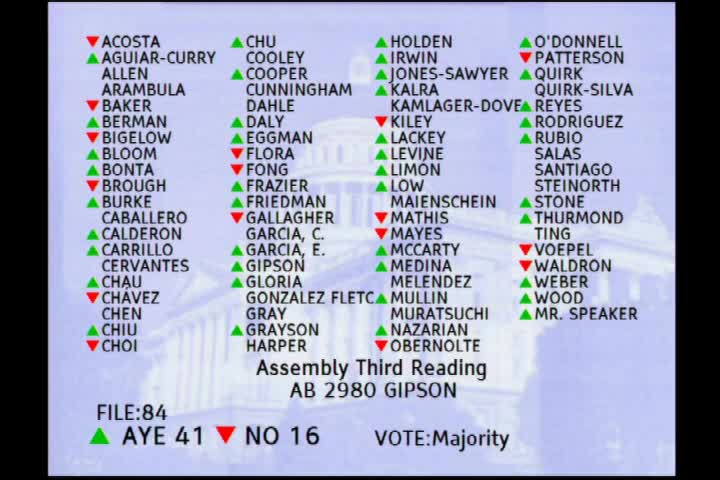 1MIN
Assembly Floor
 10MIN
Assembly Standing Committee on Judiciary
Bill Author

Bill Co-Author(s):