AB 2225: State government: storing and recording: public records.
- Session Year: 2017-2018
- House: Assembly
- Latest Version Date: 2018-09-19
Existing law establishes the Department of Technology, under the supervision of the Director of Technology, to, among other things, establish and enforce state information technology strategic plans, policies, standards, and enterprise architecture.
Existing law requires the Secretary of State to approve and adopt appropriate standards established by the American National Standards Institute in order to ensure that uniform statewide standards for storing and recording permanent documents in electronic media remain current and relevant. Existing law requires those standards to include a requirement that a trusted system, as defined for purposes of these provisions and for purposes of provisions relating to the duties of county auditors, treasurers, and recorders, be utilized, and further specifies that a cloud computing storage service that complies with specified standards shall be considered a trusted system. Existing law specifies that, for purposes of those provisions, cloud computing is defined in a specified publication of the National Institute of Standards and Technology.
This bill would instead require the Secretary of State, in consultation with the Department of Technology, to approve and adopt appropriate uniform statewide standards, as specified, for the purpose of storing and recording public records, described as permanent and nonpermanent documents, in electronic media or in a cloud computing storage system. The bill would require a cloud computing storage service that complies with specified requirements that provide administrative users with controls to prevent stored public records from being overwritten, deleted, or altered to be considered a trusted system, and would require all public records stored or recorded in electronic media or in a cloud computing service by a state agency to comply with a trusted system as defined in the uniform statewide standards and as otherwise specified. The bill would require a trusted system using cloud computing storage service to comply with applicable standards articulated in the State Administrative Manual and the Statewide Information Management Manual. The bill would also require a state agency, prior to establishing an information technology system interconnection or data exchange with a local government entity or otherwise partnering with a local government entity for the development, use, or maintenance of an information technology system, product, or service to first enter into a written agreement with that local government entity for the purpose of establishing mutually agreeable terms that protect relevant public records.
Existing law establishes the Department of Technology, under the supervision of the Director of Technology, to, among other things, establish and enforce state information technology strategic plans, policies, standards, and enterprise architecture.
Existing law requires the Secretary of State to approve and adopt appropriate standards established by the American National Standards Institute in order to ensure that uniform statewide standards for storing and recording permanent documents in electronic media remain current and relevant. Existing law requires those standards to include a requirement that a trusted system, as defined for purposes of these provisions and for purposes of provisions relating to the duties of county auditors, treasurers, and recorders, be utilized, and further specifies that a cloud computing storage service that complies with specified standards shall be considered a trusted system. Existing law specifies that, for purposes of those provisions, cloud computing is defined in a specified publication of the National Institute of Standards and Technology.
This bill would instead require the Secretary of State, in consultation with the Department of Technology, to approve and adopt appropriate uniform statewide standards, as specified, for the purpose of storing and recording public records, described as permanent and nonpermanent documents, in electronic media or in a cloud computing storage system. The bill would require a cloud computing storage service that complies with specified requirements that provide administrative users with controls to prevent stored public records from being overwritten, deleted, or altered to be considered a trusted system. system, and would require all public records stored or recorded in electronic media or in a cloud computing service by a state agency to comply with a trusted system as defined in the uniform statewide standards and as otherwise specified. The bill would require a trusted system using cloud computing storage service to comply with applicable standards articulated in the State Administrative Manual and the Statewide Information Management Manual. The bill would also require a state agency, prior to establishing an information technology system interconnection or data exchange with a local government entity or otherwise partnering with a local government entity for the development, use, or maintenance of an information technology system, product, or service to first enter into a written agreement with that local government entity for the purpose of establishing mutually agreeable terms that protect relevant public records.
Existing law establishes the Department of Technology, under the supervision of the Director of Technology, to, among other things, establish and enforce state information technology strategic plans, policies, standards, and enterprise architecture.
Existing law requires the Secretary of State to approve and adopt appropriate standards established by the American National Standards Institute in order to ensure that uniform statewide standards for storing and recording permanent documents in electronic media remain current and relevant. Existing law requires those standards to include a requirement that a trusted system, as defined for purposes of these provisions and for purposes of provisions relating to the duties of county auditors, treasurers, and recorders, be utilized, and further specifies that a cloud computing storage service that complies with specified standards shall be considered a trusted system. Existing law specifies that, for purposes of those provisions, cloud computing is defined in a specified publication of the National Institute of Standards and Technology.
This bill would instead require the Secretary of State, in consultation with the Department of Technology, to approve and adopt appropriate uniform statewide standards standards, as specified, for the purpose of storing and recording public records, described as permanent and nonpermanent documents documents, in electronic media, and would require cloud computing to be defined by the Department of Technology based on industry-recognized standards, consistent with the intent of the state law. The bill would delete those provisions that define a trusted system for purposes of the duties of county auditors, treasurers, and recorders. media or in a cloud computing storage system. The bill would require a cloud computing storage service that complies with the standards adopted by the Secretary of State specified requirements that provide administrative users with controls to prevent stored public records from being overwritten, deleted, or altered to be considered a trusted system. The bill would require a trusted system using cloud computing storage service to comply with applicable standards articulated in the State Administrative Manual and the Statewide Information Management Manual. The bill would also require a state agency that contracts with a local government entity for the development, use, or maintenance of an information system, product, solution, or service to enter into a written agreement with that local government entity that, at a minimum, complies with requirements set forth in the State Administrative Manual. agency, prior to establishing an information technology system interconnection or data exchange with a local government entity or otherwise partnering with a local government entity for the development, use, or maintenance of an information technology system, product, or service to first enter into a written agreement with that local government entity for the purpose of establishing mutually agreeable terms that protect relevant public records.
Existing law establishes the Department of Technology, under the supervision of the Director of Technology, to, among other things, establish and enforce state information technology strategic plans, policies, standards, and enterprise architecture.
Existing law requires the Secretary of State to approve and adopt appropriate standards established by the American National Standards Institute in order to ensure that uniform statewide standards for storing and recording permanent documents in electronic media remain current and relevant. Existing law requires those standards to include a requirement that a trusted system system, as defined for purposes of these provisions and for purposes of provisions relating to the duties of county auditors, treasurers, and recorders, be utilized, and further specifies that a cloud computing storage service that complies with specified standards shall be considered a trusted system. Existing law specifies that, for purposes of those provisions, cloud computing is defined in a specified publication of the National Institute of Standards and Technology.
This bill would instead require the Department of Technology and the Secretary of State State, in consultation with the Department of Technology, to approve and adopt appropriate uniform statewide standards for the purpose of storing and recording permanent and nonpermanent documents in electronic media, and would specify that require cloud computing shall to be defined by the Department of Technology based on industry-recognized standards, consistent with the intent of the state law. The bill would delete those provisions that define a trusted system for purposes of the duties of county auditors, treasurers, and recorders. The bill would require a cloud computing storage service that complies with the standards adopted by the Secretary of State that provide administrative users with controls to prevent stored records from being overwritten, deleted, or altered to be considered a trusted system. The bill would require a trusted system using cloud computing storage service to comply with applicable standards articulated in the State Administrative Manual and the Statewide Information Management Manual. The bill would also require a state agency that contracts with a local government entity for the development, use, or maintenance of an information system, product, solution, or service to enter into a written agreement with that local government entity that, at a minimum, complies with requirements set forth in the State Administrative Manual.
Existing law establishes the Department of Technology, under the supervision of the Director of Technology, to, among other things, establish and enforce state information technology strategic plans, policies, standards, and enterprise architecture.
Existing law requires the Secretary of State to approve and adopt appropriate standards established by the American National Standards Institute in order to ensure that uniform statewide standards for storing and recording permanent documents in electronic media remain current and relevant. Existing law requires those standards to include a requirement that a trusted system be utilized, and further specifies that a cloud computing storage service that complies with specified standards shall be considered a trusted system. Existing law specifies that, for purposes of those provisions, cloud computing is defined in a specified publication of the National Institute of Standards and Technology.
This bill would instead require the Department of Technology and the Secretary of State to approve and adopt appropriate uniform statewide standards for the purpose of storing and recording permanent documents in electronic media, and would specify that cloud computing shall be defined by the Department of Technology based on industry-recognized standards, consistent with the intent of the state law.
Existing law requires a state agency to report to the Department of Technology on its compliance with specified cybersecurity strategy incident response standards no later than July 1, 2019. Existing law authorizes a local entity that receives state funds for the purposes of storing, sharing, or transmitting data, or in support of certain information technology projects, upon the request of the department, to submit a Technology Recovery Plan to the department.This bill would state the intent of the Legislature to enact legislation that would require public agencies to meet increased data protection standards by enhancing password protection requirements and annually assessing cybersecurity responses.Existing law requires a state agency to report to the Department of Technology on its compliance with specified cybersecurity strategy incident response standards no later than July 1, 2019. Existing law authorizes a local entity that receives state funds for the purposes of storing, sharing, or transmitting data, or in support of certain information technology projects, upon the request of the department, to submit a Technology Recovery Plan to the department.
This bill would state the intent of the Legislature to enact legislation that would require public agencies to meet increased data protection standards by enhancing password protection requirements and annually assessing cybersecurity responses.
The Legislature finds and declares all of the following:
(a)Use of cloud storage for any business operation is a benefit to the state and to local public entities.
(b)There is within the Government Operations Agency the Department of Technology under the supervision of the Director of Technology, who also serves as the State Chief Information Officer. The department is generally responsible for the approval and oversight of information technology projects by, among other things, consulting with state agencies during initial project planning to ensure that project proposals are based on well-defined programmatic needs.
(c)There is within the Department of Technology the Office of Information Security, under the supervision of the Chief of the Office of Information Security. The office provides direction for information security and privacy to state government agencies.
SEC. 2.Section 12168.7 of the Government Code is amended to read:12168.7.(a)The Legislature hereby recognizes the need to adopt uniform statewide standards for the purpose of storing and recording public records in electronic media or in a cloud computing storage service.
(b)In order to ensure that uniform statewide standards remain current and relevant, the Secretary of State, in consultation with the Department of Technology, shall approve and adopt appropriate uniform statewide standards by using standards that are accredited by the American National Standards Institute or other applicable industry-recognized standards making body, including the International Organization for Standardization TR 15801:2017 or successor standard, for storing and recording public records in electronic media or in a cloud computing storage service.
(c)(1)The standards specified in subdivision (b) shall include a requirement that a trusted system be utilized. For this purpose and for purposes of Sections 25105, 26205, 26205.1, 26205.5, 26907, 27001, 27322.2, 34090.5, and 60203, Section 102235 of the Health and Safety Code, and Section 10851 of the Welfare and Institutions Code, trusted system means a combination of technologies, policies, and procedures for which there is no plausible scenario in which a public record retrieved from or reproduced by the system could differ substantially from the public record that is originally stored.
(2)For a state agency that stores and records public records pursuant to this section, the uniform statewide standards specified in subdivision (b) shall include a definition of trusted system that combines the various elements of trusted systems specified in this section.
(d)(1)A cloud computing storage service that complies with International Organization for Standardization ISO/IEC 27001:2013, or other applicable industry-recognized standards relating to techniques and information security management, and that provides administrative users with controls to prevent stored public records from being overwritten, deleted, or altered, shall be considered a trusted system.
(2)Notwithstanding paragraph (1), all public records stored or recorded in electronic media or in a cloud computing service by a state agency shall comply with a trusted system as defined in the uniform statewide standards adopted pursuant to subdivision (b).
(e)A trusted system using cloud computing storage service shall also comply with applicable standards articulated in the State Administrative Manual and the Statewide Information Management Manual. This requirement applies to state agencies and does not apply to local government entities, except to local government entities that have a system interconnection or data exchange with a state agency, or that contract with a state agency, for the development, use, or maintenance of an information system, product, solution, or service.
(f)(1)A state agency, prior to establishing an information technology system interconnection or data exchange with a local government entity or otherwise partnering with a local government entity for the development, use, or maintenance of an information technology system, product, or service, shall first enter into a written agreement with that local government entity for the purpose of establishing mutually agreeable terms that protect relevant public records.
(2)The requirements of paragraph (1) shall apply prospectively, after the effective date of this subdivision, to new agreements of the types specified and to existing agreements of the types specified when they are considered for renewal.
(g)For the purposes of this section, the following definitions shall apply:
(1)Cloud computing has the same definition as the term is defined by the National Institute of Standards and Technology Special Publication 800-145, or a successor publication, and includes the service and deployment models referenced therein.
(2)Public records includes permanent and nonpermanent documents.
(3)State agency has the same meaning as that term is defined in Section 11000.
(h)The Secretary of State shall ensure that microfilming, electronic data imaging, and photographic reproduction are done in compliance with the minimum standards or guidelines, or both, as recommended by the American National Standards Institute for recording of public records or any other applicable and comparable industry standard.
(i)Nothing in this section shall prohibit a local government entity from adopting applicable standards articulated in the Secretary of States uniform statewide standards for Trustworthy Electronic Document or Record Preservation, the State Administrative Manual, or the Statewide Information Management Manual for purposes of utilizing a trusted system as defined in subdivision (c).
The Legislature finds and declares all of the following:
(a)Use of cloud storage for any business operation is a benefit to the state and to local public entities.
(b)There is within the Government Operations Agency the Department of Technology under the supervision of the Director of Technology, who also serves as the State Chief Information Officer. The department is generally responsible for the approval and oversight of information technology projects by, among other things, consulting with state agencies during initial project planning to ensure that project proposals are based on well-defined programmatic needs.
(c)There is within the Department of Technology the Office of Information Security, under the supervision of the Chief of the Office of Information Security. The office provides direction for information security and privacy to state government agencies.
SEC. 2.Section 12168.7 of the Government Code is amended to read:12168.7.(a)The Legislature hereby recognizes the need to adopt uniform statewide standards for the purpose of storing and recording public records in electronic media or in a cloud computing storage service.
(b)In order to ensure that uniform statewide standards remain current and relevant, the Secretary of State, in consultation with the Department of Technology, shall approve and adopt appropriate uniform statewide standards by using standards that are accredited by the American National Standards Institute or other applicable industry-recognized standards making body, including the International Organization for Standardization TR 15801:2017 or successor standard, for storing and recording public records in electronic media or in a cloud computing storage service.
(c)(1)The standards specified in subdivision (b) shall include a requirement that a trusted system be utilized. For this purpose and for purposes of Sections 25105, 26205, 26205.1, 26205.5, 26907, 27001, 27322.2, 34090.5, and 60203, Section 102235 of the Health and Safety Code, and Section 10851 of the Welfare and Institutions Code, trusted system means a combination of technologies, policies, and procedures for which there is no plausible scenario in which a public record retrieved from or reproduced by the system could differ substantially from the public record that is originally stored.
(2)For a state agency that stores and records public records pursuant to this section, the uniform statewide standards specified in subdivision (b) shall include a definition of trusted system that combines the various elements of trusted systems specified in this section.
(d)(1)A cloud computing storage service that complies with the requirements of subdivision (b) International Organization for Standardization ISO/IEC 27001:2013, or other applicable industry-recognized standards relating to techniques and information security management, and that provides administrative users with controls to prevent stored public records from being overwritten, deleted, or altered, shall be considered a trusted system.
(2)Notwithstanding paragraph (1), all public records stored or recorded in electronic media or in a cloud computing service by a state agency shall comply with a trusted system as defined in the uniform statewide standards adopted pursuant to subdivision (b).
(e)A trusted system using cloud computing storage service shall also comply with applicable standards articulated in the State Administrative Manual and the Statewide Information Management Manual. This requirement applies to state agencies and does not apply to local government entities, except to local government entities that have a system interconnection or data exchange with a state agency, or that contract with a state agency, for the development, use, or maintenance of an information system, product, solution, or service.
(f)(1)A state agency, prior to establishing an information technology system interconnection or data exchange with a local government entity or otherwise partnering with a local government entity for the development, use, or maintenance of an information technology system, product, or service, shall first enter into a written agreement with that local government entity for the purpose of establishing mutually agreeable terms that protect relevant public records.
(2)The requirements of paragraph (1) shall apply prospectively, after the effective date of this subdivision, to new agreements of the types specified and to existing agreements of the types specified when they are considered for renewal.
(g)For the purposes of this section, the following definitions shall apply:
(1)Cloud computing has the same definition as the term is defined by the National Institute of Standards and Technology Special Publication 800-145, or a successor publication, and includes the service and deployment models referenced therein.
(2)Public records includes permanent and nonpermanent documents.
(3)State agency has the same meaning as that term is defined in Section 11000.
(h)The Secretary of State shall ensure that microfilming, electronic data imaging, and photographic reproduction are done in compliance with the minimum standards or guidelines, or both, as recommended by the American National Standards Institute for recording of public records or any other applicable and comparable industry standard.
(i)Nothing in this section shall prohibit a local government entity from adopting applicable standards articulated in the Secretary of States uniform statewide standards for Trustworthy Electronic Document or Record Preservation, the State Administrative Manual, or the Statewide Information Management Manual for purposes of utilizing a trusted system as defined in subdivision (c).
The Legislature finds and declares all of the following:
(a)Use of cloud storage for any business operation is a benefit to the state and to local public entities.
(b)There is within the Government Operations Agency the Department of Technology under the supervision of the Director of Technology, who also serves as the State Chief Information Officer. The department is generally responsible for the approval and oversight of information technology projects by, among other things, consulting with state agencies during initial project planning to ensure that project proposals are based on well-defined programmatic needs.
(c)There is within the Department of Technology the Office of Information Security, under the supervision of the Chief of the Office of Information Security. The office provides direction for information security and privacy to state government agencies.
(d)The Secretary of State is required to approve and adopt appropriate standards accredited by the American National Standards Institute.SEC. 2.Section 12168.7 of the Government Code is amended to read:12168.7.(a)The Legislature hereby recognizes the need to adopt uniform statewide standards for the purpose of storing and recording permanent and nonpermanent documents public records in electronic media. media or in a cloud computing storage service.
(b)In order to ensure that uniform statewide standards remain current and relevant, the Secretary of State State, in consultation with the Department of Technology, shall approve and adopt appropriate uniform statewide standards accredited by the American National Standards Institute or other applicable industry-recognized standards making body, including the International Organization for Standardization TR 15801:2017 or successor standard, for the purpose of storing and recording permanent and nonpermanent documents public records in electronic media. media or in a cloud computing storage service.
(c)The standards specified in subdivision (b) shall include a requirement that a trusted system be utilized. For this purpose and for purposes of Sections 25105, 26205, 26205.1, 26205.5, 26907, 27001, 27322.2, 34090.5, and 60203, Section 102235 of the Health and Safety Code, and Section 10851 of the Welfare and Institutions Code, trusted system means a combination of technologies, policies, and procedures for which there is no plausible scenario in which a document public record retrieved from or reproduced by the system could differ substantially from the document public record that is originally stored.
(d)The Secretary of State shall consult with the Department of Technology when approving and adopting appropriate uniform statewide standards, pursuant to subdivision (b), for storing permanent and nonpermanent records using a cloud computing storage service. (e)(d)A cloud computing storage service that complies with standards adopted pursuant to the requirements of subdivision (b) relating to techniques and information security management, and that provides administrative users with controls to prevent stored public records from being overwritten, deleted, or altered, shall be considered a trusted system.
(f)(e)A trusted system using cloud computing storage service shall also comply with applicable standards articulated in the State Administrative Manual and the Statewide Information Management Manual. This requirement applies to state agencies and does not apply to local government entities, except to local government entities that have voluntarily entered into a written agreement with a state agency subject to the State Administrative Manual, a system interconnection or data exchange with a state agency, for the development, use, or maintenance of an information system, product, solution, or service.
(g)A state agency that contracts with a local government entity for the development, use, or maintenance of an information system, product, solution, or service shall enter into a written agreement with that local government entity that, at a minimum, complies with requirements set forth in the State Administrative Manual. (h)For purposes of this section cloud computing shall be defined by the Department of Technology based on industry-recognized standards, consistent with the intent of this section.(f)(1)A state agency, prior to establishing an information technology system interconnection or data exchange with a local government entity or otherwise partnering with a local government entity for the development, use, or maintenance of an information technology system, product, or service, shall first enter into a written agreement with that local government entity for the purpose of establishing mutually agreeable terms that protect relevant public records.
(2)The requirements of paragraph (1) shall apply prospectively, after the effective date of this subdivision, to new agreements of the types specified and to existing agreements of the types specified when they are considered for renewal.
(g)For the purposes of this section, the following definitions shall apply:
(1)Cloud computing has the same definition as the term is defined by the National Institute of Standards and Technology Special Publication 800-145, or a successor publication, and includes the service and deployment models referenced therein.
(2)Public records includes permanent and nonpermanent documents.
(i)(h)The Secretary of State shall ensure that microfilming, electronic data imaging, and photographic reproduction are done in compliance with the minimum standards or guidelines, or both, as recommended by the American National Standards Institute for recording of permanent and nonpermanent public records or any other applicable and comparable industry standard.
(j)(i)Nothing in this section shall prohibit a local government entity from adopting applicable standards articulated in the Secretary of States uniform statewide standards for Trustworthy Electronic Document or Record Preservation, the State Administrative Manual, or the Statewide Information Management Manual for purposes of utilizing a trusted system as described defined in subdivision (e). (c).
The Legislature finds and declares all of the following:
(a)Use of cloud storage for any business operation is a benefit to the state and to local public entities.
(b)There is within the Government Operations Agency the Department of Technology under the supervision of the Director of Technology, who also serves as the State Chief Information Officer. The department is generally responsible for the approval and oversight of information technology projects by, among other things, consulting with state agencies during initial project planning to ensure that project proposals are based on well-defined programmatic needs.
(c)There is within the Department of Technology the Office of Information Security, under the supervision of the Chief of the Office of Information Security. The office provides direction for information security and privacy to state government agencies.
(d)The Secretary of State is required to approve and adopt appropriate standards established accredited by the American National Standards Institute.
SEC. 2.Section 12168.7 of the Government Code is amended to read:12168.7.(a)The Legislature hereby recognizes the need to adopt uniform statewide standards for the purpose of storing and recording permanent and nonpermanent documents in electronic media.
(b)In order to ensure that uniform statewide standards remain current and relevant, the Department of Technology and the Secretary of State shall approve and adopt appropriate uniform statewide standards for the purpose of storing and recording permanent and nonpermanent documents in electronic media.
(c)The standards specified in subdivision (b) shall include a requirement that a trusted system be utilized. For this purpose and for purposes of Sections 25105, 26205, 26205.1, 26205.5, 26907, 27001, 27322.2, 34090.5, and 60203, Section 102235 of the Health and Safety Code, and Section 10851 of the Welfare and Institutions Code, trusted system means a combination of technologies, policies, and procedures for which there is no plausible scenario in which a document retrieved from or reproduced by the system could differ substantially from the document that is originally stored.
(d)The Secretary of State shall consult with the Department of Technology when approving and adopting appropriate uniform statewide standards, pursuant to subdivision (b), for storing permanent and nonpermanent records using a cloud computing storage service.
(d)(e)A cloud computing storage service that complies with International Organization for Standardization ISO/IEC 27001:2013, or other applicable industry-recognized standard relating to security techniques and information security management, and standards adopted pursuant to subdivision (b) relating to techniques and information security management, and that provides administrative users with controls to prevent stored records from being overwritten, deleted, or altered altered, shall be considered a trusted system.
(e)(f)A trusted system using cloud computing storage service shall also comply with applicable standards articulated in the State Administrative Manual and the Statewide Information Management Manual. This requirement applies to state agencies and does not apply to local government entities. entities, except to local government entities that have voluntarily entered into a written agreement with a state agency subject to the State Administrative Manual, for the development, use, or maintenance of an information system, product, solution, or service.
(g)A state agency that contracts with a local government entity for the development, use, or maintenance of an information system, product, solution, or service shall enter into a written agreement with that local government entity that, at a minimum, complies with requirements set forth in the State Administrative Manual.
(f)(h)For purposes of this section cloud computing shall be defined by the Department of Technology based on industry-recognized standards, consistent with the intent of this section.
(g)State officials(i)The Secretary of State shall ensure that microfilming, electronic data imaging, and photographic reproduction are done in compliance with the minimum standards or guidelines, or both, as recommended by the American National Standards Institute for recording of permanent records. and nonpermanent records or any other applicable and comparable industry standard.
(h)(j)Nothing in this section shall prohibit a local government entity from adopting applicable standards articulated in the Secretary of States uniform statewide standards for Trustworthy Electronic Document or Record Preservation, the State Administrative Manual and Manual, or the Statewide Information Management Manual for purposes of utilizing a trusted system as defined described in subdivision (c). (e).
The Legislature finds and declares all of the following:
(a)Use of cloud storage for any business operation is a benefit to the state and to local public entities.
(b)There is within the Government Operations Agency the Department of Technology under the supervision of the Director of Technology, who also serves as the State Chief Information Officer. The department is generally responsible for the approval and oversight of information technology projects by, among other things, consulting with state agencies during initial project planning to ensure that project proposals are based on well-defined programmatic needs.
(c)There is within the Department of Technology the Office of Information Security, under the supervision of the Chief of the Office of Information Security. The office provides direction for information security and privacy to state government agencies.
(d)The Secretary of State is required to approve and adopt appropriate standards established by the American National Standards Institute.
SEC. 2.Section 12168.7 of the Government Code is amended to read:12168.7.(a)The California Legislature hereby recognizes the need to adopt uniform statewide standards for the purpose of storing and recording permanent documents in electronic media.
(b)In order to ensure that uniform statewide standards remain current and relevant, the Department of Technology and the Secretary of State shall approve and adopt appropriate standards established by the American National Standards Institute. uniform statewide standards for the purpose of storing and recording permanent documents in electronic media.
(c)The standards specified in subdivision (b) shall include a requirement that a trusted system be utilized. For this purpose and for purposes of Sections 25105, 26205, 26205.1, 26205.5, 26907, 27001, 27322.2, 34090.5, and 60203, Section 102235 of the Health and Safety Code, and Section 10851 of the Welfare and Institutions Code, trusted system means a combination of technologies, policies, and procedures for which there is no plausible scenario in which a document retrieved from or reproduced by the system could differ substantially from the document that is originally stored.
(d)A cloud computing storage service that complies with International Organization for Standardization ISO/IEC 27001:2013, or other applicable industry-recognized standard relating to security techniques and information security management, and provides administrative users with controls to prevent stored records from being overwritten, deleted, or altered shall be considered a trusted system.
(e)A trusted system shall comply with applicable standards articulated in the State Administrative Manual and the Statewide Information Management Manual. This requirement applies to state agencies and does not apply to local government entities.
(f)For purposes of this section cloud computing is defined by the National Institute of Standards and Technology Special Publication 800-145 or a successor publication, and includes the service and deployment models referenced therein. shall be defined by the Department of Technology based on industry-recognized standards, consistent with the intent of this section.
(g)State officials shall ensure that microfilming, electronic data imaging, and photographic reproduction are done in compliance with the minimum standards or guidelines, or both, as recommended by the American National Standards Institute for recording of permanent records.
(h)Nothing in this section shall prohibit a local government entity from adopting applicable standards articulated in the State Administrative Manual and the Statewide Information Management Manual for purposes of utilizing a trusted system as defined in subdivision (c).
SECTION 1.It is the intent of the Legislature to enact legislation that would require public agencies to meet increased data protection standards by enhancing password protection requirements and annually assessing cybersecurity responses.It is the intent of the Legislature to enact legislation that would require public agencies to meet increased data protection standards by enhancing password protection requirements and annually assessing cybersecurity responses.
|
Date
|
Status
|
|---|---|
| Sep 19, 2018 | Chaptered by Secretary of State - Chapter 535, Statutes of 2018. |
| Sep 19, 2018 | Approved by the Governor. |
| Sep 6, 2018 | Enrolled and presented to the Governor at 3 p.m. |
| Aug 29, 2018 | Senate amendments concurred in. To Engrossing and Enrolling. |
| Aug 27, 2018 | In Assembly. Concurrence in Senate amendments pending. May be considered on or after August 29 pursuant to Assembly Rule 77. |
| Aug 27, 2018 | Read third time. Passed. Ordered to the Assembly. |
| Aug 23, 2018 | Read second time. Ordered to third reading. |
| Aug 22, 2018 | Read third time and amended. Ordered to second reading. |
| Aug 7, 2018 | Read second time. Ordered to third reading. |
| Aug 6, 2018 | From committee: Be ordered to second reading pursuant to Senate Rule 28.8. |
| Aug 6, 2018 | From committee chair, with author's amendments: Amend, and re-refer to committee. Read second time, amended, and re-referred to Com. on APPR. |
| Jun 26, 2018 | From committee: Do pass and re-refer to Com. on APPR. (Ayes 13. Noes 0.) (June 26). Re-referred to Com. on APPR. |
| May 30, 2018 | Referred to Com. on G.O. |
| May 17, 2018 | In Senate. Read first time. To Com. on RLS. for assignment. |
| May 17, 2018 | Read third time. Passed. Ordered to the Senate. |
| May 10, 2018 | Read second time. Ordered to Consent Calendar. |
| May 9, 2018 | From committee: Do pass. To Consent Calendar. (Ayes 16. Noes 0.) (May 9). |
| Apr 18, 2018 | From committee: Do pass and re-refer to Com. on APPR. (Ayes 10. Noes 0.) (April 17). Re-referred to Com. on APPR. |
| Apr 11, 2018 | Re-referred to Com. on P. & C.P. |
| Apr 10, 2018 | From committee chair, with author's amendments: Amend, and re-refer to Com. on P. & C.P. Read second time and amended. |
| Mar 20, 2018 | Re-referred to Com. on P. & C.P. |
| Mar 19, 2018 | From committee chair, with author's amendments: Amend, and re-refer to Com. on P. & C.P. Read second time and amended. |
| Mar 19, 2018 | Referred to Com. on P. & C.P. |
| Feb 14, 2018 | From printer. May be heard in committee March 16. |
| Feb 13, 2018 | Read first time. To print. |
|
Date
|
Description
|
Location
|
Votes
|
|
|---|---|---|---|---|
| Aug 29, 2018 | AB 2225 LIMÓN Concurrence in Senate Amendments | Assembly Floor |
Passed |
|
| Aug 27, 2018 | Assembly 3rd Reading AB2225 Limón By Allen | Senate Floor |
Passed |
|
| Jun 26, 2018 | Do pass, but first be re-referred to the Committee on [Appropriations] | Senate Standing Committee on Governmental Organization |
Passed |
|
| May 17, 2018 | AB 2225 LIMÓN Consent Calendar Second Day Regular Session | Assembly Floor |
Passed |
|
| May 9, 2018 | Do pass. To Consent Calendar. | Assembly Standing Committee on Appropriations |
Passed |
|
| Apr 17, 2018 | Do pass and be re-referred to the Committee on [Appropriations] | Assembly Standing Committee on Privacy and Consumer Protection |
Passed |
This list shows positions taken on this bill by organizations on the date displayed, which is linked to the original source.
Positions by individuals are not included.
CONCURRENCE IN SENATE AMENDMENTS
CSA1 Bill Id:AB 2225
Author:(Limón)
As Amended Ver:August 22, 2018
Majority vote
ASSEMBLY: | 73-0 | (May 17, 2018) | SENATE: | 39-0 | (August 27, 2018) |
Original Committee Reference: P. & C.P.
SUMMARY: Requires the Secretary of State (SOS), in consultation with the California Department of Technology (CDT), to approve and adopt appropriate uniform statewide standards for the purpose of storing and recording public records in electronic media or in a cloud computing storage service, as specified.
The Senate amendments:
- Replace references to "permanent and nonpermanent records" with "public records" and define "public records" to include both permanent and nonpermanent records.
- Clarify that the uniform statewide standards approved and adopted by the SOS, in consultation with the CDT, for the above purposes must be accredited by the American National Standards Institute (ANSI) or other applicable industry-recognized standards making body, including the International Organization for Standardization TR 15801:2017 or successor standard, and remove related language from the uncodified findings and declarations. Further require that the uniform statewide standards include a definition of "trusted system" that combines the various elements of trusted systems specified in this section.
- Clarify the limited circumstances when local government entities must comply with additional standards articulated in the State Administrative Manual (SAM) and Statewide Information Management Manual (SIMM) for using a cloud computing storage service. Specifically, a local government entity must comply with the state standards if it has a system interconnection or data exchange with a state agency, for the development, use, or maintenance of an information system, product, solution, or service.
- Revise the requirements governing written agreements between state agencies and local government entities for the development, use, or maintenance of an information technology system, product, or service. Specifically, a state agency must, prospectively only, first enter into a written agreement with a local government entity for the purpose of establishing mutually agreeable terms that protect relevant public records prior to establishing an information technology system interconnection or data exchange with that local government entity or otherwise partnering with that local government entity for the development, use, or maintenance of an information technology system, product, or service.
- Restore the cloud service standard to that of existing law, but provide that notwithstanding that standard, all public records stored or recorded in electronic media or in a cloud computing service by a state agency shall comply with a trusted system.
- Remove the proposed change to the existing law definition of "cloud computing."
- Make other technical and clarifying changes.
EXISTING LAW:
- Requires, in order to ensure that uniform statewide standards for storing and recording permanent documents in electronic media remain current and relevant, the SOS to approve and adopt appropriate standards established by the ANSI. Further specifies that these standards must include a requirement that a "trusted system" be utilized. (Government Code Sections (GOV) 12168.7(b) and (c).)
- Defines, for the above purpose, and purposes of other specified sections under the Government Code, Health and Safety Code, and the Welfare and Institutions Code, "trusted system" to mean a combination of technologies, policies, and procedures for which there is no plausible scenario in which a document retrieved from or reproduced by the system could differ substantially from the document that is originally stored. (GOV 12168.7(c).)
- Further provides that a cloud computing storage service that complies with International Organization for Standardization ISO/IEC 27001:2013, or other applicable industry-recognized standard relating to security techniques and information security management, and provides administrative users with controls to prevent stored records from being overwritten, deleted, or altered shall be considered a trusted system. (GOV 12168.7(d).)
- Requires a trusted system to comply with applicable standards articulated in the SAM and SIMM. This requirement applies to state agencies and does not apply to local government entities. This does not prohibit a local government entity from adopting applicable standards articulated in the SAM and the SIMM for purposes of utilizing a trusted system as defined, above. (GOV 12168.7(e) to (h).)
- Requires state officials to ensure that microfilming, electronic data imaging, and photographic reproduction are done in compliance with the minimum standards or guidelines, or both, as recommended by the ANSI for recording of permanent records. (GOV 12168.7(g).
- Identifies, as a matter of regulations adopted by the SOS in consultation with the Department of General Services, the uniform statewide standards for use in recording, storing, and reproducing permanent and nonpermanent documents or records in electronic media. (2 California Code of Regulations Section 22620.1 to 22620.8, "Trustworthy Electronic Document or Records Preservation.")
- Provides, among other things, that the duties of the Director of CDT include establishing and enforcing state information technology strategic plans, policies, standards, and enterprise architecture. This, in turn, includes the periodic review and maintenance of the information technology sections of the SAM and procurement procedures related to information technology projects, except for sections on information technology fiscal policy. (GOV 11545(b)(2).)
- Sets forth, through the State's Cloud Computing Policy under the SAM, various standards in the SAM and SIMM that must be complied with by each state agency/entity, including security standards, as specified. (See SAM Sec. 4983.1.)
- Defines, "cloud computing," for purposes of GOV 12168.7, above, to be defined by the NIST Special Publication 800-145 or a successor publication, and includes the service and deployment models referenced therein. (GOV 12168.7(f).)
- Defines "cloud computing" under the SAM to mean a model for enabling ubiquitous, convenient, on-demand network access to a shared pool of configurable computing resources (e.g., networks, servers, storage, applications, and services) that can be rapidly provisioned and released with minimal management effort or service provider interaction. (SAM Sec. 4819.2.)
FISCAL EFFECT: According to the Senate Appropriations Committee, pursuant to Senate Rule 28.8, any additional state costs are not significant, and do not and will not require the appropriation of additional state funds, and the bill will cause no significant reduction in revenues.
COMMENTS:
- Purpose of this bill: This bill seeks to complete the update to, and further clarify various provisions relating to, a state statute setting forth cloud computing standards that were enacted by AB 22 (Bonta), Chapter 834, Statutes of 2017, last year. According to the author, "this bill will align statute with contemporary document storage and recording processes, and ensure that California is following the most appropriate standards[…]."
- Updates needed following AB 22: In California, the SOS is charged with approving and adopting appropriate statewide standards for the purpose of storing and recording public documents. In order for these uniform statewide standards to remain current and relevant, state agencies and local governments are statutorily required to use a "trusted system" to meet that goal.
A "trusted system" has, for years, been defined to mean a combination of techniques, policies, and procedures for which there is no plausible scenario in which a document retrieved from or reproduced by the system could differ substantially from the document that is originally stored. To that end, public records of any state agency are authorized to be microfilmed, electronically data imaged, or otherwise photographically reproduced and certified. AB 22 expanded that definition of a trusted system to include a cloud-computing storage service that meets specified requirements or that meets other applicable industry-recognized standards relating to security techniques and information security management, and provides administrative users with controls to prevent stored records from being overwritten, deleted, or altered. By expanding the definition to include such cloud computing storage services as a method for storing records, AB 22 was intended to provide state agencies and local governments an additional tool to store and retrieve public documents with greater efficiency and lower costs. AB 22 also had some unintended consequences that this bill now seeks to address.
Significantly, this bill reinserts references to "non-permanent records" which had been erroneously removed from the statute by AB 22, to ensure that such public records are also stored in trusted systems that meet the standards mandated in this State. As a practical matter, this provides assurance that such records will not be altered and are in their original form, thus removing concerns that they will become invalided or be rendered inadmissible in court.
This bill also eliminates any potential for situations to arise wherein local entities could maintain their records in the same cloud computing storage system as state agencies without having to comply with the higher (i.e., more protective) data protection standards that state agencies must meet for records that they store in the same cloud computing storage system. While AB 22 recognized that local entities may also utilize SAM and SIMM standards adopted by CDT to ensure they would be considered to be utilizing a "trusted system" by law, it did not otherwise require local entities to do so even where their records may be comingled with state records. This bill now requires that local entities meet the same higher data protection standards met by state agencies any time there is such comingling of records. Specifically, a local government entity must comply with the state standards if it has a system interconnection or data exchange with a state agency, for the development, use, or maintenance of an information system, product, solution, or service.
- Arguments in support: In support, the SOS writes that its office houses the State Archives, "whose purpose is to store public records from state entities. The State Archives must store specified public records in a manner that ensures their physical safety, preservation and authenticity. There are different types of public records kept at the Archives, some of which are stored permanently, and some which are not required to be kept permanently ('non-permanent'). The system and procedures to ensure all public records are not altered, or authentic, is called a 'trusted system.' […] AB 2225 restores the previously existing requirement that nonpermanent documents follow the same uniform electronic media standards that apply to permanent documents. This bill will ensure that the authenticity of nonpermanent records, which are the vast majority of state records, will not become invalidated or be inadmissible in court."
Also in support, the City of Santa Monica writes that "California faces millions of cybersecurity threats every year. These cyber-attacks seek to compromise the state's computer systems and access the state's data files. This data contains sensitive information and these systems safeguard core functions of the state government. This bill would safeguard some of the state's most important information by having the California [SOS] coordinate with the [CDT] to adopt appropriate and uniform standards for the storage of permanent and non-permanent records."
- Recent amendments addressed opposition concerns: A coalition comprised of CompTIA, Internet Association, ITI and TechNet writes opposed the prior version of this bill unless it was amended to adhere to the existing cloud security standard. The coalition wrote:
Cloud security is a very significant issue and the highest standards and protections are at the Federal level, with the gold standard in security, the International Organization for Standardization (ISO), currently the requirement in law.
Current law, as codified in Assembly Bill 22, 12168.7(d) reads: "A cloud computing storage service that complies with International Organization for Standardization ISO/IEC 27001:2013, or other applicable industry-recognized standard relating to security techniques and information security management, and provides administrative users with controls to prevent stored records from being overwritten, deleted, or altered shall be considered a trusted system."
Departing from the standard established by the legislature in 2017 raises many questions for the technology industry. […] It is for the reasons above that we oppose AB 2225 unless it is amended to keep Government Code Section 12168.7(d) as it was established by [AB] 22 in 2017, a public policy position that if a cloud service provider follows the ISO standard, then it shall be considered a trusted system. [Emphases in original.]
Recent amendments removed any changes, absent a handful of technical corrections, that this bill would have made to Gov. Code Sec. 12168.7(d), thereby resolving the concerns of the coalition who subsequently removed their opposition.
Analysis Prepared by: Ronak Daylami / P. & C.P. / (916) 319-2200 FN: 0004991
Office of Senate Floor Analyses (916) 651-1520 Fax: (916) 327-4478 | AB |
THIRD READING
Bill No: AB 2225
:
SENATE GOVERNMENTAL ORG. COMMITTEE: 13-0, 6/26/18
AYES: Dodd, Wilk, Bradford, Cannella, Gaines, Galgiani, Glazer, Hill, Hueso, Lara, Portantino, Vidak, Wiener
SENATE APPROPRIATIONS COMMITTEE: Senate Rule 28.8
ASSEMBLY FLOOR: 73-0, 5/17/18 (Consent) - See last page for vote
SUBJECT: State government: storing and recording: public records
DIGEST:
This bill requires the Secretary of State (SOS), in consultation with the California Department of Technology (CDT), to approve and adopt appropriate uniform statewide standards for the purpose of storing and recording public records in electronic media or in a cloud computing storage system, as specified.
Senate Floor Amendments of 8/22/18 require all public records stored or recorded in electronic media or in a cloud computing service by a state agency to comply with a trusted system, as defined.
- Establishes CDT within the Government Operations Agency, under the supervision of the Director of CDT, to, among other things, establish and enforce state information technology (IT) strategic plans, policies, standards, and enterprise architecture.
- Requires the SOS to approve and adopt appropriate standards established by the American National Standards Institute in order to ensure that uniform statewide standards for storing and recording permanent documents in electronic media remain current and relevant.
- Provides that a cloud computing storage service that complies with International Organization for Standardization ISO/IEC 27001:2013, or other applicable industry-recognized standard relating to security techniques and information security management, and provides administrative users with controls to prevent stored records from being overwritten, deleted, or altered shall be considered a trusted system.
- Specifies that, for the purposes of those provisions, “cloud computing” is defined in a specified publication of the National Institute of Standards and Technology (NIST).
This bill:
- Requires the SOS, in consultation with CDT, to approve and adopt appropriate uniform statewide standards, as specified, for the purpose of storing and recording public records in electronic media or in a cloud computing storage system.
- Provides that a state agency that stores and records public records pursuant to this bill, the uniform statewide standards shall include a definition of “trusted system,” as specified.
- Provides that all public records stored or recorded in electronic media or in a cloud computing service by a state agency shall comply with a trusted system, as specified.
- Requires a trusted system using a cloud computing storage service to comply with applicable standards articulated in the State Administrative Manual (SAM) and the Statewide Information Management Manual (SIMM).
- Requires a state agency, prior to establishing an IT system interconnection or data exchange with a local government entity to first enter into a written agreement with that local government entity for the purpose of establishing mutually agreeable terms that protect relevant public records.
- Specifies that local government entities are not prohibited from adopting applicable standards articulated in the SOS’s uniform statewide standards for Trustworthy Electronic Document or Record Preservation, the SAM, or the SIMM.
- Defines “public records” to include permanent and nonpermanent documents.
- Defines “state agency” to include every state office, officer, department, division, bureau, board, and commission, and does not include the California State University.
- Includes legislative findings and declarations.
Comments
Purpose of this bill. According to the author, “this bill will align statute with contemporary document storage and recording processes, and ensure that California is following the most appropriate standards.”
Follow-up legislation. Last year, AB 22 (Bonta, Chapter 834, Statutes of 2017) authorized state agencies and local governments to retain public records specifically through the use of a cloud computing storage service. In doing so, that bill made various changes to the Government Code which sets forth the standards that must be met for those purposes. That provision now requires some additional clarification and clean up. For example, this bill clarifies that the SOS shall consult with CDT in approving and adopting uniform statewide standards by using standards that are accredited by American National Standards Institute, or other applicable industry-recognized standards making bodies.
Local government entities. AB 22 left open the possibility for local government entities to utilize standards adopted by CDT to ensure they would be considered to be utilizing a “trusted system” by law, but otherwise did not require them to do so even where their records may be comingled with state records. This has inadvertently created the potential for situations to arise where local government entities could maintain their records in the same cloud computing storage system as state agencies, without having to comply with the higher (i.e., more protective) data protection standards that state agencies must meet for records that they store in that same cloud computing storage system.
This bill makes clear that the requirement does in fact apply to local government entities in the limited circumstance where the local government entity has a system interconnection or data exchange with a state agency. Furthermore, this bill requires any local government entity that contracts with a state agency for the development, use, or maintenance of an information system, product, solution, or service, to at a minimum, comply with requirements as specified.
Additionally, this bill requires any state agency, prior to establishing an IT system interconnection or data exchange with a local government entity, or otherwise partnering with a local government entity for the development, use, or maintenance of an IT system, product, or service, to first enter into a written agreement with that local government entity for the purpose of establishing mutually agreeable terms that protect relevant public records.
Current preservation and storage methods. In California, the SOS is charged with approving and adopting appropriate statewide standards for the purpose of storing and recording public documents. In order for these uniform statewide standards to remain current and relevant, state agencies and local governments are statutorily required to use a “trusted system” to meet that goal.
A “trusted system” has, for years, been defined to mean a combination of techniques, policies, and procedures for which there is no plausible scenario in which a document retrieved from or reproduced by the system could differ substantially from the document that is originally stored. To that end, public records of any state agency are authorized to be microfilmed, electronically data imaged, or otherwise photographically reproduced and certified. AB 22 expanded that definition of a trusted system to include a cloud-computing storage service that meets specified requirements or that meets other applicable industry-recognized standards relating to security techniques and information security management, and provides administrative users with controls to prevent stored records from being overwritten, deleted, or altered.
Related/Prior Legislation
AB 22 (Bonta, Chapter 834, Statutes of 2017) authorized state agencies and local governments to retain public records specifically through the use of a cloud computing storage service Authorized state agencies and local governments to retain public records through use of a cloud computing storage service.
FISCAL EFFECT: Appropriation: Fiscal Com.: Local:
Secretary of State Alex Padilla
City of Santa Monica
OPPOSITION: (Verified 8/23/18)
None received
ARGUMENTS IN SUPPORT: In support of this bill, Secretary of State Alex Padilla writes that the “Secretary of State’s office houses the State Archives, whose purpose is to store public records from state entities. The State Archives must store specified public records in a manner that ensures their physical safety, preservation and authenticity. There are different types of public records kept at the Archives, some of which are stored permanently, and some which are not required to be kept permanently (‘non-permanent’). The system and procedures to ensure all public records are not altered, or authentic, is called a ‘trusted system.’”
ASSEMBLY FLOOR: 73-0, 5/17/18
AYES: Acosta, Aguiar-Curry, Travis Allen, Arambula, Baker, Berman, Bigelow, Bloom, Bonta, Brough, Burke, Caballero, Calderon, Carrillo, Cervantes, Chau, Chávez, Chen, Chiu, Choi, Chu, Cooley, Cooper, Cunningham, Dahle, Daly, Eggman, Flora, Fong, Frazier, Friedman, Gallagher, Eduardo Garcia, Gipson, Gloria, Gonzalez Fletcher, Gray, Grayson, Harper, Holden, Irwin, Jones-Sawyer, Kalra, Kamlager-Dove, Kiley, Lackey, Levine, Limón, Low, Maienschein, Mathis, Mayes, McCarty, Medina, Mullin, Nazarian, Obernolte, O'Donnell, Patterson, Quirk, Quirk-Silva, Reyes, Rodriguez, Rubio, Salas, Mark Stone, Thurmond, Ting, Voepel, Waldron, Weber, Wood, Rendon
NO VOTE RECORDED: Cristina Garcia, Melendez, Muratsuchi, Santiago, Steinorth
8/23/18 16:04:24
**** END ****
Office of Senate Floor Analyses (916) 651-1520 Fax: (916) 327-4478 | AB |
THIRD READING
Bill No: AB 2225
:
SENATE GOVERNMENTAL ORG. COMMITTEE: 13-0, 6/26/18
AYES: Dodd, Wilk, Bradford, Cannella, Gaines, Galgiani, Glazer, Hill, Hueso, Lara, Portantino, Vidak, Wiener
SENATE APPROPRIATIONS COMMITTEE: Senate Rule 28.8
ASSEMBLY FLOOR: 73-0, 5/17/18 (Consent) - See last page for vote
SUBJECT: State government: storing and recording: public records
DIGEST:
This bill requires the Secretary of State (SOS), in consultation with the California Department of Technology (CDT), to approve and adopt appropriate uniform statewide standards for the purpose of storing and recording public records in electronic media or in a cloud computing storage system, as specified.
Existing law:
- Establishes CDT within the Government Operations Agency, under the supervision of the Director of Technology, to, among other things, establish and enforce state information technology (IT) strategic plans, policies, standards, and enterprise architecture.
- Requires the SOS to approve and adopt appropriate standards established by the American National Standards Institute in order to ensure that uniform statewide standards for storing and recording permanent documents in electronic media remain current and relevant.
- Specifies that, for the purposes of those provisions, “cloud computing” is defined in a specified publication of the National Institute of Standards and Technology (NIST).
This bill:
- Requires the SOS, in consultation with CDT, to approve and adopt appropriate uniform statewide standards, as specified, for the purpose of storing and recording public records in electronic media or in a cloud computing storage system.
- Requires that the standards specified in this bill shall include a requirement that a trusted system be utilized.
- Provides that a cloud computing storage service that complies with the provisions of this bill relating to techniques and information security management, and that provides administrative users with controls to protect stored public records from being overwriting, deleted, or altered, shall be considered a trusted system.
- Requires a trusted system using cloud computing storage service to comply with applicable standards articulated in the State Administrative Manual (SAM) and the Statewide Information Management Manual (SIMM).
- Requires a state agency, prior to establishing an IT system interconnection or data exchange with a local government entity to first enter into a written agreement with that local government entity for the purpose of establishing mutually agreeable terms that protect relevant public records, and, specifies that these requirements shall apply prospectively, after the effective date of this bill.
- Requires the SOS to ensure that microfilming, electronic data imaging and photographic reproductions are done in compliance with the minimum standards or guidelines, or both, as recommended by the American National Standards Institute for recording public records or any other applicable and comparable industry standard.
- Specifies that nothing in this bill shall prohibit a local government entity from adopting applicable standards articulated in the SOS’s uniform statewide standards for Trustworthy Electronic or Record Preservation, the SAM, or the SIMM for purposes of utilizing a trusted system, as specified.
- Defines “cloud computing” to have the same definition as the term is defined by the NIST Special Publication 800-145, or a successor publication, and includes the service and deployment models referenced therein.
- Defines “trusted system” to mean a combination of technologies, policies, and procedures for which there is no plausible scenario in which a public record retrieved or reproduced by the system could differ substantially from the public record that is originally stored.
- Defines “public records” to include permanent and nonpermanent documents.
- Includes findings and declarations relating to cloud storage.
Comments
Purpose of this bill. According to the author, “this bill will align statute with contemporary document storage and recording processes, and ensure that California is following the most appropriate standards.”
Follow-up legislation. Last year, AB 22 (Bonta, Chapter 834, Statutes of 2017) authorized state agencies and local governments to retain public records specifically through the use of a cloud computing storage service. In doing so, that bill made various changes to the Government Code which sets forth the standards that must be met for those purposes. That provision now requires some additional clarification and clean up.
Removal of specific standards. This bill removes various standards that were written into the statute by AB 22. Instead, this bill provides that a cloud computing storage system that complies with the uniform statewide standards adopted by the SOS relating to technique and information security management, and that provides administrative users with controls to prevent stored records from being overwritten, deleted, or altered, shall be considered a trusted system.
According to the author, “SOS Archives Division has received calls from agencies questioning whether they should follow the International Organization for Standardization (ISO) standard relating to trusted systems or the SOS issued standards. The core reason for having a trusted system is that it allows a record to be retrieved unaltered in the same condition in which it was originally stored. If records are stored in something other than a trusted system, an agency must keep an official paper copy, which can be costly and require substantial time and storage space.” Thus, the intent of the author here appears to be to remove that confusion by removing the specific reference to ISO standards.
Current preservation and storage methods. In California, the SOS is charged with approving and adopting appropriate statewide standards for the purpose of storing and recording public documents. In order for these uniform statewide standards to remain current and relevant, state agencies and local governments are statutorily required to use a “trusted system” to meet that goal.
Related/Prior Legislation
AB 22 (Bonta, Chapter 834, Statutes of 2017) authorized state agencies and local governments to retain public records specifically through the use of a cloud computing storage service Authorized state agencies and local governments to retain public records through use of a cloud computing storage service.
FISCAL EFFECT: Appropriation: Fiscal Com.: Local:
Secretary of State Alex Padilla
City of Santa Monica
CompTIA
Internet Association
TechNet
ARGUMENTS IN SUPPORT: In support of this bill, Secretary of State Alex Padilla writes that the “Secretary of State’s office houses the State Archives, whose purpose is to store public records from state entities. The State Archives must store specified public records in a manner that ensures their physical safety, preservation and authenticity. There are different types of public records kept at the Archives, some of which are stored permanently, and some which are not required to be kept permanently (‘non-permanent’). The system and procedures to ensure all public records are not altered, or authentic, is called a ‘trusted system.’”
ARGUMENTS IN OPPOSITION: According to the opposition, “AB 2225 was originally presented to legislative stakeholders, as a technical correction to last year’s AB 22. Championed by Assemblymember Bonta at the request of local municipalities, AB 22 was enacted January 1 of this year after careful negotiations with multiple stakeholders, and ultimately supported by a range of tech industry and local government groups. To-date, the AB 2225 interested party conversations have been extensive and productive. Unfortunately, there is one significant and problematic issue remaining in AB 2225, as amended August 6, 2018. The current language in AB 2225 amends Section 12168.7 (d) of the Government Code to read: ‘A cloud computing storage service that complies with the requirements a/subdivision (b) relating to techniques and information security management, and that provides administrative users with controls to prevent stored public records from being overwritten, deleted, or altered, shall be considered a trusted system.’”
Further, the opposition argues that, “the proposed changes in AB 2225 would subject cloud providers to any security standards the Secretary of State created under their authority in 12168.7(b). Cloud security is a very significant issue and the highest standards and protections are at the Federal level, with the gold standard in security, the International Organization for Standardization (ISO), currently the requirement in law.”
ASSEMBLY FLOOR: 73-0, 5/17/18
AYES: Acosta, Aguiar-Curry, Travis Allen, Arambula, Baker, Berman, Bigelow, Bloom, Bonta, Brough, Burke, Caballero, Calderon, Carrillo, Cervantes, Chau, Chávez, Chen, Chiu, Choi, Chu, Cooley, Cooper, Cunningham, Dahle, Daly, Eggman, Flora, Fong, Frazier, Friedman, Gallagher, Eduardo Garcia, Gipson, Gloria, Gonzalez Fletcher, Gray, Grayson, Harper, Holden, Irwin, Jones-Sawyer, Kalra, Kamlager-Dove, Kiley, Lackey, Levine, Limón, Low, Maienschein, Mathis, Mayes, McCarty, Medina, Mullin, Nazarian, Obernolte, O'Donnell, Patterson, Quirk, Quirk-Silva, Reyes, Rodriguez, Rubio, Salas, Mark Stone, Thurmond, Ting, Voepel, Waldron, Weber, Wood, Rendon
NO VOTE RECORDED: Cristina Garcia, Melendez, Muratsuchi, Santiago, Steinorth
8/8/18 12:40:06
SENATE COMMITTEE ON GOVERNMENTAL ORGANIZATION
Senator Bill Dodd
Chair
2017 - 2018 Regular
Bill No: AB Hearing Date: 6/26/2018
Author: | Limón | ||
Version: | Amended | ||
Urgency: | Fiscal: | ||
Consultant: | |||
SUBJECT:
DIGEST: This bill requires the Secretary of State (SOS), in consultation with the California Department of Technology (CDT), to approve and adopt appropriate uniform statewide standards for the purpose of storing and recording documents in electronic media, as specified.
ANALYSIS:
Existing law:
- Establishes CDT within the Government Operations Agency, under the supervision of the Director of Technology, to, among other things, establish and enforce state information technology (IT) strategic plans, policies, standards, and enterprise architecture.
- Requires the SOS to approve and adopt appropriate standards established by the American National Standards Institute in order to ensure that uniform statewide standards for storing and recording permanent documents in electronic media remain current and relevant.
- Requires those standards to include a requirement that a trusted system, as defined, be utilized, and further specifies that a cloud computing storage service that complies with specified standards shall be considered a trusted system.
- Specifies that, for the purposes of those provisions, “cloud computing” is defined in a specified publication of the National Institute of Standards and Technology (NIST).
This bill:
- Requires the SOS to approve and adopt appropriate uniform statewide standards for the purpose of storing and recording permanent and nonpermanent documents in electronic media.
- Requires the SOS to consult with CDT when approving and adopting appropriate uniform statewide standards for storing permanent and nonpermanent records using a cloud computing storage service.
- Requires a cloud computing storage service that complies with the standards adopted by the SOS that provide administrative users with controls to prevent stored records from being overwritten, deleted, or altered to be considered a trusted system.
- Requires a trusted system using cloud computing storage service to comply with applicable standards articulated in the State Administrative Manual (SAM) and the Statewide Information Management Manual (SIMM).
- Requires the SOS to ensure that microfilming, electronic data imaging and photographic reproductions are done in compliance with the minimum standards or guidelines, or both, as recommended by the American National Standards Institute for recording or permanent and nonpermanent records or any other applicable and comparable industry standard.
- Specifies that nothing in this bill shall prohibit a local government entity from adopting applicable standards articulated in the SOS’s uniform statewide standards for Trustworthy Electronic or Record Preservation, the SAM, or the SIMM for purposes of utilizing a trusted system, as specified.
- Provides that “cloud computing” shall be defined by CDT based on industry-recognized standards, consistent with the intent of this bill.
- Adds “nonpermanent” documents to existing requirements regarding uniform statewide standards for storing and recording documents in electronic media.
- Deletes provisions that define a “trusted system” for purposes of the duties of county auditors, treasurers, and recorders.
- Includes findings and declarations relating to cloud storage.
Background
Purpose of the bill. According to the author, “this bill will align statute with contemporary document storage and recording processes, and ensure that California is following the most appropriate standards.”
Follow-up legislation. Last year, AB 22 (Bonta, Ch. 834, Statutes of 2017) authorized state agencies and local governments to retain public records specifically through the use of a cloud computing storage service. In doing so, that bill made various changes to the Government Code which sets forth the standards that must be met for those purposes. That provision now requires some additional clarification and clean up. For example, AB 22 removed reference to “non-permanent records” that should never have been removed. This bill reinserts those references to “non-permanent records.” This bill also removes references to certain provisions in the Government Code which do not use the term “trusted system” as suggested by that statute.
Definition of cloud computing. This bill replaces the AB 22 definition of cloud computing with one that relies on a CDT definition of the term based on industry-recognized standards, consistent with the overall intent of this statute. AB 22, in contrast, provided that term was to be defined by a NIST publication and includes the service and deployment models referenced therein. Arguably, a definition based on industry-recognized standards would include the NIST publication.
Removal of specific standards. This bill removes various standards that were written into the statute by AB 22. Instead, this bill would provide that a cloud computing storage system that complies with the uniform statewide standards adopted by the SOS relating to technique and information security management, and that provides administrative users with controls to prevent stored records from being overwritten, deleted, or altered, shall be considered a trusted system.
According to the author, “SOS Archives Division has received calls from agencies questioning whether they should follow the International Organization for Standardization (ISO) standard relating to trusted systems or the SOS issued standards. The core reason for having a trusted system is that it allows a record to be retrieved unaltered in the same condition in which it was originally stored. If records are stored in something other than a trusted system, an agency must keep an official paper copy, which can be costly and require substantial time and storage space.” Thus, the intent of the author here appears to be to remove that confusion by removing the specific reference to ISO standards.
Current preservation and storage methods. In California, the SOS is charged with approving and adopting appropriate statewide standards for the purpose of storing and recording public documents. In order for these uniform statewide standards to remain current and relevant, state agencies and local governments are statutorily required to use a “trusted system” to meet that goal.
A “trusted system” has, for years, been defined to mean a combination of techniques, policies, and procedures for which there is no plausible scenario in which a document retrieved from or reproduced by the system could differ substantially from the document that is originally stored. To that end, public records of any state agency are authorized to be microfilmed, electronically data imaged, or otherwise photographically reproduced and certified. AB 22 expanded that definition of a trusted system to include a cloud-computing storage service that meets specified requirements or that meets other applicable industry-recognized standards relating to security techniques and information security management, and provides administrative users with controls to prevent stored records from being overwritten, deleted, or altered.
By expanding the definition to include such cloud computing storage services as a method for storing records, AB 22 was intended to provide state agencies and local governments an additional tool to store and retrieve public documents with greater efficiency and lower costs. For example, by using a commercial cloud-based archival storage service, government data can be accessed from any location quickly and maintenance costs of traditional storage systems will no longer be required. Furthermore, such use of the cloud should promote greater transparency by increasing access to public records and reducing response times. Cloud-based storage may also improve response and recovery by protecting permanent and nonpermanent records from local disasters such as fires or floods.
Local entities. AB 22 left open the possibility for local entities to utilize standards adopted by CDT to ensure they would be considered to be utilizing a “trusted system” by law, but otherwise did not require them to do so even where their records may be comingled with state records. This has inadvertently created the potential for situations to arise where local entities could maintain their records in the same cloud computing storage system as state agencies, without having to comply with the higher (i.e., more protective) data protection standards that state agencies must meet for records that they store in that same cloud computing storage system.
This bill would make clear that the requirement does in fact apply to local entities in the limited circumstance where they have entered into a written agreement with a state agency for the development, use, or maintenance of information systems, products, solutions, or services. Furthermore, this bill would require any state agency that engages with a local government entity for the development, use, or maintenance of information systems, products, solutions, or services to enter in a written agreement that, at a minimum, complies with requirements as specified.
State Administrative Manual. The SAM is a reference resource for statewide policies, procedures, requirements and information developed and issued by authoring agencies which include the Department of Finance (DOF), Department of Human Resources (CalHR), Department of General Services (DGS), CDT, and the Governor's Office. In order to provide a uniform approach to statewide management policy, the contents are published under the authority of the Directors of DOF and DGS.
Prior/Related Legislation
AB 22 (Bonta, Chapter 834, Statutes of 2017) authorized state agencies and local governments to retain public records specifically through the use of a cloud computing storage service Authorizes state agencies and local governments to retain public records through use of a cloud computing storage service.
FISCAL EFFECT: Appropriation: No Fiscal Com.: Yes Local: No
SUPPORT:
Alex Padilla, California Secretary of State
City of Santa Monica
ARGUMENTS IN SUPPORT: In support of this bill, California Secretary of State Alex Padilla writes that the “Secretary of State’s office houses the State Archives, whose purpose is to store public records from state entities. The State Archives must store specified public records in a manner that ensures their physical safety, preservation and authenticity. There are different types of public records kept at the Archives, some of which are stored permanently, and some which are not required to be kept permanently (‘non-permanent’). The system and procedures to ensure all public records are not altered, or authentic, is called a ‘trusted system.’”
Further, the Secretary of State argues that, “AB 2225 restores the previously existing requirement that nonpermanent documents follow the same uniform electronic media standards that apply to permanent documents. This bill will ensure that the authenticity of nonpermanent records, which are the vast majority of state records, will not become invalidated or be inadmissible in court.”
Date of Hearing: May 9, 2018
ASSEMBLY COMMITTEE ON APPROPRIATIONS
Lorena Gonzalez Fletcher, Chair
ABPCA Bill Id:AB 2225
Author:(Limón) – As Amended Ver:April 10, 2018
Policy Committee: | Privacy and Consumer Protection | Vote: | 10 - 0 |
|
| ||
|
|
Urgency: No State Mandated Local Program: No Reimbursable: No
SUMMARY:
This bill revises and clarifies the standards under which state entities must store records using a cloud computing storage service, and requires that the Secretary of State (SOS) consult with the California Department of Technology (CDT) for these purposes, as specified. This bill reinserts references to non-permanent records where existing law references permanent records, revises the definition of a “trusted system” as specified, deletes obsolete cross-references, and makes other conforming changes.
FISCAL EFFECT:
Minor and absorbable costs to CDT and SOS.
COMMENTS:
Background and purpose. AB 22 (Bonta), Chapter 834, Statutes of 2017, authorizes state agencies and local governments to retain public records specifically through use of a cloud computing storage service. This bill seeks to clarify and expand upon the cloud computing standards that were enacted by AB 22.
Analysis Prepared by: Jessica Peters / APPR. / (916) 319-2081
Date of Hearing: April 17, 2018
ASSEMBLY COMMITTEE ON PRIVACY AND CONSUMER PROTECTION
Ed Chau, Chair
ABPCA Bill Id:AB 2225 (
Author:Limón) – As Amended Ver:April 10, 2018
SUBJECT: State government: storing and recording electronic media
SUMMARY: This bill would clarify the standards under which state entities must store records using a cloud computing storage service, and require that the Secretary of State (SOS) consult with the California Department of Technology (CDT) for these purposes, as specified. This bill would reinsert references to non-permanent records where existing law references permanent records, revise the current definition of a “trusted system” as specified, delete obsolete cross-references, and set forth various findings and declarations. Specifically, this bill would:
- Revise the current standard by which the SOS office must approve and adopt appropriate standards established by the American National Standards Institute (ANSI) to, instead, provide that the SOS shall approve and adopt “appropriate uniform statewide standards” for the purpose of storing and recording both permanent and non-permanent documents in electronic media.
- Require the SOS to consult with CDT when approving and adopting appropriate uniform standards for storing such records using a cloud computing storage service.
- Specify that a cloud computing storage service that complies with standards adopted pursuant to the above, relating to techniques and information security management and that provides administrative users with controls to prevent stored records from being overwritten, deleted, or altered, shall be considered a “trusted system.” In doing so, the bill would remove the specific reference to “International Organization for Standardization ISO/IEC 27001:2013, or other applicable industry-recognized standard relating to security” as a trusted system under existing law.
- Require a trusted system using a cloud computing storage service to also comply with applicable standards articulated in the State Administrative Manual (SAM) and the Statewide Information Management Manual (SIMM). This requirement applies only to state agencies and not local government entities, unless a local entity has entered into a written agreement with a state agency, as specified.
- Require any state agency that engages with a local government entity for the development, use, or maintenance of information systems, products, solutions, or services to enter in a written agreement that, at a minimum, complies with requirements set forth in the SAM.
- Specify that the SOS, as opposed to state officials, shall ensure that microfilming, electronic data imaging, and photographic reproduction are done in compliance with the minimum standards or guidelines, or both, as recommended by the ANSI for recording of permanent and non-permanent records or any other applicable and comparable industry standard.
- Revise existing law to additionally recognize the authority of local governmental entities to adopt applicable standards articulated in the SOS’s uniform statewide standards for Trustworthy Electronic Documents or Records Preservation, as well as the SAM and the SIMM, for purposes of utilizing a trusted system.
- Provide that “cloud computing” shall be defined by CDT based on industry-recognized standards, as opposed to a National Institute of Standards and Technology (NIST) Special Publication under existing law, as specified.
- Delete, within the definition of “trusted systems,” cross-references to various provisions in the Government Code that do not use the term as suggested by the definition.
- State, as part of various uncodified findings and declarations, that the SOS is required to approve and adopt appropriate standards accredited by the ANSI.
- Make other conforming changes to effectuate the above revisions to existing law.
EXISTING LAW:
- Requires, in order to ensure that uniform statewide standards for storing and recording permanent documents in electronic media remain current and relevant, the SOS to approve and adopt appropriate standards established by the ANSI. Further specifies that these standards must include a requirement that a “trusted system” be utilized. (Gov. Code Sec. 12168.7(b), (c).)
- Defines, for the above purpose, and purposes of other specified sections under the Government Code, Health and Safety Code, and the Welfare and Institutions Code, “trusted system” to mean a combination of technologies, policies, and procedures for which there is no plausible scenario in which a document retrieved from or reproduced by the system could differ substantially from the document that is originally stored. (Gov. Code Sec. 12168.7(c).)
- Further provides that a cloud computing storage service that complies with International Organization for Standardization ISO/IEC 27001:2013, or other applicable industry-recognized standard relating to security techniques and information security management, and provides administrative users with controls to prevent stored records from being overwritten, deleted, or altered shall be considered a trusted system. (Gov. Code Sec. 12168.7(d).)
- Requires a trusted system to comply with applicable standards articulated in the SAM and SIMM. This requirement applies to state agencies and does not apply to local government entities. This does not prohibit a local government entity from adopting applicable standards articulated in the SAM and the SIMM for purposes of utilizing a trusted system as defined, above. (Gov. Code Sec. 12168.7(e), (h).)
- Requires state officials to ensure that microfilming, electronic data imaging, and photographic reproduction are done in compliance with the minimum standards or guidelines, or both, as recommended by the ANSI for recording of permanent records.
- Identifies, as a matter of regulations adopted by the SOS in consultation with the Department of General Services, the uniform statewide standards for use in recording, storing, and reproducing permanent and nonpermanent documents or records in electronic media. (2 C.C.R. Sec. 22620.1-22620.8, “Trustworthy Electronic Document or Records Preservation.”)
- Provides, among other things, that the duties of the Director of CDT include establishing and enforcing state information technology strategic plans, policies, standards, and enterprise architecture. This, in turn, includes the periodic review and maintenance of the information technology sections of the SAM and procurement procedures related to information technology projects, except for sections on information technology fiscal policy. (Gov. Code Sec. 11545(b)(2).)
- Sets forth, through the State’s Cloud Computing Policy under the SAM, various standards in the SAM and SIMM that must be complied with by each state agency/entity, including security standards, as specified. (See SAM Sec. 4983.1.)
- Defines, “cloud computing,” for purposes of Government Code Section 12168.7, above, to be defined by the NIST Special Publication 800-145 or a successor publication, and includes the service and deployment models referenced therein.
- Defines “cloud computing” under the SAM to mean a model for enabling ubiquitous, convenient, on-demand network access to a shared pool of configurable computing resources (e.g., networks, servers, storage, applications, and services) that can be rapidly provisioned and released with minimal management effort or service provider interaction. (SAM Sec. 4819.2.)
FISCAL EFFECT: Unknown
COMMENTS:
- Purpose of this bill: This bill seeks to complete the update to, and further clarify various provisions relating to, a state statute setting forth cloud computing standards that were enacted by AB 22 (Bonta, Ch. 834, Stats. 2017) last year. This is an author-sponsored bill.
- Author’s statement: According to the author, this bill “will align statute with contemporary document storage and recording processes, and ensure that California is following the most appropriate standards by:
- Reestablishing authenticity and trustworthiness of nonpermanent electronic documents. […]
- Clarifying that SOS will approve and adopt appropriate uniform statewide standards in consultation with the [CDT], which is similar to the process that involved SOS and DGS prior to SB 854 [Comm. on Budget & Fiscal Review] (2014; [which removed DGS from the standards adoption process and assigned SOS the sole responsibility to approve and adopt storage and recording standards]).
- Removing confusion by eliminating conflicting definitions of “trusted system” […].
- Ensuring workability of sources for document storage and recording standards [by clarifying] that the [SOS] is authorized to set uniform standards applicable to state agencies that supersede ISO/IEC and other standards when necessary[…].
- Remov[ing] confusion about when state and local entities must act in compliance with the State Administrative Manual for document management.”
- Bill clarifies provisions enacted by legislation last year: Last year, AB 22 (Bonta, Ch. 834, Stats. 2017) was enacted to authorize state agencies and local governments to retain public records specifically through the use of a cloud computing storage service. In doing so, that bill made various changes to Section 12168.7 of the Government Code which sets forth the standards that must be met for those purposes. That provision now requires some additional clarification and clean up. For example, AB 22 removed reference to “non-permanent records” that should never have been removed. This bill reinserts those references to “non-permanent records.” This bill also removes references to certain provisions in the Government Code which do not use the term “trusted system” as suggested by that statute.
With respect to non-permanent records, the deletion of those records in statute by AB 22 has potentially significant impact if left uncorrected. Fundamentally, if an agency stores non-permanent records in something other than a trusted system, the agency must keep a paper record for the non-permanent document. Of course, storing a document on paper, as opposed to in a trusted system, poses risk in terms of potential changes to the quality and content of the document. For example, if the paper document degrades, its authenticity may be doubted in court and elsewhere. AB 22, however, removed the requirement that non-permanent records follow any sort of electronic storage standard and without any statutory clarity for how to handle these records, there is arguably a huge risk posed to the State: if agencies incorrectly believe that only permanent records need to be stored in a trusted system, then non-permanent records may be stored in a system that is not trusted. If this were to happen, a record may be altered and not in its original form when it is accessed. Again, this presents a risk that a non-permanent record will be inadmissible in court and may not be accepted as an official document. Further, public agencies may also be left confused about what constitutes a permanent record if non-permanent records are excluded from the law. This bill recognizes that it is vital that oversight of non-permanent records be restored in law, especially given that non-permanent records make up the vast majority of records. It would rectify such unintended consequences of AB 22 by reinserting recognition of non-permanent records and ensuring that there are uniform standards surrounding both permanent and non-permanent records in this State.
- Current preservation and storage methods: In California, the SOS is charged with approving and adopting appropriate statewide standards for the purpose of storing and recording public documents. In order for these uniform statewide standards to remain current and relevant, state agencies and local governments are statutorily required to use a “trusted system” to meet that goal.
A “trusted system” has, for years, been defined to mean a combination of techniques, policies, and procedures for which there is no plausible scenario in which a document retrieved from or reproduced by the system could differ substantially from the document that is originally stored. To that end, public records of any state agency are authorized to be microfilmed, electronically data imaged, or otherwise photographically reproduced and certified. AB 22 (Bonta, Ch. 834, Stats. 2017) expanded that definition of a trusted system to include a cloud-computing storage service that meets specified requirements or that meets other applicable industry-recognized standards relating to security techniques and information security management, and provides administrative users with controls to prevent stored records from being overwritten, deleted, or altered.
By expanding the definition to include such cloud computing storage services as a method for storing records, AB 22 was intended to provide state agencies and local governments an additional tool to store and retrieve public documents with greater efficiency and lower costs. For example, by using a commercial cloud-based archival storage service, government data can be accessed from any location quickly and maintenance costs of traditional storage systems will no longer be required. Furthermore, such use of the cloud should promote greater transparency by increasing access to public records and reducing response times. Cloud-based storage may also improve response and recovery by protecting permanent and nonpermanent records from local disasters such as fires or floods.
At the same time, however, AB 22 also amended the definition to state that while a trusted system must comply with applicable standards articulated in the SAM and in the SIMM, this requirement applies to state agencies and does not apply to local government entities. While AB 22 left open the possibility that local government entities could voluntarily adopt the standards articulated in the SAM and SIMM for purposes of being assured that they are utilizing a trusted system under a separate subdivision (see Gov. Code Section 12186.7(h)), in retrospect, it has become clear that this change by AB 22 creates the potential to mislead local entities into believing that they do not have to comply with the SAM and SIMM in situations where they interface with and have written agreements with state agencies as required by policies issued by CDT under the SAM. This bill seeks to provide clarification around that provision, specifically, as described further below.
- Local government entities must meet applicable standards set forth under the SAM and SIMM in certain circumstances: In California, the SAM contains statewide policies, procedures, requirements and information developed and issued by authoring agencies, including the Department of General Services and CDT, among others. The SIMM contains standards, instructions, forms and templates that state agencies must use to comply with information technology (IT) policy set by CDT in the SAM. This bill seeks to clarify an existing requirement which states that a trusted system using a cloud computing storage service must also comply with applicable standards articulated in the SAM and SIMM. Currently, this requirement applies to state agencies, and not local government entities.
As noted above, AB 22 left open the possibility for local entities to utilize SAM and SIMM standards adopted by CDT to ensure they would be considered to be utilizing a “trusted system” by law, but otherwise did not require them to do so even where their records may be comingled with state records. This has inadvertently created the potential for situations to arise where local entities could maintain their records in the same cloud computing storage system as state agencies, without having to comply with the higher (i.e., more protective) data protection standards that state agencies must meet for records that they store in that same cloud computing storage system. As reflected in the state’s Cloud Computing Policy in SAM Section 4983.1, state entities/agencies must meet certain standards in their cloud infrastructure as a service (IaaS) and platform as a service (PaaS) solutions. Those standards, under SAM Section 5300 et seq. and various sections of the SIMM, ensure the highest level of protection for the state’s information technology systems.
Separately under the SAM, state entities are already required to enter into written agreements with state and non-state entities when they engage such entities in the development, use, or maintenance of information systems, products, solutions, or services, in order to protect and minimize risk to the state. In such situations, agreements must include certain provisions, at a minimum, such as a provision delineating the appropriate levels of security (confidentiality, integrity and availability) for the data, as specified. (See SAM Sec. 5305.8.)
This bill would make clear that the requirement does in fact apply to local entities in the limited circumstance where they have entered into a written agreement with a state agency, as required by the SAM, for the development, use, or maintenance of information systems, products, solutions, or services. Furthermore, this bill would require any state agency that engages with a local government entity for the development, use, or maintenance of information systems, products, solutions, or services to enter in a written agreement that, at a minimum, complies with requirements set forth in the SAM.
By expressly requiring written agreements between state entities and local governments that at a minimum comply with these SAM requirements, and also clarifying the law to ensure that local government entities also comply with applicable standards under SAM and SIMM when entering into written agreements with state agencies, this bill appears to ensure that local government entities do not create vulnerabilities in the cloud when their records are maintained in the same cloud computing storage service as state agencies.
- Bill removes specific standards: As currently drafted, this bill removes various standards that were written into the statute by AB 22, including the language that specified that cloud computing storage services that comply with International Organization for Standardization ISO/IEC 27001:2013, or other applicable industry-recognized standard relating to security techniques and information security management and provide administrative users with controls to prevent stored records from being overwritten, deleted, or altered, shall be considered a trusted system. Instead, this bill would provide that a cloud computing storage system that complies with the uniform statewide standards adopted by the SOS relating to technique and information security management, and that provides administrative users with controls to prevent stored records from being overwritten, deleted, or altered, shall be considered a trusted system. According to the author , “SOS Archives Division has received calls from agencies questioning whether they should follow the ISO standard relating to trusted systems or the SOS issued standards. The core reason for having a trusted system is that it allows a record to be retrieved unaltered in the same condition in which it was originally stored. If records are stored in something other than a trusted system, an agency must keep an official paper copy, which can be costly and require substantial time and storage space.” Thus, the intent here appears to be to remove that confusion by removing the specific reference to ISO standards.
- Definition of cloud computing: This bill replaces the AB 22 definition of cloud computing with one that relies on a CDT definition of the term based on industry-recognized standards, consistent with the overall intent of this statute. AB 22, in contrast, provided that term was to be defined by a NIST publication and includes the service and deployment models referenced therein. Arguably, a definition based on industry-recognized standards would include the NIST publication.
- Prior legislation: AB 22 (Bonta, Ch. 834, Stats. 2017) See Comments 3 and 4.
REGISTERED SUPPORT / OPPOSITION:
Support
None on file
Opposition
None on file
Analysis Prepared by: Ronak Daylami / P. & C.P. / (916) 319-2200
Discussed in Hearing
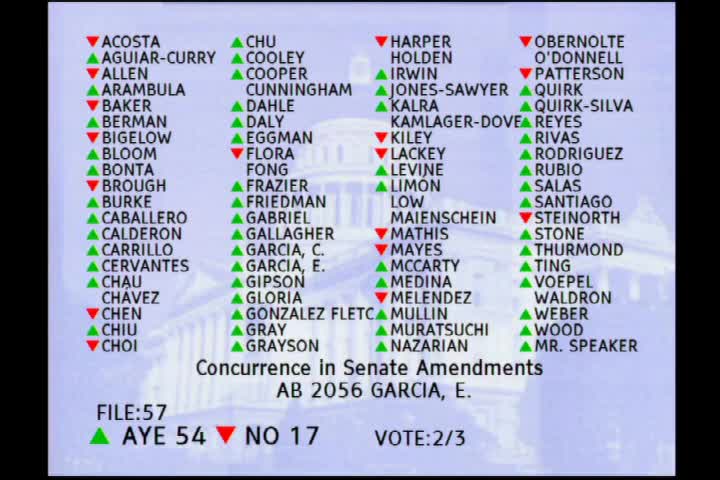 45SEC
Assembly Floor
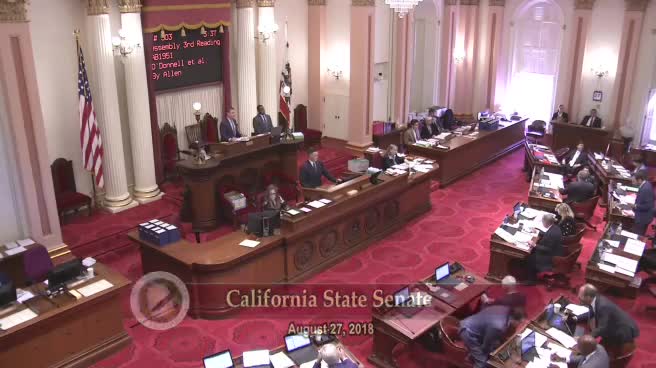 2MIN
Senate Floor
 2MIN
Senate Standing Committee on Governmental Organization
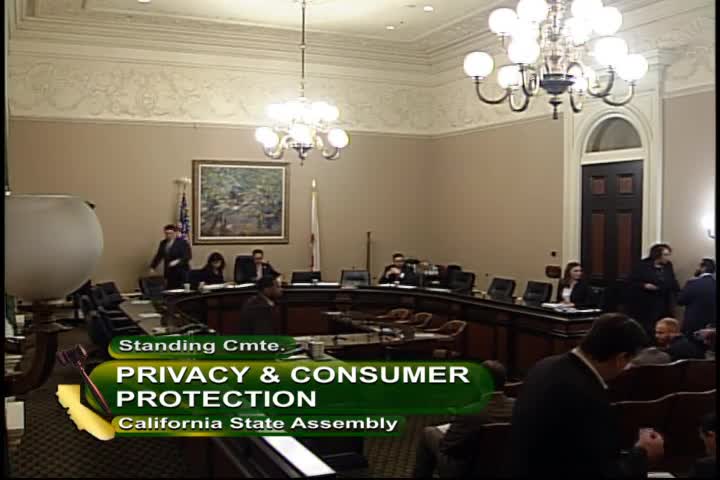 3MIN
Assembly Standing Committee on Privacy and Consumer Protection
Bill Author

Bill Co-Author(s):