AB 2238: Local agency formation: regional housing need allocation: fire hazards: local health emergencies: hazardous and medical waste.
- Session Year: 2017-2018
- House: Assembly
- Latest Version Date: 2018-09-30
(1)Existing law, the Cortese-Knox-Hertzberg Local Government Reorganization Act of 2000, provides the authority and procedures for the initiation, conduct, and completion of changes of organization and reorganization of cities and districts. The act specifies the factors that a local agency formation commission is required to consider in the review of a proposal for a change of organization or reorganization, including, among other things, per capita assessed valuation and the proposals consistency with city or county general and specific plans.
This bill would instead require the commission to consider the assessed valuation rather than per capita assessed valuation. The bill would additionally require the commission to consider information contained in a local hazard mitigation plan, information contained in a safety element of a general plan, and any maps that identify land as a very high fire hazard zone or maps that identify land determined to be in a state responsibility area if it is determined that such information is relevant to the area that is the subject of the proposal. By adding to the duties of local agency formation commissions in reviewing a change of organization or reorganization, this bill would impose a state-mandated local program.
(2)Existing law, the Planning and Zoning Law, requires each county and city to adopt a comprehensive, long-term general plan for the physical development of the county or city, and certain land outside its boundaries, that includes, among other specified mandatory elements, a housing element. That law, for the 4th and subsequent revisions of the housing element, requires the Department of Housing and Community Development to determine the existing and projected need for housing for each region, as provided, and requires the appropriate council of governments or for cities and counties without a council of governments, the department, to adopt a final regional housing need plan allocating a share of the regional housing need to each city, county, or city and county. Existing law requires the department to meet and consult with the council of governments regarding the assumptions and methodology to be used by the department to determine the regions housing needs and requires the council of governments to provide data assumptions, including specified information regarding housing availability within the region.
This bill would require that the information provided by the council of governments include the loss of units during a state of emergency, as defined, that was declared by the Governor pursuant to the California Emergency Services Act, during the planning period immediately preceding the relevant revision of the housing element that have not been rebuilt or replaced at the time of the data request.
Existing law requires the council of governments, or delegate subregion as applicable, to develop a proposed methodology for distributing the existing and projected regional housing need to cities, counties, and cities and counties within the region or subregion, as applicable, that is consistent with specified objectives. Existing law, to the extent that sufficient data is available as provided, requires each council of governments, or delegate subregion as applicable, to include specified factors to develop the methodology that allocates regional housing needs.
This bill would require that these factors include the loss of units during a state of emergency, as defined, that was declared by the Governor pursuant to the California Emergency Services Act during the planning period immediately preceding the relevant revision of the housing element that have yet to be rebuilt or replaced at the time of the analysis.
By adding to the duties of councils of governments and delegate subregions in determining the regional housing need allocation, this bill would impose a state-mandated local program.
(3)Under existing law, whenever a release, spill, escape, or entry of waste occurs, as specified, and the Director of Health Care Services or the local health officer makes specified determinations as to that waste, the director is authorized to declare a health emergency and the local health officer is authorized to declare a local health emergency in the jurisdiction or any area thereof affected by the threat to the public health. Existing law prohibits a local health emergency declared by a local health officer in excess of 7 days unless the board of supervisors or city council, as applicable, ratifies the local health emergency. Existing law requires the board of supervisors or city council, as applicable, to review the need for continuing the local health emergency at least every 14 days and requires the board of supervisors or city council to terminate the local health emergency at the earliest possible date that conditions warrant.
This bill would extend the periodic review of a local health emergency by a board of supervisors or city council from every 14 days to every 30 days.
(4)This bill would incorporate additional changes to Section 65584.01 of the Government Code proposed by AB 1771 and SB 828 to be operative only if this bill and either or both AB 1771 and SB 828 are enacted and this bill is enacted last.
This bill would incorporate additional changes to Section 65584.04 of the Government Code proposed by AB 1771 and SB 828 to be operative only if this bill and either or both AB 1771 and SB 828 are enacted and this bill is enacted last.
(5)The California Constitution requires the state to reimburse local agencies and school districts for certain costs mandated by the state. Statutory provisions establish procedures for making that reimbursement.
This bill would provide that no reimbursement is required by this act for a specified reason.
(1)Existing law, the Cortese-Knox-Hertzberg Local Government Reorganization Act of 2000, provides the authority and procedures for the initiation, conduct, and completion of changes of organization and reorganization of cities and districts. The act specifies the factors that a local agency formation commission is required to consider in the review of a proposal for a change of organization or reorganization, including, among other things, per capita assessed valuation and the proposals consistency with city or county general and specific plans.
This bill would instead require the commission to consider the assessed valuation rather than per capita assessed valuation. The bill would additionally require the commission to consider information contained in a local hazard mitigation plan, information contained in a safety element of a general plan, and any maps that identify land as a very high fire hazard zone or maps that identify land determined to be in a state responsibility area if it is determined that such information is relevant to the area that is the subject of the proposal. By adding to the duties of local agency formation commissions in reviewing a change of organization or reorganization, this bill would impose a state-mandated local program.
(2)Existing law, the Planning and Zoning Law, requires each county and city to adopt a comprehensive, long-term general plan for the physical development of the county or city, and certain land outside its boundaries, that includes, among other specified mandatory elements, a housing element. That law, for the 4th and subsequent revisions of the housing element, requires the Department of Housing and Community Development to determine the existing and projected need for housing for each region, as provided, and requires the appropriate council of governments or for cities and counties without a council of governments, the department, to adopt a final regional housing need plan allocating a share of the regional housing need to each city, county, or city and county. Existing law requires the department to meet and consult with the council of governments regarding the assumptions and methodology to be used by the department to determine the regions housing needs and requires the council of governments to provide data assumptions, including specified information regarding housing availability within the region.
This bill would require that the information provided by the council of governments include the loss of units during a state of emergency, as defined, that was declared by the Governor pursuant to the California Emergency Services Act, during the planning period immediately preceding the relevant revision of the housing element that have not been rebuilt or replaced at the time of the data request.
Existing law requires the council of governments, or delegate subregion as applicable, to develop a proposed methodology for distributing the existing and projected regional housing need to cities, counties, and cities and counties within the region or subregion, as applicable, that is consistent with specified objectives. Existing law, to the extent that sufficient data is available as provided, requires each council of governments, or delegate subregion as applicable, to include specified factors to develop the methodology that allocates regional housing needs.
This bill would require that these factors include the loss of units during a state of emergency, as defined, that was declared by the Governor pursuant to the California Emergency Services Act during the planning period immediately preceding the relevant revision of the housing element that have yet to be rebuilt or replaced at the time of the analysis.
By adding to the duties of councils of governments and delegate subregions in determining the regional housing need allocation, this bill would impose a state-mandated local program.
(3)Under existing law, whenever a release, spill, escape, or entry of waste occurs, as specified, and the Director of Health Care Services or the local health officer makes specified determinations as to that waste, the director is authorized to declare a health emergency and the local health officer is authorized to declare a local health emergency in the jurisdiction or any area thereof affected by the threat to the public health. Existing law prohibits a local health emergency declared by a local health officer in excess of 7 days unless the board of supervisors or city council, as applicable, ratifies the local health emergency. Existing law requires the board of supervisors or city council, as applicable, to review the need for continuing the local health emergency at least every 14 days and requires the board of supervisors or city council to terminate the local health emergency at the earliest possible date that conditions warrant.
This bill would extend the periodic review of a local health emergency by a board of supervisors or city council from every 14 days to every 30 days.
(4)This bill would incorporate additional changes to Section 65584.01 of the Government Code proposed by AB 1771 and SB 828 to be operative only if this bill and either or both AB 1771 and SB 828 are enacted and this bill is enacted last.
This bill would incorporate additional changes to Section 65584.04 of the Government Code proposed by AB 1771 and SB 828 to be operative only if this bill and either or both AB 1771 and SB 828 are enacted and this bill is enacted last.
(4)(5)The California Constitution requires the state to reimburse local agencies and school districts for certain costs mandated by the state. Statutory provisions establish procedures for making that reimbursement.
This bill would provide that no reimbursement is required by this act for a specified reason.
(1)Existing law, the Cortese-Knox-Hertzberg Local Government Reorganization Act of 2000, provides the authority and procedures for the initiation, conduct, and completion of changes of organization and reorganization of cities and districts. The act specifies the factors that a local agency formation commission is required to consider in the review of a proposal for a change of organization or reorganization, including, among other things, per capita assessed valuation and the proposals consistency with city or county general and specific plans.
This bill would instead require the commission to consider the assessed valuation rather than per capita assessed valuation. The bill would additionally require the commission to consider information contained in a local hazard mitigation plan, information contained in a safety element of a general plan, and any maps that identify land as a very high fire hazard zone or maps that identify land determined to be in a state responsibility area if it is determined that such information is relevant to the area that is the subject of the proposal. By adding to the duties of local agency formation commissions in reviewing a change of organization or reorganization, this bill would impose a state-mandated local program.
(2)Existing law, the Planning and Zoning Law, requires each county and city to adopt a comprehensive, long-term general plan for the physical development of the county or city, and certain land outside its boundaries, that includes, among other specified mandatory elements, a housing element. That law, for the 4th and subsequent revisions of the housing element, requires the Department of Housing and Community Development to determine the existing and projected need for housing for each region, as provided, and requires the appropriate council of governments or for cities and counties without a council of governments, the department, to adopt a final regional housing need plan allocating a share of the regional housing need to each city, county, or city and county. Existing law requires the department to meet and consult with the council of governments regarding the assumptions and methodology to be used by the department to determine the regions housing needs and requires the council of governments to provide data assumptions, including specified information regarding housing availability within the region.
This bill would require that the information provided by the council of governments include the loss of units during a state of emergency, as defined, that was declared by the Governor pursuant to the California Emergency Services Act Act, during the planning period immediately preceding the relevant revision of the housing element that have not been rebuilt or replaced at the time of the data request.
Existing law requires the council of governments, or delegate subregion as applicable, to develop a proposed methodology for distributing the existing and projected regional housing need to cities, counties, and cities and counties within the region or subregion, as applicable, that is consistent with specified objectives. Existing law, to the extent that sufficient data is available as provided, requires each council of governments, or delegate subregion as applicable, to include specified factors to develop the methodology that allocates regional housing needs.
This bill would require that these factors include the loss of units during a state of emergency, as defined, that was declared by the Governor pursuant to the California Emergency Services Act during the planning period immediately preceding the relevant revision of the housing element that have yet to be rebuilt or replaced at the time of the analysis.
By adding to the duties of councils of governments and delegate subregions in determining the regional housing need allocation, this bill would impose a state-mandated local program.
(3)Existing law, the Subdivision Map Act, requires, among other things, that the legislative body of a county make 3 specified findings before approving a tentative map, or a parcel map for which a tentative map was not required, for an area located in a state responsibility area or a very high fire hazard severity zone, as defined, except as provided. Existing law requires that one of these findings be that the design and location of each lot in the subdivision, and the subdivision as a whole, are consistent with specified regulations by the State Board of Forestry and Fire Protection establishing certain minimum fire safety standards applicable to state responsibility area lands and implementing specified fire safety standards applicable to specified lands.This bill would instead require that this finding be that the subdivision is consistent with the boards regulations, but would delete the requirement that the subdivision be consistent with the above-described regulations relating to fire safety standards applicable to state responsibility area lands. The bill, upon approving a tentative map, or a parcel map for which a tentative map was not required, for an area located in a state responsibility area or a very high fire hazard severity zone would require a legislative body of a county to transmit a copy of these findings and accompanying maps to the State Board of Forestry and Fire Protection. By adding to the duties of counties in approving tentative maps and parcel maps, this bill would impose a state-mandated local program.(4)(3)Under existing law, whenever a release, spill, escape, or entry of waste occurs, as specified, and the Director of Health Care Services or the local health officer makes specified determinations as to that waste, the director is authorized to declare a health emergency and the local health officer is authorized to declare a local health emergency in the jurisdiction or any area thereof affected by the threat to the public health. Existing law prohibits a local health emergency declared by a local health officer in excess of 7 days unless the board of supervisors or city council, as applicable, ratifies the local health emergency. Existing law requires the board of supervisors or city council, as applicable, to review the need for continuing the local health emergency at least every 14 days and requires the board of supervisors or city council to terminate the local health emergency at the earliest possible date that conditions warrant.
This bill would extend the periodic review of a local health emergency by a board of supervisors or city council from every 14 days to every 30 days.
(5)(4)The California Constitution requires the state to reimburse local agencies and school districts for certain costs mandated by the state. Statutory provisions establish procedures for making that reimbursement.
This bill would provide that no reimbursement is required by this act for a specified reason.
(1)Existing law, the Cortese-Knox-Hertzberg Local Government Reorganization Act of 2000, provides the authority and procedures for the initiation, conduct, and completion of changes of organization and reorganization of cities and districts. The act specifies the factors that a local agency formation commission is required to consider in the review of a proposal for a change of organization or reorganization, including, among other things, the proposals consistency with city or county general and specific plans.
This bill would additionally require the commission to consider any relevant hazard mitigation plan or safety element of a general plan, and the extent to which the proposal will affect any land identified as a very high fire hazard severity zone or land determined to be in a state responsibility area, as provided. information contained in a local hazard mitigation plan, information contained in a safety element of a general plan, and any maps that identify land as a very high fire hazard zone or maps that identify land determined to be in a state responsibility area if it is determined that such information is relevant to the area that is the subject of the proposal. By adding to the duties of local agency formation commissions in reviewing a change of organization or reorganization, this bill would impose a state-mandated local program.
(2)Existing law, the Planning and Zoning Law, requires each county and city to adopt a comprehensive, long-term general plan for the physical development of the county or city, and certain land outside its boundaries, that includes, among other specified mandatory elements, a housing element. That law, for the 4th and subsequent revisions of the housing element, requires the Department of Housing and Community Development to determine the existing and projected need for housing for each region, as provided, and requires the appropriate council of governments or for cities and counties without a council of governments, the department, to adopt a final regional housing need plan allocating a share of the regional housing need to each city, county, or city and county. Existing law requires the department to meet and consult with the council of governments regarding the assumptions and methodology to be used by the department to determine the regions housing needs and requires the council of governments to provide data assumptions, including specified information regarding housing availability within the region.
This bill would require that the information provided by the council of governments include the loss of units during a state of emergency, as defined, declared by the Governor pursuant to the California Emergency Services Act that have not been rebuilt or replaced at the time of the data request.
Existing law requires the council of governments, or delegate subregion as applicable, to develop a proposed methodology for distributing the existing and projected regional housing need to cities, counties, and cities and counties within the region or subregion, as applicable, that is consistent with specified objectives. Existing law, to the extent that sufficient data is available as provided, requires each council of governments, or delegate subregion as applicable, to include specified factors to develop the methodology that allocates regional housing needs.
This bill would require that these factors include the loss of units during a state of emergency, as defined, declared by the Governor pursuant to the California Emergency Services Act that have yet to be rebuilt or replaced at the time of the analysis.
By adding to the duties of councils of governments and delegate subregions in determining the regional housing need allocation, this bill would impose a state-mandated local program.
(3)Existing law, the Subdivision Map Act, requires, among other things, that the legislative body of a county make 3 specified findings before approving a tentative map, or a parcel map for which a tentative map was not required, for an area located in a state responsibility area or a very high fire hazard severity zone, as defined, except as provided. Existing law requires that one of these findings be that the design and location of each lot in the subdivision, and the subdivision as a whole, are consistent with specified regulations by the State Board of Forestry and Fire Protection establishing certain minimum fire safety standards applicable to state responsibility area lands and implementing specified fire safety standards applicable to specified lands.
This bill would instead require that this finding be that the subdivision is consistent with the boards regulations, but would delete the requirement that the subdivision be consistent with the above-described regulations relating to fire safety standards applicable to state responsibility area lands. The bill, upon approving a tentative map, or a parcel map for which a tentative map was not required, for an area located in a state responsibility area or a very high fire hazard severity zone would require a legislative body of a county to transmit a copy of these findings and accompanying maps to the State Board of Forestry and Fire Protection. By adding to the duties of counties in approving tentative maps and parcel maps, this bill would impose a state-mandated local program.
(4)Under existing law, whenever a release, spill, escape, or entry of waste occurs, as specified, and the Director of Health Care Services or the local health officer makes specified determinations as to that waste, the director is authorized to declare a health emergency and the local health officer is authorized to declare a local health emergency in the jurisdiction or any area thereof affected by the threat to the public health. Existing law prohibits a local health emergency declared by a local health officer in excess of 7 days unless the board of supervisors or city council, as applicable, ratifies the local health emergency. Existing law requires the board of supervisors or city council, as applicable, to review the need for continuing the local health emergency at least every 14 days and requires the board of supervisors or city council to terminate the local health emergency at the earliest possible date that conditions warrant.
This bill would extend the periodic review of a local health emergency by a board of supervisors or city council from every 14 days to every 30 days.
The(5)The California Constitution requires the state to reimburse local agencies and school districts for certain costs mandated by the state. Statutory provisions establish procedures for making that reimbursement.
This bill would provide that no reimbursement is required by this act for a specified reason.
Existing law, the Cortese-Knox-Hertzberg Local Government Reorganization Act of 2000, provides the authority and procedures for the initiation, conduct, and completion of changes of organization and reorganization of cities and districts. The act specifies the factors that a local agency formation commission is required to consider in the review of a proposal for a change of organization or reorganization, including, among other things, the proposals consistency with city or county general and specific plans.
This bill would additionally require the commission to consider any relevant hazard mitigation plan or safety element of a general plan, and the extent to which the proposal will affect any land identified as a very high fire hazard severity zone or land determined to be in a state responsibility area, as provided. By adding to the duties of local agency formation commissions in reviewing a change of organization or reorganization, this bill would impose a state-mandated local program.
The California Constitution requires the state to reimburse local agencies and school districts for certain costs mandated by the state. Statutory provisions establish procedures for making that reimbursement.
This bill would provide that no reimbursement is required by this act for a specified reason.
Factors to be considered in the review of a proposal shall include, but not be limited to, all of the following:
(a)Population and population density; land area and land use; assessed valuation; topography, natural boundaries, and drainage basins; proximity to other populated areas; the likelihood of significant growth in the area, and in adjacent incorporated and unincorporated areas, during the next 10 years.
(b)The need for organized community services; the present cost and adequacy of governmental services and controls in the area; probable future needs for those services and controls; probable effect of the proposed incorporation, formation, annexation, or exclusion and of alternative courses of action on the cost and adequacy of services and controls in the area and adjacent areas.
Services, as used in this subdivision, refers to governmental services whether or not the services are services which would be provided by local agencies subject to this division, and includes the public facilities necessary to provide those services.
(c)The effect of the proposed action and of alternative actions, on adjacent areas, on mutual social and economic interests, and on the local governmental structure of the county.
(d)The conformity of both the proposal and its anticipated effects with both the adopted commission policies on providing planned, orderly, efficient patterns of urban development, and the policies and priorities in Section 56377.
(e)The effect of the proposal on maintaining the physical and economic integrity of agricultural lands, as defined by Section 56016.
(f)The definiteness and certainty of the boundaries of the territory, the nonconformance of proposed boundaries with lines of assessment or ownership, the creation of islands or corridors of unincorporated territory, and other similar matters affecting the proposed boundaries.
(g)A regional transportation plan adopted pursuant to Section 65080.
(h)The proposals consistency with city or county general and specific plans.
(i)The sphere of influence of any local agency which may be applicable to the proposal being reviewed.
(j)The comments of any affected local agency or other public agency.
(k)The ability of the newly formed or receiving entity to provide the services which are the subject of the application to the area, including the sufficiency of revenues for those services following the proposed boundary change.
(l)Timely availability of water supplies adequate for projected needs as specified in Section 65352.5.
(m)The extent to which the proposal will affect a city or cities and the county in achieving their respective fair shares of the regional housing needs as determined by the appropriate council of governments consistent with Article 10.6 (commencing with Section 65580) of Chapter 3 of Division 1 of Title 7.
(n)Any information or comments from the landowner or landowners, voters, or residents of the affected territory.
(o)Any information relating to existing land use designations.
(p)The extent to which the proposal will promote environmental justice. As used in this subdivision, environmental justice means the fair treatment of people of all races, cultures, and incomes with respect to the location of public facilities and the provision of public services.
(q)Information contained in a local hazard mitigation plan, information contained in a safety element of a general plan, and any maps that identify land as a very high fire hazard zone pursuant to Section 51178 or maps that identify land determined to be in a state responsibility area pursuant to Section 4102 of the Public Resources Code, if it is determined that such information is relevant to the area that is the subject of the proposal.
SEC. 2.Section 65584.01 of the Government Code is amended to read:65584.01.For the fourth and subsequent revision of the housing element pursuant to Section 65588, the department, in consultation with each council of governments, where applicable, shall determine the existing and projected need for housing for each region in the following manner:
(a)The departments determination shall be based upon population projections produced by the Department of Finance and regional population forecasts used in preparing regional transportation plans, in consultation with each council of governments. If the total regional population forecast for the projection year, developed by the council of governments and used for the preparation of the regional transportation plan, is within a range of 1.5 percent of the total regional population forecast for the projection year by the Department of Finance, then the population forecast developed by the council of governments shall be the basis from which the department determines the existing and projected need for housing in the region. If the difference between the total population projected by the council of governments and the total population projected for the region by the Department of Finance is greater than 1.5 percent, then the department and the council of governments shall meet to discuss variances in methodology used for population projections and seek agreement on a population projection for the region to be used as a basis for determining the existing and projected housing need for the region. If no agreement is reached, then the population projection for the region shall be the population projection for the region prepared by the Department of Finance as may be modified by the department as a result of discussions with the council of governments.
(b)(1)At least 26 months prior to the scheduled revision pursuant to Section 65588 and prior to developing the existing and projected housing need for a region, the department shall meet and consult with the council of governments regarding the assumptions and methodology to be used by the department to determine the regions housing needs. The council of governments shall provide data assumptions from the councils projections, including, if available, the following data for the region:
(A)Anticipated household growth associated with projected population increases.
(B)Household size data and trends in household size.
(C)The percentage of households that are overcrowded. For purposes of this subparagraph, the term overcrowded means more than one resident per room in each room in a dwelling.
(D)The rate of household formation, or headship rates, based on age, gender, ethnicity, or other established demographic measures.
(E)The vacancy rates in existing housing stock, and the vacancy rates for healthy housing market functioning and regional mobility, as well as housing replacement needs.
(F)Other characteristics of the composition of the projected population.
(G)The relationship between jobs and housing, including any imbalance between jobs and housing.
(H)The loss of units during a state of emergency, that was declared by the Governor pursuant to the California Emergency Services Act (Chapter 7 (commencing with Section 8550) of Division 1 of Title 2), during the planning period immediately preceding the relevant revision pursuant to Section 65588 that have not been rebuilt or replaced at the time of the data request.
(2)The department may accept or reject the information provided by the council of governments or modify its own assumptions or methodology based on this information. After consultation with the council of governments, the department shall make determinations in writing on the assumptions for each of the factors listed in subparagraphs (A) to (G), inclusive, of paragraph (1) and the methodology it shall use and shall provide these determinations to the council of governments.
(c)(1)After consultation with the council of governments, the department shall make a determination of the regions existing and projected housing need based upon the assumptions and methodology determined pursuant to subdivision (b). The regions existing and projected housing need shall reflect the achievement of a feasible balance between jobs and housing within the region using the regional employment projections in the applicable regional transportation plan. Within 30 days following notice of the determination from the department, the council of governments may file an objection to the departments determination of the regions existing and projected housing need with the department.
(2)The objection shall be based on and substantiate either of the following:
(A)The department failed to base its determination on the population projection for the region established pursuant to subdivision (a), and shall identify the population projection which the council of governments believes should instead be used for the determination and explain the basis for its rationale.
(B)The regional housing need determined by the department is not a reasonable application of the methodology and assumptions determined pursuant to subdivision (b). The objection shall include a proposed alternative determination of its regional housing need based upon the determinations made in subdivision (b), including analysis of why the proposed alternative would be a more reasonable application of the methodology and assumptions determined pursuant to subdivision (b).
(3)If a council of governments files an objection pursuant to this subdivision and includes with the objection a proposed alternative determination of its regional housing need, it shall also include documentation of its basis for the alternative determination. Within 45 days of receiving an objection filed pursuant to this section, the department shall consider the objection and make a final written determination of the regions existing and projected housing need that includes an explanation of the information upon which the determination was made.
SEC. 2.3.Section 65584.01 of the Government Code is amended to read:65584.01.For the fourth and subsequent revision of the housing element pursuant to Section 65588, the department, in consultation with each council of governments, where applicable, shall determine the existing and projected need for housing for each region in the following manner:
(a)The departments determination shall be based upon population projections produced by the Department of Finance and regional population forecasts used in preparing regional transportation plans, in consultation with each council of governments. If the total regional population forecast for the projection year, developed by the council of governments and used for the preparation of the regional transportation plan, is within a range of 1.5 percent of the total regional population forecast for the projection year by the Department of Finance, then the population forecast developed by the council of governments shall be the basis from which the department determines the existing and projected need for housing in the region. If the difference between the total population projected by the council of governments and the total population projected for the region by the Department of Finance is greater than 1.5 percent, then the department and the council of governments shall meet to discuss variances in methodology used for population projections and seek agreement on a population projection for the region to be used as a basis for determining the existing and projected housing need for the region. If no agreement is reached, then the population projection for the region shall be the population projection for the region prepared by the Department of Finance as may be modified by the department as a result of discussions with the council of governments.
(b)(1)At least 26 months prior to the scheduled revision pursuant to Section 65588 and prior to developing the existing and projected housing need for a region, the department shall meet and consult with the council of governments regarding the assumptions and methodology to be used by the department to determine the regions housing needs. The council of governments shall provide data assumptions from the councils projections, including, if available, the following data for the region:
(A)Anticipated household growth associated with projected population increases.
(B)Household size data and trends in household size.
(C)The percentage of households that are overcrowded and the overcrowding rate for a comparable housing market. For purposes of this subparagraph:
(i)The term overcrowded means more than one resident per room in each room in a dwelling.
(ii)The term overcrowded rate for a comparable housing market means that the overcrowding rate is no more than the average overcrowding rate in comparable regions throughout the nation, as determined by the council of governments.
(D)The rate of household formation, or headship rates, based on age, gender, ethnicity, or other established demographic measures.
(E)The vacancy rates in existing housing stock, and the vacancy rates for healthy housing market functioning and regional mobility, as well as housing replacement needs. For purposes of this subparagraph, the vacancy rate for a healthy rental housing market shall be considered no less than 5 percent.
(F)Other characteristics of the composition of the projected population.
(G)The relationship between jobs and housing, including any imbalance between jobs and housing.
(H)The percentage of households that are cost burdened and the rate of housing cost burden for a healthy housing market. For the purposes of this subparagraph:
(i)The term cost burdened means the share of very low-, low-, moderate-, and above moderate-income households that are paying more than 30 percent of household income on housing costs.
(ii)The term rate of housing cost burden for a healthy housing market means that the rate of households that are cost burdened is no more than the average rate of households that are cost burdened in comparable regions throughout the nation, as determined by the council of governments.
(I)The loss of units during a state of emergency that was declared by the Governor pursuant to the California Emergency Services Act (Chapter 7 (commencing with Section 8550) of Division 1 of Title 2), during the planning period immediately preceding the relevant revision pursuant to Section 65588 that have yet to be rebuilt or replaced at the time of the data request.
(2)The department may accept or reject the information provided by the council of governments or modify its own assumptions or methodology based on this information. After consultation with the council of governments, the department shall make determinations in writing on the assumptions for each of the factors listed in subparagraphs (A) to (I), inclusive, of paragraph (1) and the methodology it shall use and shall provide these determinations to the council of governments. The methodology submitted by the department may make adjustments based on the regions total projected households, which includes existing households as well as projected households.
(c)(1)After consultation with the council of governments, the department shall make a determination of the regions existing and projected housing need based upon the assumptions and methodology determined pursuant to subdivision (b). The regions existing and projected housing need shall reflect the achievement of a feasible balance between jobs and housing within the region using the regional employment projections in the applicable regional transportation plan. Within 30 days following notice of the determination from the department, the council of governments may file an objection to the departments determination of the regions existing and projected housing need with the department.
(2)The objection shall be based on and substantiate either of the following:
(A)The department failed to base its determination on the population projection for the region established pursuant to subdivision (a), and shall identify the population projection which the council of governments believes should instead be used for the determination and explain the basis for its rationale.
(B)The regional housing need determined by the department is not a reasonable application of the methodology and assumptions determined pursuant to subdivision (b). The objection shall include a proposed alternative determination of its regional housing need based upon the determinations made in subdivision (b), including analysis of why the proposed alternative would be a more reasonable application of the methodology and assumptions determined pursuant to subdivision (b).
(3)If a council of governments files an objection pursuant to this subdivision and includes with the objection a proposed alternative determination of its regional housing need, it shall also include documentation of its basis for the alternative determination. Within 45 days of receiving an objection filed pursuant to this section, the department shall consider the objection and make a final written determination of the regions existing and projected housing need that includes an explanation of the information upon which the determination was made.
(d)Statutory changes enacted after the date the department issued a final determination pursuant to this section shall not be a basis for a revision of the final determination.
SEC. 2.5.Section 65584.01 of the Government Code is amended to read:65584.01.For the fourth and subsequent revision of the housing element pursuant to Section 65588, the department, in consultation with each council of governments, where applicable, shall determine the existing and projected need for housing for each region in the following manner:
(a)The departments determination shall be based upon population projections produced by the Department of Finance and regional population forecasts used in preparing regional transportation plans, in consultation with each council of governments. If the total regional population forecast for the projection year, developed by the council of governments and used for the preparation of the regional transportation plan, is within a range of 1.5 percent of the total regional population forecast for the projection year by the Department of Finance, then the population forecast developed by the council of governments shall be the basis from which the department determines the existing and projected need for housing in the region. If the difference between the total population projected by the council of governments and the total population projected for the region by the Department of Finance is greater than 1.5 percent, then the department and the council of governments shall meet to discuss variances in methodology used for population projections and seek agreement on a population projection for the region to be used as a basis for determining the existing and projected housing need for the region. If no agreement is reached, then the population projection for the region shall be the population projection for the region prepared by the Department of Finance as may be modified by the department as a result of discussions with the council of governments.
(b)(1)At least 26 months prior to the scheduled revision pursuant to Section 65588 and prior to developing the existing and projected housing need for a region, the department shall meet and consult with the council of governments regarding the assumptions and methodology to be used by the department to determine the regions housing needs. The council of governments shall provide data assumptions from the councils projections, including, if available, the following data for the region:
(A)Anticipated household growth associated with projected population increases.
(B)Household size data and trends in household size.
(C)The percentage of households that are overcrowded. For purposes of this subparagraph, the term overcrowded means more than one resident per room in each room in a dwelling.
(D)The rate of household formation, or headship rates, based on age, gender, ethnicity, or other established demographic measures.
(E)The vacancy rates in existing housing stock, and the vacancy rates for healthy housing market functioning and regional mobility, as well as housing replacement needs.
(F)Other characteristics of the composition of the projected population.
(G)The relationship between jobs and housing, including any imbalance between jobs and housing.
(H)The loss of units during a state of emergency that was declared by the Governor pursuant to the California Emergency Services Act (Chapter 7 (commencing with Section 8550) of Division 1 of Title 2), during the planning period immediately preceding the relevant revision pursuant to Section 65588 that have yet to be rebuilt or replaced at the time of the analysis.
(2)The department may accept or reject the information provided by the council of governments or modify its own assumptions or methodology based on this information. After consultation with the council of governments, the department shall make determinations in writing on the assumptions for each of the factors listed in subparagraphs (A) to (G), inclusive, of paragraph (1) and the methodology it shall use and shall provide these determinations to the council of governments.
(c)(1)After consultation with the council of governments, the department shall make a determination of the regions existing and projected housing need based upon the assumptions and methodology determined pursuant to subdivision (b). The regions existing and projected housing need shall reflect the achievement of a feasible balance between jobs and housing within the region using the regional employment projections in the applicable regional transportation plan. Within 30 days following notice of the determination from the department, the council of governments may file an objection to the departments determination of the regions existing and projected housing need with the department.
(2)The objection shall be based on and substantiate either of the following:
(A)The department failed to base its determination on the population projection for the region established pursuant to subdivision (a), and shall identify the population projection which the council of governments believes should instead be used for the determination and explain the basis for its rationale.
(B)The regional housing need determined by the department is not a reasonable application of the methodology and assumptions determined pursuant to subdivision (b). The objection shall include a proposed alternative determination of its regional housing need based upon the determinations made in subdivision (b), including analysis of why the proposed alternative would be a more reasonable application of the methodology and assumptions determined pursuant to subdivision (b).
(3)If a council of governments files an objection pursuant to this subdivision and includes with the objection a proposed alternative determination of its regional housing need, it shall also include documentation of its basis for the alternative determination. Within 45 days of receiving an objection filed pursuant to this section, the department shall consider the objection and make a final written determination of the regions existing and projected housing need that includes an explanation of the information upon which the determination was made.
(d)Statutory changes enacted after the date the department issued a final determination pursuant to this section shall not be a basis for a revision of the final determination.
SEC. 2.7.Section 65584.01 of the Government Code is amended to read:65584.01.For the fourth and subsequent revision of the housing element pursuant to Section 65588, the department, in consultation with each council of governments, where applicable, shall determine the existing and projected need for housing for each region in the following manner:
(a)The departments determination shall be based upon population projections produced by the Department of Finance and regional population forecasts used in preparing regional transportation plans, in consultation with each council of governments. If the total regional population forecast for the projection year, developed by the council of governments and used for the preparation of the regional transportation plan, is within a range of 1.5 percent of the total regional population forecast for the projection year by the Department of Finance, then the population forecast developed by the council of governments shall be the basis from which the department determines the existing and projected need for housing in the region. If the difference between the total population projected by the council of governments and the total population projected for the region by the Department of Finance is greater than 1.5 percent, then the department and the council of governments shall meet to discuss variances in methodology used for population projections and seek agreement on a population projection for the region to be used as a basis for determining the existing and projected housing need for the region. If no agreement is reached, then the population projection for the region shall be the population projection for the region prepared by the Department of Finance as may be modified by the department as a result of discussions with the council of governments.
(b)(1)At least 26 months prior to the scheduled revision pursuant to Section 65588 and prior to developing the existing and projected housing need for a region, the department shall meet and consult with the council of governments regarding the assumptions and methodology to be used by the department to determine the regions housing needs. The council of governments shall provide data assumptions from the councils projections, including, if available, the following data for the region:
(A)Anticipated household growth associated with projected population increases.
(B)Household size data and trends in household size.
(C)The percentage of households that are overcrowded and the overcrowding rate for a comparable housing market. For purposes of this subparagraph:
(i)The term overcrowded means more than one resident per room in each room in a dwelling.
(ii)The term overcrowded rate for a comparable housing market means that the overcrowding rate is no more than the average overcrowding rate in comparable regions throughout the nation, as determined by the council of governments.
(D)The rate of household formation, or headship rates, based on age, gender, ethnicity, or other established demographic measures.
(E)The vacancy rates in existing housing stock, and the vacancy rates for healthy housing market functioning and regional mobility, as well as housing replacement needs. For purposes of this subparagraph, the vacancy rate for a healthy rental housing market shall be considered no less than 5 percent.
(F)Other characteristics of the composition of the projected population.
(G)The relationship between jobs and housing, including any imbalance between jobs and housing.
(H)The percentage of households that are cost burdened and the rate of housing cost burden for a healthy housing market. For the purposes of this subparagraph:
(i)The term cost burdened means the share of very low-, low-, moderate-, and above moderate-income households that are paying more than 30 percent of household income on housing costs.
(ii)The term rate of housing cost burden for a healthy housing market means that the rate of households that are cost burdened is no more than the average rate of households that are cost burdened in comparable regions throughout the nation, as determined by the council of governments.
(I)The loss of units during a state of emergency that was declared by the Governor pursuant to the California Emergency Services Act (Chapter 7 (commencing with Section 8550) of Division 1 of Title 2), during the planning period immediately preceding the relevant revision pursuant to Section 65588 that have yet to be rebuilt or replaced at the time of the data request.
(2)The department may accept or reject the information provided by the council of governments or modify its own assumptions or methodology based on this information. After consultation with the council of governments, the department shall make determinations in writing on the assumptions for each of the factors listed in subparagraphs (A) to (I), inclusive, of paragraph (1) and the methodology it shall use and shall provide these determinations to the council of governments. The methodology submitted by the department may make adjustments based on the regions total projected households, which includes existing households as well as projected households.
(c)(1)After consultation with the council of governments, the department shall make a determination of the regions existing and projected housing need based upon the assumptions and methodology determined pursuant to subdivision (b). The regions existing and projected housing need shall reflect the achievement of a feasible balance between jobs and housing within the region using the regional employment projections in the applicable regional transportation plan. Within 30 days following notice of the determination from the department, the council of governments may file an objection to the departments determination of the regions existing and projected housing need with the department.
(2)The objection shall be based on and substantiate either of the following:
(A)The department failed to base its determination on the population projection for the region established pursuant to subdivision (a), and shall identify the population projection which the council of governments believes should instead be used for the determination and explain the basis for its rationale.
(B)The regional housing need determined by the department is not a reasonable application of the methodology and assumptions determined pursuant to subdivision (b). The objection shall include a proposed alternative determination of its regional housing need based upon the determinations made in subdivision (b), including analysis of why the proposed alternative would be a more reasonable application of the methodology and assumptions determined pursuant to subdivision (b).
(3)If a council of governments files an objection pursuant to this subdivision and includes with the objection a proposed alternative determination of its regional housing need, it shall also include documentation of its basis for the alternative determination. Within 45 days of receiving an objection filed pursuant to this section, the department shall consider the objection and make a final written determination of the regions existing and projected housing need that includes an explanation of the information upon which the determination was made.
(d)Statutory changes enacted after the date the department issued a final determination pursuant to this section shall not be a basis for a revision of the final determination.
SEC. 3.Section 65584.04 of the Government Code is amended to read:65584.04.(a)At least two years prior to a scheduled revision required by Section 65588, each council of governments, or delegate subregion as applicable, shall develop a proposed methodology for distributing the existing and projected regional housing need to cities, counties, and cities and counties within the region or within the subregion, where applicable pursuant to this section. The methodology shall be consistent with the objectives listed in subdivision (d) of Section 65584.
(b)(1)No more than six months prior to the development of a proposed methodology for distributing the existing and projected housing need, each council of governments shall survey each of its member jurisdictions to request, at a minimum, information regarding the factors listed in subdivision (d) that will allow the development of a methodology based upon the factors established in subdivision (d).
(2)The council of governments shall seek to obtain the information in a manner and format that is comparable throughout the region and utilize readily available data to the extent possible.
(3)The information provided by a local government pursuant to this section shall be used, to the extent possible, by the council of governments, or delegate subregion as applicable, as source information for the methodology developed pursuant to this section. The survey shall state that none of the information received may be used as a basis for reducing the total housing need established for the region pursuant to Section 65584.01.
(4)If the council of governments fails to conduct a survey pursuant to this subdivision, a city, county, or city and county may submit information related to the items listed in subdivision (d) prior to the public comment period provided for in subdivision (c).
(c)Public participation and access shall be required in the development of the methodology and in the process of drafting and adoption of the allocation of the regional housing needs. Participation by organizations other than local jurisdictions and councils of governments shall be solicited in a diligent effort to achieve public participation of all economic segments of the community. The proposed methodology, along with any relevant underlying data and assumptions, and an explanation of how information about local government conditions gathered pursuant to subdivision (b) has been used to develop the proposed methodology, and how each of the factors listed in subdivision (d) is incorporated into the methodology, shall be distributed to all cities, counties, any subregions, and members of the public who have made a written request for the proposed methodology. The council of governments, or delegate subregion, as applicable, shall conduct at least one public hearing to receive oral and written comments on the proposed methodology.
(d)To the extent that sufficient data is available from local governments pursuant to subdivision (b) or other sources, each council of governments, or delegate subregion as applicable, shall include the following factors to develop the methodology that allocates regional housing needs:
(1)Each member jurisdictions existing and projected jobs and housing relationship.
(2)The opportunities and constraints to development of additional housing in each member jurisdiction, including all of the following:
(A)Lack of capacity for sewer or water service due to federal or state laws, regulations or regulatory actions, or supply and distribution decisions made by a sewer or water service provider other than the local jurisdiction that preclude the jurisdiction from providing necessary infrastructure for additional development during the planning period.
(B)The availability of land suitable for urban development or for conversion to residential use, the availability of underutilized land, and opportunities for infill development and increased residential densities. The council of governments may not limit its consideration of suitable housing sites or land suitable for urban development to existing zoning ordinances and land use restrictions of a locality, but shall consider the potential for increased residential development under alternative zoning ordinances and land use restrictions. The determination of available land suitable for urban development may exclude lands where the Federal Emergency Management Agency (FEMA) or the Department of Water Resources has determined that the flood management infrastructure designed to protect that land is not adequate to avoid the risk of flooding.
(C)Lands preserved or protected from urban development under existing federal or state programs, or both, designed to protect open space, farmland, environmental habitats, and natural resources on a long-term basis.
(D)County policies to preserve prime agricultural land, as defined pursuant to Section 56064, within an unincorporated area.
(3)The distribution of household growth assumed for purposes of a comparable period of regional transportation plans and opportunities to maximize the use of public transportation and existing transportation infrastructure.
(4)The market demand for housing.
(5)Agreements between a county and cities in a county to direct growth toward incorporated areas of the county.
(6)The loss of units contained in assisted housing developments, as defined in paragraph (9) of subdivision (a) of Section 65583, that changed to non-low-income use through mortgage prepayment, subsidy contract expirations, or termination of use restrictions.
(7)High-housing cost burdens.
(8)The housing needs of farmworkers.
(9)The housing needs generated by the presence of a private university or a campus of the California State University or the University of California within any member jurisdiction.
(10)The loss of units during a state of emergency, that was declared by the Governor pursuant to the California Emergency Services Act (Chapter 7 (commencing with Section 8550) of Division 1 of Title 2), during the planning period immediately preceding the relevant revision pursuant to Section 65588 that have yet to be rebuilt or replaced at the time of the analysis.
(11)Any other factors adopted by the council of governments.
(e)The council of governments, or delegate subregion, as applicable, shall explain in writing how each of the factors described in subdivision (d) was incorporated into the methodology and how the methodology is consistent with subdivision (d) of Section 65584. The methodology may include numerical weighting.
(f)Any ordinance, policy, voter-approved measure, or standard of a city or county that directly or indirectly limits the number of residential building permits issued by a city or county shall not be a justification for a determination or a reduction in the share of a city or county of the regional housing need.
(g)In addition to the factors identified pursuant to subdivision (d), the council of governments, or delegate subregion, as applicable, shall identify any existing local, regional, or state incentives, such as a priority for funding or other incentives available to those local governments that are willing to accept a higher share than proposed in the draft allocation to those local governments by the council of governments or delegate subregion pursuant to Section 65584.05.
(h)Following the conclusion of the 60-day public comment period described in subdivision (c) on the proposed allocation methodology, and after making any revisions deemed appropriate by the council of governments, or delegate subregion, as applicable, as a result of comments received during the public comment period, each council of governments, or delegate subregion, as applicable, shall adopt a final regional, or subregional, housing need allocation methodology and provide notice of the adoption of the methodology to the jurisdictions within the region, or delegate subregion as applicable, and to the department.
(i)(1)It is the intent of the Legislature that housing planning be coordinated and integrated with the regional transportation plan. To achieve this goal, the allocation plan shall allocate housing units within the region consistent with the development pattern included in the sustainable communities strategy.
(2)The final allocation plan shall ensure that the total regional housing need, by income category, as determined under Section 65584, is maintained, and that each jurisdiction in the region receive an allocation of units for low- and very low income households.
(3)The resolution approving the final housing need allocation plan shall demonstrate that the plan is consistent with the sustainable communities strategy in the regional transportation plan.
SEC. 3.3.Section 65584.04 of the Government Code is amended to read:65584.04.(a)At least two years prior to a scheduled revision required by Section 65588, each council of governments, or delegate subregion as applicable, shall develop a proposed methodology for distributing the existing and projected regional housing need to cities, counties, and cities and counties within the region or within the subregion, where applicable pursuant to this section. The methodology shall be consistent with the objectives listed in subdivision (d) of Section 65584.
(b)(1)No more than six months prior to the development of a proposed methodology for distributing the existing and projected housing need, each council of governments shall survey each of its member jurisdictions to request, at a minimum, information regarding the factors listed in subdivision (d) that will allow the development of a methodology based upon the factors established in subdivision (d).
(2)The council of governments shall seek to obtain the information in a manner and format that is comparable throughout the region and utilize readily available data to the extent possible.
(3)The information provided by a local government pursuant to this section shall be used, to the extent possible, by the council of governments, or delegate subregion as applicable, as source information for the methodology developed pursuant to this section. The survey shall state that none of the information received may be used as a basis for reducing the total housing need established for the region pursuant to Section 65584.01.
(4)If the council of governments fails to conduct a survey pursuant to this subdivision, a city, county, or city and county may submit information related to the items listed in subdivision (d) prior to the public comment period provided for in subdivision (c).
(c)Public participation and access shall be required in the development of the methodology and in the process of drafting and adoption of the allocation of the regional housing needs. Participation by organizations other than local jurisdictions and councils of governments shall be solicited in a diligent effort to achieve public participation of all economic segments of the community. The proposed methodology, along with any relevant underlying data and assumptions, and an explanation of how information about local government conditions gathered pursuant to subdivision (b) has been used to develop the proposed methodology, and how each of the factors listed in subdivision (d) is incorporated into the methodology, shall be distributed to all cities, counties, any subregions, and members of the public who have made a written request for the proposed methodology. The council of governments, or delegate subregion, as applicable, shall conduct at least one public hearing to receive oral and written comments on the proposed methodology.
(d)To the extent that sufficient data is available from local governments pursuant to subdivision (b) or other sources, each council of governments, or delegate subregion as applicable, shall include the following factors to develop the methodology that allocates regional housing needs:
(1)Each member jurisdictions existing and projected jobs and housing relationship.
(2)The opportunities and constraints to development of additional housing in each member jurisdiction, including all of the following:
(A)Lack of capacity for sewer or water service due to federal or state laws, regulations or regulatory actions, or supply and distribution decisions made by a sewer or water service provider other than the local jurisdiction that preclude the jurisdiction from providing necessary infrastructure for additional development during the planning period.
(B)The availability of land suitable for urban development or for conversion to residential use, the availability of underutilized land, and opportunities for infill development and increased residential densities. The council of governments may not limit its consideration of suitable housing sites or land suitable for urban development to existing zoning ordinances and land use restrictions of a locality, but shall consider the potential for increased residential development under alternative zoning ordinances and land use restrictions. The determination of available land suitable for urban development may exclude lands where the Federal Emergency Management Agency (FEMA) or the Department of Water Resources has determined that the flood management infrastructure designed to protect that land is not adequate to avoid the risk of flooding.
(C)Lands preserved or protected from urban development under existing federal or state programs, or both, designed to protect open space, farmland, environmental habitats, and natural resources on a long-term basis.
(D)County policies to preserve prime agricultural land, as defined pursuant to Section 56064, within an unincorporated area.
(3)The distribution of household growth assumed for purposes of a comparable period of regional transportation plans and opportunities to maximize the use of public transportation and existing transportation infrastructure.
(4)The market demand for housing.
(5)Agreements between a county and cities in a county to direct growth toward incorporated areas of the county.
(6)The loss of units contained in assisted housing developments, as defined in paragraph (9) of subdivision (a) of Section 65583, that changed to non-low-income use through mortgage prepayment, subsidy contract expirations, or termination of use restrictions.
(7)High-housing cost burdens.
(8)The housing needs of farmworkers.
(9)The housing needs generated by the presence of a private university or a campus of the California State University or the University of California within any member jurisdiction.
(10)The loss of units during a state of emergency, that was declared by the Governor pursuant to the California Emergency Services Act (Chapter 7 (commencing with Section 8550) of Division 1 of Title 2), during the planning period immediately preceding the relevant revision pursuant to Section 65588 that have yet to be rebuilt or replaced at the time of the analysis.
(11)Any other factors adopted by the council of governments.
(e)The council of governments, or delegate subregion, as applicable, shall explain in writing how each of the factors described in subdivision (d) was incorporated into the methodology and how the methodology is consistent with subdivision (d) of Section 65584. The methodology may include numerical weighting.
(f)The following criteria shall not be a justification for a determination or a reduction in a jurisdictions share of the regional housing need:
(1)Any ordinance, policy, voter-approved measure, or standard of a city or county that directly or indirectly limits the number of residential building permits issued by a city or county.
(2)Prior underproduction of housing in a city or county from the previous regional housing need allocation, as determined by each jurisdictions annual production report submitted pursuant to subparagraph (H) of paragraph (2) of subdivision (a) of Section 65400.
(3)Stable population numbers in a city or county from the previous regional housing needs cycle.
(g)In addition to the factors identified pursuant to subdivision (d), the council of governments, or delegate subregion, as applicable, shall identify any existing local, regional, or state incentives, such as a priority for funding or other incentives available to those local governments that are willing to accept a higher share than proposed in the draft allocation to those local governments by the council of governments or delegate subregion pursuant to Section 65584.05.
(h)Following the conclusion of the 60-day public comment period described in subdivision (c) on the proposed allocation methodology, and after making any revisions deemed appropriate by the council of governments, or delegate subregion, as applicable, as a result of comments received during the public comment period, each council of governments, or delegate subregion, as applicable, shall adopt a final regional, or subregional, housing need allocation methodology and provide notice of the adoption of the methodology to the jurisdictions within the region, or delegate subregion as applicable, and to the department.
(i)(1)It is the intent of the Legislature that housing planning be coordinated and integrated with the regional transportation plan. To achieve this goal, the allocation plan shall allocate housing units within the region consistent with the development pattern included in the sustainable communities strategy.
(2)The final allocation plan shall ensure that the total regional housing need, by income category, as determined under Section 65584, is maintained, and that each jurisdiction in the region receive an allocation of units for low- and very low income households.
(3)The resolution approving the final housing need allocation plan shall demonstrate that the plan is consistent with the sustainable communities strategy in the regional transportation plan.
SEC. 3.5.Section 65584.04 of the Government Code is amended to read:65584.04.(a)At least two years prior to a scheduled revision required by Section 65588, each council of governments, or delegate subregion as applicable, shall develop, in consultation with the department, a proposed methodology for distributing the existing and projected regional housing need to cities, counties, and cities and counties within the region or within the subregion, where applicable pursuant to this section. The methodology shall further the objectives listed in subdivision (d) of Section 65584.
(b)(1)No more than six months prior to the development of a proposed methodology for distributing the existing and projected housing need, each council of governments shall survey each of its member jurisdictions to request, at a minimum, information regarding the factors listed in subdivision (e) that will allow the development of a methodology based upon the factors established in subdivision (e).
(2)With respect to the objective in paragraph (5) of subdivision (d) of Section 65584, the survey shall review and compile information that will allow the development of a methodology based upon the issues, strategies, and actions that are included, as available, in an Analysis of Impediments to Fair Housing Choice or an Assessment of Fair Housing completed by any city or county or the department that covers communities within the area served by the council of governments, and in housing elements adopted pursuant to this article by cities and counties within the area served by the council of governments.
(3)The council of governments shall seek to obtain the information in a manner and format that is comparable throughout the region and utilize readily available data to the extent possible.
(4)The information provided by a local government pursuant to this section shall be used, to the extent possible, by the council of governments, or delegate subregion as applicable, as source information for the methodology developed pursuant to this section. The survey shall state that none of the information received may be used as a basis for reducing the total housing need established for the region pursuant to Section 65584.01.
(4)If the council of governments fails to conduct a survey pursuant to this subdivision, a city, county, or city and county may submit information related to the items listed in subdivision (e) prior to the public comment period provided for in subdivision (d).
(c)The council of governments shall electronically report the results of the survey of fair housing issues, strategies, and actions compiled pursuant to paragraph (2) of subdivision (b). The report shall describe common themes and effective strategies employed by cities and counties within the area served by the council of governments, including common themes and effective strategies around avoiding the displacement of lower-income households. The council of governments shall also identify significant barriers to affirmatively furthering fair housing at the regional level and may recommend strategies or actions to overcome those barriers. A council of governments or metropolitan planning organization, as appropriate, may use this information for any other purpose, including publication within a regional transportation plan adopted pursuant to Section 65080 or to inform the land use assumptions that are applied in the development of a regional transportation plan.
(d)Public participation and access shall be required in the development of the methodology and in the process of drafting and adoption of the allocation of the regional housing needs. Participation by organizations other than local jurisdictions and councils of governments shall be solicited in a diligent effort to achieve public participation of all economic segments of the community as well as members of protected classes under Section 12955. The proposed methodology, along with any relevant underlying data and assumptions, an explanation of how information about local government conditions gathered pursuant to subdivision (b) has been used to develop the proposed methodology, how each of the factors listed in subdivision (e) is incorporated into the methodology, and how the proposed methodology furthers the objectives listed in subdivision (e) of Section 65584, shall be distributed to all cities, counties, any subregions, and members of the public who have made a written request for the proposed methodology and published on the council of governments, or delegate subregions Internet Web site. The council of governments, or delegate subregion, as applicable, shall conduct at least one public hearing to receive oral and written comments on the proposed methodology.
(e)To the extent that sufficient data is available from local governments pursuant to subdivision (b) or other sources, each council of governments, or delegate subregion as applicable, shall include the following factors to develop the methodology that allocates regional housing needs:
(1)Each member jurisdictions existing and projected jobs and housing relationship. This shall include an estimate, based on readily available data, of the number of low-wage jobs within the jurisdiction and how many housing units within the jurisdiction are affordable to low-wage workers as well as an estimate, based on readily available data, of projected job growth and projected household growth by income level within each member jurisdiction during the planning period.
(2)The opportunities and constraints to development of additional housing in each member jurisdiction, including all of the following:
(A)Lack of capacity for sewer or water service due to federal or state laws, regulations or regulatory actions, or supply and distribution decisions made by a sewer or water service provider other than the local jurisdiction that preclude the jurisdiction from providing necessary infrastructure for additional development during the planning period.
(B)The availability of land suitable for urban development or for conversion to residential use, the availability of underutilized land, and opportunities for infill development and increased residential densities. The council of governments may not limit its consideration of suitable housing sites or land suitable for urban development to existing zoning ordinances and land use restrictions of a locality, but shall consider the potential for increased residential development under alternative zoning ordinances and land use restrictions. The determination of available land suitable for urban development may exclude lands where the Federal Emergency Management Agency (FEMA) or the Department of Water Resources has determined that the flood management infrastructure designed to protect that land is not adequate to avoid the risk of flooding.
(C)Lands preserved or protected from urban development under existing federal or state programs, or both, designed to protect open space, farmland, environmental habitats, and natural resources on a long-term basis.
(D)County policies to preserve prime agricultural land, as defined pursuant to Section 56064, within an unincorporated area, and land within an unincorporated area zoned or designated for agricultural protection or preservation that is subject to a local ballot measure that was approved by the voters of that jurisdiction that prohibits or restricts its conversion to non-agricultural uses.
(3)The distribution of household growth assumed for purposes of a comparable period of regional transportation plans and opportunities to maximize the use of public transportation and existing transportation infrastructure.
(4)Agreements between a county and cities in a county to direct growth toward incorporated areas of the county, and land within an unincorporated area zoned or designated for agricultural protection or presentation that is subject to a local ballot measure that was approved by the voters of the jurisdiction that prohibits or restricts conversion to nonagricultural uses.
(5)The loss of units contained in assisted housing developments, as defined in paragraph (9) of subdivision (a) of Section 65583, that changed to non-low-income use through mortgage prepayment, subsidy contract expirations, or termination of use restrictions.
(6)The percentage of existing households at each of the income levels listed in subdivision (e) of Section 65584 that are paying more than 30 percent and more than 50 percent of their income in rent.
(7)The rate of overcrowding.
(8)The housing needs of farmworkers.
(9)The housing needs generated by the presence of a private university or a campus of the California State University or the University of California within any member jurisdiction.
(10)The loss of units during a state of emergency that was declared by the Governor pursuant to the California Emergency Services Act (Chapter 7 (commencing with Section 8550) of Division 1 of Title 2), during the planning period immediately preceding the relevant revision pursuant to Section 65588 that have yet to be rebuilt or replaced at the time of the analysis.
(11)The regions greenhouse gas emissions targets provided by the Air Resources Board pursuant to section 65080.
(12)Any other factors adopted by the council of governments, that further the objectives listed in subdivision (d) of Section 65584, provided that the council of governments specifies which of the objectives each additional factor is necessary to further. The council of governments may include additional factors unrelated to furthering the objectives listed in subdivision (d) of Section 65584 so long as the additional factors do not undermine the objectives listed in subdivision (d) of Section 65584 and are applied equally across all household income levels as described in subdivision (f) of Section 65584 and the council of governments makes a finding that the factor is necessary to address significant health and safety conditions.
(f)The council of governments, or delegate subregion, as applicable, shall explain in writing how each of the factors described in subdivision (e) was incorporated into the methodology and how the methodology furthers the objectives listed in subdivision (d) of Section 65584. The methodology may include numerical weighting. This information and any other supporting materials used in determining the methodology, shall be posted on the council of governments, or delegate subregions, Internet Web site.
(g)Any ordinance, policy, voter-approved measure, or standard of a city or county that directly or indirectly limits the number of residential building permits issued by a city or county shall not be a justification for a determination or a reduction in the share of a city or county of the regional housing need.
(h)Following the conclusion of the public comment period described in subdivision (c) on the proposed allocation methodology, and after making any revisions deemed appropriate by the council of governments, or delegate subregion, as applicable, as a result of comments received during the public comment period, and as a result of consultation with the department, each council of governments, or delegate subregion, as applicable, shall publish a draft allocation methodology on its Internet Web site and submit the draft allocation methodology, along with the information required pursuant to subdivision (f), to the department.
(i)Within 60 days, the department shall review the draft allocation methodology and report its written findings to the council of governments, or delegate subregion, as applicable. In its written findings the department shall determine whether the methodology furthers the objectives listed in subdivision (d) of Section 65584. If the department determines that the methodology does not further the objectives listed in subdivision (d) of Section 65584, the council of governments, or delegate subregion, as applicable, shall consider the findings made by the department and take one of the following actions:
(1)Revise the methodology to further the objectives listed in subdivision (d) of Section 65584 and adopt a final regional, or subregional, housing need allocation methodology.
(2)Adopt the regional, or subregional, housing need allocation methodology without revisions and include within its resolution of adoption written findings, supported by substantial evidence, as to why the council of governments, or delegate subregion, believes that the methodology furthers the objectives listed in subdivision (d) of Section 65584 despite the findings of the department.
(j)If the departments findings are not available within the time limits set by subdivision (i), the council of governments, or delegate subregion, may act without them.
(k)Upon either action pursuant to subdivision (i), the council of governments, or delegate subregion, shall provide notice of the adoption of the methodology to the jurisdictions within the region, or delegate subregion, as applicable, and to the department, and shall publish the adopted allocation methodology, along with its resolution and any adopted written findings, on its Internet Web site.
(l)The department may, within 90 days, review the adopted methodology and report its findings to the council of governments, or delegate subregion.
(m)(1)It is the intent of the Legislature that housing planning be coordinated and integrated with the regional transportation plan. To achieve this goal, the allocation plan shall allocate housing units within the region consistent with the development pattern included in the sustainable communities strategy.
(2)The final allocation plan shall ensure that the total regional housing need, by income category, as determined under Section 65584, is maintained, and that each jurisdiction in the region receive an allocation of units for low- and very low income households.
(3)The resolution approving the final housing need allocation plan shall demonstrate that the plan is consistent with the sustainable communities strategy in the regional transportation and furthers the objectives listed in subdivision (d) of Section 65584.
SEC. 3.7.Section 65584.04 of the Government Code is amended to read:65584.04.(a)At least two years prior to a scheduled revision required by Section 65588, each council of governments, or delegate subregion as applicable, shall develop, in consultation with the department, a proposed methodology for distributing the existing and projected regional housing need to cities, counties, and cities and counties within the region or within the subregion, where applicable pursuant to this section. The methodology shall further the objectives listed in subdivision (d) of Section 65584.
(b)(1)No more than six months prior to the development of a proposed methodology for distributing the existing and projected housing need, each council of governments shall survey each of its member jurisdictions to request, at a minimum, information regarding the factors listed in subdivision (e) that will allow the development of a methodology based upon the factors established in subdivision (e).
(2)With respect to the objective in paragraph (5) of subdivision (d) of Section 65584, the survey shall review and compile information that will allow the development of a methodology based upon the issues, strategies, and actions that are included, as available, in an Analysis of Impediments to Fair Housing Choice or an Assessment of Fair Housing completed by any city or county or the department that covers communities within the area served by the council of governments, and in housing elements adopted pursuant to this article by cities and counties within the area served by the council of governments.
(3)The council of governments shall seek to obtain the information in a manner and format that is comparable throughout the region and utilize readily available data to the extent possible.
(4)The information provided by a local government pursuant to this section shall be used, to the extent possible, by the council of governments, or delegate subregion as applicable, as source information for the methodology developed pursuant to this section. The survey shall state that none of the information received may be used as a basis for reducing the total housing need established for the region pursuant to Section 65584.01.
(5)If the council of governments fails to conduct a survey pursuant to this subdivision, a city, county, or city and county may submit information related to the items listed in subdivision (e) prior to the public comment period provided for in subdivision (d).
(c)The council of governments shall electronically report the results of the survey of fair housing issues, strategies, and actions compiled pursuant to paragraph (2) of subdivision (b). The report shall describe common themes and effective strategies employed by cities and counties within the area served by the council of governments, including common themes and effective strategies around avoiding the displacement of lower-income households. The council of governments shall also identify significant barriers to affirmatively furthering fair housing at the regional level and may recommend strategies or actions to overcome those barriers. A council of governments or metropolitan planning organization, as appropriate, may use this information for any other purpose, including publication within a regional transportation plan adopted pursuant to Section 65080 or to inform the land use assumptions that are applied in the development of a regional transportation plan.
(d)Public participation and access shall be required in the development of the methodology and in the process of drafting and adoption of the allocation of the regional housing needs. Participation by organizations other than local jurisdictions and councils of governments shall be solicited in a diligent effort to achieve public participation of all economic segments of the community as well as members of protected classes under Section 12955. The proposed methodology, along with any relevant underlying data and assumptions, an explanation of how information about local government conditions gathered pursuant to subdivision (b) has been used to develop the proposed methodology, how each of the factors listed in subdivision (e) is incorporated into the methodology, and how the proposed methodology furthers the objectives listed in subdivision (e) of Section 65584, shall be distributed to all cities, counties, any subregions, and members of the public who have made a written or electronic request for the proposed methodology and published on the council of governments, or delegate subregions, Internet Web site. The council of governments, or delegate subregion, as applicable, shall conduct at least one public hearing to receive oral and written comments on the proposed methodology.
(e)To the extent that sufficient data is available from local governments pursuant to subdivision (b) or other sources, each council of governments, or delegate subregion as applicable, shall include the following factors to develop the methodology that allocates regional housing needs:
(1)Each member jurisdictions existing and projected jobs and housing relationship. This shall include an estimate based on readily available data on the number of low-wage jobs within the jurisdiction and how many housing units within the jurisdiction are affordable to low-wage workers as well as an estimate based on readily available data, of projected job growth and projected household growth by income level within each member jurisdiction during the planning period.
(2)The opportunities and constraints to development of additional housing in each member jurisdiction, including all of the following:
(A)Lack of capacity for sewer or water service due to federal or state laws, regulations or regulatory actions, or supply and distribution decisions made by a sewer or water service provider other than the local jurisdiction that preclude the jurisdiction from providing necessary infrastructure for additional development during the planning period.
(B)The availability of land suitable for urban development or for conversion to residential use, the availability of underutilized land, and opportunities for infill development and increased residential densities. The council of governments may not limit its consideration of suitable housing sites or land suitable for urban development to existing zoning ordinances and land use restrictions of a locality, but shall consider the potential for increased residential development under alternative zoning ordinances and land use restrictions. The determination of available land suitable for urban development may exclude lands where the Federal Emergency Management Agency (FEMA) or the Department of Water Resources has determined that the flood management infrastructure designed to protect that land is not adequate to avoid the risk of flooding.
(C)Lands preserved or protected from urban development under existing federal or state programs, or both, designed to protect open space, farmland, environmental habitats, and natural resources on a long-term basis, including land zoned or designated for agricultural protection or preservation that is subject to a local ballot measure that was approved by the voters of that jurisdiction that prohibits or restricts conversion to non-agricultural uses.
(D)County policies to preserve prime agricultural land, as defined pursuant to Section 56064, within an unincorporated and land within an unincorporated area zoned or designated for agricultural protection or preservation that is subject to a local ballot measure that was approved by the voters of that jurisdiction that prohibits or restricts its conversion to non-agricultural uses.
(3)The distribution of household growth assumed for purposes of a comparable period of regional transportation plans and opportunities to maximize the use of public transportation and existing transportation infrastructure.
(4)Agreements between a county and cities in a county to direct growth toward incorporated areas of the county and land within an unincorporated area zoned or designated for agricultural protection or preservation that is subject to a local ballot measure that was approved by the voters of the jurisdiction that prohibits or restricts conversion to non-agricultural uses.
(5)The loss of units contained in assisted housing developments, as defined in paragraph (9) of subdivision (a) of Section 65583, that changed to non-low-income use through mortgage prepayment, subsidy contract expirations, or termination of use restrictions.
(6)The percentage of existing households at each of the income levels listed in subdivision (e) of Section 65584 that are paying more than 30 percent and more than 50 percent of their income in rent.
(7)The rate of overcrowding.
(8)The housing needs of farmworkers.
(9)The housing needs generated by the presence of a private university or a campus of the California State University or the University of California within any member jurisdiction.
(10)The loss of units during a state of emergency that was declared by the Governor pursuant to the California Emergency Services Act (Chapter 7 (commencing with Section 8550) of Division 1 of Title 2), during the planning period immediately preceding the relevant revision pursuant to Section 65588 that have yet to be rebuilt or replaced at the time of the analysis.
(11)The regions greenhouse gas emissions targets provided by the State Air Resources Board pursuant to Section 65080.
(12)Any other factors adopted by the council of governments, that further the objectives listed in subdivision (d) of Section 65584, provided that the council of governments specifies which of the objectives each additional factor is necessary to further. The council of governments may include additional factors unrelated to furthering the objectives listed in subdivision (d) of Section 65584 so long as the additional factors do not undermine the objectives listed in subdivision (d) of Section 65584 and are applied equally across all household income levels as described in subdivision (f) of Section 65584 and the council of governments makes a finding that the factor is necessary to address significant health and safety conditions.
(f)The council of governments, or delegate subregion, as applicable, shall explain in writing how each of the factors described in subdivision (e) was incorporated into the methodology and how the methodology furthers the objectives listed in subdivision (d) of Section 65584. The methodology may include numerical weighting. This information and any other supporting materials used in determining the methodology, shall be posted on the council of governments, or delegate subregions, Internet Web site.
(g)The following criteria shall not be a justification for a determination or a reduction in a jurisdictions share of the regional housing need:
(1)Any ordinance, policy, voter-approved measure, or standard of a city or county that directly or indirectly limits the number of residential building permits issued by a city or county.
(2)Prior underproduction of housing in a city or county from the previous regional housing need allocation, as determined by each jurisdictions annual production report submitted pursuant to subparagraph (H) of paragraph (2) of subdivision (a) of Section 65400.
(3)Stable population numbers in a city or county from the previous regional housing needs cycle.
(h)Following the conclusion of the public comment period described in subdivision (d) on the proposed allocation methodology, and after making any revisions deemed appropriate by the council of governments, or delegate subregion, as applicable, as a result of comments received during the public comment period, and as a result of consultation with the department, each council of governments, or delegate subregion, as applicable, shall publish a draft allocation methodology on its Internet Web site and submit the draft allocation methodology, along with the information required pursuant to subdivision (e), to the department.
(i)Within 60 days, the department shall review the draft allocation methodology and report its written findings to the council of governments, or delegate subregion, as applicable. In its written findings the department shall determine whether the methodology furthers the objectives listed in subdivision (d) of Section 65584. If the department determines that the methodology is not consistent with subdivision (d) of Section 65584, the council of governments, or delegate subregion, as applicable, shall take one of the following actions:
(1)Revise the methodology to further the objectives listed in subdivision (d) of Section 65584 and adopt a final regional, or subregional, housing need allocation methodology.
(2)Adopt the regional, or subregional, housing need allocation methodology without revisions and include within its resolution of adoption findings, supported by substantial evidence, as to why the council of governments, or delegate subregion, believes that the methodology furthers the objectives listed in subdivision (d) of Section 65584 despite the findings of the department.
(j)If the departments findings are not available within the time limits set by subdivision (i), the council of governments, or delegate subregion, may act without them.
(k)Upon either action pursuant to subdivision (i), the council of governments, or delegate subregion, shall provide notice of the adoption of the methodology to the jurisdictions within the region, or delegate subregion, as applicable, and to the department, and shall publish the adopted allocation methodology, along with its resolution and any adopted written findings, on its Internet Web site.
(l)The department may, within 90 days, review the adopted methodology and report its findings to the council of governments, or delegate subregion.
(m)(1)It is the intent of the Legislature that housing planning be coordinated and integrated with the regional transportation plan. To achieve this goal, the allocation plan shall allocate housing units within the region consistent with the development pattern included in the sustainable communities strategy.
(2)The final allocation plan shall ensure that the total regional housing need, by income category, as determined under Section 65584, is maintained, and that each jurisdiction in the region receive an allocation of units for low- and very low income households.
(3)The resolution approving the final housing need allocation plan shall demonstrate that the plan is consistent with the sustainable communities strategy in the regional transportation plan and furthers the objectives listed in subdivision (d) of Section 65584.
SEC. 4.Section 101080 of the Health and Safety Code is amended to read:101080.Whenever a release, spill, escape, or entry of waste occurs as described in paragraph (2) of subdivision (b) of Section 101075 and the director or the local health officer reasonably determines that the waste is a hazardous waste or medical waste, or that it may become a hazardous waste or medical waste because of a combination or reaction with other substances or materials, and the director or local health officer reasonably determines that the release or escape is an immediate threat to the public health, or whenever there is an imminent and proximate threat of the introduction of any contagious, infectious, or communicable disease, chemical agent, noncommunicable biologic agent, toxin, or radioactive agent, the director may declare a health emergency and the local health officer may declare a local health emergency in the jurisdiction or any area thereof affected by the threat to the public health. Whenever a local health emergency is declared by a local health officer pursuant to this section, the local health emergency shall not remain in effect for a period in excess of seven days unless it has been ratified by the board of supervisors, or city council, whichever is applicable to the jurisdiction. The board of supervisors, or city council, if applicable, shall review, at least every 30 days until the local health emergency is terminated, the need for continuing the local health emergency and shall proclaim the termination of the local health emergency at the earliest possible date that conditions warrant the termination.
SEC. 5.(a)(1)Section 2.3 of this bill incorporates amendments to Section 65584.01 of the Government Code proposed by both this bill and Senate Bill 828. That section of this bill shall only become operative if (1) both bills are enacted and become effective on or before January 1, 2019, (2) each bill amends Section 65584.01 of the Government Code, and (3) this bill is enacted after Senate Bill 828, in which case Sections 2, 2.5, and 2.7 of this bill shall not become operative.
(2)Section 2.5 of this bill incorporates amendments to Section 65584.01 of the Government Code proposed by both this bill and Assembly Bill 1771. That section of this bill shall only become operative if (1) both bills are enacted and become effective on or before January 1, 2019, (2) each bill amends Section 65584.01 of the Government Code, and (3) this bill is enacted after Assembly Bill 1771, in which case Sections 2, 2.3, and 2.7 of this bill shall not become operative.
(3)Section 2.7 of this bill incorporates amendments to Section 65584.01 of the Government Code proposed by this bill, Assembly Bill 1771, and Senate Bill 828. That section of this bill shall only become operative if (1) this bill, Assembly Bill 1771, and Senate Bill 828 are all enacted and become effective on or before January 1, 2019, (2) each bill amends Section 65584.01 of the Government Code, and (3) this bill is enacted after both Assembly Bill 1771 and Senate Bill 828, in which case Sections 2, 2.3, and 2.5 of this bill shall not become operative.
(c)(1)Section 3.3 of this bill incorporates amendments to Section 65584.04 of the Government Code proposed by both this bill and Senate Bill 828. That section of this bill shall only become operative if (1) both bills are enacted and become effective on or before January 1, 2019, (2) each bill amends Section 65584.04 of the Government Code, and (3) this bill is enacted after Senate Bill 828, in which case Sections 3, 3.5, and 3.7 of this bill shall not become operative.
(2)Section 3.5 of this bill incorporates amendments to Section 65584.04 of the Government Code proposed by both this bill and Assembly Bill 1771. That section of this bill shall only become operative if (1) both bills are enacted and become effective on or before January 1, 2019, (2) each bill amends Section 65584.04 of the Government Code, and (3) this bill is enacted after Assembly Bill 1771, in which case Sections 3, 3.3, and 3.7 of this bill shall not become operative.
(3)Section 3.7 of this bill incorporates amendments to Section 65584.04 of the Government Code proposed by this bill, Assembly Bill 1771, and Senate Bill 828. That section of this bill shall only become operative if (1) this bill, Assembly Bill 1771, and Senate Bill 828 are all enacted and become effective on or before January 1, 2019, (2) each bill amends Section 65584.04 of the Government Code, and (3) this bill is enacted after both Assembly Bill 1771 and Senate Bill 828, in which case Sections 3, 3.3, and 3.5 of this bill shall not become operative.
SEC. 6.No reimbursement is required by this act pursuant to Section 6 of Article XIIIB of the California Constitution because a local agency or school district has the authority to levy service charges, fees, or assessments sufficient to pay for the program or level of service mandated by this act, within the meaning of Section 17556 of the Government Code.
Factors to be considered in the review of a proposal shall include, but not be limited to, all of the following:
(a)Population and population density; land area and land use; assessed valuation; topography, natural boundaries, and drainage basins; proximity to other populated areas; the likelihood of significant growth in the area, and in adjacent incorporated and unincorporated areas, during the next 10 years.
(b)The need for organized community services; the present cost and adequacy of governmental services and controls in the area; probable future needs for those services and controls; probable effect of the proposed incorporation, formation, annexation, or exclusion and of alternative courses of action on the cost and adequacy of services and controls in the area and adjacent areas.
Services, as used in this subdivision, refers to governmental services whether or not the services are services which would be provided by local agencies subject to this division, and includes the public facilities necessary to provide those services.
(c)The effect of the proposed action and of alternative actions, on adjacent areas, on mutual social and economic interests, and on the local governmental structure of the county.
(d)The conformity of both the proposal and its anticipated effects with both the adopted commission policies on providing planned, orderly, efficient patterns of urban development, and the policies and priorities in Section 56377.
(e)The effect of the proposal on maintaining the physical and economic integrity of agricultural lands, as defined by Section 56016.
(f)The definiteness and certainty of the boundaries of the territory, the nonconformance of proposed boundaries with lines of assessment or ownership, the creation of islands or corridors of unincorporated territory, and other similar matters affecting the proposed boundaries.
(g)A regional transportation plan adopted pursuant to Section 65080.
(h)The proposals consistency with city or county general and specific plans.
(i)The sphere of influence of any local agency which may be applicable to the proposal being reviewed.
(j)The comments of any affected local agency or other public agency.
(k)The ability of the newly formed or receiving entity to provide the services which are the subject of the application to the area, including the sufficiency of revenues for those services following the proposed boundary change.
(l)Timely availability of water supplies adequate for projected needs as specified in Section 65352.5.
(m)The extent to which the proposal will affect a city or cities and the county in achieving their respective fair shares of the regional housing needs as determined by the appropriate council of governments consistent with Article 10.6 (commencing with Section 65580) of Chapter 3 of Division 1 of Title 7.
(n)Any information or comments from the landowner or landowners, voters, or residents of the affected territory.
(o)Any information relating to existing land use designations.
(p)The extent to which the proposal will promote environmental justice. As used in this subdivision, environmental justice means the fair treatment of people of all races, cultures, and incomes with respect to the location of public facilities and the provision of public services.
(q)Information contained in a local hazard mitigation plan, information contained in a safety element of a general plan, and any maps that identify land as a very high fire hazard zone pursuant to Section 51178 or maps that identify land determined to be in a state responsibility area pursuant to Section 4102 of the Public Resources Code, if it is determined that such information is relevant to the area that is the subject of the proposal.
SEC. 2.Section 65584.01 of the Government Code is amended to read:65584.01.For the fourth and subsequent revision of the housing element pursuant to Section 65588, the department, in consultation with each council of governments, where applicable, shall determine the existing and projected need for housing for each region in the following manner:
(a)The departments determination shall be based upon population projections produced by the Department of Finance and regional population forecasts used in preparing regional transportation plans, in consultation with each council of governments. If the total regional population forecast for the projection year, developed by the council of governments and used for the preparation of the regional transportation plan, is within a range of 1.5 percent of the total regional population forecast for the projection year by the Department of Finance, then the population forecast developed by the council of governments shall be the basis from which the department determines the existing and projected need for housing in the region. If the difference between the total population projected by the council of governments and the total population projected for the region by the Department of Finance is greater than 1.5 percent, then the department and the council of governments shall meet to discuss variances in methodology used for population projections and seek agreement on a population projection for the region to be used as a basis for determining the existing and projected housing need for the region. If no agreement is reached, then the population projection for the region shall be the population projection for the region prepared by the Department of Finance as may be modified by the department as a result of discussions with the council of governments.
(b)(1)At least 26 months prior to the scheduled revision pursuant to Section 65588 and prior to developing the existing and projected housing need for a region, the department shall meet and consult with the council of governments regarding the assumptions and methodology to be used by the department to determine the regions housing needs. The council of governments shall provide data assumptions from the councils projections, including, if available, the following data for the region:
(A)Anticipated household growth associated with projected population increases.
(B)Household size data and trends in household size.
(C)The percentage of renters households that are overcrowded. For purposes of this subparagraph, the term overcrowded means more than one resident per room in each room in a dwelling.
(D)The rate of household formation, or headship rates, based on age, gender, ethnicity, or other established demographic measures.
(E)The vacancy rates in existing housing stock, and the vacancy rates for healthy housing market functioning and regional mobility, as well as housing replacement needs.
(F)Other characteristics of the composition of the projected population.
(G)The relationship between jobs and housing, including any imbalance between jobs and housing.
(H)The loss of units during a state of emergency, that was declared by the Governor pursuant to the California Emergency Services Act (Chapter 7 (commencing with Section 8550) of Division 1 of Title 2), during the planning period immediately preceding the relevant revision pursuant to Section 65588 that have not been rebuilt or replaced at the time of the data request.
(2)The department may accept or reject the information provided by the council of governments or modify its own assumptions or methodology based on this information. After consultation with the council of governments, the department shall make determinations in writing on the assumptions for each of the factors listed in subparagraphs (A) to (G), inclusive, of paragraph (1) and the methodology it shall use and shall provide these determinations to the council of governments.
(c)(1)After consultation with the council of governments, the department shall make a determination of the regions existing and projected housing need based upon the assumptions and methodology determined pursuant to subdivision (b). The regions existing and projected housing need shall reflect the achievement of a feasible balance between jobs and housing within the region using the regional employment projections in the applicable regional transportation plan. Within 30 days following notice of the determination from the department, the council of governments may file an objection to the departments determination of the regions existing and projected housing need with the department.
(2)The objection shall be based on and substantiate either of the following:
(A)The department failed to base its determination on the population projection for the region established pursuant to subdivision (a), and shall identify the population projection which the council of governments believes should instead be used for the determination and explain the basis for its rationale.
(B)The regional housing need determined by the department is not a reasonable application of the methodology and assumptions determined pursuant to subdivision (b). The objection shall include a proposed alternative determination of its regional housing need based upon the determinations made in subdivision (b), including analysis of why the proposed alternative would be a more reasonable application of the methodology and assumptions determined pursuant to subdivision (b).
(3)If a council of governments files an objection pursuant to this subdivision and includes with the objection a proposed alternative determination of its regional housing need, it shall also include documentation of its basis for the alternative determination. Within 45 days of receiving an objection filed pursuant to this section, the department shall consider the objection and make a final written determination of the regions existing and projected housing need that includes an explanation of the information upon which the determination was made.
SEC. 2.3.Section 65584.01 of the Government Code is amended to read:65584.01.For the fourth and subsequent revision of the housing element pursuant to Section 65588, the department, in consultation with each council of governments, where applicable, shall determine the existing and projected need for housing for each region in the following manner:
(a)The departments determination shall be based upon population projections produced by the Department of Finance and regional population forecasts used in preparing regional transportation plans, in consultation with each council of governments. If the total regional population forecast for the projection year, developed by the council of governments and used for the preparation of the regional transportation plan, is within a range of 1.5 percent of the total regional population forecast for the projection year by the Department of Finance, then the population forecast developed by the council of governments shall be the basis from which the department determines the existing and projected need for housing in the region. If the difference between the total population projected by the council of governments and the total population projected for the region by the Department of Finance is greater than 1.5 percent, then the department and the council of governments shall meet to discuss variances in methodology used for population projections and seek agreement on a population projection for the region to be used as a basis for determining the existing and projected housing need for the region. If no agreement is reached, then the population projection for the region shall be the population projection for the region prepared by the Department of Finance as may be modified by the department as a result of discussions with the council of governments.
(b)(1)At least 26 months prior to the scheduled revision pursuant to Section 65588 and prior to developing the existing and projected housing need for a region, the department shall meet and consult with the council of governments regarding the assumptions and methodology to be used by the department to determine the regions housing needs. The council of governments shall provide data assumptions from the councils projections, including, if available, the following data for the region:
(A)Anticipated household growth associated with projected population increases.
(B)Household size data and trends in household size.
(C)The percentage of renters households that are overcrowded. For purposes of this subparagraph, the overcrowded and the overcrowding rate for a comparable housing market. For purposes of this subparagraph:
(i)The term overcrowded means more than one resident per room in each room in a dwelling.
(ii)The term overcrowded rate for a comparable housing market means that the overcrowding rate is no more than the average overcrowding rate in comparable regions throughout the nation, as determined by the council of governments.
(D)The rate of household formation, or headship rates, based on age, gender, ethnicity, or other established demographic measures.
(E)The vacancy rates in existing housing stock, and the vacancy rates for healthy housing market functioning and regional mobility, as well as housing replacement needs. For purposes of this subparagraph, the vacancy rate for a healthy rental housing market shall be considered no less than 5 percent.
(F)Other characteristics of the composition of the projected population.
(G)The relationship between jobs and housing, including any imbalance between jobs and housing.
(H)The percentage of households that are cost burdened and the rate of housing cost burden for a healthy housing market. For the purposes of this subparagraph:
(i)The term cost burdened means the share of very low-, low-, moderate-, and above moderate-income households that are paying more than 30 percent of household income on housing costs.
(ii)The term rate of housing cost burden for a healthy housing market means that the rate of households that are cost burdened is no more than the average rate of households that are cost burdened in comparable regions throughout the nation, as determined by the council of governments.
(I)The loss of units during a state of emergency that was declared by the Governor pursuant to the California Emergency Services Act (Chapter 7 (commencing with Section 8550) of Division 1 of Title 2), during the planning period immediately preceding the relevant revision pursuant to Section 65588 that have yet to be rebuilt or replaced at the time of the data request.
(2)The department may accept or reject the information provided by the council of governments or modify its own assumptions or methodology based on this information. After consultation with the council of governments, the department shall make determinations in writing on the assumptions for each of the factors listed in subparagraphs (A) to (G), (I), inclusive, of paragraph (1) and the methodology it shall use and shall provide these determinations to the council of governments. The methodology submitted by the department may make adjustments based on the regions total projected households, which includes existing households as well as projected households.
(c)(1)After consultation with the council of governments, the department shall make a determination of the regions existing and projected housing need based upon the assumptions and methodology determined pursuant to subdivision (b). The regions existing and projected housing need shall reflect the achievement of a feasible balance between jobs and housing within the region using the regional employment projections in the applicable regional transportation plan. Within 30 days following notice of the determination from the department, the council of governments may file an objection to the departments determination of the regions existing and projected housing need with the department.
(2)The objection shall be based on and substantiate either of the following:
(A)The department failed to base its determination on the population projection for the region established pursuant to subdivision (a), and shall identify the population projection which the council of governments believes should instead be used for the determination and explain the basis for its rationale.
(B)The regional housing need determined by the department is not a reasonable application of the methodology and assumptions determined pursuant to subdivision (b). The objection shall include a proposed alternative determination of its regional housing need based upon the determinations made in subdivision (b), including analysis of why the proposed alternative would be a more reasonable application of the methodology and assumptions determined pursuant to subdivision (b).
(3)If a council of governments files an objection pursuant to this subdivision and includes with the objection a proposed alternative determination of its regional housing need, it shall also include documentation of its basis for the alternative determination. Within 45 days of receiving an objection filed pursuant to this section, the department shall consider the objection and make a final written determination of the regions existing and projected housing need that includes an explanation of the information upon which the determination was made.
(d)Statutory changes enacted after the date the department issued a final determination pursuant to this section shall not be a basis for a revision of the final determination.
SEC. 2.5.Section 65584.01 of the Government Code is amended to read:65584.01.For the fourth and subsequent revision of the housing element pursuant to Section 65588, the department, in consultation with each council of governments, where applicable, shall determine the existing and projected need for housing for each region in the following manner:
(a)The departments determination shall be based upon population projections produced by the Department of Finance and regional population forecasts used in preparing regional transportation plans, in consultation with each council of governments. If the total regional population forecast for the projection year, developed by the council of governments and used for the preparation of the regional transportation plan, is within a range of 1.5 percent of the total regional population forecast for the projection year by the Department of Finance, then the population forecast developed by the council of governments shall be the basis from which the department determines the existing and projected need for housing in the region. If the difference between the total population projected by the council of governments and the total population projected for the region by the Department of Finance is greater than 1.5 percent, then the department and the council of governments shall meet to discuss variances in methodology used for population projections and seek agreement on a population projection for the region to be used as a basis for determining the existing and projected housing need for the region. If no agreement is reached, then the population projection for the region shall be the population projection for the region prepared by the Department of Finance as may be modified by the department as a result of discussions with the council of governments.
(b)(1)At least 26 months prior to the scheduled revision pursuant to Section 65588 and prior to developing the existing and projected housing need for a region, the department shall meet and consult with the council of governments regarding the assumptions and methodology to be used by the department to determine the regions housing needs. The council of governments shall provide data assumptions from the councils projections, including, if available, the following data for the region:
(A)Anticipated household growth associated with projected population increases.
(B)Household size data and trends in household size.
(C)The percentage of renters households that are overcrowded. For purposes of this subparagraph, the term overcrowded means more than one resident per room in each room in a dwelling.
(D)The rate of household formation, or headship rates, based on age, gender, ethnicity, or other established demographic measures.
(E)The vacancy rates in existing housing stock, and the vacancy rates for healthy housing market functioning and regional mobility, as well as housing replacement needs.
(F)Other characteristics of the composition of the projected population.
(G)The relationship between jobs and housing, including any imbalance between jobs and housing.
(H)The loss of units during a state of emergency that was declared by the Governor pursuant to the California Emergency Services Act (Chapter 7 (commencing with Section 8550) of Division 1 of Title 2), during the planning period immediately preceding the relevant revision pursuant to Section 65588 that have yet to be rebuilt or replaced at the time of the analysis.
(2)The department may accept or reject the information provided by the council of governments or modify its own assumptions or methodology based on this information. After consultation with the council of governments, the department shall make determinations in writing on the assumptions for each of the factors listed in subparagraphs (A) to (G), inclusive, of paragraph (1) and the methodology it shall use and shall provide these determinations to the council of governments.
(c)(1)After consultation with the council of governments, the department shall make a determination of the regions existing and projected housing need based upon the assumptions and methodology determined pursuant to subdivision (b). The regions existing and projected housing need shall reflect the achievement of a feasible balance between jobs and housing within the region using the regional employment projections in the applicable regional transportation plan. Within 30 days following notice of the determination from the department, the council of governments may file an objection to the departments determination of the regions existing and projected housing need with the department.
(2)The objection shall be based on and substantiate either of the following:
(A)The department failed to base its determination on the population projection for the region established pursuant to subdivision (a), and shall identify the population projection which the council of governments believes should instead be used for the determination and explain the basis for its rationale.
(B)The regional housing need determined by the department is not a reasonable application of the methodology and assumptions determined pursuant to subdivision (b). The objection shall include a proposed alternative determination of its regional housing need based upon the determinations made in subdivision (b), including analysis of why the proposed alternative would be a more reasonable application of the methodology and assumptions determined pursuant to subdivision (b).
(3)If a council of governments files an objection pursuant to this subdivision and includes with the objection a proposed alternative determination of its regional housing need, it shall also include documentation of its basis for the alternative determination. Within 45 days of receiving an objection filed pursuant to this section, the department shall consider the objection and make a final written determination of the regions existing and projected housing need that includes an explanation of the information upon which the determination was made.
(d)Statutory changes enacted after the date the department issued a final determination pursuant to this section shall not be a basis for a revision of the final determination.
SEC. 2.7.Section 65584.01 of the Government Code is amended to read:65584.01.For the fourth and subsequent revision of the housing element pursuant to Section 65588, the department, in consultation with each council of governments, where applicable, shall determine the existing and projected need for housing for each region in the following manner:
(a)The departments determination shall be based upon population projections produced by the Department of Finance and regional population forecasts used in preparing regional transportation plans, in consultation with each council of governments. If the total regional population forecast for the projection year, developed by the council of governments and used for the preparation of the regional transportation plan, is within a range of 1.5 percent of the total regional population forecast for the projection year by the Department of Finance, then the population forecast developed by the council of governments shall be the basis from which the department determines the existing and projected need for housing in the region. If the difference between the total population projected by the council of governments and the total population projected for the region by the Department of Finance is greater than 1.5 percent, then the department and the council of governments shall meet to discuss variances in methodology used for population projections and seek agreement on a population projection for the region to be used as a basis for determining the existing and projected housing need for the region. If no agreement is reached, then the population projection for the region shall be the population projection for the region prepared by the Department of Finance as may be modified by the department as a result of discussions with the council of governments.
(b)(1)At least 26 months prior to the scheduled revision pursuant to Section 65588 and prior to developing the existing and projected housing need for a region, the department shall meet and consult with the council of governments regarding the assumptions and methodology to be used by the department to determine the regions housing needs. The council of governments shall provide data assumptions from the councils projections, including, if available, the following data for the region:
(A)Anticipated household growth associated with projected population increases.
(B)Household size data and trends in household size.
(C)The percentage of renters households that are overcrowded. For purposes of this subparagraph, the overcrowded and the overcrowding rate for a comparable housing market. For purposes of this subparagraph:
(i)The term overcrowded means more than one resident per room in each room in a dwelling.
(ii)The term overcrowded rate for a comparable housing market means that the overcrowding rate is no more than the average overcrowding rate in comparable regions throughout the nation, as determined by the council of governments.
(D)The rate of household formation, or headship rates, based on age, gender, ethnicity, or other established demographic measures.
(E)The vacancy rates in existing housing stock, and the vacancy rates for healthy housing market functioning and regional mobility, as well as housing replacement needs. For purposes of this subparagraph, the vacancy rate for a healthy rental housing market shall be considered no less than 5 percent.
(F)Other characteristics of the composition of the projected population.
(G)The relationship between jobs and housing, including any imbalance between jobs and housing.
(H)The percentage of households that are cost burdened and the rate of housing cost burden for a healthy housing market. For the purposes of this subparagraph:
(i)The term cost burdened means the share of very low-, low-, moderate-, and above moderate-income households that are paying more than 30 percent of household income on housing costs.
(ii)The term rate of housing cost burden for a healthy housing market means that the rate of households that are cost burdened is no more than the average rate of households that are cost burdened in comparable regions throughout the nation, as determined by the council of governments.
(I)The loss of units during a state of emergency that was declared by the Governor pursuant to the California Emergency Services Act (Chapter 7 (commencing with Section 8550) of Division 1 of Title 2), during the planning period immediately preceding the relevant revision pursuant to Section 65588 that have yet to be rebuilt or replaced at the time of the data request.
(2)The department may accept or reject the information provided by the council of governments or modify its own assumptions or methodology based on this information. After consultation with the council of governments, the department shall make determinations in writing on the assumptions for each of the factors listed in subparagraphs (A) to (G), (I), inclusive, of paragraph (1) and the methodology it shall use and shall provide these determinations to the council of governments. The methodology submitted by the department may make adjustments based on the regions total projected households, which includes existing households as well as projected households.
(c)(1)After consultation with the council of governments, the department shall make a determination of the regions existing and projected housing need based upon the assumptions and methodology determined pursuant to subdivision (b). The regions existing and projected housing need shall reflect the achievement of a feasible balance between jobs and housing within the region using the regional employment projections in the applicable regional transportation plan. Within 30 days following notice of the determination from the department, the council of governments may file an objection to the departments determination of the regions existing and projected housing need with the department.
(2)The objection shall be based on and substantiate either of the following:
(A)The department failed to base its determination on the population projection for the region established pursuant to subdivision (a), and shall identify the population projection which the council of governments believes should instead be used for the determination and explain the basis for its rationale.
(B)The regional housing need determined by the department is not a reasonable application of the methodology and assumptions determined pursuant to subdivision (b). The objection shall include a proposed alternative determination of its regional housing need based upon the determinations made in subdivision (b), including analysis of why the proposed alternative would be a more reasonable application of the methodology and assumptions determined pursuant to subdivision (b).
(3)If a council of governments files an objection pursuant to this subdivision and includes with the objection a proposed alternative determination of its regional housing need, it shall also include documentation of its basis for the alternative determination. Within 45 days of receiving an objection filed pursuant to this section, the department shall consider the objection and make a final written determination of the regions existing and projected housing need that includes an explanation of the information upon which the determination was made.
(d)Statutory changes enacted after the date the department issued a final determination pursuant to this section shall not be a basis for a revision of the final determination.
SEC. 3.Section 65584.04 of the Government Code is amended to read:65584.04.(a)At least two years prior to a scheduled revision required by Section 65588, each council of governments, or delegate subregion as applicable, shall develop a proposed methodology for distributing the existing and projected regional housing need to cities, counties, and cities and counties within the region or within the subregion, where applicable pursuant to this section. The methodology shall be consistent with the objectives listed in subdivision (d) of Section 65584.
(b)(1)No more than six months prior to the development of a proposed methodology for distributing the existing and projected housing need, each council of governments shall survey each of its member jurisdictions to request, at a minimum, information regarding the factors listed in subdivision (d) that will allow the development of a methodology based upon the factors established in subdivision (d).
(2)The council of governments shall seek to obtain the information in a manner and format that is comparable throughout the region and utilize readily available data to the extent possible.
(3)The information provided by a local government pursuant to this section shall be used, to the extent possible, by the council of governments, or delegate subregion as applicable, as source information for the methodology developed pursuant to this section. The survey shall state that none of the information received may be used as a basis for reducing the total housing need established for the region pursuant to Section 65584.01.
(4)If the council of governments fails to conduct a survey pursuant to this subdivision, a city, county, or city and county may submit information related to the items listed in subdivision (d) prior to the public comment period provided for in subdivision (c).
(c)Public participation and access shall be required in the development of the methodology and in the process of drafting and adoption of the allocation of the regional housing needs. Participation by organizations other than local jurisdictions and councils of governments shall be solicited in a diligent effort to achieve public participation of all economic segments of the community. The proposed methodology, along with any relevant underlying data and assumptions, and an explanation of how information about local government conditions gathered pursuant to subdivision (b) has been used to develop the proposed methodology, and how each of the factors listed in subdivision (d) is incorporated into the methodology, shall be distributed to all cities, counties, any subregions, and members of the public who have made a written request for the proposed methodology. The council of governments, or delegate subregion, as applicable, shall conduct at least one public hearing to receive oral and written comments on the proposed methodology.
(d)To the extent that sufficient data is available from local governments pursuant to subdivision (b) or other sources, each council of governments, or delegate subregion as applicable, shall include the following factors to develop the methodology that allocates regional housing needs:
(1)Each member jurisdictions existing and projected jobs and housing relationship.
(2)The opportunities and constraints to development of additional housing in each member jurisdiction, including all of the following:
(A)Lack of capacity for sewer or water service due to federal or state laws, regulations or regulatory actions, or supply and distribution decisions made by a sewer or water service provider other than the local jurisdiction that preclude the jurisdiction from providing necessary infrastructure for additional development during the planning period.
(B)The availability of land suitable for urban development or for conversion to residential use, the availability of underutilized land, and opportunities for infill development and increased residential densities. The council of governments may not limit its consideration of suitable housing sites or land suitable for urban development to existing zoning ordinances and land use restrictions of a locality, but shall consider the potential for increased residential development under alternative zoning ordinances and land use restrictions. The determination of available land suitable for urban development may exclude lands where the Federal Emergency Management Agency (FEMA) or the Department of Water Resources has determined that the flood management infrastructure designed to protect that land is not adequate to avoid the risk of flooding.
(C)Lands preserved or protected from urban development under existing federal or state programs, or both, designed to protect open space, farmland, environmental habitats, and natural resources on a long-term basis.
(D)County policies to preserve prime agricultural land, as defined pursuant to Section 56064, within an unincorporated area.
(3)The distribution of household growth assumed for purposes of a comparable period of regional transportation plans and opportunities to maximize the use of public transportation and existing transportation infrastructure.
(4)The market demand for housing.
(5)Agreements between a county and cities in a county to direct growth toward incorporated areas of the county.
(6)The loss of units contained in assisted housing developments, as defined in paragraph (9) of subdivision (a) of Section 65583, that changed to non-low-income use through mortgage prepayment, subsidy contract expirations, or termination of use restrictions.
(7)High-housing cost burdens.
(8)The housing needs of farmworkers.
(9)The housing needs generated by the presence of a private university or a campus of the California State University or the University of California within any member jurisdiction.
(10)The loss of units during a state of emergency, that was declared by the Governor pursuant to the California Emergency Services Act (Chapter 7 (commencing with Section 8550) of Division 1 of Title 2), during the planning period immediately preceding the relevant revision pursuant to Section 65588 that have yet to be rebuilt or replaced at the time of the analysis.
(11)Any other factors adopted by the council of governments.
(e)The council of governments, or delegate subregion, as applicable, shall explain in writing how each of the factors described in subdivision (d) was incorporated into the methodology and how the methodology is consistent with subdivision (d) of Section 65584. The methodology may include numerical weighting.
(f)Any ordinance, policy, voter-approved measure, or standard of a city or county that directly or indirectly limits the number of residential building permits issued by a city or county shall not be a justification for a determination or a reduction in the share of a city or county of the regional housing need.
(g)In addition to the factors identified pursuant to subdivision (d), the council of governments, or delegate subregion, as applicable, shall identify any existing local, regional, or state incentives, such as a priority for funding or other incentives available to those local governments that are willing to accept a higher share than proposed in the draft allocation to those local governments by the council of governments or delegate subregion pursuant to Section 65584.05.
(h)Following the conclusion of the 60-day public comment period described in subdivision (c) on the proposed allocation methodology, and after making any revisions deemed appropriate by the council of governments, or delegate subregion, as applicable, as a result of comments received during the public comment period, each council of governments, or delegate subregion, as applicable, shall adopt a final regional, or subregional, housing need allocation methodology and provide notice of the adoption of the methodology to the jurisdictions within the region, or delegate subregion as applicable, and to the department.
(i)(1)It is the intent of the Legislature that housing planning be coordinated and integrated with the regional transportation plan. To achieve this goal, the allocation plan shall allocate housing units within the region consistent with the development pattern included in the sustainable communities strategy.
(2)The final allocation plan shall ensure that the total regional housing need, by income category, as determined under Section 65584, is maintained, and that each jurisdiction in the region receive an allocation of units for low- and very low income households.
(3)The resolution approving the final housing need allocation plan shall demonstrate that the plan is consistent with the sustainable communities strategy in the regional transportation plan.
SEC. 3.3.Section 65584.04 of the Government Code is amended to read:65584.04.(a)At least two years prior to a scheduled revision required by Section 65588, each council of governments, or delegate subregion as applicable, shall develop a proposed methodology for distributing the existing and projected regional housing need to cities, counties, and cities and counties within the region or within the subregion, where applicable pursuant to this section. The methodology shall be consistent with the objectives listed in subdivision (d) of Section 65584.
(b)(1)No more than six months prior to the development of a proposed methodology for distributing the existing and projected housing need, each council of governments shall survey each of its member jurisdictions to request, at a minimum, information regarding the factors listed in subdivision (d) that will allow the development of a methodology based upon the factors established in subdivision (d).
(2)The council of governments shall seek to obtain the information in a manner and format that is comparable throughout the region and utilize readily available data to the extent possible.
(3)The information provided by a local government pursuant to this section shall be used, to the extent possible, by the council of governments, or delegate subregion as applicable, as source information for the methodology developed pursuant to this section. The survey shall state that none of the information received may be used as a basis for reducing the total housing need established for the region pursuant to Section 65584.01.
(4)If the council of governments fails to conduct a survey pursuant to this subdivision, a city, county, or city and county may submit information related to the items listed in subdivision (d) prior to the public comment period provided for in subdivision (c).
(c)Public participation and access shall be required in the development of the methodology and in the process of drafting and adoption of the allocation of the regional housing needs. Participation by organizations other than local jurisdictions and councils of governments shall be solicited in a diligent effort to achieve public participation of all economic segments of the community. The proposed methodology, along with any relevant underlying data and assumptions, and an explanation of how information about local government conditions gathered pursuant to subdivision (b) has been used to develop the proposed methodology, and how each of the factors listed in subdivision (d) is incorporated into the methodology, shall be distributed to all cities, counties, any subregions, and members of the public who have made a written request for the proposed methodology. The council of governments, or delegate subregion, as applicable, shall conduct at least one public hearing to receive oral and written comments on the proposed methodology.
(d)To the extent that sufficient data is available from local governments pursuant to subdivision (b) or other sources, each council of governments, or delegate subregion as applicable, shall include the following factors to develop the methodology that allocates regional housing needs:
(1)Each member jurisdictions existing and projected jobs and housing relationship.
(2)The opportunities and constraints to development of additional housing in each member jurisdiction, including all of the following:
(A)Lack of capacity for sewer or water service due to federal or state laws, regulations or regulatory actions, or supply and distribution decisions made by a sewer or water service provider other than the local jurisdiction that preclude the jurisdiction from providing necessary infrastructure for additional development during the planning period.
(B)The availability of land suitable for urban development or for conversion to residential use, the availability of underutilized land, and opportunities for infill development and increased residential densities. The council of governments may not limit its consideration of suitable housing sites or land suitable for urban development to existing zoning ordinances and land use restrictions of a locality, but shall consider the potential for increased residential development under alternative zoning ordinances and land use restrictions. The determination of available land suitable for urban development may exclude lands where the Federal Emergency Management Agency (FEMA) or the Department of Water Resources has determined that the flood management infrastructure designed to protect that land is not adequate to avoid the risk of flooding.
(C)Lands preserved or protected from urban development under existing federal or state programs, or both, designed to protect open space, farmland, environmental habitats, and natural resources on a long-term basis.
(D)County policies to preserve prime agricultural land, as defined pursuant to Section 56064, within an unincorporated area.
(3)The distribution of household growth assumed for purposes of a comparable period of regional transportation plans and opportunities to maximize the use of public transportation and existing transportation infrastructure.
(4)The market demand for housing.
(5)Agreements between a county and cities in a county to direct growth toward incorporated areas of the county.
(6)The loss of units contained in assisted housing developments, as defined in paragraph (9) of subdivision (a) of Section 65583, that changed to non-low-income use through mortgage prepayment, subsidy contract expirations, or termination of use restrictions.
(7)High-housing cost burdens.
(8)The housing needs of farmworkers.
(9)The housing needs generated by the presence of a private university or a campus of the California State University or the University of California within any member jurisdiction.
(10)The loss of units during a state of emergency, that was declared by the Governor pursuant to the California Emergency Services Act (Chapter 7 (commencing with Section 8550) of Division 1 of Title 2), during the planning period immediately preceding the relevant revision pursuant to Section 65588 that have yet to be rebuilt or replaced at the time of the analysis.
(10)(11)Any other factors adopted by the council of governments.
(e)The council of governments, or delegate subregion, as applicable, shall explain in writing how each of the factors described in subdivision (d) was incorporated into the methodology and how the methodology is consistent with subdivision (d) of Section 65584. The methodology may include numerical weighting.
(f)The following criteria shall not be a justification for a determination or a reduction in a jurisdictions share of the regional housing need:
(f)(1)Any ordinance, policy, voter-approved measure, or standard of a city or county that directly or indirectly limits the number of residential building permits issued by a city or county shall not be a justification for a determination or a reduction in the share of a city or county of the regional housing need. county.
(2)Prior underproduction of housing in a city or county from the previous regional housing need allocation, as determined by each jurisdictions annual production report submitted pursuant to subparagraph (H) of paragraph (2) of subdivision (a) of Section 65400.
(3)Stable population numbers in a city or county from the previous regional housing needs cycle.
(g)In addition to the factors identified pursuant to subdivision (d), the council of governments, or delegate subregion, as applicable, shall identify any existing local, regional, or state incentives, such as a priority for funding or other incentives available to those local governments that are willing to accept a higher share than proposed in the draft allocation to those local governments by the council of governments or delegate subregion pursuant to Section 65584.05.
(h)Following the conclusion of the 60-day public comment period described in subdivision (c) on the proposed allocation methodology, and after making any revisions deemed appropriate by the council of governments, or delegate subregion, as applicable, as a result of comments received during the public comment period, each council of governments, or delegate subregion, as applicable, shall adopt a final regional, or subregional, housing need allocation methodology and provide notice of the adoption of the methodology to the jurisdictions within the region, or delegate subregion as applicable, and to the department.
(i)(1)It is the intent of the Legislature that housing planning be coordinated and integrated with the regional transportation plan. To achieve this goal, the allocation plan shall allocate housing units within the region consistent with the development pattern included in the sustainable communities strategy.
(2)The final allocation plan shall ensure that the total regional housing need, by income category, as determined under Section 65584, is maintained, and that each jurisdiction in the region receive an allocation of units for low- and very low income households.
(3)The resolution approving the final housing need allocation plan shall demonstrate that the plan is consistent with the sustainable communities strategy in the regional transportation plan.
SEC. 3.5.Section 65584.04 of the Government Code is amended to read:65584.04.(a)At least two years prior to a scheduled revision required by Section 65588, each council of governments, or delegate subregion as applicable, shall develop develop, in consultation with the department, a proposed methodology for distributing the existing and projected regional housing need to cities, counties, and cities and counties within the region or within the subregion, where applicable pursuant to this section. The methodology shall be consistent with further the objectives listed in subdivision (d) of Section 65584.
(b)(1)No more than six months prior to the development of a proposed methodology for distributing the existing and projected housing need, each council of governments shall survey each of its member jurisdictions to request, at a minimum, information regarding the factors listed in subdivision (d) (e) that will allow the development of a methodology based upon the factors established in subdivision (d). (e).
(2)With respect to the objective in paragraph (5) of subdivision (d) of Section 65584, the survey shall review and compile information that will allow the development of a methodology based upon the issues, strategies, and actions that are included, as available, in an Analysis of Impediments to Fair Housing Choice or an Assessment of Fair Housing completed by any city or county or the department that covers communities within the area served by the council of governments, and in housing elements adopted pursuant to this article by cities and counties within the area served by the council of governments.
(2)(3)The council of governments shall seek to obtain the information in a manner and format that is comparable throughout the region and utilize readily available data to the extent possible.
(3)(4)The information provided by a local government pursuant to this section shall be used, to the extent possible, by the council of governments, or delegate subregion as applicable, as source information for the methodology developed pursuant to this section. The survey shall state that none of the information received may be used as a basis for reducing the total housing need established for the region pursuant to Section 65584.01.
(4)(4)If the council of governments fails to conduct a survey pursuant to this subdivision, a city, county, or city and county may submit information related to the items listed in subdivision (d) (e) prior to the public comment period provided for in subdivision (c). (d).
(c)The council of governments shall electronically report the results of the survey of fair housing issues, strategies, and actions compiled pursuant to paragraph (2) of subdivision (b). The report shall describe common themes and effective strategies employed by cities and counties within the area served by the council of governments, including common themes and effective strategies around avoiding the displacement of lower-income households. The council of governments shall also identify significant barriers to affirmatively furthering fair housing at the regional level and may recommend strategies or actions to overcome those barriers. A council of governments or metropolitan planning organization, as appropriate, may use this information for any other purpose, including publication within a regional transportation plan adopted pursuant to Section 65080 or to inform the land use assumptions that are applied in the development of a regional transportation plan.
(c)(d)Public participation and access shall be required in the development of the methodology and in the process of drafting and adoption of the allocation of the regional housing needs. Participation by organizations other than local jurisdictions and councils of governments shall be solicited in a diligent effort to achieve public participation of all economic segments of the community. community as well as members of protected classes under Section 12955. The proposed methodology, along with any relevant underlying data and assumptions, and an explanation of how information about local government conditions gathered pursuant to subdivision (b) has been used to develop the proposed methodology, and how each of the factors listed in subdivision (d) (e) is incorporated into the methodology, and how the proposed methodology furthers the objectives listed in subdivision (e) of Section 65584, shall be distributed to all cities, counties, any subregions, and members of the public who have made a written request for the proposed methodology. methodology and published on the council of governments, or delegate subregions Internet Web site. The council of governments, or delegate subregion, as applicable, shall conduct at least one public hearing to receive oral and written comments on the proposed methodology.
(d)(e)To the extent that sufficient data is available from local governments pursuant to subdivision (b) or other sources, each council of governments, or delegate subregion as applicable, shall include the following factors to develop the methodology that allocates regional housing needs:
(1)Each member jurisdictions existing and projected jobs and housing relationship. This shall include an estimate, based on readily available data, of the number of low-wage jobs within the jurisdiction and how many housing units within the jurisdiction are affordable to low-wage workers as well as an estimate, based on readily available data, of projected job growth and projected household growth by income level within each member jurisdiction during the planning period.
(2)The opportunities and constraints to development of additional housing in each member jurisdiction, including all of the following:
(A)Lack of capacity for sewer or water service due to federal or state laws, regulations or regulatory actions, or supply and distribution decisions made by a sewer or water service provider other than the local jurisdiction that preclude the jurisdiction from providing necessary infrastructure for additional development during the planning period.
(B)The availability of land suitable for urban development or for conversion to residential use, the availability of underutilized land, and opportunities for infill development and increased residential densities. The council of governments may not limit its consideration of suitable housing sites or land suitable for urban development to existing zoning ordinances and land use restrictions of a locality, but shall consider the potential for increased residential development under alternative zoning ordinances and land use restrictions. The determination of available land suitable for urban development may exclude lands where the Federal Emergency Management Agency (FEMA) or the Department of Water Resources has determined that the flood management infrastructure designed to protect that land is not adequate to avoid the risk of flooding.
(C)Lands preserved or protected from urban development under existing federal or state programs, or both, designed to protect open space, farmland, environmental habitats, and natural resources on a long-term basis.
(D)County policies to preserve prime agricultural land, as defined pursuant to Section 56064, within an unincorporated area. area, and land within an unincorporated area zoned or designated for agricultural protection or preservation that is subject to a local ballot measure that was approved by the voters of that jurisdiction that prohibits or restricts its conversion to non-agricultural uses.
(3)The distribution of household growth assumed for purposes of a comparable period of regional transportation plans and opportunities to maximize the use of public transportation and existing transportation infrastructure.
(4)The market demand for housing. (5)(4)Agreements between a county and cities in a county to direct growth toward incorporated areas of the county. county, and land within an unincorporated area zoned or designated for agricultural protection or presentation that is subject to a local ballot measure that was approved by the voters of the jurisdiction that prohibits or restricts conversion to nonagricultural uses.
(6)(5)The loss of units contained in assisted housing developments, as defined in paragraph (9) of subdivision (a) of Section 65583, that changed to non-low-income use through mortgage prepayment, subsidy contract expirations, or termination of use restrictions.
(6)The percentage of existing households at each of the income levels listed in subdivision (e) of Section 65584 that are paying more than 30 percent and more than 50 percent of their income in rent.
(7)High-housing cost burdens.(7)The rate of overcrowding.
(8)The housing needs of farmworkers.
(9)The housing needs generated by the presence of a private university or a campus of the California State University or the University of California within any member jurisdiction.
(10)The loss of units during a state of emergency that was declared by the Governor pursuant to the California Emergency Services Act (Chapter 7 (commencing with Section 8550) of Division 1 of Title 2), during the planning period immediately preceding the relevant revision pursuant to Section 65588 that have yet to be rebuilt or replaced at the time of the analysis.
(11)The regions greenhouse gas emissions targets provided by the Air Resources Board pursuant to section 65080.
(10)(12)Any other factors adopted by the council of governments. governments, that further the objectives listed in subdivision (d) of Section 65584, provided that the council of governments specifies which of the objectives each additional factor is necessary to further. The council of governments may include additional factors unrelated to furthering the objectives listed in subdivision (d) of Section 65584 so long as the additional factors do not undermine the objectives listed in subdivision (d) of Section 65584 and are applied equally across all household income levels as described in subdivision (f) of Section 65584 and the council of governments makes a finding that the factor is necessary to address significant health and safety conditions.
(e)(f)The council of governments, or delegate subregion, as applicable, shall explain in writing how each of the factors described in subdivision (d) (e) was incorporated into the methodology and how the methodology is consistent with furthers the objectives listed in subdivision (d) of Section 65584. The methodology may include numerical weighting. This information and any other supporting materials used in determining the methodology, shall be posted on the council of governments, or delegate subregions, Internet Web site.
(f)(g)Any ordinance, policy, voter-approved measure, or standard of a city or county that directly or indirectly limits the number of residential building permits issued by a city or county shall not be a justification for a determination or a reduction in the share of a city or county of the regional housing need.
(g)In addition to the factors identified pursuant to subdivision (d), the council of governments, or delegate subregion, as applicable, shall identify any existing local, regional, or state incentives, such as a priority for funding or other incentives available to those local governments that are willing to accept a higher share than proposed in the draft allocation to those local governments by the council of governments or delegate subregion pursuant to Section 65584.05.(h)Following the conclusion of the 60-day public comment period described in subdivision (c) on the proposed allocation methodology, and after making any revisions deemed appropriate by the council of governments, or delegate subregion, as applicable, as a result of comments received during the public comment period, and as a result of consultation with the department, each council of governments, or delegate subregion, as applicable, shall adopt a final regional, or subregional, housing need allocation methodology and provide notice of the adoption of the methodology to the jurisdictions within the region, or delegate subregion as applicable, and to the department. publish a draft allocation methodology on its Internet Web site and submit the draft allocation methodology, along with the information required pursuant to subdivision (f), to the department.
(i)Within 60 days, the department shall review the draft allocation methodology and report its written findings to the council of governments, or delegate subregion, as applicable. In its written findings the department shall determine whether the methodology furthers the objectives listed in subdivision (d) of Section 65584. If the department determines that the methodology does not further the objectives listed in subdivision (d) of Section 65584, the council of governments, or delegate subregion, as applicable, shall consider the findings made by the department and take one of the following actions:
(1)Revise the methodology to further the objectives listed in subdivision (d) of Section 65584 and adopt a final regional, or subregional, housing need allocation methodology.
(2)Adopt the regional, or subregional, housing need allocation methodology without revisions and include within its resolution of adoption written findings, supported by substantial evidence, as to why the council of governments, or delegate subregion, believes that the methodology furthers the objectives listed in subdivision (d) of Section 65584 despite the findings of the department.
(j)If the departments findings are not available within the time limits set by subdivision (i), the council of governments, or delegate subregion, may act without them.
(k)Upon either action pursuant to subdivision (i), the council of governments, or delegate subregion, shall provide notice of the adoption of the methodology to the jurisdictions within the region, or delegate subregion, as applicable, and to the department, and shall publish the adopted allocation methodology, along with its resolution and any adopted written findings, on its Internet Web site.
(l)The department may, within 90 days, review the adopted methodology and report its findings to the council of governments, or delegate subregion.
(i)(m)(1)It is the intent of the Legislature that housing planning be coordinated and integrated with the regional transportation plan. To achieve this goal, the allocation plan shall allocate housing units within the region consistent with the development pattern included in the sustainable communities strategy.
(2)The final allocation plan shall ensure that the total regional housing need, by income category, as determined under Section 65584, is maintained, and that each jurisdiction in the region receive an allocation of units for low- and very low income households.
(3)The resolution approving the final housing need allocation plan shall demonstrate that the plan is consistent with the sustainable communities strategy in the regional transportation plan. and furthers the objectives listed in subdivision (d) of Section 65584.
SEC. 3.7.Section 65584.04 of the Government Code is amended to read:65584.04.(a)At least two years prior to a scheduled revision required by Section 65588, each council of governments, or delegate subregion as applicable, shall develop develop, in consultation with the department, a proposed methodology for distributing the existing and projected regional housing need to cities, counties, and cities and counties within the region or within the subregion, where applicable pursuant to this section. The methodology shall be consistent with further the objectives listed in subdivision (d) of Section 65584.
(b)(1)No more than six months prior to the development of a proposed methodology for distributing the existing and projected housing need, each council of governments shall survey each of its member jurisdictions to request, at a minimum, information regarding the factors listed in subdivision (d) (e) that will allow the development of a methodology based upon the factors established in subdivision (d). (e).
(2)With respect to the objective in paragraph (5) of subdivision (d) of Section 65584, the survey shall review and compile information that will allow the development of a methodology based upon the issues, strategies, and actions that are included, as available, in an Analysis of Impediments to Fair Housing Choice or an Assessment of Fair Housing completed by any city or county or the department that covers communities within the area served by the council of governments, and in housing elements adopted pursuant to this article by cities and counties within the area served by the council of governments.
(2)(3)The council of governments shall seek to obtain the information in a manner and format that is comparable throughout the region and utilize readily available data to the extent possible.
(3)(4)The information provided by a local government pursuant to this section shall be used, to the extent possible, by the council of governments, or delegate subregion as applicable, as source information for the methodology developed pursuant to this section. The survey shall state that none of the information received may be used as a basis for reducing the total housing need established for the region pursuant to Section 65584.01.
(4)(5)If the council of governments fails to conduct a survey pursuant to this subdivision, a city, county, or city and county may submit information related to the items listed in subdivision (d) (e) prior to the public comment period provided for in subdivision (c). (d).
(c)The council of governments shall electronically report the results of the survey of fair housing issues, strategies, and actions compiled pursuant to paragraph (2) of subdivision (b). The report shall describe common themes and effective strategies employed by cities and counties within the area served by the council of governments, including common themes and effective strategies around avoiding the displacement of lower-income households. The council of governments shall also identify significant barriers to affirmatively furthering fair housing at the regional level and may recommend strategies or actions to overcome those barriers. A council of governments or metropolitan planning organization, as appropriate, may use this information for any other purpose, including publication within a regional transportation plan adopted pursuant to Section 65080 or to inform the land use assumptions that are applied in the development of a regional transportation plan.
(c)(d)Public participation and access shall be required in the development of the methodology and in the process of drafting and adoption of the allocation of the regional housing needs. Participation by organizations other than local jurisdictions and councils of governments shall be solicited in a diligent effort to achieve public participation of all economic segments of the community. community as well as members of protected classes under Section 12955. The proposed methodology, along with any relevant underlying data and assumptions, and an explanation of how information about local government conditions gathered pursuant to subdivision (b) has been used to develop the proposed methodology, and how each of the factors listed in subdivision (d) (e) is incorporated into the methodology, and how the proposed methodology furthers the objectives listed in subdivision (e) of Section 65584, shall be distributed to all cities, counties, any subregions, and members of the public who have made a written or electronic request for the proposed methodology. methodology and published on the council of governments, or delegate subregions, Internet Web site. The council of governments, or delegate subregion, as applicable, shall conduct at least one public hearing to receive oral and written comments on the proposed methodology.
(d)(e)To the extent that sufficient data is available from local governments pursuant to subdivision (b) or other sources, each council of governments, or delegate subregion as applicable, shall include the following factors to develop the methodology that allocates regional housing needs:
(1)Each member jurisdictions existing and projected jobs and housing relationship. This shall include an estimate based on readily available data on the number of low-wage jobs within the jurisdiction and how many housing units within the jurisdiction are affordable to low-wage workers as well as an estimate based on readily available data, of projected job growth and projected household growth by income level within each member jurisdiction during the planning period.
(2)The opportunities and constraints to development of additional housing in each member jurisdiction, including all of the following:
(A)Lack of capacity for sewer or water service due to federal or state laws, regulations or regulatory actions, or supply and distribution decisions made by a sewer or water service provider other than the local jurisdiction that preclude the jurisdiction from providing necessary infrastructure for additional development during the planning period.
(B)The availability of land suitable for urban development or for conversion to residential use, the availability of underutilized land, and opportunities for infill development and increased residential densities. The council of governments may not limit its consideration of suitable housing sites or land suitable for urban development to existing zoning ordinances and land use restrictions of a locality, but shall consider the potential for increased residential development under alternative zoning ordinances and land use restrictions. The determination of available land suitable for urban development may exclude lands where the Federal Emergency Management Agency (FEMA) or the Department of Water Resources has determined that the flood management infrastructure designed to protect that land is not adequate to avoid the risk of flooding.
(C)Lands preserved or protected from urban development under existing federal or state programs, or both, designed to protect open space, farmland, environmental habitats, and natural resources on a long-term basis. basis, including land zoned or designated for agricultural protection or preservation that is subject to a local ballot measure that was approved by the voters of that jurisdiction that prohibits or restricts conversion to non-agricultural uses.
(D)County policies to preserve prime agricultural land, as defined pursuant to Section 56064, within an unincorporated area. and land within an unincorporated area zoned or designated for agricultural protection or preservation that is subject to a local ballot measure that was approved by the voters of that jurisdiction that prohibits or restricts its conversion to non-agricultural uses.
(3)The distribution of household growth assumed for purposes of a comparable period of regional transportation plans and opportunities to maximize the use of public transportation and existing transportation infrastructure.
(4)The market demand for housing.(5)(4)Agreements between a county and cities in a county to direct growth toward incorporated areas of the county. county and land within an unincorporated area zoned or designated for agricultural protection or preservation that is subject to a local ballot measure that was approved by the voters of the jurisdiction that prohibits or restricts conversion to non-agricultural uses.
(6)(5)The loss of units contained in assisted housing developments, as defined in paragraph (9) of subdivision (a) of Section 65583, that changed to non-low-income use through mortgage prepayment, subsidy contract expirations, or termination of use restrictions.
(7)High-housing cost burdens.(6)The percentage of existing households at each of the income levels listed in subdivision (e) of Section 65584 that are paying more than 30 percent and more than 50 percent of their income in rent.
(7)The rate of overcrowding.
(8)The housing needs of farmworkers.
(9)The housing needs generated by the presence of a private university or a campus of the California State University or the University of California within any member jurisdiction.
(10)The loss of units during a state of emergency that was declared by the Governor pursuant to the California Emergency Services Act (Chapter 7 (commencing with Section 8550) of Division 1 of Title 2), during the planning period immediately preceding the relevant revision pursuant to Section 65588 that have yet to be rebuilt or replaced at the time of the analysis.
(11)The regions greenhouse gas emissions targets provided by the State Air Resources Board pursuant to Section 65080.
(10)(12)Any other factors adopted by the council of governments. governments, that further the objectives listed in subdivision (d) of Section 65584, provided that the council of governments specifies which of the objectives each additional factor is necessary to further. The council of governments may include additional factors unrelated to furthering the objectives listed in subdivision (d) of Section 65584 so long as the additional factors do not undermine the objectives listed in subdivision (d) of Section 65584 and are applied equally across all household income levels as described in subdivision (f) of Section 65584 and the council of governments makes a finding that the factor is necessary to address significant health and safety conditions.
(e)(f)The council of governments, or delegate subregion, as applicable, shall explain in writing how each of the factors described in subdivision (d) (e) was incorporated into the methodology and how the methodology is consistent with furthers the objectives listed in subdivision (d) of Section 65584. The methodology may include numerical weighting. This information and any other supporting materials used in determining the methodology, shall be posted on the council of governments, or delegate subregions, Internet Web site.
(g)The following criteria shall not be a justification for a determination or a reduction in a jurisdictions share of the regional housing need:
(f)(1)Any ordinance, policy, voter-approved measure, or standard of a city or county that directly or indirectly limits the number of residential building permits issued by a city or county shall not be a justification for a determination or a reduction in the share of a city or county of the regional housing need. county.
(2)Prior underproduction of housing in a city or county from the previous regional housing need allocation, as determined by each jurisdictions annual production report submitted pursuant to subparagraph (H) of paragraph (2) of subdivision (a) of Section 65400.
(3)Stable population numbers in a city or county from the previous regional housing needs cycle.
(g)In addition to the factors identified pursuant to subdivision (d), the council of governments, or delegate subregion, as applicable, shall identify any existing local, regional, or state incentives, such as a priority for funding or other incentives available to those local governments that are willing to accept a higher share than proposed in the draft allocation to those local governments by the council of governments or delegate subregion pursuant to Section 65584.05.(h)Following the conclusion of the 60-day public comment period described in subdivision (c) (d) on the proposed allocation methodology, and after making any revisions deemed appropriate by the council of governments, or delegate subregion, as applicable, as a result of comments received during the public comment period, and as a result of consultation with the department, each council of governments, or delegate subregion, as applicable, shall adopt a final regional, or subregional, housing need allocation methodology and provide notice of the adoption of the methodology to the jurisdictions within the region, or delegate subregion as applicable, and to the department. publish a draft allocation methodology on its Internet Web site and submit the draft allocation methodology, along with the information required pursuant to subdivision (e), to the department.
(i)Within 60 days, the department shall review the draft allocation methodology and report its written findings to the council of governments, or delegate subregion, as applicable. In its written findings the department shall determine whether the methodology furthers the objectives listed in subdivision (d) of Section 65584. If the department determines that the methodology is not consistent with subdivision (d) of Section 65584, the council of governments, or delegate subregion, as applicable, shall take one of the following actions:
(1)Revise the methodology to further the objectives listed in subdivision (d) of Section 65584 and adopt a final regional, or subregional, housing need allocation methodology.
(2)Adopt the regional, or subregional, housing need allocation methodology without revisions and include within its resolution of adoption findings, supported by substantial evidence, as to why the council of governments, or delegate subregion, believes that the methodology furthers the objectives listed in subdivision (d) of Section 65584 despite the findings of the department.
(j)If the departments findings are not available within the time limits set by subdivision (i), the council of governments, or delegate subregion, may act without them.
(k)Upon either action pursuant to subdivision (i), the council of governments, or delegate subregion, shall provide notice of the adoption of the methodology to the jurisdictions within the region, or delegate subregion, as applicable, and to the department, and shall publish the adopted allocation methodology, along with its resolution and any adopted written findings, on its Internet Web site.
(l)The department may, within 90 days, review the adopted methodology and report its findings to the council of governments, or delegate subregion.
(i)(m)(1)It is the intent of the Legislature that housing planning be coordinated and integrated with the regional transportation plan. To achieve this goal, the allocation plan shall allocate housing units within the region consistent with the development pattern included in the sustainable communities strategy.
(2)The final allocation plan shall ensure that the total regional housing need, by income category, as determined under Section 65584, is maintained, and that each jurisdiction in the region receive an allocation of units for low- and very low income households.
(3)The resolution approving the final housing need allocation plan shall demonstrate that the plan is consistent with the sustainable communities strategy in the regional transportation plan. plan and furthers the objectives listed in subdivision (d) of Section 65584.
SEC. 4.Section 101080 of the Health and Safety Code is amended to read:101080.Whenever a release, spill, escape, or entry of waste occurs as described in paragraph (2) of subdivision (b) of Section 101075 and the director or the local health officer reasonably determines that the waste is a hazardous waste or medical waste, or that it may become a hazardous waste or medical waste because of a combination or reaction with other substances or materials, and the director or local health officer reasonably determines that the release or escape is an immediate threat to the public health, or whenever there is an imminent and proximate threat of the introduction of any contagious, infectious, or communicable disease, chemical agent, noncommunicable biologic agent, toxin, or radioactive agent, the director may declare a health emergency and the local health officer may declare a local health emergency in the jurisdiction or any area thereof affected by the threat to the public health. Whenever a local health emergency is declared by a local health officer pursuant to this section, the local health emergency shall not remain in effect for a period in excess of seven days unless it has been ratified by the board of supervisors, or city council, whichever is applicable to the jurisdiction. The board of supervisors, or city council, if applicable, shall review, at least every 30 days until the local health emergency is terminated, the need for continuing the local health emergency and shall proclaim the termination of the local health emergency at the earliest possible date that conditions warrant the termination.
SEC. 5.(a)(1)Section 2.3 of this bill incorporates amendments to Section 65584.01 of the Government Code proposed by both this bill and Senate Bill 828. That section of this bill shall only become operative if (1) both bills are enacted and become effective on or before January 1, 2019, (2) each bill amends Section 65584.01 of the Government Code, and (3) this bill is enacted after Senate Bill 828, in which case Sections 2, 2.5, and 2.7 of this bill shall not become operative.
(2)Section 2.5 of this bill incorporates amendments to Section 65584.01 of the Government Code proposed by both this bill and Assembly Bill 1771. That section of this bill shall only become operative if (1) both bills are enacted and become effective on or before January 1, 2019, (2) each bill amends Section 65584.01 of the Government Code, and (3) this bill is enacted after Assembly Bill 1771, in which case Sections 2, 2.3, and 2.7 of this bill shall not become operative.
(3)Section 2.7 of this bill incorporates amendments to Section 65584.01 of the Government Code proposed by this bill, Assembly Bill 1771, and Senate Bill 828. That section of this bill shall only become operative if (1) this bill, Assembly Bill 1771, and Senate Bill 828 are all enacted and become effective on or before January 1, 2019, (2) each bill amends Section 65584.01 of the Government Code, and (3) this bill is enacted after both Assembly Bill 1771 and Senate Bill 828, in which case Sections 2, 2.3, and 2.5 of this bill shall not become operative.
(c)(1)Section 3.3 of this bill incorporates amendments to Section 65584.04 of the Government Code proposed by both this bill and Senate Bill 828. That section of this bill shall only become operative if (1) both bills are enacted and become effective on or before January 1, 2019, (2) each bill amends Section 65584.04 of the Government Code, and (3) this bill is enacted after Senate Bill 828, in which case Sections 3, 3.5, and 3.7 of this bill shall not become operative.
(2)Section 3.5 of this bill incorporates amendments to Section 65584.04 of the Government Code proposed by both this bill and Assembly Bill 1771. That section of this bill shall only become operative if (1) both bills are enacted and become effective on or before January 1, 2019, (2) each bill amends Section 65584.04 of the Government Code, and (3) this bill is enacted after Assembly Bill 1771, in which case Sections 3, 3.3, and 3.7 of this bill shall not become operative.
(3)Section 3.7 of this bill incorporates amendments to Section 65584.04 of the Government Code proposed by this bill, Assembly Bill 1771, and Senate Bill 828. That section of this bill shall only become operative if (1) this bill, Assembly Bill 1771, and Senate Bill 828 are all enacted and become effective on or before January 1, 2019, (2) each bill amends Section 65584.04 of the Government Code, and (3) this bill is enacted after both Assembly Bill 1771 and Senate Bill 828, in which case Sections 3, 3.3, and 3.5 of this bill shall not become operative.
SEC. 5.SEC. 6.No reimbursement is required by this act pursuant to Section 6 of Article XIIIB of the California Constitution because a local agency or school district has the authority to levy service charges, fees, or assessments sufficient to pay for the program or level of service mandated by this act, within the meaning of Section 17556 of the Government Code.
Factors to be considered in the review of a proposal shall include, but not be limited to, all of the following:
(a)Population and population density; land area and land use; per capita assessed valuation; topography, natural boundaries, and drainage basins; proximity to other populated areas; the likelihood of significant growth in the area, and in adjacent incorporated and unincorporated areas, during the next 10 years.
(b)The need for organized community services; the present cost and adequacy of governmental services and controls in the area; probable future needs for those services and controls; probable effect of the proposed incorporation, formation, annexation, or exclusion and of alternative courses of action on the cost and adequacy of services and controls in the area and adjacent areas.
Services, as used in this subdivision, refers to governmental services whether or not the services are services which would be provided by local agencies subject to this division, and includes the public facilities necessary to provide those services.
(c)The effect of the proposed action and of alternative actions, on adjacent areas, on mutual social and economic interests, and on the local governmental structure of the county.
(d)The conformity of both the proposal and its anticipated effects with both the adopted commission policies on providing planned, orderly, efficient patterns of urban development, and the policies and priorities in Section 56377.
(e)The effect of the proposal on maintaining the physical and economic integrity of agricultural lands, as defined by Section 56016.
(f)The definiteness and certainty of the boundaries of the territory, the nonconformance of proposed boundaries with lines of assessment or ownership, the creation of islands or corridors of unincorporated territory, and other similar matters affecting the proposed boundaries.
(g)A regional transportation plan adopted pursuant to Section 65080.
(h)The proposals consistency with city or county general and specific plans.
(i)The sphere of influence of any local agency which may be applicable to the proposal being reviewed.
(j)The comments of any affected local agency or other public agency.
(k)The ability of the newly formed or receiving entity to provide the services which are the subject of the application to the area, including the sufficiency of revenues for those services following the proposed boundary change.
(l)Timely availability of water supplies adequate for projected needs as specified in Section 65352.5.
(m)The extent to which the proposal will affect a city or cities and the county in achieving their respective fair shares of the regional housing needs as determined by the appropriate council of governments consistent with Article 10.6 (commencing with Section 65580) of Chapter 3 of Division 1 of Title 7.
(n)Any information or comments from the landowner or owners, or landowners, voters, or residents of the affected territory.
(o)Any information relating to existing land use designations.
(p)The extent to which the proposal will promote environmental justice. As used in this subdivision, environmental justice means the fair treatment of people of all races, cultures, and incomes with respect to the location of public facilities and the provision of public services.
(q)Information contained in a local hazard mitigation plan, information contained in a safety element of a general plan, and any maps that identify land as a very high fire hazard zone pursuant to Section 51178 or maps that identify land determined to be in a state responsibility area pursuant to Section 4102 of the Public Resources Code, if it is determined that such information is relevant to the area that is the subject of the proposal.
SEC. 2.Section 65584.01 of the Government Code is amended to read:65584.01.For the fourth and subsequent revision of the housing element pursuant to Section 65588, the department, in consultation with each council of governments, where applicable, shall determine the existing and projected need for housing for each region in the following manner:
(a)The departments determination shall be based upon population projections produced by the Department of Finance and regional population forecasts used in preparing regional transportation plans, in consultation with each council of governments. If the total regional population forecast for the projection year, developed by the council of governments and used for the preparation of the regional transportation plan, is within a range of 1.5 percent of the total regional population forecast for the projection year by the Department of Finance, then the population forecast developed by the council of governments shall be the basis from which the department determines the existing and projected need for housing in the region. If the difference between the total population projected by the council of governments and the total population projected for the region by the Department of Finance is greater than 1.5 percent, then the department and the council of governments shall meet to discuss variances in methodology used for population projections and seek agreement on a population projection for the region to be used as a basis for determining the existing and projected housing need for the region. If no agreement is reached, then the population projection for the region shall be the population projection for the region prepared by the Department of Finance as may be modified by the department as a result of discussions with the council of governments.
(b)(1)At least 26 months prior to the scheduled revision pursuant to Section 65588 and prior to developing the existing and projected housing need for a region, the department shall meet and consult with the council of governments regarding the assumptions and methodology to be used by the department to determine the regions housing needs. The council of governments shall provide data assumptions from the councils projections, including, if available, the following data for the region:
(A)Anticipated household growth associated with projected population increases.
(B)Household size data and trends in household size.
(C)The percentage of renters households that are overcrowded. For purposes of this subparagraph, the term overcrowded means more than one resident per room in each room in a dwelling.
(D)The rate of household formation, or headship rates, based on age, gender, ethnicity, or other established demographic measures.
(E)The vacancy rates in existing housing stock, and the vacancy rates for healthy housing market functioning and regional mobility, as well as housing replacement needs.
(F)Other characteristics of the composition of the projected population.
(G)The relationship between jobs and housing, including any imbalance between jobs and housing.
(H)The loss of units during a state of emergency, as defined in subdivision (b) of Section 8558, that was declared by the Governor pursuant to the California Emergency Services Act (Chapter 7 (commencing with Section 8550) of Division 1 of Title 2) Title 2), during the planning period immediately preceding the relevant revision pursuant to Section 65588 that have not been rebuilt or replaced at the time of the data request.
(2)The department may accept or reject the information provided by the council of governments or modify its own assumptions or methodology based on this information. After consultation with the council of governments, the department shall make determinations in writing on the assumptions for each of the factors listed in subparagraphs (A) to (G), inclusive, of paragraph (1) and the methodology it shall use and shall provide these determinations to the council of governments.
(c)(1)After consultation with the council of governments, the department shall make a determination of the regions existing and projected housing need based upon the assumptions and methodology determined pursuant to subdivision (b). The regions existing and projected housing need shall reflect the achievement of a feasible balance between jobs and housing within the region using the regional employment projections in the applicable regional transportation plan. Within 30 days following notice of the determination from the department, the council of governments may file an objection to the departments determination of the regions existing and projected housing need with the department.
(2)The objection shall be based on and substantiate either of the following:
(A)The department failed to base its determination on the population projection for the region established pursuant to subdivision (a), and shall identify the population projection which the council of governments believes should instead be used for the determination and explain the basis for its rationale.
(B)The regional housing need determined by the department is not a reasonable application of the methodology and assumptions determined pursuant to subdivision (b). The objection shall include a proposed alternative determination of its regional housing need based upon the determinations made in subdivision (b), including analysis of why the proposed alternative would be a more reasonable application of the methodology and assumptions determined pursuant to subdivision (b).
(3)If a council of governments files an objection pursuant to this subdivision and includes with the objection a proposed alternative determination of its regional housing need, it shall also include documentation of its basis for the alternative determination. Within 45 days of receiving an objection filed pursuant to this section, the department shall consider the objection and make a final written determination of the regions existing and projected housing need that includes an explanation of the information upon which the determination was made.
SEC. 3.Section 65584.04 of the Government Code is amended to read:65584.04.(a)At least two years prior to a scheduled revision required by Section 65588, each council of governments, or delegate subregion as applicable, shall develop a proposed methodology for distributing the existing and projected regional housing need to cities, counties, and cities and counties within the region or within the subregion, where applicable pursuant to this section. The methodology shall be consistent with the objectives listed in subdivision (d) of Section 65584.
(b)(1)No more than six months prior to the development of a proposed methodology for distributing the existing and projected housing need, each council of governments shall survey each of its member jurisdictions to request, at a minimum, information regarding the factors listed in subdivision (d) that will allow the development of a methodology based upon the factors established in subdivision (d).
(2)The council of governments shall seek to obtain the information in a manner and format that is comparable throughout the region and utilize readily available data to the extent possible.
(3)The information provided by a local government pursuant to this section shall be used, to the extent possible, by the council of governments, or delegate subregion as applicable, as source information for the methodology developed pursuant to this section. The survey shall state that none of the information received may be used as a basis for reducing the total housing need established for the region pursuant to Section 65584.01.
(4)If the council of governments fails to conduct a survey pursuant to this subdivision, a city, county, or city and county may submit information related to the items listed in subdivision (d) prior to the public comment period provided for in subdivision (c).
(c)Public participation and access shall be required in the development of the methodology and in the process of drafting and adoption of the allocation of the regional housing needs. Participation by organizations other than local jurisdictions and councils of governments shall be solicited in a diligent effort to achieve public participation of all economic segments of the community. The proposed methodology, along with any relevant underlying data and assumptions, and an explanation of how information about local government conditions gathered pursuant to subdivision (b) has been used to develop the proposed methodology, and how each of the factors listed in subdivision (d) is incorporated into the methodology, shall be distributed to all cities, counties, any subregions, and members of the public who have made a written request for the proposed methodology. The council of governments, or delegate subregion, as applicable, shall conduct at least one public hearing to receive oral and written comments on the proposed methodology.
(d)To the extent that sufficient data is available from local governments pursuant to subdivision (b) or other sources, each council of governments, or delegate subregion as applicable, shall include the following factors to develop the methodology that allocates regional housing needs:
(1)Each member jurisdictions existing and projected jobs and housing relationship.
(2)The opportunities and constraints to development of additional housing in each member jurisdiction, including all of the following:
(A)Lack of capacity for sewer or water service due to federal or state laws, regulations or regulatory actions, or supply and distribution decisions made by a sewer or water service provider other than the local jurisdiction that preclude the jurisdiction from providing necessary infrastructure for additional development during the planning period.
(B)The availability of land suitable for urban development or for conversion to residential use, the availability of underutilized land, and opportunities for infill development and increased residential densities. The council of governments may not limit its consideration of suitable housing sites or land suitable for urban development to existing zoning ordinances and land use restrictions of a locality, but shall consider the potential for increased residential development under alternative zoning ordinances and land use restrictions. The determination of available land suitable for urban development may exclude lands where the Federal Emergency Management Agency (FEMA) or the Department of Water Resources has determined that the flood management infrastructure designed to protect that land is not adequate to avoid the risk of flooding.
(C)Lands preserved or protected from urban development under existing federal or state programs, or both, designed to protect open space, farmland, environmental habitats, and natural resources on a long-term basis.
(D)County policies to preserve prime agricultural land, as defined pursuant to Section 56064, within an unincorporated area.
(3)The distribution of household growth assumed for purposes of a comparable period of regional transportation plans and opportunities to maximize the use of public transportation and existing transportation infrastructure.
(4)The market demand for housing.
(5)Agreements between a county and cities in a county to direct growth toward incorporated areas of the county.
(6)The loss of units contained in assisted housing developments, as defined in paragraph (9) of subdivision (a) of Section 65583, that changed to non-low-income use through mortgage prepayment, subsidy contract expirations, or termination of use restrictions.
(7)High-housing cost burdens.
(8)The housing needs of farmworkers.
(9)The housing needs generated by the presence of a private university or a campus of the California State University or the University of California within any member jurisdiction.
(10)The loss of units during a state of emergency, as defined in subdivision (b) of Section 8558, that was declared by the Governor pursuant to the California Emergency Services Act (Chapter 7 (commencing with Section 8550) of Division 1 of Title 2) Title 2), during the planning period immediately preceding the relevant revision pursuant to Section 65588 that have yet to be rebuilt or replaced at the time of the analysis.
(11)Any other factors adopted by the council of governments.
(e)The council of governments, or delegate subregion, as applicable, shall explain in writing how each of the factors described in subdivision (d) was incorporated into the methodology and how the methodology is consistent with subdivision (d) of Section 65584. The methodology may include numerical weighting.
(f)Any ordinance, policy, voter-approved measure, or standard of a city or county that directly or indirectly limits the number of residential building permits issued by a city or county shall not be a justification for a determination or a reduction in the share of a city or county of the regional housing need.
(g)In addition to the factors identified pursuant to subdivision (d), the council of governments, or delegate subregion, as applicable, shall identify any existing local, regional, or state incentives, such as a priority for funding or other incentives available to those local governments that are willing to accept a higher share than proposed in the draft allocation to those local governments by the council of governments or delegate subregion pursuant to Section 65584.05.
(h)Following the conclusion of the 60-day public comment period described in subdivision (c) on the proposed allocation methodology, and after making any revisions deemed appropriate by the council of governments, or delegate subregion, as applicable, as a result of comments received during the public comment period, each council of governments, or delegate subregion, as applicable, shall adopt a final regional, or subregional, housing need allocation methodology and provide notice of the adoption of the methodology to the jurisdictions within the region, or delegate subregion as applicable, and to the department.
(i)(1)It is the intent of the Legislature that housing planning be coordinated and integrated with the regional transportation plan. To achieve this goal, the allocation plan shall allocate housing units within the region consistent with the development pattern included in the sustainable communities strategy.
(2)The final allocation plan shall ensure that the total regional housing need, by income category, as determined under Section 65584, is maintained, and that each jurisdiction in the region receive an allocation of units for low- and very low income households.
(3)The resolution approving the final housing need allocation plan shall demonstrate that the plan is consistent with the sustainable communities strategy in the regional transportation plan.
SEC. 4.Section 66474.02 of the Government Code is amended to read:66474.02.(a)(1)Before approving a tentative map, or a parcel map for which a tentative map was not required, for an area located in a state responsibility area or a very high fire hazard severity zone, as both are defined in Section 51177, a legislative body of a county shall, except as provided in subdivision (b), make the following three findings:(A)A finding supported by substantial evidence in the record that the subdivision is consistent with any applicable regulations adopted by the State Board of Forestry and Fire Protection pursuant to Section 4291 of the Public Resources Code.(B)A finding supported by substantial evidence in the record that structural fire protection and suppression services will be available for the subdivision through any of the following entities:(i)A county, city, special district, political subdivision of the state, or another entity organized solely to provide fire protection services that is monitored and funded by a county or other public entity.(ii)The Department of Forestry and Fire Protection by contract entered into pursuant to Section 4133, 4142, or 4144 of the Public Resources Code.(C)A finding that, to the extent practicable, ingress and egress for the subdivision meets or exceeds the requirements of the regulations regarding road standards for fire equipment access adopted pursuant to Section 4290 of the Public Resources Code and any applicable local ordinance.(2)Upon approving a tentative map, or a parcel map for which a tentative map was not required, for an area located in a state responsibility area or a very high fire hazard severity zone, as both are defined in Section 51177, a legislative body of a county shall transmit a copy of the findings required by this subdivision and accompanying maps to the State Board of Forestry and Fire Protection.(b)(1)Subdivision (a) does not apply to the approval of a tentative map, or a parcel map for which a tentative map was not required, that would subdivide land identified in the open space element of the general plan for the managed production of resources, including, but not limited to, forest land, rangeland, agricultural land, and areas of economic importance for the production of food or fiber, if the subdivision is consistent with the open space purpose and if, for the subdivision of land that would result in parcels that are 40 acres or smaller in size, those parcels are subject to a binding and recorded restriction prohibiting the development of a habitable, industrial, or commercial building or structure. All other structures shall comply with defensible space requirements described in Section 51182 of this code or Section 4291 of the Public Resources Code.(2)Any later approval to remove a binding restriction placed as a condition of a tentative map, or a parcel map for which a tentative map was not required, that would allow the development of a building or structure for a parcel that has previously been exempted from the requirements of subdivision (a) pursuant to paragraph (1) of this subdivision shall be subject to the requirements of subdivision (a).(c)This section does not supersede regulations established by the State Board of Forestry and Fire Protection or local ordinances that provide equivalent or more stringent minimum requirements than those contained within this section.SEC. 5.SEC. 4.Section 101080 of the Health and Safety Code is amended to read:101080.Whenever a release, spill, escape, or entry of waste occurs as described in paragraph (2) of subdivision (b) of Section 101075 and the director or the local health officer reasonably determines that the waste is a hazardous waste or medical waste, or that it may become a hazardous waste or medical waste because of a combination or reaction with other substances or materials, and the director or local health officer reasonably determines that the release or escape is an immediate threat to the public health, or whenever there is an imminent and proximate threat of the introduction of any contagious, infectious, or communicable disease, chemical agent, noncommunicable biologic agent, toxin, or radioactive agent, the director may declare a health emergency and the local health officer may declare a local health emergency in the jurisdiction or any area thereof affected by the threat to the public health. Whenever a local health emergency is declared by a local health officer pursuant to this section, the local health emergency shall not remain in effect for a period in excess of seven days unless it has been ratified by the board of supervisors, or city council, whichever is applicable to the jurisdiction. The board of supervisors, or city council, if applicable, shall review, at least every 30 days until the local health emergency is terminated, the need for continuing the local health emergency and shall proclaim the termination of the local health emergency at the earliest possible date that conditions warrant the termination.
SEC. 6.SEC. 5.No reimbursement is required by this act pursuant to Section 6 of Article XIIIB of the California Constitution because a local agency or school district has the authority to levy service charges, fees, or assessments sufficient to pay for the program or level of service mandated by this act, within the meaning of Section 17556 of the Government Code.
Factors to be considered in the review of a proposal shall include, but not be limited to, all of the following:
(a)Population and population density; land area and land use; per capita assessed valuation; topography, natural boundaries, and drainage basins; proximity to other populated areas; the likelihood of significant growth in the area, and in adjacent incorporated and unincorporated areas, during the next 10 years.
(b)(1)The need for organized community services; the present cost and adequacy of governmental services and controls in the area; probable future needs for those services and controls; probable effect of the proposed incorporation, formation, annexation, or exclusion and of alternative courses of action on the cost and adequacy of services and controls in the area and adjacent areas.
(2)Services,Services, as used in this subdivision, refers to governmental services whether or not the services are services which would be provided by local agencies subject to this division, and includes the public facilities necessary to provide those services.
(c)The effect of the proposed action and of alternative actions, on adjacent areas, on mutual social and economic interests, and on the local governmental structure of the county.
(d)The conformity of both the proposal and its anticipated effects with both the adopted commission policies on providing planned, orderly, efficient patterns of urban development, and the policies and priorities in Section 56377.
(e)The effect of the proposal on maintaining the physical and economic integrity of agricultural lands, as defined by Section 56016.
(f)The definiteness and certainty of the boundaries of the territory, the nonconformance of proposed boundaries with lines of assessment or ownership, the creation of islands or corridors of unincorporated territory, and other similar matters affecting the proposed boundaries.
(g)A regional transportation plan adopted pursuant to Section 65080.
(h)The proposals consistency with city or county general and specific plans.
(i)The sphere of influence of any local agency which may be applicable to the proposal being reviewed.
(j)The comments of any affected local agency or other public agency.
(k)The ability of the newly formed or receiving entity to provide the services which are the subject of the application to the area, including the sufficiency of revenues for those services following the proposed boundary change.
(l)Timely availability of water supplies adequate for projected needs as specified in Section 65352.5.
(m)The extent to which the proposal will affect a city or cities and the county in achieving their respective fair shares of the regional housing needs as determined by the appropriate council of governments consistent with Article 10.6 (commencing with Section 65580) of Chapter 3 of Division 1 of Title 7.
(n)Any information or comments from the landowner or owners, voters, or residents of the affected territory.
(o)Any information relating to existing land use designations.
(p)The extent to which the proposal will promote environmental justice. As used in this subdivision, environmental justice means the fair treatment of people of all races, cultures, and incomes with respect to the location of public facilities and the provision of public services.
(q)Any relevant hazard mitigation plan or safety element of a general plan, and the extent to which the proposal will affect any land identified as a very high fire hazard severity zone pursuant to Section 51178 of this code or land determined to be in a state responsibility area pursuant to Section 4102 of the Public Resources Code.(q)Information contained in a local hazard mitigation plan, information contained in a safety element of a general plan, and any maps that identify land as a very high fire hazard zone pursuant to Section 51178 or maps that identify land determined to be in a state responsibility area pursuant to Section 4102 of the Public Resources Code, if it is determined that such information is relevant to the area that is the subject of the proposal.
SEC. 2.Section 65584.01 of the Government Code is amended to read:65584.01.For the fourth and subsequent revision of the housing element pursuant to Section 65588, the department, in consultation with each council of governments, where applicable, shall determine the existing and projected need for housing for each region in the following manner:
(a)The departments determination shall be based upon population projections produced by the Department of Finance and regional population forecasts used in preparing regional transportation plans, in consultation with each council of governments. If the total regional population forecast for the projection year, developed by the council of governments and used for the preparation of the regional transportation plan, is within a range of 1.5 percent of the total regional population forecast for the projection year by the Department of Finance, then the population forecast developed by the council of governments shall be the basis from which the department determines the existing and projected need for housing in the region. If the difference between the total population projected by the council of governments and the total population projected for the region by the Department of Finance is greater than 1.5 percent, then the department and the council of governments shall meet to discuss variances in methodology used for population projections and seek agreement on a population projection for the region to be used as a basis for determining the existing and projected housing need for the region. If no agreement is reached, then the population projection for the region shall be the population projection for the region prepared by the Department of Finance as may be modified by the department as a result of discussions with the council of governments.
(b)(1)At least 26 months prior to the scheduled revision pursuant to Section 65588 and prior to developing the existing and projected housing need for a region, the department shall meet and consult with the council of governments regarding the assumptions and methodology to be used by the department to determine the regions housing needs. The council of governments shall provide data assumptions from the councils projections, including, if available, the following data for the region:
(A)Anticipated household growth associated with projected population increases.
(B)Household size data and trends in household size.
(C)The percentage of renters households that are overcrowded. For purposes of this subparagraph, the term overcrowded means more than one resident per room in each room in a dwelling.
(D)The rate of household formation, or headship rates, based on age, gender, ethnicity, or other established demographic measures.
(E)The vacancy rates in existing housing stock, and the vacancy rates for healthy housing market functioning and regional mobility, as well as housing replacement needs.
(F)Other characteristics of the composition of the projected population.
(G)The relationship between jobs and housing, including any imbalance between jobs and housing.
(H)The loss of units during a state of emergency, as defined in subdivision (b) of Section 8558, declared by the Governor pursuant to the California Emergency Services Act (Chapter 7 (commencing with Section 8550) of Division 1 of Title 2) that have not been rebuilt or replaced at the time of the data request.
(2)The department may accept or reject the information provided by the council of governments or modify its own assumptions or methodology based on this information. After consultation with the council of governments, the department shall make determinations in writing on the assumptions for each of the factors listed in subparagraphs (A) to (G), inclusive, of paragraph (1) and the methodology it shall use and shall provide these determinations to the council of governments.
(c)(1)After consultation with the council of governments, the department shall make a determination of the regions existing and projected housing need based upon the assumptions and methodology determined pursuant to subdivision (b). The regions existing and projected housing need shall reflect the achievement of a feasible balance between jobs and housing within the region using the regional employment projections in the applicable regional transportation plan. Within 30 days following notice of the determination from the department, the council of governments may file an objection to the departments determination of the regions existing and projected housing need with the department.
(2)The objection shall be based on and substantiate either of the following:
(A)The department failed to base its determination on the population projection for the region established pursuant to subdivision (a), and shall identify the population projection which the council of governments believes should instead be used for the determination and explain the basis for its rationale.
(B)The regional housing need determined by the department is not a reasonable application of the methodology and assumptions determined pursuant to subdivision (b). The objection shall include a proposed alternative determination of its regional housing need based upon the determinations made in subdivision (b), including analysis of why the proposed alternative would be a more reasonable application of the methodology and assumptions determined pursuant to subdivision (b).
(3)If a council of governments files an objection pursuant to this subdivision and includes with the objection a proposed alternative determination of its regional housing need, it shall also include documentation of its basis for the alternative determination. Within 45 days of receiving an objection filed pursuant to this section, the department shall consider the objection and make a final written determination of the regions existing and projected housing need that includes an explanation of the information upon which the determination was made.
SEC. 3.Section 65584.04 of the Government Code is amended to read:65584.04.(a)At least two years prior to a scheduled revision required by Section 65588, each council of governments, or delegate subregion as applicable, shall develop a proposed methodology for distributing the existing and projected regional housing need to cities, counties, and cities and counties within the region or within the subregion, where applicable pursuant to this section. The methodology shall be consistent with the objectives listed in subdivision (d) of Section 65584.
(b)(1)No more than six months prior to the development of a proposed methodology for distributing the existing and projected housing need, each council of governments shall survey each of its member jurisdictions to request, at a minimum, information regarding the factors listed in subdivision (d) that will allow the development of a methodology based upon the factors established in subdivision (d).
(2)The council of governments shall seek to obtain the information in a manner and format that is comparable throughout the region and utilize readily available data to the extent possible.
(3)The information provided by a local government pursuant to this section shall be used, to the extent possible, by the council of governments, or delegate subregion as applicable, as source information for the methodology developed pursuant to this section. The survey shall state that none of the information received may be used as a basis for reducing the total housing need established for the region pursuant to Section 65584.01.
(4)If the council of governments fails to conduct a survey pursuant to this subdivision, a city, county, or city and county may submit information related to the items listed in subdivision (d) prior to the public comment period provided for in subdivision (c).
(c)Public participation and access shall be required in the development of the methodology and in the process of drafting and adoption of the allocation of the regional housing needs. Participation by organizations other than local jurisdictions and councils of governments shall be solicited in a diligent effort to achieve public participation of all economic segments of the community. The proposed methodology, along with any relevant underlying data and assumptions, and an explanation of how information about local government conditions gathered pursuant to subdivision (b) has been used to develop the proposed methodology, and how each of the factors listed in subdivision (d) is incorporated into the methodology, shall be distributed to all cities, counties, any subregions, and members of the public who have made a written request for the proposed methodology. The council of governments, or delegate subregion, as applicable, shall conduct at least one public hearing to receive oral and written comments on the proposed methodology.
(d)To the extent that sufficient data is available from local governments pursuant to subdivision (b) or other sources, each council of governments, or delegate subregion as applicable, shall include the following factors to develop the methodology that allocates regional housing needs:
(1)Each member jurisdictions existing and projected jobs and housing relationship.
(2)The opportunities and constraints to development of additional housing in each member jurisdiction, including all of the following:
(A)Lack of capacity for sewer or water service due to federal or state laws, regulations or regulatory actions, or supply and distribution decisions made by a sewer or water service provider other than the local jurisdiction that preclude the jurisdiction from providing necessary infrastructure for additional development during the planning period.
(B)The availability of land suitable for urban development or for conversion to residential use, the availability of underutilized land, and opportunities for infill development and increased residential densities. The council of governments may not limit its consideration of suitable housing sites or land suitable for urban development to existing zoning ordinances and land use restrictions of a locality, but shall consider the potential for increased residential development under alternative zoning ordinances and land use restrictions. The determination of available land suitable for urban development may exclude lands where the Federal Emergency Management Agency (FEMA) or the Department of Water Resources has determined that the flood management infrastructure designed to protect that land is not adequate to avoid the risk of flooding.
(C)Lands preserved or protected from urban development under existing federal or state programs, or both, designed to protect open space, farmland, environmental habitats, and natural resources on a long-term basis.
(D)County policies to preserve prime agricultural land, as defined pursuant to Section 56064, within an unincorporated area.
(3)The distribution of household growth assumed for purposes of a comparable period of regional transportation plans and opportunities to maximize the use of public transportation and existing transportation infrastructure.
(4)The market demand for housing.
(5)Agreements between a county and cities in a county to direct growth toward incorporated areas of the county.
(6)The loss of units contained in assisted housing developments, as defined in paragraph (9) of subdivision (a) of Section 65583, that changed to non-low-income use through mortgage prepayment, subsidy contract expirations, or termination of use restrictions.
(7)High-housing cost burdens.
(8)The housing needs of farmworkers.
(9)The housing needs generated by the presence of a private university or a campus of the California State University or the University of California within any member jurisdiction.
(10)The loss of units during a state of emergency, as defined in subdivision (b) of Section 8558, declared by the Governor pursuant to the California Emergency Services Act (Chapter 7 (commencing with Section 8550) of Division 1 of Title 2) that have yet to be rebuilt or replaced at the time of the analysis.
(10)(11)Any other factors adopted by the council of governments.
(e)The council of governments, or delegate subregion, as applicable, shall explain in writing how each of the factors described in subdivision (d) was incorporated into the methodology and how the methodology is consistent with subdivision (d) of Section 65584. The methodology may include numerical weighting.
(f)Any ordinance, policy, voter-approved measure, or standard of a city or county that directly or indirectly limits the number of residential building permits issued by a city or county shall not be a justification for a determination or a reduction in the share of a city or county of the regional housing need.
(g)In addition to the factors identified pursuant to subdivision (d), the council of governments, or delegate subregion, as applicable, shall identify any existing local, regional, or state incentives, such as a priority for funding or other incentives available to those local governments that are willing to accept a higher share than proposed in the draft allocation to those local governments by the council of governments or delegate subregion pursuant to Section 65584.05.
(h)Following the conclusion of the 60-day public comment period described in subdivision (c) on the proposed allocation methodology, and after making any revisions deemed appropriate by the council of governments, or delegate subregion, as applicable, as a result of comments received during the public comment period, each council of governments, or delegate subregion, as applicable, shall adopt a final regional, or subregional, housing need allocation methodology and provide notice of the adoption of the methodology to the jurisdictions within the region, or delegate subregion as applicable, and to the department.
(i)(1)It is the intent of the Legislature that housing planning be coordinated and integrated with the regional transportation plan. To achieve this goal, the allocation plan shall allocate housing units within the region consistent with the development pattern included in the sustainable communities strategy.
(2)The final allocation plan shall ensure that the total regional housing need, by income category, as determined under Section 65584, is maintained, and that each jurisdiction in the region receive an allocation of units for low- and very low income households.
(3)The resolution approving the final housing need allocation plan shall demonstrate that the plan is consistent with the sustainable communities strategy in the regional transportation plan.
SEC. 4.Section 66474.02 of the Government Code is amended to read:66474.02.(a)(1)Before approving a tentative map, or a parcel map for which a tentative map was not required, for an area located in a state responsibility area or a very high fire hazard severity zone, as both are defined in Section 51177, a legislative body of a county shall, except as provided in subdivision (b), make the following three findings:
(1)(A)A finding supported by substantial evidence in the record that the design and location of each lot in the subdivision, and the subdivision as a whole, are subdivision is consistent with any applicable regulations adopted by the State Board of Forestry and Fire Protection pursuant to Sections 4290 and Section 4291 of the Public Resources Code.
(2)(B)A finding supported by substantial evidence in the record that structural fire protection and suppression services will be available for the subdivision through any of the following entities:
(A)(i)A county, city, special district, political subdivision of the state, or another entity organized solely to provide fire protection services that is monitored and funded by a county or other public entity.
(B)(ii)The Department of Forestry and Fire Protection by contract entered into pursuant to Section 4133, 4142, or 4144 of the Public Resources Code.
(3)(C)A finding that, to the extent practicable, ingress and egress for the subdivision meet meets or exceeds the requirements of the regulations regarding road standards for fire equipment access adopted pursuant to Section 4290 of the Public Resources Code and any applicable local ordinance.
(2)Upon approving a tentative map, or a parcel map for which a tentative map was not required, for an area located in a state responsibility area or a very high fire hazard severity zone, as both are defined in Section 51177, a legislative body of a county shall transmit a copy of the findings required by this subdivision and accompanying maps to the State Board of Forestry and Fire Protection.
(b)(1)Subdivision (a) does not apply to the approval of a tentative map, or a parcel map for which a tentative map was not required, that would subdivide land identified in the open space element of the general plan for the managed production of resources, including, but not limited to, forest land, rangeland, agricultural land, and areas of economic importance for the production of food or fiber, if the subdivision is consistent with the open space purpose and if, for the subdivision of land that would result in parcels that are 40 acres or smaller in size, those parcels are subject to a binding and recorded restriction prohibiting the development of a habitable, industrial, or commercial building or structure. All other structures shall comply with defensible space requirements described in Section 51182 of this code or Section 4291 of the Public Resources Code.
(2)Any later approval to remove a binding restriction placed as a condition of a tentative map, or a parcel map for which a tentative map was not required, that would allow the development of a building or structure for a parcel that has previously been exempted from the requirements of subdivision (a) pursuant to paragraph (1) of this subdivision shall be subject to the requirements of subdivision (a).
(c)This section does not supersede regulations established by the State Board of Forestry and Fire Protection or local ordinances that provide equivalent or more stringent minimum requirements than those contained within this section.
SEC. 5.Section 101080 of the Health and Safety Code is amended to read:101080.Whenever a release, spill, escape, or entry of waste occurs as described in paragraph (2) of subdivision (b) of Section 101075 and the director or the local health officer reasonably determines that the waste is a hazardous waste or medical waste, or that it may become a hazardous waste or medical waste because of a combination or reaction with other substances or materials, and the director or local health officer reasonably determines that the release or escape is an immediate threat to the public health, or whenever there is an imminent and proximate threat of the introduction of any contagious, infectious, or communicable disease, chemical agent, noncommunicable biologic agent, toxin, or radioactive agent, the director may declare a health emergency and the local health officer may declare a local health emergency in the jurisdiction or any area thereof affected by the threat to the public health. Whenever a local health emergency is declared by a local health officer pursuant to this section, the local health emergency shall not remain in effect for a period in excess of seven days unless it has been ratified by the board of supervisors, or city council, whichever is applicable to the jurisdiction. The board of supervisors, or city council, if applicable, shall review, at least every 14 30 days until the local health emergency is terminated, the need for continuing the local health emergency and shall proclaim the termination of the local health emergency at the earliest possible date that conditions warrant the termination.
SEC. 2.SEC. 6.No reimbursement is required by this act pursuant to Section 6 of Article XIIIB of the California Constitution because a local agency or school district has the authority to levy service charges, fees, or assessments sufficient to pay for the program or level of service mandated by this act, within the meaning of Section 17556 of the Government Code.
Factors to be considered in the review of a proposal shall include, but not be limited to, all of the following:
(a)Population and population density; land area and land use; per capita assessed valuation; topography, natural boundaries, and drainage basins; proximity to other populated areas; the likelihood of significant growth in the area, and in adjacent incorporated and unincorporated areas, during the next 10 years.
(b)(1)The need for organized community services; the present cost and adequacy of governmental services and controls in the area; probable future needs for those services and controls; probable effect of the proposed incorporation, formation, annexation, or exclusion and of alternative courses of action on the cost and adequacy of services and controls in the area and adjacent areas.
Services,
(2)Services, as used in this subdivision, refers to governmental services whether or not the services are services which would be provided by local agencies subject to this division, and includes the public facilities necessary to provide those services.
(c)The effect of the proposed action and of alternative actions, on adjacent areas, on mutual social and economic interests, and on the local governmental structure of the county.
(d)The conformity of both the proposal and its anticipated effects with both the adopted commission policies on providing planned, orderly, efficient patterns of urban development, and the policies and priorities in Section 56377.
(e)The effect of the proposal on maintaining the physical and economic integrity of agricultural lands, as defined by Section 56016.
(f)The definiteness and certainty of the boundaries of the territory, the nonconformance of proposed boundaries with lines of assessment or ownership, the creation of islands or corridors of unincorporated territory, and other similar matters affecting the proposed boundaries.
(g)A regional transportation plan adopted pursuant to Section 65080.
(h)The proposals consistency with city or county general and specific plans.
(i)The sphere of influence of any local agency which may be applicable to the proposal being reviewed.
(j)The comments of any affected local agency or other public agency.
(k)The ability of the newly formed or receiving entity to provide the services which are the subject of the application to the area, including the sufficiency of revenues for those services following the proposed boundary change.
(l)Timely availability of water supplies adequate for projected needs as specified in Section 65352.5.
(m)The extent to which the proposal will affect a city or cities and the county in achieving their respective fair shares of the regional housing needs as determined by the appropriate council of governments consistent with Article 10.6 (commencing with Section 65580) of Chapter 3 of Division 1 of Title 7.
(n)Any information or comments from the landowner or owners, voters, or residents of the affected territory.
(o)Any information relating to existing land use designations.
(p)The extent to which the proposal will promote environmental justice. As used in this subdivision, environmental justice means the fair treatment of people of all races, cultures, and incomes with respect to the location of public facilities and the provision of public services.
(q)Any relevant hazard mitigation plan or safety element of a general plan, and the extent to which the proposal will affect any land identified as a very high fire hazard severity zone pursuant to Section 51178 of this code or land determined to be in a state responsibility area pursuant to Section 4102 of the Public Resources Code.
SEC. 2.No reimbursement is required by this act pursuant to Section 6 of Article XIIIB of the California Constitution because a local agency or school district has the authority to levy service charges, fees, or assessments sufficient to pay for the program or level of service mandated by this act, within the meaning of Section 17556 of the Government Code.
|
Date
|
Status
|
|---|---|
| Sep 30, 2018 | Chaptered by Secretary of State - Chapter 990, Statutes of 2018. |
| Sep 30, 2018 | Approved by the Governor. |
| Sep 10, 2018 | Enrolled and presented to the Governor at 3:30 p.m. |
| Aug 30, 2018 | Senate amendments concurred in. To Engrossing and Enrolling. |
| Aug 29, 2018 | In Assembly. Concurrence in Senate amendments pending. |
| Aug 29, 2018 | Read third time. Passed. Ordered to the Assembly. |
| Aug 27, 2018 | Read second time. Ordered to third reading. |
| Aug 24, 2018 | From inactive file. |
| Aug 9, 2018 | From Consent Calendar. |
| Aug 7, 2018 | Read second time. Ordered to Consent Calendar. |
| Aug 6, 2018 | From committee: Be ordered to second reading file pursuant to Senate Rule 28.8 and ordered to Consent Calendar. |
| Jun 20, 2018 | From committee: Do pass and re-refer to Com. on APPR. with recommendation: To Consent Calendar. (Ayes 7. Noes 0.) (June 20). Re-referred to Com. on APPR. |
| Jun 12, 2018 | From committee chair, with author's amendments: Amend, and re-refer to committee. Read second time, amended, and re-referred to Com. on GOV. & F. |
| Jun 6, 2018 | In committee: Hearing postponed by committee. |
| May 24, 2018 | Referred to Com. on GOV. & F. |
| May 10, 2018 | In Senate. Read first time. To Com. on RLS. for assignment. |
| May 10, 2018 | Read third time. Passed. Ordered to the Senate. |
| May 3, 2018 | Read second time. Ordered to Consent Calendar. |
| May 2, 2018 | From committee: Do pass. To Consent Calendar. (Ayes 17. Noes 0.) (May 2). |
| Apr 19, 2018 | From committee: Do pass and re-refer to Com. on APPR. (Ayes 9. Noes 0.) (April 18). Re-referred to Com. on APPR. |
| Apr 4, 2018 | Re-referred to Com. on L. GOV. |
| Apr 3, 2018 | From committee chair, with author's amendments: Amend, and re-refer to Com. on L. GOV. Read second time and amended. |
| Mar 1, 2018 | Referred to Com. on L. GOV. |
| Feb 14, 2018 | From printer. May be heard in committee March 16. |
| Feb 13, 2018 | Read first time. To print. |
|
Date
|
Description
|
Location
|
Votes
|
|
|---|---|---|---|---|
| Aug 30, 2018 | AB 2238 AGUIAR-CURRY Concurrence in Senate Amendments | Assembly Floor |
Passed |
|
| Aug 29, 2018 | Assembly 3rd Reading AB2238 Aguiar-Curry By Dodd | Senate Floor |
Passed |
|
| Jun 20, 2018 | Do pass, but first be re-referred to the Committee on [Appropriations] with the recommendation: To Consent Calendar | Senate Standing Committee on Governance and Finance |
Passed |
|
| May 10, 2018 | AB 2238 AGUIAR-CURRY Consent Calendar Second Day Regular Session | Assembly Floor |
Passed |
|
| May 2, 2018 | Do pass. To Consent Calendar. | Assembly Standing Committee on Appropriations |
Passed |
|
| Apr 18, 2018 | Do pass and be re-referred to the Committee on [Appropriations] | Assembly Standing Committee on Local Government |
Passed |
This list shows positions taken on this bill by organizations on the date displayed, which is linked to the original source.
Positions by individuals are not included.
CONCURRENCE IN SENATE AMENDMENTS
CSA1 Bill Id:AB 2238
Author:(Aguiar-Curry)
As Amended Ver:August 24, 2018
Majority vote
ASSEMBLY: | 73-0 | (May 10, 2018) | SENATE: | 39-0 | (August 29, 2018) |
Original Committee Reference: L. GOV.
SUMMARY: Makes a number of minor changes to local agency formation commission (LAFCO) law, regional housing needs allocation (RHNA) law, and the law that governs public health emergencies.
The Senate amendments address chaptering conflicts with AB 1771 (Bloom) and SB 828 (Wiener) of the current legislative session, delete provisions related to the Subdivision Map Act, and make several technical changes.
EXISTING LAW:
- Authorizes, pursuant to the Cortese-Knox-Hertzberg Local Government Reorganization Act (Act) of 2000, a LAFCO in each county to control the boundaries and changes of organization of cities, county service areas, and most special districts. Specifies, in the Act the factors that a LAFCO is required to consider in the review of a proposal for a change of organization or reorganization, including, among other things, the proposal's consistency with city or county general and specific plans.
- Requires each county and city to adopt a comprehensive, long-term general plan for the physical development of the county or city, and certain land outside its boundaries, that includes, among other specified mandatory elements, a housing element.
- Requires the Department to determine the existing and projected need for housing for each region, as provided, and requires the appropriate council of government (COG), or for cities and counties without a COG, the Department to adopt a final regional housing need plan allocating a share of the regional housing need to each city, county, or city and county.
- Requires the Department to meet and consult with the COG regarding the assumptions and methodology to be used by the Department to determine the region's housing needs and requires the COG to provide data assumptions, including specified information regarding housing availability within the region.
- Authorizes a local health officer to declare a local health emergency in the jurisdiction or any area thereof affected by the threat to the public health, whenever a release, spill, escape, or entry of waste occurs, as specified. Requires the board of supervisors or city council, as applicable, to ratify the local health emergency, and requires the board of supervisors or city council to review the need for continuing the local health emergency at least every 14 days and to terminate the emergency at the earliest possible date that conditions warrant.
FISCAL EFFECT: According to the Senate Appropriations Committee, pursuant to Senate Rule 28.8, negligible state costs.
COMMENTS:
- Bill Summary. This bill, the "Local Government Disaster Omnibus" bill, enacts a number of minor, non-controversial changes to laws affecting local agencies. This bill is sponsored by the author.
- Author's Statement. According to the author, "Instead of introducing a bill for each of these proposals, we chose to introduce one bill with multiple proposals in the hope of creating an expedient legislative solution. These proposals came to light after last fall's devastating fires in my district. At that point, it became clear that there was a need to update several of the statutes that affect local agencies and how we prepare for disasters, mitigate disasters, and account for disasters after the fact."
- Arguments in Support. Napa County argues that this bill makes two important changes for counties working to rebuild after a disaster while trying to meet statutory obligations.
- Arguments in Opposition. None on file.
Analysis Prepared by: Debbie Michel / L. GOV. / (916) 319-3958 FN: 0005043
Office of Senate Floor Analyses (916) 651-1520 Fax: (916) 327-4478 | AB |
THIRD READING
Bill No: AB 2238
:
SENATE GOVERNANCE & FIN. COMMITTEE: 7-0, 6/20/18
AYES: McGuire, Nguyen, Beall, Hernandez, Hertzberg, Lara, Moorlach
SENATE APPROPRIATIONS COMMITTEE: Senate Rule 28.8
ASSEMBLY FLOOR: 73-0, 5/10/18 (Consent) - See last page for vote
DIGEST:
This bill enacts a number of minor, non-controversial changes to laws affecting local agencies to account for threats posed by fires.
Senate Floor Amendments of 8/24/18 add chaptering out language with AB 1771 (Bloom) and SB 828 (Wiener).
Existing law:
- Tasks the California Department of Forestry and Fire Protection (CALFIRE) with providing wildland fire protection on non-federal lands outside cities.
- Designates the State Responsibility Area (SRA) every five years, as determined by the State Board of Forestry and Fire Protection (Board), and designates fire hazard severity zones within the SRA.
- Requires landowners in the SRA to follow specified fire prevention practices.
- Requires cities and counties to adopt an ordinance establishing very high fire hazard severity zones within 120 days of receiving maps of the zones from CALFIRE. Local governments can include additional areas in the very high fire hazard severity zones, and may exempt some areas from complying with the required fire prevention standards in very high fire hazard severity zones, with findings supported by substantial evidence that the protections aren’t necessary for effective fire protection in the area.
- Requires every city and county to adopt a general plan with seven mandatory elements, including a safety element and a housing element.
- Requires a safety element to contain:
- Specified information about fire hazards.
- Based on that information, a set of comprehensive goals, policies, and objectives to protect against unreasonable fire risks.
- To carry out those goals, a set of feasible implementation measures.
- Requires cities and counties to submit drafts of their safety elements to the Board and to local fire protection agencies at least 90 days before adopting it, and to consider recommendations from the Board.
- Requires a city or county’s housing element to identify adequate sites for housing at all income levels—very low, low, moderate, and above moderate income—and include rental housing, factory-built housing, mobile homes, and emergency shelters—and to ensure that its housing element makes enough sites available to accommodate its share of the regional housing need allocation (RHNA).
- Regulates, under the Subdivision Map Act, how local officials approve the conversion of larger parcels into marketable lots.
- Requires a city council or county board of supervisors to make three findings, supported by substantial evidence, before approving a tentative map or final map in the SRA or in an area designated very high fire hazard severity zone, including that:
- The design and location of each lot in the subdivision, and the subdivision as a whole, are consistent with the Board’s applicable regulations;
- A local agency or CALFIRE, under contract, will provide structural fire protection and suppression services to the subdivision; and
- Ingress and egress for the subdivision meets regulations regarding road standards for fire equipment access adopted by the Board.
- Creates a local agency formation commission (LAFCO) in each county to control the boundaries of cities, county service areas, and most special districts. When reviewing a proposal to change local boundaries, the LAFCO must consider numerous factors specified in law, such as population, local government land use plans, adequacy of service, impact on the ability of a city or county to meet its regional housing needs, and the extent to which the proposal will promote environmental justice.
- Allows local health officers to declare a local health emergency when certain threats to the public health occur within their jurisdiction. The board of supervisors or city council must ratify the local health emergency and review the need for continuing the local health emergency at least every 14 days. The board of supervisors or city council must also terminate the emergency at the earliest possible date, as warranted by local conditions.
This bill:
- Requires LAFCOs, in the list of factors they must consider when reviewing a proposal, to additionally consider the following information, if it is determined that such information is relevant to the area that is the subject of the proposal:
- Information contained in a local hazard mitigation plan;
- Information contained in a safety element of a general plan; and
- Any maps that identify land as a very high fire hazard severity zone, pursuant to existing law, or maps that identify land determined to be in SRA, pursuant to existing law.
- Requires a Council of Governments (COG) tasked with allocating housing needs under RHNA to include units lost during a Governor-declared emergency that occurred during the planning period immediately preceding the relevant revision of the housing element that have not been rebuilt or replaced at the time of the data request that informs the computation of the regional housing need.
- Requires this information to be part of the data assumptions that the COG gives to the Department of Housing and Community Development during the consultation that happens prior to the revision of the methodology for computing regional housing need.
- Adds the loss of units to the list of data that each COG or delegate sub region must look at in order to develop the methodology that allocates regional housing need.
- Allows local health emergencies to be declared every 30 days, instead of every 14 days.
- Deletes a reference to “per capita” from the assessed valuation that a LAFCO must consider in evaluating a proposal.
- Makes other technical changes.
Comments
Purpose of this bill. The 2017 fire season represents the new normal in California: ever more destructive fires that are harder to put out once they start. These disasters highlighted both deficiencies in the state’s land use planning processes and particular challenges in the state’s housing planning process that places an additional burden on the most fire-affected areas. Specifically, those areas lost, in some cases, thousands of housing units to the fires. Yet these cities may be expected to make up for this loss or face consequences for not meeting their regional housing needs. AB 2238 revises the RHNA process modestly to ensure that local governments aren’t unfairly penalized by requiring COGs to take housing lost due to disasters into account. Finally, it eases the burden on disaster-affected areas by reducing the frequency with which they must re-up their local health emergency declarations. Together, these common-sense changes will reduce the likelihood of future fires and help local governments recover when they do happen.
FISCAL EFFECT: Appropriation: Fiscal Com.: Local:
Amador LAFCO
American Insurance Association
California Association of Local Agency Formation Commissions
Contra Costa LAFCO
El Dorado LAFCO
Imperial LAFCO
Mendocino LAFCO
Napa County Board of Supervisors
Napa LAFCO
National Association of Mutual Insurance Companies
Pacific Association of Domestic Insurance Companies
Personal Insurance Federation of California
Property Casualty Insurers Association of America
Santa Clara LAFCO
Sonoma LAFCO
Yolo LAFCO
OPPOSITION: (Verified 8/27/18)
None received
ASSEMBLY FLOOR: 73-0, 5/10/18
AYES: Acosta, Aguiar-Curry, Arambula, Baker, Berman, Bigelow, Bloom, Bonta, Brough, Burke, Caballero, Calderon, Carrillo, Cervantes, Chau, Chávez, Chen, Chiu, Choi, Chu, Cooper, Cunningham, Dahle, Daly, Eggman, Flora, Fong, Frazier, Gallagher, Eduardo Garcia, Gipson, Gloria, Gonzalez Fletcher, Gray, Grayson, Harper, Holden, Irwin, Jones-Sawyer, Kalra, Kamlager-Dove, Kiley, Lackey, Levine, Limón, Low, Maienschein, Mathis, Mayes, McCarty, Medina, Melendez, Mullin, Muratsuchi, Nazarian, O'Donnell, Patterson, Quirk, Quirk-Silva, Reyes, Rodriguez, Rubio, Salas, Santiago, Steinorth, Mark Stone, Thurmond, Ting, Voepel, Waldron, Weber, Wood, Rendon
NO VOTE RECORDED: Travis Allen, Cooley, Friedman, Cristina Garcia, Obernolte
8/27/18 19:32:28
**** END ****
Office of Senate Floor Analyses (916) 651-1520 Fax: (916) 327-4478 | AB |
CONSENT
Bill No: AB 2238
:
SENATE GOVERNANCE & FIN. COMMITTEE: 7-0, 6/20/18
AYES: McGuire, Nguyen, Beall, Hernandez, Hertzberg, Lara, Moorlach
SENATE APPROPRIATIONS COMMITTEE: Senate Rule 28.8
ASSEMBLY FLOOR: 73-0, 5/10/18 (Consent) - See last page for vote
DIGEST:
This bill enacts a number of minor, non-controversial changes to laws affecting local agencies to account for threats posed by fires.
Existing law:
- Tasks the California Department of Forestry and Fire Protection (CALFIRE) with providing wildland fire protection on non-federal lands outside cities.
- Designates the State Responsibility Area (SRA) every five years, as determined by the State Board of Forestry and Fire Protection (Board), and designates fire hazard severity zones within the SRA.
- Requires landowners in the SRA to follow specified fire prevention practices.
- Requires cities and counties to adopt an ordinance establishing very high fire hazard severity zones within 120 days of receiving maps of the zones from CALFIRE. Local governments can include additional areas in the very high fire hazard severity zones, and may exempt some areas from complying with the required fire prevention standards in very high fire hazard severity zones, with findings supported by substantial evidence that the protections aren’t necessary for effective fire protection in the area.
- Requires every city and county to adopt a general plan with seven mandatory elements, including a safety element and a housing element.
- Requires a safety element to contain:
- Specified information about fire hazards.
- Based on that information, a set of comprehensive goals, policies, and objectives to protect against unreasonable fire risks.
- To carry out those goals, a set of feasible implementation measures.
- Requires cities and counties to submit drafts of their safety elements to the Board and to local fire protection agencies at least 90 days before adopting it, and to consider recommendations from the Board.
- Requires a city or county’s housing element to identify adequate sites for housing at all income levels—very low, low, moderate, and above moderate income—and include rental housing, factory-built housing, mobile homes, and emergency shelters—and to ensure that its housing element makes enough sites available to accommodate its share of the regional housing need allocation (RHNA).
- Regulates, under the Subdivision Map Act, how local officials approve the conversion of larger parcels into marketable lots.
- Requires a city council or county board of supervisors to make three findings, supported by substantial evidence, before approving a tentative map or final map in the SRA or in an area designated very high fire hazard severity zone, including that:
- The design and location of each lot in the subdivision, and the subdivision as a whole, are consistent with the Board’s applicable regulations;
- A local agency or CALFIRE, under contract, will provide structural fire protection and suppression services to the subdivision; and
- Ingress and egress for the subdivision meets regulations regarding road standards for fire equipment access adopted by the Board.
- Creates a local agency formation commission (LAFCO) in each county to control the boundaries of cities, county service areas, and most special districts. When reviewing a proposal to change local boundaries, the LAFCO must consider numerous factors specified in law, such as population, local government land use plans, adequacy of service, impact on the ability of a city or county to meet its regional housing needs, and the extent to which the proposal will promote environmental justice.
- Allows local health officers to declare a local health emergency when certain threats to the public health occur within their jurisdiction. The board of supervisors or city council must ratify the local health emergency and review the need for continuing the local health emergency at least every 14 days. The board of supervisors or city council must also terminate the emergency at the earliest possible date, as warranted by local conditions.
This bill:
- Requires LAFCOs, in the list of factors they must consider when reviewing a proposal, to additionally consider the following information, if it is determined that such information is relevant to the area that is the subject of the proposal:
- Information contained in a local hazard mitigation plan;
- Information contained in a safety element of a general plan; and
- Any maps that identify land as a very high fire hazard severity zone, pursuant to existing law, or maps that identify land determined to be in SRA, pursuant to existing law.
- Requires a Council of Governments (COG) tasked with allocating housing needs under RHNA to include units lost during a Governor-declared emergency that occurred during the planning period immediately preceding the relevant revision of the housing element that have not been rebuilt or replaced at the time of the data request that informs the computation of the regional housing need.
- Requires this information to be part of the data assumptions that the COG gives to the Department of Housing and Community Development during the consultation that happens prior to the revision of the methodology for computing regional housing need.
- Adds the loss of units to the list of data that each COG or delegate sub region must look at in order to develop the methodology that allocates regional housing need.
- Allows local health emergencies to be declared every 30 days, instead of every 14 days.
- Deletes a reference to “per capita” from the assessed valuation that a LAFCO must consider in evaluating a proposal.
- Makes other technical changes.
Comments
Purpose of this bill. The 2017 fire season represents the new normal in California: ever more destructive fires that are harder to put out once they start. These disasters highlighted both deficiencies in the state’s land use planning processes and particular challenges in the state’s housing planning process that places an additional burden on the most fire-affected areas. Specifically, those areas lost, in some cases, thousands of housing units to the fires. Yet these cities may be expected to make up for this loss or face consequences for not meeting their regional housing needs. AB 2238 revises the RHNA process modestly to ensure that local governments aren’t unfairly penalized by requiring COGs to take housing lost due to disasters into account. Finally, it eases the burden on disaster-affected areas by reducing the frequency with which they must re-up their local health emergency declarations. Together, these common-sense changes will reduce the likelihood of future fires and help local governments recover when they do happen.
FISCAL EFFECT: Appropriation: Fiscal Com.: Local:
Amador LAFCO
American Insurance Association
California Association of Local Agency Formation Commissions
Contra Costa LAFCO
El Dorado LAFCO
Imperial LAFCO
Mendocino LAFCO
Napa County Board of Supervisors
Napa LAFCO
National Association of Mutual Insurance Companies
Pacific Association of Domestic Insurance Companies
Personal Insurance Federation of California
Property Casualty Insurers Association of America
Santa Clara LAFCO
Sonoma LAFCO
Yolo LAFCO
None received
ASSEMBLY FLOOR: 73-0, 5/10/18
AYES: Acosta, Aguiar-Curry, Arambula, Baker, Berman, Bigelow, Bloom, Bonta, Brough, Burke, Caballero, Calderon, Carrillo, Cervantes, Chau, Chávez, Chen, Chiu, Choi, Chu, Cooper, Cunningham, Dahle, Daly, Eggman, Flora, Fong, Frazier, Gallagher, Eduardo Garcia, Gipson, Gloria, Gonzalez Fletcher, Gray, Grayson, Harper, Holden, Irwin, Jones-Sawyer, Kalra, Kamlager-Dove, Kiley, Lackey, Levine, Limón, Low, Maienschein, Mathis, Mayes, McCarty, Medina, Melendez, Mullin, Muratsuchi, Nazarian, O'Donnell, Patterson, Quirk, Quirk-Silva, Reyes, Rodriguez, Rubio, Salas, Santiago, Steinorth, Mark Stone, Thurmond, Ting, Voepel, Waldron, Weber, Wood, Rendon
NO VOTE RECORDED: Travis Allen, Cooley, Friedman, Cristina Garcia, Obernolte
8/8/18 13:01:53
**** END ****
SENATE COMMITTEE ON GOVERNANCE AND FINANCE
Senator Mike McGuire, Chair
2017 - 2018 Regular
Bill No: | AB 2238 | Hearing Date: | 6/20/18 |
Author: | Aguiar-Curry | Tax Levy: | No |
Version: | 6/12/18 | Fiscal: | Yes |
Consultant: | Favorini-Csorba | ||
Local agency formation: regional housing need allocation: fire hazards: local health emergencies: hazardous and medical waste
Enacts a number of minor, non-controversial changes to laws affecting local agencies to account for threats posed by fires.
Background
The California Department of Forestry and Fire Protection (CALFIRE) provides wildland fire protection on non-federal lands outside cities. To meet this duty, the State Board of Forestry and Fire Protection designates the State Responsibility Area (SRA) every five years. Within SRA lands, the Director of CALFIRE designates fire hazard severity zones. SRA landowners must follow specified fire prevention practices. After the 1991 Oakland-Berkeley fire storm, the Legislature required CALFIRE to designate very high fire hazard severity zones. Landowners in these areas must follow specified fire prevention practices (AB 337, Bates, 1992). Under current law, cities and counties must adopt an ordinance establishing very high fire hazard severity zones within 120 days of receiving maps of the zones from CALFIRE. Local governments can include additional areas in the very high fire hazard severity zones, and may exempt some areas from complying with the required fire prevention standards in very high fire hazard severity zones, with findings supported by substantial evidence that the protections aren’t necessary for effective fire protection in the area.
Planning and Zoning Law. Every county and city must adopt a general plan with seven mandatory elements: land use, circulation, housing, conservation, open space, noise, and safety. Most of cities’ and counties’ major land use decisions—subdivisions, zoning, public works projects, use permits—must be consistent with their general plans. Development decisions must carry out and not obstruct a general plan’s policies.
The Planning and Zoning Law says that the safety element’s purpose is to protect the community from unreasonable risks from geologic hazards, flooding, and wildland and urban fires. In 2012, the Legislature expanded the safety elements’ contents for fire risks on land classified as SRAs and very high fire hazard severity zones (SB 1241, Kehoe, 2012). SB 1241 required safety elements to contain:
- Specified information about fire hazards.
- Based on that information, a set of comprehensive goals, policies, and objectives to protect against unreasonable fire risks.
- To carry out those goals, a set of feasible implementation measures.
Cities and counties must also submit drafts of their safety elements to the state Board of Forestry and Fire Protection (Board) and to local fire protection agencies at least 90 days before adopting it. The Board must review and recommend changes to the draft safety element within 60 days of receiving it. If the Board provides recommendations within this timeframe, local governments must consider its recommendations. If they don’t adopt the Board’s recommendations, local governments have to explain to the Board why they didn’t.
Subdivision approvals. The Subdivision Map Act regulates how local officials approve the conversion of larger parcels into marketable lots. Major subdivisions—more than four lots—require a discretionary tentative map and a ministerial final map. Minor subdivisions—four or fewer lots, called “lot splits”—usually require a single, discretionary parcel map. In some communities, minor subdivisions require a tentative parcel map and a final parcel map, similar to major subdivisions. A city council or county boards of supervisors must make three findings, supported by substantial evidence, before approving a tentative map or final map in the SRA or in an area designated very high fire hazard severity zone, including that:
- The design and location of each lot in the subdivision, and the subdivision as a whole, are consistent with the Board’s applicable regulations;
- A local agency or CALFIRE, under contract, will provide structural fire protection and suppression services to the subdivision; and
- Ingress and egress for the subdivision meets regulations regarding road standards for fire equipment access adopted by the Board.
Local agency formation commissions. The Cortese-Knox-Hertzberg Act creates a local agency formation commission (LAFCO) in each county to control the boundaries of cities, county service areas, and most special districts. The courts often refer to LAFCOs as the Legislature’s watchdog over boundary changes. To plan for the future boundaries and service areas of the cities and special districts, a LAFCO must adopt a policy document for each city and district called a sphere of influence. The LAFCO’s boundary decisions must be consistent with the spheres of influence of the affected cities or districts. Spheres must be updated at least every five years.
Local governments can only exercise their powers and provide services where LAFCO allows them to. A local government that wants to expand its territory must ask LAFCO to annex new territory into the local government’s boundaries. When reviewing a proposal to change local boundaries, the LAFCO must consider numerous factors specified in law, such as population, local government land use plans, adequacy of service, impact on the ability of a city or county to meet its regional housing needs, and the extent to which the proposal will promote environmental justice.
Regional housing needs allocation. A city or county’s housing element must identify adequate sites for housing at all income levels—very low, low, moderate, and above moderate income—and include rental housing, factory-built housing, mobile homes, and emergency shelters. Each local jurisdiction must also ensure that its housing element makes enough sites available to accommodate its share of the regional housing need allocation (RHNA), which is an estimate for various regions in the state that is developed by the Department of Finance (DOF) and the Department of Housing and Community Development (HCD). Once HCD and DOF identify the housing need for each region, the applicable Council of Governments (COG) must apportion a share of the regional housing need to each city, county, or city and county in that region. Prior to allocating housing needs, HCD meets and consults with the COG on the assumptions and methodology to be used by HCD to determine the region’s housing needs and requires the COG to provide data assumptions, including specified information regarding housing availability within the region.
Health emergencies. Local health officers can declare a local health emergency when certain threats to the public health occur within their jurisdiction. The board of supervisors or city council must ratify the local health emergency and review the need for continuing the local health emergency at least every 14 days. The board of supervisors or city council must also terminate the emergency at the earliest possible date, as warranted by local conditions.
2017 fire season. In 2017, California experienced the largest and most destructive wildfire season in its history. Nearly 9,000 wildfires ignited across the state, burning 1.2 million acres of land, destroying more than 10,800 structures, and killing at least 46 people. Five of California’s most destructive wildfires on record occurred in 2017, including the Thomas Fire, which is now the largest recorded fire in California history, and the Tubbs Fire, which destroyed 5,643 structures to make it by far the most destructive fire in California history. With the prospect of additional fires aggravated by climate change in the future, the author wants to update the state’s fire prevention laws, including some aspects of local land use regulations.
Proposed Law
Assembly Bill 2238 enacts a number of minor, non-controversial changes to laws affecting local agencies to account for threats posed by fires.
Land use decisions. AB 2238 requires LAFCOs, in the list of factors they must consider when reviewing a proposal, to additionally consider the following information, if it is determined that such information is relevant to the area that is the subject of the proposal:
- Information contained in a local hazard mitigation plan;
- Information contained in a safety element of a general plan; and
- Any maps that identify land as a very high fire hazard severity zone, pursuant to existing law, or maps that identify land determined to be in SRA, pursuant to existing law.
Regional Housing Needs Allocation. AB 2238 requires the COG to include units lost during a Governor-declared emergency that occurred during the planning period immediately preceding the relevant revision of the housing element that have not been rebuilt or replaced at the time of the data request that informs the computation of the regional housing need. This information must be part of the data assumptions that the COG gives to the HCD during the consultation that happens prior to the revision of the methodology for computing regional housing need. AB 2238 also adds the loss of units to the list of data that each COG or delegate sub region must look at in order to develop the methodology that allocates regional housing need.
Other changes. AB 2238 allows local health emergencies to be declared every 30 days, instead of every 14 days, deletes a reference to “per capita” from the assessed valuation that a LAFCO must consider in evaluating a proposal, and makes other technical changes.
State Revenue Impact
No estimate.
Comments
1. Purpose of the bill. The 2017 fire season represents the new normal in California: ever more destructive fires that are harder to put out once they start. These disasters highlighted both deficiencies in the state’s land use planning processes and particular challenges in the state’s housing planning process that places an additional burden on the most fire-affected areas. Specifically, those areas lost, in some cases, thousands of housing units to the fires. Yet these cities may be expected to make up for this loss or face consequences for not meeting their regional housing needs. AB 2238 revises the RHNA process modestly to ensure that local governments aren’t unfairly penalized by requiring COGs to take housing lost due to disasters into account. Finally, it eases the burden on disaster-affected areas by reducing the frequency with which they must re-up their local health emergency declarations. Together, these common-sense changes will reduce the likelihood of future fires and help local governments recover when they do happen.
2. Mandate. The California Constitution generally requires the state to reimburse local agencies for their costs when the state imposes new programs or additional duties on them. According to the Legislative Counsel’s Office, AB 2238 creates a new state-mandated local program because it increases the duties of local governments. But this bill disclaims the state's responsibility for reimbursing local agencies by including findings and declarations that local agencies may levy fees to cover the costs of the program.
3. Related legislation. SB 1260 (Jackson), which the Committee approved at its April 25th hearing on a 6-1 vote, makes numerous changes to laws governing fire prevention and land use. SB 1260 also revises law regarding prescribed burns, establishes new fire-related programs and indicates the Legislature’s intent to establish additional new programs. SB 1260 is currently awaiting hearing in the Assembly Natural Resources Committee.
Assembly Actions
Assembly Local Government Committee: 9-0
Assembly Appropriations Committee: 17-0
Assembly Floor: 73-0
Support and Opposition
(6/15/18)
Support: American Insurance Association; California Association of Local Agency Formation Commissions; Amador LAFCO; Contra Costa LAFCO; El Dorado LAFCO; Imperial LAFCO; Mendocino LAFCO; Napa County Board of Supervisors; Napa LAFCO; National Association of Mutual Insurance Companies; Pacific Association of Domestic Insurance Companies; Personal Insurance Federation of California; Property Casualty Insurers Association of America; Santa Clara LAFCO; Sonoma LAFCO; Yolo LAFCO;
Opposition: Unknown.
-- END --
Date of Hearing: May 2, 2018
ASSEMBLY COMMITTEE ON APPROPRIATIONS
Lorena Gonzalez Fletcher, Chair
ABPCA Bill Id:AB 2238
Author:(Aguiar-Curry) – As Amended Ver:April 3, 2018
Policy Committee: | Local Government | Vote: | 9 - 0 |
|
| ||
|
|
Urgency: No State Mandated Local Program: Yes Reimbursable: No
SUMMARY:
This “Local Government Disaster Omnibus” bill enacts a number of minor, non-controversial changes to laws affecting local agencies. Specifically, this bill:
- Requires a LAFCO, in the list of factors it must consider when reviewing a proposal, to additionally consider the following information, if LAFCO determines that such information is relevant to the proposal:
- Information contained in a local hazard mitigation plan.
- Information contained in a safety element of a general plan.
- Any maps that identify land as a very high fire hazard severity zone (Zone) or land determined to be in a state responsibility area (SRA), pursuant to existing law.
- Allows local health emergencies to be declared every 30 days, instead of every 14 days.
- Requires a county to transmit a copy of its fire protection related findings to the State Board of Forestry and Fire Protection, upon approval of a tentative map, or a parcel map for which a tentative map was not required, for an area located in an SRA or a Zone.
- Adds the loss of units to the list of data that each Council of Governments (COG), or delegate subregion, must look at when developing the methodology to allocate regional housing need.
- Requires the COG to additionally include the loss of units during a governor-declared emergency that have not been rebuilt or replaced, to the list of information to be used to make the COG’s data assumptions prior to the computation of the regional housing need. Requires this information to be part of the data assumptions that the COG gives to the Department of Housing and Community Development during the consultation that happens at least 26 months before the revision.
FISCAL EFFECT:
Minor costs to affected local agencies. These costs are not reimbursable by the state because local agencies have authority to levy fees to cover any costs.
COMMENTS:
Purpose and background. According to the author:
Instead of introducing a bill for each of these proposals, we chose to introduce one bill with multiple proposals in the hope of creating an expedient legislative solution. These proposals came to light after last fall’s devastating fires in my district. At that point, it became clear that there was a need to update several of the statutes that affect local agencies and how we prepare for disasters, mitigate disasters, and account for disasters after the fact.
Analysis Prepared by: Jennifer Swenson / APPR. / (916) 319-2081
Date of Hearing: April 18, 2018
ASSEMBLY COMMITTEE ON LOCAL GOVERNMENT
Cecilia Aguiar-Curry, Chair
ABPCA Bill Id:AB 2238 (
Author:Aguiar-Curry) – As Amended Ver:April 3, 2018
SUBJECT: Local agency formation: regional housing need allocation: fire hazards: local health emergencies: hazardous and medical waste.
SUMMARY: Makes a number of minor changes to local agency formation commission (LAFCO) law, regional housing needs allocation (RHNA) law, subdivision map act law, and the law that governs public health emergencies. Specifically, this bill:
- Requires LAFCOs, in the list of factors they must consider when reviewing a proposal, to additionally consider the following information, if it is determined that such information is relevant to the area that is the subject of the proposal:
- Information contained in a local hazard mitigation plan;
- Information contained in a safety element of a general plan; and,
- Any maps that identify land as a very high fire hazard severity zone (Zone), pursuant to existing law, or maps that identify land determined to be in a state responsibility area (SRA), pursuant to existing law.
- Allows local health emergencies to be declared every 30 days, instead of every 14 days.
- Requires a legislative body of a county to transmit a copy of the findings to the State Board of Forestry and Fire Protection, upon approval of a tentative map, or a parcel map for which a tentative map was not required, for an area located in an SRA or a Zone.
- Adds the loss of units to the list of data that each Council of Governments (COG), or delegate subregion, must look at in order to develop the methodology that allocates regional housing need.
- Requires the COG to additionally include the loss of units during a Governor-declared emergency that have not been rebuilt or replaced at the time of the data request, to the list of information required under existing law that is then used to make the COG’s data assumptions prior to the computation of the regional housing need. Requires this information to be part of the data assumptions that the COG would give to the Department of Housing and Community Development during the consultation that happens at least 26 months before the revision.
- States that no reimbursement is required by this act, pursuant to Section 6 of Article XIII B
of the California Constitution, because a local agency or school district has the authority to levy service charges, fees, or assessments sufficient to pay for the program or level of service mandated by this act.
EXISTING LAW:
- Authorizes, pursuant to the Cortese-Knox-Hertzberg Local Government Reorganization Act (Act) of 2000, a LAFCO in each county to control the boundaries and changes of organization of cities, county service areas, and most special districts. Specifies, in the Act the factors that a LAFCO is required to consider in the review of a proposal for a change of organization or reorganization, including, among other things, the proposal’s consistency with city or county general and specific plans.
- Requires each county and city to adopt a comprehensive, long-term general plan for the physical development of the county or city, and certain land outside its boundaries, that includes, among other specified mandatory elements, a housing element.
- Requires the Department to determine the existing and projected need for housing for each region, as provided, and requires the appropriate COG, or for cities and counties without a COG, the Department to adopt a final regional housing need plan allocating a share of the regional housing need to each city, county, or city and county.
- Requires the Department to meet and consult with the COG regarding the assumptions and methodology to be used by the Department to determine the region’s housing needs and requires the COG to provide data assumptions, including specified information regarding housing availability within the region.
- Requires, pursuant to the Subdivision Map Act, the legislative body of a county to make three specified findings before approving a tentative map, or a parcel map for which a tentative map was not required, for an area located in an SRA or a Zone, except as specified.
- Authorizes a local health officer to declare a local health emergency in the jurisdiction or any area thereof affected by the threat to the public health, whenever a release, spill, escape, or entry of waste occurs, as specified. Requires the board of supervisors or city council, as applicable, to ratify the local health emergency, and requires the board of supervisors or city council to review the need for continuing the local health emergency at least every 14 days and to terminate the emergency at the earliest possible date that conditions warrant.
FISCAL EFFECT: This bill is keyed fiscal and contains a state-mandated local program.
COMMENTS:
- Bill Summary. This bill, the “Local Government Disaster Omnibus” bill, enacts a number of minor, non-controversial changes to laws affecting local agencies. This bill is sponsored by the author.
- Author’s Statement. According to the author, “Instead of introducing a bill for each of these proposals, we chose to introduce one bill with multiple proposals in the hope of creating an expedient legislative solution. These proposals came to light after last fall’s devastating fires in my district. At that point, it became clear that there was a need to update several of the statutes that affect local agencies and how we prepare for disasters, mitigate disasters, and account for disasters after the fact.”
- Arguments in Support. Napa County argues that this bill makes two important changes for counties working to rebuild after a disaster while trying to meet statutory obligations.
- Arguments in Opposition. None on file.
REGISTERED SUPPORT / OPPOSITION:
Support
Napa County
Opposition
None on file
Analysis Prepared by: Debbie Michel / L. GOV. / (916) 319-3958
Discussed in Hearing
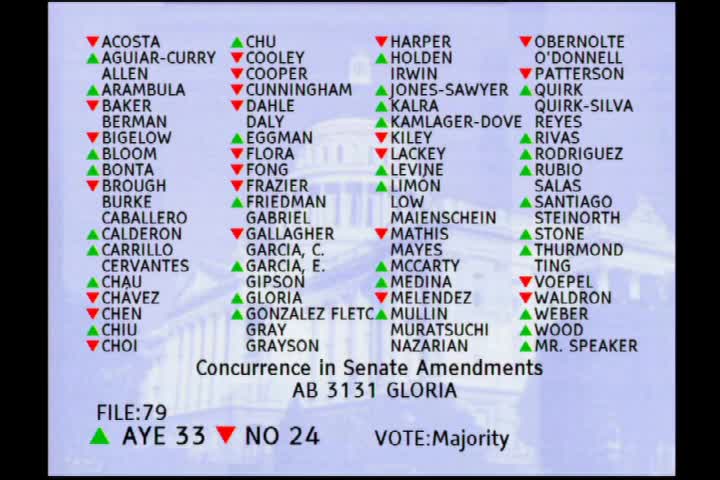 53SEC
Assembly Floor
 1MIN
Senate Floor
 4MIN
Assembly Standing Committee on Local Government
Bill Author

Bill Co-Author(s):