AB 2263: Designated historical resource: conversion or adaptation: required parking.
- Session Year: 2017-2018
- House: Assembly
- Latest Version Date: 2018-08-28
The State Historical Building Code provides for alternative regulations and standards for the rehabilitation, preservation, restoration, or relocation of qualified historical buildings or structures, and requires all state agencies and local authorities to administer and enforce that code with respect to historical buildings or structures under their respective jurisdictions. Those alternative building standards, enacted by regulations adopted by the State Historical Building Safety Board and specified other state agencies, are required to be applied by every city, county, and local agency.
This bill would require a local agency to provide specified reductions in required parking for certain development projects in which a designated historical resource, as defined in the bill, is being converted or adapted, unless otherwise required by local ordinance. Because the bill imposes new duties on local agencies, the bill would impose a state-mandated local program.
The California Constitution requires the state to reimburse local agencies and school districts for certain costs mandated by the state. Statutory provisions establish procedures for making that reimbursement.
This bill would provide that no reimbursement is required by this act for a specified reason.
The State Historical Building Code provides for alternative regulations and standards for the rehabilitation, preservation, restoration, or relocation of qualified historical buildings or structures, and requires all state agencies and local authorities to administer and enforce that code with respect to historical buildings or structures under their respective jurisdictions. Those alternative building standards, enacted by regulations adopted by the State Historical Building Safety Board and specified other state agencies, are required to be applied by every city, county, and local agency.
This bill would require a local agency to provide specified reductions in required parking for certain development projects in which a designated historical resource, as defined in the bill, is being converted or adapted, unless otherwise required by local ordinance. Because the bill imposes new duties on local agencies, the bill would impose a state-mandated local program.
The California Constitution requires the state to reimburse local agencies and school districts for certain costs mandated by the state. Statutory provisions establish procedures for making that reimbursement.This bill would provide that, if the Commission on State Mandates determines that the bill contains costs mandated by the state, reimbursement for those costs shall be made pursuant to the statutory provisions noted above.The California Constitution requires the state to reimburse local agencies and school districts for certain costs mandated by the state. Statutory provisions establish procedures for making that reimbursement.
This bill would provide that no reimbursement is required by this act for a specified reason.
The State Historical Building Code provides for alternative regulations and standards for the rehabilitation, preservation, restoration, or relocation of qualified historical buildings or structures, and requires all state agencies and local authorities to administer and enforce that code with respect to historical buildings or structures under their respective jurisdictions. Those alternative building standards, enacted by regulations adopted by the State Historical Building Safety Board and specified other state agencies, are required to be applied by every city, county, and local agency.
This bill would prohibit a local agency from imposing parking standards on a qualified historical structure, or a structure that is eligible to be listed as a qualified historical structure, that is located in a qualified historic resource, unless the qualified historical structure is being converted into a high intensity use building, as defined in the bill. require a local agency to provide specified reductions in required parking for certain development projects in which a designated historical resource, as defined in the bill, is being converted or adapted, unless otherwise required by local ordinance. Because the bill imposes new duties on local agencies, the bill would impose a state-mandated local program.
The California Constitution requires the state to reimburse local agencies and school districts for certain costs mandated by the state. Statutory provisions establish procedures for making that reimbursement.
This bill would provide that, if the Commission on State Mandates determines that the bill contains costs mandated by the state, reimbursement for those costs shall be made pursuant to the statutory provisions noted above.
The State Historical Building Code provides for alternative regulations and standards for the rehabilitation, preservation, restoration, or relocation of qualified historical buildings or structures, and requires all state agencies and local authorities to administer and enforce that code with respect to historical buildings or structures under their respective jurisdictions. Those alternative building standards, enacted by regulations adopted by the State Historical Building Safety Board and specified other state agencies, are required to be applied by every city, county, and local agency.
This bill would prohibit a local agency from imposing parking standards on a qualified historical structure, or a structure that is eligible to be listed as a qualified historical structure, that exceed the parking standards required by rules and regulations adopted pursuant to the State Historical Building Code. that is located in a qualified historic resource, unless the qualified historical structure is being converted into a high intensity use building, as defined in the bill.
The State Historical Building Code provides for alternative regulations and standards for the rehabilitation, preservation, restoration, or relocation of qualified historical buildings or structures, and requires all state agencies and local authorities to administer and enforce that code with respect to historical buildings or structures under their respective jurisdictions. Those alternative building standards, enacted by regulations adopted by the State Historical Building Safety Board, Board and specified other state agencies, are required to be applied by every city, county, and local agency.
This bill, for building permit requests received on or after January 1, 2019, for the conversion of a historical structure for residential or mixed use purposes, would prohibit a local ordinance from imposing parking standards that exceed the parking standards that applied at the time the historical building was originally constructed. By imposing new duties on local agencies, the bill would impose a state-mandated local program.The California Constitution requires the state to reimburse local agencies and school districts for certain costs mandated by the state. Statutory provisions establish procedures for making that reimbursement.This bill would provide that, if the Commission on State Mandates determines that the bill contains costs mandated by the state, reimbursement for those costs shall be made pursuant to the statutory provisions noted above.This bill would prohibit a local agency from imposing parking standards on a qualified historical structure, or a structure that is eligible to be listed as a qualified historical structure, that exceed the parking standards required by rules and regulations adopted pursuant to the State Historical Building Code.
The State Historical Building Code provides for alternative regulations and standards for the rehabilitation, preservation, restoration, or relocation of qualified historical buildings or structures, and requires all state agencies and local authorities to administer and enforce that code with respect to historical buildings or structures under their respective jurisdictions. Those alternative building standards, enacted by regulations adopted by the State Historical Building Safety Board, are required to be applied by every city, county, and local agency.
This bill, for building permit requests received on or after January 1, 2019, for the conversion of a historical structure for residential or mixed use purposes, would prohibit a local ordinance from imposing parking standards that exceed the parking standards that applied at the time the historical building was originally constructed. By imposing new duties on local agencies, the bill would impose a state-mandated local program.
The California Constitution requires the state to reimburse local agencies and school districts for certain costs mandated by the state. Statutory provisions establish procedures for making that reimbursement.
This bill would provide that, if the Commission on State Mandates determines that the bill contains costs mandated by the state, reimbursement for those costs shall be made pursuant to the statutory provisions noted above.
(a)For a development project in which a designated historical resource is being converted or adapted, a local agency shall provide the following reductions in required parking, unless otherwise required by a local historical preservation or adaptive reuse ordinance:
(1)For a project converting or adapting a designated historical resource to a residential use that is located within one-half mile of a major transit stop, as defined in subdivision (b) of Section 21155 of the Public Resources Code, a local agency shall not require the project to provide parking spaces greater than the number of parking spaces that existed on the project site at the time the project application was submitted.
(2)For a project converting or adapting a designated historical resource to a nonresidential use, a local agency shall provide a 25-percent reduction in the amount of parking spaces that would otherwise be required.
(b)A development project in which a designated historical resource is being converted or adapted that is eligible for reductions in required parking pursuant to this section shall comply with all federal, state, and local alternative regulations and standards necessary for the preservation, restoration, rehabilitation, safety, relocation, or continued use of the designated historical resource.
(c)For purposes of this section, designated historical resource means a structure or property officially designated on a local register of historical resources, the California Register of Historical Resources, or the National Register of Historic Places.
SEC. 2.No reimbursement is required by this act pursuant to Section 6 of Article XIIIB of the California Constitution because a local agency or school district has the authority to levy service charges, fees, or assessments sufficient to pay for the program or level of service mandated by this act, within the meaning of Section 17556 of the Government Code.
(a)For a development project in which a designated historical resource is being converted or adapted, a local agency shall provide the following reductions in required parking, unless otherwise required by a local historical preservation or adaptive reuse ordinance:
(1)For a project converting or adapting a designated historical resource to a residential use that is located within one-half mile of a major transit stop, as defined in subdivision (b) of Section 21155 of the Public Resources Code, a local agency shall not require the project to provide parking spaces greater than the number of parking spaces that existed on the project site at the time the project application was submitted.
(2)For a project converting or adapting a designated historical resource to a nonresidential use, a local agency shall provide a 25-percent reduction in the amount of parking spaces that would otherwise be required.
(b)A development project in which a designated historical resource is being converted or adapted that is eligible for reductions in required parking pursuant to this section shall comply with all federal, state, and local alternative regulations and standards necessary for the preservation, restoration, rehabilitation, safety, relocation, or continued use of the designated historical resource.
(b)(c)For purposes of this section, designated historical resource means a structure or property officially designated on a local register of historical resources, the California Register of Historical Resources, or the National Register of Historic Places.
SEC. 2.If the Commission on State Mandates determines that this act contains costs mandated by the state, reimbursement to local agencies and school districts for those costs shall be made pursuant to Part 7 (commencing with Section 17500) of Division 4 of Title 2 of the Government Code.SEC. 2.No reimbursement is required by this act pursuant to Section 6 of Article XIIIB of the California Constitution because a local agency or school district has the authority to levy service charges, fees, or assessments sufficient to pay for the program or level of service mandated by this act, within the meaning of Section 17556 of the Government Code.
(a)For a development project in which a designated historical resource is being converted or adapted, a local agency shall provide the following reductions in required parking, unless otherwise required by a local historical preservation or adaptive reuse ordinance:
(1)For a project converting or adapting a designated historical resource to a residential use that is located within one-half mile of a major transit stop, as defined in subdivision (b) of Section 21155 of the Public Resource Code, a local agency shall not require the project to provide parking spaces greater than the number of parking spaces that existed on the project site at the time the project application was submitted.
(2)For a project converting or adapting a designated historical resource to a nonresidential use, a local agency shall provide a 25-percent reduction in the amount of parking spaces that would otherwise be required.
(b)For purposes of this section, designated historical resource means a structure or property officially designated on a local register of historical resources, the California Register of Historical Resources, or the National Register of Historic Places.
SEC. 2.If the Commission on State Mandates determines that this act contains costs mandated by the state, reimbursement to local agencies and school districts for those costs shall be made pursuant to Part 7 (commencing with Section 17500) of Division 4 of Title 2 of the Government Code.
(a)A local agency shall not impose parking standards on a qualified historical structure, as defined in Section 18955, or any structure eligible to be listed as a qualified historical structure, that exceed the parking standards, if any, required by rules and regulations adopted pursuant to the State Historical Building Code. structure, that is located in a qualified historic resource, unless the qualified historic structure is being converted into a high intensity use building.
(b)A qualified historical structure identified in subdivision (a) is subject to all other applicable local zoning ordinances.
(c)For purposes of this section, the following definitions apply:
(1)High intensity means the maximum building intensity recommended in the land use element of the citys general plan for the district or territory in which the qualified historical structure is located, as specified in subdivision (a) of Section 65302 of the Government Code, and as specified in the citys zoning ordinance.
(2)Qualified historical resource means a property officially designated on a local register of historical resources, the California Register of Historical Resources, or the National Register of Historic Places.
(3)Qualified historical structure has the same meaning as that term is defined in Section 18955.
A local agency shall not impose parking standards on a qualified historical structure, as defined in Section 18955, or any structure eligible to be listed as a qualified historical structure, that exceed the parking standards, if any, required by rules and regulations adopted pursuant to the State Historical Building Code.
SEC. 2.If the Commission on State Mandates determines that this act contains costs mandated by the state, reimbursement to local agencies and school districts for those costs shall be made pursuant to Part 7 (commencing with Section 17500) of Division 4 of Title 2 of the Government Code.For building permit requests received on or after January 1, 2019, for the conversion of a historical structure for residential or mixed use purposes, a local ordinance shall not impose parking standards that exceed the parking standards that applied at the time the historical building was originally constructed.
SEC. 2.If the Commission on State Mandates determines that this act contains costs mandated by the state, reimbursement to local agencies and school districts for those costs shall be made pursuant to Part 7 (commencing with Section 17500) of Division 4 of Title 2 of the Government Code.
|
Date
|
Status
|
|---|---|
| Aug 28, 2018 | Chaptered by Secretary of State - Chapter 234, Statutes of 2018. |
| Aug 28, 2018 | Approved by the Governor. |
| Aug 16, 2018 | Enrolled and presented to the Governor at 4 p.m. |
| Aug 13, 2018 | Senate amendments concurred in. To Engrossing and Enrolling. |
| Aug 9, 2018 | In Assembly. Concurrence in Senate amendments pending. May be considered on or after August 11 pursuant to Assembly Rule 77. |
| Aug 9, 2018 | Read third time. Passed. Ordered to the Assembly. |
| Aug 7, 2018 | Read second time. Ordered to third reading. |
| Aug 6, 2018 | From committee: Be ordered to second reading pursuant to Senate Rule 28.8. |
| Jun 28, 2018 | From committee: Do pass and re-refer to Com. on APPR. (Ayes 6. Noes 0.) (June 27). Re-referred to Com. on APPR. |
| Jun 20, 2018 | From committee: Do pass and re-refer to Com. on GOV. & F. (Ayes 12. Noes 1.) (June 19). Re-referred to Com. on GOV. & F. |
| Jun 11, 2018 | From committee chair, with author's amendments: Amend, and re-refer to committee. Read second time, amended, and re-referred to Com. on T. & H. |
| Jun 7, 2018 | Referred to Coms. on T. & H. and GOV. & F. |
| May 30, 2018 | In Senate. Read first time. To Com. on RLS. for assignment. |
| May 29, 2018 | Read third time. Passed. Ordered to the Senate. |
| May 24, 2018 | Read second time. Ordered to third reading. |
| May 23, 2018 | From committee: Do pass. (Ayes 11. Noes 5.) (May 23). |
| May 14, 2018 | Read second time. Ordered to third reading. |
| May 10, 2018 | Read second time and amended. Ordered returned to second reading. |
| May 9, 2018 | From committee: Amend, and do pass as amended. (Ayes 6. Noes 1.) (May 9). |
| Apr 25, 2018 | In committee: Set, first hearing. Hearing canceled at the request of author. |
| Apr 17, 2018 | Re-referred to Com. on H. & C.D. |
| Apr 16, 2018 | From committee chair, with author's amendments: Amend, and re-refer to Com. on H. & C.D. Read second time and amended. |
| Apr 2, 2018 | Re-referred to Com. on H. & C.D. |
| Mar 23, 2018 | From committee chair, with author's amendments: Amend, and re-refer to Com. on H. & C.D. Read second time and amended. |
| Mar 1, 2018 | Referred to Com. on H. & C.D. |
| Feb 14, 2018 | From printer. May be heard in committee March 16. |
| Feb 13, 2018 | Read first time. To print. |
|
Date
|
Description
|
Location
|
Votes
|
|
|---|---|---|---|---|
| Aug 13, 2018 | AB 2263 FRIEDMAN Concurrence in Senate Amendments | Assembly Floor |
Passed |
|
| Aug 9, 2018 | Assembly 3rd Reading AB2263 Friedman By Beall | Senate Floor |
Passed |
|
| Jun 27, 2018 | Do pass, but first be re-referred to the Committee on [Appropriations] | Senate Standing Committee on Governance and Finance |
Passed |
|
| Jun 19, 2018 | Do pass, but first be re-referred to the Committee on [Governance and Finance] | Senate Standing Committee on Transportation and Housing |
Passed |
|
| May 29, 2018 | AB 2263 FRIEDMAN Assembly Third Reading | Assembly Floor |
Passed |
|
| May 23, 2018 | Do pass. | Assembly Standing Committee on Appropriations |
Passed |
|
| May 9, 2018 | Do pass as amended. | Assembly Standing Committee on Housing and Community Development |
Passed |
This list shows positions taken on this bill by organizations on the date displayed, which is linked to the original source.
Positions by individuals are not included.
CONCURRENCE IN SENATE AMENDMENTS
CSA1 Bill Id:AB 2263
Author:(Friedman)
As Amended Ver:June 11, 2018
Majority vote
ASSEMBLY: | 51-25 | (May 29, 2018) | SENATE: | 30-5 | (August 9, 2018) |
Original Committee Reference: H. & C.D.
SUMMARY: Requires a local agency to provide for a reduction in parking requirements when a development project that is designated as a historical resource is being converted or adapted to another use. Specifically, this bill:
- Provides that for a development project that is converting to a residential use within one-half mile of a major transit stop a local agency shall not require more parking spaces than the number of parking spaces that existed on the project at the time the project application was submitted.
- Provides for a project that is being converted to a non-residential use a local agency shall provide a 25% reduction in the amount of parking spaces that would otherwise be required.
- Defines "qualified historical resource" to mean a property officially designated on a local register of historical resources, the California Register of Historical Resources, or the National Register of Historic Places.
The Senate amendments require a development project to comply with all federal, state, and local alternative regulations and standards necessary for the preservation, restoration, rehabilitation, safety, relocation, or continued use of the designated historical resource.
FISCAL EFFECT: According to the Assembly Appropriations Committee: Minor state-mandated costs to local agencies to meet the new parking requirements. These costs are potentially reimbursable by the state but it is unlikely an agency would submit a claim to the Commission on State Mandates.
COMMENTS: Background: Housing, particularly affordable housing, is expensive to build in California due to both the amount of subsidy needed to make the housing affordable and the cost of local regulatory requirements. In some cases, cities and counties apply minimum parking standards to housing developments that may not reflect the demand from tenants for parking. These projects may be close to transit stations or home to seniors or individuals with special needs who drive less frequently and have fewer vehicles. Parking requirements also have a disproportionate impact on housing for low-income households, since those households own fewer vehicles than higher income households and are more burdened by the extra cost.
Parking spaces significantly increase the cost of construction. The average construction cost per space, excluding land cost, in a parking structure in the United States is $24,000 for aboveground parking and $34,000 for underground parking, based on 2014 estimates.[1] In cities such as San Francisco, parking can add $40,000 to $75,000 (in 2007 dollars) or more to the construction cost of a new housing unit.[2] A 2012 analysis by the Portland Bureau of Planning and Sustainability demonstrated the impact and cost of different types of onsite parking on monthly rents in a proposed infill apartment building (see chart below).[3]
Type of parking | # of units | # of parking spaces | Parking costs per space | Parking cost as a % of total construction cost | Potential monthly rent range (550 sq. ft. apartment) | Monthly rent increase as a % above no parking development prototype |
No Parking | 50 | 0 | $0 | 0% | $800-$1,150 | n/a |
Tuck-Under | 45 | 9 | $20,000 | 4% | $850-$1,200 | 6% |
Surface | 30 | 19 | $3,000 | 2% | $1,200-$1,800 | 50% |
Podium | 42 | 22 | $20,000 | 10% | $950-$1,350 | 19% |
Mechanical | 46 | 23 | $45,000 | 22% | $1,175-$1,660 | 47% |
Underground | 44 | 33 | $55,000 | 28% | $1,300-$1,900 | 63% |
Source: Portland Bureau of Planning and Sustainability | ||||||
In addition, parking spaces can often go unused. The GreenTRIP Parking Database, which was funded in part by the United States Department of Housing and Urban Development and the Metropolitan Transportation Commission, is a public database that provides parking supply and utilization information from 80 multifamily residential sites in the San Francisco Bay Area. Across those multifamily developments, an average of 28% of parking spaces went unused between 12 a.m. and 5 a.m. on a weekday night (the peak time for residential parking). The total construction cost of those unused spaces was close to $200 million, and they took up over one million square feet of space.[4]
State Historical Building Code: The purpose of the State Historical Building Code is to provide regulations and standards for the rehabilitation, preservation, restoration (including related reconstruction) or relocation as applicable to all historical buildings, structures and properties deemed of importance to the history, architecture, or culture of an area by an appropriate local or state governmental jurisdiction. Such standards and regulations are intended to facilitate the restoration or change of occupancy so as to preserve their original or restored elements and features, to encourage energy conservation and a cost effective approach to preservation, and to provide for reasonable safety from fire, seismic forces or other hazards for occupants and users of such "buildings, structures, and properties" and to provide reasonable availability and usability by the physically disabled.
Historical resources: How many historical resources are there in California? As of 2017, there were approximately 2,800 properties in California listed on the National Register of Historic Places. Informal estimates from the California State Parks' Office of Historic Preservation suggest the number of resources on the California Register of Historical Resources is around 25,000. As an example, Sacramento County has 99 landmarks listed in the National Register, 58 state landmarks, four landmarks in the California Register, and 20 points of historical interest, according to the Office of Historic Preservation online database and the National Register of Historic Places. Not all of these landmarks are buildings, and not all of them are eligible for conversion – some, like the Governor's Mansion and the California State Capitol Building, are still in regular use.
City of Los Angeles Adaptive Reuse Ordinance: This bill is based, in part, on the City of Los Angeles's Adaptive Reuse Ordinance (ARO). The city enacted the ARO in 1999 to facilitate the conversion of historic structures in its downtown area, and later expanded it to other neighborhoods in 2003. One major component of the ARO was that it exempted buildings in this area from parking requirements in excess of the parking that existed on-site on June 3, 1999. According to one study, between 1999 and 2008 developers used the ARO to create about 6,900 housing units in downtown Los Angeles, primarily through conversion of existing historical office buildings. The author of that study surveyed 56 ARO developments and found that most developers said that the conversions would have been impossible without removing the parking requirements. Additionally, over a third of ARO buildings did not include parking in the price of their units, leading to savings on rent costs for many ARO residents.[5]
Related legislation:
AB 744 (Chau), Chapter 699, Statutes of 2015: Required a local government, upon the request of a developer that receives a density bonus, to reduce the minimum parking requirements for a housing development, if it meets certain criteria.
AB 904 (Skinner) of 2012: Would have prohibited cities and counties from imposing minimum parking standards greater than specific limits set out in the bill. This bill died in the Senate Committee on Governance and Finance.
Analysis Prepared by: Lisa Engel/ H. & C.D. / (916) 319-2085 FN: 0003953
Donald Shoup, “The High Cost of Minimum Parking Requirements,” in Parking: Issues and Policies, vol. 5, Transport and Sustainability (Emerald Group Publishing Limited, 2014), 87–113. ↑
“Affordable by Design: How to Create Middle-Income Housing in San Francisco” (SPUR, November 20, 2007). ↑
“Cost Comparison: Parking Prototype Impacts on Form and Affordability” (Portland Bureau of Planning and Sustainability, November 2012). ↑
TransForm, “Comparison Report,” GreenTRIP Parking Database, n.d. ↑
Michael Manville, “Parking Requirements and Housing Development: Regulation and Reform in Los Angeles,” Journal of the American Planning Association 79, no. 1 (2013): 49–66. ↑
Office of Senate Floor Analyses (916) 651-1520 Fax: (916) 327-4478 | AB |
THIRD READING
Bill No: AB 2263
:
SENATE TRANS. & HOUSING COMMITTEE: 12-1, 6/19/18
AYES: Beall, Cannella, Allen, Dodd, Galgiani, McGuire, Morrell, Roth, Skinner, Vidak, Wieckowski, Wiener
NOES: Gaines
SENATE GOVERNANCE & FIN. COMMITTEE: 6-0, 6/27/18
AYES: McGuire, Beall, Hernandez, Hertzberg, Lara, Moorlach
NO VOTE RECORDED: Nguyen
SENATE APPROPRIATIONS COMMITTEE: Senate Rule 28.8
ASSEMBLY FLOOR: 51-25, 5/29/18 - See last page for vote
DIGEST:
This bill requires a local agency to reduce the required number of parking spaces for development projects in which a designated historical resource is being converted or adapted.
Existing law:
- Establishes the State Historical Building Code to provide for the preservation of qualified historical buildings or structures; reasonable safety from fire, seismic forces, or other hazards for occupants of these buildings or structures; and reasonable availability to, and usability by, disabled individuals.
- Requires local authorities to administer and enforce the State Historical Building Code with respect to qualified historical buildings and structures where applicable.
- Defines “qualified historical building or structure” as follows:
- Any structure or property, collection of structures, and their related sites deemed of importance to the history, architecture, or culture of an area by an appropriate local or state government jurisdiction.
- Historical buildings or structures on existing or future national, state, or local historical registers of official inventories, such as the National Register of Historic Places, State Historical Landmarks, State Points of Historical Interest, and city or county registers or inventories of historical or architecturally significant sites, places, historic districts, or landmarks.
- Places, locations, or sites identified on these historical registers or official inventories and deemed of importance to the history, architecture, or culture of an area by an appropriate local or state government jurisdiction.
- Permits a city, county, or city and county to reduce or eliminate a parking requirement for developments of any type or location.
This bill:
- Requires a local agency, for a development project in which a designated historical resource is being converted or adapted, to provide the following parking reductions unless otherwise required by a local historical preservation or adaptive reuse ordinance:
- For a project converting or adapting a designated historical resource to a residential use, located within ½ mile of a major transit stop, the required number of parking spaces shall not exceed the number of parking spaces that existed at the time the project application was submitted.
- For a project converting or adapting a designated historical resource to a non-residential use, the required number of parking spaces shall be 25% less than would otherwise be required.
- Requires a project converting or adapting a designated historical resource that is eligible for reductions in parking requirements under this bill to comply with all federal, state, and local alternative regulations and standards necessary for the preservation, restoration, rehabilitation, safety, relocation, or continued use of the designated historical resource.
- Defines “designated historical resource” as a structure or property official designated on a local register of historical resources, the California Register of Historical Resources, or the National Register of Historic Places.
Comments
- Purpose. The author states that this bill ensures that a locality’s historic character is maintained while incentivizing adaptive reuse of existing historic structures for much-needed uses such as housing. This bill is the result of the efforts of historic preservation experts both in the author’s community and statewide. It is modeled from the success of Los Angeles’ adaptive reuse ordinance and one of Glendale’s historic preservation incentives. Thousands of structures in California are already eligible to take advantage of this incentive.
- Historical resources. As of 2017, there were approximately 2,800 properties in California listed on the National Register of Historic Places. Informal estimates from the state Office of Historic Preservation suggest that there are approximately 25,000 resources listed on the California Register of Historic Resources. For example, Sacramento County has 99 landmarks listed in the National Register, 58 state landmarks, four landmarks in the California Register, and 20 points of historical interest. Not all of these landmarks are buildings, and not all are eligible for conversion; for example, the California State Capitol Building is still in regular use.
- City of Los Angeles’ Adaptive Reuse Ordinance. This bill is based in part on the Los Angeles’ Adaptive Reuse Ordinance, which was enacted in 1999 for the downtown area and extended to additional neighborhoods in 2003. This ordinance provides for an expedited approval process and is intended to ensure that older and historic buildings are not subjected to the same zoning and code enforcement requirements that apply to new construction. The author notes that between 1999 and 2008, developers created at least 6,900 new housing units in the exempted area, or more than three-quarters of units added in downtown Los Angeles.
- Parking ratios. Parking requirements often discourage infill redevelopment on small lots where it is difficult and costly to fit both a new building and the required parking; they can also prevent new uses for older buildings that lack the required parking spaces. The average construction cost per parking space — excluding land cost — in a parking structure in the United States is $24,000 for aboveground parking and $34,000 for underground parking. Certain types of parking, such as underground parking, can increase parking costs by 6% or more relative to other types of parking.
Related/Prior Legislation
SB 893 (Nguyen, 2018) would have deleted lowered parking ratios available to developers receiving a density bonus for 100% affordable rental housing projects, as specified. The bill failed passage in the Senate Transportation and Housing Committee on April 17, 2018.
AB 744 (Chau, Chapter 699, Statutes of 2015) placed a cap on the parking ratios that local governments may impose on some affordable housing developments upon the request of a developer.
FISCAL EFFECT: Appropriation: Fiscal Com.: Local:
American Planning Association, California Chapter
Bay Area Council
Silver Lake Neighborhood Council
University of California, Los Angeles
None received
ARGUMENTS IN SUPPORT: The University of California, Los Angeles, states that parking requirements often obstruct adaptive reuse and, even worse, sometimes encourage demolition of older buildings to make way for a parking lot. This bill will enable preservation of many historic buildings and help cities add more housing units.
ASSEMBLY FLOOR: 51-25, 5/29/18
AYES: Aguiar-Curry, Arambula, Berman, Bloom, Bonta, Burke, Caballero, Calderon, Carrillo, Cervantes, Chau, Chiu, Chu, Cooper, Daly, Eggman, Frazier, Friedman, Cristina Garcia, Eduardo Garcia, Gipson, Gloria, Gonzalez Fletcher, Grayson, Holden, Irwin, Jones-Sawyer, Kalra, Kamlager-Dove, Levine, Limón, Low, McCarty, Medina, Mullin, Muratsuchi, Nazarian, O'Donnell, Quirk, Quirk-Silva, Reyes, Rodriguez, Rubio, Salas, Santiago, Mark Stone, Thurmond, Ting, Weber, Wood, Rendon
NOES: Acosta, Travis Allen, Baker, Bigelow, Brough, Chávez, Chen, Cunningham, Dahle, Flora, Fong, Gallagher, Gray, Harper, Kiley, Lackey, Maienschein, Mathis, Mayes, Melendez, Obernolte, Patterson, Steinorth, Voepel, Waldron
NO VOTE RECORDED: Choi, Cooley
8/8/18 10:32:24
**** END ****
SENATE COMMITTEE ON GOVERNANCE AND FINANCE
Senator Mike McGuire, Chair
2017 - 2018 Regular
Bill No: | AB 2263 | Hearing Date: | 6/27/18 |
Author: | Friedman | Tax Levy: | No |
Version: | 6/11/18 | Fiscal: | Yes |
Consultant: | Favorini-Csorba | ||
Designated historical resource: conversion or adaptation: required parking
Requires a local agency to provide for a reduction in parking requirements when a development project that is designated as a historical resource is being converted or adapted to another use.
Background
Building standards. The California Building Standards Code (Title 24 of the California Code of Regulations) contains building standards and regulations as adopted by the California Building Standards Commission. These standards include, among other requirements, structural standards for building safety (the Building Code), fire safety standards (the Fire Code), energy efficiency standards (the Energy Code), and standards for green buildings (CalGreen).
The Building Standards Code is updated on a three year cycle—the most recent update occurred in 2016. Building and fire codes in California are typically developed and adopted according to the following process:
- A model code is developed by a national organization.
- The California Building Standards Commission then adopts that model code, with any amendments specific to California. In the case of the California Fire Code, the State Fire Marshal), with the advice of the State Board of Fire Services—composed of representatives from relevant state agencies, fire chiefs, firefighters, the insurance industry, and local governments—recommends standards for adoption.
- Local agencies in California then enact an ordinance to adopt the codes. Those ordinances may include amendments that are more stringent than the state codes, if the local governing body makes findings that the amendments are necessary because of local climatic, geological, or topographical conditions.
New construction and improvements to existing buildings must comply with the current building codes, and improvements to an existing building may trigger additional code upgrades for other parts of a building. State laws regarding building codes apply to all cities and counties, including charter cities.
State Historic Building Code. The State Historic Building Code (SHBC) provides alternative building regulations for permitting repairs, alterations and additions necessary for the preservation, rehabilitation, relocation, related construction, change of use, or continued use of a “qualified historical building or structure,” which is any building or structure that is declared to have importance to history. A qualified historical building also includes structures on national, state, or local historical registers or official inventories, such as the National Register of Historic Places, State Historical Landmarks, or State Points of Historical Interest. Cities and counties may also designate historical or architecturally significant sites, places, historic districts, or landmarks.
The SHBC’s standards and regulations are intended to facilitate the rehabilitation or change of occupancy so as to preserve their original or restored elements and features, to encourage energy conservation and a cost-effective approach to preservation, to provide for reasonable safety from fire, seismic forces, or other hazards for occupants and users of such buildings, structures and properties, and to provide both reasonable availability and usability by the physically disabled.
Local planning. The California Constitution allows a city to "make and enforce within its limits, all local, police, sanitary and other ordinances and regulations not in conflict with general laws." It is from this fundamental power (commonly called the police power) that local governments derive their authority to regulate behavior to preserve the health, safety, and welfare of the public—including land use authority. Local governments use their police power to enact zoning ordinances that shape development, such as setting maximum densities for housing units, minimum numbers of required parking spaces, and setbacks to preserve privacy. These ordinances can also include conditions on development to address aesthetics, community impacts, or other particular site-specific considerations.
Local ordinances can set a variety of rules intended to shape developments, including setting maximum densities for housing units or minimum numbers of required parking spaces. These parking space requirements are often based on a “parking ratio” that requires builders to include a certain number of parking spaces per unit, depending on the size of the unit.
High parking ratios can increase the cost of housing because constructing off-street parking can be expensive. For example, estimates of the average cost of constructing parking spaces range from $15,000 to $34,000 per space. Accordingly, requirements for new parking can be a deterrent to rehabilitating and converting older structures to new uses.
The City of Los Angeles enacted an Adaptive Reuse Ordinance in 1999, to encourage the transformation of vacant commercial buildings in the historic core of downtown into housing. The City’s ordinance relaxes height, density, and other typical zoning requirements, including to only require the same number of parking spaces as existed at the site on June 3rd, 1999. Between 1999 and 2008, this program enabled developers to create at least 6,900 new housing units in the downtown area. Seeking to replicate this program’s success statewide, the author wants to limit parking requirements that local agencies can impose on historic buildings.
Proposed Law
Assembly Bill 2263 requires a local agency, for a development project in which a designated historical resource is being converted or adapted, to provide the following parking reductions unless otherwise required by a local historical preservation or adaptive reuse ordinance:
- For a project converting or adapting a designated historical resource to a residential use, located within ½ mile of a major transit stop, the required number of parking spaces shall not exceed the number of parking spaces that existed at the time the project application was submitted.
- For a project converting or adapting a designated historical resource to a non-residential use, the required number of parking spaces shall be 25% less than would otherwise be required.
AB 2263 defines “designated historical resource” to mean a structure or property official designated on a local register of historical resources, the California Register of Historical Resources, or the National Register of Historic Places.
State Revenue Impact
No estimate.
Comments
1. Purpose of the bill. According to the author, “This bill ensures a local’s historic character is maintained, while incentivizing adaptive reuse of existing historic structures for much needed use, such as housing. This was an effort of historic preservation experts in my community and statewide, is modeled off of the success of LA’s adaptive reuse ordinance, and one of Glendale’s historic preservation incentives. Thousands of structures in California are already eligible to take advantage of this incentive. This bill works to utilize and preserve what we have already built.”
2. Sure, but will it work? AB 2263 establishes an absolute standard for parking requirements in the case of buildings being converted to residential use, but its standard for non-residential buildings is relative to local governments’ own ordinances. Cities and counties that feel strongly about parking may simply amend their ordinances to increase parking requirements by an amount that offsets the bill’s mandated reduction.
3. Mandate. The California Constitution requires the state to reimburse local governments for the costs of new or expanded state mandated local programs. Because AB 2263 requires cities and counties to provide a reduction in required parking, Legislative Counsel says that it imposes a new state mandate. The measure states that if the Commission on State Mandates determines that the bill imposes a reimbursable mandate, reimbursement must be made pursuant to existing statutory provisions.
4. Incoming! The Senate Transportation and Housing Committee approved AB 2263 at its June 19th meeting on a vote of 12 to 1. The Senate Governance and Finance Committee is hearing AB 2263 as the committee of second reference.
Assembly Actions
Assembly Housing and Community Development Committee: 6-1
Assembly Appropriations Committee: 11-5
Assembly Floor: 51-25
Support and Opposition
(6/22/18)
Support: American Planning Association-California Chapter; Bay Area Council.
Opposition: Unknown.
-- END --
SENATE COMMITTEE ON TRANSPORTATION AND HOUSING
Senator Jim Beall, Chair
2017 - 2018 Regular
Bill No: AB 2263 Hearing Date: 6/19/18
Author: | Friedman | ||
Version: | 6/11/2018 Amended | ||
Urgency: | No | Fiscal: | Yes |
Consultant: | Erin Riches | ||
SUBJECT: Designated historical resource: conversion or adaptation: required parking
DIGEST: This bill requires a local agency to reduce the required number of parking spaces for development projects in which a designated historical resource is being converted or adapted.
ANALYSIS:
Existing law:
- Establishes the State Historical Building Code to provide for the preservation of qualified historical buildings or structures; reasonable safety from fire, seismic forces, or other hazards for occupants of these buildings or structures; and reasonable availability to, and usability by, disabled individuals.
- Requires local authorities to administer and enforce the State Historical Building Code with respect to qualified historical buildings and structures where applicable.
- Defines “qualified historical building or structure” as follows:
- Any structure or property, collection of structures, and their related sites deemed of importance to the history, architecture, or culture of an area by an appropriate local or state government jurisdiction.
- Historical buildings or structures on existing or future national, state, or local historical registers of official inventories, such as the National Register of Historic Places, State Historical Landmarks, State Points of Historical Interest, and city or county registers or inventories of historical or architecturally significant sites, places, historic districts, or landmarks.
- Places, locations, or sites identified on these historical registers or official inventories and deemed of importance to the history, architecture, or culture of an area by an appropriate local or state government jurisdiction.
- Permits a city, county, or city and county to reduce or eliminate a parking requirement for developments of any type or location.
This bill:
- Requires a local agency, for a development project in which a designated historical resource is being converted or adapted, to provide the following parking reductions unless otherwise required by a local historical preservation or adaptive reuse ordinance:
- For a project converting or adapting a designated historical resource to a residential use, located within ½ mile of a major transit stop, the required number of parking spaces shall not exceed the number of parking spaces that existed at the time the project application was submitted.
- For a project converting or adapting a designated historical resource to a non-residential use, the required number of parking spaces shall be 25% less than would otherwise be required.
- Requires a project converting or adapting a designated historical resource that is eligible for reductions in parking requirements under this bill to comply with all federal, state, and local alternative regulations and standards necessary for the preservation, restoration, rehabilitation, safety, relocation, or continued use of the designated historical resource.
- Defines “designated historical resource” as a structure or property official designated on a local register of historical resources, the California Register of Historical Resources, or the National Register of Historic Places.
COMMENTS
- Purpose. The author states that this bill ensures that a locality’s historic character is maintained while incentivizing adaptive reuse of existing historic structures for much-needed uses such as housing. This bill is the result of the efforts of historic preservation experts both in the author’s community and statewide. It is modeled from the success of Los Angeles’ adaptive reuse ordinance and one of Glendale’s historic preservation incentives. Thousands of structures in California are already eligible to take advantage of this incentive.
- Historical resources. As of 2017, there were approximately 2,800 properties in California listed on the National Register of Historic Places. Informal estimates from the state Office of Historic Preservation suggest that there are approximately 25,000 resources listed on the California Register of Historic Resources. For example, Sacramento County has 99 landmarks listed in the National Register, 58 state landmarks, four landmarks in the California Register, and 20 points of historical interest. Not all of these landmarks are buildings, and not all are eligible for conversion; for example, the California State Capitol Building is still in regular use.
- City of Los Angeles’ Adaptive Reuse Ordinance. This bill is based in part on the Los Angeles’ Adaptive Reuse Ordinance, which was enacted in 1999 for the downtown area and extended to additional neighborhoods in 2003. This ordinance provides for an expedited approval process and is intended to ensure that older and historic buildings are not subjected to the same zoning and code enforcement requirements that apply to new construction. The author notes that between 1999 and 2008, developers created at least 6,900 new housing units in the exempted area, or more than three-quarters of units added in downtown Los Angeles.
- Parking ratios. Parking requirements often discourage infill redevelopment on small lots where it is difficult and costly to fit both a new building and the required parking; they can also prevent new uses for older buildings that lack the required parking spaces. The average construction cost per parking space — excluding land cost — in a parking structure in the United States is $24,000 for aboveground parking and $34,000 for underground parking. Certain types of parking, such as underground parking, can increase parking costs by 6% or more relative to other types of parking.
- Double referral. This bill has also been referred to the Governance and Finance Committee.
Related Legislation:
SB 893 (Nguyen, 2018) — would have deleted lowered parking ratios available to developers receiving a density bonus for 100% affordable rental housing projects, as specified. This bill failed passage in the Senate Transportation and Housing Committee on April 17th.
AB 744 (Chau, Chapter 699, Statutes of 2015) — placed a cap on the parking ratios that local governments may impose on some affordable housing developments upon the request of a developer.
Assembly Votes:
Floor: 51-25
Appr: 11-5
H&CD: 6-1
FISCAL EFFECT: Appropriation: Fiscal Com.: Local:
POSITIONS: (Communicated to the committee before noon on Wednesday,
June 13, 2018.)
SUPPORT:
American Planning Association, California Chapter
Bay Area Council
University of California, Los Angeles
OPPOSITION:
None received.
-- END --
ASSEMBLY THIRD READING
ATR Bill Id:AB 2263
Author:(Friedman)
As Amended Ver:May 10, 2018
Majority vote
Committee | Votes | Ayes | Noes |
Housing | 6-1 | Chiu, Maienschein, Chau, Gloria, Limón, Wood | Choi |
Appropriations | 11-5 | Gonzalez Fletcher, Bloom, Calderon, Carrillo, Chau, Eggman, Friedman, Eduardo Garcia, Nazarian, Quirk, Reyes | Bigelow, Mathis, Fong, Gallagher, Obernolte |
SUMMARY: Requires a local agency to provide for a reduction in parking requirements when a development project that is designated as a historical resource is being converted or adapted to another use. Specifically, this bill:
- Provides that for a development project that is converting to a residential use within one-half mile of a major transit stop a local agency shall not require more parking spaces than the number of parking spaces that existed on the project at the time the project application was submitted.
- Provides for a project that is being converted to a non-residential use a local agency shall provide a 25% reduction in the amount of parking spaces that would otherwise be required.
- Defines "qualified historical resource" to mean a property officially designated on a local register of historical resources, the California Register of Historical Resources, or the National Register of Historic Places.
FISCAL EFFECT: According to the Assembly Appropriations Committee: Minor state-mandated costs to local agencies to meet the new parking requirements. These costs are potentially reimbursable by the state but it is unlikely an agency would submit a claim to the Commission on State Mandates.
COMMENTS:
Background: Housing, particularly affordable housing, is expensive to build in California due to both the amount of subsidy needed to make the housing affordable and the cost of local regulatory requirements. In some cases, cities and counties apply minimum parking standards to housing developments that may not reflect the demand from tenants for parking. These projects may be close to transit stations or home to seniors or individuals with special needs who drive less frequently and have fewer vehicles. Parking requirements also have a disproportionate impact on housing for low-income households, since those households own fewer vehicles than higher income households and are more burdened by the extra cost.
Parking spaces significantly increase the cost of construction. The average construction cost per space, excluding land cost, in a parking structure in the United States is $24,000 for aboveground parking and $34,000 for underground parking, based on 2014 estimates.[1] In cities such as San Francisco, parking can add $40,000 to $75,000 (in 2007 dollars) or more to the construction cost of a new housing unit.[2] A 2012 analysis by the Portland Bureau of Planning and Sustainability demonstrated the impact and cost of different types of onsite parking on monthly rents in a proposed infill apartment building (see chart below).[3]
Type of parking | # of units | # of parking spaces | Parking costs per space | Parking cost as a % of total construction cost | Potential monthly rent range (550 sq. ft. apartment) | Monthly rent increase as a % above no parking development prototype |
No Parking | 50 | 0 | $0 | 0% | $800-$1,150 | n/a |
Tuck-Under | 45 | 9 | $20,000 | 4% | $850-$1,200 | 6% |
Surface | 30 | 19 | $3,000 | 2% | $1,200-$1,800 | 50% |
Podium | 42 | 22 | $20,000 | 10% | $950-$1,350 | 19% |
Mechanical | 46 | 23 | $45,000 | 22% | $1,175-$1,660 | 47% |
Underground | 44 | 33 | $55,000 | 28% | $1,300-$1,900 | 63% |
Source: Portland Bureau of Planning and Sustainability | ||||||
In addition, parking spaces can often go unused. The GreenTRIP Parking Database, which was funded in part by the United States. Department of Housing and Urban Development and the Metropolitan Transportation Commission, is a public database that provides parking supply and utilization information from 80 multifamily residential sites in the San Francisco Bay Area. Across those multifamily developments, an average of 28% of parking spaces went unused between 12:00 a.m. and 5:00 a.m. on a weekday night (the peak time for residential parking). The total construction cost of those unused spaces was close to $200 million, and they took up over one million square feet of space.[4]
State Historical Building Code: The purpose of the State Historical Building Code is to provide regulations and standards for the rehabilitation, preservation, restoration (including related reconstruction) or relocation as applicable to all historical buildings, structures and properties deemed of importance to the history, architecture, or culture of an area by an appropriate local or state governmental jurisdiction. Such standards and regulations are intended to facilitate the restoration or change of occupancy so as to preserve their original or restored elements and features, to encourage energy conservation and a cost effective approach to preservation, and to provide for reasonable safety from fire, seismic forces or other hazards for occupants and users of such "buildings, structures, and properties" and to provide reasonable availability and usability by the physically disabled.
Historical resources: How many historical resources are there in California? As of 2017, there were approximately 2,800 properties in California listed on the National Register of Historic Places. Informal estimates from the California State Parks' Office of Historic Preservation suggest the number of resources on the California Register of Historical Resources is around 25,000. As an example, Sacramento County has 99 landmarks listed in the National Register, 58 state landmarks, four landmarks in the California Register, and 20 points of historical interest, according to the Office of Historic Preservation online database and the National Register of Historic Places. Not all of these landmarks are buildings, and not all of them are eligible for conversion—some, like the Governor's Mansion and the California State Capitol Building, are still in regular use.
City of Los Angeles Adaptive Reuse Ordinance: This bill is based, in part, on the City of Los Angeles’s Adaptive Reuse Ordinance (ARO). The city enacted the ARO in 1999 to facilitate the conversion of historic structures in its downtown area, and later expanded it to other neighborhoods in 2003. One major component of the ARO was that it exempted buildings in this area from parking requirements in excess of the parking that existed on-site on June 3, 1999. According to one study, between 1999 and 2008 developers used the ARO to create about 6,900 housing units in downtown Los Angeles, primarily through conversion of existing historical office buildings. The author of that study surveyed 56 ARO developments and found that most developers said that the conversions would have been impossible without removing the parking requirements. Additionally, over a third of ARO buildings did not include parking in the price of their units, leading to savings on rent costs for many ARO residents.[5]
Related legislation:
AB 744 (Chau), Chapter 699, Statutes of 2015: Required a local government, upon the request of a developer that receives a density bonus, to reduce the minimum parking requirements for a housing development, if it meets certain criteria.
AB 904 (Skinner) of 2012: Would have prohibited cities and counties from imposing minimum parking standards greater than specific limits set out in the bill. This bill was returned without further action from the Senate Governance and Finance Committee.
Analysis Prepared by: Lisa Engel / H. & C.D. / (916) 319-2085 FN: 0003017
Donald Shoup, "The High Cost of Minimum Parking Requirements," in Parking: Issues and Policies, vol. 5, Transport and Sustainability (Emerald Group Publishing Limited, 2014), 87–113. ↑
"Affordable by Design: How to Create Middle-Income Housing in San Francisco" (SPUR, November 20, 2007). ↑
"Cost Comparison: Parking Prototype Impacts on Form and Affordability" (Portland Bureau of Planning and Sustainability, November 2012). ↑
TransForm, "Comparison Report," GreenTRIP Parking Database, n.d. ↑
Michael Manville, "Parking Requirements and Housing Development: Regulation and Reform in Los Angeles," Journal of the American Planning Association 79, no. 1 (2013): 49–66. ↑
Date of Hearing: May 23, 2018
ASSEMBLY COMMITTEE ON APPROPRIATIONS
Lorena Gonzalez Fletcher, Chair
ABPCA Bill Id:AB 2263
Author:(Friedman) – As Amended Ver:May 10, 2018
Policy Committee: | Housing and Community Development | Vote: | 6 - 1 |
|
| ||
|
|
Urgency: No State Mandated Local Program: Yes Reimbursable: Yes
SUMMARY:
This bill requires a local agency to provide specified reductions in required parking for development projects involving a designated historical resource, unless otherwise required by local ordinance.
FISCAL EFFECT:
Minor state-mandated costs to local agencies to meet the new parking requirements. These costs are potentially reimbursable by the state but it is unlikely an agency would submit a claim to the Commission on State Mandates.
COMMENTS:
- Purpose. According to the author, this bill works to incentivize historic preservation and adaptive reuse of existing structures into housing by reducing parking requirements on historic structures. This bill eliminates additional parking requirements for historic structures eligible for, or currently listed under, the National Register of Historic Places, the California Register of Historical Resources, or a local city or county register of historic resources.
- Background. The State Historical Building Code is intended to provide regulations and standards for the rehabilitation, preservation, restoration (including related reconstruction) or relocation as applicable to all historical buildings, structures and properties deemed of importance to the history, architecture, or culture of an area by an appropriate local or state governmental jurisdiction. Such standards and regulations are intended to facilitate the restoration or change of occupancy so as to preserve their original or restored elements and features.
As of 2017, there were approximately 2,800 properties in California listed on the National Register of Historic Places. Informal estimates from the California State Parks’ Office of Historic Preservation suggest the number of resources on the California Register of Historical Resources is around 25,000. Not all of these landmarks are buildings, and not all of them are eligible for conversion—some, like the Governor’s Mansion and the California State Capitol Building, are still in regular use.
- Prior Legislation.
AB 744 (Chau), Chapter 699, Statutes of 2015, required a local government, upon the request of a developer that receives a density bonus, to reduce the minimum parking requirements for a housing development, if it meets certain criteria.
AB 904 (Skinner), of the 2011-12 Legislative Session, would have prohibited cities and counties from imposing minimum parking standards greater than specific limits set out in the bill. That bill died in the Senate Committee on Governance and Finance.
Analysis Prepared by: Jennifer Swenson / APPR. / (916) 319-2081
Date of Hearing: May 9, 2018
ASSEMBLY COMMITTEE ON HOUSING AND COMMUNITY DEVELOPMENT
David Chiu, Chair
ABPCA Bill Id:AB 2263 (
Author:Friedman) – As Amended Ver:April 16, 2018
SUBJECT: Qualified historical structures: parking spaces
SUMMARY: Prohibits a local agency from imposing parking standards on a qualified historical structure unless the structure is being converted to high intensity use. Specifically, this bill:
- Prohibits a local agency from imposing parking standards on a qualified historical structure, or any structure eligible to be listed as a qualified historical structure that is located in a qualified historical resource, unless the structure is being converted into a high intensity use building.
- Specifies that a qualified historical structure is subject to all other applicable local zoning ordinances.
- Defines “high intensity” to mean the maximum building intensity recommended in the land use element of the city’s general plan for the district or territory in which the qualified historical structure is located, as specified in the city’s zoning ordinance.
- Defines “qualified historical resource” to mean a property officially designated on a local register of historical resources, the California Register of Historical Resources, or the National Register of Historic Places.
EXISTING LAW:
- Establishes the State Historical Building Code (SHBC) to provide alternative regulations and standards for the rehabilitation, preservation, restoration (including related reconstruction), or relocation of qualified historical buildings or structures.
- Defines a “qualified historical building or structure” to mean any of the following:
- Any structure or property, collection of structures, and their related sites deemed of importance to the history, architecture, or culture of an area by an appropriate local or state governmental jurisdiction.
- Historical buildings or structures on existing or future national, state, or local historical registers or official inventories, including:
- The National Register of Historic Places;
- State Historical Landmarks;
- State Points of Historical Interest;
- City or county registers or inventories of historical or architecturally significant sites, places, historic districts, or landmarks; and
- Places, locations, or sites identified on these historical registers or official inventories and deemed of importance to the history, architecture, or culture of an area by an appropriate local or state governmental jurisdiction.
- Requires the building department of every city or county or other local agency that has jurisdiction over code enforcement to apply the alternative standards and regulations in permitting repairs, alterations, and additions necessary for the preservation, restoration, rehabilitation, safety, moving, or continued use of a qualified historical building or structure.
- Requires all local authorities to administer and enforce the SHBC with respect to qualified historical buildings or structures under their respective jurisdictions where applicable.
- Requires the planning agency of each county and city to adopt a comprehensive, long-term general plan for the physical development of the county or city.
- Requires the general plan to include a land use element that designates the proposed general distribution and general location and extent of the uses of the land for housing, business, industry, open space (including agriculture, natural resources, recreation, public buildings, and greenways), and other categories of public and private uses of land.
- Requires the land use element to include a statement of the standards of population density and building intensity recommended for the various districts and other territory covered by the plan.
FISCAL EFFECT: None.
COMMENTS:
Background: Housing, particularly affordable housing, is expensive to build in California due to both the amount of subsidy needed to make the housing affordable and the cost of local regulatory requirements. In some cases, cities and counties apply minimum parking standards to housing developments that may not reflect the demand from tenants for parking. These projects may be close to transit stations or home to seniors or individuals with special needs who drive less frequently and have fewer vehicles. Parking requirements also have a disproportionate impact on housing for low-income households, since those households own fewer vehicles than higher income households and are more burdened by the extra cost.
Parking spaces significantly increase the cost of construction. The average construction cost per space, excluding land cost, in a parking structure in the United States is $24,000 for aboveground parking and $34,000 for underground parking, based on 2014 estimates.[1] In cities such as San Francisco, parking can add $40,000 to $75,000 (in 2007 dollars) or more to the construction cost of a new housing unit.[2] A 2012 analysis by the Portland Bureau of Planning and Sustainability demonstrated the impact and cost of different types of onsite parking on monthly rents in a proposed infill apartment building (see chart below).[3]
Type of parking | # of units | # of parking spaces | Parking costs per space | Parking cost as a % of total construction cost | Potential monthly rent range (550 sq. ft. apartment) | Monthly rent increase as a % above no parking development prototype |
No Parking | 50 | 0 | $0 | 0% | $800-$1,150 | n/a |
Tuck-Under | 45 | 9 | $20,000 | 4% | $850-$1,200 | 6% |
Surface | 30 | 19 | $3,000 | 2% | $1,200-$1,800 | 50% |
Podium | 42 | 22 | $20,000 | 10% | $950-$1,350 | 19% |
Mechanical | 46 | 23 | $45,000 | 22% | $1,175-$1,660 | 47% |
Underground | 44 | 33 | $55,000 | 28% | $1,300-$1,900 | 63% |
Source: Portland Bureau of Planning and Sustainability | ||||||
In addition, parking spaces can often go unused. The GreenTRIP Parking Database, which was funded in part by the U.S. Department of Housing and Urban Development and the Metropolitan Transportation Commission, is a public database that provides parking supply and utilization information from 80 multifamily residential sites in the San Francisco Bay Area. Across those multifamily developments, an average of 28% of parking spaces went unused between 12:00 a.m. and 5:00 a.m. on a weekday night (the peak time for residential parking). The total construction cost of those unused spaces was close to $200 million, and they took up over one million square feet of space.[4]
This bill prohibits local governments from imposing parking standards on a historical structure unless it is being converted into a high intensity use building, i.e. a building that reaches the local standard for maximum allowable intensity in the district or neighborhood in which the building is located.
State Historical Building Code: The purpose of the State Historical Building Code is to provide regulations and standards for the rehabilitation, preservation, restoration (including related reconstruction) or relocation as applicable to all historical buildings, structures and properties deemed of importance to the history, architecture, or culture of an area by an appropriate local or state governmental jurisdiction. Such standards and regulations are intended to facilitate the restoration or change of occupancy so as to preserve their original or restored elements and features, to encourage energy conservation and a cost effective approach to preservation, and to provide for reasonable safety from fire, seismic forces or other hazards for occupants and users of such "buildings, structures, and properties" and to provide reasonable availability and usability by the physically disabled.
Historical resources: How many historical resources are there in California? As of 2017, there were approximately 2,800 properties in California listed on the National Register of Historic Places. Informal estimates from the California State Parks’ Office of Historic Preservation suggest the number of resources on the California Register of Historical Resources is around 25,000. As an example, Sacramento County has 99 landmarks listed in the National Register, 58 state landmarks, 4 landmarks in the California Register, and 20 points of historical interest, according to the Office of Historic Preservation online database and the National Register of Historic Places. Not all of these landmarks are buildings, and not all of them are eligible for conversion—some, like the Governor’s Mansion and the California State Capitol Building, are still in regular use.
Under the provisions of this bill in its current form, if any of those buildings were to be converted to a different use—not just housing—no parking standards could be applied to that building unless the new use was the maximum intensity allowed under the local government’s land use element for that area. The historical structure would still be subject to all other local zoning ordinances that apply.
City of Los Angeles Adaptive Reuse Ordinance: This bill is based, in part, on the City of Los Angeles’s Adaptive Reuse Ordinance (ARO). The city enacted the ARO in 1999 to facilitate the conversion of historic structures in its downtown area, and later expanded it to other neighborhoods in 2003. One major component of the ARO was that it exempted buildings in this area from parking requirements in excess of the parking that existed on-site on June 3, 1999. According to one study, between 1999 and 2008 developers used the ARO to create about 6,900 housing units in downtown Los Angeles, primarily through conversion of existing historical office buildings. The author of that study surveyed 56 ARO developments and found that most developers said that the conversions would have been impossible without removing the parking requirements. Additionally, over a third of ARO buildings did not include parking in the price of their units, leading to savings on rent costs for many ARO residents.[5]
Need for the bill: According to the author, this bill works to incentivize historic preservation and adaptive reuse of existing structures into housing by reducing parking requirements on historic structures. This bill eliminates additional parking requirements for historic structures eligible for, or currently listed under, the National Register of Historic Places, the California Register of Historical Resources, or a local city or county register of historic resources.
Committee amendments:
The Committee may wish to consider the following amendments to delete the current contents of the bill and instead insert provisions that would:
- Prohibit a local agency from requiring projects that are converting or adapting a historical resource to a residential use and are located within a half-mile of a major transit stop to provide parking in excess of the parking that existed on the project site when an application was submitted.
- Require a local agency to provide projects converting or adapting a historical resource to a non-residential use with a 25% reduction in required parking spaces.
- Clarify that this bill is not intended to override local ordinances that already provide reductions in required parking for historical preservation projects.
Related legislation:
AB 744 (Chau), Chapter 699, Statutes of 2015: Required a local government, upon the request of a developer that receives a density bonus, to reduce the minimum parking requirements for a housing development, if it meets certain criteria.
AB 904 (Skinner), 2012: Would have prohibited cities and counties from imposing minimum parking standards greater than specific limits set out in the bill. This bill died in the Senate Committee on Governance and Finance.
REGISTERED SUPPORT / OPPOSITION:
Support
Bay Area Council
Donald C. Shoup, FAICP
Opposition
None on file
Analysis Prepared by: Nicole Restmeyer / H. & C.D. / (916) 319-2085
Donald Shoup, “The High Cost of Minimum Parking Requirements,” in Parking: Issues and Policies, vol. 5, Transport and Sustainability (Emerald Group Publishing Limited, 2014), 87–113. ↑
“Affordable by Design: How to Create Middle-Income Housing in San Francisco” (SPUR, November 20, 2007). ↑
“Cost Comparison: Parking Prototype Impacts on Form and Affordability” (Portland Bureau of Planning and Sustainability, November 2012). ↑
TransForm, “Comparison Report,” GreenTRIP Parking Database, n.d. ↑
Michael Manville, “Parking Requirements and Housing Development: Regulation and Reform in Los Angeles,” Journal of the American Planning Association 79, no. 1 (2013): 49–66. ↑
Date of Hearing: April 25, 2018
ASSEMBLY COMMITTEE ON HOUSING AND COMMUNITY DEVELOPMENT
David Chiu, Chair
ABPCA Bill Id:AB 2263 (
Author:Friedman) – As Amended Ver:April 16, 2018
SUBJECT: Qualified historical structures: parking spaces
SUMMARY: Prohibits a local agency from imposing parking standards on a qualified historical structure unless the structure is being converted to high intensity use. Specifically, this bill:
- Prohibits a local agency from imposing parking standards on a qualified historical structure, or any structure eligible to be listed as a qualified historical structure that is located in a qualified historical resource, unless the structure is being converted into a high intensity use building.
- Specifies that a qualified historical structure is subject to all other applicable local zoning ordinances.
- Defines “high intensity” to mean the maximum building intensity recommended in the land use element of the city’s general plan for the district or territory in which the qualified historical structure is located, as specified in the city’s zoning ordinance.
- Defines “qualified historical resource” to mean a property officially designated on a local register of historical resources, the California Register of Historical Resources, or the National Register of Historic Places.
EXISTING LAW:
- Establishes the State Historical Building Code (SHBC) to provide alternative regulations and standards for the rehabilitation, preservation, restoration (including related reconstruction), or relocation of qualified historical buildings or structures.
- Defines a “qualified historical building or structure” to mean any of the following:
- Any structure or property, collection of structures, and their related sites deemed of importance to the history, architecture, or culture of an area by an appropriate local or state governmental jurisdiction.
- Historical buildings or structures on existing or future national, state, or local historical registers or official inventories, including:
- The National Register of Historic Places.
- State Historical Landmarks.
- State Points of Historical Interest.
- City or county registers or inventories of historical or architecturally significant sites, places, historic districts, or landmarks.
- Places, locations, or sites identified on these historical registers or official inventories and deemed of importance to the history, architecture, or culture of an area by an appropriate local or state governmental jurisdiction.
- Requires the building department of every city or county or other local agency that has jurisdiction over code enforcement to apply the alternative standards and regulations in permitting repairs, alterations, and additions necessary for the preservation, restoration, rehabilitation, safety, moving, or continued use of a qualified historical building or structure.
- Requires all local authorities to administer and enforce the SHBC with respect to qualified historical buildings or structures under their respective jurisdictions where applicable.
- Requires the planning agency of each county and city to adopt a comprehensive, long-term general plan for the physical development of the county or city.
- Requires the general plan to include a land use element that designates the proposed general distribution and general location and extent of the uses of the land for housing, business, industry, open space (including agriculture, natural resources, recreation, public buildings, and greenways), and other categories of public and private uses of land.
- Requires the land use element to include a statement of the standards of population density and building intensity recommended for the various districts and other territory covered by the plan.
FISCAL EFFECT: None.
COMMENTS:
Background: Housing, particularly affordable housing, is expensive to build in California due to both the amount of subsidy needed to make the housing affordable and the cost of local regulatory requirements. In some cases, cities and counties apply minimum parking standards to housing developments that may not reflect the demand from tenants for parking. These projects may be close to transit stations or home to seniors or individuals with special needs who drive less frequently and have fewer vehicles. Parking requirements also have a disproportionate impact on housing for low-income households, since those households own fewer vehicles than higher income households and are more burdened by the extra cost.
Parking spaces significantly increase the cost of construction. The average construction cost per space, excluding land cost, in a parking structure in the United States is $24,000 for aboveground parking and $34,000 for underground parking, based on 2014 estimates.[1] In cities such as San Francisco, parking can add $40,000 to $75,000 (in 2007 dollars) or more to the construction cost of a new housing unit.[2] A 2012 analysis by the Portland Bureau of Planning and Sustainability demonstrated the impact and cost of different types of onsite parking on monthly rents in a proposed infill apartment building (see chart below).[3]
Type of parking | # of units | # of parking spaces | Parking costs per space | Parking cost as a % of total construction cost | Potential monthly rent range (550 sq ft. apartment) | Monthly rent increase as a % above no parking development prototype |
No Parking | 50 | 0 | $0 | 0% | $800-$1,150 | n/a |
Tuck-Under | 45 | 9 | $20,000 | 4% | $850-$1,200 | 6% |
Surface | 30 | 19 | $3,000 | 2% | $1,200-$1,800 | 50% |
Podium | 42 | 22 | $20,000 | 10% | $950-$1,350 | 19% |
Mechanical | 46 | 23 | $45,000 | 22% | $1,175-$1,660 | 47% |
Underground | 44 | 33 | $55,000 | 28% | $1,300-$1,900 | 63% |
Source: Portland Bureau of Planning and Sustainability | ||||||
In addition, parking spaces can often go unused. The GreenTRIP Parking Database, which was funded in part by the U.S. Department of Housing and Urban Development and the Metropolitan Transportation Commission, is a public database that provides parking supply and utilization information from 80 multifamily residential sites in the San Francisco Bay Area. Across those multifamily developments, an average of 28% of parking spaces went unused between 12:00am and 5:00am on a weekday night (the peak time for residential parking). The total construction cost of those unused spaces was close to $200 million, and they took up over 1 million square feet of space.[4]
This bill prohibits local governments from imposing parking standards on a historical structure unless it is being converted into a high intensity use building, i.e. a building that reaches the local standard for maximum allowable intensity in the district or neighborhood in which the building is located.
State Historical Building Code: The purpose of the State Historical Building Code is to provide regulations and standards for the rehabilitation, preservation, restoration (including related reconstruction) or relocation as applicable to all historical buildings, structures and properties deemed of importance to the history, architecture, or culture of an area by an appropriate local or state governmental jurisdiction. Such standards and regulations are intended to facilitate the restoration or change of occupancy so as to preserve their original or restored elements and features, to encourage energy conservation and a cost effective approach to preservation, and to provide for reasonable safety from fire, seismic forces or other hazards for occupants and users of such "buildings, structures and properties" and to provide reasonable availability and usability by the physically disabled.
Historical resources: How many historical resources are there in California? As of 2017, there were approximately 2,800 properties in California listed on the National Register of Historic Places. Informal estimates from the California State Parks’ Office of Historic Preservation suggest the number of resources on the California Register of Historical Resources is around 25,000. As an example, Sacramento County has 99 landmarks listed in the National Register, 58 state landmarks, 4 landmarks in the California Register, and 20 points of historical interest, according to the Office of Historic Preservation online database and the National Register of Historic Places. Not all of these landmarks are buildings, and not all of them are eligible for conversion—some, like the Governor’s Mansion and the California State Capitol Building, are still in regular use.
Under the provisions of this bill in its current form, if any of those buildings were to be converted to a different use—not just housing—no parking standards could be applied to that building unless the new use was the maximum intensity allowed under the local government’s land use element for that area. The historical structure would still be subject to all other local zoning ordinances that apply.
City of Los Angeles Adaptive Reuse Ordinance: This bill is based, in part, on the City of Los Angeles’s Adaptive Reuse Ordinance (ARO). The city enacted the ARO in 1999 to facilitate the conversion of historic structures in its downtown area, and later expanded it to other neighborhoods in 2003. One major component of the ARO was that it exempted buildings in this area from parking requirements in excess of the parking that existed on-site on June 3, 1999. According to one study, between 1999 and 2008 developers used the ARO to create about 6,900 housing units in downtown Los Angeles, primarily through conversion of existing historical office buildings. The author of that study surveyed 56 ARO developments and found that most developers said that the conversions would have been impossible without removing the parking requirements. Additionally, over a third of ARO buildings did not include parking in the price of their units, leading to savings on rent costs for many ARO residents.[5]
Need for the bill: According to the author, this bill works to incentivize historic preservation and adaptive reuse of existing structures into housing by reducing parking requirements on historic structures. This bill eliminates additional parking requirements for historic structures eligible for, or currently listed under, the National Register of Historic Places, the California Register of Historical Resources, or a local city or county register of historic resources.
Committee amendments:
In order to align the provisions of this bill more closely with existing law regarding transit-oriented development and current planning practices, the Committee may wish to consider the following amendments to strike out provisions relating to high-intensity use and instead prohibit local agencies, in specified cases, from requiring parking spaces in excess of the number of spaces that existed on the project site at the time an application is submitted. To qualify, projects must be conversions or adaptations of historical structures to a residential or mixed-use purpose, and the project must be located within a half mile of a major transit stop. The amendments are as follows:
- On page 2, strike out line 3 to line 10, and instead insert:
18962. (a) For development projects in which a qualified historical structure is being converted or adapted, a local agency shall not require the project to provide parking spaces greater than the number of parking spaces that existed on the project site at the time a project application was submitted, if the following requirements are met:
(1) The qualified historical structure is being converted or adapted to a residential or mixed use purpose.
(2) The project is located within one-half mile of a major transit stop, as defined in subdivision (b) of Section 21155 of the Public Resources Code.
- On page 2, strike out line 13 to line 24, strike out “(3)” and insert:
- On page 2, in line 24, strike out ““Qualified” and insert:
For purposes of this section, “qualified
Related legislation:
AB 744 (Chau), Chapter 699, Statutes of 2015: Required a local government, upon the request of a developer that receives a density bonus, to reduce the minimum parking requirements for a housing development, if it meets certain criteria.
AB 904 (Skinner), 2012: Would have prohibited cities and counties from imposing minimum parking standards greater than specific limits set out in the bill. This bill died in the Senate Committee on Governance and Finance.
REGISTERED SUPPORT / OPPOSITION:
Support
Bay Area Council
Donald C. Shoup, FAICP
Opposition
None on file
Analysis Prepared by: Nicole Restmeyer / H. & C.D. / (916) 319-2085
Donald Shoup, “The High Cost of Minimum Parking Requirements,” in Parking: Issues and Policies, vol. 5, Transport and Sustainability (Emerald Group Publishing Limited, 2014), 87–113. ↑
“Affordable by Design: How to Create Middle-Income Housing in San Francisco” (SPUR, November 20, 2007). ↑
“Cost Comparison: Parking Prototype Impacts on Form and Affordability” (Portland Bureau of Planning and Sustainability, November 2012). ↑
TransForm, “Comparison Report,” GreenTRIP Parking Database, n.d. ↑
Michael Manville, “Parking Requirements and Housing Development: Regulation and Reform in Los Angeles,” Journal of the American Planning Association 79, no. 1 (2013): 49–66. ↑
Discussed in Hearing
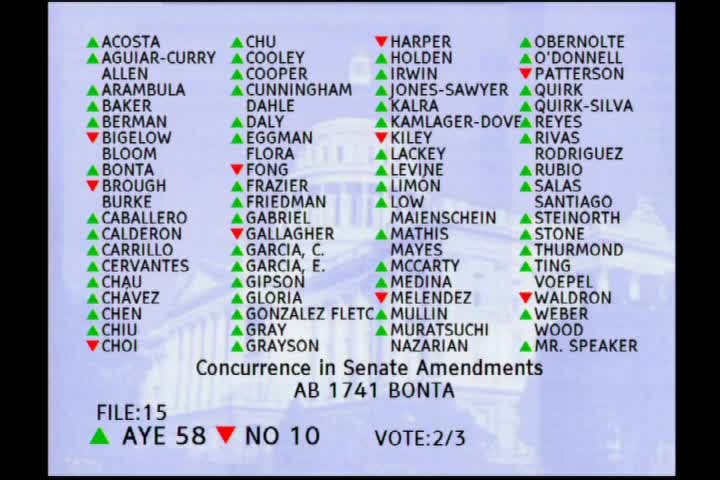 1MIN
Assembly Floor
 2MIN
Senate Floor
 4MIN
Senate Standing Committee on Transportation and Housing
 2MIN
Assembly Floor
 29SEC
Assembly Standing Committee on Appropriations
 4MIN
Assembly Standing Committee on Housing and Community Development
Bill Author

Bill Co-Author(s):