AB 2269: CalWORKs: eligibility.
- Session Year: 2017-2018
- House: Assembly
- Latest Version Date: 2018-03-14
Existing law provides for the California Work Opportunity and Responsibility to Kids (CalWORKs) program, under which each county provides cash assistance and other benefits to qualified low-income families and individuals. Existing law prohibits the granting of CalWORKs aid to a child who has attained 18 years of age unless the child is less than 19 years of age, is attending high school or vocational training on a full-time basis, and is reasonably expected to complete the educational or training program before his or her 19th birthday.
This bill would extend this exception to make a person who is less than 22 20 years of age eligible for CalWORKs assistance if he or she is attending high school or vocational training on a full-time basis and is reasonably expected to complete the educational or training program before his or her 22nd 20th birthday. By expanding eligibility for CalWORKs, which is administered by counties, this bill would impose a state-mandated local program.
Existing law continuously appropriates moneys from the General Fund to defray a portion of county costs under the CalWORKs program.
This bill would instead provide that the continuous appropriation would not be made for purposes of implementing the bill.
The California Constitution requires the state to reimburse local agencies and school districts for certain costs mandated by the state. Statutory provisions establish procedures for making that reimbursement.
This bill would provide that, if the Commission on State Mandates determines that the bill contains costs mandated by the state, reimbursement for those costs shall be made pursuant to the statutory provisions noted above.
Existing law provides for the California Work Opportunity and Responsibility to Kids (CalWORKs) program, under which each county provides cash assistance and other benefits to qualified low-income families and individuals. Existing law prohibits the granting of CalWORKs aid to a child who has attained 18 years of age unless the child is less than 19 years of age, is attending high school or vocational training on a full-time basis, and is reasonably expected to complete the educational or training program before his or her 19th birthday.
This bill would extend this exception to make a person who is less than 22 years of age eligible for CalWORKs assistance if he or she is attending high school or vocational training on a full-time basis and is reasonably expected to complete the educational or training program before his or her 22nd birthday. By expanding eligibility for CalWORKs, which is administered by counties, this bill would impose a state-mandated local program.
Existing law continuously appropriates moneys from the General Fund to defray a portion of county costs under the CalWORKs program.
This bill would instead provide that the continuous appropriation would not be made for purposes of implementing the bill.
The California Constitution requires the state to reimburse local agencies and school districts for certain costs mandated by the state. Statutory provisions establish procedures for making that reimbursement.
This bill would provide that, if the Commission on State Mandates determines that the bill contains costs mandated by the state, reimbursement for those costs shall be made pursuant to the statutory provisions noted above.
(a)Except as provided in subdivision (b), aid shall not be granted under this chapter to, or on behalf of, any person who has attained 18 years of age unless all of the following apply:
(1)The person is less than 22 20 years of age and is attending high school or the equivalent level of vocational or technical training on a full-time basis.
(2)The person can reasonably be expected to complete the educational or training program before his or her 22nd 20th birthday.
(b)(1)Aide Aid shall be granted under this chapter to, or on behalf of, any nonminor dependent, as defined in subdivision (v) of Section 11400, if the nonminor dependent is placed in the approved home of a relative under the supervision of the county child welfare or probation department or Indian tribe that has entered into an agreement pursuant to Section 10553.1, and the nonminor dependent otherwise is eligible pursuant to Section 11403.
(2)The eligible nonminor dependent is exempt from Chapter 4.6 (commencing with Section 10830) of Part 2 governing the statewide fingerprint imaging system.
(c)Notwithstanding any other law, payment of aid under this chapter may be made out of state if the nonminor dependent who is described in subdivision (b) is placed in the approved home of a relative who resides in another state.
SEC. 2.No appropriation pursuant to Section 15200 of the Welfare and Institutions Code shall be made for purposes of implementing this act.
SEC. 3.If the Commission on State Mandates determines that this act contains costs mandated by the state, reimbursement to local agencies and school districts for those costs shall be made pursuant to Part 7 (commencing with Section 17500) of Division 4 of Title 2 of the Government Code.
(a)Except as provided in subdivision (b), aid shall not be granted under this chapter to to, or on behalf of of, any child person who has attained 18 years of age unless all of the following apply:
(1)The child person is less than 19 22 years of age and is attending high school or the equivalent level of vocational or technical training on a full-time basis.
(2)The child person can reasonably be expected to complete the educational or training program before his or her 19th 22nd birthday.
(b)(1)On and after January 1, 2012, aid Aide shall be granted under this chapter to to, or on behalf of of, any nonminor dependent, as defined in subdivision (v) of Section 11400, if the nonminor dependent is placed in the approved home of a relative under the supervision of the county child welfare or probation department or Indian tribe that has entered into an agreement pursuant to Section 10553.1, and the nonminor dependent otherwise is eligible pursuant to Section 11403.
(2)The eligible nonminor dependent shall be is exempt from Chapter 4.6 (commencing with Section 10830) of Part 2 governing the statewide fingerprint imaging system.
(c)Notwithstanding any other law, payment of aid under this chapter may be made out of state if the nonminor dependent who is described in subdivision (b) is placed in the approved home of a relative who resides in another state.
SEC. 2.No appropriation pursuant to Section 15200 of the Welfare and Institutions Code shall be made for purposes of implementing this act.
SEC. 3.If the Commission on State Mandates determines that this act contains costs mandated by the state, reimbursement to local agencies and school districts for those costs shall be made pursuant to Part 7 (commencing with Section 17500) of Division 4 of Title 2 of the Government Code.
|
Date
|
Status
|
|---|---|
| Aug 16, 2018 | In committee: Held under submission. |
| Jun 25, 2018 | In committee: Referred to APPR. suspense file. |
| Jun 13, 2018 | From committee: Do pass and re-refer to Com. on APPR. (Ayes 6. Noes 0.) (June 12). Re-referred to Com. on APPR. |
| Jun 7, 2018 | Referred to Com. on HUMAN S. |
| May 30, 2018 | In Senate. Read first time. To Com. on RLS. for assignment. |
| May 29, 2018 | Read third time. Passed. Ordered to the Senate. |
| May 25, 2018 | Read second time. Ordered to third reading. |
| Apr 18, 2018 | In committee: Set, first hearing. Referred to APPR. suspense file. |
| Mar 21, 2018 | From committee: Do pass and re-refer to Com. on APPR. with recommendation: To Consent Calendar. (Ayes 7. Noes 0.) (March 20). Re-referred to Com. on APPR. |
| Mar 15, 2018 | Re-referred to Com. on HUM. S. |
| Mar 14, 2018 | From committee chair, with author's amendments: Amend, and re-refer to Com. on HUM. S. Read second time and amended. |
| Mar 1, 2018 | Referred to Com. on HUM. S. |
| Feb 14, 2018 | From printer. May be heard in committee March 16. |
| Feb 13, 2018 | Read first time. To print. |
|
Date
|
Description
|
Location
|
Votes
|
|
|---|---|---|---|---|
| Jun 25, 2018 | Placed on suspense file | Senate Standing Committee on Appropriations |
Passed |
|
| Jun 12, 2018 | Do pass, but first be re-referred to the Committee on [Appropriations] | Senate Standing Committee on Human Services |
Passed |
|
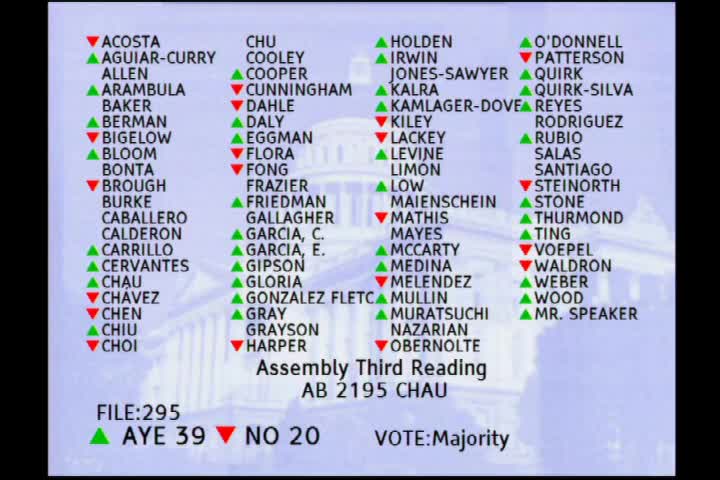
| May 29, 2018 | AB 2269 LACKEY Assembly Third Reading | Assembly Floor |
Passed |
|
| May 25, 2018 | Do pass. | Assembly Standing Committee on Appropriations |
Passed |
|
| Mar 20, 2018 | Do pass and be re-referred to the Committee on [Appropriations] with recommendation: To Consent Calendar | Assembly Standing Committee on Human Services |
Passed |
This list shows positions taken on this bill by organizations on the date displayed, which is linked to the original source.
Positions by individuals are not included.
SENATE COMMITTEE ON APPROPRIATIONS
Senator Anthony Portantino, Chair
2017 - 2018 Regular Session
AB 2269 (Lackey) - CalWORKs: eligibility
Version: March 14, 2018 | Policy Vote: HUMAN S. 6 - 0 |
Urgency: No | Mandate: Yes |
Hearing Date: June 25, 2018 | Consultant: Debra Cooper |
This bill meets the criteria for referral to the Suspense File.
Bill Summary:
AB 2269 would increase the maximum age until which a child in a California Work Opportunity and Responsibility to Kids (CalWORKs) assistance unit who is attending high school or the equivalent level of training on a full-time basis, as specified, may receive CalWORKs assistance from less than 19 years of age to less than 20 years of age.
Fiscal Impact:
Estimated ongoing costs to the Department of Social Services (CDSS) of around $8 million in additional grant aid (GF). This assumes all eligible 19-year olds continue receiving aid for, on average, an additional six months. Actual costs would depend on the number of 19-years-olds who qualify and for how long.
Background:
The CalWORKs program, which implements the federal Temporary Assistance for Needy Families (TANF) program, is a welfare program that gives cash aid and employment-related services to eligible California families to move them out of poverty and help families meet basic needs. In order to be eligible for CalWORKs, families must meet income and asset tests. In addition, children must be deprived of parental support and care due to the incapacity, death, or absence of a parent or unemployment of the principal wage-earner. According to a February 2018 CalWORKs Annual Summary, the average monthly cash grant for FY 2017-18 was estimated at $564 and the maximum monthly grant amount for a family of three is $714.
Current law prohibits the receipt of CalWORKs aid by, or on behalf of, a child 18 years of age or older, except in cases where an 18 year old is attending high school or receiving the equivalent level of vocational or technical training on a full-time basis. In these cases, if the 18 year old can reasonably be expected to complete the educational or training program before turning 19 years of age, he or she may remain eligible for aid.
Proposed Law:
This bill would increase the maximum age from 19 to 20 years of age for which a child in a CalWORKs assistance unit who is attending high school or the equivalent training on a full-time basis (and is expected to complete the educational training by his/her 20th birthday) may receive CalWORKs assistance. The bill would also provide that no continuous appropriation be made to implement these provisions.
Related Legislation:
AB 2637 (O’Donnell, 2018) would have required a child who is receiving CalWORKs aid, who is not pregnant or parenting, and who attains a high school diploma or its equivalent to be eligible to receive a one-time education support in the amount of $500. This bill was held in the Assembly Committee on Appropriations.
Staff Comments:
According to CDSS, in the fourth quarter of 2017, there were approximately 3,300 cases with a potentially eligible child who is still in high school or receiving equivalent training at age 19, who is also the only child in the home. These children would receive an average of $355 per month in aid. Additionally, there are approximately 700 cases with one potentially eligible child in a home with multiple children on aid. These eligible children receive an average of $137 per month in aid. It is uncertain how many of these eligible children would remain on aid. The families that only have one child on aid, who would be eligible under this bill, would remain on aid for up to an additional year that they would not have otherwise been eligible. The families with multiple children, with only one of whom is eligible, would otherwise lose a portion of their aid. Actual costs would depend on the number of 19 year olds who are eligible, and for how long.
The exception to raise the age limit is supported by federal regulations which, for purposes of the TANF program, define "minor child" to mean "an individual who: 1) has not attained 18 years of age; or 2) has not attained 19 years of age and is a full-time student in a secondary school (or in the equivalent level of vocational or technical training). According to CDSS, this federal regulation does not preclude California from raising the age limit to 20, as proposed by this bill, but it does mean that the costs attending this change cannot be paid for using federal TANF dollars.
-- END --
SENATE COMMITTEE ON HUMAN SERVICES
Senator Wiener, Chair
2017 - 2018 Regular
Bill No: AB 2269
Author: | Lackey | ||
Version: | March 14, 2018 | Hearing Date: | June 12, 2018 |
Urgency: | No | Fiscal: | Yes |
Consultant: | Taryn Smith | ||
Subject: CalWORKs: eligibility.
SUMMARY
This bill increases the maximum age until which a child in a CalWORKs assistance unit who is attending high school or the equivalent level of training on a full-time basis, as specified, may receive CalWORKs assistance from less than 19 years of age to less than 20 years of age.
ABSTRACT
Existing law:
- Establishes the federal Temporary Assistance for Needy Families (TANF) program, which permits states to implement the program under a state plan. (42 U.S.C. 601 et seq.)
- Defines “minor child,” for purposes of TANF to mean an individual who has not attained 18 years of age; or has not attained 19 years of age and is a full-time student in a secondary school or in the equivalent level of vocational or technical training. (45 C.F.R. 260.30).
- Establishes in state law the CalWORKs program to provide cash assistance and other services for low-income families through the federal TANF program. Under CalWORKs, each county provides assistance through a combination of state, county and federal TANF funds. (WIC 10530, 11200)
- Establishes income, asset and real property limits to determine eligibility for CalWORKs program participants, including net income below the MAP, based on family size and county of residence, which is around 40 percent of the federal poverty level (FPL). (WIC 11150 et seq., 11450 et seq.)
- Establishes a 48-month lifetime limit on CalWORKs benefits for eligible adults, including a “24-month time clock” (24 cumulative, but not necessarily consecutive, months) during which a recipient has broad range of permissible activities, and after which, a recipient must meet the more stringent federal work requirements in order to retain eligibility. (WIC 11454, 11322.85)
- Requires, generally, a recipient of CalWORKs benefits to participate in welfare-to-work (WTW) activities as a condition of eligibility for aid. (WIC 11320 et seq.)
- Prohibits CalWORKs aid from being granted to or on behalf of any child who has reached 18 years of age unless the child is less than 19 years of age and attending high school or the equivalent level of vocational or technical training on a full-time basis and can reasonably be expected to complete the educational or training program prior to his or her 19th birthday. (WIC 11253)
This bill:
- Prohibits aid from being granted to, or on behalf of, any person who has attained 18 years of age unless all of the following apply:
- The person is less than 20 years of age and is attending high school or the equivalent level of vocational or technical training on a full-time basis, and;
- The person can reasonably be expected to complete the educational or training program before his or her 20th birthday.
- Provides that no continuous appropriation, as specified, shall be made to implement the provisions of this bill
- Makes technical changes.
FISCAL IMPACT
According to the Assembly Appropriations Committee on April 18, 2018, this bill may result in estimated ongoing annual costs to the Department of Social Services (DSS) in the range of $2.3 million to $6.5 million (General Fund), assuming between 25% and 75% of potentially eligible 18-year-olds receive aid for an additional six months upon turning 19. Actual costs would depend on the number of 19-year-olds who qualify and for how long.
The Assembly Appropriations Committee notes that this bill would impact 18-year-old children who are still in high school or receiving equivalent training who don't finish before they turn 19 years of age. Under this bill, such children would be eligible for aid until they turn 20 or complete school or training, whichever comes first. According to DSS, in the fourth quarter of 2017, there were nearly 3,300 cases with a potentially eligible child who is the only child in the home. These children receive an average of $355 per month in aid. In addition, there are 700 cases with one potentially eligible child in a home with multiple children on aid. These eligible children receive an average of $137 per month.
BACKGROUND AND DISCUSSION
Purpose of the bill:
This bill is designed to help low-income youth complete their high school requirements or their equivalent. According to the author, "Individuals who have a General Educational Development (GED) credential can earn the same level of weekly wages as high school graduates.” While the CalWORKs program is designed to break the cycle of poverty, “the current program structure inaccurately excludes benefits from individuals who are pursuing education simply because of his or her age,” the author states.
CalWORKs
Federal welfare reform of the mid-1990s created the TANF program at the federal level and led to the establishment of CalWORKs in California. When creating CalWORKs, the Legislature declared its intent that CalWORKs would reduce child poverty in the state, achieve TANF goals, and meet requirements of federal law. As one of California’s largest anti-poverty programs, CalWORKs provides cash assistance to more than 450,000 families and 860,000 children. CalWORKs is funded with a mix of federal TANF money, state, and county funds. California Department of Social Services (CDSS) is the designated state agency responsible for program supervision at the state level. The counties are responsible for administering the program at the local level.
In order to be eligible for CalWORKs, families must meet income and asset tests. For example, a family of three living in a higher cost of living region could qualify to receive CalWORKs benefits if their monthly adjusted income is no more than $1,342. The same family living in a lower cost-of-living region would qualify if their monthly adjusted income is no more than $1,274.
In addition to cash assistance, CalWORKs recipients may receive employment-related services aimed at moving children out of poverty and helping families meet basic needs. Recipients are typically required to perform certain activities as a condition of receiving benefits and there are limits on the time period during which adults may receive benefits. These services are outlined in a WTW plan, which can include public or private sector subsidized or unsubsidized employment; on-the-job training; community service; secondary school, adult basic education and vocational education and training when the education is needed for the recipient to become employed; specific mental health, substance abuse, or domestic violence services if they are necessary to obtain or retain employment; and a number of other activities necessary to assist a recipient in obtaining unsubsidized employment.
Current state law prohibits the receipt of CalWORKs aid by, or on behalf of, a child 18 years of age or older. However, there is an exception to this prohibition in cases where an 18-year-old is attending high school or receiving the equivalent level of vocational or technical training on a full time basis. In such cases, provided the 18-year old can reasonably be expected to complete the educational or training program before turning 19, he or she may remain eligible for aid. This exception is supported by federal regulations which, for purposes of the TANF program, define "minor child" to mean "an individual who: 1) has not attained 18 years of age; or 2) has not attained 19 years of age and is a full-time student in a secondary school (or in the equivalent level of vocational or technical training)”. According to CDSS, this federal regulation does not preclude California from raising the age limit to 20, as proposed by this bill, but it does mean that the costs attending this change cannot be paid for using federal TANF dollars.
According to a report issued by US Department of Labor’s Bureau of Labor Statistics, in 2014, 18.3 percent of the working poor had not obtained a high school diploma and 8.3 percent of the working poor had obtained a high school diploma, but no college education.[1] In a separate report by the Bureau of Labor Statistics, the average weekly income for a worker with less than a high school diploma in 2015 was $493. The same report shows high school graduates earning $678 per week. Additionally, unemployment rates for a worker with less than a high school diploma were about 8 percent, which was almost double that of the national average. [2]
Related legislation:
AB 2637 (O’Donnell, 2018) would require a child who is receiving CalWORKs aid, who is not pregnant or parenting, and who attains a high school diploma or its equivalent to be eligible to receive a one-time education support in the amount of $500. This bill was held in the Assembly Committee on Appropriations.
PRIOR VOTES
Assembly Floor: | 76 - 0 |
Assembly Appropriations Committee: | 16 - 0 |
Assembly Human Services Committee: | 7 - 0 |
POSITIONS
Support:
Western Center on Law and Poverty (Sponsor)
Coalition of California Welfare Rights Organizations (Sponsor)
California Alternative Payment Program
California Association of Food banks
California Immigrant Policy Center
Family Assistance Program
SEIU California
The Alliance for Children’s Rights
Women Organizing Resources Knowledge and Services
Oppose:
None received
-- END --
ASSEMBLY THIRD READING
ATR Bill Id:AB 2269
Author:(Lackey)
As Amended Ver:March 14, 2018
Majority vote
Committee | Votes | Ayes | Noes |
Human Services | 7-0 | Rubio, Choi, Arambula, Maienschein, Reyes, Mark Stone, Thurmond | |
Appropriations | 16-0 | Gonzalez Fletcher, Bigelow, Bloom, Bonta, Calderon, Carrillo, Chau, Eggman, Fong, Friedman, Gallagher, Eduardo Garcia, Nazarian, Obernolte, Quirk, Reyes |
|
SUMMARY: Increases from less than 19 years to less than 20 years of age the maximum age until which a child in a CalWORKs assistance unit who is attending high school or the equivalent level of training on a full-time basis, as specified, may receive CalWORKs assistance; provides that no continuous appropriation, as specified, shall be made to implement the provisions of this bill; and makes technical changes.
EXISTING LAW:
- Establishes under federal law the Temporary Assistance for Needy Families (TANF) program to provide aid and welfare-to-work services to eligible families and, in California, provides that TANF funds for welfare-to-work services are administered through the CalWORKs program. (42 United Stated Code Section (U.S.C.) 601 et seq., Welfare and Institutions Code Section (WIC) 11200 et seq.)
- Establishes income, asset, and real property limits used to determine eligibility for the CalWORKs program, including net income below the Maximum Aid Payment (MAP), based on family size and county of residence, which is around 40% of the Federal Poverty Level. (WIC 11150 to 11160, 11450 et seq.)
- Establishes a 48-month lifetime limit on CalWORKs benefits for eligible adults, including a period beyond the "24-month time clock" during which a recipient must meet federal work requirements in order to retain eligibility. (WIC 11454, 11322.85)
- Requires all individuals 16 years of age or older, unless they are otherwise exempt, to participate in welfare-to-work activities as a condition of eligibility for CalWORKs. (WIC 11320.3, 11322.6)
- Establishes the number of weekly hours of welfare-to-work participation necessary to remain eligible for aid, including requirements for an unemployed parent in a two-parent assistance unit, as specified. (WIC 11322.8)
- Prohibits CalWORKs aid from being granted to or on behalf of any child who has reached 18 years of age unless the child is less than 19 years of age and attending high school or the equivalent level of vocational or technical training on a full-time basis and can reasonably be expected to complete the educational or training program prior to his or her 19th birthday.
FISCAL EFFECT: According to the Assembly Appropriations Committee on April 18, 2018, this bill may result in estimated ongoing annual costs to the Department of Social Services (DSS) in the range of $2.3 million to $6.5 million (General Fund), assuming between 25% and 75% of potentially eligible 18-year-olds receive aid for an additional six months upon turning 19. Actual costs would depend on the number of 19-year-olds who qualify and for how long.
The Assembly Appropriations Committee notes that this bill would impact 18-year-old children who are still in high school or receiving equivalent training who don't finish before they turn 19 years of age. Under this bill, such children would be eligible for aid until they turn 20 or complete school or training, whichever comes first. According to DSS, in the fourth quarter of 2017, there were nearly 3,300 cases with a potentially eligible child who is the only child in the home. These children receive an average of $355 per month in aid. In addition, there are 700 cases with one potentially eligible child in a home with multiple children on aid. These eligible children receive an average of $137 per month.
COMMENTS:
CalWORKs: CalWORKs is a county-administered public assistance program that is funded in part by the federal TANF block grant and that aims to help children and families meet basic needs and move out of poverty. Families receive cash assistance and have access to a variety of services, including, where applicable, child care, as well as services aimed at addressing mental health needs, substance use disorders, instances of domestic violence, and learning disabilities, among other issues. Parents must develop and participate in a welfare-to-work plan, unless exempted or otherwise not required to participate. The maximum CalWORKs grant for a family of three living in a high cost county, if the family has no other income, is $714 per month. For Fiscal Year 2017-18, the average monthly CalWORKs cash grant is $564 per household. In Fiscal Year 2016-17, the average monthly CalWORKs caseload was 452,770 households, of which 154,005 were single-parent households and 234,766 were households where only the child or children received aid.
The CalWORKs program typically requires recipients to participate in welfare-to-work requirements, which can include public or private sector subsidized or unsubsidized employment; on-the-job training; community service; secondary school, adult basic education and vocational education and training when the education is needed for the recipient to become employed; specific mental health, substance abuse, or domestic violence services if they are necessary to obtain or retain employment; and a number of other activities necessary to assist a recipient in obtaining unsubsidized employment.
SB 1041 (Senate Committee on Budget and Fiscal Review), Chapter 47, Statutes of 2012, adopted a number of changes to the CalWORKs program, including the establishment of the 24-month time clock. While most adult recipients are expected to participate in welfare-to-work activities during the up to 48 months for which they may receive assistance, those participation requirements can include a broad range of activities for 24 of those 48 months, such as employment, training, education, and mental health, domestic violence, and substance abuse services. After this 24-month time clock "runs out," recipients must meet the less-flexible federal TANF requirements in order to remain eligible for aid. A CalWORKs recipient who does not meet his or her welfare-to-work requirements and is not exempt from them is subject to sanction, which results in that individual's portion of the family's grant being subtracted from the total grant amount provided to the family to meet basic needs.
Current law prohibits the receipt of CalWORKs aid by, or on behalf of, a child 18 years of age or older. However, there is an exception to this prohibition in cases where an 18-year-old is attending high school or receiving the equivalent level of vocational or technical training on a full time basis; in these instances, provided the child can reasonably be expected to complete the educational or training program before turning 19, he or she may remain eligible for aid. This exception is supported by federal regulations which, for purposes of the TANF program, define "minor child" to mean "an individual who: 1) has not attained 18 years of age; or 2) has not attained 19 years of age and is a full-time student in a secondary school (or in the equivalent level of vocational or technical training)" (Code of Federal Regulations, Title 45, Section 260.30). According to DSS, this federal regulation does not preclude California from raising the age limit to 20, as proposed by this bill, but it does mean that the costs attending this change cannot be paid for using federal TANF dollars.
Need for this bill: According to the author, "Individuals who have a General Educational Development (GED) credential can earn the same level of weekly wages as high school graduates. A GED can increase income earning potential by roughly $115 per week in comparison to individuals with no high school degree or its equivalent. In today's competitive economy, completing a high school degree or its equivalent is imperative for economic success. Statistics show that 60% of job opportunities in the skilled labor force mandate a high school degree or its equivalent. A GED can ensure a socioeconomically disadvantaged individual escapes his or her economic circumstances. The CalWORKs program is designed to break the cycle of poverty. Yet, the current program structure inaccurately excludes benefits from individuals who are pursuing education simply because of his or her age. [This bill] is designed to help low-income youth complete their high school requirements or their equivalent."
Analysis Prepared by: Daphne Hunt / HUM. S. / (916) 319-2089 FN: 0003199
Date of Hearing: April 18, 2018
ASSEMBLY COMMITTEE ON APPROPRIATIONS
Lorena Gonzalez Fletcher, Chair
ABPCA Bill Id:AB 2269
Author:(Lackey) – As Amended Ver:March 14, 2018
Policy Committee: | Human Services | Vote: | 7 - 0 |
|
| ||
|
|
Urgency: No State Mandated Local Program: Yes Reimbursable: Yes
SUMMARY:
This bill increases, from 18 years of age to 19 years of age, the maximum age a “child” may be and remain eligible to receive CalWORKs aid, provided that child is still attending high school or the equivalent level of training full-time, and can be reasonably expected to complete the education or training program prior to their 20th birthday.
FISCAL EFFECT:
Estimated ongoing annual costs to DSS in the range of $ 2.3 million to $6.5 million (GF), assuming between 25% and 75% of potentially eligible 18-year-olds receive aid for an additional six months upon turning 19. Actual costs would depend on the number of 19-year-olds who qualify and for how long.
This bill would impact 18-year-old children who are still in high school or receiving equivalent training who don’t finish before they turn 19 years of age. Under this bill, such children would be eligible for aid until they turn 20 or complete school or training, whichever comes first. According to DSS, in the fourth quarter of 2017, there were nearly 3,300 cases with a potentially eligible child who is the only child in the home. These children receive an average of $355 per month in aid. In addition, there are 700 cases with one potentially eligible child in a home with multiple children on aid. These eligible children receive an average of $137 per month.
COMMENTS:
- Purpose. This bill seeks to assist CalWORKs recipients who are 18 years of age complete their high school education or equivalent training by increasing to 19 years of age the maximum age at which a recipient may receive aid if they are still in high school or receiving qualified training. According to the author:
The CalWORKs program is designed to break the cycle of poverty. Yet, the current program structure inaccurately excludes benefits from individuals who are pursuing education simply because of his or her age. [This bill] is designed to help low-income youth complete their high school requirements or their equivalent.
- Background. The CalWORKs program typically requires recipients to participate in welfare-to-work requirements, which can include public or private sector subsidized or unsubsidized employment; on-the-job training; community service; secondary school, adult basic education and vocational education and training when the education is needed for the recipient to become employed; specific mental health, substance abuse, or domestic violence services if they are necessary to obtain or retain employment; and a number of other activities necessary to assist a recipient in obtaining unsubsidized employment.
Current law prohibits the receipt of CalWORKs aid by, or on behalf of, a child 18 years of age or older, unless the 18-year-old is attending high school or receiving the equivalent level of vocational or technical training on a full time basis. In these instances, provided the child can reasonably be expected to complete the educational or training program before turning 19, he or she may remain eligible for aid. This exception is supported by federal regulations.
According to DSS, federal regulation does not preclude California from raising the age limit to 20, as proposed by this bill, but notes that the costs cannot be paid for using federal TANF dollars.
For FY 2017-18, the average monthly CalWORKs cash grant is $564 per household. In FY 2016-17, the average monthly CalWORKs caseload was 452,770 households, of which 154,005 were single-parent households and 234,766 were households where only the child or children received aid.
- Related Legislation. AB 2637 (O’Donnell), of the 2017-18 Legislative Session, requires a child who is receiving CalWORKs aid, who is not pregnant or parenting, and who attains a high school diploma or its equivalent to be eligible to receive a one-time education support in the amount of $500. AB 2637 is pending hearing in this Committee.
Analysis Prepared by: Jennifer Swenson / APPR. / (916) 319-2081
Date of Hearing: March 20, 2018
ASSEMBLY COMMITTEE ON HUMAN SERVICES
Blanca Rubio, Chair
ABPCA Bill Id:AB 2269 (
Author:Lackey) – As Amended Ver:March 14, 2018
SUBJECT: CalWORKs: eligibility
SUMMARY: Increases from less than 19 years to less than 20 years of age the maximum age until which a child in a CalWORKs assistance unit who is attending high school or the equivalent level of training on a full-time basis, as specified, may receive CalWORKs assistance; provides that no continuous appropriation, as specified, shall be made to implement the provisions of this bill; and makes technical changes.
EXISTING LAW:
- Establishes under federal law the Temporary Assistance for Needy Families (TANF) program to provide aid and welfare-to-work services to eligible families and, in California, provides that TANF funds for welfare-to-work services are administered through the CalWORKs program. (42 U.S.C. 601 et seq., WIC 11200 et seq.)
- Establishes income, asset, and real property limits used to determine eligibility for the CalWORKs program, including net income below the Maximum Aid Payment (MAP), based on family size and county of residence, which is around 40% of the Federal Poverty Level. (WIC 11150 to 11160, 11450 et seq.)
- Establishes a 48-month lifetime limit on CalWORKs benefits for eligible adults, including a period beyond the “24-month time clock” during which a recipient must meet federal work requirements in order to retain eligibility. (WIC 11454, 11322.85)
- Requires all individuals 16 years of age or older, unless they are otherwise exempt, to participate in welfare-to-work activities as a condition of eligibility for CalWORKs.
(WIC 11320.3, 11322.6)
- Establishes the number of weekly hours of welfare-to-work participation necessary to remain eligible for aid, including requirements for an unemployed parent in a two-parent assistance unit, as specified. (WIC 11322.8)
- Prohibits CalWORKs aid from being granted to or on behalf of any child who has reached 18 years of age unless the child is less than 19 years of age and attending high school or the equivalent level of vocational or technical training on a full-time basis and can reasonably be expected to complete the educational or training program prior to his or her 19th birthday.
FISCAL EFFECT: Unknown
COMMENTS:
CalWORKs: CalWORKs is a county-administered public assistance program that is funded in part by the federal TANF block grant and that aims to help children and families meet basic needs and move out of poverty. Families receive cash assistance and have access to a variety of services, including, where applicable, child care, as well as services aimed at addressing mental health needs, substance use disorders, instances of domestic violence, and learning disabilities, among other issues. Parents must develop and participate in a welfare-to-work plan, unless exempted or otherwise not required to participate. The maximum CalWORKs grant for a family of three living in a high cost county, if the family has no other income, is $714 per month. For Fiscal Year 2017-18, the average monthly CalWORKs cash grant is $564 per household. In Fiscal Year 2016-17, the average monthly CalWORKs caseload was 452,770 households, of which 154,005 were single-parent households and 234,766 were households where only the child or children received aid.
The CalWORKs program typically requires recipients to participate in welfare-to-work requirements, which can include public or private sector subsidized or unsubsidized employment; on-the-job training; community service; secondary school, adult basic education and vocational education and training when the education is needed for the recipient to become employed; specific mental health, substance abuse, or domestic violence services if they are necessary to obtain or retain employment; and a number of other activities necessary to assist a recipient in obtaining unsubsidized employment.
SB 1041 (Senate Committee on Budget and Fiscal Review), Chapter 47, Statutes of 2012, adopted a number of changes to the CalWORKs program, including the establishment of the 24-month time clock. While most adult recipients are expected to participate in welfare-to-work activities during the up to 48 months for which they may receive assistance, those participation requirements can include a broad range of activities for 24 of those 48 months, such as employment, training, education, and mental health, domestic violence, and substance abuse services. After this 24-month time clock “runs out,” recipients must meet the less-flexible federal TANF requirements in order to remain eligible for aid. A CalWORKs recipient who does not meet his or her welfare-to-work requirements and is not exempt from them is subject to sanction, which results in that individual’s portion of the family’s grant being subtracted from the total grant amount provided to the family to meet basic needs.
Current law prohibits the receipt of CalWORKs aid by, or on behalf of, a child 18 years of age or older. However, there is an exception to this prohibition in cases where an 18-year-old is attending high school or receiving the equivalent level of vocational or technical training on a full time basis; in these instances, provided the child can reasonably be expected to complete the educational or training program before turning 19, he or she may remain eligible for aid. This exception is supported by federal regulations which, for purposes of the TANF program, define “minor child” to mean “an individual who: 1) has not attained 18 years of age; or 2) has not attained 19 years of age and is a full-time student in a secondary school (or in the equivalent level of vocational or technical training)” (Code of Federal Regulations, Title 45, Section 260.30). According to the Department of Social Services (DSS), this federal regulation does not preclude California from raising the age limit to 20, as proposed by this bill, but it does mean that the costs attending this change cannot be paid for using federal TANF dollars.
Need for this bill: According to the author, “Individuals who have a General Educational Development (GED) credential can earn the same level of weekly wages as high school graduates. A GED can increase income earning potential by roughly $115 per week in comparison to individuals with no high school degree or its equivalent. In today’s competitive economy, completing a high school degree or its equivalent is imperative for economic success. Statistics show that 60% of job opportunities in the skilled labor force mandate a high school degree or its equivalent. A GED can ensure a socioeconomically disadvantaged individual escapes his or her economic circumstances. The CalWORKs program is designed to break the cycle of poverty. Yet, the current program structure inaccurately excludes benefits from individuals who are pursuing education simply because of his or her age. [This bill] is designed to help low-income youth complete their high school requirements or their equivalent.”
RELATED AND PRIOR LEGISLATION:
AB 2637 (O’Donnell), 2018, would require a child who is receiving CalWORKs aid, who is not pregnant or parenting, and who attains a high school diploma or its equivalent to be eligible to receive a one-time education support in the amount of $500. It is currently scheduled to be heard in the Assembly Human Services Committee on April 10, 2018.
REGISTERED SUPPORT / OPPOSITION:
Support
American Academy of Pediatrics
California Association of Food Banks
California Catholic Conferences
California Immigrant Policy Center
Children’s Defense Fund-California
Coalition of California Welfare Rights Organizations (sponsor)
WORKS
Opposition
None on file.
Analysis Prepared by: Daphne Hunt / HUM. S. / (916) 319-2089
Discussed in Hearing
 1H
Senate Standing Committee on Appropriations
 3MIN
Senate Standing Committee on Human Services
 1MIN
Assembly Floor
Bill Author

Bill Co-Author(s):