AB 2335: Nutrition Incentive Matching Grant Program: Healthy Stores Refrigeration Grant Program.
- Session Year: 2017-2018
- House: Assembly
- Latest Version Date: 2018-06-12
Existing law establishes the Office of Farm to Fork within the Department of Food and Agriculture, and requires the office, to the extent that resources are available, to work with various entities, including, among others, the agricultural industry and other organizations involved in promoting food access, to increase the amount of agricultural products available to underserved communities and schools in the state. Existing law requires the office to, among other things, identify urban and rural communities that lack access to healthy food, and to coordinate with local, state, and federal agencies to promote and increase awareness of programs that promote greater food access.
Existing law establishes the Nutrition Incentive Matching Grant Program in the Office of Farm to Fork, and creates the Nutrition Incentive Matching Grant Account in the Department of Food and Agriculture Fund to collect matching funds received from a specified federal grant program and funds from other public and private sources. Under the program, the department is required to award moneys in the account to qualified entities, as defined, to encourage the purchase and consumption of California fresh fruits, nuts, and vegetables by nutrition benefit clients, as defined. Existing law requires that grants only be provided upon the deposit of sufficient funds, as specified in the federal Food Insecurity Nutrition Incentive Grant Program application, into the Nutrition Incentive Matching Grant Account. A violation of the laws governing fruit, nut, and vegetable standards is a crime.
This bill would instead require grants to be provided upon the deposit of sufficient funds, including from an a successful application of federal grant funding, if available, into the Nutrition Incentive Matching Grant Account. The bill would require matching funds to be collected from the specified federal grant program only if those funds are available. The bill would include, in the definition of qualified entities, community-supported agriculture programs and farm stands, as defined. The bill would, notwithstanding any other law, authorize the department to provide grant funds to a grantee in advance of the expenditure of funds by the grantee for implementation of the Nutrition Incentive Matching Grant Program, instead of in the form of a reimbursement after the expenditure of funds for that program, in an amount equal to or less than 50% of the grant amount provided in the grantees grant agreement, if certain conditions are met.
The bill would create the Healthy Stores Refrigeration Grant Program in the department Account in the Department of Food and Agriculture Fund to collect funds for the Healthy Stores Refrigeration Grant Program that would be created by this bill. The bill would require funds to be deposited into the fund upon the appropriation of funds, including from an a successful application of federal grant funding, if available, by the Legislature for purposes of the Healthy Stores Refrigeration Grant Program. The bill would require the department to administer the Healthy Stores Refrigeration Grant Program and to award grants to qualified entities, as defined, for the purchase of an energy-efficient refrigeration unit or units by a small business or corner store that is located in a food desert. The bill would require a small business or corner store that purchases a refrigeration unit with grant funds to stock the unit with California-grown fresh fruits, nuts, vegetables, and minimally processed prepared foods, and to offer those items for sale. The bill would authorize not more than a city, county, city and county, or nonprofit entity that is awarded a grant to use up to 10% of Healthy Stores Refrigeration Grant Program grant funds to be used for technical assistance. The bill would authorize the department to establish regulations, minimum standards, funding schedules, and procedures for awarding grants to qualified entities, and to adopt any other regulations to implement and administer the Healthy Stores Refrigeration Grant Program. The bill would provide that certain provisions imposing criminal liability do not apply for a violation of these provisions or any regulation adopted to administer these provisions. The bill would provide that receipt of a grant under the Healthy Stores Refrigeration Grant Program or the Nutrition Incentive Matching Grant Program does not preclude the recipient from being eligible to receive a grant under the other program.
Existing law establishes the Office of Farm to Fork within the Department of Food and Agriculture, and requires the office, to the extent that resources are available, to work with various entities, including, among others, the agricultural industry and other organizations involved in promoting food access, to increase the amount of agricultural products available to underserved communities and schools in the state. Existing law requires the office to, among other things, identify urban and rural communities that lack access to healthy food, and to coordinate with local, state, and federal agencies to promote and increase awareness of programs that promote greater food access.
Existing law establishes the Nutrition Incentive Matching Grant Program in the Office of Farm to Fork, and creates the Nutrition Incentive Matching Grant Account in the Department of Food and Agriculture Fund to collect matching funds received from a specified federal grant program and funds from other public and private sources. Under the program, the department is required to award moneys in the account to qualified entities, as defined, to encourage the purchase and consumption of California fresh fruits, nuts, and vegetables by nutrition benefit clients, as defined. Existing law requires that grants only be provided upon the deposit of sufficient funds, as specified in the federal Food Insecurity Nutrition Incentive Grant Program application, into the Nutrition Incentive Matching Grant Account. A violation of the laws governing fruit, nut, and vegetable standards is a crime.
This bill would instead require grants to be provided upon the deposit of sufficient funds, including from an application of federal grant funding, if available, into the Nutrition Incentive Matching Grant Account. The bill would require matching funds to be collected from the specified federal grant program only if those funds are available. The bill would include, in the definition of qualified entities, community-supported agriculture programs and farm stands, as defined. The bill would, notwithstanding any other law, authorize the department to provide grant funds to a grantee in advance of the expenditure of funds by the grantee for implementation of the Nutrition Incentive Matching Grant Program, instead of in the form of a reimbursement after the expenditure of funds for that program, in an amount equal to or less than 50% of the grant amount provided in the grantees grant agreement, if certain conditions are met.
The bill would create the Small Business Nutrition Incentive Program within the Nutrition Incentive Matching Grant Program, Healthy Stores Refrigeration Grant Program in the department upon the appropriation of funds funds, including from an application of federal grant funding, if available, by the Legislature for purposes of the Small Business Nutrition Incentive Program and upon the receipt of matching funds from the federal Food Insecurity Nutrition Incentive Grant Program. Healthy Stores Refrigeration Grant Program. The bill would require the department to administer the program Healthy Stores Refrigeration Grant Program and to award grants to the Counties of Alameda, Los Angeles, and San Diego and the City and County of San Francisco to provide grant funds to applicant small businesses and corner stores that are located in food deserts, as defined. The bill would require these funds to be used to qualified entities, as defined, for the purchase of an energy-efficient refrigeration unit or units, and would impose other requirements on small businesses and corner stores that receive these funds. units by a small business or corner store that is located in a food desert. The bill would require a small business or corner store that purchases a refrigeration unit with grant funds to stock the unit with California-grown fresh fruits, nuts, vegetables, and minimally processed prepared foods, and to offer those items for sale. The bill would authorize not more than 5% of program 10% of Healthy Stores Refrigeration Grant Program funds to be used for technical assistance. The bill would authorize the department to establish regulations, minimum standards, funding schedules, and procedures for awarding grants to qualified entities, and to adopt any other regulations to implement and administer the program. Healthy Stores Refrigeration Grant Program. The bill would provide that certain provisions imposing criminal liability do not apply for a violation of these provisions or any regulation adopted to administer these provisions. The bill would provide that receipt of a grant under the program Healthy Stores Refrigeration Grant Program or the Nutrition Incentive Matching Grant Program does not preclude the recipient from being eligible to receive a grant under the other program.
The bill would make legislative findings and declarations as to the necessity of a special statute for the Counties of Alameda, Los Angeles, and San Diego and the City and County of San Francisco.Existing law establishes the Office of Farm to Fork within the Department of Food and Agriculture, and requires the office, to the extent that resources are available, to work with various entities, including, among others, the agricultural industry and other organizations involved in promoting food access, to increase the amount of agricultural products available to underserved communities and schools in the state. Existing law requires the office to, among other things, identify urban and rural communities that lack access to healthy food, and to coordinate with local, state, and federal agencies to promote and increase awareness of programs that promote greater food access.
Existing law establishes the Nutrition Incentive Matching Grant Program in the Office of Farm to Fork, and creates the Nutrition Incentive Matching Grant Account in the Department of Food and Agriculture Fund to collect matching funds received from a specified federal grant program and funds from other public and private sources, sources. Under the program, the department is required to award moneys in the account to qualified entities, as defined, to encourage the purchase and consumption of California fresh fruits, nuts, and vegetables by nutrition benefit clients, as defined. A violation of the laws governing fruit, nut, and vegetable standards is a crime.
This bill would include, in the definition of qualified entities, community-supported agriculture programs and farm stands, as defined. The bill would, notwithstanding any other law, authorize the department to provide grant funds to a grantee in advance of the expenditure of funds by the grantee for implementation of the Nutrition Incentive Matching Grant Program, instead of in the form of a reimbursement after the expenditure of funds for that program, in an amount equal to or less than 50% of the grant amount provided in the grantees grant agreement, if certain conditions are met.
The bill would create the Small Business Nutrition Incentive Program within the Nutrition Incentive Matching Grant Program, upon appropriation of funds by the Legislature for purposes of the Small Business Nutrition Incentive Program and upon the receipt of matching funds from the federal Food Insecurity Nutrition Incentive Grant Program. The bill would require the department to administer the program and to award grants to the Counties of Alameda, Los Angeles, and San Diego and the City and County of San Francisco to provide grant funds to applicant small businesses and corner stores that are located in food deserts, as defined. The bill would require these funds to be used to purchase an energy-efficient refrigeration unit or units, and would impose other requirements on small businesses and corner stores that receive these funds. The bill would authorize not more than 5% of program funds to be used for technical assistance. The bill would authorize the department to adopt regulations to implement and administer the program. The bill would provide that certain provisions imposing criminal liability do not apply for a violation of these provisions or any regulation adopted to administer these provisions. The bill would provide that receipt of a grant under the program or the Nutrition Incentive Matching Grant Program does not preclude the recipient from being eligible to receive a grant under the other program.
The bill would make legislative findings and declarations as to the necessity of a special statute for the Counties of Alameda, Los Angeles, and San Diego and the City and County of San Francisco.
Existing law establishes the Office of Farm to Fork within the Department of Food and Agriculture, and requires the office, to the extent that resources are available, to work with various entities, including, among others, the agricultural industry and other organizations involved in promoting food access, to increase the amount of agricultural products available to underserved communities and schools in the state. Existing law requires the office to, among other things, identify urban and rural communities that lack access to healthy food, and to coordinate with local, state, and federal agencies to promote and increase awareness of programs that promote greater food access.
Existing law establishes the Nutrition Incentive Matching Grant Program in the Office of Farm to Fork, and creates the Nutrition Incentive Matching Grant Account in the Department of Food and Agriculture Fund to collect matching funds received from a specified federal grant program and funds from other public and private sources, to encourage the purchase and consumption of California fresh fruits, nuts, and vegetables by nutrition benefit clients, as defined. A violation of the laws governing fruit, nut, and vegetable standards is a crime.
This bill would, notwithstanding any other law, authorize the department to provide grant funds to a grantee in advance of the expenditure of funds by the grantee for implementation of the Nutrition Incentive Matching Grant Program, instead of in the form of a reimbursement after the expenditure of funds for that program, in an amount equal to or less than 50% of the grant amount provided in the grantees grant agreement, if certain conditions are met.
This
The bill would create the Small Business Nutrition Incentive Program within the Nutrition Incentive Matching Grant Program, upon appropriation of funds by the Legislature for purposes of the Small Business Nutrition Incentive Program and upon the receipt of matching funds from the federal Food Insecurity Nutrition Incentive Grant Program. The bill would require the Department of Food and Agriculture department to administer the program and to award grants to the City of Los Angeles Counties of Alameda, Los Angeles, and San Diego and the City and County of San Francisco to provide grant funds to applicant small businesses and corner stores that are located in food deserts, as defined. The bill would require these funds to be used to purchase an energy-efficient refrigeration unit or units, and would impose other requirements on small businesses and corner stores that receive these funds. The bill would authorize the department to adopt regulations to implement and administer the program. The bill would provide that certain provisions imposing criminal liability do not apply for a violation of these provisions or any regulation adopted to administer these provisions.
This
The bill would make legislative findings and declarations as to the necessity of a special statute for the City of Los Angeles Counties of Alameda, Los Angeles, and San Diego and the City and County of San Francisco.
Existing law establishes the Office of Farm to Fork within the Department of Food and Agriculture, and requires the office, to the extent that resources are available, to work with various entities, including, among others, the agricultural industry and other organizations involved in promoting food access, to increase the amount of agricultural products available to underserved communities and schools in the state. Existing law requires the office to, among other things, identify urban and rural communities that lack access to healthy food, and to coordinate with local, state, and federal agencies to promote and increase awareness of programs that promote greater food access.
Existing law establishes the Nutrition Incentive Matching Grant Program in the Office of Farm to Fork, and creates the Nutrition Incentive Matching Grant Account in the Department of Food and Agriculture Fund to collect matching funds received from a specified federal grant program and funds from other public and private sources, to encourage the purchase and consumption of California fresh fruits, nuts, and vegetables by nutrition benefit clients, as defined. A violation of the laws governing fruit, nut, and vegetable standards is a crime.
This bill would create the Small Business Nutrition Incentive Program within the Nutrition Incentive Matching Grant Program, upon appropriation of funds by the Legislature for purposes of the Small Business Nutrition Incentive Program and upon the receipt of matching funds from the federal Food Insecurity Nutrition Incentive Grant Program. The bill would require the Department of Food and Agriculture to administer the program and to award grants to the City of Los Angeles and the City and County of San Francisco to provide grant funds to applicant small businesses and corner stores that are located in food deserts, as defined. The bill would require these funds to be used to purchase an energy-efficient refrigeration unit or units, and would impose other requirements on small businesses and corner stores that receive these funds. The bill would authorize the department to adopt regulations to implement and administer the program. The bill would provide that certain provisions imposing criminal liability do not apply for a violation of these provisions or any regulation adopted to administer these provisions.
This bill would make legislative findings and declarations as to the necessity of a special statute for the City of Los Angeles and the City and County of San Francisco.
The Legislature finds and declares all of the following:
(a)Since its inception in 2009, Market Match, the states largest nutrition incentive program, has encouraged the purchase and consumption of California fresh fruits, nuts, and vegetables by directly linking California specialty crop producers with nutrition benefit clients and doubling the purchasing value of the nutrition assistance received by nutrition benefit clients when they purchase California fresh fruits, nuts, and vegetables.
(b)Market Match dollars provide incentives for new consumers to visit local farmers markets and purchase healthy produce, benefiting both their health and the health of local economies.
(c)The Market Match program has acted as an economic stimulus to local agricultural economies throughout the state by increasing the number of loyal customers, and the purchasing power of those customers, in areas including food deserts, where California fresh fruits, nuts, and vegetables are scarce.
(d)Data shows that the Market Match program has completed over 300,000 incentive transactions at 300 participating sites in over 31 counties.
(e)Data shows that Market Match dollars have had a six-fold return on investment (ROI) in farmers market sales.
(f)The Pacific Coast Farmers Market Associations business analysis of ROIs for Market Match programs in 2012 held in various regions and cities showed the following rates of ROI throughout the state:
(1)The East Bay region and the City and County of San Francisco: 132 percent ROI.
(2)The City of Long Beach: 257 percent ROI.
(3)The City of Huntington Park: 403 percent ROI.
(4)The City of Davis: 390 percent ROI.
(5)The City of Woodland: 576 percent ROI.
(6)The City of Monterey: 717 percent ROI.
(g)Market Match is currently utilizing $3 million per year to service 300 sites, and demand is outstripping supply of available matching funds.
(h)Scaling up the Market Match program to serve 600 farmers markets, farm stands, or community supported agriculture programs throughout the state would be beneficial to the health of local economies and the state economy while simultaneously improving the health of the most vulnerable families throughout California.
(i)The statewide Nutrition Incentive Matching Grant Program (Chapter 13 (commencing with Section 49010) of Division 17 of the Food and Agricultural Code), modeled after the successful experience of the Market Match program, helps to draw down federal funds and attract community-based philanthropy to further maximize access to fresh healthy foods and stimulate local economies in a more equitable cross section of communities.
SEC. 2.Section 49012 of the Food and Agricultural Code is amended to read:49012.For purposes of this chapter, the following definitions shall apply:
(a)Consumer incentive program means a program administered by a qualified entity that increases the purchasing value of a nutrition benefit clients benefits when the benefits are used to purchase California fresh fruits, nuts, and vegetables.
(b)Nutrition benefit client means a person who receives services or payments through any of the following:
(1)California Special Supplemental Nutrition Program for Women, Infants, and Children, as described in Section 123280 of the Health and Safety Code.
(2)CalWORKs program, as described in Chapter 2 (commencing with Section 11200) of Part 3 of Division 9 of the Welfare and Institutions Code.
(3)CalFresh, as described in Section 18900.2 of the Welfare and Institutions Code.
(4)Implementation of the federal WIC Farmers Market Nutrition Act of 1992 (Public Law 102-314).
(5)The Senior Farmers Market Nutrition Program, as described in Section 3007 of Title 7 of the United States Code.
(6)Supplemental Security Income or State Supplementary Payment, as described in Section 1381 and following of Title 42 of the United States Code.
(c)Qualified entity means either of the following:
(1)A certified farmers market, as described in Section 47004, an association of certified producers, a community-supported agriculture program, as defined in Section 47060, a farm stand, as defined in Section 47050, or a nonprofit organization representing a collective or association of certified producers that is authorized by the United States Department of Agriculture to accept federal Supplemental Nutrition Assistance Program (Chapter 51 (commencing with Section 2011) of Title 7 of the United States Code) benefits from recipient purchasers at a farmers market. Certified producers shall be certified by the county agricultural commissioner pursuant to Section 47020.
(2)A small business, as defined in Section 14837 of the Government Code, that sells California grown fresh fruits, nuts, and vegetables and that is authorized to accept nutrition benefits from any of the programs listed in paragraphs (1) to (6), inclusive, of subdivision (b).
SEC. 3.Section 49013 of the Food and Agricultural Code is amended to read:49013.(a)The Nutrition Incentive Matching Grant Account is hereby created in the Department of Food and Agriculture Fund to collect matching funds from the federal Food Insecurity Nutrition Incentive Grant Program (7 U.S.C. Sec. 7517), if available, and from other public and private sources, to provide grants under the Nutrition Incentive Matching Grant Program. The Nutrition Incentive Matching Grant Program shall provide grants upon the deposit of sufficient funds, including from an a successful application of federal grant funding, if available, into the Nutrition Incentive Matching Grant Account.
(b)Notwithstanding any other law, the department may provide grant funds to a grantee in advance of the expenditure of funds by the grantee for implementation of the Nutrition Incentive Matching Grant Program, instead of in the form of a reimbursement after the expenditure of funds for that program, in an amount equal to or less than 50 percent of the grant amount provided in the grantees grant agreement pursuant to subdivision (a) and Section 49014, if both of the following conditions are met:
(1)The grantee has an operating budget of no more than five hundred thousand dollars ($500,000).
(2)The department makes a determination, based on a review of the grantee, that the grantee has modest reserves and potential cashflow problems and that an advance payment is essential for the effective implementation of the Nutrition Incentive Matching Grant Program by the grantee.
SEC. 4.Section 49014 of the Food and Agricultural Code is amended to read:49014.The Nutrition Incentive Matching Grant Program shall be administered in accordance with all of the following:
(a)Subject to the regulations adopted by the National Institute of Food and Agriculture in the United States Department of Agriculture in accordance with the federal Agricultural Act of 2014 (Public Law 113-79), or any subsequent federal agricultural act, moneys in the Nutrition Incentive Matching Grant Account shall be awarded in the form of grants to qualified entities for consumer incentive programs.
(b)(1)The Office of Farm to Fork shall establish minimum standards, funding schedules, and procedures for awarding grants in consultation with the United States Department of Agriculture and other interested stakeholders, including, but not limited to, the State Department of Public Health, State Department of Social Services, organizations with expertise in nutrition benefit programs or consumer incentive programs, small business owners that may qualify as a qualified entity, and certified farmers market operators.
(2)The department shall not use more than one-third of the Nutrition Incentive Matching Grant Program funds for consumer incentive programs with qualified entities described in paragraph (2) of subdivision (c) of Section 49012 that are not otherwise qualified pursuant to paragraph (1) of that subdivision.
(c)The department shall give priority in awarding grants to qualified entities based on, but not limited to, the following:
(1)The service of an area of population currently not being served by a consumer incentive program.
(2)The degree of the existence of the following demographic conditions and the character of the communities in which sales of California grown fresh fruits, nuts, and vegetables are made to the public by authorized vendors operating in conjunction with a qualified entity:
(A)The number of people who are eligible for, or receiving, nutrition benefit program services.
(B)The prevalence of diabetes, obesity, and other diet-related illnesses.
(C)The availability of access to fresh fruits, nuts, and vegetables.
(3)Demonstrated efficiency in the administration of a consumer incentive program.
SEC. 5.Section 49015 is added to the Food and Agricultural Code, to read:49015.(a)For purposes of this section, the following definitions shall apply:
(1)Corner store means a small-scale store or grocery store, either an independent store or a chain store, that sells a limited selection of foods and other products, and that is located in a food desert in a rural, urban, or suburban area. Corner store includes, among others, stores that are not located on a corner and stores commonly referred to as convenience stores or neighborhood stores.
(2)Food desert means a low-income census tract with low access to a supermarket or large grocery store.
(A)For purposes of this paragraph, a census tract has low access to a supermarket or large grocery store if at least 500 persons or 33 percent of the population lives more than one mile, for nonrural areas, or more than 10 miles, for rural areas, from a supermarket or large grocery store.
(B)For purposes of this paragraph, a census tract is low-income if the income of at least 20 percent of the population is at or below the federal poverty level by family size, or if the median family income of the population is at or below 80 percent of the median family income of surrounding census tracts.
(3)Minimally processed prepared food means food that has not been physically or chemically processed in a way that fundamentally alters the raw product, and food that has been processed only to separate the whole, intact food into component parts.
(4)Qualified entity means any of the following:
(A)A small business or corner store.
(B)A city, county, or city and county with representative low-income census tracts, as described in subparagraph (B) of paragraph (2), that contain small businesses or corner stores.
(C)A nonprofit entity with demonstrated efficiency in the administration of a consumer incentive program, as defined in subdivision (a) of Section 49012, that would apply for grants on behalf of a small business or corner store or a collection of small businesses or corner stores.
(5)Recipient means a small business or corner store that is provided funds pursuant to subdivision (c).
(6)Small business means a small business, as defined in Section 14837 of the Government Code, that is authorized to accept nutrition benefits from any of the programs listed in paragraphs (1) to (6), inclusive, of subdivision (b) of Section 49012, and is located within a food desert.
(b)The Healthy Stores Refrigeration Grant Program shall be Account is hereby created in the department Department of Food and Agriculture Fund to collect funds for the Healthy Stores Refrigeration Grant Program. Funds shall be deposited into the Healthy Stores Refrigeration Grant Account upon the appropriation of funds, including from an a successful application of federal grant funding, if available, by the Legislature for purposes of the Healthy Stores Refrigeration Grant Program.
(c)(1)Upon an appropriation of funds as specified in subdivision (b), the department shall administer the Healthy Stores Refrigeration Grant Program and, pursuant to the program, award grants to qualified entities. If a city, county, or city and county is awarded a grant pursuant to this subdivision, it shall provide grant funds to applicant small businesses and corner stores that are located in food deserts.
(2)When awarding grants, the department shall consider giving priority to qualified entities based on, but not limited to, demonstrated efficiency and capability in the administration of a consumer incentive program, as defined in subdivision (a) of Section 49012.
(3)The department may establish regulations, minimum standards, funding schedules, and procedures for awarding grants to qualified entities, and may adopt any other regulations to implement and administer the Healthy Stores Refrigeration Grant Program.
(d)A recipient shall be required to do all of the following:
(1)Use the grant funds provided pursuant to subdivision (c) exclusively to purchase an energy-efficient refrigeration unit or units.
(2)Stock the refrigeration unit or units purchased with Healthy Stores Refrigeration Grant Program grant funds only with California-grown fresh fruits, nuts, vegetables, and minimally processed prepared foods.
(3)Offer for sale California-grown fresh fruits, nuts, vegetables, and minimally processed prepared foods.
(e)A recipient shall be subject to reporting and auditing requirements, as determined by the department.
(f)No more than A city, county, city and county, or nonprofit entity that is awarded a grant pursuant to paragraph (1) of subdivision (c) may use up to 10 percent of Healthy Stores Refrigeration Grant Program funds may be used for technical assistance.
(g)Sections 9 and 42971 do not apply for a violation of this section or any regulation adopted pursuant to paragraph (3) of subdivision (f). (c).
SEC. 6.Section 49016 is added to the Food and Agricultural Code, to read:49016.The receipt of a grant under either program established in this chapter shall not preclude an entity from being eligible to receive a grant under the other program.
The Legislature finds and declares all of the following:
(a)Since its inception in 2009, Market Match, the states largest nutrition incentive program, has encouraged the purchase and consumption of California fresh fruits, nuts, and vegetables by directly linking California specialty crop producers with nutrition benefit clients and doubling the purchasing value of the nutrition assistance received by nutrition benefit clients when they purchase California fresh fruits, nuts, and vegetables.
(b)Market Match dollars provide incentives for new consumers to visit local farmers markets and purchase healthy produce, benefiting both their health and the health of local economies.
(c)The Market Match program has acted as an economic stimulus to local agricultural economies throughout the state by increasing the number of loyal customers, and the purchasing power of those customers, in areas including food deserts, where California fresh fruits, nuts, and vegetables are scarce.
(d)Data shows that the Market Match program has completed over 300,000 incentive transactions at 300 participating sites in over 31 counties.
(e)Data shows that Market Match dollars have had a six-fold return on investment (ROI) in farmers market sales.
(f)The Pacific Coast Farmers Market Associations business analysis of ROIs for Market Match programs in 2012 held in various regions and cities showed the following rates of ROI throughout the state:
(1)The East Bay region and the City and County of San Francisco: 132 percent ROI.
(2)The City of Long Beach: 257 percent ROI.
(3)The City of Huntington Park: 403 percent ROI.
(4)The City of Davis: 390 percent ROI.
(5)The City of Woodland: 576 percent ROI.
(6)The City of Monterey: 717 percent ROI.
(g)Market Match is currently utilizing $3 million per year to service 300 sites, and demand is outstripping supply of available matching funds.
(h)Scaling up the Market Match program to serve 600 farmers markets, farm stands, or community supported agriculture programs throughout the state would be beneficial to the health of local economies and the state economy while simultaneously improving the health of the most vulnerable families throughout California.
(i)The statewide Nutrition Incentive Matching Grant Program (Chapter 13 (commencing with Section 49010) of Division 17 of the Food and Agricultural Code), modeled after the successful experience of the Market Match program, helps to draw down federal funds and attract community-based philanthropy to further maximize access to fresh healthy foods and stimulate local economies in a more equitable cross section of communities.
SEC. 2.Section 49012 of the Food and Agricultural Code is amended to read:49012.For purposes of this chapter, the following definitions shall apply:
(a)Consumer incentive program means a program administered by a qualified entity that increases the purchasing value of a nutrition benefit clients benefits when the benefits are used to purchase California fresh fruits, nuts, and vegetables.
(b)Nutrition benefit client means a person who receives services or payments through any of the following:
(1)California Special Supplemental Nutrition Program for Women, Infants, and Children, as described in Section 123280 of the Health and Safety Code.
(2)CalWORKS CalWORKs program, as described in Chapter 2 (commencing with Section 11200) of Part 3 of Division 9 of the Welfare and Institutions Code.
(3)CalFresh, as described in Section 18900.2 of the Welfare and Institutions Code.
(4)Implementation of the federal WIC Farmers Market Nutrition Act of 1992 (Public Law 102-314).
(5)The Senior Farmers Market Nutrition Program, as described in Section 3007 of Title 7 of the United States Code.
(6)Supplemental Security Income or State Supplementary Payment, as described in Section 1381 and following of Title 42 of the United States Code.
(c)Qualified entity means either of the following:
(1)A certified farmers market, as described in Section 47004, an association of certified producers, a community-supported agriculture program, as defined in Section 47060, a farm stand, as defined in Section 47050, or a nonprofit organization representing a collective or association of certified producers that is authorized by the United States Department of Agriculture to accept federal Supplemental Nutrition Assistance Program (Chapter 51 (commencing with Section 2011) of Title 7 of the United States Code) benefits from recipient purchasers at a farmers market. Certified producers shall be certified by the county agricultural commissioner pursuant to Section 47020.
(2)A small business, as defined in Section 14837 of the Government Code, that sells California grown fresh fruits, nuts, and vegetables and that is authorized to accept nutrition benefits from any of the programs listed in paragraphs (1) to (6), inclusive, of subdivision (b).
SEC. 3.Section 49013 of the Food and Agricultural Code is amended to read:49013.(a)The Nutrition Incentive Matching Grant Account is hereby created in the Department of Food and Agriculture Fund to collect matching funds from the federal Food Insecurity Nutrition Incentive Grant Program (7 U.S.C. Sec. 7517), if available, and from other public and private sources, to provide grants under the Nutrition Incentive Matching Grant Program. The Nutrition Incentive Matching Grant Program shall only provide grants upon the deposit of sufficient funds, as specified in its federal Food Insecurity Nutrition Incentive Grant Program application, including from an application of federal grant funding, if available, into the Nutrition Incentive Matching Grant Account.
(b)Notwithstanding any other law, the department may provide grant funds to a grantee in advance of the expenditure of funds by the grantee for implementation of the Nutrition Incentive Matching Grant Program, instead of in the form of a reimbursement after the expenditure of funds for that program, in an amount equal to or less than 50 percent of the grant amount provided in the grantees grant agreement pursuant to subdivision (a) and Section 49014, if both of the following conditions are met:
(1)The grantee has an operating budget of no more than five hundred thousand dollars ($500,000).
(2)The department makes a determination, based on a review of the grantee, that the grantee has modest reserves and potential cash flow cashflow problems and that an advance payment is essential for the effective implementation of the Nutrition Incentive Matching Grant Program by the grantee.
SEC. 4.Section 49014 of the Food and Agricultural Code is amended to read:49014.The Nutrition Incentive Matching Grant Program shall be administered in accordance with all of the following:
(a)Subject to the regulations adopted by the National Institute of Food and Agriculture in the United States Department of Agriculture in accordance with the federal Agricultural Act of 2014 (Public Law 113-79), or any subsequent federal agricultural act, moneys in the Nutrition Incentive Matching Grant Account shall be awarded in the form of grants to qualified entities for consumer incentive programs.
(b)(1)The Office of Farm to Fork shall establish minimum standards, funding schedules, and procedures for awarding grants in consultation with the United States Department of Agriculture and other interested stakeholders, including, but not limited to, the State Department of Public Health, State Department of Social Services, organizations with expertise in nutrition benefit programs or consumer incentive programs, small business owners that may qualify as a qualified entity, and certified farmers market operators.
(2)The department shall not use more than one-third of the Nutrition Incentive Matching Grant Program funds for consumer incentive programs with qualified entities described in paragraph (2) of subdivision (c) of Section 49012 that are not otherwise qualified pursuant to paragraph (1) of that subdivision.
(c)The department shall give priority in awarding grants to qualified entities based on, but not limited to, the following:
(1)The service of an area of population currently not being served by a consumer incentive program.
(2)The degree of the existence of the following demographic conditions and the character of the communities in which sales of California grown fresh fruits, nuts, and vegetables are made to the public by authorized vendors operating in conjunction with a qualified entity:
(A)The number of people who are eligible for, or receiving, nutrition benefit program services.
(B)The prevalence of diabetes, obesity, and other diet-related illnesses.
(C)The availability of access to fresh fruits, nuts, and vegetables.
(3)Demonstrated efficiency in the administration of a consumer incentive program.
SEC. 5.Section 49015 is added to the Food and Agricultural Code, to read:49015.(a)For purposes of this section, the following definitions shall apply:
(1)Corner store means a small-scale store or grocery store, either an independent store or a chain store, that sells a limited selection of foods and other products, and that is located in a food desert in a rural, urban, or suburban area. Corner store includes, among others, stores that are not located on a corner and stores commonly referred to as convenience stores or neighborhood stores.
(2)Food desert means a low-income census tract with low access to a supermarket or large grocery store.
(A)For purposes of this paragraph, a census tract has low access to a supermarket or large grocery store if at least 500 persons or 33 percent of the population lives more than one mile, for nonrural areas, or more than 10 miles, for rural areas, from a supermarket or large grocery store.
(B)For purposes of this paragraph, a census tract is low income low-income if the income of at least 20 percent of the population is at or below the federal poverty level by family size, or if the median family income of the population is at or below 80 percent of the median family income of surrounding census tracts.
(3)Minimally processed prepared food means food that has not been physically or chemically processed in a way that fundamentally alters the raw product, and food that has been processed only to separate the whole, intact food into component parts.
(4)Qualified entity means any of the following:
(A)A small business or corner store.
(B)A city, county, or city and county with representative low-income census tracts, as described in subparagraph (B) of paragraph (2), that contain small businesses or corner stores.
(C)A nonprofit entity with demonstrated efficiency in the administration of a consumer incentive program, as defined in subdivision (a) of Section 49012, that would apply for grants on behalf of a small business or corner store or a collection of small businesses or corner stores.
(3)(5)Recipient means a small business or corner store that is provided funds pursuant to subdivision (c).
(4)(6)Small business has the same definition specified in paragraph (2) of subdivision (c) of Section 49012. means a small business, as defined in Section 14837 of the Government Code, that is authorized to accept nutrition benefits from any of the programs listed in paragraphs (1) to (6), inclusive, of subdivision (b) of Section 49012, and is located within a food desert.
(b)The Small Business Nutrition Incentive Program Healthy Stores Refrigeration Grant Program shall be created within in the Nutrition Incentive Matching Grant Program department upon the appropriation of funds funds, including from an application of federal grant funding, if available, by the Legislature for purposes of the Small Business Nutrition Incentive Program and upon the receipt of matching funds from the federal Food Insecurity Nutrition Incentive Grant Program (7 U.S.C. Sec. 7517). Healthy Stores Refrigeration Grant Program.
(c)The (1)Upon an appropriation of funds as specified in subdivision (b), the department shall administer the Small Business Nutrition Incentive Program Healthy Stores Refrigeration Grant Program and, pursuant to the program, award grants to the Counties of Alameda, Los Angeles, and San Diego and the City and County of San Francisco to qualified entities. If a city, county, or city and county is awarded a grant pursuant to this subdivision, it shall provide grant funds to applicant small businesses and corner stores that are located in food deserts.
(2)When awarding grants, the department shall consider giving priority to qualified entities based on, but not limited to, demonstrated efficiency and capability in the administration of a consumer incentive program, as defined in subdivision (a) of Section 49012.
(3)The department may establish regulations, minimum standards, funding schedules, and procedures for awarding grants to qualified entities, and may adopt any other regulations to implement and administer the Healthy Stores Refrigeration Grant Program.
(d)A recipient shall be required to do all of the following:
(d)(1)A recipient shall use Use the grant funds provided pursuant to subdivision (c) exclusively to purchase an energy-efficient refrigeration unit or units.
(e)A recipient shall be required to do all of the following:(1)Offer for sale fresh produce and other healthy foods.(2)Stock a the refrigeration unit or units purchased with Small Business Nutrition Incentive Program Healthy Stores Refrigeration Grant Program grant funds only with at least 75 percent fresh produce and other fresh foods. California-grown fresh fruits, nuts, vegetables, and minimally processed prepared foods.
(3)Offer for sale California-grown fresh fruits, nuts, vegetables, and minimally processed prepared foods.
(e)A recipient shall be subject to reporting and auditing requirements, as determined by the department.
(f)No more than 5 10 percent of Small Business Nutrition Incentive Program Healthy Stores Refrigeration Grant Program funds may be used for technical assistance.
(g)The department may adopt regulations to implement and administer the Small Business Nutrition Incentive Program.(h)(g)Sections 9 and 42971 do not apply for a violation of this section or any regulation adopted pursuant to subdivision (f).
SEC. 6.Section 49016 is added to the Food and Agricultural Code, to read:49016.The receipt of a grant under either program established in this chapter shall not preclude an entity from being eligible to receive a grant under the other program.
SEC. 7.The Legislature finds and declares that a special statute is necessary and that a general statute cannot be made applicable within the meaning of Section 16 of Article IV of the California Constitution because of the unique challenges that face the Counties of Alameda, Los Angeles, and San Diego and the City and County of San Francisco in managing food deserts in population dense areas.The Legislature finds and declares all of the following:
(a)Since its inception in 2009, Market Match, the states largest nutrition incentive program, has encouraged the purchase and consumption of California fresh fruits, nuts, and vegetables by directly linking California specialty crop producers with nutrition benefit clients and doubling the purchasing value of the nutrition assistance received by nutrition benefit clients when they purchase California fresh fruits, nuts, and vegetables.
(b)Market Match dollars provide incentives for new consumers to visit local farmers markets and purchase healthy produce, benefiting both their health and the health of local economies.
(c)The Market Match program has acted as an economic stimulus to local agricultural economies throughout the state by increasing the number of loyal customers, and the purchasing power of those customers, in areas including food deserts, where California fresh fruits, nuts, and vegetables are scarce.
(d)Data shows that the Market Match program has completed over 300,000 incentive transactions at 300 participating sites in over 31 counties.
(e)Data shows that Market Match dollars have had a six-fold return on investment (ROI) in farmers market sales.
(f)The Pacific Coast Farmers Market Associations business analysis of ROIs for Market Match programs in 2012 held in various regions and cities showed the following rates of ROI throughout the state:
(1)The East Bay region and the City and County of San Francisco: 132 percent ROI.
(2)The City of Long Beach: 257 percent ROI.
(3)The City of Huntington Park: 403 percent ROI.
(4)The City of Davis: 390 percent ROI.
(5)The City of Woodland: 576 percent ROI.
(6)The City of Monterey: 717 percent ROI.
(g)Market Match is currently utilizing $3 million per year to service 300 sites, and demand is outstripping supply of available matching funds.
(h)Scaling up the Market Match program to serve 600 farmers markets, farm stands, or community supported agriculture programs throughout the state would be beneficial to the health of local economies and the state economy while simultaneously improving the health of the most vulnerable families throughout California.
(i)The statewide Nutrition Incentive Matching Grant Program (Chapter 13 (commencing with Section 49010) of Division 17 of the Food and Agricultural Code), modeled after the successful experience of the Market Match program, helps to draw down federal funds and attract community-based philanthropy to further maximize access to fresh healthy foods and stimulate local economies in a more equitable cross section of communities.
SEC. 2.Section 49012 of the Food and Agricultural Code is amended to read:49012.For purposes of this chapter, the following definitions shall apply:
(a)Consumer incentive program means a program administered by a qualified entity that increases the purchasing value of a nutrition benefit clients benefits when the benefits are used to purchase California fresh fruits, nuts, and vegetables.
(b)Nutrition benefit client means a person who receives services or payments through any of the following:
(1)California Special Supplemental Nutrition Program for Women, Infants, and Children, as described in Section 123280 of the Health and Safety Code.
(2)CalWORKS program, as described in Chapter 2 (commencing with Section 11200) of Part 3 of Division 9 of the Welfare and Institutions Code.
(3)CalFresh, as described in Section 18900.2 of the Welfare and Institutions Code.
(4)Implementation of the federal WIC Farmers Market Nutrition Act of 1992 (Public Law 102-314).
(5)The Senior Farmers Market Nutrition Program, as described in Section 3007 of Title 7 of the United States Code.
(6)Supplemental Security Income or State Supplementary Payment, as described in Section 1381 and following of Title 42 of the United States Code.
(c)Qualified entity means either of the following:
(1)A certified farmers market, as described in Section 47004, an association of certified producers, a community-supported agriculture program, as defined in Section 47060, a farm stand, as defined in Section 47050, or a nonprofit organization representing a collective or association of certified producers that is authorized by the United States Department of Agriculture to accept federal Supplemental Nutrition Assistance Program (Chapter 51 (commencing with Section 2011) of Title 7 of the United States Code) benefits from recipient purchasers at a farmers market. Certified producers shall be certified by the county agricultural commissioner pursuant to Section 47020.
(2)A small business, as defined in Section 14837 of the Government Code, that sells California grown fresh fruits, nuts, and vegetables and that is authorized to accept nutrition benefits from any of the programs listed in paragraphs (1) to (6), inclusive, of subdivision (b).
SEC. 2.SEC. 3.Section 49013 of the Food and Agricultural Code is amended to read:49013.(a)The Nutrition Incentive Matching Grant Account is hereby created in the Department of Food and Agriculture Fund to collect matching funds from the federal Food Insecurity Nutrition Incentive Grant Program (7 U.S.C. Sec. 7517), and other public and private sources, to provide grants under the Nutrition Incentive Matching Grant Program. The Nutrition Incentive Matching Grant Program shall only provide grants upon the deposit of sufficient funds, as specified in its federal Food Insecurity Nutrition Incentive Grant Program application, into the Nutrition Incentive Matching Grant Account.
(b)Notwithstanding any other law, the department may provide grant funds to a grantee in advance of the expenditure of funds by the grantee for implementation of the Nutrition Incentive Matching Grant Program, instead of in the form of a reimbursement after the expenditure of funds for that program, in an amount equal to or less than 50 percent of the grant amount provided in the grantees grant agreement pursuant to subdivision (a) and Section 49014, if both of the following conditions are met:
(1)The grantee has an operating budget of no more than five hundred thousand dollars ($500,000).
(2)The department makes a determination, based on a review of the grantee, that the grantee has modest reserves and potential cash flow problems and that an advance payment is essential for the effective implementation of the Nutrition Incentive Matching Grant Program by the grantee.
SEC. 4.Section 49014 of the Food and Agricultural Code is amended to read:49014.The Nutrition Incentive Matching Grant Program shall be administered in accordance with all of the following:
(a)Subject to the regulations adopted by the National Institute of Food and Agriculture in the United States Department of Agriculture in accordance with the federal Agricultural Act of 2014 (Public Law 113-79), or any subsequent federal agricultural act, moneys in the Nutrition Incentive Matching Grant Account shall be awarded in the form of grants to qualified entities for consumer incentive programs.
(b)(1)The Office of Farm to Fork shall establish minimum standards, funding schedules, and procedures for awarding grants in consultation with the United States Department of Agriculture and other interested stakeholders, including, but not limited to, the State Department of Public Health, State Department of Social Services, organizations with expertise in nutrition benefit programs or consumer incentive programs, small business owners that may qualify as a qualified entity, and certified farmers market operators.
(2)The department shall not use more than one-third of the Nutrition Incentive Matching Grant Program funds for consumer incentive programs with qualified entities described in paragraph (2) of subdivision (c) of Section 49012. 49012 that are not otherwise qualified pursuant to paragraph (1) of that subdivision.
(c)The department shall give priority in awarding grants to qualified entities based on, but not limited to, the following:
(1)The service of an area of population currently not being served by a consumer incentive program.
(2)The degree of the existence of the following demographic conditions and the character of the communities in which sales of California grown fresh fruits, nuts, and vegetables are made to the public by authorized vendors operating in conjunction with a qualified entity:
(A)The number of people who are eligible for, or receiving, nutrition benefit program services.
(B)The prevalence of diabetes, obesity, and other diet-related illnesses.
(C)The availability of access to fresh fruits, nuts, and vegetables.
(3)Demonstrated efficiency in the administration of a consumer incentive program.
SEC. 3.SEC. 5.Section 49015 is added to the Food and Agricultural Code, to read:49015.(a)For purposes of this section, the following definitions shall apply:
(1)Corner store means a small-scale store or grocery store, either an independent store or a chain store, that sells a limited selection of foods and other products, in a rural, urban, or suburban area. Corner store includes, among others, stores that are not located on a corner and stores commonly referred to as convenience stores or neighborhood stores.
(2)Food desert means a low-income census tract with low access to a supermarket or large grocery store.
(A)For purposes of this paragraph, a census tract has low access to a supermarket or large grocery store if at least 500 persons or 33 percent of the population lives more than one mile, for nonrural areas, or more than 10 miles, for rural areas, from a supermarket or large grocery store.
(B)For purposes of this paragraph, a census tract is low income if the income of at least 20 percent of the population is at or below the federal poverty level by family size, or if the median family income of the population is at or below 80 percent of the median family income of surrounding census tracts.
(3)Recipient means a small business or corner store that is provided funds pursuant to subdivision (c).
(4)Small business has the same definition specified in paragraph (2) of subdivision (c) of Section 49012.
(b)The Small Business Nutrition Incentive Program shall be created within the Nutrition Incentive Matching Grant Program upon appropriation of funds by the Legislature for purposes of the Small Business Nutrition Incentive Program and upon the receipt of matching funds from the federal Food Insecurity Nutrition Incentive Grant Program (7 U.S.C. Sec. 7517).
(c)The department shall administer the Small Business Nutrition Incentive Program and, pursuant to the program, award grants to the Counties of Alameda, Los Angeles, and San Diego and the City and County of San Francisco to provide grant funds to applicant small businesses and corner stores that are located in food deserts.
(d)A recipient shall use funds provided pursuant to subdivision (c) to purchase an energy-efficient refrigeration unit or units.
(e)A recipient shall be required to do all of the following:
(1)Offer for sale fresh produce and other healthy foods.
(2)Stock a refrigeration unit purchased with Small Business Nutrition Incentive Program grant funds with at least 75 percent fresh produce and other fresh foods.
(f)No more than 5 percent of Small Business Nutrition Incentive Program funds may be used for technical assistance.
(f)(g)The department may adopt regulations to implement and administer the Small Business Nutrition Incentive Program.
(g)(h)Sections 9 and 42971 do not apply for a violation of this section or any regulation adopted pursuant to subdivision (f).
SEC. 6.Section 49016 is added to the Food and Agricultural Code, to read:49016.The receipt of a grant under either program established in this chapter shall not preclude an entity from being eligible to receive a grant under the other program.
SEC. 4.SEC. 7.The Legislature finds and declares that a special statute is necessary and that a general statute cannot be made applicable within the meaning of Section 16 of Article IV of the California Constitution because of the unique challenges that face the Counties of Alameda, Los Angeles, and San Diego and the City and County of San Francisco in managing food deserts in population dense areas.
The Legislature finds and declares all of the following:
(a)Since its inception in 2009, Market Match, the states largest nutrition incentive program, has encouraged the purchase and consumption of California fresh fruits, nuts, and vegetables by directly linking California specialty crop producers with nutrition benefit clients and doubling the purchasing value of the nutrition assistance received by nutrition benefit clients when they purchase California fresh fruits, nuts, and vegetables.
(b)Market Match dollars provide incentives for new consumers to visit local farmers markets and purchase healthy produce, benefiting both their health and the health of local economies.
(c)The Market Match program has acted as an economic stimulus to local agricultural economies throughout the state by increasing the number of loyal customers, and the purchasing power of those customers, in areas including food deserts, where California fresh fruits, nuts, and vegetables are scarce.
(d)Data shows that the Market Match program has completed over 300,000 incentive transactions at 300 participating sites in over 31 counties.
(e)Data shows that Market Match dollars have had a six-fold return on investment (ROI) in farmers market sales.
(f)The Pacific Coast Farmers Market Associations business analysis of ROIs for Market Match programs in 2012 held in various regions and cities showed the following rates of ROI throughout the state:
(1)The East Bay region and the City and County of San Francisco: 132 percent ROI.
(2)The City of Long Beach: 257 percent ROI.
(3)The City of Huntington Park: 403 percent ROI.
(4)The City of Davis: 390 percent ROI.
(5)The City of Woodland: 576 percent ROI.
(6)The City of Monterey: 717 percent ROI.
(g)Market Match is currently utilizing $3 million per year to service 300 sites, and demand is outstripping supply of available matching funds.
(h)Scaling up the Market Match program to serve 600 farmers markets, farm stands, or community supported agriculture programs throughout the state would be beneficial to the health of local economies and the state economy while simultaneously improving the health of the most vulnerable families throughout California.
(i)The statewide Nutrition Incentive Matching Grant Program (Chapter 13 (commencing with Section 49010) of Division 17 of the Food and Agricultural Code), modeled after the successful experience of the Market Match program, helps to draw down federal funds and attract community-based philanthropy to further maximize access to fresh healthy foods and stimulate local economies in a more equitable cross section of communities.
SEC. 2.Section 49013 of the Food and Agricultural Code is amended to read:49013.(a)The Nutrition Incentive Matching Grant Account is hereby created in the Department of Food and Agriculture Fund to collect matching funds from the federal Food Insecurity Nutrition Incentive Grant Program (7 U.S.C. Sec. 7517), and other public and private sources, to provide grants under the Nutrition Incentive Matching Grant Program. The Nutrition Incentive Matching Grant Program shall only provide grants upon the deposit of sufficient funds, as specified in its federal Food Insecurity Nutrition Incentive Grant Program application, into the Nutrition Incentive Matching Grant Account.
(b)Notwithstanding any other law, the department may provide grant funds to a grantee in advance of the expenditure of funds by the grantee for implementation of the Nutrition Incentive Matching Grant Program, instead of in the form of a reimbursement after the expenditure of funds for that program, in an amount equal to or less than 50 percent of the grant amount provided in the grantees grant agreement pursuant to subdivision (a) and Section 49014, if both of the following conditions are met:
(1)The grantee has an operating budget of no more than five hundred thousand dollars ($500,000).
(2)The department makes a determination, based on a review of the grantee, that the grantee has modest reserves and potential cash flow problems and that an advance payment is essential for the effective implementation of the Nutrition Incentive Matching Grant Program by the grantee.
SECTION 1.SEC. 3.Section 49015 is added to the Food and Agricultural Code, to read:49015.(a)For purposes of this section, the following definitions shall apply:
(1)Corner store means a small-scale store or grocery store, either an independent store or a chain store, that sells a limited selection of foods and other products, in a rural, urban, and or suburban areas. area. Corner store includes, among others, stores that are not located on a corner and stores commonly referred to as convenience stores or neighborhood stores.
(2)Food desert means a low-income census tract with low access to a supermarket or large grocery store.
(A)For purposes of this paragraph, a census tract has low access access to a supermarket or large grocery store if at least 500 persons or 33 percent of the population lives more than one mile, for nonrural areas, or more than 10 miles, for rural areas, from a supermarket or large grocery store.
(B)For purposes of this paragraph, a census tract is low income if the income of at least 20 percent of the population is at or below the federal poverty level by family size, or if the median family income of the population is at or below 80 percent of the median family income of surrounding census tracts.
(3)Recipient means a small business or corner store that is provided funds pursuant to subdivision (c).
(4)Small business has the same definition specified in paragraph (2) of subdivision (c) of Section 49012.
(b)The Small Business Nutrition Incentive Program shall be created within the Nutrition Incentive Matching Grant Program upon appropriation of funds by the Legislature for purposes of the Small Business Nutrition Incentive Program and upon the receipt of matching funds from the federal Food Insecurity Nutrition Incentive Grant Program (7 U.S.C. Sec. 7517).
(c)The department shall administer the Small Business Nutrition Incentive Program and, pursuant to the program, award grants to the City of Los Angeles Counties of Alameda, Los Angeles, and San Diego and the City and County of San Francisco to provide grant funds to applicant small businesses and corner stores that are located in food deserts.
(d)A recipient shall use funds provided pursuant to subdivision (c) to purchase an energy-efficient refrigeration unit or units.
(e)A recipient shall be required to do all of the following:
(1)Offer for sale fresh produce and other healthy foods.
(2)Stock a refrigeration unit purchased with Small Business Nutrition Incentive Program grant funds with at least 75 percent fresh produce and other fresh foods.
(f)The department may adopt regulations to implement and administer the Small Business Nutrition Incentive Program.
(g)Sections 9 and 42971 do not apply for a violation of this section or any regulation adopted pursuant to subdivision (f).
SEC. 2.SEC. 4.The Legislature finds and declares that a special statute is necessary and that a general statute cannot be made applicable within the meaning of Section 16 of Article IV of the California Constitution because of the unique challenges that face the City of Los Angeles Counties of Alameda, Los Angeles, and San Diego and the City and County of San Francisco in managing food deserts in population dense areas.
(a)For purposes of this section, the following definitions shall apply:
(1)Corner store means a small-scale store or grocery store, either an independent store or a chain store, that sells a limited selection of foods and other products, in rural, urban, and suburban areas. Corner store includes, among others, stores that are not located on a corner and stores commonly referred to as convenience stores or neighborhood stores.
(2)Food desert means a low-income census tract with low access to a supermarket or large grocery store.
(A)For purposes of this paragraph, a census tract has low access if at least 500 persons or 33 percent of the population lives more than one mile, for nonrural areas, or more than 10 miles, for rural areas, from a supermarket or large grocery store.
(B)For purposes of this paragraph, a census tract is low income if the income of at least 20 percent of the population is at or below the federal poverty level by family size, or if the median family income of the population is at or below 80 percent of the median family income of surrounding census tracts.
(3)Recipient means a small business or corner store that is provided funds pursuant to subdivision (c).
(b)The Small Business Nutrition Incentive Program shall be created within the Nutrition Incentive Matching Grant Program upon appropriation of funds by the Legislature for purposes of the Small Business Nutrition Incentive Program and upon the receipt of matching funds from the federal Food Insecurity Nutrition Incentive Grant Program (7 U.S.C. Sec. 7517).
(c)The department shall administer the Small Business Nutrition Incentive Program and, pursuant to the program, award grants to the City of Los Angeles and the City and County of San Francisco to provide grant funds to applicant small businesses and corner stores that are located in food deserts.
(d)A recipient shall use funds provided pursuant to subdivision (c) to purchase an energy-efficient refrigeration unit or units.
(e)A recipient shall be required to do all of the following:
(1)Offer for sale fresh produce and other healthy foods.
(2)Stock a refrigeration unit purchased with Small Business Nutrition Incentive Program grant funds with at least 75 percent fresh produce and other fresh foods.
(f)The department may adopt regulations to implement and administer the Small Business Nutrition Incentive Program.
(g)Sections 9 and 42971 do not apply for a violation of this section or any regulation adopted pursuant to subdivision (f).
SEC. 2.The Legislature finds and declares that a special statute is necessary and that a general statute cannot be made applicable within the meaning of Section 16 of Article IV of the California Constitution because of the unique challenges that face the City of Los Angeles and the City and County of San Francisco in managing food deserts in population dense areas.
|
Date
|
Status
|
|---|---|
| Aug 16, 2018 | In committee: Held under submission. |
| Jul 2, 2018 | In committee: Referred to APPR. suspense file. |
| Jun 19, 2018 | From committee: Do pass and re-refer to Com. on APPR. (Ayes 4. Noes 0.) (June 19). Re-referred to Com. on APPR. |
| Jun 12, 2018 | From committee chair, with author's amendments: Amend, and re-refer to committee. Read second time, amended, and re-referred to Com. on AGRI. |
| Jun 7, 2018 | Referred to Com. on AGRI. |
| May 31, 2018 | In Senate. Read first time. To Com. on RLS. for assignment. |
| May 30, 2018 | Read third time. Passed. Ordered to the Senate. |
| May 29, 2018 | Read second time. Ordered to third reading. |
| May 25, 2018 | From committee: Amend, and do pass as amended. (Ayes 12. Noes 4.) (May 25). |
| Apr 25, 2018 | In committee: Set, first hearing. Referred to APPR. suspense file. |
| Apr 12, 2018 | From committee: Do pass and re-refer to Com. on APPR. (Ayes 7. Noes 1.) (April 11). Re-referred to Com. on APPR. |
| Apr 3, 2018 | Re-referred to Com. on AGRI. |
| Apr 2, 2018 | From committee chair, with author's amendments: Amend, and re-refer to Com. on AGRI. Read second time and amended. |
| Mar 19, 2018 | In committee: Hearing postponed by committee. |
| Mar 12, 2018 | Re-referred to Com. on AGRI. |
| Mar 8, 2018 | From committee chair, with author's amendments: Amend, and re-refer to Com. on AGRI. Read second time and amended. |
| Mar 1, 2018 | Referred to Com. on AGRI. |
| Feb 14, 2018 | From printer. May be heard in committee March 16. |
| Feb 13, 2018 | Read first time. To print. |
|
Date
|
Description
|
Location
|
Votes
|
|
|---|---|---|---|---|
| Jul 2, 2018 | Placed on suspense file | Senate Standing Committee on Appropriations |
Passed |
|
| Jun 19, 2018 | Do pass, but first be re-referred to the Committee on [Appropriations] | Senate Standing Committee on Agriculture |
Passed |
|
| May 30, 2018 | AB 2335 TING Assembly Third Reading | Assembly Floor |
Passed |
|
| May 25, 2018 | Do pass as amended. | Assembly Standing Committee on Appropriations |
Passed |
|
| Apr 11, 2018 | Do pass and be re-referred to the Committee on [Appropriations] | Assembly Standing Committee on Agriculture |
Passed |
This list shows positions taken on this bill by organizations on the date displayed, which is linked to the original source.
Positions by individuals are not included.
SENATE COMMITTEE ON APPROPRIATIONS
Senator Anthony Portantino, Chair
2017 - 2018 Regular Session
AB 2335 (Ting) - Nutrition Incentive Matching Grant Program: Healthy Stores Refrigeration Grant Program
Version: June 12, 2018 | Policy Vote: AGRI. 4 - 0 |
Urgency: No | Mandate: No |
Hearing Date: July 2, 2018 | Consultant: Robert Ingenito |
This bill meets the criteria for referral to the Suspense File.
Bill Summary:
AB 2335 would create the Healthy Stores Refrigeration Grant Program (HSRGP) within the California Nutrition Incentive Program (CNIP), to award grants to certain small businesses and corner stores
Fiscal Impact:
This bill would result in administrative costs in 2019-20 and 2020-21, in the hundreds of thousands of dollars each, for the Department of Food and Agriculture (CDFA) to manage the grants (General Fund, see staff Comments)
Background:
AB 1321 (Ting) created CNIP to provide greater access to fresh fruits, nuts, and vegetables for low-income individuals and families It provides a matching grant for “consumer incentive programs” that aim to double the purchasing power of eligible consumers at certified farmers’ markets and other direct farm marketing programs. Initially, CNIP was funded through a $5 million appropriation in the 2016 Budget Act that was contingent upon additional federal funding. Subsequently CDFA received $3.9 million federal Food Insecurity Nutrition Incentive (FINI) grant. CNIP may also be funded through other public and private sources.
Proposed Law:
This bill would do the following:
- Establish the HSRGP upon appropriation of funds from the legislature and matching funds from the federal Food Insecurity Nutrition Incentive (FINI) Grant Program.
- Require CDFA to administer the HSRGP and require the department to award grants to qualified entities.
- Require CDFA to establish regulations, minimum standards, funding schedules, and procedures for awarding grants to qualified entities.
- Require that qualified businesses that receive grant funding shall use it to (1) purchase energy efficient refrigeration unit(s), and (2) stock the unit(s) with fresh California-grown fresh fruits, nuts, vegetables, and minimally processed prepared foods and offer them for sale.
- State that no more than 10 percent of the HSRGP be used for technical assistance
- Permit CDFA to provide grant funds to a grantee in advance of the expenditure of funds through the California Nutrition Incentive Matching Grant Program if certain conditions are met.
Related Legislation:
AB 1321 (Ting, Chapter 442, Statutes of 2015) established the Nutrition Incentive Matching Grant (NIMG) program within the Office of Farm to Fork.
Staff Comments:
The enacted budget bill, SB 840 includes a one-time appropriation of $10 million for CNIP, and $5 million for HSRGP; additionally the provisions of this bill were included in a budget trailer bill. Based on the appropriations in the budget bill, CDFA estimates that it will require $720,000 and four positions in 2019-20, and $900,000 and five positions in 2020-21 to administer the grants.
-- END --
SENATE COMMITTEE ON AGRICULTURE
Senator Cathleen Galgiani, Chair
2017 - 2018 Regular
Bill No: AB 2335 Hearing Date: 6/19/18
Author: | Ting | ||
Version: | 6/12/18 Amended | ||
Urgency: | No | Fiscal: | Yes |
Consultant: | Reichel Everhart | ||
Subject: Nutrition Incentive Matching Grant Program: Healthy Stores Refrigeration Grant Program
SUMMARY
:
This bill creates the Healthy Stores Refrigeration Grant Program (HSRGP) within the California Nutrition Incentive Program (CNIP), to award grants to certain small businesses and corner stores.
BACKGROUND AND EXISTING LAW
:
Office of Farm to Fork: A program established within CDFA to connect school districts and community members directly with California’s farmers and ranchers, and provide information and other resources.
California Nutrition Incentive Program (CNIP): Encourages the purchase and consumption of healthy, California-grown fresh fruits, vegetables, and nuts by nutrition benefit clients.
Nutrition Incentive Matching Grant Program (NIMG): Created within the CNIP, to collect matching funds received from federal grant programs and other public and private sources, to encourage the purchase and consumption of healthy, California-grown fresh fruits, vegetables, and nuts by nutrition benefit clients.
California Market Match Program (MM): Encourages low-income families receiving benefits through SNAP to purchase fresh, locally-grown fruits and vegetables at farmers' markets. The program "matches" or doubles the amount of benefits these families can spend and has expanded operations to over 150 farmers' markets across California and increased the spending power of over 37,000 families.
PROPOSED LAW
:
This bill:
- Establishes the HSRGP upon appropriation of funds from the legislature and matching funds from the federal Food Insecurity Nutrition Incentive (FINI) Grant Program.
- Requires the California Department of Food and Agriculture (CDFA) to administer the HSRGP and require the department to award grants to qualified entities.
- Requires CDFA to establish regulations, minimum standards, funding schedules, and procedures for awarding grants to qualified entities.
- Requires that qualified businesses that receive grant funding shall use it to:
- Purchase energy efficient refrigeration unit(s)
- Stock the unit(s) with fresh California-grown fresh fruits, nuts, vegetables, and minimally processed prepared foods and offer them for sale
- States that no more than 10% of the HSRGP be used for technical assistance
- Allows CDFA to provide grant funds to a grantee in advance of the expenditure of funds through the California Nutrition Incentive Matching Grant Program if certain conditions are met.
ARGUMENTS IN SUPPORT:
According to the author, “Every person deserves access to healthy and nutritious food. Unfortunately, many Californians living in urban areas lack access to healthy and nutritious food options because they live too far from grocery stores and they end up purchasing their groceries from corner markets that don’t have fresh produce options. This bill would bring healthier food options to these areas by creating the Healthy Stores Refrigeration Grant Program to assist corner stores in purchasing refrigeration in order to stock fresh and nutritious produce.
The California School Employees Association states that AB 2335 will help bring fresh produce to low-income communities by creating the CNIP, thus allowing small, locally-owned businesses that cannot afford to purchase the necessary refrigeration units to stock fresh produce for their customers.
ARGUMENTS IN OPPOSITION:
None received
COMMENTS
:
The trend to encourage healthy food consumption in California is well-documented. In 2009, Market Match was created to provide incentives for healthy food consumption. Market Match provides incentives for consumers to visit local farmers’ markets and purchase healthy foods by allowing consumers to use their CalFresh Electronic Benefit Transfer (EBT) card at the farmers’ market. Market Match has acted as an economic stimulus to local agricultural economies throughout the state and further data show that the program has completed over 300,000 incentive transactions at 300 participating sites in over 31 counties.
Recent studies from PolicyLink indicated lack of transportation to grocery stores and school settings in urban, low-income neighborhoods as two of many obstacles to receiving healthy food and snack choices. (http://thefoodtrust.org/uploads/media_items/access-to-healthy-food.original.pdf)
RELATED LEGISLATION
:
AB 1321 (Ting) Nutrition Incentive Matching Program (CNIP): Established the Nutrition Incentive Matching Grant (NIMG) program within the Office of Farm to Fork.
PRIOR ACTIONS
:
Assembly Floor: | 62 - 16 |
Assembly Appropriations Committee: | 12 - 4 |
Assembly Agriculture Committee: | 7 - 1 |
SUPPORT
:
American Heart Association (Co-sponsor)
American Stroke Association Co-sponsor)
Latino Coalition for a Healthy California (Co-sponsor)
Public Health Institute (Co-sponsor)
Roots of Change (Co-sponsor)
California Food Policy Advocates
California Pan-Ethnic Health Network
California School Employees Association
Community Alliance With Family Farmers
Crescent City Downtown Divas
Ecology Center
Heart of the City Farmers’ Market
Humboldt Food Policy Council
Interfaith Sustainable Food Collaborative
Occidental Arts & Ecology Center
Orange County Food Access Coalition
San Francisco Bay Area Planning and Urban Research Association
Sierra Harvest
OPPOSITION
:
None received
-- END --
ASSEMBLY THIRD READING
ATR Bill Id:AB 2335
Author:(Ting)
As Amended Ver:May 25, 2018
Majority vote
Committee | Votes | Ayes | Noes |
Agriculture | 7-1 | Caballero, Aguiar-Curry, Gray, Eggman, Jones-Sawyer, Levine, Salas | Mathis |
Appropriations | 12-4 | Gonzalez Fletcher, Bloom, Bonta, Calderon, Carrillo, Chau, Eggman, Friedman, Eduardo Garcia, Nazarian, Quirk, Reyes | Bigelow, Fong, Gallagher, Obernolte |
SUMMARY: This bill creates the Healthy Stores Refrigeration Grant Program (HSRGP), within the California Nutrition Incentive Program (CNIP), to award grants to certain small businesses and corner stores and makes other changes to CNIP. Specifically, this bill:
- Creates HSRGP upon appropriation of funds from the Legislature and upon the receipt of funds from the federal Food Insecurity Nutrition Incentive (FINI) Grant Program.
- Requires the California Department of Food and Agriculture (CDFA) to award grants toqualified entities. Any local government awarded a HSRGP grant (grant) shall provide grants to small businesses and corner stores located in food deserts, as specified.
- Requires businesses receiving a grant to do all the following:
- Use the grant exclusively for purchasing energy efficient refrigeration unit(s);
- Stock the refrigeration unit(s) with fresh California grown fruits, nuts and vegetables, as specified; and,
- Offer for sale fresh California grown fruits, nuts and vegetables, as specified.
- States that no more than 10% of HSRGP may be use for technical assistance.
- Allows CDFA to provide a CNIP grant as an upfront grant rather than as an expense reimbursement, if certain conditions are met.
FISCAL EFFECT:
According to the Assembly Appropriations Committee, this bill has significant one-time General Fund (GF) costs of $5 million to start HSRGP. Because there are no existing CNIP dollars to reallocate to HSRGP, creating it will require a GF appropriation.
COMMENTS:
CNIP was created by AB 1321 (Ting), Chapter 442, Statutes of 2015, to provide greater access to fresh fruits, nuts, and vegetables for low-income individuals and families. It works by offering matching grants to double the purchasing power of low-income individuals and families at certified farmers' markets and other direct farm marketing programs. This program has benefited both consumers and sellers of fresh fruits, nuts, and vegetables.
According to data from the United States Department of Agriculture (USDA), from 2013-15, 12.6% of California households were living with food insecurity, meaning that these neighborhoods were living with low-quality, variety, or desirability of diet. Food deserts are usually defined as neighborhoods where residents have low access to supermarkets. Typically these neighborhoods are low-income urban areas, and residents have no choice but to get their groceries from corner stores, many of which do not stock fresh produce. While CNIP helps address this issue, the author and supporter feel that more can be done.
This bill would create HSRGP, within CDFA. HSRGP would provide grant incentives to corner stores and other small-scale stores with a limited selection of food products to purchase energy efficient refrigeration. Eligible businesses, whose local governments had received a Grant, would agree to stock fresh produce in the purchased refrigeration units.
Supporters point out this bill would bring healthier food options to communities that are low-income and lack accessibility to grocery stores. Furthermore, they state the bill is good for low-income families and California agriculture, large-scale and small-scale.
Analysis Prepared by: Victor Francovich / AGRI. / (916) 319-2084 FN: 0003143
Date of Hearing: April 25, 2018
ASSEMBLY COMMITTEE ON APPROPRIATIONS
Lorena Gonzalez Fletcher, Chair
ABPCA Bill Id:AB 2335
Author:(Ting) – As Amended Ver:April 2, 2018
Policy Committee: | Agriculture | Vote: | 7 - 1 |
|
| ||
|
|
Urgency: No State Mandated Local Program: No Reimbursable: No
SUMMARY:
This bill creates the Small Business Nutrition Incentive Program (Program), within the California Nutrition Incentive Program (CNIP), to award grants to certain small businesses and corner stores and makes other changes to CNIP. Specifically, this bill:
- Creates the Program upon appropriation of funds from the Legislature and upon the receipt of funds from the federal Food Insecurity Nutrition Incentive (FINI) Grant Program.
- Requires the California Department of Food and Agriculture (CDFA) to award grants to the counties of Alameda, Los Angeles, San Diego, and San Francisco for grants to small businesses and corner stores located in food deserts. These grants are for purchasing refrigeration units that will be stocked with fresh produce and other healthy foods.
- Allows CDFA to provide a CNIP grant as an upfront grant rather than as an expense reimbursement, if certain conditions are met.
FISCAL EFFECT:
- Significant one-time General Fund (GF) costs, possibly in excess of $1 million, to start the Program. Because there are no existing CNIP dollars to reallocate to the Program, creating it will require a GF appropriation and a new FINI grant.
Total GF costs to start the Program depend on the scope and how much of the Program’s activities can be supported through federal FINI dollars. For example, CNIP began with a one-time $5 million GF appropriation and a $3.7 million FINI grant. Given the author’s intent that the Program be a pilot project, GF costs are expected to be than $5 million.
- Ongoing administrative costs, possibly in the hundreds of thousands of dollars annually, for CDFA to manage the Program. Administrative costs depend on the size of the FINI grant received as a match to the state’s GF commitment. Current administrative costs for the $3.9 million federal grant allocation are approximately $429,000 annually.
COMMENTS:
- Background. AB 1321 (Ting), Chapter 442, Statutes of 2015, created CNIP to provide greater access to fresh fruits, nuts, and vegetables for low-income individuals and families It provides a matching grant for “consumer incentive programs” that aim to double the purchasing power of eligible consumers at certified farmers’ markets and other direct farm marketing programs. Initially, CNIP was funded through a $5 million appropriation in the 2016 Budget Act that was contingent upon additional federal funding. Subsequently CDFA received $3.9 million FINI grant. CNIP may also be funded through other public and private sources.
- Purpose. According to the author, more can be done to provide those who live in food deserts more access to high quality food. AB 2335 creates a pilot project within CNIP to help small-scale stores or corner stores purchase energy-efficient refrigeration in exchange for stocking fresh produce.
- Advanced CNIP grants. AB 2335 contains a standalone provision that allows CNIP grants to be provided upfront to a grantee. Typically, CNIP grants are provided after a grantee spends money for which the grant is provided. This advanced payment option is available to smaller grantees with an operating budget of no more than $500,000 and only if CDFA determines that the grantee has certain financial barriers. According to the author’s office, smaller nonprofits that are eligible for CNIP grants must wait a long time for reimbursement. Therefore they struggle to participate in the program.
Analysis Prepared by: Luke Reidenbach / APPR. / (916) 319-2081
Date of Hearing: April 11, 2018
ASSEMBLY COMMITTEE ON AGRICULTURE
Anna Caballero, Chair
ABPCA Bill Id:AB 2335
Author:(Ting) – As Amended Ver:April 2, 2018
SUBJECT: Nutrition Incentive Matching Grant Program: Small Business Nutrition Incentive Program.
SUMMARY: This bill would create the Small Business Nutrition Incentive Program (SBNIP) within the Nutrition Incentive Matching Grant Program (NIMGP), to award grants to the Counties of Alameda, Los Angeles, and San Diego, and the City and County of San Francisco, to provide grant funds to applicant small businesses and corner stores that are located in food deserts. SBNIP grants would be used to purchase an energy-efficient refrigeration unit or units, as specified. Specifically, this bill:
- Makes legislative findings and declarations as to the necessity of a special statute for the counties of Alameda, Los Angeles, San Diego, and the City and County of San Francisco, and the positive impact of NIMGP.
- Adds community supported agriculture and farm stands as qualified entities to NIMGP.
- Allows the California Department of Food and Agriculture (CDFA) to provide NIMGP grants in advance of expenditure of funds in an amount of 50% or less of the actual NIMGP grants, if the following conditions are met:
- The grantee has an operating budget of no more than $500,000; and,
- CDFA makes a determination, based on a review of the grantee, that the grantee has modest reserves and potential cash flow problems and that an advance payment is essential for the effective implementation of NIMGP by the grantee.
- Defines, for the purpose of SBNIP, the following:
- Corner store to mean a small-scale store or grocery store, either an independent store or a chain store that sells a limited selection of foods and other products, in a rural, urban, or suburban area. Corner store includes, among others, stores that are not located on a corner and stores commonly referred to as convenience stores or neighborhood stores;
- Food desert to mean a low-income census tract with low access to a supermarket or large grocery store;
- Low access to a supermarket or large grocery store to mean a census tract where at least 500 persons or 33% of the population lives more than one mile, for non-rural areas, or more than 10 miles, for rural areas, from a supermarket or large grocery store;
- Low income census track to mean a census track where the income of at least 20% of the population is at or below the federal poverty level by family size, or if the median family income of the population is at or below 80% of the median family income of surrounding census tracts;
- Recipient to mean a small business or corner store, as specified; and,
- Small business to mean a small business as defined in Food and Agriculture code section 49012 (c)(2).
- Creates SBINP, as specified, upon appropriation of funds by the Legislature and upon the receipt of funds from the federal Food Insecurity Nutrition Incentive Grant Program.
- Requires CDFA to administer the SBNIP to award grants to the counties of Alameda, Los Angeles, San Diego, and the City and County of San Francisco, to provide grant funds to small businesses applicants and corner stores that are located in food deserts.
- Requires recipients to use the SBNIP grant for the purchase of refrigeration unit(s).
- Requires recipients to do the following:
- Offer for sale fresh produce and other healthy foods; and,
- Stock a refrigeration unit purchased with SBNIP grant funds with at least 75% fresh produce and other fresh foods.
- Allows for up to 5% of SBNIP funds to be used for technical assistance.
- Allows CDFA to adopt regulations to implement and administer SBNIP.
- Allows the recipient of a NIMGP or SBNIP to also be a recipient of a grant under the other program.
EXISTING LAW:
- Establishes the Office of Farm to Fork (OF2F) within CDFA, and requires the office, to the extent that resources are available, to work with various entities, including, among others, the agricultural industry and other organizations involved in promoting food access, to increase the amount of agricultural products available to underserved communities and schools in the state.
- Requires OF2F to, among other things, identify urban and rural communities that lack access to healthy food, and to coordinate with local, state, and federal agencies to promote and increase awareness of programs that promote greater food access.
- Establishes NIMGP in OF2F, and creates the Nutrition Incentive Matching Grant Account in the CDFA Fund to collect matching funds received from a specified federal grant program and funds from other public and private sources, to encourage the purchase and consumption of California fresh fruits, nuts, and vegetables by nutrition benefit clients, as defined. A violation of the laws governing fruit, nut, and vegetable standards is a crime.
FISCAL EFFECT: Unknown
COMMENTS: NIMGP was created by AB 1321 (Ting), Chapter 442, Statutes of 2015, to provide greater access to fresh fruits, nuts, and vegetables for low-income individual and family. It works by offering matching grants to double the purchasing power of low-income individuals and families at certified farmers' markets and other direct farm marketing programs. This program has benefited both consumers and sellers of fresh fruits, nuts, and vegetables.
According to data from the United States Department of Agriculture (USDA), from 2013-15, 12.6% of California households were living with food insecurity, meaning that these neighborhoods were living with low-quality, variety, or desirability of diet. Food deserts are usually defined as neighborhoods where residents have low access to supermarkets. Typically these neighborhoods are low-income urban areas, and residents have no choice but to get their groceries from corner stores, many of which do not stock fresh produce. While NIMGP helps address this issue, the author and supporter feel that more can be done.
This bill would create SBNIP, a pilot project, within CDFA. SBNIP would provide grant incentives to corner stores and other small-scale stores with a limited selection of food products to purchase energy efficient refrigeration. Eligible businesses in the counties of Alameda, Los Angeles, and San Diego, and the City and County of San Francisco, would agree to stock fresh produce in the purchased refrigeration units.
Supporters point out this bill would bring healthier food options to communities that are low-income and lack accessibility to grocery stores. Furthermore, they state the bill is good for low-income families and California agriculture, large-scale and small-scale.
The SBNIP pilot project is first being implemented in the counties of Alameda, Los Angeles, San Diego, and the City and County of San Francisco, due to the high concentration of food deserts in areas.
REGISTERED SUPPORT / OPPOSITION:
Support
American Heart Association/American Stroke Association (Co-Sponsor)
Latino Coalition for a Healthy California (Co-Sponsor)
Public Health Institute (Co-Sponsor)
Roots of Change (Co-Sponsor)
American Cancer Society Cancer Action Network
California Chamber of Commerce
California Pan-Ethnic Health Network
Environmental Working Group
Food Chain Workers Alliance
Food System Alliance
Humboldt Food Policy Council
Locally Delicious
Mulvaney's B&L restaurant
Nutrition & Fitness Collaborative of the Central Coast
Occidental Arts & Ecology Center
Orange County Food Access Coalition
Pesticide Action Network North America
Sierra harvest
Social justice Learning Institute
Opposition
None on file
Analysis Prepared by: Victor Francovich / AGRI. / (916) 319-2084
Discussed in Hearing
 1H
Senate Standing Committee on Appropriations
 4MIN
Senate Standing Committee on Agriculture
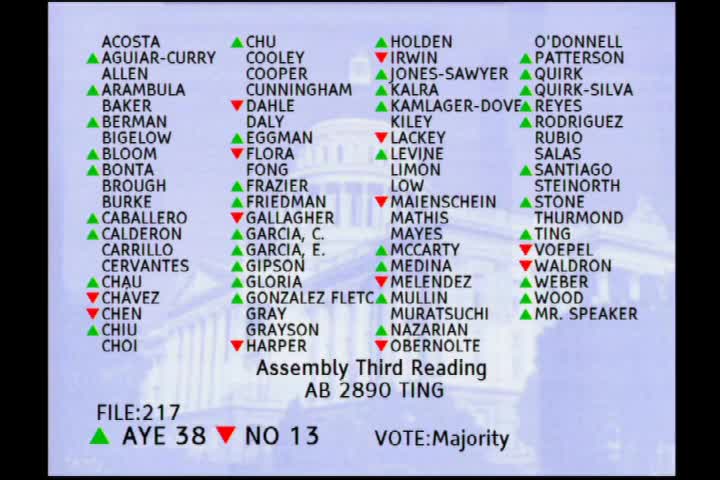 1MIN
Assembly Floor
 13MIN
Assembly Standing Committee on Agriculture
Bill Author

Bill Co-Author(s):
