AB 234: Student financial aid: Assumption Program of Loans for Education.
- Session Year: 2017-2018
- House: Assembly
- Latest Version Date: 2017-01-26
Existing law establishes the Assumption Program of Loans for Education, administered by the Student Aid Commission, under which any person enrolled in an eligible institution of postsecondary education, as defined, or any person who agrees to participate in a teacher trainee or teacher internship program, is eligible to enter into an agreement for loan assumption, to be redeemed pursuant to a prescribed procedure upon becoming employed as a teacher in an eligible school, as defined, if he or she satisfies certain conditions.
This bill would express the intent of the Legislature to restore the funding for the Assumption Program of Loans for Education to its 201112 fiscal year level. The bill would require the commission to award 7,200 new warrants for the assumption of loans under the program in the 201718 fiscal year. The bill would appropriate $5,000,000 from the General Fund to the commission for the funding of warrants for the assumption of loans under the program for the 201718 fiscal year.
This bill would declare that it is to take effect immediately as an urgency statute.
It is the intent of the Legislature to restore the funding for the Assumption Program of Loans for Education (APLE) to its 201112 fiscal year level.
SEC. 2.Section 69615.8 of the Education Code is amended to read:69615.8.Notwithstanding any other law, in any the 201718 fiscal year, the commission shall award no more than the number of loan assumption agreements that are authorized by the Governor and the Legislature in the annual Budget Act for that year 7,200 new warrants for the assumption of loans pursuant to this article.
SEC. 3.The sum of five million dollars ($5,000,000) is hereby appropriated from the General Fund to the Student Aid Commission for the funding of warrants for the assumption of loans under the Assumption Program of Loans for Education (Article 5 (commencing with Section 69612) of Chapter 2 of Part 42 of Division 5 of Title 3 of the Education Code) for the 201718 fiscal year.
SEC. 4.This act is an urgency statute necessary for the immediate preservation of the public peace, health, or safety within the meaning of Article IV of the California Constitution and shall go into immediate effect. The facts constituting the necessity are:
In order for the Assumption Program of Loans for Education to be adequately funded for the 201718 fiscal year, it is necessary that this act take effect immediately.
REVISIONS: HeadingLines 1 and 3.|
Date
|
Status
|
|---|---|
| Feb 1, 2018 | From committee: Filed with the Chief Clerk pursuant to Joint Rule 56. |
| Jan 31, 2018 | Died pursuant to Art. IV, Sec. 10(c) of the Constitution. |
| May 26, 2017 | In committee: Held under submission. |
| Apr 5, 2017 | In committee: Set, first hearing. Referred to APPR. suspense file. |
| Mar 28, 2017 | Coauthors revised. |
| Mar 22, 2017 | Coauthors revised. |
| Mar 15, 2017 | From committee: Do pass and re-refer to Com. on APPR. (Ayes 13. Noes 0.) (March 14). Re-referred to Com. on APPR. |
| Mar 6, 2017 | Coauthors revised. |
| Feb 6, 2017 | Referred to Com. on HIGHER ED. |
| Jan 27, 2017 | From printer. May be heard in committee February 26. |
| Jan 26, 2017 | Read first time. To print. |
|
Date
|
Description
|
Location
|
Votes
|
|
|---|---|---|---|---|
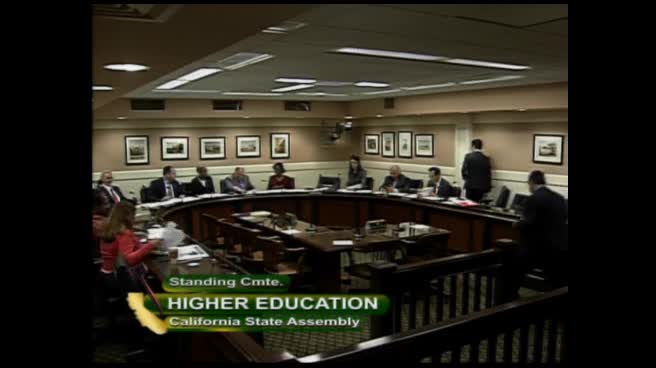
| Mar 14, 2017 | Do pass and be re-referred to the Committee on [Appropriations] | Assembly Standing Committee on Higher Education |
Passed |
This list shows positions taken on this bill by organizations on the date displayed, which is linked to the original source.
Positions by individuals are not included.
Date of Hearing: April 5, 2017
ASSEMBLY COMMITTEE ON APPROPRIATIONS
Lorena Gonzalez Fletcher, Chair
ABPCA Bill Id:AB 234
Author:(Steinorth) – As Introduced Ver:January 26, 2017
Policy Committee: | Higher Education | Vote: | 13-0 |
Urgency: Yes State Mandated Local Program: No Reimbursable: No
SUMMARY:
This bill, an urgency measure, requires the California Student Aid Commission (CSAC) to award 7,200 new warrants for the Assumption Program of Loans for Education (APLE) and appropriates $5 million from the General Fund (GF) to fund the new warrants.
FISCAL EFFECT:
- Over $36 million GF in new warrants for years one through four. While this bill provides a one-time $5 million GF appropriation, the true cost of awarding 7,200 new warrants is over $36 million GF in the first four years of implementation.
- $918,000 GF in administrative cost to CSAC in year one and $799,000 GF in on-going costs. CSAC will need 8 new personnel years (PY’s) to implement this bill. The costs include $119,000 in one-time funds for new equipment and facilities space.
- The bill deletes existing statutory language which links the number of APLE warrants issued to the annual Budget Act. This creates a cost pressure to continue funding APLE at this level regardless of competing budget priorities.
COMMENTS:
- Background. APLE was established in 1983 to provide loan assumption benefits to credentialed teachers, and is administered by CSAC. Generally, APLE warrants are given to credential candidates; the warrants are then redeemed for the loan assumption benefit once the candidate has earned a credential and completed a year of eligible teaching. The program forgives up to $11,000 of college loan debt for a person who teaches for four consecutive years in a qualifying school or subject area (paying $2,000 for the first year of teaching service and $3,000 for each of the next three years of teaching); and, provides additional loan forgiveness of $1,000 per year for up to four years for those who teach math, science or special education (for a total of $15,000) and an additional $1,000 for those who teach math, science or special education in schools with an Academic Performance Index (API) of 1 or 2 (for a total of $19,000) (EC Sections 69613.4 and 69613.8)
- Purpose. According to the author, "A 2016 California School Board Association study found that many schools throughout the state are experiencing teacher shortages. According to the survey, approximately 75 percent of school districts report a teacher shortage; and, 80 percent said shortages have gotten worse since previous years." The author contends that, "This bill tackles teacher shortages and traditionally low retention rates at low-performing schools by “re-starting” APLE."
- Staff Comments. This bill appropriates $5 million GF to CSAC to issue 7,200 new APLE warrants in the 2017-18 fiscal year, which CSAC can begin paying in 2018-19 (after the credential candidates have become teachers and taught for a year). This appropriation is insufficient. To administer 7,200 new warrants, CSAC will require additional PY’s and over $31 million GF. According to CSAC, “administering this program is very labor intensive and spans over 10 years from the moment the new teacher submits employer notification paperwork” Without budget appropriations after 2012, CSAC phased-out APLE and reassigned staff. Additionally, a key requirement of the APLE program is that recipients teach at a school with an Academic Performance Index (API) of 1 or 2. At the direction of the Legislature and the Governor, the State Board of Education and the California Department of Education are in the process of developing a new accountability system to replace the API to better measure our State's educational goals. API scores have not been calculated since 2013.
- Related Legislation. AB 234 is in direct conflict with AB 463 (Salas), pending a hearing in Assembly Higher Education Committee. AB 463 makes various programmatic changes to APLE including changes that reflect the states transition to a new accountability system.
Analysis Prepared by: Daisy Gonzales / APPR. / (916) 319-2081
Date of Hearing: March 14, 2017
ASSEMBLY COMMITTEE ON HIGHER EDUCATION
Jose Medina, Chair
ABPCA Bill Id:AB 234 (
Author:Steinorth) – As Introduced Ver:January 26, 2017
SUBJECT: Student financial aid: Assumption Program of Loans for Education.
SUMMARY: Authorizes the California Student Aid Commission (CSAC) to award 7,200 new warrants for the assumption of loans for the Assumption Program of Loans for Education (APLE). Specifically, this bill:
- States the Legislature intends to restore the funding for APLE to its 2011-12 fiscal year level.
- Specifies that $5,000,000 is appropriated from the General Fund to CSAC for the express purpose of funding 7,200 new warrants for APLE for the 2017-18 fiscal year.
- Adds an urgency clause in order for APLE to be adequately funded for the 2017-18 fiscal year.
EXISTING LAW:
- Establishes CSAC as the primary state agency to administer state-authorized student financial aid programs available to eligible students attending all eligible segments of postsecondary education (Education Code Section 69510, et seq.).
- Establishes the APLE program, administered by the CSAC, to provide loan assumption benefits to credentialed teachers; specifies that qualifying schools include those with high proportions of low-income youth or emergency permit teachers and those located in rural areas; and, requires the subject area shortages to annually be determined by the State Superintendent of Public Instruction (EC Section 69612, et seq.).
- Forgives up to $11,000 of college loan debt for a person who teaches for four consecutive years in a qualifying school or subject area (paying $2,000 for the first year of teaching service and $3,000 for each of the next three years of teaching); and, provides additional loan forgiveness of $1,000 per year for up to four years for those who teach math, science or special education (for a total of $15,000) and an additional $1,000 for those who teach math, science or special education in schools with an Academic Performance Index of 1 or 2 (for a total of $19,000) (EC Sections 69613.4 and 69613.8).
- Prohibits CSAC from awarding a greater number of agreements than is authorized in the annual Budget Act (EC Section 69615.8).
FISCAL EFFECT: Unknown.
COMMENTS: Urgency clause. This measure has an urgency clause.
Background. According to a February 2017 research brief by the Learning Policy Institute, in the past year, the overall teacher workforce trends in the state have worsened, with severe consequences in special education, mathematics, science, and bilingual education. The Institute, via survey data, finds that in addition to cancelling courses and increasing class sizes, some school districts are responding to shortages by hiring underprepared teachers (teachers who have not yet completed the subject matter and teacher preparation requirements for a full credential), assigning some teachers out of their fields of preparation, and hiring substitutes.
To note, the Institute finds that high attrition rates of underprepared teachers creates a continuous demand for new teachers and only exacerbates the teacher shortages in the state. Additionally, schools serving the most underrepresented students (high-poverty, high-minority, and/or high-English Learner), disproportionately turn to underprepared teachers to meet their hiring needs.
Additionally, the California Teachers Association contends that one-third of California's teachers are at or near retirement age.
Purpose of this measure. According to the author, "A 2016 California School Board Association study found that many schools throughout the state are experiencing teacher shortages. According to the survey, approximately 75 percent of school districts report a teacher shortage; and, 80 percent said shortages have gotten worse since previous years." The author contends that, "This bill tackles teacher shortages and traditionally low retention rates at low-performing schools by “re-starting” APLE."
The author argues that, "AB 234 ensures competition among all school districts by providing loan assumptions to offset salary restrictions. The APLE program means schools with fewer resources can become a viable option for newly credentialed teachers who might look to more-affluent schools and areas to offset high housing and cost-of-living expenses in California."
Assumption Program of Loans for Education (APLE). The APLE warrants are given to credential candidates; the warrants are then redeemed for the loan assumption benefit once the candidate has earned a credential and completed a year of eligible teaching. The program “forgives” up to $11,000 of college loan debt for a person who teaches for four consecutive years in a qualifying school or subject area (paying $2,000 for the first year of teaching service and $3,000 for each of the next three years of teaching). Qualifying schools include those with high proportions of low-income youth or emergency permit teachers and those located in rural areas.
The 2012-2013 Budget Act included language authorizing a total of 7,300 warrants for loan assumption, but the Governor line item vetoed said provision. This year's budget does not include funding for new APLE warrants.
Committee staff understands that over a decade ago the state spent over $80 million on statewide teacher recruitment efforts; however, if APLE is fully phased out over the course of the next few years, the state will eventually spend zero dollars on efforts to increase the number of teachers in the state.
This measure seeks to reinstate APLE in order to meet California's current teaching demands.
Committee comments. AB 463 (Salas), as described in the "Related legislation" section of this analysis, appears to be in conflict with this measure. As the two measures move through the Legislative Process, Committee staff recommends the authors working together to achieve a shared goal.
Related legislation. AB 463 (Salas), which is pending a hearing in this Committee, would, among others, make various programmatic changes to APLE.
SB 62 (Pavley) of 2015, which, as introduced, made various changes to APLE. However, on August 30, 2106, this measure was amended out of the jurisdiction of this Committee; the amended version was subsequently chaptered.
SB 1264 (Pavley) of 2014, which was held in the Senate Appropriations Committee, proposed to establish the Educator Excellence Program, an assumption loan program for up to 6,500 teachers who satisfied specified criteria.
SB 212 (Pavley) of 2013, which was held in the Senate Appropriations Committee, sought to appropriate $5 million, from an unspecified funding source, for 7,200 new warrants for the assumption of school loans for teachers in areas with identified teacher shortages.
REGISTERED SUPPORT / OPPOSITION:
Support
California School Boards Association
Public Advocates
Opposition
None on file
Analysis Prepared by: Jeanice Warden / HIGHER ED. / (916) 319-3960
Discussed in Hearing
 1H
Assembly Standing Committee on Appropriations
 17MIN