AB 2346: Public utilities: rates: wildfire expense memorandum accounts.
- Session Year: 2017-2018
- House: Assembly
- Latest Version Date: 2018-09-05
Under existing law, the Public Utilities Commission has regulatory authority over public utilities, including electrical corporations. Existing law authorizes the commission to fix the rates and charges for every public utility, and requires that those rates and charges be just and reasonable. Existing law requires the commission to authorize public utilities to establish catastrophic event memorandum accounts and to record certain costs in those accounts.
This bill would require the commission to authorize an electrical corporation, upon request, to establish a wildfire expense memorandum account for incremental unreimbursed costs relating to California wildfires that occur on or after January 1, 2015, and to record certain costs in those accounts. The bill would require the recovery in rates of those costs to be subject to review by, and the determination of, the commission, as specified. The bill would require an electrical corporation to notify the commission by letter within 30 days after the electrical corporation begins recording costs in its wildfire expense memorandum account.
Under existing law, a violation of the Public Utilities Act or any order, decision, rule, direction, demand, or requirement of the commission is a crime.
Because the provisions of this bill would be a part of the act and because a violation of an order or decision of the commission implementing its requirements would be a crime, the bill would impose a state-mandated local program.
The California Constitution requires the state to reimburse local agencies and school districts for certain costs mandated by the state. Statutory provisions establish procedures for making that reimbursement.
This bill would provide that no reimbursement is required by this act for a specified reason.
Under existing law, the Public Utilities Commission has regulatory authority over public utilities, including electrical corporations and gas corporations. Existing law authorizes the commission to fix the rates and charges for every public utility, and requires that those rates and charges be just and reasonable. Existing law requires the commission to authorize public utilities to establish catastrophic event memorandum accounts and to record certain costs in those accounts.
This bill would require the commission to authorize an electrical corporation, upon request, to establish a wildfire expense memorandum account for incremental unreimbursed costs relating to California wildfires that occur on or after January 1, 2015, and to record certain costs in those accounts. The bill would require the recovery in rates of those costs to be subject to review by, and the determination of, the commission, as specified. The bill would require an electrical corporation or gas corporation to notify the commission by letter within 30 days after the electrical corporation or gas corporation begins recording costs in its wildfire expense memorandum account.
Under existing law, a violation of the Public Utilities Act or any order, decision, rule, direction, demand, or requirement of the commission is a crime.
Because the provisions of this bill would be a part of the act and because a violation of an order or decision of the commission implementing its requirements would be a crime, the bill would impose a state-mandated local program.
The California Constitution requires the state to reimburse local agencies and school districts for certain costs mandated by the state. Statutory provisions establish procedures for making that reimbursement.
This bill would provide that no reimbursement is required by this act for a specified reason.
Under existing law, the Public Utilities Commission has regulatory authority over public utilities, including electrical corporations and gas corporations. Existing law authorizes the commission to fix the rates and charges for every public utility, and requires that those rates and charges be just and reasonable. Existing law requires the commission to authorize public utilities to establish catastrophic event memorandum accounts and to record certain costs in those accounts.
This bill would authorize require the commission to permit each authorize an electrical corporation and gas corporation corporation, upon request, to establish a wildfire expense memorandum account for incremental unreimbursed costs relating to California wildfires that occur on or after January 1, 2015, and to record certain costs in those accounts. The bill would require the recovery in rates of those costs to be subject to review by, and the determination of, the commission, as specified. The bill would require an electrical corporation or gas corporation to notify the commission by letter within 30 days after the electrical corporation or gas corporation begins recording costs in its wildfire expense memorandum account.
Under existing law, a violation of the Public Utilities Act or any order, decision, rule, direction, demand, or requirement of the commission is a crime.
Because the provisions of this bill would be a part of the act and because a violation of an order or decision of the commission implementing its requirements would be a crime, the bill would impose a state-mandated local program.
The California Constitution requires the state to reimburse local agencies and school districts for certain costs mandated by the state. Statutory provisions establish procedures for making that reimbursement.
This bill would provide that no reimbursement is required by this act for a specified reason.
Under existing law, the Public Utilities Commission has regulatory authority over public utilities, including electrical corporations and gas corporations. Existing law authorizes the commission to fix the rates and charges for every public utility, and requires that those rates and charges be just and reasonable. Existing law requires the commission to authorize public utilities to establish catastrophic event memorandum accounts and to record certain costs in those accounts.
This bill would require authorize the commission, by an unspecified date, commission to authorize permit each electrical corporation and gas corporation to establish a wildfire expense memorandum accounts account for incremental unreimbursed costs relating to California wildfires that occur on or after January 1, 2015, and to record certain costs in those accounts. The bill would require the recovery in rates of those costs to be subject to review by, and the determination of, the commission, as specified. The bill would require an electrical corporation or gas corporation to notify the commission by letter within 30 days after the electrical corporation or gas corporation begins recording costs in its wildfire expense memorandum account.
Under existing law, a violation of the Public Utilities Act or any order, decision, rule, direction, demand, or requirement of the commission is a crime.
Because the provisions of this bill would be a part of the act and because a violation of an order or decision of the commission implementing its requirements would be a crime, the bill would impose a state-mandated local program.
The California Constitution requires the state to reimburse local agencies and school districts for certain costs mandated by the state. Statutory provisions establish procedures for making that reimbursement.
This bill would provide that no reimbursement is required by this act for a specified reason.
Under existing law, the Public Utilities Commission has regulatory authority over public utilities, including electrical corporations and gas corporations. Existing law authorizes the commission to fix the rates and charges for every public utility, and requires that those rates and charges be just and reasonable. Existing law requires the commission to authorize public utilities to establish catastrophic event memorandum accounts and to record certain costs in those accounts.
This bill would require the commission commission, by an unspecified date, to authorize public utilities each electrical corporation and gas corporation to establish wildfire expense memorandum accounts for costs relating specifically to the 2017 California wildfires that occur on or after January 1, 2015, and to record certain costs in those accounts. The bill would provide that this authorization does not authorize the recovery in rates of those costs recorded in the accounts. require the recovery in rates of those costs to be subject to review by, and the determination of, the commission, as specified. The bill would require an electrical corporation or gas corporation to notify the commission by letter within 30 days after the electrical corporation or gas corporation begins recording costs in its wildfire expense memorandum account.
Under existing law, a violation of the Public Utilities Act or any order, decision, rule, direction, demand, or requirement of the commission is a crime.
Because the provisions of this bill would be a part of the act and because a violation of an order or decision of the commission implementing its requirements would be a crime, the bill would impose a state-mandated local program.
The California Constitution requires the state to reimburse local agencies and school districts for certain costs mandated by the state. Statutory provisions establish procedures for making that reimbursement.
This bill would provide that no reimbursement is required by this act for a specified reason.
Under existing law, the Public Utilities Commission has regulatory authority over public utilities, including electrical corporations and gas corporations. Existing law authorizes the commission to fix the rates and charges for every public utility, and requires that those rates and charges be just and reasonable. Existing law requires the commission to authorize public utilities to establish catastrophic event memorandum accounts and to record certain costs in those accounts.
This bill would require the commission to authorize public utilities to establish wildfire expense memorandum accounts for costs relating specifically to the 2017 California wildfires and to record certain costs in those accounts. The bill would provide that this authorization does not authorize the recovery in rates of those costs recorded in the accounts.
Under existing law, a violation of the Public Utilities Act or any order, decision, rule, direction, demand, or requirement of the commission is a crime.
Because the provisions of this bill would be a part of the act and because a violation of an order or decision of the commission implementing its requirements would be a crime, the bill would impose a state-mandated local program.
The California Constitution requires the state to reimburse local agencies and school districts for certain costs mandated by the state. Statutory provisions establish procedures for making that reimbursement.
This bill would provide that no reimbursement is required by this act for a specified reason.
The California Renewables Portfolio Standard Program requires the Public Utilities Commission to establish a renewables portfolio standard requiring all retail sellers, as defined, to procure a minimum quantity of electricity products from eligible renewable energy resources, as defined, so that the total kilowatthours of those products sold to their retail end-use customers achieves 25% of retail sales by December 31, 2016, 33% by December 31, 2020, 40% by December 31, 2024, 45% by December 31, 2027, and 50% by December 31, 2030. The commission is required to waive enforcement of the renewables portfolio procurement requirements if it finds that a retail seller demonstrates the existence of any of 4 specified conditions.This bill would explicitly authorize the commission to condition waiver of enforcement upon the retail seller purchasing replacement generating resources that result in the least amount of harm to the environment.The California Renewables Portfolio Standard Program requires the Public Utilities Commission to establish a renewables portfolio standard requiring all retail sellers, as defined, to procure a minimum quantity of electricity products from eligible renewable energy resources, as defined, so that the total kilowatthours of those products sold to their retail end-use customers achieves 25% of retail sales by December 31, 2016, 33% by December 31, 2020, 40% by December 31, 2024, 45% by December 31, 2027, and 50% by December 31, 2030. The commission is required to waive enforcement of the renewables portfolio procurement requirements if it finds that a retail seller demonstrates the existence of any of 4 specified conditions.
This bill would explicitly authorize the commission to condition waiver of enforcement upon the retail seller purchasing replacement generating resources that result in the least amount of harm to the environment.
(a)The commission shall authorize an electrical corporation, upon request, to establish a wildfire expense memorandum account for incremental unreimbursed costs relating to California wildfires that occur on or after January 1, 2015, and to record in that account all of the following costs incurred after the start of each wildfire, excluding costs recoverable in the electrical corporations or gas corporations general rate case or recorded in the electrical corporations catastrophic event memorandum account pursuant to Section 454.9, and excluding costs recoverable through any other mechanism the commission has provided to allow for recovery:
(1)Payments and costs to satisfy wildfire claims, including coinsurance and deductible expenses paid by the electrical corporation.
(2)Outside legal costs incurred by the electrical corporation either to settle claims or to defend against claims relating to the wildfires.
(3)Increases in insurance premiums and the cost of other financial risk transfer instruments incurred by the electrical corporation.
(4)Increases in fire risk mitigation costs, including infrastructure hardening and vegetation management costs incurred by the electrical corporation. However, costs of grid hardening and vegetation management activities intended to comply with existing state law or commission regulations and costs for which recovery may be available through other commission cost recovery mechanisms shall not be recorded.
(b)The recovery in rates of those costs recorded in the account shall be subject to review by, and the determination of, the commission pursuant to Section 451.
(c)An electrical corporation shall notify the commission by letter within 30 days after the electrical corporation begins recording costs in its wildfire expense memorandum account.
SEC. 2.No reimbursement is required by this act pursuant to Section 6 of Article XIIIB of the California Constitution because the only costs that may be incurred by a local agency or school district will be incurred because this act creates a new crime or infraction, eliminates a crime or infraction, or changes the penalty for a crime or infraction, within the meaning of Section 17556 of the Government Code, or changes the definition of a crime within the meaning of Section 6 of Article XIIIB of the California Constitution.
(a)The commission shall authorize an electrical corporation, upon request, to establish a wildfire expense memorandum account for incremental unreimbursed costs relating to California wildfires that occur on or after January 1, 2015, and to record in that account all of the following costs incurred after the start of each wildfire, excluding costs recoverable in the electrical corporations or gas corporations general rate case or recorded in the electrical corporations or gas corporations catastrophic event memorandum account pursuant to Section 454.9, and excluding costs recoverable through any other mechanism the commission has provided to allow for recovery:
(1)Payments and costs to satisfy wildfire claims, including coinsurance and deductible expenses paid by the electrical corporation or gas corporation.
(2)Outside legal costs incurred by the electrical corporation or gas corporation either to settle claims or to defend against claims relating to the wildfires.
(3)Increases in insurance premiums and the cost of other financial risk transfer instruments incurred by the electrical corporation or gas corporation.
(4)Increases in fire risk mitigation costs, including infrastructure hardening and vegetation management costs incurred by the electrical corporation or gas corporation. However, costs of grid hardening and vegetation management activities intended to comply with existing state law or commission regulations and costs for which recovery may be available through other commission cost recovery mechanisms shall not be recorded.
(b)The recovery in rates of those costs recorded in the account shall be subject to review by, and the determination of, the commission pursuant to Section 451.
(c)An electrical corporation or gas corporation shall notify the commission by letter within 30 days after the electrical corporation or gas corporation begins recording costs in its wildfire expense memorandum account.
SEC. 2.No reimbursement is required by this act pursuant to Section 6 of Article XIIIB of the California Constitution because the only costs that may be incurred by a local agency or school district will be incurred because this act creates a new crime or infraction, eliminates a crime or infraction, or changes the penalty for a crime or infraction, within the meaning of Section 17556 of the Government Code, or changes the definition of a crime within the meaning of Section 6 of Article XIIIB of the California Constitution.
(a)The commission may shall authorize each an electrical corporation and gas corporation corporation, upon request, to establish a wildfire expense memorandum account for incremental unreimbursed costs relating to California wildfires that occur on or after January 1, 2015, and to record in that account all of the following costs incurred after the start of each wildfire, excluding costs recoverable in the electrical corporations or gas corporations general rate case or recorded in the electrical corporations or gas corporations catastrophic event memorandum account pursuant to Section 454.9, and excluding costs recoverable through any other mechanism the commission has provided to allow for recovery:
(1)Payments and costs to satisfy wildfire claims, including coinsurance and deductible expenses paid by the electrical corporation or gas corporation.
(2)Outside legal costs incurred by the electrical corporation or gas corporation either to settle claims or to defend against claims relating to the wildfires.
(3)Increases in insurance premiums and the cost of other financial risk transfer instruments incurred by the electrical corporation or gas corporation.
(4)Increases in fire risk mitigation costs, including infrastructure hardening and vegetation management costs incurred by the electrical corporation or gas corporation. However, costs of grid hardening and vegetation management activities intended to comply with existing state law or commission regulations and costs for which recovery may be available through other commission cost recovery mechanisms shall not be recorded.
(b)The recovery in rates of those costs recorded in the account shall be subject to review by, and the determination of, the commission pursuant to Section 451.
(c)An electrical corporation or gas corporation shall notify the commission by letter within 30 days after the electrical corporation or gas corporation begins recording costs in its wildfire expense memorandum account.
SEC. 2.No reimbursement is required by this act pursuant to Section 6 of Article XIIIB of the California Constitution because the only costs that may be incurred by a local agency or school district will be incurred because this act creates a new crime or infraction, eliminates a crime or infraction, or changes the penalty for a crime or infraction, within the meaning of Section 17556 of the Government Code, or changes the definition of a crime within the meaning of Section 6 of Article XIIIB of the California Constitution.
(a)No later than _____, the The commission shall may authorize each electrical corporation and gas corporation to establish a wildfire expense memorandum account for incremental unreimbursed costs relating to California wildfires that occur on or after January 1, 2015, and to record in that account all of the following costs incurred after the start of each wildfire, excluding costs recoverable in the electrical corporations or gas corporations general rate case or recorded in the electrical corporations or gas corporations catastrophic event memorandum account pursuant to Section 454.9: 454.9, and excluding costs recoverable through any other mechanism the commission has provided to allow for recovery:
(1)Payments and costs to satisfy wildfire claims, including co-insurance coinsurance and deductible expenses paid by the electrical corporation or gas corporation.
(2)Outside legal costs incurred by the electrical corporation or gas corporation either to settle claims or to defend against claims relating to the wildfires.
(3)Increases in insurance premiums and the cost of other financial risk transfer instruments incurred by the electrical corporation or gas corporation.
(4)Increases in fire risk mitigation costs, including infrastructure hardening and vegetation management costs incurred by the electrical corporation or gas corporation. However, costs of grid hardening and vegetation management activities intended to comply with existing state law or commission regulations and costs for which recovery may be available through other commission cost recovery mechanisms shall not be recorded.
(b)The recovery in rates of those costs recorded in the account shall be subject to review by, and the determination of, the commission pursuant to Section 451.
(c)An electrical corporation or gas corporation shall notify the commission by letter within 30 days after the electrical corporation or gas corporation begins recording costs in its wildfire expense memorandum account.
SEC. 2.No reimbursement is required by this act pursuant to Section 6 of Article XIIIB of the California Constitution because the only costs that may be incurred by a local agency or school district will be incurred because this act creates a new crime or infraction, eliminates a crime or infraction, or changes the penalty for a crime or infraction, within the meaning of Section 17556 of the Government Code, or changes the definition of a crime within the meaning of Section 6 of Article XIIIB of the California Constitution.
(a)The No later than _____, the commission shall authorize each public utility electrical corporation and gas corporation to establish a wildfire expense memorandum account for costs relating specifically to the 2017 California wildfires that occur on or after January 1, 2015, and to record in that account all of the following costs: costs incurred after the start of each wildfire, excluding costs recoverable in the electrical corporations or gas corporations general rate case or recorded in the electrical corporations or gas corporations catastrophic event memorandum account pursuant to Section 454.9:
(1)Payments and costs to satisfy wildfire claims, including co-insurance and deductible expenses paid by the public utility, but excluding costs previously authorized in the public utilitys general rate case. electrical corporation or gas corporation.
(2)Outside legal costs incurred defending by the electrical corporation or gas corporation either to settle claims or to defend against claims relating to the wildfires.
(3)Increases or decreases in wildfire insurance premiums from amounts authorized in the public utilitys general rate case. and the cost of other financial risk transfer instruments incurred by the electrical corporation or gas corporation.
(4)Increases in fire risk mitigation costs, including infrastructure hardening and vegetation management costs incurred by the electrical corporation or gas corporation.
(b)The authorization to establish a wildfire expense memorandum account pursuant to this section shall not authorize the recovery in rates of those costs recorded in the account. account shall be subject to review by, and the determination of, the commission pursuant to Section 451.
(c)An electrical corporation or gas corporation shall notify the commission by letter within 30 days after the electrical corporation or gas corporation begins recording costs in its wildfire expense memorandum account.
SEC. 2.No reimbursement is required by this act pursuant to Section 6 of Article XIIIB of the California Constitution because the only costs that may be incurred by a local agency or school district will be incurred because this act creates a new crime or infraction, eliminates a crime or infraction, or changes the penalty for a crime or infraction, within the meaning of Section 17556 of the Government Code, or changes the definition of a crime within the meaning of Section 6 of Article XIIIB of the California Constitution.
(a)The commission shall authorize each public utility to establish a wildfire expense memorandum account for costs relating specifically to the 2017 California wildfires and to record in that account all of the following costs:
(1)Payments to satisfy wildfire claims, including co-insurance and deductible expenses paid by the public utility, but excluding costs previously authorized in the public utilitys general rate case.
(2)Outside legal costs incurred defending against claims relating to the wildfires.
(3)Increases or decreases in wildfire insurance premiums from amounts authorized in the public utilitys general rate case.
(b)The authorization to establish a wildfire expense memorandum account pursuant to this section shall not authorize the recovery in rates of those costs recorded in the account.
SEC. 2.No reimbursement is required by this act pursuant to Section 6 of Article XIIIB of the California Constitution because the only costs that may be incurred by a local agency or school district will be incurred because this act creates a new crime or infraction, eliminates a crime or infraction, or changes the penalty for a crime or infraction, within the meaning of Section 17556 of the Government Code, or changes the definition of a crime within the meaning of Section 6 of Article XIIIB of the California Constitution.
SECTION 1.Section 399.15 of the Public Utilities Code is amended to read:399.15.(a)In order to fulfill unmet long-term resource needs, the commission shall establish a renewables portfolio standard requiring all retail sellers to procure a minimum quantity of electricity products from eligible renewable energy resources as a specified percentage of total kilowatthours sold to their retail end-use customers each compliance period to achieve the targets established under this article. For any retail seller procuring at least 14 percent of retail sales from eligible renewable energy resources in 2010, the deficits associated with any previous renewables portfolio standard shall not be added to any procurement requirement pursuant to this article.(b)The commission shall implement renewables portfolio standard procurement requirements only as follows:(1)Each retail seller shall procure a minimum quantity of eligible renewable energy resources for each of the following compliance periods:(A)January 1, 2011, to December 31, 2013, inclusive.(B)January 1, 2014, to December 31, 2016, inclusive.(C)January 1, 2017, to December 31, 2020, inclusive.(D)January 1, 2021, to December 31, 2024, inclusive.(E)January 1, 2025, to December 31, 2027, inclusive.(F)January 1, 2028, to December 31, 2030, inclusive.(2)(A)No later than January 1, 2017, the commission shall establish the quantity of electricity products from eligible renewable energy resources to be procured by the retail seller for each compliance period. These quantities shall be established in the same manner for all retail sellers and result in the same percentages used to establish compliance period quantities for all retail sellers.(B)In establishing quantities for the compliance period from January 1, 2011, to December 31, 2013, inclusive, the commission shall require procurement for each retail seller equal to an average of 20 percent of retail sales. For the following compliance periods, the quantities shall reflect reasonable progress in each of the intervening years sufficient to ensure that the procurement of electricity products from eligible renewable energy resources achieves 25 percent of retail sales by December 31, 2016, 33 percent by December 31, 2020, 40 percent by December 31, 2024, 45 percent by December 31, 2027, and 50 percent by December 31, 2030. The commission shall establish appropriate three-year compliance periods for all subsequent years that require retail sellers to procure not less than 50 percent of retail sales of electricity products from eligible renewable energy resources.(C)Retail sellers shall be obligated to procure no less than the quantities associated with all intervening years by the end of each compliance period. Retail sellers shall not be required to demonstrate a specific quantity of procurement for any individual intervening year.(3)The commission may require the procurement of eligible renewable energy resources in excess of the quantities specified in paragraph (2).(4)Only for purposes of establishing the renewables portfolio standard procurement requirements of paragraph (1) and determining the quantities pursuant to paragraph (2), the commission shall include all electricity sold to retail customers by the Department of Water Resources pursuant to Division 27 (commencing with Section 80000) of the Water Code in the calculation of retail sales by an electrical corporation.(5)The commission shall waive enforcement of this section if it finds that the retail seller has demonstrated any of the following conditions are beyond the control of the retail seller and will prevent compliance:(A)There is inadequate transmission capacity to allow for sufficient electricity to be delivered from proposed eligible renewable energy resource projects using the current operational protocols of the Independent System Operator. In making its findings relative to the existence of this condition with respect to a retail seller that owns transmission lines, the commission shall consider both of the following:(i)Whether the retail seller has undertaken, in a timely fashion, reasonable measures under its control and consistent with its obligations under local, state, and federal laws and regulations, to develop and construct new transmission lines or upgrades to existing lines intended to transmit electricity generated by eligible renewable energy resources. In determining the reasonableness of a retail sellers actions, the commission shall consider the retail sellers expectations for full-cost recovery for these transmission lines and upgrades.(ii)Whether the retail seller has taken all reasonable operational measures to maximize cost-effective deliveries of electricity from eligible renewable energy resources in advance of transmission availability.(B)Permitting, interconnection, or other circumstances that delay procured eligible renewable energy resource projects, or there is an insufficient supply of eligible renewable energy resources available to the retail seller. In making a finding that this condition prevents timely compliance, the commission shall consider whether the retail seller has done all of the following:(i)Prudently managed portfolio risks, including relying on a sufficient number of viable projects.(ii)Sought to develop one of the following: its own eligible renewable energy resources, transmission to interconnect to eligible renewable energy resources, or energy storage used to integrate eligible renewable energy resources. This clause shall not require an electrical corporation to pursue development of eligible renewable energy resources pursuant to Section 399.14.(iii)Procured an appropriate minimum margin of procurement above the minimum procurement level necessary to comply with the renewables portfolio standard to compensate for foreseeable delays or insufficient supply.(iv)Taken reasonable measures, under the control of the retail seller, to procure cost-effective distributed generation and allowable unbundled renewable energy credits.(C)Unanticipated curtailment of eligible renewable energy resources if the waiver would not result in an increase in greenhouse gas emissions.(D)Unanticipated increase in retail sales due to transportation electrification. In making a finding that this condition prevents timely compliance, the commission shall consider all of the following:(i)Whether transportation electrification significantly exceeded forecasts in that retail sellers service territory based on the best and most recently available information filed with the State Air Resources Board, the Energy Commission, or other state agency.(ii)Whether the retail seller has taken reasonable measures to procure sufficient resources to account for unanticipated increases in retail sales due to transportation electrification.(6)If the commission waives the compliance requirements of this section, the commission shall establish additional reporting requirements on the retail seller to demonstrate that all reasonable actions under the control of the retail seller are taken in each of the intervening years sufficient to satisfy future procurement requirements.(7)The commission shall not waive enforcement pursuant to this section, unless the retail seller demonstrates that it has taken all reasonable actions under its control, as set forth in paragraph (5), to achieve full compliance.(8)If a retail seller fails to procure sufficient eligible renewable energy resources to comply with a procurement requirement pursuant to paragraphs (1) and (2) and fails to obtain an order from the commission waiving enforcement pursuant to paragraph (5), the commission shall assess penalties for noncompliance. A schedule of penalties shall be adopted by the commission that shall be comparable for electrical corporations and other retail sellers. For electrical corporations, the cost of any penalties shall not be collected in rates. Any penalties collected under this article shall be deposited into the Electric Program Investment Charge Fund and used for the purposes described in Chapter 8.1 (commencing with Section 25710) of Division 15 of the Public Resources Code.(9)Deficits associated with the compliance period shall not be added to a future compliance period.(10)The commission may condition waiver of enforcement pursuant to paragraph (5) upon the retail seller purchasing replacement generating resources that result in the least amount of harm to the environment.(c)The commission shall establish a limitation for each electrical corporation on the procurement expenditures for all eligible renewable energy resources used to comply with the renewables portfolio standard. This limitation shall be set at a level that prevents disproportionate rate impacts.(d)If the cost limitation for an electrical corporation is insufficient to support the projected costs of meeting the renewables portfolio standard procurement requirements, the electrical corporation may refrain from entering into new contracts or constructing facilities beyond the quantity that can be procured within the limitation, unless eligible renewable energy resources can be procured without exceeding a de minimis increase in rates, consistent with the long-term procurement plan established for the electrical corporation pursuant to Section 454.5.(e)(1)The commission shall monitor the status of the cost limitation for each electrical corporation in order to ensure compliance with this article.(2)If the commission determines that an electrical corporation may exceed its cost limitation prior to achieving the renewables portfolio standard procurement requirements, the commission shall do both of the following within 60 days of making that determination:(A)Investigate and identify the reasons why the electrical corporation may exceed its annual cost limitation.(B)Notify the appropriate policy and fiscal committees of the Legislature that the electrical corporation may exceed its cost limitation, and include the reasons why the electrical corporation may exceed its cost limitation.(f)The establishment of a renewables portfolio standard shall not constitute implementation by the commission of the federal Public Utility Regulatory Policies Act of 1978 (Public Law 95-617).(a)In order to fulfill unmet long-term resource needs, the commission shall establish a renewables portfolio standard requiring all retail sellers to procure a minimum quantity of electricity products from eligible renewable energy resources as a specified percentage of total kilowatthours sold to their retail end-use customers each compliance period to achieve the targets established under this article. For any retail seller procuring at least 14 percent of retail sales from eligible renewable energy resources in 2010, the deficits associated with any previous renewables portfolio standard shall not be added to any procurement requirement pursuant to this article.
(b)The commission shall implement renewables portfolio standard procurement requirements only as follows:
(1)Each retail seller shall procure a minimum quantity of eligible renewable energy resources for each of the following compliance periods:
(A)January 1, 2011, to December 31, 2013, inclusive.
(B)January 1, 2014, to December 31, 2016, inclusive.
(C)January 1, 2017, to December 31, 2020, inclusive.
(D)January 1, 2021, to December 31, 2024, inclusive.
(E)January 1, 2025, to December 31, 2027, inclusive.
(F)January 1, 2028, to December 31, 2030, inclusive.
(2)(A)No later than January 1, 2017, the commission shall establish the quantity of electricity products from eligible renewable energy resources to be procured by the retail seller for each compliance period. These quantities shall be established in the same manner for all retail sellers and result in the same percentages used to establish compliance period quantities for all retail sellers.
(B)In establishing quantities for the compliance period from January 1, 2011, to December 31, 2013, inclusive, the commission shall require procurement for each retail seller equal to an average of 20 percent of retail sales. For the following compliance periods, the quantities shall reflect reasonable progress in each of the intervening years sufficient to ensure that the procurement of electricity products from eligible renewable energy resources achieves 25 percent of retail sales by December 31, 2016, 33 percent by December 31, 2020, 40 percent by December 31, 2024, 45 percent by December 31, 2027, and 50 percent by December 31, 2030. The commission shall establish appropriate three-year compliance periods for all subsequent years that require retail sellers to procure not less than 50 percent of retail sales of electricity products from eligible renewable energy resources.
(C)Retail sellers shall be obligated to procure no less than the quantities associated with all intervening years by the end of each compliance period. Retail sellers shall not be required to demonstrate a specific quantity of procurement for any individual intervening year.
(3)The commission may require the procurement of eligible renewable energy resources in excess of the quantities specified in paragraph (2).
(4)Only for purposes of establishing the renewables portfolio standard procurement requirements of paragraph (1) and determining the quantities pursuant to paragraph (2), the commission shall include all electricity sold to retail customers by the Department of Water Resources pursuant to Division 27 (commencing with Section 80000) of the Water Code in the calculation of retail sales by an electrical corporation.
(5)The commission shall waive enforcement of this section if it finds that the retail seller has demonstrated any of the following conditions are beyond the control of the retail seller and will prevent compliance:
(A)There is inadequate transmission capacity to allow for sufficient electricity to be delivered from proposed eligible renewable energy resource projects using the current operational protocols of the Independent System Operator. In making its findings relative to the existence of this condition with respect to a retail seller that owns transmission lines, the commission shall consider both of the following:
(i)Whether the retail seller has undertaken, in a timely fashion, reasonable measures under its control and consistent with its obligations under local, state, and federal laws and regulations, to develop and construct new transmission lines or upgrades to existing lines intended to transmit electricity generated by eligible renewable energy resources. In determining the reasonableness of a retail sellers actions, the commission shall consider the retail sellers expectations for full-cost recovery for these transmission lines and upgrades.
(ii)Whether the retail seller has taken all reasonable operational measures to maximize cost-effective deliveries of electricity from eligible renewable energy resources in advance of transmission availability.
(B)Permitting, interconnection, or other circumstances that delay procured eligible renewable energy resource projects, or there is an insufficient supply of eligible renewable energy resources available to the retail seller. In making a finding that this condition prevents timely compliance, the commission shall consider whether the retail seller has done all of the following:
(i)Prudently managed portfolio risks, including relying on a sufficient number of viable projects.
(ii)Sought to develop one of the following: its own eligible renewable energy resources, transmission to interconnect to eligible renewable energy resources, or energy storage used to integrate eligible renewable energy resources. This clause shall not require an electrical corporation to pursue development of eligible renewable energy resources pursuant to Section 399.14.
(iii)Procured an appropriate minimum margin of procurement above the minimum procurement level necessary to comply with the renewables portfolio standard to compensate for foreseeable delays or insufficient supply.
(iv)Taken reasonable measures, under the control of the retail seller, to procure cost-effective distributed generation and allowable unbundled renewable energy credits.
(C)Unanticipated curtailment of eligible renewable energy resources if the waiver would not result in an increase in greenhouse gas emissions.
(D)Unanticipated increase in retail sales due to transportation electrification. In making a finding that this condition prevents timely compliance, the commission shall consider all of the following:
(i)Whether transportation electrification significantly exceeded forecasts in that retail sellers service territory based on the best and most recently available information filed with the State Air Resources Board, the Energy Commission, or other state agency.
(ii)Whether the retail seller has taken reasonable measures to procure sufficient resources to account for unanticipated increases in retail sales due to transportation electrification.
(6)If the commission waives the compliance requirements of this section, the commission shall establish additional reporting requirements on the retail seller to demonstrate that all reasonable actions under the control of the retail seller are taken in each of the intervening years sufficient to satisfy future procurement requirements.
(7)The commission shall not waive enforcement pursuant to this section, unless the retail seller demonstrates that it has taken all reasonable actions under its control, as set forth in paragraph (5), to achieve full compliance.
(8)If a retail seller fails to procure sufficient eligible renewable energy resources to comply with a procurement requirement pursuant to paragraphs (1) and (2) and fails to obtain an order from the commission waiving enforcement pursuant to paragraph (5), the commission shall assess penalties for noncompliance. A schedule of penalties shall be adopted by the commission that shall be comparable for electrical corporations and other retail sellers. For electrical corporations, the cost of any penalties shall not be collected in rates. Any penalties collected under this article shall be deposited into the Electric Program Investment Charge Fund and used for the purposes described in Chapter 8.1 (commencing with Section 25710) of Division 15 of the Public Resources Code.
(9)Deficits associated with the compliance period shall not be added to a future compliance period.
(10)The commission may condition waiver of enforcement pursuant to paragraph (5) upon the retail seller purchasing replacement generating resources that result in the least amount of harm to the environment.
(c)The commission shall establish a limitation for each electrical corporation on the procurement expenditures for all eligible renewable energy resources used to comply with the renewables portfolio standard. This limitation shall be set at a level that prevents disproportionate rate impacts.
(d)If the cost limitation for an electrical corporation is insufficient to support the projected costs of meeting the renewables portfolio standard procurement requirements, the electrical corporation may refrain from entering into new contracts or constructing facilities beyond the quantity that can be procured within the limitation, unless eligible renewable energy resources can be procured without exceeding a de minimis increase in rates, consistent with the long-term procurement plan established for the electrical corporation pursuant to Section 454.5.
(e)(1)The commission shall monitor the status of the cost limitation for each electrical corporation in order to ensure compliance with this article.
(2)If the commission determines that an electrical corporation may exceed its cost limitation prior to achieving the renewables portfolio standard procurement requirements, the commission shall do both of the following within 60 days of making that determination:
(A)Investigate and identify the reasons why the electrical corporation may exceed its annual cost limitation.
(B)Notify the appropriate policy and fiscal committees of the Legislature that the electrical corporation may exceed its cost limitation, and include the reasons why the electrical corporation may exceed its cost limitation.
(f)The establishment of a renewables portfolio standard shall not constitute implementation by the commission of the federal Public Utility Regulatory Policies Act of 1978 (Public Law 95-617).
|
Date
|
Status
|
|---|---|
| Sep 21, 2018 | Vetoed by Governor. |
| Sep 12, 2018 | Enrolled and presented to the Governor at 12 p.m. |
| Aug 31, 2018 | Senate amendments concurred in. To Engrossing and Enrolling. |
| Aug 30, 2018 | From committee: That the Senate amendments be concurred in. (Ayes 8. Noes 0.) (August 30). |
| Aug 29, 2018 | Joint Rule 62(a), file notice suspended. |
| Aug 28, 2018 | Re-referred to Com. on U. & E. pursuant to Assembly Rule 77.2. |
| Aug 27, 2018 | In Assembly. Concurrence in Senate amendments pending. May be considered on or after August 29 pursuant to Assembly Rule 77. |
| Aug 27, 2018 | Read third time. Passed. Ordered to the Assembly. |
| Aug 23, 2018 | Read second time. Ordered to third reading. |
| Aug 22, 2018 | Read third time and amended. Ordered to second reading. |
| Aug 14, 2018 | Read second time. Ordered to third reading. |
| Aug 13, 2018 | From committee: Be ordered to second reading pursuant to Senate Rule 28.8. |
| Aug 8, 2018 | From committee chair, with author's amendments: Amend, and re-refer to committee. Read second time, amended, and re-referred to Com. on APPR. |
| Aug 6, 2018 | In committee: Set, first hearing. Hearing canceled at the request of author. |
| Jul 5, 2018 | Read second time and amended. Re-referred to Com. on APPR. |
| Jul 3, 2018 | From committee: Amend, and do pass as amended and re-refer to Com. on APPR. (Ayes 6. Noes 1.) (June 27). |
| Jun 13, 2018 | From committee chair, with author's amendments: Amend, and re-refer to committee. Read second time, amended, and re-referred to Com. on E., U. & C. |
| Jun 7, 2018 | Referred to Com. on E., U. & C. |
| May 30, 2018 | In Senate. Read first time. To Com. on RLS. for assignment. |
| May 29, 2018 | Read third time. Passed. Ordered to the Senate. |
| May 24, 2018 | Read second time. Ordered to Consent Calendar. |
| May 23, 2018 | From committee: Do pass. To Consent Calendar. (Ayes 16. Noes 0.) (May 23). |
| May 16, 2018 | In committee: Hearing postponed by committee. |
| May 9, 2018 | In committee: Hearing postponed by committee. |
| Apr 26, 2018 | From committee: Do pass and re-refer to Com. on APPR. (Ayes 14. Noes 0.) (April 25). Re-referred to Com. on APPR. |
| Apr 19, 2018 | Re-referred to Com. on U. & E. |
| Apr 18, 2018 | From committee chair, with author's amendments: Amend, and re-refer to Com. on U. & E. Read second time and amended. |
| Mar 1, 2018 | Referred to Coms. on U. & E. and NAT. RES. |
| Feb 14, 2018 | From printer. May be heard in committee March 16. |
| Feb 13, 2018 | Read first time. To print. |
|
Date
|
Description
|
Location
|
Votes
|
|
|---|---|---|---|---|
| Aug 31, 2018 | AB 2346 QUIRK Concurrence in Senate Amendments | Assembly Floor |
Passed |
|
| Aug 30, 2018 | With recommendation: That Senate amendments be concurred in. | Assembly Standing Committee on Utilities and Energy |
Passed |
|
| Aug 27, 2018 | Assembly 3rd Reading AB2346 Quirk By Bradford | Senate Floor |
Passed |
|
| Jun 27, 2018 | Do pass as amended, but first amend, and re-refer to the Committee on [Appropriations] | Senate Standing Committee on Energy, Utilities and Communications |
Passed |
|
| May 29, 2018 | AB 2346 QUIRK Consent Calendar Second Day Regular Session | Assembly Floor |
Passed |
|
| May 23, 2018 | Do pass. To Consent Calendar. | Assembly Standing Committee on Appropriations |
Passed |
|
| Apr 25, 2018 | Do pass and be re-referred to the Committee on [Appropriations] | Assembly Standing Committee on Utilities and Energy |
Passed |
This list shows positions taken on this bill by organizations on the date displayed, which is linked to the original source.
Positions by individuals are not included.
GOVERNOR'S VETO
GV Bill Id:AB 2346
Author:(Quirk)
As Enrolled Ver:September 12, 2018
2/3 vote
ASSEMBLY: | 78-0 | (May 29, 2018) | SENATE: | 39-0 | (August 27, 2018) |
COMMITTEE VOTE: | 8-0 | (August 30, 2018) | RECOMMENDATION: | concur |
(U. & E.)
ASSEMBLY: | 80-0 | (August 31, 2018) |
|
|
|
Original Committee Reference: U. & E.
SUMMARY: Requires the California Public Utilities Commission (CPUC) to authorize electrical corporations (IOUs) to create memorandum accounts to track unreimbursed expenses related to wildfires occurring after January 1, 2015 and specifies the costs that can be tracked in those accounts.
The Senate amendments:
- Strikes the limitation to 2017 wildfires only and instead mandates the CPUC to allow an IOU to establish a Wildfire Expense Memorandum Account (WEMA), at the request of an IOU, for all wildfires which occur after January 1, 2015.
- Permits IOUs to record in a WEMA, specific costs such as those related to vegetation management and grid hardening after the start of each wildfire but restricts the recording of costs which may be recoverable through other mechanisms.
- Subjects any recorded costs to CUPC review for a determination of whether the costs are just and reasonable.
- Requires the IOU to notify the CPUC when it begins recording costs.
EXISTING LAW:
- Requires the CPUC if, after a hearing, it finds that the rates charged or collected by any IOU are insufficient, unlawful, unjust, unreasonable, discriminatory, or preferential, to determine and fix, by order, the just, reasonable, or sufficient rates, classifications, rules, practices, or contracts to be thereafter observed and in force. (Public Utilities Code Section 728)
- Requires that all charges demanded or received by any public utility for any product, commodity or service be just and reasonable, and that every unjust or unreasonable charge is unlawful. (Public Utilities Code Section 451)
- Requires the CPUC to authorize IOUs to create memorandum accounts to track expenses related to catastrophic events and permits recovery of recorded costs in rates upon application by the IOU and a finding of reasonableness and approval by the CPUC. (Public Utilities Code Section 454.9)
FISCAL EFFECT: The Senate Appropriations Committee ordered the bill to the floor pursuant to Senate Rule 28.8.
COMMENTS:
Memorandum Accounts. The IOUs are required to receive CPUC authorization prior to establishing a memorandum account. Once approved, the IOU can record expenses in the account for events not covered by a general rate case. However, the IOU must later request recovery for those expenses from the CPUC who must ensure that rate recovery of the expenses is just and reasonable.
Wildfire Expense Memorandum Account (WEMA). In the case of wildfire-related expenses, including those related to damages from wildfires, the IOU files an application with the CPUC requesting authorization to have ratepayer funds collected to recover the costs associated with the uninsured expense. The CPUC opens a rate-setting proceeding to allow parties to weigh in on the matter and develop an evidentiary record to review the expenses with the CPUC making a final determination based on the merits found in the record. In the case of uninsured expenses, the burden is on the utility to demonstrate through a preponderance of the evidence that it acted prudently and reasonable in order to receive approval for cost recovery through ratepayer funding.
Not Just Accounting. Although the bill appears to be a simple accounting exercise, the results of this measure tie the hands of the CPUC, reduce public comment on the necessity of these mechanisms, and increase the likelihood of an IOU double-counting or recovering the same costs in multiple proceedings at a later date.
SB 901 Wildfire Conference Committee. The Conference Committee report on SB 901 (Dodd), which is pending consideration by the Legislature, establishes a comprehensive framework to address and prevent catastrophic wildfires including prevention and planning by the state’s electric utilities, management of the state's forests, chaparrals, and other lands to prevent and defend against wildfires, and standards to stabilize IOUs in the event of extensive liability resulting from claims under inverse condemnation. The SB 901 report establishes a new category of "catastrophic wildfires" and a new statutory standard of review (adding Public Utilities Code 451.1) for catastrophic wildfires which ignite after January 1, 2019. This bill would not apply to the tracking of costs related to catastrophic wildfires if SB 901 becomes law.
This bill directs the California Public Utilities Commission to authorize memorandum accounts for electric corporations to track costs related to wildfires occurring after January 1, 2015. The bill also specifies the types of costs that can be tracked in the accounts.
I recently signed SB 901, which, among other things, establishes rules for tracking and recovering costs for both wildfire mitigation activities and damages resulting from catastrophic wildfires.
This bill is inconsistent with SB 901.
Analysis Prepared by: Kellie Smith / U. & E. / (916) 319-2083 FN: 0005258
Date of Hearing: August 30, 2018
ASSEMBLY COMMITTEE ON UTILITIES AND ENERGY
Chris Holden, Chair
ABPCA Bill Id:AB 2346 (
Author:Quirk) – As Amended Ver:August 22, 2018
SUBJECT: Public utilities: rates: wildfire expense memorandum accounts
SUMMARY: Requires the California Public Utilities Commission (CPUC) to authorize electrical corporations (IOUs) to create memorandum accounts to track unreimbursed expenses related to wildfires occurring after January 1, 2015 and specifies the costs that can be tracked in those accounts.
EXISTING LAW:
- Requires the CPUC if, after a hearing, it finds that the rates charged or collected by any IOU are insufficient, unlawful, unjust, unreasonable, discriminatory, or preferential, to determine and fix, by order, the just, reasonable, or sufficient rates, classifications, rules, practices, or contracts to be thereafter observed and in force. (Public Utilities Code § 728)
- Requires that all charges demanded or received by any public utility for any product, commodity or service be just and reasonable, and that every unjust or unreasonable charge is unlawful. (Public Utilities Code § 451)
- Requires the CPUC to authorize IOUs to create memorandum accounts to track expenses related to catastrophic events and permits recovery of recorded costs in rates upon application by the IOU and a finding of reasonableness and approval by the CPUC. (Public Utilities Code § 454.9)
FISCAL EFFECT: The Senate Appropriations Committee ordered the bill to the floor pursuant to Senate Rule 28.8.
COMMENTS:
Memorandum Accounts. The IOUs are required to receive CPUC authorization prior to establishing a memorandum account. Once approved, the IOU can record expenses in the account for events not covered by a general rate case. However, the IOU must later request recovery for those expenses from the CPUC who must ensure that rate recovery of the expenses is just and reasonable.
Wildfire Expense Memorandum Account (WEMA). In the case of wildfire-related expenses, including those related to damages from wildfires, the IOU files an application with the CPUC requesting authorization to have ratepayer funds collected to recover the costs associated with the uninsured expense. The CPUC opens a rate-setting proceeding to allow parties to weigh in on the matter and develop an evidentiary record to review the expenses with the CPUC making a final determination based on the merits found in the record. In the case of uninsured expenses, the burden is on the utility to demonstrate through a preponderance of the evidence that it acted prudently and reasonable in order to receive approval for cost recovery through ratepayer funding.
Not Just Accounting. Although the bill appears to be a simple accounting exercise, the results of this measure tie the hands of the CPUC, reduce public comment on the necessity of these mechanisms, and increase the likelihood of an IOU double-counting or recovering the same costs in multiple proceedings at a later date. The author responds that the ongoing authority to establish these accounts is necessary for the utilities to be able to track expenses as soon as possible.
REGISTERED SUPPORT / OPPOSITION:
Support
California State Association of Electrical Workers
California State Pipe Trades Council
Coalition Of California Utility Employees
Pacific Gas And Electric Company
Southern California Edison
Oppose
The Utility Reform Network
Analysis Prepared by: Kellie Smith / U. & E. /
CONCURRENCE IN SENATE AMENDMENTS
CSA2 Bill Id:AB 2346
Author:(Quirk)
As Amended Ver:August 22, 2018
Majority vote
ASSEMBLY: | 78-0 | (May 29, 2018) | SENATE: | 39-0 | (August 27, 2018) |
COMMITTEE VOTE: | 8-0 | (August 30, 2018) | RECOMMENDATION: | concur |
(U. & E.)
Original Committee Reference: U. & E.
SUMMARY: Requires the California Public Utilities Commission (CPUC) to authorize electrical corporations (IOUs) to create memorandum accounts to track unreimbursed expenses related to wildfires occurring after January 1, 2015 and specifies the costs that can be tracked in those accounts.
The Senate amendments
- Strikes the limitation to 2017 wildfires only and instead mandates the CPUC to allow an IOU to establish a Wildfire Expense Memorandum Account (WEMA), at the request of an IOU, for all wildfires which occur after January 1, 2015.
- Permits IOUs to record in a WEMA specific costs such as those related to vegetation management and grid hardening after the start of each wildfire but restricts the recording of costs which may be recoverable through other mechanisms.
- Subjects any recorded costs to CUPC review for a determination of whether the costs are just and reasonable.
- Requires the IOU to notify the CPUC when it begins recording costs.
EXISTING LAW:
- Requires the CPUC if, after a hearing, it finds that the rates charged or collected by any IOU are insufficient, unlawful, unjust, unreasonable, discriminatory, or preferential, to determine and fix, by order, the just, reasonable, or sufficient rates, classifications, rules, practices, or contracts to be thereafter observed and in force. (Public Utilities Code Section (PUC) 728)
- Requires that all charges demanded or received by any public utility for any product, commodity or service be just and reasonable, and that every unjust or unreasonable charge is unlawful. (PUC 451)
- Requires the CPUC to authorize IOUs to create memorandum accounts to track expenses related to catastrophic events and permits recovery of recorded costs in rates upon application by the IOU and a finding of reasonableness and approval by the CPUC. (PUC 454.9)
FISCAL EFFECT: The Senate Appropriations Committee ordered the bill to the floor pursuant to Senate Rule 28.8.
COMMENTS:
Memorandum Accounts. The IOUs are required to receive CPUC authorization prior to establishing a memorandum account. Once approved, the IOU can record expenses in the account for events not covered by a general rate case. However, the IOU must later request recovery for those expenses from the CPUC who must ensure that rate recovery of the expenses is just and reasonable.
Wildfire Expense Memorandum Account (WEMA). In the case of wildfire-related expenses, including those related to damages from wildfires, the IOU files an application with the CPUC requesting authorization to have ratepayer funds collected to recover the costs associated with the uninsured expense. The CPUC opens a rate-setting proceeding to allow parties to weigh in on the matter and develop an evidentiary record to review the expenses with the CPUC making a final determination based on the merits found in the record. In the case of uninsured expenses, the burden is on the utility to demonstrate through a preponderance of the evidence that it acted prudently and reasonable in order to receive approval for cost recovery through ratepayer funding.
Not Just Accounting. Although the bill appears to be a simple accounting exercise, the results of this measure tie the hands of the CPUC, reduce public comment on the necessity of these mechanisms, and increase the likelihood of an IOU double-counting or recovering the same costs in multiple proceedings at a later date.
SB 901 Wildfire Conference Committee. The Conference Committee report on SB 901 (Dodd), which is pending consideration by the Legislature, establishes a comprehensive framework to address and prevent catastrophic wildfires including prevention and planning by the state’s electric utilities, management of the state's forests, chaparrals, and other lands to prevent and defend against wildfires, and standards to stabilize IOUs in the event of extensive liability resulting from claims under inverse condemnation. The SB 901 report establishes a new category of "catastrophic wildfires" and a new statutory standard of review (adding Public Utilities Code 451.1) for catastrophic wildfires which ignite after January 1, 2019. AB 2346 would not apply to the tracking of costs related to catastrophic wildfires if SB 901 becomes law.
Analysis Prepared by: Kellie Smith / U. & E. / (916) 319-2083 FN: 0005193
CONCURRENCE IN SENATE AMENDMENTS
CSA1 Bill Id:AB 2346
Author:(Quirk)
As Amended Ver:August 22, 2018
Majority vote
ASSEMBLY: | 78-0 | (May 29, 2018) | SENATE: | 39-0 | (August 27, 2018) |
Original Committee Reference: U. & E.
SUMMARY: Requires the California Public Utilities Commission (CPUC) to authorize electrical corporations (IOUs) to create memorandum accounts to track unreimbursed expenses related to wildfires occurring after January 1, 2015 and specifies the costs that can be tracked in those accounts.
The Senate amendments
- Strikes the limitation in the bill to 2017 wildfires only and instead mandates the CPUC to allow an IOU to establish a Wildfire Expense Memorandum Account (WEMA), at the request of an IOU, for all wildfires which occur after January 1, 2015.
- Further mandates which costs can be recorded but excludes cost recovery through other specific mechanisms.
- Permits IOUs to record in a WEMA specific costs such as those related to vegetation management and grid hardening after the start of each wildfire.
- Requires the IOU to notify the CPUC when it begins recording costs.
EXISTING LAW:
- Requires the CPUC if, after a hearing, it finds that the rates charged or collected by any IOU are insufficient, unlawful, unjust, unreasonable, discriminatory, or preferential, to determine and fix, by order, the just, reasonable, or sufficient rates, classifications, rules, practices, or contracts to be thereafter observed and in force. (Public Utilities Code Section (PUC) 728)
- Requires that all charges demanded or received by any public utility for any product, commodity or service be just and reasonable, and that every unjust or unreasonable charge is unlawful. (PUC 451)
- Requires the CPUC to authorize IOUs to create memorandum accounts to track expenses related to catastrophic events and permits recovery of recorded costs in rates upon application by the IOU and a finding of reasonableness and approval by the CPUC. (PUC 454.9)
FISCAL EFFECT: The Senate Appropriations Committee ordered the bill to the floor pursuant to Senate Rule 28.8.
COMMENTS:
Memorandum Accounts. The IOUs are required to receive CPUC authorization prior to establishing a memorandum account. Once approved, the IOU can record expenses in the account for events not covered by a general rate case. However, the IOU must later request recovery for those expenses from the CPUC who must ensure that rate recovery of the expenses is just and reasonable.
Wildfire Expense Memorandum Account (WEMA). In the case of wildfire-related expenses, including those related to damages from wildfires, the IOU files an application with the CPUC requesting authorization to have ratepayer funds collected to recover the costs associated with the uninsured expense. The CPUC opens a rate-setting proceeding to allow parties to weigh in on the matter and develop an evidentiary record to review the expenses with the CPUC making a final determination based on the merits found in the record. In the case of uninsured expenses, the burden is on the utility to demonstrate through a preponderance of the evidence that it acted prudently and reasonable in order to receive approval for cost recovery through ratepayer funding.
Not Just Accounting. Although the bill appears to be a simple accounting exercise, the results of this measure tie the hands of the CPUC, reduce public comment on the necessity of these mechanisms, and increase the likelihood of an IOU double-counting or recovering the same costs in multiple proceedings at a later date.
Analysis Prepared by: Kellie Smith / U. & E. / (916) 319-2083 FN: 0004990
Office of Senate Floor Analyses (916) 651-1520 Fax: (916) 327-4478 | AB |
THIRD READING
Bill No: AB 2346
:
SENATE ENERGY, U. & C. COMMITTEE: 6-1, 6/27/18
AYES: Hueso, Bradford, Hertzberg, McGuire, Stern, Wiener
NOES: Hill
NO VOTE RECORDED: Morrell, Cannella, Skinner, Vidak
SENATE APPROPRIATIONS COMMITTEE: Senate Rule 28.8
ASSEMBLY FLOOR: 78-0, 5/29/18 (Consent) - See last page for vote
DIGEST:
This bill requires the California Public Utilities Commission (CPUC) to authorize an electrical corporation, upon request, to establish wildfire expense memorandum accounts for costs related to California wildfires that occur on or after January 1, 2015, and to record specified costs in those accounts.
Senate Floor Amendments of 8/22/18 remove all remaining references to gas corporations.
Existing law:
- Authorizes the CPUC to fix rates, establish rules, examine records, issue subpoenas, administer oaths, take testimony, punish for contempt, and prescribe a uniform system of accounts for all public utilities, including electrical and gas corporations, subject to its jurisdiction. (Article 12 of the California Constitution)
- Requires that all charges demanded or received by any public utility for any product, commodity or service be just and reasonable, and that every unjust or unreasonable charge is unlawful. (Public Utilities Code §451)
- Requires the CPUC to authorize public utilities to establish catastrophic event memorandum accounts and to record certain costs in those accounts. (Public Utilities Code §454.9)
- Requires the CPUC if, after a hearing, it finds that the rates charged or collected by any public utility are insufficient, unlawful, unjust, unreasonable, discriminatory, or preferential, to determine and fix, by order, the just, reasonable, or sufficient rates, classifications, rules, practices, or contracts to be thereafter observed and in force. (Public Utilities Code §728)
This bill:
- Requires the CPUC to authorize an electrical corporation, upon request by the corporation, to establish a wildfire expense memorandum account for costs related to California wildfires that occur on or after January 1, 2015, and to record in that account all of the following costs incurred after the start of each wildfire, excluding costs recoverable through other mechanisms, including the electrical corporation’s general rate case:
- Payments and costs to satisfy wildfire claims, including co-insurance and deductible expenses paid by the electrical corporation.
- Outside legal costs incurred by the electrical corporation either to settle claims or to defend against claims related to the wildfires.
- Increases in insurance premiums and the costs of other financial risk transfer instruments incurred by the electrical corporation.
- Increases in fire risk mitigation costs, including infrastructure hardening and vegetation management costs incurred by the electrical corporation. Prohibits costs of grid hardening and vegetation management activities from being recorded if they are intended to comply with existing state law or CPUC regulations or costs for which recovery may be available through other CPUC cost recovery mechanisms.
- Requires the recovery in rates of those costs recorded in the account to be subject to review by, and the determination of, the CPUC.
- Requires an electrical corporation to notify the CPUC by letter within 30 days after the electrical corporation begins recording costs in its wildfire expense memorandum account.
Background
CPUC-regulated utilities - cost recovery of expenses. CPUC-regulated utilities routinely submit requests for recovery of costs related to their operations, including expanding their infrastructure, paying for operation expenses, etc. The primary vehicle for recovery of a utility’s costs is through the general rate case (GRC). The GRC usually occurs every three years and authorizes a utility to collect a specified amount from its customers to cover the anticipated operational expenses during the three years of the authorized amount in the GRC. As required by statute in Public Utilities Code §451, the CPUC may only approve a utility’s request for recovery of costs that is deemed “just and reasonable.” The review of utility expenses to ensure they are just and reasonable is the primary purpose of the CPUC’s existence and the main task of the agency as an economic regulator.
Cost recovery mechanisms. The CPUC makes available various mechanisms to allow energy utilities to recover costs for exogenous events that are outside the control of the utility and occur in between GRC cycles. Examples of exogenous events include: emergencies related to floods, fires and earthquakes. The available mechanisms include: Catastrophic Expense Memorandum Account (CEMA), Z-factor, Major Emergency Balancing Account (MEBA), and memorandum account.
CEMA. A CEMA can be used in cases where the state or federal government has declared a state of emergency related to a catastrophic event. In these incidents, the utility can record costs caused by the event in a CEMA. The utility can later request the CPUC allow for recovery of these costs in ratepayer collection of funds if they are just and reasonable. The CEMA was originally established by the CPUC resolution in 1991, and was then added in the statutes following the disaster-related costs associated with the 1989 Loma Prieta and 1994 Northridge earthquakes. Utilities may only record or request recovery for expenses incurred on the date the event is declared a state of emergency.
Z-factor. Z-factor recovery mechanisms can be employed for costs associated with exogenous events that are not declared states of emergency. Z-factor recovery mechanisms are strictly for events that are unforeseen at the time rates were established in the GRC and must meet a list of eight specified criteria. Among the criteria required for a Z-factor, the event could not have been prevented by management and the event must have a significant financial impact on the utility. Z-factor mechanisms are reviewed and approved in the GRC proceedings and require the utility to pay a deductible (generally $5-10 million, depending on the utility). In general, the way a Z-factor mechanism works varies by utility.
MEBA. MEBA was established for Pacific, Gas and Electric (PG&E) in the 2014 GRC decision (D. 14-08-032) in response to the non-CEMA-eligible costs associated with ferocious storms that affected Northern California in January 2008. The storms affected multiple counties, costing the company $89 million. However, only a fraction of the affected counties were declared a state of emergency, resulting in PG&E incurring $61 million in expenses that could not be recovered through CEMA. The CPUC approval of the MEBA provides PG&E the ability to recover in rates its forecasted costs of addressing non-CEMA emergencies. PG&E cannot reprioritize the funds to other purposes and any unspent funds must be returned to ratepayers. In contrast, Southern California Edison (SCE) and San Diego Gas & Electric (SDG&E) forecasts for emergency preparedness and responses are approved as part of the GRC budget and not segregated in a balancing account.
Memorandum Accounts. Utilities are required to receive CPUC authorization prior to establishing a memorandum account. Once approved, the utilities can record expenses in the account for events not covered by a GRC. However, utilities must later request recovery for those expenses from the CPUC who must ensure the recovery of the expenses is just and reasonable.
Balancing v. Memorandum Accounts. Both balancing accounts and memorandum accounts are employed by the CPUC to ensure the accurate recovery of the actual costs of a regulatory program. However, balancing accounts have an associated expectation of recovery since they have been pre-authorized by the CPUC, and it is the amounts – not the creation of the accounts themselves – that the CPUC review for reasonableness. In contrast, memorandum accounts are accounts in which the utilities record amounts for tracking purposes. However, the recovery of expenses in a memorandum account is not guaranteed, instead utilities may later ask for recovery, generally through an application that the CPUC reviews through a proceeding that involves other stakeholders to ensure the expenses are just and reasonable.
Wildfire Expense Memorandum Account (WEMA). WEMAs have been used to track unexpected costs associated with a wildfire incident, specifically damages that were paid out to other parties, legal fees and other costs associated with the specific incident. WEMAs have historically not tracked wildfire mitigation costs activities undertaken by the utility, as mitigation costs tend to require prospective planning that is considered during the general rate case. In the case of wildfire-related expenses, including those related to damages from wildfires that are above those covered by the utility’s insurance, the utility files an application with the CPUC requesting authorization to have ratepayer funds collected to recover the costs associated with the uninsured expense. The CPUC opens a rate-setting proceeding to allow parties to weigh in on the matter and develop an evidentiary record to review the expenses with the CPUC making a final determination based on the merits found in the record. In the case of uninsured expenses, the burden is on the utility to demonstrate through a preponderance of the evidence that it acted prudently and reasonable in order to receive approval for cost recovery through ratepayer funding.
Active WEMA requests. SDG&E has a WEMA application (A. 15-09-010) which the CPUC voted to deny the $379 million requested in uninsured costs associated with the 2007 San Diego fires (minus a 10 percent deductible). The SDG&E WEMA decision was not without its controversy and it is the subject of a rehearing request. Additionally, on July 26, 2017, PG&E filed (A. 17-07-011) for a request with the CPUC to establish a WEMA for the purpose of tracking “incremental unreimbursed wildfire liability costs” associated with the 2015 Butte Fire, but not limited to only the Butte Fire. The CPUC approved the request for the PG&E WEMA at the recent business meeting, allowing PG&E to maintain one WEMA but requires subaccounts per wildfire incident and category of non-incident specific expenses (such as insurance premiums). On April 3, 2018, SCE filed an application (A. 18-04-011) requesting a WEMA to track “incremental unreimbursed wildfire liability-related costs potentially stemming from increased insurance costs, wildfire claims, legal expenses and others that may occur due to the impacts of the 2017 Thomas Fire. In its application, SCE noted it had already requested recovery via a Z-factor expense for unanticipated increases in insurance expenses.
2017 Wildfires. In 2017, several wildfires raced across California resulting in a year that is considered to be one of the most destructive and damaging in the state’s history, with wildfire-related property damages estimated at $15 billion and resulting in the death of upwards of 40 people. These fires include the North Bay Wildfires (a series of wildfires in Sonoma, Napa, Lake, Solano, Mendocino counties) and the Thomas fire, the state’s largest in its history.
Is a bill necessary? AB 2346 requires the CPUC to authorize electrical corporations to establish WEMAs and require the tracking of specified information in the accounts. However, the CPUC has authority to establish WEMAs, and as noted above, has already approved a WEMA for PG&E and is reviewing an application recently submitted by SCE for a WEMA. Therefore, it is unclear that a bill is necessary.
Wildfire mitigation costs – appropriate use of a WEMA? As noted above, WEMAs have been used to track specific wildfire incident costs, including damages paid to affected third parties, legal fees, and more recently insurance premiums. WEMAs are not (and have never been) used to track costs of utility wildfire risk mitigation activities, such as vegetation management and infrastructure hardening expenses which are likely already accounted for in the GRC and via other tracking efforts. Wildfire mitigation risk costs are generally forecasted, reviewed and considered for approval within the GRC or can be submitted to the CPUC for approval separately via another mechanism, including advice letter or other application.
Related/Prior Legislation
SB 819 (Hill, 2018) prohibits an electrical corporation from recovering a fine or penalty through a rate approved by the CPUC. The bill is pending consideration on the Assembly Floor.
FISCAL EFFECT: Appropriation: Fiscal Com.: Local:
California State Association of Electrical Workers
California State Pipe Trades Council
Coalition of California Utility Employees
Pacific Gas and Electric Company
Southern California Edison
OPPOSITION: (Verified 8/22/18)
The Utility Reform Network
ARGUMENTS IN SUPPORT: According to the author, “AB 2346 will allow utilities to establish a Wildfire emergency memorandum accounts (WEMA) for fire related expenses that occurred in 2015 or later. The act of simply establishing a WEMA does not authorize recovery in rates.”
ARGUMENTS IN OPPOSITION: The Utility Reform Network states that this bill is unnecessary since the matter is already under consideration at the CPUC and “it is not clear what AB 2346 seeks to achieve that is not already likely to emerge from the CPUC process.”
ASSEMBLY FLOOR: 78-0, 5/29/18
AYES: Acosta, Aguiar-Curry, Travis Allen, Arambula, Baker, Berman, Bigelow, Bloom, Bonta, Brough, Burke, Caballero, Calderon, Carrillo, Cervantes, Chau, Chávez, Chen, Chiu, Choi, Chu, Cooley, Cooper, Cunningham, Dahle, Daly, Eggman, Flora, Fong, Frazier, Friedman, Gallagher, Cristina Garcia, Eduardo Garcia, Gipson, Gloria, Gonzalez Fletcher, Gray, Grayson, Harper, Holden, Irwin, Jones-Sawyer, Kalra, Kamlager-Dove, Kiley, Lackey, Levine, Limón, Low, Maienschein, Mathis, Mayes, McCarty, Medina, Melendez, Mullin, Muratsuchi, Nazarian, Obernolte, O'Donnell, Patterson, Quirk, Quirk-Silva, Reyes, Rodriguez, Rubio, Salas, Santiago, Steinorth, Mark Stone, Thurmond, Ting, Voepel, Waldron, Weber, Wood, Rendon
8/23/18 16:04:26
**** END ****
Office of Senate Floor Analyses (916) 651-1520 Fax: (916) 327-4478 | AB |
THIRD READING
Bill No: AB 2346
:
SENATE ENERGY, U. & C. COMMITTEE: 6-1, 6/27/18
AYES: Hueso, Bradford, Hertzberg, McGuire, Stern, Wiener
NOES: Hill
NO VOTE RECORDED: Morrell, Cannella, Skinner, Vidak
SENATE APPROPRIATIONS COMMITTEE: Senate Rule 28.8
ASSEMBLY FLOOR: 78-0, 5/29/18 (Consent) - See last page for vote
DIGEST:
This bill requires the California Public Utilities Commission (CPUC) to authorize an electrical corporation, upon request, to establish wildfire expense memorandum accounts for costs related to California wildfires that occur on or after January 1, 2015, and to record specified costs in those accounts.
Existing law:
- Authorizes the CPUC to fix rates, establish rules, examine records, issue subpoenas, administer oaths, take testimony, punish for contempt, and prescribe a uniform system of accounts for all public utilities, including electrical and gas corporations, subject to its jurisdiction. (Article 12 of the California Constitution)
- Requires that all charges demanded or received by any public utility for any product, commodity or service be just and reasonable, and that every unjust or unreasonable charge is unlawful. (Public Utilities Code §451)
- Requires the CPUC to authorize public utilities to establish catastrophic event memorandum accounts and to record certain costs in those accounts. (Public Utilities Code §454.9)
- Requires the CPUC if, after a hearing, it finds that the rates charged or collected by any public utility are insufficient, unlawful, unjust, unreasonable, discriminatory, or preferential, to determine and fix, by order, the just, reasonable, or sufficient rates, classifications, rules, practices, or contracts to be thereafter observed and in force. (Public Utilities Code §728)
- Requires the CPUC to authorize an electrical corporation, upon request by the corporation, to establish a wildfire expense memorandum account for costs related to California wildfires that occur on or after January 1, 2015, and to record in that account all of the following costs incurred after the start of each wildfire, excluding costs recoverable through other mechanisms, including the electrical or gas corporation’s general rate case:
- Payments and costs to satisfy wildfire claims, including co-insurance and deductible expenses paid by the electrical corporation or gas corporation.
- Outside legal costs incurred by the electrical corporation or gas corporation either to settle claims or to defend against claims related to the wildfires.
- Increases in insurance premiums and the costs of other financial risk transfer instruments incurred by the electrical corporation or gas corporation.
- Increases in fire risk mitigation costs, including infrastructure hardening and vegetation management costs incurred by the electrical corporation or gas corporation. Prohibits costs of grid hardening and vegetation management activities from being recorded if they are intended to comply with existing state law or CPUC regulations or costs for which recovery may be available through other CPUC cost recovery mechanisms.
- Requires the recovery in rates of those costs recorded in the account to be subject to review by, and the determination of, the CPUC.
- Requires an electrical corporation or gas corporation to notify the CPUC by letter within 30 days after the electrical corporation or gas corporation begins recording costs in its wildfire expense memorandum account.
Background
CPUC-regulated utilities - cost recovery of expenses. CPUC-regulated utilities routinely submit requests for recovery of costs related to their operations, including expanding their infrastructure, paying for operation expenses, etc. The primary vehicle for recovery of a utility’s costs is through the general rate case (GRC). The GRC usually occurs every three years and authorizes a utility to collect a specified amount from its customers to cover the anticipated operational expenses during the three years of the authorized amount in the GRC. As required by statute in Public Utilities Code §451, the CPUC may only approve a utility’s request for recovery of costs that is deemed “just and reasonable.” The review of utility expenses to ensure they are just and reasonable is the primary purpose of the CPUC’s existence and the main task of the agency as an economic regulator.
Cost recovery mechanisms. The CPUC makes available various mechanisms to allow energy utilities to recover costs for exogenous events that are outside the control of the utility and occur in between GRC cycles. Examples of exogenous events include: emergencies related to floods, fires and earthquakes. The available mechanisms include: Catastrophic Expense Memorandum Account (CEMA), Z-factor, Major Emergency Balancing Account (MEBA), and memorandum account.
CEMA. A CEMA can be used in cases where the state or federal government has declared a state of emergency related to a catastrophic event. In these incidents, the utility can record costs caused by the event in a CEMA. The utility can later request the CPUC allow for recovery of these costs in ratepayer collection of funds if they are just and reasonable. The CEMA was originally established by the CPUC resolution in 1991, and was then added in the statutes following the disaster-related costs associated with the 1989 Loma Prieta and 1994 Northridge earthquakes. Utilities may only record or request recovery for expenses incurred on the date the event is declared a state of emergency.
Z-factor. Z-factor recovery mechanisms can be employed for costs associated with exogenous events that are not declared states of emergency. Z-factor recovery mechanisms are strictly for events that are unforeseen at the time rates were established in the GRC and must meet a list of eight specified criteria. Among the criteria required for a Z-factor, the event could not have been prevented by management and the event must have a significant financial impact on the utility. Z-factor mechanisms are reviewed and approved in the GRC proceedings and require the utility to pay a deductible (generally $5-10 million, depending on the utility). In general, the way a Z-factor mechanism works varies by utility.
MEBA. MEBA was established for Pacific, Gas and Electric (PG&E) in the 2014 GRC decision (D. 14-08-032) in response to the non-CEMA-eligible costs associated with ferocious storms that affected Northern California in January 2008. The storms affected multiple counties, costing the company $89 million. However, only a fraction of the affected counties were declared a state of emergency, resulting in PG&E incurring $61 million in expenses that could not be recovered through CEMA. The CPUC approval of the MEBA provides PG&E the ability to recover in rates its forecasted costs of addressing non-CEMA emergencies. PG&E cannot reprioritize the funds to other purposes and any unspent funds must be returned to ratepayers. In contrast, Southern California Edison (SCE) and San Diego Gas & Electric (SDG&E) forecasts for emergency preparedness and responses are approved as part of the GRC budget and not segregated in a balancing account.
Memorandum Accounts. Utilities are required to receive CPUC authorization prior to establishing a memorandum account. Once approved, the utilities can record expenses in the account for events not covered by a GRC. However, utilities must later request recovery for those expenses from the CPUC who must ensure the recovery of the expenses is just and reasonable.
Balancing v. Memorandum Accounts. Both balancing accounts and memorandum accounts are employed by the CPUC to ensure the accurate recovery of the actual costs of a regulatory program. However, balancing accounts have an associated expectation of recovery since they have been pre-authorized by the CPUC, and it is the amounts – not the creation of the accounts themselves – that the CPUC review for reasonableness. In contrast, memorandum accounts are accounts in which the utilities record amounts for tracking purposes. However, the recovery of expenses in a memorandum account is not guaranteed, instead utilities may later ask for recovery, generally through an application that the CPUC reviews through a proceeding that involves other stakeholders to ensure the expenses are just and reasonable.
Wildfire Expense Memorandum Account (WEMA). WEMAs have been used to track unexpected costs associated with a wildfire incident, specifically damages that were paid out to other parties, legal fees and other costs associated with the specific incident. WEMAs have historically not tracked wildfire mitigation costs activities undertaken by the utility, as mitigation costs tend to require prospective planning that is considered during the general rate case. In the case of wildfire-related expenses, including those related to damages from wildfires that are above those covered by the utility’s insurance, the utility files an application with the CPUC requesting authorization to have ratepayer funds collected to recover the costs associated with the uninsured expense. The CPUC opens a rate-setting proceeding to allow parties to weigh in on the matter and develop an evidentiary record to review the expenses with the CPUC making a final determination based on the merits found in the record. In the case of uninsured expenses, the burden is on the utility to demonstrate through a preponderance of the evidence that it acted prudently and reasonable in order to receive approval for cost recovery through ratepayer funding.
Active WEMA requests. SDG&E has a WEMA application (A. 15-09-010) which the CPUC voted to deny the $379 million requested in uninsured costs associated with the 2007 San Diego fires (minus a 10 percent deductible). The SDG&E WEMA decision was not without its controversy and it is the subject of a rehearing request. Additionally, on July 26, 2017, PG&E filed (A. 17-07-011) for a request with the CPUC to establish a WEMA for the purpose of tracking “incremental unreimbursed wildfire liability costs” associated with the 2015 Butte Fire, but not limited to only the Butte Fire. The CPUC approved the request for the PG&E WEMA at the recent business meeting, allowing PG&E to maintain one WEMA but requires subaccounts per wildfire incident and category of non-incident specific expenses (such as insurance premiums). On April 3, 2018, SCE filed an application (A. 18-04-011) requesting a WEMA to track “incremental unreimbursed wildfire liability-related costs potentially stemming from increased insurance costs, wildfire claims, legal expenses and others that may occur due to the impacts of the 2017 Thomas Fire. In its application, SCE noted it had already requested recovery via a Z-factor expense for unanticipated increases in insurance expenses.
2017 wildfires. In 2017, several wildfires raced across California resulting in a year that is considered to be one of the most destructive and damaging in the state’s history, with wildfire-related property damages estimated at $15 billion and resulting in the death of upwards of 40 people. These fires include the North Bay Wildfires (a series of wildfires in Sonoma, Napa, Lake, Solano, Mendocino counties) and the Thomas fire, the state’s largest in its history.
Is a bill necessary? AB 2346 requires the CPUC to authorize electrical corporations to establish WEMAs and require the tracking of specified information in the accounts. However, the CPUC has authority to establish WEMAs, and as noted above, has already approved a WEMA for PG&E and is reviewing an application recently submitted by SCE for a WEMA. Therefore, it is unclear that a bill is necessary.
WEMA for utility wildfire mitigation activities? As noted above, WEMAs have been used to track specific wildfire incident costs, including damages paid to affected third parties, legal fees, and more recently insurance premiums. WEMAs are not (and have never been) used to track costs of utility wildfire risk mitigation activities, such as vegetation management and infrastructure hardening expenses which are likely already accounted for in the GRC and via other tracking efforts. Wildfire mitigation risk costs are generally forecasted, reviewed and considered for approval within the GRC or can be submitted to the CPUC for approval separately via another mechanism, including advice letter or other application.
Related/Prior Legislation
SB 819 (Hill, 2018) prohibits an electrical corporation from recovering a fine or penalty through a rate approved by the CPUC. The bill is pending consideration on the Assembly Floor.
FISCAL EFFECT: Appropriation: Fiscal Com.: Local:
California State Association of Electrical Workers
California State Pipe Trades Council
Coalition of California Utility Employees
Pacific Gas and Electric Company
Southern California Edison
OPPOSITION: (Verified 8/13/18)
The Utility Reform Network
ARGUMENTS IN SUPPORT: According to the author, “AB 2346 will allow utilities to establish a Wildfire emergency memorandum accounts (WEMA) for fire related expenses that occurred in 2015 or later. The act of simply establishing a WEMA does not authorize recovery in rates.”
ARGUMENTS IN OPPOSITION: The Utility Reform Network states that this bill is unnecessary since the matter is already under consideration at the CPUC and “it is not clear what AB 2346 seeks to achieve that is not already likely to emerge from the CPUC process.”
ASSEMBLY FLOOR: 78-0, 5/29/18
AYES: Acosta, Aguiar-Curry, Travis Allen, Arambula, Baker, Berman, Bigelow, Bloom, Bonta, Brough, Burke, Caballero, Calderon, Carrillo, Cervantes, Chau, Chávez, Chen, Chiu, Choi, Chu, Cooley, Cooper, Cunningham, Dahle, Daly, Eggman, Flora, Fong, Frazier, Friedman, Gallagher, Cristina Garcia, Eduardo Garcia, Gipson, Gloria, Gonzalez Fletcher, Gray, Grayson, Harper, Holden, Irwin, Jones-Sawyer, Kalra, Kamlager-Dove, Kiley, Lackey, Levine, Limón, Low, Maienschein, Mathis, Mayes, McCarty, Medina, Melendez, Mullin, Muratsuchi, Nazarian, Obernolte, O'Donnell, Patterson, Quirk, Quirk-Silva, Reyes, Rodriguez, Rubio, Salas, Santiago, Steinorth, Mark Stone, Thurmond, Ting, Voepel, Waldron, Weber, Wood, Rendon
8/15/18 14:34:47
**** END ****
SENATE COMMITTEE ON ENERGY, UTILITIES AND COMMUNICATIONS
Senator Ben Hueso, Chair
2017 - 2018 Regular
Bill No: AB 2346 Hearing Date: 6/27/2018
Author: | Quirk | ||
Version: | 6/13/2018 As Amended | ||
Urgency: | No | Fiscal: | Yes |
Consultant: | Nidia Bautista | ||
SUBJECT: Public utilities: rates: wildfire expense memorandum accounts
DIGEST: This bill would require the California Public Utilities Commission (CPUC) to authorize each electrical corporation and gas corporation to establish wildfire expense memorandum accounts for costs related to California wildfires that occur on or after January 1, 2015, and to record specified costs in those accounts.
ANALYSIS:
Existing law:
- Authorizes the CPUC to fix rates, establish rules, examine records, issue subpoenas, administer oaths, take testimony, punish for contempt, and prescribe a uniform system of accounts for all public utilities, including electrical and gas corporations, subject to its jurisdiction. (Article 12 of the California Constitution)
- Requires that all charges demanded or received by any public utility for any product, commodity or service be just and reasonable, and that every unjust or unreasonable charge is unlawful. (Public Utilities Code §451)
- Existing law requires the CPUC to authorize public utilities to establish catastrophic event memorandum accounts and to record certain costs in those accounts. (Public Utilities Code §454.9)
- Requires the CPUC if, after a hearing, it finds that the rates charged or collected by any public utility are insufficient, unlawful, unjust, unreasonable, discriminatory, or preferential, to determine and fix, by order, the just, reasonable, or sufficient rates, classifications, rules, practices, or contracts to be thereafter observed and in force. (Public Utilities Code §728)
This bill:
- Requires the CPUC to authorize, by no later than an undetermined date, each electrical corporation and gas corporation to establish a wildfire expense memorandum account for costs related to California wildfires that occur on or after January 1, 2015, and to record in that account all of the following costs incurred after the start of each wildfire:
- Payments and costs to satisfy wildfire claims, including co-insurance and deductible expenses paid by the electrical corporation or gas corporation.
- Outside legal costs incurred by the electrical corporation or gas corporation either to settle claims or to defend against claims related to the wildfires.
- Increases in insurance premiums and the costs of other financial risk transfer instruments incurred by the electrical corporation or gas corporation.
- Increases in fire risk mitigation costs, including infrastructure hardening and vegetation management costs incurred by the electrical corporation or gas corporation.
- Excludes costs recoverable in the electrical corporation’s or gas corporation’s general rate case or recorded in the electrical corporation’s or gas corporation’s catastrophic event memorandum account.
- Requires the recovery in rates of those costs recorded in the account to be subject to review by, and the determination of, the CPUC.
- Requires an electrical corporation or gas corporation to notify the CPUC by letter within 30 days after the electrical corporation or gas corporation begins recording costs in its wildfire expense memorandum account.
Background
CPUC-regulated Utilities - Cost Recovery of Expenses. CPUC-regulated utilities routinely submit requests for recovery of costs related to their operations, including expanding their infrastructure, paying for operation expenses, etc. The primary vehicle for recovery of a utility’s costs is through the general rate case. The general rate case (GRC) usually occurs every three years and authorizes a utility to collect a specified amount from its customers to cover the anticipated operational expenses during the three years of the authorized amount in the GRC. As required by statute in Public Utilities Code §451, the CPUC may only approve a utility’s request for recovery of costs that is deemed just and reasonable. The review of utility expenses to ensure they are just and reasonable is the primary purpose of the CPUC’s existence and the main task of the agency as an economic regulator.
Cost Recovery Mechanisms. The CPUC makes available various mechanisms to allow energy utilities to recover costs for exogenous events that are outside the control of the utility and occur in between GRC cycles. Examples of exogenous events include: emergencies related to floods, fires and earthquakes. The available mechanisms include: Catastrophic Expense Memorandum Account (CEMA), Z-factor, Major Emergency Balancing Account (MEBA), and memorandum account.
CEMA. A CEMA can be used in cases where the state or federal government has declared a state of emergency related to a catastrophic event. In these incidents, the utility can record costs caused by the event in a CEMA. The utility can later request the CPUC allow for recovery of these costs in ratepayer collection of funds if they are just and reasonable. The CEMA was originally established by the CPUC resolution in 1991, and was then added in the statutes following the disaster-related costs associated with the 1989 Loma Prieta and 1994 Northridge earthquakes. Utilities may only record or request recovery for expenses incurred on the date the event is declared a state of emergency.
Z-factor. Z-factor recovery mechanisms can be employed for costs associated with exogenous events that are not declared states of emergency. Z-factor recovery mechanisms are strictly for events that are unforeseen at the time rates were established in the GRC and must meet a list of eight specified criteria. Among the criteria required for a Z-factor, the event could not have been prevented by management and the event must have a significant financial impact on the utility. Z-factor mechanisms are reviewed and approved in the GRC proceedings and require the utility to pay a deductible (generally $5-10 million, depending on the utility). In general, the way a Z-factor mechanism works varies by utility.
MEBA. MEBA was established for Pacific, Gas and Electric (PG&E) in the 2014 GRC decision (D. 14-08-032) in response to the non-CEMA-eligible costs associated with January 2008 storms. The storms affected multiple counties, costing the company $89 million. However, only a fraction of the affected counties were declared a state of emergency, resulting in PG&E incurring $61 million in expenses that could not be recovered through CEMA. The CPUC approval of the MEBA provides PG&E the ability to recover in rates its forecasted costs of addressing non-CEMA emergencies. PG&E cannon reprioritize the funds to other purposes and any unspent funds must be returned to ratepayers. In contrast, Southern California Edison (SCE) and San Diego Gas & Electric (SDG&E) forecasts for emergency preparedness and responses are approved as part of the GRC budget and not segregated in a balancing account.
Memorandum Accounts. Utilities are required to receive CPUC authorization prior to establishing a memorandum account. Once approved, the utilities can record expenses in the account for events not covered by a GRC. However, utilities must later request recovery for those expenses from the CPUC who must ensure the recovery of the expenses is just and reasonable.
Balancing v. Memorandum Accounts. Both balancing accounts and memorandum accounts are employed by the CPUC to ensure the accurate recovery of the actual costs of a regulatory program. However, balancing accounts have an associated expectation of recovery since they have been pre-authorized by the CPUC, and it is the amounts – not the creation of the accounts themselves – that the CPUC review for reasonableness. In contrast, memorandum accounts are accounts in which the utilities record amounts for tracking purposes. However, the recovery of expenses in a memorandum account is not guaranteed, instead utilities may later ask for recovery, generally through an application that the CPUC reviews through a proceeding that involves other stakeholders to ensure the expenses are just and reasonable.
Wildfire Expense Memorandum Account (WEMA). In the case of wildfire-related expenses, including those related to damages from wildfires, the utility files an application with the CPUC requesting authorization to have ratepayer funds collected to recover the costs associated with the uninsured expense. The CPUC opens a rate-setting proceeding to allow parties to weigh in on the matter and develop an evidentiary record to review the expenses with the CPUC making a final determination based on the merits found in the record. In the case of uninsured expenses, the burden is on the utility to demonstrate through a preponderance of the evidence that it acted prudently and reasonable in order to receive approval for cost recovery through ratepayer funding.
Active WEMA Requests. SDG&E has a WEMA application (A. 15-09-010) which was reviewed by the CPUC and denied the $379 million requested in uninsured costs associated with the 2007 San Diego fires (minus a 10 percent deductible). The SDG&E WEMA decision was not without its controversy and it is currently the subject of a rehearing request. Additionally, on July 26, 2017, PG&E filed (A. 17-07-011) for a request with the CPUC to establish a WEMA for the purpose of tracking “incremental unreimbursed wildfire liability costs” associated with the 2015 Butte Fire, but not limited to only the Butte Fire. The CPUC approved the request for the PG&E WEMA at the recent business meeting, allowing PG&E to maintain one WEMA but requires subaccounts per wildfire incident and category of non-incident expenses (such as insurance premiums). On April 3, 2018, SCE filed an application (A. 18-04-011)requesting a WEMA to track “incremental unreimbursed wildfire liability-related costs potentially stemming from increased insurance costs, wildfire claims, legal expenses and others that may occur due to the impacts of the 2017 Thomas Fire. In its application, SCE noted it had already requested recovery via a Z-factor expense for unanticipated increases in insurance expenses.
2017 Wildfires. In 2017, several wildfires raced across California resulting in a year that is considered to be one of the most destructive and damaging in the state’s history, with damages estimated at $15 billion and resulting in the death of upwards of 40 people. These fires include the North Bay Wildfires (a series of wildfires in Sonoma, Napa, Lake, Solano, Mendocino counties) and the Thomas fire, the state’s largest in its history.
This Bill. AB 2346 would require the CPUC to authorize all electrical and gas corporations to establish WEMAs and require the tracking of specified information in the accounts. However, the CPUC has authority to establish WEMAs, and therefore it is unclear that a bill is necessary.
Need for Amendments. Among the items noted are expenses associated with wildfire risk mitigation efforts, including vegetation management and infrastructure hardening, expenses which are likely already accounted for in the GRC and via other tracking efforts. Therefore, the author and committee may wish to amend this bill to remove the references to wildfire mitigation efforts. Additionally, this bill attempts to account for expenses for which the utilities have already sought approval. However, as The Utility Reform Network (TURN) points out the terminology used in this bill is not consistent with the language employed in the WEMA applications and decisions, which account for the “incremental unreimbursed wildfire expenses.” The author and committee may wish to amend this bill to utilize consistent terminology. Furthermore, this bill should account for other mechanisms that the utility may be utilizing to request recovery of costs, including the Z-factor mechanism as SCE has already noted they have requested. Therefore, the author and committee may wish to amend this bill to account for any expenses that are already authorized via any recovery mechanisms. As currently drafted, this bill would require all electrical and gas corporations to establish a WEMA, even if one is not needed. As noted above, the CPUC is actively reviewing WEMA requests. The author and committee may wish to amend this bill to allow utilities to establish a WEMA, but not require that they must.
Prior/Related Legislation
SB 819 (Hill, 2018) prohibits an electrical corporation from recovering a fine or penalty through a rate approved by the CPUC. The bill is pending consideration in the Assembly Committee on Judiciary.
FISCAL EFFECT: Appropriation: No Fiscal Com.: Yes Local: Yes
SUPPORT:
California State Association of Electrical Workers
California State Pipe Trades Council
Coalition of California Utility Employees
Pacific Gas and Electric Company
Southern California Edison
OPPOSITION:
The Utility Reform Network
ARGUMENTS IN SUPPORT: According to the author:
“AB 2346 will allow utilities to establish a Wildfire emergency memorandum accounts (WEMA) for fire related expenses that occurred in 2015 or later. The act of simply establishing a WEMA does not authorize recovery in rates.”
ARGUMENTS IN OPPOSITION: TURN states that this bill is unnecessary since the matter is already under consideration at the CPUC and “it is not clear what AB 2346 seeks to achieve that is not already likely to emerge from the CPUC process.” TURN also takes issue with the bill’s use of the word “recoverable” as it relates to costs from a general rate case or through a CEMA and the lack of sufficient explanation for its use. TURN proposes that the more appropriate consideration for ratemaking purposes is whether the costs are appropriately treated as “incremental” to already-authorized amounts. TURN further states: “Rather than introduce the term “recoverable” to the mix or otherwise insert itself into the more nuanced or technical ratemaking issues, the Legislature should leave it to the CPUC to follow-through on the process that is already well underway there.”
-- END --
Date of Hearing: May 23, 2018
ASSEMBLY COMMITTEE ON APPROPRIATIONS
Lorena Gonzalez Fletcher, Chair
ABPCA Bill Id:AB 2346
Author:(Quirk) – As Amended Ver:April 18, 2018
Policy Committee: | Utilities and Energy | Vote: | 14 - 0 |
|
| ||
|
|
Urgency: No State Mandated Local Program: Yes Reimbursable: No
SUMMARY:
This bill directs the California Public Utilities Commission (CPUC) to authorize each investor-owned utility (IOU) to establish a wildfire expense memorandum account for costs relating specifically to the 2017 California wildfires and to record in that account specified costs related to the wildfires.
FISCAL EFFECT:
Negligible costs to the CPUC.
COMMENTS:
Background and Purpose. Statute charges the CPUC with regulating the rates charged by IOUs. Statute further requires any rate approved by the CPUC be just and reasonable.
A memorandum account is a mechanism used by IOUs to track related costs so that the IOU may seek CPUC approval, at a later time, to recover the costs from ratepayers. The fact that an IOU establishes a memorandum account does not guarantee the CPUC will allow the IOU to recover from ratepayers the costs the IOU records in the memorandum account.
According to the CPUC, both Pacific Gas and Electric and Southern California Edison have filed with the CPUC requests to establish memorandum accounts to track expenses related to the 2017 wildfires in their respective service territories. The CPUC indicates it has no reason to deny the IOUs’ requests to establish these accounts. It is unclear why statute is needed to direct the CPUC to approve the memorandum accounts.
Analysis Prepared by: Jay Dickenson / APPR. / (916) 319-2081
Date of Hearing: April 25, 2018
ASSEMBLY COMMITTEE ON UTILITIES AND ENERGY
Chris Holden, Chair
ABPCA Bill Id:AB 2346 (
Author:Quirk) – As Amended Ver:April 18, 2018
SUBJECT: Public utilities: rates: wildfire expense memorandum accounts
SUMMARY: Requires the California Public Utilities Commission (CPUC) to authorize investor owned utilities (IOUs) to create memorandum accounts to track expenses related to the 2017 wildfires. Specifically, this bill:
- Requires the CPUC to authorize IOUs to establish wildfire expense memorandum accounts to track costs related to the 2017 California wildfires and track:
- Payments to satisfy wildfire claims, including co-insurance and deductible expenses paid by the IOU, but excluding costs previously authorized in the IOU’s general rate case;
- Outside legal costs incurred defending against claims; and
- Increases or decreases in wildfire insurance premiums from amounts authorized in the IOU’s general rate case.
- Prohibits automatic rate recovery of recorded costs.
EXISTING LAW:
- Requires the CPUC if, after a hearing, it finds that the rates charged or collected by any IOU are insufficient, unlawful, unjust, unreasonable, discriminatory, or preferential, to determine and fix, by order, the just, reasonable, or sufficient rates, classifications, rules, practices, or contracts to be thereafter observed and in force. (Public Utilities Code § 728)
- Requires that all charges demanded or received by any public utility for any product, commodity or service be just and reasonable, and that every unjust or unreasonable charge is unlawful. (Public Utilities Code § 451)
- Requires the CPUC to authorize IOUs to create memorandum accounts to track expenses related to catastrophic events and permits recovery of recorded costs in rates upon application by the IOU and a finding of reasonableness and approval by the CPUC. (Public Utilities Code § 454.9)
FISCAL EFFECT: Unknown
BACKGROUND:
Cost Recovery of Expenses – CPUC-regulated utilities routinely submit requests for cost recovery related to their operations, including expanding their infrastructure, paying for operation expenses, etc. Under current law the CPUC may only approve an IOU’s request for cost recovery that is deemed just and reasonable. Review of utility expenses to ensure they are just and reasonable is the principle purpose of the CPUC’s existence and the main task of the agency as an economic regulator. Uninsured expenses, just as other expenses related to the operation of an IOU, must be reviewed by the CPUC to ensure they meet the requirements that they are just and reasonable.
Balancing and Memorandum Accounts – Both balancing accounts and memorandum accounts are employed by the CPUC to ensure the accurate recovery of the actual costs of a regulatory program. However, balancing accounts have an associated expectation of recovery since they have been pre-authorized by the CPUC, and it is the amounts – not the creation of the accounts themselves – that the CPUC review for reasonableness. In contrast, memorandum accounts are accounts in which the utilities record amounts for tracking purposes. However, their recovery is not guaranteed with memorandum accounts, instead IOUs may later ask for recovery and the CPUC reviews to ensure the expenses are just and reasonable. In the case of uninsured expenses, the utility files an application with the CPUC requesting authorization to have ratepayer funds collected to recover the costs associated with the uninsured expense. The CPUC opens a rate-setting proceeding to allow parties to weigh in on the matter and develop an evidentiary record to review the expenses with the CPUC making a final determination based on the merits found in the record. In the case of uninsured expenses, the burden is on the utility to demonstrate through a preponderance of the evidence that it acted prudently and reasonable in order to receive approval for cost recovery through ratepayer funding.
COMMENTS:
- Author’s Statement. Beginning on October 8, 2017, several major wildfires spread through Napa, Sonoma, Butte, Humboldt, Mendocino, and Del Norte Counties, as well as in the areas surrounding Grass Valley and Yuba City which was primarily in the territory of Pacific Gas & Electric. In December 2017, several major wildfires spread through Southern California, including the Rye Fire, the Thomas Fire, and Liberty Fire, and the Creek Fire. These were primarily in the territory of Southern California Edison.
Causation has yet to be determined for any of the fires. Even if the IOUs are not found to be negligent, the IOUs could be held strictly liable under the doctrine of inverse condemnation. The IOUs must have memorandum accounts so that the expenses can be clearly segregated from expenses previously authorized to be recovered in rates. This will allow for clear segregation from those for which ratepayer recovery has already been authorized by the CPUC. - Memorandum Accounts. These accounts are regularly established by the regulated utilities when approved by the CPUC. The purpose of the accounts is to track all amounts paid by IOUs as result of extraordinary expenses that were not previously authorized in a general rate case.
The 2017 Wildfires have created extraordinary costs for the IOUs that were not previously authorized in general rate cases. Causation has yet to be determined for any of the fires but IOU infrastructure is largely implicated. Causation is legally distinct from negligence. However, under current statutory and judicial doctrines, the utilities will likely be held responsible for all property damages and attorney fees, at a minimum, due to the doctrine of inverse condemnation. The utilities cannot seek recovery of wildfire expenses unless those expenses are reviewed and approved at a later date by the CPUC. The threshold for recovery of expenses from ratepayers however is high requiring the IOUs to show the CPUC that it acted prudently in the management of the system. - Related Legislation. SB 819 (Hill) prohibits an electrical corporation from recovering a fine or penalty through a rate approved by the CPUC. This bill would also prohibit an electrical or gas corporation from recovering through a rate approved by the CPUC an uninsured expense from damages caused by the IOU’s electric facilities or gas facilities, if the CPUC determines that the electrical corporation did not reasonably construct, maintain, manage, control, or operate the facility. Status: Set in Senate Judiciary Committee April 24th.
REGISTERED SUPPORT / OPPOSITION:
Support
California State Association of Electrical Workers
California State Pipe Trades Council
Coalition of California Utility Employees
Opposition
None on file.
Analysis Prepared by: Kellie Smith / U. & E. /
Discussed in Hearing
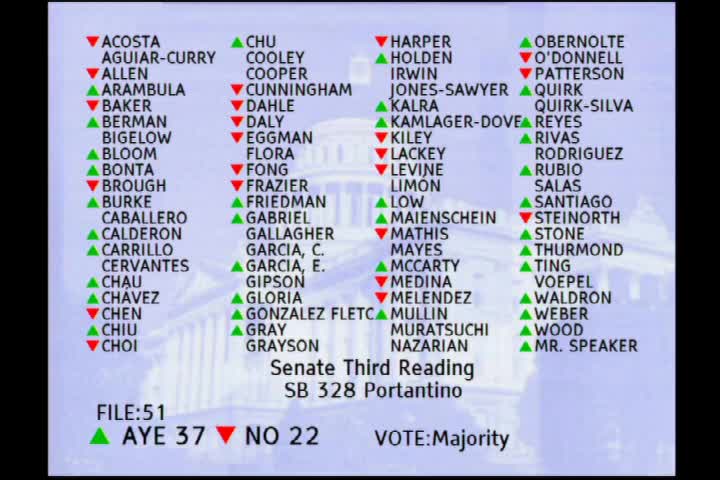 1MIN
Assembly Floor
 1MIN
Assembly Standing Committee on Utilities and Energy
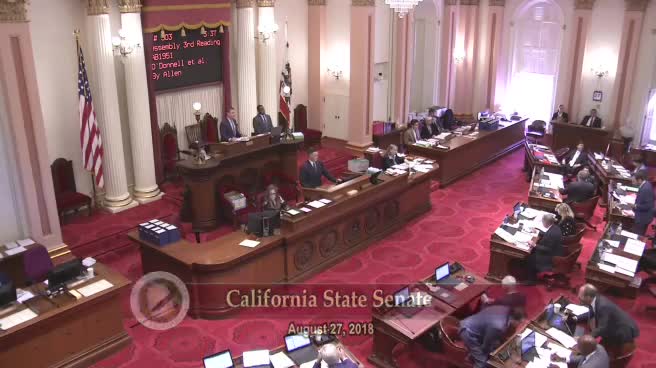 2MIN
Senate Floor
 16MIN
Senate Standing Committee on Energy, Utilities and Communications
Bill Author

Bill Co-Author(s):