AB 2354: Family law: court reporters.
- Session Year: 2017-2018
- House: Assembly
- Latest Version Date: 2018-03-14
Existing law law, the Domestic Violence Prevention Act, provides for the issuance of emergency protective orders and other protective orders for the prevention of domestic violence. Existing law also requires a family court to determine child custody in proceedings for dissolution of marriage, nullity of marriage, and legal separation of the parties, petitions for exclusive custody of a child, and proceedings under the Domestic Violence Prevention Act.
Existing law requires an official reporter or official reporter pro tempore of the superior court to take down in shorthand all testimony and other information in proceedings before the court in civil cases on order of the court and at the request of a party or counsel.
This bill would require the court to provide a court reporter at every hearing at which testimony is received in either a proceeding that relates to an emergency protective order or other protective order requested or issued in a case of domestic violence. child custody or a proceeding under the Domestic Violence Prevention Act.
Existing law provides for the issuance of emergency protective orders and other protective orders for the prevention of domestic violence.
This bill would require the court to provide a court reporter at every hearing that relates to an emergency protective order or other protective order requested or issued in a case of domestic violence.
The court shall provide a court reporter at every hearing in a proceeding under this division at which testimony is received.
SECTION 1.SEC. 2.Section 6222.5 is added to the Family Code, to read:6222.5.The court shall provide a court reporter at every hearing that relates to a protective order requested or issued pursuant to this division. in a proceeding under this division at which testimony is received.
The court shall provide a court reporter at every hearing that relates to a protective order requested or issued pursuant to this division.
|
Date
|
Status
|
|---|---|
| Aug 16, 2018 | In committee: Held under submission. |
| Aug 6, 2018 | In committee: Referred to APPR. suspense file. |
| Jun 27, 2018 | From committee: Do pass and re-refer to Com. on APPR. (Ayes 6. Noes 1.) (June 26). Re-referred to Com. on APPR. |
| Jun 7, 2018 | Referred to Com. on JUD. |
| May 30, 2018 | In Senate. Read first time. To Com. on RLS. for assignment. |
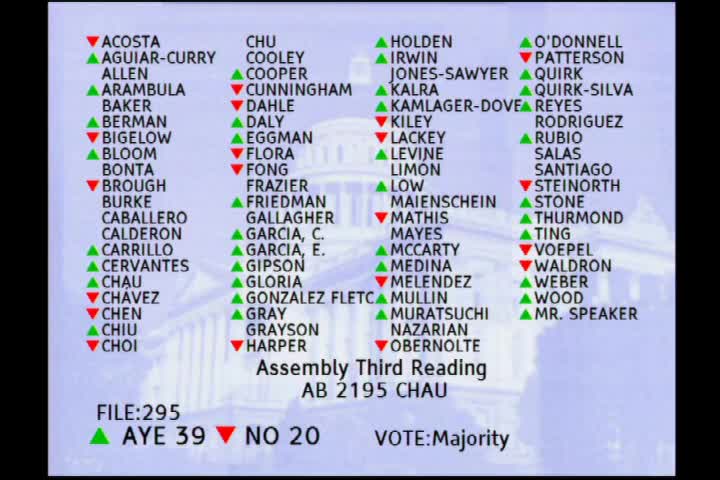
| May 29, 2018 | Read third time. Passed. Ordered to the Senate. |
| May 25, 2018 | From committee: Do pass. (Ayes 12. Noes 3.) (May 25). |
| Apr 4, 2018 | In committee: Set, first hearing. Referred to suspense file. |
| Mar 20, 2018 | From committee: Do pass and re-refer to Com. on APPR. (Ayes 8. Noes 1.) (March 20). Re-referred to Com. on APPR. |
| Mar 15, 2018 | Re-referred to Com. on JUD. |
| Mar 14, 2018 | From committee chair, with author's amendments: Amend, and re-refer to Com. on JUD. Read second time and amended. |
| Mar 1, 2018 | Referred to Com. on JUD. |
| Feb 14, 2018 | From printer. May be heard in committee March 16. |
| Feb 13, 2018 | Read first time. To print. |
|
Date
|
Description
|
Location
|
Votes
|
|
|---|---|---|---|---|
| Aug 6, 2018 | Placed on suspense file | Senate Standing Committee on Appropriations |
Passed |
|
| Jun 26, 2018 | Do pass, but first be re-referred to the Committee on [Appropriations] | Senate Standing Committee on Judiciary |
Passed |
|
| May 29, 2018 | AB 2354 RUBIO Assembly Third Reading | Assembly Floor |
Passed |
|
| May 25, 2018 | Do pass. | Assembly Standing Committee on Appropriations |
Passed |
|
| Mar 20, 2018 | Do pass and be re-referred to the Committee on [Appropriations] | Assembly Standing Committee on Judiciary |
Passed |
This list shows positions taken on this bill by organizations on the date displayed, which is linked to the original source.
Positions by individuals are not included.
SENATE COMMITTEE ON APPROPRIATIONS
Senator Anthony Portantino, Chair
2017 - 2018 Regular Session
AB 2354 (Rubio) - Family law: court reporters
Version: March 14, 2018 | Policy Vote: JUD. 6 - 1 |
Urgency: No | Mandate: No |
Hearing Date: August 6, 2018 | Consultant: Shaun Naidu |
This bill meets the criteria for referral to the Suspense File.
Bill Summary:
AB 2354 would require the court to provide a court reporter at every hearing at which testimony is received in proceedings related to child custody or under the Domestic Violence Prevention Act.
Fiscal Impact:
Judicial Council anticipates ongoing costs of approximately $31 million annually to hire enough additional court reporters to satisfy the requirements imposed by this bill. (General Fund*)
As a part of the Budget Act of 2018, the Legislature intended $10 million appropriated to the judicial branch out of $75 million in discretionary funding for the trial courts be used to supplement, but not supplant, the level of court reporters in family law cases. Assuming the accuracy of estimates by Judicial Council on the costs associated with providing court reporters that would be required by this bill, the one-time intent (but not requirement) of $10 million would not be sufficient to cover costs associated with this bill.
*Trial Court Trust Fund
Background:
Current law requires that there be official reporters (and official reporters pro tempore) of the superior court to take down in shorthand all testimony, objections made, rulings of the court, exceptions taken, arraignments, pleas, sentences, arguments of the attorneys to the jury, and statements and remarks made and oral instructions given by the judge or other judicial office, in a criminal case, as specified, and in a civil case on the order of the court or at the request of a party. The report of the court reporter, or court reporter pro tempore, duly appointed and sworn, is prima facie evidence of the testimony and proceedings when it is transcribed and certified as being a correct transcript of the testimony and proceedings in the case. The superior court may appoint as many competent court reporters as are deemed necessary for the performance of the duties and the exercise of the powers conferred by law on the court.
A family court determines child custody in proceedings for dissolution of marriage, nullity of marriage, and legal separation of the parties, petitions for exclusive custody of a child, and proceedings under the Domestic Violence Prevention Act. The Domestic Violence Prevention Act provides for the issuance of emergency protective orders and other protective orders for the prevention of domestic violence.
Proposed Law:
See Bill Summary.
Related Legislation:
AB 2084 (Kalra, 2018) would augment the regulation of those engaged in the business of providing or arranging for certified shorthand reporters. AB 2084 is pending in this Committee.
AB 2664 (Holden, 2018) would clarify that an official court reporter pro tempore may be appointed even if the parties fail to stipulate to the appointment. AB 2664 is pending on the Senate floor.
AB 2757 (Reyes, 2018) would increase the fees charged by court reporters for original transcripts and copies, as specified. AB 2757 is pending in this Committee.
Staff Comments:
The Judicial Needs Assessment indicates that courts need a total of 325 judges in family law cases to handle current caseloads. Based on the 1.25 FTE court reporter position required for each courtroom as indicated by the Resource Allocation Study, the court would need to have 400 court reporters to cover all family law matters. Judicial Council has indicated that the courts currently employ 200 court reporters, meaning the need of an additional 200 reporters to handle all family law cases. Committee staff notes, however, that this bill requires the court to provide court reporters only in proceedings related to child custody and under the Domestic Violence Prevention Act and not all family law cases. Staff is unaware of how many cases under the family law umbrella fall under those specific topics. Nonetheless, Judicial Council has indicated that it appears that, given current trends, the labor supply of licensed court reporters is unlikely to meet the need imposed by this bill. A shortage of reporters could result in higher wages to retain existing and attract new court reporters, thereby placing cost pressures on the General Fund to support an increase in court reporter wages and/or benefits to keep the court as a competitive employer.
-- END --
Senator Hannah-Beth Jackson, Chair
2017-2018 Regular Session
Bill No: AB 2354 (Author:Rubio)
Version: March 14, 2018
Hearing Date: June 26, 2018
Fiscal: Yes
Urgency: No
Consultant: JDT
SUBJECT
Family law: court reporters
DESCRIPTION
This bill would require a court to provide a court reporter at every hearing at which testimony is received in either a proceeding that relates to child custody or a proceeding under the Domestic Violence Act.
BACKGROUND
Transcripts generated by court reporters are essential to the administration of justice. Unfortunately, California does not mandate the use of court reporters in certain civil actions, forcing parties to choose between forgoing the creation of a formal record of the proceedings and absorbing the costs by seeking the services of private reporters. This bill would require a court to provide a court reporter at every hearing at which testimony is received in either a proceeding that relates to child custody or a proceeding under the Domestic Violence Act.
CHANGES TO EXISTING LAW
Existing law requires that an official reporter or official reporter pro tempore of the superior court take down in shorthand all testimony, objections made, rulings of the court, exceptions taken, arraignments, pleas, sentences, arguments of the attorneys to the jury, and statements and remarks made and oral instructions given by the judge or other judicial office, in a criminal case, as specified, and in a civil case on the order of the court or at the request of a party. (Code Civ. Proc. Sec. 269(a).)
Existing law provides that the report of the official reporter, or official reporter pro tempore, of any court, duly appointed and sworn, when transcribed and certified as being a correct transcript of the testimony and proceedings in the case, is prima facie evidence of that testimony and proceedings. (Code Civ. Proc. Sec. 273(a).)
Existing law establishes within the Department of Consumer Affairs the Court Reporters Board of California that is responsible for the licensure, regulation, and discipline of shorthand court reporters. (Bus. & Prof. Code Secs. 8000 & 8005.1.)
Existing law prohibits a person from engaging in the practice of shorthand reporting, including pro tempore official reporters, unless that person is the holder of a certificate in full force and effect issued by the board. (Bus. & Prof. Code Sec. 8016.)
Existing law defines the practice of shorthand reporting as the making, by means of written symbols or abbreviations in shorthand or machine shorthand writing, of a verbatim record of any oral court proceeding, deposition, court ordered hearing or arbitration, or proceeding before any grand jury, referee or court commissioner and the accurate transcription thereof. (Bus. & Prof. Code Sec. 8017.)
Existing law provides that any natural person holding a valid certificate as a shorthand reporter is a “certified shorthand reporter,” and that no other person, firm, or corporation may assume or use that title unless so certified. (Bus. & Prof. Code Sec. 8018.)
Existing law provides that a violation of the provisions governing the regulation of shorthand reporters, or any support provided in the commission of such a violation, is guilty of a misdemeanor. (Bus. & Prof. Code Secs. 8018 & 8019.)
Existing law provides that a superior court may appoint as many competent phonographic reporters, to be known as official reporters of such court, and such official reporters pro tempore, as are deemed necessary for the performance of the duties and the exercise of the powers conferred by law upon the court and its members. (Gov. Code Sec. 69941.)
Existing law prohibits a person from being appointed to the position of official reporter of any court unless the person has first obtained a license to practice as a certified shorthand reporter from the Court Reporters Board of California. (Gov. Code Sec. 69942.)
Existing law provides that before entering upon the duties of his or her office, the official reporter of any court or official reporter pro tempore must take and subscribe the constitutional oath of office. (Gov. Code Sec. 69946.)
Existing law prescribes the fees for reporting testimony and proceedings at $55 a day, or any fractional part thereof, and sets varying levels of compensation for court reporters based on the county in which the reporting occurs. (Gov. Code Sec. 69948.)
Existing law provides that when there is no official reporter in attendance and a reporter pro tempore is appointed, his or her reasonable expenses for traveling and detention must be fixed and allowed by the court and paid in like manner. (Gov. Code Sec. 69952.)
Existing law requires the Judicial Council to adopt rules to ensure all of the following:
- that parties are given adequate and timely notice of the availability of an official court reporter;
- that if an official court reporter is not available, a party may arrange for the presence of a certified shorthand reporter to serve as an official pro tempore reporter, the costs therefor recoverable as taxable costs by the prevailing party, as otherwise provided by law; and
- that if the services of an official pro tempore reporter are utilized, no other charge may be made to the parties. (Gov. Code Sec. 68086(c) & (d).)
Existing law states: “If the services of an official court reporter are not available for a hearing or trial in a civil case, a party may arrange for the presence of a certified shorthand reporter to serve as an official pro tempore reporter. It is that party’s responsibility to pay the reporter's fee for attendance at the proceedings, but the expense may be recoverable as part of the costs, as provided by law.” (Rule of Court, Sec. 2.956(c).)
Existing law provides, that when needed in order for judicial business of the superior court to be diligently carried on without delay, a pro tempore official reporter may be appointed to perform the duties of a phonographic reporter in such matter, or until a regular official reporter becomes available for such service. A pro tempore official reporter for such service may be appointed by the presiding judge of the court and the judge presiding in the department where the reporter will serve. If the appointment is made for service in a contested matter, it must be made pursuant to a written stipulation of the parties appearing at the trial or hearing or other proceeding to be reported by the pro tempore reporter. (Gov. Code Sec. 70044(a).)
Existing law provides that a pro tempore reporter who has passed the test on qualifications and has a certificate thereof on file among the records of the court, as prescribed, and who has been appointed a pro tempore official reporter by a majority of the judges of such court, as specified, may serve in a matter without further order or stipulation of the parties. (Gov. Code Sec. 70044(b).)
Existing law requires a family court to determine child custody in proceedings for dissolution of marriage, nullity of marriage, and legal separation of the parties, petitions for exclusive custody of a child, and proceedings under the Domestic Violence Prevention Act. (Fam. Code Sec. 3000 et seq.)
Existing law, the Domestic Violence Prevention Act, provides for the issuance of emergency protective orders and other protective orders for the prevention of domestic violence. (Fam. Code Sec. 6200 et seq.)
This bill would require a court to provide a court reporter at every hearing at which testimony is received in either a proceeding that relates to child custody or a proceeding under the Domestic Violence Act.
COMMENT
1. Stated need for the bill
According to the author:
Access to a verbatim transcript is critically important at the trial level, where parties overwhelmingly represent themselves. First, verbatim records are needed to write accurate post-hearing restraining orders, or child custody and visitation orders, that law enforcement officers can enforce. Second, verbatim records are needed because custody and visitation cases are frequently litigated and revisited over many years. The court needs a clear record of past proceedings to determine whether changed circumstances require changing custody or visitation schedules. Moreover, family judges often only serve one or two years, so later judges assigned to a case need a clear record of what has previously happened in a case to effectively manage the case. A verbatim record is especially critical on appeal. Under current law, the appeal, in many cases, will be dismissed or denied without the reporter’s transcript.
2. The importance of transcripts of proceedings
California does not mandate the use of court reporters in certain civil actions, and budget cuts have resulted in increasingly shallow pools of official court reporters, prompting parties to seek the services of private reporters. Privately-retained reporters who serve as official reporters pro tempore do so under appointment by the superior court. (Gov. Code Secs. 69941 & 70044.) By accepting that appointment, persons serving as official reporters pro tempore become ministerial officers of the court and are subject to the jurisdiction of the court during the period of their appointment to the same extent as an official reporter. (Burd v. Barkley Court Reporters, Inc. (2017) 17 Cal.App.5th 1037, 1050.) However, because parties generally must pay for a court reporter when one is not provided, they often forgo using a private court reporter.
As a matter of public policy, accurate transcripts of proceedings are vital to the administration of justice for a variety of reasons, including: establishing a record in order to subject errant rulings to the scrutiny of higher courts; enabling counsel to impeach a witness by showing that the witness made prior inconsistent statements while under oath; prosecuting a person for perjury; and ensuring that court orders accurately reflect the judge’s ruling on nuanced issues such as visitation rights or division of property. If the parties later disagree on a ruling, they may be forced to re-litigate the case—a considerable burden on the parties and courts. Moreover, a lack of transcripts of court proceedings deprives the general public of a means to independently evaluate what transpires in courts. Accurate, authoritative transcripts of proceedings are thus critical to ensuring judicial accountability, due process, equal protection, and access to justice.
This bill would require a court to provide a court reporter at every hearing at which testimony is received in either a proceeding that relates to child custody or a proceeding under the Domestic Violence Act. The Family Violence Appellate Project (FVAP), one of the bill’s sponsors, writes that this bill addresses a critical need for transcripts in family violence and custody cases – “a need which today is unmet in the majority of California counties.” FVAP states that “the overwhelming majority of family law litigants, including survivors of domestic violence like FVAP’s clients, cannot afford to pay for a court reporter where none is provided by the court. The elimination of court-provided reporters in family law courts thus denies these litigants a meaningful right to litigate their cases. FVAP’s work has made it acutely aware of the devastating effect that the denial of a verbatim record has on family violence cases, and the serious access to justice and due process issues that occur as a result.”
The bill’s co-sponsor, California Court Reporters Association, writes:
As certified shorthand reporters, we know how important it is to have a complete and accurate record of court proceedings. Without a transcript, litigants are unable to appeal, parties struggle to draft orders effectively and it is nearly impossible to recount what happened during the trail with accuracy.
Under current law, court reporters are required to be made available in all criminal and juvenile proceedings because of the trial’s significant importance and impact on the litigants and individuals involved. However, in family law, California now has a two-tied justice system, where only parties who could afford to hire a private court reporter receive the benefits of a complete and accurate transcript. Given the importance of family law proceedings, there is no question as to the need for a complete and accurate record in these cases.
The California Partnership to End Domestic Violence adds that requiring litigants to pay the substantial cost and provide their own court reporters especially harms survivors of domestic violence: “Court reporter fees can range from $700 to $800 for a full day, which limits access to survivors who are often also suffering the impacts of financial abuse.”
Support: California Partnership to End Domestic Violence; California Protective Parents Association; Executive Committee of the Family Law Section of the California Lawyers Association; Family Justice Advocates in Action; IFPTE Local 21; Legislative Coalition to Prevent Child Abuse
Opposition: None Known
HISTORY
Source: California Court Reporters Association; Family Violence Appellate Project
Related Pending Legislation:
AB 2084 (Kalra, 2018) would augment the regulation of those engaged in the business of providing or arranging for certified shorthand reporters. That bill is pending hearing in the Senate Business, Professions & Economic Development Committee.
AB 2664 (Holden, 2018) would clarify that an official court reporter pro tempore may be appointed even if the parties fail to stipulate to the appointment. That bill was heard in this Committee and passed by a vote of 7-0. It is now pending on the Senate Floor.
AB 2757 (Reyes, 2018) would increase the fees charged by court reporters for original transcripts and copies by 33 percent, through a series of increases over the next five years, commencing in 2019. That bill will be heard in this Committee.
Prior Legislation: SCR 95 (Jackson, Res. Ch. 17, 2018), proclaims February 10 through February 17, 2018, as California Court Reporting and Captioning Week.
Prior Vote:
Assembly Floor (Ayes 54, Noes 24)
Assembly Appropriations Committee (Ayes 12, Noes 3)
Assembly Judiciary Committee (Ayes 8, Noes 1)
**************
ASSEMBLY THIRD READING
ATR Bill Id:AB 2354
Author:(Rubio)
As Amended Ver:March 14, 2018
Majority vote
Committee | Votes | Ayes | Noes |
Judiciary | 8-1 | Mark Stone, Calderon, Berman, Gonzalez Fletcher, Holden, Kalra, Maienschein, Reyes | Obernolte |
Appropriations | 12-3 | Gonzalez Fletcher, Bloom, Bonta, Calderon, Carrillo, Chau, Eggman, Friedman, Eduardo Garcia, Nazarian, Quirk, Reyes | Bigelow, Fong, Obernolte |
SUMMARY: Requires court reporters in child custody and domestic violence proceedings under the Family Code. Specifically, this bill requires that the court provide a court reporter at every child custody or Domestic Violence Prevention Act hearing at which testimony is received.
EXISTING LAW:
- Requires court reporters in all death penalty proceedings, juvenile court proceedings, and hearings on motions to withdraw consent to step-parent adoptions. (Penal Code Section (PEN) 190.9; Welfare and Institutions Code Sections (WIC) 347 and 677; Family Code Section (FAM) 9005 (d).)
- Requires that a court reporter take down all testimony, objections made, rulings of the court, exceptions taken, arraignments, pleas, sentences, arguments of the attorneys to the jury, and statements and remarks made and oral instructions given by the judge or other judicial officer, in the following cases:
- In a civil case, on the order of the court or at the request of a party;
- In a felony case, on the order of the court or at the request of the prosecution, the defendant, or the attorney for the defendant; and
- In a misdemeanor or infraction case, on the order of the court. (Code of Civil Procedure Section (CCP) 269.)
- Permits a judge to have a court reporter in felony, unlimited civil, probate, juvenile and selected family law proceedings, including child custody and child support proceedings, take down any opinion, judgment or testimony, as provided, in short hand and transcribe, as the court deems necessary. (CCP 274a.)
- Provides that the court may direct the making of a verbatim record and that payment be from the county treasury on order of the court for: (a) criminal matters; (b) juvenile proceedings; (c) proceedings to declare a minor free from custody; (d) proceedings under the Lanterman-Petris-Short Act; and (e) as otherwise provided by law. (Government Code Section (GOV) 69952.)
- Allows a court, if an official court reporter or an official reporter pro tempore is unavailable, to use electronic recording equipment only for a limited civil case, a misdemeanor or infraction case, or for the internal purpose of monitoring the performance of subordinate judicial officers, hearing officers, and temporary judges. (GOV 69957 (a)-(b).)
FISCAL EFFECT: According to the Assembly Appropriations Committee, approximately 40 counties provide limited or no court reporters in family law proceedings. Assuming each of these counties, on average, would have to hire one full-time court reporter at an average annual cost of $100,000 for salary and benefits, statewide costs would be $4 million. (Trial Court Trust Fund). To the extent that these counties need more than one full-time court reporter, costs could be substantially greater.
According to a Judicial Council survey conducted in 2016, of the 54 counties responding, 16 counties provided court reporters in all family law proceedings while 22 counties provide court reporters in only some family law proceedings.
COMMENTS: Court reporters take shorthand notes of court proceedings and produce a verbatim record of what transpires in court. Today, court reporters are only mandated in some court proceedings, generally criminal and juvenile court proceedings. The lack of mandate for court reporters in civil actions, coupled with budget cuts to the courts during the great recession, has resulted in many civil courtrooms across the state operating without court reporters, unless the parties decide to provide and pay for their own reporters. In family law cases, where life-altering decisions are made every day and the vast majority of litigants are unrepresented, court reporters are almost nonexistent in far too many courts. Without a court reporter to take down the proceedings, there is no report of what transpires in court. As a result, parties may be unable to understand or draft orders accurately, and there is effectively no right to appeal. This bill mandates that the court provide a court reporter in all child custody and domestic violence proceedings where testimony is received.
Court Budget Reductions in California Dramatically Reduced Civil Courtrooms with Court Reporters: As a result of the recession and the state budget crisis, the trial courts' budget had been reduced significantly (although the courts' budget has increased each of the last five years and is scheduled for a very significant increase this year). In 2013, this Committee held an informational hearing titled "The Access to Justice Crisis Facing California's Families" in order to identify and better understand the impacts of the budget reductions on the trial courts. In preparing for that hearing, this Committee independently surveyed the 58 trial courts to assess what measures the courts have taken to address the cuts and discovered that fully 30 courts had ceased providing court reporters for civil, family and probate proceedings. In those courts, parties who wish to have an official record of proceedings must hire and pay the substantial cost of providing their own private court reporter. While the courts' budget situation has improved, court reporters have not been brought back into family law courts.
Judicial Council Task Force Has Highlighted the Need For Better Access To Records In Family Law Proceedings Generally: As a result of the dearth of court reporters in family law proceedings, there is all too often no official record of the proceeding and little ability to appeal a ruling, even a grossly unjust one. There is also all too frequent confusion by unrepresented litigants – who make up the vast majority of family law litigants – about the basic nature of the court's orders, and there is no recording or reporting of any kind for them to review after the hearing, often making it impossible to draft accurate orders. Yet family law matters generally, and the specific matters covered by this bill – child custody and domestic violence – arguably include some of the most important matters facing children and families. As a result, the Judicial Council's Elkins Family Law Task Force has recommended:
Legislation should be enacted to provide that cost-effective options for creating an official record be available in all family law courtrooms in order to ensure that a complete and accurate record is available in all family law proceedings. These options would include court reporters, high quality electronic audio recording, or other available mechanisms to create an accurate, timely, and cost-effective official record. Access to the record in family law is a serious access-to-justice issue and must be significantly improved both to ensure that parties understand and can finalize the court's orders and to ensure that the parties' right to appeal is protected. Parties' current inability to access the record in their family law proceedings is an area of long-standing concern. This inability to have an accurate record of their family law cases makes the ability of family law litigants to appeal too often illusory. (Judicial Council's Elkins Family Law Task Force, Final Report and Recommendations, p. 80 (April 2010.))
Family Law Judges and Practitioners Strongly Support the Need For a Record in Family Law Proceedings: Judges and family law practitioners alike support having court reporters in family law proceedings. Judge Kimberly Nystrom-Geist, testifying at the Senate Judiciary Committee's March 11, 2014 informational hearing entitled "Family Law Courts: Budget Cutbacks and Access to Justice," stated: "Without a court reporter, there is no record. Everyone suffers. The public doesn't know if the judge did the job right. The litigants can't have an appeal. Without appeals, we have no case law, and it stifles the development of family law."
Family law practitioners strongly concur in the need for a record in important family law proceedings. In support of AB 251 (Wagner), 2013, which would have permitted electronic recording in family law cases, but failed in this Committee, one practitioner wrote the following:
Due to budgetary restraints, many family law hearings and trials are taking place without any record at all. Without a record there can be no meaningful appellate review, nor oversight of the family law judiciary. This situation also complicates preparation of written orders. This situation has a special impact in family law because these cases routinely involve fundamental constitutional rights; the vast majority of family law litigants represent themselves without counsel; and a large proportion of family law litigants are indigent. The courts are making orders regarding child custody and visitation, child support, spousal support and the division of assets and debts and there is often no written record. Access to justice should not be based on one's ability to pay for a court reporter.
Moreover, family law cases can last for years and involve multiple orders from multiple judges. Without a record, a subsequent judge likely will not understand the detailed history of the case and the findings of the prior judge.
The Commission on Judicial Performance Believes Elimination of Court Reporters in Civil Proceedings Impairs Its Ability to Protect the Public: Without court reporters in the courtroom, there is very limited review of judges' actions, as well as their behavior. The then-Director-Chief Counsel of the Commission on Judicial Performance (CJP) wrote, in a letter to the Governor, the Chief Justice, and legislative leaders, that she is concerned that the significant reduction in court reporters impairs the Commission's "ability to fulfill its mandate to protect the public, and undermines the administration of justice in court proceedings in California." (Letter from Victoria Henley to Governor Brown, Supreme Court Chief Justice Cantil-Sakauye, Speaker Pérez and Senate President Pro Tempore Steinberg (Feb. 29, 2012).) Without a record of court proceedings, CJP states:
[I]t can be difficult, if not impossible, to establish what occurred in the courtroom, where 95% of the complaints to the Commission each year originate. In December 2011, there were transcripts or recordings in only half of the Commission's pending investigations that involve courtroom conduct. . . . The absence of transcripts or recordings thus impedes the commission in determining that misconduct has occurred and in protecting the public from abusive judges. Equally important, the absence of a record of court proceedings prevents the swift and complete exoneration of judges by the commission when appropriate. (Id. (footnote omitted).)
Analysis Prepared by: Leora Gershenzon / JUD. / (916) 319-2334 FN: 0003033
Date of Hearing: April 4, 2018
ASSEMBLY COMMITTEE ON APPROPRIATIONS
Lorena Gonzalez Fletcher, Chair
ABPCA Bill Id:AB 2354
Author:(Rubio) – As Amended Ver:March 14, 2018
Policy Committee: | Judiciary | Vote: | 8 - 1 |
|
| ||
|
|
Urgency: No State Mandated Local Program: No Reimbursable: No
SUMMARY:
This bill requires the court to provide a court reporter at every child custody or Domestic Violence Prevention Act hearing at which testimony is received.
FISCAL EFFECT:
Approximately 40 counties provide limited or no court reporters in family law proceedings. Assuming each of these counties, on average, would have to hire one full-time court reporter at an average annual cost of $100,000 for salary and benefits, statewide costs would be $4 million. (Trial Court Trust Fund). To the extent that these counties need more than one full-time court reporter, costs could be substantially greater.
According to a Judicial Council survey conducted in 2016, of the 54 counties responding, 16 counties provided court reporters in all family law proceedings while 22 counties provide court reporters in only some family law proceedings.
COMMENTS:
- Purpose. This bill seeks to ensure that parties to child custody and domestic violence proceedings are provided with appropriate due process protection by requiring the use of a court reporter in these cases. According to the author:
Access to a verbatim transcript is critically important at the trial level, where parties overwhelmingly represent themselves. First, verbatim records are needed to write accurate post-hearing restraining orders, or child custody and visitation orders, that law enforcement officers can enforce. Second, verbatim records are needed because custody and visitation cases are frequently litigated and revisited over many years. The court needs a clear record of past proceedings to determine whether changed circumstances require changing custody or visitation schedules. Moreover, family judges often only serve one or two years, so later judges assigned to a case need a clear record of what has previously happened in a case to effectively manage the case. A verbatim record is especially critical on appeal. Under current law, the appeal, in many cases, will be dismissed or denied without the reporter’s transcript.
- Background. Court reporters are only mandated in some court proceedings, generally criminal and juvenile court proceedings. The lack of mandate for court reporters in civil actions, coupled with budget cuts to the courts during the great recession, has resulted in many civil courtrooms across the state operating without court reporters, unless the parties decide to provide and pay for their own reporters. Generally, state law provides that an official court reporter must transcribe civil, felony, and misdemeanor proceedings if ordered by the court or, in civil or felony cases, if requested by the parties. However this does not require that, in civil cases, a court reporter be provided free of charge, nor does it require that transcripts be provided for free. Parties have a right to hire a court reporter for their civil matters, but unless specifically required otherwise, the court is currently not required to provide a court reporter for them.
According to the California Court Reporters Association, there are over 7,000 certified court reporters in the state, including the freelance and official markets. Freelance court reporters are used in the private sector for closed captioning, depositions, or out-of-court proceedings. Official court reporters work in the courts and receive a base salary and benefits. All official court reporters are paid extra for producing transcripts.
- Related Pending Legislation: There are several bills in this legislative session regarding court reporters:
AB 2084 (Kalra) would better regulate those engaged in the business of providing or arranging for certified shorthand reporters. That bill is pending hearing in the Assembly Business & Professions Committee.
AB 2651 (Kiley) would, among other things, increase the fee charged by courts for providing a court reporter in a civil action. That bill is pending hearing the Assembly Judiciary Committee.
AB 2664 (Holden) would require a court, if a party requests a court reporter but the parties are unable to reach a stipulation on that, to appoint an official court reporter pro tempore from among the qualified candidates proposed by the parties. That bill is pending hearing the Assembly Judiciary Committee.
AB 2757 (Reyes) would increase the fee for court transcripts prepared by official court reporters or court reporters pro tempore. That bill is pending hearing the Assembly Judiciary committee.
- Prior Legislation.
AB 749 (Bloom), of the 2015-16 Legislative Session, was very similar to this bill. It was held on suspense in this Committee.
AB 251 (Wagner), of the 2013-14 Legislative Session, would have allowed use of electronic recording in family law cases if a court reporter is unavailable. AB 803 (Wagner), of the 2011-12 Legislative Session, would have allowed electronic recording in a specific percentage of courtrooms each year. Both bills failed passage in the Assembly Committee on Judiciary.
Analysis Prepared by: Jennifer Swenson / APPR. / (916) 319-2081
Date of Hearing: March 20, 2018
ASSEMBLY COMMITTEE ON JUDICIARY
Mark Stone, Chair
ABPCA Bill Id:AB 2354
Author:(Rubio) – As Amended Ver:March 14, 2018
SUBJECT: COURT REPORTERS: FAMILY LAW
KEY ISSUE: IN ORDER TO ENSURE THAT PARTIES TO CHILD CUSTODY AND DOMESTIC VIOLENCE PROCEEDINGS -- AMONG THE MOST CRITICAL AND LIFE-ALTERING OF ALL JUDICIAL PROCEEDINGS -- ARE PROVIDED WITH APPROPRIATE DUE PROCESS PROTECTION, SHOULD COURT REPORTERS BE REQUIRED IN THOSE CASES?
SYNOPSIS
Court reporters take shorthand notes of court proceedings and produce a verbatim record of what transpires in court. Today court reporters are only mandated in some court proceedings, generally criminal and juvenile court proceedings. The lack of mandate for court reporters in civil actions, coupled with budget cuts to the courts during the great recession, has resulted in many civil courtrooms across the state operating without court reporters, unless the parties decide to provide and pay for their own reporters. In family law cases, where life-altering decisions are made every day and the vast majority of litigants are unrepresented, court reporters are almost nonexistent in far too many courtrooms. Without a court reporter to take down the proceeding, there is no report of what transpires in court. As a result, parties may be unable to understand or draft orders accurately, and there is effectively no right to appeal. This bill, sponsored by the California Court Reporters Association and the Family Violence Appellate Project, requires that the court provide a court reporter at every child custody or Domestic Violence Prevention Act hearing at which testimony is received. This bill is supported by, among others, the California Partnership to End Domestic Violence and the California Protective Parents Association, and has no reported opposition.
SUMMARY: Requires court reporters in child custody and domestic violence proceedings under the Family Code. Specifically, this bill requires that the court provide a court reporter at every child custody or Domestic Violence Prevention Act hearing at which testimony is received.
EXISTING LAW:
- Requires court reporters in all death penalty proceedings, juvenile court proceedings, and hearings on motions to withdraw consent to step-parent adoptions. (Penal Code Section 190.9; Welfare & Institutions Code Sections 347 and 677; Family Code Section 9005 (d).)
- Requires that a court reporter take down all testimony, objections made, rulings of the court, exceptions taken, arraignments, pleas, sentences, arguments of the attorneys to the jury, and statements and remarks made and oral instructions given by the judge or other judicial officer, in the following cases:
- In a civil case, on the order of the court or at the request of a party;
- In a felony case, on the order of the court or at the request of the prosecution, the defendant, or the attorney for the defendant; and
- In a misdemeanor or infraction case, on the order of the court. (Code of Civil Procedure Section 269.)
- Permits a judge to have a court reporter in felony, unlimited civil, probate, juvenile and selected family law proceedings, including child custody and child support proceedings, take down any opinion, judgment or testimony, as provided, in short hand and transcribe, as the court deems necessary. (Code of Civil Procedure Section 274a.)
- Provides that the court may direct the making of a verbatim record and that payment be from the county treasury on order of the court for: (a) criminal matters; (b) juvenile proceedings; (c) proceedings to declare a minor free from custody; (d) proceedings under the Lanterman-Petris-Short Act; and (e) as otherwise provided by law. (Government Code Section 69952.)
- Allows a court, if an official court reporter or an official reporter pro tempore is unavailable, to use electronic recording equipment only for a limited civil case, a misdemeanor or infraction case, or for the internal purpose of monitoring the performance of subordinate judicial officers, hearing officers, and temporary judges. (Government Code Section 69957 (a)-(b).)
FISCAL EFFECT: As currently in print this bill is keyed fiscal.
COMMENTS: Court reporters take shorthand notes of court proceedings and produce a verbatim record of what transpires in court. Today, court reporters are only mandated in some court proceedings, generally criminal and juvenile court proceedings. The lack of mandate for court reporters in civil actions, coupled with budget cuts to the courts during the great recession, has resulted in many civil courtrooms across the state operating without court reporters, unless the parties decide to provide and pay for their own reporters. In family law cases, where life-altering decisions are made every day and the vast majority of litigants are unrepresented, court reporters are almost nonexistent in far too many courts. Without a court reporter to take down the proceedings, there is no report of what transpires in court. As a result, parties may be unable to understand or draft orders accurately, and there is effectively no right to appeal. This bill mandates that the court provide a court reporter in all child custody and domestic violence proceedings where testimony is received.
In support of the bill, the author writes:
Access to a verbatim transcript is critically important at the trial level, where parties overwhelmingly represent themselves. First, verbatim records are needed to write accurate post-hearing restraining orders, or child custody and visitation orders, that law enforcement officers can enforce. Second, verbatim records are needed because custody and visitation cases are frequently litigated and revisited over many years. The court needs a clear record of past proceedings to determine whether changed circumstances require changing custody or visitation schedules. Moreover, family judges often only serve one or two years, so later judges assigned to a case need a clear record of what has previously happened in a case to effectively manage the case. A verbatim record is especially critical on appeal. Under current law, the appeal, in many cases, will be dismissed or denied without the reporter’s transcript. Without court reporters in the courtroom, there is also very limited review of judges' actions, as well as their behavior, should the Commission on Judicial Performance receive a complaint.
Basics on Court Reporters: According to the California Court Reporters Association, court reporters currently produce and deliver transcripts acting as independent contractors using privately purchased hardware, software, computer networks, supplies, shipping costs, and labor. There are over 7,000 certified court reporters in the state, including the freelance and official markets. Freelance court reporters are used in the private sector for closed captioning, depositions, or out-of-court proceedings. Official court reporters work in the courts and receive a base salary and benefits. All official court reporters are paid extra for producing transcripts.
While Court Reporters are Permitted in Court Proceedings, They are Only Mandated in Certain Cases: California law specifically mandates that court reporters take down in shorthand court proceedings and provide transcripts of those proceedings to certain cases, including all death penalty cases and dependency and delinquency proceedings in juvenile court. Additionally, both the United States Supreme Court and the California Supreme Court have held that an indigent criminal defendant has a right to a free transcript. (Britt v. North Carolina (1971) 404 U.S. 226, 230; People v. Hosner (1975) 15 Cal.3d 60, 65.) The right to a transcript – and hence the right to a court reporter – in felony cases is also codified in Code of Civil Procedure Section 269 and California Rule of Court, Rule 8.336.
More generally, Code of Civil Procedure Section 269 provides that an official court reporter shall transcribe civil, felony, and misdemeanor proceedings if ordered by the court or, in civil or felony cases, if requested by the parties. However this provision does not require that, in civil cases, a court reporter be provided free of charge, nor does it require that transcripts be provided for free. Parties have a right to hire a court reporter for their civil matters, but unless specifically required otherwise, the court is currently not required to provide a court reporter for them. In particular Rule of Court 2.956 (c) states:
If the services of an official court reporter are not available for a hearing or trial in a civil case, a party may arrange for the presence of a certified shorthand reporter to serve as an official pro tempore reporter. It is that party's responsibility to pay the reporter's fee for attendance at the proceedings, but the expense may be recoverable as part of the costs, as provided by law.
Except as provided for indigent parties under the Transcript Reimbursement Fund (a limited fund that helps indigent parties in civil actions obtain transcripts for free, see Business & Professions Code Section 8030.2 et seq.), courts are only authorized to provide free transcripts in limited instances: criminal matters, juvenile proceedings, Lanterman-Petris-Short Act proceedings, or other proceedings provided by law. (Government Code Section 69952.) In fact, state law provides that: “Except as provided in [Government Code] Section 69952, no reporter shall perform any service in a civil action other than transcriptions until his fee for it has been deposited with the clerk of the court or with the reporter.” (Government Code Section 69953.)
Court Budget Reductions in California Dramatically Reduced Civil Courtrooms with Court Reporters: As a result of the recession and the state budget crisis, the trial courts' budget had been reduced significantly (although the courts' budget has increased each of the last five years and is scheduled for a very significant increase this year). In 2013, this Committee held an informational hearing titled “The Access to Justice Crisis Facing California’s Families” in order to identify and better understand the impacts of the budget reductions on the trial courts. In preparing for that hearing, this Committee independently surveyed the 58 trial courts to assess what measures the courts have taken to address the cuts and discovered that fully 30 courts had ceased providing court reporters for civil, family and probate proceedings. In those courts, parties who wish to have an official record of proceedings must hire and pay the substantial cost of providing their own private court reporter. While the courts' budget situation has improved, court reporters have not been brought back into family law courts.
Judicial Council Task Force Has Highlighted the Need For Better Access To Records In Family Law Proceedings Generally: As a result of the dearth of court reporters in family law proceedings, there is all too often no official record of the proceeding and little ability to appeal a ruling, even a grossly unjust one. There is also all too frequent confusion by unrepresented litigants – who make up the vast majority of family law litigants – about the basic nature of the court's orders, and there is no recording or reporting of any kind for them to review after the hearing, often making it impossible to draft accurate orders. Yet family law matters generally, and the specific matters covered by this bill – child custody and domestic violence – arguably include some of the most important matters facing children and families. As a result, the Judicial Council’s Elkins Family Law Task Force has recommended:
Legislation should be enacted to provide that cost-effective options for creating an official record be available in all family law courtrooms in order to ensure that a complete and accurate record is available in all family law proceedings. These options would include court reporters, high quality electronic audio recording, or other available mechanisms to create an accurate, timely, and cost-effective official record. Access to the record in family law is a serious access-to-justice issue and must be significantly improved both to ensure that parties understand and can finalize the court’s orders and to ensure that the parties’ right to appeal is protected. Parties’ current inability to access the record in their family law proceedings is an area of long-standing concern. This inability to have an accurate record of their family law cases makes the ability of family law litigants to appeal too often illusory. (Judicial Council’s Elkins Family Law Task Force, Final Report and Recommendations, p. 80 (April 2010.))
State Supreme Court Now Considering Related Issue. The need for court reporters is also now before the California Supreme Court in a medical malpractice case. In that case, Jameson v. Desta (2015) 241 Cal. App. 491, involving an indigent plaintiff who was granted a fee waiver, the San Diego trial court told the parties that no court reporter was available and if they wanted a record they would have to provide their own reporter. The parties did not. The trial court granted a motion for nonsuit in favor of the defendant, and the plaintiff appealed. However, because there was no record of the court proceedings, the appellate court found that the plaintiff could not show that any error occurred at the trial court and upheld the trial court's judgment for the defendant. The Supreme Court took the case to decide if a party granted a fee waiver can be denied a court reporter and, as a result, an effective right to appeal. The decision in that case could impact whether court reporters are required in cases involving indigent parties, but would not necessarily impact cases where parties do not qualify for a fee waiver, but are still unable to provide their own court reporter. Final briefing on the appeal was due in November, 2017.
Family Law Judges and Practitioners Strongly Support the Need For a Record in Family Law Proceedings: Judges and family law practitioners alike support having court reporters in family law proceedings. Judge Kimberly Nystrom-Geist, testifying at the Senate Judiciary Committee's March 11, 2014 informational hearing entitled "Family Law Courts: Budget Cutbacks and Access to Justice," stated: "Without a court reporter, there is no record. Everyone suffers. The public doesn’t know if the judge did the job right. The litigants can't have an appeal. Without appeals, we have no case law, and it stifles the development of family law."
Family law practitioners strongly concur in the need for a record in important family law proceedings. In support of AB 251 (Wagner), 2013, which would have permitted electronic recording in family law cases, but failed in this Committee, one practitioner wrote the following:
Due to budgetary restraints, many family law hearings and trials are taking place without any record at all. Without a record there can be no meaningful appellate review, nor oversight of the family law judiciary. This situation also complicates preparation of written orders. This situation has a special impact in family law because these cases routinely involve fundamental constitutional rights; the vast majority of family law litigants represent themselves without counsel; and a large proportion of family law litigants are indigent. The courts are making orders regarding child custody and visitation, child support, spousal support and the division of assets and debts and there is often no written record. Access to justice should not be based on one’s ability to pay for a court reporter.
Moreover, family law cases can last for years and involve multiple orders from multiple judges. Without a record, a subsequent judge likely will not understand the detailed history of the case and the findings of the prior judge.
The Commission on Judicial Performance Believes Elimination of Court Reporters in Civil Proceedings Impairs Its Ability to Protect the Public: Without court reporters in the courtroom, there is very limited review of judges' actions, as well as their behavior. The then-Director-Chief Counsel of the Commission on Judicial Performance (CJP) wrote, in a letter to the Governor, the Chief Justice, and legislative leaders, that she is concerned that the significant reduction in court reporters impairs the Commission's "ability to fulfill its mandate to protect the public, and undermines the administration of justice in court proceedings in California." (Letter from Victoria Henley to Governor Brown, Supreme Court Chief Justice Cantil-Sakauye, Speaker Pérez and Senate President Pro Tempore Steinberg (Feb. 29, 2012).) Without a record of court proceedings, CJP states:
[I]t can be difficult, if not impossible, to establish what occurred in the courtroom, where 95% of the complaints to the Commission each year originate. In December 2011, there were transcripts or recordings in only half of the Commission's pending investigations that involve courtroom conduct. . . . The absence of transcripts or recordings thus impedes the commission in determining that misconduct has occurred and in protecting the public from abusive judges. Equally important, the absence of a record of court proceedings prevents the swift and complete exoneration of judges by the commission when appropriate. (Id. (footnote omitted).)
This Bill May Not Go As Far As Necessary to Ensure That All Parties' Rights Are Protected: While this bill mandates that court reporters take testimony in all child custody and domestic violence proceedings, it does not require that court reporters are present in other family law proceedings or in civil proceedings generally. Moreover, while this bill directs that court reporters make a record of the proceedings, it does not require that parties be provided with a transcript. In order to obtain a transcript, the parties would first have to pay the court reporter for the transcript, which may make it nearly impossible for some parties to get a copy of the court record (other than through the limited Transcript Reimbursement Fund). Thus, while this bill is a good first step to help ensure all parties have a right to a record in their court proceedings, it does not fully accomplish this important goal.
ARGUMENTS IN SUPPORT: The Family Violence Appellate Project (FVAP), one of the bill's sponsors, writes that this bill address a critical need for transcripts in family violence and custody cases – "a need which today is unmet in the majority of California counties." FVAP states that "the overwhelming majority of family law litigants, including survivors of domestic violence like FVAP’s clients, cannot afford to pay for a court reporter where none is provided by the court. The elimination of court-provided reporters in family law courts thus denies these litigants a meaningful right to litigate their cases. FVAP’s work has made it acutely aware of the devastating effect that the denial of a verbatim record has on family violence cases, and the serious access to justice and due process issues that occur as a result."
California Court Reporters Association, also a sponsor, writes in support:
As certified shorthand reporters, we know how important it is to have a complete and accurate record of court proceedings. Without a transcript, litigants are unable to appeal, parties struggle to draft orders effectively and it is nearly impossible to recount what happened during the trail with accuracy.
Under current law, court reporters are required to be made available in all criminal and juvenile proceedings because of the trial’s significant importance and impact on the litigants and individuals involved. However, in family law, California now has a two-tied justice system, where only parties who could afford to hire a private court reporter receive the benefits of a complete and accurate transcript. Given the importance of family law proceedings, there is no question as to the need for a complete and accurate record in these cases.
The California Partnership to End Domestic Violence adds that requiring litigants to pay the substantial cost and provide their own court reporters especially harms survivors of domestic violence: “Court reporter fees can range from $700 to $800 for a full day, which limits access to survivors who are often also suffering the impacts of financial abuse.”
Related Pending Legislation: AB 2084 (Kalra) would better regulate those engaged in the business of providing or arranging for certified shorthand reporters. That bill has been referred to the Assembly Business & Professions Committee.
AB 2651 (Kiley) would, among other things, increase the fee charged by courts for providing a court reporter in a civil action. That bill has been referred to this Committee.
AB 2664 (Holden) would require a court, if a party requests a court reporter but the parties are unable to reach a stipulation on that, to appoint an official court reporter pro tempore from among the qualified candidates proposed by the parties. That bill has been referred to this Committee.
AB 2757 (Reyes) would increase the fee for court transcripts prepared by official court reporters or court reporters pro tempore. That bill has been referred to this Committee.
Related Recent Legislation: SCR 95 (Jackson), Res. Chap. 17, 2018, proclaims February 10 through February 17, 2018, as California Court Reporting and Captioning Week.
AB 749 (Bloom), 2015, was very similar to this bill. It passed this Committee on a 7-3 vote, but was held on suspense in the Assembly Appropriations Committee.
AB 251 (Wagner), 2013, would have allowed use of electronic recording in family law cases if a court reporter is unavailable. AB 803 (Wagner), 2011, would have allowed electronic recording in a specific percentage of courtrooms each year. Neither bill passed this Committee.
REGISTERED SUPPORT / OPPOSITION:
Support
California Court Reporter's Association (sponsor)
Family Violence Appellate Project (sponsor)
California Partnership to End Domestic Violence
California Protective Parents Association
Family Justice Advocates in Action
Opposition
None on file
Analysis Prepared by: Leora Gershenzon / JUD. / (916) 319-2334
Discussed in Hearing
 1H
Senate Standing Committee on Appropriations
 1MIN
Assembly Floor
 8MIN
Assembly Standing Committee on Judiciary
Bill Author

Bill Co-Author(s):