AB 2356: Violent crimes.
- Session Year: 2017-2018
- House: Assembly
- Latest Version Date: 2018-02-13
Existing law, as amended by Proposition 21, approved March 7, 2000, and by Proposition 83, approved November 7, 2006, classifies certain felonies as violent felonies for purposes of sentencing. Existing law imposes an additional one-year term for a felony and a 3-year term for a violent felony for each prior separate prison term served for a violent felony. Existing law, as added by Proposition 184, approved November 8, 1994, and amended by Proposition 36, approved November 6, 2012, commonly known as the Three Strikes Law, also imposes additional years of imprisonment in state prison on a person who commits a violent felony and has been convicted of, or who has a prior conviction for, a violent felony. The Legislature may amend the above-specified initiative statutes by a statute passed in each house by a 2/3 vote.
This bill would amend those initiative statutes by clarifying human trafficking to effect or maintain a violation of specified sex crimes a violent felony. Because this bill would increase penalties for a crime, it would impose a state-mandated local program.
The California Constitution requires the state to reimburse local agencies and school districts for certain costs mandated by the state. Statutory provisions establish procedures for making that reimbursement.
This bill would provide that no reimbursement is required by this act for a specified reason.
(a)Notwithstanding subdivision (h) of Section 667, for all offenses committed on or after November 7, 2012, but before January 1, 2019, all references to existing statutes in subdivisions (c) to (g), inclusive, of Section 667, are to those statutes as they existed read on November 7, 2012.
(b)Notwithstanding subdivision (h) of Section 667, for all offenses committed on or after January 1, 2019, all references to existing statutes in subdivisions (c) to (g), inclusive, of Section 667, are to those statutes as they read on January 1, 2019.
SEC. 2.Section 667.5 of the Penal Code is amended to read:667.5.Enhancement of prison terms for new offenses because of prior prison terms shall be imposed as follows:
(a)Where If one of the new offenses is one of the violent felonies specified in subdivision (c), in addition to and consecutive to any other prison terms therefor, the court shall impose a three-year term for each prior separate prison term served by the defendant where if the prior offense was one of the violent felonies specified in subdivision (c). However, no an additional term shall not be imposed under this subdivision for any a prison term served prior to a period of 10 years in which the defendant remained free of both prison custody and the commission of an offense which that results in a felony conviction.
(b)Except where if subdivision (a) applies, where if the new offense is any a felony for which a prison sentence or a sentence of imprisonment in a county jail under subdivision (h) of Section 1170 is imposed or is not suspended, in addition and consecutive to any other sentence therefor, the court shall impose a one-year term for each prior separate prison term or county jail term imposed under subdivision (h) of Section 1170 or when sentence is not suspended for any felony; provided that no a felony. An additional term shall not be imposed under this subdivision for any a prison term or county jail term imposed under subdivision (h) of Section 1170 or when if the sentence is not suspended prior to a period of five years in which the defendant remained free of both the commission of an offense which that results in a felony conviction, and prison custody or the imposition of a term of jail custody imposed under subdivision (h) of Section 1170 or any a felony sentence that is not suspended. A term imposed under the provisions of paragraph (5) of subdivision (h) of Section 1170, wherein a portion of the term is suspended by the court to allow mandatory supervision, shall qualify as a prior county jail term for the purposes of the one-year enhancement.
(c)The Legislature finds and declares that the following specified crimes merit special consideration when imposing a sentence to display societys condemnation for these extraordinary crimes of violence against the person. For the purpose of this section, violent felony shall mean any of the following:
(1)Murder or voluntary manslaughter.
(2)Mayhem.
(3)Rape as defined in paragraph (2) or (6) of subdivision (a) of Section 261 or paragraph (1) or (4) of subdivision (a) of Section 262.
(4)Sodomy as defined in subdivision (c) or (d) of Section 286.
(5)Oral copulation as defined in subdivision (c) or (d) of Section 288a.
(6)Lewd or lascivious act as defined in subdivision (a) or (b) of Section 288.
(7)Any felony punishable by death or imprisonment in the state prison for life.
(8)Any felony in which the defendant inflicts great bodily injury on any person other than an accomplice which has been charged and proved as provided for in Section 12022.7, 12022.8, or 12022.9 on or after July 1, 1977, or as specified prior to July 1, 1977, in Sections 213, 264, and 461, or any felony in which the defendant uses a firearm which use has been charged and proved as provided in subdivision (a) of Section 12022.3, or Section 12022.5 or 12022.55.
(9)Any robbery.
(10)Arson, in violation of subdivision (a) or (b) of Section 451.
(11)Sexual penetration as defined in subdivision (a) or (j) of Section 289.
(12)Attempted murder.
(13)A violation of Section 18745, 18750, or 18755.
(14)Kidnapping.
(15)Assault with the intent to commit a specified felony, in violation of Section 220.
(16)Continuous sexual abuse of a child, in violation of Section 288.5.
(17)Carjacking, as defined in subdivision (a) of Section 215.
(18)Rape, spousal rape, or sexual penetration, in concert, in violation of Section 264.1.
(19)Extortion, as defined in Section 518, which would constitute a felony violation of Section 186.22.
(20)Threats to victims or witnesses, as defined in Section 136.1, which would constitute a felony violation of Section 186.22.
(21)Any burglary of the first degree, as defined in subdivision (a) of Section 460, wherein it is charged and proved that another person, other than an accomplice, was present in the residence during the commission of the burglary.
(22)Any violation of Section 12022.53.
(23)A violation of subdivision (b) or (c) of Section 11418. The Legislature finds and declares that these specified crimes merit special consideration when imposing a sentence to display societys condemnation for these extraordinary crimes of violence against the person.
(24)Human trafficking in violation of subdivision (b) or (c) of Section 236.1.
(d)For the purposes of this section, the defendant shall be deemed to remain in prison custody for an offense until the official discharge from custody, including any period of mandatory supervision, or until release on parole or postrelease community supervision, whichever first occurs, including any time during which the defendant remains subject to reimprisonment or custody in county jail for escape from custody or is reimprisoned on revocation of parole or postrelease community supervision. The additional penalties provided for prior prison terms shall not be imposed unless they are charged and admitted or found true in the action for the new offense.
(e)The additional penalties provided for prior prison terms shall not be imposed for any felony for which the defendant did not serve a prior separate term in state prison or in county jail under subdivision (h) of Section 1170.
(f)A prior conviction of a felony shall include a conviction in another jurisdiction for an offense which, if committed in California, is punishable by imprisonment in the state prison or in county jail under subdivision (h) of Section 1170 if the defendant served one year or more in prison for the offense in the other jurisdiction. A prior conviction of a particular felony shall include a conviction in another jurisdiction for an offense which that includes all of the elements of the particular felony as defined under California law if the defendant served one year or more in prison for the offense in the other jurisdiction.
(g)A prior separate prison term for the purposes of this section shall mean a continuous completed period of prison incarceration imposed for the particular offense alone or in combination with concurrent or consecutive sentences for other crimes, including any reimprisonment on revocation of parole which that is not accompanied by a new commitment to prison, and including any reimprisonment after an escape from incarceration.
(h)Serving a prison term includes any confinement time in any state prison or federal penal institution as punishment for commission of an offense, including confinement in a hospital or other institution or facility credited as service of prison time in the jurisdiction of the confinement.
(i)For the purposes of this section, a commitment to the State Department of Mental Health, or its successor the State Department of State Hospitals, as a mentally disordered sex offender following a conviction of a felony, which commitment exceeds one year in duration, shall be deemed a prior prison term.
(j)For the purposes of this section, when a person subject to the custody, control, and discipline of the Secretary of the Department of Corrections and Rehabilitation is incarcerated at a facility operated by the Division of Juvenile Justice, that incarceration shall be deemed to be a term served in state prison.
(k)(1)Notwithstanding subdivisions (d) and (g) or any other provision of law, where one of the new offenses is committed while the defendant is temporarily removed from prison pursuant to Section 2690 or while the defendant is transferred to a community facility pursuant to Section 3416, 6253, or 6263, or while the defendant is on furlough pursuant to Section 6254, the defendant shall be subject to the full enhancements provided for in this section.
(2)This subdivision shall does not apply when if a full, separate, and consecutive term is imposed pursuant to any other provision of law.
SEC. 3.Section 1170.125 of the Penal Code is amended to read:1170.125.(a)Notwithstanding Section 2 of Proposition 184, as adopted at the November 8, 1994, General Election, statewide general election, for all offenses committed on or after November 7, 2012, but before January 1, 2019, all references to existing statutes in Sections 1170.12 and 1170.126 are to those sections as they existed read on November 7, 2012.
(b)Notwithstanding Section 2 of Proposition 184, as adopted at the November 8, 1994, statewide general election, for all offenses committed on or after January 1, 2019, all references to existing statutes in Sections 1170.12 and 1170.126 are to those sections as they read on January 1, 2019.
SEC. 4.No reimbursement is required by this act pursuant to Section 6 of Article XIIIB of the California Constitution because the only costs that may be incurred by a local agency or school district will be incurred because this act creates a new crime or infraction, eliminates a crime or infraction, or changes the penalty for a crime or infraction, within the meaning of Section 17556 of the Government Code, or changes the definition of a crime within the meaning of Section 6 of Article XIIIB of the California Constitution.
CORRECTIONS: TextPage 4.|
Date
|
Status
|
|---|---|
| May 25, 2018 | In committee: Held under submission. |
| Apr 18, 2018 | In committee: Set, first hearing. Referred to APPR. suspense file. |
| Apr 4, 2018 | From committee: Do pass and re-refer to Com. on APPR. (Ayes 6. Noes 1.) (April 3). Re-referred to Com. on APPR. |
| Mar 1, 2018 | Referred to Com. on PUB. S. |
| Feb 22, 2018 | Introduced measure version corrected. |
| Feb 14, 2018 | From printer. May be heard in committee March 16. |
| Feb 13, 2018 | Read first time. To print. |
|
Date
|
Description
|
Location
|
Votes
|
|
|---|---|---|---|---|
| Apr 3, 2018 | Do pass and be re-referred to the Committee on [Appropriations] | Assembly Standing Committee on Public Safety |
Passed |
This list shows positions taken on this bill by organizations on the date displayed, which is linked to the original source.
Positions by individuals are not included.
Date of Hearing: April 18, 2018
ASSEMBLY COMMITTEE ON APPROPRIATIONS
Lorena Gonzalez Fletcher, Chair
ABPCA Bill Id:AB 2356
Author:(Kiley) – As Introduced Ver:February 13, 2018
Policy Committee: | Public Safety | Vote: | 6 - 1 |
|
| ||
|
|
Urgency: No State Mandated Local Program: Yes Reimbursable: No
SUMMARY:
This bill adds the crime of human sex trafficking to the list of “violent felonies” making that offense a strike for purposes of the Three Strikes law and requiring the offender to serve a minimum of 85% of the state prison sentence.
FISCAL EFFECT:
Unknown significant GF costs for the California Department of Corrections and Rehabilitation (CDCR), likely in the low tens of millions of dollars annually, to incarcerate offenders for longer periods of time.
This includes longer sentences for offenders convicted of human sex trafficking and longer time actually served by these offenders because they will have less ability to earn “good time” credits for early-release. For example, under current law, the mid-term sentence for adult human sex trafficking is 14 years in state prison and with good time credits earned, an offender is likely to serve half of that sentence, or seven years. Under this bill, an offender convicted of adult human sex trafficking who receives the mid-term sentence of 14 years will serve 85% of the sentence with good time credits, or about 12 years (more than five years longer than under current law). If the conviction is the offender’s second strike, the sentence will be doubled to 28 years, meaning with good time credits the offender will serve almost 24 years (about 17 years longer than under current law). If the human sex trafficking conviction is the offender’s third strike, the sentence is 25 years to life.
In addition, offenders who were previously convicted of human sex trafficking will now have higher sentences for any subsequent felony convictions (including felonies not related to human sex trafficking) because the prior human sex trafficking conviction is now a strike.
As an illustration of potential costs, assuming CDCR admits 70 offenders annually and half are first time offenders who are convicted of human sex trafficking of an adult, these offenders will each serve about five years longer in state prison than they otherwise would. Assuming the other half of offenders are second-strikers, they will serve 17 years longer in prison, as compared to the sentence for human sex trafficking of an adult prior to the changes contained in this bill. These longer sentences will increase the average daily population for CDCR by 770 offenders on an ongoing basis, once the effects of this bill are fully implemented. Assuming the out-of-state contract bed rate of $30,000, 770 additional offenders will cost $23.1 million to house.
COMMENTS:
- Background. Under current law, there is a list of violent felonies that includes 23 categories of crimes. Offenders convicted of one of these violent felonies must serve at least 85% of the prison term sentenced by the court, because they are limited to earning no more than 15% of good time credits toward their parole. In addition, all violent felonies are also considered strikes under the Three Strikes law. Under the Three Strikes law, an offender convicted of a second strike receives a state prison term that is double the term prescribed in law for the crime. An offender convicted of a third strike receives double the term prescribed in law for the crime if the third strike is for a non-violent felony and a term of 25 years to life if the third strike is a violent felony. Currently, human sex trafficking is not included on the list of violent felonies and is not a strike. However, offenders convicted of human sex trafficking are required to register as sex offenders.
- Purpose. According to the author:
Human trafficking ranks among one of the fastest growing illegal crimes in the world and despite the seriousness of human trafficking, these crimes are not considered serious or violent felonies under California law. This bill would identify the most egregious forms of human trafficking and add them to the list of crimes that are considered to be a violent felony.
- Related legislation. AB 2823 (Nazarian), of the current legislative session, adds human trafficking and other offenses to the list of violent felonies. AB 2823 is pending hearing in Assembly Public Safety Committee.
- Prior legislation.
AB 67 (Rodriguez), of the current legislative session, would have added human trafficking and specified sexual assault offenses to the list of violent felonies. AB 67 was held on this committee’s suspense file.
AB 16 (Swanson), of the 2009-10 Legislative Session, would have added human trafficking to the list of violent felonies. AB 16 was held on this committee’s suspense file.
Analysis Prepared by: Jessica Peters / APPR. / (916) 319-2081
Date of Hearing:
Counsel: Matthew Fleming
ASSEMBLY COMMITTEE ON PUBLIC SAFETY
Reginald Byron Jones-Sawyer, Sr., Chair
ABPCA Bill Id:AB 2356
Author:(Kiley) – As Introduced Ver:February 13, 2018
SUMMARY:
Adds the crime of human sex trafficking to the list of “violent felonies” making that offense a “strike” for purposes of the Three Strikes law and requiring a defendant who was convicted of such an offense to serve a minimum of 85% of his or her sentence in custody. Specifically, this bill:
- Provides that it is a “violent felony” to deprive or violate the personal liberty of another with the intent to effect or maintain the offenses of:
- Procurement of a person under the age of 18;
- Pimping;
- Pandering;
- Procurement of a child under the age of 16;
- Abduction of a minor for prostitution;
- Sale or distribution of obscene matter depicting person under age of 18 years engaging in sexual conduct;
- Production, distribution, or exhibition of obscene matter;
- Sexual exploitation of a child;
- Employment of minor in sale or distribution of obscene matter or production of pornography;
- Advertising or promotion of matter represented to be obscene;
- Obscene live conduct; or
- Extortion.
- Procurement of a person under the age of 18;
- Makes human sex trafficking a strike for purposes of the Three Strikes law.
EXISTING LAW:
-
- Defines a "violent felony" as any of the following (Pen. Code § 667.5(c).):
- Murder or voluntary manslaughter;
- Mayhem;
- Rape or spousal rape accomplished by means of force or threats of retaliation;
- Sodomy by force or fear of immediate bodily injury on the victim or another person;
- Oral copulation by force or fear of immediate bodily injury on the victim or another person;
- Lewd acts on a child under the age of 14 years, as defined;
- Any felony punishable by death or imprisonment in the state prison for life;
- Any felony in which the defendant inflicts great bodily injury on any person other than an accomplice, or any felony in which the defendant has used a firearm, as specified;
- Any robbery;
- Arson of a structure, forest land, or property that causes great bodily injury;
- Arson that causes an inhabited structure or property to burn;
- Sexual penetration accomplished against the victim's will by means of force, menace or fear of immediate bodily injury on the victim or another person;
- Attempted murder;
- Explosion or attempted explosion of a destructive device with the intent to commit murder;
- Explosion or ignition of any destructive device or any explosive which causes bodily injury to any person;
- Explosion of a destructive device which causes death or great bodily injury;
- Kidnapping;
- Assault with intent to commit mayhem, rape, sodomy or oral copulation;
- Continuous sexual abuse of a child;
- Carjacking, as defined;
- Rape or penetration of genital or anal openings by a foreign object;
- Felony extortion;
- Threats to victims or witnesses, as specified;
- First degree burglary, as defined, where it is proved that another person other than an accomplice, was present in the residence during the burglary;
- Use of a firearm during the commission of specified crimes; and,
- Possession, development, production, and transfers of weapons of mass destruction. (Pen. Code § 667.5(c).)
- Murder or voluntary manslaughter;
- Allows a three year sentence enhancement when a person who has committed a violent felony and already has been sentenced to a prison term for a violent felony in the past. (Pen. Code § 667.5(a).)
- Limits the accrual of post commitment credits for a person convicted of a violent felony to 15 percent. (Pen. Code § 2933.1(a).)
- Defines a "serious felony" as any of the following: murder or manslaughter; mayhem; rape; sodomy; oral copulation; lewd acts on a child under the age of 14; any felony punishable by death or imprisonment for life; any felony in which the defendant inflicts great bodily injury; attempted murder; assault with the intent to commit rape or robbery; assault with a deadly weapon or instrument on a peace officer; assault by a life prisoner on a non-inmate; assault with a deadly weapon by an inmate; arson; exploding a destructive devise with the intention to commit murder or great bodily injury; first-degree burglary; armed robbery or bank robbery; kidnapping; holding of a hostage by a person confined to a state prison; attempting to commit a felony punishable by death or life in prison; any felony where the defendant personally used a dangerous or deadly weapon; selling or otherwise providing heroin, PCP or any type of methamphetamine-related drug; forcible sexual penetration; grand theft involving a firearm; carjacking; assault with the intent to commit mayhem, rape, sodomy or forcible oral copulation; throwing acid or other flammable substance; assault with a deadly weapon on a peace officer; assault with a deadly weapon on a member of the transit authority; discharge of a firearm in an inhabited dwelling or car; rape or sexual penetration done in concert; continuous sexual abuse of a child; shooting from a vehicle; intimidating a victim or witness; any attempt to commit the above-listed crimes except assault or burglary; and using a firearm in the commission of a crime and possession of weapons of mass destruction. (Pen. Code § 1192.7(c).)
- Provides that if a defendant has been convicted of a felony and it has been pled and proved that the defendant has one or more prior serious and/or violent felony convictions in the past, the court shall adhere to each of the following:
- There shall not be an aggregate term limitation for purposes of consecutive sentencing for any subsequent felony conviction;
- Probation for the current offense shall not be granted, nor shall execution or imposition of the sentence be suspended for any prior offense;
- The length of time between the prior serious and/or violent felony conviction and the current felony conviction shall not affect the imposition of sentence;
- There shall not be a commitment to any other facility other than the state prison, diversion shall not be granted nor shall the defendant be eligible for commitment to the California Rehabilitation Center;
- The total amount of credits awarded shall not exceed one–fifth of the total term of imprisonment imposed and shall not accrue until the defendant is physically placed in the state prison;
- If there is a current conviction for more than one felony count not committed on the same occasion, and not arising from the same set of operative facts, the court shall sentence the defendant consecutively on each count pursuant to subdivision;
- If there is a current conviction for more than one serious or violent felony, the court shall impose the sentence for each conviction consecutive to the sentence for any other conviction for which the defendant may be consecutively sentenced in the manner prescribed by law; and
- Any sentence imposed pursuant to law will be imposed consecutive to any other sentence which the defendant is already serving, unless otherwise provided by law. (Pen. Code § 667(c).)
- There shall not be an aggregate term limitation for purposes of consecutive sentencing for any subsequent felony conviction;
- Provides that when a defendant has one prior serious and/or violent felony conviction that has been pled and proved, the determinate term or minimum term for an indeterminate term shall be twice the term otherwise provided as punishment for the current felony conviction. (Pen. Code § 667 subd. (e)(1).)
- Provides that if a defendant has two or more prior serious and/or violent felony convictions, as defined by law, that have been pled and proved, the term for the current felony conviction shall be an indeterminate term of life imprisonment with a minimum term of the indeterminate sentence calculated as the greatest of:
- Three times the term otherwise provided as punishment for each current felony conviction subsequent to the two or more prior serious and/or violent felony convictions;
- Imprisonment in the state prison for 25 years; or
- The term determined by the court pursuant to law for the underlying conviction, including any applicable enhancement, as defined. (Pen. Code § 667 subd. (e)(2).)
- Three times the term otherwise provided as punishment for each current felony conviction subsequent to the two or more prior serious and/or violent felony convictions;
FISCAL EFFECT:
Unknown
COMMENTS:
- Author's Statement: According to the author, “Human trafficking ranks among one of the fastest growing illegal crimes in the world and despite the seriousness of human trafficking, these crimes are not considered serious or violent felonies under California law. This bill would identify the most egregious forms of human trafficking and add them to the list of crimes that are considered to be a violent felony.”
- “Violent Felony” Designation: This bill would add human sex trafficking to the list of “violent” crimes that causes an offender to receive fewer custody credits toward release on parole and can be used as a “strike” in order to double an offender’s sentence upon a subsequent conviction for a felony. Persons convicted of felony offenses that are defined in statute as “violent felonies” must serve 85% of their sentence in custody, whereas persons convicted of a felony that is not specifically defined as “violent” typically are able to serve less than 85%.
Under California law, a sentence can be increased where a person has a prior conviction that resulted in a prison term and the new offense is one of the listed violent felonies. In addition to the time that the person must serve for his new offense, a three year term can be added. This sentencing enhancement is separate from the three strikes law. - Three Strikes Implications: The Three Strikes law was enacted by AB 971 (Jones/Costa), Chapter 12, Statutes of 1994, and by Proposition 184 passed by the voters on November 8, 1994. The Three Strikes law provides that a juvenile adjudication (finding by a juvenile court judge that a minor committed a crime) may constitute an adult strike prior, although a minor is not entitled to a jury trial. In addition, a person sentenced under the Three Strikes law may not be committed to any facility other than prison and the Three Strikes law prohibits plea-bargaining. The Three Strikes law eliminates any "wash-out" period, requiring that any prior or serious or violent felony conviction be used to enhance a sentence regardless of when it occurred; and requires the prosecuting attorney to plead and prove each prior felony conviction. Finally, the Three Strikes law may only be amended by a two-thirds vote of the Legislature or a ballot measure approved by the electorate.
As indicated above, offenses that are defined as violent felonies are considered "strikes" for purposes of California's Three Strikes law. However, Proposition 36, which was passed by California voters on November 6, 2012 specifies that only the crimes that were included in the "violent felonies" list prior to November 7, 2016 shall be treated as strikes for purposes of the Three Strikes law. Although human sex trafficking is not considered a strike under current law, this bill would ensure that it is.
- Proposition 57: On November 8, 2016 the voters of California approved Proposition 57. Proposition 57 was known as the “Parole for Non-Violent Criminals and Juvenile Court Trial Requirements Initiative.” The initiative allows parole consideration for non-violent felons. It also authorizes sentence reduction for rehabilitation, good behavior, and education. Additionally the proposition provides juvenile court judges decide whether a juvenile will be tried as an adult.
As a result of the initiative state prison inmates convicted of non-violent felony offenses are considered for early release. The state prison system may award additional sentencing credits to inmates for good behavior and approved rehabilitative or educational achievements. Additionally, minors must have a hearing in juvenile court before they can be transferred to adult court.
Advocates for this legislation want human sex trafficking offenses to be included on the violent felonies list codified in the penal code. That would make any person convicted of such an offense ineligible for early parole. It would also increase the penalties for human sex trafficking. In addition, as noted by the opposition, this bill may counteract the express will of the people of California when they passed Proposition 57. (See infra.)
- Prison Over-Crowding: In January 2010, a three-judge panel issued a ruling ordering the State of California to reduce its prison population to 137.5% of design capacity because overcrowding was the primary reason that CDCR was unable to provide inmates with constitutionally adequate healthcare. (Coleman/Plata vs. Schwarzenegger (2010) No. Civ S-90-0520 LKK JFM P/NO. C01-1351 THE.) The United State Supreme Court upheld the decision, declaring that “without a reduction in overcrowding, there will be no efficacious remedy for the unconstitutional care of the sick and mentally ill” inmates in California’s prisons. (Brown v. Plata (2011) 131 S.Ct. 1910, 1939; 179 L.Ed.2d 969, 999.)
After continued litigation, on February 10, 2014, the federal court ordered California to reduce its in-state adult institution population to 137.5% of design capacity by February 28, 2016, as follows: 143% of design bed capacity by June 30, 2014; 141.5% of design bed capacity by February 28, 2015; and, 137.5% of design bed capacity by February 28, 2016.
CDCR’s February 2018 monthly report on the prison population notes that the in-state adult institution population is currently 113,975 inmates, which amounts to approximately 134% of design capacity. This represents a marginal .1% improvement from February of last year. Additionally, there are still 4,145 prisoners being housed out of state. (<http://www.cdcr.ca.gov/Reports_Research/Offender_Information _Services_Branch/Monthly/TPOP1A/TPOP1Ad1802.pdf>.)
Thus, while CDCR is currently in compliance with the three-judge panel’s order on the prison population, the state needs to maintain a “durable solution” to prison overcrowding “consistently demanded” by the court. (Opinion Re: Order Granting in Part and Denying in Part Defendants’ Request For Extension of December 31, 2013 Deadline, NO. 2:90-cv-0520 LKK DAD (PC), 3-Judge Court, Coleman v. Brown, Plata v. Brown (2-10-14).) This bill would greatly increase the sentences imposed upon people with human trafficking convictions and therefore is likely to result in a larger prison population. It would also not allow them to be eligible for early parole. As a result it may be at odds with the requirement that the state continue to keep its prison population below the 137.5% threshold.
- Argument in Support: According to the sponsor of the bill, The Office of the District Attorney for El Dorado County, “Despite the egregiousness of these human trafficking cases, these crimes are not considered to be violent felonies under current law. Consequently, this is allowing many of these violent perpetrators to be released from prison with only serving half of their sentence. Additionally, those convicted are eligible to be released after only serving a sentence for one victim, regardless of how many victims they were convicted of trafficking. Further, all of the enhancements for subsequent crimes under the current strike laws are not applicable to these crimes.”
- Argument in Opposition: According to The American Civil Liberties Union, “AB 2356 directly contradicts the will of the voters when they passed Proposition 57 in November of 2016. Prop 57 allows an offender convicted of a non-violent felony to be eligible for parole when he or she has completed the prison term for his or her primary offense. The arguments in opposition to Prop 57 expressly noted that someone convicted of human trafficking would be eligible for early parole under the Proposition. Proponents of the measure noted that California’s prison population had increased by 500% in just a few decades, and that the measure would save tens of millions of taxpayer dollars. California voters passed the measure with over 65% of the vote. AB 2356, like other measures introduced this session to add crimes to the list of violent felonies would undermine the voters’ choice. The bill would limit the cost-saving and rehabilitative benefits of Prop 57 by adding to the list of violent felonies, this allowing fewer offenders to be eligible for early release. If it were to pass, we surely would see more crimes proposed to be added, year after year.”
- Related Legislation: AB 2823 (Nazarian) seeks to add human trafficking, among other offenses, to the list of violent felonies.
- Prior Legislation:
- AB 67 (Rodriguez), of the 2017-2018 Legislative Session, would have added human trafficking and specified sexual assault offenses to the list of violent felonies in the Penal Code. AB 67 was held in the Assembly Appropriations suspense file.
- AB 27 (Melendez), of the 2017-2018 Legislative Session, would have added a number of sexual offenses to the list of violent felonies in the Penal Code. AB 27 was held in the Senate Appropriations suspense file.
- SB 1269 (Galgiani) of the 2015-2016 Legislative Session, would have added human trafficking to the list violent felonies in the Penal Code. SB 1269 failed passage in the Senate Public Safety Committee.
- AB 1188 (Pan) of the 2011-2012 Legislative Session, would have added four new offenses relating to child abuse to the list of violent" felonies, and added five new offenses related to human trafficking and the abuse of a child to the "serious" felony list. AB 1188 failed passage in the Assembly Public Safety Committee.
- AB 16 (Swanson), of the 2009-2010 Legislative Session, would have added human trafficking to the list of serious and violent felonies codified in the penal code. AB 16 was held in the Assembly Appropriations suspense file.
- AB 67 (Rodriguez), of the 2017-2018 Legislative Session, would have added human trafficking and specified sexual assault offenses to the list of violent felonies in the Penal Code. AB 67 was held in the Assembly Appropriations suspense file.
REGISTERED SUPPORT / OPPOSITION:
Support
El Dorado District Attorney (Sponsor)
3Strands Global Foundation
California District Attorneys Association
California Police Chiefs Association
El Dorado Delegation of Youth and Government
Love Never Fails
Riverside Sheriffs’ Association
Stand Up Placer
Opposition
American Civil Liberties Union
Analysis Prepared by:
Matthew Fleming / PUB. S. / (916) 319-3744
Discussed in Hearing
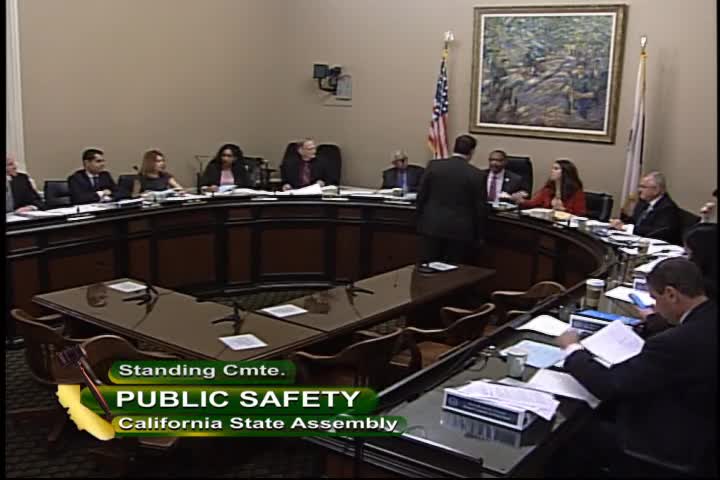 12MIN
Assembly Standing Committee on Public Safety
Bill Author

Bill Co-Author(s):