AB 2365: Vehicular air pollution: emissions standards: exemption.
- Session Year: 2017-2018
- House: Assembly
- Latest Version Date: 2018-04-17
Existing law requires the State Air Resources Board to achieve the maximum degree of emission reduction possible from vehicular and other mobile sources to accomplish the attainment of the state standards at the earliest practicable date.
This bill would exempt exempt, except as specified, from any regulation requiring the installation of air pollution control technology the engines used to power a crane of any size that is part of a fleet of 25 or less cranes. used for onroad or offroad purposes.
Existing law requires the State Air Resources Board to achieve the maximum degree of emission reduction possible from vehicular and other mobile sources to accomplish the attainment of the state standards at the earliest practicable date.
This bill would make technical, nonsubstantive changes to that provision. exempt from any regulation requiring the installation of air pollution control technology the engines used to power a crane that is part of a fleet of 25 or less cranes.
Existing law requires the State Air Resources Board to achieve the maximum degree of emission reduction possible from vehicular and other mobile sources to accomplish the attainment of the state standards at the earliest practicable date.
This bill would make technical, nonsubstantive changes to that provision.
The (a)Except as provided for in subdivision (b), the state board shall exempt from any regulation requiring the installation of air pollution control technology pursuant to this part the engines used to power a crane of any size that is part of a fleet of 25 or less cranes. used for onroad or offroad purposes.
(b)(1)The exemption provided for in subdivision (a) shall not apply to a new owner or transferee of a crane whose engines previously qualified for the exemption provided for in subdivision (a).
(2)Upon the sale or transfer of a crane subject to this section, the seller or transferor shall notify the state board.
The state board shall exempt from any regulation requiring the installation of air pollution control technology pursuant to this part the engines used to power a crane that is part of a fleet of 25 or less cranes.
SECTION 1.Section 43018 of the Health and Safety Code is amended to read:43018.(a) The state board shall endeavor to achieve the maximum degree of emission reduction possible from vehicular and other mobile sources in order to accomplish the attainment of the state standards at the earliest practicable date.(b) The state board shall take whatever actions are necessary, cost-effective, and technologically feasible in order to achieve, not later than December 31, 2000, a reduction in the actual emissions of reactive organic gases of at least 55 percent and a reduction in emissions of oxides of nitrogen of at least 15 percent from motor vehicles. These reductions in emissions shall be calculated with respect to the 1987 baseline year. The state board also shall take action to achieve the maximum feasible reductions in particulates, carbon monoxide, and toxic air contaminants from vehicular sources.(c) In carrying out this section, the state board shall adopt standards and regulations that will result in the most cost-effective combination of control measures on all classes of motor vehicles and motor vehicle fuel, including, but not limited to, all of the following:(1) Reductions in motor vehicle exhaust and evaporative emissions.(2) Reductions in emissions from in-use emissions from motor vehicles through improvements in emission system durability and performance.(3) Requirements on the purchase of low-emission vehicles by state fleet operators.(4) Specifications of vehicular fuel composition.(d) In order to accomplish the purposes of this division, and to ensure timely approval of a districts plans for attainment of the state air quality standards by the state board, the state board shall adopt the following schedule for workshops and hearings to consider the adoption of the standards and regulations required pursuant to this section:(1) Workshops on the adoption of vehicular fuel specifications for aromatic content, diesel fuel quality, light-duty vehicle exhaust emission standards, and revisions to the standards for new vehicle certification and durability to reflect current driving conditions and useful vehicle life shall be held not later than March 31, 1989. Hearings of the state board to consider adoption of proposed regulations pursuant to this subdivision shall be held not later than November 15, 1989.(2) Notwithstanding Section 43830, workshops on the adoption of regulations governing gasoline Reid vapor pressure, and standards for heavy-duty and medium-duty vehicle emissions, shall be held not later than January 31, 1990. Hearings of the state board to consider the adoption of proposed regulations pursuant to this subdivision shall be held not later than November 15, 1990.(3) Workshops on the adoption of regulations governing detergent content, emissions from off-highway vehicles, vehicle fuel composition, emissions from construction equipment and farm equipment, motorcycles, locomotives, utility engines, and, to the extent permitted by federal law, marine vessels, shall be held not later than January 31, 1991. Hearings of the state board to consider adoption of proposed regulations pursuant to this subdivision shall be held not later than November 15, 1991.(e) Prior to adopting standards and regulations pursuant to this section, the state board shall consider the effect of the standards and regulations on the economy of the state, including, but not limited to, motor vehicle fuel efficiency.(f) The amendment of this section made at the 198990 Regular Session of the Legislature does not constitute a change in, but is declaratory of, the existing law.(a) The state board shall endeavor to achieve the maximum degree of emission reduction possible from vehicular and other mobile sources in order to accomplish the attainment of the state standards at the earliest practicable date.
(b) Not later than January 1, 1992, the The state board shall take whatever actions are necessary, cost-effective, and technologically feasible in order to achieve, not later than December 31, 2000, a reduction in the actual emissions of reactive organic gases of at least 55 percent, percent and a reduction in emissions of oxides of nitrogen of at least 15 percent from motor vehicles. These reductions in emissions shall be calculated with respect to the 1987 baseline year. The state board also shall take action to achieve the maximum feasible reductions in particulates, carbon monoxide, and toxic air contaminants from vehicular sources.
(c) In carrying out this section, the state board shall adopt standards and regulations which that will result in the most cost-effective combination of control measures on all classes of motor vehicles and motor vehicle fuel, including, but not limited to, all of the following:
(1) Reductions in motor vehicle exhaust and evaporative emissions.
(2) Reductions in emissions from in-use emissions from motor vehicles through improvements in emission system durability and performance.
(3) Requiring Requirements on the purchase of low-emission vehicles by state fleet operators.
(4) Specification Specifications of vehicular fuel composition.
(d) In order to accomplish the purposes of this division, and to ensure timely approval of the a districts plans for attainment of the state air quality standards by the state board, the state board shall adopt the following schedule for workshops and hearings to consider the adoption of the standards and regulations required pursuant to this section:
(1) Workshops on the adoption of vehicular fuel specifications for aromatic content, diesel fuel quality, light-duty vehicle exhaust emission standards, and revisions to the standards for new vehicle certification and durability to reflect current driving conditions and useful vehicle life shall be held not later than March 31, 1989. Hearings of the state board to consider adoption of proposed regulations pursuant to this subdivision shall be held not later than November 15, 1989.
(2) Notwithstanding Section 43830, workshops on the adoption of regulations governing gasoline Reid vapor pressure, and standards for heavy-duty and medium-duty vehicle emissions, shall be held not later than January 31, 1990. Hearings of the state board to consider the adoption of proposed regulations pursuant to this subdivision shall be held not later than November 15, 1990.
(3) Workshops on the adoption of regulations governing detergent content, emissions from off-highway vehicles, vehicle fuel composition, emissions from construction equipment and farm equipment, motorcycles, locomotives, utility engines, and and, to the extent permitted by federal law, marine vessels, shall be held not later than January 31, 1991. Hearings of the state board to consider adoption of proposed regulations pursuant to this subdivision shall be held not later than November 15, 1991.
(e) Prior to adopting standards and regulations pursuant to this section, the state board shall consider the effect of the standards and regulations on the economy of the state, including, but not limited to, motor vehicle fuel efficiency.
(f) The amendment of this section made at the 198990 Regular Session of the Legislature does not constitute a change in, but is declaratory of, the existing law.
|
Date
|
Status
|
|---|---|
| Apr 23, 2018 | In committee: Set, first hearing. Failed passage. Reconsideration granted. |
| Apr 18, 2018 | Re-referred to Com. on TRANS. |
| Apr 17, 2018 | From committee chair, with author's amendments: Amend, and re-refer to Com. on TRANS. Read second time and amended. |
| Apr 9, 2018 | In committee: Hearing postponed by committee. |
| Apr 2, 2018 | Re-referred to Com. on TRANS. |
| Mar 22, 2018 | Referred to Com. on TRANS. |
| Feb 15, 2018 | From printer. May be heard in committee March 17. |
| Feb 14, 2018 | Read first time. To print. |
|
Date
|
Description
|
Location
|
Votes
|
|
|---|---|---|---|---|
| Apr 23, 2018 | Reconsideration. | Assembly Standing Committee on Transportation |
Passed |
|
| Apr 23, 2018 | Do pass and be re-referred to the Committee on [Appropriations] | Assembly Standing Committee on Transportation |
Failed |
This list shows positions taken on this bill by organizations on the date displayed, which is linked to the original source.
Positions by individuals are not included.
Date of Hearing: April 23, 2018
ASSEMBLY COMMITTEE ON TRANSPORTATION
Jim Frazier, Chair
ABPCA Bill Id:AB 2365 (
Author:Acosta) – As Amended Ver:April 17, 2018
SUBJECT: Vehicular air pollution: emissions standards: exemption
SUMMARY: Exempts a crane owner from complying with any regulation requiring the installation of air pollution control technology, until the crane is sold or transferred. Specifically, this bill:
- Requires ARB to exempt a crane owner from any regulation requiring the installation of air pollution control technology on engines used to power a crane of any size that is used for on-road and off-road purposes.
- Prohibits the exemption to apply to a new owner or transferee of a crane whose engine previously qualified for the above referenced exemption.
- Requires a crane owner to notify ARB upon a sale or transfer of the exempt crane.
EXISTING LAW:
- Establishes the Federal Clean Air Act (FCAA), with its implementing regulations:
- Setting National Ambient Air Quality Standards (NAAQS) for six criteria pollutants,
- Designating air basins that do not achieve NAAQS as non-attainment, and,
- requiring states with non-attainment areas to submit a State Implementation Plan (SIP) detailing how they will achieve compliance with NAAQS.
- Establishes ARB as the air pollution control agency in California and requires ARB, among other things, to achieve the maximum degree of emission reduction possible from vehicular and other mobile sources in order to accomplish the attainment of the state standards at the earliest practicable date.
- Requires certain vehicles to meet compliance with applicable air pollution control technology requirements to be registered in the state, beginning January 1, 2020.
- Establishes the Global Warming Solutions Act of 2006, [AB 32 (Núñez), Chapter 244, Statutes of 2006], that requires ARB to establish programs to reduce GHG emissions to 1990 levels by 2020 including the use of market-based mechanisms (cap-and-trade) to comply with these regulations.
- Requires ARB to ensure that statewide GHG emissions are reduced to at least 40% below the 1990 level by 2030.
FISCAL EFFECT: Unknown
COMMENTS: In order to achieve the health-based air quality standards for criteria and other air pollutants under the state and federal Clean Air Acts, reduce public exposure to toxic air contaminants such as diesel particulate matter (PM), and reduce greenhouse gas emissions to 1990 levels by 2020, with further reductions to 40% below 1990 levels by 2030, ARB has established various rules and regulations on heavy-duty vehicles and equipment, including cranes.
Cranes are machines that run on diesel and are used for lifting or lowering a load and moving it horizontally, in which the hoisting mechanism is an integral part of the machine. It may be driven manually or by power and may be a fixed or a mobile machine. There are different types of cranes that are operated in different capacities and settings. Depending on how a crane is operated, where it’s operated, and how many engines it has dictates under what emission regulation it falls. Cranes are typically subject to three main ARB regulations. According to ARB, there are approximately 10 statewide cranes subject to the Mobile Cargo Handling Equipment Regulation, 3,210 subject to the Off-Road Vehicle Regulation and 12,592 cranes subject to the On-Road Truck and Bus Regulation (Truck and Bus Rule).
In cases where the single-engine crane is equipped with an off-road engine, the Off-Road Regulation will apply. For two-engine cranes where one engine provides the motive power and the second engine provides the lifting power, regardless of whether the engine is on-road or off-road , the Off- Road Regulation will apply. In 2007, ARB adopted the Off-Road Regulation to reduce diesel PM and oxides of nitrogen (NOx) emissions from existing off-road heavy-duty diesel vehicles in California. Such vehicles, including cranes, are used in construction, mining, and industrial operations. The Off-Road regulation among other things requires crane fleets to reduce their emissions by retiring, replacing, or repowering older engines or installing exhaust retrofits. The requirements and compliance dates of the Off-Road Regulation vary by fleet size which is measured by the combined horsepower (hp) under the fleet. Large fleets (more than 5,000 hp) have compliance deadlines each year from 2014 through 2023, medium fleets (2,501-5,000 hp) each year from 2017 through 2023, and small fleets (2,500 hp or less) each year from 2019 through 2028.
For single-engine cranes where the motive engines serve a dual purpose of motive and lifting power, the Truck and Bus Rule would apply, since most single-engine cranes are equipped with an on-road engine. The Truck and Bus Rule, adopted in 2009, aims to reduce air toxics (diesel PM) and other criteria pollutants by ensuring that nearly every heavy-duty vehicle operated in California meets 2010 heavy-duty engine emission standards by 2023. PM filter requirements for heavier vehicles phased in beginning January 2012 and engine replacement requirements for heavier and lighter vehicles began phase-in January 2015. However, PM filter requirements and engine replacement requirements for certain cranes have been extended and begin in January, 2018.
To help cranes owners of the biggest (gross vehicle weight rating of 54,000 pounds or more) and most expensive cranes comply with the Truck and Bus Rule, ARB has a Heavy Crane Phase-in Option. The option allows crane owners to exclude certain heavy cranes from the general requirements of the regulation and to comply by replacing heavy cranes with 2010 engines from 2018 to 2027. This option also allows any heavy crane that is equipped with a PM filter before 2018 to be grandfathered-in. If a crane owner equips a heavy crane with a retrofit PM filter or has purchased a heavy crane with an original equipment PM filter before January 1, 2018, it will be exempt from the requirement to upgrade to a 2010 model year or newer engine and will count towards the heavy crane compliance the same as a 2010 engine crane.
To be eligible to use the heavy crane phase-in option for each compliance year, the fleet must meet the minimum 2010 or newer engine requirement as shown in the following table.
Required Heavy Crane Fleet Upgrades to 2010 or Newer Model Year Engines
Compliance Deadline as of January 1 | 1 Crane Owner | 2 Crane Owner | 3 Crane Owner | 4 or More Cranes |
2018 | 10% | |||
2019 | 1 | 20% | ||
2020 | 1 | 30% | ||
2021 | 40% | |||
2022 | 1 | 1 | 50% | |
2023 | 60% | |||
2024 | 70% | |||
2025 | 1 | 80% | ||
2026 | 1 | 90% | ||
2027 | 100% |
In the past, modifications and extensions to comply with diesel emission regulations for crane owners have been made due to concerns with the inability to place retrofit PM filters on cranes and the costs associated with buying this very expensive type of machinery. Federal regulations require manufacturers to review and approve any modifications (such as installing a PM filter or an exhaust retofit) to a crane, and may require additional modifications to ensure that it operates safely.
According to the author, this bill “Creates an environment for crane operators in the State of California that will not force crane owners out of business or out of the state. The current one size fits all regulations forcing the retrofit, repowering, replacement, or retirement of diesel powered equipment in the state of California fail to account for how cranes differ from the trucking industry. Given that full replacement is the only valid option for most cranes due to stringent Federal Occupational Safety and Health Administration (OSHA) regulations, which prohibit the modification of cranes without manufacturer approval, the expenses quickly make this option cost prohibitive for all but the largest operators”.
In opposition, the California Trucking Association (CTA) argues that California must remain consistent in how rules are established and enforced. CTA contends, “Companies have spent over a billion dollars each year since the adoption of the California Truck and Bus Rule to be compliant with California law. Unfortunately, many companies have not followed CTA’s lead and remain in non-compliance. Law abiding companies are the ones who are shouldering this cost as they are constantly under bid by companies who have not upgraded their fleets and do not carry the same cost burden.”
Committee Concerns: Buying a new crane can be very costly; however giving crane owners a blanket exemption from current regulations is the wrong approach. Unfortunately, this bill sets a bad precedent and jeopardizes our ability to meet our mandated attainment targets. The state and ARB have moved forward with stringent regulations to reduce pollution and comply with the state and federal Clean Air Acts. By exempting one category of vehicle from existing regulations, we are undermining our state goals and potentially reopening regulations that have been in place for over a decade. Because this bill effects current regulations, this bill would force ARB to amend the regulations and reopen their regulatory process for all applicable regulations exempted through this bill. ARB will also have to determine how this new exemption will affect attainment and potentially require more stringent regulations from other sources/entities.
With the current phase in options, heavy-crane operators will have an additional 9 years to fully comply with the Truck and Bus Rule and have a specified timeline to comply with the Off-Road Regulation. This bill has no set date when owners must retire their cranes and may lead to high-polluting cranes remaining on our roads for decades to come. Per SB 1, (Beall), Chapter 5, Statutes of 2017, all applicable vehicles must meet compliance with applicable air pollution control technology requirements to be registered in the state, beginning January 1, 2020. This bill takes a step backward from SB 1’s intended goal and ultimately rewards bad actors, disincentives early compliance, and creates an “uneven playing field” for those how already invested money to comply with state regulations. Additionally, providing an exemption for one category may presumably lead to other industries coming back to the Legislature to seek an exemption. Rather than prohibiting ARB from imposing regulations, the state should focus on incentives and augmenting programs that help businesses comply with regulations, such as the Truck Loan Assistance program, which offers small-businesses the ability to access more favorable loan options.
Previous Legislation: SB 1 (Beall), Chapter 5, Statutes of 2017, among other things, requires certain vehicles to meet compliance with applicable air pollution control technology requirements to be registered in the state, beginning January 1, 2020.
SB 41 (Galgiani) of 2017, would have deemed a person to be in compliance with the Truck and Bus Regulation and would prohibit the ARB from requiring the person to spend additional money on compliance or taking enforcement actions against a person, if certain conditions were met. SB 41 was not presented in the Senate Environmental Quality Committee.
SB 32 (Pavley), Chapter 249, Statutes of 2016, required ARB to ensure that statewide GHG emissions are reduced at least 40% below 1990 levels by 2030.
AB 32 (Núñez), Chapter 488, Statutes of 2006, required ARB to develop a plan of how to reduce emissions to 1990 levels by the year 2020.
REGISTERED SUPPORT / OPPOSITION:
Support
None on file
Opposition
California Trucking Association
Analysis Prepared by: Cynthia Alvarez / TRANS. / (916) 319-2093
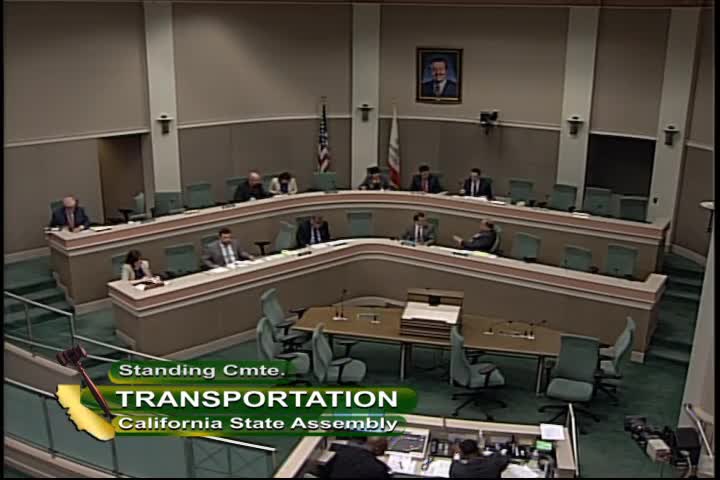
Discussed in Hearing
 13MIN
Assembly Standing Committee on Transportation


Bill Co-Author(s):