AB 2369: Fishing: marine protected areas: violations.
- Session Year: 2017-2018
- House: Assembly
- Latest Version Date: 2018-08-24
(1)The Marine Life Protection Act (MLPA) establishes the Marine Life Protection Program to reexamine and redesign Californias marine protected area system. Existing law requires the Department of Fish and Wildlife to prepare, and the Fish and Game Commission to adopt, a master plan that guides the adoption and implementation of the program. Under the MLPA, the commission is authorized to regulate commercial and recreational fishing and any other taking of marine species in marine protected areas, but the taking of a marine species in a marine life reserve, a type of marine protected area, is prohibited for any purpose, including recreational and commercial fishing, except as authorized by the commission for scientific purposes.
Existing law generally makes any violation of the Fish and Game Code or any rule, regulation, or order made or adopted under the code a misdemeanor. Existing law makes a violation of a specified regulation relating to marine protected areas, marine managed areas, and special closures an infraction or a misdemeanor, except under certain circumstances, including if the person who violates the regulation holds a commercial fishing license or a commercial passenger fishing boat license. Existing law generally provides that the punishment for a violation of the Fish and Game Code that is a misdemeanor is a fine of not more than $1,000, or imprisonment in a county jail for not more than 6 months, or by both that fine and imprisonment.
This bill would expand the applicability of a misdemeanor for a violation of this regulation from a person who holds a commercial passenger fishing boat license to a person who is operating a boat or vessel licensed as a commercial passenger fishing boat at the time of the violation. By expanding the scope of a crime, this bill would impose a state-mandated local program.
Existing law provides that any person who illegally takes, possesses, imports, exports, sells, purchases, barters, trades, or exchanges a bird, fish, mammal, reptile, or amphibian, or part of any of those animals, for profit or personal gain, is guilty of a misdemeanor punishable by a fine of not less than $5,000 nor more than $40,000, or imprisonment in the county jail for not more than one year, or by both that fine and imprisonment. Existing law increases the fine for a 2nd or subsequent violation. Existing law exempts fish taken pursuant to a commercial fishing license from this provision.
Existing law generally requires that prosecution for an offense not punishable by death, imprisonment in the state prison, or specified felonies punishable by imprisonment in a county jail, be commenced within one year after commission of the offense, except as specified.
This bill would establish a separate penalty for a person who holds a commercial fishing license, or is operating a boat or vessel licensed as a commercial passenger fishing boat, and, for commercial purposes, either unlawfully takes a fish within a marine protected area, or engages in, or knowingly facilitates another persons, fishing activity within the marine protected area. This penalty would be equivalent to the penalties established for the above-described poaching provision. The bill would also authorize the department to suspend a persons commercial fishing license or commercial passenger fishing boat license, as applicable, or other privilege issued pursuant to the Fish and Game Code, if the person is convicted of a 2nd or subsequent violation that is punishable pursuant to this provision, after having been convicted of a previous violation that is punishable pursuant to this provision that occurred within the previous 10 years. The bill would authorize a suspension to be appealed to the commission. The bill would require prosecution of an offense punishable under this provision to be commenced within 3 years after the commission of the offense. By changing the penalty for this crime, this bill would impose a state-mandated local program.
(2)Existing law applies various conditions to each commercial fishing license, permit, or other entitlement issued to take, possess aboard a boat, or land fish for commercial purposes and to each commercial boat registration issued by the Department of Fish and Wildlife, including a condition that those entitlements are not transferable unless expressly authorized. Existing law authorizes, subject to specified requirements, the transfer of various types of permits to take certain species of fish for commercial purposes upon application to the department.
This bill would require an application to transfer any permit or other entitlement to take fish for commercial purposes to be deferred if the current holder of the permit or other entitlement is awaiting final resolution of any pending criminal, civil, or administrative action that could affect the status of the permit or other entitlement.
(3)The California Constitution requires the state to reimburse local agencies and school districts for certain costs mandated by the state. Statutory provisions establish procedures for making that reimbursement.
This bill would provide that no reimbursement is required by this act for a specified reason.
(1)The Marine Life Protection Act (MLPA) establishes the Marine Life Protection Program to reexamine and redesign Californias marine protected area system. Existing law requires the Department of Fish and Wildlife to prepare, and the Fish and Game Commission to adopt, a master plan that guides the adoption and implementation of the program. Under the MLPA, the commission is authorized to regulate commercial and recreational fishing and any other taking of marine species in marine protected areas, but the taking of a marine species in a marine life reserve, a type of marine protected area, is prohibited for any purpose, including recreational and commercial fishing, except as authorized by the commission for scientific purposes.
Existing law generally makes any violation of the Fish and Game Code or any rule, regulation, or order made or adopted under the code a misdemeanor. Existing law makes a violation of a specified regulation relating to marine protected areas, marine managed areas, and special closures an infraction or a misdemeanor, except under certain circumstances, including if the person who violates the regulation holds a commercial fishing license or a commercial passenger fishing boat license. Existing law generally provides that the punishment for a violation of the Fish and Game Code that is a misdemeanor is a fine of not more than $1,000, or imprisonment in a county jail for not more than 6 months, or by both that fine and imprisonment.
This bill would expand the applicability of a misdemeanor for a violation of this regulation from a person who holds a commercial passenger fishing boat license to a person who is operating a boat or vessel licensed as a commercial passenger fishing boat at the time of the violation. By expanding the scope of a crime, this bill would impose a state-mandated local program.
Existing law provides that any person who illegally takes, possesses, imports, exports, sells, purchases, barters, trades, or exchanges a bird, fish, mammal, reptile, or amphibian, or part of any of those animals, for profit or personal gain, is guilty of a misdemeanor punishable by a fine of not less than $5,000 nor more than $40,000, or imprisonment in the county jail for not more than one year, or by both that fine and imprisonment. Existing law increases the fine for a 2nd or subsequent violation. Existing law exempts fish taken pursuant to a commercial fishing license from this provision.
Existing law generally requires that prosecution for an offense not punishable by death, imprisonment in the state prison, or specified felonies punishable by imprisonment in a county jail, be commenced within one year after commission of the offense, except as specified.
This bill would establish a separate penalty for a person who holds a commercial fishing license, or is operating a boat or vessel licensed as a commercial passenger fishing boat, and, for commercial purposes, either unlawfully takes a fish within a marine protected area, or engages in, or knowingly facilitates another persons, fishing activity within the marine protected area. This penalty would be equivalent to the penalties established for the above-described poaching provision. The bill would also authorize the department to suspend a persons commercial fishing license or commercial passenger fishing boat license, as applicable, or other privilege issued pursuant to the Fish and Game Code, if the person is convicted of a 2nd or subsequent violation of violation that is punishable pursuant to this provision and the violation provision, after having been convicted of a previous violation that is punishable pursuant to this provision that occurred within 20 years of a prior violation of the provision that resulted in a conviction. the previous 10 years. The bill would authorize a suspension to be appealed to the commission. The bill would require prosecution of an offense punishable under this provision to be commenced within 3 years after the commission of the offense. By changing the penalty for this crime, this bill would impose a state-mandated local program.
(2)Existing law applies various conditions to each commercial fishing license, permit, or other entitlement issued to take, possess aboard a boat, or land fish for commercial purposes and to each commercial boat registration issued by the Department of Fish and Wildlife, including a condition that those entitlements are not transferable unless expressly authorized. Existing law authorizes, subject to specified requirements, the transfer of various types of permits to take certain species of fish for commercial purposes upon application to the department.
This bill would require an application to transfer any permit or other entitlement to take fish for commercial purposes to be deferred if the current holder of the permit or other entitlement is awaiting final resolution of any pending criminal, civil, or administrative action that could affect the status of the permit or other entitlement.
(3)The California Constitution requires the state to reimburse local agencies and school districts for certain costs mandated by the state. Statutory provisions establish procedures for making that reimbursement.
This bill would provide that no reimbursement is required by this act for a specified reason.
(1)The Marine Life Protection Act (MLPA) establishes the Marine Life Protection Program to reexamine and redesign Californias marine protected area system. Existing law requires the Department of Fish and Wildlife to prepare, and the Fish and Game Commission to adopt, a master plan that guides the adoption and implementation of the program. Under the MLPA, the commission is authorized to regulate commercial and recreational fishing and any other taking of marine species in marine protected areas, but the taking of a marine species in a marine life reserve, a type of marine protected area, is prohibited for any purpose, including recreational and commercial fishing, except as authorized by the commission for scientific purposes.
Existing law generally makes any violation of the Fish and Game Code or any rule, regulation, or order made or adopted under the code a misdemeanor. Existing law makes a violation of a specified regulation relating to marine protected areas, marine managed areas, and special closures an infraction or a misdemeanor, except under certain circumstances, including if the person who violates the regulation holds a commercial fishing license or a commercial passenger fishing boat license. Existing law generally provides that the punishment for a violation of the Fish and Game Code that is a misdemeanor is a fine of not more than $1,000, or imprisonment in a county jail for not more than 6 months, or by both that fine and imprisonment.
This bill would expand the applicability of a misdemeanor for a violation of this regulation from a person who holds a commercial passenger fishing boat license to a person who is operating a boat or vessel licensed as a commercial passenger fishing boat at the time of the violation. By expanding the scope of a crime, this bill would impose a state-mandated local program.
Existing law provides that any person who illegally takes, possesses, imports, exports, sells, purchases, barters, trades, or exchanges a bird, fish, mammal, reptile, or amphibian, or part of any of those animals, for profit or personal gain, is guilty of a misdemeanor punishable by a fine of not less than $5,000 nor more than $40,000, or imprisonment in the county jail for not more than one year, or by both that fine and imprisonment. Existing law increases the fine for a 2nd or subsequent violation. Existing law exempts fish taken pursuant to a commercial fishing license from this provision.
Existing law generally requires that prosecution for an offense not punishable by death, imprisonment in the state prison, or specified felonies punishable by imprisonment in a county jail, be commenced within one year after commission of the offense, except as specified.
This bill would increase the penalty establish a separate penalty for a person who holds a commercial fishing license, or is operating a boat or vessel licensed as a commercial passenger fishing boat, and, for commercial purposes, either unlawfully taking takes a fish for commercial purposes within a marine protected area area, or engages in, or knowingly facilitates another persons, fishing activity within the marine protected area. This penalty would be equivalent to the penalties established for the above-described poaching provision for a person who holds a commercial fishing license or for a person who is operating a boat or vessel licensed as a commercial passenger fishing boat at the time of the violation. provision. The bill would also require authorize the department to suspend a persons commercial fishing license or commercial passenger fishing boat license, as applicable, to be suspended for up to one year if the person is convicted of a 2nd violation or subsequent violation of this provision and the violation occurred within 20 years of a prior violation of the provision that resulted in a conviction. The bill would authorize a suspension to be appealed to the commission. The bill would require prosecution of an offense punishable under this provision to be commenced within 3 years after the commission of the offense. By changing the penalty for this crime, this bill would impose a state-mandated local program.
(2)Existing law applies various conditions to each commercial fishing license, permit, or other entitlement issued to take, possess aboard a boat, or land fish for commercial purposes and to each commercial boat registration issued by the Department of Fish and Wildlife, including a condition that those entitlements are not transferable unless expressly authorized. Existing law authorizes, subject to specified requirements, the transfer of various types of permits to take certain species of fish for commercial purposes upon application to the department.
This bill would prohibit the department from processing require an application to transfer any permit or other entitlement to take fish for commercial purposes to be deferred if the current holder of the permit or other entitlement is awaiting final resolution of any pending criminal, civil, or administrative action that could affect the status of the permit. permit or other entitlement.
(3)The California Constitution requires the state to reimburse local agencies and school districts for certain costs mandated by the state. Statutory provisions establish procedures for making that reimbursement.
This bill would provide that no reimbursement is required by this act for a specified reason.
(1)The Marine Life Protection Act (MLPA) establishes the Marine Life Protection Program to reexamine and redesign Californias marine protected area system. Existing law requires the Department of Fish and Wildlife to prepare, and the Fish and Game Commission to adopt, a master plan that guides the adoption and implementation of the program. Under the MLPA, the commission is authorized to regulate commercial and recreational fishing and any other taking of marine species in marine protected areas, but the taking of a marine species in a marine life reserve, a type of marine protected area, is prohibited for any purpose, including recreational and commercial fishing, except as authorized by the commission for scientific purposes.
Existing law generally makes any violation of the Fish and Game Code or any rule, regulation, or order made or adopted under the code a misdemeanor. Existing law makes a violation of a specified regulation relating to marine protected areas, marine managed areas, and special closures an infraction or a misdemeanor, except under certain circumstances, including if the person who violates the regulation holds a commercial fishing license or a commercial passenger fishing boat license. Existing law generally provides that the punishment for a violation of the Fish and Game Code that is a misdemeanor is a fine of not more than $1,000, or imprisonment in a county jail for not more than 6 months, or by both that fine and imprisonment.
This bill would expand the applicability of a misdemeanor for a violation of this regulation from a person who holds a commercial passenger fishing boat license to a person who is operating a boat or vessel licensed as a commercial passenger fishing boat at the time of the violation. By expanding the scope of a crime, this bill would impose a state-mandated local program.
Existing law provides that any person who illegally takes, possesses, imports, exports, sells, purchases, barters, trades, or exchanges a bird, fish, mammal, reptile, or amphibian, or part of any of those animals, for profit or personal gain, is guilty of a misdemeanor punishable by a fine of not less than $5,000 nor more than $40,000, or imprisonment in the county jail for not more than one year, or by both that fine and imprisonment. Existing law increases the fine for a 2nd or subsequent violation. Existing law exempts fish taken pursuant to a commercial fishing license from this provision.
Existing law generally requires that prosecution for an offense not punishable by death, imprisonment in the state prison, or specified felonies punishable by imprisonment in a county jail, be commenced within one year after commission of the offense, except as specified.
This bill would increase the penalty for unlawfully taking a fish for commercial purposes within a marine protected area to the penalties established for the above-described poaching provision for a person who holds a commercial fishing license or for a person who is operating a boat or vessel licensed as a commercial passenger fishing boat license. at the time of the violation. The bill would also require a persons commercial fishing license or commercial passenger fishing boat license, as applicable, to be revoked suspended for up to one year if the person is convicted of a 2nd violation or subsequent violation of this provision. provision and the violation occurred within 20 years of a prior violation of the provision that resulted in a conviction. The bill would require prosecution of an offense punishable under this provision to be commenced within 3 years after the commission of the offense. By changing the penalty for this crime, this bill would impose a state-mandated local program.
(2)Existing law applies various conditions to each commercial fishing license, permit, or other entitlement issued to take, possess aboard a boat, or land fish for commercial purposes and to each commercial boat registration issued by the Department of Fish and Wildlife, including a condition that those entitlements are not transferable unless expressly authorized. Existing law authorizes, subject to specified requirements, the transfer of various types of permits to take certain species of fish for commercial purposes upon application to the department.
This bill would prohibit the department from processing an application to transfer any permit or other entitlement to take fish for commercial purposes if the current holder of the permit or other entitlement is awaiting final resolution of any pending criminal, civil, or administrative action that could affect the status of the permit.
(3)The California Constitution requires the state to reimburse local agencies and school districts for certain costs mandated by the state. Statutory provisions establish procedures for making that reimbursement.
This bill would provide that no reimbursement is required by this act for a specified reason.
(1)The Marine Life Protection Act (MLPA) establishes the Marine Life Protection Program to reexamine and redesign Californias marine protected area system. Existing law requires the Department of Fish and Wildlife to prepare, and the Fish and Game Commission to adopt, a master plan that guides the adoption and implementation of the program. Under the MLPA, the commission is authorized to regulate commercial and recreational fishing and any other taking of marine species in marine protected areas, but the taking of a marine species in a marine life reserve, a type of marine protected area, is prohibited for any purpose, including recreational and commercial fishing, except as authorized by the commission for scientific purposes.
Existing law generally makes any violation of the Fish and Game Code or any rule, regulation, or order made or adopted under the code a misdemeanor. Existing law makes a violation of a specified regulation relating to marine protected areas, marine managed areas, and special closures an infraction or a misdemeanor, except under certain circumstances, including if the person who violates the regulation holds a commercial fishing license or a commercial passenger fishing boat license. Existing law generally provides that the punishment for a violation of the Fish and Game Code that is a misdemeanor is a fine of not more than $1,000, or imprisonment in a county jail for not more than 6 months, or by both that fine and imprisonment.
Existing law provides that any person who illegally takes, possesses, imports, exports, sells, purchases, barters, trades, or exchanges a bird, fish, mammal, reptile, or amphibian, or part of any of those animals, for profit or personal gain, is guilty of a misdemeanor punishable by a fine of not less than $5,000, $5,000 nor more than $40,000, or imprisonment in the county jail for not more than one year, or by both that fine and imprisonment. Existing law increases the fine for a 2nd or subsequent violation. Existing law exempts fish taken pursuant to a commercial fishing license from this provision.
Existing law generally requires that prosecution for an offense not punishable by death, imprisonment in the state prison, or specified felonies punishable by imprisonment in a county jail, be commenced within one year after commission of the offense, except as specified.
This bill would increase the penalty for unlawfully taking a fish for commercial purposes within a marine protected area to the penalties established for the above-described poaching provision for a person who holds a commercial fishing license or a commercial passenger fishing boat license. The bill would also require a persons commercial fishing license or commercial passenger fishing boat license, as applicable, to be revoked if the person is convicted of a 2nd violation of this provision. The bill would require prosecution of an offense punishable under this provision to be commenced within 3 years after the commission of the offense. By changing the penalty for this crime, this bill would impose a state-mandated local program.
(2)Existing law applies various conditions to each commercial fishing license, permit, or other entitlement issued to take, possess aboard a boat, or land fish for commercial purposes and to each commercial boat registration issued by the Department of Fish and Wildlife, including a condition that those entitlements are not transferable unless expressly authorized. Existing law authorizes, subject to specified requirements, the transfer of various types of permits to take certain species of fish for commercial purposes upon application to the department.
This bill would prohibit the department from processing an application to transfer any permit or other entitlement to take fish for commercial purposes if the current holder of the permit or other entitlement is awaiting final resolution of any pending criminal, civil, or administrative action that could affect the status of the permit.
(3)The California Constitution requires the state to reimburse local agencies and school districts for certain costs mandated by the state. Statutory provisions establish procedures for making that reimbursement.
This bill would provide that no reimbursement is required by this act for a specified reason.
(1)The Marine Life Protection Act (MLPA) establishes the Marine Life Protection Program to reexamine and redesign Californias marine protected area system. Existing law requires the Department of Fish and Wildlife to prepare, and the Fish and Game Commission to adopt, a master plan that guides the adoption and implementation of the program. Under the MLPA, the commission is authorized to regulate commercial and recreational fishing and any other taking of marine species in marine protected areas, but the taking of a marine species in a marine life reserve, a type of marine protected area, is prohibited for any purpose, including recreational and commercial fishing, except as authorized by the commission for scientific purposes.
Existing law generally makes any violation of the Fish and Game Code or any rule, regulation, or order made or adopted under the code a misdemeanor. Existing law makes a violation of a specified regulation relating to marine protected areas, marine managed areas, and special closures an infraction or a misdemeanor, except under certain circumstances, including if the person who violates the regulation holds a commercial fishing license or a commercial passenger fishing boat license. Existing law generally provides that the punishment for a violation of the Fish and Game Code that is a misdemeanor is a fine of not more than $1,000, or imprisonment in a county jail for not more than 6 months, or by both that fine and imprisonment.
Existing law provides that any person who illegally takes, possesses, imports, exports, sells, purchases, barters, trades, or exchanges a bird, fish, mammal, reptile, or amphibian, or part of any of those animals, for profit or personal gain, is guilty of a misdemeanor punishable by a fine of not less than $5,000, nor more than $40,000, or imprisonment in the county jail for not more than one year, or by both that fine and imprisonment. Existing law increases the fine for a 2nd or subsequent violation. Existing law exempts fish taken pursuant to a commercial fishing license from this provision.
This bill would increase the penalty for unlawfully taking a fish for commercial purposes within a marine protected area to the penalties established for the above-described poaching provision for a person who holds a commercial fishing license or a commercial passenger fishing boat license. The bill would also require a persons commercial fishing license or commercial passenger fishing boat license, as applicable, to be revoked if the person is convicted of a 2nd violation of this provision. By changing the penalty for this crime, this bill would impose a state-mandated local program.
(2)Existing law applies various conditions to each commercial fishing license, permit, or other entitlement issued to take, possess aboard a boat, or land fish for commercial purposes and to each commercial boat registration issued by the Department of Fish and Wildlife, including a condition that those entitlements are not transferable unless expressly authorized. Existing law authorizes, subject to specified requirements, the transfer of various types of permits to take certain species of fish for commercial purposes upon application to the department.
This bill would prohibit the department from processing an application to transfer any permit or other entitlement to take fish for commercial purposes if the current holder of the permit or other entitlement is awaiting final resolution of any pending criminal, civil, or administrative action that could affect the status of the permit.
(3)The California Constitution requires the state to reimburse local agencies and school districts for certain costs mandated by the state. Statutory provisions establish procedures for making that reimbursement.
This bill would provide that no reimbursement is required by this act for a specified reason.
The Legislature finds and declares all of the following:
(a)The State of California has established a network of marine protected areas to further the environmental and social goals set out in the Marine Life Protection Act (Chapter 10.5 (commencing with Section 2850) of Division 3 of the Fish and Game Code).
(b)Given the high commercial value of certain marine species, existing penalties for violation of take restrictions within components of the marine protected area network by commercial fishers and operators of commercial passenger fishing vessels are insufficient to serve as an effective deterrent to poaching.
(c)It is in the public interest to ensure that poachers pay back the full value of the wildlife resources they take from the public by increasing fines and other penalties for egregious violations to more accurately reflect the value of the states marine protected area network.
(d)It is in the interest of Californias fishing industry to deter illegal poaching in marine protected areas in order to prevent violators from profiting at the expense of law-abiding fishers.
(e)It is in the public interest to prevent permits from being transferred in an effort to avoid suspension or revocation when the permitholder is facing violations that could affect the status of the permit.
SEC. 2.Section 7857 of the Fish and Game Code is amended to read:7857.Unless otherwise specified, the following conditions apply to each commercial fishing license, permit, or other entitlement issued to take, possess aboard a boat, or land fish for commercial purposes and to each commercial boat registration issued by the department, except licenses issued pursuant to Article 7 (commencing with Section 8030):
(a)The person to whom a commercial fishing permit or other entitlement is issued shall have a valid commercial fishing license issued pursuant to Section 7852 that is not revoked or suspended.
(b)The commission, after notice and opportunity for hearing, may suspend, revoke, or cancel commercial fishing privileges for a period of time to be determined by the commission for the following reasons:
(1)The person was not lawfully entitled to be issued the license, permit, or other entitlement.
(2)A violation of this code, the terms of the permit or other entitlement, or the regulations adopted pursuant thereto, by the licensee, permittee, person holding the entitlement, or his or her agent, servant, employee, or person acting under the licensees, permittees, or entitled persons direction or control.
(3)A violation of any federal law relating to the fishery for which the license, permit, or other entitlement was issued by the licensee, permittee, person holding the entitlement, or his or her agent, servant, employee, or person acting under the licensees, permittees, or entitled persons direction or control.
(c)The person to whom the commercial fishing license, permit, or other entitlement is issued shall be present when fish are being taken, possessed aboard a boat, or landed for commercial purposes. This subdivision does not apply to commercial fishing vessel permits or licenses.
(d)The commercial fishing license, permit, or other entitlement shall be in the licensees, permittees, or entitled persons possession, or immediately available to the licensee, permittee, or entitled person at all times when engaged in any activity for which the commercial fishing license, permit, or entitlement is required.
(e)Not more than one individual commercial fishing license, permit, or other entitlement of a single type shall be issued to an individual person and not more than one commercial vessel fishing license, permit, or other entitlement of a single type shall be issued for each vessel.
(f)Any landing of fish used to qualify for, or renew, a commercial fishing license, permit, or other entitlement shall be reported on landing receipts delivered to the department pursuant to Section 8046.
(g)In addition to any other requirements in Article 7.5 (commencing with Section 8040), the name of the person issued the commercial fishing license, permit, or other entitlement authorizing the taking of the fish shall be included on the landing receipt for that landing.
(h)An application for a commercial fishing license, permit, or other entitlement shall be made on a form containing the information the department may require. The commercial fishing license, permit, or other entitlement shall be signed by the holder prior to use.
(i)Any person who has had a commercial fishing license, permit, or other entitlement suspended or revoked shall not engage in that fishery, and shall not obtain any other commercial fishing license, permit, or other entitlement that authorizes engaging in that fishery, while the suspension or revocation is in effect.
(j)A commercial fishing license, permit, or other entitlement is not transferable unless otherwise expressly specified in this code.
(k)Every commercial fishing license, permit, stamp, commercial boat registration, or other entitlement issued pursuant to this part, except commercial fish business licenses issued pursuant to Article 7 (commencing with Section 8030), is valid from April 1 to March 31 of the next following calendar year or, if issued after the beginning of that term, for the remainder of that term.
(l)A person who holds a commercial fishing vessel permit or other entitlement authorizing the use of a vessel for commercial fishing shall also hold a valid commercial boat registration for that vessel, issued pursuant to Section 7881, that has not been suspended or revoked.
(m)A person who holds a commercial fishing license, permit, registration, or other entitlement, who moves or acquires a new address shall notify the department of the old and new addresses within three months of acquiring the new address.
(n)An application to transfer any permit or other entitlement to take fish for commercial purposes shall be deferred if the current holder of the permit or other entitlement is awaiting final resolution of any pending criminal, civil, or administrative action that could affect the status of the permit or other entitlement.
SEC. 3.Section 12000 of the Fish and Game Code is amended to read:12000.(a)Except as expressly provided otherwise in this code, any violation of this code, or of any rule, regulation, or order made or adopted under this code, is a misdemeanor.
(b)Notwithstanding subdivision (a), a person who violates any of the following statutes or regulations is guilty of an infraction punishable by a fine of not less than one hundred dollars ($100) and not to exceed one thousand dollars ($1,000), or of a misdemeanor:
(1)Section 2009.
(2)Subdivision (a) of Section 6596.1.
(3)Section 7149.8.
(4)Sections 1.14, 1.17, 1.62, 1.63, and 1.74 of Title 14 of the California Code of Regulations.
(5)Sections 2.00 to 5.95, inclusive, and 7.00 to 8.00, inclusive, of Title 14 of the California Code of Regulations.
(6)Sections 27.56 to 30.10, inclusive, of Title 14 of the California Code of Regulations.
(7)Sections 40 to 43, inclusive, of Title 14 of the California Code of Regulations.
(8)Section 251.7 of Title 14 of the California Code of Regulations.
(9)Sections 307, 308, and 311 to 313, inclusive, of Title 14 of the California Code of Regulations.
(10)Sections 505, 507 to 510, inclusive, and 550 to 552, inclusive, of Title 14 of the California Code of Regulations.
(11)Section 630 of Title 14 of the California Code of Regulations.
(12)Section 632 of Title 14 of the California Code of Regulations, except if either of the following apply:
(A)The person who violates the regulation holds a commercial fishing license issued pursuant to Article 3 (commencing with Section 7850) of Chapter 1 of Part 3 of Division 6 or the person who violates the regulation is operating a boat or vessel licensed pursuant to Article 5 (commencing with Section 7920) of Chapter 1 of Part 3 of Division 6 at the time of the violation. Except as provided in Section 12012.5, a person described in this subparagraph who violates Section 632 of Title 14 of the California Code of Regulations is guilty of a misdemeanor punishable pursuant to Section 12002.
(B)The violation of the regulation occurred within two years of a prior violation of the regulation that resulted in a conviction.
SEC. 4.Section 12012.5 is added to the Fish and Game Code, to read:12012.5.(a)Notwithstanding Section 12000 or any other provision of this code, a person who holds a commercial fishing license issued pursuant to Article 3 (commencing with Section 7850) of Chapter 1 of Part 3 of Division 6, or is operating a commercial passenger fishing boat licensed pursuant to Article 5 (commencing with Section 7920) of Chapter 1 of Part 3 of Division 6, and, for commercial purposes, either unlawfully takes a fish, within any meaning provided in Section 86, within a marine protected area, as defined in Section 2852, or engages in, or knowingly facilitates another persons, fishing activity within the marine protected area, is guilty of a misdemeanor punishable by a fine of not less than five thousand dollars ($5,000) nor more than forty thousand dollars ($40,000), or imprisonment in the county jail for not more than one year, or by both that fine and imprisonment.
(b)If a person is convicted of a second or subsequent violation that is punishable pursuant to subdivision (a) and the violation occurred within 10 years of a prior violation that is punishable pursuant to subdivision (a) that resulted in a conviction, the department may suspend that persons license described in subdivision (a), as applicable, or other privilege issued pursuant to this code, and that person shall be punished by a fine of not less than ten thousand dollars ($10,000) nor more than fifty thousand dollars ($50,000), or imprisonment in the county jail for not more than one year, or by both that fine and imprisonment.
(c)A person whose license or other privilege is suspended pursuant to this section may appeal the suspension to the commission. The commission shall initiate the appeal process within 12 months of the violators appeal request. The commission shall consider at least the nature, circumstances, extent, and gravity of the persons violations, the persons culpability for the violations, and the injury to natural resources by the violations, and may restore a persons license or other privileges.
(d)Notwithstanding Section 802 of the Penal Code, prosecution of an offense punishable under this section shall be commenced within three years after commission of the offense.
SEC. 5.No reimbursement is required by this act pursuant to Section 6 of Article XIIIB of the California Constitution because the only costs that may be incurred by a local agency or school district will be incurred because this act creates a new crime or infraction, eliminates a crime or infraction, or changes the penalty for a crime or infraction, within the meaning of Section 17556 of the Government Code, or changes the definition of a crime within the meaning of Section 6 of Article XIIIB of the California Constitution.
The Legislature finds and declares all of the following:
(a)The State of California has established a network of marine protected areas to further the environmental and social goals set out in the Marine Life Protection Act (Chapter 10.5 (commencing with Section 2850) of Division 3 of the Fish and Game Code).
(b)Given the high commercial value of certain marine species, existing penalties for violation of take restrictions within components of the marine protected area network by commercial fishers and operators of commercial passenger fishing vessels are insufficient to serve as an effective deterrent to poaching.
(c)It is in the public interest to ensure that poachers pay back the full value of the wildlife resources they take from the public by increasing fines and other penalties for egregious violations to more accurately reflect the value of the states marine protected area network.
(d)It is in the interest of Californias fishing industry to deter illegal poaching in marine protected areas in order to prevent violators from profiting at the expense of law-abiding fishers.
(e)It is in the public interest to prevent permits from being transferred in an effort to avoid suspension or revocation when the permitholder is facing violations that could affect the status of the permit.
SEC. 2.Section 7857 of the Fish and Game Code is amended to read:7857.Unless otherwise specified, the following conditions apply to each commercial fishing license, permit, or other entitlement issued to take, possess aboard a boat, or land fish for commercial purposes and to each commercial boat registration issued by the department, except licenses issued pursuant to Article 7 (commencing with Section 8030):
(a)The person to whom a commercial fishing permit or other entitlement is issued shall have a valid commercial fishing license issued pursuant to Section 7852 that is not revoked or suspended.
(b)The commission, after notice and opportunity for hearing, may suspend, revoke, or cancel commercial fishing privileges for a period of time to be determined by the commission for the following reasons:
(1)The person was not lawfully entitled to be issued the license, permit, or other entitlement.
(2)A violation of this code, the terms of the permit or other entitlement, or the regulations adopted pursuant thereto, by the licensee, permittee, person holding the entitlement, or his or her agent, servant, employee, or person acting under the licensees, permittees, or entitled persons direction or control.
(3)A violation of any federal law relating to the fishery for which the license, permit, or other entitlement was issued by the licensee, permittee, person holding the entitlement, or his or her agent, servant, employee, or person acting under the licensees, permittees, or entitled persons direction or control.
(c)The person to whom the commercial fishing license, permit, or other entitlement is issued shall be present when fish are being taken, possessed aboard a boat, or landed for commercial purposes. This subdivision does not apply to commercial fishing vessel permits or licenses.
(d)The commercial fishing license, permit, or other entitlement shall be in the licensees, permittees, or entitled persons possession, or immediately available to the licensee, permittee, or entitled person at all times when engaged in any activity for which the commercial fishing license, permit, or entitlement is required.
(e)Not more than one individual commercial fishing license, permit, or other entitlement of a single type shall be issued to an individual person and not more than one commercial vessel fishing license, permit, or other entitlement of a single type shall be issued for each vessel.
(f)Any landing of fish used to qualify for, or renew, a commercial fishing license, permit, or other entitlement shall be reported on landing receipts delivered to the department pursuant to Section 8046.
(g)In addition to any other requirements in Article 7.5 (commencing with Section 8040), the name of the person issued the commercial fishing license, permit, or other entitlement authorizing the taking of the fish shall be included on the landing receipt for that landing.
(h)An application for a commercial fishing license, permit, or other entitlement shall be made on a form containing the information the department may require. The commercial fishing license, permit, or other entitlement shall be signed by the holder prior to use.
(i)Any person who has had a commercial fishing license, permit, or other entitlement suspended or revoked shall not engage in that fishery, and shall not obtain any other commercial fishing license, permit, or other entitlement that authorizes engaging in that fishery, while the suspension or revocation is in effect.
(j)A commercial fishing license, permit, or other entitlement is not transferable unless otherwise expressly specified in this code.
(k)Every commercial fishing license, permit, stamp, commercial boat registration, or other entitlement issued pursuant to this part, except commercial fish business licenses issued pursuant to Article 7 (commencing with Section 8030), is valid from April 1 to March 31 of the next following calendar year or, if issued after the beginning of that term, for the remainder of that term.
(l)A person who holds a commercial fishing vessel permit or other entitlement authorizing the use of a vessel for commercial fishing shall also hold a valid commercial boat registration for that vessel, issued pursuant to Section 7881, that has not been suspended or revoked.
(m)A person who holds a commercial fishing license, permit, registration, or other entitlement, who moves or acquires a new address shall notify the department of the old and new addresses within three months of acquiring the new address.
(n)An application to transfer any permit or other entitlement to take fish for commercial purposes shall be deferred if the current holder of the permit or other entitlement is awaiting final resolution of any pending criminal, civil, or administrative action that could affect the status of the permit or other entitlement.
SEC. 3.Section 12000 of the Fish and Game Code is amended to read:12000.(a)Except as expressly provided otherwise in this code, any violation of this code, or of any rule, regulation, or order made or adopted under this code, is a misdemeanor.
(b)Notwithstanding subdivision (a), a person who violates any of the following statutes or regulations is guilty of an infraction punishable by a fine of not less than one hundred dollars ($100) and not to exceed one thousand dollars ($1,000), or of a misdemeanor:
(1)Section 2009.
(2)Subdivision (a) of Section 6596.1.
(3)Section 7149.8.
(4)Sections 1.14, 1.17, 1.62, 1.63, and 1.74 of Title 14 of the California Code of Regulations.
(5)Sections 2.00 to 5.95, inclusive, and 7.00 to 8.00, inclusive, of Title 14 of the California Code of Regulations.
(6)Sections 27.56 to 30.10, inclusive, of Title 14 of the California Code of Regulations.
(7)Sections 40 to 43, inclusive, of Title 14 of the California Code of Regulations.
(8)Section 251.7 of Title 14 of the California Code of Regulations.
(9)Sections 307, 308, and 311 to 313, inclusive, of Title 14 of the California Code of Regulations.
(10)Sections 505, 507 to 510, inclusive, and 550 to 552, inclusive, of Title 14 of the California Code of Regulations.
(11)Section 630 of Title 14 of the California Code of Regulations.
(12)Section 632 of Title 14 of the California Code of Regulations, except if either of the following apply:
(A)The person who violates the regulation holds a commercial fishing license issued pursuant to Article 3 (commencing with Section 7850) of Chapter 1 of Part 3 of Division 6 or the person who violates the regulation is operating a boat or vessel licensed pursuant to Article 5 (commencing with Section 7920) of Chapter 1 of Part 3 of Division 6 at the time of the violation. Except as provided in Section 12012.5, a person described in this subparagraph who violates Section 632 of Title 14 of the California Code of Regulations is guilty of a misdemeanor punishable pursuant to Section 12002.
(B)The violation of the regulation occurred within two years of a prior violation of the regulation that resulted in a conviction.
SEC. 4.Section 12012.5 is added to the Fish and Game Code, to read:12012.5.(a)Notwithstanding Section 12000 or any other provision of this code, a person who holds a commercial fishing license issued pursuant to Article 3 (commencing with Section 7850) of Chapter 1 of Part 3 of Division 6, or is operating a commercial passenger fishing boat licensed pursuant to Article 5 (commencing with Section 7920) of Chapter 1 of Part 3 of Division 6, and, for commercial purposes, either unlawfully takes a fish, within any meaning provided in Section 86, within a marine protected area, as defined in Section 2852, or engages in, or knowingly facilitates another persons, fishing activity within the marine protected area, is guilty of a misdemeanor punishable by a fine of not less than five thousand dollars ($5,000) nor more than forty thousand dollars ($40,000), or imprisonment in the county jail for not more than one year, or by both that fine and imprisonment.
(b)If a person is convicted of a second or subsequent violation of that is punishable pursuant to subdivision (a) and the violation occurred within 20 10 years of a prior violation of that is punishable pursuant to subdivision (a) that resulted in a conviction, the department may suspend that persons license described in subdivision (a), as applicable, or other privilege issued pursuant to this code, and that person shall be punished by a fine of not less than ten thousand dollars ($10,000) nor more than fifty thousand dollars ($50,000), or imprisonment in the county jail for not more than one year, or by both that fine and imprisonment.
(c)A person whose license or other privilege is suspended pursuant to this section may appeal the suspension to the commission. The commission shall initiate the appeal process within 12 months of the violators appeal request. The commission shall consider at least the nature, circumstances, extent, and gravity of the persons violations, the persons culpability for the violations, and the injury to natural resources by the violations, and may restore a persons license or other privileges.
(d)Notwithstanding Section 802 of the Penal Code, prosecution of an offense punishable under this section shall be commenced within three years after commission of the offense.
SEC. 5.No reimbursement is required by this act pursuant to Section 6 of Article XIIIB of the California Constitution because the only costs that may be incurred by a local agency or school district will be incurred because this act creates a new crime or infraction, eliminates a crime or infraction, or changes the penalty for a crime or infraction, within the meaning of Section 17556 of the Government Code, or changes the definition of a crime within the meaning of Section 6 of Article XIIIB of the California Constitution.
The Legislature finds and declares all of the following:
(a)The State of California has established a network of marine protected areas to further the environmental and social goals set out in the Marine Life Protection Act (Chapter 10.5 (commencing with Section 2850) of Division 3 of the Fish and Game Code).
(b)Given the high commercial value of certain marine species, existing penalties for violation of take restrictions within components of the marine protected area network by commercial fishers and operators of commercial passenger fishing vessels are insufficient to serve as an effective deterrent to poaching.
(c)It is in the public interest to ensure that poachers pay back the full value of the wildlife resources they take from the public by increasing fines and other penalties for egregious violations to more accurately reflect the value of the states marine protected area network.
(d)It is in the interest of Californias fishing industry to deter illegal poaching in marine protected areas in order to prevent violators from profiting at the expense of law-abiding fishers.
(e)It is in the public interest to prevent permits from being transferred in an effort to avoid suspension or revocation when the permitholder is facing violations that could affect the status of the permit.
SEC. 2.Section 7857 of the Fish and Game Code is amended to read:7857.Unless otherwise specified, the following conditions apply to each commercial fishing license, permit, or other entitlement issued to take, possess aboard a boat, or land fish for commercial purposes and to each commercial boat registration issued by the department, except licenses issued pursuant to Article 7 (commencing with Section 8030):
(a)The person to whom a commercial fishing permit or other entitlement is issued shall have a valid commercial fishing license issued pursuant to Section 7852 that is not revoked or suspended.
(b)The commission, after notice and opportunity for hearing, may suspend, revoke, or cancel commercial fishing privileges for a period of time to be determined by the commission for the following reasons:
(1)The person was not lawfully entitled to be issued the license, permit, or other entitlement.
(2)A violation of this code, the terms of the permit or other entitlement, or the regulations adopted pursuant thereto, by the licensee, permittee, person holding the entitlement, or his or her agent, servant, employee, or person acting under the licensees, permittees, or entitled persons direction or control.
(3)A violation of any federal law relating to the fishery for which the license, permit, or other entitlement was issued by the licensee, permittee, person holding the entitlement, or his or her agent, servant, employee, or person acting under the licensees, permittees, or entitled persons direction or control.
(c)The person to whom the commercial fishing license, permit, or other entitlement is issued shall be present when fish are being taken, possessed aboard a boat, or landed for commercial purposes. This subdivision does not apply to commercial fishing vessel permits or licenses.
(d)The commercial fishing license, permit, or other entitlement shall be in the licensees, permittees, or entitled persons possession, or immediately available to the licensee, permittee, or entitled person at all times when engaged in any activity for which the commercial fishing license, permit, or entitlement is required.
(e)Not more than one individual commercial fishing license, permit, or other entitlement of a single type shall be issued to an individual person and not more than one commercial vessel fishing license, permit, or other entitlement of a single type shall be issued for each vessel.
(f)Any landing of fish used to qualify for, or renew, a commercial fishing license, permit, or other entitlement shall be reported on landing receipts delivered to the department pursuant to Section 8046.
(g)In addition to any other requirements in Article 7.5 (commencing with Section 8040), the name of the person issued the commercial fishing license, permit, or other entitlement authorizing the taking of the fish shall be included on the landing receipt for that landing.
(h)An application for a commercial fishing license, permit, or other entitlement shall be made on a form containing the information the department may require. The commercial fishing license, permit, or other entitlement shall be signed by the holder prior to use.
(i)Any person who has had a commercial fishing license, permit, or other entitlement suspended or revoked shall not engage in that fishery, and shall not obtain any other commercial fishing license, permit, or other entitlement that authorizes engaging in that fishery, while the suspension or revocation is in effect.
(j)A commercial fishing license, permit, or other entitlement is not transferable unless otherwise expressly specified in this code.
(k)Every commercial fishing license, permit, stamp, commercial boat registration, or other entitlement issued pursuant to this part, except commercial fish business licenses issued pursuant to Article 7 (commencing with Section 8030), is valid from April 1 to March 31 of the next following calendar year or, if issued after the beginning of that term, for the remainder of that term.
(l)A person who holds a commercial fishing vessel permit or other entitlement authorizing the use of a vessel for commercial fishing shall also hold a valid commercial boat registration for that vessel, issued pursuant to Section 7881, that has not been suspended or revoked.
(m)A person who holds a commercial fishing license, permit, registration, or other entitlement, who moves or acquires a new address shall notify the department of the old and new addresses within three months of acquiring the new address.
(n)The department shall not process an An application to transfer any permit or other entitlement to take fish for commercial purposes shall be deferred if the current holder of the permit or other entitlement is awaiting final resolution of any pending criminal, civil, or administrative action, including an enforcement action for violations of take provisions within a marine protected area, action that could affect the status of the permit. permit or other entitlement.
SEC. 3.Section 12000 of the Fish and Game Code is amended to read:12000.(a)Except as expressly provided otherwise in this code, any violation of this code, or of any rule, regulation, or order made or adopted under this code, is a misdemeanor.
(b)Notwithstanding subdivision (a), a person who violates any of the following statutes or regulations is guilty of an infraction punishable by a fine of not less than one hundred dollars ($100) and not to exceed one thousand dollars ($1,000), or of a misdemeanor:
(1)Section 2009.
(2)Subdivision (a) of Section 6596.1.
(3)Section 7149.8.
(4)Sections 1.14, 1.17, 1.62, 1.63, and 1.74 of Title 14 of the California Code of Regulations.
(5)Sections 2.00 to 5.95, inclusive, and 7.00 to 8.00, inclusive, of Title 14 of the California Code of Regulations.
(6)Sections 27.56 to 30.10, inclusive, of Title 14 of the California Code of Regulations.
(7)Sections 40 to 43, inclusive, of Title 14 of the California Code of Regulations.
(8)Section 251.7 of Title 14 of the California Code of Regulations.
(9)Sections 307, 308, and 311 to 313, inclusive, of Title 14 of the California Code of Regulations.
(10)Sections 505, 507 to 510, inclusive, and 550 to 552, inclusive, of Title 14 of the California Code of Regulations.
(11)Section 630 of Title 14 of the California Code of Regulations.
(12)Section 632 of Title 14 of the California Code of Regulations, except if either of the following apply:
(A)The person who violates the regulation holds a commercial fishing license issued pursuant to Article 3 (commencing with Section 7850) of Chapter 1 of Part 3 of Division 6 or the person who violates the regulation is operating a boat or vessel licensed pursuant to Article 5 (commencing with Section 7920) of Chapter 1 of Part 3 of Division 6 at the time of the violation. Except as provided in Section 12012.5, a person described in this subparagraph who violates Section 632 of Title 14 of the California Code of Regulations is guilty of a misdemeanor punishable pursuant to Section 12002.
(B)The violation of the regulation occurred within two years of a prior violation of the regulation that resulted in a conviction.
SEC. 4.Section 12012.5 is added to the Fish and Game Code, to read:12012.5.(a)Notwithstanding Section 12000 or any other provision of this code, a person who holds a commercial fishing license issued pursuant to Article 3 (commencing with Section 7850) of Chapter 1 of Part 3 of Division 6, or is operating a commercial passenger fishing boat licensed pursuant to Article 5 (commencing with Section 7920) of Chapter 1 of Part 3 of Division 6, and, for commercial purposes, either unlawfully takes a fish for commercial purposes fish, within any meaning provided in Section 86, within a marine protected area, as defined in Section 2852, or engages in, or knowingly facilitates another persons, fishing activity within the marine protected area, is guilty of a misdemeanor punishable by a fine of not less than five thousand dollars ($5,000) nor more than forty thousand dollars ($40,000), or imprisonment in the county jail for not more than one year, or by both that fine and imprisonment.
(b)If a person is convicted of a second or subsequent violation of subdivision (a) and the violation occurred within 20 years of a prior violation of subdivision (a) that resulted in a conviction, the department may suspend that persons license described in subdivision (c), (a), as applicable, shall be suspended for up to one year and that person shall be punished by a fine of not less than ten thousand dollars ($10,000) nor more than fifty thousand dollars ($50,000), or imprisonment in the county jail for not more than one year, or by both that fine and imprisonment.
(c)This section applies only to the following persons:(1)A person who holds a commercial fishing license issued pursuant to Article 3 (commencing with Section 7850) of Chapter 1 of Part 3 of Division 6.(2)A person who is operating a boat or vessel licensed pursuant to Article 5 (commencing with Section 7920) of Chapter 1 of Part 3 of Division 6 at the time of the violation.(c)A person whose license is suspended pursuant to this section may appeal the suspension to the commission. The commission shall initiate the appeal process within 12 months of the violators appeal request. The commission shall consider at least the nature, circumstances, extent, and gravity of the persons violations, the persons culpability for the violations, and the injury to natural resources by the violations, and may restore a persons license privileges.
(d)Notwithstanding Section 802 of the Penal Code, prosecution of an offense punishable under this section shall be commenced within three years after commission of the offense.
SEC. 5.No reimbursement is required by this act pursuant to Section 6 of Article XIIIB of the California Constitution because the only costs that may be incurred by a local agency or school district will be incurred because this act creates a new crime or infraction, eliminates a crime or infraction, or changes the penalty for a crime or infraction, within the meaning of Section 17556 of the Government Code, or changes the definition of a crime within the meaning of Section 6 of Article XIIIB of the California Constitution.
The Legislature finds and declares all of the following:
(a)The State of California has established a network of marine protected areas to further the environmental and social goals set out in the Marine Life Protection Act (Chapter 10.5 (commencing with Section 2850) of Division 3 of the Fish and Game Code).
(b)Given the high commercial value of certain marine species, existing penalties for violation of take restrictions within components of the marine protected area network by commercial fishers and operators of commercial passenger fishing vessels are insufficient to serve as an effective deterrent to poaching.
(c)It is in the public interest to ensure that poachers pay back the full value of the wildlife resources they take from the public by increasing fines and other penalties for egregious violations to more accurately reflect the value of the states marine protected area network.
(d)It is in the interest of Californias fishing industry to deter illegal poaching in marine protected areas in order to prevent violators from profiting at the expense of law-abiding fishers.
(e)It is in the public interest to prevent permits from being transferred in an effort to avoid suspension or revocation when the permitholder is facing violations that could affect the status of the permit.
SEC. 2.Section 7857 of the Fish and Game Code is amended to read:7857.Unless otherwise specified, the following conditions apply to each commercial fishing license, permit, or other entitlement issued to take, possess aboard a boat, or land fish for commercial purposes and to each commercial boat registration issued by the department, except licenses issued pursuant to Article 7 (commencing with Section 8030):
(a)The person to whom a commercial fishing permit or other entitlement is issued shall have a valid commercial fishing license issued pursuant to Section 7852 that is not revoked or suspended.
(b)The commission, after notice and opportunity for hearing, may suspend, revoke, or cancel commercial fishing privileges for a period of time to be determined by the commission for the following reasons:
(1)The person was not lawfully entitled to be issued the license, permit, or other entitlement.
(2)A violation of this code, the terms of the permit or other entitlement, or the regulations adopted pursuant thereto, by the licensee, permittee, person holding the entitlement, or his or her agent, servant, employee, or person acting under the licensees, permittees, or entitled persons direction or control.
(3)A violation of any federal law relating to the fishery for which the license, permit, or other entitlement was issued by the licensee, permittee, person holding the entitlement, or his or her agent, servant, employee, or person acting under the licensees, permittees, or entitled persons direction or control.
(c)The person to whom the commercial fishing license, permit, or other entitlement is issued shall be present when fish are being taken, possessed aboard a boat, or landed for commercial purposes. This subdivision does not apply to commercial fishing vessel permits or licenses.
(d)The commercial fishing license, permit, or other entitlement shall be in the licensees, permittees, or entitled persons possession, or immediately available to the licensee, permittee, or entitled person at all times when engaged in any activity for which the commercial fishing license, permit, or entitlement is required.
(e)Not more than one individual commercial fishing license, permit, or other entitlement of a single type shall be issued to an individual person and not more than one commercial vessel fishing license, permit, or other entitlement of a single type shall be issued for each vessel.
(f)Any landing of fish used to qualify for, or renew, a commercial fishing license, permit, or other entitlement shall be reported on landing receipts delivered to the department pursuant to Section 8046.
(g)In addition to any other requirements in Article 7.5 (commencing with Section 8040), the name of the person issued the commercial fishing license, permit, or other entitlement authorizing the taking of the fish shall be included on the landing receipt for that landing.
(h)An application for a commercial fishing license, permit, or other entitlement shall be made on a form containing the information the department may require. The commercial fishing license, permit, or other entitlement shall be signed by the holder prior to use.
(i)Any person who has had a commercial fishing license, permit, or other entitlement suspended or revoked shall not engage in that fishery, and shall not obtain any other commercial fishing license, permit, or other entitlement that authorizes engaging in that fishery, while the suspension or revocation is in effect.
(j)A commercial fishing license, permit, or other entitlement is not transferable unless otherwise expressly specified in this code.
(k)Every commercial fishing license, permit, stamp, commercial boat registration, or other entitlement issued pursuant to this part, except commercial fish business licenses issued pursuant to Article 7 (commencing with Section 8030), is valid from April 1 to March 31 of the next following calendar year or, if issued after the beginning of that term, for the remainder of that term.
(l)A person who holds a commercial fishing vessel permit or other entitlement authorizing the use of a vessel for commercial fishing shall also hold a valid commercial boat registration for that vessel, issued pursuant to Section 7881, that has not been suspended or revoked.
(m)A person who holds a commercial fishing license, permit, registration, or other entitlement, who moves or acquires a new address shall notify the department of the old and new addresses within three months of acquiring the new address.
(n)The department shall not process an application to transfer any permit or other entitlement to take fish for commercial purposes if the current holder of the permit or other entitlement is awaiting final resolution of any pending criminal, civil, or administrative action, including an enforcement action for violations of take provisions within a marine protected area, that could affect the status of the permit.
SEC. 3.Section 12000 of the Fish and Game Code is amended to read:12000.(a)Except as expressly provided otherwise in this code, any violation of this code, or of any rule, regulation, or order made or adopted under this code, is a misdemeanor.
(b)Notwithstanding subdivision (a), a person who violates any of the following statutes or regulations is guilty of an infraction punishable by a fine of not less than one hundred dollars ($100) and not to exceed one thousand dollars ($1,000), or of a misdemeanor:
(1)Section 2009.
(2)Subdivision (a) of Section 6596.1.
(3)Section 7149.8.
(4)Sections 1.14, 1.17, 1.62, 1.63, and 1.74 of Title 14 of the California Code of Regulations.
(5)Sections 2.00 to 5.95, inclusive, and 7.00 to 8.00, inclusive, of Title 14 of the California Code of Regulations.
(6)Sections 27.56 to 30.10, inclusive, of Title 14 of the California Code of Regulations.
(7)Sections 40 to 43, inclusive, of Title 14 of the California Code of Regulations.
(8)Section 251.7 of Title 14 of the California Code of Regulations.
(9)Sections 307, 308, and 311 to 313, inclusive, of Title 14 of the California Code of Regulations.
(10)Sections 505, 507 to 510, inclusive, and 550 to 552, inclusive, of Title 14 of the California Code of Regulations.
(11)Section 630 of Title 14 of the California Code of Regulations.
(12)Section 632 of Title 14 of the California Code of Regulations, except if either of the following apply:
(A)The person who violates the regulation holds a commercial fishing license issued pursuant to Article 3 (commencing with Section 7850) of Chapter 1 of Part 3 of Division 6 or a commercial passenger fishing boat license issued the person who violates the regulation is operating a boat or vessel licensed pursuant to Article 5 (commencing with Section 7920) of Chapter 1 of Part 3 of Division 6. 6 at the time of the violation. Except as provided in Section 12012.5, a person described in this subparagraph who violates Section 632 of Title 14 of the California Code of Regulations is guilty of a misdemeanor punishable pursuant to Section 12002.
(B)The violation of the regulation occurred within two years of a prior violation of the regulation that resulted in a conviction.
SEC. 4.Section 12012.5 is added to the Fish and Game Code, to read:12012.5.(a)Notwithstanding Section 12000 or any other provision of this code, a person who unlawfully takes a fish for commercial purposes within a marine protected area, as defined in Section 2852, is guilty of a misdemeanor punishable by a fine of not less than five thousand dollars ($5,000) nor more than forty thousand dollars ($40,000), or imprisonment in the county jail for not more than one year, or by both that fine and imprisonment.
(b)If a person is convicted of a second or subsequent violation of subdivision (a), (a) and the violation occurred within 20 years of a prior violation of subdivision (a) that resulted in a conviction, that persons license described in subdivision (c), as applicable, shall be revoked suspended for up to one year and that person shall be punished by a fine of not less than ten thousand dollars ($10,000) nor more than fifty thousand dollars ($50,000), or imprisonment in the county jail for not more than one year, or by both that fine and imprisonment.
(c)This section applies only to a person who holds a commercial fishing license issued pursuant to Article 3 (commencing with Section 7850) of Chapter 1 of Part 3 of Division 6 or a commercial passenger fishing boat license issued pursuant to Article 5 (commencing with Section 7920) of Chapter 1 of Part 3 of Division 6.(c)This section applies only to the following persons:
(1)A person who holds a commercial fishing license issued pursuant to Article 3 (commencing with Section 7850) of Chapter 1 of Part 3 of Division 6.
(2)A person who is operating a boat or vessel licensed pursuant to Article 5 (commencing with Section 7920) of Chapter 1 of Part 3 of Division 6 at the time of the violation.
(d)Notwithstanding Section 802 of the Penal Code, prosecution of an offense punishable under this section shall be commenced within three years after commission of the offense.
SEC. 5.No reimbursement is required by this act pursuant to Section 6 of Article XIIIB of the California Constitution because the only costs that may be incurred by a local agency or school district will be incurred because this act creates a new crime or infraction, eliminates a crime or infraction, or changes the penalty for a crime or infraction, within the meaning of Section 17556 of the Government Code, or changes the definition of a crime within the meaning of Section 6 of Article XIIIB of the California Constitution.
The Legislature finds and declares all of the following:
(a)The State of California has established a network of marine protected areas to further the environmental and social goals set out in the Marine Life Protection Act (Chapter 10.5 (commencing with Section 2850) of Division 3 of the Fish and Game Code).
(b)Given the high commercial value of certain marine species, existing penalties for violation of take restrictions within components of the marine protected area network by commercial fishers and operators of commercial passenger fishing vessels are insufficient to serve as an effective deterrent to poaching.
(c)It is in the public interest to ensure that poachers pay back the full value of the wildlife resources they take from the public by increasing fines and other penalties for egregious violations to more accurately reflect the value of the states marine protected area network.
(d)It is in the interest of Californias fishing industry to deter illegal poaching in marine protected areas in order to prevent violators from profiting at the expense of law-abiding fishers.
(e)It is in the public interest to prevent permits from being transferred in an effort to avoid suspension or revocation when the permitholder is facing violations that could affect the status of the permit.
SEC. 2.Section 7857 of the Fish and Game Code is amended to read:7857.Unless otherwise specified, the following conditions apply to each commercial fishing license, permit, or other entitlement issued to take, possess aboard a boat, or land fish for commercial purposes and to each commercial boat registration issued by the department, except licenses issued pursuant to Article 7 (commencing with Section 8030):
(a)The person to whom a commercial fishing permit or other entitlement is issued shall have a valid commercial fishing license issued pursuant to Section 7852 that is not revoked or suspended.
(b)The commission, after notice and opportunity for hearing, may suspend, revoke, or cancel commercial fishing privileges for a period of time to be determined by the commission for the following reasons:
(1)The person was not lawfully entitled to be issued the license, permit, or other entitlement.
(2)A violation of this code, the terms of the permit or other entitlement, or the regulations adopted pursuant thereto, by the licensee, permittee, person holding the entitlement, or his or her agent, servant, employee, or person acting under the licensees, permittees, or entitled persons direction or control.
(3)A violation of any federal law relating to the fishery for which the license, permit, or other entitlement was issued by the licensee, permittee, person holding the entitlement, or his or her agent, servant, employee, or person acting under the licensees, permittees, or entitled persons direction or control.
(c)The person to whom the commercial fishing license, permit, or other entitlement is issued shall be present when fish are being taken, possessed aboard a boat, or landed for commercial purposes. This subdivision does not apply to commercial fishing vessel permits or licenses.
(d)The commercial fishing license, permit, or other entitlement shall be in the licensees, permittees, or entitled persons possession, or immediately available to the licensee, permittee, or entitled person at all times when engaged in any activity for which the commercial fishing license, permit, or entitlement is required.
(e)Not more than one individual commercial fishing license, permit, or other entitlement of a single type shall be issued to an individual person and not more than one commercial vessel fishing license, permit, or other entitlement of a single type shall be issued for each vessel.
(f)Any landing of fish used to qualify for, or renew, a commercial fishing license, permit, or other entitlement shall be reported on landing receipts delivered to the department pursuant to Section 8046.
(g)In addition to any other requirements in Article 7.5 (commencing with Section 8040), the name of the person issued the commercial fishing license, permit, or other entitlement authorizing the taking of the fish shall be included on the landing receipt for that landing.
(h)An application for a commercial fishing license, permit, or other entitlement shall be made on a form containing the information the department may require. The commercial fishing license, permit, or other entitlement shall be signed by the holder prior to use.
(i)Any person who has had a commercial fishing license, permit, or other entitlement suspended or revoked shall not engage in that fishery, and shall not obtain any other commercial fishing license, permit, or other entitlement that authorizes engaging in that fishery, while the suspension or revocation is in effect.
(j)A commercial fishing license, permit, or other entitlement is not transferable unless otherwise expressly specified in this code.
(k)Every commercial fishing license, permit, stamp, commercial boat registration, or other entitlement issued pursuant to this part, except commercial fish business licenses issued pursuant to Article 7 (commencing with Section 8030), is valid from April 1 to March 31 of the next following calendar year or, if issued after the beginning of that term, for the remainder thereof. of that term.
(l)A person who holds a commercial fishing vessel permit or other entitlement authorizing the use of a vessel for commercial fishing shall also hold a valid commercial boat registration for that vessel, issued pursuant to Section 7881, that has not been suspended or revoked.
(m)A(m)A person who holds a commercial fishing license, permit, registration, or other entitlement, who moves or acquires a new address shall notify the department of the old and new addresses within three months of acquiring the new address.
(n)The department shall not process an application to transfer any permit or other entitlement to take fish for commercial purposes if the current holder of the permit or other entitlement is awaiting final resolution of any pending criminal, civil, or administrative action, including an enforcement action for violations of take provisions within a marine protected area, that could affect the status of the permit.
SEC. 3.Section 12000 of the Fish and Game Code is amended to read:12000.(a)Except as expressly provided otherwise in this code, any violation of this code, or of any rule, regulation, or order made or adopted under this code, is a misdemeanor.
(b)Notwithstanding subdivision (a), a person who violates any of the following statutes or regulations is guilty of an infraction punishable by a fine of not less than one hundred dollars ($100) and not to exceed one thousand dollars ($1,000), or of a misdemeanor:
(1)Section 2009.
(2)Subdivision (a) of Section 6596. 6596.1.
(3)Section 7149.8.
(4)Sections 1.14, 1.17, 1.62, 1.63, and 1.74 of Title 14 of the California Code of Regulations.
(5)Sections 2.00 to 5.95, inclusive, and 7.00 to 8.00, inclusive, of Title 14 of the California Code of Regulations.
(6)Sections 27.56 to 30.10, inclusive, of Title 14 of the California Code of Regulations.
(7)Sections 40 to 43, inclusive, of Title 14 of the California Code of Regulations.
(8)Section 251.7 of Title 14 of the California Code of Regulations.
(9)Sections 307, 308, and 311 to 313, inclusive, of Title 14 of the California Code of Regulations.
(10)Sections 505, 507 to 510, inclusive, and 550 to 553, 552, inclusive, of Title 14 of the California Code of Regulations.
(11)Section 630 of Title 14 of the California Code of Regulations.
(12)Section 632 of Title 14 of the California Code of Regulations, except if either of the following apply:
(A)The person who violates the regulation holds a commercial fishing license issued pursuant to Article 3 (commencing with Section 7850) of Chapter 1 of Part 3 of Division 6 or a commercial passenger fishing boat license issued pursuant to Article 5 (commencing with Section 7920) of Chapter 1 of Part 3 of Division 6. Except as provided in Section 12012.5, a person described in this subparagraph who violates Section 632 of Title 14 of the California Code of Regulations is guilty of a misdemeanor punishable pursuant to Section 12002.
(B)The violation of the regulation occurred within two years of a prior violation of the regulation that resulted in a conviction.
SEC. 3.SEC. 4.Section 12006.7 12012.5 is added to the Fish and Game Code, to read:12006.7.12012.5.(a)Notwithstanding Section 12000 or any other provision of this code, a person who unlawfully takes a fish for commercial purposes within a marine protected area, as defined in Section 2852, is guilty of a misdemeanor punishable by a fine of not less than five thousand dollars ($5,000) nor more than forty thousand dollars ($40,000), or imprisonment in the county jail for not more than one year, or by both that fine and imprisonment.
(b)If a person is convicted of a second or subsequent violation of subdivision (a), that persons license described in subdivision (c), as applicable, shall be revoked and that person shall be punished by a fine of not less than ten thousand dollars ($10,000) nor more than fifty thousand dollars ($50,000), or imprisonment in the county jail for not more than one year, or by both that fine and imprisonment.
(c)This section applies only to a person who holds a commercial fishing license issued pursuant to Article 3 (commencing with Section 7850) of Chapter 1 of Part 3 of Division 6 or a commercial passenger fishing boat license issued pursuant to Article 5 (commencing with Section 7920) of Chapter 1 of Part 3 of Division 6.
(d)Notwithstanding Section 802 of the Penal Code, prosecution of an offense punishable under this section shall be commenced within three years after commission of the offense.
SEC. 4.SEC. 5.No reimbursement is required by this act pursuant to Section 6 of Article XIIIB of the California Constitution because the only costs that may be incurred by a local agency or school district will be incurred because this act creates a new crime or infraction, eliminates a crime or infraction, or changes the penalty for a crime or infraction, within the meaning of Section 17556 of the Government Code, or changes the definition of a crime within the meaning of Section 6 of Article XIIIB of the California Constitution.
The Legislature finds and declares all of the following:
(a)The State of California has established a network of marine protected areas to further the environmental and social goals set out in the Marine Life Protection Act (Chapter 10.5 (commencing with Section 2850) of Division 3 of the Fish and Game Code).
(b)Given the high commercial value of certain marine species, existing penalties for violation of take restrictions within components of the marine protected area network by commercial fishers and operators of commercial passenger fishing vessels are insufficient to serve as an effective deterrent to poaching.
(c)It is in the public interest to ensure that poachers pay back the full value of the wildlife resources they take from the public by increasing fines and other penalties for egregious violations to more accurately reflect the value of the states marine protected area network.
(d)It is in the interest of Californias fishing industry to deter illegal poaching in marine protected areas in order to prevent violators from profiting at the expense of law-abiding fishers.
(e)It is in the public interest to prevent permits from being transferred in an effort to avoid suspension or revocation when the permitholder is facing violations that could affect the status of the permit.
SEC. 2.Section 7857 of the Fish and Game Code is amended to read:7857.Unless otherwise specified, the following conditions apply to each commercial fishing license, permit, or other entitlement issued to take, possess aboard a boat, or land fish for commercial purposes and to each commercial boat registration issued by the department, except licenses issued pursuant to Article 7 (commencing with Section 8030):
(a)The person to whom a commercial fishing permit or other entitlement is issued shall have a valid commercial fishing license issued pursuant to Section 7852 that is not revoked or suspended.
(b)The commission, after notice and opportunity for hearing, may suspend, revoke, or cancel commercial fishing privileges for a period of time to be determined by the commission for the following reasons:
(1)The person was not lawfully entitled to be issued the license, permit, or other entitlement.
(2)A violation of this code, the terms of the permit or other entitlement, or the regulations adopted pursuant thereto, by the licensee, permittee, person holding the entitlement, or his or her agent, servant, employee, or person acting under the licensees, permittees, or entitled persons direction or control.
(3)A violation of any federal law relating to the fishery for which the license, permit, or other entitlement was issued by the licensee, permittee, person holding the entitlement, or his or her agent, servant, employee, or person acting under the licensees, permittees, or entitled persons direction or control.
(c)The person to whom the commercial fishing license, permit, or other entitlement is issued shall be present when fish are being taken, possessed aboard a boat, or landed for commercial purposes. This subdivision does not apply to commercial fishing vessel permits or licenses.
(d)The commercial fishing license, permit, or other entitlement shall be in the licensees, permittees, or entitled persons possession, or immediately available to the licensee, permittee, or entitled person at all times when engaged in any activity for which the commercial fishing license, permit, or entitlement is required.
(e)Not more than one individual commercial fishing license, permit, or other entitlement of a single type shall be issued to an individual person and not more than one commercial vessel fishing license, permit, or other entitlement of a single type shall be issued for each vessel.
(f)Any landing of fish used to qualify for, or renew, a commercial fishing license, permit, or other entitlement shall be reported on landing receipts delivered to the department pursuant to Section 8046.
(g)In addition to any other requirements in Article 7.5 (commencing with Section 8040), the name of the person issued the commercial fishing license, permit, or other entitlement authorizing the taking of the fish shall be included on the landing receipt for that landing.
(h)An application for a commercial fishing license, permit, or other entitlement shall be made on a form containing the information the department may require. The commercial fishing license, permit, or other entitlement shall be signed by the holder prior to use.
(i)Any person who has had a commercial fishing license, permit, or other entitlement suspended or revoked shall not engage in that fishery, and shall not obtain any other commercial fishing license, permit, or other entitlement that authorizes engaging in that fishery, while the suspension or revocation is in effect.
(j)A commercial fishing license, permit, or other entitlement is not transferable unless otherwise expressly specified in this code.
(k)Every commercial fishing license, permit, stamp, commercial boat registration, or other entitlement issued pursuant to this part, except commercial fish business licenses issued pursuant to Article 7 (commencing with Section 8030), is valid from April 1 to March 31 of the next following calendar year or, if issued after the beginning of that term, for the remainder thereof.
(l)A person who holds a commercial fishing vessel permit or other entitlement authorizing the use of a vessel for commercial fishing shall also hold a valid commercial boat registration for that vessel, issued pursuant to Section 7881, that has not been suspended or revoked.
(m)A person who holds a commercial fishing license, permit, registration, or other entitlement, who moves or acquires a new address shall notify the department of the old and new addresses within three months of acquiring the new address.
(n)The department shall not process an application to transfer any permit or other entitlement to take fish for commercial purposes if the current holder of the permit or other entitlement is awaiting final resolution of any pending criminal, civil, or administrative action, including an enforcement action for violations of take provisions within a marine protected area, that could affect the status of the permit.
SEC. 3.Section 12006.7 is added to the Fish and Game Code, to read:12006.7.(a)Notwithstanding Section 12000 or any other provision of this code, a person who unlawfully takes a fish for commercial purposes within a marine protected area, as defined in Section 2852, is guilty of a misdemeanor punishable by a fine of not less than five thousand dollars ($5,000) nor more than forty thousand dollars ($40,000), or imprisonment in the county jail for not more than one year, or by both that fine and imprisonment.
(b)If a person is convicted of a second or subsequent violation of subdivision (a), that persons license described in subdivision (c), as applicable, shall be revoked and that person shall be punished by a fine of not less than ten thousand dollars ($10,000) nor more than fifty thousand dollars ($50,000), or imprisonment in the county jail for not more than one year, or by both that fine and imprisonment.
(c)This section applies only to a person who holds a commercial fishing license issued pursuant to Article 3 (commencing with Section 7850) of Chapter 1 of Part 3 of Division 6 or a commercial passenger fishing boat license issued pursuant to Article 5 (commencing with Section 7920) of Chapter 1 of Part 3 of Division 6.
SEC. 4.No reimbursement is required by this act pursuant to Section 6 of Article XIIIB of the California Constitution because the only costs that may be incurred by a local agency or school district will be incurred because this act creates a new crime or infraction, eliminates a crime or infraction, or changes the penalty for a crime or infraction, within the meaning of Section 17556 of the Government Code, or changes the definition of a crime within the meaning of Section 6 of Article XIIIB of the California Constitution.
|
Date
|
Status
|
|---|---|
| Aug 24, 2018 | Chaptered by Secretary of State - Chapter 189, Statutes of 2018. |
| Aug 24, 2018 | Approved by the Governor. |
| Aug 14, 2018 | Enrolled and presented to the Governor at 4 p.m. |
| Aug 9, 2018 | Senate amendments concurred in. To Engrossing and Enrolling. |
| Aug 7, 2018 | In Assembly. Concurrence in Senate amendments pending. May be considered on or after August 9 pursuant to Assembly Rule 77. |
| Aug 6, 2018 | Read third time. Passed. Ordered to the Assembly. |
| Jul 3, 2018 | Read second time. Ordered to Consent Calendar. |
| Jul 2, 2018 | From committee: Be ordered to second reading file pursuant to Senate Rule 28.8 and ordered to Consent Calendar. |
| Jun 27, 2018 | From committee chair, with author's amendments: Amend, and re-refer to committee. Read second time, amended, and re-referred to Com. on APPR. |
| Jun 12, 2018 | From committee: Do pass and re-refer to Com. on APPR. with recommendation: To Consent Calendar. (Ayes 9. Noes 0.) (June 12). Re-referred to Com. on APPR. |
| Jun 4, 2018 | From committee chair, with author's amendments: Amend, and re-refer to committee. Read second time, amended, and re-referred to Com. on N.R. & W. |
| May 10, 2018 | Referred to Com. on N.R. & W. |
| Apr 30, 2018 | In Senate. Read first time. To Com. on RLS. for assignment. |
| Apr 30, 2018 | Read third time. Passed. Ordered to the Senate. |
| Apr 26, 2018 | Read second time. Ordered to third reading. |
| Apr 25, 2018 | Read second time and amended. Ordered returned to second reading. |
| Apr 24, 2018 | From committee: Amend, and do pass as amended. (Ayes 15. Noes 0.) (April 18). |
| Apr 10, 2018 | From committee: Do pass and re-refer to Com. on APPR. (Ayes 12. Noes 1.) (April 10). Re-referred to Com. on APPR. |
| Apr 4, 2018 | Re-referred to Com. on W.,P., & W. |
| Apr 3, 2018 | From committee chair, with author's amendments: Amend, and re-refer to Com. on W.,P., & W. Read second time and amended. |
| Mar 1, 2018 | Referred to Com. on W.,P., & W. |
| Feb 15, 2018 | From printer. May be heard in committee March 17. |
| Feb 14, 2018 | Read first time. To print. |
|
Date
|
Description
|
Location
|
Votes
|
|
|---|---|---|---|---|
| Aug 9, 2018 | AB 2369 GONZALEZ FLETCHER Concurrence in Senate Amendments | Assembly Floor |
Passed |
|
| Aug 6, 2018 | Consent Calendar AB2369 Gonzalez Fletcher | Senate Floor |
Passed |
|
| Jun 12, 2018 | Do pass, but first be re-referred to the Committee on [Appropriations] with the recommendation: To Consent Calendar | Senate Standing Committee on Natural Resources and Water |
Passed |
|
| Apr 30, 2018 | AB 2369 GONZALEZ FLETCHER Assembly Third Reading | Assembly Floor |
Passed |
|
| Apr 18, 2018 | Do pass as amended. | Assembly Standing Committee on Appropriations |
Passed |
|
| Apr 10, 2018 | Do pass and be re-referred to the Committee on [Appropriations] | Assembly Standing Committee on Water, Parks, and Wildlife |
Passed |
This list shows positions taken on this bill by organizations on the date displayed, which is linked to the original source.
Positions by individuals are not included.
CONCURRENCE IN SENATE AMENDMENTS
CSA1 Bill Id:AB 2369
Author:(Gonzalez Fletcher)
As Amended Ver:June 27, 2018
Majority vote
ASSEMBLY: | 74-0 | (April 30, 2018) | SENATE: | 37-0 | (August 6, 2018) |
Original Committee Reference: W., P., & W.
SUMMARY: Establishes a separate penalty for unlawfully taking a fish for commercial purposes within a marine protected area, and provides additional sanctions.
The Senate amendments:
- Establish a separate penalty for a person who holds a commercial fishing license, or is operating a commercial passenger fishing boat, and unlawfully takes a fish for commercial purposes within a marine protected area, or engages in, or knowingly facilitates another person's fishing activity, within a marine protected area.
- Authorize the Department of Fish and Wildlife (DFW) to suspend a commercial fishing license, commercial passenger fishing boat license, or other privilege issued pursuant to the Fish and Game Code if the person is convicted of a second or subsequent violation within 10 years of a conviction due to a previous violation.
- Contain procedures for a person to appeal the suspension of a license or other privilege to the Fish and Game Commission (commission) and requires the commission to consider the nature, circumstances, extent, and gravity of the violations, the person's culpability, and the injury to natural resources by the violations. Allows the commission to restore a person's license or other privilege.
- Require the deferral of an application to transfer a permit or other entitlement to take fish for commercial purposes if the current holder of the permit is awaiting final resolution of any criminal, civil or administrative action that could affect the status of the permit or other entitlement.
EXISTING LAW:
- Authorizes the commission, under the Marine Life Protection Act (MLPA) to approve a network of marine protected areas (MPAs) to protect and conserve marine life and habitat, and to regulate commercial and recreational fishing and any other taking of marine species in MPAs. Current regulations of the Fish and Game Code regulate the public use of MPAs, other marine managed areas, and special closure areas.
- Provides that violations of the Fish and Game Code or regulations adopted under the code by persons holding a commercial fishing license or a commercial passenger fishing boat license, or violations occurring within two years of a prior violation of the same regulation, are prosecuted as a misdemeanor.
- Provides that any violation of the Fish and Game Code or regulations adopted under the code is a misdemeanor, except where expressly provided otherwise, punishable by a fine of not more than $1,000, imprisonment in county jail for not more than six months, or by both the fine and imprisonment.
- Provides that certain specified violations of the Fish and Game Code or regulations may be punishable as an infraction or a misdemeanor (wobblet). Infractions are punishable by a fine of not less than $100 and not more than $1,000.
- Prohibits the taking of a marine species in a marine life reserve, a type of marine protected area, for any purpose, including recreational and commercial fishing, except as authorized by the commission for scientific purposes.
- Provides that any person who illegally takes, possesses, imports, exports, sells, purchases, barters, trades, or exchanges a bird, fish, mammal, reptile, or amphibian, or part of any of those animals, for profit or personal gain, is guilty of a misdemeanor punishable by a fine of not less than $5,000, nor more than $40,000, or imprisonment in the county jail for not more than one year, or by both that fine and imprisonment. Increases the fine to not less than $10,000, nor more than $50,000, for a second or subsequent violation. Exempts fish taken pursuant to a commercial fishing license from this provision.
- Applies various conditions to each commercial fishing license, permit, or other entitlement issued to take, possess aboard a boat, or land fish for commercial purposes and to each commercial boat registration issued by the DFW, including a condition that those entitlements are not transferable unless expressly authorized.
FISCAL EFFECT: According to the Assembly Appropriations Committee, there are no additional state costs associated with this bill. There are potential unknown increased revenues resulting from increased fines.
Analysis Prepared by: Keith Cialino / W., P., & W. / (916) 319-2096 FN: 0003728
Office of Senate Floor Analyses (916) 651-1520 Fax: (916) 327-4478 | AB |
CONSENT
Bill No: AB 2369
:
SENATE NATURAL RES. & WATER COMMITTEE: 9-0, 6/12/18
AYES: Hertzberg, Stone, Allen, Hueso, Jackson, McGuire, Monning, Stern, Vidak
SENATE APPROPRIATIONS COMMITTEE: Senate Rule 28.8
ASSEMBLY FLOOR: 74-0, 4/30/18 - See last page for vote
DIGEST:
This bill increases the penalty for unlawfully taking a fish for commercial purposes with a marine protected area and provides additional sanctions.
Existing law:
- Authorizes the Fish and Game Commission (Commission), under the Marine Life Protection Act (MLPA), to approve a network of marine protected areas (MPA) to protect and conserve marine life and habitat, and to regulate commercial and recreational fishing and any other taking of marine species in MPAs.
- Provides that violations of the Fish and Game Code or regulations adopted under the Code by persons holding a commercial fishing license or a commercial passenger fishing boat license, or violations occurring within two years of a prior violation of the same regulation, are prosecuted as a misdemeanor.
- Prohibits the taking of a marine species in a marine life reserve, a type of marine protected area, for any purpose, including recreational and commercial fishing, except as authorized by the commission for scientific purposes.
- Applies various conditions to each commercial fishing license, permit, or other entitlement issued to take, possess aboard a boat, or land fish for commercial purposes and to each commercial boat registration issued by the California Department of Fish and Wildlife (CDFW), including a condition that those entitlements are not transferable unless authorized by law.
- Provides that any violation of the Fish and Game Code or regulations adopted under the code is a misdemeanor, except where expressly provided otherwise, punishable by a fine of not more than $1,000, imprisonment in county jail for not more than six months, or by both the fine and imprisonment.
- Provides that certain specified violations of the Fish and Game Code or regulations may be punishable as an infraction or a misdemeanor (wobblet). Infractions are punishable by a fine of not less than $100 and not more than $1,000.
- Provides that any person who illegally takes, possesses, imports, exports, sells, purchases, barters, trades, or exchanges a bird, fish, mammal, reptile, or amphibian, or part of any of those animals, for profit or personal gain, is guilty of a misdemeanor punishable by a fine of not less than $5,000, nor more than $40,000, or imprisonment in the county jail for not more than one year, or by both that fine and imprisonment.
- The fine is increased to not less than $10,000, nor more than $50,000, for a second or subsequent violation.
- Fish taken pursuant to a commercial fishing license are exempt from this provision.
This bill increases the penalty for unlawfully taking a fish for commercial purposes within a MPA and provides additional sanctions. Specifically, this bill:
- Provides that an application to transfer a commercial fishing permit shall be deferred if the current holder of the permit is awaiting final resolution of any pending criminal, civil, or administrative action that could affect the status of the permit.
- Adds commercial boats or vessels to the misdemeanor that now applies to violations by those with commercial fishing licenses.
- Establishes separate penalties for violators with commercial fishing licenses, operators of commercial passenger fishing boats, who either take fish for commercial purposes or engages in, or knowingly facilitate another person’s fishing activity within a marine protected area.
- The penalty increases to not less than $5,000, nor more than $40,000, or imprisonment in the county jail for not more than one year, or both, for second or subsequent violations for violations by those who hold a commercial fishing license.
- The commercial fishing license or commercial passenger fishing boat license of a person convicted of a second or subsequent violation within 10 years of a prior violation that resulted in a conviction or other privilege issued pursuant to the Fish and Game Code may be suspended for up to one year.
- Extends the statute of limitations from one to three years for commercial fishing violations in MPAs.
- Establishes enhanced penalties for second or subsequent violations that occurred within 10 years of a prior violation that resulted in a conviction. The penalty shall be a fine of not less than $10,000 nor more than $50,000 or by imprisonment in the county jail for 1 year. The CDFW may also suspend that person’s commercial fishing or commercial passenger fishing boat license.
- Contains procedures for a licensee to appeal a suspension to the Commission and requires the Commission to consider the nature, circumstances, extent, and gravity of the violations, the person’s culpability, and the injury to natural resources by the violations. The Commission may restore a person’s license privileges.
Comments
- The MLPA requires the enforcement of the marine reserve network to be handled largely by CDFW. When originally completed, the network was enforced through misdemeanor citations for both commercial and recreational violators. In 2015, AB 298 (Gonzales Fletcher, Chapter 31, Statutes of 2015) was passed allowing enforcement officers the discretion of citing recreational fishermen in violation of the marine protected area regulations with either an infraction or a misdemeanor. This flexibility allows for more prosecutions of recreational marine protected area violations since minor abuses do not need to go through the trial court system.
- In addition to the enforcement example cited by the author below, in February 2018, the Commission set a precedent by handing out the stiffest penalty for a commercial fishing operation found violating marine protected area regulations to date. A commercial passenger fishing vessel operator was observed by CDFW wildlife officers taking paying customers into a marine protected area to fish, thereby poaching in the marine protected area, as well as committing 17 other violations. An administrative law judge recommended a 90-day suspension of the fishing license, but the Commission rejected the sentence as too lenient, and ordered a five-year license suspension for the boat operator.
- CDFW informed the Senate Natural Resources and Water Committee that in 2017, it had approximately 24,685 contacts while conducting MPA patrols. It said there were 686 MPA related violations that resulted in court action with an additional 1053 warnings being issued. A future Legislature may note that most courts do not have a data system that catalogs these violations or the penalties, so that information is not currently available.
- This bill does not affect individual (non-commercial) fishermen who remain subject to a wobblet provision allowing a warden to charge him or her with either an infraction or a misdemeanor depending on the circumstances. Existing law already provides that subsequent violations within 2 years of the first violation shall be punished as a misdemeanor.
- To summarize, this bill increases penalties on commercial fishing licensees and “party boat” licensees, defers any attempt to transfer a license while enforcement procedures are underway, and provides procedures and criteria for appealing a license suspended for fishing in a marine protected area.
FISCAL EFFECT: Appropriation: Fiscal Com.: Local:
Wildcoast (source)
California Coastkeeper Alliance
California District Attorneys Association
Cahto Tribe
Cambria Fishing Club
City of Encinitas
City of Malibu
Defenders of Wildlife
Environmental Action Committee of West Marin
Environmental Defense Center
Escondido Neighbors United
Heal the Bay
InterTribal Sinkyone Wilderness Council
Los Angeles Waterkeeper
Marine Conservation Institute
Monterey Bay Aquarium
Natural Resources Defense Council
Northcoast Environmental Center
Outdoor Outreach West
Resources Legacy Fund
San Diego Audubon Society
San Diego Coastkeeper
Santa Barbara Channelkeeper
Smiley’s Saloon and Hotel
Sportfishing Conservancy
Southwest Wetlands Interpretative Association
Surfrider Foundation
None received
ARGUMENTS IN SUPPORT: According to the author, MPAs in California have been established to protect and conserve marine life and habitat. These areas provide opportunities to preserve our natural biodiversity, enjoy nature recreationally, understand human impacts on marine life, and more. However, some individuals and entities undermine the protections established by MPAs with illegal poaching. Illegal poaching threatens the delicate balance of marine life inside these MPAs. When done by commercial entities, the poaching is typically on a much greater scale and thus poses an even greater threat to these ecosystems. Additionally, illegal poaching by commercial entities can negatively impact those businesses which are playing by the rules.
Under current law, penalties for poaching in a marine protected area for commercial entities, including commercial passenger fishing vessels or “party boats,” are not an effective economic deterrent. These penalties vary depending on the exact violation, but generally under the Fish and Game Code may not exceed $1000 per violation.
For instance, in 2015, a commercial fisherman was fined a mere $220 for having set 200 hagfish traps within a no-take State Marine Reserve. These low fines can be easily absorbed by businesses when catch such as spiny lobster can sell for as much as $32 per pound. In contrast, penalties for the illegal trophy hunting of animals like deer and elk include fines between $5,000 to $40,000, and/or up to a year imprisonment in county jail.
Furthermore, commercial fishermen and party boats have been able to continue operating even while under investigation and enforcement action against them for poaching, due to instances where individuals have simply transferred the fishing permit over to another person in their business. AB 2369 would crack down on poaching in MPAs by commercial fishermen and party boats by increasing the penalties for poaching to be a sufficient deterrent, rather than just a cost of doing business.
The author is joined in these arguments by environmental, philanthropic, recreational fishing, tribal, and some business groups. One local government and the California District Attorney Association are also in support.
ASSEMBLY FLOOR: 74-0, 4/30/18
AYES: Acosta, Aguiar-Curry, Arambula, Baker, Berman, Bigelow, Bloom, Bonta, Burke, Caballero, Calderon, Carrillo, Cervantes, Chau, Chávez, Chen, Chiu, Choi, Chu, Cooley, Cooper, Dahle, Daly, Eggman, Flora, Fong, Frazier, Friedman, Gallagher, Eduardo Garcia, Gipson, Gloria, Gonzalez Fletcher, Gray, Grayson, Harper, Holden, Irwin, Jones-Sawyer, Kalra, Kamlager-Dove, Kiley, Lackey, Levine, Limón, Low, Maienschein, Mathis, Mayes, McCarty, Medina, Melendez, Mullin, Muratsuchi, Nazarian, Obernolte, O'Donnell, Patterson, Quirk, Quirk-Silva, Reyes, Rodriguez, Rubio, Salas, Santiago, Steinorth, Mark Stone, Thurmond, Ting, Voepel, Waldron, Weber, Wood, Rendon
NO VOTE RECORDED: Travis Allen, Brough, Cunningham, Cristina Garcia
7/3/18 16:00:04
**** END ****
SENATE COMMITTEE ON NATURAL RESOURCES AND WATER
Senator Robert Hertzberg, Chair
2017 - 2018 Regular
Bill No: AB 2369 Hearing Date: June 12, 2018
Author: | |||
Version: |
| ||
Urgency: | Fiscal: | ||
Consultant: | |||
Subject: Fishing: marine protected areas: violations
BACKGROUND AND EXISTING LAW
- Authorizes the Fish and Game Commission (Commission), under the Marine Life Protection Act (MLPA), to approve a network of marine protected areas (MPA) to protect and conserve marine life and habitat, and to regulate commercial and recreational fishing and any other taking of marine species in MPAs.
- Provides that violations of the Fish and Game Code or regulations adopted under the code by persons holding a commercial fishing license or a commercial passenger fishing boat license, or violations occurring within two years of a prior violation of the same regulation, are prosecuted as a misdemeanor.
- Prohibits the taking of a marine species in a marine life reserve, a type of marine protected area, for any purpose, including recreational and commercial fishing, except as authorized by the commission for scientific purposes.
- Applies various conditions to each commercial fishing license, permit, or other entitlement issued to take, possess aboard a boat, or land fish for commercial purposes and to each commercial boat registration issued by the California Department of Fish and Wildlife (CDFW), including a condition that those entitlements are not transferable unless authorized by law.
- Provides that any violation of the Fish and Game Code or regulations adopted under the code is a misdemeanor, except where expressly provided otherwise, punishable by a fine of not more than $1,000, imprisonment in county jail for not more than six months, or by both the fine and imprisonment.
- Provides that certain specified violations of the Fish and Game Code or regulations may be punishable as an infraction or a misdemeanor (wobblet). Infractions are punishable by a fine of not less than $100 and not more than $1,000.
- Provides that any person who illegally takes, possesses, imports, exports, sells, purchases, barters, trades, or exchanges a bird, fish, mammal, reptile, or amphibian, or part of any of those animals, for profit or personal gain, is guilty of a misdemeanor punishable by a fine of not less than $5,000, nor more than $40,000, or imprisonment in the county jail for not more than one year, or by both that fine and imprisonment. Increases the fine to not less than $10,000, nor more than $50,000, for a second or subsequent violation. Exempts fish taken pursuant to a commercial fishing license from this provision.
PROPOSED LAW
This bill increases the penalty for unlawfully taking a fish for commercial purposes within a MPA and provides additional sanctions. Specifically, this bill:
- Provides that an application to transfer a commercial fishing permit shall be deferred if the current holder of the permit is awaiting final resolution of any pending criminal, civil, or administrative action that could affect the status of the permit.
- Adds commercial boats or vessels to the misdemeanor that now applies to violations by those with commercial fishing licenses.
- Establishes separate penalties for violators with commercial fishing licenses, operators of commercial passenger fishing boats, who either take fish for commercial purposes or engages in, or knowingly facilitate another person’s fishing activity within a marine protected area. Increases the penalty to not less than $5,000, nor more than $40,000, or imprisonment in the county jail for not more than one year, or both, for second or subsequent violations for violations by those who hold a commercial fishing license. Allows for the suspension, for up to one year, of the commercial fishing license or commercial passenger fishing boat license of a person convicted of a second or subsequent violation within 20 years of a prior violation that resulted in a conviction.
- Extends the statute of limitations from one to three years for commercial fishing violations in MPAs.
- Establishes enhanced penalties for second or subsequent violations that occurred within 20 years of a prior violation that resulted in a conviction. The penalty shall be a fine of not less than $10,000 nor more than $50,000 or by imprisonment in the county jail for 1 year. The CDFW may also suspend that person’s commercial fishing or commercial passenger fishing boat license.
- Contains procedures for a licensee to appeal a suspension to the commission and requires the commission to consider the nature, circumstances, extent, and gravity of the violations, the person’s culpability, and the injury to natural resources by the violations. The commission may restore a person’s license privileges. Prohibits CDFW from processing an application to transfer any permit or other entitlement to take fish for commercial purposes if the current holder of the permit or other entitlement is awaiting final resolution of any pending criminal, civil, or administrative action that could affect the status of the permit.
ARGUMENTS IN SUPPORT
According to the author, MPAs in California have been established to protect and conserve marine life and habitat. These areas provide opportunities to preserve our natural biodiversity, enjoy nature recreationally, understand human impacts on marine life, and more. However, some individuals and entities undermine the protections established by MPAs with illegal poaching. Illegal poaching threatens the delicate balance of marine life inside these MPAs. When done by commercial entities, the poaching is typically on a much greater scale and thus poses an even greater threat to these ecosystems. Additionally, illegal poaching by commercial entities can negatively impact those businesses which are playing by the rules.
Under current law, penalties for poaching in a marine protected area for commercial entities, including commercial passenger fishing vessels or “party boats,” are not an effective economic deterrent. These penalties vary depending on the exact violation, but generally under the Fish and Game Code may not exceed $1000 per violation.
For instance, in 2015, a commercial fisherman was fined a mere $220 for having set 200 hagfish traps within a no-take State Marine Reserve. These low fines can be easily absorbed by businesses when catch such as spiny lobster can sell for as much as $32 per pound. In contrast, penalties for the illegal trophy hunting of animals like deer and elk include fines between $5,000 to $40,000, and/or up to a year imprisonment in county jail.
Furthermore, commercial fishermen and party boats have been able to continue operating even while under investigation and enforcement action against them for poaching, due to instances where individuals have simply transferred the fishing permit over to another person in their business. AB 2369 would crack down on poaching in MPAs by commercial fishermen and party boats by increasing the penalties for poaching to be a sufficient deterrent, rather than just a cost of doing business.
The author is joined in these arguments by environmental, philanthropic, recreational fishing, tribal, and some business groups. One local government and the California District Attorney Association are also in support.
ARGUMENTS IN OPPOSITION
None received.
COMMENTS
- The Marine Life Protection Act requires the enforcement of the marine reserve network to be handled largely by CDFW. When originally completed, the network was enforced through misdemeanor citations for both commercial and recreational violators. In 2015, AB 298 (Gonzales Fletcher) was passed allowing enforcement officers the discretion of citing recreational fishermen in violation of the marine protected area regulations with either an infraction or a misdemeanor--this flexibility allows for more prosecutions of recreational marine protected area violations since minor abuses do not need to go through the trial court system.
- In addition to the enforcement example cited by the author above, in February 2018, the Commission set a precedent by handing out the stiffest penalty for a commercial fishing operation found violating marine protected area regulations to date. A commercial passenger fishing vessel operator was observed by DFW wildlife officers taking paying customers into a marine protected area to fish, thereby poaching in the marine protected area, as well as committing 17 other violations. An administrative law judge recommended a 90-day suspension of the fishing license, but the Commission rejected the sentence as too lenient, and ordered a five-year license suspension for the boat operator.
- CDFW informed the Committee that in 2017, it had approximately 24685 contacts while conducting MPA patrols. It said there were 686 MPA related violations that resulted in court action with an additional 1053 warnings being issued.
A future Legislature may note that most courts do not have a data system that catalogs these violations or the penalties, so that information is not currently available. - The author’s most recent amendments reflect staff’s concerns on a number of points although the supporters and the author came up with the specific solutions. In particular, the prohibition on transfer of a permit has changed into a deferral of a permit transfer application if the permit holder has any pending enforcement actions. This emulates a similar provision regarding the transfer of spiny lobster permits. Also, the new license suspension provision is very similar to Fish and Game Code Section 12154. Both of these amendments seem well within the ambit of existing provisions that are familiar to the DFW and the Commission.
- This bill does not affect individual (non-commercial) fishermen who remain subject to a wobblet provision allowing a warden to charge him or her with either an infraction or a misdemeanor depending on the circumstances. Existing law already provides that subsequent violations within 2 years of the first violation shall be punished as a misdemeanor.
- To summarize, this bill increases penalties on commercial fishing licensees and “party boat” licensees, defers any attempt to transfer a license while enforcement procedures are underway, and provides procedures and criteria for appealing a license suspended for fishing in a marine protected area.
SUPPORT
California Coastkeeper Alliance
California District Attorneys Association
Cahto Tribe
Cambria Fishing Club
City of Encinitas
Defenders of Wildlife
Environmental Defense Center
Escondido Neighbors United
Heal the Bay
InterTribal Sinkyone Wilderness Council
Los Angeles Waterkeeper
Marin Environmental Action Committee
Marine Conservation Institute
Monterey Bay Aquarium
Natural Resources Defense Council
Northcoast Environmental Center
Outdoor Outreach West
Resources Legacy Fund
San Diego Audubon Society
San Diego Coastkeeper
Santa Barbara Channelkeeper
Smiley’s Saloon and Hotel
Sportfishing Conservancy
Southwest Wetlands Interpretative Association
Surfrider Foundation
Wildcoast
OPPOSITION
None Received
-- END --
ASSEMBLY THIRD READING
ATR Bill Id:AB 2369
Author:(Gonzalez Fletcher)
As Amended Ver:April 25, 2018
Majority vote
Committee | Votes | Ayes | Noes |
Water | 12-1 | Eduardo Garcia, Gallagher, Bigelow, Carrillo, Chu, Friedman, Gloria, Kalra, Levine, Rubio, Salas, Wood | Harper |
Appropriations | 15-0 | Gonzalez Fletcher, Bigelow, Bloom, Bonta, Brough, Calderon, Carrillo, Chau, McCarty, Fong, Friedman, Gallagher, Nazarian, Obernolte, Reyes |
SUBJECT: Fishing: marine protected areas: violations.
SUMMARY: Increases the penalty for unlawfully taking a fish for commercial purposes within a marine protected area (MPA) and provides additional sanctions. Specifically, this bill:
- Provides the penalty for a person holding a commercial fishing license or a person operating a commercial passenger fishing boat who unlawfully takes a fish for commercial purposes within a MPA is not less than $5,000, nor more than $40,000, or imprisonment in the county jail for not more than one year, or both.
- Allows for the suspension, for up to one year, of the commercial fishing license or commercial passenger fishing boat license of a person convicted of a second or subsequent violation within 20 years of a prior violation that resulted in a conviction. Increases the penalty to not less than $10,000, nor more than $50,000, or imprisonment in the county jail for not more than one year, or both, for second or subsequent violations.
- Extends the statute of limitations from one to three years for commercial fishing violations in MPAs.
- Prohibits the Department of Fish and Wildlife (DFW) from processing an application to transfer any permit or other entitlement to take fish for commercial purposes if the current holder of the permit or other entitlement is awaiting final resolution of any pending criminal, civil, or administrative action that could affect the status of the permit.
EXISTING LAW:
- Authorizes the Fish and Game Commission, under the Marine Life Protection Act (MLPA), to approve a network of MPAs to protect and conserve marine life and habitat, and to regulate commercial and recreational fishing and any other taking of marine species in MPAs.
- Provides that violations of the Fish and Game Code or regulations adopted under the code by persons holding a commercial fishing license or a commercial passenger fishing boat license, or violations occurring within two years of a prior violation of the same regulation, are prosecuted as a misdemeanor.
- Prohibits the taking of a marine species in a marine life reserve, a type of marine protected area, for any purpose, including recreational and commercial fishing, except as authorized by the commission for scientific purposes.
- Applies various conditions to each commercial fishing license, permit, or other entitlement issued to take, possess aboard a boat, or land fish for commercial purposes and to each commercial boat registration issued by the DFW, including a condition that those entitlements are not transferable unless expressly authorized by the DFW.
FISCAL EFFECT: According to the Assembly Appropriations Committee, there are no additional state costs associated with this bill. There are potential unknown increased revenues resulting from increased fines.
COMMENTS:
Background and Purpose: The purpose of this bill is to decrease illegal poaching in MPAs by commercial fishermen and commercial passenger fishing boats by increasing penalties in an amount that is greater than the cost of doing business and sufficient to create a deterrent. This bill does not affect the legal take of fish by commercial entities in a MPA, where allowed.
The MLPA directed the state to redesign California's system of MPAs to function as a network in order to increase coherence and effectiveness in protecting the state's marine life and habitats, marine ecosystems, and marine natural heritage, as well as to improve recreational, educational, and study opportunities provided by marine ecosystems subject to minimal human disturbance.
Illegally catching fish within a restricted area like a MPA is an unfair competitive advantage for the holder of a commercial fishing license or the operator of a commercial passenger fishing boat. Illegal fishing activity in MPAs depletes fish populations and undermines efforts to ensure sustainable fisheries for the future. It also damages the economic and social welfare of those involved in legal fishing, and reduces incentives to play by the rules.
Generally, illegal fishing by commercial entities within a MPA is treated as a misdemeanor, and under the Fish and Game Code, typically results in a maximum fine of $1000 per violation. This bill would make the penalties for illegal fishing by commercial entities within a MPA similar to the penalties established for poaching. Currently, fish taken pursuant to a commercial fishing license are specifically exempted from the existing poaching regulation.
In California, where a crime is punishable by imprisonment, the statute of limitations is generally three years, while misdemeanors generally have a one year statute of limitations. This bill extends the statute of limitations from one to three years for commercial fishing violations in MPAs.
Commercial fishermen and commercial passenger fishing boats can continue to utilize their fishing permit even while under investigation or with enforcement action against them. This is because the individuals are able to transfer the fishing permit to another person in their business. This bill would prohibit the DFW from allowing the transfer of a commercial fishing permit until any pending enforcement actions are settled.
This bill was amended in Assembly Appropriations to move liability to the operator of a commercial passenger fishing boat if the license holder is not on board, to limit the second or subsequent violation penalties to within 20 years of a prior violation, and to allow for the suspension rather than the automatic revocation of the license.
Related Legislation:
AB 298 (Gonzalez), Chapter 31, Statutes of 2015, makes certain violations of regulations restricting activities in MPAs punishable as either an infraction or a misdemeanor, allowing game wardens to issue citations for violations. Violations by persons holding a commercial fishing license or a commercial passenger fishing boat license, or violations occurring within two years of a prior violation of the same regulation, are still prosecuted as a misdemeanor.
Analysis Prepared by: Keith Cialino / W., P., & W. / (916) 319-2096 FN: 0002748
Date of Hearing: April 18, 2018
ASSEMBLY COMMITTEE ON APPROPRIATIONS
Lorena Gonzalez Fletcher, Chair
ABPCA Bill Id:AB 2369
Author:(Gonzalez Fletcher) – As Amended Ver:April 3, 2018
Policy Committee: | Committee on Water, Parks and Wildlife | Vote: | 12-1 |
|
| ||
|
|
Urgency: No State Mandated Local Program: Yes Reimbursable: No
SUMMARY:
This bill increases the penalty for unlawfully taking a fish for commercial purposes within a marine protected area (MPA) and provides additional sanctions. Specifically, this bill:
- Provides the penalty for a person holding a commercial fishing license, or a commercial fishing boat license, who unlawfully takes a fish for commercial purposes within an MPA is not less than $5,000, nor more than $40,000, or imprisonment in the county jail for not more than one year, or both.
- Requires the revocation of a commercial fishing license or commercial passenger fishing boat license if a person is convicted of a second or subsequent violation. Increases the penalty to not less than $10,000, nor more than $50,000, or imprisonment in the county jail for not more than one year, or both for second or subsequent violations.
- Extends the statute of limitations from one to three years for commercial fishing violations in MPAs.
- Prohibits the Department of Fish and Wildlife (DFW) from processing an application to transfer any permit or other entitlement to take fish for commercial purposes if the current holder of the permit or other entitlement is awaiting final resolution of any pending criminal, civil, or administrative action that could affect the status of the permit.
FISCAL EFFECT:
No additional state costs. Potential unknown increased revenues resulting from increased fines.
COMMENTS:
- Purpose. The purpose of this bill is to decrease illegal poaching in MPAs by commercial fisherman and passenger boats by increasing penalties in an amount that is greater than the cost of doing business and sufficient to create a deterrent.
- Background. The Marine Life Protection Act (MLPA) directed the Fish and Game Commission (FGC) to establish a network of Marine Protected Areas (MPAs) in the state to protect and conserve marine life and habitat and to regulate commercial and recreation fishing within MPAs. Additionally, the MLPA directed the FGC to improve the recreational, education and research opportunities provided by marine ecosystems subject to minimal human disturbance. There are currently five MPA designations with varied amounts of allowed activities and protections: a) State Marine Reserves; b) State Marine Conservation Areas; c) State Marine Conservation Areas-No Take; d) State Marine Recreational Management Areas; and e) Special Closure Areas.
Illegally catching fish within a restricted area like an MPA is an unfair competitive advantage for a holder of a commercial fishing license or a commercial passenger fishing boat license. MPAs often have the goal of increasing local fish populations by protecting critical breeding, nursery, and feeding habits. Illegal fishing depletes fish populations and undermines efforts to ensure sustainable fisheries for the future. It also damages the economic and social welfare of those involved in legal fishing and reduces incentives to play by the rules. This bill does not affect the legal take of fish by commercial entities in an MPA, where allowed.
- Bad Actors. In 2017, a commercial passenger fishing boat was caught by the U.S. Coast Guard and DFW wardens fishing in the no-take Gull Islands State Marine Reserve (SMR) in the Channel Islands. The boat was also caught illegally dumping raw sewage into the Reserve. The captain was placed on three years’ probation and fined $1,000.
In 2015, a commercial fisherman was caught with 195 commercial bucket traps actively fishing in the Point Buchon SMR, a no-take area off the San Luis Obispo coast. The court imposed a $200 fine.
In 2015, a San Luis Obispo Superior Court case resulted in a $220 fine for a commercial fisherman found to have set 200 hagfish traps within a no-take SMR.
In 2014, a commercial passenger fishing boat operating out of San Diego was caught by two undercover DFW game wardens violating a large number of DFW regulations, including fishing with 24 paying customers inside the no-take Santa Barbara Islands SMR. The vessel operator was convicted and fined $2500.
Clearly, current penalties are either within the cost of doing business or too small to deter illegal activity.
Analysis Prepared by: Jennifer Galehouse / APPR. / (916) 319-2081
Date of Hearing: April 10, 2018
ASSEMBLY COMMITTEE ON WATER, PARKS, AND WILDLIFE
Eduardo Garcia, Chair
ABPCA Bill Id:AB 2369 (
Author:Gonzalez Fletcher) – As Amended Ver:April 3, 2018
SUBJECT: Fishing: marine protected areas: violations
SUMMARY: Increases the penalty for unlawfully taking a fish for commercial purposes within a marine protected area, and prohibits the Department of Fish and Wildlife (DFW) from transferring any permit or other entitlement to take fish for commercial purposes if the current holder of the permit or other entitlement is awaiting final resolution of any pending criminal, civil, or administrative action that could affect the status of the permit. Specifically, this bill:
- Makes the penalty for unlawfully taking a fish for commercial purposes within a marine protected area (MPA) for a person who holds a commercial fishing license or a commercial passenger fishing boat license not less than $5,000, nor more than $40,000, or imprisonment in the county jail for not more than one year, or by both that fine and imprisonment.
- Revokes the commercial fishing license or commercial passenger fishing boat license if a person is convicted of a second or subsequent violation of taking fish for commercial purposes within a marine protected area, and increases the penalty to not less than $10,000, nor more than $50,000, or imprisonment in the county jail for not more than one year, or by both that fine and imprisonment.
- Extends the statute of limitations from one to three years for commercial fishing violations in MPAs.
- Prohibits the DFW from processing an application to transfer any permit or other entitlement to take fish for commercial purposes if the current holder of the permit or other entitlement is awaiting final resolution of any pending criminal, civil, or administrative action that could affect the status of the permit.
- Imposes a state-mandated local program by changing the penalty for the crime described.
- Makes findings and declarations regarding the need to balance penalties for violations with the high commercial value of many marine species that are taken illegally.
EXISTING LAW:
- Authorizes the Fish and Game Commission (FGC), under the Marine Life Protection Act (MLPA) to approve a network of MPAs to protect and conserve marine life and habitat, and to regulate commercial and recreational fishing and any other taking of marine species in MPAs. Current regulations of the FGC regulate the public use of MPAs, other marine managed areas, and special closure areas.
- Provides that any violation of the Fish and Game Code or regulations adopted under the code is a misdemeanor, except where expressly provided otherwise, punishable by a fine of not more than $1,000, imprisonment in county jail for not more than six months, or by both the fine and imprisonment.
- Provides that certain specified violations of the Fish and Game Code or regulations may be punishable as an infraction or a misdemeanor. Infractions are punishable by a fine of not less than $100 and not more than $1,000.
- Provides that violations by persons holding a commercial fishing license or a commercial passenger fishing boat license, or violations occurring within two years of a prior violation of the same regulation, are prosecuted as a misdemeanor.
- Prohibits the taking of a marine species in a marine life reserve, a type of marine protected area, for any purpose, including recreational and commercial fishing, except as authorized by the commission for scientific purposes.
- Provides that any person who illegally takes, possesses, imports, exports, sells, purchases, barters, trades, or exchanges a bird, fish, mammal, reptile, or amphibian, or part of any of those animals, for profit or personal gain, is guilty of a misdemeanor punishable by a fine of not less than $5,000, nor more than $40,000, or imprisonment in the county jail for not more than one year, or by both that fine and imprisonment. Increases the fine to not less than $10,000, nor more than $50,000, for a second or subsequent violation. Exempts fish taken pursuant to a commercial fishing license from this provision.
- Applies various conditions to each commercial fishing license, permit, or other entitlement issued to take, possess aboard a boat, or land fish for commercial purposes and to each commercial boat registration issued by the DFW, including a condition that those entitlements are not transferable unless expressly authorized.
- Authorizes, subject to specified requirements, the transfer of various types of permits to take certain species of fish for commercial purposes upon application to the DFW.
FISCAL EFFECT: Unknown
COMMENTS: This bill increases the penalty for unlawfully taking a fish for commercial purposes within a marine protected area, and prohibits the DFW from transferring any permit or other entitlement to take fish for commercial purposes if the current holder of the permit or other entitlement is awaiting final resolution of any pending criminal, civil, or administrative action that could affect the status of the permit.
Author’s Statement:
Marine Protected Areas (MPAs) in California have been established to protect and conserve marine life and habitat. These areas provide opportunities to preserve our natural biodiversity, enjoy nature recreationally, understand human impacts on marine life, and more. However, some individuals and entities undermine the protections established by MPAs with illegal poaching. Illegal poaching threatens the delicate balance of marine life inside these MPAs. When done by commercial entities, the poaching is typically on a much greater scale and thus poses an even greater threat to these ecosystems. Additionally, illegal poaching by commercial entities can negatively impact those businesses which are playing by the rules.
Under current law, penalties for poaching in a marine protected area for commercial entities, including commercial passenger fishing vessels or “party boats”, are not an effective economic deterrent. These penalties vary depending on the exact violation, but generally under the Fish and Game Code may not exceed $1000 per violation.
For instance, in 2015, a commercial fisherman was fined a mere $220 for having set 200 hagfish traps within a no-take State Marine Reserve. These low fines can be easily absorbed by businesses when catch such as spiny lobster can sell for as much as $32 per pound. In contrast, penalties for the illegal trophy hunting of animals like deer and elk include fines between $5,000 to $40,000, and/or up to a year imprisonment in county jail.
Furthermore, commercial fishermen and party boats have been able to continue operating even while under investigation and enforcement action against them for poaching, due to instances where individuals have simply transferred the fishing permit over to another person in their business. AB 2369 would crack down on poaching in MPAs by commercial fishermen and party boats by increasing the penalties for poaching to be a sufficient deterrent, rather than just a cost of doing business.
Background: Marine Protected Areas. The MLPA directed the state to redesign California's system of MPAs to function as a network in order to increase coherence and effectiveness in protecting the state's marine life and habitats, marine ecosystems, and marine natural heritage, as well as to improve recreational, educational, and study opportunities provided by marine ecosystems subject to minimal human disturbance.
Types of MPAs. The process instituted under the MLPA resulted in a combination of several area designations, with varied amounts of allowed activities and protections in each type. The area designations and general protections within the MPA network are as follows:
- State Marine Reserve (SMR) - A MPA designation that prohibits damage or take of all marine resources (living, geologic, or cultural) including recreational and commercial take;
- State Marine Conservation Area (SMCA) - A MPA designation that may allow some recreational and/or commercial take of marine resources (restrictions vary);
- State Marine Conservation Area, No-Take (SMCA No-Take) - A MPA designation that generally prohibits the take of living, geological, and cultural marine resources, but allows potentially affected and ongoing permitted activities such as dredging and maintenance to continue;
- State Marine Recreational Management Area (SMRMA) - A designation that limits recreational and commercial take of marine resources while allowing for legal waterfowl hunting to occur; provides subtidal protection equivalent to a MPA (restrictions vary); and
- Special Closure Area - An area designated by the Fish and Game Commission that prohibits access or restricts boating activities in waters adjacent to sea bird rookeries or marine mammal haul-out sites (restrictions vary).
Details on the regulations that pertain to each MPA are available on the Department of Fish and Wildlife website (https://www.wildlife.ca.gov/Conservation/Marine/MPAs/Network).
Penalties. Generally, illegal fishing by commercial entities within a MPA is treated as a misdemeanor, and under the Fish and Game Code, typically results in a maximum fine of $1000 per violation. This bill would apply to illegal commercial fishing within all areas of the MPA system, and would make the penalties for illegal fishing by commercial entities within a MPA the same as the penalties established for the illegal take, possession, import, export, sale, purchase, barter, trade, or exchange of a bird, fish, mammal, reptile, or amphibian, or part of any of those animals, for profit or personal gain (“poaching”). Currently, fish taken pursuant to a commercial fishing license are specifically exempted from the existing poaching regulation.
This bill would result in penalties for illegal fishing by commercial entities within a MPA of not less than $5,000, nor more than $40,000, or imprisonment in the county jail for not more than one year, or by both that fine and imprisonment. The provisions in this bill would also increase the fine to not less than $10,000 nor more than $50,000 for a second or subsequent violation.
For comparison, the illegal commercial take of abalone from a closed area results in more severe punishment than typical misdemeanors under the Fish and Game Code: a fine of not less than $15,000, nor more than $40,000; permanent revocation of any fishing license; and seizure of the vessel, vehicle, or gear used. While charges are pending, there is a prohibition on selling or transferring of any fishing license.
In California, where a crime is punishable by imprisonment, the statute of limitations is generally three years, while misdemeanors generally have a one year statute of limitations. This bill extends the statute of limitations from one to three years for commercial fishing violations in MPAs.
Permit Transfers. This bill would prohibit the DFW from allowing the transfer of a commercial fishing permit until any pending enforcement actions are settled. Commercial fishermen and commercial passenger fishing boats can continue to utilize their fishing permit even while under investigation or with enforcement action against them due to instances where individuals have transferred the fishing permit to another person in their business.
Poaching in MPAs Results in an Unfair Competitive Advantage. Illegally catching fish within a restricted area like a MPA is an unfair competitive advantage for a holder of a commercial fishing license or a commercial passenger fishing boat license. MPAs often have a goal of increasing local fish populations by protecting critical breeding, nursery, and feeding habits. Illegal fishing activity depletes fish populations and undermines efforts to ensure sustainable fisheries for the future. It also damages the economic and social welfare of those involved in legal fishing, and reduces incentives to play by the rules. This bill does not affect the legal take of fish by commercial entities in a MPA, where allowed.
Examples of Infractions and Penalties. In 2017, a commercial passenger fishing boat was caught by the U.S. Coast Guard and DFW wardens fishing in the no-take Gull Islands SMR in the Channel Islands. The boat was also caught illegally dumping raw sewage into the Reserve. The captain was placed on three years’ probation and fined $1,000.
In 2015, a commercial fisherman was caught with 195 commercial bucket traps actively fishing in the Point Buchon SMR, a no-take area off the San Luis Obispo coast. The court imposed a $200 fine.
In 2015, a San Luis Obispo Superior Court case resulted in a $220 fine for a commercial fisherman found to have set 200 hagfish traps within a no-take SMR.
In 2014, a commercial passenger fishing boat operating out of San Diego was caught by two undercover DFW game wardens violating a large number of DFW regulations, including fishing with 24 paying customers inside the no-take Santa Barbara Islands SMR. The vessel operator was convicted and fined $2500.
Considerations. The person to whom a commercial fishing license, permit, or other entitlement is issued is required by law to be present when fish are being taken, possessed aboard a boat, or landed for commercial purposes. However, this requirement does not apply to commercial passenger fishing boat permits or licenses. As written, this bill would hold the owner of a commercial passenger fishing boat license liable, even if they are not present on the vessel when an infraction occurs. As this bill moves forward, the author may wish to consider adding language to hold the operator of a commercial passenger fishing boat liable when the license holder is not on board.
Committee Amendments: None at this time.
Prior or Related Legislation:
- AB 298 (Gonzalez), Chapter 31, Statutes of 2015, makes certain violations of regulations restricting activities in MPAs punishable as either an infraction or a misdemeanor. This allowed wardens to issue citations for violations, often by recreational fishermen, rather than pursue prosecution for a misdemeanor. Violations by persons holding a commercial fishing license or a commercial passenger fishing boat license, or violations occurring within two years of a prior violation of the same regulation, are still prosecuted as a misdemeanor.
- AB 2941 (Committee on Water, Parks and Wildlife), Chapter 388, Statutes of 2000, made various changes to the Fish and Game Code regarding commercial fishing, including increasing the maximum fines associated with abalone related violations.
- AB 993 (Shelley), Chapter 1015, Statutes of 1999, enacted the Marine Life Protection Act, which required the Fish and Game Commission to adopt a master plan to guide the adoption and implementation of the Marine Life Protection Program established by the bill. The bill prohibited the taking of a marine species in a marine life reserve for any purpose, except if taken under a scientific collecting permit issued by the department.
Supporting Arguments: Those in support argue that AB 2369 will enhance enforcement against poaching in MPAs by commercial fishermen and commercial passenger fishing boats by increasing the penalties to be a sufficient deterrent. This will decrease illegal poaching by commercial entities that can undermine science based management of MPAs and negatively impact businesses which are playing by the rules.
REGISTERED SUPPORT / OPPOSITION:
Support
Cambria Fishing Club
City of Encinitas
Defenders of Wildlife
Environmental Action Committee
InterTribal Sinkyone Wilderness Council
Los Angeles Waterkeeper
Monterey Bay Aquarium
Natural Resources Defense Council
Sierra Club California
Sportfishing Conservancy
Surfrider Foundation
WILDCOAST (sponsor)
Opposition
None on file
Analysis Prepared by: Keith Cialino / W., P., & W. / (916) 319-2096
Discussed in Hearing
 1MIN
Assembly Floor
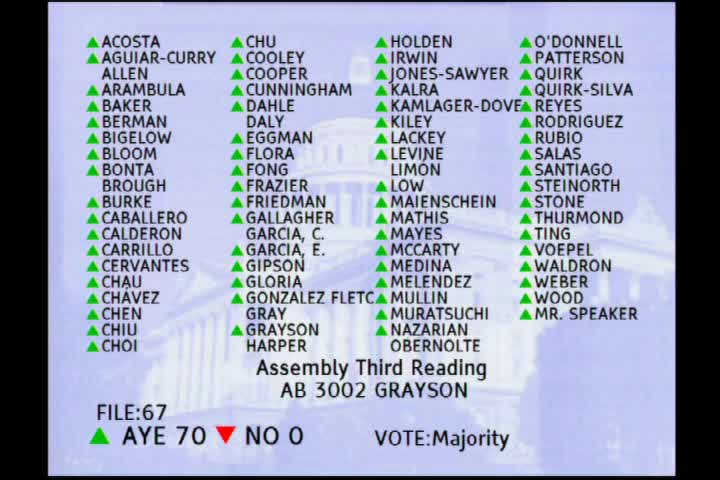 1MIN
Assembly Floor
 2MIN
Assembly Standing Committee on Appropriations
 6MIN
Assembly Standing Committee on Water, Parks, and Wildlife
Bill Author

Bill Co-Author(s):