AB 2381: Vehicles: emissions: certification, auditing, and compliance.
- Session Year: 2017-2018
- House: Assembly
- Latest Version Date: 2018-09-23
Existing law requires a manufacturer of a new motor vehicle to allow the State Air Resources Board to conduct surveillance emissions testing at its assembly facilities or at any other location where the manufacturers assembly line testing is performed and testing records are kept. Existing law authorizes the state board to impose a fee on the manufacturers of new motor vehicles to recover the state boards costs associated with this surveillance.
This bill would require the state board to enhance its certification, audit, and compliance activities for new motor vehicles to detect defeat devices or other software used to evade emissions testing, as specified. The bill would authorize the state board to impose a fee on the manufacturers of new motor vehicles to cover the state boards costs associated with the state boards certification, audit, and compliance activities, with those fees to be deposited in the Certification and Compliance Fund. The bill would authorize the state board to impose a penalty on the manufacturers of new motor vehicles relating to the state boards certification, audit, and compliance activities if specified conditions are met, with those penalty moneys to be deposited in the Air Pollution Control Fund.
Existing law requires a manufacturer of a new motor vehicle to allow the State Air Resources Board to conduct surveillance emissions testing at its assembly facilities or at any other location where the manufacturers assembly line testing is performed and testing records are kept. Existing law authorizes the state board to impose a fee on the manufacturers of new motor vehicles to recover the state boards costs associated with this surveillance.
This bill would require the state board to enhance its certification, audit, and compliance activities for new motor vehicles to detect defeat devices or other software used to evade emissions testing, as specified. The bill would authorize the state board to impose a fee on the manufacturers of new motor vehicles to cover the state boards costs associated with the state boards certification, audit, and compliance activities. activities, with those fees to be deposited in the Certification and Compliance Fund. The bill would authorize the state board to impose a penalty on the manufacturers of new motor vehicles relating to the state boards certification, audit, and compliance activities if specified conditions are met. The bill would create the Certification Fund and the Certification Penalty Account, with the moneys in both the fund and account available upon appropriation. met, with those penalty moneys to be deposited in the Air Pollution Control Fund.
Existing law requires a manufacturer of a new motor vehicle to allow the State Air Resources Board to conduct surveillance emissions testing at its assembly facilities or at any other location where the manufacturers assembly line testing is performed and testing records are kept. Existing law authorizes the state board to impose a fee on the manufacturers of new motor vehicles to recover the state boards costs associated with this surveillance.
This bill would require the state board to enhance its certification, audit, and compliance activities for new motor vehicles to detect defeat devices or other software used to evade emissions testing, as specified. The bill would authorize the state board to impose a fee on the manufacturers of new motor vehicles to cover the state boards costs associated with the state boards certification, audit, and compliance activities. The bill would authorize the state board to impose a penalty on the manufacturers of new motor vehicles relating to the state boards certification, audit, and compliance activities if specified conditions are met. The bill would create the Certification Fund and the Certification Penalty Account, with the moneys in both the fund and account available upon appropriation.
The Certification and Compliance Fund is hereby created in the State Treasury. All moneys in the fund, upon appropriation by the Legislature, shall be expended by the state board for the activities described in Section 43019.1 and 43202.5, as appropriate.
SEC. 2.Section 43202.5 is added to the Health and Safety Code, to read:43202.5.(a)For purposes of this section, real-world conditions emissions testing includes both new and used motor vehicles being driven on-road, outside of normal laboratory testing conditions.
(b)The state board shall enhance its certification, audit, and compliance activities for new motor vehicles to detect defeat devices or other software used to evade emissions testing. Those certification, audit, and compliance activities shall include, but need not be limited to, the increased utilization of in-use and real-world conditions emissions testing.
(c)To further the objectives of subdivision (b), the state board may consult or partner with academic institutions and their associated laboratories to do any of the following:
(1)Develop new surveillance methods and test cycles.
(2)Perform emissions testing on behalf of the state board.
(3)Conduct research on vehicle emissions testing.
SEC. 3.Section 43202.6 is added to the Health and Safety Code, to read:43202.6.(a)The state board, by regulation, may impose fees on manufacturers of new motor vehicles to recover the state boards reasonable costs in implementing Section 43202.5. The total amount of fees collected pursuant to this section shall not exceed five million dollars ($5,000,000) in the 201920 fiscal year, and in any subsequent year shall not increase by an amount greater than the annual increase in the California Consumer Price Index.
(b)A manufacturer that fails to pay a fee imposed pursuant to subdivision (a) within 60 days after receiving an invoice shall pay the state board an additional charge equal to 10 percent of the fee specified in subdivision (a). If the manufacturer notifies the state board within 60 days after receiving the invoice that additional information is needed to honor the invoice, the state board shall grant an additional 90 days for payment without the imposition of an additional charge. An additional interest fee equal to the rate of interest earned by the Pooled Money Investment Account shall be imposed upon the fee specified in subdivision (a) and the additional charges specified in this subdivision and subdivision (c) for each 30-day period for which they remain unpaid, commencing 60 days after the receipt of the original invoice.
(c)A manufacturer that fails to pay all the fees imposed pursuant to this section within one year from the date of receipt of the original invoice shall pay a charge equal to 100 percent of the fees imposed pursuant to subdivision (a). A manufacturer who fails to pay all the charges imposed pursuant to this section within two years from the date of receipt of the original invoice shall pay a penalty equal to 100 percent of the charges imposed pursuant to subdivision (a) and this subdivision for each one-year period for which they remain unpaid.
(d)(1)All moneys collected pursuant to subdivision (a) shall be deposited in the Certification and Compliance Fund, created pursuant to Section 43019.2.
(2)All moneys collected pursuant to subdivisions (b) and (c) shall be deposited in the Air Pollution Control Fund, created pursuant to Section 43015.
The Certification and Compliance Fund is hereby created in the State Treasury. All moneys in the fund, upon appropriation by the Legislature, shall be expended by the state board for the activities described in Section 43019.1. 43019.1 and 43202.5, as appropriate.
SECTION 1.SEC. 2.Section 43202.5 is added to the Health and Safety Code, to read:43202.5.(a)For purposes of this section, real-world conditions emissions testing includes both new and used motor vehicles being driven on-road, outside of normal laboratory testing conditions.
(b)The state board shall enhance its certification, audit, and compliance activities for new motor vehicles to detect defeat devices or other software used to evade emissions testing. Those certification, audit, and compliance activities shall include, but need not be limited to, the increased utilization of in-use and real-world conditions emissions testing.
(c)To further the objectives of subdivision (b), the state board may consult or partner with academic institutions and their associated laboratories to do any of the following:
(1)Develop new surveillance methods and test cycles.
(2)Perform emissions testing on behalf of the state board.
(3)Conduct research on vehicle emissions testing.
SEC. 2.SEC. 3.Section 43202.6 is added to the Health and Safety Code, to read:43202.6.(a)(1)The Certification Fund is hereby created in the State Treasury. Moneys in the fund shall be available upon appropriation by the Legislature to the state board to implement Section 43202.5.(2)The Certification Penalty Account is hereby created in the Certification Fund in the State Treasury. Moneys in the account shall be available upon appropriation by the Legislature.(b)43202.6.(a)The state board, by regulation, may impose fees on manufacturers of new motor vehicles to recover the state boards reasonable costs in implementing Section 43202.5. The total amount of fees collected pursuant to this section shall not exceed five million dollars ($5,000,000) in the 201920 fiscal year, and in any subsequent year shall not increase by an amount greater than the annual increase in the California Consumer Price Index.
(c)(b)A manufacturer that fails to pay a fee imposed pursuant to subdivision (b) (a) within 60 days after receiving an invoice shall pay the state board an additional charge equal to 10 percent of the fee specified in subdivision (b). (a). If the manufacturer notifies the state board within 60 days after receiving the invoice that additional information is needed to honor the invoice, the state board shall grant an additional 90 days for payment without the imposition of an additional charge. An additional interest fee equal to the rate of interest earned by the Pooled Money Investment Account shall be imposed upon the fee specified in subdivision (b) (a) and the additional charges specified in this subdivision and subdivision (d) (c) for each 30-day period for which they remain unpaid, commencing 60 days after the receipt of the original invoice.
(d)(c)A manufacturer that fails to pay all the fees imposed pursuant to this section within one year from the date of receipt of the original invoice shall pay a charge equal to 100 percent of the fees imposed pursuant to subdivision (b). (a). A manufacturer who fails to pay all the charges imposed pursuant to this section within two years from the date of receipt of the original invoice shall pay a penalty equal to 100 percent of the charges imposed pursuant to subdivision (b) (a) and this subdivision for each one-year period for which they remain unpaid.
(e)(d)(1)All moneys collected pursuant to subdivision (b) (a) shall be deposited in the Certification Fund. and Compliance Fund, created pursuant to Section 43019.2.
(2)All moneys collected pursuant to subdivisions (c) and (d) (b) and (c) shall be deposited in the Certification Penalty Account. Air Pollution Control Fund, created pursuant to Section 43015.
(a)For purposes of this section, real-world conditions emissions testing includes both new and used motor vehicles being driven on-road, outside of normal laboratory testing conditions.
(b)The state board shall enhance its certification, audit, and compliance activities for new motor vehicles to detect defeat devices or other software used to evade emissions testing. Those certification, audit, and compliance activities shall include, but need not be limited to, the increased utilization of in-use and real-world conditions emissions testing.
(c)To further the objectives of subdivision (b), the state board may consult or partner with academic institutions and their associated laboratories to do any of the following:
(1)Develop new surveillance methods and test cycles.
(2)Perform emissions testing on behalf of the state board.
(3)Conduct research on vehicle emissions testing.
SEC. 2.Section 43202.6 is added to the Health and Safety Code, to read:43202.6.(a)(1)The Certification Fund is hereby created in the State Treasury. Moneys in the fund shall be available upon appropriation by the Legislature to the state board to implement Section 43202.5.
(2)The Certification Penalty Account is hereby created in the Certification Fund in the State Treasury. Moneys in the account shall be available upon appropriation by the Legislature.
(b)The state board, by regulation, may impose fees on manufacturers of new motor vehicles to recover the state boards reasonable costs in implementing Section 43202.5. The total amount of fees collected pursuant to this section shall not exceed five million dollars ($5,000,000) in the 201920 fiscal year, and in any subsequent year shall not increase by an amount greater than the annual increase in the California Consumer Price Index, operational costs, and labor costs. Index.
(c)A manufacturer that fails to pay a fee imposed pursuant to subdivision (b) within 60 days after receiving an invoice shall pay the state board an additional charge equal to 10 percent of the fee specified in subdivision (b). If the manufacturer notifies the state board within 60 days after receiving the invoice that additional information is needed to honor the invoice, the state board shall grant an additional 90 days for payment without the imposition of an additional charge. An additional interest fee equal to the rate of interest earned by the Pooled Money Investment Account shall be imposed upon the fee specified in subdivision (b) and the additional charges specified in this subdivision and subdivision (d) for each 30-day period for which they remain unpaid, commencing 60 days after the receipt of the original invoice.
(d)A manufacturer that fails to pay all the fees imposed pursuant to this section within one year from the date of receipt of the original invoice shall pay a charge equal to 100 percent of the fees imposed pursuant to subdivision (b). A manufacturer who fails to pay all the charges imposed pursuant to this section within two years from the date of receipt of the original invoice shall pay a penalty equal to 100 percent of the charges imposed pursuant to subdivision (b) and this subdivision for each one-year period for which they remain unpaid.
(e)(1)All moneys collected pursuant to subdivision (b) shall be deposited in the Certification Fund.
(2)All moneys collected pursuant to subdivisions (c) and (d) shall be deposited in the Certification Penalty Account.
(a)For purposes of this section, real-world conditions emissions testing includes both new and used motor vehicles being driven on-road, outside of normal laboratory testing conditions.
(b)The state board shall enhance its certification, audit, and compliance activities for new motor vehicles to detect defeat devices or other software used to evade emissions testing. Those certification, audit, and compliance activities shall include, but need not be limited to, the increased utilization of in-use and real-world conditions emissions testing.
(c)To further the objectives of subdivision (b), the state board may consult or partner with academic institutions and laboratories to do any of the following:
(1)Develop new surveillance methods and test cycles.
(2)Perform emissions testing on behalf of the state board.
(3)Conduct research on vehicle emissions testing.
SEC. 2.Section 43202.6 is added to the Health and Safety Code, to read:43202.6.(a)(1)The Certification Fund is hereby created in the State Treasury. Moneys in the fund shall be available upon appropriation by the Legislature to the state board to implement Section 43202.5.
(2)The Certification Penalty Account is hereby created in the Certification Fund in the State Treasury. Moneys in the account shall be available upon appropriation by the Legislature.
(b)The state board, by regulation, may impose fees on manufacturers of new motor vehicles to recover the state boards reasonable costs in implementing Section 43202.5. The total amount of fees collected pursuant to this section shall not exceed five million dollars ($5,000,000) in the 201920 fiscal year, and in any subsequent year shall not increase by an amount greater than the annual increase in the California Consumer Price Index, operational costs, and labor costs.
(c)A manufacturer that fails to pay a fee imposed pursuant to subdivision (b) within 60 days after receiving an invoice shall pay the state board an additional charge equal to 10 percent of the fee specified in subdivision (b). If the manufacturer notifies the state board within 60 days after receiving the invoice that additional information is needed to honor the invoice, the state board shall grant an additional 90 days for payment without the imposition of an additional charge. An additional interest fee equal to the rate of interest earned by the Pooled Money Investment Account shall be imposed upon the fee specified in subdivision (b) and the additional charges specified in this subdivision and subdivision (d) for each 30-day period for which they remain unpaid, commencing 60 days after the receipt of the original invoice.
(d)A manufacturer that fails to pay all the fees imposed pursuant to this section within one year from the date of receipt of the original invoice shall pay a charge equal to 100 percent of the fees imposed pursuant to subdivision (b). A manufacturer who fails to pay all the charges imposed pursuant to this section within two years from the date of receipt of the original invoice shall pay a penalty equal to 100 percent of the charges imposed pursuant to subdivision (b) and this subdivision for each one-year period for which they remain unpaid.
(e)(1)All moneys collected pursuant to subdivision (b) shall be deposited in the Certification Fund.
(2)All moneys collected pursuant to subdivisions (c) and (d) shall be deposited in the Certification Penalty Account.
|
Date
|
Status
|
|---|---|
| Sep 23, 2018 | Chaptered by Secretary of State - Chapter 713, Statutes of 2018. |
| Sep 23, 2018 | Approved by the Governor. |
| Sep 10, 2018 | Enrolled and presented to the Governor at 3:30 p.m. |
| Aug 30, 2018 | Senate amendments concurred in. To Engrossing and Enrolling. |
| Aug 29, 2018 | In Assembly. Concurrence in Senate amendments pending. |
| Aug 29, 2018 | Read third time. Passed. Ordered to the Assembly. |
| Aug 27, 2018 | Read second time. Ordered to third reading. |
| Aug 24, 2018 | Read third time and amended. Ordered to second reading. |
| Aug 17, 2018 | From committee: Do pass. (Ayes 5. Noes 2.) (August 16). |
| Aug 6, 2018 | In committee: Referred to APPR. suspense file. |
| Jun 27, 2018 | From committee: Do pass and re-refer to Com. on APPR. (Ayes 9. Noes 3.) (June 26). Re-referred to Com. on APPR. |
| Jun 21, 2018 | From committee: Do pass and re-refer to Com. on T. & H. (Ayes 7. Noes 0.) (June 20). Re-referred to Com. on T. & H. |
| Jun 13, 2018 | Referred to Coms. on EQ. and T. & H. |
| Jun 4, 2018 | In Senate. Read first time. To Com. on RLS. for assignment. |
| May 31, 2018 | Read third time. Passed. Ordered to the Senate. |
| May 29, 2018 | Read second time. Ordered to third reading. |
| May 25, 2018 | From committee: Amend, and do pass as amended. (Ayes 14. Noes 0.) (May 25). |
| May 9, 2018 | In committee: Set, first hearing. Referred to APPR. suspense file. |
| Apr 24, 2018 | From committee: Do pass and re-refer to Com. on APPR. (Ayes 14. Noes 0.) (April 23). Re-referred to Com. on APPR. |
| Apr 10, 2018 | From committee: Do pass and re-refer to Com. on TRANS. (Ayes 10. Noes 0.) (April 9). Re-referred to Com. on TRANS. |
| Mar 1, 2018 | Referred to Coms. on NAT. RES. and TRANS. |
| Feb 15, 2018 | From printer. May be heard in committee March 17. |
| Feb 14, 2018 | Read first time. To print. |
|
Date
|
Description
|
Location
|
Votes
|
|
|---|---|---|---|---|
| Aug 30, 2018 | AB 2381 CARRILLO Concurrence in Senate Amendments | Assembly Floor |
Passed |
|
| Aug 29, 2018 | Assembly 3rd Reading AB2381 Carrillo By Wieckowski | Senate Floor |
Passed |
|
| Aug 16, 2018 | Do pass | Senate Standing Committee on Appropriations |
Passed |
|
| Aug 6, 2018 | Placed on suspense file | Senate Standing Committee on Appropriations |
Passed |
|
| Jun 26, 2018 | Do pass, but first be re-referred to the Committee on [Appropriations] | Senate Standing Committee on Transportation and Housing |
Passed |
|
| Jun 20, 2018 | Do pass, but first be re-referred to the Committee on [Transportation and Housing] | Senate Standing Committee on Environmental Quality |
Passed |
|
| May 31, 2018 | AB 2381 CARRILLO Assembly Third Reading | Assembly Floor |
Passed |
|
| May 25, 2018 | Do pass as amended. | Assembly Standing Committee on Appropriations |
Passed |
|
| Apr 23, 2018 | Do pass and be re-referred to the Committee on [Appropriations] | Assembly Standing Committee on Transportation |
Passed |
|
| Apr 9, 2018 | Do pass and be re-referred to the Committee on [Transportation] | Assembly Standing Committee on Natural Resources |
Passed |
This list shows positions taken on this bill by organizations on the date displayed, which is linked to the original source.
Positions by individuals are not included.
CONCURRENCE IN SENATE AMENDMENTS
CSA1 Bill Id:AB 2381
Author:(Carrillo)
As Amended Ver:August 24, 2018
Majority vote
ASSEMBLY: | 62-11 | (May 31, 2018) | SENATE: | 29-10 | (August 29, 2018) |
Original Committee Reference: NAT. RES.
SUMMARY: Requires the Air Resources Board (ARB) to enhance its emissions testing of new motor vehicles and authorizes ARB to impose a fee on vehicle manufacturers to cover implementation costs. Specifically, this bill:
- Defines "real-world conditions emissions testing" to include both new and used motor vehicles being driven on-road, outside of normal laboratory testing conditions.
- Requires ARB to enhance its certification, audit, and compliance activities for new motor vehicles to detect defeat devices or other software used to evade emissions testing.
- Requires ARB's certification, audit, and compliance activities to include increased utilization of in-use and real-world conditions emissions testing.
- Authorizes ARB to consult or partner with academic institutions and their associated laboratories to develop new surveillance methods and test cycles, perform emissions testing on behalf of ARB, and conduct research on vehicle emissions testing.
- Authorizes ARB to impose fees on manufacturers of new motor vehicles to recover implementation costs. Caps the fees at $5 million for Fiscal Year 2019-20 and limits subsequent increases to inflation.
The Senate amendments remove the creation of the Certification Fund and the Certification Penalty Account and instead require the fees collected pursuant to the bill to be deposited into the Certification and Compliance Fund and require the penalties collected pursuant to the bill to be deposited into the Air Pollution Control Fund.
EXISTING LAW:
- Requires ARB to endeavor to achieve the maximum degree of emission reductions possible from vehicular and other mobile sources in order to attain state ambient air standards.
- Requires ARB to adopt and implement emissions standard for new motor vehicles that ARB finds to be necessary and technologically feasible.
- Prohibits a new motor vehicle or new motor vehicle engine from being certified by ARB, unless the vehicle or engine meets the emissions standards adopted by ARB.
- Prohibits a new motor vehicle required to meet the emissions standards adopted by the state from being sold and registered in this state unless the new motor vehicle manufacturer permits ARB to conduct surveillance testing of emissions of new motor vehicles.
- Authorizes ARB to adopt, by regulation, a schedule of annual fees for the certification of motor vehicles and engines sold in the state to cover costs of state programs related to mobile sources. Limits fees to $4.5 million in the 1989-90 Fiscal Year and allows annual increases to not exceed the annual increase in the California Consumer Price Index.
- Authorizes ARB to impose a fee on manufacturers of new motor vehicles to recover ARB's cost of conducting surveillance of new motor vehicles prior to retail sales.
- Requires ARB to establish criteria for the evaluation of the effectiveness of motor vehicle pollution control devices.
- Prohibits a person from installing, selling, or offering for sale any device, apparatus, or mechanism intended for use with, or as a part of, a required motor vehicle pollution control device or system that alters or modifies the original design or performance of the motor vehicle pollution control device or system.
- Establishes civil penalties for violations of new motor vehicle emission standards or altering or modifying the motor vehicle pollution control device.
FISCAL EFFECT: According to the Senate Appropriations Committee, $573,000 (3 Positions) and $450,000 contract funds to ARB.
COMMENTS: According to a Volkswagen PowerPoint that was discovered as part of the defeat device investigation, ten years ago Volkswagen engineers realized that the emissions control equipment installed in their diesel engines did not have the durability to meet federal and California emissions standards. Durable and effective emissions control equipment would have cost Volkswagen hundreds of dollars more per vehicle and would have increased the sticker price to consumers. Instead of pursuing the more expensive emissions control equipment, Volkswagen developed software, known as a defeat device, which could detect when the vehicle was being put through an emissions test and activate the emissions control equipment only for the purposes of passing the test. This would extend the life of the emissions control equipment and allow Volkswagen to appear to be in compliance with federal and California emissions standards. However, when not being tested, the vehicles were emitting nitrous oxides (NOx) up to 40 times the legal limit.
The events that led to the discovery of Volkswagen's defeat device began when the Center for Alternative Fuels, Engines and Emissions at West Virginia University was attempting to understand the difference between vehicle emissions in real-world conditions and laboratory performance in both America and Europe. The real-world emissions of a Volkswagen Passat and Jetta were much higher than the laboratory tests at ARB's Haagen-Smit Laboratory (HSL). The University turned its data over to ARB, which prompted ARB to open an investigation on the discrepancy. Subsequently, Volkswagen's engineers admitted to ARB they were using defeat devices.
There were over 70,000 2.0L and almost 15,000 3.0L Volkswagen diesel vehicles registered in California that have emitted excess tons of harmful NOx emissions. NOx emissions create nitrogen dioxide, particulate matter, and ozone pollution. California has made large strides in cleaning up the air, but Volkswagen's cheating was particularly harmful because in many parts of the state our air quality is still much worse than anywhere else in the nation: 23 million Californians live within the nation's only severe non-attainment areas for ozone pollution, and 12 million Californians live in areas with nation-leading levels of fine particle pollution. These pollutants cause lung disease, heart disease, and premature death, especially among the most vulnerable populations.
Recently, ARB has discovered that other automakers may also be using defeat devices. It has become clear that some automakers are willing to develop new software designed to cheat California's clean air laws. While ARB was instrumental in catching Volkswagen, the automaker's vehicles were able to pollute California's air for nine years before Volkswagen was brought to justice. As result of the partial settlements with ARB and United States Environmental Protection Agency, Volkswagen will be paying billions of dollars in air quality mitigation, investments in the Zero-Emission Vehicle market, and penalties. These funds will be spent throughout the country, but the settlements have specific California requirements and amounts.
According to ARB regulations, an AECD means "any device or element of design that senses temperature, vehicle speed, engine revolutions per minute, transmission gear, manifold vacuum, or any other parameter for the purpose of activating, modulating, delaying, or deactivating the operation of the emission control system." AECD is usually not a physical device, but instead code in the vehicle's software. This code modifies the vehicle's emission control system's performance. AECD can have legitimate uses to protect the emission control system during extreme cold weather or when there is a heavy load in the vehicle. However, manufacturers are required to disclose AECDs to ARB for their review and approval. An AECD is a defeat device when it reduces the effectiveness of the emission control system under conditions that a vehicle can be reasonably expected to encounter. Auto manufacturers may use defeat devices to avoid investing in more durable emission control systems.
Analysis Prepared by: Michael Jarred / NAT. RES. / (916) 319-2092 FN: 0005085
Office of Senate Floor Analyses (916) 651-1520 Fax: (916) 327-4478 | AB |
THIRD READING
Bill No: AB 2381
Amended: 8/24/18 in Senate
SENATE ENVIRONMENTAL QUALITY COMMITTEE: 7-0, 6/20/18
AYES: Wieckowski, Stone, Gaines, Hill, Lara, Skinner, Stern
SENATE TRANS. & HOUSING COMMITTEE: 9-3, 6/26/18
AYES: Beall, Cannella, Allen, Dodd, Galgiani, McGuire, Roth, Skinner, Wiener
NOES: Gaines, Morrell, Vidak
NO VOTE RECORDED: Wieckowski
SENATE APPROPRIATIONS COMMITTEE: 5-2, 8/16/18
AYES: Portantino, Beall, Bradford, Hill, Wiener
NOES: Bates, Nielsen
ASSEMBLY FLOOR: 62-11, 5/31/18 - See last page for vote
DIGEST:
This bill requires the Air Resources Board (ARB) to enhance its emissions testing of new motor vehicles and authorizes ARB to impose a fee on vehicle manufacturers to cover implementation costs.
Senate Floor Amendments of 8/24/18 expand the purposes that the fees collected pursuant to the bill may fund, remove the creation of the Certification Fund and the Certification Penalty Account and instead require the fees collected pursuant to the bill to be deposited into the Certification and Compliance Fund and require the penalties collected pursuant to the bill to be deposited into the Air Pollution Control Fund.
ANALYSIS: Existing federal law, the Federal Clean Air Act (FCAA) and its implementing regulations, sets National Ambient Air Quality Standards (NAAQS) for six criteria pollutants, designates air basins that do not achieve NAAQS as nonattainment, allows only California to set vehicular emissions standards stricter than the federal government, and allows other states to adopt either the federal or California vehicular emissions standards. (42 U.S.C. §7401 et seq.)
Existing state law:
- Establishes ARB as the air pollution control agency in California and requires the ARB, among other things, to control emissions from a wide array of mobile sources. (Health and Safety Code (HSC) §39500 et seq.)
- Requires ARB to promulgate and enforce rules and regulations necessary for the proper execution of its statutory mandates. (HSC §39601 et seq.)
- Requires, with exceptions, all new motor vehicles to meet ARB’s emission standards in order to be sold and registered in this state. (HSC §43202)
- Authorizes ARB to assess fees on vehicle manufacturers to recover the costs associated with emissions testing. (HSC §43203)
- Establishes the Motor Vehicle Inspection Program, commonly known as the smog check program, to help the state meet federal air quality standards. (HSC §44000 et seq.)
- Prohibits a person from installing, selling, offering for sale, or advertising any device, apparatus, or mechanism intended for use with, or as a part of, a required motor vehicle pollution control device or system that alters or modifies the original design or performance of the motor vehicle pollution control device or system; and imposes a fine for doing so. (Vehicle Code (VEH) §27156)
- Establishes the Air Pollution Control Fund (APCF) in the State Treasury for ARB to carry out its duties and functions, upon appropriation by the Legislature. (HSC §43015)
This bill:
- Defines that “real-world conditions emissions testing” may include both new and used vehicles being driven on-road, outside of normal laboratory testing conditions.
- Requires ARB to enhance its certification, audit, and compliance of new motor vehicles to detect defeat devices or other software used to evade emissions testing, including the utilization of real-world conditions emissions testing.
- Allows ARB to enter into agreements with academic institutions and associated laboratories to develop new surveillance methods and test cycles, perform emissions testing on behalf of the state, or conduct research on vehicle emissions testing.
- Creates the Certification and Compliance Fund in the state treasury and requires the moneys in the funds be available upon appropriation by the Legislature, as specified.
- Allows ARB, by regulation, to impose fees on new motor vehicles in order to implement this bill, requires that the amount collected not exceed $7 million in fiscal year 2019-20, and prohibits an increase in subsequent years except as warranted by the annual increase in the California Consumer Price Index.
- Imposes penalties on manufacturers who fail to pay a fee under this bill as follows:
- A 10% additional charge if the invoice is not paid within 60 days, unless the manufacturer asks for additional information in order to honor the invoice, upon which an additional 90 days is granted to pay a fee without penalty.
- Sixty days after receiving the invoice, an interest penalty is added that is equal to the rate earned by the Pooled Money Investment Account of all cumulative penalties for each 30-day period the invoice remains unpaid.
- An additional 100% penalty of all cumulative penalties for any invoice that remains unpaid a year after the receipt of the invoice.
- An additional 100% penalty of all cumulative penalties for any invoice that remain unpaid two years after the receipt of the invoice.
- Requires all fees to be deposited into the Certification and Compliance Fund and all penalties to be deposited into the APCF.
Background
- Health impacts of air pollution. When not adequately controlled, air pollution has dire consequences on the health and safety of both people and the environment. Poor air quality causes the lungs to constrict, resulting in wheezing, shortness of breath and chest tightness, especially during exercise or physical activity.
It is well known that air pollution causes asthma. According to the Centers for Disease Control and Prevention, nationwide 7.4% of adults and 8.6% of children have been diagnosed with asthma. In California, the numbers are significantly higher: 13.1% of adults and 12.5% of children have been diagnosed with asthma. Lower income and minority groups are disproportionately affected by asthma due to their increased exposure to air pollution.
Depending on exposure, air pollution alone can cause an increased risk of cardiovascular and respiratory illness, lung disease, cancerous tumors, birth defects, premature births, developmental disorders, central nervous system damage, intellectual disability, persistent memory impairments, epilepsy, dementia, and premature death.
- Air quality standards. The FCAA passed in 1963 and has been revised many times thereafter. The FCAA and its implementing regulations are intended to protect public health and environmental quality by limiting and reducing pollution from various sources. Under the FCAA, the United States Environmental Protection Agency (US EPA) establishes NAAQS that apply to outdoor air throughout the country.
In 1969 and 1971, ARB set the first air quality standards for ozone, Particulate Matter (PM), oxides of nitrogen (NOx), oxides of sulfur (SOx), and carbon monoxide due to their negative impacts on public health above specified concentrations.
The federal government followed suit and set NAAQS for six “criteria pollutants.” These included ground-level ozone, PM, NOx, SOx, carbon monoxide, and added lead. Now, the US EPA reviews each NAAQS at five-year intervals to ensure that the standards are based on the most recent scientific information.
Regions that do not meet the national standards for any one of the standards are designated “nonattainment areas.” The FCAA sets deadlines for attainment based on the severity of nonattainment and requires states to develop comprehensive plans, known as the state implementation plan (SIP), to attain and maintain air-quality standards for each area designated nonattainment for an NAAQS.
- Vehicles and air pollution. Vehicles are one of the primary sources of air pollution nationally. As such, the FCAA authorizes US EPA to establish and regulate emissions standards for mobile sources.
California, due to its preexisting vehicle-emission standards and severe motor vehicle air pollution problems, is authorized under the FCAA to implement separate mobile emission standards from the federal government. Other states may choose to follow either the national standard or the stricter California standards.
State law assigns the ARB with primary responsibility for control of mobile-source air pollution, including adoption of rules for reducing vehicle emissions, the specification of vehicular fuel composition, emissions control devices, and engine standards.
- Volkswagen and Fiat Chrysler Automobiles. On September 3, 2015, representatives of Volkswagen (VW) admitted to staff of US EPA and ARB that a large number of their vehicle engines had been designed and manufactured with a “defeat device” to bypass, defeat, or render inoperative elements of the vehicles’ emissions control system. As a result, these vehicles are able to pass emissions tests despite exceeding federal emissions standards by up to 40 times. This is due to the fact that the emission control system works while the vehicle is being tested, but is turned off by the defeat device when the car is being driven on the road.
There are an estimated half-million of these vehicles in the US, of which about 70,000 are in California. On January 4, 2016, the US filed a complaint alleging that VW violated the Clean Air Act by selling approximately 590,000 diesel motor vehicles, model year 2009-2016, equipped with defeat devices.
On March 8, 2016, the Senate Transportation and Housing Committee and the Senate Environmental Quality Committee held a hearing titled “Volkswagen’s ‘Defeat Device:’ Update and Implications for California.” This hearing examined how the defeat device was discovered, how US EPA and ARB were addressing the violations, how California’s air quality would be impacted, and how we can prevent such violations from occurring again.
Since that hearing, US EPA, ARB, and the United States Department of Justice (US DOJ) have reached a settlement with VW relating to the affected 2.0-liter engines, as well as an initial settlement relating to the affected 3.0-liter engines. Further, on January 11, 2017, US DOJ announced a settlement of civil and criminal penalties.
On January 12, 2017, ARB and US EPA issued Notices of Violation to Fiat Chrysler Automobiles for failing to disclose auxiliary emissions control devices (AECDs); ARB has not yet determined whether these AECDs are actually defeat devices. ARB’s investigation involves about 14,000 Jeep Grand Cherokees and Ram 1500 pickup trucks, model years 2014-16 (there are approximately 104,000 of these vehicles nationwide). The discovery of the AECDs occurred as part of the expanded testing implemented by ARB and US EPA as a result of the VW investigation.
- Auxiliary Emission Control Devices. According to ARB regulations, an AECD means “any device or element of design that senses temperature, vehicle speed, engine revolutions per minute, transmission gear, manifold vacuum, or any other parameter for the purpose of activating, modulating, delaying, or deactivating the operation of the emission control system.” AECD is usually not a physical device, but instead code in the vehicle’s software. This code modifies the vehicle’s emission control system’s performance. AECD can have legitimate uses to protect the emission control system during extreme cold weather or when there is a heavy load in the vehicle. However, manufacturers are required to disclose AECDs to ARB for their review and approval. An AECD is a defeat device when it reduces the effectiveness of the emission control system under conditions that a vehicle can be reasonably expected to encounter. Auto manufacturers may use defeat devices to avoid investing in more durable emission control systems.
(NOTE: For more background on the Volkswagen settlement, see the Senate Environmental Quality Committee and Transportation and Housing Committee analyses.)
Comments
Purpose of bill. According to the author, “AB 2381 would partner the ARB with academic institutions, associated laboratories, and experts in order to enhance their new motor vehicle emissions testing program and detect these heinous defeat devices. AB 2381 would also give the ARB the ability to secure additional funding to perform more independent testing. AB 2381 will keep ARB at the forefront of protecting California’s air from those who would flout our laws, pollute our environment, and harm our residents.”
FISCAL EFFECT: Appropriation: Fiscal Com.: Local:
According to the Senate Appropriations Committee, $573,000 (three Positions) and $450,000 contract funds to ARB.
American Lung Association
California League of Conservation Voters
Coalition for Clean Air
Valley Clean Air Now
OPPOSITION: (Verified 8/15/18)
None received
ASSEMBLY FLOOR: 62-11, 5/31/18
AYES: Acosta, Aguiar-Curry, Arambula, Baker, Berman, Bigelow, Bloom, Bonta, Burke, Caballero, Calderon, Carrillo, Chau, Chen, Chiu, Chu, Cooley, Cooper, Cunningham, Daly, Eggman, Flora, Fong, Frazier, Friedman, Cristina Garcia, Eduardo Garcia, Gipson, Gloria, Gonzalez Fletcher, Gray, Grayson, Holden, Irwin, Jones-Sawyer, Kalra, Kamlager-Dove, Lackey, Levine, Limón, Low, Maienschein, McCarty, Medina, Melendez, Mullin, Muratsuchi, Nazarian, O'Donnell, Quirk, Quirk-Silva, Reyes, Rodriguez, Rubio, Salas, Santiago, Mark Stone, Thurmond, Ting, Voepel, Weber, Rendon
NOES: Travis Allen, Brough, Cervantes, Chávez, Dahle, Kiley, Mathis, Obernolte, Patterson, Steinorth, Waldron
NO VOTE RECORDED: Choi, Gallagher, Harper, Mayes, Wood
8/27/18 20:38:47
Office of Senate Floor Analyses (916) 651-1520 Fax: (916) 327-4478 | AB |
THIRD READING
Bill No: AB 2381
:
SENATE ENVIRONMENTAL QUALITY COMMITTEE: 7-0, 6/20/18
AYES: Wieckowski, Stone, Gaines, Hill, Lara, Skinner, Stern
SENATE TRANS. & HOUSING COMMITTEE: 9-3, 6/26/18
AYES: Beall, Cannella, Allen, Dodd, Galgiani, McGuire, Roth, Skinner, Wiener
NOES: Gaines, Morrell, Vidak
NO VOTE RECORDED: Wieckowski
SENATE APPROPRIATIONS COMMITTEE: 5-2, 8/16/18
AYES: Portantino, Beall, Bradford, Hill, Wiener
NOES: Bates, Nielsen
ASSEMBLY FLOOR: 62-11, 5/31/18 - See last page for vote
DIGEST:
This bill requires the Air Resources Board (ARB) to enhance its emissions testing of new motor vehicles and authorizes ARB to impose a fee on vehicle manufacturers to cover implementation costs.
ANALYSIS: Existing federal law, the Federal Clean Air Act (FCAA) and its implementing regulations, sets National Ambient Air Quality Standards (NAAQS) for six criteria pollutants, designates air basins that do not achieve NAAQS as nonattainment, allows only California to set vehicular emissions standards stricter than the federal government, and allows other states to adopt either the federal or California vehicular emissions standards. (42 U.S.C. §7401 et seq.)
Existing state law:
- Establishes ARB as the air pollution control agency in California and requires the ARB, among other things, to control emissions from a wide array of mobile sources. (Health and Safety Code (HSC) §39500 et seq.)
- Requires ARB to promulgate and enforce rules and regulations necessary for the proper execution of its statutory mandates. (HSC §39601 et seq.)
- Requires, with exceptions, all new motor vehicles to meet ARB’s emission standards in order to be sold and registered in this state. (HSC §43202)
- Authorizes ARB to asses fees on vehicle manufacturers to recover the costs associated with emissions testing. (HSC §43203)
- Establishes the Motor Vehicle Inspection Program, commonly known as the smog check program, to help the state meet federal air quality standards. (HSC §44000 et seq.)
- Prohibits a person from installing, selling, offering for sale, or advertising any device, apparatus, or mechanism intended for use with, or as a part of, a required motor vehicle pollution control device or system that alters or modifies the original design or performance of the motor vehicle pollution control device or system; and imposes a fine for doing so. (Vehicle Code (VEH) §27156)
This bill:
- Defines that “real-world conditions emissions testing” may include both new and used vehicles being driven on-road, outside of normal laboratory testing conditions.
- Requires ARB to enhance its certification, audit, and compliance of new motor vehicles to detect defeat devices or other software used to evade emissions testing, including the utilization of real-world conditions emissions testing.
- Allows ARB to enter into agreements with academic institutions and associated laboratories to develop new surveillance methods and test cycles, perform emissions testing on behalf of the state, or conduct research on vehicle emissions testing.
- Creates the Certification Fund and the Certification Penalty Account in the state treasury and requires the moneys in the funds be available upon appropriation by the Legislature.
- Allows ARB, by regulation, to impose fees on new motor vehicles in order to implement this bill, requires that the amount collected not exceed $7 million in fiscal year 2019-20, and prohibits an increase in subsequent years except as warranted by the annual increase in the California Consumer Price Index.
- Imposes penalties on manufacturers who fail to pay a fee under the bill as follows:
- A 10% additional charge if the invoice is not paid within 60 days, unless the manufacturer asks for additional information in order to honor the invoice, upon which an additional 90 days is granted to pay a fee without penalty.
- Sixty days after receiving the invoice, an interest penalty is added that is equal to the rate earned by the Pooled Money Investment Account of all cumulative penalties for each 30-day period the invoice remains unpaid.
- An additional 100% penalty of all cumulative penalties for any invoice that remains unpaid a year after the receipt of the invoice.
- An additional 100% penalty of all cumulative penalties for any invoice that remain unpaid two years after the receipt of the invoice.
- Requires all fees to be deposited into the Certification Fund and all penalties to be deposited into the Certification Penalty Account.
- A 10% additional charge if the invoice is not paid within 60 days, unless the manufacturer asks for additional information in order to honor the invoice, upon which an additional 90 days is granted to pay a fee without penalty.
Background
- Health impacts of air pollution. When not adequately controlled, air pollution has dire consequences on the health and safety of both people and the environment. Poor air quality causes the lungs to constrict, resulting in wheezing, shortness of breath and chest tightness, especially during exercise or physical activity.
It is well known that air pollution causes asthma. According to the Centers for Disease Control and Prevention, nationwide 7.4% of adults and 8.6% of children have been diagnosed with asthma. In California, the numbers are significantly higher: 13.1% of adults and 12.5% of children have been diagnosed with asthma. Lower income and minority groups are disproportionately affected by asthma due to their increased exposure to air pollution.
Depending on exposure, air pollution alone can cause an increased risk of cardiovascular and respiratory illness, lung disease, cancerous tumors, birth defects, premature births, developmental disorders, central nervous system damage, intellectual disability, persistent memory impairments, epilepsy, dementia, and premature death. - Air quality standards. The Federal Clean Air Act (FCAA) passed in 1963 and has been revised many times thereafter. The FCAA and its implementing regulations are intended to protect public health and environmental quality by limiting and reducing pollution from various sources. Under the FCAA, the United States Environmental Protection Agency (US EPA) establishes National Ambient Air Quality Standards (NAAQS) that apply to outdoor air throughout the country.
In 1969 and 1971, ARB set the first air quality standards for ozone, Particulate Matter (PM), oxides of nitrogen (NOx), oxides of sulfur (SOx), and carbon monoxide due to their negative impacts on public health above specified concentrations.
The federal government followed suit and set NAAQS for six “criteria pollutants.” These included ground-level ozone, PM, NOx, SOx, carbon monoxide, and added lead. Now, the US EPA reviews each NAAQS at five-year intervals to ensure that the standards are based on the most recent scientific information.
Regions that do not meet the national standards for any one of the standards are designated “nonattainment areas.” The FCAA sets deadlines for attainment based on the severity of nonattainment and requires states to develop comprehensive plans, known as the state implementation plan (SIP), to attain and maintain air-quality standards for each area designated nonattainment for an NAAQS. - Vehicles and air pollution. Vehicles are one of the primary sources of air pollution nationally. As such, the FCAA authorizes US EPA to establish and regulate emissions standards for mobile sources.
California, due to its preexisting vehicle-emission standards and severe motor vehicle air pollution problems, is authorized under the FCAA to implement separate mobile emission standards from the federal government. Other states may choose to follow either the national standard or the stricter California standards.
State law assigns the ARB with primary responsibility for control of mobile-source air pollution, including adoption of rules for reducing vehicle emissions, the specification of vehicular fuel composition, emissions control devices, and engine standards. - Volkswagen and Fiat Chrysler Automobiles. On September 3, 2015, representatives of Volkswagen (VW) admitted to staff of US EPA and ARB that a large number of their vehicle engines had been designed and manufactured with a “defeat device” to bypass, defeat, or render inoperative elements of the vehicles’ emissions control system. As a result, these vehicles are able to pass emissions tests despite exceeding federal emissions standards by up to 40 times. This is due to the fact that the emission control system works while the vehicle is being tested, but is turned off by the defeat device when the car is being driven on the road.
There are an estimated half-million of these vehicles in the US, of which about 70,000 are in California. On January 4, 2016, the US filed a complaint alleging that VW violated the Clean Air Act by selling approximately 590,000 diesel motor vehicles, model year 2009-2016, equipped with defeat devices.
On March 8, 2016, the Senate Transportation and Housing Committee and the Senate Environmental Quality Committee held a hearing titled “Volkswagen’s ‘Defeat Device:’ Update and Implications for California.” This hearing examined how the defeat device was discovered, how US EPA and ARB were addressing the violations, how California’s air quality would be impacted, and how we can prevent such violations from occurring again.
Since that hearing, US EPA, ARB, and the United States Department of Justice (US DOJ) have reached a settlement with VW relating to the affected 2.0-liter engines, as well as an initial settlement relating to the affected 3.0-liter engines. Further, on January 11, 2017, US DOJ announced a settlement of civil and criminal penalties.
On January 12, 2017, ARB and US EPA issued Notices of Violation to Fiat Chrysler Automobiles (FCA) for failing to disclose auxiliary emissions control devices (AECDs); ARB has not yet determined whether these AECDs are actually defeat devices. ARB’s investigation involves about 14,000 Jeep Grand Cherokees and Ram 1500 pickup trucks, model years 2014-16 (there are approximately 104,000 of these vehicles nationwide). The discovery of the AECDs occurred as part of the expanded testing implemented by ARB and US EPA as a result of the VW investigation. - Auxiliary Emission Control Devices (AECD). According to ARB regulations, an AECD means “any device or element of design that senses temperature, vehicle speed, engine revolutions per minute, transmission gear, manifold vacuum, or any other parameter for the purpose of activating, modulating, delaying, or deactivating the operation of the emission control system.” AECD is usually not a physical device, but instead code in the vehicle’s software. This code modifies the vehicle’s emission control system’s performance. AECD can have legitimate uses to protect the emission control system during extreme cold weather or when there is a heavy load in the vehicle. However, manufacturers are required to disclose AECDs to ARB for their review and approval. An AECD is a defeat device when it reduces the effectiveness of the emission control system under conditions that a vehicle can be reasonably expected to encounter. Auto manufacturers may use defeat devices to avoid investing in more durable emission control systems.
(NOTE: For more background on the Volkswagen settlement, see the Senate Environmental Quality Committee and Transportation and Housing Committee analyses.)
Comments
Purpose of bill. According to the author, “AB 2381 would partner the ARB with academic institutions, associated laboratories, and experts in order to enhance their new motor vehicle emissions testing program and detect these heinous defeat devices. AB 2381 would also give the ARB the ability to secure additional funding to perform more independent testing. AB 2381 will keep ARB at the forefront of protecting California’s air from those who would flout our laws, pollute our environment, and harm our residents.”
FISCAL EFFECT: Appropriation: Fiscal Com.: Local:
According to the Senate Appropriations Committee, $573,000 (three Positions) and $450,000 contract funds to ARB.
American Lung Association
California League of Conservation Voters
Coalition for Clean Air
Valley Clean Air Now
OPPOSITION: (Verified 8/15/18)
None received
ASSEMBLY FLOOR: 62-11, 5/31/18
AYES: Acosta, Aguiar-Curry, Arambula, Baker, Berman, Bigelow, Bloom, Bonta, Burke, Caballero, Calderon, Carrillo, Chau, Chen, Chiu, Chu, Cooley, Cooper, Cunningham, Daly, Eggman, Flora, Fong, Frazier, Friedman, Cristina Garcia, Eduardo Garcia, Gipson, Gloria, Gonzalez Fletcher, Gray, Grayson, Holden, Irwin, Jones-Sawyer, Kalra, Kamlager-Dove, Lackey, Levine, Limón, Low, Maienschein, McCarty, Medina, Melendez, Mullin, Muratsuchi, Nazarian, O'Donnell, Quirk, Quirk-Silva, Reyes, Rodriguez, Rubio, Salas, Santiago, Mark Stone, Thurmond, Ting, Voepel, Weber, Rendon
NOES: Travis Allen, Brough, Cervantes, Chávez, Dahle, Kiley, Mathis, Obernolte, Patterson, Steinorth, Waldron
NO VOTE RECORDED: Choi, Gallagher, Harper, Mayes, Wood
8/18/18 13:41:51
SENATE COMMITTEE ON APPROPRIATIONS
Senator Anthony Portantino, Chair
2017 - 2018 Regular Session
AB 2381 (Carrillo) - Vehicles: emissions: certification, auditing, and compliance
Version: May 25, 2018 | Policy Vote: E.Q. 7 - 0, T. & H. 9 - 3 |
Urgency: No | Mandate: No |
Hearing Date: August 6, 2018 | Consultant: Ashley Ames |
This bill meets the criteria for referral to the Suspense File.
Bill Summary:
This bill would This bill would require the state Air Resources Board (ARB) to enhance its emissions testing of new motor vehicles and authorizes ARB to impose a fee on vehicle manufacturers to cover implementation costs.
Fiscal Impact:
$573,000 (3 Positions) and $450,000 contract funds to CARB.
Background:
In September 2015, EPA issued a notice of violation of the Federal Clean Air Act to Volkswagen after it was found that the company had intentionally programmed certain diesel engines in model years 2009 to 2015 to activate emissions controls only during laboratory emissions testing. The software (also called defeat device) caused the vehicles' nitrous oxide (NOx) output to meet EPA standards during regulatory testing but to emit up to 40 times more NOx in real-world driving conditions. Volkswagen deployed this defeat device in about eleven million cars worldwide. Five hundred thousand of these vehicles were deployed in the United States and 79,400 of these were sold in California.
NOx emissions create nitrogen dioxide, particulate matter, and ozone pollution. These pollutants cause lung disease, heart disease, and premature death, especially among the most vulnerable populations. Volkswagen vehicles were able to pollute California’s air for nine years before Volkswagen was brought to justice. Recently, ARB has discovered that other automakers may also be using defeat devices.
Proposed Law:
This bill would:
- Require ARB to enhance its certification, audit, and compliance of new motor vehicles to detect defeat devices or other software used to evade emissions testing, including the utilization of real-world conditions emissions testing.
- Allow ARB to enter into agreements with academic institutions and associated laboratories to develop new surveillance methods and test cycles, perform emissions testing on behalf of the state, or conduct research on vehicle emissions testing.
- Create the Certification Fund and the Certification Penalty Account in the state treasury and requires the moneys in the funds be available upon appropriation by the Legislature.
- Allow ARB, by regulation, to impose fees on new motor vehicles in order to implement this bill, requires that the amount collected not exceed $7 million in fiscal year 2019-20, and prohibits an increase in subsequent years except as warranted by the annual increase in the California Consumer Price Index.
- Impose penalties on manufacturers who fail to pay a fee.
-- END --
SENATE COMMITTEE ON TRANSPORTATION AND HOUSING
Senator Jim Beall, Chair
2017 - 2018 Regular
Bill No: AB 2381 Hearing Date: 6/26/2018
Author: | Carrillo | ||
Version: | 5/25/2018 | ||
Urgency: | No | Fiscal: | Yes |
Consultant: | Manny Leon | ||
SUBJECT: Vehicles: emissions: certification, auditing, and compliance
DIGEST: This bill requires the state Air Resources Board (ARB) to enhance its emissions testing of new motor vehicles and authorizes ARB to impose a fee on vehicle manufacturers to cover implementation costs.
ANALYSIS:
Existing law:
- Requires ARB to achieve the maximum degree of emission reductions possible from vehicular and other mobile sources in order to achieve attainment of state ambient air quality standards.
- Requires ARB to adopt and implement emission standards for new motor vehicles that are necessary and technologically feasible.
- Prohibits a new motor vehicle or new motor vehicle engine from being certified by ARB unless the vehicle or engine meets certain emission standards adopted by ARB.
- Prohibits a new motor vehicle from being sold and registered in the state unless the manufacturer allows ARB to conduct surveillance testing on the vehicle.
- Authorizes ARB to impose a fee, by regulation, on manufacturers of new motor vehicles to recover the costs of conducting surveillance of new motor vehicles prior to retail sales and to impose penalties if the fees are not paid.
- Requires ARB to establish criteria for the evaluation of the effectiveness of motor vehicle pollution control devices.
- Prohibits a person from installing, selling, or offering for sale any device, apparatus, or mechanism intended for use with, or as a part of, a required motor vehicle pollution control device or system that alters or modifies the original design or performance of the motor vehicle pollution control device or system.
- Establishes civil penalties for violations of new motor vehicle emission standards or altering or modifying a motor vehicle pollution control device.
This bill:
- Defines “real-world conditions emissions testing” to include both new and used vehicles being driven on-road, outside of normal laboratory testing conditions.
- Requires ARB to enhance its certification, audit, and compliance of new motor vehicles to detect defeat devices or other software used to evade emissions testing, including the utilization of real-world conditions emissions testing.
- Allows ARB to enter into agreements with academic institutions and associated laboratories to develop new surveillance methods and test cycles, perform emissions testing on behalf of the state, or conduct research on vehicle emissions testing.
- Creates the Certification Fund and the Certification Penalty Account in the State Treasury and requires the moneys in the funds be available upon appropriation by the Legislature.
- Allows ARB, by regulation, to impose fees on new motor vehicles in order to implement this bill, requires that the amount collected not exceed $7 million in fiscal year 2019-20, and prohibits an increase in subsequent years except as warranted by the annual increase in the California Consumer Price Index.
- Imposes penalties on manufacturers who fail to pay a fee under the bill as follows:
- A 10% additional charge if the invoice is not paid within 60 days, unless the manufacturer asks for additional information in order to honor the invoice, upon which an additional 90 days is granted to pay a fee without penalty.
- Sixty days after receiving the invoice, an interest penalty is added that is equal to the rate earned by the Pooled Money Investment Account of all cumulative penalties for each 30-day period the invoice remains unpaid.
- An additional 100% penalty of all cumulative penalties for any invoice that remains unpaid a year after the receipt of the invoice.
- An additional 100% penalty of all cumulative penalties for any invoice that remain unpaid two years after the receipt of the invoice.
- Requires all fees to be deposited into the Certification Fund and all penalties to be deposited into the Certification Penalty Account.
- A 10% additional charge if the invoice is not paid within 60 days, unless the manufacturer asks for additional information in order to honor the invoice, upon which an additional 90 days is granted to pay a fee without penalty.
COMMENTS
- Purpose. According to the author, “AB 2381 would partner the ARB with academic institutions, associated laboratories, and experts in order to enhance their new motor vehicle emissions testing program and detect these heinous defeat devices. AB 2381 would also give the ARB the ability to secure additional funding to perform more independent testing. AB 2381 will keep ARB at the forefront of protecting California’s air from those who would flout our laws, pollute our environment, and harm our residents.”
- Background: the VW scandal. As early as 2013, regulators in California and the European Union noticed that emissions from Volkswagen diesel engines were higher than expected when the cars were tested in actual operating conditions. Clear evidence that the vehicles’ on-road emissions deviated from laboratory testing levels came in May 2014 in a study by university researchers working in cooperation with ARB. The study results prompted ARB and US EPA to launch their own investigations. On September 3, 2015, representatives of Volkswagen admitted to staff of US EPA and ARB that a large number of their vehicles had been designed and manufactured with a software-based “defeat device” to bypass, defeat, or render inoperative elements of the vehicles’ emissions control systems. As a result, those vehicles are able to pass emissions tests despite exceeding federal emissions standards by up to 40 times. According to vehicle sales data, there are estimated to be 617,000 of these vehicles nationally, of which about 79,000 are in California. US EPA and ARB are currently also investigating Fiat Chrysler for alleged similar violations.
- Federal and state emissions testing requirements. Nationally and statewide, the transportation sector is responsible for a major portion of air pollution. To address transportation sector emissions, the federal Clean Air Act authorizes US EPA to establish and regulate standards for mobile sources of air pollution. Because of its pre-existing vehicle emissions standards and motor vehicle air pollution problems, California is also authorized under the Clean Air Act to implement separate, stricter state mobile emissions standards.
Both US EPA and ARB regulations require a manufacturer, prior to introducing a vehicle for sale, to demonstrate that it meets certain federal and state emissions standards. Only after undergoing this certification process are vehicles legal for sale in California. In California, applications must be concurrently submitted to, and approved by, both US EPA and ARB. A manufacturer that fails to comply is subject to civil penalties and other enforcement actions. The current maximum federal penalty is $37,500 per violation. A violation of the state certification carried a fine, up until 2017, of up to $5,000 per vehicle; AB 1685 (Gomez, Chapter 604, Statutes of 2016) brought the state fine in line with the federal fine.
- Catching cheaters at the front end. Under partial settlements with ARB and US EPA, Volkswagen is now paying billions of dollars in penalties, mitigation, and investments in zero emission vehicles. Additionally, Volkswagen must make a concerted effort to either repair the offending vehicles or remove them from the road. No payment or action, however, can undo the negative air quality impact of these vehicles to date. This bill aims to ensure that ARB is able to catch any emissions violators prior to the vehicles hitting the road, i.e., before they can negatively impact California’s air quality.
- Double Referral. This bill passed out of the Senate Environmental Quality Committee on June 20th on a 7-0 vote.
Related Legislation:
AB 582 (C. Garcia, 2017) — almost identical to this bill, would have required the ARB to enhance its certification, audit, and compliance workload activities for new motor vehicles to detect defeat devices or other software used to evade emissions testing. Also would have authorized ARB to impose new fees and penalties, and created the Certification Fund and the Certification Penalty Account. This bill was held on suspense in the Senate Appropriations Committee.
ACR 112 (Hadley, Chapter 117, Statutes of 2016) — described the events that led to the discovery of the Volkswagen defeat devices and declared that the Legislature thanks ARB for its exemplary work uncovering the Volkswagen defeat devices. It also declared that the Legislature supports ARB increasing the use of real-world emissions verification testing.
Assembly votes:
Floor: 62-11
Approps: 14-0
Trans: 14-0
Nat Rcs: 10-0
FISCAL EFFECT: Appropriation: Fiscal Com.: Local:
POSITIONS: (Communicated to the committee before noon on Wednesday,
June 20, 2018.)
SUPPORT:
American Lung Association
California League of Conservation Voters
Coalition for Clean Air
Valley Clean Air Now
OPPOSITION:
None received.
-- END --
SENATE COMMITTEE ON ENVIRONMENTAL QUALITY
Senator Wieckowski, Chair
2017 - 2018 Regular
Bill No: AB 2381
Author: | Carrillo | ||
Version: | 5/25/2018 | Hearing Date: | 6/20/2018 |
Urgency: | No | Fiscal: | Yes |
Consultant: | David Ernest García | ||
SUBJECT: Vehicles: emissions: certification, auditing, and compliance
ANALYSIS:
Existing federal law:
- The Federal Clean Air Act (FCAA) and its implementing regulations set National Ambient Air Quality Standards (NAAQS) for six criteria pollutants, designate air basins that do not achieve NAAQS as nonattainment, allow only California to set vehicular emissions standards stricter than the federal government, and allow other states to adopt either the federal or California vehicular emissions standards. (42 U.S.C. §7401 et seq.)
Existing state law:
- Establishes the Air Resources Board (ARB) as the air pollution control agency in California and requires the ARB, among other things, to control emissions from a wide array of mobile sources. (Health and Safety Code (HSC) §39500 et seq.)
- Requires ARB to promulgate and enforce rules and regulations necessary for the proper execution of its statutory mandates. (HSC §39601 et seq.)
- Requires, with exceptions, all new motor vehicles to meet ARB’s emission standards in order to be sold and registered in this state. (HSC §43202)
- Authorizes ARB to asses fees on vehicle manufacturers to recover the costs associated with emissions testing. (HSC §43203)
- Establishes the Motor Vehicle Inspection Program, commonly known as the smog check program, to help the state meet federal air quality standards. (HSC §44000 et seq.)
- Prohibits a person from installing, selling, offering for sale, or advertising any device, apparatus, or mechanism intended for use with, or as a part of, a required motor vehicle pollution control device or system that alters or modifies the original design or performance of the motor vehicle pollution control device or system; and imposes a fine for doing so. (Vehicle Code (VEH) §27156)
This bill:
- Defines that “real-world conditions emissions testing” may include both new and used vehicles being driven on-road, outside of normal laboratory testing conditions.
- Requires ARB to enhance its certification, audit, and compliance of new motor vehicles to detect defeat devices or other software used to evade emissions testing, including the utilization of real-world conditions emissions testing.
- Allows ARB to enter into agreements with academic institutions and associated laboratories to develop new surveillance methods and test cycles, perform emissions testing on behalf of the state, or conduct research on vehicle emissions testing.
- Creates the Certification Fund and the Certification Penalty Account in the state treasury and requires the moneys in the funds be available upon appropriation by the Legislature.
- Allows ARB, by regulation, to impose fees on new motor vehicles in order to implement this bill, requires that the amount collected not exceed $7 million in fiscal year 2019-20, and prohibits an increase in subsequent years except as warranted by the annual increase in the California Consumer Price Index.
- Imposes penalties on manufacturers who fail to pay a fee under the bill as follows:
- A 10% additional charge if the invoice is not paid within 60 days, unless the manufacturer asks for additional information in order to honor the invoice, upon which an additional 90 days is granted to pay a fee without penalty.
- Sixty days after receiving the invoice, an interest penalty is added that is equal to the rate earned by the Pooled Money Investment Account of all cumulative penalties for each 30-day period the invoice remains unpaid.
- An additional 100% penalty of all cumulative penalties for any invoice that remains unpaid a year after the receipt of the invoice.
- An additional 100% penalty of all cumulative penalties for any invoice that remain unpaid two years after the receipt of the invoice.
- Requires all fees to be deposited into the Certification Fund and all penalties to be deposited into the Certification Penalty Account.
- A 10% additional charge if the invoice is not paid within 60 days, unless the manufacturer asks for additional information in order to honor the invoice, upon which an additional 90 days is granted to pay a fee without penalty.
Background
- Health impacts of air pollution. When not adequately controlled, air pollution has dire consequences on the health and safety of both people and the environment. Poor air quality causes the lungs to constrict, resulting in wheezing, shortness of breath and chest tightness, especially during exercise or physical activity.
It is well known that air pollution causes asthma. According to the Centers for Disease Control and Prevention, nationwide 7.4% of adults and 8.6% of children have been diagnosed with asthma. In California, the numbers are significantly higher: 13.1% of adults and 12.5% of children have been diagnosed with asthma. Lower income and minority groups are disproportionately affected by asthma due to their increased exposure to air pollution.
Depending on exposure, air pollution alone can cause an increased risk of cardiovascular and respiratory illness, lung disease, cancerous tumors, birth defects, premature births, developmental disorders, central nervous system damage, intellectual disability, persistent memory impairments, epilepsy, dementia, and premature death. - Air quality standards. The Federal Clean Air Act (FCAA) passed in 1963 and has been revised many times thereafter. The FCAA and its implementing regulations are intended to protect public health and environmental quality by limiting and reducing pollution from various sources. Under the FCAA, the United States Environmental Protection Agency (US EPA) establishes National Ambient Air Quality Standards (NAAQS) that apply to outdoor air throughout the country.
In 1969 and 1971, ARB set the first air quality standards for ozone, Particulate Matter (PM), oxides of nitrogen (NOx), oxides of sulfur (SOx), and carbon monoxide due to their negative impacts on public health above specified concentrations.
The federal government followed suit and set NAAQS for six “criteria pollutants.” These included ground-level ozone, PM, NOx, SOx, carbon monoxide, and added lead. Now, the US EPA reviews each NAAQS at five-year intervals to ensure that the standards are based on the most recent scientific information.
Regions that do not meet the national standards for any one of the standards are designated “nonattainment areas.” The FCAA sets deadlines for attainment based on the severity of nonattainment and requires states to develop comprehensive plans, known as the state implementation plan (SIP), to attain and maintain air-quality standards for each area designated nonattainment for an NAAQS. - Vehicles and air pollution. Vehicles are one of the primary sources of air pollution nationally. As such, the FCAA authorizes US EPA to establish and regulate emissions standards for mobile sources.
California, due to its preexisting vehicle-emission standards and severe motor vehicle air pollution problems, is authorized under the FCAA to implement separate mobile emission standards from the federal government. Other states may choose to follow either the national standard or the stricter California standards.
State law assigns the ARB with primary responsibility for control of mobile-source air pollution, including adoption of rules for reducing vehicle emissions, the specification of vehicular fuel composition, emissions control devices, and engine standards. - Volkswagen and Fiat Chrysler Automobiles. On September 3, 2015, representatives of Volkswagen (VW) admitted to staff of US EPA and ARB that a large number of their vehicle engines had been designed and manufactured with a “defeat device” to bypass, defeat, or render inoperative elements of the vehicles’ emissions control system. As a result, these vehicles are able to pass emissions tests despite exceeding federal emissions standards by up to 40 times. This is due to the fact that the emission control system works while the vehicle is being tested, but is turned off by the defeat device when the car is being driven on the road.
There are an estimated half-million of these vehicles in the US, of which about 70,000 are in California. On January 4, 2016, the US filed a complaint alleging that VW violated the Clean Air Act by selling approximately 590,000 diesel motor vehicles, model year 2009-2016, equipped with defeat devices.
On March 8, 2016, the Senate Transportation and Housing Committee and the Senate Environmental Quality Committee held a hearing titled “Volkswagen’s ‘Defeat Device:’ Update and Implications for California.” This hearing examined how the defeat device was discovered, how US EPA and ARB were addressing the violations, how California’s air quality would be impacted, and how we can prevent such violations from occurring again.
Since that hearing, US EPA, ARB, and the United States Department of Justice (US DOJ) have reached a settlement with VW relating to the affected 2.0-liter engines, as well as an initial settlement relating to the affected 3.0-liter engines. Further, on January 11, 2017, US DOJ announced a settlement of civil and criminal penalties.
On January 12, 2017, ARB and US EPA issued Notices of Violation to Fiat Chrysler Automobiles (FCA) for failing to disclose auxiliary emissions control devices (AECDs); ARB has not yet determined whether these AECDs are actually defeat devices. ARB’s investigation involves about 14,000 Jeep Grand Cherokees and Ram 1500 pickup trucks, model years 2014-16 (there are approximately 104,000 of these vehicles nationwide). The discovery of the AECDs occurred as part of the expanded testing implemented by ARB and US EPA as a result of the VW investigation. - Auxiliary Emission Control Devices (AECD). According to ARB regulations, an AECD means “any device or element of design that senses temperature, vehicle speed, engine revolutions per minute, transmission gear, manifold vacuum, or any other parameter for the purpose of activating, modulating, delaying, or deactivating the operation of the emission control system.” AECD is usually not a physical device, but instead code in the vehicle’s software. This code modifies the vehicle’s emission control system’s performance. AECD can have legitimate uses to protect the emission control system during extreme cold weather or when there is a heavy load in the vehicle. However, manufacturers are required to disclose AECDs to ARB for their review and approval. An AECD is a defeat device when it reduces the effectiveness of the emission control system under conditions that a vehicle can be reasonably expected to encounter. Auto manufacturers may use defeat devices to avoid investing in more durable emission control systems.
- Settlement with Volkswagen. On June 28, 2016, the US filed with the court a partial settlement with VW addressing vehicles containing 2.0-liter diesel engines; on October 25, 2016, the settlement was approved by the US District Court for the Northern District of California. The partial consent decree was agreed upon by VW, ARB, US EPA, and US DOJ. This $14.7 billion agreement is the largest settlement in history involving an automaker. California will receive about $1.2 billion from the consent decree, intended to mitigate the environmental damage caused by VW’s deception.
The partial consent decree applies to the entire US, with special provisions for California. Specifically:- Appendices A and B specify buyback, lease termination, and potential vehicle modification terms. VW will offer affected customers the option of (a) a buyback (based on fair replacement value as of September 17, 2015) or lease termination (at no cost) or (b) an emissions modification. Customers can also choose to do neither. VW must remove from commerce in the US, or perform an emissions modification on, at least 85% of the affected 2.0 liter vehicles; in California, VW must meet an 85% recall rate. Any proposed emissions modification must be approved by both US EPA and ARB; if no emissions fix is approved, any vehicles bought back or with terminated leases must be recycled or scrapped. If VW fails to meet these numbers, it must pay specified penalties.
- Appendix C specifies VW’s $2 billion national investment commitment in zero-emission vehicles (ZEVs) over 10 years ($800 million in California). The decree stipulates that VW has final say over its proposal for spending Appendix C funding (provided it complies with the terms of the decree). Eligible investments include ZEV infrastructure, brand-neutral education and public awareness campaigns, ZEV access improvements for consumers at all income levels (e.g., scrap-and-replace programs, ZEV rideshare or ride hailing services), and a “Green City” initiative (e.g., ZEV car-sharing or ZEV freight transport projects). VW was required to submit a draft ZEV Investment Plan to ARB by February 22, 2017, which ARB may approve in whole or in part. The consent decree specifies what ARB may approve or partially approve. VW submitted the first proposed spending plan to ARB on March 8, 2017. On July 27, 2017, the California Air Resources Board approved the first of four Plans by VW to invest $800 million over 10 years in ZEV infrastructure, public outreach, and access to these ultra-clean vehicles for residents of disadvantaged communities.
- Appendix D requires VW to pay $2.7 billion into an Environmental Mitigation Trust to address past and future excess emissions of NOx from VW 2.0 liter vehicles sold in the US. Of this, California will receive $381 million over a three-year period to fund projects to replace older and dirtier heavy-duty diesel vehicles and equipment with cleaner vehicles and equipment, including advanced zero- or near-zero-emission technologies. Once the trust is established, the Governor will have 30 days to appoint a lead agency to implement trust spending. According to ARB, the state will engage in a public process to help determine project selection.
- Appendices A and B specify buyback, lease termination, and potential vehicle modification terms. VW will offer affected customers the option of (a) a buyback (based on fair replacement value as of September 17, 2015) or lease termination (at no cost) or (b) an emissions modification. Customers can also choose to do neither. VW must remove from commerce in the US, or perform an emissions modification on, at least 85% of the affected 2.0 liter vehicles; in California, VW must meet an 85% recall rate. Any proposed emissions modification must be approved by both US EPA and ARB; if no emissions fix is approved, any vehicles bought back or with terminated leases must be recycled or scrapped. If VW fails to meet these numbers, it must pay specified penalties.
Any emissions modification must be approved by ARB and US EPA and will be specific to the different types of engines in question. ARB and US EPA have approved emissions modifications for all 2.0-liter vehicles with the exception of the Generation 2 manual transmission vehicles. For 3.0-liter vehicles, there are approved fixes for all vehicles except Generation 1.2, which is pending approval.
- VW settlement relating to 3.0-liter vehicles. On December 20, 2016, another partial consent decree was filed with the court relating to the affected 3.0-liter diesel vehicles, model years 2009-16. This decree requires VW to pay $225 million, of which California will receive about $41 million, into the Environmental Mitigation Trust established pursuant to the 2.0-liter settlement. The decree also requires VW to offer to buy back, cancel leases, or modify (upon US EPA and ARB approval) the affected vehicles. Similar to the 2.0 liter agreement, VW must meet an 85% recall rate in California for the affected vehicles. This case affects about 83,000 vehicles, of which nearly 15,000 are in California.
The separate California Consent Decree requires VW to add a second “Green City” initiative in California in addition to the one required in Appendix C of the consent decree related to 2.0 liter vehicles. This second initiative must be implemented in a city with a population of approximately 500,000 that predominantly consists of disadvantaged communities. The decree also requires VW to provide at least two new battery electric vehicle (BEV) models for sale in California – including at least one sport utility BEV by 2019. VW must offer and sell an additional sport utility BEV model in California by 2020. VW must sell an average of 5,000 of these three additional BEV models in California from 2019 through 2025 for a total of 35,000 BEVs. ZEV credits generated by placement of these vehicles in California may not be sold in the ZEV credit market.
The California Consent Decree also requires VW to pay ARB $25 million by July 1, 2017, to support efforts to make ZEVs available to more Californians. According to ARB, this funding will likely be used to expand programs such as EFMP Plus-Up and the Clean Vehicle Rebate Program, primarily or wholly in disadvantaged communities.
- California civil penalty and costs settlement. On January 10, 2017, VW and ARB agreed on a resolution of the last part of the case (though it is still not final). VW agreed to pay an additional $153.8 million to resolve ARB’s remaining claims. Of this, $93.8 million is for civil penalties for sales of 2.0 and 3.0 Liter vehicles that violated emissions standards. The remaining $60 million (in payments of $10 million per year, for six years is intended to act as a penalty to VW as well as a deterrent to VW and other manufacturers from similar actions in the future, and will cover future testing and implementation costs. VW also agreed to an injunction not to violate California law.
- ARB guidance to VW. As discussed above, the 2.0 Liter settlement requires VW to submit a proposed ZEV investment plan to ARB every 30 months for approval. In February 2017, following a public workshop and request for public comments in December, ARB published a document intended to guide VW on its first 30-month expenditure plan. In it, ARB states that it expects the plan to:
- Provide investments that are complementary and additional to those already being made by the public and private sector in California;
- Focus significant, targeted investments in a limited number of communities that represent a variety of community types, to create transformative outcomes;
- Dedicate at least 35% of its investment to disadvantaged, low-income, underserved, and disproportionately impacted communities, identified in consultation with state agencies;
- Place an initial priority on ZEV infrastructure and public awareness;
- Include investment in hydrogen refueling infrastructure;
- Include data collection and reporting; and
- Refrain from interfering with or undermining established and emerging businesses in the marketplace.
- ARB’s guidance also recommends that about half of the ZEV investment plan be directed to infrastructure, with the remainder to be split between public awareness, ZEV access, and the Green City initiative.
- Provide investments that are complementary and additional to those already being made by the public and private sector in California;
On March 14, 2017, VW submitted its first investment plan, which ARB discussed at its April 28, 2017 hearing. On May 24, 2017, ARB sent a letter to VW saying ARB was eager to move forward with the investment plan, but needed additional information relating to the ten-year vision for the investment plan, investment in disadvantaged and underserved communities, transparency, accountability, coordination, brand-neutral public education that includes fuel cell vehicles, credible costs, and other data requests. Upon receiving this information, ARB will move forward with approving the investment plan, in whole or in part. VW provided additional information and on July 27, 2017, the California Air Resources Board approved the first of four Plans by VW to invest $800 million over 10 years in ZEV infrastructure, public outreach, and access to these ultra-clean vehicles for residents of disadvantaged communities.
Finally, it must be noted that ARB’s guidance is not totally binding; as long as the plan submitted by VW is consistent with the consent decree, ARB has little legal ground to reject the plan.
Comments
- Purpose of Bill. According to the author, “AB 2381 would partner the ARB with academic institutions, associated laboratories, and experts in order to enhance their new motor vehicle emissions testing program and detect these heinous defeat devices. AB 2381 would also give the ARB the ability to secure additional funding to perform more independent testing. AB 2381 will keep ARB at the forefront of protecting California’s air from those who would flout our laws, pollute our environment, and harm our residents.”
- Repeat bill. The contents of AB 2381—with the exception of findings and declarations, the implementation year, and one clause—are an exact copy and paste from AB 582 (C. Garcia, 2017), which was held on the Senate Appropriations Committee Suspense File.
Related/Prior Legislation
AB 582 (C. Garcia, 2017) contained the exact same operational language as AB 2381. AB 582 was held on the Senate Appropriations Committee Suspense File.
ACR 112 (Hadley, Chapter 117, Statutes of 2016) describes the events that led to the discovery of the Volkswagen defeat devices and declares that the Legislature thanks ARB for its exemplary work uncovering the Volkswagen defeat devices. Declares that the Legislature supports ARB increasing the use of real-world emissions verification testing.
DOUBLE REFERRAL:
If this measure is approved by the Senate Environmental Quality Committee, the do pass motion must include the action to re-refer the bill to the Senate Transportation and Housing Committee.
SOURCE:
Author
SUPPORT:
American Lung Association
California League of Conservation Voters
Coalition for Clean Air
Valley Clean Air Now
OPPOSITION:
None received
-- END --
ASSEMBLY THIRD READING
ATR Bill Id:AB 2381
Author:(Carrillo)
As Amended Ver:May 25, 2018
Majority vote
Committee | Votes | Ayes | Noes |
Natural Resources | 10-0 | Muratsuchi, Acosta, Chau, Eggman, Flora, Limón, McCarty, Melendez, Mark Stone, Bloom | |
Transportation | 14-0 | Frazier, Fong, Aguiar-Curry, Baker, Berman, Chu, Daly, Friedman, Gipson, Harper, Mathis, Medina, Nazarian, O'Donnell | |
Appropriations | 14-0 | Gonzalez Fletcher, Bigelow, Bloom, Bonta, Calderon, Carrillo, Chau, Eggman, Fong, Friedman, Eduardo Garcia, Nazarian, Quirk, Reyes |
|
SUMMARY: Requires the Air Resources Board (ARB) to enhance its emissions testing of new motor vehicles and authorizes ARB to impose a fee on vehicle manufacturers to cover implementation costs. Specifically, this bill:
- Defines "real-world conditions emissions testing" to include both new and used motor vehicles being driven on-road, outside of normal laboratory testing conditions.
- Requires ARB to enhance its certification, audit, and compliance activities for new motor vehicles to detect defeat devices or other software used to evade emissions testing.
- Requires ARB's certification, audit, and compliance activities to include increased utilization of in-use and real-world conditions emissions testing.
- Authorizes ARB to consult or partner with academic institutions and their associated laboratories to develop new surveillance methods and test cycles, perform emissions testing on behalf of ARB, and conduct research on vehicle emissions testing.
- Authorizes ARB to impose fees on manufacturers of new motor vehicles to recover implementation costs. Caps the fees at $5 million for Fiscal Year 2019-20 and limits subsequent increases to inflation.
EXISTING LAW:
- Requires ARB to endeavor to achieve the maximum degree of emission reductions possible from vehicular and other mobile sources in order to attain state ambient air standards.
- Requires ARB to adopt and implement emissions standard for new motor vehicles that ARB finds to be necessary and technologically feasible.
- Prohibits a new motor vehicle or new motor vehicle engine from being certified by ARB, unless the vehicle or engine meets the emissions standards adopted by ARB.
- Prohibits a new motor vehicle required to meet the emissions standards adopted by the state from being sold and registered in this state unless the new motor vehicle manufacturer permits ARB to conduct surveillance testing of emissions of new motor vehicles.
- Authorizes ARB to adopt, by regulation, a schedule of annual fees for the certification of motor vehicles and engines sold in the state to cover costs of state programs related to mobile sources. Limits fees to $4.5 million in the 1989-90 Fiscal Year and allows annual increases to not exceed the annual increase in the California Consumer Price Index.
- Authorizes ARB to impose a fee on manufacturers of new motor vehicles to recover ARB's cost of conducting surveillance of new motor vehicles prior to retail sales.
- Requires ARB to establish criteria for the evaluation of the effectiveness of motor vehicle pollution control devices.
- Prohibits a person from installing, selling, or offering for sale any device, apparatus, or mechanism intended for use with, or as a part of, a required motor vehicle pollution control device or system that alters or modifies the original design or performance of the motor vehicle pollution control device or system.
- Establishes civil penalties for violations of new motor vehicle emission standards or altering or modifying the motor vehicle pollution control device.
FISCAL EFFECT: According to the Assembly Appropriations Committee:
- Increased first year ARB costs of approximately $1 million including 3 Personnel Year (PY) and $450,000 in contract funds to develop new surveillance methods and test cycles, procure equipment, and coordinate enforcement actions (Air Pollution Control Account).
- Ongoing increased ARB costs of approximately $1.48 million including 8 PY to increase the utilization of on-the-road testing methods, and perform testing using the newly developed methods and test cycles (Air Pollution Control Account).
- This bill authorizes ARB to impose fees, by regulation, on manufacturers of new vehicles to cover surveillance costs. If ARB opted to do this, the costs of developing regulations would likely be in the $100,000 to $300,000 range (Air Pollution Control Account).
- Unknown revenue increases resulting from penalties.
COMMENTS: According to a Volkswagen PowerPoint that was discovered as part of the defeat device investigation, ten years ago Volkswagen engineers realized that the emissions control equipment installed in their diesel engines did not have the durability to meet federal and California emissions standards. Durable and effective emissions control equipment would have cost Volkswagen hundreds of dollars more per vehicle and would have increased the sticker price to consumers. Instead of pursuing the more expensive emissions control equipment, Volkswagen developed software, known as a defeat device, which could detect when the vehicle was being put through an emissions test and activate the emissions control equipment only for the purposes of passing the test. This would extend the life of the emissions control equipment and allow Volkswagen to appear to be in compliance with federal and California emissions standards. However, when not being tested, the vehicles were emitting nitrous oxides (NOx) up to 40 times the legal limit.
The events that led to the discovery of Volkswagen's defeat device began when the Center for Alternative Fuels, Engines and Emissions at West Virginia University was attempting to understand the difference between vehicle emissions in real-world conditions and laboratory performance in both America and Europe. The real-world emissions of a Volkswagen Passat and Jetta were much higher than the laboratory tests at ARB's Haagen-Smit Laboratory (HSL). The University turned its data over to ARB, which prompted ARB to open an investigation on the discrepancy. Subsequently, Volkswagen's engineers admitted to ARB they were using defeat devices.
There were over 70,000 2.0L and almost 15,000 3.0L Volkswagen diesel vehicles registered in California that have emitted excess tons of harmful NOx emissions. NOx emissions create nitrogen dioxide, particulate matter, and ozone pollution. California has made large strides in cleaning up the air, but Volkswagen's cheating was particularly harmful because in many parts of the state our air quality is still much worse than anywhere else in the nation: 23 million Californians live within the nation's only severe non-attainment areas for ozone pollution, and 12 million Californians live in areas with nation-leading levels of fine particle pollution. These pollutants cause lung disease, heart disease, and premature death, especially among the most vulnerable populations.
Recently, ARB has discovered that other automakers may also be using defeat devices. It has become clear that some automakers are willing to develop new software designed to cheat California's clean air laws. While ARB was instrumental in catching Volkswagen, the automaker's vehicles were able to pollute California's air for nine years before Volkswagen was brought to justice. As result of the partial settlements with ARB and United States Environmental Protection Agency, Volkswagen will be paying billions of dollars in air quality mitigation, investments in the Zero-Emission Vehicle market, and penalties. These funds will be spent throughout the country, but the settlements have specific California requirements and amounts.
According to ARB regulations, an AECD means "any device or element of design that senses temperature, vehicle speed, engine revolutions per minute, transmission gear, manifold vacuum, or any other parameter for the purpose of activating, modulating, delaying, or deactivating the operation of the emission control system." AECD is usually not a physical device, but instead code in the vehicle's software. This code modifies the vehicle's emission control system's performance. AECD can have legitimate uses to protect the emission control system during extreme cold weather or when there is a heavy load in the vehicle. However, manufacturers are required to disclose AECDs to ARB for their review and approval. An AECD is a defeat device when it reduces the effectiveness of the emission control system under conditions that a vehicle can be reasonably expected to encounter. Auto manufacturers may use defeat devices to avoid investing in more durable emission control systems.
Analysis Prepared by: Michael Jarred / NAT. RES. / (916) 319-2092 FN: 0003291
Date of Hearing: May 9, 2018
ASSEMBLY COMMITTEE ON APPROPRIATIONS
Lorena Gonzalez Fletcher, Chair
ABPCA Bill Id:AB 2381
Author:(Carrillo) – As Introduced Ver:February 14, 2018
Policy Committee: | Natural Resources | Vote: | 10 - 0 |
Transportation | 14 - 0 | ||
|
|
Urgency: No State Mandated Local Program: No Reimbursable: No
SUMMARY:
This bill requires the California Air Resources Board (ARB) to enhance its emissions surveillance of new motor vehicles to better detect software that may be used to evade the surveillance of emissions and authorizes ARB to impose a fee on vehicle manufacturers to cover implementation costs. Specifically, this bill:
- Authorizes ARB to consult or partner with academic institutions and laboratories to develop new surveillance methods and test cycles, perform emissions testing on behalf of ARB, and conduct research on vehicle emissions testing.
- Authorizes ARB to impose fees on manufacturers of new motor vehicles to recover implementation costs. Caps the fees at $5 million for fiscal year 2019-20 and limits subsequent increases to inflation, operational costs, and labor costs.
- Requires a manufacturer who fails to pay this fee within 60 days to pay ARB a penalty equal to 10% of the fee. Provides an additional 90 days for payment if the manufacturer informs ARB that additional information is needed to honor the invoice. Requires a manufacturer who fails to pay all fees within one year to pay a penalty fee equal to 100% of all fees imposed and imposes a subsequent 100% penalty for each year the fees go unpaid.
FISCAL EFFECT:
- Increased first year ARB costs of approximately $1 million including 3 PY and $450,000 in contract funds to develop new surveillance methods and test cycles, procure equipment, and coordinate enforcement actions (Air Pollution Control Account).
- Ongoing increased ARB costs of approximately $1.48 million including 8 PY to increase the utilization of on-the-road testing methods and perform testing using the newly developed methods and test cycles (Air Pollution Control Account).
- This bill authorizes ARB to impose fees, by regulation, on manufacturers of new vehicles to cover surveillance costs. If ARB opted to do this, the one-time costs of developing regulations would likely be in the $100,000 to $300,000 range (Air Pollution Control Account).
- Unknown revenue increases resulting from penalties.
COMMENTS:
- Purpose. According to the author, “AB 2381 will enhance testing and seek out bad actors in the vehicle manufacturing community who would pollute California’s air and endanger its residents.”
- Background. In September 2015, EPA issued a notice of violation of the Federal Clean Air Act to Volkswagen after it was found that the company had intentionally programmed certain diesel engines in model years 2009 to 2015 to activate emissions controls only during laboratory emissions testing. The software (also called defeat device) caused the vehicles' nitrous oxide (NOx) output to meet EPA standards during regulatory testing but to emit up to 40 times more NOx in real-world driving conditions. Volkswagen deployed this defeat device in about eleven million cars worldwide. Five hundred thousand of these vehicles were deployed in the United States and 79,400 of these were sold in California.
NOx emissions create nitrogen dioxide, particulate matter, and ozone pollution. These pollutants cause lung disease, heart disease, and premature death, especially among the most vulnerable populations. Volkswagen vehicles were able to pollute California’s air for nine years before Volkswagen was brought to justice. Recently, ARB has discovered that other automakers may also be using defeat devices.
This bill provides the necessary framework and funding to help ARB ensure that in the future automakers comply with existing laws and regulations as they relate to vehicle emissions.
- Prior and Related legislation. AB 582 (C.Garcia) of this session is similar to this bill and was held in the Senate Appropriations Committee on suspense.
AB 1685 (Gomez), Chapter 604, Statutes of 2016, updates civil penalties for violations of ARB regulations, orders, or rules to bring penalty assessments into alignment with those of the United States Environmental Protection Agency.
Analysis Prepared by: Jennifer Galehouse / APPR. / (916) 319-2081
Date of Hearing: April 23, 2018
ASSEMBLY COMMITTEE ON TRANSPORTATION
Jim Frazier, Chair
ABPCA Bill Id:AB 2381 (
Author:Carrillo) – As Introduced Ver:February 14, 2018
SUBJECT: Vehicles: emissions: certification, auditing, and compliance
SUMMARY: Requires the California Air Resources Board (ARB) to enhance its emissions surveillance of new motor vehicles to better detect software that may be used to evade the surveillance of emissions and authorizes ARB to impose a fee on vehicle manufacturers to cover implementation costs. Specifically, this bill:
- Defines “real-world conditions emissions testing” to include both new and used motor vehicles being driven on-road, outside of normal laboratory testing conditions.
- Requires ARB to enhance its certification, audit, and compliance activities including, but not be limited to, the increased utilization of in-use and real-world conditions emissions testing, for new motor vehicles to detect defeat devices or other software used to evade emissions testing.
- Authorizes ARB to consult or partner with academic institutions and laboratories to develop new surveillance methods and test cycles, perform emissions testing on behalf of ARB, and conduct research on vehicle emissions testing.
- Authorizes ARB, by regulation, to impose fees on manufacturers of new motor vehicles to recover ARB’s reasonable costs in implementing the enhanced surveillance required in this bill while, capping the total amount of fees collected at $5 million in the 2019–20 fiscal year and limiting subsequent fee increases to inflation, operational and labor costs.
- Requires a manufacturer who fails to pay this fee within 60 days to pay ARB a penalty equal to 10% of the fee. Provides an additional 90 days for payment if the manufacturer informs ARB that additional information is needed to honor the invoice. Requires a manufacturer who fails to pay all fees within one year to pay a penalty fee equal to 100% of all fees imposed and imposes a subsequent 100% penalty for each year the fees go unpaid.
EXISTING LAW:
- Requires ARB to achieve the maximum degree of emission reductions possible from vehicular and other mobile sources in order to achieve attainment of state ambient air quality standards.
- Requires ARB to adopt and implement emission standards for new motor vehicles that are necessary and technologically feasible.
- Prohibits a new motor vehicle or new motor vehicle engine from being certified by ARB unless the vehicle or engine meets certain emission standards adopted by ARB.
- Prohibits a new motor vehicle from being sold and registered in the state unless the manufacturer allows ARB to conduct surveillance testing on the vehicle.
- Authorizes ARB to impose a fee, by regulation, on manufacturers of new motor vehicles to recover the costs of conducting surveillance of new motor vehicles prior to retail sales and to impose penalties if the fees are not paid.
- Requires ARB to establish criteria for the evaluation of the effectiveness of motor vehicle pollution control devices.
- Prohibits a person from installing, selling, or offering for sale any device, apparatus, or mechanism intended for use with, or as a part of, a required motor vehicle pollution control device or system that alters or modifies the original design or performance of the motor vehicle pollution control device or system.
- Establishes civil penalties for violations of new motor vehicle emission standards or altering or modifying the motor vehicle pollution control device.
FISCAL EFFECT: Unknown
COMMENTS: Nationally and statewide, the transportation sector is responsible for a major portion of air pollution and emissions. To address this, the United States Environmental Protection Agency (EPA) has established regulations requiring that, prior to introducing a vehicle for sale in the United States, manufacturers must demonstrate that the vehicle meets federal emissions standards. In California, manufacturers must additionally demonstrate compliance with state air quality standards. Manufacturers who fail to comply with both state and federal requirements are subject to civil penalties and other enforcement actions.
In September 2015, EPA issued a notice of violation of the federal Clean Air Act to Volkswagen after it was found that the company had intentionally programmed certain diesel engines in model years 2009 to 2015 to activate emission controls only during laboratory emissions testing. The software (also called defeat device) caused the vehicles' nitrous oxide (NOx) output to meet EPA standards during regulatory testing but to emit up to 40 times more NOx in real-world driving conditions. More than 500,000 of these vehicles were sold in the U.S., of which approximately 85,000 were sold in California.
The federal Clean Air Act defines a defeat device as an auxiliary emission control device (AECD) that reduces the effectiveness of the emission control system under conditions which may reasonably be expected to be encountered in normal vehicle operation and use. A manufacturer may equip a vehicle with a defeat device if it can justify the need for it in terms of preventing damage, provided the AECD does not go beyond the requirements of engine starting and the manufacturer discloses this information in its application to EPA for its certificate of conformity. Volkswagen failed to disclose the defeat device in any of its applications.
California has made great strides in improving air quality, but despite these efforts, many regions in the state continue to experience poor air quality. For example, 10 million Californians live in the nation’s most severe non-attainment areas for ozone pollution, and 12 million Californians live in areas with extremely high levels of fine particle pollution. These pollutants cause lung disease, heart disease, and premature death, especially among the most vulnerable populations.
According to the author, current procedures have not been sufficient to stop vehicle manufacturers from dodging emissions standards. The author has introduced this bill to enhance testing to seek out bad actors and keep ARB at the forefront of protecting California’s air.
While ARB was instrumental in discovering that a vehicle manufacturer was cheating the system, many years went by before the issue was discovered. While it is hoped that the billions of dollars in air quality mitigation, investments, and penalties that have been imposed on Volkswagen will serve as a deterrent to other vehicle manufactures, this has not been the case. As a result of ARB’s expanded testing program, developed during the Volkswagen case, ARB found undeclared emission control devices on Fiat-Chrysler vehicles. In 2017, both ARB and the EPA filed a notice of violation to Fiat-Chrysler. The violation covers about 104,000 cars and pickups nationally and there are about 14,000 of these vehicles on the road in California. The notice of violation claimed that Fiat-Chrysler failed to disclose it had AECD on certain vehicles and failed to comply with laws related to emission standards. Shortly thereafter, investigations continued and the initiated litigation. According to the EPA’s website “EPA and ARB are continuing in their discussions with Fiat-Chrysler to bring the subject vehicles into compliance with the Clean Air Act and California law. The nature and timing of any resolution of this issue are uncertain.”
California has one of the most stringent standards when it comes to vehicular pollution. This bill provides the framework and resources to help ARB ensure that every manufacturer complies with these standards and that our standards are not undermined by those who “cheat the system”.
Double Referral: This bill passed out of the Assembly Natural Resources Committee on April 9, 2018 with a 10-0 vote.
Previous Legislation: AB 582 (C. Garcia) of 2017, was nearly identical to this bill and was held on the Senate Appropriations Committee suspense file.
AB 1685 (Gomez), Chapter 604, Statutes of 2016, updated civil penalties for violations of ARB regulations, orders, or rules, to bring penalty assessments into alignment with those of the EPA.
ACR 112 (Hadley), Chapter 117, Statutes of 2016, thanked ARB for its exemplary work and tenacity in uncovering the emissions control defeat devices on certain diesel-fueled Volkswagen motor vehicles and expressed the Legislature’s support for specified future emissions test-related actions by ARB.
SB 1402 (Dutton), Chapter 413, Statutes of 2010, required ARB to provide a specified written explanation prior to imposing an administrative or civil penalty for a violation of air pollution law, make these explanations available to the public, annually report specified administrative penalties imposed, and publish a penalty policy pertaining to vehicular air pollution control.
REGISTERED SUPPORT / OPPOSITION:
Support
American Lung Association
Coalition for Clean Air
Valley Clean Air Now
Opposition
None on file
Analysis Prepared by: Cynthia Alvarez / TRANS. / (916) 319-2093
Date of Hearing: April 9, 2018
ASSEMBLY COMMITTEE ON NATURAL RESOURCES
Al Muratsuchi, Acting Chair
ABPCA Bill Id:AB 2381 (
Author:Carrillo) – As Introduced Ver:February 14, 2018
SUBJECT: Vehicles: emissions: certification, auditing, and compliance
SUMMARY: Requires the Air Resources Board (ARB) to enhance its emissions testing of new motor vehicles and authorizes ARB to impose a fee on vehicle manufacturers to cover implementation costs.
EXISTING LAW:
- Declares that the Legislature finds emissions of air pollutants from motor vehicles are the primary cause of air pollution in many parts of the state.
- Requires ARB to endeavor to achieve the maximum degree of emission reductions possible from vehicular and other mobile sources in order to attain state ambient air standards.
- Requires ARB to adopt and implement emissions standard for new motor vehicles that ARB finds to be necessary and technologically feasible.
- Prohibits a new motor vehicle or new motor vehicle engine from being certified by ARB, unless the vehicle or engine meets the emissions standards adopted by ARB.
- Prohibits a new motor vehicle required to meet the emissions standards adopted by the state from being sold and registered in this state unless the new motor vehicle manufacturer permits ARB to conduct surveillance testing of emissions of new motor vehicles.
- Authorizes ARB to adopt, by regulation, a schedule of annual fees for the certification of motor vehicles and engines sold in the state to cover costs of state programs related to mobile sources. Limits fees to $4.5 million in the 1989-90 Fiscal Year and allows annual increases to not exceed the annual increase in the California Consumer Price Index.
- Authorizes ARB to impose a fee on manufacturers of new motor vehicles to recover ARB's cost of conducting surveillance of new motor vehicles prior to retail sales.
- Requires ARB to establish criteria for the evaluation of the effectiveness of motor vehicle pollution control devices.
- Prohibits a person from installing, selling, or offering for sale any device, apparatus, or mechanism intended for use with, or as a part of, a required motor vehicle pollution control device or system that alters or modifies the original design or performance of the motor vehicle pollution control device or system.
- Establishes civil penalties for violations of new motor vehicle emission standards or altering or modifying the motor vehicle pollution control device.
THIS BILL:
- Defines “real-world conditions emissions testing” to include both new and used motor vehicles being driven on-road, outside of normal laboratory testing conditions.
- Requires ARB to enhance its certification, audit, and compliance activities for new motor vehicles to detect defeat devices or other software used to evade emissions testing.
- Requires ARB’s certification, audit, and compliance activities to include increased utilization of in-use and real-world conditions emissions testing.
- Authorizes ARB to consult or partner with academic institutions and laboratories to develop new surveillance methods and test cycles, perform emissions testing on behalf of ARB, and conduct research on vehicle emissions testing.
- Authorizes ARB to impose fees on manufacturers of new motor vehicles to recover implementation costs. Caps the fees at $5 million for Fiscal Year 2019-20 and limits subsequent increases to inflation, operational costs, and labor costs.
- Requires a manufacturer who fails to pay this fee within 60 days to pay ARB a penalty equal to 10% of the fee. Provides an additional 90 days for payment if the manufacturer informs ARB that additional information is needed to honor the invoice. Requires a manufacturer who fails to pay all fees within one year to pay a penalty fee equal to 100% of all fees imposed and imposes a subsequent 100% penalty for each year the fees go unpaid.
FISCAL EFFECT: Unknown
COMMENTS:
- Author’s statement.
While ARB conducts emissions tests on all vehicles that can be sold, used, or registered in California, those tests can be foiled by defeat devices that can fool laboratory testing. This bill would allow the ARB to conduct more real-world testing of these vehicles, thus making emissions standards testing more difficult to evade. This real-world testing would include new and used motor vehicles being driven on-road, outside of normal laboratory testing conditions.
Additionally, the bill would allow ARB to enhance its certification, audit, and compliance activities by partnering with laboratories and academic institutions. Current procedures, as described below, have not been sufficient to stop vehicle manufacturers from dodging emissions standards. AB 2381 will enhance testing and seek out bad actors in the vehicle manufacturing community who would pollute California’s air and endanger its residents.
- Volkswagen. According to a Volkswagen PowerPoint that was discovered as part of the defeat device investigation, ten years ago Volkswagen engineers realized that the emissions control equipment installed in their diesel engines did not have the durability to meet federal and California emissions standards. Durable and effective emissions control equipment would have cost Volkswagen hundreds of dollars more per vehicle and would have increased the sticker price to consumers. Instead of pursuing the more expensive emissions control equipment, Volkswagen developed software, known as a defeat device, which could detect when the vehicle was being put through an emissions test and activate the emissions control equipment only for the purposes of passing the test. This would extend the life of the emissions control equipment and allow Volkswagen to appear to be in compliance with federal and California emissions standards. However, when not being tested, the vehicles were emitting nitrous oxides (NOx) up to 40 times the legal limit.
The events that led to the discovery of Volkswagen’s defeat device began when the Center for Alternative Fuels, Engines and Emissions at West Virginia University was attempting to understand the difference between vehicle emissions in real-world conditions and laboratory performance in both America and Europe. The real-world emissions of a Volkswagen Passat and Jetta were much higher than the laboratory tests at ARB’s Haagen-Smit Laboratory (HSL). The University turned its data over to ARB, which prompted ARB to open an investigation on the discrepancy. Subsequently, Volkswagen’s engineers admitted to ARB they were using defeat devices.
There were over 70,000 2.0L and almost 15,000 3.0L Volkswagen diesel vehicles registered in California that have emitted excess tons of harmful NOx emissions. NOx emissions create nitrogen dioxide, particulate matter, and ozone pollution. California has made large strides in cleaning up the air, but Volkswagen’s cheating was particularly harmful because in many parts of the state our air quality is still much worse than anywhere else in the nation: 23 million Californians live within the nation’s only severe non-attainment areas for ozone pollution, and 12 million Californians live in areas with nation-leading levels of fine particle pollution. These pollutants cause lung disease, heart disease, and premature death, especially among the most vulnerable populations.
Recently, ARB has discovered that other automakers may also be using defeat devices. It has become clear that some automakers are willing to develop new software designed to cheat California’s clean air laws. While ARB was instrumental in catching Volkswagen, the automaker’s vehicles were able to pollute California’s air for nine years before Volkswagen was brought to justice.
As result of the partial settlements with ARB and United States Environmental Protection Agency, Volkswagen will be paying billions of dollars in air quality mitigation, investments in the Zero-Emission Vehicle market, and penalties. These funds will be spent throughout the country, but the settlements have specific California requirements and amounts.
- Auxiliary Emission Control Devices (AECD). According to ARB regulations, an AECD means “any device or element of design that senses temperature, vehicle speed, engine revolutions per minute, transmission gear, manifold vacuum, or any other parameter for the purpose of activating, modulating, delaying, or deactivating the operation of the emission control system.” AECD is usually not a physical device, but instead code in the vehicle’s software. This code modifies the vehicle’s emission control system’s performance. AECD can have legitimate uses to protect the emission control system during extreme cold weather or when there is a heavy load in the vehicle. However, manufacturers are required to disclose AECDs to ARB for their review and approval. An AECD is a defeat device when it reduces the effectiveness of the emission control system under conditions that a vehicle can be reasonably expected to encounter. Auto manufacturers may use defeat devices to avoid investing in more durable emission control systems.
- AB 2381. In California, the transportation sector accounts for approximately 80% of NOx emissions. In 2012, ARB adopted the Low Emission Vehicle III amendments, which included more stringent emission standards for both criteria pollutants, including NOx and greenhouse gases for new passenger vehicles. In complying with current and future emission standards, vehicles’ emission control systems will likely become more costly and there may be new types of defeat devices or other software used to mask noncompliance to reduce costs. AB 2381 requires ARB to enhance its surveillance of emissions and grants it new fee authority to discover any new attempts to circumvent emissions standards. This includes requiring ARB to increase the use of real-world emissions verification testing, which the Legislature declared its support for in ACR 112 (Hadley), Chapter 117, Statutes of 2016. ARB’s current fee authority only permits recovery of costs on tests that are conducted prior to retail sale. AB 2381 provides ARB new tools to verify that vehicles are meeting emissions standards in real-world conditions regardless of whether the vehicle has been placed on the market.
- New ARB emissions testing facility. In 1971, ARB opened HSL in El Monte, California. HSL is the center of California’s mobile source regulatory activities, and extensive vehicle emissions testing is conducted there. However, ARB has identified HSL facilities and infrastructure as insufficient to meet existing and future equipment, fuel, and emissions testing needs. ARB is currently in the process of relocating its existing southern California motor vehicle and engine emissions testing and research facilities to a new facility that will be built near the University of California, Riverside. This new facility will increase ARB’s capacity to conduct more complex vehicle emissions testing to detect defeat devices.
- Prior legislation.
AB 1685 (Gomez), Chapter 604, Statutes of 2016, updates civil penalties for violations of ARB regulations, orders, or rules, to bring penalty assessments into alignment with those of the United States Environmental Protection Agency.
AB 582 (C. Garcia, 2017) was similar to this bill and was held in the Senate Appropriations Committee.
- Double Referral. This bill has been double referred to the Assembly Transportation Committee.
REGISTERED SUPPORT / OPPOSITION:
Support
American Lung Association
Opposition
None on file
Analysis Prepared by: Michael Jarred / NAT. RES. /
Discussed in Hearing
 1MIN
Assembly Floor
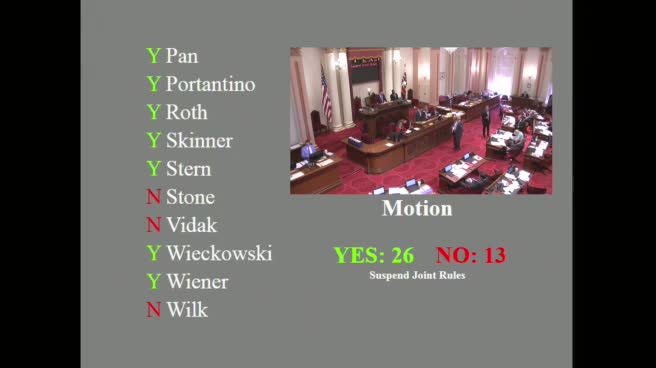 4MIN
Senate Floor
 1H
Senate Standing Committee on Appropriations
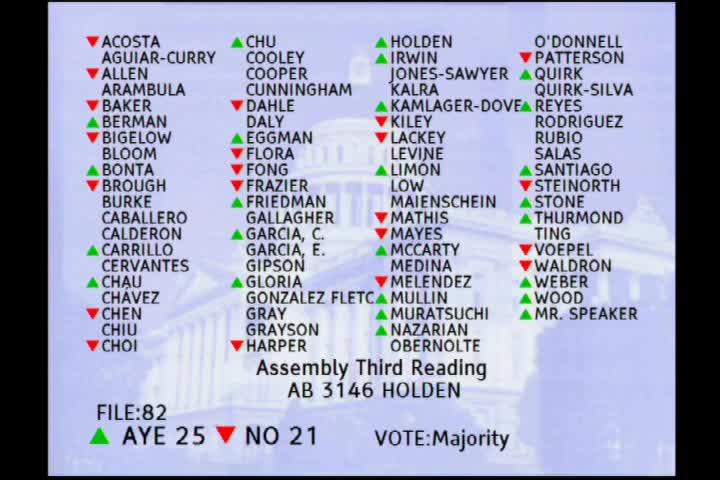 2MIN
Assembly Floor
 7MIN
Assembly Standing Committee on Transportation
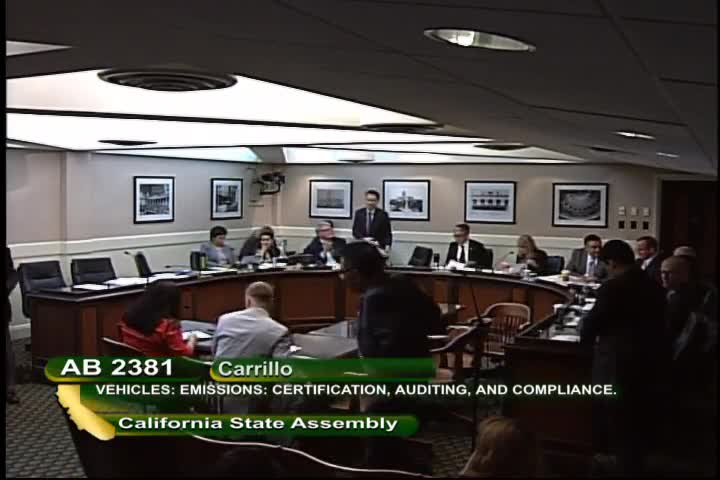 4MIN
Assembly Standing Committee on Natural Resources
Bill Author

Bill Co-Author(s):