AB 2395: California Life and Health Insurance Guarantee Association.
- Session Year: 2017-2018
- House: Assembly
- Latest Version Date: 2018-09-21
Existing law, the California Life and Health Insurance Guarantee Association Act, protects specified persons against failure in the performance of contractual obligations because of the impairment or insolvency of a member insurer that issued a life or health insurance policy or specified annuity contract. Existing law provides that the California Life and Health Insurance Guarantee Association may, in its discretion and subject to specified limitations, guarantee, assume, or reinsure the policies of an impaired insurer, as defined. Existing law authorizes the associations board of directors to request that the Insurance Commissioner order an examination of a member insurer that may be impaired or insolvent, and requires the commissioner to begin the examination within 30 days of a request.
This bill would authorize the association to file for an actuarially justified rate or premium increase for a policy or contract for which the association provides coverage pursuant to the act, if specified requirements are met. The bill would require an insurer with long-term care insurance contracts covering more than 10,000 lives to file annual disclosure reports with the Insurance Commissioner and the Department of Insurances office of principle-based reserving, as specified.
Existing law requires the board of directors of the association to assess the member insurers for the purpose of providing funds necessary to carry out the powers and duties of the association.
This bill would require the association to annually provide a financial report to the commissioner and the chairs of the Senate Insurance Committee and the Assembly Insurance Committee that includes the maximum amount of coverage that the association may provide based on the assessments.
Existing law, the California Life and Health Insurance Guarantee Association Act, protects specified persons against failure in the performance of contractual obligations because of the impairment or insolvency of a member insurer that issued a life or health insurance policy or specified annuity contract. Existing law provides that the California Life and Health Insurance Guarantee Association may, in its discretion and subject to specified limitations, guarantee, assume, or reinsure the policies of an impaired insurer, as defined. Existing law authorizes the associations board of directors to request that the Insurance Commissioner order an examination of a member insurer that may be impaired or insolvent, and requires the commissioner to begin the examination within 30 days of a request.
This bill would authorize the association to file for an actuarially justified rate or premium increase for a policy or contract for which the association provides coverage pursuant to the act, if specified requirements are met. The bill would require an insurer with long-term care insurance contracts covering more than 10,000 lives to file annual disclosure reports with the Insurance Commissioner and the Department of Insurances office of principle-based reserving, as specified.
Existing law requires the board of directors of the association to assess the member insurers for the purpose of providing funds necessary to carry out the powers and duties of the association.
This bill would require the association to annually provide a financial report to the commissioner and the chairs of the Senate Insurance Committee and the Assembly Insurance Committee that includes the maximum amount of coverage that the association may provide based on the assessments.
Existing law, the California Life and Health Insurance Guarantee Association Act, protects specified persons against failure in the performance of contractual obligations because of the impairment or insolvency of a member insurer that issued a life or health insurance policy or specified annuity contract. Existing law provides that the California Life and Health Insurance Guarantee Association may, in its discretion and subject to specified limitations, guarantee, assume, or reinsure the policies of an impaired insurer, as defined. Existing law also permits the association, among other things, to enter into contracts or borrow money to effect the purposes of the act. Existing law authorizes the associations board of directors to request that the Insurance Commissioner order an examination of a member insurer that may be impaired or insolvent, and requires the commissioner to begin the examination within 30 days of a request.
This bill would authorize the association to file for an actuarially justified rate or premium increase for a policy or contract for which the association provides coverage pursuant to the act, if specified requirements are met. The bill would require an insurer with long-term care insurance contracts covering more than 10,000 lives to file annual disclosure reports with the Insurance Commissioner and the Department of Insurances office of principle-based reserving, as specified. The
Existing law requires the board of directors of the association to assess the member insurers for the purpose of providing funds necessary to carry out the powers and duties of the association.
This bill would require the association to annually provide a financial report, as specified, report to the commissioner and the chairs of the Senate Insurance Committee and the Assembly Insurance Committee, which would include, among other things, a list of insurers writing long-term care insurance that the association has identified to be operating in a hazardous manner that may result in a future insolvency. The bill would also make technical, nonsubstantive changes. Committee that includes the maximum amount of coverage that the association may provide based on the assessments.
Existing law, the California Life and Health Insurance Guarantee Association Act, protects specified persons against failure in the performance of contractual obligations because of the impairment or insolvency of a member insurer that issued a life or health insurance policy or specified annuity contract. Existing law provides that the California Life and Health Insurance Guarantee Association may, in its discretion and subject to specified limitations, guarantee, assume, or reinsure the policies of an impaired insurer, as defined. Existing law also permits the association, among other things, to enter into contracts or borrow money to effect the purposes of the act. Existing law authorizes the associations board of directors to request that the Insurance Commissioner order an examination of a member insurer that may be impaired or insolvent, and requires the commissioner to begin the examination within 30 days of a request.
This bill would authorize the association to file for an actuarially justified rate or premium increase for a policy or contract for which the association provides coverage pursuant to the act, if specified requirements are met. The bill would require an insurer with long-term care insurance contracts covering more than 10,000 lives to file annual reports with the Department of Insurances office of principle-based reserving, as specified. The bill would require the association to annually provide a financial report, as specified, to the Senate Insurance Committee and the Assembly Insurance Committee, which would include, among other things, a list of insurers writing long-term care insurance that the association has identified to be operating in a hazardous manner that may result in a future insolvency. The bill would also make technical, nonsubstantive changes.
Existing law, the California Life and Health Insurance Guarantee Association Act, protects specified persons against failure in the performance of contractual obligations because of the impairment or insolvency of a member insurer that issued a life or health insurance policy or specified annuity contract. Existing law provides that the California Life and Health Insurance Guarantee Association may, in its discretion and subject to specified limitations, guarantee, assume, or reinsure the policies of an impaired insurer, as defined. Existing law also permits the association, among other things, to enter into contracts or borrow money to effect the purposes of the act.
This bill would authorize the association to file for an actuarially justified rate or premium increase for a policy or contract for which the association provides coverage pursuant to the act, if specified requirements are met. The bill would also make technical, nonsubstantive changes.
(a)If a member insurer is an impaired insurer, the association may, in its discretion, and subject to the conditions imposed by the association that do not impair the contractual obligations of the impaired insurer and that are approved by the commissioner, do any of the following:
(1)Guarantee, assume, or reinsure, or cause to be guaranteed, assumed, or reinsured, any or all of the policies or contracts of the impaired insurer.
(2)Provide moneys, pledges, loans, notes, guarantees, or other means to effectuate paragraph (1) and assure payment of the contractual obligations of the impaired insurer pending action under paragraph (1).
(b)If a member insurer is an insolvent insurer, the association shall, in its discretion, either do those things described in paragraph (1) or in paragraph (2):
(1)(A)Guarantee, assume, or reinsure, or cause to be guaranteed, assumed, or reinsured, the policies or contracts of the insolvent insurer; or
(B)Assure payment of the contractual obligations of the insolvent insurer; and
(C)Provide moneys, pledges, loans, notes, guarantees, or other means reasonably necessary to discharge the associations duties.
(2)Provide benefits and coverages in accordance with the following provisions:
(A)With respect to life and health insurance policies and annuities, assure payment of benefits for premiums identical to the premiums and benefits, except for terms of conversion and renewability, that would have been payable under the policies or contracts of the insolvent insurer, for claims incurred:
(i)With respect to group policies and contracts, not later than the earlier of the next renewal date under those policies or contracts or 45 days, but in no event less than 30 days, after the date on which the association becomes obligated with respect to the policies and contracts.
(ii)With respect to nongroup policies, contracts, and annuities, not later than the earlier of the next renewal date, if any, under the policies or contracts or one year, but in no event less than 30 days, from the date on which the association becomes obligated with respect to the policies or contracts.
(B)Make diligent efforts to provide all known insureds or annuitants, for nongroup policies and contracts, or group policy owners with respect to group policies and contracts, 30 days notice of the termination, pursuant to subparagraph (A), of the benefits provided.
(C)With respect to nongroup life and health insurance policies and annuities covered by the association, make available to each known insured or annuitant, or owner if other than the insured or annuitant, and with respect to an individual formerly insured or formerly an annuitant under a group policy who is not eligible for replacement group coverage, make available substitute coverage on an individual basis in accordance with subparagraph (D), if the insureds or annuitants had a right under law or the terminated policy or annuity to convert coverage to individual coverage or to continue an individual policy or annuity in force until a specified age or for a specified time, during which the insurer had no right unilaterally to make changes in a provision of the policy or annuity or had a right only to make changes in premium by class.
(D)(i)In providing the substitute coverage required under subparagraph (C), the association may offer either to reissue the terminated coverage or to issue an alternative policy and shall consider obtaining coverage for a medically uninsurable person.
(ii)Alternative or reissued policies shall be offered without requiring evidence of insurability, and shall not provide for a waiting period or exclusion that would not have applied under the terminated policy.
(iii)The association may reinsure an alternative or reissued policy.
(E)(i)Alternative policies adopted by the association shall be subject to the approval of the commissioner. The association may adopt alternative policies of various types for future issuance without regard to any particular impairment or insolvency.
(ii)Alternative policies shall contain at least the minimum statutory provisions required in this state and provide benefits that shall not be unreasonable in relation to the premium charged. The association shall set the premium in accordance with a table of rates that it shall adopt. The premium shall reflect the amount of insurance to be provided and the age and class of risk of each insured, but shall not reflect the changes in the health of the insured after the original policy was last underwritten.
(iii)An alternative policy issued by the association shall provide coverage of a type similar to that of the policy issued by the impaired or insolvent insurer, as determined by the association.
(F)If the association elects to reissue terminated coverage at a premium rate different from that charged under the terminated policy, the premium shall be set by the association in accordance with the amount of insurance provided and the age and class of risk, subject to approval of the commissioner or by a court of competent jurisdiction.
(G)The associations obligations with respect to coverage under a policy of the impaired or insolvent insurer or under a reissued or alternative policy shall cease on the date the coverage or policy is replaced by another similar policy by the policy owner, the insured, or the association.
(H)When proceeding under this paragraph with respect to a policy or contract carrying guaranteed minimum interest rates, the association shall assure the payment or crediting of a rate of interest consistent with subparagraph (C) of paragraph (2) of subdivision (b) of Section 1067.02.
(c)Nonpayment of premiums within 31 days after the date required under the terms of a guaranteed, assumed, alternative, or reissued policy or contract or substitute coverage shall terminate the associations obligations under the policy or coverage under this article with respect to that policy or coverage, except with respect to the claims incurred or a net cash surrender value that may be due in accordance with this article.
(d)Premiums due for coverage after entry of an order of liquidation of an insolvent insurer shall belong to and be payable at the direction of the association, and the association shall be liable for unearned premiums due to policy or contract owners arising after the entry of that order.
(e)The protection provided by this article shall not apply if a guarantee protection is provided to residents of this state by the laws of the domiciliary state or jurisdiction of the impaired or insolvent insurer other than this state.
(f)In carrying out its duties under subdivision (b), the association may, subject to approval by a court of competent jurisdiction, do either of the following:
(1)Impose permanent policy or contract liens in connection with a guarantee, assumption, or reinsurance agreement, if the association finds that the amounts that can be assessed under this article are less than the amounts needed to assure full and prompt performance of the associations duties under this article, or that the economic or financial conditions as they affect member insurers are sufficiently adverse to render the imposition of the permanent policy or contract liens, to be in the public interest.
(2)Impose temporary moratoriums or liens on payments of cash values and policy loans, or any other right to withdraw funds held in conjunction with policies or contracts, in addition to the contractual provisions for deferral of cash or policy loan value. In addition, in the event of a temporary moratorium or moratorium charge imposed by the receivership court on payment of cash values or policy loans, or on any other right to withdraw funds held in conjunction with policies or contracts, out of the assets of the impaired or insolvent insurer, the association may defer the payment of cash values, policy loans, or other rights by the association for the period of the moratorium or moratorium charge imposed by the receivership court, except for claims covered by the association to be paid in accordance with a hardship procedure established by the liquidator or rehabilitator and approved by the receivership court.
(g)A deposit in this state, held pursuant to law or required by the commissioner for the benefit of creditors, including policy owners, not turned over to the domiciliary liquidator upon the entry of a final order of liquidation or order approving a rehabilitation plan of an insurer domiciled in this state or in a reciprocal state shall be promptly paid to the association. The association shall be entitled to retain a portion of an amount so paid to it equal to the percentage determined by dividing the aggregate amount of policy owners claims related to that insolvency for which the association has provided statutory benefits by the aggregate amount of all policy owners claims in this state related to that insolvency and shall remit to the domiciliary receiver the amount so paid to the association less the amount retained pursuant to this subdivision. An amount so paid to the association and retained by it shall be treated as a distribution of estate assets pursuant to applicable state receivership law dealing with early access disbursements.
(h)If the association fails to act within a reasonable period of time with respect to an insolvent insurer, as provided in subdivision (b), the commissioner shall have the powers and duties of the association under this article with respect to the insolvent insurer.
(i)The association may render assistance and advice to the commissioner, upon his or her request, concerning rehabilitation, payment of claims, continuance of coverage, or the performance of other contractual obligations of an impaired or insolvent insurer.
(j)The association shall have standing to appear or intervene before a court or agency engaged in an adjudication in this state with jurisdiction over an impaired or insolvent insurer concerning which the association is or may become obligated under this article or with jurisdiction over a person or property against which the association may have rights through subrogation or otherwise. Standing shall extend to all matters germane to the powers and duties of the association, including, but not limited to, proposals for reinsuring, modifying, or guaranteeing the policies or contracts of the impaired or insolvent insurer and the determination of the policies or contracts and contractual obligations. The association shall also have the right to appear or intervene before a court or agency in another state with jurisdiction over an impaired or insolvent insurer for which the association is or may become obligated or with jurisdiction over a person or property against which the association may have rights through subrogation or otherwise.
(k)(1)A person receiving benefits under this article shall be deemed to have assigned the rights under, and causes of action against a person for losses arising under, resulting from, or otherwise relating to, the covered policy or contract to the association to the extent of the benefits received because of this article, whether the benefits are payments of or on account of contractual obligations, continuation of coverage, or provision of substitute or alternative coverages. The association may require an assignment to it of those rights and cause of action by a payee, policy or contract owner, beneficiary, insured, or annuitant as a condition precedent to the receipt of any right or benefits conferred by this article upon that person.
(2)The subrogation rights of the association under this subdivision shall have the same priority against the assets of the impaired or insolvent insurer as that possessed by the person entitled to receive benefits under this article.
(3)In addition to paragraphs (1) and (2), the association shall have all common law rights of subrogation and any other equitable or legal remedy that would have been available to the impaired or insolvent insurer or owner, beneficiary, or payee of a policy or contract with respect to the policy or contracts, including, without limitation, in the case of a structured settlement annuity, the rights of the owner, beneficiary, or payee of the annuity, to the extent of benefits received pursuant to this article, against a person originally or by succession responsible for the losses arising from the personal injury relating to the annuity or payment therefor, excepting a person responsible solely by reason of serving as an assignee in respect of a qualified assignment under Section 130 of the Internal Revenue Code.
(4)If the preceding provisions of this subdivision are invalid or ineffective with respect to a person or claim, the amount payable by the association with respect to the related covered obligations shall be reduced by the amount realized by any other person with respect to the person or claim that is attributable to the policies, or portion thereof, covered by the association.
(5)If the association has provided benefits with respect to a covered obligation and a person recovers amounts as to which the association has rights as described in the preceding paragraphs of this subdivision, the person shall pay to the association the portion of the recovery attributable to the policies, or portion thereof, covered by the association.
(l)In addition to the rights and powers elsewhere in this article, the association may do any of the following:
(1)Enter into contracts necessary or proper to carry out the provisions and purposes of this article.
(2)Sue or be sued, including taking the legal actions necessary or proper to recover unpaid assessments under Section 1067.08 and to settle claims or potential claims against it.
(3)Borrow money to effect the purposes of this article. Notes or other evidence of indebtedness of the association not in default shall be legal investments for domestic insurers and may be carried as admitted assets.
(4)Employ or retain an executive director and other persons to handle the financial transactions of the association, and to perform other functions necessary or proper under this article, provided that the executive director shall be subject to the approval of the commissioner.
(5)Take legal action necessary or appropriate to avoid or recover payment of improper claims.
(6)Exercise, for the purposes of this article and to the extent approved by the commissioner, the powers of a domestic life or health insurer, but in no case may the association issue insurance policies or annuity contracts other than those issued to perform its obligations under this article.
(7)Organize itself as a corporation or in another legal form permitted by the laws of the state.
(8)Request information from a person seeking coverage from the association in order to aid the association in determining its obligations under this article with respect to the person, and the person shall promptly comply with the request.
(9)File for an actuarially justified rate or premium increase for a policy or contract, in accordance with the terms and conditions of the policy or contract, for which the association provides coverage pursuant to this act, unless prohibited by law.
(10)Take other necessary or appropriate action to discharge its duties and obligations under this article or to exercise its powers under this article.
(m)The association may join an organization of one or more other state associations of similar purposes, to further the purposes and administer the powers and duties of the association.
(n)There shall be no liability on the part of and no cause of action shall arise against the association or against a transferee from the association in connection with the transfer by reinsurance or otherwise of all or any part of an impaired or insolvent insurers business by reason of an action taken or a failure to take an action by the impaired or insolvent insurer at any time.
(o)With respect to covered policies for which the association becomes obligated after an entry of an order or liquidation or rehabilitation, the association may elect to succeed to the rights of the insolvent insurer arising after the date of the order of liquidation or rehabilitation under a contract of reinsurance to which the insolvent insurer was a party, to the extent that the contract provides coverage for losses occurring after the date of the order of liquidation or rehabilitation. As a condition to making this election, the association must pay all unpaid premiums due under the contract for coverage relating to periods before and after the date of the order of liquidation or rehabilitation.
(p)The board of directors of the association shall have discretion and may exercise reasonable business judgment to determine the means by which the association is to provide the benefits of this article in an economical and efficient manner.
(q)If the association has arranged or offered to provide the benefits of this article to a covered person under a plan or arrangement that fulfills the associations obligations under this article, the person shall not be entitled to benefits from the association in addition to or other than those provided under the plan or arrangement.
(r)The association shall not be required to give an appeal bond in an appeal that relates to a cause of action arising under this article.
(s)In carrying out its duties in connection with guaranteeing, assuming, or reinsuring policies or contracts under subdivision (a) or (b), the association may, subject to approval of the receivership court, issue substitute coverage for a policy or contract that provides an interest rate, crediting rate, or similar factor determined by use of an index or other external reference stated in the policy or contract employed in calculating returns or changes in value by issuing an alternative policy or contract in accordance with all of the following provisions:
(1)In lieu of the index or other external reference provided for in the original policy or contract, the alternative policy or contract provides for a fixed interest rate, payment of dividends with minimum guarantees, or a different method for calculating interest or changes in value.
(2)There is no requirement for evidence of insurability, waiting period, or other exclusion that would not have applied under the replaced policy or contract.
(3)The alternative policy or contract is substantially similar to the replaced policy or contract in all other material terms.
SEC. 2.Section 1067.11 of the Insurance Code is amended to read:1067.11.To aid in the detection and prevention of insurer insolvencies or impairments:
(a)It shall be the duty of the commissioner to do the following:
(1)To notify the commissioners of all the other states, territories of the United States, and the District of Columbia when he or she takes any of the following actions against a member insurer:
(A)Revocation of license.
(B)Suspension of license.
(C)Makes a formal order that the company restrict its premium writing, obtain additional contributions to surplus, withdraw from the state, reinsure all or any part of its business, or increase capital, surplus, or any other account for the security of policy owners or creditors.
The notice shall be mailed to all commissioners within 30 days following the action taken or the date on which the action occurs.
(2)To report to the board of directors, the Legislature, and the Governor when he or she has taken any of the actions set forth in paragraph (1) or has received a report from any other commissioner indicating that any action has been taken in another state. The report to the board of directors, the Legislature, and the Governor shall contain all significant details of the action taken on the report received from another commissioner.
(3)To report to the board of directors when he or she has reasonable cause to believe from an examination, whether completed or in process, of a member company that the company may be an impaired or insolvent insurer.
(4)To furnish to the board of directors the NAIC Insurance Regulatory Information System (IRIS) ratios and listings of companies not included in the ratios developed by the National Association of Insurance Commissioners, and the board may use the information contained therein in carrying out its duties and responsibilities under this section. The report and the information contained therein shall be kept confidential by the board of directors until that time as it is made public by the commissioner or other lawful authority.
(b)The commissioner may seek the advice and recommendations of the board of directors concerning any matter affecting his or her duties and responsibilities regarding the financial condition of member insurers and companies seeking admission to transact insurance business in this state.
(c)The board of directors may, upon majority vote, make reports and recommendations to the commissioner upon any matter germane to the solvency, liquidation, rehabilitation, or conservation of a member insurer or germane to the solvency of any company seeking to do insurance business in this state. Those reports and recommendations shall not be considered public documents.
(d)The board of directors shall, upon majority vote, notify the commissioner of any information indicating a member insurer may be an impaired or insolvent insurer.
(e)The board of directors may, upon majority vote, request that the commissioner order an examination of a member insurer that the board in good faith believes may be an impaired or insolvent insurer. Within 30 days of the receipt of the request, the commissioner shall begin the examination. The examination may be conducted as a National Association of Insurance Commissioners examination or may be conducted by persons that the commissioner designates. The cost of the examination shall be paid by the association and the examination report shall be treated as are other examination reports. In no event shall the examination report be released to the board of directors prior to its release to the public, but this shall not preclude the commissioner from complying with subdivision (a).
The commissioner shall notify the board of directors when the examination is completed. The request for an examination shall be kept on file by the commissioner, but it shall not be open to public inspection prior to the release of the examination report to the public.
(f)The board of directors may, upon majority vote, make recommendations to the commissioner for the detection and prevention of insurer insolvencies.
(g)Reports, information, and recommendations from the board to the commissioner and from the commissioner to the board under this section shall be treated as confidential and shall not be considered public documents except as otherwise specifically provided in this section or by specific action of the board or commissioner.
(h)For valuation years ending in 2019 and later, an insurer with long-term care insurance contracts in force covering more than 10,000 lives as of the valuation date shall file disclosure reports with the commissioner and the departments office of principle-based reserving. The reports shall be in compliance with the long-term care insurance-specific requirements developed in Actuarial Guideline 51 to be incorporated in the National Association of Insurance Commissioners Valuation Manual. The reports shall be submitted no later than April 1 for the previous calendar year.
(i)On or before April 1, 2019, and on or before each April 1 thereafter, the association shall provide an annual financial report to the commissioner and the chairs of the Senate Insurance Committee and the Assembly Insurance Committee. The report shall include the maximum amount of coverage the association can provide pursuant to subparagraph (A) of paragraph (1) of subdivision (e) of Section 1067.08. The report shall cover the previous calendar year.
(a)If a member insurer is an impaired insurer, the association may, in its discretion, and subject to the conditions imposed by the association that do not impair the contractual obligations of the impaired insurer and that are approved by the commissioner, do any of the following:
(1)Guarantee, assume, or reinsure, or cause to be guaranteed, assumed, or reinsured, any or all of the policies or contracts of the impaired insurer.
(2)Provide moneys, pledges, loans, notes, guarantees, or other means to effectuate paragraph (1) and assure payment of the contractual obligations of the impaired insurer pending action under paragraph (1).
(b)If a member insurer is an insolvent insurer, the association shall, in its discretion, either do those things described in paragraph (1) or in paragraph (2):
(1)(A)Guarantee, assume, or reinsure, or cause to be guaranteed, assumed, or reinsured, the policies or contracts of the insolvent insurer; or
(B)Assure payment of the contractual obligations of the insolvent insurer; and
(C)Provide moneys, pledges, loans, notes, guarantees, or other means reasonably necessary to discharge the associations duties.
(2)Provide benefits and coverages in accordance with the following provisions:
(A)With respect to life and health insurance policies and annuities, assure payment of benefits for premiums identical to the premiums and benefits, except for terms of conversion and renewability, that would have been payable under the policies or contracts of the insolvent insurer, for claims incurred:
(i)With respect to group policies and contracts, not later than the earlier of the next renewal date under those policies or contracts or 45 days, but in no event less than 30 days, after the date on which the association becomes obligated with respect to the policies and contracts.
(ii)With respect to nongroup policies, contracts, and annuities, not later than the earlier of the next renewal date, if any, under the policies or contracts or one year, but in no event less than 30 days, from the date on which the association becomes obligated with respect to the policies or contracts.
(B)Make diligent efforts to provide all known insureds or annuitants, for nongroup policies and contracts, or group policy owners with respect to group policies and contracts, 30 days notice of the termination, pursuant to subparagraph (A), of the benefits provided.
(C)With respect to nongroup life and health insurance policies and annuities covered by the association, make available to each known insured or annuitant, or owner if other than the insured or annuitant, and with respect to an individual formerly insured or formerly an annuitant under a group policy who is not eligible for replacement group coverage, make available substitute coverage on an individual basis in accordance with subparagraph (D), if the insureds or annuitants had a right under law or the terminated policy or annuity to convert coverage to individual coverage or to continue an individual policy or annuity in force until a specified age or for a specified time, during which the insurer had no right unilaterally to make changes in a provision of the policy or annuity or had a right only to make changes in premium by class.
(D)(i)In providing the substitute coverage required under subparagraph (C), the association may offer either to reissue the terminated coverage or to issue an alternative policy and shall consider obtaining coverage for a medically uninsurable person.
(ii)Alternative or reissued policies shall be offered without requiring evidence of insurability, and shall not provide for a waiting period or exclusion that would not have applied under the terminated policy.
(iii)The association may reinsure an alternative or reissued policy.
(E)(i)Alternative policies adopted by the association shall be subject to the approval of the commissioner. The association may adopt alternative policies of various types for future issuance without regard to any particular impairment or insolvency.
(ii)Alternative policies shall contain at least the minimum statutory provisions required in this state and provide benefits that shall not be unreasonable in relation to the premium charged. The association shall set the premium in accordance with a table of rates that it shall adopt. The premium shall reflect the amount of insurance to be provided and the age and class of risk of each insured, but shall not reflect the changes in the health of the insured after the original policy was last underwritten.
(iii)An alternative policy issued by the association shall provide coverage of a type similar to that of the policy issued by the impaired or insolvent insurer, as determined by the association.
(F)If the association elects to reissue terminated coverage at a premium rate different from that charged under the terminated policy, the premium shall be set by the association in accordance with the amount of insurance provided and the age and class of risk, subject to approval of the commissioner or by a court of competent jurisdiction.
(G)The associations obligations with respect to coverage under a policy of the impaired or insolvent insurer or under a reissued or alternative policy shall cease on the date the coverage or policy is replaced by another similar policy by the policy owner, the insured, or the association.
(H)When proceeding under this paragraph with respect to a policy or contract carrying guaranteed minimum interest rates, the association shall assure the payment or crediting of a rate of interest consistent with subparagraph (C) of paragraph (2) of subdivision (b) of Section 1067.02.
(c)Nonpayment of premiums within 31 days after the date required under the terms of a guaranteed, assumed, alternative, or reissued policy or contract or substitute coverage shall terminate the associations obligations under the policy or coverage under this article with respect to that policy or coverage, except with respect to the claims incurred or a net cash surrender value that may be due in accordance with this article.
(d)Premiums due for coverage after entry of an order of liquidation of an insolvent insurer shall belong to and be payable at the direction of the association, and the association shall be liable for unearned premiums due to policy or contract owners arising after the entry of that order.
(e)The protection provided by this article shall not apply if a guarantee protection is provided to residents of this state by the laws of the domiciliary state or jurisdiction of the impaired or insolvent insurer other than this state.
(f)In carrying out its duties under subdivision (b), the association may, subject to approval by a court of competent jurisdiction, do either of the following:
(1)Impose permanent policy or contract liens in connection with a guarantee, assumption, or reinsurance agreement, if the association finds that the amounts that can be assessed under this article are less than the amounts needed to assure full and prompt performance of the associations duties under this article, or that the economic or financial conditions as they affect member insurers are sufficiently adverse to render the imposition of the permanent policy or contract liens, to be in the public interest.
(2)Impose temporary moratoriums or liens on payments of cash values and policy loans, or any other right to withdraw funds held in conjunction with policies or contracts, in addition to the contractual provisions for deferral of cash or policy loan value. In addition, in the event of a temporary moratorium or moratorium charge imposed by the receivership court on payment of cash values or policy loans, or on any other right to withdraw funds held in conjunction with policies or contracts, out of the assets of the impaired or insolvent insurer, the association may defer the payment of cash values, policy loans, or other rights by the association for the period of the moratorium or moratorium charge imposed by the receivership court, except for claims covered by the association to be paid in accordance with a hardship procedure established by the liquidator or rehabilitator and approved by the receivership court.
(g)A deposit in this state, held pursuant to law or required by the commissioner for the benefit of creditors, including policy owners, not turned over to the domiciliary liquidator upon the entry of a final order of liquidation or order approving a rehabilitation plan of an insurer domiciled in this state or in a reciprocal state shall be promptly paid to the association. The association shall be entitled to retain a portion of an amount so paid to it equal to the percentage determined by dividing the aggregate amount of policy owners claims related to that insolvency for which the association has provided statutory benefits by the aggregate amount of all policy owners claims in this state related to that insolvency and shall remit to the domiciliary receiver the amount so paid to the association less the amount retained pursuant to this subdivision. An amount so paid to the association and retained by it shall be treated as a distribution of estate assets pursuant to applicable state receivership law dealing with early access disbursements.
(h)If the association fails to act within a reasonable period of time with respect to an insolvent insurer, as provided in subdivision (b), the commissioner shall have the powers and duties of the association under this article with respect to the insolvent insurer.
(i)The association may render assistance and advice to the commissioner, upon his or her request, concerning rehabilitation, payment of claims, continuance of coverage, or the performance of other contractual obligations of an impaired or insolvent insurer.
(j)The association shall have standing to appear or intervene before a court or agency engaged in an adjudication in this state with jurisdiction over an impaired or insolvent insurer concerning which the association is or may become obligated under this article or with jurisdiction over a person or property against which the association may have rights through subrogation or otherwise. Standing shall extend to all matters germane to the powers and duties of the association, including, but not limited to, proposals for reinsuring, modifying, or guaranteeing the policies or contracts of the impaired or insolvent insurer and the determination of the policies or contracts and contractual obligations. The association shall also have the right to appear or intervene before a court or agency in another state with jurisdiction over an impaired or insolvent insurer for which the association is or may become obligated or with jurisdiction over a person or property against which the association may have rights through subrogation or otherwise.
(k)(1)A person receiving benefits under this article shall be deemed to have assigned the rights under, and causes of action against a person for losses arising under, resulting from, or otherwise relating to, the covered policy or contract to the association to the extent of the benefits received because of this article, whether the benefits are payments of or on account of contractual obligations, continuation of coverage, or provision of substitute or alternative coverages. The association may require an assignment to it of those rights and cause of action by a payee, policy or contract owner, beneficiary, insured, or annuitant as a condition precedent to the receipt of any right or benefits conferred by this article upon that person.
(2)The subrogation rights of the association under this subdivision shall have the same priority against the assets of the impaired or insolvent insurer as that possessed by the person entitled to receive benefits under this article.
(3)In addition to paragraphs (1) and (2), the association shall have all common law rights of subrogation and any other equitable or legal remedy that would have been available to the impaired or insolvent insurer or owner, beneficiary, or payee of a policy or contract with respect to the policy or contracts, including, without limitation, in the case of a structured settlement annuity, the rights of the owner, beneficiary, or payee of the annuity, to the extent of benefits received pursuant to this article, against a person originally or by succession responsible for the losses arising from the personal injury relating to the annuity or payment therefor, excepting a person responsible solely by reason of serving as an assignee in respect of a qualified assignment under Section 130 of the Internal Revenue Code.
(4)If the preceding provisions of this subdivision are invalid or ineffective with respect to a person or claim, the amount payable by the association with respect to the related covered obligations shall be reduced by the amount realized by any other person with respect to the person or claim that is attributable to the policies, or portion thereof, covered by the association.
(5)If the association has provided benefits with respect to a covered obligation and a person recovers amounts as to which the association has rights as described in the preceding paragraphs of this subdivision, the person shall pay to the association the portion of the recovery attributable to the policies, or portion thereof, covered by the association.
(l)In addition to the rights and powers elsewhere in this article, the association may do any of the following:
(1)Enter into contracts necessary or proper to carry out the provisions and purposes of this article.
(2)Sue or be sued, including taking the legal actions necessary or proper to recover unpaid assessments under Section 1067.08 and to settle claims or potential claims against it.
(3)Borrow money to effect the purposes of this article. Notes or other evidence of indebtedness of the association not in default shall be legal investments for domestic insurers and may be carried as admitted assets.
(4)Employ or retain an executive director and other persons to handle the financial transactions of the association, and to perform other functions necessary or proper under this article, provided that the executive director shall be subject to the approval of the commissioner.
(5)Take legal action necessary or appropriate to avoid or recover payment of improper claims.
(6)Exercise, for the purposes of this article and to the extent approved by the commissioner, the powers of a domestic life or health insurer, but in no case may the association issue insurance policies or annuity contracts other than those issued to perform its obligations under this article.
(7)Organize itself as a corporation or in another legal form permitted by the laws of the state.
(8)Request information from a person seeking coverage from the association in order to aid the association in determining its obligations under this article with respect to the person, and the person shall promptly comply with the request.
(9)File for an actuarially justified rate or premium increase for a policy or contract, in accordance with the terms and conditions of the policy or contract, for which the association provides coverage pursuant to this act, unless prohibited by law.
(10)Take other necessary or appropriate action to discharge its duties and obligations under this article or to exercise its powers under this article.
(m)The association may join an organization of one or more other state associations of similar purposes, to further the purposes and administer the powers and duties of the association.
(n)There shall be no liability on the part of and no cause of action shall arise against the association or against a transferee from the association in connection with the transfer by reinsurance or otherwise of all or any part of an impaired or insolvent insurers business by reason of an action taken or a failure to take an action by the impaired or insolvent insurer at any time.
(o)With respect to covered policies for which the association becomes obligated after an entry of an order or liquidation or rehabilitation, the association may elect to succeed to the rights of the insolvent insurer arising after the date of the order of liquidation or rehabilitation under a contract of reinsurance to which the insolvent insurer was a party, to the extent that the contract provides coverage for losses occurring after the date of the order of liquidation or rehabilitation. As a condition to making this election, the association must pay all unpaid premiums due under the contract for coverage relating to periods before and after the date of the order of liquidation or rehabilitation.
(p)The board of directors of the association shall have discretion and may exercise reasonable business judgment to determine the means by which the association is to provide the benefits of this article in an economical and efficient manner.
(q)If the association has arranged or offered to provide the benefits of this article to a covered person under a plan or arrangement that fulfills the associations obligations under this article, the person shall not be entitled to benefits from the association in addition to or other than those provided under the plan or arrangement.
(r)The association shall not be required to give an appeal bond in an appeal that relates to a cause of action arising under this article.
(s)In carrying out its duties in connection with guaranteeing, assuming, or reinsuring policies or contracts under subdivision (a) or (b), the association may, subject to approval of the receivership court, issue substitute coverage for a policy or contract that provides an interest rate, crediting rate, or similar factor determined by use of an index or other external reference stated in the policy or contract employed in calculating returns or changes in value by issuing an alternative policy or contract in accordance with all of the following provisions:
(1)In lieu of the index or other external reference provided for in the original policy or contract, the alternative policy or contract provides for a fixed interest rate, payment of dividends with minimum guarantees, or a different method for calculating interest or changes in value.
(2)There is no requirement for evidence of insurability, waiting period, or other exclusion that would not have applied under the replaced policy or contract.
(3)The alternative policy or contract is substantially similar to the replaced policy or contract in all other material terms.
SEC. 2.Section 1067.11 of the Insurance Code is amended to read:1067.11.To aid in the detection and prevention of insurer insolvencies or impairments:
(a)It shall be the duty of the commissioner to do the following:
(1)To notify the commissioners of all the other states, territories of the United States, and the District of Columbia when he or she takes any of the following actions against a member insurer:
(A)Revocation of license.
(B)Suspension of license.
(C)Makes a formal order that the company restrict its premium writing, obtain additional contributions to surplus, withdraw from the state, reinsure all or any part of its business, or increase capital, surplus, or any other account for the security of policy owners or creditors.
The notice shall be mailed to all commissioners within 30 days following the action taken or the date on which the action occurs.
(2)To report to the board of directors, the Legislature, and the Governor when he or she has taken any of the actions set forth in paragraph (1) or has received a report from any other commissioner indicating that any action has been taken in another state. The report to the board of directors, the Legislature, and the Governor shall contain all significant details of the action taken on the report received from another commissioner.
(3)To report to the board of directors when he or she has reasonable cause to believe from an examination, whether completed or in process, of a member company that the company may be an impaired or insolvent insurer.
(4)To furnish to the board of directors the NAIC Insurance Regulatory Information System (IRIS) ratios and listings of companies not included in the ratios developed by the National Association of Insurance Commissioners, and the board may use the information contained therein in carrying out its duties and responsibilities under this section. The report and the information contained therein shall be kept confidential by the board of directors until that time as it is made public by the commissioner or other lawful authority.
(b)The commissioner may seek the advice and recommendations of the board of directors concerning any matter affecting his or her duties and responsibilities regarding the financial condition of member insurers and companies seeking admission to transact insurance business in this state.
(c)The board of directors may, upon majority vote, make reports and recommendations to the commissioner upon any matter germane to the solvency, liquidation, rehabilitation, or conservation of a member insurer or germane to the solvency of any company seeking to do insurance business in this state. Those reports and recommendations shall not be considered public documents.
(d)The board of directors shall, upon majority vote, notify the commissioner of any information indicating a member insurer may be an impaired or insolvent insurer.
(e)The board of directors may, upon majority vote, request that the commissioner order an examination of a member insurer that the board in good faith believes may be an impaired or insolvent insurer. Within 30 days of the receipt of the request, the commissioner shall begin the examination. The examination may be conducted as a National Association of Insurance Commissioners examination or may be conducted by persons that the commissioner designates. The cost of the examination shall be paid by the association and the examination report shall be treated as are other examination reports. In no event shall the examination report be released to the board of directors prior to its release to the public, but this shall not preclude the commissioner from complying with subdivision (a).
The commissioner shall notify the board of directors when the examination is completed. The request for an examination shall be kept on file by the commissioner, but it shall not be open to public inspection prior to the release of the examination report to the public.
(f)The board of directors may, upon majority vote, make recommendations to the commissioner for the detection and prevention of insurer insolvencies.
(g)Reports, information, and recommendations from the board to the commissioner and from the commissioner to the board under this section shall be treated as confidential and shall not be considered public documents except as otherwise specifically provided in this section or by specific action of the board or commissioner.
(h)For valuation years ending in 2019 and later, an insurer with long-term care insurance contracts in force covering more than 10,000 lives as of the valuation date shall file disclosure reports with the commissioner and the departments office of principle-based reserving. The reports shall be in compliance with the long-term care insurance-specific requirements developed in Actuarial Guideline 51 to be incorporated in the National Association of Insurance Commissioners Valuation Manual. The reports shall be submitted no later than April 1 for the previous calendar year.
(i)On or before April 1, 2019, and on or before each April 1 thereafter, the association shall provide an annual financial report to the commissioner and the chairs of the Senate Insurance Committee and the Assembly Insurance Committee. The report shall include the maximum amount of coverage the association can provide pursuant to subparagraph (A) of paragraph (1) of subdivision (e) of Section 1067.08. The report shall cover the previous calendar year.
(a)If a member insurer is an impaired insurer, the association may, in its discretion, and subject to the conditions imposed by the association that do not impair the contractual obligations of the impaired insurer and that are approved by the commissioner, do any of the following:
(1)Guarantee, assume, or reinsure, or cause to be guaranteed, assumed, or reinsured, any or all of the policies or contracts of the impaired insurer.
(2)Provide moneys, pledges, loans, notes, guarantees, or other means to effectuate paragraph (1) and assure payment of the contractual obligations of the impaired insurer pending action under paragraph (1).
(b)If a member insurer is an insolvent insurer, the association shall, in its discretion, either do those things described in paragraph (1) or in paragraph (2):
(1)(A)Guarantee, assume, or reinsure, or cause to be guaranteed, assumed, or reinsured, the policies or contracts of the insolvent insurer; or
(B)Assure payment of the contractual obligations of the insolvent insurer; and
(C)Provide moneys, pledges, loans, notes, guarantees, or other means reasonably necessary to discharge the associations duties.
(2)Provide benefits and coverages in accordance with the following provisions:
(A)With respect to life and health insurance policies and annuities, assure payment of benefits for premiums identical to the premiums and benefits, except for terms of conversion and renewability, that would have been payable under the policies or contracts of the insolvent insurer, for claims incurred:
(i)With respect to group policies and contracts, not later than the earlier of the next renewal date under those policies or contracts or 45 days, but in no event less than 30 days, after the date on which the association becomes obligated with respect to the policies and contracts.
(ii)With respect to nongroup policies, contracts, and annuities, not later than the earlier of the next renewal date, if any, under the policies or contracts or one year, but in no event less than 30 days, from the date on which the association becomes obligated with respect to the policies or contracts.
(B)Make diligent efforts to provide all known insureds or annuitants, for nongroup policies and contracts, or group policy owners with respect to group policies and contracts, 30 days notice of the termination, pursuant to subparagraph (A), of the benefits provided.
(C)With respect to nongroup life and health insurance policies and annuities covered by the association, make available to each known insured or annuitant, or owner if other than the insured or annuitant, and with respect to an individual formerly insured or formerly an annuitant under a group policy who is not eligible for replacement group coverage, make available substitute coverage on an individual basis in accordance with subparagraph (D), if the insureds or annuitants had a right under law or the terminated policy or annuity to convert coverage to individual coverage or to continue an individual policy or annuity in force until a specified age or for a specified time, during which the insurer had no right unilaterally to make changes in a provision of the policy or annuity or had a right only to make changes in premium by class.
(D)(i)In providing the substitute coverage required under subparagraph (C), the association may offer either to reissue the terminated coverage or to issue an alternative policy and shall consider obtaining coverage for a medically uninsurable person.
(ii)Alternative or reissued policies shall be offered without requiring evidence of insurability, and shall not provide for a waiting period or exclusion that would not have applied under the terminated policy.
(iii)The association may reinsure an alternative or reissued policy.
(E)(i)Alternative policies adopted by the association shall be subject to the approval of the commissioner. The association may adopt alternative policies of various types for future issuance without regard to any particular impairment or insolvency.
(ii)Alternative policies shall contain at least the minimum statutory provisions required in this state and provide benefits that shall not be unreasonable in relation to the premium charged. The association shall set the premium in accordance with a table of rates that it shall adopt. The premium shall reflect the amount of insurance to be provided and the age and class of risk of each insured, but shall not reflect the changes in the health of the insured after the original policy was last underwritten.
(iii)An alternative policy issued by the association shall provide coverage of a type similar to that of the policy issued by the impaired or insolvent insurer, as determined by the association.
(F)If the association elects to reissue terminated coverage at a premium rate different from that charged under the terminated policy, the premium shall be set by the association in accordance with the amount of insurance provided and the age and class of risk, subject to approval of the commissioner or by a court of competent jurisdiction.
(G)The associations obligations with respect to coverage under a policy of the impaired or insolvent insurer or under a reissued or alternative policy shall cease on the date the coverage or policy is replaced by another similar policy by the policy owner, the insured, or the association.
(H)When proceeding under this paragraph with respect to a policy or contract carrying guaranteed minimum interest rates, the association shall assure the payment or crediting of a rate of interest consistent with subparagraph (C) of paragraph (2) of subdivision (b) of Section 1067.02.
(c)Nonpayment of premiums within 31 days after the date required under the terms of a guaranteed, assumed, alternative, or reissued policy or contract or substitute coverage shall terminate the associations obligations under the policy or coverage under this article with respect to that policy or coverage, except with respect to the claims incurred or a net cash surrender value that may be due in accordance with this article.
(d)Premiums due for coverage after entry of an order of liquidation of an insolvent insurer shall belong to and be payable at the direction of the association, and the association shall be liable for unearned premiums due to policy or contract owners arising after the entry of that order.
(e)The protection provided by this article shall not apply if a guarantee protection is provided to residents of this state by the laws of the domiciliary state or jurisdiction of the impaired or insolvent insurer other than this state.
(f)In carrying out its duties under subdivision (b), the association may, subject to approval by a court of competent jurisdiction, do either of the following:
(1)Impose permanent policy or contract liens in connection with a guarantee, assumption, or reinsurance agreement, if the association finds that the amounts that can be assessed under this article are less than the amounts needed to assure full and prompt performance of the associations duties under this article, or that the economic or financial conditions as they affect member insurers are sufficiently adverse to render the imposition of the permanent policy or contract liens, to be in the public interest.
(2)Impose temporary moratoriums or liens on payments of cash values and policy loans, or any other right to withdraw funds held in conjunction with policies or contracts, in addition to the contractual provisions for deferral of cash or policy loan value. In addition, in the event of a temporary moratorium or moratorium charge imposed by the receivership court on payment of cash values or policy loans, or on any other right to withdraw funds held in conjunction with policies or contracts, out of the assets of the impaired or insolvent insurer, the association may defer the payment of cash values, policy loans, or other rights by the association for the period of the moratorium or moratorium charge imposed by the receivership court, except for claims covered by the association to be paid in accordance with a hardship procedure established by the liquidator or rehabilitator and approved by the receivership court.
(g)A deposit in this state, held pursuant to law or required by the commissioner for the benefit of creditors, including policy owners, not turned over to the domiciliary liquidator upon the entry of a final order of liquidation or order approving a rehabilitation plan of an insurer domiciled in this state or in a reciprocal state shall be promptly paid to the association. The association shall be entitled to retain a portion of an amount so paid to it equal to the percentage determined by dividing the aggregate amount of policy owners claims related to that insolvency for which the association has provided statutory benefits by the aggregate amount of all policy owners claims in this state related to that insolvency and shall remit to the domiciliary receiver the amount so paid to the association less the amount retained pursuant to this subdivision. An amount so paid to the association and retained by it shall be treated as a distribution of estate assets pursuant to applicable state receivership law dealing with early access disbursements.
(h)If the association fails to act within a reasonable period of time with respect to an insolvent insurer, as provided in subdivision (b), the commissioner shall have the powers and duties of the association under this article with respect to the insolvent insurer.
(i)The association may render assistance and advice to the commissioner, upon his or her request, concerning rehabilitation, payment of claims, continuance of coverage, or the performance of other contractual obligations of an impaired or insolvent insurer.
(j)The association shall have standing to appear or intervene before a court or agency engaged in an adjudication in this state with jurisdiction over an impaired or insolvent insurer concerning which the association is or may become obligated under this article or with jurisdiction over a person or property against which the association may have rights through subrogation or otherwise. Standing shall extend to all matters germane to the powers and duties of the association, including, but not limited to, proposals for reinsuring, modifying, or guaranteeing the policies or contracts of the impaired or insolvent insurer and the determination of the policies or contracts and contractual obligations. The association shall also have the right to appear or intervene before a court or agency in another state with jurisdiction over an impaired or insolvent insurer for which the association is or may become obligated or with jurisdiction over a person or property against which the association may have rights through subrogation or otherwise.
(k)(1)A person receiving benefits under this article shall be deemed to have assigned the rights under, and causes of action against a person for losses arising under, resulting from, or otherwise relating to, the covered policy or contract to the association to the extent of the benefits received because of this article, whether the benefits are payments of or on account of contractual obligations, continuation of coverage, or provision of substitute or alternative coverages. The association may require an assignment to it of those rights and cause of action by a payee, policy or contract owner, beneficiary, insured, or annuitant as a condition precedent to the receipt of any right or benefits conferred by this article upon that person.
(2)The subrogation rights of the association under this subdivision shall have the same priority against the assets of the impaired or insolvent insurer as that possessed by the person entitled to receive benefits under this article.
(3)In addition to paragraphs (1) and (2), the association shall have all common law rights of subrogation and any other equitable or legal remedy that would have been available to the impaired or insolvent insurer or owner, beneficiary, or payee of a policy or contract with respect to the policy or contracts, including, without limitation, in the case of a structured settlement annuity, the rights of the owner, beneficiary, or payee of the annuity, to the extent of benefits received pursuant to this article, against a person originally or by succession responsible for the losses arising from the personal injury relating to the annuity or payment therefor, excepting a person responsible solely by reason of serving as an assignee in respect of a qualified assignment under Section 130 of the Internal Revenue Code.
(4)If the preceding provisions of this subdivision are invalid or ineffective with respect to a person or claim, the amount payable by the association with respect to the related covered obligations shall be reduced by the amount realized by any other person with respect to the person or claim that is attributable to the policies, or portion thereof, covered by the association.
(5)If the association has provided benefits with respect to a covered obligation and a person recovers amounts as to which the association has rights as described in the preceding paragraphs of this subdivision, the person shall pay to the association the portion of the recovery attributable to the policies, or portion thereof, covered by the association.
(l)In addition to the rights and powers elsewhere in this article, the association may do any of the following:
(1)Enter into contracts necessary or proper to carry out the provisions and purposes of this article.
(2)Sue or be sued, including taking the legal actions necessary or proper to recover unpaid assessments under Section 1067.08 and to settle claims or potential claims against it.
(3)Borrow money to effect the purposes of this article. Notes or other evidence of indebtedness of the association not in default shall be legal investments for domestic insurers and may be carried as admitted assets.
(4)Employ or retain an executive director and other persons to handle the financial transactions of the association, and to perform other functions necessary or proper under this article, provided that the executive director shall be subject to the approval of the commissioner.
(5)Take legal action necessary or appropriate to avoid or recover payment of improper claims.
(6)Exercise, for the purposes of this article and to the extent approved by the commissioner, the powers of a domestic life or health insurer, but in no case may the association issue insurance policies or annuity contracts other than those issued to perform its obligations under this article.
(7)Organize itself as a corporation or in another legal form permitted by the laws of the state.
(8)Request information from a person seeking coverage from the association in order to aid the association in determining its obligations under this article with respect to the person, and the person shall promptly comply with the request.
(9)File for an actuarially justified rate or premium increase for a policy or contract, in accordance with the terms and conditions of the policy or contract, for which the association provides coverage pursuant to this act, unless prohibited by law.
(10)Take other necessary or appropriate action to discharge its duties and obligations under this article or to exercise its powers under this article.
(m)The association may join an organization of one or more other state associations of similar purposes, to further the purposes and administer the powers and duties of the association.
(n)There shall be no liability on the part of and no cause of action shall arise against the association or against a transferee from the association in connection with the transfer by reinsurance or otherwise of all or any part of an impaired or insolvent insurers business by reason of an action taken or a failure to take an action by the impaired or insolvent insurer at any time.
(o)With respect to covered policies for which the association becomes obligated after an entry of an order or liquidation or rehabilitation, the association may elect to succeed to the rights of the insolvent insurer arising after the date of the order of liquidation or rehabilitation under a contract of reinsurance to which the insolvent insurer was a party, to the extent that the contract provides coverage for losses occurring after the date of the order of liquidation or rehabilitation. As a condition to making this election, the association must pay all unpaid premiums due under the contract for coverage relating to periods before and after the date of the order of liquidation or rehabilitation.
(p)The board of directors of the association shall have discretion and may exercise reasonable business judgment to determine the means by which the association is to provide the benefits of this article in an economical and efficient manner.
(q)If the association has arranged or offered to provide the benefits of this article to a covered person under a plan or arrangement that fulfills the associations obligations under this article, the person shall not be entitled to benefits from the association in addition to or other than those provided under the plan or arrangement.
(r)The association shall not be required to give an appeal bond in an appeal that relates to a cause of action arising under this article.
(s)In carrying out its duties in connection with guaranteeing, assuming, or reinsuring policies or contracts under subdivision (a) or (b), the association may, subject to approval of the receivership court, issue substitute coverage for a policy or contract that provides an interest rate, crediting rate, or similar factor determined by use of an index or other external reference stated in the policy or contract employed in calculating returns or changes in value by issuing an alternative policy or contract in accordance with all of the following provisions:
(1)In lieu of the index or other external reference provided for in the original policy or contract, the alternative policy or contract provides for a fixed interest rate, payment of dividends with minimum guarantees, or a different method for calculating interest or changes in value.
(2)There is no requirement for evidence of insurability, waiting period, or other exclusion that would not have applied under the replaced policy or contract.
(3)The alternative policy or contract is substantially similar to the replaced policy or contract in all other material terms.
SEC. 2.Section 1067.11 of the Insurance Code is amended to read:1067.11.To aid in the detection and prevention of insurer insolvencies or impairments:
(a)It shall be the duty of the commissioner to do the following:
(1)To notify the commissioners of all the other states, territories of the United States, and the District of Columbia when he or she takes any of the following actions against a member insurer:
(A)Revocation of license.
(B)Suspension of license.
(C)Makes a formal order that the company restrict its premium writing, obtain additional contributions to surplus, withdraw from the state, reinsure all or any part of its business, or increase capital, surplus, or any other account for the security of policy owners or creditors.
The notice shall be mailed to all commissioners within 30 days following the action taken or the date on which the action occurs.
(2)To report to the board of directors, the Legislature, and the Governor when he or she has taken any of the actions set forth in paragraph (1) or has received a report from any other commissioner indicating that any action has been taken in another state. The report to the board of directors, the Legislature, and the Governor shall contain all significant details of the action taken on the report received from another commissioner.
(3)To report to the board of directors when he or she has reasonable cause to believe from an examination, whether completed or in process, of a member company that the company may be an impaired or insolvent insurer.
(4)To furnish to the board of directors the NAIC Insurance Regulatory Information System (IRIS) ratios and listings of companies not included in the ratios developed by the National Association of Insurance Commissioners, and the board may use the information contained therein in carrying out its duties and responsibilities under this section. The report and the information contained therein shall be kept confidential by the board of directors until that time as it is made public by the commissioner or other lawful authority.
(b)The commissioner may seek the advice and recommendations of the board of directors concerning any matter affecting his or her duties and responsibilities regarding the financial condition of member insurers and companies seeking admission to transact insurance business in this state.
(c)The board of directors may, upon majority vote, make reports and recommendations to the commissioner upon any matter germane to the solvency, liquidation, rehabilitation, or conservation of a member insurer or germane to the solvency of any company seeking to do insurance business in this state. Those reports and recommendations shall not be considered public documents.
(d)The board of directors shall, upon majority vote, notify the commissioner of any information indicating a member insurer may be an impaired or insolvent insurer.
(e)The board of directors may, upon majority vote, request that the commissioner order an examination of a member insurer that the board in good faith believes may be an impaired or insolvent insurer. Within 30 days of the receipt of the request, the commissioner shall begin the examination. The examination may be conducted as a National Association of Insurance Commissioners examination or may be conducted by persons that the commissioner designates. The cost of the examination shall be paid by the association and the examination report shall be treated as are other examination reports. In no event shall the examination report be released to the board of directors prior to its release to the public, but this shall not preclude the commissioner from complying with subdivision (a).
The commissioner shall notify the board of directors when the examination is completed. The request for an examination shall be kept on file by the commissioner, but it shall not be open to public inspection prior to the release of the examination report to the public.
(f)The board of directors may, upon majority vote, make recommendations to the commissioner for the detection and prevention of insurer insolvencies.
(g)Reports, information, and recommendations from the board to the commissioner and from the commissioner to the board under this section shall be treated as confidential and shall not be considered public documents except as otherwise specifically provided in this section or by specific action of the board or commissioner.
(h)For valuation years ending in 2019 and later, an insurer with long-term care insurance contracts in force covering more than 10,000 lives as of the valuation date shall file disclosure reports with the commissioner and the departments office of principle-based reserving. The reports shall be in compliance with the long-term care insurance-specific requirements developed in Actuarial Guideline 51 to be incorporated in the National Association of Insurance Commissioners Valuation Manual under VM-30: Actuarial Opinion and Memorandum Requirements. Manual. The reports shall be due submitted no later than April 1 for the previous calendar year.
(i)On or before April 1, 2019, and on or before each April 1 thereafter, the association shall provide an annual financial report to the commissioner and the chairs of the Senate Insurance Committee and the Assembly Insurance Committee. The report shall include the maximum amount of coverage the association can provide pursuant to subparagraph (A) of paragraph (1) of subdivision (e) of Section 1067.08, and a list of insurers writing long-term care insurance in California that the association has identified to be operating in a hazardous manner that may result in a future insolvency. 1067.08. The report shall cover the previous calendar year.
(a)If a member insurer is an impaired insurer, the association may, in its discretion, and subject to the conditions imposed by the association that do not impair the contractual obligations of the impaired insurer and that are approved by the commissioner, do any of the following:
(1)Guarantee, assume, or reinsure, or cause to be guaranteed, assumed, or reinsured, any or all of the policies or contracts of the impaired insurer.
(2)Provide moneys, pledges, loans, notes, guarantees, or other means to effectuate paragraph (1) and assure payment of the contractual obligations of the impaired insurer pending action under paragraph (1).
(b)If a member insurer is an insolvent insurer, the association shall, in its discretion, either do those things described in paragraph (1) or in paragraph (2):
(1)(A)Guarantee, assume, or reinsure, or cause to be guaranteed, assumed, or reinsured, the policies or contracts of the insolvent insurer; or
(B)Assure payment of the contractual obligations of the insolvent insurer; and
(C)Provide moneys, pledges, loans, notes, guarantees, or other means reasonably necessary to discharge the associations duties.
(2)Provide benefits and coverages in accordance with the following provisions:
(A)With respect to life and health insurance policies and annuities, assure payment of benefits for premiums identical to the premiums and benefits, except for terms of conversion and renewability, that would have been payable under the policies or contracts of the insolvent insurer, for claims incurred:
(i)With respect to group policies and contracts, not later than the earlier of the next renewal date under those policies or contracts or 45 days, but in no event less than 30 days, after the date on which the association becomes obligated with respect to the policies and contracts.
(ii)With respect to nongroup policies, contracts, and annuities, not later than the earlier of the next renewal date, if any, under the policies or contracts or one year, but in no event less than 30 days, from the date on which the association becomes obligated with respect to the policies or contracts.
(B)Make diligent efforts to provide all known insureds or annuitants, for nongroup policies and contracts, or group policy owners with respect to group policies and contracts, 30 days notice of the termination, pursuant to subparagraph (A), of the benefits provided.
(C)With respect to nongroup life and health insurance policies and annuities covered by the association, make available to each known insured or annuitant, or owner if other than the insured or annuitant, and with respect to an individual formerly insured or formerly an annuitant under a group policy who is not eligible for replacement group coverage, make available substitute coverage on an individual basis in accordance with subparagraph (D), if the insureds or annuitants had a right under law or the terminated policy or annuity to convert coverage to individual coverage or to continue an individual policy or annuity in force until a specified age or for a specified time, during which the insurer had no right unilaterally to make changes in a provision of the policy or annuity or had a right only to make changes in premium by class.
(D)(i)In providing the substitute coverage required under subparagraph (C), the association may offer either to reissue the terminated coverage or to issue an alternative policy and shall consider obtaining coverage for a medically uninsurable person.
(ii)Alternative or reissued policies shall be offered without requiring evidence of insurability, and shall not provide for a waiting period or exclusion that would not have applied under the terminated policy.
(iii)The association may reinsure an alternative or reissued policy.
(E)(i)Alternative policies adopted by the association shall be subject to the approval of the commissioner. The association may adopt alternative policies of various types for future issuance without regard to any particular impairment or insolvency.
(ii)Alternative policies shall contain at least the minimum statutory provisions required in this state and provide benefits that shall not be unreasonable in relation to the premium charged. The association shall set the premium in accordance with a table of rates that it shall adopt. The premium shall reflect the amount of insurance to be provided and the age and class of risk of each insured, but shall not reflect the changes in the health of the insured after the original policy was last underwritten.
(iii)An alternative policy issued by the association shall provide coverage of a type similar to that of the policy issued by the impaired or insolvent insurer, as determined by the association.
(F)If the association elects to reissue terminated coverage at a premium rate different from that charged under the terminated policy, the premium shall be set by the association in accordance with the amount of insurance provided and the age and class of risk, subject to approval of the commissioner or by a court of competent jurisdiction.
(G)The associations obligations with respect to coverage under a policy of the impaired or insolvent insurer or under a reissued or alternative policy shall cease on the date the coverage or policy is replaced by another similar policy by the policy owner, the insured, or the association.
(H)When proceeding under this paragraph with respect to a policy or contract carrying guaranteed minimum interest rates, the association shall assure the payment or crediting of a rate of interest consistent with subparagraph (C) of paragraph (2) of subdivision (b) of Section 1067.02.
(c)Nonpayment of premiums within 31 days after the date required under the terms of a guaranteed, assumed, alternative, or reissued policy or contract or substitute coverage shall terminate the associations obligations under the policy or coverage under this article with respect to that policy or coverage, except with respect to the claims incurred or a net cash surrender value that may be due in accordance with this article.
(d)Premiums due for coverage after entry of an order of liquidation of an insolvent insurer shall belong to and be payable at the direction of the association, and the association shall be liable for unearned premiums due to policy or contract owners arising after the entry of that order.
(e)The protection provided by this article shall not apply if a guarantee protection is provided to residents of this state by the laws of the domiciliary state or jurisdiction of the impaired or insolvent insurer other than this state.
(f)In carrying out its duties under subdivision (b), the association may, subject to approval by a court of competent jurisdiction, do either of the following:
(1)Impose permanent policy or contract liens in connection with a guarantee, assumption, or reinsurance agreement, if the association finds that the amounts that can be assessed under this article are less than the amounts needed to assure full and prompt performance of the associations duties under this article, or that the economic or financial conditions as they affect member insurers are sufficiently adverse to render the imposition of the permanent policy or contract liens, to be in the public interest.
(2)Impose temporary moratoriums or liens on payments of cash values and policy loans, or any other right to withdraw funds held in conjunction with policies or contracts, in addition to the contractual provisions for deferral of cash or policy loan value. In addition, in the event of a temporary moratorium or moratorium charge imposed by the receivership court on payment of cash values or policy loans, or on any other right to withdraw funds held in conjunction with policies or contracts, out of the assets of the impaired or insolvent insurer, the association may defer the payment of cash values, policy loans, or other rights by the association for the period of the moratorium or moratorium charge imposed by the receivership court, except for claims covered by the association to be paid in accordance with a hardship procedure established by the liquidator or rehabilitator and approved by the receivership court.
(g)A deposit in this state, held pursuant to law or required by the commissioner for the benefit of creditors, including policy owners, not turned over to the domiciliary liquidator upon the entry of a final order of liquidation or order approving a rehabilitation plan of an insurer domiciled in this state or in a reciprocal state shall be promptly paid to the association. The association shall be entitled to retain a portion of an amount so paid to it equal to the percentage determined by dividing the aggregate amount of policy owners claims related to that insolvency for which the association has provided statutory benefits by the aggregate amount of all policy owners claims in this state related to that insolvency and shall remit to the domiciliary receiver the amount so paid to the association less the amount retained pursuant to this subdivision. An amount so paid to the association and retained by it shall be treated as a distribution of estate assets pursuant to applicable state receivership law dealing with early access disbursements.
(h)If the association fails to act within a reasonable period of time with respect to an insolvent insurer, as provided in subdivision (b), the commissioner shall have the powers and duties of the association under this article with respect to the insolvent insurer.
(i)The association may render assistance and advice to the commissioner, upon his or her request, concerning rehabilitation, payment of claims, continuance of coverage, or the performance of other contractual obligations of an impaired or insolvent insurer.
(j)The association shall have standing to appear or intervene before a court or agency engaged in an adjudication in this state with jurisdiction over an impaired or insolvent insurer concerning which the association is or may become obligated under this article or with jurisdiction over a person or property against which the association may have rights through subrogation or otherwise. Standing shall extend to all matters germane to the powers and duties of the association, including, but not limited to, proposals for reinsuring, modifying, or guaranteeing the policies or contracts of the impaired or insolvent insurer and the determination of the policies or contracts and contractual obligations. The association shall also have the right to appear or intervene before a court or agency in another state with jurisdiction over an impaired or insolvent insurer for which the association is or may become obligated or with jurisdiction over a person or property against which the association may have rights through subrogation or otherwise.
(k)(1)A person receiving benefits under this article shall be deemed to have assigned the rights under, and causes of action against a person for losses arising under, resulting from, or otherwise relating to, the covered policy or contract to the association to the extent of the benefits received because of this article, whether the benefits are payments of or on account of contractual obligations, continuation of coverage, or provision of substitute or alternative coverages. The association may require an assignment to it of those rights and cause of action by a payee, policy or contract owner, beneficiary, insured, or annuitant as a condition precedent to the receipt of any right or benefits conferred by this article upon that person.
(2)The subrogation rights of the association under this subdivision shall have the same priority against the assets of the impaired or insolvent insurer as that possessed by the person entitled to receive benefits under this article.
(3)In addition to paragraphs (1) and (2), the association shall have all common law rights of subrogation and any other equitable or legal remedy that would have been available to the impaired or insolvent insurer or owner, beneficiary, or payee of a policy or contract with respect to the policy or contracts, including including, without limitation, in the case of a structured settlement annuity, the rights of the owner, beneficiary, or payee of the annuity, to the extent of benefits received pursuant to this article, against a person originally or by succession responsible for the losses arising from the personal injury relating to the annuity or payment therefor, excepting a person responsible solely by reason of serving as an assignee in respect of a qualified assignment under Section 130 of the Internal Revenue Code.
(4)If the preceding provisions of this subdivision are invalid or ineffective with respect to a person or claim, the amount payable by the association with respect to the related covered obligations shall be reduced by the amount realized by any other person with respect to the person or claim that is attributable to the policies, or portion thereof, covered by the association.
(5)If the association has provided benefits with respect to a covered obligation and a person recovers amounts as to which the association has rights as described in the preceding paragraphs of this subdivision, the person shall pay to the association the portion of the recovery attributable to the policies, or portion thereof, covered by the association.
(l)In addition to the rights and powers elsewhere in this article, the association may do any of the following:
(1)Enter into contracts necessary or proper to carry out the provisions and purposes of this article.
(2)Sue or be sued, including taking the legal actions necessary or proper to recover unpaid assessments under Section 1067.08 and to settle claims or potential claims against it.
(3)Borrow money to effect the purposes of this article. Notes or other evidence of indebtedness of the association not in default shall be legal investments for domestic insurers and may be carried as admitted assets.
(4)Employ or retain an executive director and other persons to handle the financial transactions of the association, and to perform other functions necessary or proper under this article, provided that the executive director shall be subject to the approval of the commissioner.
(5)Take legal action necessary or appropriate to avoid or recover payment of improper claims.
(6)Exercise, for the purposes of this article and to the extent approved by the commissioner, the powers of a domestic life or health insurer, but in no case may the association issue insurance policies or annuity contracts other than those issued to perform its obligations under this article.
(7)Organize itself as a corporation or in another legal form permitted by the laws of the state.
(8)Request information from a person seeking coverage from the association in order to aid the association in determining its obligations under this article with respect to the person, and the person shall promptly comply with the request.
(9)File for an actuarially justified rate or premium increase for a policy or contract, in accordance with the terms and conditions of the policy or contract, for which the association provides coverage pursuant to this act, unless prohibited by law.
(10)Take other necessary or appropriate action to discharge its duties and obligations under this article or to exercise its powers under this article.
(m)The association may join an organization of one or more other state associations of similar purposes, to further the purposes and administer the powers and duties of the association.
(n)There shall be no liability on the part of and no cause of action shall arise against the association or against a transferee from the association in connection with the transfer by reinsurance or otherwise of all or any part of an impaired or insolvent insurers business by reason of an action taken or a failure to take an action by the impaired or insolvent insurer at any time.
(o)With respect to covered policies for which the association becomes obligated after an entry of an order or liquidation or rehabilitation, the association may elect to succeed to the rights of the insolvent insurer arising after the date of the order of liquidation or rehabilitation under a contract of reinsurance to which the insolvent insurer was a party, to the extent that the contract provides coverage for losses occurring after the date of the order of liquidation or rehabilitation. As a condition to making this election, the association must pay all unpaid premiums due under the contract for coverage relating to periods before and after the date of the order of liquidation or rehabilitation.
(p)The board of directors of the association shall have discretion and may exercise reasonable business judgment to determine the means by which the association is to provide the benefits of this article in an economical and efficient manner.
(q)If the association has arranged or offered to provide the benefits of this article to a covered person under a plan or arrangement that fulfills the associations obligations under this article, the person shall not be entitled to benefits from the association in addition to or other than those provided under the plan or arrangement.
(r)The association shall not be required to give an appeal bond in an appeal that relates to a cause of action arising under this article.
(s)In carrying out its duties in connection with guaranteeing, assuming, or reinsuring policies or contracts under subdivision (a) or (b), the association may, subject to approval of the receivership court, issue substitute coverage for a policy or contract that provides an interest rate, crediting rate, or similar factor determined by use of an index or other external reference stated in the policy or contract employed in calculating returns or changes in value by issuing an alternative policy or contract in accordance with all of the following provisions:
(1)In lieu of the index or other external reference provided for in the original policy or contract, the alternative policy or contract provides for a fixed interest rate, payment of dividends with minimum guarantees, or a different method for calculating interest or changes in value.
(2)There is no requirement for evidence of insurability, waiting period, or other exclusion that would not have applied under the replaced policy or contract.
(3)The alternative policy or contract is substantially similar to the replaced policy or contract in all other material terms.
SEC. 2.Section 1067.11 of the Insurance Code is amended to read:1067.11.To aid in the detection and prevention of insurer insolvencies or impairments:
(a)It shall be the duty of the commissioner to do the following:
(1)To notify the commissioners of all the other states, territories of the United States, and the District of Columbia when he or she takes any of the following actions against a member insurer:
(A)Revocation of license.
(B)Suspension of license.
(C)Makes any a formal order that the company restrict its premium writing, obtain additional contributions to surplus, withdraw from the state, reinsure all or any part of its business, or increase capital, surplus, or any other account for the security of policy owners or creditors.
The notice shall be mailed to all commissioners within 30 days following the action taken or the date on which the action occurs.
(2)To report to the board of directors, the Legislature, and the Governor when he or she has taken any of the actions set forth in paragraph (1) or has received a report from any other commissioner indicating that any action has been taken in another state. The report to the board of directors, the Legislature, and the Governor shall contain all significant details of the action taken on the report received from another commissioner.
(3)To report to the board of directors when he or she has reasonable cause to believe from any an examination, whether completed or in process, of any a member company that the company may be an impaired or insolvent insurer.
(4)To furnish to the board of directors the NAIC Insurance Regulatory Information System (IRIS) ratios and listings of companies not included in the ratios developed by the National Association of Insurance Commissioners, and the board may use the information contained therein in carrying out its duties and responsibilities under this section. The report and the information contained therein shall be kept confidential by the board of directors until that time as it is made public by the commissioner or other lawful authority.
(b)The commissioner may seek the advice and recommendations of the board of directors concerning any matter affecting his or her duties and responsibilities regarding the financial condition of member insurers and companies seeking admission to transact insurance business in this state.
(c)The board of directors may, upon majority vote, make reports and recommendations to the commissioner upon any matter germane to the solvency, liquidation, rehabilitation, or conservation of any a member insurer or germane to the solvency of any company seeking to do an insurance business in this state. Those reports and recommendations shall not be considered public documents.
(d)The board of directors shall, upon majority vote, notify the commissioner of any information indicating a member insurer may be an impaired or insolvent insurer.
(e)The board of directors may, upon majority vote, request that the commissioner order an examination of any a member insurer which that the board in good faith believes may be an impaired or insolvent insurer. Within 30 days of the receipt of the request, the commissioner shall begin the examination. The examination may be conducted as a National Association of Insurance Commissioners examination or may be conducted by persons that the commissioner designates. The cost of the examination shall be paid by the association and the examination report shall be treated as are other examination reports. In no event shall the examination report be released to the board of directors prior to its release to the public, but this shall not preclude the commissioner from complying with subdivision (a).
The commissioner shall notify the board of directors when the examination is completed. The request for an examination shall be kept on file by the commissioner commissioner, but it shall not be open to public inspection prior to the release of the examination report to the public.
(f)The board of directors may, upon majority vote, make recommendations to the commissioner for the detection and prevention of insurer insolvencies.
(g)Reports, information, and recommendations from the board to the commissioner and from the commissioner to the board under this section shall be treated as confidential and shall not be considered public documents except as otherwise specifically provided in this section or by specific action of the board or commissioner.
(h)For valuation years ending in 2019 and later, an insurer with long-term care insurance contracts in force covering more than 10,000 lives as of the valuation date shall file disclosure reports with the departments office of principle-based reserving. The reports shall be in compliance with the long-term care insurance-specific requirements in the National Association of Insurance Commissioners Valuation Manual under VM-30: Actuarial Opinion and Memorandum Requirements. The reports shall be due no later than April 1 for the previous calendar year.
(i)On or before April 1, 2019, and on or before each April 1 thereafter, the association shall provide an annual financial report to the chairs of the Senate Insurance Committee and the Assembly Insurance Committee. The report shall include the maximum amount of coverage the association can provide pursuant to subparagraph (A) of paragraph (1) of subdivision (e) of Section 1067.08, and a list of insurers writing long-term care insurance in California that the association has identified to be operating in a hazardous manner that may result in a future insolvency. The report shall cover the previous calendar year.
(a)If a member insurer is an impaired insurer, the association may, in its discretion, and subject to any the conditions imposed by the association that do not impair the contractual obligations of the impaired insurer and that are approved by the commissioner, do any of the following:
(1)Guarantee, assume, or reinsure, or cause to be guaranteed, assumed, or reinsured, any or all of the policies or contracts of the impaired insurer.
(2)Provide moneys, pledges, loans, notes, guarantees, or other means as are proper to effectuate paragraph (1) and assure payment of the contractual obligations of the impaired insurer pending action under paragraph (1).
(b)If a member insurer is an insolvent insurer, the association shall, in its discretion, either do those things described in paragraph (1) or in paragraph (2):
(1)(A)Guarantee, assume, or reinsure, or cause to be guaranteed, assumed, or reinsured, the policies or contracts of the insolvent insurer; or
(B)Assure payment of the contractual obligations of the insolvent insurer; and
(C)Provide moneys, pledges, loans, notes, guarantees, or other means reasonably necessary to discharge the associations duties.
(2)Provide benefits and coverages in accordance with the following provisions:
(A)With respect to life and health insurance policies and annuities, assure payment of benefits for premiums identical to the premiums and benefits, except for terms of conversion and renewability, that would have been payable under the policies or contracts of the insolvent insurer, for claims incurred:
(i)With respect to group policies and contracts, not later than the earlier of the next renewal date under those policies or contracts or 45 days, but in no event less than 30 days, after the date on which the association becomes obligated with respect to the policies and contracts.
(ii)With respect to nongroup policies, contracts, and annuities, not later than the earlier of the next renewal date, if any, under the policies or contracts or one year, but in no event less than 30 days, from the date on which the association becomes obligated with respect to the policies or contracts.
(B)Make diligent efforts to provide all known insureds or annuitants, for nongroup policies and contracts, or group policy owners with respect to group policies and contracts, 30 days notice of the termination, pursuant to subparagraph (A), of the benefits provided.
(C)With respect to nongroup life and health insurance policies and annuities covered by the association, make available to each known insured or annuitant, or owner if other than the insured or annuitant, and with respect to an individual formerly insured or formerly an annuitant under a group policy who is not eligible for replacement group coverage, make available substitute coverage on an individual basis in accordance with the provisions of subparagraph (D), if the insureds or annuitants had a right under law or the terminated policy or annuity to convert coverage to individual coverage or to continue an individual policy or annuity in force until a specified age or for a specified time, during which the insurer had no right unilaterally to make changes in any a provision of the policy or annuity or had a right only to make changes in premium by class.
(D)(i)In providing the substitute coverage required under subparagraph (C), the association may offer either to reissue the terminated coverage or to issue an alternative policy and shall consider obtaining coverage for a medically uninsurable person from the program established under Part 6.5 (commencing with Section 12700) of Division 2. person.
(ii)Alternative or reissued policies shall be offered without requiring evidence of insurability, and shall not provide for any a waiting period or exclusion that would not have applied under the terminated policy.
(iii)The association may reinsure any an alternative or reissued policy.
(E)(i)Alternative policies adopted by the association shall be subject to the approval of the commissioner. The association may adopt alternative policies of various types for future issuance without regard to any particular impairment or insolvency.
(ii)Alternative policies shall contain at least the minimum statutory provisions required in this state and provide benefits that shall not be unreasonable in relation to the premium charged. The association shall set the premium in accordance with a table of rates which that it shall adopt. The premium shall reflect the amount of insurance to be provided and the age and class of risk of each insured, but shall not reflect any the changes in the health of the insured after the original policy was last underwritten.
(iii)Any An alternative policy issued by the association shall provide coverage of a type similar to that of the policy issued by the impaired or insolvent insurer, as determined by the association.
(F)If the association elects to reissue terminated coverage at a premium rate different from that charged under the terminated policy, the premium shall be set by the association in accordance with the amount of insurance provided and the age and class of risk, subject to approval of the commissioner or by a court of competent jurisdiction.
(G)The associations obligations with respect to coverage under any a policy of the impaired or insolvent insurer or under any a reissued or alternative policy shall cease on the date the coverage or policy is replaced by another similar policy by the policy owner, the insured, or the association.
(H)When proceeding under this paragraph with respect to a policy or contract carrying guaranteed minimum interest rates, the association shall assure the payment or crediting of a rate of interest consistent with subparagraph (C) of paragraph (2) of subdivision (b) of Section 1067.02.
(c)Nonpayment of premiums within 31 days after the date required under the terms of any a guaranteed, assumed, alternative, or reissued policy or contract or substitute coverage shall terminate the associations obligations under the policy or coverage under this article with respect to that policy or coverage, except with respect to any the claims incurred or any a net cash surrender value which that may be due in accordance with the provisions of this article.
(d)Premiums due for coverage after entry of an order of liquidation of an insolvent insurer shall belong to and be payable at the direction of the association, and the association shall be liable for unearned premiums due to policy or contract owners arising after the entry of that order.
(e)The protection provided by this article shall not apply where any if a guarantee protection is provided to residents of this state by the laws of the domiciliary state or jurisdiction of the impaired or insolvent insurer other than this state.
(f)In carrying out its duties under subdivision (b), the association may, subject to approval by a court of competent jurisdiction, do either of the following:
(1)Impose permanent policy or contract liens in connection with any a guarantee, assumption, or reinsurance agreement, if the association finds that the amounts which that can be assessed under this article are less than the amounts needed to assure full and prompt performance of the associations duties under this article, or that the economic or financial conditions as they affect member insurers are sufficiently adverse to render the imposition of the permanent policy or contract liens, to be in the public interest.
(2)Impose temporary moratoriums or liens on payments of cash values and policy loans, or any other right to withdraw funds held in conjunction with policies or contracts, in addition to any the contractual provisions for deferral of cash or policy loan value. In addition, in the event of a temporary moratorium or moratorium charge imposed by the receivership court on payment of cash values or policy loans, or on any other right to withdraw funds held in conjunction with policies or contracts, out of the assets of the impaired or insolvent insurer, the association may defer the payment of cash values, policy loans, or other rights by the association for the period of the moratorium or moratorium charge imposed by the receivership court, except for claims covered by the association to be paid in accordance with a hardship procedure established by the liquidator or rehabilitator and approved by the receivership court.
(g)A deposit in this state, held pursuant to law or required by the commissioner for the benefit of creditors, including policy owners, not turned over to the domiciliary liquidator upon the entry of a final order of liquidation or order approving a rehabilitation plan of an insurer domiciled in this state or in a reciprocal state shall be promptly paid to the association. The association shall be entitled to retain a portion of any an amount so paid to it equal to the percentage determined by dividing the aggregate amount of policy owners claims related to that insolvency for which the association has provided statutory benefits by the aggregate amount of all policy owners claims in this state related to that insolvency and shall remit to the domiciliary receiver the amount so paid to the association less the amount retained pursuant to this subdivision. Any An amount so paid to the association and retained by it shall be treated as a distribution of estate assets pursuant to applicable state receivership law dealing with early access disbursements.
(h)If the association fails to act within a reasonable period of time with respect to an insolvent insurer, as provided in subdivision (b), the commissioner shall have the powers and duties of the association under this article with respect to the insolvent insurer.
(i)The association may render assistance and advice to the commissioner, upon his or her request, concerning rehabilitation, payment of claims, continuance of coverage, or the performance of other contractual obligations of any an impaired or insolvent insurer.
(j)The association shall have standing to appear or intervene before a court or agency engaged in an adjudication in this state with jurisdiction over an impaired or insolvent insurer concerning which the association is or may become obligated under this article or with jurisdiction over any a person or property against which the association may have rights through subrogation or otherwise. Standing shall extend to all matters germane to the powers and duties of the association, including, but not limited to, proposals for reinsuring, modifying, or guaranteeing the policies or contracts of the impaired or insolvent insurer and the determination of the policies or contracts and contractual obligations. The association shall also have the right to appear or intervene before a court or agency in another state with jurisdiction over an impaired or insolvent insurer for which the association is or may become obligated or with jurisdiction over any a person or property against which the association may have rights through subrogation or otherwise.
(k)(1)Any A person receiving benefits under this article shall be deemed to have assigned the rights under, and any causes of action against any a person for losses arising under, resulting from, or otherwise relating to, the covered policy or contract to the association to the extent of the benefits received because of this article, whether the benefits are payments of or on account of contractual obligations, continuation of coverage, or provision of substitute or alternative coverages. The association may require an assignment to it of those rights and cause of action by any a payee, policy or contract owner, beneficiary, insured, or annuitant as a condition precedent to the receipt of any right or benefits conferred by this article upon that person.
(2)The subrogation rights of the association under this subdivision shall have the same priority against the assets of the impaired or insolvent insurer as that possessed by the person entitled to receive benefits under this article.
(3)In addition to paragraphs (1) and (2), the association shall have all common law rights of subrogation and any other equitable or legal remedy that would have been available to the impaired or insolvent insurer or owner, beneficiary, or payee of a policy or contract with respect to the policy or contracts, including without limitation, in the case of a structured settlement annuity, any the rights of the owner, beneficiary, or payee of the annuity, to the extent of benefits received pursuant to this article, against a person originally or by succession responsible for the losses arising from the personal injury relating to the annuity or payment therefor, excepting any a person responsible solely by reason of serving as an assignee in respect of a qualified assignment under Section 130 of the Internal Revenue Code.
(4)If the preceding provisions of this subdivision are invalid or ineffective with respect to any a person or claim for any reason, claim, the amount payable by the association with respect to the related covered obligations shall be reduced by the amount realized by any other person with respect to the person or claim that is attributable to the policies, or portion thereof, covered by the association.
(5)If the association has provided benefits with respect to a covered obligation and a person recovers amounts as to which the association has rights as described in the preceding paragraphs of this subdivision, the person shall pay to the association the portion of the recovery attributable to the policies, or portion thereof, covered by the association.
(l)In addition to the rights and powers elsewhere in this article, the association may do any of the following:
(1)Enter into contracts as are necessary or proper to carry out the provisions and purposes of this article.
(2)Sue or be sued, including taking any the legal actions necessary or proper to recover any unpaid assessments under Section 1067.08 and to settle claims or potential claims against it.
(3)Borrow money to effect the purposes of this article. Any notes Notes or other evidence of indebtedness of the association not in default shall be legal investments for domestic insurers and may be carried as admitted assets.
(4)Employ or retain an executive director and other persons to handle the financial transactions of the association, and to perform other functions necessary or proper under this article, provided that the executive director shall be subject to the approval of the commissioner.
(5)Take such legal action as may be necessary or appropriate to avoid or recover payment of improper claims.
(6)Exercise, for the purposes of this article and to the extent approved by the commissioner, the powers of a domestic life or health insurer, but in no case may the association issue insurance policies or annuity contracts other than those issued to perform its obligations under this article.
(7)Organize itself as a corporation or in another legal form permitted by the laws of the state.
(8)Request information from a person seeking coverage from the association in order to aid the association in determining its obligations under this article with respect to the person, and the person shall promptly comply with the request.
(9)File for an actuarially justified rate or premium increase for a policy or contract, in accordance with the terms and conditions of the policy or contract, for which the association provides coverage pursuant to this act, unless prohibited by law.
(9)(10)Take other necessary or appropriate action to discharge its duties and obligations under this article or to exercise its powers under this article.
(m)The association may join an organization of one or more other state associations of similar purposes, to further the purposes and administer the powers and duties of the association.
(n)There shall be no liability on the part of and no cause of action shall arise against the association or against any a transferee from the association in connection with the transfer by reinsurance or otherwise of all or any part of an impaired or insolvent insurers business by reason of any an action taken or any a failure to take any an action by the impaired or insolvent insurer at any time.
(o)With respect to covered policies for which the association becomes obligated after an entry of an order or liquidation or rehabilitation, the association may elect to succeed to the rights of the insolvent insurer arising after the date of the order of liquidation or rehabilitation under any a contract of reinsurance to which the insolvent insurer was a party, to the extent that the contract provides coverage for losses occurring after the date of the order of liquidation or rehabilitation. As a condition to making this election, the association must pay all unpaid premiums due under the contract for coverage relating to periods before and after the date of the order of liquidation or rehabilitation.
(p)The board of directors of the association shall have discretion and may exercise reasonable business judgment to determine the means by which the association is to provide the benefits of this article in an economical and efficient manner.
(q)Where If the association has arranged or offered to provide the benefits of this article to a covered person under a plan or arrangement that fulfills the associations obligations under this article, the person shall not be entitled to benefits from the association in addition to or other than those provided under the plan or arrangement.
(r)The association shall not be required to give an appeal bond in an appeal that relates to a cause of action arising under this article.
(s)In carrying out its duties in connection with guaranteeing, assuming, or reinsuring policies or contracts under subdivision (a) or (b), the association may, subject to approval of the receivership court, issue substitute coverage for a policy or contract that provides an interest rate, crediting rate, or similar factor determined by use of an index or other external reference stated in the policy or contract employed in calculating returns or changes in value by issuing an alternative policy or contract in accordance with all of the following provisions:
(1)In lieu of the index or other external reference provided for in the original policy or contract, the alternative policy or contract provides for a fixed interest rate, payment of dividends with minimum guarantees, or a different method for calculating interest or changes in value.
(2)There is no requirement for evidence of insurability, waiting period, or other exclusion that would not have applied under the replaced policy or contract.
(3)The alternative policy or contract is substantially similar to the replaced policy or contract in all other material terms.
|
Date
|
Status
|
|---|---|
| Sep 21, 2018 | Chaptered by Secretary of State - Chapter 651, Statutes of 2018. |
| Sep 21, 2018 | Approved by the Governor. |
| Sep 10, 2018 | Enrolled and presented to the Governor at 3:30 p.m. |
| Aug 30, 2018 | Senate amendments concurred in. To Engrossing and Enrolling. |
| Aug 29, 2018 | In Assembly. Concurrence in Senate amendments pending. |
| Aug 29, 2018 | Read third time. Passed. Ordered to the Assembly. |
| Aug 24, 2018 | Ordered to third reading. |
| Aug 21, 2018 | Ordered to special consent calendar. |
| Aug 17, 2018 | From committee: Do pass. (Ayes 7. Noes 0.) (August 16). |
| Aug 6, 2018 | In committee: Referred to APPR. suspense file. |
| Jul 3, 2018 | Read second time and amended. Re-referred to Com. on APPR. |
| Jul 2, 2018 | From committee: Amend, and do pass as amended and re-refer to Com. on APPR. (Ayes 12. Noes 0.) (June 27). |
| Jun 7, 2018 | Referred to Com. on INS. |
| May 30, 2018 | In Senate. Read first time. To Com. on RLS. for assignment. |
| May 29, 2018 | Read third time. Passed. Ordered to the Senate. |
| May 25, 2018 | From committee: Do pass. (Ayes 16. Noes 0.) (May 25). |
| May 9, 2018 | In committee: Set, first hearing. Referred to APPR. suspense file. |
| Apr 18, 2018 | From committee: Do pass and re-refer to Com. on APPR. (Ayes 13. Noes 0.) (April 18). Re-referred to Com. on APPR. |
| Apr 12, 2018 | Re-referred to Com. on INS. |
| Apr 11, 2018 | From committee chair, with author's amendments: Amend, and re-refer to Com. on INS. Read second time and amended. |
| Mar 1, 2018 | Referred to Com. on INS. |
| Feb 15, 2018 | From printer. May be heard in committee March 17. |
| Feb 14, 2018 | Read first time. To print. |
|
Date
|
Description
|
Location
|
Votes
|
|
|---|---|---|---|---|
| Aug 30, 2018 | AB 2395 CALDERON Concurrence in Senate Amendments | Assembly Floor |
Passed |
|
| Aug 29, 2018 | Assembly 3rd Reading AB2395 Calderon By Roth | Senate Floor |
Passed |
|
| Aug 16, 2018 | Do pass | Senate Standing Committee on Appropriations |
Passed |
|
| Aug 6, 2018 | Placed on suspense file | Senate Standing Committee on Appropriations |
Passed |
|
| Jun 27, 2018 | Do pass as amended, but first amend, and re-refer to the Committee on [Appropriations] | Senate Standing Committee on Insurance |
Passed |
|
| May 29, 2018 | AB 2395 CALDERON Assembly Third Reading | Assembly Floor |
Passed |
|
| May 25, 2018 | Do pass. | Assembly Standing Committee on Appropriations |
Passed |
|
| Apr 18, 2018 | Do pass and be re-referred to the Committee on [Appropriations] | Assembly Standing Committee on Insurance |
Passed |
This list shows positions taken on this bill by organizations on the date displayed, which is linked to the original source.
Positions by individuals are not included.
CONCURRENCE IN SENATE AMENDMENTS
CSA1 Bill Id:AB 2395
Author:(Calderon)
As Amended Ver:July 3, 2018
Majority vote
ASSEMBLY: | 77-0 | (May 29, 2018) | SENATE: | 39-0 | (August 29, 2018) |
Original Committee Reference: INS.
SUMMARY: Increases the surveillance of potentially insolvent long-term care insurers and expands the authority of the California Life and Health Insurer Guarantee Association (CLHIGA) to manage the liquidation of insolvent insurers. Specifically, this bill:
- Permits CLHIGA to request actuarially justified rate increases for covered policies.
- Requires long-term care insurers with more than 10,000 long-term care insurance policies in force to annually report additional financial information to the Department of Insurance (DOI).
- Requires CLHIGA to submit an annual report to the Legislature regarding its capacity to absorb the claims of insolvent insurers.
The Senate amendments remove a provision requiring CLHIGA to include a list of long-term care insurers operating in a financially hazardous manner in the annual report required by the bill.
EXISTING LAW:
- Provides, as a matter of federal law, that insurance companies are exempt from the bankruptcy code and that the insolvency of an insurer is only governed by state law.
- Permits the Insurance Commissioner (commissioner) to take over any insolvent or delinquent insurer.
- Establishes the Conservation and Liquidation Office (CLO) under the supervision of the Insurance Commissioner and authorizes the CLO to rehabilitate or liquidate delinquent or insolvent insurers taken over by the commissioner.
- Requires the establishment of CLHIGA as a private association of life and disability insurers and requires any insurer licensed to transact life or disability insurance in California to be a CLHIGA member.
- Authorizes CLHIGA to pay the claims of an insurer liquidated by the CLO and assess its members to cover the cost of those claims that exceeds the assets available from the estate of the liquidated insurer.
- Establishes two separate accounts (the life account and the health account) in CLHIGA to receive the proceeds of assessments imposed on member insurers.
- Permits a member insurer charged as assessment for the health account to recoup the amount of that assessment through a surcharge on policyholders.
FISCAL EFFECT: According to the Senate Appropriations Committee, costs of approximately $390,000 in FY 2018-19, and ongoing costs of approximately $700,000 for additional personnel to review filed disclosure reports submitted to DOI.
COMMENTS:
- Purpose. According to the author, in March 2017 Penn Treaty (a Pennsylvania based long-term care insurer) was liquidated, roiling the life and health insurance industries. In December 2016, the rating firm AM Best estimated that Penn Treaty had up to $4 billion in liabilities and only $700 million in assets. The gap between Penn Treaty's assets and liabilities will have to be made up through assessments on disability insurers which, in California, are ultimately passed on to policyholders through surcharges. Estimates prepared by the National Association of Life and Health Guaranty Associations (NOLGHA) show that California policyholders will ultimately pay $400 million in surcharges related to the Penn Treaty insolvency. Those surcharges will ensure that the approximately 8,000 Penn Treaty policyholders in California will be able to get their long-term care insurance claims paid.
Penn Treaty put the challenges in the long-term care insurance market and our insurance guaranty system into stark relief. This bill starts our consideration of these issues by requiring long-term care insurers to submit more detailed financial information to the DOI and requiring CLHIGA to assess and report to the Legislature on its capacity to handle potential long-term care insurer insolvencies. The new filing requirements will better empower the DOI to understand the financial position of long-term care insurers and hopefully act early enough to head off potential insolvencies. The CLHIGA study should answer key questions about whether its current structure is adequate to handle what our future may hold.
- Insolvent Insurers. Insurance is subject to extensive regulation to provide assurances to policyholders that an insurer can fulfill its contractual responsibilities and pay claims. The CLO can seek a court order to take over operation of an insurer that becomes financially troubled despite this regulatory oversight. The CLO will attempt to conserve the assets of the insurer for the benefit of policy holders, creditors, and others with claims against the insurer (an insurer in the conservation/liquidation process is referred to as an "estate"). Part of the conservation process is a determination of whether the insurer can be rehabilitated and continue to operate as an insurance company, or whether the insurer must be shut down. If the insurer cannot be rehabilitated or wound down in an orderly fashion, it is then subject to liquidation by the CLO. When it is decided to liquidate an estate, responsibility for paying "covered claims" is transferred to a guarantee association (California Insurance Guaranty Association or "CIGA" for property/casualty policies and the CLHIGA for life and disability insurance policies). When an insurer is liquidated, all existing policies are cancelled and all the assets of the estate will be sold off to satisfy claims against the estate. CIGA and CLHIGA use whatever assets are available from the estate, in combination with assessments levied on its member insurers, to resolve covered claims.
- Guaranty Associations. An insurer is required to be a member of the guaranty association for any line of insurance that it sells. Each guaranty association steps in to pay the claims of an insurer that is liquidated by the commissioner. Claim payments from a guaranty association are capped ($300,000 is common but the amount varies by the state and the type of policy) at a level to satisfy the claims of ordinary customers. However, customers with higher value policies will bear some losses.
Functional guaranty associations are vital to healthy insurance markets. They allow consumers to trust that when they buy an insurance policy that their claims will be paid. In the absence of that trust, consumers would be less willing to make the substantial financial commitment required purchase insurance products and would likely focus their purchases on large, well known firms. This concentration of purchasing would reduce competition from new or smaller firms that is needed for a healthy market.
- Assessments and Surcharges. When a guaranty association exhausts the assets of the estate of the liquidated insurer, it assesses its members (assessments amounts are derived from a formula based on market share) to raise enough money to pay covered claims. In California, the assessed insurers (with the exception of life insurers) then recoup the cost of the assessment through a surcharge on its policyholders. Thus, in California the ultimate guarantors of most insurance products are other policyholders. Which particular set of policyholders pays the cost of claims for a liquidated insurer is laid out in the statute defining the guaranty association account structure. The CLHIGA statute creates two "accounts" into which all life and disability policies are grouped for the purpose of collecting assessments and funding covered claims. These are the life account and the health account. The life account (and its annuity sub-account) collects assessments from life insurers to pay covered claims on life insurance policies and annuities. The health account collects assessments from disability insurers to fund covered claims on disability insurance policies. Disability insurance includes a range of different products including health insurance, disability income insurance (such as AFLAC), specific disease insurance, and long-term care insurance.
It is an unavoidable truth when liquidating an insurer that someone is going to pay, and whoever pays wasn't responsible for the insurer becoming insolvent. Those responsible are either broke (the company itself) or gone (these running the company) or both. No matter how the rules for liquidating an insurer are structured, the result imposes "unfair" charges to whoever pays. Designing the rules is little more or less than a process of allocating the unfairness.
California, like many states, has chosen the "assess and surcharge" approach which assigns the unfairness to the policyholders in the same/similar/related line(s) of insurance (life, automobile, workers compensation, disability, etc.). In all these cases, surcharged policyholders did nothing to deserve the surcharge other than buy a policy from an insurer that behaved responsibly enough to remain solvent. As noted above, life insurers in California are not allowed to surcharge their policies and are forced to absorb the assessment. This imposes the cost on the liquidated insurer's former competitors who now bear the cost of paying claims of policies they didn't issue and for which they never received any premium.
Some states have opted instead to assess insurers but provide a credit against the gross premiums tax in the amount of the assessment. In California, the proceeds of the gross premiums tax are deposited into the General Fund. Accordingly, any credit against that tax reduces General Fund revenue thereby shifting the financial burden of an insurer insolvency to the General Fund. As with the other approaches to apportioning the cost of an insolvency, the gross premiums tax credit shifts the burden onto blameless taxpayers.
- Capacity. The Penn Treaty insolvency caused many to question the ability of the existing structure of the guarantee association to handle a series of insolvencies among long-term care insurers. Surcharges are generally capped (no more than 2% of premium in California) and spread over multiple years. Accordingly, a guaranty association is limited in the amount of loss it can absorb based on how many policies are subject to the surcharge and the amount of premium associated with those policies. Most of the policies that can be surcharged in the health account are few in number and/or have small premiums. Long-term care insurance policies are few in number (roughly one in 10 of the adult population have a policy) and generate expensive claims. In response to this problem, some states are considering changing the structure of their guaranty associations along the lines of a model law generated by the National Association of Insurance Commissioners that would a) include health maintenance organizations (HMO) in the health account and b) then split the assessments evenly between the health and life accounts. Some HMOs have fiercely opposed this approach while other HMOs have been supportive of it. Some opponents of the NAIC model have proffered alternatives that would not bring HMOs into the assessment/surcharge regime. Among those alternatives proposed were:
- To limit the expansion of assessments to life insurers.
- Merge CLHIGA and CIGA and spread the assessments across property/casualty policies as well.
- Create a stack of assessments that would assess other lines of insurance (but not HMOs) as the capacity in the health account is exhausted with the last layer being fine and penalty revenue generated by the Department of Managed Health Care.
- Allow CLHIGA to access some portion of fine and penalty revenue generated by DOI.
It is important to note that at this point the bill makes no change to how CLHIGA is structured. However, it seems clear that further consideration of CLHIGA's capacity and structure going forward is inevitable. Consideration of expanding the range of policies subject to assessment will be greatly complicated by the likelihood that most any bill subjecting a new class of policies to assessment/surcharge would require a two-thirds majority for passage. Furthermore, proposals to redirect any public funds (such as fine and penalty revenues) to fund long-term care insurer insolvencies would require some substantial level of agreement from a far broader range of stakeholders who would see a diminution of resources available for their priorities.
- Problems in the LTC Market. The long-term care insurance marketplace is problematic for both insurers and consumers. In recent years, 10 of the top 20 LTC insurers have stopped selling new LTC policies. Insurers have struggled with setting premiums adequate to cover their costs in the absence of sufficient claims data. LTC insurance is a relatively new product that requires years of paying premiums before claims are made. Only in recent years have the insurers begun to receive claims for many of the policies sold early on, and those claims have been much higher than the insurers anticipated. In addition to misjudging the cost of claims, insurers have struggled with anticipating policy lapse rates, LTC inflation, and life span increases. Those factors, and others, have led to LTC insurance being much more expensive than expected when insurers were initially determining what premium to charge. The early mistakes in pricing LTC policies have led to rounds of major premium increases which adds marketing challenges to a product that is already, according to insurance agents, difficult to sell. With little prospect of increasing the number of policies in force, and thereby expanding the assessment base, there appears to be little prospect of relief to the problems associated with the insolvency of a long-term care insurer.
Genworth is the largest issuer of private LTC insurance and it has suffered massive financial losses on the product in recent years. It has added nearly $1 billion to the loss reserves for its LTC policies and has had its bonds reduced to junk status by multiple rating agencies. These losses are occurring despite Genworth having significantly increased the premiums charged for its existing policies in many states. More recently, General Electric has been forced to commit to increasing claims reserves for its legacy LTC insurance policies (retained when GE spun off Genworth) by $15 billion causing a major drop in the GE stock price and triggering an SEC investigation into GE accounting practices. Losses in LTC insurance previously caused both MetLife and Prudential to exit the LTC insurance market. These market factors a substantial part of the concern that the existing CLHIGA structure may not be adequate.
Analysis Prepared by: Paul Riches / INS. / (916) 319-2086 FN: 0004387
Office of Senate Floor Analyses (916) 651-1520 Fax: (916) 327-4478 | AB |
THIRD READING
Bill No: AB 2395
:
SENATE INSURANCE COMMITTEE: 12-0, 6/27/18
AYES: Glazer, Gaines, Galgiani, Hernandez, Hertzberg, Hueso, Lara, Mitchell, Moorlach, Morrell, Portantino, Roth
NO VOTE RECORDED: Berryhill
SENATE APPROPRIATIONS COMMITTEE: 7-0, 8/16/18
AYES: Portantino, Bates, Beall, Bradford, Hill, Nielsen, Wiener
ASSEMBLY FLOOR: 77-0, 5/29/18 - See last page for vote
SOURCE: Association of California Life and Health Insurance Companies
DIGEST:
This bill authorizes the California Life and Health Insurance Guarantee Association (CLHIGA) to request approval for actuarially justified rate increases for covered policies and increases the financial surveillance of long-term care insurers.
Existing law:
- Provides, as a matter of federal law, that insurance companies are exempt from the bankruptcy code and that insolvency of an insurer is governed by state law.
- Permits the Insurance Commissioner (commissioner) to take over an insolvent insurer when authorized by a court.
- Establishes CLHIGA as a private association of life and disability insurers and requires any insurer licensed to transact life or disability insurance in California to be a member.
- Requires CLHIGA to guarantee the policies of an insolvent insurer, up to a limit; in many ways CLHIGA will stand in the shoes of the insolvent insurer and collect the premium and other sources of income, pay claims, and defend certain legal rights of the estate.
- Establishes two separate accounts for the purpose of collecting assessments to pay claims, the life account covering life insurance and annuities benefits and the health account covering health and long-term care insurance (LTCI) claims.
- Authorizes CLHIGA to assess its members when the cost of claims exceeds available assets, but limits the total amount CLIGHA may collect annually on assessments to 2% of the insurer’s average premium, as provided.
- Permits a member insurer to recoup assessments through a surcharge on policyholders.
This bill:
- Permits CLHIGA to request actuarially justified rate increases for covered LTCI policies.
- Requires LTCI carriers with more than 10,000 policies in force to annually report additional financial information to the California Department of Insurance (CDI) according to the standards of the Actuarial Guideline 51 published by the National Association of Insurance Commissioners (NAIC).
- Requires CLHIGA to submit an annual report to the Senate and Assembly Insurance Committees and the commissioner regarding its capacity to absorb the claims of insolvent insurers.
Background
LTCI covers services and supports when insureds can no longer care for themselves and is often purchased decades in advance. The insurer may not raise the premium based on the insured’s personal claims history or change in health, but may, subject to approval by CDI, raise the premium on a class of policies if the utilization and service costs are higher than expected. In 2016, California LTCI carriers earned about $1 billion in premium representing 631,142 policies.
LTCI is difficult to manage because it requires anticipating costs, earnings, and other factors decades into the future. Insurers severely underpriced early policies and began instituting large premium increases when claims exceeded expectations. Newer policies are far more stable and consumer friendly, but are higher priced and harder to get. Most insurers have stopped selling new policies, but must still pay claims. Over the last few years, several insurers have increased their reserves by several billion dollars, but some insurers lack the assets or income to make those increases. Last year, Penn Treaty Network America Insurance Company (Penn Treaty), a Pennsylvania domiciled insurer, was placed in liquidation (the insurer version of bankruptcy).
In California, CLHIGA assumes responsibility for claims owed by liquidated life and disability insurers to its residents. CLHIGA will either arrange to transfer liabilities to a healthy insurer or assume, settle, and pay the claims itself.
CLHIGA must use available assets and income, including premium payments, to pay claims or pay other insurers to take over the policies. According to the author, one of the reasons for insurer insolvencies in LTCI is that regulators fail to grant premium increases. Stepping into the shoes of the insolvent insurer, CLHIGA may need to seek approval from CDI for a rate increase. This bill provides CLHIGA with the express authority to request actuarially justified rate increases.
When available assets and income are inadequate, CLHIGA assesses its member to make up the difference. The assessment for each member is proportionate to its market share, capped on an annual basis, and spread over a number of years. CLHIGA has two "accounts,” a life insurance account and a health account; health insurance and LTCI carriers are covered by the health account. Assessed insurers recoup the cost of the assessment through a surcharge on its policyholders. California LTCI and health insurance policyholders will ultimately pay an estimated $400 million in surcharges to cover approximately 8,000 Penn Treaty policyholders.
CLHIGA’s capacity to pay claims is limited by the number and size of its members for each account. When claims exceed capacity, it will be unable to cover its obligations. As health insurers transition their products to managed care plans not subject to assessment (such as an HMO plan), CLHIGA’s capacity to cover LTCI and health insurance claims drops. In 2011, CLHIGA enjoyed a capacity of about $381 million; in 2016, that capacity dropped to $299 million. If trends continue, CLHIGA’s capacity may fall below $200 million. This bill requires CLHIGA to report on its current capacity.
FISCAL EFFECT: Appropriation: Fiscal Com.: Local:
According to the Senate Appropriations Committee, this bill would result in significant costs to the Insurance Fund of approximately $390,000 in FY 2018-19, and ongoing costs of approximately $700,000 for additional personnel to review filed disclosure reports.
Association of California Life and Health Insurance Companies (source)
Aetna
Cigna
Guardian Life Insurance Company of America
Health Net
OPPOSITION: (Verified 8/16/18)
None received
ARGUMENTS IN SUPPORT: Health Net, a health insurer, supports this bill even though it has never written LTCI in the marketplace, but believes that ensuring carriers that write LTCI have sufficient assets to insure risks across different product lines serves the stability of the entire health insurer market.
ASSEMBLY FLOOR: 77-0, 5/29/18
AYES: Acosta, Aguiar-Curry, Travis Allen, Arambula, Baker, Berman, Bigelow, Bloom, Bonta, Brough, Burke, Caballero, Calderon, Carrillo, Cervantes, Chau, Chávez, Chen, Chiu, Choi, Chu, Cooley, Cooper, Cunningham, Dahle, Daly, Eggman, Flora, Fong, Friedman, Gallagher, Cristina Garcia, Eduardo Garcia, Gipson, Gloria, Gonzalez Fletcher, Gray, Grayson, Harper, Holden, Irwin, Jones-Sawyer, Kalra, Kamlager-Dove, Kiley, Lackey, Levine, Limón, Low, Maienschein, Mathis, Mayes, McCarty, Medina, Melendez, Mullin, Muratsuchi, Nazarian, Obernolte, O'Donnell, Patterson, Quirk, Quirk-Silva, Reyes, Rodriguez, Rubio, Salas, Santiago, Steinorth, Mark Stone, Thurmond, Ting, Voepel, Waldron, Weber, Wood, Rendon
NO VOTE RECORDED: Frazier
8/18/18 13:41:52
SENATE COMMITTEE ON APPROPRIATIONS
Senator Anthony Portantino, Chair
2017 - 2018 Regular Session
AB 2395 (Calderon) - California Life and Health Insurance Guarantee Association
Version: July 3, 2018 | Policy Vote: INS. 12 - 0 |
Urgency: No | Mandate: No |
Hearing Date: August 6, 2018 | Consultant: Debra Cooper |
This bill meets the criteria for referral to the Suspense File.
Bill Summary:
AB 2395 would authorize the California Life and Health Insurance Guarantee Association (CLHIGA) to request approval for actuarially justified rate increases for covered policies and increases the financial surveillance of long-term insurers.
Fiscal Impact:
Significant costs of approximately $390,000 in FY 2018-19, and ongoing costs of approximately $700,000 for additional personnel to review filed disclosure reports submitted to CDI. (Insurance Fund)
Background:
In 2016, California long-term care insurance (LTCI) carriers earned about $1 billion in premium representing 631,142 policies. LTCI covers services and supports when the insured can no longer care for himself or herself. LTCI is often sold decades before it is needed and intended to remain in force for the life of the insured. While the insurer may not cancel the contract or raise the premium based on the insured’s personal claims history or change in health, the insurer may, subject to approval by CDI, raise the premium on a class of policies if the utilization and service costs are higher than expected. For much of the early history of the product, insurers made overly optimistic assumptions and consumers snatched up underpriced products. Eventually, claims far exceeded expectations and insurers began instituting large premium increases. Legislators and regulators responded by placing controls on rate increases and other consumer protections. Maintaining the legacy policies has led to troubles for many of the insurers and most insurers have left the market. CDI reports that there are only nine carriers actively writing LTCI in California, down from 12 in 2016.
A fundamental purpose to insurance regulation is to make sure policyholders’ claims are paid. In a case of insolvency, guarantee associations serve as a failsafe. Member insurers in the same lines will help pay for the claims on policies issued by insolvent members. When an insurer’s situation becomes irreparable, it will be liquidated. CLHIGA assumes responsibility for claims owed by liquidated life and disability insurers to California residents. CALHIGA will either arrange to transfer liabilities to a healthy insurer or assume, settle, and pay the claims itself.
Proposed Law:
This bill would:
- Permit CLHIGA to request actuarially justified rate increases for covered policies;
- Require long-term care insurance (LTCI) carriers with more than 10,000 policies in force to annually report additional financial information to the Insurance Commissioner and CDI’s office of principle-based reserving according to the standards of the Actuarial Opinion and Memorandum Requirements published by the National Association of Insurance Commissioners (NAIC);
- Require CLHIGA to submit an annual report to the Senate and Assembly Insurance Committees regarding its capacity to absorb the claims of insolvent insurers and identify LTCI carriers operating in a hazardous manner.
-- END --
SENATE COMMITTEE ON INSURANCE
Senator Steven Glazer, Chair
2017 - 2018 Regular
Bill No: AB 2395 Hearing Date: June 27, 2018
Author: | Calderon | ||
Version: | April 11, 2018 Amended | ||
Urgency: | No | Fiscal: | Yes |
Consultant: | Hugh Slayden | ||
Subject: California Life and Health Insurance Guarantee Association
SUMMARY
Authorizes the California Life and Health Insurance Guarantee Association (CLHIGA) to request approval for actuarially justified rate increases for covered policies and increases the financial surveillance of long-term care insurers.
DIGEST
Existing law
- Provides, as a matter of federal law, that insurance companies are exempt from the bankruptcy code and that insolvency of an insurer is governed by state law.
- Permits the Insurance Commissioner (“commissioner”) to take over an insolvent insurer when authorized by a court, and establishes the Conservation and Liquidation Office (CLO) within the California Department of Insurance (CDI) to liquidate an insurer taken over by the commissioner.
- Establishes CLHIGA as a private association of life and disability insurers and requires any insurer licensed to transact life or disability insurance in California to be a member.
- Requires CLHIGA to guarantee the policies of an insolvent insurer, up to a limit; in many ways CLHIGA will stand in the shoes of the insolvent insurer and collect the premium and other sources of income, pay claims, and defend certain legal rights of the estate.
- Establishes two separate accounts for the purpose of collecting assessments to pay claims, the life account covering life insurance and annuities benefits and the health account covering forms of “disability” insurance such as health and long-term care insurance.
- Authorizes CLHIGA to assess its members when the cost of claims exceeds available assets, but limits the total amount CLIGHA may collect annually on assessments to 2% of the insurer’s average premium, as provided.
- Permits a member insurer to recoup assessments through a surcharge on policyholders.
This bill
- Permits CLHIGA to request actuarially justified rate increases for covered policies.
- Requires long-term care insurance (LTCI) carriers with more than 10,000 policies in force to annually report additional financial information to CDI according to the standards of the VM-30: Actuarial Opinion and Memorandum Requirements published by the National Association of Insurance Commissioners (NAIC).
- Requires CLHIGA to submit an annual report to the Senate and Assembly Insurance Committees regarding its capacity to absorb the claims of insolvent insurers and identify LTCI carriers operating in a hazardous manner.
COMMENTS
- Purpose of the bill On March 1, 2017, Penn Treaty Network America Insurance Company (“Penn Treaty”) and its wholly owned subsidiary, American Network Insurance Company (ANIC), were placed in liquidation by orders of the Commonwealth Court of Pennsylvania. That event raised red flags throughout the LTCI and health insurance markets.
According to the author, in December 2016, the rating firm AM Best estimated that Penn Treaty had up to $4 billion in liabilities and only $700 million in assets. The gap between Penn Treaty's assets and liabilities will have to be made up through assessments on disability insurers which, in California, are ultimately passed on to policyholders through surcharges. Estimates prepared by the National Association of Life and Health Guaranty Associations show that California policyholders will ultimately pay $400 million in surcharges related to the Penn Treaty insolvency. Those surcharges will ensure that the approximately 8,000 Penn Treaty policyholders in California will be able to get their LTCI claims paid.
Penn Treaty serves as a stark warning about the challenges of the LTCI market and our insurance guarantee system. This bill takes a first step to address these issues by requiring LTCI carriers to submit more detailed financial information to CDI and requiring CLHIGA to assess and report to the Legislature on its capacity to handle potential LTCI carrier insolvencies. The new filing requirements will better empower the CDI to understand the financial position of the insurers and hopefully act early enough to head off potential insolvencies. The CLHIGA study should answer key questions about whether its current structure is adequate to handle what our future may hold.
- Background CLIHGA is the backstop when a disability insurer fails. This bill deals with potential failures related to LTCI and when CLHIGA must cover LTCI claims.
In 2016, California LTCI carriers earned about $1 billion in premium representing 631,142 policies. LTCI covers services and supports when the insured can no longer care for themselves. LTCI is often sold decades before it is needed and intended to remain in force for the life of the insured. While the insurer may not cancel the contract or raise the premium based on the insured’s personal claims history or change in health, the insurer may, subject to approval by CDI, raise the premium on a class of policies if the utilization and service costs are higher than expected.
Even under the best of circumstances, LTCI is difficult to develop and manage because it requires anticipating service costs, utilization rates, investment earnings, lapse rates, and other factors decades into the future. For much of the early history of the product, insurers lacked reliable data and made overly optimistic assumptions about these factors. Consumers snatched up underpriced products and more insurers jumped into the market, some offering highly generous benefits like lifetime coverage.
But claims far exceeded expectations and insurers began instituting large premium increases. Legislatures and regulators responded by placing controls on rate increases and other consumer protections. Although new policies are far more stable and consumer friendly, they are higher priced, harder to get, and offer lower benefits.
The older legacy policies still haunt the LTCI market. Over the last few years, Genworth, the largest issuer of LTCI, suffered substantial financial losses on its legacy policies, added nearly $1 billion to its loss reserves, and suffered credit downgrades. Earlier this year, General Electric announced it increased it claims reserves (on policies retained when GE spun off Genworth) by $15 billion causing a major drop in its stock value and triggering an investigation by the U.S. Securities and Exchange Commission. These sorts of troubles have encouraged most insurers to leave the market. CDI only reports 9 carriers actively writing LTCI in California; down from 12 in 2016.
Life insurers have seen an opportunity with new products that combine the benefits of life insurance and LTCI; these products have proven increasingly popular. According to research by LIMRA (a life insurance a marketing research association), while national sales for combination life insurance products grew from $210 million in 2012 to $480 million in 2016, sales for standalone LTCI dropped from $580 million in 2012 to $226 million in 2016.
CLHIGA. A fundamental purpose to insurance regulation is to make sure policyholders’ claims are paid. In a case of insolvency, guarantee associations serve as a failsafe. Member insurers in the same lines will help pay for the claims on policies issued by insolvent members.
When an insurer’s situation becomes irreparable, it will be liquidated. CLHIGA assumes responsibility for claims owed by liquidated life and disability insurers to California residents (property and casualty insurers belong to the California Insurance Guarantee Association). CLHIGA will either arrange to transfer liabilities to a healthy insurer or assume, settle, and pay the claims itself. Coverage by CLHIGA is capped based on the type of insurance and other factors; for example claims filed to cover Penn Treaty policies are capped at $560,929.
CLHIGA must use available assets and income to pay claims or pay other insurers to take over the policies. This includes premium income. According to the author, one of the reasons for insurer insolvencies in LTCI is that regulators failed to grant premium increases. Stepping into the shoes of the insolvent insurer, CLHIGA may need to seek approval from CDI for a rate increase. The author argues that without some increases, CLHIGA may also find itself unable to pay claims. This bill provides CLHIGA with the express authority to request approval for actuarially justified rate increases.
When available estate assets and income are inadequate, CLHIGA must assess its member to make up the difference. The assessment amount for each member is proportionate to market share. Each assessment is broken down and spread over a number of years. Assessed insurers, except for life insurers, recoup the cost of the assessment through a surcharge on its policyholders (some states allow a premium tax credit). CLIGHA may not collect more than 2% of the insurer’s average premium in any one year. CLHIGA’s capacity to pay claims is limited by the number and size of its members in terms of aggregate annual premium for each account. When claims exceed CLHIGA’s capacity, it will be unable to cover its obligations.
CLHIGA has two "accounts" for the purpose of collecting assessments and funding covered claims. Life insurers pay into the life account to cover life insurance policies and annuities. Disability insurers, including health, disability income, and long-term care insurers, pay into the health account.
Some health insurers have been transitioning to a managed care model (such as HMO or PPO plans). These plans fall under the regulatory authority of the Department of Managed Health Care and are not subject to assessment. This movement depletes the pool of members in CLHIGA’s health account and its capacity to cover LTCI claims. In 2011, CLHIGA enjoyed its highest capacity at about $381 million; in 2016, that capacity has dropped to $299 million. If current trends continue, CLHIGA’s capacity may drop below $200 million. This bill requires LTCI carriers to submit additional information to CDI and requires CLHIGA to report to the insurance committees on its current capacity.
The NAIC Model Act. Recently, the National Association of Insurance Commissioners (NAIC) revised its Model Act to (1) include managed care organizations in the health account (2) split assessments for LTCI insolvencies evenly between the health and life accounts and (3) treat life/LTCI combination products as life insurance. MCOs opposed this proposal at the NAIC. While this bill adopts a provision of the Model Act that authorizes CLHIGA to seek a premium increase, it does not impact MCOs.
- Arguments in Support Health Net, a health insurer, supports this bill even though it has never written LTCI in the marketplace, but believes that ensuring carriers that write LTCI have sufficient assets to insure risks across different product lines serves the stability of the entire health insurer market.
- Suggested Amendments The author has agreed to the following amendments suggested by CDI.
The bill requires insurers to submit reports to CDI’s Office of Principle-based Reserving (OPR) and in compliance with the NAIC’s VM 30: Actuarial Opinion and Memorandum. But the VM 30 may not be the most appropriate set of standards. Amendments would require the reports to comply with the Actuarial Guideline 51 as incorporated in the NAIC’s valuation manual and that the report also be submitted to the commissioner.
The bill requires CLHIGA to submit annual financial reports to the insurance committees. Amendments would require those reports to be submitted to the commissioner as well.
CLHIGA already has authority identify problematic members and even request that CDI perform a financial exam. The bill requires CLHIGA to submit a list of its own members that it has identified as operating in a hazardous manner as part of the previously mentioned report. Amendments would strike that provision.
- Prior Legislation SB 482 (Johnston), Chapter 974, Statutes of 1993, created CLHIGA by combining the California Life Insurance Guaranty Association and the California Health Insurance Guaranty Association.
POSITIONS
Support
Association of California Life and Health Insurance Companies (sponsor)
Aetna
Cigna
Guardian Life Insurance Company of America
Health Net
Oppose
None Received
-- END --
ASSEMBLY THIRD READING
ATR Bill Id:AB 2395
Author:(Calderon)
As Amended Ver:April 11, 2018
Majority vote
Committee | Votes | Ayes | Noes |
Insurance | 13-0 | Daly, Mayes, Bigelow, Caballero, Calderon, Chen, Chu, Cooley, Cooper, Frazier, Gipson, Grayson, Harper | |
Appropriations | 16-0 | Gonzalez Fletcher, Bigelow, Bloom, Bonta, Calderon, Carrillo, Chau, Eggman, Fong, Friedman, Gallagher, Eduardo Garcia, Nazarian, Obernolte, Quirk, Reyes |
|
SUMMARY: Increases the surveillance of potentially insolvent long-term care insurers and expands California's Life Insurance Guarantee Association's (CLHIGA) authority to manage the liquidation of insolvent insurers. Specifically, this bill:
- Permits CLHIGA to request actuarially justified rate increases for covered policies.
- Requires long-term care insurers with more than 10,000 long-term care insurance policies in force to annually report additional financial information to the Department of Insurance (DOI).
- Requires CLHIGA to submit an annual report to the Legislature regarding its capacity to absorb the claims of insolvent insurers.
- Requires the annual report to include a list of insurers issuing long-term care insurance policies in California that are operating in a financially hazardous manner.
EXISTING LAW:
- Provides, as a matter of federal law, that insurance companies are exempt from the bankruptcy code and that the insolvency of an insurer is only governed by state law.
- Permits the Insurance Commissioner (commissioner) to take over any insolvent or delinquent insurer.
- Establishes the Conservation and Liquidation Office (CLO) under the supervision of the Insurance Commissioner and authorizes the CLO to rehabilitate or liquidate delinquent or insolvent insurers taken over by the commissioner.
- Requires the establishment of CLHIGA as a private association of life and disability insurers and requires any insurer licensed to transact life or disability insurance in California to be a CLHIGA member.
- Authorizes CLHIGA to pay the claims of an insurer liquidated by the CLO and assess its members to cover the cost of those claims that exceeds the assets available from the estate of the liquidated insurer.
- Establishes two separate accounts (the life account and the health account) in CLHIGA to receive the proceeds of assessments imposed on member insurers.
- Permits a member insurer charged as assessment for the health account to recoup the amount of that assessment through a surcharge on policyholders.
FISCAL EFFECT: According to the Assembly Appropriations Committee, the bill would increase annual staff actuarial costs to CDI in the range of several hundred thousand dollars to review financial information (Insurance Fund).
COMMENTS:
- Purpose. According to the author, in March 2017 Penn Treaty (a Pennsylvania based long-term care insurer) was liquidated, roiling the life and health insurance industries. In December 2016, the rating firm AM Best estimated that Penn Treaty had up to $4 billion in liabilities and only $700 million in assets. The gap between Penn Treaty's assets and liabilities will have to be made up through assessments on disability insurers which, in California, are ultimately passed on to policyholders through surcharges. Estimates prepared by the National Association of Life and Health Guaranty Associations (NOLGHA) show that California policyholders will ultimately pay $400 million in surcharges related to the Penn Treaty insolvency. Those surcharges will ensure that the approximately 8,000 Penn Treaty policyholders in California will be able to get their long-term care insurance claims paid.
Penn Treaty put the challenges in the long-term care insurance market and our insurance guaranty system into stark relief. This bill starts our consideration of these issues by requiring long-term care insurers to submit more detailed financial information to the DOI and requiring CLHIGA to assess and report to the Legislature on its capacity to handle potential long-term care insurer insolvencies. The new filing requirements will better empower the DOI to understand the financial position of long-term care insurers and hopefully act early enough to head off potential insolvencies. The CLHIGA study should answer key questions about whether its current structure is adequate to handle what our future may hold.
- Insolvent Insurers. Insurance is subject to extensive regulation to provide assurances to policyholders that an insurer can fulfill its contractual responsibilities and pay claims. The CLO can seek a court order to take over operation of an insurer that becomes financially troubled despite this regulatory oversight. The CLO will attempt to conserve the assets of the insurer for the benefit of policy holders, creditors, and others with claims against the insurer (an insurer in the conservation/liquidation process is referred to as an "estate"). Part of the conservation process is a determination of whether the insurer can be rehabilitated and continue to operate as an insurance company, or whether the insurer must be shut down. If the insurer cannot be rehabilitated or wound down in an orderly fashion, it is then subject to liquidation by the CLO. When it is decided to liquidate an estate, responsibility for paying "covered claims" is transferred to a guarantee association (California Insurance Guaranty Association or "CIGA" for property/casualty policies and the CLHIGA for life and disability insurance policies). When an insurer is liquidated, all existing policies are cancelled and all the assets of the estate will be sold off to satisfy claims against the estate. CIGA and CLHIGA use whatever assets are available from the estate, in combination with assessments levied on its member insurers, to resolve covered claims.
- Guaranty Associations. An insurer is required to be a member of the guaranty association for any line of insurance that it sells. Each guaranty association steps in to pay the claims of an insurer that is liquidated by the commissioner. Claim payments from a guaranty association are capped ($300,000 is common but the amount varies by the state and the type of policy) at a level to satisfy the claims of ordinary customers. However, customers with higher value policies will bear some losses.
Functional guaranty associations are vital to healthy insurance markets. They allow consumers to trust that when they buy an insurance policy that their claims will be paid. In the absence of that trust, consumers would be less willing to make the substantial financial commitment required purchase insurance products and would likely focus their purchases on large, well known firms. This concentration of purchasing would reduce competition from new or smaller firms that is needed for a healthy market.
- Assessments and Surcharges. When a guaranty association exhausts the assets of the estate of the liquidated insurer, it assesses its members (assessments amounts are derived from a formula based on market share) to raise enough money to pay covered claims. In California, the assessed insurers (with the exception of life insurers) then recoup the cost of the assessment through a surcharge on its policyholders. Thus, in California the ultimate guarantors of most insurance products are other policyholders. Which particular set of policyholders pays the cost of claims for a liquidated insurer is laid out in the statute defining the guaranty association account structure. The CLHIGA statute creates two "accounts" into which all life and disability policies are grouped for the purpose of collecting assessments and funding covered claims. These are the life account and the health account. The life account (and its annuity sub-account) collects assessments from life insurers to pay covered claims on life insurance policies and annuities. The health account collects assessments from disability insurers to fund covered claims on disability insurance policies. Disability insurance includes a range of different products including health insurance, disability income insurance (such as AFLAC), specific disease insurance, and long-term care insurance.
It is an unavoidable truth when liquidating an insurer that someone is going to pay, and whoever pays wasn't responsible for the insurer becoming insolvent. Those responsible are either broke (the company itself) or gone (these running the company) or both. No matter how the rules for liquidating an insurer are structured, the result imposes "unfair" charges to whoever pays. Designing the rules is little more or less than a process of allocating the unfairness.
California, like many states, has chosen the "assess and surcharge" approach which assigns the unfairness to the policyholders in the same/similar/related line(s) of insurance (life, automobile, workers compensation, disability, etc.). In all these cases, surcharged policyholders did nothing to deserve the surcharge other than buy a policy from an insurer that behaved responsibly enough to remain solvent. As noted above, life insurers in California are not allowed to surcharge their policies and are forced to absorb the assessment. This imposes the cost on the liquidated insurer's former competitors who now bear the cost of paying claims of policies they didn't issue and for which they never received any premium.
Some states have opted instead to assess insurers but provide a credit against the gross premiums tax in the amount of the assessment. In California, the proceeds of the gross premiums tax are deposited into the General Fund. Accordingly, any credit against that tax reduces General Fund revenue thereby shifting the financial burden of an insurer insolvency to the General Fund. As with the other approaches to apportioning the cost of an insolvency, the gross premiums tax credit shifts the burden onto blameless taxpayers.
- Capacity. The Penn Treaty insolvency caused many to question the ability of the existing structure of the guarantee association to handle a series of insolvencies among long-term care insurers. Surcharges are generally capped (no more than 2% of premium in California) and spread over multiple years. Accordingly, a guaranty association is limited in the amount of loss it can absorb based on how many policies are subject to the surcharge and the amount of premium associated with those policies. Most of the policies that can be surcharged in the health account are few in number and/or have small premiums. Long-term care insurance policies are few in number (roughly one in 10 of the adult population have a policy) and generate expensive claims. In response to this problem, some states are considering changing the structure of their guaranty associations along the lines of a model law generated by the National Association of Insurance Commissioners that would 1) include health maintenance organizations (HMO) in the health account and 2) then split the assessments evenly between the health and life accounts. Some HMOs have fiercely opposed this approach while other HMOs have been supportive of it. Some opponents of the NAIC model have proffered alternatives that would not bring HMOs into the assessment/surcharge regime. Among those alternatives proposed were:
- To limit the expansion of assessments to life insurers.
- Merge CLHIGA and CIGA and spread the assessments across property/casualty policies as well.
- Create a stack of assessments that would assess other lines of insurance (but not HMOs) as the capacity in the health account is exhausted with the last layer being fine and penalty revenue generated by the Department of Managed Health Care.
- Allow CLHIGA to access some portion of fine and penalty revenue generated by DOI.
It is important to note that at this point the bill makes no change to how CLHIGA is structured. However, it seems clear that further consideration of CLHIGA's capacity and structure going forward is inevitable. Consideration of expanding the range of policies subject to assessment will be greatly complicated by the likelihood that most any bill subjecting a new class of policies to assessment/surcharge would require a two-thirds majority for passage. Furthermore, proposals to redirect any public funds (such as fine and penalty revenues) to fund long-term care insurer insolvencies would require some substantial level of agreement from a far broader range of stakeholders who would see a diminution of resources available for their priorities.
- Problems in the Long-term Care( LTC) Market. The long-term care insurance marketplace is problematic for both insurers and consumers. In recent years, 10 of the top 20 LTC insurers have stopped selling new LTC policies. Insurers have struggled with setting premiums adequate to cover their costs in the absence of sufficient claims data. LTC insurance is a relatively new product that requires years of paying premiums before claims are made. Only in recent years have the insurers begun to receive claims for many of the policies sold early on, and those claims have been much higher than the insurers anticipated. In addition to misjudging the cost of claims, insurers have struggled with anticipating policy lapse rates, LTC inflation, and life span increases. Those factors, and others, have led to LTC insurance being much more expensive than expected when insurers were initially determining what premium to charge. The early mistakes in pricing LTC policies have led to rounds of major premium increases which adds marketing challenges to a product that is already, according to insurance agents, difficult to sell. With little prospect of increasing the number of policies in force, and thereby expanding the assessment base, there appears to be little prospect of relief to the problems associated with the insolvency of a long-term care insurer.
Genworth is the largest issuer of private LTC insurance and it has suffered massive financial losses on the product in recent years. It has added nearly $1 billion to the loss reserves for its LTC policies and has had its bonds reduced to junk status by multiple rating agencies. These losses are occurring despite Genworth having significantly increased the premiums charged for its existing policies in many states. More recently, General Electric has been forced to commit to increasing claims reserves for its legacy LTC insurance policies (retained when GE spun off Genworth) by $15 billion causing a major drop in the GE stock price and triggering an SEC investigation into GE accounting practices. Losses in LTC insurance previously caused both MetLife and Prudential to exit the LTC insurance market. These market factors a substantial part of the concern that the existing CLHIGA structure may not be adequate.
Analysis Prepared by: Paul Riches / INS. / (916) 319-2086 FN: 0003058
Date of Hearing: May 9, 2018
ASSEMBLY COMMITTEE ON APPROPRIATIONS
Lorena Gonzalez Fletcher, Chair
ABPCA Bill Id:AB 2395
Author:(Calderon) – As Amended Ver:April 11, 2018
Policy Committee: | Insurance | Vote: | 13 - 0 |
Urgency: No State Mandated Local Program: No Reimbursable: No
SUMMARY:
This bill increases the surveillance of potentially insolvent long-term care insurers and expands California Life and Health Insurance Guarantee Association's (CLHIGA's) authority to manage the liquidation of insolvent insurers. Specifically, this bill:
- Permits CLHIGA to request actuarially justified rate increases for covered policies.
- Requires long-term care insurers with more than 10,000 long-term care insurance policies in force to annually report additional financial information to the California Department of Insurance (CDI).
- Requires CLHIGA to submit an annual report to the Legislature regarding its capacity to absorb the claims of insolvent insurers and a list of issuers operating in a financially hazardous manner, as specified.
FISCAL EFFECT:
Annual staff actuarial costs to CDI in the range of several hundred thousand dollars to review financial information (Insurance Fund).
COMMENTS:
- Purpose. This bill is intended to strengthen legislative and regulatory oversight of CLHIGA by requiring reporting of additional information. This bill is sponsored by Association of California Life and Health Insurance Companies and Guardian Life Insurance Company of America.
- Background. An insurer is required to be a member of the guaranty association for any line of insurance that it sells. Each guaranty association pays the claims of an insurer that is liquidated by the commissioner, thereby creating trust in the marketplace that claims will be paid regardless of insolvencies. This, in turn, allows smaller insurers to compete and helps create a competitive marketplace, which ultimately helps policyholders. When a guaranty association exhausts the assets of the estate of the liquidated insurer, it assesses its members based on market share to raise enough money to pay covered claims. Insurers then recoup the money through surcharges on policyholders.
CLHIGA is the guaranty association of life and disability insurers. Insolvencies in the long-term care insurance market have prompted discussion nationwide and in California about whether the current guaranty structure is able to absorb these losses. In particular, it is estimated the spectacular 2017 insolvency of Penn Treaty, a long-term care insurer estimated to have $700 million in assets and $4 billion in liabilities, will cost California policyholders $400 million. CLHIGA is currently authorized to assess companies within the same line of business, but because most of California's full-service health plans are not considered insurance products, the base on which these assessments would be made is fairly small.
- Staff Comment. Many health maintenance organizations (HMOs) have expressed concern and alarm that this bill's sponsors, in context of discussions related to this bill and CLHIGA's authority, have raised the prospect of assessing HMOs to help cover the cost of claims from insolvent issuers of long-term care policies. Similar concepts have been floated in other states and discussed nationally. As currently drafted, this bill does not address this issue.
Analysis Prepared by: Lisa Murawski / APPR. / (916) 319-2081
Date of Hearing: April 18, 2018
ASSEMBLY COMMITTEE ON INSURANCE
Tom Daly, Chair
ABPCA Bill Id:AB 2395 (
Author:Calderon) – As Amended Ver:April 11, 2018
SUBJECT: California Life and Health Insurance Guarantee Association
SUMMARY: Increases the surveillance of potentially insolvent long-term care insurers and expands CLHIGA's authority to manage the liquidation of insolvent insurers. Specifically, this bill:
- Permits CLHIGA to request actuarially justified rate increases for covered policies.
- Requires long-term care insurers with more than 10,000 long-term care insurance policies in force to annually report additional financial information to the Department of Insurance (DOI).
- Requires CLHIGA to submit an annual report to the Legislature regarding its capacity to absorb the claims of insolvent insurers.
- Requires the annual report to include a list of insurers issuing long-term care insurance policies in California that are operating in a financially hazardous manner.
EXISTING LAW:
- Provides, as a matter of federal law, that insurance companies are exempt from the bankruptcy code and that the insolvency of an insurer is only governed by state law.
- Permits the Insurance Commissioner (commissioner) to take over any insolvent or delinquent insurer.
- Establishes the Conservation and Liquidation Office (CLO) under the supervision of the Insurance Commissioner and authorizes the CLO to rehabilitate or liquidate delinquent or insolvent insurers taken over by the commissioner.
- Requires the establishment of CLHIGA as a private association of life and disability insurers and requires any insurer licensed to transact life or disability insurance in California to be a CLHIGA member.
- Authorizes CLHIGA to pay the claims of an insurer liquidated by the CLO and assess its members to cover the cost of those claims that exceeds the assets available from the estate of the liquidated insurer.
- Establishes two separate accounts (the life account and the health account) in CLHIGA to receive the proceeds of assessments imposed on member insurers.
- Permits a member insurer charged as assessment for the health account to recoup the amount of that assessment through a surcharge on policyholders.
FISCAL EFFECT: Undetermined
COMMENTS:
- Purpose. According to the author, in March 2017 Penn Treaty (a Pennsylvania based long-term care insurer) was liquidated, roiling the life and health insurance industries. In December 2016, the rating firm AM Best estimated that Penn Treaty had up to $4 billion in liabilities and only $700 million in assets. The gap between Penn Treaty's assets and liabilities will have to be made up through assessments on disability insurers which, in California, are ultimately passed on to policyholders through surcharges. Estimates prepared by the National Association of Life and Health Guaranty Associations (NOLGHA) show that California policyholders will ultimately pay $400 million in surcharges related to the Penn Treaty insolvency. Those surcharges will ensure that the approximately 8,000 Penn Treaty policyholders in California will be able to get their long-term care insurance claims paid.
Penn Treaty put the challenges in the long-term care insurance market and our insurance guaranty system into stark relief. This bill starts our consideration of these issues by requiring long-term care insurers to submit more detailed financial information to the DOI and requiring CLHIGA to assess and report to the Legislature on its capacity to handle potential long-term care insurer insolvencies. The new filing requirements will better empower the DOI to understand the financial position of long-term care insurers and hopefully act early enough to head off potential insolvencies. The CLHIGA study should answer key questions about whether its current structure is adequate to handle what our future may hold.
- Insolvent Insurers. Insurance is subject to extensive regulation to provide assurances to policyholders that an insurer can fulfill its contractual responsibilities and pay claims. The CLO can seek a court order to take over operation of an insurer that becomes financially troubled despite this regulatory oversight. The CLO will attempt to conserve the assets of the insurer for the benefit of policy holders, creditors, and others with claims against the insurer (an insurer in the conservation/liquidation process is referred to as an "estate"). Part of the conservation process is a determination of whether the insurer can be rehabilitated and continue to operate as an insurance company, or whether the insurer must be shut down. If the insurer cannot be rehabilitated or wound down in an orderly fashion, it is then subject to liquidation by the CLO. When it is decided to liquidate an estate, responsibility for paying "covered claims" is transferred to a guarantee association (California Insurance Guaranty Association or "CIGA" for property/casualty policies and the CLHIGA for life and disability insurance policies). When an insurer is liquidated, all existing policies are cancelled and all the assets of the estate will be sold off to satisfy claims against the estate. CIGA and CLHIGA use whatever assets are available from the estate, in combination with assessments levied on its member insurers, to resolve covered claims.
- Guaranty Associations. An insurer is required to be a member of the guaranty association for any line of insurance that it sells. Each guaranty association steps in to pay the claims of an insurer that is liquidated by the commissioner. Claim payments from a guaranty association are capped ($300,000 is common but the amount varies by the state and the type of policy) at a level to satisfy the claims of ordinary customers. However, customers with higher value policies will bear some losses.
Functional guaranty associations are vital to healthy insurance markets. They allow consumers to trust that when they buy an insurance policy that their claims will be paid. In the absence of that trust, consumers would be less willing to make the substantial financial commitment required purchase insurance products and would likely focus their purchases on large, well known firms. This concentration of purchasing would reduce competition from new or smaller firms that is needed for a healthy market.
- Assessments and Surcharges. When a guaranty association exhausts the assets of the estate of the liquidated insurer, it assesses its members (assessments amounts are derived from a formula based on market share) to raise enough money to pay covered claims. In California, the assessed insurers (with the exception of life insurers) then recoup the cost of the assessment through a surcharge on its policyholders. Thus, in California the ultimate guarantors of most insurance products are other policyholders. Which particular set of policyholders pays the cost of claims for a liquidated insurer is laid out in the statute defining the guaranty association account structure. The CLHIGA statute creates two "accounts" into which all life and disability policies are grouped for the purpose of collecting assessments and funding covered claims. These are the life account and the health account. The life account (and its annuity sub-account) collects assessments from life insurers to pay covered claims on life insurance policies and annuities. The health account collects assessments from disability insurers to fund covered claims on disability insurance policies. Disability insurance includes a range of different products including health insurance, disability income insurance (such as AFLAC), specific disease insurance, and long-term care insurance.
It is an unavoidable truth when liquidating an insurer that someone is going to pay, and whoever pays wasn't responsible for the insurer becoming insolvent. Those responsible are either broke (the company itself) or gone (these running the company) or both. No matter how the rules for liquidating an insurer are structured, the result imposes "unfair" charges to whoever pays. Designing the rules is little more or less than a process of allocating the unfairness.
California, like many states, has chosen the "assess and surcharge" approach which assigns the unfairness to the policyholders in the same/similar/related line(s) of insurance (life, automobile, workers compensation, disability, etc.). In all these cases, surcharged policyholders did nothing to deserve the surcharge other than buy a policy from an insurer that behaved responsibly enough to remain solvent. As noted above, life insurers in California are not allowed to surcharge their policies and are forced to absorb the assessment. This imposes the cost on the liquidated insurer's former competitors who now bear the cost of paying claims of policies they didn't issue and for which they never received any premium.
Some states have opted instead to assess insurers but provide a credit against the gross premiums tax in the amount of the assessment. In California, the proceeds of the gross premiums tax are deposited into the General Fund. Accordingly, any credit against that tax reduces General Fund revenue thereby shifting the financial burden of an insurer insolvency to the General Fund. As with the other approaches to apportioning the cost of an insolvency, the gross premiums tax credit shifts the burden onto blameless taxpayers.
- Capacity. The Penn Treaty insolvency caused many to question the ability of the existing structure of the guarantee association to handle a series of insolvencies among long-term care insurers. Surcharges are generally capped (no more than 2% of premium in California) and spread over multiple years. Accordingly, a guaranty association is limited in the amount of loss it can absorb based on how many policies are subject to the surcharge and the amount of premium associated with those policies. Most of the policies that can be surcharged in the health account are few in number and/or have small premiums. Long-term care insurance policies are few in number (roughly 1 in 10 of the adult population have a policy) and generate expensive claims. In response to this problem, some states are considering changing the structure of their guaranty associations along the lines of a model law generated by the National Association of Insurance Commissioners that would 1) include health maintenance organizations (HMO) in the health account and 2) then split the assessments evenly between the health and life accounts. Some HMOs have fiercely opposed this approach while other HMOs have been supportive of it. Some opponents of the NAIC model have proffered alternatives that would not bring HMOs into the assessment/surcharge regime. Among those alternatives proposed were:
- To limit the expansion of assessments to life insurers.
- Merge CLHIGA and CIGA and spread the assessments across property/casualty policies as well.
- Create a stack of assessments that would assess other lines of insurance (but not HMOs) as the capacity in the health account is exhausted with the last layer being fine and penalty revenue generated by the Department of Managed Health Care.
- Allow CLHIGA to access some portion of fine and penalty revenue generated by DOI.
It is important to note that at this point the bill makes no change to how CLHIGA is structured. However, it seems clear that further consideration of CLHIGA's capacity and structure going forward is inevitable. Consideration of expanding the range of policies subject to assessment will be greatly complicated by the likelihood that most any bill subjecting a new class of policies to assessment/surcharge would require a two-thirds majority for passage. Furthermore, proposals to redirect any public funds (such as fine and penalty revenues) to fund long-term care insurer insolvencies would require some substantial level of agreement from a far broader range of stakeholders who would see a diminution of resources available for their priorities.
- Problems in the LTC Market. The long-term care insurance marketplace is problematic for both insurers and consumers. In recent years, 10 of the top 20 LTC insurers have stopped selling new LTC policies. Insurers have struggled with setting premiums adequate to cover their costs in the absence of sufficient claims data. LTC insurance is a relatively new product that requires years of paying premiums before claims are made. Only in recent years have the insurers begun to receive claims for many of the policies sold early on, and those claims have been much higher than the insurers anticipated. In addition to misjudging the cost of claims, insurers have struggled with anticipating policy lapse rates, LTC inflation, and life span increases. Those factors, and others, have led to LTC insurance being much more expensive than expected when insurers were initially determining what premium to charge. The early mistakes in pricing LTC policies have led to rounds of major premium increases which adds marketing challenges to a product that is already, according to insurance agents, difficult to sell. With little prospect of increasing the number of policies in force, and thereby expanding the assessment base, there appears to be little prospect of relief to the problems associated with the insolvency of a long-term care insurer.
Genworth is the largest issuer of private LTC insurance and it has suffered massive financial losses on the product in recent years. It has added nearly $1 billion to the loss reserves for its LTC policies and has had its bonds reduced to junk status by multiple rating agencies. These losses are occurring despite Genworth having significantly increased the premiums charged for its existing policies in many states. More recently, General Electric has been forced to commit to increasing claims reserves for its legacy LTC insurance policies (retained when GE spun off Genworth) by $15 billion causing a major drop in the GE stock price and triggering an SEC investigation into GE accounting practices. Losses in LTC insurance previously caused both MetLife and Prudential to exit the LTC insurance market. These market factors a substantial part of the concern that the existing CLHIGA structure may not be adequate.
REGISTERED SUPPORT / OPPOSITION:
Support
Association of California Life and Health Insurance Companies (sponsor)
Guardian Life Insurance Company of America (Guardian)
Opposition
None received
Analysis Prepared by: Paul Riches / INS. / (916) 319-2086



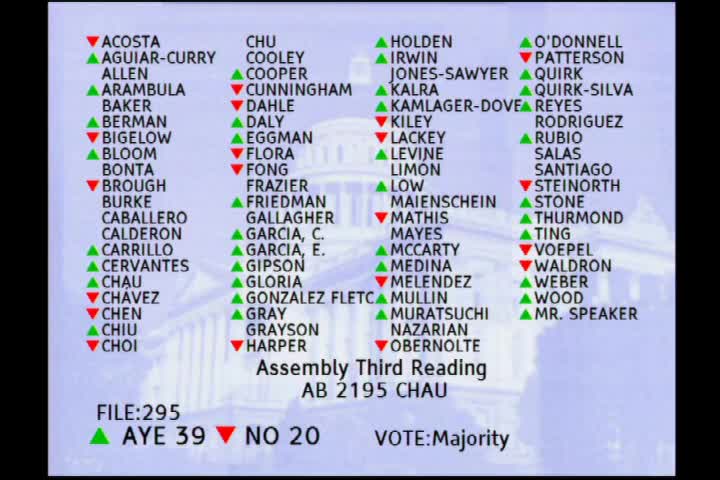

Bill Author

Bill Co-Author(s):