AB 24: Instructional programs: State Seal of Civic Engagement.
- Session Year: 2017-2018
- House: Assembly
- Latest Version Date: 2017-10-09
Existing law sets forth various requirements for the issuance of diplomas conferred upon a pupil as evidence of graduation from high school. Existing law establishes the Golden State Seal Merit Diploma for the purpose of recognizing pupils who have mastered the high school curriculum. Existing law also establishes the State Seal of Biliteracy, awarded by the Superintendent of Public Instruction in accordance with specified criteria, to recognize high school graduates who have attained a high level of proficiency in speaking, reading, and writing in one or more languages in addition to English.
This bill would require the Superintendent, on or before January 1, 2020, to recommend to the State Board of Education criteria for awarding a State Seal of Civic Engagement to pupils who have demonstrated excellence in civics education and participation and have demonstrated an understanding of the United States Constitution, the California Constitution, and the democratic system of government. The bill would require the Superintendent to consider, among other criteria, the successful completion of history, government, and civics courses, including courses that incorporate character education, and voluntary participation in community service or extracurricular activities. The bill would require the state board, on or before January 31, 2021, to adopt, reject, or modify the criteria recommended by the Superintendent.
The bill would require the Superintendent to prepare and deliver to participating school districts the seal insignia to be affixed to the diploma or transcript of a pupil awarded the State Seal of Civic Engagement. The bill would also require participating school districts to maintain records in order to identify pupils who have earned the State Seal of Civic Engagement and to affix the appropriate insignia to the diploma or transcript of those pupils.
Existing law sets forth various requirements for the issuance of diplomas conferred upon a pupil as evidence of graduation from high school. Existing law establishes the Golden State Seal Merit Diploma for the purpose of recognizing pupils who have mastered the high school curriculum. Existing law also establishes the State Seal of Biliteracy, awarded by the Superintendent of Public Instruction in accordance with specified criteria, to recognize high school graduates who have attained a high level of proficiency in speaking, reading, and writing in one or more languages in addition to English.
This bill would require the State Board of Education, Superintendent, on or before January 1, 2019, to establish 2020, to recommend to the State Board of Education criteria for awarding a State Seal of Civic Engagement to pupils who have demonstrated excellence in civics education and participation and have demonstrated an understanding of the United States Constitution, the California Constitution, and the democratic system of government. The bill would require the state board Superintendent to consider, among other criteria, the successful completion of history, government, and civics courses, including courses that incorporate character education, and voluntary participation in community service or extracurricular activities. The bill would require the state board, on or before January 31, 2021, to adopt, reject, or modify the criteria recommended by the Superintendent.
The bill would require the Superintendent to prepare and deliver to participating school districts the seal insignia to be affixed to the diploma or transcript of a pupil awarded the State Seal of Civic Engagement. The bill would also require participating school districts to maintain records in order to identify pupils who have earned the State Seal of Civic Engagement and to affix the appropriate insignia to the diploma or transcript of those pupils.
Existing law sets forth various requirements for the issuance of diplomas conferred upon a pupil as evidence of graduation from high school. Existing law establishes the Golden State Seal Merit Diploma for the purpose of recognizing pupils who have mastered the high school curriculum. Existing law also establishes the State Seal of Biliteracy, awarded by the Superintendent of Public Instruction in accordance with specified criteria, to recognize high school graduates who have attained a high level of proficiency in speaking, reading, and writing in one or more languages in addition to English.
This bill would require the State Board of Education, on or before January 1, 2019, to establish criteria for awarding a State Seal of Civic Engagement to pupils who have demonstrated excellence in civics education and participation and have demonstrated an understanding of the United States Constitution, the California Constitution, and the democratic system of government. The bill would require the state board to consider, among other criteria, the successful completion of history, government, and civics courses, including courses that incorporate character education, and voluntary participation in community service or extracurricular activities.
The bill would require the Superintendent to prepare and deliver to participating school districts the seal insignia to be affixed to the diploma or transcript of a pupil awarded the State Seal of Civic Engagement. The bill would also require participating school districts to maintain records in order to identify pupils who have earned the State Seal of Civic Engagement and to affix the appropriate insignia to the diploma or transcript of those pupils.
It is the intent of the Legislature to establish a State Seal of Civic Engagement to encourage, and create pathways for, pupils in elementary and secondary schools to become civically engaged in democratic governmental institutions at the local, state, and national levels.
51471.(a)On or before January 1, 2020, the Superintendent shall recommend to the state board criteria for awarding a State Seal of Civic Engagement to pupils who have demonstrated excellence in civics education and participation and have demonstrated an understanding of the United States Constitution, the California Constitution, and the democratic system of government. In developing criteria for the State Seal of Civic Engagement, the Superintendent shall incorporate the Six Proven Practices for Effective Civic Learning, developed by the Education Commission of the States, and any and all other best practices for civic learning and engagement. In developing criteria for the State Seal of Civic Engagement, the Superintendent shall also consult with a diverse group of credentialed, current, classroom teachers who teach the subject of history-social science, including government, in secondary schools. The Superintendent shall also consider including criteria based on each of the following:
(1)Successful completion of history, government, and civics courses, including courses that incorporate character education.
(2)Voluntary participation in community service or extracurricular activities.
(3)Any other related requirements as it deems appropriate.
(b)In developing criteria pursuant to subdivision (a), the Superintendent shall ensure, to the greatest extent feasible, that the criteria:
(1)Provide all pupils with an opportunity to earn the State Seal of Civic Engagement.
(2)Recognize pupil excellence or outstanding achievement.
(3)Are not based primarily on pupil achievement that is already recognized through grades or other standard measures of pupil achievement.
(4)To the extent possible, result in a seal that confers some benefit to pupils beyond secondary school.
(c)On or before January 31, 2021, the state board shall adopt, reject, or modify the criteria recommended by the Superintendent pursuant to subdivision (a).
(d)School district participation in this program is voluntary.
51472.The Superintendent shall do both of the following:
(a)Prepare and deliver to participating school districts an appropriate insignia to be affixed to the diploma or transcript of the pupil indicating that the pupil has been awarded a State Seal of Civic Engagement by the Superintendent.
(b)Provide other information he or she deems necessary for school districts to successfully participate in the program.
51473.A school district that participates in the program under this article shall do both of the following:
(a)Maintain appropriate records in order to identify pupils who have earned a State Seal of Civic Engagement.
(b)Affix the appropriate insignia to the diploma or transcript of each pupil who earns a State Seal of Civic Engagement.
51474.No fee shall be charged to a pupil to receive a State Seal of Civic Engagement.
It is the intent of the Legislature to establish a State Seal of Civic Engagement to encourage, and create pathways for, pupils in elementary and secondary schools to become civically engaged in democratic governmental institutions at the local, state, and national levels.
51471.(a)On or before January 1, 2019, the state board shall establish 2020, the Superintendent shall recommend to the state board criteria for awarding a State Seal of Civic Engagement to pupils who have demonstrated excellence in civics education and participation and have demonstrated an understanding of the United States Constitution, the California Constitution, and the democratic system of government. In establishing developing criteria for the State Seal of Civic Engagement, the state board Superintendent shall incorporate the Six Proven Practices for Effective Civic Learning, developed by the Education Commission of the States, and any and all other best practices for civic learning and engagement. In establishing developing criteria for the State Seal of Civic Engagement, the state board Superintendent shall also consult with a diverse group of credentialed, current, classroom teachers who teach the subject of history-social science, including government, in secondary schools. The state board Superintendent shall also consider including criteria based on each of the following:
(1)Successful completion of history, government, and civics courses, including courses that incorporate character education.
(2)Voluntary participation in community service or extracurricular activities.
(3)Any other related requirements as it deems appropriate.
(b)In establishing developing criteria pursuant to subdivision (a), the state board Superintendent shall ensure, to the greatest extent feasible, that the criteria:
(1)Provide all pupils with an opportunity to earn the State Seal of Civic Engagement.
(2)Recognize pupil excellence or outstanding achievement.
(3)Are not based primarily on pupil achievement that is already recognized through grades or other standard measures of pupil achievement.
(4)To the extent possible, result in a seal that confers some benefit to pupils beyond secondary school.
(c)On or before January 31, 2021, the state board shall adopt, reject, or modify the criteria recommended by the Superintendent pursuant to subdivision (a).
(c)(d)School district participation in this program is voluntary.
51472.The Superintendent shall do both of the following:
(a)Prepare and deliver to participating school districts an appropriate insignia to be affixed to the diploma or transcript of the pupil indicating that the pupil has been awarded a State Seal of Civic Engagement by the Superintendent.
(b)Provide other information he or she deems necessary for school districts to successfully participate in the program.
51473.A school district that participates in the program under this article shall do both of the following:
(a)Maintain appropriate records in order to identify pupils who have earned a State Seal of Civic Engagement.
(b)Affix the appropriate insignia to the diploma or transcript of each pupil who earns a State Seal of Civic Engagement.
51474.No fee shall be charged to a pupil to receive a State Seal of Civic Engagement.
It is the intent of the Legislature to establish a State Seal of Civic Engagement to encourage, and create pathways for, pupils in elementary and secondary schools to become civically engaged in democratic governmental institutions at the local, state, and national level. levels.
51471.(a)On or before January 1, 2019, the state board shall establish criteria for awarding a State Seal of Civic Engagement to pupils who have demonstrated excellence in civics education and participation and have demonstrated an understanding of the United States Constitution, the California Constitution, and the democratic system of government. In establishing criteria for the State Seal of Civic Engagement, the state board shall incorporate the Six Proven Practices for Effective Civic Learning, developed by the Education Commission of the States, and any and all other best practices for civic learning and engagement. In establishing criteria for the State Seal of Civic Engagement, the state board shall also consult with a diverse group of credentialed, current, classroom teachers who teach the subject of history-social science, including government, in secondary schools. The state board shall also consider including criteria based on each of the following:
(1)Successful completion of history, government, and civics courses, including courses that incorporate character education.
(2)Voluntary participation in community service or extracurricular activities.
(3)Any other related requirements as it deems appropriate.
(b)In establishing criteria pursuant to subdivision (a), the state board shall ensure, to the greatest extent feasible, that the criteria:
(1)Provide all pupils with an opportunity to earn the State Seal of Civic Engagement.
(2)Recognize pupil excellence or outstanding achievement.
(3)Are not based primarily on pupil achievement that is already recognized through grades or other standard measures of pupil achievement.
(4)To the extent possible, result in a seal that confers some benefit to pupils beyond secondary school.
(c)School district participation in this program is voluntary.
51472.The Superintendent shall do both of the following:
(a)Prepare and deliver to participating school districts an appropriate insignia to be affixed to the diploma or transcript of the pupil indicating that the pupil has been awarded a State Seal of Civic Engagement by the Superintendent.
(b)Provide other information he or she deems necessary for school districts to successfully participate in the program.
51473.A school district that participates in the program under this article shall do both of the following:
(a)Maintain appropriate records in order to identify pupils who have earned a State Seal of Civic Engagement.
(b)Affix the appropriate insignia to the diploma or transcript of each pupil who earns a State Seal of Civic Engagement.
51474.No fee shall be charged to a pupil to receive a State Seal of Civic Engagement.
It is the intent of the Legislature to establish a State Seal of Civic Engagement to encourage, and create pathways for, pupils in elementary and secondary schools to become civically engaged in democratic governmental institutions at the local, state, and national level.
51471.(a)On or before January 1, 2019, the state board shall establish criteria for awarding a State Seal of Civic Engagement to pupils who have demonstrated excellence in civics education and participation and have demonstrated an understanding of the United States Constitution, the California Constitution, and the democratic system of government. In establishing criteria for the State Seal of Civic Engagement, the state board shall incorporate the Six Proven Practices for Effective Civic Learning, developed by the Education Commission of the States, and any and all other best practices for civic learning and engagement. The state board shall also consider including criteria based on each of the following:
(1)Successful completion of history, government, and civics courses, including courses that incorporate character education.
(2)Voluntary participation in community service or extracurricular activities.
(3)Any other related requirements as it deems appropriate.
(b)In establishing criteria pursuant to subdivision (a), the state board shall ensure, to the greatest extent feasible, that the criteria:
(1)Provide all pupils with an opportunity to earn the State Seal of Civic Engagement.
(2)Recognize pupil excellence or outstanding achievement.
(3)Are not based primarily on pupil achievement that is already recognized through grades or other standard measures of pupil achievement.
(4)To the extent possible, result in a seal that confers some benefit to pupils beyond secondary school.
(b)(c)School district participation in this program is voluntary.
51472.The Superintendent shall do both of the following:
(a)Prepare and deliver to participating school districts an appropriate insignia to be affixed to the diploma or transcript of the pupil indicating that the pupil has been awarded a State Seal of Civic Engagement by the Superintendent.
(b)Provide other information he or she deems necessary for school districts to successfully participate in the program.
51473.A school district that participates in the program under this article shall do both of the following:
(a)Maintain appropriate records in order to identify pupils who have earned a State Seal of Civic Engagement.
(b)Affix the appropriate insignia to the diploma or transcript of each pupil who earns a State Seal of Civic Engagement.
51474.No fee shall be charged to a pupil to receive a State Seal of Civic Engagement.
It is the intent of the Legislature to establish a State Seal of Civic Engagement to encourage, and create pathways for, pupils in elementary and secondary schools to become civically engaged in democratic governmental institutions at the local, state, and national level.
51471.(a)On or before January 1, 2019, the state board shall establish criteria for awarding a State Seal of Civic Engagement to pupils who have demonstrated excellence in civics education and participation and have demonstrated an understanding of the United States Constitution, the California Constitution, and the democratic system of government. In establishing criteria for the State Seal of Civic Engagement, the state board shall incorporate the Six Proven Practices for Effective Civic Learning, developed by the Education Commission of the States, and any and all other best practices for civic learning and engagement. The state board shall also consider including criteria based on each of the following:
(1)Successful completion of history, government, and civics courses, including courses that incorporate character education.
(2)Voluntary participation in community service or extracurricular activities.
(3)Any other related requirements as it deems appropriate.
(b)School district participation in this program is voluntary.
51472.The Superintendent shall do both of the following:
(a)Prepare and deliver to participating school districts an appropriate insignia to be affixed to the diploma or transcript of the pupil indicating that the pupil has been awarded a State Seal of Civic Engagement by the Superintendent.
(b)Provide other information he or she deems necessary for school districts to successfully participate in the program.
51473.A school district that participates in the program under this article shall do both of the following:
(a)Maintain appropriate records in order to identify pupils who have earned a State Seal of Civic Engagement.
(b)Affix the appropriate insignia to the diploma or transcript of each pupil who earns a State Seal of Civic Engagement.
51474.No fee shall be charged to a pupil to receive a State Seal of Civic Engagement.
|
Date
|
Status
|
|---|---|
| Oct 9, 2017 | Chaptered by Secretary of State - Chapter 604, Statutes of 2017. |
| Oct 9, 2017 | Approved by the Governor. |
| Sep 12, 2017 | Enrolled and presented to the Governor at 2:30 p.m. |
| Sep 5, 2017 | Senate amendments concurred in. To Engrossing and Enrolling. (Ayes 76. Noes 0.). |
| Aug 31, 2017 | In Assembly. Concurrence in Senate amendments pending. May be considered on or after September 2 pursuant to Assembly Rule 77. |
| Aug 31, 2017 | Read third time. Passed. Ordered to the Assembly. |
| Jul 18, 2017 | Read second time. Ordered to third reading. |
| Jul 17, 2017 | Read third time and amended. Ordered to second reading. |
| Jul 10, 2017 | Read second time. Ordered to third reading. |
| Jul 6, 2017 | Read third time and amended. Ordered to second reading. |
| Jun 27, 2017 | Read second time. Ordered to third reading. |
| Jun 26, 2017 | From committee: Be ordered to second reading pursuant to Senate Rule 28.8. |
| Jun 7, 2017 | From committee: Do pass and re-refer to Com. on APPR. (Ayes 7. Noes 0.) (June 7). Re-referred to Com. on APPR. |
| May 10, 2017 | Referred to Com. on ED. |
| Apr 27, 2017 | In Senate. Read first time. To Com. on RLS. for assignment. |
| Apr 27, 2017 | Read third time. Passed. Ordered to the Senate. (Ayes 74. Noes 0. Page 1260.) |
| Apr 24, 2017 | Read third time and amended. Ordered to third reading. (Page 1187.) |
| Apr 6, 2017 | Read second time. Ordered to third reading. |
| Apr 5, 2017 | From committee: Do pass. (Ayes 17. Noes 0.) (April 5). |
| Mar 28, 2017 | Re-referred to Com. on APPR. |
| Mar 27, 2017 | Read second time and amended. |
| Mar 23, 2017 | From committee: Amend, and do pass as amended and re-refer to Com. on APPR. (Ayes 7. Noes 0.) (March 15). |
| Jan 19, 2017 | Referred to Com. on ED. |
| Dec 6, 2016 | From printer. May be heard in committee January 5. |
| Dec 5, 2016 | Read first time. To print. |
|
Date
|
Description
|
Location
|
Votes
|
|
|---|---|---|---|---|
| Sep 5, 2017 | AB 24 EGGMAN Concurrence in Senate Amendments | Assembly Floor |
Passed |
|
| Aug 31, 2017 | Assembly 3rd Reading AB24 Eggman et al. By Stern | Senate Floor |
Passed |
|
| Jun 7, 2017 | Do pass, but first be re-referred to the Committee on [Appropriations] | Senate Standing Committee on Education |
Passed |
|
| Apr 27, 2017 | AB 24 EGGMAN Assembly Third Reading | Assembly Floor |
Passed |
|
| Apr 5, 2017 | Do pass. | Assembly Standing Committee on Appropriations |
Passed |
|
| Mar 15, 2017 | Do pass as amended and be re-referred to the Committee on [Appropriations] | Assembly Standing Committee on Education |
Passed |
This list shows positions taken on this bill by organizations on the date displayed, which is linked to the original source.
Positions by individuals are not included.
CONCURRENCE IN SENATE AMENDMENTS
CSA1 Bill Id:AB 24
Author:(Eggman)
As Amended Ver:July 17, 2017
Majority vote
ASSEMBLY: | 74-0 | (April 27, 2017) | SENATE: | 39-0 | (August 31, 2017) |
Original Committee Reference: ED.
SUMMARY: Establishes a State Seal of Civic Engagement, to be affixed to the diploma of qualifying high school graduates, based on a demonstration of excellence in civics education and participation.
The Senate amendments:
- Delete the requirement that the State Board of Education (SBE) establish criteria for earning the State Seal of Civic Engagement by January 1, 2019, and instead require the Superintendent of Public Instruction (SPI) to develop and recommend such criteria to the SBE by January 1, 2020.
- Require the SBE to adopt, reject, or modify the criteria by January 31, 2021.
- Require the SPI, instead of the SBE, when developing the criteria for earning the State Seal of Civic Engagement, to incorporate the Six Proven Practices for Effective Civic Learning, consult with specified individuals, and to ensure that the criteria meet specified requirements.
- Add a co-author and make a technical change.
FISCAL EFFECT: According to the Assembly Appropriations Committee on a prior version of this bill:
Ongoing cost to the California Department of Education/SBE of about $64,000 General Fund (GF)/Prop 98 and one-time costs of $13,000 to develop criteria and design the seal. Ongoing costs include one year of seals and staff time to coordinate and distribute the seals.
The bill would not create any state reimbursable mandate cost. However, the bill could create Proposition 98/GF cost pressures because a participating school district's record maintenance and other administrative costs would need to be absorbed within the school district's existing resources.
COMMENTS:
Need for the bill. According to the author's office, "Civic education and participation in the United States has declined. The United States ranks 139th out of 172 democracies around the world in voter participation, and less than half of eligible young people ages 18-24 voted in the 2012 elections. In California, less than 50% of high school seniors surveyed viewed being actively involved in state and local issues as their responsibility.
"Such findings were also corroborated during hearings in 2015 conducted by the Assembly Select Committee on Civic Engagement. Data highlighted severe racial disparities to civic participation across the Asian Pacific Islander, African American, and Latino communities, measured in several ways including but not limited to, contacting public officials, attending political meetings, and engaging in forms of political activism. These findings emphasized the need to better engage California's diverse student population.
"A 2014 report authored by the California Task Force on K-12 Civic Learning outlined several policy recommendations to revitalize civic learning and participation in California, including badging programs which incentivize students to develop a deeper understanding of civics through active engagement in their communities.
"The State Seal of Civic Engagement would provide additional incentives for students to become civically engaged over the course of their K-12 education."
Analysis Prepared by: Tanya Lieberman / ED. / (916) 319-2087 FN: 0001249
Office of Senate Floor Analyses (916) 651-1520 Fax: (916) 327-4478 | AB |
THIRD READING
Bill No: AB 24
Amended: 7/17/17 in Senate
SENATE EDUCATION COMMITTEE: 7-0, 6/7/17
AYES: Allen, Wilk, Galgiani, Leyva, Mendoza, Pan, Vidak
SENATE APPROPRIATIONS COMMITTEE: Senate Rule 28.8
ASSEMBLY FLOOR: 74-0, 4/27/17 - See last page for vote
DIGEST:
This bill establishes a State Seal of Civic Engagement, to be affixed to the diploma of qualifying high school graduates, based on a demonstration of excellence in civics education and participation.
Senate Floor Amendments of 7/17/17 revise the process and timeline for the development of the State Seal of Civic Engagement.
Senate Floor Amendments of 7/6/17 add a coauthor.
Existing law:
1) Establishes the State Seal of Biliteracy (SSB), which provides recognition to high school students who have demonstrated proficiency in speaking, reading, and writing in one or more languages in addition to English. (Education Code § 51460)
2) Requires each school district, county office of education, or direct-funded charter school that confers the SSB to maintain appropriate records in order to identify students who have met the established criteria for the award and to affix the SSB insignia to the diploma or transcript of each qualifying student. (EC § 51464)
3) Requires high school graduates to meet all of the following criteria to be eligible for the SSB:
a) Complete all English language arts requirements for graduation with an overall grade point average of 2.0 or above in those classes.
b) Pass the California Standards Test in English language arts administered in grade 11 at the proficient level or above.
c) Demonstrate proficiency in one or more languages in addition to English, through one of four methods. (EC § 51461)
4) Establishes the Golden State Seal Merit Diploma, which provides recognition to public high school graduates who have demonstrated mastery of high school curriculum in six designated subject areas, four of which must be mathematics, English language arts, science, and United States history. (EC § 51450 et seq.)
This bill:
1) States legislative intent to establish a State Seal of Civic Engagement to encourage, and create pathways for, students in elementary and secondary schools to become civically engaged in democratic governmental institutions at the local, state, and national levels.
2) Requires that, by January 1, 2020, the Superintendent of Public Instruction (SPI) recommend to the State Board of Education (SBE) criteria for awarding a State Seal of Civic Engagement to students who have demonstrated excellence in civics education and participation and have demonstrated an understanding of the United States Constitution, the California Constitution, and the democratic system of government.
3) Requires the SBE to adopt, reject, or modify the criteria recommended by the SPI by January 1, 2021.
3) Requires that, in developing criteria for the State Seal of Civic Engagement, the SPI:
a) Incorporate the Six Proven Practices for Effective Civic Learning, developed by the Education Commission of the States, and any and all other best practices for civic learning and engagement.
b) Consult with a diverse group of credentialed, current, classroom teachers who teach the subject of history-social science, including government, in secondary schools.
c) Ensure, to the greatest extent feasible, that the criteria:
i) Provide all pupils with an opportunity to earn the State Seal of Civic Engagement.
ii) Recognize pupil excellence or outstanding achievement.
iii) Not be based primarily on pupil achievement that is already recognized through grades or other standard measures of pupil achievement.
iv) To the extent possible, result in a seal that confers some benefit to pupils beyond secondary school.
4) Requires the SPI to also consider including criteria based on each of the following:
a) Successful completion of history, government, and civics courses, including courses that incorporate character education.
b) Voluntary participation in community service or extracurricular activities and any other related requirements as it deems appropriate.
c) Any other related requirements as it deems appropriate.
5) States that school district participation in this program is voluntary.
6) Requires the SPI to:
a) Prepare and deliver to participating school districts an appropriate insignia to be affixed to the diploma or transcript of the pupil indicating that the pupil has been awarded a State Seal of Civic Engagement by the SPI.
b) Provide other information he or she deems necessary for school districts to successfully participate in the program.
7) Requires school districts participating in the program to:
a) Maintain appropriate records in order to identify pupils who have earned a State Seal of Civic Engagement.
b) Affix the appropriate insignia to the diploma or transcript of each pupil who earns a State Seal of Civic Engagement.
8) States that no fee shall be charged to a pupil to receive a State Seal of Civic Engagement.
Comments
- Need for the bill. According to the author, “Civic education and participation in the United States has declined. The United States ranks 139th out of 172 democracies around the world in voter participation, and less than half of eligible young people ages 18-24 voted in the 2012 elections. In California, less than 50% of high school seniors surveyed viewed being actively involved in state and local issues as their responsibility.
“Such findings were also corroborated during hearings in 2015 conducted by the Assembly Select Committee on Civic Engagement. Data highlighted severe racial disparities to civic participation across the Asian Pacific Islander, African American, and Latino communities, measured in several ways including but not limited to, contacting public officials, attending political meetings, and engaging in forms of political activism. These findings emphasized the need to better engage California’s diverse student population.
“A 2014 report authored by the California Task Force on K-12 Civic Learning outlined several policy recommendations to revitalize civic learning and participation in California, including badging programs which incentivize students to develop a deeper understanding of civics through active engagement in their communities.”
2) Six Proven Practices for Effective Civic Learning. This bill requires the SBE, in establishing criteria for the State Seal of Civic Engagement, to incorporate the Six Proven Practices for Effective Civic Learning, developed by the Education Commission of the States. These Six Practices:
a) Provide instruction in government, history, law, and democracy.
b) Incorporate discussion of current local, national, and international issues and events in the classroom, particularly those that young people view as important to their lives.
c) Design and implement programs that provide students with opportunities to apply what they learn through performing community service that is linked to the formal curriculum and classroom instruction.
d) Offer extracurricular activities that provide opportunities for young people to get involved in their schools or communities.
e) Encourage student participation in school governance.
f) Encourage students’ participation in simulations of democratic processes and procedures.
Related/Prior Legislation
AB 1142 (Medina, 2017) updates the English language arts and English language development assessments used to determine recipients of the State Seal of Biliteracy. AB 1142 is pending concurrence in the Assembly.
AB 2072 (Chang, 2015-16 Regular Session) would have established the State Seal of STEM (Science, Technology, Engineering and Math) to recognize high school graduates who have attained proficiency in STEM content. AB 2072 was held in the Senate Appropriations Committee.
AB 815 (Brownley, Chapter 618, Statutes of 2011) established the SSB to recognize high school graduates who attained a high level of proficiency in speaking, reading, and writing in one or more languages in addition to English.
SB 253 (Wyland, 2009-10 Regular Session) would have authorized school districts and county offices of education to offer pupils a Career Tech Education certificate upon meeting specified requirements. SB 253 was held in the Assembly Appropriations Committee.
FISCAL EFFECT: Appropriation: Fiscal Com.: Local:
California Secretary of State Alex Padilla
Alameda County Office of Education
American Academy of Pediatrics
California Council for the Social Studies
California State PTA
California Teachers Association
Common Sense Kids Action
Compton Unified School District
Mi Familia Vota
OPPOSITION: (Verified 7/14/17)
California Right to Life Committee, Inc.
ASSEMBLY FLOOR: 74-0, 4/27/17
AYES: Acosta, Aguiar-Curry, Travis Allen, Arambula, Baker, Berman, Bigelow, Bloom, Bocanegra, Bonta, Brough, Burke, Caballero, Chau, Chávez, Chen, Chiu, Choi, Chu, Cooper, Cunningham, Dababneh, Dahle, Daly, Eggman, Flora, Fong, Frazier, Friedman, Gallagher, Cristina Garcia, Eduardo Garcia, Gipson, Gloria, Gonzalez Fletcher, Gray, Grayson, Harper, Holden, Irwin, Jones-Sawyer, Kalra, Kiley, Lackey, Levine, Limón, Low, Maienschein, Mathis, Mayes, Medina, Melendez, Mullin, Muratsuchi, Nazarian, Obernolte, O'Donnell, Patterson, Quirk, Quirk-Silva, Reyes, Ridley-Thomas, Rodriguez, Rubio, Salas, Steinorth, Mark Stone, Thurmond, Ting, Voepel, Waldron, Weber, Wood, Rendon
NO VOTE RECORDED: Calderon, Cervantes, Cooley, Gomez, McCarty, Santiago
7/19/17 15:19:49
**** END ****
Office of Senate Floor Analyses (916) 651-1520 Fax: (916) 327-4478 | AB |
THIRD READING
Bill No: AB 24
Amended: 7/6/17 in Senate
SENATE EDUCATION COMMITTEE: 7-0, 6/7/17
AYES: Allen, Wilk, Galgiani, Leyva, Mendoza, Pan, Vidak
SENATE APPROPRIATIONS COMMITTEE: Senate Rule 28.8
ASSEMBLY FLOOR: 74-0, 4/27/17 - See last page for vote
DIGEST:
This bill establishes a State Seal of Civic Engagement, to be affixed to the diploma of qualifying high school graduates, based on a demonstration of excellence in civics education and participation.
Senate Floor Amendments of 7/6/17 add a coauthor.
Existing law:
1) Establishes the State Seal of Biliteracy (SSB), which provides recognition to high school students who have demonstrated proficiency in speaking, reading, and writing in one or more languages in addition to English. (Education Code § 51460)
2) Requires each school district, county office of education, or direct-funded charter school that confers the SSB to maintain appropriate records in order to identify students who have met the established criteria for the award and to affix the SSB insignia to the diploma or transcript of each qualifying student. (EC § 51464)
3) Requires high school graduates to meet all of the following criteria to be eligible for the SSB:
a) Complete all English language arts requirements for graduation with an overall grade point average of 2.0 or above in those classes.
b) Pass the California Standards Test in English language arts administered in grade 11 at the proficient level or above.
c) Demonstrate proficiency in one or more languages in addition to English, through one of four methods. (EC § 51461)
4) Establishes the Golden State Seal Merit Diploma, which provides recognition to public high school graduates who have demonstrated mastery of high school curriculum in six designated subject areas, four of which must be mathematics, English language arts, science, and United States history. (EC § 51450 et seq.)
This bill:
1) States legislative intent to establish a State Seal of Civic Engagement to encourage, and create pathways for, students in elementary and secondary schools to become civically engaged in democratic governmental institutions at the local, state, and national levels.
2) Requires that, by January 1, 2019, the State Board of Education (SBE) establish criteria for awarding a State Seal of Civic Engagement to students who have demonstrated excellence in civics education and participation and have demonstrated an understanding of the United States Constitution, the California Constitution, and the democratic system of government.
3) Requires that, in establishing criteria for the State Seal of Civic Engagement, the SBE:
a) Incorporate the Six Proven Practices for Effective Civic Learning, developed by the Education Commission of the States, and any and all other best practices for civic learning and engagement.
b) Consult with a diverse group of credentialed, current, classroom teachers who teach the subject of history-social science, including government, in secondary schools.
c) Ensure, to the greatest extent feasible, that the criteria:
i) Provide all pupils with an opportunity to earn the State Seal of Civic Engagement.
ii) Recognize pupil excellence or outstanding achievement.
iii) Not be based primarily on pupil achievement that is already recognized through grades or other standard measures of pupil achievement.
iv) To the extent possible, result in a seal that confers some benefit to pupils beyond secondary school.
4) Requires the SBE to also consider including criteria based on each of the following:
a) Successful completion of history, government, and civics courses, including courses that incorporate character education.
b) Voluntary participation in community service or extracurricular activities and any other related requirements as it deems appropriate.
c) Any other related requirements as it deems appropriate.
5) States that school district participation in this program is voluntary.
6) Requires the Superintendent of Public Instruction (SPI) to:
a) Prepare and deliver to participating school districts an appropriate insignia to be affixed to the diploma or transcript of the pupil indicating that the pupil has been awarded a State Seal of Civic Engagement by the SPI.
b) Provide other information he or she deems necessary for school districts to successfully participate in the program.
7) Requires school districts participating in the program to:
a) Maintain appropriate records in order to identify pupils who have earned a State Seal of Civic Engagement.
b) Affix the appropriate insignia to the diploma or transcript of each pupil who earns a State Seal of Civic Engagement.
8) States that no fee shall be charged to a pupil to receive a State Seal of Civic Engagement.
Comments
- Need for the bill. According to the author, “Civic education and participation in the United States has declined. The United States ranks 139th out of 172 democracies around the world in voter participation, and less than half of eligible young people ages 18-24 voted in the 2012 elections. In California, less than 50% of high school seniors surveyed viewed being actively involved in state and local issues as their responsibility.
“Such findings were also corroborated during hearings in 2015 conducted by the Assembly Select Committee on Civic Engagement. Data highlighted severe racial disparities to civic participation across the Asian Pacific Islander, African American, and Latino communities, measured in several ways including but not limited to, contacting public officials, attending political meetings, and engaging in forms of political activism. These findings emphasized the need to better engage California’s diverse student population.
“A 2014 report authored by the California Task Force on K-12 Civic Learning outlined several policy recommendations to revitalize civic learning and participation in California, including badging programs which incentivize students to develop a deeper understanding of civics through active engagement in their communities.”
2) Six Proven Practices for Effective Civic Learning. This bill requires the SBE, in establishing criteria for the State Seal of Civic Engagement, to incorporate the Six Proven Practices for Effective Civic Learning, developed by the Education Commission of the States. These Six Practices:
a) Provide instruction in government, history, law, and democracy.
b) Incorporate discussion of current local, national, and international issues and events in the classroom, particularly those that young people view as important to their lives.
c) Design and implement programs that provide students with opportunities to apply what they learn through performing community service that is linked to the formal curriculum and classroom instruction.
d) Offer extracurricular activities that provide opportunities for young people to get involved in their schools or communities.
e) Encourage student participation in school governance.
f) Encourage students’ participation in simulations of democratic processes and procedures.
Related/Prior Legislation
AB 1142 (Medina, 2017) updates the English language arts and English language development assessments used to determine recipients of the State Seal of Biliteracy. AB 1142 is pending in the Senate Appropriations Committee.
AB 2072 (Chang, 2015-16 Regular Session) would have established the State Seal of STEM (Science, Technology, Engineering and Math) to recognize high school graduates who have attained proficiency in STEM content. AB 2072 was held in the Senate Appropriations Committee.
AB 815 (Brownley, Chapter 618, Statutes of 2011) established the SSB to recognize high school graduates who attained a high level of proficiency in speaking, reading, and writing in one or more languages in addition to English.
SB 253 (Wyland, 2009-10 Regular Session) would have authorized school districts and county offices of education to offer pupils a Career Tech Education certificate upon meeting specified requirements. SB 253 was held in the Assembly Appropriations Committee.
FISCAL EFFECT: Appropriation: Fiscal Com.: Local:
California Secretary of State Alex Padilla
Alameda County Office of Education
American Academy of Pediatrics
California Council for the Social Studies
California State PTA
California Teachers Association
Common Sense Kids Action
Compton Unified School District
Mi Familia Vota
OPPOSITION: (Verified 6/26/17)
California Right to Life Committee, Inc.
ASSEMBLY FLOOR: 74-0, 4/27/17
AYES: Acosta, Aguiar-Curry, Travis Allen, Arambula, Baker, Berman, Bigelow, Bloom, Bocanegra, Bonta, Brough, Burke, Caballero, Chau, Chávez, Chen, Chiu, Choi, Chu, Cooper, Cunningham, Dababneh, Dahle, Daly, Eggman, Flora, Fong, Frazier, Friedman, Gallagher, Cristina Garcia, Eduardo Garcia, Gipson, Gloria, Gonzalez Fletcher, Gray, Grayson, Harper, Holden, Irwin, Jones-Sawyer, Kalra, Kiley, Lackey, Levine, Limón, Low, Maienschein, Mathis, Mayes, Medina, Melendez, Mullin, Muratsuchi, Nazarian, Obernolte, O'Donnell, Patterson, Quirk, Quirk-Silva, Reyes, Ridley-Thomas, Rodriguez, Rubio, Salas, Steinorth, Mark Stone, Thurmond, Ting, Voepel, Waldron, Weber, Wood, Rendon
NO VOTE RECORDED: Calderon, Cervantes, Cooley, Gomez, McCarty, Santiago
7/10/17 11:19:38
**** END ****
Office of Senate Floor Analyses (916) 651-1520 Fax: (916) 327-4478 | AB |
THIRD READING
Bill No: AB 24
:
SENATE EDUCATION COMMITTEE: 7-0, 6/7/17
AYES: Allen, Wilk, Galgiani, Leyva, Mendoza, Pan, Vidak
SENATE APPROPRIATIONS COMMITTEE: Senate Rule 28.8
ASSEMBLY FLOOR: 74-0, 4/27/17 - See last page for vote
DIGEST:
This bill establishes a State Seal of Civic Engagement, to be affixed to the diploma of qualifying high school graduates, based on a demonstration of excellence in civics education and participation.
Existing law:
1) Establishes the State Seal of Biliteracy (SSB), which provides recognition to high school students who have demonstrated proficiency in speaking, reading, and writing in one or more languages in addition to English. (Education Code § 51460)
2) Requires each school district, county office of education, or direct-funded charter school that confers the SSB to maintain appropriate records in order to identify students who have met the established criteria for the award and to affix the SSB insignia to the diploma or transcript of each qualifying student. (EC § 51464)
3) Requires high school graduates to meet all of the following criteria to be eligible for the SSB:
a) Complete all English language arts requirements for graduation with an overall grade point average of 2.0 or above in those classes.
b) Pass the California Standards Test in English language arts administered in grade 11 at the proficient level or above.
c) Demonstrate proficiency in one or more languages in addition to English, through one of four methods. (EC § 51461)
4) Establishes the Golden State Seal Merit Diploma, which provides recognition to public high school graduates who have demonstrated mastery of high school curriculum in six designated subject areas, four of which must be mathematics, English language arts, science, and United States history. (EC § 51450 et seq.)
This bill:
1) States legislative intent to establish a State Seal of Civic Engagement to encourage, and create pathways for, students in elementary and secondary schools to become civically engaged in democratic governmental institutions at the local, state, and national level.
2) Requires that, by January 1, 2019, the State Board of Education (SBE) establish criteria for awarding a State Seal of Civic Engagement to students who have demonstrated excellence in civics education and participation and have demonstrated an understanding of the United States Constitution, the California Constitution, and the democratic system of government.
3) Requires that, in establishing criteria for the State Seal of Civic Engagement, the SBE:
a) Incorporate the Six Proven Practices for Effective Civic Learning, developed by the Education Commission of the States, and any and all other best practices for civic learning and engagement.
b) Consult with a diverse group of credentialed, current, classroom teachers who teach the subject of history-social science, including government, in secondary schools.
c) Ensure, to the greatest extent feasible, that the criteria:
i) Provide all pupils with an opportunity to earn the State Seal of Civic Engagement.
ii) Recognize pupil excellence or outstanding achievement.
iii) Not be based primarily on pupil achievement that is already recognized through grades or other standard measures of pupil achievement.
iv) To the extent possible, result in a seal that confers some benefit to pupils beyond secondary school.
4) Requires the SBE to also consider including criteria based on each of the following:
a) Successful completion of history, government, and civics courses, including courses that incorporate character education.
b) Voluntary participation in community service or extracurricular activities and any other related requirements as it deems appropriate.
c) Any other related requirements as it deems appropriate.
5) States that school district participation in this program is voluntary.
6) Requires the Superintendent of Public Instruction (SPI) to:
a) Prepare and deliver to participating school districts an appropriate insignia to be affixed to the diploma or transcript of the pupil indicating that the pupil has been awarded a State Seal of Civic Engagement by the SPI.
b) Provide other information he or she deems necessary for school districts to successfully participate in the program.
7) Requires school districts participating in the program to:
a) Maintain appropriate records in order to identify pupils who have earned a State Seal of Civic Engagement.
b) Affix the appropriate insignia to the diploma or transcript of each pupil who earns a State Seal of Civic Engagement.
8) States that no fee shall be charged to a pupil to receive a State Seal of Civic Engagement.
Comments
- Need for the bill. According to the author, “Civic education and participation in the United States has declined. The United States ranks 139th out of 172 democracies around the world in voter participation, and less than half of eligible young people ages 18-24 voted in the 2012 elections. In California, less than 50% of high school seniors surveyed viewed being actively involved in state and local issues as their responsibility.
“Such findings were also corroborated during hearings in 2015 conducted by the Assembly Select Committee on Civic Engagement. Data highlighted severe racial disparities to civic participation across the Asian Pacific Islander, African American, and Latino communities, measured in several ways including but not limited to, contacting public officials, attending political meetings, and engaging in forms of political activism. These findings emphasized the need to better engage California’s diverse student population.
“A 2014 report authored by the California Task Force on K-12 Civic Learning outlined several policy recommendations to revitalize civic learning and participation in California, including badging programs which incentivize students to develop a deeper understanding of civics through active engagement in their communities.”
2) Six Proven Practices for Effective Civic Learning. This bill requires the SBE, in establishing criteria for the State Seal of Civic Engagement, to incorporate the Six Proven Practices for Effective Civic Learning, developed by the Education Commission of the States. These Six Practices:
a) Provide instruction in government, history, law, and democracy.
b) Incorporate discussion of current local, national, and international issues and events in the classroom, particularly those that young people view as important to their lives.
c) Design and implement programs that provide students with opportunities to apply what they learn through performing community service that is linked to the formal curriculum and classroom instruction.
d) Offer extracurricular activities that provide opportunities for young people to get involved in their schools or communities.
e) Encourage student participation in school governance.
f) Encourage students’ participation in simulations of democratic processes and procedures.
Related/Prior Legislation
AB 1142 (Medina, 2017) updates the English language arts and English language development assessments used to determine recipients of the State Seal of Biliteracy. AB 1142 is pending in the Senate Appropriations Committee.
AB 2072 (Chang, 2015-16 Regular Session) would have established the State Seal of STEM (Science, Technology, Engineering and Math) to recognize high school graduates who have attained proficiency in STEM content. AB 2072 was held in the Senate Appropriations Committee.
AB 815 (Brownley, Chapter 618, Statutes of 2011) established the SSB to recognize high school graduates who attained a high level of proficiency in speaking, reading, and writing in one or more languages in addition to English.
SB 253 (Wyland, 2009-10 Regular Session) would have authorized school districts and county offices of education to offer pupils a Career Tech Education certificate upon meeting specified requirements. SB 253 was held in the Assembly Appropriations Committee.
FISCAL EFFECT: Appropriation: Fiscal Com.: Local:
California Secretary of State Alex Padilla
Alameda County Office of Education
American Academy of Pediatrics
California Council for the Social Studies
California State PTA
California Teachers Association
Common Sense Kids Action
Compton Unified School District
Mi Familia Vota
OPPOSITION: (Verified 6/26/17)
California Right to Life Committee, Inc.
ASSEMBLY FLOOR: 74-0, 4/27/17
AYES: Acosta, Aguiar-Curry, Travis Allen, Arambula, Baker, Berman, Bigelow, Bloom, Bocanegra, Bonta, Brough, Burke, Caballero, Chau, Chávez, Chen, Chiu, Choi, Chu, Cooper, Cunningham, Dababneh, Dahle, Daly, Eggman, Flora, Fong, Frazier, Friedman, Gallagher, Cristina Garcia, Eduardo Garcia, Gipson, Gloria, Gonzalez Fletcher, Gray, Grayson, Harper, Holden, Irwin, Jones-Sawyer, Kalra, Kiley, Lackey, Levine, Limón, Low, Maienschein, Mathis, Mayes, Medina, Melendez, Mullin, Muratsuchi, Nazarian, Obernolte, O'Donnell, Patterson, Quirk, Quirk-Silva, Reyes, Ridley-Thomas, Rodriguez, Rubio, Salas, Steinorth, Mark Stone, Thurmond, Ting, Voepel, Waldron, Weber, Wood, Rendon
NO VOTE RECORDED: Calderon, Cervantes, Cooley, Gomez, McCarty, Santiago
6/27/17 16:46:30
**** END ****
SENATE COMMITTEE ON EDUCATION
Senator Benjamin Allen, Chair
2017 - 2018 Regular
Bill No: AB 24 Hearing Date: June 7, 2017
Author: | Eggman | ||
Version: | April 24, 2017 | ||
Urgency: | No | Fiscal: | Yes |
Consultant: | Brandon Darnell | ||
Subject: Instructional programs: State Seal of Civic Engagement
SUMMARY
This bill establishes a State Seal of Civic Engagement, to be affixed to the diploma of qualifying high school graduates, based on a demonstration of excellence in civics education and participation
BACKGROUND
1) Existing law establishes the State Seal of Biliteracy (SSB), which provides recognition to high school students who have demonstrated proficiency in speaking, reading, and writing in one or more languages in addition to English.
(Education Code § 51460)
2) Requires each school district, county office of education, or direct-funded charter school that confers the SSB to maintain appropriate records in order to identify students who have met the established criteria for the award and to affix the SSB insignia to the diploma or transcript of each qualifying student.
(EC § 51464)
3) Requires high school graduates to meet all of the following criteria to be eligible for the SSB:
a) Complete all English language arts requirements for graduation with an overall grade point average of 2.0 or above in those classes.
b) Pass the California Standards Test in English language arts administered in grade 11 at the proficient level or above.
c) Demonstrate proficiency in one or more languages in addition to English, through one of four methods. (EC § 51461)
4) Establishes the Golden State Seal Merit Diploma (GSSMD), which provides recognition to public high school graduates who have demonstrated mastery of high school curriculum in six designated subject areas, four of which must be mathematics, English language arts, science, and United States history. Eligibility requirements for the GSSMD include a combination of course grades, results from assessments produced by private providers or local education agencies (LEAs), and/or qualifying Smarter Balanced Summative Assessment of
California Standards Tests scores for use by local Education agencies (LEAs) to award the Golden State Seal Merit Diploma (GSSMD) to graduating students. (EC § 51450 et seq.)
ANALYSIS
This bill establishes a State Seal of Civic Engagement, to be affixed to the diploma of qualifying high school graduates, based on a demonstration of excellence in civics education and participation. Specifically, this bill:
1) States legislative intent to establish a State Seal of Civic Engagement to encourage, and create pathways for, students in elementary and secondary schools to become civically engaged in democratic governmental institutions at the local, state, and national level.
2) Requires that, by January 1, 2019, the State Board of Education (SBE) establish criteria for awarding a State Seal of Civic Engagement to students who have demonstrated excellence in civics education and participation and have demonstrated an understanding of the United States Constitution, the California Constitution, and the democratic system of government.
3) Requires that, in establishing criteria for the State Seal of Civic Engagement, the SBE to:
a) Incorporate the Six Proven Practices for Effective Civic Learning, developed by the Education Commission of the States, and any and all other best practices for civic learning and engagement.
b) Consult with a diverse group of credentialed, current, classroom teachers who teach the subject of history-social science, including government, in secondary schools.
c) Ensure, to the greatest extent feasible, that the criteria:
i) Provide all pupils with an opportunity to earn the State Seal of Civic Engagement.
ii) Recognize pupil excellence or outstanding achievement.
iii) Not be based primarily on pupil achievement that is already recognized through grades or other standard measures of pupil achievement.
iv) To the extent possible, result in a seal that confers some benefit to pupils beyond secondary school.
4) Requires the SBE to also consider including criteria based on each of the following:
a) Successful completion of history, government, and civics courses, including courses that incorporate character education.
b) Voluntary participation in community service or extracurricular activities and any other related requirements as it deems appropriate.
c) Any other related requirements as it deems appropriate.
5) States that school district participation in this program is voluntary.
6) Requires the Superintendent of Public Instruction (SPI) to:
a) Prepare and deliver to participating school districts an appropriate insignia to be affixed to the diploma or transcript of the pupil indicating that the pupil has been awarded a State Seal of Civic Engagement by the SPI
b) Provide other information he or she deems necessary for school districts to successfully participate in the program
7) Requires school districts participating in the program to:
a) Maintain appropriate records in order to identify pupils who have earned a State Seal of Civic Engagement.
b) Affix the appropriate insignia to the diploma or transcript of each pupil who earns a State Seal of Civic Engagement
8) States that no fee shall be charged to a pupil to receive a State Seal of Civic Engagement.
STAFF COMMENTS
- Need for the bill. According to the author, “Civic education and participation in the United States has declined. The United States ranks 139th out of 172 democracies around the world in voter participation, and less than half of eligible young people ages 18-24 voted in the 2012 elections. In California, less than 50% of high school seniors surveyed viewed being actively involved in state and local issues as their responsibility.
Such findings were also corroborated during hearings in 2015 conducted by the Assembly Select Committee on Civic Engagement. Data highlighted severe racial disparities to civic participation across the Asian Pacific Islander, African American, and Latino communities, measured in several ways including but not limited to, contacting public officials, attending political meetings, and engaging in forms of political activism. These findings emphasized the need to better engage California’s diverse student population.
A 2014 report authored by the California Task Force on K-12 Civic Learning outlined several policy recommendations to revitalize civic learning and participation in California, including badging programs which incentivize students to develop a deeper understanding of civics through active engagement in their communities.
The State Seal of Civic Engagement would provide additional incentives for students to become civically engaged over the course of their K-12 education.”
However, the new History – Social Science Framework, adopted by the State Board of Education (SBE) in July, 2016, addresses civic engagement throughout the document. The framework includes two appendices devoted to civic engagement and service-learning:
a) Appendix D: Educating for Democracy: Civic Education in the History–Social Science Curriculum, which includes the Six Proven Practices for Effective Civic Learning.
b) Appendix H: Practicing Civic Engagement: Service Learning in the History-Social Science Framework, which provides definitions, examples, and reasons for encouraging service-learning in the curriculum.
According to the California Department of Education (CDE), the framework includes more than thirty detailed classroom examples from a wide range of grade levels that show teachers how they can tailor instruction to address not only the history–social science standards, but also the English Language Arts (ELA)/Literacy and English Language Development (ELD) standards. The classroom examples include a number with a civic focus, such as:
a) Kindergarten: Being a Good Citizen.
b) Grade Three: Classroom Constitution.
c) Grade Five: The Preamble.
d) Grade Eight: The Civic Purpose of Public Education.
e) Grade Twelve: Judicial Review.
In addition to the classroom examples, CDE reports that there are many places in the framework’s course descriptions where there are suggestions for activities that engage students in civic learning. Some examples include:
a) Studying key American symbols and heroes through grade-appropriate literature, songs, and images in kindergarten through grade three.
b) Simulations of government activities (e.g., a congressional hearing debating the bill of rights in grade five, planning and participating in a mock election in grade eight, or conducing mock trials of landmark Supreme Court cases in grade eleven).
c) Suggestions for engaging in service-learning projects such as voter education and registration activities.
d) Suggestions for inquiry-based projects that include student interviews of legislators and other public officials, civil rights activists, or members of the military.
e) Suggestions for ways that students can get involved in campaigns to address local issues at the school or community level (e.g., recycling, campus safety).
The 12th grade curriculum in the 12th grade “Principles of American Democracy” section includes a focus on the questions, “What does it mean to be a citizen?” and “How can citizens improve democracy?” The course description states: “Students learn that democracies depend upon an actively engaged citizenry – individuals who fully participate in the responsibilities of citizenship (such as voting, serving in the military, or regular public service) – for their long-term survival.”
This 12th grade course description also suggests the use of structured group discussion techniques, simulations, classroom debates, and civics-based serving learning activities, designed to provide students with concrete answers to the question. Other suggested activities include participating in classroom mock trials, visiting court rooms, serving as poll workers, participating in voter registration, simulating or visit city council meetings, conducting projects to identify, analyze and address a community problem, competing in civic-writing activities, and participate in service-learning.
In light of the recent adoption of the new History – Social Science Framework and its provisions involving civic engagement, the committee may wish to consider whether the framework provides sufficient opportunities to inspire students’ civic engagement before creating a new diploma seal.
2) Six Proven Practices for Effective Civic Learning. This bill requires the State Board of Education (SBE), in establishing criteria for the State Seal of Civic Engagement, to incorporate the Six Proven Practices for Effective Civic Learning, developed by the Education Commission of the States. These Six Practices are:
a) Provide instruction in government, history, law, and democracy.
b) Incorporate discussion of current local, national, and international issues and events in the classroom, particularly those that young people view as important to their lives.
c) Design and implement programs that provide students with opportunities to apply what they learn through performing community service that is linked to the formal curriculum and classroom instruction.
d) Offer extracurricular activities that provide opportunities for young people to get involved in their schools or communities.
e) Encourage student participation in school governance.
f) Encourage students’ participation in simulations of democratic processes and procedures.
3) Do diploma seals provide a tangible benefit? In recent years the Legislature has reviewed three proposals for state diploma seals, in biliteracy, science, technology, engineering, and mathematics (STEM), and civic engagement. In addition, the Golden State Seal Merit (GSSM) diplomas are still issued. Diploma seals can be powerful incentives for students. They can influence students’ course taking patterns, assessments taken, and extracurricular choices. All such choices involve trade-off and opportunity costs. So what is the benefit to students who pursue diploma seals?
It may be instructive to consider the Golden State Seal Merit Diploma in this context. When originally authorized in the 1990’s, Governor Wilson argued that this diploma would serve as an ambitious goal that would both shape teaching and inspire students. It was envisioned as California version of the New York's Regent's Diploma, conferring advantages in University of California (UC) and California State University (CSU) admission. The state created a series of assessments, called the Golden State Merit Examinations, which were taken by hundreds of thousands of students, who spent time and resources preparing to take the exams. These examinations were eliminated in 2009, and now the GSSMDs are awarded based on grades, Smart Balance Assessment Consortium (SBAC) scores, and, in some cases, local assessments.
Staff is unaware of any benefit the GSSMD now provides to students in postsecondary admissions or employment, yet each year over 50,000 students work toward achieving the special diploma, taking the time to prepare for and take assessments. This bill does require the State Board of Education (SBE) to the greatest extent feasible, to ensure that the criteria developed for the State Seal of Civic Engagement result in a seal that confers some benefit to pupils beyond secondary school. However, regardless of the criteria developed by the SBE, the ultimate power to convey a tangible benefit to any diploma seal rests with college admissions officers and employers. The committee may wish to consider whether a seal of civic engagements represents a skillset that colleges and employers will value enough to give weight to.
4) Do all students have an equal opportunity to earn diploma seals? Last year this Committee heard AB 2072 (Chang), which would have established a State Seal of STEM. The author’s intent was to recognize outstanding achievement in the fields of STEM. That bill, as initially proposed, would have established criteria for the diploma seal to include scores on Advanced Placement and International Baccalaureate examinations in STEM fields, out-of-school STEM activities such as robotics clubs, internships in STEM fields, participation in STEM research, and completion of college level courses in STEM fields.
Evidence from multiple sources has demonstrated serious inequities in the availability of these high quality STEM courses and programs. According to the College Board, for example, “in many cases, schools serving large numbers of traditionally underrepresented minority students do not yet provide Advance Placement course work in science, technology, engineering, and mathematics (STEM) disciplines.” With respect to the equal opportunity to participate in out-of-school STEM programs, 2014 study commissioned by the Association of Children’s Museums Committee found that “there are still significant challenges to ensuring youth in low socioeconomic communities have equitable access to out-of-school STEM learning opportunities, most of which revolve around issues of finances and funding.”
As a result, the opportunity to earn the proposed diploma seal in STEM would have been highly uneven, and would have made many students from low income communities disadvantaged. This contrasts with the State Seal of Biliteracy, which uses criteria which are accessible to the vast majority of students in the state.
This bill requires the State Board of Education (SBE), to the greatest extent feasible, to ensure, that the criteria developed for the State Seal of Civic Engagement provide all pupils with an opportunity to earn the State Seal of Civic Engagement. However, the committee may wish to consider whether there are factors outside of criteria that may inhibit all students from earning the State Seal of Civic Engagement, including awareness of the seal, academic counseling to attain the seal, the availability of appropriate volunteer opportunities, and parental engagement in encouraging students to obtain the seal. Moreover, this bill makes participation in the program options for each school district.
5) Proliferation of diploma seals. Since 2011 this Committee has reviewed three bills proposing diploma seal, in biliteracy, STEM, and civic engagement. It is likely that this Committee will see similar measures to establish diploma seals in other subject. The committee may wish to consider the policy implications of establishing numerous diploma seal options, including the effect multiple seals would have on students and families, and whether authorizing additional diploma seals could result in diminishing returns on the already limited benefits they might provide.
6) Related and prior legislation. AB 1142 (Medina) of this Session would update the English language arts and English language development assessments used to determine recipients of the State Seal of Biliteracy. AB 1142 is scheduled to be heard in this Committee on June 7, 2017.
AB 2072 (Chang) of the 2015-16 Session would have established the State Seal of STEM to recognize high school graduates who have attained proficiency in STEM content. AB 2072 was held in the Senate Appropriations Committee.
AB 815 (Brownley), Chapter 618, Statutes of 2011 established the State Seal of Biliteracy to recognize high school graduates who what attained a high level of proficiency in speaking, reading, and writing in one or more languages in addition to English.
SB 253 (Wyland) of the 2009-10 Session would have authorized school districts and county offices of education to offer pupils a CTE certificate upon meeting specified requirements. This bill was held in the Assembly Appropriations Committee.
SUPPORT
Alameda County Office of Education
American Academy of Pediatrics
California Council for the Social Studies
California Secretary of State, Alex Padilla
California State PTA
California Teachers Association
Common Sense Kids Action
Compton Unified School District
Mi Familia Vota
OPPOSITION
California Right to Life, Inc.
-- END --
ASSEMBLY THIRD READING
ATR Bill Id:AB 24
Author:(Eggman)
As Amended Ver:April 24, 2017
Majority vote
Committee | Votes | Ayes | Noes |
Education | 7-0 | O'Donnell, Chávez, Gloria, Kiley, McCarty, Thurmond, Weber | |
Appropriations | 17-0 | Gonzalez Fletcher, Bigelow, Bloom, Bocanegra, Bonta, Brough, Calderon, Chau, Eggman, Fong, Friedman, Gallagher, Eduardo Garcia, Gray, Muratsuchi, Obernolte, Reyes |
SUMMARY: Establishes a State Seal of Civic Engagement, to be affixed to the diploma of qualifying high school graduates, based on a demonstration of excellence in civics education and participation. Specifically, this bill:
- States legislative intent to establish a State Seal of Civic Engagement to encourage, and create pathways for, students in elementary and secondary schools to become civically engaged in democratic governmental institutions at the local, state, and national level.
- Requires that, by January 1, 2019, the State Board of Education (SBE) establish criteria for awarding a State Seal of Civic Engagement to students who have demonstrated excellence in civics education and participation and have demonstrated an understanding of the United States Constitution, the California Constitution, and the democratic system of government.
- Requires that, in establishing criteria for the State Seal of Civic Engagement, the SBE incorporate the Six Proven Practices for Effective Civic Learning, developed by the Education Commission of the States, and any and all other best practices for civic learning and engagement.
- Requires the SBE to also consider including criteria based on each of the following:
- successful completion of history, government, and civics courses, including courses that incorporate character education
- voluntary participation in community service or extracurricular activities
- any other related requirements as it deems appropriate
- Requires that, in establishing these criteria, the SBE ensure, to the greatest extent feasible, that the criteria:
- provide all students with an opportunity to earn the State Seal of Civic Engagement
- recognize excellence or outstanding achievement
- are not based primarily on student achievement that is already recognized through grades or other standard measures of achievement
- to the extent possible, result in a diploma seal that confers some benefit to students beyond secondary school
- Requires the SBE, in establishing these criteria, to consult with a diverse group of credentialed, current classroom teachers who teach the subject of history-social science, including government, in secondary schools.
- States that school district participation in this program is voluntary.
- Requires the Superintendent of Public Instruction (SPI) to:
- prepare and deliver to participating school districts an appropriate insignia to be affixed to the diploma or transcript of the pupil indicating that the pupil has been awarded a State Seal of Civic Engagement by the SPI
- provide other information he or she deems necessary for school districts to successfully participate in the program
- Requires school districts participating in the program to:
- maintain appropriate records in order to identify pupils who have earned a State Seal of Civic Engagement
- affix the appropriate insignia to the diploma or transcript of each pupil who earns a State Seal of Civic Engagement
- States that no fee shall be charged to a pupil to receive a State Seal of Civic Engagement.
FISCAL EFFECT: According to the Assembly Appropriations Committee:
Ongoing cost to the California Department of Education/SBE of about $64,000 General Fund (GF)/Prop 98 and one-time costs of $13,000 to develop criteria and design the seal. Ongoing costs include one year of seals and staff time to coordinate and distribute the seals.
The bill would not create any state reimbursable mandate cost. However, the bill could create Proposition 98/GF cost pressures because a participating school district's record maintenance and other administrative costs would need to be absorbed within the school district’s existing resources.
COMMENTS:
Need for the bill. According to the author's office, "Civic education and participation in the United States has declined. The United States ranks 139th out of 172 democracies around the world in voter participation, and less than half of eligible young people ages 18-24 voted in the 2012 elections. In California, less than 50% of high school seniors surveyed viewed being actively involved in state and local issues as their responsibility.
Such findings were also corroborated during hearings in 2015 conducted by the Assembly Select Committee on Civic Engagement. Data highlighted severe racial disparities to civic participation across the Asian Pacific Islander, African American, and Latino communities, measured in several ways including but not limited to, contacting public officials, attending political meetings, and engaging in forms of political activism. These findings emphasized the need to better engage California's diverse student population.
A 2014 report authored by the California Task Force on K-12 Civic Learning outlined several policy recommendations to revitalize civic learning and participation in California, including badging programs which incentivize students to develop a deeper understanding of civics through active engagement in their communities.
The State Seal of Civic Engagement would provide additional incentives for students to become civically engaged over the course of their K-12 education."
Analysis Prepared by: Tanya Lieberman / ED. / (916) 319-2087 FN: 0000128
ASSEMBLY THIRD READING
ATR Bill Id:AB 24
Author:()
As Amended Ver:
Majority vote
Committee | Votes | Ayes | Noes |
Education | 7-0 | O'Donnell, Chávez, Gloria, Kiley, McCarty, Thurmond, Weber | |
Appropriations | 17-0 | Gonzalez Fletcher, Bigelow, Bloom, Bocanegra, Bonta, Brough, Calderon, Chau, Eggman, Fong, Friedman, Gallagher, Eduardo Garcia, Gray, Muratsuchi, Obernolte, Reyes |
SUMMARY: Establishes a State Seal of Civic Engagement, to be affixed to the diploma of qualifying high school graduates, based on a demonstration of excellence in civics education and participation. Specifically, this bill:
- States legislative intent to establish a State Seal of Civic Engagement to encourage, and create pathways for, students in elementary and secondary schools to become civically engaged in democratic governmental institutions at the local, state, and national level.
- Requires that, by January 1, 2019, the State Board of Education (SBE) establish criteria for awarding a State Seal of Civic Engagement to students who have demonstrated excellence in civics education and participation and have demonstrated an understanding of the United States Constitution, the California Constitution, and the democratic system of government.
- Requires that, in establishing criteria for the State Seal of Civic Engagement, the SBE incorporate the Six Proven Practices for Effective Civic Learning, developed by the Education Commission of the States, and any and all other best practices for civic learning and engagement.
- Requires the SBE to also consider including criteria based on each of the following:
- successful completion of history, government, and civics courses, including courses that incorporate character education
- voluntary participation in community service or extracurricular activities
- any other related requirements as it deems appropriate
- Requires that, in establishing these criteria, the SBE ensure, to the greatest extent feasible, that the criteria:
- provide all students with an opportunity to earn the State Seal of Civic Engagement
- recognize excellence or outstanding achievement
- are not based primarily on student achievement that is already recognized through grades or other standard measures of achievement
- to the extent possible, result in a diploma seal that confers some benefit to students beyond secondary school
- Requires the SBE, in establishing these criteria, to consult with a diverse group of credentialed, current classroom teachers who teach the subject of history-social science, including government, in secondary schools.
- States that school district participation in this program is voluntary.
- Requires the Superintendent of Public Instruction (SPI) to:
- prepare and deliver to participating school districts an appropriate insignia to be affixed to the diploma or transcript of the pupil indicating that the pupil has been awarded a State Seal of Civic Engagement by the SPI
- provide other information he or she deems necessary for school districts to successfully participate in the program
- Requires school districts participating in the program to:
- maintain appropriate records in order to identify pupils who have earned a State Seal of Civic Engagement
- affix the appropriate insignia to the diploma or transcript of each pupil who earns a State Seal of Civic Engagement
- States that no fee shall be charged to a pupil to receive a State Seal of Civic Engagement.
FISCAL EFFECT: According to the Assembly Appropriations Committee:
Ongoing cost to the California Department of Education/SBE of about $64,000 General Fund (GF)/Prop 98 and one-time costs of $13,000 to develop criteria and design the seal. Ongoing costs include one year of seals and staff time to coordinate and distribute the seals.
The bill would not create any state reimbursable mandate cost. However, the bill could create Proposition 98/GF cost pressures because a participating school district's record maintenance and other administrative costs would need to be absorbed within the school district's existing resources.
COMMENTS:
Need for the bill. According to the author's office, "Civic education and participation in the United States has declined. The United States ranks 139th out of 172 democracies around the world in voter participation, and less than half of eligible young people ages 18-24 voted in the 2012 elections. In California, less than 50% of high school seniors surveyed viewed being actively involved in state and local issues as their responsibility.
"Such findings were also corroborated during hearings in 2015 conducted by the Assembly Select Committee on Civic Engagement. Data highlighted severe racial disparities to civic participation across the Asian Pacific Islander, African American, and Latino communities, measured in several ways including but not limited to, contacting public officials, attending political meetings, and engaging in forms of political activism. These findings emphasized the need to better engage California's diverse student population.
"A 2014 report authored by the California Task Force on K-12 Civic Learning outlined several policy recommendations to revitalize civic learning and participation in California, including badging programs which incentivize students to develop a deeper understanding of civics through active engagement in their communities.
The State Seal of Civic Engagement would provide additional incentives for students to become civically engaged over the course of their K-12 education."
Analysis Prepared by: Tanya Lieberman / ED. / (916) 319-2087 FN: 0000121
Date of Hearing: April 5, 2017
ASSEMBLY COMMITTEE ON APPROPRIATIONS
Lorena Gonzalez Fletcher, Chair
ABPCA Bill Id:AB 24
Author:(Eggman) – As Amended Ver:March 27, 2017
Policy Committee: | Education | Vote: | 7 - 0 |
Urgency: No State Mandated Local Program: No Reimbursable: No
SUMMARY:
This bill establishes the State Seal of Civic Engagement, a voluntary program, to recognize qualifying high school graduates who demonstrate excellence in civics education and participation. Specifically, this bill:
- Requires that, by January 1, 2019, the State Board of Education (SBE) establish criteria for awarding a State Seal of Civic Engagement to students who have demonstrated excellence in civics education and participation and have demonstrated an understanding of the United States Constitution, the California Constitution, and the democratic system of government.
- Requires that, in establishing criteria for the State Seal of Civic Engagement, the SBE incorporate the Six Proven Practices for Effective Civic Learning, developed by the Education Commission of the States, and any and all other best practices for civic learning and engagement.
- Requires the Superintendent of Public Instruction (SPI) to:
- Prepare and deliver to participating school districts an appropriate insignia to be affixed to the diploma or transcript of the pupil indicating that the pupil has been awarded a State Seal of Civic Engagement by the SPI.
- Provide other information he or she deems necessary for school districts to successfully participate in the program.
- Requires school districts participating in the program to maintain appropriate records in order to identify pupils who have earned a State Seal of Civic Engagement.
FISCAL EFFECT:
Ongoing cost to the California Department of Education/SBE of about $64,000 General Fund (GF)/Prop 98 and one-time costs of $13,000 to develop criteria and design the seal. Ongoing costs include one year of seals and staff time to coordinate and distribute the seals.
The bill would not create any state reimbursable mandate cost. However, the bill could create Proposition 98/GF cost pressures because a participating school district's record maintenance and other administrative costs would need to be absorbed within the school district’s existing resources.
COMMENTS:
- Background. Existing law authorizes the State Seal of Biliteracy to recognize high school graduates who what attained a high level of proficiency in speaking, reading, and writing in one or more languages in addition to English. In 2016, 40,220 graduating high school seniors were awarded the State Seal of Biliteracy.
- Purpose. According to the author’s office, “Civic education and participation in the United States has declined. The United States ranks 139th out of 172 democracies around the world in voter participation, and less than half of eligible young people ages 18-24 voted in the 2012 elections. In California, less than 50% of high school seniors surveyed viewed being actively involved in state and local issues as their responsibility.”
- Related legislation. AB 1142 (Medina) of this session, pending committee hearing in Assembly Education, updates the English language arts and English language development assessments used to determine recipients of the State Seal of Biliteracy.
Analysis Prepared by: Daisy Gonzales / APPR. / (916) 319-2081
Date of Hearing: March 15, 2017
ASSEMBLY COMMITTEE ON EDUCATION
Patrick O'Donnell, Chair
ABPCA Bill Id:AB 24 (
Author:Eggman) – As Introduced Ver:December 5, 2016
SUBJECT: Instructional programs: State Seal of Civic Engagement
SUMMARY: Establishes a State Seal of Civic Engagement, to be affixed to the diploma of qualifying high school graduates, based on a demonstration of excellence in civics education and participation. Specifically, this bill:
- States legislative intent to establish a State Seal of Civic Engagement to encourage, and create pathways for, students in elementary and secondary schools to become civically engaged in democratic governmental institutions at the local, state, and national level.
- Requires that, by January 1, 2019, the State Board of Education (SBE) establish criteria for awarding a State Seal of Civic Engagement to students who have demonstrated excellence in civics education and participation and have demonstrated an understanding of the United States Constitution, the California Constitution, and the democratic system of government.
- Requires that, in establishing criteria for the State Seal of Civic Engagement, the SBE incorporate the Six Proven Practices for Effective Civic Learning, developed by the Education Commission of the States, and any and all other best practices for civic learning and engagement.
- Requires the SBE to also consider including criteria based on each of the following:
- successful completion of history, government, and civics courses, including courses that incorporate character education
- voluntary participation in community service or extracurricular activities and any other related requirements as it deems appropriate
- States that school district participation in this program is voluntary.
- Requires the Superintendent of Public Instruction (SPI) to:
- prepare and deliver to participating school districts an appropriate insignia to be affixed to the diploma or transcript of the pupil indicating that the pupil has been awarded a State Seal of Civic Engagement by the SPI
- provide other information he or she deems necessary for school districts to successfully participate in the program
- Requires school districts participating in the program to:
- maintain appropriate records in order to identify pupils who have earned a State Seal of Civic Engagement.
- affix the appropriate insignia to the diploma or transcript of each pupil who earns a State Seal of Civic Engagement
- States that no fee shall be charged to a pupil to receive a State Seal of Civic Engagement.
EXISTING LAW:
- Establishes the State Seal of Biliteracy (SSB), which provides recognition to high school students who have demonstrated proficiency in speaking, reading, and writing in one or more languages in addition to English. Requires each school district, county office of education, or direct-funded charter school that confers the SSB to maintain appropriate records in order to identify students who have met the established criteria for the award and to affix the SSB insignia to the diploma or transcript of each qualifying student.
- Requires high school graduates to meet all of the following criteria to be eligible for the SSB:
- complete all English language arts requirements for graduation with an overall grade point average of 2.0 or above in those classes
- pass the California Standards Test in English language arts administered in grade 11 at the proficient level or above
- demonstrate proficiency in one or more languages in addition to English, through one of four methods
3) Establishes the Golden State Seal Merit Diploma (GSSMD), which provides recognition to public high school graduates who have demonstrated mastery of high school curriculum in six designated subject areas, four of which must be mathematics, English language arts, science, and United States history. Eligibility requirements for the GSSMD include a combination of course grades, results from assessments produced by private providers or local education agencies (LEAs), and/or qualifying Smarter Balanced Summative Assessment of California Standards Tests scores for use by LEAs to award the GSSMD to graduating students.
FISCAL EFFECT: Unknown
COMMENTS:
Need for the bill. According to the author’s office, “Civic education and participation in the United States has declined. The United States ranks 139th out of 172 democracies around the world in voter participation, and less than half of eligible young people ages 18-24 voted in the 2012 elections. In California, less than 50% of high school seniors surveyed viewed being actively involved in state and local issues as their responsibility.
Such findings were also corroborated during hearings in 2015 conducted by the Assembly Select Committee on Civic Engagement. Data highlighted severe racial disparities to civic participation across the Asian Pacific Islander, African American, and Latino communities, measured in several ways including but not limited to, contacting public officials, attending political meetings, and engaging in forms of political activism. These findings emphasized the need to better engage California’s diverse student population.
A 2014 report authored by the California Task Force on K-12 Civic Learning outlined several policy recommendations to revitalize civic learning and participation in California, including badging programs which incentivize students to develop a deeper understanding of civics through active engagement in their communities.
The State Seal of Civic Engagement would provide additional incentives for students to become civically engaged over the course of their K-12 education.”
Six Proven Practices for Effective Civic Learning. This bill requires the SBE, in establishing criteria for the State Seal of Civic Engagement, to incorporate the Six Proven Practices for Effective Civic Learning, developed by the Education Commission of the States. These Six Practices are:
- Provide instruction in government, history, law, and democracy
- Incorporate discussion of current local, national, and international issues and events in the classroom, particularly those that young people view as important to their lives
- Design and implement programs that provide students with opportunities to apply what they learn through performing community service that is linked to the formal curriculum and classroom instruction
- Offer extracurricular activities that provide opportunities for young people to get involved in their schools or communities
- Encourage student participation in school governance
- Encourage students’ participation in simulations of democratic processes and procedures
What is the point of diploma seals? In recent years the Legislature has reviewed three proposals for state diploma seals, in biliteracy, STEM, and civic engagement. In addition, the Golden State Seal Merit diplomas are still issued. Based on authors’ statements of intent, it appears that there are several motivations for establishing these seals:
- To leverage increased instruction or programs in a given subject or by a certain instructional method, by creating demand from students and parents
- To recognize a student’s extraordinary academic achievement
- To recognize, and signal to employers, proficiency in a key, marketable skill
- To confer an advantage in postsecondary admissions or employment
Benefit to students. Diploma seals can be powerful incentives for students. They can influence students’ course taking patterns, assessments taken, and extracurricular choices. All such choices involve trade-off and opportunity costs. So what is the effect on students if a diploma seal is designed so that it confers no to students beyond high school?
It may be instructive to consider the Golden State Seal Merit Diploma in this context. When originally authorized in the 1990’s, Governor Wilson argued that this diploma would serve as an ambitious goal that would both shape teaching and inspire students. It was envisioned as California version of the New York's Regent's Diploma, conferring advantages in UC and CSU admission. The state created a series of assessments, called the Golden State Merit Examinations, which were taken by hundreds of thousands of students, who spent time and resources preparing to take the exams. These examinations were eliminated in 2009, and now the GSSMDs are awarded based on grades, SBAC scores, and, in some cases, local assessments.
Staff is unaware of any benefit the GSSMD now provides to students in postsecondary admissions or employment, yet each year over 50,000 students work toward achieving the special diploma, taking the time to prepare for and take assessments. The Committee may wish to consider whether it is fair to encourage students to work toward a diploma seal which confers no clear benefit to them.
Equal opportunity. Last year this Committee heard AB 2072 (Chang), which would have established a State Seal of STEM. The author’s intent was to recognize outstanding achievement in the fields of science, technology, engineering, and mathematics (STEM). That bill, as initially proposed, would have established criteria for the diploma seal to include scores on Advanced Placement and International Baccalaureate examinations in STEM fields, out-of-school STEM activities such as robotics clubs, internships in STEM fields, participation in STEM research, and completion of college level courses in STEM fields.
Evidence from multiple sources has demonstrated serious inequities in the availability of these high quality STEM courses and programs. According to the College Board, for example, “in many cases, schools serving large numbers of traditionally underrepresented minority students do not yet provide AP course work in STEM disciplines.” With respect to the equal opportunity to participate in out-of-school STEM programs, 2014 study commissioned by the Association of Children’s Museums Committee found that “there are still significant challenges to ensuring youth in low socioeconomic communities have equitable access to out-of-school STEM learning opportunities, most of which revolve around issues of finances and funding.”
As a result, the opportunity to earn the proposed diploma seal in STEM would have been highly uneven, and would have made many students from low income communities disadvantaged. This contrasts with the State Seal of Biliteracy, which uses criteria which are accessible to the vast majority of students in the state. The Committee may wish to consider whether it is appropriate to establish criteria for a seal which some students, through no fault of their own, will not have the opportunity to earn.
Achievement thresholds. Forms of special recognition in high school, such as the honor roll, valedictorian awards, or an International Baccalaureate diploma, recognize outstanding achievement. Because the threshold for achieving this recognition is set high, it’s widely understood that these forms of recognition represent outstanding achievement.
But if the bar is set too low – for example, recognizing that a student has taken a required course and received a passing grade – a diploma seal ceases to carry any significance. In addition, schools already provide recognition, in the form of grades or test scores, for proficiency in a given subject. The Committee may wish to consider the importance of using diploma seals to recognize outstanding achievement, particularly achievement not already recognized by schools in other ways.
Guiding questions for this Committee’s review of diploma seal bills. Staff recommends that this Committee consider the following questions when evaluating any measure seeking to establish a diploma seal meet the following criteria:
- Does the diploma seal confer a benefit to the student through recognition by postsecondary institutions, employers, or other institutions outside of high school?
- Is the diploma seal designed so that all students have an opportunity to earn it?
- Does the diploma seal recognize excellence or outstanding achievement, not simply proficiency in a required or widely studied subject?
- Is eligibility for the diploma seal based primarily on achievement which is already recognized through grades or other standard measure of student achievement?
Given these questions, staff recommends that this bill be amended to require that in establishing criteria for the diploma seal, the SBE ensure, to the greatest extent feasible, that the criteria:
- To the extent possible, result in a seal that confers some benefit to students beyond secondary school
- Provide all students an opportunity to earn the diploma seal
- Recognize excellence or outstanding achievement
- Are not based primarily on achievement which is already recognized through grades or other standard measures of student achievement
Civic education in new History-Social Science Curriculum Framework. California’s new History – Social Science Framework, adopted by the SBE in July, 2016, addresses civic engagement throughout the document.
The framework includes two appendices devoted to civic engagement and service-learning:
- Appendix D: Educating for Democracy: Civic Education in the History–Social Science Curriculum, which includes the Six Proven Practices for Effective Civic Learning
- Appendix H: Practicing Civic Engagement: Service Learning in the History-Social Science Framework, which provides definitions, examples, and reasons for encouraging service-learning in the curriculum.
According to the CDE, the framework includes more than thirty detailed classroom examples from a wide range of grade levels that show teachers how they can tailor instruction to address not only the history–social science standards, but also the ELA/Literacy and ELD standards. The classroom examples include a number with a civic focus, such as:
- Kindergarten: Being a Good Citizen
- Grade Three: Classroom Constitution
- Grade Five: The Preamble
- Grade Eight: The Civic Purpose of Public Education
- Grade Twelve: Judicial Review
In addition to the classroom examples, CDE reports that there are many places in the framework’s course descriptions where there are suggestions for activities that engage students in civic learning. Some examples include:
- Studying key American symbols and heroes through grade-appropriate literature, songs, and images in kindergarten through grade three
- Simulations of government activities (e.g., a congressional hearing debating the bill of rights in grade five, planning and participating in a mock election in grade eight, or conducing mock trials of landmark Supreme Court cases in grade eleven)
- Suggestions for engaging in service-learning projects such as voter education and registration activities
- Suggestions for inquiry-based projects that include student interviews of legislators and other public officials, civil rights activists, or members of the military
- Suggestions for ways that students can get involved in campaigns to address local issues at the school or community level (e.g., recycling, campus safety)
The 12th grade curriculum in the 12th grade “Principles of American Democracy” section includes a focus on the questions, “What does it mean to be a citizen?” and “How can citizens improve democracy?” The course description states: “Students learn that democracies depend upon an actively engaged citizenry – individuals who fully participate in the responsibilities of citizenship (such as voting, serving in the military, or regular public service) – for their long-term survival.”
This 12th grade course description also suggests the use of structured group discussion techniques, simulations, classroom debates, and civics-based serving learning activities, designed to provide students with concrete answers to the question. Other suggested activities include participating in classroom mock trials, visiting court rooms, serving as poll workers, participating in voter registration, simulating or visit city council meetings, conducting projects to identify, analyze and address a community problem, competing in civic-writing activities, and participate in service-learning
Proliferation of diploma seals. Since 2011 this Committee has reviewed three bills proposing diploma seal, in biliteracy, STEM, and civic engagement. It is likely that this Committee will see similar measures to establish diploma seals in other subject. The committee may wish to consider the policy implications of establishing numerous diploma seal options, including the effect multiple seals would have on students and families.
Related and prior legislation. AB 1142 (Medina) of this Session would update the English language arts and English language development assessments used to determine recipients of the State Seal of Biliteracy. AB 1145 is pending in this Committee.
AB 2072 (Chang) of the 2015-16 Session would have established the State Seal of STEM to recognize high school graduates who have attained proficiency in STEM content. This bill was held in the Senate Appropriations Committee.
AB 815 (Brownley), Chapter 618, Statutes of 2011 established the State Seal of Biliteracy to recognize high school graduates who what attained a high level of proficiency in speaking, reading, and writing in one or more languages in addition to English.
SB 253 (Wyland) of the 2009-10 Session would have authorized school districts and county offices of education to offer pupils a CTE certificate upon meeting specified requirements. This bill was held in the Assembly Appropriations Committee.
REGISTERED SUPPORT / OPPOSITION:
Support
American Academy of Pediatrics
California Council for the Social Studies
California Secretary of State, Alex Padilla
California State PTA
Mi Familia Vota
Opposition
California Right to Life Committee, Inc.
Analysis Prepared by: Tanya Lieberman / ED. / (916) 319-2087
Discussed in Hearing
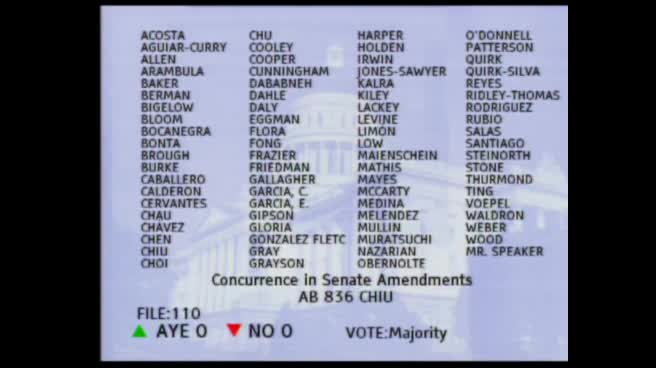 54SEC
Assembly Floor
 1MIN
Senate Floor
 14MIN
Senate Standing Committee on Education
 1MIN
Assembly Floor
 1MIN
Assembly Floor
 50SEC
Assembly Standing Committee on Appropriations
 6MIN
Assembly Standing Committee on Education
Bill Author

Bill Co-Author(s):






