AB 240: University of California: California Institute for Aerospace.
- Session Year: 2017-2018
- House: Assembly
- Latest Version Date: 2017-03-06
Existing law establishes the University of California, under the administration of the Regents of the University of California, as one of the segments of public postsecondary education in this state. The University of California provides instruction and performs research at the 10 campuses it operates and maintains in Berkeley, Davis, Irvine, Los Angeles, Merced, Riverside, San Diego, San Francisco, Santa Barbara, and Santa Cruz.
This bill would express legislative findings and declarations relating to the aerospace industry in this state. The bill would request the regents to establish the California Institute for Aerospace to achieve specified goals relating to the development of the aerospace industry in the state. The bill would also request the regents to locate the California Institute for Aerospace at a satellite campus within 20 miles of Edwards Air Force Base or United States Air Force Plant 42 so that it will be in close proximity to a large part of Californias current aerospace research and development. The bill would provide that it would be implemented only to the extent that the regents determine that adequate funding for its purposes has been provided to the University of California, as specified.
The Legislature hereby finds and declares all of the following:
(a)Californias aerospace industry is a world leader and a powerful, reliable source of employment, innovation, and export income, directly employing several hundred thousand California workers.
(b)The enactment of a state aerospace tax credit in 2014 has positioned California to receive thousands of new jobs researching, designing, building, and testing the Long Range Strike Bomber following the awarding of the contract by the United States Air Force in 2015.
(c)In order to maximize the states potential for creating new research, design, and manufacturing jobs as a result of this contract, NASAs recently announced New Aviation Horizons initiative for aeronautics research and development, and the numerous aerospace-related companies already operating in the state, the creation of the California Institute for Aerospace by the University of California would greatly amplify the states role in the industry and improve public-private partnerships for innovative research.
(d)The model provided by the Collaborative Center for Aerospace Sciences, a joint research venture of the United States Air Force Research Laboratory and the University of California, Los Angeles, is an example of the partnerships the California Institute for Aerospace could form and expand.
(e)Throughout the history of the University of California, many industries have grown in partnership utilizing innovative research conducted by the university.
SEC. 2.Article 7 (commencing with Section 92665) is added to Chapter 6 of Part 57 of Division 9 of Title 3 of the Education Code, to read:7.California Institute for Aerospace92665.(a)The Regents of the University of California are requested to establish the California Institute for Aerospace in order to achieve all of the following goals:
(1)Grow Californias economy and the aerospace industry by creating new opportunities for jobs in aerospace research and design.
(2)Utilize public-private partnerships to perform innovative research in aerospace technology.
(3)Strengthen Californias position as a global leader in the aerospace industry by increasing the amount of research, development, and design taking place in the state.
(4)Maximize Californias role in designing and building the Long Range Strike Bomber.(5)(4)Develop Californias next generation of engineers and technicians through expanded career technical education research opportunities within the aerospace industry.
(6)Act as an incubator for aerospace-focused small businesses and technology companies.(b)The regents are requested to locate the California Institute for Aerospace at a satellite campus within 20 miles of Edwards Air Force Base or United States Air Force Plant 42 so that it will be in close proximity to a large part of Californias current aerospace research and development.
92665.5.This article shall be implemented only to the extent that the regents determine that adequate funding for its purposes has been provided from federal, local, or private sector sources, has been appropriated to the University of California in the annual Budget Act or in another statute, or has been provided from a combination of these sources.
The Legislature hereby finds and declares all of the following:
(a)Californias aerospace industry is a world leader and a powerful, reliable source of employment, innovation, and export income, directly employing several hundred thousand California workers.
(b)The enactment of a state aerospace tax credit in 2014 has positioned California to receive thousands of new jobs researching, designing, building, and testing the Long Range Strike Bomber following the awarding of the contract by the United States Air Force in 2015.
(c)In order to maximize the states potential for creating new research, design, and manufacturing jobs as a result of this contract, NASAs recently announced New Aviation Horizons initiative for aeronautics research and development, and the numerous aerospace-related companies already operating in the state, the creation of the California Institute for Aerospace by the University of California would greatly amplify the states role in the industry and improve public-private partnerships for innovative research.
(d)The model provided by the Collaborative Center for Aerospace Sciences, a joint research venture of the United States Air Force Research Laboratory and the University of California, Los Angeles, is an example of the partnerships the California Institute for Aerospace could form and expand.
(e)Throughout the history of the University of California, many industries have grown in partnership utilizing innovative research conducted by the university.
SEC. 2.Article 7 (commencing with Section 92665) is added to Chapter 6 of Part 57 of Division 9 of Title 3 of the Education Code, to read:7.California Institute for Aerospace92665.(a)The Regents of the University of California are requested to establish the California Institute for Aerospace in order to achieve all of the following goals:
(1)Grow Californias economy and the aerospace industry by creating new opportunities for jobs in aerospace research and design.
(2)Utilize public-private partnerships to perform innovative research in aerospace technology.
(3)Strengthen Californias position as a global leader in the aerospace industry by increasing the amount of research, development, and design taking place in the state.
(4)Maximize Californias role in designing and building the Long Range Strike Bomber.
(5)Develop Californias next generation of engineers and technicians through expanded career technical education opportunities within the aerospace industry.
(6)Act as an incubator for aerospace-focused small businesses and technology companies.
(b)The regents are requested to locate the California Institute for Aerospace at a satellite campus within 20 miles of Edwards Air Force Base or United States Air Force Plant 42 so that it will be in close proximity to a large part of Californias current aerospace research and development.
92665.5.This article shall be implemented only to the extent that the regents determine that adequate funding for its purposes has been provided from federal, local, or private sector sources, has been appropriated to the University of California in the annual Budget Act or in another statute, or has been provided from a combination of these sources.
|
Date
|
Status
|
|---|---|
| Feb 1, 2018 | From committee: Filed with the Chief Clerk pursuant to Joint Rule 56. |
| Jan 31, 2018 | Died pursuant to Art. IV, Sec. 10(c) of the Constitution. |
| May 26, 2017 | In committee: Held under submission. |
| Apr 5, 2017 | In committee: Set, first hearing. Referred to APPR. suspense file. |
| Mar 15, 2017 | From committee: Do pass and re-refer to Com. on APPR. (Ayes 13. Noes 0.) (March 14). Re-referred to Com. on APPR. |
| Mar 7, 2017 | Re-referred to Com. on HIGHER ED. |
| Mar 6, 2017 | From committee chair, with author's amendments: Amend, and re-refer to Com. on HIGHER ED. Read second time and amended. |
| Feb 6, 2017 | Referred to Com. on HIGHER ED. |
| Jan 31, 2017 | From printer. May be heard in committee March 2. |
| Jan 30, 2017 | Read first time. To print. |
|
Date
|
Description
|
Location
|
Votes
|
|
|---|---|---|---|---|
| Mar 14, 2017 | Do pass and be re-referred to the Committee on [Appropriations] | Assembly Standing Committee on Higher Education |
Passed |
This list shows positions taken on this bill by organizations on the date displayed, which is linked to the original source.
Positions by individuals are not included.
Date of Hearing: April 5, 2017
ASSEMBLY COMMITTEE ON APPROPRIATIONS
Lorena Gonzalez Fletcher, Chair
ABPCA Bill Id:AB 240
Author:(Lackey) – As Amended Ver:March 6, 2017
Policy Committee: | Higher Education | Vote: | 13-0 |
|
| ||
|
|
Urgency: No State Mandated Local Program: No Reimbursable: No
SUMMARY:
This bill requests the University of California (UC) Regents to establish the California Institute for Aerospace. Specifically, this bill:
- Requests the Regents to establish the institute in order to achieve specified goals, including: a) creating new opportunities for jobs in aerospace research; b) design and using public-private partnerships to perform innovative research in aerospace technology; and c) develop California’s next generation of engineers and technicians through expanded research opportunities within the aerospace industry.
- Requests the regents locate the institute at a satellite campus within 20 miles of Edwards Air Force Base or United States Air Force Plant 42, so that it will be close to a large part of the state's current aerospace research and development.
- Provides this bill may only be implemented to the extent that Regents determine adequate funding has been provided from federal, local, or private sector sources, and has been appropriated in the annual Budget Act or in another statute, or has been provided from a combination of these sources.
FISCAL EFFECT: Annual costs to UC of over $3 million per year. UC indicates that it is open to establishing a research institute to the extent it has appropriate expertise and adequate funding.
COMMENTS:
- Purpose. The author argues "California institutes have been tremendous resources for research in various industries. They have successfully addressed critical issues facing the globe in the fields of biology, physics, chemistry, economics, and medicine." According to the author, "with a small investment, such institutes provide a substantial economic impact on their surrounding areas and the entire state by accelerating research and product development. This institute would strengthen California’s position as a global leader in the aerospace industry, increase public-private partnerships and fully maximize our role in designing and building the Long Range Strike Bomber."
- Background. AB 2664 (Irwin) Chapter 862, Statutes of 2016, provided UC with $22 million one-time General Fund for innovation and entrepreneurship programs ($2.2 million per UC). The bill outlined implementation parameters to use these funds for business training, mentorship, proof-of-concept grants, work space, laboratory space and equipment. UC confirms that AB 2664 funds have already been committed and no existing funds can be diverted for the implementation of this bill.
Analysis Prepared by: Daisy Gonzales / APPR. / (916) 319-2081
Date of Hearing: March 14, 2017
ASSEMBLY COMMITTEE ON HIGHER EDUCATION
Jose Medina, Chair
ABPCA Bill Id:AB 240 (
Author:Lackey) – As Amended Ver:March 6, 2017
SUBJECT: University of California: California Institute for Aerospace.
SUMMARY: Requests the University of California (UC) Regents establish the California Institute for Aerospace. Specifically, this bill:
- Finds and declares all of the following:
- California’s aerospace industry is a world leader and a powerful, reliable source of employment, innovation, and export income, directly employing several hundred thousand California workers;
- The enactment of a state aerospace tax credit in 2014 has positioned California to receive thousands of new jobs researching, designing, building, and testing the Long Range Strike Bomber following the awarding of the contract by the United States Air Force in 2015;
- In order to maximize the state’s potential for creating new research, design, and manufacturing jobs as a result of this contract, NASA’s recently announced New Aviation Horizons initiative for aeronautics research and development, and the numerous aerospace-related companies already operating in the state, the creation of the California Institute for Aerospace by the University of California would greatly amplify the state’s role in the industry and improve public-private partnerships for innovative research;
- The model provided by the Collaborative Center for Aerospace Sciences, a joint research venture of the United States Air Force Research Laboratory and the University of California, Los Angeles, is an example of the partnerships the California Institute for Aerospace could form and expand; and,
- Throughout the history of the UC, many industries have grown in partnership utilizing innovative research conducted by the university.
- Requests the UC Regents establish the California Institute for Aerospace in order to achieve all of the following goals:
- Grow California’s economy and the aerospace industry by creating new opportunities for jobs in aerospace research and design;
- Utilize public-private partnerships to perform innovative research in aerospace technology;
- Strengthen California’s position as a global leader in the aerospace industry by increasing the amount of research, development, and design taking place in the state; and,
- Develop California’s next generation of engineers and technicians through expanded research opportunities within the aerospace industry.
- Requests the UC Regents locate the California Institute for Aerospace at a satellite campus within 20 miles of Edwards Air Force Base or United States Air Force Plant 42 so that it will be in close proximity to a large part of California’s current aerospace research and development.
- Provides that this bill shall only be implemented to the extent that the UC Regents determine that adequate funding for its purposes has been provided from federal, local, or private sector sources, has been appropriated in the annual Budget Act or in another statute, or has been provided from a combination of these sources.
EXISTING LAW:
- Establishes the UC as a public trust and confers the full powers of the UC upon the UC Regents. The Constitution establishes that the UC is subject to legislative control only to the degree necessary to ensure the security of its funds and compliance with the terms of its endowments. Judicial decisions have held that there are three additional areas in which there may be limited legislative intrusion into university operations: authority over the appropriation of state moneys; exercise of the general police power to provide for the public health, safety and welfare; and, legislation on matters of general statewide concern not involving internal university affairs (Constitution of California, Article IX, Section 9).
- Establishes the Donahoe Higher Education Act, setting forth the mission of the UC (Education Code (EC) Section 66010, et seq.).
- Grants the UC Regents regulatory authority over the UC (EC Section 92440, et seq.).
FISCAL EFFECT: Unknown.
COMMENTS: Background. The Legislature, in 2014, debated a series of bills relative to the aerospace industry, a brief history of the industry was included in those bill analyses:
The aerospace industry began in California with a few aircraft builders around World War I, and then vastly expanded in the mobilization for World War II. The industry steadily grew during the Cold War encompassing a wide range of activities, including military and civilian aircraft, reconnaissance and communications satellites, strategic missiles, and space exploration. By the 1980s, about 40% of the aerospace business resided in southern California, and the industry employed close to a half-million people. One of the region's strongest selling points for aerospace was its environment: the clear blue skies and ample open spaces were ideal for testing new aircraft. California also was home to a variety of related industries, particularly petroleum, as well as top-notch research universities and a large labor pool.
Defense spending peaked at $557 billion in 1985 (in constant fiscal 2009 dollars) and then began a downward trend. The collapse of the Soviet Union and the end the Cold War led to more than 50 major defense companies consolidating into only six. According to the Employment Development Department's Labor Market Information Division, employment in the Aerospace Production and Manufacturing sector declined from 139,300 in 1993 to 70,800 in 2013. Most of the decline occurred before 2004. However, further job decline is likely because defense spending is expected to fall due to the implementation of federal budget cuts.
Purpose of this measure. According to the author, "California’s aerospace companies in 2012 contributed $62 billion in tax revenues, equivalent to more than a third of the state budget. Employing a highly skilled and specialized workforce of more than half a million people in commercial, military and civil capacities, the aerospace industry’s statewide economic impact in 2012 exceeded $100 billion, with average annual aerospace industry wages among the nation’s highest." The author contends that, "California institutes have been tremendous resources for research in various industries. They have successfully addressed critical issues facing the globe in the fields of biology, physics, chemistry, economics, and medicine."
Additionally, the author argues, "We have already seen aerospace industry companies and programs lured away, if industry outmigration continues, California risks losing global aerospace market share; to help the industry attract and retain the talent it needs to propel it forward, California should continue to invest in the aerospace industry.
Committee consideration. Chaptered in 2016, AB 2664 (Irwin), required the UC to expand or accelerate economic development in the state in ways that support innovation and entrepreneurship; the Committee may wish to consider if the passage of AB 240, as outlined in this bill, will divert UC from its existing focus as stipulated in AB 2664.
Related legislation. AB 427 (Muratsuchi), which is pending a hearing in the Assembly Arts, Entertainment, Sports, Tourism, and Internet Media Committee, would, among others, establish the California Aerospace Commission to foster the development of activities in California related to aerospace, including, but not limited to, aviation, commercial and governmental space travel, unmanned aerial vehicles, aerospace education and job training, infrastructure and research launches, manufacturing, academic research, applied research, economic diversification, business development, tourism, and education.
AB 2600 (Lackey) of 2016, which was held on suspense in the Assembly Appropriations Committee, was virtually identical to this measure.
AB 2664 (Irwin), Chapter 862, Statutes of 2016, required the UC, among others, to make one-time expenditures on activities, using the $22 million General Fund provided in the Budget Act of 2016, to expand or accelerate economic development in the state in ways that support innovation and entrepreneurship.
REGISTERED SUPPORT / OPPOSITION:
Support
Board of Trustees of the Antelope Valley Community College District
California Institute for Aerospace
Opposition
None on file.
Analysis Prepared by: Jeanice Warden / HIGHER ED. / (916) 319-3960
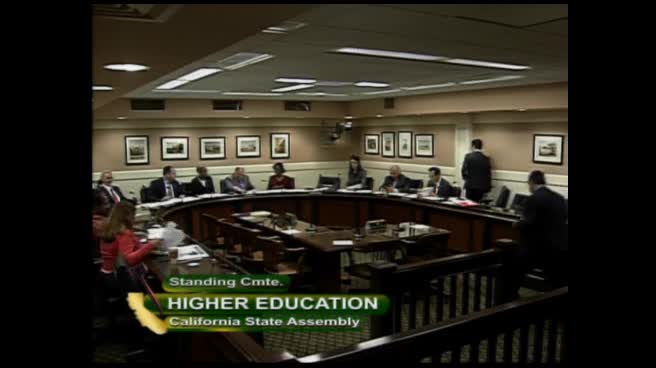
Discussed in Hearing
 1H
Assembly Standing Committee on Appropriations
 7MIN
Assembly Standing Committee on Higher Education
Bill Author