AB 2450: Electrically conductive balloons.
- Session Year: 2017-2018
- House: Assembly
- Latest Version Date: 2018-09-05
Existing law prohibits a person from selling or distributing a balloon constructed of electrically conductive material and filled with a gas lighter than air without affixing to the balloon a weighted object, the identity of the manufacturer, and a warning statement, and prohibits the sale or distribution of an electrically conductive balloon filled with a gas lighter than air that is attached to an electrically conductive string, tether, streamer, or another electrically conductive balloon or appurtenance. A violation of those provisions is a misdemeanor.
This bill would instead make those provisions subject to civil action. The bill would also require a person who manufactures a balloon that is constructed of electrically conductive material to permanently mark each balloon with the identity of the manufacturer and a printed statement that warns the consumer about the dangerous risk of fire if the balloon comes in contact with an electrical power line.
Existing law prohibits a person from selling or distributing a balloon constructed of electrically conductive material and filled with a gas lighter than air without affixing to the balloon a weighted object, the identity of the manufacturer, and a warning statement, and prohibits the sale or distribution of an electrically conductive balloon filled with a gas lighter than air that is attached to an electrically conductive string, tether, streamer, or another electrically conductive balloon or appurtenance. A violation of those provisions is a misdemeanor.
This bill would instead make those provisions subject to civil action. The bill would also require a person who manufactures a balloon that is constructed of electrically conductive material and filled with a gas lighter than air to permanently mark each balloon with the identity of the manufacturer and a printed statement that warns the consumer about the dangerous risk of fire if the balloon comes in contact with an electrical power line.
Existing law makes it a crime for a person to sell or distribute a balloon that is constructed of electrically conductive material and filled with a gas lighter than air that does not have a statement affixed to the balloon that warns the consumer about the risk if the balloon comes in contact with electrical power lines.
This bill would require a person who manufactures a balloon that is constructed of electrically conductive material and filled with a gas lighter than air to permanently mark each balloon with a printed statement that warns the consumer about the dangerous risk of fire if the balloon comes in contact with an electrical power line.
Existing law makes it a crime for a person to sell or distribute a balloon that is constructed of electrically conductive material and filled with a gas lighter than air that does not have a statement affixed to the balloon that warns the consumer about the risk if the balloon comes in contact with electrical power lines.
This bill would require a person who manufactures a balloon that is constructed of electrically conductive material and filled with a gas lighter than air to permanently mark each balloon with a printed statement that warns the consumer about the risk if the balloon comes in contact with an electrical power line.
(a)A person who manufactures a balloon in this state that is constructed of electrically conductive material shall comply with both of the following:
(1)Permanently mark each balloon with a printed statement, written in a legible font size and located in a conspicuous area on the balloon, that warns the consumer about the dangerous risk of fire if the balloon comes in contact with an electrical power line.
(2)Permanently mark each balloon with the identity of the manufacturer.
(b)A person who sells or distributes a balloon constructed of electrically conductive material that is filled with a gas lighter than air shall comply with both of the following:
(1)The person shall affix an object of sufficient weight to each balloon or its appurtenance to counter the lift capability of the balloon.
(2)The person shall not attach the balloon to an electrically conductive string, tether, or streamer, to a balloon constructed of electrically conductive material, or to any other electrically conductive object.
(c)This section shall not apply to manned hot air balloons or to balloons used in governmental or scientific research projects.
SEC. 2.Section 653.1 of the Penal Code is amended to read:653.1.(a)No person or group shall release, outdoors, balloons made of electrically conductive material and filled with a gas lighter than air, as part of a public or civic event, promotional activity, or product advertisement.
(b)Any person who violates this section shall be guilty of an infraction punishable by a fine not exceeding one hundred dollars ($100). Any person who violates this section who has been previously convicted twice of violating this section shall be guilty of a misdemeanor.
(c)This section shall not apply to manned hot air balloons, or to balloons used in governmental or scientific research projects.
(a)A person who manufactures a balloon in this state that is constructed of electrically conductive material and filled with a gas lighter than air shall permanently comply with both of the following:
(1)Permanently mark each balloon with a printed statement, written in a legible font size and located in a conspicuous area on the balloon, that warns the consumer about the dangerous risk of fire if the balloon comes in contact with an electrical power line.
(2)Permanently mark each balloon with the identity of the manufacturer.
(b)A person who sells or distributes a balloon constructed of electrically conductive material that is filled with a gas lighter than air shall comply with both of the following:
(1)The person shall affix an object of sufficient weight to each balloon or its appurtenance to counter the lift capability of the balloon.
(2)The person shall not attach the balloon to an electrically conductive string, tether, or streamer, to a balloon constructed of electrically conductive material, or to any other electrically conductive object.
(b)(c)This section shall not apply to manned hot air balloons or to balloons used in governmental or scientific research projects.
SEC. 2.Section 653.1 of the Penal Code is amended to read:653.1.(a)No person shall sell or distribute any balloon that is constructed of electrically conductive material, and filled with a gas lighter than air without:(1)Affixing an object of sufficient weight to the balloon or its appurtenance to counter the lift capability of the balloon.(2)Affixing a statement on the balloon, or ensuring that a statement is so affixed, that warns the consumer about the risk if the balloon comes in contact with electrical power lines.(3)A printed identification of the manufacturer of the balloon.(b)No person shall sell or distribute any balloon filled with a gas lighter than air that is attached to an electrically conductive string, tether, streamer, or other electrically conductive appurtenance.(c)No person shall sell or distribute any balloon that is constructed of electrically conductive material and filled with a gas lighter than air and that is attached to another balloon constructed of electrically conductive material and filled with a gas lighter than air. (d)653.1.(a)No person or group shall release, outdoors, balloons made of electrically conductive material and filled with a gas lighter than air, as part of a public or civic event, promotional activity, or product advertisement.
(e)(b)Any person who violates subdivision (a), (b), (c), or (d) this section shall be guilty of an infraction punishable by a fine not exceeding one hundred dollars ($100). Any person who violates subdivision (a), (b), (c), or (d) this section who has been previously convicted twice of violating subdivision (a), (b), (c), or (d) this section shall be guilty of a misdemeanor.
(f)(c)This section shall not apply to manned hot air balloons, or to balloons used in governmental or scientific research projects.
(a)A person who manufactures a balloon in this state that is constructed of electrically conductive material and filled with a gas lighter than air shall permanently mark each balloon with a printed statement statement, written in a legible font size and located in a conspicuous area on the balloon, that warns the consumer about the dangerous risk of fire if the balloon comes in contact with an electrical power line.
(b)This section shall not apply to manned hot air balloons or to balloons used in governmental or scientific research projects.
(a)A person who manufactures a balloon in this state that is constructed of electrically conductive material and filled with a gas lighter than air shall permanently mark each balloon with a printed statement that warns the consumer about the risk if the balloon comes in contact with an electrical power line.
(b)This section shall not apply to manned hot air balloons or to balloons used in governmental or scientific research projects.
|
Date
|
Status
|
|---|---|
| Sep 5, 2018 | Chaptered by Secretary of State - Chapter 262, Statutes of 2018. |
| Sep 5, 2018 | Approved by the Governor. |
| Aug 28, 2018 | Enrolled and presented to the Governor at 3 p.m. |
| Aug 23, 2018 | Senate amendments concurred in. To Engrossing and Enrolling. |
| Aug 16, 2018 | In Assembly. Concurrence in Senate amendments pending. May be considered on or after August 18 pursuant to Assembly Rule 77. |
| Aug 16, 2018 | Read third time. Passed. Ordered to the Assembly. |
| Jun 20, 2018 | Read second time. Ordered to third reading. |
| Jun 19, 2018 | From committee: Do pass. (Ayes 7. Noes 2.) (June 18). |
| Jun 11, 2018 | From committee chair, with author's amendments: Amend, and re-refer to committee. Read second time, amended, and re-referred to Com. on B., P. & E.D. |
| May 24, 2018 | Referred to Com. on B., P. & E.D. |
| May 10, 2018 | In Senate. Read first time. To Com. on RLS. for assignment. |
| May 10, 2018 | Read third time. Passed. Ordered to the Senate. |
| May 9, 2018 | Read second time. Ordered to third reading. |
| May 8, 2018 | From committee: Do pass. (Ayes 13. Noes 3.) (May 8). |
| May 7, 2018 | Re-referred to Com. on B. & P. |
| May 3, 2018 | From committee chair, with author's amendments: Amend, and re-refer to Com. on B. & P. Read second time and amended. |
| Mar 12, 2018 | Referred to Com. on B. & P. |
| Feb 15, 2018 | From printer. May be heard in committee March 17. |
| Feb 14, 2018 | Read first time. To print. |
|
Date
|
Description
|
Location
|
Votes
|
|
|---|---|---|---|---|
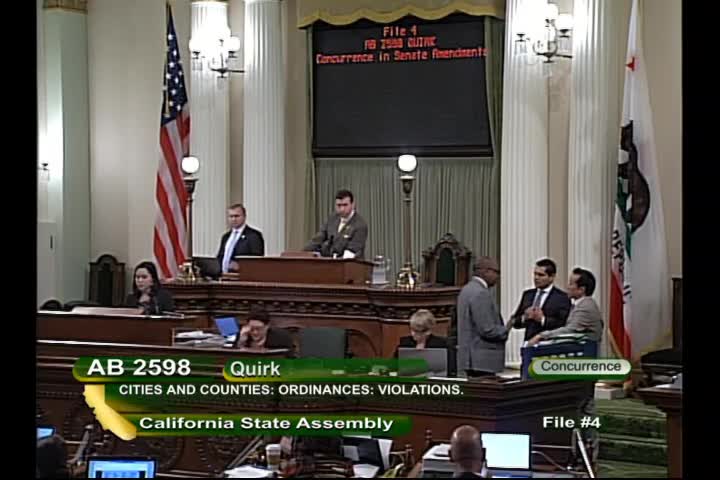
| Aug 23, 2018 | AB 2450 QUIRK Concurrence in Senate Amendments | Assembly Floor |
Passed |
|
| Aug 16, 2018 | Assembly 3rd Reading AB2450 Quirk By Hill | Senate Floor |
Passed |
|
| Jun 18, 2018 | Do pass | Senate Standing Committee on Business, Professions and Economic Development |
Passed |
|
| May 10, 2018 | AB 2450 QUIRK Assembly Third Reading | Assembly Floor |
Passed |
|
| May 8, 2018 | Do pass. | Assembly Standing Committee on Business and Professions |
Passed |
This list shows positions taken on this bill by organizations on the date displayed, which is linked to the original source.
Positions by individuals are not included.
CONCURRENCE IN SENATE AMENDMENTS
CSA1 Bill Id:AB 2450
Author:(Quirk)
As Amended Ver:June 11, 2018
Majority vote
ASSEMBLY: | 56-12 | (May 10, 2018) | SENATE: | 27-11 | (August 16, 2018) |
Original Committee Reference: B. & P.
SUMMARY: This bill requires manufacturers of balloons constructed of electrically conductive material in California to permanently mark each balloon with a warning about the dangerous risk of fires if a balloon comes in contact with an electrical power line. This bill also makes violating specified requirements related to the selling or distribution of balloons constructed of electrically conductive material subject to civil, rather than criminal, penalties.
The Senate amendments in Section 1 were made to Business and Professions Code, Chapter 31 (Electrically Conductive Balloons), and in Section 2, Penal Code Section 653.1 is amended to read that no person or group shall release, outdoors, balloons made of electrically conductive material and filled with a gas lighter than air, as part of a public or civic event, promotional activity, or product advertisement.
Also, added to this Section, is that any person who violates this shall be guilty of an infraction punishable by a fine not exceeding $100. In addition, any person who violates this section who has been previously convicted twice of this section shall be guilty of a misdemeanor.
Lastly, this section shall not apply to manned hot air balloons, or to balloons used in governmental or scientific research projects.
EXISTING LAW:
- Prohibits the selling or distribution of any balloon that is constructed of electrically conductive material and filled with a gas lighter than air not affixed with a weighted object to counter the lift capability of the balloon; a statement that warns the customer about the risk if the balloon comes in contact with electrical power lines; and a printed identification of the manufacturer. (Penal Code Section (PEN) 653.1(a))
- Prohibits the selling or distribution of any balloon that is filled with a gas lighter than air attached to an electrically conductive attachment, including a string, tether, or stream. (PEN 653.1(b))
- Prohibits the selling or distribution of any balloon that is constructed of electrically conductive material and filled with a gas lighter than air attached to another balloon constructed of electrically conductive material and filled with a gas lighter than air. (PEN 653.1(c))
- Prohibits a person or a group from releasing balloons made of electrically conductive material and filled with a gas lighter than air outdoors as part of a public or civic event, promotional activity, or product advertisement. (PEN 653.1(d))
- Specifies that a person who violates any of the above provisions is guilty of an infraction punishable by a maximum fine of $100 or, if the person has been previously convicted twice of violating the above provisions, a misdemeanor. (PEN 653.1(e))
- Clarifies that the above provisions do not apply to manned hot air balloons or balloons used in governmental or scientific research projects. (PEN 653.1(f))
FISCAL EFFECT: This bill has been keyed non-fiscal by the Legislative Counsel
COMMENTS:
- Purpose. Requires manufacturers of balloons constructed of electrically conductive material in California to permanently mark each balloon with a printed statement, in a legible font size place in a conspicuous are on the balloon, warning the consumer about the dangerous risk of fire if the balloon were to come in contact with an electrical power line.
- Deletes provisions related to the selling and distribution of balloons constructed of electrically conductive material from the Penal Code and moves the following provisions from the Penal Code to the Business and Professions Code:
- Manufacturers of balloons constructed of electrically conductive material in California are required to permanently mark each balloon with the identity of the manufacturer.
- Sellers or distributers of balloons constructed of electrically conductive material filled with a gas lighter than air are required to affix an object of sufficient weight to each balloon or its appurtenance to counter the lift of the balloon.
- Sellers or distributors of balloons constructed of electrically conductive material filled with a gas lighter than air are prohibited from attaching an electrically conductive material or object, including a string, tether, or streamer, to the balloon.
- Specifies that the above provisions do not apply to manned hot air balloons or to balloons used in governmental or scientific research projects.
Background. Mylar Balloons. There are two common types of balloons currently in use, Mylar and latex balloons. Mylar balloons are made with Mylar nylon, a material not classified as biodegradable, and are typically coated with a metallic finish. Latex balloons are biodegradable and do not typically conduct electricity. If Mylar balloons are not sufficiently weighted and are released into the air, they have the potential to travel several miles and end up tangling in power lines. The metallic finish on Mylar balloons conduct electricity, so if these balloons come in contact with electrical lines, they can cause a bridge resulting in power outages. Mylar balloons are often released for celebrations, such as birthdays or memorials, or as part of a mass balloon release by non-profit organizations and charity groups to raise funds. PG&E reports that they typically see a spike in the number of power outages caused by metallic balloons during the graduation season.
Southern California Edison recently reported that metallic balloon-related outages are on the rise causing Edison to handle a record 1,094 Mylar balloon-related power outages in 2017, which caused 1.4 million customers to experience outages caused by balloons. PG&E reported that 456 power outages were caused by these metallic Mylar balloons in 2017, across PG&E's service area of northern and central California, disrupting service to more than 371,000 homes and businesses. Recently on June 3, 2018, 4,500 customers in Palo Alto lost power when a Mylar balloon got caught in the powerlines, which the Palo Alto Utilities reported was the number one cause to power outages in the area. Balloons stuck in power lines can harm energy company workers tasked with removing the balloons from the powerlines and lead to fires.
Analysis Prepared by: Danielle Sires / B. & P. / (916) 319-3301 FN: 0003571
Office of Senate Floor Analyses (916) 651-1520 Fax: (916) 327-4478 | AB |
THIRD READING
Bill No: AB 2450
:
SENATE BUS., PROF. & ECON. DEV. COMMITTEE: 7-2, 6/18/18
AYES: Hill, Allen, Dodd, Galgiani, Glazer, Hernandez, Pan
NOES: Fuller, Wilk
ASSEMBLY FLOOR: 56-12, 5/10/18 - See last page for vote
DIGEST:
This bill requires manufacturers of balloons constructed of electrically conductive material in California to permanently mark each balloon with a warning about the dangerous risk of fires if a balloon comes in contact with an electrical power line. This bill also makes violating specified requirements related to the selling or distribution of balloons constructed of electrically conductive material subject to civil, rather than criminal, penalties.
Existing law:
- Prohibits the selling or distribution of any balloon that is constructed of electrically conductive material and filled with a gas lighter than air not affixed with a weighted object to counter the lift capability of the balloon; a statement that warns the customer about the risk if the balloon comes in contact with electrical power lines; and a printed identification of the manufacturer.
(Penal Code (PEN) § 653.1(a)) - Prohibits the selling or distribution of any balloon that is filled with a gas lighter than air attached to an electrically conductive attachment, including a string, tether, or stream. (PEN § 653.1(b))
- Prohibits the selling or distribution of any balloon that is constructed of electrically conductive material and filled with a gas lighter than air attached to another balloon constructed of electrically conductive material and filled with a gas lighter than air. (PEN § 653.1(c))
- Prohibits a person or a group from releasing balloons made of electrically conductive material and filled with a gas lighter than air outdoors as part of a public or civic event, promotional activity, or product advertisement.
(PEN § 653.1(d)) - Specifies that a person who violates any of the above provisions is guilty of an infraction punishable by a maximum fine of one hundred dollars ($100) or, if the person has been previously convicted twice of violating the above provisions, a misdemeanor. (PEN § 653.1(e))
- Clarifies that the above provisions do not apply to manned hot air balloons or balloons used in governmental or scientific research projects. (PEN § 653.1(f))
This bill:
- Requires manufacturers of balloons constructed of electrically conductive material in California to permanently mark each balloon with a printed statement, in a legible font size place in a conspicuous are on the balloon, warning the consumer about the dangerous risk of fire if the balloon were to come in contact with an electrical power line.
- Deletes provisions related to the selling and distribution of balloons constructed of electrically conductive material from the Penal Code and moves the following provisions from the Penal Code to the Business and Professions Code:
- Manufacturers of balloons constructed of electrically conductive material in California are required to permanently mark each balloon with the identity of the manufacturer.
- Sellers or distributers of balloons constructed of electrically conductive material filled with a gas lighter than air are required to affix an object of sufficient weight to each balloon or its appurtenance to counter the lift of the balloon.
- Sellers or distributors of balloons constructed of electrically conductive material filled with a gas lighter than air are prohibited from attaching an electrically conductive material or object, including a string, tether, or streamer, to the balloon.
- Specifies that the above provisions do not apply to manned hot air balloons or to balloons used in governmental or scientific research projects.
Background
Mylar Balloons. There are two common types of balloons currently in use, Mylar and latex balloons. Mylar balloons are made with Mylar nylon, a material not classified as biodegradable, and are typically coated with a metallic finish. Latex balloons are biodegradable and do not typically conduct electricity. If Mylar balloons are not sufficiently weighted and are released into the air, they have the potential to travel several miles and end up tangling in power lines. The metallic finish on Mylar balloons conduct electricity, so if these balloons come in contact with electrical lines, they can cause a bridge resulting in power outages. Mylar balloons are often released for celebrations, such as birthdays or memorials, or as part of a mass balloon release by non-profit organizations and charity groups to raise funds. PG&E reports that they typically see a spike in the number of power outages caused by metallic balloons during the graduation season.
Southern California Edison recently reported that metallic balloon-related outages are on the rise causing Edison to handle a record 1,094 Mylar balloon-related power outages in 2017, which caused 1.4 million customers to experience outages caused by balloons. PG&E reported that 456 power outages were caused by these metallic Mylar balloons in 2017, across PG&E’s service area of northern and central California, disrupting service to more than 371,000 homes and businesses. Recently on June 3, 2018, 4,500 customers in Palo Alto lost power when a Mylar balloon got caught in the powerlines, which the Palo Alto Utilities reported was the number one cause to power outages in the area. Balloons stuck in power lines can harm energy company workers tasked with removing the balloons from the powerlines and lead to fires.
FISCAL EFFECT: Appropriation: Fiscal Com.: Local:
Burbank Water and Power
California Municipal Utilities Association
California State Association of Electrical Workers
City of Burbank
City of Roseville
Coalition of California Utility Employees
Northern California Power Agency
PacifiCorp
San Francisco Bay Area Rapid Transit District
Southern California Edison
Southern California Public Power Authority
OPPOSITION: (Verified 6/20/18)
None received
ARGUMENTS IN SUPPORT: Supporters write that each thousands of power outages are caused by Mylar balloons colliding with powerlines. By requiring manufacturers to print a permanent notice on Mylar balloons informing customers of the dangers of the balloons coming into contact with power lines, the associated problems can be mitigated.
ASSEMBLY FLOOR: 56-12, 5/10/18
AYES: Aguiar-Curry, Arambula, Berman, Bloom, Bonta, Burke, Caballero, Calderon, Carrillo, Cervantes, Chau, Chávez, Chen, Chiu, Chu, Cooper, Cunningham, Daly, Eggman, Frazier, Eduardo Garcia, Gipson, Gloria, Gonzalez Fletcher, Gray, Grayson, Holden, Irwin, Jones-Sawyer, Kalra, Kamlager-Dove, Lackey, Levine, Limón, Low, Maienschein, McCarty, Medina, Mullin, Muratsuchi, Nazarian, O'Donnell, Quirk, Quirk-Silva, Reyes, Rodriguez, Rubio, Salas, Santiago, Mark Stone, Thurmond, Ting, Voepel, Weber, Wood, Rendon
NOES: Acosta, Baker, Bigelow, Brough, Dahle, Fong, Gallagher, Kiley, Mathis, Melendez, Patterson, Waldron
NO VOTE RECORDED: Travis Allen, Choi, Cooley, Flora, Friedman, Cristina Garcia, Harper, Mayes, Obernolte, Steinorth
6/20/18 14:56:18
**** END ****
SENATE COMMITTEE ON
BUSINESS, PROFESSIONS AND ECONOMIC DEVELOPMENT
Senator Jerry Hill, Chair
2017 - 2018 Regular
Bill No: Hearing Date: June 18, 2018
Author: | |||
Version: | June 11, 2018 | ||
Urgency: | No | Fiscal: | No |
Consultant: | Anissa Badea | ||
Subject:
SUMMARY:
Requires manufacturers of balloons constructed of electrically conductive material in California to permanently mark each balloon with a warning about the dangerous risk of fires if a balloon comes in contact with an electrical power line. Makes violating specified requirements related to the selling or distribution of balloons constructed of electrically conductive material subject to civil, rather than criminal, penalties.
Existing law:
- Prohibits the selling or distribution of any balloon that is constructed of electrically conductive material and filled with a gas lighter than air not affixed with a weighted object to counter the lift capability of the balloon; a statement that warns the customer about the risk if the balloon comes in contact with electrical power lines; and a printed identification of the manufacturer. (Penal Code (PEN) § 653.1(a))
- Prohibits the selling or distribution of any balloon that is filled with a gas lighter than air attached to an electrically conductive attachment, including a string, tether, or stream. (PEN § 653.1(b))
- Prohibits the selling or distribution of any balloon that is constructed of electrically conductive material and filled with a gas lighter than air attached to another balloon constructed of electrically conductive material and filled with a gas lighter than air. (PEN § 653.1(c))
- Prohibits a person or a group from releasing balloons made of electrically conductive material and filled with a gas lighter than air outdoors as part of a public or civic event, promotional activity, or product advertisement. (PEN § 653.1(d))
- Specifies that a person who violates any of the above provisions is guilty of an infraction punishable by a maximum fine of one hundred dollars ($100) or, if the person has been previously convicted twice of violating the above provisions, a misdemeanor. (PEN § 653.1(e))
- Clarifies that the above provisions do not apply to manned hot air balloons or balloons used in governmental or scientific research projects. (PEN § 653.1(f))
This bill:
- Requires manufacturers of balloons constructed of electrically conductive material in California to permanently mark each balloon with a printed statement, in a legible font size place in a conspicuous are on the balloon, warning the consumer about the dangerous risk of fire if the balloon were to come in contact with an electrical power line.
- Deletes provisions related to the selling and distribution of balloons constructed of electrically conductive material from the Penal Code and moves the following provisions from the Penal Code to the Business and Professions Code:
- Manufactures of balloons constructed of electrically conductive material in California are required to permanently mark each balloon with the identity of the manufacturer.
- Sellers or distributers of balloons constructed of electrically conductive material filled with a gas lighter than air are required to affix an object of sufficient weight to each balloon or its appurtenance to counter the lift of the balloon.
- Sellers or distributors of balloons constructed of electrically conductive material filled with a gas lighter than air are prohibited from attaching an electrically conductive material or object, including a string, tether, or streamer, to the balloon.
- Specifies that the above provisions do not apply to manned hot air balloons or to balloons used in governmental or scientific research projects.
FISCAL EFFECT:
This bill was keyed non-fiscal by Legislative Counsel.
COMMENTS:
- Purpose. The Author is the sponsor of this bill. According to the Author, “popular balloons made of metallic material, commonly known as Mylar balloons, pose a significant hazard to power lines. Since the metallic material conducts electricity, when the balloon comes into contact with power lines or in close proximity, it can cause an electric arc across two power lines that release a lot of energy which if prolonged, can melt the conducting wire, damaging power lines, and other equipment. The power outages disrupt all sorts of activities, including traffic signals, lights, business and personal activity. Wire-down incidences are a significant public safety risk because people can come into contact with high voltage power.
By requiring California manufactures to print the warning on the balloon, and by placing the warning in a conspicuous area, AB 2450 will increase the likelihood a consumer sees the warning, and reduce the risk that a warning is not affixed to the balloon by a manufacturer.” Furthermore, by striking provisions related to balloons made of electrically conductive material in the Penal Code and replicating them in the Business and Professions Code, this bill “will hopefully increase enforcement of these requirements by allowing District Attorneys and County Counsels to levy civil penalties for unfair competitive practices of up to $2,500 instead of criminal prosecution for a misdemeanor of $100.”
- Mylar Balloons. There are two common types of balloons currently in use, Mylar and latex balloons. Mylar balloons are made with Mylar nylon, a material not classified as biodegradable, and are typically coated with a metallic finish. Latex balloons are biodegradable and do not typically conduct electricity. If Mylar balloons are not sufficiently weighted and are released into the air, they have the potential to travel several miles and end up tangling in power lines. The metallic finish on Mylar balloons conduct electricity, so if these balloons come in contact with electrical lines, they can cause a bridge resulting in power outages. Mylar balloons are often released for celebrations, such as birthdays or memorials, or as part of a mass balloon release b non-profit organizations and charity groups to raise funds. PG&E reports that they typically see a spike in the number of power outages caused by metallic balloons during the graduation season.
Southern California Edison recently reported that metallic balloon-related outages are on the rise causing Edison to handle a record 1,094 Mylar balloon-related power outages in 2017 which caused 1.4 million customers to experience outages caused by balloons. PG&E reported that 456 power outages were caused by these metallic mylar balloons in 2017, across PG&E’s service area of norther and central California, disrupting service to more than 371,000 homes and businesses. Recently on June 3, 2018, 4,500 customers in Palo Alto lost power when a Mylar balloon got caught in the powerlines, which the Palo Alto Utilities reported was the number one cause to power outages in the area. Balloons stuck in power lines can harm energy company workers tasked with removing the balloons from the powerlines and lead to fires.
- Previous Related Legislation. AB 1091 (Quirk) of 2017, would have made it a crime to willfully release outdoors, balloons made of electrically conductive material, regardless of whether the outdoor release is part of a public or civic event, promotional activity, or product advertisement. (Status: This bill was vetoed by Governor Brown who wrote, “I do not believe that expanded criminal liability is the best solution to the problem of electrically conductive balloons interfering with power lines…our Penal Code is already far too complex and unnecessary proscriptive. Criminal penalties are not the solution to every problem.”)
AB 2709 (Quirk) of 2016, would have, beginning January 1, 2018, prohibited selling, distributing, or releasing balloons made of or attached to electrically conductive material, unless the balloons are not designed to be buoyant in ambient air when filled with any air. (Status: This bill was held in Senate Appropriations Committee.)
SB 1499 (Scott) of 2007, would have added new warning requirements for the sale of balloons constructed of electrically conductive material, and filled with a gas lighter than air. This bill would have also increased the fine of a violation of provisions related to electrically conductive balloons. (Status: This bill was vetoed by Governor Schwarzenegger because of the delay in passing the 2008-2009 State Budget. The Governor only signed the bills deemed of the highest priority for California and this bill did not meet that standard.)
SB 111 (Knight, Chapter 193, Statutes of 2004) repealed the obsolete requirement of the PUC to report to the Legislature on electrical service disruptions caused by metallic balloons by December 31, 1993.
SB 1990 (Ayala, Chapter 1559, Statutes of 1990) prohibited the sale or distribution of any balloon constructed of electrically conductive material and filled with a gas lighter than air, without affixing a weight to counter the lift capability of the balloon and a warning statement about the risks involved should the balloon come in contact with electrical power lines.
- Arguments in Support. The California Municipal Utilities Association, in support, writes: “each year thousands of power outages are caused by mylar balloon drifting and colliding with power lines. In some cases, these outages can cause major disruption, affecting thousands of people and lasting for many hours. In some cases, mylar balloons colliding with powerlines have caused fires. AB 2450 seeks to educate the public about the dangers of releasing mylar balloons by requiring mylar balloon manufacturer to include a warning statement on balloons about the risk of them coming into contact with power lines. By doing so, AB 2450 will hopefully lead to a decrease in power outages caused by balloons made of electrically conductive material.”
The Coalition of California Utility Employees and the California State Association of Electrical Workers write: “more than 1,800 outages caused by these balloons were reported by utilities in 2017. Fires in 2013 and 2017 were caused by metallic balloons, which burned more than 10,000 acres. By requiring manufacturers to print a permanent notice informing consumers of these hazards, the problem associated by these balloons can be mitigated.”
According to the Southern California Public Power Authority, “metallic balloons and ribbons conduct electricity. If a balloon made of conductive material and filled with helium is caught between electricity wires, the balloon acts as a bridge, allowing electricity to jump from one wire to another. When this happens, the electrical system is programmed to shut down and an outage results…Errant mylar balloons are among the top causes of power outages for utility customers. The outages caused by metallic balloons lead to damaged electrically equipment, harm to public safety services and infrastructure, economic losses to local businesses, and degraded the environment.”
The San Francisco Bay Area Rapid Transit District (BART) writes that “recently, a metallic balloon connected with the third rail at the BART Civic Center Station, exploded, and caused smoke in the station. The incident happened during the morning commute, temporarily requiring a closure and suspension of train service.”
Southern California Edison (SCE) states that “over the past seven years, there have been more than 5,660 power outages related to metallic balloons in SCE’s service territory. SCE has experienced a significant spike in outages as a result of metallic balloons in recent years. Although difficult to calculate, the economic impacts associated with such outages to local businesses and residents is estimated to be in the hundreds of millions of dollars…Downed wires create significant public safety hazards for our customers, utility workers, and first-responders that may inadvertently come into contact with a live powerline and cause electrocution.”
SUPPORT AND OPPOSITION:
Support:
Burbank Water and Power
California Municipal Utilities Association
California State Association of Electrical Workers
City of Roseville
Coalition of California Utility Employees
Northern California Power Agency
PacifiCorp
San Francisco Bay Area Rapid Transit District
Southern California Edison
Southern California Public Power Authority
Opposition:
None on file as of June 13, 2018.
-- END --
ASSEMBLY THIRD READING
ATR Bill Id:AB 2450
Author:(Quirk)
As Amended Ver:
Majority vote
Committee | Votes | Ayes | Noes |
Business & Professions | 13-3 | Low, Arambula, Chen, Chiu, Cunningham, Eggman, Gipson, Grayson, Holden, Irwin, Medina, Mullin, Ting | Baker, Fong, Obernolte |
SUMMARY: Requires a person who manufactures a balloon that is constructed of electrically conductive material to permanently mark each balloon with a printed statement that warns the consumer about the dangerous risk of fire if the balloon comes into contact with an electrical power line. Specifically, this bill:
- Requires a person who manufactures a balloon in this state that is constructed of electrically conductive material and filled with a gas lighter than air to permanently mark each balloon with a printed statement, in a conspicuous location of the balloon and with legible font size, that warns the consumer about the dangerous risk of fire if the balloon comes into contact with an electrical power line; and
- Specifies that the requirements of this bill do not apply to manned hot air balloons and balloons used in governmental or scientific research projects.
FISCAL EFFECT: None. This bill is keyed non-fiscal by the Legislative Counsel.
COMMENTS:
Purpose. This bill is sponsored by the author. According to the author, "[a]s each of us who has experienced power outages knows, loss of electricity means a halt and disruption to almost every kind of activity we engage in every day. Business operations and manufacturing can be halted, traffic signals and street lights can stop working, lights and computers at home can turn off and can even be damaged. Metallic balloons cause thousands of power outages a year and represent a significant portion of preventable power outages. These shiny metallic balloons are made of electrically conductive material, and can cause significant damage to power lines and equipment when they come into close proximity to power lines and cause an electric arc. Costs to repair damaged equipment from just a single metallic balloon can number in the thousands of dollars. And the loss of power due to metallic balloons represents a significant cost to California's economy on the order of tens of millions of dollars. In addition, CAL FIRE linked two fires in 2013 and 2015 to metallic film balloons. These fires burned over 10,000 acres, and cost millions of dollars to suppress. AB 2450 makes it clear that a warning to consumers of the dangers must be permanently printed on the balloon. This will encourage the proper disposal of these balloons, and protect California's electrical infrastructure."
Background. Balloons and Power Outages. Two main types of balloons are in use today throughout California – latex and mylar. While latex balloons are biodegradable because they are made of natural rubber, mylar balloons are not biodegradable because they are made with mylar nylon and are typically coated with a metallic finish. Since the metallic finish on mylar balloons conducts electricity, if they are not weighted and are released into the air, they have the potential to travel several miles and end up tangling in power lines. When these electrically conductive metallic balloons come into contact with power lines, power outages are often the result. It was recently reported that 456 power outages were caused by these metallic mylar balloons in 2017 across PG&E's service area of northern and central California, disrupting service to more than 371,000 homes and businesses. (https://www.sonomacountygazette.com/sonoma-county-news/mylar-balloons-create-power-outage-hazards [as of February, 2018]).
Other Consumer Products with Similar Warning Label Requirements. Under current California law, several products are already required to have a warning label affixed to them, warning of the dangers posed to consumers. Among those include polyethylene plastic materials and tanning facilities. Polyethylene plastic materials, more commonly recognized as plastic grocery bags, which are large enough to fit over a child's head, must have a label printed on the bag or securely attached to the bag a warning that the bag is dangerous to small children. (Business and Professions Code (BPC) Section 22200). In addition, tanning facilities are required to give each customer a written statement warning of the various dangers and risks associated with using an ultraviolet tanning device. (BPC Section 22705).
This bill places a similar label requirement on mylar balloons, warning consumers of the risk that they may cause power outages when they come into contact with power lines.
Prior Related Legislation. AB 1091 (Quirk) of 2017 would have amended Penal Code Section 653.1 to require that a balloon made of electrically conductive material be released willfully for it to be a crime, and would have further prohibited the release of these balloons even during a public or civic event, promotional activity, or product advertisement. NOTE: AB 1091 was vetoed by Governor Brown, stating, "I do not believe that expanded criminal liability is the best solution to the problem of electrically conductive balloons interfering with power lines . . . our Penal Code is already far too complex and unnecessarily proscriptive."
AB 2709 (Quirk) of 2016, would have made it a crime to sell or distribute any balloon constructed of electrically conductive material or any balloon that is attached to an electrically conductive material. AB 2709 would have also made it a crime to release, outdoors, balloons made of electrically conductive material, regardless of whether the outdoor release is part of a public or civic event, promotional activity, or product advertisement. AB 2709 would have exempted specified balloons from these provisions, including balloons that are not designed to be buoyant in ambient air when filled with any gas. NOTE: AB 2709 was held in the Assembly Committee on Appropriations.
Analysis Prepared by: Danielle Sires / B. & P. / (916) 319-3301 FN: 0002818
Date of Hearing: May 8, 2018
ASSEMBLY COMMITTEE ON BUSINESS AND PROFESSIONS
Evan Low, Chair
ABPCA Bill Id:AB 2450 (
Author:Quirk) – As Amended Ver:May 3, 2018
SUBJECT: Electrically conductive balloons: manufacturers: warning
SUMMARY: Requires a person who manufactures a balloon that is constructed of electrically conductive material to permanently mark each balloon with a printed statement that warns the consumer about the dangerous risk of fire if the balloon comes into contact with an electrical power line.
EXISTING LAW:
- Prohibits the sale or distribution of any balloon that is constructed of electrically conductive material, and filled with a gas lighter than air without:
- Affixing an object of sufficient weight to the balloon or its appurtenance to counter the lift capability of the balloon;
- Affixing a statement on the balloon, or ensuring that a statement is affixed, that warns the consumer about the risk if the balloon comes in contact with electrical power lines; and
- A printed identification of the manufacturer of the balloon. (Penal Code § 653.1(a)).
- Affixing an object of sufficient weight to the balloon or its appurtenance to counter the lift capability of the balloon;
- Prohibits the sale or distribution of any balloon filled with a gas lighter than air that is attached to an electrically conductive string, tether, streamer, or other electrically conductive appurtenance. (Penal Code § 653.1(b)).
- Prohibits the sale or distribution of any balloon that is constructed of electrically conductive material and filled with a gas lighter than air and that is attached to another balloon constructed of electrically conductive material and filled with a gas lighter than air. (Penal Code § 653.1(c)).
- Prohibits any person or group from releasing balloons made of electrically conductive material and filled with a gas lighter than air, outdoors as part of a public or civic event, promotional activity, or product advertisement. (Pen. Code, § 653.1(d)).
- Punishes a violation of the above prohibited conduct as an infraction with a fine of not more than $100, unless the person has twice been convicted of any of the above. A third or subsequent conviction is a misdemeanor. (Pen. Code, § 653.1(e)).
- States that this prohibition does not apply to manned hot air balloons, or to balloons used in governmental or scientific research projects. (Pen. Code, § 653.1(f)).
THIS BILL:
- Requires a person who manufactures a balloon in this state that is constructed of electrically conductive material and filled with a gas lighter than air to permanently mark each balloon with a printed statement, in a conspicuous location of the balloon and with legible font size, that warns the consumer about the dangerous risk of fire if the balloon comes into contact with an electrical power line; and
- Specifies that the requirements of the bill do not apply to manned hot air balloons and balloons used in governmental or scientific research projects.
FISCAL EFFECT: This bill is keyed non-fiscal by Legislative Counsel.
COMMENTS:
Purpose. This bill is sponsored by the author. According to the author, “[a]s each of us who has experienced power outages knows, loss of electricity means a halt and disruption to almost every kind of activity we engage in every day. Business operations and manufacturing can be halted, traffic signals and street lights can stop working, lights and computers at home can turn off and can even be damaged. Metallic balloons cause thousands of power outages a year and represent a significant portion of preventable power outages. These shiny metallic balloons are made of electrically conductive material, and can cause significant damage to power lines and equipment when they come into close proximity to power lines and cause an electric arc. Costs to repair damaged equipment from just a single metallic balloon can number in the thousands of dollars. And the loss of power due to metallic balloons represents a significant cost to California’s economy on the order of tens of millions of dollars. In addition, CAL FIRE linked two fires in 2013 and 2015 to metallic film balloons. These fires burned over 10,000 acres, and cost millions of dollars to suppress. AB 2450 makes it clear that a warning to consumers of the dangers must be permanently printed on the balloon. This will encourage the proper disposal of these balloons, and protect California’s electrical infrastructure.”
Background. Balloons and Power Outages. Two main types of balloons are in use today throughout California – latex and mylar. While latex balloons are biodegradable because they are made of natural rubber, mylar balloons are not biodegradable because they are made with mylar nylon and are typically coated with a metallic finish. Since the metallic finish on mylar balloons conducts electricity, if they are not weighted and are released into the air, they have the potential to travel several miles and end up tangling in power lines. When these electrically conductive metallic balloons come into contact with power lines, power outages are often the result. It was recently reported that 456 power outages were caused by these metallic mylar balloons in 2017 across PG&E’s service area of northern and central California, disrupting service to more than 371,000 homes and businesses. (https://www.sonomacountygazette.com/sonoma-county-news/mylar-balloons-create-power-outage-hazards [as of February, 2018]).
Other Consumer Products with Similar Warning Label Requirements. Under current California law, several products are already required to have a warning label affixed to them, warning of the dangers posed to consumers. Among those include polyethylene plastic materials and tanning facilities. Polyethylene plastic materials, more commonly recognized as plastic grocery bags, which are large enough to fit over a child’s head, must have a label printed on the bag or securely attached to the bag a warning that the bag is dangerous to small children. (BPC Section 22200). In addition, tanning facilities are required to give each customer a written statement warning of the various dangers and risks associated with using an ultraviolet tanning device. (BPC Section 22705).
This bill places a similar label requirement on mylar balloons, warning consumers of the risk that they may cause power outages when they come into contact with power lines.
Prior Related Legislation. AB 1091 (Quirk) of 2017 would have amended Penal Code Section 653.1 to require that a balloon made of electrically conductive material be released willfully for it to be a crime, and would have further prohibited the release of these balloons even during a public or civic event, promotional activity, or product advertisement. NOTE: AB 1091 was vetoed by Governor Brown, stating, “I do not believe that expanded criminal liability is the best solution to the problem of electrically conductive balloons interfering with power lines . . . our Penal Code is already far too complex and unnecessarily proscriptive.”
AB 2709 (Quirk), of the 2015-2016 Legislative Session, would have made it a crime to sell or distribute any balloon constructed of electrically conductive material or any balloon that is attached to an electrically conductive material. AB 2709 would have also made it a crime to release, outdoors, balloons made of electrically conductive material, regardless of whether the outdoor release is part of a public or civic event, promotional activity, or product advertisement. AB 2709 would have exempted specified balloons from these provisions, including balloons that are not designed to be buoyant in ambient air when filled with any gas. NOTE: AB 2709 was held in the Assembly Committee on Appropriations.
SB 1499 (Scott), of the 2007-2008 Legislative Session, would have increased the fine for a violation of those provisions punished as an infraction. SB 1499 would have further specified the type of weight that must be attached to the balloon and the specifications for the required warning, and would have required that the consumer be provided a separate warning notice, as specified. SB 1499 would also have prohibited a manufacturer or distributor from sending or shipping these types of balloons to retailers without the shipment containing a notice describing the retailer’s responsibilities. NOTE: SB 1499 was vetoed by Governor Schwarzenegger.
SB 1990 (Ayala) Chapter 1559, Statutes of 1990, prohibited the sale or distribution of a balloon which is either constructed of electrically conductive material or is attached to electrically conductive string, tether, streamer, or other electrically conductive appurtenance, unless a specified weight and consumer warning regarding powerlines are affixed to the balloon and the manufacturers identification printed on it.
ARGUMENTS IN SUPPORT:
The California Municipal Utilities Association (CMUA) writes, “[this bill] seeks to educate the public about the dangers of releasing mylar balloons by requiring mylar balloon manufacturers to include a warning statement on balloons about the risk of them coming into contact with power lines. By doing so, [this bill] will hopefully lead to a decrease in power outages caused by balloons made of electrically conductive material.”
The Coalition of California Utility Employees and the California State Association of Electrical Workers write, “[t]his legislation . . . addresses the hazards of balloons constructed of electrically conductive material. These balloons are the cause of significant power outages when in contact with power lines. In addition, these balloons are a fire hazard. It appears that that the fire season now encompasses the entire year and this bill seeks to reduce the risk associated with this type of balloon.
More than 1,800 outages caused by these balloons were reported by the utilities in 2017. Fires in 2013 and 2017 were caused by metallic balloons, which burned more than 10,000 acres. By requiring manufacturers to print a permanent notice informing consumers of these hazards, the problems associated by these balloons can be mitigated.”
The Northern California Power Agency writes, “[this bill’ is a rational solution to educate consumers about an issue that could result in public safety and economic impacts. An electrically conductive balloon coming into contact with a power line can cause an unexpected outage or result in other interruptions to electric service. The impacts of an unplanned power outage can be felt across customer type: the well-being of individuals under critical health monitoring, the livelihood of businesses relying upon refrigeration, and the continued functionality of electrified public transit systems are among many examples of what could be at stake.”
The Mayor of Roseville, California writes, “[this bill] provides a practical approach to educating the public about the potential risks of releasing an electrically conductive balloon into the air and the unintended consequences of power outages. Additionally, there is the risk of fires that may occur when these balloons strike or become tangled in a power line.
Safety and system reliability are key components of all electric utility’s service models. We believe that requiring manufacturers to provide a warning label on electrically conductive balloons may result in fewer power outages and lessen the potential for fire caused by electrically conductive balloons caught in power lines, which will benefit all Californians.”
ARGUMENTS IN OPPOSITION:
None on file.
REGISTERED SUPPORT / OPPOSITION:
Support
California Municipal Utilities Association (CMUA)
Coalition of California Utility Employees
California State Association of Electrical Workers
Northern California Power Agency
City of Roseville, California
Opposition
No formal opposition has been filed.
Analysis Prepared by: Nicholas Scotti / B. & P. / (916) 319-3301, Danielle Sires / B. & P. / (916) 319-3301
Discussed in Hearing
 1MIN
Assembly Floor
 2MIN
Senate Floor
 2MIN
Senate Standing Committee on Business, Professions and Economic Development
 1MIN
Assembly Floor
 7MIN
Assembly Standing Committee on Business and Professions
Bill Author

Bill Co-Author(s):