AB 246: Environmental quality: Jobs and Economic Improvement Through Environmental Leadership Act of 2011.
- Session Year: 2017-2018
- House: Assembly
- Latest Version Date: 2017-10-06
The California Environmental Quality Act (CEQA) requires a lead agency, as defined, to prepare, or cause to be prepared, and certify the completion of an environmental impact report (EIR) on a project that it proposes to carry out or approve that may have a significant effect on the environment or to adopt a negative declaration if it finds that the project will not have that effect. CEQA also requires a lead agency to prepare a mitigated negative declaration for a project that may have a significant effect on the environment if revisions in the project would avoid or mitigate that effect and there is no substantial evidence that the project, as revised, would have a significant effect on the environment.
The Jobs and Economic Improvement Through Environmental Leadership Act of 2011 authorizes the Governor, until January 1, 2018, to certify projects that meet certain requirements, including the requirement that the project is certified as LEED silver or better by the United States Green Building Council, achieves a 10% greater standard for transportation efficiency than for comparable projects, and creates high-wage, highly skilled jobs that pay prevailing wages and living wages, for streamlining benefits provided by that act. The act provides that if a lead agency fails to approve a project certified by the Governor before January 1, 2019, the certification expires and is no longer valid. The act requires a lead agency to prepare the record of proceedings for the certified project concurrent with the preparation of the environmental documents. The act is repealed by its own terms on January 1, 2019.
This bill would increase the certification of the project to LEED gold or better and increase the transportation efficiency to a 15% greater standard. The bill would require the project applicant to demonstrate compliance with requirements for commercial and organic waste recycling, as applicable. The bill would extend the authority of the Governor to certify a project to January 1, 2020. The bill would provide that the certification expires and is no longer valid if the lead agency fails to approve a certified project before January 1, 2021. The bill would repeal the act on January 1, 2021. Because the bill would extend the obligation of the lead agency to prepare concurrently the record of proceedings, this bill would impose a state-mandated local program.
The act requires the Judicial Council to adopt a rule of court to establish procedures for judicial review of a lead agencys certification of the EIR of a certified project or the approval of a project to ensure that the judicial review is completed within 270 days of the certification of the record of proceedings for the project.
This bill would instead require the judicial review to be completed within 270 days of the filing of the certified record of proceedings with the court to the extent feasible. The bill would make other, nonsubstantive changes.
The California Constitution requires the state to reimburse local agencies and school districts for certain costs mandated by the state. Statutory provisions establish procedures for making that reimbursement.
This bill would provide that no reimbursement is required by this act for a specified reason.
The California Environmental Quality Act (CEQA) requires a lead agency, as defined, to prepare, or cause to be prepared, and certify the completion of an environmental impact report (EIR) on a project that it proposes to carry out or approve that may have a significant effect on the environment or to adopt a negative declaration if it finds that the project will not have that effect. CEQA also requires a lead agency to prepare a mitigated negative declaration for a project that may have a significant effect on the environment if revisions in the project would avoid or mitigate that effect and there is no substantial evidence that the project, as revised, would have a significant effect on the environment.
The Jobs and Economic Improvement Through Environmental Leadership Act of 2011 authorizes the Governor, until January 1, 2018, to certify projects that meet certain requirements, including the requirement that the project create is certified as LEED silver or better by the United States Green Building Council, achieves a 10% greater standard for transportation efficiency than for comparable projects, and creates high-wage, highly skilled jobs that pay prevailing wages and living wages, for streamlining benefits provided by that act. The act provides that if a lead agency fails to approve a project certified by the Governor before January 1, 2019, the certification expires and is no longer valid. The act requires a lead agency to prepare the record of proceedings for the certified project concurrent with the preparation of the environmental documents. The act is repealed by its own terms on January 1, 2019.
This bill would increase the certification of the project to LEED gold or better and increase the transportation efficiency to a 15% greater standard. The bill would require the project applicant to demonstrate compliance with requirements for commercial and organic waste recycling, as applicable. The bill would extend the authority of the Governor to certify a project to January 1, 2020. The bill would provide that the certification expires and is no longer valid if the lead agency fails to approve a certified project before January 1, 2021. The bill would repeal the act on January 1, 2021. Because the bill would extend the obligation of the lead agency to prepare concurrently the record of proceedings, this bill would impose a state-mandated local program.
The act requires the Judicial Council to adopt a rule of court to establish procedures for judicial review of a lead agencys certification of the EIR of a certified project or the approval of a project to ensure that the judicial review is completed within 270 days of the certification of the record of proceedings for the project.
This bill would instead require the judicial review to be completed within 270 days of the filing of the certified record of proceedings with the court to the extent feasible. The bill would make other, nonsubstantive changes.
The California Constitution requires the state to reimburse local agencies and school districts for certain costs mandated by the state. Statutory provisions establish procedures for making that reimbursement.
This bill would provide that no reimbursement is required by this act for a specified reason.
The California Environmental Quality Act (CEQA) requires a lead agency, as defined, to prepare, or cause to be prepared, and certify the completion of an environmental impact report on a project that it proposes to carry out or approve that may have a significant effect on the environment or to adopt a negative declaration if it finds that the project will not have that effect. CEQA also requires a lead agency to prepare a mitigated negative declaration for a project that may have a significant effect on the environment if revisions in the project would avoid or mitigate that effect and there is no substantial evidence that the project, as revised, would have a significant effect on the environment.
The Jobs and Economic Improvement Through Environmental Leadership Act of 2011 authorizes the Governor, until January 1, 2018, to certify projects that meet certain requirements, including the requirement that the project create high-wage, highly skilled jobs that pay prevailing wages and living wages, for streamlining benefits provided by that act. The act provides that if a lead agency fails to approve a project certified by the Governor before January 1, 2019, the certification expires and is no longer valid. The act requires a lead agency to prepare the record of proceedings for the certified project concurrent with the preparation of the environmental documents. The act is repealed by its own terms on January 1, 2019.
This bill would extend the authority of the Governor to certify a project to January 1, 2020. The bill would provide that the certification expires and is no longer valid if the lead agency fails to approve a certified project before January 1, 2021. The bill would repeal the act on January 1, 2021. Because the bill would extend the obligation of the lead agency to prepare concurrently the record of proceedings, this bill would impose a state-mandated local program.
The California Constitution requires the state to reimburse local agencies and school districts for certain costs mandated by the state. Statutory provisions establish procedures for making that reimbursement.
This bill would provide that no reimbursement is required by this act for a specified reason.
Existing law, as part of the hazardous waste control laws, requires a facility handling hazardous waste to obtain a hazardous waste facilities permit from the Department of Toxic Substances Control. Existing law requires the department to impose certain conditions on each hazardous waste facilities permit and authorizes the department to impose other conditions on a hazardous waste facilities permit, as specified. A violation of the hazardous waste control laws, including a regulation adopted pursuant to those laws, is a crime.Existing law generally assigns to air pollution control and air quality management districts the primary responsibility for the control of air pollution from all sources other than vehicular sources.This bill would require the department to assess, in consultation with the relevant air pollution control district or air quality management district, hazardous waste facilities under its jurisdiction within the respective territory of each air district to determine if fence-line or other monitoring to measure and record emissions at those facilities is necessary or appropriate. To the extent this requirement would impose additional duties on air districts, the bill would impose a state-mandated local program. The bill would require the department, based on its findings upon completion of the assessment, to adopt regulations, on or before September 1, 2018, for fence-line monitoring at hazardous waste facilities. Because a violation of those regulations would be a crime, the bill would impose a state-mandated local program.The California Constitution requires the state to reimburse local agencies and school districts for certain costs mandated by the state. Statutory provisions establish procedures for making that reimbursement.This bill would provide that, with regard to certain mandates, no reimbursement is required by this act for a specified reason.With regard to any other mandates, this bill would provide that, if the Commission on State Mandates determines that the bill contains costs so mandated by the state, reimbursement for those costs shall be made pursuant to the statutory provisions noted above.Existing law, as part of the hazardous waste control laws, requires a facility handling hazardous waste to obtain a hazardous waste facilities permit from the Department of Toxic Substances Control. Existing law requires the department to impose certain conditions on each hazardous waste facilities permit and authorizes the department to impose other conditions on a hazardous waste facilities permit, as specified. A violation of the hazardous waste control laws, including a regulation adopted pursuant to those laws, is a crime.
Existing law generally designates assigns to air pollution control and air quality management districts with the primary responsibility for the control of air pollution from all sources other than vehicular sources.
This bill would require the department to assess, in consultation with the relevant air pollution control district or air quality management district, hazardous waste facilities under its jurisdiction within the respective territory of each air district to determine if fence-line or other monitoring to measure and record emissions at those facilities is necessary or appropriate. To the extent this requirement would impose additional duties on air districts, the bill would impose a state-mandated local program. The bill would require the department to complete, and report to the Legislature on, its assessment by September 1, 2018. department, based on its findings upon completion of the assessment, to adopt regulations, on or before September 1, 2018, for fence-line monitoring at hazardous waste facilities. Because a violation of those regulations would be a crime, the bill would impose a state-mandated local program.
The California Constitution requires the state to reimburse local agencies and school districts for certain costs mandated by the state. Statutory provisions establish procedures for making that reimbursement.This bill would provide that no reimbursement is required by this act for a specified reason.The California Constitution requires the state to reimburse local agencies and school districts for certain costs mandated by the state. Statutory provisions establish procedures for making that reimbursement.
This bill would provide that, with regard to certain mandates, no reimbursement is required by this act for a specified reason.
With regard to any other mandates, this bill would provide that, if the Commission on State Mandates determines that the bill contains costs so mandated by the state, reimbursement for those costs shall be made pursuant to the statutory provisions noted above.
Existing law, as part of the hazardous waste control laws, requires a facility handling hazardous waste to obtain a hazardous waste facilities permit from the Department of Toxic Substances Control. Existing law requires the department to impose certain conditions on each hazardous waste facilities permit and authorizes the department to impose other conditions on a hazardous waste facilities permit, as specified. A violation of the hazardous waste control laws is a crime.
This bill would, as a condition for a new hazardous waste facilities permit or a renewal of a hazardous waste facilities permit, require an applicant to install and maintain a fence-line monitoring system to measure and record emissions along the border of the facility. The bill would provide that this requirement applies only for a permit to operate a hazardous waste facility that treats or disposes of hazardous waste. Because a violation of this requirement would be a crime, the bill would impose a state-mandated local program.The California Constitution requires the state to reimburse local agencies and school districts for certain costs mandated by the state. Statutory provisions establish procedures for making that reimbursement.This bill would provide that no reimbursement is required by this act for a specified reason.Existing law generally designates air pollution control and air quality management districts with the primary responsibility for the control of air pollution from all sources other than vehicular sources.
This bill would require the department to assess, in consultation with the relevant air pollution control district or air quality management district, hazardous waste facilities under its jurisdiction within the respective territory of each air district to determine if fence-line or other monitoring to measure and record emissions at those facilities is necessary or appropriate. To the extent this requirement would impose additional duties on air districts, the bill would impose a state-mandated local program. The bill would require the department to complete, and report to the Legislature on, its assessment by September 1, 2018.
The California Constitution requires the state to reimburse local agencies and school districts for certain costs mandated by the state. Statutory provisions establish procedures for making that reimbursement.
This bill would provide that no reimbursement is required by this act for a specified reason.
Existing law, as part of the hazardous waste control laws, requires a facility handling hazardous waste to obtain a hazardous waste facilities permit from the Department of Toxic Substances Control. Existing law requires the department to impose certain conditions on each hazardous waste facilities permit and authorizes the department to impose other conditions on a hazardous waste facilities permit, as specified. A violation of the hazardous waste control laws is a crime.
This bill would, as a condition for a new hazardous waste facilities permit or a renewal of a hazardous waste facilities permit, require an applicant to obtain a permit from the air quality management district or local air pollution control district and to maintain compliance with the requirements of that permit. install and maintain a fence-line monitoring system to measure and record emissions along the border of the facility. The bill would provide that this requirement applies only for a permit to operate a hazardous waste facility that treats or disposes of hazardous waste. Because a violation of this requirement would be a crime, the bill would impose a state-mandated local program.
The California Constitution requires the state to reimburse local agencies and school districts for certain costs mandated by the state. Statutory provisions establish procedures for making that reimbursement.
This bill would provide that no reimbursement is required by this act for a specified reason.
Existing law, as part of the hazardous waste control laws, requires a facility handling hazardous waste to obtain a hazardous waste facilities permit from the Department of Toxic Substances Control. Existing law requires the department to impose certain conditions on each hazardous waste facilities permit and authorizes the department to impose other conditions on a hazardous waste facilities permit, as specified. A violation of the hazardous waste control laws is a crime.
This bill would, as a condition for a new hazardous waste facilities permit or a renewal of a hazardous waste facilities permit, require an applicant to obtain a permit from the air quality management district or local air pollution control district and to maintain compliance with the requirements of that permit. Because a violation of this requirement would be a crime, the bill would impose a state-mandated local program.
The California Constitution requires the state to reimburse local agencies and school districts for certain costs mandated by the state. Statutory provisions establish procedures for making that reimbursement.
This bill would provide that no reimbursement is required by this act for a specified reason.
For the purposes of this chapter, the following terms shall have the following meanings:
(a)Applicant means a public or private entity or its affiliates, or a person or entity that undertakes a public works project, that proposes a project and its successors, heirs, and assignees.
(b)Environmental leadership development project, leadership project, or project means a project as described in Section 21065 that is one the following:
(1)A residential, retail, commercial, sports, cultural, entertainment, or recreational use project that is certified as LEED gold or better by the United States Green Building Council and, where applicable, that achieves a 15-percent greater standard for transportation efficiency than for comparable projects. These projects must be located on an infill site. For a project that is within a metropolitan planning organization for which a sustainable communities strategy or alternative planning strategy is in effect, the infill project shall be consistent with the general use designation, density, building intensity, and applicable policies specified for the project area in either a sustainable communities strategy or an alternative planning strategy, for which the State Air Resources Board, pursuant to subparagraph (H) of paragraph (2) of subdivision (b) of Section 65080 of the Government Code, has accepted a metropolitan planning organizations determination that the sustainable communities strategy or the alternative planning strategy would, if implemented, achieve the greenhouse gas emission reduction targets.
(2)A clean renewable energy project that generates electricity exclusively through wind or solar, but not including waste incineration or conversion.
(3)A clean energy manufacturing project that manufactures products, equipment, or components used for renewable energy generation, energy efficiency, or for the production of clean alternative fuel vehicles.
(c)Transportation efficiency means the number of vehicle trips by employees, visitors, or customers of the residential, retail, commercial, sports, cultural, entertainment, or recreational use project divided by the total number of employees, visitors, and customers.
SEC. 2.Section 21181 of the Public Resources Code is amended to read:21181.This chapter does not apply to a project if the Governor does not certify the project as an environmental leadership development project eligible for streamlining pursuant to this chapter prior to January 1, 2020.
SEC. 3.Section 21183 of the Public Resources Code is amended to read:21183.The Governor may certify a leadership project for streamlining pursuant to this chapter if all the following conditions are met:
(a)The project will result in a minimum investment of one hundred million dollars ($100,000,000) in California upon completion of construction.
(b)(1)The project creates high-wage, highly skilled jobs that pay prevailing wages and living wages and provide construction jobs and permanent jobs for Californians, and helps reduce unemployment. For purposes of this subdivision, jobs that pay prevailing wages means that all construction workers employed in the execution of the project will receive at least the general prevailing rate of per diem wages for the type of work and geographic area, as determined by the Director of Industrial Relations pursuant to Sections 1773 and 1773.9 of the Labor Code. If the project is certified for streamlining, the project applicant shall include this requirement in all contracts for the performance of the work.
(2)(A)If the project is certified pursuant to this chapter, contractors and subcontractors shall pay to all construction workers employed in the execution of the project at least the general prevailing rate of per diem wages.
(B)Except as provided in subparagraph (C), the obligation of the contractors and subcontractors to pay prevailing wages pursuant to subparagraph (A) may be enforced by the Labor Commissioner through the issuance of a civil wage and penalty assessment pursuant to Section 1741 of the Labor Code, which may be reviewed pursuant to Section 1742 of the Labor Code, within 18 months after the completion of the project, or by an underpaid worker through an administrative complaint or civil action. If a civil wage and penalty assessment is issued, the contractor, subcontractor, and surety on a bond or bonds issued to secure the payment of wages covered by the assessment shall be liable for liquidated damages pursuant to Section 1742.1 of the Labor Code.
(C)Subparagraph (B) does not apply if all contractors and subcontractors performing work on the project are subject to a project labor agreement that requires the payment of prevailing wages to all construction workers employed in the execution of the project and provides for enforcement of that obligation through an arbitration procedure. For purposes of this subparagraph, project labor agreement has the same meaning as set forth in paragraph (1) of subdivision (b) of Section 2500 of the Public Contract Code.
(c)The project does not result in any net additional emission of greenhouse gases, including greenhouse gas emissions from employee transportation, as determined by the State Air Resources Board pursuant to Division 25.5 (commencing with Section 38500) of the Health and Safety Code.
(d)The project applicant demonstrates compliance with the requirements of Chapters 12.8 (commencing with Section 42649) and 12.9 (commencing with Section 42649.8) of Part 3 of Division 30, as applicable.
(e)The project applicant has entered into a binding and enforceable agreement that all mitigation measures required pursuant to this division to certify the project under this chapter shall be conditions of approval of the project, and those conditions will be fully enforceable by the lead agency or another agency designated by the lead agency. In the case of environmental mitigation measures, the applicant agrees, as an ongoing obligation, that those measures will be monitored and enforced by the lead agency for the life of the obligation.
(f)The project applicant agrees to pay the costs of the Court of Appeal in hearing and deciding any case, including payment of the costs for the appointment of a special master if deemed appropriate by the court, in a form and manner specified by the Judicial Council, as provided in the Rules of Court adopted by the Judicial Council pursuant to Section 21185.
(g)The project applicant agrees to pay the costs of preparing the record of proceedings for the project concurrent with review and consideration of the project pursuant to this division, in a form and manner specified by the lead agency for the project.
SEC. 4.Section 21185 of the Public Resources Code is amended to read:21185.On or before July 1, 2014, the Judicial Council shall adopt a rule of court to establish procedures applicable to actions or proceedings brought to attack, review, set aside, void, or annul the certification of the environmental impact report for an environmental leadership development project certified by the Governor pursuant to this chapter or the granting of any project approvals that require the actions or proceedings, including any potential appeals therefrom, be resolved, to the extent feasible, within 270 days of the filing of the certified record of proceedings with the court.
SEC. 5.Section 21186 of the Public Resources Code is amended to read:21186.Notwithstanding any other law, the preparation and certification of the record of proceedings for a leadership project certified by the Governor shall be performed in the following manner:
(a)The lead agency for the project shall prepare the record of proceedings pursuant to this division concurrently with the administrative process.
(b)All documents and other materials placed in the record of proceedings shall be posted on, and be downloadable from, an Internet Web site maintained by the lead agency commencing with the date of the release of the draft environmental impact report.
(c)The lead agency shall make available to the public in a readily accessible electronic format the draft environmental impact report and all other documents submitted to, or relied on by, the lead agency in the preparation of the draft environmental impact report.
(d)A document prepared by the lead agency or submitted by the applicant after the date of the release of the draft environmental impact report that is a part of the record of the proceedings shall be made available to the public in a readily accessible electronic format within five business days after the document is released or received by the lead agency.
(e)The lead agency shall encourage written comments on the project to be submitted in a readily accessible electronic format, and shall make any comment available to the public in a readily accessible electronic format within five days of its receipt.
(f)Within seven business days after the receipt of any comment that is not in an electronic format, the lead agency shall convert that comment into a readily accessible electronic format and make it available to the public in that format.
(g)Notwithstanding paragraphs (b) to (f), inclusive, documents submitted to or relied on by the lead agency that were not prepared specifically for the project and are copyright protected are not required to be made readily accessible in an electronic format. For those copyright-protected documents, the lead agency shall make an index of these documents available in an electronic format no later than the date of the release of the draft environmental impact report, or within five business days if the document is received or relied on by the lead agency after the release of the draft environmental impact report. The index must specify the libraries or lead agency offices in which hardcopies of the copyrighted materials are available for public review.
(h)The lead agency shall certify the final record of proceedings within five days of its approval of the project.
(i)Any dispute arising from the record of proceedings shall be resolved by the superior court. Unless the superior court directs otherwise, a party disputing the content of the record shall file a motion to augment the record at the time it files its initial brief.
(j)The contents of the record of proceedings shall be as set forth in subdivision (e) of Section 21167.6.
SEC. 6.Section 21189.1 of the Public Resources Code is amended to read:21189.1.If, prior to January 1, 2021, a lead agency fails to approve a project certified by the Governor pursuant to this chapter, then the certification expires and is no longer valid.
SEC. 7.Section 21189.3 of the Public Resources Code is amended to read:21189.3.This chapter shall remain in effect until January 1, 2021, and as of that date is repealed unless a later enacted statute extends or repeals that date.
SEC. 8.No reimbursement is required by this act pursuant to Section 6 of Article XIIIB of the California Constitution because a local agency or school district has the authority to levy service charges, fees, or assessments sufficient to pay for the program or level of service mandated by this act, within the meaning of Section 17556 of the Government Code.
For the purposes of this chapter, the following terms shall have the following meanings:
(a)Applicant means a public or private entity or its affiliates, or a person or entity that undertakes a public works project, that proposes a project and its successors, heirs, and assignees.
(b)Environmental leadership development project, leadership project, or project means a project as described in Section 21065 that is one the following:
(1)A residential, retail, commercial, sports, cultural, entertainment, or recreational use project that is certified as LEED silver gold or better by the United States Green Building Council and, where applicable, that achieves a 10-percent 15-percent greater standard for transportation efficiency than for comparable projects. These projects must be located on an infill site. For a project that is within a metropolitan planning organization for which a sustainable communities strategy or alternative planning strategy is in effect, the infill project shall be consistent with the general use designation, density, building intensity, and applicable policies specified for the project area in either a sustainable communities strategy or an alternative planning strategy, for which the State Air Resources Board, pursuant to subparagraph (H) of paragraph (2) of subdivision (b) of Section 65080 of the Government Code, has accepted a metropolitan planning organizations determination that the sustainable communities strategy or the alternative planning strategy would, if implemented, achieve the greenhouse gas emission reduction targets.
(2)A clean renewable energy project that generates electricity exclusively through wind or solar, but not including waste incineration or conversion.
(3)A clean energy manufacturing project that manufactures products, equipment, or components used for renewable energy generation, energy efficiency, or for the production of clean alternative fuel vehicles.
(c)Transportation efficiency means the number of vehicle trips by employees, visitors, or customers of the residential, retail, commercial, sports, cultural, entertainment, or recreational use project divided by the total number of employees, visitors, and customers.
SECTION 1.SEC. 2.Section 21181 of the Public Resources Code is amended to read:21181.This chapter does not apply to a project if the Governor does not certify the project as an environmental leadership development project eligible for streamlining pursuant to this chapter prior to January 1, 2020.
SEC. 3.Section 21183 of the Public Resources Code is amended to read:21183.The Governor may certify a leadership project for streamlining pursuant to this chapter if all the following conditions are met:
(a)The project will result in a minimum investment of one hundred million dollars ($100,000,000) in California upon completion of construction.
(b)(1)The project creates high-wage, highly skilled jobs that pay prevailing wages and living wages and provide construction jobs and permanent jobs for Californians, and helps reduce unemployment. For purposes of this subdivision, jobs that pay prevailing wages means that all construction workers employed in the execution of the project will receive at least the general prevailing rate of per diem wages for the type of work and geographic area, as determined by the Director of Industrial Relations pursuant to Sections 1773 and 1773.9 of the Labor Code. If the project is certified for streamlining, the project applicant shall include this requirement in all contracts for the performance of the work.
(2)(A)If the project is certified pursuant to this chapter, contractors and subcontractors shall pay to all construction workers employed in the execution of the project at least the general prevailing rate of per diem wages.
(B)Except as provided in subparagraph (C), the obligation of the contractors and subcontractors to pay prevailing wages pursuant to subparagraph (A) may be enforced by the Labor Commissioner through the issuance of a civil wage and penalty assessment pursuant to Section 1741 of the Labor Code, which may be reviewed pursuant to Section 1742 of the Labor Code, within 18 months after the completion of the project, or by an underpaid worker through an administrative complaint or civil action. If a civil wage and penalty assessment is issued, the contractor, subcontractor, and surety on a bond or bonds issued to secure the payment of wages covered by the assessment shall be liable for liquidated damages pursuant to Section 1742.1 of the Labor Code.
(C)Subparagraph (B) does not apply if all contractors and subcontractors performing work on the project are subject to a project labor agreement that requires the payment of prevailing wages to all construction workers employed in the execution of the project and provides for enforcement of that obligation through an arbitration procedure. For purposes of this subparagraph, project labor agreement has the same meaning as set forth in paragraph (1) of subdivision (b) of Section 2500 of the Public Contract Code.
(c)The project does not result in any net additional emission of greenhouse gases, including greenhouse gas emissions from employee transportation, as determined by the State Air Resources Board pursuant to Division 25.5 (commencing with Section 38500) of the Health and Safety Code.
(d)The project applicant demonstrates compliance with the requirements of Chapters 12.8 (commencing with Section 42649) and 12.9 (commencing with Section 42649.8) of Part 3 of Division 30, as applicable.
(d)(e)The project applicant has entered into a binding and enforceable agreement that all mitigation measures required pursuant to this division to certify the project under this chapter shall be conditions of approval of the project, and those conditions will be fully enforceable by the lead agency or another agency designated by the lead agency. In the case of environmental mitigation measures, the applicant agrees, as an ongoing obligation, that those measures will be monitored and enforced by the lead agency for the life of the obligation.
(e)(f)The project applicant agrees to pay the costs of the Court of Appeal in hearing and deciding any case, including payment of the costs for the appointment of a special master if deemed appropriate by the court, in a form and manner specified by the Judicial Council, as provided in the Rules of Court adopted by the Judicial Council pursuant to Section 21185.
(f)(g)The project applicant agrees to pay the costs of preparing the administrative record of proceedings for the project concurrent with review and consideration of the project pursuant to this division, in a form and manner specified by the lead agency for the project.
SEC. 4.Section 21185 of the Public Resources Code is amended to read:21185.On or before July 1, 2014, the Judicial Council shall adopt a rule of court to establish procedures applicable to actions or proceedings brought to attack, review, set aside, void, or annul the certification of the environmental impact report for an environmental leadership development project certified by the Governor pursuant to this chapter or the granting of any project approvals that require the actions or proceedings, including any potential appeals therefrom, be resolved, to the extent feasible, within 270 days of certification of the record of proceedings pursuant to Section 21186. the filing of the certified record of proceedings with the court.
SEC. 5.Section 21186 of the Public Resources Code is amended to read:21186.Notwithstanding any other law, the preparation and certification of the administrative record record of proceedings for a leadership project certified by the Governor shall be performed in the following manner:
(a)The lead agency for the project shall prepare the administrative record of proceedings pursuant to this division concurrently with the administrative process.
(b)All documents and other materials placed in the administrative record of proceedings shall be posted on, and be downloadable from, an Internet Web site maintained by the lead agency commencing with the date of the release of the draft environmental impact report.
(c)The lead agency shall make available to the public in a readily accessible electronic format the draft environmental impact report and all other documents submitted to, or relied on by, the lead agency in the preparation of the draft environmental impact report.
(d)A document prepared by the lead agency or submitted by the applicant after the date of the release of the draft environmental impact report that is a part of the record of the proceedings shall be made available to the public in a readily accessible electronic format within five business days after the document is released or received by the lead agency.
(e)The lead agency shall encourage written comments on the project to be submitted in a readily accessible electronic format, and shall make any comment available to the public in a readily accessible electronic format within five days of its receipt.
(f)Within seven business days after the receipt of any comment that is not in an electronic format, the lead agency shall convert that comment into a readily accessible electronic format and make it available to the public in that format.
(g)Notwithstanding paragraphs (b) to (f), inclusive, documents submitted to or relied on by the lead agency that were not prepared specifically for the project and are copyright protected are not required to be made readily accessible in an electronic format. For those copyright-protected documents, the lead agency shall make an index of these documents available in an electronic format no later than the date of the release of the draft environmental impact report, or within five business days if the document is received or relied on by the lead agency after the release of the draft environmental impact report. The index must specify the libraries or lead agency offices in which hardcopies of the copyrighted materials are available for public review.
(h)The lead agency shall certify the final administrative record of proceedings within five days of its approval of the project.
(i)Any dispute arising from the administrative record of proceedings shall be resolved by the superior court. Unless the superior court directs otherwise, a party disputing the content of the record shall file a motion to augment the record at the time it files its initial brief.
(j)The contents of the record of proceedings shall be as set forth in subdivision (e) of Section 21167.6.
SEC. 2.SEC. 6.Section 21189.1 of the Public Resources Code is amended to read:21189.1.If, prior to January 1, 2021, a lead agency fails to approve a project certified by the Governor pursuant to this chapter, then the certification expires and is no longer valid.
SEC. 3.SEC. 7.Section 21189.3 of the Public Resources Code is amended to read:21189.3.This chapter shall remain in effect until January 1, 2021, and as of that date is repealed unless a later enacted statute extends or repeals that date.
SEC. 4.SEC. 8.No reimbursement is required by this act pursuant to Section 6 of Article XIIIB of the California Constitution because a local agency or school district has the authority to levy service charges, fees, or assessments sufficient to pay for the program or level of service mandated by this act, within the meaning of Section 17556 of the Government Code.
This chapter does not apply to a project if the Governor does not certify the project as an environmental leadership development project eligible for streamlining pursuant to this chapter prior to January 1, 2018. 2020.
SEC. 2.Section 21189.1 of the Public Resources Code is amended to read:21189.1.If, prior to January 1, 2019, 2021, a lead agency fails to approve a project certified by the Governor pursuant to this chapter, then the certification expires and is no longer valid.
SEC. 3.Section 21189.3 of the Public Resources Code is amended to read:21189.3.This chapter shall remain in effect until January 1, 2019, 2021, and as of that date is repealed unless a later enacted statute extends or repeals that date.
SEC. 4.No reimbursement is required by this act pursuant to Section 6 of Article XIIIB of the California Constitution because a local agency or school district has the authority to levy service charges, fees, or assessments sufficient to pay for the program or level of service mandated by this act, within the meaning of Section 17556 of the Government Code.
SECTION 1.Section 25158.2 is added to the Health and Safety Code, to read:25158.2.(a)The department shall assess, in consultation with the relevant air pollution control district or air quality management district, hazardous waste facilities under its jurisdiction within the respective territory of each air district to determine if fence-line monitoring to measure and record emissions along the border of the facility or other monitoring to measure and record emissions at the facility is necessary or appropriate.(b)Upon completion of the assessment, the department shall, based on its findings, adopt regulations, on or before September 1, 2018, for fence-line monitoring at hazardous waste facilities.SEC. 2.No reimbursement is required by this act pursuant to Section 6 of Article XIIIB of the California Constitution because a local agency or school district has the authority to levy service charges, fees, or assessments sufficient to pay for the program or level of service mandated by this act or because costs that may be incurred by a local agency or school district will be incurred because this act creates a new crime or infraction, eliminates a crime or infraction, or changes the penalty for a crime or infraction, within the meaning of Section 17556 of the Government Code, or changes the definition of a crime within the meaning of Section 6 of Article XIIIB of the California Constitution.However, if the Commission on State Mandates determines that this act contains other costs mandated by the state, reimbursement to local agencies and school districts for those costs shall be made pursuant to Part 7 (commencing with Section 17500) of Division 4 of Title 2 of the Government Code.(a)The department shall assess, in consultation with the relevant air pollution control district or air quality management district, hazardous waste facilities under its jurisdiction within the respective territory of each air district to determine if fence-line monitoring to measure and record emissions along the border of the facility or other monitoring to measure and record emissions at the facility is necessary or appropriate.
(b)The department shall complete, and report to the Legislature on, its assessment by September 1, 2018.(c)(1)A report to be submitted pursuant to subdivision (b) shall be submitted in compliance with Section 9795 of the Government Code.(2)Pursuant to Section 10231.5 of the Government Code, this section is repealed on January 1, 2023.(b)Upon completion of the assessment, the department shall, based on its findings, adopt regulations, on or before September 1, 2018, for fence-line monitoring at hazardous waste facilities.
SEC. 2.No reimbursement is required by this act pursuant to Section 6 of Article XIIIB of the California Constitution because a local agency or school district has the authority to levy service charges, fees, or assessments sufficient to pay for the program or level of service mandated by this act, within the meaning of Section 17556 of the Government Code.SEC. 2.No reimbursement is required by this act pursuant to Section 6 of Article XIIIB of the California Constitution because a local agency or school district has the authority to levy service charges, fees, or assessments sufficient to pay for the program or level of service mandated by this act or because costs that may be incurred by a local agency or school district will be incurred because this act creates a new crime or infraction, eliminates a crime or infraction, or changes the penalty for a crime or infraction, within the meaning of Section 17556 of the Government Code, or changes the definition of a crime within the meaning of Section 6 of Article XIIIB of the California Constitution.
However, if the Commission on State Mandates determines that this act contains other costs mandated by the state, reimbursement to local agencies and school districts for those costs shall be made pursuant to Part 7 (commencing with Section 17500) of Division 4 of Title 2 of the Government Code.
(a)The department shall assess, in consultation with the relevant air pollution control district or air quality management district, hazardous waste facilities under its jurisdiction within the respective territory of each air district to determine if fence-line monitoring to measure and record emissions along the border of the facility or other monitoring to measure and record emissions at the facility is necessary or appropriate.
(b)The department shall complete, and report to the Legislature on, its assessment by September 1, 2018.
(c)(1)A report to be submitted pursuant to subdivision (b) shall be submitted in compliance with Section 9795 of the Government Code.
(2)Pursuant to Section 10231.5 of the Government Code, this section is repealed on January 1, 2023.
SEC. 2.No reimbursement is required by this act pursuant to Section 6 of Article XIIIB of the California Constitution because a local agency or school district has the authority to levy service charges, fees, or assessments sufficient to pay for the program or level of service mandated by this act, within the meaning of Section 17556 of the Government Code.
SECTION 1.Section 25200.24 is added to the Health and Safety Code, immediately following Section 25200.23, to read:25200.24.(a)The department shall, as a condition for a new hazardous waste facilities permit or a renewal of a hazardous waste facilities permit, require an applicant to install and maintain a fence-line monitoring system to measure and record emissions along the border of the facility.(b)Subdivision (a) shall apply only for a permit to operate a hazardous waste facility that treats or disposes of hazardous waste.SEC. 2.No reimbursement is required by this act pursuant to Section 6 of Article XIIIB of the California Constitution because the only costs that may be incurred by a local agency or school district will be incurred because this act creates a new crime or infraction, eliminates a crime or infraction, or changes the penalty for a crime or infraction, within the meaning of Section 17556 of the Government Code, or changes the definition of a crime within the meaning of Section 6 of Article XIIIB of the California Constitution.(a)The department shall, as a condition for a new hazardous waste facilities permit or a renewal of a hazardous waste facilities permit, require an applicant to obtain a permit from the air quality management district or local air pollution control district and to maintain compliance with the requirements of that permit. install and maintain a fence-line monitoring system to measure and record emissions along the border of the facility.
(b)Subdivision (a) shall apply only for a permit to operate a hazardous waste facility that treats or disposes of hazardous waste.
SEC. 2.No reimbursement is required by this act pursuant to Section 6 of Article XIIIB of the California Constitution because the only costs that may be incurred by a local agency or school district will be incurred because this act creates a new crime or infraction, eliminates a crime or infraction, or changes the penalty for a crime or infraction, within the meaning of Section 17556 of the Government Code, or changes the definition of a crime within the meaning of Section 6 of Article XIIIB of the California Constitution.
The department shall, as a condition for a new hazardous waste facilities permit or a renewal of a hazardous waste facilities permit, require an applicant to obtain a permit from the air quality management district or local air pollution control district and to maintain compliance with the requirements of that permit.
SEC. 2.No reimbursement is required by this act pursuant to Section 6 of Article XIIIB of the California Constitution because the only costs that may be incurred by a local agency or school district will be incurred because this act creates a new crime or infraction, eliminates a crime or infraction, or changes the penalty for a crime or infraction, within the meaning of Section 17556 of the Government Code, or changes the definition of a crime within the meaning of Section 6 of Article XIIIB of the California Constitution.
|
Date
|
Status
|
|---|---|
| Oct 6, 2017 | Chaptered by Secretary of State - Chapter 522, Statutes of 2017. |
| Oct 6, 2017 | Approved by the Governor. |
| Sep 27, 2017 | Enrolled and presented to the Governor at 4 p.m. |
| Sep 16, 2017 | Re-referred to Com. on NAT. RES. pursuant to Assembly Rule 77.2. |
| Sep 15, 2017 | In Assembly. Concurrence in Senate amendments pending. |
| Sep 15, 2017 | Read third time. Passed. Ordered to the Assembly. |
| Sep 15, 2017 | Pursuant to Senate Rule 28.8 |
| Sep 12, 2017 | From committee: Do pass and re-refer to Com. on APPR. (Ayes 7. Noes 0.) (September 11). Re-referred to Com. on APPR. |
| Sep 7, 2017 | Joint Rules 61 and 62 suspended. (Ayes 27. Noes 12.) |
| Sep 6, 2017 | Read second time and amended. Re-referred to Com. on RLS. |
| Sep 5, 2017 | From committee: Amend, and do pass as amended and re-refer to Com. on RLS. (Ayes 5. Noes 2.) (September 1). |
| Aug 21, 2017 | In committee: Referred to APPR. suspense file. |
| Jul 12, 2017 | Read second time and amended. Re-referred to Com. on APPR. |
| Jul 11, 2017 | From committee: Amend, and do pass as amended and re-refer to Com. on APPR. (Ayes 5. Noes 2.) (July 5). |
| Jun 21, 2017 | From committee chair, with author's amendments: Amend, and re-refer to committee. Read second time, amended, and re-referred to Com. on EQ. |
| Jun 14, 2017 | Referred to Com. on EQ. |
| Jun 1, 2017 | In Senate. Read first time. To Com. on RLS. for assignment. |
| May 31, 2017 | Read third time. Passed. Ordered to the Senate. (Ayes 48. Noes 21. Page 1946.) |
| May 30, 2017 | Read second time. Ordered to third reading. |
| May 26, 2017 | From committee: Do pass. (Ayes 12. Noes 5.) (May 26). |
| Apr 5, 2017 | In committee: Set, first hearing. Referred to APPR. suspense file. |
| Mar 13, 2017 | Re-referred to Com. on APPR. |
| Mar 9, 2017 | Read second time and amended. |
| Mar 8, 2017 | From committee: Amend, and do pass as amended and re-refer to Com. on APPR. (Ayes 5. Noes 0.) (March 7). |
| Feb 6, 2017 | Referred to Com. on E.S. & T.M. |
| Jan 31, 2017 | From printer. May be heard in committee March 2. |
| Jan 30, 2017 | Read first time. To print. |
|
Date
|
Description
|
Location
|
Votes
|
|
|---|---|---|---|---|
| Sep 16, 2017 | AB 246 SANTIAGO Concurrence in Senate Amendments | Assembly Floor |
Passed |
|
| Sep 16, 2017 | With recommendation: That Senate amendments be concurred in. | Assembly Standing Committee on Natural Resources |
Passed |
|
| Sep 15, 2017 | Assembly 3rd Reading AB246 Santiago et al. By Galgiani | Senate Floor |
Passed |
|
| Sep 11, 2017 | Do pass, but first be re-referred to the Committee on [Appropriations] | Senate Standing Committee on Environmental Quality |
Passed |
|
| Sep 1, 2017 | Do pass as amended, but first amend, and re-refer to the Committee on [Rules] | Senate Standing Committee on Appropriations |
Passed |
|
| Aug 21, 2017 | Placed on suspense file | Senate Standing Committee on Appropriations |
Passed |
|
| Jul 5, 2017 | Do pass as amended, but first amend, and re-refer to the Committee on [Appropriations] | Senate Standing Committee on Environmental Quality |
Passed |
|
| May 31, 2017 | AB 246 SANTIAGO Assembly Third Reading | Assembly Floor |
Passed |
|
| May 26, 2017 | Do pass. | Assembly Standing Committee on Appropriations |
Passed |
|
| Mar 7, 2017 | Do pass as amended and be re-referred to the Committee on [Appropriations] | Assembly Standing Committee on Environmental Safety and Toxic Materials |
Passed |
This list shows positions taken on this bill by organizations on the date displayed, which is linked to the original source.
Positions by individuals are not included.
Date of Hearing: September 15, 2017
ASSEMBLY COMMITTEE ON NATURAL RESOURCES
Cristina Garcia, Chair
ABPCA Bill Id:AB 246 (
Author:Santiago) – As Amended Ver:September 7, 2017
SUBJECT: Environmental quality: Jobs and Economic Improvement Through Environmental Leadership Act of 2011
SUMMARY: Extends for two years the expedited California Environmental Quality Act (CEQA) judicial review procedures established by the Jobs and Economic Improvement Through Environmental Leadership Act (AB 900 (Buchanan), Chapter 354, Statutes of 2011). Specifically, this bill:
- Extends the operation of AB 900 by two years, so that the Governor must certify a project prior to January 1, 2020, the project must be approved prior to January 1, 2021, and AB 900 sunsets January 1, 2021.
- Increases the Leadership in Energy and Environmental Design (LEED) certification requirement from "silver" to "gold."
- Increases transportation efficiency requirement from 10% greater than comparable projects to 15% greater.
- Requires a project applicant to demonstrate compliance with the requirement that generators of commercial solid waste and large amounts of organic waste arrange for recycling services for those materials.
- Requires the courts to resolve CEQA lawsuits on AB 900 projects within 270 days to the extent feasible from the date the certified record of proceedings is filed with the court.
EXISTING LAW:
- Pursuant to CEQA, requires a lead agency with the principal responsibility for carrying out or approving a proposed discretionary project to evaluate the environmental effects of its action and prepare a negative declaration, mitigated negative declaration, or environmental impact report (EIR). If an initial study shows that the project may have a significant effect on the environment, the lead agency must prepare an EIR. CEQA authorizes judicial review of the agency's decision to carry out or approve the project. Challenges alleging improper determination that a project may have a significant effect on the environment, or alleging an EIR doesn't comply with CEQA, must be filed in the Superior Court within 30 days of filing of the notice of approval. The courts are required to give CEQA actions preference over all other civil actions.
- Pursuant to AB 900, establishes procedures for expedited judicial review (i.e., requiring the courts to resolve lawsuits within 270 days) for "environmental leadership" projects certified by the Governor and meeting specified conditions, including LEED silver-certified infill site projects, clean renewable energy projects, and clean energy manufacturing projects.
- Defines "environmental leadership" project as a CEQA project that is one of the following:
- A residential, retail, commercial, sports, cultural, entertainment, or recreational use project that is certified as LEED silver or better by the United States Green Building Council and, where applicable, that achieves a 10% greater standard for transportation efficiency than for comparable projects.
- Requires that these projects be located on an infill site.
- Requires a project that is within a metropolitan planning organization for which a sustainable communities strategy (SCS) or alternative planning strategy (APS) is in effect, to be consistent with specified policies in either the SCS or APS, which, if implemented, would achieve greenhouse gas emission (GHG) reduction targets.
- A clean renewable energy project that generates electricity exclusively through wind or solar, but not including waste incineration or conversion.
- A clean energy manufacturing project that manufactures products, equipment, or components used for renewable energy generation, energy efficiency, or for the production of clean alternative fuel vehicles.
- A residential, retail, commercial, sports, cultural, entertainment, or recreational use project that is certified as LEED silver or better by the United States Green Building Council and, where applicable, that achieves a 10% greater standard for transportation efficiency than for comparable projects.
- Allows a person proposing to construct a leadership project to apply to the Governor for certification that the leadership project is eligible for streamlining. Requires the person to supply evidence and materials that the Governor deems necessary to make a decision on the application. Requires any evidence or materials be made available to the public at least 15 days before the Governor certifies a project pursuant to AB 900.
- Authorizes the Governor to certify a leadership project if the Governor finds the project meets all of the following conditions:
- The project will result in a minimum investment of $100 million in California upon completion of construction.
- The project creates high-wage, highly skilled jobs that pay prevailing wages and living wages, provides construction jobs and permanent jobs for Californians, and helps reduce unemployment.
- Requires contractors and subcontractors to pay to all construction workers employed in the execution of the project at least the general prevailing rate of per diem wages.
- Provides that this obligation may be enforced by the Labor Commissioner through the issuance of a civil wage and penalty assessment pursuant to relevant provisions of the Labor Code, unless all contractors and subcontractors performing work on the project are subject to a project labor agreement that requires the payment of prevailing wages and provides for enforcement through an arbitration procedure.
- The project does not result in any net additional GHG emissions, including emissions from employee transportation, as determined by the Air Resources Board pursuant to the California Global Warming Solutions Act of 2006.
- A multifamily residential project provides unbundled parking, such that private vehicle parking spaces are priced and rented or purchased separately from dwelling units, except for units subject to affordability restrictions in law that prescribe rent or sale prices, where the cost of parking spaces cannot be unbundled from the cost of dwelling units.
- The project applicant has entered into a binding and enforceable agreement that all mitigation measures required under CEQA shall be conditions of approval of the project, and those conditions will be fully enforceable by the lead agency or another agency designated by the lead agency. In the case of environmental mitigation measures, the applicant agrees, as an ongoing obligation, that those measures will be monitored and enforced by the lead agency for the life of the obligation.
- The project applicant agrees to pay the costs of the Court of Appeal in hearing and deciding any case, including payment of the costs for the appointment of a special master if deemed appropriate by the court, in a form and manner specified by the Judicial Council.
- The project applicant agrees to pay the costs of preparing the administrative record for the project concurrent with review and consideration of the project pursuant to CEQA, in a form and manner specified by the lead agency for the project.
- Requires the Governor, prior to certifying a project, to make a determination that each of the conditions specified above has been met. These findings are not subject to judicial review.
- If the Governor determines that a leadership project is eligible for streamlining, requires the Governor to submit that determination, and any supporting information, to the Joint Legislative Budget Committee (JLBC) for review and concurrence or non-concurrence.
- Requires the JLBC to concur or non-concur in writing within 30 days of receiving the Governor's determination.
- Deems the leadership project certified if the JLBC fails to concur or non-concur on a determination by the Governor within 30 days of the submittal.
- Authorizes the Governor to issue guidelines regarding application and certification of projects pursuant to AB 900. These guidelines are not subject to the rulemaking provisions of the Administrative Procedure Act.
- Requires the Judicial Council to adopt a rule of court to establish procedures that require resolution within 270 days, including any appeals, of a lawsuit challenging the certification of the EIR or any project approvals for a certified environmental leadership project.
- Prohibits AB 900 from applying to a leadership project if the applicant fails to notify a lead agency prior to the release of the draft EIR for public comment.
- Sets requirements for preparation and certification of the administrative record for a leadership project certified by the Governor.
- Requires the draft and final EIR to include a specified notice in no less than 12-point type regarding the draft and final EIR being subject to AB 900.
- Provides that provisions of AB 900 are severable.
- Provides that nothing in AB 900 affects the duty of any party to comply with CEQA, except as otherwise provided in AB 900.
- Prohibits AB 900 from applying to a leadership project if the Governor does not certify the project prior to January 1, 2018.
- Provides that certification of the leadership project expires and is no longer valid if the lead agency fails to approve the project prior to January 1, 2019.
- Requires the Judicial Council to report to the Legislature on or before January 1, 2017, on the effects of AB 900 on the administration of justice.
- Sunsets January 1, 2019.
- Defines "environmental leadership" project as a CEQA project that is one of the following:
FISCAL EFFECT: According to the Senate Appropriations Committee, pursuant to Senate Rule 28.8, negligible state costs.
COMMENTS: CEQA provides a process for evaluating the environmental effects of applicable projects undertaken or approved by public agencies. If a project is not exempt from CEQA, an initial study is prepared to determine whether the project may have a significant effect on the environment. If the initial study shows that there would not be a significant effect on the environment, the lead agency must prepare a negative declaration. If the initial study shows that the project may have a significant effect on the environment, the lead agency must prepare an EIR.
Generally, an EIR must accurately describe the proposed project, identify and analyze each significant environmental impact expected to result from the proposed project, identify mitigation measures to reduce those impacts to the extent feasible, and evaluate a range of reasonable alternatives to the proposed project. If mitigation measures are required or incorporated into a project, the agency must adopt a reporting or monitoring program to ensure compliance with those measures.
CEQA actions taken by public agencies can be challenged in Superior Court once the agency approves or determines to carry out the project. CEQA appeals are subject to unusually short statutes of limitations. Under current law, court challenges of CEQA decisions generally must be filed within 30 to 35 days, depending on the type of decision. The courts are required to give CEQA actions preference over all other civil actions. The petitioner must request a hearing within 90 days of filing the petition and, generally, briefing must be completed within 90 days of the request for hearing. There is no deadline specified for the court to render a decision.
In 2011, AB 900 and SB 292 (Padilla), Chapter 353, Statutes of 2011, established expedited CEQA judicial review procedures for a limited number of projects. For AB 900, it was large-scale projects meeting extraordinary environmental standards and providing significant jobs and investment. For SB 292, it was a proposed downtown Los Angeles football stadium and convention center project achieving specified traffic and air quality mitigations. For these eligible projects, the bills provided for original jurisdiction by the Court of Appeal and a compressed schedule requiring the court to render a decision on any lawsuit within 175 days. This promised to reduce the existing judicial review timeline by 100 days or more, while creating new burdens for the courts and litigants to meet the compressed schedule. AB 900's provision granting original jurisdiction to the Court of Appeal was invalidated in 2013 by a decision in Alameda Superior Court in Planning and Conservation League v. State of California. AB 900 was subsequently revised to restore jurisdiction to superior courts and require resolution of lawsuits within 270 days.
Only two projects have used the judicial review procedures enacted since 2011: the Sacramento Kings arena project under SB 743 (Steinberg), Chapter 386, Statutes of 2013; and the Golden State Warriors arena project in San Francisco under AB 900. CEQA lawsuits were filed against both projects, and the lawsuits, including appeals, were resolved, in favor of the applicants, within the 270-day timeline.
To date, eight projects have been certified under AB 900:
- McCoy Solar Energy Project in Riverside County.
- Apple Campus 2 in Cupertino.
- Soitec Solar Energy Project in San Diego County.
- 8150 Sunset Boulevard, a mixed-use commercial and residential project in Hollywood.
- Event Center and Mixed-Use Development at Mission Bay Blocks (i.e., Warriors Arena) in San Francisco.
- Qualcomm Stadium Reconstruction Project in San Diego.
- 6701 Sunset/Crossroads, a mixed-use residential, hotel, and commercial project in Hollywood.
- Yucca-Argyle Project, a mixed-use residential, hotel, and commercial project in Hollywood.
Although this bill provides a blanket extension of AB 900 and is not specific to any particular projects, proponents have identified two projects that would apply for AB 900 certification if the bill is enacted:
- Millennium Hollywood, a mixed-use residential, hotel, and commercial project in Hollywood.
- Facebook Willow Campus Master Plan – Office, commercial, retail, and housing development in Menlo Park.
It's an open question whether the idea of limiting the scope and time of judicial review of favored projects was ever good policy, even for one project. The practical benefit of this approach to developers is debatable, and it's unclear whether that benefit outweighs the potential sacrifice to effective environmental review and the increased burden on the courts.
REGISTERED SUPPORT / OPPOSITION:
Support
State Building and Construction Trades Council, AFL-CIO (source)
Bay Area Council
California Business Properties Association
California Apartment Association
California Association of Winegrape Growers
California Chamber of Commerce
California Labor Federation
California Manufacturers & Technology Association
California Retailers Association
Central City Association of Los Angeles
Chemical Industry Council of California
LA Bizfed
Los Angeles Chamber of Commerce
Menlo Spark
Orange County Business Council
San Mateo County Economic Development Association
TechNet
UNITE HERE
U.S. Green Building Council
Valley Industry & Commerce Association
West Coast Lumber & Building Material Association
Western Mining Alliance
Opposition
Consumer Attorneys of California
Judicial Council of California
Sierra Club
Analysis Prepared by: Lawrence Lingbloom / NAT. RES. /
(Without Reference to File)
CONCURRENCE IN SENATE AMENDMENTS
CSA2 Bill Id:AB 246
Author:(Santiago)
As Amended Ver:September 7, 2017
Majority vote
ASSEMBLY: | 48-21 | (May 31, 2017 | SENATE: | 36-0 | (September 15, 2017) |
COMMITTEE VOTE: | 6-3 | (September 15, 2017) | RECOMMENDATION: | concur |
(Nat. Res.)
Original Committee Reference: E.S. & T. M.
SUMMARY: Extends for two years the expedited California Environmental Quality Act (CEQA) judicial review procedures established by the Jobs and Economic Improvement Through Environmental Leadership Act (AB 900 (Buchanan), Chapter 354, Statutes of 2011).
The Senate amendments delete the Assembly version of the bill, and instead:
- Extend the operation of AB 900 by two years, so that the Governor must certify a project prior to January 1, 2020, the project must be approved prior to January 1, 2021, and AB 900 sunsets January 1, 2021.
- Increase the Leadership in Energy and Environmental Design (LEED) certification requirement from "silver" to "gold."
- Increase transportation efficiency requirement from 10% greater than comparable projects to 15% greater.
- Require a project applicant to demonstrate compliance with the requirement that generators of commercial solid waste and large amounts of organic waste arrange for recycling services for those materials.
- Require the courts to resolve CEQA lawsuits on AB 900 projects within 270 days to the extent feasible from the date the certified record of proceedings is filed with the court.
EXISTING LAW:
- Pursuant to CEQA, requires a lead agency with the principal responsibility for carrying out or approving a proposed discretionary project to evaluate the environmental effects of its action and prepare a negative declaration, mitigated negative declaration, or environmental impact report (EIR). If an initial study shows that the project may have a significant effect on the environment, the lead agency must prepare an EIR. CEQA authorizes judicial review of the agency's decision to carry out or approve the project. Challenges alleging improper determination that a project may have a significant effect on the environment, or alleging an EIR doesn't comply with CEQA, must be filed in the Superior Court within 30 days of filing of the notice of approval. The courts are required to give CEQA actions preference over all other civil actions.
- Pursuant to AB 900, establishes procedures for expedited judicial review (i.e., requiring the courts to resolve lawsuits within 270 days) for "environmental leadership" projects certified by the Governor and meeting specified conditions, including LEED silver-certified infill site projects, clean renewable energy projects, and clean energy manufacturing projects.
- Defines "environmental leadership" project as a CEQA project that is one of the following:
- A residential, retail, commercial, sports, cultural, entertainment, or recreational use project that is certified as LEED silver or better by the United States Green Building Council and, where applicable, that achieves a 10% greater standard for transportation efficiency than for comparable projects.
- Requires that these projects be located on an infill site.
- Requires a project that is within a metropolitan planning organization for which a sustainable communities strategy (SCS) or alternative planning strategy (APS) is in effect, to be consistent with specified policies in either the SCS or APS, which, if implemented, would achieve greenhouse gas emission (GHG) reduction targets.
- A clean renewable energy project that generates electricity exclusively through wind or solar, but not including waste incineration or conversion.
- A clean energy manufacturing project that manufactures products, equipment, or components used for renewable energy generation, energy efficiency, or for the production of clean alternative fuel vehicles.
- A residential, retail, commercial, sports, cultural, entertainment, or recreational use project that is certified as LEED silver or better by the United States Green Building Council and, where applicable, that achieves a 10% greater standard for transportation efficiency than for comparable projects.
- Allows a person proposing to construct a leadership project to apply to the Governor for certification that the leadership project is eligible for streamlining. Requires the person to supply evidence and materials that the Governor deems necessary to make a decision on the application. Requires any evidence or materials be made available to the public at least 15 days before the Governor certifies a project pursuant to AB 900.
- Authorizes the Governor to certify a leadership project if the Governor finds the project meets all of the following conditions:
- The project will result in a minimum investment of $100 million in California upon completion of construction.
- The project creates high-wage, highly skilled jobs that pay prevailing wages and living wages, provides construction jobs and permanent jobs for Californians, and helps reduce unemployment.
- Requires contractors and subcontractors to pay to all construction workers employed in the execution of the project at least the general prevailing rate of per diem wages.
- Provides that this obligation may be enforced by the Labor Commissioner through the issuance of a civil wage and penalty assessment pursuant to relevant provisions of the Labor Code, unless all contractors and subcontractors performing work on the project are subject to a project labor agreement that requires the payment of prevailing wages and provides for enforcement through an arbitration procedure.
- The project does not result in any net additional GHG emissions, including emissions from employee transportation, as determined by the Air Resources Board pursuant to the California Global Warming Solutions Act of 2006.
- A multifamily residential project provides unbundled parking, such that private vehicle parking spaces are priced and rented or purchased separately from dwelling units, except for units subject to affordability restrictions in law that prescribe rent or sale prices, where the cost of parking spaces cannot be unbundled from the cost of dwelling units.
- The project applicant has entered into a binding and enforceable agreement that all mitigation measures required under CEQA shall be conditions of approval of the project, and those conditions will be fully enforceable by the lead agency or another agency designated by the lead agency. In the case of environmental mitigation measures, the applicant agrees, as an ongoing obligation, that those measures will be monitored and enforced by the lead agency for the life of the obligation.
- The project applicant agrees to pay the costs of the Court of Appeal in hearing and deciding any case, including payment of the costs for the appointment of a special master if deemed appropriate by the court, in a form and manner specified by the Judicial Council.
- The project applicant agrees to pay the costs of preparing the administrative record for the project concurrent with review and consideration of the project pursuant to CEQA, in a form and manner specified by the lead agency for the project.
- Requires the Governor, prior to certifying a project, to make a determination that each of the conditions specified above has been met. These findings are not subject to judicial review.
- If the Governor determines that a leadership project is eligible for streamlining, requires the Governor to submit that determination, and any supporting information, to the Joint Legislative Budget Committee (JLBC) for review and concurrence or non-concurrence.
- Requires the JLBC to concur or non-concur in writing within 30 days of receiving the Governor's determination.
- Deems the leadership project certified if the JLBC fails to concur or non-concur on a determination by the Governor within 30 days of the submittal.
- Authorizes the Governor to issue guidelines regarding application and certification of projects pursuant to AB 900. These guidelines are not subject to the rulemaking provisions of the Administrative Procedure Act.
- Requires the Judicial Council to adopt a rule of court to establish procedures that require resolution within 270 days, including any appeals, of a lawsuit challenging the certification of the EIR or any project approvals for a certified environmental leadership project.
- Prohibits AB 900 from applying to a leadership project if the applicant fails to notify a lead agency prior to the release of the draft EIR for public comment.
- Sets requirements for preparation and certification of the administrative record for a leadership project certified by the Governor.
- Requires the draft and final EIR to include a specified notice in no less than 12-point type regarding the draft and final EIR being subject to AB 900.
- Provides that provisions of AB 900 are severable.
- Provides that nothing in AB 900 affects the duty of any party to comply with CEQA, except as otherwise provided in AB 900.
- Prohibits AB 900 from applying to a leadership project if the Governor does not certify the project prior to January 1, 2018.
- Provides that certification of the leadership project expires and is no longer valid if the lead agency fails to approve the project prior to January 1, 2019.
- Requires the Judicial Council to report to the Legislature on or before January 1, 2017, on the effects of AB 900 on the administration of justice.
- Sunsets January 1, 2019.
- Defines "environmental leadership" project as a CEQA project that is one of the following:
AS PASSED BY THE ASSEMBLY, this bill required the Department of Toxic Substances Control, as a condition for a new or renewed permit for a hazardous waste facility that treats or disposes of hazardous waste, to require a permit applicant to install and maintain a fence-line monitoring system to measure and record emissions along the border of the facility.
FISCAL EFFECT: According to the Senate Appropriations Committee, pursuant to Senate Rule 28.8, negligible state costs.
COMMENTS: CEQA provides a process for evaluating the environmental effects of applicable projects undertaken or approved by public agencies. If a project is not exempt from CEQA, an initial study is prepared to determine whether the project may have a significant effect on the environment. If the initial study shows that there would not be a significant effect on the environment, the lead agency must prepare a negative declaration. If the initial study shows that the project may have a significant effect on the environment, the lead agency must prepare an EIR.
Generally, an EIR must accurately describe the proposed project, identify and analyze each significant environmental impact expected to result from the proposed project, identify mitigation measures to reduce those impacts to the extent feasible, and evaluate a range of reasonable alternatives to the proposed project. If mitigation measures are required or incorporated into a project, the agency must adopt a reporting or monitoring program to ensure compliance with those measures.
CEQA actions taken by public agencies can be challenged in Superior Court once the agency approves or determines to carry out the project. CEQA appeals are subject to unusually short statutes of limitations. Under current law, court challenges of CEQA decisions generally must be filed within 30 to 35 days, depending on the type of decision. The courts are required to give CEQA actions preference over all other civil actions. The petitioner must request a hearing within 90 days of filing the petition and, generally, briefing must be completed within 90 days of the request for hearing. There is no deadline specified for the court to render a decision.
In 2011, AB 900 and SB 292 (Padilla), Chapter 353, Statutes of 2011, established expedited CEQA judicial review procedures for a limited number of projects. For AB 900, it was large-scale projects meeting extraordinary environmental standards and providing significant jobs and investment. For SB 292, it was a proposed downtown Los Angeles football stadium and convention center project achieving specified traffic and air quality mitigations. For these eligible projects, the bills provided for original jurisdiction by the Court of Appeal and a compressed schedule requiring the court to render a decision on any lawsuit within 175 days. This promised to reduce the existing judicial review timeline by 100 days or more, while creating new burdens for the courts and litigants to meet the compressed schedule. AB 900's provision granting original jurisdiction to the Court of Appeal was invalidated in 2013 by a decision in Alameda Superior Court in Planning and Conservation League v. State of California. AB 900 was subsequently revised to restore jurisdiction to superior courts and require resolution of lawsuits within 270 days.
Only two projects have used the judicial review procedures enacted since 2011: the Sacramento Kings arena project under SB 743 (Steinberg), Chapter 386, Statutes of 2013, and the Golden State Warriors arena project in San Francisco under AB 900. CEQA lawsuits were filed against both projects, and the lawsuits, including appeals, were resolved, in favor of the applicants, within the 270-day timeline.
To date, eight projects have been certified under AB 900:
- McCoy Solar Energy Project in Riverside County.
- Apple Campus 2 in Cupertino.
- Soitec Solar Energy Project in San Diego County.
- 8150 Sunset Boulevard, a mixed-use commercial and residential project in Hollywood.
- Event Center and Mixed-Use Development at Mission Bay Blocks (i.e., Warriors Arena) in San Francisco.
- Qualcomm Stadium Reconstruction Project in San Diego.
- 6701 Sunset/Crossroads, a mixed-use residential, hotel, and commercial project in Hollywood.
- Yucca-Argyle Project, a mixed-use residential, hotel, and commercial project in Hollywood.
Although this bill provides a blanket extension of AB 900 and is not specific to any particular projects, proponents have identified two projects that would apply for AB 900 certification if the bill is enacted:
- Millennium Hollywood, a mixed-use residential, hotel, and commercial project in Hollywood.
- Facebook Willow Campus Master Plan – Office, commercial, retail, and housing development in Menlo Park.
It's an open question whether the idea of limiting the scope and time of judicial review of favored projects was ever good policy, even for one project. The practical benefit of this approach to developers is debatable, and it's unclear whether that benefit outweighs the potential sacrifice to effective environmental review and the increased burden on the courts.
Analysis Prepared by: Lawrence Lingbloom / NAT. RES. / (916) 319-2092 FN: 0002426
Office of Senate Floor Analyses (916) 651-1520 Fax: (916) 327-4478 | AB |
THIRD READING
Bill No: AB 246
:
SENATE ENVIRONMENTAL QUALITY COMMITTEE: 5-2, 7/5/17
AYES: Wieckowski, Hill, Lara, Skinner, Stern
NOES: Stone, Gaines
SENATE APPROPRIATIONS COMMITTEE: 5-2, 9/1/17
AYES: Lara, Beall, Bradford, Hill, Wiener
NOES: Bates, Nielsen
SENATE APPROPRIATIONS COMMITTEE: Senate Rule 28.8
ASSEMBLY FLOOR: 48-21, 5/31/17 - See last page for vote
SOURCE: State Building and Construction Trades Council, AFL-CIO
DIGEST:
This bill extends the sunset of the Jobs and Economic Improvement Through Environmental Leadership Act of 2011 from January 1, 2019 to January 1, 2021.
ANALYSIS: Existing law, under the California Environmental Quality Act (CEQA):
- Requires lead agencies with the principal responsibility for carrying out or approving a proposed discretionary project to prepare a negative declaration, mitigated declaration, or environmental impact report (EIR) for this action, unless the project is exempt from CEQA (CEQA includes various statutory exemptions, as well as categorical exemptions in the CEQA guidelines). (Public Resources Code (PRC) §21000 et seq.).
- Sets requirements relating to preparation, review, comment, approval and certification of environmental documents, as well as procedures relating to an action or proceeding to attack, review, set aside, void, or annul various actions of a public agency on the grounds of noncompliance with CEQA.
- Requires courts to give CEQA-related actions or proceedings preference over all other civil actions so that the action or proceeding is quickly heard and determined. (PRC §21167.1).
- Establishes CEQA administrative and judicial review procedures for an “environmental leadership development project”, under the Jobs and Economic Improvement Through Environmental Leadership Act of 2011 (AB 900, Buchanan, Gordon, Chapter 354, Statutes of 2011) (AB 900), which is part of CEQA. Among the provisions of AB 900 (PRC §21178 et seq.):
- Establishes procedures for expedited judicial review (i.e., requiring the courts to resolve lawsuits within 270 days) for “environmental leadership” projects certified by the Governor and meeting specified conditions, including LEED silver-certified infill site projects, clean renewable energy projects, and clean energy manufacturing projects.
- Defines “environmental leadership” project as specified.
- Allows a person proposing to construct a leadership project to apply to the Governor for certification that the leadership project is eligible for streamlining and authorizes the Governor to certify a leadership project if the Governor finds the project meets specified conditions.
- If the Governor determines that a leadership project is eligible for streamlining, requires the Governor to submit that determination, and any supporting information, to the Joint Legislative Budget Committee (JLBC) for review and concurrence or non-concurrence.
- Requires the JLBC to concur or non-concur in writing within 30 days of receiving the Governor’s determination; and deems the leadership project certified if the JLBC fails to concur or non-concur on a determination by the Governor within 30 days of the submittal.
- Requires the Judicial Council to adopt a rule of court to establish procedures that require resolution within 270 days, including any appeals, of a lawsuit challenging the certification of the EIR or any project approvals for a certified environmental leadership project.
- Prohibits AB 900 from applying to a leadership project if the applicant fails to notify a lead agency prior to the release of the draft EIR for public comment.
- Sets requirements for preparation and certification of the administrative record for a leadership project certified by the Governor.
- Prohibits AB 900 from applying to a leadership project if the Governor does not certify the project prior to January 1, 2018.
- Provides that certification of the leadership project expires and is no longer valid if the lead agency fails to approve the project prior to January 1, 2019.
- Repeals the act on January 1, 2019.
- Establishes procedures for expedited judicial review (i.e., requiring the courts to resolve lawsuits within 270 days) for “environmental leadership” projects certified by the Governor and meeting specified conditions, including LEED silver-certified infill site projects, clean renewable energy projects, and clean energy manufacturing projects.
This bill:
- Increases the certification of a project from LEED silver to LEED gold or better.
- Increases the transportation efficiency from a 10% to 15% greater standard.
- Requires the project applicant to demonstrate compliance with commercial and organic waste recycling, as applicable.
- Changes the requirement that the judicial review be completed within 270 days of the certification of the record of proceedings for the project to 270 days of the filing of the certified record of proceedings with the court to the extent feasible.
- Extends the operation of AB 900 by two years, so that the Governor must certify a project prior to January 1, 2020, the lead agency must decide whether to approve the project prior to January 1, 2021, and sunsets the act January 1, 2021.
- Makes a technical change by replacing the term, “administrative record,” with “record of proceedings.”
Background
- Previous, related bills to the Jobs and Economic Improvement Through Environmental Leadership Act of 2011 (AB 900). (Please refer to the Senate Environmental Quality Committee analysis.)
- AB 900 projects to date. Several projects have been certified under AB 900. According to the Office of Planning and Research, the following projects have had AB 900 applications submitted:
- McCoy Solar Energy Project (January 12, 2012);
- Apple Campus 2 (April 19, 2012);
- Soitec Solar Energy Project (January 7, 2013);
- 8150 Sunset Boulevard (January 31, 2014);
- Event Center and Mixed-Use Development at Mission Bay Blocks (The Golden State Warriors Arena) (February 17, 2014);
- Qualcomm Stadium Reconstruction Project (August 25, 2015);
- Crossroads Hollywood (August 29, 2016); and,
- 6220 West Yucca Project (April 17, 2017).
According to the Judicial Council of California, only one project certified by the Governor as an environmental leadership development project has resulted in a court case subject to AB 900, which is the Golden State Warriors Arena.
Comments
- Purpose of bill. According to the author:
“The provisions of AB 900 (Buchanan & Gordon, 2011) were, and still are, groundbreaking in a number of ways. The ELDP is designed to incentivize projects that are transit-oriented, environmentally superior, infill developments of major economic consequence ($100 million investment or more) that promote the creation of housing and infrastructure in a manner that creates and supports good-paying jobs.
“CEQA lawsuits can delay the delivery of projects and much-needed local housing by up to five years. In a fast-evolving urban area like my district in Downtown Los Angeles, five years can mean the difference for residents, jobs, and overall economic progress. As our urban centers continue to evolve their transportation infrastructure and smart planning techniques, it is important to reduce barriers to development that meets those goals. AB 246’s continuation of streamlined review of CEQA project litigation is a vital piece of California’s forward progress.
“It is obvious that a more comprehensive conversation must be had in the near future about how to modernize CEQA to make it more effective for the state’s 21st century economy. For now, I’m happy to be assisting in the ongoing effort to revitalize our local communities while providing streamlined affordable housing construction with good jobs for Californians.”
- Project in waiting: Capitol Records Project. MCAF Development Holding Co LLC (MCAF), is a project proponent that intends to apply for the AB 900 judicial review process under CEQA for the Capitol Records Project, also known as the Millenium Hollywood project. MCAF is the owner of the Capitol Records site, which includes the Capitol Records building and the parking lots surrounding it.
According to the proponent, the project will consist of:- Over 1 million square feet of total development, including approximately 500 residential units, 200 hotel rooms, substantial public open space, and a sizeable commercial and office component;
- Overall total of approximately $1 billion in private investment;
- Creation of approximately 5,900 total jobs; and,
- Preservation of the Capitol Records Building.
The proposed Capitol Records Project is on a 4.47 acre lot located at the corner of Vine Street and Yucca Street in Hollywood.
- Golden State Warriors Arena and two lawsuits. Of the projects listed above that have been subject to AB 900, one project, the proposed Golden State Warriors Arena and related development at Mission Bay in San Francisco has been challenged under CEQA. One of the plaintiffs, Mission Bay Alliance, which is a coalition of University of California, San Francisco (UCSF) stakeholders, donors, faculty, and physicians, argued that the 18,500-seat arena would congest area streets with traffic, slowing down access to the UCSF Medical Center at Mission Bay, which is located across the street from the proposed arena. In addition, the plaintiff contended that the basketball arena in Mission Bay is at odds with the cluster of life science research and health care facilities that have been built in the neighborhood.
The case, Mission Bay Alliance et al. v Office of Community Investment and Infrastructure, was initially filed on January 7, 2016, in Sacramento County Superior Court. The Golden State Warriors moved for a change of venue and on February 3, 2016 the Sacramento Superior Court granted this request. On March 11, 2016, the CEQA case was received and filed in the San Francisco County Superior Court. On July 18, 2016, a trial court ruled in favor of the project sponsor, the Warriors. On November 29, 2016, the Court of Appeal issued its decision on the case, 327 days after the petition was initially filed. The decision was appealed; and ultimately, in January 2017, the California Supreme Court declined to hear the case.
The above lawsuit is one of two legal challenges filed by the Mission Bay Alliance in regards to the Warriors arena; the second of which is not CEQA-related.
In the second lawsuit, filed in Alameda County, the plaintiffs seek to invalidate an agreement between UCSF and the Warriors, which included a $10 million Mission Bay Transportation Improvement Fund for controlling traffic flow in the area. The plaintiffs contend that the UCSF Chancellor went beyond his authority in reaching this agreement without UC Regents approval. Although the CEQA case had concluded as of January, 2017, the second, non-CEQA-related case in Alameda was still pending at that time.
The Warriors team has stated that the lawsuits have delayed the opening of the arena by one year, to 2019. One lawsuit had special, fast-tracking CEQA-related litigation privileges and the other does not. Although AB 900 expedited the litigation process for the CEQA case, the second lawsuit demonstrates that CEQA is not the only body of law subject to civil litigation and that AB 900 does not guarantee a project from being litigation-free after 270 days. Rather, there is a cavalry of non-CEQA-related causes of action from which a plaintiff may choose and that are subject to standard civil procedure rules.
As demonstrated above, the AB 900 process cannot expedite or insulate a project from non-CEQA-related litigation and cannot ensure that a project will be completed faster.
State Building and Construction Trades Council, AFL-CIO (source)
Bay Area Council
California Business Properties Association
California Apartment Association
California Chamber of Commerce
California Labor Federation
California Manufacturers & Technology Association
California Retailers Association
Central City Association of Los Angeles
Chemical Industry Council of California
Los Angeles Chamber of Commerce
Menlo Spark
San Mateo County Economic Development Association
TechNet
UNITE HERE
U.S. Green Building Council
West Coast Lumber & Building Material Association
Western Mining Alliance
OPPOSITION: (Verified 9/11/17)
Judicial Council of California
Sierra Club California
ASSEMBLY FLOOR: 48-21, 5/31/17
AYES: Aguiar-Curry, Arambula, Berman, Bloom, Bocanegra, Bonta, Burke, Calderon, Cervantes, Chau, Chiu, Chu, Dababneh, Friedman, Cristina Garcia, Eduardo Garcia, Gloria, Gomez, Gonzalez Fletcher, Grayson, Holden, Irwin, Jones-Sawyer, Kalra, Lackey, Levine, Limón, Low, McCarty, Medina, Mullin, Muratsuchi, Nazarian, O'Donnell, Quirk, Quirk-Silva, Reyes, Ridley-Thomas, Rodriguez, Rubio, Salas, Santiago, Mark Stone, Thurmond, Ting, Weber, Wood, Rendon
NOES: Baker, Bigelow, Brough, Caballero, Chávez, Chen, Cooley, Cunningham, Flora, Fong, Gallagher, Gray, Harper, Kiley, Maienschein, Mathis, Mayes, Obernolte, Patterson, Voepel, Waldron
NO VOTE RECORDED: Acosta, Travis Allen, Choi, Cooper, Dahle, Daly, Eggman, Frazier, Gipson, Melendez, Steinorth
9/15/17 14:33:56
**** END ****
SENATE COMMITTEE ON ENVIRONMENTAL QUALITY
Senator Wieckowski, Chair
2017 - 2018 Regular
Bill No: AB 246
Author: | Santiago | ||
Version: | 9/7/2017 | Hearing Date: | 9/11/2017 |
Urgency: | No | Fiscal: | Yes |
Consultant: | Joanne Roy | ||
SUBJECT: Environmental quality: Jobs and Economic Improvement Through Environmental Leadership Act of 2011.
ANALYSIS:
Existing law, under the California Environmental Quality Act (CEQA):
- Requires lead agencies with the principal responsibility for carrying out or approving a proposed discretionary project to prepare a negative declaration, mitigated declaration, or environmental impact report (EIR) for this action, unless the project is exempt from CEQA (CEQA includes various statutory exemptions, as well as categorical exemptions in the CEQA guidelines). (Public Resources Code (PRC) §21000 et seq.).
- Sets requirements relating to preparation, review, comment, approval and certification of environmental documents, as well as procedures relating to an action or proceeding to attack, review, set aside, void, or annul various actions of a public agency on the grounds of noncompliance with CEQA.
- Requires courts to give CEQA-related actions or proceedings preference over all other civil actions so that the action or proceeding is quickly heard and determined. (PRC §21167.1).
- Under the Jobs and Economic Improvement Through Environmental Leadership Act of 2011 (AB 900, Buchanan, Gordon, Chapter 354, Statutes of 2011), which is part of CEQA, establishes CEQA administrative and judicial review procedures for an “environmental leadership development project.” Among the provisions of AB 900 (PRC §21178 et seq.):
- Establishes procedures for expedited judicial review (i.e., requiring the courts to resolve lawsuits within 270 days) for “environmental leadership” projects certified by the Governor and meeting specified conditions, including LEED silver-certified infill site projects, clean renewable energy projects, and clean energy manufacturing projects.
- Defines “environmental leadership” project as a CEQA project that is one of the following:
- A residential, retail, commercial, sports, cultural, entertainment, or recreational use project that is certified as LEED silver or better by the United States Green Building Council and, where applicable, that achieves a 10% greater standard for transportation efficiency than for comparable projects.
- Requires that these projects be located on an infill site.
- Requires a project that is within a metropolitan planning organization for which a sustainable communities strategy (SCS) or alternative planning strategy (APS) is in effect, to be consistent with specified policies in either the SCS or APS, which, if implemented, would achieve greenhouse gas emission (GHG) reduction targets.
- Requires that these projects be located on an infill site.
- A clean renewable energy project that generates electricity exclusively through wind or solar, but not including waste incineration or conversion.
- A clean energy manufacturing project that manufactures products, equipment, or components used for renewable energy generation, energy efficiency, or for the production of clean alternative fuel vehicles.
- A residential, retail, commercial, sports, cultural, entertainment, or recreational use project that is certified as LEED silver or better by the United States Green Building Council and, where applicable, that achieves a 10% greater standard for transportation efficiency than for comparable projects.
- Allows a person proposing to construct a leadership project to apply to the Governor for certification that the leadership project is eligible for streamlining. Requires the person to supply evidence and materials that the Governor deems necessary to make a decision on the application. Requires any evidence or materials be made available to the public at least 15 days before the Governor certifies a project pursuant to AB 900.
- Authorizes the Governor to certify a leadership project if the Governor finds the project meets all of the following conditions:
- The project will result in a minimum investment of $100 million in California upon completion of construction.
- The project creates high-wage, highly skilled jobs that pay prevailing wages and living wages, provides construction jobs and permanent jobs for Californians, and helps reduce unemployment.
- The project does not result in any net additional GHG emissions, including emissions from employee transportation, as determined by the Air Resources Board pursuant to the California Global Warming Solutions Act of 2006.
- The project applicant has entered into a binding and enforceable agreement that all mitigation measures required under CEQA shall be conditions of approval of the project, and those conditions will be fully enforceable by the lead agency or another agency designated by the lead agency. In the case of environmental mitigation measures, the applicant agrees, as an ongoing obligation, that those measures will be monitored and enforced by the lead agency for the life of the obligation.
- The project applicant agrees to pay the costs of the Court of Appeal in hearing and deciding any case, including payment of the costs for the appointment of a special master if deemed appropriate by the court, in a form and manner specified by the Judicial Council.
- The project applicant agrees to pay the costs of preparing the administrative record for the project concurrent with review and consideration of the project pursuant to CEQA, in a form and manner specified by the lead agency for the project.
- Requires the Governor, prior to certifying a project, to make a determination that each of the conditions specified above has been met. These findings are not subject to judicial review.
- If the Governor determines that a leadership project is eligible for streamlining, requires the Governor to submit that determination, and any supporting information, to the Joint Legislative Budget Committee (JLBC) for review and concurrence or non-concurrence.
- Requires the JLBC to concur or non-concur in writing within 30 days of receiving the Governor’s determination.
- Deems the leadership project certified if the JLBC fails to concur or non-concur on a determination by the Governor within 30 days of the submittal.
- Authorizes the Governor to issue guidelines regarding application and certification of projects pursuant to AB 900. These guidelines are not subject to the rulemaking provisions of the Administrative Procedure Act.
- Requires the Judicial Council to adopt a rule of court to establish procedures that require resolution within 270 days, including any appeals, of a lawsuit challenging the certification of the EIR or any project approvals for a certified environmental leadership project.
- Prohibits AB 900 from applying to a leadership project if the applicant fails to notify a lead agency prior to the release of the draft EIR for public comment.
- Sets requirements for preparation and certification of the administrative record for a leadership project certified by the Governor.
- Requires the draft and final EIR to include a specified notice in no less than 12-point type regarding the draft and final EIR being subject to AB 900.
- Provides that provisions of AB 900 are severable.
- Provides that nothing in AB 900 affects the duty of any party to comply with CEQA, except as otherwise provided in AB 900.
- Prohibits AB 900 from applying to a leadership project if the Governor does not certify the project prior to January 1, 2018.
- Provides that certification of the leadership project expires and is no longer valid if the lead agency fails to approve the project prior to January 1, 2019.
- Requires the Judicial Council to report to the Legislature on or before January 1, 2017, on the effects of AB 900 on the administration of justice.
- Repeals the act on January 1, 2019.
- Establishes procedures for expedited judicial review (i.e., requiring the courts to resolve lawsuits within 270 days) for “environmental leadership” projects certified by the Governor and meeting specified conditions, including LEED silver-certified infill site projects, clean renewable energy projects, and clean energy manufacturing projects.
This bill:
- Increases the certification of a project from LEED silver to LEED gold or better.
- Increases the transportation efficiency from a 10% to 15% greater standard.
- Requires the project applicant to demonstrate compliance with commercial and organic waste recycling, as applicable.
- Changes the requirement that the judicial review be completed within 270 days of the certification of the record of proceedings for the project to 270 days of the filing of the certified record of proceedings with the court to the extent feasible.
- Extends the operation of AB 900 by two years, so that the Governor must certify a project prior to January 1, 2020, the lead agency must decide whether to approve the project prior to January 1, 2021, and sunsets the act January 1, 2021.
- Makes a technical change by replacing the term, “administrative record,” with “record of proceedings.”
Background
- Previous, related bills to the Jobs and Economic Improvement Through Environmental Leadership Act of 2011 (AB 900).
- AB 900 and SB 292. AB 900 (Buchanan and Gordon, Chapter 354, Statutes of 2011) and SB 292 (Padilla, Chapter 353, Statutes of 2011) established expedited CEQA judicial review procedures for a limited number of projects. For AB 900, it was large-scale projects meeting extraordinary environmental standards and providing significant jobs and investment. For SB 292, it was a proposed downtown Los Angeles football stadium and convention center project achieving specified traffic and air quality mitigations. The stadium project subject to SB 292 has not proceeded.
For these eligible projects, the bills provided for original jurisdiction by the Court of Appeal and a compressed schedule requiring the court to render a decision on any lawsuit within 175 days. This promised to reduce the existing judicial review timeline by 100 days or more, while creating new burdens for the courts and litigants to meet the shortened schedule.
AB 900’s provision granting original jurisdiction to the Court of Appeal was invalidated in 2013 by a decision in Alameda Superior Court in Planning and Conservation League v. State of California. - SB 743 (Steinberg, Chapter 386, Statutes of 2013). Subsequent to the Alameda Superior Court holding mentioned above, SB 743 repealed the provision that gave original jurisdiction to the Court of Appeal and required Judicial Council to adopt a rule of court mandating lawsuits and any appeals to be resolved within 270 days.
Also, SB 743 (Steinberg) established special CEQA procedures modeled on SB 292 for the Sacramento Kings arena project. Like SB 292, SB 743 applied to a single project and included specified traffic and air quality mitigations. CEQA lawsuits were filed against the Kings arena, and the lawsuits, including appeals, were resolved 267 days after certification of the record. - SB 734 (Galgiani, Chapter 210, Statutes of 2016). SB 734 extended the operation of AB 900 by two years, so that the Governor must certify a project prior to January 1, 2018, the project must be approved prior to January 1, 2019, and AB 900 sunsets January 1, 2019.
- AB 900 and SB 292. AB 900 (Buchanan and Gordon, Chapter 354, Statutes of 2011) and SB 292 (Padilla, Chapter 353, Statutes of 2011) established expedited CEQA judicial review procedures for a limited number of projects. For AB 900, it was large-scale projects meeting extraordinary environmental standards and providing significant jobs and investment. For SB 292, it was a proposed downtown Los Angeles football stadium and convention center project achieving specified traffic and air quality mitigations. The stadium project subject to SB 292 has not proceeded.
- AB 900 projects to date. Several projects have been certified under AB 900. According to the Office of Planning and Research, the following projects have had AB 900 applications submitted:
- McCoy Solar Energy Project (January 12, 2012);
- Apple Campus 2 (April 19, 2012);
- Soitec Solar Energy Project (January 7, 2013);
- 8150 Sunset Boulevard (January 31, 2014);
- Event Center and Mixed-Use Development at Mission Bay Blocks (The Golden State Warriors Arena) (February 17, 2014);
- Qualcomm Stadium Reconstruction Project (August 25, 2015);
- Crossroads Hollywood (August 29, 2016); and,
- 6220 West Yucca Project (April 17, 2017).
According to the Judicial Council of California, only one project certified by the Governor as an environmental leadership development project has resulted in a court case subject to AB 900, which is the Golden State Warriors Arena.
Comments
- Purpose of bill. According to the author:
“The provisions of AB 900 (Buchanan & Gordon, 2011) were, and still are, groundbreaking in a number of ways. The ELDP is designed to incentivize projects that are transit-oriented, environmentally superior, infill developments of major economic consequence ($100 million investment or more) that promote the creation of housing and infrastructure in a manner that creates and supports good-paying jobs.
“CEQA lawsuits can delay the delivery of projects and much-needed local housing by up to five years. In a fast-evolving urban area like my district in Downtown Los Angeles, five years can mean the difference for residents, jobs, and overall economic progress. As our urban centers continue to evolve their transportation infrastructure and smart planning techniques, it is important to reduce barriers to development that meets those goals. AB 246’s continuation of streamlined review of CEQA project litigation is a vital piece of California’s forward progress.
“It is obvious that a more comprehensive conversation must be had in the near future about how to modernize CEQA to make it more effective for the state’s 21st century economy. For now, I’m happy to be assisting in the ongoing effort to revitalize our local communities while providing streamlined affordable housing construction with good jobs for Californians.”
- Project in waiting: Capitol Records Project. MCAF Development Holding Co LLC (MCAF), is a project proponent that intends to apply for the AB 900 judicial review process under CEQA for the Capitol Records Project, also known as the Millenium Hollywood project. MCAF is the owner of the Capitol Records site, which includes the Capitol Records building and the parking lots surrounding it.
According to the proponent, the project will consist of:- Over 1 million square feet of total development, including approximately 500 residential units, 200 hotel rooms, substantial public open space, and a sizeable commercial and office component;
- Overall total of approximately $1 billion in private investment;
- Creation of approximately 5,900 total jobs; and,
- Preservation of the Capitol Records Building.
The proposed Capitol Records Project is on a 4.47 acre lot located at the corner of Vine Street and Yucca Street in Hollywood.
- Golden State Warriors Arena and two lawsuits. Of the projects listed above that have been subject to AB 900, one project, the proposed Golden State Warriors Arena and related development at Mission Bay in San Francisco has been challenged under CEQA. One of the plaintiffs, Mission Bay Alliance, which is a coalition of University of California, San Francisco (UCSF) stakeholders, donors, faculty, and physicians, argued that the 18,500-seat arena would congest area streets with traffic, slowing down access to the UCSF Medical Center at Mission Bay, which is located across the street from the proposed arena. In addition, the plaintiff contended that the basketball arena in Mission Bay is at odds with the cluster of life science research and health care facilities that have been built in the neighborhood.
The case, Mission Bay Alliance et al. v Office of Community Investment and Infrastructure, was initially filed on January 7, 2016, in Sacramento County Superior Court. The Golden State Warriors moved for a change of venue and on February 3, 2016 the Sacramento Superior Court granted this request. On March 11, 2016, the CEQA case was received and filed in the San Francisco County Superior Court. On July 18, 2016, a trial court ruled in favor of the project sponsor, the Warriors. On November 29, 2016, the Court of Appeal issued its decision on the case, 327 days after the petition was initially filed. The decision was appealed; and ultimately, in January 2017, the California Supreme Court declined to hear the case.
The above lawsuit is one of two legal challenges filed by the Mission Bay Alliance in regards to the Warriors arena; the second of which is not CEQA-related.
In the second lawsuit, filed in Alameda County, the plaintiffs seek to invalidate an agreement between UCSF and the Warriors, which included a $10 million Mission Bay Transportation Improvement Fund for controlling traffic flow in the area. The plaintiffs contend that the UCSF Chancellor went beyond his authority in reaching this agreement without UC Regents approval. Although the CEQA case had concluded as of January, 2017, the second, non-CEQA-related case in Alameda was still pending at that time.
The Warriors team has stated that the lawsuits have delayed the opening of the arena by one year, to 2019. One lawsuit had special, fast-tracking CEQA-related litigation privileges and the other does not. Although AB 900 expedited the litigation process for the CEQA case, the second lawsuit demonstrates that CEQA is not the only body of law subject to civil litigation and that AB 900 does not guarantee a project from being litigation-free after 270 days. Rather, there is a cavalry of non-CEQA-related causes of action from which a plaintiff may choose and that are subject to standard civil procedure rules.
As demonstrated above, the AB 900 process cannot expedite or insulate a project from non-CEQA-related litigation and cannot ensure that a project will be completed faster.
Related/Prior Legislation
SB 699 (Galgiani) (as amended August 31, 2017) extends the operation of AB 900 by two years, so that the Governor must certify a project prior to January 1, 2020, the lead agency must decide whether to approve the project prior to January 1, 2021, and sunsets the act January 1, 2021. SB 699 is currently located in the Assembly Rules Committee.
SB 789 (Bradford) (as amended September 1, 2017) provides for an expedited administrative and judicial review process for the development of a sports and entertainment project in the City of Inglewood; exempts activities or approvals necessary, as specified, for the Olympic Games; and authorizes the City of Inglewood to prosecute an eminent domain action prior to completing the environmental review for the Inglewood sports and entertainment project. SB 789 has been triple-referred to Assembly Committees on Natural Resources, Local Government, and Appropriations.
SOURCE:
State Building and Construction Trades Council, AFL-CIO
SUPPORT:
Bay Area Council
California Labor Federation
Central City Association of Los Angeles
Los Angeles Chamber of Commerce
Menlo Spark
TechNet
UNITE HERE
OPPOSITION:
Judicial Council of California
Sierra Club California
-- END –
SENATE COMMITTEE ON
Senator Ricardo Lara, Chair
2017 - 2018 Regular Session
AB 246 (Santiago) - Department of Toxic Substances Control: hazardous waste: facilities: emissions monitoring
Version: | Policy Vote: |
Urgency: | Mandate: |
Hearing Date: | Consultant: |
Bill Summary:
AB 246 requires the Department of Toxic Substances Control (DTSC), in consultation with the relevant air pollution control district or air quality management district (district), to assess facilities under its jurisdiction to determine if fence-line or other monitoring to measure and record emissions is necessary or appropriate. The bill also requires DTSC, by September 1, 2018, to adopt regulations for fence-line monitoring at hazardous waste facilities based on its findings.
*********** ANALYSIS ADDENDUM – SUSPENSE FILE ***********
The following information is revised to reflect amendments
adopted by the committee on September 1, 2017
Fiscal Impact:
Negligible state costs.
Author Amendments:
Delete the contents of the bill pertaining to DTSC and insert provisions that would extend the sunset by two years, to January 1, 2020, on the expedited California Environmental Quality Act (CEQA) judicial review procedures established by the Jobs, Economic Improvement Through Environmental Leadership Act (AB 900, Buchanan, Chapter 345, Statutes of 2011).
-- END --
SENATE COMMITTEE ON APPROPRIATIONS
Senator Ricardo Lara, Chair
2017 - 2018 Regular Session
AB 246 (Santiago) - Department of Toxic Substances Control: hazardous waste: facilities: emissions monitoring
Version: July 12, 2017 | Policy Vote: E.Q. 5 - 2 |
Urgency: No | Mandate: Yes |
Hearing Date: August 21, 2017 | Consultant: Narisha Bonakdar |
This bill meets the criteria for referral to the Suspense File.
Bill Summary:
- AB 246 requires the Department of Toxic Substances Control (DTSC), in consultation with the relevant air pollution control district or air quality management district (district), to assess facilities under its jurisdiction to determine if fence-line or other monitoring to measure and record emissions is necessary or appropriate. The bill also requires DTSC, by September 1, 2018, to adopt regulations for fence-line monitoring at hazardous waste facilities based on its findings.
Fiscal Impact:
- Approximately $240,000 (Toxic Waste Account) to the DTSC to evaluate facilities and adopt regulations.
- Unknown potential reimbursement costs (Toxic Waste Account) resulting from state mandate if the Commission on State Mandates finds that reimbursement is necessary.
Background:
Department of Toxic Substances Control. DTSC is responsible for protecting public health and the environment from the harmful effects of toxic substances. It achieves this mission by restoring contaminated resources, enforcing hazardous waste laws, reducing hazardous waste generation, and encouraging the manufacture of chemically safer products.
The case for reform. Several incidents have highlighted DTSC’s failure to effectively achieve its mandate. These include the mishandling of the permitting and enforcement of the Exide and Quemetco battery recycling facilities; cost-recovery efforts that resulted in $194 million in uncollected cleanup costs; a growing backlog of hazardous waste permit renewal applications; delayed site remediation; complaints regarding public participation and transparency; and personnel issues.
Numerous statutory changes and budget augmentations have been enacted to provide DTSC with the resources necessary to reduce backlogs and address outstanding programmatic issues. However, many of the underlying concerns about transparency, accountability, and long-term stability remain.
The Independent Review Panel (IRP). The IRP is a three-member panel established to review and make recommendations regarding improvements to DTSC’s permitting, enforcement, public outreach, and fiscal management. The IRP is required to report to the Governor and the Legislature every 90 days, and submit recommendations to the Legislature when the Governor submits the annual budget. The IRP is authorized until January 1, 2018.
To date, the IRP has released seven reports and conducted more than a dozen public meetings, which culminated in the release of a compendium of these IRP’s recommendations. To date, DTSC has adopted seven of the 23 IRP recommendations.
Legislative Analyst Office Review. On April 4, 2017, LAO released “Department of Toxic Substances Control: Performance Improvement Initiatives Merit Oversight.” The report discusses DTSC progress in addressing its deficiencies. In the report, the LAO concluded that, “over the past few years, the Legislature has approved funding and personnel resources to address specific deficiencies in DTSC’s programs. Even with these new resources, DTSC’s own projections show that for some programs it will be years before the deficiencies are fully remedied. Therefore, it will be important for the Legislature to continue to oversee DTSC’s progress and hold DTSC accountable for producing results over the next several years…”
Proposed Law:
This bill:
- Requires DTSC to assess, in consultation with the relevant air pollution control district or air quality management district, hazardous waste facilities under its jurisdiction within the respective territory of each air district to determine if fence-line monitoring to measure and record emissions along the border of the facility or other monitoring to measure and record emissions at the facility is necessary or appropriate.
- Upon completion of the assessment, the department shall, based on its findings, adopt regulations, on or before September 1, 2018, for fence-line monitoring at hazardous waste facilities.
Related Legislation:
AB 246 (Santiago, 2017) promotes the use of fence line monitoring by hazardous waste facility permit holders. Pending hearing in Senate Appropriations Committee.
AB 247 (Garcia, 2017) creates a statewide lead advisory taskforce to review and revise policies and procedures to reduce lead poisoning in the state. Pending hearing in Senate Appropriations Committee.
AB 248 (Reyes, 2017) requires permittees to submit complete renewal applications 6 months prior to expire of a hazardous waste facilities permit if the permit is due to expire prior to July 1, 2020 and two years prior to expiration for those permits that expire after July 1, 2020. Pending hearing on the Senate Floor.
AB 1179 (Kalra, 2017) requires inspection frequencies for DTSC when inspecting permitted hazardous waste facilities. Pending hearing in Senate Appropriations Committee.
SB 774 (Leyva, 2017) creates a governing board over DTSC. Pending hearing in Assembly Appropriations Committee.
Staff Comments:
Potential state costs to reimburse locals for state mandate. This bill constitutes a state mandate. Under the California Constitution, cost associated with the following are not reimbursable: (1) legislation defining a new crime or changing an existing definition of a crime; (2) mandates on local agencies or school districts because have the authority to levy service charges, fees, or assessments sufficient to pay for the program or level of service mandated; or (3) legislative mandates requested by the local affected agency.
However, the bill specifies that if the Commission on State Mandates determines that this act contains other costs mandated by the state, reimbursement to local agencies and school districts for those costs must be made.
-- END --
SENATE COMMITTEE ON ENVIRONMENTAL QUALITY
Senator Wieckowski, Chair
2017 - 2018 Regular
Bill No: AB 246
Author: | Santiago, et al. | ||
Version: | 6/21/2017 | Hearing Date: | 7/5/2017 |
Urgency: | No | Fiscal: | Yes |
Consultant: | Rachel Machi Wagoner | ||
SUBJECT: Department of Toxic Substances Control: hazardous waste: facilities: emissions monitoring.
ANALYSIS:
Existing federal law:
- Under the Resource Conservation and Recovery Act (RCRA) of 1976, governs the disposal of hazardous waste:
- Through regulation, sets standards for the treatment, storage, transport, tracking and disposal of hazardous waste in the United States.
- Authorizes states to carry out many of the functions of the federal law through their own hazardous waste laws if such programs have been approved by the United States Environmental Protection Agency (US EPA).
- Sets, by regulation, the penalties for hazardous waste management violations at $70,000.
- Under the Clean Air Act (FCAA) and its implementing regulations, sets National Ambient Air Quality Standards (NAAQS) for six criteria pollutants, designate air basins that do not achieve NAAQS as nonattainment, allow only California to set vehicular emissions standards stricter than the federal government, and allow other states to adopt either the federal or California vehicular emissions standards.
Existing state law:
- Under the California Hazardous Waste Control Act (HWCA) of 1972:
- Establishes the Hazardous Waste Control program.
- Regulates the appropriate handling, processing and disposal of hazardous and extremely hazardous waste to protect the public, livestock and wildlife from hazards to health and safety.
- Authorizes the Department of Toxic Substances Control (DTSC) to enforce federal law and regulations under RCRA.
- Requires DTSC to grant and review permits and enforce HWCA requirements for hazardous waste treatment, storage and disposal facilities.
- Requires DTSC to impose conditions on each hazardous waste facility permit specifying the types of hazardous wastes that may be accepted for transfer, storage, treatment, or disposal.
- Establishes the Air Resources Board (ARB) as the air pollution control agency in California and requires the ARB, among other things, to control emissions from a wide array of mobile sources and coordinate with local air quality management districts (AQMDs) to control emissions from stationary sources in order to implement the FCAA.
- Provides shared authority over toxic air contaminant emissions between ARB and AQMDs.
- Requires, subject to the powers and duties of the ARB, AQMDs to adopt and enforce rules and regulations to achieve and maintain the state and federal ambient air quality standards in all areas affected by emission sources under their jurisdiction, and to enforce all applicable provisions of state and federal law.
This bill:
- Requires DTSC to assess, in consultation with the relevant air pollution control district or air quality management district, hazardous waste facilities under its jurisdiction within the respective territory of each air district to determine if fence-line or other monitoring to measure and record emissions at those facilities is necessary or appropriate.
- Requires DTSC to complete, and report to the Legislature on, its assessment by September 1, 2018.
Background
- DTSC Hazardous Waste Management. DTSC is responsible for protecting public health and the environment by overseeing the state’s response to releases of hazardous substances and disposal of hazardous waste. DTSC investigates, removes and remediates contamination as part of that mission. The Hazardous Waste Management Program is one of DTSC’s four major divisions.
This program is responsible for issuing permit decisions for proposed new hazardous waste facilities and the approximately 120 existing hazardous waste facilities in California that treat, store, and dispose of hazardous waste. The program’s staff conducts inspections and takes enforcement actions to ensure compliance with hazardous waste laws and regulations. This program oversees the hazardous waste generator program. In addition, it provides hazardous waste management-related policy support, regulatory and statutory interpretation, financial assurance, and data management support for internal and external stakeholders. The program also provides emergency response support for hazardous materials-related emergencies throughout California.
- Exide Technologies, Vernon, California. The Exide facility in Vernon, California was one of two secondary lead smelting facilities in California which recovered lead from recycled automotive batteries. It has over 100 employees. It recycles 23,000 to 41,000 batteries daily and has an average production of 100,000 to 120,000 tons of lead per year.
The facility has been used for a variety of metal fabrication and metal recovery operations since 1922. Previous owners have included Morris P. Kirk & Sons, Inc., NL Industries, Gould Inc., and GNB Inc.
The facility in Vernon has been operating with an interim hazardous waste facility permit since 1981.
In recent years, the Exide facility has brought to light the failings of DTSC’s Permitting Program. Over the 30 years that the facility operated with an interim permit, there were many violations of the permit as well as other regulatory standards, such as those by the South Coast Air Quality Management District, which caused environmental damage and risk to public health.
In March, 2015 it was announced that an agreement was reached between the United States Department of Justice and Exide Technologies to permanently close the battery recycling facility in Vernon, CA, and in order to avoid criminal prosecution, Exide Technologies further agreed to a stipulation and order with DTSC to complete remediation activities as specified in the stipulation and order issued by DTSC.
This example of a failed process calls into question whether the statutory authorizations, requirements and direction to DTSC is adequate to ensure that the program runs correctly and is appropriately protective of public health and the environment, especially in the vulnerable communities where there are permitted facilities.
Additionally, it called into question whether there are other facilities that may currently be similarly causing harm to the communities in which they are located.
The community crisis around Exide created significant concern about DTSC’s permitting statutory authorization and implementation.
- DTSC Hazardous Waste Management Performance. There has been significant dissatisfaction with the performance of DTSC’s permitting office, directed at the cost and length of time in completing the permit process and a perception that the Office does not deny or revoke permits as often as it should to address community concerns. The stakeholder interviews conducted as part of this study identified the following major concerns:
- The need to create clear and objective criteria for making denial/revocation decisions that are based on valid standards of performance and risk.
- A clear standard for violations that would lead to a denial or revocation.
- The need for the Department to document and measure a “scorecard” of attributes that would be perceived as a “good result” for the permitting program.
DTSC entered into a contract with CPS HR Consulting on February 1, 2013, to conduct a permitting process review and analysis.
CPS HR was asked to review the existing permitting program and develop a recommended standardized process with clear decision criteria and corresponding standards of performance. CPS HR was also asked to document the changes in the permitting process over the past five years based primarily on the record obtained from past internal review, and to obtain perspectives of designated subject matter experts, including representatives from the environmentalist, environmental justice, and industry communities. This report provides findings in each defined area.
The study found that the overall average permitting process time, which was 5.0 years prior to FY 2003, improved to a 3.2 year average for the period from
FY 2003 to FY 2007, before again increasing to 4.3 years in the most recent time period (from FY 2008 through part of FY 2013). So while there was an improvement from the oldest period studied to the most recent, the current trend is again towards longer processing time.
The study notes several key findings regarding the recent increase in permit processing time which is attributed to at least two major factors:
- There was a reduction in staffing in the office. Permitting staffing has been reduced significantly from 95.8 personnel years utilized in FY 2007 to just 24.6 personnel years utilized in FY 2009. The initial change was a response to the economic recession in 2009, and its required state budget reductions. However, less than 26.1 personnel years have been utilized in each year since that time.
- The study found that the second primary reason for permitting delays is poor management practices. Between December 2009 and June 2013, the Permitting Program Office did not maintain consistent uniform management, supervisory structure or clear consistent organizational structure. This is demonstrated by the fact that program managers were either re‐assigned to other duties or vacant for a majority of the time period from July 2009 through July 2013, while program supervisor positions for all personnel in the unit were either not authorized or vacant for more than half of this period. In other words, there was a four‐year period in which direct supervision of personnel lapsed.
This study concludes that while many aspects of the work process required for a permit renewal are well-defined and well-known, most of the difficult or complex steps are not clear or well-defined. This is one of the most likely reasons for prolonged delays, and for future process improvement.
The study further stated that much of the “process” knowledge within the Office of Permitting is in the individual professional knowledge of the DTSC staff which is interpretive and not documented. More importantly, a re-review of the Permit Renewal Team effort of 2007‐2009 has not found any structural changes or permanent process changes that have been implemented that could cause significantly improved permit renewals in the future. According to CPS HR the “lessons learned” from the renewal team effort appear to have been misconstrued, and the actions taken after the team experience were damaging to management and supervision in the unit.
According to DTSC, for several years, DTSC’s efforts to carry out this mission were compromised by deficiencies in technical and administrative processes and procedures, from a misaligned personnel system to insufficient coordination between programs. These systemic issues resulted in a structural budget deficit; $184.5 million in uncollected cleanup costs dating back 26 years; a growing backlog of applications to renew hazardous waste permits; and decreased stakeholder confidence and public trust in DTSC.
- DTSC Internal Improvement Initiative: In early 2012, DTSC embarked on its “Fixing the Foundation” initiative, which includes more than 30 different activities intended to improve its operations and restore public trust in the department. Activities include increasing cost recovery from those responsible for hazardous waste contamination, reducing permitting backlogs, strengthening enforcement, and improving the financial sustainability of its operating funds. This effort includes multiple goals at every level of the organization, from staff engagement to permitting backlogs and cost recovery.
In 2014, DTSC released its Permitting Enhancement Work Plan as a comprehensive roadmap to guide efforts to improve DTSC’s ability to issue protective, timely and enforceable permits using more transparent standards and consistent procedures.
In the 2014-15 Budget Act, DTSC requested and was granted 8 limited-term positions and $1.2 million for reduction of backlogged permitting application review.
As part of the 2015-16 Budget Act, DTSC requested an additional $1.632 million and 16 limited-term positions for two years to address the permitting backlog.
- Legislative Oversight. Specific incidents across California have exposed and continue to expose glaring failings in DTSC’s implementation of its core programs as well as its support programs.
The mishandling of the hazardous waste facility permitting and enforcement of first the Exide and now the Quemetco battery recycling facilities; neglected cost-recovery efforts for cleanups across the state leading to an accumulation of 1,661 projects totaling almost $194 million in uncollected cleanup costs dating back 26 years; a growing backlog of applications to renew hazardous waste permits; delayed site remediation; failed public participation and transparency activities; and personnel issues have all led to decreased stakeholder confidence and public trust in DTSC’s ability to meet its mandate to protect public health and the environment.
Over the last five years, the Legislature has conducted numerous hearings on DTSC’s internal controls, its business practices, and its basic statutory obligations. In those hearings, the budget and policy committees have evaluated the following four main areas: (1) reviewing and monitoring the department’s strategic plan and reorganization; (2) auditing cost recovery at the department; (3) providing staffing to improve permit backlogs and business operations; and, (4) improving enforcement at the department.
Numerous statutory changes have been made to clarify and strengthen the statute to help DTSC better achieve its mandates, and budget augmentations have been made to give DTSC the resources to reduce backlogs and address outstanding programmatic failings. However, many of the underlying concerns about transparency, accountability, and long-term stability of DTSC programs remain. - The Independent Review Panel. With the aim of identifying and addressing the
continued failings of DTSC to meet its public health and environmental protection mandates, SB 83 (Committee on Budget and Fiscal Review, Chapter 24, Statutes of 2015) established an Independent Review Panel (IRP) to review and make recommendations regarding improvements to DTSC’s permitting, enforcement, public outreach, and fiscal management with the goal of resolving the outstanding operational problems within DTSC and creating strong statutory mandates and accountability in the long term.
The IRP is comprised of three individuals: an appointee of the Speaker of the Assembly with scientific experience related to toxic materials, an appointee of the Senate Rules Committee who is a community representative, and an appointee of the Governor who is a local government management expert.
The IRP additionally advises DTSC on issues related to its reporting obligations, making recommendations for improving DTSC’s programs, and advises DTSC, along with the other California Environmental Protection Agency boards and departments, to “institute quality government programs to achieve increased levels of environmental protection and the public’s satisfaction through improving the quality, efficiency, and cost-effectiveness of the state programs” and “submit a biennial report to the Governor and Legislature, no later than December 1 with respect to the previous two fiscal years, reporting on the extent to which these state agencies have attained their performance objectives, and on their continuous quality improvement efforts.”
The IRP is required to report to the Governor and the Legislature every 90 days on DTSC’s progress in reducing permitting and enforcement backlogs, improving public outreach, and improving fiscal management. In addition, the IRP must submit recommendations at the time of the submission of the Governor’s annual budget to the Legislature.
Pursuant to SB 83, the IRP is authorized until January 1, 2018.
To date the IRP has released seven reports and conducted more than a dozen public meetings. In December, 2016, the IRP released a thorough list of recommendations compiled from the meetings and reports conducted in the IRP’s first 11 months. That report contained a compendium of the recommendations that the IRP made in its quarterly reports during 2016. The compendium shows that of a total of 23 IRP recommendations made, 7 have been adopted by DTSC and 16 have not yet been implemented.
In February, 2017, IRP Chair Kracov, testified before the Senate Committee on Environmental Quality that the IRP continues its work evaluating and making recommendations for administrative, structural and statutory changes for improvements to DTSC. His testimony revealed that less than a third of those recommendations have been implemented and that the IRP shares stakeholder concern and frustration with the lack of implementation of those recommendations. Additionally, Chair Kracov stated that the IRP believes that one of the key improvements needed at DTSC is a transparent and accountable process by which stakeholders can participate in a public way, in the deliberative processes around permits and cleanup orders.
Stakeholders also testified during that hearing and during the IRP hearings supporting changes that would bring greater transparency and accountability to DTSC.
- Legislative Analyst Office – DTSC Review. On April 4, 2017, LAO released its web post entitled, “Department of Toxic Substances Control: Performance Improvement Initiatives Merit Oversight.” LAO discusses DTSC progress to date in addressing its deficiencies, focusing on those programs that have received additional funding and personnel resources, including (1) Hazardous Waste Management Program, (2) Exide Facilities Contamination Cleanup Program, (3) Site Mitigation and Brownfields Reuse Program, and (4) Office of Strategic Planning and Development.
- Hazardous Waste Management Program—Facility Permitting Backlog. The Hazardous Waste Management Program issues permits to facilities that manage waste that is toxic, corrosive, reactive, or ignitable. DTSC issues hazardous waste permits with a 10-year term, and each permit establishes specific conditions that a facility must meet in order to operate.
California has 118 permitted facilities that manage hazardous waste with a total of 127 permits (some facilities have more than one permit). Given the number of permits and permit term, DTSC must process an average of about 13 permit renewal decisions per year in order to prevent a backlog of permit renewal applications from developing. If a facility submits a renewal application on time, the law allows the facility to continue operation under its expired permit (referred to as a continued permit). Facilities operating under a continued permit are held to the standards established in the original permit. They are not required to implement the most recent technologies, practices, and safeguards to prevent releases of hazardous waste into the environment that have been developed since the original permit was approved.
In the spring of 2016, DTSC had 30 permitted facilities—roughly one-quarter—operating under “continued permits” with pending permit renewal applications. Some of these permits had been continued for more than five years.
To address the backlog of continued permits, the Legislature approved in the 2016-17 budget plan $3.6 million to convert eight previously approved limited-term positions to permanent status and to provide 15 additional permanent positions. - Hazardous Waste Management Program—Enforcement Enhancement Initiatives. The Hazardous Waste Management Program is also responsible for administering DTSC’s enforcement program through its Enforcement and Emergency Response Division (EERD) and the Office of Criminal Investigations (OCI). EERD has regulatory authority to enforce hazardous waste laws through administrative and civil enforcement. EERD staff conducts inspections of hazardous waste generators and transporters, as well as of treatment, storage, and disposal facilities. EERD staff also provides technical training and support to local agencies (under the Certified Unified Program Agency system) that perform hazardous waste regulatory functions on behalf of the state. In conjunction with DTSC’s Public Participation Branch, EERD coordinates with community action and environmental justice groups throughout California on hazardous waste issues. Working in collaboration with EERD, OCI investigates complaints of illegal handling of hazardous waste and participates in environmental initiatives focused on high-priority illegal activities.
The 2015-16 budget included two proposals related to improving DTSC’s hazardous waste enforcement activities. First, the Legislature approved $1.4 million in two-year funding and 11 positions to conduct a review of the department’s hazardous waste management enforcement program. Second, the 2015-16 spending plan included $2.1 million and 11 positons for three years to evaluate and implement approaches to address hazardous waste violations in vulnerable communities.
DTSC released the statewide assessment report related to its public engagement efforts in January 2017. The report completed by UC Davis researchers recommended that DTSC (1) establish a more direct and visible connection between public input and decisions made to increase transparency and accountability; (2) engage in earlier, more systematic and sustained interaction with impacted communities; (3) build greater capacity for effective public engagement for both DTSC and stakeholders; and (4) increase access to data and information relevant to decision making. - Exide Facilities Contamination Cleanup Program—Lead Contamination Cleanup. In 2000, Exide Technologies (Exide) purchased a lead-acid battery recycling facility in the City of Vernon that had been operating since 1922. The facility ceased operations in 2014 when DTSC notified Exide that its application for a new permit would be denied. Testing indicated that releases of lead dust from the facility contaminated areas up to 1.7 miles from the facility and impacted thousands of properties including private residences, parks, and schools.
In 2015-16, the Legislature approved increases in spending for the cleanup of properties contaminated by Exide. In August 2015, the Legislature approved $7 million of emergency funding from the Toxic Substances Control Account (TSCA) to (1) test approximately 1,000 properties in the community surrounding Exide, (2) develop a comprehensive cleanup plan, and (3) begin cleanup of the highest priority sites. In addition, SB 93 (de León and Lara, Chapter 9, Statutes of 2016) authorizes a loan of up to $177 million from the General Fund to TSCA to use for activities related to the lead contamination in the communities surrounding the Exide facility. The Governor’s 2017-18 budget assumes that about $96 million of that loan will be spent by the end of the budget year. (To the extent that DTSC recovers costs for the investigation and cleanup from the parties responsible for the contamination, these funds will be used to repay the loan from the General Fund.) The Legislature has expressed its preference that the local community be consulted in the cleanup process.
DTSC estimates that it will investigate 8,500 properties for lead contamination from the Exide facility, and 2,500 properties will be remediated by October of 2019. - Site Mitigation and Brownfields Reuse Program—Cost Recovery Backlog. Under the Site Mitigation and Brownfields Reuse Program, when DTSC incurs costs for the investigation and remediation of contaminated sites, the department is authorized by law to recover its costs from potentially responsible parties (PRPs). In 2013, DTSC identified that its cost recovery efforts had been impeded by various factors, including a lack of statutory authority to require PRPs to provide financial information and a lack of resources to perform cost recovery activities. The Bureau of State Audits (BSA) released a report in August 2014 that made 11 recommendations, including that the Legislature give DTSC the authority to require financial information from PRPs. According to BSA, the lack of such information hindered DTSC’s ability to make an informed decision whether to pursue a PRP for response costs, which impacted DTSC’s ability to ultimately recover these costs. AB 276 (Committee on Environmental Safety and Toxic Materials, Chapter 459, Statutes of 2015) allowed DTSC to require a PRP to provide information regarding its ability to pay for a response action at a hazardous waste site.
- Hazardous Waste Management Program—Facility Permitting Backlog. The Hazardous Waste Management Program issues permits to facilities that manage waste that is toxic, corrosive, reactive, or ignitable. DTSC issues hazardous waste permits with a 10-year term, and each permit establishes specific conditions that a facility must meet in order to operate.
As part of the 2014-15 budget plan, the Legislature approved $1.6 million and 14 positions to recover costs from them. At the time, DTSC estimated that the cost recovery backlog included around $26 million in unbilled or uncollected costs that were recoverable. As part of the 2016-17 budget plan, the Legislature approved $180,000 and two positions to implement AB 276.
As a result of AB 276, DTSC estimated the number of completed ability to pay cases would increase by 25 annually.
Strategic Development Team Established to Create a Culture of Change, Accountability, and Transparency. In recent years, the Legislature has held numerous hearings to discuss deficiencies in DTSC’s programs. During these hearings, the department acknowledged a need to address the issues raised at the hearings.
In 2016-17, the Legislature approved a request for the conversion of five limited-term positions to permanent positions and $747,000 in ongoing funding to establish an Office of Strategic Planning, Performance, and Analysis within DTSC.
LAO concluded that, “over the past few years, the Legislature has approved funding and personnel resources to address specific deficiencies in DTSC’s programs. Even with these new resources, DTSC’s own projections show that for some programs it will be years before the deficiencies are fully remedied. Therefore, it will be important for the Legislature to continue to oversee DTSC’s progress and hold DTSC accountable for producing results over the next several years … In cases where the department is not achieving its performance goals, the Legislature may wish to consider further oversight measures. These could include holding hearings to determine the reason for the lack of progress and whether funding and personnel continue to be justified. It could also include having an independent entity—such as the Bureau of State Audits—conduct program reviews to better understand why the program continues to underperform. In our view, such continued oversight is necessary to ensure that the department continues to improve its performance in several key programs.”
Comments
- Purpose of Bill. According to the author, “DTSC has faced many challenges while endeavoring to fulfill its mission of protecting Californians and the environment from toxic substances. As a prime example, DTSC allowed the Exide battery recycling facility in Vernon, CA to operate near (and emit toxic metals into) disadvantaged communities for over three decades on a temporary permit. The resulting cleanup of up to 10,000 residential properties is the largest ever of its kind in California and will cost an estimated hundreds of millions of dollars. The issues brought to light with Exide are not specific to this situation, as they also apply to various hazardous waste facilities across the state.”
The author states that “in response to concerns over DTSC, the Legislature created a three person Independent Review Panel (IRP) in the 2015-16 Budget Act to oversee DTSC’s permitting, enforcement, public outreach, and fiscal management. The IRP is tasked to report every 90 days for a defined period of time on DTSC’s performance (HSC §57014). The IRP released multiple reports in 2016 with various recommendations to the Legislature, with one recommending DTSC be given specific authority to require fence line monitoring by permit holders in appropriate cases.”
The author asserts that “AB 246—generally in line with this recommendation—promotes the use of fence line monitoring by requiring DTSC to consult with the South Coast Air Quality Management District (SCAQMD) to assess hazardous waste facilities in SCAQMD’s jurisdiction at which fence line monitoring would be appropriate. This measure will help better protect public health and the environment.”
- What then? The bill requires an assessment of hazardous waste facilities and the potential need or appropriateness of fence-line monitoring and requires a report to the Legislature.
It has been clearly illustrated by specific cases like Exide and the chrome plating operations in Paramount, California that greater air monitoring is needed. Rather than assess and report back to the Legislature for further action, would it not be more appropriate to direct DTSC in consultation with the AQMDs to develop regulations for enhanced fence-line monitoring protocols?
If so, an amendment is needed to direct DTSC to develop regulations.
- Incremental change or systemic or both? AB 246 is part of a package of Assembly bills aimed at making targeted statutory changes to DTSC’s hazardous waste management program based on specific recommendations of the IRP.
A question arises as to how many more incremental changes will be made or need to be made to improve this department and whether these changes will result in a cure to DTSC’s dis-functionality.
The Legislature, the Administration and stakeholders have all pointed to systemic issues and programmatic deficiencies that have impacted DTSC’s ability to fulfill its public health and environmental protection mandates. In the last five years, the Legislature has had more than 20 hearings on the department’s deficiencies in both the policy and budget committees in both houses. DTSC and the Governor have initiated audits, panels, reports, and their own initiatives to fix identified problems. The Legislature has passed several reform bills and significantly augmented DTSC’s budget and staff by more than two dozen positions (limited-term and permanent) and millions of dollars.
Many of the measures approved by the Legislature and signed by the Governor directing specific action by DTSC remain undone. Additionally, the IRP has made recommendations for improvements that have not been implemented.
It is clear, that all review and changes to date point to systemic issues at DTSC. At the heart of the criticisms around DTSC’s failings is a lack of accountability and transparency.
While these new bills will result in tightening the statute, additional action is needed to address the systemic problem of greater transparency and accountability within DTSC.
Related/Prior Legislation
AB 245 (Quirk, 2017) requires DTSC, within 90 days of receiving a renewal application for a hazardous waste facilities permit, to hold a public meeting; requires DTSC review the financial assurances required to operate a hazardous waste facility at least once every 5 years; requires DTSC, under specified circumstances, to request an owner or operator of a hazardous waste facility to submit to DTSC for review and approval a written cost estimate to cover activities associated with a corrective action based on available data, history of releases, and site activities, as specified and require the owner or operator, within 90 days of the approval or the imposition of a corrective action cost estimate, as specified, to fund the cost estimate or enter into a schedule of compliance for assurances of financial responsibility for completing the corrective action; requires DTSC to review permit financial assurance every 5 years; and increases administrative and civil penalties to $37,500. This bill is set to be heard on July 5, 2017 in the Senate Committee on Environmental Quality.
AB 247 (Garcia, 2017) creates a statewide lead advisory taskforce to review and revise policies and procedures to reduce lead poisoning in the state. This bill is also set to be heard on July 5, 2017 in the Senate Committee on Environmental Quality.
AB 248 (Reyes, 2017) requires permittees to submit complete renewal applications 6 months prior to expire of a hazardous waste facilities permit if the permit is due to expire prior to July 1, 2020 and two years prior to expiration for those permits that expire after July 1, 2020. This bill is also set to be heard on July 5, 2017 in the Senate Committee on Environmental Quality.
AB 1179 (Kalra, 2017) requires inspection frequencies for DTSC when inspecting permitted hazardous waste facilities. This bill is also set to be heard on July 5, 2017 in the Senate Committee on Environmental Quality.
SB 774 (Leyva, 2017) creates a governing board over DTSC. This bill is set to be heard in the Assembly Committee on Environmental Safety and Toxic Materials on July 11, 2017.
AB 1102 (Santiago, 2016) would have required DTSC to inspect a permitted hazardous waste land disposal facility no less than once per month, inspect a permitted and operating hazardous waste facility no less than four times per calendar year, and inspect a permitted hazardous waste facility no less than two times per calendar year. AB 1102 was held by the author in the Senate Environmental Quality Committee.
AB 1205 (Gomez, 2016) would have required DTSC, within 90 days of receiving a renewal application for a hazardous waste facilities permit, to hold a public meeting for specified purposes in or near the community in which the hazardous waste facility is located and requires DTSC review the financial assurances required to operate a hazardous waste facility at least once every five years. If the department’s review finds the financial assurances for a facility to be inadequate, the bill would require the department to notify the owner or operator of the facility and would require the owner or operator to update and adopt adequate financial assurances within 90 days. AB 1205 was held by the author in the Senate Environmental Quality Committee.
AB 1400 (Santiago, 2016) would have required DTSC, as a condition for a new hazardous waste facilities permit or a renewal of a hazardous waste facilities permit, to require a facility operator to install monitoring devices or other equipment at the fence line of the facility to monitor for potential releases from the facility into the surrounding community, except as specified; requires DTSC to grant such a request from a member of the public for a technical assistance grant for the purpose of getting assistance relating to, and information about, a pending hazardous waste facilities permit if DTSC receives the request within one year of the submission of the applicable hazardous waste facilities permit application, and would authorize DTSC to, in its discretion, grant such a request received more than one year from the submission of the applicable permit application, requires the permit applicant to fund the grants; requires DTSC, upon receipt of an application for a new hazardous waste facilities permit or for a renewal of a hazardous waste facilities permit, to post on its Internet Web site that the application has been received, and to include with this information a description of the process for applying for a technical assistance grant. AB 1400 was held by the author in the Senate Environmental Quality Committee.
SB 83 (Committee on Budget and Fiscal Review, Chapter 24, Statutes of 2015) among other things, created the IRP to review and make recommendations for improving DTSC programs, as specified.
SB 673 (Lara, Chapter 611, Statutes of 2015) revises the DTSC’s permitting process and public participation requirements for hazardous waste facilities.
SB 712 (Lara, Chapter 833, Statutes of 2014) requires DTSC, on or before December 31, 2015, to issue a final permit decision on an application for a hazardous waste facilities permit that is submitted by a facility operating under a grant of interim status on or before January 1, 1986, by either issuing a final permit or a final denial of the application.
SB 812 (de León, 2014) would have required DTSC to adopt regulations by January 1, 2017, to specify conditions for new permits and the renewal of existing permits, as specified, and establishes deadlines for the submission and processing of facility applications, as specified. SB 812 was vetoed by Governor Brown.
SOURCE:
Author
SUPPORT:
American Veterans
Apostolic Faith Center
Breast Cancer Prevention Partners
California Communities Against Toxics
California Environmental Justice Alliance
California Kids IAQ
California League of Conservation Voters
California Safe Schools
Center for Environmental Health
Center on Race Poverty and the Environment
Coalition for a Safe Environment
Community Dreams
Del Amo Action Committee
Desert Citizens Against Pollution
EMERGE
Environmental Working Group
Mothers for East Los Angeles
National Association for the Advancement of Colored People (NAACP) #1069
Natural Resources Defense Council
Resurrection Church
San Pedro Peninsula Homeowners Coalition
Sierra Club California
Society for Positive Action
St. Philomena Social Justice Ministry
Wilmington Improvement Center
OPPOSITION:
Alhambra Chamber of Commerce
California Business Properties Association
California Cement Manufacturers Environmental Coalition
California Chamber of Commerce
California Manufacturers & Technology Association
California Metals Coalition
California Small Business Alliance
Camarillo Chamber of Commerce
Chemical Industry Council of California
Clean Harbors Environmental Services, Inc.
El Dorado County Chamber of Commerce
Fontana Chamber of Commerce
Greater Fresno Area Chamber of Commerce
Industrial Environmental Association
Metal Finishing Association of Northern California
Metal Finishing Association of Southern California
National Federation of Independent Business
Norco Area Chamber of Commerce
North Orange County Chamber
Oxnard Chamber of Commerce
Palm Desert Area Chamber of Commerce
Rancho Cordova Chamber of Commerce
Redondo Beach Chamber of Commerce & Visitors Bureau
Safety-Kleen, Inc.
San Diego Regional Chamber of Commerce
Simi Valley Chamber of Commerce
South Bay Association of Chambers of Commerce
Southwest California Legislative Council
Torrance Chamber of Commerce
West Coast Lumber & Building Material Association
Western Plant Health Association
Western States Petroleum Association
-- END --
ASSEMBLY THIRD READING
ATR Bill Id:AB 246
Author:()
As Amended Ver:
Majority vote
Committee | Votes | Ayes | Noes |
Environmental Safety | 5-0 | Quirk, Arambula, Cristina Garcia, Gomez, Holden | |
Appropriations | 12-5 | Gonzalez Fletcher, Bloom, Bocanegra, Bonta, Calderon, McCarty, Quirk, Friedman, Eduardo Garcia, Gray, Muratsuchi, Reyes | Bigelow, Brough, Fong, Gallagher, Obernolte |
SUMMARY: Requires the Department of Toxic Substances Control (DTSC), as a condition for a new hazardous waste facility permit or a renewal of a hazardous waste facility permit, to require a permit applicant, only for facilities that treat or dispose of hazardous waste, to install and maintain a fence-line monitoring system to measure and record emissions along the border of the facility.
EXISTING LAW:
- Authorizes DTSC to issue hazardous waste facilities permits for the operation of one or more hazardous waste management units at a facility that meets the standards adopted pursuant to the Hazardous Waste Control Law (HWCL). (Health & Safety Code (HSC) Section 25200 (a))
- Requires DTSC to impose conditions on each hazardous waste facility permit specifying the types of hazardous wastes that may be accepted for transfer, storage, treatment, or disposal. (HSC Section 25200 (a))
FISCAL EFFECT: According to the Assembly Appropriations Committee, enactment of this bill could result in increased annual ongoing DTSC costs of approximately $700,000 per year and an additional 4.5 positions (Hazardous Waste Control Account) to provide feedback on facility air monitoring and to conduct additional public outreach.
COMMENTS: Need for the bill. According to the author, "AB 246 promotes the use of fence line monitoring by hazardous waste facility permit holders by instructing the Department of Toxic Substances Control (DTSC), as a condition for a new or renewal permit, to require an applicant to obtain and maintain compliance with a permit from the local air quality management or air pollution control district."
DTSC's hazardous waste management permitting program: DTSC is responsible for administering the hazardous waste facility permitting program established under the HWCL and the federal Resource Conservation and Recovery Act (RCRA). The core activities of the permitting program include: review of RCRA and non-RCRA hazardous waste permit applications to ensure safe design and operation; issuance and denial of operating permits; issuance of post-closure permits; approval and denial of permit modifications; issuance and denial of emergency permits; review and approval of closure plans; oversight of approved closure plans; and, providing public involvement on issues related to permitted facilities. A hazardous waste facility permit granted by DTSC authorizes a facility to transfer, treat, store, or dispose of hazardous waste. Presently there are 119 permitted hazardous waste facilities in California.
DTSC Independent Review Panel (IRP): In 2015, the Legislature passed and the Governor signed, SB 83 (Budget and Fiscal Review), Chapter 24, Statutes of 2015, which establishes within DTSC a three-member IRP to review and make recommendations regarding improvements to DTSC's permitting, enforcement, public outreach, and fiscal management. The IRP is required to submit recommendations to the Governor and Legislature at the time of each submission of the Governor's budget, 90 days after the IRP was initially appointed, and every 90 days thereafter on DTSC’s progress in reducing permitting and enforcement backlogs, improving public outreach, and improving fiscal management.
Exide Technologies: The Exide Technologies (Exide) facility, located in the City of Vernon, California recycled lead from used automotive batteries and other sources. The facility could process about 25,000 automotive and industrial batteries per day, providing a source of lead for new batteries.
For 33 years, Exide operated the Vernon facility on an interim status permit, while its hazardous waste permit application was being processed. Over the course of decades of operation, the facility polluted the soil beneath it with high levels of lead, arsenic, cadmium, and other toxic metals. It also contaminated groundwater, released battery acid onto roads, and contaminated homes and yards in surrounding communities with lead emissions. Exide was finally forced to close in 2015. In addition to closing the facility, DTSC is investigating the magnitude of pollution in the communities surrounding the facility to identify the scope and range of off-site cleanup. In addition to nearby businesses, schools and parks, an estimated 10,000 homes are impacted by Exide's pollution.
As stated, hazardous waste facilities can handle very dangerous substances and the processing of those facilities' permits in order to ensure safe operation can be a very complex enterprise. However, the purpose of a permit is to ensure that these hazardous waste facilities operate safely and do not harm the public or environment. Some may argue that the air emissions are the sole responsibility of an air quality management district or an air pollution control district. However, DTSC’s job is to ensure that the facility is safe. It is important to look at our history in order to improve on the present and future. Reflecting on Exide, and the lead emissions from that facility over the decades, if fence-line monitoring data would have been available to DTSC and the local air district at the time, regulation of that facility may have improved significantly. Given this, it is reasonable to assume that DTSC should also ensure a facility's air emissions, from the processing of hazardous waste, do not pose a risk to the community where the facility is located. This bill utilizes the expertise of the local air quality management district and air pollution control district by requiring compliance with their air permits as a condition of DTSC's hazardous waste facility permit.
Analysis Prepared by: Josh Tooker / E.S. & T.M. / (916) 319-3965 FN: 0000542
Date of Hearing: April 5, 2017
ASSEMBLY COMMITTEE ON APPROPRIATIONS
Lorena Gonzalez Fletcher, Chair
ABPCA Bill Id:AB 246
Author:(Santiago) – As Amended Ver:March 9, 2017
Policy Committee: | Environmental Safety and Toxic Materials | Vote: | 5 - 0 |
|
|
Urgency: No State Mandated Local Program: Yes Reimbursable: No
SUMMARY:
This bill requires the Department of Toxic Substance Control (DTSC) to require the installation and maintenance of fence-line monitoring system to measure and record emissions along the border of the facility for every new license or renewal of a hazardous waste facility permit applicant, as specified.
FISCAL EFFECT:
Increased annual ongoing DTSC costs of approximately $700,000 per year and an additional 4.5 positions (Hazardous Waste Control Account) to provide feedback on facility air monitoring and to conduct additional public outreach.
COMMENTS:
- Rationale. The 2015-16 Budget Act created a three person Independent Review Panel (IRP) to oversee DTSC's permitting, enforcement, public outreach, and fiscal management. The IRP released multiple reports in 2016, and provided various recommendations on the aforementioned categories. The recommendations include giving DTSC specific authority to require fence line monitoring by permit holders in appropriate cases.
This bill is consistent with the IRP recommendation related to fence line monitoring and the goals outlined in DTSC’s Permitting Enhancement Workplan. According to the author, this measure will strengthen DTSC’s permitting standards to better protect public health and the environment.
- Related Legislation.
AB 245 (Gomez) requires DTSC to review and approve corrective action cost estimates and financial assurances as a condition of an operational hazardous waste facility permit. This bill is pending in this Committee.
AB 247 (C. Garcia) requires the Office of Environmental Health Hazard Assessment to convene a statewide lead taskforce to review and provide recommendations on policies and procedures to reduce lead poisoning in the state. This bill will be heard today in this Committee.
AB 248 (Reyes) makes several changes to improve the permitting of hazardous waste facilities. This bill is pending in this Committee.
AB 249 (Gomez) increases the maximum penalties for hazardous waste violations to make them equivalent to the federal penalties for the same violations. This bill will be heard today in this Committee.
Analysis Prepared by: Jennifer Galehouse / APPR. /
Date of Hearing: March 7, 2017
ASSEMBLY COMMITTEE ON ENVIRONMENTAL SAFETY AND TOXIC MATERIALS
Bill Quirk, Chair
ABPCA Bill Id:AB 246 (
Author:Santiago) – As Introduced Ver:January 30, 2017
SUBJECT: Hazardous waste: facilities: permits
SUMMARY: Requires the Department of Toxic Substances Control (DTSC), as a condition for a new hazardous waste facilities permit or a renewal of a hazardous waste facilities permit, to require a permit applicant to obtain a permit from the local air quality management district or air pollution control district and that compliance with the air permit is also a condition of the hazardous waste facilities permit.
EXISTING LAW:
1) Authorizes DTSC to issue hazardous waste facilities permits for the operation of one or more hazardous waste management units at a facility that meets the standards adopted pursuant to the Hazardous Waste Control Law. (Health & Safety Code (HSC) § 25200 (a))
2) Requires DTSC to impose conditions on each hazardous waste facility permit specifying the types of hazardous wastes that may be accepted for transfer, storage, treatment, or disposal. (HSC § 25200 (a))
3) Establishes the national hazardous waste management program under Subtitle C of the Resources Conservation and Recovery Act (RCRA). (42 United States Code § 6901 et seq.)
FISCAL EFFECT: Unknown.
COMMENTS:
Need for the bill. According to the author,
“AB 246 promotes the use of fence line monitoring by hazardous waste facility permit holders by instructing the Department of Toxic Substances Control (DTSC), as a condition for a new or renewal permit, to require an applicant to obtain and maintain compliance with a permit from the local air quality management or air pollution control district.
The 2015-16 Budget Act created a three person Independent Review Panel (IRP) to oversee DTSC's permitting, enforcement, public outreach, and fiscal management. The IRP released multiple reports in 2016, and provided various recommendations on the aforementioned categories. Among the recommendations include giving DTSC specific authority to require fence line monitoring by permit holders in appropriate cases.
The situation at the Exide facility in Vernon, CA, where the plant was allowed to operate near, and emit toxic metals into, a disadvantaged community for over three decades on a temporary permit, is a prime example validating concerns raised to the IRP. Furthermore, these criticisms are not specific to Exide, but also apply to various additional hazardous waste facilities.
AB 246 is in line with the IRP recommendation related to fence line monitoring, and additionally, goals outlined in DTSC’s Permitting Enhancement Workplan, promotes the use of fence line monitoring by instructing DTSC to require permit applicants to hold and maintain compliance with a local air management or air pollution district permit. This measure will strengthen DTSC’s permitting standards to better protect public health and the environment.”
DTSC’s hazardous waste management permitting program: DTSC is responsible for administering the hazardous waste facility permitting program established under the California Hazardous Waste Control Law and the federal Resource Conservation and Recovery Act (RCRA). The core activities of the permitting program include: review of RCRA and non-RCRA hazardous waste permit applications to ensure safe design and operation; issuance and denial of operating permits; issuance of post-closure permits; approval and denial of permit modifications; issuance and denial of emergency permits; review and approval of closure plans; oversight of approved closure plans; and providing public involvement on issues related to permitted facilities. In general, DTSC issues permits for complex and large facilities, such as Class I landfills, large treatment facilities, and for facilities managing RCRA hazardous waste.
A hazardous waste facility permit granted by DTSC authorizes a facility to transfer, treat, store, or dispose of hazardous waste. Presently there are 119 permitted hazardous waste facilities in California. In order for a facility to gain authorization to treat, store, transfer, or dispose of hazardous waste, its permit application must include a detailed description of the facility’s activities, units, equipment, operation plans, recordkeeping system, procedures for response to accidental release of toxic substances or other emergencies, and training. The application will also contain engineering and structural specifications, closure plans, closure cost estimates, and the mechanism for financial assurance in the event of closure. Ultimately, the applicant must demonstrate the ability to manage the waste in a protective manner. DTSC permit applications must address requirements beyond hazardous waste laws and regulations. For example, the permit process must adhere to the California Environmental Quality Act (CEQA) requirements, which involves a comprehensive review of impacts of the facility on public health and the environment.
At any point in the permit application review process, if DTSC finds that the facility does not meet applicable standards, it can deny the permit application. Either an approval or denial by DTSC is considered a permit decision. Federal and state law allows facilities with expired permits to continue to operate if the facility has submitted an application for renewal that is administratively complete in advance of the permit expiration date. These types of permits (i.e., expired permits for a facility that has submitted an administratively complete application for a permit renewal) are referred to as “continued permits.”
Over the past decade or so, DTSC had received complaints from the public about its permitting program and held meetings with the public, the regulated community, and stakeholders to identify and understand concerns about its permitting program.
In 2012, DTSC commissioned CPS HR Consulting, a non‐profit corporation established under the California Joint Powers Authority, to conduct an external review of the permitting program. The review found that permitting decisions were not timely, taking upwards of four years to complete on average and that the permitting program restructuring from Fiscal Year 08‐09 had resulted in a lack of management structure. The review found that the lack of management structure: was a factor in the poor performance of the program; lacked consistent processes for making permitting decisions; resulted in deficient training of staff; lead to a lack of clarity around when to deny or revoke a permit; and, resulted in a lack of performance metrics.
In early 2014, DTSC developed a Permitting Enhancement Work Plan (Work Plan) to significantly upgrade and strengthen DTSC’s permitting program and to ensure that the problems of the past would not resurface in the future. The Work Plan serves as a comprehensive roadmap to guide DTSC’s efforts to improve the permitting program’s ability to issue protective, timely, and enforceable permits using more transparent standards and consistent procedures. In addition, DTSC mapped, for the first time, the entire permitting process and memorialized it in the form of a baseline flow chart that staff can work from and incorporate future improvements.
Beginning in Fiscal Year 15‐16, DTSC’s permitting program established a performance management approach similar to that used by the DTSC cleanup program. One of the essential elements to the implementation of this performance management approach is the development of an annual work plan. The annual work plan specifies due dates for major milestones in the permitting process on permitting projects, tracks completion of permitting activities, increases communication between staff and management on permit progress, and measures planned versus completed milestones as a performance measure of the permitting program.
DTSC Independent Review Panel (IRP): In 2015, the Legislature passed and the Governor signed, SB 83 (Chapter 24, Statutes of 2015) which establishes within DTSC a three-member IRP to review and make recommendations regarding improvements to DTSC’s permitting, enforcement, public outreach, and fiscal management. The statute stipulates that IRP membership shall be comprised of a community representative, a person with scientific experience related to toxic materials, and a local government management expert. The following individuals subsequently received appointments to serve on the Panel: Gideon Kracov, J.D. (community representative and appointee of the Senate Committee on Rules), Dr. Arezoo Campbell (panelist with scientific experience related to toxic materials and appointee of the Speaker of the Assembly), and Mike Vizzier (local government management expert and appointee of the Governor).
The IRP is required to submit recommendations to the Governor and Legislature at the time of each submission of the Governor’s budget, 90 days after the IRP was initially appointed, and every 90 days thereafter on DTSC’s progress in reducing permitting and enforcement backlogs, improving public outreach, and improving fiscal management. The IRP remains in effect until January 1, 2018.
Beginning with the IRP’s first meeting on November 18, 2015, and including its most recent meeting on December 9, 2016, the IRP has convened 20 public meetings to discuss its work and hear testimony from stakeholders, subject matter experts, elected officials, and representatives of DTSC, and the California Environmental Protection Agency (Cal/EPA).
In its April 2016 report, the IRP made several recommendations to the Governor and Legislature to improve DTSC’s permitting program:
1) Augment the Hazardous Waste Control Account to fund necessary permanent positions to achieve the goal of DTSC making 16 permit decisions a year and processing 90 percent of permit decisions in a two-year period or less.
2) Require DTSC to review each permitted hazardous waste facility’s financial assurances every five years.
3) Require DTSC to respond within certain time periods to hazardous waste permit application submittals, require applicants to submit application information on a timely basis, and establish accountability mechanisms, such as approval of the submitted information or the initiation of permit denial proceedings, if these event deadlines are not met by DTSC or the applicant.
4) Amend Section 25200 of Health & Safety Code to give DTSC specific authority to require fence line monitoring by permit holders in appropriate cases.
5) Give hazardous waste facility permit applicants a reasonable assurance of application costs and include some mechanism to hold DTSC accountable for those assurances, even in fee-for-service scenarios.
Exide Technologies: The Exide Technologies (Exide) facility, located in the City of Vernon, California recycled lead from used automotive batteries and other sources. The facility could process about 25,000 automotive and industrial batteries per day, providing a source of lead for new batteries.
For 33 years, Exide operated the Vernon facility on an interim status permit, while its hazardous waste permit application was being processed. Over the course of decades of operation, the facility polluted the soil beneath it with high levels of lead, arsenic, cadmium, and other toxic metals. It also contaminated groundwater, released battery acid onto roads, and contaminated homes and yards in surrounding communities with lead emissions. Exide was finally forced to close in 2015. In addition to closing the facility, DTSC is investigating the magnitude of pollution in the communities surrounding the facility to identify the scope and range of off-site cleanup. In addition to nearby businesses, schools and parks, an estimated 10,000 homes are impacted by Exide’s pollution.
As stated, hazardous waste facilities can handle very dangerous substances and the processing of those facilities permits in order to ensure safe operation can be a very complex enterprise. However, the purpose of a permit is to ensure that these hazardous waste facilities operate safely and do not harm the public or environment. Several hazardous waste facilities create air emissions during the processing of hazardous waste. Some may argue that the air emissions are the sole responsibility of an air quality management district or an air pollution control district, however DTSC’s job is to ensure that the facility is safe. It is important to look at our history in order to improve on the present and future. Reflecting on Exide, and the lead emissions from that facility over the decades, if fence-line monitoring data would have been available to DTSC and the local air district at the time, regulation of that facility may have improved significantly. Given this, it is reasonable to assume that DTSC should also ensure a facility’s air emissions, from the processing of hazardous waste, do not pose a risk to the community where the facility is located. AB 246 utilizes the expertise of the local air quality management district and air pollution control district by requiring compliance with their air permits as a condition of DTSC’s hazardous waste facility permit.
The opposition is concerned that the provisions of this bill could be overly burdensome and stated that DTSC has the authority to require fence-line monitoring when appropriate. On the flip side, supporters of the bill are concerned that DTSC does not utilize its authority enough and that this bill is necessary to better protect human health and safety, as well as the environment, from exposure to toxic substances. In order to ensure protection of human health and the environment and not be overly burdensome, an approach the author and committee may wish consider is to require DTSC to impose fence-line monitoring only for operating facilities that treat or dispose of hazardous waste. This approach ensures fence-line monitoring only at existing facilities, not those in closure, and also focuses on hazardous waste landfills and facilities that are processing/treating hazardous waste.
Related legislation:
1) AB 245 (Gomez) would require DTSC to review and approve corrective action cost estimates and financial assurances as a condition of an operational hazardous waste facility permit. This bill is scheduled to be heard in the Assembly Environmental Safety & Toxic Materials Committee on March 7, 2017.
2) AB 247 (C. Garcia) would require the Office of Environmental Health Hazard Assessment to convene a statewide lead taskforce to review and provide recommendations on policies and procedures to reduce lead poisoning in the state. This bill is scheduled to be heard in the Assembly Environmental Safety & Toxic Materials Committee on March 7, 2017.
3) AB 248 (Reyes) would make several changes to improve the permitting of hazardous waste facilities. This bill is scheduled to be heard in the Assembly Environmental Safety & Toxic Materials Committee on March 7, 2017.
4) AB 249 (Gomez) would increase the maximum penalties for hazardous waste violations to make them equivalent to the federal penalties for the same violations. This bill is scheduled to be heard in the Assembly Environmental Safety & Toxic Materials Committee on March 7, 2017.
5) AB 1179 (Kalra) would establish frequencies for DTSC to adhere to when inspecting permitted hazardous waste facilities. This bill is pending referral in the Assembly Rules Committee.
6) SB 774 (Leyva) would establish the Hazardous Waste Management Council to serve as an advisory body to DTSC and the state regarding hazardous waste management issues. This bill is pending referral in the Senate Rules Committee.
REGISTERED SUPPORT / OPPOSITION:
Support
Breast Cancer Prevention Partners
California Environmental Justice Alliance
Center for Race, Poverty, and the Environment
Natural Resources Defense Council
Sierra Club California
Opposition
Alhambra Chamber of Commerce
California Business Properties Association
California Cement Manufacturers Environmental Coalition
California Chamber of Commerce
California Metals Coalition
California Small Business Alliance
Camarillo Chamber of Commerce
Chemical Industry Council of California
Clean Harbors Environmental Services, Inc.
Fontana Chamber of Commerce
El Dorado County Chamber of Commerce
Greater Fresno Area Chamber of Commerce
Industrial Environmental Association
Institute of Scrap Recycling Industries
Metal Finishing Association of Northern California
Metal Finishing Association of Southern California
National Federation of Independent Business
Norco Area Chamber of Commerce
North Orange County Chamber
Oxnard Chamber of Commerce
Palm Desert Area Chamber of Commerce
Rancho Cordova Chamber of Commerce
Redondo Beach Chamber of Commerce & Visitors Bureau
Safety-Kleen, Inc.
San Diego Regional Chamber of Commerce
South Bay Association of Chambers of Commerce
Southwest California Legislative Council
Simi Valley Chamber of Commerce
Torrance Chamber of Commerce
West Coast Lumber & Building Material Association
Western Plant Health Association
Western States Petroleum Association
Analysis Prepared by: Josh Tooker / E.S. & T.M. / (916) 319-3965
Discussed in Hearing
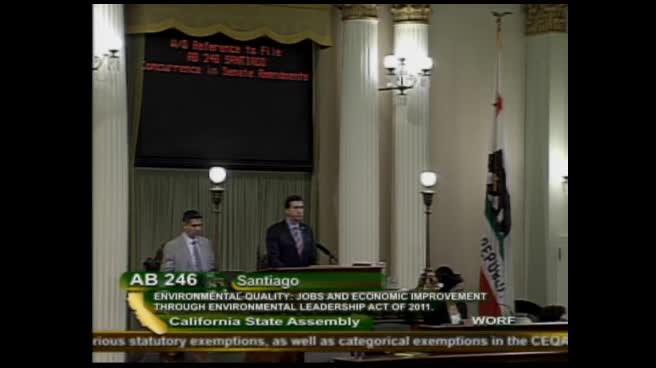 5MIN
Assembly Floor
 8MIN
Senate Floor
 16MIN
Senate Standing Committee on Environmental Quality
 1H
Senate Standing Committee on Appropriations
 5MIN
Senate Standing Committee on Environmental Quality
 1MIN
Assembly Floor
 1H
Assembly Standing Committee on Appropriations
 28MIN
Assembly Standing Committee on Environmental Safety and Toxic Materials





Bill Co-Author(s):
