AB 2463: California Small Business Development Technical Assistance Expansion Act of 2018.
- Session Year: 2017-2018
- House: Assembly
- Latest Version Date: 2018-08-24
Existing law, until January 1, 2024, creates the California Small Business Development Technical Assistance Expansion Program within the Governors Office of Business and Economic Development (GO-Biz), under the Director of the Governors Office of Business and Economic Development, for the purpose of assisting small businesses through free or low-cost one-on-one consulting and low-cost training by entering into grant agreements with one or more federal small business technical assistance centers, as defined. Existing law requires GO-Biz to make grants, upon appropriation of funds by the Legislature, to federal small business technical assistance centers that GO-Biz determines meet specified eligibility criteria.
This bill would revise the definition of a federal small business technical assistance center to include a state trade expansion program as an eligible grant applicant.
Existing law, the Economic Revitalization Act, establishes the Governors Office of Business and Economic Development, also known as GO-Biz, under the control of a director. Existing law requires GO-Biz to serve the Governor as the lead entity for economic strategy and authorizes it to undertake specified activities, including supporting small businesses by providing information about accessing capital, complying with regulations, and supporting state initiatives that support small business. Existing law also creates the California Economic Development Fund for the purpose of receiving federal, state, local, and private economic development funds and, upon appropriation by the Legislature, authorizes moneys in the fund to be expended by GO-Biz to provide matching funds for loans or grants to public agencies, nonprofit organizations, and private entities, and for other economic development purposes, consistent with the purposes for which the moneys were received.This bill would create the California Small Business Technical Assistance and Expansion Program within GO-Biz, under the director, for the purpose of assisting small businesses through free or low-cost one-on-one counseling and low-cost training by entering into grant agreements with one or more federal small business technical assistance centers and providing grants to those centers to expand the capacity of small business development technical assistance programs in California. This bill, upon appropriation of funds by the Legislature into the Small Business Technical Assistance and Expansion Account, which this bill creates within the California Economic Development Fund, would require the office to make grants to federal small business technical assistance centers. This bill would make the program inoperative on March 30, 2025 and repeal the program on January 1, 2026.Existing law, the Economic Revitalization Act, establishes the Governors Office of Business and Economic Development, also known as GO-Biz, under the control of a director. Existing law requires GO-Biz to serve the Governor as the lead entity for economic strategy and authorizes it to undertake specified activities, including supporting small businesses by providing information about accessing capital, complying with regulations, and supporting state initiatives that support small business. Existing law also creates the California Economic Development Fund for the purpose of receiving federal, state, local, and private economic development funds and, upon appropriation by the Legislature, authorizes moneys in the fund to be expended by GO-Biz to provide matching funds for loans or grants to public agencies, nonprofit organizations, and private entities, and for other economic development purposes, consistent with the purposes for which the moneys were received.
This bill would create the California Small Business Technical Assistance and Expansion Program within GO-Biz, under the director, for the purpose of assisting small businesses through free or low-cost one-on-one counseling and low-cost training by entering into partnership grant agreements with one or more federal small business technical assistance centers, as defined, centers and providing grants to those centers. centers to expand the capacity of small business development technical assistance programs in California. This bill, upon appropriation of funds by the Legislature into the Small Business Technical Assistance and Expansion Account, which this bill creates within the California Economic Development Fund, would require the office to make grants to federal small business technical assistance centers. This bill would require the director to adopt regulations to implement the program. The bill would require any center completing a partnership agreement to provide a written report to the office containing specified information. This bill would make the program inoperative on March 30, 2025 and repealed repeal the program on January 1, 2026.
Existing law, the Economic Revitalization Act, establishes the Governors Office of Business and Economic Development, also known as GO-Biz, under the control of a director. Existing law requires GO-Biz to serve the Governor as the lead entity for economic strategy and authorizes it to undertake specified activities, including supporting small businesses by providing information about accessing capital, complying with regulations, and supporting state initiatives that support small business. Existing law also creates the California Economic Development Fund for the purpose of receiving federal, state, local, and private economic development funds and, upon appropriation by the Legislature, authorizes moneys in the fund to be expended by GO-Biz to provide matching funds for loans or grants to public agencies, nonprofit organizations, and private entities, and for other economic development purposes, consistent with the purposes for which the moneys were received.
This bill would create the California Small Business Technical Assistance and Expansion Program within GO-Biz, under the director, for the purpose of assisting small businesses through free or low-cost one-on-one counseling and training by entering into partnership agreements with one or more federal small business technical assistance centers, as defined, and providing grants to those centers. This bill, upon appropriation of funds by the Legislature into the Small Business Technical Assistance and Expansion Account, which this bill creates within the California Economic Development Fund, would require the office to make grants to federal small business technical assistance centers. This bill would require the director to adopt regulations to implement the program. The bill would require any center receiving grants completing a partnership agreement to provide a written report to the office containing specified information. This bill would repeal the program on January 1, 2024. make the program inoperative on March 30, 2025 and repealed on January 1, 2026.
Existing law, the Economic Revitalization Act, establishes the Governors Office of Business and Economic Development, also known as GO-Biz, under the control of a director. Existing law requires GO-Biz to serve the Governor as the lead entity for economic strategy and authorizes it to undertake specified activities, including supporting small businesses by providing information about accessing capital, complying with regulations, and supporting state initiatives that support small business. Existing law also creates the California Economic Development Fund for the purpose of receiving federal, state, local, and private economic development funds and, upon appropriation by the Legislature, authorizes moneys in the fund to be expended by GO-Biz to provide matching funds for loans or grants to public agencies, nonprofit organizations, and private entities, and for other economic development purposes, consistent with the purposes for which the moneys were received.
This bill would create the California Small Business Assistance Program within GO-Biz, under the director, for the purpose of assisting small businesses by entering into partnership agreements with one or more federal small business technical assistance centers, as defined, and providing grants to those centers. This bill, upon appropriation of funds by the Legislature into the Small Business Assistance Account, which this bill creates within the California Economic Development Fund, would require the office to make grants to federal small business technical assistance centers. This bill would require the director to adopt regulations to implement the program. The bill would require any center receiving grants to provide a written report to the office containing specified information. This bill would repeal the program on January 1, 2024.
Unless the context otherwise requires, the following definitions in this section shall govern the construction of this article:
(a)California Small Business Development Center Program is comprised of the five regional networks of small business development centers operating in the state pursuant to a cooperative agreement between the fiscal agent and the federal Small Business Administration.
(b)Committed nonstate local cash match means funding awarded by a nonstate local source to a federal small business technical assistance center through a letter of intent, notice of award, or cash deposit.
(c)Director means the Director of the Governors Office of Business and Economic Development.
(d)Federal small business technical assistance center means an organization that contracts with a federal funding partner to operate a small business development center, a womens business center, a veterans business outreach center, a manufacturing extension partnership center, a minority business development center, a procurement technical assistance center, a state trade expansion program, or a similar center or program within this state to support small businesses.
(e)Federal funding partner means the federal Small Business Administration, federal Department of Commerce, federal Department of Defense, or any other federal agency with the authority to administer a small business technical assistance program in this state.
(f)Fiscal agent means the entity with which a federal funding partner contracts to administer small business technical assistance programs within a state or district. The fiscal agent shall be directly accountable to the federal funding partner for all aspects of the specified small business technical assistance program, including staffing, programming, outreach, securing any required matching funds to draw down federal funds, and reporting performance outcomes to operate the program in the fiscal agents area of responsibility.
(g)GO-Biz or office means the Governors Office of Business and Economic Development.
(h)Local cash match means nonfederal funds that are spent on eligible program costs.
(i)Manufacturing extension partnership center means a California contractor recognized by the federal National Institute of Standards and Technology pursuant to the Omnibus Trade and Competitiveness Act of 1988 (Public Law 100-418), at which small manufacturers can obtain information and assistance on new technology acceleration, supply chain management, lean processing, export development, sustainable manufacturing practices, and other issues related to innovation.
(j)Minority business development center means an entity or physical location, recognized by the federal Department of Commerce, from which a minority-owned small business may receive consulting and technical services to expand to new markets, both foreign and domestic.
(k)Minority business export center means an entity or physical location, recognized by the federal Department of Commerce, from which a minority-owned small business may receive consulting and technical services to increase access to capital, contracts, and foreign markets.
(l)Procurement act means Chapter 142 (commencing with Section 2411) of Part IV of Subtitle A of Title 10 of the United States Code, which governs the Procurement Technical Assistance Cooperative Agreement program, administered by the federal Department of Defense.
(m)Procurement technical assistance center means an entity or physical location, recognized by the federal Department of Defense, from which a small business owner may receive free training on a variety of topics, including starting, operating, and expanding a small business.
(n)Program means the California Small Business Development Technical Assistance Expansion Program created pursuant to Section 12100.63 and administered in accordance with this article.
(o)Small business act means the Small Business Development Center Act of 1980 (Public Law 96-302), and any amendments to that act, which authorizes the Small Business Development Center Program, administered by the federal Small Business Administration.
(p)Small business development center means to an entity or physical location, recognized by the federal Small Business Administration, from which a small business owner or an aspiring entrepreneur may receive free one-on-one consulting and low at-cost training on a variety of topics, including starting, operating, and expanding a small business.
(q)State trade expansion program means a program, recognized by the federal Small Business Administration, that assists small businesses in entering and succeeding in the international marketplace.
(q)(r)Veterans business act means Section 657b of Title 15 of the United States Code, which establishes the Office of Veterans Business Development and governs veteran business outreach centers, administered by the federal Small Business Administration.
(r)(s)Veterans business center means an entity or physical location, recognized by the federal Small Business Administration, from which a small business veteran owner or an aspiring veteran entrepreneur can receive free one-on-one consulting and low at-cost training on a variety of topics including starting, operating, and expanding a small business.
(s)(t)Womens business act means the Womens Business Ownership Act of 1988 (Public Law 100-533), and any amendments to that act, administered by the federal Small Business Administration.
(t)(u)Womens business center means an entity or physical location, recognized by the federal Small Business Administration, from which a small business owner or an aspiring entrepreneur can receive free one-on-one consulting and low at-cost training on a variety of topics including starting, operating, and expanding a small business.
SECTION 1.Article 7 (commencing with Section 12100.60) is added to Chapter 1.6 of Part 2 of Division 3 of Title 2 of the Government Code, to read:7.Small Business Technical Assistance and Expansion Act of 201812100.60.This article shall be known and may be cited as the Small Business Technical Assistance and Expansion Act of 2018.12100.61.The Legislature finds and declares all of the following:(a)Small businesses form the core of the California economy and it is in the interest of the state to increase opportunities for entrepreneurs, the self-employed, and microbusiness and small business owners to have better access to business and technical resources.(b)The federal government funds and operates a range of technical assistance programs through contracts with nonprofit organizations who commit to serve and support small businesses in California, including the California Small Business Development Center Program, the Womens Business Center Program, the Minority Business Development Agency Business Center Program, and the Veterans Business Outreach Center Program. All of these programs provide free and low-cost services to California small businesses. It is in the interest of the state to collaborate with these centers under the state role of helping to provide an economic environment in which small businesses can be successful, including participation in a seamless network of federal, state, and nonprofit programs, services, and activities that benefit small businesses.(c)(1)The California Small Business Development Center Program plays a significant role in expanding and supporting California small businesses. There are more than 1,000 small business development centers in the United States and its territories, and there are over 30 small business development centers located in regions throughout California.(2)The primary role of the California Small Business Development Center Program, a component of the federal Small Business Development Center Program, is to provide technical assistance to the states small businesses, including tracking assistance and outcomes that result in a meaningful contribution to the California economy.(d)(1)The Womens Business Center Program plays a significant role in expanding and supporting California small businesses. The Womens Business Center program was established to provide in-depth, substantive, outcome-oriented business services to women entrepreneurs, both nascent and established businesses, including a representative number of which are socially and economically disadvantaged.(2)The Womens Business Center Program meets its mission through the award of financial assistance to tax-exempt, private nonprofit organizations to enable them to effect substantial economic impact in their communities, as measured by successful business startups, job creation and retention, and increased company revenues.(e)The Veterans Business Outreach Center Program in California plays an important role in meeting the unique needs of veterans in starting and operating businesses. The program is funded by the Small Business Administrations veterans unit. The Veterans Business Outreach Center Program provides statewide small business consulting and workshops for veteran owners of small businesses, and veterans wishing to start a small business.(f)(1)The Procurement Technical Assistance Cooperative Agreement program plays an important role in helping small business access public contract opportunities. The Procurement Technical Assistance Cooperative Agreement program was authorized by Congress in 1985 in an effort to expand the number of businesses capable of participating in the government marketplace.(2)The Procurement Technical Assistance Cooperative Agreement program is administered by the Department of Defense. The program provides matching funds through cooperative agreements with state and local governments and nonprofit organizations for the establishment of procurement technical assistance centers to provide procurement assistance.(3)Procurement technical assistance centers are staffed with counselors experienced in government contracting and provide a wide range of services including classes and seminars, individual counseling, and easy access to bid opportunities, contract specifications, procurement histories, and other information necessary to successfully compete for government contracts.(g)The Hollings Manufacturing Extension Partnership was established in the 1980s as United States manufacturing began to lose ground to Japan. The United States faced key competitive challenges in consumer electronics, steel, and other industries. United States goods production processes were deemed comparatively outdated and innovation stagnated. The program is administered by the National Institute of Standards and Technology.(h)The Minority Business Development Agency Business Center Program provides a range of services to minority-owned businesses seeking to expand to new markets, both foreign and domestic, as well as a wide range of technical assistance and business services, including business consulting, private equity, and venture capital opportunities, facilitating joint ventures, and strategic partnerships.12100.63.(a)The California Small Business Technical Assistance and Expansion Program is hereby created within the office.(b)The program shall be under the direct authority of the director.(c)The purpose of the program is to assist small businesses through free or low-cost one-on-one counseling and low-cost training by entering into grant agreements with one or more of the federal small business technical assistance centers.(d)In implementing the program, the director shall consult with local, regional, federal, and other state public and private entities that share a similar mission to support the needs of small businesses in California.(e)(1)An applicant pursuant to this article shall be a federal small business technical assistance center operating as a group, including a regional or statewide network, or as an individual center.(2)(A)A federal small business technical assistance center operating as a group consisting of centers organized under a coordinating administrative or fiscal entity shall apply by submitting a single consolidated application to the office.(B)A federal small business technical assistance center operating as an individual center shall apply by submitting a single application for that center to the office.(f)The office shall administer the program to provide grants to expand the capacity of small business development technical assistance programs in California, administered by and primarily funded by federal agencies, that provide one-on-one confidential counseling and training to small businesses and entrepreneurs in the state.(g)A grant award application may be for one or multiple years, as determined by the office.(h)The requested funding amount for an award shall not exceed the lesser of the total dollars specified in the contract with the federal funding partner or twenty-five thousand dollars ($25,000).(i)An applicant shall have a fiscal agent that is able to receive nonfederal funds.12100.65.(a)Upon appropriation of funds by the Legislature for the purpose of implementing this article, the office shall make grants to federal small business technical assistance centers, consistent with the requirements of Section 12100.63.(b)Unless otherwise specified, all moneys appropriated for the purpose of this article shall be deposited in the Small Business Technical Assistance and Expansion Account, which is hereby created within the California Economic Development Fund created pursuant to Section 13997.6.12100.69.This article shall become inoperative on March 30, 2025, and, as of January 1, 2026, is repealed.This article shall be known and may be cited as the Small Business Technical Assistance and Expansion Act of 2018.
12100.61.The Legislature finds and declares all of the following:
(a)Small businesses form the core of the California economy and it is in the interest of the state to increase opportunities for entrepreneurs, the self-employed, and microbusiness and small business owners to have better access to business and technical resources.
(b)The federal government funds and operates a range of technical assistance programs through contracts with nonprofit organizations who commit to serve and support small businesses in California, including the California Small Business Development Center Program, the Womens Business Center Program, the Minority Business Development Agency Business Center Program, and the Veterans Business Outreach Center Program. All of these programs provide free and low-cost services to California small businesses. It is in the interest of the state to collaborate with these centers under the state role of helping to provide an economic environment in which small businesses can be successful, including participation in a seamless network of federal, state, and nonprofit programs, services, and activities that benefit small businesses.
(c)(1)The California Small Business Development Center Program plays a significant role in expanding and supporting California small businesses. There are more than 1,000 small business development centers in the United States and its territories, and there are over 30 small business development centers located in regions throughout California.
(2)The primary role of the California Small Business Development Center Program, a component of the federal Small Business Development Center Program, is to provide technical assistance to the states small businesses, including tracking assistance and outcomes that result in a meaningful contribution to the California economy.
(d)(1)The Womens Business Center Program plays a significant role in expanding and supporting California small businesses. The Womens Business Center program was established to provide in-depth, substantive, outcome-oriented business services to women entrepreneurs, both nascent and established businesses, including a representative number of which are socially and economically disadvantaged.
(2)The Womens Business Center Program meets its mission through the award of financial assistance to tax-exempt, private nonprofit organizations to enable them to effect substantial economic impact in their communities, as measured by successful business startups, job creation and retention, and increased company revenues.
(e)The Veterans Business Outreach Center Program in California plays an important role in meeting the unique needs of veterans in starting and operating businesses. The program is funded by the Small Business Administrations veterans unit. The Veterans Business Outreach Center Program provides statewide small business consulting and workshops for veteran owners of small businesses, and veterans wishing to start a small business.
(f)(1)The Procurement Technical Assistance Cooperative Agreement program plays an important role in helping small business access public contract opportunities. The Procurement Technical Assistance Cooperative Agreement program was authorized by Congress in 1985 in an effort to expand the number of businesses capable of participating in the government marketplace.
(2)The Procurement Technical Assistance Cooperative Agreement program is administered by the Department of Defense. The program provides matching funds through cooperative agreements with state and local governments and nonprofit organizations for the establishment of procurement technical assistance centers to provide procurement assistance.
(3)Procurement technical assistance centers are staffed with counselors experienced in government contracting and provide a wide range of services including classes and seminars, individual counseling, and easy access to bid opportunities, contract specifications, procurement histories, and other information necessary to successfully compete for government contracts.
(g)The Hollings Manufacturing Extension Partnership was established in the 1980s as United States manufacturing began to lose ground to Japan. The United States faced key competitive challenges in consumer electronics, steel, and other industries. United States goods production processes were deemed comparatively outdated and innovation stagnated. The program is administered by the National Institute of Standards and Technology.
(h)The Minority Business Development Agency Business Center Program provides a range of services to minority-owned businesses seeking to expand to new markets, both foreign and domestic, as well as a wide range of technical assistance and business services, including business consulting, private equity, and venture capital opportunities, facilitating joint ventures, and strategic partnerships.
12100.62.Unless the context otherwise requires, the definitions in this section shall govern the construction of this article.(a)Administrative lead center means the entity with which the federal Small Business Administration contracts with to administer the Small Business Development Center Program, authorized pursuant to the Small Business Development Center Act of 1980 (15 U.S.C. 648), within a state or district and that is directly accountable to the federal Small Business Administration for all aspects of the small business development center, including staffing, program, outreach, and securing the required one-to-one match to draw down federal funds to operate the program in the administrative lead centers area of responsibility. The California Small Business Development Center Leadership Council may apply for grants under this article for administrative lead centers in California.(b)California Small Business Development Center Program is comprised of the five regional networks of small business development centers operating in the state pursuant to a cooperative agreement between the administrative lead centers and the federal Small Business Administration.(c)Director means the Director of the Governors Office of Business and Economic Development.(d)Federal small business technical assistance centers means an administrative lead center, a womens business center, a veterans business outreach center, a manufacturing extension partnership center, a minority business development center, and a procurement technical assistance center that operate in California under federal contracts.(e)Manufacturing extension partnership center means a California contractor recognized by the federal National Institute of Standards and Technology pursuant to the Omnibus Trade and Competitiveness Act of 1988 (Public Law 100-418), at which small manufacturers can obtain information and assistance on new technology acceleration, supply chain management, lean processing, export development, sustainable manufacturing practices, and other issues related to innovation.(f)Minority business development center means a center designated through the Minority Business Development Agency of the United States Department of Commerce that promotes the growth of minority-owned businesses through the mobilization and advancement of public and private sector programs, policy, and research.(g)Office means the Governors Office of Business and Economic Development.(h)Procurement technical assistance center means an entity or physical location, recognized by the United States Department of Defense for purposes of the Procurement Technical Assistance Cooperative Agreement Program (Chapter 142 (commencing with Section 2411) of Part IV of Subtitle A of Title 10 of the United States Code), at which a small business owner may receive free training on a variety of local, state, and federal procurement issues.(i)Program means the California Small Business Technical Assistance and Expansion Program created pursuant to Section 12100.63 and administered in accordance with this article.(j)Small business development center refers to an individual physical location, recognized by the federal Small Business Administration and overseen by the administrative lead center, at which a small business owner or an aspiring entrepreneur can receive free one-on-one consulting and low at-cost training on a variety of topics including starting, operating, and expanding a small business.(k)Veterans business center means an individual, physical location, recognized by the federal Small Business Administration for the purposes specified in Section 657b of Title 15 of the United States Code, at which a small business veteran owner or an aspiring veteran entrepreneur can receive free one-on-one consulting and low at-cost training on a variety of topics including starting, operating, and expanding a small business.(l)Womens business center means an individual, physical location, recognized by the federal Small Business Administration for purposes of the Womens Business Ownership Act of 1988 (Public Law 100-533), at which a small business owner or an aspiring entrepreneur can receive free one-on-one consulting and low at-cost training on a variety of topics including starting, operating, and expanding a small business.12100.63.(a)The California Small Business Technical Assistance and Expansion Program is hereby created within the office.
(b)The program shall be under the direct authority of the director.
(c)(1)The purpose of the program is to assist small businesses through free or low-cost one-on-one counseling and low-cost training by entering into partnership grant agreements with one or more of the federal small business technical assistance centers and providing grants to those centers.
(d)In implementing the program, the director shall consult with local, regional, federal, and other state public and private entities that share a similar mission to support the needs of small businesses in California.
(2)(e)(1)An applicant pursuant to this article shall be a federal small business technical assistance center operating as a group, including a regional or statewide network, or as an individual center.
(2)(A)A federal small business technical assistance center operating as a group consisting of centers organized under a coordinating administrative or fiscal entity shall apply by submitting a single consolidated application to the office.
(B)A federal small business technical assistance center operating as an individual center shall apply by submitting a single application for that center to the office.
(f)The office shall administer the program to provide grants to expand the capacity of small business development technical assistance programs in California, administered by and primarily funded by federal agencies, that provide one-on-one confidential counseling and training to small businesses and entrepreneurs in the state.
(3)(g)A grant award application may be for one or multiple years, as determined by the office.
(d)The director shall adopt regulations that are consistent with the purpose and requirements of this article.(e)In implementing the program, the director shall consult with local, regional, federal, and other state public and private entities that share a similar mission to support the needs of small businesses in California.(h)The requested funding amount for an award shall not exceed the lesser of the total dollars specified in the contract with the federal funding partner or twenty-five thousand dollars ($25,000).
(i)An applicant shall have a fiscal agent that is able to receive nonfederal funds.
12100.65.(a)Upon appropriation of funds by the Legislature for the purpose of implementing this article, the office shall make grants to federal small business technical assistance centers, consistent with the regulations developed pursuant to subdivision (d) requirements of Section 12100.63.
(b)Unless otherwise specified, all moneys appropriated for the purpose of this article shall be deposited in the Small Business Technical Assistance and Expansion Account, which is hereby created within the California Economic Development Fund created pursuant to Section 13997.6.
12100.67.(a)No more than 60 days following the completion of a partnership agreement, the federal small business technical assistance center shall provide a written report to the office consistent with the requirements of this section and in a form prescribed by the office.(b)Each federal small business technical assistance center shall accept the reporting requirement in this section as a condition of receiving the grant.(c)The report prepared pursuant to subdivision (a) shall include, but not be limited to, all of the following data:(1)Number of businesses assisted.(2)The amount of funds awarded.(3)The size of businesses assisted, based on the number of employees at the time those businesses were assisted, as reported by the assisted businesses. Reporting shall be in categories of business size, as determined by the office.(4)The city and county in which the assisted businesses are located.(5)Industry sectors of the assisted businesses, as reported by the assisted businesses.(6)Other program- and performance-based information, as determined by the office.(d)The director shall include the outcome of the programs activities within the annual report of the Office of the Small Business Advocate required by Section 12098.4.12100.69.This article shall become inoperative on March 30, 2025, and, as of January 1, 2026, is repealed.
This article shall be known and may be cited as the Small Business Technical Assistance and Expansion Act of 2018.
12100.61.The Legislature finds and declares all of the following:
(a)Small businesses form the core of the California economy and it is in the interest of the state to increase opportunities for entrepreneurs, the self-employed, and microbusiness and small business owners to have better access to business and technical resources.
(b)The federal government funds and operates a range of technical assistance programs through contracts with nonprofit organizations who commit to serve and support small businesses in California, including the California Small Business Development Center Program, the Womens Business Center Program, the Minority Business Development Agency Business Center Program, and the Veterans Business Outreach Center Program. All of these programs provide free and low-cost services to California small businesses. It is in the interest of the state to collaborate with these centers under the state role of helping to provide an economic environment in which small businesses can be successful, including participation in a seamless network of federal, state, and nonprofit programs, services, and activities that benefit small businesses.
(c)(1)The California Small Business Development Center Program plays a significant role in expanding and supporting California small businesses. There are more than 1,000 small business development centers in the United States and its territories, and there are over 30 small business development centers located in regions throughout California.
(2)The primary role of the California Small Business Development Center Program, a component of the federal Small Business Development Center Program, is to provide technical assistance to the states small businesses, including tracking assistance and outcomes that result in a meaningful contribution to the California economy.
(d)(1)The Womens Business Center Program plays a significant role in expanding and supporting California small businesses. The Womens Business Center program was established to provide in-depth, substantive, outcome-oriented business services to women entrepreneurs, both nascent and established businesses, including a representative number of which are socially and economically disadvantaged.
(2)The Womens Business Center Program meets its mission through the award of financial assistance to tax-exempt, private nonprofit organizations to enable them to effect substantial economic impact in their communities, as measured by successful business startups, job creation and retention, and increased company revenues.
(e)The Veterans Business Outreach Center Program in California plays an important role in meeting the unique needs of veterans in starting and operating businesses. The program is funded by the Small Business Administrations veterans unit. The Veterans Business Outreach Center Program provides statewide small business consulting and workshops for veteran owners of small businesses, and veterans wishing to start a small business.
(f)(1)The Procurement Technical Assistance Cooperative Agreement program plays an important role in helping small business access public contract opportunities. The Procurement Technical Assistance Cooperative Agreement program was authorized by Congress in 1985 in an effort to expand the number of businesses capable of participating in the government marketplace.
(2)The Procurement Technical Assistance Cooperative Agreement program is administered by the Department of Defense. The program provides matching funds through cooperative agreements with state and local governments and nonprofit organizations for the establishment of procurement technical assistance centers to provide procurement assistance.
(3)Procurement technical assistance centers are staffed with counselors experienced in government contracting and provide a wide range of services including classes and seminars, individual counseling, and easy access to bid opportunities, contract specifications, procurement histories, and other information necessary to successfully compete for government contracts.
(g)The Hollings Manufacturing Extension Partnership was established in the 1980s as United States manufacturing began to lose ground to Japan. The United States faced key competitive challenges in consumer electronics, steel, and other industries. United States goods production processes were deemed comparatively outdated and innovation stagnated. The program is administered by the National Institute of Standards and Technology.
(h)The Minority Business Development Agency Business Center Program provides a range of services to minority-owned businesses seeking to expand to new markets, both foreign and domestic, as well as a wide range of technical assistance and business services, including business consulting, private equity, and venture capital opportunities, facilitating joint ventures, and strategic partnerships.
12100.62.Unless the context otherwise requires, the definitions in this section shall govern the construction of this article.
(a)Administrative lead center means the entity with which the federal Small Business Administration contracts with to administer the Small Business Development Center Program, authorized pursuant to the Small Business Development Center Act of 1980 (15 U.S.C. 648), within a state or district and that is directly accountable to the federal Small Business Administration for all aspects of the small business development center, including staffing, program, outreach, and securing the required one-to-one match to draw down federal funds to operate the program in the administrative lead centers area of responsibility. The California Small Business Development Center Leadership Council may apply for grants under this article for administrative lead centers in California.
(b)California Small Business Development Center Program is comprised of the six five regional networks of small business development centers operating in the state pursuant to a cooperative agreement between the administrative lead centers and the federal Small Business Administration.
(c)California Small Business Development Center Leadership Council refers to the entity that is comprised of the directors of the administrative lead centers that coordinate the regional networks of small business development centers and is the statewide entity tasked with negotiating partnerships on behalf of the California Small Business Development Center Program, leveraging operational and technical assistance for best practices across the six regions, and working with the state government to maximize the economic impact of the federal Small Business Development Center Program within the state.(d)(c)Director means the Director of the Governors Office of Business and Economic Development.
(e)(d)Federal small business technical assistance centers means an administrative lead center, a womens business center, a veterans business outreach center, a manufacturing extension partnership center, a minority business development center, and a procurement technical assistance center that operate in California under federal contracts.
(f)(e)Manufacturing extension partnership center refers to means a California contractor recognized by the federal National Institute of Standards and Technology pursuant to the Omnibus Trade and Competitiveness Act of 1988 (Public Law 100-418), at which small manufacturers can obtain information and assistance on new technology acceleration, supply chain management, lean processing, export development, sustainable manufacturing practices, and other issues related to innovation.
(g)(f)Minority business development center means a center designated through the Minority Business Development Agency of the United States Department of Commerce that promotes the growth of minority-owned businesses through the mobilization and advancement of public and private sector programs, policy, and research.
(h)(g)Office means the Governors Office of Business and Economic Development.
(i)(h)Procurement technical assistance center means an individual, entity or physical location, recognized by the United States Department of Defense for purposes of the Procurement Technical Assistance Cooperative Agreement Program (Chapter 142 (commencing with Section 2411) of Part IV of Subtitle A of Title 10 of the United States Code, Code), at which a small business owner can may receive free training on a variety of state local, state, and federal procurement issues.
(i)Program means the California Small Business Technical Assistance and Expansion Program created pursuant to Section 12100.63 and administered in accordance with this article.
(j)Small business development center refers to an individual physical location, recognized by the federal Small Business Administration and overseen by the administrative lead center, at which a small business owner or an aspiring entrepreneur can receive free one-on-one consulting and low at-cost training on a variety of topics including starting, operating, and expanding a small business.
(k)Veterans business center means an individual, physical location, recognized by the federal Small Business Administration for the purposes specified in Section 657b of Title 15 of the United States Code, at which a small business veteran owner or an aspiring veteran entrepreneur can receive free one-on-one consulting and low at-cost training on a variety of topics including starting, operating, and expanding a small business.
(l)Womens business center means an individual, physical location, recognized by the federal Small Business Administration for purposes of the Womens Business Ownership Act of 1988 (Public Law 100-533), at which a small business owner or an aspiring entrepreneur can receive free one-on-one consulting and low at-cost training on a variety of topics including starting, operating, and expanding a small business.
12100.63.(a)The California Small Business Technical Assistance and Expansion Program is hereby created within the office.
(b)The program shall be under the direct authority of the director.
(c)(1)The purpose of the program is to assist small businesses through free or low-cost one-on-one counseling and training by entering into partnership agreements with one or more of the federal small business technical assistance centers and providing grants to those centers.
(2)An applicant pursuant to this article shall be a federal small business technical assistance center operating as a group, including a regional or statewide network, or as an individual center.
(3)A grant award application may be for one or multiple years, as determined by the office.
(d)The director shall adopt regulations that are consistent with the purpose specified in subdivision (c) to implement this program. and requirements of this article.
(e)In implementing the program, the director shall consult with local, regional, federal, and other state public and private entities that share a similar mission to support the needs of small businesses in California.
12100.65.(a)Upon appropriation of funds by the Legislature for the purpose of implementing this article, the office shall make grants to federal small business technical assistance centers, consistent with the regulations developed pursuant to subdivision (d) of Section 12100.63.
(b)Unless otherwise specified, all moneys appropriated for the purpose of this article shall be deposited in the Small Business Technical Assistance and Expansion Account, which is hereby created within the California Economic Development Fund created pursuant to Section 13997.6.
12100.67.(a)On or before November 30 following any fiscal year that grants are made to a federal small business technical assistance center pursuant to this article, the No more than 60 days following the completion of a partnership agreement, the federal small business technical assistance center receiving the grant shall provide a written report to the office consistent with the requirements of this section. section and in a form prescribed by the office.
(b)Each federal small business technical assistance center shall accept the reporting requirement in this section as a condition of receiving the grant.
(c)The report prepared pursuant to subdivision (a) shall include, but not be limited to, all of the following data:
(1)Number of businesses assisted.
(2)The amount of funds awarded.
(3)The size of businesses assisted, based on the number of employees at the time those businesses were assisted, as reported by the assisted businesses. Reporting shall be in categories of business size, as determined by the office.
(4)The city and county in which the assisted businesses are located.
(5)Industry sectors of the businesses assisted, assisted businesses, as reported by the assisted businesses.
(6)Other program- and performance-based information, as determined by the office.
(d)The director shall include the outcome of the programs activities within the annual report of the Office of the Small Business Advocate required by Section 12098.4.
12100.69.This article shall remain in effect only until January 1, 2024, and as of that date is repealed, unless a later enacted statute, that is enacted before January 1, 2024, deletes or extends that date. become inoperative on March 30, 2025, and, as of January 1, 2026, is repealed.
This article shall be known and may be cited as the Small Business Assistance Act of 2018.
12100.61.The Legislature finds and declares all of the following:
(a)Small businesses form the core of the California economy and it is in the interest of the state to increase opportunities for entrepreneurs, the self-employed, and microbusiness and small business owners to have better access to business and technical resources.
(b)The federal government funds and operates a range of technical assistance programs through contracts with nonprofit organizations who commit to serve and support small businesses in California, including the California Small Business Development Center Program, the Womens Business Center Program, and the Veterans Business Outreach Center Program. All of these programs provide free and low-cost services to California small businesses. It is in the interest of the state to collaborate with these centers under the state role of helping to provide an economic environment in which small businesses can be successful, including participation in a seamless network of federal, state, and nonprofit programs, services, and activities that benefit small businesses.
(c)(1)The California Small Business Development Center Program plays a significant role in expanding and supporting California small businesses. There are more than 1,000 small business development centers in the United States and its territories, and there are over 30 small business development centers located in regions throughout California.
(2)The primary role of the California Small Business Development Center Program, a component of the federal Small Business Development Center Program, is to provide technical assistance to the states small businesses, including tracking assistance and outcomes that result in a meaningful contribution to the California economy.
(d)(1)The Womens Business Center Program plays a significant role in expanding and supporting California small businesses. The Womens Business Center program was established to provide in-depth, substantive, outcome-oriented business services to women entrepreneurs, both nascent and established businesses, including a representative number of which are socially and economically disadvantaged.
(2)The Womens Business Center Program meets its mission through the award of financial assistance to tax-exempt, private nonprofit organizations to enable them to effect substantial economic impact in their communities, as measured by successful business startups, job creation and retention, and increased company revenues.
(e)The Veterans Business Outreach Center Program in California plays an important role in meeting the unique needs of veterans in starting and operating businesses. The program is funded by the Small Business Administrations veterans unit. The Veterans Business Outreach Center Program provides statewide small business consulting and workshops for veteran owners of small businesses, and veterans wishing to start a small business.
(f)(1)The Procurement Technical Assistance Cooperative Agreement program plays an important role in helping small business access public contract opportunities. The Procurement Technical Assistance Cooperative Agreement program was authorized by Congress in 1985 in an effort to expand the number of businesses capable of participating in the government marketplace.
(2)The Procurement Technical Assistance Cooperative Agreement program is administered by the Department of Defense. The program provides matching funds through cooperative agreements with state and local governments and nonprofit organizations for the establishment of procurement technical assistance centers to provide procurement assistance.
(3)Procurement technical assistance centers are staffed with counselors experienced in government contracting and provide a wide range of services including classes and seminars, individual counseling, and easy access to bid opportunities, contract specifications, procurement histories, and other information necessary to successfully compete for government contracts.
(g)The Hollings Manufacturing Extension Partnership was established in the 1980s as United States manufacturing began to lose ground to Japan. The United States faced key competitive challenges in consumer electronics, steel, and other industries. United States goods production processes were deemed comparatively outdated and innovation stagnated. The program is administered by the National Institute of Standards and Technology.
12100.62.Unless the context otherwise requires, the definitions in this section shall govern the construction of this article.
(a)Administrative lead center means the entity with which the federal Small Business Administration contracts with to administer the Small Business Development Center Program, authorized pursuant to the Small Business Development Center Act of 1980 (15 U.S.C. 648), within a state or district and that is directly accountable to the federal Small Business Administration for all aspects of the small business development center, including staffing, program, outreach, and securing the required one-to-one match to draw down federal funds to operate the program in the administrative lead centers area of responsibility. The California Small Business Development Center Leadership Council may apply for grants under this article for administrative lead centers in California.
(b)California Small Business Development Center Program is comprised of the six regional networks of small business development centers operating in the state pursuant to a cooperative agreement between the administrative lead centers and the federal Small Business Administration.
(c)California Small Business Development Center Leadership Council refers to the entity that is comprised of the directors of the administrative lead centers that coordinate the regional networks of small business development centers and is the statewide entity tasked with negotiating partnerships on behalf of the California Small Business Development Center Program, leveraging operational and technical assistance for best practices across the six regions, and working with the state government to maximize the economic impact of the federal Small Business Development Center Program within the state.
(d)Director means the Director of the Governors Office of Business and Economic Development.
(e)Federal small business technical assistance centers means an administrative lead center, a womens business center, a veterans business outreach center, a manufacturing extension partnership center, a minority business development center, and a procurement technical assistance center that operate in California under federal contracts.
(f)Manufacturing extension partnership center refers to a California contractor recognized by the federal National Institute of Standards and Technology pursuant to the Omnibus Trade and Competitiveness Act of 1988 (Public Law 100-418), at which small manufacturers can obtain information and assistance on new technology acceleration, supply chain management, lean processing, export development, sustainable manufacturing practices, and other issues related to innovation.
(g)Minority business development center means a center designated through the Minority Business Development Agency of the United States Department of Commerce that promotes the growth of minority-owned businesses through the mobilization and advancement of public and private sector programs, policy, and research.
(h)Office means the Governors Office of Business and Economic Development.
(i)Procurement technical assistance center means an individual, physical location, recognized by the United States Department of Defense for purposes of the Procurement Technical Assistance Cooperative Agreement Program (Chapter 142 (commencing with Section 2411) of Part IV of Subtitle A of Title 10 of the United States Code, at which a small business owner can receive free training on a variety of state and federal procurement issues.
(j)Small business development center refers to an individual physical location, recognized by the federal Small Business Administration and overseen by the administrative lead center, at which a small business owner or an aspiring entrepreneur can receive free one-on-one consulting and low at-cost training on a variety of topics including starting, operating, and expanding a small business.
(k)Veterans business center means an individual, physical location, recognized by the federal Small Business Administration for the purposes specified in Section 657b of Title 15 of the United States Code, at which a small business veteran owner or an aspiring veteran entrepreneur can receive free one-on-one consulting and low at-cost training on a variety of topics including starting, operating, and expanding a small business.
(l)Womens business center means an individual, physical location, recognized by the federal Small Business Administration for purposes of the Womens Business Ownership Act of 1988 (Public Law 100-533), at which a small business owner or an aspiring entrepreneur can receive free one-on-one consulting and low at-cost training on a variety of topics including starting, operating, and expanding a small business.
12100.63.(a)The California Small Business Assistance Program is hereby created within the office.
(b)The program shall be under the direct authority of the director.
(c)The purpose of the program is to assist small businesses by entering into partnership agreements with one or more of the federal small business technical assistance centers and providing grants to those centers.
(d)The director shall adopt regulations that are consistent with the purpose specified in subdivision (c) to implement this program.
(e)In implementing the program, the director shall consult with local, regional, federal, and other state public and private entities that share a similar mission to support the needs of small businesses in California.
12100.65.(a)Upon appropriation of funds by the Legislature for the purpose of implementing this article, the office shall make grants to federal small business technical assistance centers, consistent with the regulations developed pursuant to subdivision (d) of Section 12100.63.
(b)Unless otherwise specified, all moneys appropriated for the purpose of this article shall be deposited in the Small Business Assistance Account, which is hereby created within the California Economic Development Fund created pursuant to Section 13997.6.
12100.67.(a)On or before November 30 following any fiscal year that grants are made to a federal small business technical assistance center pursuant to this article, the center receiving the grant shall provide a written report to the office consistent with the requirements of this section.
(b)Each federal small business technical assistance center shall accept the reporting requirement in this section as a condition of receiving the grant.
(c)The report prepared pursuant to subdivision (a) shall include, but not be limited to, all of the following data:
(1)Number of businesses assisted.
(2)The amount of funds awarded.
(3)The size of businesses assisted, based on the number of employees at the time those businesses were assisted, as reported by the assisted businesses. Reporting shall be in categories of business size, as determined by the office.
(4)The city and county in which the businesses are located.
(5)Industry sectors of the businesses assisted, as reported by the assisted businesses.
(d)The director shall include the outcome of the programs activities within the annual report of the Office of the Small Business Advocate required by Section 12098.4.
12100.69.This article shall remain in effect only until January 1, 2024, and as of that date is repealed, unless a later enacted statute, that is enacted before January 1, 2024, deletes or extends that date.
|
Date
|
Status
|
|---|---|
| Aug 31, 2018 | Ordered to inactive file at the request of Senator Delgado. |
| Aug 27, 2018 | Read second time. Ordered to third reading. |
| Aug 24, 2018 | From inactive file. |
| Aug 16, 2018 | Ordered to inactive file at the request of Senator Delgado. |
| Aug 14, 2018 | Read second time. Ordered to third reading. |
| Aug 13, 2018 | From committee: Be ordered to second reading pursuant to Senate Rule 28.8. |
| Aug 6, 2018 | In committee: Hearing postponed by committee. |
| Jun 26, 2018 | From committee: Do pass and re-refer to Com. on APPR. (Ayes 9. Noes 0.) (June 25). Re-referred to Com. on APPR. |
| Jun 7, 2018 | From committee chair, with author's amendments: Amend, and re-refer to committee. Read second time, amended, and re-referred to Com. on B., P. & E.D. |
| Jun 7, 2018 | Referred to Com. on B., P. & E.D. |
| May 31, 2018 | In Senate. Read first time. To Com. on RLS. for assignment. |
| May 30, 2018 | Read third time. Passed. Ordered to the Senate. |
| May 25, 2018 | From committee: Do pass. (Ayes 16. Noes 0.) (May 25). |
| May 16, 2018 | In committee: Set, first hearing. Referred to APPR. suspense file. |
| Apr 30, 2018 | Re-referred to Com. on APPR. |
| Apr 26, 2018 | Read second time and amended. |
| Apr 25, 2018 | From committee: Amend, and do pass as amended and re-refer to Com. on APPR. (Ayes 7. Noes 0.) (April 17). |
| Mar 5, 2018 | Referred to Com. on J., E.D., & E. |
| Feb 15, 2018 | From printer. May be heard in committee March 17. |
| Feb 14, 2018 | Read first time. To print. |
|
Date
|
Description
|
Location
|
Votes
|
|
|---|---|---|---|---|
| Jun 25, 2018 | Do pass, but first be re-referred to the Committee on [Appropriations] | Senate Standing Committee on Business, Professions and Economic Development |
Passed |
|
| May 30, 2018 | AB 2463 QUIRK-SILVA Assembly Third Reading | Assembly Floor |
Passed |
|
| May 25, 2018 | Do pass. | Assembly Standing Committee on Appropriations |
Passed |
|
| Apr 17, 2018 | Do pass as amended and be re-referred to the Committee on [Appropriations] | Assembly Standing Committee on Jobs, Economic Development, and the Economy |
Passed |
This list shows positions taken on this bill by organizations on the date displayed, which is linked to the original source.
Positions by individuals are not included.
Office of Senate Floor Analyses (916) 651-1520 Fax: (916) 327-4478 | AB |
THIRD READING
Bill No: AB 2463
: 8/24/18
SENATE BUS., PROF. & ECON. DEV. COMMITTEE: 9-0, 6/25/18
AYES: Hill, Fuller, Allen, Dodd, Galgiani, Glazer, Hernandez, Pan, Wilk
SENATE APPROPRIATIONS COMMITTEE: Senate Rule 28.8
ASSEMBLY FLOOR: 78-0, 5/30/18 - See last page for vote
SUBJECT: California Small Business Development Technical Assistance Expansion Act of 2018
DIGEST:
This bill expands the definition of “federal small business technical assistance center” within the California (Act) to include a state trade expansion program as an eligible grant applicant and adds a definition of “state trade expansion program.”
Senate Floor Amendments of 8/24/18 remove provisions previously contained in the bill that would have established a Small Business Technical Assistance and Expansion Program within the Governor’s Office of Business and Economic Development (GO-Biz) and replace those with cleanup language to revise the definition of a federal small business technical assistance center within the Act to include a state trade expansion program as an eligible grant applicant.
ANALYSIS: Existing law establishes the Act within GO-Biz for the purpose of assisting small businesses by entering into grant agreements with federal small business technical assistance centers. (GOV §§ 12100.60 - 12100.69)
This bill:
- Revises the definition of a federal small business technical assistance center within the Act to include a state trade expansion program as an eligible grant applicant.
- Defines “state trade expansion program” as a program recognized by the federal Small Business Administration that assists small businesses in entering and succeeding in the international marketplace.
Background
The Small Business Development Centers (SBDC) program is administered by the U.S. Small Business Administration to provide technical assistance to small businesses and aspiring entrepreneurs. The California SBDC, a branch of the national program, is administered through five administrative lead centers that support a network of small business development centers throughout the state.
AB 1817 (Assembly Committee on Budget, Chapter 37, Statutes of 2018), the 2018 General Government trailer bill, established the California Small Business Development Technical Assistance Expansion Program. The Program includes a competitive grant program to support an expansion in services provided by federal small business technical assistance programs to small businesses and pre-venture entrepreneurs. The purpose of this program is to expand federal small business technical assistance programs into new and/or underserved small business segments. Specifically, this funding will focus on an expansion of no-cost, one-on-one consulting and low-cost training to small businesses in the areas of capital access, commercialization, business plans and strategy, export assistance, sales, operations, financial management, marketing, cybersecurity, manufacturing assistance, emergency preparedness, business continuity and disaster recovery and increased productivity and innovation, among other areas.
FISCAL EFFECT: Appropriation: Fiscal Com.: Local:
OPPOSITION: (Verified 8/27/18)
None received
ASSEMBLY FLOOR: 78-0, 5/30/18
AYES: Acosta, Aguiar-Curry, Travis Allen, Arambula, Baker, Berman, Bigelow, Bloom, Bonta, Brough, Burke, Caballero, Calderon, Carrillo, Cervantes, Chau, Chávez, Chen, Chiu, Choi, Chu, Cooley, Cooper, Cunningham, Dahle, Daly, Eggman, Flora, Fong, Frazier, Friedman, Gallagher, Cristina Garcia, Eduardo Garcia, Gipson, Gloria, Gonzalez Fletcher, Gray, Grayson, Harper, Holden, Irwin, Jones-Sawyer, Kalra, Kamlager-Dove, Kiley, Lackey, Levine, Limón, Low, Maienschein, Mathis, Mayes, McCarty, Medina, Melendez, Mullin, Muratsuchi, Nazarian, Obernolte, O'Donnell, Patterson, Quirk, Quirk-Silva, Reyes, Rodriguez, Rubio, Salas, Santiago, Steinorth, Mark Stone, Thurmond, Ting, Voepel, Waldron, Weber, Wood, Rendon
8/27/18 19:47:23
Office of Senate Floor Analyses (916) 651-1520 Fax: (916) 327-4478 | AB |
THIRD READING
Bill No: AB 2463
:
SENATE BUS., PROF. & ECON. DEV. COMMITTEE: 9-0, 6/25/18
AYES: Hill, Fuller, Allen, Dodd, Galgiani, Glazer, Hernandez, Pan, Wilk
SENATE APPROPRIATIONS COMMITTEE: Senate Rule 28.8
ASSEMBLY FLOOR: 78-0, 5/30/18 - See last page for vote
DIGEST:
This bill establishes the Small Business Technical Assistance and Expansion Program (Program) within the Governor’s Office of Business and Economic Development (GO-Biz) to assist small businesses through free or low-cost counseling and training.
ANALYSIS: Existing law establishes the Office of the Small Business Advocate (OSBA) within GO-Biz and outlines the duties and functions of the Director of OSBA, otherwise known as the Small Business Advocate (Advocate), including representing the views and interests of small businesses before other state agencies whose policies and activities may affect small businesses. (GOV §§ 12098-12098.9)
This bill:
- Establishes the Program within GO-Biz under the direct authority of the Director of GO-Biz.
- Specifies that the purpose of the program is to assist small businesses by entering into grant agreements with federal small business technical assistance centers and that in implementing the program, the Director shall consult with public and private entities that share a similar mission to support the needs of small businesses in California.
Background
The Small Business Development Centers (SBDC) program is administered by the U.S. Small Business Administration to provide technical assistance to small businesses and aspiring entrepreneurs. The California SBDC, a branch of the national program, is administered through five administrative lead centers that support a network of small business development centers throughout the state.
AB 1817 (Assembly Committee on Budget, Chapter 37, Statutes of 2018), the 2018 General Government trailer bill, established the California Small Business Development Technical Assistance Expansion Program as proposed by this bill. The Program in the Budget is identical to that outlined in this bill, including a competitive grant program to support an expansion in services provided by federal small business technical assistance programs to small businesses and pre-venture entrepreneurs. The purpose of this program is to expand federal small business technical assistance programs into new and/or underserved small business segments. Specifically, this funding will focus on an expansion of no-cost, one-on-one consulting and low-cost training to small businesses in the areas of capital access, commercialization, business plans and strategy, export assistance, sales, operations, financial management, marketing, cybersecurity, manufacturing assistance, emergency preparedness, business continuity and disaster recovery and increased productivity and innovation, among other areas.
FISCAL EFFECT: Appropriation: Fiscal Com.: Local:
Access Plus Capital
Accion
Airport Mobil Towing
American Grilled Cheese Kitchen
AnewAmerica Community Corporation
Aqua Skin and Nail Care
Bay Area Urban Manufacturing Initiative
Bitches Britches Records
Bonti
Bouquet Canyon Kennels
Brandt Ventures
Buddhi Boxx
California Asian Pacific Chamber of Commerce
California Association of Competitive Telecommunications Companies
California Association of Micro Enterprise Opportunity
California Black Chamber of Commerce
California Capital Financial Development Corporation
California Hispanic Chambers of Commerce
California League of Food Producers
California Metals Coalition
California Sunriders Inc.
CDC Small Business Finance
Children's Therapy Network Inc.
Chinatown Service Center
Christina's Angels
CIELO
City of Antioch
City of Berkeley
City of Brentwood
City of Concord
City of Emeryville
City of Emeryville, City Manager Carolyn Lehr
City of Emeryville, Mayor John J. Bauters
City of Fremont
City of Livermore
City of Los Banos
City of Morgan Hill
City of Murrieta
City of Newark
City of Oakdale
City of Oakland
City of Oakley
City of Pleasanton
City of Rancho Cucamonga
City of Riverside
City of San Jose
City of San Leandro
City of San Rafael
City of Union City
City of Vallejo
Clientworks, Inc.
College of Marin
College of Siskiyous
College of the Canyons
College Web Media
CONNECT
Control Corrective Skincare Systems Inc.
Corte Madera Chamber of Commerce
CSU Bakersfield
David Mercer Consulting, Inc.
Delhi Center
Designs On A Vine Boutique
Dimic Steel Tech, Inc.
Dominican University of California
Economic Development Department of the City of Menifee
Economic Vitality Corporation
El Pajaro
Fine Lines Communications
Fire Starter Studios
Flasher Barricade Association
Fresno Business Council
Fresno Regional Workforce Development Board
Gary A. Foltz Professional Law Corporation
Golden Gate Restaurant Association
Greater Geary Boulevard Merchants & Property Owners Association
Hispanic 100
Hispanic Business Consultants
HR Business Solutionz
Hub Cities
In Trust Legal
Inbound Design
InterACT Computing Enterprise, Inc.
Invest in Women Entrepreneurs Initiative
Isabella Gourmet Foods
Julie London
K&L Gates LLP
Kundalini Kitchen
LAEDC
Lancaster Alloys Company, Inc.
LaPenai Design
Larta Institute
Latino Coalition
Lemmon Employment Law & Conflict Resolution
Lendistry
Lenson Consulting
Lenson Life Coaching
Lifework Solutions, aka Monica Lenches Real Estate
Little Tokyo Service Center
Main Street Launch
Mariposa County
Mendocino County Board of Supervisors
Microenterprise Collaborative of Inland Southern California
Microsemi Corporation
Mid-State Development Corporation
Mike Dozier Consulting
Mill Valley Chamber of Commerce
Miramar Venture Partners
Mission Community Services
Moreno Valley Chamber of Commerce
Mother Lode Job Training
Motoroso
Napa Valley College
National Association of Women Business Owners – Sacramento Valley
National Federation of Independent Business
Nevada County Economic Resource Council, Inc.
North East Mission Business Association
Northern California Independent Booksellers Association
Nuhubit Software Studios
OCS Construction Services, Inc.
OCTANe
Office of Economic Development for the City of Garden Grove
One Source Insurance
Opportunity Fund
Opportunity Stanislaus
Orange County Business Council
Orange County Hispanic Chamber of Commerce
Pacific Coast Regional Small Business Development Corporation
Petite Sweets
PhageTech, Inc.
Plumbing Heating Cooling Contractors of California
Promenade Temecula
Public Law Center
PureFit Premium Protein Bars
Quality Behavior Solutions, Inc.
Rancho Santiago Community College District
Recros Medica
Regional Chamber of Commerce - San Gabriel Valley
Renaissance Entrepreneurship Center
Reves de Sabine
Rosenstein & Associates
RSM US LLP
San Francisco Builders Exchange
San Francisco Chamber of Commerce
San Francisco Council of District Merchants Association
San Francisco Locally Owned Merchants Alliance
San Francisco Small Business Network
Santa Barbara Matchmaking
Search To Involve Pilipino Americans
Sierra Business Council
Siskiyou Economic Development Council
Small Business California
Small Business Majority
Small Manufacturers Association of California
Soft Health Technologies
Sonoma County Economic Development Board
Stanislaus County Board of Supervisors
Stradling Yocca Carlson & Rauth
Summit Technology Laboratory
Temecula Valley Chamber of Commerce
Thai Community Development Center
Thomas Gallaway Corporation
TP Food Processing Inc.
Trace-Ability, Inc.
Tuolumne Economic Development Authority
Umpqua Bank
United Chamber Advocacy Network
Valley Economic Development Center
Valley Vision
Visual Terrain, Inc.
Waff-N-Roll
Werth-It
Whalebird Kombucha
Women's Business Center
Women's Economic Ventures
Working Solutions
WSI Smart Marketing
YWCA San Francisco & Marin
OPPOSITION: (Verified 8/15/18)
None received
ARGUMENTS IN SUPPORT: Supporters write that this bill will help fund federally designated small business assistance centers, including the SBDCs, the Women’s Business Centers, the Manufacturing Extension Partnership, the Procurement Technical Assistance Centers and the Veteran Business Outreach Centers, to help expand available services and provide one-on-one training for businesses about starting, operating, sustaining an providing capital for growth for small businesses.
ASSEMBLY FLOOR: 78-0, 5/30/18
AYES: Acosta, Aguiar-Curry, Travis Allen, Arambula, Baker, Berman, Bigelow, Bloom, Bonta, Brough, Burke, Caballero, Calderon, Carrillo, Cervantes, Chau, Chávez, Chen, Chiu, Choi, Chu, Cooley, Cooper, Cunningham, Dahle, Daly, Eggman, Flora, Fong, Frazier, Friedman, Gallagher, Cristina Garcia, Eduardo Garcia, Gipson, Gloria, Gonzalez Fletcher, Gray, Grayson, Harper, Holden, Irwin, Jones-Sawyer, Kalra, Kamlager-Dove, Kiley, Lackey, Levine, Limón, Low, Maienschein, Mathis, Mayes, McCarty, Medina, Melendez, Mullin, Muratsuchi, Nazarian, Obernolte, O'Donnell, Patterson, Quirk, Quirk-Silva, Reyes, Rodriguez, Rubio, Salas, Santiago, Steinorth, Mark Stone, Thurmond, Ting, Voepel, Waldron, Weber, Wood, Rendon
8/15/18 15:12:07
SENATE COMMITTEE ON
BUSINESS, PROFESSIONS AND ECONOMIC DEVELOPMENT
Senator Jerry Hill, Chair
2017 - 2018 Regular
Bill No: Hearing Date: June 25, 2018
Author: | |||
Version: | June 7, 2018 | ||
Urgency: | No | Fiscal: | Yes |
Consultant: | Anissa Badea | ||
Subject:
SUMMARY:
Establishes the Small Business Technical Assistance and Expansion Program (Program) within the Governor’s Office of Business and Economic Development (GO-Biz) to assist small businesses through free or low-cost counseling and training.
Existing law:
- Establishes the GO-Biz within the Governor’s Office for the purpose of serving as the lead state agency for economic strategy and marketing of California on issues relating to business development, private sector investment, and economic growth. (Government Code (GOV) §§ 12096-12098.5)
- Establishes the Office of the Small Business Advocate (OSBA) within the GO-Biz and outlines the duties and functions of the Director of OSBA, otherwise known as the Small Business Advocate (Advocate), including representing the views and interests of small businesses before other state agencies whose policies and activities may affect small businesses. (GOV §§ 12098-12098.9)
This bill:
- Makes findings and declarations that small businesses form the core of the California economy and that the California Small Business Development Center Program and its affiliates play a significant role in expanding and supporting California small businesses.
- Establishes the Program within GO-Biz under the direct authority of the Director of GO-Biz.
- Specifies that the purpose of the program is to assist small businesses by entering into grant agreements with federal small business technical assistance centers and that in implementing the program, the Director shall consult with public and private entities that share a similar mission to support the needs of small businesses in California.
- Specifies that an entity must be a federal small business technical assistance center, as specified, to be an applicant for the Program.
- Requires GO-Biz to administer the Program in order to provide grants to expand the capacity of a small business development technical assistance center.
- Specifies that a grant award application may be for one or multiple years, as determined by the office; the requested funding amount for the award shall not exceed the lesser of the total dollars specified in the contract with the federal funding partner or $25,000; and the applicant must have a fiscal agent that can receive nonfederal funds.
- Directs GO-Biz, upon appropriation of funds to make grants to federal small business technical assistance centers
- Creates the Small Business Technical Assistance and Expansion Account within the California Economic Development Fund where all monies appropriated for the Program shall be deposited unless otherwise specified.
- Specifies that the Program and provisions related to the program shall become inoperative on March 30, 2025 and repeal on January 1, 2026.
FISCAL EFFECT:
This bill is keyed fiscal by Legislative Counsel. According to the Assembly Appropriations analysis dated May 16, 2018, this bill will have ongoing General Fund (GF) costs to provide grants to federal small business technical assistance centers. If the state were to provide ten grants of $1 million, costs would be $10 million and ongoing GF in the mid hundreds-of-thousands of dollars annually to support three existing staff at GO-Biz that the agency would reassign to this program.
COMMENTS:
- Purpose. The Author is the sponsor of this bill. According to the Author, “California's dominance in many economic areas is based, in part, on the significant role small businesses play in the state's $2.7 trillion economy. Among other advantages, small businesses are crucial to the state's international competitiveness and are an important means for dispersing the positive economic impacts of trade within the California economy.
In hard economic times, smaller size businesses often function as economic engines. The trend continued in this most recent recession with the number of nonemployer firms increasing from 2.6 million firms ($137 billion in revenues) for 2008 to 2.8 million firms ($138 billion in revenues) for 2010. In the post-recession economy, small businesses are expected to become increasingly important due to their ability to be more flexible and better suited to meet niche market needs. Their small size, however, results in certain challenges in meeting regulatory requirements, accessing capital, and marketing their goods and services. California's network of technical assistance providers help businesses with a range of services, including access to quality training, one-on-one counseling, mentoring, marketing data, and other business development resources.
Based on prior program experience, technical assistance to small businesses results in many advantages, including lower default rates, higher sales tax revenues, and new hires. AB 2463 establishes the Small Business Assistance Expansion Act to provide grants to federal small business technical assistance centers for the purpose of providing direct assistance to small businesses within their statewide network of 72 offices.”
- California Small Business Development Centers. The Small Business Development Centers (SBDC) is administered by the U.S. Small Business Administration to provide technical assistance to small businesses and aspiring entrepreneurs. The California SBDC, a branch of the national program, is administered through five administrative lead centers that support a network of small business development centers throughout the state. California SBDCs support business growth and sustainability through providing no cost, extensive, one-on-one, long-term professional business advising, among other services. Other major federal small business technical assistance programs in California besides the SBDC include the Women’s Business Centers (WBC), Veteran’s Business Outreach Centers (VBOC), the Minority Business Development Centers (MBDC), and the Export Centers.
During 1990s and early 2000s, the California, Technology, Trade and Commerce Agency (CTTCA) provided financial support for California’s SBDC program to match federal funding. However, upon the closure of the CTTCA in 2003, direct state funding to the SBDC ended. In 2014 the OSBA at GO-Biz began administering the Capital Infusion Program (CIP), which provides competitive grant funding to the California SBDC network, and since then SBDC programs have received between $1.5 million and $3 million year fiscal year in state GFs.
AB 1817 (Assembly Committee on Budget), the 2018 General Government trailer bill, proposes to establish the California Small Business Development Technical Assistance Expansion Program as proposed by this bill. AB 1817 was enrolled on June 18, 2018 and presented to the Governor. The Program in the budget is identical to that outlined in this measure, including a competitive grant program to support an expansion in services provided by federal small business technical assistance programs to small businesses and pre-venture entrepreneurs. The purpose of this program is to expand federal small business technical assistance programs into new and/or underserved small business segments. Specifically, this funding will focus on an expansion of no-cost, one-on-one consulting and low-cost training to small businesses in the areas of capital access, commercialization, business plans and strategy, export assistance, sales, operations, financial management, marketing, cybersecurity, manufacturing assistance, emergency preparedness, business continuity and disaster recovery and increased productivity and innovation, among other areas.
- Governor’s Office of Business and Economic Development (GO-Biz). In February 2010, the Little Hoover Commission undertook a review of the state's economic and workforce development programs. In its final report, Making up for Lost Ground: Creating a Governor's Office of Economic Development, it analyzed the status and effectiveness of current programs since the 2003 demise of the CTTCA and recommended the creation of a new governmental entity to fill the void left by the dismantled agency.
The report called for a single entity that would promote greater economic development, foster job creation, serve as a policy advisor and deliver specific services (i.e., permitting, tax, regulatory, and other information) directly to the California business community. In April 2010, Governor Schwarzenegger issued Executive Order S-05-10 as a means to operationalize the report recommendations including the creation of the Governor's Office of Economic Development (GOED).
In October 2011, Governor Brown signed AB 29 (John A. Pérez, Chapter 475, Statutes of 2011), which effectively codified GOED and changed its name to GO-Biz. Since its inception, the office has served thousands of businesses, 95 percent of which are small businesses. The most frequent types of assistance include help with permit streamlining, starting a business, relocation and expansion of businesses, and regulatory challenges.
In March 2012, Governor Brown initiated a reorganization process to realign the state's administrative structure. Key changes include dismantling of the Business, Transportation and Housing Agency and the shifting of a number of key programs to GO-Biz including the Small Business Loan Guarantee Program, the California Travel and Tourism Commission, the California Film Commission, the Film California First Program and the IBank. GO-Biz administers the “Made In California” program for the purpose of encouraging consumer product awareness and to foster the purchases of products manufactured in California. A key initiative of GO-Biz is the "strike teams" which can be mobilized to help attract and/or retain specific businesses.
GO-Biz also administers the California Competes Tax Credit Program under which “businesses who want to come, stay, or grow in California”, as noted on the GO-Biz website, can receive and income tax credit. Tax credit agreements are negotiated between GO-Biz and the taxpayer, and approved by a committee, consisting of the State Treasurer, the Director of the Department of Finance, the Director of GO-Biz, and one appointee each by the Speaker of the Assembly and Senate Committee on Rules. Allocations are based on certain specified factors, but mainly focus on the amount of investment, the impact of a project, and the number of jobs the taxpayer will create or retain in California. The program is open to taxpayers of all sizes but creates preferential treatment for “small businesses”, defined as those making less than $2 million in revenue per year.
GO-Biz also has authority for undertaking international trade and foreign investment activities, including establishing any international trade and investment office. The International Trade and Investment Strategy prepared by GO-Biz in 2014 notes that as part of meeting its strategic objective to “develop a comprehensive, coordinated and cohesive strategy development framework with a clear vision to expand trade and investment which includes other relevant state agencies”, GO-Biz engaged in ongoing efforts to “identify foreign markets with the greatest potential for export expansion including our top trading partners such as Canada, Mexico and China…[and] utilize the public-private sector trade and investment working group to identify and target new foreign sources of investment with likely potential to invest in California.” GO-Biz has partnered with the Bay Area Council to open a California-China Trade and Investment office (CCTO) in Shanghai's downtown Yangpu district. The 2015 CCTO Annual Report noted that “In fulfilling this mission the CCTO engages with California companies seeking to enter into or expand in the Chinese market as well as with Chinese entities looking to invest in California. The CCTO has had direct engagement with 69 entities between January 2014 and October 2015.” The report outlined efforts to expand opportunities and to increase the state’s presence in China to other cities and provide a broader representation of regions in California.
Under the Control, Regulate and Tax Adult Use of Marijuana Act (AUMA) enacted by voters through Proposition 64 in 2016, GO-Biz is responsible for administering a community reinvestments grants program to local health departments and at least 50 percent to qualified community-based nonprofit organizations to support job placement, mental health treatment, substance use disorder treatment, system navigation services, legal services to address barriers to reentry and linkages to medical care for communities disproportionately affected by past federal and state drug policies. GO-Biz must solicit input from community-based job skills, job placement, and legal service providers with relevant expertise as to the administration of the grants program, as well as periodically evaluate the programs, and it’s funding to determine the effectiveness of the programs, spending no more than four percent for administrative costs related to implementation, evaluation and oversight of the programs.
Among these other programs, GO-Biz also administers the Innovation Hub (iHub) program, an effort to harness and enhance California's innovative spirit. The iHubs aim to improve the state's national and global competitiveness by stimulating partnerships, economic development, and job creation around specific research clusters through state-designated iHubs
- Related Legislation This Year. AB 1817 (Assembly Committee on Budget), the General Government trailer bill, would establish the California Small Business Development Technical Assistance Expansion Program. (Status: This bill was enrolled on June 18, 2018 and presented to the Governor.)
- Prior Related Legislation. AB 29 (Perez, Chapter 475, Statutes of 2011) establishes GO-Biz and transferred the OSBA from the Business, Transportation, and Housing Agency to GO-Biz.
- Arguments in Support. Supporters write that this bill would help fund federally designated small business assistance centers, including the Small Business Development Centers, the Women’s Business Centers, the Manufacturing Extension Partnership, the Procurement Technical Assistance Centers and the Veteran Business Outreach Centers, to help expand available services and provide one-on-one training for businesses about starting, operating, sustaining an providing capital for growth for small businesses.
SUPPORT AND OPPOSITION:
Support:
12 Small Things
Access Plus Capital
Accion
Airport Mobil Towing
American Grilled Cheese Kitchen
AnewAmerica Community Corporation
Aqua Skin and Nail Care
Bay Area Urban Manufacturing Initiative (BAUM)
Bitches Britches Records
Bonti
Bouquet Canyon Kennels
Brandt Ventures
Buddhi Boxx
California Asian Pacific Chamber of Commerce
California Association of Competitive Telecommunications Companies (CALTEL)
California Association of Micro Enterprise Opportunity (CAMEO)
California Black Chamber of Commerce
California Capital Financial Development Corporation
California Hispanic Chambers of Commerce
California League of Food Producers
California Metals Coalition (CMC)
California Sunriders Inc.
CDC Small Business Finance
Children's Therapy Network Inc.
Chinatown Service Center
Christina's Angels
CIELO
City of Antioch
City of Berkeley
City of Brentwood
City of Concord
City of Emeryville
City of Emeryville, City Manager Carolyn Lehr
City of Emeryville, Mayor John J. Bauters
City of Fremont
City of Livermore
City of Los Banos
City of Morgan Hill
City of Murrieta
City of Newark
City of Oakdale
City of Oakland
City of Oakley
City of Pleasanton
City of Rancho Cucamonga
City of Riverside
City of San Jose
City of San Leandro
City of San Rafael
City of Union City
City of Vallejo
Clientworks, Inc.
College of Marin
College of Siskiyous
College of the Canyons
College Web Media
CONNECT
Control Corrective Skincare Systems Inc.
Corte Madera Chamber of Commerce
CSU Bakersfield
David Mercer Consulting, Inc.
Delhi Center
Designs On A Vine Boutique
Dimic Steel Tech, Inc.
Dominican University of California
Economic Development Department of the City of Menifee
Economic Vitality Corporation
El Pajaro
Fine Lines Communications
Fire Starter Studios
Flasher Barricade Association
Fresno Business Council
Fresno Regional Workforce Development Board
Gary A. Foltz Professional Law Corporation
Golden Gate Restaurant Association
Greater Geary Boulevard Merchants & Property Owners Association
Hispanic 100
Hispanic Business Consultants
HR Business Solutionz
Hub Cities
In Trust Legal
Inbound Design
InterACT Computing Enterprise, Inc.
Invest in Women Entrepreneurs Initiative
Isabella Gourmet Foods
Julie London
K&L Gates LLP
Kundalini Kitchen
LAEDC
Lancaster Alloys Company, Inc.
LaPenai Design
Larta Institute
Latino Coalition
Lemmon Employment Law & Conflict Resolution
Lendistry
Lenson Consulting
Lenson Life Coaching
Lifework Solutions, aka Monica Lenches Real Estate
Little Tokyo Service Center
Main Street Launch
Mariposa County
Mendocino County Board of Supervisors
Microenterprise Collaborative of Inland Southern California
Microsemi Corporation
Mid-State Development Corporation
Mike Dozier Consulting
Mill Valley Chamber of Commerce
Miramar Venture Partners
Mission Community Services
Moreno Valley Chamber of Commerce
Mother Lode Job Training
Motoroso
Napa Valley College
National Association of Women Business Owners (NAWBO) – Sacramento Valley
National Federation of Independent Business (NFIB)
Nevada County Economic Resource Council, Inc.
North East Mission Business Association (NEMBA)
Northern California Independent Booksellers Association (NCIBA)
Nuhubit Software Studios
OCS Construction Services, Inc.
OCTANe
Office of Economic Development for the City of Garden Grove
One Source Insurance
Opportunity Fund
Opportunity Stanislaus
Orange County Business Council
Orange County Hispanic Chamber of Commerce
Pacific Coast Regional Small Business Development Corporation
Petite Sweets
PhageTech, Inc.
Plumbing Heating Cooling Contractors of California (PHCC)
Promenade Temecula
Public Law Center
PureFit Premium Protein Bars
Quality Behavior Solutions, Inc.
Rancho Santiago Community College District
Recros Medica
Regional Chamber of Commerce - San Gabriel Valley
Renaissance Entrepreneurship Center
Reves de Sabine
Rosenstein & Associates
RSM US LLP
San Francisco Builders Exchange
San Francisco Chamber of Commerce
San Francisco Council of District Merchants Association (SFCDMA)
San Francisco Locally Owned Merchants Alliance
San Francisco Small Business Network
Santa Barbara Matchmaking
Search To Involve Pilipino Americans
Sierra Business Council
Siskiyou Economic Development Council
Small Business California
Small Business Majority
Small Manufacturers Association of California
Soft Health Technologies
Sonoma County Economic Development Board
Stanislaus County Board of Supervisors
Stradling Yocca Carlson & Rauth
Summit Technology Laboratory
Temecula Valley Chamber of Commerce
Thai Community Development Center
Thomas Gallaway Corporation
TP Food Processing Inc.
Trace-Ability, Inc.
Tuolumne Economic Development Authority
Umpqua Bank
United Chamber Advocacy Network
Valley Economic Development Center
Valley Vision
Visual Terrain, Inc.
Waff-N-Roll
Werth-It
Whalebird Kombucha
Women's Business Center
Women's Economic Ventures
Working Solutions
WSI Smart Marketing
YWCA San Francisco & Marin
Opposition:
None on file as of June 20, 2018.
-- END --
ASSEMBLY THIRD READING
ATR Bill Id:AB 2463
Author:(Quirk-Silva and Cervantes)
As Amended Ver:April 26, 2018
Majority vote
Committee | Votes | Ayes | Noes |
Jobs | 7-0 | Quirk-Silva, Travis Allen, Berman, Cervantes, Eduardo Garcia, Steinorth, Cooley | |
Appropriations | 16-0 | Gonzalez Fletcher, Bigelow, Bloom, Bonta, Calderon, Carrillo, Chau, Eggman, Fong, Friedman, Gallagher, Eduardo Garcia, Nazarian, Obernolte, Quirk, Reyes |
|
SUMMARY: Establishes the Small Business Assistance Expansion Program (Program) for the purpose of providing technical assistance to small businesses through partnership agreements with one or more federally designated small business technical assistance centers.
Eligible small business technical assistance centers include small business development centers (SBDCs), women's business centers, veterans business outreach centers, manufacturing extension partnership centers, minority business development agency business centers, and procurement technical assistance centers that operate in California under federal contracts.
As a condition of funding, each small business technical assistance center agrees to submit an annual report, which includes, at a minimum, the number of businesses assisted, the amount of funds awarded, the size of businesses assisted, the city and county in which the businesses assisted are located, and the industry sectors of the businesses assisted, as reported by the assisted businesses.
Funding for the Program is provided through an appropriation in the budget. The Program sunsets on January 1, 2024.
FISCAL EFFECT:
- Ongoing general fund (GF) to provide grants to federal small business technical assistance centers. If the state were to provide ten grants of $1 million, costs would be $10 million.
- Ongoing GF in the mid hundreds-of-thousands of dollars annually to support three existing staff at GO-Biz that the agency would reassign to this Program.
COMMENTS: Small businesses form the core of the California economy. Too often overlooked, these small size businesses often do double duty as the state's top job creators and innovators. Based on prior program experience, technical assistance to small businesses results in many advantages, including lower default rates, higher sales tax revenues, and new hires. This bill establishes the Small Business Assistance Expansion Act to provide grants to federal small business technical assistance centers for the purpose of providing direct assistance to small businesses within their statewide network of 72 offices.
The policy committee analysis includes information on the California small business economy, the federal small business technical assistance programs, and the Governor's $20 million budget proposal to fund this Program.
State Support for Federal Small Business Technical Assistance Centers: Prior to the demise of the California Technology, Trade, and Commerce Agency in 2003, California had a direct relationship with the federal government as an SBDC Administrative Lead Center and received federal matching funds to oversee and coordinate these activities.
In 2010, Speaker John A. Pérez negotiated $6 million for the SBDCs as part of the final budget negotiations with the Governor. [AB 1632 (Assembly Budget Committee) Chapter 731, Statutes of 2010]. In the 2010-11 federal fiscal year, the for-once fully funded California SDBCs consulted with 50,000 businesses, including 50% women, 48% minorities, and 12% veterans. In addition, the SBDCs:
- Created and retained 7,944 jobs, which was a 38% increase over the prior year;
- Assisted in 740 business startups, which was a 23% increase over the prior year;
- Helped small business clients to increase sales by $220,000, which was a 71% increase over the prior year; and
- Helped small business clients raise $176 million in new capital, which was a 22% increase over the prior year.
Since 2010, state funding for the SBDCs has been more limited and narrowly focused on assisting small businesses access capital. While useful, some businesses require substantial assistance from other services and counseling before taking the step to acquire additional capital. Serving these businesses has been challenging and, in some cases, the SBDCs have returned funds to the SBA due to an inability to acquire a local match. This bill expands the scope of the state's relationship with the SBDCs and other federal small business technical assistance centers.
Governor's Proposed Budget 2018-19: The Governor's proposed budget for fiscal year 2018-19 includes a legislative proposal to extend the California Competes Tax Credit for an additional five years. In addition to extending tax credit authority, the Governor is proposing to reduce the overall value of the annual tax credit awards from $200 million per year to $180 million per year and remove the mandate to annually set aside 25% ($50 million) of these credits for small business taxpayers.
In a separate but related budget proposal, the Governor is proposing a five-year commitment of $20 million per year for small business technical assistance. This bill establishes a statutory program that would use $17 million of those $20 million as capitalization.
Analysis Prepared by: Toni Symonds / J., E.D., & E. / (916) 319-2090 FN: 0003193
Date of Hearing: May 16, 2018
ASSEMBLY COMMITTEE ON APPROPRIATIONS
Lorena Gonzalez Fletcher, Chair
ABPCA Bill Id:AB 2463
Author:(Quirk-Silva) – As Amended Ver:April 26, 2018
Policy Committee: | Jobs, Economic Development, and the Economy | Vote: | 7 - 0 |
Urgency: No State Mandated Local Program: No Reimbursable: No
SUMMARY: This bill creates a competitive grant program, subject to appropriation, within the Governor’s Office of Business and Economic Development (GO-Biz) for federal small business technical assistance centers to provide free or low-cost services and training to small businesses. The bill requires grantees to provide a written report to GO-Biz and requires GO-Biz to include reported information in an existing annual report.
FISCAL EFFECT:
- Ongoing GF to provide grants to federal small business technical assistance centers. If the state were to provide ten grants of $1 million, costs would be $10 million.
- Ongoing GF in the mid hundreds-of-thousands of dollars annually to support three existing staff at GO-Biz that the agency would reassign to this program.
COMMENTS:
- GO-Biz. GO-Biz is the state’s lead agency for economic strategy and job creation efforts. The office provides recommendations to the state on economic policy and programming. It provides services to businesses, administers tax credits, and offers regulatory guidance. The agency received $13.9 million GF in 2017-18 for operations and several programs, including $3.3 million to support the Office of the Small Business Advocate (OSBA).
- Federal Technical Assistance Centers. The federal government designates various types of small business technical assistance centers nationwide, including Small Business Development Centers, Women’s Business Centers, Veteran Business Outreach Centers, and Procurement Technical Assistance Centers. The centers provide no- or low-cost advising and technical assistance to small businesses entrepreneurs. The centers are typically funded through a mix of federal, state, and local dollars.
- Capital Infusion Grant Program. OSBA currently administers the Capital Infusion Grant Program, which provides competitive grant funding of about $2 million annually to SBDCs to provide low- or no-cost technical assistance to small businesses. Grantees work with other partners to provide these services, including federal programs such as Women’s Business Centers, Veteran Business Outreach Centers, and Procurement Technical Assistance Centers.
- Governor’s Budget Proposal. The governor’s 2018-19 budget proposal creates a program at GO-Biz to offer competitive grants to federal small business technical assistance programs to support an expansion of services, similar to the program this bill creates. The proposal includes $20 million in ongoing GF for the program.
- Staff Comments. This bill does not include an appropriation for its purpose and presumably would require funding in the budget act or another statute for implementation.
- Related Legislation. AB 2687 (Quirk-Silva, Limon), of this legislative session, expands some other duties of the Office of Small Business Advocate within GO-Biz. The bill is currently pending a hearing in this committee.
AB 2596 (Cooley), of this legislative session, requires GO-Biz to develop an economic development strategic plan for the state. The bill is currently pending a hearing in this committee.
Analysis Prepared by: Natasha Collins / APPR. / (916) 319-2081
Date of Hearing: April 17, 2018
ASSEMBLY COMMITTEE ON JOBS, ECONOMIC DEVELOPMENT, AND THE ECONOMY
Sharon Quirk-Silva, Chair
ABPCA Bill Id:AB 2463 (
Author:Quirk-Silva and Cervantes) – As Introduced Ver:February 14, 2018
SUBJECT: Small Business Assistance Act of 2018
SUMMARY: Establishes the Small Business Assistance Program for the purpose of providing technical assistance to small businesses through partnership agreements with one or more federally designated small business technical assistance centers. Specifically, this bill:
- Establishes the Small Business Assistance Act of 2018 and makes a number of findings and declarations, including, but not limited to:
- Small businesses form the core of the California economy and it is in the interest of the state to increase opportunities for entrepreneurs, the self-employed, and microbusiness and small business owners to have better access to business and technical resources.
- The federal government funds and operates a range of technical assistance programs through contracts with nonprofit organizations who commit to serve and support small businesses in California. All of these programs provide free and low-cost services to California small businesses. It is in the interest of the state to collaborate with these centers under the state role of helping to provide an economic environment in which small businesses can be successful.
- Establishes the California Small Business Assistance Program, within the Governor's Office of Business and Economic Development (GO-Biz), for the purpose of assisting small business by entering into partnership agreements with one or more federal small business technical assistance centers.
- Requires the Director of GO-Biz to adopt regulations that are consistent with the purposes of this act.
- Requires the Director of GO-Biz to consult with local, regional, federal, and other state public and private entities that share the similar missions to support small businesses in California.
- Requires Go-Biz, upon appropriations of funds for this purpose, to make grants to federal small business technical assistance centers.
- Requires, unless otherwise specified, that all moneys appropriated for the purpose of this act be deposited in the Small Business Assistance Account, which is created by this bill, within the California Economic Development Fund, as specified.
- Requires a federal small business technical assistance center to submit a prescribed report to GO-Biz on or before November 30 of any fiscal year that the center receives a grant pursuant to this article. The bill requires that the acceptance of these reporting requirements be a condition of accepting the funds. At a minimum, the report is required to include:
- The number of businesses assisted;
- The amount of funds awarded;
- The size of businesses assisted, based on the number of employees at the time those businesses were assisted, as reported by the assisted businesses. Reporting shall be in categories of business size, as determined by the office;
- The city and county in which the businesses are located; and
- The industry sectors of the businesses assisted, as reported by the assisted businesses.
- Requires the Director of GO-Biz to include a summary of the Small Business Assistance Program within the annual report of the Office of the Small Business Advocate, as specified.
- Defines a “federal small business technical assistance center” to mean an administrative lead center, a women’s business center, a veterans business outreach center, a manufacturing extension partnership center, a minority business development center, and a procurement technical assistance center that operates in California under a federal contract.
- Defines, consistent with federal law, the terms "administrative lead center," "small business development center," "manufacturing extension partnership center," "minority business development center," "procurement technical assistance center," "veterans business center," and "women's business center."
- Sunsets the provisions of this bill on January 1, 2024.
FISCAL EFFECT: Unknown
POLICY FRAME: Small businesses form the core of the California economy. Too often overlooked, these small size businesses often do double duty as the state top job creators and innovations. Based on prior program experience, technical to small businesses results in many advantages, including lower default rates, higher sales tax revenues, and new hires. AB 2463 establishes the Small Business Assistance Act to provide grants to federal small business technical assistance centers for the purpose of providing direct assistance to small businesses within their statewide network of 72 offices.
The analysis includes information on the California small business economy, the federal small business technical assistance programs, and the existing GO-Biz Capital Infusion Program. Suggested amendments are included in Comment 12.
COMMENTS:
- The Role of Small Business within the California Economy: California's dominance in many economic areas is based, in part, on the significant role small businesses play in the state's $2.6 trillion economy. Among other advantages, small businesses are crucial to the state's international competitiveness and are an important means for dispersing the positive economic impacts of trade within the California economy.
Nonemployer firms make up the single largest component of businesses in California with over $4.7 million sole proprietorships being reported in 2015. Excluding nonemployer firms, businesses with less than 20 employees comprise nearly 72% of all businesses and employ approximately 18% of all workers. These non-employer and small employer firms create jobs, generate taxes, and revitalize communities.
In hard economic times, smaller size businesses often function as economic engines. The trend continued in this most recent recession with the number of nonemployer firms increasing from 2.6 million firms ($137 billion in revenues) for 2008 to 2.8 million firms ($138 billion in revenues) for 2010. In the post-recession economy, small businesses are expected to become increasingly important due to their ability to be more flexible and better suited to meet niche market needs. Their small size, however, results in certain challenges in meeting regulatory requirements, accessing capital, and marketing their goods and services. California's network of technical assistance providers help businesses with a range of services, including access to quality training, one-on-one counseling, mentoring, marketing data, and other business development resources.
- Governor's Office of Business and Economic Development: In April 2010, the Governor's Office of Economic Development was established to provide a one-stop-shop for serving the needs of businesses and economic developers. While initially established through Executive Order S-01-10 and partnership agreements with the SBDCs, the office was later codified and renamed the Governor’s Office of Business and Economic Development. [AB 29 (John A. Pérez), Chapter 475, Statues of 2010]
The Governor's 2012 reorganization plan (GRP2), further aligned the state's economic development-related administrative structure. Key changes included dismantling of the Business, Transportation, and Housing Agency and the shifting of a number of programs and services to GO-Biz including:
- The Small Business Loan Guarantee Program;
- The California Travel and Tourism Commission;
- The California Film Commission;
- The Film California First Program; and
- The Infrastructure and Economic Development Bank.
In 2017, GO-Biz assisted over 18,000 companies through programs and services administered through its six service units: California Business Investment Services, the Office of Permit Assistance, the Office of the Small Business Advocate (OSBA), International Affairs and Business Development, the California Competes Tax Credit Program, and the Innovation and Entrepreneurship Program.
The OSBA oversees a number of programs and services, including advocacy on small business regulatory and legislative issues; administering the Made in California Labeling Program; maintaining an informational website; and providing advisory assistance to small businesses in the areas of regulatory compliance, business start-up and expansion, capital formation, and disaster preparedness. The Capital Infusion Grant Program is also administered through the OSBA, and it provides grants to SBDCs to provide one-on-one counseling to help small businesses access capital.
AB 2463 expands the state's relationship with the federal SBDC Program. In doing so, this would further GO-Biz's ability to serve as a strategic resource for start-ups, small businesses, and entrepreneurs in California.
- Capital Infusion Program: The Capital Infusion Program provides competitive grant funding to the California SBDC Network, the state's largest network of small business technical assistance providers. Through the state program, the California SBDC Network has been able to expand their one-on-one, no-cost, confidential consulting to small business owners to help them attain loans, investor capital, understand and resolve their credit readiness issues, and develop funding strategies for business expansion or start-up.
Funding for this program was first authorized as part of the fiscal year 2014-15 state budget and later reauthorized in the following three fiscal years. Most but not all SBDCs participate in the competitively awarded program (34 SBDCs in the first year, 41 in the second year, and 42 in the third year).
Fiscal Year | State Dollars Committed | Capital Infusion Generated | Clients Served |
2014-15 | $2,000,000 | $202,645,465 | 10,053 |
2015-16 | $2,000,000 | $173,856,832 | 10,251 |
2016-17 | $1,500,000 | $263,314,473 | 11,728 |
*2017-18 | $3,000,000 | TBD | TBD |
In fiscal years 2014-15 and 2016-17, over 32,000 small business clients were assisted and nearly $640 million in capital infusion was generated.
Capital Infusion Out Comes (2016-17) | ||
SBDC Region | Capital Infusion | Small Business Clients Served |
Los Angeles | $31,183,073 | 2,515 |
Northeastern CA | $26,605,352 | 1,400 |
Northern CA | $28,447,577 | 2,163 |
Orange County/Inland Empire | $122,034,575 | 1,455 |
San Diego and Imperial | $22,436,092 | 2,672 |
UC Merced (Central California) | $32,607,804 | 1,523 |
Total | $263,314,473 | 11,728 |
Source: 2016-17 Annual Report of the Small Business Advocate | ||
While clearly a successful program, demonstrated by consistently providing a return on state investment of over 1500%, there are areas of the state, industry sectors, and types of businesses that either do not require or are not currently qualified for additional capital. Businesses that may be located in more rural areas or be very small in size could use additional types of assistance. AB 2463 is designed to supplement and not supplant the existing Capital Infusion Program.
- State Support for Federal Small Business Technical Assistance Centers: Prior to the demise of the California Technology, Trade, and Commerce Agency in 2003, California had a direct relationship with the federal government as an SBDC Administrative Lead Center and received federal matching funds to oversee and coordinate these activities.
In 2010, Speaker John A. Pérez negotiated $6 million for the SBDCs as part of the final budget negotiations with the Governor. [AB 1632 (Assembly Budget Committee) Chapter 731, Statutes of 2010]. In the 2010-11 federal fiscal year, the for-once fully funded California SDBCs consulted with 50,000 businesses, including 50% women, 48% minorities, and 12% veterans. In addition, the SBDCs:
- Created and retained 7,944 jobs, which was a 38% increase over the prior year;
- Assisted in 740 business startups, which was a 23% increase over the prior year;
- Helped small business clients to increase sales by $220,000, which was a 71% increase over the prior year; and
- Helped small business clients raise $176 million in new capital, which was a 22% increase over the prior year.
Since 2010, state funding for the SBDCs has been more limited and narrowly focused on assisting small businesses access capital. While useful, some businesses require substantial assistance from other services and counseling before taking the step to acquire additional capital. Serving these businesses has been challenging and, in some cases, the SBDCs have returned funds to the SBA due to an inability to acquire a local match. AB 2463 expands the scope of the state's relationship with the SBDCs and other federal small business technical assistance centers.
- Governor's Proposed Budget 2018-19: The Governor's proposed budget for fiscal year 2018-19 includes a legislative proposal to extend the California Competes Tax Credit for an additional five years. In addition to extending tax credit authority, the Governor is proposing to reduce the overall value of the annual tax credit awards from $200 million per year to $180 million per year and remove the mandate to annually set aside 25% ($50 million) of these credits for small business taxpayers.
In a separate, but related budget proposal, the Governor is proposing a five-year commitment of $20 million per year for small business technical assistance. AB 2463 establishes a statutory program that would use $17 million of $20 million as capitalization.
- Small Business Development Centers: The SBDC program is sponsored by the federal SBA and functions as a cooperative effort of the private sector, the educational community, and federal, state, and local governments. Small businesses can access a range of free and low costs services through a SBDC, including one-on-one counseling and workshops that assist the business owners in better understanding and developing effective business and marketing plans, accessing capital, and reaching foreign markets.
The SBDC program's budget is $125 million for federal fiscal year 2017, which authorizes California to draw-down up to $13.9 million in federal funds. Pursuant to federal law/regulation, the program is annually measured by the number of businesses served, the number of one-on-one counseling hours provided, the number of jobs created, and the amount of capital raised.
In California, SBDCs are administered through a partnership between the California State Universities at Chico, Humboldt, and Fullerton; the University of California at Merced; Long Beach City College; and Southwestern Community College, Chula Vista.
Formal management of the partnership is provided through the six Administrative Lead Centers that are designated by, and responsible to, the SBA. Each Administrative Lead Center serves a specific geographic area comprised of several SBDCs. The California SBDC network serves businesses throughout California with over 40 service centers and administrative lead centers.
In 2016, the California SBDC network reported that they had advised more than 17,469 clients by providing, among other services, over 98,600 one-on-one business advising hours and hosting 1,895 training events. The SBDC network helped launch 1,231 new businesses, raised over $787.5 million in capital, and created 6,663 jobs.
- Manufacturing Extension Partnership Center: The Manufacturing Extension Partnership program is administered through the National Institute of Standards and Technology (NIST) within the US Department of Commerce. The program is delivered through a nationwide network of centers which offer a range of services tailored to meet the current and future needs of small and medium-sized manufacturers. These services, among others, include: technology transfer, export assistance, new product development, market diversification, productivity improvement, and workforce development. CMTC works with the manufacturer to identify their needs and delivers hands-on customized on-site technical assistance and training, typically engaging the manufacturer and their employees from four to twelve months.
In California, the Manufacturing Extension Partnership Program is delivered through the California Manufacturing Technology Consulting, which holds a 5-year program agreement.
The Manufacturing Extension Partnership program's budget is $130 million for federal fiscal year 2017, which authorizes the California Center to draw-down up to $14 million in federal funds. Pursuant to federal regulations, the program is annually measured by the number of manufacturers served, amounts of job creation and retention, cost savings to clients, total new capital investments, and increased company revenues.
Among other distinctions, California Manufacturing Technology Consulting is a founding member of the California Network for Manufacturing Innovation, which is a collaborative that includes Lawrence Livermore Laboratory, Lawrence Berkley National Laboratory, University of Southern California, University of California Irvine, MANEX, and El Camino Community College. The goal of the California Network for Manufacturing Innovation is to improve the transfer of technology to California manufacturers. In addition, CMTC has embedded employees at two Manufacturing USA Institutes, NextFlex in San Jose and the Clean Energy Smart Manufacturing Innovation Institute in Los Angeles, to transfer advanced manufacturing technologies to small manufacturers.
In 2016, the California Manufacturing Extension Partnership Program served 1,079 manufacturers, which resulted in $663 million in new and retained sales, $321 million in new client investments, $112 million in cost saving to client businesses, and supported the creation/retention of 10,078 manufacturing jobs reported via third party client surveys from NIST. Using the US Department of Labor multiplier of 2.5:1, the program impacted 25,195 total jobs in California.
In 2017, as a result of the requirement to meet federal matching requirements, CMTC was unable to draw down the full $14 million award for California. California funding will assure that the California Manufacturing Extension Partnership Program will draw-down full federal funding.
- Procurement Technical Assistance Center Program: The Procurement Technical Assistance Center (PTAC) program is administered through the Defense Logistics Agency within the US Department of Defense. The program was established to expand the number of businesses capable of participating in government contracts. Procurement Technical Assistance Centers provide a wide range of government contracting assistance from workshops to one-on-one mentoring.
California has six Procurement Technical Assistance Centers, including: Los Angeles County Office of Small Business/PTAC (Los Angeles); Monterey Bay PTAC (Seaside); Procurement Assistance Center at Riverside Community College District (Corona); Norcal Procurement Technical Assistance Center (Arcata); San Diego Contracting Opportunities Center – PTAC (National City); and California Capital Financial Development Corporation (Sacramento). The American Indian Chamber Education Fund – PTAC (Los Angeles) serves Native American-owned businesses in California, Arizona, Nevada, and Utah.
Among other services, the Procurement Technical Assistance Center can assist a business in determining their readiness to successfully compete for and complete government contracts; identifying the various vendor databases and registrations/certifications used in government contracting; researching potential agencies’ prior procurement histories to help make competitive bids; networking and matchmaking that lead to teaming and subcontracting opportunities; pinpointing potential government contracting opportunities that align with their skill sets; and understanding and completing a solicitation package.
Procurement Technical Assistance Center assistance is not limited to federal government contracts. Businesses can learn about local and state contracting opportunities, as well. Businesses can also learn about related accounting and reporting requirements and the various government contract payment systems.
Based on 2016 data collected from five of the seven Procurement Technical Assistance Centers which serve California businesses, over 3,500 businesses were served, which resulted in 1,061 contracts with an average of $159.4 million in contract awards per Procurement Technical Assistance Center. Every $1 of investment has resulted in $93 in contract awards, representing a 1:93 or 9,300% return on investment.
- The Veteran Business Outreach Center Program: The Veteran Business Outreach Center program is administered through the SBA, with two of the 20 centers nationwide being designated to serve veterans in California. While all SBA small business centers provide services to all entrepreneurs, including veterans, the Veteran Business Outreach Centers have additional programs and services to address the sometimes unique needs of veterans in starting and operating businesses.
A primary focus of the Centers is to facilitate and provide instruction of the SBA's “Introduction to Entrepreneurship,” known as “Boots to Business,” which is a course offered within the Department of Defense Transition Assistance Program. The more recently introduced program "Boots to Business Reboot" brings the "Boots to Business" curriculum off military installations and into communities for veterans, members of the National Guard and Reserve, and military spouses. Other services provided by the Centers include pre-business plan workshops, entrepreneurial training, one-on-one counseling, and feasibility analysis of business plans and site locations. In addition to serving active duty entrepreneurs, the Centers serve service-disabled veterans and Reserve, Guard, and military spouse/survivor entrepreneurs, as well as any other small business owners interested in starting a new or expanding/diversifying an established small business.
The minimum federal contract for a Veteran Business Outreach Center is $150,000 and the maximum is $250,000. Unlike the other federal small business technical assistance programs, there are no matching fund requirements to draw-down these moneys. Pursuant to federal law/regulation, the program is annually measured by the number of businesses served, the number of one-on-one counseling hours provided, the number of jobs created, and the amount of capital raised.
California veterans and their spouses are served through a Sacramento-based nonprofit specifically dedicated to this contract and a community college-based nonprofit administered through the MiraCosta College in Oceanside. The Sacramento-based center serves northern and central California, as well as Nevada. Santa Barbara, Ventura, Los Angeles, Orange, Riverside, San Bernardino, San Diego, and Imperial Counties are served by the MiraCosta College Center.
- Women's Business Centers (WBC): The Women's Business Center program is sponsored by the federal SBA and was established to provide in-depth, substantive, and outcome-oriented business services to women entrepreneurs of both nascent and established businesses, including a representative number of which are socially and economically disadvantaged. The Women’s Business Centers operate through a network of over 100 nonprofits nationally, including 12 nonprofit organizations in California.
The Women’s Business Center program's budget is $18 million for federal fiscal year 2017, which authorizes California to draw-down up to $1.8 million in federal funds. Pursuant to federal regulations, the program is measured by successful business startups, job creation and retention, and increased company revenues.
California’s network of women’s business centers include:
- AnewAmerica Women's Business Center (East Bay, SF area)
- AnewAmerica Women's Business Center (San Jose)
- Asian Pacific Islander Small Business Program WBC LTSC Community Development Corp (Los Angeles)
- California Capital Financial Development Corporation (Sacramento)
- Coachella Valley WBC at California State University of San Bernardino
- Inland Empire Women's Business Center at California State University of San Bernardino
- Jefferson Economic Development Institute (Mount Shasta – serves 5 northern counties)
- Mendocino Women's Business Center @ West Company (Fort Bragg)
- Pacific Asian Consortium Employment (PACE) Women's Business Center (Los Angeles)
- Renaissance Entrepreneurship Center (San Francisco Bay Area)
- Women Business Partners Program at Mission Community Services Corp. (San Luis Obispo)
- Women's Economic Ventures (Santa Barbara)
- Valley Economic Development Center Women's Business Center (Los Angeles)
The Women’s Business Center program is the smallest of the SBA programs, with each center receiving a maximum award of $185,000 per year in federal funds. In federal fiscal year 2017, assistance from the Women's Business Centers resulted in the creation or retention of over 2,200 jobs in California. The Women's Business Centers provided one-on-one counseling to nearly 3,000 business clients, provided training in group settings to over 19,600 businesses, and helped clients access over $30 million in capital. The average loan size of reporting Women's Business Centers was $205,000.
- Minority Business Outreach Center (MBOC): The Minority Business Outreach Center program is administered by the US Department of Commerce’s Minority Development Agency. The program provides a range of services to minority-owned businesses seeking to expand to new markets, both foreign and domestic, as well as a wide range of technical assistance and business services including business consulting, private equity and venture capital opportunities, and facilitating joint ventures and strategic partnerships. The primary focuses of the Minority Business Outreach Center program are to build management capacity, job creation/retention resulting from facilitating contracts, and financing for medium-sized businesses.
The Minority Business Outreach Center Export Centers help businesses with identifying suitable foreign markets; matching and securing alternative sources of capital and financing, and educating minority-owned business owners of the benefits of strategic growth alternatives.
California has four Minority Business Outreach Centers, including:
- Fresno MBDA Business Center serves as a Native American Business Center and focuses, among other things, on helping entrepreneurs become procurement partners on High Speed Rail. The Fresno MBDA collaborates with Owens Valley Career Development Centers and reports serving over 5,500 tribal members from Stockton to Ventura County in California.
- Los Angeles MBDA Business Center provides core business services and is operated by the University of Southern California (USC) in partnership with the City of Los Angeles, Mayor’s Office of Economic & Business Policy.
- Pasadena MBDA Business Center provides core business services and is operated by the So Cal Corporate Growth Partners.
- Sacramento MBDA Export Center provides core business services with a focus on exports. It is operated by the California Asian Pacific Chamber of Commerce.
- San Jose MBDA Business Center provides core business services and is operated by ASIAN, Inc. of San Francisco.
- Proposed Amendments: Below is a list of amendments the committee may wish to consider.
- Update the name of the program to Small Business Assistance and Expansion Program;
- Extend the sunset on the program to cover the reporting period;
- Provide that small businesses may be assisted by free and low cost one-on-one counseling and training;
- Add specificity to the purpose of the program;
- Add legislative intent related to Minority Business Development Centers;
- Authorize individual and group applications;
- Authorize grant awards for both single-year and multiple years;
- Revise the reporting criteria to be based on the completion of the agreement;
- Authorize GO-Biz to expand the reporting criteria and to set the format for submittals; and
- Make other technical changes.
- Related Legislation: Legislation related to this measure includes the following:
- AB 184 (E. Garcia) Small Business Technical Assistance Act of 2015: This bill would have designated the Governor’s Office of Business and Economic Development as the lead entity for facilitating the state’s engagement with five key federal small business technical assistance programs: the Small Business Development Centers; the Women's Business Center program; the Veteran Business Outreach Center program; the Service Corps of Retired Executives; and the Procurement Technical Assistance Cooperative Agreement program. Status: Held on the Suspense File of the Assembly Committee on Appropriations, 2015.
- AB 837 (Campos) Economic Development Program Reporting: As passed by JEDE, this bill would have required annual reporting to GO-Biz from the Small Business Development Center Leadership Council on its activities in any year that the state contributes funds. Amendments taken in the Senate deleted the content of the bill and added language relating to CalPERS with Assemblymember Wieckowski as the author. Status: Vetoed by the Governor, 2014. The veto message reads: "This measure creates an exemption to the California Public Employees' Pension Reform Act of 2013. I am unwilling to begin chipping away at these reforms."
- AB 1632 (Assembly Budget Committee) Financing and Technical Assistance Funds for Small Businesses: This bill provided $32.35 million in funds for small business finance and technical assistance, which leveraged $174 million in federal and in-kind funding. The $32.35 million was allocated as follows: $20 million was appropriated for use within the state Small Business Loan Guarantee Program; $6 million to provide a federal match for California SBDCs to draw-down federal dollars; $6 million for the California Capital Access Program for loss reserve programs; and $350,000 to the Federal Technology Program to draw-down federal dollars. Status: Signed by the Governor, Chapter 731, Statutes of 2010.
- AB 2206 (Price) Small Business Development Centers: This bill would have re-established the California Small Business Development Center Program through the auspices of the Business, Transportation, and Housing Agency. Status: Held in Assembly Committee on Appropriations, 2008.
- AB 2670 (Medina) Small Business Technical Assistance Centers: This bill would have designated the Governor's Office of Business and Economic Development as the lead state entity for overseeing the state's participation and collaboration with the federal small business technical assistance programs. Status: Held on the Suspense File in the Assembly Committee on Appropriations, 2014. As a result of this bill and AB 2717, $2 million dollars was provided in the budget to the SBDCs for assisting small businesses access capital.
- AB 2717 (Bonta) Funding for Small Business Development Centers: This bill would have appropriated $6 million for the purpose of assisting SBDC Administrative Lead Centers provide the mandatory match to draw-down federal funds. Status: Held on the Suspense File in the Assembly Committee on Appropriations, 2014. As a result of this bill and AB 2670, $2 million dollars was provided in the budget to the SBDCs for assisting small businesses access capital.
- AB 2900 (JEDE) Small Business Centers Reporting: As passed by JEDE, this bill would have required a state department that awards funds to a federal small business technical assistance center to report to the Legislature in the following year. Among other data, the department would be required to report on the number of businesses assisted, industry sectors of those businesses, and the general geographic location. Amendments taken in the Senate removed the contents of the bill and added the provisions in AB 2901 with amendments. As signed, this bill expands the mandatory annual reporting of data on the California Competes Tax Credit to include the city and county of the business location, and whether the business is located in areas of high unemployment or high poverty, as specified. Status: Signed by the Governor, Chapter 582, Statues of 2016.
REGISTERED SUPPORT / OPPOSITION:
Support
12 Small Things
Access Plus Capital
Accion
Airport Mobil Towing
American Grilled Cheese Kitchen
AnewAmerica Community Corporation
Aqua Skin and Nail Care
Bay Area Urban Manufacturing Initiative (BAUM)
Bitches Britches Records
Bonti
Bouquet Canyon Kennels
Brandt Ventures
Buddhi Boxx
California Asian Pacific Chamber of Commerce
California Association of Competitive Telecommunications Companies (CALTEL)
California Association of Micro Enterprise Opportunity (CAMEO)
California Black Chamber of Commerce
California Capital Financial Development Corporation
California Hispanic Chambers of Commerce
California League of Food Producers
California Metals Coalition (CMC)
California Sunriders Inc.
CDC Small Business Finance
Children's Therapy Network Inc.
Chinatown Service Center
Christina's Angels
CIELO
City of Antioch
City of Berkeley
City of Brentwood
City of Concord
City of Fremont
City of Los Banos
City of Morgan Hill
City of Murrieta
City of Newark
City of Oakdale
City of Oakland
City of Oakley
City of Pleasanton
City of Rancho Cucamonga
City of Riverside
City of San Jose
City of San Leandro
City of San Rafael
City of Union City
City of Vallejo
Clientworks, Inc.
College of Marin
College of Siskiyous
College of the Canyons
College Web Media
CONNECT
Control Corrective Skincare Systems Inc.
Corte Madera Chamber of Commerce
CSU Bakersfield
David Mercer Consulting, Inc.
Delhi Center
Designs On A Vine Boutique
Dimic Steel Tech, Inc.
Dominican University of California
Economic Development Department of the City of Menifee
Economic Vitality Corporation
Fine Lines Communications
Fire Starter Studios
Flasher Barricade Association
Fresno Business Council
Fresno Regional Workforce Development Board
Gary A. Foltz Professional Law Corporation
Golden Gate Restaurant Association
Greater Geary Boulevard Merchants & Property Owners Association
Hispanic 100
Hispanic Business Consultants
HR Business Solutionz
Hub Cities
In Trust Legal
Inbound Design
InterACT Computing Enterprise, Inc.
Invest in Women Entrepreneurs Initiative
Isabella Gourmet Foods
Julie London
K&L Gates LLP
Kundalini Kitchen
LAEDC
Lancaster Alloys Company, Inc.
LaPenai Design
Latino Coalition
Lemmon Employment Law & Conflict Resolution
Lendistry
Lenson Consulting
Lenson Life Coaching
Lifework Solutions, aka Monica Lenches Real Estate
Little Tokyo Service Center
Main Street Launch
Mariposa County
Mendocino County Board of Supervisors
Microenterprise Collaborative of Inland Southern California
Microsemi Corporation
Mid-State Development Corporation
Mike Dozier Consulting
Mill Valley Chamber of Commerce
Miramar Venture Partners
Mission Community Services
Moreno Valley Chamber of Commerce
Mother Lode Job Training
Motoroso
Napa Valley College
National Association of Women Business Owners (NAWBO) – Sacramento Valley
National Federation of Independent Business (NFIB)
Nevada County Economic Resource Council, Inc.
North East Mission Business Association (NEMBA)
Northern California Independent Booksellers Association (NCIBA)
Nuhubit Software Studios
OCS Construction Services, Inc.
OCTANe
Office of Economic Development for the City of Garden Grove
One Source Insurance
Opportunity Fund
Opportunity Stanislaus
Orange County Business Council
Orange County Hispanic Chamber of Commerce
Pacific Coast Regional Small Business Development Corporation
Petite Sweets
PhageTech, Inc.
Plumbing Heating Cooling Contractors of California (PHCC)
Promenade Temecula
Public Law Center
PureFit Premium Protein Bars
Quality Behavior Solutions, Inc.
Rancho Santiago Community College District
Recros Medica
Regional Chamber of Commerce - San Gabriel Valley
Renaissance Entrepreneurship Center
Reves de Sabine
Rosenstein & Associates
RSM US LLP
San Francisco Builders Exchange
San Francisco Chamber of Commerce
San Francisco Council of District Merchants Association (SFCDMA)
San Francisco Locally Owned Merchants Alliance
San Francisco Small Business Network
Santa Barbara Matchmaking
Search To Involve Pilipino Americans
Sierra Business Council
Siskiyou Economic Development Council
Small Business California
Small Business Majority
Small Manufacturers Association of California
Soft Health Technologies
Sonoma County Economic Development Board
Stanislaus County Board of Supervisors
Stradling Yocca Carlson & Rauth
Summit Technology Laboratory
Temecula Valley Chamber of Commerce
Thai Community Development Center
Thomas Gallaway Corporation
TP Food Processing Inc.
Trace-Ability, Inc.
Tuolumne Economic Development Authority
Umpqua Bank
Valley Economic Development Center
Valley Vision
Visual Terrain, Inc.
Waff-N-Roll
Werth-It
Whalebird Kombucha
Women's Business Center
Women's Economic Ventures
Working Solutions
WSI Smart Marketing
YWCA San Francisco & Marin
and 122 individuals
Opposition – None on File
Analysis Prepared by: Toni Symonds / J., E.D., & E. / (916) 319-2090
Discussed in Hearing
 2MIN
Senate Standing Committee on Business, Professions and Economic Development
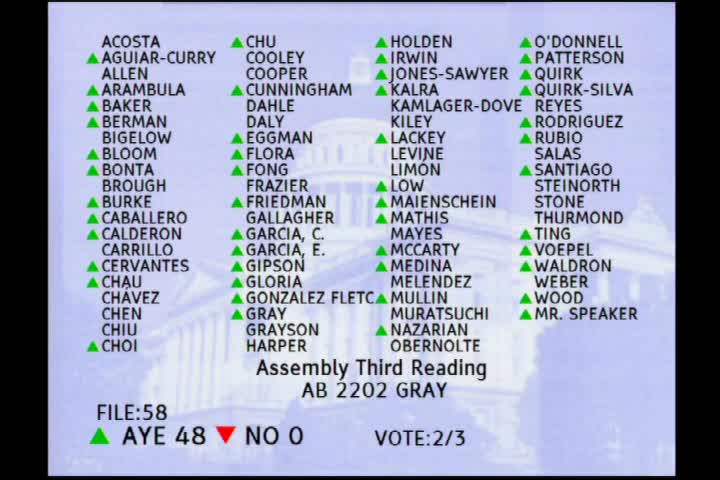 2MIN
Assembly Floor
 15MIN



