AB 2528: Climate adaptation.
- Session Year: 2017-2018
- House: Assembly
- Latest Version Date: 2018-08-29
Existing law requires the Natural Resources Agency by July 1, 2017, and every 3 years thereafter, to update the states climate adaptation strategy to identify vulnerabilities to climate change by sectors, including the biodiversity and habitat sector, and priority actions needed to reduce the risks in those sectors. As part of the update, existing law requires the Natural Resources Agency to coordinate with other state agencies to identify a lead agency or group of agencies to lead adaptation efforts in each sector.
This bill would add 3 new sectors to the climate adaptation strategy: the land use and community development sector, the climate justice sector, and the parks, recreation, and California culture sector. The bill would also specify that the biodiversity and habitat sector includes habitat resilience areas, as defined.
Existing law requires the Natural Resources Agency, Agency by July 1, 2017, and every 3 years thereafter, to update the states climate adaptation strategy to identify vulnerabilities to climate change by sectors, including the biodiversity and habitat sector, and priority actions needed to reduce the risks in those sectors. To address vulnerabilities identified in the climate adaptation strategy, existing law requires state agencies to maximize specified objectives, including, among others, protecting and enhancing habitat, species strongholds, and wildlife corridors that are critical to the preservation of species that are at risk from the consequences of climate change. As part of the update, existing law requires the Natural Resources Agency to coordinate with other state agencies to identify a lead agency or group of agencies to lead adaptation efforts in each sector.
This bill would add 3 new sectors to the climate adaptation strategy: the land use and community development sector, the climate justice sector, and the parks, recreation, and California culture sector. The bill would also specify that the biodiversity and habitat sector includes habitat resilience areas, as defined. The bill would also require state agencies to maximize the objective of protecting and enhancing habitat resilience areas.
Existing law requires the Natural Resources Agency, by July 1, 2017, and every 3 years thereafter, to update the states climate adaptation strategy to identify vulnerabilities to climate change by sectors, including the biodiversity and habitat sector, and priority actions needed to reduce the risks in those sectors. To address vulnerabilities identified in the climate adaptation strategy, existing law requires state agencies to maximize specified objectives, including, among others, protecting and enhancing habitat, species strongholds, and wildlife corridors that are critical to the preservation of species that are at risk from the consequences of climate change.
This bill would specify that the biodiversity and habitat sector includes habitat resilience areas, as defined. The bill would also require state agencies to maximize the objective of protecting and enhancing habitat resilience areas. The bill would require the Natural Resources Agency to coordinate with the Governors office to promote the protection of habitat resilience areas within the Pacific Coast Collaborative. The bill would authorize the Ocean Protection Council and the Strategic Growth Council to conduct biannual, joint meetings to discuss the science and planning relating to the implementation of the climate adaptation strategy and to receive updates on the implementation of the climate adaptation strategy.
Existing law requires the Natural Resources Agency, by July 1, 2017, and every 3 years thereafter, to update the states climate adaptation strategy to identify vulnerabilities to climate change by sectors, including the water biodiversity and habitat sector, and priority actions needed to reduce the risks in those sectors. To address vulnerabilities identified in the climate adaptation strategy, existing law requires state agencies to maximize specified objectives, including, among others, protecting and enhancing habitat, species strongholds, and wildlife corridors that are critical to the preservation of species that are at risk from the consequences of climate change.
This bill would specify that the water sector includes the component of habitat resiliency biodiversity and habitat sector includes habitat resilience areas, as defined. The bill would also require state agencies to maximize the objective of protecting and enhancing habitat resiliency resilience areas. The bill would require the Natural Resources Agency to coordinate with the Governors office to promote the protection of habitat resiliency resilience areas within the Pacific Coast Collaborative. The bill would authorize the Ocean Protection Council and the Strategic Growth Council to conduct biannual, joint meetings to discuss the science and planning relating to the implementation of the climate adaptation strategy and to receive updates on the implementation of the climate adaptation strategy.
Existing law requires the Natural Resources Agency, by July 1, 2017, and every 3 years thereafter, to update the states climate adaptation strategy to identify vulnerabilities to climate change by sectors, including the water sector, and priority actions needed to reduce the risks in those sectors. To address vulnerabilities identified in the climate adaptation strategy, existing law requires state agencies to maximize specified objectives, including, among others, protecting and enhancing habitat, species strongholds, and wildlife corridors that are critical to the preservation of species that are at risk from the consequences of climate change.
This bill would specify that the water sector includes the component of habitat resiliency areas, as defined. The bill would also require state agencies to maximize the objective of protecting and enhancing habitat resiliency areas. The bill would require the Natural Resources Agency to coordinate with the Governors office to promote the protection of habitat resiliency areas within the Pacific Coast Collaborative. The bill would authorize the Ocean Protection Council and the Strategic Growth Council to conduct biannual, joint meetings to discuss the science and planning relating to the implementation of the climate adaptation strategy and to receive updates on the implementation of the climate adaptation strategy.
It is the intent of the Legislature for state agencies, as they implement Part 3.7 (commencing with Section 71150) of Division 34 of the Public Resources Code, to do the following:
(a)Study and understand habitat resilience areas in California in order to prepare the state and its associated ecosystems to be more resilient to climate change and its associated impacts, such as drought, fire, and sea-level rise.
(b)Proactively identify, study, and understand habitat resilience areas, including existing strongholds, through existing state planning, including the Safeguarding California Plan, recovery plans, the Wildlife Action Plan, associated sector-specific plans, and other appropriate state plans and programs.
(c)Study and understand strongholds in each of the six bioregions identified by the North American Salmon Stronghold Partnership. Together these strongholds represent less than 5 percent of the states area and less than 10 percent of the salmon and steelhead-bearing streams, but are home to roughly 70 percent of the genetic and run-timing diversity of these species, which act as indicators of watershed and broader ecosystem health.
SEC. 2.Section 71150 of the Public Resources Code is amended to read:71150.For purposes of this part, the following terms have the following meanings:
(a)Agency means the Natural Resources Agency.
(b)Council means the Strategic Growth Council.
(c)Habitat resilience area means any one of the following:
(1)Salmonid Strongholds. For purposes of this paragraph, the following definitions apply:
(A)Salmonid Stronghold means a watershed and its rivers that supports the largest populations of fish or a watershed and its rivers that support populations of fish with critical genetic diversity essential for the recovery of those fish species in each of the following six bioregions identified by the North American Salmon Stronghold Partnership in 2010:
(i)The Smith River Stronghold.
(ii)The Salmon/Mid-Klamath Stronghold.
(iii)The Sacramento Stronghold.
(iv)The Mattole/South Fork Eel Stronghold.
(v)The Big Sur Stronghold.
(vi)The Santa Clara Stronghold.
(B)Populations of fish means any wild, native salmonid species, including trout, salmon, and steelhead species listed as an endangered or threatened species pursuant to the federal Endangered Species Act (16 U.S.C. Sec. 1531 et seq.) or as an endangered, threatened, or candidate species pursuant to the California Endangered Species Act (Chapter 1.5 (commencing with Section 2050) of Division 3 of the Fish and Game Code).
(2)Source waters. For purposes of this paragraph, source waters means any system in the Cascade Mountains, Modoc Plateau, and Feather River headwaters that provides groundwater recharge to extensive volcanic aquifers that store and release large quantities of groundwater to spring-fed rivers.
(3)Coastal estuaries over two acres in size.
(4)Mountain meadows or degraded mountain meadows that are located within the California portion of the Sierra Nevada, Modoc Plateau, Warner Mountains, Southern Cascades, or Sierra or Cascade foothills.
(d)Plan means the Safeguarding California Plan.
SEC. 3.Section 71151 is added to the Public Resources Code, to read:71151.The agency may identify the precise geographic boundaries of the habitat resilience areas defined in subdivision (c) of Section 71150 and include them in the plan.
SEC. 4.Section 71153 of the Public Resources Code is amended to read:71153.(a)By July 1, 2017, and every three years thereafter, the agency shall update the states climate adaptation strategy, known as the plan. As part of the update, the agency shall coordinate with other state agencies to identify a lead agency or group of agencies to lead adaptation efforts in each sector. The updates to the plan shall include all of the following:
(1)Vulnerabilities to climate change by sector, as identified by the lead agency or group of agencies, and regions, including, at a minimum, the following sectors:
(A)Water.
(B)Energy.
(C)Transportation.
(D)Public health.
(E)Agriculture.
(F)Emergency services.
(G)Forestry.
(H)Biodiversity and habitat, including habitat resilience areas.
(I)Ocean and coastal resources.
(J)Land use and community development.
(K)Climate justice.
(L)Parks, recreation, and California culture.
(2)Priority actions needed to advance climate adaptation strategies and to reduce risks in those sectors, as identified by the lead agency or group of agencies.
(b)By January 1, 2017, and every three years thereafter, the agency shall release a draft plan. Between the release of the draft plan and the publication of the final update of the plan, the agency shall hold at least three public hearings for the purpose of providing an opportunity for the public to review and provide written and oral comments on the draft plan. The public hearings shall be held in northern California, the central valley of California, and southern California.
(c)The agency shall annually report to the Legislature, consistent with Section 9795 of the Government Code, on actions taken by each applicable agency to implement the plan.
It is the intent of the Legislature for state agencies, as they implement Part 3.7 (commencing with Section 71150) of Division 34 of the Public Resources Code, to do the following:
(a)Study and understand habitat resilience areas in California in order to prepare the state and its associated ecosystems to be more resilient to climate change and its associated impacts, such as drought, fire, and sea-level rise.
(b)Proactively identify, study, and understand habitat resilience areas, including existing strongholds, through existing state planning, including the Safeguarding California Plan, recovery plans, the Wildlife Action Plan, associated sector-specific plans, and other appropriate state plans and programs.
(c)Study and understand strongholds in each of the six bioregions identified by the North American Salmon Stronghold Partnership. Together these strongholds represent less than 5 percent of the states area and less than 10 percent of the salmon and steelhead-bearing streams, but are home to roughly 70 percent of the genetic and run-timing diversity of these species, which act as indicators of watershed and broader ecosystem health.
SEC. 2.Section 71150 of the Public Resources Code is amended to read:71150.For purposes of this part, the following terms have the following meanings:
(a)Agency means the Natural Resources Agency.
(b)Council means the Strategic Growth Council.
(c)Habitat resilience area means any one of the following:
(1)Aquatic habitat resilience area. For purposes of this paragraph, aquatic habitat resilience area means any one of the following:(A)Strongholds.(1)Salmonid Strongholds. For purposes of this subparagraph, paragraph, the following definitions apply:
(i)Stronghold(A)Salmonid Stronghold means a watershed and its rivers that supports the largest populations of fish or a watershed and its rivers that support populations of fish with critical genetic diversity essential for the recovery of those fish species in each of the following six bioregions identified by the North American Salmon Stronghold Partnership in 2010:
(I)(i)The Smith River Stronghold.
(II)(ii)The Salmon/Mid-Klamath Stronghold.
(III)(iii)The Sacramento Stronghold.
(IV)(iv)The Mattole/South Fork Eel Stronghold.
(V)(v)The Big Sur Stronghold.
(VI)(vi)The Santa Clara Stronghold.
(ii)(B)Populations of fish means any wild, native salmonid species, including trout, salmon, and steelhead species listed as an endangered or threatened species pursuant to the federal Endangered Species Act (16 U.S.C. Sec. 1531 et seq.) or as an endangered, threatened, or candidate species pursuant to the California Endangered Species Act (Chapter 1.5 (commencing with Section 2050) of Division 3 of the Fish and Game Code).
(B)(2)Source waters. For purposes of this subparagraph, paragraph, source waters means any system in the Cascade Mountains, Modoc Plateau, and Feather River headwaters that provides groundwater recharge to extensive volcanic aquifers that store and release large quantities of groundwater to spring-fed rivers.
(C)(3)Coastal estuaries over two acres in size.
(D)(4)Mountain meadows or degraded mountain meadows that are located within the California portion of the Sierra Nevada, Modoc Plateau, Warner Mountains, Southern Cascades, or Sierra or Cascade foothills.
(d)Plan means the Safeguarding California Plan.
SEC. 3.Section 71151 is added to the Public Resources Code, to read:71151.The agency may identify the precise geographic boundaries of the habitat resilience areas defined in subdivision (c) of Section 71150 and include them in the plan.
SEC. 3.SEC. 4.Section 71153 of the Public Resources Code is amended to read:71153.(a)By July 1, 2017, and every three years thereafter, the agency shall update the states climate adaptation strategy, known as the plan. As part of the update, the agency shall coordinate with other state agencies to identify a lead agency or group of agencies to lead adaptation efforts in each sector. The updates to the plan shall include all of the following:
(1)Vulnerabilities to climate change by sector, as identified by the lead agency or group of agencies, and regions, including, at a minimum, the following sectors:
(A)Water.
(B)Energy.
(C)Transportation.
(D)Public health.
(E)Agriculture.
(F)Emergency services.
(G)Forestry.
(H)Biodiversity and habitat, including habitat resilience areas.
(I)Ocean and coastal resources.
(J)Land use and community development.
(K)Climate justice.
(L)Parks, recreation, and California culture.
(2)Priority actions needed to advance climate adaptation strategies and to reduce risks in those sectors, as identified by the lead agency or group of agencies.
(b)By January 1, 2017, and every three years thereafter, the agency shall release a draft plan. Between the release of the draft plan and the publication of the final update of the plan, the agency shall hold at least three public hearings for the purpose of providing an opportunity for the public to review and provide written and oral comments on the draft plan. The public hearings shall be held in northern California, the central valley of California, and southern California.
(c)The agency shall annually report to the Legislature, consistent with Section 9795 of the Government Code, on actions taken by each applicable agency to implement the plan.
(a)It is the intent of the Legislature to protect and enhance for state agencies, as they implement Part 3.7 (commencing with Section 71150) of Division 34 of the Public Resources Code, to do the following:
(a)Study and understand habitat resilience areas in California and in order to prepare the state and its associated ecosystems to be more resilient to climate change and its associated impacts, such as drought, fire, and sea level sea-level rise.
(b)It is the intent of the Legislature for state agencies, as they implement Part 3.7 (commencing with Section 71150) of Division 34 of the Public Resources Code, to proactively Proactively identify, protect, and further enhance study, and understand habitat resilience areas, including existing strongholds, through existing state planning, including the Safeguarding California Plan, recovery plans, the Wildlife Action Plan, associated sector-specific plans, and other appropriate state plans and programs.
(c)Study and understand strongholds in each of the six bioregions identified by the North American Salmon Stronghold Partnership. Together these strongholds represent less than 5 percent of the states area and less than 10 percent of the salmon and steelhead-bearing streams, but are home to roughly 70 percent of the genetic and run-timing diversity of these species, which act as indicators of watershed and broader ecosystem health.
SEC. 2.Section 71150 of the Public Resources Code is amended to read:71150.For purposes of this part, the following terms have the following meanings:
(a)Agency means the Natural Resources Agency.
(b)Council means the Strategic Growth Council.
(c)Habitat resilience area means any one of the following:
(1)Aquatic habitat resilience area. For purposes of this paragraph, aquatic habitat resilience area means any one of the following:
(A)Strongholds. For purposes of this paragraph, subparagraph, the following definitions apply:
(i)Stronghold means a watershed that currently supports the largest populations of fish in each bioregion within the state or a watershed that supports populations of fish with critical genetic diversity essential for the recovery of those fish species.(i)Stronghold means a watershed and its rivers that supports the largest populations of fish or a watershed and its rivers that support populations of fish with critical genetic diversity essential for the recovery of those fish species in each of the following bioregions identified by the North American Salmon Stronghold Partnership in 2010:
(I)The Smith River Stronghold.
(II)The Salmon/Mid-Klamath Stronghold.
(III)The Sacramento Stronghold.
(IV)The Mattole/South Fork Eel Stronghold.
(V)The Big Sur Stronghold.
(VI)The Santa Clara Stronghold.
(ii)Populations of fish means any one of the following: wild, native salmonid species, including trout, salmon, and steelhead species listed as an endangered or threatened species pursuant to the federal Endangered Species Act (16 U.S.C. Sec. 1531 et seq.) or as an endangered, threatened, or candidate species pursuant to the California Endangered Species Act (Chapter 1.5 (commencing with Section 2050) of Division 3 of the Fish and Game Code).
(I)Any wild trout, salmon, and steelhead species listed as an endangered or threatened species pursuant to the federal Endangered Species Act (16 U.S.C. Sec. 1531 et seq.) or as an endangered, threatened, or candidate species pursuant to the California Endangered Species Act (Chapter 1.5 (commencing with Section 2050) of Division 3 of the Fish and Game Code).(II)Any wild, native salmonid.(III)Any native anadromous fish species.(IV)Any native fish species listed as an endangered or threatened species pursuant to the federal Endangered Species Act (16 U.S.C. Sec. 1531 et seq.) or as an endangered, threatened, or candidate species pursuant to the California Endangered Species Act (Chapter 1.5 (commencing with Section 2050) of Division 3 of the Fish and Game Code).(B)Source waters. For purposes of this subparagraph, source waters means any system in the Cascade Mountains, Modoc Plateau, and Feather River headwaters that provides groundwater recharge to extensive volcanic aquifers that store and release large quantities of groundwater to spring-fed rivers.
(C)Coastal estuaries over two acres in size.
(D)Mountain meadows or degraded mountain meadows that are located within the California portion of the Sierra Nevada, Modoc Plateau, Warner Mountains, Southern Cascades, or Sierra or Cascade foothills.
(d)Plan means the Safeguarding California Plan.
SEC. 3.Section 71153 of the Public Resources Code is amended to read:71153.(a)By July 1, 2017, and every three years thereafter, the agency shall update the states climate adaptation strategy, known as the plan. As part of the update, the agency shall coordinate with other state agencies to identify a lead agency or group of agencies to lead adaptation efforts in each sector. The updates to the plan shall include all of the following:
(1)Vulnerabilities to climate change by sector, as identified by the lead agency or group of agencies, and regions, including, at a minimum, the following sectors:
(A)Water.
(B)Energy.
(C)Transportation.
(D)Public health.
(E)Agriculture.
(F)Emergency services.
(G)Forestry.
(H)Biodiversity and habitat, including habitat resilience areas.
(I)Ocean and coastal resources.
(J)Land use and community development.
(K)Climate justice.
(L)Parks, recreation, and California culture.
(2)Priority actions needed to advance climate adaptation strategies and to reduce risks in those sectors, as identified by the lead agency or group of agencies.
(b)By January 1, 2017, and every three years thereafter, the agency shall release a draft plan. Between the release of the draft plan and the publication of the final update of the plan, the agency shall hold at least three public hearings for the purpose of providing an opportunity for the public to review and provide written and oral comments on the draft plan. The public hearings shall be held in northern California, the central valley of California, and southern California.
(c)The agency shall annually report to the Legislature, consistent with Section 9795 of the Government Code, on actions taken by each applicable agency to implement the plan.
SEC. 4.Section 71154 of the Public Resources Code is amended to read:71154.To address the vulnerabilities identified in the plan, state agencies shall work to maximize, where applicable and feasible, the following objectives:(a)Educating the public about the consequences of climate change, such as sea level rise, extreme weather events, the urban heat island effect, habitat loss, wildfire, drought, threats to infrastructure and agriculture, worsening air and water quality, and public health impacts.(b)Ensuring there is a continued repository for scientific data on climate change and climate adaptation in the state in order to facilitate educated state and local policy decisions and to help identify primary risks from climate change to residents, property, communities, and natural systems across the state.(c)(1)Promoting the use of the plan to inform planning decisions and ensure that state investments consider climate change impacts, as well as promote the use of natural systems and natural infrastructure, when developing physical infrastructure to address adaptation.(2)When developing infrastructure to address adaptation, where feasible, a project alternative should be developed that utilizes existing natural features and ecosystem processes or the restoration of natural features and ecosystem processes to meet the projects goals.(3)For purposes of this subdivision, natural infrastructure means the preservation or restoration of ecological systems or the utilization of engineered systems that use ecological processes to increase resiliency to climate change, manage other environmental hazards, or both. This may include, but need not be limited to, flood plain and wetlands restoration or preservation, combining levees with restored natural systems to reduce flood risk, and urban tree planting to mitigate high heat days.(d)Encouraging regional collaborative planning efforts to address regional climate change impacts and adaptation strategies.(e)Promoting drought resiliency through an integrated water supply, delivery, and capture system that is coordinated and that can be resilient to a multiyear drought scenario while protecting water quality and the public health. Establishing both drought preparation programs, which will help create sustainable water systems in the future, and immediate drought response programs, which will reduce water demand or increase supply within one to five years of any declared drought.(f)Building resilient communities by developing urban greening projects that reduce air pollution and heat reflection in urban areas and create livable, sustainable communities in urban cores to promote infill development and reduce greenhouse gas emissions.(g)Protecting and enhancing habitat, species strongholds, and wildlife corridors that are critical to the preservation of species that are at risk from the consequences of climate change.(h)Promoting actions to ensure healthy soils and sustainable agriculture; inform reliable transportation planning; improve emergency management response across sectors; ensure sufficient, reliable, and safe energy; improve capacity to reduce and respond to public health threats; address the impacts of climate change on disadvantaged communities; and protect cultural resources from the impacts of climate change.(i)Protecting and enhancing habitat resilience areas.(a)It is the intent of the Legislature to protect and enhance habitat resilience areas in California and to prepare the state and its associated ecosystems to be more resilient to climate change and its associated impacts, such as drought, fire, and sea level rise.
(b)It is the intent of the Legislature for state agencies, as they implement Part 3.7 (commencing with Section 71150) of Division 34 of the Public Resources Code, to proactively identify, protect, and further enhance habitat resilience areas, including existing strongholds, through existing state planning, including the Safeguarding California Plan, recovery plans, the Wildlife Action Plan, associated sector-specific plans, and other appropriate state plans and programs.
SEC. 2.Section 71150 of the Public Resources Code is amended to read:71150.For purposes of this part, the following terms have the following meanings:
(a)Agency means the Natural Resources Agency.
(b)Council means the Strategic Growth Council.
(c)Habitat resilience area means any one of the following:
(1)Aquatic habitat resilience area. For purposes of this paragraph, aquatic habitat resilience area means any one of the following:
(1)(A)Strongholds. For purposes of this paragraph, the following definitions apply:
(A)(i)Stronghold means a watershed that currently supports the largest populations of fish in each bioregion within the state or a watershed that supports populations of fish with critical genetic diversity essential for the recovery of those fish species.
(B)(ii)Populations of fish means any one of the following:
(i)(I)Any wild trout, salmon, and steelhead species listed as an endangered or threatened species pursuant to the federal Endangered Species Act (16 U.S.C. Sec. 1531 et seq.) or as an endangered, threatened, or candidate species pursuant to the California Endangered Species Act (Chapter 1.5 (commencing with Section 2050) of Division 3 of the Fish and Game Code).
(ii)(II)Any wild, native salmonid.
(iii)(III)Any native anadromous fish species.
(iv)(IV)Any native fish species listed as an endangered or threatened species pursuant to the federal Endangered Species Act (16 U.S.C. Sec. 1531 et seq.) or as an endangered, threatened, or candidate species pursuant to the California Endangered Species Act (Chapter 1.5 (commencing with Section 2050) of Division 3 of the Fish and Game Code).
(2)(B)Source waters. For purposes of this paragraph, subparagraph, source waters means any system in the Cascade Mountains, Modoc Plateau, and Feather River headwaters that provides groundwater recharge to extensive volcanic aquifers that store and release large quantities of groundwater to spring-fed rivers.
(3)(C)Coastal estuaries over two acres in size.
(4)(D)Mountain meadows or degraded mountain meadows that are located within the California portion of the Sierra Nevada, Modoc Plateau, Warner Mountains, Southern Cascades, or Sierra or Cascade foothills.
(d)Plan means the Safeguarding California Plan.
SEC. 3.Section 71153 of the Public Resources Code is amended to read:71153.(a)By July 1, 2017, and every three years thereafter, the agency shall update the states climate adaptation strategy, known as the plan. As part of the update, the agency shall coordinate with other state agencies to identify a lead agency or group of agencies to lead adaptation efforts in each sector. The updates to the plan shall include all of the following:
(1)Vulnerabilities to climate change by sector, as identified by the lead agency or group of agencies, and regions, including, at a minimum, the following sectors:
(A)Water.
(B)Energy.
(C)Transportation.
(D)Public health.
(E)Agriculture.
(F)Emergency services.
(G)Forestry.
(H)Biodiversity and habitat, including habitat resilience areas.
(I)Ocean and coastal resources.
(2)Priority actions needed to advance adaptation strategies and to reduce risks in those sectors, as identified by the lead agency or group of agencies.
(b)By January 1, 2017, and every three years thereafter, the agency shall release a draft plan. Between the release of the draft plan and the publication of the final update of the plan, the agency shall hold at least three public hearings for the purpose of providing an opportunity for the public to review and provide written and oral comments on the draft plan. The public hearings shall be held in northern California, the central valley of California, and southern California.
(c)The agency shall annually report to the Legislature, consistent with Section 9795 of the Government Code, on actions taken by each applicable agency to implement the plan.
SEC. 4.Section 71154 of the Public Resources Code is amended to read:71154.To address the vulnerabilities identified in the plan, state agencies shall work to maximize, where applicable and feasible, the following objectives:
(a)Educating the public about the consequences of climate change, such as sea level rise, extreme weather events, the urban heat island effect, habitat loss, wildfire, drought, threats to infrastructure and agriculture, worsening air and water quality, and public health impacts.
(b)Ensuring there is a continued repository for scientific data on climate change and climate adaptation in the state in order to facilitate educated state and local policy decisions and to help identify primary risks from climate change to residents, property, communities, and natural systems across the state.
(c)(1)Promoting the use of the plan to inform planning decisions and ensure that state investments consider climate change impacts, as well as promote the use of natural systems and natural infrastructure, when developing physical infrastructure to address adaptation.
(2)When developing infrastructure to address adaptation, where feasible, a project alternative should be developed that utilizes existing natural features and ecosystem processes or the restoration of natural features and ecosystem processes to meet the projects goals.
(3)For purposes of this subdivision, natural infrastructure means the preservation or restoration of ecological systems or the utilization of engineered systems that use ecological processes to increase resiliency to climate change, manage other environmental hazards, or both. This may include, but need not be limited to, flood plain and wetlands restoration or preservation, combining levees with restored natural systems to reduce flood risk, and urban tree planting to mitigate high heat days.
(d)Encouraging regional collaborative planning efforts to address regional climate change impacts and adaptation strategies.
(e)Promoting drought resiliency through an integrated water supply, delivery, and capture system that is coordinated and that can be resilient to a multiyear drought scenario while protecting water quality and the public health. Establishing both drought preparation programs, which will help create sustainable water systems in the future, and immediate drought response programs, which will reduce water demand or increase supply within one to five years of any declared drought.
(f)Building resilient communities by developing urban greening projects that reduce air pollution and heat reflection in urban areas and create livable, sustainable communities in urban cores to promote infill development and reduce greenhouse gas emissions.
(g)Protecting and enhancing habitat, species strongholds, and wildlife corridors that are critical to the preservation of species that are at risk from the consequences of climate change.
(h)Promoting actions to ensure healthy soils and sustainable agriculture; inform reliable transportation planning; improve emergency management response across sectors; ensure sufficient, reliable, and safe energy; improve capacity to reduce and respond to public health threats; address the impacts of climate change on disadvantaged communities; and protect cultural resources from the impacts of climate change.
(i)Protecting and enhancing habitat resilience areas.
SEC. 5.Section 71156 is added to the Public Resources Code, to read:71156.(a)The Ocean Protection Council and the council may conduct biannual, joint meetings to discuss the science and planning relating to the implementation of the plan and to receive updates on the implementation of the plan.(b)The agency shall coordinate with the Governors office to promote the protection of habitat resilience areas within the Pacific Coast Collaborative.(a)It is the intent of the Legislature to protect and enhance habitat resiliency resilience areas in California and to prepare the state and its associated ecosystems to be more resilient to climate change and its associated impacts, such as drought, fire, and sea level rise.
(b)It is the intent of the Legislature for state agencies, as they implement Part 3.7 (commencing with Section 71150) of Division 34 of the Public Resources Code, to proactively identify, protect, and further enhance habitat resiliency resilience areas, including existing strongholds, through existing state planning, including the Safeguarding California Plan, recovery plans, the Wildlife Action Plan, associated sector-specific plans, and other appropriate state plans and programs.
(c)It is the intent of the Legislature that by 2040 the state will have protected and enhanced 100 percent of the habitat resiliency areas in the state.SEC. 2.Section 71150 of the Public Resources Code is amended to read:71150.For purposes of this part, the following terms have the following meanings:
(a)Agency means the Natural Resources Agency.
(b)Council means the Strategic Growth Council.
(c)Habitat resiliency resilience area means any one of the following:
(1)A watershed or collection of watersheds that are ecologically connected in a region that currently supports, or has the potential to support, abundant, native, and wild fish populations, including salmon or steelhead, or both, and that are essential to the long-term persistence and recovery of these species in the state. These include, but are not limited to, the stronghold areas identified by the Department of Fish and Wildlife.(2)A source watershed that serves a reservoir system of 3,000,000 acre-feet or greater.(1)Strongholds. For purposes of this paragraph, the following definitions apply:
(A)Stronghold means a watershed that currently supports the largest populations of fish in each bioregion within the state or a watershed that supports populations of fish with critical genetic diversity essential for the recovery of those fish species.
(B)Populations of fish means any one of the following:
(i)Any wild trout, salmon, and steelhead species listed as an endangered or threatened species pursuant to the federal Endangered Species Act (16 U.S.C. Sec. 1531 et seq.) or as an endangered, threatened, or candidate species pursuant to the California Endangered Species Act (Chapter 1.5 (commencing with Section 2050) of Division 3 of the Fish and Game Code).
(ii)Any wild, native salmonid.
(iii)Any native anadromous fish species.
(iv)Any native fish species listed as an endangered or threatened species pursuant to the federal Endangered Species Act (16 U.S.C. Sec. 1531 et seq.) or as an endangered, threatened, or candidate species pursuant to the California Endangered Species Act (Chapter 1.5 (commencing with Section 2050) of Division 3 of the Fish and Game Code).
(2)Source waters. For purposes of this paragraph, source waters means any system in the Cascade Mountains, Modoc Plateau, and Feather River headwaters that provides groundwater recharge to extensive volcanic aquifers that store and release large quantities of groundwater to spring-fed rivers.
(3)Coastal estuaries over five two acres in size.
(4)A mountain meadow, degraded mountain meadow, or collection of meadows that could serve as natural reservoirs for cold, clean water.(4)Mountain meadows or degraded mountain meadows that are located within the California portion of the Sierra Nevada, Modoc Plateau, Warner Mountains, Southern Cascades, or Sierra or Cascade foothills.
(d)Plan means the Safeguarding California Plan.
SEC. 3.Section 71153 of the Public Resources Code is amended to read:71153.(a)By July 1, 2017, and every three years thereafter, the agency shall update the states climate adaptation strategy, known as the plan. As part of the update, the agency shall coordinate with other state agencies to identify a lead agency or group of agencies to lead adaptation efforts in each sector. The updates to the plan shall include all of the following:
(1)Vulnerabilities to climate change by sector, as identified by the lead agency or group of agencies, and regions, including, at a minimum, the following sectors:
(A)Water, including the component of habitat resiliency areas.(A)Water.
(B)Energy.
(C)Transportation.
(D)Public health.
(E)Agriculture.
(F)Emergency services.
(G)Forestry.
(H)Biodiversity and habitat. habitat, including habitat resilience areas.
(I)Ocean and coastal resources.
(2)Priority actions needed to advance adaptation strategies and to reduce risks in those sectors, as identified by the lead agency or group of agencies.
(b)By January 1, 2017, and every three years thereafter, the agency shall release a draft plan. Between the release of the draft plan and the publication of the final update of the plan, the agency shall hold at least three public hearings for the purpose of providing an opportunity for the public to review and provide written and oral comments on the draft plan. The public hearings shall be held in northern California, the central valley of California, and southern California.
(c)The agency shall annually report to the Legislature, consistent with Section 9795 of the Government Code, on actions taken by each applicable agency to implement the plan.
SEC. 4.Section 71154 of the Public Resources Code is amended to read:71154.To address the vulnerabilities identified in the plan, state agencies shall work to maximize, where applicable and feasible, the following objectives:
(a)Educating the public about the consequences of climate change, such as sea-level sea level rise, extreme weather events, the urban heat island effect, habitat loss, wildfire, drought, threats to infrastructure and agriculture, worsening air and water quality, and public health impacts.
(b)Ensuring there is a continued repository for scientific data on climate change and climate adaptation in the state in order to facilitate educated state and local policy decisions and to help identify primary risks from climate change to residents, property, communities, and natural systems across the state.
(c)(1)Promoting the use of the plan to inform planning decisions and ensure that state investments consider climate change impacts, as well as promote the use of natural systems and natural infrastructure, when developing physical infrastructure to address adaptation.
(2)When developing infrastructure to address adaptation, where feasible, a project alternative should be developed that utilizes existing natural features and ecosystem processes or the restoration of natural features and ecosystem processes to meet the projects goals.
(3)For purposes of this subdivision, natural infrastructure means the preservation or restoration of ecological systems or the utilization of engineered systems that use ecological processes to increase resiliency to climate change, manage other environmental hazards, or both. This may include, but need not be limited to, flood plain and wetlands restoration or preservation, combining levees with restored natural systems to reduce flood risk, and urban tree planting to mitigate high heat days.
(d)Encouraging regional collaborative planning efforts to address regional climate change impacts and adaptation strategies.
(e)Promoting drought resiliency through an integrated water supply, delivery, and capture system that is coordinated and that can be resilient to a multiyear drought scenario while protecting water quality and the public health. Establishing both drought preparation programs, which will help create sustainable water systems in the future, and immediate drought response programs, which will reduce water demand or increase supply within one to five years of any declared drought.
(f)Building resilient communities by developing urban greening projects that reduce air pollution and heat reflection in urban areas and create livable, sustainable communities in urban cores to promote infill development and reduce greenhouse gas emissions.
(g)Protecting and enhancing habitat, species strongholds, and wildlife corridors that are critical to the preservation of species that are at risk from the consequences of climate change.
(h)Promoting actions to ensure healthy soils and sustainable agriculture; inform reliable transportation planning; improve emergency management response across sectors; ensure sufficient, reliable, and safe energy; improve capacity to reduce and respond to public health threats; address the impacts of climate change on disadvantaged communities; and protect cultural resources from the impacts of climate change.
(i)Protecting and enhancing habitat resiliency resilience areas.
SEC. 5.Section 71156 is added to the Public Resources Code, to read:71156.(a)The Ocean Protection Council and the council may conduct biannual, joint meetings to discuss the science and planning relating to the implementation of the plan and to receive updates on the implementation of the plan.
(b)The agency shall coordinate with the Governors office to promote the protection of habitat resiliency resilience areas within the Pacific Coast Collaborative.
(a)It is the intent of the Legislature to protect and enhance habitat resiliency areas in California and to prepare the state and its associated ecosystems to be more resilient to climate change and its associated impacts, such as drought, fire, and sea level rise.
(b)It is the intent of the Legislature for state agencies, as they implement Part 3.7 (commencing with Section 71150) of Division 34 of the Public Resources Code, to proactively identify, protect, and further enhance habitat resiliency areas, including existing strongholds, through existing state planning, including the Safeguarding California Plan, recovery plans, the Wildlife Action Plan, associated sector-specific plans, and other appropriate state plans and programs.
(c)It is the intent of the Legislature that by 2040 the state will have protected and enhanced 100 percent of the habitat resiliency areas in the state.
SEC. 2.Section 71150 of the Public Resources Code is amended to read:71150.For purposes of this part, the following terms have the following meanings:
(a)Agency means the Natural Resources Agency.
(b)Council means the Strategic Growth Council.
(c)Habitat resiliency area means any one of the following:
(1)A watershed or collection of watersheds that are ecologically connected in a region that currently supports, or has the potential to support, abundant, native, and wild fish populations, including salmon or steelhead, or both, and that are essential to the long-term persistence and recovery of these species in the state. These include, but are not limited to, the stronghold areas identified by the Department of Fish and Wildlife.
(2)A source watershed that serves a reservoir system of 3,000,000 acre-feet or greater.
(3)Coastal estuaries over five acres in size.
(4)A mountain meadow, degraded mountain meadow, or collection of meadows that could serve as natural reservoirs for cold, clean water.
(c)(d)Plan means the Safeguarding California Plan.
SEC. 3.Section 71153 of the Public Resources Code is amended to read:71153.(a)By July 1, 2017, and every three years thereafter, the agency shall update the states climate adaptation strategy, known as the plan. As part of the update, the agency shall coordinate with other state agencies to identify a lead agency or group of agencies to lead adaptation efforts in each sector. The updates to the plan shall include all of the following:
(1)Vulnerabilities to climate change by sector, as identified by the lead agency or group of agencies, and regions, including, at a minimum, the following sectors:
(A)Water.(A)Water, including the component of habitat resiliency areas.
(B)Energy.
(C)Transportation.
(D)Public health.
(E)Agriculture.
(F)Emergency services.
(G)Forestry.
(H)Biodiversity and habitat.
(I)Ocean and coastal resources.
(2)Priority actions needed to reduce risks in those sectors, as identified by the lead agency or group of agencies.
(b)By January 1, 2017, and every three years thereafter, the agency shall release a draft plan. Between the release of the draft plan and the publication of the final update of the plan, the agency shall hold at least three public hearings for the purpose of providing an opportunity for the public to review and provide written and oral comments on the draft plan. The public hearings shall be held in northern California, the central valley of California, and southern California.
(c)The agency shall annually report to the Legislature, consistent with Section 9795 of the Government Code, on actions taken by each applicable agency to implement the plan.
SEC. 4.Section 71154 of the Public Resources Code is amended to read:71154.To address the vulnerabilities identified in the plan, state agencies shall work to maximize, where applicable and feasible, the following objectives:
(a)Educating the public about the consequences of climate change, such as sea-level rise, extreme weather events, the urban heat island effect, habitat loss, wildfire, drought, threats to infrastructure and agriculture, worsening air and water quality, and public health impacts.
(b)Ensuring there is a continued repository for scientific data on climate change and climate adaptation in the state in order to facilitate educated state and local policy decisions and to help identify primary risks from climate change to residents, property, communities, and natural systems across the state.
(c)(1)Promoting the use of the plan to inform planning decisions and ensure that state investments consider climate change impacts, as well as promote the use of natural systems and natural infrastructure, when developing physical infrastructure to address adaptation.
(2)When developing infrastructure to address adaptation, where feasible, a project alternative should be developed that utilizes existing natural features and ecosystem processes or the restoration of natural features and ecosystem processes to meet the projects goals.
(3)For purposes of this subdivision, natural infrastructure means the preservation or restoration of ecological systems or the utilization of engineered systems that use ecological processes to increase resiliency to climate change, manage other environmental hazards, or both. This may include, but need not be limited to, flood plain and wetlands restoration or preservation, combining levees with restored natural systems to reduce flood risk, and urban tree planting to mitigate high heat days.
(d)Encouraging regional collaborative planning efforts to address regional climate change impacts and adaptation strategies.
(e)Promoting drought resiliency through an integrated water supply, delivery, and capture system that is coordinated and that can be resilient to a multiyear drought scenario while protecting water quality and the public health. Establishing both drought preparation programs, which will help create sustainable water systems in the future, and immediate drought response programs, which will reduce water demand or increase supply within one to five years of any declared drought.
(f)Building resilient communities by developing urban greening projects that reduce air pollution and heat reflection in urban areas and create livable, sustainable communities in urban cores to promote infill development and reduce greenhouse gas emissions.
(g)Protecting and enhancing habitat, species strongholds, and wildlife corridors that are critical to the preservation of species that are at risk from the consequences of climate change.
(h)Promoting actions to ensure healthy soils and sustainable agriculture; inform reliable transportation planning; improve emergency management response across sectors; ensure sufficient, reliable, and safe energy; improve capacity to reduce and respond to public health threats; address the impacts of climate change on disadvantaged communities; and protect cultural resources from the impacts of climate change.
(i)Protecting and enhancing habitat resiliency areas.
SEC. 5.Section 71156 is added to the Public Resources Code, to read:71156.(a)The Ocean Protection Council and the council may conduct biannual, joint meetings to discuss the science and planning relating to the implementation of the plan and to receive updates on the implementation of the plan.
(b)The agency shall coordinate with the Governors office to promote the protection of habitat resiliency areas within the Pacific Coast Collaborative.
|
Date
|
Status
|
|---|---|
| Sep 18, 2018 | Vetoed by Governor. |
| Sep 5, 2018 | Enrolled and presented to the Governor at 3 p.m. |
| Aug 27, 2018 | Senate amendments concurred in. To Engrossing and Enrolling. |
| Aug 22, 2018 | In Assembly. Concurrence in Senate amendments pending. May be considered on or after August 24 pursuant to Assembly Rule 77. |
| Aug 22, 2018 | Read third time. Passed. Ordered to the Assembly. |
| Aug 17, 2018 | From committee: Do pass. (Ayes 5. Noes 2.) (August 16). |
| Aug 6, 2018 | In committee: Referred to APPR. suspense file. |
| Jul 3, 2018 | Read second time and amended. Re-referred to Com. on APPR. |
| Jul 2, 2018 | From committee: Amend, and do pass as amended and re-refer to Com. on APPR. (Ayes 7. Noes 2.) (June 26). |
| Jun 14, 2018 | From committee chair, with author's amendments: Amend, and re-refer to committee. Read second time, amended, and re-referred to Com. on N.R. & W. |
| Jun 7, 2018 | Referred to Com. on N.R. & W. |
| May 30, 2018 | In Senate. Read first time. To Com. on RLS. for assignment. |
| May 29, 2018 | Read third time. Passed. Ordered to the Senate. |
| May 24, 2018 | Read second time. Ordered to third reading. |
| May 23, 2018 | From committee: Do pass. (Ayes 11. Noes 5.) (May 23). |
| Apr 25, 2018 | Re-referred to Com. on APPR. |
| Apr 24, 2018 | Read second time and amended. |
| Apr 23, 2018 | From committee: Amend, and do pass as amended and re-refer to Com. on APPR. (Ayes 7. Noes 3.) (April 16). |
| Apr 5, 2018 | Re-referred to Com. on NAT. RES. |
| Apr 4, 2018 | From committee chair, with author's amendments: Amend, and re-refer to Com. on NAT. RES. Read second time and amended. |
| Mar 20, 2018 | In committee: Set, first hearing. Hearing canceled at the request of author. |
| Mar 5, 2018 | Referred to Com. on NAT. RES. |
| Feb 15, 2018 | From printer. May be heard in committee March 17. |
| Feb 14, 2018 | Read first time. To print. |
|
Date
|
Description
|
Location
|
Votes
|
|
|---|---|---|---|---|
| Aug 27, 2018 | AB 2528 BLOOM Concurrence in Senate Amendments | Assembly Floor |
Passed |
|
| Aug 22, 2018 | Assembly 3rd Reading AB2528 Bloom et al. By Allen | Senate Floor |
Passed |
|
| Aug 16, 2018 | Do pass | Senate Standing Committee on Appropriations |
Passed |
|
| Aug 6, 2018 | Placed on suspense file | Senate Standing Committee on Appropriations |
Passed |
|
| Jun 26, 2018 | Do pass as amended, but first amend, and re-refer to the Committee on [Appropriations] | Senate Standing Committee on Natural Resources and Water |
Passed |
|
| May 29, 2018 | AB 2528 BLOOM Assembly Third Reading | Assembly Floor |
Passed |
|
| May 23, 2018 | Do pass. | Assembly Standing Committee on Appropriations |
Passed |
|
| Apr 16, 2018 | Do pass as amended and be re-referred to the Committee on [Appropriations] | Assembly Standing Committee on Natural Resources |
Passed |
This list shows positions taken on this bill by organizations on the date displayed, which is linked to the original source.
Positions by individuals are not included.
GOVERNOR'S VETO
GV Bill Id:AB 2528
Author:(Bloom)
As Enrolled Ver:September 5, 2018
2/3 vote
ASSEMBLY: | 42-32 | (May 29, 2018) | SENATE: | 23-12 | (August 22, 2018) |
ASSEMBLY: | 44-32 | (August 27, 2018) |
|
|
Original Committee Reference: NAT. RES.
SUMMARY: Specifies that "habitat resilience areas," as defined, are included in the state's climate adaptation strategy and requires state agencies to maximize the objective of protecting and enhancing habitat resilience areas.
EXISTING LAW:
- Pursuant to Executive Order S-13-08 (Schwarzenegger), requires the Natural Resources Agency (NRA), through the Climate Action Team, to coordinate with local, regional, state, federal, and private entities to develop a state Climate Adaptation Strategy. Requires the strategy to summarize the best known science on climate change impacts to California, assess California's vulnerability to the identified impacts, and outline solutions that can be implemented within and across state agencies to promote resiliency.
- Pursuant to Executive Order B-30-15 (Brown), in addition to establishing a 40% Greenhouse Gas (GHG) emission reduction goal by 2030, requires several actions on adaptation including:
- Requires the NRA to update its climate adaptation strategy, the Safeguarding California Plan (Plan), by July 1, 2017, and every three years thereafter, by coordinating adaption activities among lead state agencies in each sector. Requires the state's climate adaptation strategy to:
- Identify vulnerabilities to climate change by sector and regions, including, at a minimum, the following sectors: water, energy, transportation, public health, agriculture, emergency services, forestry, biodiversity and habitat, and ocean and coastal resources;
- Outline primary risks to residents, property, communities, and natural systems from these vulnerabilities, and identify priority actions needed to reduce these risks; and,
- Identify a lead agency or group of agencies to lead adaptation efforts in each sector.
- Requires the NRA to update its climate adaptation strategy, the Safeguarding California Plan (Plan), by July 1, 2017, and every three years thereafter, by coordinating adaption activities among lead state agencies in each sector. Requires the state's climate adaptation strategy to:
- Requires each sector lead to prepare an implementation plan by September 2015 to outline the actions that will be taken as identified in the state's climate adaptation strategy, and report back on those actions to the NRA.
- Requires state agencies' planning and investment to be guided by the principles of climate preparedness, flexibility and adaptive approaches for uncertain climate impacts, protective of vulnerable populations, and prioritization of natural infrastructure solutions.
- Requires the Governor's Office of Planning and Research (OPR) to establish a technical advisory group to help state agencies incorporate climate change impacts into planning and investment decisions.
- Requires the state to continue its rigorous climate change research program focused on understanding the impacts of climate change and how best to prepare and adapt to such impacts.
- Establishes the Strategic Growth Council (SGC) consisting of the Director of OPR, the Secretary of NRA, the Secretary for Environmental Protection, the Secretary of Transportation, the Secretary of California Health and Human Services, the Secretary of Business, Consumer Services, and Housing, the Secretary of Food and Agriculture, three members of the public selected independently by the Speaker of the Assembly, the Senate Committee on Rules, and the Governor.
- Requires the public members to have a background in land use planning, local government, resource protection and management, or community development or revitalization.
- Requires that SGC staffing be reflective of the member organizations.
- Specifies NRA as the lead agency.
- Requires SGC to identify and review activities and funding programs of state agencies that may be coordinated to improve air and water quality, improve natural resource protection, increase the availability of affordable housing, improve transportation, meet the goals of the California Global Warming Solutions Act [AB 32 (Nuñez), Chapter 488, Statutes of 2006] and the strategies and priorities developed in the state's climate adaptation strategy known as the Safeguarding California Plan, encourage sustainable land use planning, and revitalize urban and community centers in a sustainable manner.
- Requires local jurisdictions to include climate adaptation and resiliency strategies in the safety elements of their general plans.
- Directs state agencies to pursue the following objectives;
- Educate the public about climate change;
- Maintain a continued data repository on climate change and climate adaptation for the purposes of facilitating educated state and local policy decisions about climate change;
- Promote the use of the plan to inform planning decisions, and promote the use of natural systems, natural infrastructure and natural processes to address adaptation needs;
- Encourage regional collaborative planning;
- Promote drought resiliency;
- Build resilient communities;
- Protect and enhance habitat; and,
- Promote healthy soils and sustainable agriculture.
FISCAL EFFECT: According to the Senate Appropriations Committee, the department reports it would require the addition of two new staff and $445,000 to implement the bill.
COMMENTS: In 2009, NRA described adaptation as a relatively new concept in California policy and stated the term means, "efforts that respond to the impacts of climate change – adjustments in natural or human systems to actual or expected climate changes to minimize harm or take advantage of beneficial opportunities." California's adaptation efforts can be traced back to 2008, when Governor Schwarzenegger ordered the NRA, through the Climate Action Team (CAT), to coordinate with local, regional, state, federal, public, and private entities to develop, by 2009, the state's Climate Adaptation Strategy. Governor Schwarzenegger's Executive Order required the strategy to summarize the best known science on climate change impacts for California, assess California's vulnerability to the identified impacts, and outline solutions that can be implemented within and across state agencies to promote resiliency. As a result, NRA drafted The 2009 California Climate Adaptation Strategy. The state's Climate Adaptation Strategy represents the work of seven sector-specific working groups led by 12 state agencies, boards, commissions, and numerous stakeholders. The Strategy proposes a comprehensive set of recommendations designed to inform and guide California decision makers as they begin to develop policies that will protect the state, its residents, and its resources from a range of climate change impacts. In July of 2014, NRA released an update to the 2009 California Climate Adaptation Strategy Safeguarding California: Reducing Climate Risk. In May of 2017, as required by AB 1482 (Gordon) Chapter 603, Statutes of 2016, the SGC submitted a subsequent update to the plan, the first in a series of updates required every three years. The biodiversity and habitat section of the plan emphasizes the importance of promoting habitat connectivity and finding conservation solutions with multiple benefits.
Water is a vital and precious resource for humans and wildlife in California. The state's Mediterranean climate means that water availability varies widely between years and seasons. The vast majority of the state's precipitation falls between October and April and is stored in the snowpack, groundwater, ecosystems, and the state's extensive network of reservoirs. Statewide precipitation varies widely around the average, and while the precise impacts of climate change on California's water resources are unknown, precipitation is likely to become more variable and droughts are likely to get more extreme, which could threaten the resilience of sensitive species and ecosystems.
Watersheds statewide have been heavily altered, limiting species access to habitat and leading to substantial declines in wildlife populations. The Department of Fish and Wildlife (DFW) has identified a series of "species stronghold" areas, which represent the healthiest remaining ecosystems for target species like salmon. Targeting stronghold areas for conservation, rather than areas that have already been degraded, is considered the most effective use of adaptation resources. Cold water is an essential habitat requirement for the salmonid and other fish species targeted by this bill, and both the "source waters" and mountain meadows identified by the bill help regulate water temperature in fish habitat. The last ecosystem type targeted by this bill, coastal estuaries more than two acres in size, exist at the boundaries of freshwater systems and the ocean. They are critical nursery habitats for a variety of species, particularly anadromous salmonid species that spend a substantial portion of their life in the ocean.
In coming years, California's climate is generally expected to become hotter, drier, and more variable. This is expected to impact the state in a variety of ways, and may significantly shift habitat boundaries for thousands of wildlife species across the state. Climate smart habitat planning includes not only consideration of contemporary habitat distributions, but contingencies for how habitat may shift under different climate scenarios. For example, the climate resilience of mammals in terrestrial habitats is dependent on corridors to allow for the passage to suitable habitat. This bill is focused on directing SGC to consider the factors that influence ecosystem processes and resilience in critical habitats for specific categories of fish species. While the importance of these species is clear, other species, both terrestrial and avian, rely on complex ecological interactions across time and space as well, and are at risk due to climate change. To address this, the bill would benefit from changing the nomenclature around "habitat resilience areas" to allow for more types of habitat resilience areas to be considered in the future.
This bill would add three sectors - land use and community development, climate justice, and parks, recreation and California culture - to the Safeguarding California Plan (Plan), the state's climate adaptation strategy. The bill would also require the Biodiversity and Habitat sector of the Plan to include habitat resilience areas.
While well intentioned, this bill is unduly restrictive in its definitions. The bill requires too narrow a focus for the broad mandate that the Safeguarding California Plan envisions.
As we continue to evaluate the impacts of climate change across all sectors, it is important for state agencies to be able to identify priorities based on in-depth assessment of climate risks and adaptation needs pertaining to all ecosystems.
Analysis Prepared by: Dylan Chapple / NAT. RES. / (916) 319-2092 FN: 0005263
CONCURRENCE IN SENATE AMENDMENTS
CSA1 Bill Id:AB 2528
Author:(Bloom)
As Amended Ver:July 3, 2018
Majority vote
ASSEMBLY: | 42-32 | (May 29, 2018) | SENATE: | 23-12 | (August 22, 2018) |
Original Committee Reference: NAT. RES.
SUMMARY: Specifies that "habitat resilience areas," as defined, are included in the state's climate adaptation strategy and requires state agencies to maximize the objective of protecting and enhancing habitat resilience areas.
The Senate amendments:
- Make technical changes to bill language;
- Include a specification that part of the intent of the bill is to study and understand strongholds identified by the North American Salmon Stronghold Partnership (NASSP);
- Re-define the focal areas of the bill as "Salmonid Strongholds; list the 6 bioregions identified by the NASSP;
- Authorize the Natural Resources Agency (NRA) to identify precise geographic boundaries of habitat resilience areas;
- add land use and community development, climate justice, parks, recreation, and California culture to the list of climate change vulnerabilities identified in the Safeguarding California Plan (SCP); and,
- Remove Section 4 of the Assembly version of the bill, which specified approaches to addressing vulnerabilities identified in the SCP.
EXISTING LAW:
- Pursuant to Executive Order S-13-08 (Schwarzenegger), requires the NRA, through the Climate Action Team, to coordinate with local, regional, state, federal, and private entities to develop a state Climate Adaptation Strategy. Requires the strategy to summarize the best known science on climate change impacts to California, assess California's vulnerability to the identified impacts, and outline solutions that can be implemented within and across state agencies to promote resiliency.
- Pursuant to Executive Order B-30-15 (Brown), in addition to establishing a 40% Greenhouse Gas (GHG) emission reduction goal by 2030, requires several actions on adaptation
including:- Requires the NRA to update its climate adaptation strategy, the Safeguarding California Plan (Plan), by July 1, 2017, and every three years thereafter, by coordinating adaption activities among lead state agencies in each sector. Requires the state's climate adaptation strategy to:
- Identify vulnerabilities to climate change by sector and regions, including, at a minimum, the following sectors: water, energy, transportation, public health, agriculture, emergency services, forestry, biodiversity and habitat, and ocean and coastal resources;
- Outline primary risks to residents, property, communities, and natural systems from these vulnerabilities, and identify priority actions needed to reduce these risks; and,
- Identify a lead agency or group of agencies to lead adaptation efforts in each sector.
- Requires each sector lead to prepare an implementation plan by September 2015 to outline the actions that will be taken as identified in the state's climate adaptation strategy, and report back on those actions to the NRA.
- Requires state agencies' planning and investment to be guided by the principles of climate preparedness, flexibility and adaptive approaches for uncertain climate impacts, protective of vulnerable populations, and prioritization of natural infrastructure solutions.
- Requires the Governor's Office of Planning and Research (OPR) to establish a technical advisory group to help state agencies incorporate climate change impacts into planning and investment decisions.
- Requires the state to continue its rigorous climate change research program focused on understanding the impacts of climate change and how best to prepare and adapt to such impacts.
- Requires the NRA to update its climate adaptation strategy, the Safeguarding California Plan (Plan), by July 1, 2017, and every three years thereafter, by coordinating adaption activities among lead state agencies in each sector. Requires the state's climate adaptation strategy to:
- Establishes the Strategic Growth Council (SGC) consisting of the Director of OPR, the Secretary of NRA, the Secretary for Environmental Protection, the Secretary of Transportation, the Secretary of California Health and Human Services, the Secretary of Business, Consumer Services, and Housing, the Secretary of Food and Agriculture, three members of the public selected independently by the Speaker of the Assembly, the Senate Committee on Rules, and the Governor.
- Requires the public members to have a background in land use planning, local government, resource protection and management, or community development or revitalization.
- Requires that SGC staffing be reflective of the member organizations.
- Specifies NRA as the lead agency.
- Requires SGC to identify and review activities and funding programs of state agencies that may be coordinated to improve air and water quality, improve natural resource protection, increase the availability of affordable housing, improve transportation, meet the goals of the California Global Warming Solutions Act [AB 32 (Nuñez), Chapter 488, Statutes of 2006] and the strategies and priorities developed in the state's climate adaptation strategy known as the Safeguarding California Plan, encourage sustainable land use planning, and revitalize urban and community centers in a sustainable manner.
- Requires local jurisdictions to include climate adaptation and resiliency strategies in the safety elements of their general plans.
- Directs state agencies to pursue the following objectives;
- Educate the public about climate change;
- Maintain a continued data repository on climate change and climate adaptation for the purposes of facilitating educated state and local policy decisions about climate change;
- Promote the use of the plan to inform planning decisions, and promote the use of natural systems, natural infrastructure and natural processes to address adaptation needs;
- Encourage regional collaborative planning;
- Promote drought resiliency;
- Build resilient communities;
- Protect and enhance habitat; and,
- Promote healthy soils and sustainable agriculture.
FISCAL EFFECT: According to the Senate Appropriations Committee, the department reports it would require the addition of two new staff and $445,000 to implement the bill.
COMMENTS:
- Author's Statement:
The State's Climate Adaptation Strategy identifies vulnerabilities that should be addressed in a climate change policy. AB 2528 updates these vulnerabilities to include watersheds that are naturally resilient to climate impacts. This bill would ask the SGC to take a closer look at four watersheds in California: salmon and steelhead strongholds, source watersheds, mountain meadows, and estuaries, and focuses planning on protecting these areas in coordination with the Governor's office and the Pacific Coast Collaborative. By doing so, the state will be able to create more climate resilient habitat, and conserve critical water supplies for all in California and throughout the entire Pacific Coast.
- Adaptation. In 2009, NRA described adaptation as a relatively new concept in California policy and stated the term means, "efforts that respond to the impacts of climate change – adjustments in natural or human systems to actual or expected climate changes to minimize harm or take advantage of beneficial opportunities." California's adaptation efforts can be traced back to 2008, when Governor Schwarzenegger ordered the NRA, through the Climate Action Team (CAT), to coordinate with local, regional, state, federal, public, and private entities to develop, by 2009, the state's Climate Adaptation Strategy. Governor Schwarzenegger's Executive Order required the strategy to summarize the best known science on climate change impacts for California, assess California's vulnerability to the identified impacts, and outline solutions that can be implemented within and across state agencies to promote resiliency. As a result, NRA drafted The 2009 California Climate Adaptation Strategy. The state's Climate Adaptation Strategy represents the work of seven sector-specific working groups led by 12 state agencies, boards, commissions, and numerous stakeholders. The Strategy proposes a comprehensive set of recommendations designed to inform and guide California decision makers as they begin to develop policies that will protect the state, its residents, and its resources from a range of climate change impacts. In July of 2014, NRA released an update to the 2009 California Climate Adaptation Strategy Safeguarding California: Reducing Climate Risk. In May of 2017, as required by AB 1482 (Gordon) Chapter 603, Statutes of 2015, the SGC submitted a subsequent update to the plan, the first in a series of updates required every three years. The biodiversity and habitat section of the plan emphasizes the importance of promoting habitat connectivity and finding conservation solutions with multiple benefits.
- Critical water resources in California. Water is a vital and precious resource for humans and wildlife in California. The state's Mediterranean climate means that water availability varies widely between years and seasons. The vast majority of the state's precipitation falls between October and April and is stored in the snowpack, groundwater, ecosystems, and the state's extensive network of reservoirs. Statewide precipitation varies widely around the average, and while the precise impacts of climate change on California's water resources are unknown, precipitation is likely to become more variable and droughts are likely to get more extreme, which could threaten the resilience of sensitive species and ecosystems.
Watersheds statewide have been heavily altered, limiting species access to habitat and leading to substantial declines in wildlife populations. The Department of Fish and Wildlife (DFW) has identified a series of "species stronghold" areas, which represent the healthiest remaining ecosystems for target species like salmon. Targeting stronghold areas for conservation, rather than areas that have already been degraded, is considered the most effective use of adaptation resources. Cold water is an essential habitat requirement for the salmonid and other fish species targeted by this bill, and both the "source waters" and mountain meadows identified by the bill help regulate water temperature in fish habitat. The last ecosystem type targeted by this bill, coastal estuaries more than two acres in size, exist at the boundaries of freshwater systems and the ocean. They are critical nursery habitats for a variety of species, particularly anadromous salmonid species that spend a substantial portion of their life in the ocean.
- Habitat complexity and climate adaptation. In coming years, California's climate is generally expected to become hotter, drier, and more variable. This is expected to impact the state in a variety of ways, and may significantly shift habitat boundaries for thousands of wildlife species across the state. Climate smart habitat planning includes not only consideration of contemporary habitat distributions, but contingencies for how habitat may shift under different climate scenarios. For example, the climate resilience of mammals in terrestrial habitats is dependent on corridors to allow for the passage to suitable habitat. This bill is focused on directing SGC to consider the factors that influence ecosystem processes and resilience in critical habitats for specific categories of fish species. While the importance of these species is clear, other species, both terrestrial and avian, rely on complex ecological interactions across time and space as well, and are at risk due to climate change. To address this, the bill would benefit from changing the nomenclature around "habitat resilience areas" to allow for more types of habitat resilience areas to be considered in the future.
Analysis Prepared by: Dylan Chapple / NAT. RES. / (916) 319-2092 FN: 0004425
Office of Senate Floor Analyses (916) 651-1520 Fax: (916) 327-4478 | AB |
THIRD READING
Bill No: AB 2528
:
SENATE NATURAL RES. & WATER COMMITTEE: 7-2, 6/26/18
AYES: Hertzberg, Allen, Hueso, Jackson, McGuire, Monning, Stern
NOES: Stone, Vidak
SENATE APPROPRIATIONS COMMITTEE: 5-2, 8/16/18
AYES: Portantino, Beall, Bradford, Hill, Wiener
NOES: Bates, Nielsen
ASSEMBLY FLOOR: 42-32, 5/29/18 - See last page for vote
DIGEST:
This bill adds three new sectors to the state’s climate adaptation strategy (land use and community development; climate justice; and parks, recreation, and California culture), specifies that the biodiversity and habitat sector includes habitat resilience areas, and defines habitat resilience areas.
Existing law:
- Establishes the Natural Resources Agency (agency).
- Requires that the Safeguarding California Plan (plan), the state’s climate adaptation strategy, be revised by the agency every three years starting July 1, 2017, with public input. The agency shall identify other state agencies to identify a lead agency or group of agencies for each identified sector. The updates shall address vulnerabilities to climate change and priority actions to respond to the risks posed in at least the following sectors: water, energy, transportation, public health, agriculture, emergency services, forestry, biodiversity and habitat, and ocean and coastal resources (Public Resources Code (PRC) §71153).
- Establishes legislative intent “to prioritize the state’s response to the impacts resulting from climate change by ensuring all state departments and agencies prepare for and are ready to respond to the impacts of climate change, such as extreme weather events, the urban heat island effect, habitat loss, wildfire, sea-level rise, and drought, and that the agency consider developing policies to address the impacts of climate change and climate adaptation with a focus on people, place, and water and that actions taken to address climate adaptation should be consistent with the Safeguarding California Plan (PRC §71152).”
- Requires state agencies to work to maximize, where applicable and feasible, numerous objectives to address vulnerabilities identified in the plan, including: educating the public about the consequences of climate change; ensuring there is a continuing depository of relevant scientific data; promoting the use of the plan to inform planning and state investments in natural infrastructure, as specified; protecting and enhancing habitat, species strongholds, and wildlife corridors that are critical to the preservation of species that are at risk; improving emergency management response; ensuring sufficient energy; improving capacity to reduce public health threats; impacts on disadvantaged communities and protecting cultural resources, among other things (PRC §71154).
This bill adds three new sectors to the state’s climate adaptation strategy (land use and community development; climate justice; and parks, recreation, and California culture), specifies that the biodiversity and habitat sector includes habitat resilience areas, and defines habitat resilience areas. Specifically, this bill:
- Defines “habitat resilience area” for the purposes of the state’s climate adaptation law. A habitat resilience areas is any one of the following:
- Salmonid strongholds where a salmonid stronghold means a watershed and its rivers that supports the largest populations of fish or a watershed and its rivers that support populations of fish with critical genetic diversity essential from the recovery of those fish species in each of the following bioregions identified, as specified, in 2010 that includes the Smith River stronghold, the Salmon/Mid-Klamath stronghold, the Sacramento stronghold, the Mattole/South Fork Eel stronghold, the Big Sur stronghold, and the Santa Clara stronghold.
- Populations of fish means any wild, native salmonid species, including trout, salmon, and steelhead species listed as an endangered or threatened species pursuant to federal Endangered Species Act or as an endangered, threatened or candidate species pursuant to California Endangered Species Act.
- Source waters defined as any system in the Cascade Mountains, Modoc Plateau, and Feather River headwaters that provides groundwater recharge to extensive volcanic aquifers that store and release large quantities of groundwater to spring-fed rivers.
- Coastal estuaries defined as those over two acres in size, and
- Mountain meadows or degraded mountain meadows defined as those that are located with the California portion of the Sierra Nevada, Modoc Plateau, Warner Mountains, Southern Cascades or Sierra or Cascade foothills.
- Salmonid strongholds where a salmonid stronghold means a watershed and its rivers that supports the largest populations of fish or a watershed and its rivers that support populations of fish with critical genetic diversity essential from the recovery of those fish species in each of the following bioregions identified, as specified, in 2010 that includes the Smith River stronghold, the Salmon/Mid-Klamath stronghold, the Sacramento stronghold, the Mattole/South Fork Eel stronghold, the Big Sur stronghold, and the Santa Clara stronghold.
- Revises the plan and its triennial updates to include three new sectors to identify vulnerabilities to climate change in, and revises one sector.
- Land use and community development; climate justice; parks, recreation, and California culture are the new sectors and the biodiversity and habitat sector is revised to include habitat resilience areas.
- States legislative intent relevant to the proposed habitat resilience areas.
Background
In 2009, the agency described adaptation as a relatively new concept in California policy and stated the term means, “efforts that respond to the impacts of climate change – adjustments in natural or human systems to actual or expected climate changes to minimize harm or take advantage of beneficial opportunities.” California’s adaptation efforts began in 2008, when then-Governor Schwarzenegger ordered the agency, through the Climate Action Team, to coordinate with local, regional, state, federal, public, and private entities to develop, by 2009, the state’s climate adaptation strategy which summarized the best known science on climate change impacts for the state, assessed the state's vulnerability to the identified impacts, and outlined solutions implementable within and across state agencies to promote resiliency. Five years later, in July of 2014, the agency released the first Safeguarding California Plan that updated the 2009 report. AB 1482 (Gordon, Chapter 603, Statutes of 2016) provided for regular updates every 3 years to the plan starting in 2017. The most recent update is the Safeguarding California Plan: 2018 Update. The biodiversity and habitat section of the plan emphasizes the importance of promoting habitat connectivity and finding conservation solutions with multiple benefits.
Comments
Current law qualifies “maximize”. The language in PRC Section 71154 already provides that state agencies maximize objectives to address vulnerabilities “as feasible.” The agencies have discretion. Further, it is important to note that the state’s climate adaptation planning and efforts are coordinated with and put into effect by existing statutory and regulatory efforts to protect air and water quality, wildlife populations, public health, and drought resiliency, among other programs. These generally also provide for agency discretion, and for a process for administrative resolution of disputes. There appears to be a fair argument that the broad language used in the existing climate adaptation law already includes the habitat resilience areas specifically identified in this bill. This bill seeks to ensure they are included.
The three new sectors conform to latest edition of the plan. The three new sectors added to statute are already incorporated into the plan. One appeared in the 2016 update of the plan as well. The new sectors address emerging challenges identified through the process of updating the plan.
Species strongholds. The concept of species strongholds appears to have been in general use for at least several years, including by the Department of Fish and Wildlife. Those for salmonid species have received considerable effort and publicity due to their listing status, but the concept of strongholds is not limited to salmonids. Improvements in water quality – in coastal estuaries and source waters, for example – have the potential to aid salmonid recovery as well as improve the habitat for numerous other species too. The current plan includes mention of projects underway under existing programs that address some of the aspects of the habitat resilience areas defined by this bill.
FISCAL EFFECT: Appropriation: Fiscal Com.: Local:
According to the Senate Appropriations Committee, to implement this bill, the department reports it would require the addition of two new staff and $445,000.
Workload associated with this bill would involve mapping the aquatic habitat resilience areas, and refining the list of Strongholds. Extensive external and internal coordination and additional scientific analysis would be needed to vet and finalize the list of Strongholds. Additional positions are needed in both Headquarters and Region 1 (where the majority of Strongholds are located) to perform data analysis, provide local ecological expertise, and general organization (including in-person workshops, partner engagement, etc.). Products will need to be flexible and iterative to allow for revision as new information becomes available, requiring long-term staff assignments.
California Trout (source)
Bear Yuba Land Trust
Eastern Sierra Land Trust
Placer Land Trust
Point Blue Conservation Science
Sierra Business Council
Sierra Foothill Conservancy
Sierra Nevada Alliance
Truckee Donner Land Trust
Western Rivers Conservancy
Wild Salmon Center
OPPOSITION: (Verified 8/16/18)
California Association of Nurseries and Garden Centers
California Association of Realtors
California Building Industry Association
California Cattlemen’s Association
California Chamber of Commerce
California Cotton Ginners and Growers Association
California Council for Environmental and Economic Balance
California Farm Bureau Federation
California Forestry Association
California Fresh Fruit Association
California Licensed Foresters Association
Forest Landowners of California
Western Agricultural Processor Association
ARGUMENTS IN SUPPORT: According to the author, “[t]he state’s climate adaptation strategy identifies vulnerabilities that should be addressed in a climate change policy. AB 2528 updates these vulnerabilities to include watersheds that are naturally resilient to climate impacts. This bill would ask the Natural Resources Agency to take a closer look at four watersheds in California: salmon and steelhead strongholds, source watersheds, mountain meadows, and estuaries, and focuses planning on protecting these areas in coordination with the Governor’s office and the Pacific Coast Collaborative. By doing so, the state will be able to create more climate resilient habitat, and conserve critical water supplies for all in California and throughout the entire Pacific Coast.”
According to the sponsor, “[i]f California wants clean source waters, wildlife, and native salmonids to persist in a rapidly changing climate, we need to focus on protecting and enhancing reliance areas. […] By updating our planning to include assessments of these vulnerabilities we can increase their resilience to future change and ensure they persist into the future.”
ARGUMENTS IN OPPOSITION: In a joint “oppose unless amended” letter, the California Forestry Association, among other organizations, acknowledges that recent amendments have addressed some of the groups’ concern, but note that “the bill still defines “strongholds” which under existing law (Public Resources Code section 71154) calls for “protecting and enhancing habitat, species strongholds, and wildlife corridors.”
“While AB 2528 seems to shift the intent of the bill from “protect and enhance” to “identify,” there is still a provision in existing law that would require the protection and enhancement of exact provisions in AB 2528.”
Opponents additionally raises concerns that this bill may harm landowners who have managed lands under their control to provide habitat, the large amount of area in the state and its waters identified by this bill as habitat resilience areas, and regulatory uncertainty associated with vague language, among others.
ASSEMBLY FLOOR: 42-32, 5/29/18
AYES: Aguiar-Curry, Berman, Bloom, Bonta, Burke, Calderon, Carrillo, Chau, Chiu, Chu, Cooley, Eggman, Friedman, Cristina Garcia, Eduardo Garcia, Gipson, Gloria, Gonzalez Fletcher, Holden, Irwin, Jones-Sawyer, Kalra, Kamlager-Dove, Levine, Limón, Low, McCarty, Medina, Mullin, Muratsuchi, Nazarian, O'Donnell, Quirk, Reyes, Rubio, Santiago, Mark Stone, Thurmond, Ting, Weber, Wood, Rendon
NOES: Acosta, Travis Allen, Arambula, Baker, Bigelow, Brough, Caballero, Cervantes, Chávez, Chen, Choi, Cunningham, Dahle, Flora, Fong, Gallagher, Gray, Grayson, Harper, Kiley, Lackey, Maienschein, Mathis, Mayes, Melendez, Obernolte, Patterson, Quirk-Silva, Salas, Steinorth, Voepel, Waldron
NO VOTE RECORDED: Cooper, Daly, Frazier, Rodriguez
8/18/18 13:41:54
**** END ****
SENATE COMMITTEE ON APPROPRIATIONS
Senator Anthony Portantino, Chair
2017 - 2018 Regular Session
AB 2528 (Bloom) - Climate adaptation
Version: July 3, 2018 | Policy Vote: N.R. & W. 7 - 2 |
Urgency: No | Mandate: No |
Hearing Date: August 6, 2018 | Consultant: Ashley Ames |
This bill meets the criteria for referral to the Suspense File.
Bill Summary:
This bill would specify “habitat resilience areas,” are included in the state’s climate adaptation strategy and requires state agencies to maximize the objective of protecting and enhancing habitat resilience areas.
Fiscal Impact:
To implement this bill, the department reports it would require the addition of two new staff and $445,000.
Workload associated with this bill would involve mapping the aquatic habitat resilience areas, and refining the list of Strongholds. Extensive external and internal coordination and additional scientific analysis would be needed to vet and finalize the list of Strongholds. Additional positions are needed in both Headquarters and Region 1 (where the majority of Strongholds are located) to perform data analysis, provide local ecological expertise, and general organization (including in-person workshops, partner engagement, etc.). Products will need to be flexible and iterative to allow for revision as new information becomes available, requiring long-term staff assignments.
Proposed Legislation: This bill would specify “habitat resilience areas,” are included in the state’s climate adaptation strategy and requires state agencies to maximize the objective of protecting and enhancing habitat resilience areas. Specifically, this bill:
- Adds “habitat resilience areas” to the list of identified vulnerabilities to climate change in the Safeguarding California Plan, and updates the “biodiversity and habitat” sector language to include “habitat resilience areas.”
- Defines aquatic habitat resistance areas as including the following:
- “Strongholds,” defined as watersheds that currently support the largest populations of fish in each bioregion or a watershed that supports populations of fish with critical genetic diversity essential for species recovery.
- “Source waters,” defined as any system in the Cascade Mountains, Modoc Plateau, or Feather River headwaters that provide groundwater recharge to volcanic aquifers that store and release large quantities of groundwater to spring-fed rivers.
- Coastal estuaries over two acres in size.
- A mountain meadow, degraded mountain meadow, or collection of meadows that are located within the California portion of the Sierra Nevada, Modoc Plateau, Warner Mountains, Southern Cascades, or Sierra or Cascade foothills that could serve as natural reservoirs for cold, clean water.
-- END --
SENATE COMMITTEE ON NATURAL RESOURCES AND WATER
Senator Robert Hertzberg, Chair
2017 - 2018 Regular
Bill No: AB Hearing Date: June 26, 2018
Author: | Bloom | ||
Version: | June 14, 2018 | ||
Urgency: | No | Fiscal: | Yes |
Consultant: | Katharine Moore | ||
Subject: Climate adaptation
BACKGROUND AND EXISTING LAW
Existing law:
- Establishes the Natural Resources Agency (agency).
- Requires that the Safeguarding California Plan (plan), the state’s climate adaptation strategy, be revised by the agency every three years starting July 1, 2017 with public input. The agency shall identify other state agencies to identify a lead agency or group of agencies for each identified sector. The updates shall address vulnerabilities to climate change and priority actions to respond to the risks posed in at least the following sectors: water, energy, transportation, public health, agriculture, emergency services, forestry, biodiversity and habitat, and ocean and coastal resources (Public Resources Code (PRC) §71153).
- Establishes legislative intent “to prioritize the state’s response to the impacts resulting from climate change by ensuring all state departments and agencies prepare for and are ready to respond to the impacts of climate change, such as extreme weather events, the urban heat island effect, habitat loss, wildfire, sea-level rise, and drought, and that the agency consider developing policies to address the impacts of climate change and climate adaptation with a focus on people, place, and water and that actions taken to address climate adaptation should be consistent with the Safeguarding California Plan (PRC §71152).
- Requires state agencies to work to maximize, where applicable and feasible, numerous objectives to address vulnerabilities identified in the plan, including: educating the public about the consequences of climate change; ensuring there is a continuing depository of relevant scientific data; promoting the use of the plan to inform planning and state investments in natural infrastructure, as specified; protecting and enhancing habitat, species strongholds, and wildlife corridors that are critical to the preservation of species that are at risk; improving emergency management response; ensuring sufficient energy; improving capacity to reduce public health threats; impacts on disadvantaged communities and protecting cultural resources, among other things (PRC §71154).
In 2009, the agency described adaptation as a relatively new concept in California policy and stated the term means, “efforts that respond to the impacts of climate change – adjustments in natural or human systems to actual or expected climate changes to minimize harm or take advantage of beneficial opportunities.” California’s adaptation efforts began in 2008, when then-Governor Schwarzenegger ordered the agency, through the Climate Action Team, to coordinate with local, regional, state, federal, public, and private entities to develop, by 2009, the state’s climate adaptation strategy which summarized the best known science on climate change impacts for the state, assessed the state's vulnerability to the identified impacts, and outlined solutions implementable within and across state agencies to promote resiliency. Five years later, in July of 2014, the agency released the first Safeguarding California Plan that updated the 2009 report. AB 1482 (Gordon, Chapter 603, Statutes of 2016) provided for regular updates every 3 years to the plan starting in 2017. The most recent update is the Safeguarding California Plan: 2018 Update. The biodiversity and habitat section of the plan emphasizes the importance of promoting habitat connectivity and finding conservation solutions with multiple benefits.
PROPOSED LAW
This bill would:
- Define “habitat resilience area” for the purposes of the state’s climate adaptation law. A habitat resilience areas is any one of the following:
- A “stronghold” where a stronghold means a watershed and its rivers that supports the largest populations of fish or a watershed and its rivers that support populations of fish with critical genetic diversity essential from the recovery of those fish species in each of the following bioregions identified, as specified, in 2010 that includes the Smith River stronghold, the Salmon/Mid-Klamath stronghold, the Sacramento stronghold, the Mattole/South Fork Eel stronghold, the Big Sur stronghold, and the Santa Clara stronghold.
- Populations of fish means any wild, native salmonid species, including trout, salmon, and steelhead species listed as an endangered or threatened species pursuant to federal Endangered Species Act or as an endangered, threatened or candidate species pursuant to California Endangered Species Act.
- Source waters defined as any system in the Cascade Mountains, Modoc Plateau, and Feather River headwaters that provides groundwater recharge to extensive volcanic aquifers that store and release large quantities of groundwater to spring-fed rivers.
- Coastal estuaries defined as those over two acres in size, and
- Mountain meadows or degraded mountain meadows defined as those that are located with the California portion of the Sierra Nevada, Modoc Plateau, Warner Mountains, Southern Cascades or Sierra or Cascade foothills.
- A “stronghold” where a stronghold means a watershed and its rivers that supports the largest populations of fish or a watershed and its rivers that support populations of fish with critical genetic diversity essential from the recovery of those fish species in each of the following bioregions identified, as specified, in 2010 that includes the Smith River stronghold, the Salmon/Mid-Klamath stronghold, the Sacramento stronghold, the Mattole/South Fork Eel stronghold, the Big Sur stronghold, and the Santa Clara stronghold.
- Revise the Safeguarding California Plan and its triennial updates to include three new sectors to identify vulnerabilities to climate change in, and revise one sector.
- Land use and community development; climate justice; parks, recreation, and California culture are the new sectors and the biodiversity and habitat sector is revised to include habitat resilience areas.
- State legislative intent relevant to the proposed habitat resilience areas.
ARGUMENTS IN SUPPORT
According to the author, “[t]he state’s climate adaptation strategy identifies vulnerabilities that should be addressed in a climate change policy. AB 2528 updates these vulnerabilities to include watersheds that are naturally resilient to climate impacts. This bill would ask the Natural Resources Agency to take a closer look at four watersheds in California: salmon and steelhead strongholds, source watersheds, mountain meadows, and estuaries, and focuses planning on protecting these areas in coordination with the Governor’s office and the Pacific Coast Collaborative. By doing so, the state will be able to create more climate resilient habitat, and conserve critical water supplies for all in California and throughout the entire Pacific Coast.”
According to the sponsor, “[i]f California wants clean source waters, wildlife, and native salmonids to persist in a rapidly changing climate, we need to focus on protecting and enhancing reliance areas. […] By updating our planning to include assessments of these vulnerabilities we can increase their resilience to future change and ensure they persist into the future.”
ARGUMENTS IN OPPOSITION
In a joint “oppose unless amended” letter, the California Forestry Association, among other organizations, acknowledges that recent amendments have addressed some of the groups’ concern, but note that “the bill still defines “strongholds” which under existing law (Public Resources Code section 71154) calls for “protecting and enhancing habitat, species strongholds, and wildlife corridors.”
“While AB 2528 seems to shift the intent of the bill from “protect and enhance” to “identify,” there is still a provision in existing law that would require the protection and enhancement of exact provisions in AB 2528.”
Opponents additionally raises concerns that the bill may harm landowners who have managed lands under their control to provide habitat, the large amount of area in the state and its waters identified by the bill as habitat resilience areas, and regulatory uncertainty associated with vague language, among others.
COMMENTS
Recent author amendments. Prior to the bill being heard before this Committee, the author took several amendments following discussions with the bill’s opponents. The Committee may wish to ask the author to continue these discussions as the bill moves forward.
Technical amendment. The existing structure of the definition of “habitat resilience areas” is awkward and can be difficult to follow. The Committee may wish to revise this definition to provide clarity. [Amendment 1]
Current law qualifies “maximize”. The language in PRC §71154 already provides that state agencies maximize objectives to address vulnerabilities “as feasible.” The agencies have discretion. Further, it is important to note that the state’s climate adaptation planning and efforts are coordinated with and put into effect by existing statutory and regulatory efforts to protect air and water quality, wildlife populations, public health, and drought resiliency, among other programs. These generally also provide for agency discretion, and for a process for administrative resolution of disputes. There appears to be a fair argument that the broad language used in the existing climate adaptation law already includes the habitat resilience areas specifically identified in this bill.
The three new sectors conform to latest edition of the plan. The three new sectors added to statute are already incorporated into the plan. One appeared in the 2016 update of the plan as well. The new categories address emerging challenges identified through the process of updating the plan.
Species strongholds. The concept of species strongholds appears to have been in general use for at least several years, including by the Department of Fish and Wildlife. Those for salmonid species have received considerable effort and publicity due to their listing status, but the concept of strongholds is not limited to salmonids. Improvements in water quality – in coastal estuaries and source waters, for example – have the potential to aid salmonid recovery as well as improve the habitat for numerous other species too. The current plan includes mention of projects underway under existing programs that address some of the aspects of the habitat resilience areas defined by this bill.
Recent related legislation
SB 262 (Wieckowski, 2017) would create the California Council for Adaptation and Resiliency in the Governor’s Office of Planning and Research (OPR) to oversee the Integrated Climate Adaptation and Resiliency Program, among other things. This bill is before the Assembly Appropriations Committee.
SB 1072 (Leyva, 2018) would establish regional climate collaborative teams to provide technical assistance for applicable grants, among other things. This bill is before the Assembly Appropriations Committee.
SB 263 (Levya, 2017) would have established Climate Assistance Centers, as described. This bill was held on the Senate Appropriations Committee suspense file.
SB 1380 (Stern, 2018) would have established the Climate Adaptation Information Clearinghouse. This bill was held on the Senate Appropriations Committee suspense file.
SB 1015 (Allen, 2018) would establish the California Climate Resiliency Program, as specified. This bill is pending before the Assembly Water, Parks, and Wildlife Committee.
SUGGESTED AMENDMENTS
AMENDMENT 1
Revise the definition of “habitat resilience areas” for clarity and necessary additional technical conforming changes.
SUPPORT
California Trout (sponsor)
Bear Yuba Land Trust
Eastern Sierra Land Trust
Placer Land Trust
Point Blue Conservation Science
Sierra Business Council
Sierra Foothill Conservancy
Sierra Nevada Alliance
Truckee Donner Land Trust
Wild Salmon Center
Western Rivers Conservancy
OPPOSITION
California Association of Nurseries and Garden Centers (unless amended)
California Association of Realtors (unless amended)
California Building Industry Association (unless amended)
California Cattlemen’s Association (unless amended)
California Chamber of Commerce (unless amended)
California Cotton Ginners and Growers Association (unless amended)
California Council for Environmental and Economic Balance
California Farm Bureau Federation (unless amended)
California Forestry Association (unless amended)
California Fresh Fruit Association (unless amended)
California Licensed Foresters Association (unless amended)
Forest Landowners of California (unless amended)
Western Agricultural Processor Association (unless amended)
-- END --
ASSEMBLY THIRD READING
ATR Bill Id:AB 2528
Author:(Bloom)
As Amended Ver:April 24, 2018
Majority vote
Committee | Votes | Ayes | Noes |
Natural Resources | 7-3 | Muratsuchi, Chau, Eggman, Limón, McCarty, Mark Stone, Bloom | Acosta, Flora, Melendez |
Appropriations | 11-5 | Gonzalez Fletcher, Bloom, Calderon, Carrillo, Chau, Eggman, Friedman, Eduardo Garcia, Nazarian, Quirk, Reyes | Bigelow, Mathis, Fong, Gallagher, Obernolte |
SUMMARY: Specifies that "habitat resilience areas," as defined including aquatic habitat resilience areas, are included in the state’s climate adaptation strategy and requires state agencies to maximize the objective of protecting and enhancing habitat resilience areas.
EXISTING LAW:
- Pursuant to Executive Order S-13-08 (Schwarzenegger), requires Natural Resources Agency (NRA), through the Climate Action Team, to coordinate with local, regional, state, federal, and private entities to develop a state Climate Adaptation Strategy. Requires the strategy to summarize the best known science on climate change impacts to California, assess California's vulnerability to the identified impacts, and outline solutions that can be implemented within and across state agencies to promote resiliency.
- Pursuant to Executive Order B-30-15 (Brown), requires the NRA to update its climate adaptation strategy, the Safeguarding California Plan (Plan), by July 1, 2017, and every three years thereafter, by coordinating adaption activities among lead state agencies in each sector. Requires the state's climate adaptation strategy to:
- Identify vulnerabilities to climate change by sector and regions, including, at a minimum, the following sectors: water, energy, transportation, public health, agriculture, emergency services, forestry, biodiversity and habitat, and ocean and coastal resources;
- Outline primary risks to residents, property, communities, and natural systems from these vulnerabilities, and identify priority actions needed to reduce these risks; and,
- Identify a lead agency or group of agencies to lead adaptation efforts in each sector.
- Requires state agencies' planning and investment to be guided by the principles of climate preparedness, flexibility and adaptive approaches for uncertain climate impacts, protective of vulnerable populations, and prioritization of natural infrastructure solutions.
- Requires the state to continue its rigorous climate change research program focused on understanding the impacts of climate change and how best to prepare and adapt to such impacts.
- Establishes the Strategic Growth Council (SGC) consisting of the Director of the Governor’s Office of Planning and Research (OPR), the Secretary of NRA, the Secretary for Environmental Protection, the Secretary of Transportation, the Secretary of California Health and Human Services, the Secretary of Business, Consumer Services, and Housing, the Secretary of Food and Agriculture, three members of the public selected independently by the Speaker of the Assembly, the Senate Committee on Rules, and the Governor and requires SGC to identify and review activities and funding programs of state agencies that may be coordinated to improve air and water quality, improve natural resource protection, increase the availability of affordable housing, improve transportation, meet the goals of the California Global Warming Solutions Act [AB 32 (Nuñez), Chapter 488, Statutes of 2006] and the strategies and priorities developed in the state’s climate adaptation strategy known as the Safeguarding California Plan, encourage sustainable land use planning, and revitalize urban and community centers in a sustainable manner.
- Requires local jurisdictions to include climate adaptation and resiliency strategies in the safety elements of their general plans.
FISCAL EFFECT: The Assembly Appropriations Committee estimates that cost will be absorbable within existing resources.
COMMENTS: In 2009, the NRA described adaptation as a relatively new concept in California policy and stated that the term means, "efforts that respond to the impacts of climate change – adjustments in natural or human systems to actual or expected climate changes to minimize harm or take advantage of beneficial opportunities." California’s adaptation efforts can be traced back to 2008, when Governor Schwarzenegger ordered the NRA, through the Climate Action Team, to coordinate with local, regional, state, federal, public, and private entities to develop, by 2009, the state's Climate Adaptation Strategy. Governor Schwarzenegger's Executive Order required the strategy to summarize the best known science on climate change impacts for California, assess California's vulnerability to the identified impacts, and outline solutions that can be implemented within and across state agencies to promote resiliency. As a result, NRA drafted The 2009 California Climate Adaptation Strategy. The state's Climate Adaptation Strategy represents the work of seven sector-specific working groups led by 12 state agencies, boards, commissions, and numerous stakeholders. The Strategy proposes a comprehensive set of recommendations designed to inform and guide California decision makers as they develop policies that will protect the state, its residents, and its resources from a range of climate change impacts. In July of 2014, NRA released an update to the 2009 California Climate Adaptation Strategy Safeguarding California: Reducing Climate Risk. In May of 2017, as required by AB 1482 (Gordon) Chapter 603, Statutes of 2016, the SGC submitted a subsequent update to the plan, the first in a series of updates required every three years. The biodiversity and habitat section of the plan emphasizes the importance of promoting habitat connectivity and finding conservation solutions with multiple benefits.
Water is a vital and precious resource for humans and wildlife in California. The state's Mediterranean climate means that water availability varies widely between years and seasons. The vast majority of the state's precipitation falls between October and April and is stored in the snowpack, groundwater, ecosystems, and the state's extensive network of reservoirs. Statewide precipitation varies widely around the average, and while the precise impacts of climate change on California’s water resources are unknown, precipitation is likely to become more variable and droughts are likely to get more extreme, which could threaten the resilience of sensitive species and ecosystems.
Watersheds statewide have been heavily altered, limiting species access to habitat and leading to substantial declines in wildlife populations. The Department of Fish and Wildlife (DFW) has identified a series of "species stronghold" areas, which represent the healthiest remaining ecosystems for target species like salmon. Targeting stronghold areas for conservation, rather than areas that have already been degraded, is considered the most effective use of adaptation resources. Cold water is an essential habitat requirement for the salmonid and other fish species targeted by this bill, and both the "source waters" and mountain meadows identified by this bill help regulate water temperature in fish habitat. The last ecosystem type targeted by this bill, coastal estuaries more than two acres in size, exist at the boundaries of freshwater systems and the ocean. They are critical nursery habitats for a variety of species, particularly anadromous salmonid species that spend a substantial portion of their life in the ocean.
In coming years, California's climate is generally expected to become hotter, drier, and more variable. This is expected to impact the state in a variety of ways, and may significantly shift habitat boundaries for thousands of wildlife species across the state. Climate smart habitat planning includes not only consideration of contemporary habitat distributions, but contingencies for how habitat may shift under different climate scenarios. For example, the climate resilience of mammals in terrestrial habitats is dependent on corridors to allow for the passage to suitable habitat. This bill is focused on directing SGC to consider the factors that influence ecosystem processes and resilience in critical habitats for specific categories of fish species, but allows for other types of habitat resilience areas to be included in the future to account for complex ecological interactions across time and space that may shift due to climate change.
Analysis Prepared by: Dylan Chapple / NAT. RES. / (916) 319-2092 FN: 0003008
Date of Hearing: May 23, 2018
ASSEMBLY COMMITTEE ON APPROPRIATIONS
Lorena Gonzalez Fletcher, Chair
ABPCA Bill Id:AB 2528
Author:(Bloom) – As Amended Ver:April 24, 2018
Policy Committee: | Natural Resources | Vote: | 7 - 3 |
|
| ||
|
|
Urgency: No State Mandated Local Program: No Reimbursable: No
SUMMARY:
This bill specifies “habitat resilience areas,” are included in the state’s climate adaptation strategy and requires state agencies to maximize the objective of protecting and enhancing habitat resilience areas. Specifically, this bill:
- Adds “habitat resilience areas” to the list of identified vulnerabilities to climate change in the Safeguarding California Plan, and updates the “biodiversity and habitat” sector language to include “habitat resilience areas.”
- Defines aquatic habitat resistance areas as including the following:
- “Strongholds,” defined as watersheds that currently support the largest populations of fish in each bioregion or a watershed that supports populations of fish with critical genetic diversity essential for species recovery.
- “Source waters,” defined as any system in the Cascade Mountains, Modoc Plateau, or Feather River headwaters that provide groundwater recharge to volcanic aquifers that store and release large quantities of groundwater to spring-fed rivers.
- Coastal estuaries over two acres in size.
- A mountain meadow, degraded mountain meadow, or collection of meadows that are located within the California portion of the Sierra Nevada, Modoc Plateau, Warner Mountains, Southern Cascades, or Sierra or Cascade foothills that could serve as natural reservoirs for cold, clean water.
FISCAL EFFECT:
Absorbable within existing resources.
COMMENTS:
- Purpose. According to the author:
The State’s Climate Adaptation Strategy identifies vulnerabilities that should be addressed in a climate change policy. AB 2528 updates these vulnerabilities to include watersheds that are naturally resilient to climate impacts.
- Background. In 2009, the Natural Resources Agency (NRA) drafted “The 2009 California Climate Adaptation Strategy.” The state’s Climate Adaptation Strategy represents the work of seven sector-specific working groups led by 12 state agencies, boards, commissions, and numerous stakeholders. The Strategy proposes a comprehensive set of recommendations designed to inform and guide California decision makers as they begin to develop policies to protect the state’s and resources from a range of climate change impacts. This strategy was updated in in July 2014.
In May of 2017, as required by AB 1482 (Gordon) Chapter 603, Statutes of 2016, the Strategic Growth Council submitted updated its “Safeguarding California Plan”, the first in a series of updates required every three years to promote sustainability through planning. The biodiversity and habitat section of the plan emphasizes the importance of promoting habitat connectivity and finding conservation solutions with multiple benefits.
Analysis Prepared by: Jennifer Galehouse / APPR. / (916) 319-2081
Date of Hearing: April 16, 2018
ASSEMBLY COMMITTEE ON NATURAL RESOURCES
Al Muratsuchi, Acting Chair
ABPCA Bill Id:AB 2528 (
Author:Bloom) – As Amended Ver:April 4, 2018
SUBJECT: Climate adaptation
SUMMARY: Specifies that “habitat resilience areas,” as defined, are included in the state’s climate adaptation strategy and requires state agencies to maximize the objective of protecting and enhancing habitat resilience areas.
EXISTING LAW:
- Pursuant to Executive Order S-13-08 (Schwarzenegger), requires Natural Resources Agency (NRA), through the Climate Action Team, to coordinate with local, regional, state, federal, and private entities to develop a state Climate Adaptation Strategy. Requires the strategy to summarize the best known science on climate change impacts to California, assess California's vulnerability to the identified impacts, and outline solutions that can be implemented within and across state agencies to promote resiliency.
- Pursuant to Executive Order B-30-15 (Brown), in addition to establishing a 40% Greenhouse Gas (GHG) emission reduction goal by 2030, requires several actions on adaptation including:
- Requires the NRA to update its climate adaptation strategy, the Safeguarding California Plan (Plan), by July 1, 2017, and every three years thereafter, by coordinating adaption activities among lead state agencies in each sector. Requires the state's climate adaptation strategy to:
- Identify vulnerabilities to climate change by sector and regions, including, at a minimum, the following sectors: water, energy, transportation, public health, agriculture, emergency services, forestry, biodiversity and habitat, and ocean and coastal resources;
- Outline primary risks to residents, property, communities, and natural systems from these vulnerabilities, and identify priority actions needed to reduce these risks; and,
- Identify a lead agency or group of agencies to lead adaptation efforts in each sector.
- Identify vulnerabilities to climate change by sector and regions, including, at a minimum, the following sectors: water, energy, transportation, public health, agriculture, emergency services, forestry, biodiversity and habitat, and ocean and coastal resources;
- Requires each sector lead to prepare an implementation plan by September 2015 to outline the actions that will be taken as identified in the state's climate adaptation strategy, and report back on those actions to the NRA.
- Requires state agencies' planning and investment to be guided by the principles of climate preparedness, flexibility and adaptive approaches for uncertain climate impacts, protective of vulnerable populations, and prioritization of natural infrastructure solutions.
- Requires the Governor’s Office of Planning and Research (OPR) to establish a technical advisory group to help state agencies incorporate climate change impacts into planning and investment decisions.
- Requires the state to continue its rigorous climate change research program focused on understanding the impacts of climate change and how best to prepare and adapt to such impacts.
- Requires the NRA to update its climate adaptation strategy, the Safeguarding California Plan (Plan), by July 1, 2017, and every three years thereafter, by coordinating adaption activities among lead state agencies in each sector. Requires the state's climate adaptation strategy to:
- Establishes the Strategic Growth Council (SGC) consisting of the Director of OPR, the Secretary of NRA, the Secretary for Environmental Protection, the Secretary of Transportation, the Secretary of California Health and Human Services, the Secretary of Business, Consumer Services, and Housing, the Secretary of Food and Agriculture, three members of the public selected independently by the Speaker of the Assembly, the Senate Committee on Rules, and the Governor.
- Requires the public members to have a background in land use planning, local government, resource protection and management, or community development or revitalization.
- Requires that SGC staffing be reflective of the member organizations.
- Specifies NRA as the lead agency.
- Requires SGC to identify and review activities and funding programs of state agencies that may be coordinated to improve air and water quality, improve natural resource protection, increase the availability of affordable housing, improve transportation, meet the goals of the California Global Warming Solutions Act [AB 32 (Nuñez), Chapter 488, Statutes of 2006] and the strategies and priorities developed in the state’s climate adaptation strategy known as the Safeguarding California Plan, encourage sustainable land use planning, and revitalize urban and community centers in a sustainable manner.
- Requires local jurisdictions to include climate adaptation and resiliency strategies in the safety elements of their general plans.
- Directs state agencies to pursue the following objectives;
- Educate the public about climate change.
- Maintain a continued data repository on climate change and climate adaptation for the purposes of facilitating educated state and local policy decisions about climate change.
- Promote the use of the plan to inform planning decisions, and promote the use of natural systems, natural infrastructure and natural processes to address adaptation needs.
- Encourage regional collaborative planning.
- Promote drought resiliency.
- Build resilient communities.
- Protect and enhance habitat.
- Promote healthy soils and sustainable agriculture.
THIS BILL:
- Under the list of identified vulnerabilities to climate change in the Safeguarding California Plan, updates the “biodiversity and habitat” sector language to include “habitat resilience areas.”
- Defines habitat resilience areas as including the following areas:
- “Strongholds,” defined as watersheds that currently support the largest populations of fish in each bioregion or a watershed that supports populations of fish with critical genetic diversity essential for species recovery.
- Defines populations of fish as: 1) any wild trout, salmon, and steelhead species listed as an endangered or threatened species pursuant to the federal Endangered Species Act or as an endangered, threatened, or candidate species pursuant to the California Endangered Species Act; 2) any wild, native salmonid; 3) any native anadromous fish species.
- “Source waters,” defined as any system in the Cascade Mountains, Modoc Plateau, or Feather River headwaters that provides groundwater recharge to volcanic aquifers that store and release large quantities of groundwater to spring-fed rivers.
- Coastal estuaries over two acres in size.
- A mountain meadow, degraded mountain meadow or collection of meadows that are located within the California portion of the Sierra Nevada, Modoc Plateau, Warner Mountains, Southern Cascades, or Sierra or Cascade foothills that could serve as natural reservoirs for cold, clean water.
- “Strongholds,” defined as watersheds that currently support the largest populations of fish in each bioregion or a watershed that supports populations of fish with critical genetic diversity essential for species recovery.
- Adds language around priority climate actions to advance adaptation strategies in addition to reducing risk across sectors.
- Authorizes the Ocean Protection Council to conduct biannual, joint meetings to discuss the science and planning related to the implementation of the plan, including topics related to habitat resilience areas.
FISCAL EFFECT: Unknown
COMMENTS:
- Author’s Statement:
The State’s Climate Adaptation Strategy identifies vulnerabilities that should be addressed in a climate change policy. AB 2528 updates these vulnerabilities to include watersheds that are naturally resilient to climate impacts. This bill would ask the SGC to take a closer look at four watersheds in California: salmon and steelhead strongholds, source watersheds, mountain meadows, and estuaries, and focuses planning on protecting these areas in coordination with the Governor’s office and the Pacific Coast Collaborative. By doing so, the state will be able to create more climate resilient habitat, and conserve critical water supplies for all in California and throughout the entire Pacific Coast.
- Adaptation. In 2009, NRA described adaptation as a relatively new concept in California policy and stated the term means, “efforts that respond to the impacts of climate change – adjustments in natural or human systems to actual or expected climate changes to minimize harm or take advantage of beneficial opportunities.” California’s adaptation efforts can be traced back to 2008, when Governor Schwarzenegger ordered the NRA, through the Climate Action Team (CAT), to coordinate with local, regional, state, federal, public, and private entities to develop, by 2009, the state’s Climate Adaptation Strategy. Governor Schwarzenegger’s Executive Order required the strategy to summarize the best known science on climate change impacts for California, assess California's vulnerability to the identified impacts, and outline solutions that can be implemented within and across state agencies to promote resiliency. As a result, NRA drafted The 2009 California Climate Adaptation Strategy. The state’s Climate Adaptation Strategy represents the work of seven sector-specific working groups led by 12 state agencies, boards, commissions, and numerous stakeholders. The Strategy proposes a comprehensive set of recommendations designed to inform and guide California decision makers as they begin to develop policies that will protect the state, its residents, and its resources from a range of climate change impacts. In July of 2014, NRA released an update to the 2009 California Climate Adaptation Strategy Safeguarding California: Reducing Climate Risk. In May of 2017, as required by AB 1482 (Gordon) Chapter 603, Statutes of 2016, the SGC submitted a subsequent update to the plan, the first in a series of updates required every three years. The biodiversity and habitat section of the plan emphasizes the importance of promoting habitat connectivity and finding conservation solutions with multiple benefits.
- Critical water resources in California. Water is a vital and precious resource for humans and wildlife in California. The state's Mediterranean climate means that water availability varies widely between years and seasons. The vast majority of the state's precipitation falls between October and April and is stored in the snowpack, groundwater, ecosystems, and the state's extensive network of reservoirs. Statewide precipitation varies widely around the average, and while the precise impacts of climate change on California’s water resources are unknown, precipitation is likely to become more variable and droughts are likely to get more extreme, which could threaten the resilience of sensitive species and ecosystems.
Watersheds statewide have been heavily altered, limiting species access to habitat and leading to substantial declines in wildlife populations. The Department of Fish and Wildlife (DFW) has identified a series of “species stronghold” areas, which represent the healthiest remaining ecosystems for target species like salmon. Targeting stronghold areas for conservation, rather than areas that have already been degraded, is considered the most effective use of adaptation resources. Cold water is an essential habitat requirement for the salmonid and other fish species targeted by this bill, and both the “source waters” and mountain meadows identified by the bill help regulate water temperature in fish habitat. The last ecosystem type targeted by this bill, coastal estuaries more than two acres in size, exist at the boundaries of freshwater systems and the ocean. They are critical nursery habitats for a variety of species, particularly anadromous salmonid species that spend a substantial portion of their life in the ocean.
- Habitat complexity and climate adaptation. In coming years, California’s climate is generally expected to become hotter, drier, and more variable. This is expected to impact the state in a variety of ways, and may significantly shift habitat boundaries for thousands of wildlife species across the state. Climate smart habitat planning includes not only consideration of contemporary habitat distributions, but contingencies for how habitat may shift under different climate scenarios. For example, the climate resilience of mammals in terrestrial habitats is dependent on corridors to allow for the passage to suitable habitat. This bill is focused on directing SGC to consider the factors that influence ecosystem processes and resilience in critical habitats for specific categories of fish species. While the importance of these species is clear, other species, both terrestrial and avian, rely on complex ecological interactions across time and space as well, and are at risk due to climate change. To address this, the bill would benefit from changing the nomenclature around “habitat resilience areas” to allow for more types of habitat resilience areas to be considered in the future.
- Suggested amendments. The author may wish to consider an amendment to address the current nomenclature related to “habitat resilience areas” so as to not restrict focus on habitat resilience to only the fish species referenced in the bill.
REGISTERED SUPPORT / OPPOSITION:
Support
81 Individuals
Opposition
None on file
Analysis Prepared by: Dylan Chapple / NAT. RES. /
Discussed in Hearing
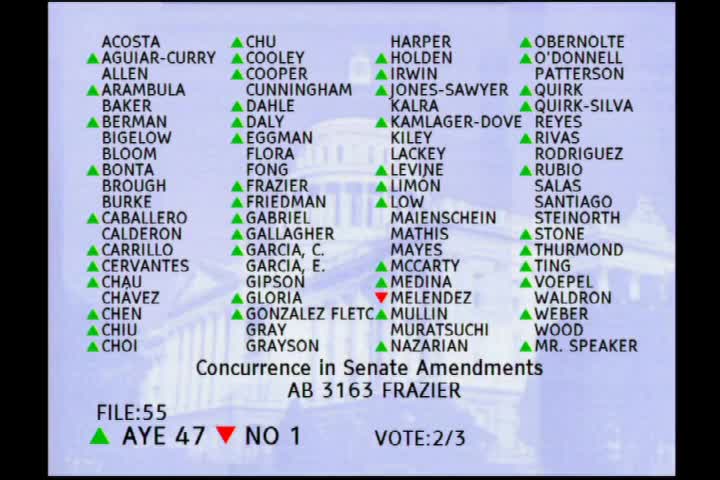 2MIN
Assembly Floor
 3MIN
Senate Floor
 1H
Senate Standing Committee on Appropriations
 1MIN
Assembly Floor
 3MIN
Assembly Standing Committee on Appropriations
 8MIN
Assembly Standing Committee on Natural Resources
Bill Author

Bill Co-Author(s):
