AB 2548: Commute benefit policies: Los Angeles County Metropolitan Transportation Authority.
- Session Year: 2017-2018
- House: Assembly
- Latest Version Date: 2018-08-20
Existing law declares that the fostering, continuance, and development of public transportation systems are a matter of statewide concern. Existing law creates the Los Angeles County Metropolitan Transportation Authority, with various powers and duties with respect to transportation planning, programming, construction, and operations.
This bill would authorize the authority to adopt, and revise as necessary, a commute benefit ordinance that requires covered employers operating within the authoritys area with a specified number of employees to offer certain employees commute benefits, as specified, except that the bill would prohibit the ordinance from affecting employers covered by certain South Coast Air Quality Management District rules or regulations. The bill would require the ordinance to specify certain matters, including any consequences for noncompliance. The bill would, if the authority adopts a commute benefit ordinance, require the authority, before January 1, 2022, to submit a report to the transportation policy committees of each house of the Legislature and the Senate Committee on Environmental Quality that includes specified elements.
Existing law declares that the fostering, continuance, and development of public transportation systems are a matter of statewide concern. Existing law creates the Los Angeles County Metropolitan Transportation Authority, with various powers and duties with respect to transportation planning, programming, construction, and operations.
This bill would authorize the authority to adopt adopt, and revise as necessary, a commute benefit ordinance that requires covered employers operating within the authoritys area with a specified number of employees to offer certain employees commute benefits, as specified, except that the bill would prohibit the ordinance from affecting employers covered by certain South Coast Air Quality Management District rules or regulations. The bill would require the ordinance to specify certain matters, including any consequences for noncompliance. The bill would, if the authority adopts a commute benefit ordinance, require the authority, before January 1, 2022, to submit a report to the transportation policy committees of each house of the Legislature and the Senate Committee on Environmental Quality that includes specified elements.
Existing law declares that the fostering, continuance, and development of public transportation systems are a matter of statewide concern. Existing law creates the Los Angeles County Metropolitan Transportation Authority (LACMTA), Authority, with various powers and duties with respect to transportation planning, programming, construction, and operations. Existing law establishes the South Coast Air Quality Management District vested with the authority to regulate air emissions from stationary sources located in the South Coast Air Basin, which incorporates a specified portion of the jurisdiction of the authority.
This bill would authorize the authority, in coordination with the district, to jointly authority to adopt a commute benefit ordinance that requires covered employers operating within the common authoritys area of the 2 entities with a specified number of employees to offer certain employees commute benefits, as specified. specified, except that the bill would prohibit the ordinance from affecting employers covered by certain South Coast Air Quality Management District rules or regulations. The bill would require that the ordinance to specify certain matters, including any consequences for noncompliance. The bill would, if the authority adopts a commute benefit ordinance, require the authority, before January 1, 2022, to submit a report to the transportation policy committees of each house of the Legislature that includes specified elements.
Existing law creates the Los Angeles County Metropolitan Transportation Authority (LACMTA), with various powers and duties with respect to transportation planning, programming, construction, and operations. Existing law establishes the South Coast Air Quality Management District vested with the authority to regulate air emissions from stationary sources located in the South Coast Air Basin, which incorporates a specified portion of the jurisdiction of the authority.
This bill would authorize the authority, in coordination with the district, to jointly adopt a commute benefit ordinance that requires covered employers operating within the common area of the 2 entities with a specified number of employees to offer certain employees commute benefits, as specified. The bill would require that the ordinance specify certain matters, including any consequences for noncompliance.
(a)It is the intent of the Legislature to encourage metropolitan planning organizations and county transportation commissions to work with local employers to adopt policies that encourage commuting by means other than driving alone. To encourage this, the Legislature hereby establishes a program in that regard in the County of Los Angeles.
(b)Notwithstanding Section 40717.9 of the Health and Safety Code, the Los Angeles County Metropolitan Transportation Authority may adopt, and revise as necessary, a commute benefit ordinance that requires covered employers operating within the authoritys area to offer all covered employees a pretax option program, consistent with Section 132(f) of the Internal Revenue Code, allowing covered employees to elect to exclude from taxable wages employee commuting costs incurred for transit passes or vanpool charges, up to the maximum amount allowed by federal tax law.
(c)Nothing in this section shall prevent a covered employer from offering a more generous commuter benefit program that is otherwise consistent with the requirements of the applicable commute benefit ordinance. Nothing in this section shall require employees to change their behavior.
(d)An employer offering, or proposing to offer, an alternative commuter benefit program on the employers own initiative, or an employer otherwise required to offer an alternative commuter benefit program as a condition of a lease, original building permit, or other similar requirement, if the alternative is not consistent with the program described in subdivision (b), may seek approval of the alternative from the authority. The authority may approve an alternative if it determines that the alternative provides at least the same benefit in terms of reducing single-occupant vehicle trips as the program described in subdivision (b). An employer that offers an approved alternative to covered employees in a manner otherwise consistent with this section is not required to offer the program described in subdivision (b).
(e)The commute benefit ordinance shall provide covered employers with at least six months to comply after the ordinance is adopted.
(f)An employer that participates in, or is represented by, a transportation management association, or a transportation management organization, that provides the employers covered employees with the program described in subdivision (b) or an alternative commuter benefit program approved pursuant to subdivision (d), shall be deemed in compliance with the commute benefit ordinance and the transportation management association, or transportation management organization, may act on behalf of those employers in that regard. The authority shall communicate directly with the transportation management association or transportation management organization, rather than the participating employers, to determine compliance with the ordinance.
(g)A commute benefit ordinance adopted pursuant to this section shall specify all of the following:
(1)How the authority will inform covered employers about the ordinance.
(2)How compliance with the ordinance will be demonstrated.
(3)The procedures for proposing, and the criteria that will be used to evaluate, an alternative commuter benefit program pursuant to subdivision (d).
(4) Any consequences for noncompliance.
(h)Nothing in this section shall limit or restrict the statutory or regulatory authority of the authority.
(i)The authority shall not use federal planning funds in the implementation of the commute benefit ordinance.
(j)Nothing in this section shall authorize the authority to adopt a commute benefit ordinance that would affect an employer covered by a South Coast Air Quality Management District rule or regulation intended to reduce on-road mobile source emissions generated from employee commuting or to provide options for attaining equivalent emissions reductions.
(k)If the authority adopts a commute benefit ordinance pursuant to this section, the authority, before January 1, 2022, shall submit a report to the transportation policy committees of each house of the Legislature and the Senate Committee on Environmental Quality that includes, but is not limited to, all of the following elements:
(1)A description of the program, including how the authority informed covered employers and employees of the ordinance, and of any compliance issues.
(2)The number of employers complying with the ordinance that did not previously offer a commute benefit consistent with those required by the ordinance.
(3)The number of employees who stopped driving alone to work to instead take transit or a vanpool because of the commute benefit ordinance.
(4)The number of single-occupant vehicle trips reduced per month, week, or day because of the commute benefit ordinance.
(5)The vehicle miles traveled and greenhouse gas emissions reductions associated with implementation of the commute benefit ordinance.
(6)The greenhouse gas emissions reductions associated with implementation of the commute benefit ordinance as a percentage of the regions greenhouse gas emissions target established by the State Air Resources Board.
(l)For purposes of this section, the following definitions shall apply:
(1)Authority means the Los Angeles County Metropolitan Transportation Authority.
(2)Covered employee means an employee who performed at least an average of 20 hours of work per week within the previous calendar month within the area where the ordinance adopted pursuant to this section operates.
(3)Covered employer means any employer for which an average of 50 or more employees perform work for compensation at a worksite within the area where the ordinance adopted pursuant to this section operates. In determining the number of employees performing work for an employer during a given week, only employees performing work on a full-time basis shall be counted.
(a)It is the intent of the Legislature to encourage metropolitan planning organizations and county transportation commissions to work with local employers to adopt policies that encourage commuting by means other than driving alone. To encourage this, the Legislature hereby establishes a program in that regard in the County of Los Angeles.
(b)Notwithstanding Section 40717.9 of the Health and Safety Code, the Los Angeles County Metropolitan Transportation Authority may adopt adopt, and revise as necessary, a commute benefit ordinance that requires covered employers operating within the authoritys area to offer all covered employees a pretax option program, consistent with Section 132(f) of the Internal Revenue Code, allowing covered employees to elect to exclude from taxable wages employee commuting costs incurred for transit passes or vanpool charges, up to the maximum amount allowed by federal tax law.
(c)Nothing in this section shall prevent a covered employer from offering a more generous commuter benefit program that is otherwise consistent with the requirements of the applicable commute benefit ordinance. Nothing in this section shall require employees to change their behavior.
(d)An employer offering, or proposing to offer, an alternative commuter benefit program on the employers own initiative, or an employer otherwise required to offer an alternative commuter benefit program as a condition of a lease, original building permit, or other similar requirement, if the alternative is not consistent with the program described in subdivision (b), may seek approval of the alternative from the authority. The authority may approve an alternative if it determines that the alternative provides at least the same benefit in terms of reducing single-occupant vehicle trips as the program described in subdivision (b). An employer that offers an approved alternative to covered employees in a manner otherwise consistent with this section is not required to offer the program described in subdivision (b).
(e)The commute benefit ordinance shall provide covered employers with at least six months to comply after the ordinance is adopted.
(f)An employer that participates in, or is represented by, a transportation management association, or a transportation management organization, that provides the employers covered employees with the program described in subdivision (b) or an alternative commuter benefit program approved pursuant to subdivision (d), shall be deemed in compliance with the commute benefit ordinance and the transportation management association, or transportation management organization, may act on behalf of those employers in that regard. The authority shall communicate directly with the transportation management association or transportation management organization, rather than the participating employers, to determine compliance with the ordinance.
(g)A commute benefit ordinance adopted pursuant to this section shall specify all of the following:
(1)How the authority will inform covered employers about the ordinance.
(2)How compliance with the ordinance will be demonstrated.
(3)The procedures for proposing, and the criteria that will be used to evaluate, an alternative commuter benefit program pursuant to subdivision (d).
(4) Any consequences for noncompliance.
(h)Nothing in this section shall limit or restrict the statutory or regulatory authority of the authority.
(i)The authority shall not use federal planning funds in the implementation of the commute benefit ordinance.
(j)Nothing in this section shall authorize the authority to adopt a commute benefit ordinance that would affect an employer covered by a South Coast Air Quality Management District rule or regulation intended to reduce on-road mobile source emissions generated from employee commuting or to provide options for attaining equivalent emissions reductions.
(k)If the authority adopts a commute benefit ordinance pursuant to this section, the authority, before January 1, 2022, shall submit a report to the transportation policy committees of each house of the Legislature and the Senate Committee on Environmental Quality that includes, but is not limited to, all of the following elements:
(1)A description of the program, including how the authority informed covered employers and employees of the ordinance, and of any compliance issues.
(2)The number of employers complying with the ordinance that did not previously offer a commute benefit consistent with those required by the ordinance.
(3)The number of employees who stopped driving alone to work to instead take transit or a vanpool because of the commute benefit ordinance.
(4)The number of single-occupant vehicle trips reduced per month, week, or day because of the commute benefit ordinance.
(5)The vehicle miles traveled and greenhouse gas emissions reductions associated with implementation of the commute benefit ordinance.
(6)The greenhouse gas emissions reductions associated with implementation of the commute benefit ordinance as a percentage of the regions greenhouse gas emissions target established by the State Air Resources Board.
(l)For purposes of this section, the following definitions shall apply:
(1)Authority means the Los Angeles County Metropolitan Transportation Authority.
(2)Covered employee means an employee who performed at least an average of 20 hours of work per week within the previous calendar month within the area where the ordinance adopted pursuant to this section operates.
(3)Covered employer means any employer for which an average of 50 or more employees perform work for compensation at a worksite within the area where the ordinance adopted pursuant to this section operates. In determining the number of employees performing work for an employer during a given week, only employees performing work on a full-time basis shall be counted.
(a)It is the intent of the Legislature to encourage metropolitan planning organizations, organizations and county transportation commissions, and local air quality management districts or air pollution control districts commissions to work with local employers to adopt policies that encourage commuting by means other than driving alone. To encourage this, the Legislature hereby establishes a program in that regard in the County of Los Angeles.
(b)Notwithstanding Section 40717.9 of the Health and Safety Code, the Los Angeles County Metropolitan Transportation Authority, in coordination with the South Coast Air Quality Management District, with respect to the common area within their respective jurisdictions, Authority may jointly adopt a commute benefit ordinance that requires covered employers operating within the common area of the authority and district authoritys area to offer all covered employees a pretax option program, consistent with Section 132(f) of the Internal Revenue Code, allowing covered employees to elect to exclude from taxable wages employee commuting costs incurred for transit passes or vanpool charges, up to the maximum amount allowed by federal tax law.
(c)Nothing in this section shall prevent a covered employer from offering a more generous commuter benefit program that is otherwise consistent with the requirements of the applicable commute benefit ordinance. Nothing in this section shall require employees to change their behavior.
(d)An employer offering, or proposing to offer, an alternative commuter benefit program on the employers own initiative, or an employer otherwise required to offer an alternative commuter benefit program as a condition of a lease, original building permit, or other similar requirement, if the alternative is not consistent with the program described in subdivision (b), may seek approval of the alternative from the authority or district. authority. The authority or district may approve an alternative if it determines that the alternative provides at least the same benefit in terms of reducing single-occupant vehicle trips as the program described in subdivision (b). An employer that offers an approved alternative to covered employees in a manner otherwise consistent with this section is not required to offer the program described in subdivision (b).
(e)The commute benefit ordinance shall provide covered employers with at least six months to comply after the ordinance is adopted.
(f)An employer that participates in, or is represented by, a transportation management association association, or a transportation management organization, that provides the employers covered employees with the program described in subdivision (b) or an alternative commuter benefit program approved pursuant to subdivision (d), shall be deemed in compliance with the commute benefit ordinance and the transportation management association association, or transportation management organization, may act on behalf of those employers in that regard. The authority or district shall communicate directly with the transportation management association, association or transportation management organization, rather than the participating employers, to determine compliance with the ordinance.
(g)A commute benefit ordinance adopted pursuant to this section shall specify all of the following:
(1)How the implementing agencies authority will inform covered employers about the ordinance.
(2)How compliance with the ordinance will be demonstrated.
(3)The procedures for proposing, and the criteria that will be used to evaluate, an alternative commuter benefit program pursuant to subdivision (d).
(4) Any consequences for noncompliance.
(h)Nothing in this section shall limit or restrict the statutory or regulatory authority of the authority or district. authority.
(i)The authority shall not use federal planning funds in the implementation of the commute benefit ordinance.
(j)Nothing in this section shall authorize the authority to adopt a commute benefit ordinance that would affect an employer covered by a South Coast Air Quality Management District rule or regulation intended to reduce on-road mobile source emissions generated from employee commuting or to provide options for attaining equivalent emissions reductions.
(k)If the authority adopts a commute benefit ordinance pursuant to this section, the authority, before January 1, 2022, shall submit a report to the transportation policy committees of each house of the Legislature that includes, but is not limited to, all of the following elements:
(1)A description of the program, including how the authority informed covered employers and employees of the ordinance, and of any compliance issues.
(2)The number of employers complying with the ordinance that did not previously offer a commute benefit consistent with those required by the ordinance.
(3)The number of employees who stopped driving alone to work to instead take transit or a vanpool because of the commute benefit ordinance.
(4)The number of single-occupant vehicle trips reduced per month, week, or day because of the commute benefit ordinance.
(5)The vehicle miles traveled and greenhouse gas emissions reductions associated with implementation of the commute benefit ordinance.
(6)The greenhouse gas emissions reductions associated with implementation of the commute benefit ordinance as a percentage of the regions greenhouse gas emissions target established by the State Air Resources Board.
(j)(l)For purposes of this section, the following definitions shall apply:
(1)Authority means the Los Angeles County Metropolitan Transportation Authority.
(2)Covered employee means an employee who performed at least an average of 20 hours of work per week within the previous calendar month within the area where the ordinance adopted pursuant to this section operates.
(3)Covered employer means any employer for which an average of 50 or more employees per week perform work for compensation at a worksite within the area where the ordinance adopted pursuant to this section operates. In determining the number of employees performing work for an employer during a given week, only employees performing work on a full-time basis shall be counted.
(4)District means the South Coast Air Quality Management District.(a)It is the intent of the Legislature to encourage metropolitan planning organizations, county transportation commissions, and local air quality management districts or air pollution control districts to work with local employers to adopt policies that encourage commuting by means other than driving alone. To encourage this, the Legislature hereby establishes a program in that regard in the County of Los Angeles.
(b)Notwithstanding Section 40717.9 of the Health and Safety Code, the Los Angeles County Metropolitan Transportation Authority, in coordination with the South Coast Air Quality Management District, with respect to the common area within their respective jurisdictions, may jointly adopt a commute benefit ordinance that requires covered employers operating within the common area of the authority and district to offer all covered employees a pretax option program, consistent with Section 132(f) of the Internal Revenue Code, allowing covered employees to elect to exclude from taxable wages employee commuting costs incurred for transit passes or vanpool charges, up to the maximum amount allowed by federal tax law.
(c)Nothing in this section shall prevent a covered employer from offering a more generous commuter benefit program that is otherwise consistent with the requirements of the applicable commute benefit ordinance. Nothing in this section shall require employees to change their behavior.
(d)An employer offering, or proposing to offer, an alternative commuter benefit program on the employers own initiative, or an employer otherwise required to offer an alternative commuter benefit program as a condition of a lease, original building permit, or other similar requirement, if the alternative is not consistent with the program described in subdivision (b), may seek approval of the alternative from the authority or district. The authority or district may approve an alternative if it determines that the alternative provides at least the same benefit in terms of reducing single-occupant vehicle trips as the program described in subdivision (b). An employer that offers an approved alternative to covered employees in a manner otherwise consistent with this section is not required to offer the program described in subdivision (b).
(e)The commute benefit ordinance shall provide covered employers with at least six months to comply after the ordinance is adopted.
(f)An employer that participates in, or is represented by, a transportation management association that provides the employers covered employees with the program described in subdivision (b) or an alternative commuter benefit program approved pursuant to subdivision (d), shall be deemed in compliance with the commute benefit ordinance and the transportation management association may act on behalf of those employers in that regard. The authority or district shall communicate directly with the transportation management association, rather than the participating employers, to determine compliance with the ordinance.
(g)A commute benefit ordinance adopted pursuant to this section shall specify all of the following:
(1)How the implementing agencies will inform covered employers about the ordinance.
(2)How compliance with the ordinance will be demonstrated.
(3)The procedures for proposing, and the criteria that will be used to evaluate, an alternative commuter benefit program pursuant to subdivision (d).
(4) Any consequences for noncompliance.
(h)Nothing in this section shall limit or restrict the statutory or regulatory authority of the authority or district.
(i)The authority shall not use federal planning funds in the implementation of the commute benefit ordinance.
(j)For purposes of this section, the following definitions shall apply:
(1)Authority means the Los Angeles County Metropolitan Transportation Authority.
(2)Covered employee means an employee who performed at least an average of 20 hours of work per week within the previous calendar month within the area where the ordinance adopted pursuant to this section operates.
(3)Covered employer means any employer for which an average of 50 or more employees per week perform work for compensation within the area where the ordinance adopted pursuant to this section operates. In determining the number of employees performing work for an employer during a given week, only employees performing work on a full-time basis shall be counted.
(4)District means the South Coast Air Quality Management District.
|
Date
|
Status
|
|---|---|
| Aug 20, 2018 | Chaptered by Secretary of State - Chapter 173, Statutes of 2018. |
| Aug 20, 2018 | Approved by the Governor. |
| Aug 9, 2018 | Enrolled and presented to the Governor at 11:30 a.m. |
| Aug 6, 2018 | Senate amendments concurred in. To Engrossing and Enrolling. |
| Jul 5, 2018 | In Assembly. Concurrence in Senate amendments pending. May be considered on or after August 3 pursuant to Assembly Rule 77. |
| Jul 5, 2018 | Read third time. Passed. Ordered to the Assembly. |
| Jun 25, 2018 | Read second time and amended. Ordered to third reading. |
| Jun 21, 2018 | From committee: Amend, and do pass as amended. (Ayes 5. Noes 2.) (June 20). |
| Jun 12, 2018 | From committee: Do pass and re-refer to Com. on EQ. (Ayes 9. Noes 2.) (June 12). Re-referred to Com. on EQ. |
| May 10, 2018 | Referred to Coms. on T. & H. and EQ. |
| Apr 30, 2018 | In Senate. Read first time. To Com. on RLS. for assignment. |
| Apr 30, 2018 | Read third time. Passed. Ordered to the Senate. |
| Apr 25, 2018 | Read second time. Ordered to third reading. |
| Apr 24, 2018 | From committee: Do pass. (Ayes 11. Noes 1.) (April 23). |
| Apr 16, 2018 | In committee: Hearing postponed by committee. |
| Apr 16, 2018 | Re-referred to Com. on TRANS. |
| Apr 12, 2018 | From committee chair, with author's amendments: Amend, and re-refer to Com. on TRANS. Read second time and amended. |
| Mar 5, 2018 | Referred to Com. on TRANS. |
| Feb 16, 2018 | From printer. May be heard in committee March 18. |
| Feb 15, 2018 | Read first time. To print. |
|
Date
|
Description
|
Location
|
Votes
|
|
|---|---|---|---|---|
| Aug 6, 2018 | AB 2548 FRIEDMAN Concurrence in Senate Amendments | Assembly Floor |
Passed |
|
| Jul 5, 2018 | Assembly 3rd Reading AB2548 Friedman By Allen | Senate Floor |
Passed |
|
| Jun 20, 2018 | Do pass as amended | Senate Standing Committee on Environmental Quality |
Passed |
|
| Jun 12, 2018 | Do pass, but first be re-referred to the Committee on [Environmental Quality] | Senate Standing Committee on Transportation and Housing |
Passed |
|
| Apr 30, 2018 | AB 2548 FRIEDMAN Assembly Third Reading | Assembly Floor |
Passed |
|
| Apr 23, 2018 | Do pass. | Assembly Standing Committee on Transportation |
Passed |
This list shows positions taken on this bill by organizations on the date displayed, which is linked to the original source.
Positions by individuals are not included.
CONCURRENCE IN SENATE AMENDMENTS
CSA1 Bill Id:AB 2548
Author:(Friedman)
As Amended Ver:June 25, 2018
Majority vote
ASSEMBLY: | 55-18 | (April 30, 2018) | SENATE: | 25-10 | (July 5, 2018) |
Original Committee Reference: TRANS.
SUMMARY: Authorizes the Los Angeles County Metropolitan Transportation Authority (Metro) to administer a commute benefit program that requires certain employers to provide a commuter benefit option to their employees.
The Senate amendments are technical and clarifying in nature, including authorizing Metro to revise the commute benefit ordinance and adding the Senate Committee on Environmental Quality to the legislative committees receiving the required report.
AS PASSED BY THE ASSEMBLY, this bill:
- Declared the intent of the Legislature to encourage metropolitan planning organizations, and county transportation commissions, to work with local employers to adopt policies that encourage commuting by means other than driving alone.
- Authorized Metro to adopt a commute benefit ordinance that requires covered employers, as defined, to offer a pretax option, consistent with federal law, allowing covered employees to exclude from taxable wages employee transit pass or vanpool commuting costs.
- Ensured that a covered employer can offer a more generous commuter benefit than what is included in the ordinance.
- Allowed any employer who is required to offer an alternative commute benefit program either on their own initiative or as a condition of a lease, or similar requirement, to seek approval from Metro. Metro can approve an alternative if it provides similar benefits in reducing single-occupant trips.
- Required that the commute benefit ordinance allow covered employers at least six months to comply after adoption of the ordinance.
- Established the role of transportation management associations or transportation management organizations in the place of covered employers in complying with the ordinance.
- Required the commute benefit ordinance to specify how the implementing agencies will inform covered employers, how compliance will be demonstrated, the procedures for proposing and criteria used to evaluate an alternative commuter benefit, and any consequences for non-compliance.
- Prohibited the use of federal planning funds to implement the commute benefit program.
- Defined "covered employee" to mean an employee who performed at least an average of 20 hours of work per week within the previous calendar month within the area where the ordinance is adopted.
- Defined "covered employer" to mean any employer for which an average of 50 or more employees at a worksite perform work for compensation on a full-time basis within the area where a commute benefit ordinance is adopted.
- Prohibited Metro from adopting a commute benefit ordinance affecting any employer covered by a similar program required by a South Coast Air Quality Management District (SCAQMD) rule or regulation.
- Required Metro on or before January 1, 2022, if they implement a commute benefit ordinance, to submit a report to the transportation policy committees of the Legislature on the effectiveness of the ordinance and sets requirements for that report.
FISCAL EFFECT: None, this bill is keyed non-fiscal by the Legislative Counsel.
COMMENTS: This bill is based on a successful commute benefit program administered in the Bay Area by Metropolitan Transportation Commission (MTC) and Bay Area Air Quality Management District (BAAQMD). In 2012, SB 1339 (Yee), Chapter 871, authorized the two agencies to develop a pilot ordinance, and later SB 1128 (Glazer), Chapter 483, Statutes of 2016, made the program permanent. In the Bay Area, MTC offers four options to covered employers in the nine county Bay Area region. Of the four options, the one most chosen by employers is a pre-tax option, which allows employees to exclude their transit or vanpool expenses from taxable income for up to $260 per month, in accordance with federal law. According to MTC, this option covers roughly 82% of the participating employers. The option is easy to administer and also saves money for the employer and the employee. Specifically, in a report submitted on the pilot program, MTC found that an employer could reduce their payroll taxes by as much as $238 per employee per year. Employees in the 25% federal income tax bracket and the 6.5% state income tax bracket can save up to $965 per year. Additionally, MTC found that in the first year of the program 4.3 million fewer vehicle trips were made as a result of the benefit, reducing vehicle miles traveled (VMT) by 86 million miles. This translates to a reduction of nearly 36,000 tons of greenhouse gases (GHGs) or 2.7% of the Bay Area's GHG reduction target.
Additionally, in the Los Angeles area, including parts of Riverside and Orange Counties, the SCAQMD administers an extensive commute benefit program. Specifically, SCAQMD Rule 2202 requires employers with over 250 or more employees at a worksite, on a full-time basis, to establish commuter programs to meet the designated emission reduction target set by SCAQMD. Some of these include a commuter choice program, including pre-tax set aside benefits, ride-sharing, flexible work schedules, parking cash out, and incentives for bike and carpool. The SCAQMD program also provides options for extensive outreach and marketing by the employers for their employees, including new hire orientation, a transit information center, rideshare bulletin boards, rideshare meetings to solicit input, rideshare matching programs, and a points program to earn rewards. According to SCAQMD, they currently have 1,360 worksites in the program.
This bill would authorize Metro to establish a commuter benefits ordinance in L.A. County that would give commuters the ability to set aside up to $260 per month of their paycheck pre-tax to cover the cost of ride-sharing, vanpools, and transit. The new ordinance would apply to employers that are not currently subject to the regulations established under Rule 2202. In fact, the bill specifically prohibits Metro from approving any commute benefit ordinance that affects the SCAQMD program. Currently, that would mean that the Metro program would cover employers with 50 to 249 employees at a worksite. However, in the future, the Metro program would have to be updated based on any actions by SCAQMD to raise or lower the amount of employers covered by Rule 2022. Metro estimates that 24-26% of the worksites in L.A. County, or 64,000 to 69,000 of approximately 265,000 worksites, have between 50-249 employees.
Committee Comments: As the state continues to set aggressive GHG reduction goals, shifting people from single occupant trips is vital to our success. Expanding commute benefit programs in the world's most congested metropolitan area would help employers and employees find travel alternatives. Although the Bay Area has found that education and marketing campaigns aimed at covered employers has been successful in bringing businesses into the program, they do have authority to enforce compliance. In fact, last summer the BAAQMD issued a warning to unregistered employers that they could face financial penalties for not coming into compliance. SCAQMD has very strict enforcement of their programs as they also have enforcement authority under air quality law. Metro, however, does not have similar authority. Metro will have to conduct extensive outreach and marketing to have businesses comply. This bill requires Metro to complete a report and submit it to the Legislature by January 1, 2022, if they implement the ordinance. This is a good way for the Legislature to review their progress and how the program is working and benefitting L.A. County. Finally, as mentioned, there are numerous existing commute benefit programs in cities in L.A. County. Although the bill prohibits Metro from overlapping the SCAQMD program, the author may want to consider an amendment to protect those cities' programs as well.
Please see the policy committee analysis for full discussion of this bill.
Analysis Prepared by: Melissa White / TRANS. / (916) 319-2093 FN: 0003602
Office of Senate Floor Analyses (916) 651-1520 Fax: (916) 327-4478 | AB |
THIRD READING
Bill No: AB 2548
:
SENATE TRANS. & HOUSING COMMITTEE: 9-2, 6/12/18
AYES: Beall, Cannella, Allen, Dodd, Galgiani, McGuire, Roth, Skinner, Wiener
NOES: Gaines, Vidak
NO VOTE RECORDED: Morrell, Wieckowski
SENATE ENVIRONMENTAL QUALITY COMMITTEE: 5-2, 6/20/18
AYES: Wieckowski, Hill, Lara, Skinner, Stern
NOES: Stone, Gaines
ASSEMBLY FLOOR: 55-18, 4/30/18 - See last page for vote
DIGEST:
This bill authorizes the Los Angeles County Metropolitan Transportation Authority (Metro) to administer a commute benefit program, as specified.
ANALYSIS: Existing federal law allows employees to use pre-tax dollars, up to $260 per month, excluded from gross income, to pay for transit commuting and parking costs through employer-sponsored programs.
Existing state law:
- Establishes Metro with the responsibility for serving as the regional transportation planning agency, including planning and programming transportation funding and the transit operator for fixed guideway and bus systems in Los Angeles County.
- Establishes South Coast Air Quality Management District (SCAQMD) with the primary responsibility for controlling stationary sources of air pollution in the South Coast Air Basin, including parts of Los Angeles, Riverside, San Bernandino counties, and all of Orange County.
- Requires SCAQMD to adopt, implement, and enforce transportation control measures for the attainment of state or federal ambient air quality standards, in accordance with specified procedures.
- Authorizes the Metropolitan Transportation Commission (MTC) and the Bay Area Air Quality Management District (BAAQMD) to administer a San Francisco Bay Area commute benefits program that requires certain employers to provide commuter benefit options to their employees.
- Authorizes air districts to adopt and implement regulations that reduce or mitigate emissions from indirect and area wide sources of air pollution and also encourage or require the use of measures which reduce the number or length of vehicle trips.
This bill:
- Declares the intent of the Legislature to encourage metropolitan planning organizations, and county transportation commissions, to work with local employers to adopt policies that encourage commuting by means other than driving alone.
- Authorizes Metro to adopt and revise as necessary a commute benefit ordinance that requires covered employers, as defined, to offer a pretax option, consistent with federal law, allowing covered employees to exclude from taxable wages employee transit pass or vanpool commuting costs.
- Ensures that a covered employer can offer a more generous commuter benefit than what is included in the ordinance.
- Allows any employer who is required to offer an alternative commute benefit program either on their own initiative or as a condition of a lease, or similar requirement, to seek approval from Metro. Metro can approve an alternative if it provides similar benefits in reducing single-occupant trips.
- Requires that the commute benefit ordinance allow covered employers at least six months to comply after adoption of the ordinance.
- Establishes the role of transportation management associations or transportation management organizations in the place of covered employers in complying with the ordinance.
- Requires the commute benefit ordinance to specify how the implementing agencies will inform covered employers, how compliance will be demonstrated, the procedures for proposing and criteria used to evaluate an alternative commuter benefit, and any consequences for non-compliance.
- Prohibits the use of federal planning funds to implement the commute benefit program.
- Defines "covered employee" to mean an employee who performed at least an average of 20 hours of work per week within the previous calendar month within the area where the ordinance is adopted.
- Defines "covered employer" to mean any employer for which an average of 50 or more employees at a worksite perform work for compensation on a full-time basis within the area where a commute benefit ordinance is adopted.
- Prohibits Metro from adopting a commute benefit ordinance affecting any employer covered by a similar program required by a SCAQMD rule or regulation.
- Requires Metro on or before January 1, 2022, if they implement a commute benefit ordinance, to submit a report to the relevant policy committees of the Legislature on the effectiveness of the ordinance and sets requirements for that report.
Comments
- Purpose. According to the author, “AB 2548 seeks to expand the number of businesses participating in commuter benefits programs in Los Angeles County to encourage transit usage, mode switch and reduce greenhouse gas emissions. The state has aggressive greenhouse gas reduction targets and tools like the program proposed in this legislation are key to meeting those targets. The Bay Area (MTC and BAAQMD) have a successful program that was implemented in 2014. Los Angeles Metro would like to work to establish a similar program here in Los Angeles that would apply to employers who are not subject to current commuter benefits regulations.”
- MTC Program. This bill is based on a successful commute benefit program administered in the Bay Area by MTC and BAAQMD. In 2012, SB 1339 (Yee, Chapter 871, Statutes of 2012), authorized the two agencies to develop a pilot ordinance, and later SB 1128 (Glazer, Chapter 483, Statutes of 2016) made the program permanent. In the Bay Area, MTC offers four options to covered employers in the nine county Bay Area region. Of the four options, the one most chosen by employers is a pre-tax option, which allows employees to exclude their transit or vanpool expenses from taxable income for up to $260 per month, in accordance with federal law. According to MTC, this option covers roughly 82% of the participating employers. Ultimately, the 2016 pilot program report issued by MTC and BAAQMD found that the commuter benefit program added 2,142 new employers that otherwise would not have offered commuter benefits. The study further found that, under the program, approximately 44,400 employees switched from driving alone to transit, vanpool, or bicycle over the program’s initial 12 month period.
- Southern California. Additionally, in the Los Angeles area, including parts of Riverside and Orange Counties, the SCAQMD administers an extensive commute benefit program. Specifically, SCAQMD Rule 2202 requires employers with over 250 or more employees at a worksite, on a full-time basis, to establish commuter programs to meet the designated emission reduction target set by SCAQMD.
This bill authorizes Metro to establish a commuter benefits ordinance in L.A. County that would give commuters the ability to set aside up to $260 per month of their paycheck pre-tax to cover the cost of ride-sharing, vanpools, and transit. It should be noted, however, that it remains unclear how Metro will enforce employers to comply with this new ordinance. Furthermore, it should also be noted that the new ordinance would apply to employers that are not currently subject to the regulations established under Rule 2202 (i.e. employers with between 50 to 249 employees).
FISCAL EFFECT: Appropriation: Fiscal Com.: Local:
Amalgamated Transit Union Local 1277
Association for Commuter Transportation
BizFed
City of Inglewood
City of Los Angeles
City of West Hollywood
Edenred Commuter Benefit Solutions
Employers Group
Enterprise Holdings
Fixing Angelenos Stuck in Traffic
Valley Industry and Commerce Association
OPPOSITION: (Verified 6/27/18)
None received
ASSEMBLY FLOOR: 55-18, 4/30/18
AYES: Aguiar-Curry, Arambula, Baker, Berman, Bloom, Bonta, Burke, Caballero, Calderon, Carrillo, Cervantes, Chau, Chávez, Chiu, Chu, Cooley, Cooper, Daly, Eggman, Frazier, Friedman, Eduardo Garcia, Gipson, Gloria, Gonzalez Fletcher, Gray, Grayson, Holden, Irwin, Jones-Sawyer, Kalra, Kamlager-Dove, Levine, Limón, Low, Maienschein, McCarty, Medina, Mullin, Muratsuchi, Nazarian, O'Donnell, Quirk, Quirk-Silva, Reyes, Rodriguez, Rubio, Salas, Santiago, Mark Stone, Thurmond, Ting, Weber, Wood, Rendon
NOES: Acosta, Travis Allen, Bigelow, Brough, Cunningham, Dahle, Flora, Gallagher, Harper, Kiley, Lackey, Mathis, Mayes, Melendez, Obernolte, Patterson, Voepel, Waldron
NO VOTE RECORDED: Chen, Choi, Fong, Cristina Garcia, Steinorth
6/27/18 15:38:35
**** END ****
SENATE COMMITTEE ON ENVIRONMENTAL QUALITY
Senator Wieckowski, Chair
2017 - 2018 Regular
Bill No: AB 2548
Author: | Friedman | ||
Version: | 4/12/2018 | Hearing Date: | 6/20/18 |
Urgency: | No | Fiscal: | No |
Consultant: | David Ernest García | ||
SUBJECT: Commute benefit policies: Los Angeles County Metropolitan Transportation Authority
ANALYSIS:
Existing law:
- Establishes the Los Angeles County Metropolitan Transportation Authority (Metro) with the responsibility, among other things, to serve as the regional transportation planning agency, including planning and programming transportation funding and the transit operator for fixed guideway and bus systems in Los Angeles County. (Public Utilities Code (PUC) §130050 et seq.)
- Establishes the South Coast Air Quality Management District (SCAQMD) with the responsibility, among other things, to control stationary sources of air pollution in the South Coast Air Basin, including parts of Los Angeles, Riverside, and San Bernadino counties, and all of Orange County. (Health and Safety Code (HSC) §40410 et seq.)
- Establishes the Metropolitan Transportation Commission (MTC) to provide comprehensive regional transportation planning for the region comprised of the City and County of San Francisco and the Counties of Alameda, Contra Costa, Marin, Napa, San Mateo, Santa Clara, Solano, and Sonoma. (Government Code (GOV) §66500 et seq.)
- Establishes the Bay Area Air Quality Management District (BAAQMD) with the responsibility, among other things, to control stationary sources of air pollution in the Counties of Alameda, Contra Costa, Marin, Napa, San Francisco, San Mateo, and Santa Clara and those portions of the Counties of Solano and Sonoma within the boundaries of the Bay Area Air Pollution Control District as it existed on January 1, 1976. (HSC §40200 et seq.)
- Authorizes MTC and BAAQMD to administer a San Francisco Bay Area commute benefits program that requires certain employers to provide commuter benefit options to their employees, as specified. (GOV §65081)
- Establishes the Air Resources Board (ARB) as the air pollution control agency in California and requires ARB, among other things, to control emissions from a wide array of mobile sources and coordinate, encourage, and review the efforts of all levels of government as they affect air quality. (HSC §39500 et seq.)
- Requires, under the California Global Warming Solutions Act of 2006 (also known as AB 32), ARB to (1) determine the 1990 statewide greenhouse gas (GHG) emissions level and approve a statewide GHG emissions limit that is equivalent to that level to be achieved by 2020; (2) ensure that statewide GHG emissions are reduced to at least 40% below the 1990 level by December 31, 2030 (i.e., SB 32); and (3) adopt regulations, until December 31, 2030, that utilize market-based compliance mechanisms to reduce GHG emissions (i.e., the cap-and-trade program). (HSC §38500 et seq.)
This bill:
- Declares in statute the intent of the Legislature to encourage metropolitan planning organizations, and county transportation commissions, to work with local employers to adopt policies that encourage commuting by means other than driving alone.
- Authorizes Metro to adopt a commute benefit ordinance that requires covered employers, as defined, to offer a pretax option, consistent with federal law, allowing covered employees to exclude from taxable wages employee transit pass or vanpool commuting costs.
- Ensures that a covered employer can offer a more generous commuter benefit than what is included in the ordinance.
- Allows any employer who is required to offer an alternative commute benefit program either on their own initiative or as a condition of a lease, or similar requirement, to seek approval from Metro and allows Metro to approve an alternative if it provides similar benefits in reducing single-occupant trips.
- Requires that the commute benefit ordinance allows covered employers at least six months to comply after adoption of the ordinance.
- Establishes the role of transportation management associations or transportation management organizations in the place of covered employers in complying with the ordinance.
- Requires the commute benefit ordinance to specify how the implementing agencies will inform covered employers, how compliance will be demonstrated, the procedures for proposing and criteria used to evaluate an alternative commuter benefit, and any consequences for non-compliance.
- Prohibits the use of federal planning funds to implement the commute benefit program.
- Defines “covered employee” to mean an employee who performed at least an average of 20 hours of work per week within the previous calendar month within the area where the ordinance is adopted.
- Defines “covered employer” to mean any employer for which an average of 50 or more employees at a worksite perform work for compensation on a full-time basis within the area where a commute benefit ordinance is adopted.
- Prohibits Metro from adopting a commute benefit ordinance affecting any employer covered by a similar program required by a SCAQMD rule or regulation.
- Requires Metro on or before January 1, 2022, if they implement a commute benefit ordinance, to submit a report to the transportation policy committees of the Legislature on the effectiveness of the ordinance and sets requirements for that report.
Background
- Responses to traffic. Transportation Demand Management (TDM) activities are strategies and policies employed by metropolitan areas to reduce travel demand and help relieve congestion. Vehicle trip reduction programs, coupled with transit incentives are important tools to help meet the state’s goals of reducing vehicle miles traveled (VMT), increasing transit ridership, and reducing GHG emissions. Incentives for employees to utilize alternative modes to commute, such as ride-sharing and transit, can contribute to reducing congestion, including single-occupant trips, and improve air quality.
- Bay Area Program. In fall 2012, Senate Bill 1339 (Yee, Chapter 871, Statutes of 2012) was signed into law, BAAQMD and the MTC to adopt and implement a regional commuter benefits ordinance in the San Francisco Bay Area on a pilot basis through December 31, 2016. The Bay Area Commuter Benefits Program was adopted by BAAQMD and ratified by MTC in March 2014, and employers were required to offer commuter benefits by September 30, 2014.
The goal of the Bay Area Commuter Benefits Program is to promote the use of transit and other alternative commute modes in order to reduce single-occupant vehicle (SOV) commute trips, traffic congestion, GHG emissions, and other air pollutants from motor vehicles. The Bay Area Commuter Benefits Program seeks to achieve these objectives by expanding the number of employers who provide commuter benefits to their employees. BAAQMD and MTC worked together, in consultation with the business community, to implement the Bay Area Commuter Benefits Program and to help employers comply with its requirements.
MTC offers four options to covered employers in the nine county Bay Area region. Of the four options, the one most chosen by employers is a pre-tax option, which allows employees to exclude their transit or vanpool expenses from taxable income for up to $260 per month, in accordance with federal law. According to MTC, this option covers roughly 82% of the participating employers. The option is easy to administer and also saves money for the employer and the employee. Specifically, in a report submitted on the pilot program, MTC found that an employer could reduce their payroll taxes by as much as $238 per employee per year. Employees in the 25% federal income tax bracket and the 6.5% state income tax bracket can save up to $965 per year.
Due to those, and the following, successes, SB 1128 (Glazer, Chapter 483, Statutes of 2016) made the Bay Area Commuter Benefits Program permanent:- As of December 28, 2015, of the 3,910 registered employers in the Bay Area Commuter Benefits Program, 55% reported that they began offering commuter benefits for the first time.
- An estimated 4,291,300 vehicle trips and 85,600,000 miles of vehicle travel were reduced in response to the Program over the first 12 months of Program implementation.
- An estimated 35,778 tons of carbon dioxide emissions were reduced over the first 12 months of the Bay Area Commuter Benefits Program.
- As of December 28, 2015, of the 3,910 registered employers in the Bay Area Commuter Benefits Program, 55% reported that they began offering commuter benefits for the first time.
- Traffic in Los Angeles. According to a global traffic scorecard published in 2017 by traffic data analyst company, Inrix, LA County is home to the worst congestion in the world. Residents spent an average of 102 hours last year in traffic jams during peak congestion hours, costing drivers over $2,800 each and the city $19.2 billion from direct and indirect costs. While congestion is on the rise, transit ridership in L.A. continues to decline. According to a recent study by the University of California Institute for Transportation Studies, in spite of the heavy investment in public transit in the Southern California region in the past 25 years, transit ridership hit its peak in 1985. In the 1990’s and 2000’s ridership rose and fell moderately, but has been mostly declining since 2007, having fallen constantly since 2013. One of the major reasons cited for the decline in transit ridership is the growth in access to a vehicle.
- SCAQMD Rule 2202. SCAQMD Rule 2202 requires employers with 250 or more employees at a worksite, on a full-time basis, to establish commuter programs to meet the designated emission reduction target set by SCAQMD. Some of these include a commuter choice program, including pre-tax set aside benefits, ride-sharing, flexible work schedules, parking cash out, and incentives for bike and carpool. The SCAQMD program also provides options for extensive outreach and marketing by the employers for their employees, including new hire orientation, a transit information center, rideshare bulletin boards, rideshare meetings to solicit input, rideshare matching programs, and a points program to earn rewards. According to SCAQMD, they currently have 1,360 worksites in the program.
Comments
- Purpose of Bill. According to the author, “the intent of AB 2548 is to expand the number of businesses participating in commuter benefits programs in Los Angeles County to reduce greenhouse gas emissions caused by single-occupant commuting, encourage transit usage, and mode switch. The state has aggressive greenhouse gas reduction targets and tools like the program proposed in this legislation are key to meeting those targets. The Bay Area (MTC and BAAQMD) have a successful program that was implemented in 2014. Los Angeles Metro would like to work to establish a similar program here in Los Angeles that would apply to employers who are not subject to current commuter benefits regulations.”
- Add some flexibility. As it is currently written, AB 2548 allows Metro to adopt an ordinance that provides commute benefits, but it does not provide the flexibility for Metro to adjust the ordinance if necessary. This is important because Metro intends to begin the program on a voluntary basis. Although a version of this program exists in the Bay Area, this will be a new program for the South Coast—for Metro, and the affected businesses and citizens—so a voluntary program is not unreasonable to start. There will likely be problems that need troubleshooting and having the ability to work only with willing participants will help get the program up and running more smoothly.
After some time, however, participation in the program should no longer be voluntary. According to the sponsors of this legislation, it took the program in the Bay Area approximately five years to get to the point where they were ready to begin enforcing compliance.
Therefore, the Committee may wish to amend the bill to allow Metro to revise the ordinance as necessary. - Unintentional omission. AB 2548 contains a provision requiring Metro, if they adopt a commute benefit ordinance after the pilot program, before January 1, 2022, to submit a report to the transportation policy committees of each house of the Legislature.
Given that the Senate Environmental Quality Committee also has jurisdiction over this policy area, an amendment is needed to require that the report also be sent to the Senate Environmental Quality Committee. - Where is SCAQMD? As noted in the background, AB 2548 is modeled after a successful program in the Bay Area jointly operated by BAAQMD and MTC; BAAQMD is the air quality regulator and MTC is the transportation authority.
What is conspicuously missing from AB 2548 is SCAQMD. The original version of AB 2548 was modeled after the earlier legislation for the Bay Area and included both the air quality regulator and the transportation authority. Subsequently, SCAQMD was amended out of the bill. The benefit of the program proposed in AB 2548 is not just to relieve traffic congestion; this type of program also has the benefits of improving air quality and helping to combat climate change. Given SCAQMD’s statutory charge to have the primary responsibility for air quality in the South Coast air basin, SCAQMD’s absence is indeed conspicuous.
Where is the South Coast Air Quality Management District?
Related/Prior Legislation
SB 582 (Yee, 2011) would have authorized a metropolitan planning organization jointly with the local air quality management district or air pollution control district to adopt a commute benefit ordinance. SB 582 was vetoed.
SB 1339 (Yee, Chapter 871, Statutes of 2012) authorizes, through January 1, 2017, a pilot program for MTC and BAAQMD to establish ordinance requiring certain Bay Area employers to offer commute benefits to employees.
SB 1128 (Glazer, Chapter 483, Statutes of 2016) authorizes, permanently, a commute benefit program for the Bay Area managed by the MTC and BAAQMD.
DOUBLE REFERRAL:
This measure was heard in Senate Transportation and Housing Committee on June 12, 2018, and passed out of committee with a vote of 9-2.
SOURCE:
Los Angeles County Metropolitan Transportation Authority
SUPPORT:
Amalgamated Transit Union Local 1277
Association for Commuter Transportation
BizFed
City of Inglewood
City of Los Angeles
City of West Hollywood
Edenred Commuter Benefit Solutions
Employers Group
Enterprise Holdings
Fixing Angelenos Stuck in Traffic
Valley Industry and Commerce Association
OPPOSITION:
None received
-- END --
SENATE COMMITTEE ON TRANSPORTATION AND HOUSING
Senator Jim Beall, Chair
2017 - 2018 Regular
Bill No: AB 2548 Hearing Date: 6/12/2018
Author: | Friedman | ||
Version: | 4/12/2018 | ||
Urgency: | No | Fiscal: | No |
Consultant: | Manny Leon | ||
SUBJECT: Commute benefit policies: Los Angeles County Metropolitan Transportation Authority
DIGEST: This bill authorizes the Los Angeles County Metropolitan Transportation Authority (Metro) to administer a commute benefit program, as specified.
ANALYSIS:
Existing law:
- Establishes Metro with the responsibility for serving as the regional transportation planning agency, including planning and programming transportation funding and the transit operator for fixed guideway and bus systems in Los Angeles County.
- Establishes South Coast Air Quality Management District (SCAQMD) with the primary responsibility for controlling stationary sources of air pollution in the South Coast Air Basin, including parts of Los Angeles, Riverside, San Bernandino counties, and all of Orange County.
- Requires SCAQMD to adopt, implement, and enforce transportation control measures for the attainment of state or federal ambient air quality standards, in accordance with specified procedures.
- Authorizes the Metropolitan Transportation Commission (MTC) and the Bay Area Air Quality Management District (BAAQMD) to administer a San Francisco Bay Area commute benefits program that requires certain employers to provide commuter benefit options to their employees.
- Authorizes air districts to adopt and implement regulations that reduce or mitigate emissions from indirect and area wide sources of air pollution and also encourage or require the use of measures which reduce the number or length of vehicle trips.
- Federal law allows employees to use pre-tax dollars, up to $260 per month, excluded from gross income, to pay for transit commuting and parking costs through employer-sponsored programs.
This bill:
- Declares the intent of the Legislature to encourage metropolitan planning organizations, and county transportation commissions, to work with local employers to adopt policies that encourage commuting by means other than driving alone.
- Authorizes Metro to adopt a commute benefit ordinance that requires covered employers, as defined, to offer a pretax option, consistent with federal law, allowing covered employees to exclude from taxable wages employee transit pass or vanpool commuting costs.
- Ensures that a covered employer can offer a more generous commuter benefit than what is included in the ordinance.
- Allows any employer who is required to offer an alternative commute benefit program either on their own initiative or as a condition of a lease, or similar requirement, to seek approval from Metro. Metro can approve an alternative if it provides similar benefits in reducing single-occupant trips.
- Requires that the commute benefit ordinance allow covered employers at least six months to comply after adoption of the ordinance.
- Establishes the role of transportation management associations or transportation management organizations in the place of covered employers in complying with the ordinance.
- Requires the commute benefit ordinance to specify how the implementing agencies will inform covered employers, how compliance will be demonstrated, the procedures for proposing and criteria used to evaluate an alternative commuter benefit, and any consequences for non-compliance.
- Prohibits the use of federal planning funds to implement the commute benefit program.
- Defines "covered employee" to mean an employee who performed at least an average of 20 hours of work per week within the previous calendar month within the area where the ordinance is adopted.
- Defines "covered employer" to mean any employer for which an average of 50 or more employees at a worksite perform work for compensation on a full-time basis within the area where a commute benefit ordinance is adopted.
- Prohibits Metro from adopting a commute benefit ordinance affecting any employer covered by a similar program required by a SCAQMD rule or regulation.
- Requires Metro on or before January 1, 2022, if they implement a commute benefit ordinance, to submit a report to the transportation policy committees of the Legislature on the effectiveness of the ordinance and sets requirements for that report.
COMMENTS
- Purpose. According to the author, “AB 2548 seeks to expand the number of businesses participating in commuter benefits programs in Los Angeles County to encourage transit usage, mode switch and reduce greenhouse gas emissions. The state has aggressive greenhouse gas reduction targets and tools like the program proposed in this legislation are key to meeting those targets. The Bay Area (MTC and BAAQMD) have a successful program that was implemented in 2014. Los Angeles Metro would like to work to establish a similar program here in Los Angeles that would apply to employers who are not subject to current commuter benefits regulations.”
- MTC Program. This bill is based on a successful commute benefit program administered in the Bay Area by MTC and BAAQMD. In 2012, SB 1339 (Yee), Chapter 871, Statutes of 2012, authorized the two agencies to develop a pilot ordinance, and later SB 1128 (Glazer), Chapter 483, Statutes of 2016, made the program permanent. In the Bay Area, MTC offers four options to covered employers in the nine county Bay Area region. Of the four options, the one most chosen by employers is a pre-tax option, which allows employees to exclude their transit or vanpool expenses from taxable income for up to $260 per month, in accordance with federal law. According to MTC, this option covers roughly 82% of the participating employers. Ultimately, the 2016 pilot program report issued by MTC and BAAQMD found that the commuter benefit program added 2,2142 new employers that otherwise would not have offered commuter benefits. The study further found that, under the program, approximately 44,400 employees switched from driving alone to transit, vanpool, or bicycle over the program’s initial 12 month period.
- Southern California. Additionally, in the Los Angeles area, including parts of Riverside and Orange Counties, the SCAQMD administers an extensive commute benefit program. Specifically, SCAQMD Rule 2202 requires employers with over 250 or more employees at a worksite, on a full-time basis, to establish commuter programs to meet the designated emission reduction target set by SCAQMD.
This bill would authorize Metro to establish a commuter benefits ordinance in L.A. County that would give commuters the ability to set aside up to $260 per month of their paycheck pre-tax to cover the cost of ride-sharing, vanpools, and transit. It should be noted, however, that it remains unclear how Metro will enforce employers to comply with this new ordinance. Furthermore, it should also be noted that the new ordinance would apply to employers that are not currently subject to the regulations established under Rule 2202 (i.e. employers with between 50 to 249 employees).
- Double Referral. This bill will be referred to the Senate Environmental Quality Committee should it pass out of this committee.
Related Legislation:
SB 1128 (Glazer, Chapter 483, Statutes of 2016) — permanently authorizes a commute benefit program for the Bay Area managed by the MTC and BAAQMD.
SB 1339 (Yee, Chapter 871, Statutes of 2012) — authorizes a pilot program for MTC and BAAQMD to establish ordinance requiring certain Bay Area employers to offer commute benefits to employees.
FISCAL EFFECT: Appropriation: Fiscal Com.: Local:
Assembly votes:
Floor: 55-18
Trans: 11-1
POSITIONS: (Communicated to the committee before noon on Wednesday,
June 6, 2018.)
SUPPORT:
Los Angeles County Metropolitan Transportation Authority (Sponsor)
Amalgamated Transit Union Local 1277
Association for Commuter Transportation
BizFed
California Transit Association
City of Inglewood
City of West Hollywood
Edenred Commuter Benefit Solutions
Employer’s Group
Enterprise Holdings
Fixing Angelenos Stuck in Traffic
Honorable Eric Garcetti, Mayor, City of Los Angeles
Valley Industry and Commerce Association
OPPOSITION:
None received.
-- END --
ASSEMBLY THIRD READING
ATR Bill Id:AB 2548
Author:(Friedman)
As Amended Ver:April 12, 2018
Majority vote
Committee | Votes | Ayes | Noes |
Transportation | 11-1 | Frazier, Aguiar-Curry, Baker, Berman, Chu, Daly, Friedman, Gipson, Medina, Nazarian, O'Donnell | Harper |
SUMMARY: Authorizes the Los Angeles County Metropolitan Transportation Authority (Metro) to administer a commute benefit program that requires certain employers to provide a commuter benefit option to their employees. Specifically, this bill:
- Declares the intent of the Legislature to encourage metropolitan planning organizations, and county transportation commissions, to work with local employers to adopt policies that encourage commuting by means other than driving alone.
- Authorizes Metro to adopt a commute benefit ordinance that requires covered employers, as defined, to offer a pretax option, consistent with federal law, allowing covered employees to exclude from taxable wages employee transit pass or vanpool commuting costs.
- Ensures that a covered employer can offer a more generous commuter benefit than what is included in the ordinance.
- Allows any employer who is required to offer an alternative commute benefit program either on their own initiative or as a condition of a lease, or similar requirement, to seek approval from Metro. Metro can approve an alternative if it provides similar benefits in reducing single-occupant trips.
- Requires that the commute benefit ordinance allow covered employers at least six months to comply after adoption of the ordinance.
- Establishes the role of transportation management associations or transportation management organizations in the place of covered employers in complying with the ordinance.
- Requires the commute benefit ordinance to specify how the implementing agencies will inform covered employers, how compliance will be demonstrated, the procedures for proposing and criteria used to evaluate an alternative commuter benefit, and any consequences for non-compliance.
- Prohibits the use of federal planning funds to implement the commute benefit program.
- Defines "covered employee" to mean an employee who performed at least an average of 20 hours of work per week within the previous calendar month within the area where the ordinance is adopted.
- Defines "covered employer" to mean any employer for which an average of 50 or more employees at a worksite perform work for compensation on a full-time basis within the area where a commute benefit ordinance is adopted.
- Prohibits Metro from adopting a commute benefit ordinance affecting any employer covered by a similar program required by a South Coast Air Quality Management District (SCAQMD) rule or regulation.
- Requires Metro on or before January 1, 2022, if they implement a commute benefit ordinance, to submit a report to the transportation policy committees of the Legislature on the effectiveness of the ordinance and sets requirements for that report.
FISCAL EFFECT: None, this bill is keyed non-fiscal by the Legislative Counsel.
COMMENTS: This bill is based on a successful commute benefit program administered in the Bay Area by Metropolitan Transportation Commission (MTC) and Bay Area Air Quality Management District (BAAQMD). In 2012, SB 1339 (Yee), Chapter 871, authorized the two agencies to develop a pilot ordinance, and later SB 1128 (Glazer), Chapter 483, Statutes of 2016, made the program permanent. In the Bay Area, MTC offers four options to covered employers in the nine county Bay Area region. Of the four options, the one most chosen by employers is a pre-tax option, which allows employees to exclude their transit or vanpool expenses from taxable income for up to $260 per month, in accordance with federal law. According to MTC, this option covers roughly 82% of the participating employers. The option is easy to administer and also saves money for the employer and the employee. Specifically, in a report submitted on the pilot program, MTC found that an employer could reduce their payroll taxes by as much as $238 per employee per year. Employees in the 25% federal income tax bracket and the 6.5% state income tax bracket can save up to $965 per year. Additionally, MTC found that in the first year of the program 4.3 million fewer vehicle trips were made as a result of the benefit, reducing vehicle miles traveled (VMT) by 86 million miles. This translates to a reduction of nearly 36,000 tons of greenhouse gases (GHGs) or 2.7% of the Bay Area's GHG reduction target.
Additionally, in the Los Angeles area, including parts of Riverside and Orange Counties, the SCAQMD administers an extensive commute benefit program. Specifically, SCAQMD Rule 2202 requires employers with over 250 or more employees at a worksite, on a full-time basis, to establish commuter programs to meet the designated emission reduction target set by SCAQMD. Some of these include a commuter choice program, including pre-tax set aside benefits, ride-sharing, flexible work schedules, parking cash out, and incentives for bike and carpool. The SCAQMD program also provides options for extensive outreach and marketing by the employers for their employees, including new hire orientation, a transit information center, rideshare bulletin boards, rideshare meetings to solicit input, rideshare matching programs, and a points program to earn rewards. According to SCAQMD, they currently have 1,360 worksites in the program.
This bill would authorize Metro to establish a commuter benefits ordinance in L.A. County that would give commuters the ability to set aside up to $260 per month of their paycheck pre-tax to cover the cost of ride-sharing, vanpools, and transit. The new ordinance would apply to employers that are not currently subject to the regulations established under Rule 2202. In fact, the bill specifically prohibits Metro from approving any commute benefit ordinance that affects the SCAQMD program. Currently, that would mean that the Metro program would cover employers with 50 to 249 employees at a worksite. However, in the future, the Metro program would have to be updated based on any actions by SCAQMD to raise or lower the amount of employers covered by Rule 2022. Metro estimates that 24-26% of the worksites in L.A. County, or 64,000 to 69,000 of approximately 265,000 worksites, have between 50-249 employees.
Committee Comments: As the state continues to set aggressive GHG reduction goals, shifting people from single occupant trips is vital to our success. Expanding commute benefit programs in the world's most congested metropolitan area would help employers and employees find travel alternatives. Although the Bay Area has found that education and marketing campaigns aimed at covered employers has been successful in bringing businesses into the program, they do have authority to enforce compliance. In fact, last summer the BAAQMD issued a warning to unregistered employers that they could face financial penalties for not coming into compliance. SCAQMD has very strict enforcement of their programs as they also have enforcement authority under air quality law. Metro, however, does not have similar authority. Metro will have to conduct extensive outreach and marketing to have businesses comply. The bill requires Metro to complete a report and submit it to the Legislature by January 1, 2022, if they implement the ordinance. This is a good way for the Legislature to review their progress and how the program is working and benefitting L.A. County. Finally, as mentioned, there are numerous existing commute benefit programs in cities in L.A. County. Although the bill prohibits Metro from overlapping the SCAQMD program, the author may want to consider an amendment to protect those cities' programs as well.
Please see the policy committee analysis for full discussion of this bill.
Analysis Prepared by: Melissa White / TRANS. / (916) 319-2093 FN: 0002731
Date of Hearing: April 23, 2018
ASSEMBLY COMMITTEE ON TRANSPORTATION
Jim Frazier, Chair
ABPCA Bill Id:AB 2548 (
Author:Friedman) – As Amended Ver:April 12, 2018
SUBJECT: Commute benefit policies: Los Angeles County Metropolitan Transportation Authority
SUMMARY: Authorizes the Los Angeles County Metropolitan Transportation Authority (Metro) to administer a commute benefit program that requires certain employers to provide a commuter benefit option to their employees. Specifically, this bill:
- Declares the intent of the Legislature to encourage metropolitan planning organizations, and county transportation commissions, to work with local employers to adopt policies that encourage commuting by means other than driving alone.
- Authorizes Metro to adopt a commute benefit ordinance that requires covered employers, as defined, to offer a pretax option, consistent with federal law, allowing covered employees to exclude from taxable wages employee transit pass or vanpool commuting costs.
- Ensures that a covered employer can offer a more generous commuter benefit than what is included in the ordinance.
- Allows any employer who is required to offer an alternative commute benefit program either on their own initiative or as a condition of a lease, or similar requirement, to seek approval from Metro. Metro can approve an alternative if it provides similar benefits in reducing single-occupant trips.
- Requires that the commute benefit ordinance allow covered employers at least six months to comply after adoption of the ordinance.
- Establishes the role of transportation management associations or transportation management organizations in the place of covered employers in complying with the ordinance.
- Requires the commute benefit ordinance to specify how the implementing agencies will inform covered employers, how compliance will be demonstrated, the procedures for proposing and criteria used to evaluate an alternative commuter benefit, and any consequences for non-compliance.
- Prohibits the use of federal planning funds to implement the commute benefit program.
- Defines "covered employee" to mean an employee who performed at least an average of 20 hours of work per week within the previous calendar month within the area where the ordinance is adopted.
- Defines "covered employer" to mean any employer for which an average of 50 or more employees at a worksite perform work for compensation on a full-time basis within the area where a commute benefit ordinance is adopted.
- Prohibits Metro from adopting a commute benefit ordinance affecting any employer covered by a similar program required by a South Coast Air Quality Management District (SCAQMD) rule or regulation.
- Requires Metro on or before January 1, 2022, if they implement a commute benefit ordinance, to submit a report to the transportation policy committees of the Legislature on the effectiveness of the ordinance and sets requirements for that report.
EXISTING LAW:
- Establishes Metro with the responsibility for serving as the regional transportation planning agency, including planning and programming transportation funding and the transit operator for fixed guideway and bus systems in Los Angeles County.
- Establishes SCAQMD with the primary responsibility for controlling stationary sources of air pollution in the South Coast Air Basin, including parts of Los Angeles, Riveside, San Bernandino counties and all of Orange County.
- Requires SCAQMD to adopt, implement, and enforce transportation control measures for the attainment of state or federal ambient air quality standards, in accordance with specified procedures.
- Authorizes the Metropolitan Transportation Commission (MTC) and the Bay Area Air Quality Management District (BAAQMD) to administer a San Francisco Bay Area commute benefits program that requires certain employers to provide commuter benefit options to their employees.
- Authorizes air districts to adopt and implement regulations that reduce or mitigate emissions from indirect and areawide sources of air pollution and also encourage or require the use of measures which reduce the number or length of vehicle trips.
- Federal law allows employees to use pre-tax dollars, up to $260 per month, excluded from gross income, to pay for transit commuting and parking costs through employer-sponsored programs.
- Enacts the Global Warming Act of 2006 [AB 32 (Núñez), Chapter 488, Statutes of 2006], that requires the California Air Resources Board (ARB) to adopt a statewide greenhouse gas (GHG) emissions limit equivalent to the statewide GHG emissions levels in 1990 to be achieved by 2020.
- Enacts SB 32 (Pavley), Chapter 249, Statutes of 2016, that requires ARB to ensure that statewide GHG emissions are reduced to 40% below the 1990 level by 2030.
- Enacts SB 375 (Steinberg), Chapter 728, Statutes of 2008, that requires ARB to provide each region of the state with GHG emission reduction targets for the automobile and light truck sector. Requires, in Metropolitan Planning Organization (MPO) areas, a Regional Transportation Plan (RTP) to include a Sustainable Communities Strategies (SCS) as part of the regional transportation plan to achieve the targets for GHG reduction.
FISCAL EFFECT: None, this bill is keyed non-fiscal by the Legislative Counsel.
COMMENTS: According to a global traffic scorecard published in 2017 by traffic data analyst company, Inrix, Los Angeles (L.A) County is home to the worst congestion in the world. Angelenos spent an average of 102 hours last year in traffic jams during peak congestion hours, costing drivers over $2,800 each and the city $19.2 billion from direct and indirect costs. While congestion is on the rise, transit ridership in L.A. continues to decline. According to a recent study by the University of California Institute for Transportation Studies, in spite of the heavy investment in public transit in the Southern California region in the past 25 years, transit ridership hit its peak in 1985. In the 1990’s and 2000’s ridership rose and fell moderately, but has been mostly declining since 2007, having fallen constantly since 2013. One of the major reasons cited for the decline in transit ridership is the growth in access to a vehicle.
Transportation Demand Management (TDM) activities are strategies and policies employed by metropolitan areas to reduce travel demand and help relieve congestion. Vehicle trip reduction programs, coupled with transit incentives are important tools to help meet the state’s goals of reducing vehicle miles traveled (VMT), increasing transit ridership, and reducing GHG emissions. With the passage of SB 375, the state’s MPOs are required to develop SCSs to reduce GHGs by a certain amount determined by the ARB. Adopting innovative strategies to increase mode shift is paramount to meeting the targets. Incentives for employees to utilize alternative modes to commute, such as ride-sharing and transit, can contribute to reducing congestion, including single-occupant trips, and improve air quality. This bill authorizes Metro to adopt a commute benefit ordinance in Los Angeles County to complement and expand existing vehicle trip reduction programs.
This bill is based on a successful commute benefit program administered in the Bay Area by MTC and BAAQMD. In 2012, SB 1339 (Yee), Chapter 871, Statutes of 2012, authorized the two agencies to develop a pilot ordinance, and later SB 1128 (Glazer), Chapter 483, Statutes of 2016, made the program permanent. In the Bay Area, MTC offers four options to covered employers in the nine county Bay Area region. Of the four options, the one most chosen by employers is a pre-tax option, which allows employees to exclude their transit or vanpool expenses from taxable income for up to $260 per month, in accordance with federal law. According to MTC, this option covers roughly 82% of the participating employers. The option is easy to administer and also saves money for the employer and the employee. Specifically, in a report submitted on the pilot program, MTC found that an employer could reduce their payroll taxes by as much as $238 per employee per year. Employees in the 25% federal income tax bracket and the 6.5% state income tax bracket can save up to $965 per year. Additionally, MTC found that in the first year of the program 4.3 million fewer vehicle trips were made as a result of the benefit, reducing VMT by 86 million miles. This translates to a reduction of nearly 36,000 tons of GHGs or 2.7% of the Bay Area’s GHG reduction target.
Additionally, in the Los Angeles area, including parts of Riverside and Orange Counties, the SCAQMD administers an extensive commute benefit program. Specifically, SCAQMD Rule 2202 requires employers with over 250 or more employees at a worksite, on a full-time basis, to establish commuter programs to meet the designated emission reduction target set by SCAQMD. Some of these include a commuter choice program, including pre-tax set aside benefits, ride-sharing, flexible work schedules, parking cash out, and incentives for bike and carpool. The SCAQMD program also provides options for extensive outreach and marketing by the employers for their employees, including new hire orientation, a transit information center, rideshare bulletin boards, rideshare meetings to solicit input, rideshare matching programs, and a points program to earn rewards. According to SCAQMD, they currently have 1,360 worksites in the program.
This bill would authorize Metro to establish a commuter benefits ordinance in L.A. County that would give commuters the ability to set aside up to $260 per month of their paycheck pre-tax to cover the cost of ride-sharing, vanpools, and transit. The new ordinance would apply to employers that are not currently subject to the regulations established under Rule 2202. In fact, the bill specifically prohibits Metro from approving any commute benefit ordinance that affects the SCAQMD program. Currently, that would mean that the Metro program would cover employers with 50 to 249 employees at a worksite. However, in the future, the Metro program would have to be updated based on any actions by SCAQMD to raise or lower the amount of employers covered by Rule 2022. Metro estimates that 24-26% of the worksites in L.A. County, or 64,000 to 69,000 of approximately 265,000 worksites, have between 50-249 employees.
Additionally, a few municipalities have their own commute benefit or TDM programs that vary in size and complexity for city employees and private businesses. Currently, the cities of Burbank, Glendale, West Hollywood, Pasadena, and the City of L.A. have some type of program. The City of Santa Monica runs their program with official delegation authority from SCAQMD, meaning they administer the SCAQMD Rule 2022 program and any necessary compliance enforcement.
According to the author, “The intent [of the bill] is to expand the number of businesses participating in commuter benefits programs in Los Angeles County to encourage transit usage, mode switch and reduce GHG emissions. The state has aggressive GHG emission reduction targets, and tools like the program proposed in this legislation are key to meeting those targets.”
According to Metro, the sponsor of the bill, “An enacted commuter benefits ordinance would provide Metro the authority to work with employers for the significant opportunity to reduce single passenger commutes, reduce vehicle miles traveled, and reduce GHG emissions countywide through incentivizing alternative modes of transportation.”
Writing in support of the bill, the City of Los Angeles notes that “This bill would give Los Angeles County a valuable new tool to help ease congestion on our highways and streets. This bill will also promote sustainable transportation by encouraging Angelenos to commute by transit or vanpool.”
Committee Comments: As the state continues to set aggressive GHG reduction goals, shifting people from single occupant trips is vital to our success. Expanding commute benefit programs in the world’s most congested metropolitan area would help employers and employees find travel alternatives. Although the Bay Area has found that education and marketing campaigns aimed at covered employers has been successful in bringing businesses into the program, they do have authority to enforce compliance. In fact, last summer the BAAQMD issued a warning to unregistered employers that they could face financial penalties for not coming into compliance. SCAQMD has very strict enforcement of their programs as they also have enforcement authority under air quality law. Metro, however, does not have similar authority. Metro will have to conduct extensive outreach and marketing to have businesses comply. The bill requires Metro to complete a report and submit it to the Legislature by January 1, 2022, if they implement the ordinance. This is a good way for the Legislature to review their progress and how the program is working and benefitting L.A. County. Finally, as mentioned, there are numerous existing commute benefit programs in cities in L.A. County. Although the bill prohibits Metro from overlapping the SCAQMD program, the author may want to consider an amendment to protect those cities’ programs as well.
Previous legislation: SB 1128 (Glazer), Chapter 483, Statutes of 2016, permanently authorizes a commute benefit program for the Bay Area managed by the MTC and BAAQMD.
SB 1339 (Yee), Chapter 871, Statutes of 2012, authorizes a pilot program for MTC and BAAQMD to establish ordinance requiring certain Bay Area employers to offer commute benefits to employees.
SB 582 (Yee) of 2011, would have authorizes a metropolitan planning organization jointly with the local air quality management district or air pollution control district to adopt a commute benefit ordinance. SB 582 was vetoed.
SB 728 (Lowenthal), Chapter 359, Statutes of 2009, authorizes local entities to enforce the provisions of the parking cash-out law.
REGISTERED SUPPORT / OPPOSITION:
Support
Los Angeles County Metropolitan Transportation Authority (Sponsor)
Association for Commuter Transportation
Honorable Eric Garcetti, Mayor, City of Los Angeles
Edenred Commuter Benefit Solutions
Enterprise Holdings
Opposition
None on file
Analysis Prepared by: Melissa White / TRANS. / (916) 319-2093
Discussed in Hearing
 1MIN
Assembly Floor
 2MIN
Senate Floor
 6MIN
Senate Standing Committee on Transportation and Housing
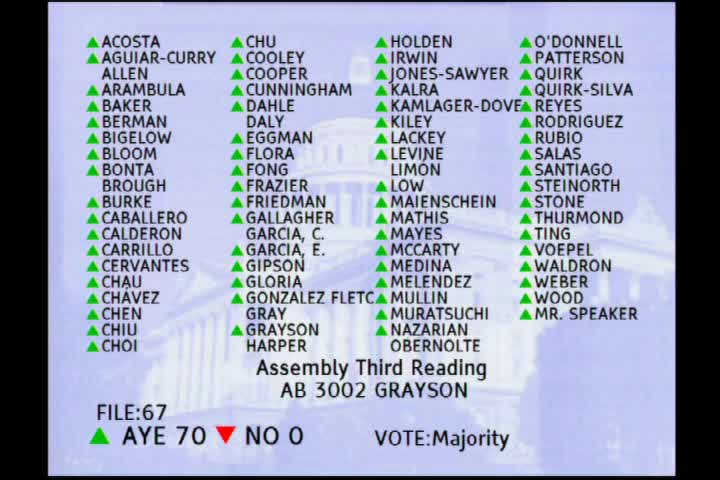 1MIN
Assembly Floor
Bill Author

Bill Co-Author(s):