AB 2596: California Economic Development Strategic Action Plan.
- Session Year: 2017-2018
- House: Assembly
- Latest Version Date: 2018-08-29
The Economic Revitalization Act establishes the Governors Office of Business and Economic Development, also known as GO-Biz, to serve as the Governors lead entity for economic strategy and the marketing of California on issues relating to business development, private sector investment, and economic growth. The office, among others, makes recommendations to the Governor and the Legislature regarding policies, programs, and actions to advance statewide economic goals.
This bill would require the office to lead the preparation of a California Economic Development Strategic Action Plan, as specified, to commission a study to identify and evaluate economic development issues, and to create a comprehensive agenda and framework for inclusive statewide and regional economic growth. The bill would authorize the office to accept nonstate moneys for the purposes of commissioning the study and developing the action plan. The bill would require the deposit of private sector donations into the Economic Action Plan Account, which the bill would establish in the California Economic Development Fund.
The Economic Revitalization Act establishes the Governors Office of Business and Economic Development serves Development, also known as GO-Biz, to serve as the Governors lead entity for economic strategy and the marketing of California on issues relating to business development, private sector investment, and economic growth. The office, among others, makes recommendations to the Governor and the Legislature regarding policies, programs, and actions to advance statewide economic goals.
This bill would require the office to lead the preparation of a California Economic Development Strategic Action Plan, as specified. specified, to create a comprehensive agenda and framework for inclusive statewide and regional economic growth. The bill would authorize the office to accept nonstate moneys for the purposes of developing the action plan. The bill would require the deposit of private sector donations into the Economic Action Plan Account, which the bill would establish in the California Economic Development Fund.
The Governors Office of Business and Economic Development serves as the Governors lead entity for economic strategy and the marketing of California on issues relating to business development, private sector investment, and economic growth. The office, among others, makes recommendations to the Governor and the Legislature regarding policies, programs, and actions to advance statewide economic goals.
This bill would require the office to lead the preparation of a California Economic Development Strategic Plan, as specified.
The Legislature finds and declares all of the following:
(a)Californias regional economies compete in an increasingly connected and complex global market driven by changes in technologies, demographics, and geopolitics.
(b)Public policy plays multiple and critical roles in creating the conditions that attract private capital investment, while encouraging equitable and sustainable economic growth.
(c)Scores of state, regional, and local programs strive to develop skilled workers, to attract and grow employers, and to support small businesses and entrepreneurs. Billions of dollars are spent each year on infrastructure to support development, transportation, and trade. Dozens of programs promote industries and encourage commerce.
(d)Yet California lacks an assessment of its competitiveness agenda and a coherent strategy that explicitly links state and regional priorities with goals and metrics, investments, and programs. An integrated economic strategy is essential to the success of existing and future programs and investments addressing the following:
(1)Growing inequality and the erosion of upward mobility in California that call for state policy to be intensely focused on increasing economic opportunity and security for all Californians.
(2)Global disruptions that are challenging Californias economic leadership in advanced manufacturing, agriculture, technology, health and life sciences, future mobility, and many other sectors. Future success will require highly refined public policies that help industries, institutions, and individuals adapt and thrive.
(3)Californias commitment to reduce greenhouse gas emissions, to restore ecosystems, and to improve environmental health that requires the skillful integration of regulations and other policies that shape natural resource management, energy, housing, transportation, and the myriad of job-creating economic decisions.
(e)To reconcile and align these ambitious and essential goals, California needs a triple-bottom-line strategy that simultaneously advances an inclusive economy through equity, prosperity, and sustainability while responding to market forces, including encouraging all of the following:
(1)The development within California of new technologies that yield more equitable, efficient, sustainable communities and affordable qualities of life.
(2)The rejuvenation of industrial zones, marketplaces, and community hubs to yield a greater diversity of business, employment, housing, and recreational opportunities for current and future residents of all income levels.
(3)Investments that amplify and balance the unique assets of urban, suburban, and rural communities, including working landscapes and infrastructure improvements.
(f)Californias triple-bottom-line prosperity strategy should be predicated on partnerships among state and local governments, and among public, private, and civic organizations, through which projects can integrate legal authorities, financial resources, and organizational expertise.
(g)The strategy should incorporate mechanisms for assessing and improving the public policies and investments according to triple-bottom-line metrics, affirming and reaffirming Californias commitment to a more inclusive, more sustainable, and more resilient economy.
SEC. 2.Section 12096.35 is added to the Government Code, to read:12096.35.(a)The office shall lead the preparation of a California Economic Development Strategic Action Plan. The purpose of the action plan is to create a comprehensive agenda and framework for inclusive statewide and regional economic growth.
(b)The goal of the action plan is to create a process by which the office can identify economic development challenges that confront the state and develop a plan that addresses the shifting economic landscape, changing demographics, and unique strengths of Californias industries, businesses, workers, and entrepreneurs.
(c)(1)The priorities set in the action plan shall be consistent with a current State Environmental Goals and Policy Report, developed pursuant to Section 65041, and used to guide the development and recommended actions of related state functional plans and strategies of state agencies, boards, and commissions.
(2)The office shall advocate for the alignment of priorities and recommendations for the purpose of increasing the states overall national and international competitiveness, to support regional priorities, and lead the state toward an inclusive economic growth agenda.
(d)The action plan shall cover a five-year period, with a review every two years, and the office shall revise the action plan, if the office determines it to be necessary, to ensure the action plan is responsive to the changing economic landscape.
(e)In preparation for the development and update of the action plan, the office shall commission a study that includes, but is not limited to, all of the following:
(1)Identification of state agencies, departments, boards, and commissions that have economic development-related responsibilities.
(2)An evaluation and identification of governmental and nongovernmental impediments to economic development.
(3)Identification and an analysis of economic opportunities for underserved and high-risk populations and geographic areas.
(4)An evaluation of each regions national and international competitiveness, including major proposals, policies, and goals, and of the effectiveness of state programs supporting regional needs.
(5)An evaluation of the strengths and weaknesses of the California economy, statewide economic development programs, and tools, and the states prospects for future economic prosperity, benchmarked against 10 or more competitor states and regions in the world.
(6)An evaluation of the effectiveness of Californias economic development programs in creating and retaining jobs, supporting entrepreneurship, attracting and developing advanced industries, and promoting inclusive growth.
(7)An evaluation of the adequacy of state and local infrastructure to meet current and future business needs, including goods and passenger movement and information networks. Include an analysis of current relevant funding models.
(8)An evaluation of opportunities to leverage federal resources for state priorities.
(9)An evaluation of tactics for attracting private capital to the state and investment in state priority areas.
(10)Identification of state workforce preparation and delivery systems, including workforce training programs, apprenticeships, and incumbent worker training.
(11)Identification and evaluation of impediments and support programs for small businesses and entrepreneurship, including in emerging and advanced industries.
(f)(1)The study shall also include recommendations on goals, priorities, and actions that would advance the purposes of the action plan, as provided in this section.
(2)Recommendations shall include, but not be limited to, a list of legislative, regulatory, and administrative initiatives to address key issues, seize opportunities, and ease impediments.
(g)The study shall also include potential funding options for covering the cost of implementing the recommendations.
(h)(1)Nothing precludes the office from undertaking additional studies to assist in the development, review, and update of the action plan.
(2)In fulfilling the requirements of this section, the office may utilize portions of previous studies that satisfy the requirements of this section to the extent feasible, current, and topically relevant.
(i)Upon completion of the study required in subdivision (e), the office shall do the following:
(1)Post the study on the office Internet Web site and open a public comment period to obtain feedback on the assessments and recommendations in the study.
(2)Engage with and encourage stakeholders to provide feedback on the assessments and recommendations during the public comment period.
(3)Convene an advisory group consisting of representatives from businesses, labor unions, organizations representing the interests of diverse ethnic and gender groups, local government leaders, academic economists and business professors, chambers of commerce and other business organizations, economic development organizations, economic development groups focusing on regional economies, government agencies, and key industries to assist with reviewing the study, evaluating the stakeholder comments, and preparing the California Economic Development Strategic Action Plan.
(j)In reviewing and evaluating the study required in subdivision (e) and any comments submitted pursuant to subdivision (i), the advisory group shall consider how this information relates to supporting the following:
(1)Upward mobility, including enhanced economic opportunities, workforce development, wage and income growth, job creation, and poverty reduction.
(2)Local and regional economic development efforts.
(3)Supporting the state competitiveness relative to other states and nations.
(4)Innovation and advanced technologies and industries.
(k)The California Economic Development Strategic Action Plan shall include the following:
(1)A statement of statewide economic development goals, with the development of a service model to support regionally created economic goals.
(2)A prioritized list of short-term and long-term issues that the action plan is designed to address.
(3)Identification of statewide and regionally dominant and emerging industry sectors.
(4)Legislative, regulatory, and administrative initiatives to address key issues, seize opportunities, and ease impediments.
(5)Identification of key state government and nonstate public and private partners.
(6)An outline of funding options for key features of the action plan.
(7)An evaluation process and metrics that will be used to assess, track, and report on the implementation and success of the action plan.
(l)The office, prior to action plan approval, shall seek the advice of the Legislature.
(m)(1) The office shall post the approved action plan on its Internet Web site and submit a letter providing notice of its public availability to the Legislature in the manner required pursuant to Section 9795.
(2)The first action plan shall be posted and notice received by the Legislature on or before January 10, 2020, and every five years after that date.
(3)The office shall notify the Legislature, consistent with Section 9795, each time the action plan is updated pursuant to subdivision (d).
(n)Within 120 days of submitting notice of the posting of the action plan, the office shall publish a list of performance indicators that will be used to evaluate and track the implementation of the action plan. The list shall include specific benchmarks, metrics, and timelines for each recommendation that is under the control or direct influence of the state. In meeting the requirements of this subdivision, the office shall engage relevant stakeholders for the inclusion of benchmarks and timelines for the industry-driven recommendations.
(o)(1)The biennial review pursuant to subdivision (d) shall evaluate the action plan compared to factors including, but not limited to, significant shifts in state or regional economic environments, available funding models, the removal of impediments, and new implementation options for identified priorities and goals.
(2)The biennial review pursuant to subdivision (d) shall include a progress report and identify the next steps toward implementation of the action plan or revised action plan, as appropriate.
(p)(1)The commission of the study and development and update of the California Economic Development Strategic Action Plan may be funded in whole or in part by nonstate funds.
(2)The office may accept nonstate moneys, including, but not limited to, federal and private sector funds, for the purposes of commissioning the study and developing the California Economic Development Strategic Action Plan, upon appropriation by the Legislature. A donor shall not donate more than 25 percent of funding for the California Economic Development Strategic Action Plan. The private sector moneys shall be deposited in the Economic Action Plan Account, which is hereby created in the California Economic Development Fund.
(3)For each donation that it receives to fund the California Economic Development Strategic Action Plan for this purpose, the office shall post a report on its Internet Web site within 30 days of receiving that donation. The report shall contain all of the following information: name and address of the donor, amount of the donation, and the date the donation was made.
(q)As used in this section, California Economic Development Strategic Action Plan or action plan means the California Economic Development Strategic Action Plan established pursuant to this section.
The Legislature finds and declares all of the following:
(a)Californias regional economies compete in an increasingly connected and complex global market driven by changes in technologies, demographics, and geopolitics.
(b)Public policy plays multiple and critical roles in creating the conditions that attract private capital investment, while encouraging equitable and sustainable economic growth.
(c)Scores of state, regional, and local programs strive to develop skilled workers, to attract and grow employers, and to support small businesses and entrepreneurs. Billions of dollars are spent each year on infrastructure to support development, transportation, and trade. Dozens of programs promote industries and encourage commerce.
(d)Yet California lacks an assessment of its competitiveness agenda and a coherent strategy that explicitly links state and regional priorities with goals and metrics, investments, and programs. An integrated economic strategy is essential to the success of existing and future programs and investments addressing the following:
(1)Growing inequality and the erosion of upward mobility in California that call for state policy to be intensely focused on increasing economic opportunity and security for all Californians.
(2)Global disruptions that are challenging Californias economic leadership in advanced manufacturing, agriculture, technology, health and life sciences, future mobility, and many other sectors. Future success will require highly refined public policies that help industries, institutions, and individuals adapt and thrive.
(3)Californias commitment to reduce greenhouse gas emissions, to restore ecosystems, and to improve environmental health that requires the skillful integration of regulations and other policies that shape natural resource management, energy, housing, transportation, and the myriad of job-creating economic decisions.
(e)To reconcile and align these ambitious and essential goals, California needs a triple-bottom-line strategy that simultaneously advances an inclusive economy through equity, prosperity, and sustainability while responding to market forces, including encouraging all of the following:
(1)The development within California of new technologies that yield more equitable, efficient, sustainable communities and affordable qualities of life.
(2)The rejuvenation of industrial zones, marketplaces, and community hubs to yield a greater diversity of business, employment, housing, and recreational opportunities for current and future residents of all income levels.
(3)Investments that amplify and balance the unique assets of urban, suburban, and rural communities, including working landscapes and infrastructure improvements.
(f)Californias triple-bottom-line prosperity strategy should be predicated on partnerships among state and local governments, and among public, private, and civic organizations, through which projects can integrate legal authorities, financial resources, and organizational expertise.
(g)The strategy should incorporate mechanisms for assessing and improving the public policies and investments according to triple-bottom-line metrics, affirming and reaffirming Californias commitment to a more inclusive, more sustainable, and more resilient economy.
SEC. 2.Section 12096.35 is added to the Government Code, to read:12096.35.(a)The office shall lead the preparation of a California Economic Development Strategic Action Plan. The purpose of the action plan is to create a comprehensive agenda and framework for inclusive statewide and regional economic growth.
(b)The goal of the action plan is to create a process by which the office can identify economic development challenges that confront the state and develop a plan that addresses the shifting economic landscape, changing demographics, and unique strengths of Californias industries, businesses, workers, and entrepreneurs.
(c)(1)The priorities set in the action plan shall be consistent with a current State Environmental Goals and Policy Report, developed pursuant to Section 65041, and used to guide the development and recommended actions of related state functional plans and strategies of state agencies, boards, and commissions.
(2)The office shall advocate for the alignment of priorities and recommendations for the purpose of increasing the states overall national and international competitiveness, to support regional priorities, and lead the state toward an inclusive economic growth agenda.
(d)The action plan shall cover a five-year period, with a review every two years, and the office shall revise the action plan, if the office determines it to be necessary, to ensure the action plan is responsive to the changing economic landscape.
(e)In preparation for the development and update of the action plan, the office shall commission a study that includes, but is not limited to, all of the following:
(1)Identification of state agencies, departments, boards, and commissions that have economic development-related responsibilities.
(2)An evaluation and identification of governmental and nongovernmental impediments to economic development.
(3)An identification Identification and an analysis of economic opportunities for underserved and high-risk populations and geographic areas.
(4)An evaluation of each regions national and international competitiveness, including major proposals, policies, and goals, and of the effectiveness of state programs supporting regional needs.
(5)An evaluation of the strengths and weaknesses of the California economy, statewide economic development programs, and tools, and the states prospects for future economic prosperity, benchmarked against 10 or more competitor states and regions in the world.
(6)Effectiveness An evaluation of the effectiveness of Californias economic development programs in creating and retaining jobs and attracting industries. jobs, supporting entrepreneurship, attracting and developing advanced industries, and promoting inclusive growth.
(7)Adequacy An evaluation of the adequacy of state and local infrastructure to meet current and future business needs, including goods and passenger movement and information networks. Include an analysis of current relevant funding models.
(8)Opportunities An evaluation of opportunities to leverage federal resources for state priorities.
(9)Evaluation An evaluation of tactics for attracting private capital to the state and investment in state priority areas.
(10)Identification of state workforce preparation and delivery systems, including workforce training programs, apprenticeships, and incumbent worker training.
(11)Identification and evaluation of impediments and support programs for small businesses and entrepreneurship, including in emerging and advanced industries.
(f)(1)The study shall also include recommendations on goals, priorities, and actions that would advance the purposes of the action plan, as provided in this section.
(2)Recommendations shall include, but not be limited to, a list of legislative, regulatory, and administrative initiatives to address key issues, seize opportunities, and ease impediments.
(g)The study shall also include potential funding options for covering the cost of implementing the recommendations.
(h)(1)Nothing precludes the office from undertaking additional studies to assist in the development, review, and update of the action plan.
(2)In fulfilling the requirements of this section, the office may utilize portions of previous studies that satisfy the requirements of this section to the extent feasible, current, and topically relevant.
(i)Upon completion of the study required in subdivision (e), the office shall do the following:
(1)Post the study on the office Internet Web site and open a public comment period to obtain feedback on the assessments and recommendations in the study.
(2)Engage with and encourage stakeholders to provide feedback on the assessments and recommendations during the public comment period.
(3)Convene an advisory group consisting of representatives from businesses, labor unions, organizations representing the interests of diverse ethnic and gender groups, local government leaders, academic economists and business professors, chambers of commerce and other business organizations, economic development organizations, economic development groups focusing on regional economies, government agencies, and key industries to assist with reviewing the study, evaluating the stakeholder comments, and preparing the California Economic Development Strategic Action Plan.
(j)In reviewing and evaluating the study required in subdivision (e) and any comments submitted pursuant to subdivision (i), the advisory group shall consider how this information relates to supporting the following:
(1)Upward mobility, including enhanced economic opportunities, workforce development, wage and income growth, job creation, and poverty reduction.
(2)Local and regional economic development efforts.
(3)Supporting the state competitiveness relative to other states and nations.
(4)Innovation and advanced technologies and industries.
(k)The California Economic Development Strategic Action Plan shall include the following:
(1)A statement of statewide economic development goals, with the development of a service model to support regionally created economic goals.
(2)A prioritized list of short-term and long-term issues that the action plan is designed to address.
(3)Identification of statewide and regionally dominant and emerging industry sectors.
(4)Legislative, regulatory, and administrative initiatives to address key issues, seize opportunities, and ease impediments.
(5)Identification of key state government and nonstate public and private partners.
(6)An outline of funding options for key features of the action plan.
(7)An evaluation process and metrics that will be used to assess, track, and report on the implementation and success of the action plan.
(l)The office, prior to action plan approval, shall seek the advice of the Legislature.
(m)(1) The office shall post the approved action plan on its Internet Web site and submit a letter providing notice of its public availability to the Legislature in the manner required pursuant to Section 9795.
(2)The first action plan shall be posted and notice received by the Legislature on or before January 10, 2020, and every five years after that date.
(3)The office shall notify the Legislature, consistent with Section 9795, each time the action plan is updated pursuant to subdivision (d).
(n)Within 120 days of submitting notice of the posting of the action plan, the office shall publish a list of performance indicators that will be used to evaluate and track the implementation of the action plan. The list shall include specific benchmarks, metrics, and timelines for each recommendation that is under the control or direct influence of the state. In meeting the requirements of this subdivision, the office shall engage relevant stakeholders for the inclusion of benchmarks and timelines for the industry-driven recommendations.
(o)(1)The biennial review pursuant to subdivision (d) shall evaluate the action plan compared to factors including, but not limited to, significant shifts in state or regional economic environments, available funding models, the removal of impediments, and new implementation options for identified priorities and goals.
(2)The biennial review pursuant to subdivision (d) shall include a progress report and identify the next steps toward implementation of the action plan or revised action plan, as appropriate.
(p)(1)The commission of the study and development and update of the California Economic Development Strategic Action Plan may be funded in whole or in part by nonstate funds.
(2)The office may accept nonstate moneys, including, but not limited to, federal and private sector funds, for the purposes of commissioning the study and developing the California Economic Development Strategic Action Plan. Plan, upon appropriation by the Legislature. A donor shall not donate more than 25 percent of funding for the California Economic Development Strategic Action Plan. The private sector moneys shall be deposited in the Economic Action Plan Account, which is hereby created in the California Economic Development Fund.
(3)For each donation that it receives to fund the California Economic Development Strategic Action Plan for this purpose, the office shall post a report on its Internet Web site within 30 days of receiving that donation. The report shall contain all of the following information: name and address of the donor, amount of the donation, and the date the donation was made.
(q)As used in this section, California Economic Development Strategic Action Plan or action plan means the California Economic Development Strategic Action Plan established pursuant to this section.
The Legislature finds and declares all of the following:
(a)Californias regional economies compete in an increasingly connected and complex global market driven by changes in technologies, demographics, and geopolitics.
(b)Public policy plays multiple and critical roles in creating the conditions that attract private capital investment, while encouraging equitable and sustainable economic growth.
(c)Scores of state, regional, and local programs strive to develop skilled workers, to attract and grow employers, and to support small businesses and entrepreneurs. Billions of dollars are spent each year on infrastructure to support development, transportation, and trade. Dozens of programs promote industries and encourage commerce.
(d)Yet California lacks an assessment of its competitiveness agenda and a coherent strategy that explicitly links state and regional priorities with goals and metrics, investments, and programs. An integrated economic strategy is essential to the success of existing and future programs and investments addressing the following:
(1)Growing inequality and the erosion of upward mobility in California that call for state policy to be intensely focused on increasing economic opportunity and security for all Californians.
(2)Global disruptions that are challenging Californias economic leadership in advanced manufacturing, agriculture, technology, health and life sciences, future mobility, and many other sectors. Future success will require highly refined public policies that help industries, institutions, and individuals adapt and thrive.
(3)Californias commitment to reduce greenhouse gas emissions, to restore ecosystems, and to improve environmental health that requires the skillful integration of regulations and other policies that shape natural resource management, energy, housing, transportation, and the myriad of job-creating economic decisions.
(e)To reconcile and align these ambitious and essential goals, California needs a triple-bottom-line strategy that simultaneously advances an inclusive economy through equity, prosperity, and sustainability while responding to market forces, including encouraging all of the following:
(1)The development within California of new technologies that yield more equitable, efficient, sustainable communities and affordable qualities of life.
(2)The rejuvenation of industrial zones, marketplaces, and community hubs to yield a greater diversity of business, employment, housing, and recreational opportunities for current and future residents of all income levels.
(3)Investments that amplify and balance the unique assets of urban, suburban, and rural communities, including working landscapes and infrastructure improvements.
(f)Californias triple-bottom-line prosperity strategy should be predicated on partnerships among state and local governments, and among public, private, and civic organizations, through which projects can integrate legal authorities, financial resources, and organizational expertise.
(g)The strategy should incorporate mechanisms for assessing and improving the public policies and investments according to triple-bottom-line metrics, affirming and reaffirming Californias commitment to a more inclusive, more sustainable, and more resilient economy.
SEC. 2.Section 12096.35 is added to the Government Code, to read:12096.35.(a)The office shall lead the preparation of a California Economic Development Strategic Action Plan. The purpose of the action plan is to create a comprehensive agenda and framework for inclusive statewide and regional economic growth.
(b)The goal of the action plan is to create a process by which the office can identify economic development challenges that confront the state and develop a plan that addresses the shifting economic landscape, changing demographics, and unique strengths of Californias industries, businesses, workers, and entrepreneurs.
(c)(1)The priorities set in the action plan shall be consistent with a current State Environmental Goals and Policy Report, developed pursuant to Section 65041, and used to guide the development and recommended actions of related state functional plans and strategies of state agencies, boards, and commissions.
(2)The office shall advocate for the alignment of priorities and recommendations for the purpose of increasing the states overall national and international competitiveness, to support regional priorities, and lead the state toward an inclusive economic growth agenda.
(d)The action plan shall cover a five-year period, with a review every 2 two years, and the office shall revise the action plan, if the office determines it to be necessary, to ensure the action plan is responsive to the changing economic landscape.
(e)In preparation for the development and update of the action plan, the office shall commission a study that includes, but is not limited to, all of the following:
(1)Identification of state agencies, departments, boards, and commissions that have economic development-related responsibilities.
(2)An evaluation and identification of governmental and nongovernmental impediments to economic development.
(3)An evaluation of the effectiveness of the states economic development programs in creating and retaining jobs, supporting entrepreneurship, attracting and developing advanced industries, and promoting inclusive growth.(4)(3)An identification and analysis of economic opportunities for underserved and high-risk populations and geographic areas.
(5)(4)An evaluation of each regions national and international competitiveness, including major proposals, policies, and goals, and of the effectiveness of state programs supporting regional needs.
(6)(5)An evaluation of the strengths and weaknesses of the California economy, statewide economic development programs, and tools, and the states prospects for future economic prosperity, benchmarked against 10 or more competitor states and regions in the world.
(7)Identification of existing, emerging, and declining industries in California, in comparison to the nation and the world. (8)(6)Effectiveness of Californias economic development programs in creating and retaining jobs and attracting industries.
(9)(7)Adequacy of state and local infrastructure to meet current and future business needs, including goods and passenger movement and information networks. Include an analysis of current relevant funding models.
(10)(8)Opportunities to leverage federal resources for state priorities.
(11)(9)Evaluation of tactics for attracting private capital to the state and investment in state priority areas.
(12)(10)Identification of state work-force workforce preparation and delivery systems, including workforce training programs, apprenticeships, and incumbent worker training.
(13)(11)Identification and evaluation of impediments and support programs for small businesses and entrepreneurship, including in emerging and advanced industries.
(f)(1)The study shall also include recommendations on goals, priorities, and actions that would advance the purposes of the action plan, as provided in this section.
(2)Recommendations shall include, but not be limited to, a list of legislative, regulatory, and administrative initiatives to address key issues, seize opportunities, and ease impediments.
(g)The study shall also include potential funding options for covering the cost of implementing the recommendations.
(h)(1)Nothing precludes the office from undertaking additional studies to assist in the development, review, and update of the action plan.
(2)In fulfilling the requirements of this section, the office may utilize portions of previous studies that satisfy the requirements of this section to the extent feasible, current, and topically relevant.
(i)Upon completion of the study required in subdivision (e), the office shall do the following:
(1)Post the study on the office Internet Web site and open a public comment period to obtain feedback on the assessments and recommendations in the study.
(2)Engage with and encourage stakeholders to hold statewide, regional, topic-specific, and industry-focused events to review the study and provide feedback on the assessments and recommendations. recommendations during the public comment period.
(3)Convene an advisory group consisting of representatives from businesses, labor unions, organizations representing the interests of diverse ethnic and gender groups, local government leaders, academic economists and business professors, chambers of commerce and other business organizations, economic development organizations, economic development groups focusing on regional economies, government agencies, and key industries to assist with reviewing the study, evaluating the stakeholder comments, and preparing the California Economic Development Strategic Action Plan.
(j)In reviewing and evaluating the study required in subdivision (e) and any comments submitted pursuant to subdivision (i), the advisory group shall consider how this information relates to supporting the following:
(1)Upward mobility, including enhanced economic opportunities, workforce development, wage and income growth, job creation, and poverty reduction.
(2)Local and regional economic development efforts.
(3)Supporting the state competitiveness relative to other states and nations.
(4)Innovation and advanced technologies and industries.
(k)The California Economic Development Strategic Action Plan shall include the following:
(1)A statement of statewide economic development goals, with the development of a service model to support regionally created economic goals.
(2)A prioritized list of short-term and long-term issues that the action plan is designed to address.
(3)Identification of statewide and regionally dominant and emerging industry sectors.
(4)Legislative, regulatory, and administrative initiatives to address key issues, seize opportunities, and ease impediments.
(5)Identification of key state government and nonstate public and private partners.
(6)An outline of funding options for key features of the action plan.
(7)An evaluation process and metrics that will be used to assess, track, and report on the implementation and success of the action plan.
(l)The office, prior to action plan approval, shall seek the advice of the Legislature.
(m)(1) The office shall post the approved action plan on its Internet Web site and submit a letter providing notice of its public availability to the Legislature in the manner required pursuant to Section 9795.
(2)The first action plan shall be posted and notice received by the Legislature on or before January 10, 2020, and every five years after that date.
(3)The office shall notify the Legislature, consistent with Section 9795, each time the action plan is updated pursuant to subdivision (d).
(n)Within 120 days of submitting notice of the posting of the action plan, the office shall publish a list of performance indicators that will be used to evaluate and track the implementation of the action plan. The list shall include specific benchmarks, metrics, and timelines for each recommendation that is under the control or direct influence of the state. In meeting the requirements of this subdivision, the office shall engage relevant stakeholders for the inclusion of benchmarks and timelines for the industry-driven recommendations.
(o)On or before January 10 of each year, the office shall post on its Internet Web site a progress report and next steps toward implementation of the action plan. (p)(o)The biennial review pursuant to subdivision (d) shall evaluate the action plan compared to factors including, but not limited to, significant shifts in state or regional economic environments, available funding models, the removal of impediments, and new implementation options for identified priorities and goals.
(q)(p)(1)The commission of the study and development and update of the California Economic Development Strategic Action Plan may be funded in whole or in part by nonstate funds.
(2)The office may accept nonstate moneys, including, but not limited to, federal and private sector funds, for the purposes of commissioning the study and developing the California Economic Development Strategic Action Plan. A donor shall not donate more than 25 percent of funding for the California Economic Development Strategic Action Plan. The private sector moneys shall be deposited in the Economic Action Plan Account, which is hereby created in the California Economic Development Fund.
(3)For each donation that it receives to fund the California Economic Development Strategic Action Plan for this purpose, the office shall post a report on its Internet Web site within 30 days of receiving that donation. The report shall contain all of the following information: name and address of the donor, amount of the donation, and the date the donation was made.
(r)(q)As used in this section, California Economic Development Strategic Action Plan or action plan means the California Economic Development Strategic Action Plan established pursuant to this section.
The Legislature finds and declares all of the following:
(a)Californias regional economies compete in an increasingly connected and complex global market driven by changes in technologies, demographics, and geopolitics.
(b)Public policy plays multiple and critical roles in creating the conditions that attract private capital investment, while encouraging equitable and sustainable economic growth.
(c)Scores of state, regional, and local programs strive to develop skilled workers, to attract and grow employers, and to support small businesses and entrepreneurs. Billions of dollars are spent each year on infrastructure to support development, transportation, and trade. Dozens of programs promote industries and encourage commerce.
(d)Yet California lacks an assessment of its competitiveness agenda and a coherent strategy that explicitly links state and regional priorities with goals and metrics, investments, and programs. An integrated economic strategy is essential to the success of existing and future programs and investments addressing the following:
(1)Growing inequality and the erosion of upward mobility in California that call for state policy to be intensely focused on increasing economic opportunity and security for all Californians.
(2)Global disruptions that are challenging Californias economic leadership in advanced manufacturing, agriculture, technology, health and life sciences, future mobility, and many other sectors. Future success will require highly refined public policies that help industries, institutions, and individuals adapt and thrive.
(3)Californias commitment to reduce greenhouse gas emissions, to restore ecosystems, and to improve environmental health that requires the skillful integration of regulations and other policies that shape natural resource management, energy, housing, transportation, and the myriad of job-creating economic decisions.
(e)To reconcile and align these ambitious and essential goals, California needs a triple-bottom-line strategy that simultaneously advances an inclusive economy through equity, prosperity, and sustainability while responding to market forces, including encouraging all of the following:
(1)The development within California of new technologies that yield more equitable, efficient, sustainable communities and affordable qualities of life.
(2)The rejuvenation of industrial zones, marketplaces, and community hubs to yield a greater diversity of business, employment, housing, and recreational opportunities for current and future residents of all income levels.
(3)Investments that amplify and balance the unique assets of urban, suburban, and rural communities, including working landscapes and infrastructure improvements.
(f)Californias triple-bottom-line prosperity strategy should be predicated on partnerships among state and local governments, and among public, private, and civic organizations, through which projects can integrate legal authorities, financial resources, and organizational expertise.
(g)The strategy should incorporate mechanisms for assessing and improving the public policies and investments according to triple-bottom-line metrics, affirming and reaffirming Californias commitment to a more inclusive, more sustainable, and more resilient economy.
SECTION 1.SEC. 2.Section 12096.35 is added to the Government Code, to read:12096.35.(a)The office shall lead the preparation of a California Economic Development Strategic Action Plan. In fulfilling this duty, the office shall commission a study that includes, but is not limited to, all of the following: The purpose of the action plan is to create a comprehensive agenda and framework for inclusive statewide and regional economic growth.
(1)Recommendations regarding an economic development strategic plan for the state, covering a two-year period for the first report and a three-year time period for subsequent reports and containing a statement of economic goals for the state.(2)Governmental and nongovernmental impediments to economic development and a list of legislative, regulatory, and administrative reforms necessary to ease those impediments and improvements to the business climate and economy of the state.(3)An evaluation of the effectiveness of the states economic development programs.(4)A list of key industries in which the state shall focus its economic development efforts, and strategies to foster job growth and economic development covering all state agencies, offices, boards, and commissions that have economic development responsibilities.(b)The goal of the action plan is to create a process by which the office can identify economic development challenges that confront the state and develop a plan that addresses the shifting economic landscape, changing demographics, and unique strengths of Californias industries, businesses, workers, and entrepreneurs.
(c)(1)The priorities set in the action plan shall be consistent with a current State Environmental Goals and Policy Report, developed pursuant to Section 65041, and used to guide the development and recommended actions of related state functional plans and strategies of state agencies, boards, and commissions.
(2)The office shall advocate for the alignment of priorities and recommendations for the purpose of increasing the states overall national and international competitiveness, to support regional priorities, and lead the state toward an inclusive economic growth agenda.
(d)The action plan shall cover a five-year period, with a review every 2 years, and the office shall revise the action plan, if the office determines it to be necessary, to ensure the action plan is responsive to the changing economic landscape.
(e)In preparation for the development and update of the action plan, the office shall commission a study that includes, but is not limited to, all of the following:
(1)Identification of state agencies, departments, boards, and commissions that have economic development-related responsibilities.
(2)An evaluation and identification of governmental and nongovernmental impediments to economic development.
(3)An evaluation of the effectiveness of the states economic development programs in creating and retaining jobs, supporting entrepreneurship, attracting and developing advanced industries, and promoting inclusive growth.
(4)An identification and analysis of economic opportunities for underserved and high-risk populations and geographic areas.
(5)An evaluation of each regions national and international competitiveness, including major proposals, policies, and goals developed at the regional level. goals, and of the effectiveness of state programs supporting regional needs.
(6)Strengths An evaluation of the strengths and weaknesses of the California economy economy, statewide economic development programs, and tools, and the states prospects for future economic prosperity. prosperity, benchmarked against 10 or more competitor states and regions in the world.
(7)Existing, Identification of existing, emerging, and declining industries in California and elsewhere. California, in comparison to the nation and the world.
(8)Effectiveness of Californias economic development programs in creating and retaining jobs and attracting industries.
(9)Adequacy of state and local physical and economic infrastructure. infrastructure to meet current and future business needs, including goods and passenger movement and information networks. Include an analysis of current relevant funding models.
(10)Opportunities to leverage federal resources for state priorities.
(11)Tactics Evaluation of tactics for attracting private capital to the state and investment in state priority areas.
(12)Identification of state work-force preparation and delivery systems, including workforce training programs, apprenticeships, and incumbent worker training.
(13)Identification and evaluation of impediments and support programs for small businesses and entrepreneurship, including in emerging and advanced industries.
(f)(1)The study shall also include recommendations on goals, priorities, and actions that would advance the purposes of the action plan, as provided in this section.
(2)Recommendations shall include, but not be limited to, a list of legislative, regulatory, and administrative initiatives to address key issues, seize opportunities, and ease impediments.
(g)The study shall also include potential funding options for covering the cost of implementing the recommendations.
(h)(1)Nothing precludes the office from undertaking additional studies to assist in the development, review, and update of the action plan.
(2)In fulfilling the requirements of this section, the office may utilize portions of previous studies that satisfy the requirements of this section to the extent feasible, current, and topically relevant.
(b)(i)Upon completion of the study, study required in subdivision (e), the office shall convene a stakeholder shall do the following:
(1)Post the study on the office Internet Web site and open a public comment period to obtain feedback on the assessments and recommendations in the study.
(2)Engage with and encourage stakeholders to hold statewide, regional, topic-specific, and industry-focused events to review the study and provide feedback on the assessments and recommendations.
(3)Convene an advisory group consisting of representatives from businesses, labor unions, organizations representing the interests of diverse ethnic and gender groups, local government leaders, academic economists and business professors, chambers of commerce and other business organizations, economic development organizations, economic development groups focusing on regional economies, government agencies, and key industries to assist with reviewing the study, evaluating the stakeholder comments, and preparing the California Economic Development Strategic Action Plan.
(c)The office shall submit a report of its findings and recommendations regarding subdivision (a) to the Governor and the Legislature no later than one year after its first meeting after January 1, 2019, and every three years following that date. The report shall be submitted to the Legislature in the manner required pursuant to Section 9795.(d)The office shall electronically deliver copies of the recommended California Economic Development Strategic Plan to every constitutional officer, legislator, member of the Governors cabinet, and every state agency, office, board, and commission having economic development responsibilities.(e)In fulfilling the requirements of this section, the office may utilize portions of previous studies that satisfy the requirements of subdivision (a) to the extent feasible and relevant.(j)In reviewing and evaluating the study required in subdivision (e) and any comments submitted pursuant to subdivision (i), the advisory group shall consider how this information relates to supporting the following:
(1)Upward mobility, including enhanced economic opportunities, workforce development, wage and income growth, job creation, and poverty reduction.
(2)Local and regional economic development efforts.
(3)Supporting the state competitiveness relative to other states and nations.
(4)Innovation and advanced technologies and industries.
(k)The California Economic Development Strategic Action Plan shall include the following:
(1)A statement of statewide economic development goals, with the development of a service model to support regionally created economic goals.
(2)A prioritized list of short-term and long-term issues that the action plan is designed to address.
(3)Identification of statewide and regionally dominant and emerging industry sectors.
(4)Legislative, regulatory, and administrative initiatives to address key issues, seize opportunities, and ease impediments.
(5)Identification of key state government and nonstate public and private partners.
(6)An outline of funding options for key features of the action plan.
(7)An evaluation process and metrics that will be used to assess, track, and report on the implementation and success of the action plan.
(l)The office, prior to action plan approval, shall seek the advice of the Legislature.
(m)(1) The office shall post the approved action plan on its Internet Web site and submit a letter providing notice of its public availability the Legislature in the manner required pursuant to Section 9795.
(2)The first action plan shall be posted and notice received by the Legislature on or before January 10, 2020, and every five years after that date.
(3)The office shall notify the Legislature, consistent with Section 9795, each time the action plan is updated pursuant to subdivision (d).
(n)Within 120 days of submitting notice of the posting of the action plan, the office shall publish a list of performance indicators that will be used to evaluate and track the implementation of the action plan. The list shall include specific benchmarks, metrics, and timelines for each recommendation that is under the control or direct influence of the state. In meeting the requirements of this subdivision, the office shall engage relevant stakeholders for the inclusion of benchmarks and timelines for the industry-driven recommendations.
(o)On or before January 10 of each year, the office shall post on its Internet Web site a progress report and next steps toward implementation of the action plan.
(p)The biennial review pursuant to subdivision (d) shall evaluate the action plan compared to factors including, but not limited to, significant shifts in state or regional economic environments, available funding models, the removal of impediments, and new implementation options for identified priorities and goals.
(f)(q)(1)The development and update of the California Economic Development Strategic Action Plan may be funded in whole or in part by nonstate funds.
(1)(2)The Governors Office of Business and Economic Development office may accept nonstate moneys, including, but not limited to, federal and private sector funds, for the purposes of developing the California Economic Development Strategic Action Plan. A donor shall not donate more than 25 percent of funding for the California Economic Development Strategic Action Plan. The private sector moneys shall be deposited in the Economic Action Plan Account, which is hereby created in the California Economic Development Fund.
(2)(3)For each donation that it receives to fund the California Economic Development Strategic Action Plan for this purpose, the Governors Office of Business and Economic Development office shall post a report on its Internet Web site within 30 days of receiving that donation. The report shall contain all of the following information: name and address of the donor, amount of the donation, and the date the donation was made.
(r)As used in this section, California Economic Development Strategic Action Plan or action plan means the California Economic Development Strategic Action Plan established pursuant to this section.
(a)The office shall lead the preparation of a California Economic Development Strategic Plan. In fulfilling this duty, the office shall commission a study that includes, but is not limited to, all of the following:
(1)Recommendations regarding an economic development strategic plan for the state, covering a two-year period for the first report and a three-year time period for subsequent reports and containing a statement of economic goals for the state.
(2)Governmental and nongovernmental impediments to economic development and a list of legislative, regulatory, and administrative reforms necessary to ease those impediments and improvements to the business climate and economy of the state.
(3)An evaluation of the effectiveness of the states economic development programs.
(4)A list of key industries in which the state shall focus its economic development efforts, and strategies to foster job growth and economic development covering all state agencies, offices, boards, and commissions that have economic development responsibilities.
(5)An evaluation of proposals, policies, and goals developed at the regional level.
(6)Strengths and weaknesses of the California economy and the states prospects for future economic prosperity.
(7)Existing, emerging, and declining industries in California and elsewhere.
(8)Effectiveness of Californias economic development programs in creating and retaining jobs and attracting industries.
(9)Adequacy of state and local physical and economic infrastructure.
(10)Opportunities to leverage federal resources for state priorities.
(11)Tactics for attracting private capital to the state and investment in state priority areas.
(b)Upon completion of the study, the office shall convene a stakeholder advisory group consisting of representatives from businesses, labor unions, organizations representing the interests of diverse ethnic and gender groups, local government leaders, academic economists and business professors, chambers of commerce and other business organizations, economic development organizations, economic development groups focusing on regional economies, government agencies, and key industries to assist with evaluating and preparing the California Economic Development Strategic Plan.
(c)The office shall submit a report of its findings and recommendations regarding subdivision (a) to the Governor and the Legislature no later than one year after its first meeting after January 1, 2019, and every three years following that date. The report shall be submitted to the Legislature in the manner required pursuant to Section 9795.
(d)The office shall electronically deliver copies of the recommended California Economic Development Strategic Plan to every constitutional officer, legislator, member of the Governors cabinet, and every state agency, office, board, and commission having economic development responsibilities.
(e)In fulfilling the requirements of this section, the office may utilize portions of previous studies that satisfy the requirements of subdivision (a) to the extent feasible and relevant.
(f)The California Economic Development Strategic Plan may be funded in whole or in part by nonstate funds.
(1)The Governors Office of Business and Economic Development may accept nonstate moneys, including, but not limited to, federal and private sector funds, for the purposes of developing the California Economic Development Strategic Plan. A donor shall not donate more than 25 percent of funding for the California Economic Development Strategic Plan. The private sector moneys shall be deposited in the California Economic Development Fund.
(2)For each donation that it receives to fund the California Economic Development Strategic Plan for this purpose, the Governors Office of Business and Economic Development shall post a report on its Internet Web site within 30 days of receiving that donation. The report shall contain all of the following information: name and address of the donor, amount of the donation, and the date the donation was made.
|
Date
|
Status
|
|---|---|
| Sep 28, 2018 | Vetoed by Governor. |
| Sep 6, 2018 | Enrolled and presented to the Governor at 3 p.m. |
| Aug 28, 2018 | Senate amendments concurred in. To Engrossing and Enrolling. |
| Aug 23, 2018 | In Assembly. Concurrence in Senate amendments pending. May be considered on or after August 25 pursuant to Assembly Rule 77. |
| Aug 23, 2018 | Read third time. Passed. Ordered to the Assembly. |
| Aug 20, 2018 | Read second time. Ordered to third reading. |
| Aug 17, 2018 | Read second time and amended. Ordered returned to second reading. |
| Aug 6, 2018 | In committee: Referred to APPR. suspense file. |
| Jun 26, 2018 | From committee: Do pass and re-refer to Com. on APPR. (Ayes 9. Noes 0.) (June 25). Re-referred to Com. on APPR. |
| Jun 13, 2018 | Referred to Com. on B., P. & E.D. |
| Jun 4, 2018 | In Senate. Read first time. To Com. on RLS. for assignment. |
| May 31, 2018 | Read third time. Passed. Ordered to the Senate. |
| May 29, 2018 | Read second time. Ordered to third reading. |
| May 25, 2018 | Read second time and amended. Ordered returned to second reading. |
| May 16, 2018 | In committee: Set, first hearing. Referred to APPR. suspense file. |
| Apr 30, 2018 | Re-referred to Com. on APPR. |
| Apr 26, 2018 | Read second time and amended. |
| Apr 25, 2018 | From committee: Amend, and do pass as amended and re-refer to Com. on APPR. (Ayes 7. Noes 0.) (April 17). |
| Mar 5, 2018 | Referred to Com. on J., E.D., & E. |
| Feb 16, 2018 | From printer. May be heard in committee March 18. |
| Feb 15, 2018 | Read first time. To print. |
|
Date
|
Description
|
Location
|
Votes
|
|
|---|---|---|---|---|
| Aug 28, 2018 | AB 2596 COOLEY Concurrence in Senate Amendments | Assembly Floor |
Passed |
|
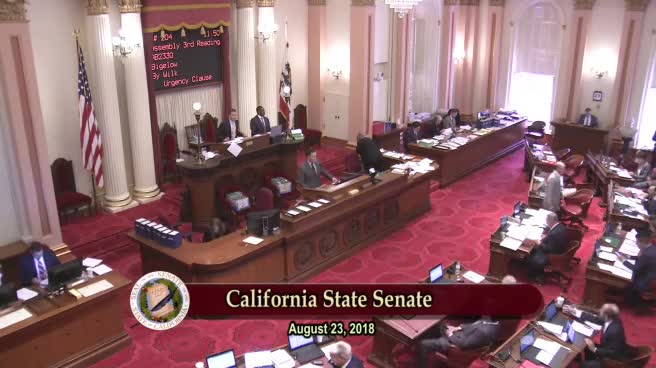
| Aug 23, 2018 | Assembly 3rd Reading AB2596 Cooley et al. By Hill | Senate Floor |
Passed |
|
| Aug 16, 2018 | Do pass as amended | Senate Standing Committee on Appropriations |
Passed |
|
| Aug 6, 2018 | Placed on suspense file | Senate Standing Committee on Appropriations |
Passed |
|
| Jun 25, 2018 | Do pass, but first be re-referred to the Committee on [Appropriations] | Senate Standing Committee on Business, Professions and Economic Development |
Passed |
|
| May 31, 2018 | AB 2596 COOLEY Assembly Third Reading | Assembly Floor |
Passed |
|
| May 25, 2018 | Do pass as amended. | Assembly Standing Committee on Appropriations |
Passed |
|
| Apr 17, 2018 | Do pass as amended and be re-referred to the Committee on [Appropriations] | Assembly Standing Committee on Jobs, Economic Development, and the Economy |
Passed |
This list shows positions taken on this bill by organizations on the date displayed, which is linked to the original source.
Positions by individuals are not included.
GOVERNOR'S VETO
GV Bill Id:AB 2596
Author:(Cooley, et al.)
As Enrolled Ver:September 6, 2018
2/3 vote
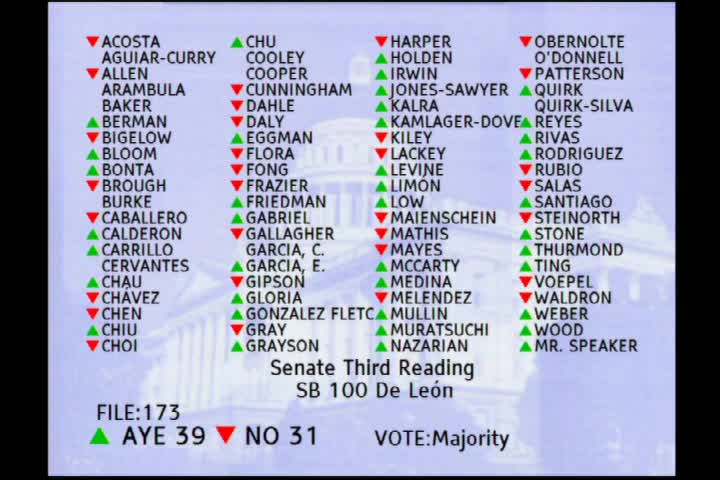
ASSEMBLY: | 78-0 | (May 31, 2018) | SENATE: | 39-0 | (August 23, 2018) |
ASSEMBLY: | 78-0 | (August 28, 2018) |
Original Committee Reference: J., E.D., & E.
SUMMARY: Requires the Governor's Office of Business and Economic Development (GO-Biz) to take the lead in preparing a California Economic Development Strategic Action Plan (ED Action Plan). The purpose of the ED Action Plan is to identify economic challenges and provide a set of actions to address the shifting economic landscape, changing demographics, and unique strengths of California’s industries, businesses, workers, and entrepreneurs.
GO-Biz is authorized to accept nonstate moneys for the purpose of developing the ED Action Plan, including, but not limited to, federal and private sector funds. The ED Action Plan is to be updated every five years and include policy recommendations and evaluation criteria.
The Senate amendments:
- Add detail to the already required biennial review by requiring the review to include a progress report and next steps in implementing the ED Action Plan.
- Add detail to the existing requirements relating to the evaluation of California's economic development programs.
- Require nonstate moneys committed to the development and evaluation of the plan be subject to appropriation by the Legislature.
FISCAL EFFECT: According to the Senate Appropriations Committee analysis, GO-Biz indicates that it would incur a one-time, first-year cost ranging between $2.6 million and $3.6 million, and ongoing annual costs ranging between $520,000 and $850,000 thereafter, to implement the provisions of the bill. The bill allows GO-Biz to accept nonstate funds; however, it would mandate the preparation of the ED Plan and other departmental tasks regardless of whether outside funds were raised, resulting in a General Fund cost pressure.
COMMENTS: As the fifth largest economy in the world, California's lack of a strategic plan impedes the state's ability to communicate clear policies on fundamental drivers of the economy, such as infrastructure development, workforce preparation, upward mobility, and support for emerging and dominant industry sectors within the state's regional economies. AB 2596 proposes the development of a strategy to guide the state's economic development activities, including providing support for significant regional projects.
The policy committee analysis includes additional information on the advantages of a strategy, the interrelationships between state planning and funding, and the role of GO-Biz.
California Economy: California is home to over 39 million people, providing the state with one of the most diverse populations in the world, often comprising the single largest concentration of nationals outside of their native country. In 2017, this diverse group of business owners and workers produced $2.7 trillion in goods and services, ranking the size of the state economy as fifth largest in the world.
The state's significance in the global marketplace results from a variety of factors, including its strategic west coast location, its economically diverse regional economies, its skilled workforce, and its culture of innovation and entrepreneurship, particularly in the area of technology. California has the largest workforce in the nation, comprised of 19.4 million people who are comparatively younger and more educated than the national average. As an example, over 30% of the working age population in California holds at least a bachelor's degree.
Many policy makers and economists describe California as having not a single economy but having a highly integrated network of regional industry clusters that provide access points to other areas of the US and across the world. While biotech has a comparative advantage in some regions, information technology drives growth in others. Driving this economic vitality are global fortune 250 companies with California headquarters and other facilities, as well as the state's robust small business sector, which employs nearly half of all workers and is comprised of more than 98% of all businesses in the state.
 What a Strategy Could Accomplish: There are ten key drivers of the California economy: capital, infrastructure, labor, business, education, research and development, resources, consumers, nonprofits, and government actions. Each of these drivers has both its own unique characteristics as well as shared qualities. In addition, each of the drivers is inextricably linked within the overall economic environment. A significant weakness within any one of the drivers affects the others.
As an example, California's aging infrastructure limits the state's ability to move products from farms to factories and on to foreign and domestic markets. These delays in moving goods and the related higher costs of transportation impact businesses all along the supply chain resulting in less job growth, lower discretionary income, and ultimately less tax revenues.
While the impacts of poor quality infrastructure are known, addressing this challenge requires a coordinated and comprehensive approach by both public and private stakeholders, including having appropriate funding, workforce, contractors, land use planning, and technologies. The ED Action Plan serves such a purpose. Up until August 2011, existing law required the state to have a two-year state Economic Development Strategic Plan. AB 2596 would re-establish a requirement for a comprehensive strategy that could support job creation, business development, attraction of private sector investment, and inclusive economic growth.
This bill would require the Governor's Office of Business and Economic Development, or GO-Biz, to lead the preparation of a California Economic Development Strategic Plan.
Since its inception, GO-Biz has expanded direct foreign investment, created opportunities for small businesses, identified incentives for growth, and helped resolve barriers for businesses navigating the government. These successes are due, in part, to the ability of GO-Biz to nimbly respond to rapidly changing economic factors including unpredictable federal decisions, natural disasters and more. I don't believe an ongoing costly study and report will provide any additional benefit to these efforts.
Analysis Prepared by: Toni Symonds / J., E.D., & E. / (916) 319-2090 FN: 0005370
CONCURRENCE IN SENATE AMENDMENTS
CSA1 Bill Id:AB 2596
Author:(Cooley, et al.)
As Amended Ver:August 17, 2018
Majority vote
ASSEMBLY: | 78-0 | (May 31, 2018) | SENATE: | 39-0 | (August 23, 2018) |
Original Committee Reference: J., E.D., & E.
SUMMARY: Requires the Governor's Office of Business and Economic Development (GO-Biz) to take the lead in preparing a California Economic Development Strategic Action Plan (ED Action Plan). The purpose of the ED Action Plan is to identify economic challenges and provide a set of actions to address the shifting economic landscape, changing demographics, and unique strengths of California’s industries, businesses, workers, and entrepreneurs.
GO-Biz is authorized to accept nonstate moneys for the purpose of developing the ED Action Plan, including, but not limited to, federal and private sector funds. The ED Action Plan is to be updated every five years and include policy recommendations and evaluation criteria.
The Senate amendments:
- Add detail to the already required biennial review by requiring the review to include a progress report and next steps in implementing the ED Action Plan.
- Add detail to the existing requirements relating to the evaluation of California's economic development programs.
- Require nonstate moneys committed to the development and evaluation of the plan be subject to appropriation by the Legislature.
FISCAL EFFECT: According to the Senate Appropriations Committee analysis, GO-Biz indicates that it would incur a one-time, first-year cost ranging between $2.6 million and $3.6 million, and ongoing annual costs ranging between $520,000 and $850,000 thereafter, to implement the provisions of the bill. The bill allows GO-Biz to accept nonstate funds; however, it would mandate the preparation of the ED Plan and other departmental tasks regardless of whether outside funds were raised, resulting in a General Fund cost pressure.
COMMENTS: As the fifth largest economy in the world, California's lack of a strategic plan impedes the state's ability to communicate clear policies on fundamental drivers of the economy, such as infrastructure development, workforce preparation, upward mobility, and support for emerging and dominant industry sectors within the state's regional economies. AB 2596 proposes the development of a strategy to guide the state's economic development activities, including providing support for significant regional projects.
The policy committee analysis includes additional information on the advantages of a strategy, the interrelationships between state planning and funding, and the role of GO-Biz.
California Economy: California is home to over 39 million people, providing the state with one of the most diverse populations in the world, often comprising the single largest concentration of nationals outside of their native country. In 2017, this diverse group of business owners and workers produced $2.7 trillion in goods and services, ranking the size of the state economy as fifth largest in the world.
The state's significance in the global marketplace results from a variety of factors, including its strategic west coast location, its economically diverse regional economies, its skilled workforce, and its culture of innovation and entrepreneurship, particularly in the area of technology. California has the largest workforce in the nation, comprised of 19.4 million people who are comparatively younger and more educated than the national average. As an example, over 30% of the working age population in California holds at least a bachelor's degree.
Many policy makers and economists describe California as having not a single economy but having a highly integrated network of regional industry clusters that provide access points to other areas of the US and across the world. While biotech has a comparative advantage in some regions, information technology drives growth in others. Driving this economic vitality are global fortune 250 companies with California headquarters and other facilities, as well as the state's robust small business sector, which employs nearly half of all workers and is comprised of more than 98% of all businesses in the state.
What a Strategy Could Accomplish: There are ten key drivers of the California economy: capital, infrastructure, labor, business, education, research and development, resources, consumers, nonprofits, and government actions. Each of these drivers has both its own unique characteristics as well as shared qualities. In addition, each of the drivers is inextricably linked within the overall economic environment. A significant weakness within any one of the drivers affects the others.
As an example, California's aging infrastructure limits the state's ability to move products from farms to factories and on to foreign and domestic markets. These delays in moving goods and the related higher costs of transportation impact businesses all along the supply chain resulting in less job growth, lower discretionary income, and ultimately less tax revenues.
While the impacts of poor quality infrastructure are known, addressing this challenge requires a coordinated and comprehensive approach by both public and private stakeholders, including having appropriate funding, workforce, contractors, land use planning, and technologies. The ED Action Plan serves such a purpose. Up until August 2011, existing law required the state to have a two-year state Economic Development Strategic Plan. AB 2596 would re-establish a requirement for a comprehensive strategy that could support job creation, business development, attraction of private sector investment, and inclusive economic growth.
Analysis Prepared by: Toni Symonds / J., E.D., & E. / (916) 319-2090 FN: 0004295
Office of Senate Floor Analyses (916) 651-1520 Fax: (916) 327-4478 | AB |
THIRD READING
Bill No: AB 2596
:
SENATE BUS., PROF. & ECON. DEV. COMMITTEE: 9-0, 6/25/18
AYES: Hill, Fuller, Allen, Dodd, Galgiani, Glazer, Hernandez, Pan, Wilk
SENATE APPROPRIATIONS COMMITTEE: 7-0, 8/16/18
AYES: Portantino, Bates, Beall, Bradford, Hill, Nielsen, Wiener
ASSEMBLY FLOOR: 78-0, 5/31/18 - See last page for vote
Greater Sacramento Economic Council
Valley Vision
DIGEST:
This bill requires the Governor’s Office of Business and Economic Development (GO-Biz) to lead the preparation of a California Economic Development Strategic Action Plan (ED Plan).
Existing law:
- Authorizes GO-Biz to recommend to the Governor and the Legislature new state policies, programs, and actions, or amendments to existing programs, advance statewide economic goals and respond to emerging economic problems and opportunities, and ensure that all state policies and programs conform to the adopted state economic and business development goals. (GOV § 12096.3)
- Authorizes GO-Biz to conduct research on the state’s business climate, including, but not limited to, research on how the state can remain on the leading edge of innovation and emerging sectors. (GOV § 12096.3)
- Instructs the Director of the Office of Small Business Advocate to, prepare and submit a written annual report to the Governor and to the Legislature that describes the activities and recommendations of the office, including an evaluation of the efforts of state agencies and, where appropriate, specific departments, that significantly regulate small businesses to assist minority and other small business enterprises, and making recommendations that may be appropriate to assist the development and strengthening of minority and other small business enterprises. (GOV § 12098.4)
This bill:
- Designates GO-Biz as the lead in preparing an ED Plan with the goal of creating a process by which the office can identify economic development challenges that confront the state. Requires Go-Biz, in preparation for the development of the action plan, to commission a study that includes specified information. Authorizes the use of portions of previous studies that satisfy the requirements of the study.
- Requires GO-Biz to seek approval or provide notice to the Legislature, as specified, prior to ED Plan approval, upon posting the approved action plan on its website, and each time the action plan is updated.
- Requires the first ED plan to be posted by January 10, 2020, and every five years thereafter.
- Permits the commission of the study and update of the ED Plan to be funded in whole or in part by nonstate funds, upon appropriation by the Legislature, and establishes rules for the acceptance, use, and reporting of nonstate funds.
Background
GO-Biz is currently authorized to “recommend new state policies, programs, and actions, or amendments to existing programs, advance statewide economic goals and respond to emerging economic problems and opportunities, and ensure that all state policies and programs conform to the adopted state economic and business development goals.” Until 2011, the Economic Strategy Panel (ESP) was tasked with preparing a California Economic Development Strategic Plan. The ESP was supported by the Employment Development Department and Department of Industrial Relations under the Labor and Workforce Development Agency budget. As part of a larger Administration proposal to reduce state government and achieve savings, the ESP was eliminated in the 2011-12 Budget (AB 119, Committee on Budget, Chapter 31, Statutes of 2011).
FISCAL EFFECT: Appropriation: Fiscal Com.: Local:
According to the Senate Committee on Appropriations analysis dated August 16, 2018, GO-Biz indicates that it would incur a one-time, first-year cost ranging between $2.6 million and $3.6 million, and ongoing annual costs ranging between $520,000 and $850,000 thereafter, to implement the provisions of the bill. The analysis also notes that the bill allows GO-Biz to accept nonstate funds; however, it would mandate the preparation of the ED Plan and other departmental tasks regardless of whether outside funds were raised, resulting in a General Fund cost pressure.
Bay Area Council (co-source)
Greater Sacramento Economic Council (co-source)
Valley Vision (co-source)
Align Capital Region
American Society of Civil Engineers
Buzz Oates
California Credit Union League
California Forward Action Fund
City of Citrus Heights
City of Elk Grove
City of Folsom
City of Galt
City of Lincoln
City of Roseville
Clark Pacific
Council Member of City of Woodland
Dignity Health
El Dorado County Board of Supervisors
Eskaton
Future Ford Lincoln of Roseville
Hanson McClain Advisors
Health Net
Holt of California
Los Angeles Area Chamber of Commerce
Los Rios Community College District
Lyon Real Estate
MarketOne Builders
Markstein Beverage Co.
Mayor of City of Rancho Cordova
Mayor of City of Rocklin
Mikuni Restaurant Group, Inc.
Nevada County Economic Resource Council
Orange County Business Council
Placer County Board of Supervisors
PRIDE Industries
Rabobank
Raley's
River City Bank
Sacramento Area Council of Governments
Sacramento County Board of Supervisors
Sacramento Jet Center
Sacramento Metro Chamber of Commerce
Sacramento Republic FC
San Francisco Chamber of Commerce
Sierra College
SMUD
Sutter County Supervisor Dan Flores
Sutter Health
The Niello Company
United Chamber Advocacy Network of California
United Corporate Furnishings, Inc.
University of the Pacific
VSP Global
William Jessup University
Yolo County
Yuba County Supervisor Gary Bradford
Four individuals
OPPOSITION: (Verified 8/17/18)
None received
ARGUMENTS IN SUPPORT: Supporters state that state that implementing a statewide strategic economic development plan will create an environment where all communities in California can engage in a cohesive conversation with the state about creating an inclusive, equitable economy with growth opportunities across regions.
ASSEMBLY FLOOR: 78-0, 5/31/18
AYES: Acosta, Aguiar-Curry, Travis Allen, Arambula, Baker, Berman, Bigelow, Bloom, Bonta, Brough, Burke, Caballero, Calderon, Carrillo, Cervantes, Chau, Chávez, Chen, Chiu, Choi, Chu, Cooley, Cooper, Cunningham, Dahle, Daly, Eggman, Flora, Fong, Frazier, Friedman, Gallagher, Cristina Garcia, Eduardo Garcia, Gipson, Gloria, Gonzalez Fletcher, Gray, Grayson, Harper, Holden, Irwin, Jones-Sawyer, Kalra, Kamlager-Dove, Kiley, Lackey, Levine, Limón, Low, Maienschein, Mathis, Mayes, McCarty, Medina, Melendez, Mullin, Muratsuchi, Nazarian, Obernolte, O'Donnell, Patterson, Quirk, Quirk-Silva, Reyes, Rodriguez, Rubio, Salas, Santiago, Steinorth, Mark Stone, Thurmond, Ting, Voepel, Waldron, Weber, Wood, Rendon
8/20/18 19:25:54
**** END ****
SENATE COMMITTEE ON
Senator Anthony Portantino, Chair
2017 - 2018 Regular Session
AB 2596 (Cooley) - California Economic Development Strategic Action Plan
Version: | Policy Vote: |
Urgency: | Mandate: |
Hearing Date: | Consultant: |
Bill Summary:
AB 2596 would require the Governor’s Office of Business and Economic Development (GO-Biz) to lead the preparation of a California Economic Development Strategic Action Plan (ED Plan).
*********** ANALYSIS ADDENDUM – SUSPENSE FILE ***********
The following information is revised to reflect amendments
adopted by the committee on August 16, 2018
Fiscal Impact:
GO-Biz indicates that it would incur a one-time, first-year cost ranging between $2.6 million and $3.6 million, and ongoing annual costs ranging between $520,000 and $850,000 thereafter, to implement the provisions of the bill. As noted below, the bill allows GO-Biz to accept nonstate funds; however, it would mandate the preparation of the ED Plan and other departmental tasks regardless of whether outside funds were raised, resulting in a General Fund cost pressure.
Author Amendments:
Require the Legislature to appropriate nonstate monies, and make technical changes.
-- END --
SENATE COMMITTEE ON APPROPRIATIONS
Senator Anthony Portantino, Chair
2017 - 2018 Regular Session
AB 2596 (Cooley) - California Economic Development Strategic Action Plan
Version: May 25, 2018 | Policy Vote: B., P. & E.D. 9 - 0 |
Urgency: No | Mandate: No |
Hearing Date: August 6, 2018 | Consultant: Robert Ingenito |
This bill meets the criteria for referral to the Suspense File.
Bill Summary:
AB 2596 would require the Governor’s Office of Business and Economic Development (GO-Biz) to lead the preparation of a California Economic Development Strategic Action Plan (ED Plan).
Fiscal Impact:
GO-Biz indicates that it would incur a one-time, first-year cost ranging between $2.6 million and $3.6 million, and ongoing annual costs ranging between $520,000 and $850,000 thereafter, to implement the provisions of the bill. As noted below, the bill allows GO-Biz to accept nonstate funds; however, it would mandate the preparation of the ED Plan and other departmental tasks regardless of whether outside funds were raised, resulting in a General Fund cost pressure (see Staff Comments).
Background:
In February 2010, the Little Hoover Commission undertook a review of the state's economic and workforce development programs. In its final report, it (1) analyzed the status and effectiveness of current programs since the 2003 demise of the Technology, Trade and Commerce Agency (TTCA), and (2) recommended the creation of a new governmental entity to fill the void left by the dismantled agency. Specifically, the report called for a single entity that would promote greater economic development, foster job creation, serve as a policy advisor, and deliver specific services directly to the California business community. In April 2010, Governor Schwarzenegger issued Executive Order S-05-10 as a means to operationalize the report recommendations, which included the creation of the Governor's Office of Economic Development (GOED). In October 2011, the Governor signed AB 29 (Pérez, Chapter 475, Statutes of 2011), which effectively codified GOED and changed its name to GO-Biz. Since its inception, the office has served thousands of businesses, 95 percent of which are small businesses. The most frequent types of assistance include help with permit streamlining, starting a business, relocation and expansion of businesses, and regulatory challenges.
Thus, GO-Biz is the state’s lead agency for economic strategy and job creation efforts. The office provides recommendations to the state on economic policy and programming. It provides services to businesses, administers tax credits, and offers regulatory guidance. The agency received $13.9 million GF in 2017-18 for operations and several programs, including $3.3 million to support the Office of the Small Business Advocate (OSBA).
Proposed Law:
This bill would, among other things, do the following:
- Designate GO-Biz as the lead in preparing an ED Plan, as specified, with the goal of creating a process by which the office can identify economic development challenges that confront the State.
- Require GO-Biz to post the study on their website and have a public comment period.
- Require GO-Biz to convene a stakeholder advisory group, as specified, to assist with reviewing the study, evaluating stakeholder comments, and preparing the ED Plan.
- Require the advisory group, in reviewing and evaluating the study, to consider how the information relates to upward mobility; local and regional economic development efforts; supporting state competitiveness; and innovation and advanced technologies.
- Provide that the ED Plan shall include specified items.
- Require GO-Biz to seek approval or provide notice to the Legislature, as specified, prior to ED Plan approval, upon posting the approved action plan on its website, and each time the action plan is updated.
- Require the first ED plan to be posted by January 10, 2020, and pentannually thereafter.
- Require GO-Biz to publish a list of performance indicators within 120 days of submitting the notice of posting.
- Permit the commission of the study and update of the ED Plan to be funded in whole or in part by nonstate funds and establish rules for their acceptance, use, and reporting.
Related Legislation:
- AB 2463 (Quirk-Silva) would create a competitive grant program, subject to appropriation, within GO-Biz for federal small business technical assistance centers to expand services. The bill is currently pending before this Committee.
- AB 2687 (Quirk-Silva) would expand some other duties of the Office of Small Business Advocate within GO-Biz. The bill is currently pending before this Committee.
- AB 53 (Pérez, 2013) would have required GO-Biz to lead the preparation of a California Economic Development Strategic Plan. The bill was vetoed by the Governor.
Staff Comments:
The plan described in this bill is similar to the plan developed by the California Economic Strategy Panel at the Labor and Workforce Development Agency. Specifically, the California Economic Strategy Panel was previously tasked with preparing a California Economic Development Plan, and was supported by the Employment Development Department and the Department of Industrial Relations. The Panel did work to develop a statewide strategy for economic growth and development and produced a statewide economic development strategic plan every other year, from 1996 to 2002. It was eliminated in the 2011-12 Budget as part of a larger proposal by the Administration to reduce state government.
GO-Biz notes that this bill’s provisions outlining the content of the study/ED Plan include identification, analysis, or evaluation of thirteen broad areas related to economic development within regions, statewide, nationally, and internationally. The study/ED Plan must also include recommendations and a funding analysis to determine how the recommendations can be funded. GO-Biz indicates that the precise cost of conducting an industry analysis of this magnitude cannot be determined before a request for proposals through a competitive bidding process is issued; however, the department preliminarily estimates that this portion of the bill would cost between $2.5 million to $3.5 million for a commissioned study; in addition, GO-Biz would require one project manager at $140,000 (for salary, benefits, operating expenses, and equipment).
Upon completion of the study, GO-Biz would be required to (1) publish the study/ED Plan and solicit public feedback, (2) host events that are statewide, regional, topic-specific, and industry focused to solicit feedback, (3) convene a stakeholder advisory group consisting of a wide array of individuals and experts from the public and private sectors to solicit their feedback, and (4) seek the advice of the Legislature. The department anticipates that the project manager could lead and direct this activity, but would need part-time support staff. Costs are estimated to be $145,000.
Finally, the bill would require an ongoing evaluation process with performance indicators to assess, track, and report on the implementation of the ED Plan. The performance tracking must be updated and a review of the strategic action plan must take place every two years. GO-Biz estimates ongoing costs of managing the program and retaining expert consulting services for periodic updates to be between $520,000 and $850,000 annually.
-- END --
SENATE COMMITTEE ON
BUSINESS, PROFESSIONS AND ECONOMIC DEVELOPMENT
Senator Jerry Hill, Chair
2017 - 2018 Regular
Bill No: Hearing Date: June 25, 2018
Author: | |||
Version: |
| ||
Urgency: | Fiscal: | ||
Consultant: | Miller Saltzman and Sarah Mason | ||
Subject:
SUMMARY:
Requires the Governor’s Office of Business and Economic Development (GO-Biz) to lead the preparation of a California Economic Development Strategic Action Plan (ED Plan).
Existing law:
- Establishes GO-Biz within the Governor’s Office for the purpose of serving as the lead state agency for economic strategy and marketing of California on issues relating to business development, private sector investment, and economic growth. (Government Code (GOV) §§ 12096-12098.5)
- Authorizes GO-Biz to recommend to the Governor and the Legislature new state policies, programs, and actions, or amendments to existing programs, advance statewide economic goals and respond to emerging economic problems and opportunities, and ensure that all state policies and programs conform to the adopted state economic and business development goals. (GOV § 12096.3)
- Authorizes GO-Biz to conduct research on the state’s business climate, including, but not limited to, research on how the state can remain on the leading edge of innovation and emerging sectors. (GOV § 12096.3)
- Instructs the Director of the Office of Small Business Advocate to, prepare and submit a written annual report to the Governor and to the Legislature that describes the activities and recommendations of the office, including an evaluation of the efforts of state agencies and, where appropriate, specific departments, that significantly regulate small businesses to assist minority and other small business enterprises, and making recommendations that may be appropriate to assist the development and strengthening of minority and other small business enterprises. (GOV § 12098.4)
This bill:
- Designates GO-Biz as the lead in preparing an ED Plan with the goal of creating a process by which the office can identify economic development challenges that confront the state.
- Specifies that the action plan shall cover a five-year period, with a review every two years.
- Requires Go-Biz, in preparation for the development of the action plan, to commission a study that includes the following:
- Identification of state organizations that have economic development-related responsibilities.
- Evaluation and identification of governmental and nongovernmental impediments to economic development.
- Identification and analysis of economic opportunities for underserved and high-risk populations and geographic areas.
- Evaluation of each region’s competitiveness and effectiveness of state programs supporting regional needs.
- Strengths and weaknesses of the California economy and the state’s prospects for future economic prosperity.
- Effectiveness of California’s economic development programs in creating and retaining jobs and attracting industries.
- Adequacy of state and local infrastructure to meet current and future business needs.
- Opportunities to leverage federal resources for state priorities.
- Tactics for attracting private capital to the state and investment in state priority areas.
- Identification of state workforce preparation and delivery systems.
- Identification and evaluation of impediments and support programs for small businesses and entrepreneurship.
- Recommendations on goals, priorities, and actions that would advance the purposes of the action plan.
- Authorizes the use of portions of previous studies that satisfy the requirements of the study.
- Requires GO-Biz to post the study on their website and have a public comment period.
- Requires GO-Biz to convene a stakeholder advisory group to assist with reviewing the study, evaluating stakeholder comments, and preparing the ED Plan. The stakeholder advisory group is required to include representatives from businesses; labor unions; organizations representing the interests of diverse ethnic and gender groups; local government leaders; academic economists and business professors; chambers of commerce and other business organizations; economic development organizations; economic development groups focusing on regional economies; government agencies; and key industries.
- Requires the advisory group, in reviewing and evaluating the study, to consider how the information relates to upward mobility; local and regional economic development efforts; supporting state competitiveness; and innovation and advanced technologies.
- Specifies that the ED Plan shall include to following:
- A statement of statewide economic development goals.
- A prioritized list of short-term and long-term issues that the action plan addresses.
- Identification of statewide regionally dominant and emerging industry sectors.
- Legislative, regulatory, and administrative initiatives to address key issues.
- Identification of key state government and non-state public and private partners.
- An outline of funding options for the action plan.
- An evaluation process and metrics for tracking the implementation of the plan.
- Requires GO-Biz to seek approval or provide notice to the Legislature, as specified, prior to ED Plan approval, upon posting the approved action plan on its website, and each time the action plan is updated.
- Requires the first ED plan to be posted by January 10, 2020, and every five years thereafter.
- GO-Biz is to publish a list of performance indicators within 120 days of submitting the notice of posting.
- Permits the commission of the study and update of the ED Plan to be funded in whole or in part by nonstate funds and establishes rules for the acceptance, use, and reporting of nonstate funds.
FISCAL EFFECT:
This bill is keyed fiscal by Legislative Counsel. According to the Assembly Appropriations Committee analysis dated May 16, 2018, this bill would have “one-time General Fund (GF) costs in the low millions of dollars for GO-Biz to commission the study and hire a limited-term project manager to oversee the contract” and “ongoing GF costs in the low hundreds of thousands of dollars to hire staff to gather input on the study, develop the plan, and oversee the process.”
COMMENTS:
- Purpose. This bill is sponsored by Greater Sacramento Economic Council, Bay Area Council and Valley Vision. According to the Author, “The state’s economic prosperity is concentrated in small areas. The state has consistently been identified as a challenging place to do business due to regulations, complexity, and high barriers to entry. And the state’s lack of a statewide economic development strategy has continually impeded its ability to set and work towards clear priorities. To remain competitive in business attraction and retention, California must adopt a state level strategic plan.”
- Governor’s Office of Economic Development (GO-Biz). In February 2010, the Little Hoover Commission undertook a review of the state's economic and workforce development programs. In its final report, Making up for Lost Ground: Creating a Governor's Office of Economic Development, it analyzed the status and effectiveness of current programs since the 2003 demise of the Technology, Trade and Commerce Agency (TTCA) and recommended the creation of a new governmental entity to fill the void left by the dismantled agency.
The report called for a single entity that would promote greater economic development, foster job creation, serve as a policy advisor, and deliver specific services directly to the California business community. In April 2010, Governor Schwarzenegger issued Executive Order S-05-10 as a means to operationalize the report recommendations, which included the creation of the Governor's Office of Economic Development (GOED).
In October 2011, the Governor signed AB 29 (Pérez, Chapter 475, Statutes of 2011), which effectively codified GOED and changed its name to GO-Biz. Since its inception, the office has served thousands of businesses, 95 percent of which are small businesses. The most frequent types of assistance include help with permit streamlining, starting a business, relocation and expansion of businesses, and regulatory challenges.
In March 2012, Governor Brown initiated a reorganization process to realign the state's administrative structure. Key changes include dismantling of the Business, Transportation and Housing Agency and the shifting of a number of key programs to GO-Biz including the Small Business Loan Guarantee Program, the California Travel and Tourism Commission, the California Film Commission, the Film California First Program, and the Infrastructure and Economic Development Bank (I-Bank). GO-Biz administers the “Made In California” program for the purpose of encouraging consumer product awareness and to foster the purchases of products manufactured in California. GO-Biz is responsible for specialized assistance to small businesses through the Office of Small Business Advocate (OSBA). OSBA directly serves the small business community through hosting summits, forums, and interagency meetings; maintaining resources for technical assistance, financing, and state procurement; holding webinars, and other outreach methods. Among these other programs, GO-Biz also administers the Innovation Hub (iHub) program. The iHubs aim to improve the state's national and global competitiveness by stimulating partnerships, economic development, and job creation around specific research clusters through state-designated iHubs.
GO-Biz also has authority for undertaking international trade and foreign investment activities, including establishing any international trade and investment office. GO-Biz has partnered with the Bay Area Council to open a California-China Trade and Investment office (CCTO) in Shanghai's downtown Yangpu district. GO-Biz has a Permit Assistance Unit (Unit) established based on the agency’s statutory authority to provide assistance to businesses in obtaining state and local permits and support small businesses in complying with regulatory requirements, which may include permitting. Under GO-Biz, the Office of Small Business Advocate hosts a variety of summits, forums and interagency meetings designed to provide information and assistance to small businesses to help them succeed in the California marketplace.
GO-Biz also administers the California Competes Tax Credit. Under the California Competes Tax Credit, “businesses who want to come, stay, or grow in California,” as noted on the GO-Biz website, can receive income tax credit. Tax credit agreements are negotiated between GO-Biz and the taxpayer, and approved by a committee, consisting of the State Treasurer, the Director of the Department of Finance, the Director of GO-Biz, and one appointee each by the Speaker of the Assembly and Senate Committee on Rules. Allocations are based on certain specified factors, but mainly focus on the amount of investment, the impact of a project, and the number of jobs the taxpayer will create or retain in California. The program is open to taxpayers of all sizes but creates preferential treatment for “small businesses,” defined as those making less than $2 million in revenue per year.
Under the Control, Regulate and Tax Adult Use of Marijuana Act (AUMA) enacted by voters through Proposition 64 in 2016, GO-Biz is responsible for administering a community reinvestments grants program to local health departments and at least 50 percent to qualified community-based nonprofit organizations to support job placement, mental health treatment, substance use disorder treatment, system navigation services, legal services to address barriers to reentry and linkages to medical care for communities disproportionately affected by past federal and state drug policies. GO-Biz must solicit input from community-based job skills, job placement, and legal service providers with relevant expertise as to the administration of the grants program, as well as periodically evaluate the programs, and it’s funding to determine the effectiveness of the programs, spending no more than four percent for administrative costs related to implementation, evaluation and oversight of the programs.
GO-Biz is currently authorized to “recommend new state policies, programs, and actions, or amendments to existing programs, advance statewide economic goals and respond to emerging economic problems and opportunities, and ensure that all state policies and programs conform to the adopted state economic and business development goals.” Until 2011, the Economic Strategy Panel (ESP) was tasked with preparing a California Economic Development Strategic Plan (Plan). The ESP was supported by the Employment Development Department and Department of Industrial Relations under the Labor and Workforce Development Agency budget. As part of a larger Administration proposal to reduce state government and achieve savings, the ESP was eliminated in the 2011-12 Budget (AB 119, Committee on Budget, Chapter 31, Statutes of 2011).
- Prior Related Legislation. AB 53 (John A. Pérez) of 2013 would have required GO-Biz to lead the preparation of a California Economic Development Strategic Plan. (Status: The measure was vetoed by the Governor who indicated in his veto message that “GO Biz is now implementing the state's new economic development initiative that Speaker Pérez helped make possible earlier this year. In addition, thanks to legislation authored by Speaker Pérez, GO Biz is expanding direct foreign investment, promoting export of California products, removing unnecessary government barriers for businesses, and helping large and small businesses innovate, grow, and prosper in California. For all these reasons, I don't think a study and report will bring any additional focus to our efforts.”)
- Arguments in Support. Greater Sacramento Economic Council, Valley Vision, and Bay Area Council, the co-sponsors of the bill, state that, “Implementing a statewide strategic economic development plan will create an environment where all communities in California can engage in a cohesive conversation with the state about creating an inclusive, equitable economy with growth opportunities across regions.”
California Forward Action Fund writes, “While California’s state government has assumed a global leadership role in many areas—from climate resiliency to poverty reduction—the state lacks a coherent strategy for ensuring California remains competitive in a rapidly changing global economy and allowing all Californians to share in that prosperity.”
SUPPORT AND OPPOSITION:
Support:
Greater Sacramento Economic Council (co-sponsor)
Bay Area Council (co-sponsor
Valley Vision (co-sponsor)
Align Capital Region
American Society of Civil Engineers
Buzz Oates
California Credit Union League
California Forward Action Fund
City of Citrus Heights
City of Elk Grove
City of Folsom
City of Galt
City of Lincoln
City of Roseville
Clark Pacific
Council Member of City of Woodland
Dignity Health
El Dorado County Board of Supervisors
Eskaton
Future Ford Lincoln of Roseville
Hanson McClain Advisors
Health Net
Holt of California
Los Angeles Area Chamber of Commerce
Los Rios Community College District
Lyon Real Estate
MarketOne Builders
Markstein Beverage Co.
Mayor of City of Rancho Cordova
Mayor of City of Rocklin
Mikuni Restaurant Group, Inc.
Nevada County Economic Resource Council
Orange County Business Council
Placer County Board of Supervisors
PRIDE Industries
Rabobank
Raley's
River City Bank
Sacramento Area Council of Governments
Sacramento County Board of Supervisors
Sacramento Jet Center
Sacramento Metro Chamber of Commerce
Sacramento Republic FC
San Francisco Chamber of Commerce
Sierra College
SMUD
Sutter County Supervisor Dan Flores
Sutter Health
The Niello Company
United Chamber Advocacy Network of California
United Corporate Furnishings, Inc.
University of the Pacific
VSP Global
William Jessup University
Yolo County
Yuba County Supervisor Gary Bradford
Four individuals
Opposition:
None on file as of June 20, 2018.
-- END --
ASSEMBLY THIRD READING
ATR Bill Id:AB 2596
Author:(Cooley, et al.)
As Amended Ver:May 25, 2018
Majority vote
Committee | Votes | Ayes | Noes |
Jobs | 7-0 | Quirk-Silva, Travis Allen, Berman, Cervantes, Eduardo Garcia, Steinorth, Cooley | |
Appropriations | 16-0 | Gonzalez Fletcher, Bigelow, Bloom, Bonta, Calderon, Carrillo, Chau, Eggman, Fong, Friedman, Gallagher, Eduardo Garcia, Nazarian, Obernolte, Quirk, Reyes |
|
SUMMARY: Requires the Governor's Office of Business and Economic Development (GO-Biz) to take the lead in preparing a California Economic Development Strategic Action Plan (ED Action Plan). The purpose of the ED Action Plan is to identify economic challenges and provide a set of actions to address the shifting economic landscape, changing demographics, and unique strengths of California's industries, businesses, workers, and entrepreneurs.
GO-Biz is authorized to accept nonstate moneys for the purpose of developing the ED Action Plan, including but not limited to, federal and private sector funds. The ED Action Plan is to be updated every five years and include policy recommendations and evaluation criteria.
FISCAL EFFECT:
- Potential one-time General Fund (GF) costs in the high hundreds of thousands of dollars to $1 million for GO-Biz to commission the study and hire a limited-term project manager.
- Ongoing GF costs in the low hundreds of thousands-of-dollars to hire staff to gather input on the study, develop the plan, and oversee the process.
COMMENTS: As the fifth largest economy in the world, California's lack of a strategic plan impedes the state's ability to communicate clear policies on fundamental drivers of the economy, such as infrastructure development, workforce preparation, upward mobility, and support for emerging and dominant industry sectors within the state's regional economies. This bill proposes the development of a strategy to guide the state's economic development activities, including providing support for significant regional projects.
The amendments made in the Assembly Appropriations Committee are intended to reduce the statutory specificity of the study, which serves to inform specific actions of the ED Action Plan. The deleted elements may also be addressed through other mandatory elements of the study.
The policy committee analysis includes additional information on the advantages of a strategy, the interrelationships between state planning and funding, and the role of GO-Biz.
California Economy: California is home to over 39 million people, providing the state with one of the most diverse populations in the world, often comprising the single largest concentration of nationals outside their native country. In 2017, this diverse group of business owners and workers produced $2.7 trillion in goods and services, ranking the size of the state economy as fifth largest in the world.
The state's significance in the global marketplace results from a variety of factors, including its strategic west coast location, its economically diverse regional economies, its skilled workforce, and its culture of innovation and entrepreneurship, particularly in the area of technology. California has the largest workforce in the nation, comprised of 19.4 million people who are comparatively younger and more educated than the national average. As an example, over 30% of the working age population in California holds at least a bachelor's degree.
Many policy makers and economists describe California as having not a single economy but having a highly integrated network of regional industry clusters that provide access points to other areas of the US and across the world. While biotech has a comparative advantage in some regions, information technology drives growth in others. Driving this economic vitality are global fortune 250 companies with California headquarters and other facilities, as well as the state's robust small business sector, which employs nearly half of all workers and is comprised of more than 98% of all businesses in the state.
What a Strategy Could Accomplish: There are ten key drivers of the California economy: capital, infrastructure, labor, business, education, research and development, resources, consumers, nonprofits, and government actions. Each of these drivers has both its own unique characteristics, as well as shared qualities. In addition, each of the drivers is inextricably linked within the overall economic environment. A significant weakness within any one of the drivers affects the others.
As an example, California's aging infrastructure limits the state's ability to move products from farms to factories and on to foreign and domestic markets. These delays in moving goods and the related higher costs of transportation impact businesses all along the supply chain resulting in less job growth, lower discretionary income, and ultimately less tax revenues.
While the impacts of poor quality infrastructure are known, addressing this challenge requires a coordinated and comprehensive approach by both public and private stakeholders, including having appropriate funding, workforce, contractors, land use planning, and technologies. The ED Action Plan serves such a purpose. Up until August 2011, existing law required the state to have a two-year state Economic Development Strategic Plan. This bill would re-establish a requirement for a comprehensive strategy that could support job creation, business development, attraction of private sector investment, and inclusive economic growth.
Analysis Prepared by: Toni Symonds / J., E.D., & E. / (916) 319-2090 FN: 0003426
Date of Hearing: May 16, 2018
ASSEMBLY COMMITTEE ON APPROPRIATIONS
Lorena Gonzalez Fletcher, Chair
ABPCA Bill Id:AB 2596
Author:(Cooley) – As Amended Ver:April 26, 2018
Policy Committee: | Jobs, Economic Development, and the Economy | Vote: | 7 - 0 |
|
| ||
|
|
Urgency: No State Mandated Local Program: No Reimbursable: No
SUMMARY: This bill requires the Governor’s Office of Business and Economic Development (GO-Biz) to develop a California Economic Development Strategic Action Plan, which would create an agenda for statewide and regional economic growth. The bill first requires GO-Biz to commission a study that evaluates the state’s current efforts and provides recommendations for improvement, among other things. It then requires GO-Biz to publicize the study, elicit feedback, and convene an advisory group to prepare the plan for the next five years. It requires GO-Biz to review the plan every two years. The bill allows GO-Biz to accept nonstate funding to develop the plan.
FISCAL EFFECT:
- One-time GF costs in the low millions of dollars for GO-Biz to commission the study and hire a limited-term project manager to oversee the contract.
- Ongoing GF costs in the low hundreds of thousands-of-dollars to hire staff to gather input on the study, develop the plan, and oversee the process.
COMMENTS:
- Purpose. According to the author:
The state’s lack of a statewide economic development strategy has continually impeded its ability to set and work towards clear priorities. Without a plan that evaluates and measures economic outcomes and promotes inclusive growth for all residents, the disparate programs supporting the economy in California are less effective at producing results.
- Background. From 1993 to 2011, the state supported the California Economic Strategy Panel at the Labor and Workforce Development Agency. The panel did work to develop a statewide strategy for economic growth and development and produced a statewide economic development strategic plan every other year, from 1996 to 2002. The panel was chaired by the Secretary of the Labor and Workforce Development Agency and composed of gubernatorial and legislative appointees.
The plan described in this bill is similar to the plan developed by the panel.
GO-Biz is the state’s lead agency for economic strategy and job creation efforts. The office provides recommendations to the state on economic policy and programming. It provides services to businesses, administers tax credits, and offers regulatory guidance.
- Staff Comments. The sponsors of the bill, the Bay Area Council, Greater Sacramento Economic Council, and Valley Vision, have expresses their commitment to co-chair a private funding initiative to implement this bill with the goal of reducing costs to the state.
- Related Legislation. AB 2463 (Quirk-Silva, Cervantes), of this legislative session, creates a competitive grant program, subject to appropriation, within GO-Biz for federal small business technical assistance centers to expand services. The bill is currently pending a hearing in this committee.
AB 2687 (Quirk-Silva, Limon), of this legislative session, expands some other duties of the Office of Small Business Advocate within GO-Biz. The bill is currently pending a hearing in this committee.
Analysis Prepared by: Natasha Collins / APPR. / (916) 319-2081
Date of Hearing: April 17, 2018
ASSEMBLY COMMITTEE ON JOBS, ECONOMIC DEVELOPMENT, AND THE ECONOMY
Sharon Quirk-Silva, Chair
ABPCA Bill Id:AB 2596 (
Author:Cooley and Kiley) – As Introduced Ver:February 15, 2018
SUBJECT: California Economic Development Strategic Plan
SUMMARY: Requires the Governor's Office of Business and Economic Development (GO-Biz) to take the lead in preparing a California Economic Development Strategy (ED Plan). Specifically, this bill:
- Designates GO-BIZ as the lead in preparing an ED Plan.
- Requires GO-Biz to commission a study to make recommendations on the ED Plan. The first study is to cover a two-year period, and subsequent studies are to be for a three-year period. Each study is to include the following:
- A statement of economic goals for the state;
- Identification of governmental and nongovernmental impediments to economic development;
- A list of legislative, regulatory, and administrative reforms necessary to ease the identified impediments and to make improvements to the business climate and economy of the state;
- An evaluation of the effectiveness of the state’s economic development programs;
- A list of key industries in which the state shall focus its economic development efforts, and strategies to foster job growth and economic development covering all state agencies, offices, boards, and commissions that have economic development responsibilities;
- An evaluation of proposals, policies, and goals developed at the regional level;
- Strengths and weaknesses of the California economy and the state’s prospects for future economic prosperity;
- Existing, emerging, and declining industries in California and elsewhere;
- Effectiveness of California’s economic development programs in creating and retaining jobs and attracting industries;
- Adequacy of state and local physical and economic infrastructure;
- Opportunities to leverage federal resources for state priorities; and
- Tactics for attracting private capital to the state and investment in state priority areas.
- Authorizes the use of selected portions from previous studies to satisfy the prescribed elements of the study, as specified.
- Requires GO-Biz to convene, following the completion of the study described in #2, a stakeholder advisory group to assist with evaluating and preparing the ED Plan. The stakeholder advisory group is required to include representatives from:
- Businesses;
- Labor unions;
- Organizations representing the interests of diverse ethnic and gender groups;
- Local government leaders;
- Academic economists and business professors;
- Chambers of commerce and other business organizations;
- Economic development organizations;
- Economic development groups focusing on regional economies, government agencies; and
- Key industries.
- Requires GO-Biz to submit a report of its findings and recommendations regarding the study to the Governor and the Legislature no later than one-year following the first meeting for the stakeholder advisory group after January 1, 2019, and every three years following that date.
- Requires GO-Biz to electronically deliver copies of the recommended ED Plan to every constitutional officer, legislator, and member of the Governor's cabinet, as well as to every state agency, office, board, and commission having economic development responsibilities.
- Authorizes GO-Biz to accept nonstate moneys for the purpose of developing the ED Plan, including but not limited to, federal and private sector funds. In the instances where GO-Biz accepts donations, the following applies:
- No donor is allowed to contribute more than 25% of total cost of the development of the ED Plan;
- GO-Biz is required to post a donor report on its website within 30 days of receiving funds; and
- The donor report is required to include the donor's name and address, amount of the donation, and the date the donation was made.
EXISTING LAW:
- Requires the Governor to prepare the Environmental Goals and Policy Report (EGPR) every four years for the purpose of defining the state's 20- to 30-year growth and economic development strategy with particular attention to statewide land use policy. Upon approval by the Governor, the EGPR shall serve to:
- Record approved goals, policies, and decisions of state government related to statewide growth and development and the preservation of environmental quality;
- Advise the Legislature of statutory action required to implement state environmental goals and objectives;
- Inform other levels of government and the public of approved state environmental goals and objectives and the proposed direction of state programs and actions in achieving them;
- Provide a clear framework of goals and objectives as a guide to the preparation and evaluation of state functional plans; and
- Serve as a basis for judgments about the design, location, and priority of major public programs, capital projects, and other actions, including the allocation of state resources for environmental purposes through the budget and appropriation process.
- Requires the Governor to transmit to the Legislature, not later than April 15 of each year, an economic report to be designated as the “Economic Report of the Governor” setting forth all of the following:
- A review of economic developments during the preceding calendar year, including trends in employment, unemployment, income, construction, and major economic sectors providing a measure of economic growth.
- Forecasts of trends in employment, income, and investment for the coming year and trends in such major economic sectors as it is feasible to project.
- Additional material on the California economy that is pertinent and of general interest, with historical analysis and projections of use in economic planning whenever possible.
- Insofar as possible, summaries of state policies and actions that relate to the economic development of the state that foster and promote growth in employment, productivity, income, and purchasing power.
- Requires the Governor, in conjunction with the economic report, to present an economic message and make recommendations as may be appropriate for programs to further economic development to increase employment, income, and investment in the state.
- Establishes GO-Biz within the Governor's Office for the purpose of serving as the lead state entity for economic strategy and marketing of California on issues relating to business development, private sector investment and economic growth.
- Authorizes GO-Biz to undertake international trade and investment activities and, as a condition of that authority, requires the office to develop and implement a comprehensive international trade and investment strategy (ITI Strategy). All international trade and foreign investment activities and funding are required to be consistent with the ITI strategy.
- Requires the California Department of Transportation develop the State Transportation Plan (STP), which includes policies covering a broad system of concepts and strategies synthesized from regional transportation plans, including policies on statewide and regional goods movement.
- Requires the California Department of Housing and Community Development (HCD) to prepare a California Statewide Housing Plan, which includes a statement of housing goals, policies, and objectives. The Statewide housing plan is also required to include recommendations for actions by federal, state, and local governments and the private sector that will contribute to the attainment of the housing goals established for California. HCD is required to annually report on the progress of implementation of this plan.
FISCAL EFFECT: Unknown
POLICY FRAME: As the sixth largest economy in the world, California's lack of a strategic plan impedes the state's ability to communicate clear policies on fundamental drivers of the economy, such as infrastructure development, workforce preparation, upward mobility, and support for emerging and dominant industry sectors with the state's regional economies. AB 2596 proposes the development of strategy to guide the state's economic development activities.
This bill analysis includes additional information on the advantages of a strategy, the interrelationships between state planning and funding, and the role of GO-Biz. Suggested amendments are discussed in comment 6.
COMMENTS:
- California Economy: California is home to over 39 million people, providing the state with one of the most diverse populations in the world, often comprising the single largest concentration of nationals outside their native country. In 2016, this diverse group of business owners and workers produced $2.6 trillion in goods and services, ranking the size of the state economy as sixth largest in the world.
The state's significance in the global marketplace results from a variety of factors: including its strategic west coast location; its economically diverse regional economies; its skilled workforce; and its culture of innovation and entrepreneurship, particularly in the area of technology. California has the largest workforce in the nation, comprised of 19.3 million people who are comparatively younger and more educated than the national average. As an example, over 30% of the working age population in California holds at least a bachelor's degree.
Many policy makers and economists describe California as having not a single economy but having a highly integrated network of regional industry clusters that provide access points to other areas of the US and across the world. While biotech has a comparative advantage in some regions, information technology drives growth in others. Driving this economic vitality are both global fortune 250 companies with California headquarters and other facilities, as well as the state's robust small business sector, which employs nearly half of all workers and is comprised of more than 98% of all businesses in the state. The chart below displays California 2016 GDP as reported by industry sector.
The Finance and Insurance sector is consistently the largest contributor to state GDP, providing 21.7% to the California economy in 2016, including 14% of all jobs in the state. The state's two primary industry sectors in terms of GDP (Finance & Insurance and Professional & Business Services) provide a foundation to other industry sectors, including Manufacturing and Information. As shown in the chart below, these same industry sectors represent a significant number of employees.
While California has the largest manufacturing sector in the nation, the state is often bypassed for new facilities and the expansion of existing facilities. According to the California Manufacturers and Technology Association, California falls into the lower quartile of states, based on its job growth following the recession. In comparing new and expanding manufacturing activity (January 2010 to October 2016), California ranked 24 out of 32 major manufacturing states. California received only 2.57% of the job growth, as compared to Michigan (32.49%) that generated the most and New Jersey (-4.78%) that had a net loss of jobs over the 16-year period.
One challenge California faces in growing manufacturing jobs is the state's perceived lack of cost competitiveness and regulated nature of its business environment. These perceptions impact not only decisions about expansions and relocation from other states, but also reshoring decisions. According to one study, California is receiving only about 1% of reshored manufacturing jobs. In recent years, the Legislature and Administration have adopted and funded new initiatives related to the initial costs of development and expansions and technical assistance to help businesses navigate the state regulatory and permitting environment.
Perhaps one of the greatest challenges California faces is the exponentially increasing rate of technological change. The technologies that initially supported California businesses accessing global markets are now in second and third generations. From having a few select centers of innovation in Western industrialized nations, the world now supports multiple centers of technology and innovation. AB 2596 can play an important role in keeping California competitive in today's more technologically sophisticated, hyperlinked, and globally-connected world.
- What a Strategy could Accomplish: There are ten key drivers of the California economy: capital, infrastructure, labor, business, education, research and development, resources, consumers, nonprofits, and government actions. Each of these drivers has both its own unique characteristics, as well as shared qualities. In addition, each of the drivers is inextricably linked within the overall economic environment. A significant weakness within any one of the drivers affects the others.
As an example, California's aging infrastructure limits the state's ability to move products from farm to factories and on to foreign and domestic markets. These delays in moving goods and the higher costs of transportation impacts businesses all along the supply chain resulting in less job growth, lower discretionary income, and ultimately less tax revenues.
While the impacts of poor quality infrastructure are known, addressing this challenge requires a coordinated and comprehensive approach by both public and private stakeholders. Since financing often requires long-term commitments and development projects are often permanent structures within the environment, agreements need to be reflected in public documents that can guide related decisions in the future.
The ED Strategy would serve such a purpose of identifying important issues and engaging appropriate stakeholders for the purpose of prioritizing key state actions. Up until August 2011, existing law required the state to have a two-year state Economic Development Strategic Plan, similar to the ED Strategy proposed in AB 2596. Based on an evaluation of current conditions, the required updates were designed to allow the Administration and Legislature to monitor the effectiveness of programs and initiatives on an ongoing basis. The last ED Strategy was prepared in 2002 and its statutory mandate was eliminated as part of the 2011-12 budget actions.
AB 2596 would re-establish a requirement for a comprehensive strategy that could support job creation, business development, and attraction of private sector investment.
- Prior Strategic Plan Attempts: AB 2596 is modeled after AB 53 as it was passed by the Legislature and vetoed by the Governor. In his veto message, the Governor noted that GO-Biz was in the process of implementing several new business incentives, which were designed to replace the California Enterprise Zone Program, as well as "expanding direct foreign investment, promoting export of California products, removing unnecessary government barriers for businesses, and helping large and small businesses innovate, grow, and prosper in California." Due to these actions which were already proceeding, the Governor said, "I don't think a study and report will bring any additional focus to our efforts."
Prior to the passage and veto of AB 53, the Legislature proposed numerous bills. Initially these efforts focused on the development of an update to the 2002 ED Plan and later to try to reinstate the strategy. These initiatives were backed by significant stakeholder support, including the California Manufacturers and Technology Association, California Forward, California Stewardship Council, the REAL Coalition, and the California Association for Local Economic Development.
While economic development work has not stopped in California without the existence of a plan, many regions have reported feeling a disconnect between state actions and support for significant regional priorities. In contrast, many communities commended the Governor and GO-Biz for their proactive assistance in helping communities prepare competitive bids for the new Amazon headquarters.
What is being proposed in AB 2596 is not a document that sits on a self. AB 2596 proposes an on-going engagement process where state government and other stakeholders come together to share information, set goals, remove barriers, align resources, and work collaboratively toward inclusive economic growth.
- When CA had a Recognizable Plan for Economic Growth: California's community and economic development policy had historically been driven by a number of statutory mandates, including the EGPR, the Governor's annual economic message, a Five-Year Infrastructure Plan (Infrastructure Plan), and the ED Plan.
Collectively, these four policy mandates formed the foundation for the state's short-, middle-, and long-term economic success. The EGPR was designed to set the overall long-term framework in which individual departments and agencies could develop more detailed functional plans, including elements of the state transportation and state housing plans that would then be used to draw down significant federal dollars.
The Infrastructure Plan was envisioned as a blueprint to set a rational infrastructure development agenda that supported the long-term economic and population growth assessments outlined in the EGPR. Based on the data and assessments from the EGPR and priorities identified in the Infrastructure Plan, an Economic Strategy Panel was convened to develop the ED Strategy, including goals and measureable economic objectives. The Governor's annual economic message served as an annual update and opportunity to true-up these other documents.
Currently the EGPR is out of date. The mandate for an ED Strategy, as noted earlier, was eliminated through a last minute budget action, and the Infrastructure Plan is little more than a tracking system of state infrastructure needs. The Governor's economic message has been subsumed within the discussion of the budget, including the release of the January proposed budget and the May Revise.
While California is awash with potentially impactful strategies, most are unaligned, and priorities between strategies are unclear. As California leads the world in addressing climate change, state actions or too often focused on one-off initiatives rather than laying the framework for an overall economic transition to a low-carbon fueled economy. AB 2596 proposes the development of an action plan, based on current research, that can help the state move forward.
- Office of Business and Economic Development: In April 2010, the Governor's Office of Economic Development was established to provide a one-stop-shop for serving the needs of businesses and economic developers. While initially established through Executive Order S-01-10 and partnership agreement with the SBDCs, the office was later codified and renamed GO-Biz. [AB 29 (John A. Pérez), Chapter 475, Statues of 2010]
In 2012, the Governor initiated, and the Legislature allowed to advance, a comprehensive reorganization of the state's administrative structure. Key changes included the dismantling of the Business, Transportation, and Housing Agency (BTH) and further consolidating GO-Biz's position as the state's lead in economic development. Effective July 1, 2013, GO-Biz gained administrative authority for more economic development related programs and services, including the Small Business Loan Guarantee Program and the Infrastructure and Economic Development Bank.
In 2017, GO-Biz assisted over 18,000 companies through programs and direct services of GO-Biz's six service units: California Business Investment Services, the Office of Permit Assistance, the Office of the Small Business Advocate (OSBA), International Affairs and Business Development, the California Competes Tax Credit Program, and the Innovation and Entrepreneurship Program.
GO-Biz has distinguished itself in serving as a problem solver. As California's development of recharging stations lagged the state's mandate for large-scale deployment of zero emission vehicles, GO-Biz stepped in and began working one-on-one with local communities to site new stations. Implementation of the Sustainable Freight Plan received a boost of reality from GO-Biz's detailed efforts to help operationalize a challenging set of actions. Cyber-security and lean engineering are other areas where GO-Biz has also assisted the state government.
- Proposed Amendments: Below is a list of amendments the committee may wish to consider:
- Legislative Intent: Add legislative intent regarding the importance and value of an ED strategy that promotes triple-bottom-line prosperity, private investment, and regional and stakeholder engagement;
- Purpose and Scope of Plan: Provide specificity as to the scope and purpose of the ED Strategy, including, but not limited to:
- Specifying that the purpose of the plan is to create a comprehensive agenda and framework for inclusive state-wide and regional growth;
- Expending the term of the study to five-years with biennial reviews and potential updates; and
- Specifying that the priorities set in the plan are to be used to guide the development and recommended actions of related state functional plans and strategies of agencies, boards, and commissions;
- Content of Initial Study: Revise and expand the list of mandatory elements of the study, including, but not limited to:
- Identification and analysis of economic opportunities for underserved and high-risk populations and geographic areas;
- Identification of state workforce preparation and delivery systems;
- Identification and evaluation of impediments for small businesses development; and
- Potential funding options for covering the cost of implementing the recommendations;
- Public Engagement: Expand the public engagement provisions by requiring a public comment period and the option of stakeholder-hosted workshops to review and comment on the study;
- Finalizing Plan: Specify how the study and public comment will result in a final plan; including:
- Identifying the final ED Strategy as an Action Plan and setting specific criteria for its contents;
- Setting review criteria for the advisory group to use when reviewing the study, evaluating the public comments, and making recommendations on the final ED Strategy;
- Requiring GO-Biz to seek legislative advice prior to the finalization of the Action Plan; and
- Reducing the notice requirements by directing GO-Biz to post the Action Plan on its website and notify the Legislature that the Action Plan is available;
- Implementation: Require ongoing engagement and evaluation including:
- Requiring GO-Biz, within 120 days of finalizing the Action Plan, to publish a list of performance indicators which will be used to evaluate and track the implementation of the Action Plan;
- Requiring an annual progress report that also includes next steps; and
- Requiring a biennial review and optional update to the Action Plan.
- Related Legislation: Below is a list of related legislation.
- AB 29 (John A. Pérez, Feuer and V. Manuel Pérez) Office of Business and Economic Development: This bill established GO-Biz to include a newly codified California Business Services and the existing Office of the Small Business Advocate. Status: Signed by the Governor, Chapter 475, Statutes of 2011.
- AB 53 (John A. Pérez) Re-instate a State Economic Strategy: This bill would have required GO-Biz to lead the preparation of the California Economic Development Strategic Plan, as specified. In addition, the bill would have required a copy of the Worker Adjustment and Retraining Notification Act (WARN) notice be provided to GO-Biz and that it be posted on the Employment Development Department website. Status: Vetoed by the Governor, 2014. In his veto message, the Governor stated: "GO Biz is now implementing the state's new economic development initiative that Speaker Pérez helped make possible earlier this year. In addition, thanks to legislation authored by Speaker Pérez, GO-Biz is expanding direct foreign investment, promoting export of California products, removing unnecessary government barriers for businesses, and helping large and small businesses innovate, grow, and prosper in California. For all these reasons, I don't think a study and report will bring any additional focus to our efforts."
- AB 119 (Assembly Budget Committee) Elimination of State Economic Strategy: This bill eliminated, commencing January 1, 2012, the responsibility of the Secretary of Labor and Workforce Development Agency to lead the preparation of a biennial California Economic Development Strategic Plan, and to biennially convene an Economic Strategy Panel to provide recommendations regarding the plan. Status: Signed by the Governor, Chapter 31, Statutes of 2011.
- AB 699 (Portantino and V. Manuel Pérez) Update State Economic Strategy – Version 3: This bill would have updated the requirements for the development of a California Economic Development Strategic Plan, especially in the areas of technology and innovation, and required it be submitted to the Legislature by May 1, 2010. Status: Held in Assembly Appropriations Committee in 2009.
- AB 761 (Vasconcellos) California Economic Development Strategic Planning Act of 1993: This bill required the Secretary of the Trade and Commerce Agency to convene a biennial Economic Strategy Panel to support the development of a California Economic Development Strategic Plan. Status: Signed by the Governor, Chapter 864, Statutes of 1993.
- AB 1233 (V. Manuel Pérez) State Economic & Workforce Development Strategy: This bill would have required GO-Biz to prepare a five-year Economic and Workforce Development Strategy. The blueprint will help the state set a strategic path forward by prioritizing and coordinating state activities, supporting local and regional economic development activities, and better leveraging of private and public sector resources. Status: Held in the Assembly Appropriations Committee in 2012.
- AB 1606 (Arambula and Lieu) Update State Economic Strategy - Version 1: This bill would have updated the membership of the Economic Strategy Panel and the requirements of the California Economic Development Strategic Plan. The bill would have also required the plan to include a targeted set of actions to increase private investment in California's historically underserved communities, also known as emerging domestic markets. Status: Vetoed by the Governor in 2007. In his veto message, the Governor stated: "As I have said since the first days of my Administration, I am committed to fostering a healthy business environment in California. While this bill attempts to aid in that crucial effort, California needs a new overall strategy for its role in promoting economic development, not a piecemeal approach. I am instructing members of my Administration to build on their work and prepare new recommendations on how, and in what manner, state government can assist economic development in California. I look forward to working with the Legislature on this vital issue."
- AB 1916 (Portantino, Arambula, Price, Salas, and Caballero) Update State Economic Strategy – Version 2: This bill would have updated the requirements for the development of a California Economic Development Strategic Plan, especially in the areas of technology and innovation, and required it be submitted to the Legislature by January 1, 2010. Status: Vetoed by the Governor in 2008. In his veto message, the Governor stated: "The historic delay in passing the 2008-09 State Budget has forced me to prioritize the bills sent to my desk at the end of the year's legislative session. Given the delay, I am only signing bills that are the highest priority for California. This bill does not meet that standard and I cannot sign it at this time."
REGISTERED SUPPORT / OPPOSITION:
Support
Greater Sacramento Economic Council, Bay Area Council, and Valley Vision (co-sponsors)
Align Capital Region
Assembly Member Roger Niello (ret.)
Buzz Oates
Chancellor of UC Davis, Gary S. May
City of Folsom
City of Lincoln
City of Roseville
Eskaton
Future Ford Lincoln of Roseville
Hanson McClain Advisors
Health Net
Los Rios Community College District
Markstein Beverage Co.
Mayor of City of Rocklin
Mikuni Restaurant Group, Inc.
Orange County Business Council
Placer County Board of Supervisors
President of Sacramento State University, Robert S. Nelsen
PRIDE Industries
Rabobank
Raley's
River City Bank
Roseville Mayor Susan Rohan
Sacramento Metro Chamber of Commerce
Sacramento Republic FC
SMUD
Sutter County Supervisor Dan Flores
Sutter Health Valley Area
The Niello Company
United Chamber Advocacy Network of California (UCAN)
United Corporate Furnishings, Inc.
University of the Pacific
VSP Global
William Jessup University
Yolo County
3 individuals
Opposition
None on File
Analysis Prepared by: Toni Symonds / J., E.D., & E. / (916) 319-2090