AB 2615: State highway system: parks and recreation: accessibility for bicycles and pedestrians.
- Session Year: 2017-2018
- House: Assembly
- Latest Version Date: 2018-09-18
Existing law provides that the Department of Transportation has full possession and control of all state highways and all property and rights in property acquired for state highway purposes, including any portion of a state highway within a state park. Existing law also authorizes the department and any county having a park commission to enter into and carry out cooperative agreements for the grading, development, planting and maintenance of roadside areas, including a roadside park, along any state highway and within the right of way of that state highway. Existing law also authorizes the department to enter into any agreement with the United States or any federal department or agency when the construction of any federal facility or any feature of that facility requires construction, relocation, or other change in any state highway or bridge.
This bill would, to the extent possible, and where feasible and cost effective, require the department to partner with appropriate public agencies, including, but not limited to, the Department of Parks and Recreation, any federal department or agency, and any regional or local public entity, to develop strategies and plans to improve access for bicycles and pedestrians to federal, state, regional, and local parks adjacent to or connected to the state highway system.
Existing law provides that the Department of Transportation has full possession and control of all state highways and all property and rights in property acquired for state highway purposes, including any portion of a state highway within a state park. Existing law also authorizes the department and any county having a park commission to enter into and carry out cooperative agreements for the grading, development, planting and maintenance of roadside areas, including a roadside park, along any state highway and within the right of way of that state highway. Existing law also authorizes the department to enter into any agreement with the United States or any federal department or agency when the construction of any federal facility or any feature of that facility requires construction, relocation, or other change in any state highway or bridge.
This bill would, to the extent possible, and where feasible, feasible and cost effective, require the department to partner with appropriate public agencies, including, but not limited to, the Department of Parks and Recreation, any federal department or agency, and any regional or local public entity, to develop strategies and plans to maximize safe and convenient improve access for bicycles and pedestrians to federal, state, regional, and local parks adjacent to or connected to the state highway system.
Existing law provides that the Department of Transportation has full possession and control of all state highways and all property and rights in property acquired for state highway purposes, including any portion of a state highway within a state park. Existing law also authorizes the department and any county having a park commission to enter into and carry out cooperative agreements for the grading, development, planting and maintenance of roadside areas, including a roadside park, along any state highway and within the right of way of that state highway. Existing law also authorizes the department to enter into any agreement with the United States or any federal department or agency when the construction of any federal facility or any feature of that facility requires construction, relocation, or other change in any state highway or bridge.
This bill would, to the extent possible, and where feasible, require the department to partner with appropriate public agencies, including, but not limited to, the Department of Parks and Recreation, any federal department or agency, and any regional or local public entity, to develop strategies and plans to maximize safe and convenient access for bicycles and pedestrians to federal, state, regional, and local parks adjacent to or connected to the state highway system.
Existing law establishes in the Transportation Agency, the Department of Transportation. Existing law prescribes certain powers and duties of the department, including that the department support the California Transportation Commission in coordinating and developing, in cooperation with local and regional entities, comprehensive balanced transportation planning and policy for the movement of people and goods within the state.This bill would require the department to enter into memoranda of understanding with all appropriate public agencies, including the Department of Parks and Recreation and any local public entity, for purposes of providing maximum and safe pedestrian access to state and local parks.Existing law establishes in the Transportation Agency, the Department of Transportation. Existing law prescribes certain powers and duties of the department, including that the department support the California Transportation Commission in coordinating and developing, in cooperation with local and regional entities, comprehensive balanced transportation planning and policy for the movement of people and goods within the state.
This bill would require the department to enter into memoranda of understanding with all appropriate public agencies, including the Department of Parks and Recreation and any local public entity, for purposes of providing maximum and safe pedestrian access to state and local parks.
To the extent possible, and where feasible and cost effective, the department shall partner with appropriate public agencies, including, but not limited to, the Department of Parks and Recreation, any federal department or agency, and any regional or local public entity, to develop strategies and plans to improve access for bicycles and pedestrians to federal, state, regional, and local parks adjacent to or connected to the state highway system.
To the extent possible, and where feasible and cost effective, the department shall partner with appropriate public agencies, including, but not limited to, the Department of Parks and Recreation, any federal department or agency, and any regional or local public entity, to develop strategies and plans to improve access for bicycles and pedestrians to federal, state, regional, and local parks adjacent to or connected to the state highway system.
To the extent possible, and where feasible, feasible and cost effective, the department shall partner with appropriate public agencies, including, but not limited to, the Department of Parks and Recreation, any federal department or agency, and any regional or local public entity, to develop strategies and plans to maximize safe and convenient improve access for bicycles and pedestrians to federal, state, regional, and local parks adjacent to or connected to the state highway system.
To the extent possible, and where feasible, the department shall partner with appropriate public agencies, including, but not limited to, the Department of Parks and Recreation, any federal department or agency, and any regional or local public entity, to develop strategies and plans to maximize safe and convenient access for bicycles and pedestrians to federal, state, regional, and local parks adjacent to or connected to the state highway system.
SECTION 1.Section 14030.1 is added to the Government Code, to read:14030.1.The department shall enter into memoranda of understanding with all appropriate public agencies, including the Department of Parks and Recreation and any local public entity, for purposes of providing maximum and safe pedestrian access to state and local parks.The department shall enter into memoranda of understanding with all appropriate public agencies, including the Department of Parks and Recreation and any local public entity, for purposes of providing maximum and safe pedestrian access to state and local parks.
|
Date
|
Status
|
|---|---|
| Sep 18, 2018 | Chaptered by Secretary of State - Chapter 496, Statutes of 2018. |
| Sep 18, 2018 | Approved by the Governor. |
| Sep 7, 2018 | Enrolled and presented to the Governor at 2:30 p.m. |
| Aug 29, 2018 | Senate amendments concurred in. To Engrossing and Enrolling. |
| Aug 27, 2018 | In Assembly. Concurrence in Senate amendments pending. May be considered on or after August 29 pursuant to Assembly Rule 77. |
| Aug 27, 2018 | Read third time. Passed. Ordered to the Assembly. |
| Aug 20, 2018 | Read second time. Ordered to third reading. |
| Aug 17, 2018 | From committee: Amend, and do pass as amended. (Ayes 7. Noes 0.) (August 16). |
| Jun 25, 2018 | In committee: Referred to APPR. suspense file. |
| Jun 12, 2018 | From committee: Do pass and re-refer to Com. on APPR. with recommendation: To Consent Calendar. (Ayes 12. Noes 0.) (June 12). Re-referred to Com. on APPR. |
| Jun 7, 2018 | Referred to Com. on T. & H. |
| May 31, 2018 | In Senate. Read first time. To Com. on RLS. for assignment. |
| May 30, 2018 | Read third time. Passed. Ordered to the Senate. |
| May 25, 2018 | From committee: Do pass. (Ayes 16. Noes 0.) (May 25). |
| May 9, 2018 | In committee: Set, first hearing. Referred to APPR. suspense file. |
| Apr 24, 2018 | From committee: Do pass and re-refer to Com. on APPR. (Ayes 15. Noes 0.) (April 24). Re-referred to Com. on APPR. |
| Apr 10, 2018 | From committee: Do pass and re-refer to Com. on W.,P., & W. (Ayes 12. Noes 0.) (April 9). Re-referred to Com. on W.,P., & W. |
| Mar 22, 2018 | Re-referred to Com. on TRANS. |
| Mar 21, 2018 | From committee chair, with author's amendments: Amend, and re-refer to Com. on TRANS. Read second time and amended. |
| Mar 8, 2018 | Referred to Coms. on TRANS. and W.,P., & W. |
| Feb 16, 2018 | From printer. May be heard in committee March 18. |
| Feb 15, 2018 | Read first time. To print. |
|
Date
|
Description
|
Location
|
Votes
|
|
|---|---|---|---|---|
| Aug 29, 2018 | AB 2615 CARRILLO Concurrence in Senate Amendments | Assembly Floor |
Passed |
|
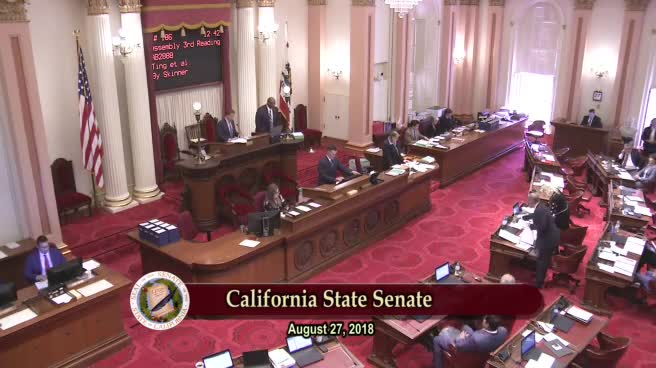
| Aug 27, 2018 | Assembly 3rd Reading AB2615 Carrillo et al. By Galgiani | Senate Floor |
Passed |
|
| Aug 16, 2018 | Do pass as amended | Senate Standing Committee on Appropriations |
Passed |
|
| Jun 25, 2018 | Placed on suspense file | Senate Standing Committee on Appropriations |
Passed |
|
| Jun 12, 2018 | Do pass, but first be re-referred to the Committee on [Appropriations] with the recommendation: To Consent Calendar | Senate Standing Committee on Transportation and Housing |
Passed |
|
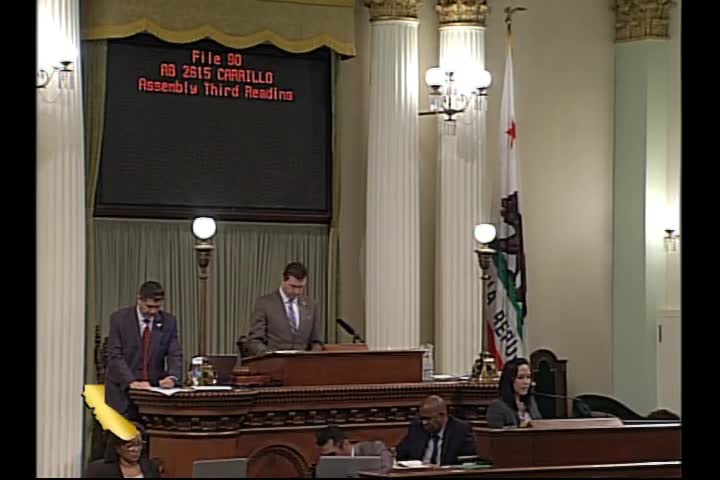
| May 30, 2018 | AB 2615 CARRILLO Assembly Third Reading | Assembly Floor |
Passed |
|
| May 25, 2018 | Do pass. | Assembly Standing Committee on Appropriations |
Passed |
|
| Apr 24, 2018 | Do pass and be re-referred to the Committee on [Appropriations] | Assembly Standing Committee on Water, Parks, and Wildlife |
Passed |
|
| Apr 9, 2018 | Do pass and be re-referred to the Committee on [Water, Parks, and Wildlife] | Assembly Standing Committee on Transportation |
Passed |
This list shows positions taken on this bill by organizations on the date displayed, which is linked to the original source.
Positions by individuals are not included.
CONCURRENCE IN SENATE AMENDMENTS
CSA1 Bill Id:AB 2615
Author:(Carrillo)
As Amended Ver:August 17, 2018
Majority vote
ASSEMBLY: | 77-0 | (May 30, 2018) | SENATE: | 39-0 | (August 27, 2018) |
Original Committee Reference: TRANS.
SUMMARY: Requires the California Department of Transportation (Caltrans), to the extent possible and where feasible and cost effective, to partner with the California Department of Parks and Recreation (DPR) and other appropriate public agencies in order to develop strategies and plans to improve access for bicycles and pedestrians to any parks adjacent or connected to the state highway system.
The Senate amendments make technical, non-substantive changes.
EXISTING LAW:
- Defines a "state highway" as any roadway that is acquired, laid out, constructed, improved, or maintained as a state highway pursuant to constitutional or legislative authorization and statutorily identifies all state highway system routes.
- Specifies that it is the intent of the Legislature that the state highway system connect communities and regions of the state and that they serve the state's economy by connecting centers of commerce, industry, agriculture, mineral wealth, and recreation.
- Prescribes certain powers and duties to Caltrans, including that it support the California Transportation Commission in coordinating and developing, in cooperation with local and regional entities, comprehensive balanced transportation planning and policy for the movement of people and goods within the state.
FISCAL EFFECT: According to the Senate Appropriations Committee:
- Ongoing Caltrans administrative costs in the range of $106,000 to $212,000 for 1-2 program years (PY) of staff time to coordinate with other public entities and conduct additional planning activities. (State Highway Account)
- Absorbable DPR costs to coordinate with Caltrans on planning to enhance bicycle and pedestrian access to state parks adjacent to highways. (State Parks and Recreation Fund)
COMMENTS: The author states that many parks in California have physical barriers at their borders such as roadways or unsafe terrain that make it hazardous for people to safely enter. For example, in the case of Los Angeles State Historic Park, an adjoining highway makes it problematic for locals to access and enjoy the park easily or safely. Improvements like pedestrian bridges, sidewalks, and walkways would enable more people to partake in the park experience and do so in a manner that would not put their safety at risk.
Caltrans is charged with coordinating and developing, in cooperation with other public entities, comprehensive, balanced transportation plans. One plan recently adopted by Caltrans is "Toward an Active California," the State Bicycle and Pedestrian Plan which lays out the policies and actions that Caltrans and its partner agencies will take to achieve Caltrans' ambitious statewide goals to double walking and triple bicycling trips by 2020. This plan includes two strategies relevant to the aim of this bill. First, Caltrans states that it will support low-stress or separated pedestrian and bicycle trail routes of statewide or regional significance for tourism, recreation, and utilitarian transportation. Second, Caltrans commits to explore joint funding of active transportation plans and programs with counties, tribal governments, transit agencies, parks and recreation departments, and other potential partners.
The author states that Caltrans often does not consider issues relating to safe park access when planning for transportation projects. This bill would make such considerations a more prominent consideration in infrastructure planning, and appears to be consistent with Caltrans' Bicycle and Pedestrian Plan.
Writing in support of the bill, a group of park-supporting organizations suggests that this bill, in effect, creates a modified "Safe Routes to Parks Program," similar to the federal and state Safe Routes to School Program. Supporters write that this bill continues a long history of local parks and recreation departments and youth-serving organizations working in concert with state entities and local public works departments to promote the value of healthy and active lifestyles.
Analysis Prepared by: Eric Thronson / TRANS. / (916) 319-2093 FN: 0004422
Office of Senate Floor Analyses (916) 651-1520 Fax: (916) 327-4478 | AB |
THIRD READING
Bill No: AB 2615
: in Senate
SENATE TRANS. & HOUSING COMMITTEE: 12-0, 6/12/18
AYES: Beall, Cannella, Allen, Dodd, Gaines, Galgiani, McGuire, Roth, Skinner, Vidak, Wieckowski, Wiener
NO VOTE RECORDED: Morrell
SENATE APPROPRIATIONS COMMITTEE: 7-0, 8/16/18
AYES: Portantino, Bates, Beall, Bradford, Hill, Nielsen, Wiener
ASSEMBLY FLOOR: 77-0, 5/30/18 - See last page for vote
DIGEST:
This bill requires the California Department of Transportation (Caltrans), to the extent possible and where feasible and cost effective, to partner with the California Department of Parks and Recreation (DPR) and other appropriate public agencies in order to develop strategies and plans to improve access for bicycles and pedestrians to any parks adjacent or connected to the state highway system.
Existing law:
- Defines a "state highway" as any roadway that is acquired, lay out, constructed, improved, or maintained as a state highway pursuant to constitutional or legislative authorization and statutorily identifies all state highway system routes.
- Prescribes certain powers and duties to Caltrans, including that it support the California Transportation Commission in coordinating and developing, in cooperation with local and regional entities, comprehensive balanced transportation planning and policy for the movement of people and goods within the state.
This bill requires Caltrans, to the extent possible and where feasible and cost effective, to partner with DPR and other appropriate public agencies in order to develop strategies and plans to improve access for bicycles and pedestrians to any parks adjacent or connected to the state highway system.
Comments
- Purpose. The author states that this bill mandates that Caltrans collaborate with DPR and other public entities to facilitate greater communication and coordination that emphasizes the concerns of safe pedestrian and bicycle access to parks for all Californians. This cooperation will help clear the way for more Californians to take advantage of the magnificent parks within the state.
- Caltrans’ Current Activities. Caltrans is charged with coordinating and developing comprehensive transportation plans, in cooperation with other public agencies and entities. One recent example is the state’s first bicycle and pedestrian plan: “Toward an Active California”[1], which lays out the policies and actions that Caltrans and its partner agencies will take to achieve statewide goals of doubling walking and tripling bicycling trips by 2020.
This plan already includes a few strategies that are consistent with the scope of this bill. The first is promoting and supporting low-stress or separated pedestrian and bicycle trail routes of statewide or regional significance for tourism, recreation, and utilitarian transportation. The other is that Caltrans commits to explore joint funding of active transportation plans and programs with counties, tribal governments, transit agencies, parks and recreation departments, and other potential partners.
- More Prominent Mandate. The author states that Caltrans does not often consider issues relating to safe park access when planning for transportation projects. This bill makes this consideration a more prominent consideration in state highway infrastructure planning, and appears to be consistent with Caltrans’ bicycle and pedestrian plan.
- Senate Appropriations Amendments. This bill was amended in the Senate Appropriations Committee to (a) require collaboration with public agencies to develop strategies and plans when it is cost effective, and (b) specify that plans must improve access, rather than maximize safe and convenient access.
FISCAL EFFECT: Appropriation: Fiscal Com.: Local:
According to the Senate Appropriations Committee:
- Ongoing Caltrans administrative costs in the range of $106,000 to $212,000 for 1-2 PY of staff time to coordinate with other public entities and conduct additional planning activities. (State Highway Account)
- Absorbable DPR costs to coordinate with Caltrans on planning to enhance bicycle and pedestrian access to state parks adjacent to highways. (State Parks and Recreation Fund)
California Outdoor Recreation Partners
California Park & Recreation Society
California State Parks Foundation
California Walks
Latino Outdoors
Los Angeles River State Park Partners
Mammoth Lakes Recreation
Midpeninsula Regional Open Space District
Movement Science Sport & Leisure Studies, Westfield State University
National Interscholastic Cycling Association
Outdoor Afro
Outdoor Industry Association
Santa Clara Valley Open Space Authority
The Trust for Public Land
Wild Places
OPPOSITION: (Verified 8/17/18)
None received
ASSEMBLY FLOOR: 77-0, 5/30/18
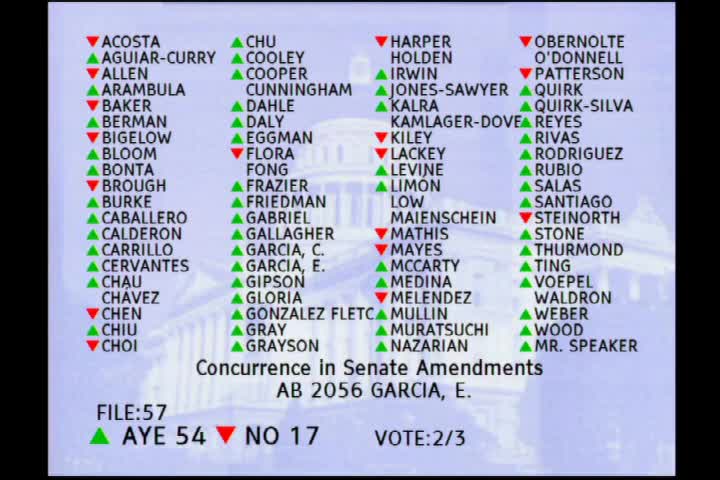
AYES: Acosta, Aguiar-Curry, Arambula, Baker, Berman, Bigelow, Bloom, Bonta, Brough, Burke, Caballero, Calderon, Carrillo, Cervantes, Chau, Chávez, Chen, Chiu, Choi, Chu, Cooley, Cooper, Cunningham, Dahle, Daly, Eggman, Flora, Fong, Frazier, Friedman, Gallagher, Cristina Garcia, Eduardo Garcia, Gipson, Gloria, Gonzalez Fletcher, Gray, Grayson, Harper, Holden, Irwin, Jones-Sawyer, Kalra, Kamlager-Dove, Kiley, Lackey, Levine, Limón, Low, Maienschein, Mathis, Mayes, McCarty, Medina, Melendez, Mullin, Muratsuchi, Nazarian, Obernolte, O'Donnell, Patterson, Quirk, Quirk-Silva, Reyes, Rodriguez, Rubio, Salas, Santiago, Steinorth, Mark Stone, Thurmond, Ting, Voepel, Waldron, Weber, Wood, Rendon
NO VOTE RECORDED: Travis Allen
8/19/18 13:34:18
**** END ****
https://altaplanning.com/wp-content/uploads/Toward-an-Active-California.pdf ↑
SENATE COMMITTEE ON
Senator Anthony Portantino, Chair
2017 - 2018 Regular Session
AB 2615 (Carrillo) - State highway system: parks and recreation: accessibility for bicycles and pedestrians
Version: | Policy Vote: |
Urgency: | Mandate: |
Hearing Date: | Consultant: |
Bill Summary:
AB 2615 would require the Department of Transportation (Caltrans), to the extent possible and feasible, to partner with the Department of Parks and Recreation (DPR) and other public agencies to develop strategies and plans to maximize safe and convenient bicycle and pedestrian access to parks adjacent or connected to the state highway system.
*********** ANALYSIS ADDENDUM – SUSPENSE FILE ***********
The following information is revised to reflect amendments
adopted by the committee on August 16, 2018
Fiscal Impact:
- Ongoing Caltrans administrative costs in the range of $106,000 to $212,000 for 1-2 PY of staff time to coordinate with other public entities and conduct additional planning activities. (State Highway Account)
- Absorbable DPR costs to coordinate with Caltrans on planning to enhance bicycle and pedestrian access to state parks adjacent to highways. (State Parks and Recreation Fund)
Author Amendments:
Require collaboration with public agencies to develop strategies and plans when it is cost effective, and specify that plans must improve access, rather than maximize safe and convenient access.
-- END --
SENATE COMMITTEE ON APPROPRIATIONS
Senator Anthony Portantino, Chair
2017 - 2018 Regular Session
AB 2615 (Carrillo) - State highway system: parks and recreation: accessibility for bicycles and pedestrians
Version: March 21, 2018 | Policy Vote: T. & H. 12 - 0 |
Urgency: No | Mandate: No |
Hearing Date: June 25, 2018 | Consultant: Mark McKenzie |
This bill meets the criteria for referral to the Suspense File.
Bill Summary:
AB 2615 would require the Department of Transportation (Caltrans), to the extent possible and feasible, to partner with the Department of Parks and Recreation (DPR) and other public agencies to develop strategies and plans to maximize safe and convenient bicycle and pedestrian access to parks adjacent or connected to the state highway system.
Fiscal Impact:
- Ongoing Caltrans administrative costs in the range of $106,000 to $212,000 for 1-2 PY of staff time to coordinate with other public entities and conduct additional planning activities. (State Highway Account)
- Unknown ongoing significant cost pressures, potentially in the millions annually, for additional project expenditures related to enhanced bicycle and pedestrian access to public parks. (State Highway Account, Road Maintenance and Rehabilitation Account)
- Absorbable DPR costs to coordinate with Caltrans on planning to enhance bicycle and pedestrian access to state parks adjacent to highways. (State Parks and Recreation Fund)
Background:
Existing law establishes the Active Transportation Program (ATP) within Caltrans for the purpose of encouraging increased use of active modes of transportation, such as biking and walking. The ATP consolidated several existing federal and state transportation programs, including the Transportation Alternatives Program, Bicycle Transportation Account, and Safe Routes to Schools, into a single program with a focus on making California a national leader on active transportation. The budget agreement that established the ATP directed funds to be awarded by the California Transportation Commission (CTC) through a competitive process to urban regions (40%), small urban and rural regions (10%), and for statewide allocation (50%). The allocations for the statewide and small urban/rural components are awarded by CTC on a competitive basis, while the CTC allocates funds for the urban component in proportion to the regions’ relative population, and each region awards grants on a competitive basis. Existing law requires the CTC program guidelines to include a process to ensure that at least 25 percent of overall ATP funding benefit disadvantaged communities during each program cycle. In addition to funding provided to ATP from the consolidation of specified programs, an additional $100 million in annual funding from SB 1 revenues is dedicated to the ATP. The program has been historically oversubscribed.
Caltrans is charged with coordinating and developing comprehensive, balanced transportation plans in cooperation with other public entities, including the recently adopted “Toward an Active California,” the State Bicycle and Pedestrian Plan. This plan lays out the policies and actions that Caltrans and its partner agencies will take to achieve statewide goals of doubling walking and tripling bicycling trips by 2020. This plan states that it will support low-stress or separated pedestrian and bicycle trail routes of statewide or regional significance for tourism, recreation, and utilitarian transportation, and also commits Caltrans to explore joint funding of active transportation plans and programs with other public entities.
Proposed Law:
AB 2615 would require Caltrans, to the extent possible and where feasible, to partner with appropriate public agencies, including DPR and any relevant federal, regional, or local public entity, to develop strategies and plans to maximize safe and convenient access for bicycles and pedestrians to federal, state, regional, and local parks adjacent or connected to the state highway system.
Staff Comments:
This bill would require Caltrans to provide additional ongoing planning for access to local parks and more than 100 state and federal parks. Caltrans anticipates incorporating this planning into existing efforts underway to develop district bicycle and pedestrian plans, which would be periodically updated, as well as into the statewide Bicycle and Pedestrian Plan. Caltrans also anticipates working with local, state, and federal partners to further develop those plans at the ground level. Caltrans estimates these additional planning activities would require 1-2 PYs annually on an ongoing basis at a cost of $106,000-$212,000. To the extent the increased planning regarding bicycle and pedestrian access to parks results in an increase in demand for project funding for those projects, the bill would also drive significant cost pressures, primarily to the ATP.
Staff notes that the recently enacted 2018 Budget Act includes an allocation of $500,000 to DPR to conduct planning and coordination activities related to the construction of a new crosswalk and/or pedestrian bridge from North Broadway to Los Angeles State Historical Park. A highway adjacent to that park has presented challenges to ensuring safe and convenient access for bicyclists and pedestrians.
-- END --
SENATE COMMITTEE ON TRANSPORTATION AND HOUSING
Senator Jim Beall, Chair
2017 - 2018 Regular
Bill No: Hearing Date: 6/12/2018
Author: | Carrillo | ||
Version: | 3/21/2018 | ||
Urgency: | No | Fiscal: | Yes |
Consultant: | Jeffery Song | ||
SUBJECT:
DIGEST: This bill requires the California Department of Transportation (Caltrans), to the extent possible and where feasible, to partner with the California Department of Parks and Recreation (DPR) and other appropriate public agencies in order to develop strategies and plans to maximize safe and convenient access for bicycles and pedestrians to any parks adjacent or connected to the state highway system.
ANALYSIS:
Existing law:
- Defines a "state highway" as any roadway that is acquired, lay out, constructed, improved, or maintained as a state highway pursuant to constitutional or legislative authorization and statutorily identifies all state highway system routes.
- Prescribes certain powers and duties to Caltrans, including that it support the California Transportation Commission in coordinating and developing, in cooperation with local and regional entities, comprehensive balanced transportation planning and policy for the movement of people and goods within the state.
This bill requires Caltrans, to the extent possible and where feasible, to partner with DPR and other appropriate public agencies in order to develop strategies and plans to maximize safe and convenient access for bicycles and pedestrians to any parks adjacent or connected to the state highway system.
COMMENTS
- Purpose. The author states that this bill would mandate that Caltrans collaborate with DPR and other public entities to facilitate greater communication and coordination that emphasizes the concerns of safe pedestrian and bicycle access to parks for all Californians. This cooperation will help clear the way for more Californians to take advantage of the magnificent parks within the state.
- Caltrans’ Current Activities. Caltrans is charged with coordinating and developing comprehensive transportation plans. These are regularly done in cooperation with other public agencies and entities. One example is “Toward an Active California”[1], the state’s first bicycle and pedestrian plan, which lays out the policies and actions that Caltrans and its partner agencies will take to achieve Caltrans’ ambitious statewide goals to double walking and triple bicycling trips by 2020. This plan includes a few strategies that are similar to the scope of this bill. The first is promoting and supporting low-stress or separated pedestrian and bicycle trail routes of statewide or regional significance for tourism, recreation, and utilitarian transportation. The other is that Caltrans commits to explore joint funding of active transportation plans and programs with counties, tribal governments, transit agencies, parks and recreation departments, and other potential partners.
- More Prominent Mandate. The author states that Caltrans does not often consider issues relating to safe park access when planning for transportation projects. This bill makes this consideration a more prominent consideration in state highway infrastructure planning, and appears to be consistent with Caltrans’ bicycle and pedestrian plan.
Related Legislation:
Assembly Votes
Floor: 77-0
Appropriations: 16-0
Water: 15-0
Transportation: 12-0
FISCAL EFFECT: Appropriation: No Fiscal Com.: Yes Local: No
POSITIONS: (Communicated to the committee before noon on Wednesday,
June 6, 2018.)
SUPPORT:
California Outdoor Recreation Partners
California Park & Recreation Society
California State Parks Foundation
California Walks
Latino Outdoors
Los Angeles River State Park Partners
Mammoth Lakes Recreation
Midpeninsula Regional Open Space District
Movement Science Sport & Leisure Studies, Westfield State University
National Interscholastic Cycling Association
Outdoor Afro
Outdoor Industry Association
Santa Clara Valley Open Space Authority
Trust for Public Land, The
Wild Places
OPPOSITION:
None received.
-- END --
https://altaplanning.com/wp-content/uploads/Toward-an-Active-California.pdf ↑
ASSEMBLY THIRD READING
ATR Bill Id:AB 2615
Author:(Carrillo)
As Amended Ver:March 21, 2018
Majority vote
Committee | Votes | Ayes | Noes |
Transportation | 12-0 | Frazier, Fong, Aguiar-Curry, Baker, Berman, Daly, Gipson, Harper, Mathis, Medina, Nazarian, O'Donnell | |
Water | 15-0 | Eduardo Garcia, Gallagher, Bigelow, Carrillo, Choi, Chu, Friedman, Gloria, Harper, Kalra, Levine, Mathis, Rubio, Salas, Wood | |
Appropriations | 16-0 | Gonzalez Fletcher, Bigelow, Bloom, Bonta, Calderon, Carrillo, Chau, Eggman, Fong, Friedman, Gallagher, Eduardo Garcia, Nazarian, Obernolte, Quirk, Reyes |
|
SUMMARY: Requires the California Department of Transportation (Caltrans), to the extent possible and where feasible, to partner with the California Department of Parks and Recreation (DPR) and other appropriate public agencies in order to develop strategies and plans to maximize safe and convenient access for bicycles and pedestrians to any parks adjacent or connected to the state highway system.
EXISTING LAW:
- Defines a "state highway" as any roadway that is acquired, laid out, constructed, improved, or maintained as a state highway pursuant to constitutional or legislative authorization and statutorily identifies all state highway system routes.
- Specifies that it is the intent of the Legislature that the state highway system connect communities and regions of the state and that they serve the state's economy by connecting centers of commerce, industry, agriculture, mineral wealth, and recreation.
- Prescribes certain powers and duties to Caltrans, including that it support the California Transportation Commission in coordinating and developing, in cooperation with local and regional entities, comprehensive balanced transportation planning and policy for the movement of people and goods within the state.
FISCAL EFFECT: According to the Assembly Appropriations Committee:
- Cost pressure (transportation special funds), likely in the tens of millions of dollars annually, for infrastructure to improve access to parks adjacent to state highways.
- Significant costs (transportation special funds), in the hundreds of thousands of dollars to low millions of dollars, for Caltrans to collaborate with other public agencies to develop plans and strategies to improve bicycle and pedestrian access to parks.
- Potentially significant GF costs, likely in the low hundreds of thousands of dollars, to the Department of Parks and Recreation or other state entities that operate parklands to collaborate with Caltrans on potential changes to improve pedestrian and bicycle access.
COMMENTS: The author states that many parks in California have physical barriers at their borders such as roadways or unsafe terrain that make it hazardous for people to safely enter. For example, in the case of Los Angeles State Historic Park, an adjoining highway makes it problematic for locals to access and enjoy the park easily or safely. Improvements like pedestrian bridges, sidewalks, and walkways would enable more people to partake in the park experience and do so in a manner that would not put their safety at risk.
Caltrans is charged with coordinating and developing, in cooperation with other public entities, comprehensive, balanced transportation plans. One plan recently adopted by Caltrans is "Toward an Active California," the State Bicycle and Pedestrian Plan which lays out the policies and actions that Caltrans and its partner agencies will take to achieve Caltrans' ambitious statewide goals to double walking and triple bicycling trips by 2020. This plan includes two strategies relevant to the aim of this bill. First, Caltrans states that it will support low-stress or separated pedestrian and bicycle trail routes of statewide or regional significance for tourism, recreation, and utilitarian transportation. Second, Caltrans commits to explore joint funding of active transportation plans and programs with counties, tribal governments, transit agencies, parks and recreation departments, and other potential partners.
The author states that Caltrans often does not consider issues relating to safe park access when planning for transportation projects. This bill would make such considerations a more prominent consideration in infrastructure planning, and appears to be consistent with Caltrans' Bicycle and Pedestrian Plan.
Writing in support of the bill, a group of park-supporting organizations suggests that this bill, in effect, creates a modified "Safe Routes to Parks Program," similar to the federal and state Safe Routes to School Program. Supporters write that this bill continues a long history of local parks and recreation departments and youth-serving organizations working in concert with state entities and local public works departments to promote the value of healthy and active lifestyles.
Analysis Prepared by: Eric Thronson / TRANS. / (916) 319-2093 FN: 0003076
Date of Hearing: May 9, 2018
ASSEMBLY COMMITTEE ON APPROPRIATIONS
Lorena Gonzalez Fletcher, Chair
ABPCA Bill Id:AB 2615
Author:(Carrillo) – As Amended Ver:March 21, 2018
Policy Committee: | Transportation | Vote: | 12 - 0 |
Water, Parks and Wildlife | 15 - 0 | ||
|
|
Urgency: No State Mandated Local Program: No Reimbursable: No
SUMMARY:
This bill requires the California Department of Transportation (Caltrans), to the extent possible and where feasible, to partner with the California Department of Parks and Recreation (DPR) and other appropriate public agencies to develop strategies and plans to maximize safe and convenient access for bicycles and pedestrians to any parks adjacent or connected to the state highway system.
FISCAL EFFECT:
- Cost pressure (transportation special funds), likely in the tens of millions of dollars annually, for infrastructure to improve access to parks adjacent to state highways.
- Significant costs (transportation special funds), in the hundreds of thousands of dollars to low millions of dollars, for Caltrans to collaborate with other public agencies to develop plans and strategies to improve bicycle and pedestrian access to parks.
- Potentially significant GF costs, likely in the low hundreds of thousands of dollars, to the Department of Parks and Recreation or other state entities that operate parklands to collaborate with Caltrans on potential changes to improve pedestrian and bicycle access.
COMMENTS:
Background and purpose. The author states that many parks in California have physical barriers at their borders such as roadways or unsafe terrain that make it hazardous for people to safely enter. For example, in the case of Los Angeles State Historic Park, an adjoining highway makes it hard for locals to access and enjoy the park easily or safely. Improvements like pedestrian bridges, sidewalks, and walkways would enable more people to partake in the park experience and do so in a manner that would not put their safety at risk. However, the author believes Caltrans often does not consider issues relating to safe park access when planning for transportation projects. This bill would make such considerations a more prominent consideration in infrastructure planning and appears to be consistent with Caltrans’ Bicycle and Pedestrian Plan.
Analysis Prepared by: Jessica Peters / APPR. / (916) 319-2081
Date of Hearing: April 24, 2018
ASSEMBLY COMMITTEE ON WATER, PARKS, AND WILDLIFE
Eduardo Garcia, Chair
ABPCA Bill Id:AB 2615 (
Author:Carrillo) – As Amended Ver:March 21, 2018
SUBJECT: State highway system: parks and recreation: accessibility for bicycles and pedestrians
SUMMARY: Requires the California Department of Transportation (Caltrans), to the extent possible and where feasible, to partner with the California Department of Parks and Recreation (DPR) and other appropriate public agencies in order to develop strategies and plans to maximize safe and convenient access for bicycles and pedestrians to any parks adjacent or connected to the state highway system.
EXISTING LAW:
- Establishes the Natural Resources Agency (CNRA), consisting of various departments, including the DPR, California Coastal Commission, and the various state conservancies.
- Establishes the DPR which is responsible for administering the state park system, which includes 280 park units from state beaches to museums to traditional parks.
- Defines a "state highway" as any roadway that is acquired, laid out, constructed, improved, or maintained as a state highway pursuant to constitutional or legislative authorization and statutorily identifies all state highway system routes.
- Specifies that it is the intent of the Legislature that the state highway system connect communities and regions of the state and that they serve the state's economy by connecting centers of commerce, industry, agriculture, mineral wealth, and recreation.
- Prescribes certain powers and duties to Caltrans, including that it support the California Transportation Commission in coordinating and developing, in cooperation with local and regional entities, comprehensive balanced transportation planning and policy for the movement of people and goods within the state.
FISCAL EFFECT: Unknown
COMMENTS: This bill focuses on ensuring safe access to state and local parks where roads may be barriers to that access.
Author’s Statement:
AB 2615 would mandate that the DOT enter into partnerships with the Department of Parks and Recreation and other local entities to facilitate greater communication and coordination that emphasizes the concerns of safe park access for all Californians. This cooperation will help clear the way for more Californians to take advantage of the magnificent parks within the State.
Encouraging safer pedestrian and bicycle access would also mean that automobile emissions would decrease as well, as cars would not always be necessary to get into a park. Consequently, this bill will not only encourage the well-being of the residents of the State, but also a cleaner environment.
Background and Purpose: According to the author, many parks in California have physical barriers near them, such as roadways or unsafe terrain that make it hazardous for people to enter them. For example, in the case of Los Angeles State Historic Park, an adjoining highway makes it problematic for locals to enjoy the park easily or safely. Improvements like pedestrian bridges, sidewalks, and walkways would enable more people to partake in the park experience and do so in a manner that would not put them at risk.
According to the Assembly Transportation Committee Analysis, Caltrans is charged with coordinating and developing, in cooperation with other public entities, comprehensive, balanced transportation plans. One plan recently adopted by Caltrans is “Toward an Active California,” the State Bicycle and Pedestrian Plan which lays out the policies and actions that Caltrans and its partner agencies will take to achieve Caltrans’ ambitious statewide goals to double walking and triple bicycling trips by 2020. This plan includes two strategies relevant to the aim of this bill. First, Caltrans states that it will support low-stress or separated pedestrian and bicycle trail routes of statewide or regional significance for tourism, recreation, and utilitarian transportation. Second, Caltrans commits to explore joint funding of active transportation plans and programs with counties, tribal governments, transit agencies, parks and recreation departments, and other potential partners.
The author states that Caltrans often does not consider issues relating to safe park access when planning for transportation projects. This bill would make such considerations a more prominent consideration in infrastructure planning, and appears to be consistent with Caltrans’ Bicycle and Pedestrian Plan.
Parking, Dodging Traffic, and Other Dangerous Situations. The issue of safe access to parks is both an urban and rural concern. In urban areas, the author rightly cites situations such as the newly transformed LA Historic Park, where residents in nearby neighborhoods must cross a busy street, or, in the case of residents of Chinatown, must travel a roundabout way through traffic, over light rail tracks and through a heavy industrial area, just to get to one of the park entrances. Efforts to improve access would involve multiple transportation agencies, but could be as simple as a traffic signal and crosswalk. In another example, throughout the state, coastal state parks are accessed through paid parking areas. To avoid these areas, and when they are full, cars park along busy roadways (Highway One for example), forcing high-moving vehicles and pedestrians to intersect. The litmus test for when parking is restricted, or when crosswalks or sidewalks are added, is unclear and uneven throughout the state. For those wishing to access these parks using bicycles or other human-powered vehicles, access may be even more limited. Though close to populated areas, many park areas lack safe shoulder, sidewalk or bike lane access.
Barriers to Youth Outdoor Access—Transportation. Finally, according to the California State Parks Foundation, “For many families, particularly those of modest economic means, lack of reliable transportation and lack of knowledge about programs and services that are available at parks and open spaces are overwhelming barriers.” According to a report commissioned by the Great Valley Center in partnership with the Stewardship Council, which specifically details the transportation challenges in connecting youth to the outdoors, the principal challenges to transportation are cost, administration, and availability. As detailed in this report, and as supported by numerous other organizations and non-profits dedicated to connecting youth to the outdoors, “the greatest barrier to getting young people outdoors turns out, in our experience, to be just getting them there.”
Prior and Related Legislation:
AB 2534 (Limon), of this session, would establish the Outdoor Equity Grants program to increase the ability of underserved and at-risk populations to access outdoor environmental education experiences.
AB 2614 (Carillo), of this session, would increase access to school buses for transportation access to parks.
SB 204 (Pavley), Chapter 573, Statutes of 2015, authorizes the DPR to accept donations from public or private sources to fund programs to benefit youth, and to enter into cooperative agreements with public or nonprofit organizations to provide service and learning opportunities for youth.
AB 988 (Stone and Atkins), of 2015, which would have expanded and provided outdoor environmental education and recreation grants, died in Senate Appropriations.
Arguments in Support: According to supporters of the bill, many picturesque parks are within sight of many residents, but just out of reach. These parks can have physical barriers near them, such as roadways or unsafe terrain that make it hazardous for people to enter them. Improvements like pedestrian bridges, sidewalks, and walkways would enable more people to partake in the park experience and do so in a manner that would not put them at risk.
Arguments in Opposition: None at this time.
REGISTERED SUPPORT / OPPOSITION:
Support
California Outdoor Recreation Partners
California Park & Recreation Society
Latino Outdoors
Mammoth Lakes Recreation
Midpeninsula Regional Open Space District
Movement Science Sport & Leisure Studies, Westfield State University
National Interscholastic Cycling Association
Outdoor Afro
Outdoor Industry Association
Santa Clara Valley Open Space Authority
Trust For Public Land, The
Wild Places
Opposition
None on file
Analysis Prepared by: Catherine Freeman / W., P., & W. / (916) 319-2096
Date of Hearing: April 9, 2018
ASSEMBLY COMMITTEE ON TRANSPORTATION
Jim Frazier, Chair
ABPCA Bill Id:AB 2615 (
Author:Carrillo) – As Amended Ver:March 21, 2018
SUBJECT: State highway system: parks and recreation: accessibility for bicycles and pedestrians
SUMMARY: Requires the California Department of Transportation (Caltrans), to the extent possible and where feasible, to partner with the California Department of Parks and Recreation (DPR) and other appropriate public agencies in order to develop strategies and plans to maximize safe and convenient access for bicycles and pedestrians to any parks adjacent or connected to the state highway system.
EXISTING LAW:
- Defines a "state highway" as any roadway that is acquired, laid out, constructed, improved, or maintained as a state highway pursuant to constitutional or legislative authorization and statutorily identifies all state highway system routes.
- Specifies that it is the intent of the Legislature that the state highway system connect communities and regions of the state and that they serve the state's economy by connecting centers of commerce, industry, agriculture, mineral wealth, and recreation.
- Prescribes certain powers and duties to Caltrans, including that it support the California Transportation Commission in coordinating and developing, in cooperation with local and regional entities, comprehensive balanced transportation planning and policy for the movement of people and goods within the state.
FISCAL EFFECT: Unknown
COMMENTS: The author states that many parks in California have physical barriers at their borders such as roadways or unsafe terrain that make it hazardous for people to safely enter. For example, in the case of Los Angeles State Historic Park, an adjoining highway makes it problematic for locals to access and enjoy the park easily or safely. Improvements like pedestrian bridges, sidewalks, and walkways would enable more people to partake in the park experience and do so in a manner that would not put their safety at risk.
Caltrans is charged with coordinating and developing, in cooperation with other public entities, comprehensive, balanced transportation plans. One plan recently adopted by Caltrans is “Toward an Active California,” the State Bicycle and Pedestrian Plan which lays out the policies and actions that Caltrans and its partner agencies will take to achieve Caltrans’ ambitious statewide goals to double walking and triple bicycling trips by 2020. This plan includes two strategies relevant to the aim of this bill. First, Caltrans states that it will support low-stress or separated pedestrian and bicycle trail routes of statewide or regional significance for tourism, recreation, and utilitarian transportation. Second, Caltrans commits to explore joint funding of active transportation plans and programs with counties, tribal governments, transit agencies, parks and recreation departments, and other potential partners.
The author states that Caltrans often does not consider issues relating to safe park access when planning for transportation projects. This bill would make such considerations a more prominent consideration in infrastructure planning, and appears to be consistent with Caltrans’ Bicycle and Pedestrian Plan.
Writing in support of the bill, a group of park-supporting organizations suggests that this bill, in effect, creates a modified “Safe Routes to Parks Program,” similar to the federal and state Safe Routes to School Program. Supporters write that this bill continues a long history of local parks and recreation departments and youth-serving organizations working in concert with state entities and local public works departments to promote the value of healthy and active lifestyles.
Double referral: This bill will be referred to the Assembly Water, Parks and Wildlife Committee should it pass out of this committee.
REGISTERED SUPPORT / OPPOSITION:
Support
California Outdoor Recreation Partners
California Park and Recreation Society
California Walks
Latino Outdoors
Mammoth Lakes Recreation
National Interscholastic Cycling Association
Outdoor Afro
Outdoor Industry Association
Santa Clara Valley Open Space Authority
The Trust for Public Land
Wild Places
One private citizen
Opposition
None on file
Analysis Prepared by: Eric Thronson / TRANS. / (916) 319-2093

Bill Author

Bill Co-Author(s):
