AB 2634: Life insurance.
- Session Year: 2017-2018
- House: Assembly
- Latest Version Date: 2018-09-19
Existing law requires an insurer transacting life insurance in California to register its policies with the Insurance Commissioner and comply with specified provisions of the Insurance Code relating to, among others, reserve liabilities, capital requirements, and disclosure requirements for replacement of life insurance policies. Existing law regulates illustrations used in the sale of a life insurance policy. Existing law requires an insurer to provide notice to the policyholder of a life insurance policy upon an increase of premium if that policy provides for premium changes, as specified.
For a policy in effect on or after April 1, 2019, this bill would require an insurer to provide a summary notice to a policyholder of a flexible premium life insurance policy whenever the policy is subject to an adverse change in the current scale of nonguaranteed elements, as defined. The bill would require the summary notice to include specified information and language about the adverse change. The bill would also require an insurer, for a flexible premium life insurance policy for which illustrations are used in effect on or after April 1, 2019, to provide an inforce illustration of current and future benefits and values whenever the policy is subject to an adverse change in the current scale of nonguaranteed elements. The bill would impose the notice requirements to an adverse change that is scheduled to take effect on or after July 1, 2019, and would impose the illustration requirement to an adverse change that is scheduled to take effect on or after July 1, 2020.
Existing law requires an insurer transacting life insurance in California to register its policies with the Insurance Commissioner and comply with specified provisions of the Insurance Code relating to, among others, reserve liabilities, capital requirements, and disclosure requirements for replacement of life insurance policies. Existing law regulates illustrations used in the sale of a life insurance policy. Existing law requires an insurer to provide notice to the policyholder of a life insurance policy upon an increase of premium if that policy provides for premium changes, as specified.
For a policy in effect on or after April 1, 2019, this bill would require an insurer to provide a summary notice to a policyholder of a flexible premium life insurance policy whenever the policy is subject to an adverse change in the current scale of nonguaranteed elements, as defined. The bill would require the summary notice to include specified information and language about the adverse change. The bill would also require an insurer, for a flexible premium life insurance policy for which illustrations are used in effect on or after April 1, 2019, to provide an inforce illustration of current and future benefits and values whenever the policy is subject to an adverse change in the current scale of nonguaranteed elements. The bill would impose the notice requirements to an adverse change that is scheduled to take effect on or after July 1, 2019, and would impose the illustration requirement to an adverse change that is scheduled to take effect on or after July 1, 2020.
Existing law requires an insurer transacting life insurance in California to register its policies with the Insurance Commissioner and comply with specified provisions of the Insurance Code relating to, among others, reserve liabilities, capital requirements, and disclosure requirements for replacement of life insurance policies. Existing law regulates illustrations used in the sale of a life insurance policy. Existing law requires an insurer to provide notice to the policyholder of a life insurance policy upon an increase of premium if that policy provides for premium changes, as specified.
For a policy in effect on or after April 1, 2019, this bill would require an insurer to provide inforce illustrations showing the impact on the policy values and the scheduled premiums before and after an adverse change, as specified, and a summary notice to a policyholder of a flexible premium life insurance policy whenever the policy is subject to an adverse change in the current scale of nonguaranteed elements, as defined. The bill would require the summary notice to include specified information and language about the adverse change. The bill would also require an insurer, for a flexible premium life insurance policy for which illustrations are used in effect on or after April 1, 2019, to provide an inforce illustration of current and future benefits and values whenever the policy is subject to an adverse change in the current scale of nonguaranteed elements. The bill would impose the notice requirements to an adverse change that is scheduled to take effect on or after July 1, 2019, and would impose the illustrations illustration requirement to an adverse change that is scheduled to take effect on or after July 1, 2020.
Existing law requires an insurer transacting life insurance in California to register its policies with the Insurance Commissioner and comply with specified provisions of the Insurance Code relating to, among others, reserve liabilities, capital requirements, and disclosure requirements for replacement of life insurance policies. Existing law regulates illustrations used in the sale of a life insurance policy. Existing law requires an insurer to provide notice to the policyholder of a life insurance policy upon an increase of premium if that policy provides for premium changes, as specified.
For a policy in effect on or after April 1, 2019, this bill would require an insurer to provide an inforce illustration, inforce illustrations showing the impact on the policy values and the scheduled premiums before and after an adverse change, as specified, and an accompanying a summary notice to a policyholder of a flexible premium life insurance policy whenever the policy is subject to an adverse change in the current scale of nonguaranteed elements, as defined, that is scheduled to take effect on or after July 1, 2019. defined. The bill would require the accompanying summary notice to include specified information and language about the adverse change. The bill would impose the notice requirements to an adverse change that is scheduled to take effect on or after July 1, 2019, and would impose the illustrations requirement to an adverse change that is scheduled to take effect on or after July 1, 2020.
Existing law requires an insurer transacting life insurance in California to register its policies with the Insurance Commissioner and comply with specified provisions of the Insurance Code relating to, among others, reserve liabilities, capital requirements, and disclosure requirements for replacement of life insurance policies. Existing law regulates illustrations used in the sale of a life insurance policy. Existing law requires an insurer to provide notice to the policyholder of a life insurance policy upon an increase of premium if that policy provides for premium changes, as specified.
On and after JulyFor a policy in effect on or after April 1, 2019, this bill would require an insurer to provide an inforce illustration, as specified, and an accompanying summary notice to a policyholder of a flexible premium life insurance policy whenever the policy is subject to an increase in the cost of insurance charge or administrative expense charge. adverse change in the current scale of nonguaranteed elements, as defined, that is scheduled to take effect on or after July 1, 2019. The bill would require the accompanying summary notice to include specified information and language about the increase. adverse change.
Existing law requires an insurer transacting life insurance in California to register its policies with the Insurance Commissioner and comply with specified provisions of the Insurance Code relating to, among others, reserve liabilities, capital requirements, and disclosure requirements for replacement of life insurance policies. Existing law regulates illustrations used in the sale of a life insurance policy. Existing law requires an insurer to provide notice to the policyholder of a life insurance policy upon an increase of premium if that policy provides for premium changes, as specified.
ThisOn and after July 1, 2019, this bill would require an insurer to provide notice to a policyholder of a flexible premium life insurance policy whenever the policy is subject to an increase in the cost of insurance charge or administrative expense charge. The bill would require the notice to include specified information about the increase.
Existing law requires an insurer transacting life insurance in California to register its policies with the Insurance Commissioner and comply with specified provisions of the Insurance Code relating to, among others, reserve liabilities, capital requirements, and disclosure requirements for replacement of life insurance policies. Existing law regulates illustrations used in the sale of a life insurance policy. Existing law requires an insurer to provide notice to the policyholder of a life insurance policy upon an increase of premium if that policy provides for premium changes, as specified.
This bill would require an insurer to provide notice to a policyholder of a flexible premium life insurance policy whenever the policy is subject to an increase in the cost of insurance charge or administrative expense charge. The bill would require the notice to include specified information about the increase.
(a)(1)Whenever a flexible premium life insurance policy is subject to an adverse change in the current scale of nonguaranteed elements, as soon as practicable, but no later than 90 days before the effective date of the adverse change in the current scale of nonguaranteed elements, the insurer shall provide a summary notice and, if the policy is designated as one for which illustrations shall be used, an inforce illustration of current and future benefits and values. The illustration or illustrations shall be based on the insurers illustrated scale after the effective date of the adverse change in the current scale of nonguaranteed elements.
(2)An inforce illustration provided pursuant to this section shall comply with the requirements of subdivisions (a) and (b) of Section 10509.955 and subdivisions (a) and (e) of Section 10509.956.
(b)The summary notice shall be in no less than 12-point type, and the illustration and summary notice shall contain the following language in boldface type: IMPORTANT: NOTICE OF CHANGE IN NONGUARANTEED ELEMENTS OF YOUR POLICY.
(c)The summary notice shall include the information required by paragraphs (1) to (5), inclusive, and the language set forth in paragraphs (6) to (8), inclusive:
(1)The name of each nonguaranteed element in the current scale of nonguaranteed elements that is subject to an adverse change.
(2)The definition of each nonguaranteed element in the current scale of nonguaranteed elements that is subject to an adverse change.
(3)A statement identifying the current rate or charge for each nonguaranteed element and the new rate or charge for each nonguaranteed element, with reference to the current scale of nonguaranteed elements, including the percentage change in the nonguaranteed element that the adverse change represents.
(4)An explanation that the adverse change in the current scale of nonguaranteed elements is based on expectations of the future cost of providing the benefits under the policy, and that the adverse change to the current scale of nonguaranteed elements will reduce the accumulation value and may increase the risk of policy lapse based on continued payment of current premiums.
(5)The date the adverse change to the current scale of nonguaranteed elements will take effect.
(6)Policy information:
Last policy anniversary date: ____
Next policy anniversary date: ____
Current accumulation value: ____
Current cash surrender value (accumulation value minus any surrender charges and policy loans): ____
(7)Your options:
Take no action: This option will reduce the accumulation of your policy. Additional premiums will be required at some point in order to maintain your coverage if not otherwise adequately funded to maintain coverage.
Pay additional premiums: You may choose to pay additional premiums starting now to maintain your policys accumulation value and death benefit coverage for the level and period anticipated before the increase.
Reduce the face value of your policy: If your policy is not already at the minimum value specified on your policy, you may choose to reduce the specified amount on your policy to a level that will be supported by the amount and years of the premium payments you would like to pay. Please note that reducing the specified amount may result in a surrender charge.
Surrender your policy: You may choose to surrender your policy for the current cash surrender value. Before you decide to surrender your policy, you should consult your tax, insurance, or financial advisor.
Convert your policy (applicable only if your policy includes a conversion or exchange privilege in the contract): If you wish to maintain life insurance coverage but are unable to pay increased premiums to keep your policy in force, you may choose to convert your flexible premium life insurance policy to a different type of life insurance policy we offer, subject to the terms of conversions listed in your policy, which may better suit your financial needs.
(8)We understand that you may have further questions about this change or the options available to you. You may call your agent or our customer service team at [insert customer service toll-free telephone number and hours of operation].
(d)As used in this section:
(1)Adverse change means a change to the current scale of nonguaranteed elements that increases or may increase a charge, or reduces or may reduce a benefit to the policy owner, other than a change in a credited interest rate or an index account parameter based entirely on changes in the insurers expected investment income or hedging costs.
(2)Current scale of nonguaranteed elements means the nonguaranteed elements, as defined in subdivision (m) of Section 10509.953, that apply to a policy in the current year and in future years, unless changed by the insurer.
(3)Index account parameter means a feature impacting the net credited rate for an index account, such as participation rate, cap, or spread.
(e)This section does not prohibit an insurer from including additional information in the notice that is specific to the policy for which the notice is sent, so long as it meets the requirements of this section.
(f)This section does not apply to a corporate-owned life insurance policy permitted by Section 10110.4 under which all benefits are payable to the corporate policy owner.
(g)(1)This section shall apply to a flexible premium life insurance policy in effect on or after April 1, 2019.
(2)Notwithstanding paragraph (1), the notice requirement of this section shall apply to an adverse change in the current scale of nonguaranteed elements that is scheduled to take effect on or after July 1, 2019.
(3)Notwithstanding paragraph (1), the illustration requirement of this section shall apply to an adverse change in the current scale of nonguaranteed elements that is scheduled to take effect on or after July 1, 2020.
(a)(1)Whenever a flexible premium life insurance policy is subject to an adverse change in the current scale of nonguaranteed elements, as soon as practicable, but no later than 90 days before the effective date of the adverse change in the current scale of nonguaranteed elements, the insurer shall provide a summary notice and, if the policy is designated as one for which illustrations shall be used, an inforce illustration of current and future benefits and values. The illustration or illustrations shall be based on the insurers illustrated scale after the effective date of the adverse change in the current scale of nonguaranteed elements.
(2)An inforce illustration provided pursuant to this section shall comply with the requirements of subdivisions (a) and (b) of Section 10509.955 and subdivisions (a) and (e) of Section 10509.956.
(b)The summary notice shall be in no less than 12-point type, and the illustration and summary notice shall contain the following language in boldface type: IMPORTANT: NOTICE OF CHANGE IN NONGUARANTEED ELEMENTS OF YOUR POLICY.
(c)The summary notice shall include the information required by paragraphs (1) to (5), inclusive, and the language set forth in paragraphs (6) to (8), inclusive:
(1)The name of each nonguaranteed element in the current scale of nonguaranteed elements that is subject to an adverse change.
(2)The definition of each nonguaranteed element in the current scale of nonguaranteed elements that is subject to an adverse change.
(3)A statement identifying the current rate or charge for each nonguaranteed element and the new rate or charge for each nonguaranteed element, with reference to the current scale of nonguaranteed elements, including the percentage change in the nonguaranteed element that the adverse change represents.
(4)An explanation that the adverse change in the current scale of nonguaranteed elements is based on expectations of the future cost of providing the benefits under the policy, and that the adverse change to the current scale of nonguaranteed elements will reduce the accumulation value and may increase the risk of policy lapse based on continued payment of current premiums.
(5)The date the adverse change to the current scale of nonguaranteed elements will take effect.
(6)Policy information:
Last policy anniversary date: ____
Next policy anniversary date: ____
Current accumulation value: ____
Current cash surrender value (accumulation value minus any surrender charges and policy loans): ____
(7)Your options:
Take no action: This option will reduce the accumulation of your policy. Additional premiums will be required at some point in order to maintain your coverage if not otherwise adequately funded to maintain coverage.
Pay additional premiums: You may choose to pay additional premiums starting now to maintain your policys accumulation value and death benefit coverage for the level and period anticipated before the increase.
Reduce the face value of your policy: If your policy is not already at the minimum value specified on your policy, you may choose to reduce the specified amount on your policy to a level that will be supported by the amount and years of the premium payments you would like to pay. Please note that reducing the specified amount may result in a surrender charge.
Surrender your policy: You may choose to surrender your policy for the current cash surrender value. Before you decide to surrender your policy, you should consult your tax, insurance, or financial advisor.
Convert your policy (applicable only if your policy includes a conversion or exchange privilege in the contract): If you wish to maintain life insurance coverage but are unable to pay increased premiums to keep your policy in force, you may choose to convert your flexible premium life insurance policy to a different type of life insurance policy we offer, subject to the terms of conversions listed in your policy, which may better suit your financial needs.
(8)We understand that you may have further questions about this change or the options available to you. You may call your agent or our customer service team at [insert customer service toll-free telephone number and hours of operation].
(d)As used in this section:
(1)Adverse change means a change to the current scale of nonguaranteed elements that increases or may increase a charge, or reduces or may reduce a benefit to the policy owner, other than a change in a credited interest rate or an index account parameter based entirely on changes in the insurers expected investment income or hedging costs.
(2)Current scale of nonguaranteed elements means the nonguaranteed elements, as defined in subdivision (m) of Section 10509.953, that apply to a policy in the current year and in future years, unless changed by the insurer.
(3)Index account parameter means a feature impacting the net credited rate for an index account, such as participation rate, cap, or spread.
(e)This section does not prohibit an insurer from including additional information in the notice that is specific to the policy for which the notice is sent, so long as it meets the requirements of this section.
(f)This section does not apply to a corporate-owned life insurance policy permitted by Section 10110.4 under which all benefits are payable to the corporate policy owner.
(g)(1)This section shall apply to a flexible premium life insurance policy in effect on or after April 1, 2019.
(2)Notwithstanding paragraph (1), the notice requirement of this section shall apply to an adverse change in the current scale of nonguaranteed elements that is scheduled to take effect on or after July 1, 2019.
(3)Notwithstanding paragraph (1), the illustration requirement of this section shall apply to an adverse change in the current scale of nonguaranteed elements that is scheduled to take effect on or after July 1, 2020.
(a)(1)Whenever a flexible premium life insurance policy is subject to an adverse change in the current scale of nonguaranteed elements, as soon as practicable, but no later than 90 days before the effective date of the adverse change in the current scale of nonguaranteed elements, the insurer shall provide inforce illustrations showing the impact on the policy values and the scheduled premiums before and after the adverse change in the current scale of nonguaranteed elements, and a summary notice. a summary notice and, if the policy is designated as one for which illustrations shall be used, an inforce illustration of current and future benefits and values. The illustration or illustrations shall be based on the insurers illustrated scale after the effective date of the adverse change in the current scale of nonguaranteed elements.
(2)An inforce illustration provided pursuant to this section shall comply with the requirements of subdivisions (a) and (b) of Section 10509.955 and subdivisions (a) and (e) of Section 10509.956.
(b)The summary notice shall be in no less than 12-point type, and the illustrations illustration and summary notice shall contain the following language in boldface type: IMPORTANT: NOTICE OF CHANGE IN NONGUARANTEED ELEMENTS OF YOUR POLICY.
(c)The summary notice shall include the information required by paragraphs (1) to (5), inclusive, and the language set forth in paragraphs (6) to (8), inclusive:
(1)The name of each nonguaranteed element in the current scale of nonguaranteed elements that is subject to an adverse change.
(2)The definition of each nonguaranteed element in the current scale of nonguaranteed elements that is subject to an adverse change.
(3)A statement identifying the current rate or charge for each nonguaranteed element and the new rate or charge for each nonguaranteed element, with reference to the current scale of nonguaranteed elements, including the percentage change in the nonguaranteed element that the adverse change represents.
(4)An explanation that the adverse change in the current scale of nonguaranteed elements is based on expectations of the future cost of providing the life insurance coverage, benefits under the policy, and that the adverse change to the current scale of nonguaranteed elements will reduce the accumulation value and may increase the risk of policy lapse based on continued payment of current premiums.
(5)The date the adverse change to the current scale of nonguaranteed elements will take effect.
(6)Policy information:
Last policy anniversary date: ____
Next policy anniversary date: ____
Current accumulation value: ____
Current cash surrender value (accumulation value minus any surrender charges and policy loans): ____
(7)Your options:
Take no action: This option will reduce the accumulation of your policy. Additional premiums will be required at some point in order to maintain your coverage if not otherwise adequately funded to maintain coverage.
Pay additional premiums: You may choose to pay additional premiums starting now to maintain your policys accumulation value and death benefit coverage for the level and period anticipated before the increase.
Reduce the face value of your policy: If your policy is not already at the minimum value specified on your policy, you may choose to reduce the specified amount on your policy to a level that will be supported by the amount and years of the premium payments you would like to pay. Please note that reducing the specified amount may result in a surrender fee. charge.
Surrender your policy: You may choose to surrender your policy for the current cash surrender value. Before you decide to surrender your policy, you should consult your tax, insurance, or financial advisor.
Convert your policy (applicable only if your policy includes a conversion or exchange privilege in the contract): If you wish to maintain life insurance coverage but are unable to pay increased premiums to keep your policy in force, you may choose to convert your flexible premium life insurance policy to a different type of life insurance policy we offer, subject to the terms of conversions listed in your policy, which may better suit your financial needs.
(8)We understand that you may have further questions about this change or the options available to you. You may call your agent or our customer service team at [insert customer service toll-free telephone number and hours of operation].
(d)As used in this section:
(1)Adverse change means a change to the current scale of nonguaranteed elements that increases or may increase a charge, or reduces or may reduce a benefit to the policy owner, other than a change in a credited interest rate or an index account parameter based entirely on changes in the insurers expected investment income or hedging costs.
(2)Current scale of nonguaranteed elements means the elements nonguaranteed elements, as defined in subdivision (m) of Section 10509.953, that apply to a policy in the current year or and in future years, or both, that may be changed at the insurers discretion without the consent or request of the policy owner and that affects the values or benefits provided under the policy. unless changed by the insurer.
(3)Index account parameter means a feature impacting the net credited rate for an index account, such as participation rate, cap, or spread.
(e)This section does not prohibit an insurer from including additional information in the notice that is specific to the policy for which the notice is sent, so long as it meets the requirements of this section.
(f)This section does not apply to a corporate-owned life insurance policy permitted by Section 10110.4 under which all benefits are payable to the corporate policy owner.
(f)(g)(1)This section shall apply to a flexible premium life insurance policy in effect on or after April 1, 2019.
(2)Notwithstanding paragraph (1), the notice requirement of this section shall apply to an adverse change in the current scale of nonguaranteed elements that is scheduled to take effect on or after July 1, 2019.
(3)Notwithstanding paragraph (1), the illustrations illustration requirement of this section shall apply to an adverse change in the current scale of nonguaranteed elements that is scheduled to take effect on or after July 1, 2020.
(a)Whenever a flexible premium life insurance policy is subject to an adverse change in the current scale of nonguaranteed elements, as soon as practicable, but no later than 90 days before the effective date of the adverse change in the current scale of nonguaranteed elements, the insurer shall provide an inforce illustration inforce illustrations showing the impact on the policy values and the required scheduled premiums before and after the adverse change in the current scale of nonguaranteed elements, along with an accompanying and a summary notice.
(b)The accompanying summary notice shall be in no less than 12-point type, and the illustration and accompanying illustrations and summary notice shall contain the following language in boldface type: IMPORTANT: NOTICE OF CHANGE IN NONGUARANTEED ELEMENTS OF YOUR POLICY.
(c)The accompanying summary notice shall include the information required by paragraphs (1) to (5), inclusive, and the language set forth in paragraphs (6) to (8), inclusive:
(1)The name of each nonguaranteed element in the current scale of nonguaranteed elements that is subject to an adverse change.
(2)The definition of each nonguaranteed element in the current scale of nonguaranteed elements that is subject to an adverse change.
(3)A statement identifying the current rate for each nonguaranteed element and the new rate for each nonguaranteed element, with reference to the current scale of nonguaranteed elements, including the percentage change in the nonguaranteed element that the adverse change represents.
(4)An explanation that the adverse change in the current scale of nonguaranteed elements is based on expectations of the future cost of providing the life insurance coverage, and that the adverse change to the current scale of nonguaranteed elements will reduce the accumulation value and may increase the risk of policy lapse based on continued payment of current premiums.
(5)The date the adverse change to the current scale of nonguaranteed elements will take effect.
(6)Policy information:
Last policy anniversary date: ____
Next policy anniversary date: ____
Current accumulation value: ____
Current cash surrender value (accumulation value minus any surrender charges and policy loans): ____
(7)Your options:
Take no action: This option will reduce the accumulation of your policy. Additional premiums will be required at some point in order to maintain your coverage if not otherwise adequately funded to maintain coverage.
Pay additional premiums: You may choose to pay additional premiums starting now to maintain your policys accumulation value and death benefit coverage for the level and period anticipated before the increase.
Reduce the face value of your policy: If your policy is not already at the minimum value specified on your policy, you may choose to reduce the specified amount on your policy to a level that will be supported by the amount and years of the premium payments you would like to pay. Please note that reducing the specified amount may result in a surrender fee.
Surrender your policy: You may choose to surrender your policy for the current cash surrender value. Before you decide to surrender your policy, you should consult your tax, insurance, or financial advisor.
Convert your policy (applicable only if your policy includes a conversion or exchange privilege in the contract): If you wish to maintain life insurance coverage but are unable to pay increased premiums to keep your policy in force, you may choose to convert your flexible premium life insurance policy to a different type of life insurance policy we offer, subject to the terms of conversions listed in your policy, which may better suit your financial needs.
(8)We understand that you may have further questions about this change or the options available to you. You may call your agent or our customer service team at [insert customer service toll-free telephone number and hours of operation].
(d)As used in this section:
(1)Adverse change means a change to the current scale of nonguaranteed elements that increases or may increase a charge, or reduces or may reduce a benefit to the policy owner, other than a change in a credited interest rate or an index account parameter based entirely on changes in the insurers expected investment income or hedging costs.
(2)Current scale of nonguaranteed elements means the elements that apply to a policy in the current year or in future years, or both, that may be changed at the insurers discretion without the consent or request of the policy owner and that affects the values or benefits provided under the policy.
(e)This section does not prohibit an insurer from including additional information in the notice that is specific to the policy for which the notice is sent, so long as it meets the requirements of this section.
(f)(1)This section shall apply to a flexible premium life insurance policy in effect on or after April 1, 2019.
(2)Notwithstanding paragraph (1), the notice and illustration requirements requirement of this section shall apply to an adverse change in the current scale of nonguaranteed elements that is scheduled to take effect on or after July 1, 2019.
(3)Notwithstanding paragraph (1), the illustrations requirement of this section shall apply to an adverse change in the current scale of nonguaranteed elements that is scheduled to take effect on or after July 1, 2020.
(a)Whenever a flexible premium life insurance policy is subject to an increase in the cost of insurance charge or administrative expense charge, adverse change in the current scale of nonguaranteed elements, as soon as practicable, but no later than 120 90 days before the effective date of the increase in the cost of insurance charge or administrative expense charge, adverse change in the current scale of nonguaranteed elements, the insurer shall provide notice to this effect to the policyholder pursuant to this section. an inforce illustration showing the impact on the policy values and the required premiums before and after the adverse change in the current scale of nonguaranteed elements, along with an accompanying summary notice.
(b)The accompanying summary notice shall be in no less than 12-point type type, and the illustration and accompanying summary notice shall contain the following language in boldface type in the subject line: type: IMPORTANT: NOTICE OF INCREASE OF CHARGES ON CHANGE IN NONGUARANTEED ELEMENTS OF YOUR POLICY.
(c)The text of the notice shall read as follows:(1)We are writing to notify you that the cost of insurance charge and/or administrative expense charge on your policy will be increased, effective ____. The cost of insurance charge will be increased from $____ to $____ and/or the administrative expense charge will be increased from $____ to $____.(2)The cost of insurance charge is a monthly charge to administer the mortality risk and expenses on your policy and is based on your age, original rating class, and death benefit amount. Please review your policy for a further explanation of the factors included in the cost of insurance charge. An administrative expense charge is a monthly charge related to the accounting, marketing, and recordkeeping expenses on the policy. These charges are deducted monthly from your policys accumulation value. The increase to the monthly cost of insurance charge or administrative expense charge will reduce the accumulation value and may result in a risk of lapse based on your current premiums.(3)Your policy refers to the cost of insurance charge as [insert name of cost of insurance charge].(4)The increase in the cost of insurance charge or the administrative expense charge (or both) is based on our expectations of the future cost of providing this coverage.(c)The accompanying summary notice shall include the information required by paragraphs (1) to (5), inclusive, and the language set forth in paragraphs (6) to (8), inclusive:
(1)The name of each nonguaranteed element in the current scale of nonguaranteed elements that is subject to an adverse change.
(2)The definition of each nonguaranteed element in the current scale of nonguaranteed elements that is subject to an adverse change.
(3)A statement identifying the current rate for each nonguaranteed element and the new rate for each nonguaranteed element, with reference to the current scale of nonguaranteed elements, including the percentage change in the nonguaranteed element that the adverse change represents.
(4)An explanation that the adverse change in the current scale of nonguaranteed elements is based on expectations of the future cost of providing the life insurance coverage, and that the adverse change to the current scale of nonguaranteed elements will reduce the accumulation value and may increase the risk of policy lapse based on continued payment of current premiums.
(5)The date the adverse change to the current scale of nonguaranteed elements will take effect.
(5)(6)Policy information:
Last policy anniversary date: ____
Next policy anniversary date: ____
Current accumulation value: ____
Current cash value (minus any surrender value (accumulation value minus any surrender charges and policy loans): ____
(6)(7)Your options:
Take no action: This option will reduce the accumulation of your policy. Additional premiums will be required at some point in order to maintain your coverage if not otherwise adequately funded to maintain coverage.
Pay additional premiums: You may choose to pay additional premiums starting now to maintain your policys accumulation value and death benefit coverage for the level and period anticipated before the increase.
Reduce the face value of your policy: If your policy is not already at the minimum value specified on your policy, you may choose to reduce the specified amount on your policy to a level that will be supported by the amount and years of the premium payments you would like to pay. Please note that reducing the specified amount may result in a surrender fee.
Surrender your policy: You may choose to surrender your policy for the current cash surrender value. Before you decide to surrender your policy, you should consult your tax, insurance, or financial advisor.
Convert your policy: policy (applicable only if your policy includes a conversion or exchange privilege in the contract): If you wish to maintain life insurance coverage but are unable to pay increased premiums to keep your policy in force, you may choose to convert your flexible premium life insurance policy to a different type of life insurance policy we offer, subject to no new underwriting, that better suits the terms of conversions listed in your policy, which may better suit your financial needs.
(7)Upon request, we will provide you with a no-cost policy illustration.(8)We understand that you may have further questions about this change or the options available to you. You may call your agent or our customer service team at [insert customer service toll-free telephone number and hours of operation].
(d)The sentence in paragraph (3) of subdivision (c) shall be deleted from the notice when the cost of insurance charge is called a cost of insurance charge in the policy.(d)As used in this section:
(1)Adverse change means a change to the current scale of nonguaranteed elements that increases or may increase a charge, or reduces or may reduce a benefit to the policy owner, other than a change in a credited interest rate or an index account parameter based entirely on changes in the insurers expected investment income or hedging costs.
(2)Current scale of nonguaranteed elements means the elements that apply to a policy in the current year or in future years, or both, that may be changed at the insurers discretion without the consent or request of the policy owner and that affects the values or benefits provided under the policy.
(e)Nothing in this section shall This section does not prohibit an insurer from including additional information in the notice that is specific to the policy for which the notice is sent, so long as it meets the requirements of subdivision (b). this section.
(f)This section shall become operative on July 1, 2019. This section shall apply to all flexible premium life insurance policies in effect on July 1, 2019, and all flexible premium life insurance policies issued or delivered on or after July 1, 2019.(f)(1)This section shall apply to a flexible premium life insurance policy in effect on or after April 1, 2019.
(2)Notwithstanding paragraph (1), the notice and illustration requirements of this section shall apply to an adverse change in the current scale of nonguaranteed elements that is scheduled to take effect on or after July 1, 2019.
(a)Whenever a flexible premium life insurance policy is subject to an increase in the cost of insurance charge or administrative expense charge, as soon as practicable, but no later than 120 days before the effective date of the increase in the cost of insurance charge or administrative expense charge, the insurer shall provide notice to this effect to the policyholder pursuant to this section.
(b)The notice shall be in no less than 12-point type and shall contain the following language in boldface type in the subject line: IMPORTANT: NOTICE OF INCREASE OF CHARGES ON YOUR POLICY.
(c)The text of the notice shall read as follows:
(1)We are writing to notify you that the cost of insurance charge and/or administrative expense charge on your policy will be increased, effective ____. The cost of insurance charge will be increased from $____ to $____ and/or the administrative expense charge will be increased from $____ to $____.
(2)The cost of insurance charge is a monthly charge to administer the mortality risk and expenses on your policy and is based on your age, original rating class, and death benefit amount. Please review your policy for a further explanation of the factors included in the cost of insurance charge. An administrative expense charge is a monthly charge related to the accounting, marketing, and recordkeeping expenses on the policy. These charges are deducted monthly from your policys accumulation value. The increase to the monthly cost of insurance charge or administrative expense charge will reduce the accumulation value and may result in a risk of lapse based on your current premiums.
(3)Your policy refers to the cost of insurance charge as [insert name of cost of insurance charge].
(3)(4)The increase in the cost of insurance charge or the administrative expense charge (or both) is based on our expectations of the future cost of providing this coverage.
(4)(5)Policy information:
Last policy anniversary date: ____
Next policy anniversary date: ____
Current accumulation value: ____
Current cash value (minus any policy loans): ____
(5)(6)Your options:
Take no action: This option will reduce the accumulation of your policy. Additional premiums will be required at some point in order to maintain your coverage if not otherwise adequately funded to maintain coverage.
Pay additional premiums: You may choose to pay additional premiums starting now to maintain your policys accumulation value and death benefit coverage for the level and period anticipated before the increase.
Reduce the face value of your policy: If your policy is not already at the minimum value specified on your policy, you may choose to reduce the specified amount on your policy to a level that will be supported by the amount and years of the premium payments you would like to pay. Please note that reducing the specified amount may result in a surrender fee.
Surrender your policy: You may choose to surrender your policy for the current cash surrender value. Before you decide to surrender your policy, you should consult your tax, insurance, or financial advisor. advisor.
Convert your policy: If you wish to maintain life insurance coverage but are unable to pay increased premiums to keep your policy in force, you may choose to convert your flexible premium life insurance policy to a different type of life insurance policy we offer, subject to no new underwriting, that better suits your financial needs.
(6)(7)Upon request, we will provide you with a no-cost policy illustration.
(7)(8)We understand that you may have further questions about this change. change or the options available to you. You may call your agent or our customer service team at (800) ____, MondayFriday, ____ a.m. to ____ p.m., ____ time. [insert customer service toll-free telephone number and hours of operation].
(d)The sentence in paragraph (3) of subdivision (c) shall be deleted from the notice when the cost of insurance charge is called a cost of insurance charge in the policy.
(d)This section does not(e)Nothing in this section shall prohibit an insurer from including additional information in the notice that is specific to the policy for which the notice is sent. sent, so long as it meets the requirements of subdivision (b).
(f)This section shall become operative on July 1, 2019. This section shall apply to all flexible premium life insurance policies in effect on July 1, 2019, and all flexible premium life insurance policies issued or delivered on or after July 1, 2019.
(a)Whenever a flexible premium life insurance policy is subject to an increase in the cost of insurance charge or administrative expense charge, as soon as practicable, but no later than 120 days before the effective date of the increase in the cost of insurance charge or administrative expense charge, the insurer shall provide notice to this effect to the policyholder pursuant to this section.
(b)The notice shall be in no less than 12-point type and shall contain the following language in boldface type in the subject line: IMPORTANT: NOTICE OF INCREASE OF CHARGES ON YOUR POLICY.
(c)The text of the notice shall read as follows:
(1)We are writing to notify you that the cost of insurance charge and/or administrative expense charge on your policy will be increased, effective ____. The cost of insurance charge will be increased from $____ to $____ and/or the administrative expense charge will be increased from $____ to $____.
(2)The cost of insurance charge is a monthly charge to administer the mortality risk and expenses on your policy and is based on your age, original rating class, and death benefit amount. An administrative expense charge is a monthly charge related to the accounting, marketing, and recordkeeping expenses on the policy. These charges are deducted monthly from your policys accumulation value. The increase to the monthly cost of insurance charge or administrative expense charge will reduce the accumulation value and may result in a risk of lapse based on your current premiums.
(3)The increase in the cost of insurance charge or the administrative expense charge (or both) is based on our expectations of the future cost of providing this coverage.
(4)Policy information:
Last policy anniversary date: ____
Next policy anniversary date: ____
Current accumulation value: ____
Current cash value (minus any policy loans): ____
(5)Your options:
Take no action: This option will reduce the accumulation of your policy. Additional premiums will be required at some point in order to maintain your coverage if not otherwise adequately funded to maintain coverage.
Pay additional premiums: You may choose to pay additional premiums starting now to maintain your policys accumulation value and death benefit coverage for the level and period anticipated before the increase.
Reduce the face value of your policy: If your policy is not already at the minimum value specified on your policy, you may choose to reduce the specified amount on your policy to a level that will be supported by the amount and years of the premium payments you would like to pay. Please note that reducing the specified amount may result in a surrender fee.
Surrender your policy: You may choose to surrender your policy for the current cash surrender value. Before you decide to surrender your policy, you should consult your tax, insurance, or financial advisor.
(6)Upon request, we will provide you with a no-cost policy illustration.
(7)We understand that you may have further questions about this change. You may call your agent or our customer service team at (800) ____, MondayFriday, ____ a.m. to ____ p.m., ____ time.
(d)This section does not prohibit an insurer from including additional information in the notice that is specific to the policy for which the notice is sent.
|
Date
|
Status
|
|---|---|
| Sep 19, 2018 | Chaptered by Secretary of State - Chapter 545, Statutes of 2018. |
| Sep 19, 2018 | Approved by the Governor. |
| Sep 7, 2018 | Enrolled and presented to the Governor at 2:30 p.m. |
| Aug 29, 2018 | Senate amendments concurred in. To Engrossing and Enrolling. |
| Aug 27, 2018 | In Assembly. Concurrence in Senate amendments pending. May be considered on or after August 29 pursuant to Assembly Rule 77. |
| Aug 27, 2018 | Read third time. Passed. Ordered to the Assembly. |
| Aug 21, 2018 | Read second time. Ordered to third reading. |
| Aug 20, 2018 | Read third time and amended. Ordered to second reading. |
| Jul 3, 2018 | Read second time and amended. Ordered to third reading. |
| Jul 2, 2018 | From committee: Amend, and do pass as amended. (Ayes 12. Noes 0.) (June 27). |
| Jun 18, 2018 | From committee chair, with author's amendments: Amend, and re-refer to committee. Read second time, amended, and re-referred to Com. on INS. |
| Jun 6, 2018 | In committee: Set, first hearing. Hearing canceled at the request of author. |
| May 24, 2018 | Referred to Com. on INS. |
| May 10, 2018 | In Senate. Read first time. To Com. on RLS. for assignment. |
| May 10, 2018 | Read third time. Passed. Ordered to the Senate. |
| May 3, 2018 | Read second time. Ordered to Consent Calendar. |
| May 2, 2018 | From committee: Do pass. To Consent Calendar. (Ayes 13. Noes 0.) (May 2). |
| Apr 25, 2018 | Re-referred to Com. on INS. |
| Apr 24, 2018 | From committee chair, with author's amendments: Amend, and re-refer to Com. on INS. Read second time and amended. |
| Mar 8, 2018 | Referred to Com. on INS. |
| Feb 16, 2018 | From printer. May be heard in committee March 18. |
| Feb 15, 2018 | Read first time. To print. |
|
Date
|
Description
|
Location
|
Votes
|
|
|---|---|---|---|---|
| Aug 29, 2018 | AB 2634 CHAU Concurrence in Senate Amendments | Assembly Floor |
Passed |
|
| Aug 27, 2018 | Assembly 3rd Reading AB2634 Chau By Glazer | Senate Floor |
Passed |
|
| Jun 27, 2018 | Do pass as amended | Senate Standing Committee on Insurance |
Passed |
|
| May 10, 2018 | AB 2634 CHAU Consent Calendar Second Day Regular Session | Assembly Floor |
Passed |
|
| May 2, 2018 | Do pass. To Consent Calendar. | Assembly Standing Committee on Insurance |
Passed |
This list shows positions taken on this bill by organizations on the date displayed, which is linked to the original source.
Positions by individuals are not included.
CONCURRENCE IN SENATE AMENDMENTS
CSA1 Bill Id:AB 2634
Author:(Chau)
As Amended Ver:August 20, 2018
Majority vote
ASSEMBLY: | 73-0 | (May 10, 2018) | SENATE: | 39-0 | (August 27, 2018) |
Original Committee Reference: INS.
SUMMARY: Requires an insurer to notify the owner of a variable premium life insurance policy (variable policy) of an increase in the cost of insurance or administrative charge. Specifically, this bill:
- Requires the owner of a variable policy to be notified 90 days before an increase in the cost of insurance or administrative charges.
- Requires the notice to include an illustration of the impact of cost increases on the value of the variable policy.
- Provides an exemption from the requirement to produce an illustration when the insurer determines that the required illustration would not comply with Department of Insurance regulations governing illustrations.
- Requires the notice to be in at least 12 point type, include specific information, and contain specific language relating to the impact of increases in the cost of insurance or administrative charges.
- Permits an insurer to include other information related to the policy in the notice.
- Delays implementation of the notice requirement until July 1, 2019.
- Delays implementation of the illustration requirement until July 1, 2020.
The Senate amendments:
- Require the notice to include an illustration of the impact of the cost increases on the policy value.
- Delay the implementation of the illustration requirement.
- Add elements to the notice.
- Reduce the number of days before the cost increase takes effect that the notice must be provided from 120 to 90 days.
- Exempts corporate-owned variable policies from the notice and illustration requirements.
- Make numerous technical and clarifying changes.
EXISTING LAW:
- Requires an insurer to provide 20 days advance notice of any change in premium for an individual life insurance policy.
- Requires an insurer to provide an annual report, including detail of charges, to the policyholder for many forms of life insurance.
FISCAL EFFECT: Unknown
COMMENTS:
- Purpose. According to the author, life insurance companies have been increasing certain components of the premiums they charge for flexible premium life policies, and these increases have caused the premiums charged to policy owners to increase dramatically. Some premiums have increased to as much as five times their original amount. These increases have generated litigation and a significant number of complaints at the Department of Insurance. While some policy owners who face premium increases can afford them, others cannot. Unless the policy owner can make larger premium payments, these increases can, over time, consume the cash value of the life insurance policy, eventually rendering it worthless. The notice required by this bill will better inform policy owners about the impact of these charges so that they can choose the best among a range of difficult options in response to the increase.
- Cost of Insurance. The premium paid by the owner of a variable policy serves a number of purposes. Part of it goes to pay the administrative cost, part of it pays the cost of the death benefit, and part adds to the cash value of the policy. Many insurers lump both the administrative costs and the cost of the death benefit into a single category referred to as the "cost of insurance." Variable policies typically establish a fixed death benefit when the policy is issued. That death benefit is provided by combining the cash value of the policy with a separate life insurance policy that is purchased to provide the difference between the cash value and the death benefit amount. Initially that death benefit is provided almost entirely by the insurance purchased out of the premium paid. As the cash value of the policy increases, the amount of insurance required drops, and as the cash value declines the amount of insurance purchased increases. The cost of providing the death benefit on an annual basis is expected to change over time based in part on the accumulation of the policy's cash value. However, variable policies by their nature can experience large changes in the cost of insurance if investments providing the cash value perform poorly.
Analysis Prepared by: Paul Riches / INS. / (916) 319-2086 FN: 0004964
Office of Senate Floor Analyses (916) 651-1520 Fax: (916) 327-4478 | AB |
THIRD READING
Bill No: AB 2634
:
SENATE INSURANCE COMMITTEE: 12-0, 6/27/18
AYES: Glazer, Gaines, Galgiani, Hernandez, Hertzberg, Hueso, Lara, Mitchell, Moorlach, Morrell, Portantino, Roth
NO VOTE RECORDED: Berryhill
ASSEMBLY FLOOR: 73-0, 5/10/18 (Consent) - See last page for vote
SOURCE: California Department of Insurance
DIGEST:
This bill requires an insurer to provide a 90-day notice to the owner of a flexible premium life insurance policy prior to an increase in the cost of insurance or administrative charge and to provide an illustration or illustrations showing the impact on the policy values and necessary premium payments before and after the increase.
Senate Floor Amendments of 8/20/18 clarify language designed to allow the insurer to provide more than one illustration when necessary, limit the illustration requirement to only those policies already marketed with an illustration, and identify specific readability standards that apply. Amendments also exempt policies taken out by a corporation on its own employees.
Existing law:
- Establishes a system to license and regulate life insurers administered by the California Department of Insurance (CDI).
- Requires an insurer to notify CDI whether a life insurance policy will be marketed with or without an illustration (policies marketed with an illustration are “designated” polices).
- Establishes readability standards for illustrations, including those that apply to basic, supplemental, and “in force” illustrations.
- Requires an insurer to provide an annual report for any designated life insurance policy. The report must include a detail of charges and credits, and, for policies that have a flexible premium, a notice if the policy’s net cash surrender value will not maintain insurance in force until the end of the next reporting period.
This bill:
- Requires an insurer to notify the owner of a flexible premium policy 90 days before an adverse change of a nonguaranteed element and requires the notice to describe options available to the consumer including surrender of the policy (“cashing out”) and reduction of the death benefit (to reduce policy charges).
- Requires an insurer, when providing the notice on a designated policy, to provide an in force illustration or illustrations showing the impact on policy values and necessary premiums before and after the change.
- Identifies specific readability standards that apply to the illustration or illustrations required by this bill.
- Exempts certain corporate-owned life insurance policies.
- Applies the general provisions of the bill to policies in effect on or after April 1, 2019, but delays the provisions requiring the notice until July 1, 2019, and the provisions requiring illustrations until July 1, 2020.
Background
Consumers purchase life insurance to provide some form of income to dependents and loved ones after death, but also for financial and retirement planning. Traditional life insurance involves terms that are fixed when the policy is purchased, such as the premium amount and death benefit. However, flexible premium policies, such as universal life (UL) insurance, allow the consumer to adjust these terms and the insurer to adjust nonguaranteed elements of the policy, such as the interest paid on the savings component and the “cost of insurance” (COI), i.e. the charge for the death benefit. These products have similar risks and benefits as variable interest rate loans (as opposed to a fixed rate loans).
UL policies look like an investment account paired with a life insurance policy. Premium is deposited into the account and charges are deducted automatically. The balance is the cash value which builds with premium contributions and investment earnings or declines if the charges exceed the contributions and earnings. The policy remains in force so long as the policy has cash value. Depending on the growth rate, the policyholder may even lower or pause premium payments, but if the cash value cannot sustain the charged, the policy lapses.
Changes to the nonguaranteed elements of a UL policy, such as the COI, make the policy far less predictable. Consumers must actively monitor and manage the policy in order to adapt to different earnings rates and changes in the policy costs. Recently, some insurers have increased the COI; some news articles report increases ranging from single digits to over 200% (most frequently reported between 40% and 70%). These increases may place consumers in a bind, especially older policyholders who will have a hard time replacing the policy.
Earlier this year, New York adopted a regulation requiring insurers to provide a 60 day notice of an adverse change of a nonguaranteed element. This bill is based on that regulation, but requires insurers to provide a 90-day notice that includes a list of options to mitigate the increase. Also, this bill requires insurers to provide an illustration of the changes when the notice is provided for a designated policy.
An illustration is a ledger that describes how a policy should perform given a specified set of parameters and assumptions as applied to the policy features. Many, but not all, life insurance policies are marketed with illustrations; the insurer must designate with CDI which policies will and which will not be marketed in this way. Because illustrations can grow fairly complicated, existing law establishes readability standards depending on how the illustration will be used.
Recent amendments address concerns raised by the Association of California Life and Health Insurance Companies (ACLHIC) that a single illustration may violate readability standards. The amendments identify the specific readability standards in the Insurance Code that apply and also clarify language intended to allow insurers more flexibility when providing an illustration or illustration. Depending on how an illustration is formatted, an insurer may need to provide more than one illustration or provide one illustration along with a more detailed summary notice.
Additionally, amendments exempt corporate-owned life insurance policies, known as “COLI,” that an employer has taken out on the life of a current or former employee. These policies are restricted and subject to their own set of statutory standards. The New York regulation also exempts COLI policies.
FISCAL EFFECT: Appropriation: Fiscal Com.: Local:
California Department of Insurance (source)
California Advocates for Nursing Home Reform
Consumer Federation of California
OPPOSITION: (Verified 8/21/18)
None received
ARGUMENTS IN SUPPORT: Both the Consumer Federation of California and California Advocates for Nursing Home Reform note that while insurers are required to provide an annual report on the status of the policy, they are not required to provide advance notice before increasing costs.
ASSEMBLY FLOOR: 73-0, 5/10/18
AYES: Acosta, Aguiar-Curry, Arambula, Baker, Berman, Bigelow, Bloom, Bonta, Brough, Burke, Caballero, Calderon, Carrillo, Cervantes, Chau, Chávez, Chen, Chiu, Choi, Chu, Cooper, Cunningham, Dahle, Daly, Eggman, Flora, Fong, Frazier, Gallagher, Eduardo Garcia, Gipson, Gloria, Gonzalez Fletcher, Gray, Grayson, Harper, Holden, Irwin, Jones-Sawyer, Kalra, Kamlager-Dove, Kiley, Lackey, Levine, Limón, Low, Maienschein, Mathis, Mayes, McCarty, Medina, Melendez, Mullin, Muratsuchi, Nazarian, O'Donnell, Patterson, Quirk, Quirk-Silva, Reyes, Rodriguez, Rubio, Salas, Santiago, Steinorth, Mark Stone, Thurmond, Ting, Voepel, Waldron, Weber, Wood, Rendon
NO VOTE RECORDED: Travis Allen, Cooley, Friedman, Cristina Garcia, Obernolte
8/21/18 19:01:07
**** END ****
Office of Senate Floor Analyses (916) 651-1520 Fax: (916) 327-4478 | AB |
THIRD READING
Bill No: AB 2634
: 7/3/18
SENATE INSURANCE COMMITTEE: 12-0, 6/27/18
AYES: Glazer, Gaines, Galgiani, Hernandez, Hertzberg, Hueso, Lara, Mitchell, Moorlach, Morrell, Portantino, Roth
NO VOTE RECORDED: Berryhill
ASSEMBLY FLOOR: 73-0, 5/10/18 (Consent) - See last page for vote
SOURCE: California Department of Insurance
DIGEST:
This bill requires an insurer to provide a 90-day notice to the owner of a flexible premium life insurance policy prior to an increase in the cost of insurance or administrative charge and provide illustrations showing the impact on the policy values and necessary premium payments before and after the increase.
Existing law:
- Establishes a system to license and regulate life insurers administered by the California Department of Insurance (CDI).
- Requires an insurer to provide an annual report for any life insurance policy that is paired with an illustration; the report must include a detail of charges and credits, and, for policies that have a flexible premium, a notice if the policy’s net cash surrender value will not maintain insurance in force until the end of the next reporting period.
This bill:
- Requires an insurer to notify the owner of a flexible premium policy 90 days before an adverse change of a nonguaranteed element and requires the notice to describe options available to the consumer including surrender of the policy (“cashing out”) and reduction of the death benefit (to reduce policy charges).
- Requires an insurer to provide illustrations showing the impact on policy values and necessary premiums before and after the change.
- Applies the general provisions of this bill to policies in effect on or after April 1, 2019, but delays the provisions requiring the notice until July 1, 2019, and the provisions requiring illustrations until July 1, 2020.
Background
Consumers purchase life insurance to provide some form of income to dependents and loved ones after death, but also for financial and retirement planning. Traditional life insurance involves terms that are fixed when the policy is purchased, such as the premium amount and death benefit. However, flexible premium policies, such as universal life (UL) insurance, allow the consumer to adjust these terms and the insurer to adjust nonguaranteed elements of the policy, such as the interest paid on the savings component and the “cost of insurance” (COI), i.e. the charge for the death benefit. These products have similar risks and benefits as variable interest rate loans (as opposed to a fixed rate loans).
UL policies look like an investment account paired with a life insurance policy. Premium is deposited into the account and charges are deducted automatically (similar to mortgage payment deducted from a checking account). The balance is the cash value which builds with premium contributions and investment earnings or declines if the charges exceed the contributions and earnings. The policy remains in force so long as the policy has cash value and lapses when it doesn’t. Depending on the growth rate, the policyholder may even lower or pause premium payments, but if the cash value cannot sustain the charged, the policy lapses.
UL policies might also allow policyholders to adjust the death benefit. But they also may allow the insurer to adjust the COI based on recent loss experience (if more insured’s died earlier than expected), administrative expenses, etc.
The nonguaranteed elements of a UL policy , such as the interest earnings, fees, and the COI, make the policy far less predictable. Consumers must actively monitor and manage the policy in order to adapt to different earnings rates and changes in the policy costs. Recently, some insurers have increased the COI; some news articles report increases ranging from single digits to over 200% (most frequently reported between 40% and 70%). These increases may place consumers in a bind, especially older policyholders who will have a hard time replacing the policy.
Earlier this year, New York adopted a regulation requiring insurers to provide a 60-day notice. This bill is based on that regulation, but requires insurers to provide a 90-day notice of any adverse change, such as a COI increase. This bill also differs from the New York regulation in several other ways, but most notably in that it requires the insurer to provide illustrations of the changes. (An illustration is a ledger that describes how a policy should perform given a specified set of parameters and assumptions as applied to the policy features.)
Comments
The Association of California Life and Health Insurance Companies (ACLHIC) has not taken a position on this bill but has raised concerns that this bill might conflict with standards applicable to policy illustrations. ACLHIC also suggests that that this bill should more closely follow the New York regulation on some points by requiring a 60-day notice and exempting corporate or bank owned policies. The author is working with stakeholders to consider further amendments on these issues.
In order to provide insurers more time to comply with the illustration provisions, recent amendments provide greater flexibility in providing the illustrations and delays that requirement until July 1, 2020.
FISCAL EFFECT: Appropriation: Fiscal Com.: Local:
California Department of Insurance (source)
California Advocates for Nursing Home Reform
Consumer Federation of California
None received
ARGUMENTS IN SUPPORT: Both the Consumer Federation of California and California Advocates for Nursing Home Reform note that since 2010, CDI has received nearly 2,000 complaints pertaining to premium increases. They also note that while insurers are required to provide an annual report on the status of the policy, they are not required to provide advance notice before increasing costs.
ASSEMBLY FLOOR: 73-0, 5/10/18
AYES: Acosta, Aguiar-Curry, Arambula, Baker, Berman, Bigelow, Bloom, Bonta, Brough, Burke, Caballero, Calderon, Carrillo, Cervantes, Chau, Chávez, Chen, Chiu, Choi, Chu, Cooper, Cunningham, Dahle, Daly, Eggman, Flora, Fong, Frazier, Gallagher, Eduardo Garcia, Gipson, Gloria, Gonzalez Fletcher, Gray, Grayson, Harper, Holden, Irwin, Jones-Sawyer, Kalra, Kamlager-Dove, Kiley, Lackey, Levine, Limón, Low, Maienschein, Mathis, Mayes, McCarty, Medina, Melendez, Mullin, Muratsuchi, Nazarian, O'Donnell, Patterson, Quirk, Quirk-Silva, Reyes, Rodriguez, Rubio, Salas, Santiago, Steinorth, Mark Stone, Thurmond, Ting, Voepel, Waldron, Weber, Wood, Rendon
NO VOTE RECORDED: Travis Allen, Cooley, Friedman, Cristina Garcia, Obernolte
7/3/18 15:17:45
**** END ****
SENATE COMMITTEE ON INSURANCE
Senator Steven Glazer, Chair
2017 - 2018 Regular
Bill No: AB 2634 Hearing Date: June 27, 2018
Author: | Chau | ||
Version: | June 18, 2018 Amended | ||
Urgency: | No | Fiscal: | No |
Consultant: | Hugh Slayden | ||
Subject: Life insurance
SUMMARY
Requires an insurer to provide a 90 day notice to the owner of a flexible premium life insurance policy prior to an increase in the cost of insurance or administrative charge, as well as an illustration showing the impact on the policy values and necessary premium payments before and after the increase.
DIGEST
Existing law
- Establishes a system to license and regulate life insurers administered by the California Department of Insurance (CDI).
- Requires an insurer to notify CDI when it intends to use a policy illustration in the sale and marketing of a life insurance policy and establishes applicable standards designed to ensure that illustrations do not mislead consumers and to make illustrations more understandable.
- Requires an insurer to provide an annual report for any life insurance policy that is paired with an illustration; the report must include a detail of charges and credits, and, for policies that have a flexible premium, a notice if the policy’s net cash surrender value will not maintain insurance in force until the end of the next reporting period.
This bill
- Requires insurers to notify the owner of a flexible premium policy 90 days before an adverse change of a nonguaranteed element of the policy and provides that the insurer include an illustration showing the impact on policy values and necessary premiums before and after the change.
- Requires the notice to list options that the consumer can take to avoid the paying more, such as surrendering the policy, reducing the death benefit, or converting it to a different type of policy, and permits an insurer to include other information.
- Applies the provisions of the bill to policies in effect on or after April 1, 2019, but delays implementation of the notice and illustration requirements until July 1, 2019.
COMMENTS
- Purpose of the bill According to the author, life insurance companies have been increasing certain components of the premiums they charge for flexible premium life policies, and these increases have caused the premiums charged to policy owners to increase dramatically. Some premiums have increased to as much as five times their original amount.
While some policy owners who face premium increases can pay the increased premiums, those who cannot are severely affected. Most policy owners affected by these increases are elderly. At their age, many are unable to replace their policy because of age, medical conditions, and the increased cost of replacement policies.
The author further explains that insurers are required to send annual reports to policy owners that provide valuable information about the current status of a policy. However, the annual report does not tell the policy owner when increases in costs and expenses are about to occur. These increases can, over time, consume the cash value of the life insurance policy, eventually rendering it worthless. As a result, they are unable to make informed decisions about their policies, which often require substantial payments to keep them from lapsing.
AB 2634 would require insurers to disclose an increase in the cost of insurance (COI) charge or administrative expense charge on an individual life insurance policy so that the policy owner can make an informed decision about the policy and avoid a reduction in policy values or a possible lapse.
- Background Life insurance pays a cash death benefit to named beneficiaries at the death of the insured (usually, but not always, the policyholder). Consumers purchase life insurance to provide some form of income to dependents and loved ones after death, but also as a financial and retirement planning vehicle.
Life insurers have developed ways to leverage the tax free growth and give consumers access to the value of the policy during their life. The cash value may grow tax free so long as it is not paid out during the life of the insured; however the policyholder may take a loan against the cash value (similar to a loan against a 401(k)). When the insured dies, the remainder of the loan is paid out of the death benefit. If the policy lapses, however, the loan may be treated as income and trigger a tax liability.
This bill addresses permanent flexible premium policies intended to last the life of the insured (as opposed to term that expires in a fixed number of years). These products also have other features particularly relevant to this bill.
- Premium. Premium is paid to cover the cost of the policy, as well as contributions to any savings component. A level premium remains the same throughout the life of the policy. This bill impacts flexible premium policies that allow the owner to adjust the amount they pay.
- Death Benefit. The death benefit is the amount of cash paid to the beneficiary when the insured dies; it is equivalent to the face value of the policy. The value is usually fixed when purchased, but some policies allow the owner to adjust it.
- Cash value. Permanent life insurance includes a savings component that builds a cash value based on the contributions (in excess of deductions) and the performance of underlying investments. The cash value may be accessed by the owner through policy loans or by surrendering the policy (“cashing out”).
Universal Life Insurance. Universal life (UL) insurance policies have both a flexible premium and flexible death benefit. These policies looks like an investment account paired with a life insurance policy. The premium is deposited into the account and the charges are deducted, including the COI that pays for the insurance policy. The balance is the cash value which builds with contributions and investment earnings. Unlike other types of policies, the COI and other charges are deducted from the cash value, paid directly by the policyholder (similar to the way a mortgage payment might be deducted from a checking account). The policy remains in force so long as the account has the cash value to pay the charges.
UL policies also involve nonguaranteed elements that may be adjusted unilaterally by the insurer without the consent of the policyholder. These include interest earnings, fees, and the COI. Nonguaranteed elements make the costs and earnings far less predictable and require the consumer to actively manage the policy. The use of the nonguaranteed elements is a way of lowering the cost of the policy by shifting some of the financial risks back to the policyholder. In some ways, these products have similar risks and benefits as variable interest rate loans (as opposed to a fixed rate loan).
When UL policies are issued, consumers are provided a plan to pay their premium based on the assumed interest rate, expenses, and other factors impacting the cash value. If the assumptions prove reliable and premium payments made, the policy should remain in force and grow in value. The target premium includes the COI and other charges or fees. When the cash value is large enough, the policyholder may lower or skip premium payments without fear of lapse, but if the cash value drops, the policyholder may have to increase the premium payment.
These policies come with investment options. Some policies involve investments established by the insurer while others allow the policyholder to direct investments (variable policies). Investments managed by the insurer include a guaranteed minimum earnings rate for the cash value, but rates in excess of that are driven by the market. Interest rate guarantees are usually very conservative.
The consumer selects a death benefit at the onset, but may also change it later; the higher the death benefit, the more expensive the policy. The COI represents the charge for the death benefit and may be based on a number of factors, including mortality and the insurer’s administrative expenses. Level premium policies base the COI on the historical mortality experience fixed at the time of purchase. If the COI is not guaranteed, the insurer may adjust it based on recent experiences; for example, if more policyholders die earlier than expected resulting in more policies paying out sooner, the insurer may pass the increase in those losses on to the consumer by way of a higher COI.
The COI is also based on how much insurance coverage is needed. The death benefit is paid by combining the cash value of the policy supplemented by a separate insurance component. Initially that death benefit is provided almost entirely by the insurance, but the cash value offsets the death benefit coverage as it grows. The COI may also increase as the insured ages according to the original rating class (based on factors such as health, whether the insured smokes, etc.). If the assumptions stay true, these policies are designed so that the insured needs less life insurance as they age and as the cash value grows. If older policies suffer from a low cash value and require significantly more life insurance coverage, the COI may increase dramatically.
Consumers that need cash, cannot afford the policy, or do not need the policy may surrender the policy, but taxes and surrender charges may apply.
Recent COI Increases. UL policies grew in popularity during the high-earning years of the 1980s and 1990s. But pervasive low interest earnings may have eaten away at the value those older policies. Low interest rates also hit insurers. Older policies sold with a guaranteed growth rate of 3% or 4% outpaced the insurer’s earnings.
Several insurers have dramatically raised the COI on some policies. Reports range from single digits to increases over 200% (40% to 70% appear most often). Lawsuits have been filed that claim some insurers raised the COI higher than justified in order to force consumers to drop their policies or unfairly make up for the losses related to minimum guaranteed interest earnings.
Earlier this year, the New York Department of Financial Services adopted a regulation requiring insurers to provide a 60 day notice. This bill is based on that regulation, but requires a 90 day notice and adds a policy illustration requirement.
An illustration is a ledger that describes how a policy should perform given a specified set of parameters and assumptions as applied to the policy features. Insurers may, but are not required to, provide an illustration usually during the sales process. If a policy will be marketed with an illustration, the insurer must comply with applicable standards designed to provide understandable information that does not mislead the consumer. Generally, illustrations only reflect one set of assumptions at one time. This bill would require insurers to provide an illustration showing the impact on the policy values and required premiums before and after the increase.
While consumers already receive an annual report on their policy, this bill requires insurers to notify owners of flexible premium policies when the insurer raises the COI or other nonguaranteed element. That notice provides other information as well, such as options to avoid the increase including surrender and reduction of the death benefit. The provisions of this bill are delayed until April 1, 2019, but the notice and illustration provisions go into effect July 1, 2019.
Life Settlements. A life settlement involves the sale of a life insurance policy to a third-party, often an investor. After the sale, the investor makes the premium payments and receives the death benefit when the insured dies. These investments involve ongoing premium payments and investors are sensitive to increases. Although media reports focus on the elderly consumers impacted by the COI increases, some complaints and litigation come from investors.
- Arguments in Support Both the Consumer Federation of California and California Advocates for Nursing Home Reform note that since 2010, CDI has received nearly 2,000 complaints pertaining to premium increases. They also note that while insurers are required to provide an annual report on the status of the policy, they are not required to provide advance notice before increasing costs.
- Industry Concerns The Association of California Life and Health Insurance Companies (ACLHIC) has not taken a position on the bill but has raised concerns. Some insurers suggest that the unified, side-by-side illustration required by this bill may not be feasible given their systems and may conflict with other law. California enacted the NAIC Life Insurance Illustration Model Regulation as a statute. ACLHIC is concerned that providing a comparative, side-by-side illustration would violate the statute’s formatting standards. For example, an insurer cannot illustrate the current scale unless it passes technical test; ACLHIC argues that, under this bill, insurers would be required to provide an illustration even if it fails the test. Insurers also argue that this bill should more closely resemble the New York regulation by requiring a 60 day notice and exempting corporate or bank owned policies.
- Suggested Amendments In order to give insurers adequate time to implement the new illustration requirement, the committee may wish to consider amendments that would delay operation of the illustration requirement to July 1, 2020.
POSITIONS
Support
Department of Insurance (sponsor)
California Advocates for Nursing Home Reform
Consumer Federation of California
Oppose
None received
-- END --
Date of Hearing: May 2, 2018
ASSEMBLY COMMITTEE ON INSURANCE
Tom Daly, Chair
ABPCA Bill Id:AB 2634 (
Author:Chau) – As Amended Ver:April 24, 2018
SUBJECT: Life insurance
SUMMARY: Requires an insurer to notify the owner of a variable premium life insurance policy (variable policy) of an increase in the cost of insurance or administrative charge. Specifically, this bill:
- Requires the owner of a variable policy to be notified 120 days before an increase in the cost of insurance or administrative charge.
- Requires the notice to be in at least 12 point type and contain language specified by the bill.
- Permits an insurer to include other information related to the policy in the notice.
- Delays implementation of the bill until July 1, 2019.
EXISTING LAW:
- Requires an insurer to provide 20 days advance notice of any change in premium for an individual life insurance policy.
- Requires an insurer to provide an annual report, including detail of charges, to the policyholder for many forms of life insurance.
FISCAL EFFECT: Undetermined
COMMENTS:
- Purpose. According to the author, life insurance companies have been increasing certain components of the premiums they charge for flexible premium life policies, and these increases have caused the premiums charged to policy owners to increase dramatically. Some premiums have increased to as much as five times their original amount. These increases have generated litigation and a significant number of complaints at the Department of Insurance. While some policy owners who face premium increases can afford them, others cannot. Unless the policy owner can make larger premium payments, these increases can, over time, consume the cash value of the life insurance policy, eventually rendering it worthless. The notice required by this bill will better inform policy owners about the impact of these charges so that they can choose the best among a range of difficult options in response to the increase.
- Cost of Insurance. The premium paid by the owner of a variable policy serves a number of purposes. Part of it goes to pay the administrative cost, part of it pays the cost of the death benefit, and part adds to the cash value of the policy. Many insurers lump both the administrative costs and the cost of the death benefit into a single category referred to as the "cost of insurance." Variable policies typically establish a fixed death benefit when the policy is issued. That death benefit is provided by combining the cash value of the policy with a separate life insurance policy that is purchased to provide the difference between the cash value and the death benefit amount. Initially that death benefit is provided almost entirely by the insurance purchased out of the premium paid. As the cash value of the policy increases, the amount of insurance required drops, and as the cash value declines the amount of insurance purchased increases. The cost of providing the death benefit on an annual basis is expected to change over time based in part on the accumulation of the policy's cash value. However, variable policies by their nature can experience large changes in the cost of insurance if investments providing the cash value perform poorly.
- Ongoing Discussions. The author, sponsor, and industry stakeholders have been in active discussions regarding how to best inform policyholders of changes in the cost of their policies. Those discussions are expected to continue as the bill moves though the legislative process until agreement is reached.
REGISTERED SUPPORT / OPPOSITION:
Support
Department of Insurance, (sponsor)
California Advocates for Nursing Home Reform (CANHR)
Opposition
None received.
Analysis Prepared by: Paul Riches / INS. / (916) 319-2086
Discussed in Hearing
View Older Hearings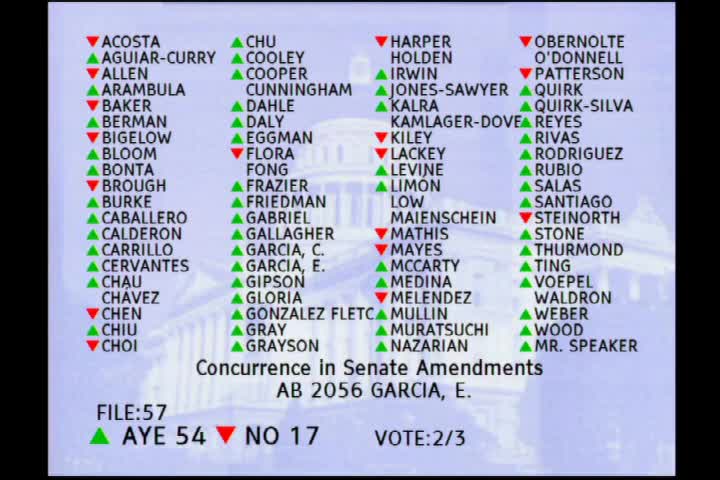
Bill Author

Bill Co-Author(s):