AB 2681: Seismic safety: potentially vulnerable buildings.
- Session Year: 2017-2018
- House: Assembly
- Latest Version Date: 2018-08-29
Existing law establishes a program within all cities and all counties and portions thereof located within seismic zone 4, as defined, to identify all potentially hazardous buildings and to establish a mitigation program for these buildings. The mitigation program may include, among other things, the adoption by ordinance of a hazardous buildings program, measures to strengthen buildings, and the application of structural standards necessary to provide for life safety above current code requirements.
This bill would, upon the identification of funding by the Office of Emergency Services, require the building department of a city or county that meets specified requirements to create an inventory of potentially vulnerable buildings, as defined, within its jurisdiction, based on age and other publicly available information, and submit that inventory to the office, as specified. By increasing the duties of local officials, this bill would create a state-mandated local program. The bill would require the office to, among other things, maintain a statewide inventory, identify funding mechanisms to offset costs to building departments and building owners in complying with these provisions, and report to the Legislature on the number of potentially vulnerable buildings and compliance of building departments with these provisions. The bill would require the owner of a building identified by a building department as a potentially vulnerable building to retain a licensed professional engineer to identify whether the building meets the definition of a potentially vulnerable building, and provide a letter to the building department stating the licensed professional engineers findings. The bill would specify the date by which each requirement must be met.
The California Constitution requires the state to reimburse local agencies and school districts for certain costs mandated by the state. Statutory provisions establish procedures for making that reimbursement.
This bill would provide that, if the Commission on State Mandates determines that the bill contains costs mandated by the state, reimbursement for those costs shall be made pursuant to the statutory provisions noted above.
Existing law establishes a program within all cities and all counties and portions thereof located within seismic zone 4, as defined, to identify all potentially hazardous buildings and to establish a mitigation program for these buildings. The mitigation program may include, among other things, the adoption by ordinance of a hazardous buildings program, measures to strengthen buildings, and the application of structural standards necessary to provide for life safety above current code requirements.
This bill would, upon the identification of funding by the Office of Emergency Services, require the building department of a city or county that meets specified requirements to create an inventory of potentially vulnerable buildings, as defined, within its jurisdiction, based on age and other publicly available information, and submit that inventory to the office, as specified. By increasing the duties of local officials, this bill would create a state-mandated local program. The bill would require the office to, among other things, maintain a statewide inventory, identify funding mechanisms to offset costs to building departments and building owners in complying with these provisions, and report annually to the Legislature on the number of potentially vulnerable buildings and compliance of building departments with these provisions. The bill would require the owner of a building identified by a building department as a potentially vulnerable building to retain a licensed professional engineer to identify whether the building meets the definition of a potentially vulnerable building, and provide a letter to the building department stating the licensed professional engineers findings. The bill would specify the date by which each requirement must be met.
The California Constitution requires the state to reimburse local agencies and school districts for certain costs mandated by the state. Statutory provisions establish procedures for making that reimbursement.
This bill would provide that, if the Commission on State Mandates determines that the bill contains costs mandated by the state, reimbursement for those costs shall be made pursuant to the statutory provisions noted above.
Existing law establishes a program within all cities and all counties and portions thereof located within seismic zone 4, as defined, to identify all potentially hazardous buildings and to establish a mitigation program for these buildings. The mitigation program may include, among other things, the adoption by ordinance of a hazardous buildings program, measures to strengthen buildings, and the application of structural standards necessary to provide for life safety above current code requirements.
This bill would, upon the identification of funding by the Office of Emergency Services, require the building department of a city or county that meets specified requirements to create an inventory of potentially vulnerable buildings, as defined, within its jurisdiction, based on age and other publicly available information, and submit that inventory to the office, as specified. By increasing the duties of local officials, this bill would create a state-mandated local program. The bill would require the office to, among other things, maintain a statewide inventory, identify funding mechanisms to offset costs to building departments and building owners in complying with these provisions, and report annually to the Legislature on the compliance of building departments with these provisions. The bill would require the owner of a building identified by a building department as a potentially vulnerable building to retain a licensed professional engineer to identify whether the building meets the definition of a potentially vulnerable building, and provide a letter to the building department stating the licensed professional engineers findings. The bill would specify the date by which each requirement must be met.
The California Constitution requires the state to reimburse local agencies and school districts for certain costs mandated by the state. Statutory provisions establish procedures for making that reimbursement.
This bill would provide that, if the Commission on State Mandates determines that the bill contains costs mandated by the state, reimbursement for those costs shall be made pursuant to the statutory provisions noted above.
Existing law establishes a program within all cities and all counties and portions thereof located within seismic zone 4, as defined, to identify all potentially hazardous buildings and to establish a mitigation program for these buildings. The mitigation program may include, among other things, the adoption by ordinance of a hazardous buildings program, measures to strengthen buildings, and the application of structural standards necessary to provide for life safety above current code requirements.
This bill would, upon the identification of funding by the Office of Emergency Services, require each the building department of a city or county that meets specified requirements to create an inventory of potentially vulnerable buildings, as defined, within its jurisdiction, based on age and other publicly available information, and submit that inventory to the office, as specified. By increasing the duties of local officials, this bill would create a state-mandated local program. The bill would require the office to, among other things, maintain a statewide inventory, create a standard reporting form, identify funding mechanisms to offset costs to building departments and building owners in complying with these provisions, and report annually to the Legislature on the compliance of building departments with these provisions. The bill would require the owner of a building identified by a building department as a potentially vulnerable building to retain a licensed professional engineer to identify whether the building meets the definition of a potentially vulnerable building, and if it does, to complete the standard reporting form. provide a letter to the building department stating the licensed professional engineers findings. The bill would specify the date by which each requirement must be met.
The California Constitution requires the state to reimburse local agencies and school districts for certain costs mandated by the state. Statutory provisions establish procedures for making that reimbursement.
This bill would provide that, if the Commission on State Mandates determines that the bill contains costs mandated by the state, reimbursement for those costs shall be made pursuant to the statutory provisions noted above.
Existing law establishes a program within all cities and all counties and portions thereof located within seismic zone 4, as defined, to identify all potentially hazardous buildings and to establish a mitigation program for these buildings. The mitigation program may include, among other things, the adoption by ordinance of a hazardous buildings program, measures to strengthen buildings, and the application of structural standards necessary to provide for life safety above current code requirements.
This bill would would, upon the identification of funding by the Office of Emergency Services, require each building department of a city or county to create an inventory of potentially vulnerable buildings, as defined, within its jurisdiction, based on age and other publicly available information, and submit that inventory to the Office of Emergency Services, office, as specified. By increasing the duties of local officials, this bill would create a state-mandated local program. The bill would require the Office of Emergency Services office to, among other things, maintain a statewide inventory, create a standard reporting form, prepare a report identifying possible funding mechanisms available to building departments and building owners in complying with these provisions, identify funding mechanisms to offset costs to building departments and building owners in complying with these provisions, and report annually to the Legislature on the compliance of building departments with these provisions. The bill would require the owner of a building identified by a building department as a potentially vulnerable building to retain a licensed professional engineer to identify whether the building meets the definition of a potentially vulnerable building, and if it does, to complete the standard reporting form. The bill would specify the date by which each requirement must be met.
The California Constitution requires the state to reimburse local agencies and school districts for certain costs mandated by the state. Statutory provisions establish procedures for making that reimbursement.
This bill would provide that, if the Commission on State Mandates determines that the bill contains costs mandated by the state, reimbursement for those costs shall be made pursuant to the statutory provisions noted above.
Existing law establishes a program within all cities and all counties and portions thereof located within seismic zone 4, as defined, to identify all potentially hazardous buildings and to establish a mitigation program for these buildings. The mitigation program may include, among other things, the adoption by ordinance of a hazardous buildings program, measures to strengthen buildings, and the application of structural standards necessary to provide for life safety above current code requirements.
This bill would require each building department of a city or county to create an inventory of potentially vulnerable buildings, as defined, within its jurisdiction, based on age and other publicly available information, and submit that inventory to the Office of Emergency Services, as specified. By increasing the duties of local officials, this bill would create a state-mandated local program. The bill would require the Office of Emergency Services to, among other things, maintain a statewide inventory, create a standard reporting form, prepare a report identifying possible funding mechanisms available to building departments and building owners in complying with these provisions, and report annually to the Legislature on the compliance of building departments with these provisions. The bill would require the owner of a building identified by a building department as a potentially vulnerable building to retain a licensed professional engineer to identify whether the building meets the definition of a potentially vulnerable building, and if it does, to complete the standard reporting form. The bill would specify the date by which each requirement must be met.
The California Constitution requires the state to reimburse local agencies and school districts for certain costs mandated by the state. Statutory provisions establish procedures for making that reimbursement.
This bill would provide that, if the Commission on State Mandates determines that the bill contains costs mandated by the state, reimbursement for those costs shall be made pursuant to the statutory provisions noted above.
The Legislature hereby finds and declares all of the following:
(a)Major earthquakes around the Pacific Rim, the devastation left by hurricanes Harvey, Irma, and Maria, and the September 2017 earthquakes in Mexico are continuing reminders of Californias vulnerability to massive earthquake-related losses.
(b)The most recent California ShakeOut study estimates that a major quake along the San Andreas Fault could cause more than two hundred billion dollars ($200,000,000,000) in physical and economic damage, and could result in up to 1,800 or more deaths. In 2016, the California Geologic Survey estimated Californias annualized earthquake loss at the state level at approximately three billion seven hundred million dollars ($3,700,000,000).
(c)The chronic labor and affordable housing shortages from which most cities in California already suffer would be made dramatically worse for years to come following such an event.
(d)California contains thousands of buildings that are known to present an unacceptably high earthquake risk of death, injury, and damage based on their age, structural system, size, and location.
(e)Protecting our states economy, affordable housing stock, and social fabric from the long-lasting turmoil of earthquakes is of utmost importance, and the failure to do so could impact Californians quality of life for decades.
(f)The first step toward reducing these expected losses is to quantify them with basic inventory measures that account for structural vulnerabilities and recovery-critical functions.
8875.101.For purposes of this chapter, the following terms have the following meanings:
(a)Building department means the department, bureau, or officer of a city or county charged with the enforcement of laws or ordinances regulating the erection, construction, or alteration of buildings.
(b)Potentially vulnerable building means a building that meets one of the following:
(1)The design and construction of the building was approved by the city or county prior to the adoption of the 1976 edition of the Uniform Building Code and has one or more of the following characteristics:
(A)Unreinforced masonry lateral force resisting systems or unreinforced masonry infill walls that interact with the lateral force resisting system.
(B)Concrete buildings with a nonductile lateral force resisting system.
(C)Soft, weak, or open front walls at the ground floor level of multistory light framed buildings.
(2)The design and construction of the building was approved by the city or county pursuant to the 1995 or earlier edition of the California Building Code and consists of any of the following structural systems:
(A)Steel frame buildings with moment frame connections.
(B)Concrete or masonry buildings with flexible diaphragms.
(C)Buildings with precast, prestressed, or post-tensioned concrete.
(3)Potentially vulnerable building does not include any of the following:
(A)Residential real property comprising one to four dwelling units, or a manufactured home as defined in Section 18007 of the Health and Safety Code.
(B)A building listed in subdivision (a), (c), or (e) of Section 19100 of the Health and Safety Code.
(C)Facilities regulated by the Office of Statewide Health Planning and Development or the Division of the State Architect, or buildings owned by the state or federal government.
(c)Recovery function means a building use or occupancy involving one or more of the following:
(1)Multifamily housing.
(2)A skilled nursing or residential care facility.
(3)A designated emergency shelter.
(4)A mercantile grocery or packaged food sales.
(5)A mercantile pharmacy or medical supply.
(6)Medical provider offices.
(7)A K12 school.
(8)Essential services provided by a city or county that are identified in the city or countys local hazard mitigation plan.
(9)Essential services buildings as defined in Section 16007 of the Health and Safety Code.
(10)A communication center or broadcast station.
(d)Office means the Office of Emergency Services.
8875.102.This chapter shall apply to a city or county with at least half of its geographical area located where the peak ground acceleration equals or exceeds 0.3g as determined by the 2008 United States Geological Survey National Seismic Hazard Model gridded data, based on 10-percent-in-50-year probability of exceedance. The office shall determine whether a city or city and county meets this criteria and shall notify any city or county that meets this criteria that the city or county is subject to this chapter.
8875.103(a)On or before January 1, 2021, each building department shall develop an inventory of potentially vulnerable buildings within its jurisdiction, based on the age of the building and other publicly available information, including, but not limited to, tax assessors record surveys, census data, housing data, building permit records, past or ongoing earthquake mitigation program records, and online searches. For each potentially vulnerable building, the inventory shall identify which recovery functions, if any, it contains.
(b)A city or county is not required to develop an inventory pursuant to subdivision (a) if it already has an existing inventory of potentially vulnerable buildings within its jurisdiction compiled pursuant to a local ordinance that otherwise meets the requirements of subdivision (a). If a building within its jurisdiction meets the additional potentially vulnerable building criteria specified in this chapter was not included in the information the city or county previously complied, the building department of the city or county shall add it to the inventory on or before January 1, 2021, in order for the city or county to be in compliance with this section.
8875.104(a)On or before June 1, 2021, each building department shall notify the owner of any building identified by the building department as a potentially vulnerable building of the status of the owners building.
(b)(1)On or before June 1, 2022, an owner who has received a notification from a building department pursuant to subdivision (a) shall submit a letter from a licensed professional engineer to the building department stating whether the building meets the definition of a potentially vulnerable building set forth in subdivision (b) of Section 8875.101.
(2)If the letter from a licensed professional engineer submitted by the owner of a building pursuant to paragraph (1) states that the building does not meet the definition of a potentially vulnerable building, the building department shall remove the building from the inventory it created pursuant to Section 8875.103, and shall not include the building on the list provided to the office pursuant to Section 8875.105.
(3)If a letter from a licensed professional engineer has not been submitted by the owner of a building pursuant to paragraph (1), the building department shall assume that the building qualifies as a potentially vulnerable building and shall include the building on the inventory provided to the office pursuant to Section 8875.105.
8875.105.(a)The office shall maintain a statewide inventory of potentially vulnerable buildings.
(b)On or before January 1, 2023, each building department shall provide the office, in an electronic form prescribed by the office, the inventory of buildings identified by the building department as potentially vulnerable buildings pursuant to Sections 8875.103 and 8875.104.
(c)A building department shall notify the office if a building on the inventory is seismically retrofitted or replaced and the office shall remove that building from the statewide inventory.
8875.106.On or before January 1, 2020, the office shall identify funding mechanisms to offset costs to building departments and building owners in complying with this chapter. The funding shall be limited to federal funds, funds from the General Fund of the state, funds from the sale of revenue bonds, local funds, and private grants.
8875.107.No city, county, or city and county, nor any employee of a city, county, or city and county, shall be liable for damages for injury to persons or property, resulting from an earthquake or otherwise, on the basis of any inventory, assessment, or evaluation performed, any ordinance adopted, or any other action taken pursuant to this chapter, irrespective of whether that action complies with the terms of this chapter, or on the basis of failure to take any action authorized by this chapter. The immunity from liability provided herein is in addition to all other immunities of the city, city and county, or county provided by law.
8875.108.The office shall coordinate the earthquake-related responsibilities of building departments imposed by this chapter.
8875.109.(a)Notwithstanding Section 10231.5, the office shall report to the Legislature on the compliance of building departments with the requirements of this chapter on or before June 1, 2023. The report shall include the number of potentially vulnerable buildings and the building departments that have not complied with Sections 8875.103 to 8875.105, inclusive, in order to assess the effectiveness of building identification standards adopted by these building departments pursuant to this section.
(b)(1)A report to be submitted pursuant to subdivision (a) shall be submitted in compliance with Section 9795 of the Government Code.
(2)Pursuant to Section 10231.5 of the Government Code, this section is repealed on June 1, 2027.
8875.110.(a)If the Commercial Property Owners Guide to Earthquake Safety described in Section 10147 of the Business and Professions Code is delivered to a transferee in connection with the transfer of a potentially vulnerable building, a seller or broker is not required to provide additional information concerning a potentially vulnerable building, and the Commercial Property Owners Guide to Earthquake Safety shall be deemed adequate to inform the transferee regarding the potentially vulnerable building.
(b)Notwithstanding subdivision (a), nothing in this section increases or decreases the duties, if any, of sellers or their brokers or agents, or alters the duty of a seller, agent, or broker, to disclose the existence of a known potentially vulnerable building.
8875.111.This chapter shall not become operative until the office identifies funding pursuant to Section 8875.106 and the office reports to the Secretary of State that this contingency has been met and also posts notice on its Internet Web site that the contingency has been met.
SEC. 2.If the Commission on State Mandates determines that this act contains costs mandated by the state, reimbursement to local agencies and school districts for those costs shall be made pursuant to Part 7 (commencing with Section 17500) of Division 4 of Title 2 of the Government Code.
The Legislature hereby finds and declares all of the following:
(a)Major earthquakes around the Pacific Rim, the devastation left by hurricanes Harvey, Irma, and Maria, and the September 2017 earthquakes in Mexico are continuing reminders of Californias vulnerability to massive earthquake-related losses.
(b)The most recent California ShakeOut study estimates that a major quake along the San Andreas Fault could cause more than two hundred billion dollars ($200,000,000,000) in physical and economic damage, and could result in up to 1,800 or more deaths. In 2016, the California Geologic Survey estimated Californias annualized earthquake loss at the state level at approximately three billion seven hundred million dollars ($3,700,000,000).
(c)The chronic labor and affordable housing shortages from which most cities in California already suffer would be made dramatically worse for years to come following such an event.
(d)California contains thousands of buildings that are known to present an unacceptably high earthquake risk of death, injury, and damage based on their age, structural system, size, and location.
(e)Protecting our states economy, affordable housing stock, and social fabric from the long-lasting turmoil of earthquakes is of utmost importance, and the failure to do so could impact Californians quality of life for decades.
(f)The first step toward reducing these expected losses is to quantify them with basic inventory measures that account for structural vulnerabilities and recovery-critical functions.
8875.101.For purposes of this chapter, the following terms have the following meanings:
(a)Building department means the department, bureau, or officer of a city or county charged with the enforcement of laws or ordinances regulating the erection, construction, or alteration of buildings.
(b)Potentially vulnerable building means a building that meets one of the following:
(1)The design and construction of the building was approved by the city or county prior to the adoption of the 1976 edition of the Uniform Building Code and has one or more of the following characteristics:
(A)Unreinforced masonry lateral force resisting systems or unreinforced masonry infill walls that interact with the lateral force resisting system.
(B)Concrete buildings with a nonductile lateral force resisting system.
(C)Soft, weak, or open front walls at the ground floor level of multistory light framed buildings.
(2)The design and construction of the building was approved by the city or county pursuant to the 1995 or earlier edition of the California Building Code and consists of any of the following structural systems:
(A)Steel frame buildings with moment frame connections.
(B)Concrete or masonry buildings with flexible diaphragms.
(C)Buildings with precast, prestressed, or post-tensioned concrete.
(3)Potentially vulnerable building does not include any of the following:
(A)Residential real property comprising one to four dwelling units, or a manufactured home as defined in Section 18007 of the Health and Safety Code.
(B)A building listed in subdivision (a), (c), or (e) of Section 19100 of the Health and Safety Code.
(C)Facilities regulated by the Office of Statewide Health Planning and Development or the Division of the State Architect, or buildings owned by the state or federal government.
(c)Recovery function means a building use or occupancy involving one or more of the following:
(1)Multifamily housing.
(2)A skilled nursing or residential care facility.
(3)A designated emergency shelter.
(4)A mercantile grocery or packaged food sales.
(5)A mercantile pharmacy or medical supply.
(6)Medical provider offices.
(7)A K12 school.
(8)Essential services provided by a city or county that are identified in the city or countys local hazard mitigation plan.
(9)Essential services buildings as defined in Section 16007 of the Health and Safety Code.
(10)A communication center or broadcast station.
(d)Office means the Office of Emergency Services.
8875.102.This chapter shall apply to a city or county with at least half of its geographical area located where the peak ground acceleration equals or exceeds 0.3g as determined by the 2008 United States Geological Survey National Seismic Hazard Model gridded data, based on 10-percent-in-50-year probability of exceedance. The office shall determine whether a city or city and county meets this criteria and shall notify any city or county that meets this criteria that the city or county is subject to this chapter.
8875.103(a)On or before January 1, 2021, each building department shall develop an inventory of potentially vulnerable buildings within its jurisdiction, based on the age of the building and other publicly available information, including, but not limited to, tax assessors record surveys, census data, housing data, building permit records, past or ongoing earthquake mitigation program records, and online searches. For each potentially vulnerable building, the inventory shall identify which recovery functions, if any, it contains.
(b)A city or county is not required to develop an inventory pursuant to subdivision (a) if it already has an existing inventory of potentially vulnerable buildings within its jurisdiction compiled pursuant to a local ordinance that otherwise meets the requirements of subdivision (a). If a building within its jurisdiction meets the additional potentially vulnerable building criteria specified in this chapter was not included in the information the city or county previously complied, the building department of the city or county shall add it to the inventory on or before January 1, 2021, in order for the city or county to be in compliance with this section.
8875.104(a)On or before June 1, 2021, each building department shall notify the owner of any building identified by the building department as a potentially vulnerable building of the status of the owners building.
(b)(1)On or before June 1, 2022, an owner who has received a notification from a building department pursuant to subdivision (a) shall submit a letter from a licensed professional engineer to the building department stating whether the building meets the definition of a potentially vulnerable building set forth in subdivision (b) of Section 8875.101.
(2)If the letter from a licensed professional engineer submitted by the owner of a building pursuant to paragraph (1) states that the building does not meet the definition of a potentially vulnerable building, the building department shall remove the building from the inventory it created pursuant to Section 8875.103, and shall not include the building on the list provided to the office pursuant to Section 8875.105.
(3)If a letter from a licensed professional engineer has not been submitted by the owner of a building pursuant to paragraph (1), the building department shall assume that the building qualifies as a potentially vulnerable building and shall include the building on the inventory provided to the office pursuant to Section 8875.105.
8875.105.(a)The office shall maintain a statewide inventory of potentially vulnerable buildings.
(b)On or before January 1, 2023, each building department shall provide the office, in an electronic form prescribed by the office, the inventory of buildings identified by the building department as potentially vulnerable buildings pursuant to Sections 8875.103 and 8875.104.
(c)A building department shall notify the office if a building on the inventory is seismically retrofitted or replaced and the office shall remove that building from the statewide inventory.
8875.106.On or before January 1, 2020, the office shall identify funding mechanisms to offset costs to building departments and building owners in complying with this chapter. The funding shall be limited to federal funds, funds from the General Fund of the state, funds from the sale of revenue bonds, local funds, and private grants.
8875.107.No city, county, or city and county, nor any employee of a city, county, or city and county, shall be liable for damages for injury to persons or property, resulting from an earthquake or otherwise, on the basis of any inventory, assessment, or evaluation performed, any ordinance adopted, or any other action taken pursuant to this chapter, irrespective of whether that action complies with the terms of this chapter, or on the basis of failure to take any action authorized by this chapter. The immunity from liability provided herein is in addition to all other immunities of the city, city and county, or county provided by law.
8875.108.The office shall coordinate the earthquake related earthquake-related responsibilities of building departments imposed by this chapter to ensure compliance with the purposes of this chapter.
8875.109.(a)Notwithstanding Section 10231.5, the office shall report annually to the Legislature on the compliance of building departments with the requirements of this chapter. The annual report shall review and chapter on or before June 1, 2023. The report shall include the number of potentially vulnerable buildings and the building departments that have not complied with Sections 8875.103 to 8875.105, inclusive, in order to assess the effectiveness of building identification and evaluation standards adopted by these building departments pursuant to this section. The annual report shall comply with Section 9795.
(b)(1)A report to be submitted pursuant to subdivision (a) shall be submitted in compliance with Section 9795 of the Government Code.
(2)Pursuant to Section 10231.5 of the Government Code, this section is repealed on June 1, 2027.
8875.110.(a)If the Commercial Property Owners Guide to Earthquake Safety described in Section 10147 of the Business and Professions Code is delivered to a transferee in connection with the transfer of a potentially vulnerable building, a seller or broker is not required to provide additional information concerning a potentially vulnerable building, and the Commercial Property Owners Guide to Earthquake Safety shall be deemed adequate to inform the transferee regarding the potentially vulnerable building.
(b)Notwithstanding subdivision (a), nothing in this section increases or decreases the duties, if any, of sellers or their brokers or agents, or alters the duty of a seller, agent, or broker, to disclose the existence of a known potentially vulnerable building.
8875.111.This chapter shall not become operative until the office identifies funding pursuant to Section 8875.106 and the office reports to the Secretary of State that this contingency has been met and also posts notice on its Internet Web site that the contingency has been met.
SEC. 2.If the Commission on State Mandates determines that this act contains costs mandated by the state, reimbursement to local agencies and school districts for those costs shall be made pursuant to Part 7 (commencing with Section 17500) of Division 4 of Title 2 of the Government Code.
The Legislature hereby finds and declares all of the following:
(a)Major earthquakes around the Pacific Rim, the devastation left by hurricanes Harvey, Irma, and Maria, and the September 2017 earthquakes in Mexico are continuing reminders of Californias vulnerability to massive earthquake-related losses.
(b)The most recent California ShakeOut study estimates that a major quake along the San Andreas Fault could cause more than two hundred billion dollars ($200,000,000,000) in physical and economic damage, and could result in up to 1,800 or more deaths. In 2016, the California Geologic Survey estimated Californias annualized earthquake loss at the state level at approximately three billion seven hundred million dollars ($3,700,000,000).
(c)The chronic labor and affordable housing shortages from which most cities in California already suffer would be made dramatically worse for years to come following such an event.
(d)California contains thousands of buildings that are known to present an unacceptably high earthquake risk of death, injury, and damage based on their age, structural system, size, and location.
(e)Protecting our states economy, affordable housing stock, and social fabric from the long-lasting turmoil of earthquakes is of utmost importance, and the failure to do so could impact Californians quality of life for decades.
(f)The first step toward reducing these expected losses is to quantify them with basic inventory measures that account for structural vulnerabilities and recovery-critical functions.
8875.101.For purposes of this chapter, the following terms have the following meanings:
(a)Building department means the department, bureau, or officer of a city or county charged with the enforcement of laws or ordinances regulating the erection, construction, or alteration of buildings.
(b)Potentially vulnerable building means a building that meets one of the following:
(1)The design and construction of the building was approved by the city or county prior to the adoption of the 1976 edition of the Uniform Building Code and has one or more of the following characteristics:
(A)Unreinforced masonry lateral force resisting systems or unreinforced masonry infill walls that interact with the lateral force resisting system.
(B)Concrete buildings with a nonductile lateral force resisting system.
(C)Soft, weak, or open front walls at the ground floor level of multistory light framed buildings.
(2)The design and construction of the building was approved by the city or county pursuant to the 1995 or earlier edition of the California Building Code and consists of any of the following structural systems:
(A)Steel frame buildings with moment frame connections.
(B)Concrete or masonry buildings with flexible diaphragms.
(C)Buildings with precast, prestressed, or post-tensioned concrete.
(3)Potentially vulnerable building does not include any of the following:
(A)Residential real property comprising one to four dwelling units, or a manufactured home as defined in Section 18007 of the Health and Safety Code.
(B)A building listed in subdivision (a), (c), or (e) of Section 19100 of the Health and Safety Code.
(C)Facilities regulated by the Office of Statewide Health Planning and Development or the Division of the State Architect, or buildings owned by the state or federal government.
(c)Recovery function means a building use or occupancy involving one or more of the following:
(1)Multifamily housing.
(2)A skilled nursing or residential care facility.
(3)A designated emergency shelter.
(4)A mercantile grocery or packaged food sales.
(5)A mercantile pharmacy or medical supply.
(6)Medical provider offices.
(7)A K12 school.
(8)Essential services provided by a city or county that are identified in the city or countys local hazard mitigation plan.
(9)Essential services buildings as defined in Section 16007 of the Health and Safety Code.
(10)A communication center or broadcast station.
(d)Office means the Office of Emergency Services.
8875.102.This chapter shall apply to a city or county with at least half of its geographical area located where the peak ground acceleration equals or exceeds 0.3g as determined by the 2008 United States Geological Survey National Seismic Hazard Model gridded data, based on 10-percent-in-50-year probability of exceedance, and to the Counties of Monterey, San Diego, San Luis Obispo, and Santa Barbara, and all cities within each of those counties. exceedance. The office shall determine whether a city or city and county meets this criteria and shall notify any city or county that meets this criteria that the city or county is subject to this chapter.
8875.103On or before January 1, 2021, each building department shall develop an inventory of potentially vulnerable buildings within its jurisdiction, based on the age of the building and other publicly available information, including, but not limited to, tax assessors record surveys, census data, housing data, building permit records, past or ongoing earthquake mitigation program records, and online searches. For each potentially vulnerable building, the inventory shall identify which recovery functions, if any, it contains.
8875.104(a)On or before June 1, 2021, each building department shall notify the owner of any building identified by the building department as a potentially vulnerable building of the status of the owners building.
(b)(1)On or before June 1, 2022, an owner who has received a notification from a building department pursuant to subdivision (a) shall submit a letter from a licensed professional engineer to the building department stating whether the building meets the definition of a potentially vulnerable building set forth in subdivision (b) of Section 8875.101.
(2)If the letter from a licensed professional engineer submitted by the owner of a building pursuant to paragraph (1) states that the building does not meet the definition of a potentially vulnerable building, the building department shall remove the building from the inventory it created pursuant to Section 8875.103, and shall not include the building on the list provided to the office pursuant to Section 8875.105.
(3)If a letter from a licensed professional engineer has not been submitted by the owner of a building pursuant to paragraph (1), the building department shall assume that the building qualifies as a potentially vulnerable building and shall include the building on the inventory provided to the office pursuant to Section 8875.105.
8875.105.(a)The office shall maintain a statewide inventory of potentially vulnerable buildings.
(b)On or before January 1, 2023, each building department shall provide the office, in an electronic form prescribed by the office, the inventory of buildings identified by the building department as potentially vulnerable buildings pursuant to Sections 8875.103 and 8875.104.
(c)A building department shall notify the office if a building on the inventory is seismically retrofitted or replaced and the office shall remove that building from the statewide inventory.
8875.106.On or before January 1, 2020, the office shall identify funding mechanisms to offset costs to building departments and building owners in complying with this chapter. The funding shall be limited to federal funds, funds from the General Fund of the state, funds from the sale of revenue bonds, local funds, and private grants.
8875.107.No city, county, or city and county, nor any employee of a city, county, or city and county, shall be liable for damages for injury to persons or property, resulting from an earthquake or otherwise, on the basis of any inventory, assessment, or evaluation performed, any ordinance adopted, or any other action taken pursuant to this chapter, irrespective of whether that action complies with the terms of this chapter, or on the basis of failure to take any action authorized by this chapter. The immunity from liability provided herein is in addition to all other immunities of the city, city and county, or county provided by law.
8875.108.The office shall coordinate the earthquake related responsibilities of building departments imposed by this chapter to ensure compliance with the purposes of this chapter.
8875.109.Notwithstanding Section 10231.5, the office shall report annually to the Legislature on the compliance of building departments with the requirements of this chapter. The annual report shall review and assess the effectiveness of building identification and evaluation standards adopted by these building departments pursuant to this section. The annual report shall comply with Section 9795.
8875.110.(a)If the Commercial Property Owners Guide to Earthquake Safety described in Section 10147 of the Business and Professions Code is delivered to a transferee in connection with the transfer of a potentially vulnerable building, a seller or broker is not required to provide additional information concerning a potentially vulnerable building, and the Commercial Property Owners Guide to Earthquake Safety shall be deemed adequate to inform the transferee regarding the potentially vulnerable building.
(b)Notwithstanding subdivision (a), nothing in this section increases or decreases the duties, if any, of sellers or their brokers or agents, or alters the duty of a seller, agent, or broker, to disclose the existence of a known potentially vulnerable building.
8875.111.This chapter shall not become operative until the office identifies funding pursuant to Section 8875.106 and the office reports to the Secretary of State that this contingency has been met and also posts notice on its Internet Web site that the contingency has been met.
SEC. 2.If the Commission on State Mandates determines that this act contains costs mandated by the state, reimbursement to local agencies and school districts for those costs shall be made pursuant to Part 7 (commencing with Section 17500) of Division 4 of Title 2 of the Government Code.
The Legislature hereby finds and declares all of the following:
(a)The Major earthquakes around the Pacific Rim, the devastation left by hurricanes Harvey, Irma, and Maria, and the September 2017 earthquakes in Mexico is a wake-up call for California. are continuing reminders of Californias vulnerability to massive earthquake-related losses.
(b)The most recent California ShakeOut study estimates that a major quake along the San Andreas Fault could cause more than two hundred billion dollars ($200,000,000,000) in physical and economic damage, and could result in up to 1,800 or more deaths. In 2016, the California Geologic Survey estimated Californias annualized earthquake loss at the state level at approximately three billion seven hundred million dollars ($3,700,000,000).
(c)The chronic labor and affordable housing shortages from which most cities in California already suffer would be made dramatically worse for years to come following such an event.
(d)California contains thousands of buildings that are known to present a heightened an unacceptably high earthquake risk of death, injury, and damage based on their age, structural system, size, and location.
(e)Protecting our states economy, affordable housing stock, and social fabric from the long-lasting turmoil of earthquakes is of utmost importance, and the failure to do so could impact Californians quality of life for decades.
(f)Because the state represents the sixth largest economy in the world, the aftershocks of such an event would have national and even global impacts.(f)The first step toward reducing these expected losses is to quantify them with basic inventory measures that account for structural vulnerabilities and recovery-critical functions.
8875.101.For purposes of this section, chapter, the following terms have the following meanings:
(a)Building department means the department, bureau, or officer of a city or county charged with the enforcement of laws or ordinances regulating the erection, construction, or alteration of buildings.
(b)(1)Potentially vulnerable building means a building that meets both one of the following:
(A)The building is located in a region of the state with a peak ground acceleration equal to or exceeding 0.3g as determined by the 2008 United States Geological Survey National Seismic Hazard Model gridded data, based on 10-percent-in-50-year probability of exceedance, or is located in the Counties of Monterey, San Diego, San Luis Obispo, or Santa Barbara.(B)The building has one or more of the following characteristics: (i)(1)The design and construction of the building was approved by the city or county pursuant prior to the adoption of the 1976 or earlier edition of the Uniform Building Code. Code and has one or more of the following characteristics:
(A)Unreinforced masonry lateral force resisting systems or unreinforced masonry infill walls that interact with the lateral force resisting system.
(B)Concrete buildings with a nonductile lateral force resisting system.
(C)Soft, weak, or open front walls at the ground floor level of multistory light framed buildings.
(ii)(2)The design and construction of the building was approved by the city or county pursuant to the 1995 or earlier edition of the California Building Code and consists of any of the following structural systems:
(I)(A)Steel frame buildings with moment frame connections.
(II)Soft, weak, or open front walls at the ground floor level of light framed buildings. (III)(B)Concrete or masonry buildings with flexible diaphragms.
(IV)(C)Buildings with precast, prestressed, or post-tensioned concrete.
(2)(3)Potentially vulnerable building does not include any of the following:
(A)building designed and constructed for use exclusively as a dwelling by four or fewer families.(A)Residential real property comprising one to four dwelling units, or a manufactured home as defined in Section 18007 of the Health and Safety Code.
(B)A building listed in subdivision (a), (c), or (e) of Section 19100 of the Health and Safety Code.
(C)Hospitals, public schools, Facilities regulated by the Office of Statewide Health Planning and Development or the Division of the State Architect, or buildings owned by the state or federal government.
(c)Recovery function means a building use or occupancy involving one or more of the following:
(1)Multifamily housing.
(2)A skilled nursing or residential care facility.
(3)A designated emergency shelter.
(4)A mercantile grocery or packaged food sales.
(5)A mercantile pharmacy or medical supply.
(6)Medical provider offices.
(7)A K12 school.
(8)Essential services provided by a city or county that are identified in the city or countys local hazard mitigation plan.
(9)Essential services buildings as defined in Section 16007 of the Health and Safety Code.
(10)A communication center or broadcast station.
(c)(d)Office means the Office of Emergency Services.
8875.102.This chapter shall apply to a city or county with at least half of its geographical area located where the peak ground acceleration equals or exceeds 0.3g as determined by the 2008 United States Geological Survey National Seismic Hazard Model gridded data, based on 10-percent-in-50-year probability of exceedance, and to the Counties of Monterey, San Diego, San Luis Obispo, and Santa Barbara, and all cities within each of those counties.
8875.102.8875.103On or before January 1, 2021, each building department shall develop an inventory of potentially vulnerable buildings within its jurisdiction, based on the age of the building and other publicly available information, including, but not limited to, tax assessors record surveys surveys, census data, housing data, building permit records, past or ongoing earthquake mitigation program records, and online searches. For each potentially vulnerable building, the inventory shall identify which recovery functions, if any, it contains.
8875.103.8875.104(a)On or before January June 1, 2021, each building department shall notify the owner of any building identified by the building department as a potentially vulnerable building of the status of the owners building.
(b)(1)On or before January June 1, 2022, an owner who has received a notification from a building department pursuant to subdivision (a) shall submit a letter from a licensed professional engineer to the building department stating whether the building meets the definition of a potentially vulnerable building set forth in subdivision (b) of Section 8875.101.
(2)If the letter from a licensed professional engineer submitted by the owner of a building pursuant to paragraph (1) states that the building does not meet the definition of a potentially vulnerable building, the building department shall remove the building from the inventory it created pursuant to Section 8875.102, 8875.103, and shall not include the building on the list provided to the office pursuant to Section 8875.104. 8875.105.
(3)If a letter from a licensed professional engineer has not been submitted by the owner of a building pursuant to paragraph (1), the building department shall assume that the building qualifies as a potentially vulnerable building and shall include the building on the inventory provided to the office pursuant to Section 8875.104. 8875.105.
8875.104.8875.105.(a)The office shall maintain a statewide inventory of potentially vulnerable buildings.
(b)On or before June 1, 2022, January 1, 2023, each building department shall provide the office, in an electronic form prescribed by the office, the inventory of buildings identified by the building department as potentially vulnerable buildings pursuant to Sections 8875.102 and 8875.103. 8875.103 and 8875.104.
(c)A building department shall notify the office if a building on the inventory is seismically retrofitted or replaced and the office shall remove that building from the statewide inventory.
8875.105.(a)On or before January 1, 2021, the office shall develop a standard reporting form that addresses the expected seismic performance of the building in terms of safety, repair costs, and recovery time, when subjected to an earthquake consistent with the intensity prescribed in the most current edition of the California Building Code for new building design.(b)On or before June 1, 2022, each building department shall provide the standard reporting form to the owner of any building that remains on the building departments list of potentially vulnerable buildings following the removal of any buildings pursuant to paragraph (2) of subdivision (b) of Section 8875.103.(c)On or before January 1, 2025, the owner of a building identified by a building department as a potentially vulnerable building pursuant to Section 8875.103 shall retain a professional engineer to complete the standard reporting form and provide the completed standard reporting form to the building department. (d)On or before June 1, 2025, each building department shall provide the office in an electronic form prescribed by the office, the completed standard reporting forms.8875.106.On or before January 1, 2020, the office shall identify funding mechanisms to offset costs to building departments and building owners in complying with this chapter. The funding shall be limited to federal funds, funds from the General Fund of the state, funds from the sale of revenue bonds, local funds, and private grants.
8875.107.No city, county, or city and county, nor any employee of a city, county, or city and county, shall be liable for damages for injury to persons or property, resulting from an earthquake or otherwise, on the basis of any inventory, assessment, or evaluation performed, any ordinance adopted, or any other action taken pursuant to this chapter, irrespective of whether that action complies with the terms of this chapter, or on the basis of failure to take any action authorized by this chapter. The immunity from liability provided herein is in addition to all other immunities of the city, city and county, or county provided by law.
8875.108.The office shall coordinate the earthquake related responsibilities of building departments imposed by this chapter to ensure compliance with the purposes of this chapter.
8875.109.Notwithstanding Section 10231.5, the office shall report annually to the Legislature on the compliance of building departments with the requirements of this chapter. The annual report shall review and assess the effectiveness of building identification and evaluation standards adopted by these building departments pursuant to this section. The annual report shall comply with Section 9795.
8875.110.(a)If the Commercial Property Owners Guide to Earthquake Safety described in Section 10147 of the Business and Professions Code is delivered to a transferee in connection with the transfer of a potentially vulnerable building, a seller or broker is not required to provide additional information concerning a potentially vulnerable building, and the Commercial Property Owners Guide to Earthquake Safety shall be deemed adequate to inform the transferee regarding the potentially vulnerable building.
(b)Notwithstanding subdivision (a), nothing in this section increases or decreases the duties, if any, of sellers or their brokers or agents, or alters the duty of a seller, agent, or broker, to disclose the existence of a known potentially vulnerable building.
8875.110.8875.111.This chapter shall not become operative until the office identifies funding pursuant to Section 8875.106 and the office reports to the Secretary of State that this contingency has been met and also posts notice on its Internet Web site that the contingency has been met.
SEC. 2.If the Commission on State Mandates determines that this act contains costs mandated by the state, reimbursement to local agencies and school districts for those costs shall be made pursuant to Part 7 (commencing with Section 17500) of Division 4 of Title 2 of the Government Code.
The Legislature hereby finds and declares all of the following:
(a)The devastation left by hurricanes Harvey, Irma, and Maria, and the September 2017 earthquakes in Mexico is a wake-up call for California.
(b)The most recent California ShakeOut study estimates that a major quake along the San Andreas Fault could cause more than two hundred billion dollars ($200,000,000,000) in physical and economic damage, and could result in up to 1,800 or more deaths.
(c)The chronic labor and affordable housing shortages from which most cities in California already suffer would be made dramatically worse for years to come following such an event.
(d)California contains thousands of buildings that are known to present a heightened earthquake risk of death, injury, and damage based on their age, structural system, size, and location.
(e)Protecting our states economy, affordable housing stock, and social fabric from the long-lasting turmoil of earthquakes is of utmost importance, and the failure to do so could impact Californians quality of life for decades.
(f)Because the state represents the sixth largest economy in the world, the aftershocks of such an event would have national and even global impacts.
8875.101.For purposes of this section, the following terms have the following meaning: meanings:
(a)Building department means the department, bureau, or officer of a city or county charged with the enforcement of laws or ordinances regulating the erection, construction, or alteration of buildings.
(b)(1)Potentially vulnerable building means a building that meets both of the following:
(A)The building is located in a region of the state with a peak ground acceleration equal to or exceeding 0.3g as determined by the 2008 United States Geological Survey National Seismic Hazard Model gridded data, based on 10-percent-in-50-year probability of exceedance, or is located in the Counties of Monterey, San Diego, San Luis Obispo, or Santa Barbara.
(B)The building has one or more of the following characteristics:
(i)The design and construction of the building was approved by the city or county pursuant to the 1976 or earlier edition of the Uniform Building Code.
(ii)The design and construction of the building was approved by the city or county pursuant to the 1995 or earlier edition of the California Building Code and consists of any of the following structural systems:
(I)Steel frame buildings with moment frame connections.
(II)Soft, weak, or open front walls at the ground floor level of light framed buildings.
(III)Concrete or masonry buildings with flexible diaphragms.
(IV)Buildings with precast, prestressed, or post-tensioned concrete.
(2)Potentially vulnerable building does not include any of the following:
(A)building designed and constructed for use exclusively as a dwelling by four or fewer families.
(B)A building listed in subdivision (a), (c), or (e) of Section 19100 of the Health and Safety Code.
(C)Hospitals, public schools, or buildings owned by the state or federal government.
(c)Office means the Office of Emergency Services.
8875.102.On or before January 1, 2020, 2021, each building department shall develop an inventory of potentially vulnerable buildings within its jurisdiction, based on the age of the building and other publicly available information, including, but not limited to, tax assessors record surveys and online searches.
8875.103.(a)On or before January 1, 2020, 2021, each building department shall notify the owner of any building identified by the building department as a potentially vulnerable building of the status of the owners building.
(b)(1)On or before January 1, 2021, 2022, an owner who has received a notification from a building department pursuant to subdivision (a) shall submit a letter from a licensed professional engineer to the building department stating whether the building meets the definition of a potentially vulnerable building set forth in subdivision (b) of Section 8875.101.
(2)If the letter from a licensed professional engineer submitted by the owner of a building pursuant to paragraph (1) states that the building does not meet the definition of a potentially vulnerable building, the building department shall remove the building from the inventory it created pursuant to Section 8875.102, and shall not include the building on the list provided to the office pursuant to Section 8875.104.
(3)If a letter from a licensed professional engineer has not been submitted by the owner of a building pursuant to paragraph (1), the building department shall assume that the building qualifies as a potentially vulnerable building and shall include the building on the inventory provided to the office pursuant to Section 8875.104.
8875.104.(a)The office shall maintain a statewide inventory of potentially vulnerable buildings in a searchable database on its Internet Web site. buildings.
(b)On or before June 1, 2021, 2022, each building department shall provide the office, in an electronic form prescribed by the office, the inventory of buildings identified by the building department as potentially vulnerable buildings pursuant to Sections 8875.102 and 8875.103.
(c)A building department shall notify the office if a building on the inventory is seismically retrofitted or replaced and the office shall remove that building from the statewide inventory.
8875.105.(a)On or before January 1, 2020, 2021, the office shall develop a standard reporting form that addresses the expected seismic performance of the building in terms of safety, repair costs, and recovery time, when subjected to an earthquake consistent with the intensity prescribed in the most current edition of the California Building Code for new building design.
(b)On or before June 1, 2021, 2022, each building department shall provide the standard reporting form to the owner of any building that remains on the building departments list of potentially vulnerable buildings following the removal of any buildings pursuant to paragraph (2) of subdivision (b) of Section 8875.103.
(c)On or before January 1, 2024, 2025, the owner of a building identified by a building department as a potentially vulnerable building pursuant to Section 8875.103 shall retain a professional engineer to complete the standard reporting form and provide the completed standard reporting form to the building department.
(d)On or before June 1, 2024, 2025, each building department shall provide the office in an electronic form prescribed by the office, the completed standard reporting forms.
8875.106.On or before January 1, 2020, the office shall prepare and post on the offices Internet Web site, a report identifying possible identify funding mechanisms to offset costs to building departments and building owners in complying with this chapter. The funding shall be limited to federal funds, funds from the General Fund of the state, funds from the sale of revenue bonds, local funds, and private grants.
8875.107.No city, county, or city and county, nor any employee of a city, county, or city and county, shall be liable for damages for injury to persons or property, resulting from an earthquake or otherwise, on the basis of any inventory, assessment, or evaluation performed, any ordinance adopted, or any other action taken pursuant to this chapter, irrespective of whether that action complies with the terms of this chapter, or on the basis of failure to take any action authorized by this chapter. The immunity from liability provided herein is in addition to all other immunities of the city, city and county, or county provided by law.
8875.108.The office shall coordinate the earthquake related responsibilities of building departments imposed by this chapter to ensure compliance with the purposes of this chapter.
8875.109.Notwithstanding Section 10231.5, the office shall report annually to the Legislature on the compliance of building departments with the requirements of this chapter. The annual report shall review and assess the effectiveness of building identification and evaluation standards adopted by these building departments pursuant to this section. The annual report shall comply with Section 9795.
8875.110.This chapter shall not become operative until the office identifies funding pursuant to Section 8875.106 and the office reports to the Secretary of State that this contingency has been met and also posts notice on its Internet Web site that the contingency has been met.
SEC. 2.If the Commission on State Mandates determines that this act contains costs mandated by the state, reimbursement to local agencies and school districts for those costs shall be made pursuant to Part 7 (commencing with Section 17500) of Division 4 of Title 2 of the Government Code.
The Legislature hereby finds and declares all of the following:
(a)The devastation left by hurricanes Harvey, Irma, and Maria, and the September 2017 earthquakes in Mexico is a wake-up call for California.
(b)The most recent California ShakeOut study estimates that a major quake along the San Andreas Fault could cause more than two hundred billion dollars ($200,000,000,000) in physical and economic damage, and could result in up to 1,800 or more deaths.
(c)The chronic labor and affordable housing shortages from which most cities in California already suffer would be made dramatically worse for years to come following such an event.
(d)California contains thousands of buildings that are known to present a heightened earthquake risk of death, injury, and damage based on their age, structural system, size, and location.
(e)Protecting our states economy, affordable housing stock, and social fabric from the long-lasting turmoil of earthquakes is of utmost importance, and the failure to do so could impact Californians quality of life for decades.
(f)Because the state represents the sixth largest economy in the world, the aftershocks of such an event would have national and even global impacts.
8875.101.For purposes of this section, the following terms have the following meaning:
(a)Building department means the department, bureau, or officer of a city or county charged with the enforcement of laws or ordinances regulating the erection, construction, or alteration of buildings.
(b)(1)Potentially vulnerable building means a building that meets both of the following:
(A)The building is located in a region of the state with a peak ground acceleration equal to or exceeding 0.3g as determined by the 2008 United States Geological Survey National Seismic Hazard Model gridded data, based on 10-percent-in-50-year probability of exceedance, or is located in the Counties of Monterey, San Diego, San Luis Obispo, or Santa Barbara.
(B)The building has one or more of the following characteristics:
(i)The design and construction of the building was approved by the city or county pursuant to the 1976 or earlier edition of the Uniform Building Code.
(ii)The design and construction of the building was approved by the city or county pursuant to the 1995 or earlier edition of the California Building Code and consists of any of the following structural systems:
(I)Steel frame buildings with moment frame connections.
(II)Soft, weak, or open front walls at the ground floor level of light framed buildings.
(III)Concrete or masonry buildings with flexible diaphragms.
(IV)Buildings with precast, prestressed, or post-tensioned concrete.
(2)Potentially vulnerable building does not include any of the following:
(A)building designed and constructed for use exclusively as a dwelling by four or fewer families.
(B)A building listed in subdivision (a), (c), or (e) of Section 19100 of the Health and Safety Code.
(C)Hospitals, public schools, or buildings owned by the state or federal government.
(c)Office means the Office of Emergency Services.
8875.102.On or before January 1, 2020, each building department shall develop an inventory of potentially vulnerable buildings within its jurisdiction, based on the age of the building and other publicly available information, including, but not limited to, tax assessors record surveys and online searches.
8875.103.(a)On or before January 1, 2020, each building department shall notify the owner of any building identified by the building department as a potentially vulnerable building of the status of the owners building.
(b)(1)On or before January 1, 2021, an owner who has received a notification from a building department pursuant to subdivision (a) shall submit a letter from a licensed professional engineer to the building department stating whether the building meets the definition of a potentially vulnerable building set forth in subdivision (b) of Section 8875.101.
(2)If the letter from a licensed professional engineer submitted by the owner of a building pursuant to paragraph (1) states that the building does not meet the definition of a potentially vulnerable building, the building department shall remove the building from the inventory it created pursuant to Section 8875.102, and shall not include the building on the list provided to the office pursuant to Section 8875.104.
(3)If a letter from a licensed professional engineer has not been submitted by the owner of a building pursuant to paragraph (1), the building department shall assume that the building qualifies as a potentially vulnerable building and shall include the building on the inventory provided to the office pursuant to Section 8875.104.
8875.104.(a)The office shall maintain a statewide inventory of potentially vulnerable buildings in a searchable database on its Internet Web site.
(b)On or before June 1, 2021, each building department shall provide the office, in an electronic form prescribed by the office, the inventory of buildings identified by the building department as potentially vulnerable buildings pursuant to Sections 8875.102 and 8875.103.
(c)A building department shall notify the office if a building on the inventory is seismically retrofitted or replaced and the office shall remove that building from the statewide inventory.
8875.105.(a)On or before January 1, 2020, the office shall develop a standard reporting form that addresses the expected seismic performance of the building in terms of safety, repair costs, and recovery time, when subjected to an earthquake consistent with the intensity prescribed in the most current edition of the California Building Code for new building design.
(b)On or before June 1, 2021, each building department shall provide the standard reporting form to the owner of any building that remains on the building departments list of potentially vulnerable buildings following the removal of any buildings pursuant to paragraph (2) of subdivision (b) of Section 8875.103.
(c)On or before January 1, 2024, the owner of a building identified by a building department as a potentially vulnerable building pursuant to Section 8875.103 shall retain a professional engineer to complete the standard reporting form and provide the completed standard reporting form to the building department.
(d)On or before June 1, 2024, each building department shall provide the office in an electronic form prescribed by the office, the completed standard reporting forms.
8875.106.On or before January 1, 2020, the office shall prepare and post on the offices Internet Web site, a report identifying possible funding mechanisms to offset costs to building departments and building owners in complying with this chapter.
8875.107.No city, county, or city and county, nor any employee of a city, county, or city and county, shall be liable for damages for injury to persons or property, resulting from an earthquake or otherwise, on the basis of any inventory, assessment, or evaluation performed, any ordinance adopted, or any other action taken pursuant to this chapter, irrespective of whether that action complies with the terms of this chapter, or on the basis of failure to take any action authorized by this chapter. The immunity from liability provided herein is in addition to all other immunities of the city, city and county, or county provided by law.
8875.108.The office shall coordinate the earthquake related responsibilities of building departments imposed by this chapter to ensure compliance with the purposes of this chapter.
8875.109.Notwithstanding Section 10231.5, the office shall report annually to the Legislature on the compliance of building departments with the requirements of this chapter. The annual report shall review and assess the effectiveness of building identification and evaluation standards adopted by these building departments pursuant to this section. The annual report shall comply with Section 9795.
SEC. 2.If the Commission on State Mandates determines that this act contains costs mandated by the state, reimbursement to local agencies and school districts for those costs shall be made pursuant to Part 7 (commencing with Section 17500) of Division 4 of Title 2 of the Government Code.
|
Date
|
Status
|
|---|---|
| Sep 28, 2018 | Vetoed by Governor. |
| Sep 5, 2018 | Enrolled and presented to the Governor at 3 p.m. |
| Aug 27, 2018 | Senate amendments concurred in. To Engrossing and Enrolling. |
| Aug 22, 2018 | In Assembly. Concurrence in Senate amendments pending. May be considered on or after August 24 pursuant to Assembly Rule 77. |
| Aug 22, 2018 | Read third time. Passed. Ordered to the Assembly. |
| Aug 20, 2018 | Read second time. Ordered to third reading. |
| Aug 17, 2018 | From committee: Amend, and do pass as amended. (Ayes 5. Noes 2.) (August 16). |
| Aug 6, 2018 | In committee: Referred to APPR. suspense file. |
| Jul 2, 2018 | Read second time and amended. Re-referred to Com. on APPR. |
| Jun 28, 2018 | From committee: Amend, and do pass as amended and re-refer to Com. on APPR. (Ayes 10. Noes 2.) (June 26). |
| Jun 20, 2018 | From committee: Do pass and re-refer to Com. on G.O. (Ayes 10. Noes 3.) (June 19). Re-referred to Com. on G.O. |
| Jun 14, 2018 | In committee: Hearing postponed by committee. |
| Jun 13, 2018 | Referred to Coms. on T. & H. and G.O. |
| Jun 4, 2018 | In Senate. Read first time. To Com. on RLS. for assignment. |
| May 31, 2018 | Read third time. Passed. Ordered to the Senate. |
| May 29, 2018 | Read second time. Ordered to third reading. |
| May 25, 2018 | From committee: Amend, and do pass as amended. (Ayes 12. Noes 4.) (May 25). |
| May 16, 2018 | In committee: Set, first hearing. Referred to APPR. suspense file. |
| Apr 26, 2018 | From committee: Do pass and re-refer to Com. on APPR. (Ayes 6. Noes 2.) (April 25). Re-referred to Com. on APPR. |
| Apr 19, 2018 | From committee: Do pass and re-refer to Com. on L. GOV. (Ayes 12. Noes 3.) (April 18). Re-referred to Com. on L. GOV. |
| Apr 16, 2018 | Re-referred to Com. on G.O. |
| Apr 12, 2018 | From committee chair, with author's amendments: Amend, and re-refer to Com. on G.O. Read second time and amended. |
| Mar 15, 2018 | Referred to Coms. on G.O. and L. GOV. |
| Feb 16, 2018 | From printer. May be heard in committee March 18. |
| Feb 15, 2018 | Read first time. To print. |
|
Date
|
Description
|
Location
|
Votes
|
|
|---|---|---|---|---|
| Aug 27, 2018 | AB 2681 NAZARIAN Concurrence in Senate Amendments | Assembly Floor |
Passed |
|
| Aug 22, 2018 | Assembly 3rd Reading AB2681 Nazarian et al. By Beall | Senate Floor |
Passed |
|
| Aug 16, 2018 | Do pass as amended | Senate Standing Committee on Appropriations |
Passed |
|
| Aug 6, 2018 | Placed on suspense file | Senate Standing Committee on Appropriations |
Passed |
|
| Jun 26, 2018 | Do pass as amended, but first amend, and re-refer to the Committee on [Appropriations] | Senate Standing Committee on Governmental Organization |
Passed |
|
| Jun 19, 2018 | Do pass, but first be re-referred to the Committee on [Governmental Organization] | Senate Standing Committee on Transportation and Housing |
Passed |
|
| Jun 19, 2018 | Do pass as amended, but first amend, and re-refer to the Committee on [Governmental Organization] | Senate Standing Committee on Transportation and Housing |
Passed |
|
| May 31, 2018 | AB 2681 NAZARIAN Assembly Third Reading | Assembly Floor |
Passed |
|
| May 25, 2018 | Do pass as amended. | Assembly Standing Committee on Appropriations |
Passed |
|
| Apr 25, 2018 | Do pass and be re-referred to the Committee on [Appropriations] | Assembly Standing Committee on Local Government |
Passed |
|
| Apr 18, 2018 | Do pass and be re-referred to the Committee on [Local Government] | Assembly Standing Committee on Governmental Organization |
Passed |
This list shows positions taken on this bill by organizations on the date displayed, which is linked to the original source.
Positions by individuals are not included.
GOVERNOR'S VETO
GV Bill Id:AB 2681
Author:(Nazarian)
As Enrolled Ver:September 5, 2018
2/3 vote
ASSEMBLY: | 51-26 | (May 31, 2018) | SENATE: | 28-10 | (August 22, 2018) |
ASSEMBLY: | 55-23 | (August 27, 2018) |
|
|
|
SUMMARY: Creates a local and state reporting and inventory program for buildings that are identified as vulnerable to seismic activity. Specifically, this bill:
- Defines "Building Department" as the department, bureau, or officer of a city or county charged with the enforcement of laws or ordinances regulating the erection, construction, or alteration of buildings.
- Defines "Potentially Vulnerable Building" as a building that meets one or more of the characteristics as defined in the bill.
- Applies to a city or county with at least half of its geographical area located where the peak ground acceleration equals or exceeds 0.3g as determined by the 2008 United States Geological Survey National Seismic Hazard Model gridded data, based on 10-percent-in-50-year probability of exceedance. The Governor's Office of Emergency Services (Cal OES) shall determine whether a city or city and county meets this criteria and shall notify any city or county that meets this criteria that the city or county is subject to this bill.
- Requires, on or before January 1, 2021, each building department to develop an inventory of potentially vulnerable buildings within its jurisdiction, based on the age of the building and other publicly available information, including, but not limited to, tax assessors record surveys and online searches. For each potentially vulnerable building, the inventory shall identify which recovery functions, if any, it contains.
- Exempts a city or county from requirement to develop an inventory if it already has an existing inventory of potentially vulnerable buildings within its jurisdiction compiled pursuant to a local ordinance that otherwise meets the requirements. If a building within its jurisdiction meets the additional potentially vulnerable building criteria specified in this chapter was not included in the information the city or county previously complied, the building department of the city or county shall add it to the inventory on or before January 1, 2021, in order for the city or county to be in compliance with this section.
- Requires, on or before June 1, 2021, the building department to notify all owners of any building identified as a potentially vulnerable building.
- Requires, on or before June 1, 2022, an owner who has received a notification to submit a letter from a licensed professional engineer to the building department stating whether the building meets the definition of a potentially vulnerable building. If the letter states that the building does not meet the definition of a potentially vulnerable building according to the licensed professional engineer, then it will be removed from the inventory.
- Requires Cal OES to maintain a statewide inventory of potentially vulnerable buildings.
- Requires, on or before January 1, 2023, each building department to provide Cal OES the inventory of buildings identified as potentially vulnerable buildings. Additionally, the building department shall notify Cal OES if a building on the inventory is seismically retrofitted or replaced and the office shall remove that building from the statewide inventory.
- Requires, on or before January 1, 2020, Cal OES, prior to law becoming operative, identify funding mechanisms to offset costs to building departments and building owners in complying with this chapter. The funding shall be limited to federal funds, funds from the General Fund of the state, funds from the sale of revenue bonds, local funds, and private grants.
- Provides immunity from liability for a city, county, employee of a city or county on the basis of any inventory, assessment, or evaluation performed, any ordinance adopted, or any other action taken pursuant to this bill, irrespective of whether that action complies with the terms of this chapter, or on the basis of failure to take any action authorized by this bill.
- Requires Cal OES to report to the Legislature on the compliance of building departments with the requirements of this bill on or before June 1, 2023. The report shall include the number of potentially vulnerable buildings and the building departments that have not complied in order to assess the effectiveness of building identification standards adopted by these building departments
- Requires Cal OES to coordinate the earthquake-related responsibilities of building departments imposed by this bill.
- Makes various declarations and findings.
EXISTING LAW:
- Defines "Potentially Hazardous Building" as any building constructed prior to the adoption of local building codes requiring earthquake resistant design of buildings and constructed of unreinforced masonry wall construction. "Potentially hazardous building" includes all buildings of this type, including, but not limited to, public and private schools, theaters, places of public assembly, apartment buildings, hotels, motels, fire stations, police stations, and buildings housing emergency services, equipment, or supplies, such as government buildings, disaster relief centers, communications facilities, hospitals, blood banks, pharmaceutical supply warehouses, plants, and retail outlets.
- Defines "Local Building Department" as a department or agency of a city or county charged with the responsibility for the enforcement of local building codes.
- Establishes a program within all cities, counties and portions located within seismic zone 4, as defined and illustrated in Chapter 2-23 of Part 2 of Title 24 of the California Administrative Code, to identify all potentially hazardous buildings and to establish a program for mitigation of identified potentially hazardous buildings.
- Requires local building departments to do the following:
- Identify and inventorying all potentially hazardous buildings on or before January 1, 1990. This identification shall include current building use and daily occupancy load.
- Establish a mitigation program for potentially hazardous buildings to include notification to the legal owner that the building is considered to be one of a general type of structure that historically has exhibited little resistance to earthquake motion.
- By January 1, 1990, all information regarding potentially hazardous buildings and all hazardous building mitigation programs shall be reported to the appropriate legislative body of a city or county and filed with the Seismic Safety Commission.
- Establishes Cal OES by the Governor's Reorganization Plan No.2, operative July 1, 2013.
- Requires Cal OES to perform a variety of duties with respect to specified emergency preparedness, mitigation, and response activities in the state, including emergency medical services.
FISCAL EFFECT: According to Assembly Appropriations Committee this bill contains the following costs:
- Significant ongoing General Fund costs, potentially in excess of $1 million each year, for Cal OES to manage received data, assist local building departments with compliance, prepare annual reports, and coordinate earthquake-related responsibilities of building departments.
- Significant, and potentially reimbursable, costs in the tens of millions of dollars across local building departments to develop an inventory by January 1, 2021. If each of the 45 affected counties coordinates with local building departments to develop these inventories and spends an average $2 million annually on developing the required inventory, ongoing costs across affected counties would be $90 million each year.
These cost estimates are subject to significant uncertainty because costs will vary across building departments based on the number of eligible buildings and the status of existing work related to developing inventories of seismically vulnerable buildings.
This bill specifies that Cal OES must identify funding mechanisms to help reimburse building departments for this work.
COMMENTS:
Purpose of the bill: According to the Author: "The chronic labor and affordable housing shortages most California cities already suffer would dramatically increase for years to come following a major seismic event. Protecting the state's economy, affordable housing stock, and social fabric from the long-lasting turmoil of a large-scale earthquake is critical, and the failure to do so could impact Californians' quality of life for decades. As the sixth largest economy in the world, the aftershocks of such an event in California would have national and even global impacts.
While some cities have started identifying vulnerable buildings and implemented mandatory retrofits, large swaths of the state have not identified vulnerable buildings. An accurate statewide building vulnerability map is an essential first step in developing longer-term solutions to mitigate the effects of a large-scale earthquake and to protect our economy and limited affordable housing stock."
Background: More than 28 million Californians still live in areas of high seismic risk. While the State has some of the most modern and earthquake-resistant buildings in the world, it contains thousands of buildings that are known to present a heightened earthquake risk of death, injury, and damage based on their age, structural system, size, and location. The most recent California ShakeOut study estimates that a major quake along the San Andreas Fault could cause more than $200 billion in physical and economic damage, and could result in up to 1,800 or more deaths.
State agencies and several federal standards have identified the most seismically vulnerable classes of buildings (likeliest to collapse) as unreinforced masonry, nonductile concrete, soft story wood frame, older concrete or masonry with flexible diaphragms and older steel moment frames. According to the Seismic Safety Commission (SSC), experience in California near active earthquake faults has shown the following types of buildings pose an exceptionally high risk of collapse:
- Pre-1940's Unreinforced Masonry (URM) - primarily brick buildings.
- Pre-1980's concrete frame buildings
- Pre-1980's buildings with soft or open lower stories, unbraced crawl space walls below first floors, or irregular shapes, including those on steep hillsides
- Pre-2000's buildings with precast concrete tilt-up walls, and precast concrete parking structures
The Legislature passed the "URM Law," SB 547 [(Alquist), Chapter 250], in 1986, which required 366 local governments in Seismic Zone 4 (highest danger) to inventory their potentially hazardous URM buildings, establish loss reduction/remediation programs within 4 years, and report progress to the California Seismic Safety Commission. Seismic Zone 4 includes the major metropolitan areas of San Francisco, Los Angeles, and San Diego, and includes nearly 75% of the state's population. Each local government was allowed to tailor the program to its own specifications. This bill takes a similar approach the URM Law, but expands the seismic jurisdiction and vulnerable buildings it seeks to inventory.
"Potentially Vulnerable Building": AB 2681 captures buildings for inventory based on location, the year the building was erected in relation to the building codes in place at that time, and the type of structural system used in its construction:
- Building Codes: Buildings that were approved by a city or county prior to the adoption of the 1976 or earlier edition of the Uniform Building Code and buildings approved by a city or county pursuant to the 1995 or earlier edition of the California Building Codes, contains one of the structural systems below.
- Structural System: Buildings with steel frame buildings with moment frame connections, soft, weak, or open front walls at the ground floor level of light framed buildings, concrete or masonry buildings with flexible diaphragms, and buildings with precast, pre-stressed, or post-tensioned concrete.
- Location: Buildings must also be located in a city or county with at least half of its geographical area located where the peak ground acceleration equals or exceeds 0.3g as determined by the 2008 United States Geological Survey National Seismic Hazard Model. (Counties fully covered by the map: Del Norte, Humboldt, Mendocino, Lake, Sonoma, Napa, Marin, Solano, Sonoma, San Francisco, Contra Costa, Alameda, San Mateo, Santa Clara, San Benito, Monterey, Santa Cruz, San Luis Obispo, Santa Barbara, Ventura, Los Angeles, Orange, and San Diego. Counties with partial coverage: Alpine, El Dorado, Fresno, Imperial, Inyo, Kern, Kings, Lassen, Merced, Mono, Nevada, Placer, Plumas, Riverside, San Bernardino, San Joaquin, Shasta, Sierra, Siskiyou, Stanislaus, and Trinity. Counties with little to no coverage: Amador, Butte, Calaveras, Glenn, Modoc, Madera, Mariposa, Sacramento, Sutter, Tehama, Tulare, Tuolumne, and Yuba).
This bill specifically exempts buildings designed and constructed for use exclusively as a dwelling by four or fewer families, hospitals, schools, buildings owned by the state or federal government and buildings generally not intended for occupancy by humans.
Cal OES: In 2009, the California Legislature merged the powers, purposes, and responsibilities of the former Cal OES with those of the Office of Homeland Security (OHS) into the newly- created California Emergency Management Agency (CalEMA).On July 1, 2013, Governor Edmund G. Brown Jr.'s Reorganization Plan #2 eliminated CalEMA and restored it to the Governor's Office, renaming it the California Governor's Office of Emergency Services (Cal OES), and merging it with the Office of Public Safety Communications. Today, Cal OES is responsible for overseeing and coordinating emergency preparedness, response, recovery and homeland security activities within the state. In addition, Cal OES administers a variety of programs, including the Earthquake Early Warning System (EEWS). Much like the EEWS program, this bill requires Cal OES to identify funding to offset costs of the program prior to the law becoming operative.
Prior/Related Legislation: AB 1346 (Gray) of 2015. Would have discontinued the requirement that the funding sources for the system exclude the General Fund and be limited to federal funds, funds from revenue bonds, local funds, and funds from private sources.
SB 494 (Hill), Chapter 799, Statues of 2015. Created the California Earthquake Safety Fund to be used for seismic safety and earthquake-related programs, including the earthquake early warning system and requires the identification of funding of the earthquake early warning system to occur by July 1, 2016.
SB 31 (Padilla), Chapter 342, Statutes of 2013. Required OES, in collaboration with various entities, to develop a comprehensive statewide earthquake early warning system in California.
AB 928 (Blakeslee) of 2009. Would have required the High-Speed Rail Authority to develop an earthquake early warning system and coordinate development of that system with various state agencies. (Held in Assembly Governmental Organization Committee)
SB 547 (Alquist), Chapter 250, Statutes of 1986. Enacted the "URM Law", which required 366 local governments in Seismic Zone 4 (highest danger) to inventory their potentially hazardous URM buildings, establish loss reduction/remediation programs within 4 years, and report progress to the California Seismic Safety Commission.
This bill requires local building departments in seismically active areas to submit an inventory of potentially vulnerable buildings to the Office of Emergency Services by January 1, 2021 and requires the Office to develop a statewide inventory of those buildings by January 1, 2023.
I agree with the author's goal to mitigate the effects of a large-scale earthquake. I am concerned, however, that this bill will not provide the greatest value for the significant investment this enterprise requires.
A more suitable approach is to develop a partnership between the state, local governments and building owners to develop a plan to cost effectively identify collapse prone buildings and a realistic timetable to develop an inventory.
Therefore, I will ask the California Seismic Safety Commission and other seismic experts to provide recommendations that identify an achievable path toward improving the safety of earthquake-vulnerable buildings.
Analysis Prepared by: Kenton Stanhope / G.O. / (916) 319-2531 FN: 0005366
CONCURRENCE IN SENATE AMENDMENTS
CSA1 Bill Id:AB 2681
Author:(Nazarian)
As Amended Ver:August 17, 2018
Majority vote
ASSEMBLY: | 51-26 | (May 31, 2018) | SENATE: | 28-10 | (August 22, 2018) |
Original Committee Reference: G.O.
SUMMARY: Creates a local and state reporting and inventory program for buildings that are identified as vulnerable to seismic activity. Specifically, this bill:
- Defines "Building Department" as the department, bureau, or officer of a city or county charged with the enforcement of laws or ordinances regulating the erection, construction, or alteration of buildings.
- Defines "Potentially Vulnerable Building" as a building that meets one or more of the characteristics as defined in the bill.
- Applies to a city or county with at least half of its geographical area located where the peak ground acceleration equals or exceeds 0.3g as determined by the 2008 United States Geological Survey National Seismic Hazard Model gridded data, based on 10%-in-50-year probability of exceedance. The Governor's Office of Emergency Services (Cal OES) shall determine whether a city or city and county meets this criteria and shall notify any city or county that meets this criteria that the city or county is subject to this bill.
- Requires, on or before January 1, 2021, each building department to develop an inventory of potentially vulnerable buildings within its jurisdiction, based on the age of the building and other publicly available information, including, but not limited to, tax assessors record surveys and online searches. For each potentially vulnerable building, the inventory shall identify which recovery functions, if any, it contains.
- Exempts a city or county from requirement to develop an inventory if it already has an existing inventory of potentially vulnerable buildings within its jurisdiction compiled pursuant to a local ordinance that otherwise meets the requirements. If a building within its jurisdiction meets the additional potentially vulnerable building criteria specified in this chapter was not included in the information the city or county previously complied, the building department of the city or county shall add it to the inventory on or before January 1, 2021, in order for the city or county to be in compliance with this section.
- Requires, on or before June 1, 2021, the building department to notify all owners of any building identified as a potentially vulnerable building.
- Requires, on or before June 1, 2022, an owner who has received a notification to submit a letter from a licensed professional engineer to the building department stating whether the building meets the definition of a potentially vulnerable building. If the letter states that the building does not meet the definition of a potentially vulnerable building according to the licensed professional engineer, then it will be removed from the inventory.
- Requires Cal OES to maintain a statewide inventory of potentially vulnerable buildings.
- Requires, on or before January 1, 2023, each building department to provide Cal OES the inventory of buildings identified as potentially vulnerable buildings. Additionally, the building department shall notify Cal OES if a building on the inventory is seismically retrofitted or replaced and the office shall remove that building from the statewide inventory.
- Requires, on or before January 1, 2020, Cal OES, prior to law becoming operative, identify funding mechanisms to offset costs to building departments and building owners in complying with this chapter. The funding shall be limited to federal funds, funds from the General Fund of the state, funds from the sale of revenue bonds, local funds, and private grants.
- Provides immunity from liability for a city, county, employee of a city or county on the basis of any inventory, assessment, or evaluation performed, any ordinance adopted, or any other action taken pursuant to this bill, irrespective of whether that action complies with the terms of this chapter, or on the basis of failure to take any action authorized by this bill.
- Requires Cal OES to report to the Legislature on the compliance of building departments with the requirements of this bill on or before June 1, 2023. The report shall include the number of potentially vulnerable buildings and the building departments that have not complied in order to assess the effectiveness of building identification standards adopted by these building departments
- Requires Cal OES to coordinate the earthquake-related responsibilities of building departments imposed by this bill.
- Makes various declarations and findings.
The Senate amendments:
- Require Cal OES to determine whether a city or city and county meet geographical criteria established in the bill and shall notify any city or county is subject to this bill.
- Provide a partial exemption from the requirement for local agencies to develop an inventory of vulnerable buildings, to the extent a jurisdiction has compiled an inventory pursuant to a local ordinance that otherwise meets the bill’s requirements. These entities must add any other buildings to their inventories that meet the criteria specified in the bill.
- Delete a requirement for OES to "ensure compliance" with the bill.
- Delete the annual OES report on local compliance, and instead require a one-time report by January 1, 2023 that includes the number of potentially vulnerable buildings and the building departments that are out of compliance.
EXISTING LAW:
- Defines "Potentially Hazardous Building" as any building constructed prior to the adoption of local building codes requiring earthquake resistant design of buildings and constructed of unreinforced masonry wall construction. "Potentially hazardous building" includes all buildings of this type, including, but not limited to, public and private schools, theaters, places of public assembly, apartment buildings, hotels, motels, fire stations, police stations, and buildings housing emergency services, equipment, or supplies, such as government buildings, disaster relief centers, communications facilities, hospitals, blood banks, pharmaceutical supply warehouses, plants, and retail outlets.
- Defines "Local Building Department" as a department or agency of a city or county charged with the responsibility for the enforcement of local building codes.
- Establishes a program within all cities, counties and portions located within seismic zone 4, as defined and illustrated in Chapter 2-23 of Part 2 of Title 24 of the California Administrative Code, to identify all potentially hazardous buildings and to establish a program for mitigation of identified potentially hazardous buildings.
- Requires local building departments to do the following:
- Identify and inventorying all potentially hazardous buildings on or before January 1, 1990. This identification shall include current building use and daily occupancy load.
- Establish a mitigation program for potentially hazardous buildings to include notification to the legal owner that the building is considered to be one of a general type of structure that historically has exhibited little resistance to earthquake motion.
- By January 1, 1990, all information regarding potentially hazardous buildings and all hazardous building mitigation programs shall be reported to the appropriate legislative body of a city or county and filed with the Seismic Safety Commission.
- Establishes Cal OES by the Governor's Reorganization Plan No.2, operative July 1, 2013.
- Requires Cal OES to perform a variety of duties with respect to specified emergency preparedness, mitigation, and response activities in the state, including emergency medical services.
FISCAL EFFECT: According to Assembly Appropriations Committee this bill contains the following costs:
- Significant ongoing General Fund costs, potentially in excess of $1 million each year, for Cal OES to manage received data, assist local building departments with compliance, prepare annual reports, and coordinate earthquake-related responsibilities of building departments.
- Significant, and potentially reimbursable, costs in the tens of millions of dollars across local building departments to develop an inventory by January 1, 2021. If each of the 45 affected counties coordinates with local building departments to develop these inventories and spends an average $2 million annually on developing the required inventory, ongoing costs across affected counties would be $90 million each year.
These cost estimates are subject to significant uncertainty because costs will vary across building departments based on the number of eligible buildings and the status of existing work related to developing inventories of seismically vulnerable buildings.
This bill specifies that Cal OES must identify funding mechanisms to help reimburse building departments for this work.
COMMENTS:
Purpose of the bill: According to the Author: "The chronic labor and affordable housing shortages most California cities already suffer would dramatically increase for years to come following a major seismic event. Protecting the state's economy, affordable housing stock, and social fabric from the long-lasting turmoil of a large-scale earthquake is critical, and the failure to do so could impact Californians' quality of life for decades. As the sixth largest economy in the world, the aftershocks of such an event in California would have national and even global impacts.
While some cities have started identifying vulnerable buildings and implemented mandatory retrofits, large swaths of the state have not identified vulnerable buildings. An accurate statewide building vulnerability map is an essential first step in developing longer-term solutions to mitigate the effects of a large-scale earthquake and to protect our economy and limited affordable housing stock."
Background: More than 28 million Californians still live in areas of high seismic risk. While the State has some of the most modern and earthquake-resistant buildings in the world, it contains thousands of buildings that are known to present a heightened earthquake risk of death, injury, and damage based on their age, structural system, size, and location. The most recent California ShakeOut study estimates that a major quake along the San Andreas Fault could cause more than $200 billion in physical and economic damage, and could result in up to 1,800 or more deaths.
State agencies and several federal standards have identified the most seismically vulnerable classes of buildings (likeliest to collapse) as unreinforced masonry, nonductile concrete, soft story wood frame, older concrete or masonry with flexible diaphragms and older steel moment frames. According to the Seismic Safety Commission (SSC), experience in California near active earthquake faults has shown the following types of buildings pose an exceptionally high risk of collapse:
- Pre-1940's Unreinforced Masonry (URM) - primarily brick buildings.
- Pre-1980's concrete frame buildings
- Pre-1980's buildings with soft or open lower stories, unbraced crawl space walls below first floors, or irregular shapes, including those on steep hillsides
- Pre-2000's buildings with precast concrete tilt-up walls, and precast concrete parking structures
The Legislature passed the "URM Law," SB 547 [(Alquist), Chapter 250], in 1986, which required 366 local governments in Seismic Zone 4 (highest danger) to inventory their potentially hazardous URM buildings, establish loss reduction/remediation programs within 4 years, and report progress to the California Seismic Safety Commission. Seismic Zone 4 includes the major metropolitan areas of San Francisco, Los Angeles, and San Diego, and includes nearly 75% of the state's population. Each local government was allowed to tailor the program to its own specifications. This bill takes a similar approach the URM Law, but expands the seismic jurisdiction and vulnerable buildings it seeks to inventory.
"Potentially Vulnerable Building": AB 2681 captures buildings for inventory based on location, the year the building was erected in relation to the building codes in place at that time, and the type of structural system used in its construction:
- Building Codes: Buildings that were approved by a city or county prior to the adoption of the 1976 or earlier edition of the Uniform Building Code and buildings approved by a city or county pursuant to the 1995 or earlier edition of the California Building Codes, contains one of the structural systems below.
- Structural System: Buildings with steel frame buildings with moment frame connections, soft, weak, or open front walls at the ground floor level of light framed buildings, concrete or masonry buildings with flexible diaphragms, and buildings with precast, pre-stressed, or post-tensioned concrete.
- Location: Buildings must also be located in a city or county with at least half of its geographical area located where the peak ground acceleration equals or exceeds 0.3g as determined by the 2008 United States Geological Survey National Seismic Hazard Model. (Counties fully covered by the map: Del Norte, Humboldt, Mendocino, Lake, Sonoma, Napa, Marin, Solano, Sonoma, San Francisco, Contra Costa, Alameda, San Mateo, Santa Clara, San Benito, Monterey, Santa Cruz, San Luis Obispo, Santa Barbara, Ventura, Los Angeles, Orange, and San Diego. Counties with partial coverage: Alpine, El Dorado, Fresno, Imperial, Inyo, Kern, Kings, Lassen, Merced, Mono, Nevada, Placer, Plumas, Riverside, San Bernardino, San Joaquin, Shasta, Sierra, Siskiyou, Stanislaus, and Trinity. Counties with little to no coverage: Amador, Butte, Calaveras, Glenn, Modoc, Madera, Mariposa, Sacramento, Sutter, Tehama, Tulare, Tuolumne, and Yuba).
This bill specifically exempts buildings designed and constructed for use exclusively as a dwelling by four or fewer families, hospitals, schools, buildings owned by the state or federal government and buildings generally not intended for occupancy by humans.
Cal OES: In 2009, the California Legislature merged the powers, purposes, and responsibilities of the former Cal OES with those of the Office of Homeland Security (OHS) into the newly- created California Emergency Management Agency (CalEMA).On July 1, 2013, Governor Edmund G. Brown Jr.'s Reorganization Plan #2 eliminated CalEMA and restored it to the Governor's Office, renaming it the California Governor's Office of Emergency Services (Cal OES), and merging it with the Office of Public Safety Communications. Today, Cal OES is responsible for overseeing and coordinating emergency preparedness, response, recovery and homeland security activities within the state. In addition, Cal OES administers a variety of programs, including the Earthquake Early Warning System (EEWS). Much like the EEWS program, this bill requires Cal OES to identify funding to offset costs of the program prior to the law becoming operative.
Prior/Related Legislation: AB 1346 (Gray) of 2015. Would have discontinued the requirement that the funding sources for the system exclude the General Fund and be limited to federal funds, funds from revenue bonds, local funds, and funds from private sources.
SB 494 (Hill), Chapter 799, Statues of 2015. Created the California Earthquake Safety Fund to be used for seismic safety and earthquake-related programs, including the earthquake early warning system and requires the identification of funding of the earthquake early warning system to occur by July 1, 2016.
SB 31 (Padilla), Chapter 342, Statutes of 2013. Required OES, in collaboration with various entities, to develop a comprehensive statewide earthquake early warning system in California.
AB 928 (Blakeslee) of 2009. Would have required the High-Speed Rail Authority to develop an earthquake early warning system and coordinate development of that system with various state agencies. (Held in Assembly Governmental Organization Committee)
SB 547 (Alquist), Chapter 250, Statutes of 1986. Enacted the "URM Law", which required 366 local governments in Seismic Zone 4 (highest danger) to inventory their potentially hazardous URM buildings, establish loss reduction/remediation programs within four years, and report progress to the California Seismic Safety Commission.
Analysis Prepared by: Kenton Stanhope / G.O. / (916) 319-2531 FN: 0004562
Office of Senate Floor Analyses (916) 651-1520 Fax: (916) 327-4478 | AB |
THIRD READING
Bill No: AB 2681
Amended: 8/17/18 in Senate
SENATE TRANS. & HOUSING COMMITTEE: 10-3, 6/19/18
AYES: Beall, Cannella, Allen, Dodd, Galgiani, McGuire, Roth, Skinner, Wieckowski, Wiener
NOES: Gaines, Morrell, Vidak
SENATE GOVERNMENTAL ORG. COMMITTEE: 10-2, 6/26/18
AYES: Dodd, Wilk, Bradford, Cannella, Galgiani, Hill, Hueso, Lara, Portantino, Wiener
NOES: Gaines, Vidak
NO VOTE RECORDED: Glazer
SENATE APPROPRIATIONS COMMITTEE: 5-2, 8/16/18
AYES: Portantino, Beall, Bradford, Hill, Wiener
NOES: Bates, Nielsen
ASSEMBLY FLOOR: 51-26, 5/31/18 - See last page for vote
DIGEST:
This bill requires city and county building departments in seismically active areas, once a funding source is identified, to submit to the Governor’s Office of Emergency Services (OES) an inventory of buildings in their jurisdiction that are potentially vulnerable to seismic activity, as defined.
Existing law:
- Establishes a program within all cities, counties and portions thereof located within seismic zone 4, as defined and illustrated in Chapter 2-23 of Part 2 of Title 24 of the California Administrative Code, to identify all potentially hazardous buildings and to establish a program for mitigation of identified potentially hazardous buildings.
- Requires local building departments to do the following:
- Identify and inventory all potentially hazardous buildings on or before January 1, 1990. This identification shall include current building use and daily occupancy load;
- Establish a mitigation program for potentially hazardous buildings to include notification to the legal owner that the building is considered to be one of a general type of structure that historically has exhibited little resistance to earthquake motion; and,
- By January 1, 1990, all information regarding potentially hazardous buildings and all hazardous building mitigation programs shall be reported to the appropriate legislative body of a city or county and filed with the Seismic Safety Commission.
- Establishes OES and requires it to perform a variety of duties with respect to specified emergency preparedness, mitigation, and response activities in the state, including emergency medical services.
This bill requires building departments of a city or county in seismically active areas, as defined, to create an inventory of potentially seismically vulnerable buildings. Specifically, this bill:
- Requires, on or before January 1, 2021, each building department to develop an inventory of potentially vulnerable buildings, as defined, within its jurisdiction, based on the age of the building and other publicly available information, including, but not limited to, tax assessors’ record surveys and online searches. A city or county already has an existing inventory pursuant to a local ordinance, a new inventory is not required.
- Requires, on or before June 1, 2021, each building department to notify all owners of any building identified as a potentially vulnerable building.
- Requires, on or before June 1, 2022, an owner who has received a notification to submit a letter from a licensed professional engineer to the building department stating whether the building meets the definition of a potentially vulnerable building.
- Requires OES to maintain a statewide inventory of potentially vulnerable buildings. On or before January 1, 2023, each building department shall provide OES, in an electronic form prescribed by the office, the inventory of buildings identified by the building department as potentially vulnerable.
- Provides immunity from liability for a city, county, employee of a city or county on the basis of any inventory, assessment, or evaluation performed, any ordinance adopted, or any other action taken pursuant to this bill, irrespective of whether that action complies with the terms of this chapter, or on the basis of failure to take any action authorized by this chapter.
- Defines “Potentially Vulnerable Building” as a building that meets the following:
- The design and construction of the building was approved prior to the adoption of the 1976 edition of the Uniform Building Code, and the building has specified characteristics.
- The design and construction of the building was approved pursuant to the 1995 or earlier edition of the California Building Code and the building has specified characteristics.
- Provides “Potentially Vulnerable Building” does not include:
- Residential property containing four or fewer dwelling units,
- Any building not intended primarily for occupancy by human beings and located entirely outside the limits of a city or city and county.
- Any building designed and constructed primarily for use in housing poultry, livestock, hay, grain, or farm machinery and supplies, even though persons may work in, or may otherwise be present in, such building from time to time.
- Facilities regulated by the Office of Statewide Health Planning and Development or the Division of the State Architect, or buildings owned by the state or federal government.
- Provides that the requirements of the bill only apply to a city or county with at least half its geographical area located where the peak ground acceleration equals or exceeds 0.3g, as determined by a 2008 United States Geological Survey model, and to the Counties of Monterey, San Diego, San Luis Obispo and Santa Barbara and all the cities therein.
- Requires, on or before January 1, 2020, Cal OES to identify funding mechanisms to offset costs to building departments and building owners in compliance with this chapter. The funding shall be limited to federal funds, funds from the General Fund of the state, funds from the sale of revenue bonds, local funds, and private grants. The provisions of this bill are operative only if Cal OES identifies appropriate funding.
Comments
- Author’s Statement. The chronic labor and affordable housing shortages most California cities already suffer would dramatically increase for years to come following a major seismic event. Protecting the state’s economy, affordable housing stock, and social fabric from the long-lasting turmoil of a large-scale earthquake is critical, and the failure to do so could impact Californians’ quality of life for decades. While some cities have started identifying vulnerable buildings and implemented mandatory retrofits, large swaths of the state have not identified vulnerable buildings. An accurate statewide building vulnerability map is an essential first step in developing longer-term solutions to mitigate the effects of a large-scale earthquake and to protect our economy and limited affordable housing stock.
- A First Step. California’s building codes have been continually improved to reflect current knowledge of seismic risk and building technology. But older building codes and practices provide inadequate protection, putting many Californians at risk. Pre-1930s buildings were likely constructed without considering earthquake resistance since California’s building codes did not include earthquake safety requirements until 1933. Unreinforced masonry (e.g. bricks without metal reinforcement) buildings are very brittle and can easily collapse in an earthquake. It wasn’t until 1986 that California required local governments to inventory those types of buildings and develop loss reduction plans. Further research and experience has identified many other types of building construction that are at risk, and these are identified in this bill. The 1995 building code referenced in the bill for identifying at-risk buildings was chosen because the subsequent revision of that building code created much safer buildings, reflecting the lessons learned from the Northridge earthquake.
- The Second Step is Much Harder. This bill requires building officials in specified locations to identify older buildings that are particularly at risk and create an appropriate database. Identifying at-risk buildings is only the first step. The much more expensive next step, which is not taken in this bill, is to retrofit those buildings to withstand a likely earthquake. In the mid-1980’s California passed legislation requiring local governments in earthquake-prone areas to inventory unreinforced masonry buildings. About a dozen cities in the Bay Area and the greater Los Angeles area have established local ordinances to identify, and in some cases retrofit, particularly weak structures. Hospitals are also subject to retrofit requirements to bring them up to modern building code standards.
- Who’s covered? This bill applies where at least half of a city or county meets specified technical criteria: at least 0.3g peak ground acceleration as determined by the 2008 USGS National Seismic Hazard Model gridded data based on a 10% in 50 year probability.
The following gives a general sense of what part of the state is covered by this bill:
Counties fully covered: Del Norte, Humboldt, Mendocino, Lake, Sonoma, Napa, Marin, Solano, Sonoma, San Francisco, Contra Costa, Alameda, San Mateo, Santa Clara, San Benito, Monterey, Santa Cruz, San Luis Obispo, Santa Barbara, Ventura, Los Angeles, Orange, and San Diego. Counties with partial coverage: Alpine, El Dorado, Fresno, Imperial, Inyo, Kern, Kings, Lassen, Merced, Mono, Nevada, Placer, Plumas, Riverside, San Bernardino, San Joaquin, Shasta, Sierra, Siskiyou, Stanislaus, and Trinity. Counties with little to no coverage: Amador, Butte, Calaveras, Glenn, Modoc, Madera, Mariposa, Sacramento, Sutter, Tehama, Tulare, Tuolumne, and Yuba.
- Who’s doing the Work? Local governments will be responsible for developing an initial inventory of vulnerable buildings, contacting the building owners, cataloging their replies, and sending that information to OES. OES has the responsibility of compiling that information and ensuring that local governments are doing their job properly. OES is not a perfect fit for this duty as they have no existing regulatory capacity to police local governments. Because the inventory deals with seismic risk the natural repository of this information would seem to be the Seismic Safety Commission. But they too have no regulatory capacity and they are a very small organization.
- Where’s The Money? The bill provisions are only effective once OES “identifies” the funding to offset the costs to building departments and building owners to comply, which will cost millions of dollars annually. The funding is limited to federal funds, state General Funds, funds from the sale of revenue bonds, local funds and private grants. This funding mechanism looks, um, shaky. And the language is vague, as “identify” falls well short of having the necessary funding appropriated, with the intent seemingly to cover both the public and private costs of compliance. (See fiscal impact from the Senate Appropriations Committee analysis below.)
FISCAL EFFECT: Appropriation: Fiscal Com.: Local:
According to the Senate Appropriations Committee:
- OES administrative costs of approximately $2.2 million in 2019-20 and $1.7 million annually ongoing until assessments and evaluations are complete. OES would be required to manage received data, assist local building departments with compliance, prepare reports, and coordinate earthquake-related responsibilities of building departments. (General Fund)
- Significant state-reimbursable mandate costs, at least in the tens of millions of dollars statewide, and perhaps in excess of $100 million, for local agencies to develop an inventory of potentially vulnerable buildings. These cost estimates are subject to significant uncertainty because costs will vary across building departments based on the number of eligible buildings and any current local efforts to identify seismically vulnerable buildings. The reimbursable mandate costs could be partially offset, to the extent OES identifies state, local, federal, or private funding for this purpose, but there is no requirement to explicitly provide local assistance. Without explicitly providing offsetting revenues to cover local costs to inventory vulnerable buildings, it is likely that the Commission on State Mandates would require state reimbursement for costs imposed on local agencies as a result of this bill. (General Fund)
City of Los Angeles
City of West Hollywood
Fair Housing Council of Riverside County, Inc.
San Gabriel Valley Council of Governments
State Building and Construction Trades Council
Structural Engineers Association of California
US Green Building Council
US Resiliency Council
OPPOSITION: (Verified 8/16/18)
California Building Officials
League of California Cities
ASSEMBLY FLOOR: 51-26, 5/31/18
AYES: Aguiar-Curry, Arambula, Berman, Bloom, Bonta, Burke, Calderon, Carrillo, Cervantes, Chau, Chiu, Chu, Cooley, Cooper, Daly, Eggman, Friedman, Cristina Garcia, Eduardo Garcia, Gipson, Gloria, Gonzalez Fletcher, Gray, Grayson, Holden, Irwin, Jones-Sawyer, Kalra, Kamlager-Dove, Levine, Limón, Low, McCarty, Medina, Mullin, Muratsuchi, Nazarian, O'Donnell, Quirk, Quirk-Silva, Reyes, Rodriguez, Rubio, Salas, Santiago, Mark Stone, Thurmond, Ting, Weber, Wood, Rendon
NOES: Acosta, Travis Allen, Baker, Bigelow, Brough, Caballero, Chávez, Chen, Choi, Cunningham, Dahle, Flora, Fong, Gallagher, Harper, Kiley, Lackey, Maienschein, Mathis, Mayes, Melendez, Obernolte, Patterson, Steinorth, Voepel, Waldron
NO VOTE RECORDED: Frazier
8/19/18 13:53:47
**** END ****
SENATE COMMITTEE ON APPROPRIATIONS
Senator Anthony Portantino, Chair
2017 - 2018 Regular Session
AB 2681 (Nazarian) - Seismic safety: potentially vulnerable buildings
Version: July 2, 2018 | Policy Vote: T. & H. 10 - 3, G.O. 10 - 2 |
Urgency: No | Mandate: Yes |
Hearing Date: August 16, 2018 | Consultant: Mark McKenzie |
Bill Summary:
AB 2681 would require cities and counties to create an inventory of buildings that are potentially vulnerable to seismic activity and submit the information to the Office of Emergency Services (OES). The bill would require OES to maintain a statewide inventory of potentially vulnerable buildings, identify funding to offset local costs to create the inventories, and report annually to the Legislature, as specified.
*********** ANALYSIS ADDENDUM – SUSPENSE FILE ***********
The following information is revised to reflect amendments
adopted by the committee on August 16, 2018
Fiscal Impact:
- OES administrative costs of approximately $2.2 million in 2019-20 and $1.7 million annually ongoing until assessments and evaluations are complete. OES would be required to manage received data, assist local building departments with compliance, prepare report, and coordinate earthquake-related responsibilities of building departments. (General Fund)
- Significant state-reimbursable mandate costs, at least in the tens of millions of dollars statewide, and perhaps in excess of $100 million, for local agencies to develop an inventory of potentially vulnerable buildings. These cost estimates are subject to significant uncertainty because costs will vary across building departments based on the number of eligible buildings and any current local efforts to identify seismically vulnerable buildings. The reimbursable mandate costs could be partially offset, to the extent OES identifies state, local, federal, or private funding for this purpose, but there is no requirement to explicitly provide local assistance. Without explicitly providing offsetting revenues to cover local costs to inventory vulnerable buildings, it is likely that the Commission on State Mandates would require state reimbursement for costs imposed on local agencies as a result of this bill. (General Fund)
Author Amendments:
- Provide a partial exemption from the requirement for local agencies to develop an inventory of vulnerable buildings, to the extent a jurisdiction has compiled an inventory pursuant to a local ordinance that otherwise meets the bill’s requirements. These entities must add any other buildings to their inventories that meet the criteria specified in the bill.
- Delete a requirement for OES to “ensure compliance” with the bill.
- Delete the annual OES report on local compliance, and instead require a one-time report by January 1, 2023 that includes the number of potentially vulnerable buildings and the building departments that are out of compliance.
-- END --
SENATE COMMITTEE ON APPROPRIATIONS
Senator Anthony Portantino, Chair
2017 - 2018 Regular Session
AB 2681 (Nazarian) - Seismic safety: potentially vulnerable buildings
Version: July 2, 2018 | Policy Vote: T. & H. 10 - 3, G.O. 10 - 2 |
Urgency: No | Mandate: Yes |
Hearing Date: August 6, 2018 | Consultant: Mark McKenzie |
This bill meets the criteria for referral to the Suspense File.
Bill Summary:
AB 2681 would require cities and counties to create an inventory of buildings that are potentially vulnerable to seismic activity and submit the information to the Office of Emergency Services (OES). The bill would require OES to maintain a statewide inventory of potentially vulnerable buildings, identify funding to offset local costs to create the inventories, and report annually to the Legislature, as specified.
Fiscal Impact:
- OES administrative costs of approximately $2.2 million in 2019-20 and $1.7 million annually ongoing until assessments and evaluations are complete. OES would be required to manage received data, assist local building departments with compliance, prepare annual reports, and coordinate earthquake-related responsibilities of building departments. (General Fund)
- Significant state-reimbursable mandate costs, at least in the tens of millions of dollars statewide, and perhaps in excess of $100 million, for local agencies to develop an inventory of potentially vulnerable buildings. These cost estimates are subject to significant uncertainty because costs will vary across building departments based on the number of eligible buildings and any current local efforts to identify seismically vulnerable buildings. The reimbursable mandate costs could be partially offset, to the extent OES identifies state, local, federal, or private funding for this purpose, but there is no requirement to explicitly provide local assistance. Without explicitly providing offsetting revenues to cover local costs to inventory vulnerable buildings, it is likely that the Commission on State Mandates would require state reimbursement for costs imposed on local agencies as a result of this bill. (General Fund)
Background:
Existing law, the unreinforced masonry law (URM Law), requires cities and counties located in seismic zone 4, as specified in state regulations, to identify all potentially hazardous buildings on or before January 1, 1990, and to establish a mitigation program, as specified. All information regarding potentially hazardous buildings and mitigation programs must be reported to the Seismic Safety Commission. These requirements applied primarily to buildings constructed of unreinforced masonry, which perform particularly poorly in a seismic event. Following the Northridge earthquake, the California Building Code was updated in 1995 to incorporate enhanced earthquake safety requirements.
While California has some of the most modern and earthquake-resistant buildings in the world, more than 28 million Californians live in areas of high seismic risk. The Seismic Safety Commission, in a 2017 report, notes that most of the state’s older buildings could be damaged in a major earthquake and a small percentage of them could partially or completely collapse. The 2017 report also details the types of buildings most vulnerable, which are: a) pre-1940’s unreinforced masonry, which are primarily brick buildings; b) pre-1980’s concrete frame buildings; c) pre-1980’s buildings with soft or open lower stories, unbraced crawl space walls below first floors, or irregular shapes, including those on steep hillsides; and, d) pre-2000’s buildings with precast concrete tilt-up walls, and precast concrete parking structures.
Proposed Law:
AB 2681 would require specified building departments of a city or county to create an inventory of potentially seismically vulnerable buildings. Specifically, this bill:
- Requires, on or before January 1, 2021, each building department to develop an inventory of potentially vulnerable buildings, as defined, within its jurisdiction, based on the age of the building and other publicly available information, including, but not limited to, tax assessors’ record surveys and online searches.
- Requires, on or before June 1, 2021, each building department to notify all owners of any building identified as a potentially vulnerable building.
- Requires, on or before June 1, 2022, an owner who has received a notification to submit a letter from a licensed professional engineer to the building department stating whether the building meets the definition of a potentially vulnerable building.
- Requires OES to maintain a statewide inventory of potentially vulnerable buildings. On or before January 1, 2023, each building department shall provide OES, in an electronic form prescribed by the office, the inventory of buildings identified by the building department as potentially vulnerable.
- Requires, on or before January 1, 2025, the owner of a building identified by a building department as potentially vulnerable to retain a professional engineer to complete the standard reporting form and provide the completed standard reporting form to the building department. The form must be submitted to OES by June 1, 2025.
- Provides immunity from liability for a city, county, employee of a city or county on the basis of any inventory, assessment, or evaluation performed, any ordinance adopted, or any other action taken pursuant to this bill, irrespective of whether that action complies with the terms of this chapter, or on the basis of failure to take any action authorized by this chapter.
- Defines “Potentially Vulnerable Building” as a building that meets the following:
- The design and construction of the building was approved prior to the adoption of the 1976 edition of the Uniform Building Code, and the building has specified characteristics that reflect seismic vulnerability.
- The design and construction of the building was approved pursuant to the 1995 or earlier edition of the California Building Code and the building has specified characteristics.
- “Potentially Vulnerable Building” does not include: (1) mobilehomes or residential property containing four or fewer dwelling units; (2) buildings not intended for human occupancy that are located outside of city limits; (3) specified farm-related buildings; and (4) facilities regulated by the Office of Statewide Health Planning and Development or the Division of the State Architect, or buildings owned by the state or federal government.
- Provides that the requirements of the bill only apply to a city or county with at least half its geographical area located where the peak ground acceleration equals or exceeds 0.3g, as determined by a 2008 United States Geological Survey model, as specified. OES must notify any city or county that meets the criteria.
- Requires, on or before January 1, 2020, Cal OES to identify funding mechanisms to offset costs to building departments and building owners in compliance with this chapter. The funding shall be limited to federal funds, funds from the General Fund of the state, funds from the sale of revenue bonds, local funds, and private grants. Enactment of the provisions of the bill is contingent upon identification of funding.
- Requires OES to annually report to the Legislature on the compliance of local building departments with the bill’s requirements. The report must review and assess the effectiveness of building identification and evaluation standards adopted by local building departments.
Related Legislation:
SB 547 (Alquist), Chap. 250/1986, enacted the unreinforced masonry law, or “URM Law”, which required 366 local governments in Seismic Zone 4 (highest danger) to inventory their potentially hazardous URM buildings, establish loss reduction/remediation programs within four years, and report progress to the California Seismic Safety Commission.
Staff Comments:
This bill would apply to cities and counties in areas that are subject to seismic risk. In a general sense, the bill’s requirements would apply to certain geographic areas of the state, as follows:
Counties fully covered by the map: Del Norte, Humboldt, Mendocino, Lake, Sonoma, Napa, Marin, Solano, Sonoma, San Francisco, Contra Costa, Alameda, San Mateo, Santa Clara, San Benito, Monterey, Santa Cruz, San Luis Obispo, Santa Barbara, Ventura, Los Angeles, Orange, and San Diego.
Counties with partial coverage: Alpine, El Dorado, Fresno, Imperial, Inyo, Kern, Kings, Lassen, Merced, Mono, Nevada, Placer, Plumas, Riverside, San Bernardino, San Joaquin, Shasta, Sierra, Siskiyou, Stanislaus, and Trinity.
Counties with little to no coverage: Amador, Butte, Calaveras, Glenn, Modoc, Madera, Mariposa, Sacramento, Sutter, Tehama, Tulare, Tuolumne, and Yuba.
Proposed Author Amendments:
The author has proposed amendments (RN 18 16606) that would do the following:
- Specify that a city or county that has an existing inventory of potentially vulnerable buildings pursuant to a local ordinance is not required to develop an inventory, as specified in the bill. However, if the ordinance and inventory is not in compliance with the requirements of the bill, the local agency must update its inventory by January 1, 2021.
- Delete a requirement that OES ensure local compliance with the bill’s requirements.
- Remove the requirement that OES provide annual reports to the Legislature, and instead require a single report on local compliance by June 1, 2023, as specified.
-- END --
SENATE COMMITTEE ON GOVERNMENTAL ORGANIZATION
Senator Bill Dodd
Chair
2017 - 2018 Regular
Bill No: 2681 Hearing Date: 6/26/2018
Author: | , et al. | ||
Version: | 5/25/2018 Amended | ||
Urgency: | No | Fiscal: | Yes |
Consultant: | Brian Duke | ||
SUBJECT: Seismic safety: potentially vulnerable buildings
DIGEST: This bill requires city and county building departments, once a funding source is identified, to submit to the Governor’s Office of Emergency Services (OES) an inventory of buildings in their jurisdiction that are potentially vulnerable to seismic activity.
ANALYSIS:
Existing law:
- Establishes the OES, in the office of the Governor, and provides that OES is responsible for the state’s emergency and disaster response services for natural, technological, or manmade disasters and emergencies.
- Specifies those events constituting a state or local emergency and provides for specified activities in preparation for, or response to, those events.
- Requires the Governor to coordinate the preparation of plans and programs for the mitigation of the effects of an emergency by the political subdivisions of the State of California, such plans and programs to be integrated into and coordinated with the State Emergency Plan (SEP), and the plans and programs of the federal government and of other states to the fullest possible extent.
- Establishes a program within all cities, counties and portions thereof located within seismic zone 4, as defined and illustrated in Chapter 2-23 of Part 2 of Title 24 of the California Administrative Code, to identify all potentially hazardous buildings and to establish a program for mitigation of identified potentially hazardous buildings.
- Requires local building departments to do the following:
- Identify and inventory all potentially hazardous buildings on or before January 1, 1990. This identification shall include current building use and daily occupancy load.
- Establish a mitigation program for potentially hazardous buildings to include notification to the legal owner that the building is considered to be one of a general type of structure that historically has exhibited little resistance to earthquake motion; and,
- By January 1, 1990, all information regarding potentially hazardous buildings and all hazardous building mitigation programs shall be reported to the appropriate legislative body of a city or county and filed with the Seismic Safety Commission.
This bill:
- Requires OES to maintain a statewide inventory of potentially vulnerable buildings.
- Requires that on or before January 1, 2021, each building department to develop an inventory of potentially vulnerable buildings within its jurisdiction, based on the age of the building and other publicly available information, as specified.
- Requires on or before January June 1, 2021, each building department to notify the owner of any building identified by the building department as a potentially vulnerable building.
- Requires on or before January June 1, 2022, an owner who has received a notification from a building department to submit a letter from a licensed professional engineer to the building department stating whether the building meets the definition of a potentially vulnerable building.
- Requires that on or before January 1, 2023, each building department to provide OES an electronic inventory of buildings identified as potentially vulnerable buildings.
- Requires building departments to notify OES if a building on the inventory is seismically retrofitted or replaced.
- If the letter from a licensed professional engineer submitted by the owner of a building pursuant to this bill states that the building does not meet the definition of a potentially vulnerable building, the building department shall remove the building from the inventory it created pursuant, and shall not include the building on the list provided to the office pursuant.
- Provides that this bill only applies to a city or county with at least half of its geographical area located where the peak ground acceleration equals or exceeds 0.3g as determined by the 2008 United States Geological Survey National Seismic Hazard Model gridded data, based on 10-percent-in-50-year probability of exceedance, and to the Counties of Monterey, San Diego, San Luis Obispo, and Santa Barbara, and all cities within each of those counties.
- Requires OES to coordinate the earthquake related responsibilities of building departments imposed by this bill to ensure compliance.
- Requires that on or before January 1, 2020, OES to identify funding mechanisms to offset costs to building departments and building owners in complying with this bill.
- Provides that this bill shall only become operative if OES identifies funding and reports to the Secretary of State that this contingency has been met, and posts notice on its Internet Web site that the contingency has been met.
- Defines “building department” to mean the department, bureau, or officer of a city or county charged with the enforcement of laws or ordinances regulating the erection, construction, or alteration of buildings.
- Defines “potentially vulnerable building” to mean a building that meets one of the following:
- The design and construction of the building was approved by the city or county prior to the adoption of the 1976 edition of the Uniform Building Code and has one or more of the following characteristics: 1) Unreinforced masonry lateral force resisting systems or unreinforced masonry infill walls that interact with the lateral force resisting system; 2) Concrete buildings with a nonductile lateral force resisting system; 3) Soft, weak, or open front walls at the ground floor level of multistory light framed buildings.
- The design and construction of the building was approved by the city or county pursuant to the 1995 or earlier edition of the California Building Code and consists of any of the following structural systems: 1) Steel frame buildings with moment frame connections; 2) Concrete or masonry buildings with flexible diaphragms; 3) Buildings with precast, prestressed, or post-tensioned concrete.
- “Potentially vulnerable building” does not include any of the following: 1) Residential real property comprising one to four dwelling units, or a manufactured home, as specified; 2) Any building not intended primarily for occupancy by human beings and located entirely outside the limits of a city or city and county, any building designed and constructed primarily for use in housing poultry, livestock, hay, grain, or farm machinery and supplies, even though persons may work in, or may otherwise be present in, such building from time to time, or any building in an unincorporated area and used for human habitation and of wood frame construction and not more than two stories in height; 3) Facilities regulated by the Office of Statewide Health Planning and Development or the Division of the State Architect, or buildings owned by the state or federal government.
- Defines “recovery function” to mean a building use or occupancy involving one or more of the following:
- Multifamily housing.
- A skilled nursing or residential care facility.
- A designated emergency shelter.
- A mercantile grocery or packaged food sales.
- A mercantile pharmacy or medical supply.
- Medical provider offices.
- A K-12 school.
- Essential services provided by a city or county that are identified in the city or county’s local hazard mitigation plan.
- Essential services buildings, as specified.
- A communication center or broadcast station.
- Makes legislative findings and declarations relating to California’s vulnerability to massive earthquake-related losses.
Background
Purpose of the bill. According to the author, “the chronic labor and affordable housing shortages most California cities already suffer would dramatically increase for years to come following a major seismic event. Protecting the state’s economy, affordable housing stock, and social fabric from the long-lasting turmoil of a large-scale earthquake is critical, and the failure to do so could impact Californians’ quality of life for decades. While some cities have started identifying vulnerable buildings and implemented mandatory retrofits, large swaths of the state have not identified vulnerable buildings. An accurate statewide building vulnerability map is an essential first step in developing longer-term solutions to mitigate the effects of a large-scale earthquake and to protect our economy and limited affordable housing stock.”
Office of Emergency Services. The Governor’s Reorganization Plan No. 2 established the OES in 2013, and vested OES with the responsibility for the state’s emergency and disaster response services for natural, technological, or manmade disasters and emergencies. Today, OES performs its broader mission by administering numerous programs that support stakeholders, protect California communities, and help to create a resilient California.
Local governments will be responsible for developing an initial inventory of vulnerable buildings, contacting the building owners, cataloging their replies, and sending that information to OES. OES has the responsibility of compiling that information and ensuring that local governments are doing their job properly. OES is not a perfect fit for this duty as they have no existing regulatory capacity to police local governments. Because the inventory deals with seismic risk the natural repository of this information would seem to be the Seismic Safety Commission. But they too have no regulatory capacity and they are a very small organization.
Seismic safety. More than 28 million Californians live in areas of high seismic risk. California’s building codes have been continually improved to reflect current knowledge of seismic risk and building technology. But older building codes and practices provide inadequate protection, putting many Californians at risk. Pre-1930s buildings were likely constructed without considering earthquake resistance since California’s building codes did not include earthquake safety requirements until 1933. Unreinforced masonry (e.g. bricks without metal reinforcement) buildings are very brittle and can easily collapse in an earthquake. It wasn’t until 1986 that California required local governments to inventory those types of buildings and develop loss reduction plans.
This bill requires building officials in specified locations to identify older buildings that are particularly at risk and create an appropriate database. Identifying at-risk buildings is only the first step. The much more expensive next step, which is not taken in this bill, is to retrofit those buildings to withstand a likely earthquake. In the mid-1980’s California passed legislation requiring local governments in earthquake-prone areas to inventory unreinforced masonry buildings, which perform poorly in earthquakes, and develop a loss reduction plan. About a dozen cities in the Bay Area and the greater Los Angeles area have established local ordinances to identify, and in some cases retrofit, particularly weak structures. Hospitals are also subject to retrofit requirements to bring them up to modern building code standards.
Identifying funding. The bill’s provisions are only effective once OES “identifies” the funding to offset the costs to building departments and building owners to comply, which the Assembly fiscal analysis estimates to be in the tens of millions annually. The funding is limited to federal funds, state General Funds, funds from the sale of revenue bonds, local funds and private grants. The language is vague, as “identify” falls well short of having the necessary funding appropriated, and the intent seems to be to cover both the public and private costs of compliance.
What counties are covered? The bill applies where at least half of a city or county meets specified technical criteria: at least 0.3g peak ground acceleration as determined by the 2008 USGS National Seismic Hazard Model gridded data based on a 10% in 50 year probability. While this may be clear to a seismic engineer, it seems too complex for a typical city or county public works department. In lay terms, this roughly corresponds to a major earthquake.
The following gives a general sense of what part of the state is covered by this bill:
- Counties fully covered by the map: Del Norte, Humboldt, Mendocino, Lake, Sonoma, Napa, Marin, Solano, Sonoma, San Francisco, Contra Costa, Alameda, San Mateo, Santa Clara, San Benito, Monterey, Santa Cruz, San Luis Obispo, Santa Barbara, Ventura, Los Angeles, Orange, and San Diego.
- Counties with partial coverage: Alpine, El Dorado, Fresno, Imperial, Inyo, Kern, Kings, Lassen, Merced, Mono, Nevada, Placer, Plumas, Riverside, San Bernardino, San Joaquin, Shasta, Sierra, Siskiyou, Stanislaus, and Trinity.
- Counties with little to no coverage: Amador, Butte, Calaveras, Glenn, Modoc, Madera, Mariposa, Sacramento, Sutter, Tehama, Tulare, Tuolumne, and Yuba.
Author’s amendments. The author agreed in the Senate Transportation & Housing Committee to accept amendments to have OES determine what specific areas are covered by this criterion and to notify local governments about their responsibility. As a technical amendment, the specific reference to the counties of Monterey, San Diego, San Luis Obispo, and Santa Barbara can be deleted as the specified criteria already covers them.
Prior/Related Legislation
SB 494 (Hill, Chapter 799, Statues of 2015) created the California Earthquake Safety Fund to be used for seismic safety and earthquake-related programs, including the earthquake early warning system and requires the identification of funding of the earthquake early warning system to occur by July 1, 2016.
SB 31 (Padilla, Chapter 342, Statutes of 2013) required OES, in collaboration with various entities, to develop a comprehensive statewide earthquake early warning system in California.
AB 928 (Blakeslee, 2009) would have required the High-Speed Rail Authority to develop an earthquake early warning system and coordinate development of that system with various state agencies. (Held in Assembly Governmental Organization Committee)
SB 547 (Alquist, Chapter 250, Statutes of 1986) enacted the unreinforced masonry, or “URM Law”, which required 366 local governments in Seismic Zone 4 (highest danger) to inventory their potentially hazardous URM buildings, establish loss reduction/remediation programs within four years, and report progress to the California Seismic Safety Commission.
FISCAL EFFECT: Appropriation: Fiscal Com.: Local:
SUPPORT:
City of Los Angeles
City of West Hollywood
Fair Housing Council of Riverside County
Heal the Bay
Regional Black Chamber of Commerce – San Fernando Valley
San Gabriel Valley Council of Governments
State Building and Construction Trades Council, AFL-CIO
Structural Engineers Association of California
U.S. Green Building Council
Ventura Coastkeeper Program
Wishtoyo Foundation
OPPOSITION:
California Building Officials
ARGUMENTS IN SUPPORT: In support of the bill, the State Building and Construction trades write that “[r]ecent natural disasters, such as last year’s devastating earthquakes in Mexico City, have highlighted the necessity of preparing adequately for volatile seismic activity. This necessity has also been tragically emphasized several times in our state’s history. The Northridge earthquake of 1994 resulted in 57 deaths, and with damages estimated as high as $50 billion, is one of the costliest natural disasters in U.S. history. A harrowing new study from the U.S. Geological Survey warns that there is a 60 percent chance that another earthquake of this magnitude or larger will hit the Los Angeles area within the next 30 years.”
ARGUMENTS IN OPPOSITION: The California Building Officials (CALBO) write in opposition to the bill that “we are strongly opposed to a statewide mandate contained within the bill and feel that such a universal requirement will pose major compliance problems for many local jurisdictions. Our local California building departments reflect the diversity of our great state, and many are too small to carry out the provisions set forth in AB 2681. Further, adding a new system and program to an already burdened department will create staffing and financial difficulties.”
Additionally, CALBO argues that “[i]n its current form, AB 2681 would mandate that each building department not only identify and create an inventory of ‘potentially vulnerable’ buildings in their jurisdiction, but also inform each owner that their building has been deemed as such, update the building inventory, and track all existing documents. Requiring local building department to take on this responsibility would be costly and burdensome. Further, the bill has not identified a funding mechanism for this program, or its maintenance.”
DUAL REFERRAL: Senate Transportation and Housing Committee (10-3)
SENATE COMMITTEE ON TRANSPORTATION AND HOUSING
Senator Jim Beall, Chair
2017 - 2018 Regular
Bill No: Hearing Date: 6/19/2018
Author: | Nazarian | ||
Version: | 5/25/2018 | ||
Urgency: | No | Fiscal: | Yes |
Consultant: | Randy Chinn | ||
SUBJECT:
DIGEST: This bill requires city and county building departments, once a funding source is identified, to submit to the Governor’s Office of Emergency Services (OES) an inventory of buildings in their jurisdiction that are potentially vulnerable to seismic activity.
ANALYSIS:
Existing law:
- Establishes a program within all cities, counties and portions thereof located within seismic zone 4, as defined and illustrated in Chapter 2-23 of Part 2 of Title 24 of the California Administrative Code, to identify all potentially hazardous buildings and to establish a program for mitigation of identified potentially hazardous buildings.
- Requires local building departments to do the following:
- Identify and inventory all potentially hazardous buildings on or before January 1, 1990. This identification shall include current building use and daily occupancy load;
- Establish a mitigation program for potentially hazardous buildings to include notification to the legal owner that the building is considered to be one of a general type of structure that historically has exhibited little resistance to earthquake motion; and,
- By January 1, 1990, all information regarding potentially hazardous buildings and all hazardous building mitigation programs shall be reported to the appropriate legislative body of a city or county and filed with the Seismic Safety Commission.
- Establishes OES, effective July 1, 2013, and requires OES to perform a variety of duties with respect to specified emergency preparedness, mitigation, and response activities in the state, including emergency medical services
This bill:
Requires specified building departments of a city or county to create an inventory
of potentially seismically vulnerable buildings. Specifically, this bill:
- Requires, on or before January 1, 2021, each building department to develop an inventory of potentially vulnerable buildings, as defined, within its jurisdiction, based on the age of the building and other publicly available information, including, but not limited to, tax assessors’ record surveys and online searches.
- Requires, on or before June 1, 2021, each building department to notify all owners of any building identified as a potentially vulnerable building.
- Requires, on or before June 1, 2022, an owner who has received a notification to submit a letter from a licensed professional engineer to the building department stating whether the building meets the definition of a potentially vulnerable building.
- Requires OES to maintain a statewide inventory of potentially vulnerable buildings. On or before January 1, 2023, each building department shall provide OES, in an electronic form prescribed by the office, the inventory of buildings identified by the building department as potentially vulnerable.
- Requires, on or before January 1, 2025, the owner of a building identified by a building department as potentially vulnerable to retain a professional engineer to complete the standard reporting form and provide the completed standard reporting form to the building department. Requires this form be submitted to Cal OES on or before June 1, 2025.
- Provides immunity from liability for a city, county, employee of a city or county on the basis of any inventory, assessment, or evaluation performed, any ordinance adopted, or any other action taken pursuant to this bill, irrespective of whether that action complies with the terms of this chapter, or on the basis of failure to take any action authorized by this chapter.
- Defines “Potentially Vulnerable Building” as a building that meets the following:
- The design and construction of the building was approved prior to the adoption of the 1976 edition of the Uniform Building Code, and the building has specified characteristics.
- The design and construction of the building was approved pursuant to the 1995 or earlier edition of the California Building Code and the building has specified characteristics.
- “Potentially Vulnerable Building” does not include:
- Residential property containing four or fewer dwelling units,
- Any building not intended primarily for occupancy by human beings and located entirely outside the limits of a city or city and county.
- Any building designed and constructed primarily for use in housing poultry, livestock, hay, grain, or farm machinery and supplies, even though persons may work in, or may otherwise be present in, such building from time to time.
- Facilities regulated by the Office of Statewide Health Planning and Development or the Division of the State Architect, or buildings owned by the state or federal government.
- Provides that the requirements of the bill only apply to a city or county with at least half its geographical area located where the peak ground acceleration equals or exceeds 0.3g, as determined by a 2008 United States Geological Survey model, and to the Counties of Monterey, San Diego, San Luis Obispo and Santa Barbara and all the cities therein.
- Requires, on or before January 1, 2020, Cal OES to identify funding mechanisms to offset costs to building departments and building owners in compliance with this chapter. The funding shall be limited to federal funds, funds from the General Fund of the state, funds from the sale of revenue bonds, local funds, and private grants. Enactment of the provisions of the bill is contingent upon identification of funding.
COMMENTS:
- Author’s Statement. The chronic labor and affordable housing shortages most California cities already suffer would dramatically increase for years to come following a major seismic event. Protecting the state’s economy, affordable housing stock, and social fabric from the long-lasting turmoil of a large-scale earthquake is critical, and the failure to do so could impact Californians’ quality of life for decades. While some cities have started identifying vulnerable buildings and implemented mandatory retrofits, large swaths of the state have not identified vulnerable buildings. An accurate statewide building vulnerability map is an essential first step in developing longer-term solutions to mitigate the effects of a large-scale earthquake and to protect our economy and limited affordable housing stock.
- A First Step. California’s building codes have been continually improved to reflect current knowledge of seismic risk and building technology. But older building codes and practices provide inadequate protection, putting many Californians at risk. Pre-1930s buildings were likely constructed without considering earthquake resistance since California’s building codes did not include earthquake safety requirements until 1933. Unreinforced masonry (e.g. bricks without metal reinforcement) buildings are very brittle and can easily collapse in an earthquake. It wasn’t until 1986 that California required local governments to inventory those types of buildings and develop loss reduction plans. Further research and experience has identified many other types of building construction that are at risk, and these are identified in this bill. The 1995 building code referenced in the bill for identifying at-risk buildings was chosen because the subsequent revision of that building code created much safer buildings, reflecting the lessons learned from the Northridge earthquake.
- The Second Step is Much Harder. This bill requires building officials in specified locations to identify older buildings that are particularly at risk and create an appropriate database. Identifying at-risk buildings is only the first step. The much more expensive next step, which is not taken in this bill, is to retrofit those buildings to withstand a likely earthquake. In the mid-1980’s California passed legislation requiring local governments in earthquake-prone areas to inventory unreinforced masonry buildings, which perform poorly in earthquakes, and develop a loss reduction plan. About a dozen cities in the Bay Area and the greater Los Angeles area have established local ordinances to identify, and in some cases retrofit, particularly weak structures. Hospitals are also subject to retrofit requirements to bring them up to modern building code standards.
- Who’s covered? The bill applies where at least half of a city or county meets specified technical criteria: at least 0.3g peak ground acceleration as determined by the 2008 USGS National Seismic Hazard Model gridded data based on a 10% in 50 year probability. While this may be clear to a seismic engineer, it seems too complex for a typical city or county public works department. In lay terms, this roughly corresponds to a major earthquake. The author has agreed to accept amendments to have OES determine what specific areas are covered by this criterion and to notify local governments about their responsibility. As a technical amendment, the specific reference to the counties of Monterey, San Diego, San Luis Obispo and Santa Barbara can be deleted as the specified criteria already cover them.
The following gives a general sense of what part of the state is covered by this bill:
Counties fully covered by the map: Del Norte, Humboldt, Mendocino, Lake, Sonoma, Napa, Marin, Solano, Sonoma, San Francisco, Contra Costa, Alameda, San Mateo, Santa Clara, San Benito, Monterey, Santa Cruz, San Luis Obispo, Santa Barbara, Ventura, Los Angeles, Orange, and San Diego. Counties with partial coverage: Alpine, El Dorado, Fresno, Imperial, Inyo, Kern, Kings, Lassen, Merced, Mono, Nevada, Placer, Plumas, Riverside, San Bernardino, San Joaquin, Shasta, Sierra, Siskiyou, Stanislaus, and Trinity. Counties with little to no coverage: Amador, Butte, Calaveras, Glenn, Modoc, Madera, Mariposa, Sacramento, Sutter, Tehama, Tulare, Tuolumne, and Yuba.
- Who’s doing the Work? Local governments will be responsible for developing an initial inventory of vulnerable buildings, contacting the building owners, cataloging their replies, and sending that information to OES. OES has the responsibility of compiling that information and ensuring that local governments are doing their job properly. OES is not a perfect fit for this duty as they have no existing regulatory capacity to police local governments. Because the inventory deals with seismic risk the natural repository of this information would seem to be the Seismic Safety Commission. But they too have no regulatory capacity and they are a very small organization.
- Where’s The Money? The bill provisions are only effective once OES “identifies” the funding to offset the costs to building departments and building owners to comply, which the Assembly fiscal analysis estimates to be in the tens of millions annually. The funding is limited to federal funds, state General Funds, funds from the sale of revenue bonds, local funds and private grants. This funding mechanism looks, um, shaky. And the language is vague, as “identify” falls well short of having the necessary funding appropriated, and the intent seems to be to cover both the public and private costs of compliance.
- Double Referral. This bill has been double-referred to the Governmental Organization Committee.
Related Legislation:
SB 547 (Alquist, Chapter 250, Statutes of 1986) — enacted the unreinforced masonry, or “URM Law”, which required 366 local governments in Seismic Zone 4 (highest danger) to inventory their potentially hazardous URM buildings, establish loss reduction/remediation programs within four years, and report progress to the California Seismic Safety Commission.
FISCAL EFFECT: Appropriation: No Fiscal Com.: Yes Local: Yes
Assembly Votes:
Governmental Organization: 12-3
Local Government: 6-3
Appropriations: 12-4
Floor: 51-26
POSITIONS: (Communicated to the committee before noon on Wednesday,
June 13, 2018.)
SUPPORT:
City of Los Angeles
City of West Hollywood
Fair Housing Council of Riverside County, Inc.
San Gabriel Valley Council of Governments
State Building and Construction Trades Council
US Green Building Council
US Resiliency Council
OPPOSITION:
California Building Officials
-- END --
ASSEMBLY THIRD READING
ATR Bill Id:AB 2681
Author:(Nazarian)
As Amended Ver:
Majority vote
Committee | Votes | Ayes | Noes |
Governmental Organization | 12-3 | Gray, Berman, Bonta, Cooley, Cooper, Daly, Eduardo Garcia, Gipson, Gloria, Levine, Low, Rubio | Jones-Sawyer, Lackey, Waldron |
Local Government | 6-2 | Aguiar-Curry, Bloom, Caballero, Cooley, Grayson, Mark Stone | Waldron, Lackey |
Appropriations | 12-4 | Gonzalez Fletcher, Bloom, Bonta, Calderon, Carrillo, Chau, Eggman, Friedman, Eduardo Garcia, Nazarian, Quirk, Reyes | Bigelow, Fong, Gallagher, Obernolte |
SUMMARY: Creates a local and state reporting and inventory program for buildings that are identified as vulnerable to seismic activity. Specifically, this bill:
- Defines "Building Department" as the department, bureau, or officer of a city or county charged with the enforcement of laws or ordinances regulating the erection, construction, or alteration of buildings.
- Defines "Potentially Vulnerable Building" as a building that meets one or more of the characteristics as defined in the bill.
- Applies to a city or county with at least half of its geographical area located where the peak ground acceleration equals or exceeds 0.3g as determined by the 2008 United States Geological Survey National Seismic Hazard Model gridded data, based on 10-percent-in-50-year probability of exceedance, and to the Counties of Monterey, San Diego, San Luis Obispo, and Santa Barbara, and all cities within each of those counties.
- Requires, on or before January 1, 2021, each building department to develop an inventory of potentially vulnerable buildings within its jurisdiction, based on the age of the building and other publicly available information, including, but not limited to, tax assessors record surveys and online searches. For each potentially vulnerable building, the inventory shall identify which recovery functions, if any, it contains.
- Requires, on or before June 1, 2021, the building department to notify all owners of any building identified as a potentially vulnerable building.
- Requires, on or before June 1, 2022, an owner who has received a notification to submit a letter from a licensed professional engineer to the building department stating whether the building meets the definition of a potentially vulnerable building. If the letter states that the building does not meet the definition of a potentially vulnerable building according to the licensed professional engineer, then it will be removed from the inventory.
- Requires, the Governor's Office of Emergency Services (Cal OES) to maintain a statewide inventory of potentially vulnerable buildings.
- Requires, on or before January 1, 2023, each building department to provide Cal OES the inventory of buildings identified as potentially vulnerable buildings. Additionally, the building department shall notify Cal OES if a building on the inventory is seismically retrofitted or replaced and the office shall remove that building from the statewide inventory.
- Requires, on or before January 1, 2020, Cal OES, prior to law becoming operative, identify funding mechanisms to offset costs to building departments and building owners in complying with this chapter. The funding shall be limited to federal funds, funds from the General Fund of the state, funds from the sale of revenue bonds, local funds, and private grants.
- Provides immunity from liability for a city, county, employee of a city or county on the basis of any inventory, assessment, or evaluation performed, any ordinance adopted, or any other action taken pursuant to this bill, irrespective of whether that action complies with the terms of this chapter, or on the basis of failure to take any action authorized by this chapter
- Requires Cal OES to report annually to the Legislature on the compliance of building departments with the requirements of this bill. Requires the annual report to review and assess the effectiveness of building identification and evaluation standards adopted by these building departments
- Makes various declarations and findings.
EXISTING LAW:
- Defines "Potentially Hazardous Building" as any building constructed prior to the adoption of local building codes requiring earthquake resistant design of buildings and constructed of unreinforced masonry wall construction. "Potentially hazardous building" includes all buildings of this type, including, but not limited to, public and private schools, theaters, places of public assembly, apartment buildings, hotels, motels, fire stations, police stations, and buildings housing emergency services, equipment, or supplies, such as government buildings, disaster relief centers, communications facilities, hospitals, blood banks, pharmaceutical supply warehouses, plants, and retail outlets.
- Defines "Local Building Department" as a department or agency of a city or county charged with the responsibility for the enforcement of local building codes.
- Establishes a program within all cities, counties and portions located within seismic zone 4, as defined and illustrated in Chapter 2-23 of Part 2 of Title 24 of the California Administrative Code, to identify all potentially hazardous buildings and to establish a program for mitigation of identified potentially hazardous buildings.
- Requires local building departments to do the following:
- Identify and inventorying all potentially hazardous buildings on or before January 1, 1990. This identification shall include current building use and daily occupancy load.
- Establish a mitigation program for potentially hazardous buildings to include notification to the legal owner that the building is considered to be one of a general type of structure that historically has exhibited little resistance to earthquake motion.
- By January 1, 1990, all information regarding potentially hazardous buildings and all hazardous building mitigation programs shall be reported to the appropriate legislative body of a city or county and filed with the Seismic Safety Commission.
- Establishes Cal OES by the Governor's Reorganization Plan No.2, operative July 1, 2013.
- Requires Cal OES to perform a variety of duties with respect to specified emergency preparedness, mitigation, and response activities in the state, including emergency medical services.
FISCAL EFFECT: According to Assembly Appropriations Committee this bill contains the following costs:
- Significant ongoing General Fund costs, potentially in excess of $1 million each year, for Cal OES to manage received data, assist local building departments with compliance, prepare annual reports, and coordinate earthquake-related responsibilities of building departments.
- Significant, and potentially reimbursable, costs in the tens of millions of dollars across local building departments to develop an inventory by January 1, 2021. If each of the 45 affected counties coordinates with local building departments to develop these inventories and spends an average $2 million annually on developing the required inventory, ongoing costs across affected counties would be $90 million each year.
These cost estimates are subject to significant uncertainty because costs will vary across building departments based on the number of eligible buildings and the status of existing work related to developing inventories of seismically vulnerable buildings.
This bill specifies that Cal OES must identify funding mechanisms to help reimburse building departments for this work.
COMMENTS:
Purpose of the bill: According to the Author: "The chronic labor and affordable housing shortages most California cities already suffer would dramatically increase for years to come following a major seismic event. Protecting the state's economy, affordable housing stock, and social fabric from the long-lasting turmoil of a large-scale earthquake is critical, and the failure to do so could impact Californians' quality of life for decades. As the sixth largest economy in the world, the aftershocks of such an event in California would have national and even global impacts.
While some cities have started identifying vulnerable buildings and implemented mandatory retrofits, large swaths of the state have not identified vulnerable buildings. An accurate statewide building vulnerability map is an essential first step in developing longer-term solutions to mitigate the effects of a large-scale earthquake and to protect our economy and limited affordable housing stock."
Background: More than 28 million Californians still live in areas of high seismic risk. While the State has some of the most modern and earthquake-resistant buildings in the world, it contains thousands of buildings that are known to present a heightened earthquake risk of death, injury, and damage based on their age, structural system, size, and location. The most recent California ShakeOut study estimates that a major quake along the San Andreas Fault could cause more than $200 billion in physical and economic damage, and could result in up to 1,800 or more deaths.
State agencies and several federal standards have identified the most seismically vulnerable classes of buildings (likeliest to collapse) as unreinforced masonry, nonductile concrete, soft story wood frame, older concrete or masonry with flexible diaphragms and older steel moment frames. According to the Seismic Safety Commission (SSC), experience in California near active earthquake faults has shown the following types of buildings pose an exceptionally high risk of collapse:
- Pre-1940's Unreinforced Masonry (URM) - primarily brick buildings.
- Pre-1980's concrete frame buildings
- Pre-1980's buildings with soft or open lower stories, unbraced crawl space walls below first floors, or irregular shapes, including those on steep hillsides
- Pre-2000's buildings with precast concrete tilt-up walls, and precast concrete parking structures
The Legislature passed the "URM Law," SB 547 [(Alquist), Chapter 250], in 1986, which required 366 local governments in Seismic Zone 4 (highest danger) to inventory their potentially hazardous URM buildings, establish loss reduction/remediation programs within 4 years, and report progress to the California Seismic Safety Commission. Seismic Zone 4 includes the major metropolitan areas of San Francisco, Los Angeles, and San Diego, and includes nearly 75% of the state's population. Each local government was allowed to tailor the program to its own specifications. This bill takes a similar approach the URM Law, but expands the seismic jurisdiction and vulnerable buildings it seeks to inventory.
"Potentially Vulnerable Building": AB 2681 captures buildings for inventory based on location, the year the building was erected in relation to the building codes in place at that time, and the type of structural system used in its construction:
- Building Codes: Buildings that were approved by a city or county prior to the adoption of the 1976 or earlier edition of the Uniform Building Code and buildings approved by a city or county pursuant to the 1995 or earlier edition of the California Building Codes, contains one of the structural systems below.
- Structural System: Buildings with steel frame buildings with moment frame connections, soft, weak, or open front walls at the ground floor level of light framed buildings, concrete or masonry buildings with flexible diaphragms, and buildings with precast, pre-stressed, or post-tensioned concrete.
- Location: Buildings must also be located in a city or county with at least half of its geographical area located where the peak ground acceleration equals or exceeds 0.3g as determined by the 2008 United States Geological Survey National Seismic Hazard Model. (Counties fully covered by the map: Del Norte, Humboldt, Mendocino, Lake, Sonoma, Napa, Marin, Solano, Sonoma, San Francisco, Contra Costa, Alameda, San Mateo, Santa Clara, San Benito, Monterey, Santa Cruz, San Luis Obispo, Santa Barbara, Ventura, Los Angeles, Orange, and San Diego. Counties with partial coverage: Alpine, El Dorado, Fresno, Imperial, Inyo, Kern, Kings, Lassen, Merced, Mono, Nevada, Placer, Plumas, Riverside, San Bernardino, San Joaquin, Shasta, Sierra, Siskiyou, Stanislaus, and Trinity. Counties with little to no coverage: Amador, Butte, Calaveras, Glenn, Modoc, Madera, Mariposa, Sacramento, Sutter, Tehama, Tulare, Tuolumne, and Yuba).
This bill specifically exempts buildings designed and constructed for use exclusively as a dwelling by four or fewer families, hospitals, schools, buildings owned by the state or federal government and buildings generally not intended for occupancy by humans.
Cal OES: In 2009, the California Legislature merged the powers, purposes, and responsibilities of the former Cal OES with those of the Office of Homeland Security (OHS) into the newly- created California Emergency Management Agency (CalEMA).On July 1, 2013, Governor Edmund G. Brown Jr.'s Reorganization Plan #2 eliminated CalEMA and restored it to the Governor's Office, renaming it the California Governor's Office of Emergency Services (Cal OES), and merging it with the Office of Public Safety Communications. Today, Cal OES is responsible for overseeing and coordinating emergency preparedness, response, recovery and homeland security activities within the state. In addition, Cal OES administers a variety of programs, including the Earthquake Early Warning System (EEWS). Much like the EEWS program, this bill requires Cal OES to identify funding to offset costs of the program prior to the law becoming operative.
Prior/Related Legislation: AB 1346 (Gray) of 2015. Would have discontinued the requirement that the funding sources for the system exclude the General Fund and be limited to federal funds, funds from revenue bonds, local funds, and funds from private sources.
SB 494 (Hill), Chapter 799, Statues of 2015. Created the California Earthquake Safety Fund to be used for seismic safety and earthquake-related programs, including the earthquake early warning system and requires the identification of funding of the earthquake early warning system to occur by July 1, 2016.
SB 31 (Padilla), Chapter 342, Statutes of 2013. Required OES, in collaboration with various entities, to develop a comprehensive statewide earthquake early warning system in California.
AB 928 (Blakeslee) of 2009. Would have required the High-Speed Rail Authority to develop an earthquake early warning system and coordinate development of that system with various state agencies. (Held in Assembly Governmental Organization Committee)
SB 547 (Alquist), Chapter 250, Statutes of 1986. Enacted the "URM Law", which required 366 local governments in Seismic Zone 4 (highest danger) to inventory their potentially hazardous URM buildings, establish loss reduction/remediation programs within 4 years, and report progress to the California Seismic Safety Commission.
Analysis Prepared by: Kenton Stanhope / G.O. / (916) 319-2531 FN: 0003389
Date of Hearing: May 16, 2018
ASSEMBLY COMMITTEE ON APPROPRIATIONS
Lorena Gonzalez Fletcher, Chair
ABPCA Bill Id:AB 2681
Author:(Nazarian) – As Amended Ver:April 12, 2018
Policy Committee: | Governmental Organization | Vote: | 12 - 3 |
Local Government | 6 - 2 | ||
|
|
Urgency: No State Mandated Local Program: Yes Reimbursable: Yes
SUMMARY:
This bill creates a process for the state to compile an inventory of seismically vulnerable buildings. Specifically, this bill:
- Requires, on or before January 1, 2021, each local building department to develop an inventory of vulnerable buildings within its jurisdiction, based on specified factors, and notify the owners of each identified building of its vulnerable status. Only buildings located in specified areas based on the 2008 United States Geological Survey National Seismic Hazard model must be included in this inventory.
- Requires, on or before January 1, 2022, owners of vulnerable buildings to submit a letter from an engineer stating whether the building meets the definition of vulnerable, and authorizes a building department to remove the building from the inventory.
- Requires the California Office of Emergency Services (Cal OES) to maintain a statewide inventory of vulnerable buildings, and requires building departments to submit their compiled inventories to Cal OES by June 1, 2022.
- Requires building owners to retain a professional engineer to fill out a reporting form developed by Cal OES and to submit that form to Cal OES by June 1, 2025.
- Requires Cal OES to identify funding mechanisms, including state funds, revenue bonds, local funds, and private grants, to offset costs to building departments and building owners for complying with the provisions of this bill.
FISCAL EFFECT:
- Significant ongoing General Fund costs, potentially in excess of $1 million each year, for Cal OES to manage received data, assist local building departments with compliance, prepare annual reports, and coordinate earthquake-related responsibilities of building departments.
- Significant, and potentially reimbursable, costs in the tens of millions of dollars across local building departments to develop an inventory by January 1, 2021. If each of the 45 affected counties coordinates with local building departments to develop these inventories and spends an average $2 million annually on developing the required inventory, ongoing costs across affected counties would be $90 million each year.
These cost estimates are subject to significant uncertainty because costs will vary across building departments based on the number of eligible buildings and the status of existing work related to developing inventories of seismically vulnerable buildings.
AB 2681 specifies that Cal OES must identify funding mechanisms to help reimburse building departments for this work.
COMMENTS:
- Background. While California has some of the most modern and earthquake-resistant buildings in the world, more than 28 million Californians live in areas of high seismic risk. The Seismic Safety Commission, in a 2017 report, notes that most of the state’s older buildings could be damaged in a major earthquake and a small percentage of them could partially or completely collapse. The 2017 report also details the types of buildings most vulnerable, which are: a) pre-1940’s unreinforced masonry, which are primarily brick buildings; b) pre-1980’s concrete frame buildings; c) pre-1980’s buildings with soft or open lower stories, unbraced crawl space walls below first floors, or irregular shapes, including those on steep hillsides; and, d) pre-2000’s buildings with precast concrete tilt-up walls, and precast concrete parking structures.
- Purpose. According to the author, AB 2681 will create an accurate statewide building vulnerability map, which is the first essential step to developing longer-term solutions to mitigate the risks of a large-scale earthquake. The author notes that some cities have started identifying vulnerable buildings and mandating retrofits, but much of the state has not started this work.
- Affected counties. Buildings must be located in a region mapped out by the 2008 United States Geological Survey National Seismic Hazard Model.
Counties fully covered by this map include: Del Norte, Humboldt, Mendocino, Lake, Sonoma, Napa, Marin, Solano, Sonoma, San Francisco, Contra Costa, Alameda, San Mateo, Santa Clara, San Benito, Monterey, Santa Cruz, San Luis Obispo, Santa Barbara, Ventura, Los Angeles, Orange, and San Diego.
Counties partially covered by this map include: Alpine, El Dorado, Fresno, Imperial, Inyo, Kern, Kings, Lassen, Merced, Mono, Nevada, Placer, Plumas, Riverside, San Bernardino, San Joaquin, Shasta, Sierra, Siskiyou, Stanislaus, and Trinity.
Counties not affected by AB 2681 include: Amador, Butte, Calaveras, Glenn, Modoc, Madera, Mariposa, Sacramento, Sutter, Tehama, Tulare, Tuolumne, and Yuba.
Analysis Prepared by: Luke Reidenbach / APPR. / (916) 319-2081
Date of Hearing: April 25, 2018
ASSEMBLY COMMITTEE ON LOCAL GOVERNMENT
Cecilia Aguiar-Curry, Chair
ABPCA Bill Id:AB 2681 (
Author:Nazarian) – As Amended Ver:April 12, 2018
SUBJECT: Seismic safety: potentially vulnerable buildings.
SUMMARY: Requires each building department of a city or county to create an inventory
of potentially seismically vulnerable buildings. Specifically, this bill:
- Requires, on or before January 1, 2021, each building department to develop an inventory
of potentially vulnerable buildings within its jurisdiction, based on the age of the building and other publicly available information, including, but not limited to, tax assessors’ record surveys and online searches. - Requires, on or before January 1, 2021, each building department to notify all owners of any building identified as a potentially vulnerable building.
- Requires, on or before January 1, 2022, an owner who has received a notification to submit a letter from a licensed professional engineer to the building department stating whether the building meets the definition of a potentially vulnerable building. If the letter states that the building does not meet the definition of a potentially vulnerable building according to the licensed professional engineer, then it will be removed from the inventory.
- Requires, the Governor’s Office of Emergency Services (Cal OES) to maintain a statewide inventory of potentially vulnerable buildings.
- Requires, on or before June 1, 2022, each building department to provide Cal OES the inventory of buildings identified as potentially vulnerable buildings. Additionally, the building department shall notify Cal OES if a building on the inventory is seismically retrofitted or replaced and the office shall remove that building from the statewide inventory.
- Requires, on or before January 1, 2021, Cal OES to develop a standard reporting form that addresses the expected seismic performance of the building in terms of safety, repair costs, and recovery time, when subjected to an earthquake consistent with the intensity prescribed in the most current edition of the California Building Code for new building design.
- Requires, on or before June 1, 2022, each building department to provide the standard reporting form to the owner of any building that remains on the building department’s list
of potentially vulnerable buildings. - Requires, on or before January 1, 2025, the owner of a building identified by a building department as potentially vulnerable to retain a professional engineer to complete the standard reporting form and provide the completed standard reporting form to the building department. Requires this form be submitted to Cal OES on or before June 1, 2025.
- Requires, on or before January 1, 2020, Cal OES to identify funding mechanisms to offset costs to building departments and building owners in compliance with this chapter. The funding shall be limited to federal funds, funds from the General Fund of the state, funds from the sale of revenue bonds, local funds, and private grants.
- Provides that the enactment of the bill’s provisions is contingent upon identification of funding pursuant to 9), above. Requires CalOES to report to the Secretary of State that the contingency has been met and to post notice on its website.
- Provides immunity from liability for a city, county, employee of a city or county on the basis of any inventory, assessment, or evaluation performed, any ordinance adopted, or any other action taken pursuant to this bill, irrespective of whether that action complies with the terms of this chapter, or on the basis of failure to take any action authorized by this chapter.
- Requires Cal OES to report annually to the Legislature on the compliance of building departments with the requirements of this bill. Requires the annual report to review and assess the effectiveness of building identification and evaluation standards adopted by these building departments.
- Defines “Building Department” as the department, bureau, or officer of a city or county charged with the enforcement of laws or ordinances regulating the erection, construction, or alteration of buildings.
- Defines “Potentially Vulnerable Building” as a building that meets the following:
- The building is located in a region of the state with a peak ground acceleration equal to
or exceeding 0.3g, as determined by the 2008 United States Geological Survey National Seismic Hazard Model gridded data, based on 10-percent-in-50-year probability of exceedance, or is located in the Counties of Monterey, San Diego, San Luis Obispo, or Santa Barbara; and, - The building has one or more of the design and construction characteristics defined in the bill.
- The building is located in a region of the state with a peak ground acceleration equal to
- Makes various other declarations and findings.
- Provides that reimbursement to local agencies shall be made, should the commission on State Mandates determine that this act contains costs mandated by the state.
EXISTING LAW:
- Defines “Potentially Hazardous Building” as any building constructed prior to the adoption of local building codes requiring earthquake resistant design of buildings and constructed
of unreinforced masonry wall construction. “Potentially hazardous building” includes all buildings of this type, including, but not limited to, public and private schools, theaters, places of public assembly, apartment buildings, hotels, motels, fire stations, police stations, and buildings housing emergency services, equipment, or supplies, such as government buildings, disaster relief centers, communications facilities, hospitals, blood banks, pharmaceutical supply warehouses, plants, and retail outlets. - Defines “Local Building Department” as a department or agency of a city or county charged with the responsibility for the enforcement of local building codes.
- Establishes a program within all cities, counties and portions located within seismic zone 4, as defined and illustrated in Chapter 2-23 of Part 2 of Title 24 of the California Administrative Code, to identify all potentially hazardous buildings and to establish a program for mitigation of identified potentially hazardous buildings.
- Requires local building departments to do the following:
- Identify and inventorying all potentially hazardous buildings on or before January 1, 1990. This identification shall include current building use and daily occupancy load;
- Establish a mitigation program for potentially hazardous buildings to include notification to the legal owner that the building is considered to be one of a general type of structure that historically has exhibited little resistance to earthquake motion; and,
- By January 1, 1990, all information regarding potentially hazardous buildings and all hazardous building mitigation programs shall be reported to the appropriate legislative body of a city or county and filed with the Seismic Safety Commission.
- Establishes Cal OES by the Governor's Reorganization Plan No.2, operative July 1, 2013.
- Requires Cal OES to perform a variety of duties with respect to specified emergency preparedness, mitigation, and response activities in the state, including emergency medical services.
FISCAL EFFECT: This bill is keyed fiscal and contains a state-mandated local program.
COMMENTS:
- Bill Summary. This bill requires city and county building departments to submit to CalOES an inventory of buildings in their jurisdiction that are potentially vulnerable to seismic activity. CalOES must then maintain a statewide inventory of potentially vulnerable buildings, create a standard reporting form, prepare a report identifying possible funding mechanisms available to building departments and building owners in complying with these provisions, and report annually to the Legislature on the compliance of building departments. The owner of a building identified by a building department as potentially vulnerable must then get a licensed professional engineer to determine whether the building is potentially vulnerable, and if so, complete the standard reporting form. The enactment of the bill’s provisions is contingent upon identification of funding.
This bill requires Cal OES to identify funding to offset costs of the program prior to the law becoming operative. Once the funding source has been identified, CalOES will report to the Secretary of State that the contingency has been met and post notice on its website. This bill is sponsored by the Seismic Resilience Initiative.
- Author’s Statement. According to the author, “The chronic labor and affordable housing shortages in most California cities already suffer would dramatically increase for years to come following a major seismic event. Protecting the state’s economy, affordable housing stock, and social fabric from the long-lasting turmoil of a large-scale earthquake is critical, and the failure to do so could impact Californians’ quality of life for decades. As the sixth largest economy in the world, the aftershocks of such an event in California would have national and even global impacts.
“While some cities have started identifying vulnerable buildings and implemented mandatory retrofits, large swaths of the state have not identified vulnerable buildings. An accurate statewide building vulnerability map is an essential first step in developing longer-term solutions to mitigate the effects of a large-scale earthquake and to protect our economy and limited affordable housing stock.
“AB 2681 doesn’t break new ground or implement an untried process, but simply extends an important law that identified unreinforced masonry buildings to other known vulnerable building types, and mirrors many local ordinances that have been adopted in cities statewide, which have already proven successful as test-beds for other communities.”
- Background. California is a hotbed for earthquake activity. Ninety percent of the world's earthquakes and approximately eighty percent of the world's largest earthquakes occur along the Pacific Ring of Fire – a 25,000-mile horseshoe shaped area in the Pacific Ocean, which extends from the western coast of South and North America to Eastern Asia, Australia and New Zealand. The Pacific Ring of Fire includes the very active San Andreas Fault zone in California. More than 28 million Californians still live in areas of high seismic risk. While the state has some of the most modern and earthquake-resistant buildings in the world, it contains thousands of buildings that are known to present a heightened earthquake risk of death, injury, and damage based on their age, structural system, size, and location. According to the Seismic Safety Commission, most of the state’s older buildings could be damaged by severe shaking in a major earthquake, and a small percentage of them could partially or completely collapse. The most recent California ShakeOut study estimates that a major quake along the San Andreas Fault could cause more than $200 billion in physical and economic damage, and could result in up to 1,800 or more deaths.
The Seismic Safety Commission’s 2017 report, “Guide to Identify & Manage Seismic Risks of Buildings for Local Governments,” states that the below buildings pose exceptionally high risks of collapse:
- Pre-1940’s Unreinforced Masonry (URM) - primarily brick buildings;
- Pre-1980’s concrete frame buildings;
- Pre-1980’s buildings with soft or open lower stories, unbraced crawl space walls below first floors, or irregular shapes, including those on steep hillsides; and,
- Pre-2000’s buildings with precast concrete tilt-up walls, and precast concrete parking structures.
- Pre-1940’s Unreinforced Masonry (URM) - primarily brick buildings;
- Unreinforced Masonry Building Law. The Legislature passed the “URM Law,” SB 547, in 1986, which required 366 local governments in Seismic Zone 4 (highest danger) to inventory their potentially hazardous URM buildings, establish loss reduction/remediation programs within four years, and report progress to the California Seismic Safety Commission. Seismic Zone 4 includes the major metropolitan areas of San Francisco, Los Angeles, and San Diego, and includes nearly 75% of the state's population. Each local government was allowed to tailor the program to its own specifications. This bill takes a similar approach to the URM Law, but expands the seismic jurisdiction and vulnerable buildings it seeks to inventory.
- Potentially Vulnerable Buildings. This bill captures buildings for inventory based on location, the year the building was erected in relation to the building codes in place at that time, and the type of structural system used in its construction:
- Building Codes. Buildings that were approved by a city or county pursuant to the 1976 or earlier edition of the Uniform Building Code and buildings approved by a city or county pursuant to the 1995 or earlier edition of the California Building Codes, contains one of the structural systems below;
- Structural System. Steel frame buildings with moment frame connections, soft, weak, or open front walls at the ground floor level of light framed buildings, concrete or masonry buildings with flexible diaphragms, and buildings with precast, pre-stressed, or post-tensioned concrete;
- Location. Buildings must also be located in a region mapped out by the 2008 United States Geological Survey National Seismic Hazard Model. Counties fully covered by the map: Del Norte, Humboldt, Mendocino, Lake, Sonoma, Napa, Marin, Solano, Sonoma, San Francisco, Contra Costa, Alameda, San Mateo, Santa Clara, San Benito, Monterey, Santa Cruz, San Luis Obispo, Santa Barbara, Ventura, Los Angeles, Orange, and San Diego. Counties with partial coverage: Alpine, El Dorado, Fresno, Imperial, Inyo, Kern, Kings, Lassen, Merced, Mono, Nevada, Placer, Plumas, Riverside, San Bernardino, San Joaquin, Shasta, Sierra, Siskiyou, Stanislaus, and Trinity. Counties with little to no coverage: Amador, Butte, Calaveras, Glenn, Modoc, Madera, Mariposa, Sacramento, Sutter, Tehama, Tulare, Tuolumne, and Yuba).
- Building Codes. Buildings that were approved by a city or county pursuant to the 1976 or earlier edition of the Uniform Building Code and buildings approved by a city or county pursuant to the 1995 or earlier edition of the California Building Codes, contains one of the structural systems below;
This bill specifically exempts buildings designed and constructed for use exclusively as a dwelling by four or fewer families, hospitals, schools, buildings owned by the state or federal government, and buildings generally not intended for occupancy by humans.
- Policy Considerations. The committee may wish to consider the following:
- Cities with Existing Seismic Ordinances. The cities of Alameda, Berkeley, Beverly Hills, Burbank, Fremont, Long Beach, Los Angeles, Oakland, San Francisco, Santa Monica, and West Hollywood have already adopted a seismic ordinance, requiring the evaluation and retrofitting of specific building types proven to be vulnerable to seismic events. These ordinances outline minimum requirements for mandatory evaluation and structural improvements intended to reduce earthquake-induced damage to classes of buildings identified to be particularly vulnerable to earthquake damage.
In Los Angeles, for example, for soft-first story buildings built before 1980, building owners will have one year to submit to the City documentation establishing that an acceptable retrofit has already been conducted or that a retrofit is required, and an additional year to acquire necessary permits. Property owners will have seven years total to retrofit their buildings upon receipt of notice. For non-ductile reinforced concrete, building owners will have three years to submit documentation to the City to begin the inspection process, and 10 years to establish whether an acceptable retrofit has already been conducted or that a retrofit is required. Property owners would have 25 years total to complete the retrofit work, inclusive of the first 13.
Given that ordinances for seismic retrofitting already exist at the local level, the Committee may wish to consider whether these cities should be exempted from the language in this bill.
- Previous Legislation. AB 1346 (Gray) of the 2015-2016 legislative session, would have discontinued the requirement that the funding sources for the system exclude the General Fund and be limited to federal funds, funds from revenue bonds, local funds, and funds from private sources. This bill died in the Senate.
SB 494 (Hill), Chapter 799, Statutes of 2015, created the California Earthquake Safety Fund to be used for seismic safety and earthquake-related programs, including the earthquake early warning system and required the identification of funding of the earthquake early warning system to occur by July 1, 2016.
SB 31 (Padilla), Chapter 342, Statutes of 2013, required OES, in collaboration with various entities, to develop a comprehensive statewide earthquake early warning system in California.
AB 928 (Blakeslee) of the 2009-2010 legislative session, would have required the High-Speed Rail Authority to develop an earthquake early warning system and coordinate development of that system with various state agencies. The bill was held in the Assembly Committee on Governmental Organization.
SB 547 (Alquist), Chapter 250, Statutes of 1986, enacted the “URM Law”, which required 366 local governments in Seismic Zone 4 (highest danger) to inventory their potentially hazardous URM buildings, established loss reduction/remediation programs within four years, and reported progress to the California Seismic Safety Commission.
- Arguments in Support. The State Building and Construction Trades Council, in support, writes, “Recent natural disasters, such as last year’s devastating earthquakes in Mexico City, have highlighted the necessity of preparing adequately for volatile seismic activity. This necessity has also been tragically emphasized several times in our state’s history. The Northridge earthquake of 1994 resulted in 57 deaths, and with damages estimated as high as $50 billion, is one of the costliest natural disasters in U.S. history. A harrowing new study from the U.S. Geological Survey warns that there is a 60 percent chance that another earthquake of this magnitude or larger will hit the Los Angeles area within the next 30 years. In order for the state to reduce the damages of an event such as this, it is essential that there is
an accurate and reliable database of all potentially vulnerable buildings in California so that steps can be taken to seismically retrofit them. AB 2681 will initiate this process by requiring the Office of Emergency Services to work with cities and counties to amass and maintain this database.” - Arguments in Opposition. The California Realtors Association, in opposition unless amended, writes, “C.A.R. will oppose AB 2681 unless it is amended to only apply to buildings with 16 units or more and provides sellers and brokers with the ability to inform buyers of “potentially vulnerable buildings” by delivering the Commercial Property Owner’s Guide to Earthquake Safety to them.
- Double-referral. This bill was heard by the Governmental Organization Committee on April 18, 2018, and passed on a 12-3 vote.
REGISTERED SUPPORT / OPPOSITION:
Support
City of Los Angeles
Fair Housing Council Riverside
State Building and Construction Trades Council
United States Green Building Council
Opposition
California Realtors Association (unless amended)
Analysis Prepared by: Puja Navaney / Debbie Michel / L. GOV. / (916) 319-3958
Date of Hearing: April 18, 2018
ASSEMBLY COMMITTEE ON GOVERNMENTAL ORGANIZATION
Adam Gray, Chair
ABPCA Bill Id:AB 2681 (
Author:Nazarian) – As Amended Ver:April 12, 2018
SUBJECT: Seismic safety: potentially vulnerable buildings
SUMMARY: Creates a local and state reporting and inventory program for buildings that are identified as vulnerable to seismic activity. Specifically, this bill:
- Defines “Building Department” as the department, bureau, or officer of a city or county charged with the enforcement of laws or ordinances regulating the erection, construction, or alteration of buildings.
- Defines “Potentially Vulnerable Building” as building that meets the following:
- The building is located in a region of the state with a peak ground acceleration equal to or exceeding 0.3g as determined by the 2008 United States Geological Survey National Seismic Hazard Model gridded data, based on 10-percent-in-50-year probability of exceedance, or is located in the Counties of Monterey, San Diego, San Luis Obispo, or Santa Barbara.
- The building has one or more of the design and construction characteristics defined in the bill.
- Requires, on or before January 1, 2021, each building department to develop an inventory of potentially vulnerable buildings within its jurisdiction, based on the age of the building and other publicly available information, including, but not limited to, tax assessors record surveys and online searches.
- Requires, on or before January 1, 2021, the building department to notify all owners of any building identified as a potentially vulnerable building.
- Requires, on or before January 1, 2022, an owner who has received a notification to submit a letter from a licensed professional engineer to the building department stating whether the building meets the definition of a potentially vulnerable building. If the letter states that the building does not meet the definition of a potentially vulnerable building according to the licensed professional engineer, then it will be removed from the inventory.
- Requires, the Governor’s Office of Emergency Services (Cal OES) to maintain a statewide inventory of potentially vulnerable buildings.
- Requires, on or before June 1, 2022, each building department to provide Cal OES the inventory of buildings identified as potentially vulnerable buildings. Additionally, the building department shall notify Cal OES if a building on the inventory is seismically retrofitted or replaced and the office shall remove that building from the statewide inventory.
- Requires, on or before January 1, 2021, Cal OES to develop a standard reporting form that addresses the expected seismic performance of the building in terms of safety, repair costs, and recovery time, when subjected to an earthquake consistent with the intensity prescribed in the most current edition of the California Building Code for new building design.
- Requires, on or before June 1, 2022, each building department to provide the standard reporting form to the owner of any building that remains on the building department’s list of potentially vulnerable buildings.
- Requires, on or before January 1, 2025, the owner of a building identified by a building department as a potentially vulnerable to retain a professional engineer to complete the standard reporting form and provide the completed standard reporting form to the building department. Requires this form be submitted to Cal OES on or before June 1, 2024.
- Requires, on or before January 1, 2020, Cal OES, prior to law becoming operative, identify funding mechanisms to offset costs to building departments and building owners in complying with this chapter. The funding shall be limited to federal funds, funds from the General Fund of the state, funds from the sale of revenue bonds, local funds, and private grants.
- Provides immunity from liability for a city, county, employee of a city or county on the basis of any inventory, assessment, or evaluation performed, any ordinance adopted, or any other action taken pursuant to this bill, irrespective of whether that action complies with the terms of this chapter, or on the basis of failure to take any action authorized by this chapter
- Requires Cal OES to report annually to the Legislature on the compliance of building departments with the requirements of this bill. Requires the annual report to review and assess the effectiveness of building identification and evaluation standards adopted by these building departments
- Makes various declarations and findings.
EXISTING LAW:
- Defines “Potentially Hazardous Building” as any building constructed prior to the adoption of local building codes requiring earthquake resistant design of buildings and constructed of unreinforced masonry wall construction. “Potentially hazardous building” includes all buildings of this type, including, but not limited to, public and private schools, theaters, places of public assembly, apartment buildings, hotels, motels, fire stations, police stations, and buildings housing emergency services, equipment, or supplies, such as government buildings, disaster relief centers, communications facilities, hospitals, blood banks, pharmaceutical supply warehouses, plants, and retail outlets.
- Defines “Local Building Department” as a department or agency of a city or county charged with the responsibility for the enforcement of local building codes.
- Establishes a program within all cities, counties and portions located within seismic zone 4, as defined and illustrated in Chapter 2-23 of Part 2 of Title 24 of the California Administrative Code, to identify all potentially hazardous buildings and to establish a program for mitigation of identified potentially hazardous buildings.
- Requires local building departments to do the following:
- Identify and inventorying all potentially hazardous buildings on or before January 1, 1990. This identification shall include current building use and daily occupancy load.
- Establish a mitigation program for potentially hazardous buildings to include notification to the legal owner that the building is considered to be one of a general type of structure that historically has exhibited little resistance to earthquake motion.
- By January 1, 1990, all information regarding potentially hazardous buildings and all hazardous building mitigation programs shall be reported to the appropriate legislative body of a city or county and filed with the Seismic Safety Commission.
- Establishes Cal OES by the Governor's Reorganization Plan No.2, operative July 1, 2013.
- Requires Cal OES to perform a variety of duties with respect to specified emergency preparedness, mitigation, and response activities in the state, including emergency medical services.
FISCAL EFFECT: Unknown
COMMENTS:
Purpose of the bill: According to the Author: “The chronic labor and affordable housing shortages most California cities already suffer would dramatically increase for years to come following a major seismic event. Protecting the state’s economy, affordable housing stock, and social fabric from the long-lasting turmoil of a large-scale earthquake is critical, and the failure to do so could impact Californians’ quality of life for decades. As the sixth largest economy in the world, the aftershocks of such an event in California would have national and even global impacts.
While some cities have started identifying vulnerable buildings and implemented mandatory retrofits, large swaths of the state have not identified vulnerable buildings. An accurate statewide building vulnerability map is an essential first step in developing longer-term solutions to mitigate the effects of a large-scale earthquake and to protect our economy and limited affordable housing stock.”
Background: More than 28 million Californians still live in areas of high seismic risk. While the State has some of the most modern and earthquake-resistant buildings in the world, it contains thousands of buildings that are known to present a heightened earthquake risk of death, injury, and damage based on their age, structural system, size, and location. The most recent California ShakeOut study estimates that a major quake along the San Andreas Fault could cause more than $200 billion in physical and economic damage, and could result in up to 1,800 or more deaths.
State agencies and several federal standards have identified the most seismically vulnerable classes of buildings (likeliest to collapse) as unreinforced masonry, nonductile concrete, soft story wood frame, older concrete or masonry with flexible diaphragms and older steel moment frames. According to the Seismic Safety Commission (SSC), experience in California near active earthquake faults has shown the following types of buildings pose an exceptionally high risk of collapse:
- Pre-1940’s Unreinforced Masonry (URM) - primarily brick buildings.
- Pre-1980’s concrete frame buildings
- Pre-1980’s buildings with soft or open lower stories, unbraced crawl space walls below first floors, or irregular shapes, including those on steep hillsides
- Pre-2000’s buildings with precast concrete tilt-up walls, and precast concrete parking structures
The Legislature passed the “URM Law,” SB 547, in 1986, which required 366 local governments in Seismic Zone 4 (highest danger) to inventory their potentially hazardous URM buildings, establish loss reduction/remediation programs within 4 years, and report progress to the California Seismic Safety Commission. Seismic Zone 4 includes the major metropolitan areas of San Francisco, Los Angeles, and San Diego, and includes nearly 75% of the state's population. Each local government was allowed to tailor the program to its own specifications. This bill takes a similar approach the URM Law, but expands the seismic jurisdiction and vulnerable buildings it seeks to inventory.
“Potentially Vulnerable Building”: AB 2681 captures buildings for inventory based on location, the year the building was erected in relation to the building codes in place at that time, and the type of structural system used in its construction:
- Building Codes: Buildings that were approved by a city or county pursuant to the 1976 or earlier edition of the Uniform Building Code and buildings approved by a city or county pursuant to the 1995 or earlier edition of the California Building Codes, contains one of the structural systems below.
- Structural System: Buildings with steel frame buildings with moment frame connections, soft, weak, or open front walls at the ground floor level of light framed buildings, concrete or masonry buildings with flexible diaphragms, and buildings with precast, pre-stressed, or post-tensioned concrete.
- Location: Buildings must also be located in a region mapped out by the 2008 United States Geological Survey National Seismic Hazard Model. (Counties fully covered by the map: Del Norte, Humboldt, Mendocino, Lake, Sonoma, Napa, Marin, Solano, Sonoma, San Francisco, Contra Costa, Alameda, San Mateo, Santa Clara, San Benito, Monterey, Santa Cruz, San Luis Obispo, Santa Barbara, Ventura, Los Angeles, Orange, and San Diego. Counties with partial coverage: Alpine, El Dorado, Fresno, Imperial, Inyo, Kern, Kings, Lassen, Merced, Mono, Nevada, Placer, Plumas, Riverside, San Bernardino, San Joaquin, Shasta, Sierra, Siskiyou, Stanislaus, and Trinity. Counties with little to no coverage: Amador, Butte, Calaveras, Glenn, Modoc, Madera, Mariposa, Sacramento, Sutter, Tehama, Tulare, Tuolumne, and Yuba).
This bill specifically exempts buildings designed and constructed for use exclusively as a dwelling by four or fewer families, hospitals, schools, buildings owned by the state or federal government and buildings generally not intended for occupancy by humans.
Cal OES: In 2009, the California Legislature merged the powers, purposes, and responsibilities of the former Cal OES with those of the Office of Homeland Security (OHS) into the newly- created California Emergency Management Agency (CalEMA).On July 1, 2013, Governor Edmund G. Brown Jr.’s Reorganization Plan #2 eliminated CalEMA and restored it to the Governor’s Office, renaming it the California Governor’s Office of Emergency Services (Cal OES), and merging it with the Office of Public Safety Communications. Today, Cal OES is responsible for overseeing and coordinating emergency preparedness, response, recovery and homeland security activities within the state. In addition, Cal OES administers a variety of programs, including the Earthquake Early Warning System (EEWS). Much like the EEWS program, this bill requires Cal OES to identify funding to offset costs of the program prior to the law becoming operative.
Opposition: The California Realtors Association writes in opposition: “C.A.R. will oppose AB 2681 unless it is amended to only apply to buildings with 16 units or more and provides sellers and brokers with the ability to inform buyers of “potentially vulnerable buildings” by delivering the Commercial Property Owner’s Guide to Earthquake Safety to them. C.A.R. will remove its opposition if the following amendments are incorporated into AB 2681 (see below)”
- Small apartment complexes consisting of 5 to 15 units should be exempt from AB 2681. California Code of Regulations Title 25, Section 42 requires multifamily residential rental complexes of 16 units or more to have a manager or other similar staff person residing onsite. Small apartment complexes consisting of 5 to 15 units do not employ an onsite professional manager, and many of them are owned by seniors and other small “mom and pop” operators. Due to this lack of onsite professional management, AB 2681 must be amended to ensure that onerous standards are not imposed on small property owners.
On Page 3, Line 14, after “means a building”, insert:
with 16 units or more
- Make the bill consistent with the language already used in existing law that describes residential dwellings defined as single family 1-4.
On Page 3, Lines 39-40, after “(A)”, strike:
building designed and constructed for use exclusively as a dwelling by four or fewer families.
And insert:
A residential real property comprising one to four dwelling units, or a manufactured home as defined in Section 18007 of the Health and Safety Code.
- Amend the bill to conform to existing law and current practice to allow sellers and brokers to inform buyers of “potentially vulnerable buildings.” Existing law already allows sellers and brokers to deliver the Commercial Property Owner’s Guide to Earthquake Safety to inform buyers about geologic and seismic hazards that may affect the property and mitigating measures that the buyer might consider.
On Page 6, Line 10, after “9795”, insert:
8875.110. (a) If a Commercial Property Owner’s Guide to Earthquake Safety described in Section 10147 of the Business and Professions Code is delivered to a transferee in connection with the transfer of a “potentially vulnerable building” as defined in subdivision (b)(1) of Section 8875.101 of the Government Code, a seller or broker is not required to provide additional information concerning, and the information shall be deemed to be adequate to inform the transferee regarding, a “potentially vulnerable building.”
(b) Notwithstanding subdivision (a), nothing in this section increases or decreases the duties, if any, of sellers, their brokers or agents, or alters the duty of a seller, agent, or broker to disclose the existence of a known “potentially vulnerable building” as defined in subdivision (b)(1) of Section 8875.101 of the Government Code.
Double-Referral: This bill is double-referred to the Assembly Local Government Committee, where it will be heard if passed by this Committee.
Prior/Related Legislation: AB 1346 (Gray) of 2015-2016 Session. Discontinues the requirement that the funding sources for the system exclude the General Fund and be limited to federal funds, funds from revenue bonds, local funds, and funds from private sources.
SB 494 (Hill), Chapter 799, Statues of 2015. Created the California Earthquake Safety Fund to be used for seismic safety and earthquake-related programs, including the earthquake early warning system and requires the identification of funding of the earthquake early warning system to occur by July 1, 2016.
SB 31 (Padilla), Chapter 342, Statutes of 2013. Required OES, in collaboration with various entities, to develop a comprehensive statewide earthquake early warning system in California.
AB 928 (Blakeslee) of 2009-2010 Session. Would have required the High-Speed Rail Authority to develop an earthquake early warning system and coordinate development of that system with various state agencies. (Held in Assembly Governmental Organization Committee)
AB 457, Chapter 250, Statutes of 1986. Enacted the “URM Law”, which required 366 local governments in Seismic Zone 4 (highest danger) to inventory their potentially hazardous URM buildings, establish loss reduction/remediation programs within 4 years, and report progress to the California Seismic Safety Commission.
REGISTERED SUPPORT / OPPOSITION:
Support
Eric Garcetti, Mayor, City of Los Angeles
Fair Housing Council of Riverside County, Inc.
Opposition
California Association of Realtors
Analysis Prepared by: Kenton Stanhope / G.O. / (916) 319-2531
Discussed in Hearing
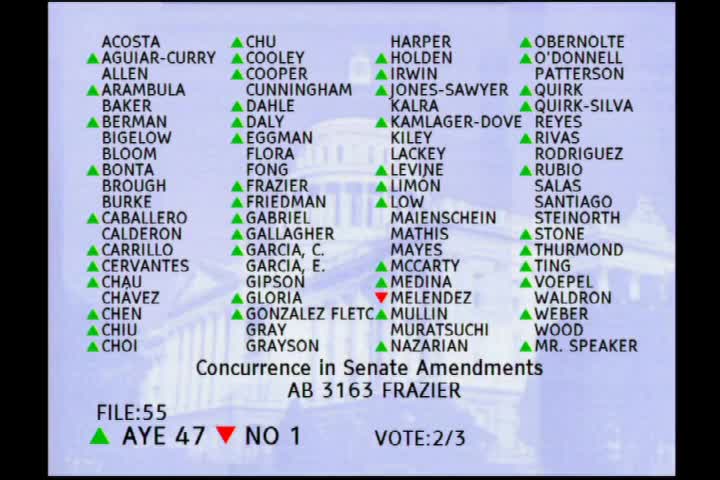 57SEC
Assembly Floor
 2MIN
Senate Floor
 1H
Senate Standing Committee on Appropriations
 21MIN
Senate Standing Committee on Transportation and Housing
 3MIN
Assembly Floor
 22MIN
Assembly Standing Committee on Local Government
 13MIN
Assembly Standing Committee on Governmental Organization
Bill Author


