AB 2772: Pupil instruction: ethnic studies: grant program.
- Session Year: 2017-2018
- House: Assembly
- Latest Version Date: 2018-09-04
Existing law requires a pupil to complete designated coursework while in grades 9 to 12, inclusive, in order to receive a diploma of graduation from high school.
Existing law requires the Instructional Quality Commission to develop, and the State Board of Education to adopt, modify, or revise, a model curriculum in ethnic studies. Existing law also encourages each school district and charter school that maintains any of grades 9 to 12, inclusive, and that does not otherwise offer a standards-based ethnic studies curriculum to offer, beginning in the school year following the adoption of the model curriculum, a course of study in ethnic studies based on the model curriculum.
This bill would authorize the governing board of a school district to, during the 201920 school year, apply to the State Department of Education for a grant to fund, for the 202021, 202122, and 202223 school years, a semester- or year-long course in ethnic studies that the governing board of the school district would require each pupil to complete, except as specified, while in any of grades 9 to 12, inclusive, in order to receive a diploma of graduation from high school. The bill would require the governing board of a school district to base any course required as part of the grant program on the model curriculum in ethnic studies adopted by the state board. The bill would require the department to award grants for these purposes, as specified, to provide professional development and technical assistance to school districts for purposes of applying for and implementing grants, and to submit a report to the Legislature that contains best practices and recommendations for including an ethnic studies course in the states high school graduation requirements. The bill would make implementation of its provisions contingent upon funding being provided for those purposes from private or public sources.
The bill would make these provisions inoperative on March 1, 2028, and would repeal them as of January 1, 2029.
Existing law requires a pupil to complete designated coursework while in grades 9 to 12, inclusive, in order to receive a diploma of graduation from high school.
Existing law requires the Instructional Quality Commission to develop, and the State Board of Education to adopt, modify, or revise, a model curriculum in ethnic studies. Existing law also encourages each school district and charter school that maintains any of grades 9 to 12, inclusive, and that does not otherwise offer a standards-based ethnic studies curriculum to offer, beginning in the school year following the adoption of the model curriculum, a course of study in ethnic studies based on the model curriculum.
This bill would authorize the governing board of a school district to, during the 201920 school year, apply to the State Department of Education for a grant to fund, for the 202021, 202122, and 202223 school years, a semester- or year-long course in ethnic studies that the governing board of the school district would require each pupil to complete complete, except as specified, while in any of grades 9 to 12, inclusive, in order to receive a diploma of graduation from high school. The bill would require the governing board of a school district to base any course required as part of the grant program on the model curriculum in ethnic studies adopted by the state board. The bill would require the department to award grants for these purposes, as specified, to provide professional development and technical assistance to school districts for purposes of applying for and implementing grants, and to submit a report to the Legislature that contains best practices and recommendations for including an ethnic studies course in the states high school graduation requirements. The bill would make implementation of its provisions contingent upon funding being provided for those purposes from private or public sources.
This
The bill would make these provisions inoperative on March 1, 2028, and would repeal them as of January 1, 2029.
Existing law requires a pupil to complete designated coursework while in grades 9 to 12, inclusive, in order to receive a diploma of graduation from high school. These graduation requirements include the completion of 3 years of courses in social studies, including one-year courses in United States history and geography and world history, culture, and geography, a one-semester course in American government and civics, and a one-semester course in economics.
Existing law requires the Instructional Quality Commission to develop, and the State Board of Education to adopt, modify, or revise, a model curriculum in ethnic studies. Existing law also encourages each school district and charter school that maintains any of grades 9 to 12, inclusive, and that does not otherwise offer a standards-based ethnic studies curriculum to offer, beginning in the school year following the adoption of the model curriculum, a course of study in ethnic studies based on the model curriculum.
This bill would add the completion of a one-semester course in ethnic studies, in either the subject of social studies or English, based on the model curriculum in ethnic studies developed by the Instructional Quality Commission, to the high school graduation requirements commencing with the 202324 school year. The bill would authorize local educational agencies to require a full-year course in ethnic studies at their discretion, as specified. authorize the governing board of a school district to, during the 201920 school year, apply to the State Department of Education for a grant to fund, for the 202021, 202122, and 202223 school years, a semester- or year-long course in ethnic studies that the governing board of the school district would require each pupil to complete while in any of grades 9 to 12, inclusive, in order to receive a diploma of graduation from high school. The bill would require the governing board of a school district to base any course required as part of the grant program on the model curriculum in ethnic studies adopted by the state board. The bill would require the department to award grants for these purposes, as specified, to provide professional development and technical assistance to school districts for purposes of applying for and implementing grants, and to submit a report to the Legislature that contains best practices and recommendations for including an ethnic studies course in the states high school graduation requirements. The bill would make implementation of its provisions contingent upon funding being provided for those purposes from private or public sources.
Because the bill would add new duties to local educational agencies, it would constitute a state-mandated local program.(2)The California Constitution requires the state to reimburse local agencies and school districts for certain costs mandated by the state. Statutory provisions establish procedures for making that reimbursement.This bill would provide that, if the Commission on State Mandates determines that the bill contains costs mandated by the state, reimbursement for those costs shall be made pursuant to the statutory provisions noted above.This bill would make these provisions inoperative on March 1, 2028, and would repeal them as of January 1, 2029.
(1)Existing law requires a pupil to complete designated coursework while in grades 9 to 12, inclusive, in order to receive a diploma of graduation from high school. These graduation requirements include the completion of 3 years of courses in social studies, including one-year courses in United States history and geography and world history, culture, and geography, a one-semester course in American government and civics, and a one-semester course in economics.
Existing law requires the Instructional Quality Commission to develop, and the State Board of Education to adopt, modify, or revise, a model curriculum in ethnic studies. Existing law also encourages each school district and charter school that maintains any of grades 9 to 12, inclusive, and that does not otherwise offer a standards-based ethnic studies curriculum to offer, beginning in the school year following the adoption of the model curriculum, a course of study in ethnic studies based on the model curriculum.
This bill would instead require each school district and charter school that maintains any of grades 9 to 12, inclusive, and that does not otherwise offer a standards-based ethnic studies curriculum to offer, beginning in the 202122 school year, a course of study in ethnic studies based on the model curriculum, as specified. The bill would specify that this ethnic studies course would be offered as an elective in the social sciences. Because the bill would add new duties to school districts and charter schools, it would constitute a state-mandated local program.The bill would add the completion of a course in ethnic studies based on the model curriculum to the high school graduation requirements in social studies commencing with the 202324 school year.This bill would add the completion of a one-semester course in ethnic studies, in either the subject of social studies or English, based on the model curriculum in ethnic studies developed by the Instructional Quality Commission, to the high school graduation requirements commencing with the 202324 school year. The bill would authorize local educational agencies to require a full-year course in ethnic studies at their discretion, as specified.
Because the bill would add new duties to local educational agencies, it would constitute a state-mandated local program.
(2)The California Constitution requires the state to reimburse local agencies and school districts for certain costs mandated by the state. Statutory provisions establish procedures for making that reimbursement.
This bill would provide that, if the Commission on State Mandates determines that the bill contains costs mandated by the state, reimbursement for those costs shall be made pursuant to the statutory provisions noted above.
(1)Existing law requires a pupil to complete designated coursework while in grades 9 to 12, inclusive, in order to receive a diploma of graduation from high school. These graduation requirements include the completion of 3 years of courses in social studies, including one-year courses in United States history and geography and world history, culture, and geography, a one-semester course in American government and civics, and a one-semester course in economics.
Existing law requires the Instructional Quality Commission to develop, and the State Board of Education to adopt, modify, or revise, a model curriculum in ethnic studies. Existing law also encourages each school district and charter school that maintains any of grades 9 to 12, inclusive, and that does not otherwise offer a standards-based ethnic studies curriculum to offer, beginning in the school year following the adoption of the model curriculum, a course of study in ethnic studies based on the model curriculum.
This bill would instead require each school district and charter school that maintains any of grades 9 to 12, inclusive, and that does not otherwise offer a standards-based ethnic studies curriculum to offer, beginning in the 202122 school year, a course of study in ethnic studies based on the model curriculum, as specified. The bill would specify that this ethnic studies course would be offered as an elective in the social sciences. Because the bill would add new duties to school districts and charter schools, it would constitute a state-mandated local program.
The bill would add the completion of a course in ethnic studies based on the model curriculum to the high school graduation requirements in social studies commencing with the 202324 school year.
(2)The California Constitution requires the state to reimburse local agencies and school districts for certain costs mandated by the state. Statutory provisions establish procedures for making that reimbursement.
This bill would provide that, if the Commission on State Mandates determines that the bill contains costs mandated by the state, reimbursement for those costs shall be made pursuant to the statutory provisions noted above.
(a)The governing board of a school district may, during the 201920 school year, apply to the department for a grant to fund a semester- or year-long course in ethnic studies that the governing board of the school district would require each pupil to complete while in any of grades 9 to 12, inclusive, in order to receive a diploma of graduation from high school.
(b)The department shall award grants for purposes of subdivision (a) between July 1, 2020, and the commencement of the 202021 school year. The department shall award grants to applicant school districts in rural, urban, and suburban locations and shall include, among other school districts, applicant school districts with underrepresented pupil groups. The department is encouraged to award a grant to at least one school district within each of the 11 California County Superintendents Educational Services Association regions. The grants shall be for a period of three school years from the 202021 to the 202223 school year, inclusive.
(c)During the duration of the application and grant implementation period, the department shall provide professional development and technical assistance to school districts for purposes of applying for and implementing grants.
(d)The governing board of a school district that receives a grant pursuant to subdivision (b) shall require, for the 202021, 202122, and 202223 school years, each pupil to complete a semester- or year-long course in ethnic studies while in any of grades 9 to 12, inclusive, in order to receive a diploma of graduation from high school. The governing board of a school district shall base any course required as part of the grant program on the model curriculum in ethnic studies adopted pursuant to Section 51226.7.
(e)Both of the following types of pupils shall not be required to complete a course in ethnic studies as part of a grant program undertaken pursuant to this section:
(1)A pupil that is graduating from high school in the year 2021.
(2)A pupil that transfers to the school district participating in the grant program during the pupils last year of high school.
(f)(1)The department shall, at the conclusion of the grant program, review the grant program, in consultation with school districts that participated in the grant program, and produce a report that contains best practices and recommendations for including an ethnic studies course in the states high school graduation requirements.
(2)The report shall include, but is not limited to, any program implementation issues, a description of what credentials the instructors of the ethnic studies courses held, any training provided to instructors, any resources offered to instructors, the course titles and syllabi for all courses required as part of the grant program, and any impact the courses had on school climate.
(3)The department shall submit the report to the Legislature in compliance with Section 9795 of the Government Code on or before March 1, 2024.
(g)Implementation of this section is contingent upon funding being provided for its purposes from private or public sources.
(h)This section shall become inoperative on March 1, 2028, and, as of January 1, 2029, is repealed.
(a)The governing board of a school district may, during the 201920 school year, apply to the department for a grant to fund a semester- or year-long course in ethnic studies that the governing board of the school district would require each pupil to complete while in any of grades 9 to 12, inclusive, in order to receive a diploma of graduation from high school.
(b)The department shall award grants for purposes of subdivision (a) between July 1, 2020, and the commencement of the 202021 school year. The department shall award grants to applicant school districts in rural, urban, and suburban locations and shall include, among other school districts, applicant school districts with underrepresented pupil groups. The department is encouraged to award a grant to at least one school district within each of the 11 California County Superintendents Educational Services Association regions. The grants shall be for a period of three school years from the 202021 to the 202223 school year, inclusive.
(c)During the duration of the application and grant implementation period, the department shall provide professional development and technical assistance to school districts for purposes of applying for and implementing grants.
(d)The governing board of a school district that receives a grant pursuant to subdivision (b) shall require, for the 202021, 202122, and 202223 school years, each pupil to complete a semester- or year-long course in ethnic studies while in any of grades 9 to 12, inclusive, in order to receive a diploma of graduation from high school. The governing board of a school district shall base any course required as part of the grant program on the model curriculum in ethnic studies adopted pursuant to Section 51226.7.
(e)Both of the following types of pupils shall not be required to complete a course in ethnic studies as part of a grant program undertaken pursuant to this section:
(1)A pupil that is graduating from high school in the year 2021.
(2)A pupil that transfers to the school district participating in the grant program during the pupils last year of high school.
(e)(f)(1)The department shall, at the conclusion of the grant program, review the grant program, in consultation with school districts that participated in the grant program, and produce a report that contains best practices and recommendations for including an ethnic studies course in the states high school graduation requirements.
(2)The report shall include, but is not limited to, any program implementation issues, a description of what credentials the instructors of the ethnic studies courses held, any training provided to instructors, any resources offered to instructors, the course titles and syllabi for all courses required as part of the grant program, and any impact the courses had on school climate.
(3)The department shall submit the report to the Legislature in compliance with Section 9795 of the Government Code on or before March 1, 2024.
(f)(g)Implementation of this section is contingent upon funding being provided for its purposes from private or public sources.
(g)(h)This section shall become inoperative on March 1, 2028, and, as of January 1, 2029, is repealed.
(a)The governing board of a school district may, during the 201920 school year, apply to the department for a grant to fund a semester- or year-long course in ethnic studies that the governing board of the school district would require each pupil to complete while in any of grades 9 to 12, inclusive, in order to receive a diploma of graduation from high school.
(b)The department shall award grants for purposes of subdivision (a) between July 1, 2020, and the commencement of the 202021 school year. The department shall award grants to applicant school districts in rural, urban, and suburban locations and shall include, among other school districts, applicant school districts with underrepresented pupil groups. The grants shall be for a period of three school years from the 202021 to the 202223 school year, inclusive.
(c)During the duration of the application and grant implementation period, the department shall provide professional development and technical assistance to school districts for purposes of applying for and implementing grants.
(d)The governing board of a school district that receives a grant pursuant to subdivision (b) shall require, for the 202021, 202122, and 202223 school years, each pupil to complete a semester- or year-long course in ethnic studies while in any of grades 9 to 12, inclusive, in order to receive a diploma of graduation from high school. The governing board of a school district shall base any course required as part of the grant program on the model curriculum in ethnic studies adopted pursuant to Section 51226.7.
(e)(1)The department shall, at the conclusion of the grant program, review the grant program, in consultation with school districts that participated in the grant program, and produce a report that contains best practices and recommendations for including an ethnic studies course in the states high school graduation requirements.
(2)The report shall include, but is not limited to, any program implementation issues, a description of what credentials the instructors of the ethnic studies courses held, any training provided to instructors, any resources offered to instructors, the course titles and syllabi for all courses required as part of the grant program, and any impact the courses had on school climate.
(3)The department shall submit the report to the Legislature in compliance with Section 9795 of the Government Code on or before March 1, 2024.
(f)Implementation of this section is contingent upon funding being provided for its purposes from private or public sources.
(g)This section shall become inoperative on March 1, 2028, and, as of January 1, 2029, is repealed.
SECTION 1.Section 51225.3 of the Education Code, as amended by Section 2 of Chapter 888 of the Statutes of 2014, is amended to read:51225.3.(a)A pupil shall complete all of the following while in grades 9 to 12, inclusive, in order to receive a diploma of graduation from high school:(1)At least the following numbers of courses in the subjects specified, each course having a duration of one year, unless otherwise specified:(A)Three courses in English.(B)Two courses in mathematics. If the governing board of a school district requires more than two courses in mathematics for graduation, the governing board of the school district may award a pupil up to one mathematics course credit pursuant to Section 51225.35.(C)Two courses in science, including biological and physical sciences.(D)Three courses in social studies, including United States history and geography; world history, culture, and geography; a one-semester course in American government and civics; and a one-semester course in economics.(E)One course in visual or performing arts or foreign language. For purposes of satisfying the requirement specified in this subparagraph, a course in American Sign Language shall be deemed a course in foreign language.(F)Two courses in physical education, unless the pupil has been exempted pursuant to the provisions of this code.(G)Commencing with the 202324 school year, a one-semester course in ethnic studies, in either the subject of social studies or English, based on the model curriculum developed pursuant to Section 51226.7. A local educational agency may require a full-year course in ethnic studies at its discretion pursuant to paragraph (2).(2)Other coursework requirements adopted by the governing board of the school district.(b)The governing board, with the active involvement of parents, administrators, teachers, and pupils, shall adopt alternative means for pupils to complete the prescribed course of study that may include practical demonstration of skills and competencies, supervised work experience or other outside school experience, career technical education classes offered in high schools, courses offered by regional occupational centers or programs, interdisciplinary study, independent study, and credit earned at a postsecondary educational institution. Requirements for graduation and specified alternative modes for completing the prescribed course of study shall be made available to pupils, parents, and the public.(c)If a pupil completed a career technical education course that met the requirements of subparagraph (E) of paragraph (1) of subdivision (a) of Section 51225.3, as amended by the act adding this section, before the inoperative date of that section, that course shall be deemed to fulfill the requirements of subparagraph (E) of paragraph (1) of subdivision (a) of this section.(d)This section shall become operative upon the date that Section 51225.3, as amended by the act adding this section, becomes inoperative.SEC. 2.Section 51225.3 of the Education Code, as amended by Section 40 of Chapter 561 of the Statutes of 2017, is amended to read:51225.3.(a)A pupil shall complete all of the following while in grades 9 to 12, inclusive, in order to receive a diploma of graduation from high school:(1)At least the following numbers of courses in the subjects specified, each course having a duration of one year, unless otherwise specified:(A)Three courses in English.(B)Two courses in mathematics. If the governing board of a school district requires more than two courses in mathematics for graduation, the governing board of the school district may award a pupil up to one mathematics course credit pursuant to Section 51225.35.(C)Two courses in science, including biological and physical sciences.(D)Three courses in social studies, including United States history and geography; world history, culture, and geography; a one-semester course in American government and civics; and a one-semester course in economics.(E)One course in visual or performing arts, foreign language, or, commencing with the 201213 school year, career technical education.(i)For purposes of satisfying the requirement specified in this subparagraph, a course in American Sign Language shall be deemed a course in foreign language.(ii)For purposes of this subparagraph, a course in career technical education means a course in a district-operated career technical education program that is aligned to the career technical model curriculum standards and framework adopted by the state board, including courses through a regional occupational center or program operated by a county superintendent of schools or pursuant to a joint powers agreement.(iii)This subparagraph does not require a school or school district that currently does not offer career technical education courses to start new career technical education programs for purposes of this section.(iv)If a school district or county office of education elects to allow a career technical education course to satisfy the requirement imposed by this subparagraph, the governing board of the school district or county office of education, before offering that alternative to pupils, shall notify parents, teachers, pupils, and the public at a regularly scheduled meeting of the governing board of all of the following:(I)The intent to offer career technical education courses to fulfill the graduation requirement specified in this subparagraph.(II)The impact that offering career technical education courses, pursuant to this subparagraph, will have on the availability of courses that meet the eligibility requirements for admission to the California State University and the University of California, and whether the career technical education courses to be offered pursuant to this subparagraph are approved to satisfy those eligibility requirements. If a school district elects to allow a career technical education course to satisfy the requirement imposed by this subparagraph, the school district shall comply with subdivision (m) of Section 48980.(III)The distinction, if any, between the high school graduation requirements of the school district or county office of education, and the eligibility requirements for admission to the California State University and the University of California.(F)Two courses in physical education, unless the pupil has been exempted pursuant to the provisions of this code.(G)Commencing with the 202324 school year, a one-semester course in ethnic studies, in either the subject of social studies or English, based on the model curriculum developed pursuant to Section 51226.7. A local educational agency may require a full-year course in ethnic studies at its discretion pursuant to paragraph (2).(2)Other coursework requirements adopted by the governing board of the school district.(b)The governing board, with the active involvement of parents, administrators, teachers, and pupils, shall adopt alternative means for pupils to complete the prescribed course of study that may include practical demonstration of skills and competencies, supervised work experience or other outside school experience, career technical education classes offered in high schools, courses offered by regional occupational centers or programs, interdisciplinary study, independent study, and credit earned at a postsecondary educational institution. Requirements for graduation and specified alternative modes for completing the prescribed course of study shall be made available to pupils, parents, and the public.(c)On or before July 1, 2017, the department shall submit a comprehensive report to the appropriate policy committees of the Legislature on the addition of career technical education courses to satisfy the requirement specified in subparagraph (E) of paragraph (1) of subdivision (a), including, but not limited to, the following information:(1)A comparison of the pupil enrollment in career technical education courses, foreign language courses, and visual and performing arts courses for the 200506 to 201112 school years, inclusive, to the pupil enrollment in career technical education courses, foreign language courses, and visual and performing arts courses for the 201213 to 201617 school years, inclusive.(2)The reasons, reported by school districts, that pupils give for choosing to enroll in a career technical education course to satisfy the requirement specified in subparagraph (E) of paragraph (1) of subdivision (a).(3)The type and number of career technical education courses that were conducted for the 200506 to 201112 school years, inclusive, compared to the type and number of career technical education courses that were conducted for the 201213 to 201617 school years, inclusive.(4)The number of career technical education courses that satisfied the subject matter requirements for admission to the University of California or the California State University.(5)The extent to which the career technical education courses chosen by pupils are aligned with the California Career Technical Education Model Curriculum Standards, and prepare pupils for employment, advanced training, and postsecondary education.(6)The number of career technical education courses that also satisfy the visual and performing arts requirement, and the number of career technical education courses that also satisfy the foreign language requirement.(7)Annual pupil dropout and graduation rates for the 201112 to 201415 school years, inclusive.(d)For purposes of completing the report described in subdivision (c), the Superintendent may use existing state resources and federal funds. If state or federal funds are not available or sufficient, the Superintendent may apply for and accept grants, and receive donations and other financial support from public or private sources for purposes of this section.(e)For purposes of completing the report described in subdivision (c), the Superintendent may accept support, including, but not limited to, financial and technical support, from high school reform advocates, teachers, chamber organizations, industry representatives, research centers, parents, and pupils.(f)This section shall become inoperative on the earlier of the following two dates:(1)On July 1, immediately following the first fiscal year after the enactment of the act that adds this paragraph in which the number of career technical education courses that, as determined by the department, satisfy the foreign language requirement for admission to the California State University and the University of California is at least twice the number of career technical education courses that meet these admission requirements as of January 1, 2012. This section shall be repealed on the following January 1, unless a later enacted statute, that becomes operative on or before that date, deletes or extends the dates on which it becomes inoperative and is repealed. It is the intent of the Legislature that new career technical education courses that satisfy the foreign language requirement for admission to the California State University and the University of California focus on world languages aligned with career preparation, emphasizing real-world application and technical content in related career and technical education courses.(2)On July 1, 2022, and, as of January 1, 2023, is repealed, unless a later enacted statute, that becomes operative on or before January 1, 2023, deletes or extends the dates on which it becomes inoperative and is repealed.SEC. 3.Section 51226.7 of the Education Code is amended to read:51226.7.(a)The Instructional Quality Commission shall develop, and the state board shall adopt, modify, or revise, a model curriculum in ethnic studies to ensure quality courses of study in ethnic studies. The model curriculum shall be developed with participation from the faculty of ethnic studies programs at universities and colleges with ethnic studies programs and a group of representatives of local educational agencies, a majority of whom are kindergarten to grade 12, inclusive, teachers who have relevant experience or education background in the study and teaching of ethnic studies.(b)The model curriculum shall be written as a guide to allow school districts to adapt their courses to reflect the pupil demographics in their communities. The model curriculum shall include examples of courses offered by local educational agencies that have been approved as meeting the AG admissions requirements of the University of California and the California State University, including, to the extent possible, course outlines for those courses.(c)On or before December 31, 2019, the Instructional Quality Commission shall submit the model curriculum to the state board for adoption, and the state board shall adopt the model curriculum on or before March 31, 2020.(d)The Instructional Quality Commission shall provide a minimum of 45 days for public comment before submitting the model curriculum to the state board.(e)It is the intent of the Legislature that local educational agencies submit course outlines for ethnic studies for approval as AG courses.SEC. 4.If the Commission on State Mandates determines that this act contains costs mandated by the state, reimbursement to local agencies and school districts for those costs shall be made pursuant to Part 7 (commencing with Section 17500) of Division 4 of Title 2 of the Government Code.(a)A pupil shall complete all of the following while in grades 9 to 12, inclusive, in order to receive a diploma of graduation from high school:
(1)At least the following numbers of courses in the subjects specified, each course having a duration of one year, unless otherwise specified:
(A)Three courses in English.
(B)Two courses in mathematics. If the governing board of a school district requires more than two courses in mathematics for graduation, the governing board of the school district may award a pupil up to one mathematics course credit pursuant to Section 51225.35.
(C)Two courses in science, including biological and physical sciences.
(D)Commencing with the 202324 school year, four Three courses in social studies, including United States history and geography; world history, culture, and geography; a one-semester course in American government and civics; and a one-semester course in economics; and a course in ethnic studies based on the model curriculum developed pursuant to Section 51226.7. economics.
(E)One course in visual or performing arts or foreign language. For purposes of satisfying the requirement specified in this subparagraph, a course in American Sign Language shall be deemed a course in foreign language.
(F)Two courses in physical education, unless the pupil has been exempted pursuant to the provisions of this code.
(G)Commencing with the 202324 school year, a one-semester course in ethnic studies, in either the subject of social studies or English, based on the model curriculum developed pursuant to Section 51226.7. A local educational agency may require a full-year course in ethnic studies at its discretion pursuant to paragraph (2).
(2)Other coursework requirements adopted by the governing board of the school district.
(b)The governing board, with the active involvement of parents, administrators, teachers, and pupils, shall adopt alternative means for pupils to complete the prescribed course of study that may include practical demonstration of skills and competencies, supervised work experience or other outside school experience, career technical education classes offered in high schools, courses offered by regional occupational centers or programs, interdisciplinary study, independent study, and credit earned at a postsecondary educational institution. Requirements for graduation and specified alternative modes for completing the prescribed course of study shall be made available to pupils, parents, and the public.
(c)If a pupil completed a career technical education course that met the requirements of subparagraph (E) of paragraph (1) of subdivision (a) of Section 51225.3, as amended by the act adding this section, before the inoperative date of that section, that course shall be deemed to fulfill the requirements of subparagraph (E) of paragraph (1) of subdivision (a) of this section.
(d)This section shall become operative upon the date that Section 51225.3, as amended by the act adding this section, becomes inoperative.
SEC. 2.Section 51225.3 of the Education Code, as amended by Section 40 of Chapter 561 of the Statutes of 2017, is amended to read:51225.3.(a)A pupil shall complete all of the following while in grades 9 to 12, inclusive, in order to receive a diploma of graduation from high school:
(1)At least the following numbers of courses in the subjects specified, each course having a duration of one year, unless otherwise specified:
(A)Three courses in English.
(B)Two courses in mathematics. If the governing board of a school district requires more than two courses in mathematics for graduation, the governing board of the school district may award a pupil up to one mathematics course credit pursuant to Section 51225.35.
(C)Two courses in science, including biological and physical sciences.
(D)Commencing with the 202324 school year, four Three courses in social studies, including United States history and geography; world history, culture, and geography; a one-semester course in American government and civics; and a one-semester course in economics; and a course in ethnic studies based on the model curriculum adopted pursuant to Section 51226.7. economics.
(E)One course in visual or performing arts, foreign language, or, commencing with the 201213 school year, career technical education.
(i)For purposes of satisfying the requirement specified in this subparagraph, a course in American Sign Language shall be deemed a course in foreign language.
(ii)For purposes of this subparagraph, a course in career technical education means a course in a district-operated career technical education program that is aligned to the career technical model curriculum standards and framework adopted by the state board, including courses through a regional occupational center or program operated by a county superintendent of schools or pursuant to a joint powers agreement.
(iii)This subparagraph does not require a school or school district that currently does not offer career technical education courses to start new career technical education programs for purposes of this section.
(iv)If a school district or county office of education elects to allow a career technical education course to satisfy the requirement imposed by this subparagraph, the governing board of the school district or county office of education, before offering that alternative to pupils, shall notify parents, teachers, pupils, and the public at a regularly scheduled meeting of the governing board of all of the following:
(I)The intent to offer career technical education courses to fulfill the graduation requirement specified in this subparagraph.
(II)The impact that offering career technical education courses, pursuant to this subparagraph, will have on the availability of courses that meet the eligibility requirements for admission to the California State University and the University of California, and whether the career technical education courses to be offered pursuant to this subparagraph are approved to satisfy those eligibility requirements. If a school district elects to allow a career technical education course to satisfy the requirement imposed by this subparagraph, the school district shall comply with subdivision (m) of Section 48980.
(III)The distinction, if any, between the high school graduation requirements of the school district or county office of education, and the eligibility requirements for admission to the California State University and the University of California.
(F)Two courses in physical education, unless the pupil has been exempted pursuant to the provisions of this code.
(G)Commencing with the 202324 school year, a one-semester course in ethnic studies, in either the subject of social studies or English, based on the model curriculum developed pursuant to Section 51226.7. A local educational agency may require a full-year course in ethnic studies at its discretion pursuant to paragraph (2).
(2)Other coursework requirements adopted by the governing board of the school district.
(b)The governing board, with the active involvement of parents, administrators, teachers, and pupils, shall adopt alternative means for pupils to complete the prescribed course of study that may include practical demonstration of skills and competencies, supervised work experience or other outside school experience, career technical education classes offered in high schools, courses offered by regional occupational centers or programs, interdisciplinary study, independent study, and credit earned at a postsecondary educational institution. Requirements for graduation and specified alternative modes for completing the prescribed course of study shall be made available to pupils, parents, and the public.
(c)On or before July 1, 2017, the department shall submit a comprehensive report to the appropriate policy committees of the Legislature on the addition of career technical education courses to satisfy the requirement specified in subparagraph (E) of paragraph (1) of subdivision (a), including, but not limited to, the following information:
(1)A comparison of the pupil enrollment in career technical education courses, foreign language courses, and visual and performing arts courses for the 200506 to 201112 school years, inclusive, to the pupil enrollment in career technical education courses, foreign language courses, and visual and performing arts courses for the 201213 to 201617 school years, inclusive.
(2)The reasons, reported by school districts, that pupils give for choosing to enroll in a career technical education course to satisfy the requirement specified in subparagraph (E) of paragraph (1) of subdivision (a).
(3)The type and number of career technical education courses that were conducted for the 200506 to 201112 school years, inclusive, compared to the type and number of career technical education courses that were conducted for the 201213 to 201617 school years, inclusive.
(4)The number of career technical education courses that satisfied the subject matter requirements for admission to the University of California or the California State University.
(5)The extent to which the career technical education courses chosen by pupils are aligned with the California Career Technical Education Model Curriculum Standards, and prepare pupils for employment, advanced training, and postsecondary education.
(6)The number of career technical education courses that also satisfy the visual and performing arts requirement, and the number of career technical education courses that also satisfy the foreign language requirement.
(7)Annual pupil dropout and graduation rates for the 201112 to 201415 school years, inclusive.
(d)For purposes of completing the report described in subdivision (c), the Superintendent may use existing state resources and federal funds. If state or federal funds are not available or sufficient, the Superintendent may apply for and accept grants, and receive donations and other financial support from public or private sources for purposes of this section.
(e)For purposes of completing the report described in subdivision (c), the Superintendent may accept support, including, but not limited to, financial and technical support, from high school reform advocates, teachers, chamber organizations, industry representatives, research centers, parents, and pupils.
(f)This section shall become inoperative on the earlier of the following two dates:
(1)On July 1, immediately following the first fiscal year after the enactment of the act that adds this paragraph in which the number of career technical education courses that, as determined by the department, satisfy the foreign language requirement for admission to the California State University and the University of California is at least twice the number of career technical education courses that meet these admission requirements as of January 1, 2012. This section shall be repealed on the following January 1, unless a later enacted statute, that becomes operative on or before that date, deletes or extends the dates on which it becomes inoperative and is repealed. It is the intent of the Legislature that new career technical education courses that satisfy the foreign language requirement for admission to the California State University and the University of California focus on world languages aligned with career preparation, emphasizing real-world application and technical content in related career and technical education courses.
(2)On July 1, 2022, and, as of January 1, 2023, is repealed, unless a later enacted statute, that becomes operative on or before January 1, 2023, deletes or extends the dates on which it becomes inoperative and is repealed.
SEC. 3.Section 51226.7 of the Education Code is amended to read:51226.7.(a)The Instructional Quality Commission shall develop, and the state board shall adopt, modify, or revise, a model curriculum in ethnic studies to ensure quality courses of study in ethnic studies. The model curriculum shall be developed with participation from the faculty of ethnic studies programs at universities and colleges with ethnic studies programs and a group of representatives of local educational agencies, a majority of whom are kindergarten to grade 12, inclusive, teachers who have relevant experience or education background in the study and teaching of ethnic studies.
(b)The model curriculum shall be written as a guide to allow school districts to adapt their courses to reflect the pupil demographics in their communities. The model curriculum shall include examples of courses offered by local educational agencies that have been approved as meeting the A-G AG admissions requirements of the University of California and the California State University, including, to the extent possible, course outlines for those courses.
(c)On or before December 31, 2019, the Instructional Quality Commission shall submit the model curriculum to the state board for adoption, and the state board shall adopt the model curriculum on or before March 31, 2020.
(d)The Instructional Quality Commission shall provide a minimum of 45 days for public comment before submitting the model curriculum to the state board.
(e)Beginning in the 202122 school year, each school district or charter school maintaining any of grades 9 to 12, inclusive, that does not otherwise offer a standards-based ethnic studies curriculum shall offer to all otherwise qualified pupils a course of study in ethnic studies based on the model curriculum. A school district or charter school that offers a course of study in ethnic studies shall offer the course as an elective in the social sciences, and shall make the course available in at least one year during a pupils enrollment in grades 9 to 12, inclusive.(f)(e)It is the intent of the Legislature that local educational agencies submit course outlines for ethnic studies for approval as A-G AG courses.
SEC. 4.If the Commission on State Mandates determines that this act contains costs mandated by the state, reimbursement to local agencies and school districts for those costs shall be made pursuant to Part 7 (commencing with Section 17500) of Division 4 of Title 2 of the Government Code.
REVISIONS: HeadingLine 2.(a)A pupil shall complete all of the following while in grades 9 to 12, inclusive, in order to receive a diploma of graduation from high school:
(1)At least the following numbers of courses in the subjects specified, each course having a duration of one year, unless otherwise specified:
(A)Three courses in English.
(B)Two courses in mathematics. If the governing board of a school district requires more than two courses in mathematics for graduation, the governing board of the school district may award a pupil up to one mathematics course credit pursuant to Section 51225.35.
(C)Two courses in science, including biological and physical sciences.
(D)Three Commencing with the 202324 school year, four courses in social studies, including United States history and geography; world history, culture, and geography; a one-semester course in American government and civics; and a one-semester course in economics. economics; and a course in ethnic studies based on the model curriculum developed pursuant to Section 51226.7.
(E)One course in visual or performing arts or foreign language. For purposes of satisfying the requirement specified in this subparagraph, a course in American Sign Language shall be deemed a course in foreign language.
(F)Two courses in physical education, unless the pupil has been exempted pursuant to the provisions of this code.
(2)Other coursework requirements adopted by the governing board of the school district.
(b)The governing board, with the active involvement of parents, administrators, teachers, and pupils, shall adopt alternative means for pupils to complete the prescribed course of study that may include practical demonstration of skills and competencies, supervised work experience or other outside school experience, career technical education classes offered in high schools, courses offered by regional occupational centers or programs, interdisciplinary study, independent study, and credit earned at a postsecondary educational institution. Requirements for graduation and specified alternative modes for completing the prescribed course of study shall be made available to pupils, parents, and the public.
(c)If a pupil completed a career technical education course that met the requirements of subparagraph (E) of paragraph (1) of subdivision (a) of Section 51225.3, as amended by the act adding this section, before the inoperative date of that section, that course shall be deemed to fulfill the requirements of subparagraph (E) of paragraph (1) of subdivision (a) of this section.
(d)This section shall become operative upon the date that Section 51225.3, as amended by the act adding this section, becomes inoperative.
SEC. 2.Section 51225.3 of the Education Code, as amended by Section 40 of Chapter 561 of the Statutes of 2017, is amended to read:51225.3.(a)A pupil shall complete all of the following while in grades 9 to 12, inclusive, in order to receive a diploma of graduation from high school:
(1)At least the following numbers of courses in the subjects specified, each course having a duration of one year, unless otherwise specified:
(A)Three courses in English.
(B)Two courses in mathematics. If the governing board of a school district requires more than two courses in mathematics for graduation, the governing board of the school district may award a pupil up to one mathematics course credit pursuant to Section 51225.35.
(C)Two courses in science, including biological and physical sciences.
(D)Three Commencing with the 202324 school year, four courses in social studies, including United States history and geography; world history, culture, and geography; a one-semester course in American government and civics; and a one-semester course in economics. economics; and a course in ethnic studies based on the model curriculum adopted pursuant to Section 51226.7.
(E)One course in visual or performing arts, foreign language, or, commencing with the 201213 school year, career technical education.
(i)For purposes of satisfying the requirement specified in this subparagraph, a course in American Sign Language shall be deemed a course in foreign language.
(ii)For purposes of this subparagraph, a course in career technical education means a course in a district-operated career technical education program that is aligned to the career technical model curriculum standards and framework adopted by the state board, including courses through a regional occupational center or program operated by a county superintendent of schools or pursuant to a joint powers agreement.
(iii)This subparagraph does not require a school or school district that currently does not offer career technical education courses to start new career technical education programs for purposes of this section.
(iv)If a school district or county office of education elects to allow a career technical education course to satisfy the requirement imposed by this subparagraph, the governing board of the school district or county office of education, before offering that alternative to pupils, shall notify parents, teachers, pupils, and the public at a regularly scheduled meeting of the governing board of all of the following:
(I)The intent to offer career technical education courses to fulfill the graduation requirement specified in this subparagraph.
(II)The impact that offering career technical education courses, pursuant to this subparagraph, will have on the availability of courses that meet the eligibility requirements for admission to the California State University and the University of California, and whether the career technical education courses to be offered pursuant to this subparagraph are approved to satisfy those eligibility requirements. If a school district elects to allow a career technical education course to satisfy the requirement imposed by this subparagraph, the school district shall comply with subdivision (m) of Section 48980.
(III)The distinction, if any, between the high school graduation requirements of the school district or county office of education, and the eligibility requirements for admission to the California State University and the University of California.
(F)Two courses in physical education, unless the pupil has been exempted pursuant to the provisions of this code.
(2)Other coursework requirements adopted by the governing board of the school district.
(b)The governing board, with the active involvement of parents, administrators, teachers, and pupils, shall adopt alternative means for pupils to complete the prescribed course of study that may include practical demonstration of skills and competencies, supervised work experience or other outside school experience, career technical education classes offered in high schools, courses offered by regional occupational centers or programs, interdisciplinary study, independent study, and credit earned at a postsecondary educational institution. Requirements for graduation and specified alternative modes for completing the prescribed course of study shall be made available to pupils, parents, and the public.
(c)On or before July 1, 2017, the department shall submit a comprehensive report to the appropriate policy committees of the Legislature on the addition of career technical education courses to satisfy the requirement specified in subparagraph (E) of paragraph (1) of subdivision (a), including, but not limited to, the following information:
(1)A comparison of the pupil enrollment in career technical education courses, foreign language courses, and visual and performing arts courses for the 200506 to 201112 school years, inclusive, to the pupil enrollment in career technical education courses, foreign language courses, and visual and performing arts courses for the 201213 to 201617 school years, inclusive.
(2)The reasons, reported by school districts, that pupils give for choosing to enroll in a career technical education course to satisfy the requirement specified in subparagraph (E) of paragraph (1) of subdivision (a).
(3)The type and number of career technical education courses that were conducted for the 200506 to 201112 school years, inclusive, compared to the type and number of career technical education courses that were conducted for the 201213 to 201617 school years, inclusive.
(4)The number of career technical education courses that satisfied the subject matter requirements for admission to the University of California or the California State University.
(5)The extent to which the career technical education courses chosen by pupils are aligned with the California Career Technical Education Model Curriculum Standards, and prepare pupils for employment, advanced training, and postsecondary education.
(6)The number of career technical education courses that also satisfy the visual and performing arts requirement, and the number of career technical education courses that also satisfy the foreign language requirement.
(7)Annual pupil dropout and graduation rates for the 201112 to 201415 school years, inclusive.
(d)For purposes of completing the report described in subdivision (c), the Superintendent may use existing state resources and federal funds. If state or federal funds are not available or sufficient, the Superintendent may apply for and accept grants, and receive donations and other financial support from public or private sources for purposes of this section.
(e)For purposes of completing the report described in subdivision (c), the Superintendent may accept support, including, but not limited to, financial and technical support, from high school reform advocates, teachers, chamber organizations, industry representatives, research centers, parents, and pupils.
(f)This section shall become inoperative on the earlier of the following two dates:
(1)On July 1, immediately following the first fiscal year after the enactment of the act that adds this paragraph in which the number of career technical education courses that, as determined by the department, satisfy the foreign language requirement for admission to the California State University and the University of California is at least twice the number of career technical education courses that meet these admission requirements as of January 1, 2012. This section shall be repealed on the following January 1, unless a later enacted statute, that becomes operative on or before that date, deletes or extends the dates on which it becomes inoperative and is repealed. It is the intent of the Legislature that new career technical education courses that satisfy the foreign language requirement for admission to the California State University and the University of California focus on world languages aligned with career preparation, emphasizing real-world application and technical content in related career and technical education courses.
(2)On July 1, 2022, and, as of January 1, 2023, is repealed, unless a later enacted statute, that becomes operative on or before January 1, 2023, deletes or extends the dates on which it becomes inoperative and is repealed.
SEC. 3.Section 51226.7 of the Education Code is amended to read:51226.7.(a)The Instructional Quality Commission shall develop, and the state board shall adopt, modify, or revise, a model curriculum in ethnic studies to ensure quality courses of study in ethnic studies. The model curriculum shall be developed with participation from the faculty of ethnic studies programs at universities and colleges with ethnic studies programs and a group of representatives of local educational agencies, a majority of whom are kindergarten to grade 12, inclusive, teachers who have relevant experience or education background in the study and teaching of ethnic studies.
(b)The model curriculum shall be written as a guide to allow school districts to adapt their courses to reflect the pupil demographics in their communities. The model curriculum shall include examples of courses offered by local educational agencies that have been approved as meeting the A-G admissions requirements of the University of California and the California State University, including, to the extent possible, course outlines for those courses.
(c)On or before December 31, 2019, the Instructional Quality Commission shall submit the model curriculum to the state board for adoption, and the state board shall adopt the model curriculum on or before March 31, 2020.
(d)The Instructional Quality Commission shall provide a minimum of 45 days for public comment before submitting the model curriculum to the state board.
(e)Beginning in the school year following the adoption of the model curriculum pursuant to subdivision (a), 202122 school year, each school district or charter school maintaining any of grades 9 to 12, inclusive, that does not otherwise offer a standards-based ethnic studies curriculum is encouraged to shall offer to all otherwise qualified pupils a course of study in ethnic studies based on the model curriculum. A school district or charter school that elects to offer offers a course of study in ethnic studies pursuant to this subdivision shall offer the course as an elective in the social sciences or English language arts sciences, and shall make the course available in at least one year during a pupils enrollment in grades 9 to 12, inclusive.
(f)It is the intent of the Legislature that local educational agencies submit course outlines for ethnic studies for approval as A-G courses.
SEC. 4.If the Commission on State Mandates determines that this act contains costs mandated by the state, reimbursement to local agencies and school districts for those costs shall be made pursuant to Part 7 (commencing with Section 17500) of Division 4 of Title 2 of the Government Code.
|
Date
|
Status
|
|---|---|
| Sep 30, 2018 | Vetoed by Governor. |
| Sep 11, 2018 | Enrolled and presented to the Governor at 4:30 p.m. |
| Aug 30, 2018 | Senate amendments concurred in. To Engrossing and Enrolling. |
| Aug 29, 2018 | In Assembly. Concurrence in Senate amendments pending. |
| Aug 29, 2018 | Read third time. Passed. Ordered to the Assembly. |
| Aug 27, 2018 | Read second time. Ordered to third reading. |
| Aug 24, 2018 | Read third time and amended. Ordered to second reading. |
| Aug 20, 2018 | Read second time. Ordered to third reading. |
| Aug 17, 2018 | From committee: Amend, and do pass as amended. (Ayes 5. Noes 2.) (August 16). |
| Aug 6, 2018 | In committee: Referred to APPR. suspense file. |
| Jun 28, 2018 | From committee: Do pass and re-refer to Com. on APPR. (Ayes 5. Noes 0.) (June 27). Re-referred to Com. on APPR. |
| Jun 20, 2018 | In committee: Hearing postponed by committee. |
| Jun 7, 2018 | Referred to Com. on ED. |
| May 31, 2018 | In Senate. Read first time. To Com. on RLS. for assignment. |
| May 30, 2018 | Read third time. Passed. Ordered to the Senate. |
| May 25, 2018 | Coauthors revised. |
| Apr 18, 2018 | In committee: Set, first hearing. Referred to APPR. suspense file. |
| Apr 4, 2018 | Re-referred to Com. on APPR. |
| Apr 3, 2018 | Read second time and amended. |
| Apr 2, 2018 | From committee: Amend, and do pass as amended and re-refer to Com. on APPR. (Ayes 5. Noes 1.) (March 21). |
| Mar 8, 2018 | Referred to Com. on ED. |
| Feb 17, 2018 | From printer. May be heard in committee March 19. |
| Feb 16, 2018 | Read first time. To print. |
|
Date
|
Description
|
Location
|
Votes
|
|
|---|---|---|---|---|
| Aug 30, 2018 | AB 2772 MEDINA Concurrence in Senate Amendments | Assembly Floor |
Passed |
|
| Aug 29, 2018 | Assembly 3rd Reading AB2772 Medina et al. By Mitchell | Senate Floor |
Passed |
|
| Aug 16, 2018 | Do pass as amended | Senate Standing Committee on Appropriations |
Passed |
|
| Aug 6, 2018 | Placed on suspense file | Senate Standing Committee on Appropriations |
Passed |
|
| Jun 27, 2018 | Do pass, but first be re-referred to the Committee on [Appropriations] | Senate Standing Committee on Education |
Passed |
|
| May 30, 2018 | AB 2772 MEDINA Assembly Third Reading | Assembly Floor |
Passed |
|
| May 25, 2018 | Do pass. | Assembly Standing Committee on Appropriations |
Passed |
|
| Mar 21, 2018 | Do pass as amended and be re-referred to the Committee on [Appropriations] | Assembly Standing Committee on Education |
Passed |
This list shows positions taken on this bill by organizations on the date displayed, which is linked to the original source.
Positions by individuals are not included.
GOVERNOR'S VETO
GV Bill Id:AB 2772
Author:(Medina, et al.)
As Enrolled Ver:September 11, 2018
2/3 vote
ASSEMBLY: | 54-19 | (May 30, 2018) | SENATE: | 31-6 | (August 29, 2018) |
ASSEMBLY: | 63-12 | (August 30, 2018) |
|
|
|
Original Committee Reference: ED.
SUMMARY: Establishes a grant program, administered by the California Department of Education (CDE), for the purpose of providing funding for courses in ethnic studies in school districts which would make ethnic studies a graduation requirement.
The Senate amendments:
- Delete the contents of this bill.
- Authorize the governing board of a school district to, during the 2019–20 school year, apply to the CDE for a grant to fund a semester- or year-long course in ethnic studies that the governing board of the school district would require each pupil to complete while in any of grades 9 to 12, inclusive, in order to receive a diploma of graduation from high school.
- Require the CDE to award grants between July 1, 2020 and the commencement of the 2020–21 school year.
- Require the CDE to award grants to applicant school districts in rural, urban, and suburban locations and to include, among others, school districts with underrepresented pupil groups.
- Encourages the CDE to award a grant to at least one school district within each of the 11 California County Superintendents Educational Services Association regions.
- Make the grants available for three school years from the 2020–21 to the 2022–23 school year.
- Require the CDE, during the duration of the application and grant implementation period, to provide professional development and technical assistance to school districts for purposes of applying for and implementing grants.
- Require the governing board of a school district that receives a grant to require, for the 2020–21, 2021–22, and 2022–23 school years, each student to complete a semester- or year-long course in ethnic studies while in grades 9 to 12 in order to receive a diploma of graduation from high school.
- Require the governing board of a school district to base any course required as part of the grant program on the model curriculum in ethnic studies required to be developed under current law.
- Exempts the following students from being required to complete a course in ethnic studies as part of a grant program:
- a student who is graduating from high school in 2021
- a student who transfers to the school district participating in the grant program during the pupil's last year of high school
- Require the CDE to, at the conclusion of the grant program, review the grant program, in consultation with school districts that participated in the grant program, and produce a report that contains best practices and recommendations for including an ethnic studies course in the state's high school graduation requirements.
- Require the report to include any program implementation issues, a description of what credentials the instructors of the ethnic studies courses held, any training provided to instructors, any resources offered to instructors, the course titles and syllabi for all courses required as part of the grant program, and any impact the courses had on school climate.
- Require the CDE to submit the report to the Legislature in compliance by March 1, 2024.
- Make implementation of the act contingent upon funding being provided for its purposes from private or public sources.
- Make the act inoperative on March 1, 2028, and repealed as of January 1, 2029.
FISCAL EFFECT: According to the Senate Appropriations Committee, while implementation of the program would be contingent upon an appropriation, the bill could result in significant cost pressure for the CDE to establish the program. The program would award grants to school districts for purposes of the program, and the administrative activities for CDE would include the provision of professional development and technical assistance. While the exact costs are unknown and would largely depend on the number of participating districts, they could be in the hundreds of thousands to low millions of dollars in Proposition 98 General Fund.
COMMENTS:
Need for the bill. According to the author's office: "The goal of AB 2772 is to allow all students to gain knowledge of one's history and community while also helping students feel more connected and empowered by the curriculum. Studies have proven that attendance, and the GPA of at-risk high school students have improved when culturally relevant pedagogy is added to the curriculum."
Steep increases in enrollment in ethnic studies courses, trend toward local ethnic studies graduation requirements. According to the California Department of Education, in 2016-17, 17,354 students were enrolled in ethnic studies courses (social science and English language arts combined), up from 8,678 in 2014-15.
Several school districts have recently made completion of a course in ethnic studies a local graduation requirement. Among them are Montebello Unified School District, El Rancho Unified School District, Sacramento City Unified School District, and Coachella Valley Unified School District.
This bill establishes a three-year grant program for school districts that require ethnic studies in order to graduate.
School districts already can, and are, requiring ethnic studies for graduation. While I recognize the value of these courses, I am reluctant to encourage yet another graduation requirement, especially when students are already overburdened by multiple tests and endless hours of homework.
Analysis Prepared by: Tanya Lieberman / ED. / (916) 319-2087 FN: 0005330
CONCURRENCE IN SENATE AMENDMENTS
CSA1 Bill Id:AB 2772
Author:(Medina, et al.)
As Amended Ver:August 24, 2018
Majority vote
ASSEMBLY: | 54-19 | (May 30, 2018) | SENATE: | 31-6 | (August 29, 2018) |
Original Committee Reference: ED.
SUMMARY: Establishes a grant program, administered by the California Department of Education (CDE), for the purpose of providing funding for courses in ethnic studies in school districts which would make ethnic studies a graduation requirement.
The Senate amendments:
- Delete the contents of this bill.
- Authorize the governing board of a school district to, during the 2019–20 school year, apply to the CDE for a grant to fund a semester- or year-long course in ethnic studies that the governing board of the school district would require each pupil to complete while in any of grades 9 to 12, inclusive, in order to receive a diploma of graduation from high school.
- Require the CDE to award grants between July 1, 2020 and the commencement of the 2020–21 school year.
- Require the CDE to award grants to applicant school districts in rural, urban, and suburban locations and to include, among others, school districts with underrepresented pupil groups.
- Encourages the CDE to award a grant to at least one school district within each of the 11 California County Superintendents Educational Services Association regions.
- Make the grants available for three school years from the 2020–21 to the 2022–23 school year.
- Require the CDE, during the duration of the application and grant implementation period, to provide professional development and technical assistance to school districts for purposes of applying for and implementing grants.
- Require the governing board of a school district that receives a grant to require, for the 2020–21, 2021–22, and 2022–23 school years, each student to complete a semester- or year-long course in ethnic studies while in grades 9 to 12 in order to receive a diploma of graduation from high school.
- Require the governing board of a school district to base any course required as part of the grant program on the model curriculum in ethnic studies required to be developed under current law.
- Exempts the following students from being required to complete a course in ethnic studies as part of a grant program:
- a student who is graduating from high school in 2021
- a student who transfers to the school district participating in the grant program during the pupil's last year of high school
- Require the CDE to, at the conclusion of the grant program, review the grant program, in consultation with school districts that participated in the grant program, and produce a report that contains best practices and recommendations for including an ethnic studies course in the state's high school graduation requirements.
- Require the report to include any program implementation issues, a description of what credentials the instructors of the ethnic studies courses held, any training provided to instructors, any resources offered to instructors, the course titles and syllabi for all courses required as part of the grant program, and any impact the courses had on school climate.
- Require the CDE to submit the report to the Legislature in compliance by March 1, 2024.
- Make implementation of the act contingent upon funding being provided for its purposes from private or public sources.
- Make the act inoperative on March 1, 2028, and repealed as of January 1, 2029.
FISCAL EFFECT: According to the Senate Appropriations Committee, while implementation of the program would be contingent upon an appropriation, the bill could result in significant cost pressure for the CDE to establish the program. The program would award grants to school districts for purposes of the program, and the administrative activities for CDE would include the provision of professional development and technical assistance. While the exact costs are unknown and would largely depend on the number of participating districts, they could be in the hundreds of thousands to low millions of dollars in Proposition 98 General Fund.
COMMENTS:
Need for the bill. According to the author's office: "The goal of AB 2772 is to allow all students to gain knowledge of one's history and community while also helping students feel more connected and empowered by the curriculum. Studies have proven that attendance, and the grade point average (GPA) of at-risk high school students have improved when culturally relevant pedagogy is added to the curriculum."
Steep increases in enrollment in ethnic studies courses, trend toward local ethnic studies graduation requirements. According to the California Department of Education, in 2016-17, 17,354 students were enrolled in ethnic studies courses (social science and English language arts combined), up from 8,678 in 2014-15.
Several school districts have recently made completion of a course in ethnic studies a local graduation requirement. Among them are Montebello Unified School District, El Rancho Unified School District, Sacramento City Unified School District, and Coachella Valley Unified School District.
Analysis Prepared by: Tanya Lieberman / ED. / (916) 319-2087 FN: 0005159
Office of Senate Floor Analyses (916) 651-1520 Fax: (916) 327-4478 | AB |
THIRD READING
Bill No: AB 2772
: in Senate
SENATE EDUCATION COMMITTEE: 5-0, 6/27/18
AYES: Allen, Galgiani, Leyva, McGuire, Pan
NO VOTE RECORDED: Wilk, Vidak
SENATE APPROPRIATIONS COMMITTEE: 5-2, 8/16/18
AYES: Portantino, Beall, Bradford, Hill, Wiener
NOES: Bates, Nielsen
ASSEMBLY FLOOR: 54-19, 5/30/18 - See last page for vote
SUBJECT: Pupil instruction: ethnic studies: grant program
DIGEST:
This bill establishes a three-year program that requires the California Department of Education (CDE), contingent upon funding, to award grants to school districts to fund a semester- or year-long course in ethnic studies as part of a local graduation requirement in ethnic studies that is applicable to all students.
Senate Floor Amendments of 8/24/18 exempt 2020-21 school year seniors and any student who transfers to a participating school during their senior year from the requirement to complete a course in ethnic studies as part of the grant program. The amendments also encourage the CDE to award a grant to at least one school district within each of the 11 California County Superintendents Educational Services Association regions.
Existing law:
- Establishes statewide high school graduation requirements, which include, among other requirements, three courses in English and three courses in social studies, and authorizes school districts to establish additional requirements for graduation. (Education Code § 51225.3)
- Requires the Instructional Quality Commission (IQC) to develop, and the State Board of Education (SBE) to adopt, modify, or revise, a model curriculum in ethnic studies. (EC § 51226.7)
- Requires the IQC to submit the model curriculum by December 31, 2019, to the SBE for adoption, and the SBE to adopt the model curriculum by March 31, 2020. (EC § 51226.7)
- Requires the model curriculum to be developed with participation from faculty of ethnic studies programs at universities and colleges with ethnic studies programs and a group of representatives of local educational agencies (LEAs). (EC § 51226.7)
- Requires that the model curriculum be written as a guide to allow school districts to adapt their courses to reflect the student demographics in their communities, and include examples of courses offered by LEAs that have been approved as meeting A-G admissions requirements including, to the extent possible, course outlines for those courses. (EC § 51226.7)
- Encourages each school district or charter school maintaining any of grades 9 to 12, inclusive, that does not otherwise offer a standards-based ethnic studies curriculum, beginning in the school year following the adoption of the model curriculum, to offer to all otherwise qualified pupils a course of study in ethnic studies based on the model curriculum. (EC § 51226.7)
- Requires a school district or charter school that elects to offer a course of study in ethnic studies pursuant to the model curriculum to offer the course as an elective in the social sciences or English language arts and to make the course available in at least one year during a pupil’s enrollment in grades 9 to 12, inclusive. (EC § 51226.7)
- States the intent of the Legislature that LEAs submit course outlines for ethnic studies for approval as “A-G” courses which meet the admissions requirements of the University of California (UC) and the California State University (CSU). (EC § 51226.7)
- Authorizes the governing board of a school district or a county board of education, on a districtwide or countywide basis or on behalf of one or more of its schools or programs, after a public hearing on the matter, to request the SBE to waive all or part of any section of this code or any regulation adopted by the SBE that implements a provision of this code that may be waived, including graduation requirements. (EC § 33050)
This bill establishes a three-year program that requires the CDE, contingent upon funding, to award grants to school districts to fund a semester- or year-long course in ethnic studies as part of a local graduation requirement in ethnic studies that is applicable to all students. Specifically, this bill:
- Authorizes the governing board of a school district, during the 2019-20 school year, to apply to the CDE for a grant to fund a semester- or year-long course in ethnic students that the governing board of the school district would require each pupil to complete while in any of grades 9 to 12, inclusive, in order to receive a diploma of graduation from high school.
- Requires the CDE to award grants for that purpose between July 1, 2020, and the commencement of the 2020-21 school year.
- Requires the CDE to award the grants to applicant school districts in rural, urban, and suburban locations and to include, among other school districts, applicant school districts with underrepresented pupil group.
- Requires the grants to be for a period of three school years from the 2020-21 school year to the 2022-23 school year, and requires the CDE, during the duration of application and grant implementation period, to provide professional development and technical assistance to school districts for purposes of applying for and implementing the grants.
- Requires a grantee to require, for the 2020-21, 2021-22, and 2022-23 school years, each student to complete a semester- or year-long course in ethnic studies while in any of grades 9 to 12, inclusive, in order to receive a diploma of graduation from high school.
- Requires a grantee to base any course required as part of the grant program on the model curriculum in ethnic studies.
- Requires the CDE, at the conclusion of the grant program, to review the program, in consultation with participating school districts, and to produce a report to Legislature by March 1, 2024, that contains best practices and recommendations for including an ethnic studies course in the state’s high school graduation requirements.
- Requires the report to include at least all of the following:
- Program implementation issues.
- A description of what credentials the instructors of the ethnic studies courses held.
- Any resources offered to instructors.
- Course titles and syllabi for all courses required as part of the grant program.
- Any impact the courses had on school climate.
- Makes implementation of its provisions contingent upon funding being provided for its purposes from private or public sources.
- Makes its provisions inoperative on March 1, 2028, and repeals them as of January 1, 2029.
Comments
- Need for the bill? According to the author, “Ethnic studies is an interdisciplinary field of study that encompasses many subject areas, including: history, literature, economics, sociology, and political science, among others. It offers an in-depth comparative study of the history, politics, culture, contributions, challenges, and current status of ethnic groups in the United States.
“It is important for students to learn the national origins of ethnic groups and their transnational linkages. In Ethnic Studies, students examine the formation process of ethnic minorities in a variety of contexts: political, legal, social, historical, economic, and cultural. Ethnic studies concentrates on the experiences of various ethnic minorities and the ways in which their experiences were impacted by the issues of race, ethnicity, class, gender, and the interaction among different ethnic groups.”
- Ethnic studies model curriculum under development. As noted above, existing law requires the development of an ethnic studies model curriculum. The model curriculum must be written as a guide to allow school districts to adapt their courses to reflect the pupil demographics in their communities and include examples of courses offered by LEAs that have been approved as meeting the A-G admissions requirements of the UC and the CSU, including, to the extent possible, course outlines for those courses.
The IQC must develop and submit the model curriculum in ethnic studies to the SBE by December 31, 2019, and the SBE must adopt the curriculum by March 31, 2020. The CDE held a public input webinar in January of this year, and will be bringing a project timeline, advisory committee application, and guidelines to the IQC in May, and to the SBE for approval in July. CDE reports that advisory committee members will be recruited from late summer and fall, and that the advisory committee will begin meeting in February of next year.
- Ethnic studies enrollment. Enrollment in, and course offerings of, ethnic studies is increasing, but many social science ethnic studies courses are not “A-G” approved. Enrollment in ethnic studies courses has been growing in recent years, but a significant number are not approved as meeting “A-G” admissions requirements of the UC and the CSU systems, particularly those offered as social science courses. In order for courses to receive approval, course outlines must be submitted to, and approved by, the UC. In recognition of this problem, the statute authorizing the development of the model curriculum requires that it include examples of courses “A-G” approved courses, including course outlines for those courses, to the extent feasible. The CDE data on course enrollment and offerings in ethnic studies indicates that in 2016-17, 17,354 students were enrolled in ethnic studies courses (social science and English language arts combined), up from 8,678 in 2014-15.
- Local ethnic studies graduation requirements. Existing law authorizes local school district governing boards to impose additional graduation requirements beyond the state-mandated graduation requirements, and several school districts have recently made completion of a course in ethnic studies a local graduation requirement. Among them are Montebello Unified School District, El Rancho Unified School District, Sacramento City Unified School District, and Coachella Valley Unified School District.
- Similar efforts in other states. California would not be the first state to consider increasing ethnic studies instruction. Beginning this fall, as a result of Senate Enrolled Act 337, all high schools in Indiana will be required to offer an ethnic and racial studies elective course at least every school. In Oregon, as a result of House Bill 2845, an advisory group is developing ethnic-studies standards into existing statewide social-studies standards where "it fails to recognize the histories, contributions and perspectives of ethnic minorities and social minorities.” The Oregon Department of Education will adopt the ethnic studies standards by adopted by 2020, and must direct each school district to implement the ethnic studies standards by July 1, 2021.
- Research on academic value of ethnic studies. As noted in the Assembly Education Committee analysis, a review by the National Education Association found that “there is considerable research evidence that well-designed and well-taught ethnic studies curricula have positive academic and social outcomes for students.” Another recent analysis found “a consistent, significant, positive relationship between [Mexican American Studies] participation and student academic performance.” A 2016 study from Stanford University (published as a working paper) on the effects of an ethnic studies curriculum piloted in several San Francisco Unified School District high schools found that assignment to a year-long 9th grade ethnic studies course was associated with an increase of ninth-grade student attendance by 21 percentage points, GPA by 1.4 grade points, and credits earned by 23. The authors conclude that “these surprisingly large effects are consistent with the hypothesis that the course reduced dropout rates and suggest that culturally relevant teaching, when implemented in a supportive, high-fidelity context, can provide effective support to at-risk students.”
FISCAL EFFECT: Appropriation: Fiscal Com.: Local: No
According to the Senate Appropriations Committee, while implementation of the program would be contingent upon an appropriation, this bill could result in significant cost pressure for CDE to establish the program. The program would award grants to school districts for purposes of the program, and the administrative activities for CDE would include the provision of professional development and technical assistance. While the exact costs are unknown and would largely depend on the number of participating districts, they could be in the hundreds of thousands to low millions of dollars in Proposition 98 General Fund.
State Superintendent of Public Instruction Tom Torlakson
Asian Americans Advancing Justice
Association of Mexican American Educators, Inc. – East Los Angeles Chapter
Association of Raza Educators
Black Parallel School Board
CAFÉ de California
California Association for Bilingual Education
California Chapter of the National Association for Multicultural Education
California Faculty Association
California Federation of Teachers
California Latino School Boards Association
California School Boards Association
California State Conference of the NAACP
California Teachers Association
Californians Together
Chicano Latino Caucus of the California Democratic Party
City of Perris
Common Sense Kids Action
ConXión to Community
County of Monterey
Delores Huerta Foundation
Empowering Pacific Islander Communities
Greater Riverside Hispanic Chamber of Commerce
Inland Empire Economic Partnership
La Raza Roundtable del California
Latino Caucus of California Counties
Latino Network
League of United Latin American Citizens #2862
Monterrey County Board of Supervisors
Moreno Valley Hispanic Chamber of Commerce
Music Changing Lives
Occupy Riverside
Organize Sacramento
Riverside Side Branch NAACP
Roberts Family Development Center
San Francisco Unified School District
SIATech High School
Sol Collective
Southeast Asia Resource Action Center
Spanish Town Heritage Foundation
Student Affairs Professionals and Educators
The Cambodian Family Community Center
The Education Trust—West
Training Occupational Development Educating Communities Legal Center
United Farm Workers
United Teachers Los Angeles
Xicanx Institute for Teaching and Organizing
Multiple individuals
OPPOSITION: (Verified 8/24/18)
None received
ASSEMBLY FLOOR: 54-19, 5/30/18
AYES: Aguiar-Curry, Arambula, Berman, Bloom, Bonta, Burke, Caballero, Calderon, Carrillo, Cervantes, Chau, Chiu, Choi, Chu, Cooley, Cooper, Daly, Eggman, Frazier, Friedman, Cristina Garcia, Eduardo Garcia, Gipson, Gloria, Gonzalez Fletcher, Gray, Grayson, Holden, Irwin, Jones-Sawyer, Kalra, Kamlager-Dove, Levine, Limón, Low, McCarty, Medina, Mullin, Muratsuchi, Nazarian, O'Donnell, Quirk, Quirk-Silva, Reyes, Rodriguez, Rubio, Salas, Santiago, Mark Stone, Thurmond, Ting, Weber, Wood, Rendon
NOES: Travis Allen, Baker, Bigelow, Brough, Chávez, Chen, Cunningham, Dahle, Fong, Harper, Kiley, Lackey, Maienschein, Mathis, Melendez, Obernolte, Patterson, Voepel, Waldron
NO VOTE RECORDED: Acosta, Flora, Gallagher, Mayes, Steinorth
8/27/18 19:35:00
Office of Senate Floor Analyses (916) 651-1520 Fax: (916) 327-4478 | AB |
THIRD READING
Bill No: AB 2772
: in Senate
SENATE EDUCATION COMMITTEE: 5-0, 6/27/18
AYES: Allen, Galgiani, Leyva, McGuire, Pan
NO VOTE RECORDED: Wilk, Vidak
SENATE APPROPRIATIONS COMMITTEE: 5-2, 8/16/18
AYES: Portantino, Beall, Bradford, Hill, Wiener
NOES: Bates, Nielsen
ASSEMBLY FLOOR: 54-19, 5/30/18 - See last page for vote
SUBJECT: Pupil instruction: ethnic studies: grant program
DIGEST:
This bill establishes a three-year program that requires the California Department of Education (CDE), contingent upon funding, to award grants to school districts to fund a semester- or year-long course in ethnic studies as part of a local graduation requirement in ethnic studies that is applicable to all students.
Existing law:
- Establishes statewide high school graduation requirements, which include, among other requirements, three courses in English and three courses in social studies, and authorizes school districts to establish additional requirements for graduation. (Education Code § 51225.3)
- Requires the Instructional Quality Commission (IQC) to develop, and the State Board of Education (SBE) to adopt, modify, or revise, a model curriculum in ethnic studies. (EC § 51226.7)
- Requires the IQC to submit the model curriculum by December 31, 2019, to the SBE for adoption, and the SBE to adopt the model curriculum by March 31, 2020. (EC § 51226.7)
- Requires the model curriculum to be developed with participation from faculty of ethnic studies programs at universities and colleges with ethnic studies programs and a group of representatives of local educational agencies (LEAs). (EC § 51226.7)
- Requires that the model curriculum be written as a guide to allow school districts to adapt their courses to reflect the student demographics in their communities, and include examples of courses offered by LEAs that have been approved as meeting A-G admissions requirements including, to the extent possible, course outlines for those courses. (EC § 51226.7)
- Encourages each school district or charter school maintaining any of grades 9 to 12, inclusive, that does not otherwise offer a standards-based ethnic studies curriculum, beginning in the school year following the adoption of the model curriculum, to offer to all otherwise qualified pupils a course of study in ethnic studies based on the model curriculum. (EC § 51226.7)
- Requires a school district or charter school that elects to offer a course of study in ethnic studies pursuant to the model curriculum to offer the course as an elective in the social sciences or English language arts and to make the course available in at least one year during a pupil’s enrollment in grades 9 to 12, inclusive. (EC § 51226.7)
- States the intent of the Legislature that LEAs submit course outlines for ethnic studies for approval as “A-G” courses which meet the admissions requirements of the University of California (UC) and the California State University (CSU). (EC § 51226.7)
- Authorizes the governing board of a school district or a county board of education, on a districtwide or countywide basis or on behalf of one or more of its schools or programs, after a public hearing on the matter, to request the SBE to waive all or part of any section of this code or any regulation adopted by the SBE that implements a provision of this code that may be waived, including graduation requirements. (EC § 33050)
This bill establishes a three-year program that requires the CDE, contingent upon funding, to award grants to school districts to fund a semester- or year-long course in ethnic studies as part of a local graduation requirement in ethnic studies that is applicable to all students. Specifically, this bill:
- Authorizes the governing board of a school district, during the 2019-20 school year, to apply to the CDE for a grant to fund a semester- or year-long course in ethnic students that the governing board of the school district would require each pupil to complete while in any of grades 9 to 12, inclusive, in order to receive a diploma of graduation from high school.
- Requires the CDE to award grants for that purpose between July 1, 2020, and the commencement of the 2020-21 school year.
- Requires the CDE to award the grants to applicant school districts in rural, urban, and suburban locations and to include, among other school districts, applicant school districts with underrepresented pupil group.
- Requires the grants to be for a period of three school years from the 2020-21 school year to the 2022-23 school year, and requires the CDE, during the duration of application and grant implementation period, to provide professional development and technical assistance to school districts for purposes of applying for and implementing the grants.
- Requires a grantee to require, for the 2020-21, 2021-22, and 2022-23 school years, each student to complete a semester- or year-long course in ethnic studies while in any of grades 9 to 12, inclusive, in order to receive a diploma of graduation from high school.
- Requires a grantee to base any course required as part of the grant program on the model curriculum in ethnic studies.
- Requires the CDE, at the conclusion of the grant program, to review the program, in consultation with participating school districts, and to produce a report to Legislature by March 1, 2024, that contains best practices and recommendations for including an ethnic studies course in the state’s high school graduation requirements.
- Requires the report to include at least all of the following:
- Program implementation issues.
- A description of what credentials the instructors of the ethnic studies courses held.
- Any resources offered to instructors.
- Course titles and syllabi for all courses required as part of the grant program.
- Any impact the courses had on school climate.
- Makes implementation of its provisions contingent upon funding being provided for its purposes from private or public sources.
- Makes its provisions inoperative on March 1, 2028, and repeals them as of January 1, 2029.
Comments
- Need for the bill? According to the author, “Ethnic studies is an interdisciplinary field of study that encompasses many subject areas, including: history, literature, economics, sociology, and political science, among others. It offers an in-depth comparative study of the history, politics, culture, contributions, challenges, and current status of ethnic groups in the United States.
“It is important for students to learn the national origins of ethnic groups and their transnational linkages. In Ethnic Studies, students examine the formation process of ethnic minorities in a variety of contexts: political, legal, social, historical, economic, and cultural. Ethnic studies concentrates on the experiences of various ethnic minorities and the ways in which their experiences were impacted by the issues of race, ethnicity, class, gender, and the interaction among different ethnic groups.”
- Ethnic studies model curriculum under development. As noted above, existing law requires the development of an ethnic studies model curriculum. The model curriculum must be written as a guide to allow school districts to adapt their courses to reflect the pupil demographics in their communities and include examples of courses offered by LEAs that have been approved as meeting the A-G admissions requirements of the UC and the CSU, including, to the extent possible, course outlines for those courses.
The IQC must develop and submit the model curriculum in ethnic studies to the SBE by December 31, 2019, and the SBE must adopt the curriculum by March 31, 2020. The CDE held a public input webinar in January of this year, and will be bringing a project timeline, advisory committee application, and guidelines to the IQC in May, and to the SBE for approval in July. CDE reports that advisory committee members will be recruited from late summer and fall, and that the advisory committee will begin meeting in February of next year.
- Ethnic studies enrollment. Enrollment in, and course offerings of, ethnic studies is increasing, but many social science ethnic studies courses are not “A-G” approved. Enrollment in ethnic studies courses has been growing in recent years, but a significant number are not approved as meeting “A-G” admissions requirements of the UC and the CSU systems, particularly those offered as social science courses. In order for courses to receive approval, course outlines must be submitted to, and approved by, the UC. In recognition of this problem, the statute authorizing the development of the model curriculum requires that it include examples of courses “A-G” approved courses, including course outlines for those courses, to the extent feasible.
The CDE data on course enrollment and offerings in ethnic studies indicates the following:
- In 2016-17, 17,354 students were enrolled in ethnic studies courses (social science and English language arts combined), up from 8,678 in 2014-15.
- The total above includes 4,662 students enrolled in ethnic studies courses in English language arts, in 210 courses in 82 schools in ethnic studies.
- In 2016-17, 943 ethnic studies courses (social science and English language arts combined) were taught in 555 schools, compared with 696 courses in 177 schools in 2014-15.
- In 2016-17, for ethnic studies courses in social science, 395 of the 777 courses (51 percent) were approved as meeting “A-G” admissions requirements.
- In 2016-17, English language arts ethnic studies courses were more likely to be approved, with 166 of 210 (80 percent) courses approved as meeting “A-G” admissions requirements.
- Local ethnic studies graduation requirements. Existing law authorizes local school district governing boards to impose additional graduation requirements beyond the state-mandated graduation requirements, and several school districts have recently made completion of a course in ethnic studies a local graduation requirement. Among them are Montebello Unified School District, El Rancho Unified School District, Sacramento City Unified School District, and Coachella Valley Unified School District.
- Similar efforts in other states. California would not be the first state to consider increasing ethnic studies instruction. Beginning this fall, as a result of Senate Enrolled Act 337, all high schools in Indiana will be required to offer an ethnic and racial studies elective course at least every school. In Oregon, as a result of House Bill 2845, an advisory group is developing ethnic-studies standards into existing statewide social-studies standards where "it fails to recognize the histories, contributions and perspectives of ethnic minorities and social minorities.” The Oregon Department of Education will adopt the ethnic studies standards by adopted by 2020, and must direct each school district to implement the ethnic studies standards by July 1, 2021.
- Research on academic value of ethnic studies. As noted in the Assembly Education Committee analysis, a review by the National Education Association found that “there is considerable research evidence that well-designed and well-taught ethnic studies curricula have positive academic and social outcomes for students.” Another recent analysis found “a consistent, significant, positive relationship between [Mexican American Studies] participation and student academic performance.” A 2016 study from Stanford University (published as a working paper) on the effects of an ethnic studies curriculum piloted in several San Francisco Unified School District high schools found that assignment to a year-long 9th grade ethnic studies course was associated with an increase of ninth-grade student attendance by 21 percentage points, GPA by 1.4 grade points, and credits earned by 23. The authors conclude that “these surprisingly large effects are consistent with the hypothesis that the course reduced dropout rates and suggest that culturally relevant teaching, when implemented in a supportive, high-fidelity context, can provide effective support to at-risk students.”
FISCAL EFFECT: Appropriation: Fiscal Com.: Local: No
According to the Senate Appropriations Committee, while implementation of the program would be contingent upon an appropriation, the bill could result in significant cost pressure for the California Department of Education (CDE) to establish the program. The program would award grants to school districts for purposes of the program, and the administrative activities for CDE would include the provision of professional development and technical assistance. While the exact costs are unknown and would largely depend on the number of participating districts, they could be in the hundreds of thousands to low millions of dollars in Proposition 98 General Fund.
State Superintendent of Public Instruction Tom Torlakson
Asian Americans Advancing Justice
Association of Mexican American Educators, Inc. – East Los Angeles Chapter
Association of Raza Educators
Black Parallel School Board
CAFÉ de California
California Association for Bilingual Education
California Chapter of the National Association for Multicultural Education
California Faculty Association
California Federation of Teachers
California Latino School Boards Association
California School Boards Association
California State Conference of the NAACP
Californians Together
City of Perris
Common Sense Kids Action
ConXión to Community
Delores Huerta Foundation
Empowering Pacific Islander Communities
Greater Riverside Hispanic Chamber of Commerce
Inland Empire Economic Partnership
La Raza Roundtable del California
Latino Caucus of California Counties
Latino Network
League of United Latin American Citizens #2862
Monterrey County Board of Supervisors
Moreno Valley Hispanic Chamber of Commerce
Music Changing Lives
Occupy Riverside
Organize Sacramento
Riverside Side Branch NAACP
Roberts Family Development Center
San Francisco Unified School District
SIATech High School
Sol Collective
Southeast Asia Resource Action Center
Spanish Town Heritage Foundation
Student Affairs Professionals and Educators
The Cambodian Family Community Center
The Education Trust—West
Training Occupational Development Educating Communities Legal Center
United Farm Workers
United Teachers Los Angeles
Xicanx Institute for Teaching and Organizing
Multiple individuals
OPPOSITION: (Verified 8/17/18)
None received
ASSEMBLY FLOOR: 54-19, 5/30/18
AYES: Aguiar-Curry, Arambula, Berman, Bloom, Bonta, Burke, Caballero, Calderon, Carrillo, Cervantes, Chau, Chiu, Choi, Chu, Cooley, Cooper, Daly, Eggman, Frazier, Friedman, Cristina Garcia, Eduardo Garcia, Gipson, Gloria, Gonzalez Fletcher, Gray, Grayson, Holden, Irwin, Jones-Sawyer, Kalra, Kamlager-Dove, Levine, Limón, Low, McCarty, Medina, Mullin, Muratsuchi, Nazarian, O'Donnell, Quirk, Quirk-Silva, Reyes, Rodriguez, Rubio, Salas, Santiago, Mark Stone, Thurmond, Ting, Weber, Wood, Rendon
NOES: Travis Allen, Baker, Bigelow, Brough, Chávez, Chen, Cunningham, Dahle, Fong, Harper, Kiley, Lackey, Maienschein, Mathis, Melendez, Obernolte, Patterson, Voepel, Waldron
NO VOTE RECORDED: Acosta, Flora, Gallagher, Mayes, Steinorth
8/20/18 11:48:36
SENATE COMMITTEE ON APPROPRIATIONS
Senator Anthony Portantino, Chair
2017 - 2018 Regular Session
AB 2772 (Medina) - Pupil instruction: ethnic studies
Version: April 3, 2018 | Policy Vote: ED. 5 - 0 |
Urgency: No | Mandate: Yes |
Hearing Date: August 16, 2018 | Consultant: Lenin Del Castillo |
Bill Summary:
> This bill requires all students, commencing with the 2023-24 school year, to complete a semester-long social studies or English language arts course in ethnic studies, based on a state-adopted model curriculum, in order to graduate from high school.
*********** ANALYSIS ADDENDUM – SUSPENSE FILE ***********
The following information is revised to reflect amendments
adopted by the committee on August 16, 2018
Fiscal Impact:
While implementation of the program would be contingent upon an appropriation, the bill could result in significant cost pressure for the California Department of Education (CDE) to establish the program. The program would award grants to school districts for purposes of the program, and the administrative activities for CDE would include the provision of professional development and technical assistance. While the exact costs are unknown and would largely depend on the number of participating districts, they could be in the hundreds of thousands to low millions of dollars in Proposition 98 General Fund.
Author Amendments:
Replace the bill’s requirement with an ethnic studies grant program, as specified, to be administered by the (CDE).
-- END --
SENATE COMMITTEE ON APPROPRIATIONS
Senator Anthony Portantino, Chair
2017 - 2018 Regular Session
AB 2772 (Medina) - Pupil instruction: ethnic studies
Version: April 3, 2018 | Policy Vote: ED. 5 - 0 |
Urgency: No | Mandate: Yes |
Hearing Date: August 6, 2018 | Consultant: Lenin Del Castillo |
This bill meets the criteria for referral to the Suspense File.
Bill Summary:
This bill requires all students, commencing with the 2023-24 school year, to complete a semester-long social studies or English language arts course in ethnic studies, based on a state-adopted model curriculum, in order to graduate from high school.
Fiscal Impact:
By requiring a semester-long social studies or English language arts course in ethnic studies as a new high school graduation requirement, this bill could create a reimbursable state mandate likely to be in the low millions of dollars annually (Proposition 98 General Fund). This estimate is based on the statewide cost estimate adopted by the Commission on State Mandates for the Graduation Requirements mandate. The reimbursable activities would include hiring new teachers or providing additional training, integration of ethnic studies content in current courses, course development, and the purchase of instructional materials. To the extent that school districts are already requiring a course in ethnic studies as a local graduation requirement, the related costs could be eligible for reimbursement from the state.
Background: Existing law establishes statewide high school graduation requirements, which include, among other requirements, three courses in English, three courses in social studies, and two courses in science. Existing law also authorizes school districts to establish additional requirements for graduation.
Existing law requires the Instructional Quality Commission (IQC) to develop, and the State Board of Education (SBE) to adopt, modify, or revise, a model curriculum in ethnic studies. The IQC shall submit the model curriculum by December 31, 2019 to the SBE for adoption, and the SBE to adopt the model curriculum by March 31, 2020. Existing law requires the model curriculum to be developed with participation from faculty of ethnic studies programs at universities and colleges with ethnic studies programs and a group of representatives of local educational agencies (LEAs), and requires that the model curriculum be written as a guide to allow school districts to adapt their courses to reflect the student demographics in their communities, and include examples of courses offered by LEAs that have been approved as meeting A-G admissions requirements including, to the extent possible, course outlines for those courses.
Existing law encourages each school district or charter school maintaining any of grades 9 to 12, inclusive, that does not otherwise offer a standards-based ethnic studies curriculum, beginning in the school year following the adoption of the model curriculum, to offer to all otherwise qualified pupils a course of study in ethnic studies based on the model curriculum.
Proposed Law:
This bill adds, commencing with the 2023–24 school year, a one-semester course in ethnic studies, in either the subject of social studies or English, based on the model curriculum, to the list of statewide graduation requirements. It also authorizes that an LEA may require a full-year course in ethnic studies at its discretion.
This bill also deletes the following provisions from existing law:
- Encouraging each school district or charter school maintaining any of grades 9 to 12, inclusive, that does not otherwise offer a standards-based ethnic studies curriculum, beginning in the school year following the adoption of the model curriculum, to offer to all otherwise qualified pupils a course of study in ethnic studies based on the model curriculum.
- Requiring a school district or charter school that elects to offer a course of study in ethnic studies pursuant to the model curriculum to offer the course as an elective in the social sciences or English language arts and to make the course available in at least one year during a pupil’s enrollment in grades 9 to 12, inclusive.
Related Legislation:
AB 2016 (Alejo, Chapter 327, Statues of 2016) required the development of a model curriculum in ethnic studies and required school districts which elect to offer one course in ethnic studies to make the course available in at least one year during a student’s enrollment in grades 9-12.
AB 101 (Alejo, 2015), similar to AB 2016, would have required the development of a model curriculum in ethnic studies. This measure was vetoed with the following message:
This bill would require the Superintendent of Public Instruction to oversee the development of a model curriculum in ethnic studies for adoption by the State Board of Education.
This bill creates what is essentially a redundant process. The Instructional Quality Commission is in the midst of revising the History-Social Science Framework, which includes guidance on ethnic studies courses.
Creating yet another advisory body specific to ethnic studies would be duplicative and undermine our current curriculum process.
Staff Comments:
Requiring students to complete a course in ethnic studies as a condition of graduation necessitates that each high school offers sufficient sections of ethnic studies courses to each student that attends high school. Of the 1,945,405 students enrolled in high school in the 2016-17 school year, fewer than 1 percent were enrolled in an ethnic studies course. This means that schools will have to significantly ramp up ethnic studies course offerings in order to meet the 2023-24 school year deadline in the bill. The 2024 graduating class begins high school in the fall of 2019.
-- END --
SENATE COMMITTEE ON EDUCATION
Senator Benjamin Allen, Chair
2017 - 2018 Regular
Bill No: AB 2772 Hearing Date: June 27, 2018
Author: | Medina | ||
Version: | April 3, 2018 | ||
Urgency: | No | Fiscal: | Yes |
Consultant: | Brandon Darnell | ||
Subject: Pupil instruction: ethnic studies.
SUMMARY
This bill requires all students, commencing with the 2023-24 school year, to complete a semester-long social studies or English language arts course in ethnic studies, based on a state-adopted model curriculum, in order to graduate from high school.
BACKGROUND
Existing law:
1) Establishes statewide high school graduation requirements, which include, among other requirements, three courses in English and three courses in social studies, and authorizes school districts to establish additional requirements for graduation. (Education Code § 51225.3)
2) Requires the Instructional Quality Commission (IQC) to develop, and the State Board of Education (SBE) to adopt, modify, or revise, a model curriculum in ethnic studies. (EC § 51226.7)
3) Requires the IQC to submit the model curriculum by December 31, 2019 to the SBE for adoption, and the SBE to adopt the model curriculum by March 31, 2020. (EC § 51226.7)
4) Requires the model curriculum to be developed with participation from faculty of ethnic studies programs at universities and colleges with ethnic studies programs and a group of representatives of local educational agencies (LEAs).
(EC § 51226.7)
5) Requires that the model curriculum be written as a guide to allow school districts to adapt their courses to reflect the student demographics in their communities, and include examples of courses offered by LEAs that have been approved as meeting A-G admissions requirements including, to the extent possible, course outlines for those courses. (EC § 51226.7)
6) Encourages each school district or charter school maintaining any of grades 9 to 12, inclusive, that does not otherwise offer a standards-based ethnic studies curriculum, beginning in the school year following the adoption of the model curriculum, to offer to all otherwise qualified pupils a course of study in ethnic studies based on the model curriculum. (EC § 51226.7)
7) Requires a school district or charter school that elects to offer a course of study in ethnic studies pursuant to the model curriculum to offer the course as an elective in the social sciences or English language arts and to make the course available in at least one year during a pupil’s enrollment in grades 9 to 12, inclusive. (EC § 51226.7)
8) States the intent of the Legislature that local educational agencies (LEAs) submit course outlines for ethnic studies for approval as “A-G” courses which meet the admissions requirements of the University of California (UC) and the California State University (CSU). (EC § 51226.7)
9) Authorizes the governing board of a school district or a county board of education, on a districtwide or countywide basis or on behalf of one or more of its schools or programs, after a public hearing on the matter, to request the State Board of Education to waive all or part of any section of this code or any regulation adopted by the state board that implements a provision of this code that may be waived, including graduation requirements. (EC § 33050)
ANALYSIS
This bill requires all students, commencing with the 2023-24 school year, to complete a semester-long social studies or English language arts course in ethnic studies, based on a state-adopted model curriculum, in order to graduate from high school. Specifically, this bill:
1) Adds, commencing with the 2023–24 school year, a one-semester course in ethnic studies, in either the subject of social studies or English, based on the model curriculum, to the list of statewide graduation requirements.
2) Expressly authorizes that a LEA may require a full-year course in ethnic studies at its discretion.
3) Deletes both of the following provisions:
a) Encouraging each school district or charter school maintaining any of grades 9 to 12, inclusive, that does not otherwise offer a standards-based ethnic studies curriculum, beginning in the school year following the adoption of the model curriculum, to offer to all otherwise qualified pupils a course of study in ethnic studies based on the model curriculum.
b) Requiring a school district or charter school that elects to offer a course of study in ethnic studies pursuant to the model curriculum to offer the course as an elective in the social sciences or English language arts and to make the course available in at least one year during a pupil’s enrollment in grades 9 to 12, inclusive.
STAFF COMMENTS
1) Need for the bill? According to the author, “Ethnic studies is an interdisciplinary field of study that encompasses many subject areas, including: history, literature, economics, sociology, and political science, among others. It offers an in-depth comparative study of the history, politics, culture, contributions, challenges, and current status of ethnic groups in the United States.
It is important for students to learn the national origins of ethnic groups and their transnational linkages. In Ethnic Studies, students examine the formation process of ethnic minorities in a variety of contexts: political, legal, social, historical, economic, and cultural. Ethnic studies concentrates on the experiences of various ethnic minorities and the ways in which their experiences were impacted by the issues of race, ethnicity, class, gender, and the interaction among different ethnic groups.”
2) Ethnic studies model curriculum under development. As noted above, existing law requires the development of an ethnic studies model curriculum. The model curriculum must be written as a guide to allow school districts to adapt their courses to reflect the pupil demographics in their communities and include examples of courses offered by local educational agencies that have been approved as meeting the A-G admissions requirements of the University of California (UC) and the California State University (CSU), including, to the extent possible, course outlines for those courses.
The Instructional Quality Commission (IQC) must develop and submit the model curriculum in ethnic studies to the State Board of Education (SBE) by December 31, 2019, and the SBE must adopt the curriculum by March 31, 2020. The California Department of Education (CDE) held a public input webinar in January of this year, and will be bringing a project timeline, advisory committee application, and guidelines to the IQC in May, and to the SBE for approval in July. CDE reports that advisory committee members will be recruited from late summer and fall, and that the advisory committee will begin meeting in February of next year.
This bill requires the 2024 graduating class to have completed a course in ethnic studies. Under these timeframes, the 2024 graduating class will begin high school before the SBE adopts the model curriculum.
3) Ethnic studies enrollment. Enrollment in, and course offerings of, ethnic studies is increasing, but many social science ethnic studies courses are not “A-G” approved. Enrollment in ethnic studies courses has been growing in recent years, but a significant number are not approved as meeting “A-G” admissions requirements of the UC and the CSU systems, particularly those offered as social science courses. In order for courses to receive approval, course outlines must be submitted to, and approved by, the UC. In recognition of this problem, the statute authorizing the development of the model curriculum requires that it include examples of courses “A-G” approved courses, including course outlines for those courses, to the extent feasible.
The CDE data on course enrollment and offerings in ethnic studies indicates the following:
• In 2016-17, 17,354 students were enrolled in ethnic studies courses (social science and English language arts combined), up from 8,678 in 2014-15.
• The total above includes 4,662 students enrolled in ethnic studies courses in English language arts, in 210 courses in 82 schools in ethnic studies.
• In 2016-17, 943 ethnic studies courses (social science and English language arts combined) were taught in 555 schools, compared with 696 courses in 177 schools in 2014-15.
• In 2016-17, for ethnic studies courses in social science, 395 of the 777 courses (51 percent) were approved as meeting “A-G” admissions requirements.
• In 2016-17, English language arts ethnic studies courses were more likely to be approved, with 166 of 210 (80 percent) courses approved as meeting “A-G” admissions requirements.
4) Capacity questions. Requiring students to complete a course in ethnic studies as a condition of graduation necessitates that each high school offers sufficient sections of ethnic studies courses to each student that attends high school. Based on the California Department of Education (CDE) data above, of the 1,945,405 students enrolled in high school in the 2016-17 school year, fewer than 1 percent were enrolled in an ethnic studies course. Accordingly, this means that schools will have to significantly ramp up ethnic studies course offerings, and do quickly, in order to meet the 2023-24 school year deadline in the bill. The 2024 graduating class begins high school in the fall of 2019. With these figures in mind, the committee may wish to consider:
a) Whether school districts and county offices of education have sufficient resources to offer an ethnic studies course and instructional materials for each student?
b) Are there enough appropriately credentialed teachers to teach ethnic studies to each student that attends high school?
c) Do students have sufficient flexibility in their schedules to absorb an additional required course while retaining the freedom to explore elective courses and career technical education courses or pathways?
d) Do additional graduation requirements potentially crowd out or discourage other local graduation requirements? According to the CDE “most school districts in California require between 22 and 26 one-year courses (or the equivalent) for graduation.” The state requires a minimum of 13 courses.
The governing board of a school district or a county board of education may request a waiver from the graduation requirements from the State Board of Education. For the reasons outlined above, the committee may wish to consider encouraging the author to amend the bill to account for this authority and to allow local educational agencies flexibility to take innovative approaches to ensuring that all students receive ethnic studies instruction, as shown below:
“(g)(2) Notwithstanding any other law, this paragraph may be waived by the state board if a local educational agency submits, and the state board approves, a formal plan to ensure that the ethnic studies model curriculum is incorporated into one or more existing courses, such that each pupil receives instruction on the ethnic studies model curriculum, and the proposed approach has unique benefits.”
5) Existing graduation requirements. Since the 1986-87 school year, the Education Code has required students receiving a diploma from a California high school to have completed all of the following one-year (unless otherwise specified) courses while in high school:
- Three courses in English.
- Two courses in mathematics, including one year of Algebra I.
- Two courses in science, including biological and physical sciences.
- Three courses in social studies, including United States history and geography; world history, culture, and geography; a one-semester course in American government and civics, and a one-semester course in economics.
- One course in visual or performing arts, foreign language, or commencing with the 2012-13 school year, career technical education.
- Two courses in physical education.
These statewide minimum requirements are not as robust as the A-G admissions requirements of the California State University and University of California, which require:
- Two years of history/social science, including one year of world history, cultures and historical geography and one year of U.S. history, or one-half year of U.S. history and one-half year of American government or civics.
- Four years of college preparatory English that integrates reading of classic and modern literature, frequent and regular writing, and practice listening and speaking.
- Three years of college-preparatory math, including or integrating the topics covered in elementary and advanced algebra and two- and three-dimensional geometry.
- Two years of laboratory science providing fundamental knowledge in at least two of the three disciplines of biology, chemistry and physics.
- Two years of the same language other than English or equivalent to the second level of high school instruction.
- One year of visual and performing chosen from dance, music, theater or the visual arts.
- One year of a college-preparatory elective beyond those used to satisfy the requirements above, or courses that have been approved solely in the elective area.
It should be noted the Legislature has considered a burgeoning list of subjects for a new graduation requirement in recent years, including financial literacy, service learning, health, and now, ethnic studies. Additionally, the Legislature has authorized AP computer science to count toward local math graduation requirements beyond the state requirements, and expanded the foreign language or visual and performing arts requirement to also be satisfied by a career technical education course. Moreover, other bills have attempted to revise the number of courses required for certain existing subjects. The committee may wish to consider whether all of these measures – taken together – as well as the differences between the state minimum requirements and the California State University/University of California requirements, indicate a need revisit the state graduation requirements as a whole and perhaps make appropriate changes, including by adding new requirements in existing and new subjects.
6) Local ethnic studies graduation requirements. Existing law authorizes local school district governing boards to impose additional graduation requirements beyond the state-mandated graduation requirements, and several school districts have recently made completion of a course in ethnic studies a local graduation requirement. Among them are Montebello Unified School District, El Rancho Unified School District, Sacramento City Unified School District, and Coachella Valley Unified School District.
7) What about charter schools? According to the California Department of Education, whether students at a California approved charter school are required to complete the 13 minimum courses mandated for graduation “depends on a variety of factors.” Accordingly, students at charter schools may not be subject to the graduation requirement proposed by the bill. The author may wish to consider clarifying the applicability of the bill’s provisions to charter school students.
8) Similar efforts in other states. California would not be the first state to consider increasing ethnic studies instruction. Beginning this fall, as a result of Senate Enrolled Act 337, all high schools in Indiana will be required to offer an ethnic and racial studies elective course at least every school. In Oregon, as a result of House Bill 2845, an advisory group is developing ethnic-studies standards into existing statewide social-studies standards where "it fails to recognize the histories, contributions and perspectives of ethnic minorities and social minorities.” The Oregon Department of Education will adopt the ethnic studies standards by adopted by 2020, and must direct each school district to implement the ethnic studies standards by July 1, 2021. While these efforts are similar, they do not go as far as this bill in requiring ethnic studies as its own graduation requirement.
9) Ethnic studies course outlined in History-Social Science framework. The History-Social Science Framework adopted by the State Board of Education (SBE) in 2016 describes high school elective courses in ethnic studies as follows:
“Ethnic studies is an interdisciplinary field of study that encompasses many subject areas including history, literature, economics, sociology, and political science, among others. In this course, students focus on an in-depth comparative study of the history, politics, culture, contributions, challenges, and current status of ethnic groups in the United States. It is also important for students to learn the national origins of ethnic groups and their transnational linkages. In Ethnic Studies, students examine the process of racial and ethnic formation of ethnic minorities in a variety of contexts: political, legal, social, historical, economic, and cultural. The course concentrates, to a great extent, on the experiences of various ethnic minorities in the United States and the ways in which their experiences were impacted by the issues of race, ethnicity, class, gender, and the interaction among different ethnic groups. Students will also address how individuals within specific ethnic groups think and feel about themselves and their group as it can be represented by literature, memoirs, art, and music. To understand ethnic identity in their local communities, students can volunteer with local community organizations and centers that serve specific ethnic populations.”
In addition, many of these concepts are incorporated throughout the newly adopted framework. For example, as described in the framework’s executive summary, “Students in first grade develop a deeper understanding of cultural diversity and learn to appreciate people from various backgrounds and the many ways of life that exist in the larger world.” At the high school level, one of the four themes in eleventh grade is “changes in racial, ethnic, and gender dynamics in American society.”
10) Research on academic value of ethnic studies. As noted in the Assembly Education Committee analysis, a review by the National Education Association found that “there is considerable research evidence that well-designed and well-taught ethnic studies curricula have positive academic and social outcomes for students.” Another recent analysis found “a consistent, significant, positive relationship between [Mexican American Studies] participation and student academic performance.” A 2016 study from Stanford University (published as a working paper) on the effects of an ethnic studies curriculum piloted in several San Francisco Unified School District high schools found that assignment to a year-long 9th grade ethnic studies course was associated with an increase of ninth-grade student attendance by 21 percentage points, GPA by 1.4 grade points, and credits earned by 23. The authors conclude that “these surprisingly large effects are consistent with the hypothesis that the course reduced dropout rates and suggest that culturally relevant teaching, when implemented in a supportive, high-fidelity context, can provide effective support to at-risk students.” They also note, “the implementation of ethnic studies in SFUSD was, arguably, conducted with a high degree of fidelity, forethought, and planning. In particular, it appeared to draw upon the work of a core group of dedicated teachers, engaging in a regular professional learning community, with outside support from experts in the subject to create and sustain the program. As scholars from a number of disciplines have noted, the effects of such smaller-scale interventions are often very different when the same policies are implemented at scale.”
11) Previous legislation. AB 2016 (Alejo, Chapter 327, Statues of 2016) required the development of a model curriculum in ethnic studies and required school districts which elect to offer one course in ethnic studies to make the course available in at least one year during a student’s enrollment in grades 9-12.
AB 1689 (Low, 2015-16 Session) would have required, beginning with the high school class of 2022-23, that at least one of the courses required for graduation include a service-learning component. This bill was held in the Assembly Appropriations Committee.
AB 524 (Low, 2015-16 Session) would have required, beginning with the high school class of 2020-21, that at least one of the courses required for graduation include a service-learning component. This bill was held in the Assembly Appropriations Committee.
SUPPORT
State Superintendent of Public Instruction Tom Torlakson
California Legislative Black Caucus
Association of Mexican American Educators, Inc. – East Los Angeles Chapter
Association of Raza Educators
Black Parallel School Board
Café de California
California Association for Bilingual Education
California Faculty Association
California Federation of Teachers
California Latino School Boards Association
California Chapter of the National Association for Multicultural Education
Californians Together
California State Conference of the NAACP
City of Perris
Common Sense Kids Action
Greater Riverside Hispanic Chamber of Commerce
Inland Empire Economic Partnership
Latino Caucus of California Counties
Latino Network
League of United Latin American Citizens #2862
Monterrey County Board of Supervisors
Music Changing Lives
Occupy Riverside
Riverside Side Branch NAACP
Roberts Family Development Center
San Francisco Unified School District
SIATech High School
Southeast Asia Resource Action Center
Spanish Town Heritage Foundation
The Cambodian Family Community Center
The Education Trust—West
United Teachers Los Angeles
Xicanx Institute for Teaching and Organizing
Multiple individuals
OPPOSITION
California School Boards Association
-- END --
SENATE COMMITTEE ON EDUCATION
Senator Benjamin Allen, Chair
2017 - 2018 Regular
Bill No: Hearing Date: June 20, 2018
Author: | Medina | ||
Version: |
| ||
Urgency: | Fiscal: | ||
Consultant: | |||
Subject: .
SUMMARY
This bill requires all students, commencing with the 2023-24 school year, complete a semester-long social studies or English language arts course in ethnic studies, based on a state-adopted model curriculum, in order to graduate from high school.
BACKGROUND
Existing law:
1) Establishes statewide high school graduation requirements, which include, among other requirements, three courses in English and three courses in social studies, and authorizes school districts to establish additional requirements for graduation. (Education Code § 51225.3)
2) Requires the Instructional Quality Commission (IQC) to develop, and the State Board of Education (SBE) to adopt, modify, or revise, a model curriculum in ethnic studies. (EC § 51226.7)
3) Requires the IQC to submit the model curriculum by December 31, 2019 to the SBE for adoption, and the SBE to adopt the model curriculum by March 31, 2020. (EC § 51226.7)
4) Requires the model curriculum to be developed with participation from faculty of ethnic studies programs at universities and colleges with ethnic studies programs and a group of representatives of local educational agencies (LEAs).
(EC § 51226.7)
5) Requires that the model curriculum be written as a guide to allow school districts to adapt their courses to reflect the student demographics in their communities, and include examples of courses offered by LEAs that have been approved as meeting A-G admissions requirements including, to the extent possible, course outlines for those courses. (EC § 51226.7)
6) Encourages each school district or charter school maintaining any of grades 9 to 12, inclusive, that does not otherwise offer a standards-based ethnic studies curriculum, beginning in the school year following the adoption of the model curriculum, to offer to all otherwise qualified pupils a course of study in ethnic studies based on the model curriculum. (EC § 51226.7)
7) Requires a school district or charter school that elects to offer a course of study in ethnic studies pursuant to the model curriculum to offer the course as an elective in the social sciences or English language arts and to make the course available in at least one year during a pupil’s enrollment in grades 9 to 12, inclusive. (EC § 51226.7)
8) States the intent of the Legislature that local educational agencies (LEAs) submit course outlines for ethnic studies for approval as “A-G” courses which meet the admissions requirements of the University of California (UC) and the California State University (CSU). (EC § 51226.7)
ANALYSIS
This bill requires all students, commencing with the 2023-24 school year, complete a semester-long social studies or English language arts course in ethnic studies, based on a state-adopted model curriculum, in order to graduate from high school. Specifically, this bill:
1) Adds, commencing with the 2023–24 school year, a one-semester course in ethnic studies, in either the subject of social studies or English, based on the model curriculum, to the list of statewide graduation requirements.
2) Expressly authorizes a LEA may require a full-year course in ethnic studies at its discretion.
3) Deletes both of the following provisions:
a) Encouraging each school district or charter school maintaining any of grades 9 to 12, inclusive, that does not otherwise offer a standards-based ethnic studies curriculum, beginning in the school year following the adoption of the model curriculum, to offer to all otherwise qualified pupils a course of study in ethnic studies based on the model curriculum.
b) Requiring a school district or charter school that elects to offer a course of study in ethnic studies pursuant to the model curriculum to offer the course as an elective in the social sciences or English language arts and to make the course available in at least one year during a pupil’s enrollment in grades 9 to 12, inclusive.
STAFF COMMENTS
1) Need for the bill? According to the author, “Ethnic studies is an interdisciplinary field of study that encompasses many subject areas, including: history, literature, economics, sociology, and political science, among others. It offers an in-depth comparative study of the history, politics, culture, contributions, challenges, and current status of ethnic groups in the United States.
It is important for students to learn the national origins of ethnic groups and their transnational linkages. In Ethnic Studies, students examine the formation process of ethnic minorities in a variety of contexts: political, legal, social, historical, economic, and cultural. Ethnic studies concentrates on the experiences of various ethnic minorities and the ways in which their experiences were impacted by the issues of race, ethnicity, class, gender, and the interaction among different ethnic groups.”
2) Ethnic studies enrollment. Enrollment in, and course offerings of, ethnic studies is increasing, but many social science ethnic studies courses are not “A-G” approved. Enrollment in ethnic studies courses has been growing in recent years, but a significant number are not approved as meeting “A-G” admissions requirements of the University of California (UC) and the California State University (CSU) systems, particularly those offered as social science courses. In order for courses to receive approval, course outlines must be submitted to, and approved by, the UC. In recognition of this problem, the statute authorizing the development of the model curriculum requires that it include examples of courses “A-G” approved courses, including course outlines for those courses, to the extent feasible.
The California Department of Education (CDE) data on course enrollment and offerings in ethnic studies indicates the following:
• In 2016-17, 17,354 students were enrolled in ethnic studies courses (social science and English language arts combined), up from 8,678 in 2014-15.
• The total above includes 4,662 students enrolled in ethnic studies courses in English language arts, in 210 courses in 82 schools in ethnic studies.
• In 2016-17, 943 ethnic studies courses (social science and English language arts combined) were taught in 555 schools, compared with 696 courses in 177 schools in 2014-15.
• In 2016-17, for ethnic studies courses in social science, 395 of the 777 courses (51 percent) were approved as meeting “A-G” admissions requirements.
• In 2016-17, English language arts ethnic studies courses were more likely to be approved, with 166 of 210 (80 percent) courses approved as meeting “A-G” admissions requirements.
3) Capacity questions. Requiring pupils to complete a course in ethnic studies as a condition of graduation necessitates that each high school offers sufficient sections of financial literacy courses educate each pupil that graduates high school. Based on the CDE data above, of the 1,945,405 students enrolled in high school in the 2016-17 school year, fewer than 1 percent were enrolled in an ethnic studies course. The committee may wish to consider:
a) Do school districts and county offices of education have sufficient resources to offer an ethnic studies course and instructional material for each student?
b) Are there enough appropriately credentialed teachers to teach ethnic studies to each student that attends high school?
c) Do students have sufficient flexibility in their schedules to absorb an additional required course while retaining the freedom to explore elective courses or career technical education courses or pathways?
4) Local ethnic studies graduation requirements. Several school districts have recently made completion of a course in ethnic studies a local graduation requirement. Among them are Montebello Unified School District, El Rancho Unified School District, Sacramento City Unified School District, and Coachella Valley Unified School District.
5) Ethnic studies course outlined in History-Social Science framework. The History-Social Science Framework adopted by the State Board of Education (SBE) in 2017 describes high school elective courses in ethnic studies as follows:
“Ethnic studies is an interdisciplinary field of study that encompasses many subject areas including history, literature, economics, sociology, and political science, among others. In this course, students focus on an in-depth comparative study of the history, politics, culture, contributions, challenges, and current status of ethnic groups in the United States. It is also important for students to learn the national origins of ethnic groups and their transnational linkages. In Ethnic Studies, students examine the process of racial and ethnic formation of ethnic minorities in a variety of contexts: political, legal, social, historical, economic, and cultural. The course concentrates, to a great extent, on the experiences of various ethnic minorities in the United States and the ways in which their experiences were impacted by the issues of race, ethnicity, class, gender, and the interaction among different ethnic groups. Students will also address how individuals within specific ethnic groups think and feel about themselves and their group as it can be represented by literature, memoirs, art, and music. To understand ethnic identity in their local communities, students can volunteer with local community organizations and centers that serve specific ethnic populations.”
6) Research on academic value of ethnic studies. As noted in the Assembly Education Committee analysis, a review by the National Education Association found that “there is considerable research evidence that well-designed and well-taught ethnic studies curricula have positive academic and social outcomes for students.” Another recent analysis found “a consistent, significant, positive relationship between [Mexican American Studies] participation and student academic performance.” A 2016 study from Stanford University (published as a working paper) on the effects of an ethnic studies curriculum piloted in several San Francisco Unified School District high schools found that assignment to a year-long 9th grade ethnic studies course was associated with an increase of ninth-grade student attendance by 21 percentage points, GPA by 1.4 grade points, and credits earned by 23. The authors conclude that “these surprisingly large effects are consistent with the hypothesis that the course reduced dropout rates and suggest that culturally relevant teaching, when implemented in a supportive, high-fidelity context, can provide effective support to at-risk students.” They also note, “the implementation of ethnic studies in SFUSD was, arguably, conducted with a high degree of fidelity, forethought, and planning. In particular, it appeared to draw upon the work of a core group of dedicated teachers, engaging in a regular professional learning community, with outside support from experts in the subject to create and sustain the program. As scholars from a number of disciplines have noted, the effects of such smaller-scale interventions are often very different when the same policies are implemented at scale.”
7) Previous legislation. AB 2016 (Alejo, Chapter 327, Statues of 2016) required the development of a model curriculum in ethnic studies and required school districts which elect to offer one course in ethnic studies to make the course available in at least one year during a student’s enrollment in grades 9-12.
AB 1689 (Low, 2015-16 Session) would have required, beginning with the high school class of 2022-23, that at least one of the courses required for graduation include a service-learning component. This bill was held in the Assembly Appropriations Committee.
AB 524 (Low, 2015-16 Session) would have required, beginning with the high school class of 2020-21, that at least one of the courses required for graduation include a service-learning component. This bill was held in the Assembly Appropriations Committee.
SUPPORT
Association of Mexican American Educators, Inc. – East Los Angeles Chapter
Association of Raza Educators
Black Parallel School Board
California Association for Bilingual Education
California Faculty Association
California Latino School Boards Association
California Chapter of the National Association for Multicultural Education
Californians Together
California State Conference of the NAACP
Common Sense Kids Action
Latino Caucus of California Counties
Latino Network
Monterrey County Board of Supervisors
Music Changing Lives
Occupy Riverside
Roberts Family Development Center
San Francisco Unified School District
SIATech High School
Southeast Asia Resource Action Center
The Cambodian Family Community Center
The Education Trust—West
United Teachers Los Angeles
OPPOSITION
California School Boards Association
-- END --
ASSEMBLY THIRD READING
ATR Bill Id:AB 2772
Author:()
As Amended Ver:
Majority vote
Committee | Votes | Ayes | Noes |
Education | 5-1 | O'Donnell, Lackey, Kalra, Thurmond, Weber | Kiley |
Appropriations | 12-3 | Gonzalez Fletcher, Bloom, Bonta, Calderon, Carrillo, Chau, Eggman, Friedman, Eduardo Garcia, Nazarian, Quirk, Reyes | Bigelow, Fong, Obernolte |
SUMMARY: Requires all students to complete a semester-long social studies or English language arts course in ethnic studies to graduate from high school, based on a state-adopted model curriculum, commencing in the 2023-24 school year. Specifically, this bill:
- Requires, commencing with the 2023-24 school year, that students complete a one semester ethnic studies course, in either social studies or English, in order to meet state high school graduation requirements.
- States that a local educational agency may require a full-year course in ethnic studies at its discretion under its authority to establish local graduation requirements that exceed those of the state.
FISCAL EFFECT: According to the Assembly Appropriations Committee, potentially reimbursable Proposition 98 General Fund state mandated costs, likely in the millions of dollars annually, to incorporate instruction in ethnic studies in high school courses. Costs would include funding for additional teacher training or hiring; integration of ethnic studies content in current courses or ethnic studies course development; purchase of supplemental materials; and outreach to students and parents about the new graduation requirement. Costs would likely be less for schools that already offer ethnic studies classes or include ethnic studies as part of their school district's local graduation requirements.
Need for the bill. According to the author's office: "The goal of AB 2772 is to allow all students to gain knowledge of one's history and community while also helping students feel more connected and empowered by the curriculum. Studies have proven that attendance, and the grade point average (GPA) of at-risk high school students have improved when culturally relevant pedagogy is added to the curriculum."
State graduation requirements. Current law establishes state high school graduation requirements, including three year-long courses in English and the equivalent of three year-long courses in social studies. Current law also permits school districts to establish local graduation requirements which exceed those of the state.
Existing law does not require course in ethnic studies for graduation, but does require a school district or charter school that elects to offer a course of study in ethnic studies to offer the course as an elective in the social sciences or English language arts and to make the course available in at least one year during a student's enrollment in grades 9 to 12.
Steep increases in enrollment in ethnic studies courses, trend toward local ethnic studies graduation requirements. According to the California Department of Education, in 2016-17, 17,354 students were enrolled in ethnic studies courses (social science and English language arts combined), up from 8,678 in 2014-15.
Several school districts have recently made completion of a course in ethnic studies a local graduation requirement. Among them are Montebello Unified School District, El Rancho Unified School District, Sacramento City Unified School District, and Coachella Valley Unified School District.
Status of ethnic studies model curriculum. This bill requires that the ethnic studies social studies or English courses required for graduation be based on a state-adopted model curriculum in ethnic studies currently under development. Current law requires the Instructional Quality Commission (IQC) to develop and submit that model curriculum in ethnic studies to the SBE by December 31, 2019, and the SBE to adopt the curriculum by March 31, 2020.
The CDE held a public input webinar in January of this year, and is scheduled to bring a project timeline, advisory committee application, and guidelines to the IQC in May, and to the SBE for approval in July. CDE reports that advisory committee members will be recruited from late summer and fall, and that the advisory committee will begin meeting in February of next year.
Analysis Prepared by: Tanya Lieberman / ED. / (916) 319-2087 FN: 0003079
Date of Hearing: April 18, 2018
ASSEMBLY COMMITTEE ON APPROPRIATIONS
Lorena Gonzalez Fletcher, Chair
ABPCA Bill Id:AB 2772
Author:(Medina) – As Amended Ver:April 3, 2018
Policy Committee: | Education | Vote: | 5 - 1 |
|
| ||
|
|
Urgency: No State Mandated Local Program: Yes Reimbursable: Yes
SUMMARY: This bill requires all students to complete a semester-long social studies or English language arts course in ethnic studies to graduate from high school, based on state-adopted model curriculum, commencing in the 2023-24 school year.
FISCAL EFFECT:
Potentially reimbursable Proposition 98 General Fund state mandated costs, likely in the millions of dollars annually, to incorporate instruction in ethnic studies in high school courses. Costs would include funding for additional teacher training or hiring; integration of ethnic studies content in current courses or ethnic studies course development; purchase of supplemental materials; and outreach to students and parents about the new graduation requirement. Costs would likely be less for schools that already offer ethnic studies classes or include ethnic studies as part of their school district’s local graduation requirements.
COMMENTS:
- Purpose. The author indicates the goal of requiring ethnic studies as a graduation requirement is to help all students better understand their histories and communities. The author states, “Studies have proven that attendance and the grade point average of at-risk high school students have improved when culturally relevant pedagogy is added to the curriculum.”
- Ethnic Studies Courses. The State Board of Education’s curriculum frameworks describe high school ethnic studies courses as interdisciplinary courses that focus on ethnic groups’ experiences in the United States with a concentration on the experiences of these groups in historical, literary, and political contexts, among others. High schools may elect to offer ethnic studies courses and these courses typically are taught as part of English language arts or social science courses.
In the 2016-17 school year, 17,354 students enrolled in 943 ethnic studies courses at 555 schools. Of these courses, about 60% were approved as meeting the admissions requirements for UC and CSU.
- Current Graduation Requirements. Current law establishes state high school graduation requirements. Current law requires high school students to complete three courses in English and three courses in social studies. The social studies courses must include a United States history and geography course; a world history, culture, and geography course; a one-semester course in American government and civics; and a one-semester course in economics. While the state does not require a course in ethnic studies for graduation, it does require a school district or charter school electing to offer a course of study in ethnic studies to offer the course as an elective in the social sciences or English language arts and make the course available in at least one year during a student’s enrollment in grades 9 to 12.
Current law also permits school districts to establish local graduation requirements which exceed those of the state. Several school districts have recently made completion of a course in ethnic studies a local graduation requirement.
- Ethnic Studies Curriculum Development. To date, the state has not adopted a model curriculum for schools to use to teach ethnic studies courses. State law requires the State Board of Education do so by March 31, 2020. This curriculum is to include examples of ethnic studies courses meeting admissions requirements for UC and CSU.
Analysis Prepared by: Natasha Collins / APPR. / (916) 319-2081
Date of Hearing: March 21, 2018
ASSEMBLY COMMITTEE ON EDUCATION
Patrick O'Donnell, Chair
ABPCA Bill Id:AB 2772 (
Author:Medina) – As Introduced Ver:February 16, 2018
SUBJECT: Pupil instruction: ethnic studies
SUMMARY: Requires all students to complete a year-long social studies course in ethnic studies to graduate from high school, commencing in the 2023-24 school year. Specifically, this bill:
- Requires, commencing with the 2023-24 school year, that students complete four courses in social studies, including one year long social studies course in ethnic studies based on an ethnic studies model curriculum currently under development.
- Maintains the requirement school districts and charter schools that do not otherwise offer a standards-based ethnic studies curriculum to offer to all otherwise qualified pupils an elective course in ethnic studies based on the model curriculum, but specifies that the requirement is effective in the 2021-22 school year, and repeals the option of meeting this requirement by offering an elective in English language arts.
EXISTING LAW:
- Establishes high school graduation requirements, and authorizes school districts to establish additional requirements for graduation.
- Requires the Instructional Quality Commission (IQC) to develop, and the State Board of Education (SBE) to adopt, modify, or revise, a model curriculum in ethnic studies. Requires that, by December 31, 2019, the IQC to submit the model curriculum to the SBE for adoption, and the SBE to adopt the model curriculum by March 31, 2020.
- Requires the model curriculum to be developed with participation from faculty of ethnic studies programs at universities and colleges with ethnic studies programs and a group of representatives of local educational agencies (LEAs).
- Requires that the model curriculum be written as a guide to allow school districts to adapt their courses to reflect the student demographics in their communities, and include examples of courses offered by LEAs that have been approved as meeting A-G admissions requirements including, to the extent possible, course outlines for those courses.
- Requires the IQC to provide a minimum of 45 days for public comment before submitting the model curriculum to the SBE.
- Requires a school district or charter school that elects to offer a course of study in ethnic studies to offer the course as an elective in the social sciences or English language arts and to make the course available in at least one year during a student’s enrollment in grades 9 to 12.
- States the intent of the Legislature that local educational agencies submit course outlines for ethnic studies for approval as A-G courses which meet the admissions requirements of the University of California (UC) and the California State University (UC).
FISCAL EFFECT: This bill has been keyed a state mandated local program by the Office of Legislative Counsel.
COMMENTS:
Need for the bill. According to the author’s office: “The goal of AB 2772 is to allow all students to gain knowledge of one’s history and community while also helping students feel more connected and empowered by the curriculum. Studies have proven that attendance, and the GPA of at-risk high school students have improved when culturally relevant pedagogy is added to the curriculum.”
State graduation requirements. Current law establishes state high school graduation requirements, including the equivalent of three year-long courses in social studies. These courses must include United States history and geography; world history, culture, and geography; a one-semester course in American government and civics, and a one-semester course in economics. Current law also permits school districts to establish local graduation requirements which exceed those of the state.
Existing law does not require course in ethnic studies for graduation, but does require a school district or charter school that elects to offer a course of study in ethnic studies to offer the course as an elective in the social sciences or English language arts and to make the course available in at least one year during a student’s enrollment in grades 9 to 12.
Status of ethnic studies model curriculum. Current law requires the IQC to develop and submit the model curriculum in ethnic studies to the SBE by December 31, 2019, and the SBE to adopt the curriculum by March 31, 2020.
The CDE held a public input webinar in January of this year, and will be bringing a project timeline, advisory committee application, and guidelines to the IQC in May, and to the SBE for approval in July. CDE reports that advisory committee members will be recruited from late summer and fall, and that the advisory committee will begin meeting in February of next year.
Enrollment and course offerings in ethnic studies is increasing, but many social science ethnic studies courses are not A-G approved. Enrollment in ethnic studies courses has been growing in recent years, but a significant number are not approved as meeting A-G admissions requirements of the UC and the CSU systems, particularly those offered as social science courses. In order for courses to receive approval, course outlines must be submitted to, and approved by, the UC.
In recognition of this problem, the statute authorizing the development of the model curriculum requires that it include examples of courses A-G approved courses, including course outlines for those courses, to the extent feasible.
CDE data on course enrollment and offerings in ethnic studies indicates the following:
- In 2016-17, 17,354 students were enrolled in ethnic studies courses (social science and English language arts combined), up from 8,678 in 2014-15.
- The total above includes 4,662 students enrolled in ethnic studies courses in English language arts, in 210 courses in 82 schools in ethnic studies.
- In 2016-17, 943 ethnic studies courses (social science and English language arts combined) were taught in 555 schools, compared with 696 courses in 177 schools in 2014-15.
- In 2016-17, for ethnic studies courses in social science, 395 of the 777 courses (51%) were approved as meeting A-G admissions requirements.
- In 2016-17, English language arts ethnic studies courses were more likely to be approved, with 166 of 210 (80%) courses approved as meeting A-G admissions requirements.
Trend toward local ethnic studies graduation requirements. Several school districts have recently made completion of a course in ethnic studies a local graduation requirement. Among them are Montebello Unified School District, El Rancho Unified School District, Sacramento City Unified School District, and Coachella Valley Unified School District.
Ethnic studies course outlined in History-Social Science framework. The History-Social Science Framework adopted by the SBE in 2017 describes high school elective courses in ethnic studies as follows:
Ethnic studies is an interdisciplinary field of study that encompasses many subject areas including history, literature, economics, sociology, and political science, among others. In this course, students focus on an in-depth comparative study of the history, politics, culture, contributions, challenges, and current status of ethnic groups in the United States. It is also important for students to learn the national origins of ethnic groups and their transnational linkages. In Ethnic Studies, students examine the process of racial and ethnic formation of ethnic minorities in a variety of contexts: political, legal, social, historical, economic, and cultural. The course concentrates, to a great extent, on the experiences of various ethnic minorities in the United States and the ways in which their experiences were impacted by the issues of race, ethnicity, class, gender, and the interaction among different ethnic groups. Students will also address how individuals within specific ethnic groups think and feel about themselves and their group as it can be represented by literature, memoirs, art, and music. To understand ethnic identity in their local communities, students can volunteer with local community organizations and centers that serve specific ethnic populations.
Research on academic value of ethnic studies. A review by the National Education Association found that “there is considerable research evidence that well-designed and well-taught ethnic studies curricula have positive academic and social outcomes for students.” Another recent analysis found “a consistent, significant, positive relationship between [Mexican American Studies] participation and student academic performance.”
A 2016 study from Stanford University (published as a working paper) on the effects of an ethnic studies curriculum piloted in several San Francisco Unified School District high schools found that assignment to a year-long 9th grade ethnic studies course was associated with an increase of ninth-grade student attendance by 21 percentage points, GPA by 1.4 grade points, and credits earned by 23. The authors conclude that “these surprisingly large effects are consistent with the hypothesis that the course reduced dropout rates and suggest that culturally relevant teaching, when implemented in a supportive, high-fidelity context, can provide effective support to at-risk students.” They also note, “the implementation of ethnic studies in SFUSD was, arguably, conducted with a high degree of fidelity, forethought, and planning. In particular, it appeared to draw upon the work of a core group of dedicated teachers, engaging in a regular professional learning community, with outside support from experts in the subject to create and sustain the program. As scholars from a number of disciplines have noted, the effects of such smaller-scale interventions are often very different when the same policies are implemented at scale.”
What would happen to ethnic studies literature courses? Ethnic studies courses are be taught in different disciplines, most commonly in history/social sciences and English language arts. The model curriculum under development will provide a model for both of these disciplines.
As of the 2014-15 school year, the Montebello Unified School District offered a history elective called “Mexican American Studies” and an English language arts elective called “African American Literature.” The Oakland Unified School District offered a history-social science elective course titled “African American History,” and Los Angeles Unified School District offered an English language arts course titled “Mexican American Literature.” SFUSD offered a social studies elective called “Asian American History,” a year-long course taught in Chinese titled “Asian American Studies,” as well as a social studies elective titled “Ethnic Studies.”
This bill requires that the graduation requirement be met through taking an ethnic studies course in the social sciences. As noted above, in 2016-17 there were 4,662 students enrolled in ethnic studies courses in English language arts, in 210 courses in 82 schools in ethnic studies, 80% of which were A-G approved as A-G courses for purposes of UC and CSU admissions. The Committee may wish to consider that by requiring that the required course be offered only in social science, this bill could reduce course offerings of ethnic studies literature courses.
Year-long social science requirement leaves no room for other history/social science course offerings. Current law requires that students complete three year-long courses in history/social science, and specifies that these courses must include one year of U.S. history and geography; one year of world history, culture, and geography; one semester of American government and civics, and one semester of economics.
For the fourth year of history/social science courses, school districts offer a variety of courses. According to the CDE, in 2016-17 those offerings included more than 30 other courses, including:
- psychology: enrollment of 79,000
- geography (various courses): enrollment of 58,000
- world cultures: enrollment of 26,000
- sociology: enrollment of 8,000
- law-related education: enrollment of 8,000
Some smaller, but programmatically significant courses are offered in the fourth year of history/social science are dual enrollment programs with community colleges (enrollment of 2,299), and specialized programs such as the International Baccalaureate program.
It also appears that some of the school districts which have made ethnic studies a graduation requirement require a one semester course, not a full year course. Sacramento City Unified School District and El Rancho Unified School Districts require a one semester course, while Coachella Unified School District requires a one year course.
Because this bill requires a fourth year-long course in the social sciences, and because students would have difficulty meeting other subject matter requirements if they were to exceed four years of history/social science, this bill would create significant pressure to reduce or eliminate other social science elective courses. The Committee may also wish to consider that schools may require a full year of ethnic studies if they so choose.
Recommended amendments. Staff recommends the following amendments to this bill:
- For reasons outlined above, require a one semester course in ethnic studies instead of a full year course in ethnic studies, and include a statement indicating that schools have the discretion to require a full year course if they so choose.
- For reasons outlined above, allow students to meet the ethnic studies graduation requirement through an ethnic studies course in English language arts, aligned to the ethnic studies model curriculum.
- Strike the current provisions related to offering an elective course, since this bill establishes a requirement that the course be offered through a new graduation requirement.
Prior legislation. AB 738 (Limon), Chapter 614, Statutes of 2017 requires the development of a model curriculum in Native American studies, and requires school districts which elect to offer one course in Native American studies to make the course available in at least one year during a student’s enrollment in grades 9-12.
HR 29 (Weber) of this Session resolves that the state will establish an ethnic studies graduation requirement for all high school pupils.
AB 2016 (Alejo) Chapter 327, Statutes of 2016 requires the development of a model curriculum in ethnic studies, and requires school districts which elect to offer one course in ethnic studies to make the course available in at least one year during a student’s enrollment in grades 9-12.
AB 101 (Alejo) of the 2015-16 Session would have required the SPI to oversee the development of a model curriculum in ethnic studies, and would have established an advisory committee on ethnic studies to make recommendations on the development of the curriculum. AB 101 was vetoed by the Governor.
AB 1750 (Alejo) of the 2013-14 Session would have required the IQC to identify a model curriculum on ethnic studies at the high school level. This bill was held in the Senate Appropriations Committee.
AB 2001 (Diaz) of the 2001-02 Session would have required the Curriculum Development and Supplemental Materials Commission (now the IQC) to identify model programs, standards, and curricula for ethnic studies at the high school level. This bill was vetoed by the Governor, who stated that existing law, teacher training, and curriculum already addressed this topic.
REGISTERED SUPPORT / OPPOSITION:
Support
Common Sense Kids Action
San Francisco Unified School District
Opposition
None on file
Analysis Prepared by: Tanya Lieberman / ED. / (916) 319-2087
Discussed in Hearing
 6MIN
Assembly Floor
 3MIN
Senate Floor
 1H
Senate Standing Committee on Appropriations
 12MIN
Senate Standing Committee on Education
 22MIN
Assembly Floor
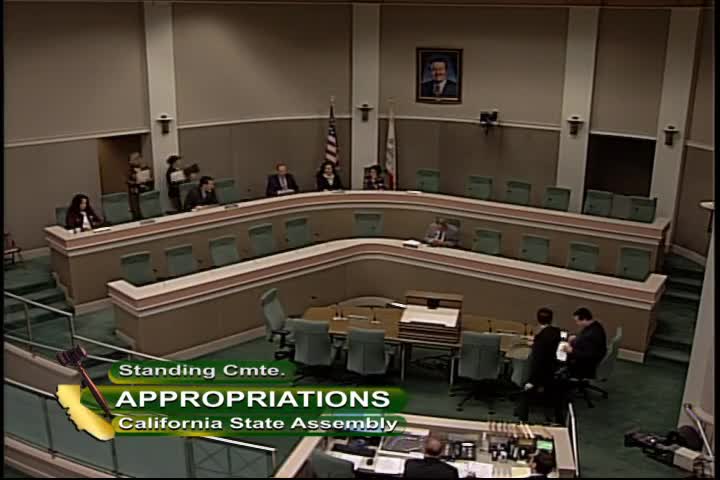 2MIN
Assembly Standing Committee on Appropriations
 13MIN
Assembly Standing Committee on Education



Bill Co-Author(s):
