AB 2797: Planning and zoning: density bonuses.
- Session Year: 2017-2018
- House: Assembly
- Latest Version Date: 2018-09-29
Existing law, the Density Bonus Law, requires a city or county to provide a developer that proposes a housing development within the jurisdictional boundaries of that city or county with a density bonus, and, if requested by the applicant, other incentives or concessions, waivers or reductions of development standards, and parking ratios, for the production of lower income housing units or for the donation of land within the development if the developer agrees to construct a specified percentage of units for very low income, low-income, or moderate-income households or qualifying residents, and meets other requirements. Existing law provides that these provisions do not supersede or in any way alter or lessen the effect or application of the California Coastal Act of 1976, which provides for the regulation of development of certain lands within the coastal zone, as defined.
This bill would require that any density bonus, concessions, incentives, waivers or reductions of development standards, and parking ratios to which an applicant is entitled under the Density Bonus Law be permitted in a manner that is consistent with that law and the California Coastal Act of 1976. This bill would also declare the intent of the Legislature in this regard.
This bill would incorporate additional changes to Section 65915 of the Government Code proposed by AB 2753 and SB 1227 to be operative only if this bill and either or both AB 2753 and SB 1227 are enacted and this bill is enacted last.
Existing law, the Density Bonus Law, requires a city or county to provide a developer that proposes a housing development within the jurisdictional boundaries of that city or county with a density bonus, and, if requested by the applicant, other incentives or concessions, waivers or reductions of development standards, and parking ratios, for the production of lower income housing units or for the donation of land within the development if the developer agrees to construct a specified percentage of units for very low income, low-income, or moderate-income households or qualifying residents, and meets other requirements. Existing law provides that these provisions do not supersede or in any way alter or lessen the effect or application of the California Coastal Act of 1976, which provides for the regulation of development of certain lands within the coastal zone, as defined.
This bill would require that any density bonus, concessions, incentives, waivers or reductions of development standards, and parking ratios to which an applicant is entitled under the Density Bonus Law be accommodated under the California Coastal Act of 1976, but in a manner that harmonizes the Density Bonus Law and specified provisions of that act relating to coastal resources planning and management policies. permitted in a manner that is consistent with that law and the California Coastal Act of 1976. This bill would also declare the intent of the Legislature in this regard.
Existing law, the Density Bonus Law, requires a city or county to provide a developer that proposes a housing development within the jurisdictional boundaries of that city or county with a density bonus, and, if requested by the applicant, other incentives or concessions, waivers or reductions of development standards, and parking ratios, for the production of lower income housing units or for the donation of land within the development if the developer agrees to construct a specified percentage of units for very low income, low-income, or moderate-income households or qualifying residents, and meets other requirements. Existing law provides that these provisions do not supersede or in any way alter or lessen the effect or application of the California Coastal Act of 1976, which provides for the regulation of development of certain lands within the coastal zone, as defined.
This bill would prohibit require that any density bonus, incentives or concessions, incentives, waivers or reductions of development standards, and parking ratios from being a basis for finding a project inconsistent with a specified provision of to which an applicant is entitled under the Density Bonus Law be accommodated under the California Coastal Act of 1976. 1976, but in a manner that harmonizes the Density Bonus Law and specified provisions of that act relating to coastal resources planning and management policies. This bill would also declare the intent of the Legislature in this regard.
Existing law, the Density Bonus Law, requires a city or county to provide a developer that proposes a housing development within the jurisdictional boundaries of that city or county with a density bonus, and, if requested by the applicant, other incentives or concessions, waivers or reductions of development standards, and parking ratios, for the production of lower income housing units or for the donation of land within the development if the developer agrees to construct a specified percentage of units for very low income, low-income, or moderate-income households or qualifying residents, and meets other requirements. Existing law provides that these provisions do not supersede or in any way alter or lessen the effect or application of the California Coastal Act of 1976, which provides for the regulation of development of certain lands within the coastal zone, as defined.
This bill would prohibit any density bonus, incentives or concessions, waivers or reductions of development standards, and parking ratios from being a basis for finding a project inconsistent with a specified provision of the California Coastal Act of 1976.
It is the intent of the Legislature in amending subdivision (m) of Section 65915 of the Government Code to address the holding and dicta in Kalnel Gardens, LLC v. City of Los Angeles (2016) 3 Cal.App.5th 927 regarding the relationship between Section 65915 and the California Coastal Act of 1976 (Division 20 (commencing with Section 30000) of the Public Resources Code). The Legislatures intent is that the two statutes be harmonized so as to achieve the goal of increasing the supply of affordable housing in the coastal zone while also protecting coastal resources and coastal access.
SEC. 2.Section 65915 of the Government Code is amended to read:65915.(a)(1)When an applicant seeks a density bonus for a housing development within, or for the donation of land for housing within, the jurisdiction of a city, county, or city and county, that local government shall comply with this section. A city, county, or city and county shall adopt an ordinance that specifies how compliance with this section will be implemented. Failure to adopt an ordinance shall not relieve a city, county, or city and county from complying with this section.
(2)A local government shall not condition the submission, review, or approval of an application pursuant to this chapter on the preparation of an additional report or study that is not otherwise required by state law, including this section. This subdivision does not prohibit a local government from requiring an applicant to provide reasonable documentation to establish eligibility for a requested density bonus, incentives or concessions, as described in subdivision (d), waivers or reductions of development standards, as described in subdivision (e), and parking ratios, as described in subdivision (p).
(3)In order to provide for the expeditious processing of a density bonus application, the local government shall do all of the following:
(A)Adopt procedures and timelines for processing a density bonus application.
(B)Provide a list of all documents and information required to be submitted with the density bonus application in order for the density bonus application to be deemed complete. This list shall be consistent with this chapter.
(C)Notify the applicant for a density bonus whether the application is complete in a manner consistent with Section 65943.
(b)(1)A city, county, or city and county shall grant one density bonus, the amount of which shall be as specified in subdivision (f), and, if requested by the applicant and consistent with the applicable requirements of this section, incentives or concessions, as described in subdivision (d), waivers or reductions of development standards, as described in subdivision (e), and parking ratios, as described in subdivision (p), when an applicant for a housing development seeks and agrees to construct a housing development, excluding any units permitted by the density bonus awarded pursuant to this section, that will contain at least any one of the following:
(A)Ten percent of the total units of a housing development for lower income households, as defined in Section 50079.5 of the Health and Safety Code.
(B)Five percent of the total units of a housing development for very low income households, as defined in Section 50105 of the Health and Safety Code.
(C)A senior citizen housing development, as defined in Sections 51.3 and 51.12 of the Civil Code, or a mobilehome park that limits residency based on age requirements for housing for older persons pursuant to Section 798.76 or 799.5 of the Civil Code.
(D)Ten percent of the total dwelling units in a common interest development, as defined in Section 4100 of the Civil Code, for persons and families of moderate income, as defined in Section 50093 of the Health and Safety Code, provided that all units in the development are offered to the public for purchase.
(E)Ten percent of the total units of a housing development for transitional foster youth, as defined in Section 66025.9 of the Education Code, disabled veterans, as defined in Section 18541, or homeless persons, as defined in the federal McKinney-Vento Homeless Assistance Act (42 U.S.C. Sec. 11301 et seq.). The units described in this subparagraph shall be subject to a recorded affordability restriction of 55 years and shall be provided at the same affordability level as very low income units.
(2)For purposes of calculating the amount of the density bonus pursuant to subdivision (f), an applicant who requests a density bonus pursuant to this subdivision shall elect whether the bonus shall be awarded on the basis of subparagraph (A), (B), (C), (D), or (E) of paragraph (1).
(3)For the purposes of this section, total units or total dwelling units does not include units added by a density bonus awarded pursuant to this section or any local law granting a greater density bonus.
(c)(1)An applicant shall agree to, and the city, county, or city and county shall ensure, the continued affordability of all very low and low-income rental units that qualified the applicant for the award of the density bonus for 55 years or a longer period of time if required by the construction or mortgage financing assistance program, mortgage insurance program, or rental subsidy program. Rents for the lower income density bonus units shall be set at an affordable rent as defined in Section 50053 of the Health and Safety Code.
(2)An applicant shall agree to, and the city, county, or city and county shall ensure that, the initial occupant of all for-sale units that qualified the applicant for the award of the density bonus are persons and families of very low, low, or moderate income, as required, and that the units are offered at an affordable housing cost, as that cost is defined in Section 50052.5 of the Health and Safety Code. The local government shall enforce an equity sharing agreement, unless it is in conflict with the requirements of another public funding source or law. The following apply to the equity sharing agreement:
(A)Upon resale, the seller of the unit shall retain the value of any improvements, the downpayment, and the sellers proportionate share of appreciation. The local government shall recapture any initial subsidy, as defined in subparagraph (B), and its proportionate share of appreciation, as defined in subparagraph (C), which amount shall be used within five years for any of the purposes described in subdivision (e) of Section 33334.2 of the Health and Safety Code that promote home ownership.
(B)For purposes of this subdivision, the local governments initial subsidy shall be equal to the fair market value of the home at the time of initial sale minus the initial sale price to the moderate-income household, plus the amount of any downpayment assistance or mortgage assistance. If upon resale the market value is lower than the initial market value, then the value at the time of the resale shall be used as the initial market value.
(C)For purposes of this subdivision, the local governments proportionate share of appreciation shall be equal to the ratio of the local governments initial subsidy to the fair market value of the home at the time of initial sale.
(3)(A)An applicant shall be ineligible for a density bonus or any other incentives or concessions under this section if the housing development is proposed on any property that includes a parcel or parcels on which rental dwelling units are or, if the dwelling units have been vacated or demolished in the five-year period preceding the application, have been subject to a recorded covenant, ordinance, or law that restricts rents to levels affordable to persons and families of lower or very low income; subject to any other form of rent or price control through a public entitys valid exercise of its police power; or occupied by lower or very low income households, unless the proposed housing development replaces those units, and either of the following applies:
(i)The proposed housing development, inclusive of the units replaced pursuant to this paragraph, contains affordable units at the percentages set forth in subdivision (b).
(ii)Each unit in the development, exclusive of a managers unit or units, is affordable to, and occupied by, either a lower or very low income household.
(B)For the purposes of this paragraph, replace shall mean either of the following:
(i)If any dwelling units described in subparagraph (A) are occupied on the date of application, the proposed housing development shall provide at least the same number of units of equivalent size to be made available at affordable rent or affordable housing cost to, and occupied by, persons and families in the same or lower income category as those households in occupancy. If the income category of the household in occupancy is not known, it shall be rebuttably presumed that lower income renter households occupied these units in the same proportion of lower income renter households to all renter households within the jurisdiction, as determined by the most recently available data from the United States Department of Housing and Urban Developments Comprehensive Housing Affordability Strategy database. For unoccupied dwelling units described in subparagraph (A) in a development with occupied units, the proposed housing development shall provide units of equivalent size to be made available at affordable rent or affordable housing cost to, and occupied by, persons and families in the same or lower income category as the last household in occupancy. If the income category of the last household in occupancy is not known, it shall be rebuttably presumed that lower income renter households occupied these units in the same proportion of lower income renter households to all renter households within the jurisdiction, as determined by the most recently available data from the United States Department of Housing and Urban Developments Comprehensive Housing Affordability Strategy database. All replacement calculations resulting in fractional units shall be rounded up to the next whole number. If the replacement units will be rental dwelling units, these units shall be subject to a recorded affordability restriction for at least 55 years. If the proposed development is for-sale units, the units replaced shall be subject to paragraph (2).
(ii)If all dwelling units described in subparagraph (A) have been vacated or demolished within the five-year period preceding the application, the proposed housing development shall provide at least the same number of units of equivalent size as existed at the highpoint of those units in the five-year period preceding the application to be made available at affordable rent or affordable housing cost to, and occupied by, persons and families in the same or lower income category as those persons and families in occupancy at that time, if known. If the incomes of the persons and families in occupancy at the highpoint is not known, it shall be rebuttably presumed that low-income and very low income renter households occupied these units in the same proportion of low-income and very low income renter households to all renter households within the jurisdiction, as determined by the most recently available data from the United States Department of Housing and Urban Developments Comprehensive Housing Affordability Strategy database. All replacement calculations resulting in fractional units shall be rounded up to the next whole number. If the replacement units will be rental dwelling units, these units shall be subject to a recorded affordability restriction for at least 55 years. If the proposed development is for-sale units, the units replaced shall be subject to paragraph (2).
(C)Notwithstanding subparagraph (B), for any dwelling unit described in subparagraph (A) that is or was, within the five-year period preceding the application, subject to a form of rent or price control through a local governments valid exercise of its police power and that is or was occupied by persons or families above lower income, the city, county, or city and county may do either of the following:
(i)Require that the replacement units be made available at affordable rent or affordable housing cost to, and occupied by, low-income persons or families. If the replacement units will be rental dwelling units, these units shall be subject to a recorded affordability restriction for at least 55 years. If the proposed development is for-sale units, the units replaced shall be subject to paragraph (2).
(ii)Require that the units be replaced in compliance with the jurisdictions rent or price control ordinance, provided that each unit described in subparagraph (A) is replaced. Unless otherwise required by the jurisdictions rent or price control ordinance, these units shall not be subject to a recorded affordability restriction.
(D)For purposes of this paragraph, equivalent size means that the replacement units contain at least the same total number of bedrooms as the units being replaced.
(E)Subparagraph (A) does not apply to an applicant seeking a density bonus for a proposed housing development if his or her application was submitted to, or processed by, a city, county, or city and county before January 1, 2015.
(d)(1)An applicant for a density bonus pursuant to subdivision (b) may submit to a city, county, or city and county a proposal for the specific incentives or concessions that the applicant requests pursuant to this section, and may request a meeting with the city, county, or city and county. The city, county, or city and county shall grant the concession or incentive requested by the applicant unless the city, county, or city and county makes a written finding, based upon substantial evidence, of any of the following:
(A)The concession or incentive does not result in identifiable and actual cost reductions, consistent with subdivision (k), to provide for affordable housing costs, as defined in Section 50052.5 of the Health and Safety Code, or for rents for the targeted units to be set as specified in subdivision (c).
(B)The concession or incentive would have a specific, adverse impact, as defined in paragraph (2) of subdivision (d) of Section 65589.5, upon public health and safety or the physical environment or on any real property that is listed in the California Register of Historical Resources and for which there is no feasible method to satisfactorily mitigate or avoid the specific, adverse impact without rendering the development unaffordable to low-income and moderate-income households.
(C)The concession or incentive would be contrary to state or federal law.
(2)The applicant shall receive the following number of incentives or concessions:
(A)One incentive or concession for projects that include at least 10 percent of the total units for lower income households, at least 5 percent for very low income households, or at least 10 percent for persons and families of moderate income in a common interest development.
(B)Two incentives or concessions for projects that include at least 20 percent of the total units for lower income households, at least 10 percent for very low income households, or at least 20 percent for persons and families of moderate income in a common interest development.
(C)Three incentives or concessions for projects that include at least 30 percent of the total units for lower income households, at least 15 percent for very low income households, or at least 30 percent for persons and families of moderate income in a common interest development.
(3)The applicant may initiate judicial proceedings if the city, county, or city and county refuses to grant a requested density bonus, incentive, or concession. If a court finds that the refusal to grant a requested density bonus, incentive, or concession is in violation of this section, the court shall award the plaintiff reasonable attorneys fees and costs of suit. Nothing in this subdivision shall be interpreted to require a local government to grant an incentive or concession that has a specific, adverse impact, as defined in paragraph (2) of subdivision (d) of Section 65589.5, upon health, safety, or the physical environment, and for which there is no feasible method to satisfactorily mitigate or avoid the specific adverse impact. Nothing in this subdivision shall be interpreted to require a local government to grant an incentive or concession that would have an adverse impact on any real property that is listed in the California Register of Historical Resources. The city, county, or city and county shall establish procedures for carrying out this section, that shall include legislative body approval of the means of compliance with this section.
(4)The city, county, or city and county shall bear the burden of proof for the denial of a requested concession or incentive.
(e)(1)In no case may a city, county, or city and county apply any development standard that will have the effect of physically precluding the construction of a development meeting the criteria of subdivision (b) at the densities or with the concessions or incentives permitted by this section. An applicant may submit to a city, county, or city and county a proposal for the waiver or reduction of development standards that will have the effect of physically precluding the construction of a development meeting the criteria of subdivision (b) at the densities or with the concessions or incentives permitted under this section, and may request a meeting with the city, county, or city and county. If a court finds that the refusal to grant a waiver or reduction of development standards is in violation of this section, the court shall award the plaintiff reasonable attorneys fees and costs of suit. Nothing in this subdivision shall be interpreted to require a local government to waive or reduce development standards if the waiver or reduction would have a specific, adverse impact, as defined in paragraph (2) of subdivision (d) of Section 65589.5, upon health, safety, or the physical environment, and for which there is no feasible method to satisfactorily mitigate or avoid the specific adverse impact. Nothing in this subdivision shall be interpreted to require a local government to waive or reduce development standards that would have an adverse impact on any real property that is listed in the California Register of Historical Resources, or to grant any waiver or reduction that would be contrary to state or federal law.
(2)A proposal for the waiver or reduction of development standards pursuant to this subdivision shall neither reduce nor increase the number of incentives or concessions to which the applicant is entitled pursuant to subdivision (d).
(f)For the purposes of this chapter, density bonus means a density increase over the otherwise maximum allowable gross residential density as of the date of application by the applicant to the city, county, or city and county, or, if elected by the applicant, a lesser percentage of density increase, including, but not limited to, no increase in density. The amount of density increase to which the applicant is entitled shall vary according to the amount by which the percentage of affordable housing units exceeds the percentage established in subdivision (b).
(1)For housing developments meeting the criteria of subparagraph (A) of paragraph (1) of subdivision (b), the density bonus shall be calculated as follows:
| Percentage Low-Income Units | Percentage Density Bonus |
| 10 | 20 |
| 11 | 21.5 |
| 12 | 23 |
| 13 | 24.5 |
| 14 | 26 |
| 15 | 27.5 |
| 17 | 30.5 |
| 18 | 32 |
| 19 | 33.5 |
| 20 | 35 |
(2)For housing developments meeting the criteria of subparagraph (B) of paragraph (1) of subdivision (b), the density bonus shall be calculated as follows:
| Percentage Very Low Income Units | Percentage Density Bonus |
| 5 | 20 |
| 6 | 22.5 |
| 7 | 25 |
| 8 | 27.5 |
| 9 | 30 |
| 10 | 32.5 |
| 11 | 35 |
(3)(A)For housing developments meeting the criteria of subparagraph (C) of paragraph (1) of subdivision (b), the density bonus shall be 20 percent of the number of senior housing units.
(B)For housing developments meeting the criteria of subparagraph (E) of paragraph (1) of subdivision (b), the density bonus shall be 20 percent of the number of the type of units giving rise to a density bonus under that subparagraph.
(4)For housing developments meeting the criteria of subparagraph (D) of paragraph (1) of subdivision (b), the density bonus shall be calculated as follows:
| Percentage Moderate-Income Units | Percentage Density Bonus |
| 10 | 5 |
| 11 | 6 |
| 12 | 7 |
| 13 | 8 |
| 14 | 9 |
| 15 | 10 |
| 16 | 11 |
| 17 | 12 |
| 18 | 13 |
| 19 | 14 |
| 20 | 15 |
| 21 | 16 |
| 22 | 17 |
| 23 | 18 |
| 24 | 19 |
| 25 | 20 |
| 26 | 21 |
| 27 | 22 |
| 28 | 23 |
| 29 | 24 |
| 30 | 25 |
| 31 | 26 |
| 32 | 27 |
| 33 | 28 |
| 34 | 29 |
| 35 | 30 |
| 36 | 31 |
| 37 | 32 |
| 38 | 33 |
| 39 | 34 |
| 40 | 35 |
(5)All density calculations resulting in fractional units shall be rounded up to the next whole number. The granting of a density bonus shall not require, or be interpreted, in and of itself, to require a general plan amendment, local coastal plan amendment, zoning change, or other discretionary approval.
(g)(1)When an applicant for a tentative subdivision map, parcel map, or other residential development approval donates land to a city, county, or city and county in accordance with this subdivision, the applicant shall be entitled to a 15-percent increase above the otherwise maximum allowable residential density for the entire development, as follows:
| Percentage Very Low Income | Percentage Density Bonus |
| 10 | 15 |
| 11 | 16 |
| 12 | 17 |
| 13 | 18 |
| 14 | 19 |
| 15 | 20 |
| 16 | 21 |
| 17 | 22 |
| 18 | 23 |
| 19 | 24 |
| 20 | 25 |
| 21 | 26 |
| 22 | 27 |
| 23 | 28 |
| 24 | 29 |
| 25 | 30 |
| 26 | 31 |
| 27 | 32 |
| 28 | 33 |
| 29 | 34 |
| 30 | 35 |
(2)This increase shall be in addition to any increase in density mandated by subdivision (b), up to a maximum combined mandated density increase of 35 percent if an applicant seeks an increase pursuant to both this subdivision and subdivision (b). All density calculations resulting in fractional units shall be rounded up to the next whole number. Nothing in this subdivision shall be construed to enlarge or diminish the authority of a city, county, or city and county to require a developer to donate land as a condition of development. An applicant shall be eligible for the increased density bonus described in this subdivision if all of the following conditions are met:
(A)The applicant donates and transfers the land no later than the date of approval of the final subdivision map, parcel map, or residential development application.
(B)The developable acreage and zoning classification of the land being transferred are sufficient to permit construction of units affordable to very low income households in an amount not less than 10 percent of the number of residential units of the proposed development.
(C)The transferred land is at least one acre in size or of sufficient size to permit development of at least 40 units, has the appropriate general plan designation, is appropriately zoned with appropriate development standards for development at the density described in paragraph (3) of subdivision (c) of Section 65583.2, and is or will be served by adequate public facilities and infrastructure.
(D)The transferred land shall have all of the permits and approvals, other than building permits, necessary for the development of the very low income housing units on the transferred land, not later than the date of approval of the final subdivision map, parcel map, or residential development application, except that the local government may subject the proposed development to subsequent design review to the extent authorized by subdivision (i) of Section 65583.2 if the design is not reviewed by the local government prior to the time of transfer.
(E)The transferred land and the affordable units shall be subject to a deed restriction ensuring continued affordability of the units consistent with paragraphs (1) and (2) of subdivision (c), which shall be recorded on the property at the time of the transfer.
(F)The land is transferred to the local agency or to a housing developer approved by the local agency. The local agency may require the applicant to identify and transfer the land to the developer.
(G)The transferred land shall be within the boundary of the proposed development or, if the local agency agrees, within one-quarter mile of the boundary of the proposed development.
(H)A proposed source of funding for the very low income units shall be identified not later than the date of approval of the final subdivision map, parcel map, or residential development application.
(h)(1)When an applicant proposes to construct a housing development that conforms to the requirements of subdivision (b) and includes a child care facility that will be located on the premises of, as part of, or adjacent to, the project, the city, county, or city and county shall grant either of the following:
(A)An additional density bonus that is an amount of square feet of residential space that is equal to or greater than the amount of square feet in the child care facility.
(B)An additional concession or incentive that contributes significantly to the economic feasibility of the construction of the child care facility.
(2)The city, county, or city and county shall require, as a condition of approving the housing development, that the following occur:
(A)The child care facility shall remain in operation for a period of time that is as long as or longer than the period of time during which the density bonus units are required to remain affordable pursuant to subdivision (c).
(B)Of the children who attend the child care facility, the children of very low income households, lower income households, or families of moderate income shall equal a percentage that is equal to or greater than the percentage of dwelling units that are required for very low income households, lower income households, or families of moderate income pursuant to subdivision (b).
(3)Notwithstanding any requirement of this subdivision, a city, county, or city and county shall not be required to provide a density bonus or concession for a child care facility if it finds, based upon substantial evidence, that the community has adequate child care facilities.
(4)Child care facility, as used in this section, means a child day care facility other than a family day care home, including, but not limited to, infant centers, preschools, extended day care facilities, and schoolage child care centers.
(i)Housing development, as used in this section, means a development project for five or more residential units, including mixed-use developments. For the purposes of this section, housing development also includes a subdivision or common interest development, as defined in Section 4100 of the Civil Code, approved by a city, county, or city and county and consists of residential units or unimproved residential lots and either a project to substantially rehabilitate and convert an existing commercial building to residential use or the substantial rehabilitation of an existing multifamily dwelling, as defined in subdivision (d) of Section 65863.4, where the result of the rehabilitation would be a net increase in available residential units. For the purpose of calculating a density bonus, the residential units shall be on contiguous sites that are the subject of one development application, but do not have to be based upon individual subdivision maps or parcels. The density bonus shall be permitted in geographic areas of the housing development other than the areas where the units for the lower income households are located.
(j)(1)The granting of a concession or incentive shall not require or be interpreted, in and of itself, to require a general plan amendment, local coastal plan amendment, zoning change, study, or other discretionary approval. For purposes of this subdivision, study does not include reasonable documentation to establish eligibility for the concession or incentive or to demonstrate that the incentive or concession meets the definition set forth in subdivision (k). This provision is declaratory of existing law.
(2)Except as provided in subdivisions (d) and (e), the granting of a density bonus shall not require or be interpreted to require the waiver of a local ordinance or provisions of a local ordinance unrelated to development standards.
(k)For the purposes of this chapter, concession or incentive means any of the following:
(1)A reduction in site development standards or a modification of zoning code requirements or architectural design requirements that exceed the minimum building standards approved by the California Building Standards Commission as provided in Part 2.5 (commencing with Section 18901) of Division 13 of the Health and Safety Code, including, but not limited to, a reduction in setback and square footage requirements and in the ratio of vehicular parking spaces that would otherwise be required that results in identifiable and actual cost reductions, to provide for affordable housing costs, as defined in Section 50052.5 of the Health and Safety Code, or for rents for the targeted units to be set as specified in subdivision (c).
(2)Approval of mixed-use zoning in conjunction with the housing project if commercial, office, industrial, or other land uses will reduce the cost of the housing development and if the commercial, office, industrial, or other land uses are compatible with the housing project and the existing or planned development in the area where the proposed housing project will be located.
(3)Other regulatory incentives or concessions proposed by the developer or the city, county, or city and county that result in identifiable and actual cost reductions to provide for affordable housing costs, as defined in Section 50052.5 of the Health and Safety Code, or for rents for the targeted units to be set as specified in subdivision (c).
(l)Subdivision (k) does not limit or require the provision of direct financial incentives for the housing development, including the provision of publicly owned land, by the city, county, or city and county, or the waiver of fees or dedication requirements.
(m)This section does not supersede or in any way alter or lessen the effect or application of the California Coastal Act of 1976 (Division 20 (commencing with Section 30000) of the Public Resources Code). Any density bonus, concessions, incentives, waivers or reductions of development standards, and parking ratios to which the applicant is entitled under this section shall be permitted in a manner that is consistent with this section and Division 20 (commencing with Section 30000) of the Public Resources Code.
(n)If permitted by local ordinance, nothing in this section shall be construed to prohibit a city, county, or city and county from granting a density bonus greater than what is described in this section for a development that meets the requirements of this section or from granting a proportionately lower density bonus than what is required by this section for developments that do not meet the requirements of this section.
(o)For purposes of this section, the following definitions shall apply:
(1)Development standard includes a site or construction condition, including, but not limited to, a height limitation, a setback requirement, a floor area ratio, an onsite open-space requirement, or a parking ratio that applies to a residential development pursuant to any ordinance, general plan element, specific plan, charter, or other local condition, law, policy, resolution, or regulation.
(2)Maximum allowable residential density means the density allowed under the zoning ordinance and land use element of the general plan, or, if a range of density is permitted, means the maximum allowable density for the specific zoning range and land use element of the general plan applicable to the project. Where the density allowed under the zoning ordinance is inconsistent with the density allowed under the land use element of the general plan, the general plan density shall prevail.
(p)(1) Except as provided in paragraphs (2) and (3), upon the request of the developer, a city, county, or city and county shall not require a vehicular parking ratio, inclusive of handicapped and guest parking, of a development meeting the criteria of subdivisions (b) and (c), that exceeds the following ratios:
(A)Zero to one bedroom: one onsite parking space.
(B)Two to three bedrooms: two onsite parking spaces.
(C)Four and more bedrooms: two and one-half parking spaces.
(2)Notwithstanding paragraph (1), if a development includes the maximum percentage of low-income or very low income units provided for in paragraphs (1) and (2) of subdivision (f) and is located within one-half mile of a major transit stop, as defined in subdivision (b) of Section 21155 of the Public Resources Code, and there is unobstructed access to the major transit stop from the development, then, upon the request of the developer, a city, county, or city and county shall not impose a vehicular parking ratio, inclusive of handicapped and guest parking, that exceeds 0.5 spaces per bedroom. For purposes of this subdivision, a development shall have unobstructed access to a major transit stop if a resident is able to access the major transit stop without encountering natural or constructed impediments.
(3)Notwithstanding paragraph (1), if a development consists solely of rental units, exclusive of a managers unit or units, with an affordable housing cost to lower income families, as provided in Section 50052.5 of the Health and Safety Code, then, upon the request of the developer, a city, county, or city and county shall not impose a vehicular parking ratio, inclusive of handicapped and guest parking, that exceeds the following ratios:
(A)If the development is located within one-half mile of a major transit stop, as defined in subdivision (b) of Section 21155 of the Public Resources Code, and there is unobstructed access to the major transit stop from the development, the ratio shall not exceed 0.5 spaces per unit.
(B)If the development is a for-rent housing development for individuals who are 62 years of age or older that complies with Sections 51.2 and 51.3 of the Civil Code, the ratio shall not exceed 0.5 spaces per unit. The development shall have either paratransit service or unobstructed access, within one-half mile, to fixed bus route service that operates at least eight times per day.
(C)If the development is a special needs housing development, as defined in Section 51312 of the Health and Safety Code, the ratio shall not exceed 0.3 spaces per unit. The development shall have either paratransit service or unobstructed access, within one-half mile, to fixed bus route service that operates at least eight times per day.
(4)If the total number of parking spaces required for a development is other than a whole number, the number shall be rounded up to the next whole number. For purposes of this subdivision, a development may provide onsite parking through tandem parking or uncovered parking, but not through onstreet parking.
(5)This subdivision shall apply to a development that meets the requirements of subdivisions (b) and (c), but only at the request of the applicant. An applicant may request parking incentives or concessions beyond those provided in this subdivision pursuant to subdivision (d).
(6)This subdivision does not preclude a city, county, or city and county from reducing or eliminating a parking requirement for development projects of any type in any location.
(7)Notwithstanding paragraphs (2) and (3), if a city, county, city and county, or an independent consultant has conducted an areawide or jurisdictionwide parking study in the last seven years, then the city, county, or city and county may impose a higher vehicular parking ratio not to exceed the ratio described in paragraph (1), based upon substantial evidence found in the parking study, that includes, but is not limited to, an analysis of parking availability, differing levels of transit access, walkability access to transit services, the potential for shared parking, the effect of parking requirements on the cost of market-rate and subsidized developments, and the lower rates of car ownership for low-income and very low income individuals, including seniors and special needs individuals. The city, county, or city and county shall pay the costs of any new study. The city, county, or city and county shall make findings, based on a parking study completed in conformity with this paragraph, supporting the need for the higher parking ratio.
(8)A request pursuant to this subdivision shall neither reduce nor increase the number of incentives or concessions to which the applicant is entitled pursuant to subdivision (d).
(q)Each component of any density calculation, including base density and bonus density, resulting in fractional units shall be separately rounded up to the next whole number. The Legislature finds and declares that this provision is declaratory of existing law.
(r)This chapter shall be interpreted liberally in favor of producing the maximum number of total housing units.
SEC. 2.1.Section 65915 of the Government Code is amended to read:65915.(a)(1)When an applicant seeks a density bonus for a housing development within, or for the donation of land for housing within, the jurisdiction of a city, county, or city and county, that local government shall comply with this section. A city, county, or city and county shall adopt an ordinance that specifies how compliance with this section will be implemented. Failure to adopt an ordinance shall not relieve a city, county, or city and county from complying with this section.
(2)A local government shall not condition the submission, review, or approval of an application pursuant to this chapter on the preparation of an additional report or study that is not otherwise required by state law, including this section. This subdivision does not prohibit a local government from requiring an applicant to provide reasonable documentation to establish eligibility for a requested density bonus, incentives or concessions, as described in subdivision (d), waivers or reductions of development standards, as described in subdivision (e), and parking ratios, as described in subdivision (p).
(3)In order to provide for the expeditious processing of a density bonus application, the local government shall do all of the following:
(A)Adopt procedures and timelines for processing a density bonus application.
(B)Provide a list of all documents and information required to be submitted with the density bonus application in order for the density bonus application to be deemed complete. This list shall be consistent with this chapter.
(C)Notify the applicant for a density bonus whether the application is complete in a manner consistent with the timelines specified in Section 65943.
(D)(i)If the local government notifies the applicant that the application is deemed complete pursuant to subparagraph (C), provide the applicant with a determination as to the following matters:
(I)The amount of density bonus, calculated pursuant to subdivision (f), for which the applicant is eligible.
(II)If the applicant requests a parking ratio pursuant to subdivision (p), the parking ratio for which the applicant is eligible.
(III)If the applicant requests incentives or concessions pursuant to subdivision (d) or waivers or reductions of development standards pursuant to subdivision (e), whether the applicant has provided adequate information for the local government to make a determination as to those incentives, concessions, or waivers or reductions of development standards.
(ii)Any determination required by this subparagraph shall be based on the development project at the time the application is deemed complete. The local government shall adjust the amount of density bonus and parking ratios awarded pursuant to this section based on any changes to the project during the course of development.
(b)(1)A city, county, or city and county shall grant one density bonus, the amount of which shall be as specified in subdivision (f), and, if requested by the applicant and consistent with the applicable requirements of this section, incentives or concessions, as described in subdivision (d), waivers or reductions of development standards, as described in subdivision (e), and parking ratios, as described in subdivision (p), when an applicant for a housing development seeks and agrees to construct a housing development, excluding any units permitted by the density bonus awarded pursuant to this section, that will contain at least any one of the following:
(A)Ten percent of the total units of a housing development for lower income households, as defined in Section 50079.5 of the Health and Safety Code.
(B)Five percent of the total units of a housing development for very low income households, as defined in Section 50105 of the Health and Safety Code.
(C)A senior citizen housing development, as defined in Sections 51.3 and 51.12 of the Civil Code, or a mobilehome park that limits residency based on age requirements for housing for older persons pursuant to Section 798.76 or 799.5 of the Civil Code.
(D)Ten percent of the total dwelling units in a common interest development, as defined in Section 4100 of the Civil Code, for persons and families of moderate income, as defined in Section 50093 of the Health and Safety Code, provided that all units in the development are offered to the public for purchase.
(E)Ten percent of the total units of a housing development for transitional foster youth, as defined in Section 66025.9 of the Education Code, disabled veterans, as defined in Section 18541, or homeless persons, as defined in the federal McKinney-Vento Homeless Assistance Act (42 U.S.C. Sec. 11301 et seq.). The units described in this subparagraph shall be subject to a recorded affordability restriction of 55 years and shall be provided at the same affordability level as very low income units.
(2)For purposes of calculating the amount of the density bonus pursuant to subdivision (f), an applicant who requests a density bonus pursuant to this subdivision shall elect whether the bonus shall be awarded on the basis of subparagraph (A), (B), (C), (D), or (E) of paragraph (1).
(3)For the purposes of this section, total units or total dwelling units does not include units added by a density bonus awarded pursuant to this section or any local law granting a greater density bonus.
(c)(1)An applicant shall agree to, and the city, county, or city and county shall ensure, the continued affordability of all very low and low-income rental units that qualified the applicant for the award of the density bonus for 55 years or a longer period of time if required by the construction or mortgage financing assistance program, mortgage insurance program, or rental subsidy program. Rents for the lower income density bonus units shall be set at an affordable rent as defined in Section 50053 of the Health and Safety Code.
(2)An applicant shall agree to, and the city, county, or city and county shall ensure that, the initial occupant of all for-sale units that qualified the applicant for the award of the density bonus are persons and families of very low, low, or moderate income, as required, and that the units are offered at an affordable housing cost, as that cost is defined in Section 50052.5 of the Health and Safety Code. The local government shall enforce an equity sharing agreement, unless it is in conflict with the requirements of another public funding source or law. The following apply to the equity sharing agreement:
(A)Upon resale, the seller of the unit shall retain the value of any improvements, the downpayment, and the sellers proportionate share of appreciation. The local government shall recapture any initial subsidy, as defined in subparagraph (B), and its proportionate share of appreciation, as defined in subparagraph (C), which amount shall be used within five years for any of the purposes described in subdivision (e) of Section 33334.2 of the Health and Safety Code that promote home ownership.
(B)For purposes of this subdivision, the local governments initial subsidy shall be equal to the fair market value of the home at the time of initial sale minus the initial sale price to the moderate-income household, plus the amount of any downpayment assistance or mortgage assistance. If upon resale the market value is lower than the initial market value, then the value at the time of the resale shall be used as the initial market value.
(C)For purposes of this subdivision, the local governments proportionate share of appreciation shall be equal to the ratio of the local governments initial subsidy to the fair market value of the home at the time of initial sale.
(3)(A)An applicant shall be ineligible for a density bonus or any other incentives or concessions under this section if the housing development is proposed on any property that includes a parcel or parcels on which rental dwelling units are or, if the dwelling units have been vacated or demolished in the five-year period preceding the application, have been subject to a recorded covenant, ordinance, or law that restricts rents to levels affordable to persons and families of lower or very low income; subject to any other form of rent or price control through a public entitys valid exercise of its police power; or occupied by lower or very low income households, unless the proposed housing development replaces those units, and either of the following applies:
(i)The proposed housing development, inclusive of the units replaced pursuant to this paragraph, contains affordable units at the percentages set forth in subdivision (b).
(ii)Each unit in the development, exclusive of a managers unit or units, is affordable to, and occupied by, either a lower or very low income household.
(B)For the purposes of this paragraph, replace shall mean either of the following:
(i)If any dwelling units described in subparagraph (A) are occupied on the date of application, the proposed housing development shall provide at least the same number of units of equivalent size to be made available at affordable rent or affordable housing cost to, and occupied by, persons and families in the same or lower income category as those households in occupancy. If the income category of the household in occupancy is not known, it shall be rebuttably presumed that lower income renter households occupied these units in the same proportion of lower income renter households to all renter households within the jurisdiction, as determined by the most recently available data from the United States Department of Housing and Urban Developments Comprehensive Housing Affordability Strategy database. For unoccupied dwelling units described in subparagraph (A) in a development with occupied units, the proposed housing development shall provide units of equivalent size to be made available at affordable rent or affordable housing cost to, and occupied by, persons and families in the same or lower income category as the last household in occupancy. If the income category of the last household in occupancy is not known, it shall be rebuttably presumed that lower income renter households occupied these units in the same proportion of lower income renter households to all renter households within the jurisdiction, as determined by the most recently available data from the United States Department of Housing and Urban Developments Comprehensive Housing Affordability Strategy database. All replacement calculations resulting in fractional units shall be rounded up to the next whole number. If the replacement units will be rental dwelling units, these units shall be subject to a recorded affordability restriction for at least 55 years. If the proposed development is for-sale units, the units replaced shall be subject to paragraph (2).
(ii)If all dwelling units described in subparagraph (A) have been vacated or demolished within the five-year period preceding the application, the proposed housing development shall provide at least the same number of units of equivalent size as existed at the highpoint of those units in the five-year period preceding the application to be made available at affordable rent or affordable housing cost to, and occupied by, persons and families in the same or lower income category as those persons and families in occupancy at that time, if known. If the incomes of the persons and families in occupancy at the highpoint is not known, it shall be rebuttably presumed that low-income and very low income renter households occupied these units in the same proportion of low-income and very low income renter households to all renter households within the jurisdiction, as determined by the most recently available data from the United States Department of Housing and Urban Developments Comprehensive Housing Affordability Strategy database. All replacement calculations resulting in fractional units shall be rounded up to the next whole number. If the replacement units will be rental dwelling units, these units shall be subject to a recorded affordability restriction for at least 55 years. If the proposed development is for-sale units, the units replaced shall be subject to paragraph (2).
(C)Notwithstanding subparagraph (B), for any dwelling unit described in subparagraph (A) that is or was, within the five-year period preceding the application, subject to a form of rent or price control through a local governments valid exercise of its police power and that is or was occupied by persons or families above lower income, the city, county, or city and county may do either of the following:
(i)Require that the replacement units be made available at affordable rent or affordable housing cost to, and occupied by, low-income persons or families. If the replacement units will be rental dwelling units, these units shall be subject to a recorded affordability restriction for at least 55 years. If the proposed development is for-sale units, the units replaced shall be subject to paragraph (2).
(ii)Require that the units be replaced in compliance with the jurisdictions rent or price control ordinance, provided that each unit described in subparagraph (A) is replaced. Unless otherwise required by the jurisdictions rent or price control ordinance, these units shall not be subject to a recorded affordability restriction.
(D)For purposes of this paragraph, equivalent size means that the replacement units contain at least the same total number of bedrooms as the units being replaced.
(E)Subparagraph (A) does not apply to an applicant seeking a density bonus for a proposed housing development if his or her application was submitted to, or processed by, a city, county, or city and county before January 1, 2015.
(d)(1)An applicant for a density bonus pursuant to subdivision (b) may submit to a city, county, or city and county a proposal for the specific incentives or concessions that the applicant requests pursuant to this section, and may request a meeting with the city, county, or city and county. The city, county, or city and county shall grant the concession or incentive requested by the applicant unless the city, county, or city and county makes a written finding, based upon substantial evidence, of any of the following:
(A)The concession or incentive does not result in identifiable and actual cost reductions, consistent with subdivision (k), to provide for affordable housing costs, as defined in Section 50052.5 of the Health and Safety Code, or for rents for the targeted units to be set as specified in subdivision (c).
(B)The concession or incentive would have a specific, adverse impact, as defined in paragraph (2) of subdivision (d) of Section 65589.5, upon public health and safety or the physical environment or on any real property that is listed in the California Register of Historical Resources and for which there is no feasible method to satisfactorily mitigate or avoid the specific, adverse impact without rendering the development unaffordable to low-income and moderate-income households.
(C)The concession or incentive would be contrary to state or federal law.
(2)The applicant shall receive the following number of incentives or concessions:
(A)One incentive or concession for projects that include at least 10 percent of the total units for lower income households, at least 5 percent for very low income households, or at least 10 percent for persons and families of moderate income in a common interest development.
(B)Two incentives or concessions for projects that include at least 20 percent of the total units for lower income households, at least 10 percent for very low income households, or at least 20 percent for persons and families of moderate income in a common interest development.
(C)Three incentives or concessions for projects that include at least 30 percent of the total units for lower income households, at least 15 percent for very low income households, or at least 30 percent for persons and families of moderate income in a common interest development.
(3)The applicant may initiate judicial proceedings if the city, county, or city and county refuses to grant a requested density bonus, incentive, or concession. If a court finds that the refusal to grant a requested density bonus, incentive, or concession is in violation of this section, the court shall award the plaintiff reasonable attorneys fees and costs of suit. Nothing in this subdivision shall be interpreted to require a local government to grant an incentive or concession that has a specific, adverse impact, as defined in paragraph (2) of subdivision (d) of Section 65589.5, upon health, safety, or the physical environment, and for which there is no feasible method to satisfactorily mitigate or avoid the specific adverse impact. Nothing in this subdivision shall be interpreted to require a local government to grant an incentive or concession that would have an adverse impact on any real property that is listed in the California Register of Historical Resources. The city, county, or city and county shall establish procedures for carrying out this section, that shall include legislative body approval of the means of compliance with this section.
(4)The city, county, or city and county shall bear the burden of proof for the denial of a requested concession or incentive.
(e)(1)In no case may a city, county, or city and county apply any development standard that will have the effect of physically precluding the construction of a development meeting the criteria of subdivision (b) at the densities or with the concessions or incentives permitted by this section. An applicant may submit to a city, county, or city and county a proposal for the waiver or reduction of development standards that will have the effect of physically precluding the construction of a development meeting the criteria of subdivision (b) at the densities or with the concessions or incentives permitted under this section, and may request a meeting with the city, county, or city and county. If a court finds that the refusal to grant a waiver or reduction of development standards is in violation of this section, the court shall award the plaintiff reasonable attorneys fees and costs of suit. Nothing in this subdivision shall be interpreted to require a local government to waive or reduce development standards if the waiver or reduction would have a specific, adverse impact, as defined in paragraph (2) of subdivision (d) of Section 65589.5, upon health, safety, or the physical environment, and for which there is no feasible method to satisfactorily mitigate or avoid the specific adverse impact. Nothing in this subdivision shall be interpreted to require a local government to waive or reduce development standards that would have an adverse impact on any real property that is listed in the California Register of Historical Resources, or to grant any waiver or reduction that would be contrary to state or federal law.
(2)A proposal for the waiver or reduction of development standards pursuant to this subdivision shall neither reduce nor increase the number of incentives or concessions to which the applicant is entitled pursuant to subdivision (d).
(f)For the purposes of this chapter, density bonus means a density increase over the otherwise maximum allowable gross residential density as of the date of application by the applicant to the city, county, or city and county, or, if elected by the applicant, a lesser percentage of density increase, including, but not limited to, no increase in density. The amount of density increase to which the applicant is entitled shall vary according to the amount by which the percentage of affordable housing units exceeds the percentage established in subdivision (b).
(1)For housing developments meeting the criteria of subparagraph (A) of paragraph (1) of subdivision (b), the density bonus shall be calculated as follows:
| Percentage Low-Income Units | Percentage Density Bonus |
| 10 | 20 |
| 11 | 21.5 |
| 12 | 23 |
| 13 | 24.5 |
| 14 | 26 |
| 15 | 27.5 |
| 17 | 30.5 |
| 18 | 32 |
| 19 | 33.5 |
| 20 | 35 |
(2)For housing developments meeting the criteria of subparagraph (B) of paragraph (1) of subdivision (b), the density bonus shall be calculated as follows:
| Percentage Very Low Income Units | Percentage Density Bonus |
| 5 | 20 |
| 6 | 22.5 |
| 7 | 25 |
| 8 | 27.5 |
| 9 | 30 |
| 10 | 32.5 |
| 11 | 35 |
(3)(A)For housing developments meeting the criteria of subparagraph (C) of paragraph (1) of subdivision (b), the density bonus shall be 20 percent of the number of senior housing units.
(B)For housing developments meeting the criteria of subparagraph (E) of paragraph (1) of subdivision (b), the density bonus shall be 20 percent of the number of the type of units giving rise to a density bonus under that subparagraph.
(4)For housing developments meeting the criteria of subparagraph (D) of paragraph (1) of subdivision (b), the density bonus shall be calculated as follows:
| Percentage Moderate-Income Units | Percentage Density Bonus |
| 10 | 5 |
| 11 | 6 |
| 12 | 7 |
| 13 | 8 |
| 14 | 9 |
| 15 | 10 |
| 16 | 11 |
| 17 | 12 |
| 18 | 13 |
| 19 | 14 |
| 20 | 15 |
| 21 | 16 |
| 22 | 17 |
| 23 | 18 |
| 24 | 19 |
| 25 | 20 |
| 26 | 21 |
| 27 | 22 |
| 28 | 23 |
| 29 | 24 |
| 30 | 25 |
| 31 | 26 |
| 32 | 27 |
| 33 | 28 |
| 34 | 29 |
| 35 | 30 |
| 36 | 31 |
| 37 | 32 |
| 38 | 33 |
| 39 | 34 |
| 40 | 35 |
(5)All density calculations resulting in fractional units shall be rounded up to the next whole number. The granting of a density bonus shall not require, or be interpreted, in and of itself, to require a general plan amendment, local coastal plan amendment, zoning change, or other discretionary approval.
(g)(1)When an applicant for a tentative subdivision map, parcel map, or other residential development approval donates land to a city, county, or city and county in accordance with this subdivision, the applicant shall be entitled to a 15-percent increase above the otherwise maximum allowable residential density for the entire development, as follows:
| Percentage Very Low Income | Percentage Density Bonus |
| 10 | 15 |
| 11 | 16 |
| 12 | 17 |
| 13 | 18 |
| 14 | 19 |
| 15 | 20 |
| 16 | 21 |
| 17 | 22 |
| 18 | 23 |
| 19 | 24 |
| 20 | 25 |
| 21 | 26 |
| 22 | 27 |
| 23 | 28 |
| 24 | 29 |
| 25 | 30 |
| 26 | 31 |
| 27 | 32 |
| 28 | 33 |
| 29 | 34 |
| 30 | 35 |
(2)This increase shall be in addition to any increase in density mandated by subdivision (b), up to a maximum combined mandated density increase of 35 percent if an applicant seeks an increase pursuant to both this subdivision and subdivision (b). All density calculations resulting in fractional units shall be rounded up to the next whole number. Nothing in this subdivision shall be construed to enlarge or diminish the authority of a city, county, or city and county to require a developer to donate land as a condition of development. An applicant shall be eligible for the increased density bonus described in this subdivision if all of the following conditions are met:
(A)The applicant donates and transfers the land no later than the date of approval of the final subdivision map, parcel map, or residential development application.
(B)The developable acreage and zoning classification of the land being transferred are sufficient to permit construction of units affordable to very low income households in an amount not less than 10 percent of the number of residential units of the proposed development.
(C)The transferred land is at least one acre in size or of sufficient size to permit development of at least 40 units, has the appropriate general plan designation, is appropriately zoned with appropriate development standards for development at the density described in paragraph (3) of subdivision (c) of Section 65583.2, and is or will be served by adequate public facilities and infrastructure.
(D)The transferred land shall have all of the permits and approvals, other than building permits, necessary for the development of the very low income housing units on the transferred land, not later than the date of approval of the final subdivision map, parcel map, or residential development application, except that the local government may subject the proposed development to subsequent design review to the extent authorized by subdivision (i) of Section 65583.2 if the design is not reviewed by the local government prior to the time of transfer.
(E)The transferred land and the affordable units shall be subject to a deed restriction ensuring continued affordability of the units consistent with paragraphs (1) and (2) of subdivision (c), which shall be recorded on the property at the time of the transfer.
(F)The land is transferred to the local agency or to a housing developer approved by the local agency. The local agency may require the applicant to identify and transfer the land to the developer.
(G)The transferred land shall be within the boundary of the proposed development or, if the local agency agrees, within one-quarter mile of the boundary of the proposed development.
(H)A proposed source of funding for the very low income units shall be identified not later than the date of approval of the final subdivision map, parcel map, or residential development application.
(h)(1)When an applicant proposes to construct a housing development that conforms to the requirements of subdivision (b) and includes a child care facility that will be located on the premises of, as part of, or adjacent to, the project, the city, county, or city and county shall grant either of the following:
(A)An additional density bonus that is an amount of square feet of residential space that is equal to or greater than the amount of square feet in the child care facility.
(B)An additional concession or incentive that contributes significantly to the economic feasibility of the construction of the child care facility.
(2)The city, county, or city and county shall require, as a condition of approving the housing development, that the following occur:
(A)The child care facility shall remain in operation for a period of time that is as long as or longer than the period of time during which the density bonus units are required to remain affordable pursuant to subdivision (c).
(B)Of the children who attend the child care facility, the children of very low income households, lower income households, or families of moderate income shall equal a percentage that is equal to or greater than the percentage of dwelling units that are required for very low income households, lower income households, or families of moderate income pursuant to subdivision (b).
(3)Notwithstanding any requirement of this subdivision, a city, county, or city and county shall not be required to provide a density bonus or concession for a child care facility if it finds, based upon substantial evidence, that the community has adequate child care facilities.
(4)Child care facility, as used in this section, means a child day care facility other than a family day care home, including, but not limited to, infant centers, preschools, extended day care facilities, and schoolage child care centers.
(i)Housing development, as used in this section, means a development project for five or more residential units, including mixed-use developments. For the purposes of this section, housing development also includes a subdivision or common interest development, as defined in Section 4100 of the Civil Code, approved by a city, county, or city and county and consists of residential units or unimproved residential lots and either a project to substantially rehabilitate and convert an existing commercial building to residential use or the substantial rehabilitation of an existing multifamily dwelling, as defined in subdivision (d) of Section 65863.4, where the result of the rehabilitation would be a net increase in available residential units. For the purpose of calculating a density bonus, the residential units shall be on contiguous sites that are the subject of one development application, but do not have to be based upon individual subdivision maps or parcels. The density bonus shall be permitted in geographic areas of the housing development other than the areas where the units for the lower income households are located.
(j)(1)The granting of a concession or incentive shall not require or be interpreted, in and of itself, to require a general plan amendment, local coastal plan amendment, zoning change, study, or other discretionary approval. For purposes of this subdivision, study does not include reasonable documentation to establish eligibility for the concession or incentive or to demonstrate that the incentive or concession meets the definition set forth in subdivision (k). This provision is declaratory of existing law.
(2)Except as provided in subdivisions (d) and (e), the granting of a density bonus shall not require or be interpreted to require the waiver of a local ordinance or provisions of a local ordinance unrelated to development standards.
(k)For the purposes of this chapter, concession or incentive means any of the following:
(1)A reduction in site development standards or a modification of zoning code requirements or architectural design requirements that exceed the minimum building standards approved by the California Building Standards Commission as provided in Part 2.5 (commencing with Section 18901) of Division 13 of the Health and Safety Code, including, but not limited to, a reduction in setback and square footage requirements and in the ratio of vehicular parking spaces that would otherwise be required that results in identifiable and actual cost reductions, to provide for affordable housing costs, as defined in Section 50052.5 of the Health and Safety Code, or for rents for the targeted units to be set as specified in subdivision (c).
(2)Approval of mixed-use zoning in conjunction with the housing project if commercial, office, industrial, or other land uses will reduce the cost of the housing development and if the commercial, office, industrial, or other land uses are compatible with the housing project and the existing or planned development in the area where the proposed housing project will be located.
(3)Other regulatory incentives or concessions proposed by the developer or the city, county, or city and county that result in identifiable and actual cost reductions to provide for affordable housing costs, as defined in Section 50052.5 of the Health and Safety Code, or for rents for the targeted units to be set as specified in subdivision (c).
(l)Subdivision (k) does not limit or require the provision of direct financial incentives for the housing development, including the provision of publicly owned land, by the city, county, or city and county, or the waiver of fees or dedication requirements.
(m)This section does not supersede or in any way alter or lessen the effect or application of the California Coastal Act of 1976 (Division 20 (commencing with Section 30000) of the Public Resources Code). Any density bonus, concessions, incentives, waivers or reductions of development standards, and parking ratios to which the applicant is entitled under this section shall be permitted in a manner that is consistent with this section and Division 20 (commencing with Section 30000) of the Public Resources Code.
(n)If permitted by local ordinance, nothing in this section shall be construed to prohibit a city, county, or city and county from granting a density bonus greater than what is described in this section for a development that meets the requirements of this section or from granting a proportionately lower density bonus than what is required by this section for developments that do not meet the requirements of this section.
(o)For purposes of this section, the following definitions shall apply:
(1)Development standard includes a site or construction condition, including, but not limited to, a height limitation, a setback requirement, a floor area ratio, an onsite open-space requirement, or a parking ratio that applies to a residential development pursuant to any ordinance, general plan element, specific plan, charter, or other local condition, law, policy, resolution, or regulation.
(2)Maximum allowable residential density means the density allowed under the zoning ordinance and land use element of the general plan, or, if a range of density is permitted, means the maximum allowable density for the specific zoning range and land use element of the general plan applicable to the project. Where the density allowed under the zoning ordinance is inconsistent with the density allowed under the land use element of the general plan, the general plan density shall prevail.
(p)(1) Except as provided in paragraphs (2) and (3), upon the request of the developer, a city, county, or city and county shall not require a vehicular parking ratio, inclusive of handicapped and guest parking, of a development meeting the criteria of subdivisions (b) and (c), that exceeds the following ratios:
(A)Zero to one bedroom: one onsite parking space.
(B)Two to three bedrooms: two onsite parking spaces.
(C)Four and more bedrooms: two and one-half parking spaces.
(2)Notwithstanding paragraph (1), if a development includes the maximum percentage of low-income or very low income units provided for in paragraphs (1) and (2) of subdivision (f) and is located within one-half mile of a major transit stop, as defined in subdivision (b) of Section 21155 of the Public Resources Code, and there is unobstructed access to the major transit stop from the development, then, upon the request of the developer, a city, county, or city and county shall not impose a vehicular parking ratio, inclusive of handicapped and guest parking, that exceeds 0.5 spaces per bedroom. For purposes of this subdivision, a development shall have unobstructed access to a major transit stop if a resident is able to access the major transit stop without encountering natural or constructed impediments.
(3)Notwithstanding paragraph (1), if a development consists solely of rental units, exclusive of a managers unit or units, with an affordable housing cost to lower income families, as provided in Section 50052.5 of the Health and Safety Code, then, upon the request of the developer, a city, county, or city and county shall not impose a vehicular parking ratio, inclusive of handicapped and guest parking, that exceeds the following ratios:
(A)If the development is located within one-half mile of a major transit stop, as defined in subdivision (b) of Section 21155 of the Public Resources Code, and there is unobstructed access to the major transit stop from the development, the ratio shall not exceed 0.5 spaces per unit.
(B)If the development is a for-rent housing development for individuals who are 62 years of age or older that complies with Sections 51.2 and 51.3 of the Civil Code, the ratio shall not exceed 0.5 spaces per unit. The development shall have either paratransit service or unobstructed access, within one-half mile, to fixed bus route service that operates at least eight times per day.
(C)If the development is a special needs housing development, as defined in Section 51312 of the Health and Safety Code, the ratio shall not exceed 0.3 spaces per unit. The development shall have either paratransit service or unobstructed access, within one-half mile, to fixed bus route service that operates at least eight times per day.
(4)If the total number of parking spaces required for a development is other than a whole number, the number shall be rounded up to the next whole number. For purposes of this subdivision, a development may provide onsite parking through tandem parking or uncovered parking, but not through onstreet parking.
(5)This subdivision shall apply to a development that meets the requirements of subdivisions (b) and (c), but only at the request of the applicant. An applicant may request parking incentives or concessions beyond those provided in this subdivision pursuant to subdivision (d).
(6)This subdivision does not preclude a city, county, or city and county from reducing or eliminating a parking requirement for development projects of any type in any location.
(7)Notwithstanding paragraphs (2) and (3), if a city, county, city and county, or an independent consultant has conducted an areawide or jurisdictionwide parking study in the last seven years, then the city, county, or city and county may impose a higher vehicular parking ratio not to exceed the ratio described in paragraph (1), based upon substantial evidence found in the parking study, that includes, but is not limited to, an analysis of parking availability, differing levels of transit access, walkability access to transit services, the potential for shared parking, the effect of parking requirements on the cost of market-rate and subsidized developments, and the lower rates of car ownership for low-income and very low income individuals, including seniors and special needs individuals. The city, county, or city and county shall pay the costs of any new study. The city, county, or city and county shall make findings, based on a parking study completed in conformity with this paragraph, supporting the need for the higher parking ratio.
(8)A request pursuant to this subdivision shall neither reduce nor increase the number of incentives or concessions to which the applicant is entitled pursuant to subdivision (d).
(q)Each component of any density calculation, including base density and bonus density, resulting in fractional units shall be separately rounded up to the next whole number. The Legislature finds and declares that this provision is declaratory of existing law.
(r)This chapter shall be interpreted liberally in favor of producing the maximum number of total housing units.
SEC. 2.2.Section 65915 of the Government Code is amended to read:65915.(a)(1)When an applicant seeks a density bonus for a housing development within, or for the donation of land for housing within, the jurisdiction of a city, county, or city and county, that local government shall comply with this section. A city, county, or city and county shall adopt an ordinance that specifies how compliance with this section will be implemented. Failure to adopt an ordinance shall not relieve a city, county, or city and county from complying with this section.
(2)A local government shall not condition the submission, review, or approval of an application pursuant to this chapter on the preparation of an additional report or study that is not otherwise required by state law, including this section. This subdivision does not prohibit a local government from requiring an applicant to provide reasonable documentation to establish eligibility for a requested density bonus, incentives or concessions, as described in subdivision (d), waivers or reductions of development standards, as described in subdivision (e), and parking ratios, as described in subdivision (p).
(3)In order to provide for the expeditious processing of a density bonus application, the local government shall do all of the following:
(A)Adopt procedures and timelines for processing a density bonus application.
(B)Provide a list of all documents and information required to be submitted with the density bonus application in order for the density bonus application to be deemed complete. This list shall be consistent with this chapter.
(C)Notify the applicant for a density bonus whether the application is complete in a manner consistent with Section 65943.
(b)(1)A city, county, or city and county shall grant one density bonus, the amount of which shall be as specified in subdivision (f), and, if requested by the applicant and consistent with the applicable requirements of this section, incentives or concessions, as described in subdivision (d), waivers or reductions of development standards, as described in subdivision (e), and parking ratios, as described in subdivision (p), when an applicant for a housing development seeks and agrees to construct a housing development, excluding any units permitted by the density bonus awarded pursuant to this section, that will contain at least any one of the following:
(A)Ten percent of the total units of a housing development for lower income households, as defined in Section 50079.5 of the Health and Safety Code.
(B)Five percent of the total units of a housing development for very low income households, as defined in Section 50105 of the Health and Safety Code.
(C)A senior citizen housing development, as defined in Sections 51.3 and 51.12 of the Civil Code, or a mobilehome park that limits residency based on age requirements for housing for older persons pursuant to Section 798.76 or 799.5 of the Civil Code.
(D)Ten percent of the total dwelling units in a common interest development, as defined in Section 4100 of the Civil Code, for persons and families of moderate income, as defined in Section 50093 of the Health and Safety Code, provided that all units in the development are offered to the public for purchase.
(E)Ten percent of the total units of a housing development for transitional foster youth, as defined in Section 66025.9 of the Education Code, disabled veterans, as defined in Section 18541, or homeless persons, as defined in the federal McKinney-Vento Homeless Assistance Act (42 U.S.C. Sec. 11301 et seq.). The units described in this subparagraph shall be subject to a recorded affordability restriction of 55 years and shall be provided at the same affordability level as very low income units.
(F)(i)Twenty percent of the total units for lower income students in a student housing development that meets the following requirements:
(I)All units in the student housing development will be used exclusively for undergraduate, graduate, or professional students enrolled full time at an institution of higher education accredited by the Western Association of Schools and Colleges or the Accrediting Commission for Community and Junior Colleges. In order to be eligible under this subclause, the developer shall, as a condition of receiving a certificate of occupancy, provide evidence to the city, county, or city or county that the developer has entered into an operating agreement or master lease with one or more institutions of higher education for the institution or institutions to occupy all units of the student housing development with students from that institution or institutions. An operating agreement or master lease entered into pursuant to this subclause is not violated or breached if, in any subsequent year, there are not sufficient students enrolled in an institution of higher education to fill all units in the student housing development.
(II)The applicable 20 percent units will be used for lower income students. For purposes of this clause, lower income students means students who have a household income and asset level that does not exceed the level for Cal Grant A or Cal Grant B award recipients as set forth in paragraph (1) of subdivision (k) of Section 69432.7 of the Education Code. The eligibility of a student under this clause shall be verified by an affidavit, award letter, or letter of eligibility provided by the institution of higher education that the student is enrolled in, as described in subclause (I), or by the California Student Aid Commission that the student receives or is eligible for financial aid, including an institutional grant or fee waiver, from the college or university, the California Student Aid Commission, or the federal government shall be sufficient to satisfy this subclause.
(III)The rent provided in the applicable units of the development for lower income students shall be calculated at 30 percent of 65 percent of the area median income for a single-room occupancy unit type.
(IV)The development will provide priority for the applicable affordable units for lower income students experiencing homelessness. A homeless service provider, as defined in paragraph (3) of subdivision (d) of Section 103577 of the Health and Safety Code, or institution of higher education that has knowledge of a persons homeless status may verify a persons status as homeless for purposes of this subclause.
(ii)For purposes of calculating a density bonus granted pursuant to this subparagraph, the term unit as used in this section means one rental bed and its pro rata share of associated common area facilities. The units described in this subparagraph shall be subject to a recorded affordability restriction of 55 years.
(2)For purposes of calculating the amount of the density bonus pursuant to subdivision (f), an applicant who requests a density bonus pursuant to this subdivision shall elect whether the bonus shall be awarded on the basis of subparagraph (A), (B), (C), (D), (E), or (F) of paragraph (1).
(3)For the purposes of this section, total units, total dwelling units, or total rental beds does not include units added by a density bonus awarded pursuant to this section or any local law granting a greater density bonus.
(c)(1)An applicant shall agree to, and the city, county, or city and county shall ensure, the continued affordability of all very low and low-income rental units that qualified the applicant for the award of the density bonus for 55 years or a longer period of time if required by the construction or mortgage financing assistance program, mortgage insurance program, or rental subsidy program. Rents for the lower income density bonus units shall be set at an affordable rent as defined in Section 50053 of the Health and Safety Code.
(2)An applicant shall agree to, and the city, county, or city and county shall ensure that, the initial occupant of all for-sale units that qualified the applicant for the award of the density bonus are persons and families of very low, low, or moderate income, as required, and that the units are offered at an affordable housing cost, as that cost is defined in Section 50052.5 of the Health and Safety Code. The local government shall enforce an equity sharing agreement, unless it is in conflict with the requirements of another public funding source or law. The following apply to the equity sharing agreement:
(A)Upon resale, the seller of the unit shall retain the value of any improvements, the downpayment, and the sellers proportionate share of appreciation. The local government shall recapture any initial subsidy, as defined in subparagraph (B), and its proportionate share of appreciation, as defined in subparagraph (C), which amount shall be used within five years for any of the purposes described in subdivision (e) of Section 33334.2 of the Health and Safety Code that promote home ownership.
(B)For purposes of this subdivision, the local governments initial subsidy shall be equal to the fair market value of the home at the time of initial sale minus the initial sale price to the moderate-income household, plus the amount of any downpayment assistance or mortgage assistance. If upon resale the market value is lower than the initial market value, then the value at the time of the resale shall be used as the initial market value.
(C)For purposes of this subdivision, the local governments proportionate share of appreciation shall be equal to the ratio of the local governments initial subsidy to the fair market value of the home at the time of initial sale.
(3)(A)An applicant shall be ineligible for a density bonus or any other incentives or concessions under this section if the housing development is proposed on any property that includes a parcel or parcels on which rental dwelling units are or, if the dwelling units have been vacated or demolished in the five-year period preceding the application, have been subject to a recorded covenant, ordinance, or law that restricts rents to levels affordable to persons and families of lower or very low income; subject to any other form of rent or price control through a public entitys valid exercise of its police power; or occupied by lower or very low income households, unless the proposed housing development replaces those units, and either of the following applies:
(i)The proposed housing development, inclusive of the units replaced pursuant to this paragraph, contains affordable units at the percentages set forth in subdivision (b).
(ii)Each unit in the development, exclusive of a managers unit or units, is affordable to, and occupied by, either a lower or very low income household.
(B)For the purposes of this paragraph, replace shall mean either of the following:
(i)If any dwelling units described in subparagraph (A) are occupied on the date of application, the proposed housing development shall provide at least the same number of units of equivalent size to be made available at affordable rent or affordable housing cost to, and occupied by, persons and families in the same or lower income category as those households in occupancy. If the income category of the household in occupancy is not known, it shall be rebuttably presumed that lower income renter households occupied these units in the same proportion of lower income renter households to all renter households within the jurisdiction, as determined by the most recently available data from the United States Department of Housing and Urban Developments Comprehensive Housing Affordability Strategy database. For unoccupied dwelling units described in subparagraph (A) in a development with occupied units, the proposed housing development shall provide units of equivalent size to be made available at affordable rent or affordable housing cost to, and occupied by, persons and families in the same or lower income category as the last household in occupancy. If the income category of the last household in occupancy is not known, it shall be rebuttably presumed that lower income renter households occupied these units in the same proportion of lower income renter households to all renter households within the jurisdiction, as determined by the most recently available data from the United States Department of Housing and Urban Developments Comprehensive Housing Affordability Strategy database. All replacement calculations resulting in fractional units shall be rounded up to the next whole number. If the replacement units will be rental dwelling units, these units shall be subject to a recorded affordability restriction for at least 55 years. If the proposed development is for-sale units, the units replaced shall be subject to paragraph (2).
(ii)If all dwelling units described in subparagraph (A) have been vacated or demolished within the five-year period preceding the application, the proposed housing development shall provide at least the same number of units of equivalent size as existed at the highpoint of those units in the five-year period preceding the application to be made available at affordable rent or affordable housing cost to, and occupied by, persons and families in the same or lower income category as those persons and families in occupancy at that time, if known. If the incomes of the persons and families in occupancy at the highpoint is not known, it shall be rebuttably presumed that low-income and very low income renter households occupied these units in the same proportion of low-income and very low income renter households to all renter households within the jurisdiction, as determined by the most recently available data from the United States Department of Housing and Urban Developments Comprehensive Housing Affordability Strategy database. All replacement calculations resulting in fractional units shall be rounded up to the next whole number. If the replacement units will be rental dwelling units, these units shall be subject to a recorded affordability restriction for at least 55 years. If the proposed development is for-sale units, the units replaced shall be subject to paragraph (2).
(C)Notwithstanding subparagraph (B), for any dwelling unit described in subparagraph (A) that is or was, within the five-year period preceding the application, subject to a form of rent or price control through a local governments valid exercise of its police power and that is or was occupied by persons or families above lower income, the city, county, or city and county may do either of the following:
(i)Require that the replacement units be made available at affordable rent or affordable housing cost to, and occupied by, low-income persons or families. If the replacement units will be rental dwelling units, these units shall be subject to a recorded affordability restriction for at least 55 years. If the proposed development is for-sale units, the units replaced shall be subject to paragraph (2).
(ii)Require that the units be replaced in compliance with the jurisdictions rent or price control ordinance, provided that each unit described in subparagraph (A) is replaced. Unless otherwise required by the jurisdictions rent or price control ordinance, these units shall not be subject to a recorded affordability restriction.
(D)For purposes of this paragraph, equivalent size means that the replacement units contain at least the same total number of bedrooms as the units being replaced.
(E)Subparagraph (A) does not apply to an applicant seeking a density bonus for a proposed housing development if his or her application was submitted to, or processed by, a city, county, or city and county before January 1, 2015.
(d)(1)An applicant for a density bonus pursuant to subdivision (b) may submit to a city, county, or city and county a proposal for the specific incentives or concessions that the applicant requests pursuant to this section, and may request a meeting with the city, county, or city and county. The city, county, or city and county shall grant the concession or incentive requested by the applicant unless the city, county, or city and county makes a written finding, based upon substantial evidence, of any of the following:
(A)The concession or incentive does not result in identifiable and actual cost reductions, consistent with subdivision (k), to provide for affordable housing costs, as defined in Section 50052.5 of the Health and Safety Code, or for rents for the targeted units to be set as specified in subdivision (c).
(B)The concession or incentive would have a specific, adverse impact, as defined in paragraph (2) of subdivision (d) of Section 65589.5, upon public health and safety or the physical environment or on any real property that is listed in the California Register of Historical Resources and for which there is no feasible method to satisfactorily mitigate or avoid the specific, adverse impact without rendering the development unaffordable to low-income and moderate-income households.
(C)The concession or incentive would be contrary to state or federal law.
(2)The applicant shall receive the following number of incentives or concessions:
(A)One incentive or concession for projects that include at least 10 percent of the total units for lower income households, at least 5 percent for very low income households, or at least 10 percent for persons and families of moderate income in a common interest development.
(B)Two incentives or concessions for projects that include at least 20 percent of the total units for lower income households, at least 10 percent for very low income households, or at least 20 percent for persons and families of moderate income in a common interest development.
(C)Three incentives or concessions for projects that include at least 30 percent of the total units for lower income households, at least 15 percent for very low income households, or at least 30 percent for persons and families of moderate income in a common interest development.
(3)The applicant may initiate judicial proceedings if the city, county, or city and county refuses to grant a requested density bonus, incentive, or concession. If a court finds that the refusal to grant a requested density bonus, incentive, or concession is in violation of this section, the court shall award the plaintiff reasonable attorneys fees and costs of suit. Nothing in this subdivision shall be interpreted to require a local government to grant an incentive or concession that has a specific, adverse impact, as defined in paragraph (2) of subdivision (d) of Section 65589.5, upon health, safety, or the physical environment, and for which there is no feasible method to satisfactorily mitigate or avoid the specific adverse impact. Nothing in this subdivision shall be interpreted to require a local government to grant an incentive or concession that would have an adverse impact on any real property that is listed in the California Register of Historical Resources. The city, county, or city and county shall establish procedures for carrying out this section, that shall include legislative body approval of the means of compliance with this section.
(4)The city, county, or city and county shall bear the burden of proof for the denial of a requested concession or incentive.
(e)(1)In no case may a city, county, or city and county apply any development standard that will have the effect of physically precluding the construction of a development meeting the criteria of subdivision (b) at the densities or with the concessions or incentives permitted by this section. An applicant may submit to a city, county, or city and county a proposal for the waiver or reduction of development standards that will have the effect of physically precluding the construction of a development meeting the criteria of subdivision (b) at the densities or with the concessions or incentives permitted under this section, and may request a meeting with the city, county, or city and county. If a court finds that the refusal to grant a waiver or reduction of development standards is in violation of this section, the court shall award the plaintiff reasonable attorneys fees and costs of suit. Nothing in this subdivision shall be interpreted to require a local government to waive or reduce development standards if the waiver or reduction would have a specific, adverse impact, as defined in paragraph (2) of subdivision (d) of Section 65589.5, upon health, safety, or the physical environment, and for which there is no feasible method to satisfactorily mitigate or avoid the specific adverse impact. Nothing in this subdivision shall be interpreted to require a local government to waive or reduce development standards that would have an adverse impact on any real property that is listed in the California Register of Historical Resources, or to grant any waiver or reduction that would be contrary to state or federal law.
(2)A proposal for the waiver or reduction of development standards pursuant to this subdivision shall neither reduce nor increase the number of incentives or concessions to which the applicant is entitled pursuant to subdivision (d).
(f)For the purposes of this chapter, density bonus means a density increase over the otherwise maximum allowable gross residential density as of the date of application by the applicant to the city, county, or city and county, or, if elected by the applicant, a lesser percentage of density increase, including, but not limited to, no increase in density. The amount of density increase to which the applicant is entitled shall vary according to the amount by which the percentage of affordable housing units exceeds the percentage established in subdivision (b).
(1)For housing developments meeting the criteria of subparagraph (A) of paragraph (1) of subdivision (b), the density bonus shall be calculated as follows:
| Percentage Low-Income Units | Percentage Density Bonus |
| 10 | 20 |
| 11 | 21.5 |
| 12 | 23 |
| 13 | 24.5 |
| 14 | 26 |
| 15 | 27.5 |
| 17 | 30.5 |
| 18 | 32 |
| 19 | 33.5 |
| 20 | 35 |
(2)For housing developments meeting the criteria of subparagraph (B) of paragraph (1) of subdivision (b), the density bonus shall be calculated as follows:
| Percentage Very Low Income Units | Percentage Density Bonus |
| 5 | 20 |
| 6 | 22.5 |
| 7 | 25 |
| 8 | 27.5 |
| 9 | 30 |
| 10 | 32.5 |
| 11 | 35 |
(3)(A)For housing developments meeting the criteria of subparagraph (C) of paragraph (1) of subdivision (b), the density bonus shall be 20 percent of the number of senior housing units.
(B)For housing developments meeting the criteria of subparagraph (E) of paragraph (1) of subdivision (b), the density bonus shall be 20 percent of the number of the type of units giving rise to a density bonus under that subparagraph.
(C)For housing developments meeting the criteria of subparagraph (F) of paragraph (1) of subdivision (b), the density bonus shall be 35 percent of the student housing units.
(4)For housing developments meeting the criteria of subparagraph (D) of paragraph (1) of subdivision (b), the density bonus shall be calculated as follows:
| Percentage Moderate-Income Units | Percentage Density Bonus |
| 10 | 5 |
| 11 | 6 |
| 12 | 7 |
| 13 | 8 |
| 14 | 9 |
| 15 | 10 |
| 16 | 11 |
| 17 | 12 |
| 18 | 13 |
| 19 | 14 |
| 20 | 15 |
| 21 | 16 |
| 22 | 17 |
| 23 | 18 |
| 24 | 19 |
| 25 | 20 |
| 26 | 21 |
| 27 | 22 |
| 28 | 23 |
| 29 | 24 |
| 30 | 25 |
| 31 | 26 |
| 32 | 27 |
| 33 | 28 |
| 34 | 29 |
| 35 | 30 |
| 36 | 31 |
| 37 | 32 |
| 38 | 33 |
| 39 | 34 |
| 40 | 35 |
(5)All density calculations resulting in fractional units shall be rounded up to the next whole number. The granting of a density bonus shall not require, or be interpreted, in and of itself, to require a general plan amendment, local coastal plan amendment, zoning change, or other discretionary approval.
(g)(1)When an applicant for a tentative subdivision map, parcel map, or other residential development approval donates land to a city, county, or city and county in accordance with this subdivision, the applicant shall be entitled to a 15-percent increase above the otherwise maximum allowable residential density for the entire development, as follows:
| Percentage Very Low Income | Percentage Density Bonus |
| 10 | 15 |
| 11 | 16 |
| 12 | 17 |
| 13 | 18 |
| 14 | 19 |
| 15 | 20 |
| 16 | 21 |
| 17 | 22 |
| 18 | 23 |
| 19 | 24 |
| 20 | 25 |
| 21 | 26 |
| 22 | 27 |
| 23 | 28 |
| 24 | 29 |
| 25 | 30 |
| 26 | 31 |
| 27 | 32 |
| 28 | 33 |
| 29 | 34 |
| 30 | 35 |
(2)This increase shall be in addition to any increase in density mandated by subdivision (b), up to a maximum combined mandated density increase of 35 percent if an applicant seeks an increase pursuant to both this subdivision and subdivision (b). All density calculations resulting in fractional units shall be rounded up to the next whole number. Nothing in this subdivision shall be construed to enlarge or diminish the authority of a city, county, or city and county to require a developer to donate land as a condition of development. An applicant shall be eligible for the increased density bonus described in this subdivision if all of the following conditions are met:
(A)The applicant donates and transfers the land no later than the date of approval of the final subdivision map, parcel map, or residential development application.
(B)The developable acreage and zoning classification of the land being transferred are sufficient to permit construction of units affordable to very low income households in an amount not less than 10 percent of the number of residential units of the proposed development.
(C)The transferred land is at least one acre in size or of sufficient size to permit development of at least 40 units, has the appropriate general plan designation, is appropriately zoned with appropriate development standards for development at the density described in paragraph (3) of subdivision (c) of Section 65583.2, and is or will be served by adequate public facilities and infrastructure.
(D)The transferred land shall have all of the permits and approvals, other than building permits, necessary for the development of the very low income housing units on the transferred land, not later than the date of approval of the final subdivision map, parcel map, or residential development application, except that the local government may subject the proposed development to subsequent design review to the extent authorized by subdivision (i) of Section 65583.2 if the design is not reviewed by the local government before the time of transfer.
(E)The transferred land and the affordable units shall be subject to a deed restriction ensuring continued affordability of the units consistent with paragraphs (1) and (2) of subdivision (c), which shall be recorded on the property at the time of the transfer.
(F)The land is transferred to the local agency or to a housing developer approved by the local agency. The local agency may require the applicant to identify and transfer the land to the developer.
(G)The transferred land shall be within the boundary of the proposed development or, if the local agency agrees, within one-quarter mile of the boundary of the proposed development.
(H)A proposed source of funding for the very low income units shall be identified not later than the date of approval of the final subdivision map, parcel map, or residential development application.
(h)(1)When an applicant proposes to construct a housing development that conforms to the requirements of subdivision (b) and includes a child care facility that will be located on the premises of, as part of, or adjacent to, the project, the city, county, or city and county shall grant either of the following:
(A)An additional density bonus that is an amount of square feet of residential space that is equal to or greater than the amount of square feet in the child care facility.
(B)An additional concession or incentive that contributes significantly to the economic feasibility of the construction of the child care facility.
(2)The city, county, or city and county shall require, as a condition of approving the housing development, that the following occur:
(A)The child care facility shall remain in operation for a period of time that is as long as or longer than the period of time during which the density bonus units are required to remain affordable pursuant to subdivision (c).
(B)Of the children who attend the child care facility, the children of very low income households, lower income households, or families of moderate income shall equal a percentage that is equal to or greater than the percentage of dwelling units that are required for very low income households, lower income households, or families of moderate income pursuant to subdivision (b).
(3)Notwithstanding any requirement of this subdivision, a city, county, or city and county shall not be required to provide a density bonus or concession for a child care facility if it finds, based upon substantial evidence, that the community has adequate child care facilities.
(4)Child care facility, as used in this section, means a child day care facility other than a family day care home, including, but not limited to, infant centers, preschools, extended day care facilities, and schoolage child care centers.
(i)Housing development, as used in this section, means a development project for five or more residential units, including mixed-use developments. For the purposes of this section, housing development also includes a subdivision or common interest development, as defined in Section 4100 of the Civil Code, approved by a city, county, or city and county and consists of residential units or unimproved residential lots and either a project to substantially rehabilitate and convert an existing commercial building to residential use or the substantial rehabilitation of an existing multifamily dwelling, as defined in subdivision (d) of Section 65863.4, where the result of the rehabilitation would be a net increase in available residential units. For the purpose of calculating a density bonus, the residential units shall be on contiguous sites that are the subject of one development application, but do not have to be based upon individual subdivision maps or parcels. The density bonus shall be permitted in geographic areas of the housing development other than the areas where the units for the lower income households are located.
(j)(1)The granting of a concession or incentive shall not require or be interpreted, in and of itself, to require a general plan amendment, local coastal plan amendment, zoning change, study, or other discretionary approval. For purposes of this subdivision, study does not include reasonable documentation to establish eligibility for the concession or incentive or to demonstrate that the incentive or concession meets the definition set forth in subdivision (k). This provision is declaratory of existing law.
(2)Except as provided in subdivisions (d) and (e), the granting of a density bonus shall not require or be interpreted to require the waiver of a local ordinance or provisions of a local ordinance unrelated to development standards.
(k)For the purposes of this chapter, concession or incentive means any of the following:
(1)A reduction in site development standards or a modification of zoning code requirements or architectural design requirements that exceed the minimum building standards approved by the California Building Standards Commission as provided in Part 2.5 (commencing with Section 18901) of Division 13 of the Health and Safety Code, including, but not limited to, a reduction in setback and square footage requirements and in the ratio of vehicular parking spaces that would otherwise be required that results in identifiable and actual cost reductions, to provide for affordable housing costs, as defined in Section 50052.5 of the Health and Safety Code, or for rents for the targeted units to be set as specified in subdivision (c).
(2)Approval of mixed-use zoning in conjunction with the housing project if commercial, office, industrial, or other land uses will reduce the cost of the housing development and if the commercial, office, industrial, or other land uses are compatible with the housing project and the existing or planned development in the area where the proposed housing project will be located.
(3)Other regulatory incentives or concessions proposed by the developer or the city, county, or city and county that result in identifiable and actual cost reductions to provide for affordable housing costs, as defined in Section 50052.5 of the Health and Safety Code, or for rents for the targeted units to be set as specified in subdivision (c).
(l)Subdivision (k) does not limit or require the provision of direct financial incentives for the housing development, including the provision of publicly owned land, by the city, county, or city and county, or the waiver of fees or dedication requirements.
(m)This section does not supersede or in any way alter or lessen the effect or application of the California Coastal Act of 1976 (Division 20 (commencing with Section 30000) of the Public Resources Code). Any density bonus, concessions, incentives, waivers or reductions of development standards, and parking ratios to which the applicant is entitled under this section shall be permitted in a manner that is consistent with this section and Division 20 (commencing with Section 30000) of the Public Resources Code.
(n)If permitted by local ordinance, nothing in this section shall be construed to prohibit a city, county, or city and county from granting a density bonus greater than what is described in this section for a development that meets the requirements of this section or from granting a proportionately lower density bonus than what is required by this section for developments that do not meet the requirements of this section.
(o)For purposes of this section, the following definitions shall apply:
(1)Development standard includes a site or construction condition, including, but not limited to, a height limitation, a setback requirement, a floor area ratio, an onsite open-space requirement, or a parking ratio that applies to a residential development pursuant to any ordinance, general plan element, specific plan, charter, or other local condition, law, policy, resolution, or regulation.
(2)Maximum allowable residential density means the density allowed under the zoning ordinance and land use element of the general plan, or, if a range of density is permitted, means the maximum allowable density for the specific zoning range and land use element of the general plan applicable to the project. If the density allowed under the zoning ordinance is inconsistent with the density allowed under the land use element of the general plan, the general plan density shall prevail.
(p)(1) Except as provided in paragraphs (2) and (3) upon the request of the developer, a city, county, or city and county shall not require a vehicular parking ratio, inclusive of handicapped and guest parking, of a development meeting the criteria of subdivisions (b) and (c), that exceeds the following ratios:
(A)Zero to one bedroom: one onsite parking space.
(B)Two to three bedrooms: two onsite parking spaces.
(C)Four and more bedrooms: two and one-half parking spaces.
(2)Notwithstanding paragraph (1), if a development includes the maximum percentage of low-income or very low income units provided for in paragraphs (1) and (2) of subdivision (f) and is located within one-half mile of a major transit stop, as defined in subdivision (b) of Section 21155 of the Public Resources Code, and there is unobstructed access to the major transit stop from the development, then, upon the request of the developer, a city, county, or city and county shall not impose a vehicular parking ratio, inclusive of handicapped and guest parking, that exceeds 0.5 spaces per bedroom. For purposes of this subdivision, a development shall have unobstructed access to a major transit stop if a resident is able to access the major transit stop without encountering natural or constructed impediments.
(3)Notwithstanding paragraph (1), if a development consists solely of rental units, exclusive of a managers unit or units, with an affordable housing cost to lower income families, as provided in Section 50052.5 of the Health and Safety Code, then, upon the request of the developer, a city, county, or city and county shall not impose a vehicular parking ratio, inclusive of handicapped and guest parking, that exceeds the following ratios:
(A)If the development is located within one-half mile of a major transit stop, as defined in subdivision (b) of Section 21155 of the Public Resources Code, and there is unobstructed access to the major transit stop from the development, the ratio shall not exceed 0.5 spaces per unit.
(B)If the development is a for-rent housing development for individuals who are 62 years of age or older that complies with Sections 51.2 and 51.3 of the Civil Code, the ratio shall not exceed 0.5 spaces per unit. The development shall have either paratransit service or unobstructed access, within one-half mile, to fixed bus route service that operates at least eight times per day.
(C)If the development is a special needs housing development, as defined in Section 51312 of the Health and Safety Code, the ratio shall not exceed 0.3 spaces per unit. The development shall have either paratransit service or unobstructed access, within one-half mile, to fixed bus route service that operates at least eight times per day.
(4)If the total number of parking spaces required for a development is other than a whole number, the number shall be rounded up to the next whole number. For purposes of this subdivision, a development may provide onsite parking through tandem parking or uncovered parking, but not through onstreet parking.
(5)This subdivision shall apply to a development that meets the requirements of subdivisions (b) and (c), but only at the request of the applicant. An applicant may request parking incentives or concessions beyond those provided in this subdivision pursuant to subdivision (d).
(6)This subdivision does not preclude a city, county, or city and county from reducing or eliminating a parking requirement for development projects of any type in any location.
(7)Notwithstanding paragraphs (2) and (3), if a city, county, city and county, or an independent consultant has conducted an areawide or jurisdictionwide parking study in the last seven years, then the city, county, or city and county may impose a higher vehicular parking ratio not to exceed the ratio described in paragraph (1), based upon substantial evidence found in the parking study, that includes, but is not limited to, an analysis of parking availability, differing levels of transit access, walkability access to transit services, the potential for shared parking, the effect of parking requirements on the cost of market-rate and subsidized developments, and the lower rates of car ownership for low-income and very low income individuals, including seniors and special needs individuals. The city, county, or city and county shall pay the costs of any new study. The city, county, or city and county shall make findings, based on a parking study completed in conformity with this paragraph, supporting the need for the higher parking ratio.
(8)A request pursuant to this subdivision shall neither reduce nor increase the number of incentives or concessions to which the applicant is entitled pursuant to subdivision (d).
(q)Each component of any density calculation, including base density and bonus density, resulting in fractional units shall be separately rounded up to the next whole number. The Legislature finds and declares that this provision is declaratory of existing law.
(r)This chapter shall be interpreted liberally in favor of producing the maximum number of total housing units.
SEC. 2.3.Section 65915 of the Government Code is amended to read:65915.(a)(1)When an applicant seeks a density bonus for a housing development within, or for the donation of land for housing within, the jurisdiction of a city, county, or city and county, that local government shall comply with this section. A city, county, or city and county shall adopt an ordinance that specifies how compliance with this section will be implemented. Failure to adopt an ordinance shall not relieve a city, county, or city and county from complying with this section.
(2)A local government shall not condition the submission, review, or approval of an application pursuant to this chapter on the preparation of an additional report or study that is not otherwise required by state law, including this section. This subdivision does not prohibit a local government from requiring an applicant to provide reasonable documentation to establish eligibility for a requested density bonus, incentives or concessions, as described in subdivision (d), waivers or reductions of development standards, as described in subdivision (e), and parking ratios, as described in subdivision (p).
(3)In order to provide for the expeditious processing of a density bonus application, the local government shall do all of the following:
(A)Adopt procedures and timelines for processing a density bonus application.
(B)Provide a list of all documents and information required to be submitted with the density bonus application in order for the density bonus application to be deemed complete. This list shall be consistent with this chapter.
(C)Notify the applicant for a density bonus whether the application is complete in a manner consistent with the timelines specified in Section 65943.
(D)(i)If the local government notifies the applicant that the application is deemed complete pursuant to subparagraph (C), provide the applicant with a determination as to the following matters:
(I)The amount of density bonus, calculated pursuant to subdivision (f), for which the applicant is eligible.
(II)If the applicant requests a parking ratio pursuant to subdivision (p), the parking ratio for which the applicant is eligible.
(III)If the applicant requests incentives or concessions pursuant to subdivision (d) or waivers or reductions of development standards pursuant to subdivision (e), whether the applicant has provided adequate information for the local government to make a determination as to those incentives, concessions, or waivers or reductions of development standards.
(ii)Any determination required by this subparagraph shall be based on the development project at the time the application is deemed complete. The local government shall adjust the amount of density bonus and parking ratios awarded pursuant to this section based on any changes to the project during the course of development.
(b)(1)A city, county, or city and county shall grant one density bonus, the amount of which shall be as specified in subdivision (f), and, if requested by the applicant and consistent with the applicable requirements of this section, incentives or concessions, as described in subdivision (d), waivers or reductions of development standards, as described in subdivision (e), and parking ratios, as described in subdivision (p), when an applicant for a housing development seeks and agrees to construct a housing development, excluding any units permitted by the density bonus awarded pursuant to this section, that will contain at least any one of the following:
(A)Ten percent of the total units of a housing development for lower income households, as defined in Section 50079.5 of the Health and Safety Code.
(B)Five percent of the total units of a housing development for very low income households, as defined in Section 50105 of the Health and Safety Code.
(C)A senior citizen housing development, as defined in Sections 51.3 and 51.12 of the Civil Code, or a mobilehome park that limits residency based on age requirements for housing for older persons pursuant to Section 798.76 or 799.5 of the Civil Code.
(D)Ten percent of the total dwelling units in a common interest development, as defined in Section 4100 of the Civil Code, for persons and families of moderate income, as defined in Section 50093 of the Health and Safety Code, provided that all units in the development are offered to the public for purchase.
(E)Ten percent of the total units of a housing development for transitional foster youth, as defined in Section 66025.9 of the Education Code, disabled veterans, as defined in Section 18541, or homeless persons, as defined in the federal McKinney-Vento Homeless Assistance Act (42 U.S.C. Sec. 11301 et seq.). The units described in this subparagraph shall be subject to a recorded affordability restriction of 55 years and shall be provided at the same affordability level as very low income units.
(F)(i)Twenty percent of the total units for lower income students in a student housing development that meets the following requirements:
(I)All units in the student housing development will be used exclusively for undergraduate, graduate, or professional students enrolled full-time at an institution of higher education accredited by the Western Association of Schools and Colleges or the Accrediting Commission for Community and Junior Colleges. In order to be eligible under this subclause, the developer shall, as a condition of receiving a certificate of occupancy, provide evidence to the city, county, or city or county that the developer has entered into an operating agreement or master lease with one or more institutions of higher education for the institution or institutions to occupy all units of the student housing development with students from that institution or institutions. An operating agreement or master lease entered into pursuant to this subclause is not violated or breached if, in any subsequent year, there are not sufficient students enrolled in an institution of higher education to fill all units in the student housing development.
(II)The applicable 20 percent units will be used for lower income students. For purposes of this clause, lower income students means students who have a household income and asset level that does not exceed the level for Cal Grant A or Cal Grant B award recipients as set forth in paragraph (1) of subdivision (k) of Section 69432.7 of the Education Code. The eligibility of a student under this clause shall be verified by an affidavit, award letter, or letter of eligibility provided by the institution of higher education that the student is enrolled in, as described in subclause (I), or by the California Student Aid Commission that the student receives or is eligible for financial aid, including an institutional grant or fee waiver, from the college or university, the California Student Aid Commission, or the federal government shall be sufficient to satisfy this subclause.
(III)The rent provided in the applicable units of the development for lower income students shall be calculated at 30 percent of 65 percent of the area median income for a single-room occupancy unit type.
(IV)The development will provide priority for the applicable affordable units for lower income students experiencing homelessness. A homeless service provider, as defined in paragraph (3) of subdivision (d) of Section 103577 of the Health and Safety Code, or institution of higher education that has knowledge of a persons homeless status may verify a persons status as homeless for purposes of this subclause.
(ii)For purposes of calculating a density bonus granted pursuant to this subparagraph, the term unit as used in this section means one rental bed and its pro rata share of associated common area facilities. The units described in this subparagraph shall be subject to a recorded affordability restriction of 55 years.
(2)For purposes of calculating the amount of the density bonus pursuant to subdivision (f), an applicant who requests a density bonus pursuant to this subdivision shall elect whether the bonus shall be awarded on the basis of subparagraph (A), (B), (C), (D), (E), or (F) of paragraph (1).
(3)For the purposes of this section, total units, total dwelling units, or total rental beds does not include units added by a density bonus awarded pursuant to this section or any local law granting a greater density bonus.
(c)(1)An applicant shall agree to, and the city, county, or city and county shall ensure, the continued affordability of all very low and low-income rental units that qualified the applicant for the award of the density bonus for 55 years or a longer period of time if required by the construction or mortgage financing assistance program, mortgage insurance program, or rental subsidy program. Rents for the lower income density bonus units shall be set at an affordable rent as defined in Section 50053 of the Health and Safety Code.
(2)An applicant shall agree to, and the city, county, or city and county shall ensure that, the initial occupant of all for-sale units that qualified the applicant for the award of the density bonus are persons and families of very low, low, or moderate income, as required, and that the units are offered at an affordable housing cost, as that cost is defined in Section 50052.5 of the Health and Safety Code. The local government shall enforce an equity sharing agreement, unless it is in conflict with the requirements of another public funding source or law. The following apply to the equity sharing agreement:
(A)Upon resale, the seller of the unit shall retain the value of any improvements, the downpayment, and the sellers proportionate share of appreciation. The local government shall recapture any initial subsidy, as defined in subparagraph (B), and its proportionate share of appreciation, as defined in subparagraph (C), which amount shall be used within five years for any of the purposes described in subdivision (e) of Section 33334.2 of the Health and Safety Code that promote home ownership.
(B)For purposes of this subdivision, the local governments initial subsidy shall be equal to the fair market value of the home at the time of initial sale minus the initial sale price to the moderate-income household, plus the amount of any downpayment assistance or mortgage assistance. If upon resale the market value is lower than the initial market value, then the value at the time of the resale shall be used as the initial market value.
(C)For purposes of this subdivision, the local governments proportionate share of appreciation shall be equal to the ratio of the local governments initial subsidy to the fair market value of the home at the time of initial sale.
(3)(A)An applicant shall be ineligible for a density bonus or any other incentives or concessions under this section if the housing development is proposed on any property that includes a parcel or parcels on which rental dwelling units are or, if the dwelling units have been vacated or demolished in the five-year period preceding the application, have been subject to a recorded covenant, ordinance, or law that restricts rents to levels affordable to persons and families of lower or very low income; subject to any other form of rent or price control through a public entitys valid exercise of its police power; or occupied by lower or very low income households, unless the proposed housing development replaces those units, and either of the following applies:
(i)The proposed housing development, inclusive of the units replaced pursuant to this paragraph, contains affordable units at the percentages set forth in subdivision (b).
(ii)Each unit in the development, exclusive of a managers unit or units, is affordable to, and occupied by, either a lower or very low income household.
(B)For the purposes of this paragraph, replace shall mean either of the following:
(i)If any dwelling units described in subparagraph (A) are occupied on the date of application, the proposed housing development shall provide at least the same number of units of equivalent size to be made available at affordable rent or affordable housing cost to, and occupied by, persons and families in the same or lower income category as those households in occupancy. If the income category of the household in occupancy is not known, it shall be rebuttably presumed that lower income renter households occupied these units in the same proportion of lower income renter households to all renter households within the jurisdiction, as determined by the most recently available data from the United States Department of Housing and Urban Developments Comprehensive Housing Affordability Strategy database. For unoccupied dwelling units described in subparagraph (A) in a development with occupied units, the proposed housing development shall provide units of equivalent size to be made available at affordable rent or affordable housing cost to, and occupied by, persons and families in the same or lower income category as the last household in occupancy. If the income category of the last household in occupancy is not known, it shall be rebuttably presumed that lower income renter households occupied these units in the same proportion of lower income renter households to all renter households within the jurisdiction, as determined by the most recently available data from the United States Department of Housing and Urban Developments Comprehensive Housing Affordability Strategy database. All replacement calculations resulting in fractional units shall be rounded up to the next whole number. If the replacement units will be rental dwelling units, these units shall be subject to a recorded affordability restriction for at least 55 years. If the proposed development is for-sale units, the units replaced shall be subject to paragraph (2).
(ii)If all dwelling units described in subparagraph (A) have been vacated or demolished within the five-year period preceding the application, the proposed housing development shall provide at least the same number of units of equivalent size as existed at the highpoint of those units in the five-year period preceding the application to be made available at affordable rent or affordable housing cost to, and occupied by, persons and families in the same or lower income category as those persons and families in occupancy at that time, if known. If the incomes of the persons and families in occupancy at the highpoint is not known, it shall be rebuttably presumed that low-income and very low income renter households occupied these units in the same proportion of low-income and very low income renter households to all renter households within the jurisdiction, as determined by the most recently available data from the United States Department of Housing and Urban Developments Comprehensive Housing Affordability Strategy database. All replacement calculations resulting in fractional units shall be rounded up to the next whole number. If the replacement units will be rental dwelling units, these units shall be subject to a recorded affordability restriction for at least 55 years. If the proposed development is for-sale units, the units replaced shall be subject to paragraph (2).
(C)Notwithstanding subparagraph (B), for any dwelling unit described in subparagraph (A) that is or was, within the five-year period preceding the application, subject to a form of rent or price control through a local governments valid exercise of its police power and that is or was occupied by persons or families above lower income, the city, county, or city and county may do either of the following:
(i)Require that the replacement units be made available at affordable rent or affordable housing cost to, and occupied by, low-income persons or families. If the replacement units will be rental dwelling units, these units shall be subject to a recorded affordability restriction for at least 55 years. If the proposed development is for-sale units, the units replaced shall be subject to paragraph (2).
(ii)Require that the units be replaced in compliance with the jurisdictions rent or price control ordinance, provided that each unit described in subparagraph (A) is replaced. Unless otherwise required by the jurisdictions rent or price control ordinance, these units shall not be subject to a recorded affordability restriction.
(D)For purposes of this paragraph, equivalent size means that the replacement units contain at least the same total number of bedrooms as the units being replaced.
(E)Subparagraph (A) does not apply to an applicant seeking a density bonus for a proposed housing development if his or her application was submitted to, or processed by, a city, county, or city and county before January 1, 2015.
(d)(1)An applicant for a density bonus pursuant to subdivision (b) may submit to a city, county, or city and county a proposal for the specific incentives or concessions that the applicant requests pursuant to this section, and may request a meeting with the city, county, or city and county. The city, county, or city and county shall grant the concession or incentive requested by the applicant unless the city, county, or city and county makes a written finding, based upon substantial evidence, of any of the following:
(A)The concession or incentive does not result in identifiable and actual cost reductions, consistent with subdivision (k), to provide for affordable housing costs, as defined in Section 50052.5 of the Health and Safety Code, or for rents for the targeted units to be set as specified in subdivision (c).
(B)The concession or incentive would have a specific, adverse impact, as defined in paragraph (2) of subdivision (d) of Section 65589.5, upon public health and safety or the physical environment or on any real property that is listed in the California Register of Historical Resources and for which there is no feasible method to satisfactorily mitigate or avoid the specific, adverse impact without rendering the development unaffordable to low-income and moderate-income households.
(C)The concession or incentive would be contrary to state or federal law.
(2)The applicant shall receive the following number of incentives or concessions:
(A)One incentive or concession for projects that include at least 10 percent of the total units for lower income households, at least 5 percent for very low income households, or at least 10 percent for persons and families of moderate income in a common interest development.
(B)Two incentives or concessions for projects that include at least 20 percent of the total units for lower income households, at least 10 percent for very low income households, or at least 20 percent for persons and families of moderate income in a common interest development.
(C)Three incentives or concessions for projects that include at least 30 percent of the total units for lower income households, at least 15 percent for very low income households, or at least 30 percent for persons and families of moderate income in a common interest development.
(3)The applicant may initiate judicial proceedings if the city, county, or city and county refuses to grant a requested density bonus, incentive, or concession. If a court finds that the refusal to grant a requested density bonus, incentive, or concession is in violation of this section, the court shall award the plaintiff reasonable attorneys fees and costs of suit. Nothing in this subdivision shall be interpreted to require a local government to grant an incentive or concession that has a specific, adverse impact, as defined in paragraph (2) of subdivision (d) of Section 65589.5, upon health, safety, or the physical environment, and for which there is no feasible method to satisfactorily mitigate or avoid the specific adverse impact. Nothing in this subdivision shall be interpreted to require a local government to grant an incentive or concession that would have an adverse impact on any real property that is listed in the California Register of Historical Resources. The city, county, or city and county shall establish procedures for carrying out this section, that shall include legislative body approval of the means of compliance with this section.
(4)The city, county, or city and county shall bear the burden of proof for the denial of a requested concession or incentive.
(e)(1)In no case may a city, county, or city and county apply any development standard that will have the effect of physically precluding the construction of a development meeting the criteria of subdivision (b) at the densities or with the concessions or incentives permitted by this section. An applicant may submit to a city, county, or city and county a proposal for the waiver or reduction of development standards that will have the effect of physically precluding the construction of a development meeting the criteria of subdivision (b) at the densities or with the concessions or incentives permitted under this section, and may request a meeting with the city, county, or city and county. If a court finds that the refusal to grant a waiver or reduction of development standards is in violation of this section, the court shall award the plaintiff reasonable attorneys fees and costs of suit. Nothing in this subdivision shall be interpreted to require a local government to waive or reduce development standards if the waiver or reduction would have a specific, adverse impact, as defined in paragraph (2) of subdivision (d) of Section 65589.5, upon health, safety, or the physical environment, and for which there is no feasible method to satisfactorily mitigate or avoid the specific adverse impact. Nothing in this subdivision shall be interpreted to require a local government to waive or reduce development standards that would have an adverse impact on any real property that is listed in the California Register of Historical Resources, or to grant any waiver or reduction that would be contrary to state or federal law.
(2)A proposal for the waiver or reduction of development standards pursuant to this subdivision shall neither reduce nor increase the number of incentives or concessions to which the applicant is entitled pursuant to subdivision (d).
(f)For the purposes of this chapter, density bonus means a density increase over the otherwise maximum allowable gross residential density as of the date of application by the applicant to the city, county, or city and county, or, if elected by the applicant, a lesser percentage of density increase, including, but not limited to, no increase in density. The amount of density increase to which the applicant is entitled shall vary according to the amount by which the percentage of affordable housing units exceeds the percentage established in subdivision (b).
(1)For housing developments meeting the criteria of subparagraph (A) of paragraph (1) of subdivision (b), the density bonus shall be calculated as follows:
| Percentage Low-Income Units | Percentage Density Bonus |
| 10 | 20 |
| 11 | 21.5 |
| 12 | 23 |
| 13 | 24.5 |
| 14 | 26 |
| 15 | 27.5 |
| 17 | 30.5 |
| 18 | 32 |
| 19 | 33.5 |
| 20 | 35 |
(2)For housing developments meeting the criteria of subparagraph (B) of paragraph (1) of subdivision (b), the density bonus shall be calculated as follows:
| Percentage Very Low Income Units | Percentage Density Bonus |
| 5 | 20 |
| 6 | 22.5 |
| 7 | 25 |
| 8 | 27.5 |
| 9 | 30 |
| 10 | 32.5 |
| 11 | 35 |
(3)(A)For housing developments meeting the criteria of subparagraph (C) of paragraph (1) of subdivision (b), the density bonus shall be 20 percent of the number of senior housing units.
(B)For housing developments meeting the criteria of subparagraph (E) of paragraph (1) of subdivision (b), the density bonus shall be 20 percent of the number of the type of units giving rise to a density bonus under that subparagraph.
(C)For housing developments meeting the criteria of subparagraph (F) of paragraph (1) of subdivision (b), the density bonus shall be 35 percent of the student housing units.
(4)For housing developments meeting the criteria of subparagraph (D) of paragraph (1) of subdivision (b), the density bonus shall be calculated as follows:
| Percentage Moderate-Income Units | Percentage Density Bonus |
| 10 | 5 |
| 11 | 6 |
| 12 | 7 |
| 13 | 8 |
| 14 | 9 |
| 15 | 10 |
| 16 | 11 |
| 17 | 12 |
| 18 | 13 |
| 19 | 14 |
| 20 | 15 |
| 21 | 16 |
| 22 | 17 |
| 23 | 18 |
| 24 | 19 |
| 25 | 20 |
| 26 | 21 |
| 27 | 22 |
| 28 | 23 |
| 29 | 24 |
| 30 | 25 |
| 31 | 26 |
| 32 | 27 |
| 33 | 28 |
| 34 | 29 |
| 35 | 30 |
| 36 | 31 |
| 37 | 32 |
| 38 | 33 |
| 39 | 34 |
| 40 | 35 |
(5)All density calculations resulting in fractional units shall be rounded up to the next whole number. The granting of a density bonus shall not require, or be interpreted, in and of itself, to require a general plan amendment, local coastal plan amendment, zoning change, or other discretionary approval.
(g)(1)When an applicant for a tentative subdivision map, parcel map, or other residential development approval donates land to a city, county, or city and county in accordance with this subdivision, the applicant shall be entitled to a 15-percent increase above the otherwise maximum allowable residential density for the entire development, as follows:
| Percentage Very Low Income | Percentage Density Bonus |
| 10 | 15 |
| 11 | 16 |
| 12 | 17 |
| 13 | 18 |
| 14 | 19 |
| 15 | 20 |
| 16 | 21 |
| 17 | 22 |
| 18 | 23 |
| 19 | 24 |
| 20 | 25 |
| 21 | 26 |
| 22 | 27 |
| 23 | 28 |
| 24 | 29 |
| 25 | 30 |
| 26 | 31 |
| 27 | 32 |
| 28 | 33 |
| 29 | 34 |
| 30 | 35 |
(2)This increase shall be in addition to any increase in density mandated by subdivision (b), up to a maximum combined mandated density increase of 35 percent if an applicant seeks an increase pursuant to both this subdivision and subdivision (b). All density calculations resulting in fractional units shall be rounded up to the next whole number. Nothing in this subdivision shall be construed to enlarge or diminish the authority of a city, county, or city and county to require a developer to donate land as a condition of development. An applicant shall be eligible for the increased density bonus described in this subdivision if all of the following conditions are met:
(A)The applicant donates and transfers the land no later than the date of approval of the final subdivision map, parcel map, or residential development application.
(B)The developable acreage and zoning classification of the land being transferred are sufficient to permit construction of units affordable to very low income households in an amount not less than 10 percent of the number of residential units of the proposed development.
(C)The transferred land is at least one acre in size or of sufficient size to permit development of at least 40 units, has the appropriate general plan designation, is appropriately zoned with appropriate development standards for development at the density described in paragraph (3) of subdivision (c) of Section 65583.2, and is or will be served by adequate public facilities and infrastructure.
(D)The transferred land shall have all of the permits and approvals, other than building permits, necessary for the development of the very low income housing units on the transferred land, not later than the date of approval of the final subdivision map, parcel map, or residential development application, except that the local government may subject the proposed development to subsequent design review to the extent authorized by subdivision (i) of Section 65583.2 if the design is not reviewed by the local government before the time of transfer.
(E)The transferred land and the affordable units shall be subject to a deed restriction ensuring continued affordability of the units consistent with paragraphs (1) and (2) of subdivision (c), which shall be recorded on the property at the time of the transfer.
(F)The land is transferred to the local agency or to a housing developer approved by the local agency. The local agency may require the applicant to identify and transfer the land to the developer.
(G)The transferred land shall be within the boundary of the proposed development or, if the local agency agrees, within one-quarter mile of the boundary of the proposed development.
(H)A proposed source of funding for the very low income units shall be identified not later than the date of approval of the final subdivision map, parcel map, or residential development application.
(h)(1)When an applicant proposes to construct a housing development that conforms to the requirements of subdivision (b) and includes a child care facility that will be located on the premises of, as part of, or adjacent to, the project, the city, county, or city and county shall grant either of the following:
(A)An additional density bonus that is an amount of square feet of residential space that is equal to or greater than the amount of square feet in the child care facility.
(B)An additional concession or incentive that contributes significantly to the economic feasibility of the construction of the child care facility.
(2)The city, county, or city and county shall require, as a condition of approving the housing development, that the following occur:
(A)The child care facility shall remain in operation for a period of time that is as long as or longer than the period of time during which the density bonus units are required to remain affordable pursuant to subdivision (c).
(B)Of the children who attend the child care facility, the children of very low income households, lower income households, or families of moderate income shall equal a percentage that is equal to or greater than the percentage of dwelling units that are required for very low income households, lower income households, or families of moderate income pursuant to subdivision (b).
(3)Notwithstanding any requirement of this subdivision, a city, county, or city and county shall not be required to provide a density bonus or concession for a child care facility if it finds, based upon substantial evidence, that the community has adequate child care facilities.
(4)Child care facility, as used in this section, means a child day care facility other than a family day care home, including, but not limited to, infant centers, preschools, extended day care facilities, and schoolage child care centers.
(i)Housing development, as used in this section, means a development project for five or more residential units, including mixed-use developments. For the purposes of this section, housing development also includes a subdivision or common interest development, as defined in Section 4100 of the Civil Code, approved by a city, county, or city and county and consists of residential units or unimproved residential lots and either a project to substantially rehabilitate and convert an existing commercial building to residential use or the substantial rehabilitation of an existing multifamily dwelling, as defined in subdivision (d) of Section 65863.4, where the result of the rehabilitation would be a net increase in available residential units. For the purpose of calculating a density bonus, the residential units shall be on contiguous sites that are the subject of one development application, but do not have to be based upon individual subdivision maps or parcels. The density bonus shall be permitted in geographic areas of the housing development other than the areas where the units for the lower income households are located.
(j)(1)The granting of a concession or incentive shall not require or be interpreted, in and of itself, to require a general plan amendment, local coastal plan amendment, zoning change, study, or other discretionary approval. For purposes of this subdivision, study does not include reasonable documentation to establish eligibility for the concession or incentive or to demonstrate that the incentive or concession meets the definition set forth in subdivision (k). This provision is declaratory of existing law.
(2)Except as provided in subdivisions (d) and (e), the granting of a density bonus shall not require or be interpreted to require the waiver of a local ordinance or provisions of a local ordinance unrelated to development standards.
(k)For the purposes of this chapter, concession or incentive means any of the following:
(1)A reduction in site development standards or a modification of zoning code requirements or architectural design requirements that exceed the minimum building standards approved by the California Building Standards Commission as provided in Part 2.5 (commencing with Section 18901) of Division 13 of the Health and Safety Code, including, but not limited to, a reduction in setback and square footage requirements and in the ratio of vehicular parking spaces that would otherwise be required that results in identifiable and actual cost reductions, to provide for affordable housing costs, as defined in Section 50052.5 of the Health and Safety Code, or for rents for the targeted units to be set as specified in subdivision (c).
(2)Approval of mixed-use zoning in conjunction with the housing project if commercial, office, industrial, or other land uses will reduce the cost of the housing development and if the commercial, office, industrial, or other land uses are compatible with the housing project and the existing or planned development in the area where the proposed housing project will be located.
(3)Other regulatory incentives or concessions proposed by the developer or the city, county, or city and county that result in identifiable and actual cost reductions to provide for affordable housing costs, as defined in Section 50052.5 of the Health and Safety Code, or for rents for the targeted units to be set as specified in subdivision (c).
(l)Subdivision (k) does not limit or require the provision of direct financial incentives for the housing development, including the provision of publicly owned land, by the city, county, or city and county, or the waiver of fees or dedication requirements.
(m)This section does not supersede or in any way alter or lessen the effect or application of the California Coastal Act of 1976 (Division 20 (commencing with Section 30000) of the Public Resources Code). Any density bonus, concessions, incentives, waivers or reductions of development standards, and parking ratios to which the applicant is entitled under this section shall be permitted in a manner that is consistent with this section and Division 20 (commencing with Section 30000) of the Public Resources Code.
(n)If permitted by local ordinance, nothing in this section shall be construed to prohibit a city, county, or city and county from granting a density bonus greater than what is described in this section for a development that meets the requirements of this section or from granting a proportionately lower density bonus than what is required by this section for developments that do not meet the requirements of this section.
(o)For purposes of this section, the following definitions shall apply:
(1)Development standard includes a site or construction condition, including, but not limited to, a height limitation, a setback requirement, a floor area ratio, an onsite open-space requirement, or a parking ratio that applies to a residential development pursuant to any ordinance, general plan element, specific plan, charter, or other local condition, law, policy, resolution, or regulation.
(2)Maximum allowable residential density means the density allowed under the zoning ordinance and land use element of the general plan, or, if a range of density is permitted, means the maximum allowable density for the specific zoning range and land use element of the general plan applicable to the project. If the density allowed under the zoning ordinance is inconsistent with the density allowed under the land use element of the general plan, the general plan density shall prevail.
(p)(1) Except as provided in paragraphs (2) and (3) upon the request of the developer, a city, county, or city and county shall not require a vehicular parking ratio, inclusive of handicapped and guest parking, of a development meeting the criteria of subdivisions (b) and (c), that exceeds the following ratios:
(A)Zero to one bedroom: one onsite parking space.
(B)Two to three bedrooms: two onsite parking spaces.
(C)Four and more bedrooms: two and one-half parking spaces.
(2)Notwithstanding paragraph (1), if a development includes the maximum percentage of low-income or very low income units provided for in paragraphs (1) and (2) of subdivision (f) and is located within one-half mile of a major transit stop, as defined in subdivision (b) of Section 21155 of the Public Resources Code, and there is unobstructed access to the major transit stop from the development, then, upon the request of the developer, a city, county, or city and county shall not impose a vehicular parking ratio, inclusive of handicapped and guest parking, that exceeds 0.5 spaces per bedroom. For purposes of this subdivision, a development shall have unobstructed access to a major transit stop if a resident is able to access the major transit stop without encountering natural or constructed impediments.
(3)Notwithstanding paragraph (1), if a development consists solely of rental units, exclusive of a managers unit or units, with an affordable housing cost to lower income families, as provided in Section 50052.5 of the Health and Safety Code, then, upon the request of the developer, a city, county, or city and county shall not impose a vehicular parking ratio, inclusive of handicapped and guest parking, that exceeds the following ratios:
(A)If the development is located within one-half mile of a major transit stop, as defined in subdivision (b) of Section 21155 of the Public Resources Code, and there is unobstructed access to the major transit stop from the development, the ratio shall not exceed 0.5 spaces per unit.
(B)If the development is a for-rent housing development for individuals who are 62 years of age or older that complies with Sections 51.2 and 51.3 of the Civil Code, the ratio shall not exceed 0.5 spaces per unit. The development shall have either paratransit service or unobstructed access, within one-half mile, to fixed bus route service that operates at least eight times per day.
(C)If the development is a special needs housing development, as defined in Section 51312 of the Health and Safety Code, the ratio shall not exceed 0.3 spaces per unit. The development shall have either paratransit service or unobstructed access, within one-half mile, to fixed bus route service that operates at least eight times per day.
(4)If the total number of parking spaces required for a development is other than a whole number, the number shall be rounded up to the next whole number. For purposes of this subdivision, a development may provide onsite parking through tandem parking or uncovered parking, but not through onstreet parking.
(5)This subdivision shall apply to a development that meets the requirements of subdivisions (b) and (c), but only at the request of the applicant. An applicant may request parking incentives or concessions beyond those provided in this subdivision pursuant to subdivision (d).
(6)This subdivision does not preclude a city, county, or city and county from reducing or eliminating a parking requirement for development projects of any type in any location.
(7)Notwithstanding paragraphs (2) and (3), if a city, county, city and county, or an independent consultant has conducted an areawide or jurisdictionwide parking study in the last seven years, then the city, county, or city and county may impose a higher vehicular parking ratio not to exceed the ratio described in paragraph (1), based upon substantial evidence found in the parking study, that includes, but is not limited to, an analysis of parking availability, differing levels of transit access, walkability access to transit services, the potential for shared parking, the effect of parking requirements on the cost of market-rate and subsidized developments, and the lower rates of car ownership for low-income and very low income individuals, including seniors and special needs individuals. The city, county, or city and county shall pay the costs of any new study. The city, county, or city and county shall make findings, based on a parking study completed in conformity with this paragraph, supporting the need for the higher parking ratio.
(8)A request pursuant to this subdivision shall neither reduce nor increase the number of incentives or concessions to which the applicant is entitled pursuant to subdivision (d).
(q)Each component of any density calculation, including base density and bonus density, resulting in fractional units shall be separately rounded up to the next whole number. The Legislature finds and declares that this provision is declaratory of existing law.
(r)This chapter shall be interpreted liberally in favor of producing the maximum number of total housing units.
SEC. 3.(a)Section 2.1 of this bill incorporates amendments to Section 65915 of the Government Code proposed by both this bill and Assembly Bill 2753. That section of this bill shall only become operative if (1) both bills are enacted and become effective on or before January 1, 2019, (2) each bill amends Section 65915 of the Government Code, and (3) Senate Bill 1227 is not enacted or as enacted does not amend that section, and (4) this bill is enacted after Assembly Bill 2753, in which case Sections 2, 2.2, and 2.3 of this bill shall not become operative.
(b)Section 2.2 of this bill incorporates amendments to Section 65915 of the Government Code proposed by both this bill and Senate Bill 1227. That section of this bill shall only become operative if (1) both bills are enacted and become effective on or before January 1, 2019, (2) each bill amends Section 65915 of the Government Code, (3) Assembly Bill 2753 is not enacted or as enacted does not amend that section, and (4) this bill is enacted after Senate Bill 1227 in which case Sections 2, 2.1, and 2.3 of this bill shall not become operative.
(c)Section 2.3 of this bill incorporates amendments to Section 65915 of the Government Code proposed by this bill, Assembly Bill 2753, and Senate Bill 1227. That section of this bill shall only become operative if (1) all three bills are enacted and become effective on or before January 1, 2019, (2) all three bills amend Section 65915 of the Government Code, and (3) this bill is enacted after Assembly Bill 2753 and Senate Bill 1227, in which case Sections 2, 2.1, and 2.2 of this bill shall not become operative.
It is the intent of the Legislature in amending subdivision (m) of Section 65915 of the Government Code to address the holding and dicta in Kalnel Gardens, LLC v. City of Los Angeles (2016) 3 Cal.App.5th 927 regarding the relationship between Section 65915 and the California Coastal Act of 1976 (Division 20 (commencing with Section 30000) of the Public Resources Code). The Legislatures intent is that the two statutes be harmonized so as to achieve the goal of increasing the supply of affordable housing in the coastal zone while also protecting coastal resources and coastal access.
SEC. 2.Section 65915 of the Government Code is amended to read:65915.(a)(1)When an applicant seeks a density bonus for a housing development within, or for the donation of land for housing within, the jurisdiction of a city, county, or city and county, that local government shall comply with this section. A city, county, or city and county shall adopt an ordinance that specifies how compliance with this section will be implemented. Failure to adopt an ordinance shall not relieve a city, county, or city and county from complying with this section.
(2)A local government shall not condition the submission, review, or approval of an application pursuant to this chapter on the preparation of an additional report or study that is not otherwise required by state law, including this section. This subdivision does not prohibit a local government from requiring an applicant to provide reasonable documentation to establish eligibility for a requested density bonus, incentives or concessions, as described in subdivision (d), waivers or reductions of development standards, as described in subdivision (e), and parking ratios, as described in subdivision (p).
(3)In order to provide for the expeditious processing of a density bonus application, the local government shall do all of the following:
(A)Adopt procedures and timelines for processing a density bonus application.
(B)Provide a list of all documents and information required to be submitted with the density bonus application in order for the density bonus application to be deemed complete. This list shall be consistent with this chapter.
(C)Notify the applicant for a density bonus whether the application is complete in a manner consistent with Section 65943.
(b)(1)A city, county, or city and county shall grant one density bonus, the amount of which shall be as specified in subdivision (f), and, if requested by the applicant and consistent with the applicable requirements of this section, incentives or concessions, as described in subdivision (d), waivers or reductions of development standards, as described in subdivision (e), and parking ratios, as described in subdivision (p), when an applicant for a housing development seeks and agrees to construct a housing development, excluding any units permitted by the density bonus awarded pursuant to this section, that will contain at least any one of the following:
(A)Ten percent of the total units of a housing development for lower income households, as defined in Section 50079.5 of the Health and Safety Code.
(B)Five percent of the total units of a housing development for very low income households, as defined in Section 50105 of the Health and Safety Code.
(C)A senior citizen housing development, as defined in Sections 51.3 and 51.12 of the Civil Code, or a mobilehome park that limits residency based on age requirements for housing for older persons pursuant to Section 798.76 or 799.5 of the Civil Code.
(D)Ten percent of the total dwelling units in a common interest development, as defined in Section 4100 of the Civil Code, for persons and families of moderate income, as defined in Section 50093 of the Health and Safety Code, provided that all units in the development are offered to the public for purchase.
(E)Ten percent of the total units of a housing development for transitional foster youth, as defined in Section 66025.9 of the Education Code, disabled veterans, as defined in Section 18541, or homeless persons, as defined in the federal McKinney-Vento Homeless Assistance Act (42 U.S.C. Sec. 11301 et seq.). The units described in this subparagraph shall be subject to a recorded affordability restriction of 55 years and shall be provided at the same affordability level as very low income units.
(2)For purposes of calculating the amount of the density bonus pursuant to subdivision (f), an applicant who requests a density bonus pursuant to this subdivision shall elect whether the bonus shall be awarded on the basis of subparagraph (A), (B), (C), (D), or (E) of paragraph (1).
(3)For the purposes of this section, total units or total dwelling units does not include units added by a density bonus awarded pursuant to this section or any local law granting a greater density bonus.
(c)(1)An applicant shall agree to, and the city, county, or city and county shall ensure, the continued affordability of all very low and low-income rental units that qualified the applicant for the award of the density bonus for 55 years or a longer period of time if required by the construction or mortgage financing assistance program, mortgage insurance program, or rental subsidy program. Rents for the lower income density bonus units shall be set at an affordable rent as defined in Section 50053 of the Health and Safety Code.
(2)An applicant shall agree to, and the city, county, or city and county shall ensure that, the initial occupant of all for-sale units that qualified the applicant for the award of the density bonus are persons and families of very low, low, or moderate income, as required, and that the units are offered at an affordable housing cost, as that cost is defined in Section 50052.5 of the Health and Safety Code. The local government shall enforce an equity sharing agreement, unless it is in conflict with the requirements of another public funding source or law. The following apply to the equity sharing agreement:
(A)Upon resale, the seller of the unit shall retain the value of any improvements, the downpayment, and the sellers proportionate share of appreciation. The local government shall recapture any initial subsidy, as defined in subparagraph (B), and its proportionate share of appreciation, as defined in subparagraph (C), which amount shall be used within five years for any of the purposes described in subdivision (e) of Section 33334.2 of the Health and Safety Code that promote home ownership.
(B)For purposes of this subdivision, the local governments initial subsidy shall be equal to the fair market value of the home at the time of initial sale minus the initial sale price to the moderate-income household, plus the amount of any downpayment assistance or mortgage assistance. If upon resale the market value is lower than the initial market value, then the value at the time of the resale shall be used as the initial market value.
(C)For purposes of this subdivision, the local governments proportionate share of appreciation shall be equal to the ratio of the local governments initial subsidy to the fair market value of the home at the time of initial sale.
(3)(A)An applicant shall be ineligible for a density bonus or any other incentives or concessions under this section if the housing development is proposed on any property that includes a parcel or parcels on which rental dwelling units are or, if the dwelling units have been vacated or demolished in the five-year period preceding the application, have been subject to a recorded covenant, ordinance, or law that restricts rents to levels affordable to persons and families of lower or very low income; subject to any other form of rent or price control through a public entitys valid exercise of its police power; or occupied by lower or very low income households, unless the proposed housing development replaces those units, and either of the following applies:
(i)The proposed housing development, inclusive of the units replaced pursuant to this paragraph, contains affordable units at the percentages set forth in subdivision (b).
(ii)Each unit in the development, exclusive of a managers unit or units, is affordable to, and occupied by, either a lower or very low income household.
(B)For the purposes of this paragraph, replace shall mean either of the following:
(i)If any dwelling units described in subparagraph (A) are occupied on the date of application, the proposed housing development shall provide at least the same number of units of equivalent size to be made available at affordable rent or affordable housing cost to, and occupied by, persons and families in the same or lower income category as those households in occupancy. If the income category of the household in occupancy is not known, it shall be rebuttably presumed that lower income renter households occupied these units in the same proportion of lower income renter households to all renter households within the jurisdiction, as determined by the most recently available data from the United States Department of Housing and Urban Developments Comprehensive Housing Affordability Strategy database. For unoccupied dwelling units described in subparagraph (A) in a development with occupied units, the proposed housing development shall provide units of equivalent size to be made available at affordable rent or affordable housing cost to, and occupied by, persons and families in the same or lower income category as the last household in occupancy. If the income category of the last household in occupancy is not known, it shall be rebuttably presumed that lower income renter households occupied these units in the same proportion of lower income renter households to all renter households within the jurisdiction, as determined by the most recently available data from the United States Department of Housing and Urban Developments Comprehensive Housing Affordability Strategy database. All replacement calculations resulting in fractional units shall be rounded up to the next whole number. If the replacement units will be rental dwelling units, these units shall be subject to a recorded affordability restriction for at least 55 years. If the proposed development is for-sale units, the units replaced shall be subject to paragraph (2).
(ii)If all dwelling units described in subparagraph (A) have been vacated or demolished within the five-year period preceding the application, the proposed housing development shall provide at least the same number of units of equivalent size as existed at the highpoint of those units in the five-year period preceding the application to be made available at affordable rent or affordable housing cost to, and occupied by, persons and families in the same or lower income category as those persons and families in occupancy at that time, if known. If the incomes of the persons and families in occupancy at the highpoint is not known, it shall be rebuttably presumed that low-income and very low income renter households occupied these units in the same proportion of low-income and very low income renter households to all renter households within the jurisdiction, as determined by the most recently available data from the United States Department of Housing and Urban Developments Comprehensive Housing Affordability Strategy database. All replacement calculations resulting in fractional units shall be rounded up to the next whole number. If the replacement units will be rental dwelling units, these units shall be subject to a recorded affordability restriction for at least 55 years. If the proposed development is for-sale units, the units replaced shall be subject to paragraph (2).
(C)Notwithstanding subparagraph (B), for any dwelling unit described in subparagraph (A) that is or was, within the five-year period preceding the application, subject to a form of rent or price control through a local governments valid exercise of its police power and that is or was occupied by persons or families above lower income, the city, county, or city and county may do either of the following:
(i)Require that the replacement units be made available at affordable rent or affordable housing cost to, and occupied by, low-income persons or families. If the replacement units will be rental dwelling units, these units shall be subject to a recorded affordability restriction for at least 55 years. If the proposed development is for-sale units, the units replaced shall be subject to paragraph (2).
(ii)Require that the units be replaced in compliance with the jurisdictions rent or price control ordinance, provided that each unit described in subparagraph (A) is replaced. Unless otherwise required by the jurisdictions rent or price control ordinance, these units shall not be subject to a recorded affordability restriction.
(D)For purposes of this paragraph, equivalent size means that the replacement units contain at least the same total number of bedrooms as the units being replaced.
(E)Subparagraph (A) does not apply to an applicant seeking a density bonus for a proposed housing development if his or her application was submitted to, or processed by, a city, county, or city and county before January 1, 2015.
(d)(1)An applicant for a density bonus pursuant to subdivision (b) may submit to a city, county, or city and county a proposal for the specific incentives or concessions that the applicant requests pursuant to this section, and may request a meeting with the city, county, or city and county. The city, county, or city and county shall grant the concession or incentive requested by the applicant unless the city, county, or city and county makes a written finding, based upon substantial evidence, of any of the following:
(A)The concession or incentive does not result in identifiable and actual cost reductions, consistent with subdivision (k), to provide for affordable housing costs, as defined in Section 50052.5 of the Health and Safety Code, or for rents for the targeted units to be set as specified in subdivision (c).
(B)The concession or incentive would have a specific, adverse impact, as defined in paragraph (2) of subdivision (d) of Section 65589.5, upon public health and safety or the physical environment or on any real property that is listed in the California Register of Historical Resources and for which there is no feasible method to satisfactorily mitigate or avoid the specific, adverse impact without rendering the development unaffordable to low-income and moderate-income households.
(C)The concession or incentive would be contrary to state or federal law.
(2)The applicant shall receive the following number of incentives or concessions:
(A)One incentive or concession for projects that include at least 10 percent of the total units for lower income households, at least 5 percent for very low income households, or at least 10 percent for persons and families of moderate income in a common interest development.
(B)Two incentives or concessions for projects that include at least 20 percent of the total units for lower income households, at least 10 percent for very low income households, or at least 20 percent for persons and families of moderate income in a common interest development.
(C)Three incentives or concessions for projects that include at least 30 percent of the total units for lower income households, at least 15 percent for very low income households, or at least 30 percent for persons and families of moderate income in a common interest development.
(3)The applicant may initiate judicial proceedings if the city, county, or city and county refuses to grant a requested density bonus, incentive, or concession. If a court finds that the refusal to grant a requested density bonus, incentive, or concession is in violation of this section, the court shall award the plaintiff reasonable attorneys fees and costs of suit. Nothing in this subdivision shall be interpreted to require a local government to grant an incentive or concession that has a specific, adverse impact, as defined in paragraph (2) of subdivision (d) of Section 65589.5, upon health, safety, or the physical environment, and for which there is no feasible method to satisfactorily mitigate or avoid the specific adverse impact. Nothing in this subdivision shall be interpreted to require a local government to grant an incentive or concession that would have an adverse impact on any real property that is listed in the California Register of Historical Resources. The city, county, or city and county shall establish procedures for carrying out this section, that shall include legislative body approval of the means of compliance with this section.
(4)The city, county, or city and county shall bear the burden of proof for the denial of a requested concession or incentive.
(e)(1)In no case may a city, county, or city and county apply any development standard that will have the effect of physically precluding the construction of a development meeting the criteria of subdivision (b) at the densities or with the concessions or incentives permitted by this section. An applicant may submit to a city, county, or city and county a proposal for the waiver or reduction of development standards that will have the effect of physically precluding the construction of a development meeting the criteria of subdivision (b) at the densities or with the concessions or incentives permitted under this section, and may request a meeting with the city, county, or city and county. If a court finds that the refusal to grant a waiver or reduction of development standards is in violation of this section, the court shall award the plaintiff reasonable attorneys fees and costs of suit. Nothing in this subdivision shall be interpreted to require a local government to waive or reduce development standards if the waiver or reduction would have a specific, adverse impact, as defined in paragraph (2) of subdivision (d) of Section 65589.5, upon health, safety, or the physical environment, and for which there is no feasible method to satisfactorily mitigate or avoid the specific adverse impact. Nothing in this subdivision shall be interpreted to require a local government to waive or reduce development standards that would have an adverse impact on any real property that is listed in the California Register of Historical Resources, or to grant any waiver or reduction that would be contrary to state or federal law.
(2)A proposal for the waiver or reduction of development standards pursuant to this subdivision shall neither reduce nor increase the number of incentives or concessions to which the applicant is entitled pursuant to subdivision (d).
(f)For the purposes of this chapter, density bonus means a density increase over the otherwise maximum allowable gross residential density as of the date of application by the applicant to the city, county, or city and county, or, if elected by the applicant, a lesser percentage of density increase, including, but not limited to, no increase in density. The amount of density increase to which the applicant is entitled shall vary according to the amount by which the percentage of affordable housing units exceeds the percentage established in subdivision (b).
(1)For housing developments meeting the criteria of subparagraph (A) of paragraph (1) of subdivision (b), the density bonus shall be calculated as follows:
| Percentage Low-Income Units | Percentage Density Bonus |
| 10 | 20 |
| 11 | 21.5 |
| 12 | 23 |
| 13 | 24.5 |
| 14 | 26 |
| 15 | 27.5 |
| 17 | 30.5 |
| 18 | 32 |
| 19 | 33.5 |
| 20 | 35 |
(2)For housing developments meeting the criteria of subparagraph (B) of paragraph (1) of subdivision (b), the density bonus shall be calculated as follows:
| Percentage Very Low Income Units | Percentage Density Bonus |
| 5 | 20 |
| 6 | 22.5 |
| 7 | 25 |
| 8 | 27.5 |
| 9 | 30 |
| 10 | 32.5 |
| 11 | 35 |
(3)(A)For housing developments meeting the criteria of subparagraph (C) of paragraph (1) of subdivision (b), the density bonus shall be 20 percent of the number of senior housing units.
(B)For housing developments meeting the criteria of subparagraph (E) of paragraph (1) of subdivision (b), the density bonus shall be 20 percent of the number of the type of units giving rise to a density bonus under that subparagraph.
(4)For housing developments meeting the criteria of subparagraph (D) of paragraph (1) of subdivision (b), the density bonus shall be calculated as follows:
| Percentage Moderate-Income Units | Percentage Density Bonus |
| 10 | 5 |
| 11 | 6 |
| 12 | 7 |
| 13 | 8 |
| 14 | 9 |
| 15 | 10 |
| 16 | 11 |
| 17 | 12 |
| 18 | 13 |
| 19 | 14 |
| 20 | 15 |
| 21 | 16 |
| 22 | 17 |
| 23 | 18 |
| 24 | 19 |
| 25 | 20 |
| 26 | 21 |
| 27 | 22 |
| 28 | 23 |
| 29 | 24 |
| 30 | 25 |
| 31 | 26 |
| 32 | 27 |
| 33 | 28 |
| 34 | 29 |
| 35 | 30 |
| 36 | 31 |
| 37 | 32 |
| 38 | 33 |
| 39 | 34 |
| 40 | 35 |
(5)All density calculations resulting in fractional units shall be rounded up to the next whole number. The granting of a density bonus shall not require, or be interpreted, in and of itself, to require a general plan amendment, local coastal plan amendment, zoning change, or other discretionary approval.
(g)(1)When an applicant for a tentative subdivision map, parcel map, or other residential development approval donates land to a city, county, or city and county in accordance with this subdivision, the applicant shall be entitled to a 15-percent increase above the otherwise maximum allowable residential density for the entire development, as follows:
| Percentage Very Low Income | Percentage Density Bonus |
| 10 | 15 |
| 11 | 16 |
| 12 | 17 |
| 13 | 18 |
| 14 | 19 |
| 15 | 20 |
| 16 | 21 |
| 17 | 22 |
| 18 | 23 |
| 19 | 24 |
| 20 | 25 |
| 21 | 26 |
| 22 | 27 |
| 23 | 28 |
| 24 | 29 |
| 25 | 30 |
| 26 | 31 |
| 27 | 32 |
| 28 | 33 |
| 29 | 34 |
| 30 | 35 |
(2)This increase shall be in addition to any increase in density mandated by subdivision (b), up to a maximum combined mandated density increase of 35 percent if an applicant seeks an increase pursuant to both this subdivision and subdivision (b). All density calculations resulting in fractional units shall be rounded up to the next whole number. Nothing in this subdivision shall be construed to enlarge or diminish the authority of a city, county, or city and county to require a developer to donate land as a condition of development. An applicant shall be eligible for the increased density bonus described in this subdivision if all of the following conditions are met:
(A)The applicant donates and transfers the land no later than the date of approval of the final subdivision map, parcel map, or residential development application.
(B)The developable acreage and zoning classification of the land being transferred are sufficient to permit construction of units affordable to very low income households in an amount not less than 10 percent of the number of residential units of the proposed development.
(C)The transferred land is at least one acre in size or of sufficient size to permit development of at least 40 units, has the appropriate general plan designation, is appropriately zoned with appropriate development standards for development at the density described in paragraph (3) of subdivision (c) of Section 65583.2, and is or will be served by adequate public facilities and infrastructure.
(D)The transferred land shall have all of the permits and approvals, other than building permits, necessary for the development of the very low income housing units on the transferred land, not later than the date of approval of the final subdivision map, parcel map, or residential development application, except that the local government may subject the proposed development to subsequent design review to the extent authorized by subdivision (i) of Section 65583.2 if the design is not reviewed by the local government prior to the time of transfer.
(E)The transferred land and the affordable units shall be subject to a deed restriction ensuring continued affordability of the units consistent with paragraphs (1) and (2) of subdivision (c), which shall be recorded on the property at the time of the transfer.
(F)The land is transferred to the local agency or to a housing developer approved by the local agency. The local agency may require the applicant to identify and transfer the land to the developer.
(G)The transferred land shall be within the boundary of the proposed development or, if the local agency agrees, within one-quarter mile of the boundary of the proposed development.
(H)A proposed source of funding for the very low income units shall be identified not later than the date of approval of the final subdivision map, parcel map, or residential development application.
(h)(1)When an applicant proposes to construct a housing development that conforms to the requirements of subdivision (b) and includes a child care facility that will be located on the premises of, as part of, or adjacent to, the project, the city, county, or city and county shall grant either of the following:
(A)An additional density bonus that is an amount of square feet of residential space that is equal to or greater than the amount of square feet in the child care facility.
(B)An additional concession or incentive that contributes significantly to the economic feasibility of the construction of the child care facility.
(2)The city, county, or city and county shall require, as a condition of approving the housing development, that the following occur:
(A)The child care facility shall remain in operation for a period of time that is as long as or longer than the period of time during which the density bonus units are required to remain affordable pursuant to subdivision (c).
(B)Of the children who attend the child care facility, the children of very low income households, lower income households, or families of moderate income shall equal a percentage that is equal to or greater than the percentage of dwelling units that are required for very low income households, lower income households, or families of moderate income pursuant to subdivision (b).
(3)Notwithstanding any requirement of this subdivision, a city, county, or city and county shall not be required to provide a density bonus or concession for a child care facility if it finds, based upon substantial evidence, that the community has adequate child care facilities.
(4)Child care facility, as used in this section, means a child day care facility other than a family day care home, including, but not limited to, infant centers, preschools, extended day care facilities, and schoolage child care centers.
(i)Housing development, as used in this section, means a development project for five or more residential units, including mixed-use developments. For the purposes of this section, housing development also includes a subdivision or common interest development, as defined in Section 4100 of the Civil Code, approved by a city, county, or city and county and consists of residential units or unimproved residential lots and either a project to substantially rehabilitate and convert an existing commercial building to residential use or the substantial rehabilitation of an existing multifamily dwelling, as defined in subdivision (d) of Section 65863.4, where the result of the rehabilitation would be a net increase in available residential units. For the purpose of calculating a density bonus, the residential units shall be on contiguous sites that are the subject of one development application, but do not have to be based upon individual subdivision maps or parcels. The density bonus shall be permitted in geographic areas of the housing development other than the areas where the units for the lower income households are located.
(j)(1)The granting of a concession or incentive shall not require or be interpreted, in and of itself, to require a general plan amendment, local coastal plan amendment, zoning change, study, or other discretionary approval. For purposes of this subdivision, study does not include reasonable documentation to establish eligibility for the concession or incentive or to demonstrate that the incentive or concession meets the definition set forth in subdivision (k). This provision is declaratory of existing law.
(2)Except as provided in subdivisions (d) and (e), the granting of a density bonus shall not require or be interpreted to require the waiver of a local ordinance or provisions of a local ordinance unrelated to development standards.
(k)For the purposes of this chapter, concession or incentive means any of the following:
(1)A reduction in site development standards or a modification of zoning code requirements or architectural design requirements that exceed the minimum building standards approved by the California Building Standards Commission as provided in Part 2.5 (commencing with Section 18901) of Division 13 of the Health and Safety Code, including, but not limited to, a reduction in setback and square footage requirements and in the ratio of vehicular parking spaces that would otherwise be required that results in identifiable and actual cost reductions, to provide for affordable housing costs, as defined in Section 50052.5 of the Health and Safety Code, or for rents for the targeted units to be set as specified in subdivision (c).
(2)Approval of mixed-use zoning in conjunction with the housing project if commercial, office, industrial, or other land uses will reduce the cost of the housing development and if the commercial, office, industrial, or other land uses are compatible with the housing project and the existing or planned development in the area where the proposed housing project will be located.
(3)Other regulatory incentives or concessions proposed by the developer or the city, county, or city and county that result in identifiable and actual cost reductions to provide for affordable housing costs, as defined in Section 50052.5 of the Health and Safety Code, or for rents for the targeted units to be set as specified in subdivision (c).
(l)Subdivision (k) does not limit or require the provision of direct financial incentives for the housing development, including the provision of publicly owned land, by the city, county, or city and county, or the waiver of fees or dedication requirements.
(m)This section does not supersede or in any way alter or lessen the effect or application of the California Coastal Act of 1976 (Division 20 (commencing with Section 30000) of the Public Resources Code). Any density bonus, concessions, incentives, waivers or reductions of development standards, and parking ratios to which the applicant is entitled under this section shall be permitted in a manner that is consistent with this section and Division 20 (commencing with Section 30000) of the Public Resources Code.
(n)If permitted by local ordinance, nothing in this section shall be construed to prohibit a city, county, or city and county from granting a density bonus greater than what is described in this section for a development that meets the requirements of this section or from granting a proportionately lower density bonus than what is required by this section for developments that do not meet the requirements of this section.
(o)For purposes of this section, the following definitions shall apply:
(1)Development standard includes a site or construction condition, including, but not limited to, a height limitation, a setback requirement, a floor area ratio, an onsite open-space requirement, or a parking ratio that applies to a residential development pursuant to any ordinance, general plan element, specific plan, charter, or other local condition, law, policy, resolution, or regulation.
(2)Maximum allowable residential density means the density allowed under the zoning ordinance and land use element of the general plan, or, if a range of density is permitted, means the maximum allowable density for the specific zoning range and land use element of the general plan applicable to the project. Where the density allowed under the zoning ordinance is inconsistent with the density allowed under the land use element of the general plan, the general plan density shall prevail.
(p)(1) Except as provided in paragraphs (2) and (3), upon the request of the developer, a city, county, or city and county shall not require a vehicular parking ratio, inclusive of handicapped and guest parking, of a development meeting the criteria of subdivisions (b) and (c), that exceeds the following ratios:
(A)Zero to one bedroom: one onsite parking space.
(B)Two to three bedrooms: two onsite parking spaces.
(C)Four and more bedrooms: two and one-half parking spaces.
(2)Notwithstanding paragraph (1), if a development includes the maximum percentage of low-income or very low income units provided for in paragraphs (1) and (2) of subdivision (f) and is located within one-half mile of a major transit stop, as defined in subdivision (b) of Section 21155 of the Public Resources Code, and there is unobstructed access to the major transit stop from the development, then, upon the request of the developer, a city, county, or city and county shall not impose a vehicular parking ratio, inclusive of handicapped and guest parking, that exceeds 0.5 spaces per bedroom. For purposes of this subdivision, a development shall have unobstructed access to a major transit stop if a resident is able to access the major transit stop without encountering natural or constructed impediments.
(3)Notwithstanding paragraph (1), if a development consists solely of rental units, exclusive of a managers unit or units, with an affordable housing cost to lower income families, as provided in Section 50052.5 of the Health and Safety Code, then, upon the request of the developer, a city, county, or city and county shall not impose a vehicular parking ratio, inclusive of handicapped and guest parking, that exceeds the following ratios:
(A)If the development is located within one-half mile of a major transit stop, as defined in subdivision (b) of Section 21155 of the Public Resources Code, and there is unobstructed access to the major transit stop from the development, the ratio shall not exceed 0.5 spaces per unit.
(B)If the development is a for-rent housing development for individuals who are 62 years of age or older that complies with Sections 51.2 and 51.3 of the Civil Code, the ratio shall not exceed 0.5 spaces per unit. The development shall have either paratransit service or unobstructed access, within one-half mile, to fixed bus route service that operates at least eight times per day.
(C)If the development is a special needs housing development, as defined in Section 51312 of the Health and Safety Code, the ratio shall not exceed 0.3 spaces per unit. The development shall have either paratransit service or unobstructed access, within one-half mile, to fixed bus route service that operates at least eight times per day.
(4)If the total number of parking spaces required for a development is other than a whole number, the number shall be rounded up to the next whole number. For purposes of this subdivision, a development may provide onsite parking through tandem parking or uncovered parking, but not through onstreet parking.
(5)This subdivision shall apply to a development that meets the requirements of subdivisions (b) and (c), but only at the request of the applicant. An applicant may request parking incentives or concessions beyond those provided in this subdivision pursuant to subdivision (d).
(6)This subdivision does not preclude a city, county, or city and county from reducing or eliminating a parking requirement for development projects of any type in any location.
(7)Notwithstanding paragraphs (2) and (3), if a city, county, city and county, or an independent consultant has conducted an areawide or jurisdictionwide parking study in the last seven years, then the city, county, or city and county may impose a higher vehicular parking ratio not to exceed the ratio described in paragraph (1), based upon substantial evidence found in the parking study, that includes, but is not limited to, an analysis of parking availability, differing levels of transit access, walkability access to transit services, the potential for shared parking, the effect of parking requirements on the cost of market-rate and subsidized developments, and the lower rates of car ownership for low-income and very low income individuals, including seniors and special needs individuals. The city, county, or city and county shall pay the costs of any new study. The city, county, or city and county shall make findings, based on a parking study completed in conformity with this paragraph, supporting the need for the higher parking ratio.
(8)A request pursuant to this subdivision shall neither reduce nor increase the number of incentives or concessions to which the applicant is entitled pursuant to subdivision (d).
(q)Each component of any density calculation, including base density and bonus density, resulting in fractional units shall be separately rounded up to the next whole number. The Legislature finds and declares that this provision is declaratory of existing law.
(r)This chapter shall be interpreted liberally in favor of producing the maximum number of total housing units.
SEC. 2.1.Section 65915 of the Government Code is amended to read:65915.(a)(1)When an applicant seeks a density bonus for a housing development within, or for the donation of land for housing within, the jurisdiction of a city, county, or city and county, that local government shall comply with this section. A city, county, or city and county shall adopt an ordinance that specifies how compliance with this section will be implemented. Failure to adopt an ordinance shall not relieve a city, county, or city and county from complying with this section.
(2)A local government shall not condition the submission, review, or approval of an application pursuant to this chapter on the preparation of an additional report or study that is not otherwise required by state law, including this section. This subdivision does not prohibit a local government from requiring an applicant to provide reasonable documentation to establish eligibility for a requested density bonus, incentives or concessions, as described in subdivision (d), waivers or reductions of development standards, as described in subdivision (e), and parking ratios, as described in subdivision (p).
(3)In order to provide for the expeditious processing of a density bonus application, the local government shall do all of the following:
(A)Adopt procedures and timelines for processing a density bonus application.
(B)Provide a list of all documents and information required to be submitted with the density bonus application in order for the density bonus application to be deemed complete. This list shall be consistent with this chapter.
(C)Notify the applicant for a density bonus whether the application is complete in a manner consistent with the timelines specified in Section 65943.
(D)(i)If the local government notifies the applicant that the application is deemed complete pursuant to subparagraph (C), provide the applicant with a determination as to the following matters:
(I)The amount of density bonus, calculated pursuant to subdivision (f), for which the applicant is eligible.
(II)If the applicant requests a parking ratio pursuant to subdivision (p), the parking ratio for which the applicant is eligible.
(III)If the applicant requests incentives or concessions pursuant to subdivision (d) or waivers or reductions of development standards pursuant to subdivision (e), whether the applicant has provided adequate information for the local government to make a determination as to those incentives, concessions, or waivers or reductions of development standards.
(ii)Any determination required by this subparagraph shall be based on the development project at the time the application is deemed complete. The local government shall adjust the amount of density bonus and parking ratios awarded pursuant to this section based on any changes to the project during the course of development.
(b)(1)A city, county, or city and county shall grant one density bonus, the amount of which shall be as specified in subdivision (f), and, if requested by the applicant and consistent with the applicable requirements of this section, incentives or concessions, as described in subdivision (d), waivers or reductions of development standards, as described in subdivision (e), and parking ratios, as described in subdivision (p), when an applicant for a housing development seeks and agrees to construct a housing development, excluding any units permitted by the density bonus awarded pursuant to this section, that will contain at least any one of the following:
(A)Ten percent of the total units of a housing development for lower income households, as defined in Section 50079.5 of the Health and Safety Code.
(B)Five percent of the total units of a housing development for very low income households, as defined in Section 50105 of the Health and Safety Code.
(C)A senior citizen housing development, as defined in Sections 51.3 and 51.12 of the Civil Code, or a mobilehome park that limits residency based on age requirements for housing for older persons pursuant to Section 798.76 or 799.5 of the Civil Code.
(D)Ten percent of the total dwelling units in a common interest development, as defined in Section 4100 of the Civil Code, for persons and families of moderate income, as defined in Section 50093 of the Health and Safety Code, provided that all units in the development are offered to the public for purchase.
(E)Ten percent of the total units of a housing development for transitional foster youth, as defined in Section 66025.9 of the Education Code, disabled veterans, as defined in Section 18541, or homeless persons, as defined in the federal McKinney-Vento Homeless Assistance Act (42 U.S.C. Sec. 11301 et seq.). The units described in this subparagraph shall be subject to a recorded affordability restriction of 55 years and shall be provided at the same affordability level as very low income units.
(2)For purposes of calculating the amount of the density bonus pursuant to subdivision (f), an applicant who requests a density bonus pursuant to this subdivision shall elect whether the bonus shall be awarded on the basis of subparagraph (A), (B), (C), (D), or (E) of paragraph (1).
(3)For the purposes of this section, total units or total dwelling units does not include units added by a density bonus awarded pursuant to this section or any local law granting a greater density bonus.
(c)(1)An applicant shall agree to, and the city, county, or city and county shall ensure, the continued affordability of all very low and low-income rental units that qualified the applicant for the award of the density bonus for 55 years or a longer period of time if required by the construction or mortgage financing assistance program, mortgage insurance program, or rental subsidy program. Rents for the lower income density bonus units shall be set at an affordable rent as defined in Section 50053 of the Health and Safety Code.
(2)An applicant shall agree to, and the city, county, or city and county shall ensure that, the initial occupant of all for-sale units that qualified the applicant for the award of the density bonus are persons and families of very low, low, or moderate income, as required, and that the units are offered at an affordable housing cost, as that cost is defined in Section 50052.5 of the Health and Safety Code. The local government shall enforce an equity sharing agreement, unless it is in conflict with the requirements of another public funding source or law. The following apply to the equity sharing agreement:
(A)Upon resale, the seller of the unit shall retain the value of any improvements, the downpayment, and the sellers proportionate share of appreciation. The local government shall recapture any initial subsidy, as defined in subparagraph (B), and its proportionate share of appreciation, as defined in subparagraph (C), which amount shall be used within five years for any of the purposes described in subdivision (e) of Section 33334.2 of the Health and Safety Code that promote home ownership.
(B)For purposes of this subdivision, the local governments initial subsidy shall be equal to the fair market value of the home at the time of initial sale minus the initial sale price to the moderate-income household, plus the amount of any downpayment assistance or mortgage assistance. If upon resale the market value is lower than the initial market value, then the value at the time of the resale shall be used as the initial market value.
(C)For purposes of this subdivision, the local governments proportionate share of appreciation shall be equal to the ratio of the local governments initial subsidy to the fair market value of the home at the time of initial sale.
(3)(A)An applicant shall be ineligible for a density bonus or any other incentives or concessions under this section if the housing development is proposed on any property that includes a parcel or parcels on which rental dwelling units are or, if the dwelling units have been vacated or demolished in the five-year period preceding the application, have been subject to a recorded covenant, ordinance, or law that restricts rents to levels affordable to persons and families of lower or very low income; subject to any other form of rent or price control through a public entitys valid exercise of its police power; or occupied by lower or very low income households, unless the proposed housing development replaces those units, and either of the following applies:
(i)The proposed housing development, inclusive of the units replaced pursuant to this paragraph, contains affordable units at the percentages set forth in subdivision (b).
(ii)Each unit in the development, exclusive of a managers unit or units, is affordable to, and occupied by, either a lower or very low income household.
(B)For the purposes of this paragraph, replace shall mean either of the following:
(i)If any dwelling units described in subparagraph (A) are occupied on the date of application, the proposed housing development shall provide at least the same number of units of equivalent size to be made available at affordable rent or affordable housing cost to, and occupied by, persons and families in the same or lower income category as those households in occupancy. If the income category of the household in occupancy is not known, it shall be rebuttably presumed that lower income renter households occupied these units in the same proportion of lower income renter households to all renter households within the jurisdiction, as determined by the most recently available data from the United States Department of Housing and Urban Developments Comprehensive Housing Affordability Strategy database. For unoccupied dwelling units described in subparagraph (A) in a development with occupied units, the proposed housing development shall provide units of equivalent size to be made available at affordable rent or affordable housing cost to, and occupied by, persons and families in the same or lower income category as the last household in occupancy. If the income category of the last household in occupancy is not known, it shall be rebuttably presumed that lower income renter households occupied these units in the same proportion of lower income renter households to all renter households within the jurisdiction, as determined by the most recently available data from the United States Department of Housing and Urban Developments Comprehensive Housing Affordability Strategy database. All replacement calculations resulting in fractional units shall be rounded up to the next whole number. If the replacement units will be rental dwelling units, these units shall be subject to a recorded affordability restriction for at least 55 years. If the proposed development is for-sale units, the units replaced shall be subject to paragraph (2).
(ii)If all dwelling units described in subparagraph (A) have been vacated or demolished within the five-year period preceding the application, the proposed housing development shall provide at least the same number of units of equivalent size as existed at the highpoint of those units in the five-year period preceding the application to be made available at affordable rent or affordable housing cost to, and occupied by, persons and families in the same or lower income category as those persons and families in occupancy at that time, if known. If the incomes of the persons and families in occupancy at the highpoint is not known, it shall be rebuttably presumed that low-income and very low income renter households occupied these units in the same proportion of low-income and very low income renter households to all renter households within the jurisdiction, as determined by the most recently available data from the United States Department of Housing and Urban Developments Comprehensive Housing Affordability Strategy database. All replacement calculations resulting in fractional units shall be rounded up to the next whole number. If the replacement units will be rental dwelling units, these units shall be subject to a recorded affordability restriction for at least 55 years. If the proposed development is for-sale units, the units replaced shall be subject to paragraph (2).
(C)Notwithstanding subparagraph (B), for any dwelling unit described in subparagraph (A) that is or was, within the five-year period preceding the application, subject to a form of rent or price control through a local governments valid exercise of its police power and that is or was occupied by persons or families above lower income, the city, county, or city and county may do either of the following:
(i)Require that the replacement units be made available at affordable rent or affordable housing cost to, and occupied by, low-income persons or families. If the replacement units will be rental dwelling units, these units shall be subject to a recorded affordability restriction for at least 55 years. If the proposed development is for-sale units, the units replaced shall be subject to paragraph (2).
(ii)Require that the units be replaced in compliance with the jurisdictions rent or price control ordinance, provided that each unit described in subparagraph (A) is replaced. Unless otherwise required by the jurisdictions rent or price control ordinance, these units shall not be subject to a recorded affordability restriction.
(D)For purposes of this paragraph, equivalent size means that the replacement units contain at least the same total number of bedrooms as the units being replaced.
(E)Subparagraph (A) does not apply to an applicant seeking a density bonus for a proposed housing development if his or her application was submitted to, or processed by, a city, county, or city and county before January 1, 2015.
(d)(1)An applicant for a density bonus pursuant to subdivision (b) may submit to a city, county, or city and county a proposal for the specific incentives or concessions that the applicant requests pursuant to this section, and may request a meeting with the city, county, or city and county. The city, county, or city and county shall grant the concession or incentive requested by the applicant unless the city, county, or city and county makes a written finding, based upon substantial evidence, of any of the following:
(A)The concession or incentive does not result in identifiable and actual cost reductions, consistent with subdivision (k), to provide for affordable housing costs, as defined in Section 50052.5 of the Health and Safety Code, or for rents for the targeted units to be set as specified in subdivision (c).
(B)The concession or incentive would have a specific, adverse impact, as defined in paragraph (2) of subdivision (d) of Section 65589.5, upon public health and safety or the physical environment or on any real property that is listed in the California Register of Historical Resources and for which there is no feasible method to satisfactorily mitigate or avoid the specific, adverse impact without rendering the development unaffordable to low-income and moderate-income households.
(C)The concession or incentive would be contrary to state or federal law.
(2)The applicant shall receive the following number of incentives or concessions:
(A)One incentive or concession for projects that include at least 10 percent of the total units for lower income households, at least 5 percent for very low income households, or at least 10 percent for persons and families of moderate income in a common interest development.
(B)Two incentives or concessions for projects that include at least 20 percent of the total units for lower income households, at least 10 percent for very low income households, or at least 20 percent for persons and families of moderate income in a common interest development.
(C)Three incentives or concessions for projects that include at least 30 percent of the total units for lower income households, at least 15 percent for very low income households, or at least 30 percent for persons and families of moderate income in a common interest development.
(3)The applicant may initiate judicial proceedings if the city, county, or city and county refuses to grant a requested density bonus, incentive, or concession. If a court finds that the refusal to grant a requested density bonus, incentive, or concession is in violation of this section, the court shall award the plaintiff reasonable attorneys fees and costs of suit. Nothing in this subdivision shall be interpreted to require a local government to grant an incentive or concession that has a specific, adverse impact, as defined in paragraph (2) of subdivision (d) of Section 65589.5, upon health, safety, or the physical environment, and for which there is no feasible method to satisfactorily mitigate or avoid the specific adverse impact. Nothing in this subdivision shall be interpreted to require a local government to grant an incentive or concession that would have an adverse impact on any real property that is listed in the California Register of Historical Resources. The city, county, or city and county shall establish procedures for carrying out this section, that shall include legislative body approval of the means of compliance with this section.
(4)The city, county, or city and county shall bear the burden of proof for the denial of a requested concession or incentive.
(e)(1)In no case may a city, county, or city and county apply any development standard that will have the effect of physically precluding the construction of a development meeting the criteria of subdivision (b) at the densities or with the concessions or incentives permitted by this section. An applicant may submit to a city, county, or city and county a proposal for the waiver or reduction of development standards that will have the effect of physically precluding the construction of a development meeting the criteria of subdivision (b) at the densities or with the concessions or incentives permitted under this section, and may request a meeting with the city, county, or city and county. If a court finds that the refusal to grant a waiver or reduction of development standards is in violation of this section, the court shall award the plaintiff reasonable attorneys fees and costs of suit. Nothing in this subdivision shall be interpreted to require a local government to waive or reduce development standards if the waiver or reduction would have a specific, adverse impact, as defined in paragraph (2) of subdivision (d) of Section 65589.5, upon health, safety, or the physical environment, and for which there is no feasible method to satisfactorily mitigate or avoid the specific adverse impact. Nothing in this subdivision shall be interpreted to require a local government to waive or reduce development standards that would have an adverse impact on any real property that is listed in the California Register of Historical Resources, or to grant any waiver or reduction that would be contrary to state or federal law.
(2)A proposal for the waiver or reduction of development standards pursuant to this subdivision shall neither reduce nor increase the number of incentives or concessions to which the applicant is entitled pursuant to subdivision (d).
(f)For the purposes of this chapter, density bonus means a density increase over the otherwise maximum allowable gross residential density as of the date of application by the applicant to the city, county, or city and county, or, if elected by the applicant, a lesser percentage of density increase, including, but not limited to, no increase in density. The amount of density increase to which the applicant is entitled shall vary according to the amount by which the percentage of affordable housing units exceeds the percentage established in subdivision (b).
(1)For housing developments meeting the criteria of subparagraph (A) of paragraph (1) of subdivision (b), the density bonus shall be calculated as follows:
| Percentage Low-Income Units | Percentage Density Bonus |
| 10 | 20 |
| 11 | 21.5 |
| 12 | 23 |
| 13 | 24.5 |
| 14 | 26 |
| 15 | 27.5 |
| 17 | 30.5 |
| 18 | 32 |
| 19 | 33.5 |
| 20 | 35 |
(2)For housing developments meeting the criteria of subparagraph (B) of paragraph (1) of subdivision (b), the density bonus shall be calculated as follows:
| Percentage Very Low Income Units | Percentage Density Bonus |
| 5 | 20 |
| 6 | 22.5 |
| 7 | 25 |
| 8 | 27.5 |
| 9 | 30 |
| 10 | 32.5 |
| 11 | 35 |
(3)(A)For housing developments meeting the criteria of subparagraph (C) of paragraph (1) of subdivision (b), the density bonus shall be 20 percent of the number of senior housing units.
(B)For housing developments meeting the criteria of subparagraph (E) of paragraph (1) of subdivision (b), the density bonus shall be 20 percent of the number of the type of units giving rise to a density bonus under that subparagraph.
(4)For housing developments meeting the criteria of subparagraph (D) of paragraph (1) of subdivision (b), the density bonus shall be calculated as follows:
| Percentage Moderate-Income Units | Percentage Density Bonus |
| 10 | 5 |
| 11 | 6 |
| 12 | 7 |
| 13 | 8 |
| 14 | 9 |
| 15 | 10 |
| 16 | 11 |
| 17 | 12 |
| 18 | 13 |
| 19 | 14 |
| 20 | 15 |
| 21 | 16 |
| 22 | 17 |
| 23 | 18 |
| 24 | 19 |
| 25 | 20 |
| 26 | 21 |
| 27 | 22 |
| 28 | 23 |
| 29 | 24 |
| 30 | 25 |
| 31 | 26 |
| 32 | 27 |
| 33 | 28 |
| 34 | 29 |
| 35 | 30 |
| 36 | 31 |
| 37 | 32 |
| 38 | 33 |
| 39 | 34 |
| 40 | 35 |
(5)All density calculations resulting in fractional units shall be rounded up to the next whole number. The granting of a density bonus shall not require, or be interpreted, in and of itself, to require a general plan amendment, local coastal plan amendment, zoning change, or other discretionary approval.
(g)(1)When an applicant for a tentative subdivision map, parcel map, or other residential development approval donates land to a city, county, or city and county in accordance with this subdivision, the applicant shall be entitled to a 15-percent increase above the otherwise maximum allowable residential density for the entire development, as follows:
| Percentage Very Low Income | Percentage Density Bonus |
| 10 | 15 |
| 11 | 16 |
| 12 | 17 |
| 13 | 18 |
| 14 | 19 |
| 15 | 20 |
| 16 | 21 |
| 17 | 22 |
| 18 | 23 |
| 19 | 24 |
| 20 | 25 |
| 21 | 26 |
| 22 | 27 |
| 23 | 28 |
| 24 | 29 |
| 25 | 30 |
| 26 | 31 |
| 27 | 32 |
| 28 | 33 |
| 29 | 34 |
| 30 | 35 |
(2)This increase shall be in addition to any increase in density mandated by subdivision (b), up to a maximum combined mandated density increase of 35 percent if an applicant seeks an increase pursuant to both this subdivision and subdivision (b). All density calculations resulting in fractional units shall be rounded up to the next whole number. Nothing in this subdivision shall be construed to enlarge or diminish the authority of a city, county, or city and county to require a developer to donate land as a condition of development. An applicant shall be eligible for the increased density bonus described in this subdivision if all of the following conditions are met:
(A)The applicant donates and transfers the land no later than the date of approval of the final subdivision map, parcel map, or residential development application.
(B)The developable acreage and zoning classification of the land being transferred are sufficient to permit construction of units affordable to very low income households in an amount not less than 10 percent of the number of residential units of the proposed development.
(C)The transferred land is at least one acre in size or of sufficient size to permit development of at least 40 units, has the appropriate general plan designation, is appropriately zoned with appropriate development standards for development at the density described in paragraph (3) of subdivision (c) of Section 65583.2, and is or will be served by adequate public facilities and infrastructure.
(D)The transferred land shall have all of the permits and approvals, other than building permits, necessary for the development of the very low income housing units on the transferred land, not later than the date of approval of the final subdivision map, parcel map, or residential development application, except that the local government may subject the proposed development to subsequent design review to the extent authorized by subdivision (i) of Section 65583.2 if the design is not reviewed by the local government prior to the time of transfer.
(E)The transferred land and the affordable units shall be subject to a deed restriction ensuring continued affordability of the units consistent with paragraphs (1) and (2) of subdivision (c), which shall be recorded on the property at the time of the transfer.
(F)The land is transferred to the local agency or to a housing developer approved by the local agency. The local agency may require the applicant to identify and transfer the land to the developer.
(G)The transferred land shall be within the boundary of the proposed development or, if the local agency agrees, within one-quarter mile of the boundary of the proposed development.
(H)A proposed source of funding for the very low income units shall be identified not later than the date of approval of the final subdivision map, parcel map, or residential development application.
(h)(1)When an applicant proposes to construct a housing development that conforms to the requirements of subdivision (b) and includes a child care facility that will be located on the premises of, as part of, or adjacent to, the project, the city, county, or city and county shall grant either of the following:
(A)An additional density bonus that is an amount of square feet of residential space that is equal to or greater than the amount of square feet in the child care facility.
(B)An additional concession or incentive that contributes significantly to the economic feasibility of the construction of the child care facility.
(2)The city, county, or city and county shall require, as a condition of approving the housing development, that the following occur:
(A)The child care facility shall remain in operation for a period of time that is as long as or longer than the period of time during which the density bonus units are required to remain affordable pursuant to subdivision (c).
(B)Of the children who attend the child care facility, the children of very low income households, lower income households, or families of moderate income shall equal a percentage that is equal to or greater than the percentage of dwelling units that are required for very low income households, lower income households, or families of moderate income pursuant to subdivision (b).
(3)Notwithstanding any requirement of this subdivision, a city, county, or city and county shall not be required to provide a density bonus or concession for a child care facility if it finds, based upon substantial evidence, that the community has adequate child care facilities.
(4)Child care facility, as used in this section, means a child day care facility other than a family day care home, including, but not limited to, infant centers, preschools, extended day care facilities, and schoolage child care centers.
(i)Housing development, as used in this section, means a development project for five or more residential units, including mixed-use developments. For the purposes of this section, housing development also includes a subdivision or common interest development, as defined in Section 4100 of the Civil Code, approved by a city, county, or city and county and consists of residential units or unimproved residential lots and either a project to substantially rehabilitate and convert an existing commercial building to residential use or the substantial rehabilitation of an existing multifamily dwelling, as defined in subdivision (d) of Section 65863.4, where the result of the rehabilitation would be a net increase in available residential units. For the purpose of calculating a density bonus, the residential units shall be on contiguous sites that are the subject of one development application, but do not have to be based upon individual subdivision maps or parcels. The density bonus shall be permitted in geographic areas of the housing development other than the areas where the units for the lower income households are located.
(j)(1)The granting of a concession or incentive shall not require or be interpreted, in and of itself, to require a general plan amendment, local coastal plan amendment, zoning change, study, or other discretionary approval. For purposes of this subdivision, study does not include reasonable documentation to establish eligibility for the concession or incentive or to demonstrate that the incentive or concession meets the definition set forth in subdivision (k). This provision is declaratory of existing law.
(2)Except as provided in subdivisions (d) and (e), the granting of a density bonus shall not require or be interpreted to require the waiver of a local ordinance or provisions of a local ordinance unrelated to development standards.
(k)For the purposes of this chapter, concession or incentive means any of the following:
(1)A reduction in site development standards or a modification of zoning code requirements or architectural design requirements that exceed the minimum building standards approved by the California Building Standards Commission as provided in Part 2.5 (commencing with Section 18901) of Division 13 of the Health and Safety Code, including, but not limited to, a reduction in setback and square footage requirements and in the ratio of vehicular parking spaces that would otherwise be required that results in identifiable and actual cost reductions, to provide for affordable housing costs, as defined in Section 50052.5 of the Health and Safety Code, or for rents for the targeted units to be set as specified in subdivision (c).
(2)Approval of mixed-use zoning in conjunction with the housing project if commercial, office, industrial, or other land uses will reduce the cost of the housing development and if the commercial, office, industrial, or other land uses are compatible with the housing project and the existing or planned development in the area where the proposed housing project will be located.
(3)Other regulatory incentives or concessions proposed by the developer or the city, county, or city and county that result in identifiable and actual cost reductions to provide for affordable housing costs, as defined in Section 50052.5 of the Health and Safety Code, or for rents for the targeted units to be set as specified in subdivision (c).
(l)Subdivision (k) does not limit or require the provision of direct financial incentives for the housing development, including the provision of publicly owned land, by the city, county, or city and county, or the waiver of fees or dedication requirements.
(m)This section does not supersede or in any way alter or lessen the effect or application of the California Coastal Act of 1976 (Division 20 (commencing with Section 30000) of the Public Resources Code). Any density bonus, concessions, incentives, waivers or reductions of development standards, and parking ratios to which the applicant is entitled under this section shall be permitted in a manner that is consistent with this section and Division 20 (commencing with Section 30000) of the Public Resources Code.
(n)If permitted by local ordinance, nothing in this section shall be construed to prohibit a city, county, or city and county from granting a density bonus greater than what is described in this section for a development that meets the requirements of this section or from granting a proportionately lower density bonus than what is required by this section for developments that do not meet the requirements of this section.
(o)For purposes of this section, the following definitions shall apply:
(1)Development standard includes a site or construction condition, including, but not limited to, a height limitation, a setback requirement, a floor area ratio, an onsite open-space requirement, or a parking ratio that applies to a residential development pursuant to any ordinance, general plan element, specific plan, charter, or other local condition, law, policy, resolution, or regulation.
(2)Maximum allowable residential density means the density allowed under the zoning ordinance and land use element of the general plan, or, if a range of density is permitted, means the maximum allowable density for the specific zoning range and land use element of the general plan applicable to the project. Where the density allowed under the zoning ordinance is inconsistent with the density allowed under the land use element of the general plan, the general plan density shall prevail.
(p)(1) Except as provided in paragraphs (2) and (3), upon the request of the developer, a city, county, or city and county shall not require a vehicular parking ratio, inclusive of handicapped and guest parking, of a development meeting the criteria of subdivisions (b) and (c), that exceeds the following ratios:
(A)Zero to one bedroom: one onsite parking space.
(B)Two to three bedrooms: two onsite parking spaces.
(C)Four and more bedrooms: two and one-half parking spaces.
(2)Notwithstanding paragraph (1), if a development includes the maximum percentage of low-income or very low income units provided for in paragraphs (1) and (2) of subdivision (f) and is located within one-half mile of a major transit stop, as defined in subdivision (b) of Section 21155 of the Public Resources Code, and there is unobstructed access to the major transit stop from the development, then, upon the request of the developer, a city, county, or city and county shall not impose a vehicular parking ratio, inclusive of handicapped and guest parking, that exceeds 0.5 spaces per bedroom. For purposes of this subdivision, a development shall have unobstructed access to a major transit stop if a resident is able to access the major transit stop without encountering natural or constructed impediments.
(3)Notwithstanding paragraph (1), if a development consists solely of rental units, exclusive of a managers unit or units, with an affordable housing cost to lower income families, as provided in Section 50052.5 of the Health and Safety Code, then, upon the request of the developer, a city, county, or city and county shall not impose a vehicular parking ratio, inclusive of handicapped and guest parking, that exceeds the following ratios:
(A)If the development is located within one-half mile of a major transit stop, as defined in subdivision (b) of Section 21155 of the Public Resources Code, and there is unobstructed access to the major transit stop from the development, the ratio shall not exceed 0.5 spaces per unit.
(B)If the development is a for-rent housing development for individuals who are 62 years of age or older that complies with Sections 51.2 and 51.3 of the Civil Code, the ratio shall not exceed 0.5 spaces per unit. The development shall have either paratransit service or unobstructed access, within one-half mile, to fixed bus route service that operates at least eight times per day.
(C)If the development is a special needs housing development, as defined in Section 51312 of the Health and Safety Code, the ratio shall not exceed 0.3 spaces per unit. The development shall have either paratransit service or unobstructed access, within one-half mile, to fixed bus route service that operates at least eight times per day.
(4)If the total number of parking spaces required for a development is other than a whole number, the number shall be rounded up to the next whole number. For purposes of this subdivision, a development may provide onsite parking through tandem parking or uncovered parking, but not through onstreet parking.
(5)This subdivision shall apply to a development that meets the requirements of subdivisions (b) and (c), but only at the request of the applicant. An applicant may request parking incentives or concessions beyond those provided in this subdivision pursuant to subdivision (d).
(6)This subdivision does not preclude a city, county, or city and county from reducing or eliminating a parking requirement for development projects of any type in any location.
(7)Notwithstanding paragraphs (2) and (3), if a city, county, city and county, or an independent consultant has conducted an areawide or jurisdictionwide parking study in the last seven years, then the city, county, or city and county may impose a higher vehicular parking ratio not to exceed the ratio described in paragraph (1), based upon substantial evidence found in the parking study, that includes, but is not limited to, an analysis of parking availability, differing levels of transit access, walkability access to transit services, the potential for shared parking, the effect of parking requirements on the cost of market-rate and subsidized developments, and the lower rates of car ownership for low-income and very low income individuals, including seniors and special needs individuals. The city, county, or city and county shall pay the costs of any new study. The city, county, or city and county shall make findings, based on a parking study completed in conformity with this paragraph, supporting the need for the higher parking ratio.
(8)A request pursuant to this subdivision shall neither reduce nor increase the number of incentives or concessions to which the applicant is entitled pursuant to subdivision (d).
(q)Each component of any density calculation, including base density and bonus density, resulting in fractional units shall be separately rounded up to the next whole number. The Legislature finds and declares that this provision is declaratory of existing law.
(r)This chapter shall be interpreted liberally in favor of producing the maximum number of total housing units.
SEC. 2.2.Section 65915 of the Government Code is amended to read:65915.(a)(1)When an applicant seeks a density bonus for a housing development within, or for the donation of land for housing within, the jurisdiction of a city, county, or city and county, that local government shall comply with this section. A city, county, or city and county shall adopt an ordinance that specifies how compliance with this section will be implemented. Failure to adopt an ordinance shall not relieve a city, county, or city and county from complying with this section.
(2)A local government shall not condition the submission, review, or approval of an application pursuant to this chapter on the preparation of an additional report or study that is not otherwise required by state law, including this section. This subdivision does not prohibit a local government from requiring an applicant to provide reasonable documentation to establish eligibility for a requested density bonus, incentives or concessions, as described in subdivision (d), waivers or reductions of development standards, as described in subdivision (e), and parking ratios, as described in subdivision (p).
(3)In order to provide for the expeditious processing of a density bonus application, the local government shall do all of the following:
(A)Adopt procedures and timelines for processing a density bonus application.
(B)Provide a list of all documents and information required to be submitted with the density bonus application in order for the density bonus application to be deemed complete. This list shall be consistent with this chapter.
(C)Notify the applicant for a density bonus whether the application is complete in a manner consistent with Section 65943.
(b)(1)A city, county, or city and county shall grant one density bonus, the amount of which shall be as specified in subdivision (f), and, if requested by the applicant and consistent with the applicable requirements of this section, incentives or concessions, as described in subdivision (d), waivers or reductions of development standards, as described in subdivision (e), and parking ratios, as described in subdivision (p), when an applicant for a housing development seeks and agrees to construct a housing development, excluding any units permitted by the density bonus awarded pursuant to this section, that will contain at least any one of the following:
(A)Ten percent of the total units of a housing development for lower income households, as defined in Section 50079.5 of the Health and Safety Code.
(B)Five percent of the total units of a housing development for very low income households, as defined in Section 50105 of the Health and Safety Code.
(C)A senior citizen housing development, as defined in Sections 51.3 and 51.12 of the Civil Code, or a mobilehome park that limits residency based on age requirements for housing for older persons pursuant to Section 798.76 or 799.5 of the Civil Code.
(D)Ten percent of the total dwelling units in a common interest development, as defined in Section 4100 of the Civil Code, for persons and families of moderate income, as defined in Section 50093 of the Health and Safety Code, provided that all units in the development are offered to the public for purchase.
(E)Ten percent of the total units of a housing development for transitional foster youth, as defined in Section 66025.9 of the Education Code, disabled veterans, as defined in Section 18541, or homeless persons, as defined in the federal McKinney-Vento Homeless Assistance Act (42 U.S.C. Sec. 11301 et seq.). The units described in this subparagraph shall be subject to a recorded affordability restriction of 55 years and shall be provided at the same affordability level as very low income units.
(F)(i)Twenty percent of the total units for lower income students in a student housing development that meets the following requirements:
(I)All units in the student housing development will be used exclusively for undergraduate, graduate, or professional students enrolled full time at an institution of higher education accredited by the Western Association of Schools and Colleges or the Accrediting Commission for Community and Junior Colleges. In order to be eligible under this subclause, the developer shall, as a condition of receiving a certificate of occupancy, provide evidence to the city, county, or city or county that the developer has entered into an operating agreement or master lease with one or more institutions of higher education for the institution or institutions to occupy all units of the student housing development with students from that institution or institutions. An operating agreement or master lease entered into pursuant to this subclause is not violated or breached if, in any subsequent year, there are not sufficient students enrolled in an institution of higher education to fill all units in the student housing development.
(II)The applicable 20 percent units will be used for lower income students. For purposes of this clause, lower income students means students who have a household income and asset level that does not exceed the level for Cal Grant A or Cal Grant B award recipients as set forth in paragraph (1) of subdivision (k) of Section 69432.7 of the Education Code. The eligibility of a student under this clause shall be verified by an affidavit, award letter, or letter of eligibility provided by the institution of higher education that the student is enrolled in, as described in subclause (I), or by the California Student Aid Commission that the student receives or is eligible for financial aid, including an institutional grant or fee waiver, from the college or university, the California Student Aid Commission, or the federal government shall be sufficient to satisfy this subclause.
(III)The rent provided in the applicable units of the development for lower income students shall be calculated at 30 percent of 65 percent of the area median income for a single-room occupancy unit type.
(IV)The development will provide priority for the applicable affordable units for lower income students experiencing homelessness. A homeless service provider, as defined in paragraph (3) of subdivision (d) of Section 103577 of the Health and Safety Code, or institution of higher education that has knowledge of a persons homeless status may verify a persons status as homeless for purposes of this subclause.
(ii)For purposes of calculating a density bonus granted pursuant to this subparagraph, the term unit as used in this section means one rental bed and its pro rata share of associated common area facilities. The units described in this subparagraph shall be subject to a recorded affordability restriction of 55 years.
(2)For purposes of calculating the amount of the density bonus pursuant to subdivision (f), an applicant who requests a density bonus pursuant to this subdivision shall elect whether the bonus shall be awarded on the basis of subparagraph (A), (B), (C), (D), or (E) (E), or (F) of paragraph (1).
(3)For the purposes of this section, total units or total dwelling units units, total dwelling units, or total rental beds does not include units added by a density bonus awarded pursuant to this section or any local law granting a greater density bonus.
(c)(1)An applicant shall agree to, and the city, county, or city and county shall ensure, the continued affordability of all very low and low-income rental units that qualified the applicant for the award of the density bonus for 55 years or a longer period of time if required by the construction or mortgage financing assistance program, mortgage insurance program, or rental subsidy program. Rents for the lower income density bonus units shall be set at an affordable rent as defined in Section 50053 of the Health and Safety Code.
(2)An applicant shall agree to, and the city, county, or city and county shall ensure that, the initial occupant of all for-sale units that qualified the applicant for the award of the density bonus are persons and families of very low, low, or moderate income, as required, and that the units are offered at an affordable housing cost, as that cost is defined in Section 50052.5 of the Health and Safety Code. The local government shall enforce an equity sharing agreement, unless it is in conflict with the requirements of another public funding source or law. The following apply to the equity sharing agreement:
(A)Upon resale, the seller of the unit shall retain the value of any improvements, the downpayment, and the sellers proportionate share of appreciation. The local government shall recapture any initial subsidy, as defined in subparagraph (B), and its proportionate share of appreciation, as defined in subparagraph (C), which amount shall be used within five years for any of the purposes described in subdivision (e) of Section 33334.2 of the Health and Safety Code that promote home ownership.
(B)For purposes of this subdivision, the local governments initial subsidy shall be equal to the fair market value of the home at the time of initial sale minus the initial sale price to the moderate-income household, plus the amount of any downpayment assistance or mortgage assistance. If upon resale the market value is lower than the initial market value, then the value at the time of the resale shall be used as the initial market value.
(C)For purposes of this subdivision, the local governments proportionate share of appreciation shall be equal to the ratio of the local governments initial subsidy to the fair market value of the home at the time of initial sale.
(3)(A)An applicant shall be ineligible for a density bonus or any other incentives or concessions under this section if the housing development is proposed on any property that includes a parcel or parcels on which rental dwelling units are or, if the dwelling units have been vacated or demolished in the five-year period preceding the application, have been subject to a recorded covenant, ordinance, or law that restricts rents to levels affordable to persons and families of lower or very low income; subject to any other form of rent or price control through a public entitys valid exercise of its police power; or occupied by lower or very low income households, unless the proposed housing development replaces those units, and either of the following applies:
(i)The proposed housing development, inclusive of the units replaced pursuant to this paragraph, contains affordable units at the percentages set forth in subdivision (b).
(ii)Each unit in the development, exclusive of a managers unit or units, is affordable to, and occupied by, either a lower or very low income household.
(B)For the purposes of this paragraph, replace shall mean either of the following:
(i)If any dwelling units described in subparagraph (A) are occupied on the date of application, the proposed housing development shall provide at least the same number of units of equivalent size to be made available at affordable rent or affordable housing cost to, and occupied by, persons and families in the same or lower income category as those households in occupancy. If the income category of the household in occupancy is not known, it shall be rebuttably presumed that lower income renter households occupied these units in the same proportion of lower income renter households to all renter households within the jurisdiction, as determined by the most recently available data from the United States Department of Housing and Urban Developments Comprehensive Housing Affordability Strategy database. For unoccupied dwelling units described in subparagraph (A) in a development with occupied units, the proposed housing development shall provide units of equivalent size to be made available at affordable rent or affordable housing cost to, and occupied by, persons and families in the same or lower income category as the last household in occupancy. If the income category of the last household in occupancy is not known, it shall be rebuttably presumed that lower income renter households occupied these units in the same proportion of lower income renter households to all renter households within the jurisdiction, as determined by the most recently available data from the United States Department of Housing and Urban Developments Comprehensive Housing Affordability Strategy database. All replacement calculations resulting in fractional units shall be rounded up to the next whole number. If the replacement units will be rental dwelling units, these units shall be subject to a recorded affordability restriction for at least 55 years. If the proposed development is for-sale units, the units replaced shall be subject to paragraph (2).
(ii)If all dwelling units described in subparagraph (A) have been vacated or demolished within the five-year period preceding the application, the proposed housing development shall provide at least the same number of units of equivalent size as existed at the highpoint of those units in the five-year period preceding the application to be made available at affordable rent or affordable housing cost to, and occupied by, persons and families in the same or lower income category as those persons and families in occupancy at that time, if known. If the incomes of the persons and families in occupancy at the highpoint is not known, it shall be rebuttably presumed that low-income and very low income renter households occupied these units in the same proportion of low-income and very low income renter households to all renter households within the jurisdiction, as determined by the most recently available data from the United States Department of Housing and Urban Developments Comprehensive Housing Affordability Strategy database. All replacement calculations resulting in fractional units shall be rounded up to the next whole number. If the replacement units will be rental dwelling units, these units shall be subject to a recorded affordability restriction for at least 55 years. If the proposed development is for-sale units, the units replaced shall be subject to paragraph (2).
(C)Notwithstanding subparagraph (B), for any dwelling unit described in subparagraph (A) that is or was, within the five-year period preceding the application, subject to a form of rent or price control through a local governments valid exercise of its police power and that is or was occupied by persons or families above lower income, the city, county, or city and county may do either of the following:
(i)Require that the replacement units be made available at affordable rent or affordable housing cost to, and occupied by, low-income persons or families. If the replacement units will be rental dwelling units, these units shall be subject to a recorded affordability restriction for at least 55 years. If the proposed development is for-sale units, the units replaced shall be subject to paragraph (2).
(ii)Require that the units be replaced in compliance with the jurisdictions rent or price control ordinance, provided that each unit described in subparagraph (A) is replaced. Unless otherwise required by the jurisdictions rent or price control ordinance, these units shall not be subject to a recorded affordability restriction.
(D)For purposes of this paragraph, equivalent size means that the replacement units contain at least the same total number of bedrooms as the units being replaced.
(E)Subparagraph (A) does not apply to an applicant seeking a density bonus for a proposed housing development if his or her application was submitted to, or processed by, a city, county, or city and county before January 1, 2015.
(d)(1)An applicant for a density bonus pursuant to subdivision (b) may submit to a city, county, or city and county a proposal for the specific incentives or concessions that the applicant requests pursuant to this section, and may request a meeting with the city, county, or city and county. The city, county, or city and county shall grant the concession or incentive requested by the applicant unless the city, county, or city and county makes a written finding, based upon substantial evidence, of any of the following:
(A)The concession or incentive does not result in identifiable and actual cost reductions, consistent with subdivision (k), to provide for affordable housing costs, as defined in Section 50052.5 of the Health and Safety Code, or for rents for the targeted units to be set as specified in subdivision (c).
(B)The concession or incentive would have a specific, adverse impact, as defined in paragraph (2) of subdivision (d) of Section 65589.5, upon public health and safety or the physical environment or on any real property that is listed in the California Register of Historical Resources and for which there is no feasible method to satisfactorily mitigate or avoid the specific, adverse impact without rendering the development unaffordable to low-income and moderate-income households.
(C)The concession or incentive would be contrary to state or federal law.
(2)The applicant shall receive the following number of incentives or concessions:
(A)One incentive or concession for projects that include at least 10 percent of the total units for lower income households, at least 5 percent for very low income households, or at least 10 percent for persons and families of moderate income in a common interest development.
(B)Two incentives or concessions for projects that include at least 20 percent of the total units for lower income households, at least 10 percent for very low income households, or at least 20 percent for persons and families of moderate income in a common interest development.
(C)Three incentives or concessions for projects that include at least 30 percent of the total units for lower income households, at least 15 percent for very low income households, or at least 30 percent for persons and families of moderate income in a common interest development.
(3)The applicant may initiate judicial proceedings if the city, county, or city and county refuses to grant a requested density bonus, incentive, or concession. If a court finds that the refusal to grant a requested density bonus, incentive, or concession is in violation of this section, the court shall award the plaintiff reasonable attorneys fees and costs of suit. Nothing in this subdivision shall be interpreted to require a local government to grant an incentive or concession that has a specific, adverse impact, as defined in paragraph (2) of subdivision (d) of Section 65589.5, upon health, safety, or the physical environment, and for which there is no feasible method to satisfactorily mitigate or avoid the specific adverse impact. Nothing in this subdivision shall be interpreted to require a local government to grant an incentive or concession that would have an adverse impact on any real property that is listed in the California Register of Historical Resources. The city, county, or city and county shall establish procedures for carrying out this section, that shall include legislative body approval of the means of compliance with this section.
(4)The city, county, or city and county shall bear the burden of proof for the denial of a requested concession or incentive.
(e)(1)In no case may a city, county, or city and county apply any development standard that will have the effect of physically precluding the construction of a development meeting the criteria of subdivision (b) at the densities or with the concessions or incentives permitted by this section. An applicant may submit to a city, county, or city and county a proposal for the waiver or reduction of development standards that will have the effect of physically precluding the construction of a development meeting the criteria of subdivision (b) at the densities or with the concessions or incentives permitted under this section, and may request a meeting with the city, county, or city and county. If a court finds that the refusal to grant a waiver or reduction of development standards is in violation of this section, the court shall award the plaintiff reasonable attorneys fees and costs of suit. Nothing in this subdivision shall be interpreted to require a local government to waive or reduce development standards if the waiver or reduction would have a specific, adverse impact, as defined in paragraph (2) of subdivision (d) of Section 65589.5, upon health, safety, or the physical environment, and for which there is no feasible method to satisfactorily mitigate or avoid the specific adverse impact. Nothing in this subdivision shall be interpreted to require a local government to waive or reduce development standards that would have an adverse impact on any real property that is listed in the California Register of Historical Resources, or to grant any waiver or reduction that would be contrary to state or federal law.
(2)A proposal for the waiver or reduction of development standards pursuant to this subdivision shall neither reduce nor increase the number of incentives or concessions to which the applicant is entitled pursuant to subdivision (d).
(f)For the purposes of this chapter, density bonus means a density increase over the otherwise maximum allowable gross residential density as of the date of application by the applicant to the city, county, or city and county, or, if elected by the applicant, a lesser percentage of density increase, including, but not limited to, no increase in density. The amount of density increase to which the applicant is entitled shall vary according to the amount by which the percentage of affordable housing units exceeds the percentage established in subdivision (b).
(1)For housing developments meeting the criteria of subparagraph (A) of paragraph (1) of subdivision (b), the density bonus shall be calculated as follows:
| Percentage Low-Income Units | Percentage Density Bonus |
| 10 | 20 |
| 11 | 21.5 |
| 12 | 23 |
| 13 | 24.5 |
| 14 | 26 |
| 15 | 27.5 |
| 17 | 30.5 |
| 18 | 32 |
| 19 | 33.5 |
| 20 | 35 |
(2)For housing developments meeting the criteria of subparagraph (B) of paragraph (1) of subdivision (b), the density bonus shall be calculated as follows:
| Percentage Very Low Income Units | Percentage Density Bonus |
| 5 | 20 |
| 6 | 22.5 |
| 7 | 25 |
| 8 | 27.5 |
| 9 | 30 |
| 10 | 32.5 |
| 11 | 35 |
(3)(A)For housing developments meeting the criteria of subparagraph (C) of paragraph (1) of subdivision (b), the density bonus shall be 20 percent of the number of senior housing units.
(B)For housing developments meeting the criteria of subparagraph (E) of paragraph (1) of subdivision (b), the density bonus shall be 20 percent of the number of the type of units giving rise to a density bonus under that subparagraph.
(C)For housing developments meeting the criteria of subparagraph (F) of paragraph (1) of subdivision (b), the density bonus shall be 35 percent of the student housing units.
(4)For housing developments meeting the criteria of subparagraph (D) of paragraph (1) of subdivision (b), the density bonus shall be calculated as follows:
| Percentage Moderate-Income Units | Percentage Density Bonus |
| 10 | 5 |
| 11 | 6 |
| 12 | 7 |
| 13 | 8 |
| 14 | 9 |
| 15 | 10 |
| 16 | 11 |
| 17 | 12 |
| 18 | 13 |
| 19 | 14 |
| 20 | 15 |
| 21 | 16 |
| 22 | 17 |
| 23 | 18 |
| 24 | 19 |
| 25 | 20 |
| 26 | 21 |
| 27 | 22 |
| 28 | 23 |
| 29 | 24 |
| 30 | 25 |
| 31 | 26 |
| 32 | 27 |
| 33 | 28 |
| 34 | 29 |
| 35 | 30 |
| 36 | 31 |
| 37 | 32 |
| 38 | 33 |
| 39 | 34 |
| 40 | 35 |
(5)All density calculations resulting in fractional units shall be rounded up to the next whole number. The granting of a density bonus shall not require, or be interpreted, in and of itself, to require a general plan amendment, local coastal plan amendment, zoning change, or other discretionary approval.
(g)(1)When an applicant for a tentative subdivision map, parcel map, or other residential development approval donates land to a city, county, or city and county in accordance with this subdivision, the applicant shall be entitled to a 15-percent increase above the otherwise maximum allowable residential density for the entire development, as follows:
| Percentage Very Low Income | Percentage Density Bonus |
| 10 | 15 |
| 11 | 16 |
| 12 | 17 |
| 13 | 18 |
| 14 | 19 |
| 15 | 20 |
| 16 | 21 |
| 17 | 22 |
| 18 | 23 |
| 19 | 24 |
| 20 | 25 |
| 21 | 26 |
| 22 | 27 |
| 23 | 28 |
| 24 | 29 |
| 25 | 30 |
| 26 | 31 |
| 27 | 32 |
| 28 | 33 |
| 29 | 34 |
| 30 | 35 |
(2)This increase shall be in addition to any increase in density mandated by subdivision (b), up to a maximum combined mandated density increase of 35 percent if an applicant seeks an increase pursuant to both this subdivision and subdivision (b). All density calculations resulting in fractional units shall be rounded up to the next whole number. Nothing in this subdivision shall be construed to enlarge or diminish the authority of a city, county, or city and county to require a developer to donate land as a condition of development. An applicant shall be eligible for the increased density bonus described in this subdivision if all of the following conditions are met:
(A)The applicant donates and transfers the land no later than the date of approval of the final subdivision map, parcel map, or residential development application.
(B)The developable acreage and zoning classification of the land being transferred are sufficient to permit construction of units affordable to very low income households in an amount not less than 10 percent of the number of residential units of the proposed development.
(C)The transferred land is at least one acre in size or of sufficient size to permit development of at least 40 units, has the appropriate general plan designation, is appropriately zoned with appropriate development standards for development at the density described in paragraph (3) of subdivision (c) of Section 65583.2, and is or will be served by adequate public facilities and infrastructure.
(D)The transferred land shall have all of the permits and approvals, other than building permits, necessary for the development of the very low income housing units on the transferred land, not later than the date of approval of the final subdivision map, parcel map, or residential development application, except that the local government may subject the proposed development to subsequent design review to the extent authorized by subdivision (i) of Section 65583.2 if the design is not reviewed by the local government prior to before the time of transfer.
(E)The transferred land and the affordable units shall be subject to a deed restriction ensuring continued affordability of the units consistent with paragraphs (1) and (2) of subdivision (c), which shall be recorded on the property at the time of the transfer.
(F)The land is transferred to the local agency or to a housing developer approved by the local agency. The local agency may require the applicant to identify and transfer the land to the developer.
(G)The transferred land shall be within the boundary of the proposed development or, if the local agency agrees, within one-quarter mile of the boundary of the proposed development.
(H)A proposed source of funding for the very low income units shall be identified not later than the date of approval of the final subdivision map, parcel map, or residential development application.
(h)(1)When an applicant proposes to construct a housing development that conforms to the requirements of subdivision (b) and includes a child care facility that will be located on the premises of, as part of, or adjacent to, the project, the city, county, or city and county shall grant either of the following:
(A)An additional density bonus that is an amount of square feet of residential space that is equal to or greater than the amount of square feet in the child care facility.
(B)An additional concession or incentive that contributes significantly to the economic feasibility of the construction of the child care facility.
(2)The city, county, or city and county shall require, as a condition of approving the housing development, that the following occur:
(A)The child care facility shall remain in operation for a period of time that is as long as or longer than the period of time during which the density bonus units are required to remain affordable pursuant to subdivision (c).
(B)Of the children who attend the child care facility, the children of very low income households, lower income households, or families of moderate income shall equal a percentage that is equal to or greater than the percentage of dwelling units that are required for very low income households, lower income households, or families of moderate income pursuant to subdivision (b).
(3)Notwithstanding any requirement of this subdivision, a city, county, or city and county shall not be required to provide a density bonus or concession for a child care facility if it finds, based upon substantial evidence, that the community has adequate child care facilities.
(4)Child care facility, as used in this section, means a child day care facility other than a family day care home, including, but not limited to, infant centers, preschools, extended day care facilities, and schoolage child care centers.
(i)Housing development, as used in this section, means a development project for five or more residential units, including mixed-use developments. For the purposes of this section, housing development also includes a subdivision or common interest development, as defined in Section 4100 of the Civil Code, approved by a city, county, or city and county and consists of residential units or unimproved residential lots and either a project to substantially rehabilitate and convert an existing commercial building to residential use or the substantial rehabilitation of an existing multifamily dwelling, as defined in subdivision (d) of Section 65863.4, where the result of the rehabilitation would be a net increase in available residential units. For the purpose of calculating a density bonus, the residential units shall be on contiguous sites that are the subject of one development application, but do not have to be based upon individual subdivision maps or parcels. The density bonus shall be permitted in geographic areas of the housing development other than the areas where the units for the lower income households are located.
(j)(1)The granting of a concession or incentive shall not require or be interpreted, in and of itself, to require a general plan amendment, local coastal plan amendment, zoning change, study, or other discretionary approval. For purposes of this subdivision, study does not include reasonable documentation to establish eligibility for the concession or incentive or to demonstrate that the incentive or concession meets the definition set forth in subdivision (k). This provision is declaratory of existing law.
(2)Except as provided in subdivisions (d) and (e), the granting of a density bonus shall not require or be interpreted to require the waiver of a local ordinance or provisions of a local ordinance unrelated to development standards.
(k)For the purposes of this chapter, concession or incentive means any of the following:
(1)A reduction in site development standards or a modification of zoning code requirements or architectural design requirements that exceed the minimum building standards approved by the California Building Standards Commission as provided in Part 2.5 (commencing with Section 18901) of Division 13 of the Health and Safety Code, including, but not limited to, a reduction in setback and square footage requirements and in the ratio of vehicular parking spaces that would otherwise be required that results in identifiable and actual cost reductions, to provide for affordable housing costs, as defined in Section 50052.5 of the Health and Safety Code, or for rents for the targeted units to be set as specified in subdivision (c).
(2)Approval of mixed-use zoning in conjunction with the housing project if commercial, office, industrial, or other land uses will reduce the cost of the housing development and if the commercial, office, industrial, or other land uses are compatible with the housing project and the existing or planned development in the area where the proposed housing project will be located.
(3)Other regulatory incentives or concessions proposed by the developer or the city, county, or city and county that result in identifiable and actual cost reductions to provide for affordable housing costs, as defined in Section 50052.5 of the Health and Safety Code, or for rents for the targeted units to be set as specified in subdivision (c).
(l)Subdivision (k) does not limit or require the provision of direct financial incentives for the housing development, including the provision of publicly owned land, by the city, county, or city and county, or the waiver of fees or dedication requirements.
(m)This section does not supersede or in any way alter or lessen the effect or application of the California Coastal Act of 1976 (Division 20 (commencing with Section 30000) of the Public Resources Code). Any density bonus, concessions, incentives, waivers or reductions of development standards, and parking ratios to which the applicant is entitled under this section shall be permitted in a manner that is consistent with this section and Division 20 (commencing with Section 30000) of the Public Resources Code.
(n)If permitted by local ordinance, nothing in this section shall be construed to prohibit a city, county, or city and county from granting a density bonus greater than what is described in this section for a development that meets the requirements of this section or from granting a proportionately lower density bonus than what is required by this section for developments that do not meet the requirements of this section.
(o)For purposes of this section, the following definitions shall apply:
(1)Development standard includes a site or construction condition, including, but not limited to, a height limitation, a setback requirement, a floor area ratio, an onsite open-space requirement, or a parking ratio that applies to a residential development pursuant to any ordinance, general plan element, specific plan, charter, or other local condition, law, policy, resolution, or regulation.
(2)Maximum allowable residential density means the density allowed under the zoning ordinance and land use element of the general plan, or, if a range of density is permitted, means the maximum allowable density for the specific zoning range and land use element of the general plan applicable to the project. Where If the density allowed under the zoning ordinance is inconsistent with the density allowed under the land use element of the general plan, the general plan density shall prevail.
(p)(1) Except as provided in paragraphs (2) and (3), (3) upon the request of the developer, a city, county, or city and county shall not require a vehicular parking ratio, inclusive of handicapped and guest parking, of a development meeting the criteria of subdivisions (b) and (c), that exceeds the following ratios:
(A)Zero to one bedroom: one onsite parking space.
(B)Two to three bedrooms: two onsite parking spaces.
(C)Four and more bedrooms: two and one-half parking spaces.
(2)Notwithstanding paragraph (1), if a development includes the maximum percentage of low-income or very low income units provided for in paragraphs (1) and (2) of subdivision (f) and is located within one-half mile of a major transit stop, as defined in subdivision (b) of Section 21155 of the Public Resources Code, and there is unobstructed access to the major transit stop from the development, then, upon the request of the developer, a city, county, or city and county shall not impose a vehicular parking ratio, inclusive of handicapped and guest parking, that exceeds 0.5 spaces per bedroom. For purposes of this subdivision, a development shall have unobstructed access to a major transit stop if a resident is able to access the major transit stop without encountering natural or constructed impediments.
(3)Notwithstanding paragraph (1), if a development consists solely of rental units, exclusive of a managers unit or units, with an affordable housing cost to lower income families, as provided in Section 50052.5 of the Health and Safety Code, then, upon the request of the developer, a city, county, or city and county shall not impose a vehicular parking ratio, inclusive of handicapped and guest parking, that exceeds the following ratios:
(A)If the development is located within one-half mile of a major transit stop, as defined in subdivision (b) of Section 21155 of the Public Resources Code, and there is unobstructed access to the major transit stop from the development, the ratio shall not exceed 0.5 spaces per unit.
(B)If the development is a for-rent housing development for individuals who are 62 years of age or older that complies with Sections 51.2 and 51.3 of the Civil Code, the ratio shall not exceed 0.5 spaces per unit. The development shall have either paratransit service or unobstructed access, within one-half mile, to fixed bus route service that operates at least eight times per day.
(C)If the development is a special needs housing development, as defined in Section 51312 of the Health and Safety Code, the ratio shall not exceed 0.3 spaces per unit. The development shall have either paratransit service or unobstructed access, within one-half mile, to fixed bus route service that operates at least eight times per day.
(4)If the total number of parking spaces required for a development is other than a whole number, the number shall be rounded up to the next whole number. For purposes of this subdivision, a development may provide onsite parking through tandem parking or uncovered parking, but not through onstreet parking.
(5)This subdivision shall apply to a development that meets the requirements of subdivisions (b) and (c), but only at the request of the applicant. An applicant may request parking incentives or concessions beyond those provided in this subdivision pursuant to subdivision (d).
(6)This subdivision does not preclude a city, county, or city and county from reducing or eliminating a parking requirement for development projects of any type in any location.
(7)Notwithstanding paragraphs (2) and (3), if a city, county, city and county, or an independent consultant has conducted an areawide or jurisdictionwide parking study in the last seven years, then the city, county, or city and county may impose a higher vehicular parking ratio not to exceed the ratio described in paragraph (1), based upon substantial evidence found in the parking study, that includes, but is not limited to, an analysis of parking availability, differing levels of transit access, walkability access to transit services, the potential for shared parking, the effect of parking requirements on the cost of market-rate and subsidized developments, and the lower rates of car ownership for low-income and very low income individuals, including seniors and special needs individuals. The city, county, or city and county shall pay the costs of any new study. The city, county, or city and county shall make findings, based on a parking study completed in conformity with this paragraph, supporting the need for the higher parking ratio.
(8)A request pursuant to this subdivision shall neither reduce nor increase the number of incentives or concessions to which the applicant is entitled pursuant to subdivision (d).
(q)Each component of any density calculation, including base density and bonus density, resulting in fractional units shall be separately rounded up to the next whole number. The Legislature finds and declares that this provision is declaratory of existing law.
(r)This chapter shall be interpreted liberally in favor of producing the maximum number of total housing units.
SEC. 2.3.Section 65915 of the Government Code is amended to read:65915.(a)(1)When an applicant seeks a density bonus for a housing development within, or for the donation of land for housing within, the jurisdiction of a city, county, or city and county, that local government shall comply with this section. A city, county, or city and county shall adopt an ordinance that specifies how compliance with this section will be implemented. Failure to adopt an ordinance shall not relieve a city, county, or city and county from complying with this section.
(2)A local government shall not condition the submission, review, or approval of an application pursuant to this chapter on the preparation of an additional report or study that is not otherwise required by state law, including this section. This subdivision does not prohibit a local government from requiring an applicant to provide reasonable documentation to establish eligibility for a requested density bonus, incentives or concessions, as described in subdivision (d), waivers or reductions of development standards, as described in subdivision (e), and parking ratios, as described in subdivision (p).
(3)In order to provide for the expeditious processing of a density bonus application, the local government shall do all of the following:
(A)Adopt procedures and timelines for processing a density bonus application.
(B)Provide a list of all documents and information required to be submitted with the density bonus application in order for the density bonus application to be deemed complete. This list shall be consistent with this chapter.
(C)Notify the applicant for a density bonus whether the application is complete in a manner consistent with the timelines specified in Section 65943.
(D)(i)If the local government notifies the applicant that the application is deemed complete pursuant to subparagraph (C), provide the applicant with a determination as to the following matters:
(I)The amount of density bonus, calculated pursuant to subdivision (f), for which the applicant is eligible.
(II)If the applicant requests a parking ratio pursuant to subdivision (p), the parking ratio for which the applicant is eligible.
(III)If the applicant requests incentives or concessions pursuant to subdivision (d) or waivers or reductions of development standards pursuant to subdivision (e), whether the applicant has provided adequate information for the local government to make a determination as to those incentives, concessions, or waivers or reductions of development standards.
(ii)Any determination required by this subparagraph shall be based on the development project at the time the application is deemed complete. The local government shall adjust the amount of density bonus and parking ratios awarded pursuant to this section based on any changes to the project during the course of development.
(b)(1)A city, county, or city and county shall grant one density bonus, the amount of which shall be as specified in subdivision (f), and, if requested by the applicant and consistent with the applicable requirements of this section, incentives or concessions, as described in subdivision (d), waivers or reductions of development standards, as described in subdivision (e), and parking ratios, as described in subdivision (p), when an applicant for a housing development seeks and agrees to construct a housing development, excluding any units permitted by the density bonus awarded pursuant to this section, that will contain at least any one of the following:
(A)Ten percent of the total units of a housing development for lower income households, as defined in Section 50079.5 of the Health and Safety Code.
(B)Five percent of the total units of a housing development for very low income households, as defined in Section 50105 of the Health and Safety Code.
(C)A senior citizen housing development, as defined in Sections 51.3 and 51.12 of the Civil Code, or a mobilehome park that limits residency based on age requirements for housing for older persons pursuant to Section 798.76 or 799.5 of the Civil Code.
(D)Ten percent of the total dwelling units in a common interest development, as defined in Section 4100 of the Civil Code, for persons and families of moderate income, as defined in Section 50093 of the Health and Safety Code, provided that all units in the development are offered to the public for purchase.
(E)Ten percent of the total units of a housing development for transitional foster youth, as defined in Section 66025.9 of the Education Code, disabled veterans, as defined in Section 18541, or homeless persons, as defined in the federal McKinney-Vento Homeless Assistance Act (42 U.S.C. Sec. 11301 et seq.). The units described in this subparagraph shall be subject to a recorded affordability restriction of 55 years and shall be provided at the same affordability level as very low income units.
(F)(i)Twenty percent of the total units for lower income students in a student housing development that meets the following requirements:
(I)All units in the student housing development will be used exclusively for undergraduate, graduate, or professional students enrolled full-time at an institution of higher education accredited by the Western Association of Schools and Colleges or the Accrediting Commission for Community and Junior Colleges. In order to be eligible under this subclause, the developer shall, as a condition of receiving a certificate of occupancy, provide evidence to the city, county, or city or county that the developer has entered into an operating agreement or master lease with one or more institutions of higher education for the institution or institutions to occupy all units of the student housing development with students from that institution or institutions. An operating agreement or master lease entered into pursuant to this subclause is not violated or breached if, in any subsequent year, there are not sufficient students enrolled in an institution of higher education to fill all units in the student housing development.
(II)The applicable 20 percent units will be used for lower income students. For purposes of this clause, lower income students means students who have a household income and asset level that does not exceed the level for Cal Grant A or Cal Grant B award recipients as set forth in paragraph (1) of subdivision (k) of Section 69432.7 of the Education Code. The eligibility of a student under this clause shall be verified by an affidavit, award letter, or letter of eligibility provided by the institution of higher education that the student is enrolled in, as described in subclause (I), or by the California Student Aid Commission that the student receives or is eligible for financial aid, including an institutional grant or fee waiver, from the college or university, the California Student Aid Commission, or the federal government shall be sufficient to satisfy this subclause.
(III)The rent provided in the applicable units of the development for lower income students shall be calculated at 30 percent of 65 percent of the area median income for a single-room occupancy unit type.
(IV)The development will provide priority for the applicable affordable units for lower income students experiencing homelessness. A homeless service provider, as defined in paragraph (3) of subdivision (d) of Section 103577 of the Health and Safety Code, or institution of higher education that has knowledge of a persons homeless status may verify a persons status as homeless for purposes of this subclause.
(ii)For purposes of calculating a density bonus granted pursuant to this subparagraph, the term unit as used in this section means one rental bed and its pro rata share of associated common area facilities. The units described in this subparagraph shall be subject to a recorded affordability restriction of 55 years.
(2)For purposes of calculating the amount of the density bonus pursuant to subdivision (f), an applicant who requests a density bonus pursuant to this subdivision shall elect whether the bonus shall be awarded on the basis of subparagraph (A), (B), (C), (D), or (E) (E), or (F) of paragraph (1).
(3)For the purposes of this section, total units or total dwelling units units, total dwelling units, or total rental beds does not include units added by a density bonus awarded pursuant to this section or any local law granting a greater density bonus.
(c)(1)An applicant shall agree to, and the city, county, or city and county shall ensure, the continued affordability of all very low and low-income rental units that qualified the applicant for the award of the density bonus for 55 years or a longer period of time if required by the construction or mortgage financing assistance program, mortgage insurance program, or rental subsidy program. Rents for the lower income density bonus units shall be set at an affordable rent as defined in Section 50053 of the Health and Safety Code.
(2)An applicant shall agree to, and the city, county, or city and county shall ensure that, the initial occupant of all for-sale units that qualified the applicant for the award of the density bonus are persons and families of very low, low, or moderate income, as required, and that the units are offered at an affordable housing cost, as that cost is defined in Section 50052.5 of the Health and Safety Code. The local government shall enforce an equity sharing agreement, unless it is in conflict with the requirements of another public funding source or law. The following apply to the equity sharing agreement:
(A)Upon resale, the seller of the unit shall retain the value of any improvements, the downpayment, and the sellers proportionate share of appreciation. The local government shall recapture any initial subsidy, as defined in subparagraph (B), and its proportionate share of appreciation, as defined in subparagraph (C), which amount shall be used within five years for any of the purposes described in subdivision (e) of Section 33334.2 of the Health and Safety Code that promote home ownership.
(B)For purposes of this subdivision, the local governments initial subsidy shall be equal to the fair market value of the home at the time of initial sale minus the initial sale price to the moderate-income household, plus the amount of any downpayment assistance or mortgage assistance. If upon resale the market value is lower than the initial market value, then the value at the time of the resale shall be used as the initial market value.
(C)For purposes of this subdivision, the local governments proportionate share of appreciation shall be equal to the ratio of the local governments initial subsidy to the fair market value of the home at the time of initial sale.
(3)(A)An applicant shall be ineligible for a density bonus or any other incentives or concessions under this section if the housing development is proposed on any property that includes a parcel or parcels on which rental dwelling units are or, if the dwelling units have been vacated or demolished in the five-year period preceding the application, have been subject to a recorded covenant, ordinance, or law that restricts rents to levels affordable to persons and families of lower or very low income; subject to any other form of rent or price control through a public entitys valid exercise of its police power; or occupied by lower or very low income households, unless the proposed housing development replaces those units, and either of the following applies:
(i)The proposed housing development, inclusive of the units replaced pursuant to this paragraph, contains affordable units at the percentages set forth in subdivision (b).
(ii)Each unit in the development, exclusive of a managers unit or units, is affordable to, and occupied by, either a lower or very low income household.
(B)For the purposes of this paragraph, replace shall mean either of the following:
(i)If any dwelling units described in subparagraph (A) are occupied on the date of application, the proposed housing development shall provide at least the same number of units of equivalent size to be made available at affordable rent or affordable housing cost to, and occupied by, persons and families in the same or lower income category as those households in occupancy. If the income category of the household in occupancy is not known, it shall be rebuttably presumed that lower income renter households occupied these units in the same proportion of lower income renter households to all renter households within the jurisdiction, as determined by the most recently available data from the United States Department of Housing and Urban Developments Comprehensive Housing Affordability Strategy database. For unoccupied dwelling units described in subparagraph (A) in a development with occupied units, the proposed housing development shall provide units of equivalent size to be made available at affordable rent or affordable housing cost to, and occupied by, persons and families in the same or lower income category as the last household in occupancy. If the income category of the last household in occupancy is not known, it shall be rebuttably presumed that lower income renter households occupied these units in the same proportion of lower income renter households to all renter households within the jurisdiction, as determined by the most recently available data from the United States Department of Housing and Urban Developments Comprehensive Housing Affordability Strategy database. All replacement calculations resulting in fractional units shall be rounded up to the next whole number. If the replacement units will be rental dwelling units, these units shall be subject to a recorded affordability restriction for at least 55 years. If the proposed development is for-sale units, the units replaced shall be subject to paragraph (2).
(ii)If all dwelling units described in subparagraph (A) have been vacated or demolished within the five-year period preceding the application, the proposed housing development shall provide at least the same number of units of equivalent size as existed at the highpoint of those units in the five-year period preceding the application to be made available at affordable rent or affordable housing cost to, and occupied by, persons and families in the same or lower income category as those persons and families in occupancy at that time, if known. If the incomes of the persons and families in occupancy at the highpoint is not known, it shall be rebuttably presumed that low-income and very low income renter households occupied these units in the same proportion of low-income and very low income renter households to all renter households within the jurisdiction, as determined by the most recently available data from the United States Department of Housing and Urban Developments Comprehensive Housing Affordability Strategy database. All replacement calculations resulting in fractional units shall be rounded up to the next whole number. If the replacement units will be rental dwelling units, these units shall be subject to a recorded affordability restriction for at least 55 years. If the proposed development is for-sale units, the units replaced shall be subject to paragraph (2).
(C)Notwithstanding subparagraph (B), for any dwelling unit described in subparagraph (A) that is or was, within the five-year period preceding the application, subject to a form of rent or price control through a local governments valid exercise of its police power and that is or was occupied by persons or families above lower income, the city, county, or city and county may do either of the following:
(i)Require that the replacement units be made available at affordable rent or affordable housing cost to, and occupied by, low-income persons or families. If the replacement units will be rental dwelling units, these units shall be subject to a recorded affordability restriction for at least 55 years. If the proposed development is for-sale units, the units replaced shall be subject to paragraph (2).
(ii)Require that the units be replaced in compliance with the jurisdictions rent or price control ordinance, provided that each unit described in subparagraph (A) is replaced. Unless otherwise required by the jurisdictions rent or price control ordinance, these units shall not be subject to a recorded affordability restriction.
(D)For purposes of this paragraph, equivalent size means that the replacement units contain at least the same total number of bedrooms as the units being replaced.
(E)Subparagraph (A) does not apply to an applicant seeking a density bonus for a proposed housing development if his or her application was submitted to, or processed by, a city, county, or city and county before January 1, 2015.
(d)(1)An applicant for a density bonus pursuant to subdivision (b) may submit to a city, county, or city and county a proposal for the specific incentives or concessions that the applicant requests pursuant to this section, and may request a meeting with the city, county, or city and county. The city, county, or city and county shall grant the concession or incentive requested by the applicant unless the city, county, or city and county makes a written finding, based upon substantial evidence, of any of the following:
(A)The concession or incentive does not result in identifiable and actual cost reductions, consistent with subdivision (k), to provide for affordable housing costs, as defined in Section 50052.5 of the Health and Safety Code, or for rents for the targeted units to be set as specified in subdivision (c).
(B)The concession or incentive would have a specific, adverse impact, as defined in paragraph (2) of subdivision (d) of Section 65589.5, upon public health and safety or the physical environment or on any real property that is listed in the California Register of Historical Resources and for which there is no feasible method to satisfactorily mitigate or avoid the specific, adverse impact without rendering the development unaffordable to low-income and moderate-income households.
(C)The concession or incentive would be contrary to state or federal law.
(2)The applicant shall receive the following number of incentives or concessions:
(A)One incentive or concession for projects that include at least 10 percent of the total units for lower income households, at least 5 percent for very low income households, or at least 10 percent for persons and families of moderate income in a common interest development.
(B)Two incentives or concessions for projects that include at least 20 percent of the total units for lower income households, at least 10 percent for very low income households, or at least 20 percent for persons and families of moderate income in a common interest development.
(C)Three incentives or concessions for projects that include at least 30 percent of the total units for lower income households, at least 15 percent for very low income households, or at least 30 percent for persons and families of moderate income in a common interest development.
(3)The applicant may initiate judicial proceedings if the city, county, or city and county refuses to grant a requested density bonus, incentive, or concession. If a court finds that the refusal to grant a requested density bonus, incentive, or concession is in violation of this section, the court shall award the plaintiff reasonable attorneys fees and costs of suit. Nothing in this subdivision shall be interpreted to require a local government to grant an incentive or concession that has a specific, adverse impact, as defined in paragraph (2) of subdivision (d) of Section 65589.5, upon health, safety, or the physical environment, and for which there is no feasible method to satisfactorily mitigate or avoid the specific adverse impact. Nothing in this subdivision shall be interpreted to require a local government to grant an incentive or concession that would have an adverse impact on any real property that is listed in the California Register of Historical Resources. The city, county, or city and county shall establish procedures for carrying out this section, that shall include legislative body approval of the means of compliance with this section.
(4)The city, county, or city and county shall bear the burden of proof for the denial of a requested concession or incentive.
(e)(1)In no case may a city, county, or city and county apply any development standard that will have the effect of physically precluding the construction of a development meeting the criteria of subdivision (b) at the densities or with the concessions or incentives permitted by this section. An applicant may submit to a city, county, or city and county a proposal for the waiver or reduction of development standards that will have the effect of physically precluding the construction of a development meeting the criteria of subdivision (b) at the densities or with the concessions or incentives permitted under this section, and may request a meeting with the city, county, or city and county. If a court finds that the refusal to grant a waiver or reduction of development standards is in violation of this section, the court shall award the plaintiff reasonable attorneys fees and costs of suit. Nothing in this subdivision shall be interpreted to require a local government to waive or reduce development standards if the waiver or reduction would have a specific, adverse impact, as defined in paragraph (2) of subdivision (d) of Section 65589.5, upon health, safety, or the physical environment, and for which there is no feasible method to satisfactorily mitigate or avoid the specific adverse impact. Nothing in this subdivision shall be interpreted to require a local government to waive or reduce development standards that would have an adverse impact on any real property that is listed in the California Register of Historical Resources, or to grant any waiver or reduction that would be contrary to state or federal law.
(2)A proposal for the waiver or reduction of development standards pursuant to this subdivision shall neither reduce nor increase the number of incentives or concessions to which the applicant is entitled pursuant to subdivision (d).
(f)For the purposes of this chapter, density bonus means a density increase over the otherwise maximum allowable gross residential density as of the date of application by the applicant to the city, county, or city and county, or, if elected by the applicant, a lesser percentage of density increase, including, but not limited to, no increase in density. The amount of density increase to which the applicant is entitled shall vary according to the amount by which the percentage of affordable housing units exceeds the percentage established in subdivision (b).
(1)For housing developments meeting the criteria of subparagraph (A) of paragraph (1) of subdivision (b), the density bonus shall be calculated as follows:
| Percentage Low-Income Units | Percentage Density Bonus |
| 10 | 20 |
| 11 | 21.5 |
| 12 | 23 |
| 13 | 24.5 |
| 14 | 26 |
| 15 | 27.5 |
| 17 | 30.5 |
| 18 | 32 |
| 19 | 33.5 |
| 20 | 35 |
(2)For housing developments meeting the criteria of subparagraph (B) of paragraph (1) of subdivision (b), the density bonus shall be calculated as follows:
| Percentage Very Low Income Units | Percentage Density Bonus |
| 5 | 20 |
| 6 | 22.5 |
| 7 | 25 |
| 8 | 27.5 |
| 9 | 30 |
| 10 | 32.5 |
| 11 | 35 |
(3)(A)For housing developments meeting the criteria of subparagraph (C) of paragraph (1) of subdivision (b), the density bonus shall be 20 percent of the number of senior housing units.
(B)For housing developments meeting the criteria of subparagraph (E) of paragraph (1) of subdivision (b), the density bonus shall be 20 percent of the number of the type of units giving rise to a density bonus under that subparagraph.
(C)For housing developments meeting the criteria of subparagraph (F) of paragraph (1) of subdivision (b), the density bonus shall be 35 percent of the student housing units.
(4)For housing developments meeting the criteria of subparagraph (D) of paragraph (1) of subdivision (b), the density bonus shall be calculated as follows:
| Percentage Moderate-Income Units | Percentage Density Bonus |
| 10 | 5 |
| 11 | 6 |
| 12 | 7 |
| 13 | 8 |
| 14 | 9 |
| 15 | 10 |
| 16 | 11 |
| 17 | 12 |
| 18 | 13 |
| 19 | 14 |
| 20 | 15 |
| 21 | 16 |
| 22 | 17 |
| 23 | 18 |
| 24 | 19 |
| 25 | 20 |
| 26 | 21 |
| 27 | 22 |
| 28 | 23 |
| 29 | 24 |
| 30 | 25 |
| 31 | 26 |
| 32 | 27 |
| 33 | 28 |
| 34 | 29 |
| 35 | 30 |
| 36 | 31 |
| 37 | 32 |
| 38 | 33 |
| 39 | 34 |
| 40 | 35 |
(5)All density calculations resulting in fractional units shall be rounded up to the next whole number. The granting of a density bonus shall not require, or be interpreted, in and of itself, to require a general plan amendment, local coastal plan amendment, zoning change, or other discretionary approval.
(g)(1)When an applicant for a tentative subdivision map, parcel map, or other residential development approval donates land to a city, county, or city and county in accordance with this subdivision, the applicant shall be entitled to a 15-percent increase above the otherwise maximum allowable residential density for the entire development, as follows:
| Percentage Very Low Income | Percentage Density Bonus |
| 10 | 15 |
| 11 | 16 |
| 12 | 17 |
| 13 | 18 |
| 14 | 19 |
| 15 | 20 |
| 16 | 21 |
| 17 | 22 |
| 18 | 23 |
| 19 | 24 |
| 20 | 25 |
| 21 | 26 |
| 22 | 27 |
| 23 | 28 |
| 24 | 29 |
| 25 | 30 |
| 26 | 31 |
| 27 | 32 |
| 28 | 33 |
| 29 | 34 |
| 30 | 35 |
(2)This increase shall be in addition to any increase in density mandated by subdivision (b), up to a maximum combined mandated density increase of 35 percent if an applicant seeks an increase pursuant to both this subdivision and subdivision (b). All density calculations resulting in fractional units shall be rounded up to the next whole number. Nothing in this subdivision shall be construed to enlarge or diminish the authority of a city, county, or city and county to require a developer to donate land as a condition of development. An applicant shall be eligible for the increased density bonus described in this subdivision if all of the following conditions are met:
(A)The applicant donates and transfers the land no later than the date of approval of the final subdivision map, parcel map, or residential development application.
(B)The developable acreage and zoning classification of the land being transferred are sufficient to permit construction of units affordable to very low income households in an amount not less than 10 percent of the number of residential units of the proposed development.
(C)The transferred land is at least one acre in size or of sufficient size to permit development of at least 40 units, has the appropriate general plan designation, is appropriately zoned with appropriate development standards for development at the density described in paragraph (3) of subdivision (c) of Section 65583.2, and is or will be served by adequate public facilities and infrastructure.
(D)The transferred land shall have all of the permits and approvals, other than building permits, necessary for the development of the very low income housing units on the transferred land, not later than the date of approval of the final subdivision map, parcel map, or residential development application, except that the local government may subject the proposed development to subsequent design review to the extent authorized by subdivision (i) of Section 65583.2 if the design is not reviewed by the local government prior to before the time of transfer.
(E)The transferred land and the affordable units shall be subject to a deed restriction ensuring continued affordability of the units consistent with paragraphs (1) and (2) of subdivision (c), which shall be recorded on the property at the time of the transfer.
(F)The land is transferred to the local agency or to a housing developer approved by the local agency. The local agency may require the applicant to identify and transfer the land to the developer.
(G)The transferred land shall be within the boundary of the proposed development or, if the local agency agrees, within one-quarter mile of the boundary of the proposed development.
(H)A proposed source of funding for the very low income units shall be identified not later than the date of approval of the final subdivision map, parcel map, or residential development application.
(h)(1)When an applicant proposes to construct a housing development that conforms to the requirements of subdivision (b) and includes a child care facility that will be located on the premises of, as part of, or adjacent to, the project, the city, county, or city and county shall grant either of the following:
(A)An additional density bonus that is an amount of square feet of residential space that is equal to or greater than the amount of square feet in the child care facility.
(B)An additional concession or incentive that contributes significantly to the economic feasibility of the construction of the child care facility.
(2)The city, county, or city and county shall require, as a condition of approving the housing development, that the following occur:
(A)The child care facility shall remain in operation for a period of time that is as long as or longer than the period of time during which the density bonus units are required to remain affordable pursuant to subdivision (c).
(B)Of the children who attend the child care facility, the children of very low income households, lower income households, or families of moderate income shall equal a percentage that is equal to or greater than the percentage of dwelling units that are required for very low income households, lower income households, or families of moderate income pursuant to subdivision (b).
(3)Notwithstanding any requirement of this subdivision, a city, county, or city and county shall not be required to provide a density bonus or concession for a child care facility if it finds, based upon substantial evidence, that the community has adequate child care facilities.
(4)Child care facility, as used in this section, means a child day care facility other than a family day care home, including, but not limited to, infant centers, preschools, extended day care facilities, and schoolage child care centers.
(i)Housing development, as used in this section, means a development project for five or more residential units, including mixed-use developments. For the purposes of this section, housing development also includes a subdivision or common interest development, as defined in Section 4100 of the Civil Code, approved by a city, county, or city and county and consists of residential units or unimproved residential lots and either a project to substantially rehabilitate and convert an existing commercial building to residential use or the substantial rehabilitation of an existing multifamily dwelling, as defined in subdivision (d) of Section 65863.4, where the result of the rehabilitation would be a net increase in available residential units. For the purpose of calculating a density bonus, the residential units shall be on contiguous sites that are the subject of one development application, but do not have to be based upon individual subdivision maps or parcels. The density bonus shall be permitted in geographic areas of the housing development other than the areas where the units for the lower income households are located.
(j)(1)The granting of a concession or incentive shall not require or be interpreted, in and of itself, to require a general plan amendment, local coastal plan amendment, zoning change, study, or other discretionary approval. For purposes of this subdivision, study does not include reasonable documentation to establish eligibility for the concession or incentive or to demonstrate that the incentive or concession meets the definition set forth in subdivision (k). This provision is declaratory of existing law.
(2)Except as provided in subdivisions (d) and (e), the granting of a density bonus shall not require or be interpreted to require the waiver of a local ordinance or provisions of a local ordinance unrelated to development standards.
(k)For the purposes of this chapter, concession or incentive means any of the following:
(1)A reduction in site development standards or a modification of zoning code requirements or architectural design requirements that exceed the minimum building standards approved by the California Building Standards Commission as provided in Part 2.5 (commencing with Section 18901) of Division 13 of the Health and Safety Code, including, but not limited to, a reduction in setback and square footage requirements and in the ratio of vehicular parking spaces that would otherwise be required that results in identifiable and actual cost reductions, to provide for affordable housing costs, as defined in Section 50052.5 of the Health and Safety Code, or for rents for the targeted units to be set as specified in subdivision (c).
(2)Approval of mixed-use zoning in conjunction with the housing project if commercial, office, industrial, or other land uses will reduce the cost of the housing development and if the commercial, office, industrial, or other land uses are compatible with the housing project and the existing or planned development in the area where the proposed housing project will be located.
(3)Other regulatory incentives or concessions proposed by the developer or the city, county, or city and county that result in identifiable and actual cost reductions to provide for affordable housing costs, as defined in Section 50052.5 of the Health and Safety Code, or for rents for the targeted units to be set as specified in subdivision (c).
(l)Subdivision (k) does not limit or require the provision of direct financial incentives for the housing development, including the provision of publicly owned land, by the city, county, or city and county, or the waiver of fees or dedication requirements.
(m)This section does not supersede or in any way alter or lessen the effect or application of the California Coastal Act of 1976 (Division 20 (commencing with Section 30000) of the Public Resources Code). Any density bonus, concessions, incentives, waivers or reductions of development standards, and parking ratios to which the applicant is entitled under this section shall be permitted in a manner that is consistent with this section and Division 20 (commencing with Section 30000) of the Public Resources Code.
(n)If permitted by local ordinance, nothing in this section shall be construed to prohibit a city, county, or city and county from granting a density bonus greater than what is described in this section for a development that meets the requirements of this section or from granting a proportionately lower density bonus than what is required by this section for developments that do not meet the requirements of this section.
(o)For purposes of this section, the following definitions shall apply:
(1)Development standard includes a site or construction condition, including, but not limited to, a height limitation, a setback requirement, a floor area ratio, an onsite open-space requirement, or a parking ratio that applies to a residential development pursuant to any ordinance, general plan element, specific plan, charter, or other local condition, law, policy, resolution, or regulation.
(2)Maximum allowable residential density means the density allowed under the zoning ordinance and land use element of the general plan, or, if a range of density is permitted, means the maximum allowable density for the specific zoning range and land use element of the general plan applicable to the project. Where If the density allowed under the zoning ordinance is inconsistent with the density allowed under the land use element of the general plan, the general plan density shall prevail.
(p)(1) Except as provided in paragraphs (2) and (3), (3) upon the request of the developer, a city, county, or city and county shall not require a vehicular parking ratio, inclusive of handicapped and guest parking, of a development meeting the criteria of subdivisions (b) and (c), that exceeds the following ratios:
(A)Zero to one bedroom: one onsite parking space.
(B)Two to three bedrooms: two onsite parking spaces.
(C)Four and more bedrooms: two and one-half parking spaces.
(2)Notwithstanding paragraph (1), if a development includes the maximum percentage of low-income or very low income units provided for in paragraphs (1) and (2) of subdivision (f) and is located within one-half mile of a major transit stop, as defined in subdivision (b) of Section 21155 of the Public Resources Code, and there is unobstructed access to the major transit stop from the development, then, upon the request of the developer, a city, county, or city and county shall not impose a vehicular parking ratio, inclusive of handicapped and guest parking, that exceeds 0.5 spaces per bedroom. For purposes of this subdivision, a development shall have unobstructed access to a major transit stop if a resident is able to access the major transit stop without encountering natural or constructed impediments.
(3)Notwithstanding paragraph (1), if a development consists solely of rental units, exclusive of a managers unit or units, with an affordable housing cost to lower income families, as provided in Section 50052.5 of the Health and Safety Code, then, upon the request of the developer, a city, county, or city and county shall not impose a vehicular parking ratio, inclusive of handicapped and guest parking, that exceeds the following ratios:
(A)If the development is located within one-half mile of a major transit stop, as defined in subdivision (b) of Section 21155 of the Public Resources Code, and there is unobstructed access to the major transit stop from the development, the ratio shall not exceed 0.5 spaces per unit.
(B)If the development is a for-rent housing development for individuals who are 62 years of age or older that complies with Sections 51.2 and 51.3 of the Civil Code, the ratio shall not exceed 0.5 spaces per unit. The development shall have either paratransit service or unobstructed access, within one-half mile, to fixed bus route service that operates at least eight times per day.
(C)If the development is a special needs housing development, as defined in Section 51312 of the Health and Safety Code, the ratio shall not exceed 0.3 spaces per unit. The development shall have either paratransit service or unobstructed access, within one-half mile, to fixed bus route service that operates at least eight times per day.
(4)If the total number of parking spaces required for a development is other than a whole number, the number shall be rounded up to the next whole number. For purposes of this subdivision, a development may provide onsite parking through tandem parking or uncovered parking, but not through onstreet parking.
(5)This subdivision shall apply to a development that meets the requirements of subdivisions (b) and (c), but only at the request of the applicant. An applicant may request parking incentives or concessions beyond those provided in this subdivision pursuant to subdivision (d).
(6)This subdivision does not preclude a city, county, or city and county from reducing or eliminating a parking requirement for development projects of any type in any location.
(7)Notwithstanding paragraphs (2) and (3), if a city, county, city and county, or an independent consultant has conducted an areawide or jurisdictionwide parking study in the last seven years, then the city, county, or city and county may impose a higher vehicular parking ratio not to exceed the ratio described in paragraph (1), based upon substantial evidence found in the parking study, that includes, but is not limited to, an analysis of parking availability, differing levels of transit access, walkability access to transit services, the potential for shared parking, the effect of parking requirements on the cost of market-rate and subsidized developments, and the lower rates of car ownership for low-income and very low income individuals, including seniors and special needs individuals. The city, county, or city and county shall pay the costs of any new study. The city, county, or city and county shall make findings, based on a parking study completed in conformity with this paragraph, supporting the need for the higher parking ratio.
(8)A request pursuant to this subdivision shall neither reduce nor increase the number of incentives or concessions to which the applicant is entitled pursuant to subdivision (d).
(q)Each component of any density calculation, including base density and bonus density, resulting in fractional units shall be separately rounded up to the next whole number. The Legislature finds and declares that this provision is declaratory of existing law.
(r)This chapter shall be interpreted liberally in favor of producing the maximum number of total housing units.
SEC. 3.(a)Section 2.1 of this bill incorporates amendments to Section 65915 of the Government Code proposed by both this bill and Assembly Bill 2753. That section of this bill shall only become operative if (1) both bills are enacted and become effective on or before January 1, 2019, (2) each bill amends Section 65915 of the Government Code, and (3) Senate Bill 1227 is not enacted or as enacted does not amend that section, and (4) this bill is enacted after Assembly Bill 2753, in which case Sections 2, 2.2, and 2.3 of this bill shall not become operative.
(b)Section 2.2 of this bill incorporates amendments to Section 65915 of the Government Code proposed by both this bill and Senate Bill 1227. That section of this bill shall only become operative if (1) both bills are enacted and become effective on or before January 1, 2019, (2) each bill amends Section 65915 of the Government Code, (3) Assembly Bill 2753 is not enacted or as enacted does not amend that section, and (4) this bill is enacted after Senate Bill 1227 in which case Sections 2, 2.1, and 2.3 of this bill shall not become operative.
(c)Section 2.3 of this bill incorporates amendments to Section 65915 of the Government Code proposed by this bill, Assembly Bill 2753, and Senate Bill 1227. That section of this bill shall only become operative if (1) all three bills are enacted and become effective on or before January 1, 2019, (2) all three bills amend Section 65915 of the Government Code, and (3) this bill is enacted after Assembly Bill 2753 and Senate Bill 1227, in which case Sections 2, 2.1, and 2.2 of this bill shall not become operative.
It is the intent of the Legislature in amending subdivision (m) of Section 65915 of the Government Code to address the holding and dicta in Kalnel Gardens, LLC v. City of Los Angeles (2016) 3 Cal.App.5th 927 regarding the relationship between Section 65915 and the California Coastal Act of 1976 (Division 20 (commencing with Section 30000) of the Public Resources Code). The Legislatures intent is that the two statutes be harmonized so as to achieve the goal of increasing the supply of affordable housing in the coastal zone while also protecting coastal resources and coastal access.
SEC. 2.Section 65915 of the Government Code is amended to read:65915.(a)(1)When an applicant seeks a density bonus for a housing development within, or for the donation of land for housing within, the jurisdiction of a city, county, or city and county, that local government shall comply with this section. A city, county, or city and county shall adopt an ordinance that specifies how compliance with this section will be implemented. Failure to adopt an ordinance shall not relieve a city, county, or city and county from complying with this section.
(2)A local government shall not condition the submission, review, or approval of an application pursuant to this chapter on the preparation of an additional report or study that is not otherwise required by state law, including this section. This subdivision does not prohibit a local government from requiring an applicant to provide reasonable documentation to establish eligibility for a requested density bonus, incentives or concessions, as described in subdivision (d), waivers or reductions of development standards, as described in subdivision (e), and parking ratios, as described in subdivision (p).
(3)In order to provide for the expeditious processing of a density bonus application, the local government shall do all of the following:
(A)Adopt procedures and timelines for processing a density bonus application.
(B)Provide a list of all documents and information required to be submitted with the density bonus application in order for the density bonus application to be deemed complete. This list shall be consistent with this chapter.
(C)Notify the applicant for a density bonus whether the application is complete in a manner consistent with Section 65943.
(b)(1)A city, county, or city and county shall grant one density bonus, the amount of which shall be as specified in subdivision (f), and, if requested by the applicant and consistent with the applicable requirements of this section, incentives or concessions, as described in subdivision (d), waivers or reductions of development standards, as described in subdivision (e), and parking ratios, as described in subdivision (p), when an applicant for a housing development seeks and agrees to construct a housing development, excluding any units permitted by the density bonus awarded pursuant to this section, that will contain at least any one of the following:
(A)Ten percent of the total units of a housing development for lower income households, as defined in Section 50079.5 of the Health and Safety Code.
(B)Five percent of the total units of a housing development for very low income households, as defined in Section 50105 of the Health and Safety Code.
(C)A senior citizen housing development, as defined in Sections 51.3 and 51.12 of the Civil Code, or a mobilehome park that limits residency based on age requirements for housing for older persons pursuant to Section 798.76 or 799.5 of the Civil Code.
(D)Ten percent of the total dwelling units in a common interest development, as defined in Section 4100 of the Civil Code, for persons and families of moderate income, as defined in Section 50093 of the Health and Safety Code, provided that all units in the development are offered to the public for purchase.
(E)Ten percent of the total units of a housing development for transitional foster youth, as defined in Section 66025.9 of the Education Code, disabled veterans, as defined in Section 18541, or homeless persons, as defined in the federal McKinney-Vento Homeless Assistance Act (42 U.S.C. Sec. 11301 et seq.). The units described in this subparagraph shall be subject to a recorded affordability restriction of 55 years and shall be provided at the same affordability level as very low income units.
(2)For purposes of calculating the amount of the density bonus pursuant to subdivision (f), an applicant who requests a density bonus pursuant to this subdivision shall elect whether the bonus shall be awarded on the basis of subparagraph (A), (B), (C), (D), or (E) of paragraph (1).
(3)For the purposes of this section, total units or total dwelling units does not include units added by a density bonus awarded pursuant to this section or any local law granting a greater density bonus.
(c)(1)An applicant shall agree to, and the city, county, or city and county shall ensure, the continued affordability of all very low and low-income rental units that qualified the applicant for the award of the density bonus for 55 years or a longer period of time if required by the construction or mortgage financing assistance program, mortgage insurance program, or rental subsidy program. Rents for the lower income density bonus units shall be set at an affordable rent as defined in Section 50053 of the Health and Safety Code.
(2)An applicant shall agree to, and the city, county, or city and county shall ensure that, the initial occupant of all for-sale units that qualified the applicant for the award of the density bonus are persons and families of very low, low, or moderate income, as required, and that the units are offered at an affordable housing cost, as that cost is defined in Section 50052.5 of the Health and Safety Code. The local government shall enforce an equity sharing agreement, unless it is in conflict with the requirements of another public funding source or law. The following apply to the equity sharing agreement:
(A)Upon resale, the seller of the unit shall retain the value of any improvements, the downpayment, and the sellers proportionate share of appreciation. The local government shall recapture any initial subsidy, as defined in subparagraph (B), and its proportionate share of appreciation, as defined in subparagraph (C), which amount shall be used within five years for any of the purposes described in subdivision (e) of Section 33334.2 of the Health and Safety Code that promote home ownership.
(B)For purposes of this subdivision, the local governments initial subsidy shall be equal to the fair market value of the home at the time of initial sale minus the initial sale price to the moderate-income household, plus the amount of any downpayment assistance or mortgage assistance. If upon resale the market value is lower than the initial market value, then the value at the time of the resale shall be used as the initial market value.
(C)For purposes of this subdivision, the local governments proportionate share of appreciation shall be equal to the ratio of the local governments initial subsidy to the fair market value of the home at the time of initial sale.
(3)(A)An applicant shall be ineligible for a density bonus or any other incentives or concessions under this section if the housing development is proposed on any property that includes a parcel or parcels on which rental dwelling units are or, if the dwelling units have been vacated or demolished in the five-year period preceding the application, have been subject to a recorded covenant, ordinance, or law that restricts rents to levels affordable to persons and families of lower or very low income; subject to any other form of rent or price control through a public entitys valid exercise of its police power; or occupied by lower or very low income households, unless the proposed housing development replaces those units, and either of the following applies:
(i)The proposed housing development, inclusive of the units replaced pursuant to this paragraph, contains affordable units at the percentages set forth in subdivision (b).
(ii)Each unit in the development, exclusive of a managers unit or units, is affordable to, and occupied by, either a lower or very low income household.
(B)For the purposes of this paragraph, replace shall mean either of the following:
(i)If any dwelling units described in subparagraph (A) are occupied on the date of application, the proposed housing development shall provide at least the same number of units of equivalent size to be made available at affordable rent or affordable housing cost to, and occupied by, persons and families in the same or lower income category as those households in occupancy. If the income category of the household in occupancy is not known, it shall be rebuttably presumed that lower income renter households occupied these units in the same proportion of lower income renter households to all renter households within the jurisdiction, as determined by the most recently available data from the United States Department of Housing and Urban Developments Comprehensive Housing Affordability Strategy database. For unoccupied dwelling units described in subparagraph (A) in a development with occupied units, the proposed housing development shall provide units of equivalent size to be made available at affordable rent or affordable housing cost to, and occupied by, persons and families in the same or lower income category as the last household in occupancy. If the income category of the last household in occupancy is not known, it shall be rebuttably presumed that lower income renter households occupied these units in the same proportion of lower income renter households to all renter households within the jurisdiction, as determined by the most recently available data from the United States Department of Housing and Urban Developments Comprehensive Housing Affordability Strategy database. All replacement calculations resulting in fractional units shall be rounded up to the next whole number. If the replacement units will be rental dwelling units, these units shall be subject to a recorded affordability restriction for at least 55 years. If the proposed development is for-sale units, the units replaced shall be subject to paragraph (2).
(ii)If all dwelling units described in subparagraph (A) have been vacated or demolished within the five-year period preceding the application, the proposed housing development shall provide at least the same number of units of equivalent size as existed at the highpoint of those units in the five-year period preceding the application to be made available at affordable rent or affordable housing cost to, and occupied by, persons and families in the same or lower income category as those persons and families in occupancy at that time, if known. If the incomes of the persons and families in occupancy at the highpoint is not known, it shall be rebuttably presumed that low-income and very low income renter households occupied these units in the same proportion of low-income and very low income renter households to all renter households within the jurisdiction, as determined by the most recently available data from the United States Department of Housing and Urban Developments Comprehensive Housing Affordability Strategy database. All replacement calculations resulting in fractional units shall be rounded up to the next whole number. If the replacement units will be rental dwelling units, these units shall be subject to a recorded affordability restriction for at least 55 years. If the proposed development is for-sale units, the units replaced shall be subject to paragraph (2).
(C)Notwithstanding subparagraph (B), for any dwelling unit described in subparagraph (A) that is or was, within the five-year period preceding the application, subject to a form of rent or price control through a local governments valid exercise of its police power and that is or was occupied by persons or families above lower income, the city, county, or city and county may do either of the following:
(i)Require that the replacement units be made available at affordable rent or affordable housing cost to, and occupied by, low-income persons or families. If the replacement units will be rental dwelling units, these units shall be subject to a recorded affordability restriction for at least 55 years. If the proposed development is for-sale units, the units replaced shall be subject to paragraph (2).
(ii)Require that the units be replaced in compliance with the jurisdictions rent or price control ordinance, provided that each unit described in subparagraph (A) is replaced. Unless otherwise required by the jurisdictions rent or price control ordinance, these units shall not be subject to a recorded affordability restriction.
(D)For purposes of this paragraph, equivalent size means that the replacement units contain at least the same total number of bedrooms as the units being replaced.
(E)Subparagraph (A) does not apply to an applicant seeking a density bonus for a proposed housing development if his or her application was submitted to, or processed by, a city, county, or city and county before January 1, 2015.
(d)(1)An applicant for a density bonus pursuant to subdivision (b) may submit to a city, county, or city and county a proposal for the specific incentives or concessions that the applicant requests pursuant to this section, and may request a meeting with the city, county, or city and county. The city, county, or city and county shall grant the concession or incentive requested by the applicant unless the city, county, or city and county makes a written finding, based upon substantial evidence, of any of the following:
(A)The concession or incentive does not result in identifiable and actual cost reductions, consistent with subdivision (k), to provide for affordable housing costs, as defined in Section 50052.5 of the Health and Safety Code, or for rents for the targeted units to be set as specified in subdivision (c).
(B)The concession or incentive would have a specific, adverse impact, as defined in paragraph (2) of subdivision (d) of Section 65589.5, upon public health and safety or the physical environment or on any real property that is listed in the California Register of Historical Resources and for which there is no feasible method to satisfactorily mitigate or avoid the specific, adverse impact without rendering the development unaffordable to low-income and moderate-income households.
(C)The concession or incentive would be contrary to state or federal law.
(2)The applicant shall receive the following number of incentives or concessions:
(A)One incentive or concession for projects that include at least 10 percent of the total units for lower income households, at least 5 percent for very low income households, or at least 10 percent for persons and families of moderate income in a common interest development.
(B)Two incentives or concessions for projects that include at least 20 percent of the total units for lower income households, at least 10 percent for very low income households, or at least 20 percent for persons and families of moderate income in a common interest development.
(C)Three incentives or concessions for projects that include at least 30 percent of the total units for lower income households, at least 15 percent for very low income households, or at least 30 percent for persons and families of moderate income in a common interest development.
(3)The applicant may initiate judicial proceedings if the city, county, or city and county refuses to grant a requested density bonus, incentive, or concession. If a court finds that the refusal to grant a requested density bonus, incentive, or concession is in violation of this section, the court shall award the plaintiff reasonable attorneys fees and costs of suit. Nothing in this subdivision shall be interpreted to require a local government to grant an incentive or concession that has a specific, adverse impact, as defined in paragraph (2) of subdivision (d) of Section 65589.5, upon health, safety, or the physical environment, and for which there is no feasible method to satisfactorily mitigate or avoid the specific adverse impact. Nothing in this subdivision shall be interpreted to require a local government to grant an incentive or concession that would have an adverse impact on any real property that is listed in the California Register of Historical Resources. The city, county, or city and county shall establish procedures for carrying out this section, that shall include legislative body approval of the means of compliance with this section.
(4)The city, county, or city and county shall bear the burden of proof for the denial of a requested concession or incentive.
(e)(1)In no case may a city, county, or city and county apply any development standard that will have the effect of physically precluding the construction of a development meeting the criteria of subdivision (b) at the densities or with the concessions or incentives permitted by this section. An applicant may submit to a city, county, or city and county a proposal for the waiver or reduction of development standards that will have the effect of physically precluding the construction of a development meeting the criteria of subdivision (b) at the densities or with the concessions or incentives permitted under this section, and may request a meeting with the city, county, or city and county. If a court finds that the refusal to grant a waiver or reduction of development standards is in violation of this section, the court shall award the plaintiff reasonable attorneys fees and costs of suit. Nothing in this subdivision shall be interpreted to require a local government to waive or reduce development standards if the waiver or reduction would have a specific, adverse impact, as defined in paragraph (2) of subdivision (d) of Section 65589.5, upon health, safety, or the physical environment, and for which there is no feasible method to satisfactorily mitigate or avoid the specific adverse impact. Nothing in this subdivision shall be interpreted to require a local government to waive or reduce development standards that would have an adverse impact on any real property that is listed in the California Register of Historical Resources, or to grant any waiver or reduction that would be contrary to state or federal law.
(2)A proposal for the waiver or reduction of development standards pursuant to this subdivision shall neither reduce nor increase the number of incentives or concessions to which the applicant is entitled pursuant to subdivision (d).
(f)For the purposes of this chapter, density bonus means a density increase over the otherwise maximum allowable gross residential density as of the date of application by the applicant to the city, county, or city and county, or, if elected by the applicant, a lesser percentage of density increase, including, but not limited to, no increase in density. The amount of density increase to which the applicant is entitled shall vary according to the amount by which the percentage of affordable housing units exceeds the percentage established in subdivision (b).
(1)For housing developments meeting the criteria of subparagraph (A) of paragraph (1) of subdivision (b), the density bonus shall be calculated as follows:
| Percentage Low-Income Units | Percentage Density Bonus |
| 10 | 20 |
| 11 | 21.5 |
| 12 | 23 |
| 13 | 24.5 |
| 14 | 26 |
| 15 | 27.5 |
| 17 | 30.5 |
| 18 | 32 |
| 19 | 33.5 |
| 20 | 35 |
(2)For housing developments meeting the criteria of subparagraph (B) of paragraph (1) of subdivision (b), the density bonus shall be calculated as follows:
| Percentage Very Low Income Units | Percentage Density Bonus |
| 5 | 20 |
| 6 | 22.5 |
| 7 | 25 |
| 8 | 27.5 |
| 9 | 30 |
| 10 | 32.5 |
| 11 | 35 |
(3)(A)For housing developments meeting the criteria of subparagraph (C) of paragraph (1) of subdivision (b), the density bonus shall be 20 percent of the number of senior housing units.
(B)For housing developments meeting the criteria of subparagraph (E) of paragraph (1) of subdivision (b), the density bonus shall be 20 percent of the number of the type of units giving rise to a density bonus under that subparagraph.
(4)For housing developments meeting the criteria of subparagraph (D) of paragraph (1) of subdivision (b), the density bonus shall be calculated as follows:
| Percentage Moderate-Income Units | Percentage Density Bonus |
| 10 | 5 |
| 11 | 6 |
| 12 | 7 |
| 13 | 8 |
| 14 | 9 |
| 15 | 10 |
| 16 | 11 |
| 17 | 12 |
| 18 | 13 |
| 19 | 14 |
| 20 | 15 |
| 21 | 16 |
| 22 | 17 |
| 23 | 18 |
| 24 | 19 |
| 25 | 20 |
| 26 | 21 |
| 27 | 22 |
| 28 | 23 |
| 29 | 24 |
| 30 | 25 |
| 31 | 26 |
| 32 | 27 |
| 33 | 28 |
| 34 | 29 |
| 35 | 30 |
| 36 | 31 |
| 37 | 32 |
| 38 | 33 |
| 39 | 34 |
| 40 | 35 |
(5)All density calculations resulting in fractional units shall be rounded up to the next whole number. The granting of a density bonus shall not require, or be interpreted, in and of itself, to require a general plan amendment, local coastal plan amendment, zoning change, or other discretionary approval.
(g)(1)When an applicant for a tentative subdivision map, parcel map, or other residential development approval donates land to a city, county, or city and county in accordance with this subdivision, the applicant shall be entitled to a 15-percent increase above the otherwise maximum allowable residential density for the entire development, as follows:
| Percentage Very Low Income | Percentage Density Bonus |
| 10 | 15 |
| 11 | 16 |
| 12 | 17 |
| 13 | 18 |
| 14 | 19 |
| 15 | 20 |
| 16 | 21 |
| 17 | 22 |
| 18 | 23 |
| 19 | 24 |
| 20 | 25 |
| 21 | 26 |
| 22 | 27 |
| 23 | 28 |
| 24 | 29 |
| 25 | 30 |
| 26 | 31 |
| 27 | 32 |
| 28 | 33 |
| 29 | 34 |
| 30 | 35 |
(2)This increase shall be in addition to any increase in density mandated by subdivision (b), up to a maximum combined mandated density increase of 35 percent if an applicant seeks an increase pursuant to both this subdivision and subdivision (b). All density calculations resulting in fractional units shall be rounded up to the next whole number. Nothing in this subdivision shall be construed to enlarge or diminish the authority of a city, county, or city and county to require a developer to donate land as a condition of development. An applicant shall be eligible for the increased density bonus described in this subdivision if all of the following conditions are met:
(A)The applicant donates and transfers the land no later than the date of approval of the final subdivision map, parcel map, or residential development application.
(B)The developable acreage and zoning classification of the land being transferred are sufficient to permit construction of units affordable to very low income households in an amount not less than 10 percent of the number of residential units of the proposed development.
(C)The transferred land is at least one acre in size or of sufficient size to permit development of at least 40 units, has the appropriate general plan designation, is appropriately zoned with appropriate development standards for development at the density described in paragraph (3) of subdivision (c) of Section 65583.2, and is or will be served by adequate public facilities and infrastructure.
(D)The transferred land shall have all of the permits and approvals, other than building permits, necessary for the development of the very low income housing units on the transferred land, not later than the date of approval of the final subdivision map, parcel map, or residential development application, except that the local government may subject the proposed development to subsequent design review to the extent authorized by subdivision (i) of Section 65583.2 if the design is not reviewed by the local government prior to the time of transfer.
(E)The transferred land and the affordable units shall be subject to a deed restriction ensuring continued affordability of the units consistent with paragraphs (1) and (2) of subdivision (c), which shall be recorded on the property at the time of the transfer.
(F)The land is transferred to the local agency or to a housing developer approved by the local agency. The local agency may require the applicant to identify and transfer the land to the developer.
(G)The transferred land shall be within the boundary of the proposed development or, if the local agency agrees, within one-quarter mile of the boundary of the proposed development.
(H)A proposed source of funding for the very low income units shall be identified not later than the date of approval of the final subdivision map, parcel map, or residential development application.
(h)(1)When an applicant proposes to construct a housing development that conforms to the requirements of subdivision (b) and includes a child care facility that will be located on the premises of, as part of, or adjacent to, the project, the city, county, or city and county shall grant either of the following:
(A)An additional density bonus that is an amount of square feet of residential space that is equal to or greater than the amount of square feet in the child care facility.
(B)An additional concession or incentive that contributes significantly to the economic feasibility of the construction of the child care facility.
(2)The city, county, or city and county shall require, as a condition of approving the housing development, that the following occur:
(A)The child care facility shall remain in operation for a period of time that is as long as or longer than the period of time during which the density bonus units are required to remain affordable pursuant to subdivision (c).
(B)Of the children who attend the child care facility, the children of very low income households, lower income households, or families of moderate income shall equal a percentage that is equal to or greater than the percentage of dwelling units that are required for very low income households, lower income households, or families of moderate income pursuant to subdivision (b).
(3)Notwithstanding any requirement of this subdivision, a city, county, or city and county shall not be required to provide a density bonus or concession for a child care facility if it finds, based upon substantial evidence, that the community has adequate child care facilities.
(4)Child care facility, as used in this section, means a child day care facility other than a family day care home, including, but not limited to, infant centers, preschools, extended day care facilities, and schoolage child care centers.
(i)Housing development, as used in this section, means a development project for five or more residential units, including mixed-use developments. For the purposes of this section, housing development also includes a subdivision or common interest development, as defined in Section 4100 of the Civil Code, approved by a city, county, or city and county and consists of residential units or unimproved residential lots and either a project to substantially rehabilitate and convert an existing commercial building to residential use or the substantial rehabilitation of an existing multifamily dwelling, as defined in subdivision (d) of Section 65863.4, where the result of the rehabilitation would be a net increase in available residential units. For the purpose of calculating a density bonus, the residential units shall be on contiguous sites that are the subject of one development application, but do not have to be based upon individual subdivision maps or parcels. The density bonus shall be permitted in geographic areas of the housing development other than the areas where the units for the lower income households are located.
(j)(1)The granting of a concession or incentive shall not require or be interpreted, in and of itself, to require a general plan amendment, local coastal plan amendment, zoning change, study, or other discretionary approval. For purposes of this subdivision, study does not include reasonable documentation to establish eligibility for the concession or incentive or to demonstrate that the incentive or concession meets the definition set forth in subdivision (k). This provision is declaratory of existing law.
(2)Except as provided in subdivisions (d) and (e), the granting of a density bonus shall not require or be interpreted to require the waiver of a local ordinance or provisions of a local ordinance unrelated to development standards.
(k)For the purposes of this chapter, concession or incentive means any of the following:
(1)A reduction in site development standards or a modification of zoning code requirements or architectural design requirements that exceed the minimum building standards approved by the California Building Standards Commission as provided in Part 2.5 (commencing with Section 18901) of Division 13 of the Health and Safety Code, including, but not limited to, a reduction in setback and square footage requirements and in the ratio of vehicular parking spaces that would otherwise be required that results in identifiable and actual cost reductions, to provide for affordable housing costs, as defined in Section 50052.5 of the Health and Safety Code, or for rents for the targeted units to be set as specified in subdivision (c).
(2)Approval of mixed-use zoning in conjunction with the housing project if commercial, office, industrial, or other land uses will reduce the cost of the housing development and if the commercial, office, industrial, or other land uses are compatible with the housing project and the existing or planned development in the area where the proposed housing project will be located.
(3)Other regulatory incentives or concessions proposed by the developer or the city, county, or city and county that result in identifiable and actual cost reductions to provide for affordable housing costs, as defined in Section 50052.5 of the Health and Safety Code, or for rents for the targeted units to be set as specified in subdivision (c).
(l)Subdivision (k) does not limit or require the provision of direct financial incentives for the housing development, including the provision of publicly owned land, by the city, county, or city and county, or the waiver of fees or dedication requirements.
(m)This section does not supersede or in any way alter or lessen the effect or application of the California Coastal Act of 1976 (Division 20 (commencing with Section 30000) of the Public Resources Code). Any density bonus, concessions, incentives, waivers or reductions of development standards, and parking ratios to which an applicant is entitled under this section shall be accommodated, but in a manner that harmonizes this section and Chapter 3 (commencing with Section 30200) of Division 20 of the Public Resources Code. Any density bonus, concessions, incentives, waivers or reductions of development standards, and parking ratios to which the applicant is entitled under this section shall be permitted in a manner that is consistent with this section and Division 20 (commencing with Section 30000) of the Public Resources Code.
(n)If permitted by local ordinance, nothing in this section shall be construed to prohibit a city, county, or city and county from granting a density bonus greater than what is described in this section for a development that meets the requirements of this section or from granting a proportionately lower density bonus than what is required by this section for developments that do not meet the requirements of this section.
(o)For purposes of this section, the following definitions shall apply:
(1)Development standard includes a site or construction condition, including, but not limited to, a height limitation, a setback requirement, a floor area ratio, an onsite open-space requirement, or a parking ratio that applies to a residential development pursuant to any ordinance, general plan element, specific plan, charter, or other local condition, law, policy, resolution, or regulation.
(2)Maximum allowable residential density means the density allowed under the zoning ordinance and land use element of the general plan, or, if a range of density is permitted, means the maximum allowable density for the specific zoning range and land use element of the general plan applicable to the project. Where the density allowed under the zoning ordinance is inconsistent with the density allowed under the land use element of the general plan, the general plan density shall prevail.
(p)(1) Except as provided in paragraphs (2) and (3), upon the request of the developer, a city, county, or city and county shall not require a vehicular parking ratio, inclusive of handicapped and guest parking, of a development meeting the criteria of subdivisions (b) and (c), that exceeds the following ratios:
(A)Zero to one bedroom: one onsite parking space.
(B)Two to three bedrooms: two onsite parking spaces.
(C)Four and more bedrooms: two and one-half parking spaces.
(2)Notwithstanding paragraph (1), if a development includes the maximum percentage of low-income or very low income units provided for in paragraphs (1) and (2) of subdivision (f) and is located within one-half mile of a major transit stop, as defined in subdivision (b) of Section 21155 of the Public Resources Code, and there is unobstructed access to the major transit stop from the development, then, upon the request of the developer, a city, county, or city and county shall not impose a vehicular parking ratio, inclusive of handicapped and guest parking, that exceeds 0.5 spaces per bedroom. For purposes of this subdivision, a development shall have unobstructed access to a major transit stop if a resident is able to access the major transit stop without encountering natural or constructed impediments.
(3)Notwithstanding paragraph (1), if a development consists solely of rental units, exclusive of a managers unit or units, with an affordable housing cost to lower income families, as provided in Section 50052.5 of the Health and Safety Code, then, upon the request of the developer, a city, county, or city and county shall not impose a vehicular parking ratio, inclusive of handicapped and guest parking, that exceeds the following ratios:
(A)If the development is located within one-half mile of a major transit stop, as defined in subdivision (b) of Section 21155 of the Public Resources Code, and there is unobstructed access to the major transit stop from the development, the ratio shall not exceed 0.5 spaces per unit.
(B)If the development is a for-rent housing development for individuals who are 62 years of age or older that complies with Sections 51.2 and 51.3 of the Civil Code, the ratio shall not exceed 0.5 spaces per unit. The development shall have either paratransit service or unobstructed access, within one-half mile, to fixed bus route service that operates at least eight times per day.
(C)If the development is a special needs housing development, as defined in Section 51312 of the Health and Safety Code, the ratio shall not exceed 0.3 spaces per unit. The development shall have either paratransit service or unobstructed access, within one-half mile, to fixed bus route service that operates at least eight times per day.
(4)If the total number of parking spaces required for a development is other than a whole number, the number shall be rounded up to the next whole number. For purposes of this subdivision, a development may provide onsite parking through tandem parking or uncovered parking, but not through onstreet parking.
(5)This subdivision shall apply to a development that meets the requirements of subdivisions (b) and (c), but only at the request of the applicant. An applicant may request parking incentives or concessions beyond those provided in this subdivision pursuant to subdivision (d).
(6)This subdivision does not preclude a city, county, or city and county from reducing or eliminating a parking requirement for development projects of any type in any location.
(7)Notwithstanding paragraphs (2) and (3), if a city, county, city and county, or an independent consultant has conducted an areawide or jurisdictionwide parking study in the last seven years, then the city, county, or city and county may impose a higher vehicular parking ratio not to exceed the ratio described in paragraph (1), based upon substantial evidence found in the parking study, that includes, but is not limited to, an analysis of parking availability, differing levels of transit access, walkability access to transit services, the potential for shared parking, the effect of parking requirements on the cost of market-rate and subsidized developments, and the lower rates of car ownership for low-income and very low income individuals, including seniors and special needs individuals. The city, county, or city and county shall pay the costs of any new study. The city, county, or city and county shall make findings, based on a parking study completed in conformity with this paragraph, supporting the need for the higher parking ratio.
(8)A request pursuant to this subdivision shall neither reduce nor increase the number of incentives or concessions to which the applicant is entitled pursuant to subdivision (d).
(q)Each component of any density calculation, including base density and bonus density, resulting in fractional units shall be separately rounded up to the next whole number. The Legislature finds and declares that this provision is declaratory of existing law.
(r)This chapter shall be interpreted liberally in favor of producing the maximum number of total housing units.
It is the intent of the Legislature in amending subdivision (m) of Section 65915 of the Government Code to supersede the holding and dicta in Kalnel Gardens, LLC v. City of Los Angeles (2016) 3 Cal.App.5th 927, that Section 65915 is subordinate to the California Coastal Act of 1976 (Division 20 (commencing with Section 30000) of the Public Resources Code). It is the intent of the Legislature for the two statutes to be harmonized.
SECTION 1.SEC. 2.Section 65915 of the Government Code is amended to read:65915.(a)(1)When an applicant seeks a density bonus for a housing development within, or for the donation of land for housing within, the jurisdiction of a city, county, or city and county, that local government shall comply with this section. A city, county, or city and county shall adopt an ordinance that specifies how compliance with this section will be implemented. Failure to adopt an ordinance shall not relieve a city, county, or city and county from complying with this section.
(2)A local government shall not condition the submission, review, or approval of an application pursuant to this chapter on the preparation of an additional report or study that is not otherwise required by state law, including this section. This subdivision does not prohibit a local government from requiring an applicant to provide reasonable documentation to establish eligibility for a requested density bonus, incentives or concessions, as described in subdivision (d), waivers or reductions of development standards, as described in subdivision (e), and parking ratios, as described in subdivision (p).
(3)In order to provide for the expeditious processing of a density bonus application, the local government shall do all of the following:
(A)Adopt procedures and timelines for processing a density bonus application.
(B)Provide a list of all documents and information required to be submitted with the density bonus application in order for the density bonus application to be deemed complete. This list shall be consistent with this chapter.
(C)Notify the applicant for a density bonus whether the application is complete in a manner consistent with Section 65943.
(b)(1)A city, county, or city and county shall grant one density bonus, the amount of which shall be as specified in subdivision (f), and, if requested by the applicant and consistent with the applicable requirements of this section, incentives or concessions, as described in subdivision (d), waivers or reductions of development standards, as described in subdivision (e), and parking ratios, as described in subdivision (p), when an applicant for a housing development seeks and agrees to construct a housing development, excluding any units permitted by the density bonus awarded pursuant to this section, that will contain at least any one of the following:
(A)Ten percent of the total units of a housing development for lower income households, as defined in Section 50079.5 of the Health and Safety Code.
(B)Five percent of the total units of a housing development for very low income households, as defined in Section 50105 of the Health and Safety Code.
(C)A senior citizen housing development, as defined in Sections 51.3 and 51.12 of the Civil Code, or a mobilehome park that limits residency based on age requirements for housing for older persons pursuant to Section 798.76 or 799.5 of the Civil Code.
(D)Ten percent of the total dwelling units in a common interest development, as defined in Section 4100 of the Civil Code, for persons and families of moderate income, as defined in Section 50093 of the Health and Safety Code, provided that all units in the development are offered to the public for purchase.
(E)Ten percent of the total units of a housing development for transitional foster youth, as defined in Section 66025.9 of the Education Code, disabled veterans, as defined in Section 18541, or homeless persons, as defined in the federal McKinney-Vento Homeless Assistance Act (42 U.S.C. Sec. 11301 et seq.). The units described in this subparagraph shall be subject to a recorded affordability restriction of 55 years and shall be provided at the same affordability level as very low income units.
(2)For purposes of calculating the amount of the density bonus pursuant to subdivision (f), an applicant who requests a density bonus pursuant to this subdivision shall elect whether the bonus shall be awarded on the basis of subparagraph (A), (B), (C), (D), or (E) of paragraph (1).
(3)For the purposes of this section, total units or total dwelling units does not include units added by a density bonus awarded pursuant to this section or any local law granting a greater density bonus.
(c)(1)An applicant shall agree to, and the city, county, or city and county shall ensure, the continued affordability of all very low and low-income rental units that qualified the applicant for the award of the density bonus for 55 years or a longer period of time if required by the construction or mortgage financing assistance program, mortgage insurance program, or rental subsidy program. Rents for the lower income density bonus units shall be set at an affordable rent as defined in Section 50053 of the Health and Safety Code.
(2)An applicant shall agree to, and the city, county, or city and county shall ensure that, the initial occupant of all for-sale units that qualified the applicant for the award of the density bonus are persons and families of very low, low, or moderate income, as required, and that the units are offered at an affordable housing cost, as that cost is defined in Section 50052.5 of the Health and Safety Code. The local government shall enforce an equity sharing agreement, unless it is in conflict with the requirements of another public funding source or law. The following apply to the equity sharing agreement:
(A)Upon resale, the seller of the unit shall retain the value of any improvements, the downpayment, and the sellers proportionate share of appreciation. The local government shall recapture any initial subsidy, as defined in subparagraph (B), and its proportionate share of appreciation, as defined in subparagraph (C), which amount shall be used within five years for any of the purposes described in subdivision (e) of Section 33334.2 of the Health and Safety Code that promote home ownership.
(B)For purposes of this subdivision, the local governments initial subsidy shall be equal to the fair market value of the home at the time of initial sale minus the initial sale price to the moderate-income household, plus the amount of any downpayment assistance or mortgage assistance. If upon resale the market value is lower than the initial market value, then the value at the time of the resale shall be used as the initial market value.
(C)For purposes of this subdivision, the local governments proportionate share of appreciation shall be equal to the ratio of the local governments initial subsidy to the fair market value of the home at the time of initial sale.
(3)(A)An applicant shall be ineligible for a density bonus or any other incentives or concessions under this section if the housing development is proposed on any property that includes a parcel or parcels on which rental dwelling units are or, if the dwelling units have been vacated or demolished in the five-year period preceding the application, have been subject to a recorded covenant, ordinance, or law that restricts rents to levels affordable to persons and families of lower or very low income; subject to any other form of rent or price control through a public entitys valid exercise of its police power; or occupied by lower or very low income households, unless the proposed housing development replaces those units, and either of the following applies:
(i)The proposed housing development, inclusive of the units replaced pursuant to this paragraph, contains affordable units at the percentages set forth in subdivision (b).
(ii)Each unit in the development, exclusive of a managers unit or units, is affordable to, and occupied by, either a lower or very low income household.
(B)For the purposes of this paragraph, replace shall mean either of the following:
(i)If any dwelling units described in subparagraph (A) are occupied on the date of application, the proposed housing development shall provide at least the same number of units of equivalent size to be made available at affordable rent or affordable housing cost to, and occupied by, persons and families in the same or lower income category as those households in occupancy. If the income category of the household in occupancy is not known, it shall be rebuttably presumed that lower income renter households occupied these units in the same proportion of lower income renter households to all renter households within the jurisdiction, as determined by the most recently available data from the United States Department of Housing and Urban Developments Comprehensive Housing Affordability Strategy database. For unoccupied dwelling units described in subparagraph (A) in a development with occupied units, the proposed housing development shall provide units of equivalent size to be made available at affordable rent or affordable housing cost to, and occupied by, persons and families in the same or lower income category as the last household in occupancy. If the income category of the last household in occupancy is not known, it shall be rebuttably presumed that lower income renter households occupied these units in the same proportion of lower income renter households to all renter households within the jurisdiction, as determined by the most recently available data from the United States Department of Housing and Urban Developments Comprehensive Housing Affordability Strategy database. All replacement calculations resulting in fractional units shall be rounded up to the next whole number. If the replacement units will be rental dwelling units, these units shall be subject to a recorded affordability restriction for at least 55 years. If the proposed development is for-sale units, the units replaced shall be subject to paragraph (2).
(ii)If all dwelling units described in subparagraph (A) have been vacated or demolished within the five-year period preceding the application, the proposed housing development shall provide at least the same number of units of equivalent size as existed at the highpoint of those units in the five-year period preceding the application to be made available at affordable rent or affordable housing cost to, and occupied by, persons and families in the same or lower income category as those persons and families in occupancy at that time, if known. If the incomes of the persons and families in occupancy at the highpoint is not known, it shall be rebuttably presumed that low-income and very low income renter households occupied these units in the same proportion of low-income and very low income renter households to all renter households within the jurisdiction, as determined by the most recently available data from the United States Department of Housing and Urban Developments Comprehensive Housing Affordability Strategy database. All replacement calculations resulting in fractional units shall be rounded up to the next whole number. If the replacement units will be rental dwelling units, these units shall be subject to a recorded affordability restriction for at least 55 years. If the proposed development is for-sale units, the units replaced shall be subject to paragraph (2).
(C)Notwithstanding subparagraph (B), for any dwelling unit described in subparagraph (A) that is or was, within the five-year period preceding the application, subject to a form of rent or price control through a local governments valid exercise of its police power and that is or was occupied by persons or families above lower income, the city, county, or city and county may do either of the following:
(i)Require that the replacement units be made available at affordable rent or affordable housing cost to, and occupied by, low-income persons or families. If the replacement units will be rental dwelling units, these units shall be subject to a recorded affordability restriction for at least 55 years. If the proposed development is for-sale units, the units replaced shall be subject to paragraph (2).
(ii)Require that the units be replaced in compliance with the jurisdictions rent or price control ordinance, provided that each unit described in subparagraph (A) is replaced. Unless otherwise required by the jurisdictions rent or price control ordinance, these units shall not be subject to a recorded affordability restriction.
(D)For purposes of this paragraph, equivalent size means that the replacement units contain at least the same total number of bedrooms as the units being replaced.
(E)Subparagraph (A) does not apply to an applicant seeking a density bonus for a proposed housing development if his or her application was submitted to, or processed by, a city, county, or city and county before January 1, 2015.
(d)(1)An applicant for a density bonus pursuant to subdivision (b) may submit to a city, county, or city and county a proposal for the specific incentives or concessions that the applicant requests pursuant to this section, and may request a meeting with the city, county, or city and county. The city, county, or city and county shall grant the concession or incentive requested by the applicant unless the city, county, or city and county makes a written finding, based upon substantial evidence, of any of the following:
(A)The concession or incentive does not result in identifiable and actual cost reductions, consistent with subdivision (k), to provide for affordable housing costs, as defined in Section 50052.5 of the Health and Safety Code, or for rents for the targeted units to be set as specified in subdivision (c).
(B)The concession or incentive would have a specific, adverse impact, as defined in paragraph (2) of subdivision (d) of Section 65589.5, upon public health and safety or the physical environment or on any real property that is listed in the California Register of Historical Resources and for which there is no feasible method to satisfactorily mitigate or avoid the specific, adverse impact without rendering the development unaffordable to low-income and moderate-income households.
(C)The concession or incentive would be contrary to state or federal law.
(2)The applicant shall receive the following number of incentives or concessions:
(A)One incentive or concession for projects that include at least 10 percent of the total units for lower income households, at least 5 percent for very low income households, or at least 10 percent for persons and families of moderate income in a common interest development.
(B)Two incentives or concessions for projects that include at least 20 percent of the total units for lower income households, at least 10 percent for very low income households, or at least 20 percent for persons and families of moderate income in a common interest development.
(C)Three incentives or concessions for projects that include at least 30 percent of the total units for lower income households, at least 15 percent for very low income households, or at least 30 percent for persons and families of moderate income in a common interest development.
(3)The applicant may initiate judicial proceedings if the city, county, or city and county refuses to grant a requested density bonus, incentive, or concession. If a court finds that the refusal to grant a requested density bonus, incentive, or concession is in violation of this section, the court shall award the plaintiff reasonable attorneys fees and costs of suit. Nothing in this subdivision shall be interpreted to require a local government to grant an incentive or concession that has a specific, adverse impact, as defined in paragraph (2) of subdivision (d) of Section 65589.5, upon health, safety, or the physical environment, and for which there is no feasible method to satisfactorily mitigate or avoid the specific adverse impact. Nothing in this subdivision shall be interpreted to require a local government to grant an incentive or concession that would have an adverse impact on any real property that is listed in the California Register of Historical Resources. The city, county, or city and county shall establish procedures for carrying out this section, that shall include legislative body approval of the means of compliance with this section.
(4)The city, county, or city and county shall bear the burden of proof for the denial of a requested concession or incentive.
(e)(1)In no case may a city, county, or city and county apply any development standard that will have the effect of physically precluding the construction of a development meeting the criteria of subdivision (b) at the densities or with the concessions or incentives permitted by this section. An applicant may submit to a city, county, or city and county a proposal for the waiver or reduction of development standards that will have the effect of physically precluding the construction of a development meeting the criteria of subdivision (b) at the densities or with the concessions or incentives permitted under this section, and may request a meeting with the city, county, or city and county. If a court finds that the refusal to grant a waiver or reduction of development standards is in violation of this section, the court shall award the plaintiff reasonable attorneys fees and costs of suit. Nothing in this subdivision shall be interpreted to require a local government to waive or reduce development standards if the waiver or reduction would have a specific, adverse impact, as defined in paragraph (2) of subdivision (d) of Section 65589.5, upon health, safety, or the physical environment, and for which there is no feasible method to satisfactorily mitigate or avoid the specific adverse impact. Nothing in this subdivision shall be interpreted to require a local government to waive or reduce development standards that would have an adverse impact on any real property that is listed in the California Register of Historical Resources, or to grant any waiver or reduction that would be contrary to state or federal law.
(2)A proposal for the waiver or reduction of development standards pursuant to this subdivision shall neither reduce nor increase the number of incentives or concessions to which the applicant is entitled pursuant to subdivision (d).
(f)For the purposes of this chapter, density bonus means a density increase over the otherwise maximum allowable gross residential density as of the date of application by the applicant to the city, county, or city and county, or, if elected by the applicant, a lesser percentage of density increase, including, but not limited to, no increase in density. The amount of density increase to which the applicant is entitled shall vary according to the amount by which the percentage of affordable housing units exceeds the percentage established in subdivision (b).
(1)For housing developments meeting the criteria of subparagraph (A) of paragraph (1) of subdivision (b), the density bonus shall be calculated as follows:
| Percentage Low-Income Units | Percentage Density Bonus |
| 10 | 20 |
| 11 | 21.5 |
| 12 | 23 |
| 13 | 24.5 |
| 14 | 26 |
| 15 | 27.5 |
| 17 | 30.5 |
| 18 | 32 |
| 19 | 33.5 |
| 20 | 35 |
(2)For housing developments meeting the criteria of subparagraph (B) of paragraph (1) of subdivision (b), the density bonus shall be calculated as follows:
| Percentage Very Low Income Units | Percentage Density Bonus |
| 5 | 20 |
| 6 | 22.5 |
| 7 | 25 |
| 8 | 27.5 |
| 9 | 30 |
| 10 | 32.5 |
| 11 | 35 |
(3)(A)For housing developments meeting the criteria of subparagraph (C) of paragraph (1) of subdivision (b), the density bonus shall be 20 percent of the number of senior housing units.
(B)For housing developments meeting the criteria of subparagraph (E) of paragraph (1) of subdivision (b), the density bonus shall be 20 percent of the number of the type of units giving rise to a density bonus under that subparagraph.
(4)For housing developments meeting the criteria of subparagraph (D) of paragraph (1) of subdivision (b), the density bonus shall be calculated as follows:
| Percentage Moderate-Income Units | Percentage Density Bonus |
| 10 | 5 |
| 11 | 6 |
| 12 | 7 |
| 13 | 8 |
| 14 | 9 |
| 15 | 10 |
| 16 | 11 |
| 17 | 12 |
| 18 | 13 |
| 19 | 14 |
| 20 | 15 |
| 21 | 16 |
| 22 | 17 |
| 23 | 18 |
| 24 | 19 |
| 25 | 20 |
| 26 | 21 |
| 27 | 22 |
| 28 | 23 |
| 29 | 24 |
| 30 | 25 |
| 31 | 26 |
| 32 | 27 |
| 33 | 28 |
| 34 | 29 |
| 35 | 30 |
| 36 | 31 |
| 37 | 32 |
| 38 | 33 |
| 39 | 34 |
| 40 | 35 |
(5)All density calculations resulting in fractional units shall be rounded up to the next whole number. The granting of a density bonus shall not require, or be interpreted, in and of itself, to require a general plan amendment, local coastal plan amendment, zoning change, or other discretionary approval.
(g)(1)When an applicant for a tentative subdivision map, parcel map, or other residential development approval donates land to a city, county, or city and county in accordance with this subdivision, the applicant shall be entitled to a 15-percent increase above the otherwise maximum allowable residential density for the entire development, as follows:
| Percentage Very Low Income | Percentage Density Bonus |
| 10 | 15 |
| 11 | 16 |
| 12 | 17 |
| 13 | 18 |
| 14 | 19 |
| 15 | 20 |
| 16 | 21 |
| 17 | 22 |
| 18 | 23 |
| 19 | 24 |
| 20 | 25 |
| 21 | 26 |
| 22 | 27 |
| 23 | 28 |
| 24 | 29 |
| 25 | 30 |
| 26 | 31 |
| 27 | 32 |
| 28 | 33 |
| 29 | 34 |
| 30 | 35 |
(2)This increase shall be in addition to any increase in density mandated by subdivision (b), up to a maximum combined mandated density increase of 35 percent if an applicant seeks an increase pursuant to both this subdivision and subdivision (b). All density calculations resulting in fractional units shall be rounded up to the next whole number. Nothing in this subdivision shall be construed to enlarge or diminish the authority of a city, county, or city and county to require a developer to donate land as a condition of development. An applicant shall be eligible for the increased density bonus described in this subdivision if all of the following conditions are met:
(A)The applicant donates and transfers the land no later than the date of approval of the final subdivision map, parcel map, or residential development application.
(B)The developable acreage and zoning classification of the land being transferred are sufficient to permit construction of units affordable to very low income households in an amount not less than 10 percent of the number of residential units of the proposed development.
(C)The transferred land is at least one acre in size or of sufficient size to permit development of at least 40 units, has the appropriate general plan designation, is appropriately zoned with appropriate development standards for development at the density described in paragraph (3) of subdivision (c) of Section 65583.2, and is or will be served by adequate public facilities and infrastructure.
(D)The transferred land shall have all of the permits and approvals, other than building permits, necessary for the development of the very low income housing units on the transferred land, not later than the date of approval of the final subdivision map, parcel map, or residential development application, except that the local government may subject the proposed development to subsequent design review to the extent authorized by subdivision (i) of Section 65583.2 if the design is not reviewed by the local government prior to the time of transfer.
(E)The transferred land and the affordable units shall be subject to a deed restriction ensuring continued affordability of the units consistent with paragraphs (1) and (2) of subdivision (c), which shall be recorded on the property at the time of the transfer.
(F)The land is transferred to the local agency or to a housing developer approved by the local agency. The local agency may require the applicant to identify and transfer the land to the developer.
(G)The transferred land shall be within the boundary of the proposed development or, if the local agency agrees, within one-quarter mile of the boundary of the proposed development.
(H)A proposed source of funding for the very low income units shall be identified not later than the date of approval of the final subdivision map, parcel map, or residential development application.
(h)(1)When an applicant proposes to construct a housing development that conforms to the requirements of subdivision (b) and includes a child care facility that will be located on the premises of, as part of, or adjacent to, the project, the city, county, or city and county shall grant either of the following:
(A)An additional density bonus that is an amount of square feet of residential space that is equal to or greater than the amount of square feet in the child care facility.
(B)An additional concession or incentive that contributes significantly to the economic feasibility of the construction of the child care facility.
(2)The city, county, or city and county shall require, as a condition of approving the housing development, that the following occur:
(A)The child care facility shall remain in operation for a period of time that is as long as or longer than the period of time during which the density bonus units are required to remain affordable pursuant to subdivision (c).
(B)Of the children who attend the child care facility, the children of very low income households, lower income households, or families of moderate income shall equal a percentage that is equal to or greater than the percentage of dwelling units that are required for very low income households, lower income households, or families of moderate income pursuant to subdivision (b).
(3)Notwithstanding any requirement of this subdivision, a city, county, or city and county shall not be required to provide a density bonus or concession for a child care facility if it finds, based upon substantial evidence, that the community has adequate child care facilities.
(4)Child care facility, as used in this section, means a child day care facility other than a family day care home, including, but not limited to, infant centers, preschools, extended day care facilities, and schoolage child care centers.
(i)Housing development, as used in this section, means a development project for five or more residential units, including mixed-use developments. For the purposes of this section, housing development also includes a subdivision or common interest development, as defined in Section 4100 of the Civil Code, approved by a city, county, or city and county and consists of residential units or unimproved residential lots and either a project to substantially rehabilitate and convert an existing commercial building to residential use or the substantial rehabilitation of an existing multifamily dwelling, as defined in subdivision (d) of Section 65863.4, where the result of the rehabilitation would be a net increase in available residential units. For the purpose of calculating a density bonus, the residential units shall be on contiguous sites that are the subject of one development application, but do not have to be based upon individual subdivision maps or parcels. The density bonus shall be permitted in geographic areas of the housing development other than the areas where the units for the lower income households are located.
(j)(1)The granting of a concession or incentive shall not require or be interpreted, in and of itself, to require a general plan amendment, local coastal plan amendment, zoning change, study, or other discretionary approval. For purposes of this subdivision, study does not include reasonable documentation to establish eligibility for the concession or incentive or to demonstrate that the incentive or concession meets the definition set forth in subdivision (k). This provision is declaratory of existing law.
(2)Except as provided in subdivisions (d) and (e), the granting of a density bonus shall not require or be interpreted to require the waiver of a local ordinance or provisions of a local ordinance unrelated to development standards.
(k)For the purposes of this chapter, concession or incentive means any of the following:
(1)A reduction in site development standards or a modification of zoning code requirements or architectural design requirements that exceed the minimum building standards approved by the California Building Standards Commission as provided in Part 2.5 (commencing with Section 18901) of Division 13 of the Health and Safety Code, including, but not limited to, a reduction in setback and square footage requirements and in the ratio of vehicular parking spaces that would otherwise be required that results in identifiable and actual cost reductions, to provide for affordable housing costs, as defined in Section 50052.5 of the Health and Safety Code, or for rents for the targeted units to be set as specified in subdivision (c).
(2)Approval of mixed-use zoning in conjunction with the housing project if commercial, office, industrial, or other land uses will reduce the cost of the housing development and if the commercial, office, industrial, or other land uses are compatible with the housing project and the existing or planned development in the area where the proposed housing project will be located.
(3)Other regulatory incentives or concessions proposed by the developer or the city, county, or city and county that result in identifiable and actual cost reductions to provide for affordable housing costs, as defined in Section 50052.5 of the Health and Safety Code, or for rents for the targeted units to be set as specified in subdivision (c).
(l)Subdivision (k) does not limit or require the provision of direct financial incentives for the housing development, including the provision of publicly owned land, by the city, county, or city and county, or the waiver of fees or dedication requirements.
(m)This section does not supersede or in any way alter or lessen the effect or application of the California Coastal Act of 1976 (Division 20 (commencing with Section 30000) of the Public Resources Code), except that any density bonus, incentives or concessions, waivers or reductions of development standards, and parking ratios granted pursuant to this section shall not be a basis for finding a project inconsistent with Section 30251 of the Public Resources Code. Code). Any density bonus, concessions, incentives, waivers or reductions of development standards, and parking ratios to which an applicant is entitled under this section shall be accommodated, but in a manner that harmonizes this section and Chapter 3 (commencing with Section 30200) of Division 20 of the Public Resources Code.
(n)If permitted by local ordinance, nothing in this section shall be construed to prohibit a city, county, or city and county from granting a density bonus greater than what is described in this section for a development that meets the requirements of this section or from granting a proportionately lower density bonus than what is required by this section for developments that do not meet the requirements of this section.
(o)For purposes of this section, the following definitions shall apply:
(1)Development standard includes a site or construction condition, including, but not limited to, a height limitation, a setback requirement, a floor area ratio, an onsite open-space requirement, or a parking ratio that applies to a residential development pursuant to any ordinance, general plan element, specific plan, charter, or other local condition, law, policy, resolution, or regulation.
(2)Maximum allowable residential density means the density allowed under the zoning ordinance and land use element of the general plan, or, if a range of density is permitted, means the maximum allowable density for the specific zoning range and land use element of the general plan applicable to the project. Where the density allowed under the zoning ordinance is inconsistent with the density allowed under the land use element of the general plan, the general plan density shall prevail.
(p)(1) Except as provided in paragraphs (2) and (3), upon the request of the developer, a city, county, or city and county shall not require a vehicular parking ratio, inclusive of handicapped and guest parking, of a development meeting the criteria of subdivisions (b) and (c), that exceeds the following ratios:
(A)Zero to one bedroom: one onsite parking space.
(B)Two to three bedrooms: two onsite parking spaces.
(C)Four and more bedrooms: two and one-half parking spaces.
(2)Notwithstanding paragraph (1), if a development includes the maximum percentage of low-income or very low income units provided for in paragraphs (1) and (2) of subdivision (f) and is located within one-half mile of a major transit stop, as defined in subdivision (b) of Section 21155 of the Public Resources Code, and there is unobstructed access to the major transit stop from the development, then, upon the request of the developer, a city, county, or city and county shall not impose a vehicular parking ratio, inclusive of handicapped and guest parking, that exceeds 0.5 spaces per bedroom. For purposes of this subdivision, a development shall have unobstructed access to a major transit stop if a resident is able to access the major transit stop without encountering natural or constructed impediments.
(3)Notwithstanding paragraph (1), if a development consists solely of rental units, exclusive of a managers unit or units, with an affordable housing cost to lower income families, as provided in Section 50052.5 of the Health and Safety Code, then, upon the request of the developer, a city, county, or city and county shall not impose a vehicular parking ratio, inclusive of handicapped and guest parking, that exceeds the following ratios:
(A)If the development is located within one-half mile of a major transit stop, as defined in subdivision (b) of Section 21155 of the Public Resources Code, and there is unobstructed access to the major transit stop from the development, the ratio shall not exceed 0.5 spaces per unit.
(B)If the development is a for-rent housing development for individuals who are 62 years of age or older that complies with Sections 51.2 and 51.3 of the Civil Code, the ratio shall not exceed 0.5 spaces per unit. The development shall have either paratransit service or unobstructed access, within one-half mile, to fixed bus route service that operates at least eight times per day.
(C)If the development is a special needs housing development, as defined in Section 51312 of the Health and Safety Code, the ratio shall not exceed 0.3 spaces per unit. The development shall have either paratransit service or unobstructed access, within one-half mile, to fixed bus route service that operates at least eight times per day.
(4)If the total number of parking spaces required for a development is other than a whole number, the number shall be rounded up to the next whole number. For purposes of this subdivision, a development may provide onsite parking through tandem parking or uncovered parking, but not through onstreet parking.
(5)This subdivision shall apply to a development that meets the requirements of subdivisions (b) and (c), but only at the request of the applicant. An applicant may request parking incentives or concessions beyond those provided in this subdivision pursuant to subdivision (d).
(6)This subdivision does not preclude a city, county, or city and county from reducing or eliminating a parking requirement for development projects of any type in any location.
(7)Notwithstanding paragraphs (2) and (3), if a city, county, city and county, or an independent consultant has conducted an areawide or jurisdictionwide parking study in the last seven years, then the city, county, or city and county may impose a higher vehicular parking ratio not to exceed the ratio described in paragraph (1), based upon substantial evidence found in the parking study, that includes, but is not limited to, an analysis of parking availability, differing levels of transit access, walkability access to transit services, the potential for shared parking, the effect of parking requirements on the cost of market-rate and subsidized developments, and the lower rates of car ownership for low-income and very low income individuals, including seniors and special needs individuals. The city, county, or city and county shall pay the costs of any new study. The city, county, or city and county shall make findings, based on a parking study completed in conformity with this paragraph, supporting the need for the higher parking ratio.
(8)A request pursuant to this subdivision shall neither reduce nor increase the number of incentives or concessions to which the applicant is entitled pursuant to subdivision (d).
(q)Each component of any density calculation, including base density and bonus density, resulting in fractional units shall be separately rounded up to the next whole number. The Legislature finds and declares that this provision is declaratory of existing law.
(r)This chapter shall be interpreted liberally in favor of producing the maximum number of total housing units.
(a)(1)When an applicant seeks a density bonus for a housing development within, or for the donation of land for housing within, the jurisdiction of a city, county, or city and county, that local government shall comply with this section. A city, county, or city and county shall adopt an ordinance that specifies how compliance with this section will be implemented. Failure to adopt an ordinance shall not relieve a city, county, or city and county from complying with this section.
(2)A local government shall not condition the submission, review, or approval of an application pursuant to this chapter on the preparation of an additional report or study that is not otherwise required by state law, including this section. This subdivision does not prohibit a local government from requiring an applicant to provide reasonable documentation to establish eligibility for a requested density bonus, incentives or concessions, as described in subdivision (d), waivers or reductions of development standards, as described in subdivision (e), and parking ratios, as described in subdivision (p).
(3)In order to provide for the expeditious processing of a density bonus application, the local government shall do all of the following:
(A)Adopt procedures and timelines for processing a density bonus application.
(B)Provide a list of all documents and information required to be submitted with the density bonus application in order for the density bonus application to be deemed complete. This list shall be consistent with this chapter.
(C)Notify the applicant for a density bonus whether the application is complete in a manner consistent with Section 65943.
(b)(1)A city, county, or city and county shall grant one density bonus, the amount of which shall be as specified in subdivision (f), and, if requested by the applicant and consistent with the applicable requirements of this section, incentives or concessions, as described in subdivision (d), waivers or reductions of development standards, as described in subdivision (e), and parking ratios, as described in subdivision (p), when an applicant for a housing development seeks and agrees to construct a housing development, excluding any units permitted by the density bonus awarded pursuant to this section, that will contain at least any one of the following:
(A)Ten percent of the total units of a housing development for lower income households, as defined in Section 50079.5 of the Health and Safety Code.
(B)Five percent of the total units of a housing development for very low income households, as defined in Section 50105 of the Health and Safety Code.
(C)A senior citizen housing development, as defined in Sections 51.3 and 51.12 of the Civil Code, or a mobilehome park that limits residency based on age requirements for housing for older persons pursuant to Section 798.76 or 799.5 of the Civil Code.
(D)Ten percent of the total dwelling units in a common interest development, as defined in Section 4100 of the Civil Code, for persons and families of moderate income, as defined in Section 50093 of the Health and Safety Code, provided that all units in the development are offered to the public for purchase.
(E)Ten percent of the total units of a housing development for transitional foster youth, as defined in Section 66025.9 of the Education Code, disabled veterans, as defined in Section 18541, or homeless persons, as defined in the federal McKinney-Vento Homeless Assistance Act (42 U.S.C. Sec. 11301 et seq.). The units described in this subparagraph shall be subject to a recorded affordability restriction of 55 years and shall be provided at the same affordability level as very low income units.
(2)For purposes of calculating the amount of the density bonus pursuant to subdivision (f), an applicant who requests a density bonus pursuant to this subdivision shall elect whether the bonus shall be awarded on the basis of subparagraph (A), (B), (C), (D), or (E) of paragraph (1).
(3)For the purposes of this section, total units or total dwelling units does not include units added by a density bonus awarded pursuant to this section or any local law granting a greater density bonus.
(c)(1)An applicant shall agree to, and the city, county, or city and county shall ensure, the continued affordability of all very low and low-income rental units that qualified the applicant for the award of the density bonus for 55 years or a longer period of time if required by the construction or mortgage financing assistance program, mortgage insurance program, or rental subsidy program. Rents for the lower income density bonus units shall be set at an affordable rent as defined in Section 50053 of the Health and Safety Code.
(2)An applicant shall agree to, and the city, county, or city and county shall ensure that, the initial occupant of all for-sale units that qualified the applicant for the award of the density bonus are persons and families of very low, low, or moderate income, as required, and that the units are offered at an affordable housing cost, as that cost is defined in Section 50052.5 of the Health and Safety Code. The local government shall enforce an equity sharing agreement, unless it is in conflict with the requirements of another public funding source or law. The following apply to the equity sharing agreement:
(A)Upon resale, the seller of the unit shall retain the value of any improvements, the downpayment, and the sellers proportionate share of appreciation. The local government shall recapture any initial subsidy, as defined in subparagraph (B), and its proportionate share of appreciation, as defined in subparagraph (C), which amount shall be used within five years for any of the purposes described in subdivision (e) of Section 33334.2 of the Health and Safety Code that promote home ownership.
(B)For purposes of this subdivision, the local governments initial subsidy shall be equal to the fair market value of the home at the time of initial sale minus the initial sale price to the moderate-income household, plus the amount of any downpayment assistance or mortgage assistance. If upon resale the market value is lower than the initial market value, then the value at the time of the resale shall be used as the initial market value.
(C)For purposes of this subdivision, the local governments proportionate share of appreciation shall be equal to the ratio of the local governments initial subsidy to the fair market value of the home at the time of initial sale.
(3)(A)An applicant shall be ineligible for a density bonus or any other incentives or concessions under this section if the housing development is proposed on any property that includes a parcel or parcels on which rental dwelling units are or, if the dwelling units have been vacated or demolished in the five-year period preceding the application, have been subject to a recorded covenant, ordinance, or law that restricts rents to levels affordable to persons and families of lower or very low income; subject to any other form of rent or price control through a public entitys valid exercise of its police power; or occupied by lower or very low income households, unless the proposed housing development replaces those units, and either of the following applies:
(i)The proposed housing development, inclusive of the units replaced pursuant to this paragraph, contains affordable units at the percentages set forth in subdivision (b).
(ii)Each unit in the development, exclusive of a managers unit or units, is affordable to, and occupied by, either a lower or very low income household.
(B)For the purposes of this paragraph, replace shall mean either of the following:
(i)If any dwelling units described in subparagraph (A) are occupied on the date of application, the proposed housing development shall provide at least the same number of units of equivalent size to be made available at affordable rent or affordable housing cost to, and occupied by, persons and families in the same or lower income category as those households in occupancy. If the income category of the household in occupancy is not known, it shall be rebuttably presumed that lower income renter households occupied these units in the same proportion of lower income renter households to all renter households within the jurisdiction, as determined by the most recently available data from the United States Department of Housing and Urban Developments Comprehensive Housing Affordability Strategy database. For unoccupied dwelling units described in subparagraph (A) in a development with occupied units, the proposed housing development shall provide units of equivalent size to be made available at affordable rent or affordable housing cost to, and occupied by, persons and families in the same or lower income category as the last household in occupancy. If the income category of the last household in occupancy is not known, it shall be rebuttably presumed that lower income renter households occupied these units in the same proportion of lower income renter households to all renter households within the jurisdiction, as determined by the most recently available data from the United States Department of Housing and Urban Developments Comprehensive Housing Affordability Strategy database. All replacement calculations resulting in fractional units shall be rounded up to the next whole number. If the replacement units will be rental dwelling units, these units shall be subject to a recorded affordability restriction for at least 55 years. If the proposed development is for-sale units, the units replaced shall be subject to paragraph (2).
(ii)If all dwelling units described in subparagraph (A) have been vacated or demolished within the five-year period preceding the application, the proposed housing development shall provide at least the same number of units of equivalent size as existed at the highpoint of those units in the five-year period preceding the application to be made available at affordable rent or affordable housing cost to, and occupied by, persons and families in the same or lower income category as those persons and families in occupancy at that time, if known. If the incomes of the persons and families in occupancy at the highpoint is not known, it shall be rebuttably presumed that low-income and very low income renter households occupied these units in the same proportion of low-income and very low income renter households to all renter households within the jurisdiction, as determined by the most recently available data from the United States Department of Housing and Urban Developments Comprehensive Housing Affordability Strategy database. All replacement calculations resulting in fractional units shall be rounded up to the next whole number. If the replacement units will be rental dwelling units, these units shall be subject to a recorded affordability restriction for at least 55 years. If the proposed development is for-sale units, the units replaced shall be subject to paragraph (2).
(C)Notwithstanding subparagraph (B), for any dwelling unit described in subparagraph (A) that is or was, within the five-year period preceding the application, subject to a form of rent or price control through a local governments valid exercise of its police power and that is or was occupied by persons or families above lower income, the city, county, or city and county may do either of the following:
(i)Require that the replacement units be made available at affordable rent or affordable housing cost to, and occupied by, low-income persons or families. If the replacement units will be rental dwelling units, these units shall be subject to a recorded affordability restriction for at least 55 years. If the proposed development is for-sale units, the units replaced shall be subject to paragraph (2).
(ii)Require that the units be replaced in compliance with the jurisdictions rent or price control ordinance, provided that each unit described in subparagraph (A) is replaced. Unless otherwise required by the jurisdictions rent or price control ordinance, these units shall not be subject to a recorded affordability restriction.
(D)For purposes of this paragraph, equivalent size means that the replacement units contain at least the same total number of bedrooms as the units being replaced.
(E)Subparagraph (A) does not apply to an applicant seeking a density bonus for a proposed housing development if his or her application was submitted to, or processed by, a city, county, or city and county before January 1, 2015.
(d)(1)An applicant for a density bonus pursuant to subdivision (b) may submit to a city, county, or city and county a proposal for the specific incentives or concessions that the applicant requests pursuant to this section, and may request a meeting with the city, county, or city and county. The city, county, or city and county shall grant the concession or incentive requested by the applicant unless the city, county, or city and county makes a written finding, based upon substantial evidence, of any of the following:
(A)The concession or incentive does not result in identifiable and actual cost reductions, consistent with subdivision (k), to provide for affordable housing costs, as defined in Section 50052.5 of the Health and Safety Code, or for rents for the targeted units to be set as specified in subdivision (c).
(B)The concession or incentive would have a specific, adverse impact, as defined in paragraph (2) of subdivision (d) of Section 65589.5, upon public health and safety or the physical environment or on any real property that is listed in the California Register of Historical Resources and for which there is no feasible method to satisfactorily mitigate or avoid the specific, adverse impact without rendering the development unaffordable to low-income and moderate-income households.
(C)The concession or incentive would be contrary to state or federal law.
(2)The applicant shall receive the following number of incentives or concessions:
(A)One incentive or concession for projects that include at least 10 percent of the total units for lower income households, at least 5 percent for very low income households, or at least 10 percent for persons and families of moderate income in a common interest development.
(B)Two incentives or concessions for projects that include at least 20 percent of the total units for lower income households, at least 10 percent for very low income households, or at least 20 percent for persons and families of moderate income in a common interest development.
(C)Three incentives or concessions for projects that include at least 30 percent of the total units for lower income households, at least 15 percent for very low income households, or at least 30 percent for persons and families of moderate income in a common interest development.
(3)The applicant may initiate judicial proceedings if the city, county, or city and county refuses to grant a requested density bonus, incentive, or concession. If a court finds that the refusal to grant a requested density bonus, incentive, or concession is in violation of this section, the court shall award the plaintiff reasonable attorneys fees and costs of suit. Nothing in this subdivision shall be interpreted to require a local government to grant an incentive or concession that has a specific, adverse impact, as defined in paragraph (2) of subdivision (d) of Section 65589.5, upon health, safety, or the physical environment, and for which there is no feasible method to satisfactorily mitigate or avoid the specific adverse impact. Nothing in this subdivision shall be interpreted to require a local government to grant an incentive or concession that would have an adverse impact on any real property that is listed in the California Register of Historical Resources. The city, county, or city and county shall establish procedures for carrying out this section, that shall include legislative body approval of the means of compliance with this section.
(4)The city, county, or city and county shall bear the burden of proof for the denial of a requested concession or incentive.
(e)(1)In no case may a city, county, or city and county apply any development standard that will have the effect of physically precluding the construction of a development meeting the criteria of subdivision (b) at the densities or with the concessions or incentives permitted by this section. An applicant may submit to a city, county, or city and county a proposal for the waiver or reduction of development standards that will have the effect of physically precluding the construction of a development meeting the criteria of subdivision (b) at the densities or with the concessions or incentives permitted under this section, and may request a meeting with the city, county, or city and county. If a court finds that the refusal to grant a waiver or reduction of development standards is in violation of this section, the court shall award the plaintiff reasonable attorneys fees and costs of suit. Nothing in this subdivision shall be interpreted to require a local government to waive or reduce development standards if the waiver or reduction would have a specific, adverse impact, as defined in paragraph (2) of subdivision (d) of Section 65589.5, upon health, safety, or the physical environment, and for which there is no feasible method to satisfactorily mitigate or avoid the specific adverse impact. Nothing in this subdivision shall be interpreted to require a local government to waive or reduce development standards that would have an adverse impact on any real property that is listed in the California Register of Historical Resources, or to grant any waiver or reduction that would be contrary to state or federal law.
(2)A proposal for the waiver or reduction of development standards pursuant to this subdivision shall neither reduce nor increase the number of incentives or concessions to which the applicant is entitled pursuant to subdivision (d).
(f)For the purposes of this chapter, density bonus means a density increase over the otherwise maximum allowable gross residential density as of the date of application by the applicant to the city, county, or city and county, or, if elected by the applicant, a lesser percentage of density increase, including, but not limited to, no increase in density. The amount of density increase to which the applicant is entitled shall vary according to the amount by which the percentage of affordable housing units exceeds the percentage established in subdivision (b).
(1)For housing developments meeting the criteria of subparagraph (A) of paragraph (1) of subdivision (b), the density bonus shall be calculated as follows:
| Percentage Low-Income Units | Percentage Density Bonus |
| 10 | 20 |
| 11 | 21.5 |
| 12 | 23 |
| 13 | 24.5 |
| 14 | 26 |
| 15 | 27.5 |
| 17 | 30.5 |
| 18 | 32 |
| 19 | 33.5 |
| 20 | 35 |
(2)For housing developments meeting the criteria of subparagraph (B) of paragraph (1) of subdivision (b), the density bonus shall be calculated as follows:
| Percentage Very Low Income Units | Percentage Density Bonus |
| 5 | 20 |
| 6 | 22.5 |
| 7 | 25 |
| 8 | 27.5 |
| 9 | 30 |
| 10 | 32.5 |
| 11 | 35 |
(3)(A)For housing developments meeting the criteria of subparagraph (C) of paragraph (1) of subdivision (b), the density bonus shall be 20 percent of the number of senior housing units.
(B)For housing developments meeting the criteria of subparagraph (E) of paragraph (1) of subdivision (b), the density bonus shall be 20 percent of the number of the type of units giving rise to a density bonus under that subparagraph.
(4)For housing developments meeting the criteria of subparagraph (D) of paragraph (1) of subdivision (b), the density bonus shall be calculated as follows:
| Percentage Moderate-Income Units | Percentage Density Bonus |
| 10 | 5 |
| 11 | 6 |
| 12 | 7 |
| 13 | 8 |
| 14 | 9 |
| 15 | 10 |
| 16 | 11 |
| 17 | 12 |
| 18 | 13 |
| 19 | 14 |
| 20 | 15 |
| 21 | 16 |
| 22 | 17 |
| 23 | 18 |
| 24 | 19 |
| 25 | 20 |
| 26 | 21 |
| 27 | 22 |
| 28 | 23 |
| 29 | 24 |
| 30 | 25 |
| 31 | 26 |
| 32 | 27 |
| 33 | 28 |
| 34 | 29 |
| 35 | 30 |
| 36 | 31 |
| 37 | 32 |
| 38 | 33 |
| 39 | 34 |
| 40 | 35 |
(5)All density calculations resulting in fractional units shall be rounded up to the next whole number. The granting of a density bonus shall not require, or be interpreted, in and of itself, to require a general plan amendment, local coastal plan amendment, zoning change, or other discretionary approval.
(g)(1)When an applicant for a tentative subdivision map, parcel map, or other residential development approval donates land to a city, county, or city and county in accordance with this subdivision, the applicant shall be entitled to a 15-percent increase above the otherwise maximum allowable residential density for the entire development, as follows:
| Percentage Very Low Income | Percentage Density Bonus |
| 10 | 15 |
| 11 | 16 |
| 12 | 17 |
| 13 | 18 |
| 14 | 19 |
| 15 | 20 |
| 16 | 21 |
| 17 | 22 |
| 18 | 23 |
| 19 | 24 |
| 20 | 25 |
| 21 | 26 |
| 22 | 27 |
| 23 | 28 |
| 24 | 29 |
| 25 | 30 |
| 26 | 31 |
| 27 | 32 |
| 28 | 33 |
| 29 | 34 |
| 30 | 35 |
(2)This increase shall be in addition to any increase in density mandated by subdivision (b), up to a maximum combined mandated density increase of 35 percent if an applicant seeks an increase pursuant to both this subdivision and subdivision (b). All density calculations resulting in fractional units shall be rounded up to the next whole number. Nothing in this subdivision shall be construed to enlarge or diminish the authority of a city, county, or city and county to require a developer to donate land as a condition of development. An applicant shall be eligible for the increased density bonus described in this subdivision if all of the following conditions are met:
(A)The applicant donates and transfers the land no later than the date of approval of the final subdivision map, parcel map, or residential development application.
(B)The developable acreage and zoning classification of the land being transferred are sufficient to permit construction of units affordable to very low income households in an amount not less than 10 percent of the number of residential units of the proposed development.
(C)The transferred land is at least one acre in size or of sufficient size to permit development of at least 40 units, has the appropriate general plan designation, is appropriately zoned with appropriate development standards for development at the density described in paragraph (3) of subdivision (c) of Section 65583.2, and is or will be served by adequate public facilities and infrastructure.
(D)The transferred land shall have all of the permits and approvals, other than building permits, necessary for the development of the very low income housing units on the transferred land, not later than the date of approval of the final subdivision map, parcel map, or residential development application, except that the local government may subject the proposed development to subsequent design review to the extent authorized by subdivision (i) of Section 65583.2 if the design is not reviewed by the local government prior to the time of transfer.
(E)The transferred land and the affordable units shall be subject to a deed restriction ensuring continued affordability of the units consistent with paragraphs (1) and (2) of subdivision (c), which shall be recorded on the property at the time of the transfer.
(F)The land is transferred to the local agency or to a housing developer approved by the local agency. The local agency may require the applicant to identify and transfer the land to the developer.
(G)The transferred land shall be within the boundary of the proposed development or, if the local agency agrees, within one-quarter mile of the boundary of the proposed development.
(H)A proposed source of funding for the very low income units shall be identified not later than the date of approval of the final subdivision map, parcel map, or residential development application.
(h)(1)When an applicant proposes to construct a housing development that conforms to the requirements of subdivision (b) and includes a child care facility that will be located on the premises of, as part of, or adjacent to, the project, the city, county, or city and county shall grant either of the following:
(A)An additional density bonus that is an amount of square feet of residential space that is equal to or greater than the amount of square feet in the child care facility.
(B)An additional concession or incentive that contributes significantly to the economic feasibility of the construction of the child care facility.
(2)The city, county, or city and county shall require, as a condition of approving the housing development, that the following occur:
(A)The child care facility shall remain in operation for a period of time that is as long as or longer than the period of time during which the density bonus units are required to remain affordable pursuant to subdivision (c).
(B)Of the children who attend the child care facility, the children of very low income households, lower income households, or families of moderate income shall equal a percentage that is equal to or greater than the percentage of dwelling units that are required for very low income households, lower income households, or families of moderate income pursuant to subdivision (b).
(3)Notwithstanding any requirement of this subdivision, a city, county, or city and county shall not be required to provide a density bonus or concession for a child care facility if it finds, based upon substantial evidence, that the community has adequate child care facilities.
(4)Child care facility, as used in this section, means a child day care facility other than a family day care home, including, but not limited to, infant centers, preschools, extended day care facilities, and schoolage child care centers.
(i)Housing development, as used in this section, means a development project for five or more residential units, including mixed-use developments. For the purposes of this section, housing development also includes a subdivision or common interest development, as defined in Section 4100 of the Civil Code, approved by a city, county, or city and county and consists of residential units or unimproved residential lots and either a project to substantially rehabilitate and convert an existing commercial building to residential use or the substantial rehabilitation of an existing multifamily dwelling, as defined in subdivision (d) of Section 65863.4, where the result of the rehabilitation would be a net increase in available residential units. For the purpose of calculating a density bonus, the residential units shall be on contiguous sites that are the subject of one development application, but do not have to be based upon individual subdivision maps or parcels. The density bonus shall be permitted in geographic areas of the housing development other than the areas where the units for the lower income households are located.
(j)(1)The granting of a concession or incentive shall not require or be interpreted, in and of itself, to require a general plan amendment, local coastal plan amendment, zoning change, study, or other discretionary approval. For purposes of this subdivision, study does not include reasonable documentation to establish eligibility for the concession or incentive or to demonstrate that the incentive or concession meets the definition set forth in subdivision (k). This provision is declaratory of existing law.
(2)Except as provided in subdivisions (d) and (e), the granting of a density bonus shall not require or be interpreted to require the waiver of a local ordinance or provisions of a local ordinance unrelated to development standards.
(k)For the purposes of this chapter, concession or incentive means any of the following:
(1)A reduction in site development standards or a modification of zoning code requirements or architectural design requirements that exceed the minimum building standards approved by the California Building Standards Commission as provided in Part 2.5 (commencing with Section 18901) of Division 13 of the Health and Safety Code, including, but not limited to, a reduction in setback and square footage requirements and in the ratio of vehicular parking spaces that would otherwise be required that results in identifiable and actual cost reductions, to provide for affordable housing costs, as defined in Section 50052.5 of the Health and Safety Code, or for rents for the targeted units to be set as specified in subdivision (c).
(2)Approval of mixed-use zoning in conjunction with the housing project if commercial, office, industrial, or other land uses will reduce the cost of the housing development and if the commercial, office, industrial, or other land uses are compatible with the housing project and the existing or planned development in the area where the proposed housing project will be located.
(3)Other regulatory incentives or concessions proposed by the developer or the city, county, or city and county that result in identifiable and actual cost reductions to provide for affordable housing costs, as defined in Section 50052.5 of the Health and Safety Code, or for rents for the targeted units to be set as specified in subdivision (c).
(l)Subdivision (k) does not limit or require the provision of direct financial incentives for the housing development, including the provision of publicly owned land, by the city, county, or city and county, or the waiver of fees or dedication requirements.
(m)This section does not supersede or in any way alter or lessen the effect or application of the California Coastal Act of 1976 (Division 20 (commencing with Section 30000) of the Public Resources Code). Code), except that any density bonus, incentives or concessions, waivers or reductions of development standards, and parking ratios granted pursuant to this section shall not be a basis for finding a project inconsistent with Section 30251 of the Public Resources Code.
(n)If permitted by local ordinance, nothing in this section shall be construed to prohibit a city, county, or city and county from granting a density bonus greater than what is described in this section for a development that meets the requirements of this section or from granting a proportionately lower density bonus than what is required by this section for developments that do not meet the requirements of this section.
(o)For purposes of this section, the following definitions shall apply:
(1)Development standard includes a site or construction condition, including, but not limited to, a height limitation, a setback requirement, a floor area ratio, an onsite open-space requirement, or a parking ratio that applies to a residential development pursuant to any ordinance, general plan element, specific plan, charter, or other local condition, law, policy, resolution, or regulation.
(2)Maximum allowable residential density means the density allowed under the zoning ordinance and land use element of the general plan, or, if a range of density is permitted, means the maximum allowable density for the specific zoning range and land use element of the general plan applicable to the project. Where the density allowed under the zoning ordinance is inconsistent with the density allowed under the land use element of the general plan, the general plan density shall prevail.
(p)(1) Except as provided in paragraphs (2) and (3), upon the request of the developer, a city, county, or city and county shall not require a vehicular parking ratio, inclusive of handicapped and guest parking, of a development meeting the criteria of subdivisions (b) and (c), that exceeds the following ratios:
(A)Zero to one bedroom: one onsite parking space.
(B)Two to three bedrooms: two onsite parking spaces.
(C)Four and more bedrooms: two and one-half parking spaces.
(2)Notwithstanding paragraph (1), if a development includes the maximum percentage of low-income or very low income units provided for in paragraphs (1) and (2) of subdivision (f) and is located within one-half mile of a major transit stop, as defined in subdivision (b) of Section 21155 of the Public Resources Code, and there is unobstructed access to the major transit stop from the development, then, upon the request of the developer, a city, county, or city and county shall not impose a vehicular parking ratio, inclusive of handicapped and guest parking, that exceeds 0.5 spaces per bedroom. For purposes of this subdivision, a development shall have unobstructed access to a major transit stop if a resident is able to access the major transit stop without encountering natural or constructed impediments.
(3)Notwithstanding paragraph (1), if a development consists solely of rental units, exclusive of a managers unit or units, with an affordable housing cost to lower income families, as provided in Section 50052.5 of the Health and Safety Code, then, upon the request of the developer, a city, county, or city and county shall not impose a vehicular parking ratio, inclusive of handicapped and guest parking, that exceeds the following ratios:
(A)If the development is located within one-half mile of a major transit stop, as defined in subdivision (b) of Section 21155 of the Public Resources Code, and there is unobstructed access to the major transit stop from the development, the ratio shall not exceed 0.5 spaces per unit.
(B)If the development is a for-rent housing development for individuals who are 62 years of age or older that complies with Sections 51.2 and 51.3 of the Civil Code, the ratio shall not exceed 0.5 spaces per unit. The development shall have either paratransit service or unobstructed access, within one-half mile, to fixed bus route service that operates at least eight times per day.
(C)If the development is a special needs housing development, as defined in Section 51312 of the Health and Safety Code, the ratio shall not exceed 0.3 spaces per unit. The development shall have either paratransit service or unobstructed access, within one-half mile, to fixed bus route service that operates at least eight times per day.
(4)If the total number of parking spaces required for a development is other than a whole number, the number shall be rounded up to the next whole number. For purposes of this subdivision, a development may provide onsite parking through tandem parking or uncovered parking, but not through onstreet parking.
(5)This subdivision shall apply to a development that meets the requirements of subdivisions (b) and (c), but only at the request of the applicant. An applicant may request parking incentives or concessions beyond those provided in this subdivision pursuant to subdivision (d).
(6)This subdivision does not preclude a city, county, or city and county from reducing or eliminating a parking requirement for development projects of any type in any location.
(7)Notwithstanding paragraphs (2) and (3), if a city, county, city and county, or an independent consultant has conducted an areawide or jurisdictionwide parking study in the last seven years, then the city, county, or city and county may impose a higher vehicular parking ratio not to exceed the ratio described in paragraph (1), based upon substantial evidence found in the parking study, that includes, but is not limited to, an analysis of parking availability, differing levels of transit access, walkability access to transit services, the potential for shared parking, the effect of parking requirements on the cost of market-rate and subsidized developments, and the lower rates of car ownership for low-income and very low income individuals, including seniors and special needs individuals. The city, county, or city and county shall pay the costs of any new study. The city, county, or city and county shall make findings, based on a parking study completed in conformity with this paragraph, supporting the need for the higher parking ratio.
(8)A request pursuant to this subdivision shall neither reduce nor increase the number of incentives or concessions to which the applicant is entitled pursuant to subdivision (d).
(q)Each component of any density calculation, including base density and bonus density, resulting in fractional units shall be separately rounded up to the next whole number. The Legislature finds and declares that this provision is declaratory of existing law.
(r)This chapter shall be interpreted liberally in favor of producing the maximum number of total housing units.
|
Date
|
Status
|
|---|---|
| Sep 29, 2018 | Chaptered by Secretary of State - Chapter 904, Statutes of 2018. |
| Sep 29, 2018 | Approved by the Governor. |
| Sep 11, 2018 | Enrolled and presented to the Governor at 4:30 p.m. |
| Aug 30, 2018 | Senate amendments concurred in. To Engrossing and Enrolling. |
| Aug 29, 2018 | In Assembly. Concurrence in Senate amendments pending. |
| Aug 29, 2018 | Read third time. Passed. Ordered to the Assembly. |
| Aug 27, 2018 | Read second time. Ordered to third reading. |
| Aug 24, 2018 | Action rescinded whereby the bill was read third time, passed, and to Assembly. |
| Jul 5, 2018 | In Senate. Held at Desk. |
| Jul 5, 2018 | Withdrawn from Engrossing and Enrolling. |
| Jul 3, 2018 | In Assembly. Ordered to Engrossing and Enrolling. |
| Jul 2, 2018 | Read third time. Passed. Ordered to the Assembly. |
| Jun 27, 2018 | Read second time. Ordered to Consent Calendar. |
| Jun 26, 2018 | From committee: Do pass. To Consent Calendar. (Ayes 9. Noes 0.) (June 26). |
| Jun 20, 2018 | From committee: Do pass and re-refer to Com. on N.R. & W. with recommendation: To Consent Calendar. (Ayes 12. Noes 0.) (June 19). Re-referred to Com. on N.R. & W. |
| Jun 7, 2018 | Referred to Coms. on T. & H. and N.R. & W. |
| May 30, 2018 | In Senate. Read first time. To Com. on RLS. for assignment. |
| May 29, 2018 | Read third time. Passed. Ordered to the Senate. |
| May 9, 2018 | Read second time. Ordered to third reading. |
| May 8, 2018 | From committee: Do pass. (Ayes 9. Noes 0.) (May 7). |
| May 1, 2018 | Re-referred to Com. on NAT. RES. |
| Apr 30, 2018 | From committee chair, with author's amendments: Amend, and re-refer to Com. on NAT. RES. Read second time and amended. |
| Apr 16, 2018 | Re-referred to Com. on NAT. RES. |
| Apr 12, 2018 | Read second time and amended. |
| Apr 11, 2018 | From committee: Amend, and do pass as amended and re-refer to Com. on NAT. RES. (Ayes 7. Noes 0.) (April 11). |
| Mar 8, 2018 | Referred to Coms. on H. & C.D. and NAT. RES. |
| Feb 17, 2018 | From printer. May be heard in committee March 19. |
| Feb 16, 2018 | Read first time. To print. |
|
Date
|
Description
|
Location
|
Votes
|
|
|---|---|---|---|---|
| Aug 30, 2018 | AB 2797 BLOOM Concurrence in Senate Amendments | Assembly Floor |
Passed |
|
| Aug 29, 2018 | Assembly 3rd Reading AB2797 Bloom By Allen | Senate Floor |
Passed |
|
| Jul 2, 2018 | Consent Calendar AB2797 | Senate Floor |
Passed |
|
| Jun 26, 2018 | Do pass and be ordered to the Consent Calendar | Senate Standing Committee on Natural Resources and Water |
Passed |
|
| Jun 19, 2018 | Do pass, but first be re-referred to the Committee on [Natural Resources and Water] with the recommendation: To Consent Calendar | Senate Standing Committee on Transportation and Housing |
Passed |
|
| May 29, 2018 | AB 2797 BLOOM Assembly Third Reading | Assembly Floor |
Passed |
|
| May 7, 2018 | Do pass. | Assembly Standing Committee on Natural Resources |
Passed |
|
| Apr 11, 2018 | Do pass as amended and be re-referred to the Committee on [Natural Resources] | Assembly Standing Committee on Housing and Community Development |
Passed |
This list shows positions taken on this bill by organizations on the date displayed, which is linked to the original source.
Positions by individuals are not included.
CONCURRENCE IN SENATE AMENDMENTS
CSA1 Bill Id:AB 2797
Author:(Bloom)
As Amended Ver:August 24, 2018
Majority vote
ASSEMBLY: | 75-0 | (May 29, 2018) | SENATE: | 39-0 | (August 29, 2018) |
Original Committee Reference: H. & C.D.
SUMMARY: Requires any density bonus, concessions, incentives, waivers, or reductions of development standards, and parking ratios to which the applicant is entitled to under the statutes related to density bonuses (Density Bonus Law) to be permitted in a manner that is consistent with Density Bonus Law and the California Coastal Act of 1976 (Coastal Act). Specially, this bill:
- Requires any density bonus, concessions, incentives, waivers or reductions of development standards and parking ratios to which the applicant is entitled under this section shall be accommodated, but in a manner that harmonizes this section and Chapter 3 of the Coastal Act.
- Includes uncodified language that states that it is the intent of Legislature in amending subdivision (m) of Section 65915 of the Government Code to supersede the holding and dicta in Kalnel Gardens, LLC v. City of Los Angeles that Section 65915 is subordinate to the California Coastal Act of 1976 (Public Resources Code Division 20 (commencing with Section 30000)). The Legislature's intent is that the two statutes be harmonized.
The Senate amendments add language to avoid chaptering concerns with AB 2753 (Friedman) and SB 1227 (Skinner), both of the current legislative session.
FISCAL EFFECT: None.
COMMENTS:
Need for this bill: According to the author, this bill seeks to correct a recent court case, Kalnel Gardens, LLC v. City of Los Angeles, which "undermined the application of Mello and Density Bonus Law in the coastal zone." If not corrected, the author contends that this decision will likely prevent density bonus law from being used in the coastal zone, resulting in fewer affordable housing units. The author seeks to clarify a provision in density bonus law to ensure that a project cannot be found inconsistent with the Act merely because it is entitled to a density increase under state law, while also ensuring that coastal resources are protected as the Act requires.
Development in the coastal zone: In 1976, the California Legislature enacted the Coastal Act, mandating that coastal counties manage the conservation and development of coastal resources through a comprehensive planning and regulatory program. In partnership with coastal cities and counties, the Commission plans and regulates the use of land and water in the coastal zone. Development activities, which are broadly defined by the Coastal Act to include construction of buildings, divisions of land, and activities that change the intensity of use of land or public access to coastal waters, generally require a CDP from either the Commission or the local government with a certified LCP.
A person planning to undertake any development in the coastal zone is required to obtain a CDP from the Commission or local government enforcing a LCP. 85% of the coastal zone is currently governed by LCPs drafted by cities and counties, and certified by the Commission. In these certified jurisdictions, local governments issue CDPs pursuant to detailed planning and design standards. There are 14 jurisdictions without LCPs- also known as "uncertified" jurisdictions- where the Commission is still the permitting authority for CDPs. One exception to this is the City of Los Angeles, which implements the Act directly by issuing CDPs, despite not having a certified LCP. However, every city-issued CDP can be appealed to the Commission.
Density bonus law: Density bonus law was originally enacted in 1979, but has been changed numerous times since. The Legislature enacted the density bonus law to help address the affordable housing shortage and to encourage development of more low- and moderate income housing units. Nearly forty years later, the Legislature faces the same challenges. Density bonus is a tool to encourage the production of affordable housing by market rate developers, although it is used by developers building 100% affordable developments as well. In return for inclusion of affordable units in a development, developers are given an increase in density over a city's zoned density and concessions and incentives. The increase in density and concessions and incentives are intended to financially support the inclusion of the affordable units.
All local governments are required to adopt an ordinance that provides concessions and incentives to developers that seek a density bonus on top of the cities' zoned density in exchange for including extremely low, very low, low, and moderate income housing. Failure to adopt an ordinance does not relieve a local government from complying with state density bonus law. Local governments must grant a density bonus when an applicant for a housing development of five or more units seeks and agrees to construct a project that will contain at least any one of the following:
- Ten percent of the total units for lower income households;
- Five percent of the total units of a housing for very low income households;
- A senior citizen housing development or mobilehome park;
- Ten percent of the units in a common-interest development for moderate-income households; or
- Ten percent of the total units of a housing development for transitional foster youth, disabled veterans, or homeless persons.
As part of the density bonus application, a developer may also request incentives, concessions and parking ratio reductions. The number of incentives and concessions, and the parking ratio reduction, vary depending on the percentage and type of affordable housing included in a project.
Density bonus law provides that the granting of a concession or incentive shall not require or be interpreted, in and of itself, to require an LCP amendment. It also clarifies that density bonus law does not supersede or in any way alter or lessen the effect or application of the Act. Multiple local governments in the coastal zone have adopted LCPs that incorporate density bonus policies.
Kalnel Gardens, LLC v. City of Los Angeles (3 Cal.App.5th 927 (2016)): In 2013, City of Los Angeles planning officials approved a proposed residential development in the Venice area. The project would have involved tearing down a two-story, three-unit apartment building and replacing it with a 15 unit housing development including five duplexes and five single family homes. Pursuant to density bonus law, the developer was allowed to exceed the normal density restrictions for that location because two of the units would be designated for very low income households. Density bonus law also entitled the developer to other zoning concessions, including a height variance. The City approved the project's vesting tentative tract map, including findings that the project complied with the City's General Plan as well as the Venice Specific Plan, and also approved a CDP under the Act.
In September 2013, a neighborhood group appealed the planning department's development approvals, including the CDP. The residents argued the project violated the Act because its height, density, setbacks, and other visual and physical characteristics were inconsistent with the existing neighborhood. The Planning Commission found that the development did not conform to the Act because its size, height, bulk, mass, and scale were incompatible with and harmful to the surrounding neighborhood and because the setbacks were too small. The developer appealed the Planning Commission's decision to the City Council, which denied the appeal.
The developer then brought an administrative mandate action against the City, alleging that it had violated the Housing Accountability Act, the Density Bonus Act, and the Mello Act. For the purpose of this analysis, the focus will be on the court's decision as it relates to state density bonus law and the Act. The trial court found that the density bonus, height and setback variations initially approved for the project were proper under the housing density statutes and other City zoning plans and regulations, including the Commission-approved Venice Land Use Plan. However, the trial court found that the housing density statutes were subordinate to the Act and that substantial evidence supported the City's findings that the project violated the Act because it was visually out of step with the surrounding coastal community.
The developer appealed, and the appellate court affirmed the trial court's decision, holding that that state density bonus law is subordinate to the Act and that a project that violates the Act as the result of a density bonus may be denied on that basis. The court noted that "the Legislature appears to have struck a balance" between the Act and density bonus law "by requiring local agencies to grant density bonuses unless doing so would violate the [Act]."
Assembly Housing and Community Development Committee Staff comment: It is worthwhile to examine the legislative history behind two bills relating to state density bonus law and the Act, both of which enacted laws referenced in the Kalnel Gardens, LLC case. AB 1866 (Wright), Chapter 1062, Statutes of 2002, made numerous changes to state density bonus law and state law relating to second units. According to this Committee's analysis of that bill, the sponsors contended that "there are many reasons for California's housing crisis, but one very important reason are the many constraints and obstacles imposed on housing by local governments." One of the provisions of density bonus law added by AB 1866 is that the granting of a concession or incentive shall not require or be interpreted, in and of itself, to require an LCP amendment. It also added the section of law this bill seeks to amend- Government Code Section 65915(m), providing that density bonus law does not supersede or in any way alter or lessen the effect or application of the Act.
AB 1866 was opposed by the Commission until August 6, 2002, shortly after amendments taken in the Senate added, among other provisions, what is now Government Code Section 65915(m). Prior to that amendment, in the Commission's opposition letter to the Senate Housing Committee, it stated "…[t]he Commission has historically taken the position that housing density bonus ordinances need to be consistent with other LCP and Coastal Act policies, and therefore should be formally amended into any applicable LCP." In the Commission's August 7, 2002 letter to the author of AB 1866, it states that the Commission voted to remove its opposition and take a neutral position on the bill because "the most recent amendments clarify that nothing in the bill is meant to supersede or lessen the application of the Coastal Act policies…" The Assembly Concurrence in Senate Amendments analysis, which appears to be the only legislative analysis of AB 1866 that directly addresses this amendment, describes the amendment as "]p]rovid[ing] that the requirements of the California Coastal Act shall not be superseded by any of the provisions in this measure."
One year later, SB 619 (Ducheny) Chapter 793, Statutes of 2003, made several changes to laws relating to the development of affordable housing, including requiring the Commission to encourage housing opportunities for low-and moderate-income households. It also provided that the Commission may not take measures that reduce the density of a housing project below the level allowed by local zoning ordinances and state density bonus law unless the Commission makes a finding that there is no feasible method to accommodate the density without creating a significant adverse impact on coastal resources. This Committee's analysis noted that the "author asserts that in spite of overwhelming need, many communities continue to resist new housing development, especially multifamily housing and higher density housing." According to the Senate Natural Resources Committee analysis, "California coast cities, with the current rate of growth, will have to support more housing. From an environmental perspective, coastal areas should consider increasing housing density and affordability…. Affordable housing projects developed in coastal areas, as long as they are consistent with LCPs, are an environmental bonus, not a detriment."
In short, the relevant provisions of existing law were not intended to make state density bonus law wholly subordinate to the Act. Rather, they clarify that density bonus law should be accommodated in a manner that is consistent with the Act. The author is concerned that the Kalnel Gardens, LLC case could be interpreted to allow a permitting authority, whether it is a local government or the Commission, to deny a project simply because the developer is entitled to a density bonus, rather than working with the developer to accommodate the density bonus consistent with the Act.
Related legislation:
AB 663 (Bloom, 2017): Would have required, until January 1, 2023, housing opportunities for persons of low and moderate income to be protected, encouraged, and, where feasible, provided by the Act. This bill died on the Assembly Floor inactive file.
SB 619 (Ducheny) Chapter 793, Statutes of 2003: Made several changes to laws relating to the development of affordable housing, including requiring the Commission to encourage housing opportunities for low-and moderate-income households. Provides that the Commission may not take measures that reduce the density of a housing project below the level allowed by local zoning ordinances and state density bonus law unless the Commission makes a finding that there is no feasible method to accommodate the density without creating a significant adverse impact on coastal resources.
AB 1866 (Wright), Chapter 1062, Statutes of 2002: Made numerous changes to state density bonus law and state law relating to second units, including providing that that the requirements of the Act shall not be superseded by any of the provisions in density bonus law.
Analysis Prepared by: Lisa Engel / H. & C.D. / (916) 319-2085 FN: 0005036
Office of Senate Floor Analyses (916) 651-1520 Fax: (916) 327-4478 | AB |
THIRD READING
Bill No: AB 2797
:
SENATE TRANS. & HOUSING COMMITTEE: 12-0, 6/19/18
AYES: Beall, Cannella, Dodd, Gaines, Galgiani, McGuire, Morrell, Roth, Skinner, Vidak, Wieckowski, Wiener
NO VOTE RECORDED: Allen
SENATE NATURAL RES. & WATER COMMITTEE: 9-0, 6/26/18
AYES: Hertzberg, Stone, Allen, Hueso, Jackson, McGuire, Monning, Stern, Vidak
ASSEMBLY FLOOR: 75-0, 5/29/18 - See last page for vote
SOURCE: California Rural Legal Assistance Foundation
Western Center on Law and Poverty
DIGEST:
This bill requires any density bonus, concessions, incentives, waivers, or reductions of development standards, and parking ratios to which the applicant is entitled to under state density bonus law to be permitted in a manner that is consistent with both density bonus law and the California Coastal Act.
Senate Floor Amendments of 8/24/18 address chaptering issues with other bills.
Existing law:
State Density Bonus Law
- Requires all cities and counties to adopt an ordinance that specifies how they will implement state density bonus law.
- Requires cities and counties to grant a density bonus when an applicant for a housing development of five or more units seeks and agrees to construct a project with specified affordability restrictions.
- Requires the city or county to allow specified increases in density over the otherwise maximum allowable residential density under the applicable zoning ordinance and land use element of the general plan for low-income, very low-income, or senior housing, or for moderate-income housing in a common interest development.
- Imposes certain limits on a local government’s ability to impose parking ratios per unit depending on affordability, population served, and distance from a transit stop.
- Requires local governments to provide specified incentives or concessions depending on the percentage of affordable units in the development.
- Provides that density bonus law does not supersede or in any way alter or lessen the effect or application of the California Coastal Act.
California Coastal Act
- Establishes the Coastal Commission (Commission) in the Natural Resources Agency and requires the Commission to consist of 15 members.
- Requires an individual planning to perform or undertake any development in the coastal zone to obtain a coastal development permit from the Commission or local government enforcing a local coastal program.
- Defines the “coastal zone” as the land or water area of the state from the Oregon border to the Mexican border, including all offshore islands, and extending inland generally 1,000 from the mean high tide line. In significant coastal estuarine, habitat, and recreational areas, the coastal zone extends inland to the first major ridgeline paralleling the sea or five miles from the mean high tide line, whichever is less. In developed urban areas, the coastal zone generally extends inland less than 1,000 yards.
- Prohibits local coastal programs from being required to include housing policies and programs.
- Provides that nothing in the Act shall exempt local governments from meeting federal and state requirements with respect to providing low- and moderate-income housing, replacement housing, relocation benefits, or any other obligation related to housing imposed by housing law.
- Provides that the Legislature finds and declares that it is important for the Commission to encourage the protection of existing, and the provision of new, affordable housing opportunities for low- and moderate-income persons in the coastal zone.
- Requires the Commission to encourage housing opportunities for low- and moderate-income households. Prohibits the Commission from taking measures to reduce the density of a housing project below the level allowed by local zoning ordinances and state density bonus law unless the Commission makes a finding that there is no feasible method to accommodate the density without creating a significant adverse impact on coastal resources.
This bill:
- States legislative intent that this bill addresses the holding and dicta in Kalnel Gardens v. City of Los Angeles (2016) 3 Cal. App. 5th 927 regarding the relationship between density bonus law and the California Coastal Act.
- States legislative intent that these two statutes be harmonized to achieve the goal of increasing the supply of affordable housing in the coastal zone while also protecting coastal resources and coastal access.
- Provides that any density bonus, concessions, incentives, waivers, or reductions of development standards, as well as parking ratios, to which an applicant is entitled under density bonus law shall be permitted in a manner that is consistent with density bonus law and with the California Coastal Act.
Comments
- Purpose. The author states that this bill clarifies state density bonus law to ensure that a project cannot be found inconsistent with the California Coastal Act merely because it receives a density increase under state law. This bill aims to ensure that the two laws are harmonized; allowing density bonus projects to move forward to preserve and produce critically needed affordable housing units while also ensuring that coastal resources are protected.
- California Coastal Act. The California Coastal Act requires development activities, such as construction of buildings, to obtain a coastal development permit from either the Commission or a local government with a certified local coastal program. Most of the coastal zone is currently governed by local coastal programs drafted by cities and counties and certified by the Commission.
- Density bonus law. Given California’s high land and construction costs for housing, it is extremely difficult for the private market to provide housing units that are affordable to low- and even moderate-income households. Public subsidy is often required to fill the financial gap on affordable units. Density bonus law allows public entities to reduce or even eliminate subsidies for a particular project by allowing a developer to include more total units in a project than would otherwise be allowed by the local zoning in exchange for affordable units. Allowing more total units enables the developer to spread the cost of the affordable units more broadly over the market-rate units. The idea of density bonus law is to cover at least some of the financing gap of affordable housing with regulatory incentives, rather than additional subsidy.
- Density bonus law v. California Coastal Act. In 2013, City of Los Angeles planning officials approved a proposed residential development in the Venice area. This project would have demolished a two-story, three-unit apartment building and replaced it with a 15-unit housing development including five duplexes and five single-family homes. Pursuant to density bonus law, the developer was allowed to exceed the normal density restrictions for that location because two of the units would be designated for very low-income households.
In September 2013, a neighborhood group appealed the city’s development approvals, including the coastal development permit. The planning commission found that the development did not conform to the California Coastal Act because its size, height, bulk, mass, and scale were incompatible with and harmful to the surrounding neighborhood and because the setbacks were too small. The developer appealed the planning commission’s decision to the City Council, which denied the appeal. The developer then brought an administrative mandate action against the city, alleging it had violated the Housing Accountability Act, density bonus law, and the Mello Act.
The trial court found that the density bonus, height, and setback variations initially approved for the project were proper under the housing density statutes and other city zoning plans and regulations, including the Commission-approved Venice Land Use Plan. However, the trial court found that density bonus law was subordinate to the California Coastal Act and that substantial evidence supported the city’s findings that the project violated the Act because it was visually out of step with the surrounding coastal community. The developer appealed and the appellate court affirmed the trial court’s decision, holding that state density bonus law is subordinate to the California Coastal Act and that a project that violates the Act as a result of density bonus may be denied on that basis.
Related/Prior Legislation
AB 663 (Bloom, 2017) would have required, until January 1, 2023, housing opportunities for persons of low- and moderate-income to be protected, encouraged, and, where feasible, provided by the California Coastal Act of 1976. The bill died on the Assembly Inactive File.
SB 619 (Ducheny, Chapter 793, Statutes of 2003) made several changes to laws relating to the development of affordable housing, including requiring the Commission to encourage housing opportunities for low- and moderate-income households.
AB 1866 (Wright, Chapter 1062, Statutes of 2002) made numerous changes to state density bonus law and state law relating to second units, including a provision that the requirements of the California Coastal Act shall not be superseded by state density bonus law.
FISCAL EFFECT: Appropriation: Fiscal Com.: Local:
California Rural Legal Assistance Foundation (co-source)
Western Center on Law and Poverty (co-source)
Azul
California Apartment Association
California Building Industry Association
California Coastal Protection Network
California Housing Partnership Corporation
Environment California
Natural Resources Defense Council
Non-Profit Housing Association of Northern California
Resources Legacy Fund
Surfrider Foundation
OPPOSITION: (Verified 8/24/18)
None received
ARGUMENTS IN SUPPORT: The California Rural Legal Assistance Foundation and Western Center on Law and Poverty state that this will help ensure the continued applicability of density bonus law within the coastal zone.
ASSEMBLY FLOOR: 75-0, 5/29/18
AYES: Acosta, Aguiar-Curry, Arambula, Baker, Berman, Bigelow, Bloom, Bonta, Brough, Burke, Caballero, Calderon, Carrillo, Cervantes, Chau, Chávez, Chen, Chiu, Choi, Chu, Cooley, Cooper, Cunningham, Dahle, Daly, Eggman, Flora, Fong, Friedman, Gallagher, Cristina Garcia, Eduardo Garcia, Gipson, Gloria, Gonzalez Fletcher, Gray, Grayson, Harper, Holden, Irwin, Jones-Sawyer, Kalra, Kamlager-Dove, Kiley, Lackey, Levine, Limón, Low, Maienschein, Mathis, Mayes, McCarty, Medina, Melendez, Mullin, Muratsuchi, Nazarian, Obernolte, Patterson, Quirk, Quirk-Silva, Reyes, Rodriguez, Rubio, Salas, Santiago, Steinorth, Mark Stone, Thurmond, Ting, Voepel, Waldron, Weber, Wood, Rendon
NO VOTE RECORDED: Travis Allen, Frazier, O'Donnell
8/27/18 19:35:00
**** END ****
Office of Senate Floor Analyses (916) 651-1520 Fax: (916) 327-4478 | AB |
CONSENT
Bill No: AB 2797
:
SENATE TRANS. & HOUSING COMMITTEE: 12-0, 6/19/18
AYES: Beall, Cannella, Dodd, Gaines, Galgiani, McGuire, Morrell, Roth, Skinner, Vidak, Wieckowski, Wiener
NO VOTE RECORDED: Allen
SENATE NATURAL RES. & WATER COMMITTEE: 9-0, 6/26/18
AYES: Hertzberg, Stone, Allen, Hueso, Jackson, McGuire, Monning, Stern, Vidak
ASSEMBLY FLOOR: 75-0, 5/29/18 - See last page for vote
SOURCE: California Rural Legal Assistance Foundation
Western Center on Law and Poverty
DIGEST:
This bill requires any density bonus, concessions, incentives, waivers, or reductions of development standards, and parking ratios to which the applicant is entitled to under state density bonus law to be permitted in a manner that is consistent with both density bonus law and the California Coastal Act.
Existing law:
State Density Bonus Law
- Requires all cities and counties to adopt an ordinance that specifies how they will implement state density bonus law.
- Requires cities and counties to grant a density bonus when an applicant for a housing development of five or more units seeks and agrees to construct a project with specified affordability restrictions.
- Requires the city or county to allow specified increases in density over the otherwise maximum allowable residential density under the applicable zoning ordinance and land use element of the general plan for low-income, very low-income, or senior housing, or for moderate-income housing in a common interest development.
- Imposes certain limits on a local government’s ability to impose parking ratios per unit depending on affordability, population served, and distance from a transit stop.
- Requires local governments to provide specified incentives or concessions depending on the percentage of affordable units in the development.
- Provides that density bonus law does not supersede or in any way alter or lessen the effect or application of the California Coastal Act.
California Coastal Act
- Establishes the Coastal Commission (Commission) in the Natural Resources Agency and requires the Commission to consist of 15 members.
- Requires an individual planning to perform or undertake any development in the coastal zone to obtain a coastal development permit from the Commission or local government enforcing a local coastal program.
- Defines the “coastal zone” as the land or water area of the state from the Oregon border to the Mexican border, including all offshore islands, and extending inland generally 1,000 from the mean high tide line. In significant coastal estuarine, habitat, and recreational areas, the coastal zone extends inland to the first major ridgeline paralleling the sea or five miles from the mean high tide line, whichever is less. In developed urban areas, the coastal zone generally extends inland less than 1,000 yards.
- Prohibits local coastal programs from being required to include housing policies and programs.
- Provides that nothing in the Act shall exempt local governments from meeting federal and state requirements with respect to providing low- and moderate-income housing, replacement housing, relocation benefits, or any other obligation related to housing imposed by housing law.
- Provides that the Legislature finds and declares that it is important for the Commission to encourage the protection of existing, and the provision of new, affordable housing opportunities for low- and moderate-income persons in the coastal zone.
- Requires the Commission to encourage housing opportunities for low- and moderate-income households. Prohibits the Commission from taking measures to reduce the density of a housing project below the level allowed by local zoning ordinances and state density bonus law unless the Commission makes a finding that there is no feasible method to accommodate the density without creating a significant adverse impact on coastal resources.
This bill:
- States legislative intent that this bill addresses the holding and dicta in Kalnel Gardens v. City of Los Angeles (2016) 3 Cal. App. 5th 927 regarding the relationship between density bonus law and the California Coastal Act.
- States legislative intent that these two statutes be harmonized to achieve the goal of increasing the supply of affordable housing in the coastal zone while also protecting coastal resources and coastal access.
- Provides that any density bonus, concessions, incentives, waivers, or reductions of development standards, as well as parking ratios, to which an applicant is entitled under density bonus law shall be permitted in a manner that is consistent with density bonus law and with the California Coastal Act.
Comments
- Purpose. The author states that this bill clarifies state density bonus law to ensure that a project cannot be found inconsistent with the California Coastal Act merely because it receives a density increase under state law. This bill aims to ensure that the two laws are harmonized; allowing density bonus projects to move forward to preserve and produce critically needed affordable housing units while also ensuring that coastal resources are protected.
- California Coastal Act. The California Coastal Act requires development activities, such as construction of buildings, to obtain a coastal development permit from either the Commission or a local government with a certified local coastal program. Most of the coastal zone is currently governed by local coastal programs drafted by cities and counties and certified by the Commission.
- Density bonus law. Given California’s high land and construction costs for housing, it is extremely difficult for the private market to provide housing units that are affordable to low- and even moderate-income households. Public subsidy is often required to fill the financial gap on affordable units. Density bonus law allows public entities to reduce or even eliminate subsidies for a particular project by allowing a developer to include more total units in a project than would otherwise be allowed by the local zoning in exchange for affordable units. Allowing more total units enables the developer to spread the cost of the affordable units more broadly over the market-rate units. The idea of density bonus law is to cover at least some of the financing gap of affordable housing with regulatory incentives, rather than additional subsidy.
- Density bonus law v. California Coastal Act. In 2013, City of Los Angeles planning officials approved a proposed residential development in the Venice area. This project would have demolished a two-story, three-unit apartment building and replaced it with a 15-unit housing development including five duplexes and five single-family homes. Pursuant to density bonus law, the developer was allowed to exceed the normal density restrictions for that location because two of the units would be designated for very low-income households.
In September 2013, a neighborhood group appealed the city’s development approvals, including the coastal development permit. The planning commission found that the development did not conform to the California Coastal Act because its size, height, bulk, mass, and scale were incompatible with and harmful to the surrounding neighborhood and because the setbacks were too small. The developer appealed the planning commission’s decision to the City Council, which denied the appeal. The developer then brought an administrative mandate action against the city, alleging it had violated the Housing Accountability Act, density bonus law, and the Mello Act.
The trial court found that the density bonus, height, and setback variations initially approved for the project were proper under the housing density statutes and other city zoning plans and regulations, including the Commission-approved Venice Land Use Plan. However, the trial court found that density bonus law was subordinate to the California Coastal Act and that substantial evidence supported the city’s findings that the project violated the Act because it was visually out of step with the surrounding coastal community. The developer appealed and the appellate court affirmed the trial court’s decision, holding that state density bonus law is subordinate to the California Coastal Act and that a project that violates the Act as a result of density bonus may be denied on that basis.
Related/Prior Legislation
AB 663 (Bloom, 2017) would have required, until January 1, 2023, housing opportunities for persons of low- and moderate-income to be protected, encouraged, and, where feasible, provided by the California Coastal Act of 1976. This bill died on the Assembly Inactive File.
SB 619 (Ducheny, Chapter 793, Statutes of 2003) made several changes to laws relating to the development of affordable housing, including requiring the Commission to encourage housing opportunities for low- and moderate-income households.
AB 1866 (Wright, Chapter 1062, Statutes of 2002) made numerous changes to state density bonus law and state law relating to second units, including a provision that the requirements of the California Coastal Act shall not be superseded by state density bonus law.
FISCAL EFFECT: Appropriation: Fiscal Com.: Local:
California Rural Legal Assistance Foundation (co-source)
Western Center on Law and Poverty (co-source)
Azul
California Apartment Association
California Building Industry Association
California Coastal Protection Network
California Housing Partnership Corporation
Environment California
Natural Resources Defense Council
Non-Profit Housing Association of Northern California
Resources Legacy Fund
Surfrider Foundation
OPPOSITION: (Verified 6/27/18)
None received
ARGUMENTS IN SUPPORT: The California Rural Legal Assistance Foundation and Western Center on Law and Poverty state that this will help ensure the continued applicability of density bonus law within the coastal zone.
ASSEMBLY FLOOR: 75-0, 5/29/18
AYES: Acosta, Aguiar-Curry, Arambula, Baker, Berman, Bigelow, Bloom, Bonta, Brough, Burke, Caballero, Calderon, Carrillo, Cervantes, Chau, Chávez, Chen, Chiu, Choi, Chu, Cooley, Cooper, Cunningham, Dahle, Daly, Eggman, Flora, Fong, Friedman, Gallagher, Cristina Garcia, Eduardo Garcia, Gipson, Gloria, Gonzalez Fletcher, Gray, Grayson, Harper, Holden, Irwin, Jones-Sawyer, Kalra, Kamlager-Dove, Kiley, Lackey, Levine, Limón, Low, Maienschein, Mathis, Mayes, McCarty, Medina, Melendez, Mullin, Muratsuchi, Nazarian, Obernolte, Patterson, Quirk, Quirk-Silva, Reyes, Rodriguez, Rubio, Salas, Santiago, Steinorth, Mark Stone, Thurmond, Ting, Voepel, Waldron, Weber, Wood, Rendon
NO VOTE RECORDED: Travis Allen, Frazier, O'Donnell
6/27/18 15:09:31
**** END ****
SENATE COMMITTEE ON TRANSPORTATION AND HOUSING
Senator Jim Beall, Chair
2017 - 2018 Regular
Bill No: AB 2797 Hearing Date: 6/19/2018
Author: | Bloom | ||
Version: | 4/30/2018 | ||
Urgency: | No | Fiscal: | No |
Consultant: | Erin Riches | ||
SUBJECT: Planning and zoning: density bonuses
DIGEST: This bill requires any density bonus, concessions, incentives, waivers, or reductions of development standards, and parking ratios to which the applicant is entitled to under state density bonus law to be permitted in a manner that is consistent with both density bonus law and the California Coastal Act.
ANALYSIS:
Existing law:
- Pursuant to state density bonus law:
- Requires all cities and counties to adopt an ordinance that specifies how they will implement state density bonus law.
- Requires cities and counties to grant a density bonus when an applicant for a housing development of five or more units seeks and agrees to construct a project with specified affordability restrictions.
- Requires the city or county to allow specified increases in density over the otherwise maximum allowable residential density under the applicable zoning ordinance and land use element of the general plan for low-income, very low-income, or senior housing, or for moderate-income housing in a common interest development.
- Imposes certain limits on a local government’s ability to impose parking ratios per unit depending on affordability, population served, and distance from a transit stop.
- Requires local governments to provide specified incentives or concessions depending on the percentage of affordable units in the development.
- Provides that density bonus law does not supersede or in any way alter or lessen the effect or application of the California Coastal Act.
- Pursuant to the California Coastal Act:
- Establishes the Coastal Commission in the Natural Resources Agency and requires the Commission to consist of 15 members.
- Requires an individual planning to perform or undertake any development in the coastal zone to obtain a coastal development permit from the Commission or local government enforcing a local coastal program.
- Defines the “coastal zone” as the land or water area of the state from the Oregon border to the Mexican border, including all offshore islands, and extending inland generally 1,000 from the mean high tide line. In significant coastal estuarine, habitat, and recreational areas, the coastal zone extends inland to the first major ridgeline paralleling the sea or 5 miles from the mean high tide line, whichever is less. In developed urban areas, the coastal zone generally extends inland less than 1,000 yards.
- Prohibits local coastal programs from being required to include housing policies and programs.
- Provides that nothing in the Act shall exempt local governments from meeting federal and state requirements with respect to providing low- and moderate-income housing, replacement housing, relocation benefits, or any other obligation related to housing imposed by housing law.
- Provides that the Legislature finds and declares that it is important for the Commission to encourage the protection of existing, and the provision of new, affordable housing opportunities for low- and moderate-income persons in the coastal zone.
- Requires the Commission to encourage housing opportunities for low- and moderate-income households. Prohibits the Commission from taking measures to reduce the density of a housing project below the level allowed by local zoning ordinances and state density bonus law unless the Commission makes a finding that there is no feasible method to accommodate the density without creating a significant adverse impact on coastal resources.
This bill:
- States legislative intent that this bill addresses the holding and dicta in Kalnel Gardens v. City of Los Angeles (2016) 3 Cal. App. 5th 927 regarding the relationship between density bonus law and the California Coastal Act.
- States legislative intent that these two statutes be harmonized to achieve the goal of increasing the supply of affordable housing in the coastal zone while also protecting coastal resources and coastal access.
- Provides that any density bonus, concessions, incentives, waivers, or reductions of development standards, as well as parking ratios, to which an applicant is entitled under density bonus law shall be permitted in a manner that is consistent with density bonus law and with the California Coastal Act.
COMMENTS
- Purpose. The author states that this bill clarifies state density bonus law to ensure that a project cannot be found inconsistent with the California Coastal Act merely because it receives a density increase under state law. This bill aims to ensure that the two laws are harmonized; allowing density bonus projects to move forward to preserve and produce critically needed affordable housing units while also ensuring that coastal resources are protected.
- California Coastal Act. The California Coastal Act requires development activities, such as construction of buildings, to obtain a coastal development permit from either the Commission or a local government with a certified local coastal program. Most of the coastal zone is currently governed by local coastal programs drafted by cities and counties and certified by the Commission.
- Density bonus law. Given California’s high land and construction costs for housing, it is extremely difficult for the private market to provide housing units that are affordable to low- and even moderate-income households. Public subsidy is often required to fill the financial gap on affordable units. Density bonus law allows public entities to reduce or even eliminate subsidies for a particular project by allowing a developer to include more total units in a project than would otherwise be allowed by the local zoning in exchange for affordable units. Allowing more total units enables the developer to spread the cost of the affordable units more broadly over the market-rate units. The idea of density bonus law is to cover at least some of the financing gap of affordable housing with regulatory incentives, rather than additional subsidy.
- Density bonus law v. California Coastal Act. In 2013, City of Los Angeles planning officials approved a proposed residential development in the Venice area. This project would have demolished a two-story, three-unit apartment building and replaced it with a 15-unit housing development including five duplexes and five single-family homes. Pursuant to density bonus law, the developer was allowed to exceed the normal density restrictions for that location because two of the units would be designated for very low-income households.
In September 2013, a neighborhood group appealed the city’s development approvals, including the coastal development permit. The planning commission found that the development did not conform to the California Coastal Act because its size, height, bulk, mass, and scale were incompatible with and harmful to the surrounding neighborhood and because the setbacks were too small. The developer appealed the planning commission’s decision to the City Council, which denied the appeal. The developer then brought an administrative mandate action against the city, alleging it had violated the Housing Accountability Act, density bonus law, and the Mello Act.
The trial court found that the density bonus, height, and setback variations initially approved for the project were proper under the housing density statutes and other city zoning plans and regulations, including the Commission-approved Venice Land Use Plan. However, the trial court found that density bonus law was subordinate to the California Coastal Act and that substantial evidence supported the city’s findings that the project violated the Act because it was visually out of step with the surrounding coastal community. The developer appealed and the appellate court affirmed the trial court’s decision, holding that state density bonus law is subordinate to the California Coastal Act and that a project that violates the Act as a result of density bonus may be denied on that basis.
- Double referral. This bill has also been referred to the Committee on Natural Resources and Wildlife.
Related Legislation:
AB 663 (Bloom, 2017) — would have required, until January 1, 2023, housing opportunities for persons of low- and moderate-income to be protected, encouraged, and, where feasible, provided by the California Coastal Act of 1976. This bill died on the Assembly Inactive file.
SB 619 (Ducheny, Chapter 793, Statutes of 2003) — made several changes to laws relating to the development of affordable housing, including requiring the Coastal Commission to encourage housing opportunities for low- and moderate-income households.
AB 1866 (Wright, Chapter 1062, Statutes of 2002) — made numerous changes to state density bonus law and state law relating to second units, including a provision that the requirements of the California Coastal Act shall not be superseded by state density bonus law.
Assembly Votes:
Floor: 75-0
Nat Res: 9-0
H&CD: 7-0
FISCAL EFFECT: Appropriation: Fiscal Com.: Local:
POSITIONS: (Communicated to the committee before noon on Wednesday,
June 13, 2018.)
SUPPORT:
California Rural Legal Assistance Foundation (co-sponsor)
Western Center on Law and Poverty (co-sponsor)
Azul
California Apartment Association
California Building Industry Association
California Coastal Protection Network
California Housing Partnership Corporation
Environment California
Natural Resources Defense Council
Non-Profit Housing Association of Northern California
Resources Legacy Fund
Surfrider Foundation
OPPOSITION:
None received.
-- END --
ASSEMBLY THIRD READING
ATR Bill Id:AB 2797
Author:(Bloom)
As Amended Ver:April 30, 2018
Majority vote
Committee | Votes | Ayes | Noes |
Housing | 7-0 | Chiu, Maienschein, Chau, Choi, Gloria, Limón, Wood | |
Natural Resources | 9-0 | Muratsuchi, Acosta, Chau, Eggman, Flora, Limón, McCarty, Melendez, Mark Stone |
SUMMARY: Requires any density bonus, concessions, incentives, waivers, or reductions of development standards, and parking ratios to which the applicant is entitled to under the statutes related to density bonuses (Density Bonus Law) to be permitted in a manner that is consistent with Density Bonus Law and the California Coastal Act of 1976 (Coastal Act). Specially, this bill:
- Requires any density bonus, concessions, incentives, waivers or reductions of development standards and parking ratios to which the applicant is entitled under this section shall be accommodated, but in a manner that harmonizes this section and Chapter 3 of the Coastal Act.
- Includes uncodified language that states that it is the intent of Legislature in amending Government Code Section 65915 (m) to supersede the holding and dicta in Kalnel Gardens, LLC v. City of Los Angeles that Section 65915 is subordinate to the California Coastal Act of 1976 (Division 20 (commencing with Section 30000) of the Public Resources Code). The Legislature's intent is that the two statutes be harmonized.
FISCAL EFFECT: None.
COMMENTS:
Need for this bill: According to the author, this bill seeks to correct a recent court case, Kalnel Gardens, LLC v. City of Los Angeles, which "undermined the application of Mello and Density Bonus Law in the coastal zone." If not corrected, the author contends that this decision will likely prevent density bonus law from being used in the coastal zone, resulting in fewer affordable housing units. The author seeks to clarify a provision in density bonus law to ensure that a project cannot be found inconsistent with the Act merely because it is entitled to a density increase under state law, while also ensuring that coastal resources are protected as the Act requires.
Development in the coastal zone: In 1976, the California Legislature enacted the Coastal Act, mandating that coastal counties manage the conservation and development of coastal resources through a comprehensive planning and regulatory program. In partnership with coastal cities and counties, the Commission plans and regulates the use of land and water in the coastal zone. Development activities, which are broadly defined by the Coastal Act to include construction of buildings, divisions of land, and activities that change the intensity of use of land or public access to coastal waters, generally require a coastal development permit (CDP) from either the Commission or the local government with a certified Local Coastal Program (LCP).
A person planning to undertake any development in the coastal zone is required to obtain a CDP from the Commission or local government enforcing a LCP. Eighty-five percent of the coastal zone is currently governed by LCPs drafted by cities and counties, and certified by the Commission. In these certified jurisdictions, local governments issue CDPs pursuant to detailed planning and design standards. There are 14 jurisdictions without LCPs- also known as "uncertified" jurisdictions- where the Commission is still the permitting authority for CDPs. One exception to this is the City of Los Angeles (City), which implements the Act directly by issuing CDPs, despite not having a certified LCP. However, every city-issued CDP can be appealed to the Commission.
Density bonus law: Density bonus law was originally enacted in 1979, but has been changed numerous times since. The Legislature enacted the density bonus law to help address the affordable housing shortage and to encourage development of more low- and moderate income housing units. Nearly 40 years later, the Legislature faces the same challenges. Density bonus is a tool to encourage the production of affordable housing by market rate developers, although it is used by developers building 100% affordable developments as well. In return for inclusion of affordable units in a development, developers are given an increase in density over a city's zoned density and concessions and incentives. The increase in density and concessions and incentives are intended to financially support the inclusion of the affordable units.
All local governments are required to adopt an ordinance that provides concessions and incentives to developers that seek a density bonus on top of the cities' zoned density in exchange for including extremely low, very low, low, and moderate income housing. Failure to adopt an ordinance does not relieve a local government from complying with state density bonus law. Local governments must grant a density bonus when an applicant for a housing development of five or more units seeks and agrees to construct a project that will contain at least any one of the following:
- Ten percent of the total units for lower income households;
- Five percent of the total units of a housing for very low income households;
- A senior citizen housing development or mobilehome park;
- Ten percent of the units in a common-interest development for moderate-income households; or
- Ten percent of the total units of a housing development for transitional foster youth, disabled veterans, or homeless persons.
As part of the density bonus application, a developer may also request incentives, concessions and parking ratio reductions. The number of incentives and concessions, and the parking ratio reduction, vary depending on the percentage and type of affordable housing included in a project.
Density bonus law provides that the granting of a concession or incentive shall not require or be interpreted, in and of itself, to require an LCP amendment. It also clarifies that density bonus law does not supersede or in any way alter or lessen the effect or application of the Act. Multiple local governments in the coastal zone have adopted LCPs that incorporate density bonus policies.
Kalnel Gardens, LLC v. City of Los Angeles (3 Cal.App.5th 927 (2016)): In 2013, City of Los Angeles planning officials approved a proposed residential development in the Venice area. The project would have involved tearing down a two-story, three-unit apartment building and replacing it with a 15 unit housing development including five duplexes and five single family homes. Pursuant to density bonus law, the developer was allowed to exceed the normal density restrictions for that location because two of the units would be designated for very low income households. Density bonus law also entitled the developer to other zoning concessions, including a height variance. The City approved the project's vesting tentative tract map, including findings that the project complied with the City's General Plan as well as the Venice Specific Plan, and also approved a CDP under the Act.
In September 2013, a neighborhood group appealed the planning department's development approvals, including the CDP. The residents argued the project violated the Act because its height, density, setbacks, and other visual and physical characteristics were inconsistent with the existing neighborhood. The Planning Commission found that the development did not conform to the Act because its size, height, bulk, mass, and scale were incompatible with and harmful to the surrounding neighborhood and because the setbacks were too small. The developer appealed the Planning Commission's decision to the City Council, which denied the appeal.
The developer then brought an administrative mandate action against the City, alleging that it had violated the Housing Accountability Act, the Density Bonus Act, and the Mello Act. For the purpose of this analysis, the focus will be on the court's decision as it relates to state density bonus law and the Act. The trial court found that the density bonus, height and setback variations initially approved for the project were proper under the housing density statutes and other City zoning plans and regulations, including the Commission-approved Venice Land Use Plan. However, the trial court found that the housing density statutes were subordinate to the Act and that substantial evidence supported the City's findings that the project violated the Act because it was visually out of step with the surrounding coastal community.
The developer appealed, and the appellate court affirmed the trial court's decision, holding that that state density bonus law is subordinate to the Act and that a project that violates the Act as the result of a density bonus may be denied on that basis. The court noted that "the Legislature appears to have struck a balance" between the Act and density bonus law "by requiring local agencies to grant density bonuses unless doing so would violate the [Act]."
Staff comment: It is worthwhile to examine the legislative history behind two bills relating to state density bonus law and the Act, both of which enacted laws referenced in the Kalnel Gardens, LLC case. AB 1866 (Wright), Chapter 1062, Statutes of 2002, made numerous changes to state density bonus law and state law relating to second units. According to this Committee's analysis of that bill, the sponsors contended that "there are many reasons for California's housing crisis, but one very important reason are the many constraints and obstacles imposed on housing by local governments." One of the provisions of density bonus law added by AB 1866 is that the granting of a concession or incentive shall not require or be interpreted, in and of itself, to require an LCP amendment. It also added the section of law this bill seeks to amend- Government Code Section 65915(m), providing that density bonus law does not supersede or in any way alter or lessen the effect or application of the Act.
AB 1866 was opposed by the Commission until August 6, 2002, shortly after amendments taken in the Senate added, among other provisions, what is now Government Code Section 65915(m). Prior to that amendment, in the Commission's opposition letter to the Senate Housing Committee, it stated "…[t]he Commission has historically taken the position that housing density bonus ordinances need to be consistent with other LCP and Coastal Act policies, and therefore should be formally amended into any applicable LCP." In the Commission's August 7, 2002 letter to the author of AB 1866, it states that the Commission voted to remove its opposition and take a neutral position on the bill because "the most recent amendments clarify that nothing in the bill is meant to supersede or lessen the application of the Coastal Act policies…" The Assembly Concurrence in Senate Amendments analysis, which appears to be the only legislative analysis of AB 1866 that directly addresses this amendment, describes the amendment as "]p]rovid[ing] that the requirements of the California Coastal Act shall not be superseded by any of the provisions in this measure."
One year later, SB 619 (Ducheny) Chapter 793, Statutes of 2003, made several changes to laws relating to the development of affordable housing, including requiring the Commission to encourage housing opportunities for low-and moderate-income households. It also provided that the Commission may not take measures that reduce the density of a housing project below the level allowed by local zoning ordinances and state density bonus law unless the Commission makes a finding that there is no feasible method to accommodate the density without creating a significant adverse impact on coastal resources. This Committee's analysis noted that the "author asserts that in spite of overwhelming need, many communities continue to resist new housing development, especially multifamily housing and higher density housing." According to the Senate Natural Resources Committee analysis, "California coast cities, with the current rate of growth, will have to support more housing. From an environmental perspective, coastal areas should consider increasing housing density and affordability… Affordable housing projects developed in coastal areas, as long as they are consistent with LCPs, are an environmental bonus, not a detriment."
In short, the relevant provisions of existing law were not intended to make state density bonus law wholly subordinate to the Act. Rather, they clarify that density bonus law should be accommodated in a manner that is consistent with the Act. The author is concerned that the Kalnel Gardens, LLC case could be interpreted to allow a permitting authority, whether it is a local government or the Commission, to deny a project simply because the developer is entitled to a density bonus, rather than working with the developer to accommodate the density bonus consistent with the Act.
Related legislation:
AB 663 (Bloom), of 2017: Would have required, until January 1, 2023, housing opportunities for persons of low and moderate income to be protected, encouraged, and, where feasible, provided by the Act. This bill died on the Assembly Floor inactive file.
SB 619 (Ducheny) Chapter 793, Statutes of 2003: Made several changes to laws relating to the development of affordable housing, including requiring the Commission to encourage housing opportunities for low-and moderate-income households. Provides that the Commission may not take measures that reduce the density of a housing project below the level allowed by local zoning ordinances and state density bonus law unless the Commission makes a finding that there is no feasible method to accommodate the density without creating a significant adverse impact on coastal resources.
AB 1866 (Wright), Chapter 1062, Statutes of 2002: Made numerous changes to state density bonus law and state law relating to second units, including providing that that the requirements of the Act shall not be superseded by any of the provisions in density bonus law.
Analysis Prepared by: Lisa Engel / H. & C.D. / (916) 319-2085 FN: 0002893
Date of Hearing: May 7, 2018
ASSEMBLY COMMITTEE ON NATURAL RESOURCES
Al Muratsuchi, Acting Chair
ABPCA Bill Id:AB 2797 (
Author:Bloom) – As Amended Ver:April 30, 2018
SUBJECT: Planning and zoning: density bonuses
SUMMARY: Requires any density bonus, concessions, incentives, waivers, or reductions of development standards, and parking ratios to which the applicant is entitled to under the statutes related to density bonuses (Density Bonus Law) to be permitted in a manner that is consistent with Density Bonus Law and the California Coastal Act of 1976 (Coastal Act).
EXISTING LAW:
- Pursuant to the Coastal Act:
- Establishes the Commission in the Natural Resources Agency and requires the Commission to consist of 15 members (3 non-voting and 12 voting).
- Requires a person planning to perform or undertake any development in the coastal zone to obtain a coastal development permit (CDP) from the Commission or local government enforcing a Local Coastal Program (LCP).
- Defines "development" to mean, among other things, the placement or erection of any solid material or structure on land or in water. "Structure" includes, but is not limited to, any building, road, pipe, flume, conduit, siphon, aqueduct, telephone line, and electrical power transmission and distribution line.
- Defines the “coastal zone” as the land and water area of the State of California from the Oregon border to the border of the Republic of Mexico, extending seaward to the state's outer limit of jurisdiction, including all offshore islands, and extending inland generally 1,000 yards from the mean high tide line of the sea. In significant coastal estuarine, habitat, and recreational areas, the coastal zone extends inland to the first major ridgeline paralleling the sea or five miles from the mean high tide line of the sea, whichever is less. In developed urban areas, the zone generally extends inland less than 1,000 yards. The coastal zone does not include the area of jurisdiction of the San Francisco Bay Conservation and Development Commission, nor any area contiguous thereto, including any river, stream, tributary, creek, or flood control or drainage channel flowing into such area.
- Requires lower cost visitor and recreational facilities to be protected, encouraged, and, where feasible, provided. Declares a preference for developments providing public recreational opportunities.
- Prohibits LCP’s from being required to include housing policies and programs.
- Authorizes the Commission to consider environmental justice, or the equitable distribution of environmental benefits throughout the state when acting on a CDP, the issuing agency, or the Commission on appeal.
- Declares that the Legislature finds that it is important for the Commission to encourage the protection of new affordable housing opportunities for persons of low- and moderate-income in the coastal zone.
- Establishes the Commission in the Natural Resources Agency and requires the Commission to consist of 15 members (3 non-voting and 12 voting).
- Pursuant to the Density Bonus Law:
- Defines “density bonus” as a density increase over the otherwise maximum allowable residential density as of the date of application by the applicant to the local government.
- Requires all cities and counties to adopt an ordinance that specifies how they will implement the Density Bonus Law.
- Provides that when an applicant seeks a density bonus for a housing development or for the donation of land for housing, within the jurisdiction of a city, county, or city and county, that local government shall comply with the Density Bonus Law.
- Provides that the density bonus for low-, very low-, and moderate-income units increase incrementally according to a set formula.
- Requires cities and counties to provide an applicant for a density bonus concessions and incentives based on the number of below market-rate units included in the project.
- Prohibits a city or county from applying any development standard that will have the effect of precluding the construction of housing that qualifies for a density bonus at the densities or with the concessions or incentives required by Density Bonus Law.
- Provides that the granting of a concession or incentive shall not require or be interpreted, in and of itself, to require a general plan amendment, local coastal plan amendment, zoning change, study, or other discretionary approval.
- Declares that the Density Bonus Law does not supersede or in any way alter or lessen the effect or application of the Coastal Act.
FISCAL EFFECT: Non-fiscal
COMMENTS:
- Coastal Commission. The Commission was established by voter initiative in 1972 (Proposition 20) and later made permanent by the Legislature through adoption of the Coastal Act. In partnership with coastal cities and counties, the Commission plans and regulates the use of land and water in the coastal zone. Development activities, which are broadly defined by the Coastal Act to include construction of buildings, divisions of land, and activities that change the intensity of use of land or public access to coastal waters, generally require a CDP from either the Commission or the local government with a certified LCP.
The Commission is an independent, quasi-judicial state agency, and is composed of 12 voting members, appointed equally (4 each) by the Governor, the Senate Rules Committee, and the Speaker of the Assembly. Six of the voting commissioners are locally elected officials and six are appointed from the public at large. Three ex officio (non-voting) members represent the Natural Resources Agency, the Transportation Agency, and the State Lands Commission.
According to the Commission’s mission statement:
The Commission is committed to protecting and enhancing California’s coast and ocean for present and future generations. It does so through careful planning and regulation of environmentally-sustainable development, rigorous use of science, strong public participation, education, and effective intergovernmental coordination.
The Commission’s implementation of the Coastal Act included guidelines for the protection of affordable housing, which were adopted in 1977. The Commission prohibited the demolition of low and moderate income housing for reasons other than health and safety. The Commission also included density bonuses and reduced parking requirements in their guidelines to prioritize new affordable housing opportunities. The guidelines were revised in 1979 and 1981 to require in-lieu fees, land dedication, and housing credits in certain circumstances. The Commission also required specified percentages of proposed housing units set aside for low- and moderate-income households. According to the Commission, its inclusionary housing program resulted in the approval of approximately 5,000 affordable units between 1977 and 1981. The Commission also states that it denied the demolition of more than 1,100 existing affordable units. The Commission also required approximately $2,000,000 in “in lieu” fees for affordable housing between 1977 and 1981. SB 626 (Mello), Chapter 1007, Statutes of 1981, repealed the Commission’s authority to protect and provide affordable housing, but preserved its authority to protect and provide lower cost visitor and recreational facilities.
Approximately 85% of the coastal zone is covered by certified LCPs drafted by cities and counties. In these certified jurisdictions, local governments issue CDPs pursuant to detailed planning and design standards. There are 14 jurisdictions without LCPs- also known as "uncertified" jurisdictions- where the Commission is still the permitting authority for CDPs. One exception to this is the City of Los Angeles, which implements the Act directly by issuing CDPs, despite not having a certified LCP. However, every city-issued CDP can be appealed to the Commission.
- Kalnel Gardens, LLC v. City of Los Angeles (3 Cal.App.5th 927 (2016)). In 2013, City of Los Angeles planning officials approved a proposed residential development in the Venice area. The project would have involved tearing down a two-story, three-unit apartment building and replacing it with a 15-unit housing development including five duplexes and five single family homes. The project included two units for very-low-income households, which, pursuant to the Density Bonus Law, entitled it to more units, greater height, and smaller setbacks than would otherwise be permitted on the project site under local regulations. The City of Los Angeles approved the project’s vesting tentative tract map, including findings that the project complied with the City’s General Plan as well as the Venice Specific Plan, and also approved a CDP under the Coastal Act.
In September 2013, a neighborhood group appealed the planning department’s development approvals, including the CDP. The residents argued the project violated the Coastal Act because its height, density, setbacks, and other visual and physical characteristics were inconsistent with the existing neighborhood. The Planning Commission found that the development did not conform to the Coastal Act because its size, height, bulk, mass, and scale were incompatible with and harmful to the surrounding neighborhood and because the setbacks were too small. The developer appealed the Planning Commission's decision to the City Council, which denied the appeal.
The developer could have appealed the decision to the Commission, but instead chose to appeal to a trial court. The trial court found that the density bonus, height and setback variations initially approved for the project were proper under the Density Bonus Law and other City zoning plans and regulations, including the Commission-approved Venice Land Use Plan. However, the trial court found that the Density Bonus Law is subordinate to the Coastal Act and that substantial evidence supported the City’s findings that the project violated the Coastal Act because it was visually out of step with the surrounding coastal community. The developer appealed, and the appellate court affirmed the trial court's decision, holding that the Density Bonus Law is subordinate to the Coastal Act. The Court found that a proposed project in the coastal zone must be consistent with the Coastal Act and any applicable LCP adopted pursuant to the Coastal Act before proceeding with development entitlements. The court noted that "the Legislature appears to have struck a balance" between the Act and density bonus law "by requiring local agencies to grant density bonuses unless doing so would violate the [Coastal Act]."
- AB 2797. This bill declares it is the Legislature’s intent that Density Bonus Law and the Coastal Act be harmonized so as to achieve the goal of increasing the supply of affordable housing in the coastal zone while also protecting coastal resources and costal access. Some local governments with certified LCPs already attempt to do that by explaining how the two laws work together and how a project can meet the requirements of both laws. This bill requires concessions to be consistent with both Density Bonus Law and the Coastal Act, which may require local governments to proactively find concessions to offer developers that do not violate the Coastal Act.
- Double referral. This bill passed out of the Assembly Housing and Community Development Committee on a 7-0 vote.
REGISTERED SUPPORT / OPPOSITION:
Support
California Rural Legal Assistance Foundation (sponsor)
Western Center on Law and Poverty (sponsor)
Azul
California Building Industry Association
California Coastal Protection Network
Environment California
Natural Resources Defense Council
Resources Legacy Fund
Surfrider Foundation
Opposition
None on file
Analysis Prepared by: Michael Jarred / NAT. RES. /
Date of Hearing: April 11, 2018
ASSEMBLY COMMITTEE ON HOUSING AND COMMUNITY DEVELOPMENT
David Chiu, Chair
ABPCA Bill Id:AB 2797 (
Author:Bloom) – As Introduced Ver:February 16, 2018
SUBJECT: Planning and zoning: density bonuses
SUMMARY: Provides that, while state density bonus law does not supercede or in any way alter or lessen the effect or application of the California Coastal Act of 1976 (Act), any density bonus, incentives or concessions, waivers or reductions of development standards, and parking ratios granted pursuant to state density bonus law shall not be a basis for finding a project inconsistent with Section 30251 of the Public Resources Code, which relates to the scenic and visual qualities of coastal areas.
EXISTING LAW:
- Defines “density bonus” as a density increase over the otherwise maximum allowable residential density as of the date of application by the applicant to the local government.
- Requires all cities and counties to adopt an ordinance that specifies how they will implement state density bonus law.
- Provides that when an applicant seeks a density bonus for a housing development within, or for the donation of land for housing within, the jurisdiction of a city, county, or city and county, that local government shall comply with state density bonus law.
- Provides that the density bonus for low-, very low-, and moderate-income units increase incrementally according to a set formula.
- Requires cities and counties to provide an applicant for a density bonus concessions and incentives based on the number of below market-rate units included in the project.
- Prohibits a city or county from applying any development standard that will have the effect of precluding the construction of housing that qualifies for a density bonus at the densities or with the concessions or incentives required by density bonus law.
- Provides that the granting of a concession or incentive shall not require or be interpreted, in and of itself, to require a general plan amendment, local coastal plan amendment, zoning change, study, or other discretionary approval.
- Provides that density bonus law does not supercede or in any way alter or lessen the effect or application of the Act (Government Code Section 65915).
- Establishes the Coastal Commission (Commission) in the Natural Resources Agency and requires the Commission to consist of 15 members (3 non-voting and 12 voting).
- Requires a person planning to perform or undertake any development in the coastal zone to obtain a coastal development permit (CDP) from the Commission or local government enforcing a local coastal program (LCP) (Public Resources Code Section 30600).
- Defines "development" to mean, among other things, the placement or erection of any solid material or structure on land or in water. "Structure" includes, but is not limited to, any building, road, pipe, flume, conduit, siphon, aqueduct, telephone line, and electrical power transmission and distribution line (Public Resources Code Section 30106).
- Defines the “coastal zone” as the land and water area of the State of California from the Oregon border to the border of the Republic of Mexico, extending seaward to the state's outer limit of jurisdiction, including all offshore islands, and extending inland generally 1,000 yards from the mean high tide line of the sea. In significant coastal estuarine, habitat, and recreational areas, the coastal zone extends inland to the first major ridgeline paralleling the sea or five miles from the mean high tide line of the sea, whichever is less. In developed urban areas, the zone generally extends inland less than 1,000 yards. The coastal zone does not include the area of jurisdiction of the San Francisco Bay Conservation and Development Commission, nor any area contiguous thereto, including any river, stream, tributary, creek, or flood control or drainage channel flowing into such area (Public Resources Code Section 30103).
- Prohibits LCPs from being required to include housing policies and programs (Public Resources Code Section 30500.1).
- Authorizes the Commission to consider environmental justice, or the equitable distribution of environmental benefits throughout the state when acting on a CDP, the issuing agency, or the Commission on appeal (Public Resources Code Section 30013).
- Provides that nothing in the Act shall exempt local governments from meeting the requirements of state and federal law with respect to providing low- and moderate-income housing, replacement housing, relocation benefits, or any other obligation related to housing imposed by existing law or any law hereafter enacted (Public Resources Code Section 30007).
- Provides that the Legislature finds and declares that it is important for the Commission to encourage the protection of existing and the provision of new affordable housing opportunities for persons of low- and moderate-income in the coastal zone. (Public Resources Code Section 30604).
- Requires the Commission to encourage housing opportunities for low-and moderate-income households. Provides that the Commission may not take measures that reduce the density of a housing project below the level allowed by local zoning ordinances and state density bonus law unless the Commission makes a finding that there is no feasible method to accommodate the density without creating a significant adverse impact on coastal resources (Public Resources Code Section 30604).
- Provides, pursuant to the Mello Act, requirements for preserving housing for persons and families with low- and moderate-incomes in the coastal zone (Govt. Code Section 65590).
- Provides that the scenic and visual qualities of coastal areas shall be considered and protected as a resource of public importance. Permitted development shall be sited and designed to protect views to and along the ocean and scenic coastal areas, to minimize the alteration of natural land forms, to be visually compatible with the character of surrounding areas, and, where feasible, to restore and enhance visual quality in visually degraded areas. New development in highly scenic areas such as those designated in the California Coastline Preservation and Recreation Plan prepared by the Department of Parks and Recreation and by local government shall be subordinate to the character of its setting (Public Resources Code Section 30251).
FISCAL EFFECT: None.
COMMENTS:
Need for this bill: According to the author, this bill seeks to correct a recent court case, Kalnel Gardens, LLC v. City of Los Angeles, which "undermined the application of Mello and Density Bonus Law in the coastal zone." If not corrected, the author contends that this decision will likely prevent density bonus law from being used in the coastal zone, resulting in fewer affordable housing units. The author seeks to clarify a provision in density bonus law to ensure that a project cannot be found inconsistent with the Act merely because it is entitled to a density increase under state law, while also ensuring that coastal resources are protected as the Act requires.
Development in the coastal zone: In 1976, the California Legislature enacted the Coastal Act, mandating that coastal counties manage the conservation and development of coastal resources through a comprehensive planning and regulatory program. In partnership with coastal cities and counties, the Commission plans and regulates the use of land and water in the coastal zone. Development activities, which are broadly defined by the Coastal Act to include construction of buildings, divisions of land, and activities that change the intensity of use of land or public access to coastal waters, generally require a CDP from either the Commission or the local government with a certified LCP.
A person planning to undertake any development in the coastal zone is required to obtain a CDP from the Commission or local government enforcing a LCP. 85% of the coastal zone is currently governed by LCPs drafted by cities and counties, and certified by the Commission. In these certified jurisdictions, local governments issue CDPs pursuant to detailed planning and design standards. There are 14 jurisdictions without LCPs- also known as "uncertified" jurisdictions- where the Commission is still the permitting authority for CDPs. One exception to this is the City of Los Angeles, which implements the Act directly by issuing CDPs, despite not having a certified LCP. However, every city-issued CDP can be appealed to the Commission.
Density bonus law: Density bonus law was originally enacted in 1979, but has been changed numerous times since. The Legislature enacted the density bonus law to help address the affordable housing shortage and to encourage development of more low- and moderate income housing units. Nearly forty years later, the Legislature faces the same challenges. Density bonus is a tool to encourage the production of affordable housing by market rate developers, although it is used by developers building 100% affordable developments as well. In return for inclusion of affordable units in a development, developers are given an increase in density over a city's zoned density and concessions and incentives. The increase in density and concessions and incentives are intended to financially support the inclusion of the affordable units.
All local governments are required to adopt an ordinance that provides concessions and incentives to developers that seek a density bonus on top of the cities' zoned density in exchange for including extremely low, very low, low, and moderate income housing. Failure to adopt an ordinance does not relieve a local government from complying with state density bonus law. Local governments must grant a density bonus when an applicant for a housing development of five or more units seeks and agrees to construct a project that will contain at least any one of the following:
- Ten percent of the total units for lower income households;
- Five percent of the total units of a housing for very low income households;
- A senior citizen housing development or mobilehome park;
- Ten percent of the units in a common-interest development for moderate-income households; or
- Ten percent of the total units of a housing development for transitional foster youth, disabled veterans, or homeless persons.
As part of the density bonus application, a developer may also request incentives, concessions and parking ratio reductions. The number of incentives and concessions, and the parking ratio reduction, vary depending on the percentage and type of affordable housing included in a project.
Density bonus law provides that the granting of a concession or incentive shall not require or be interpreted, in and of itself, to require an LCP amendment. It also clarifies that density bonus law does not supercede or in any way alter or lessen the effect or application of the Act. Multiple local governments in the coastal zone have adopted LCPs that incorporate density bonus policies.
Kalnel Gardens, LLC v. City of Los Angeles (3 Cal.App.5th 927 (2016)): In 2013, City of Los Angeles planning officials approved a proposed residential development in the Venice area. The project would have involved tearing down a two-story, three-unit apartment building and replacing it with a 15 unit housing development including five duplexes and five single family homes. Pursuant to density bonus law, the developer was allowed to exceed the normal density restrictions for that location because two of the units would be designated for very low income households. Density bonus law also entitled the developer to other zoning concessions, including a height variance. The City approved the project’s vesting tentative tract map, including findings that the project complied with the City’s General Plan as well as the Venice Specific Plan, and also approved a CDP under the Act.
In September 2013, a neighborhood group appealed the planning department’s development approvals, including the CDP. The residents argued the project violated the Act because its height, density, setbacks, and other visual and physical characteristics were inconsistent with the existing neighborhood. The Planning Commission found that the development did not conform to the Act because its size, height, bulk, mass, and scale were incompatible with and harmful to the surrounding neighborhood and because the setbacks were too small. The developer appealed the Planning Commission's decision to the City Council, which denied the appeal.
The developer then brought an administrative mandate action against the City, alleging that it had violated the Housing Accountability Act, the Density Bonus Act, and the Mello Act. For the purpose of this analysis, the focus will be on the court's decision as it relates to state density bonus law and the Act. The trial court found that the density bonus, height and setback variations initially approved for the project were proper under the housing density statutes and other City zoning plans and regulations, including the Commission-approved Venice Land Use Plan. However, the trial court found that the housing density statutes were subordinate to the Act and that substantial evidence supported the City’s findings that the project violated the Act because it was visually out of step with the surrounding coastal community.
The developer appealed, and the appellate court affirmed the trial court's decision, holding that that state density bonus law is subordinate to the Act and that a project that violates the Act as the result of a density bonus may be denied on that basis. The court noted that "the Legislature appears to have struck a balance" between the Act and density bonus law "by requiring local agencies to grant density bonuses unless doing so would violate the [Act]."
Staff comment: It is worthwhile to examine the legislative history behind two bills relating to state density bonus law and the Act, both of which enacted laws referenced in the Kalnel Gardens, LLC case. AB 1866 (Wright), Chapter 1062, Statutes of 2002, made numerous changes to state density bonus law and state law relating to second units. According to this Committee's analysis of that bill, the sponsors contended that "there are many reasons for California's housing crisis, but one very important reason are the many constraints and obstacles imposed on housing by local governments." One of the provisions of density bonus law added by AB 1866 is that the granting of a concession or incentive shall not require or be interpreted, in and of itself, to require an LCP amendment. It also added the section of law this bill seeks to amend- Government Code Section 65915(m), providing that density bonus law does not supercede or in any way alter or lessen the effect or application of the Act.
AB 1866 was opposed by the Commission until August 6, 2002, shortly after amendments taken in the Senate added, among other provisions, what is now Government Code Section 65915(m). Prior to that amendment, in the Commission's opposition letter to the Senate Housing Committee, it stated "…[t]he Commission has historically taken the position that housing density bonus ordinances need to be consistent with other LCP and Coastal Act policies, and therefore should be formally amended into any applicable LCP." In the Commission's August 7, 2002 letter to the author of AB 1866, it states that the Commission voted to remove its opposition and take a neutral position on the bill because "the most recent amendments clarify that nothing in the bill is meant to supercede or lessen the application of the Coastal Act policies…" The Assembly Concurrence in Senate Amendments analysis, which appears to be the only legislative analysis of AB 1866 that directly addresses this amendment, describes the amendment as "]p]rovid[ing] that the requirements of the California Coastal Act shall not be superceded by any of the provisions in this measure."
One year later, SB 619 (Ducheny) Chapter 793, Statutes of 2003, made several changes to laws relating to the development of affordable housing, including requiring the Commission to encourage housing opportunities for low-and moderate-income households. It also provided that the Commission may not take measures that reduce the density of a housing project below the level allowed by local zoning ordinances and state density bonus law unless the Commission makes a finding that there is no feasible method to accommodate the density without creating a significant adverse impact on coastal resources. This Committee's analysis noted that the "author asserts that in spite of overwhelming need, many communities continue to resist new housing development, especially multifamily housing and higher density housing." According to the Senate Natural Resources Committee analysis, "California coast cities, with the current rate of growth, will have to support more housing. From an environmental perspective, coastal areas should consider increasing housing density and affordability…. Affordable housing projects developed in coastal areas, as long as they are consistent with LCPs, are an environmental bonus, not a detriment."
In short, the relevant provisions of existing law were not intended to make state density bonus law wholly subordinate to the Act. Rather, they clarify that density bonus law should be accommodated in a manner that is consistent with the Act. The author is concerned that the Kalnel Gardens, LLC case could be interpreted to allow a permitting authority, whether it is a local government or the Commission, to deny a project simply because the developer is entitled to a density bonus, rather than working with the developer to accommodate the density bonus consistent with the Act.
To better reflect the author's intent, the Committee may wish to consider amending the bill to provide that any density bonus, concessions, incentives, waivers or reductions of development standards and parking ratios to which the applicant is entitled under density bonus law shall be accommodated, but in a manner that harmonizes density bonus law and the portions of the Act relating to Coastal Resources Planning and Management Policies.
Arguments in support: Supporters contend that if the law is not clarified post-Kalnel Gardens, LLC this court decision will likely prevent density bonus law from being used in the coastal zone and will undermine the production of housing. Supporters also point to density bonus law's interaction with the Mello Act. Density bonus law incentivizes the creation of affordable housing without direct subsidy. The Mello Act, meanwhile, requires the preservation and production of affordable housing within the coastal zone. Under the Mello Act, developers building within the coastal zone typically must replace affordable housing units when they are demolished and must include affordable units in new housing developments if feasible. One tool to ensure that the units feasibly can be built is density bonus law, which could be at risk in the coastal zone post-Kalnel Gardens, LLC.
Arguments in opposition: Opponent California Coastal Protection Network, writing in opposition to the current version of the bill, views it as an exemption from PRC Section 30251, which protects scenic and visual qualities of coastal areas. They request that the bill be amended to add clear enforceable policies and accountability measures that will more reliably advance affordable housing in the coastal zone, such as (1) support for local governments that lack LCPs with affordable housing provisions to complete them in a timely fashion; (2) requirements for local governments to include density bonus and other affordable housing policies in LCPs beyond a date certain; (3) clear and enforceable policies in the Act that require local governments and the Commission to protect, encourage, and where feasible, provide for affordable housing in the coastal zone; and (4) amendments to the Mello Act to make it more difficult for developers and local governments to shift affordable housing up to three miles outside of the Coastal zone, as they are currently allowed to do, and to require local jurisdictions to adopt ordinances that proactively advance affordable housing in the coastal zone.
Committee amendments:
To better reflect the author's intent of harmonizing density bonus law and the Act, the below amendments are proposed:
1. On page 2, in line 1, add the following uncodified intent language:
It is the intent of the Legislature in amending subdivision (m) of Section 65915 of the Government Code to supersede the holding and dicta in Kalnel Gardens, LLC v. City of Los Angeles that Section 65915 is subordinate to the California Coastal Act of 1976 (Division 20 (commencing with Section 30000) of the Public Resources Code). The Legislature’s intent is that the two statutes be harmonized.
2. On page 16, delete lines 14 through 18 and insert the following language:
Resources Code). Any density bonus, concessions, incentives, waivers or reductions of development standards and parking ratios to which the applicant is entitled under this section shall be accommodated, but in a manner that harmonizes this section and Chapter 3 of the Coastal Act.
Related legislation:
AB 663 (Bloom, 2017): Would have required, until January 1, 2023, housing opportunities for persons of low and moderate income to be protected, encouraged, and, where feasible, provided by the Act. This bill died on the Assembly Floor inactive file.
SB 619 (Ducheny) Chapter 793, Statutes of 2003: Made several changes to laws relating to the development of affordable housing, including requiring the Commission to encourage housing opportunities for low-and moderate-income households. Provides that the Commission may not take measures that reduce the density of a housing project below the level allowed by local zoning ordinances and state density bonus law unless the Commission makes a finding that there is no feasible method to accommodate the density without creating a significant adverse impact on coastal resources.
AB 1866 (Wright), Chapter 1062, Statutes of 2002: Made numerous changes to state density bonus law and state law relating to second units, including providing that that the requirements of the Act shall not be superseded by any of the provisions in density bonus law.
Double-Referred: If AB 2797 passes out of this committee, the bill will be referred to the Committee on Natural Resources.
REGISTERED SUPPORT / OPPOSITION:
Support
California Rural Legal Assistance Foundation (co-sponsor)
Western Center on Law and Poverty (co-sponsor)
California Apartment Association
California Association of Realtors
California Building Industry Association
California Housing Consortium
Disability Rights California
Opposition
California Coastal Protection Network
Analysis Prepared by: Rebecca Rabovsky / H. & C.D. / (916) 319-2085
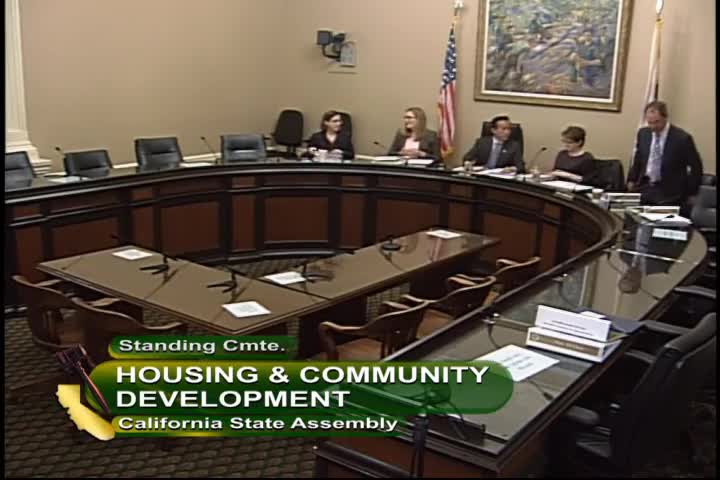
Bill Author

Bill Co-Author(s):