AB 2833: Personal income taxes: renter’s credit.
- Session Year: 2017-2018
- House: Assembly
- Latest Version Date: 2018-05-08
The Personal Income Tax Law authorizes various credits against the taxes imposed by that law, including a credit for qualified renters in the amount of $120 for spouses filing joint returns, heads of household, and surviving spouses if adjusted gross income is $50,000 or less, as currently adjusted to $80,156, and in the amount of $60 for other individuals if adjusted gross income is $25,000 or less, as currently adjusted to $40,078.
This bill, for taxable years beginning on or after January 1, 2019, and before January 1, 2024, for spouses filing joint returns, heads of household, and surviving spouses with those adjusted gross incomes, would allow a credit equal to the greater of $120 or 20% of the median rent in the county where the premises are located at which the qualified renter rented and occupied as his or her principal place of residence for the longest period during the taxable year. The bill, for taxable years beginning on or after January 1, 2019, and before January 1, 2024, for other individuals with those adjusted gross incomes, would allow a credit equal to the greater of $60 or 10% of the median rent in the county where the premises are located at which the qualified renter rented and occupied as his or her principal place of residence for the longest period during the taxable year.
This bill, on or before January 1, 2020, and on or before January 1 each year thereafter, 1, 2025, would require the county assessor Department of Housing and Community Development to annually determine the median rent in the each county for the previous calendar year and to provide that data to the Franchise Tax Board. The bill, on or before January 31, 2020, and on or before January 31 each year thereafter, 31, 2025, would require the Franchise Tax Board, using that data provided, to annually calculate the amount of the credit allowed by county for each taxable year and to publish its determinations on its Internet Web site to notify taxpayers. By imposing a new duty on county assessors, this bill would impose a state-mandated local program.
Existing law establishes the continuously appropriated Tax Relief and Refund Account and provides that payments required to be made to taxpayers or other persons from the Personal Income Tax Fund are to be paid from that account.This bill, for taxable years beginning on or after January 1, 2019, if the amount allowable as a credit under this bill exceeds the tax liability computed under the Personal Income Tax Law for the taxable year, would require the excess to be credited against other amounts due, if any, and the balance, if any, upon appropriation by the Legislature, to be paid from the Tax Relief and Refund Account and refunded to the taxpayer.The California Constitution requires the state to reimburse local agencies and school districts for certain costs mandated by the state. Statutory provisions establish procedures for making that reimbursement.This bill would provide that, if the Commission on State Mandates determines that the bill contains costs mandated by the state, reimbursement for those costs shall be made pursuant to the statutory provisions noted above.This bill would take effect immediately as a tax levy.
The Personal Income Tax Law authorizes various credits against the taxes imposed by that law, including a credit for qualified renters in the amount of $120 for spouses filing joint returns, heads of household, and surviving spouses if adjusted gross income is $50,000 or less, as currently adjusted to $80,156, and in the amount of $60 for other individuals if adjusted gross income is $25,000 or less, as currently adjusted to $40,078.
This bill, for taxable years beginning on or after January 1, 2019, for spouses filing joint returns, heads of household, and surviving spouses with those adjusted gross incomes, would allow a credit equal to the greater of $120 or 20% of the median rent in the county where the premises are located at which the qualified renter rented and occupied as his or her principal place of residence for the longest period during the taxable year. The bill, for taxable years beginning on or after January 1, 2019, for other individuals with those adjusted gross incomes, would allow a credit equal to the greater of $60 or 10% of the median rent in the county where the premises are located at which the qualified renter rented and occupied as his or her principal place of residence for the longest period during the taxable year.
This bill, on or before January 1, 2020, and on or before January 1 each year thereafter, would require the county assessor to determine the median rent in the county for the previous calendar year and provide that data to the Franchise Tax Board. The bill, on or before January 31, 2020, and on or before January 31 each year thereafter, would require the Franchise Tax Board, using that data provided, to calculate the amount of the credit allowed by county for each taxable year and to publish its determinations on its Internet Web site to notify taxpayers. By imposing a new duty on county assessors, this bill would impose a state-mandated local program.
Existing law establishes the continuously appropriated Tax Relief and Refund Account and provides that payments required to be made to taxpayers or other persons from the Personal Income Tax Fund are to be paid from that account.
This bill, for taxable years beginning on or after January 1, 2019, if the amount allowable as a credit under this bill exceeds the tax liability computed under the Personal Income Tax Law for the taxable year, would require the excess to be credited against other amounts due, if any, and the balance, if any, upon appropriation by the Legislature, to be paid from the Tax Relief and Refund Account and refunded to the taxpayer.
The California Constitution requires the state to reimburse local agencies and school districts for certain costs mandated by the state. Statutory provisions establish procedures for making that reimbursement.
This bill would provide that, if the Commission on State Mandates determines that the bill contains costs mandated by the state, reimbursement for those costs shall be made pursuant to the statutory provisions noted above.
This bill would take effect immediately as a tax levy.
Existing property tax law requires assessees to report change in ownership information to the assessor, as provided.This bill would make a nonsubstantive change to that provision.Existing property tax law requires assessees to report change in ownership information to the assessor, as provided.
This bill would make a nonsubstantive change to that provision.
(a)(1)For a qualified renter, there shall be allowed a credit against his or her net tax, as defined in Section 17039. The amount of the credit shall be as follows:
(A)For spouses filing joint returns, heads of household, and surviving spouses, as defined in Section 17046, if adjusted gross income is fifty thousand dollars ($50,000) or less, the credit shall be equal to:
(i)For taxable years beginning before January 1, 2019, one hundred twenty dollars ($120).
(ii)For taxable years beginning on or after January 1, 2019, and before January 1, 2024, the greater of one hundred twenty dollars ($120) or 20 percent of the median rent in the county where the premises are located at which the qualified renter rented and occupied as his or her principal place of residence for the longest period during the taxable year. If the qualified renter rented and occupied premises as his or her principal place of residence located in different counties for equal periods during the taxable year, such that no rental period is longer than another, the credit shall be determined based on the premises located in the county with the highest median rent.
(iii)For taxable years beginning on or after January 1, 2024, one hundred twenty dollars ($120).
(B)For other individuals, if adjusted gross income is twenty-five thousand dollars ($25,000) or less, the credit shall be equal to:
(i)For taxable years beginning before January 1, 2019, sixty dollars ($60).
(ii)For taxable years beginning on or after January 1, 2019, and before January 1, 2024, the greater of sixty dollars ($60) or 10 percent of the median rent in the county where the premises are located at which the qualified renter rented and occupied as his or her principal place of residence for the longest period during the taxable year. If the qualified renter rented and occupied premises as his or her principal place of residence located in different counties for equal periods during the taxable year, such that no rental period is longer than another, the credit shall be determined based on the premises located in the county with the highest median rent.
(iii)For taxable years beginning on or after January 1, 2024, sixty dollars ($60).
(2)Except as provided in subdivision (b), spouses shall receive but one credit under this section. If the spouses file separate returns, the credit may be taken by either or equally divided between them, except as follows:
(A)If one spouse was a resident for the entire taxable year and the other spouse was a nonresident for part or all of the taxable year, the resident spouse shall be allowed one-half the credit allowed to married persons and the nonresident spouse shall be permitted one-half the credit allowed to married persons, prorated as provided in subdivision (e).
(B)If both spouses were nonresidents for part of the taxable year, the credit allowed to married persons shall be divided equally between them subject to the proration provided in subdivision (e).
(b)For spouses, if each spouse maintained a separate place of residence and resided in this state during the entire taxable year, each spouse will be allowed one-half the full credit allowed to married persons provided in subdivision (a).
(c)For purposes of this section, a qualified renter means an individual who satisfies both of the following:
(1)Was a resident of this state, as defined in Section 17014.
(2)Rented and occupied premises in this state which constituted his or her principal place of residence during at least 50 percent of the taxable year.
(d)Qualified renter does not include any of the following:
(1)An individual who for more than 50 percent of the taxable year rented and occupied premises that were exempt from property taxes, except that an individual, otherwise qualified, is deemed a qualified renter if he or she or his or her landlord pays possessory interest taxes, or the owner of those premises makes payments in lieu of property taxes that are substantially equivalent to property taxes paid on properties of comparable market value.
(2)An individual whose principal place of residence for more than 50 percent of the taxable year is with another person who claimed that individual as a dependent for income tax purposes.
(3)An individual who has been granted or whose spouse has been granted the homeowners property tax exemption during the taxable year. This paragraph does not apply to an individual whose spouse has been granted the homeowners property tax exemption if each spouse maintained a separate residence for the entire taxable year.
(e)An otherwise qualified renter who is a nonresident for any portion of the taxable year shall claim the credits set forth in subdivision (a) at the rate of one-twelfth of those credits for each full month that individual resided within this state during the taxable year.
(f)A person claiming the credit provided in this section shall, as part of that claim, and under penalty of perjury, furnish that information as the Franchise Tax Board prescribes on a form supplied by the board.
(g)The credit provided in this section shall be claimed on returns in the form as the Franchise Tax Board may from time to time prescribe.
(h)For purposes of this section, premises means a house or a dwelling unit used to provide living accommodations in a building or structure and the land incidental thereto, but does not include land only, unless the dwelling unit is a mobilehome. The credit is not allowed for any taxable year for the rental of land upon which a mobilehome is located if the mobilehome has been granted a homeowners exemption under Section 218 in that year.
(i)This section shall become operative on January 1, 1998, and applies to any taxable year beginning on or after January 1, 1998.
(j)For each taxable year beginning on or after January 1, 1999, the Franchise Tax Board shall recompute the adjusted gross income amounts set forth in subdivision (a). The computation shall be made as follows:
(1)The Department of Industrial Relations shall transmit annually to the Franchise Tax Board the percentage change in the California Consumer Price Index for all items from June of the prior calendar year to June of the current year, no later than August 1 of the current calendar year.
(2)The Franchise Tax Board shall compute an inflation adjustment factor by adding 100 percent to the portion of the percentage change figure which is furnished pursuant to paragraph (1) and dividing the result by 100.
(3)The Franchise Tax Board shall multiply the amount in subparagraph (B) of paragraph (1) of subdivision (a) for the preceding taxable year by the inflation adjustment factor determined in paragraph (2), and round off the resulting products to the nearest one dollar ($1).
(4)In computing the amounts pursuant to this subdivision, the amounts provided in subparagraph (A) of paragraph (1) of subdivision (a) shall be twice the amount provided in subparagraph (B) of paragraph (1) of subdivision (a).
(k)(1)On or before January 1, 2020, and on or before January 1 each year thereafter, 1, 2025, the county assessor Department of Housing and Community Development shall annually determine the median rent in the each county for the previous calendar year and provide that data to the Franchise Tax Board.
(2)On or before January 31, 2020, and on or before January 31 each year thereafter, 31, 2025, the Franchise Tax Board, using the data provided from each county assessors office by the Department of Housing and Community Development for each county pursuant to paragraph (1), shall annually calculate the amount of the credit allowed pursuant to this section by county for each taxable year, commencing with taxable years beginning on January 1, 2019. 2019, and before January 1, 2024. The Franchise Tax Board shall publish its determinations on its Internet Web site to notify taxpayers.
(l)For taxable years beginning on or after January 1, 2019, if the amount allowable as a credit under this section exceeds the tax liability computed under this part for the taxable year, the excess shall be credited against other amounts due, if any, and the balance, if any, upon appropriation by the Legislature, shall be paid from the Tax Relief and Refund Account and refunded to the taxpayer.SEC. 2.If the Commission on State Mandates determines that this act contains costs mandated by the state, reimbursement to local agencies and school districts for those costs shall be made pursuant to Part 7 (commencing with Section 17500) of Division 4 of Title 2 of the Government Code.SEC. 3.SEC. 2.This act provides for a tax levy within the meaning of Article IV of the California Constitution and shall go into immediate effect.
(a)(1)For a qualified renter, there shall be allowed a credit against his or her net tax, as defined in Section 17039. The amount of the credit shall be as follows:
(A)For spouses filing joint returns, heads of household, and surviving spouses, as defined in Section 17046, if adjusted gross income is fifty thousand dollars ($50,000) or less, the credit shall be equal to one hundred twenty dollars ($120) if adjusted gross income is fifty thousand dollars ($50,000) or less. to:
(i)For taxable years beginning before January 1, 2019, one hundred twenty dollars ($120).
(ii)For taxable years beginning on or after January 1, 2019, the greater of one hundred twenty dollars ($120) or 20 percent of the median rent in the county where the premises are located at which the qualified renter rented and occupied as his or her principal place of residence for the longest period during the taxable year. If the qualified renter rented and occupied premises as his or her principal place of residence located in different counties for equal periods during the taxable year, such that no rental period is longer than another, the credit shall be determined based on the premises located in the county with the highest median rent.
(B)For other individuals, if adjusted gross income is twenty-five thousand dollars ($25,000) or less, the credit shall be equal to sixty dollars ($60) if adjusted gross income is twenty-five thousand dollars ($25,000) or less. to:
(i)For taxable years beginning before January 1, 2019, sixty dollars ($60).
(ii)For taxable years beginning on or after January 1, 2019, the greater of sixty dollars ($60) or 10 percent of the median rent in the county where the premises are located at which the qualified renter rented and occupied as his or her principal place of residence for the longest period during the taxable year. If the qualified renter rented and occupied premises as his or her principal place of residence located in different counties for equal periods during the taxable year, such that no rental period is longer than another, the credit shall be determined based on the premises located in the county with the highest median rent.
(2)Except as provided in subdivision (b), spouses shall receive but one credit under this section. If the spouses file separate returns, the credit may be taken by either or equally divided between them, except as follows:
(A)If one spouse was a resident for the entire taxable year and the other spouse was a nonresident for part or all of the taxable year, the resident spouse shall be allowed one-half the credit allowed to married persons and the nonresident spouse shall be permitted one-half the credit allowed to married persons, prorated as provided in subdivision (e).
(B)If both spouses were nonresidents for part of the taxable year, the credit allowed to married persons shall be divided equally between them subject to the proration provided in subdivision (e).
(b)For spouses, if each spouse maintained a separate place of residence and resided in this state during the entire taxable year, each spouse will be allowed one-half the full credit allowed to married persons provided in subdivision (a).
(c)For purposes of this section, a qualified renter means an individual who satisfies both of the following:
(1)Was a resident of this state, as defined in Section 17014.
(2)Rented and occupied premises in this state which constituted his or her principal place of residence during at least 50 percent of the taxable year.
(d)Qualified renter does not include any of the following:
(1)An individual who for more than 50 percent of the taxable year rented and occupied premises that were exempt from property taxes, except that an individual, otherwise qualified, is deemed a qualified renter if he or she or his or her landlord pays possessory interest taxes, or the owner of those premises makes payments in lieu of property taxes that are substantially equivalent to property taxes paid on properties of comparable market value.
(2)An individual whose principal place of residence for more than 50 percent of the taxable year is with another person who claimed that individual as a dependent for income tax purposes.
(3)An individual who has been granted or whose spouse has been granted the homeowners property tax exemption during the taxable year. This paragraph does not apply to an individual whose spouse has been granted the homeowners property tax exemption if each spouse maintained a separate residence for the entire taxable year.
(e)An otherwise qualified renter who is a nonresident for any portion of the taxable year shall claim the credits set forth in subdivision (a) at the rate of one-twelfth of those credits for each full month that individual resided within this state during the taxable year.
(f)A person claiming the credit provided in this section shall, as part of that claim, and under penalty of perjury, furnish that information as the Franchise Tax Board prescribes on a form supplied by the board.
(g)The credit provided in this section shall be claimed on returns in the form as the Franchise Tax Board may from time to time prescribe.
(h)For purposes of this section, premises means a house or a dwelling unit used to provide living accommodations in a building or structure and the land incidental thereto, but does not include land only, unless the dwelling unit is a mobilehome. The credit is not allowed for any taxable year for the rental of land upon which a mobilehome is located if the mobilehome has been granted a homeowners exemption under Section 218 in that year.
(i)This section shall become operative on January 1, 1998, and applies to any taxable year beginning on or after January 1, 1998.
(j)For each taxable year beginning on or after January 1, 1999, the Franchise Tax Board shall recompute the adjusted gross income amounts set forth in subdivision (a). The computation shall be made as follows:
(1)The Department of Industrial Relations shall transmit annually to the Franchise Tax Board the percentage change in the California Consumer Price Index for all items from June of the prior calendar year to June of the current year, no later than August 1 of the current calendar year.
(2)The Franchise Tax Board shall compute an inflation adjustment factor by adding 100 percent to the portion of the percentage change figure which is furnished pursuant to paragraph (1) and dividing the result by 100.
(3)The Franchise Tax Board shall multiply the amount in subparagraph (B) of paragraph (1) of subdivision (d) (a) for the preceding taxable year by the inflation adjustment factor determined in paragraph (2), and round off the resulting products to the nearest one dollar ($1).
(4)In computing the amounts pursuant to this subdivision, the amounts provided in subparagraph (A) of paragraph (1) of subdivision (a) shall be twice the amount provided in subparagraph (B) of paragraph (1) of subdivision (a).
(k)(1)On or before January 1, 2020, and on or before January 1 each year thereafter, the county assessor shall determine the median rent in the county for the previous calendar year and provide that data to the Franchise Tax Board.
(2)On or before January 31, 2020, and on or before January 31 each year thereafter, the Franchise Tax Board, using the data provided from each county assessors office pursuant to paragraph (1), shall calculate the amount of the credit allowed pursuant to this section by county for each taxable year, commencing with taxable years beginning on January 1, 2019. The Franchise Tax Board shall publish its determinations on its Internet Web site to notify taxpayers.
(l)For taxable years beginning on or after January 1, 2019, if the amount allowable as a credit under this section exceeds the tax liability computed under this part for the taxable year, the excess shall be credited against other amounts due, if any, and the balance, if any, upon appropriation by the Legislature, shall be paid from the Tax Relief and Refund Account and refunded to the taxpayer.
SEC. 2.If the Commission on State Mandates determines that this act contains costs mandated by the state, reimbursement to local agencies and school districts for those costs shall be made pursuant to Part 7 (commencing with Section 17500) of Division 4 of Title 2 of the Government Code.
SEC. 3.This act provides for a tax levy within the meaning of Article IV of the California Constitution and shall go into immediate effect.
SECTION 1.Section 90 of the Revenue and Taxation Code is amended to read:90.An assessee shall report change in ownership information to the assessor as provided in Article 2.5 (commencing with Section 480) of Chapter 3 of Part 2.Assessees An assessee shall report change in ownership information to the assessor as provided in Article 2.5 (commencing with Section 480) of Chapter 3 of Part 2.
|
Date
|
Status
|
|---|---|
| May 25, 2018 | In committee: Held under submission. |
| May 16, 2018 | In committee: Set, first hearing. Referred to APPR. suspense file. |
| May 9, 2018 | Re-referred to Com. on APPR. |
| May 8, 2018 | Read second time and amended. |
| May 7, 2018 | From committee: Amend, and do pass as amended and re-refer to Com. on APPR. (Ayes 9. Noes 0.) (April 30). |
| Mar 21, 2018 | Re-referred to Com. on REV. & TAX. |
| Mar 20, 2018 | From committee chair, with author's amendments: Amend, and re-refer to Com. on REV. & TAX. Read second time and amended. |
| Mar 19, 2018 | Referred to Com. on REV. & TAX. |
| Feb 17, 2018 | From printer. May be heard in committee March 19. |
| Feb 16, 2018 | Read first time. To print. |
|
Date
|
Description
|
Location
|
Votes
|
|
|---|---|---|---|---|
| Apr 30, 2018 | Do pass as amended and be re-referred to the Committee on [Appropriations] | Assembly Standing Committee on Revenue and Taxation |
Passed |
This list shows positions taken on this bill by organizations on the date displayed, which is linked to the original source.
Positions by individuals are not included.
Date of Hearing: May 16, 2018
ASSEMBLY COMMITTEE ON APPROPRIATIONS
Lorena Gonzalez Fletcher, Chair
ABPCA Bill Id:AB 2833
Author:(Santiago) – As Amended Ver:May 8, 2018
Policy Committee: | Revenue and Taxation | Vote: | 9 - 0 |
|
| ||
|
|
Urgency: No State Mandated Local Program: No Reimbursable: No
SUMMARY:
This bill modifies the Renter’s Credit by providing the greater of $120 or 20% of the county median rent to spouses filing joint returns, heads of households, and surviving spouses, and the greater of $60 or 10% of the median county rent to other individual taxpayers. Other Renter’s Credit eligibility restrictions will remain the same, and the modified renter’s credit is available for tax years 2019 through 2023.
FISCAL EFFECT:
Annual General Fund (GF) revenue loss of $140 million in 2019-20 and $140 million in 2020-21.
COMMENTS:
- Background. The Renter’s Credit provides a credit to low-income taxpayers who rent their primary residence in order to counteract the inequity between renters and homeowners. The credit was originally enacted in 1972 as part of a comprehensive property tax reform program. That program allowed for an increase in the Homeowner's Property Tax Exemption Credit that reduces the property tax on owner-occupied property. In contrast, rental property is not eligible for the homeowner's exemption. The Renter’s Credit was increased significantly in 1979 shortly after the approval of Proposition 13 because it was thought that homeowners were receiving a benefit from Proposition 13, while renters were not.
Today, the amount of the credit is $60 for single, married filing separately, and head of household filers with income not exceeding the California AGI limitation. The credit amount is $120 for married filing jointly and a qualified widower.
- Purpose. According to the author, AB 2833 will help renters by increasing the Renter’s Credit’s values to apply proportionately to the housing market in which people live. Supporters argue that the existing credit has not kept pace with the cost of living in California and it is not reaching those who could most benefit from it.
- Prior version. Prior versions of AB 2833 made the renter’s credit refundable in addition to the ability to claim a credit worth a certain share of the county median income. Making the renter’s credit refundable would have meant lower-income households without taxable income could still receive it. However, this prior version was also prohibitively expensive: Annual GF revenue loss was estimated to be $190 million in 2019-20 and $200 million in 2020-21.
- Fiscal implications of tax expenditures. Existing law allows for various tax expenditures such as credits, deductions, exclusions, and exemptions for particular taxpayer groups. These features of the tax code can result in significant state costs through foregone tax revenue and, in many cases, policymakers have little control over the revenue loss that occurs in any given year. As a result, many tax expenditure bills now include provisions designed to give the Legislature more control over costs. Examples of such provisions include placing a sunset date or making a bill’s provisions contingent upon a separate budget appropriation. AB 2833 contains a sunset.
- Related legislation. SB 1212 (Anderson), of the 2017-18 Legislative Session, increases the Renter’s Credit to $500 for married couples filing joint returns, heads of household, and surviving spouses, and to $250 for other individuals. SB 1182 (Glazer), of the 2017-18 Legislative Session, increases the Renter’s Credit to $240 for married couples filing joint returns, heads of household, and surviving spouses, and to $120 for other individuals. Both SB 1212 and SB 1182 are pending in the Senate Appropriations’ Committee.
Analysis Prepared by: Luke Reidenbach / APPR. / (916) 319-2081
Date of Hearing: April 30, 2018
ASSEMBLY COMMITTEE ON REVENUE AND TAXATION
Autumn R. Burke, Chairwoman
ABPCA Bill Id:AB 2833 (
Author:Santiago) – As Amended Ver:March 20, 2018
Majority vote. Tax levy. Fiscal committee.
SUBJECT: Personal income taxes: renter's credit
SUMMARY: Modifies and makes refundable the renter’s credit available under the Personal Income Tax (PIT) Law for qualified renters based upon the "median rent" in the county where the renter resides. Specifically, this bill:
- Modifies the existing non-refundable renters' tax credit amount under the PIT Law that qualified renters may claim, as follows:
- The greater of $120 or 20% of the "median rent" in the county of the taxpayer's principal place of residence for married couples filing joint returns, heads of household, and surviving spouses, if adjusted gross income (AGI) is $50,000 or less; or,
- The greater of $60 or 10% of the "median rent" in the county of the taxpayer's principal place of residence for other individuals if AGI is $25,000 or less.
- Makes the tax credit refundable for taxable years beginning on or after January 1, 2019.
- Specifies "median rent" is the median rent in the county.
- Selects the median rent in the county of the property rented and occupied for the longest period during the taxable year, if the taxpayer had multiple principal places of residences in different counties.
- Selects the county with the highest median rent, if the taxpayer had multiple principal places of residence in different counties for equal periods during the tax year.
- Requires each county assessor on or after January 1, 2020, and each year thereafter, to determine the county's median rent for the previous calendar year and provide the data to the Franchise Tax Board (FTB).
- Requires the FTB on or before January 31, 2020, and each year thereafter, to calculate the credit amount allowed and publish its determinations on its Web site to notify taxpayers.
- Requires tax credits to be paid from the Tax Relief and Refund Account.
- Requires a regular annual appropriation by the Legislature to pay for the refundable portion of this credit.
- Provides that if the Commission on State Mandates determines that this bill contains state-mandated costs, reimbursement to local agencies for those costs will be made, as specified.
- Takes immediate effect as a tax levy.
EXISTING LAW:
- Allows various tax credits under the PIT Law, generally designed to encourage socially beneficial behavior or to provide relief to taxpayers who incur specified expenses.
- Allows a nonrefundable tax credit for qualified renters as follows:
- $120 for married couples filing joint returns, heads of household, and surviving spouses if AGI is $50,000 or less; or,
- $60 for other individuals if AGI is $25,000 or less.
- Requires the FTB to adjust annually the specified AGI amounts for inflation. For tax year 2017, the AGI limits are $80,156 and $40,078, respectively.
- Defines a "qualified renter" as an individual who satisfies both of the following:
- Was a resident of California; and,
- Rented and occupied premises in California that constituted his or her principal place of residence during at least half of the taxable year.
- Excludes from a "qualified renter" an individual who rents and occupies property that is exempt from property tax, as specified.
- Excludes from a "qualified renter" an individual whose principal place of residence is with another person who claims him or her as a dependent for income tax purposes, and other exclusions, as specified.
- Requires any person claiming the credit to do so under penalty of perjury.
FISCAL EFFECT: The FTB estimates General Fund revenue losses of $190 million in fiscal year (FY) 2019-20, and $200 million in FY 2020-21.
COMMENTS:
- The author has provided the following statement in support of this bill:
The Legislature has spent an impressive amount of time over the past few years working on measures to increase the stock of affordable housing in California. During that time, I have been a proud participant in many of those conversations, and have been happy to author a number of bills to spur production. While all of those conversations and the upcoming housing bond are vitally necessary, they, for the large part, focus on long-term (3-10 year) solutions.
Just before these comprehensive housing conversations commenced, our state and federal governments were forced to confront a housing foreclosure crisis of epic proportions. In a true and just manner, the Legislature spent many years examining and enacting policies to tighten protections for existing homeowners while working to stabilize the mortgage process for prospective home buyers.
Through all of these discussions, little real attention has been paid to the families in California who struggle on the income margins every month. Those who are forced to share rental space with others to make ends meet and/or who have no immediate hopes of owning homes [or] real fears of becoming homeless. The renters of California have trudged along year-by-year paying more and more of their disposable income to rent, while getting proportionately less and less relief from the state's Renter's Tax Credit. In fact, average rents have increased over 60% statewide in the past two decades while the Renter's Tax Credit has remained at the same level since its inception.
There have been numerous efforts in years past to increase California's Renter's Tax Credit to various degrees; none of them have been successful. They have failed to take into account the vast differences between the state's regional housing markets, and the needs of our lowest income populations.
If we are serious about helping California's residents keep roofs over their heads, is it time to re-examine the policies of the Renter's Tax Credit – to increase its values to apply proportionately to the housing market in which people live, and to make it refundable so that it can be applied to our lowest income households…those where $100/year will make an actual difference. AB 2833 attempts to do both of those things.
- Proponents offer in support of this bill the following information:
According to the Franchise Tax Board, usage of the current Renters Tax Credit has steadily increased in the last five years. Data for 2012 shows that the majority of the Renter's Credit benefits (80%) are concentrated in households with incomes between $20,000 and $60,000/year.
The current California Renter's Tax Credit was enacted 20 years ago and has not been adjusted in the ensuing time period. Over that same period of time, average rents have increased by 60%. As of 2015, the average monthly rent in California was $1,240 – 50% higher than the average rent in other states. We have long passed the time to increase the Renter's Tax Credit amounts in California.
Nearly half of California's households rent, and 84% of those are considered "burdened," meaning that they pay 30-50% or more of their annual income on rent. To make matters worse, those households that are very low income (or who have no income tax liability) do not qualify for the existing Renter's Tax Credit.
As a result of all of these factors, the existing credit has not kept pace with the actual cost of living in California and it is not reaching those who could most benefit from it.
- The California Building Industry Association in support of this bill's provision to make the renter’s credit refundable states:
[T]he bill makes the tax credit refundable which ensures that the credit can provide assistance to even those very low income households without an income tax liability.
- The FTB has identified the following policy and implementation concerns in its analysis of this bill:
- "The department is concerned that another refundable credit could increase the trend in refund fraud and identity theft. Historically, both the Internal Revenue Service and the FTB have experienced fraud and improper claims with refundable credits. These concerns are heightened because if a refund is determined to be fraudulent, the refund commonly cannot be recovered."
- "Implementing this bill would require changes to existing tax forms and instructions, robust education and outreach, and substantial changes to information systems to limit improper payments."
- "This bill would require the FTB to calculate the amount of the credit and publish the amounts by county on its Internet Web site within 30 days of receiving the information from the county assessors on or before January 1. However, this due date is after the department develops the forms and instructions for a taxable year. In addition, 30 days is a short timeframe to make systems and forms changes."
- "This bill would allow an increased credit amount based on the county the taxpayer resides in. It is unclear how the department would verify that the correct county was used to calculate the claimed credit, in order to prevent improper payments."
- "This bill would require regular annual appropriations by the Legislature to pay for the refundable portion of this credit. Disallowance of the credit to some taxpayers could result if the amount of credits claimed exceeds the amount of appropriated funds. This concern could be alleviated by specifying the funds for refund be continuously appropriated from the Tax Relief and Refund Account."
- Committee Staff Comments:
- Creates state-mandated program by involving the county assessor: This bill requires county assessors to annually determine the median rent for their county. This provision of the bill raises several issues. First, county assessors have expertise in property valuation matters, not the calculation of county-wide annual median rents. This bill lacks any methodology or standard for the assessors in the 58 counties to follow in making the required calculation. Second, involving counties in the FTB's administration of the state income tax creates a state-mandated local program. The state has departments, such as the California Department of Housing and Community Development (HCD), that specialize in housing matters. Finally, and moreover, currently the federal government annually estimates fair-market rents (FMRs), as discussed below, through the United States Department of Housing and Urban Development (HUD). The HUD-FMRs are a standard measure used in several programs. This bill sets a different measure, with no standards, developed by counties for state-use. The Committee may wish to consider if the local county assessor is the appropriate governmental entity to assign this state income tax-related task.
- Duplicative effort? HUD annually estimates FMRs for metropolitan areas and non-metropolitan county areas for use in determining payment standard amounts for the Housing Choice Voucher program and other housing assistance programs. FMRs are gross rent estimates that include the shelter rent plus the cost of all tenant-paid utilities, except telephones, cable or satellite television service, and Internet service. The level at which FMRs are set is expressed as a percentile point within the rent distribution of standard-quality market rental housing units (generally, the 40th percentile or the 50th percentile to achieve de-concentration of voucher-based units in high poverty areas). HUD calculates FMRs for efficiencies (studio apartments with a kitchenette area instead of a full kitchen) and one- to four-bedroom units. Tax laws should generally be crafted to promote, to the greatest degree possible, simplicity, efficiency and uniformity at the least possible administrative cost. In keeping with this principle, the Committee may wish to key the tax credit to HUD-FMRs at a specific apartment bedroom size to avoid expending limited public resources on duplicative efforts.
- Rental housing occupied by room-mates and multiple generations: The renter’s credit applies to each qualified renter. This is significant because this bill does not cap the renter’s credit at a per unit amount. For example, if six college students rent a three bedroom apartment or house, then each student could claim a credit based at 10% of the county's median rent. This results in a total refundable credit of 60% of the county's median rent for the single rented residence. This is true even if the parents claim the students as dependents on their income tax returns. In the case of a multi-generational household with two married couples (i.e., grandparents and parents) living in a rental home, this would result in a total refundable credit of 40% of the county's median rent for the single rented residence. Existing law is not well-designed to transition to a percentage-based credit per residence such as this bill envisions. Thus, additional amendments consistent with the author's intent would be necessary.
- Persons who reside in property tax-exempt rental housing are ineligible for the renter’s credit. For example, persons who live in a low-income rental housing development that is receiving the property tax welfare exemption would be ineligible to claim the refundable credit. Also, college students who live in dorms that are tax exempt under the welfare exemption for non-profit institutions of higher learning or dorms that are tax exempt as publically owned property would be ineligible to claim the refundable credit.
- Inadvertent rent increase? Some economists have argued that tax subsidies for homeownership, such as the mortgage interest deduction, are factored into the price of housing and, thus, essentially inflate the prices of homes. Would the expanded tax credit have a similar impact on the rental market? Would the tax credit provide taxpayers with meaningful relief or simply increase rents higher? The Committee may wish to consider narrowing the scope of the increased credit to direct it towards individuals with the most need, or as an alternative, funding a grant program that targets vulnerable renters or supports other anti-poverty efforts.
- How is a tax expenditure different from a direct expenditure? As the Department of Finance notes in its Tax Expenditure Report, there are several key differences between tax expenditures and direct expenditures. First, once they are put in place, tax expenditures are reviewed less frequently than direct expenditures. Although this creates greater certainty for taxpayers regarding the applicable tax laws (because the tax expenditure will remain on the books for longer periods of time), it may also result in arbitrary tax expenditures that do not serve a public benefit. Second, there is generally no control over the amount of revenue losses associated with any given tax expenditure. Finally, it should also be noted that once enacted it takes a two-thirds vote to rescind an existing tax expenditure absent a sunset date. For this reason, the Committee may wish to include a five-year sunset to this bill.
- Related legislation:
- SB 1212 (Anderson) would increase the renter’s credit to $500 for married couples filing joint returns, heads of household, and surviving spouses and $250 for other individuals. SB 1212 is set for hearing by the Senate Governance and Finance Committee on May 9, 2018.
- SB 1182 (Glazer) would increase the renter’s credit, upon a budget bill that specifically so appropriates moneys, to $240 for married couples filing joint returns, heads of household, and surviving spouses and $120 for other individuals. SB 1182 is set for hearing by the Senate Governance and Finance Committee on May 9, 2018.
- AB 1582 (Bonta) would have increased the renter’s credit to $360 for married couples filing joint returns, heads of household, and surviving spouses and $180 for other individuals, and would have increased AGI thresholds for renters in high-cost areas. AB 1582 was never heard in this Committee and returned to the Chief Clerk.
- AB 1100 (Chen) would have increased the renter’s credit to $428 for married couples filing joint returns, heads of household, and surviving spouses and $214 for other individuals, increased AGI thresholds, and also would have increased the homeowners' property tax exemption to $25,000. AB 1100 was held on the Assembly Committee on Appropriations' Suspense File.
- AB 181 (Lackey) would have increased the renter’s credit to $240 for married couples filing joint returns, heads of household, and surviving spouses and $120 for other individuals. AB 181 was held on the Assembly Committee on Appropriations' Suspense File.
- Prior legislation:
- AB 2694 (Lackey), of the 2015-16 Legislative Session, would have increased the renter’s credit to $140 for married couples filing joint returns, heads of household, and surviving spouses and $70 for other individuals. AB 2694 was held on the Assembly Committee on Appropriations' Suspense File.
- SB 1103 (Cannella), of the 2015-16 Legislative Session, would have increased the renter’s credit to $200 for married couples filing joint returns, heads of household, and surviving spouses and $100 for other individuals and temporarily eliminated the AGI thresholds for tax years 2016-2019. SB 1103 was held on the Senate Committee on Appropriations' Suspense File.
- AB 476 (Chang), of the 2015-16 Legislative Session, would have increased the renter’s credit to $428 for married couples filing joint returns, heads of household, and surviving spouses and $214 for other individuals, and would have increased the homeowners' property tax exemption to $25,000. AB 476 was held on this Committee's Suspense File.
REGISTERED SUPPORT / OPPOSITION:
Support
Board of Equalization Member Jerome E. Horton (Sponsor)
California Apartment Association
California Building Industry Association
Opposition
None on file
Analysis Prepared by: Rose Marie Kinnee / REV. & TAX. / (916) 319-2098
Discussed in Hearing
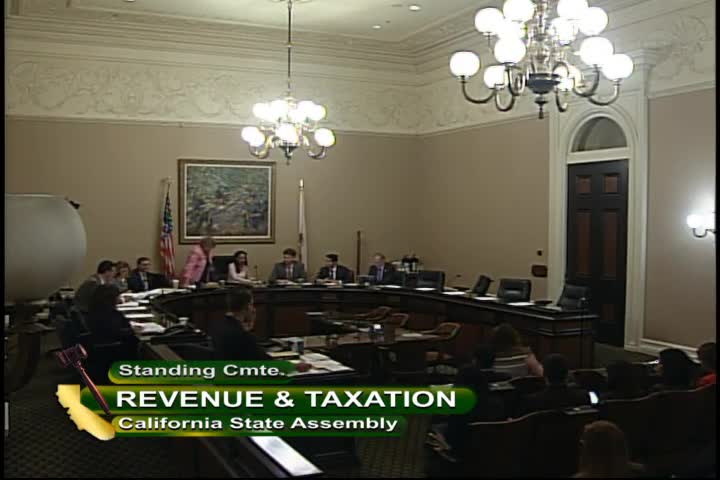 3MIN
Assembly Standing Committee on Revenue and Taxation
Bill Author

Bill Co-Author(s):