AB 2859: Pharmacy: safe storage products.
- Session Year: 2017-2018
- House: Assembly
- Latest Version Date: 2018-08-28
Existing law, the Pharmacy Law, provides for the licensure and regulation of pharmacists and pharmacies by the California State Board of Pharmacy, which is within the Department of Consumer Affairs, and provides that a violation of that law is punishable as a misdemeanor.
This bill would require a pharmacy that dispenses Schedule II, III, or IV controlled substances to display safe storage products in a place on the building premises that is located close to the pharmacy, unless the pharmacy meets 2 requirements related to the ownership and management of the pharmacy. The bill would require the board to assess a fine against a pharmacy for violation of these provisions, except that the bill would allow the board to choose not to take administrative action against a pharmacy if the board determines that compliance with the law would create a financial hardship on the pharmacy or that the pharmacy is temporarily out of stock of safe storage products. The bill would specify that a violation of these provisions shall not be punishable as a misdemeanor. The bill would also define certain terms for these purposes. The bill would repeal these provisions on January 1, 2023.
Existing law, the Pharmacy Law, provides for the licensure and regulation of pharmacists and pharmacies by the California State Board of Pharmacy, which is within the Department of Consumer Affairs, and provides that a violation of that law is punishable as a misdemeanor.
This bill would require a chain community pharmacy that dispenses Schedule II, III, or IV controlled substances to display safe storage products in a place on the building premises that is located close to the pharmacy, unless the chain community pharmacy meets 2 requirements related to the ownership and management of the pharmacy. The bill would require the board to assess a fine against a pharmacy for violation of these provisions, except that the bill would allow the board to choose not to take administrative action against a pharmacy if the board determines that compliance with the law would create a financial hardship on the pharmacy or that the pharmacy is temporarily out of stock of safe storage products. The bill would specify that a violation of these provisions shall not be punishable as a misdemeanor. The bill would also define certain terms for these purposes. The bill would repeal these provisions on January 1, 2023.
Existing law, the Pharmacy Law, provides for the licensure and regulation of pharmacists and pharmacies by the California State Board of Pharmacy, which is within the Department of Consumer Affairs, and provides that a violation of that law is punishable as a misdemeanor.
This bill would require a chain community pharmacy or an independent community pharmacy that dispenses Schedule II, III, or IV controlled substances to display safe storage products in a place on the building premises that is located close to the pharmacy. pharmacy, unless the chain community pharmacy meets 2 requirements related to the ownership and management of the pharmacy. The bill would require the board to assess a fine against a pharmacy for violation of these provisions, except that the bill would allow the board to choose not to take administrative action against a pharmacy if the board determines that compliance with the law would create a financial hardship on the pharmacy or that the pharmacy is temporarily out of stock of safe storage products. The bill would specify that a violation of these provisions shall not be punishable as a misdemeanor. The bill would also define certain terms for these purposes. The bill would repeal these provisions on January 1, 2023.
Existing law, the Pharmacy Law, provides for the licensure and regulation of pharmacists and pharmacies by the California State Board of Pharmacy, which is within the Department of Consumer Affairs, and provides that a violation of that law is punishable as a misdemeanor.
This bill would require a chain community pharmacy or an independent community pharmacy that dispenses Schedule II, III, or IV controlled substances to display safe storage products within the pharmacy department. in a place on the building premises that is located close to the pharmacy. The bill would require the board to assess a fine against a pharmacy for violation of these provisions, except that the bill would allow the board to choose not to take administrative action against a pharmacy if the board determines that compliance with the law would create a financial hardship on the pharmacy or that the pharmacy is temporarily out of stock of safe storage products. The bill would specify that a violation of these provisions shall not be punishable as a misdemeanor. The bill would also define certain terms for these purposes. The bill would repeal these provisions on January 1, 2023.
Existing law, the Pharmacy Law, provides for the licensure and regulation of pharmacists and pharmacies by the California State Board of Pharmacy, which is within the Department of Consumer Affairs, and provides that a violation of that law is punishable as a misdemeanor.
This bill would require a chain community pharmacy or an independent community pharmacy that dispenses Schedule II, III, or IV controlled substances to display safe storage products within the pharmacy department. The bill would require the board to assess a fine against a pharmacy for violation of these provisions, except that the bill would allow the board to choose not to take administrative action against a pharmacy if the board determines that compliance with the law would create a financial hardship on the pharmacy. pharmacy or that the pharmacy is temporarily out of stock of safe storage products. The bill would specify that a violation of these provisions shall not be punishable as a misdemeanor. The bill would also define certain terms for these purposes. The bill would repeal these provisions on January 1, 2023.
Existing law, the Pharmacy Law, provides for the licensure and regulation of pharmacists and pharmacies by the California State Board of Pharmacy, which is within the Department of Consumer Affairs, and provides that a violation of that law is punishable as a misdemeanor.
This bill would require a chain community pharmacy or an independent community pharmacy that dispenses Schedule II, III, or IV controlled substances to display safe storage products within the pharmacy department. The bill would require the board to assess a fine against a pharmacy for violation of these provisions, except that the bill would allow the board to choose not to take administrative action against a pharmacy if the board determines that compliance with the law would create a financial hardship on the pharmacy. The bill would specify that a violation of these provisions shall not be punishable as a misdemeanor. The bill would also define certain terms for these purposes. The bill would repeal these provisions on January 1, 2023.
Existing law, the Pharmacy Law, provides for the licensure and regulation of pharmacists and pharmacies by the California State Board of Pharmacy, which is within the Department of Consumer Affairs, and provides that a violation of that law is punishable as a misdemeanor.
This bill would require a chain community pharmacy or an independent community pharmacy that dispenses Schedule II, III, or IV controlled substances to display safe storage products within 50 feet of the counter from which those controlled substances are furnished and would require the pharmacy to make customers aware of the availability of the safe storage products by displaying a sign on or near the pharmacy counter that complies with specified requirements. the pharmacy department. The bill would require the board to assess a fine against a pharmacy for violation of these provisions, except that the bill would allow the board to choose not to take administrative action against a pharmacy if the board determines that compliance with the law would create a financial hardship on the pharmacy. The bill would specify that a violation of these provisions shall not be punishable as a misdemeanor. The bill would also define certain terms for these purposes.
Existing law, the Pharmacy Law, provides for the licensure and regulation of pharmacists and pharmacies by the California State Board of Pharmacy, which is within the Department of Consumer Affairs, and provides that a violation of that law is punishable as a misdemeanor.
This bill would require a chain community pharmacy or an independent community pharmacy that dispenses Schedule II, III, or IV controlled substances to display safe storage products within 50 feet of the counter from which those controlled substances are furnished and would require the pharmacy to make customers aware of the availability of the safe storage products by displaying a sign on or near the pharmacy counter that complies with specified requirements. The bill would require the board to assess a fine against a pharmacy for violation of these provisions, except that the bill would allow the board to choose not to take administrative action against a pharmacy if the board determines that compliance with the law would create a financial hardship on the pharmacy. The bill would specify that a violation of these provisions shall not be punishable as a misdemeanor. The bill would also define certain terms for these purposes.
This act shall be known, and may be cited, as the Protecting Our Children and Adolescents from Opioids Act of 2018.
SEC. 2.(a)The Legislature finds and declares all of the following:
(1)Drug overdoses are now the leading cause of death by injury in the United States, outnumbering both traffic crashes and gun-related deaths.
(2)In 2015, there were 52,404 drug overdose deaths, with 33,091 of those deaths involving the use of opioids.
(3)Every day, 3,000 children 12 to 17 years of age abuse a prescription painkiller for the first time.
(4)The federal Centers for Disease Control and Prevention estimates that the nonmedical use of prescription painkillers costs public and private health insurers $72.8 billion annually.
(5)The National Institute on Drug Abuse has found 90 percent of all teens who abuse pharmaceutical drugs obtain their drugs from their home medicine cabinet or from a friends medicine cabinet.
(6)Researchers at the Johns Hopkins Bloomberg School of Public Health found that nearly 70 percent of prescription opioid medications kept in homes with children are not stored safely.
(7)Only 18 percent of providers have been estimated to discuss safe storage and disposal of drugs with their patients.
(8)The Partnership for Drug-Free Kids has found that one of the key drivers for abusing prescription painkillers amongst teens is easy access, with more than 3 in 5 teens stating that pain relievers were easy to obtain from their parents medicine cabinets.
(9)New reports have found that the number of emergency room visits for accidental poisoning amongst toddlers has tripled since 1997.
(b)It is the intent of the Legislature that increasing safe storage practices among parents is an important component to protecting teens and children from the dangers of opioid abuse and that the state must do more to encourage parents to safeguard these medications that are vital to managing certain chronic pain conditions among adults.
SEC. 3.Section 4106.5 is added to the Business and Professions Code, to read:4106.5.(a)For purposes of this section, the following terms shall have the following meanings:
(1)Pharmacy does not include a pharmacy that meets both of the following requirements:
(A)It is owned and operated by a person or persons in which the majority of the beneficial interest, as well as management and control, resides with at least one board-licensed pharmacist, as that term is defined in Section 4036, that exclusively oversees the operations of the pharmacy.
(B)The owner and operator with the beneficial interest, management, and control described in subparagraph (A) owns, operates, and has management and control of no more than four pharmacies.
(2)Safe storage products means a device or product made with the purpose of storing prescription medications that includes a locking mechanism that is accessible only by the designated patient with a passcode, alphanumeric code, key, or by another secure mechanism. A safe storage product includes, but is not limited to, medicine lock boxes, locking medicine cabinets, locking medication bags, and prescription locking vials.
(3) Schedule II, III, or IV controlled substances means any substance defined as a Schedule II, III, or IV controlled substance in Sections 11055, 11056, and 11057 of the Health and Safety Code.
(b)A pharmacy that dispenses Schedule II, III, or IV controlled substances shall display safe storage products in a place on the building premises that is located close to the pharmacy.
(c)(1)The board shall assess a fine in an amount to be determined by the board for a violation of this section.
(2)Notwithstanding paragraph (1), the board may choose not to take administrative action against a pharmacy if it determines that compliance with this section would create a financial hardship on the pharmacy or that the pharmacy is temporarily out of stock of safe storage products.
(d)Section 4321 shall not apply to a violation of this section.
(e)This section shall remain in effect only until January 1, 2023, and as of that date is repealed.
This act shall be known, and may be cited, as the Protecting Our Children and Adolescents from Opioids Act of 2018.
SEC. 2.(a)The Legislature finds and declares all of the following:
(1)Drug overdoses are now the leading cause of death by injury in the United States, outnumbering both traffic crashes and gun-related deaths.
(2)In 2015, there were 52,404 drug overdose deaths, with 33,091 of those deaths involving the use of opioids.
(3)Every day, 3,000 children 12 to 17 years of age abuse a prescription painkiller for the first time.
(4)The federal Centers for Disease Control and Prevention estimates that the nonmedical use of prescription painkillers costs public and private health insurers $72.8 billion annually.
(5)The National Institute on Drug Abuse has found 90 percent of all teens who abuse pharmaceutical drugs obtain their drugs from their home medicine cabinet or from a friends medicine cabinet.
(6)Researchers at the Johns Hopkins Bloomberg School of Public Health found that nearly 70 percent of prescription opioid medications kept in homes with children are not stored safely.
(7)Only 18 percent of providers have been estimated to discuss safe storage and disposal of drugs with their patients.
(8)The Partnership for Drug-Free Kids has found that one of the key drivers for abusing prescription painkillers amongst teens is easy access, with more than 3 in 5 teens stating that pain relievers were easy to obtain from their parents medicine cabinets.
(9)New reports have found that the number of emergency room visits for accidental poisoning amongst toddlers has tripled since 1997.
(b)It is the intent of the Legislature that increasing safe storage practices among parents is an important component to protecting teens and children from the dangers of opioid abuse and that the state must do more to encourage parents to safeguard these medications that are vital to managing certain chronic pain conditions among adults.
SEC. 3.Section 4106.5 is added to the Business and Professions Code, to read:4106.5.(a)For purposes of this section, the following terms shall have the following meanings:
(1)Chain community pharmacy has the same meaning as in subdivision (c) of Section 4001.(2)(1)Pharmacy means a chain community pharmacy. However pharmacy does not include a chain community pharmacy that meets both of the following requirements:
(A)It is owned and operated by a person or persons in which the majority of the beneficial interest, as well as management and control, resides with at least one board-licensed pharmacist, as that term is defined in Section 4036, that exclusively oversees the operations of the pharmacy.
(B)The owner and operator with the beneficial interest, management, and control described in subparagraph (A) owns, operates, and has management and control of no more than four pharmacies.
(3)(2)Safe storage products means a device or product made with the purpose of storing prescription medications that includes a locking mechanism that is accessible only by the designated patient with a passcode, alphanumeric code, key, or by another secure mechanism. A safe storage product includes, but is not limited to, medicine lock boxes, locking medicine cabinets, locking medication bags, and prescription locking vials.
(4)(3) Schedule II, III, or IV controlled substances means any substance defined as a Schedule II, III, or IV controlled substance in Sections 11055, 11056, and 11057 of the Health and Safety Code.
(b)A pharmacy that dispenses Schedule II, III, or IV controlled substances shall display safe storage products in a place on the building premises that is located close to the pharmacy.
(c)(1)The board shall assess a fine in an amount to be determined by the board for a violation of this section.
(2)Notwithstanding paragraph (1), the board may choose not to take administrative action against a pharmacy if it determines that compliance with this section would create a financial hardship on the pharmacy or that the pharmacy is temporarily out of stock of safe storage products.
(d)Section 4321 shall not apply to a violation of this section.
(e)This section shall remain in effect only until January 1, 2023, and as of that date is repealed.
This act shall be known, and may be cited, as the Protecting Our Children and Adolescents from Opioids Act of 2018.
SEC. 2.(a)The Legislature finds and declares all of the following:
(1)Drug overdoses are now the leading cause of death by injury in the United States, outnumbering both traffic crashes and gun-related deaths.
(2)In 2015, there were 52,404 drug overdose deaths, with 33,091 of those deaths involving the use of opioids.
(3)Every day, 3,000 children 12 to 17 years of age abuse a prescription painkiller for the first time.
(4)The federal Centers for Disease Control and Prevention estimates that the nonmedical use of prescription painkillers costs public and private health insurers $72.8 billion annually.
(5)The National Institute on Drug Abuse has found 90 percent of all teens who abuse pharmaceutical drugs obtain their drugs from their home medicine cabinet or from a friends medicine cabinet.
(6)Researchers at the Johns Hopkins Bloomberg School of Public Health found that nearly 70 percent of prescription opioid medications kept in homes with children are not stored safely.
(7)Only 18 percent of providers have been estimated to discuss safe storage and disposal of drugs with their patients.
(8)The Partnership for Drug-Free Kids has found that one of the key drivers for abusing prescription painkillers amongst teens is easy access, with more than 3 in 5 teens stating that pain relievers were easy to obtain from their parents medicine cabinets.
(9)New reports have found that the number of emergency room visits for accidental poisoning amongst toddlers has tripled since 1997.
(b)It is the intent of the Legislature that increasing safe storage practices among parents is an important component to protecting teens and children from the dangers of opioid abuse and that the state must do more to encourage parents to safeguard these medications that are vital to managing certain chronic pain conditions among adults.
SEC. 3.Section 4106.5 is added to the Business and Professions Code, to read:4106.5.(a)For purposes of this section, the following terms shall have the following meanings:
(1)Chain community pharmacy has the same meaning as in subdivision (c) of Section 4001.
(2)Independent community pharmacy has the same meaning as in subdivision (c) of Section 4001.(3)(2)Pharmacy means either a chain community pharmacy or an independent community pharmacy. pharmacy. However pharmacy does not include a chain community pharmacy that meets both of the following requirements:
(A)It is owned and operated by a person or persons in which the majority of the beneficial interest, as well as management and control, resides with at least one board-licensed pharmacist, as that term is defined in Section 4036, that exclusively oversees the operations of the pharmacy.
(B)The owner and operator with the beneficial interest, management, and control described in subparagraph (A) owns, operates, and has management and control of more than four pharmacies.
(4)(3)Safe storage products means either: a device or product made with the purpose of storing prescription medications that includes a locking mechanism that is accessible only by the designated patient with a passcode, alphanumeric code, key, or by another secure mechanism. A safe storage product includes, but is not limited to, medicine lock boxes, locking medicine cabinets, locking medication bags, and prescription locking vials.
(A)A box, bag, or medicine cabinet made with the intent of storing medicine that includes a locking mechanism that cannot be tampered with or opened without extreme force.(B)A medicine locking closure container accessible only by the designated patient with a passcode, an alphanumeric code, a key, or by another secure mechanism. A medicine locking closure container includes, but is not limited to, a prescription container combined with a resettable alphanumeric code.(5)(4) Schedule II, III, or IV controlled substances means any substance defined as a Schedule II, III, or IV controlled substance in Sections 11055, 11056, and 11057 of the Health and Safety Code.
(b)A pharmacy that dispenses Schedule II, III, or IV controlled substances shall display safe storage products in a place on the building premises that is located close to the pharmacy.
(c)(1)The board shall assess a fine in an amount to be determined by the board for a violation of this section.
(2)Notwithstanding paragraph (1), the board may choose not to take administrative action against a pharmacy if it determines that compliance with this section would create a financial hardship on the pharmacy or that the pharmacy is temporarily out of stock of safe storage products.
(d)Section 4321 shall not apply to a violation of this section.
(e)This section shall remain in effect only until January 1, 2023, and as of that date is repealed.
This act shall be known, and may be cited, as the Protecting Our Children and Adolescents from Opioids Act of 2018.
SEC. 2.(a)The Legislature finds and declares all of the following:
(1)Drug overdoses are now the leading cause of death by injury in the United States, outnumbering both traffic crashes and gun-related deaths.
(2)In 2015, there were 52,404 drug overdose deaths, with 33,091 of those deaths involving the use of opioids.
(3)Every day, 3,000 children 12 to 17 years of age abuse a prescription painkiller for the first time.
(4)The federal Centers for Disease Control and Prevention estimates that the nonmedical use of prescription painkillers costs public and private health insurers $72.8 billion annually.
(5)The National Institute on Drug Abuse has found 90 percent of all teens who abuse pharmaceutical drugs obtain their drugs from their home medicine cabinet or from a friends medicine cabinet.
(6)Researchers at the Johns Hopkins Bloomberg School of Public Health found that nearly 70 percent of prescription opioid medications kept in homes with children are not stored safely.
(7)Only 18 percent of providers have been estimated to discuss safe storage and disposal of drugs with their patients.
(8)The Partnership for Drug-Free Kids has found that one of the key drivers for abusing prescription painkillers amongst teens is easy access, with more than 3 in 5 teens stating that pain relievers were easy to obtain from their parents medicine cabinets.
(9)New reports have found that the number of emergency room visits for accidental poisoning amongst toddlers has tripled since 1997.
(b)It is the intent of the Legislature that increasing safe storage practices among parents is an important component to protecting teens and children from the dangers of opioid abuse and that the state must do more to encourage parents to safeguard these medications that are vital to managing certain chronic pain conditions among adults.
SEC. 3.Section 4106.5 is added to the Business and Professions Code, to read:4106.5.(a)For purposes of this section, the following terms shall have the following meanings:
(1)Chain community pharmacy has the same meaning as in subdivision (c) of Section 4001.
(2)Independent community pharmacy has the same meaning as in subdivision (c) of Section 4001.
(3)Pharmacy means either a chain community pharmacy or an independent community pharmacy.
(4)Safe storage products means either:
(A)A box, bag, or medicine cabinet made with the intent of storing medicine that includes a locking mechanism that cannot be tampered with or opened without extreme force.
(B)A medicine locking closure container accessible only by the designated patient with a passcode, an alphanumeric code, a key, or by another secure mechanism. A medicine locking closure container includes, but is not limited to, a prescription container combined with a resettable alphanumeric code.
(5) Schedule II, III, or IV controlled substances means any substance defined as a Schedule II, III, or IV controlled substance in Sections 11055, 11056, and 11057 of the Health and Safety Code.
(b)A pharmacy that dispenses Schedule II, III, or IV controlled substances shall display safe storage products within the pharmacy department. in a place on the building premises that is located close to the pharmacy.
(c)(1)The board shall assess a fine in an amount to be determined by the board for a violation of this section.
(2)Notwithstanding paragraph (1), the board may choose not to take administrative action against a pharmacy if it determines that compliance with this section would create a financial hardship on the pharmacy or that the pharmacy is temporarily out of stock of safe storage products.
(d)Section 4321 shall not apply to a violation of this section.
(e)This section shall remain in effect only until January 1, 2023, and as of that date is repealed.
This act shall be known, and may be cited, as the Protecting Our Children and Adolescents from Opioids Act of 2018.
SEC. 2.(a)The Legislature finds and declares all of the following:
(1)Drug overdoses are now the leading cause of death by injury in the United States, outnumbering both traffic crashes and gun-related deaths.
(2)In 2015, there were 52,404 drug overdose deaths, with 33,091 of those deaths involving the use of opioids.
(3)Every day, 3,000 children 12 to 17 years of age abuse a prescription painkiller for the first time.
(4)The federal Centers for Disease Control and Prevention estimates that the nonmedical use of prescription painkillers costs public and private health insurers $72.8 billion annually.
(5)The National Institute on Drug Abuse has found 90 percent of all teens who abuse pharmaceutical drugs obtain their drugs from their home medicine cabinet or from a friends medicine cabinet.
(6)Researchers at the Johns Hopkins Bloomberg School of Public Health found that nearly 70 percent of prescription opioid medications kept in homes with children are not stored safely.
(7)Only 18 percent of providers have been estimated to discuss safe storage and disposal of drugs with their patients.
(8)The Partnership for Drug-Free Kids has found that one of the key drivers for abusing prescription painkillers amongst teens is easy access, with more than 3 in 5 teens stating that pain relievers were easy to obtain from their parents medicine cabinets.
(9)New reports have found that the number of emergency room visits for accidental poisoning amongst toddlers has tripled since 1997.
(b)It is the intent of the Legislature that increasing safe storage practices among parents is an important component to protecting teens and children from the dangers of opioid abuse and that the state must do more to encourage parents to safeguard these medications that are vital to managing certain chronic pain conditions among adults.
SEC. 3.Section 4106.5 is added to the Business and Professions Code, to read:4106.5.(a)For purposes of this section, the following terms shall have the following meanings:
(1)Chain community pharmacy has the same meaning as in subdivision (c) of Section 4001.
(2)Independent community pharmacy has the same meaning as in subdivision (c) of Section 4001.
(3)Pharmacy means either a chain community pharmacy or an independent community pharmacy.
(4)Safe storage products means either:
(A)A box, bag, or medicine cabinet made with the intent of storing medicine that includes a locking mechanism that cannot be tampered with or opened without extreme force.
(B)A medicine locking closure container accessible only by the designated patient with a passcode, an alphanumeric code, a key, or by another secure mechanism. A medicine locking closure container includes, but is not limited to, a prescription container combined with a resettable alphanumeric code.
(5) Schedule II, III, or IV controlled substances means any substance defined as a Schedule II, III, or IV controlled substance in Sections 11055, 11056, and 11057 of the Health and Safety Code.
(b)A pharmacy that dispenses Schedule II, III, or IV controlled substances shall display safe storage products within the pharmacy department.
(c)(1)The board shall assess a fine in an amount to be determined by the board for a violation of this section.
(2)Notwithstanding paragraph (1), the board may choose not to take administrative action against a pharmacy if it determines that compliance with this section would create a financial hardship on the pharmacy. pharmacy or that the pharmacy is temporarily out of stock of safe storage products.
(d)Section 4321 shall not apply to a violation of this section.
(e)This section shall remain in effect only until January 1, 2023, and as of that date is repealed.
This act shall be known, and may be cited, as the Protecting Our Children and Adolescents from Opioids Act of 2018.
SEC. 2.(a)The Legislature finds and declares all of the following:
(1)Drug overdoses are now the leading cause of death by injury in the United States, outnumbering both traffic crashes and gun-related deaths.
(2)In 2015, there were 52,404 drug overdose deaths, with 33,091 of those deaths involving the use of opioids.
(3)Every day, 3,000 children 12 to 17 years of age abuse a prescription painkiller for the first time.
(4)The federal Centers for Disease Control and Prevention estimates that the nonmedical use of prescription painkillers costs public and private health insurers $72.8 billion annually.
(5)The National Institute on Drug Abuse has found 90 percent of all teens who abuse pharmaceutical drugs obtain their drugs from their home medicine cabinet or from a friends medicine cabinet.
(6)Researchers at the Johns Hopkins Bloomberg School of Public Health found that nearly 70 percent of prescription opioid medications kept in homes with children are not stored safely.
(7)Only 18 percent of providers have been estimated to discuss safe storage and disposal of drugs with their patients.
(8)The Partnership for Drug-Free Kids has found that one of the key drivers for abusing prescription painkillers amongst teens is easy access, with more than 3 in 5 teens stating that pain relievers were easy to obtain from their parents medicine cabinets.
(9)New reports have found that the number of emergency room visits for accidental poisoning amongst toddlers has tripled since 1997.
(b)It is the intent of the Legislature that increasing safe storage practices among parents is an important component to protecting teens and children from the dangers of opioid abuse and that the state must do more to encourage parents to safeguard these medications that are vital to managing certain chronic pain conditions among adults.
SEC. 3.Section 4106.5 is added to the Business and Professions Code, to read:4106.5.(a)For purposes of this section, the following terms shall have the following meanings:
(1)Chain community pharmacy has the same meaning as in subdivision (c) of Section 4001.
(2)Independent community pharmacy has the same meaning as in subdivision (c) of Section 4001.
(3)Pharmacy means either a chain community pharmacy or an independent community pharmacy.
(4)Safe storage products means either:
(A)A box box, bag, or medicine cabinet made with the intent of storing medicine that includes a locking mechanism that cannot be tampered with or opened without extreme force.
(B)A medicine locking closure container accessible only by the designated patient with a passcode, an alphanumeric code, a key, or by another secure mechanism. A medicine locking closure container includes, but is not limited to, a prescription container combined with a resettable alphanumeric code.
(5) Schedule II, III, or IV controlled substances means any substance defined as a Schedule II, III, or IV controlled substance in Sections 11055, 11056, and 11057 of the Health and Safety Code.
(b)A pharmacy that dispenses Schedule II, III, or IV controlled substances shall display safe storage products within the pharmacy department.
(c)(1)The board shall assess a fine in an amount to be determined by the board for a violation of this section.
(2)Notwithstanding paragraph (1), the board may choose not to take administrative action against a pharmacy if it determines that compliance with this section would create a financial hardship on the pharmacy.
(d)Section 4321 shall not apply to a violation of this section.
(e)This section shall remain in effect only until January 1, 2023, and as of that date is repealed.
This act shall be known, and may be cited, as the Protecting Our Children and Adolescents from Opioids Act of 2018.
SEC. 2.(a)The Legislature finds and declares all of the following:
(1)Drug overdoses are now the leading cause of death by injury in the United States, outnumbering both traffic crashes and gun-related deaths.
(2)In 2015, there were 52,404 drug overdose deaths, with 33,091 of those deaths involving the use of opioids.
(3)Every day, 3,000 children 12 to 17 years of age abuse a prescription painkiller for the first time.
(4)The federal Centers for Disease Control and Prevention estimates that the nonmedical use of prescription painkillers costs public and private health insurers $72.8 billion annually.
(5)The National Institute on Drug Abuse has found 90 percent of all teens who abuse pharmaceutical drugs obtain their drugs from their home medicine cabinet or from a friends medicine cabinet.
(6)Researchers at the Johns Hopkins Bloomberg School of Public Health found that nearly 70 percent of prescription opioid medications kept in homes with children are not stored safely.
(7)Only 18 percent of providers have been estimated to discuss safe storage and disposal of drugs with their patients.
(8)The Partnership for Drug-Free Kids has found that one of the key drivers for abusing prescription painkillers amongst teens is easy access, with more than 3 in 5 teens stating that pain relievers were easy to obtain from their parents medicine cabinets.
(9)New reports have found that the number of emergency room visits for accidental poisoning amongst toddlers has tripled since 1997.
(b)It is the intent of the Legislature that increasing safe storage practices among parents is an important component to protecting teens and children from the dangers of opioid abuse and that the state must do more to encourage parents to safeguard these medications that are vital to managing certain chronic pain conditions among adults.
SEC. 3.Section 4106.5 is added to the Business and Professions Code, to read:4106.5.(a)For purposes of this section, the following terms shall have the following meanings:
(1)Chain community pharmacy has the same meaning as in subdivision (c) of Section 4001.
(2)Independent community pharmacy has the same meaning as in subdivision (c) of Section 4001.
(3)Pharmacy means either a chain community pharmacy or an independent community pharmacy.
(4)Safe storage products means either:
(A)A box made with the intent of storing medicine that includes a locking mechanism that cannot be tampered with or opened without extreme force.
(B)A medicine locking closure container accessible only by the designated patient with a passcode, an alphanumeric code, a key, or by another secure mechanism. A medicine locking closure container includes, but is not limited to, a prescription container combined with a resettable alphanumeric code.
(5) Schedule II, III, or IV controlled substances means any substance defined as a Schedule II, III, or IV controlled substance in Sections 11055, 11056, and 11057 of the Health and Safety Code.
(b)A pharmacy that dispenses Schedule II, III, or IV controlled substances shall display safe storage products within 50 feet of the counter from which the Schedule II, III, or IV controlled substances are furnished. the pharmacy department.
(c)A pharmacy subject to subdivision (b) shall make customers aware of the availability of the safe storage products by displaying a sign on or near the pharmacy counter that complies with both of the following:(1)Is at least 4 inches by 5 inches.(2)Includes the following statement in legibly printed font: Safe storage products for securing your prescription medications are available at this pharmacy. (d)(c)(1)The board shall assess a fine in an amount to be determined by the board for a violation of this section.
(2)Notwithstanding paragraph (1), the board may choose not to take administrative action against a pharmacy if it determines that compliance with this section would create a financial hardship on the pharmacy.
(e)(d)Section 4321 shall not apply to a violation of this section.
This act shall be known, and may be cited, as the Protecting Our Children and Adolescents from Opioids Act of 2018.
SEC. 2.(a)The Legislature finds and declares all of the following:
(1)Drug overdoses are now the leading cause of death by injury in the United States, outnumbering both traffic crashes and gun-related deaths.
(2)In 2015, there were 52,404 drug overdose deaths, with 33,091 of those deaths involving the use of opioids.
(3)Every day, 3,000 children 12 to 17 years of age abuse a prescription painkiller for the first time.
(4)The federal Centers for Disease Control and Prevention estimates that the nonmedical use of prescription painkillers costs public and private health insurers $72.8 billion annually.
(5)The National Institute on Drug Abuse has found 90 percent of all teens who abuse pharmaceutical drugs obtain their drugs from their home medicine cabinet or from a friends medicine cabinet.
(6)Researchers at the Johns Hopkins Bloomberg School of Public Health found that nearly 70 percent of prescription opioid medications kept in homes with children are not stored safely.
(7)Only 18 percent of providers have been estimated to discuss safe storage and disposal of drugs with their patients.
(8)The Partnership for Drug-Free Kids has found that one of the key drivers for abusing prescription painkillers amongst teens is easy access, with more than 3 in 5 teens stating that pain relievers were easy to obtain from their parents medicine cabinets.
(9)New reports have found that the number of emergency room visits for accidental poisoning amongst toddlers has tripled since 1997.
(b)It is the intent of the Legislature that increasing safe storage practices among parents is an important component to protecting teens and children from the dangers of opioid abuse and that the state must do more to encourage parents to safeguard these medications that are vital to managing certain chronic pain conditions among adults.
SEC. 3.Section 4106.5 is added to the Business and Professions Code, to read:4106.5.(a)For purposes of this section, the following terms shall have the following meanings:
(1)Chain community pharmacy has the same meaning as in subdivision (c) of Section 4001.
(2)Independent community pharmacy has the same meaning as in subdivision (c) of Section 4001.
(3)Pharmacy means either a chain community pharmacy or an independent community pharmacy.
(4)Safe storage products means either:
(A)A box made with the intent of storing medicine that includes a locking mechanism that cannot be tampered with or opened without extreme force.
(B)A medicine locking closure container accessible only by the designated patient with a passcode, an alphanumeric code, a key, or by another secure mechanism. A medicine locking closure container includes, but is not limited to, a prescription container combined with a resettable alphanumeric code.
(5) Schedule II, III, or IV controlled substances means any substance defined as a Schedule II, III, or IV controlled substance in Sections 11055, 11056, and 11057 of the Health and Safety Code.
(b)A pharmacy that dispenses Schedule II, III, or IV controlled substances shall display safe storage products within 50 feet of the counter from which the Schedule II, III, or IV controlled substances are furnished.
(c)A pharmacy subject to subdivision (b) shall make customers aware of the availability of the safe storage products by displaying a sign on or near the pharmacy counter that complies with both of the following:
(1)Is at least 4 inches by 5 inches.
(2)Includes the following statement in legibly printed font: Safe storage products for securing your prescription medications are available at this pharmacy.
(d)(1)The board shall assess a fine in an amount to be determined by the board for a violation of this section.
(2)Notwithstanding paragraph (1), the board may choose not to take administrative action against a pharmacy if it determines that compliance with this section would create a financial hardship on the pharmacy.
(e)Section 4321 shall not apply to a violation of this section.
|
Date
|
Status
|
|---|---|
| Aug 28, 2018 | Chaptered by Secretary of State - Chapter 240, Statutes of 2018. |
| Aug 28, 2018 | Approved by the Governor. |
| Aug 16, 2018 | Enrolled and presented to the Governor at 4 p.m. |
| Aug 13, 2018 | Senate amendments concurred in. To Engrossing and Enrolling. |
| Aug 9, 2018 | In Assembly. Concurrence in Senate amendments pending. May be considered on or after August 11 pursuant to Assembly Rule 77. |
| Aug 9, 2018 | Read third time. Passed. Ordered to the Assembly. |
| Aug 7, 2018 | Read second time. Ordered to third reading. |
| Aug 6, 2018 | From committee: Be ordered to second reading pursuant to Senate Rule 28.8. |
| Jun 26, 2018 | From committee: Do pass and re-refer to Com. on APPR. (Ayes 8. Noes 0.) (June 25). Re-referred to Com. on APPR. |
| Jun 21, 2018 | From committee chair, with author's amendments: Amend, and re-refer to committee. Read second time, amended, and re-referred to Com. on B., P. & E.D. |
| Jun 19, 2018 | From committee chair, with author's amendments: Amend, and re-refer to committee. Read second time, amended, and re-referred to Com. on B., P. & E.D. |
| Jun 11, 2018 | In committee: Set, first hearing. Hearing canceled at the request of author. |
| May 30, 2018 | From committee chair, with author's amendments: Amend, and re-refer to committee. Read second time, amended, and re-referred to Com. on B., P. & E.D. |
| May 21, 2018 | From committee chair, with author's amendments: Amend, and re-refer to committee. Read second time, amended, and re-referred to Com. on B., P. & E.D. |
| May 17, 2018 | Referred to Com. on B., P. & E.D. |
| May 7, 2018 | In Senate. Read first time. To Com. on RLS. for assignment. |
| May 7, 2018 | Read third time. Passed. Ordered to the Senate. |
| Apr 26, 2018 | Read second time. Ordered to third reading. |
| Apr 25, 2018 | From committee: Do pass. (Ayes 13. Noes 2.) (April 25). |
| Apr 16, 2018 | Re-referred to Com. on APPR. |
| Apr 12, 2018 | Read second time and amended. |
| Apr 11, 2018 | From committee: Amend, and do pass as amended and re-refer to Com. on APPR. (Ayes 10. Noes 0.) (April 10). |
| Apr 3, 2018 | Re-referred to Com. on B. & P. |
| Apr 2, 2018 | From committee chair, with author's amendments: Amend, and re-refer to Com. on B. & P. Read second time and amended. |
| Mar 8, 2018 | Referred to Com. on B. & P. |
| Feb 17, 2018 | From printer. May be heard in committee March 19. |
| Feb 16, 2018 | Read first time. To print. |
|
Date
|
Description
|
Location
|
Votes
|
|
|---|---|---|---|---|
| Aug 13, 2018 | AB 2859 CABALLERO Concurrence in Senate Amendments | Assembly Floor |
Passed |
|
| Aug 9, 2018 | Assembly 3rd Reading AB2859 Caballero et al. By McGuire | Senate Floor |
Passed |
|
| Jun 25, 2018 | Do pass, but first be re-referred to the Committee on [Appropriations] | Senate Standing Committee on Business, Professions and Economic Development |
Passed |
|
| May 7, 2018 | AB 2859 CABALLERO Assembly Third Reading | Assembly Floor |
Passed |
|
| Apr 25, 2018 | Do pass. | Assembly Standing Committee on Appropriations |
Passed |
|
| Apr 10, 2018 | Do pass as amended and be re-referred to the Committee on [Appropriations] | Assembly Standing Committee on Business and Professions |
Passed |
This list shows positions taken on this bill by organizations on the date displayed, which is linked to the original source.
Positions by individuals are not included.
CONCURRENCE IN SENATE AMENDMENTS
CSA1 Bill Id:AB 2859
Author:(Caballero)
As Amended Ver:June 21, 2018
Majority vote
ASSEMBLY: | 58-8 | (May 07, 2018) | SENATE: | 35-0 | (August 09, 2018) |
Original Committee Reference: B. & P.
SUMMARY: Requires certain pharmacies that dispense Schedule II, III, or IV controlled substances to display safe storage products, as defined, for sale in a place on the building premises that is located close to the pharmacy.
The Senate amendments redefine "pharmacy" for purposes of the bill to exclude stores owned and operated by pharmacists who own and operate no more than four pharmacies; simplify the definition of "safe storage product"; change the requirement that the products be displayed within the pharmacy department to allow instead for display anywhere on the building premises that is located close to the pharmacy; and authorizes the Board of Pharmacy to not take administrative action against a pharmacy for not displaying the products when they are temporarily out of stock.
EXISTING LAW:
Establishes the Board of Pharmacy (Board) to administer and regulate the Pharmacy Law. (Business and Professions Code (BPC) Section 4001)
FISCAL EFFECT: According to the Senate Appropriations Committee, pursuant to Senate Rule 28.8, negligible state costs.
COMMENTS:
Purpose. This bill is sponsored by the author. According to the author:
The wide prevalence of prescribed opioids has led to an issue that is often overlooked; dangerous opioids are now easily accessible to children and teens in thousands of homes in our state. This had led to an increase in accidental poisonings amongst toddlers, which has tripled since 1997, and early abuse among teens, who can easily access these highly addictive drugs from a regular medicine bottle. AB 2859 addresses this child safety problem by requiring pharmacies to carry safe storage products that keep medications locked and secured. This bill will increase the education of parents who are prescribed opioids about better storage practices to help safeguard children from accidental ingestion or curious experimentation, which can lead to early-onset abuse. AB 2859 is a small but important step to better protect children during this complex public health crisis.
Background. Safe Storage Products. Among the many solutions to preventing prescription drug abuse and overdose, patient safety advocates have championed the use of safe storage products designed to ensure that children and adolescents, as well as adults with diminished cognitive function, cannot access dangerous medications kept within the home. Reports of accidental poisonings resulting from child access to their parents' medicine cabinets are common anecdotes used to support policies to promote better storage practices. The author cites a report that found that the number of emergency room visits for accidental poisonings amongst toddlers has tripled since 1997.
According to the National Center on Addiction and Substance Abuse, 90% of individuals with substance use disorder began using substances before the age of 18, while 70% of prescription drugs obtained for non-medical use (12 years and older) came from a household. A study by the Partnership for Drug-Free Kids found that more than three in five teens said pain relievers were easy to obtain from their parents' medicine cabinets. The author argues that this is in large part due to the lack of safe storage practices in the home.
In response to both public policy imperative and financial incentive as awareness of the opioid crisis grows, a number of manufacturers have begun to market products aimed at providing safe storage options within the home. Many of these products are already carried at popular stores, including retailers offering in-store pharmacies. This bill would dramatically increase the availability of safe storage products by requiring a majority of pharmacies that dispense Schedule II, III, or IV controlled substances to display safe storage products nearby their pharmacy departments.
Analysis Prepared by: Robert Sumner / B. & P. / (916) 319-3301 FN: 0003933
Office of Senate Floor Analyses (916) 651-1520 Fax: (916) 327-4478 | AB |
THIRD READING
Bill No: AB 2859
:
SENATE BUS., PROF. & ECON. DEV. COMMITTEE: 8-0, 6/25/18
AYES: Hill, Allen, Dodd, Galgiani, Glazer, Hernandez, Pan, Wilk
NO VOTE RECORDED: Fuller
SENATE APPROPRIATIONS COMMITTEE: Senate Rule 28.8
ASSEMBLY FLOOR: 58-8, 5/7/18 - See last page for vote
DIGEST: This bill requires a pharmacy, as defined, that dispenses Schedule II, III, or IV controlled substances to display safe storage products, as defined, close to the pharmacy and allows the Board of Pharmacy to assess a fine or take other administrative action against the pharmacy if it does not display the safe storage products.
Existing law:
- Establishes the Board of Pharmacy (BOP) to administer and regulate the Pharmacy Law. (Business and Professions Code (BPC) § 4001)
- Defines “chain community pharmacy” as a chain of 75 or more stores in California under the same ownership and an “independent community pharmacy” as a pharmacy owned by a person or entity who owns no more than four pharmacies in California. (BPC § 4001(c))
- Defines “pharmacy” as an area, place, or premises licensed by the BOP in which the profession of pharmacy is practiced and where prescriptions are compounded. “Pharmacy” includes, but is not limited to, any area, place, or premises described in a license issued by the BOP wherein controlled substances, dangerous drugs, or dangerous devices are stored, possessed, prepared, manufactured, derived, compounded, or repackaged, and from which the controlled substances, dangerous drugs, or dangerous devices are furnished, sold or dispensed at retail. (BPC § 4037)
- Grants the BOP the authority to adopt rules and regulations, not inconsistent with the laws of California, as may be necessary for the protection of the public pertaining to the practice of pharmacy; pertaining to establishments wherein any drug or device is compounded, prepared, furnished, or dispensed; and providing for standards of minimum equipment for licensed establishments. (BPC § 4005(a))
This bill:
- Provides that this Act shall be known, and may be cited, as the Protecting our Children and Adolescents from Opioids Act of 2018.
- Specifies that it is the intent of the Legislature that increasing safe storage practices among parents is an important component to protecting teens and children from the dangers of opioid abuse and that the state must do more to encourage parents to safeguard these medications that are vital to managing certain chronic pain conditions among adults and makes other findings and declarations regarding the abuse and overdose of prescription medications.
- Provides that a “pharmacy” does not include a pharmacy that meets both of the following requirements:
- It is owned and operated by a person or persons in which the majority of the beneficial interest, as well as management and control, resides with at least one board-licensed pharmacist, as that term is defined, that exclusively oversees the operations of the pharmacy.
- The owner and operator with the beneficial interest, management, and control described above owns, operates, and has management and control of no more than four pharmacies.
- Defines “safe storage products” as a device or product made with the purpose of storing prescription medications that includes a locking mechanism that is accessible only be the designated patient with a passcode, alphanumeric code, key, or by another secure mechanism. A safe storage product includes, but is not limited to, medicine lock boxes, locking medicine cabinets, locking medication bags, and prescription locking vials.
- Requires, until January 1, 2023, that every pharmacy that dispenses Schedule II, III, or IV controlled substances, as defined in the Health and Safety Code, to display safe storage products in a place on the building premises that is located close to the pharmacy.
- Requires the BOP to assess a fine in an amount to be determined by the BOP for a violation of the requirement that safe storage products to be displayed close to the pharmacy, but violation of this requirement would not be considered as a misdemeanor or an infraction.
- Allows the BOP to choose not to take administrative action against a pharmacy if it determines that compliance would create a financial hardship on the pharmacy or that the pharmacy is temporarily out of stock of safe storage products.
This bill is sponsored by the author. According to the author, the opioid epidemic has recently been declared a national public health crisis. In 2016, California experienced roughly 2,000 opioid deaths and had over 4,000 hospitalizations from opioid overdoes. Overall, about 15% of Californians had an active opioid prescription in 2016 for either short term or chronic pain, placing prescription painkillers in millions of households throughout the state.
The author states, “[F]rom this wide prevalence of prescribed opioids stems the issue our bill is trying to address - these medications are easily accessible to children and teens in their parent’s medicine cabinets, leading to an increase of accidental poisonings and early-onset abuse.”
The author indicates that the National Center on Addiction and Substance Abuse has found that 90% of people with substance use disorder began using substances before the age of 18, while 70% of prescription drugs obtained for non-medical use (12 years and older) came from a household. Recent data also shows that every day, 3,000 kids aged 12-17 abuse a prescription painkiller for the first time. “Based on these findings, it is no surprise that the Partnership for Drug-Free Kids found that one of the key drivers for abusing prescription pain killers amongst teens was easy access. In that study, more than three in five teens said pain relievers were easy to obtain from their parents' medicine cabinets. In addition to teen opioid abuse, a new report was just released finding that the number of ER visits for accidental poisonings amongst toddlers has tripled since 1997. Additionally, 60,000 children a year under the age of 5 end up in Emergency Rooms because they swallow dangerous medications.”
As the author further notes, this is in large part due to the lack of safe storage practices in the home. The CDC has reported that fewer than 3% of households nationwide lock up their prescription medications. More recently, researchers at the Johns Hopkins Bloomberg School of Public Health found that roughly 70 percent of prescription opioid medications kept in homes with children are not safely stored. This study also found that only 13% of parents worry about their children accessing their medication, incorrectly believing that the child-proof bottle provided with their medications provides “safe storage.” Recent studies also show that only 18% of doctors and pharmacists educate patients on safe storage and disposal, and an even smaller percentage of pharmacies even offer safe storage products. It is clear that families are unaware of the dangers of unsecured opioids in homes where children are present, and that child resistant caps are not consistently effective.
Overview of the Opioid Crisis. In October of 2017, the White House declared the opioid crisis a public health emergency, formally recognizing what had long been understood to be a growing epidemic responsible for devastation in communities across the country. According to the Centers for Disease Control and Prevention, as many as 50,000 Americans died of an opioid overdose in 2016, representing a 28 percent increase over the previous year. Additionally, the number of Americans who died of an overdose of fentanyl and other opioids more than doubled during that time with nearly 20,000 deaths. These death rates compare to, and potentially exceed, those at the height of the AIDS epidemic.
Opioids are a class of drugs prescribed and administered by health professionals to manage pain. Modern use of the term “opioid” typically describes both naturally occurring opiates derived from the opium poppy as well as their manufactured synthetics. Common examples of prescription opioids include oxycodone (OxyContin, Percocet); hydrocodone (Vicodin, Norco, Lorcet); codeine; morphine; and fentanyl. Heroin is also an opioid.
In addition to providing pain relief, opioids can be used as a cough suppressant, an antidiarrheal, a method of sedation, and a treatment for shortness of breath. The majority of pharmaceutical opioids are Schedule II drugs under the federal Controlled Substances Act, considered by the federal Drug Enforcement Agency (DEA) to have a high potential for abuse that may lead to severe psychological or physical dependence. However, combination drugs containing lower doses of opioids combined with other active ingredients are typically less restricted; for example, cough syrups containing low doses of codeine are frequently classified Schedule V medications.
The abuse of prescription drugs was historically viewed as a criminal concern analogous to street narcotics cases regularly investigated by law enforcement. In recent years, however, an expert consensus has evolved around the opinion that the opioid crisis must be addressed through the lens of public health policy. This belief is supported by research demonstrating how health professionals may have inadvertently contributed to the origins of the crisis. It is widely accepted that health professionals will play a necessarily critical role in any meaningful solutions.
In the opioid crisis’s broader national context, there has been a persistent perception that California represents a relatively minor segment of an epidemic more typically identified with states like New Hampshire and West Virginia. However, there is substantial evidence that communities in California have been much harder hit than may be generally believed. For example, in 2015, several rural counties in California saw as many or more drug overdose deaths per 100,000 residents than some Midwestern states. It has been reported than some small counties had more opioid prescriptions than residents. In total, the California Department of Public Health estimates that nearly 2,000 Californians died of an opioid overdose in 2016.
Safe Medicine Storage. Among the many solutions to preventing prescription drug abuse and overdose, patient safety advocates have championed the use of safe storage products designed to ensure that children and adolescents, as well as adults with diminished cognitive function, cannot access dangerous medications kept within the home. Reports of accidental poisonings resulting from child access to their parents’ medicine cabinets are common anecdotes used to support policies to promote better storage practices. The author cites a report that found that the number of emergency room visits for accidental poisonings amongst toddlers has tripled since 1997. Every day, 3,000 children 12 to 17 years of age abuse a prescription painkiller for the first time.
According to the National Center on Addiction and Substance Abuse, 90 percent of individuals with substance use disorder began using substances before the age of 18, while 70 percent of prescription drugs obtained for non-medical use (12 years and older) came from a household. A study by the Partnership for Drug-Free Kids found that more than three in five teens said pain relievers were easy to obtain from their parents’ medicine cabinets. The author argues that this is in large part due to the lack of safe storage practices in the home.
An article by the Centers for Disease Control and Prevention and a survey conducted by Safe Kids World Wide (Safe Kids), “Safe Medicine Storage,” indicated that about 60,000 young children end up in emergency rooms each year because they got into medicines while an adult wasn’t looking and that almost every minute of every day there is a call to a poison control center (440,000 poison control center calls in 2015) because a young child got into medicine. Also, that 45-55% of accidental poisonings involved child-resistant packaging. The recent survey conducted by Safe Kids found that there is a striking gap between parents’ knowledge of what they should do to protect kids from accidental medicine poisoning and their own behavior or attitudes.
In response to both the public policy imperative and financial incentive as awareness of the opioid crisis grows, a number of manufacturers have begun to market products aimed at providing safe storage options within the home. Many of these products are already carried at popular stores, including retailers offering in-store pharmacies. This bill dramatically increases the availability of safe storage products by requiring all community pharmacies that dispense Schedule II, III, or IV controlled substances to display safe storage products on the building premises that is located close to the pharmacy.
FISCAL EFFECT: Appropriation: Fiscal Com.: Local:
AIDS Healthcare Foundation
California Coalition for Children’s Safety and Health
California Narcotic Officer’s Association
CORE Medical Clinic
Gatekeeper Innovation, Inc.
Monterey County Prescribe Safe Initiative
None received
ARGUMENTS IN SUPPORT: According to a coalition of supporters for the bill, this measure “would help protect children and teens from the dangers of opioids by placing reasonable requirements on pharmacies to advertise and make safe storage products available for patients.” Citing the statistics found in the bill’s findings and declarations and as mentioned above, the coalition argues that “many medical professionals and drug diversion experts … agree that the best way to protect adolescents, young children, and toddlers from addiction and accidental opioid poisonings is to keep medications safely locked. Increasing the practice of safe storage among parents is critical to protecting our future generations.” The supporters believe that this bill is a strong step towards addressing teen opioid abuse and accidental poisonings among children.
ASSEMBLY FLOOR: 58-8, 5/7/18
AYES: Aguiar-Curry, Arambula, Baker, Berman, Bloom, Burke, Caballero, Calderon, Carrillo, Cervantes, Chau, Chiu, Chu, Cooley, Cooper, Dahle, Daly, Eggman, Frazier, Friedman, Gallagher, Eduardo Garcia, Gipson, Gloria, Gonzalez Fletcher, Gray, Grayson, Holden, Irwin, Jones-Sawyer, Kalra, Kamlager-Dove, Kiley, Lackey, Levine, Limón, Low, Maienschein, Mathis, McCarty, Medina, Melendez, Mullin, Muratsuchi, Nazarian, O'Donnell, Quirk, Quirk-Silva, Reyes, Rodriguez, Rubio, Salas, Santiago, Mark Stone, Thurmond, Weber, Wood, Rendon
NOES: Travis Allen, Bigelow, Brough, Chávez, Harper, Obernolte, Patterson, Voepel
NO VOTE RECORDED: Acosta, Bonta, Chen, Choi, Cunningham, Flora, Fong, Cristina Garcia, Mayes, Steinorth, Ting, Waldron
8/8/18 15:52:07
**** END ****
SENATE COMMITTEE ON
BUSINESS, PROFESSIONS AND ECONOMIC DEVELOPMENT
Senator Jerry Hill, Chair
2017 - 2018 Regular
Bill No: Hearing Date: June 25, 2018
Author: | |||
Version: |
| ||
Urgency: | No | Fiscal: | Yes |
Consultant: | Bill Gage | ||
Subject:
SUMMARY:
Requires a pharmacy, as defined, that dispenses Schedule II, III, or IV controlled substances to display safe storage products, as defined, close to the pharmacy and allows the Board of Pharmacy to assess a fine if the pharmacy does not display the safe storage products.
Existing law:
- Establishes the Board of Pharmacy (BOP) to administer and regulate the Pharmacy Law. (Business and Professions Code (BPC) § 4001)
- Defines “chain community pharmacy” as a chain of 75 or more stores in California under the same ownership and an “independent community pharmacy” as a pharmacy owned by a person or entity who owns no more than four pharmacies in California. (BPC § 4001(c))
- “Pharmacy” means an area, place, or premises licensed by the BOP in which the profession of pharmacy is practiced and where prescriptions are compounded. “Pharmacy” includes, but is not limited to, any area, place, or premises described in a license issued by the BOP wherein controlled substances, dangerous drugs, or dangerous devices are stored, possessed, prepared, manufactured, derived, compounded, or repackaged, and from which the controlled substances, dangerous drugs, or dangerous devices are furnished, sold or dispensed at retail.
(BPC § 4037) - Grants the BOP the authority to adopt rules and regulations, not inconsistent with the laws of California, as may be necessary for the protection of the public pertaining to the practice of pharmacy; pertaining to establishments wherein any drug or device is compounded, prepared, furnished, or dispensed; and providing for standards of minimum equipment for licensed establishments. (BPC § 4005(a))
This bill:
- Provides that this Act shall be known, and may be cited, as the Protecting our Children and Adolescents from Opioids Act of 2018.
- Specifies that it is the intent of the Legislature that increasing safe storage practices among parents is an important component to protecting teens and children from the dangers of opioid abuse and that the state must do more to encourage parents to safeguard these medications that are vital to managing certain chronic pain conditions among adults.
- Provides that a “pharmacy” does not include a pharmacy that meets both of the following requirements:
- It is owned and operated by a person or persons in which the majority of the beneficial interest, as well as management and control, resides with at least one board-licensed pharmacist, as that term is defined, that exclusively oversees the operations of the pharmacy.
- The owner and operator with the beneficial interest, management, and control described above owns, operates, and has management and control of no more than four pharmacies.
- Defines “safe storage products” as a device or product made with the purpose of storing prescription medications that includes a locking mechanism that is accessible only be the designated patient with a passcode, alphanumeric code, key, or by another secure mechanism. A safe storage product includes, but is not limited to, medicine lock boxes, locking medicine cabinets, locking medication bags, and prescription locking vials.
- Requires, until January 1, 2023, that every pharmacy that dispenses Schedule II, III, or IV controlled substances, as defined in the Health and Safety Code, to display safe storage products in a place on the building premises that is located close to the pharmacy.
- Requires the BOP to assess a fine in an amount to be determined by the BOP for a violation of the requirement that safe storage products to be displayed close to the pharmacy, but violation of this requirement would not be considered as a misdemeanor or an infraction.
- Allows the BOP to choose not to take administrative action against a pharmacy if it determines that compliance would create a financial hardship on the pharmacy or that the pharmacy is temporarily out of stock of safe storage products.
FISCAL EFFECT:
This measure has been keyed “fiscal” by Legislative Counsel. According to the Assembly Appropriations Committee analysis dated April 25, 2018, there would be costs to the BOP within the Department of Consumer Affairs in the range of $100,000 over two years to promulgate regulations, as well as minor information technology costs (Pharmacy Board Contingent Fund).
COMMENTS:
- This bill is sponsored by the Author. According to the Author, the opioid epidemic has recently been declared a national public health crisis. In 2016, California experienced roughly 2,000 opioid deaths and had over 4,000 hospitalizations from opioid overdoes. Overall, about 15% of Californians had an active opioid prescription in 2016 for either short term or chronic pain, placing prescription painkillers in millions of households throughout the state.
The Author states, “[F]rom this wide prevalence of prescribed opioids stems the issue our bill is trying to address - these medications are easily accessible to children and teens in their parent’s medicine cabinets, leading to an increase of accidental poisonings and early-onset abuse.”
The Author indicates that the National Center on Addiction and Substance Abuse has found that 90% of people with substance use disorder began using substances before the age of 18, while 70% of prescription drugs obtained for non-medical use (12 years and older) came from a household. Recent data also shows that every day, 3,000 kids aged 12-17 abuse a prescription painkiller for the first time. “Based on these findings, it is no surprise that the Partnership for Drug-Free Kids found that one of the key drivers for abusing prescription pain killers amongst teens was easy access. In that study, more than three in five teens said pain relievers were easy to obtain from their parents' medicine cabinets. In addition to teen opioid abuse, a new report was just released finding that the number of ER visits for accidental poisonings amongst toddlers has tripled since 1997. Additionally, 60,000 children a year under the age of 5 end up in Emergency Rooms because they swallow dangerous medications.”
As the Author further notes, this is in large part due to the lack of safe storage practices in the home. The CDC has reported that fewer than 3% of households nationwide lock up their prescription medications. More recently, researchers at the Johns Hopkins Bloomberg School of Public Health found that roughly 70 percent of prescription opioid medications kept in homes with children are not safely stored. This study also found that only 13% of parents worry about their children accessing their medication, incorrectly believing that the child-proof bottle provided with their medications provides “safe storage.” Recent studies also show that only 18% of doctors and pharmacists educate patients on safe storage and disposal, and an even smaller percentage of pharmacies even offer safe storage products. It is clear that families are unaware of the dangers of unsecured opioids in homes where children are present, and that child resistant caps are not consistently effective.
Background. Overview of the Opioid Crisis. In October of 2017, the White House declared the opioid crisis a public health emergency, formally recognizing what had long been understood to be a growing epidemic responsible for devastation in communities across the country. According to the Centers for Disease Control and Prevention, as many as 50,000 Americans died of an opioid overdose in 2016, representing a 28 percent increase over the previous year. Additionally, the number of Americans who died of an overdose of fentanyl and other opioids more than doubled during that time with nearly 20,000 deaths. These death rates compare to, and potentially exceed, those at the height of the AIDS epidemic.
Opioids are a class of drugs prescribed and administered by health professionals to manage pain. Modern use of the term “opioid” typically describes both naturally occurring opiates derived from the opium poppy as well as their manufactured synthetics. Common examples of prescription opioids include oxycodone (OxyContin, Percocet); hydrocodone (Vicodin, Norco, Lorcet); codeine; morphine; and fentanyl. Heroin is also an opioid.
In addition to providing pain relief, opioids can be used as a cough suppressant, an antidiarrheal, a method of sedation, and a treatment for shortness of breath. The majority of pharmaceutical opioids are Schedule II drugs under the federal Controlled Substances Act, considered by the federal Drug Enforcement Agency (DEA) to have a high potential for abuse that may lead to severe psychological or physical dependence. However, combination drugs containing lower doses of opioids combined with other active ingredients are typically less restricted; for example, cough syrups containing low doses of codeine are frequently classified Schedule V medications.
The abuse of prescription drugs was historically viewed as a criminal concern analogous to street narcotics cases regularly investigated by law enforcement. In recent years, however, an expert consensus has evolved around the opinion that the opioid crisis must be addressed through the lens of public health policy. This belief is supported by research demonstrating how health professionals may have inadvertently contributed to the origins of the crisis. It is widely accepted that health professionals will play a necessarily critical role in any meaningful solutions.
In the opioid crisis’s broader national context, there has been a persistent perception that California represents a relatively minor segment of an epidemic more typically identified with states like New Hampshire and West Virginia. However, there is substantial evidence that communities in California have been much harder hit than may be generally believed. For example, in 2015, several rural counties in California saw as many or more drug overdose deaths per 100,000 residents than some Midwestern states. It has been reported than some small counties had more opioid prescriptions than residents. In total, the California Department of Public Health estimates that nearly 2,000 Californians died of an opioid overdose in 2016.
Safe Medicine Storage. Among the many solutions to preventing prescription drug abuse and overdose, patient safety advocates have championed the use of safe storage products designed to ensure that children and adolescents, as well as adults with diminished cognitive function, cannot access dangerous medications kept within the home. Reports of accidental poisonings resulting from child access to their parents’ medicine cabinets are common anecdotes used to support policies to promote better storage practices. The Author cites a report that found that the number of emergency room visits for accidental poisonings amongst toddlers has tripled since 1997. Every day, 3,000 children 12 to 17 years of age abuse a prescription painkiller for the first time.
According to the National Center on Addiction and Substance Abuse, 90 percent of individuals with substance use disorder began using substances before the age of 18, while 70 percent of prescription drugs obtained for non-medical use (12 years and older) came from a household. A study by the Partnership for Drug-Free Kids found that more than three in five teens said pain relievers were easy to obtain from their parents’ medicine cabinets. The Author argues that this is in large part due to the lack of safe storage practices in the home.
An article by the Centers for Disease Control and Prevention and a survey conducted by Safe Kids World Wide (Safe Kids), “Safe Medicine Storage,” indicated that about 60,000 young children end up in emergency rooms each year because they got into medicines while an adult wasn’t looking and that almost every minute of every day there is a call to a poison control center (440,000 poison control center calls in 2015) because a young child got into medicine. Also, that 45-55% of accidental poisonings involved child-resistant packaging. The recent survey conducted by Safe Kids found that there is a striking gap between parents’ knowledge of what they should do to protect kids from accidental medicine poisoning and their own behavior or attitudes.
In response to both the public policy imperative and financial incentive as awareness of the opioid crisis grows, a number of manufacturers have begun to market products aimed at providing safe storage options within the home. Many of these products are already carried at popular stores, including retailers offering in-store pharmacies. This bill would dramatically increase the availability of safe storage products by requiring all community pharmacies that dispense Schedule II, III, or IV controlled substances to display safe storage products on the building premises that is located close to the pharmacy.
- Current Related Legislation. SB 1254 (Stone) of 2018 requires a pharmacist at a hospital pharmacy to obtain an accurate medication profile, or list, for each high-risk patient upon admission if specific conditions are met and authorizes an intern pharmacist or a pharmacy technician to perform this task if certain conditions are satisfied. Provides that the BOP may adopt rules and regulations to carry out the purposes and objectives of this bill. (Status: This bill is has been referred to the Assembly Appropriations Committee.)
SB 1442 (Wiener) of 2018 prohibits a pharmacy from requiring a pharmacist employee to engage in the practice of pharmacy unless the pharmacist is assisted at all times by either another employee of the pharmacy or, if the pharmacy is located within another establishment, an employee of the establishment within which the pharmacy is located. Would exempt independent pharmacies from the requirements of this measure. (Status: This bill has been referred to the Assembly Appropriations Committee.)
AB 2741 (Burke) of 2018 would limit all opioid prescriptions for minors to a maximum of 5 days, with exceptions, and require a prescriber to discuss risks related to opioid medication with the minor and the minor’s parent or guardian and obtain written consent prior to writing the prescription. (Status: This bill is being held at the Author’s request in this Committee.)
AB 2486 (McCarty) of 2018 would establish the Opioid Prevention and Rehabilitation Program Fund to treat opioid addiction by providing existing programs the additional funding. (Status: This bill has been referred to the Senate Health Committee.)
AB 2487 (McCarty) of 2018 would add opioid addiction training as a continuing medical education requirement for certain physicians in order to increase the availability of buprenorphine treatment. (Status: This bill is scheduled to be heard by this Committee on June 25, 2018.)
AB 2760 (Wood) of 2018 would require certain prescriptions for opioids to also include a co-prescription for naloxone. (Status: This bill is has been referred to the Senate Appropriations Committee.)
AB 2256 (Santiago) of 2018 would authorize a pharmacy or wholesaler to furnish naloxone hydrochloride or other opioid antagonists directly to a law enforcement agency. (Status: This bill has been referred to the Senate Appropriations Committee.) - Prior Related Legislation. AB 2592 (Cooper) of 2016 would have required all pharmacies in receipt of opioid abuse prevention grant dollars to offer all patients who are prescribed an opioid a medicine locking closure package. (Status: This bill was held on the Assembly Appropriations suspense file.)
- Arguments in Support. According to a coalition of supporters for the bill, this measure “would help protect children and teens from the dangers of opioids by placing reasonable requirements on pharmacies to advertise and make safe storage products available for patients.” Citing the statistics found in the bill’s findings and declarations and as mentioned above, the coalition argues that “many medical professionals and drug diversion experts … agree that the best way to protect adolescents, young children, and toddlers from addiction and accidental opioid poisonings is to keep medications safely locked. Increasing the practice of safe storage among parents is critical to protecting our future generations.” The supporters believe that this bill is a strong step towards addressing teen opioid abuse and accidental poisonings among children.
- Arguments in Opposition. The California Pharmacists Association (CPhA) is opposed to this measure and is concerned with the precedent that this bill sets. As stated by CPhA, “[p]harmacists are healthcare providers first, but independently owned community pharmacies are also small businesses, often operating in the lowest of margins. While not intentioned, this bill will negatively impact them as they will bear the cost of these products, exacerbating their competitive disadvantage against large, corporate owned pharmacies. Although allowing the BOP to determine if the requirement to display safe storage products would create a financial burden on the pharmacy is an attempt to address the cost issue for the pharmacy, this is an inappropriate function of the BOP as they are tasked with consumer protection, not evaluating business viability and the financial standing of the pharmacy. The CPhA further states that there is no requirement for the patient to purchase the product nor will insurance companies be required to offer a covered benefit as is the case with many “medically necessary” devices. The CPhA is also concerned about the inconsistencies regarding the two definitions of “safe storage products.” The first definition is broad and would capture a number of medication storage products likely available at pharmacies, while the other seems specific to one particular product.
The BOP has an “Oppose Unless Amended” position on this measure and indicates that when the considering this matter the BOP was concerned that requiring a pharmacy to purchase safe storage products that have no guarantee of selling could cause hardship, especially on smaller independent pharmacies and notes that the requirement to stock safe storage products should instead be optional. - Recent Amendments May Address Opposition’s Concerns. The recent amendment to this measure would exempt small independent pharmacies from the requirements of this bill. This was the primary concern of both CPhA and the BOP that small independent pharmacies would be negatively impacted and it would create a financial burden on these pharmacies to purchase and inventory these types of products. Also the definition of “safe storage products” has been broadened to include all different types of products which could be considered for locking and securing medications.
SUPPORT AND OPPOSITION:
Support:
AIDS Healthcare Foundation
California Coalition for Children Health and Safety
CORE Medical Clinic
Gatekeeper Innovation, Inc.
Monterey County Prescribe Safe Initiative
Oppose Unless Amended:
California State Board of Pharmacy
Opposition:
California Pharmacists Association
-- END --
SENATE COMMITTEE ON
BUSINESS, PROFESSIONS AND ECONOMIC DEVELOPMENT
Senator Jerry Hill, Chair
2017 - 2018 Regular
Bill No: Hearing Date: June 11, 2018
Author: | |||
Version: |
| ||
Urgency: | Fiscal: | ||
Consultant: | |||
Subject:
SUMMARY:
Requires a pharmacy that dispenses Schedule II, III, or IV controlled substances to display safe storage products, as defined, close to the pharmacy and allows the Board of Pharmacy to assess a fine if the pharmacy does not display the safe storage products.
Existing law:
- Establishes the Board of Pharmacy (BOP) to administer and regulate the Pharmacy Law. (Business and Professions Code (BPC) § 4001)
- Defines “chain community pharmacy” as a chain of 75 or more stores in California under the same ownership and an “independent community pharmacy” as a pharmacy owned by a person or entity who owns no more than four pharmacies in California. (BPC § 4001(c))
- “Pharmacy” means an area, place, or premises licensed by the BOP in which the profession of pharmacy is practiced and where prescriptions are compounded. “Pharmacy” includes, but is not limited to, any area, place, or premises described in a license issued by the BOP wherein controlled substances, dangerous drugs, or dangerous devices are stored, possessed, prepared, manufactured, derived, compounded, or repackaged, and from which the controlled substances, dangerous drugs, or dangerous devices are furnished, sold or dispensed at retail.
(BPC § 4037) - Grants the BOP the authority to adopt rules and regulations, not inconsistent with the laws of California, as may be necessary for the protection of the public pertaining to the practice of pharmacy; pertaining to establishments wherein any drug or device is compounded, prepared, furnished, or dispensed; and providing for standards of minimum equipment for licensed establishments. (BPC § 4005(a))
This bill:
- Provides that this Act shall be known, and may be cited, as the Protecting our Children and Adolescents from Opioids Act of 2018.
- Specifies that it is the intent of the Legislature that increasing safe storage practices among parents is an important component to protecting teens and children from the dangers of opioid abuse and that the state must do more to encourage parents to safeguard these medications that are vital to managing certain chronic pain conditions among adults.
- Provides that “chain community pharmacy” and “independent community pharmacy” has the same meaning as specified in the Pharmacy Law and that “pharmacy” means either a chain community pharmacy or and independent community pharmacy.
- Defines “safe storage products” as either:
- A box, bag, or medicine cabinet made with the intent of storing medicine that includes a locking mechanism that cannot be tampered with or opened without extreme force.
- A medicine locking closure container accessible only by the designated patient with a passcode, an alphanumeric code, a key, or by another secure mechanism. A medicine locking closure container includes, but is not limited to, a prescription container combined with a resettable alphanumeric code.
- Requires, until January 1, 2023, that every community pharmacy that dispenses Schedule II, III, or IV controlled substances, as defined in the Health and Safety Code, to display safe storage products in a place on the building premises that is located close to the pharmacy.
- Requires the BOP to assess a fine in an amount to be determined by the BOP for a violation of the requirement that safe storage products to be displayed close to the pharmacy, but violation of this requirement would not be considered as a misdemeanor or an infraction.
- Allows the BOP to choose not to take administrative action against a community pharmacy if it determines that compliance would create a financial hardship on the pharmacy or that the pharmacy is temporarily out of stock of safe storage products.
FISCAL EFFECT:
This measure has been keyed “fiscal” by Legislative Counsel. According to the Assembly Appropriations Committee analysis dated April 25, 2018, there would be costs to the Board of Pharmacy within the Department of Consumer Affairs in the range of $100,000 over two years to promulgate regulations, as well as minor information technology costs (Pharmacy Board Contingent Fund).
COMMENTS:
- Purpose. This bill is sponsored by the Author. According to the Author, the opioid epidemic has recently been declared a national public health crisis. In 2016, California experienced roughly 2,000 opioid deaths and had over 4,000 hospitalizations from opioid overdoes. Overall, about 15% of Californians had an active opioid prescription in 2016 for either short term or chronic pain, placing prescription painkillers in millions of households throughout the state.
The Author states, “[F]rom this wide prevalence of prescribed opioids stems the issue our bill is trying to address - these medications are easily accessible to children and teens in their parent’s medicine cabinets, leading to an increase of accidental poisonings and early-onset abuse.”
The Author indicates that the National Center on Addiction and Substance Abuse has found that 90% of people with substance use disorder began using substances before the age of 18, while 70% of prescription drugs obtained for non-medical use (12 years and older) came from a household. Recent data also shows that every day, 3,000 kids aged 12-17 abuse a prescription painkiller for the first time. “Based on these findings, it is no surprise that the Partnership for Drug-Free Kids found that one of the key drivers for abusing prescription pain killers amongst teens was easy access. In that study, more than three in five teens said pain relievers were easy to obtain from their parents' medicine cabinets. In addition to teen opioid abuse, a new report was just released finding that the number of ER visits for accidental poisonings amongst toddlers has tripled since 1997. Additionally, 60,000 children a year under the age of 5 end up in Emergency Rooms because they swallow dangerous medications.”
As the Author further notes, this is in large part due to the lack of safe storage practices in the home. The CDC has reported that fewer than 3% of households nationwide lock up their prescription medications. More recently, researchers at the Johns Hopkins Bloomberg School of Public Health found that roughly 70 percent of prescription opioid medications kept in homes with children are not safely stored. This study also found that only 13% of parents worry about their children accessing their medication, incorrectly believing that the child-proof bottle provided with their medications provides “safe storage.” Recent studies also show that only 18% of doctors and pharmacists educate patients on safe storage and disposal, and an even smaller percentage of pharmacies even offer safe storage products. It is clear that families are unaware of the dangers of unsecured opioids in homes where children are present, and that child resistant caps are not consistently effective.
The Author also believes that the requirement to display safe storage products should apply to all pharmacies in California and that the independent pharmacies should be included in this measure due to their large numbers and geographical locations in California. Independent pharmacies make up 2,338 out of the 5,252 total pharmacies in our state. They are largely located in rural areas, where opioid addiction is most prevalent. Having safe storage devices readily available at these smaller pharmacies will bring more awareness to the importance of locking up medication in towns that need the education the most. The Author is sensitive to the fact that independent pharmacies do not have the same purchasing power as large retailers and included a financial hardship exemption in the bill. If the financial hardship exemption is not adequate, the Author is still glad to discuss ways the language could be improved. - Background.
Overview of the Opioid Crisis. In October of 2017, the White House declared the opioid crisis a public health emergency, formally recognizing what had long been understood to be a growing epidemic responsible for devastation in communities across the country. According to the Centers for Disease Control and Prevention, as many as 50,000 Americans died of an opioid overdose in 2016, representing a 28 percent increase over the previous year. Additionally, the number of Americans who died of an overdose of fentanyl and other opioids more than doubled during that time with nearly 20,000 deaths. These death rates compare to, and potentially exceed, those at the height of the AIDS epidemic.
Opioids are a class of drugs prescribed and administered by health professionals to manage pain. Modern use of the term “opioid” typically describes both naturally occurring opiates derived from the opium poppy as well as their manufactured synthetics. Common examples of prescription opioids include oxycodone (OxyContin, Percocet); hydrocodone (Vicodin, Norco, Lorcet); codeine; morphine; and fentanyl. Heroin is also an opioid.
In addition to providing pain relief, opioids can be used as a cough suppressant, an antidiarrheal, a method of sedation, and a treatment for shortness of breath. The majority of pharmaceutical opioids are Schedule II drugs under the federal Controlled Substances Act, considered by the federal Drug Enforcement Agency (DEA) to have a high potential for abuse that may lead to severe psychological or physical dependence. However, combination drugs containing lower doses of opioids combined with other active ingredients are typically less restricted; for example, cough syrups containing low doses of codeine are frequently classified Schedule V medications.
The abuse of prescription drugs was historically viewed as a criminal concern analogous to street narcotics cases regularly investigated by law enforcement. In recent years, however, an expert consensus has evolved around the opinion that the opioid crisis must be addressed through the lens of public health policy. This belief is supported by research demonstrating how health professionals may have inadvertently contributed to the origins of the crisis. It is widely accepted that health professionals will play a necessarily critical role in any meaningful solutions.
In the opioid crisis’s broader national context, there has been a persistent perception that California represents a relatively minor segment of an epidemic more typically identified with states like New Hampshire and West Virginia. However, there is substantial evidence that communities in California have been much harder hit than may be generally believed. For example, in 2015, several rural counties in California saw as many or more drug overdose deaths per 100,000 residents than some Midwestern states. It has been reported than some small counties had more opioid prescriptions than residents. In total, the California Department of Public Health estimates that nearly 2,000 Californians died of an opioid overdose in 2016. - Safe Medicine Storage. Among the many solutions to preventing prescription drug abuse and overdose, patient safety advocates have championed the use of safe storage products designed to ensure that children and adolescents, as well as adults with diminished cognitive function, cannot access dangerous medications kept within the home. Reports of accidental poisonings resulting from child access to their parents’ medicine cabinets are common anecdotes used to support policies to promote better storage practices. The Author cites a report that found that the number of emergency room visits for accidental poisonings amongst toddlers has tripled since 1997. Every day, 3,000 children 12 to 17 years of age abuse a prescription painkiller for the first time. The National Institute on Drug Abuse has found
According to the National Center on Addiction and Substance Abuse, 90 percent of individuals with substance use disorder began using substances before the age of 18, while 70 percent of prescription drugs obtained for non-medical use (12 years and older) came from a household. A study by the Partnership for Drug-Free Kids found that more than three in five teens said pain relievers were easy to obtain from their parents’ medicine cabinets. The Author argues that this is in large part due to the lack of safe storage practices in the home.
An article by the Centers for Disease Control and Prevention and a survey conducted by Safe Kids World Wide (Safe Kids), “Safe Medicine Storage,” indicated that about 60,000 young children end up in emergency rooms each year because they got into medicines while an adult wasn’t looking and that almost every minute of every day there is a call to a poison control center (440,000 poison control center calls in 2015) because a young child got into medicine. Also, that 45-55% of accidental poisonings involved child-resistant packaging. The recent survey conducted by Safe Kids found that there is a striking gap between parents’ knowledge of what they should do to protect kids from accidental medicine poisoning and their own behavior or attitudes.
In response to both public policy imperative and financial incentive as awareness of the opioid crisis grows, a number of manufacturers have begun to market products aimed at providing safe storage options within the home. Many of these products are already carried at popular stores, including retailers offering in-store pharmacies. This bill would dramatically increase the availability of safe storage products by requiring all community pharmacies that dispense Schedule II, III, or IV controlled substances to display safe storage products on the building premises that is located close to the pharmacy. - Current Related Legislation. SB 1254 (Stone) requires a pharmacist at a hospital pharmacy to obtain an accurate medication profile, or list, for each high-risk patient upon admission if specific conditions are met and authorizes an intern pharmacist or a pharmacy technician to perform this task if certain conditions are satisfied. Provides that the Board of Pharmacy may adopt rules and regulations to carry out the purposes and objectives of this bill. (Status: This bill is currently waiting assignment in the Assembly.)
SB 1442 (Stone) prohibits a pharmacy from requiring a pharmacist employee to engage in the practice of pharmacy unless the pharmacist is assisted at all times by either another employee of the pharmacy or, if the pharmacy is located within another establishment, an employee of the establishment within which the pharmacy is located. Would exempt independent pharmacies from the requirements of this measure. (Status: This bill has been assigned to the Assembly Business and Professions Committee.)
AB 2741 (Burke) would limit all opioid prescriptions for minors to a maximum of 5 days, with exceptions, and require a prescriber to discuss risks related to opioid medication with the minor and the minor’s parent or guardian and obtain written consent prior to writing the prescription. (Status: This bill is schedule to be heard by this Committee on June 11, 2018.)
AB 2486 (McCarty) would establish the Opioid Prevention and Rehabilitation Program Fund to treat opioid addiction by providing existing programs the additional funding. (Status: This bill is currently waiting assignment in the Senate.)
AB 2487 (McCarty) would add opioid addiction training as a continuing medical education requirement for certain physicians in order to increase the availability of buprenorphine treatment. (Status: This bill is currently waiting assignment in the Senate.)
AB 2760 (Wood) would require certain prescriptions for opioids to also include a co-prescription for naloxone. (Status: This bill is schedule to be heard by this Committee on June 18, 2018.)
AB 2256 (Santiago) would authorize a pharmacy or wholesaler to furnish naloxone hydrochloride or other opioid antagonists directly to a law enforcement agency. (Status: This bill is schedule to be heard by this Committee on June 11, 2018.) - Prior Related Legislation. AB 2592 (Cooper) from 2016 would have required all pharmacies in receipt of opioid abuse prevention grant dollars to offer all patients who are prescribed an opioid a medicine locking closure package. (Status: This bill was held on the Assembly Appropriations suspense file.)
- Arguments in Support. According to a coalition of supporters for the bill, this measure “would help protect children and teens from the dangers of opioids by placing reasonable requirements on pharmacies to advertise and make safe storage products available for patients.” Citing the statistics found in the bill’s findings and declarations and as mentioned above, the coalition argues that “many medical professionals and drug diversion experts … agree that the best way to protect adolescents, young children, and toddlers from addiction and accidental opioid poisonings is to keep medications safely locked. Increasing the practice of safe storage among parents is critical to protecting our future generations.” The supporters believe that this bill is a strong step towards addressing teen opioid abuse and accidental poisonings among children.
- Arguments in Opposition. The California Pharmacists Association (CPhA) is opposed to this measure and is concerned with the precedent that this bill sets. As stated by CPhA, “[p]harmacists are healthcare providers first, but independently owned community pharmacies are also small businesses, often operating in the lowest of margins. While not intentioned, this bill will negatively impact them as they will bear the cost of these products, exacerbating their competitive disadvantage against large, corporate owned pharmacies. Although allowing the BOP to determine if the requirement to display safe storage products would create a financial burden on the pharmacy is an attempt to address the cost issue for the pharmacy, this is an inappropriate function of the BOP as they are tasked with consumer protection, not evaluating business viability and the financial standing of the pharmacy. The CPhA further states that there is no requirement for the patient to purchase the product nor will insurance companies be required to offer a covered benefit as is the case with many “medically necessary” devices. The CPhA is also concerned about the inconsistencies regarding the two definitions of “safe storage products.” The first definition is broad and would capture a number of medication storage products likely available at pharmacies, while the other seems specific to one particular product.
- Policy Concerns.
- Measure sets a precedent in requiring pharmacy to stock/provide a specified product. This bill is somewhat unique in that it would require all pharmacies to provide specified commercial products. Debatably similar mandates have been implemented through public health policies aimed at increasing the availability of certain overdose rescue drugs. However, requiring that safe storage products be both stocked and sold at pharmacies would nevertheless set a precedent for businesses and retailers.
- Should the Pharmacist advise/consult on the use of safe storage products. The Author indicates in the finding and declarations of the bill that “only 18 percent of providers have estimated to discuss safe storage and disposal of drugs with their patients.” Is it the intent of the Author to require a pharmacist to to advise or consult with the patient on the use of the safe storage product. This may be the outcome if pharmacists are now held responsible for assuring that such products are available to their patients.
- Is there a need for two definitions of “safe storage products.” It is not clear, as indicated by the CPhA, why two separate definitions of “safe storage products” is necessary. It would seem that the definition or description of the safe storage product should be broad enough to capture any product that would provide for a locking mechanism that would prevent entry by a teen or a child.
- Measure sets a precedent in requiring pharmacy to stock/provide a specified product. This bill is somewhat unique in that it would require all pharmacies to provide specified commercial products. Debatably similar mandates have been implemented through public health policies aimed at increasing the availability of certain overdose rescue drugs. However, requiring that safe storage products be both stocked and sold at pharmacies would nevertheless set a precedent for businesses and retailers.
- Suggested Amendment. As argued by the CPhA, because of the possible financial
burden and competitive disadvantage this might place on the small independent pharmacy, the Committee may want to consider exempting them from the requirements of this measure to provide safe storage products for their patient/customers. This Committee recently heard a measure in which the independent pharmacy was exempted because of the problems it presented in the pharmacy attempting to comply with the staffing requirements of the bill. The following language was included in this measure to exempt the independent pharmacy:
(b) This section shall not apply to a licensed pharmacy that is:
(1) owned and operated by a person or persons where the majority of the beneficial interest in, as well as management and control, resides with at least one board-licensed pharmacist, as defined in section 4036, that exclusively oversees the operations of the pharmacy; and
(2) where the owner and operator with the beneficial interest, management, and control described in subdivision (b)(1) owns, operates, and has management and control of no more than four pharmacies.
SUPPORT AND OPPOSITION:
Support:
AIDS Healthcare Foundation
California Coalition for Children Health and Safety
CORE Medical Clinic
Gatekeeper Innovation, Inc.
Monterey County Prescribe Safe Initiative
Opposition:
California Pharmacists Association
-- END --
ASSEMBLY THIRD READING
ATR Bill Id:AB 2859
Author:(Caballero)
As Amended Ver:April 12, 2018
Majority vote
Committee | Votes | Ayes | Noes |
Business & Professions | 10-0 | Low, Baker, Bloom, Chiu, Eggman, Gipson, Grayson, Holden, Irwin, Mullin | |
Appropriations | 13-2 | Gonzalez Fletcher, Bloom, Bonta, Calderon, Carrillo, Chau, Eggman, Friedman, Gallagher, Eduardo Garcia, Nazarian, Quirk, Reyes | Bigelow, Obernolte |
SUMMARY: Requires a community pharmacy that dispenses Schedule II, III, or IV controlled substances to display safe storage products, as defined, for sale within the pharmacy department. Specifically, this bill:
- Finds and declares that the safe storage and disposal of prescription drugs can contribute significantly to the reduction of poisoning and overdose among children and adolescents.
- Defines "safe storage products" as either:
- A box, bag, or medicine cabinet made with the intent of storing medicine that includes a locking mechanism that cannot be tampered with or opened without extreme force.
- A medicine locking closure container accessible only by the designated patient with a passcode, an alphanumeric code, a key, or by another secure mechanism. A medicine locking closure container includes, but is not limited to, a prescription container combined with a resettable alphanumeric code.
- Requires every community pharmacy that dispenses Schedule II, III, or IV, controlled substances to display safe storage products within the pharmacy department.
- Requires the board to assess a fine in an amount to be determined by the board for a violation of the requirement that safe storage products be sold within a pharmacy department.
- Allows the board to choose not to take administrative action against a community pharmacy if it determines that compliance would create a financial hardship on the pharmacy.
- Subjects these provisions to a sunset date of January 1, 2023, unless extended by the Legislature.
FISCAL EFFECT: According to the Assembly Committee on Appropriations, costs to the Board of Pharmacy within the Department of Consumer Affairs in the range of $100,000 over two years to promulgate regulations, as well as minor information technology costs.
COMMENTS:
Purpose. This bill is sponsored by the author. According to the author:
The wide prevalence of prescribed opioids has led to an issue that is often overlooked; dangerous opioids are now easily accessible to children and teens in thousands of homes in our state. This had led to an increase in accidental poisonings amongst toddlers, which has tripled since 1997, and early abuse among teens, who can easily access these highly addictive drugs from a regular medicine bottle. AB 2859 addresses this child safety problem by requiring pharmacies to carry safe storage products that keep medications locked and secured. This bill will increase the education of parents who are prescribed opioids about better storage practices to help safeguard children from accidental ingestion or curious experimentation, which can lead to early-onset abuse. AB 2859 is a small but important step to better protect children during this complex public health crisis.
Background.
Overview of the Opioid Crisis. In October of 2017, the White House declared the opioid crisis a public health emergency, formally recognizing what had long been understood to be a growing epidemic responsible for devastation in communities across the country. According to the Centers for Disease Control and Prevention, as many as 50,000 Americans died of an opioid overdose in 2016, representing a 28% increase over the previous year. Additionally, the number of Americans who died of an overdose of fentanyl and other opioids more than doubled during that time with nearly 20,000 deaths. These death rates compare to, and potentially exceed, those at the height of the AIDS epidemic.
Opioids are a class of drugs prescribed and administered by health professionals to manage pain. Modern use of the term "opioid" typically describes both naturally occurring opiates derived from the opium poppy as well as their manufactured synthetics. Common examples of prescription opioids include oxycodone (OxyContin, Percocet); hydrocodone (Vicodin, Norco, Lorcet); codeine; morphine; and fentanyl. Heroin is also an opioid.
In addition to providing pain relief, opioids can be used as a cough suppressant, an antidiarrheal, a method of sedation, and a treatment for shortness of breath. The majority of pharmaceutical opioids are Schedule II drugs under the federal Controlled Substances Act, considered by the federal Drug Enforcement Agency (DEA) to have a high potential for abuse that may lead to severe psychological or physical dependence. However, combination drugs containing lower doses of opioids combined with other active ingredients are typically less restricted; for example, cough syrups containing low doses of codeine are frequently classified Schedule V medications.
The abuse of prescription drugs was historically viewed as a criminal concern analogous to street narcotics cases regularly investigated by law enforcement. In recent years, however, an expert consensus has evolved around the opinion that the opioid crisis must be addressed through the lens of public health policy. This belief is supported by research demonstrating how health professionals may have inadvertently contributed to the origins of the crisis. It is accepted that health professionals will play a necessarily critical role in any meaningful solutions.
In the opioid crisis's broader national context, there has been a persistent perception that California represents a relatively minor segment of an epidemic more typically identified with states like New Hampshire and West Virginia. However, there is substantial evidence that communities in California have been much harder hit than may be generally believed. For example, in 2015, several rural counties in California saw as many or more drug overdose deaths per 100,000 residents than some Midwestern states. It has been reported than some small counties had more opioid prescriptions than residents. In total, the California Department of Public Health estimates that nearly 2,000 Californians died of an opioid overdose in 2016.
In February of 2018, a bipartisan coalition of California State Assemblymembers announced a package of legislation aimed at combating the opioid crisis. The bills have been presented as representing a diversity of approaches to curbing overprescription, encouraging treatment, and preventing diversion. The potential of each proposed measure to effectively address the epidemic of prescription drug abuse must be evaluated in proportion to any added burden to those health professionals who remain tasked with ensuring that legitimate treatment continues to be provided to patients with pain management needs.
Safe Storage Products. Among the many solutions to preventing prescription drug abuse and overdose, patient safety advocates have championed the use of safe storage products designed to ensure that children and adolescents, as well as adults with diminished cognitive function, cannot access dangerous medications kept within the home. Reports of accidental poisonings resulting from child access to their parents' medicine cabinets are common anecdotes used to support policies to promote better storage practices. The author cites a report that found that the number of emergency room visits for accidental poisonings amongst toddlers has tripled since 1997.
According to the National Center on Addiction and Substance Abuse, 90% of individuals with substance use disorder began using substances before the age of 18, while 70% of prescription drugs obtained for non-medical use (12 years and older) came from a household. A study by the Partnership for Drug-Free Kids found that more than three in five teens said pain relievers were easy to obtain from their parents' medicine cabinets. The author argues that this is in large part due to the lack of safe storage practices in the home.
In response to both public policy imperative and financial incentive as awareness of the opioid crisis grows, a number of manufacturers have begun to market products aimed at providing safe storage options within the home. Many of these products are already carried at popular stores, including retailers offering in-store pharmacies. This bill would dramatically increase the availability of safe storage products by requiring all community pharmacies that dispense Schedule II, III, or IV controlled substances to display safe storage products within their pharmacy departments.
ARGUMENTS IN SUPPORT:
According to a coalition of supporters for the bill led by Gatekeeper Innovation, this bill "would help protect children and teens from the dangers of opioids by placing reasonable requirements on pharmacies to advertise and make safe storage products available for patients." Citing the statistics found in the bill's findings and declarations, the coalition argues that "many medical professionals and drug diversion experts … agree that the best way to protect adolescents, young children, and toddlers from addiction and accidental opioid poisonings is to keep medications safely locked. Increasing the practice of safe storage among parents is critical to protecting our future generations."
ARGUMENTS IN OPPOSITION:
None on file.
POLICY ISSUE(S) FOR CONSIDERATION:
This bill is somewhat unique in that it would require community pharmacies to retail specified commercial products. Debatably similar mandates have been implemented through public health policies aimed at increasing the availability of certain overdose rescue drugs. However, requiring that safe storage products be both stocked and sold at community pharmacies would nevertheless set a precedent and therefore compels deliberate consideration.
Current language in the bill provides two definitions for "safe storage products." The first definition is broad and would likely capture a number of retail goods already commonly available at drug stores and other community pharmacy settings. The second definition, however, details a much more specific safe storage option that may fall directly within the scope of existing patents.
This bill does not require that a community pharmacy sell the kind of product described in its second definition to comply with the bill's mandate. However, the language's inclusion might be viewed as providing the State's endorsement of a specific commercial good in such a way that would financially benefit a product's manufacturer. While this is surely not the author's intent, care should be taken to ensure that the meaning of "safe storage product" remains appropriately inclusive. The Legislature should also revisit the requirements imposed by this bill in several years to assess whether a resulting reduction in child and adolescent harm from prescription drugs adequately justifies the bill's renewal.
Analysis Prepared by: Robert Sumner / B. & P. / (916) 319-3301 FN: 0002749
Date of Hearing: April 25, 2018
ASSEMBLY COMMITTEE ON APPROPRIATIONS
Lorena Gonzalez Fletcher, Chair
ABPCA Bill Id:AB 2859
Author:(Caballero) – As Amended Ver:April 12, 2018
Policy Committee: | Business and Professions | Vote: | 10 - 0 |
Urgency: No State Mandated Local Program: No Reimbursable: No
SUMMARY:
This bill, until January 1, 2023, requires a pharmacy that dispenses Schedule II, III, or IV controlled substances to display within the pharmacy department safe storage products, defined as a box, bag, or medicine cabinet with a locking device, or a medicine locking closure container, as specified.
FISCAL EFFECT:
Costs to the Board of Pharmacy within the Department of Consumer Affairs in the range of $100,000 over two years to promulgate regulations, as well as minor information technology costs (Pharmacy Board Contingent Fund).
COMMENTS:
- Purpose. The author indicates this bill addresses a child safety problem by requiring pharmacies to carry safe storage products. Several organizations support this bill, including the California Coalition for Child Health and Safety and Gatekeeper Innovation, Inc., a manufacturer of safe storage devices. It has no opposition.
- Background. Federal law classifies [drugs] into five schedules depending on the drug’s medical use and potential for abuse or dependency. Schedule I drugs are considered the most dangerous and have no accepted medical use, while Schedule V are the least dangerous. Schedule II through IV drugs are prescription drugs considered to have low, moderate, or high potential for dependency and abuse. Safe storage devices can protect from accidental ingestion or pilfering. A number of methods for safe storage are available, including small safes with a combination locks, and devices that attach combination locks to medication bottles themselves.
- Staff Comment. This bill establishes a precedent by requiring retail pharmacies to display and sell at least one type of commercial product that meets its specifications. A sunset was inserted into the bill to allow for an assessment of whether this requirement results in safety improvements that justify this type of state intervention into retail practices.
Analysis Prepared by: Lisa Murawski / APPR. / (916) 319-2081
Date of Hearing:
ASSEMBLY COMMITTEE ON BUSINESS AND PROFESSIONS
Evan Low, Chair
ABPCA Bill Id:AB 2859
Author:(Caballero) – As Amended Ver:April 2, 2018
SUBJECT: Pharmacy: safe storage products.
SUMMARY: Requires a community pharmacy that dispenses Schedule II, III, or IV controlled substances to display safe storage products, as defined, for sale within the pharmacy department.
EXISTING LAW:
- Establishes the Board of Pharmacy (Board) to administer and regulate the Pharmacy Law. (Business and Professions Code (BPC) § 4001)
- Defines “chain community pharmacy” as a chain of 75 or more stores in California under the same ownership and an “independent community pharmacy” as a pharmacy owned by a person or entity who owns no more than four pharmacies in California. (Id.)
THIS BILL:
- Finds and declares that the safe storage and disposal of prescription drugs can contribute significantly to the reduction of poisoning and overdose among children and adolescents.
- Defines “safe storage products” as either:
- A box made with the intent of storing medicine that includes a locking mechanism that cannot be tampered with or opened without extreme force.
- A medicine locking closure container accessible only by the designated patient with a passcode, an alphanumeric code, a key, or by another secure mechanism. A medicine locking closure container includes, but is not limited to, a prescription container combined with a resettable alphanumeric code.
- Requires every community pharmacy that dispenses Schedule II, III, or IV controlled substances to display safe storage products within the pharmacy department.
- Requires the board to assess a fine in an amount to be determined by the board for a violation of the requirement that safe storage products be sold within a pharmacy department.
- Allows the board to choose not to take administrative action against a community pharmacy if it determines that compliance would create a financial hardship on the pharmacy.
FISCAL EFFECT: Unknown; this bill is keyed fiscal by the Legislative Counsel.
COMMENTS:
Purpose. This bill is sponsored by the author. According to the author:
The wide prevalence of prescribed opioids has led to an issue that is often overlooked; dangerous opioids are now easily accessible to children and teens in thousands of homes in our state. This had led to an increase in accidental poisonings amongst toddlers, which has tripled since 1997, and early abuse among teens, who can easily access these highly addictive drugs from a regular medicine bottle. AB 2859 addresses this child safety problem by requiring pharmacies to carry safe storage products that keep medications locked and secured. This bill will increase the education of parents who are prescribed opioids about better storage practices to help safeguard children from accidental ingestion or curious experimentation, which can lead to early-onset abuse. AB 2859 is a small but important step to better protect children during this complex public health crisis.
Background.
Overview of the Opioid Crisis. In October of 2017, the White House declared the opioid crisis a public health emergency, formally recognizing what had long been understood to be a growing epidemic responsible for devastation in communities across the country. According to the Centers for Disease Control and Prevention, as many as 50,000 Americans died of an opioid overdose in 2016, representing a 28 percent increase over the previous year. Additionally, the number of Americans who died of an overdose of fentanyl and other opioids more than doubled during that time with nearly 20,000 deaths. These death rates compare to, and potentially exceed, those at the height of the AIDS epidemic.
Opioids are a class of drugs prescribed and administered by health professionals to manage pain. Modern use of the term “opioid” typically describes both naturally occurring opiates derived from the opium poppy as well as their manufactured synthetics. Common examples of prescription opioids include oxycodone (OxyContin, Percocet); hydrocodone (Vicodin, Norco, Lorcet); codeine; morphine; and fentanyl. Heroin is also an opioid.
In addition to providing pain relief, opioids can be used as a cough suppressant, an antidiarrheal, a method of sedation, and a treatment for shortness of breath. The majority of pharmaceutical opioids are Schedule II drugs under the federal Controlled Substances Act, considered by the federal Drug Enforcement Agency (DEA) to have a high potential for abuse that may lead to severe psychological or physical dependence. However, combination drugs containing lower doses of opioids combined with other active ingredients are typically less restricted; for example, cough syrups containing low doses of codeine are frequently classified Schedule V medications.
The abuse of prescription drugs was historically viewed as a criminal concern analogous to street narcotics cases regularly investigated by law enforcement. In recent years, however, an expert consensus has evolved around the opinion that the opioid crisis must be addressed through the lens of public health policy. This belief is supported by research demonstrating how health professionals may have inadvertently contributed to the origins of the crisis. It is widely accepted that health professionals will play a necessarily critical role in any meaningful solutions.
In the opioid crisis’s broader national context, there has been a persistent perception that California represents a relatively minor segment of an epidemic more typically identified with states like New Hampshire and West Virginia. However, there is substantial evidence that communities in California have been much harder hit than may be generally believed. For example, in 2015, several rural counties in California saw as many or more drug overdose deaths per 100,000 residents than some Midwestern states. It has been reported than some small counties had more opioid prescriptions than residents. In total, the California Department of Public Health estimates that nearly 2,000 Californians died of an opioid overdose in 2016.
In February of 2018, a bipartisan coalition of California State Assemblymembers announced a package of legislation aimed at combating the opioid crisis. The bills have been presented as representing a diversity of approaches to curbing overprescription, encouraging treatment, and preventing diversion. The potential of each proposed measure to effectively address the epidemic of prescription drug abuse must be evaluated in proportion to any added burden to those health professionals who remain tasked with ensuring that legitimate treatment continues to be provided to patients with pain management needs.
Safe Storage Products. Among the many solutions to preventing prescription drug abuse and overdose, patient safety advocates have championed the use of safe storage products designed to ensure that children and adolescents, as well as adults with diminished cognitive function, cannot access dangerous medications kept within the home. Reports of accidental poisonings resulting from child access to their parents’ medicine cabinets are common anecdotes used to support policies to promote better storage practices. The author cites a report that found that the number of emergency room visits for accidental poisonings amongst toddlers has tripled since 1997.
According to the National Center on Addiction and Substance Abuse, 90 percent of individuals with substance use disorder began using substances before the age of 18, while 70 percent of prescription drugs obtained for non-medical use (12 years and older) came from a household. A study by the Partnership for Drug-Free Kids found that more than three in five teens said pain relievers were easy to obtain from their parents’ medicine cabinets. The author argues that this is in large part due to the lack of safe storage practices in the home.
In response to both public policy imperative and financial incentive as awareness of the opioid crisis grows, a number of manufacturers have begun to market products aimed at providing safe storage options within the home. Many of these products are already carried at popular stores, including retailers offering in-store pharmacies. This bill would dramatically increase the availability of safe storage products by requiring all community pharmacies that dispense Schedule II, III, or IV controlled substances to display safe storage products within their pharmacy departments.
Current Related Legislation. AB 1751 (Low) would provide a framework for the CURES PDMP to connect with other states that comply with California’s patient privacy and data security standards.
AB 1752 (Low) would add Schedule V drugs to the CURES database and change the requirement for pharmacists to report dispensed prescriptions from seven days to the following business day.
AB 1753 (Low) would limit the number of security printers authorized to manufacture prescription pads and linking uniquely serialized pads with CURES.
AB 2384 (Arambula) would remove barriers to medication-assisted treatment, such as prior authorization requirements and limits on coverage.
AB 2741 (Burke) would limit all opioid prescriptions for minors to a maximum of 5 days, with exceptions, and require a prescriber to discuss risks related to opioid medication with the minor and the minor’s parent or guardian and obtain written consent prior to writing the prescription.
AB 2086 (Gallagher) would allow prescribers of controlled substances to review a list of patients for whom they are listed as being the prescriber.
AB 2487 (McCarty) would add opioid addiction training as a continuing medical education requirement for certain physicians in order to increase the availability of buprenorphine treatment.
AB 2486 (McCarty) would establish the Opioid Prevention and Rehabilitation Program Fund to treat opioid addiction by providing existing programs the additional funding.
AB 2783 (O’Donnell) would reconcile discrepancies between California’s controlled substance schedules and the corresponding federal controlled substance schedules.
AB 1963 (Waldron) would incentivize medical providers to become certified prescribers of medication-assisted treatment by increasing the reimbursement rates for providers who prescribe these drug treatments.
AB 2789 (Wood) would require that prescriptions be submitted electronically, with limited exceptions.
AB 2760 (Wood) would require certain prescriptions for opioids to also include a co-prescription for naloxone.
AB 2256 (Santiago) would authorize a pharmacy or wholesaler to furnish naloxone hydrochloride or other opioid antagonists directly to a law enforcement agency.
Prior Related Legislation. AB 2592 (Cooper) from 2016 would have required all pharmacies in receipt of opioid abuse prevention grant dollars to offer all patients who are prescribed an opioid a medicine locking closure package. This bill died on the Assembly Appropriations suspense file.
ARGUMENTS IN SUPPORT:
According to a coalition of supporters for the bill led by Gatekeeper Innovation, AB 2859 “would help protect children and teens from the dangers of opioids by placing reasonable requirements on pharmacies to advertise and make safe storage products available for patients.” Citing the statistics found in the bill’s findings and declarations, the coalition argues that “many medical professionals and drug diversion experts … agree that the best way to protect adolescents, young children, and toddlers from addiction and accidental opioid poisonings is to keep medications safely locked. Increasing the practice of safe storage among parents is critical to protecting our future generations.”
ARGUMENTS IN OPPOSITION:
None on file.
POLICY ISSUE(S) FOR CONSIDERATION:
This bill is somewhat unique in that it would require community pharmacies to retail specified commercial products. Debatably similar mandates have been implemented through public health policies aimed at increasing the availability of certain overdose rescue drugs. However, requiring that safe storage products be both stocked and sold at community pharmacies would nevertheless set a precedent and therefore compels deliberate consideration.
Current language in the bill provides two definitions for “safe storage products.” The first definition is broad and would likely capture a number of retail goods already commonly available at drug stores and other community pharmacy settings. The second definition, however, details a much more specific safe storage option that may fall directly within the scope of existing patents.
This bill does not require that a community pharmacy sell the kind of product described in its second definition to comply with the bill’s mandate. However, the language’s inclusion might be viewed as providing the State’s endorsement of a specific commercial good in such a way that would financially benefit a product’s manufacturer. While this is surely not the author’s intent, care should be taken to ensure that the meaning of “safe storage product” remains appropriately inclusive. The Legislature should also revisit the requirements imposed by this bill in several years to assess whether a resulting reduction in child and adolescent harm from prescription drugs adequately justifies the bill’s renewal.
AMENDMENTS:
- To broaden the definition of “safe storage products” to include additional retail options, “bag, or medicine cabinet” should be inserted into (a)(4)(A) in Section 3 of the bill.
- To allow the Legislature the opportunity to evaluate the efficacy of requiring that retail pharmacies carry a commercial product, a four-year sunset date should be added.
REGISTERED SUPPORT:
AIDS Healthcare Foundation
California Coalition for Children Health and Safety
CORE Medical Clinic
Gatekeeper Innovation, Inc.
Monterey County Prescribe Safe Initiative
REGISTERED OPPOSITION:
None on file.
Analysis Prepared by: Robert Sumner / B. & P. / (916) 319-3301
Discussed in Hearing
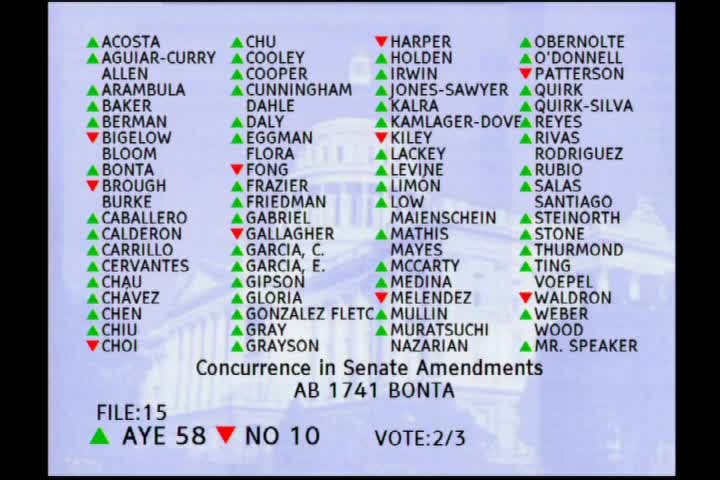 1MIN
Assembly Floor
 2MIN
Assembly Floor
 49SEC
Assembly Standing Committee on Appropriations
 10MIN
Assembly Standing Committee on Business and Professions
Bill Author