AB 2880: Political Reform Act of 1974: local enforcement.
- Session Year: 2017-2018
- House: Assembly
- Latest Version Date: 2018-09-14
Existing law authorizes the Fair Political Practices Commission, upon mutual agreement between the Commission and the Board of Supervisors of the County of San Bernardino, to have primary responsibility for the impartial, effective administration, implementation, and enforcement of a local campaign finance reform ordinance of the County of San Bernardino, as specified. Existing law also authorizes the Fair Political Practices Commission to enter into such agreements with the City Council of the City of Stockton and the City Council of the City of Sacramento, respectively.
This bill would repeal the provisions governing agreements with the Cities of Stockton and Sacramento and would generally authorize the governing body of a local government agency to contract with the Commission for the administration, implementation, and enforcement of a local campaign finance or government ethics law. This bill would also clarify that any agreement with the City of Stockton or the City of Sacramento that was in effect on December 31, 2018, is deemed to comply with this provision, and that this bill does not apply to the County of San Bernardino.
The Political Reform Act of 1974, an initiative measure, provides that the Legislature may amend the act to further the acts purposes upon a 2/3 vote of each house of the Legislature and compliance with specified procedural requirements.
This bill would declare that it furthers the purposes of the act.
Existing law authorizes the Fair Political Practices Commission, upon mutual agreement between the Commission and the Board of Supervisors of the County of San Bernardino, to have primary responsibility for the impartial, effective administration, implementation, and enforcement of a local campaign finance reform ordinance of the County of San Bernardino, as specified. Existing law also authorizes the Fair Political Practices Commission to enter into such agreements with the City Council of the City of Stockton and the City Council of the City of Sacramento, respectively.
This bill would repeal the provisions governing agreements with the Cities of Stockton and Sacramento and would generally authorize the governing body of a local government agency to contract with the Commission for the administration, implementation, and enforcement of a local campaign finance or government ethics law. This bill would also clarify that any agreement with one of the cities enumerated above the City of Stockton or the City of Sacramento that was in effect on December 31, 2018, is deemed to comply with this provision. provision, and that this bill does not apply to the County of San Bernardino.
The Political Reform Act of 1974, an initiative measure, provides that the Legislature may amend the act to further the acts purposes upon a 2/3 vote of each house of the Legislature and compliance with specified procedural requirements.
This bill would declare that it furthers the purposes of the act.
Existing law authorizes the Fair Political Practices Commission, upon mutual agreement between the Commission and the Board of Supervisors of the County of San Bernardino, to have primary responsibility for the impartial, effective administration, implementation, and enforcement of a local campaign finance reform ordinance of the County of San Bernardino, as specified. Existing law also authorizes the Fair Political Practices Commission to enter into such agreements with the City Council of the City of Stockton and the City Council of the City of Sacramento, respectively.
This bill would repeal those the provisions governing agreements with the Cities of Stockton and Sacramento and would instead generally authorize the governing body of a local government agency to contract with the Commission for the administration, implementation, and enforcement of a local campaign finance or government ethics law. This bill would also clarify that any agreement with one of the cities enumerated above that was in effect on December 31, 2018, is deemed to comply with this provision.
The Political Reform Act of 1974, an initiative measure, provides that the Legislature may amend the act to further the acts purposes upon a 2/3 vote of each house of the Legislature and compliance with specified procedural requirements.
This bill would declare that it furthers the purposes of the act.
Existing law authorizes the Fair Political Practices Commission, upon mutual agreement between the Commission and the Board of Supervisors of the County of San Bernardino, to have primary responsibility for the impartial, effective administration, implementation, and enforcement of a local campaign finance reform ordinance of the County of San Bernardino, as specified. Existing law also authorizes the Fair Political Practices Commission to enter into such agreements with the City Council of the City of Stockton and the City Council of the City of Sacramento, respectively.
This bill would repeal those provisions and would instead generally authorize the governing body of a local government agency to contract with the Commission for the administration, implementation, and enforcement of a local campaign finance or government ethics law. This bill would also clarify that any agreement with one of the cities enumerated above that was in effect on December 31, 2018, is deemed to comply with this provision.
The Political Reform Act of 1974, an initiative measure, provides that the Legislature may amend the act to further the acts purposes upon a 2/3 vote of each house of the Legislature and compliance with specified procedural requirements.
This bill would declare that it furthers the purposes of the act.
(a)(1) Upon mutual agreement between the Commission and the governing body of a local government agency, the Commission may assume primary responsibility for the impartial, effective administration, implementation, and enforcement of a local campaign finance or government ethics law passed by the local government agency.
(2)(A) Upon approval of an agreement pursuant to paragraph (1), the Commission shall be the civil prosecutor responsible for the civil enforcement of the local campaign finance or government ethics law of the local government agency in accordance with this title.
(B)As the civil prosecutor, the Commission may do all of the following with respect to the local campaign finance or government ethics law:
(i)Provide advice.
(ii)Investigate possible violations.
(iii)Bring administrative actions in accordance with this title and Chapter 5 (commencing with Section 11500) of Part 1 of Division 3 of Title 2.
(iv)Bring civil actions.
(C)The Commission shall not be required to obtain authorization from the local government agency to bring an administrative or civil action pursuant to subparagraph (B).
(b)A local campaign finance or government ethics law of the local government agency enforced by the Commission pursuant to this section shall comply with this title.
(c)The governing body of the local government agency shall consult with the Commission before adopting and amending any local campaign finance or government ethics law that is subsequently enforced by the Commission pursuant to this section.
(d)(1)The governing body of the local government agency and the Commission shall enter into any agreements necessary and appropriate to carry out the provisions of paragraph (1) of subdivision (a), including agreements pertaining to any necessary local reimbursement of direct and indirect costs incurred by the Commission in administering, implementing, or enforcing a local campaign finance or government ethics law pursuant to this section. Before approving an agreement for local reimbursement, the Commission shall submit the proposed agreement to the Department of General Services for review. The Commission may approve the agreement 90 days after submitting it to the Department of General Services or after receiving the departments written review of the agreement, whichever occurs first. The Commission shall submit an approved agreement, along with any review received, to the Department of Finance.
(2)An agreement entered into pursuant to this subdivision shall not contain a cancellation fee, a liquidated damages provision, or other financial disincentive to terminate the agreement pursuant to subdivision (e), except that, if the local government agency terminates the agreement, the Commission may require the governing body of the local government agency to pay the Commission for services rendered and any other expenditures reasonably made by the Commission in anticipation of services to be rendered pursuant to the agreement.
(e)The governing body of the local government agency or the Commission may, at any time, by ordinance or resolution, terminate an agreement made pursuant to this section for the Commission to administer, implement, or enforce a local campaign finance ordinance or any provision thereof. The termination shall be effective 90 days after the enactment of the ordinance or resolution unless an agreement between the local government and the Commission requires a longer period.
(f)The Commission shall conspicuously post on its Internet Web site a list of every local government agency that it has entered into agreement with pursuant to this section.
(g)An agreement for the enforcement of a local campaign finance or government ethics law between the Commission and the City of Stockton, or the City of Sacramento that was in effect on December 31, 2018, shall be deemed to comply with this section.
(h)If an agreement is entered into pursuant to this section, the Commission shall report to the Legislature regarding the performance of that agreement on or before January 1, 2025, and shall submit that report in compliance with Section 9795. The Commission shall develop the report in consultation with the governing body of the local government agency. The report shall include, but not be limited to, all of the following:
(1)The status of the agreement.
(2)The estimated annual cost savings, if any, for the local government agency.
(3)A summary of relevant annual performance metrics, including measures of use, enforcement, and customer satisfaction.
(4)Public comments submitted to the Commission or the local government agency relative to the operation of the agreement.
(5)Legislative recommendations.
(i)This section does not apply to a jurisdiction with a population of 3,000,000 or more or to the County of San Bernardino.
(j)This section shall remain in effect only until January 1, 2026, and as of that date is repealed, unless a later enacted statute, that is enacted before January 1, 2026, deletes or extends that date.
SEC. 3.Section 83123.7 of the Government Code is repealed.SEC. 4.The Legislature finds and declares that this bill furthers the purposes of the Political Reform Act of 1974 within the meaning of subdivision (a) of Section 81012 of the Government Code.
(a)(1) Upon mutual agreement between the Commission and the governing body of a local government agency, the Commission may assume primary responsibility for the impartial, effective administration, implementation, and enforcement of a local campaign finance or government ethics law passed by the local government agency.
(2)(A) Upon approval of an agreement pursuant to paragraph (1), the Commission shall be the civil prosecutor responsible for the civil enforcement of the local campaign finance or government ethics law of the local government agency in accordance with this title.
(B)As the civil prosecutor, the Commission may do all of the following with respect to the local campaign finance or government ethics law:
(i)Provide advice.
(ii)Investigate possible violations.
(iii)Bring administrative actions in accordance with this title and Chapter 5 (commencing with Section 11500) of Part 1 of Division 3 of Title 2.
(iv)Bring civil actions.
(C)The Commission shall not be required to obtain authorization from the local government agency to bring an administrative or civil action pursuant to subparagraph (B).
(b)A local campaign finance or government ethics law of the local government agency enforced by the Commission pursuant to this section shall comply with this title.
(c)The governing body of the local government agency shall consult with the Commission before adopting and amending any local campaign finance or government ethics law that is subsequently enforced by the Commission pursuant to this section.
(d)(1)The governing body of the local government agency and the Commission shall enter into any agreements necessary and appropriate to carry out the provisions of this section, paragraph (1) of subdivision (a), including agreements pertaining to any necessary local reimbursement of direct and indirect costs incurred by the Commission in administering, implementing, or enforcing a local campaign finance or government ethics law pursuant to this section. Before approving an agreement for local reimbursement, the Commission shall consult with the Department of Finance regarding the Commissions expected costs. submit the proposed agreement to the Department of General Services for review. The Commission may approve the agreement 90 days after submitting it to the Department of General Services or after receiving the departments written review of the agreement, whichever occurs first. The Commission shall submit an approved agreement, along with any review received, to the Department of Finance.
(2)An agreement entered into pursuant to this subdivision shall not contain a cancellation fee, a liquidated damages provision, or other financial disincentive to terminate the agreement pursuant to subdivision (e), except that, if the local government agency terminates the agreement, the Commission may require the governing body of the local government agency to pay the Commission for services rendered and any other expenditures reasonably made by the Commission in anticipation of services to be rendered pursuant to the agreement.
(e)The governing body of the local government agency or the Commission may, at any time, by ordinance or resolution, terminate an agreement made pursuant to this section for the Commission to administer, implement, or enforce a local campaign finance ordinance or any provision thereof. The termination shall be effective no earlier than 90 days after the enactment of the ordinance or resolution. resolution unless an agreement between the local government and the Commission requires a longer period.
(f)The Commission shall conspicuously post on its Internet Web site a list of every local government agency that it has entered into agreement with pursuant to this section.
(g)An agreement for the enforcement of a local campaign finance or government ethics law between the Commission and the City of Stockton, or the City of Sacramento that was in effect on December 31, 2018, shall be deemed to comply with this section.
(h)If an agreement is entered into pursuant to this section, the Commission shall report to the Legislature regarding the performance of that agreement on or before January 1, 2025, and shall submit that report in compliance with Section 9795. The Commission shall develop the report in consultation with the governing body of the local government agency. The report shall include, but not be limited to, all of the following:
(1)The status of the agreement.
(2)The estimated annual cost savings, if any, for the local government agency.
(3)A summary of relevant annual performance metrics, including measures of use, enforcement, and customer satisfaction.
(4)Public comments submitted to the Commission or the local government agency relative to the operation of the agreement.
(5)Legislative recommendations.
(i)This section does not apply to a jurisdiction with a population of 3,000,000 or more or to the County of San Bernardino.
(j)This section shall remain in effect only until January 1, 2026, and as of that date is repealed, unless a later enacted statute, that is enacted before January 1, 2026, deletes or extends that date.
SEC. 3.Section 83123.7 of the Government Code is repealed.SEC. 4.The Legislature finds and declares that this bill furthers the purposes of the Political Reform Act of 1974 within the meaning of subdivision (a) of Section 81012 of the Government Code.
(a)(1) Upon mutual agreement between the Commission and the governing body of a local government agency, the Commission may assume primary responsibility for the impartial, effective administration, implementation, and enforcement of a local campaign finance or government ethics law passed by the local government agency.
(2)(A) Upon approval of an agreement pursuant to paragraph (1), the Commission shall be the civil prosecutor responsible for the civil enforcement of the local campaign finance or government ethics law of the local government agency in accordance with this title.
(B)As the civil prosecutor, the Commission may do all of the following with respect to the local campaign finance or government ethics law:
(i)Provide advice.
(ii)Investigate possible violations.
(iii)Bring administrative actions in accordance with this title and Chapter 5 (commencing with Section 11500) of Part 1 of Division 3 of Title 2.
(iv)Bring civil actions.
(C)The Commission shall not be required to obtain authorization from the local government agency to bring an administrative or civil action pursuant to subparagraph (B).
(b)A local campaign finance or government ethics law of the local government agency enforced by the Commission pursuant to this section shall comply with this title.
(c)The governing body of the local government agency shall consult with the Commission before adopting and amending any local campaign finance or government ethics law that is subsequently enforced by the Commission pursuant to this section.
(d)(1)The governing body of the local government agency and the Commission may shall enter into any agreements necessary and appropriate to carry out the provisions of this section, including agreements pertaining to any necessary local reimbursement of state costs with local funds for direct and indirect costs incurred by the Commission in administering, implementing, or enforcing a local campaign finance or government ethics law pursuant to this section. Before approving an agreement for local reimbursement, the Commission shall consult with the Department of Finance regarding the Commissions expected costs.
(2)An agreement entered into pursuant to this subdivision shall not contain a cancellation fee, a liquidated damages provision, or other financial disincentive to terminate the agreement pursuant to subdivision (e), except that, if the local government agency terminates the agreement, the Commission may require the governing body of the local government agency to pay the Commission for services rendered and any other expenditures reasonably made by the Commission in anticipation of services to be rendered pursuant to the agreement.
(e)The governing body of the local government agency or the Commission may, at any time, by ordinance or resolution, terminate an agreement made pursuant to this section for the Commission to administer, implement, or enforce a local campaign finance ordinance or any provision thereof. The termination shall be effective no earlier than 90 days after the enactment of the ordinance or resolution.
(f)The Commission shall conspicuously post on its Internet Web site a list of every local government agency that it has entered into agreement with pursuant to this section.
(g)An agreement for the enforcement of a local campaign finance or government ethics law between the Commission and the County of San Bernardino, the City of Stockton, or the City of Sacramento that was in effect on December 31, 2018, shall be deemed to comply with this section.
(h)If an agreement is entered into pursuant to this section, the Commission shall report to the Legislature regarding the performance of that agreement on or before January 1, 2025, and shall submit that report in compliance with Section 9795. The Commission shall develop the report in consultation with the governing body of the local government agency. The report shall include, but not be limited to, all of the following:
(1)The status of the agreement.
(2)The estimated annual cost savings, if any, for the local government agency.
(3)A summary of relevant annual performance metrics, including measures of use, enforcement, and customer satisfaction.
(4)Public comments submitted to the Commission or the local government agency relative to the operation of the agreement.
(5)Legislative recommendations.
(i)This section does not apply to a jurisdiction with a population of 3,000,000 or more. more or to the County of San Bernardino.
(j)This section shall remain in effect only until January 1, 2026, and as of that date is repealed, unless a later enacted statute, that is enacted before January 1, 2026, deletes or extends that date.
SEC. 3.Section 83123.7 of the Government Code is repealed.SEC. 4.The Legislature finds and declares that this bill furthers the purposes of the Political Reform Act of 1974 within the meaning of subdivision (a) of Section 81012 of the Government Code.
(a)(1) Upon mutual agreement between the Commission and the governing body of a local government agency, the Commission may assume primary responsibility for the impartial, effective administration, implementation, and enforcement of a local campaign finance or government ethics law passed by the local government agency.
(2)(A) Upon approval of an agreement pursuant to paragraph (1), the Commission shall be the civil prosecutor responsible for the civil enforcement of the local campaign finance or government ethics law of the local government agency in accordance with this title.
(B)As the civil prosecutor, the Commission may do all of the following with respect to the local campaign finance or government ethics law:
(i)Provide advice.
(ii)Investigate possible violations.
(iii)Bring administrative actions in accordance with this title and Chapter 5 (commencing with Section 11500) of Part 1 of Division 3 of Title 2.
(iv)Bring civil actions.
(C)The Commission shall not be required to obtain authorization from the local government agency to bring an administrative or civil action pursuant to subparagraph (B).
(b)A local campaign finance or government ethics law of the local government agency enforced by the Commission pursuant to this section shall comply with this title.
(c)The governing body of the local government agency shall consult with the Commission before adopting and amending any local campaign finance or government ethics law that is subsequently enforced by the Commission pursuant to this section.
(d)(1)The governing body of the local government agency and the Commission may enter into any agreements necessary and appropriate to carry out the provisions of this section, including agreements pertaining to any necessary reimbursement of state costs with local funds for costs incurred by the Commission in administering, implementing, or enforcing a local campaign finance or government ethics law pursuant to this section.
(2)An agreement entered into pursuant to this subdivision shall not contain a cancellation fee, a liquidated damages provision, or other financial disincentive to terminate the agreement pursuant to subdivision (e), except that, if the local government agency terminates the agreement, the Commission may require the governing body of the local government agency to pay the Commission for services rendered and any other expenditures reasonably made by the Commission in anticipation of services to be rendered pursuant to the agreement.
(e)The governing body of the local government agency or the Commission may, at any time, by ordinance or resolution, terminate an agreement made pursuant to this section for the Commission to administer, implement, or enforce a local campaign finance ordinance or any provision thereof.
(f)The Commission shall conspicuously post on its Internet Web site a list of every local government agency that it has entered into agreement with pursuant to this section.
(g)An agreement for the enforcement of a local campaign finance or government ethics law between the Commission and the County of San Bernardino, the City of Stockton, or the City of Sacramento that was in effect on December 31, 2018, shall be deemed to comply with this section.
(h)If an agreement is entered into pursuant to this section, the Commission shall report to the Legislature regarding the performance of that agreement on or before January 1, 2025, and shall submit that report in compliance with Section 9795. The Commission shall develop the report in consultation with the governing body of the local government agency. The report shall include, but not be limited to, all of the following:
(1)The status of the agreement.
(2)The estimated annual cost savings, if any, for the local government agency.
(3)A summary of relevant annual performance metrics, including measures of use, enforcement, and customer satisfaction.
(4)Public comments submitted to the Commission or the local government agency relative to the operation of the agreement.
(5)Legislative recommendations.
(i)This section does not apply to a jurisdiction with a population of 3,000,000 or more.
(j)This section shall remain in effect only until January 1, 2026, and as of that date is repealed, unless a later enacted statute, that is enacted before January 1, 2026, deletes or extends that date.
SEC. 3.Section 83123.6 of the Government Code is repealed.SEC. 4.SEC. 3.Section 83123.7 of the Government Code is repealed.SEC. 5.SEC. 4.The Legislature finds and declares that this bill furthers the purposes of the Political Reform Act of 1974 within the meaning of subdivision (a) of Section 81012 of the Government Code.
(a)(1) Upon mutual agreement between the Commission and the governing body of a local government agency, the Commission may assume primary responsibility for the impartial, effective administration, implementation, and enforcement of a local campaign finance or government ethics law passed by the local government agency.
(2)(A) Upon approval of an agreement pursuant to paragraph (1), the Commission shall be the civil prosecutor responsible for the civil enforcement of the local campaign finance or government ethics law of the local government agency in accordance with this title.
(B)As the civil prosecutor, the Commission may do all of the following with respect to the local campaign finance or government ethics law:
(i)Provide advice.
(ii)Investigate possible violations.
(iii)Bring administrative actions in accordance with this title and Chapter 5 (commencing with Section 11500) of Part 1 of Division 3 of Title 2.
(iv)Bring civil actions.
(C)The Commission shall not be required to obtain authorization from the local government agency to bring an administrative or civil action pursuant to subparagraph (B).
(b)A local campaign finance or government ethics law of the local government agency enforced by the Commission pursuant to this section shall comply with this title.
(c)The governing body of the local government agency shall consult with the Commission before adopting and amending any local campaign finance or government ethics law that is subsequently enforced by the Commission pursuant to this section.
(d)(1)The governing body of the local government agency and the Commission may enter into any agreements necessary and appropriate to carry out the provisions of this section, including agreements pertaining to any necessary reimbursement of state costs with local funds for costs incurred by the Commission in administering, implementing, or enforcing a local campaign finance or government ethics law pursuant to this section.
(2)An agreement entered into pursuant to this subdivision shall not contain a cancellation fee, a liquidated damages provision, or other financial disincentive to terminate the agreement pursuant to subdivision (e), except that, if the local government agency terminates the agreement, the Commission may require the governing body of the local government agency to pay the Commission for services rendered and any other expenditures reasonably made by the Commission in anticipation of services to be rendered pursuant to the agreement.
(e)The governing body of the local government agency may, at any time, by ordinance or resolution, terminate an agreement made pursuant to this section for the Commission to administer, implement, or enforce a local campaign finance ordinance or any provision thereof.
(f)The Commission shall conspicuously post on its Internet Web site a list of every local government agency that it has entered into agreement with pursuant to this section.
(g)An agreement for the enforcement of a local campaign finance or government ethics law between the Commission and the County of San Bernardino, the City of Stockton, or the City of Sacramento that was in effect on December 31, 2018, shall be deemed to comply with this section.
SEC. 3.Section 83123.6 of the Government Code is repealed.83123.6.(a)Upon mutual agreement between the Commission and the City Council of the City of Stockton, the Commission is authorized to assume primary responsibility for the impartial, effective administration, implementation, and enforcement of a local campaign finance reform ordinance passed by the City Council of the City of Stockton. The Commission is authorized to be the civil prosecutor responsible for the civil enforcement of that local campaign finance reform ordinance in accordance with this title. As the civil prosecutor of the City of Stocktons local campaign finance reform ordinance, the Commission may do both of the following:(1)Investigate possible violations of the local campaign finance reform ordinance.(2)Bring administrative actions in accordance with this title and Chapter 5 (commencing with Section 11500) of Part 1 of Division 3 of Title 2.(b)Any local campaign finance reform ordinance of the City of Stockton enforced by the Commission pursuant to this section shall comply with this title.(c)The City Council of the City of Stockton shall consult with the Commission before adopting and amending any local campaign finance reform ordinance that is subsequently enforced by the Commission pursuant to this section.(d)(1)The City Council of the City of Stockton and the Commission may enter into any agreements necessary and appropriate to carry out the provisions of this section, including agreements pertaining to any necessary reimbursement of state costs with city funds for costs incurred by the Commission in administering, implementing, or enforcing a local campaign finance reform ordinance pursuant to this section.(2)An agreement entered into pursuant to this subdivision shall not contain any form of a cancellation fee, a liquidated damages provision, or other financial disincentive to the exercise of the right to terminate the agreement pursuant to subdivision (e), except that the Commission may require the City Council of the City of Stockton to pay the Commission for services rendered and any other expenditures reasonably made by the Commission in anticipation of services to be rendered pursuant to the agreement if the City Council of the City of Stockton terminates the agreement.(e)The City Council of the City of Stockton or the Commission may, at any time, by ordinance or resolution, terminate any agreement made pursuant to this section for the Commission to administer, implement, or enforce a local campaign finance reform ordinance or any provision of the ordinance.(f)If an agreement is entered into pursuant to this section, the Commission shall report to the Legislature regarding the performance of that agreement on or before January 1, 2019, and shall submit that report in compliance with Section 9795. The Commission shall develop the report in consultation with the City Council of the City of Stockton. The report shall include, but not be limited to, all of the following:(1)The status of the agreement.(2)The estimated annual cost savings, if any, for the City of Stockton.(3)A summary of relevant annual performance metrics, including measures of use, enforcement, and customer satisfaction.(4)Public comments submitted to the Commission or the City of Stockton relative to the operation of the agreement.(5)Legislative recommendations.(g)This section shall remain in effect only until January 1, 2020, and as of that date is repealed, unless a later enacted statute, that is enacted before January 1, 2020, deletes or extends that date.SEC. 4.Section 83123.7 of the Government Code is repealed.83123.7.(a)Upon mutual agreement between the Commission and the City Council of the City of Sacramento, the Commission is authorized to assume primary responsibility for the impartial, effective administration, implementation, and enforcement of a local campaign finance reform ordinance passed by the City Council of the City of Sacramento. The Commission is authorized to be the civil prosecutor responsible for the civil enforcement of that local campaign finance reform ordinance in accordance with this title. As the civil prosecutor of the City of Sacramentos local campaign finance reform ordinance, the Commission may do both of the following:(1)Investigate possible violations of the local campaign finance reform ordinance.(2)Bring administrative actions in accordance with this title and Chapter 5 (commencing with Section 11500) of Part 1 of Division 3 of Title 2.(b)Any local campaign finance reform ordinance of the City of Sacramento enforced by the Commission pursuant to this section shall comply with this title.(c)The City Council of the City of Sacramento shall consult with the Commission before adopting and amending any local campaign finance reform ordinance that is subsequently enforced by the Commission pursuant to this section.(d)(1) The City Council of the City of Sacramento and the Commission may enter into any agreements necessary and appropriate to carry out the provisions of this section, including agreements pertaining to any necessary reimbursement of state costs with city funds for costs incurred by the Commission in administering, implementing, or enforcing a local campaign finance reform ordinance pursuant to this section.(2)An agreement entered into pursuant to this subdivision shall not contain any form of a cancellation fee, a liquidated damages provision, or other financial disincentive to the exercise of the right to terminate the agreement pursuant to subdivision (e), except that the Commission may require the City Council of the City of Sacramento to pay the Commission for services rendered and any other expenditures reasonably made by the Commission in anticipation of services to be rendered pursuant to the agreement if the City Council of the City of Sacramento terminates the agreement.(e)The City Council of the City of Sacramento or the Commission may, at any time, by ordinance or resolution, terminate any agreement made pursuant to this section for the Commission to administer, implement, or enforce a local campaign finance reform ordinance or any provision of the ordinance.(f)If an agreement is entered into pursuant to this section, the Commission shall report to the Legislature regarding the performance of that agreement on or before January 1, 2022, and shall submit that report in compliance with Section 9795. The Commission shall develop the report in consultation with the City Council of the City of Sacramento. The report shall include, but is not limited to, all of the following:(1)The status of the agreement.(2)The estimated annual cost savings, if any, for the City of Sacramento.(3)A summary of relevant annual performance metrics, including measures of use, enforcement, and customer satisfaction.(4)Public comments submitted to the Commission or the City of Sacramento relative to the operation of the agreement.(5)Legislative recommendations.(g)This section shall remain in effect only until January 1, 2023, and as of that date is repealed, unless a later enacted statute, that is enacted before January 1, 2023, deletes or extends that date.SEC. 5.The Legislature finds and declares that this bill furthers the purposes of the Political Reform Act of 1974 within the meaning of subdivision (a) of Section 81012 of the Government Code.
REVISIONS: HeadingLine 2.|
Date
|
Status
|
|---|---|
| Sep 14, 2018 | Chaptered by Secretary of State - Chapter 394, Statutes of 2018. |
| Sep 14, 2018 | Approved by the Governor. |
| Aug 29, 2018 | Enrolled and presented to the Governor at 4 p.m. |
| Aug 23, 2018 | Senate amendments concurred in. To Engrossing and Enrolling. |
| Aug 14, 2018 | In Assembly. Concurrence in Senate amendments pending. May be considered on or after August 16 pursuant to Assembly Rule 77. |
| Aug 13, 2018 | Read third time. Passed. Ordered to the Assembly. |
| Aug 7, 2018 | Read second time. Ordered to Consent Calendar. |
| Aug 6, 2018 | From committee: Be ordered to second reading file pursuant to Senate Rule 28.8 and ordered to Consent Calendar. |
| Jul 2, 2018 | In committee: Hearing postponed by committee. |
| Jun 20, 2018 | From committee: Do pass and re-refer to Com. on APPR. with recommendation: To Consent Calendar. (Ayes 5. Noes 0.) (June 19). Re-referred to Com. on APPR. |
| Jun 12, 2018 | From committee chair, with author's amendments: Amend, and re-refer to committee. Read second time, amended, and re-referred to Com. on E. & C.A. |
| Jun 6, 2018 | From committee chair, with author's amendments: Amend, and re-refer to committee. Read second time, amended, and re-referred to Com. on E. & C.A. |
| May 30, 2018 | Referred to Com. on E. & C.A. |
| May 17, 2018 | In Senate. Read first time. To Com. on RLS. for assignment. |
| May 17, 2018 | Read third time. Passed. Ordered to the Senate. |
| May 10, 2018 | Read second time. Ordered to Consent Calendar. |
| May 9, 2018 | From committee: Do pass. To Consent Calendar. (Ayes 16. Noes 0.) (May 9). |
| Apr 26, 2018 | From committee: Do pass and re-refer to Com. on APPR. (Ayes 8. Noes 0.) (April 25). Re-referred to Com. on APPR. |
| Apr 18, 2018 | Re-referred to Com. on L. GOV. |
| Apr 17, 2018 | Read second time and amended. |
| Apr 16, 2018 | From committee: Amend, and do pass as amended and re-refer to Com. on L. GOV. (Ayes 7. Noes 0.) (April 11). |
| Mar 15, 2018 | Coauthors revised. |
| Mar 8, 2018 | Referred to Coms. on E. & R. and L. GOV. |
| Feb 17, 2018 | From printer. May be heard in committee March 19. |
| Feb 16, 2018 | Read first time. To print. |
|
Date
|
Description
|
Location
|
Votes
|
|
|---|---|---|---|---|
| Aug 23, 2018 | AB 2880 HARPER Concurrence in Senate Amendments | Assembly Floor |
Passed |
|
| Aug 13, 2018 | Consent Calendar AB2880 | Senate Floor |
Passed |
|
| Jun 19, 2018 | Do pass, but first be re-referred to the Committee on [Appropriations] with the recommendation: To Consent Calendar | Senate Standing Committee on Elections and Constitutional Amendments |
Passed |
|
| May 17, 2018 | AB 2880 HARPER Consent Calendar Second Day Regular Session | Assembly Floor |
Passed |
|
| May 9, 2018 | Do pass. To Consent Calendar. | Assembly Standing Committee on Appropriations |
Passed |
|
| Apr 25, 2018 | Do pass and be re-referred to the Committee on [Appropriations] | Assembly Standing Committee on Local Government |
Passed |
|
| Apr 11, 2018 | Do pass as amended and be re-referred to the Committee on [Local Government] | Assembly Standing Committee on Elections and Redistricting |
Passed |
This list shows positions taken on this bill by organizations on the date displayed, which is linked to the original source.
Positions by individuals are not included.
CONCURRENCE IN SENATE AMENDMENTS
CSA1 Bill Id:AB 2880
Author:(Harper)
As Amended Ver:June 12, 2018
2/3 vote
ASSEMBLY: | 73-0 | (May 17, 2018) | SENATE: | 37-0 | (August 13, 2018) |
Original Committee Reference: E. & R.
SUMMARY: Authorizes the Fair Political Practices Commission (FPPC) to administer and enforce a local campaign finance ordinance or government ethics law upon mutual agreement between the FPPC and a local agency with a population of less than three million people, as specified. Specifically, this bill:
- Permits the FPPC, upon mutual agreement with the governing body of any local agency, to assume primary responsibility for the impartial, effective administration, implementation, and enforcement of a local campaign finance ordinance or government ethics law of the local agency, as specified.
- Permits the FPPC, as the civil prosecutor of the local agency’s campaign finance ordinance, to do all of the following with respect to the local campaign finance ordinance or government ethics law:
- Provide advice;
- Investigate possible violations;
- Bring administrative actions, as specified; and,
- Bring civil actions.
- Provides that the FPPC shall not be required to obtain authorization from the local government agency to bring an administrative or civil action.
- Requires the governing body of the local government agency to consult with the FPPC prior to adopting and amending any local campaign finance ordinance or government ethics law that is subsequently enforced by the FPPC pursuant to this bill.
- Requires the governing body of the local agency and the FPPC to enter into any agreements necessary and appropriate to carry out the provisions of this bill, including agreements pertaining to any necessary local reimbursement of direct and indirect costs incurred by the FPPC, as specified.
- Prohibits an agreement entered into pursuant to the provisions of this bill from containing any form of a cancellation fee, a liquidated damages provision, or other financial disincentive to terminate the agreement, except that the FPPC may require the governing body of the local government agency to pay the FPPC for services rendered and any other expenditures reasonably made by the FPPC in anticipation of services to be rendered pursuant to the agreement.
- Allows the governing body of the local agency or the FPPC, at any time, by ordinance or resolution, to terminate an agreement made pursuant to this bill for the FPPC to administer, implement, or enforce a local campaign finance ordinance or any provision thereof, as specified.
- Provides that an agreement in effect on December 31, 2018 for the enforcement of a local campaign finance or government ethics law that was entered into between the FPPC and the City of Stockton, or the City of Sacramento pursuant to existing law shall be deemed to comply with this bill, and repeals provisions of law that specifically authorized the FPPC to enter into such contracts with the City of Stockton and the City of Sacramento.
- Requires the FPPC, if an agreement is entered into pursuant to this bill, to report to the Legislature regarding the performance of that agreement on or before January 1, 2025, as specified.
- Provides that this bill does not apply to a jurisdiction with a population of three million or more or to the County of San Bernardino.
- Contains a sunset date of January 1, 2026.
The Senate amendments:
- Require the governing body of a local government agency and the FPPC, if the FPPC administers and enforces a local campaign finance or local government ethics law, to enter into an agreement to carry out the provisions of this bill, instead of permitting a mutual agreement.
- Require the FPPC, before approving an agreement for local reimbursement, to submit the proposed agreement to the Department of General Services for review. Permit the FPPC to approve the agreement 90 days after submitting it to the Department of General Services or after receiving the department's written review of the agreement, whichever occurs first. Require the FPPC to submit an approved agreement, along with any review received, to the Department of Finance.
- Require the termination of an agreement made pursuant to the provisions of this bill to be effective 90 days after the enactment of the ordinance or resolution unless an agreement between the local government and the FPPC requires a longer period.
- Make other technical changes.
FISCAL EFFECT: According to the Senate Appropriations Committee, pursuant to Senate Rule 28.8, negligible state costs.
COMMENTS: According to the author, "Under the Political Reform Act, local governments can adopt their own campaign finance ordinances to govern campaigns for political office in that jurisdiction. The FPPC does not have authority, absent special legislation, to enforce local campaign finance or government ethics ordinances. Instead, enforcement of these ordinances is typically left to the local city attorney or county district attorney. However, because few local governments have experience investigating or prosecuting these types of violations, enforcement tends to be rare. Most local ordinances only provide for civil or criminal enforcement, and the lack of an administrative option makes the prosecution of local violations more costly and time-consuming…
"AB 2880 would give local governments the purely permissive statutory authority to contract with the FPPC, by mutual agreement, for the administration and enforcement of its local campaign finance ordinance. Because the FPPC bills the local government for the cost of this enforcement, there is no net cost to the state. By contracting with the FPPC, local governments would have the ability to bring in a cost-effective, experienced, independent, and impartial entity to investigate possible local campaign finance or government ethics violations and bring appropriate administrative action against these violators."
The Senate amendments require the FPPC, before approving an agreement for local reimbursements, to submit the proposed agreement to the Department of General Services for review, as specified, require the FPPC to submit an approved agreement along with any review received to the Department of Finance, and make technical changes to the bill. This bill, as amended in the Senate, is generally consistent with Assembly actions.
Please see the policy committee analysis for a full discussion of this bill.
Analysis Prepared by: Nichole Becker / E. & R. / (916) 319-2094 FN: 0003817
Office of Senate Floor Analyses (916) 651-1520 Fax: (916) 327-4478 | AB |
CONSENT
Bill No: AB 2880
:
SENATE ELECTIONS & C.A. COMMITTEE: 5-0, 6/19/18
AYES: Stern, Anderson, Allen, Hertzberg, Leyva
SENATE APPROPRIATIONS COMMITTEE: Senate Rule 28.8
ASSEMBLY FLOOR: 73-0, 5/17/18 (Consent) - See last page for vote
SOURCE: California Common Cause
DIGEST:
This bill authorizes the Fair Political Practices Commission (FPPC) to administer and enforce a local campaign finance ordinance or government ethics law upon mutual agreement between the FPPC and a local agency with a population of less than three million people, as specified.
Existing law:
- Creates the FPPC, and makes it responsible for the impartial, effective administration and implementation of the Political Reform Act (PRA).
- Requires a local government agency that adopts or amends a local campaign finance ordinance to file a copy of the ordinance with the FPPC.
- Prohibits a local government agency from enacting a campaign finance ordinance that imposes campaign reporting requirements that are additional to or different from those set forth in the PRA for elections held in its jurisdiction unless the additional or different requirements apply only to the candidates seeking election in that jurisdiction, their controlled committees or committees formed or existing primarily to support or oppose their candidacies, and to committees formed or existing primarily to support or oppose a candidate or to support or oppose the qualification or passage of a local ballot measure which is being voted on only in that jurisdiction, and to city or county general purpose committees active only in that city or county, respectively.
- Authorizes the FPPC, upon mutual agreement between the FPPC and the San Bernardino County Board of Supervisors, to have primary responsibility for the impartial, effective administration, implementation, and enforcement of a local San Bernardino County campaign finance reform ordinance. Requires the San Bernardino County Board of Supervisors to consult with the FPPC prior to adopting and amending any local campaign finance reform ordinance that is subsequently enforced by the FPPC.
- Allows the FPPC, until January 1, 2020, upon mutual agreement between the FPPC and the City Council of the City of Stockton, to have primary responsibility for the impartial, effective administration, implementation, and enforcement of a local City of Stockton campaign finance reform ordinance. Requires the City Council of the City of Stockton to consult with the FPPC prior to adopting and amending any local campaign finance reform ordinance that is subsequently enforced by the FPPC.
- Permits the FPPC, until January 1, 2023, upon mutual agreement between the FPPC and the City Council of the City of Sacramento, to have primary responsibility for the impartial, effective administration, implementation, and enforcement of a local campaign finance ordinance passed by the City Council of the City of Sacramento. Requires the City Council of the City of Sacramento to consult with the FPPC before adopting and amending any local campaign finance reform ordinance that is subsequently enforced by the FPPC.
- Authorizes the FPPC, pursuant to the aforementioned agreements, to investigate possible violations of the San Bernardino County, the City of Stockton, or the City of Sacramento campaign finance reform ordinances, and bring administrative actions against persons who violate the ordinances, as specified.
- Permits the San Bernardino County Board of Supervisors, the City Council of the City of Stockton, and the City Council of the City of Sacramento to enter into any agreements with the FPPC that are necessary and appropriate for the operation of these provisions, including agreements for reimbursement of state costs with county or city funds, as specified. Permits the San Bernardino County Board of Supervisors, the City Council of the City of Stockton, the City Council of the City of Sacramento or the FPPC, at any time, by ordinance or resolution, to terminate any agreement for the FPPC to administer, implement, or enforce the local campaign finance reform ordinances or any provisions thereof.
- Required the FPPC to report to the Legislature with specified information on or before January 1, 2017, if the FPPC entered into such an agreement with the San Bernardino County Board of Supervisors.
- Requires the FPPC to report to the Legislature with specified information on or before January 1, 2019, if the FPPC enters into such an agreement with the City Council of the City of Stockton.
- Requires the FPPC to report to the Legislature with specified information on or before January 1, 2022, if the FPPC enters into such an agreement with the City Council of the City of Sacramento.
This bill:
- Repeals the provisions governing agreements with the Cities of Stockton and Sacramento and generally authorizes the governing body of a local government agency with a population of less than three million to contract with the FPPC for the administration, implementation, and enforcement of a local campaign finance or government ethics law. This bill also clarifies that any agreement with one of the cities enumerated above that was in effect on December 31, 2018, is deemed to comply with this provision.
- Provides that upon mutual agreement between the FPPC and the governing body of a local government agency, the FPPC may assume primary responsibility for the impartial, effective administration, implementation, and enforcement of a local campaign finance or government ethics law passed by the local government agency.
- Provides that upon approval of such an agreement, the FPPC shall be the civil prosecutor responsible for the civil enforcement of the local campaign finance or government ethics law of the local government agency. As the civil prosecutor, the FPPC may do all of the following with respect to the local campaign finance or government ethics law:
- Provide advice.
- Investigate possible violations.
- Bring administrative actions in accordance with the PRA.
- Bring civil actions.
- Provides that the FPPC shall not be required to obtain authorization from the local government agency to bring an administrative or civil action.
- Requires that a local campaign finance or government ethics law of the local government agency enforced by the FPPC pursuant to this bill shall comply with the PRA.
- Requires the governing body of the local government agency to consult with the FPPC before adopting and amending any local campaign finance or government ethics law that is subsequently enforced by the FPPC pursuant to this bill.
- Provides that the governing body of the local government agency and the FPPC may enter into any agreements necessary and appropriate to carry out the provisions of this bill, including agreements pertaining to any necessary reimbursement of state costs with local funds for costs incurred by the FPPC in administering, implementing, or enforcing a local campaign finance or government ethics law.
- Provides that an agreement entered into pursuant to this bill shall not contain a cancellation fee, a liquidated damages provision, or other financial disincentive to terminate the agreement, except that, if the local government agency terminates the agreement, the FPPC may require the governing body of the local government agency to pay the FPPC for services rendered and any other expenditures reasonably in anticipation of services to be rendered.
- Provides that the governing body of the local government agency or the FPPC may, at any time, by ordinance or resolution, terminate an agreement made pursuant to this bill.
- Requires the FPPC to conspicuously post on its Internet Web site a list of every local government agency that it has entered into agreement with pursuant to this bill.
- Provides that an agreement for the enforcement of a local campaign finance or government ethics law between the FPPC and the County of San Bernardino, the City of Stockton, or the City of Sacramento that was in effect on December 31, 2018, shall be deemed to comply with this bill.
- Provides that if an agreement is entered into pursuant to this bill, the FPPC shall report to the Legislature regarding the performance of that agreement on or before January 1, 2025. The FPPC shall develop the report in consultation with the governing body of the local government agency. The report shall include, but not be limited to, all of the following:
- The status of the agreement.
- The estimated annual cost savings, if any, for the local government agency.
- A summary of relevant annual performance metrics, including measures of use, enforcement, and customer satisfaction.
- Public comments submitted to the FPPC or the local government agency relative to the operation of the agreement.
- Legislative recommendations.
- Provides that this bill does not apply to a jurisdiction with a population of three million or more.
- Provides that this bill shall remain in effect only until January 1, 2026, and as of that date is repealed, unless a later enacted statute, that is enacted before January 1, 2026, deletes or extends that date.
Background
San Bernardino County, the City of Stockton, and the City of Sacramento. In 2012, the Legislature passed and the Governor signed AB 2146 (Cook, Chapter 169, Statutes of 2012), which permitted San Bernardino County and the FPPC to enter into an agreement that provides for the FPPC to enforce the County’s local campaign finance reform ordinance, until January 1, 2018. Prior to this, the FPPC did not enforce any local campaign finance ordinances. According to previous analyses, the County of San Bernardino, which had been the subject of several high-profile corruption cases, was in the process of developing a campaign finance ordinance. Rather than appoint an ethics commission, which could present financial as well as conflict of interest challenges, the County proposed to contract with the FPPC to enforce their local campaign finance ordinance. Moreover, the County determined that it was in the best interest of the County to retain the services of the FPPC to provide for the enforcement and interpretation of San Bernardino County's local campaign finance ordinance as the FPPC has special skills, knowledge, experience, and expertise in the area of enforcement and interpretation of campaign laws necessary to effectively advise, assist, litigate, and otherwise represent the County on such matters.
As a result, the FPPC and San Bernardino County entered into a mutual agreement, from January 1, 2013, through December 31, 2014, for the FPPC to provide the County campaign enforcement and interpretation services for the impartial, effective administration, implementation, and enforcement of the San Bernardino's campaign finance reform ordinance. Subsequently, San Bernardino County and the FPPC entered into another two-year mutual agreement covering the period from January 1, 2015, through December 31, 2016, and recently entered into a new two-year agreement covering the period from January 1, 2017, through December 31, 2018.
As required by law, the FPPC submitted a report to the Legislature on March 24, 2016. According to the report, the agreement between the FPPC and the San Bernardino County resulted in substantial savings when compared to the cost of other public ethics commissions and aided in enforcement proceedings by removing any semblance of conflict of interest. The report concluded by stating that the partnership between the FPPC and the San Bernardino County has been successful and both the FPPC and San Bernardino County supported removing the January 1, 2018 sunset date from the statute. Consequently, the Legislature passed and the Governor signed AB 2558 (Steinorth, Chapter 202, Statutes of 2016), which removed the sunset date.
Last session, the Legislature passed and the Governor signed AB 1083 (Eggman, Chapter 186, Statutes of 2015), which authorized the City Council of the City of Stockton and the FPPC to enter into an agreement that provides for the FPPC to enforce a local campaign finance ordinance passed by the City Council of the City of Stockton, as specified. According to the FPPC, no steps have been taken to enter into an agreement with the City of Stockton at this time. Additionally, last year the Legislature passed and the Governor signed another bill, SB 267 (Pan, Chapter 622, Statutes of 2017), which authorized similar agreements between the City Council of the City of Sacramento and the FPPC. According to the FPPC, the FPPC is currently working on reaching an agreement with the City of Sacramento.
Comments
According to the author, under the PRA, local governments can adopt their own campaign finance ordinances to govern campaigns for political office in that jurisdiction. The FPPC does not have authority, absent special legislation, to enforce local campaign finance or government ethics ordinances. Instead, enforcement of these ordinances is typically left to the local city attorney or county district attorney. However, because few local governments have experience investigating or prosecuting these types of violations, enforcement tends to be rare. Most local ordinances only provide for civil or criminal enforcement, and the lack of an administrative option makes the prosecution of local violations more costly and time-consuming.
AB 2880 gives local governments the purely permissive statutory authority to contract with the FPPC, by mutual agreement, for the administration and enforcement of its local campaign finance ordinance. Because the FPPC bills the local government for the cost of this enforcement, there is no net cost to the state. By contracting with the FPPC, local governments would have the ability to bring in a cost-effective, experienced, independent, and impartial entity to investigate possible local campaign finance or government ethics violations and bring appropriate administrative action against these violators.
Related/Prior Legislation
SB 267 (Pan, Chapter 622, Statutes of 2017) permitted the City of Sacramento and the FPPC to enter into an agreement that provides for the FPPC to enforce a local campaign finance ordinance passed by the City of Sacramento, as specified.
AB 1083 (Eggman, Chapter 186, Statutes of 2015) authorized the City of Stockton to enter into an agreement with the FPPC to enforce a local campaign finance ordinance, as specified.
AB 2146 (Cook, Chapter 169, Statutes of 2012) permitted San Bernardino County and the FPPC to enter into an agreement that provides for the FPPC to enforce the County’s local campaign finance ordinance, as specified.
FISCAL EFFECT: Appropriation: Fiscal Com.: Local:
California Common Cause (source)
California Clean Money Campaign
California Special Districts Association
City of Sacramento
Fair Political Practices Commission
League of California Cities
League of Women Voters California
Voting Rights Task Force
None received
ASSEMBLY FLOOR: 73-0, 5/17/18
AYES: Acosta, Aguiar-Curry, Travis Allen, Arambula, Baker, Berman, Bigelow, Bloom, Bonta, Brough, Burke, Caballero, Calderon, Carrillo, Cervantes, Chau, Chávez, Chen, Chiu, Choi, Chu, Cooley, Cooper, Cunningham, Dahle, Daly, Eggman, Flora, Fong, Frazier, Friedman, Gallagher, Eduardo Garcia, Gipson, Gloria, Gonzalez Fletcher, Gray, Grayson, Harper, Holden, Irwin, Jones-Sawyer, Kalra, Kamlager-Dove, Kiley, Lackey, Levine, Limón, Low, Maienschein, Mathis, Mayes, McCarty, Medina, Mullin, Nazarian, Obernolte, O'Donnell, Patterson, Quirk, Quirk-Silva, Reyes, Rodriguez, Rubio, Salas, Mark Stone, Thurmond, Ting, Voepel, Waldron, Weber, Wood, Rendon
NO VOTE RECORDED: Cristina Garcia, Melendez, Muratsuchi, Santiago, Steinorth
8/7/18 17:11:36
**** END ****
SENATE COMMITTEE ON
ELECTIONS AND CONSTITUTIONAL AMENDMENTS
Senator Henry Stern, Chair
2017 - 2018 Regular
Bill No: 2880 Hearing Date: 6/19/18
Author: | Harper | ||
Version: |
| ||
Urgency: | Fiscal: | ||
Consultant: | |||
Subject:
DIGEST
This bill authorizes the Fair Political Practices Commission (FPPC) to administer and enforce a local campaign finance ordinance or government ethics law upon mutual agreement between the FPPC and a local agency with a population of less than 3 million people, as specified.
ANALYSIS
Existing law:
- Creates the FPPC, and makes it responsible for the impartial, effective administration and implementation of the Political Reform Act (PRA).
- Requires a local government agency that adopts or amends a local campaign finance ordinance to file a copy of the ordinance with the FPPC.
- Prohibits a local government agency from enacting a campaign finance ordinance that imposes campaign reporting requirements that are additional to or different from those set forth in the PRA for elections held in its jurisdiction unless the additional or different requirements apply only to the candidates seeking election in that jurisdiction, their controlled committees or committees formed or existing primarily to support or oppose their candidacies, and to committees formed or existing primarily to support or oppose a candidate or to support or oppose the qualification or passage of a local ballot measure which is being voted on only in that jurisdiction, and to city or county general purpose committees active only in that city or county, respectively.
- Authorizes the FPPC, upon mutual agreement between the FPPC and the San Bernardino County Board of Supervisors, to have primary responsibility for the impartial, effective administration, implementation, and enforcement of a local San Bernardino County campaign finance reform ordinance. Requires the San Bernardino County Board of Supervisors to consult with the FPPC prior to adopting and amending any local campaign finance reform ordinance that is subsequently enforced by the FPPC.
- Allows the FPPC, until January 1, 2020, upon mutual agreement between the FPPC and the City Council of the City of Stockton, to have primary responsibility for the impartial, effective administration, implementation, and enforcement of a local City of Stockton campaign finance reform ordinance. Requires the City Council of the City of Stockton to consult with the FPPC prior to adopting and amending any local campaign finance reform ordinance that is subsequently enforced by the FPPC.
- Permits the FPPC, until January 1, 2023, upon mutual agreement between the FPPC and the City Council of the City of Sacramento, to have primary responsibility for the impartial, effective administration, implementation, and enforcement of a local campaign finance ordinance passed by the City Council of the City of Sacramento. Requires the City Council of the City of Sacramento to consult with the FPPC before adopting and amending any local campaign finance reform ordinance that is subsequently enforced by the FPPC.
- Authorizes the FPPC, pursuant to the aforementioned agreements, to investigate possible violations of the San Bernardino County, the City of Stockton, or the City of Sacramento campaign finance reform ordinances, and bring administrative actions against persons who violate the ordinances, as specified.
- Permits the San Bernardino County Board of Supervisors, the City Council of the City of Stockton, and the City Council of the City of Sacramento to enter into any agreements with the FPPC that are necessary and appropriate for the operation of these provisions, including agreements for reimbursement of state costs with county or city funds, as specified. Permits the San Bernardino County Board of Supervisors, the City Council of the City of Stockton, the City Council of the City of Sacramento or the FPPC, at any time, by ordinance or resolution, to terminate any agreement for the FPPC to administer, implement, or enforce the local campaign finance reform ordinances or any provisions thereof.
- Required the FPPC to report to the Legislature with specified information on or before January 1, 2017, if the FPPC entered into such an agreement with the San Bernardino County Board of Supervisors.
- Requires the FPPC to report to the Legislature with specified information on or before January 1, 2019, if the FPPC enters into such an agreement with the City Council of the City of Stockton.
- Requires the FPPC to report to the Legislature with specified information on or before January 1, 2022, if the FPPC enters into such an agreement with the City Council of the City of Sacramento.
This bill:
- Repeals the provisions governing agreements with the Cities of Stockton and Sacramento and would generally authorize the governing body of a local government agency with a population of less than three million to contract with the FPPC for the administration, implementation, and enforcement of a local campaign finance or government ethics law. This bill would also clarify that any agreement with one of the cities enumerated above that was in effect on December 31, 2018, is deemed to comply with this provision.
- Provides that upon mutual agreement between the FPPC and the governing body of a local government agency, the FPPC may assume primary responsibility for the impartial, effective administration, implementation, and enforcement of a local campaign finance or government ethics law passed by the local government agency.
- Provides that upon approval of such an agreement, the FPPC shall be the civil prosecutor responsible for the civil enforcement of the local campaign finance or government ethics law of the local government agency. As the civil prosecutor, the FPPC may do all of the following with respect to the local campaign finance or government ethics law:
- Provide advice.
- Investigate possible violations.
- Bring administrative actions in accordance with the PRA.
- Bring civil actions.
- Provides that the FPPC shall not be required to obtain authorization from the local government agency to bring an administrative or civil action.
- Requires that a local campaign finance or government ethics law of the local government agency enforced by the FPPC pursuant to this bill shall comply with the PRA.
- Requires the governing body of the local government agency to consult with the FPPC before adopting and amending any local campaign finance or government ethics law that is subsequently enforced by the FPPC pursuant to this bill.
- Provides that the governing body of the local government agency and the FPPC may enter into any agreements necessary and appropriate to carry out the provisions of this bill, including agreements pertaining to any necessary reimbursement of state costs with local funds for costs incurred by the FPPC in administering, implementing, or enforcing a local campaign finance or government ethics law.
- Provides that an agreement entered into pursuant to this bill shall not contain a cancellation fee, a liquidated damages provision, or other financial disincentive to terminate the agreement, except that, if the local government agency terminates the agreement, the FPPC may require the governing body of the local government agency to pay the FPPC for services rendered and any other expenditures reasonably in anticipation of services to be rendered.
- Provides that the governing body of the local government agency or the FPPC may, at any time, by ordinance or resolution, terminate an agreement made pursuant to this bill.
- Requires the FPPC to conspicuously post on its Internet Web site a list of every local government agency that it has entered into agreement with pursuant to this bill.
- Provides that an agreement for the enforcement of a local campaign finance or government ethics law between the FPPC and the County of San Bernardino, the City of Stockton, or the City of Sacramento that was in effect on December 31, 2018, shall be deemed to comply with this bill.
- Provides that if an agreement is entered into pursuant to this bill, the FPPC shall report to the Legislature regarding the performance of that agreement on or before January 1, 2025. The FPPC shall develop the report in consultation with the governing body of the local government agency. The report shall include, but not be limited to, all of the following:
- The status of the agreement.
- The estimated annual cost savings, if any, for the local government agency.
- A summary of relevant annual performance metrics, including measures of use, enforcement, and customer satisfaction.
- Public comments submitted to the Commission or the local government agency relative to the operation of the agreement.
- Legislative recommendations.
- Provides that this bill does not apply to a jurisdiction with a population of three million or more.
- Provides that this bill shall remain in effect only until January 1, 2026, and as of that date is repealed, unless a later enacted statute, that is enacted before January 1, 2026, deletes or extends that date.
BACKGROUND
San Bernardino County, the City of Stockton, and the City of Sacramento. In 2012, the Legislature passed and the Governor signed AB 2146 (Cook), Chapter 169, Statutes of 2012, which permitted San Bernardino County and the FPPC to enter into an agreement that provides for the FPPC to enforce the County’s local campaign finance reform ordinance, until January 1, 2018. Prior to this, the FPPC did not enforce any local campaign finance ordinances. According to previous analyses, the County of San Bernardino, which had been the subject of several high-profile corruption cases, was in the process of developing a campaign finance ordinance. Rather than appoint an ethics commission, which could present financial as well as conflict of interest challenges, the County proposed to contract with the FPPC to enforce their local campaign finance ordinance. Moreover, the County determined that it was in the best interest of the County to retain the services of the FPPC to provide for the enforcement and interpretation of San Bernardino County's local campaign finance ordinance as the FPPC has special skills, knowledge, experience, and expertise in the area of enforcement and interpretation of campaign laws necessary to effectively advise, assist, litigate, and otherwise represent the County on such matters.
As a result, the FPPC and San Bernardino County entered into a mutual agreement, from January 1, 2013 through December 31, 2014, for the FPPC to provide the County campaign enforcement and interpretation services for the impartial, effective administration, implementation, and enforcement of the San Bernardino's campaign finance reform ordinance. Subsequently, San Bernardino County and the FPPC entered into another two-year mutual agreement covering the period from January 1, 2015 through December 31, 2016, and recently entered into a new two-year agreement covering the period from January 1, 2017 through December 31, 2018.
As required by law, the FPPC submitted a report to the Legislature on March 24, 2016. According to the report, the agreement between the FPPC and the San Bernardino County resulted in substantial savings when compared to the cost of other public ethics commissions and aided in enforcement proceedings by removing any semblance of conflict of interest. The report concluded by stating that the partnership between the FPPC and the San Bernardino County has been successful and both the FPPC and San Bernardino County supported removing the January 1, 2018 sunset date from the statute. Consequently, the Legislature passed and the Governor signed AB 2558 (Steinorth), Chapter 202, Statutes of 2016, which removed the sunset date.
Last session, the Legislature passed and the Governor signed AB 1083 (Eggman), Chapter 186, Statutes of 2015, which authorized the City Council of the City of Stockton and the FPPC to enter into an agreement that provides for the FPPC to enforce a local campaign finance ordinance passed by the City Council of the City of Stockton, as specified. According to the FPPC, no steps have been taken to enter into an agreement with the City of Stockton at this time. Additionally, last year the Legislature passed and the Governor signed another bill, SB 267 (Pan), Chapter 622, Statutes of 2017, which authorized similar agreements between the City Council of the City of Sacramento and the FPPC. According to the FPPC, the FPPC is currently working on reaching an agreement with the City of Sacramento.
Local Campaign Ordinances and the PRA. Under existing law, local government agencies have the ability to adopt campaign ordinances that apply to elections within their jurisdictions, though the PRA imposes certain limited restrictions on those local ordinances. For instance, SB 726 (McCorquodale), Chapter 1456, Statutes of 1985, limited the ability of local jurisdictions to impose campaign filing requirements that differed from those in the PRA, permitting such requirements only when they applied solely to candidates and committees whose activity is restricted primarily to the jurisdiction in question. This provision sought to avoid the necessity of a candidate or committee active over a wider area being required to adhere to several different campaign filing schedules. Similarly, AB 1430 (Garrick), Chapter 708, Statutes of 2007, prohibited local governments from adopting rules governing member communications that are different than the rules that govern member communications at the state level.
Aside from these restrictions, however, local government agencies generally have a significant amount of latitude when developing local campaign finance ordinances that apply to elections in those agencies' jurisdictions. Any jurisdiction that adopts or amends a local campaign finance ordinance is required to file a copy of that ordinance with the FPPC, and the FPPC posts those ordinances on its website. Several cities and counties have adopted campaign finance ordinances, some of which are very extensive. In some cases, those ordinances include campaign contribution limits, reporting and disclosure requirements that supplement the requirements of the PRA, temporal restrictions on when campaign funds may be raised, and voluntary public financing of local campaigns, among other provisions. In many cases, local campaign finance ordinances are enforced by the district attorney of the county or by the city attorney. In at least a few cases, however, local jurisdictions have set up independent boards or commissions to enforce the local campaign finance laws.
The FPPC does not currently enforce any local campaign finance ordinances other than San Bernardino County's. The FPPC can and does, however, bring enforcement actions in response to violations of the PRA that occur in campaigns for local office, even in cases where the local jurisdiction brings separate enforcement actions for violations of a local campaign finance ordinance.
COMMENTS
- According to the author: Under the Political Reform Act, local governments can adopt their own campaign finance ordinances to govern campaigns for political office in that jurisdiction. The FPPC does not have authority, absent special legislation, to enforce local campaign finance or government ethics ordinances. Instead, enforcement of these ordinances is typically left to the local city attorney or county district attorney. However, because few local governments have experience investigating or prosecuting these types of violations, enforcement tends to be rare. Most local ordinances only provide for civil or criminal enforcement, and the lack of an administrative option makes the prosecution of local violations more costly and time-consuming.
Additionally, local enforcement can open the door to allegations of political bias. For example, a city attorney may be reluctant to enforce a campaign finance violation against an incumbent versus a challenger, since most city attorneys serve at the will of the council. Similarly, an elected district attorney may be responsible for prosecuting a political ally or enemy.
AB 2880 would give local governments the purely permissive statutory authority to contract with the FPPC, by mutual agreement, for the administration and enforcement of its local campaign finance ordinance. Because the FPPC bills the local government for the cost of this enforcement, there is no net cost to the state. By contracting with the FPPC, local governments would have the ability to bring in a cost-effective, experienced, independent, and impartial entity to investigate possible local campaign finance or government ethics violations and bring appropriate administrative action against these violators.
RELATED/PRIOR LEGISLATION
SB 267 (Pan), Chapter 622, Statutes of 2017, permits the City of Sacramento and the FPPC to enter into an agreement that provides for the FPPC to enforce a local campaign finance ordinance passed by the City of Sacramento, as specified.
AB 2070 (Harper) of 2016, would have authorized the Board of Supervisors of Orange County and the FPPC to enter into an agreement that provides for the FPPC to administer and enforce a local campaign finance ordinance passed by the Board of Supervisors of Orange County, as specified. That bill was never heard in Assembly policy committee.
AB 2558 (Steinorth), Chapter 202, Statutes of 2016, removed the January 1, 2018, sunset date from a provision of law that authorizes the FPPC to enforce San Bernardino County's local campaign finance reform ordinance, as specified.
AB 1083 (Eggman), Chapter 186, Statutes of 2015, authorized the City of Stockton to enter into an agreement with the FPPC to enforce a local campaign finance ordinance, as specified.
AB 910 (Harper) of 2015, would have authorized the FPPC to administer and enforce a local campaign finance ordinance for any city or county, upon mutual agreement between the FPPC and the local agency, as specified. That bill was never heard in Assembly policy committee.
SB 1226 (Correa) of 2014, would have authorized any city or county to enter into an agreement with the FPPC to administer and enforce a local campaign finance ordinance. That bill was gutted and amended in the Assembly Appropriations Committee.
AB 2146 (Cook), Chapter 169, Statutes of 2012, permitted San Bernardino County and the FPPC to enter into an agreement that provides for the FPPC to enforce the County’s local campaign finance ordinance, as specified.
PRIOR ACTION
Assembly Floor: | 73 - 0 |
Assembly Appropriations Committee: | 16 - 0 |
Local Government Committee: Assembly Committee: | 8 - 0 7 - 0 |
POSITIONS
Sponsor: California Common Cause
Support: California Clean Money Campaign
City of Sacramento
California Special Districts Association
League of California Cities
League of Women Voters California
Oppose: None received
-- END --
Date of Hearing: May 9, 2018
ASSEMBLY COMMITTEE ON APPROPRIATIONS
Lorena Gonzalez Fletcher, Chair
ABPCA Bill Id:AB 2880
Author:(Harper) – As Amended Ver:April 17, 2018
Policy Committee: | Elections and Redistricting | Vote: | 7 - 0 |
Local Government | 8 - 0 | ||
|
|
Urgency: No State Mandated Local Program: No Reimbursable: No
SUMMARY:
This bill authorizes the Fair Political Practices Commission (FPPC), upon mutual agreement with a local agency with a population of less than three million people, to administer and enforce a local campaign finance or government ethics law. Specifically, this bill:
- Requires the FPPC to be the civil prosecutor responsible for the civil enforcement of the local campaign finance or government ethics law of the local agency in accordance with the Political Reform Act of 1974 (PRA).
- Authorizes the FPPC to: a) provide advice; b) investigate possible violations; c) bring administrative actions in accordance with the PRA and existing law, as specified; and, d) bring civil actions.
- Provides the FPPC shall not be required to obtain authorization from the local government agency to bring an administrative or civil action pursuant to the provisions of this bill.
- Requires the local campaign finance ordinance or government ethics law to comply with the provisions of the PRA.
- Requires the local government agency to consult with the FPPC prior to adopting and amending any local campaign finance ordinance or government ethics law that is subsequently enforced by the FPPC.
- Permits the local government agency and the FPPC to enter into any agreement necessary and appropriate to carry out the provisions of this bill, including agreements pertaining to any necessary reimbursement of state costs with local funds for costs incurred by the FPPC, as specified.
- Prohibits an agreement from containing any form of financial disincentive to terminate the agreement, except that the FPPC may require the local government agency to pay the FPPC for services rendered and any other expenditures reasonably made by the FPPC in anticipation of services rendered.
- Permits the local government agency, at any time, by ordinance or resolution, to terminate an agreement made pursuant to this bill.
- Requires the FPPC to post a list of every local government agency that it has entered into on its internet website.
- Provides any agreement in effect on December 31, 2018, for the enforcement of a local campaign finance or government ethics law that was entered into between the FPPC and the County of San Bernardino, the City of Stockton, or the City of Sacramento remains valid.
- Requires the FPPC to report to the Legislature regarding the performance of any agreement entered into pursuant to this bill, on or before January 1, 2025.
FISCAL EFFECT:
- Unknown ongoing annual FPPC enforcement costs, likely in the tens of thousands of dollars per local jurisdiction, reimbursed by the local agency per the agreement with the FPPC.
- Minor and absorbable costs for FPPC to prepare and submit the required report.
COMMENTS:
Background and Purpose. AB 2146 (Cook), Chapter 169, Statutes of 2012, allows San Bernardino County and the FPPC to enter into a mutual agreement that permits the FPPC to enforce the county’s local campaign finance reform ordinance. AB 2146 was prompted by several high-profile campaign finance corruption cases in San Bernardino County. Prior to AB 2146, the FPPC did not enforce any local campaign finance ordinances. The FPPC and San Bernardino County entered into a mutual agreement on January 1, 2013, which they have extended twice. The current agreement ends December 31, 2018.
As required by law, the FPPC submitted a report to the Legislature on March 24, 2016. According to the report, the agreement between the FPPC and San Bernardino County resulted in substantial savings and aided in enforcement proceedings by removing any semblance of conflict of interest. The report concluded the partnership between the FPPC and San Bernardino County has been successful. Both the FPPC and San Bernardino County supported removing the January 1, 2018, sunset date from the statute. Consequently, the Legislature passed AB 2558 (Steinorth), Chapter 202, Statutes of 2016, which removed the sunset date.
The Legislature subsequently passed two additional bills with similar authorizations:
AB 1083 (Eggman), Chapter 186, Statutes of 2015, which authorizes the City of Stockton and the FPPC to enter into an agreement that allows the FPPC to enforce the City of Stockton's campaign finance ordinance; and, SB 267 (Pan), Chapter 622, Statutes of 2017, which allows the City of Sacramento to enter into an agreement with the FPPC to administer and enforce the City of Sacramento's local campaign finance reform ordinance.
This bill, sponsored by Common Cause, allows the FPPC to enter an agreement with any local government agency with a population of less than three million people to allow the FPPC to administer and enforce the local agency's campaign finance or government ethics law. This bill is consistent with prior law authorizing such agreements for San Bernardino County and the cities of Stockton and Sacramento, with the addition of FPPC administration and enforcement of a local agency's government ethics law.
This bill also allows the FPPC to provide advice to, and bring civil actions on behalf of, the local agency.
Analysis Prepared by: Jennifer Galehouse / APPR. / (916) 319-2081
Date of Hearing: April 25, 2018
ASSEMBLY COMMITTEE ON LOCAL GOVERNMENT
Cecilia Aguiar-Curry, Chair
ABPCA Bill Id:AB 2880 (
Author:Harper) – As Amended Ver:April 17, 2018
SUBJECT: Political Reform Act of 1974: local enforcement.
SUMMARY: Authorizes the Fair Political Practices Commission (FPPC) to administer and enforce a local campaign finance or government ethics law upon mutual agreement between the FPPC and a local agency with a population of less than three million people. Specifically, this bill:
- Authorizes the FPPC, upon mutual agreement between the FPPC and the governing body
of a local government agency, to assume primary responsibility for the impartial, effective administration, implementation, and enforcement of a local campaign finance or government ethics law passed by the local agency. - Requires, upon approval of an agreement pursuant to 1), above, the FPPC to be the civil prosecutor responsible for the civil enforcement of the local campaign finance or government ethics law of the local agency in accordance with the Political Reform Act of 1974 (PRA).
- Authorizes the FPPC, as the civil prosecutor, to do all of the following with respect to the local campaign finance or government ethics law:
- Provide advice;
- Investigate possible violations;
- Bring administrative actions in accordance with the PRA and existing law governing administrative adjudication procedures for specified agencies; and,
- Bring civil actions.
- Provides that the FPPC shall not be required to obtain authorization from the local agency to bring an administrative or civil action pursuant to 3), above.
- Requires a local campaign finance or government ethics law of the local agency enforced by the FPPC to comply with the PRA.
- Requires the governing body of the local agency to consult with the FPPC before adopting and amending any local campaign finance or government ethics law that is subsequently enforced by the FPPC pursuant to this bill.
- Allows the governing body of the local agency and the FPPC to enter into any agreements necessary and appropriate to carry out the provisions of this bill, including agreements pertaining to any necessary reimbursement of state costs with local funds for costs incurred by the FPPC in administering, implementing, or enforcing a local campaign finance or government ethics law pursuant to this bill.
- Prohibits an agreement entered into pursuant to this bill from containing a cancellation fee,
a liquidated damages provision, or other financial disincentive to terminate the agreement pursuant to 9), below, except that, if the local agency terminates the agreement, the FPPC may require the governing body of the local agency to pay the FPPC for services rendered and any other expenditures reasonably made by the FPPC in anticipation of services to be rendered pursuant to the agreement. - Allows the governing body of the local agency or the FPPC, at any time, by ordinance or resolution, to terminate an agreement made pursuant to this bill for the FPPC to administer, implement, or enforce a local campaign finance ordinance or any provision thereof.
- Requires the FPPC to conspicuously post on its Internet Web site a list of every local agency that it has entered into agreement with pursuant to this bill.
- Provides that an agreement in effect on December 31, 2018, for the enforcement of a local campaign finance or government ethics law that was entered into between the FPPC and the County of San Bernardino, the City of Stockton, or the City of Sacramento pursuant to existing law shall be deemed to comply with this bill, and repeals provisions of law specific to these authorizations for the City of Stockton and the City of Sacramento.
- Requires, if an agreement is entered into pursuant to this bill, the FPPC to report to the Legislature regarding the performance of that agreement on or before January 1, 2025, and to submit that report in compliance with existing law governing the submission of reports to the Legislature.
- Requires the FPPC to develop the report required by this bill in consultation with the governing body of the local agency, and requires the report to include, but not be limited to, all of the following:
- The status of the agreement;
- The estimated annual cost savings, if any, for the local agency;
- A summary of relevant annual performance metrics, including measures of use, enforcement, and customer satisfaction;
- Public comments submitted to the FPPC or the local agency relative to the operation of the agreement; and,
- Legislative recommendations.
- Provides that this bill does not apply to a jurisdiction with a population of three million or more.
- Provides a sunset date for this bill of January 1, 2026.
- Finds and declares that this bill furthers the purposes of the PRA within the meaning of existing law governing changes to or repeal of the PRA.
EXISTING LAW:
- Creates the FPPC, and makes it responsible for the impartial, effective administration and implementation of the PRA.
- Defines, for the purposes of the PRA, "local government agency" to means a county (including a city and county), city (including a charter city) or district of any kind including school district, or any other local or regional political subdivision, or any department, division, bureau, office, board, commission or other agency of the foregoing.
- Requires a local government agency that adopts or amends a local campaign finance ordinance to file a copy of the ordinance with the FPPC.
- Prohibits a local government agency from enacting a campaign finance ordinance that imposes campaign reporting requirements that are additional to or different from those set forth in the PRA for elections held in its jurisdiction, unless the additional or different requirements apply only to the candidates seeking election in that jurisdiction, their controlled committees or committees formed or existing primarily to support or oppose their candidacies, and to committees formed or existing primarily to support or oppose a candidate or to support or oppose the qualification or passage of a local ballot measure which is being voted on only in that jurisdiction, and to city or county general purpose committees active only in that city or county, respectively.
- Authorizes the FPPC, upon mutual agreement between the FPPC and the San Bernardino County Board of Supervisors, the City Council of the City of Stockton, and the City Council of the City of Sacramento, to have primary responsibility for the impartial, effective administration, implementation, and enforcement of those jurisdictions' campaign finance reform ordinances.
- Authorizes the FPPC, pursuant to the aforementioned agreements, to investigate possible violations of those jurisdictions' campaign finance reform ordinances and bring administrative actions against persons who violate the ordinances, as specified.
- Permits the San Bernardino County Board of Supervisors, the City Council of the City of Stockton, and the City Council of the City of Sacramento to enter into any agreements with the FPPC that are necessary and appropriate for the operation of these provisions, including agreements for reimbursement of state costs with county or city funds, as specified. Permits these governing boards or the FPPC, at any time, by ordinance or resolution, to terminate any agreement for the FPPC to administer, implement, or enforce the local campaign finance reform ordinances or any provisions thereof.
- Required the FPPC to report to the Legislature with specified information on or before January 1, 2017, if the FPPC entered into such an agreement with the San Bernardino County Board of Supervisors.
- Requires the FPPC to report to the Legislature with specified information on or before January 1, 2019, if the FPPC enters into such an agreement with the City Council of the City of Stockton.
- Requires the FPPC to report to the Legislature with specified information on or before January 1, 2022, if the FPPC enters into such an agreement with the City Council of the City of Sacramento.
FISCAL EFFECT: This bill is keyed fiscal.
COMMENTS:
- Bill Summary. This bill allows the FPPC to enter an agreement with any local government agency with a population of less than three million people for the FPPC to administer and enforce the local agency's campaign finance or government ethics law, upon mutual agreement between the parties. This bill is consistent with prior law authorizing such agreements for San Bernardino County and the cities of Stockton and Sacramento, with the addition of FPPC administration and enforcement of a local agency's government ethics law. This bill also allows the FPPC to provide advice to, and bring civil actions on behalf of, the local agency.
This bill is sponsored by California Common Cause.
- Author's Statement. According to the author, "Under the PRA, local governments can adopt their own campaign finance ordinances to govern campaigns for political office in that jurisdiction. The FPPC does not have authority, absent special legislation, to enforce local campaign finance or government ethics ordinances. Instead, enforcement of these ordinances is typically left to the local city attorney or county district attorney. However, because few local governments have experience investigating or prosecuting these types of violations, enforcement tends to be rare. Most local ordinances only provide for civil or criminal enforcement, and the lack of an administrative option makes the prosecution of local violations more costly and time-consuming.
"Additionally, local enforcement can open the door to allegations of political bias. For example, a city attorney may be reluctant to enforce a campaign finance violation against an incumbent versus a challenger, since most city attorneys serve at the will of the council. Similarly, an elected district attorney may be responsible for prosecuting a political ally or enemy.
"AB 2880 would give local governments the purely permissive statutory authority to contract with the FPPC, by mutual agreement, for the administration and enforcement of its local campaign finance ordinance. Because the FPPC bills the local government for the cost of this enforcement, there is no net cost to the state. By contracting with the FPPC, local governments would have the ability to bring in a cost-effective, experienced, independent, and impartial entity to investigate possible local campaign finance or government ethics violations and bring appropriate administrative action against these violators."
- Background. Existing law, pursuant to AB 2146 (Cook), Chapter 169, Statutes of 2012, allows San Bernardino County and the FPPC to enter into a mutual agreement that permits the FPPC to enforce the County’s local campaign finance reform ordinance. AB 2146 was prompted by several high-profile campaign finance corruption cases in San Bernardino County, which subsequently developed and enacted a campaign finance reform ordinance. Prior to AB 2146, the FPPC did not enforce any local campaign finance ordinances.
San Bernardino County asked for legislative authority to contract with the FPPC to administer and enforce its campaign finance ordinance instead of creating an ethics commission as a means to avoid financial and conflict-of-interest challenges. San Bernardino County also wished to retain the services of the FPPC to provide for the enforcement and interpretation of San Bernardino County's local campaign finance ordinance because the FPPC has special skills, knowledge, experience, and expertise in the area of enforcement and interpretation of campaign laws necessary to effectively advise, assist, litigate, and otherwise represent the County on such matters. The FPPC and San Bernardino County entered into a mutual agreement on January 1, 2013, which they have extended twice. The current agreement ends December 31, 2018.
As required by law, the FPPC submitted a report to the Legislature on March 24, 2016. According to the report, the agreement between the FPPC and San Bernardino County resulted in substantial savings when compared to the cost of other public ethics commissions and aided in enforcement proceedings by removing any semblance of conflict of interest. The report concluded by stating that the partnership between the FPPC and San Bernardino County has been successful. Both the FPPC and San Bernardino County supported removing the January 1, 2018, sunset date from the statute. Consequently, the Legislature passed AB 2558 (Steinorth), Chapter 202, Statutes of 2016, which removed the sunset date.
The Legislature subsequently passed two additional bills with similar authorizations:
AB 1083 (Eggman), Chapter 186, Statutes of 2015, which authorized the City of Stockton and the FPPC to enter into an agreement that allows the FPPC to enforce the City of Stockton's campaign finance ordinance; and, SB 267 (Pan), Chapter 622, Statutes of 2017, which allowed the City of Sacramento to enter into an agreement with the FPPC to administer and enforce the City of Sacramento's local campaign finance reform ordinance
- Local Campaign Ordinances and the PRA. Current law allows local government agencies to adopt campaign ordinances that apply to elections within their jurisdictions, though the PRA imposes certain limited restrictions on those local ordinances. Several cities and counties have adopted campaign finance ordinances, some of which are very extensive. In some cases, these ordinances include campaign contribution limits, reporting and disclosure requirements that supplement the requirements of the PRA, restrictions on when campaign funds can be raised, and voluntary public financing of local campaigns, among other provisions. In many cases, local campaign finance ordinances are enforced by the district attorney of the county or by the city attorney. However, some local jurisdictions have established independent boards or commissions to enforce local campaign finance laws.
The FPPC does not currently enforce any local campaign finance ordinances other than
San Bernardino County's. However, the FPPC brings enforcement actions in response to violations of the PRA that occur in campaigns for local office, even in cases where the local jurisdiction brings separate enforcement actions for violations of a local campaign finance ordinance.
- Government Ethics Laws. Unlike previous bills that have authorized the FPPC to enter into an agreement to enforce a local campaign finance ordinance, this bill is broader and permits the FPPC to enter into an agreement with a local government agency to enforce a government ethics law passed by the local agency.
In general, ethics laws are designed to preserve the public's trust in its public institutions and those who serve in them by setting a framework to guide conduct and behavior. California has established complex ethics laws that govern both state and local officials. Current state laws prohibit public officials from using their office for personal financial gain, prohibit elected officials from receiving favors or money for official actions, require officials to recuse themselves from the decision-making processes in which they have an economic interest in the outcome, and restrict certain activities of public officials after they leave public office (also known as the revolving door ban). Additionally, the PRA requires public agencies to adopt conflict of interest codes.
State ethics laws also include restrictions on the use of public resources, gifts to public officials, and the use of campaign funds. The PRA also prohibits an elected official from sending certain mass mailings at the public's expense. Existing laws provide transparency and require disclosure of campaign contributions, economic interests, and charitable fundraising. Finally, existing law prohibits vote trading (bribes) and places restrictions on personal loans and travel payments.
Some local government agencies have adopted ethics laws that go beyond the minimum standards established in various state laws. These include laws that relate to campaign finance, laws regulating lobbyists, open government or "sunshine" ordinances, and laws prohibiting nepotism and requiring more stringent gift rules.
- Penalties Under Local Campaign Finance Ordinances and the PRA. Violations of the PRA are subject to administrative, civil, and criminal penalties. Generally speaking, the Attorney General (AG) and district attorneys have responsibility for enforcing the criminal provisions of the PRA, though any elected city attorney of a charter city also has the authority to act as the criminal prosecutor for violations of the PRA that occur within the city. The FPPC, the AG, district attorneys, and elected city attorneys of charter cities all have responsibility for enforcement of the civil penalties and remedies provided under the PRA, depending on the nature and location of the violation. In addition, any member of the public may file a civil action to enforce the civil provisions of the PRA, subject to certain restrictions.
The FPPC has the sole authority to bring administrative proceedings for enforcement of the PRA. When the FPPC determines on the basis of such a proceeding that a violation of the PRA has occurred, it has the authority to impose monetary penalties of up to $5,000 per violation, in addition to ordering the violator to cease and desist violation of the PRA and to file any reports, statements, or other documents or information required by the PRA.
In the case of local campaign ordinances, there is no single approach as to the types of penalties that are available for the violations of those ordinances. Many local ordinances provide for misdemeanor or civil penalties for violations, while some ordinances do not establish any penalties for violations. In some local jurisdictions that have independent boards or commissions to enforce the local campaign finance ordinances, those boards or commissions have the authority to bring administrative enforcement proceedings, similar to the authority the FPPC has under the PRA.
In the case of local ethics laws, some local government agencies have created or adopted ethics committees, commissions, or task forces to enforce those laws. The type of role these entities play depends on the jurisdiction. For example, a local ethics committee may be designed to be a source of advice on policy implementation and play an educational and training role. Local ethics commissions are usually independent bodies that provide external oversight and enforce and interpret local ethics laws by conducting audits and investigations, issuing subpoenas, and levying fines or imposing penalties.
- Two-thirds Vote. California voters in 1974 passed Proposition 9, commonly known as the PRA, which created the FPPC and codified significant restrictions and prohibitions on candidates, officeholders, and lobbyists. Amendments to the PRA that are not submitted to the voters, such as those contained in this bill, must further the purposes of the PRA and require a two-thirds vote of each house of the Legislature.
- Arguments in Support. California Common Cause, sponsor of this bill, writes, "A proven alternative to current local enforcement practices is for a city or county to contract with the FPPC for campaign finance and ethics enforcement…AB 2880 provides an important enforcement option to make local campaign finance and ethics ordinances more easily and effectively enforceable. AB 2880 also eliminates the need for future special legislation, which can delay by more than a year the time it takes for a local government to get a contract in place with the FPPC."
- Arguments in Opposition. None on file.
- Double-Referral. This bill was heard in the Elections and Redistricting Committee on
April 11, 2018, where it passed with a 7-0 vote.
REGISTERED SUPPORT / OPPOSITION:
Support
California Common Cause [SPONSOR]
City of Sacramento Mayor Darrell Steinberg
Opposition
None on file
Analysis Prepared by: Angela Mapp / L. GOV. / (916) 319-3958
Date of Hearing: April 11, 2018
ASSEMBLY COMMITTEE ON ELECTIONS AND REDISTRICTING
Marc Berman, Chair
ABPCA Bill Id:AB 2880 (
Author:Harper) – As Introduced Ver:February 16, 2018
AS PROPOSED TO BE AMENDED
SUBJECT: Political Reform Act of 1974: local enforcement.
SUMMARY: Authorizes the Fair Political Practices Commission (FPPC) to administer and enforce a local campaign finance ordinance or government ethics law upon mutual agreement between the FPPC and a local agency with a population of less than 3 million people, as specified. Specifically, this bill:
- Permits the FPPC to enter into a mutual agreement with the governing body of any local agency to enforce a local campaign finance ordinance or government ethics law passed by the local government agency. Provides that the FPPC, upon mutual agreement between the FPPC and the governing body of a local agency, is authorized to assume primary responsibility for the impartial, effective administration, implementation, and enforcement of a local campaign finance ordinance or government ethics law of the local agency.
- Provides, upon approval of an agreement mentioned above, that the FPPC shall be the civil prosecutor responsible for the civil enforcement of the local campaign finance ordinance or government ethics law of the local agency pursuant to this bill. Permits the FPPC, as the civil prosecutor of the local agency’s campaign finance ordinance, to do all of the following with respect to the local campaign finance ordinance or government ethics law:
- Provide advice;
- Investigate possible violations;
- Bring administrative actions in accordance with the provisions of this bill; and,
- Bring civil actions.
- Provides that the FPPC shall not be required to obtain authorization from the local government agency to bring an administrative or civil action pursuant to the provisions of this bill.
- Requires a local campaign finance ordinance or government ethics law of the local government agency enforced by the FPPC to comply with the provisions of the Political Reform Act (PRA).
- Requires the governing body of the local government agency to consult with the FPPC prior to adopting and amending any local campaign finance ordinance or government ethics law that is subsequently enforced by the FPPC pursuant to this bill.
- Permits the governing body of the local government agency and the FPPC to enter into any agreement necessary and appropriate to carry out the provisions of this bill, including agreements pertaining to any necessary reimbursement of state costs with local funds for costs incurred by the FPPC in administering, implementing, or enforcing a local campaign finance ordinance or government ethics law pursuant to the provisions of this bill.
- Prohibits an agreement entered into pursuant to the provisions of this bill from containing any form of a cancellation fee, a liquidated damages provision, or other financial disincentive to terminate the agreement, except that the FPPC may require the governing body of the local government agency to pay the FPPC for services rendered and any other expenditures reasonably made by the FPPC in anticipation of services to be rendered pursuant to the agreement.
- Permits the governing body of the local government agency, at any time, by ordinance or resolution, to terminate an agreement made pursuant to this bill for the FPPC to administer, implement, or enforce a local campaign finance ordinance or any provision thereof.
- Requires the FPPC to conspicuously post on its Internet Web site a list of every local government agency that it has entered into agreement pursuant to this bill.
- Provides that any agreement in effect on December 31, 2018 for the enforcement of a local campaign finance or government ethics law that was entered into between the FPPC and the County of San Bernardino, the City of Stockton, or the City of Sacramento remains valid.
- Provides that the provisions of this bill do not apply to a jurisdiction with a population of three million or more.
EXISTING LAW:
- Creates the FPPC, and makes it responsible for the impartial, effective administration and implementation of the PRA.
- Requires a local government agency that adopts or amends a local campaign finance ordinance to file a copy of the ordinance with the FPPC.
- Prohibits a local government agency from enacting a campaign finance ordinance that imposes campaign reporting requirements that are additional to or different from those set forth in the PRA for elections held in its jurisdiction unless the additional or different requirements apply only to the candidates seeking election in that jurisdiction, their controlled committees or committees formed or existing primarily to support or oppose their candidacies, and to committees formed or existing primarily to support or oppose a candidate or to support or oppose the qualification or passage of a local ballot measure which is being voted on only in that jurisdiction, and to city or county general purpose committees active only in that city or county, respectively.
- Authorizes the FPPC, upon mutual agreement between the FPPC and the San Bernardino County Board of Supervisors, to have primary responsibility for the impartial, effective administration, implementation, and enforcement of a local San Bernardino County campaign finance reform ordinance. Requires the San Bernardino County Board of Supervisors to consult with the FPPC prior to adopting and amending any local campaign finance reform ordinance that is subsequently enforced by the FPPC.
- Allows the FPPC, until January 1, 2020, upon mutual agreement between the FPPC and the City Council of the City of Stockton, to have primary responsibility for the impartial, effective administration, implementation, and enforcement of a local City of Stockton campaign finance reform ordinance. Requires the City Council of the City of Stockton to consult with the FPPC prior to adopting and amending any local campaign finance reform ordinance that is subsequently enforced by the FPPC.
- Permits the FPPC, until January 1, 2023, upon mutual agreement between the FPPC and the City Council of the City of Sacramento, to have primary responsibility for the impartial, effective administration, implementation, and enforcement of a local campaign finance ordinance passed by the City Council of the City of Sacramento. Requires the City Council of the City of Sacramento to consult with the FPPC before adopting and amending any local campaign finance reform ordinance that is subsequently enforced by the FPPC.
- Authorizes the FPPC, pursuant to the aforementioned agreements, to investigate possible violations of the San Bernardino County, the City of Stockton, or the City of Sacramento campaign finance reform ordinances, and bring administrative actions against persons who violate the ordinances, as specified.
- Permits the San Bernardino County Board of Supervisors, the City Council of the City of Stockton, and the City Council of the City of Sacramento to enter into any agreements with the FPPC that are necessary and appropriate for the operation of these provisions, including agreements for reimbursement of state costs with county or city funds, as specified. Permits the San Bernardino County Board of Supervisors, the City Council of the City of Stockton, the City Council of the City of Sacramento or the FPPC, at any time, by ordinance or resolution, to terminate any agreement for the FPPC to administer, implement, or enforce the local campaign finance reform ordinances or any provisions thereof.
- Required the FPPC to report to the Legislature with specified information on or before January 1, 2017, if the FPPC entered into such an agreement with the San Bernardino County Board of Supervisors.
- Requires the FPPC to report to the Legislature with specified information on or before January 1, 2019, if the FPPC enters into such an agreement with the City Council of the City of Stockton.
- Requires the FPPC to report to the Legislature with specified information on or before January 1, 2022, if the FPPC enters into such an agreement with the City Council of the City of Sacramento.
FISCAL EFFECT: Unknown
COMMENTS:
- Author's Amendment: After the committee's deadline for pre-committee author's amendments, the author proposed amendments that provide that the provisions of this bill do not apply to a jurisdiction with a population of three million (3,000,000) or more. This analysis reflects those proposed author's amendments.
- Purpose of the Bill: According to the author:
Under the Political Reform Act, local governments can adopt their own campaign finance ordinances to govern campaigns for political office in that jurisdiction. The FPPC does not have authority, absent special legislation, to enforce local campaign finance or government ethics ordinances. Instead, enforcement of these ordinances is typically left to the local city attorney or county district attorney. However, because few local governments have experience investigating or prosecuting these types of violations, enforcement tends to be rare. Most local ordinances only provide for civil or criminal enforcement, and the lack of an administrative option makes the prosecution of local violations more costly and time-consuming.
Additionally, local enforcement can open the door to allegations of political bias. For example, a city attorney may be reluctant to enforce a campaign finance violation against an incumbent versus a challenger, since most city attorneys serve at the will of the council. Similarly, an elected district attorney may be responsible for prosecuting a political ally or enemy.
AB 2880 would give local governments the purely permissive statutory authority to contract with the FPPC, by mutual agreement, for the administration and enforcement of its local campaign finance ordinance. Because the FPPC bills the local government for the cost of this enforcement, there is no net cost to the state. By contracting with the FPPC, local governments would have the ability to bring in a cost-effective, experienced, independent, and impartial entity to investigate possible local campaign finance or government ethics violations and bring appropriate administrative action against these violators.
- San Bernardino County, the City of Stockton, and the City of Sacramento: In 2012, the Legislature passed and the Governor signed AB 2146 (Cook), Chapter 169, Statutes of 2012, which permitted San Bernardino County and the FPPC to enter into an agreement that provides for the FPPC to enforce the County’s local campaign finance reform ordinance, until January 1, 2018. Prior to this, the FPPC did not enforce any local campaign finance ordinances. According to previous analyses, the County of San Bernardino, which had been the subject of several high-profile corruption cases, was in the process of developing a campaign finance ordinance. Rather than appoint an ethics commission, which could present financial as well as conflict of interest challenges, the County proposed to contract with the FPPC to enforce their local campaign finance ordinance. Moreover, the County determined that it was in the best interest of the County to retain the services of the FPPC to provide for the enforcement and interpretation of San Bernardino County's local campaign finance ordinance as the FPPC has special skills, knowledge, experience, and expertise in the area of enforcement and interpretation of campaign laws necessary to effectively advise, assist, litigate, and otherwise represent the County on such matters. As a result, the FPPC and San Bernardino County entered into a mutual agreement, from January 1, 2013 through December 31, 2014, for the FPPC to provide the County campaign enforcement and interpretation services for the impartial, effective administration, implementation, and enforcement of the San Bernardino's campaign finance reform ordinance. Subsequently, San Bernardino County and the FPPC entered into another two-year mutual agreement covering the period from January 1, 2015 through December 31, 2016, and recently entered into a new two-year agreement covering the period from January 1, 2017 through December 31, 2018.
As required by law, the FPPC submitted a report to the Legislature on March 24, 2016. According to the report, the agreement between the FPPC and the San Bernardino County resulted in substantial savings when compared to the cost of other public ethics commissions and aided in enforcement proceedings by removing any semblance of conflict of interest. The report concluded by stating that the partnership between the FPPC and the San Bernardino County has been successful and both the FPPC and San Bernardino County supported removing the January 1, 2018 sunset date from the statute. Consequently, the Legislature passed and the Governor signed AB 2558 (Steinorth), Chapter 202, Statutes of 2016, which removed the sunset date.
Last session, the Legislature passed and the Governor signed AB 1083 (Eggman), Chapter 186, Statutes of 2015, which authorized the City Council of the City of Stockton and the FPPC to enter into an agreement that provides for the FPPC to enforce a local campaign finance ordinance passed by the City Council of the City of Stockton, as specified. According to the FPPC, no steps have been taken to enter into an agreement with the City of Stockton at this time. Additionally, last year the Legislature passed and the Governor signed another bill, SB 267 (Pan), Chapter 622, Statutes of 2017, which authorized similar agreements between the City Council of the City of Sacramento and the FPPC. According to the FPPC, the FPPC is currently working on reaching an agreement with the City of Sacramento. - Local Campaign Ordinances and the PRA: Under existing law, local government agencies have the ability to adopt campaign ordinances that apply to elections within their jurisdictions, though the PRA imposes certain limited restrictions on those local ordinances. For instance, SB 726 (McCorquodale), Chapter 1456, Statutes of 1985, limited the ability of local jurisdictions to impose campaign filing requirements that differed from those in the PRA, permitting such requirements only when they applied solely to candidates and committees whose activity is restricted primarily to the jurisdiction in question. This provision sought to avoid the necessity of a candidate or committee active over a wider area being required to adhere to several different campaign filing schedules. Similarly, AB 1430 (Garrick), Chapter 708, Statutes of 2007, prohibited local governments from adopting rules governing member communications that are different than the rules that govern member communications at the state level.
Aside from these restrictions, however, local government agencies generally have a significant amount of latitude when developing local campaign finance ordinances that apply to elections in those agencies' jurisdictions. Any jurisdiction that adopts or amends a local campaign finance ordinance is required to file a copy of that ordinance with the FPPC, and the FPPC posts those ordinances on its website.
Several cities and counties have adopted campaign finance ordinances, some of which are very extensive. In some cases, those ordinances include campaign contribution limits, reporting and disclosure requirements that supplement the requirements of the PRA, temporal restrictions on when campaign funds may be raised, and voluntary public financing of local campaigns, among other provisions. In many cases, local campaign finance ordinances are enforced by the district attorney of the county or by the city attorney. In at least a few cases, however, local jurisdictions have set up independent boards or commissions to enforce the local campaign finance laws.
The FPPC does not currently enforce any local campaign finance ordinances other than San Bernardino County's. The FPPC can and does, however, bring enforcement actions in response to violations of the PRA that occur in campaigns for local office, even in cases where the local jurisdiction brings separate enforcement actions for violations of a local campaign finance ordinance.
- Government Ethics Laws: Unlike previous bills that have authorized the FPPC to enter into an agreement to enforce a local campaign finance ordinance, this bill is broader and permits the FPPC to enter into an agreement with a local government agency to enforce a government ethics law passed by the local agency. In general, ethics laws are designed to preserve the public's trust in its public institutions and those who serve in them by setting a framework to guide conduct and behavior. California has an established complex set of state ethics laws that govern both state and local officials. Current state laws include rules against public officials using their office for personal financial gain, prohibit elected officials from receiving favors or money for official actions, require officials to recuse themselves from the decision-making processes in which they have an economic interest in the outcome, and restrict certain activities of public officials after they leave public office (also known as the revolving door ban). For instance, the PRA provides that public officials may not participate in, or influence a government decision that will have a reasonably foreseeable and material financial effect on the official, the official's immediate family, or any of the official's economic interests. Additionally, the PRA specifically requires public agencies to adopt conflict of interest codes.
State ethics laws also include restrictions on the use of public resources, gifts to public officials, and the use of campaign funds. For instance, current law prohibits an elected official from accepting payments for giving a speech, writing an article or attending a public or private conference, also known as honoraria. Additionally, the PRA prohibits an elected official from sending mass mailings, as defined, at the public's expense. Moreover, current laws provide transparency and require disclosure of campaign contributions, economic interests, and charitable fundraising. Finally, existing law prohibits vote trading (bribes) and places restrictions on personal loans and travel payments.
Some local government agencies have adopted ethics laws that go beyond the minimum standards established in various state laws. These include laws that relate to campaign finance, laws regulating lobbyists, open government or "sunshine" ordinances, nepotism and more stringent gift rules.
- Criminal, Civil, and Administrative Enforcement of the PRA and Local Campaign Ordinances: Violations of the PRA are subject to administrative, civil, and criminal penalties. Generally, the Attorney General (AG) and district attorneys have responsibility for enforcing the criminal provisions of the PRA, though any elected city attorney of a charter city also has the authority to act as the criminal prosecutor for violations of the PRA that occur within the city. The FPPC, the AG, district attorneys, and elected city attorneys of charter cities all have responsibility for enforcement of the civil penalties and remedies provided under the PRA, depending on the nature and location of the violation, while any member of the public also has the ability to file a civil action to enforce the civil provisions of the PRA, subject to certain restrictions. The FPPC has the sole authority to bring administrative proceedings for enforcement of the PRA. When the FPPC determines on the basis of such a proceeding that a violation of the PRA has occurred, it can impose monetary penalties of up to $5,000 per violation, in addition to ordering the violator to cease and desist violation of the PRA and to file any reports, statements, or other documents or information required by the PRA.
In the case of local campaign ordinances, there is no single approach as to the types of penalties that are available for the violations of those ordinances. Many local ordinances provide for misdemeanor or civil penalties for violations, while some ordinances do not establish any penalties for violations. In some local jurisdictions that have independent boards or commissions to enforce the local campaign finance ordinances, those boards or commissions have the authority to bring administrative enforcement proceedings, similar to the authority the FPPC has under the PRA.
In the case of local ethics laws, some local government agencies have created or adopted ethics committees, commissions, or task forces to enforce those laws. The type of role these entities play depends on the jurisdiction. For example a local ethics committee may be designed to be a source of advice on policy implementation and play an educational and training role. Local ethics commissions are usually independent bodies that provide external oversight and enforce and interpret local ethics laws by conducting audits and investigations, issuing subpoenas, and levying fines or imposing penalties.
- Expansion of the Law: As mentioned above, while the FPPC has the authority to enter into mutual agreements to enforce three local campaign finance ordinances, it is currently only in agreement to enforce San Bernardino County's local campaign finance ordinance. At the time that the Legislature was considering AB 2146 (Cook) to authorize the FPPC and San Bernardino County to enter into a mutual agreement for the FPPC to enforce San Bernardino County's local campaign finance ordinance, San Bernardino was in the process of developing a campaign finance ordinance. In the end, however, San Bernardino County only approved a campaign contribution limit law and decided it was in the best interest of the County to retain the services of the FPPC to provide for the enforcement and interpretation of the County's local campaign finance ordinance.
Moreover, according to a previous analysis, the City of Sacramento currently has a campaign finance ordinance and recently approved a package of ethics reforms to update the city's campaign finance ordinance. This is particularly important as the City of Sacramento already has an extensive campaign finance ordinance in place, unlike San Bernardino County. If the FPPC moves forward and enters into an agreement with the City of Sacramento to enforce and administer their campaign finance ordinance, it may require more resources than needed to administer San Bernardino County's ordinance.
This bill is significantly broader than previous authorization bills, as it allows the FPPC to enter into an agreement with a local government agency to enforce a local government ethics law. The committee may wish to consider whether broadening current law to allow the FPPC to enforce local government ethics laws could add complexity to the FPPC’s work. Moreover, the committee may wish to consider whether such an expansion of the FPPC’s workload could negatively impact the ongoing enforcement of the PRA.
- Suggested Amendments: All the previous bills that authorized the FPPC to enter into an agreement to enforce a local campaign finance ordinance for San Bernardino County, the City of Stockton, and the City of Sacramento contained sunset dates and required the FPPC to submit a report to the Legislature on the success of the agreements. The sunset date and the report both serve as mechanisms for the Legislature to review and evaluate whether the partnership between the entities is successful and to assess whether future expansion or continuation of this policy should be considered. Contrary to those bills, this bill does not contain a sunset date or a report. The committee may wish to consider amending this bill to add a sunset date and to require the FPPC to submit a report to the Legislature, similar to provisions that were included in previous bills.
Moreover, unlike previous similar bills, this bill does not contain provisions which allow both the local government agency and the FPPC to terminate an agreement, as specified. This bill only permits a local government agency to terminate an agreement between the local government agency and the FPPC. While the FPPC does have discretion to decline to enter into an agreement, if unforeseen concerns or issues arise that would negatively impact the FPPC's ability to enforce and administer the PRA, this bill does not give the FPPC the option to terminate the agreement. Committee staff recommends amending the bill to add provisions that are substantially similar to previous bills which permit the FPPC to terminate an agreement. - Arguments in Support: The sponsor of this bill, California Common Cause, writes:
Many cities and counties in California pass their own local campaign finance ordinances. For the largest of these jurisdictions, such as Orange County, Oakland, and the City of Los Angeles, ethics commissions are a fiscally feasible way to enforce these laws. For most smaller and mid-sized cities and counties, though, enforcement of these ordinances is typically left to the local city attorney or county district attorney. However, because few local governments have experience investigating or prosecuting these types of violations, enforcement tends to be rare. The lack of an administrative option also makes the prosecution of local violations more costly and time-consuming.
Additionally, local enforcement can open the door to allegations of political bias. For example, an appointed city attorney may be hesitant to enforce a campaign finance law against an incumbent councilmember versus a challenger. Similarly, elected district attorneys may find themselves in situations where they are called on to prosecute a political ally or competitor.
A proven alternative to current local enforcement practices is for a city or county to contract with the FPPC for campaign finance and ethics enforcement. Since 2010, the Legislature has passed 4 separate bills extending special authorization to different local governments to contract with the FPPC for enforcement of their campaign finance ordinance. Each bill received near unanimous, bipartisan support. The first, AB 2146 (Cook, 2012), permitted San Bernardino County and the FPPC to enter into contract with the FPPC to enforce the County’s local campaign finance ordinances. The contract was a success: A 2016 FPPC report found that, for the 2014 election, the FPPC educated more than 50 campaigns on the requirements of the local ordinance; audited 22 campaigns for compliance; and investigated two dozen campaigns for alleged violations, resulting in 9 fines…
AB 2880 provides an important enforcement option to make local campaign finance and ethics ordinances more easily and effectively enforceable. AB 2880 also eliminates the need for future special legislation, which can delay by more than a year the time it takes for a local government to get a contract in place with the FPPC.
- Arguments in Opposition: In opposition, the Orange County Employees Association (OCEA), writes:
The OCEA takes issue with the [Orange County] potentially contracting with the FPPC because they are concerned the county’s finance law, known as TINCUP and the recently enacted Measure A (enacted June 2016), would be invalidated.
Measure A was placed on the June ballot by the Orange County Board of Supervisors asking for the establishment of an ethics commission as recommended by the Orange County Grand Jury. Establishing a local County commission required changing a law approved by voters in 2015 permitting the County to contract with the FPPC for civil enforcement of county campaign laws with legislative approval. The ballot measure also would ask voters to approve a charter amendment giving the executive director of the proposed Orange County Campaign Finance and Ethics Commission the legal authority to subpoena the bank records of candidates for county offices...
The purpose of AB 2880, allowing for the county to contract with the FPPC for them to administer and enforce a local campaign finance ordinance was specifically rejected by not only the Orange County Board of Supervisors but the voters as of Orange County as well as evidenced by the Board placing it on the ballot and the voters approving it in June 2016.
While it may be true that at one point the Board of Supervisors and the people of Orange County… approved moving forward with this issue this is no longer the case. OCEA believes the current path, the one supported by the Board and the voters of Orange County is the right path.
- Previous Legislation: SB 267 (Pan), Chapter 622, Statutes of 2017, permits the City of Sacramento and the FPPC to enter into an agreement that provides for the FPPC to enforce a local campaign finance ordinance passed by the City of Sacramento, as specified.
AB 2070 (Harper) of 2016, would have authorized the Board of Supervisors of Orange County and the FPPC to enter into an agreement that provides for the FPPC to administer and enforce a local campaign finance ordinance passed by the Board of Supervisors of Orange County, as specified. That bill was never heard in this committee.
AB 2558 (Steinorth), Chapter 202, Statutes of 2016, removed the January 1, 2018, sunset date from a provision of law that authorizes the FPPC to enforce San Bernardino County's local campaign finance reform ordinance, as specified.
AB 1083 (Eggman), Chapter 186, Statutes of 2015, authorized the City of Stockton to enter into an agreement with the FPPC to enforce a local campaign finance ordinance, as specified.
AB 910 (Harper) of 2015, would have authorized the FPPC to administer and enforce a local campaign finance ordinance for any city or county, upon mutual agreement between the FPPC and the local agency, as specified. That bill was never heard in this committee.
SB 1226 (Correa) of 2014, would have authorized any city or county to enter into an agreement with the FPPC to administer and enforce a local campaign finance ordinance. That bill was gutted and amended in the Assembly Appropriations Committee.
AB 2146 (Cook), Chapter 169, Statutes of 2012, permitted San Bernardino County and the FPPC to enter into an agreement that provides for the FPPC to enforce the County’s local campaign finance ordinance, as specified.
- Political Reform Act of 1974: California voters passed an initiative, Proposition 9, in 1974 that created the FPPC and codified significant restrictions and prohibitions on candidates, officeholders, and lobbyists. That initiative is commonly known as the PRA. Amendments to the PRA that are not submitted to the voters, such as those contained in this bill, must further the purposes of the proposition and require a two-thirds vote of each house of the Legislature.
- Double Referral: This bill is double-referred to the Assembly Local Government Committee.
REGISTERED SUPPORT / OPPOSITION:
Support
California Common Cause (sponsor)
California Clean Money Campaign
League of California Cities
League of Women Voters California
Opposition
Orange County Employees Association
Analysis Prepared by: Nichole Becker / E. & R. / (916) 319-2094
Discussed in Hearing
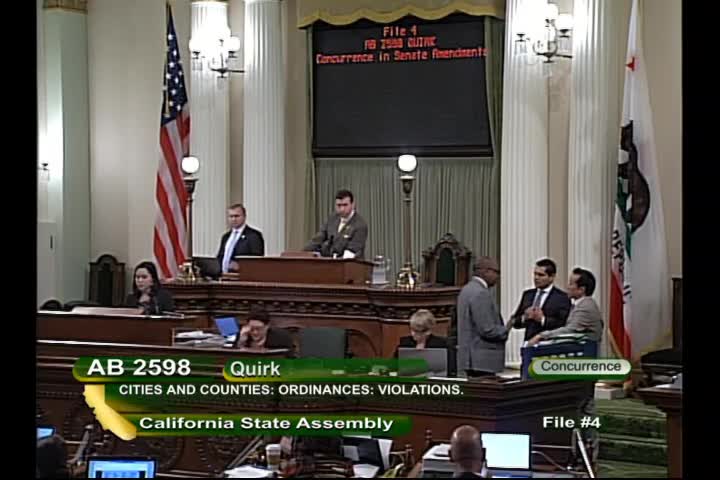 1MIN
Assembly Floor
 5MIN
Assembly Standing Committee on Local Government
 8MIN
Assembly Standing Committee on Elections and Redistricting
Bill Author