AB 2882: Campaign contributions.
- Session Year: 2017-2018
- House: Assembly
- Latest Version Date: 2018-02-16
The Political Reform Act of 1974 establishes certain limits on the amount of contributions that a person or group can make to a candidate for elective state office, or to a committee. Existing law prohibits a person from making a contribution to a committee or candidate that is earmarked unless the contribution is disclosed in compliance with the requirements for contributions made by an intermediary. Dues, assessments, fees, and similar payments made to a membership organization or its sponsored committee in an amount less than $500 per calendar year from a single source for the purpose of making contributions or expenditures are not considered earmarked.
This bill would reduce this exception for payments to a membership organization or its sponsored committee to $100.
Existing law makes a knowing or willful violation of the Political Reform Act of 1974 a misdemeanor and subjects offenders to criminal penalties. By expanding the scope of an existing crime, this bill would impose a state-mandated local program.
The California Constitution requires the state to reimburse local agencies and school districts for certain costs mandated by the state. Statutory provisions establish procedures for making that reimbursement.
This bill would provide that no reimbursement is required by this act for a specified reason.
The Political Reform Act of 1974, an initiative measure, provides that the Legislature may amend the act to further the acts purposes upon a 2/3 vote of each house of the Legislature and compliance with specified procedural requirements.
This bill would declare that it furthers the purposes of the act.
(a)A person shall not make any contribution to a committee or candidate that is earmarked for a contribution to any other particular committee, ballot measure, or candidate unless the contribution is fully disclosed pursuant to Section 84302.
(b)For purposes of subdivision (a), a contribution is earmarked if the contribution is made under any of the following circumstances:
(1)The committee or candidate receiving the contribution solicited the contribution for the purpose of making a contribution to another specifically identified committee, ballot measure, or candidate, requested the contributor to expressly consent to such use, and the contributor consents to such use.
(2)The contribution was made subject to a condition or agreement with the contributor that all or a portion of the contribution would be used to make a contribution to another specifically identified committee, ballot measure, or candidate.
(3)After the contribution was made, the contributor and the committee or candidate receiving the contribution reached a subsequent agreement that all or a portion of the contribution would be used to make a contribution to another specifically identified committee, ballot measure, or candidate.
(c)Notwithstanding subdivisions (a) and (b), dues, assessments, fees, and similar payments made to a membership organization or its sponsored committee in an amount less than five hundred dollars ($500) one hundred dollars ($100) per calendar year from a single source for the purpose of making contributions or expenditures shall not be considered earmarked.
(d)The committee making the earmarked contribution shall provide the committee receiving the earmarked contribution with the name and address of the contributor or contributors who earmarked their funds and the amount of the earmarked contribution from each contributor at the time it makes the contribution. If the committee making the contribution received earmarked contributions that exceed the amount contributed, or received contributions that were not earmarked, the committee making the contribution shall use a reasonable accounting method to determine which contributors to identify pursuant to this subdivision, but in no case shall the same contribution be disclosed more than one time to avoid disclosure of additional contributors who earmarked their funds.
(e)Earmarked contributions shall be disclosed on reports required by Chapter 4 (commencing with Section 84100) as follows:
(1)A contributor who qualifies as a committee pursuant to Section 82013 and who makes a contribution to a committee but earmarks the funds to another specifically identified committee pursuant to paragraph (1) or (2) of subdivision (b) shall disclose the specifically identified committee as the recipient of the contribution and the other committee as an intermediary at the time the earmarked contribution is made. The specifically identified committee shall disclose the contributor and intermediary at the time the funds are received from the intermediary. The intermediary committee shall disclose receipt of the funds as a miscellaneous increase to cash at the time the funds are received and shall disclose the expenditure as the transfer of an earmarked contribution from the contributor to the specifically identified committee at the time the funds are transferred to the specifically identified committee.
(2)A contributor who qualifies as a committee pursuant to Section 82013 and who makes a contribution to a committee and subsequently earmarks the funds pursuant to paragraph (3) of subdivision (b) shall include a notation on the contributors next statement that the original contribution was subsequently earmarked, including the name of the specifically identified committee, ballot measure, or candidate supported or opposed. The committee that previously received the funds shall also include a notation on its next statement that the original contribution was subsequently earmarked and shall disclose the original contributor to any new committee to which it transfers the earmarked funds. The new committee shall disclose the true source of the contribution with a notation that the contribution was earmarked to the specific ballot measure or candidate.
(3)A contributor who qualifies as a committee pursuant to Section 82013 and who earmarks a contribution to a specifically identified ballot measure or candidate shall disclose a contribution to the committee that received the contribution with a notation that the contribution was earmarked to the specific ballot measure or candidate. Compliance with this paragraph satisfies the contributors disclosure obligations under this title. The committee receiving the earmarked contribution shall disclose the contributor with a notation that the contribution was earmarked to the specific ballot measure or candidate when the contribution is received. The committee receiving the funds is solely responsible for disclosing the ultimate use of the earmarked contribution, whether by contribution or expenditure, at the time the funds are used. If the committee receiving the earmarked contribution contributes any portion of the contribution to another committee to support or oppose the specifically identified ballot measure or candidate, that committee shall disclose the true source of the contribution to the new committee receiving the earmarked funds for disclosure on the new committees campaign report. The new committee shall disclose the true source of the contribution with a notation that the contribution was earmarked to the specific ballot measure or candidate.
(f)A violation of this section shall not be based solely on the timing of contributions made or received.
SEC. 2.No reimbursement is required by this act pursuant to Section 6 of Article XIIIB of the California Constitution because the only costs that may be incurred by a local agency or school district will be incurred because this act creates a new crime or infraction, eliminates a crime or infraction, or changes the penalty for a crime or infraction, within the meaning of Section 17556 of the Government Code, or changes the definition of a crime within the meaning of Section 6 of Article XIIIB of the California Constitution.
SEC. 3.The Legislature finds and declares that this bill furthers the purposes of the Political Reform Act of 1974 within the meaning of subdivision (a) of Section 81012 of the Government Code.
REVISIONS: HeadingLine 2.|
Date
|
Status
|
|---|---|
| May 23, 2018 | From committee: Without further action pursuant to Joint Rule 62(a). |
| Apr 25, 2018 | In committee: Set, first hearing. Failed passage. |
| Mar 15, 2018 | Coauthors revised. |
| Mar 8, 2018 | Referred to Com. on E. & R. |
| Feb 17, 2018 | From printer. May be heard in committee March 19. |
| Feb 16, 2018 | Read first time. To print. |
|
Date
|
Description
|
Location
|
Votes
|
|
|---|---|---|---|---|
| Apr 25, 2018 | Do pass and be re-referred to the Committee on [Appropriations] | Assembly Standing Committee on Elections and Redistricting |
Failed |
This list shows positions taken on this bill by organizations on the date displayed, which is linked to the original source.
Positions by individuals are not included.
Date of Hearing: April 25, 2018
ASSEMBLY COMMITTEE ON ELECTIONS AND REDISTRICTING
Marc Berman, Chair
ABPCA Bill Id:AB 2882 (
Author:Harper) – As Introduced Ver:February 16, 2018
SUBJECT: Campaign contributions.
SUMMARY: Lowers, from $500 to $100 per calendar year, the cap on the amount of dues, assessments, fees, and similar payments that may be made to a membership organization or its sponsored committee from a single source for the purpose of making contributions or expenditures without being considered earmarked for the purposes of a specified provision of law.
EXISTING LAW:
- Creates the Fair Political Practices Commission (FPPC), and makes it responsible for the impartial, effective administration and implementation of the Political Reform Act (PRA).
- Requires every campaign statement that is filed pursuant to the PRA to contain the following information about each person from which the committee filing the statement received a contribution during the period covered by the statement, and from which the committee received a cumulative amount of contributions (including loans) of $100 or more, as specified:
- The person’s full name;
- The person’s street address;
- The person’s occupation;
- The name of the person’s employer, or if self-employed, the name of the business;
- The date and amount received for each contribution received from the person during the period covered by the campaign statement and if the contribution is a loan, the interest rate for the loan; and,
- The cumulative amount of contributions received from the person.
- The person’s full name;
- Prohibits a person from making a contribution to a committee or candidate that is earmarked for a contribution to any other particular committee, ballot measure, or candidate, unless the earmarking is reported as specified. Provides that a contribution is considered to be earmarked for reporting purposes under any of the following circumstances:
- The committee or candidate receiving the contribution solicited the contribution for the purpose of making a contribution to another specifically identified committee, ballot measure, or candidate, requested the contributor to expressly consent to such use, and the contributor consents to such use.
- The contribution was made subject to a condition or agreement with the contributor that all or a portion of the contribution would be used to make a contribution to another specifically identified committee, ballot measure, or candidate.
- After the contribution was made, the contributor and the committee or candidate receiving the contribution reached a subsequent agreement that all or a portion of the contribution would be used to make a contribution to another specifically identified committee, ballot measure, or candidate.
- Provides, for the purposes of the earmarking rules described above, that dues, assessments, fees, and similar payments made to a membership organization or its sponsored committee in an amount less than $500 per calendar year from a single source for the purpose of making contributions or expenditures shall not be considered earmarked.
- Requires advertisements that support or oppose candidates or ballot measures to include disclosure statements in specified circumstances. These required statements may include a disclosure of the committee that is paying for the advertisement, a disclosure of the three top contributors to the committee paying for the advertisement, as specified, and a statement (in the case of an independent expenditure supporting or opposing a candidate) that the advertisement was not authorized by a candidate or a committee controlled by a candidate for that office.
FISCAL EFFECT: Unknown. State-mandated local program; contains a crimes and infractions disclaimer.
COMMENTS:
- Purpose of the Bill: According to the author:
The [PRA] prohibits persons from collecting campaign contributions for the purpose of transmitting them to a particular candidate, unless the identities of the contributors are disclosed to the recipient. Accordingly, persons or organizations that solicit such “earmarked contributions” from others must disclose the identities of contributors who give $100 or more.
The [FPPC] has noted that the PRA bans earmarked contributions without disclosure of the true sources of the funds, because they deprive the public of important information about who is donating to campaigns, and because they facilitate the unlawful circumvention of campaign contribution limits.
In 2017, the Legislature passed AB 249, the “California Disclose Act,” to increase disclosure of the identities of groups that pay for political ads. But ironically, the Act also decreased the disclosure of persons who launder political contributions through membership organizations, by raising the disclosure threshold for such persons from $100 to $500.
Specifically, AB 249 stated that earmarked payments of up to $500 that are given by persons to their union or other membership organizations for the purpose of being transmitted to a candidate or ballot measure committee “shall not be considered earmarked,” and therefore shall not be disclosed by the organization.
A FPPC report noted that AB 249 created a two-track disclosure system for earmarked contributions, where membership organizations only have to disclose donors at the $500 threshold, while all other political committees have to disclose contributors at the $100 level.
Such loopholes allow persons to evade campaign contribution limits by giving the maximum amount directly to a candidate, and then laundering an additional contribution of up to $500 to the same candidate through a membership organization without their identities being disclosed. As noted by a FPPC analysis of a similar bill, “no rational explanation has been provided to create such a significant loophole to contribution limits.”
Assembly Bill 2882 will decrease “Dark Money” in California elections and make it harder to launder campaign contributions by repealing this loophole, and requiring all intermediaries – including unions and other membership organizations – to disclose the identities of persons who make earmarked political contributions of $100 or more.
- Disclose Act and Earmarking: Last year, the Legislature approved and the Governor signed AB 249 (Mullin), Chapter 546, Statutes of 2017, which significantly changed the content and format of disclosure statements required on specified campaign advertisements in a manner that generally required such disclosures to be more prominent. AB 249 also established new requirements for determining when contributions are considered to be earmarked, and imposed new disclosure requirements for earmarked contributions to ensure that committees are able to determine which contributors must be listed on campaign advertisements. AB 249 is commonly known as the “Disclose Act.” The passage of AB 249 marked the culmination of seven years of debate and negotiation over similar legislation.
Prior to the passage of AB 249, state law prohibited a person from making a contribution to a committee that was earmarked for a contribution to a particular candidate unless the contribution was fully disclosed. AB 249 expanded the earmarking provision to prohibit a person from making a contribution that is earmarked for any particular committee or ballot measure unless the contribution was fully disclosed. AB 249 also enacted new standards for establishing when a contribution was considered to be earmarked. These changes to the earmarking provisions of the PRA significantly broadened the circumstances under which a contribution was considered to be earmarked.
AB 249 provides, for the purposes of the new earmarking provisions, that dues, assessments, fees, and similar payments made to a membership organization or its sponsored committee in an amount less than $500 per calendar year from a single source for the purpose of making contributions or expenditures shall not be considered earmarked. This provision was designed to accomplish two purposes. First, there was concern that the new earmarking rules could create burdensome tracking and reporting requirements for dues, assessments, fees, and similar payments made to membership organizations that have a large number of members. Second, in the absence of this language, there was concern that a membership organization could be excluded from the listing of the “top donors” on an advertisement if the funds were considered to be small individual contributions from the members of the organization, rather than a large contribution from the organization itself. These concerns are described in more detail in comment #3 of this analysis.
At the time AB 249 was being considered, questions were raised about whether the provision regarding dues, assessments, fees, and similar payments made to a membership organization would (1) allow such organizations to solicit contributions of less than $500 per calendar year from their members that are designated for a specific purpose without disclosing the identities of those contributors, as is otherwise required when a committee receives contributions of $100 or more, or (2) allow an individual or an organization to make contributions to a candidate or committee in excess of existing contribution limits.
It should be noted, however, that this provision of AB 249 did not apply generally to the solicitation of contributions; instead, it applied only to dues, assessments, fees, and similar payments that are made to a membership organization. Additionally, nothing in AB 249 relieved a membership organization or its sponsored committee from provisions of existing law that require a committee to disclose the name, street address, occupation, and employer of persons from which the committee received contributions of $100 or more in a calendar year. Finally, no provision of AB 249, including the provisions regarding earmarked contributions, expressly or impliedly repealed, amended, or altered the calculation of how much money individuals and organizations may lawfully contribute to political campaigns. - Could This Bill Frustrate the Purpose of the Disclose Act? By lowering the threshold at which dues, assessments, fees, and similar payments made to a membership organization or its sponsored committee may be considered earmarked from $500 to $100, this bill could result in membership organizations and certain other committees being required to file extensive additional campaign disclosure reports identifying campaign contributions that already are publicly reported, and could result in membership organizations being left off of the list of top donors on campaign advertisements for which those organizations played a significant role. An example may be instructive in demonstrating how this bill could significantly increase the complexity of campaign disclosure reports while eliminating a membership organization from the list of top funders on an advertisement.
A committee is formed to oppose Proposition 300, a measure that will appear on the ballot at a statewide general election in California. That committee raises a total of $4 million: $1.5 million from a membership organization’s sponsored committee, $1.3 million from a corporation, and $1.2 million from an individual. The money contributed by the membership organization’s sponsored committee to the committee to oppose Proposition 300 comes from a $12.50 monthly assessment that the organization levied on each of its 10,000 members for a period of 12 months.
Under existing law (including the provisions of AB 249), the assessment payments (totaling $150 per member during the 12-month period) are not considered to be earmarked contributions to the committee to oppose Proposition 300, but instead are considered contributions that are made to the membership organization’s sponsored committee. Because the assessment payments made by each member equals or exceeds $100, the membership organization’s sponsored committee is required to disclose the identities of each of its 10,000 members that paid the $150 in assessments on its campaign disclosure reports. The committee to oppose Proposition 300 reports receiving a $1.5 million contribution from the membership organization’s sponsored committee, in addition to the $1.3 million contribution from the corporation and the $1.2 million contribution from the individual. On advertisements that the committee runs that are subject to the on-advertisement disclaimer requirements of the Disclose Act, the committee opposing Proposition 300 must list its three top donors as the membership organization, the corporation, and the individual.
Under this bill, however, the assessment payments received by the membership organization’s sponsored committee from its 10,000 members could be considered earmarked contributions to the committee to oppose Proposition 300. The membership organization would still be required to disclose the identities of each of its 10,000 members that paid the $150 in assessments on its campaign disclosure reports, but also would be required to disclose itself as an intermediary for those contributions. At the time of making the $1.5 million contribution to the committee to oppose Proposition 300, the membership organization would be required to provide the committee to oppose Proposition 300 with the names and addresses of each of the organization’s members who paid the $150 in assessments, and the committee receiving the $1.5 million contribution would be required to include each of those 10,000 members’ names on its campaign disclosure report, identifying each individual as having made a $150 contribution.
Under this scenario, this bill creates extensive new campaign reporting obligations for the membership organization and for the committee to oppose Proposition 300, without disclosing the identities of any donors whose identities aren’t already required to be disclosed on the membership organization's campaign report under existing law. Furthermore, the $1.5 million received by the committee to oppose Proposition 300 would be considered to be 10,000 individual contributions of $150 each, rather than a single $1.5 million contribution from the membership organization. As a result, the committee to oppose Proposition 300 would not be required to disclose the membership organization as one of its top three contributors on campaign ads. Instead, the committee’s campaign advertisements under this scenario would identify only the corporation and the individual as top contributors, and no third contributor would appear on the campaign’s covered advertisements. - Arguments in Support: In support of this bill, the Howard Jarvis Taxpayers Association writes, “Current law in AB 249 makes a disclosure exception for campaign contributions made by unions and other membership organizations that are less than $500 from a single source. Historically, committees have had to disclose $100 dollar donors. If your average everyday person must disclose at $100, why should donors to unions and membership organizations be allowed a higher $500 threshold? AB 249 created an unfair loophole for union donors to campaigns.”
- Arguments in Opposition: In opposition to this bill, the California Clean Money Campaign writes:
The fact that AB 249 bars dues, assessments, fees, and similar payments to membership organizations up to $500 annually from being considered earmarked is not a loophole for unions or any other membership organization. In fact, it is the opposite. It’s necessary to ensure that the membership organization itself is earmarked as the true source of the funds instead of a list of individual members whose dues were used…
[A]s sponsors of AB 249, we believe that the proposed amendment to the earmarking threshold in AB 2882 is not only unnecessary, but would in fact provide less disclosure to voters by causing individual members to be considered earmarked rather than their membership organization itself, resulting in neither the membership organization nor its individual members being disclosed on the ads, because a $499 earmarked contribution from an individual member would not reach the threshold of $50,000 required to be disclosed on ads.
Also in opposition to this bill, the California Federation of Teachers writes:
The $500 ceiling was established to avoid the costly reporting requirements of small monthly amounts that members give to [a membership-based organization (MBO)] sponsored committee, while still capturing larger amounts of money that move from individuals into larger PACs. Forcing MBOs to list every member who makes a donation to the sponsored committee is a very time consuming and costly practice that puts these organizations at a severe disadvantage. The ultimate affect would be to only allow those voices which can afford to comply with these complicated regulations to be heard in our electoral system.
- Political Reform Act of 1974: California voters passed an initiative, Proposition 9, in 1974 that created the FPPC and codified significant restrictions and prohibitions on candidates, officeholders and lobbyists. That initiative is commonly known as the PRA. Amendments to the PRA that are not submitted to the voters, such as those contained in this bill, must further the purposes of the initiative and require a two-thirds vote of both houses of the Legislature.
REGISTERED SUPPORT / OPPOSITION:
Support
Howard Jarvis Taxpayers Association
Opposition
California Clean Money Campaign
California Federation of Teachers
California Labor Federation
Analysis Prepared by: Ethan Jones / E. & R. / (916) 319-2094
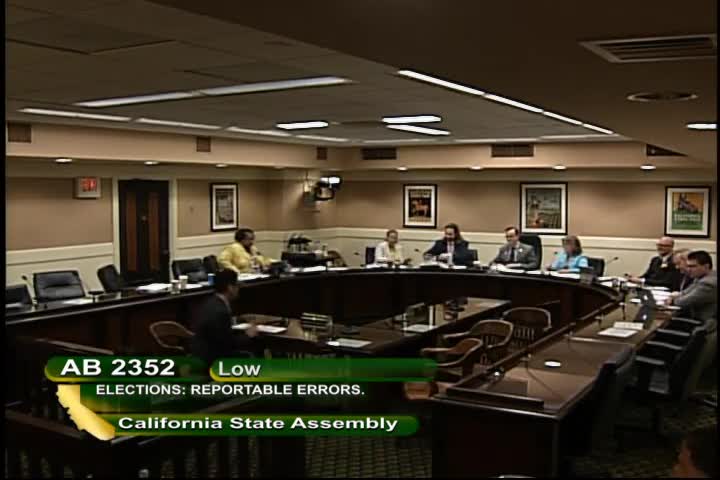
Discussed in Hearing
 13MIN
Assembly Standing Committee on Elections and Redistricting
Bill Author