AB 3043: Pupil nutrition: breakfast and lunch programs.
- Session Year: 2017-2018
- House: Assembly
- Latest Version Date: 2018-09-20
Existing law requires a school district or county superintendent of schools maintaining a kindergarten or any of grades 1 to 12, inclusive, to provide a needy pupil, as defined, one nutritionally adequate free or reduced-price meal during each schoolday, and authorizes the school district or county superintendent of schools to use funds available from any federal program, including the federal School Breakfast Program, or state program to comply with that requirement, as provided.
This bill would authorize a school district, county office of education, private nonprofit school, charter school, or residential child care institution, as defined, that participates in the federal School Breakfast Program, commencing with the 201920 school year, after submitting certain documentation to the State Department of Education for approval, to provide universal breakfast, to the maximum extent practicable. The bill would define universal breakfast to mean a nutritionally adequate breakfast that complies with, and qualifies for reimbursement under, the federal School Breakfast Program and that is provided to every pupil at no charge.
Existing law imposes various requirements relating to the nutritional quality of meals and other food and drinks provided to pupils, including breakfasts and lunches provided to pupils using state funds and all food and drinks sold on public school campuses, as provided. Existing law requires the department to ensure that the nutrition levels of meals served to schoolage children pursuant to the federal National School Lunch Act be of the highest quality and greatest nutritional value possible.
This bill would revise those nutritional quality requirements to require that those breakfasts and lunches qualify for reimbursement under, and other food and drinks sold on public school campuses are consistent with the requirements for, the most current meal pattern for the federal School Breakfast Program or the federal School Lunch Program, as specified. The bill would revise the requirement on the department to instead require the department to monitor schools participating in the federal National School Lunch Program or federal School Breakfast Program to ensure that the nutrition levels of meals qualify those meals for reimbursement under those same federal laws.
Existing law authorizes the governing board of any school district to establish cafeterias in the schools under its jurisdiction, and authorizes the moneys received for the sale of food or for any services performed by the cafeterias to be paid into the county treasury to the credit of the cafeteria fund of the particular school district. Existing law requires the cafeteria fund to be used only for those expenditures authorized by the governing board of the school district that are defined in the California School Accounting Manual.
This bill would authorize the governing board of a school district to authorize expenditures from the cafeteria fund or cafeteria account to provide universal breakfast. The bill would provide that the cost of purchasing a mobile food facility may be a charge against the cafeteria fund, upon prior approval by the department. The bill would require a local educational agency that uses federal reimbursements from any of the federal child nutrition programs to purchase a mobile food facility to use the mobile food facility only to support the administration of those federal child nutrition programs, and would require that a mobile food facility used for any purposes other than to support the administration of federal child nutrition programs be purchased entirely from funding sources other than the cafeteria fund.
Existing law authorizes the department to award grants of up to $15,000 per schoolsite on a competitive basis to school districts, county superintendents of schools, or entities approved by the department, limited to an amount subject to budget appropriations each fiscal year, for nonrecurring expenses incurred in initiating or expanding specified school breakfast programs and summer food service programs.
This bill would specify that the grants may be expended for a federal summer meals program, instead of a summer food service program.
Existing law requires a school district or county superintendent of schools maintaining a kindergarten or any of grades 1 to 12, inclusive, to provide a needy pupil, as defined, one nutritionally adequate free or reduced-price meal during each schoolday, and authorizes the school district or county superintendent of schools to use funds available from any federal program, including the federal School Breakfast Program, or state program to comply with that requirement, as provided.
This bill would authorize a school district, county office of education, private nonprofit school, charter school, or residential child care institution, as defined, that participates in the federal School Breakfast Program, commencing with the 201920 school year, after submitting certain documentation to the State Department of Education for approval, to provide universal breakfast, to the maximum extent practicable. The bill would define universal breakfast to mean a nutritionally adequate breakfast that complies with, and qualifies for reimbursement under, the federal School Breakfast Program and that is provided to every pupil at no charge.
Existing law imposes various requirements relating to the nutritional quality of meals and other food and drinks provided to pupils, including breakfasts and lunches provided to pupils using state funds and all food and drinks sold on public school campuses, as provided. Existing law requires the department to ensure that the nutrition levels of meals served to schoolage children pursuant to the federal National School Lunch Act be of the highest quality and greatest nutritional value possible.
This bill would revise those nutritional quality requirements to require that those breakfasts and lunches qualify for reimbursement under, and other food and drinks sold on public school campuses are consistent with the requirements for, the most current meal pattern for the federal School Breakfast Program or the federal School Lunch Program, as specified. The bill would revise the requirement on the department to instead require the department to monitor schools participating in the federal National School Lunch Program or federal School Breakfast Program to ensure that the nutrition levels of meals qualify those meals for reimbursement under those same federal laws.
Existing law authorizes the governing board of any school district to establish cafeterias in the schools under its jurisdiction, and authorizes the moneys received for the sale of food or for any services performed by the cafeterias to be paid into the county treasury to the credit of the cafeteria fund of the particular school district. Existing law requires the cafeteria fund to be used only for those expenditures authorized by the governing board of the school district that are defined in the California School Accounting Manual.
This bill would authorize the governing board of a school district to authorize expenditures from the cafeteria fund or cafeteria account to provide universal breakfast. The bill would provide that the cost of purchasing a mobile food facility may be a charge against the cafeteria fund, upon prior approval by the department. The bill would require a local educational agency that uses federal reimbursements from any of the federal child nutrition programs to purchase a mobile food facility to use the mobile food facility only to support the administration of those federal child nutrition programs, and would require that a mobile food facility used for any purposes other than to support the administration of federal child nutrition programs be purchased entirely from funding sources other than the cafeteria fund.
Existing law authorizes the department to award grants of up to $15,000 per schoolsite on a competitive basis to school districts, county superintendents of schools, or entities approved by the department, limited to an amount subject to budget appropriations each fiscal year, for nonrecurring expenses incurred in initiating or expanding specified school breakfast programs and summer food service programs.
This bill would increase the maximum amount of that grant to $30,000 per schoolsite, and would specify that the grants may be expended for a federal summer meals program, instead of a summer food service program.
Existing law requires a school district or county superintendent of schools maintaining a kindergarten or any of grades 1 to 12, inclusive, to provide a needy pupil, as defined, one nutritionally adequate free or reduced-price meal during each schoolday, and authorizes the school district or county superintendent of schools to use funds available from any federal program, including the federal School Breakfast Program, or state program to comply with that requirement, as provided.
This bill would authorize a school district, county superintendent of schools, office of education, private nonprofit school, or charter school school, or residential child care institution, as defined, that participates in the federal School Breakfast Program, commencing with the 201920 school year, after submitting certain documentation to the State Department of Education for approval, to provide universal breakfast, to the maximum extent practicable. The bill would define universal breakfast to mean a nutritionally adequate breakfast that complies with, and qualifies for reimbursement under, the federal School Breakfast Program and that is provided to every pupil at no charge.
Existing law imposes various requirements relating to the nutritional quality of meals and other food and drinks provided to pupils, including breakfasts and lunches provided to pupils using state funds and all food and drinks sold on public school campuses, as provided. Existing law requires the department to ensure that the nutrition levels of meals served to schoolage children pursuant to the federal National School Lunch Act be of the highest quality and greatest nutritional value possible.
This bill would revise those nutritional quality requirements to require that those breakfasts and lunches qualify for reimbursement under, and other food and drinks sold on public school campuses are consistent with the requirements for, the most current meal pattern for the federal School Breakfast Program or the federal School Lunch Program, as specified. The bill would revise the requirement on the department to instead require the department to monitor schools participating in the federal National School Lunch Program or federal School Breakfast Program to ensure that the nutrition levels of meals qualify those meals for reimbursement under those same federal laws.
Existing law authorizes the governing board of any school district to establish cafeterias in the schools under its jurisdiction, and authorizes the moneys received for the sale of food or for any services performed by the cafeterias to be paid into the county treasury to the credit of the cafeteria fund of the particular school district. Existing law requires the cafeteria fund to be used only for those expenditures authorized by the governing board of the school district that are defined in the California School Accounting Manual.
This bill would authorize the governing board of a school district to authorize expenditures from the cafeteria fund or cafeteria account to provide universal breakfast. The bill would provide that the cost of purchasing a mobile food facility may be a charge against the cafeteria fund, upon prior approval by the department. The bill would require a local educational agency that uses federal reimbursements from any of the federal child nutrition programs to purchase a mobile food facility to use the mobile food facility only to support the administration of those federal child nutrition programs, and would require that a mobile food facility used for any purposes other than to support the administration of federal child nutrition programs be purchased entirely from funding sources other than the cafeteria fund.
Existing law authorizes the department to award grants of up to $15,000 per schoolsite on a competitive basis to school districts, county superintendents of schools, or entities approved by the department, limited to an amount subject to budget appropriations each fiscal year, for nonrecurring expenses incurred in initiating or expanding specified school breakfast programs and summer food service programs.
This bill would increase the maximum amount of that grant to $30,000 per schoolsite, and would specify that the grants may be expended for a federal summer meals program, instead of a summer food service program.
Existing law requires a school district or county superintendent of schools maintaining a kindergarten or any of grades 1 to 12, inclusive, to provide a needy pupil, as defined, one nutritionally adequate free or reduced-price meal during each schoolday, and authorizes the school district or county superintendent of schools to use funds available from any federal program, including the federal School Breakfast Program, or state program to comply with that requirement, as provided.
This bill would authorize a school district, county superintendent of schools, private school, or charter school that participates in the federal School Breakfast Program, commencing with the 201920 school year, after submitting certain documentation to the State Department of Education for approval, to provide universal breakfast, to the maximum extent practicable. The bill would define universal breakfast to mean a nutritionally adequate breakfast that complies with, and qualifies for reimbursement under, the federal School Breakfast Program and that is provided to every pupil at no charge.
Existing law imposes various requirements relating to the nutritional quality of meals and other food and drinks provided to pupils, including breakfasts and lunches provided to pupils using state funds and all food and drinks sold on public school campuses, as provided. Existing law requires the department to ensure that the nutrition levels of meals served to schoolage children pursuant to the federal National School Lunch Act be of the highest quality and greatest nutritional value possible.
This bill would revise those nutritional quality requirements to require that those breakfasts and lunches qualify for reimbursement under, and other food and drinks sold on public school campuses are consistent with the requirements for, the most current meal pattern for the federal School Breakfast Program or the federal School Lunch Program, as specified. The bill would revise the requirement on the department to instead require the department to monitor schools participating in the federal National School Lunch Program or federal School Breakfast Program to ensure that the nutrition levels of meals qualify those meals for reimbursement under those same federal laws.
Existing law authorizes the governing board of any school district to establish cafeterias in the schools under its jurisdiction, and authorizes the moneys received for the sale of food or for any services performed by the cafeterias to be paid into the county treasury to the credit of the cafeteria fund of the particular school district. Existing law requires the cafeteria fund to be used only for those expenditures authorized by the governing board of the school district that are defined in the California School Accounting Manual.
This bill would authorize the governing board of a school district to authorize expenditures from the cafeteria fund or cafeteria account to provide universal breakfast. The bill would provide that the cost of purchasing a mobile food facility may be a charge against the cafeteria fund, upon prior approval by the department. The bill would require a local educational agency that uses federal reimbursements from any of the federal child nutrition programs to purchase a mobile food facility to use the mobile food facility only to support the administration of those federal child nutrition programs, and would require that a mobile food facility used for any purposes other than to support the administration of federal child nutrition programs be purchased entirely from funding sources other than the cafeteria fund.
Existing law authorizes the department to award grants of up to $15,000 per schoolsite on a competitive basis to school districts, county superintendents of schools, or entities approved by the department, limited to an amount subject to budget appropriations each fiscal year, for nonrecurring expenses incurred in initiating or expanding specified school breakfast programs and summer food service programs.
This bill would increase the maximum amount of that grant to $30,000 per schoolsite, and would specify that the grants may be expended for a federal summer meals program, instead of a summer food service program.
Existing law requires a school district or county superintendent of schools maintaining a kindergarten or any of grades 1 to 12, inclusive, to provide a needy pupil, as defined, one nutritionally adequate free or reduced-price meal during each schoolday, and authorizes the school district or county superintendent of schools to use funds available from any federal program, including the federal School Breakfast Program, or state program to comply with that requirement, as provided.
This bill would authorize a school district, county superintendent of schools, private school, or charter school that participates in the federal School Breakfast Program, commencing with the 201920 school year, after submitting certain documentation to the State Department of Education for approval, to provide universal breakfast, to the maximum extent practicable. The bill would define universal breakfast to mean a nutritionally adequate breakfast provided to every pupil at no charge.
Existing law authorizes the governing board of any school district to establish cafeterias in the schools under its jurisdiction, and authorizes the moneys received for the sale of food or for any services performed by the cafeterias to be paid into the county treasury to the credit of the cafeteria fund of the particular school district. Existing law requires the cafeteria fund to be used only for those expenditures authorized by the governing board of the school district that are defined in the California School Accounting Manual.
This bill would authorize the governing board of a school district to authorize expenditures from the cafeteria fund or cafeteria account to provide universal breakfast. The bill would provide that the cost of purchasing a mobile food facility may be a charge against the cafeteria fund, upon prior approval by the department. The bill would require a local educational agency that uses federal reimbursements from any of the federal child nutrition programs to purchase a mobile food facility to use the mobile food facility only to support the administration of those federal child nutrition programs, and would require that a mobile food facility used for any purposes other than to support the administration of federal child nutrition programs be purchased entirely from funding sources other than the cafeteria fund.
Existing law authorizes the department to award grants of up to $15,000 per schoolsite on a competitive basis to school districts, county superintendents of schools, or entities approved by the department, limited to an amount subject to budget appropriations each fiscal year, for nonrecurring expenses incurred in initiating or expanding specified school breakfast programs and summer food service programs.
This bill would increase the maximum amount of that grant to $30,000 per schoolsite, and would specify that the grants may be expended for a federal summer meals program, instead of a summer food service program.
(a)The cost of providing adequate housing for cafeterias, including, but not limited to, permanent kitchen facilities, is a charge against the funds of the school district. The cost of the lease or purchase of cafeteria equipment and of vending machines and their installation and housing shall be a charge against cafeteria funds, in accordance with Section 38091. However, when the governing board of a school district deems it necessary, the governing board of a school district may make the cost of the lease or purchase of cafeteria equipment for a kitchen or central food processing plant, and vending machines and their installation and housing, a charge against the funds of the school district. If school district funds are expended for the lease or purchase of kitchen equipment or for the lease, purchase, installation, or housing of vending machines, the governing board of the school district may at any time during the same fiscal year after the expenditure reimburse school district funds from cafeteria funds. The governing board of a school district shall only approve reimbursement for vending machines if one, or both, of the following apply:
(1)The vending machines are owned and operated by the school food services department, sell meals that qualify for federal meal program reimbursement, and are equipped with appropriate point of service meal counting software.
(2)The vending machines sell only food, or only beverages, or both that comply with state and federal competitive food laws and regulations.
(b)The governing board of a school district may by resolution make the cost of maintenance of the kitchen facilities, the cost of replacement or maintenance of kitchen equipment, and costs of telephone charges, water, drinking water in the cafeteria, electricity, gas, coal, wood, fuel, oil, and garbage disposal related to food service and delivery a charge against cafeteria funds, provided that the school district complies with all applicable state and federal laws and regulations.
(c)For purposes of this section, cafeteria fund means the nonprofit school food service account, as defined in Section 210.2 of Title 7 of the Code of Federal Regulations.
SEC. 2.Section 38101 of the Education Code is amended to read:38101.(a)(1)The governing board of a school district may authorize expenditures from the cafeteria fund or cafeteria account for those charges from that fund or account that are defined in the California School Accounting Manual, and as specified in paragraphs (2) and (3).
(2)The governing board of a school district may authorize expenditures from the cafeteria fund or cafeteria account to provide meals pursuant to Section 49550.5.
(3)(A)Upon prior approval by the department, the cost of purchasing a mobile food facility, as defined in Section 113831 of the Health and Safety Code, may be a charge against the cafeteria fund.
(B)A local educational agency that uses federal reimbursements from any of the federal child nutrition programs to purchase a mobile food facility shall use the mobile food facility only to support the administration of those federal child nutrition programs. A mobile food facility used for any purposes other than to support the administration of federal child nutrition programs shall be purchased entirely from funding sources other than the cafeteria fund.
(b)A food service program shall not be charged more than once for expenditures for the same service. If a food service program is being charged for a service as a direct cost, the school district shall not also allocate that cost as a direct support cost or indirect cost.
(c)For purposes of this section, an indirect cost shall be limited to the lesser of the school districts prior year indirect cost rate as approved by the department or the statewide average approved indirect cost for the second prior fiscal year.
(d)Charges to, or transfers from, a food service program shall indicate when the charge or transfer was made and shall be accompanied by a written explanation of the purpose of, and basis for, the expenditure.
(e)This section does not authorize a school district to charge a food service program any charges prohibited by state or federal law or regulation.
(f)If the department and the Department of Finance concur that a school district has violated this section, the Superintendent shall direct that school district to transfer double the amount improperly transferred to the general fund of the school district from that fund to the cafeteria fund of the school district or cafeteria account for the subsequent fiscal year which is then to be used for the improvement of the food service program of the school district. If the school district fails to make that transfer as directed, the Superintendent shall reduce the regular apportionment of the school district determined pursuant to Section 42238 and increase the child nutrition allowance of the school district determined pursuant to Section 41350 by double the amount improperly transferred to the general fund of the school district and that amount is then to be used for improvement of the food service program.
(g)It is the intent of the Legislature in enacting this section that responsible school district officials be held fully accountable for the accounting and reporting of food service programs and that minor and inadvertent instances of noncompliance be resolved in a fair and equitable manner to the satisfaction of the Superintendent and the Department of Finance.
(h)The Superintendent, with the approval of the Department of Finance, may waive up to the full transfer amount in subdivision (f) if he or she determines that the noncompliance involved is minor or inadvertent, or both.
(i)For purposes of this section, cafeteria fund means the nonprofit school food service account, as defined in Section 210.2 of Title 7 of the Code of Federal Regulations.
SEC. 3.Section 49531 of the Education Code is amended to read:49531.(a)Any child nutrition entity may apply to the department for all available federal and state funds so that a nutritionally adequate breakfast or lunch, or both, may be provided to pupils each schoolday at each school in the districts or maintained by the county superintendents of schools, or at private schools and parochial schools and to children receiving child development services. The state board shall adopt rules and regulations for the operation of lunch and breakfast programs in school districts. A child nutrition entity that receives state funds pursuant to this article, shall provide breakfasts and lunches in accordance with state and federal guidelines.
(b)A nutritionally adequate breakfast, for the purposes of this article, is one that qualifies for reimbursement under the most current meal pattern for the federal School Breakfast Program as defined in Section 220.8 of Title 7 of the Code of Federal Regulations. A nutritionally adequate lunch for purposes of this article is one that qualifies for reimbursement under the most current meal pattern for the federal National School Lunch Program, as defined in Section 210.10 of Title 7 of the Code of Federal Regulations.
(c)State reimbursement for meals provided pursuant to this article shall be limited to meals provided to pupils who are within the relevant definitions and criteria in federal statutes and regulations that prescribe eligibility for free and reduced-price meals.
SEC. 4.Section 49531.1 of the Education Code is amended to read:49531.1.(a)The department shall develop and maintain nutrition guidelines for school lunches and breakfasts, and for all food and beverages sold on public school campuses.
(b)The nutrition guidelines for school lunches and breakfasts, pursuant to subdivision (a), shall be consistent with the requirements for nutritionally adequate breakfasts and nutritionally adequate lunches, as defined in subdivision (b) of Section 49531.
SEC. 5.Section 49550.3 of the Education Code is amended to read:49550.3.(a)Because a hungry child cannot learn, the Legislature intends, as a state nutrition and health policy, that the federal School Breakfast Program be made available in all schools where it is needed to provide adequate nutrition for children in attendance.
(b)The department, in cooperation with school districts and county superintendents of schools, shall provide information and limited financial assistance to encourage program startup and expansion into all qualified schools, as follows:
(1)Provide information to school districts and county superintendents of schools concerning the benefits and availability of the federal School Breakfast Program.
(2)Each year, provide additional information and financial assistance to schools in the state, in which 20 percent or more of the school enrollment consists of children who have applied and qualify for free and reduced-price meals.
(c)The department shall award grants of up to fifteen thousand dollars ($15,000) per schoolsite on a competitive basis to school districts, county superintendents of schools, or entities approved by the department, limited to an amount subject to budget appropriations each fiscal year, for nonrecurring expenses incurred in initiating or expanding a school breakfast program under this section or a federal summer meals program, including the summer food service program pursuant to Article 10.7 (commencing with Section 49547) and the Seamless Summer Option component of the federal National School Lunch Program.
(d)Grants awarded under this section shall be used for nonrecurring costs of initiating or expanding a school breakfast program or a federal summer meals program, including the acquisition of equipment, training of staff in new capacities, outreach efforts to publicize new or expanded school breakfast programs or federal summer meals programs, minor alterations to accommodate new equipment, computer point-of-service systems for food service, and the purchase of vehicles for transporting food to schools. Funds may not be used for salaries and benefits of staff, food, computers, except computer point-of-service systems, or capital outlay.
(e)In making grant awards under this section in any fiscal year, the department shall give a preference to school districts and county superintendents of schools that do all of the following:
(1)Submit to the department a plan to start or expand school breakfast programs or federal summer meals programs in the school district or the county, including a description of the following:
(A)The manner in which the school district or county superintendent of schools will provide technical assistance and funding to schoolsites to expand those programs.
(B)Detailed information on the nonrecurring expenses needed to initiate a program.
(C)Public or private resources that have been assembled to carry out expansion of these programs during that year.
(2)Agree to operate the school breakfast program or the federal summer meals program for a period of not less than three years.
(3)Assure that the expenditure of funds from state and local resources for the maintenance of the school breakfast program or the federal summer meals program shall not be diminished as a result of grant awards received under this section.
(f)A grant awarded under this section may be used to implement a school breakfast program that serves breakfast after the start of the schoolday.
SEC. 6.Section 49550.5 is added to the Education Code, to read:49550.5.(a)For purposes of this section, the following definitions apply:
(1)Cafeteria fund means the nonprofit school food service account, as defined in Section 210.2 of Title 7 of the Code of Federal Regulations.
(2)Educational entity means a school district, county office of education, private nonprofit school, charter school, or residential child care institution, as defined in Section 210.2 of Title 7 of the Code of Federal Regulations within the definition of school.
(3)Universal breakfast means a nutritionally adequate breakfast that complies with, and qualifies for reimbursement under, the federal School Breakfast Program and that is provided to every pupil at no charge.
(b)(1)Commencing with the 201920 school year, an educational entity that participates in the federal School Breakfast Program may, to the maximum extent practicable, provide universal breakfast. Except as provided in paragraph (2), an educational entity that seeks to use the cafeteria fund to supplement meal costs for universal breakfast shall submit to the department for approval before implementing universal breakfast pursuant to this section, on or before July 1 of each year, an application, signed by the educational entitys governing board or governing body, certifying that the educational entity will provide breakfasts at no charge to all pupils and cover with nonfederal funds any costs of providing those breakfasts to all pupils above the amount provided in federal reimbursement.
(2)The requirement to submit an application to the department in paragraph (1) does not apply to an educational entity that participates in a federally authorized provision pursuant to which the educational entity provides universal breakfast, including, but not limited to, Provision 1, 2, or 3, or the Community Eligibility Provision of the federal Richard B. Russell National School Lunch Act (42 U.S.C. Sec. 1751 et seq.).
(c)Contributions that are a direct support of universal breakfast may be used to offset operation costs. These contributions may include the following:
(1)Funds from the cafeteria fund.
(2)Funds provided to support universal breakfast by organizations, including, but not limited to, school-related and community groups or by the city, county, city and county, or state.
SEC. 7.Section 49590 of the Education Code is amended to read:49590.The Legislature finds and declares that the State of California strives to serve food of the highest quality and greatest nutritional value possible. The department shall monitor schools participating in the federal National School Lunch Program or federal School Breakfast Program to ensure that the nutrition levels of meals served to schoolage children qualify those meals for reimbursement under the federal child nutrition program regulations as nutritionally adequate breakfasts and nutritionally adequate lunches, as defined in subdivision (b) of Section 49531.
(a)The cost of providing adequate housing for cafeterias, including, but not limited to, permanent kitchen facilities, is a charge against the funds of the school district. The cost of the lease or purchase of cafeteria equipment and of vending machines and their installation and housing shall be a charge against cafeteria funds, in accordance with Section 38091. However, when the governing board of a school district deems it necessary, the governing board of a school district may make the cost of the lease or purchase of cafeteria equipment for a kitchen or central food processing plant, and vending machines and their installation and housing, a charge against the funds of the school district. If school district funds are expended for the lease or purchase of kitchen equipment or for the lease, purchase, installation, or housing of vending machines, the governing board of the school district may at any time during the same fiscal year after the expenditure reimburse school district funds from cafeteria funds. The governing board of a school district shall only approve reimbursement for vending machines if one, or both, of the following apply:
(1)The vending machines are owned and operated by the school food services department, sell meals that qualify for federal meal program reimbursement, and are equipped with appropriate point of service meal counting software.
(2)The vending machines sell only food, or only beverages, or both that comply with state and federal competitive food laws and regulations.
(b)The governing board of a school district may by resolution make the cost of maintenance of the kitchen facilities, the cost of replacement or maintenance of kitchen equipment, and costs of telephone charges, water, drinking water in the cafeteria, electricity, gas, coal, wood, fuel, oil, and garbage disposal related to food service and delivery a charge against cafeteria funds, provided that the school district complies with all applicable state and federal laws and regulations.
(c)For purposes of this section, cafeteria fund means the nonprofit school food service account, as defined in Section 210.2 of Title 7 of the Code of Federal Regulations.
SEC. 2.Section 38101 of the Education Code is amended to read:38101.(a)(1)The governing board of a school district may authorize expenditures from the cafeteria fund or cafeteria account for those charges from that fund or account that are defined in the California School Accounting Manual, and as specified in paragraphs (2) and (3).
(2)The governing board of a school district may authorize expenditures from the cafeteria fund or cafeteria account to provide meals pursuant to Section 49550.5.
(3)(A)Upon prior approval by the department, the cost of purchasing a mobile food facility, as defined in Section 113831 of the Health and Safety Code, may be a charge against the cafeteria fund.
(B)A local educational agency that uses federal reimbursements from any of the federal child nutrition programs to purchase a mobile food facility shall use the mobile food facility only to support the administration of those federal child nutrition programs. A mobile food facility used for any purposes other than to support the administration of federal child nutrition programs shall be purchased entirely from funding sources other than the cafeteria fund.
(b)A food service program shall not be charged more than once for expenditures for the same service. If a food service program is being charged for a service as a direct cost, the school district shall not also allocate that cost as a direct support cost or indirect cost.
(c)For purposes of this section, an indirect cost shall be limited to the lesser of the school districts prior year indirect cost rate as approved by the department or the statewide average approved indirect cost for the second prior fiscal year.
(d)Charges to, or transfers from, a food service program shall indicate when the charge or transfer was made and shall be accompanied by a written explanation of the purpose of, and basis for, the expenditure.
(e)This section does not authorize a school district to charge a food service program any charges prohibited by state or federal law or regulation.
(f)If the department and the Department of Finance concur that a school district has violated this section, the Superintendent shall direct that school district to transfer double the amount improperly transferred to the general fund of the school district from that fund to the cafeteria fund of the school district or cafeteria account for the subsequent fiscal year which is then to be used for the improvement of the food service program of the school district. If the school district fails to make that transfer as directed, the Superintendent shall reduce the regular apportionment of the school district determined pursuant to Section 42238 and increase the child nutrition allowance of the school district determined pursuant to Section 41350 by double the amount improperly transferred to the general fund of the school district and that amount is then to be used for improvement of the food service program.
(g)It is the intent of the Legislature in enacting this section that responsible school district officials be held fully accountable for the accounting and reporting of food service programs and that minor and inadvertent instances of noncompliance be resolved in a fair and equitable manner to the satisfaction of the Superintendent and the Department of Finance.
(h)The Superintendent, with the approval of the Department of Finance, may waive up to the full transfer amount in subdivision (f) if he or she determines that the noncompliance involved is minor or inadvertent, or both.
(i)For purposes of this section, cafeteria fund means the nonprofit school food service account, as defined in Section 210.2 of Title 7 of the Code of Federal Regulations.
SEC. 3.Section 49531 of the Education Code is amended to read:49531.(a)Any child nutrition entity may apply to the department for all available federal and state funds so that a nutritionally adequate breakfast or lunch, or both, may be provided to pupils each schoolday at each school in the districts or maintained by the county superintendents of schools, or at private schools and parochial schools and to children receiving child development services. The state board shall adopt rules and regulations for the operation of lunch and breakfast programs in school districts. A child nutrition entity that receives state funds pursuant to this article, shall provide breakfasts and lunches in accordance with state and federal guidelines.
(b)A nutritionally adequate breakfast, for the purposes of this article, is one that qualifies for reimbursement under the most current meal pattern for the federal School Breakfast Program as defined in Section 220.8 of Title 7 of the Code of Federal Regulations. A nutritionally adequate lunch for purposes of this article is one that qualifies for reimbursement under the most current meal pattern for the federal National School Lunch Program, as defined in Section 210.10 of Title 7 of the Code of Federal Regulations.
(c)State reimbursement for meals provided pursuant to this article shall be limited to meals provided to pupils who are within the relevant definitions and criteria in federal statutes and regulations that prescribe eligibility for free and reduced-price meals.
SEC. 4.Section 49531.1 of the Education Code is amended to read:49531.1.(a)The department shall develop and maintain nutrition guidelines for school lunches and breakfasts, and for all food and beverages sold on public school campuses.
(b)The nutrition guidelines for school lunches and breakfasts, pursuant to subdivision (a), shall be consistent with the requirements for nutritionally adequate breakfasts and nutritionally adequate lunches, as defined in subdivision (b) of Section 49531.
SEC. 5.Section 49550.3 of the Education Code is amended to read:49550.3.(a)Because a hungry child cannot learn, the Legislature intends, as a state nutrition and health policy, that the federal School Breakfast Program be made available in all schools where it is needed to provide adequate nutrition for children in attendance.
(b)The department, in cooperation with school districts and county superintendents of schools, shall provide information and limited financial assistance to encourage program startup and expansion into all qualified schools, as follows:
(1)Provide information to school districts and county superintendents of schools concerning the benefits and availability of the federal School Breakfast Program.
(2)Each year, provide additional information and financial assistance to schools in the state, in which 20 percent or more of the school enrollment consists of children who have applied and qualify for free and reduced-price meals.
(c)The department shall award grants of up to thirty thousand dollars ($30,000) fifteen thousand dollars ($15,000) per schoolsite on a competitive basis to school districts, county superintendents of schools, or entities approved by the department, limited to an amount subject to budget appropriations each fiscal year, for nonrecurring expenses incurred in initiating or expanding a school breakfast program under this section or a federal summer meals program, including the summer food service program pursuant to Article 10.7 (commencing with Section 49547) and the Seamless Summer Option component of the federal National School Lunch Program.
(d)Grants awarded under this section shall be used for nonrecurring costs of initiating or expanding a school breakfast program or a federal summer meals program, including the acquisition of equipment, training of staff in new capacities, outreach efforts to publicize new or expanded school breakfast programs or federal summer meals programs, minor alterations to accommodate new equipment, computer point-of-service systems for food service, and the purchase of vehicles for transporting food to schools. Funds may not be used for salaries and benefits of staff, food, computers, except computer point-of-service systems, or capital outlay.
(e)In making grant awards under this section in any fiscal year, the department shall give a preference to school districts and county superintendents of schools that do all of the following:
(1)Submit to the department a plan to start or expand school breakfast programs or federal summer meals programs in the school district or the county, including a description of the following:
(A)The manner in which the school district or county superintendent of schools will provide technical assistance and funding to schoolsites to expand those programs.
(B)Detailed information on the nonrecurring expenses needed to initiate a program.
(C)Public or private resources that have been assembled to carry out expansion of these programs during that year.
(2)Agree to operate the school breakfast program or the federal summer meals program for a period of not less than three years.
(3)Assure that the expenditure of funds from state and local resources for the maintenance of the school breakfast program or the federal summer meals program shall not be diminished as a result of grant awards received under this section.
(f)A grant awarded under this section may be used to implement a school breakfast program that serves breakfast after the start of the schoolday.
SEC. 6.Section 49550.5 is added to the Education Code, to read:49550.5.(a)For purposes of this section, the following definitions apply:
(1)Cafeteria fund means the nonprofit school food service account, as defined in Section 210.2 of Title 7 of the Code of Federal Regulations.
(2)Educational entity means a school district, county office of education, private nonprofit school, charter school, or residential child care institution, as defined in Section 210.2 of Title 7 of the Code of Federal Regulations within the definition of school.
(3)Universal breakfast means a nutritionally adequate breakfast that complies with, and qualifies for reimbursement under, the federal School Breakfast Program and that is provided to every pupil at no charge.
(b)(1)Commencing with the 201920 school year, an educational entity that participates in the federal School Breakfast Program may, to the maximum extent practicable, provide universal breakfast. Except as provided in paragraph (2), an educational entity that seeks to use the cafeteria fund to supplement meal costs for universal breakfast shall submit to the department for approval before implementing universal breakfast pursuant to this section, on or before July 1 of each year, an application, signed by the educational entitys governing board or governing body, certifying that the educational entity will provide breakfasts at no charge to all pupils and cover with nonfederal funds any costs of providing those breakfasts to all pupils above the amount provided in federal reimbursement.
(2)The requirement to submit an application to the department in paragraph (1) does not apply to an educational entities entity that participate participates in a federally authorized provision pursuant to which the educational entity provides universal breakfast, including, but not limited to, Provision 1, 2, or 3, or the Community Eligibility Provision of the federal Richard B. Russell National School Lunch Act (42 U.S.C. Sec. 1751 et seq.).
(c)Contributions that are a direct support of universal breakfast may be used to offset operation costs. These contributions may include: include the following:
(1)Funds from the cafeteria fund.
(2)Funds provided to support universal breakfast by organizations, including, but not limited to, school-related and community groups or by the city, county, city and county, or state.
SEC. 7.Section 49590 of the Education Code is amended to read:49590.The Legislature finds and declares that the State of California strives to serve food of the highest quality and greatest nutritional value possible. The department shall monitor schools participating in the federal National School Lunch Program or federal School Breakfast Program to ensure that the nutrition levels of meals served to schoolage children qualify those meals for reimbursement under the federal child nutrition program regulations as nutritionally adequate breakfasts and nutritionally adequate lunches, as defined in subdivision (b) of Section 49531.
(a)The cost of providing adequate housing for cafeterias, including, but not limited to, permanent kitchen facilities, is a charge against the funds of the school district. The cost of the lease or purchase of cafeteria equipment and of vending machines and their installation and housing shall be a charge against cafeteria funds, in accordance with Section 38091. However, when the governing board of a school district deems it necessary, the governing board of a school district may make the cost of the lease or purchase of cafeteria equipment for a kitchen or central food processing plant, and vending machines and their installation and housing, a charge against the funds of the school district. If school district funds are expended for the lease or purchase of kitchen equipment or for the lease, purchase, installation, or housing of vending machines, the governing board of the school district may at any time during the same fiscal year after the expenditure reimburse school district funds from cafeteria funds. The governing board of a school district shall only approve reimbursement for vending machines if one, or both, of the following apply:
(1)The vending machines are owned and operated by the school food services department, sell meals that qualify for federal meal program reimbursement, and are equipped with appropriate point of service meal counting software.
(2)The vending machines sell only food, or only beverages, or both that comply with state and federal competitive food laws and regulations.
(b)The governing board of a school district may by resolution make the cost of maintenance of the kitchen facilities, the cost of replacement or maintenance of kitchen equipment, and costs of telephone charges, water, drinking water in the cafeteria, electricity, gas, coal, wood, fuel, oil, and garbage disposal related to food service and delivery a charge against cafeteria funds, provided that the school district complies with all applicable state and federal laws and regulations.
(c)For purposes of this section, cafeteria fund means the nonprofit school food service account, as defined in Section 210.2 of Title 7 of the Code of Federal Regulations.
SEC. 2.Section 38101 of the Education Code is amended to read:38101.(a)(1)The governing board of a school district may authorize expenditures from the cafeteria fund or cafeteria account for those charges from that fund or account that are defined in the California School Accounting Manual, and as specified in paragraphs (2) and (3).
(2)The governing board of a school district may authorize expenditures from the cafeteria fund or cafeteria account to provide meals pursuant to subdivision (f) of Section 49550.3. 49550.5.
(3)(A)Upon prior approval by the department, the cost of purchasing a mobile food facility, as defined in Section 113831 of the Health and Safety Code, may be a charge against the cafeteria fund.
(B)A local educational agency that uses federal reimbursements from any of the federal child nutrition programs to purchase a mobile food facility shall use the mobile food facility only to support the administration of those federal child nutrition programs. A mobile food facility used for any purposes other than to support the administration of federal child nutrition programs shall be purchased entirely from funding sources other than the cafeteria fund.
(b)A food service program shall not be charged more than once for expenditures for the same service. If a food service program is being charged for a service as a direct cost, the school district shall not also allocate that cost as a direct support cost or indirect cost.
(c)For purposes of this section, an indirect cost shall be limited to the lesser of the school districts prior year indirect cost rate as approved by the department or the statewide average approved indirect cost for the second prior fiscal year.
(d)Charges to, or transfers from, a food service program shall indicate when the charge or transfer was made and shall be accompanied by a written explanation of the purpose of, and basis for, the expenditure.
(e)This section does not authorize a school district to charge a food service program any charges prohibited by state or federal law or regulation.
(f)If the department and the Department of Finance concur that a school district has violated this section, the Superintendent shall direct that school district to transfer double the amount improperly transferred to the general fund of the school district from that fund to the cafeteria fund of the school district or cafeteria account for the subsequent fiscal year which is then to be used for the improvement of the food service program of the school district. If the school district fails to make that transfer as directed, the Superintendent shall reduce the regular apportionment of the school district determined pursuant to Section 42238 and increase the child nutrition allowance of the school district determined pursuant to Section 41350 by double the amount improperly transferred to the general fund of the school district and that amount is then to be used for improvement of the food service program.
(g)It is the intent of the Legislature in enacting this section that responsible school district officials be held fully accountable for the accounting and reporting of food service programs and that minor and inadvertent instances of noncompliance be resolved in a fair and equitable manner to the satisfaction of the Superintendent and the Department of Finance.
(h)The Superintendent, with the approval of the Department of Finance, may waive up to the full transfer amount in subdivision (f) if he or she determines that the noncompliance involved is minor or inadvertent, or both.
(i)For purposes of this section, cafeteria fund means the nonprofit school food service account, as defined in Section 210.2 of Title 7 of the Code of Federal Regulations.
SEC. 3.Section 49531 of the Education Code is amended to read:49531.(a)Any child nutrition entity may apply to the department for all available federal and state funds so that a nutritionally adequate breakfast or lunch, or both, may be provided to pupils each schoolday at each school in the districts or maintained by the county superintendents of schools, or at private schools and parochial schools and to children receiving child development services. The state board shall adopt rules and regulations for the operation of lunch and breakfast programs in school districts. A child nutrition entity that receives state funds pursuant to this article, shall provide breakfasts and lunches in accordance with state and federal guidelines.
(b)A nutritionally adequate breakfast, for the purposes of this article, is one that qualifies for reimbursement under the most current meal pattern for the federal School Breakfast Program as defined in Section 220.8 of Title 7 of the Code of Federal Regulations. A nutritionally adequate lunch for purposes of this article is one that qualifies for reimbursement under the most current meal pattern for the federal National School Lunch Program, as defined in Section 210.10 of Title 7 of the Code of Federal Regulations.
(c)State reimbursement for meals provided pursuant to this article shall be limited to meals provided to pupils who are within the relevant definitions and criteria in federal statutes and regulations that prescribe eligibility for free and reduced-price meals.
SEC. 4.Section 49531.1 of the Education Code is amended to read:49531.1.(a)The department shall develop and maintain nutrition guidelines for school lunches and breakfasts, and for all food and beverages sold on public school campuses.
(b)The nutrition guidelines for school lunches and breakfasts, pursuant to subdivision (a), shall be consistent with the requirements for nutritionally adequate breakfasts and nutritionally adequate lunches, as defined in subdivision (b) of Section 49531.
SEC. 5.Section 49550.3 of the Education Code is amended to read:49550.3.(a)Because a hungry child cannot learn, the Legislature intends, as a state nutrition and health policy, that the federal School Breakfast Program be made available in all schools where it is needed to provide adequate nutrition for children in attendance.
(b)The department, in cooperation with school districts and county superintendents of schools, shall provide information and limited financial assistance to encourage program startup and expansion into all qualified schools, as follows:
(1)Provide information to school districts and county superintendents of schools concerning the benefits and availability of the federal School Breakfast Program.
(2)Each year, provide additional information and financial assistance to schools in the state, in which 20 percent or more of the school enrollment consists of children who have applied and qualify for free and reduced-price meals.
(c)The department shall award grants of up to thirty thousand dollars ($30,000) per schoolsite on a competitive basis to school districts, county superintendents of schools, or entities approved by the department, limited to an amount subject to budget appropriations each fiscal year, for nonrecurring expenses incurred in initiating or expanding a school breakfast program under this section or a federal summer meals program, including the summer food service program pursuant to Article 10.7 (commencing with Section 49547) and the Seamless Summer Option component of the federal National School Lunch Program.
(d)Grants awarded under this section shall be used for nonrecurring costs of initiating or expanding a school breakfast program or a federal summer meals program, including the acquisition of equipment, training of staff in new capacities, outreach efforts to publicize new or expanded school breakfast programs or federal summer meals programs, minor alterations to accommodate new equipment, computer point-of-service systems for food service, and the purchase of vehicles for transporting food to schools. Funds may not be used for salaries and benefits of staff, food, computers, except computer point-of-service systems, or capital outlay.
(e)In making grant awards under this section in any fiscal year, the department shall give a preference to school districts and county superintendents of schools that do all of the following:
(1)Submit to the department a plan to start or expand school breakfast programs or federal summer meals programs in the school district or the county, including a description of the following:
(A)The manner in which the school district or county superintendent of schools will provide technical assistance and funding to schoolsites to expand those programs.
(B)Detailed information on the nonrecurring expenses needed to initiate a program.
(C)Public or private resources that have been assembled to carry out expansion of these programs during that year.
(2)Agree to operate the school breakfast program or the federal summer meals program for a period of not less than three years.
(3)Assure that the expenditure of funds from state and local resources for the maintenance of the school breakfast program or the federal summer meals program shall not be diminished as a result of grant awards received under this section.
(f)(1)For purposes of this subdivision, the following definitions apply:(A)Cafeteria fund means the nonprofit school food service account, as defined in Section 210.2 of Title 7 of the Code of Federal Regulations.(B)Educational entity means a school district, county office of education, private nonprofit school, charter school, or residential child care institution, as defined in Section 210.2 of Title 7 of the Code of Federal Regulations within the definition of school.(C)Universal breakfast means a nutritionally adequate breakfast that complies with, and qualifies for reimbursement under, the federal School Breakfast Program and that is provided to every pupil at no charge.(2)(A)Commencing with the 201920 school year, an educational entity that participates in the federal School Breakfast Program may, to the maximum extent practicable, provide universal breakfast. Except as provided in subparagraph (B), an educational entity that seeks to use the cafeteria fund to supplement meal costs for universal breakfast shall submit to the department for approval before implementing universal breakfast pursuant to this subdivision, on or before July 1 of each year, an application, signed by the educational entitys governing board or governing body, certifying that the educational entity will provide breakfasts at no charge to all pupils and cover with nonfederal funds any costs of providing those breakfasts to all pupils above the amount provided in federal assistance.(B)The requirement to submit an application to the department in subparagraph (A) does not apply to educational entities that, as of January 1, 2018, participate in Provision 1, 2, or 3, or the Community Eligibility Provision of the federal Richard B. Russell National School Lunch Act (42 U.S.C. Sec. 1751 et seq.).(3)Contributions that are a direct support of universal breakfast may be used to offset operation costs. These contributions may include:(A)Funds from the cafeteria fund.(B)Funds provided to support universal breakfast by organizations, including, but not limited to, school-related and community groups or by the city, county, city and county, or state.(g)(f)A grant awarded under this section may be used to implement a school breakfast program that serves breakfast after the start of the schoolday.
SEC. 6.Section 49550.5 is added to the Education Code, to read:49550.5.(a)For purposes of this section, the following definitions apply:
(1)Cafeteria fund means the nonprofit school food service account, as defined in Section 210.2 of Title 7 of the Code of Federal Regulations.
(2)Educational entity means a school district, county office of education, private nonprofit school, charter school, or residential child care institution, as defined in Section 210.2 of Title 7 of the Code of Federal Regulations within the definition of school.
(3)Universal breakfast means a nutritionally adequate breakfast that complies with, and qualifies for reimbursement under, the federal School Breakfast Program and that is provided to every pupil at no charge.
(b)(1)Commencing with the 201920 school year, an educational entity that participates in the federal School Breakfast Program may, to the maximum extent practicable, provide universal breakfast. Except as provided in paragraph (2), an educational entity that seeks to use the cafeteria fund to supplement meal costs for universal breakfast shall submit to the department for approval before implementing universal breakfast pursuant to this section, on or before July 1 of each year, an application, signed by the educational entitys governing board or governing body, certifying that the educational entity will provide breakfasts at no charge to all pupils and cover with nonfederal funds any costs of providing those breakfasts to all pupils above the amount provided in federal reimbursement.
(2)The requirement to submit an application to the department in paragraph (1) does not apply to educational entities that participate in a federally authorized provision pursuant to which the educational entity provides universal breakfast, including, but not limited to, Provision 1, 2, or 3, or the Community Eligibility Provision of the federal Richard B. Russell National School Lunch Act (42 U.S.C. Sec. 1751 et seq.).
(c)Contributions that are a direct support of universal breakfast may be used to offset operation costs. These contributions may include:
(1)Funds from the cafeteria fund.
(2)Funds provided to support universal breakfast by organizations, including, but not limited to, school-related and community groups or by the city, county, city and county, or state.
SEC. 6.SEC. 7.Section 49590 of the Education Code is amended to read:49590.The Legislature finds and declares that the State of California strives to serve food of the highest quality and greatest nutritional value possible. The department shall monitor schools participating in the federal National School Lunch Program or federal School Breakfast Program to ensure that the nutrition levels of meals served to schoolage children qualify those meals for reimbursement under the federal child nutrition program regulations as nutritionally adequate breakfasts and nutritionally adequate lunches, as defined in subdivision (b) of Section 49531.
(a)The cost of providing adequate housing for cafeterias, including, but not limited to, permanent kitchen facilities, is a charge against the funds of the school district. The cost of the lease or purchase of cafeteria equipment and of vending machines and their installation and housing shall be a charge against cafeteria funds, in accordance with Section 38091. However, when the governing board of a school district deems it necessary, the governing board of a school district may make the cost of the lease or purchase of cafeteria equipment for a kitchen or central food processing plant, and vending machines and their installation and housing, a charge against the funds of the school district. If school district funds are expended for the lease or purchase of kitchen equipment or for the lease, purchase, installation, or housing of vending machines, the governing board of the school district may at any time during the same fiscal year after the expenditure reimburse school district funds from cafeteria funds. The governing board of a school district shall only approve reimbursement for vending machines if one, or both, of the following apply:
(1)The vending machines are owned and operated by the school food services department, sell meals that qualify for federal meal program reimbursement, and are equipped with appropriate point of service meal counting software.
(2)The vending machines sell only food, or only beverages, or both that comply with state and federal competitive food laws and regulations.
(b)The governing board of a school district may by resolution make the cost of maintenance of the kitchen facilities, the cost of replacement or maintenance of kitchen equipment, and costs of telephone charges, water, drinking water in the cafeteria, electricity, gas, coal, wood, fuel, oil, and garbage disposal related to food service and delivery a charge against cafeteria funds, provided that the school district complies with all applicable state and federal laws and regulations.
(c)For purposes of this section, cafeteria fund means the nonprofit school food service account, as defined in Section 210.2 of Title 7 of the Code of Federal Regulations.
SEC. 2.Section 38101 of the Education Code is amended to read:38101.(a)(1)The governing board of a school district may authorize expenditures from the cafeteria fund or cafeteria account for those charges from that fund or account that are defined in the California School Accounting Manual, and as specified in paragraphs (2) and (3).
(2)The governing board of a school district may authorize expenditures from the cafeteria fund or cafeteria account to provide meals pursuant to subdivision (f) of Section 49550.3.
(3)(A)Upon prior approval by the department, the cost of purchasing a mobile food facility, as defined in Section 113831 of the Health and Safety Code, may be a charge against the cafeteria fund.
(B)A local educational agency that uses federal reimbursements from any of the federal child nutrition programs to purchase a mobile food facility shall use the mobile food facility only to support the administration of those federal child nutrition programs. A mobile food facility used for any purposes other than to support the administration of federal child nutrition programs shall be purchased entirely from funding sources other than the cafeteria fund.
(b)A food service program shall not be charged more than once for expenditures for the same service. If a food service program is being charged for a service as a direct cost, the school district shall not also allocate that cost as a direct support cost or indirect cost.
(c)For purposes of this section, an indirect cost shall be limited to the lesser of the school districts prior year indirect cost rate as approved by the department or the statewide average approved indirect cost for the second prior fiscal year.
(d)Charges to, or transfers from, a food service program shall indicate when the charge or transfer was made and shall be accompanied by a written explanation of the purpose of, and basis for, the expenditure.
(e)This section does not authorize a school district to charge a food service program any charges prohibited by state or federal law or regulation.
(f)If the department and the Department of Finance concur that a school district has violated this section, the Superintendent shall direct that school district to transfer double the amount improperly transferred to the general fund of the school district from that fund to the cafeteria fund of the school district or cafeteria account for the subsequent fiscal year which is then to be used for the improvement of the food service program of the school district. If the school district fails to make that transfer as directed, the Superintendent shall reduce the regular apportionment of the school district determined pursuant to Section 42238 and increase the child nutrition allowance of the school district determined pursuant to Section 41350 by double the amount improperly transferred to the general fund of the school district and that amount is then to be used for improvement of the food service program.
(g)It is the intent of the Legislature in enacting this section that responsible school district officials be held fully accountable for the accounting and reporting of food service programs and that minor and inadvertent instances of noncompliance be resolved in a fair and equitable manner to the satisfaction of the Superintendent and the Department of Finance.
(h)The Superintendent, with the approval of the Department of Finance, may waive up to the full transfer amount in subdivision (f) if he or she determines that the noncompliance involved is minor or inadvertent, or both.
(i)For purposes of this section, cafeteria fund means the nonprofit school food service account, as defined in Section 210.2 of Title 7 of the Code of Federal Regulations.
SEC. 3.Section 49531 of the Education Code is amended to read:49531.(a)Any child nutrition entity may apply to the department for all available federal and state funds so that a nutritionally adequate breakfast or lunch, or both, may be provided to pupils each schoolday at each school in the districts or maintained by the county superintendents of schools, or at private schools and parochial schools and to children receiving child development services. The state board shall adopt rules and regulations for the operation of lunch and breakfast programs in school districts. A child nutrition entity that receives state funds pursuant to this article, shall provide breakfasts and lunches in accordance with state and federal guidelines.
(b)A nutritionally adequate breakfast, for the purposes of this article, is one that qualifies for reimbursement under the most current meal pattern for the federal School Breakfast Program as defined in Section 220.8 of Title 7 of the Code of Federal Regulations. A nutritionally adequate lunch for purposes of this article is one that qualifies for reimbursement under the most current meal pattern for the federal National School Lunch Program, as defined in Section 210.10 of Title 7 of the Code of Federal Regulations.
(c)State reimbursement for meals provided pursuant to this article shall be limited to meals provided to pupils who are within the relevant definitions and criteria in federal statutes and regulations that prescribe eligibility for free and reduced price reduced-price meals.
SEC. 4.Section 49531.1 of the Education Code is amended to read:49531.1.(a)The department shall develop and maintain nutrition guidelines for school lunches and breakfasts, and for all food and beverages sold on public school campuses.
(b)The nutrition guidelines for school lunches and breakfasts, pursuant to subdivision (a), shall be consistent with the requirements for nutritionally adequate breakfasts and nutritionally adequate lunches, as defined in subdivision (b) of Section 49531.
SEC. 5.Section 49550.3 of the Education Code is amended to read:49550.3.(a)Because a hungry child cannot learn, the Legislature intends, as a state nutrition and health policy, that the federal School Breakfast Program be made available in all schools where it is needed to provide adequate nutrition for children in attendance.
(b)The department, in cooperation with school districts and county superintendents of schools, shall provide information and limited financial assistance to encourage program startup and expansion into all qualified schools, as follows:
(1)Provide information to school districts and county superintendents of schools concerning the benefits and availability of the federal School Breakfast Program.
(2)Each year, provide additional information and financial assistance to schools in the state, in which 20 percent or more of the school enrollment consists of children who have applied and qualify for free and reduced-price meals.
(c)The department shall award grants of up to thirty thousand dollars ($30,000) per schoolsite on a competitive basis to school districts, county superintendents of schools, or entities approved by the department, limited to an amount subject to budget appropriations each fiscal year, for nonrecurring expenses incurred in initiating or expanding a school breakfast program under this section or a federal summer meals program, including the summer food service program pursuant to Article 10.7 (commencing with Section 49547) and the Seamless Summer Option component of the federal National School Lunch Program.
(d)Grants awarded under this section shall be used for nonrecurring costs of initiating or expanding a school breakfast program or a federal summer meals program, including the acquisition of equipment, training of staff in new capacities, outreach efforts to publicize new or expanded school breakfast programs or federal summer meals programs, minor alterations to accommodate new equipment, computer point-of-service systems for food service, and the purchase of vehicles for transporting food to schools. Funds may not be used for salaries and benefits of staff, food, computers, except computer point-of-service systems, or capital outlay.
(e)In making grant awards under this section in any fiscal year, the department shall give a preference to school districts and county superintendents of schools that do all of the following:
(1)Submit to the department a plan to start or expand school breakfast programs or federal summer meals programs in the school district or the county, including a description of the following:
(A)The manner in which the school district or county superintendent of schools will provide technical assistance and funding to schoolsites to expand those programs.
(B)Detailed information on the nonrecurring expenses needed to initiate a program.
(C)Public or private resources that have been assembled to carry out expansion of these programs during that year.
(2)Agree to operate the school breakfast program or the federal summer meals program for a period of not less than three years.
(3)Assure that the expenditure of funds from state and local resources for the maintenance of the school breakfast program or the federal summer meals program shall not be diminished as a result of grant awards received under this section.
(f)(1)For purposes of this subdivision, the following definitions apply:
(A)Cafeteria fund means the nonprofit school food service account, as defined in Section 210.2 of Title 7 of the Code of Federal Regulations.
(B)Educational entity means a school district, county superintendent of schools, office of education, private nonprofit school, or charter school. school, or residential child care institution, as defined in Section 210.2 of Title 7 of the Code of Federal Regulations within the definition of school.
(C)Universal breakfast means a nutritionally adequate breakfast that complies with, and qualifies for reimbursement under, the federal School Breakfast Program and that is provided to every pupil at no charge.
(2)(A)Except as provided in subparagraph (B), commencing Commencing with the 201920 school year, an educational entity that participates in the federal School Breakfast Program may, to the maximum extent practicable, provide universal breakfast. An Except as provided in subparagraph (B), an educational entity that seeks to use the cafeteria fund to supplement meal cost costs for universal breakfast shall submit to the department for approval before implementing universal breakfast pursuant to this subdivision, on or before July 1 of each year, an application, signed by the educational entitys governing board or governing body, certifying that the educational entity will provide breakfasts at no charge to all pupils and cover with nonfederal funds any costs of providing those breakfasts to all pupils above the amount provided in federal assistance.
(B)The requirement to submit an application to the department in subparagraph (A) does not apply to educational entities that, as of January 1, 2018, participate in Provision 1, 2, or 3, or the Community Eligibility Provision of the federal Richard B. Russell National School Lunch Act (42 U.S.C. Sec. 1751 et seq.).
(3)Contributions that are a direct support of universal breakfast may be used to offset operation costs. These contributions may include:
(A)Funds from the cafeteria fund.
(B)Funds provided to support universal breakfast by organizations, including, but not limited to, school-related and community groups or by the city, county, city and county, or state.
(g)A grant awarded under this section may be used to implement a school breakfast program that serves breakfast after the start of the schoolday.
SEC. 6.Section 49590 of the Education Code is amended to read:49590.The Legislature finds and declares that the State of California strives to serve food of the highest quality and greatest nutritional value possible. The department shall monitor schools participating in the federal National School Lunch Program or federal School Breakfast Program to ensure that the nutrition levels of meals served to schoolage children qualify those meals for reimbursement under the federal child nutrition program regulations as nutritionally adequate breakfasts and nutritionally adequate lunches, as defined in subdivision (b) of Section 49531.
(a)The cost of providing adequate housing for cafeterias, including, but not limited to, permanent kitchen facilities, is a charge against the funds of the school district. The cost of the lease or purchase of cafeteria equipment and of vending machines and their installation and housing shall be a charge against cafeteria funds, in accordance with Section 38091. However, when the governing board of a school district deems it necessary, the governing board of a school district may make the cost of the lease or purchase of cafeteria equipment for a kitchen or central food processing plant, and vending machines and their installation and housing, a charge against the funds of the school district. If school district funds are expended for the lease or purchase of kitchen equipment or for the lease, purchase, installation, or housing of vending machines, the governing board of the school district may at any time during the same fiscal year after the expenditure reimburse school district funds from cafeteria funds. The governing board of a school district shall only approve reimbursement for vending machines if one, or both, of the following apply:
(1)The vending machines are owned and operated by the school food services department, sell meals that qualify for federal meal program reimbursement, and are equipped with appropriate point of service meal counting software.
(2)The vending machines sell only food, or only beverages, or both that comply with state and federal competitive food laws and regulations.
(b)The governing board of a school district may by resolution make the cost of maintenance of the kitchen facilities, the cost of replacement or maintenance of kitchen equipment, and costs of telephone charges, water, drinking water in the cafeteria, electricity, gas, coal, wood, fuel, oil, and garbage disposal related to food service and delivery a charge against cafeteria funds, provided that the school district complies with all applicable state and federal laws and regulations.
(c)For purposes of this section, cafeteria fund means the nonprofit school food service account, as defined in Section 210.2 of Title 7 of the Code of Federal Regulations.
SEC. 2.Section 38101 of the Education Code is amended to read:38101.(a)(1)The governing board of a school district may authorize expenditures from the cafeteria fund or cafeteria account for those charges from that fund or account that are defined in the California School Accounting Manual, and as specified in paragraphs (2) and (3).
(2)The governing board of a school district may authorize expenditures from the cafeteria fund or cafeteria account to provide meals pursuant to subdivision (f) of Section 49550.3.
(3)(A)Upon prior approval by the department, the cost of purchasing a mobile food facility, as defined in Section 113831 of the Health and Safety Code, may be a charge against the cafeteria fund.
(B)A local educational agency that uses federal reimbursements from any of the federal child nutrition programs to purchase a mobile food facility shall use the mobile food facility only to support the administration of those federal child nutrition programs. A mobile food facility used for any purposes other than to support the administration of federal child nutrition programs shall be purchased entirely from funding sources other than the cafeteria fund.
(b)A food service program shall not be charged more than once for expenditures for the same service. If a food service program is being charged for a service as a direct cost, the school district shall not also allocate that cost as a direct support cost or indirect cost.
(c)For purposes of this section, an indirect cost shall be limited to the lesser of the school districts prior year indirect cost rate as approved by the department or the statewide average approved indirect cost for the second prior fiscal year.
(d)Charges to, or transfers from, a food service program shall indicate when the charge or transfer was made and shall be accompanied by a written explanation of the purpose of, and basis for, the expenditure.
(e)This section does not authorize a school district to charge a food service program any charges prohibited by state or federal law or regulation.
(f)If the department and the Department of Finance concur that a school district has violated this section, the Superintendent shall direct that school district to transfer double the amount improperly transferred to the general fund of the school district from that fund to the cafeteria fund of the school district or cafeteria account for the subsequent fiscal year which is then to be used for the improvement of the food service program of the school district. If the school district fails to make that transfer as directed, the Superintendent shall reduce the regular apportionment of the school district determined pursuant to Section 42238 and increase the child nutrition allowance of the school district determined pursuant to Section 41350 by double the amount improperly transferred to the general fund of the school district and that amount is then to be used for improvement of the food service program.
(g)It is the intent of the Legislature in enacting this section that responsible school district officials be held fully accountable for the accounting and reporting of food service programs and that minor and inadvertent instances of noncompliance be resolved in a fair and equitable manner to the satisfaction of the Superintendent and the Department of Finance.
(h)The Superintendent, with the approval of the Department of Finance, may waive up to the full transfer amount in subdivision (f) if he or she determines that the noncompliance involved is minor or inadvertent, or both.
(i)For purposes of this section, cafeteria fund means the nonprofit school food service account, as defined in Section 210.2 of Title 7 of the Code of Federal Regulations.
SEC. 3.Section 49531 of the Education Code is amended to read:49531.(a)Any child nutrition entity may apply to the State Department of Education department for all available federal and state funds so that a nutritionally adequate breakfast or lunch, or both, may be provided to pupils each schoolday at each school in the districts or maintained by the county superintendents of schools, or at private schools and parochial schools and to children receiving child development services. The State Board of Education state board shall adopt rules and regulations for the operation of lunch and breakfast programs in school districts. A child nutrition entity which that receives state funds pursuant to this article, shall provide breakfasts and lunches in accordance with state and federal guidelines.
A(b)A nutritionally adequate breakfast, for the purposes of this article, is one that qualifies for reimbursement under the federal child nutrition program regulations, meets a minimum of one-fourth of the current Recommended Dietary Allowance established by the National Research Council, and incorporates the current United States Dietary Guidelines for Americans. the most current meal pattern for the federal School Breakfast Program as defined in Section 220.8 of Title 7 of the Code of Federal Regulations. A nutritionally adequate lunch for purposes of this article is one that qualifies for reimbursement under the federal child nutrition program regulations, meets one-third of the Recommended Dietary Allowance established by the National Research Council and incorporates the current United States Dietary Guidelines for Americans. the most current meal pattern for the federal National School Lunch Program, as defined in Section 210.10 of Title 7 of the Code of Federal Regulations.
State(c)State reimbursement for meals provided pursuant to this article shall be limited to meals provided to pupils who are within the relevant definitions and criteria in federal statutes and regulations which that prescribe eligibility for free and reduced price meals.
SEC. 4.Section 49531.1 of the Education Code is amended to read:49531.1.(a)The State Department of Education department shall develop and maintain nutrition guidelines for school lunches and breakfasts, and for all food and beverages sold on public school campuses. These nutrition guidelines shall consider current recommendations for children from the California Daily Food Guide published by the State Department of Health Services.
(b)The nutrition guidelines shall include guidelines for fat, saturated fat, and cholesterol, and shall specify that where comparable food products of equal nutritional value are available the food product lower in fat, or saturated fat, or cholesterol shall be used. for school lunches and breakfasts, pursuant to subdivision (a), shall be consistent with the requirements for nutritionally adequate breakfasts and nutritionally adequate lunches, as defined in subdivision (b) of Section 49531.
SEC. 3.SEC. 5.Section 49550.3 of the Education Code is amended to read:49550.3.(a)Because a hungry child cannot learn, the Legislature intends, as a state nutrition and health policy, that the federal School Breakfast Program be made available in all schools where it is needed to provide adequate nutrition for children in attendance.
(b)The department, in cooperation with school districts and county superintendents of schools, shall provide information and limited financial assistance to encourage program startup and expansion into all qualified schools, as follows:
(1)Provide information to school districts and county superintendents of schools concerning the benefits and availability of the federal School Breakfast Program.
(2)Each year, provide additional information and financial assistance to schools in the state, in which 20 percent or more of the school enrollment consists of children who have applied and qualify for free and reduced-price meals.
(c)The department shall award grants of up to thirty thousand dollars ($30,000) per schoolsite on a competitive basis to school districts, county superintendents of schools, or entities approved by the department, limited to an amount subject to budget appropriations each fiscal year, for nonrecurring expenses incurred in initiating or expanding a school breakfast program under this section or a federal summer meals program, including the summer food service program pursuant to Article 10.7 (commencing with Section 49547) and the Seamless Summer Option component of the federal National School Lunch Program.
(d)Grants awarded under this section shall be used for nonrecurring costs of initiating or expanding a school breakfast program or a federal summer meals program, including the acquisition of equipment, training of staff in new capacities, outreach efforts to publicize new or expanded school breakfast programs or federal summer meals programs, minor alterations to accommodate new equipment, computer point-of-service systems for food service, and the purchase of vehicles for transporting food to schools. Funds may not be used for salaries and benefits of staff, food, computers, except computer point-of-service systems, or capital outlay.
(e)In making grant awards under this section in any fiscal year, the department shall give a preference to school districts and county superintendents of schools that do all of the following:
(1)Submit to the department a plan to start or expand school breakfast programs or federal summer meals programs in the school district or the county, including a description of the following:
(A)The manner in which the school district or county superintendent of schools will provide technical assistance and funding to schoolsites to expand those programs.
(B)Detailed information on the nonrecurring expenses needed to initiate a program.
(C)Public or private resources that have been assembled to carry out expansion of these programs during that year.
(2)Agree to operate the school breakfast program or the federal summer meals program for a period of not less than three years.
(3)Assure that the expenditure of funds from state and local resources for the maintenance of the school breakfast program or the federal summer meals program shall not be diminished as a result of grant awards received under this section.
(f)(1)For purposes of this subdivision, the following definitions apply:
(A)Cafeteria fund means the nonprofit school food service account, as defined in Section 210.2 of Title 7 of the Code of Federal Regulations.
(A)(B)Educational entity means a school district, county superintendent of schools, private school, or charter school.
(B)(C)Universal breakfast means a nutritionally adequate breakfast that complies with, and qualifies for reimbursement under, the federal School Breakfast Program and that is provided to every pupil at no charge.
(2)Commencing (A)Except as provided in subparagraph (B), commencing with the 201920 school year, an educational entity that participates in the federal School Breakfast Program may, to the maximum extent practicable, provide universal breakfast. An educational entity that seeks to use the cafeteria fund to supplement meal cost for universal breakfast shall submit the following documentation to the department for approval before implementing universal breakfast pursuant to this subdivision:
(A)On subdivision, on or before July 1 of each year, an application and a preliminary financial analysis of the educational entitys current and projected operating costs, to ensure that the educational entity is able to maintain operations and meal quality. application, signed by the educational entitys governing board or governing body, certifying that the educational entity will provide breakfasts at no charge to all pupils and cover with nonfederal funds any costs of providing those breakfasts to all pupils above the amount provided in federal assistance.
(B)Approval from the educational entitys governing board or governing body authorizing the use of nonfederal funds, if the reimbursement received by the educational entity is not sufficient to cover program costs.(B)The requirement in subparagraph (A) does not apply to educational entities that, as of January 1, 2018, participate in Provision 1, 2, or 3, or the Community Eligibility Provision of the federal Richard B. Russell National School Lunch Act (42 U.S.C. Sec. 1751 et seq.).
(3)Contributions that are a direct support of universal breakfast may be used to offset operation costs. These contributions may include:
(A)Per-meal reimbursements provided by the federal National School Lunch Program, or by the city, county, city and county, or state.(A)Funds from the cafeteria fund.
(B)Funds provided to support universal breakfast by organizations, including, but not limited to, school-related and community groups. groups or by the city, county, city and county, or state.
(g)A grant awarded under this section may be used to implement a school breakfast program that serves breakfast after the start of the schoolday.
SEC. 6.Section 49590 of the Education Code is amended to read:49590.The State Department of Education shall The Legislature finds and declares that the State of California strives to serve food of the highest quality and greatest nutritional value possible. The department shall monitor schools participating in the federal National School Lunch Program or federal School Breakfast Program to ensure that the nutrition levels of meals served to schoolage children pursuant to the National School Lunch Act be of the highest quality and greatest nutritional value possible. qualify those meals for reimbursement under the federal child nutrition program regulations as nutritionally adequate breakfasts and nutritionally adequate lunches, as defined in subdivision (b) of Section 49531.
(a)The cost of providing adequate housing for cafeterias, including, but not limited to, permanent kitchen facilities, is a charge against the funds of the school district. The cost of the lease or purchase of cafeteria equipment and of vending machines and their installation and housing shall be a charge against cafeteria funds, in accordance with Section 38091. However, when the governing board of a school district deems it necessary, the governing board of a school district may make the cost of the lease or purchase of cafeteria equipment for a kitchen or central food processing plant, and vending machines and their installation and housing housing, a charge against the funds of the school district. If school district funds are expended for the lease or purchase of kitchen equipment or for the lease, purchase, installation, or housing of vending machines, the governing board of the school district may at any time during the same fiscal year after the expenditure reimburse school district funds from cafeteria funds. The governing board of a school district shall only approve reimbursement for vending machines if one, or both, of the following apply:
(1)The vending machines are owned and operated by the school food services department, sell meals that qualify for federal meal program reimbursement, and are equipped with appropriate point of service meal counting software.
(2)The vending machines sell only food, or only beverages, or both that comply with state and federal competitive food laws and regulations.
(b)The governing board of a school district may by resolution make the cost of maintenance of the kitchen facilities, the cost of replacement or maintenance of kitchen equipment, and costs of telephone charges, water, drinking water in the cafeteria, electricity, gas, coal, wood, fuel, oil, and garbage disposal related to food service and delivery a charge against cafeteria funds, provided that the school district complies with all applicable state and federal laws and regulations.SEC. 2.Section 38101 of the Education Code is amended to read:38101.(a)(1)The governing board of a school district may authorize expenditures from the cafeteria fund or cafeteria account only for those charges from that fund or account that are defined in the California School Accounting Manual. Manual, and as specified in paragraphs (2) and (3).
(2)The governing board of a school district may authorize expenditures from the cafeteria fund or cafeteria account to provide meals pursuant to subdivision (f) of Section 49550.3.
(3)(A)Upon prior approval by the department, the cost of purchasing a mobile food facility, as defined in Section 113831 of the Health and Safety Code, may be a charge against the cafeteria fund.
(B)A local educational agency that uses federal reimbursements from any of the federal child nutrition programs to purchase a mobile food facility shall use the mobile food facility only to support the administration of those federal child nutrition programs. A mobile food facility used for any purposes other than to support the administration of federal child nutrition programs shall be purchased entirely from funding sources other than the cafeteria fund.
(b)A food service program shall not be charged more than once for expenditures for the same service. If a food service program is being charged for a service as a direct cost, the school district shall not also allocate that cost as a direct support cost or indirect cost.
(c)For purposes of this section, an indirect cost shall be limited to the lesser of the school districts prior year indirect cost rate as approved by the department or the statewide average approved indirect cost for the second prior fiscal year.
(d)Charges to, or transfers from, a food service program shall indicate when the charge or transfer was made and shall be accompanied by a written explanation of the purpose of, and basis for, the expenditure.
(e)This section does not authorize a school district to charge a food service program any charges prohibited by state or federal law or regulation.
(f)If the department and the Department of Finance concur that a school district has violated this section, the Superintendent shall direct that school district to transfer double the amount improperly transferred to the general fund of the school district from that fund to the cafeteria fund of the school district or cafeteria account for the subsequent fiscal year which is then to be used for the improvement of the food service program of the school district. If the school district fails to make that transfer as directed, the Superintendent shall reduce the regular apportionment of the school district determined pursuant to Section 42238 and increase the child nutrition allowance of the school district determined pursuant to Section 41350 by double the amount improperly transferred to the general fund of the school district and that amount is then to be used for improvement of the food service program.
(g)It is the intent of the Legislature in enacting this section that responsible school district officials be held fully accountable for the accounting and reporting of food service programs and that minor and inadvertent instances of noncompliance be resolved in a fair and equitable manner to the satisfaction of the Superintendent and the Department of Finance.
(h)The Superintendent, with the approval of the Department of Finance, may waive up to the full transfer amount in subdivision (f) if he or she determines that the noncompliance involved is minor or inadvertent, or both.
SEC. 3.Section 49550.3 of the Education Code is amended to read:49550.3.(a)Because a hungry child cannot learn, the Legislature intends, as a state nutrition and health policy, that the federal School Breakfast Program be made available in all schools where it is needed to provide adequate nutrition for children in attendance.
(b)The department, in cooperation with school districts and county superintendents of schools, shall provide information and limited financial assistance to encourage program startup and expansion into all qualified schools, as follows:
(1)Provide information to school districts and county superintendents of schools concerning the benefits and availability of the School Breakfast Program.
(2)Each year, provide additional information and financial assistance to schools in the state, in which 20 percent or more of the school enrollment consists of children who have applied and qualify for free and reduced-price meals.
(c)The department shall award grants of up to fifteen thousand dollars ($15,000) thirty thousand dollars ($30,000) per schoolsite on a competitive basis to school districts, county superintendents of schools, or entities approved by the department, limited to an amount subject to budget appropriations each fiscal year, for nonrecurring expenses incurred in initiating or expanding a school breakfast program under this section or a federal summer meals program, including the summer food service program pursuant to Article 10.7 (commencing with Section 49547). 49547) and the Seamless Summer Option component of the federal National School Lunch Program.
(d)Grants awarded under this section shall be used for nonrecurring costs of initiating or expanding a school breakfast program or a federal summer food service meals program, including the acquisition of equipment, training of staff in new capacities, outreach efforts to publicize new or expanded school breakfast programs or federal summer food service meals programs, minor alterations to accommodate new equipment, computer point-of-service systems for food service, and the purchase of vehicles for transporting food to schools. Funds may not be used for salaries and benefits of staff, food, computers, except computer point-of-service systems, or capital outlay.
(e)In making grant awards under this section in any fiscal year, the department shall give a preference to school districts and county superintendents of schools that do all of the following:
(1)Submit to the department a plan to start or expand school breakfast programs or federal summer food service meals programs in the school district or the county, including a description of the following:
(A)The manner in which the school district or county superintendent of schools will provide technical assistance and funding to schoolsites to expand those programs.
(B)Detailed information on the nonrecurring expenses needed to initiate a program.
(C)Public or private resources that have been assembled to carry out expansion of these programs during that year.
(2)Agree to operate the school breakfast program or the federal summer food service meals program for a period of not less than three years.
(3)Assure that the expenditure of funds from state and local resources for the maintenance of the school breakfast program or the federal summer food service meals program shall not be diminished as a result of grant awards received under this section.
(f)(1)For purposes of this subdivision, the following definitions apply:
(A)Educational entity means a school district, county superintendent of schools, private school, or charter school.
(B)Universal breakfast means a nutritionally adequate breakfast provided to every pupil at no charge.
(2)Commencing with the 201920 school year, an educational entity that participates in the federal School Breakfast Program may, to the maximum extent practicable, provide universal breakfast. An educational entity shall submit the following documentation to the department for approval before implementing universal breakfast pursuant to this subdivision:
(A)On or before July 1 of each year, an application and a preliminary financial analysis of the educational entitys current and projected operating costs, to ensure that the educational entity is able to maintain operations and meal quality.
(B)Approval from the educational entitys governing board or governing body authorizing the use of nonfederal funds, if the reimbursement received by the educational entity is not sufficient to cover program costs.
(3)Contributions that are a direct support of universal breakfast may be used to offset operation costs. These contributions may include:
(A)Per-meal reimbursements provided by the federal National School Lunch Program, or by the city, county, city and county, or state.
(B)Funds provided to support universal breakfast by organizations, including, but not limited to, school-related and community groups.
(f)(g)A grant awarded under this section may be used to implement a school breakfast program that serves breakfast after the start of the schoolday.
|
Date
|
Status
|
|---|---|
| Sep 20, 2018 | Chaptered by Secretary of State - Chapter 593, Statutes of 2018. |
| Sep 20, 2018 | Approved by the Governor. |
| Sep 7, 2018 | Enrolled and presented to the Governor at 2:30 p.m. |
| Aug 29, 2018 | Senate amendments concurred in. To Engrossing and Enrolling. |
| Aug 27, 2018 | In Assembly. Concurrence in Senate amendments pending. May be considered on or after August 29 pursuant to Assembly Rule 77. |
| Aug 27, 2018 | Read third time. Passed. Ordered to the Assembly. |
| Aug 20, 2018 | Read second time. Ordered to third reading. |
| Aug 17, 2018 | From committee: Amend, and do pass as amended. (Ayes 7. Noes 0.) (August 16). |
| Jun 25, 2018 | In committee: Referred to APPR. suspense file. |
| Jun 6, 2018 | From committee: Do pass and re-refer to Com. on APPR. (Ayes 6. Noes 0.) (June 6). Re-referred to Com. on APPR. |
| May 10, 2018 | Referred to Com. on ED. |
| Apr 26, 2018 | In Senate. Read first time. To Com. on RLS. for assignment. |
| Apr 26, 2018 | Read third time. Passed. Ordered to the Senate. |
| Apr 19, 2018 | Read second time. Ordered to Consent Calendar. |
| Apr 18, 2018 | From committee: Do pass. To Consent Calendar. (Ayes 15. Noes 0.) (April 18). |
| Apr 12, 2018 | Re-referred to Com. on APPR. |
| Apr 11, 2018 | From committee chair, with author's amendments: Amend, and re-refer to Com. on APPR. Read second time and amended. |
| Apr 4, 2018 | Re-referred to Com. on APPR. |
| Apr 3, 2018 | Read second time and amended. |
| Apr 2, 2018 | From committee: Amend, and do pass as amended and re-refer to Com. on APPR. with recommendation: To Consent Calendar. (Ayes 6. Noes 0.) (March 21). |
| Mar 14, 2018 | Re-referred to Com. on ED. |
| Mar 13, 2018 | From committee chair, with author's amendments: Amend, and re-refer to Com. on ED. Read second time and amended. |
| Mar 12, 2018 | Referred to Com. on ED. |
| Feb 17, 2018 | From printer. May be heard in committee March 19. |
| Feb 16, 2018 | Read first time. To print. |
|
Date
|
Description
|
Location
|
Votes
|
|
|---|---|---|---|---|
| Aug 29, 2018 | AB 3043 BERMAN Concurrence in Senate Amendments | Assembly Floor |
Passed |
|
| Aug 27, 2018 | Assembly 3rd Reading AB3043 Berman By McGuire | Senate Floor |
Passed |
|
| Aug 16, 2018 | Do pass as amended | Senate Standing Committee on Appropriations |
Passed |
|
| Jun 25, 2018 | Placed on suspense file | Senate Standing Committee on Appropriations |
Passed |
|
| Jun 6, 2018 | Do pass, but first be re-referred to the Committee on [Appropriations] | Senate Standing Committee on Education |
Passed |
|
| Apr 26, 2018 | AB 3043 BERMAN Consent Calendar Second Day Regular Session | Assembly Floor |
Passed |
|
| Apr 18, 2018 | Do pass. To Consent Calendar. | Assembly Standing Committee on Appropriations |
Passed |
|
| Mar 21, 2018 | Do pass as amended, and be re-referred to the Committee on [Appropriations] with recommendation: To Consent Calendar | Assembly Standing Committee on Education |
Passed |
This list shows positions taken on this bill by organizations on the date displayed, which is linked to the original source.
Positions by individuals are not included.
CONCURRENCE IN SENATE AMENDMENTS
CSA1 Bill Id:AB 3043
Author:(Berman)
As Amended Ver:August 17, 2018
Majority vote
ASSEMBLY: | 74-0 | (April 26, 2018) | SENATE: | 39-0 | (August 27, 2018) |
Original Committee Reference: ED.
SUMMARY: Makes changes to the allowable expenditures from the school cafeteria fund, as specified; requires schools that choose to provide universal school breakfast using cafeteria funds, to agree to cover any costs of providing free meals to all students above the amount provided in federal assistance; and, requires the California Department of Education (CDE) to maintain nutrition guidelines in alignment with the federal National School Lunch Program and the School Breakfast Program.
The Senate amendments delete the increase to the grant amount for school breakfast after the start of the school day and the federal summer meals program.
FISCAL EFFECT: According to the Senate Appropriations Committee, the California Department of Education (CDE) estimates ongoing General Fund costs of $30,000 each year to process applications for local educational agencies (LEAs) electing to administer a universal breakfast program and to provide technical assistance.
COMMENTS: Universal Breakfast: This bill will permit school districts, county offices of education, charter schools, and other eligible entities to participate in Universal Breakfast and allow these entities to use the funds from their Cafeteria Fund to cover the costs and provide a free nutritious breakfast to all students. This bill also requires schools that do not currently qualify to provide universal meals to submit specific documentation to CDE prior to using their Cafeteria Fund to pay for school breakfast programs. Recent guidance from the U.S. Department of Agriculture (USDA) and Food and Nutrition Services (FNS) encourages the CDE to allow for the use of funds from the Cafeteria Fund to cover the cost of meals and provide a free breakfast to all students, including paid and reduced priced eligible students. FNS Office of General Council supports the use of federal reimbursements to provide universal breakfast as long as the participating entities can secure sufficient funds to cover the cost of free breakfast served to students. Schools are interested in participating in Universal Breakfast but are unable to cover the costs for all students, and as a result, breakfast participation is low. By allowing the use of funds from the Cafeteria Fund to supplement the cost of universal breakfast, CDE expects breakfast participation to go up.
Mobile Food Trucks: This bill will allow districts to use Cafeteria Funds to purchase food facilities (food trucks). Current education code prohibits using Cafeteria Funds for costs associated with housing a cafeteria or kitchen facilities. Allowing mobile food facilities creates additional points of service, which will help expand access to meals.
By authorizing the use of Cafeteria Funds to purchase food trucks, districts could see an increase in student participation in the National School Lunch Program and School Breakfast Program. Food trucks can provide more point of service locations on campus which will increase student access to healthy meals and provide more adequate time to eat as these locations can be strategically placed throughout the school campus.
Nutrition Guidelines: This bill updates outdated code sections that require CDE to maintain nutrition guidelines according to the California Daily Food Guide and make recommendations to districts about the cholesterol content of food.
CDE maintains the most current federal nutritional guidelines for school lunches and breakfasts. The California Daily Food Guide published by the State Department of Health Services is an outdated document. There is no longer specific guidance for schools on the amount of cholesterol in meals since it is not a dietary specification in the USDA meal pattern requirements and it is not emphasized in the 2015 dietary guidelines (in fact the cholesterol limit was removed in the 2015 Dietary Guidelines for Americans). Limits on total calories, saturated fat, and Trans fat address cholesterol content.
Analysis Prepared by: Chelsea Kelley / ED. / (916) 319-2087 FN: 0004564
Office of Senate Floor Analyses (916) 651-1520 Fax: (916) 327-4478 | AB |
THIRD READING
Bill No: AB 3043
: Senate
SENATE EDUCATION COMMITTEE: 6-0, 6/6/18
AYES: Allen, Wilk, Galgiani, Leyva, Pan, Vidak
SENATE APPROPRIATIONS COMMITTEE: 7-0, 8/16/18
AYES: Portantino, Bates, Beall, Bradford, Hill, Nielsen, Wiener
ASSEMBLY FLOOR: 74-0, 4/26/18 (Consent) - See last page for vote
DIGEST:
This bill (1) authorizes a school district to use cafeteria funds to also supplement the cost of providing universal breakfast and, with approval from the California Department of Education (CDE), to purchase a mobile food facility; (2) updates references to ensure that the CDE develops and maintains proper nutritional guidelines aligned to federal law; and (3) requires the CDE to monitor schools participating in federal meal programs to ensure that meals served to students qualify for federal reimbursement.
Existing federal law:
1) Authorizes a universal meal service option known as the Community Eligibility Provision (CEP), which allows a local educational agency that directly certifies for free meals at least 40 percent of the students in either the district overall, a group of schools within the district, or an individual school, to receive meal reimbursement based on a formula that equate to 1.6 times the free reimbursement rate for students directly certified for free or reduced-price meals, plus the standard reimbursement rate for paid meals. (Title 42 United State States Code § 1759a(a)(1)(F); 7 CFR § 245.9(f))
2) Authorizes an additional universal meal service option know as Provision 2 that allows a local educational agency to certify children for free and reduced-price meals for up to 4 consecutive school years in the schools that serve meals at no charge to all enrolled children. (42 USC § 1759a(a)(1)(C); 7 CFR § 245.9(b))
Existing state law:
1) Requires each school district or county superintendent of schools maintaining any kindergarten or any of grades 1 to 12, inclusive, to provide for each needy pupil one nutritionally adequate free or reduced-price meal during each school day. (Education Code § 49550)
2) Requires CDE to award grantes of up to fifteen thousand dollars ($15,000) per schoolsite on a competitive basis to school districts, county superintendents of schools, or entities approved by the department for nonrecurring expenses incurred in initiating or expanding a school breakfast after the start of the school day program. (EC § 49550.3)
3) Requires CDE to develop and maintain nutrition guidelines for school lunches and breakfasts, and for all food and beverages sold on public school campuses, and requires these nutrition guidelines to consider current recommendations for children from the California Daily Food Guide published by the State Department of Health Services, to include guidelines for fat, saturated fat, and cholesterol, and to specify that where comparable food products of equal nutritional value are available the food product lower in fat, or saturated fat, or cholesterol shall be used. (EC § 49531.1)
4) Requires the cost of providing adequate housing for cafeterias, including, but not limited to, kitchen facilities, to be charged against the funds of the school district. (EC § 38100)
This bill:
1) Clarifies the cost of providing adequate housing for cafeterias, including, but not limited to, permanent kitchen facilities, shall be a charge against the funds of the school district.
2) Authorizes the governing board of a school district to authorize expenditures from the cafeteria fund or cafeteria account to provide school breakfast after the start of the school day.
3) Authorizes, upon prior approval by CDE, the cost of purchasing a mobile food facility to be a charge against the cafeteria fund; requires a local educational agency that uses federal reimbursements from any of the federal child nutrition programs to purchase a mobile food facility to use the mobile food facility only to support the administration of those federal child nutrition programs; and, specifies that a mobile food facility used for any purposes other than to support the administration of federal child nutrition programs shall be purchased entirely from funding sources other than the cafeteria fund.
4) Defines for purposes of providing school breakfast after the start of the school day:
a) “Educational entity” to mean a school district, county superintendent of schools, private school, or charter school.
b) “Universal breakfast” to mean a nutritionally adequate breakfast that complies with the federal School Breakfast Program standards and qualifies for reimbursement is provided to every pupil at no charge.
5) Specifies, commencing with the 2019–20 school year, an educational entity that participates in the federal School Breakfast Program may, to the maximum extent practicable, provide universal breakfast, and requires an educational entity seeking to use the school food service account to supplement meal cost for universal breakfast to submit the following documentation to CDE for approval before implementing universal breakfast:
a) On or before July 1 of each year, an application signed by the educational entity’s governing board or governing body¸ certifying that the educational entity will provide breakfast at no charge to all children and agrees to cover any costs of providing free meals to all students above the amount provided in federal assistance with nonfederal funds.
b) Specifies this requirement would exclude educational entities that are currently participating in Provision 1, 2, or 3, and the CEP.
6) Authorizes contributions that are a direct support of universal breakfast to be used to offset operation costs. These contributions may include:
a) The Nonprofit School Food Service Account.
b) Funds provided to support universal breakfast by organizations, including, but not limited to, school-related and community groups, or by the city, county, city and county, or state.
7) Specifies the State of California strives to serve food of the highest quality and greatest nutritional value possible, and requires the CDE to monitor schools participating in the federal National School Lunch Program and School Breakfast Program to ensure that the nutrition levels of meals served to school aged children qualify for reimbursement under the federal child nutrition program regulations.
8) Specifies that a nutritionally adequate breakfast is one that qualifies for reimbursement under the most current meal pattern for the federal School Breakfast Program and that a nutritionally adequate lunch is one that qualifies for reimbursement under the most current meal pattern for the federal National School Lunch Program.
9) Requires CDE to maintain nutrition guidelines and deletes the requirement for the nutrition guidelines to consider current recommendations for children from the California Daily Food Guide published by the State Department of Health Services.
10) Specifies that the nutrition guidelines for breakfast and lunch are defined as meals that qualify for reimbursement under the most current meal pattern for the federal National School Lunch Program and School Breakfast Program.
Comments
- Need for the bill. According to the author, “California has been a national model for state policies that strengthen and improve the nutritional quality of foods offered in schools. However, due to changes and recent guidance at the federal level as well the importance of updating existing law to reflect the needs of today, AB 3043 makes changes to improve and increase access to school nutrition programs in California.”
- Desire for increased universal breakfast participation. According to the CDE, “Recent guidance from the U.S. Department of Agriculture (USDA) and the Food and Nutrition Services encourages the CDE to allow for the use of funds from the Cafeteria Fund to cover the cost of meals and provide a free breakfast to all students, including paid and reduced priced eligible students. Schools are interested in participating in Universal Classroom breakfast, but are unable to cover the costs for all students. As a result, breakfast participation is low. By allowing the use of funds from the Cafeteria fund to supplement the cost of Universal Classroom Breakfast, the CDE expects breakfast participation to go up and will ensure more students have access to a nutritious breakfast.”
In addition to increased participation, the author notes that universal breakfast has the following additional benefits:
a) Removes the stigma among children from different socioeconomic families.
b) Eliminates the burden of collecting fees, even though schools would still collect applications and claim students at the appropriate levels.
c) Eliminates student shaming when they do not have money to pay for a meal.
d) Students that eat a healthy breakfast have better academic success.
3) Mobile Food Trucks. This bill will allow districts to use Cafeteria Funds to purchase food facilities (food trucks). Current education code prohibits using Cafeteria Funds for costs associated with housing a cafeteria or kitchen facilities. According to the CDE, it “has also received guidance regarding the purchase of food trucks as an allowable charge to the Cafeteria Fund… The purchase of food trucks would assist schools in the operation of their meal program, create additional points of service, and help expand access to school meals while maintaining nutritional standards. In the past several years, the CDE has received over a dozen requests from districts, but has not been able to approve the use of the Cafeteria Fund for this purchase due to current law”
The author also notes other potential benefits of allowing food trucks, including:
a) Helps with adequate time to eat.
b) Helps to store, deliver, and transport food at safe temperatures.
c) Allows for a wide variety of entrée choices cooked on the truck.
d) The ability to reach students that do not patronize the traditional school cafeteria and helps decrease the stigma of school lunches.
4) School Breakfast Program/Summer Food Service Program Start-up and Expansion Grants. This bill increases the grant amounts for the School Breakfast Program and Summer Food Service Program Start-up and Expansion grants from $15,000 to $30,000. Currently, the Legislature annually appropriates $1.017 million in the State Budget for these grants of up to $15,000 per school site for nonrecurring expenses. Additionally, in 2016, Governor Brown signed SB 828 into law, which provided an additional $2 million in grant funds for two years for sites that want to start-up or expand Breakfast After the Bell (BATB) service models. The funds, which are available in School Years 2017–18 and 2018–19, prioritize grants for BATB in schools that have at least 60 percent of enrolled students approved for free or reduced-price-meals.
5) Nutrition Guidelines. This bill updates outdated code sections that require CDE to maintain nutrition guidelines according to the California Daily Food Guide and make recommendations to districts about the cholesterol content of food.
CDE maintains the most current federal nutritional guidelines for school lunches and breakfasts. The California Daily Food Guide published by the State Department of Health Services is an outdated document. There is no longer specific guidance for schools on the amount of cholesterol in meals since it is not a dietary specification in the United States Department of Agriculture meal pattern requirements and it is not emphasized in the 2015 dietary guidelines (in fact the cholesterol limit was removed in the 2015 Dietary Guidelines for Americans). Limits on total calories, saturated fat, and Trans fat address cholesterol content.
FISCAL EFFECT: Appropriation: Fiscal Com.: Local:
According to the Senate Appropriations Committee, the CDE reports ongoing General Fund costs of $30,000 each year to process applications for local educational agencies electing to administer a universal breakfast program and to provide technical assistance.
State Superintendent of Public Instruction Tom Torlakson
American Academy of Pediatrics
Bay Area Student Activists
California Academy of Nutrition and Dietetics
California Food Policy Advocates
California School Nurses Association
California School Nutrition Association
California State PTA
California Teachers Association
Common Sense Kids Action
County Health Executives Association of California
Los Angeles County Office of Education
National Association of Social Workers – California Chapter
No Kid Hungary – California
OPPOSITION: (Verified 8/17/18)
Department of Finance
ASSEMBLY FLOOR: 74-0, 4/26/18
AYES: Acosta, Aguiar-Curry, Arambula, Baker, Berman, Bigelow, Bloom, Bonta, Brough, Burke, Caballero, Calderon, Carrillo, Cervantes, Chau, Chávez, Chen, Chiu, Choi, Chu, Cooley, Cooper, Cunningham, Dahle, Daly, Eggman, Flora, Frazier, Friedman, Gallagher, Eduardo Garcia, Gipson, Gloria, Gonzalez Fletcher, Gray, Grayson, Harper, Holden, Irwin, Jones-Sawyer, Kalra, Kamlager-Dove, Kiley, Lackey, Levine, Limón, Low, Maienschein, Mathis, Mayes, McCarty, Medina, Melendez, Mullin, Muratsuchi, Nazarian, Obernolte, O'Donnell, Patterson, Quirk, Quirk-Silva, Reyes, Rubio, Salas, Santiago, Steinorth, Mark Stone, Thurmond, Ting, Voepel, Waldron, Weber, Wood, Rendon
NO VOTE RECORDED: Travis Allen, Fong, Cristina Garcia, Rodriguez
8/19/18 14:02:34
**** END ****
SENATE COMMITTEE ON APPROPRIATIONS
Senator Anthony Portantino, Chair
2017 - 2018 Regular Session
AB 3043 (Berman) - Pupil nutrition: breakfast and lunch programs
Version: April 11, 2018 | Policy Vote: ED. 6 - 0 |
Urgency: No | Mandate: No |
Hearing Date: August 16, 2018 | Consultant: Lenin Del Castillo |
Bill Summary:
This bill increases the School Breakfast Program and Summer Food Service Program Start-up and Expansion grants from $15,000 to $30,000 per schoolsite. This bill also allows school district cafeteria funds to be used to provide free breakfast and to purchase mobile food facilities, such as food trucks.
*********** ANALYSIS ADDENDUM – SUSPENSE FILE ***********
The following information is revised to reflect amendments
adopted by the committee on August 16, 2018
Fiscal Impact:
The California Department of Education (CDE) estimates ongoing General Fund costs of $30,000 each year to process applications for local educational agencies (LEAs) electing to administer a universal breakfast program and to provide technical assistance.
Committee Amendments:
Remove the provisions that would increase the School Breakfast Program and Summer Food Service Program Start-up and Expansion grants.
-- END --
SENATE COMMITTEE ON APPROPRIATIONS
Senator Anthony Portantino, Chair
2017 - 2018 Regular Session
AB 3043 (Berman) - Pupil nutrition: breakfast and lunch programs
Version: April 11, 2018 | Policy Vote: ED. 6 - 0 |
Urgency: No | Mandate: No |
Hearing Date: June 25, 2018 | Consultant: Lenin Del Castillo |
This bill meets the criteria for referral to the Suspense File.
Bill Summary:
This bill increases the School Breakfast Program and Summer Food Service Program Start-up and Expansion grants from $15,000 to $30,000 per schoolsite. This bill also allows school district cafeteria funds to be used to provide free breakfast and to purchase mobile food facilities, such as food trucks.
Fiscal Impact:
- By doubling the grant amount from $15,000 to $30,000 per school, this bill would result in Proposition 98 General Fund cost pressure of approximately $1 million each year for the School Breakfast and Summer Food Service programs. Staff notes that the proposed budget for the 2018-19 fiscal year includes $1.017 million for these programs, which have traditionally been oversubscribed each year.
- The California Department of Education (CDE) estimates ongoing General Fund costs of $30,000 each year to process applications for local educational agencies (LEAs) electing to administer a universal breakfast program and to provide technical assistance.
Background:
Existing federal law authorizes a universal meal service option known as the Community Eligibility Provision, which allows an LEA that directly certifies for free meals at least 40 percent of the students in either the district overall, a group of schools within the district, or an individual school, to receive meal reimbursement based on a formula that equate to 1.6 times the free reimbursement rate for students directly certified for free or reduced-price meals, plus the standard reimbursement rate for paid meals. Federal law also authorizes an additional universal meal service option know as Provision 2 that allows an LEA to certify children for free and reduced-price meals for up to 4 consecutive school years in the schools that serve meals at no charge to all enrolled children.
Existing state law requires each LEA maintaining any kindergarten or any of grades 1 to 12, inclusive, to provide for each needy pupil one nutritionally adequate free or reduced-price meal during each school day.
Existing law requires CDE to award grantees of up to $15,000 per schoolsite on a competitive basis to school districts, county superintendents of schools, or entities approved by the department for nonrecurring expenses incurred in initiating or expanding a School Breakfast and Summer Food Service program. CDE is also required to develop and maintain nutrition guidelines for school lunches and breakfasts, and for all food and beverages sold on public school campuses, and requires these nutrition guidelines to consider current recommendations for children from the California Daily Food Guide published by the State Department of Health Services, to include guidelines for fat, saturated fat, and cholesterol, and to specify that where comparable food products of equal nutritional value are available the food product lower in fat, or saturated fat, or cholesterol shall be used.
Existing law requires the cost of providing adequate housing for cafeterias, including, but not limited to, kitchen facilities, to be charged against the funds of the school district.
Proposed Law:
This bill makes various changes to the school breakfast and summer meals programs. Specific provisions of the bill would:
- Specify that the cost of providing adequate housing for cafeterias, including, but not limited to, permanent kitchen facilities, shall be a charge against the funds of the school district.
- Authorize expenditures from the cafeteria fund or cafeteria account to provide school breakfast after the start of the school day.
- Authorize, upon approval by CDE, the cost of purchasing a mobile food facility to be a charge against the cafeteria fund, as specified.
- Increase the grant amount for providing school breakfast after the start of the school day from $15,000 to $30,000, and specifies the grant funds may be used for providing a federal summer meals program and the Seamless Summer Option of the National School Lunch Program.
- Define “educational entity” to mean a school district, county superintendent of schools, private school, or charter school and “Universal breakfast” to mean a nutritionally adequate breakfast that complies with the federal School Breakfast Program standards and qualifies for reimbursement is provided to every pupil at no charge.
- Specify, commencing with the 2019–20 school year, that an educational entity that participates in the federal School Breakfast Program may, to the maximum extent practicable, provide universal breakfast, and requires an educational entity seeking to use the school food service account to supplement meal cost for universal breakfast to submit the specified documentation to CDE for approval before implementing universal breakfast, including certification that the entity will provide breakfast at no charge to all children and agreement to cover any costs of providing free meals to all students above the amount provided in federal assistance with nonfederal funds.
- Authorize contributions, as specified, that are a direct support of universal breakfast to be used to offset operation costs.
- Require CDE to maintain nutrition guidelines and deletes the requirement for the nutrition guidelines to consider current recommendations for children from the California Daily Food Guide published by the State Department of Health Services.
-- END --
SENATE COMMITTEE ON EDUCATION
Senator Benjamin Allen, Chair
2017 - 2018 Regular
Bill No: Hearing Date: June 6, 2018
Author: | Berman | ||
Version: |
| ||
Urgency: | Fiscal: | ||
Consultant: | |||
Subject: .
SUMMARY
This bill: (1) authorizes a school district to use cafeteria funds to also supplement the cost of providing universal breakfast and, with approval from the California Department of Education (CDE), to purchase a mobile food facility; (2) updates references to ensure that the CDE develops and maintains proper nutritional guidelines aligned to federal law; (3) doubles competitive grant awards to $30,000 per schoolsite for nonrecurring expenses for initiating or expanding a school breakfast or federal summer meals program; and (4) requires the CDE to monitor schools participating in federal meal programs to ensure that meals served to students qualify for federal reimbursement.
BACKGROUND
Existing federal law:
1) Authorizes a universal meal service option known as the Community Eligibility Provision (CEP), which allows a local educational agency that directly certifies for free meals at least 40 percent of the students in either the district overall, a group of schools within the district, or an individual school, to receive meal reimbursement based on a formula that equate to 1.6 times the free reimbursement rate for students directly certified for free or reduced-price meals, plus the standard reimbursement rate for paid meals. (Title 42 United State States Code § 1759a(a)(1)(F); 7 CFR § 245.9(f))
2) Authorizes an additional universal meal service option know as Provision 2 that allows a local educational agency to certify children for free and reduced-price meals for up to 4 consecutive school years in the schools that serve meals at no charge to all enrolled children. (42 USC § 1759a(a)(1)(C); 7 CFR § 245.9(b))
Existing state law:
1) Requires each school district or county superintendent of schools maintaining any kindergarten or any of grades 1 to 12, inclusive, to provide for each needy pupil one nutritionally adequate free or reduced-price meal during each school day. (Education Code § 49550)
2) Requires CDE to award grantes of up to fifteen thousand dollars ($15,000) per schoolsite on a competitive basis to school districts, county superintendents of schools, or entities approved by the department for nonrecurring expenses incurred in initiating or expanding a school breakfast after the start of the school day program. (EC § 49550.3)
3) Requires California Department of Education (CDE) to develop and maintain nutrition guidelines for school lunches and breakfasts, and for all food and beverages sold on public school campuses, and requires these nutrition guidelines to consider current recommendations for children from the California Daily Food Guide published by the State Department of Health Services, to include guidelines for fat, saturated fat, and cholesterol, and to specify that where comparable food products of equal nutritional value are available the food product lower in fat, or saturated fat, or cholesterol shall be used. (EC § 49531.1)
4) Requires the cost of providing adequate housing for cafeterias, including, but not limited to, kitchen facilities, to be charged against the funds of the school district. (EC § 38100)
ANALYSIS
This bill: (1) authorizes a school district to use cafeteria funds to also supplement the cost of providing universal breakfast and, with approval from the CDE, to purchase a mobile food facility; (2) updates references to ensure that the CDE develops and maintains proper nutritional guidelines aligned to federal law; (3) doubles competitive grant awards to $30,000 per schoolsite for nonrecurring expenses for initiating or expanding a school breakfast or federal summer meals program; and (4) requires the CDE to monitor schools participating in federal meal programs to ensure that meals served to students qualify for federal reimbursement.
Specifically, this bill:
1) Clarifies the cost of providing adequate housing for cafeterias, including, but not limited to, permanent kitchen facilities, shall be a charge against the funds of the school district.
2) Authorizes the governing board of a school district to authorize expenditures from the cafeteria fund or cafeteria account to provide school breakfast after the start of the school day.
3) Authorizes, upon prior approval by CDE, the cost of purchasing a mobile food facility to be a charge against the cafeteria fund; requires a local educational agency that uses federal reimbursements from any of the federal child nutrition programs to purchase a mobile food facility to use the mobile food facility only to support the administration of those federal child nutrition programs; and, specifies that a mobile food facility used for any purposes other than to support the administration of federal child nutrition programs shall be purchased entirely from funding sources other than the cafeteria fund.
4) Increases the grant amount for providing school breakfast after the start of the school day, from $15,000 to $30,000 and specifies the grant funds may be used for providing a federal summer meals program and the Seamless Summer Option of the National School Lunch Program.
5) For purposes of providing school breakfast after the start of the school day, defines:
a) “Educational entity” to mean a school district, county superintendent of schools, private school, or charter school.
b) “Universal breakfast” to mean a nutritionally adequate breakfast that complies with the federal School Breakfast Program standards and qualifies for reimbursement is provided to every pupil at no charge.
6) Specifies, commencing with the 2019–20 school year, an educational entity that participates in the federal School Breakfast Program may, to the maximum extent practicable, provide universal breakfast, and requires an educational entity seeking to use the school food service account to supplement meal cost for universal breakfast to submit the following documentation to California Department of Education (CDE) for approval before implementing universal breakfast:
a) On or before July 1 of each year, an application signed by the educational entity’s governing board or governing body¸ certifying that the educational entity will provide breakfast at no charge to all children and agrees to cover any costs of providing free meals to all students above the amount provided in federal assistance with nonfederal funds.
b) Specifies this requirement would exclude educational entities that are currently participating in Provision 1, 2, or 3, and the Community Eligibility Provision.
7) Authorizes contributions that are a direct support of universal breakfast to be used to offset operation costs. These contributions may include:
a) The Nonprofit School Food Service Account.
b) Funds provided to support universal breakfast by organizations, including, but not limited to, school-related and community groups, or by the city, county, city and county, or state.
8) Specifies the State of California strives to serve food of the highest quality and greatest nutritional value possible, and requires the CDE to monitor schools participating in the federal National School Lunch Program and School Breakfast Program to ensure that the nutrition levels of meals served to school aged children qualify for reimbursement under the federal child nutrition program regulations.
9) Specifies that a nutritionally adequate breakfast is one that qualifies for reimbursement under the most current meal pattern for the federal School Breakfast Program and that a nutritionally adequate lunch is one that qualifies for reimbursement under the most current meal pattern for the federal National School Lunch Program.
10) Requires California Department of Education (CDE) to maintain nutrition guidelines and deletes the requirement for the nutrition guidelines to consider current recommendations for children from the California Daily Food Guide published by the State Department of Health Services.
11) Specifies that the nutrition guidelines for breakfast and lunch are defined as meals that qualify for reimbursement under the most current meal pattern for the federal National School Lunch Program and School Breakfast Program.
STAFF COMMENTS
- Need for the bill. According to the author, “California has been a national model for state policies that strengthen and improve the nutritional quality of foods offered in schools. However, due to changes and recent guidance at the federal level as well the importance of updating existing law to reflect the needs of today, AB 3043 makes changes to improve and increase access to school nutrition programs in California.”
- Desire for increased universal breakfast participation. According to the CDE, “Recent guidance from the U.S. Department of Agriculture (USDA) and the Food and Nutrition Services encourages the CDE to allow for the use of funds from the Cafeteria Fund to cover the cost of meals and provide a free breakfast to all students, including paid and reduced priced eligible students. Schools are interested in participating in Universal Classroom breakfast, but are unable to cover the costs for all students. As a result, breakfast participation is low. By allowing the use of funds from the Cafeteria fund to supplement the cost of Universal Classroom Breakfast, the CDE expects breakfast participation to go up and will ensure more students have access to a nutritious breakfast.”
In addition to increased participation, the author notes that universal breakfast has the following additional benefits:
a) Removes the stigma among children from different socioeconomic families.
b) Eliminates the burden of collecting fees, even though schools would still collect applications and claim students at the appropriate levels.
c) Eliminates student shaming when they do not have money to pay for a meal.
d) Students that eat a healthy breakfast have better academic success.
3) Mobile Food Trucks. This bill will allow districts to use Cafeteria Funds to purchase food facilities (food trucks). Current education code prohibits using Cafeteria Funds for costs associated with housing a cafeteria or kitchen facilities. According to the CDE, it “has also received guidance regarding the purchase of food trucks as an allowable charge to the Cafeteria Fund… The purchase of food trucks would assist schools in the operation of their meal program, create additional points of service, and help expand access to school meals while maintaining nutritional standards. In the past several years, the CDE has received over a dozen requests from districts, but has not been able to approve the use of the Cafeteria Fund for this purchase due to current law”
The author also notes other potential benefits of allowing food trucks, including:
a) Helps with adequate time to eat.
b) Helps to store, deliver, and transport food at safe temperatures.
c) Allows for a wide variety of entrée choices cooked on the truck.
d) The ability to reach students that do not patronize the traditional school cafeteria and helps decrease the stigma of school lunches.
4) School Breakfast Program/Summer Food Service Program Start-up and Expansion Grants. This bill increases the grant amounts for the School Breakfast Program and Summer Food Service Program Start-up and Expansion grants from $15,000 to $30,000. Currently, the Legislature annually appropriates $1.017 million in the State Budget for these grants of up to $15,000 per school site for nonrecurring expenses. Additionally, in 2016, Governor Brown signed SB 828 into law, which provided an additional $2 million in grant funds for two years for sites that want to start-up or expand Breakfast After the Bell (BATB) service models. The funds, which are available in School Years 2017–18 and 2018–19, prioritize grants for BATB in schools that have at least 60 percent of enrolled students approved for free or reduced-price-meals.
5) Nutrition Guidelines. This bill updates outdated code sections that require California Department of Education (CDE) to maintain nutrition guidelines according to the California Daily Food Guide and make recommendations to districts about the cholesterol content of food.
CDE maintains the most current federal nutritional guidelines for school lunches and breakfasts. The California Daily Food Guide published by the State Department of Health Services is an outdated document. There is no longer specific guidance for schools on the amount of cholesterol in meals since it is not a dietary specification in the United States Department of Agriculture meal pattern requirements and it is not emphasized in the 2015 dietary guidelines (in fact the cholesterol limit was removed in the 2015 Dietary Guidelines for Americans). Limits on total calories, saturated fat, and Trans fat address cholesterol content.
6) Previous legislation. SB 138 (Thurmond, Chapter 724, Statutes of 2017) requires the CDE, in consultation with the State Department of Health Care Services, to develop and implement a process to use Medi-Cal data to directly certify children whose families meet the income criteria into the school meal program; requires school districts and county offices of education with high poverty schools and high poverty charter schools currently participating in the breakfast or lunch program to provide breakfast and lunch free of charge to all students at those schools; and, authorizes a school district, county office of education or charter school to opt-out due to fiscal hardship.
SB 250 (Hertzberg, Chapter 726, Statutes of 2017) requires a local educational agency (LEA) to ensure that a pupil whose parent or guardian has unpaid school meal fees is not shamed, treated differently or served a meal that differs from what a pupil whose parent or guardian does not have unpaid school meal fees would receive under the LEA's policy; requires a LEA to attempt to directly certify a family for the free and reduced lunch program when a student has unpaid school meal fees and before the LEA notifies the parent or guardian within 10 days of reaching a negative balance; and, prohibits school personnel from allowing any disciplinary action that is taken against the student to result in the denial or delay of a nutritionally adequate meal, to that pupil.
SUPPORT
State Superintendent of Public Instruction Tom Torlakson
American Academy of Pediatrics
Bay Area Student Activists
California Academy of Nutrition and Dietetics
California Food Policy Advocates
California School Nurses Association
California School Nutrition Association
California State PTA
California Teachers Association
Common Sense Kids Action
County Health Executives Association of California
Los Angeles County Office of Education
National Association of Social Workers – California Chapter
No Kid Hungary – California
OPPOSITION
Department of Finance
-- END --
Date of Hearing: April 18, 2018
ASSEMBLY COMMITTEE ON APPROPRIATIONS
Lorena Gonzalez Fletcher, Chair
ABPCA Bill Id:AB 3043
Author:(Berman) – As Amended Ver:April 11, 2018
Policy Committee: | Education | Vote: | 6 - 0 |
|
| ||
|
|
Urgency: No State Mandated Local Program: No Reimbursable: No
SUMMARY: This bill makes changes to the allowable expenditures from the school cafeteria fund; requires schools choosing to provide universal school breakfast using cafeteria funds to agree to cover any costs of providing free meals to all students above the amount provided in federal assistance; increases the grant amount for school breakfast after the start of the school day and the federal summer meals program; and requires the California Department of Education (CDE) to update school nutrition guidelines. Specifically, this bill:
- Authorizes schools to use school cafeteria funds to (a) provide school breakfast after the start of the school day and (b) purchase a mobile food facility, with approval by the CDE.
- Beginning in the 2019-20 school year, requires schools using school cafeteria funds to support universal breakfast to cover any additional costs with nonfederal funds. Unless these schools already meet certain federal requirements, they must receive approval from the California Department of Education (CDE).
- Increases grant amounts from $15,000 to $30,000 per schoolsite for the School Breakfast /Summer Food Service Start-up and Expansion Grant program.
FISCAL EFFECT:
- Ongoing costs of $30,000 General Fund annually for CDE to process applications for schools that wish to administer universal breakfast programs and provide related technical assistance.
- Potential cost pressures to schools opting to offer universal breakfast using school cafeteria funds to cover any additional costs associated with serving universal breakfast.
COMMENTS:
- Cafeteria Fund. Schools participating in the National School Lunch, School Breakfast, and Special Milk programs must establish a cafeteria fund where all federal, state, and local revenues, payments, and program reimbursement must be deposited. These funds may only be used for the operation of these services and schools must comply with state and federal limitations on the use the funds.
- Mobile Food Facilities. Current education code prohibits using Cafeteria Funds for costs of mobile food facilities, such as food trucks. Allowing funds to be used for mobile food facilities could create additional points of service, which could help expand access to meals.
- Universal Breakfast. Universal breakfast programs provide free breakfasts to all students regardless of whether they are low income. Research indicates universal breakfast helps remove stigma of eating school breakfast, eliminates some of the administrative burden of collecting fees from students and parents, and provides students with healthier breakfasts, which can lead to better academic performance.
- Federal Government Encourages Use Cafeteria Funds for Universal Breakfast. Recent federal guidance encourages the CDE to allow schools to use cafeteria funds to cover the cost of meals and provide a free breakfast to all students. Federal school nutrition authorities also support the use of federal reimbursements to provide universal breakfast as long as the participating entities can secure sufficient funds to cover the cost of free breakfast served to students.
Currently, schools interested in offering universal breakfast programs might be unable to cover the costs of breakfast for all students, resulting in low participation. By allowing the use of funds from the cafeteria fund to supplement the cost of universal breakfast, CDE expects breakfast participation to go up.
- School Breakfast /Summer Food Service Start-up and Expansion Grant Program. Currently, the Legislature annually appropriates $1.017 million for School Breakfast /Summer Food Service Start-up and Expansion Grant program. The CDE competitively awards grants of up to $15,000 per school site for nonrecurring expenses associated with school breakfast and summer meal programs. The 2015-2016 Budget Act provided an additional $2 million in grant funds for two years for sites to start-up or expand programs at schools that served breakfast after the start of the school day. Prior to the additional limited-term funding in 2016, the grant program was oversubscribed by $600,000.
Analysis Prepared by: Natasha Collins / APPR. / (916) 319-2081
Date of Hearing: March 21, 2018
ASSEMBLY COMMITTEE ON EDUCATION
Patrick O'Donnell, Chair
ABPCA Bill Id:AB 3043 (
Author:Berman) – As Amended Ver:March 13, 2018
SUBJECT: Pupil nutrition: breakfast and lunch programs
SUMMARY: Makes changes to the allowable expenditures from the school cafeteria fund, as specified; increases the grant amount for school breakfast after the start of the school day and the federal summer meals program; requires schools that choose to provide universal school breakfast using cafeteria funds, to agree to cover any costs of providing free meals to all students above the amount provided in federal assistance; and, requires the California Department of Education (CDE) to maintain nutrition guidelines in alignment with the federal National School Lunch Program and the School Breakfast Program. Specifically, this bill:
Cafeteria Fund
- Clarifies the cost of providing adequate housing for cafeterias, including, but not limited to, permanent kitchen facilities, shall be a charge against the funds of the school district.
- Authorizes the governing board of a school district to authorize expenditures from the cafeteria fund or cafeteria account to provide school breakfast after the start of the school day.
- Authorizes, upon prior approval by CDE, the cost of purchasing a mobile food facility to be a charge against the cafeteria fund; requires a local educational agency that uses federal reimbursements from any of the federal child nutrition programs to purchase a mobile food facility to use the mobile food facility only to support the administration of those federal child nutrition programs; and, specifies that a mobile food facility used for any purposes other than to support the administration of federal child nutrition programs shall be purchased entirely from funding sources other than the cafeteria fund.
School Breakfast & Summer Meals Programs
- Increases the grant amount for providing school breakfast after the start of the school day, from $15,000 to $30,000 and specifies the grant funds may be used for providing a federal summer meals program and the Seamless Summer Option of the National School Lunch Program.
- For purposes of providing school breakfast after the start of the school day, defines:
- “Educational entity” to mean a school district, county superintendent of schools, private school, or charter school.
- “Universal breakfast” to mean a nutritionally adequate breakfast that complies with the federal School Breakfast Program standards and qualifies for reimbursement is provided to every pupil at no charge.
- Specifies, commencing with the 2019–20 school year, an educational entity that participates in the federal School Breakfast Program may, to the maximum extent practicable, provide universal breakfast, and requires an educational entity seeking to use the school food service account to supplement meal cost for universal breakfast to submit the following documentation to CDE for approval before implementing universal breakfast:
- On or before July 1 of each year, an application signed by the educational entity’s governing board or governing body¸ certifying that the educational entity will provide breakfast at no charge to all children and agrees to cover any costs of providing free meals to all students above the amount provided in federal assistance with nonfederal funds.
- Specifies this requirement would exclude educational entities that are currently participating in Provision 1, 2, or 3, and the Community Eligibility Provision.
- Authorizes contributions that are a direct support of universal breakfast to be used to offset operation costs. These contributions may include:
- The Nonprofit School Food Service Account
- Funds provided to support universal breakfast by organizations, including, but not limited to, school-related and community groups, or by the city, county, city and county, or state.
Nutrition Guidelines
- Specifies the State of California strives to serve food of the highest quality and greatest nutritional value possible and, requires the CDE to monitor schools participating in the federal National School Lunch Program and School Breakfast Program to ensure that the nutrition levels of meals served to school aged children qualify for reimbursement under the federal child nutrition program regulations.
- Specifies that a nutritionally adequate breakfast is one that qualifies for reimbursement under the most current meal pattern for the federal School Breakfast Program and, a nutritionally adequate lunch is one that qualifies for reimbursement under the most current meal pattern for the federal National School Lunch Program.
- Requires CDE to maintain nutrition guidelines and deletes the requirement for the nutrition guidelines to consider current recommendations for children from the California Daily Food Guide published by the State Department of Health Services.
- Specifies that the nutrition guidelines for breakfast and lunch are defined as meals that qualify for reimbursement under the most current meal pattern for the federal National School Lunch Program and School Breakfast Program.
EXISTING LAW:
- Requires CDE to award grates of up to fifteen thousand dollars ($15,000) per schoolsite on a competitive basis to school districts, county superintendents of schools, or entities approved by the department for nonrecurring expenses incurred in initiating or expanding a school breakfast after the start of the school day program. (Education Code 49550.3)
- Requires CDE to develop and maintain nutrition guidelines for school lunches and breakfasts, and for all food and beverages sold on public school campuses. Requires these nutrition guidelines to consider current recommendations for children from the California Daily Food Guide published by the State Department of Health Services. Requires the nutrition guidelines to include guidelines for fat, saturated fat, and cholesterol, and shall specify that where comparable food products of equal nutritional value are available the food product lower in fat, or saturated fat, or cholesterol shall be used. (Education Code 49531.1)
- Requires the cost of providing adequate housing for cafeterias, including, but not limited to, kitchen facilities, to be charged against the funds of the school district. Requires the cost of the lease or purchase of cafeteria equipment and of vending machines and their installation and housing to be a charge against cafeteria funds. Specifies, when the governing board of a school district deems it necessary, the governing board of a school district may make the cost of the lease or purchase of cafeteria equipment for a kitchen or central food processing plant, and vending machines and their installation and housing a charge against the funds of the school district. Specifies if school district funds are expended for the lease or purchase of kitchen equipment or for the lease, purchase, installation, or housing of vending machines, the governing board of the school district may at any time during the same fiscal year after the expenditure reimburse school district funds from cafeteria funds. (Education Code 38100)
FISCAL EFFECT: Unknown
COMMENTS: Universal Breakfast: This bill will permit school districts, county offices of education, charter schools, and other eligible entities to participate in Universal Breakfast and allow these entities to use the funds from their Cafeteria Fund to cover the costs and provide a free nutritious breakfast to all students. The bill also requires schools that do not currently qualify to provide universal meals to submit specific documentation to CDE prior to using their Cafeteria Fund to pay for school breakfast programs. Recent guidance from the U.S. Department of Agriculture (USDA) and Food and Nutrition Services (FNS) encourages the CDE to allow for the use of funds from the Cafeteria Fund to cover the cost of meals and provide a free breakfast to all students, including paid and reduced priced eligible students. FNS Office of General Council supports the use of federal reimbursements to provide universal breakfast as long as the participating entities can secure sufficient funds to cover the cost of free breakfast served to students. Schools are interested in participating in Universal Breakfast but are unable to cover the costs for all students, and as a result, breakfast participation is low. By allowing the use of funds from the Cafeteria Fund to supplement the cost of universal breakfast, CDE expects breakfast participation to go up.
Universal school breakfast has demonstrated the following benefits:
- Removes the stigma among children from different socioeconomic families.
- Boosts participation in breakfast.
- Eliminates the burden of collecting fees, even though schools would still collect applications and claim students at the appropriate levels.
- Eliminates student shaming when they do not have money to pay for a meal.
- Students that eat a healthy breakfast have better academic success.
Mobile Food Trucks: This bill will allow districts to use Cafeteria Funds to purchase food facilities (food trucks). Current education code prohibits using Cafeteria Funds for costs associated with housing a cafeteria or kitchen facilities. Allowing mobile food facilities creates additional points of service, which will help expand access to meals.
By authorizing the use of Cafeteria Funds to purchase food trucks, districts could see an increase in student participation in the National School Lunch Program and School Breakfast Program. Food trucks can provide more point of service locations on campus which will increase student access to healthy meals and provide more adequate time to eat as these locations can be strategically placed throughout the school campus.
School Breakfast Program/Summer Food Service Program Start-up and Expansion Grants: This bill increases the grant amounts for the School Breakfast Program and Sumer Food Service Program Start-up and Expansion grants from $15,000 to $30,000. Currently, the Legislature annually appropriates $1.017 million in the State Budget for these grants of up to $15,000 per school site for nonrecurring expenses. Additionally, in 2016, Governor Brown signed SB 828 into law, which provided an additional $2 million in grant funds for two years for sites that want to start-up or expand Breakfast After the Bell (BATB) service models. The funds, which are available in School Years 2017–18 and 2018–19, prioritize grants for BATB in schools that have at least 60% of enrolled students approved for free or reduced-price meals.
The table below shows the number of grant applications submitted and awarded, and the number of dollars requested and awarded over the last five years.
School Breakfast Program and Summer Food Service Program Start-up and Expansion Grant History | |||||
2013–14 | 2014–15 | 2015–16 | 2016–17 | 2017–18 | |
Amount Requested | $1,811,542 | $1,628,544 | $1,882,195 | $956,658 | $2,403,862 |
Amount Awarded | $1,017,000 | $1,017,000 | $1,017,000 | $956,658 | $2,253,862 |
Applications Received | 46 | 44 | 34 | 24 | 46 |
Applications Awarded | 31 | 20 | 17 | 24 | 45 |
Nutrition Guidelines: This bill updates outdated code sections that require CDE to maintain nutrition guidelines according to the California Daily Food Guide and make recommendations to districts about the cholesterol content of food.
CDE maintains the most current federal nutritional guidelines for school lunches and breakfasts. The California Daily Food Guide published by the State Department of Health Services is an outdated document. There is no longer specific guidance for schools on the amount of cholesterol in meals since it is not a dietary specification in the USDA meal pattern requirements and it is not emphasized in the 2015 dietary guidelines (in fact the cholesterol limit was removed in the 2015 Dietary Guidelines for Americans). Limits on total calories, saturated fat, and Trans fat address cholesterol content.
Committee Amendment:
- Change the definition of "educational entity" to mean a school district, county office of education, private nonprofit school, charter school or residential childcare institution.
REGISTERED SUPPORT / OPPOSITION:
Support
Common Sense Kids Action
State Superintendent of Public Instruction Tom Torlakson
Opposition
None on file
Analysis Prepared by: Chelsea Kelley / ED. / (916) 319-2087
Discussed in Hearing
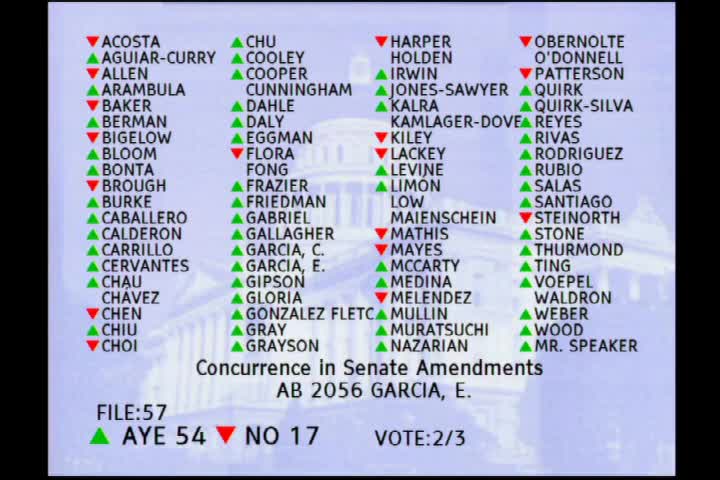 59SEC
Assembly Floor
 2MIN
Senate Floor
 1H
Senate Standing Committee on Appropriations
 6MIN
Senate Standing Committee on Education
Bill Author

Bill Co-Author(s):