AB 3048: Teachers: teacher assignment monitoring.
- Session Year: 2017-2018
- House: Assembly
- Latest Version Date: 2018-05-02
(1)Existing law establishes the Commission on Teacher Credentialing to issue teaching and services credentials, and to establish standards for the issuance and renewal of credentials, certificates, and permits. Existing law requires the commission to report to the Legislature and the Governor on the availability of teachers in California, including specified information, by April 15 of each year.
This bill would make adjustments in the data required to be reported by the commission for this report. The bill would also require the commission to periodically provide reports and recommendations to the Legislature regarding the states teacher workforce for purposes of developing and reviewing state policy, identifying workforce trends, and identifying future needs regarding the states teacher workforce. The bill would require these reports to be made publicly available on the commissions Internet Web site.
(2)Existing law requires the Commission on Teacher Credentialing to establish a nonpersonally identifiable educator identification number for each educator to whom it issues a credential, certificate, permit, or other document authorizing that individual to provide a service in the public schools.
This bill would authorize the identification number established pursuant to this provision to be used for purposes of sharing data with local educational agencies and the State Department of Education to satisfy specified reporting requirements. The bill would also authorize the identification number to be used to disclose data pursuant to a provision relating to scientific research conducted by the University of California, a nonprofit educational entity, or, in the case of education-related data, another nonprofit entity, provided that the request for information is approved as specified.
(3)Existing law requires county superintendents of schools to monitor and review teacher assignments for purposes of ensuring that the rate of teacher misassignment remains low. This provision requires county superintendents of schools to submit annual reports to the Commission on Teacher Credentialing, and authorizes the commission to establish reasonable sanctions for the misassignment of credential holders.
This bill would revise and recast this provision, providing, among other things, more authority and responsibility to the commission in collecting data relating to potential and actual teacher misassignments. The bill would require potential misassignments that cannot be verified as legally authorized to be corrected by the certificated administrator responsible for the assignment within 30 days of final notification by the commission. The bill would also apply this provision to charter schools. Because applying this provision to charter schools imposes new duties on charter schools and local educational agencies serving as chartering authorities, the bill would impose a state-mandated local program.
The bill would require a determination submitted to the commission and county office of education under this provision to be certified under penalty of perjury, thereby imposing a state-mandated local program by expanding the crime of perjury. The bill would require potential misassignments that cannot be verified as legally authorized to be corrected by the administrator responsible for the assignment within 30 days of final notification by the commission. The bill would prohibit adverse action from being taken against an affected certificated person who files a notification of misassignment with the county superintendent of schools, or in the case of a charter school, the chartering authority, and, if a misassignment is determined to have taken place, the bill would nullify any performance evaluation of the employee in any subject to which the employee was misassigned. Because this provision would create new duties for a county office of education when a certificated employee files a notification of misassignment, this provision would impose a state-mandated local program.
The California Constitution requires the state to reimburse local agencies and school districts for certain costs mandated by the state. Statutory provisions establish procedures for making that reimbursement.This bill would provide that with regard to certain mandates no reimbursement is required by this act for a specified reason.With regard to any other mandates, this bill would provide that, if the Commission on State Mandates determines that the bill contains costs so mandated by the state, reimbursement for those costs shall be made pursuant to the statutory provisions noted above.(4)The California Constitution requires the state to reimburse local agencies and school districts for certain costs mandated by the state. Statutory provisions establish procedures for making that reimbursement.
This bill would provide that, if the Commission on State Mandates determines that the bill contains costs mandated by the state, reimbursement for those costs shall be made pursuant to the statutory provisions noted above.
(1)Existing law establishes the Commission on Teacher Credentialing to issue teaching and services credentials, and to establish standards for the issuance and renewal of credentials, certificates, and permits. Existing law requires the commission to report to the Legislature and the Governor on the availability of teachers in California, including specified information, by April 15 of each year.
This bill would make adjustments in the data required to be reported by the commission for this report. The bill would also require the commission to periodically provide reports and recommendations to the Legislature regarding the states teacher workforce for purposes of developing and reviewing state policy, identifying workforce trends, and identifying future needs regarding the states teacher workforce. The bill would require these reports to be made publicly available on the commissions Internet Web site.
(3)(2)Existing law requires the Commission on Teacher Credentialing to establish a nonpersonally identifiable educator identification number for each educator to whom it issues a credential, certificate, permit, or other document authorizing that individual to provide a service in the public schools.
This bill would authorize the identification number established pursuant to this provision to be used for purposes of sharing data with local educational agencies and the State Department of Education to satisfy specified reporting requirements. The bill would also authorize the identification number to be used to disclose data pursuant to a provision relating to scientific research conducted by the University of California, a nonprofit educational entity, or, in the case of education-related data, another nonprofit entity, provided that the request for information is approved as specified.
(4)(3)Existing law requires county superintendents of schools to monitor and review teacher assignments for purposes of ensuring that the rate of teacher misassignment remains low. This provision requires county superintendents of schools to submit annual reports to the Commission on Teacher Credentialing, and authorizes the commission to establish reasonable sanctions for the misassignment of credential holders.
This bill would revise and recast this provision, providing providing, among other things, more authority and responsibility to the commission in collecting data relating to potential and actual teacher misassignments. The bill would require potential misassignments that cannot be verified as legally authorized to be corrected by the certificated administrator responsible for the assignment within 30 days of final notification by the commission and for the method of correction to be reported to the commission by the county office of education no later than July 1 of the year in which the correction occurred. commission.
The bill would require a determination submitted to the commission and county office of education under this provision to be certified under penalty of perjury, thereby imposing a state-mandated local program by expanding the crime of perjury. The bill would prohibit adverse action from being taken against an affected certificated person who files a notification of misassignment with the county superintendent of schools, and, if a misassignment is determined to have taken place, the bill would nullify any performance evaluation of the employee in any subject to which the employee was misassigned. Because this provision would create new duties for a county office of education when a certificated employee files a notification of misassignment, this provision would impose a state-mandated local program.
The California Constitution requires the state to reimburse local agencies and school districts for certain costs mandated by the state. Statutory provisions establish procedures for making that reimbursement.
This bill would provide that with regard to certain mandates no reimbursement is required by this act for a specified reason.
With regard to any other mandates, this bill would provide that, if the Commission on State Mandates determines that the bill contains costs so mandated by the state, reimbursement for those costs shall be made pursuant to the statutory provisions noted above.
(1)Existing law, known as the Classroom Instructional Improvement and Accountability Act, requires the governing board of each school district maintaining an elementary or secondary school to develop and cause to be implemented for each school in the school district a school accountability report card that includes assessments of various school conditions. Existing law requires the school accountability report card to include, among other data, the number of teacher misassignments, as defined. The act prohibits any change to its provisions, except a change to further its purposes enacted by a bill passed by a vote of 2/3 of the Legislature and signed by the Governor.
This bill would alter the definition of misassignment in the act to provide that it means the placement of a certificated educator in a teaching or services position for which the employee does not hold a legally recognized credential, as defined, with the appropriate authorization or the placement of a certificated person, as defined, in a teaching or services position that the employee is not otherwise authorized by statute to hold. To the extent this bill would impose additional duties on local educational agency officials, the bill would impose a state-mandated local program. The bill would provide that the Legislature finds and declares that the changes made to the act by that provision further the purposes of the act.
(2)Existing law establishes the Commission on Teacher Credentialing to issue teaching and services credentials, and to establish standards for the issuance and renewal of credentials, certificates, and permits. Existing law requires the commission to report to the Legislature and the Governor on the availability of teachers in California, including specified information, by April 15 of each year.
This bill would make adjustments in the data required to be reported by the commission for this report. The bill would also require the commission to periodically provide reports and recommendations to the Legislature regarding the states teacher workforce for purposes of developing and reviewing state policy, identifying workforce trends, and identifying future needs regarding the states teacher workforce. The bill would require these reports to be made publicly available on the commissions Internet Web site.
(3)Existing law requires the Commission on Teacher Credentialing to establish a nonpersonally identifiable educator identification number for each educator to whom it issues a credential, certificate, permit, or other document authorizing that individual to provide a service in the public schools.
This bill would authorize the identification number established pursuant to this provision to be used for purposes of sharing data with local educational agencies and the State Department of Education to satisfy specified reporting requirements. The bill would also authorize the identification number to be used to disclose data pursuant to a provision relating to scientific research conducted by the University of California, a nonprofit educational entity, or, in the case of education-related data, another nonprofit entity, provided that the request for information is approved as specified.
(4)Existing law requires county superintendents of schools to monitor and review teacher assignments for purposes of ensuring that the rate of teacher misassignment remains low. This provision requires county superintendents of schools to submit annual reports to the Commission on Teacher Credentialing, and authorizes the commission to establish reasonable sanctions for the misassignment of credential holders.
This bill would revise and recast this provision, providing more authority and responsibility to the commission in collecting data relating to potential and actual teacher misassignments. The bill would require potential misassignments that cannot be verified as legally authorized to be corrected by the certificated administrator responsible for the assignment within 30 days of final notification by the commission and for the method of correction to be reported to the commission by the county office of education no later than July 1 of the year in which the correction occurred.
The bill would require a determination submitted to the commission under this provision to be certified under penalty of perjury, thereby imposing a state-mandated local program by expanding the crime of perjury. The bill would prohibit adverse action from being taken against an affected certificated person who files a notification of misassignment with the county superintendent of schools, and, if a misassignment is determined to have taken place, the bill would nullify any performance evaluation of the employee in any subject to which the employee was misassigned. Because this provision would create new duties for a county office of education when a certificated employee files a notification of misassignment, this provision would impose a state-mandated local program.
The California Constitution requires the state to reimburse local agencies and school districts for certain costs mandated by the state. Statutory provisions establish procedures for making that reimbursement.
This bill would provide that with regard to certain mandates no reimbursement is required by this act for a specified reason.
With regard to any other mandates, this bill would provide that, if the Commission on State Mandates determines that the bill contains costs so mandated by the state, reimbursement for those costs shall be made pursuant to the statutory provisions noted above.
(a)By April 15 of each year, the commission shall report to the Legislature and the Governor on the availability of teachers in California. This report shall include the following information:
(1)The number of individuals recommended for credentials by institutions of higher education and each type of credential, certificate, or authorization for which they were recommended, including authorizations issued pursuant to Sections 44253.3 and 44253.4.
(2)The number of individuals recommended by school districts operating district internship programs and each type of credential, certificate, or authorization for which they were recommended, including authorizations issued pursuant to Sections 44253.3 and 44253.4.
(3)The number of individuals receiving an initial credential based on a program completed outside of California and each type of credential, certificate, or authorization for which they were recommended, including authorizations issued pursuant to Sections 44253.3 and 44253.4.
(4)The number of individuals receiving an emergency permit or credential waiver.
(5)The number of individuals receiving the certificate of completion of staff development in methods of specially designed content instruction delivered in English pursuant to paragraph (1) of subdivision (d) of Section 44253.11.
(6)Statewide, by county, and by school district, the number of individuals serving in the following capacities and as a percentage of the total number of individuals serving as teachers statewide, in the county, and in the school district:
(A)University internship.
(B)District internship.
(C)Emergency permit.
(D)Credential waiver.
(E)Preliminary or clear credential.
(F)An authorization issued pursuant to Section 44253.3.
(G)Certificates or authorizations issued pursuant to Section 44253.3, 44253.4, 44253.10, or 44253.11, if available.
(H)The number of individuals serving English learner pupils in settings calling for English language development, in settings calling for specially designed academic instruction in English, or in primary language instruction, without the appropriate authorization under Section 44253.3, 44253.4, 44253.10, or 44253.11, or under another statute, if available. The commission may utilize data from the departments Annual Language Census Survey to report the data required pursuant to this paragraph.
(7)The specific subjects and teaching areas in which there are a sufficient number of new holders of credentials to fill the positions currently held by individuals with emergency permits.
(b)The commission shall make this report available to school districts and county offices of education to assist them in the recruitment of credentialed teachers and shall make the report and supporting data publicly available on the commissions Internet Web site.
(c)A common measure of whether teacher preparation programs are meeting the challenge of preparing increasing numbers of new teachers is the number of teaching credentials awarded. The number of teaching credentials recommended by these programs and awarded by the commission are indicators of the productivity of teacher preparation programs. The commission shall include in the report prepared for the Legislature and the Governor pursuant to subdivision (a) the total number of teaching credentials recommended by all accredited teacher preparation programs authorized by the commission and the number recommended by each of the following:
(1)The University of California system.
(2)The California State University system.
(3)Independent colleges and universities that offer teacher preparation programs approved by the commission.
(4)Other institutions that offer teacher preparation programs approved by the commission.
(d)For purposes of this section, authorization has the same meaning as defined in subdivision (d) of Section 44203.
(e)The commission shall periodically provide reports and recommendations to the Legislature, in compliance with Section 9795 of the Government Code, regarding the states teacher workforce for purposes of developing and reviewing state policy, identifying workforce trends, and identifying future needs regarding the states teacher workforce. These reports shall be made publicly available on the commissions Internet Web site. The commission may make use of information obtained from the department, including, but not necessarily limited to, information obtained pursuant to Section 44258.9 for these purposes.
SEC. 2.Section 44230.5 of the Education Code is amended to read:44230.5.The commission shall establish a nonpersonally identifiable educator identification number for each educator to whom it issues a credential, certificate, permit, or other document authorizing that individual to provide a service in the public schools. The identification number established pursuant to this section shall be used for purposes of sharing data with local educational agencies and the department to satisfy the reporting requirements of Sections 44225.6 and 44258.9. This identification number may also be used to disclose data pursuant to subdivision (t) of Section 1798.24 of the Civil Code.
SEC. 3.Section 44258.9 of the Education Code is repealed.SEC. 4.Section 44258.9 is added to the Education Code, to read:44258.9.(a)(1)The Legislature finds that continued monitoring of teaching assignments by the commission to ensure that local educational agencies are in compliance with the requirements outlined in Section 35035 35035, subdivision (l) of Section 47605, subdivision (l) of Section 47605.6, and subdivision (a) of Section 47605.8 will ensure that the rate of teacher misassignment remains low. To that end, and with funds provided for that purpose, the commission, the department, and county offices of education are authorized to perform the duties specified in this section, beginning with the 201920 school year unless otherwise stated.
(2)For the purposes of this section, the following terms have the following meanings:
(A)Local educational agency means a school district, county office of education, or charter school.
(A)(B)Misassignment means the placement of a certificated educator educator, which has the same meaning as certificated person, as defined in Section 44006, in a teaching or services position for which the employee certificated educator does not hold a legally recognized credential, as defined in Section 44002, with the appropriate authorization; or authorization, the placement of a certificated person, as defined in Section 44006, educator in a teaching or services position that the employee educator certificated educator is not otherwise authorized by statute to hold; hold, or a vacant teacher position as defined in subparagraph (B).
(B)(C)Vacant teacher position means a position to which a single-designated certificated employee educator has not been assigned at the beginning of the year for an entire year or, if the position is for a one-semester course, a position to which a single-designated certificated employee educator has not been assigned at the beginning of a semester for an entire semester.
(3)Notwithstanding any other law, for charter schools authorized by the state board pursuant to paragraph (1) of subdivision (j) of Section 47605 and subdivision (a) of Section 47605.8, the requirements placed on the chartering authority of a charter school by this section shall be fulfilled by the commission.
(b)(1)The commission and the department shall enter into a data-sharing agreement to provide the commission with educator assignment data necessary to annually monitor and review schools, school districts, and county offices of education all local educational agencies and identify misassignments. The data-sharing agreement shall require the commission to make teacher assignment data available to the department to support federally required reporting and state-required review of district performance as it relates to the multiple measures public school accountability system authorized by Article 4.5 (commencing with Section 52060) of Chapter 6.1 of Part 28 of Division 4.
(2)(A)Data shared pursuant to the data-sharing agreement described in paragraph (1) shall not be used, either solely or in conjunction with data from the California Longitudinal Pupil Achievement Data System, for purposes of pay, promotion, sanction, or personnel evaluation of an individual teacher or groups of teachers, or of any other employment decisions related to individual teachers other than for determinations that a teacher is not properly assigned.
(B)Data shared pursuant to the data-sharing agreement described in paragraph (1) shall not include the names, social security numbers, home addresses, telephone numbers, or email addresses email addresses, or other personal electronic accounts of individual teachers.
(3)The commission shall collaborate with county offices of education and local education other local educational agencies to develop, test, and implement a statewide Teacher Assignment Monitoring Data System. The commission shall annually engage interested stakeholders, including, but not limited to, the department, county offices of education, and local education other local educational agencies in discussions about the functionality, performance, and impacts of the data system. Based on these discussions, the commission shall submit a report to the Legislature, pursuant to Section 9795 of the Government Code, within five years of the implementation of the data system that includes, but is not limited to, recommendations for potential improvements in the functionality, performance, and impacts of the data system.
(4)Each county superintendent of schools shall annually monitor and review all certificated educator misassignments identified pursuant to paragraph (1). Notwithstanding any other law, annual monitoring and review of assignments at charter schools shall be performed by each charter schools chartering authority, in collaboration with the county superintendent of schools, on the basis of the requirements of subdivision (l) of Section 47605, subdivision (l) of Section 47605.6, and subdivision (a) of Section 47605.8, except as provided in paragraph (3) of subdivision (a).
(5)Each county superintendent of schools shall assist local educational agencies school districts and county offices of education, and each chartering authority shall assist its charter schools, that meet either of the following:
(A)Have demonstrated recurring problems with teacher misassignments and teacher vacancies.
(B)Are currently under review through a federal intervention program, have requested assistance through the statewide system of support, or are receiving assistance through the statewide system of support.
(c)Beginning with the 201920 school year, the commission shall annually verify that schools, school districts, and county offices of education all local educational agencies that have educators serving in assignments requiring a credential, as defined in Section 44002, authorizing services pursuant to Section 44253.3, 44253.4, or 44253.7 or training pursuant to Section 44253.10 hold the appropriate authorization for the instructional services provided. For charter schools, this verification shall be performed on the basis of the requirements of subdivision (l) of Section 47605, subdivision (l) of Section 47605.6, and subdivision (a) of Section 47605.8.
(d)(1)When a potential misassignment has been identified by the commission, the local educational agency school district or county office of education responsible for the assignment, and the county office of education if the only local educational agency responsible for the assignment is a school district, or in the case of a charter school, the chartering authority, shall be notified and provided an opportunity to review the assignment and determine whether the educator is otherwise legally authorized for the assignment. If the commission, or the commission and county office of education if the only local educational agency responsible for the assignment is a school district, or in the case of a charter school, the chartering authority, does not receive a response within 30 days of the notification, the assignment shall be included in the commissions annual reporting for that year as a misassignment as defined in subparagraph (A) of paragraph (2) of subdivision (a). To be considered valid, a determination submitted to the commission and the county office of education education, or in the case of a charter school, the chartering authority, shall be certified under penalty of perjury, and is subject to verification by the county office of education or and the commission.
(2)If a potential misassignment cannot be verified as legally authorized, the certificated administrator administrator, or in the case of a charter school, the administrator, responsible for the assignment shall correct the misassignment within 30 days of final notification by the commission and shall report the correction method to the county office of education. education, or in the case of a charter school, to the chartering authority. A potential misassignment that is not identified as otherwise legally authorized or that is not corrected within the 30-day timeframe shall be reported as a misassignment to the commission by the county of education by a date specified, by regulation, by the commission. office of education, or in the case of a charter school, by the chartering authority.
(3)The county office of education shall collect data on the number of vacant teacher positions in each school district positions, as defined in subparagraph (B) of paragraph (2) of subdivision (a), in each school district and each charter school, as well as the number of complaints concerning vacancies and misassignments pursuant to Section 35186, and report that data to the commission by the date specified by the commission pursuant to paragraph (2). commission.
(4)A county in which there is a single school district, including, but not necessarily limited to, the Counties of Alpine, Amador, Del Norte, Mariposa, Plumas, and Sierra, and the City and County of San Francisco, and, notwithstanding any other law, a charter school authorized by the state board pursuant to Section 47605.8 or approved on appeal pursuant to paragraph (1) of subdivision (j) of Section 47605, shall report its determination review and determination of potential misassignments identified within the Teacher Assignment Monitoring Data System regarding otherwise legally authorized assignments and correction methods for identified misassignments directly to the commission for review. review and final determination of misassignments.
(e)The commission shall annually publish and retain final misassignment data in a searchable, publicly available format. The commission shall also submit biennial reports to the Legislature, in compliance with Section 9795 of the Government Code, concerning teacher assignments and misassignments that shall include the results of all assignment monitoring and reviews. The commission may, but is not required to, publish statewide misassignment data for the 201920 school year.
(f)(1)A local education agency or county office of education educational agency that is identified as having one or more misassignments in a school year shall develop a plan to be submitted to the county office of education and the commission, or in the case of a charter school, the chartering authority and the commission, through the Teacher Assignment Monitoring Data System to ensure that such misassignments do not reoccur the following school year.
(2)The commission or commission, the county office of education education, or, in the case of a charter school, the chartering authority may identify and report schools and school districts that have demonstrated recurring problems with teacher misassignments and teacher vacancies, as defined in subparagraphs (A) and (B) of paragraph (2) of subdivision (a).
(g)The Legislature may hold, within a reasonable period after receipt of a pertinent report, a public hearing on pupil access to educators and on related statutory provisions. The Legislature may also assign one or more of the standing committees, or a joint committee, to determine any of the following:
(1)The effectiveness of the reviews required pursuant to this section.
(2)The extent, if any, of vacancies and misassignments, as defined in paragraph (2) of subdivision (a).
(3)The need, if any, to assist schools to eliminate vacancies and misassignments.
(h)The commission may establish reasonable sanctions for the misassignment of credential holders. Before the implementation of any regulations establishing sanctions, the commission shall engage in a variety of activities designed to inform local educational agency administrators and teachers, and personnel within the offices of county superintendents of schools, of the regulations and statutes affecting the assignment of certificated personnel.
(h)(i)(1)Consistent with the California state plan addressing the federal Elementary and Secondary Education Act, Act of 1965, (20 U.S.C. Sec. 6301 et seq.), the commission and the department shall engage in a variety of activities designed to inform school administrators, teachers, local educational agency administrators and teachers, and personnel within county offices of education education, of the regulations and statutes affecting the assignment of certificated personnel for the purposes of technical assistance provided pursuant to Sections 52071 and 52072.
(2)A certificated person person, including a certificated person who is employed by a charter school, who is required by an administrative superior to accept an assignment for which he or she has no legal authorization, after exhausting existing local remedies, shall notify, in writing, the county superintendent of schools schools, or in the case of a charter school, the chartering authority, of the illegal assignment. The county superintendent of schools schools, or in the case of a charter school, the chartering authority, shall, within 15 working days, advise the affected certificated person concerning the legality of his or her assignment. There shall be no adverse action taken against a certificated person who files a notification of misassignment with the county superintendent of schools. schools, or in the case of a charter school, the chartering authority. During the period of the misassignment, the certificated person who files a written notification with the county superintendent of schools schools, or in the case of a charter school, the chartering authority, shall be exempt from Section 45034. If it is determined that a misassignment has taken place, any performance evaluation of the certificated employee under Article 11 (commencing with Section 44660) of Chapter 3 in any subject to which the employee has been misassigned shall be nullified. Notwithstanding any other law, for purposes of a charter school authorized by the state board pursuant to Section 47605.8 or paragraph (1) of subdivision (j) of Section 47605, the certificated person shall file any written notifications regarding misassignment with the commission.
(i)(j)When reporting a misassignment in a local control and accountability plan as described in paragraph (1) of subdivision (d) of Section 52060 or a school accountability report card as described in Section 33126, and as required by Section 47604.33, the governing board of a school district or a charter school shall use the most recent data provided by the commission pursuant to paragraph (1) of subdivision (d) of this section. (d).
(j)(k)(1)The Superintendent may submit a report to the Legislature on school districts and districts, county offices of education education, and charter schools that are not meeting state priority one of the local control accountability plans required pursuant to Sections 52060 and 52066, 52060, 52066, and 47606.5, respectively.
(2)A report submitted pursuant to paragraph (1) shall be submitted in compliance with Section 9795 of the Government Code.
SEC. 5.No reimbursement is required by this act pursuant to Section 6 of Article XIIIB of the California Constitution for certain costs that may be incurred by a local agency or school district because, in that regard, this act creates a new crime or infraction, eliminates a crime or infraction, or changes the penalty for a crime or infraction, within the meaning of Section 17556 of the Government Code, or changes the definition of a crime within the meaning of Section 6 of Article XIIIB of the California Constitution.However, if the Commission on State Mandates determines that this act contains other costs mandated by the state, reimbursement to local agencies and school districts for those costs shall be made pursuant to Part 7 (commencing with Section 17500) of Division 4 of Title 2 of the Government Code.SEC. 5.If the Commission on State Mandates determines that this act contains costs mandated by the state, reimbursement to local agencies and school districts for those costs shall be made pursuant to Part 7 (commencing with Section 17500) of Division 4 of Title 2 of the Government Code.
(a)By April 15 of each year, the commission shall report to the Legislature and the Governor on the availability of teachers in California. This report shall include the following information:
(1)The number of individuals recommended for credentials by institutions of higher education and each type of credential, certificate, or authorization for which they were recommended, including authorizations issued pursuant to Sections 44253.3 and 44253.4.
(2)The number of individuals recommended by school districts operating district internship programs and each type of credential, certificate, or authorization for which they were recommended, including authorizations issued pursuant to Sections 44253.3 and 44253.4.
(3)The number of individuals receiving an initial credential based on a program completed outside of California and each type of credential, certificate, or authorization for which they were recommended, including authorizations issued pursuant to Sections 44253.3 and 44253.4.
(4)The number of individuals receiving an emergency permit or credential waiver.
(5)The number of individuals receiving the certificate of completion of staff development in methods of specially designed content instruction delivered in English pursuant to paragraph (1) of subdivision (d) of Section 44253.11.
(6)Statewide, by county, and by school district, the number of individuals serving in the following capacities and as a percentage of the total number of individuals serving as teachers statewide, in the county, and in the school district:
(A)University internship.
(B)District internship.
(C)Emergency permit.
(D)Credential waiver.
(E)Preliminary or clear credential.
(F)An authorization issued pursuant to Section 44253.3.
(G)Certificates or authorizations issued pursuant to Section 44253.3, 44253.4, 44253.10, or 44253.11, if available.
(H)The number of individuals serving English learner pupils in settings calling for English language development, in settings calling for specially designed academic instruction in English, or in primary language instruction, without the appropriate authorization under Section 44253.3, 44253.4, 44253.10, or 44253.11, or under another statute, if available. The commission may utilize data from the departments Annual Language Census Survey to report the data required pursuant to this paragraph.
(7)The specific subjects and teaching areas in which there are a sufficient number of new holders of credentials to fill the positions currently held by individuals with emergency permits.
(b)The commission shall make this report available to school districts and county offices of education to assist them in the recruitment of credentialed teachers and shall make the report and supporting data publicly available on the commissions Internet Web site.
(c)A common measure of whether teacher preparation programs are meeting the challenge of preparing increasing numbers of new teachers is the number of teaching credentials awarded. The number of teaching credentials recommended by these programs and awarded by the commission are indicators of the productivity of teacher preparation programs. The commission shall include in the report prepared for the Legislature and the Governor pursuant to subdivision (a) the total number of teaching credentials recommended by all accredited teacher preparation programs authorized by the commission and the number recommended by each of the following:
(1)The University of California system.
(2)The California State University system.
(3)Independent colleges and universities that offer teacher preparation programs approved by the commission.
(4)Other institutions that offer teacher preparation programs approved by the commission.
(d)For purposes of this section, authorization has the same meaning as defined in subdivision (d) of Section 44203.
(e)The commission shall periodically provide reports and recommendations to the Legislature, in compliance with Section 9795 of the Government Code, regarding the states teacher workforce for purposes of developing and reviewing state policy, identifying workforce trends, and identifying future needs regarding the states teacher workforce. These reports shall be made publicly available on the commissions Internet Web site. The commission may make use of information obtained from the department, including, but not necessarily limited to, information obtained pursuant to Section 44258.9 for these purposes.
SEC. 3.SEC. 2.Section 44230.5 of the Education Code is amended to read:44230.5.The commission shall establish a nonpersonally identifiable educator identification number for each educator to whom it issues a credential, certificate, permit, or other document authorizing that individual to provide a service in the public schools. The identification number established pursuant to this section shall be used for purposes of sharing data with local educational agencies and the department to satisfy the reporting requirements of Sections 44225.6 and 44258.9. This identification number may also be used to disclose data pursuant to subdivision (t) of Section 1798.24 of the Civil Code.
SEC. 4.SEC. 3.Section 44258.9 of the Education Code is repealed.SEC. 5.SEC. 4.Section 44258.9 is added to the Education Code, to read:44258.9.(a)(1)The Legislature finds that continued monitoring of teaching assignments by the commission to ensure that local educational agencies are in compliance with the requirements outlined in Section 35035 will ensure that the rate of teacher misassignment remains low. To that end, the commission and with funds provided for that purpose, the commission, the department, and county offices of education are authorized to perform the duties specified in this section, beginning with the 201920 school year unless otherwise stated.
(2)For the purposes of this section, the following terms have the following meanings:
(A)Misassignment means the placement of a certificated educator in a teaching or services position for which the employee does not hold a legally recognized credential, as defined in Section 44002, with the appropriate authorization; or the placement of a certificated person, as defined in Section 44006, in a teaching or services position that the employee educator is not otherwise authorized by statute to hold; or a vacant teacher position as defined in subparagraph (B).
(B)Vacant teacher position means a position to which a single-designated certificated employee has not been assigned at the beginning of the year for an entire year or, if the position is for a one-semester course, a position to which a single-designated certificated employee has not been assigned at the beginning of a semester for an entire semester.
(b)(1)The commission and the department shall enter into a data-sharing agreement to provide the commission with educator assignment data necessary to annually monitor and review schools, school districts, and county offices of education and identify misassignments, as defined in subparagraph (B) of paragraph (5) of subdivision (b) of Section 33126. misassignments. The data-sharing agreement shall require the commission to make teacher assignment data available to the department to support federally required reporting and state-required review of district performance as it relates to the multiple measures public school accountability system authorized by Article 4.5 (commencing with Section 52060) of Chapter 6.1 of Part 28 of Division 4.
(2)(A)Data shared pursuant to the data-sharing agreement described in paragraph (1) shall not be used, either solely or in conjunction with data from the California Longitudinal Pupil Achievement Data System, for purposes of pay, promotion, sanction, or personnel evaluation of an individual teacher or groups of teachers, or of any other employment decisions related to individual teachers other than for determinations that a teacher is not properly assigned.
(B)Data shared pursuant to the data-sharing agreement described in paragraph (1) shall not include the names, social security numbers, home addresses, telephone numbers, or email addresses of individual teachers.
(3)The commission shall collaborate with county offices of education and local education agencies to develop, test, and implement a statewide Teacher Assignment Monitoring Data System. The commission shall annually engage interested stakeholders, including, but not limited to, the department, county offices of education, and local education agencies in discussions about the functionality, performance, and impacts of the data system. Based on these discussions, the commission shall submit a report to the Legislature, pursuant to Section 9795 of the Government Code, within five years of the implementation of the data system that includes, but is not limited to, recommendations for potential improvements in the functionality, performance, and impacts of the data system.
(4)Each county superintendent of schools shall annually monitor and review all certificated educator misassignments identified pursuant to paragraph (1).
(5)Each county superintendent of schools shall assist local educational agencies that meet either of the following:
(A)Have demonstrated recurring problems with teacher misassignments and teacher vacancies.
(B)Are currently under review through a federal intervention program, have requested assistance through the statewide system of support, or are receiving assistance through the statewide system of support.
(c)On or before July 1, 2019, and on or before July 1 annually thereafter, Beginning with the 201920 school year, the commission shall annually verify that schools, school districts, and county offices of education that have educators serving in assignments requiring a credential, as defined in Section 44002, authorizing services pursuant to Section 44253.3, 44253.4, or 44253.7 or training pursuant to Section 44253.10 hold the appropriate authorization for the instructional services provided.
(d)(1)When a potential misassignment has been identified by the commission, the school district or county office of education local educational agency responsible for the assignment assignment, and the county office of education if the only local educational agency responsible for the assignment is a school district, shall be notified and provided an opportunity to review the assignment and determine whether the educator is otherwise legally authorized for the assignment. If the commission commission, or the commission and county office of education if the only local educational agency responsible for the assignment is a school district, does not receive a response within 30 days of the notification, the assignment shall be included in the commissions annual reporting for that year as a misassignment as defined in subparagraph (B) of paragraph (5) of subdivision (b) of Section 33126. (A) of paragraph (2) of subdivision (a). To be considered valid, a determination submitted to the commission and the county office of education shall be certified under penalty of perjury, and is subject to verification by the county office of education or the commission.
(2)If a potential misassignment cannot be verified as legally authorized, the certificated administrator responsible for the assignment shall correct the misassignment within 30 days of final notification by the commission and shall report the correction method to the county office of education. A corrected misassignment, and the method of correction, shall be reported to the commission by the county office of education no later than July 1 of the year in which the correction occurred. A misassignment potential misassignment that is not identified as otherwise legally authorized or that is not corrected within the 30-day timeframe shall be reported as a misassignment to the commission by the county of education no later than July 1 of the year in which the misassignment occurred. by a date specified, by regulation, by the commission.
(3)The county office of education shall collect data on the number of vacant teacher positions in each school district as defined in subparagraph (A) of paragraph (5) of subdivision (b) of Section 33126, (B) of paragraph (2) of subdivision (a), as well as the number of complaints concerning vacancies and misassignments pursuant to Section 35186, and report that data to the commission no later than July 1 of the year in which the vacancies occurred. by the date specified by the commission pursuant to paragraph (2).
(4)A county in which there is a single school district, including, but not necessarily limited to, the Counties of Alpine, Amador, Del Norte, Mariposa, Plumas, and Sierra, and the City and County of San Francisco, shall report its determination regarding otherwise legally authorized assignments and correction methods for identified misassignments directly to the commission for review.
(e)The commission shall annually publish and retain misassignment data in a searchable, publicly available format. The commission shall also submit biennial reports to the Legislature, in compliance with Section 9795 of the Government Code, concerning teacher assignments and misassignments that shall include the results of all assignment monitoring and reviews.
(f)(1)A local education agency or county office of education that is identified as having one or more misassignments in a school year shall develop a plan to ensure that such misassignments do not reoccur the following school year.
(f)(2)The commission or the county office of education may identify and report schools and school districts that have demonstrated recurring problems with teacher misassignments and teacher vacancies, as defined in subparagraphs (A) and (B) of paragraph (5) of subdivision (b) of Section 33126. (2) of subdivision (a).
(g)The Legislature may hold, within a reasonable period after receipt of a pertinent report, a public hearing on pupil access to educators and on related statutory provisions. The Legislature may also assign one or more of the standing committees, or a joint committee, to determine any of the following:
(1)The effectiveness of the reviews required pursuant to this section.
(2)The extent, if any, of vacancies and misassignments, as defined in subparagraphs (A) and (B) of paragraph (5) of subdivision (b) of Section 33126. paragraph (2) of subdivision (a).
(3)The need, if any, to assist schools to eliminate vacancies and misassignments.
(h)(1)The commission and the department may establish reasonable sanctions for the misassignment of credential holders. Before the implementation of regulations establishing sanctions pursuant to this subdivision, Consistent with the California state plan addressing the federal Elementary and Secondary Education Act, the commission and the department shall engage in a variety of activities designed to inform school administrators, teachers, and personnel within county offices of education of the regulations and statutes affecting the assignment of certificated personnel. personnel for the purposes of technical assistance provided pursuant to Sections 52071 and 52072.
(2)A certificated person who is required by an administrative superior to accept an assignment for which he or she has no legal authorization, after exhausting existing local remedies, shall notify, in writing, the county superintendent of schools of the illegal assignment. The county superintendent of schools shall, within 15 working days, advise the affected certificated person concerning the legality of his or her assignment. There shall be no adverse action taken against a certificated person who files a notification of misassignment with the county superintendent of schools. During the period of the misassignment, the certificated person who files a written notification with the county superintendent of schools shall be exempt from Section 45034. If it is determined that a misassignment has taken place, any performance evaluation of the certificated employee under Article 11 (commencing with Section 44660) of Chapter 3 in any subject to which the employee has been misassigned shall be nullified.
(i)When reporting a misassignment in a local control and accountability plan as described in paragraph (1) of subdivision (d) of Section 52060 or a school accountability report card as described in Section 33126, the governing board of a school district shall use the most recent data provided by the commission pursuant to paragraph (1) of subdivision (d) of this section.
(j)(1)The Superintendent may submit a report to the Legislature on school districts and county offices of education that are not meeting state priority one of the local control accountability plans required pursuant to Sections 52060 and 52066, respectively.
(2)A report submitted pursuant to paragraph (1) shall be submitted in compliance with Section 9795 of the Government Code.
SEC. 6.The Legislature finds and declares that the amendments made to Section 33126 of the Education Code by Section 1 of this act further the purposes of the Classroom Instructional Improvement and Accountability Act.SEC. 7.SEC. 5.No reimbursement is required by this act pursuant to Section 6 of Article XIIIB of the California Constitution for certain costs that may be incurred by a local agency or school district because, in that regard, this act creates a new crime or infraction, eliminates a crime or infraction, or changes the penalty for a crime or infraction, within the meaning of Section 17556 of the Government Code, or changes the definition of a crime within the meaning of Section 6 of Article XIIIB of the California Constitution.
However, if the Commission on State Mandates determines that this act contains other costs mandated by the state, reimbursement to local agencies and school districts for those costs shall be made pursuant to Part 7 (commencing with Section 17500) of Division 4 of Title 2 of the Government Code.
(a)The school accountability report card shall provide data by which a parent can make meaningful comparisons between public schools that will enable him or her to make informed decisions on the school in which to enroll his or her children.
(b)The school accountability report card shall include, but is not limited to, assessment of the following school conditions:
(1)(A)Pupil achievement by grade level, as measured by the standardized testing and reporting programs pursuant to Article 4 (commencing with Section 60640) of Chapter 5 of Part 33. 33 of Division 4.
(B)After the state develops a statewide assessment system pursuant to Chapter 5 (commencing with Section 60600) and Chapter 6 (commencing with Section 60800) of Part 33, 33 of Division 4, pupil achievement by grade level, as measured by the results of the statewide assessment.
(2)Progress toward reducing dropout rates, including the one-year dropout rate listed in the California Basic Educational Data System or a successor data system for the schoolsite over the most recent three-year period, and the graduation rate, as defined by the state board, over the most recent three-year period when available pursuant to Section 52052.
(3)Estimated expenditures per pupil and types of services funded. The assessment of estimated expenditures per pupil shall reflect the actual salaries of personnel assigned to the schoolsite. The assessment of estimated expenditures per pupil shall be reported in total, shall be reported in subtotal by restricted and by unrestricted source, and shall include a reporting of the average of actual salaries paid to certificated instructional personnel at that schoolsite.
(4)Progress toward reducing class sizes and teaching loads, including the distribution of class sizes at the schoolsite by grade level and the average class size, using the California Basic Educational Data System or a successor data system information for the most recent three-year period.
(5)The total number of the schools fully credentialed teachers, the number of teachers relying upon emergency credentials, the number of teachers working without credentials, any assignment of teachers outside their subject areas of competence, misassignments, including misassignments of teachers of English learners, and the number of vacant teacher positions for the most recent three-year period.
(A)For purposes of this paragraph, vacant teacher position means a position to which a single-designated certificated employee has not been assigned at the beginning of the year for an entire year or, if the position is for a one-semester course, a position of which a single-designated certificated employee has not been assigned at the beginning of a semester for an entire semester.
(B)For purposes of this paragraph, misassignment means the placement of a certificated employee educator in a teaching or services position for which the employee does not hold a legally recognized certificate or credential credential, as defined in Section 44002, with the appropriate authorization or the placement of a certificated employee person, as defined in Section 44006, in a teaching or services position that the employee is not otherwise authorized by statute to hold.
(6)(A)Quality and currency of textbooks and other instructional materials, including whether textbooks and other materials meet state standards and are adopted by the state board for kindergarten and grades 1 to 8, inclusive, and adopted by the governing boards of school districts for grades 9 to 12, inclusive, and the ratio of textbooks per pupil and the year the textbooks were adopted.
(B)The availability of sufficient textbooks and other instructional materials, as determined pursuant to Section 60119, for each pupil, including English learners, in each of the areas enumerated in clauses (i) to (iv), inclusive. If the governing board determines, pursuant to Section 60119, that there are insufficient textbooks or instructional materials, or both, it shall include information for each school in which an insufficiency exists, identifying the percentage of pupils who lack sufficient standards-aligned textbooks or instructional materials in each subject area. The subject areas to be included are all of the following:
(i)The core curriculum areas of reading/language arts, mathematics, science, and history/social science.
(ii)Foreign language and health.
(iii)Science laboratory equipment for grades 9 to 12, inclusive, as appropriate.
(iv)Visual and performing arts.
(7)The availability of qualified personnel to provide counseling and other pupil support services, including the ratio of academic counselors per pupil.
(8)Safety, cleanliness, and adequacy of school facilities, including any needed maintenance to ensure good repair as specified in Section 17014, Section 17032.5, subdivision (a) of Section 17070.75, and subdivision (b) of Section 17089.
(9)The annual number of schooldays dedicated to staff development for the most recent three-year period.
(10)Suspension and expulsion rates for the most recent three-year period.
(11)For secondary schools, the percentage of graduates who have passed course requirements for entrance to the University of California and the California State University, including the course requirements for high school graduation pursuant to Section 51225.3, and the percentage of pupils enrolled in those courses, as reported by the California Basic Educational Data System or any successor data system.
(12)The number of advanced placement courses offered, by subject.
(13)The Academic Performance Index, including the disaggregation of subgroups as set forth in Section 52052 and the decile rankings and a comparison of schools.
(14)Contact information pertaining to organized opportunities for parental involvement.
(15)Career technical education data measures, including all of the following:
(A)A list of programs offered by the school district in which pupils at the school may participate and that are aligned to the model curriculum standards adopted pursuant to Section 51226, and program sequences offered by the school district. The list should identify courses conducted by a regional occupational center or program, and those conducted directly by the school district.
(B)A listing of the primary representative of the career technical advisory committee of the school district and the industries represented.
(C)The number of pupils participating in career technical education.
(D)The percentage of pupils that complete a career technical education program and earn a high school diploma.
(E)The percentage of career technical education courses that are sequenced or articulated between a school and institutions of postsecondary education.
(c)If the Commission on State Mandates finds a school district is eligible for a reimbursement of costs incurred complying with this section, the school district shall be reimbursed only if the information provided in the school accountability report card is accurate, as determined by the annual audit performed pursuant to Section 41020. If the information is determined to be inaccurate, the school district remains eligible for reimbursement if the information is corrected by May 15.
(d)It is the intent of the Legislature that schools make a concerted effort to notify parents of the purpose of the school accountability report cards, as described in this section, and ensure that all parents receive a copy of the report card; to ensure that the report cards are easy to read and understandable by parents; to ensure that local educational agencies with access to the Internet make available current copies of the report cards through the Internet; and to ensure that administrators and teachers are available to answer any questions regarding the report cards.
SEC. 2.Section 44225.6 of the Education Code is amended to read:44225.6.(a)By April 15 of each year, the commission shall report to the Legislature and the Governor on the availability of teachers in California. This report shall include the following information:
(1)The number of individuals recommended for credentials by institutions of higher education and each type of credential, certificate, or authorization for which they were recommended, including authorizations issued pursuant to Sections 44253.3 and 44253.4.
(2)The number of individuals recommended by school districts operating district internship programs and each type of credential, certificate, or authorization for which they were recommended, including authorizations issued pursuant to Sections 44253.3 and 44253.4.
(3)The number of individuals receiving an initial credential based on a program completed outside of California and each type of credential, certificate, or authorization for which they were recommended, including authorizations issued pursuant to Sections 44253.3 and 44253.4.
(4)The number of individuals receiving an emergency permit, credential waiver, or other authorization that does not meet the definition of a highly qualified teacher under the federal No Child Left Behind Act of 2001 (20 U.S.C. Sec. 6301 et seq.). permit or credential waiver.
(5)The number of individuals receiving the certificate of completion of staff development in methods of specially designed content instruction delivered in English pursuant to subdivision (d) of Section 44253.10 and, separately, pursuant to paragraph (1) of subdivision (e) (d) of Section 44253.11.
(6)Statewide, by county, and by school district, the number of individuals serving in the following capacities and as a percentage of the total number of individuals serving as teachers statewide, in the county, and in the school district:
(A)University internship.
(B)District internship.
(C)Preinternship.(D)(C)Emergency permit.
(E)(D)Credential waiver.
(F)(E)Preliminary or clear credential.
(G)An authorization, other than those listed in this paragraph, that does not meet the definition of a highly qualified teacher under the federal No Child Left Behind Act of 2001 (20 U.S.C. Sec. 6301 et seq.) by category of authorization.(H)(F)An authorization issued pursuant to Section 44253.3.
(I)(G)Certificates or authorizations issued pursuant to Section 44253.3, 44253.4, 44253.10, or 44253.11, if available.
(J)(H)The number of individuals serving English learner pupils in settings calling for English language development, in settings calling for specially designed academic instruction in English, or in primary language instruction, without the appropriate authorization under Section 44253.3, 44253.4, 44253.10, or 44253.11, or under another statute, if available. The commission may utilize data from the departments Annual Language Census Survey to report the data required pursuant to this paragraph.
(7)The specific subjects and teaching areas in which there are a sufficient number of new holders of credentials to fill the positions currently held by individuals with emergency permits.
(b)The commission shall make this report available to school districts and county offices of education to assist them in the recruitment of credentialed teachers and shall make the report and supporting data publicly available on the commissions Internet Web site.
(c)A common measure of whether teacher preparation programs are meeting the challenge of preparing increasing numbers of new teachers is the number of teaching credentials awarded. The number of teaching credentials recommended by these programs and awarded by the commission are indicators of the productivity of teacher preparation programs. The commission shall include in the report prepared for the Legislature and the Governor pursuant to subdivision (a) the total number of teaching credentials recommended by all accredited teacher preparation programs authorized by the commission and the number recommended by each of the following:
(1)The University of California system.
(2)The California State University system.
(3)Independent colleges and universities that offer teacher preparation programs approved by the commission.
(4)Other institutions that offer teacher preparation programs approved by the commission.
(d)For purposes of this section, authorization has the same meaning as defined in subdivision (d) of Section 44203.
(e)The commission shall periodically provide reports and recommendations to the Legislature, in compliance with Section 9795 of the Government Code, regarding the states teacher workforce for purposes of developing and reviewing state policy, identifying workforce trends, and identifying future needs regarding the states teacher workforce. These reports shall be made publicly available on the commissions Internet Web site. The commission may make use of information obtained from the department, including, but not necessarily limited to, information obtained pursuant to Section 44258.9 for these purposes.
SEC. 3.Section 44230.5 of the Education Code is amended to read:44230.5.The commission shall establish a nonpersonally identifiable educator identification number for each educator to whom it issues a credential, certificate, permit, or other document authorizing that individual to provide a service in the public schools. The identification number established pursuant to this section shall be used for purposes of sharing data with local educational agencies and the department to satisfy the reporting requirements of Sections 44225.6 and 44258.9. This identification number may also be used to disclose data pursuant to subdivision (t) of Section 1798.24 of the Civil Code.
SEC. 4.Section 44258.9 of the Education Code is repealed.44258.9.(a)The Legislature finds that continued monitoring of teacher assignments by county superintendents of schools will ensure that the rate of teacher misassignment remains low. To the extent possible and with funds provided for that purpose, each county superintendent of schools shall perform the duties specified in subdivisions (b) and (c).(b)(1)Each county superintendent of schools shall monitor and review school district certificated employee assignment practices in accordance with the following:(A)Annually monitor and review schools and school districts that are likely to have problems with teacher misassignments and teacher vacancies, as defined in subparagraphs (A) and (B) of paragraph (5) of subdivision (b) of Section 33126, based on past experience or other available information.(B)Annually monitor and review schools ranked in deciles 1 to 3, inclusive, of the base Academic Performance Index, as specified in paragraph (2) of subdivision (c) of Section 1240, if those schools are not currently under review through a state or federal intervention program. If a review completed pursuant to this subparagraph finds that a school has no teacher misassignments or teacher vacancies for two consecutive years, the next review of that school may be conducted according to the cycle specified in subparagraph (C), unless the school meets the criteria of subparagraph (A).(C)All other schools on a four-year cycle.(2)Each county superintendent of schools shall investigate school and district efforts to ensure that a credentialed teacher serving in an assignment requiring a certificate issued pursuant to Section 44253.3, 44253.4, or 44253.7 or training pursuant to Section 44253.10 completes the necessary requirements for these certificates or completes the required training.(3)The Commission on Teacher Credentialing shall be responsible for the monitoring and review of those counties or cities and counties in which there is a single school district, including the Counties of Alpine, Amador, Del Norte, Mariposa, Plumas, and Sierra, and the City and County of San Francisco. All information related to the misassignment of certificated personnel and teacher vacancies shall be submitted to each affected district within 30 calendar days of the monitoring activity.(c)County superintendents of schools shall submit an annual report to the Commission on Teacher Credentialing and the department summarizing the results of all assignment monitoring and reviews. These reports shall include, but need not be limited to, the following:(1)The numbers of teachers assigned and types of assignments made by the governing board of a school district under the authority of Sections 44256, 44258.2, and 44263.(2)Information on actions taken by local committees on assignment, including the number of assignments authorized, subject areas into which committee-authorized teachers are assigned, and evidence of departures from the implementation plans presented to the county superintendent by school districts.(3)Information on each school district reviewed regarding misassignments of certificated personnel, including efforts to eliminate these misassignments.(4)(A)Information on certificated employee assignment practices in schools ranked in deciles 1 to 3, inclusive, of the base Academic Performance Index, as specified in paragraph (2) of subdivision (c) of Section 1240, to ensure that, at a minimum, in any class in these schools in which 20 percent or more pupils are English learners, the assigned teacher possesses a certificate issued pursuant to Section 44253.3 or 44253.4, or has completed training pursuant to Section 44253.10, or is otherwise authorized by statute.(B)This paragraph shall not relieve a school district from compliance with state and federal law regarding teachers of English learners or be construed to alter the definition of misassignment in subparagraph (B) of paragraph (5) of subdivision (b) of Section 33126.(5)After consultation with representatives of county superintendents of schools, other information as may be determined to be needed by the Commission on Teacher Credentialing.(d)The Commission on Teacher Credentialing shall submit biennial reports to the Legislature concerning teacher assignments and misassignments that shall be based, in part, on the annual reports of the county superintendents of schools.(e)(1)The Commission on Teacher Credentialing shall establish reasonable sanctions for the misassignment of credentialholders.Prior to the implementation of regulations establishing sanctions, the Commission on Teacher Credentialing shall engage in a variety of activities designed to inform school administrators, teachers, and personnel within the offices of county superintendents of schools of the regulations and statutes affecting the assignment of certificated personnel. These activities shall include the preparation of instructive brochures and the holding of regional workshops.(2)Commencing July 1, 1989, a certificated person who is required by an administrative superior to accept an assignment for which he or she has no legal authorization, after exhausting existing local remedies, shall notify the county superintendent of schools in writing of the illegal assignment. The county superintendent of schools, within 15 working days, shall advise the affected certificated person concerning the legality of his or her assignment. There shall be no adverse action taken against a certificated person who files a notification of misassignment with the county superintendent of schools. During the period of the misassignment, the certificated person who files a written notification with the county superintendent of schools shall be exempt from Section 45034. If it is determined that a misassignment has taken place, any performance evaluation of the employee under Sections 44660 to 44664, inclusive, in any misassigned subject shall be nullified.(3)The county superintendent of schools shall notify, through the office of the school district superintendent, a certificated school administrator responsible for the assignment of a certificated person to a position for which he or she has no legal authorization of the misassignment and shall advise him or her to correct the assignment within 30 calendar days. The county superintendent of schools shall notify the Commission on Teacher Credentialing of the misassignment if the certificated school administrator has not corrected the misassignment within 30 days of the initial notification, or if the certificated school administrator has not described, in writing, within the 30-day period, to the county superintendent of schools the extraordinary circumstances which make this correction impossible.(4)The county superintendent of schools shall notify the superintendent of a school district in which 5 percent or more of all certificated teachers in the secondary schools are found to be misassigned of the misassignments and shall advise him or her to correct the misassignments within 120 calendar days. The county superintendent of schools shall notify the Commission on Teacher Credentialing of the misassignments if the school district superintendent has not corrected the misassignments within 120 days of the initial notification, or if the school district superintendent of schools has not described, in writing, within the 120-day period, to the county superintendent of schools the extraordinary circumstances that make this correction impossible.(f)An applicant for a professional administrative service credential shall be required to demonstrate knowledge of existing credentialing laws, including knowledge of assignment authorizations.(g)The Superintendent shall submit a summary of the reports submitted by county superintendents pursuant to subdivision (c) to the Legislature. The Legislature may hold, within a reasonable period after receipt of the summary, public hearings on pupil access to teachers and to related statutory provisions. The Legislature also may assign one or more of the standing committees or a joint committee, to determine the following:(1)The effectiveness of the reviews required pursuant to this section.(2)The extent, if any, of vacancies and misassignments, as defined in subparagraphs (A) and (B) of paragraph (5) of subdivision (b) of Section 33126.(3)The need, if any, to assist schools ranked in deciles 1 to 3, inclusive, of the base Academic Performance Index, as defined in paragraph (2) of subdivision (c) of Section 1240, to eliminate vacancies and misassignments.SEC. 5.Section 44258.9 is added to the Education Code, to read:44258.9.(a)The Legislature finds that continued monitoring of teaching assignments by the commission will ensure that the rate of teacher misassignment remains low. To that end, the commission and county offices of education are authorized to perform the duties specified in this section, beginning with the 201920 school year unless otherwise stated.
(b)The commission and the department shall enter into a data-sharing agreement to provide the commission with educator assignment data necessary to annually monitor and review schools, school districts, and county offices of education and identify misassignments, as defined in subparagraph (B) of paragraph (5) of subdivision (b) of Section 33126.
(c)On or before July 1, 2019, and on or before July 1 annually thereafter, the commission shall verify that schools, school districts, and county offices of education that have educators serving in assignments requiring a credential, as defined in Section 44002, authorizing services pursuant to Section 44253.3, 44253.4, or 44253.7 or training pursuant to Section 44253.10 hold the appropriate authorization for the instructional services provided.
(d)(1)When a potential misassignment has been identified by the commission, the school district or county office of education responsible for the assignment shall be notified and provided an opportunity to review the assignment and determine whether the educator is otherwise legally authorized for the assignment. If the commission does not receive a response within 30 days of the notification, the assignment shall be included in the commissions annual reporting for that year as a misassignment as defined in subparagraph (B) of paragraph (5) of subdivision (b) of Section 33126. To be considered valid, a determination submitted to the commission shall be certified under penalty of perjury, and is subject to verification by the county office of education or the commission.
(2)If a potential misassignment cannot be verified as legally authorized, the certificated administrator responsible for the assignment shall correct the misassignment within 30 days of final notification by the commission and shall report the correction method to the county office of education. A corrected misassignment, and the method of correction, shall be reported to the commission by the county office of education no later than July 1 of the year in which the correction occurred. A misassignment that is not corrected within the 30-day timeframe shall be reported to the commission by the county of education no later than July 1 of the year in which the misassignment occurred.
(3)The county office of education shall collect data on the number of vacant teacher positions in each school district as defined in subparagraph (A) of paragraph (5) of subdivision (b) of Section 33126, and report that data to the commission no later than July 1 of the year in which the vacancies occurred.
(4)A county in which there is a single school district, including, but not necessarily limited to, the Counties of Alpine, Amador, Del Norte, Mariposa, Plumas, and Sierra, and the City and County of San Francisco, shall report its determination regarding otherwise legally authorized assignments and correction methods for identified misassignments directly to the commission for review.
(e)The commission shall annually publish misassignment data in a searchable, publicly available format. The commission shall also submit biennial reports to the Legislature, in compliance with Section 9795 of the Government Code, concerning teacher assignments and misassignments that shall include the results of all assignment monitoring and reviews.
(f)The commission or the county office of education may identify and report schools and school districts that have demonstrated recurring problems with teacher misassignments and teacher vacancies, as defined in subparagraphs (A) and (B) of paragraph (5) of subdivision (b) of Section 33126.
(g)The Legislature may hold, within a reasonable period after receipt of a pertinent report, a public hearing on pupil access to educators and on related statutory provisions. The Legislature may also assign one or more of the standing committees, or a joint committee, to determine any of the following:
(1)The effectiveness of the reviews required pursuant to this section.
(2)The extent, if any, of vacancies and misassignments, as defined in subparagraphs (A) and (B) of paragraph (5) of subdivision (b) of Section 33126.
(3)The need, if any, to assist schools to eliminate vacancies and misassignments.
(h)(1)The commission and the department may establish reasonable sanctions for the misassignment of credential holders. Before the implementation of regulations establishing sanctions pursuant to this subdivision, the commission and the department shall engage in a variety of activities designed to inform school administrators, teachers, and personnel within county offices of education of the regulations and statutes affecting the assignment of certificated personnel.
(2)A certificated person who is required by an administrative superior to accept an assignment for which he or she has no legal authorization, after exhausting existing local remedies, shall notify, in writing, the county superintendent of schools of the illegal assignment. The county superintendent of schools shall, within 15 working days, advise the affected certificated person concerning the legality of his or her assignment. There shall be no adverse action taken against a certificated person who files a notification of misassignment with the county superintendent of schools. During the period of the misassignment, the certificated person who files a written notification with the county superintendent of schools shall be exempt from Section 45034. If it is determined that a misassignment has taken place, any performance evaluation of the certificated employee under Article 11 (commencing with Section 44660) of Chapter 3 in any subject to which the employee has been misassigned shall be nullified.
(i)When reporting a misassignment in a local control and accountability plan as described in paragraph (1) of subdivision (d) of Section 52060 or a school accountability report card as described in Section 33126, the governing board of a school district shall use the most recent data provided by the commission pursuant to paragraph (1) of subdivision (d) of this section.
SEC. 6.The Legislature finds and declares that the amendments made to Section 33126 of the Education Code by Section 1 of this act further the purposes of the Classroom Instructional Improvement and Accountability Act.
SEC. 7.No reimbursement is required by this act pursuant to Section 6 of Article XIIIB of the California Constitution for certain costs that may be incurred by a local agency or school district because, in that regard, this act creates a new crime or infraction, eliminates a crime or infraction, or changes the penalty for a crime or infraction, within the meaning of Section 17556 of the Government Code, or changes the definition of a crime within the meaning of Section 6 of Article XIIIB of the California Constitution.
However, if the Commission on State Mandates determines that this act contains other costs mandated by the state, reimbursement to local agencies and school districts for those costs shall be made pursuant to Part 7 (commencing with Section 17500) of Division 4 of Title 2 of the Government Code.
|
Date
|
Status
|
|---|---|
| May 25, 2018 | In committee: Held under submission. |
| May 16, 2018 | In committee: Set, first hearing. Referred to APPR. suspense file. |
| May 3, 2018 | Re-referred to Com. on APPR. |
| May 2, 2018 | Read second time and amended. |
| May 1, 2018 | From committee: Amend, and do pass as amended and re-refer to Com. on APPR. (Ayes 6. Noes 1.) (April 25). |
| Apr 18, 2018 | Re-referred to Com. on ED. |
| Apr 17, 2018 | From committee chair, with author's amendments: Amend, and re-refer to Com. on ED. Read second time and amended. |
| Apr 11, 2018 | In committee: Set, first hearing. Hearing canceled at the request of author. |
| Mar 12, 2018 | Referred to Com. on ED. |
| Feb 17, 2018 | From printer. May be heard in committee March 19. |
| Feb 16, 2018 | Read first time. To print. |
|
Date
|
Description
|
Location
|
Votes
|
|
|---|---|---|---|---|
| Apr 25, 2018 | Do pass as amended and be re-referred to the Committee on [Appropriations] | Assembly Standing Committee on Education |
Passed |
This list shows positions taken on this bill by organizations on the date displayed, which is linked to the original source.
Positions by individuals are not included.
Date of Hearing: May 16, 2018
ASSEMBLY COMMITTEE ON APPROPRIATIONS
Lorena Gonzalez Fletcher, Chair
ABPCA Bill Id:AB 3048
Author:(Irwin) – As Amended Ver:May 2, 2018
Policy Committee: | Education | Vote: | 6 - 1 |
|
| ||
|
|
Urgency: No State Mandated Local Program: Yes Reimbursable: No
SUMMARY: This bill requires the Commission on Teacher Credentialing (CTC) to develop and implement a statewide automated Teacher Assignment Monitoring Data System for annual monitoring of teacher misassignments at all local education agencies (LEAs). It also requires CTC to convene a stakeholder group and produce a report. The bill makes various other changes to teacher assignment monitoring. For example, it requires more frequent monitoring and it subjects charter schools to monitoring.
FISCAL EFFECT:
- One-time Teacher Credential Fund (special fund) costs in the mid-hundreds-of-thousands of dollars to implement an automated Teacher Assignment Monitoring Data System, convene a stakeholder group, and produce a report on the system.
- Potential Teacher Credential Fund (special fund) costs in the low-hundreds-of-thousands of dollars annually for the CTC to hire staff to work on charter school teacher assignment monitoring. Costs could be one time or ongoing, depending on how efficiently charter schools transition to monitoring.
- Minor one-time and ongoing costs to LEAs to transition to the new system and begin more frequent monitoring. Although this bill requires more frequent monitoring, it is unlikely to result in notable costs to LEAs because monitoring will be automated. To the extent the Commission on State Mandates determines these activities to be reimbursable, this could create pressure to increase the K-12 Mandate Block Grant.
COMMENTS:
- Purpose. According to the author’s office, this CTC-sponsored bill is needed to update the current monitoring system to allow the state to monitor teacher misassignments on a more regular basis, therefore providing greater accountability for teacher assignments.
- Commission on Teacher Credentialing. The CTC is an independent governmental entity responsible for accrediting educator credential preparation programs, issuing credentials and permits for service in California public schools, and administering credential discipline when necessary.
CTC’s revenue comes from two primary sources: credential application fees support the Teacher Credential Fund and educator exam fees support the Teacher Development and Assessment Account.
- Teacher Assignment Monitoring. Statute requires county superintendents of schools monitor teacher assignments at schools in their regions and report their findings to the CTC. Teacher assignment monitoring involves reviewing certification and assignment records for certificated staff working in public schools. All public schools in California are monitored once every four years and the lowest performing schools are monitored annually. CTC compiles data reported by counties into a report it submits every other year to the Legislature. Charter schools are not currently monitored.
Currently, LEAs input this information manually. This bill would automate the process by merging data from the California Department of Education on LEA course offerings with data from the CTC on what credentials teachers hold.
- Teacher Misassignments. Teacher misassignment is when teachers teach subjects for which they do not hold a credential. Research suggests teacher preparation and certification are the greatest predictors of student achievement in reading and mathematics, even when controlling for student poverty and language status. Research also suggests misassignment can lead to lower teacher engagement and higher attrition.
- Governor’s Budget Proposal. The governor’s 2018-19 budget proposal includes $380,000 in one-time Teacher Credential Fund for CTC to automate teacher assignment monitoring activities, consistent with this bill.
Analysis Prepared by: Natasha Collins / APPR. / (916) 319-2081
Date of Hearing: April 25, 2018
ASSEMBLY COMMITTEE ON EDUCATION
Patrick O'Donnell, Chair
ABPCA Bill Id:AB 3048 (
Author:Irwin) – As Amended Ver:April 17, 2018
SUBJECT: Teachers: teacher assignment monitoring
SUMMARY: Requires the Commission on Teacher Credentialing (CTC) to develop and implement a statewide automated Teacher Assignment Monitoring Data System, for annual monitoring of teacher misassignments. Specifically, this bill:
- Deletes the misassignment monitoring provisions of current law, and authorizes a new process commencing in the 2019-20 school year, as described below.
- Defines “misassignment” to mean the placement of a certificated educator in a teaching or services position for which the employee does not hold a legally recognized credential with the appropriate authorization, or the placement of a certificated person in a teaching or services position that the educator is not otherwise authorized by statute to hold, or a vacant teacher position, as defined.
- Defines a “vacant teacher position” to mean a position to which a single-designated certificated employee has not been assigned at the beginning of the year for an entire year or, for a one-semester course, at the beginning of a semester for an entire semester.
- Requires the CTC and the CDE to enter into a data-sharing agreement to provide the CTC with educator assignment data necessary to annually monitor and review schools, school districts, and county offices of education (COEs), and to identify misassignments.
- States that the data-sharing agreement shall require the CTC to make teacher assignment data available to the CDE to support federally required reporting and state-required review of district performance as it relates to the state’s accountability system.
- Prohibits data shared pursuant to the data-sharing agreement from being used, either solely or in conjunction with data from the California Longitudinal Pupil Achievement Data System (CalPADS), for purposes of pay, promotion, sanction, or personnel evaluation of an individual teacher or groups of teachers, or of any other employment decisions related to individual teachers other than for determinations that a teacher is not properly assigned.
- Prohibits the data shared pursuant to the data-sharing agreement from including the names, social security numbers, home addresses, telephone numbers, or email addresses of individual teachers.
- Requires the CTC to collaborate with COEs and local education agencies (LEAs) to develop, test, and implement a statewide Teacher Assignment Monitoring Data System.
- Requires the CTC to annually engage interested stakeholders, including the CDE, COEs and LEAs in discussions about the functionality, performance, and impacts of the data system.
- Based on these discussions, requires the CTC to submit a report to the Legislature within five years of the implementation of the data system that includes recommendations for potential improvements in the functionality, performance, and impacts of the data system.
- Requires each county superintendent of schools to annually monitor and review all certificated educator misassignments, and assist LEAs which either:
- have demonstrated recurring problems with teacher misassignments and teacher vacancies, or
- are currently under review through a federal intervention program, have requested assistance through the statewide system of support, or are receiving assistance through the statewide system of support.
- Requires the CTC, beginning with the 2019–20 school year, to annually verify that schools, school districts, and COEs that have educators serving in assignments requiring a credential hold the appropriate authorization for the instructional services provided.
- Requires, when a potential misassignment has been identified by the CTC, the LEA responsible for the assignment, and the COE if the only LEA responsible for the assignment is a school district, be notified and provided an opportunity to review the assignment and determine whether the educator is otherwise legally authorized for the assignment.
- Requires that, if the CTC does not receive a response within 30 days of the notification, the assignment be included in the CTC’s annual reporting for that year as a misassignment.
- Requires that, to be considered valid, a determination submitted to the CTC and the COE be certified under penalty of perjury, and subject to verification by the COE or the commission.
- Requires that, if a potential misassignment cannot be verified as legally authorized, the certificated administrator responsible for the assignment correct the misassignment within 30 days of final notification by the CTC, and report the correction method to the COE.
- Requires that a potential misassignment that is not identified as otherwise legally authorized or that is not corrected within the 30-day timeframe be reported as a misassignment to the CTC by the COE by a date specified, by regulation, by the CTC.
- Requires the COE to collect data on the number of vacant teacher positions in each school district as well as the number of complaints concerning vacancies and misassignments and report that data to the commission by the date specified by the CTC.
- Requires that a county in which there is a single school district, including, but not necessarily limited to, the Counties of Alpine, Amador, Del Norte, Mariposa, Plumas, and Sierra, and the City and County of San Francisco, report its determination regarding otherwise legally authorized assignments and correction methods for identified misassignments directly to the commission for review.
- Requires the CTC to annually publish and retain misassignment data in a searchable, publicly available format.
- Requires the CTC to submit biennial reports to the Legislature concerning teacher assignments and misassignments that include the results of all assignment monitoring and reviews.
- Requires an LEA or COE that is identified as having one or more misassignments in a school year to develop a plan to ensure that such misassignments do not reoccur the following school year.
- Requires the CTC or the COE to identify and report schools and school districts that have demonstrated recurring problems with teacher misassignments and teacher vacancies.
- States that the Legislature may hold, within a reasonable period after receipt of a pertinent report, a public hearing on pupil access to educators and on related statutory provisions, as specified.
- Requires, consistent with the California state plan addressing the federal Elementary and Secondary Education Act, the CTC and the CDE to engage in a variety of activities designed to inform school administrators, teachers, and personnel within COEs of the regulations and statutes affecting the assignment of certificated personnel for the purposes of technical assistance.
- States that the non-personally identifiable educator identification number for each educator authorized in law shall be used for purposes of sharing data with LEAs and CDE to satisfy misassignment reporting requirements, and may also be used to disclose data for research purposes, pursuant to current law regarding the protection of research subjects.
- Requires a certificated person who is required by an administrative superior to accept an assignment for which he or she has no legal authorization, after exhausting existing local remedies, to notify, in writing, the county superintendent of schools of the illegal assignment.
- Requires the county superintendent of schools to, within 15 working days, advise the affected certificated person concerning the legality of his or her assignment.
- Prohibits adverse action taken against a certificated person who files a notification of misassignment with the county superintendent of schools.
- Requires that, during the period of the misassignment, the certificated person who files a written notification with the county superintendent of schools cannot have their pay withheld.
- Nullifies any performance evaluation of a certificated employee determined to have been misassigned.
- Requires that, when reporting a misassignment in a local control and accountability plan (LCAP) or a school accountability report card (SARC), the governing board of a school district use the most recent data provided by the CTC.
- States that the Superintendent of Public Instruction (SPI) may submit a report to the Legislature on school districts and county offices of education that are not meeting state priority one of the LCAP.
- Requires that the CTC periodically provide reports and recommendations to the Legislature regarding the state’s teacher workforce for purposes of developing and reviewing state policy, identifying workforce trends, and identifying future needs regarding the state’s teacher workforce. Requires that these reports be made publicly available on the CTC website.
- Removes outdated references to the federal No Child Left Behind Act and to permits no longer issued by the CTC.
EXISTING LAW:
- Defines, for purposes of the SARC, a “misassignment” to mean the placement of a certificated employee in a teaching or services position for which the employee does not hold a legally recognized certificate or credential or the placement of a certificated employee in a teaching or services position that the employee is not otherwise authorized by statute to hold. (EC 33126)
- Defines, for purposes of the SARC, a “vacant teacher position” to mean a position to which a designated certificated employee has not been assigned at the beginning of the year for an entire year or, if the position is for a one-semester course, a position of which a single-designated certificated employee has not been assigned at the beginning of a semester for an entire semester. (EC 33126)
- Requires the SARC to include information on the school’s total number of fully credentialed teachers, the number of teachers relying upon emergency credentials, the number of teachers working without credentials, any assignment of teachers outside their subject areas of competence, misassignments, including misassignments of teachers of English learners, and the number of vacant teacher positions for the most recent three-year period. (EC 33126)
- Requires LCAPs to include information on the degree to which the teachers of the school district are appropriately assigned and fully credentialed. (EC 52060)
- Requires each county superintendent of schools to monitor and review school district certificated employee assignment practices, as follows:
- Annually monitor and review schools and school districts that are likely to have problems with teacher misassignments and teacher vacancies, based on past experience or other available information.
- Annually monitor and review schools ranked in deciles 1 to 3 of the Academic Performance Index (API) if those schools are not currently under review through a state or federal intervention program. If a review finds that a school has no teacher misassignments or teacher vacancies for two consecutive years, permits the next review to occur on a four year cycle, unless the school is believed to be likely to have problems with misassignment, based on past experience.
- Annually monitor and review all other schools on a four-year cycle.
- Requires each county superintendent of schools to investigate school and district efforts to ensure that credentialed teachers are properly assigned. (EC 44258.9)
- Makes the CTC responsible for the monitoring and review of those counties or cities and counties in which there is a single school district.
- Requires county superintendents to submit an annual report to the CTC and the California Department of Education (CDE) which summarizes the results of all assignment monitoring and reviews.
- Requires the CTC to submit biennial reports to the Legislature concerning teacher assignments and misassignments based, in part, on the annual reports of the county superintendents of schools.
- Requires the CTC to establish reasonable sanctions for the misassignment of credential holders, after engaging in activities to inform administrators, teachers, and other personnel about the regulations and statutes affecting the assignment of certificated personnel.
- Establishes certain procedures and requirements with respect to certificated employees who are misassigned, as follows:
- Requires a certificated person who has been misassigned, after exhausting existing local remedies, to notify the county superintendent of schools in writing of the illegal assignment.
- Requires county superintendent of schools, within 15 working days, to advise the affected certificated person concerning the legality of his or her assignment.
- Prohibits adverse action taken against a certificated person who files a notification of misassignment with the county superintendent of schools, and nullifies any performance evaluation during the misassignment.
- Nullifies any performance evaluation of an employee during a period of the misassignment.
- Requires the county superintendent of schools to notify a certificated school administrator responsible for assignments of a misassignment, and advise him or her to correct the assignment within 30 calendar days.
- Requires the county superintendent to notify the CTC of the misassignment if the certificated school administrator has not corrected the misassignment within 30 days of the initial notification, or has not described in writing the extraordinary circumstances which make the correction impossible.
- Requires the county superintendent of schools to notify the superintendent of a school district in which 5 percent or more of all certificated teachers in the secondary schools are found to be misassigned to advise him or her to correct the misassignments within 120 calendar days.
- Requires the county superintendent of schools to notify the CTC of the misassignments if the school district superintendent has not corrected the misassignments within 120 days of the initial notification, or has not described in writing to the county superintendent the extraordinary circumstances which make the correction impossible.
- Authorizes the Superintendent of Public Instruction (SPI) to submit a summary of the reports submitted by county superintendents to the Legislature, and authorizes the Legislature to hold hearings on the findings.
- Provides for a number of “local assignment options” which school districts may use to assign a teacher (EC 44256(b), 44258.2, 44258.7(c) and (d), 44263) outside of their authorization.
- Requires that teachers in charter schools hold a CTC certificate, permit, or other document equivalent to that which a teacher in other public schools would be required to hold. Requires that these documents be maintained on file at the charter school and be subject to periodic inspection by the chartering authority. States the intent of the Legislature that charter schools be given flexibility with regard to noncore, non-college preparatory courses.
- Requires teachers in countywide charter schools to be required to hold a CTC certificate, permit, or other document equivalent to that which a teacher in other public schools would be required to hold. Requires that these documents be maintained on file at the charter school and be subject to periodic inspection by the chartering authority. (EC 47605.6(l))
- Authorizes complaints concerning vacancies and misassignments to be submitted through the Uniform Complaint Procedures. (EC 35186)
- Requires the CTC to establish a non-personally identifiable educator identification number for each educator to whom it issues a credential, certificate, permit, or other document authorizing that individual to provide a service in the public schools.
- Establishes, through regulations, a process for the CTC to use to compel compliance with statute on misassignments, including, as a final step, the option to take adverse action against the credentials of individuals found to be responsible. (CCR Title 5 80339.1-80339.5)
FISCAL EFFECT: This bill has been keyed a state mandated local program by the Office of Legislative Counsel.
COMMENTS:
Need for the bill. The author’s office states: “County Superintendents of Schools and the CTC are required to monitor teacher assignments by reviewing certification and assignment records for certificated staff in public schools in California (Ed Code 44258.9). This monitoring is conducted in order to determine if the educator holds an appropriate credential and authorization for the position in which the educator is employed. Currently, they report the results of assignment monitoring for roughly one-quarter of all certificated staff in each county, creating a four-year monitoring cycle for all staff assignments in California.
California recently revised its Public Schools Accountability System and no longer uses the API index, or any other single index of school performance. By law, the CTC must conduct yearly monitoring of schools in the bottom three deciles based on API (Williams vs. California). The new California School Dashboard uses a more nuanced dataset that does not lend itself to a simple performance ranking. As a result, some of the previously bottom ranked schools have improved or others have seen their performance decline.
Additionally, current teacher assignment monitoring is outdated. Monitoring was initially introduced as a paper-driven process in 1990, but new technology now allows for a much more efficient and thorough annual reporting process. These changes allow the CTC to run an automated comparison of assignment data from CDE and data held at CTC. The majority of assignments can be reviewed through the automated process, leaving only the more complicated assignments to be resolved by CTC staff. This makes yearly teacher monitoring for all certificated staff, instead of every four years, much more feasible.
Since California now has the technological capability to monitor teachers on a more regular basis, this bill allows CDE to provide assignment information on all teachers annually, making government run more efficiently through an automated process and providing greater accountability of teacher assignments. This would satisfy the need for annual reporting of those schools ranked near the bottom of the Public Schools Accountability System since all teachers would be monitored annually. The bill also removes unnecessary references to the API system from teacher assignment monitoring statutes.”
Why does teacher misassignment matter? Research has established that teacher preparation and
certification are by far the strongest correlates of student achievement in reading and mathematics, even when controlling for student poverty and language status. (Darling-Hammond, 2000). Teachers who are misassigned are by definition teaching content which they have not been certified to teach.
Teachers can also be negatively affected by misassignment, and it can contribute to their decisions to leave the teaching profession. Research has found that “out-of-field assignments are significantly correlated with decreases in teachers’ morale, engagement, and commitment.” (Ingersoll, 2003).
The intersection between high poverty schools, new teachers, high turnover, and misassignment is notable. According to the National Center for Education Statistics (2000), new teachers tend to be concentrated in high poverty schools. Misassignment is also more likely to occur at high poverty schools (Ingersoll, 2002), and misassignment appears to occur more often for new teachers. High poverty schools experience high turnover rates - on average losing over 20% of their faculty each year (Ingersoll, 2004). According to the Education Commission of the States (2005), “there is strong evidence that teacher attrition is most severe among beginning teachers.” There are many reasons why teachers leave high poverty schools, but in one longitudinal study, new teachers reported that “misassignment was a major source of …dissatisfaction, eventually leading them out of teaching” (Johnson and Birkeland, 2003).
History of misassignment monitoring in California. Interest in the issue of teacher misassignment dates to at least 1963, when James Conant noted, in The Education of American Teachers, the widespread “misuse of teachers” through out-of-field assignments. But the establishment of our current monitoring system was driven by concerns raised in the 1980’s. In 1985 (two years after the publication of the highly influential report, A Nation at Risk) the American Federation of Teachers and the Council for Basic Education published a paper titled Making Do in the Classroom, which argued that state monitoring was insufficient and that “out-of-field teaching is out of control.”
According to the CTC, assignment monitoring in California was initiated in 1988. Initially, all districts were required to identify misassignments and report to the local governing board on an annual basis. County offices began annually monitoring educator assignments in 1989, and the CTC was required to report on assignments beginning in 1990.
In 2005, legislation implementing the Williams v. State of California settlement required that all schools in the lowest three deciles as determined by the state’s API scores to be monitored annually. Prior to the Williams settlement, each public school in California was monitored once during a four year cycle. Monitoring of the lowest decile schools also focused on the assignment of teachers properly authorized to teach English learners, requiring monitoring of the qualifications of teachers with classes enrolling 20% of more English learner students. Currently, 30 percent of the public schools are monitored each year while 70 percent of public schools are monitored once during the four year cycle.
How this bill would change misassignment monitoring. Below is a summary of the major changes to misassignment monitoring proposed by this bill:
Automation: Misassignment monitoring is currently a manual process. This bill would establish an automated process, which would merge CDE data on course offerings in CalPADS with the credential data housed at the CTC. A match would be made using a unique educator identifier. The system would produce an exceptions report which would be sent to the LEA and COE, which would then work to resolve the exceptions.
Single data system: The current misassignment monitoring system involves three assignment monitoring databases into which the COEs enter data manually. Under the proposed system, all actions of the LEA, the COE, and the CTC would be consolidated into one system.
Annual vs. four-year review: Currently, 70 percent of assignments are monitored every four years, and 30% of assignments are monitored annually. Under the proposed system, all assignments would be monitored every year.
Elimination of use of outdated API data. Since the API is no longer being calculated, outdated data is being used to determine which districts are in the bottom three deciles of the API and are subject to annual monitoring. Annual monitoring for all LEAs resolves the problem of outdated data being used to determine which districts are in the bottom three deciles of the API.
Role of COEs: The proposed system would require COEs to monitor all assignments every year. It is also intended to eliminate the need for COEs to check all assignments manually, since the automated system would verify all correct assignments, leaving the COEs to focus only on exceptions.
Support vs. sanctions: In keeping with the state’s new focus on support, the system emphasizes assistance through the statewide system of support, and removes a requirement to establish sanctions for persistent misassignment problems.
Closing of “contractor” loophole. The current definitions of misassignment (located in the SARC statute) have sometimes been interpreted to not include teachers who are employed on contract. This bill clarifies that all certificated educators are included in statutes on misassignment.
State-certified data available for SARCs and LCAPs. LEAs would receive state-certified, rather than locally-certified, data for inclusion in their SARCs and LCAPs.
Data sharing for research. This bill permits the unique teacher identification number authorized by current law to be used to disclose data for research purposes, subject to current law protections for research on human subjects.
Funding. The Governor’s Budget for 2018-19 proposes $380,000 in one-time Teacher Credentials Fund to support this project.
One part of the process which would not change is the timing of the final determinations of misassignment for purposes of local reporting and for correcting current year misassignments. Final misassignment data would be available in the spring, rather than the summer, but it would still likely be too late to influence current year assignments, and be too late for inclusion in SARC and LCAPs. Data included in SARCs and LCAPs would continue to reflect prior year assignments.
Phase-in plan. In order to ensure that the system functions as intended, the data is accurate, and that local staff are prepared and able to fulfill their responsibilities under the new system, this bill proposes a phase-in plan for the following academic years:
2017-18: CTC conducts a pilot with San Francisco Unified School District, a county for which the CTC is responsible for misassignment monitoring. Initial data is expected in the summer of 2018. Current law remains in effect for all other LEAs.
2018-19: CTC develops and conducts a statewide pilot. No manual monitoring is required among districts not participating in the pilot. There is no statewide reporting, though federal reporting is still required. Provisions of this bill take effect on January 1, 2019.
2019-20: New system operational statewide. Provisions of this bill are in effect.
How is misassignment data used? Current state and federal law require that teacher misassignment data be published in several forms:
- On the LCAP, under Priority 1: Basic Services
- On the School Accountability Report Card
- To the Legislature, in the form of biennial reports
- To the federal government, to comply with the requirements of the Every Student Succeeds Act (ESSA)
- In addition, the CTC publishes misassignment data on their website “dashboard”
What is a misassignment vs. a vacancy? Under current law, “misassignment” refers to the placement of certificated employee in a teaching or services position for which the educator does not hold a valid and legally recognized certificate, credential, permit, or waiver with an appropriate authorization for the assignment or is not otherwise legally authorized for the assignment under another section of statute or regulation.
A ‘teacher vacancy’ is defined to mean a position to which a single-designated certificated employee has not been assigned at the beginning of the year for an entire year or, if the position is for a one-semester course, a position of which a single-designated certificated employee has not been assigned at the beginning of a semester for an entire semester. While current law does not define “the beginning of the year,” CTC documents suggest that it uses a definition of the first twenty days of the school year or semester.
A low bar for teacher quality; properly assigned does not necessarily mean fully credentialed. A teacher who is not fully credentialed, but who holds the appropriate permit authorizing them to teach in the setting they are assigned does not count as a misassignment. For example, an uncredentialed teacher who holds a Provisional Internship Permit or a Short-Term Staff Permit is not considered misassigned, provided that her permit authorizes her to teach the subjects she is assigned to teach.
This sets a low bar for the qualifications of teachers when, as noted above, teacher preparation and certification are by far the strongest correlates of student achievement in reading and mathematics, both before and after controlling for student poverty and language status.
It also recognizes the constraints under which school districts operate. As the CTC states, “The Commission has attempted to balance the need for each individual to have the appropriate
preparation and authorization for their assignment with the employer’s need for flexibility in
assigning their staff to meet the unique circumstances found in their local context.” In times of shortage, such as the current one, when fully credentialed teachers simply are simply not available, it would seem unfair to hold schools to account for filling all positions with fully credentialed teachers.
But these constraints aren’t the only factor in misassignment. Ingersoll (2002) examined national data regarding assignments and found that “out-of-field teaching is not primarily due to school hiring difficulties resulting from teacher shortages. In contrast, the analysis shows that a number of aspects of the administration and organization of schools are significantly related to out-of-field teaching. For example, school district regulations concerning minimal education requirements for new hires, the quality of principal leadership, the strategies schools use to cope with teacher recruitment and hiring, and average school class sizes all have an independent association with the extent of out-of-field teaching in schools, after controlling for other factors.”
 Teacher misassignments in California. Current law requires the CTC to submit biennial reports to the Legislature on the misassignment of teachers in California. The December, 2017 report, which draws on data from the four academic years between 2011 and 2015, included the following findings:
- Misassignment data sensitive to changes in monitoring, but also policy changes. Significant changes in misassignment are sometimes due to changes in definitions of compliance. A change in the requirements for teaching children on the Autism spectrum, for example, resulted in significant numbers of misassignments. But improved compliance monitoring, for example in the case of qualifications to teach English learners required by the Williams vs. State of California settlement, also led to major improvements in assignments.
- Significant overall decrease in misassignments. There was an overall decrease of 28 percent in teaching misassignments for all schools in California when comparing the report cycles of 2007-11 and 2011-15. In total, a reduction of 9,027 teaching misassignments was achieved.
 English learner misassigments declined significantly. The total number of English learner instruction misassignments decreased by almost 84 percent between the 2007-11 and 2011-15 report cycles. The Williams settlement in 2004 created additional emphasis on the review of the English learner instruction assignments. The unauthorized assignment of teachers for English learner students rose more than an 88 percent increase during the 2003-07 monitoring cycle compared to 1999-2003, and has since declined in the subsequent two cycles.
- Misassignments are concentrated in special education, elective courses, and “other” courses. Special Education misassignments comprised 27 percent of the total. Following legislation regarding students on the Autism spectrum and changes in Special Education certification, there was an increased focus after 2008 on training how to monitor and identify special education misassignments based on disability. The CTC is currently engaged in a number of changes to special education credentials which may have the effect of reducing misassignments, including embedding the existing Physical and Health Impairments and Language and Academic Development specialty credentials into the Mild/Moderate and Significant Support needs specialty areas, leaving fewer credentials.
20 percent of misassignments are in elective courses, which include a wide variety of classes which do not fall directly within one of the statutory single subjects. The third highest content area for misassignments was “Other,” which accounted for 14 percent of the total. The “Other” category includes subjects such as Health, Home Economics, and Industrial Technology Education as well as non-traditional education settings and content such as Adult Education, Career Technical Education (CTE), and the Reserve Officers’ Training Corps (ROTC).
 Misassignments concentrated in middle and high schools. Likely connected to the higher rate of misassignment in elective courses, over 84 percent of all teaching misassignments were found to occur at the secondary school level (middle and high schools), with approximately 49 percent of misassignments identified at the high school level.
- Vacancies on the rise? While the number of vacancies reported has decreased significantly since 2007-08, vacancy data for the last two years shows the totals increasing again. The total teacher vacancies doubled in the final year of the report to a total of 617 vacancies, possibly a result of the statewide teacher shortage.
- Similar patterns for API decile 1-3 schools. For the schools ranked in the lowest three deciles on the API in the 2013-14 and 2014-15 (using the 2012 Base API) was similar to other schools. There was a total decrease of 33.4% in the number of misassignments between the 2013-14 and 2014-15 report years. Similar patterns of concentration in middle and high schools, special education were reported. Large declines in misassignment in special education and core subjects were reported. More than 99% of classrooms with an EL student population of 20% or more were taught by an appropriately EL authorized teacher. There was a significant increase in the use of local assignment options, as well as reported vacancies.
The current system for monitoring misassignments. The current process for monitoring misassignments involves the following steps:
- Counties request data from the ¼ of assignments from 70 percent of districts, and for all API decile 1-3 schools (based on 2012 API data). Districts provide all information about both educator credentials, assignments, courses, and use of local assignment options.
- The COE reviews all educator assignments, and requests additional information of districts if needed. The COE identifies potential misassignments.
- Districts respond to misassignments reported by the COE, and the COE identifies final misassignments and provides guidance on correction methods.
- Districts have 30 days to correct misassignments and reports back to the COE.
- COEs report to CTC in three different databases. CTC prepares a report to the Legislature.
- For the Decile 1-3 schools, this data is then published on the CTC’s website.
How misassignment monitoring would change under this bill. The system proposed by this bill involves the following steps, which would occur on an annual basis:
- LEAs upload course information to CDE (as currently required).
- CDE and CTC educator data are connected in a data warehouse using a unique educator identification number.
- An exception report is generated and sent to the LEA and the COE.
- The LEA verifies any legally authorized assignments within 30 days, and sends the information to the COE.
- The COE reviews this information and verifies final misassignment data, and within 30 days and submits it to the CTC.
- The CTC generates a final misassignment report and sends it to the LEA.
- The LEA has 30 days to correct the misassignments.
- The CTC publishes misassignment data on its dashboard and in a biennial report to the Legislature.
 The following graphic illustrates the proposed new system:
Current sanctions for persistent misassignment problems have never been used. Current law requires the CTC to establish reasonable sanctions for the misassignment of credential holders, after engaging in activities to inform administrators, teachers, and other personnel about the regulations and statutes affecting the assignment of certificated personnel. This bill proposes to eliminate the authority to establish sanctions.
According to the CTC, in 1993, regulations (Title 5 CCR 80339.1-80339.5) establishing compliance activities and potential sanctions were approved. The regulations outline a process for resolving misassignments which include, among other steps, the reading of a letter of non-compliance at a meeting of the governing board, and which may ultimately culminate in the “consideration of adverse action against the credentials of responsible certificated persons.”
Those sanctions have never been used. The Committee may wish to consider a number of questions regarding the sanction authority in current law:
- After years of using sanctions to compel local change, the state’s focus is now on support and assistance. At the same time, the new annual, automated system may shed new light on misassignment problems and warrant retaining some means of enforcing the law.
- The only “lever” the CTC has to compel an administrator to comply with the law is an action against their credential, a fairly blunt means of enforcing the law. In other areas of the law the CDE is able to withhold funds or take other actions.
- Charter school administrators do not have to hold administrative services credentials, so sanctions based on adverse actions against credentials would not have any effect for an uncredentialed charter school administrator.
- The regulations place responsibility for the process in the hands of state and local assignment committees, neither of which appear to exist.
Given the number of unknowns regarding the effect of the new system authorized by this bill, Committee may wish to consider whether the authority to establish them should be maintained, as an option for the CTC to use.
State ESSA plan to use misassignment data from new system in “equity gap” reporting. In April of 2018, the State Board of Education approved a plan for reporting to the federal government regarding the “equity gap” in teacher qualifications and experience for low-income and minority children enrolled in schools assisted under Title I, including “ineffective teachers,” and those teaching “out-of-field.”
In this plan, an ineffective teacher is defined as either 1) meeting the definition of a misassgined teacher, or 2) teaching without a credential. “Out-of-field” teachers are defined those who are credentialed but have not yet demonstrated subject matter competence in the subject area(s) or for the student population to which they are assigned. Under this definition, an “out-of-field” teacher is one who holds a General Education Limited Assignment Permit (GELAP) or a Special Education Limited Assignment Permit (SELAP).
The state’s ESSA plan commits to using data generated by the automated system this bill proposes, for federal reporting: “No later than spring 2019, the CDE will use data collected via the CALPADS, data collected by the CTC, and CalEdFacts to create data profiles that provide information regarding the rates at which low-income and minority children are taught by teachers in the credential and assignment statuses recognized by state law, consistent with the ineffective teacher definition, out-of-field teachers, and inexperienced teachers.” Data will also be provided to the SBE and posted on the CDE website.
The CDE also stated that, beginning in the 2018–19 school year, LEAs will need to address equity gaps in the LCAP Addendum, and that “in reviewing LCAP Addenda, the [state] will only approve LEA plans that include descriptions about how the LEA will identify and address any disparities that result in low-income students and minority students being taught at higher rates than other students by ineffective, inexperienced, or out-of-field teachers.” The state also committed, once the new misassignment system is operational, to “provide training to the relevant state and local educational agencies to promote statewide understanding of the new requirements as they relate to the LCAP process and to provide support in informing LEAs about the new teacher equity reporting process.”
Monitoring of misassignment at charter schools. Current law requires that teachers in charter schools hold a certificate, permit, or other document equivalent to that which a teacher in other public schools would be required to hold.
Current law also states the intent of the Legislature that charter schools be given flexibility with regard to noncore, non-college preparatory courses. This has been interpreted to mean that, for subjects other than core and college preparatory courses, charter schools have significant flexibility regarding the assignment of teachers. The flexibility is not provided for teachers at county-wide charter schools, who must hold the appropriate credential in all courses.
Current law also requires that the appropriate documents be maintained on file at the charter school and be subject to periodic inspection by the chartering authority, but does not specify how frequently this is to occur. Current law does not require charter schools to report misassignment data to the state, and as a result CTC does not have any information on misassignment of teachers in charter schools, and no information on assignments at charter schools is included in state reporting to the federal government.
CDE is responsible for monitoring of misassignments at charter schools authorized by the State Board of Education (SBE). As of 2017, there were 23 SBE-authorized charter schools and one statewide benefit charter that operates 6 schools.
Because charter schools are already subject to monitored for misassignments, and because the new system is intended to create efficiencies through automation, staff recommends that the bill be amended that charter schools be included in the new system, in the manner as follows:
- Include charter schools in the process established by this bill for LEAs, including, but not limited to, data matching, timelines for resolution, and state, local, and federal reporting.
- Require that authorizers, in consultation with COEs, monitor charter schools in the same manner as is done for LEAs, for the course assignments requirements to which charter schools are subject.
- Require that state-authorized charter schools be monitored by the CTC, as they do for single-district counties, such as San Francisco.
- Clarify that teachers at charter schools are subject to the same employee rights and protections, as applicable, as teachers in other public schools.
Privacy of teacher information. Current law authorizes the CTC to establish a non-personally identifiable educator identification number for each educator to whom it issues a credential, certificate, permit, or other document authorizing that individual to provide a service in the public schools. This bill authorizes the sharing of teachers’ information between the CTC and the CDE. In order to protect teachers’ personal information, the bill prohibits the shared data to include names, social security numbers, home addresses, telephone numbers, or email addresses of individual teachers.
Monitoring of teachers of English learners. Current law requires, for monitoring of API decile 1-3 schools, that county superintendents annually collect data related to teachers serving in classrooms with a population of 20% or more English learner students at these same school sites.
According to the CTC, English learner enrollment in courses is available through CalPADS, so it will be possible for the new system to review assignments for qualifications to teach English learners, including those in bilingual settings. Monitoring specifically for the classrooms with 20% English learner enrollment would be replaced by monitoring of all assignments in all settings.
Lack of state teacher database leaves state poorly positioned to establish and evaluate policy. This bill permits the unique teacher identification number authorized by current law to be used to disclose data for research purposes to the University of California, a nonprofit educational institution, or another nonprofit entity, provided the request for information is approved by the Committee for the Protection of Human Subjects for the California Health and Human Services Agency or an institutional review board.
The Legislative Analyst, in their Analysis of the 2018-19 Governor’s Budget, notes that the absence of a statewide data system that tracks teacher cohorts over time leaves the state poorly equipped to assess the outcomes of policy interventions, observe and anticipate workforce trends, and design policy to promote the preparation and retention of qualified teachers.
In 2006 the state created the California Longitudinal Teacher Integrated Data Education System (CALTIDES). The data system was created “for purposes of developing and reviewing state policy, identifying workforce trends, and identifying future needs regarding the teaching workforce.” It also was “to provide high–quality program evaluations” and “promote the efficient monitoring of teacher assignments as required by state and federal law.” The Analyst reports that the system would have linked teacher data across several state agencies, and that the state had dedicated years of preparation working through linkage and privacy issues among these agencies. The state had received $6 million in federal funding to create the database. In 2011–12, the Governor eliminated authorization for the project, writing that his action was intended to “avoid the development of a costly technology program that is not critical.”
Recommended amendments. Staff recommends that this bill be amended as follows:
- Include charter schools in the new misassignment monitoring system, in the manner described above.
- Add “and other personal electronic accounts” to the provision protecting teacher data in the new system.
- Eliminate the requirement that data be submitted under penalty of perjury
- Maintain current law authorization to establish sanctions for persistent misassignment problems, but make this authority permissive (“shall” to “may”)
- Authorize CTC to withhold data for state reporting purposes only (not to include local and federal reporting), if the data received in the first full year of implementation of the system does not appear to be accurate.
- Clarify that the definitions of misassignment and vacancy apply to all educators.
- Strike an unnecessary reference to the School Accountability Report Card.
REGISTERED SUPPORT / OPPOSITION:
Support
California Commission on Teacher Credentialing (sponsor)
Public Advocates
Opposition
California Teachers Association
Analysis Prepared by: Tanya Lieberman / ED. / (916) 319-2087
Discussed in Hearing
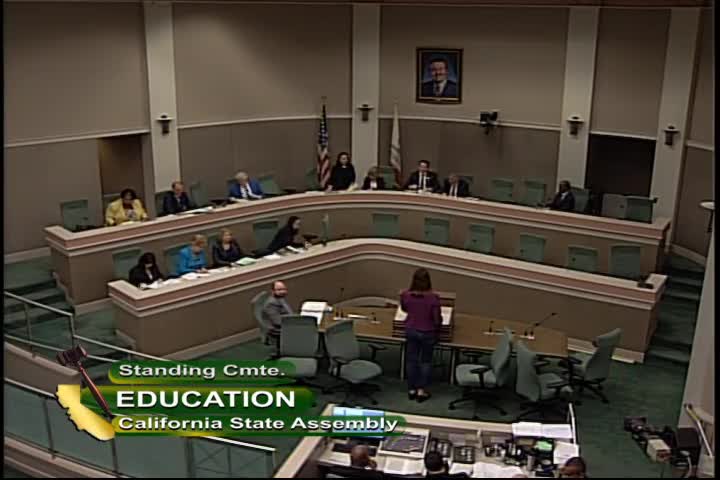 13MIN
Assembly Standing Committee on Education
Bill Author

Bill Co-Author(s):