AB 1713: Sacramento-San Joaquin Delta: peripheral canal.
- Session Year: 2015-2016
- House: Assembly
- Latest Version Date: 2016-01-26
Existing law requires various state agencies to administer programs relating to water supply, water quality, and flood management in the Sacramento-San Joaquin Delta.
The bill would prohibit the construction of a peripheral canal, as defined, unless expressly authorized by an initiative voted on by the voters of California on or after January 1, 2017, and would require the Legislative Analysts Office to complete a prescribed economic feasibility analysis prior to a vote authorizing the construction of a peripheral canal.
As used in this chapter, the following terms have the following meanings:
(a)Delta means the Sacramento-San Joaquin Delta, as defined in Section 12220.
(b)Peripheral canal means a facility or structure that conveys water directly from a diversion point in the Sacramento River to pumping facilities of the State Water Project or the federal Central Valley Project south of the Delta.
116.(a)Notwithstanding any other law, a peripheral canal shall not be constructed unless expressly authorized by an initiative voted on by the voters of California on or after January 1, 2017.
(b)If an initiative described in subdivision (a) is placed on the ballot, prior to the election, the Legislative Analysts Office shall complete an economic feasibility analysis that includes both of the following:
(1)The total cost of the project.
(2)Expected impacts of the project on taxpayers, water ratepayers, and the General Fund.
117.Notwithstanding any other law, the construction and operation of a peripheral canal shall not diminish or otherwise negatively affect the water supply, water rights, or water quality for water users within the Delta watershed.
|
Date
|
Status
|
|---|---|
| May 27, 2016 | In committee: Held under submission. |
| Apr 27, 2016 | In committee: Set, first hearing. Referred to APPR. suspense file. |
| Apr 20, 2016 | From committee: Do pass and re-refer to Com. on APPR. (Ayes 8. Noes 4.) (April 19). Re-referred to Com. on APPR. |
| Apr 7, 2016 | In committee: Set, first hearing. Hearing canceled at the request of author. |
| Feb 18, 2016 | Referred to Com. on W., P., & W. |
| Jan 27, 2016 | From printer. May be heard in committee February 26. |
| Jan 26, 2016 | Read first time. To print. |
|
Date
|
Description
|
Location
|
Votes
|
|
|---|---|---|---|---|
| Apr 19, 2016 | Do pass and be re-referred to the Committee on [Appropriations] | Assembly Standing Committee on Water, Parks, and Wildlife |
Passed |
This list shows positions taken on this bill by organizations on the date displayed, which is linked to the original source.
Positions by individuals are not included.
Date of Hearing: April 27, 2016
ASSEMBLY COMMITTEE ON APPROPRIATIONS
Lorena Gonzalez, Chair
ABPCA Bill Id:AB 1713
Author:(Eggman) – As Introduced Ver:January 26, 2016
Policy Committee: | Water, Parks and Wildlife | Vote: | 8 - 4 |
|
|
Urgency: No State Mandated Local Program: No Reimbursable: No
SUMMARY:
This bill prohibits the construction of a peripheral canal in the Sacramento-San Joaquin Delta (Delta) unless certain requirements are met. Specifically, this bill:
- Defines "peripheral canal" as a facility or structure to convey water from the Sacramento River to the State Water Project (SWP) or the federal Central Valley Project (CVP) pumping facilities in the Delta.
- Prohibits the construction of a peripheral canal unless authorized by an initiative vote on or after January 1, 2017.
- Requires the Legislative Analyst's Office to complete an economic feasibility analysis that includes the total cost of the project and expected impacts on taxpayers, water ratepayers, and the General Fund.
- Prohibits the construction and operation of a peripheral canal from diminishing or negatively affecting the water supplies, water rights, or quality of water for water users within the Delta watershed.
FISCAL EFFECT:
One-time General Fund costs of around $220,000 to include the text and analysis of the measure and arguments for and against the measure in the statewide voter information guide.
COMMENTS:
- Purpose. According to the author, a major infrastructure project such as the currently proposed WaterFix project should be affirmatively approved by those who would be directly assessed for its high cost and those who would be forced to live with its numerous adverse impacts. This bill allows voters to weigh in on the proposal.
- Background. The Delta is both the hub of the California Water System and the most valuable estuary and wetland ecosystem on the west coast of the Americas. The Delta provides water to more than 25 million Californians and 3 million acres of agricultural land. It supports a four hundred billion dollar a year economy, is part of the Pacific Flyway, is critical habitat to 700 native plant and animal species, and is home to more than 500,000 people.
- Peripheral Canal. In 1965 the first plan for a "Peripheral Canal" was put forth. This plan was for a 43 mile-long, 400 feet wide, 30 feet deep unlined ditch running from the Sacramento River in the north of the Delta to the SWP and the CVP pumping plants in the south Delta. In 1980 the Legislature passed SB 200 (Ayala) and ACA 90 (Kapiloff) that approved the “Peripheral Canal” and placed Proposition 8 on the November 1980 ballot.
Proposition 8 was approved by the voters, however, enough signatures were gathered to qualify the “Peripheral Canal” for a referendum vote of the people. In June 1982, Proposition 9, the “Peripheral Canal” was repealed by a margin of three to two.
- Cal Fed, Delta Vision and BDCP. In 1994, two years after the end of a drought, state and federal agencies joined together to coordinate activities in the Delta. This coordination ultimately resulted in the CALFED Bay-Delta Program (CALFED). CALFED initiated a long-term planning process to improve the Delta and increase the reliability of its water supply. In the final Record of Decision (ROD) signed in August of 2000, the CALFED Program chose the existing through-Delta system as the preferred alternative for continuing to convey export water supplies.
Following a 2005 independent review critical of many aspects of CALFED, former Governor Arnold Schwarzenegger created a new effort by Executive Order called "Delta Vision." Delta Vision identified seven goals, which included building facilities to improve the existing water conveyance systems and expand statewide storage.
In 2006, CALFED parties signed a Memorandum of Agreement (MOA) with state and federal export contractors. Part of that MOA initiated the Bay Delta Conservation Plan (BDCP). BDCP was intended to be a conservation plan for the Delta and its upstream basins with the express mission of providing the permits necessary to comply with the California Endangered Species Act (CESA) and the Federal Endangered Species Act (ESA) through a state Natural Communities Conservation Plan (NCCP) and a federal Habitat Conservation Plan (HCP).
In 2009, SB7X set environmental standards for BDCP beyond those required under the California Environmental Quality Act (CEQA) with specific analysis required for numerous conveyance alternatives. Importantly, SB7X required BDCP to be approved as a NCCP in order to be eligible for public funding.
- WaterFix. In 2015, federal agencies determined that BDCP likely would not meet the requirements of HCP and that the Delta conveyance associated with BDCP would not receive 50 year permits for operation. This effectively led to the end of BDCP and resulted in the Department of Water Resources (DWR) splitting BDCP into WaterFix, the Delta conveyance piece of BDCP, and EcoRestor the ecological restoration piece of BDCP.
Recent estimates put the cost of WaterFix at $17 billion and EcoRestor at $8 billion. Under existing law, the CVP and the SWP contractors will have to pay the cost of WaterFix. The funding for EcoRestor is less clear and will likely come from a mix of sources including CEQA mitigation and public funds.
- Support and Opposition. This bill is supported by environmental groups, Delta counties and other Delta interests who argue that the permitting process for a major infrastructure project should be transparent and affirmatively approved by those who would be directly assessed for its high cost and those who would be forced to live with its numerous adverse impacts.
This bill is opposed by Delta exporters, central valley and Southern California counties, and numerous unions and chambers of commerce. Opponents argue that this bill will cause unnecessary delays and bureaucracy, jeopardizing the only viable solution available to secure water supplies for 2/3 of the state while improving the health of the Delta. Opponents are fundamentally opposed to asking voters to approve the construction of infrastructure projects, particularly those that are not funded by taxpayers.
Analysis Prepared by: Jennifer Galehouse / APPR. / (916) 319-2081
Date of Hearing: April 19, 2016
ASSEMBLY COMMITTEE ON WATER, PARKS, AND WILDLIFE
Marc Levine, Chair
ABPCA Bill Id:AB 1713 (
Author:Eggman) – As Introduced Ver:January 26, 2016
SUBJECT: Sacramento-San Joaquin Delta: peripheral canal
SUMMARY: Prohibits the construction of a peripheral canal, as defined, in the Sacramento-San Joaquin Delta (Delta) unless certain requirements are met. Specifically, this bill:
- Defines "peripheral canal" as a facility or structure to convey water from the Sacramento River to the State Water Project (SWP) or the federal Central Valley Project (CVP) pumping facilities in the southern Sacramento-San Joaquin Delta (Delta).
- Prohibits the construction of a peripheral canal unless authorized by an initiative vote on or after January 1, 2017.
- Requires the Legislative Analyst's Office to complete an economic feasibility analysis of the peripheral canal prior to the election on the initiative.
- Prohibits the construction and operation of a peripheral canal from diminishing or negatively affecting the water supplies, water rights, or quality of water for water users within the Delta watershed.
EXISTING LAW:
- Provides the State Water Resources Control Board (State Water Board) authority to protect Delta municipal, industrial, agricultural, and fish and wildlife beneficial water uses through the adoption and implementation of a Water Quality Control Plan (WQCP) for the Delta.
- Provides the State Water Board authority to condition and enforce water rights permits to implement WQCPs. Requires the State Water Board use the best available science to develop flow criteria necessary to protect the Delta environment.
- Provides the Department of Water Resources (DWR) authority to construct and operate the SWP and to construct, maintain, and operate additional SWP units that further the purposes of the SWP.
- Prohibits the DWR from constructing any diversion, conveyance, or other facility to divert from the Sacramento River to the south Delta until the State Water Board issues an order approving the change.
- Prohibits construction of any new Delta conveyance facility until the SWP and the CVP contractors enter into a contract to pay for environmental and community impacts from the construction, operation, and maintenance of the facility.
- Establishes coequal goals in the Delta of a more reliable water supply for California and protecting, restoring and enhancing the Delta ecosystem while mandating that the coequal goals are to be achieved in a manner that protects and enhances the unique cultural, recreational, natural resource, and agricultural values of the Delta as an evolving place.
- Creates the Delta Stewardship Council (Council) which, among other tasks, must develop and implement the Delta Plan (Plan) a long-term management plan for the Delta that meets the coequal goals.
- Requires that the Delta Plan promote options for new and improved infrastructure relating to Delta water conveyance, storage systems, and operations to achieve the co-equal goals.
- Permits inclusion of the Bay Delta Conservation Plan (BDCP) into the Delta Plan only if it complies with a Natural Community Conservation Plan (NCCP), the California Environmental Quality Act (CEQA), and that the CEQA analysis specifically looks at flow related operational requirements and a reasonable range of Delta conveyance alternatives.
FISCAL EFFECT: unknown
COMMENTS: Prohibits the construction of a peripheral canal, as defined, in the Delta unless authorized by an initiative vote.
- Author’s Statement: This bill prohibits the construction of a water conveyance system in the Delta unless first expressly approved by the voters of California through an initiative. A major infrastructure project such as the currently proposed WaterFix project should be affirmatively approved by those who would be directly assessed for its high cost and those who would be forced to live with its numerous adverse impacts. The tunnels will only serve to benefit one portion of the State at the expense of another and, contrary to existing state law, cause direct and irreparable harm to the Delta. This bill appropriately allows voters to weigh in on an extremely expensive proposal with potentially devastating impacts both within and outside of the Delta.
- Background: There is broad agreement that the state’s water management system is currently unable to satisfactorily meet both ecological and human needs. Under current water use, demands surpass supply. Especially, in times of drought. The State has taken action through the Water Action Plan to lay out a path to sustainable water management. This and other documents, necessarily put all options on the table to improve the water management system. Those options include but are not limited to conservation, efficiency, stormwater capture, groundwater replenishment, recycled water, and desalination. Due to limited resources it is important that the state invest first in actions of the highest value to create the greatest improvements in water reliability for human and natural requirements.
The Delta is crucial and is in decline: The Delta is both the hub of the California Water System and the most valuable estuary and wetland ecosystem on the west coast of the Americas. The Delta provides water to more than 25 million Californians and 3 million acres of agricultural land. It supports a four hundred billion dollar a year economy, is part of the Pacific Flyway, is critical habitat to 700 native plant and animal species, and is home to more than 500,000 people.
California is an arid state with limited precipitation. The mountains in the northern part of the state serve as the state’s water catcher and largest natural surface reservoir. These mountains receive the bulk of their precipitation as snow in the winter. The majority of human needs in the state are hundreds of miles from the primary water source. This hurdle of time and place of use led to major reengineering of the hydrology of the state. Beginning in 1933 and largely culminating in 1968 a major redirecting of water from the mountains to the cities and valleys through the construction of the CVP and the SWP made the Delta the hub for water in California.
The Delta watershed and California’s water infrastructure are in crisis and existing pressures on the Delta are not sustainable. Among other human impacts the CVP and the SWP operations have altered the natural amount, duration, direction and timing of water flows. As a result, today there are about 100 Delta wildlife species, 140 plant species and 13 species of fish that have some form of legal or regulatory protection. There have been numerous species-related restrictions on the management of water exports from the Delta since 1991, with restrictions being in place continuously since 2008.
Simply receiving more precipitation does not appear to be sufficient to resolve the challenges for species and deliveries in the Delta as a significant part of the problem stems from the fact that the infrastructure associated with deliveries itself is environmentally damaging. 2016, an average precipitation year, is an example of what the future of this environmental and infrastructure challenge would appear to hold. CVP Sacramento Valley interests are projected to receive 100% of their deliveries while many CVP San Joaquin Valley interests are projected to receive 5% of deliveries. It seems that further restrictions on deliveries from the Delta and continued ecological decline are a certainty under the status quo.
The expectation behind proposed changes in conveyance in the Delta has always been that it will improve the reliability of water deliveries out of the Delta. A common concern with that expectation has been what the environmental impacts of that reliability will be, and what the impacts would be on the people who live in the Delta.
Long Look at Conveyance and Delta Management: Since prior to the completion of both the CVP and the SWP there has been an ongoing debate about how to manage the Delta. Management and conveyance in the Delta have been and continue to be closely linked together. Because management and conveyance have been the responsibility of Federal, State, and Local governments, plans have not always been coordinated and have occurred in overlapping ways. Much of the debate on coordination, conveyance, and management came to a head in legislation that was passed in 2009. The timeline on this debate, with respect to conveyance in the Delta has progressed as follows:
First “Peripheral Canal” 1965-1982
In 1965 the first plan for a "Peripheral Canal" was put forth. This plan was for a 43 mile-long, 400 feet wide, 30 feet deep unlined ditch running from the Sacramento River in the north of the Delta to the SWP and the CVP pumping plants in the south Delta. The “Peripheral Canal” would have been capable of delivering 23,000 cubic feet per second (cfs). At that time, many did not believe that building such a canal would require a vote of the people.
In 1980 the Legislature passed SB 200 (Ayala) and ACA 90 (Kapiloff) that approved the “Peripheral Canal” and placed Proposition 8 on the November 1980 ballot. Proposition 8 was approved by the voters. This ultimately did not move forward, however, when enough signatures were gathered to qualify the “Peripheral Canal” for a referendum, or veto by the people. In June 1982, Proposition 9, the “Peripheral Canal” was repealed by a margin of three to two and.
CALFED 1994-2000
After the vote on Proposition 9 the idea of changing conveyance in the Delta was put on the back burner for some time. A drought from 1987-1992, however, brought renewed attention to the conflicts in the Delta. 1994, two years after the end of the drought, state and federal agencies joined together to coordinate activities in the Delta. This coordination ultimately resulted in the CALFED Bay-Delta Program (CALFED). CALFED initiated a long-term planning process to improve the Delta and increase the reliability of its water supply. As part of that plan CALFED reconsidered some type of peripheral conveyance to address export water supply reliability and ecosystem restoration in the Delta. CALFED called this new conveyance an "isolated facility" and tried to distinguish it from the prior “Peripheral Canal”. Ultimately however, in a Record of Decision signed in August of 2000, the CALFED Program chose the existing through-Delta system as the preferred alternative for continuing to convey export water supplies.
Delta Vision 2005-2008
Following a 2005 independent review critical of many aspects of CALFED, former Governor Arnold Schwarzenegger created a new effort by Executive Order called "Delta Vision." Delta Vision built on CALFED's work but aimed at addressing the full array of issues necessary to achieve a sustainable Delta. Delta Vision identified seven goals which they deemed should be part of a comprehensive water plan for the state. Significantly the recommendations included:
- Building facilities to improve the existing water conveyance systems and expand statewide storage.
- Delta restoration must be founded on the co-equal goals of water supply reliability and ecosystem restoration.
- Recognition and enhancement of the unique cultural, recreational, and agricultural values of the Delta as an evolving place.
- Establish a new governance structure with the authority, responsibility, and accountability to achieve these goals.
BDCP 2006-2015
In 2006 CALFED was in financial trouble, as a result CALFED singed a Memorandum of Agreement (MOA) with state and federal export contractors. Part of that MOA initiated BDCP. BDCP was described as "a conservation plan for the Delta and its upstream basins" with the express mission of obtaining for SWP/CVP Delta operations the permits necessary to comply with the California Endangered Species Act and the Federal Endangered Species Act (FESA) through a state NCCP and a federal Habitat Conservation Plan (HCP).
Delta Legislation 2009
When California faced a third consecutive dry year, In 2009, former Governor Schwarzenegger called an Extraordinary Session of the Legislature to address water issues. That Extraordinary Session produced several pieces of Legislation including SB 1 (Simitian, Chapter 5, Statutes of the 7th Extraordinary Session 2009-2010). Among numerous changes, this legislation tied Delta conveyance, governance, and funding together. SB 1 x7 clarified that any new conveyance facility could not be constructed without approval from the State Water Board. It required the State Water Board to develop new flow criteria for the Delta and include that flow criteria in any approval for new conveyance.
SB 1 x7 set environmental bars for BDCP beyond those required under CEQA with specific analysis required for numerous conveyance alternatives, and included a reasonable range of flow criteria, rates of diversion, and other operational criteria. Importantly, SB 1 x7 required BDCP to be approved as an NCCP in order to be eligible for public funding.
Additionally, SB 1 x7 established the Council as a governance body in the Delta. Part of the Council’s responsibility is to develop a Delta Plan and make determinations of consistency with the Delta Plan. Any new conveyance facility would very likely fall under an action that would be evaluated by the Council for consistency with the Delta Plan.
The Plan is required to:
- Further the restoration of the Delta through advancing the coequal goals of providing water reliability and enhancing the Delta ecosystem in a manner that protects the unique culture of the Delta.
- Promote statewide water conservation, water use efficiency, and sustainable use of water.
- Promote options for conveyance, storage, and operation that achieve the coequal goals.
WaterFix 2015-Present
In 2015 federal agencies determined that BDCP likely would not meet the requirements of a Habitat Conservation Plan (HCP) and that the Delta conveyance associated with BDCP would not receive 50 year permits for operation. This effectively led to the end of BDCP and resulted in the Department splitting BDCP into WaterFix, the Delta conveyance piece of BDCP, and EcoRestor the ecological restoration piece of BDCP.
Recent estimates put the cost of WaterFix at $17 billion and EcoRestor at $8 billion. Under existing law, the CVP and the SWP contractors will have to pay the cost of WaterFix. The funding for EcoRestor is less clear and will likely come from a mix of sources including CEQA mitigation.
Much of SB 1 x7 still applies to how conveyance and governance continue to be carried out in the Delta. Importantly, the approval process for conveyance at the State Water Board and the Council remains in place.
Big Gulp, Little Sip
One of the driving concepts behind any conveyance facility is the idea of “Big Gulp, Little Sip”. This refers to the ability to move large portions of water in wet years so as to reduce dependence on the Delta in dry years. The central question is what size is the right size. Or what approach will have the greatest effect for achieving the coequal goals.
The original “Peripheral Canal” was an extremely large facility. What is being discussed today through WaterFix is a facility that is approximately 40% of the size of the initial proposal. To be clear, WaterFix is an extremely large facility, one in which the hydrologic impacts are not entirely clear because a facility of this kind is unprecedented. The uncertainty of the impacts of project of this magnitude is ultimately what has limited its ability to receive long-term federal permits.
Approval of New Conveyance
A ballot initiative up in this November’s election is substantially similar to this bill. Under the initiative, the state would have to seek voters' permission before funding projects that cost more than $2 billion with revenue bonds. The administration had been and may still propose such bonds for the Delta conveyance plan. This bill would require a different vote to occur after January 1, 2017, that is specifically on the peripheral canal with an economic feasibility analysis.
Clearly a large scale conveyance project in the Delta would have to comply with CEQA and all of the associated requirements for approval of the project. Additionally at least part of the ability to gain approval for a Delta conveyance facility was clearly laid out through SB 1 x7 and that process must still be adhered to today. This includes approval at the State Water Board and a finding of consistency by the Council if there is approval by the State Water Board. How the Council would make a finding of consistency with the Plan would play out is not clear, but it seems likely that process would inform any CEQA challenge.
This bill is also similar to AB 1594 (Huber) 2010 and AB 550 (Huber) 2011. Those bills specifically required Legislative approval of any “Peripheral Canal”. Those bills did not receive approval in this committee.
- Prior and Related Legislation:
AB 2583 (Frazier) of 2016, revises and recasts the Sacramento-San Joaquin Delta Reform Act of 2009. AB 2583 is pending in this committee.
AB 550 (Huber) of 2011, would have prohibited construction of a peripheral canal unless there was expressed Legislative approval. AB 550 failed passage in this Committee.
AB 1594 (Huber) of 2010, would have prohibited construction of a peripheral canal unless there was expressed Legislative approval. AB 1594 was held in this Committee.
SB 1 x7 (Simitian) Chapter 5, Statues of the 7th extraordinary session of 2009-2010, established the Sacramento-San Joaquin Delta Reform Act requiring Delta management to meet the coequal goals.
- Supporting Arguments: The permitting process for a major infrastructure project should be transparent. A major infrastructure project such as the currently proposed Twin Tunnels project should be affirmatively approved by those who would be directly assessed for its high cost and those who would be forced to live with its numerous adverse impacts. Many of those who voted against the peripheral canal proposal in 1982 are likely to question why avoiding voters this time is somehow in the best interest of Californians. At a minimum, the issue should be presented to voters statewide for their consideration.
- Opposing Arguments: This bill will cause unnecessary delays and bureaucracy, jeopardizing the only viable solution available to secure water supplies for 2/3 of the state while improving the health of the Delta. Current rains have demonstrated that the existing outdated water distribution infrastructure does not allow us to capture and transfer water to storage in wet years. Fundamentally, the state should not ask voters to approve the construction of infrastructure projects, particularly those that are not funded by taxpayers.
- REGISTERED SUPPORT / OPPOSITION:
Support
CA Save Our Streams Council
California Sportfishing Protection Alliance
California Water Impact Network (C-WIN)
Clean Water Action
Contra Costa County Board of Supervisors
County of Sacramento
Delta Counties Coalition
Environmental Protection Information Center
Fish Sniffer Magazine
Food & Water Watch
Foothill Conservancy
Friends of the River
Klamath Riverkeeper
Northern California Council of the International Federation of Fly Fishers
Planning and Conservation League
Restore the Delta
Sacramento River Preservation Trust
San Joaquin Board of Supervisors
Opposition
Alameda County Zone 7 Water Agency
American Council of Engineering Companies California
Associated General Contractors of California
Association of California Water Agencies
Burbank Water and Power
California Alliance for Jobs
California Building Industry Association
California Business Properties Association
California Chamber of Commerce
California Contract Cities Association
California Council for Environmental and Economic Balance
California Hawaii State Conference of the NAACP
California Municipal Utilities Association
California State Building and Construction Trades Council
Calleguas Municipal Water District
Castaic Lake Water Agency
Central City Association of Los Angeles
Central Coast Water Authority
Cerritos Regional Chamber of Commerce
Chamber of Commerce, Mountain View
Chambers of Commerce Alliance of Ventura and Santa Barbara Counties
City of Glendale Water and Power
City of Torrance
Coachella Valley Water District
Crestline-Lake Arrowhead Water Agency
Cucamonga Valley Water District
Desert Water Agency
East Orange County Water District
Eastern Municipal Water District
El Monte/South El Monte Chamber of Commerce
El Toro Water District
Elsinore Valley Municipal Water District
Foothill Municipal Water District
Gateway Chambers Alliance
Greater Riverside Chambers of Commerce
Huntington Beach Chamber of Commerce
Imperial County Building and Construction Trades Council
Inland Action
Inland Empire Economic Partnership
Inland Empire Utilities Agency
International Association of Heat and Frost Insulators and Allied Workers Local Union 16
International Brotherhood of Electrical Workers Local Union 11
International Brotherhood of Electrical Workers Local Union 332
International Brotherhood of Electrical Workers Local Union 441
International Brotherhood of Electrical Workers Local Union 477
International Brotherhood of Electrical Workers Local Union 551
International Brotherhood of Electrical Workers Local Union 6
Irvine Ranch Water District
Kern County Taxpayer Association
Kern County Water Agency
Kern, Inyo and Mono Building and Construction Trades Council
La Verne Chamber of Commerce
Las Virgenes Municipal Water District
Long Beach Water Commission
Los Angeles Area Chamber of Commerce
Los Angeles Area Chamber of Commerce
Los Angeles County Business Federation
Los Angeles/Orange County Building and Construction Trades Council
Mesa Water District
Metropolitan Water District of Southern California
Mojave Water Agency
Moreno Valley Chamber of Commerce
Municipal Water District of Orange County
Orange County Business Council
Oxnard Chamber of Commerce
Rancho California Water District
Rubidoux Community Services District
San Bernardino Valley Municipal Water District
San Diego County Building and Construction Trades Council
San Francisco Building and Construction Trades Council
San Francisco Chamber of Commerce
San Gabriel Valley Economic Partnership
San Gabriel Valley Municipal Water District
San Gorgonio Pass Water Agency
San Jose Silicon Valley Chamber of Commerce
San Jose/Silicon Valley NAACP
San Luis & Delta-Mendota Water Authority
Santa Clara Valley Water District
Santa Clarita Valley Chamber of Commerce
Santa Margarita Water District
Sheet Metal, Air, Rail & Transportation Workers 105
South Bay Labor Council
Southern California Pipe Trades District Council 16
Southern California Water Committee
Southwest California Legislative Council
Southwest Riverside County Association of Realtors
State Water Contractors, Inc.
Temescal Valley Water District
Three Valleys Municipal Water District
Torrance Area Chamber of Commerce
Tulare Kings Hispanic Chamber of Commerce
United Chambers of Commerce of San Fernando Valley & Region
United Water Conservation District
Upper San Gabriel Valley Municipal Water District
Valley Ag Water Coalition
Valley Industry & Commerce Association
Ventura County Taxpayers Association
Walnut Valley Water District
West Basin Municipal Water District
Western Growers Association
Western Municipal Water District
Western Riverside Council of Governments
Westlands Water District
Yorba Linda Water District
Analysis Prepared by: Ryan Ojakian / W., P., & W. / (916) 319-2096
Discussed in Hearing
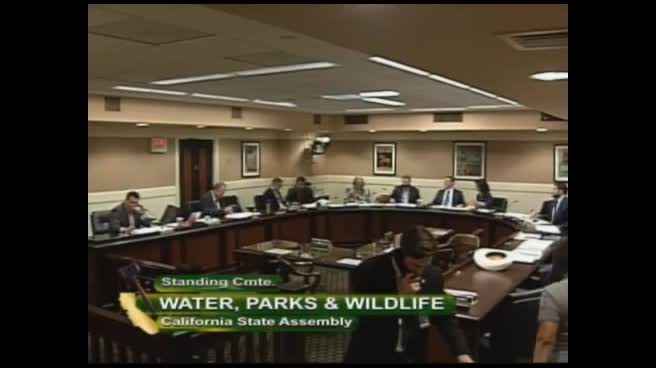 30MIN
Assembly Standing Committee on Water, Parks, and Wildlife
Bill Author

Bill Co-Author(s):