AB 319: Recycling: single-use plastic beverage container caps.
- Session Year: 2017-2018
- House: Assembly
- Latest Version Date: 2017-02-06
The California Integrated Waste Management Act of 1989, which is administered by the Department of Resources Recycling and Recovery, requires every rigid plastic packaging container, as defined, sold or offered for sale in this state, to generally meet one of specified criteria.
This bill would prohibit a retailer, on and after January 1, 2020, from selling or offering for sale a single-use plastic beverage container with a cap that is not tethered to or contiguously affixed to the beverage container. The bill would define terms for purposes of these provisions.
For the purposes of this chapter, the following definitions shall apply:
(a)Beverage has the same meaning as in Section 14504.
(b)Retailer means a person who sells a beverage in a beverage container to a consumer.
(c)Single use means intended for disposal after one use and used for serving or transporting a prepared, ready-to-consume product.
(d)Beverage container means an individual, separate bottle, can, jar, carton, or other receptacle, however denominated, in which one liter or less of a beverage is sold, and that is constructed of plastic. Beverage container does not include a cup or other similar open or loosely sealed receptacle.
42381.On and after January 1, 2020, a retailer shall not sell or offer for sale, in the state, a single-use beverage container with a cap, unless the container meets one of the following conditions:
(a)The cap is tethered to the container in a manner that prevents the separation of the cap from the container when the cap is removed from the container.
(b)The cap includes an opening from which the beverage can be consumed while the cap is screwed onto or otherwise contiguously affixed to the container.
|
Date
|
Status
|
|---|---|
| Feb 1, 2018 | Died on third reading file. |
| Jan 10, 2018 | Read second time. Ordered to third reading. |
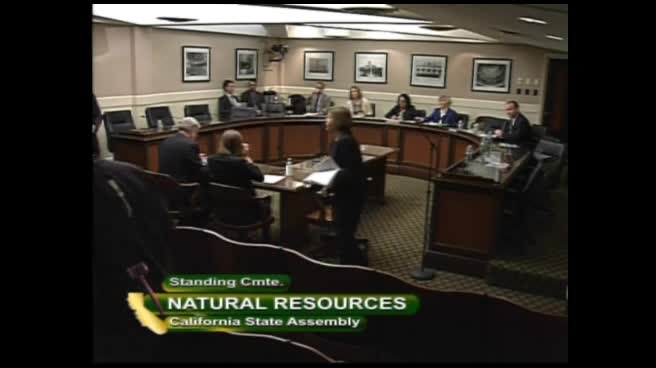
| Jan 9, 2018 | From committee: Do pass. (Ayes 7. Noes 3.) (January 8). |
| Apr 17, 2017 | In committee: Hearing postponed by committee. |
| Feb 21, 2017 | Referred to Com. on NAT. RES. |
| Feb 7, 2017 | From printer. May be heard in committee March 9. |
| Feb 6, 2017 | Read first time. To print. |
|
Date
|
Description
|
Location
|
Votes
|
|
|---|---|---|---|---|
| Jan 8, 2018 | Do pass. | Assembly Standing Committee on Natural Resources |
Passed |
This list shows positions taken on this bill by organizations on the date displayed, which is linked to the original source.
Positions by individuals are not included.
ASSEMBLY THIRD READING
ATR Bill Id:AB 319
Author:(Mark Stone)
As Introduced Ver:February 6, 2017
Majority vote
Committee | Votes | Ayes | Noes |
Natural Resources | 7-3 | Cristina Garcia, Chau, Eggman, Limón, McCarty, Muratsuchi, Mark Stone | Acosta, Travis Allen, Flora |
SUMMARY: Beginning January 1, 2020, requires that beverage containers offered for sale have a cap that is attached to the container. Specifically, this bill:
- On and after January 1, 2020, prohibits the sale of single-use plastic beverage containers unless:
- The cap is tethered to the container in a manner that prevents the separation of the cap from the container when the cap is removed; or,
- The cap includes an opening from which the beverage can be consumed without removing the cap.
- Defines "beverage container" to mean an individual, separate bottle, can, jar, carton, or other receptacle in which one liter or less of a beverage is sold that is constructed of plastic.
- Specifies that "beverage" has the same meaning as defined in the Bottle Bill.
FISCAL EFFECT: This bill is keyed non-fiscal by the legislative counsel.
COMMENTS: Plastic bottle caps are a significant contributor to litter and marine debris. Plastics are estimated to comprise 60-80% of all marine debris and 90% of all floating debris, which includes bottle caps. According to the California Coastal Commission, the primary source of marine debris is urban runoff (i.e., litter).
Due to the interplay of ocean currents, marine debris preferentially accumulates in certain areas throughout the ocean. According to Eriksen et al. (2014), 24 expeditions from 2007-2013 estimated that there are approximately 96,400 metric tons of floating plastic in the Northern Pacific Ocean. The North Pacific Central Gyre is the ultimate destination for much of the marine debris originating from the California coast. A study by the Algalita Marine Research Foundation found an average of more than 300,000 plastic pieces per square mile of the Gyre and that the mass of plastic was 6 times greater than zooplankton floating on the water’s surface.
Most plastic marine debris exists as small plastic particles due to excessive UV radiation exposure and subsequent photo-degradation. These plastic pieces are confused with small fish, plankton, or krill and ingested by birds and marine animals. Over 600 marine animal species have been negatively affected by ingesting plastic worldwide. Last month, scientists at the Australian Research Council Centre of Excellence for Coral Reef Studies at James Cook University found that corals are also ingesting small plastic particles, which remain in their small stomach cavities and impede their ability to consume and digest normal food.
In addition to the physical impacts of plastic pollution, hydrophobic chemicals present in the ocean in trace amounts (e.g., from contaminated runoff and oil and chemical spills) have an affinity for, and can bind to, plastic particles where they enter and accumulate in the food chain.
A National Oceanic and Atmospheric Administration study published in 2014 examined the costs of marine debris to Californians. The study focused on Orange County, and found that residents lose millions of dollars each year avoiding littered, local beaches in favor of choosing cleaner beaches that are father away and more costly to reach. In one scenario, the study found that reducing marine debris by just 25% would save Orange County residents $32 million in June-August; eliminating marine debris entirely, that savings reaches an estimated $148 million.
As noted by the author, a 2013 report produced for the Natural Resources Defense Council by Keir Associates estimates that Californians are shouldering $428 million annually to try to prevent litter from becoming marine debris that damages the environment, tourism, and other economic activities.
Bottle caps are generally made from polypropylene (PP) or high-density polyethylene (PE). Beverage bottles are generally made primarily from polyethylene terephthalate (PET). During recycling, the bottles are chopped into small pieces and sorted in a sink-float tank. Within the sink-float tank, the PP and HDPE will float, and the PET will sink. Once separated, the materials can be recycled.
Historically, some recyclers were unable to process bottles with the caps on; however, the vast majority of recycling facilities accept bottles with the caps. The Association of Plastic Recyclers encourages consumers to recycle bottles with the caps on.
According to the American Beverage Association, the technology to design and utilize tethered caps for certain beverage products has not been developed for market. A number of water bottles are available with attached caps; however, there are none on the market in the United States for carbonated and "hot fill" (i.e., beverages that are bottled while hot) containers.
Analysis Prepared by: Elizabeth MacMillan / NAT. RES. / (916) 319-2092 FN: 0002522
Date of Hearing: January 8, 2018
ASSEMBLY COMMITTEE ON NATURAL RESOURCES
Cristina Garcia, Chair
ABPCA Bill Id:AB 319 (
Author:Mark Stone) – As Introduced Ver:February 6, 2017
SUBJECT: Recycling: single-use plastic beverage container caps
SUMMARY: Beginning January 1, 2020, requires that beverage containers offered for sale have a cap that is attached to the container.
EXISTING LAW:
- Pursuant to the California Beverage Container Recycling and Litter Reduction Act (Bottle Bill):
- Requires beverage containers sold in this state to have a California redemption value (CRV) of five cents for containers that hold fewer than 24 ounces and 10 cents for containers that hold 24 ounces or more and requires a distributor to pay a redemption payment to the Department of Resources Recycling and Recovery (CalRecycle). Continuously appropriates these funds to CalRecycle for the payment of refund values and processing fees.
- Defines "beverage" to include, among other things, beer and other malt beverages, wine and distilled spirit coolers, carbonated mineral and soda waters, noncarbonated fruit drinks, and vegetable juices in liquid form that are intended for human consumption. Excludes from the definition of "beverage" vegetable drinks in beverage containers of more than 16 ounces, milk, medical food, and any product sold in a container that is not an aluminum beverage container, a glass container, a plastic beverage container, or a bimetal container.
- Requires beverage containers sold in this state to have a California redemption value (CRV) of five cents for containers that hold fewer than 24 ounces and 10 cents for containers that hold 24 ounces or more and requires a distributor to pay a redemption payment to the Department of Resources Recycling and Recovery (CalRecycle). Continuously appropriates these funds to CalRecycle for the payment of refund values and processing fees.
- Pursuant to the Integrated Waste Management Act (IWMA):
- Requires that local governments divert at least 50% of solid waste from landfill disposal and establishes a statewide goal that 75% of solid waste be diverted from landfill disposal by 2020.
- Requires that rigid plastic packaging containers sold in the state contain a minimum of 25% postconsumer recycled material and have a recycling rate of at least 45%.
- Requires that manufacturers of plastic trash bags that are at or above 0.70 mils thick to annually certify that they comply with one of the following:
- That the bags sold in California contain a minimum of 10% recycled content; or,
- That all plastic products sold by the manufacturer in California contain a minimum of 30% recycled content.
- Requires that expanded polystyrene loosefill packaging (i.e., packing peanuts) sold in the state contain a minimum of 60% recycled content.
- Prohibits a manufacturer or supplier from selling a plastic food or beverage container that is advertised with a specific recycling content amount unless the manufacturer or supplier is able to provide certification of that claim in a format that is easy to understand and scientifically accurate. Requires a manufacturer or supplier to provide information and documentation verifying the recycling content of a plastic food or beverage container within 90 days of a request for such information made by a member of the public or a state agency.
THIS BILL:
- On and after January 1, 2020, prohibits the sale of single-use plastic beverage containers unless:
- The cap is tethered to the container in a manner that prevents the separation of the cap from the container when the cap is removed; or,
- The cap includes an opening from which the beverage can be consumed without removing the cap.
- The cap is tethered to the container in a manner that prevents the separation of the cap from the container when the cap is removed; or,
- Defines "beverage container" to mean an individual, separate bottle, can, jar, carton, or other receptacle in which one liter or less of a beverage is sold that is constructed of plastic.
- Specifies that "beverage" has the same meaning as defined in the Bottle Bill.
FISCAL EFFECT: Unknown
COMMENTS:
- Author's statement:
Plastic bottle caps are the third most common item found in beach and river cleanups throughout the country. The Ocean Conservancy's 2015 Coastal Cleanup Day produced over 200,000 plastic bottle caps in the United States alone. Over 800,000 were recovered worldwide.
In addition to the negative impact on our environment, plastic pollution adversely affects our economy. A 2013 report commissioned by the Natural Resources Defense Council reported that California cities, towns, and taxpayers are shouldering $428 million per year in costs to stop litter from becoming pollution that harms the environment, tourism, and other economic activity.
- Plastics in the ocean. Plastic bottle caps are a significant contributor to litter and marine debris. Plastics are estimated to comprise 60-80% of all marine debris and 90% of all floating debris, which includes bottle caps. According to the California Coastal Commission, the primary source of marine debris is urban runoff (i.e., litter).
Due to the interplay of ocean currents, marine debris preferentially accumulates in certain areas throughout the ocean. According to Eriksen et al. (2014), 24 expeditions from 2007-2013 estimated that there are approximately 96,400 metric tons of floating plastic in the Northern Pacific Ocean. The North Pacific Central Gyre is the ultimate destination for much of the marine debris originating from the California coast. A study by the Algalita Marine Research Foundation found an average of more than 300,000 plastic pieces per square mile of the Gyre and that the mass of plastic was 6 times greater than zooplankton floating on the water’s surface.
Most plastic marine debris exists as small plastic particles due to excessive UV radiation exposure and subsequent photo-degradation. These plastic pieces are confused with small fish, plankton, or krill and ingested by birds and marine animals. Over 600 marine animal species have been negatively affected by ingesting plastic worldwide. Last month, scientists at the Australian Research Council Centre of Excellence for Coral Reef Studies at James Cook University found that corals are also ingesting small plastic particles, which remain in their small stomach cavities and impede their ability to consume and digest normal food.
In addition to the physical impacts of plastic pollution, hydrophobic chemicals present in the ocean in trace amounts (e.g., from contaminated runoff and oil and chemical spills) have an affinity for, and can bind to, plastic particles where they enter and accumulate in the food chain.
- Economic impacts to California. A National Oceanic and Atmospheric Administration Marine Debris Program economic study published in 2014 examined the costs of marine debris to Californians. The study focused on Orange County, and found that residents lose millions of dollars each year avoiding littered, local beaches in favor of choosing cleaner beaches that are father away and more costly to reach. In one scenario, the study found that reducing marine debris by just 25% would save Orange County residents $32 million in June-August; eliminating marine debris entirely, that savings reaches an estimated $148 million.
As noted by the author, a 2013 report produced for the Natural Resources Defense Council by Keir Associates estimates that Californians are shouldering $428 million annually to try to prevent litter from becoming marine debris that damages the environment, tourism, and other economic activities. Specific examples include:- Los Angeles spends $9.50 per person, for a total of over $36.3 million annually;
- San Diego spends $10.84 per person, for a total of $14.1 million annually;
- The community of Commerce in Los Angeles County spends $69 per person, for a total of $890,000 annually; and,
- Long Beach spends $28 per person, for a total of nearly $13 million annually.
- Los Angeles spends $9.50 per person, for a total of over $36.3 million annually;
- Bottle caps. Bottle caps are generally made from polypropylene (PP) or high-density polyethylene (PE). Beverage bottles are generally made primarily from polyethylene terephthalate (PET). During recycling, the bottles are chopped into small pieces and sorted in a sink-float tank. Within the sink-float tank, the PP and HDPE will float, and the PET will sink. Once separated, the materials can be recycled.
Historically, some recyclers were unable to process bottles with the caps on; however, the vast majority of recycling facilities accept bottles with the caps. The Association of Plastic Recyclers encourages consumers to recycle bottles with the caps on.
According to the American Beverage Association, the technology to design and utilize tethered caps for certain beverage products has not been developed for market. A number of water bottles are available with attached caps; however, there are none on the market in the US for carbonated and "hot fill" (i.e., beverages that are bottled while hot) containers.
- Public education.
In response to the introduction of this bill, the American Beverage Association began a public education campaign to encourage consumers to keep the cap on empty plastic beverage containers. The stated objective of the program is to inform the public that plastic bottle caps are recyclable and encourage consumers to keep the caps on when recycling their containers. The campaign includes information on the benefits of recycling and the environmental impacts of bottle caps. While the goals of the campaign are laudable, it is not clear how effective the campaign will be at reducing bottle cap litter. - Previous legislation. AB 925 (Saldana) of 2009 would have prohibited, on and after January 1, 2012, the sale of a single use beverage container unless the cap was tethered to the container or contained an opening from which the beverage can be consumed while the cap remains in place. This bill was held on the Senate Floor.
REGISTERED SUPPORT / OPPOSITION:
Support
Algalita Marine Research Foundation
Audubon California
California League of Conservation Voters
California Product Stewardship Council
California Resource Recovery Association
Californians Against Waste
Carbon Lite Industries
City and County of San Francisco
Clean River Alliance
Clean Water Action
Defenders of Wildlife
East Yard Communities for Environmental Justice
Environment California
Heal the Bay
Los Angeles Alliance for a New Economy
Nasa Services
National Parks Conservation Association
Northern California Recycling Association
Plastic Pollution Coalition
Save the Albatross Coalition
Save the Bay
Seventh Generation Advisors
StopWaste
Surfrider Foundation
The Watershed Project
Upstream Policy
190 individuals
Opposition
American Beverage Association
CalAsian Chamber of Commerce
California Automatic Vendors Council
California Bottled Water Association
California Chamber of Commerce
California Grocers Association
California Independent Oil Marketers Association
California League of Food Processors
California Manufacturers and Technology Association
Grocery Manufacturers Alliance
International Franchise Association
Juice Products Association
National Federation of Independent Business
Plastic Recycling Corporation of California
Plastics Industry Association
San Gabriel Valley Economic Partnership
Analysis Prepared by: Elizabeth MacMillan / NAT. RES. /
Discussed in Hearing
 24MIN
Assembly Standing Committee on Natural Resources
Bill Author

Bill Co-Author(s):