AB 3193: Information security.
- Session Year: 2017-2018
- House: Assembly
- Latest Version Date: 2018-03-23
Existing law establishes the Department of Technology within the Government Operations Agency, headed by the Director of Technology, who is also known as the State Chief Information Officer. Existing law requires the chief to establish an information security program, including, among other things, the creation, updating, and publishing of information security and privacy policies, standards, and procedures the State Administrative Manual. Existing law requires certain state entities to implement and comply with the policies and procedures issued by the office.
This bill would revise the implementation requirement described above to provide that all state agencies, as defined, must implement and comply with the policies and procedures issued by the office.
Existing law requires all contracts for the acquisition of information technology goods or services, whether by lease or purchase, to be made by or under the supervision of the Department of General Services, unless otherwise expressly provided. Under existing law, the department is required to prenegotiate the repetitively used terms and conditions in the states model contract with each interested vendor who bids or proposes on electronic data processing or telecommunications procurements. Under existing law, a bidder or proposer for one of these contracts is required to propose a negotiated change or standard contract language change to the contract within a specified timeframe.This bill would make a nonsubstantive change to that provision.Existing law requires all contracts for the acquisition of information technology goods or services, whether by lease or purchase, to be made by or under the supervision of the Department of General Services, unless otherwise expressly provided. Under existing law, the department is required to prenegotiate the repetitively used terms and conditions in the states model contract with each interested vendor who bids or proposes on electronic data processing or telecommunications procurements. Under existing law, a bidder or proposer for one of these contracts is required to propose a negotiated change or standard contract language change to the contract within a specified timeframe.
This bill would make a nonsubstantive change to that provision.
(a)The chief shall establish an information security program. The program responsibilities include, but are not limited to, all of the following:
(1)The creation, updating, and publishing of information security and privacy policies, standards, and procedures for state agencies in the State Administrative Manual.
(2)The creation, issuance, and maintenance of policies, standards, and procedures directing state agencies to effectively manage security and risk for both of the following:
(A)Information technology, which includes, but is not limited to, all electronic technology systems and services, automated information handling, system design and analysis, conversion of data, computer programming, information storage and retrieval, telecommunications, requisite system controls, simulation, electronic commerce, and all related interactions between people and machines.
(B)Information that is identified as mission critical, confidential, sensitive, or personal, as defined and published by the office.
(3)The creation, issuance, and maintenance of policies, standards, and procedures directing state agencies for the collection, tracking, and reporting of information regarding security and privacy incidents.
(4)The creation, issuance, and maintenance of policies, standards, and procedures directing state agencies in the development, maintenance, testing, and filing of each state agencys disaster recovery plan.
(5)Coordination of the activities of state agency information security officers, for purposes of integrating statewide security initiatives and ensuring compliance with information security and privacy policies and standards.
(6)Promotion and enhancement of the state agencies risk management and privacy programs through education, awareness, collaboration, and consultation.
(7)Representing the state before the federal government, other state agencies, local government entities, and private industry on issues that have statewide impact on information security and privacy.
(b)All state entities defined in Section 11546.1 agencies defined in Section 11000 shall implement the policies and procedures issued by the office, including, but not limited to, performing both of the following duties:
(1)Comply with the information security and privacy policies, standards, and procedures issued pursuant to this chapter by the office.
(2)Comply with filing requirements and incident notification by providing timely information and reports as required by the office.
(c)(1)The office may conduct, or require to be conducted, an independent security assessment of every state agency, department, or office. The cost of the independent security assessment shall be funded by the state agency, department, or office being assessed.
(2)In addition to the independent security assessments authorized by paragraph (1), the office, in consultation with the Office of Emergency Services, shall perform all the following duties:
(A)Annually require no fewer than thirty-five (35) state entities to perform an independent security assessment, the cost of which shall be funded by the state agency, department, or office being assessed.
(B)Determine criteria and rank state entities based on an information security risk index that may include, but not be limited to, analysis of the relative amount of the following factors within state agencies:
(i)Personally identifiable information protected by law.
(ii)Health information protected by law.
(iii)Confidential financial data.
(iv)Self-certification of compliance and indicators of unreported noncompliance with security provisions in the following areas:
(I)Information asset management.
(II)Risk management.
(III)Information security program management.
(IV)Information security incident management.
(V)Technology recovery planning.
(C)Determine the basic standards of services to be performed as part of independent security assessments required by this subdivision.
(3)The Military Department may perform an independent security assessment of any state agency, department, or office, the cost of which shall be funded by the state agency, department, or office being assessed.
(d)State agencies and entities required to conduct or receive an independent security assessment pursuant to subdivision (c) shall transmit the complete results of that assessment and recommendations for mitigating system vulnerabilities, if any, to the office and the Office of Emergency Services.
(e)The office shall report to the Department of Technology and the Office of Emergency Services any state entity found to be noncompliant with information security program requirements.
(f) (1)Notwithstanding any other law, during the process of conducting an independent security assessment pursuant to subdivision (c), information and records concerning the independent security assessment are confidential and shall not be disclosed, except that the information and records may be transmitted to state employees and state contractors who have been approved as necessary to receive the information and records to perform that independent security assessment, subsequent remediation activity, or monitoring of remediation activity.
(2)The results of a completed independent security assessment performed pursuant to subdivision (c), and any related information shall be subject to all disclosure and confidentiality provisions pursuant to any state law, including, but not limited to, the California Public Records Act (Chapter 3.5 (commencing with Section 6250) of Division 7 of Title 1), including, but not limited to, Section 6254.19.
(g)The office may conduct or require to be conducted an audit of information security to ensure program compliance, the cost of which shall be funded by the state agency, department, or office being audited.
(h)The office shall notify the Office of Emergency Services, Department of the California Highway Patrol, and the Department of Justice regarding any criminal or alleged criminal cyber activity affecting any state entity or critical infrastructure of state government.
SECTION 1.Section 12101.2 of the Public Contract Code is amended to read:12101.2.The Department of General Services shall prenegotiate the repetitively used terms and conditions in the states model contract with each interested vendor who bids or proposes on electronic data processing or telecommunications procurements. The contract language shall be kept on file, as a matter of public record, and shall remain operational until either the state or the vendor provides 30 days notice to the other party that new negotiations are deemed appropriate.If, for a particular procurement, the state seeks to make any further changes to either the negotiated or the standard contract language, or both, it shall identify those changes to each bidder or proposer prior to the due date for the bid or proposal. If, for a particular procurement, a bidder or proposer seeks to propose a negotiated change or standard contract language change, it shall make this identification within the timeframe identified in the solicitation document. REVISIONS: HeadingLine 1.The Department of General Services shall prenegotiate the repetitively used terms and conditions in the states model contract with each interested vendor who bids or proposes on electronic data processing or telecommunications procurements. The contract language shall be kept on file, as a matter of public record, and shall remain operational until either the state or the vendor provides 30 days notice to the other party that new negotiations are deemed appropriate.
If, for a particular procurement, the state seeks to make any further changes to either the negotiated or the standard contract language, or both, it shall identify those changes to each bidder or proposer prior to the due date for the bid or proposal. If If, for a particular procurement, a bidder or proposer seeks to propose a negotiated change or standard contract language change, it shall make this identification within the timeframe identified in the solicitation document.
|
Date
|
Status
|
|---|---|
| Jun 26, 2018 | In committee: Set, first hearing. Failed passage. |
| Jun 13, 2018 | Referred to Com. on G.O. |
| May 31, 2018 | In Senate. Read first time. To Com. on RLS. for assignment. |
| May 30, 2018 | Read third time. Passed. Ordered to the Senate. |
| May 25, 2018 | From committee: Do pass. (Ayes 16. Noes 0.) (May 25). |
| May 16, 2018 | In committee: Set, first hearing. Referred to APPR. suspense file. |
| Apr 18, 2018 | From committee: Do pass and re-refer to Com. on APPR. (Ayes 10. Noes 0.) (April 17). Re-referred to Com. on APPR. |
| Apr 12, 2018 | Coauthors revised. |
| Apr 2, 2018 | Re-referred to Com. on P. & C.P. |
| Mar 23, 2018 | From committee chair, with author's amendments: Amend, and re-refer to Com. on P. & C.P. Read second time and amended. |
| Mar 22, 2018 | Referred to Com. on P. & C.P. |
| Feb 17, 2018 | From printer. May be heard in committee March 19. |
| Feb 16, 2018 | Read first time. To print. |
|
Date
|
Description
|
Location
|
Votes
|
|
|---|---|---|---|---|
| Jun 26, 2018 | Do pass, but first be re-referred to the Committee on [Appropriations] | Senate Standing Committee on Governmental Organization |
Passed |
|
| May 30, 2018 | AB 3193 CHAU Assembly Third Reading | Assembly Floor |
Passed |
|
| May 25, 2018 | Do pass. | Assembly Standing Committee on Appropriations |
Passed |
|
| Apr 17, 2018 | Do pass and be re-referred to the Committee on [Appropriations] | Assembly Standing Committee on Privacy and Consumer Protection |
Passed |
This list shows positions taken on this bill by organizations on the date displayed, which is linked to the original source.
Positions by individuals are not included.
SENATE COMMITTEE ON GOVERNMENTAL ORGANIZATION
Senator Bill Dodd
Chair
2017 - 2018 Regular
Bill No: 3193 Hearing Date: 6/26/2018
Author: | , et al. | ||
Version: | 3/23/2018 Amended | ||
Urgency: | No | Fiscal: | Yes |
Consultant: | Felipe Lopez | ||
SUBJECT: Information security
DIGEST: This bill requires all state agencies, and not only those under the direct authority of the Governor, to comply with the policies and procedures of the Office of Information Security (OIS) within the California Department of Technology (CDT).
ANALYSIS:
Existing law:
- Establishes CDT within the Government Operations Agency, under the supervision of the Director of Technology, also known as the State Chief Information Officer.
- Establishes OIS within CDT to ensure confidentiality, integrity, and availability of state systems and applications.
- Requires OIS to develop an information security program and establish policies, standards, and procedures directing state agencies to effectively manage security and risk.
- Requires all state entities, as defined, to implement the policies and procedures issued by OIS, including, but not limited to, performing both of the following:
- Comply with specified information security and privacy policies, standards, and procedures issued by OIS.
- Comply with specified filing requirements and incident notification by providing timely information and reports as required by OIS.
- Defines “state entities,” for purposes of the above provisions, to mean an entity within the executive branch that is under the direct authority of the Governor, including, but not limited to, all departments, boards, bureaus, commissions, councils, and offices that are not defined as a “state agency.” A “state agency” is defined as the Transportation Agency, Department of Corrections and Rehabilitation, Department of Veterans Affairs, Business, Consumer Services, and Housing Agency, Natural Resources Agency, California Health and Human Services Agency, California Environmental Protection Agency, Labor and Workforce Development Agency, and the Department of Food and Agriculture.
This bill:
- Requires state agencies, as defined, to comply with the policies and procedures issued by OIS, including, but not limited to, performing both of the following:
- Comply with specified information security and privacy policies, standards, and procedures issued by OIS.
- Comply with specified filing requirements and incident notifications by providing timely information and reports as required by OIS.
- Defines “state agency” to mean every state office, officer, department, division, bureau, board, and commission. A “state agency” does not include the California State University.
Background
Purpose of the bill. According to the author’s office, “AB 3193 seeks to remove ambiguity as to the state entities that must comply with OIS-issued information security and privacy policies, standards, and procedures, and with filing requirements, incident notification, and reports as required by OIS. Specifically, this bill would remove the source of the existing confusion by striking the reference to state entities defined in Section 11546.1 and, instead, clearly state that all state agencies defined in Section 11000 of the Government Code must comply with OIS’s policies and procedures moving forward. This would be consistent with all other provisions in CDT’s chapter in the Government Code and other articles relating to CDT which similarly rely on Section 11000 definition.”
CDT/OIS. CDT is the central information technology (IT) organization for the State of California and is responsible for the approval and oversight of all state IT projects. Among its various offices is OIS, which is the primary state government authority for ensuring the confidentiality, integrity, and availability of state systems and applications, and ensuring the protection of state information. The office represents California to federal, state, and local government entities, higher education, private industry, and others on security-related matters.
OIS is required to establish an information security program. Under the program, OIS is responsible for creating standards and procedures directing state agencies to effectively manage security and risk. State entities are then required to comply with those standards and procedures. While it seems simple enough, the definition that is used under the specific provision requiring state entities to comply with those standards and procedures is “state entity” and not “state agency.” The definition of “state entity” includes those state offices that are under the direct authority of the Governor and does not include the constitutionally separate offices such as the State Treasurer, Controller, and Superintendent of Public Instruction. It is unclear why that specific provision refers to state entities and not state agencies.
The author claims that, “the statutory authority around CDT, and relatedly, OIS, having put together in a largely piecemeal fashion as the Legislature has gradually increased the responsibilities of this maturing office, has resulted in a discrepancy between the responsibility charged to OIS and the actual authority of OIS to complete those duties.”
Furthermore, the author claims that, “this discrepancy has become increasingly noticeable to me and other members of the Legislature, most recently at a joint oversight hearing of the Assembly Privacy and Consumer Protection Committee and the Select Committee on Cybersecurity, in the form of a blind spot in the visibility that these departments have into certain offices within the California state government.”
Prior/Related Legislation
AB 2087 (Waldron, 2018) would require, no later than January 1, 2020, each state agency, as defined, including the Legislature to establish modernization goals that will achieve specified objectives. (Pending in the Senate Committee on Governmental Organization)
AB 1546 (Burke, 2018) would have required CDT, on or before January 1, 2019, to develop a standardized contract performance assessment report system to evaluate the performance of a contract on any IT contractor or project reportable to CDT. (Held in the Senate Appropriations Suspense File)
AB 1680 (Burke, 2017) would have required CDT, in cooperation with the Department of General Services, to establish and oversee the implementation of a professional development training program and curriculum within the California Procurement and Contracting Academy for persons engaged in the procurement of IT, as specified. (Held in the Senate Inactive File)
AB 2623 (Gordon, Chapter 389, Statutes of 2016) required state agencies to report their information security expenditures on an annual basis to CDT on or before February 1, 2017, and annually thereafter.
AB 670 (Irwin, Chapter 518, Statutes of 2015) required CDT to conduct, or require to be conducted, no fewer than 35 independent security assessments of state agencies, departments or offices annually.
AB 2523 (Cooley, Chapter 391, Statutes of 2014) requires the Director of the Department of Technology to review a specified manual and draft a report to the Legislature by July 1, 2016.
FISCAL EFFECT: Appropriation: Fiscal Com.: Local:
SUPPORT:
None received
OPPOSITION:
Alex Padilla, California Secretary of State
Betty T. Yee, California State Controller
Dave Jones, California Insurance Commissioner
John Chiang, California State Treasurer
Tom Torlakson, State Superintendent of Public Instruction
ARGUMENTS IN OPPOSITION: Opponents argue that “the independence of California’s constitutional offices is part of the State’s system of checks and balances, which mitigates the risk that an entity external to the authority of the constitutionality elected office holder, can unduly erode that independence and place burdens of responsibility, financial or otherwise, which do not align with the priorities of the elected official.”
ASSEMBLY THIRD READING
ATR Bill Id:AB 3193
Author:(Chau, et al.)
As Amended Ver:March 23, 2018
Majority vote
Committee | Votes | Ayes | Noes |
Privacy | 10-0 | Chau, Kiley, Baker, Berman, Calderon, Irwin, Mullin, Obernolte, Reyes, Ting | |
Appropriations | 16-0 | Gonzalez Fletcher, Bigelow, Bloom, Bonta, Calderon, Carrillo, Chau, Eggman, Fong, Friedman, Gallagher, Eduardo Garcia, Nazarian, Obernolte, Quirk, Reyes |
|
SUMMARY: This bill clarifies that all state agencies, as defined under existing law, must comply with the policies and procedures of the Office of Information Security (OIS) within the California Department of Technology (CDT), and not simply those state entities under the direct authority of the Governor.
EXISTING LAW:
- Establishes CDT within the Government Operations Agency, under the supervision of the Director of Technology, also known as the State Chief Information Officer. (Government Code Section (GOV) 11545(a).) Establishes OIS within CDT to ensure the confidentiality, integrity, and availability of state systems and applications. OIS must develop an information security program and establish policies, standards, and procedures directing state agencies to effectively manage security and risk. (GOV 11549 et seq.)
- Requires all state entities agencies defined in GOV Section 11546.1, below, to implement the policies and procedures issued by the office, including, but not limited to, performing both of the following duties:
- Comply with the information security and privacy policies, standards, and procedures issued pursuant to this chapter by the office.
- Comply with filing requirements and incident notification by providing timely information and reports as required by the office. (GOV 11549.3(b).)
- Defines "state entity" for purposes of two provisions [ a) for purposes of GOV Section 11546.1 which requires state agencies and entities to have chief information officers and information security officers, and (b) for purposes of GOV 11549.3(b), above, requiring compliance with OIS' security and privacy policies and procedures, as well as OIS' filing requirements and incident notifications] to mean an entity within the executive branch that is under the direct authority of the Governor, including, but not limited to, all departments, boards, bureaus, commissions, councils, and offices that are not defined as a "state agency," as follows. "State agency" means the Transportation Agency, Department of Corrections and Rehabilitation, Department of Veterans Affairs, Business, Consumer Services, and Housing Agency, Natural Resources Agency, California Health and Human Services Agency, California Environmental Protection Agency, Labor and Workforce Development Agency, and Department of Food and Agriculture. (GOV 11546.1.)
- Authorizes OIS to conduct, or require to be conducted, an ISA of every state agency, department, or office. Requires OIS, in consultation with the Office of Emergency Services (Cal OES), to perform specified duties, which include annually requiring no fewer than 35 state entities to perform an ISA, the cost of which shall be funded by the state agency, department, or office being assessed. (GOV 11549.3(c)(1) to (2), emphases added.)
- Authorizes CMD to perform an ISA of any state agency, department, or office, the cost of which shall be funded by the state agency, department, or office being assessed. (GOV11549.3(c)(3).)
- Requires state agencies and entities that are required to conduct or receive an ISA to transmit the complete results of that assessment and recommendations for mitigating system vulnerabilities, if any, to OIS and Cal OES. (GOV 11549.3(d).) Further requires OIS to report to CDT and Cal OES any state entity found to be noncompliant with information security program requirements, and also requires OIS to notify Cal OES, California Highway Patrol (CHP), and the Department of Justice regarding any criminal or alleged criminal cyber activity affecting any state entity or critical infrastructure of state government. (GOV 11549.3(e), (h).)
- Provides under the cybersecurity article of the Emergency Services Act of the Government Code, that "state agency" or "state agencies" means the same as "state agency" as set forth in Section 11000. (GOV 8592.30(f).) Requires under this article that CDT, in consultation with Cal OES and compliance with Section 11549.3, above, update the Technology Recovery Plan element of the State Administrative Manual to ensure the inclusion of cybersecurity strategy incident response standards for each state agency to secure its critical infrastructure controls and critical infrastructure information. (GOV 8592.35(a)(1).)
- Provides under the Section 11000 of the Government Code, that as used in that title, which includes the provisions governing CDT and OIS, "state agency" includes every state office, officer, department, division, bureau, board, and commission. As used in any section of this title that is added or amended effective on or after January 1, 1997, "state agency" does not include the California State University (CSU) unless the section explicitly provides that it applies to the university. (GOV 11000(a).)
- Requires, by Executive order in 2015, Cal OES to establish and lead the California Cybersecurity Integration Center (Cal-CSIC), with its primary mission to reduce the likelihood and severity of cyber incidents that could damage California's economy, its critical infrastructure, or public and private sector computer networks in the state. Requires that the Cal-CSIC be comprised of representatives from various entities, and that it develop a statewide cybersecurity strategy informed by recommendations from the California Task Force on Cybersecurity and in accordance with state and federal requirements, standards, and best practices. (Executive Order B-34-15.)
FISCAL EFFECT: According to the Assembly Appropriations Committee:
- Significant General Fund costs, in the millions of dollars, for constitutional offices to comply with OIS requirements. Costs reported by constitutional offices range from zero to the low millions of dollars. For example, the state treasurer's office voluntarily complies with OIS requirements and therefore expects no fiscal impact from this bill. On the other hand, the state controller's office (SCO) reports that SCO uses its own standards that meet or exceed OIS standards, but will incur costs of about $1.9 million to comply with this bill.
- Minor and absorbable costs to CDT.
COMMENTS:
- Purpose of this bill: This bill seeks to remove ambiguity as to the state agencies that must comply with OIS-issued information security and privacy policies, standards, and procedures, and with filing requirements, incident notification, and reports as required by OIS pursuant to existing law, and align that provision with more recent legislation that clearly indicates legislative intent that OIS and Cal OES have visibility into state agencies, more broadly, for cybersecurity purposes. This is an author-sponsored bill. This bill is jointly-authored by Assemblymembers Chau, Irwin, and Obernolte.
- Author's statement: According to the author, "CDT's role in state government with respect to project oversight, procurement, and information security has been pieced together throughout the last 10 years since it was reestablished in January 2008 as a centralized information technology (IT) office for the state, first as the Office of the State Chief Information Officer (OCIO). When it began as the OCIO, the office was charged with establishing and enforcing IT strategic plans, policies, standards and enterprise architecture, and the IT project review, approval, and oversight program, and worked with the Department of Finance on fiscal oversight of IT projects. That role has gradually expanded over the years to include other functions. As it stands, currently, CDT functions as the state's leader in IT services and solutions, and has broad responsibility and authority over all aspects of technology in California state government, including policy formation, inter-agency coordination, IT project oversight, information security, and technology service delivery. With the Department of General Services, CDT also shares primary authority over IT procurements in the state, particularly over large scale IT projects, known as 'reportable' IT projects. (See Public Contract Code Sec. 12000 et seq.)
Separately, together with the [Cal OES, the CMD, and the CHP], CDT's Office of Information Security (OIS) today plays a significant role in safeguarding the state against cybersecurity attacks—from helping prepare for, detect, timely respond to, and mitigate risks posed across all state departments, the criticality of their role in keeping the state secure against new and evolving threats cannot be overstated.
The statutory authority around CDT, and relatedly, OIS, having been put together in a largely piecemeal fashion as the Legislature has gradually increased the responsibilities of this maturing office, has resulted in a discrepancy between the responsibility charged to OIS and the actual authority of the office to complete those duties. This discrepancy has become increasingly noticeable to me and other members of the Legislature, most recently at a joint oversight hearing of the Assembly Privacy and Consumer Protection Committee and the Select Committee on Cybersecurity, in the form of a blind spot in the visibility that these departments have into certain offices within California state government.
This bill would remove significant ambiguity and help ensure that the state applies its strongest tools and assets in its information security and cybersecurity efforts, so that all four of these departments—CDT (including OIS), Cal OES, CMD, and CHP – can be the most effective in protecting the state against and responding to future threats."
Analysis Prepared by: Ronak Daylami / P. & C.P. / (916) 319-2200 FN: 0003198
Date of Hearing: May 16, 2018
ASSEMBLY COMMITTEE ON APPROPRIATIONS
Lorena Gonzalez Fletcher, Chair
ABPCA Bill Id:AB 3193
Author:(Chau) – As Amended Ver:March 23, 2018
Policy Committee: | Privacy and Consumer Protection | Vote: | 10 - 0 |
|
| ||
|
|
Urgency: No State Mandated Local Program: No Reimbursable: No
SUMMARY:
This bill requires all executive branch state entities, including constitutional offices, to comply with the policies and procedures of the Office of Information Security (OIS) within the California Department of Technology (CDT), rather than having these requirements apply only to state entities under the direct authority of the governor.
FISCAL EFFECT:
- Significant GF costs, in the millions of dollars, for constitutional offices to comply with OIS requirements. Costs reported by constitutional offices range from zero to the low millions of dollars. For example, the state treasurer’s office voluntarily complies with OIS requirements and therefore expects no fiscal impact from this bill. On the other hand, the state controller’s office (SCO) reports that SCO uses its own standards that meet or exceed OIS standards, but will incur costs of about $1.9 million to comply with this bill.
- Minor and absorbable costs to CDT.
COMMENTS:
- Background. The OIS within CDT is charged with ensuring the confidentially and security of state technology systems. Current law requires all state entities under the direct control of the governor to adhere to the policies and procedures established by OIS. However, while current law contains some confusing references, it appears that executive branch state entities that are not under the direct control of the governor are not included in the existing requirement to implement and adhere to OIS policies and procedures. Executive-branch state entities not under the direct control of the governor include elected constitutional officers, such as the secretary of state, the attorney general, the state controller, the state treasurer, the state superintendent of schools, and the insurance commissioner.
- Purpose. This bill seeks to include executive-branch state entities not under the direct control of the governor in the requirement to adhere to and implement OIS policies and procedures. According to the author:
The statutory authority around CDT, and relatedly, OIS, having been put together in a largely piecemeal fashion as the Legislature has gradually increased the responsibilities of this maturing office, has resulted in a discrepancy between the responsibility charged to OIS and the actual authority of the office to complete those duties. This discrepancy has become increasingly noticeable to me and other members of the Legislature, most recently at a joint oversight hearing of the Assembly Privacy and Consumer Protection Committee and the Select Committee on Cybersecurity, in the form of a blind spot in the visibility that these departments have into certain offices within California state government.
Analysis Prepared by: Jessica Peters / APPR. / (916) 319-2081
Date of Hearing: April 17, 2018
ASSEMBLY COMMITTEE ON PRIVACY AND CONSUMER PROTECTION
Ed Chau, Chair
ABPCA Bill Id:AB 3193 (
Author:Chau et al.) – As Amended Ver:March 23, 2018
SUBJECT: Information security
SUMMARY: This bill would clarify that all state agencies, as defined under existing law, must comply with the policies and procedures of the Office of Information Security (OIS) within the California Department of Technology (CDT), and not simply those state entities under the direct authority of the Governor.
EXISTING LAW:
- Establishes CDT within the Government Operations Agency, under the supervision of the Director of Technology, also known as the State Chief Information Officer. (Gov. Code Sec. 11545(a).) Establishes OIS within CDT to ensure the confidentiality, integrity, and availability of state systems and applications. OIS must develop an information security program and establish policies, standards, and procedures directing state agencies to effectively manage security and risk. (Gov. Code Sec. 11549 et seq.)
- Requires all state entities agencies defined in Section 11546.1, below, to implement the policies and procedures issued by the office, including, but not limited to, performing both of the following duties:
- Comply with the information security and privacy policies, standards, and procedures issued pursuant to this chapter by the office.
- Comply with filing requirements and incident notification by providing timely information and reports as required by the office. (Gov. Code Sec. 11549.3(b).)
- Defines “state entity” for purposes of two provisions [(1) for purposes of Section 11546.1 which requires state agencies and entities to have chief information officers and information security officers, and (2) for purposes of subdivision (b) of Section 11549.3, above, requiring compliance with OIS’ security and privacy policies and procedures, as well as OIS’ filing requirements and incident notifications] to mean an entity within the executive branch that is under the direct authority of the Governor, including, but not limited to, all departments, boards, bureaus, commissions, councils, and offices that are not defined as a “state agency,” as follows. “State agency” means the Transportation Agency, Department of Corrections and Rehabilitation, Department of Veterans Affairs, Business, Consumer Services, and Housing Agency, Natural Resources Agency, California Health and Human Services Agency, California Environmental Protection Agency, Labor and Workforce Development Agency, and Department of Food and Agriculture. (Gov. Code Sec. 11546.1.)
- Authorizes OIS to conduct, or require to be conducted, an ISA of every state agency, department, or office. Requires OIS, in consultation with the Office of Emergency Services (Cal OES), to perform specified duties, which include annually requiring no fewer than 35 state entities to perform an ISA, the cost of which shall be funded by the state agency, department, or office being assessed. (Gov. Code Sec. 11549.3(c)(1)-(2), emphases added.)
- Authorizes CMD to perform an ISA of any state agency, department, or office, the cost of which shall be funded by the state agency, department, or office being assessed. (Gov. Code Sec. 11549.3(c)(3).)
- Requires state agencies and entities that are required to conduct or receive an ISA to transmit the complete results of that assessment and recommendations for mitigating system vulnerabilities, if any, to OIS and Cal OES. (Gov. Code Sec. 11549.3(d).) Further requires OIS to report to CDT and Cal OES any state entity found to be noncompliant with information security program requirements, and also requires OIS to notify Cal OES, California Highway Patrol (CHP), and the Department of Justice regarding any criminal or alleged criminal cyber activity affecting any state entity or critical infrastructure of state government. (Gov. Code Sec. 11549.3(e), (h).)
- Provides under the cybersecurity article of the Emergency Services Act of the Government Code, that “state agency” or “state agencies” means the same as “state agency” as set forth in Section 11000. (Gov. Code Sec. 8592.30(f).) Requires under this article that CDT, in consultation with Cal OES and compliance with Section 11549.3, above, update the Technology Recovery Plan element of the State Administrative Manual to ensure the inclusion of cybersecurity strategy incident response standards for each state agency to secure its critical infrastructure controls and critical infrastructure information. (Gov. Code Sec. 8592.35(a)(1).)
- Provides under the Section 11000 of the Government Code, that as used in that title, which includes the provisions governing CDT and OIS, “state agency” includes every state office, officer, department, division, bureau, board, and commission. As used in any section of this title that is added or amended effective on or after January 1, 1997, “state agency” does not include the California State University (CSU) unless the section explicitly provides that it applies to the university. (Gov. Code Sec. 11000(a).)
- Requires, by Executive order in 2015, Cal OES to establish and lead the California Cybersecurity Integration Center (Cal-CSIC), with its primary mission to reduce the likelihood and severity of cyber incidents that could damage California’s economy, its critical infrastructure, or public and private sector computer networks in the state. Requires that the Cal-CSIC be comprised of representatives from various entities, and that it develop a statewide cybersecurity strategy informed by recommendations from the California Task Force on Cybersecurity and in accordance with state and federal requirements, standards, and best practices. (Executive Order B-34-15.)
FISCAL EFFECT: Unknown
COMMENTS:
- Purpose of this bill: This bill seeks to remove ambiguity as to the state entities that must comply with OIS-issued information security and privacy policies, standards, and procedures, and with filing requirements, incident notification, and reports as required by OIS, and align that provision with more recent legislation that clearly indicates legislative intent that OIS and Cal OES have visibility into state agencies, more broadly, for cybersecurity purposes. This is an author-sponsored bill. This bill is jointly-authored by Assemblymembers Chau, Irwin, and Obernolte.
- Author’s statement: According to the author, “CDT’s role in state government with respect to project oversight, procurement, and information security has been pieced together throughout the last 10 years since it was reestablished in January 2008 as a centralized information technology (IT) office for the state, first as the Office of the State Chief Information Officer (OCIO). When it began as the OCIO, the office was charged with establishing and enforcing IT strategic plans, policies, standards and enterprise architecture, and the IT project review, approval, and oversight program, and worked with the Department of Finance on fiscal oversight of IT projects. That role has gradually expanded over the years to include other functions. As it stands, currently, CDT functions as the state’s leader in IT services and solutions, and has broad responsibility and authority over all aspects of technology in California state government, including policy formation, inter-agency coordination, IT project oversight, information security, and technology service delivery. With the Department of General Services, CDT also shares primary authority over IT procurements in the state, particularly over large scale IT projects, known as ‘reportable’ IT projects. (See Public Contract Code Sec. 12000 et seq.)
Separately, together with the [Cal OES, the CMD, and the CHP], CDT’s Office of Information Security (OIS) today plays a significant role in safeguarding the state against cybersecurity attacks—from helping prepare for, detect, timely respond to, and mitigate risks posed across all state departments, the criticality of their role in keeping the state secure against new and evolving threats cannot be overstated.
The statutory authority around CDT, and relatedly, OIS, having been put together in a largely piecemeal fashion as the Legislature has gradually increased the responsibilities of this maturing office, has resulted in a discrepancy between the responsibility charged to OIS and the actual authority of the office to complete those duties. This discrepancy has become increasingly noticeable to me and other members of the Legislature, most recently at a joint oversight hearing of the Assembly Privacy and Consumer Protection Committee and the Select Committee on Cybersecurity, in the form of a blind spot in the visibility that these departments have into certain offices within California state government.
This bill would remove significant ambiguity and help ensure that the state applies its strongest tools and assets in its information security and cybersecurity efforts, so that all four of these departments—CDT (including OIS), Cal OES, CMD, and CHP—can be the most effective in protecting the state against and responding to future threats.”
- State entity definition versus state agency definition: Under existing law, in the Government Code, unless a specific definition is given otherwise, the default definition for “state agency” is that it includes every state office, officer, department, division, bureau, board, and commission, except the CSUs. By and large, provisions pertaining to CDT use the term “state agency” without providing a specific definition, and thus the default definition of Section 11000 applies in those situations. In various provisions relating to CDT, the term “state entity” appears. In one single, specific instance, that term is defined (Section 11546.1 of the Government Code) and in one other single instance, that definition is cross-referenced (Section 11549.3(b)). That definition of “state entity” provides that it means an entity within the executive branch that is under the direct authority of the Governor, including, but not limited to, all departments, boards, bureaus, commissions, councils, and offices that are not defined as a “state agency.” (Gov. Code Sec. 11546.1(e)(2).) “State agency,” in that instance, means the Transportation Agency, Department of Corrections and Rehabilitation, Department of Veterans Affairs, Business, Consumer Services, and Housing Agency, Natural Resources Agency, California Health and Human Services Agency, California Environmental Protection Agency, Labor and Workforce Development Agency, and Department of Food and Agriculture. (Gov. Code Sec. 11546.1(e)(1).)
- Reference to “state entity” definition under existing law creates unnecessary confusion and gaps in information security and cybersecurity preparedness: As indicated in the author’s statement above, there appears to be a critical discrepancy between the responsibilities that this Legislature has charged CDT, and particularly OIS, with and the ability of that office to actually carry through those duties the Legislature has previously indicated it believes the office needs to perform.
Namely, in the main statute delineating OIS’ responsibilities, OIS must develop an information security program and, among other things, establish policies, standards, and procedures directing state agencies to effectively manage security and risk. (See Gov. Code Sec. 11549.3(a)(2).) In the Government Code, where a specific definition is not given otherwise, “state agency” is provided the same definition as that provided under Section 11000: every state office, officer, department, division, bureau, board, and commission.
In the very next subdivision of this same statute pertaining to OIS’ responsibilities, however, it then states that “all state entities defined in Section 11546.1” must comply with those information security policies, standards and procedures. That cross-reference is to a statutory section in an entirely separate chapter relating to CDT’s project oversight and other non-information security-related authority, which provides a very narrow definition of the term “state entity.” (See Gov. Code Sec. 11549.3(b).)
Even still, in the next subdivision, enacted by way of more recent legislation (AB 670 (Irwin, Ch. 518, Stats. 2015) the terms “state agency” and “state entity” are both used in various ways in relation to OIS information security assessments related duties, in conjunction with Cal OES—though the construct of the subdivision suggests that state entity is meant to be read as an “all encompassing” term that covers not only state agencies, but also offices and departments. Specifically, that subdivision states that OIS may conduct, or require to be conducted, an independent security assessment of every state agency, department, or office, and then in the very next paragraph states that OIS, in consultation with Cal OES must annually require no fewer than 35 state entities to perform an independent security assessment, the cost of which shall be funded by the state agency, department, or office being assessed. (Compare Gov. Code Sec. 11549.3(c)(1) to Gov. Code Sec. 11549.3(c)(2)(A).) And while the term “state entity” in that subdivision has not been specifically tied back to the same narrow definition in Section 11546.1 as it has been in the previous subdivision, it appears that all of this language has created much confusion as to the authority of OIS over offices in the Executive Branch (not all of whom report directly to the governor because of California’s, such that OIS seemingly cannot always, or at least in a timely fashion, perform the responsibilities that the Legislature clearly charges them with under this statute.
This discrepancy between intent of the Legislature and actual statutory language is further highlighted by the fact that later legislation in the realm of cybersecurity, under the Emergency Services Act, clearly envisions that CDT has broader authority under Section 11549.3 than some might suggest based on the “state entity” language above. The Emergency Services Act, as amended by AB 1022 (Irwin, Ch. 790, Stats. 2017) expressly states that CDT, in consultation with Cal OES and in compliance with Section 11549.3, above, must update the Technology Recovery Plan element of the State Administrative Manual to ensure the inclusion of cybersecurity strategy incident response standards for each state agency to secure its critical infrastructure controls and critical infrastructure information. (Gov. Code Sec. 8592.35(a)(1).) Under that Act, state agency is expressly defined as the same as Section 11000. If OIS, however, cannot get all state agencies to comply under Section 11549.3 with its filing requirements and incident notifications due to a cross-reference to a narrow subset of state entities, a conflict could arguably ensue under these statutes whereby CDT could be hindered from carrying forth its duties under AB 1022 as successfully as intended.
This bill would remove this ambiguity, by clearly stating that all state agencies defined in Section 11000 of the Government Code must comply with OIS’ policies and procedures moving forward. This would be consistent with all other provisions in CDT’s chapter in the Government Code and other articles relating to CDT which similarly rely on that Section 11000 definition. The only instance in which the “state entity” definition would remain would be in Section 11546.1, which sets forth the state agencies (cabinet agencies) and state entities (those with direct reporting to the Governor) that must have a CIO and information security officer within their organization. Ultimately, to ensure that the four core partners with jurisdiction over cybersecurity, CDT, Cal OES, CMD and CHP, have the best visibility into all state agencies, offices, and departments, in the broadest sense of the term, the authors may wish to further amend the bill to simply state “state agency” in the AB 670 information security assessment provisions as well. Even without changing the AB 670 provisions, however, by removing the cross reference to the limited definition of state entity in the earlier subdivision, the resulting statute would lend itself to a broader interpretation of that term, as suggested above.
- Cross reference to this specific state entity definition is untenable on numerous grounds: Committee staff further notes that even the reference to “state entity” for purposes of defining which offices must comply with OIS policies and procedures is more confusing that some might realize. Whereas the debate has been centered mostly on whether or not executive branch offices outside the direct authority of the governor should follow the information security policies and procedures set by OIS, there is an even more narrow interpretation that is wholly illogical and untenable as a result of the drafting of these statutes. Namely, because state entities are those departments, boards, bureaus, commissions, councils, and offices that are not defined as a “state agency,” and state agency means the various umbrella agencies such as the Transportation Agency; Business, Consumer Services, and Housing Agency, Natural Resources Agency, California Health and Human Services Agency, California Environmental Protection Agency, etc., there is a plausible reading of this statute that suggests even those agencies (which are under the Governor’s direct authority) do not have to comply with OIS’ policies and procedures or file reports or incidents as required by OIS. This, of course, makes sense in the context of differentiating between the state agencies that must have chief information officers that are technically considered “Agency Information Officers” or AIOs, and the state entities that must have “chief information officers” or CIOs that report to AIOs, but it does not make sense as a matter of public policy in the context of ensuring the state has uniform and strong information security policies and procedures across state government.
- Exceptions to this authority: Under the State Administrative Manual (SAM) (which the contains statewide policies, procedures, requirements and information developed and issued by authoring agencies, including the Department of General Services and CDT, among others), the definition provided for state agencies and entities is much more consistent and easily understood than under statute. Again, this is arguably because of the piecemeal way in which those statutory provisions have been put together and the way in which they have been placed within different chapters within the Government Code. Specifically, in the SAM, the term state entity includes: “every state office, officer, department, division, bureau, board, and commission, including Constitutional Officers. ‘State entity’ does not include the University of California [UC], California State University [CSU], the State Compensation Insurance Fund, the Legislature, or the Legislative Data Center in the Legislative Counsel Bureau.” “Agency,” under SAM specifically “refers to one of the state’s umbrella Agencies. Umbrella Agencies include the Natural Resources Agency, California Environmental Protection Agency, Government Operations Agency, Business Consumer Services and Housing Agency, California Department of Corrections and Rehabilitation, California State Transportation Agency, Labor Agency and the California Health and Human Services Agency.” (See SAM Sec. 4819.2.)
In contrast, in the Government Code, because the CDT’s Office of Technology Services (OTech) provisions are placed in Chapter 5.5, the Department’s main provisions are in Chapter 5.6, and the OIS provisions are in article 1 of Chapter 5.7, even the statutory exemption for “State Compensation Insurance Fund, the Legislature, or the Legislative Data Center in the Legislative Counsel Bureau” technically only applies to the chapter pertaining to CDT’s project oversight related authorities—not OTech or OIS related responsibilities. That statutory exemption located at Section 11548 of the Government Code is the very last section of Chapter 5.5. Thus, despite popular misconception otherwise, it is only by virtue of the SAM definition which exempts those same entities, as well as the UCs and CSUs, that the Legislature, for example, is considered exempt from OIS’ authority in the information security realm.
As such, the authors, or this Committee may wish to consider legislation, at some point to clean up CDT’s statutes more generally to place them into one cohesive chapter and remove much of the unnecessary ambiguities that exist as a result of the current technical framework of those codes.
REGISTERED SUPPORT / OPPOSITION:
Support
None on file
Opposition
None on file
Analysis Prepared by: Ronak Daylami / P. & C.P. / (916) 319-2200
Discussed in Hearing
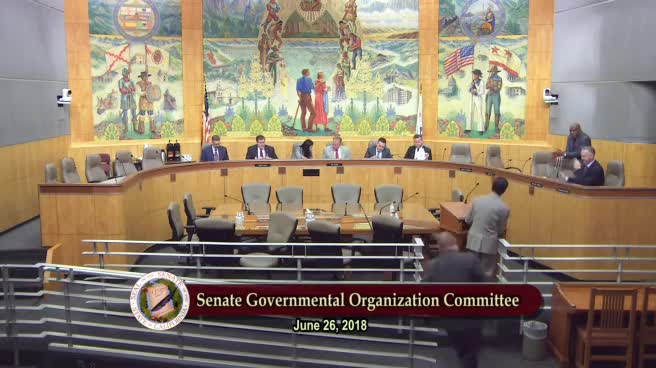 18MIN
Senate Standing Committee on Governmental Organization
 2MIN
Assembly Floor
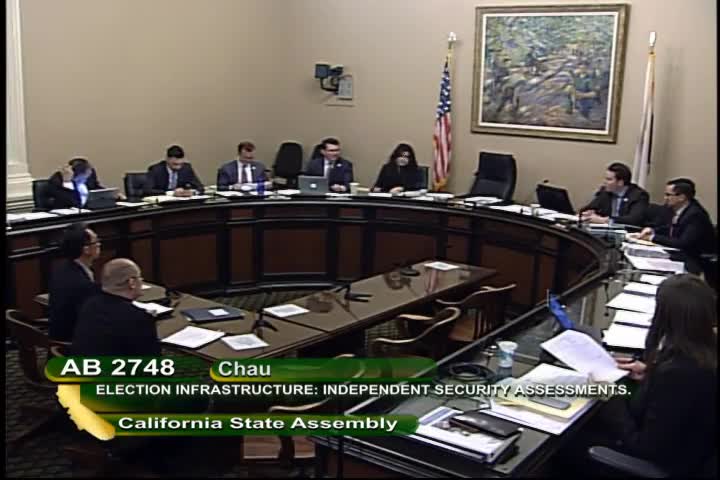 9MIN
Assembly Standing Committee on Privacy and Consumer Protection



Bill Co-Author(s):