AB 3228: School facilities: surplus real property: proceeds to pay emergency apportionment loan.
- Session Year: 2017-2018
- House: Assembly
- Latest Version Date: 2018-06-27
Existing law authorizes the governing board of any school district to sell any real property belonging to the school district, or lease for a term not exceeding 99 years any real property, together with any personal property located on the real property, belonging to the school district which is not or will not be needed by the school district for school classroom buildings at the time of delivery of title or possession, subject to specified procedures and requirements. Existing law authorizes the governing board of a school district to request an emergency apportionment through the Superintendent of Public Instruction if the governing board of the school district determines during a fiscal year that its revenues are less than the amount necessary to meet its current year expenditure obligations.
This bill, notwithstanding existing specified procedures and requirements for the sale of surplus real property by a school district, would authorize a school district that receives an emergency apportionment, and has an outstanding balance on its emergency apportionment loan, to sell or lease surplus real property, together with any personal property located on the real property, owned by the school district and use the proceeds from the sale or lease to service the debt on the emergency apportionment loan or to reduce or retire the emergency apportionment loan, as provided. The bill would prohibit a school district that uses the proceeds from the sale or lease of surplus real property pursuant to these provisions from being eligible for financial hardship assistance under the Leroy F. Greene School Facilities Act of 1998. The bill would provide that these provisions apply only to the Inglewood Unified School District, the Oakland Unified School District, the Vallejo City Unified School District, and the South Monterey County Joint Union High School District.
The bill would make these provisions inoperative on July 1, 2023, and would repeal them as of January 1, 2024.
This bill would make legislative findings and declarations as to the necessity of a special statute for the Inglewood Unified School District, the Oakland Unified School District, the Vallejo City Unified School District, and the South Monterey County Joint Union High School District.
Existing law authorizes the governing board of any school district to sell any real property belonging to the school district, or lease for a term not exceeding 99 years any real property, together with any personal property located on the real property, belonging to the school district which is not or will not be needed by the school district for school classroom buildings at the time of delivery of title or possession, subject to specified procedures and requirements. Existing law authorizes the governing board of a school district to request an emergency apportionment through the Superintendent of Public Instruction if the governing board of the school district determines during a fiscal year that its revenues are less than the amount necessary to meet its current year expenditure obligations.
This bill, notwithstanding existing specified procedures and requirements for the sale of surplus real property by a school district, would authorize a school district that receives an emergency apportionment, and has an outstanding balance on its emergency apportionment loan, to sell or lease surplus real property, together with any personal property located on the real property, owned by the school district and use the proceeds from the sale or lease to service the debt on the emergency apportionment loan or to reduce or retire the emergency apportionment loan, as provided. The bill would prohibit a school district that uses the proceeds from the sale or lease of surplus real property pursuant to these provisions from being eligible for financial hardship assistance under the Leroy F. Greene School Facilities Act of 1998.
The bill would make these provisions inoperative on July 1, 2023, and would repeal them as of January 1, 2024.
Existing law requires the State Board of Education to consider the adoption of a revised curriculum framework and evaluation criteria for instructional materials in science, as provided.This bill would make a nonsubstantive change to that provision.Existing law requires the State Board of Education to consider the adoption of a revised curriculum framework and evaluation criteria for instructional materials in science, as provided.
This bill would make a nonsubstantive change to that provision.
(a)Notwithstanding Sections 17456, 17457, 17462, and 17463, or any other law, a school district that receives an emergency apportionment pursuant to Article 2 (commencing with Section 41320) of Chapter 3 of Part 24 of Division 3 of Title 2, and has an outstanding balance on its emergency apportionment loan, may sell or lease surplus real property, together with any personal property located on the real property, owned by the school district and use the proceeds from the sale or lease to service the debt on the emergency apportionment loan or to reduce or retire the emergency apportionment loan. The sale of real property pursuant to this subdivision is not subject to Section 17459 or 17464.
(b)Notwithstanding any other law, a school district that uses the proceeds from the sale or lease of surplus real property pursuant to subdivision (a) shall not be eligible for financial hardship assistance pursuant to Article 8 (commencing with Section 17075.10) of Chapter 12.5 of Part 10.
(c)This section only applies to the Inglewood Unified School District, the Oakland Unified School District, the Vallejo City Unified School District, and the South Monterey County Joint Union High School District.
(d)Nothing in this section shall be construed as modifying the responsibility of a school district to house pupils in accordance with Section 47614.
(d)(e)This section shall become inoperative on July 1, 2023, and, as of January 1, 2024, is repealed.
SEC. 2.The Legislature finds and declares that a special statute is necessary and that a general statute cannot be made applicable within the meaning of Section 16 of Article IV of the California Constitution because of the unique financial circumstances involving the Inglewood Unified School District, the Oakland Unified School District, the Vallejo City Unified School District, and the South Monterey County Joint Union High School District.
(a)Notwithstanding Sections 17456, 17457, 17462, and 17463, or any other law, a school district that receives an emergency apportionment pursuant to Article 2 (commencing with Section 41320) of Chapter 3 of Part 24 of Division 3 of Title 2, and has an outstanding balance on its emergency apportionment loan, may sell or lease surplus real property, together with any personal property located on the real property, owned by the school district and use the proceeds from the sale or lease to service the debt on the emergency apportionment loan or to reduce or retire the emergency apportionment loan. The sale of real property pursuant to this subdivision is not subject to Section 17459 or 17464.
(b)Notwithstanding any other law, a school district that uses the proceeds from the sale or lease of surplus real property pursuant to subdivision (a) shall not be eligible for financial hardship assistance pursuant to Article 8 (commencing with Section 17075.10) of Chapter 12.5 of Part 10.
(c)This section only applies to the Inglewood Unified School District, the Oakland Unified School District, the Vallejo City Unified School District, and the South Monterey County Joint Union High School District.
(c)(d)This section shall become inoperative on July 1, 2023, and, as of January 1, 2024, is repealed.
SEC. 2.The Legislature finds and declares that a special statute is necessary and that a general statute cannot be made applicable within the meaning of Section 16 of Article IV of the California Constitution because of the unique financial circumstances involving the Inglewood Unified School District, the Oakland Unified School District, the Vallejo City Unified School District, and the South Monterey County Joint Union High School District.
(a)Notwithstanding Sections 17456, 17457, 17462, and 17463, or any other law, a school district that receives an emergency apportionment pursuant to Article 2 (commencing with Section 41320) of Chapter 3 of Part 24 of Division 3 of Title 2, and has an outstanding balance on its emergency apportionment loan, may sell or lease surplus real property, together with any personal property located on the real property, owned by the school district and use the proceeds from the sale or lease to service the debt on the emergency apportionment loan or to reduce or retire the emergency apportionment loan. The sale of real property pursuant to this subdivision is not subject to Section 17459 or 17464.
(b)Notwithstanding any other law, a school district that uses the proceeds from the sale or lease of surplus real property pursuant to subdivision (a) shall not be eligible for financial hardship assistance pursuant to Article 8 (commencing with Section 17075.10) of Chapter 12.5 of Part 10.
(c)This section shall become inoperative on July 1, 2023, and, as of January 1, 2024, is repealed.
SECTION 1.Section 60200.9 of the Education Code is amended to read:60200.9.On or before January 31, 2017, the state board shall consider the adoption of a revised curriculum framework and evaluation criteria for instructional materials in science. That revised curriculum framework shall be based on the science content standards adopted pursuant to former Section 60605.85, as that section read on June 30, 2014. In adopting the revised curriculum framework, the state board shall ensure both of the following:(a)Inclusion of English language development strategies that are aligned to the standards adopted pursuant to Section 60811.(b)Inclusion of strategies to address the needs of pupils with disabilities.On or before January 31, 2017, the state board shall consider the adoption of a revised curriculum framework and evaluation criteria for instructional materials in science. The That revised curriculum framework shall be based on the science content standards adopted pursuant to former Section 60605.85, as that section read on June 30, 2014. In adopting the revised curriculum framework, the state board shall ensure both of the following:
(a)Inclusion of English language development strategies that are aligned to the standards adopted pursuant to Section 60811.
(b)Inclusion of strategies to address the needs of pupils with disabilities.
|
Date
|
Status
|
|---|---|
| Aug 31, 2018 | Ordered to inactive file at the request of Senator Allen. |
| Aug 17, 2018 | From committee: Do pass. (Ayes 5. Noes 2.) (August 16). |
| Aug 6, 2018 | In committee: Referred to APPR. suspense file. |
| Jun 27, 2018 | Read second time and amended. Re-referred to Com. on APPR. |
| Jun 26, 2018 | From committee: Amend, and do pass as amended and re-refer to Com. on APPR. (Ayes 5. Noes 1.) (June 20). |
| Jun 13, 2018 | In committee: Set, first hearing. Hearing canceled at the request of author. |
| Jun 7, 2018 | Referred to Com. on ED. |
| May 30, 2018 | In Senate. Read first time. To Com. on RLS. for assignment. |
| May 29, 2018 | Read third time. Passed. Ordered to the Senate. |
| May 17, 2018 | Read second time. Ordered to third reading. |
| May 16, 2018 | From committee: Do pass. (Ayes 12. Noes 3.) (May 16). |
| May 2, 2018 | Re-referred to Com. on APPR. |
| May 1, 2018 | Read second time and amended. |
| Apr 30, 2018 | From committee: Amend, and do pass as amended and re-refer to Com. on APPR. (Ayes 6. Noes 0.) (April 25). |
| Apr 2, 2018 | Re-referred to Com. on ED. |
| Mar 22, 2018 | Referred to Com. on ED. |
| Feb 17, 2018 | From printer. May be heard in committee March 19. |
| Feb 16, 2018 | Read first time. To print. |
|
Date
|
Description
|
Location
|
Votes
|
|
|---|---|---|---|---|
| Aug 16, 2018 | Do pass | Senate Standing Committee on Appropriations |
Passed |
|
| Aug 6, 2018 | Placed on suspense file | Senate Standing Committee on Appropriations |
Passed |
|
| Jun 20, 2018 | Do pass as amended, but first amend, and re-refer to the Committee on [Appropriations] | Senate Standing Committee on Education |
Passed |
|
| May 29, 2018 | AB 3228 BURKE Assembly Third Reading | Assembly Floor |
Passed |
|
| May 16, 2018 | Do pass. | Assembly Standing Committee on Appropriations |
Passed |
|
| Apr 25, 2018 | Do pass as amended and be re-referred to the Committee on [Appropriations] | Assembly Standing Committee on Education |
Passed |
This list shows positions taken on this bill by organizations on the date displayed, which is linked to the original source.
Positions by individuals are not included.
Office of Senate Floor Analyses (916) 651-1520 Fax: (916) 327-4478 | AB |
THIRD READING
Bill No: AB 3228
:
SENATE EDUCATION COMMITTEE: 5-1, 6/20/18
AYES: Allen, Galgiani, Leyva, McGuire, Pan
NOES: Vidak
NO VOTE RECORDED: Wilk
SENATE APPROPRIATIONS COMMITTEE: 5-2, 8/16/18
AYES: Portantino, Beall, Bradford, Hill, Wiener
NOES: Bates, Nielsen
ASSEMBLY FLOOR: 53-20, 5/29/18 - See last page for vote
SOURCE: State Superintendent of Instruction
DIGEST:
This bill authorizes four specified school districts currently under state receivership to bypass existing priorities for sale of surplus property and use the proceeds from the sale or lease of surplus property towards the outstanding balance on the district’s state emergency apportionment loan.
Existing law:
- Requires that emergency loans requested by a school district in fiscal crisis be provided by legislative appropriation.
- Requires, upon a district's acceptance of an emergency loan exceeding 200 percent of a district's recommended reserve, that the Superintendent of Public Instruction (SPI) assumes all the legal rights, duties and powers of the district governing board, authorizes the SPI to appoint an administrator to act on his or her behalf, and requires that the district governing board become advisory to the administrator.
- Establishes a mandatory process for school districts seeking to sell or lease surplus property. Specifically, school districts must:
- Identify surplus property and convene an advisory committee to develop a district-wide policy and hold hearings on the use of surplus property.
- Declare publically their intent to sell or lease surplus property, with the governing board considering the advisory committee’s recommendation that the property be declared surplus and declaring its intent to dispose of the property in a resolution.
- Until June 30, 2016, offer to sell or lease real property to any charter school that has submitted a written request to the school district to be notified of surplus property offered for sale or lease by the school district and that meets certain other criteria.
- For property subject to the Naylor Act (property that has been used entirely or partially for outdoor recreational or playground purposes), offer the property to the following entities in order of priority:
- Until June 30, 2016, a requesting charter school.
- Any city within which the land is located.
- Any park or recreation district within which the land is located.
- Any regional park authority in the area where the land is located.
- Any county within which the land may be situated.
- For sale or lease with option to purchase, offer the property to the following entities in order of priority:
- Until June 30, 2016, a requesting charter school.
- To any park or recreation department of the city or county, any regional park authority having jurisdiction within the area, and to the State Resources Agency or any agency that may succeed to its powers.
- In writing, to the Director of General Services, the Regents of the University of California, the Trustees of the California State University, the county and city in which the property is situated.
- By public notice, to any public housing authority in the county in which the property is situated, and to any public district, public authority, public agency, public corporation, or any other political subdivision in the state, to the federal government, and to nonprofit charitable corporations, as specified.
- Requires, generally, school district proceeds from the sale of property to be used for capital outlay costs and proceeds from the lease of property with an option to purchase to be used for routine restricted maintenance. In addition, proceeds from the sale or lease with option to purchase may be used for one-time general fund purposes if the school district governing board and the State Allocation Board determines that the district has no anticipated need for additional sites or building construction for the next ten years, and the district has no major deferred maintenance.
- Establishes the School Facility Program under which the state provides general obligation bond funding for various school construction projects.
- Authorizes the State Allocation Board to establish a program that requires a local educational agency that sells real property to return any state funds that were provided to purchase or improve the property if the real property was purchased or improved within 10 years before the real property is sold, and if the property is not sold to a charter school, school district, county office of education, or an agency that will use the property exclusively for the delivery of child care and development services. (EC § 17462.3)
- Authorized, until January 1, 2016, school districts to deposit the proceeds from the sale of surplus property purchased entirely with local funds into the general fund of the school district and authorized the school district to use the proceeds for any one-time general fund purpose.
This bill:
- Authorizes, until July 1, 2023, a school district that receives an emergency apportionment and has an outstanding balance on its emergency apportionment loan to sell or lease surplus real property, together with any personal property located on the real property, owned by the school district and use the proceeds from the sale or lease to service the debt on the emergency apportionment loan or to reduce or retire the emergency apportionment loan.
- Specifies that the sale of real property is not subject to the provisions governing priorities for sale of surplus property.
- Specifies that a school district that uses the proceeds from the sale or lease of surplus real property for the purpose specified by this bill shall not be eligible for financial hardship assistance in the state school facilities bond program.
- Applies only to the Inglewood Unified School District, the Oakland Unified School District, the Vallejo City Unified School District, and the South Monterey County Joint Union High School District.
- Specifies that nothing in the bill shall be construed as modifying the existing requirement of a school district to house pupils.
Comments
- Need for the bill. According to the author, “AB 3228 recognizes that school districts in California that received an emergency loan from the State during fiscal crises must bear the cost of repaying the State for principal and interest on their loans, which depletes critical financial resources that could otherwise be used in the classroom to support student learning and achievement.
“This bill also recognizes that districts under State receivership continue to have school construction needs that must be addressed for the students they serve. Finally, this bill recognizes the value of school district capital assets as one of the largest assets they own.”
- Emergency apportionment loans for school districts. AB 1200 (Chapter 1213, Statutes of 1991) established a process that delineates the duties and responsibilities of both the state and the school district when emergency loans need to be granted to school districts due to insolvency. Once an emergency loan is made to a school district, the SPI appoints an individual as the administrator over the district. The state-appointed administrator effectively functions as both the district superintendent and the district governing board; the district governing board stays in place, but is authorized to act only in an advisory manner. Due to the nature of the issues facing districts in this situation, as well as the large state interest in the form of the outstanding emergency loan, state-appointed administrators are charged with returning the district to fiscal health and generally stay in place for a number of years. There is an existing process in statute that triggers a transitional return of powers to the local governing board; however, even after the full return of powers to the board a state presence, in the form of a state-appointed trustee with stay and rescind powers, is kept in the district until the emergency loan is fully repaid.
There are four districts under current state oversight, one of which, Inglewood Unified School District (USD), has an administrator, while the other three, Oakland USD, South Monterey County Joint Union High School District (formerly King City Joint Union High), and Vallejo City USD, have appointed trustees.
- Restrictions on use of property sale or lease proceeds. Existing law requires school districts to establish routine facilities accounts and deferred maintenance accounts, and requires proceeds from the sale of surplus property to stay in capital facilities or maintenance funds to ensure that districts protect and maintain their facilities. There is one exception in existing law that authorizes the proceeds from the sale of surplus property to be deposited into the general fund for one-time expenditures. As a condition for using funds for one-time general fund purposes, a district must show that it has no need for additional sites or building construction for a ten-year period following the sale of the property and may not apply for state bond funds during the 10-year period. The district may apply for funds after five years if the State Allocation Board, the appointed body that administers state education bond funds, determines that the district demonstrates enrollment growth or a need for additional sites it could not have anticipated.
- These districts have been given this authority previously. All four school districts under state oversight received prior authority to sell surplus property and use the proceeds to pay state loans. All four of the authorizations have expired. This bill is similar to the provisions in prior authorizations except that this bill provides general authorization to any school district under receivership and has a loan balance, whereas prior authorizations have been specific to a school district. All of the authorizations allow a school district to not comply with existing law specifying how surplus property is to be sold, to whom the property must be offered for sale, and where the funds must be deposited and used. The authorizations do not prohibit a school district from applying for future state bond funds under the School Facility Program, but prohibit the districts from receiving up to 100 percent of the cost of a project due to financial hardship.
FISCAL EFFECT: Appropriation: Fiscal Com.: Local:
According to the Senate Appropriations Committee, by allowing a district to use the proceeds from the sale or lease of surplus property towards its emergency apportionment loan and retain its eligibility to apply for new construction or modernization funding under the School Facilities Program, this bill could put significant cost pressure, potentially in the millions of dollars, on limited school facility bond funds. These costs could be higher or lower depending on the number of school districts electing to utilize the bill’s authority and pursue construction funds through School Facilities Program. Staff notes that this bill prohibits the districts from receiving up to 100 percent of the cost of a project due to financial hardship.
State Superintendent of Public Instruction (source)
Inglewood Unified School District
Los Angeles County Office of Education
Oakland Unified School District
OPPOSITION: (Verified 8/16/18)
Charter Schools Development Center
ASSEMBLY FLOOR: 53-20, 5/29/18
AYES: Aguiar-Curry, Arambula, Berman, Bloom, Bonta, Burke, Caballero, Calderon, Carrillo, Cervantes, Chau, Chiu, Chu, Cooley, Cooper, Daly, Eggman, Friedman, Cristina Garcia, Eduardo Garcia, Gipson, Gloria, Gonzalez Fletcher, Gray, Grayson, Holden, Irwin, Jones-Sawyer, Kalra, Kamlager-Dove, Lackey, Levine, Limón, Low, McCarty, Medina, Mullin, Muratsuchi, Nazarian, O'Donnell, Quirk, Quirk-Silva, Reyes, Rodriguez, Rubio, Salas, Santiago, Mark Stone, Thurmond, Ting, Weber, Wood, Rendon
NOES: Acosta, Travis Allen, Baker, Bigelow, Brough, Chávez, Chen, Choi, Cunningham, Dahle, Gallagher, Harper, Kiley, Maienschein, Mathis, Melendez, Obernolte, Patterson, Voepel, Waldron
NO VOTE RECORDED: Flora, Fong, Frazier, Mayes, Steinorth
8/18/18 13:52:18
**** END ****
SENATE COMMITTEE ON APPROPRIATIONS
Senator Anthony Portantino, Chair
2017 - 2018 Regular Session
AB 3228 (Burke) - School facilities: surplus real property: proceeds to pay emergency apportionment loan
Version: June 27, 2018 | Policy Vote: ED. 5 - 1 |
Urgency: No | Mandate: No |
Hearing Date: August 6, 2018 | Consultant: Lenin Del Castillo |
This bill meets the criteria for referral to the Suspense File.
Bill Summary:
This bill authorizes four school districts currently under state receivership (Inglewood, Oakland, Vallejo City, and South Monterey County) to bypass existing priorities for sale of surplus property and use the proceeds from the sale or lease of surplus property towards the outstanding balance on the district’s state emergency apportionment loan.
Fiscal Impact:
By allowing a district to use the proceeds from the sale or lease of surplus property towards its emergency apportionment loan and retain its eligibility to apply for new construction or modernization funding under the School Facilities Program, this bill could put significant cost pressure, potentially in the millions of dollars, on limited school facility bond funds. These costs could be higher or lower depending on the number of school districts electing to utilize the bill’s authority and pursue construction funds through School Facilities Program. Staff notes that the bill would prohibit the districts from receiving up to 100 percent of the cost of a project due to financial hardship.
Background:
Existing law provides emergency loans requested by a school district in fiscal crisis shall be provided by legislative appropriation. It requires, upon a district's acceptance of an emergency loan exceeding 200 percent of a district's recommended reserve, that the Superintendent of Public Instruction (SPI) assumes all the legal rights, duties and powers of the district governing board, authorizes the SPI to appoint an administrator to act on his or her behalf, and requires that the district governing board become advisory to the administrator.
Existing law establishes a mandatory process for school districts seeking to sell or lease surplus property. Specifically, school districts must:
- Identify surplus property and convene an advisory committee to develop a district-wide policy and hold hearings on the use of surplus property.
- Declare publically their intent to sell or lease surplus property, with the governing board considering the advisory committee’s recommendation that the property be declared surplus and declaring its intent to dispose of the property in a resolution.
- For property subject to the Naylor Act (property that has been used entirely or partially for outdoor recreational or playground purposes), offer the property to the following entities in order of priority, as specified.
- For sale or lease with option to purchase, offer the property to the following entities in order of priority:
- To any park or recreation department of the city or county, any regional park authority having jurisdiction within the area, and to the State Resources Agency or any agency that may succeed to its powers.
- In writing, to the Director of General Services, the Regents of the University of California, the Trustees of the California State University, the county and city in which the property is situated.
- By public notice, to any public housing authority in the county in which the property is situated, and to any public district, public authority, public agency, public corporation, or any other political subdivision in the state, to the federal government, and to nonprofit charitable corporations, as specified.
Proposed Law:
This bill authorizes, until July 1, 2023, a school district that receives an emergency apportionment and has an outstanding balance on its emergency apportionment loan to sell or lease surplus real property, together with any personal property located on the real property, owned by the school district and use the proceeds from the sale or lease to service the debt on the emergency apportionment loan or to reduce or retire the emergency apportionment loan.
This bill specifies that the sale of real property is not subject to the provisions governing priorities for sale of surplus property, and that a school district that uses the proceeds from the sale or lease of surplus real property for the purposes of this bill shall not be eligible for financial hardship assistance in the state School Facilities Program.
The bill provides that nothing shall be interpreted to change the obligation of school districts to house pupils in accordance with Section 47614 and no pupils or programs housed in accordance with Section 47614 shall be displaced as a result of the bill.
The provisions of the bill would apply to the Inglewood Unified School District, the Oakland Unified School District, the Vallejo City Unified School District, and the South Monterey County Joint Union High School District.
Staff Comments:
Existing law generally requires school district proceeds from the sale of property to be used for capital outlay costs and proceeds from the lease of property with option to purchase to be used for routine restricted maintenance. In addition, proceeds from the sale or lease with option to purchase may be used for one-time general fund purposes if the school district governing board and the State Allocation Board determines that the district has no anticipated need for additional sites or building construction for the next ten years, and the district has no major deferred maintenance. Further, school districts that sell surplus property may not apply for new construction or modernization funding under the School Facilities Program unless five years have elapsed since the sale was executed and the State Allocation Board determines that the district has demonstrated enrollment growth or a need for additional sites or building construction that the district could not have easily anticipated at the time the board made its original determination that the district had no anticipated need for the ten-year period following the sale.
This bill essentially allows a district to bypass existing priorities for sale of surplus property and use the proceeds towards the outstanding balance on its state emergency apportionment loan, and also retain its eligibility to apply for new construction or modernization funding under the School Facilities Program. This could put significant cost pressure on limited school facility bond funds. The extent of these costs is unknown and would depend on the extent to which the school districts elect to utilize this authority. If the bill leads to just one or two such circumstances, the cost pressure could be in the millions. This estimate assumes the average cost of a new construction project ($3.4 million) or modernization project ($1.7 million). Staff notes that Proposition 51, a $9 billion state bond measure for community college and K-12 school construction, was approved by voters in November 2016.
-- END --
SENATE COMMITTEE ON EDUCATION
Senator Benjamin Allen, Chair
2017 - 2018 Regular
Bill No: Hearing Date: June 20, 2018
Author: | Burke | ||
Version: |
| ||
Urgency: | Fiscal: | ||
Consultant: | |||
Subject:
SUMMARY
This bill authorizes four specified school districts currently under state receivership to bypass existing priorities for sale of surplus property and use the proceeds from the sale or lease of surplus property towards the outstanding balance on the district’s state emergency apportionment loan.
BACKGROUND
Existing law:
- Requires that emergency loans requested by a school district in fiscal crisis be provided by legislative appropriation.
- Requires, upon a district's acceptance of an emergency loan exceeding 200 percent of a district's recommended reserve, that the Superintendent of Public Instruction (SPI) assumes all the legal rights, duties and powers of the district governing board, authorizes the SPI to appoint an administrator to act on his or her behalf, and requires that the district governing board become advisory to the administrator.
- Establishes a mandatory process for school districts seeking to sell or lease surplus property. Specifically, school districts must:
- Identify surplus property and convene an advisory committee to develop a district-wide policy and hold hearings on the use of surplus property.
- Declare publically their intent to sell or lease surplus property, with the governing board considering the advisory committee’s recommendation that the property be declared surplus and declaring its intent to dispose of the property in a resolution.
- Until June 30, 2016, offer to sell or lease real property to any charter school that has submitted a written request to the school district to be notified of surplus property offered for sale or lease by the school district and that meets certain other criteria.
- For property subject to the Naylor Act (property that has been used entirely or partially for outdoor recreational or playground purposes), offer the property to the following entities in order of priority:
- Until June 30, 2016, a requesting charter school.
- Any city within which the land is located.
- Any park or recreation district within which the land is located.
- Any regional park authority in the area where the land is located.
- Any county within which the land may be situated.
- For sale or lease with option to purchase, offer the property to the following entities in order of priority:
- Until June 30, 2016, a requesting charter school.
- To any park or recreation department of the city or county, any regional park authority having jurisdiction within the area, and to the State Resources Agency or any agency that may succeed to its powers.
- In writing, to the Director of General Services, the Regents of the University of California, the Trustees of the California State University, the county and city in which the property is situated.
- By public notice, to any public housing authority in the county in which the property is situated, and to any public district, public authority, public agency, public corporation, or any other political subdivision in the state, to the federal government, and to nonprofit charitable corporations, as specified.
- Generally requires school district proceeds from the sale of property to be used for capital outlay costs and proceeds from the lease of property with an option to purchase to be used for routine restricted maintenance. In addition, proceeds from the sale or lease with option to purchase may be used for one-time general fund purposes if the school district governing board and the State Allocation Board determines that the district has no anticipated need for additional sites or building construction for the next ten years, and the district has no major deferred maintenance.
- Establishes the School Facility Program under which the state provides general obligation bond funding for various school construction projects.
- Authorizes the State Allocation Board to establish a program that requires a local educational agency that sells real property to return any state funds that were provided to purchase or improve the property if the real property was purchased or improved within 10 years before the real property is sold, and if the property is not sold to a charter school, school district, county office of education, or an agency that will use the property exclusively for the delivery of child care and development services. (EC § 17462.3)
- Until January 1, 2016, authorized school districts to deposit the proceeds from the sale of surplus property purchased entirely with local funds into the general fund of the school district and authorized the school district to use the proceeds for any one-time general fund purpose.
ANALYSIS
This bill:
- Authorizes, until July 1, 2023, a school district that receives an emergency apportionment and has an outstanding balance on its emergency apportionment loan to sell or lease surplus real property, together with any personal property located on the real property, owned by the school district and use the proceeds from the sale or lease to service the debt on the emergency apportionment loan or to reduce or retire the emergency apportionment loan.
- Specifies that the sale of real property is not subject to the provisions governing priorities for sale of surplus property.
- Specifies that a school district that uses the proceeds from the sale or lease of surplus real property for the purpose specified by this bill shall not be eligible for financial hardship assistance in the state school facilities bond program.
- Applies only to the Inglewood Unified School District, the Oakland Unified School District, the Vallejo City Unified School District, and the South Monterey County Joint Union High School District.
STAFF COMMENTS
- Need for the bill. According to the author, “AB 3228 recognizes that school districts in California that received an emergency loan from the State during fiscal crises must bear the cost of repaying the State for principal and interest on their loans, which depletes critical financial resources that could otherwise be used in the classroom to support student learning and achievement.
This bill also recognizes that districts under State receivership continue to have school construction needs that must be addressed for the students they serve. Finally, this bill recognizes the value of school district capital assets as one of the largest assets they own.”
- Emergency apportionment loans for school districts. AB 1200, Chapter 1213, Statutes of 1991, established a process that delineates the duties and responsibilities of both the state and the school district when emergency loans need to be granted to school districts due to insolvency. Once an emergency loan is made to a school district, the SPI appoints an individual as the administrator over the district. The state-appointed administrator effectively functions as both the district superintendent and the district governing board; the district governing board stays in place, but is authorized to act only in an advisory manner. Due to the nature of the issues facing districts in this situation, as well as the large state interest in the form of the outstanding emergency loan, state-appointed administrators are charged with returning the district to fiscal health and generally stay in place for a number of years. There is an existing process in statute that triggers a transitional return of powers to the local governing board; however, even after the full return of powers to the board a state presence, in the form of a state-appointed trustee with stay and rescind powers, is kept in the district until the emergency loan is fully repaid.
There are four districts under current state oversight, one of which, Inglewood Unified School District (USD), has an administrator, while the other three, Oakland USD, South Monterey County Joint Union High School District (formerly King City Joint Union High), and Vallejo City USD, have appointed trustees.
- Restrictions on use of property sale or lease proceeds. Existing law requires school districts to establish routine facilities accounts and deferred maintenance accounts, and requires proceeds from the sale of surplus property to stay in capital facilities or maintenance funds to ensure that districts protect and maintain their facilities. There is one exception in existing law that authorizes the proceeds from the sale of surplus property to be deposited into the general fund for one-time expenditures. As a condition for using funds for one-time general fund purposes, a district must show that it has no need for additional sites or building construction for a ten-year period following the sale of the property and may not apply for state bond funds during the ten-year period. The district may apply for funds after five years if the SAB, the appointed body that administers state education bond funds, determines that the district demonstrates enrollment growth or a need for additional sites it could not have anticipated.
- These districts have been given this authority previously. All four school districts under state oversight received prior authority to sell surplus property and use the proceeds to pay state loans. All four of the authorizations have expired. This bill is similar to the provisions in prior authorizations except that this bill provides general authorization to any school district under receivership and has a loan balance, whereas prior authorizations have been specific to a school district. All of the authorizations allow a school district to not comply with existing law specifying how surplus property is to be sold, to whom the property must be offered for sale, and where the funds must be deposited and used. The authorizations do not prohibit a school district from applying for future state bond funds under the School Facility Program, but prohibit the districts from receiving up to 100 percent of the cost of a project due to financial hardship.
- Concerns raised by charter school advocates. Charter advocates have raised concerns that this bill could be interpreted as alleviating school districts form their existing requirement to make school facilities available to charter schools operating within their district. If it is the desire of the Committee to pass this measure, staff recommends amending the bill to clarify that nothing in the bill shall be interpreted to change the obligation of school districts to house pupils in accordance with Section 47614 and no pupils or programs housed in accordance with Section 47614 shall be displaced as a result of the bill.
- Previous legislation.
SB 533 (Wright), Chapter 325, Statutes of 2012, authorized a state loan for the Inglewood USD and authorized the district to sell surplus property between September 1, 2012 and June 30, 2015.
AB 677 (Skinner), Chapter 164, Statutes of 2011, extended Oakland USD’s authority from January 1, 2012 to June 30, 2016.
AB 1874 (Evans), Chapter 147, Statutes of 2010, extended Vallejo City USD’s authority to June 30, 2015.
SB 130 (Denham), Chapter 20, Statutes of 2009, authorized a state loan for King City Joint Union High School District, and authorized the district to sell surplus property between June 1, 2009 and June 30, 2012.
AB 1948 (Evans), Chapter 636, Statutes of 2008, extended Vallejo City USD’s authority from June 1, 2004 to July 1, 2010.
SB 512 (Committee on Education), Chapter 677, Statutes of 2005, extended Oakland USD’s authority from June 30, 2005 to June 30, 2007.
SUPPORT
State Superintendent of Public Instruction (sponsor)
Inglewood Unified School District
Los Angeles County Office of Education
Oakland Unified School District
OPPOSITION
Charter Schools Development Center
-- END --
ASSEMBLY THIRD READING
ATR Bill Id:AB 3228
Author:(Burke)
As Amended Ver:May 1, 2018
Majority vote
Committee | Votes | Ayes | Noes |
Education | 6-0 | O'Donnell, Kalra, McCarty, Steinorth, Thurmond, Weber | |
Appropriations | 12-3 | Gonzalez Fletcher, Bloom, Bonta, Calderon, Carrillo, Chau, Eggman, Friedman, Eduardo Garcia, Nazarian, Quirk, Reyes | Bigelow, Brough, Obernolte |
SUMMARY: Authorizes, until July 1, 2023, Inglewood Unified School District (USD), Oakland USD, South Monterey County Joint Union High School District (formerly King City Joint Union High), and Vallejo City USD to sell or lease surplus real property, together with any personal property located on the real property, owned by the school district and use the proceeds from the sale or lease to service the debt on an emergency apportionment loan or to reduce or retire the emergency apportionment loan. Specifies the following: 1) that the sale of real property is not subject to the provisions governing priorities for sale of surplus property; and 2) that a school district that uses the proceeds from the sale or lease of surplus real property for the purpose specified by this bill shall not be eligible for financial hardship assistance in the state school facilities bond program.
FISCAL EFFECT: According to the Assembly Appropriations Committee, likely cost neutral. If school districts do not have or use the authority granted in this bill, they would still make emergency loan payments to the state, likely from their Proposition 98 General Fund apportionments.
COMMENTS: Background on school district emergency loans. AB 1200 (Eastin), Chapter 1213, Statutes of 1991, established a process that delineates the duties and responsibilities of both the state and the school district when emergency loans need to be granted to school districts due to insolvency. Once an emergency loan is made to a school district, the State Superintendent of Public Instruction (SPI) appoints an individual as the administrator over the district. The state appointed administrator effectively functions as both the district superintendent and the district governing board; the district governing board stays in place, but is authorized to act only in an advisory manner. Due to the nature of the issues facing districts in this situation, as well as the large state interest in the form of the outstanding emergency loan, state-appointed administrators are charged with returning the district to fiscal health and generally stay in place for a number of years. There is an existing process in statute that triggers a transitional return of powers to the local governing board; however, even after the full return of powers to the board a state presence, in the form of a state-appointed trustee with stay and rescind powers, is kept in the district until the emergency loan is fully repaid.
According to the California Department of Education (CDE), the following districts have received emergency loans:
District | Year Authorized | Loan | Amount Paid by District | Pay Off Date |
Inglewood USD | 2012 | $29,000,000 | $5,495,952 | November 2033 |
South Monterey County Joint Union High (formerly King City Joint Union High) | 2009 | $13,000,000 | $7,708,369 | October 2028 |
Vallejo City USD | 2004 | $60,000,000 | $43,896,904 | January 2024 (I-bank) August 2024 (General Fund) |
Oakland USD | 2003 | $100,000,000 | $77,511,409 | January 2023 (I-bank) June 2026 (General Fund) |
West Fresno ESD | 2003 | $1,300,000 | $1,425,773 | December 2010 |
Emery USD | 2001 | $1,300,000 | $1,742,501 | June 2011 |
Compton USD | 1993 | $19,951,259 | $24,358,061 | June 2001 |
Coachella Valley USD | 1992 | $7,300,000 | $9,271,830 | December 2001 |
W. Contra Costa USD | 1990 | $28,525,000 | $47,688,620 | May 2012 |
There are four districts under current state oversight, one of which, Inglewood USD, has an administrator, while the other three, Oakland USD, South Monterey County Joint Union High School District (formerly King City Joint Union High), and Vallejo City USD, have appointed trustees.
Background on use of proceeds from the sale of surplus property. Existing law requires school districts to establish routine facilities accounts and deferred maintenance accounts, and requires proceeds from the sale of surplus property to stay in capital facilities or maintenance funds to ensure that districts protect and maintain their facilities. There is one exception in existing law that authorizes the proceeds from the sale of surplus property to be deposited into the general fund for one-time expenditures. As a condition for using funds for one-time general fund purposes, a district must show that it has no need for additional sites or building construction for a ten-year period following the sale of the property and may not apply for state bond funds during the ten-year period. The district may apply for funds after five years if the State Allocation Board, the appointed body that administers state education bond funds, determines that the district demonstrates enrollment growth or a need for additional sites it could not have anticipated.
Prior authorizations. All four school districts under state oversight received prior authority to sell surplus property and use the proceeds to pay state loans. All four of the authorizations have expired. This bill is similar to the provisions in prior authorizations. All of the authorizations allow a school district to waive existing law specifying how surplus property is to be sold, to whom the property must be offered for sale, and where the funds must be deposited and used. The authorizations do not prohibit a school district from applying for future state bond funds under the School Facility Program, but prohibit the districts from receiving up to 100% of the cost of a project due to financial hardship.
Authority exercised? According to the CDE, Oakland USD and Inglewood USD did not exercise prior authority. Vallejo USD have sold and leased property to pay state loans. This bill is sponsored by the SPI and not the school districts. It is unknown whether the four school districts have surplus property or have plans to sell surplus property in order to pay state loans.
Need for facilities. State law and policy direct proceeds from the sale of surplus property to be used for facilities purposes and prohibits uses for general fund purposes. In determining whether a district has needs for new schools, it may be helpful to review the district's enrollment pattern. Of the four districts, Inglewood USD is the only district that appears to be declining. The other three districts have seen incremental increases in enrollment over the last four years. It is not known what these four districts' needs are for modernization of their existing facilities.
The SPI states, "These districts are balancing between paying back the loan and keeping schools operating, which depletes critical financial resources that could otherwise be used in the classroom to support student learning and achievement. By allowing these districts to lease or sell surplus property, AB 3228 is providing them with other options to raise money to repay the loan and minimize the impact on the classroom."
Analysis Prepared by: Sophia Kwong Kim / ED. / (916) 319-2087 FN: 0002970
Date of Hearing: May 16, 2018
ASSEMBLY COMMITTEE ON APPROPRIATIONS
Lorena Gonzalez Fletcher, Chair
ABPCA Bill Id:AB 3228
Author:(Burke) – As Amended Ver:May 1, 2018
Policy Committee: | Education | Vote: | 6 - 0 |
|
| ||
|
|
Urgency: No State Mandated Local Program: No Reimbursable: No
SUMMARY: This bill extends, until July 1, 2023, authority for each of four school districts that has received an emergency loan from the state with an outstanding balance to sell or lease surplus property owned by the school district and use the proceeds to pay down its emergency state loan balance and adds a provision allowing them to lease surplus property for the same purpose. These school districts are Inglewood Unified School District (USD), Oakland USD, Vallejo City USD, and South Monterey County Joint Union High School District. It also specifies each district will not be eligible for financial hardship assistance in the state school facilities bond program if it uses the authority granted in this bill.
FISCAL EFFECT:
Likely cost neutral. If school districts do not have or use the authority granted in this bill, they would still make emergency loan payments to the state, likely from their Proposition 98 GF apportionments.
COMMENTS:
- School District Emergency Loans. AB 1200 (Eastin), Chapter 1213, Statutes of 1991, established a process that delineates the duties and responsibilities of the state and school districts when emergency loans are granted to school districts due to insolvency. There are four districts with outstanding emergency loans to the state: Inglewood USD, Oakland USD, South Monterey County Joint Union High School District (formerly King City Joint Union High), and Vallejo City USD.
Inglewood USD’s loan of $29 million was authorized in 2012 and the district has paid $5.5 million. Oakland USD’s loan of $100 million was authorized in 2003 and the district has paid $77.5 million. South Monterey County Joint Union High School District’s loan of $13 million was authorized in 2009 and the district has paid $7.7 million. Vallejo City USD’s loan of $60 million was authorized 2004 and the district has paid $44 million.
- Sale of Surplus Property. Typically, school districts must use the proceeds from any sale or lease of surplus property to protect and maintain their other facilities. The four school districts defined in this bill have received prior authority to sell surplus property and use the proceeds to pay off state loans, and all four authorizations have expired.
According to the CDE, the sponsor of this bill, Oakland USD and Inglewood USD did not exercise the authority. It is unknown whether the four school districts have surplus property or have plans to sell or lease surplus property in order to pay state loans.
- Financial Hardship Facilities Funding. The state’s School Facility Program provides grants to school districts that cover half of the cost of new construction projects and a larger share for modernization projects. In cases where school districts can demonstrate they cannot provide matching funds for new projects, the state may grant them Financial Hardship status. This provides additional funding of up to 100% of a district share for a School Facility Program project.
This bill does not prohibit a school district from applying for future state bond under the School Facility Program if it uses its sale or lease of surplus property authority, but it prohibits the district from receiving financial hardship status, such that it would receive a higher match than other school districts.
- Prior Legislation. The following bills were all similar, giving authority to individual districts over specified time periods to sell surplus property and use the proceeds pay down state loans:
SB 533 (Wright), Chapter 325, Statutes of 2012, authorized a state loan for the Inglewood USD and authorized the district to sell surplus property between September 1, 2012 and June 30, 2015.
AB 677 (Skinner), Chapter 164, Statutes of 2011, extended Oakland USD’s authority from January 1, 2012, to June 30, 2016.
AB 1874 (Evans), Chapter 147, Statutes of 2010, extended Vallejo City USD’s authority to June 30, 2015.
SB 130 (Denham), Chapter 20, Statutes of 2009, authorized a state loan for King City Joint Union High School District and authorized the district to sell surplus property between June 1, 2009, and June 30, 2012.
AB 1948 (Evans), Chapter 636, Statutes of 2008, extended Vallejo City USD’s authority from June 1, 2004, to July 1, 2010.
SB 512 (Committee on Education), Chapter 677, Statutes of 2005, extended Oakland USD’s authority from June 30, 2005, to June 30, 2007.
Analysis Prepared by: Natasha Collins / APPR. / (916) 319-2081
Date of Hearing: April 25, 2018
ASSEMBLY COMMITTEE ON EDUCATION
Patrick O'Donnell, Chair
ABPCA Bill Id:AB 3228 (
Author:Burke) – As Amended Ver:March 22, 2018
SUBJECT: School facilities: surplus real property: proceeds to pay emergency apportionment loan
SUMMARY: Authorizes, until July 1, 2023, a school district that receives an emergency apportionment and has an outstanding balance on its emergency apportionment loan to sell or lease surplus real property, together with any personal property located on the real property, owned by the school district and use the proceeds from the sale or lease to service the debt on the emergency apportionment loan or to reduce or retire the emergency apportionment loan. Specifies that the sale of real property is not subject to the provisions governing priorities for sale of surplus property. Specifies that a school district that uses the proceeds from the sale or lease of surplus real property for the purpose specified by this bill shall not be eligible for financial hardship assistance in the state school facilities bond program.
EXISTING LAW:
- Requires that emergency loans requested by a school district in fiscal crisis be provided by legislative appropriation. (Education Code (EC) Section 41320.2)
- Requires, upon a district's acceptance of an emergency loan exceeding 200 percent of a district's recommended reserve, that the Superintendent of Public Instruction (SPI) assumes all the legal rights, duties and powers of the district governing board, authorizes the SPI to appoint an administrator to act on his or her behalf, and requires that the district governing board become advisory to the administrator. (EC Section 41326)
- Expresses the intent of the Legislature to have the community involved before decisions are made about school closure or the use of surplus space, thus avoiding community conflict and assuring building use that is compatible with the community’s needs and desires. (EC Section 17387)
- Requires funds from the sale of surplus property to be used for capital outlay or for costs of maintenance of school district property that the local governing board determines will not recur within a five-year period. (EC Section 17462)
- Authorizes proceeds from the sale or lease with the option to purchase to be deposited in the general fund if the school district governing board and the State Allocation Board (SAB) have determined that the district has no anticipated need for additional sites or building construction for the ten-year period following the sale or lease with option to purchase, and the district has no major deferred maintenance requirements. Authorizes proceeds from the sale or lease with option to purchase of school district property to be used for one-time expenditures, and may not be used for ongoing expenditures including, but not limited to, salaries and other general operating expenses. (EC Section 17462)
FISCAL EFFECT: Unknown
COMMENTS: This bill authorizes, until July 1, 2023, a school district that has received an emergency apportionment and has an outstanding balance to sell or lease surplus real property, and use the proceeds from the sale or lease to service the debt on the emergency loan or to reduce or retire the emergency apportionment loan.
Background on school district emergency loans: AB 1200, Chapter 1213, Statutes of 1991, established a process that delineates the duties and responsibilities of both the state and the school district when emergency loans need to be granted to school districts due to insolvency. Once an emergency loan is made to a school district, the SPI appoints an individual as the administrator over the district. The state appointed administrator effectively functions as both the district superintendent and the district governing board; the district governing board stays in place, but is authorized to act only in an advisory manner. Due to the nature of the issues facing districts in this situation, as well as the large state interest in the form of the outstanding emergency loan, state-appointed administrators are charged with returning the district to fiscal health and generally stay in place for a number of years. There is an existing process in statute that triggers a transitional return of powers to the local governing board; however, even after the full return of powers to the board a state presence, in the form of a state-appointed trustee with stay and rescind powers, is kept in the district until the emergency loan is fully repaid.
According to the California Department of Education (CDE), the following districts have received emergency loans:
District | Year Authorized | Loan | Amount Paid by District | Pay Off Date |
Inglewood USD | 2012 | $29,000,000 | $5,495,952 | November 2033 |
South Monterey County Joint Union High (formerly King City Joint Union High) | 2009 | $13,000,000 | $7,708,369 | October 2028 |
Vallejo City USD | 2004 | $60,000,000 | $43,896,904 | January 2024 (I-bank) August 2024 (General Fund) |
Oakland USD | 2003 | $100,000,000 | $77,511,409 | January 2023 (I-bank) June 2026 (General Fund) |
West Fresno ESD | 2003 | $1,300,000 | $1,425,773 | December 2010 |
Emery USD | 2001 | $1,300,000 | $1,742,501 | June 2011 |
Compton USD | 1993 | $19,951,259 | $24,358,061 | June 2001 |
Coachella Valley USD | 1992 | $7,300,000 | $9,271,830 | December 2001 |
W. Contra Costa USD | 1990 | $28,525,000 | $47,688,620 | May 2012 |
There are four districts under current state oversight, one of which, Inglewood Unified School District (USD), has an administrator, while the other three, Oakland USD, South Monterey County Joint Union High School District (formerly King City Joint Union High), and Vallejo City USD, have appointed trustees.
Background on use of proceeds from the sale of surplus property. Existing law requires school districts to establish routine facilities accounts and deferred maintenance accounts, and requires proceeds from the sale of surplus property to stay in capital facilities or maintenance funds to ensure that districts protect and maintain their facilities. There is one exception in existing law that authorizes the proceeds from the sale of surplus property to be deposited into the general fund for one-time expenditures. As a condition for using funds for one-time general fund purposes, a district must show that it has no need for additional sites or building construction for a ten-year period following the sale of the property and may not apply for state bond funds during the ten-year period. The district may apply for funds after five years if the SAB, the appointed body that administers state education bond funds, determines that the district demonstrates enrollment growth or a need for additional sites it could not have anticipated.
Prior authorizations. All four school districts under state oversight received prior authority to sell surplus property and use the proceeds to pay state loans. All four of the authorizations have expired. This bill is similar to the provisions in prior authorizations except that this bill provides general authorization to any school district under receivership and has a loan balance, whereas prior authorizations have been specific to a school district. All of the authorizations allow a school district to not comply with existing law specifying how surplus property is to be sold, to whom the property must be offered for sale, and where the funds must be deposited and used. The authorizations do not prohibit a school district from applying for future state bond funds under the School Facility Program, but prohibit the districts from receiving up to 100 percent of the cost of a project due to financial hardship.
Authority exercised? According to the CDE, Oakland USD and Inglewood USD did not exercise the authority. Vallejo USD have sold and leased property to pay state loans. This bill is sponsored by the SPI and not the school districts. It is unknown whether the four school districts have surplus property or have plans to sell surplus property in order to pay state loans.
Need for facilities? State law and policy direct proceeds from the sale of surplus property to be used for facilities purposes and prohibits uses for general fund purposes. In determining whether a district has needs for new schools, it may be helpful to review the district’s enrollment pattern. Of the four districts, Inglewood USD is the only district that appears to be declining. The other three districts have seen incremental increases in enrollment over the last four years. It is not known what these four districts’ needs are for modernization of their existing facilities.
Committee amendments: Staff recommends specifying the districts for which the authority to sell surplus property and use the proceeds to service, reduce or retire state loans: Inglewood USD, Oakland USD, South Monterey County Joint Union High School District, and Vallejo City USD.
Arguments in support. The SPI states, “These districts are balancing between paying back the loan and keeping schools operating, which depletes critical financial resources that could otherwise be used in the classroom to support student learning and achievement. By allowing these districts to lease or sell surplus property, AB 3228 is providing them with other options to raise money to repay the loan and minimize the impact on the classroom.”
Previous legislation. The following bills were all similar bills giving authority to individual districts over specified time periods to sell or lease surplus property and use the proceeds to retire or reduce state loan debt:
SB 512 (Committee on Education), Chapter 677, Statutes of 2005, extended Oakland USD’s authority from June 30, 2005 to June 30, 2007.
AB 1948 (Evans), Chapter 636, Statutes of 2008, extended Vallejo City USD’s authority from June 1, 2004 to July 1, 2010.
SB 130 (Denham), Chapter 20, Statutes of 2009, authorized a state loan for King City Joint Union High School District, and authorized the district to sell surplus property between June 1, 2009 and June 30, 2012.
AB 1874 (Evans), Chapter 147, Statutes of 2010, extended Vallejo City USD’s authority to June 30, 2015.
AB 677 (Skinner), Chapter 164, Statutes of 2011, extended Oakland USD’s authority from January 1, 2012 to June 30, 2016.
SB 533 (Wright), Chapter 325, Statutes of 2012, authorized a state loan for the Inglewood USD and authorized the district to sell surplus property between September 1, 2012 and June 30, 2015.
AB 1726 (Bonta), introduced in 2014, would have extended Oakland USD’s authority, from June 30, 2016 to June 30, 2020. The bill was held by the author in the Assembly Education Committee.
REGISTERED SUPPORT / OPPOSITION:
Support
State Superintendent of Public Instruction Tom Torlakson (sponsor)
Oakland Unified School District
Opposition
None on file
Analysis Prepared by: Sophia Kwong Kim / ED. / (916) 319-2087
Discussed in Hearing
 1H
Senate Standing Committee on Appropriations
 6MIN
Senate Standing Committee on Education
 1MIN
Assembly Floor
 2MIN
Assembly Standing Committee on Appropriations
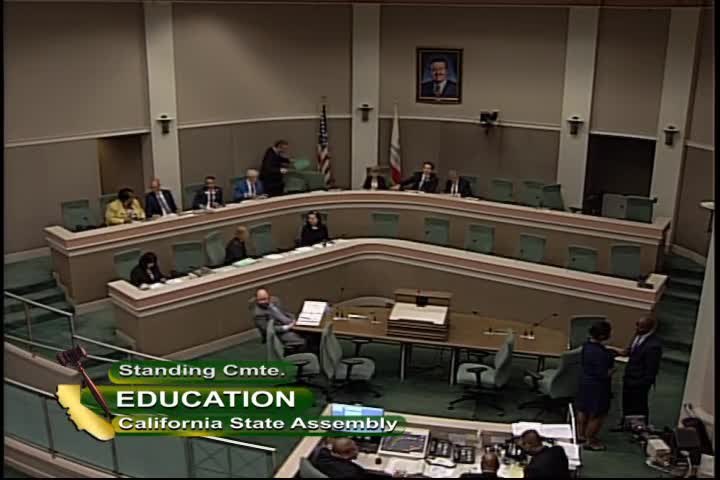 3MIN
Assembly Standing Committee on Education
Bill Author

Bill Co-Author(s):