AB 3252: Animal health.
- Session Year: 2017-2018
- House: Assembly
- Latest Version Date: 2018-09-06
(1)Existing law requires any person that has the care or control of any animal that dies from any contagious disease to immediately cremate or bury the animal. Existing law prohibits the transport of any animal that has died from any contagious disease, except as specified. Existing law makes it unlawful for any person to knowingly sell, use, expose, or fail to immediately kill any horse, mule, or other animal that has the diseases dourine, glanders, or farcy after the person is notified of the disease by a licensed veterinarian or the Department of Food and Agriculture.
This bill would repeal those provisions.
(2)Existing law defines biologics, requires the Secretary of Food and Agriculture to license biologic establishments that meet specified requirements, prescribes requirements relating to the application for a biologic license, and requires a certain biologic license application fee and license renewal fee. Existing law prescribes certain procedures for the enforcement of those provisions. Existing law exempts from certain of these requirements, private veterinarians who maintain their own, in-office blood donor animals for use in their own practice.
This bill would eliminate that exemption for private veterinarians.
(3)Existing law exempts certain facilities engaged in the collection, preparation, testing, processing, storage, or distribution of human blood or blood products and clinical laboratories whose only biologics are autogenous bacterins prepared at the request of licensed veterinarians from all the law relating to the regulation and licensing of commercial blood banks for animals and biologics.
This bill would additionally exempt licensed private veterinarians who collect blood or blood products solely for use in their own practice from the law regulating and licensing commercial blood banks for animals and biologics.
(4)Existing law makes any person who negligently or intentionally violates any state or federal law or regulation, including any quarantine regulation, by importing any pest-infested or disease-infected animal or other article and causing further infestation or infection, or causing an infestation to spread beyond any quarantine boundaries, civilly liable in a sum not to exceed $25,000.
This bill would revise this provision to instead impose civil liability for moving a pest-infested or disease-infected animal.
(5)Existing law provides for the regulation of public equine events and public horse sales, as defined, by the Secretary of Food and Agriculture. Existing law prohibits, as specified, the showing of a horse at these events and sales if the horse has been administered a prohibited substance. Existing law authorizes the therapeutic administration, as defined, of nonsteroidal anti-inflammatory drugs (NSAIDs) before and during all events and sales, except public auctions, provided that the dosage does not exceed limits established by regulation. Existing law requires the Department of Food and Agriculture, on or before July 1, 2014, to establish, by regulation, the approved therapeutic medications list and maximum detectable plasma levels. Under existing law, each violation of these provisions is punishable by, among other things, a civil penalty of not less than $100 and not more than $10,000. Existing law requires penalties collected pursuant to these provisions, including the civil penalty described in (4) above, and any interest, to be deposited in the Department of Food and Agriculture Fund. Under existing law, these moneys are continuously appropriated to the department for the purpose of carrying out these provisions.
This bill would revise the references to NSAIDs in these provisions, and related provisions, to instead refer to permissible substances, as defined. The bill would delete the requirement for the department to establish an approved therapeutic medications list on or before July 1, 2014. By expanding a category of substances for which a penalty may be imposed and expanding the application of the civil penalty provision described in (4) above, and thus increasing the revenue received from those penalties that is deposited in a continuously appropriated fund, the bill would make an appropriation.
(1)Existing law requires any person that has the care or control of any animal that dies from any contagious disease to immediately cremate or bury the animal. Existing law prohibits the transport of any animal that has died from any contagious disease, except as specified. Existing law makes it unlawful for any person to knowingly sell, use, expose, or fail to immediately kill any horse, mule, or other animal that has the diseases dourine, glanders, or farcy after the person is notified of the disease by a licensed veterinarian or the Department of Food and Agriculture.
This bill would repeal those provisions.
Existing(2)Existing law defines biologics, requires the Secretary of Food and Agriculture to license biologic establishments that meet specified requirements, prescribes requirements relating to the application for a biologic license, and requires a certain biologic license application fee and license renewal fee. Existing law prescribes certain procedures for the enforcement of those provisions. Existing law exempts from certain of these requirements, private veterinarians who maintain their own, in-office blood donor animals for use in their own practice.
This bill would eliminate that exemption for private veterinarians.
Existing(3)Existing law also exempts certain facilities engaged in the collection, preparation, testing, processing, storage, or distribution of human blood or blood products and clinical laboratories whose only biologics are autogenous bacterins prepared at the request of licensed veterinarians from all the law relating to the regulation and licensing of commercial blood banks for animals and biologics.
This bill would additionally exempt licensed private veterinarians who collect blood or blood products solely for use in their own practice from the law regulating and licensing commercial blood banks for animals and biologics.
(4)Existing law makes any person who negligently or intentionally violates any state or federal law or regulation, including any quarantine regulation, by importing any pest-infested or disease-infected animal or other article and causing further infestation or infection, or causing an infestation to spread beyond any quarantine boundaries, civilly liable in a sum not to exceed $25,000.
This bill would revise this provision to instead impose civil liability for moving a pest-infested or disease-infected animal.
(5)Existing law provides for the regulation of public equine events and public horse sales, as defined, by the Secretary of Food and Agriculture. Existing law prohibits, as specified, the showing of a horse at these events and sales if the horse has been administered a prohibited substance. Existing law authorizes the therapeutic administration, as defined, of nonsteroidal anti-inflammatory drugs (NSAIDs) before and during all events and sales, except public auctions, provided that the dosage does not exceed limits established by regulation. Existing law requires the Department of Food and Agriculture, on or before July 1, 2014, to establish, by regulation, the approved therapeutic medications list and maximum detectable plasma levels. Under existing law, each violation of these provisions is punishable by, among other things, a civil penalty of not less than $100 and not more than $10,000. Existing law requires penalties collected pursuant to these provisions, including the civil penalty described in (4) above, and any interest, to be deposited in the Department of Food and Agriculture Fund. Under existing law, these moneys are continuously appropriated to the department for the purpose of carrying out these provisions.
This bill would revise the references to NSAIDs in these provisions, and related provisions, to instead refer to permissible substances, as defined. The bill would delete the requirement for the department to establish an approved therapeutic medications list on or before July 1, 2014. By expanding a category of substances for which a penalty may be imposed and expanding the application of the civil penalty provision described in (4) above, and thus increasing the revenue received from those penalties that is deposited in a continuously appropriated fund, the bill would make an appropriation.
Existing law defines biologics, requires the Secretary of Food and Agriculture to license biologic establishments that meet specified requirements, prescribes requirements relating to the application for a biologic license, and requires a certain biologic license application fee and license renewal fee. Existing law prescribes certain procedures for the enforcement of those provisions. Existing law exempts from certain of these requirements, private veterinarians who maintain their own, in-office blood donor animals for use in their own practice.
This bill would eliminate that exemption for private veterinarians.
Existing law also exempts certain facilities engaged in the collection, preparation, testing, processing, storage, or distribution of human blood or blood products and clinical laboratories whose only biologics are autogenous bacterins prepared at the request of licensed veterinarians from all the law relating to the regulation and licensing of commercial blood banks for animals and biologics.
This bill would additionally exempt licensed private veterinarians who collect blood or blood products solely for use in their own practice from the law regulating and licensing commercial blood banks for animals and biologics.
The requirements set forth in subdivision (c) of Section 9212, subdivision (e) of Section 9221, subdivision (c) of Section 9231, and Sections 9266 and 9267:
(a)Shall not apply to those facilities required to be inspected by the United States Department of Agriculture in accordance with the Animal Welfare Act (Chapter 54 (commencing with Section 2131) of Title 7 of the United States Code).
(b)Shall apply to those facilities housing blood donor animals under contract with commercial blood banks for animals licensed by the department.
SEC. 5.Section 9272 of the Food and Agricultural Code is amended to read:9272.This chapter shall not apply (1) to licensed facilities primarily engaged in the collection, preparation, testing, processing, storage, or distribution of human blood or blood products, and any biologic as defined in Section 9203 produced by that facility is sold or distributed only to an establishment licensed by this chapter; (2) to clinical laboratories licensed pursuant to Chapter 3 (commencing with Section 1200) of Division 2 of the Business and Professions Code whose only biologics are autogenous bacterins prepared at the request of licensed veterinarians; or (3) to licensed private veterinarians who collect blood or blood products solely for use in their own practice.
SEC. 6.Section 9574 of the Food and Agricultural Code is amended to read:9574.(a)Any person who negligently or intentionally violates any state or federal law or regulation, including any quarantine regulation, by moving any animal or other article, which by virtue of being pest infested or disease infected, causes an infestation or infection of a pest, animal, or disease, or causes an existing infestation to spread beyond any quarantine boundaries is liable civilly in a sum not to exceed twenty-five thousand dollars ($25,000) for each act that constitutes a violation of the law or regulation.
(b)The Attorney General, upon request of the State Veterinarian, shall petition the superior court to impose, assess, and recover the sum imposed pursuant to subdivision (a). In determining the amount to be imposed, the court shall take into consideration all relevant circumstances, including, but not limited to, the extent of harm caused by the violation and the nature and persistence of the violation.
(c)The remedy under this section is in addition to, and does not supersede or limit, any and all other remedies, civil or criminal, that are otherwise available to the state.
(d)Any funds recovered pursuant to this section shall be deposited in the Department of Food and Agriculture Fund for emergency pest or disease exclusion, detection, eradication, and research of agricultural plant or animal pests or diseases. These funds may be allocated to cover costs related to the enforcement of this division. These funds are in addition to any funds appropriated for those purposes pursuant to Section 224.
SEC. 7.Section 24000 of the Food and Agricultural Code is amended to read:24000.The Legislature finds and declares the following:
(a)That the public has a valuable interest in public equine events and public horse sales.
(b)That it is the intent of this chapter to ensure the integrity of public equine events and public horse sales through the control of performance- and disposition-enhancing substances while limiting permitted therapeutic usage at horse shows and competitions.
SEC. 8.Section 24001 of the Food and Agricultural Code is amended to read:24001.For purposes of this chapter:
(a)Event means a public equine event or public horse sale that is held in the state, including a cutting horse competition, an endurance riding competition, a competitive trail competition, or any other competition as determined by the department by regulation.
(b)An equine event that is subject to this chapter shall meet all of the following criteria:
(1)Money, goods, or services are exchanged for the right to compete.
(2)Individuals compete for a single set of placings, points, or awards at the equine event.
(3)For one-day events, the entry fee to enter a single class exceeds four dollars and ninety-nine cents ($4.99), and either no other fees are charged or other fees charged exceed nineteen dollars and ninety-nine cents ($19.99). Fees charged may include ground fees, stall fees, or any other fees composed of money, goods, or services assessed to permit competitors to enter into the event.
(c)Sales that are subject to this chapter are public sales that permit a horse to be consigned for public sale.
(d)The following events are excluded from this chapter:
(1)Competitions subject to the jurisdiction of the California Horse Racing Board.
(2)Sales consisting solely of racing stock.
(3)Parade horse competitions.
(4)A timed rodeo-related performance competition when held apart from a horse show, including, but not limited to, rodeo, roping club, cattle team penning, barrel racing, and gymkhana.
(e)Event manager means the person in charge of an event, including the entity or individual financially responsible for the event that is responsible for registering the event with the department, and who is responsible for the assessment, collection, and remittance of fees. Event manager includes horse show secretaries and managers, competitive event managers, and horse sale managers and sale owners.
(f)Horse means all horses, mules, and asses.
(g)Licensed veterinarian means a person licensed as a veterinarian by the State of California.
(h)Prohibited substance means a stimulant, depressant, tranquilizer, anesthetic, including any local anesthetic, sedative analgesic, corticosteroid, anabolic steroid, or agent that would sore a horse, that could affect the performance, soundness, or disposition of a horse, or any drug, regardless of how harmless or innocuous it might otherwise be, that could interfere with the detection of any prohibited substance, including any metabolite or derivative of any prohibited substance.
(i)Permissible substance means a substance for which the department has established a limitation on dosage or a maximum permissible detectable level for the purposes provided in Section 24000.
(j)Therapeutic administration means the administration of a drug, medicine, or other substance that is necessary for the treatment of an illness or injury diagnosed by a licensed veterinarian. The administration of a prescription drug, medicine, or other substance shall only be as given or prescribed by the licensed veterinarian. The administration of a nonprescription drug, medicine, or other substance shall be in accordance with the directions on the manufacturers label.
(k)Exempt medication means an oral or topical medication containing prohibited substances determined by the department to be exempt from this chapter when administered therapeutically.
(l)Public equine event means a horse show or competition that permits a person to enter a horse for show or competition in exchange for money, goods, or services. Any club or group that permits people to join or enter into competition in exchange for money, goods, or services, is public for purposes of this chapter.
(m)Public horse sale is a sale that consigns a horse in exchange for money, goods, or services, excluding sales consisting solely of racing stock.
(n)Stimulant or depressant means a medication that stimulates or depresses the circulatory, respiratory, or central or peripheral nervous system.
(o)To sore means to apply an irritating or blistering agent internally or externally for the purpose of affecting the performance, soundness, or disposition of a horse.
(p)Trainer means a person who has the responsibility for the care, training, custody, or performance of a horse, including, but not limited to, a person who signs any entry blank of a public equine event or public horse sale, whether that person is an owner, rider, agent, coach, adult, or minor.
SEC. 9.Section 24004 of the Food and Agricultural Code is amended to read:24004.A horse shall not be shown in any class at an event if it has been administered in any manner a prohibited substance or permissible substance in violation of this chapter.
SEC. 10.Section 24007 of the Food and Agricultural Code is amended to read:24007.(a)In addition to any other penalty or fine prescribed by law, a trainer or owner, or both the trainer and owner, of a horse found to have received a prohibited substance or permissible substance in violation of this chapter, or determined to be in violation of Section 24009 shall be subject to a civil penalty of not less than one hundred dollars ($100) or more than ten thousand dollars ($10,000) for each violation, to be recovered by the secretary in any court of competent jurisdiction.
(b)In addition to the penalty specified in subdivision (a) or any other penalty or fine prescribed by law, the secretary may suspend any trainer or owner, or both the trainer and owner, from all competitions at any public horse show or competition for a period of not less than 90 days or more than one year for each violation. It is unlawful for any person suspended from competition by the secretary to compete in any public horse show or competition during the period of suspension. Any person suspended from competition by the secretary who competes in any public horse show or competition during the period of suspension is subject to the civil penalty prescribed by subdivision (a) for each entry during the period of suspension.
(c)The owner or owners of a horse found to have received a prohibited substance or permissible substance in violation of this chapter or determined to be in violation of Section 24009 shall forfeit all prize money or sweepstakes and any trophies, ribbons, and points won at any public horse show or competition by the horse and the same shall be redistributed by the horse show or competition in accordance with its rules or bylaws. The owner shall pay a fee of fifty dollars ($50) to the public horse show or competition. The horse may be suspended for any period of time specified by the secretary. If the violation occurs at a horse sale, the contract of sale is voidable at the buyers discretion.
(d)In lieu of civil prosecution by the secretary, the secretary may levy a civil penalty against a person violating any provision of this chapter.
(e)Before a civil penalty is levied, the person charged with the violation shall receive notice of the nature of the violation and shall be given an opportunity to be heard, including the right to review the secretarys evidence and a right to present evidence on his or her own behalf.
(f)Review of the decision of the secretary may be sought by the person against whom the penalty was levied within 30 days of the date of the decision pursuant to Section 1094.5 of the Code of Civil Procedure.
(g)After the exhaustion of the review procedure provided in this section, the secretary or his or her representative, may file a certified copy of a final decision of the secretary that directs the payment of a civil penalty and, if applicable, any order that denies a petition for a writ of administrative mandamus, with the clerk of the superior court of any county. Judgment shall be entered immediately by the clerk in conformity with the decision or order. No fees shall be charged by the clerk of the superior court for the performance of any official service required in connection with the entry of judgment pursuant to this section.
SEC. 11.Section 24009 of the Food and Agricultural Code is amended to read:24009.Whether a horse is in competition or not, refusal to submit a horse in an event for examination, or refusal to cooperate with the licensed veterinarian, or his or her technicians and agents, shall constitute a violation of, and subject the responsible person to, the same penalties that are applicable to prohibited substances or permissible substances under Section 24007. A suitable sample shall be collected from a horse selected for testing by a drug testing agent of the department unless the agent releases the horse from testing.
SEC. 12.Section 24010 of the Food and Agricultural Code is amended to read:24010.If the chemical analysis of blood, urine, saliva, or other samples taken from a horse indicate the presence of a prohibited substance or permissible substance or any metabolite or derivative thereof, it shall be prima facie evidence that the prohibited substance or permissible substance has been administered to the horse. A hearing shall be held when a positive report is received from a chemist identifying a prohibited substance or permissible substance in violation of this chapter, or any metabolite or derivative thereof, unless the requirements of Section 24011 have been met or the prohibited substance or permissible substance consists solely of an exempt medication. The trainer or owner, or both the trainer and owner, responsible for the condition of the horse shall not be subject to the penalty prescribed under this chapter or suspended, and no horse shall be barred from competition until after the conclusion of the hearing and a written ruling thereon has been made by the secretary.
SEC. 13.Section 24011 of the Food and Agricultural Code is amended to read:24011.(a)A horse that has received a prohibited substance shall not be eligible for show, competition, or sale, unless the following requirements have been met and the facts requested are submitted to the department in writing:
(1)Medication shall be therapeutic and necessary for treatment of an illness or injury.
(2)A horse shall be withdrawn from a show or competition for a period of not less than 24 hours after a prohibited substance is administered, unless the department determines a different withdrawal period for a specific prohibited substance or class of substances. A horse shall be withdrawn from a public sale for a period of not less than 72 hours after a prohibited substance or permissible substance is administered. The withdrawal period for anabolic steroids is 90 days after administration and the withdrawal period for fluphenazine or reserpine is 45 days after administration.
(3)The medication shall be administered by a licensed veterinarian, the trainer, or the owner.
(4)Medication shall be identified as to the amount, strength, and mode of administration.
(5)The statement shall include the date and time of administration of the medication.
(6)The horse shall be identified by its name, age, sex, color, and entry number.
(7)The statement shall contain the diagnosis of the attending veterinarian and reason for administering the medication.
(8)The statement shall be signed by the person administering the medication.
(9)The statement shall be filed with the event manager of the public equine event or general manager of the public horse sale within one hour after administration or one hour after the event manager of the event returns to duty, if administration is at a time other than during show or sale hours.
(10)The statement shall be signed by the event manager or his or her designated representative and time of receipt recorded on the statement by the event manager or his or her designated representative.
(b)If the chemical analysis of the sample taken from a horse treated indicates the presence of a prohibited substance and all the requirements of this section have been fully complied with, the information contained in the medication report and any other relevant evidence shall be considered at any hearing provided under this chapter in determining whether any provision of this chapter has been violated.
SEC. 14.Section 24011.6 of the Food and Agricultural Code is amended to read:24011.6.The therapeutic administration of a permissible substance is permitted before and during all events except public auctions, provided that the dosage does not exceed any limits, or result in levels that exceed maximum permissible detectable levels, established by the department by regulation for the purposes provided in Section 24000.
The requirements set forth in subdivision (c) of Section 9212, subdivision (e) of Section 9221, subdivision (c) of Section 9231, and Sections 9266 and 9267:
(a)Shall not apply to those facilities required to be inspected by the United States Department of Agriculture in accordance with the Animal Welfare Act (Chapter 54 (commencing with Section 2131) of Title 7 of the United States Code).
(b)Shall apply to those facilities housing blood donor animals under contract with commercial blood banks for animals licensed by the department.
SEC. 2.SEC. 5.Section 9272 of the Food and Agricultural Code is amended to read:9272.This chapter shall not apply (1) to licensed facilities primarily engaged in the collection, preparation, testing, processing, storage, or distribution of human blood or blood products, and any biologic as defined in Section 9203 produced by that facility is sold or distributed only to an establishment licensed by this chapter; (2) to clinical laboratories licensed pursuant to Chapter 3 (commencing with Section 1200) of Division 2 of the Business and Professions Code whose only biologics are autogenous bacterins prepared at the request of licensed veterinarians; or (3) to licensed private veterinarians who collect blood or blood products solely for use in their own practice.
SEC. 6.Section 9574 of the Food and Agricultural Code is amended to read:9574.(a)Any person who negligently or intentionally violates any state or federal law or regulation, including any quarantine regulation, by importing moving any animal or other article, which by virtue of being pest infested or disease infected, causes an infestation or infection of a pest, animal, or disease, or causes an existing infestation to spread beyond any quarantine boundaries is liable civilly in a sum not to exceed twenty-five thousand dollars ($25,000) for each act that constitutes a violation of the law or regulation.
(b)The Attorney General, upon request of the State Veterinarian, shall petition the superior court to impose, assess, and recover the sum imposed pursuant to subdivision (a). In determining the amount to be imposed, the court shall take into consideration all relevant circumstances, including, but not limited to, the extent of harm caused by the violation and the nature and persistence of the violation.
(c)The remedy under this section is in addition to, and does not supersede or limit, any and all other remedies, civil or criminal, that are otherwise available to the state.
(d)Any funds recovered pursuant to this section shall be deposited in the Department of Food and Agriculture Fund for emergency pest or disease exclusion, detection, eradication, and research of agricultural plant or animal pests or diseases. These funds may be allocated to cover costs related to the enforcement of this division. These funds are in addition to any funds appropriated for those purposes pursuant to Section 224.
SEC. 7.Section 24000 of the Food and Agricultural Code is amended to read:24000.The Legislature finds and declares the following:
(a)That the public has a valuable interest in public equine events and public horse sales.
(b)That it is the intent of this chapter to ensure the integrity of public equine events and public horse sales through the control of performance and disposition enhancing medications performance- and disposition-enhancing substances while limiting permitted therapeutic usage at horse shows and competitions.
SEC. 8.Section 24001 of the Food and Agricultural Code is amended to read:24001.For purposes of this chapter:
(a)Event means a public equine event or public horse sale that is held in the state, including a cutting horse competition, an endurance riding competition, a competitive trail competition, or any other competition as determined by the department by regulation.
(b)An equine event that is subject to this chapter shall meet all of the following criteria:
(1)Money, goods, or services are exchanged for the right to compete.
(2)Individuals compete for a single set of placings, points, or awards at the equine event.
(3)For one-day events, the entry fee to enter a single class exceeds four dollars and ninety-nine cents ($4.99), and either no other fees are charged or other fees charged exceed nineteen dollars and ninety-nine cents ($19.99). Fees charged may include ground fees, stall fees, or any other fees composed of money, goods, or services assessed to permit competitors to enter into the event.
(c)Sales that are subject to this chapter are public sales that permit a horse to be consigned for public sale.
(d)The following events are excluded from this chapter:
(1)Competitions subject to the jurisdiction of the California Horse Racing Board.
(2)Sales consisting solely of racing stock.
(3)Parade horse competitions.
(4)A timed rodeo-related performance competition when held apart from a horse show, including, but not limited to, rodeo, roping club, cattle team penning, barrel racing, and gymkhana.
(e)Event manager means the person in charge of an event, including the entity or individual financially responsible for the event that is responsible for registering the event with the department, and who is responsible for the assessment, collection, and remittance of fees. Event manager includes horse show secretaries and managers, competitive event managers, and horse sale managers and sale owners.
(f)Horse means all horses, mules, and asses.
(g)Licensed veterinarian means a person licensed as a veterinarian by the State of California.
(h)Prohibited substance means a stimulant, depressant, tranquilizer, anesthetic, including any local anesthetic, sedative analgesic, corticosteroid, anabolic steroid, or agent that would sore a horse, that could affect the performance, soundness, or disposition of a horse, or any drug, regardless of how harmless or innocuous it might otherwise be, that could interfere with the detection of any prohibited substance, including any metabolite or derivative of any prohibited substance.
(i)NSAID means a nonsteroidal anti-inflammatory drug.(i)Permissible substance means a substance for which the department has established a limitation on dosage or a maximum permissible detectable level for the purposes provided in Section 24000.
(j)Therapeutic administration means the administration of a drug or medicine drug, medicine, or other substance that is necessary for the treatment of an illness or injury diagnosed by a licensed veterinarian. The administration of a prescription drug or medicine drug, medicine, or other substance shall only be as given or prescribed by the licensed veterinarian. The administration of a nonprescription drug or medicine drug, medicine, or other substance shall be in accordance with the directions on the manufacturers label.
(k)Exempt medication means an oral or topical medication containing prohibited substances determined by the department to be exempt from this chapter when administered therapeutically.
(l)Public equine event means a horse show or competition that permits a person to enter a horse for show or competition in exchange for money, goods, or services. Any club or group that permits people to join or enter into competition in exchange for money, goods, or services, is public for purposes of this chapter.
(m)Public horse sale is a sale that consigns a horse in exchange for money, goods, or services, excluding sales consisting solely of racing stock.
(n)Stimulant or depressant means a medication that stimulates or depresses the circulatory, respiratory, or central or peripheral nervous system.
(o)To sore means to apply an irritating or blistering agent internally or externally for the purpose of affecting the performance, soundness, or disposition of a horse.
(p)Trainer means a person who has the responsibility for the care, training, custody, or performance of a horse, including, but not limited to, a person who signs any entry blank of a public equine event or public horse sale, whether that person is an owner, rider, agent, coach, adult, or minor.
SEC. 9.Section 24004 of the Food and Agricultural Code is amended to read:24004.A horse shall not be shown in any class at an event if it has been administered in any manner a prohibited substance or permissible substance in violation of this chapter.
SEC. 10.Section 24007 of the Food and Agricultural Code is amended to read:24007.(a)In addition to any other penalty or fine prescribed by law, a trainer or owner, or both the trainer and owner, of a horse found to have received a prohibited substance or NSAID permissible substance in violation of this chapter, or determined to be in violation of Section 24009 shall be subject to a civil penalty of not less than one hundred dollars ($100) or more than ten thousand dollars ($10,000) for each violation, to be recovered by the secretary in any court of competent jurisdiction.
(b)In addition to the penalty specified in subdivision (a) or any other penalty or fine prescribed by law, the secretary may suspend any trainer or owner, or both the trainer and owner, from all competitions at any public horse show or competition for a period of not less than 90 days or more than one year for each violation. It is unlawful for any person suspended from competition by the secretary to compete in any public horse show or competition during the period of suspension. Any person suspended from competition by the secretary who competes in any public horse show or competition during the period of suspension is subject to the civil penalty prescribed by subdivision (a) for each entry during the period of suspension.
(c)The owner or owners of a horse found to have received a prohibited substance or NSAID substance or permissible substance in violation of this chapter or determined to be in violation of Section 24009 shall forfeit all prize money or sweepstakes and any trophies, ribbons, and points won at any public horse show or competition by the horse and the same shall be redistributed by the horse show or competition in accordance with its rules or bylaws. The owner shall pay a fee of fifty dollars ($50) to the public horse show or competition. The horse may be suspended for any period of time specified by the secretary. If the violation occurs at a horse sale, the contract of sale is voidable at the buyers discretion.
(d)In lieu of civil prosecution by the secretary, the secretary may levy a civil penalty against a person violating any provision of this chapter.
(e)Before a civil penalty is levied, the person charged with the violation shall receive notice of the nature of the violation and shall be given an opportunity to be heard, including the right to review the secretarys evidence and a right to present evidence on his or her own behalf.
(f)Review of the decision of the secretary may be sought by the person against whom the penalty was levied within 30 days of the date of the decision pursuant to Section 1094.5 of the Code of Civil Procedure.
(g)After the exhaustion of the review procedure provided in this section, the secretary or his or her representative, may file a certified copy of a final decision of the secretary that directs the payment of a civil penalty and, if applicable, any order that denies a petition for a writ of administrative mandamus, with the clerk of the superior court of any county. Judgment shall be entered immediately by the clerk in conformity with the decision or order. No fees shall be charged by the clerk of the superior court for the performance of any official service required in connection with the entry of judgment pursuant to this section.
SEC. 11.Section 24009 of the Food and Agricultural Code is amended to read:24009.Whether a horse is in competition or not, refusal to submit a horse in an event for examination, or refusal to cooperate with the licensed veterinarian, or his or her technicians and agents, shall constitute a violation of, and subject the responsible person to, the same penalties that are applicable to prohibited substances or NSAIDs permissible substances under Section 24007. A suitable sample shall be collected from a horse selected for testing by a drug testing agent of the department unless the agent releases the horse from testing.
SEC. 12.Section 24010 of the Food and Agricultural Code is amended to read:24010.If the chemical analysis of blood, urine, saliva, or other samples taken from a horse indicate the presence of a prohibited substance or NSAID permissible substance or any metabolite or derivative thereof, it shall be prima facie evidence that the prohibited substance or NSAID permissible substance has been administered to the horse. A hearing shall be held when a positive report is received from a chemist identifying a prohibited substance substance or permissible substance in violation of this chapter, or any metabolite or derivative thereof, unless the requirements of Section 24011 have been met or the prohibited substance or NSAID permissible substance consists solely of an exempt medication. The trainer or owner, or both the trainer and owner, responsible for the condition of the horse shall not be subject to the penalty prescribed under this chapter or suspended, and no horse shall be barred from competition until after the conclusion of the hearing and a written ruling thereon has been made by the secretary.
SEC. 13.Section 24011 of the Food and Agricultural Code is amended to read:24011.(a)A horse that has received a prohibited substance shall not be eligible for show, competition, or sale, unless the following requirements have been met and the facts requested are submitted to the department in writing:
(1)Medication shall be therapeutic and necessary for treatment of an illness or injury.
(2)A horse shall be withdrawn from a show or competition for a period of not less than 24 hours after a prohibited substance is administered, unless the department determines a different withdrawal period for a specific prohibited substance or class of substances. A horse shall be withdrawn from a public sale for a period of not less than 72 hours after a prohibited substance or NSAID permissible substance is administered. The withdrawal period for anabolic steroids is 90 days after administration and the withdrawal period for fluphenazine or reserpine is 45 days after administration.
(3)The medication shall be administered by a licensed veterinarian, the trainer, or the owner.
(4)Medication shall be identified as to the amount, strength, and mode of administration.
(5)The statement shall include the date and time of administration of the medication.
(6)The horse shall be identified by its name, age, sex, color, and entry number.
(7)The statement shall contain the diagnosis of the attending veterinarian and reason for administering the medication.
(8)The statement shall be signed by the person administering the medication.
(9)The statement shall be filed with the event manager of the public equine event or general manager of the public horse sale within one hour after administration or one hour after the event manager of the event returns to duty, if administration is at a time other than during show or sale hours.
(10)The statement shall be signed by the event manager or his or her designated representative and time of receipt recorded on the statement by the event manager or his or her designated representative.
(b)If the chemical analysis of the sample taken from a horse treated indicates the presence of a prohibited substance and all the requirements of this section have been fully complied with, the information contained in the medication report and any other relevant evidence shall be considered at any hearing provided under this chapter in determining whether any provision of this chapter has been violated.
SEC. 14.Section 24011.6 of the Food and Agricultural Code is amended to read:24011.6.(a)The therapeutic administration of NSAIDs a permissible substance is permitted before and during all events except public auctions, provided that the dosage does not exceed any limits, or result in levels that exceed maximum permissible detectable levels, established by the department by regulation. regulation for the purposes provided in Section 24000.
(b)On or before July 1, 2014, the department shall establish, by regulation, the approved therapeutic medications list and maximum detectable plasma levels.The requirements set forth in subdivision (c) of Section 9212, subdivision (e) of Section 9221, subdivision (c) of Section 9231, and Sections 9266 and 9267:
(a)Shall not apply to those facilities required to be inspected by the United States Department of Agriculture in accordance with the Animal Welfare Act (Chapter 54 (commencing with Section 2131) of Title 7 of the United States Code).
(b)Shall apply to those facilities housing blood donor animals under contract with commercial blood banks for animals licensed by the department.
(c)Shall not apply to private veterinarians who maintain their own, in-office blood donor animals for use in their own practice.SEC. 2.Section 9272 of the Food and Agricultural Code is amended to read:9272.The provisions of this This chapter shall not apply (1) to licensed facilities primarily engaged in the collection, preparation, testing, processing, storage, or distribution of human blood or blood products, provided such facility is licensed pursuant to Section 1601 or 1602 of the Health and Safety Code and any biologic as defined in Section 9203 produced by such that facility is sold or distributed only to an establishment licensed by this chapter or chapter; (2) to clinical laboratories licensed pursuant to Chapter 3 (commencing with Section 1200) of Division 2 of the Business and Professions Code whose only biologics are autogenous bacterins prepared at the request of licensed veterinarians. veterinarians; or (3) to licensed private veterinarians who collect blood or blood products solely for use in their own practice.
|
Date
|
Status
|
|---|---|
| Sep 6, 2018 | Chaptered by Secretary of State - Chapter 289, Statutes of 2018. |
| Sep 6, 2018 | Approved by the Governor. |
| Aug 27, 2018 | Enrolled and presented to the Governor at 3 p.m. |
| Aug 20, 2018 | Senate amendments concurred in. To Engrossing and Enrolling. |
| Aug 15, 2018 | From committee: That the Senate amendments be concurred in. (Ayes 9. Noes 0.) (August 15). |
| Aug 9, 2018 | Re-referred to Com. on AGRI. pursuant to Assembly Rule 77.2. |
| Aug 7, 2018 | In Assembly. Concurrence in Senate amendments pending. May be considered on or after August 9 pursuant to Assembly Rule 77. |
| Aug 6, 2018 | Read third time. Passed. Ordered to the Assembly. |
| Jul 3, 2018 | Read second time. Ordered to Consent Calendar. |
| Jul 2, 2018 | From committee: Be ordered to second reading file pursuant to Senate Rule 28.8 and ordered to Consent Calendar. |
| Jun 19, 2018 | From committee: Do pass and re-refer to Com. on APPR. with recommendation: To Consent Calendar. (Ayes 4. Noes 0.) (June 19). Re-referred to Com. on APPR. |
| Jun 11, 2018 | From committee chair, with author's amendments: Amend, and re-refer to committee. Read second time, amended, and re-referred to Com. on AGRI. |
| May 30, 2018 | Referred to Com. on AGRI. |
| May 17, 2018 | In Senate. Read first time. To Com. on RLS. for assignment. |
| May 17, 2018 | Read third time. Passed. Ordered to the Senate. |
| May 10, 2018 | Read second time. Ordered to Consent Calendar. |
| May 9, 2018 | From committee: Do pass. To Consent Calendar. (Ayes 16. Noes 0.) (May 9). |
| Apr 26, 2018 | From committee: Do pass and re-refer to Com. on APPR. with recommendation: To Consent Calendar. (Ayes 10. Noes 0.) (April 25). Re-referred to Com. on APPR. |
| Mar 22, 2018 | Referred to Com. on AGRI. |
| Mar 6, 2018 | From printer. May be heard in committee April 5. |
| Mar 5, 2018 | Read first time. To print. |
|
Date
|
Description
|
Location
|
Votes
|
|
|---|---|---|---|---|
| Aug 20, 2018 | AB 3252 AGRI. Concurrence in Senate Amendments By CABALLERO | Assembly Floor |
Passed |
|
| Aug 15, 2018 | With recommendation: That Senate amendments be concurred in. | Assembly Standing Committee on Agriculture |
Passed |
|
| Aug 6, 2018 | Consent Calendar AB3252 AGRI. (Caballero) | Senate Floor |
Passed |
|
| Jun 19, 2018 | Do pass, but first be re-referred to the Committee on [Appropriations] with the recommendation: To Consent Calendar | Senate Standing Committee on Agriculture |
Passed |
|
| May 17, 2018 | AB 3252 AGRI. Consent Calendar Second Day Regular Session | Assembly Floor |
Passed |
|
| May 9, 2018 | Do pass. To Consent Calendar. | Assembly Standing Committee on Appropriations |
Passed |
|
| Apr 25, 2018 | Do pass and be re-referred to the Committee on [Appropriations] with recommendation: To Consent Calendar | Assembly Standing Committee on Agriculture |
Passed |
This list shows positions taken on this bill by organizations on the date displayed, which is linked to the original source.
Positions by individuals are not included.
CONCURRENCE IN SENATE AMENDMENTS
CSA2 Bill Id:AB 3252
Author:(Committee on Agriculture)
As Amended Ver:June 11, 2018
Majority vote
ASSEMBLY: | 73-0 | (May 17, 2018) | SENATE: | 37-0 | (August 06, 2018) |
COMMITTEE VOTE: | 9-0 | (August 15, 2018) | RECOMMENDATION: | concur |
(AGRI.)
Original Committee Reference: AGRI.
SUMMARY: This bill clarifies the exemption for private veterinarians in relation to drawing and using animal blood in their own office, repeals and updates farm animal quarantine laws, and makes changes to the Equine Medication Monitoring Program (EMMP). Specifically, this bill:
The Senate amendments:
Farm Animal Quarantine:
- Repeal the provisions in current law that require a person that has the care or control of any animal that dies from any contagious disease to immediately cremate or bury the animal, and prohibit the transport of any animal that has died from any contagious disease.
- Revise the existing law that makes any person who negligently or intentionally violates any state or federal law or regulation, including any quarantine regulation, by importing any pest-infested or disease-infected animal (infected animal)or other article and causing further infestation or infection, or causing an infestation to spread beyond any quarantine boundaries, civilly liable in a sum not to exceed $25,000 to instead impose civil liability for moving, in-state or imported into the state, an infected animal that infects other farm animals.
EMMP:
- Defines "permissible substance" to mean a substance for which the California Department of Food and Agriculture (CDFA) has established a limitation on dosage or a maximum permissible detectable level as specified.
- Defines "therapeutic administration" to mean the administration of a drug, medicine, or other substance that is necessary for the treatment of an illness or injury diagnosed by a licensed veterinarian.
- Strikes "NSAID" (nonsteroidal anti-inflammatory drugs) and replaces it with the word "permissible substance".
EXISTING LAW:
Farm Animal Quarantine:
- Requires any person that has the care or control of any animal that dies from any contagious disease to immediately cremate or bury the animal.
- Prohibits the transport of any animal that has died from any contagious disease, except as specified.
- Makes it unlawful for any person to knowingly sell, use, expose, or fail to immediately kill any horse, mule, or other animal that has specified diseases after the person is notified of the disease by a licensed veterinarian or CDFA.
- Establishes the State Veterinarian Quarantine Authority (SVQA) law to replaced outdated state emergency response requirements with a more flexible approach that accounts for current disease threats, all veterinary medical options, and other local and state laws that may limit disposal options due to environmental or health concerns.
- Provides that any person who negligently or intentionally violates any state or federal law or regulation, including any quarantine regulation, by importing any pest-infested or disease-infected animal or other article and causing further infestation or infection, or causing an infestation to spread beyond any quarantine boundaries, civilly liable in a sum not to exceed $25,000.
Equine Medication Monitoring Program:
- Provides for the regulation of public equine events and public horse sales, as defined, by CDFA. Existing law prohibits, as specified, the showing of a horse at these events and sales if the horse has been administered a prohibited substance.
- Authorizes the therapeutic administration, as defined, of nonsteroidal anti-inflammatory drugs (NSAIDs) before and during all events and sales, except public auctions, provided that the dosage does not exceed limits established by regulation.
FISCAL EFFECT: Unknown
COMMENTS: In addition to moving the private, licensed veterinarian exemption into the appropriate code section, this bill makes minor, technical changes to the Food and Agricultural Code to repeal obsolete references governing CDFA's EMMP, and provisions governing the disposal of livestock carcasses infected with contagious diseases.
The outdated provisions require owners of animals that die from contagious disease to transport carcasses to the nearest crematory and immediately cremate or bury the animal to contain the disease threat. These outdated provisions are inconsistent with SVQA. Finally, this bill expands who can be fined for knowingly moving a infected animal out of a quarantine zone without proper permission.
Analysis Prepared by: Victor Francovich / AGRI. / (916) 319-2084 FN: 0004043
Date of Hearing: August 15, 2018
ASSEMBLY COMMITTEE ON AGRICULTURE
Anna Caballero, Chair
ABPCA Bill Id:AB 3252 (
Author:Committee on Agriculture) – As Amended Ver:June 11, 2018
SUBJECT: Biologics: animal blood and blood component products: commercial blood banks for animals: licensed private veterinarians: exemptions
SUMMARY: This bill clarifies the exemption for private veterinarians in relation to drawing and using animal blood in their own office, repeals and updates farm animal quarantine laws, and makes changes to the Equine Medication Monitoring Program (EMMP). Specifically, this bill:
The Senate amendments:
Farm Animal Quarantine:
- Repeal the provisions in current law that require a person that has the care or control of any animal that dies from any contagious disease to immediately cremate or bury the animal, and prohibit the transport of any animal that has died from any contagious disease.
- Revise the existing law that makes any person who negligently or intentionally violates any state or federal law or regulation, including any quarantine regulation, by importing any pest-infested or disease-infected animal (infected animal)or other article and causing further infestation or infection, or causing an infestation to spread beyond any quarantine boundaries, civilly liable in a sum not to exceed $25,000 to instead impose civil liability for moving, in-state or imported into the state, an infected animal that infects other farm animals.
EMMP:
- Defines “permissible substance” to mean a substance for which the California Department of Food and Agriculture (CDFA) has established a limitation on dosage or a maximum permissible detectable level as specified.
- Defines “therapeutic administration” to mean the administration of a drug, medicine, or other substance that is necessary for the treatment of an illness or injury diagnosed by a licensed veterinarian.
- Strikes “NSAID” (nonsteroidal anti-inflammatory drugs) and replaces it with the word “permissible substance”.
EXISTING LAW:
Farm Animal Quarantine:
- Requires any person that has the care or control of any animal that dies from any contagious disease to immediately cremate or bury the animal.
- Prohibits the transport of any animal that has died from any contagious disease, except as specified.
- Makes it unlawful for any person to knowingly sell, use, expose, or fail to immediately kill any horse, mule, or other animal that has specified diseases after the person is notified of the disease by a licensed veterinarian or CDFA.
- Establishes the State Veterinarian Quarantine Authority (SVQA) law to replaced outdated state emergency response requirements with a more flexible approach that accounts for current disease threats, all veterinary medical options, and other local and state laws that may limit disposal options due to environmental or health concerns.
- Provides that any person who negligently or intentionally violates any state or federal law or regulation, including any quarantine regulation, by importing any pest-infested or disease-infected animal or other article and causing further infestation or infection, or causing an infestation to spread beyond any quarantine boundaries, civilly liable in a sum not to exceed $25,000.
Equine Medication Monitoring Program:
- Provides for the regulation of public equine events and public horse sales, as defined, by CDFA. Existing law prohibits, as specified, the showing of a horse at these events and sales if the horse has been administered a prohibited substance.
- Authorizes the therapeutic administration, as defined, of nonsteroidal anti-inflammatory drugs (NSAIDs) before and during all events and sales, except public auctions, provided that the dosage does not exceed limits established by regulation.
FISCAL EFFECT: Unknown
COMMENTS: In addition to moving the private, licensed veterinarian exemption into the appropriate code section, this bill makes minor, technical changes to the Food and Agricultural Code to repeal obsolete references governing CDFA’s EMMP, and provisions governing the disposal of livestock carcasses infected with contagious diseases.
The outdated provisions require owners of animals that die from contagious disease to transport carcasses to the nearest crematory and immediately cremate or bury the animal to contain the disease threat. These outdated provisions are inconsistent with SVQA. Finally, this bill expands who can be fined for knowingly moving a infected animal out of a quarantine zone without proper permission.
REGISTERED SUPPORT / OPPOSITION:
Support
Animal Blood Bank
California Veterinary Medical Association
Opposition
None on file
Analysis Prepared by: Victor Francovich / AGRI. / (916) 319-2084
CONCURRENCE IN SENATE AMENDMENTS
CSA1 Bill Id:AB 3252
Author:(Committee on Agriculture)
As Amended Ver:June 11, 2018
Majority vote
ASSEMBLY: | 73-0 | (May 17, 2018) | SENATE: | 37-0 | (August 6, 2018) |
Original Committee Reference: AGRI.
SUMMARY: This bill clarifies the exemption for private veterinarians in relation to drawing and using animal blood in their own office; repeals and updates farm animal quarantine laws; and, makes changes to the Equine Medication Monitoring Program (EMMP).
The Senate amendments:
- Remove, in relation to farm animal quarantines, outdated language and expand who can be fined for knowingly moving a diseased animal out of a quarantine zone without proper permission; and,
- Make changes to EMMP allowance of Nonsteroidal anti-inflammatory drugs (NSAID), to the broader term "permissible substances," in order to keep pace with the ever-changing equine industry.
EXISTING LAW:
Animal Blood Banks: Establishes additional protocols for commercial blood banks for animals that are licensed by the California Department of Food and Agriculture (CDFA), revises the definition of an animal to include any domesticated fowl or nonhuman mammal and any wild fowl, bird, or mammal that is reduced to captivity, with specified exemptions.
Farm Animal Quarantine:
- Requires any person that has the care or control of any animal that dies from any contagious disease to immediately cremate or bury the animal.
- Prohibits the transport of any animal that has died from any contagious disease, except as specified.
- Makes it unlawful for any person to knowingly sell, use, expose, or fail to immediately kill any horse, mule, or other animal that has specified diseases after the person is notified of the disease by a licensed veterinarian or CDFA.
- Establishes the State Veterinarian Quarantine Authority (SVQA) law to replaced outdated state emergency response requirements with a more flexible approach that accounts for current disease threats, all veterinary medical options, and other local and state laws that may limit disposal options due to environmental or health concerns.
- Provides that any person who negligently or intentionally violates any state or federal law or regulation, including any quarantine regulation, by importing any pest-infested or disease-infected animal or other article and causing further infestation or infection, or causing an infestation to spread beyond any quarantine boundaries, civilly liable in a sum not to exceed $25,000.
Equine Medication Monitoring Program:
- Provides for the regulation of public equine events and public horse sales, as defined, by CDFA. Existing law prohibits, as specified, the showing of a horse at these events and sales if the horse has been administered a prohibited substance.
- Authorizes the therapeutic administration, as defined, of nonsteroidal anti-inflammatory drugs (NSAIDs) before and during all events and sales, except public auctions, provided that the dosage does not exceed limits established by regulation.
FISCAL EFFECT: Unknown
COMMENTS: In addition to moving the private, licensed veterinarian exemption into the appropriate code section, this bill makes minor, technical changes to the Food and Agricultural Code to repeal obsolete references governing CDFA's EMMP, and provisions governing the disposal of livestock carcasses infected with contagious diseases.
The outdated provisions require owners of animals that die from contagious disease to transport carcasses to the nearest crematory and immediately cremate or bury the animal to contain the disease threat. These outdated provisions are inconsistent with SVQA. Finally, this bill updates current law regarding NSAIDs to reflect new industry standards.
This bill is similar to the version passed by the Assembly and consistent with the policies of the Assembly Agriculture Committee.
Analysis Prepared by: Victor Francovich / AGRI. / (916) 319-2084 FN: 0003704
Office of Senate Floor Analyses (916) 651-1520 Fax: (916) 327-4478 | AB |
CONSENT
Bill No: AB 3252
:
SENATE AGRICULTURE COMMITTEE: 4-0, 6/19/18
AYES: Galgiani, Wilk, Dodd, Pan
NO VOTE RECORDED: Berryhill
SENATE APPROPRIATIONS COMMITTEE: Senate Rule 28.8
ASSEMBLY FLOOR: 73-0, 5/17/18 (Consent) - See last page for vote
DIGEST:
This bill clarifies the exemption for private veterinarians in relation to drawing and using animal blood in their own office, repeals and updates farm animal quarantine laws, and makes changes to the Equine Medication Monitoring Program.
Existing law:
- Establishes additional protocols for commercial blood banks for animals that are licensed by the California Department of Food and Agriculture (CDFA), revises the definition of an animal to include any domesticated fowl or nonhuman mammal and any wild fowl, bird, or mammal that is reduced to captivity.
- Exempts research facilities, teaching hospitals, private veterinarians who maintain their own in-office blood donor animals for use in their practice, and other entities that are required to be licensed with the United States Department of Agriculture, such as small breeders and operators of animal shows.
- Requires any person that has the care or control of any animal that dies from any contagious disease to immediately cremate or bury the animal. Existing law prohibits the transport of any animal that has died from any contagious disease, except as specified. Existing law makes it unlawful for any person to knowingly sell, use, expose, or fail to immediately kill any horse, mule, or other animal that has the diseases dourine, glanders, or farcy after the person is notified of the disease by a licensed veterinarian or the CDFA.
- Requires any person who negligently or intentionally violates any state or federal law or regulation, including any quarantine regulation, by importing any pest-infested or disease-infected animal or other article and causing further infestation or infection, or causing an infestation to spread beyond any quarantine boundaries, civilly liable in a sum not to exceed $25,000.
- Provides for the regulation of public equine events and public horse sales, as defined, by the Secretary of Food and Agriculture. Existing law prohibits, as specified, the showing of a horse at these events and sales if the horse has been administered a prohibited substance.
- Authorizes the therapeutic administration, as defined, of nonsteroidal anti-inflammatory drugs (NSAIDs) before and during all events and sales, except public auctions, provided that the dosage does not exceed limits established by regulation.
- Requires CDFA, on or before July 1, 2014, to establish, by regulation, the approved therapeutic medications list and maximum detectable plasma levels.
- States each violation of these provisions be punishable by, among other things, a civil penalty of not less than $100 and not more than $10,000. Existing law requires penalties collected pursuant to these provisions, including the civil penalty described above, and any interest, to be deposited in the Department of Food and Agriculture Fund. These moneys are continuously appropriated to the CDFA for the purpose of carrying out these provisions.
This bill:
- Clarifies the exemption for licensed private veterinarians who collect blood or blood products solely for use in their own practice from the law regulating and licensing commercial blood banks for animals and biologics.
- Repeals the provisions in current law that requires a person that has the care or control of any animal that dies from any contagious disease to immediately cremate or bury the animal and prohibits the transport of any animal that has died from any contagious disease.
- Revises the existing law that makes any person who negligently or intentionally violates any state or federal law or regulation, including any quarantine regulation, by importing any pest-infested or disease-infected animal or other article and causing further infestation or infection, or causing an infestation to spread beyond any quarantine boundaries, civilly liable in a sum not to exceed $25,000 to instead impose civil liability for moving a pest-infested or disease-infected animal.
- Defines “permissible substance” to mean a substance for which the department has established a limitation on dosage or a maximum permissible detectable level as specified.
- Defines “therapeutic administration” to mean the administration of a drug, medicine, or other substance that is necessary for the treatment of an illness or injury diagnosed by a licensed veterinarian.
- Strikes “NSAID” (nonsteroidal anti-inflammatory drugs) and replaces it with the word “permissible substance”.
Background
SB 1345 (Kuehl, Chapter 822, Statutes of 2002) established additional protocols for commercial blood banks for animals that are licensed by CDFA and exempted certain facilities primarily engaged in the collection, preparation, testing, processing, storage, or distribution of nonhuman blood or blood products and for licensed clinical laboratories whose only biologics are autogenous bacterins prepared at the request of licensed veterinarians.
In a separate section of the law there is an exemption for private veterinarians who maintain their own in-office blood donor animals for use in their own practice.
Comments
The placement in code of the veterinarian’s exemption led to some confusion over whether private veterinarians could create their own commercial blood banks. When questions around this issue arose, the California Veterinary Medical Association, CDFA, and stakeholders worked out clarifying language to ensure private veterinarians could continue the practice of providing animal blood for use in their offices, but not become a commercial blood bank.
FISCAL EFFECT: Appropriation: Fiscal Com.: Local:
Animal Blood Bank
California Veterinary Medical Association
OPPOSITION: (Verified 6/29/18)
None received
ARGUMENTS IN SUPPORT: According to the author, the placement of the veterinarians’ exemption in current law led to some confusion as to whether private veterinarians could create their own commercial blood banks. When questions around this issue arose, the California Veterinary Medical Association (CVMA), CDFA, and currently regulated commercial blood banks worked out a clarifying fix that would ensure private veterinarians could continue the practice of securing/drawing a limited amount of animal blood for use in their offices but not become a commercial blood bank.
CVMA states that incorporating the exemption for a private, licensed veterinarian into the Food and Agriculture Code Section 9272 will place it in the appropriate code section and allow veterinarians to continue using an in-office blood donor animal for transfusions and blood donations to animal patients.
ASSEMBLY FLOOR: 73-0, 5/17/18
AYES: Acosta, Aguiar-Curry, Travis Allen, Arambula, Baker, Berman, Bigelow, Bloom, Bonta, Brough, Burke, Caballero, Calderon, Carrillo, Cervantes, Chau, Chávez, Chen, Chiu, Choi, Chu, Cooley, Cooper, Cunningham, Dahle, Daly, Eggman, Flora, Fong, Frazier, Friedman, Gallagher, Eduardo Garcia, Gipson, Gloria, Gonzalez Fletcher, Gray, Grayson, Harper, Holden, Irwin, Jones-Sawyer, Kalra, Kamlager-Dove, Kiley, Lackey, Levine, Limón, Low, Maienschein, Mathis, Mayes, McCarty, Medina, Mullin, Nazarian, Obernolte, O'Donnell, Patterson, Quirk, Quirk-Silva, Reyes, Rodriguez, Rubio, Salas, Mark Stone, Thurmond, Ting, Voepel, Waldron, Weber, Wood, Rendon
NO VOTE RECORDED: Cristina Garcia, Melendez, Muratsuchi, Santiago, Steinorth
7/3/18 16:11:24
**** END ****
SENATE COMMITTEE ON AGRICULTURE
Senator Cathleen Galgiani, Chair
2017 - 2018 Regular
Bill No: AB 3252 Hearing Date: 6/19/18
Author: | Committee on Agriculture | ||
Version: | 6/11/18 Amended | ||
Urgency: | No | Fiscal: | Yes |
Consultant: | Reichel Everhart | ||
Subject: Animal health
SUMMARY
:
This bill clarifies the exemption for private veterinarians in relation to drawing and using animal blood in their own office, repeals and updates farm animal quarantine laws, and makes changes to the Equine Medication Monitoring Program (EMMP).
BACKGROUND AND EXISTING LAW
:
Animal Blood Banks:
- Existing law establishes additional protocols for commercial blood banks for animals that are licensed by the California Department of Food and Agriculture (CDFA), revises the definition of an animal to include any domesticated fowl or nonhuman mammal and any wild fowl, bird, or mammal that is reduced to captivity.
- Existing law exempts research facilities, teaching hospitals, private veterinarians who maintain their own in-office blood donor animals for use in their practice, and other entities that are required to be licensed with the United States Department of Agriculture, such as small breeders and operators of animal shows.
Farm Animal Quarantine:
- Existing law requires any person that has the care or control of any animal that dies from any contagious disease to immediately cremate or bury the animal. Existing law prohibits the transport of any animal that has died from any contagious disease, except as specified. Existing law makes it unlawful for any person to knowingly sell, use, expose, or fail to immediately kill any horse, mule, or other animal that has the diseases dourine, glanders, or farcy after the person is notified of the disease by a licensed veterinarian or the Department of Food and Agriculture.
- The State Veterinarian Quarantine Authority (SVQA) law replaced outdated state emergency response requirements with a more flexible approach that accounts for current disease threats, all veterinary medical options, and other local and state laws that may limit disposal options due to environmental or health concerns.
- Existing law makes any person who negligently or intentionally violates any state or federal law or regulation, including any quarantine regulation, by importing any pest-infested or disease-infected animal or other article and causing further infestation or infection, or causing an infestation to spread beyond any quarantine boundaries, civilly liable in a sum not to exceed $25,000.
Equine Medication Monitoring Program:
- Existing law provides for the regulation of public equine events and public horse sales, as defined, by the Secretary of Food and Agriculture. Existing law prohibits, as specified, the showing of a horse at these events and sales if the horse has been administered a prohibited substance.
- Existing law authorizes the therapeutic administration, as defined, of nonsteroidal anti-inflammatory drugs (NSAIDs) before and during all events and sales, except public auctions, provided that the dosage does not exceed limits established by regulation.
- Existing law requires the Department of Food and Agriculture, on or before July 1, 2014, to establish, by regulation, the approved therapeutic medications list and maximum detectable plasma levels.
- Under existing law, each violation of these provisions is punishable by, among other things, a civil penalty of not less than $100 and not more than $10,000. Existing law requires penalties collected pursuant to these provisions, including the civil penalty described above, and any interest, to be deposited in the Department of Food and Agriculture Fund.
- Under existing law, these moneys are continuously appropriated to the department for the purpose of carrying out these provisions.
PROPOSED LAW
:
This bill:
Animal Blood Banks:
- Clarifies the exemption for licensed private veterinarians who collect blood or blood products solely for use in their own practice from the law regulating and licensing commercial blood banks for animals and biologics.
Farm Animal Quarantine:
- Repeals the provisions in current law that require a person that has the care or control of any animal that dies from any contagious disease to immediately cremate or bury the animal and prohibits the transport of any animal that has died from any contagious disease.
- Revises the existing law that makes any person who negligently or intentionally violates any state or federal law or regulation, including any quarantine regulation, by importing any pest-infested or disease-infected animal or other article and causing further infestation or infection, or causing an infestation to spread beyond any quarantine boundaries, civilly liable in a sum not to exceed $25,000 to instead impose civil liability for moving a pest-infested or disease-infected animal.
Equine Medication Monitoring Program:
- Defines “permissible substance” to mean a substance for which the department has established a limitation on dosage or a maximum permissible detectable level as specified.
- Defines “therapeutic administration” to mean the administration of a drug, medicine, or other substance that is necessary for the treatment of an illness or injury diagnosed by a licensed veterinarian.
- Strikes “NSAID” (nonsteroidal anti-inflammatory drugs) and replaces it with the word “permissible substance”.
ARGUMENTS IN SUPPORT:
According to the author the placement of the veterinarians’ exemption in current law led to some confusion as to whether private veterinarians could create their own commercial blood banks. When questions around this issue arose, the California Veterinary Medical Association (CVMA), CDFA, and currently regulated commercial blood banks worked out a clarifying fix that would ensure private veterinarians could continue the practice of securing/drawing a limited amount of animal blood for use in their offices, but not become a commercial blood bank.
CVMA states that incorporating the exemption for a private, licensed veterinarian into the Food and Agriculture Code Section 9272 will place it in the appropriate code section and allow veterinarians to continue using an in-office blood donor animal for transfusions and blood donations to animal patients.
ARGUMENTS IN OPPOSITION:
None received.
COMMENTS
:
In addition to moving the private, licensed veterinarian exemption into the appropriate code section, this bill makes minor, technical changes to the Food and Agricultural Code to repeal obsolete references governing CDFA’s Equine Medication Monitoring Program and provisions governing the disposal of livestock carcasses infected with contagious diseases. The outdated provisions require owners of animals that die from contagious disease to transport carcasses to the nearest crematory and immediately cremate or bury the animal to contain the disease threat. Finally, this bill updates current law regarding NSAIDs to reflect new industry standards.
RELATED LEGISLATION
:
SB 1345 (Kuehl) Chapter 822, Statutes of 2002, established additional protocols for commercial blood banks for animals that are licensed by CDFA, revised the definition of animal, and exempted certain facilities from the requirements under this bill.
PRIOR ACTIONS
:
Assembly Floor: | 73 - 0 |
Assembly Appropriations Committee: | 16 - 0 |
Assembly Agriculture Committee: | 10 - 0 |
SUPPORT
:
Animal Blood Bank (ABB)
California Veterinary Medical Association
OPPOSITION
:
None received
-- END --
Date of Hearing: May 9, 2018
ASSEMBLY COMMITTEE ON APPROPRIATIONS
Lorena Gonzalez Fletcher, Chair
ABPCA Bill Id:AB 3252
Author:(Committee on Agriculture) – As Introduced Ver:March 5, 2018
Policy Committee: | Agriculture | Vote: | 10 - 0 |
|
| ||
|
|
Urgency: No State Mandated Local Program: No Reimbursable: No
SUMMARY:
This bill makes clarifying changes related to commercial blood banks and private veterinarians’ ability to draw and use animal blood in their own office.
FISCAL EFFECT:
No additional state costs.
COMMENTS:
Background and purpose. SB 1345 (Kuehl), Chapter 822, Statutes of 2002, established additional protocols for commercial animal blood banks licensed by California Department of Food and Agriculture (CDFA), but exempted research facilities, teaching hospitals, and private veterinarians who maintain their own in-office blood donor animals for use in their practices. This exemption, in combination with a separate provision in the Food and Agriculture Code, has created confusion about whether private veterinarians can create their own commercial blood banks. AB 3252 clarifies that private veterinarians may still secure animal blood for use in their offices but may not become commercial blood banks.
Analysis Prepared by: Luke Reidenbach / APPR. / (916) 319-2081
Date of Hearing: April 25, 2018
ASSEMBLY COMMITTEE ON AGRICULTURE
Anna Caballero, Chair
ABPCA Bill Id:AB 3252
Author:(Committee on Agriculture) – As Introduced Ver:March 5, 2018
SUBJECT: Biologics: animal blood and blood component products: commercial blood banks for animals: licensed private veterinarians: exemptions.
SUMMARY: This bill clarifies the exemptions for private veterinarians in relation to drawing and using animal blood in their own office.
EXISTING LAW:
- Requires the Secretary of Food and Agriculture (CDFA) to license biologic establishments that meet specified requirements, prescribes requirements relating to the application for a biologic license.
- Exempts from certain of these requirements, private veterinarians who maintain their own, in-office blood donor animals for use in their own practice.
- Exempts facilities engaged in the collection, preparation, testing, processing, storage, or distribution of human blood or blood products from laws relating to the regulation and licensing of commercial blood banks for animals and biologics.
- Exempts laboratories whose only biologics are bacterial vaccine created from the disease causing organisms (autogenous bacterins), prepared at the request of licensed veterinarians, from laws relating to the regulation and licensing of commercial blood banks for animals and biologics.
FISCAL EFFECT: Unknown
COMMENTS: SB 1345 (Kuehl), Chapter 822, Statutes of 2002, established additional protocols for commercial blood banks for animals that are licensed by CDFA, revised the definition of animal, and exempted certain facilities.
The exemptions were for licensed facilities primarily engaged in the collection, preparation, testing, processing, storage, or distribution of human blood or blood products and for licensed clinical laboratories whose only biologics are autogenous bacterins prepared at the request of licensed veterinarians.
In a separate section of the law there is an exemption for private veterinarians who maintain their own, in-office blood donor animals for use in their own practice. This acknowledged a long-time practice of veterinarians for use in emergency situations when they might not have animal blood on hand, usually in cases such as a dog being injured and needing emergency surgery.
The placement of the veterinarian's exemption led to some confusion on whether private veterinarians could create their own commercial blood banks. When questions around this issue arose, the California Veterinarians Medical Association, CDFA, and currently regulated commercial blood banks, worked out a clarifying fix that would ensure private veterinarians could continue the practice of securing animal blood for use in their offices, but not become a commercial blood bank.
REGISTERED SUPPORT / OPPOSITION:
Support
California Veterinary Medical Association (Sponsor)
Opposition
None on file
Analysis Prepared by: Victor Francovich / AGRI. / (916) 319-2084
Discussed in Hearing
View Older Hearings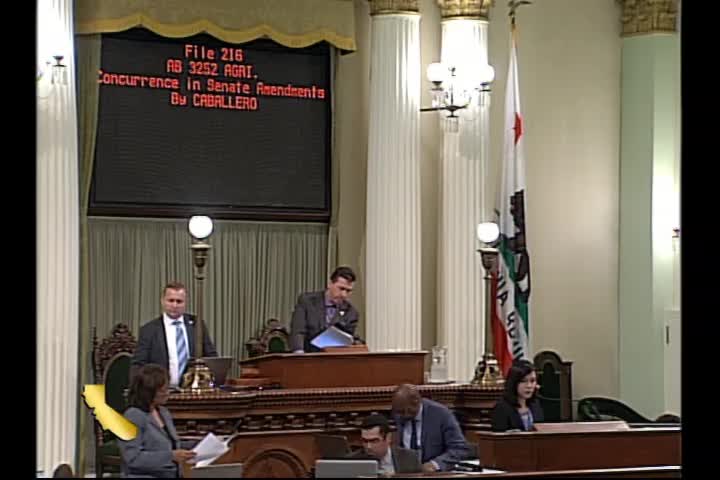
Bill Author
Bill Co-Author(s):