AB 368: Criminal procedure: jurisdiction of public offenses.
- Session Year: 2017-2018
- House: Assembly
- Latest Version Date: 2017-09-30
Existing law provides that when more than one violation of certain specified offenses occurs in more than one jurisdictional territory, jurisdiction for any of those offenses and any other properly joinable offenses may be in any jurisdiction where at least one of the offenses occurred if all district attorneys in the counties with jurisdiction over any of the offenses agree to the venue.
This bill would add the offense of sexual intercourse, sodomy, oral copulation or sexual penetration with a child 10 years of age or younger to the list of specified offenses to which the above jurisdictional provisions apply.
(a)If more than one violation of Section 220, except assault with intent to commit mayhem, 261, 262, 264.1, 269, 286, 288, 288a, 288.5, 288.7, or 289 occurs in more than one jurisdictional territory, the jurisdiction of any of those offenses, and for any offenses properly joinable with that offense, is in any jurisdiction where at least one of the offenses occurred, subject to a hearing, pursuant to Section 954, within the jurisdiction of the proposed trial. At the Section 954 hearing, the prosecution shall present written evidence that all district attorneys in counties with jurisdiction of the offenses agree to the venue. Charged offenses from jurisdictions where there is no written agreement from the district attorney shall be returned to that jurisdiction.
(b)If more than one violation of Section 273a, 273.5, or 646.9 occurs in more than one jurisdictional territory, and the defendant and the victim are the same for all of the offenses, the jurisdiction of any of those offenses and for any offenses properly joinable with that offense, is in any jurisdiction where at least one of the offenses occurred.
(c)If more than one violation of Section 236.1, 266h, or 266i occurs in more than one jurisdictional territory, the jurisdiction of any of those offenses, and for any offenses properly joinable with that offense, is in any jurisdiction where at least one of the offenses occurred, subject to a hearing pursuant to Section 954, within the jurisdiction of the proposed trial. At the Section 954 hearing, the prosecution shall present written evidence that all district attorneys in counties with jurisdiction of the offenses agree to the venue. Charged offenses from jurisdictions where there is no written agreement from the district attorney shall be returned to that jurisdiction. In determining whether all counts in the complaint should be joined in one county for prosecution, the court shall consider the location and complexity of the likely evidence, where the majority of the offenses occurred, the rights of the defendant and the people, and the convenience of, or hardship to, the victim or victims and witnesses.
|
Date
|
Status
|
|---|---|
| Sep 30, 2017 | Chaptered by Secretary of State - Chapter 379, Statutes of 2017. |
| Sep 30, 2017 | Approved by the Governor. |
| Sep 20, 2017 | Enrolled and presented to the Governor at 4:30 p.m. |
| Sep 11, 2017 | In Assembly. Ordered to Engrossing and Enrolling. |
| Sep 11, 2017 | Read third time. Passed. Ordered to the Assembly. |
| Sep 5, 2017 | Read second time. Ordered to third reading. |
| Sep 1, 2017 | From committee: Do pass. (Ayes 7. Noes 0.) (September 1). |
| Jun 26, 2017 | In committee: Referred to suspense file. |
| Jun 13, 2017 | From committee: Do pass and re-refer to Com. on APPR. (Ayes 7. Noes 0.) (June 13). Re-referred to Com. on APPR. |
| May 10, 2017 | Referred to Coms. on PUB. S. and APPR. |
| Mar 20, 2017 | In Senate. Read first time. To Com. on RLS. for assignment. |
| Mar 20, 2017 | Read third time. Passed. Ordered to the Senate. (Ayes 77. Noes 0. Page 646.) |
| Mar 16, 2017 | Read second time. Ordered to third reading. |
| Mar 15, 2017 | From committee: Do pass. (Ayes 7. Noes 0.) (March 14). |
| Feb 21, 2017 | Referred to Com. on PUB. S. |
| Feb 9, 2017 | From printer. May be heard in committee March 11. |
| Feb 8, 2017 | Read first time. To print. |
|
Date
|
Description
|
Location
|
Votes
|
|
|---|---|---|---|---|
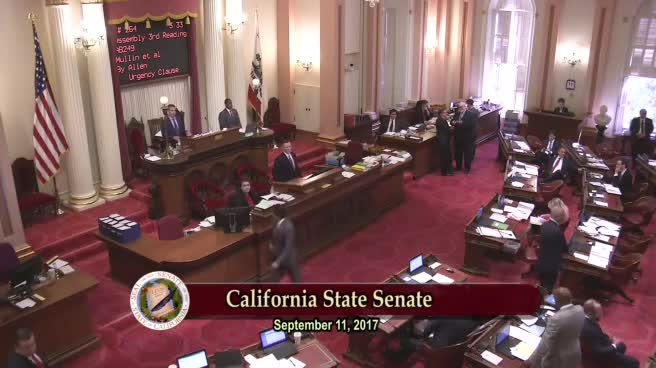
| Sep 11, 2017 | Assembly 3rd Reading AB368 Muratsuchi et al. By Stern | Senate Floor |
Passed |
|
| Sep 1, 2017 | Do pass | Senate Standing Committee on Appropriations |
Passed |
|
| Jun 26, 2017 | Placed on suspense file | Senate Standing Committee on Appropriations |
Passed |
|
| Jun 13, 2017 | Do pass, but first be re-referred to the Committee on [Appropriations] | Senate Standing Committee on Public Safety |
Passed |
|
| Mar 20, 2017 | AB 368 MURATSUCHI Assembly Third Reading | Assembly Floor |
Passed |
|
| Mar 14, 2017 | Do pass. | Assembly Standing Committee on Public Safety |
Passed |
This list shows positions taken on this bill by organizations on the date displayed, which is linked to the original source.
Positions by individuals are not included.
Office of Senate Floor Analyses (916) 651-1520 Fax: (916) 327-4478 | AB |
THIRD READING
Bill No: AB 368
:
SENATE PUBLIC SAFETY COMMITTEE: 7-0, 6/13/17
AYES: Skinner, Anderson, Bradford, Jackson, Mitchell, Stone, Wiener
SENATE APPROPRIATIONS COMMITTEE: 7-0, 9/1/17
AYES: Lara, Bates, Beall, Bradford, Hill, Nielsen, Wiener
ASSEMBLY FLOOR: 77-0, 3/20/17 - See last page for vote
SOURCE: Los Angeles County District Attorney’s Office
DIGEST:
This bill allows the consolidation of specified sex offenses with a child 10 years of age or younger occurring in different counties into a single trial if all district attorneys in the counties with jurisdiction agree.
Existing law:
- States that, except as otherwise provided by law, the jurisdiction of every public offense is in any competent court within the jurisdictional territory of which it is committed. (Pen. Code § 777.)
- States that when a public offense is committed in part in one jurisdictional territory and in part in another, the jurisdiction of such offense is in any competent court within either jurisdiction. (Pen. Code § 781.)
- Provides that if one or more violations of specified sex offenses occurs in more than one jurisdictional territory, the jurisdiction of any of those offenses, and for any offenses properly joinable with that offense, is in any jurisdiction where at least one of the offenses occurred, subject to the following conditions (Pen. Code § 784.7, subd. (a)):
- Consolidation of the cases is subject to a joinder hearing, within the jurisdiction of the proposed trial court;
- The prosecution presents written evidence that all district attorneys in counties with jurisdiction of the offenses agree to the venue; and,
- Charged offenses from jurisdictions in which there is no written agreement from the district attorney must be returned to that county.
This bill adds the offenses of sexual intercourse, sodomy, oral copulation, or sexual penetration with a child 10 years or younger to the list of specified sex offenses except from the rule that the territorial jurisdiction of the case is where the offense occurred.
FISCAL EFFECT: Appropriation: Fiscal Com.: Local:
According to the Senate Appropriations Committee:
- State prison: Unknown, potential increase in state costs (General Fund) for new or longer commitments to state prison that otherwise would not have resulted in incarceration or as lengthy of a total sentence. To the extent that the provisions of this bill lead to even one additional commitment to state prison (or one additional year of commitment), it would result in additional General Fund costs of $75,560 annually to house that person in a state institution.
- Court: Unknown, potential cost savings (General Fund*) to the court in a reduction of separate cases to adjudicate if charges across multiple counties are consolidated into one case.
*Trial Court Trust Fund
Los Angeles County District Attorney’s Office (source)
Alameda County District Attorney’s Office
California District Attorneys Association
California State Sheriffs’ Association
Crime Victims Action Alliance
Los Angeles County Sheriff’s Office
California Attorneys for Criminal Justice
California Public Defenders Association
ARGUMENTS IN SUPPORT: The Los Angeles County District Attorney’s Office writes, “Currently, existing law does not include Penal Code Section 288.7(a): Sexual Intercourse or Sodomy with a Child 10 years of age or younger; or Section 288.7(b): Oral Copulation or Sexual Penetration of a Child 10 years of age or younger, as enumerated offenses listed in Penal Code Section 784.7.
“Transitory living situations can result in a child sexual assault victim being victimized in multiple jurisdictions, often by the same offender. Failure to include section 288.7 as an enumerated offense results in subjecting a child sexual assault victim to multiple court proceedings, repetitive investigations, and testifying in multiple trials often lasting over several years.”
ARGUMENTS IN OPPOSITION: The California Attorneys for Criminal Justice writes, “This bill undermines a defendant’s constitutional right to a fair trial by combining charges from potentially any number of jurisdictions within California into a single prosecution in one particular jurisdiction. AB 368 would add a crime which carries a life sentence if convicted to those crimes already covered in PC 784.7.”
ASSEMBLY FLOOR: 77-0, 3/20/17
AYES: Acosta, Aguiar-Curry, Travis Allen, Arambula, Baker, Berman, Bigelow, Bloom, Bocanegra, Bonta, Brough, Burke, Caballero, Calderon, Cervantes, Chau, Chávez, Chen, Chiu, Choi, Chu, Cooley, Cooper, Cunningham, Dababneh, Daly, Eggman, Flora, Fong, Frazier, Friedman, Gallagher, Cristina Garcia, Eduardo Garcia, Gipson, Gloria, Gomez, Gonzalez Fletcher, Gray, Grayson, Harper, Holden, Irwin, Kalra, Kiley, Lackey, Levine, Limón, Low, Maienschein, Mathis, Mayes, McCarty, Medina, Melendez, Mullin, Muratsuchi, Nazarian, Obernolte, O'Donnell, Patterson, Quirk, Quirk-Silva, Reyes, Rodriguez, Rubio, Salas, Santiago, Steinorth, Mark Stone, Thurmond, Ting, Voepel, Waldron, Weber, Wood, Rendon
NO VOTE RECORDED: Dahle, Jones-Sawyer, Ridley-Thomas
9/3/17 18:22:46
**** END ****
SENATE COMMITTEE ON
Senator Ricardo Lara, Chair
2017 - 2018 Regular Session
AB 368 (Muratsuchi) - Criminal procedure: jurisdiction of public offenses
Version: | Policy Vote: |
Urgency: | Mandate: |
Hearing Date: | Consultant: |
This bill meets the criteria for referral to the Suspense File.
Bill Summary:
AB 368 would expand the list of sex crimes that may be consolidated into a single case in a single jurisdiction, as specified, if the violations are alleged to have occurred in multiple jurisdictions.
Fiscal Impact:
- State prison: Unknown, potential increase in state costs (General Fund) for new or longer commitments to state prison that otherwise would not have resulted in incarceration or as lengthy of a total sentence. To the extent that the provisions of this measure lead to even one additional commitment to state prison (or one additional year of commitment), it would result in additional General Fund costs of $75,560 annually to house that person in a state institution.
- Court: Unknown, potential cost savings (General Fund*) to the court in a reduction of separate cases to adjudicate if charges across multiple counties are consolidated into one case.
*Trial Court Trust Fund
Background:
The general rule in California is that the district attorney prosecutes an offense in the jurisdiction where the crime occurred. If part of the commission of the crime occurs in one county but the crime is completed in another county, the proper jurisdiction is in either of the counties. There are, however, a number of exceptions to the rule that the territorial jurisdiction of the case is where the offense occurred. These exceptions include certain sex crimes, domestic violence, child abuse, and human trafficking cases. For these offenses, existing law provides that when more than one violation of certain specified offenses occurs in more than one jurisdictional territory, jurisdiction for any of those offenses and any other properly joinable offenses may be in any jurisdiction where at least one of the offenses occurred if all district attorneys in the counties with jurisdiction over any of the offenses agree to the venue. For sex offense cases, the court has ruled that the alleged violations do not have to be of the same offense for the cases to be consolidated, as these offenses belong to the same class of crimes. (People v. Nguyen (2010) 184 Cal.App.4th 1096.)
Proposed Law:
This bill would add the offense of sexual intercourse, sodomy, oral copulation or sexual penetration with a child 10 years of age or younger to the list of offenses that can be consolidated into a single case in one jurisdiction even if the offenses are alleged to have been committed in multiple jurisdictions. All district attorneys in the counties with jurisdiction over any of the offenses must agree to the venue in order to consolidate the prosecution into one case.
Related Legislation:
SB 939 (Block, Ch. 246, Stats. 2014) permitted the consolidation of human-trafficking-related charges occurring in different counties to be joined in a single trial if all the district attorneys agree.
AB 2252 (Cohn, Ch. 194, Stats. 2002) amended territorial jurisdiction of sex crimes to remove the requirement that consolidated offenses involve a single victim and added specified crimes to the list of applicable charges.
AB 2734 (Pacheco, Ch. 302, Stats. of 1998) vested territorial jurisdiction for specified sex crimes occurring in multiple jurisdictions in any jurisdiction where at least one offense occurred, if the defendant and the victim were the same for all the offenses.
Staff Comments:
The fiscal impact of this bill cannot be known with certainty, as the actual impact will be dependent on numerous factors, including, but not limited to, judicial and prosecutorial discretion, the criminal history of the defendant, and the factors unique to each case. For example, in one county, a court may sentence a defendant found guilty of, or a district attorney may agree to a plea deal for, a sex crime that results in the avoidance of a commitment to state prison (e.g., when the sentence includes a period of probation with counseling or other rehabilitative programs or services). In another county, because of differing judicial or prosecutorial philosophies or some other reasons, that same defendant found guilty of the same crime would have no other practical alternative to a sentence to state prison. If cases from counties with differing sentencing practices were consolidated into one case in a county with stricter sentencing practice, it could result in additional counts of convictions (e.g., by rejecting plea deals that would lead to the dismissal of certain counts in place of the conviction of others) and additional and/or longer prison sentences. Consequently, by increasing the list of sex crimes that may be consolidated into a single case, this bill potentially could result in an increase in commitment costs to the state prison system.
-- END --
SENATE COMMITTEE ON PUBLIC SAFETY
Senator Nancy Skinner, Chair
2017 - 2018 Regular
Bill No: AB 368 Hearing Date: June 13, 2017
Author: | Muratsuchi | ||
Version: | February 8, 2017 | ||
Urgency: | No | Fiscal: | No |
Consultant: | SC | ||
Subject: Criminal Procedure: Jurisdiction of Public Offenses
HISTORY
Source: Los Angeles District Attorney’s Office
Prior Legislation: SB 939 (Block), Ch. 246, Stats. 2014
AB 2252 (Cohn), Ch. 194, Stats. 2002
AB 2734 (Pacheco), Ch. 302, Stats. 1998
Support: Alameda County District Attorney’s Office; California District Attorneys Association; California State Sheriffs’ Association; Los Angeles County Sheriff’s Office
Opposition: California Attorneys for Criminal Justice; California Public Defenders Association
Assembly Floor Vote: 77 - 0
PURPOSE
The purpose of this bill is to permit the consolidation of specified sex offenses with a child 10 years of age or younger occurring in different counties into a single trial if all district attorneys in the counties with jurisdiction agree.
Existing law states that, except as otherwise provided by law, the jurisdiction of every public offense is in any competent court within the jurisdictional territory of which it is committed. (Pen. Code, § 777.)
Existing law states that when a public offense is committed in part in one jurisdictional territory and in part in another, the jurisdiction of such offense is in any competent court within either jurisdiction. (Pen. Code, § 781.)
Existing law provides that if one or more violations of specified sex offenses occurs in more than one jurisdictional territory, the jurisdiction of any of those offenses, and for any offenses properly joinable with that offense, is in any jurisdiction where at least one of the offenses occurred, subject to the following conditions (Pen. Code, § 784.7, subd. (a)):
- Consolidation of the cases is subject to a joinder hearing, within the jurisdiction of the proposed trial court;
- The prosecution presents written evidence that all district attorneys in counties with jurisdiction of the offenses agree to the venue; and,
- Charged offenses from jurisdictions in which there is no written agreement from the district attorney must be returned to that county.
This bill adds the offenses of sexual intercourse, sodomy, oral copulation, or sexual penetration with a child 10 years or younger to the list of specified sex offenses except from the rule that the territorial jurisdiction of the case is where the offense occurred.
COMMENTS
1. Need for This Bill
According to the author:
In general, the California Constitution approves the joining of criminal cases because it promotes efficiency, protects victims, and ensures speedy trial rights. (Cal. Const. art. 1, §30(a).) Assembly Bill 2734 (Ch. 302/Statutes of 1998) which created Penal Code section 784.7 recognized the fact that victims of sexual abuse were particularly vulnerable, providing that “[AB] 2734 seeks to provide for the ability to combine trials when the victim and the defendant are the same for all the offenses. In crimes of … [child] molestation there is a high degree of mobility. The first offense may happen in one county, and then the victim moves to another county. The defendant follows them and commits the same crime again. Because of the repeat offenses, the victim is faced with the possibility of multiple trials.”
Sex offenses belong to the same class of crimes and Section 784.7(a) specifically allows for offenses occurring in different counties to be consolidated to protect repeat victims of sexual molestation, from crimes often inflicted by the same offender, from the need to make multiple court appearances to testify against the same offender, (Price v. Superior Court (2001) 25 Cal.4th 1046.) while allowing for the offense to be tried in any county where jurisdiction is appropriate. (People v. Betts (2005) 34 Cal.4th 1039.)
When an offender commits specified crimes involving sexual assault in more than one jurisdictional territory, offenses which are properly joinable may be heard in any jurisdiction where at least one of the offenses occurs, subject to a Section 954 hearing. (CA. Pen. Code, §784.7(a).
Currently, existing law does not include Section 288.7(a): Sexual Intercourse or Sodomy with a Child 10 years of age or younger; or Section 288.7(b): Oral Copulation or Sexual Penetration of a Child 10 years of age or younger, as enumerated offenses listed in Section 784.7.
. . . .
Penal Code section 288.7 was enacted 8 years after the enactment of Penal Code section 784.7 and that is the reason for its omission.
2. Consolidation of Charges from Different Jurisdictions
The general rule in California is that the district attorney prosecutes an offense in the jurisdiction where the crime occurred. If part of the commission of the crime occurs in one county but the crime is completed in another county, the proper jurisdiction is in either of the counties.
The Legislature has created several exceptions to the rule that the territorial jurisdiction of the case is where the offense occurred. These exceptions include sex crimes, domestic violence, child abuse, and human trafficking cases. For sex offense cases, the court has ruled that the cases that can be joined do not have to be violations of the same offense. (People v. Nguyen (2010) 184 Cal.App.4th 1096.) Rather, the sex offenses currently listed in Penal Code section 784.7 are of the same class of crimes and therefore any combination of the listed sex crimes may be properly joined. (Id. at 1113.)
Sex offenses “belong to the same class of crimes.” (People v. Lindsay (1964) 227 Cal.App.2d 482, 492 [38 Cal. Rptr. 755] [“rape, sex perversion and sodomy clearly belong to the same class of crimes …” because the “intent to satisfy sexual desires runs through” them]; see also People v. Ross (1960) 178 Cal.App.2d 801, 805 [3 Cal. Rptr. 170] [common attribute bringing offenses into same class of crimes was that each act was a sex crime committed against a child].) Thus, section 954 permits joinder of sex crimes, thereby supporting the People’s interpretation of section 784.7(a) as allowing the joinder of nonidentical sex crimes committed in different counties.
(People v. Nguyen, supra, 184 Cal.App.4th at p. 1113.)
This bill adds the crime of sexual intercourse, sodomy, oral copulation or sexual penetration with a child 10 years of age or younger (Pen. Code, § 288.7) to the currently specified list of sex crimes excepted from the general rule regarding venue. The rationale for this is that it belongs to the same class of sex crimes currently excepted from the general rule under Penal Code section 784.7. Any request to consolidate charges pursuant to Penal Code section 784.7 is subject to a hearing to determine whether the charges should be consolidated. The court must consider the prejudicial effects of such joinder and has the discretion to sever offenses “in the interests of justice and for good cause shown. . ..” (Pen. Code, § 954.)
3. Right to Jury Trial
The U.S. Constitution guarantees criminal defendants the right to be tried “by an impartial jury of the state and district wherein the crime shall have been committed, which district shall have been previously ascertained by law . . ..” (U.S. Const., 6th Amend.) The California Supreme Court has held that “[t]he Legislature may determine the venue for trial except to the extent the vicinage or due process provisions of the state or federal Constitution circumscribe that authority.” (Price v. Superior Court (2001) 25 Cal. 4th 1046, 1056.)
Venue refers to the territorial jurisdiction in which a case may be brought to trial, in other words, the location where the trial is held. Vicinage is the right to trial by a jury drawn from residents of the area in which the charged offense allegedly was committed.
In Price v. Superior Court, supra, the California Supreme Court explained these concepts as applied to criminal prosecutions.
The concepts of venue and vicinage are closely related, as a jury pool ordinarily is selected from the area in which the trial is to be held. The concepts have different origins and purposes, however. Venue is historically significant from a national perspective because, as discussed below, the pre-Revolutionary practice of transporting colonists who were charged with crimes in the colonies to either England or other English colonies for trial was among the principal complaints of the colonists against England. Objections to that practice led to the inclusion of Article III, Section 2 in the United States Constitution. That provision limits the place of trial in federal criminal proceedings to the state in which the crime was committed. Most California venue statutes serve a similar purpose in reducing the potential burden on a defendant who might otherwise be required to stand trial in a distant location that is not reasonably related to the alleged criminal conduct.
. . . [T]he general rule of territorial jurisdiction over felonies is that stated in section 777: “except as otherwise provided by law the jurisdiction of every public offense is in any competent court within the jurisdictional territory of which it is committed.” Ordinarily the jurisdictional territory of a superior court is the county in which it sits. (Pen. Code, § 691, subd. (b).) Venue or territorial jurisdiction establishes the proper place for trial, but is not an aspect of the fundamental subject matter jurisdiction of the court and does not affect the power of a court to try a case.
When the Legislature creates an exception to the rule of section 777, the venue statute is remedial and for that reason is construed liberally to achieve the legislative purpose of expanding criminal jurisdiction. Section 784.7 is such an exception and the legislative purpose is clear. (People v. Price, supra, 25 Cal.4th at pp. 1054-1056, internal citations omitted.)
As to the right of vicinage, the Supreme Court explained:
Because a vicinage guarantee does not serve the purpose of protecting a criminal defendant from government oppression and is not necessary to ensure a fair trial, it is not a necessary feature of the right to jury trial. For that reason we conclude that the vicinage clause of the Sixth Amendment is not applicable to the states through the Fourteenth Amendment. (Price v. Superior Court, supra, 25 Cal. 4th p. at 1065.)
Rather, the Court explained, the right of vicinage in California is derived from the right to a jury trial guaranteed in the California Constitution and is effectively limited to a requirement that there be a reasonable nexus between the crime and the county of trial:
The right to a trial by a jury of the vicinage, as guaranteed by the California Constitution, is not violated by trial in county having a reasonable relationship to the offense or to other crimes committed by the defendant against the same victim. We do not hold here that a crime may be tried anywhere. The Legislature’s power to designate the place for trial of a criminal offense is limited by the requirement that there be a reasonable relationship or nexus between the place designated for trial and the commission of the offense. Repeated abuse of the same child or spouse in more than one county creates that nexus. The venue authorized by Penal Code section 784.7 is not arbitrary. It is reasonable for the Legislature to conclude that this pattern of conduct is akin to a continuing offense and to conclude that the victim and other witnesses should not be burdened with having to testify in multiple trials in different counties. (Price v. Superior Court, supra, 25 Cal.4th. at p. 1075.)
5. Argument in Support
The Los Angeles County District Attorney’s Office, the sponsor of this bill, writes in support:
Currently, existing law does not include Penal Code Section 288.7(a): Sexual Intercourse or Sodomy with a Child 10 years of age or younger; or Section 288.7(b): Oral Copulation or Sexual Penetration of a Child 10 years of age or younger, as enumerated offenses listed in Penal Code Section 784.7.
Transitory living situations can result in a child sexual assault victim being victimized in multiple jurisdictions, often by the same offender. Failure to include section 288.7 as an enumerated offense results in subjecting a child sexual assault victim to multiple court proceedings, repetitive investigations, and testifying in multiple trials often lasting over several years.
Assembly Bill 368 remedies this deficiency in California by amending Penal Code Section 784.7(a) to include Penal Code Section 288.7 as one of the enumerated offenses.
6. Argument in Opposition
The California Attorneys for Criminal Justice, in opposition, writes:
This measure would amend Penal Code sec. 784.7 by allowing multiple jurisdiction prosecutions of alleged violations of Penal Code sec. 288.7 to be joined in a single case in a single jurisdiction.
This bill undermines a defendant’s constitutional right to a fair trial by combining charges from potentially any number of jurisdictions within California into a single prosecution in one particular jurisdiction. AB 368 would add a crime which carries a life sentence if convicted to those crimes already covered in PC 784.7.
-- END –
ASSEMBLY THIRD READING
ATR Bill Id:
Author:(Muratsuchi)
As Introduced Ver:February 8, 2017
Majority vote
Committee | Votes | Ayes | Noes |
Public Safety | 7-0 | Jones-Sawyer, Lackey, Cunningham, Gonzalez Fletcher, Quirk, Rubio, Santiago |
SUMMARY: Permits the consolidation of specified sex offenses with a child 10 years of age or younger occurring in different counties into a single trial if all district attorneys in the counties with jurisdiction agree. Specifically, this bill: Adds the offenses of sexual intercourse, sodomy, oral copulation, or sexual penetration with a child 10 years or younger to the list of specified sex offenses excepted from the rule that the territorial jurisdiction of the case is where the offense occurred.
EXISTING LAW:
- States that, except as otherwise provided by law, the jurisdiction of every public offense is in any competent court within the jurisdictional territory of which it is committed.
- States that when a public offense is committed in part in one jurisdictional territory and in part in another, the jurisdiction of such offense is in any competent court within either jurisdiction.
- Provides that if one or more violations of specified sex offenses occurs in more than one jurisdictional territory, the jurisdiction of any of those offenses, and for any offenses properly joinable with that offense, is in any jurisdiction where at least one of the offenses occurred, subject to the following conditions:
- Consolidation of the cases is subject to a joinder hearing, within the jurisdiction of the proposed trial court;
- The prosecution presents written evidence that all district attorneys in counties with jurisdiction of the offenses agree to the venue; and
- Charged offenses from jurisdictions in which there is no written agreement from the district attorney must be returned to that county.
- Provides that if specified domestic violence offenses occur in more than one jurisdiction, and the defendant and the victim are the same for all the offenses, the jurisdiction of any of the offenses and for any offenses properly joinable with that offense is the jurisdiction where at least one of the offenses occurred.
- Provides that if one or more specified human trafficking, pimping, and pandering offenses occurs in more than one jurisdictional territory, the jurisdiction of any of those offenses, and for any offenses properly joinable with that offense, is in any jurisdiction where at least one of the offenses occurred, subject to the following conditions:
- Consolidation of the cases is subject to a joinder hearing, within the jurisdiction of the proposed trial court;
- The prosecution presents written evidence that all district attorneys in counties with jurisdiction of the offenses agree to the venue;
- Charged offenses from jurisdictions in which there is no written agreement from the district attorney must be returned to that county; and
- The court must consider the location and complexity of the likely evidence, where the majority of the offenses occurred, the rights of the defendant and the people, and the convenience of, or hardship to, the victim or victims and witnesses.
- Allows property crimes occurring in one jurisdictional territory if property is taken to another jurisdictional territory and an arrest is made there, to be prosecuted in either jurisdiction.
- Permits consolidation of different offenses which do not relate to same transaction or event where there is common element of substantial importance in their commission, such as the same class of crimes.
FISCAL EFFECT: Unknown. This bill is keyed non-fiscal by the Legislative Counsel.
COMMENTS:
"Victims of child sexual assault often have transitory living situations, which can result in a child sexual assault victim being victimized in multiple jurisdictions, often by the same offender. When an offender commits certain crimes involving sexual assault, domestic violence, or human trafficking in more than one jurisdictional territory, offenses which are properly joinable may be heard in any jurisdiction where at least one of the offenses occurred.
"However, current law does not allow for cases involving sexual assault with a child under the age of 10 to be heard in one jurisdiction. This loophole forces the most vulnerable of victims to relive their assault details through multiple court proceedings, repetitive investigations, and testifying in multiple trials often lasting over several years.
"This bill closes the loophole, protects fragile and traumatized child sexual assault victims from reliving their experience multiple times in court, expedites the prosecution of offenders, and reduces unnecessary costs to our court system."
Analysis Prepared by: Cheryl Anderson / PUB. S. / (916) 319-3744 FN: 0000032
Date of Hearing: March 14, 2017
Counsel: Cheryl Anderson
ASSEMBLY COMMITTEE ON
Reginald Byron Jones-Sawyer, Sr., Chair
ABPCA Bill Id:
Author:() – As Ver:
SUMMARY:
Permits the consolidation of specified sex offenses with a child 10 years of age or younger occurring in different counties into a single trial if all district attorneys in the counties with jurisdiction agree, Specifically, this bill: Adds the offenses of sexual intercourse, sodomy, oral copulation, or sexual penetration with a child 10 years or younger to the list of specified sex offenses excepted from the rule that the territorial jurisdiction of the case is where the offense occurred.
EXISTING LAW:
- States that, except as otherwise provided by law, the jurisdiction of every public offense is in any competent court within the jurisdictional territory of which it is committed. (Pen. Code, § 777.)
- States that when a public offense is committed in part in one jurisdictional territory and in part in another, the jurisdiction of such offense is in any competent court within either jurisdiction. (Pen. Code, § 781.)
- Provides that if one or more violations of specified sex offenses occurs in more than one jurisdictional territory, the jurisdiction of any of those offenses, and for any offenses properly joinable with that offense, is in any jurisdiction where at least one of the offenses occurred, subject to the following conditions (Pen. Code, § 784.7, subd. (a)):
- Consolidation of the cases is subject to a joinder hearing, within the jurisdiction of the proposed trial court;
- The prosecution presents written evidence that all district attorneys in counties with jurisdiction of the offenses agree to the venue; and
- Charged offenses from jurisdictions in which there is no written agreement from the district attorney must be returned to that county.
- Provides that if specified domestic violence offenses occur in more than one jurisdiction, and the defendant and the victim are the same for all the offenses, the jurisdiction of any of the offenses and for any offenses properly joinable with that offense is the jurisdiction where at least one of the offenses occurred. (Pen. Code, § 784.7, subd. (b).)
- Provides that if one or more specified human trafficking, pimping, and pandering offenses occurs in more than one jurisdictional territory, the jurisdiction of any of those offenses, and for any offenses properly joinable with that offense, is in any jurisdiction where at least one of the offenses occurred, subject to the following conditions (Pen. Code, § 784.7, subd. (c)):
- Consolidation of the cases is subject to a joinder hearing, within the jurisdiction of the proposed trial court;
- The prosecution presents written evidence that all district attorneys in counties with jurisdiction of the offenses agree to the venue;
- Charged offenses from jurisdictions in which there is no written agreement from the district attorney must be returned to that county; and
- The court must consider the location and complexity of the likely evidence, where the majority of the offenses occurred, the rights of the defendant and the people, and the convenience of, or hardship to, the victim or victims and witnesses.
- Allows property crimes occurring in one jurisdictional territory if property is taken to another jurisdictional territory and an arrest is made there, to be prosecuted in either jurisdiction. (Pen. Code, § 786.)
- Permits consolidation of different offenses which do not relate to same transaction or event where there is common element of substantial importance in their commission, such as the same class of crimes. (Pen. Code, § 954.)
FISCAL EFFECT:
Unknown
COMMENTS:
- Author's Statement: According to the author, “Victims of child sexual assault often have transitory living situations, which can result in a child sexual assault victim being victimized in multiple jurisdictions, often by the same offender. When an offender commits certain crimes involving sexual assault, domestic violence, or human trafficking in more than one jurisdictional territory, offenses which are properly joinable may be heard in any jurisdiction where at least one of the offenses occurred.
“However, current law does not allow for cases involving sexual assault with a child under the age of 10 to be heard in one jurisdiction. This loophole forces the most vulnerable of victims to relive their assault details through multiple court proceedings, repetitive investigations, and testifying in multiple trials often lasting over several years.
“This bill closes the loophole, protects fragile and traumatized child sexual assault victims from reliving their experience multiple times in court, expedites the prosecution of offenders, and reduces unnecessary costs to our court system.” - Venue and Vicinage: Venue refers to the territorial jurisdiction in which a case may be brought to trial, in other words, the location where the trial is held. Vicinage is the right to trial by a jury drawn from residents of the area in which the charged offense allegedly was committed.
In Price v. Superior Court (2001) 25 Cal.4th 1046, the California Supreme Court explained these concepts as applied to criminal prosecutions.
The concepts of venue and vicinage are closely related, as a jury pool ordinarily is selected from the area in which the trial is to be held. The concepts have different origins and purposes, however. Venue is historically significant from a national perspective because, as discussed below, the pre-Revolutionary practice of transporting colonists who were charged with crimes in the colonies to either England or other English colonies for trial was among the principal complaints of the colonists against England. Objections to that practice led to the inclusion of Article III, Section 2 in the United States Constitution. That provision limits the place of trial in federal criminal proceedings to the state in which the crime was committed. Most California venue statutes serve a similar purpose in reducing the potential burden on a defendant who might otherwise be required to stand trial in a distant location that is not reasonably related to the alleged criminal conduct.
. . . [T]he general rule of territorial jurisdiction over felonies is that stated insection 777: “except as otherwise provided by law the jurisdiction of every public offense is in any competent court within the jurisdictional territory of which it is committed.” Ordinarily the jurisdictional territory of a superior court is the county in which it sits. (Pen. Code, § 691, subd. (b).) Venue or territorial jurisdiction establishes the proper place for trial, but is not an aspect of the fundamental subject matter jurisdiction of the court and does not affect the power of a court to try a case.
When the Legislature creates an exception to the rule of section 777, the venue statute is remedial and for that reason is construed liberally to achieve the legislative purpose of expanding criminal jurisdiction. Section 784.7 is such an exception and the legislative purpose is clear. (People v. Price, supra, 25 Cal.4th at pp. 1054-1056, internal citations omitted.)
As to the right of vicinage, the Supreme Court explained:
Because a vicinage guarantee does not serve the purpose of protecting a criminal defendant from government oppression and is not necessary to ensure a fair trial, it is not a necessary feature of the right to jury trial. For that reason we conclude that the vicinage clause of the Sixth Amendment is not applicable to the states through the Fourteenth Amendment. (People v. Price, supra, 25 Cal. 4th p. at 1065.)
Rather, the Court explained, the right of vicinage in California is derived from the right to a jury trial guaranteed in the California Constitution and is effectively limited to a requirement that there be a reasonable nexus between the crime and the county of trial:
The right to a trial by a jury of the vicinage, as guaranteed by the California Constitution, is not violated by trial in county having a reasonable relationship to the offense or to other crimes committed by the defendant against the same victim. We do not hold here that a crime may be tried anywhere. The Legislature’s power to designate the place for trial of a criminal offense is limited by the requirement that there be a reasonable relationship or nexus between the place designated for trial and the commission of the offense. Repeated abuse of the same child or spouse in more than one county creates that nexus. The venue authorized by Penal Code section 784.7 is not arbitrary. It is reasonable for the Legislature to conclude that this pattern of conduct is akin to a continuing offense and to conclude that the victim and other witnesses should not be burdened with having to testify in multiple trials in different counties. (People v. Price, supra, 25 Cal.4th. at p. 1075, emphasis added.)
The Legislature has created several exceptions to the rule that the territorial jurisdiction of the case is where the offense occurred. These exceptions include sex crimes, domestic violence, child abuse, and human trafficking cases.
The sex offenses currently listed in Penal Code section 784.7 are of the same class and therefore properly joined. (People v. Nguyen (2010) 184 Cal.App.4th 1096, 1113.)
Sex offenses “belong to the same class of crimes.” (People v. Lindsay (1964) 227 Cal.App.2d 482, 492 [38 Cal. Rptr. 755] [“rape, sex perversion and sodomy clearly belong to the same class of crimes …” because the “intent to satisfy sexual desires runs through” them]; see also People v. Ross (1960) 178 Cal.App.2d 801, 805 [3 Cal. Rptr. 170] [common attribute bringing offenses into same class of crimes was that each act was a sex crime committed against a child].) Thus, section 954 permits joinder of sex crimes, thereby supporting the People’s interpretation of section 784.7(a) as allowing the joinder of nonidentical sex crimes committed in different counties.
(People v. Nguyen, supra, 184 Cal.App.4th at p. 1113.)
This bill adds the crime of sexual intercourse, sodomy, oral copulation or sexual penetration with a child 10 years of age or younger (Pen. Code, § 288.7) to the currently specified list of sex crimes excepted from the general rule regarding venue. The rationale for this is that it belongs to the same class of sex crimes currently excepted from the general rule under Penal Code section 784.7.
- Argument in Support: According to the Los Angeles County District Attorney’s Office, the sponsor of this bill, “Penal Code Section 784.7(a) specifically allows for offenses occurring in different counties to be consolidated to protect repeat victims of sexual molestation, from crimes often inflicted by the same offender, from the need to make multiple court appearances to testify against the same offender (Price v. Superior Court (2001) 25 Cal.4th 1046) while allowing for the offense to be tried in any county where jurisdiction is appropriate. (People v. Butts (2005) 34 Cal.4th 1039.)
“The reason for the omission of Penal Code section 288.7 is because it was enacted 8 years after the enactment of Penal Code section 784.7.
“AB 368 will result in be [sic] more efficient prosecution of child molestation cases by consolidating properly joined charges within the same case resulting in savings to the courts, the state, and local agencies. Additionally, the proposed amendment would avoid repetitive testimony, typically involving the same offender, from vulnerable child witnesses.” - Argument in Opposition: According to the California Attorneys for Criminal Justice, “This bill undermines a defendant’s constitutional right to a fair trial by combining charges from potentially any number of jurisdictions within California into a single prosecution in one particular jurisdiction. AB 368 would add a crime which carries a life sentence if convicted to those crimes already covered in PC 784.7.”
- Prior Legislation:
- SB 939 (Block), Chapter 246, Statutes of 2014, permitted the consolidation of human-trafficking-related charges occurring in different counties to be joined in a single trial if all the district attorneys agree.
- AB 2252 (Cohn), Chapter 194, Statutes of 2002, amended territorial jurisdiction of sex crimes to remove the requirement that consolidated offenses involve a single victim, and added specified crimes to the list of applicable charges.
- AB 2734 (Pacheco), Chapter 302, Statutes of 1998, vested territorial jurisdiction for specified sex crimes occurring in multiple jurisdictions in any jurisdiction where at least one offense occurred, if the defendant and the victim were the same for all the offenses.
- SB 939 (Block), Chapter 246, Statutes of 2014, permitted the consolidation of human-trafficking-related charges occurring in different counties to be joined in a single trial if all the district attorneys agree.
REGISTERED SUPPORT / OPPOSITION:
Support
California State Sheriff’s Association
Los Angeles County District Attorney’s Office (Sponsor)
Los Angeles County Sheriff’s Department
Opposition
California Attorneys for Criminal Justice
California Public Defender’s Association
Analysis Prepared by:

Bill Author

Bill Co-Author(s):
