AB 391: Medi-Cal: asthma preventive services.
- Session Year: 2017-2018
- House: Assembly
- Latest Version Date: 2017-09-15
Existing law provides for the Medi-Cal program, which is administered by the State Department of Health Care Services and under which qualified low-income persons receive health care benefits. The Medi-Cal program is, in part, governed and funded by federal Medicaid program provisions. Existing federal law authorizes, at the option of the state, preventive services, as defined, to be provided by practitioners other than physicians or other licensed practitioners.
This bill, which would be known as the Asthma Preventive Services Program Act of 2017, would include asthma preventive services, as defined, as a covered benefit under the Medi-Cal program. The bill would require the department, in consultation with external stakeholders, to develop a coverage policy consistent with specified federal and clinically appropriate guidelines. The bill would require the entity supervising qualified asthma services providers to ensure that the providers satisfy specified requirements, including the successful completion of, at a minimum, 16 hours of instruction on specified topics. The bill would require an individual to satisfy specified educational and experience requirements in order to become a qualified asthma preventive services provider and would require any entity or supervising licensed provider who employs or contracts with a qualified asthma preventive services provider to comply with specified requirements. The bill would require the department to seek any federal waivers or other state plan amendments as necessary to implement these provisions and would require these provisions to be implemented only if and to the extent that any necessary federal approvals are obtained and federal financial participation is available, as specified.
Existing law provides for the Medi-Cal program, which is administered by the State Department of Health Care Services and under which qualified low-income persons receive health care benefits. The Medi-Cal program is, in part, governed and funded by federal Medicaid program provisions. Existing federal law authorizes, at the option of the state, preventive services, as defined, to be provided by practitioners other than physicians or other licensed practitioners.
This bill, which would be known as the Asthma Preventive Services Program Act of 2017, would include asthma preventive services, as defined, as a covered benefit under the Medi-Cal program. The bill would require the department, in consultation with external stakeholders, to develop a coverage policy consistent with specified federal and clinically appropriate guidelines. The bill would require the entity supervising qualified asthma services providers to ensure that the providers satisfy specified requirements, including the successful completion of, at a minimum, 16 hours of instruction on specified topics. The bill would require an individual to satisfy specified educational and experience requirements in order to become a qualified asthma preventive services provider and would require any entity or supervising licensed provider who employs or contracts with a qualified asthma preventive services provider to comply with specified requirements. The bill would require the department to seek any federal waivers or other state plan amendments as necessary to implement these provisions and would require these provisions to be implemented only if and to the extent that any necessary federal approvals are obtained and federal financial participation is available, as specified.
Existing law provides for the Medi-Cal program, which is administered by the State Department of Health Care Services and under which qualified low-income persons receive health care benefits. The Medi-Cal program is, in part, governed and funded by federal Medicaid program provisions. Existing federal law authorizes, at the option of the state, preventive services, as defined, to be provided by practitioners other than physicians or other licensed practitioners.
This bill, which would be known as the Asthma Preventive Services Program Act of 2017, would require the department to seek an amendment to its Medicaid state plan to include qualified asthma preventive services providers, as defined, as providers of asthma preventive services, as defined, for individuals with poorly controlled asthma, under the Medi-Cal program. The bill would require the department to approve at least 2 governmental or nongovernmental accrediting bodies with expertise in asthma to review and approve training curricula for qualified asthma preventive services providers, as specified, and would require the curricula to be, include asthma preventive services, as defined, as a covered benefit under the Medi-Cal program. The bill would require the department, in consultation with external stakeholders, to develop a coverage policy consistent with specified federal and clinically appropriate guidelines. The bill would require the entity supervising qualified asthma services providers to ensure that the providers satisfy specified requirements, including the successful completion of, at a minimum, 16 hours of instruction on specified topics. The bill would require an individual to satisfy specified educational and experience requirements in order to become a qualified asthma preventive services provider and would require any entity or supervising licensed provider who employs or contracts with a qualified asthma preventive services provider to comply with specified requirements. The bill would authorize require the department to seek any federal waivers or other state plan amendments as necessary to implement these provisions and would require these provisions to be implemented only if and to the extent that all any necessary federal approvals are obtained and federal financial participation is available. available, as specified.
Existing law provides for the Medi-Cal program, which is administered by the State Department of Health Care Services and under which qualified low-income persons receive health care benefits. The Medi-Cal program is, in part, governed and funded by federal Medicaid program provisions. Existing federal law authorizes, at the option of the state, preventive services, as defined, to be provided by practitioners other than physicians or other licensed practitioners.
This bill, which would be known as the Asthma Preventive Services Program Act of 2017, would require the department to seek an amendment to its Medicaid state plan to include qualified asthma preventive services providers, as defined, as providers of asthma preventive services, as defined, for individuals with poorly controlled asthma, under the Medi-Cal program. The bill would require the department to approve at least 2 governmental or nongovernmental accrediting bodies with expertise in asthma to review and approve training curricula for qualified asthma preventive services providers, as specified, and would require the curricula to be, at a minimum, 16 hours of instruction on specified topics. The bill would require an individual to satisfy specified educational and experience requirements in order to become a qualified asthma preventive services provider and would require any entity or supervising licensed provider who employs or contracts with a qualified asthma preventive services provider to comply with specified requirements. The bill would authorize the department to seek any federal waivers or other state plan amendments as necessary to implement these provisions and would require these provisions to be implemented only if and to the extent that all necessary federal approvals are obtained and federal financial participation is available.
Existing law provides for the Medi-Cal program, which is administered by the State Department of Health Care Services and under which qualified low-income persons receive health care benefits. The Medi-Cal program is, in part, governed and funded by federal Medicaid program provisions. Existing federal law authorizes, at the option of the state, preventive services, as defined, to be provided by practitioners other than physicians or other licensed practitioners.
This bill, which would be known as the Asthma Preventive Services Program Act of 2017, would require the department to seek an amendment to its Medicaid state plan to include qualified asthma preventive services providers, as defined, as providers of asthma preventive services, as defined, for individuals with poorly controlled asthma, under the Medi-Cal program. The bill would require the department to approve at least 2 governmental or nongovernmental accrediting bodies with expertise in asthma to review and approve training curricula for qualified asthma preventive services providers, as specified, and would require the curricula to be, at a minimum, 16 hours of instruction on specified topics. The bill would require an individual to satisfy specified educational and experience requirements in order to become a qualified asthma preventive services provider and would require any entity or supervising licensed provider who employs or contracts with a qualified asthma preventive services provider to comply with specified requirements. The bill would authorize the department to seek any federal waivers or other state plan amendments as necessary to implement these provisions and would require these provisions to be implemented only if and to the extent that all necessary federal approvals are obtained and federal financial participation is available.
Existing law provides for the Medi-Cal program, which is administered by the State Department of Health Care Services and under which qualified low-income persons receive health care benefits. The Medi-Cal program is, in part, governed and funded by federal Medicaid program provisions. Existing federal law authorizes, at the option of the state, preventive services, as defined, to be provided by practitioners other than physicians or other licensed practitioners.
This bill, which would be known as the Asthma Preventive Services Program Act of 2017, would require the department to seek an amendment to its Medicaid state plan to include qualified asthma preventive services providers, as defined, as providers of asthma preventive services, as defined, for individuals with poorly controlled asthma, under the Medi-Cal program. The bill would require the department to approve at least 2 governmental or nongovernmental accrediting bodies with expertise in asthma to review and approve training curricula for qualified asthma preventive services providers, as specified, and would require the curricula to be, at a minimum, 16 hours of instruction on specified topics. The bill would require an individual to satisfy specified educational and experience requirements in order to become a qualified asthma preventive services provider and would require any entity or supervising licensed provider who employs or contracts with a qualified asthma preventive services provider to comply with specified requirements. The bill would authorize the department to seek any federal waivers or other state plan amendments as necessary to implement these provisions and would require these provisions to be implemented only if and to the extent that all necessary federal approvals are obtained. obtained and federal financial participation is available.
Existing law provides for the Medi-Cal program, which is administered by the State Department of Health Care Services and under which qualified low-income persons receive health care benefits. The Medi-Cal program is, in part, governed and funded by federal Medicaid Program program provisions. Existing federal law authorizes, at the option of the state, preventive services, as defined, to be provided by practitioners other than physicians or other licensed practitioners.
This bill, which would be known as the Asthma Preventive Services Program Act of 2017, would require the department to seek an amendment to its Medicaid state plan to include qualified asthma preventive services providers, as defined, as providers of asthma preventive services, as defined, under the Medi-Cal program. The bill would require the department to approve, at a maximum, 3 governmental or approve at least 2 governmental or nongovernmental accrediting bodies with expertise in asthma to review and approve training curricula for qualified asthma preventive services providers, as specified, and would require the curricula to be, at a minimum, 16 hours of specified instruction on asthma education and home environmental asthma trigger assessment. instruction on specified topics. The bill would require an individual to satisfy specified educational and experience requirements in order to become a qualified asthma preventive services provider and would require any entity or supervising licensed provider who employs or contracts with a qualified asthma preventive services provider to comply with specified requirements. The bill would authorize the department to seek any federal waivers or other state plan amendments as necessary to implement these provisions and would require these provisions to be implemented only if and to the extent that all necessary federal approvals are obtained.
Existing law provides for the Medi-Cal program, which is administered by the State Department of Health Care Services and under which qualified low-income persons receive health care benefits. The Medi-Cal program is, in part, governed and funded by federal Medicaid Program provisions. Existing federal law authorizes, at the option of the state, preventive services, as defined, to be provided by practitioners other than physicians or other licensed practitioners.
This bill, which would be known as the Asthma Preventive Services Program Act of 2017, would require the department to seek an amendment to its Medicaid state plan to include qualified asthma preventive services providers, as defined, as providers of asthma preventive services, as defined, under the Medi-Cal program. The bill would require the department to approve, at a maximum, 3 governmental or nongovernmental accrediting bodies with expertise in asthma to review and approve training curricula for qualified asthma preventive services providers, as specified, and would require the curricula to be, at a minimum, 16 hours of specified instruction on asthma education and home environmental asthma trigger assessment. The bill would require an individual to satisfy specified educational and experience requirements in order to become a qualified asthma preventive services provider and would require any entity or supervising licensed provider who employs or contracts with a qualified asthma preventive services provider to comply with specified requirements. The bill would authorize the department to seek any federal waivers or other state plan amendments as necessary to implement these provisions and would require these provisions to be implemented only if and to the extent that all necessary federal approvals are obtained.
The Legislature finds and declares all of the following:
(a)Asthma is a significant public health problem with notable disparities by race, ethnicity, and income.
(b)Asthma is of particular concern for low-income Californians enrolled in Medi-Cal. Low-income populations have higher asthma severity, poorer asthma control, and higher rates of asthma emergency department visits and hospitalizations. When uncontrolled, patients with asthma may seek care in more expensive settings.
(c)There are also significant asthma disparities by race, ethnicity, and age.
(d)Patient asthma education and environmental asthma trigger assessments may reduce more costly emergency department visits and hospitalizations, improve asthma control, decrease the frequency of symptoms, decrease work and school absenteeism, and improve quality of life.
(e)Providing access to asthma education and environmental asthma trigger assessments will help fulfill Californias quadruple aim goal of providing strengthening health care quality, improving health outcomes, reducing health care costs, and advancing health equity.
SEC. 2.Section 14132.08 is added to the Welfare and Institutions Code, to read:14132.08.(a)This section shall be known, and may be cited, as the Asthma Preventive Services Program Act of 2017.
(b)Commencing January 1, 2019, asthma preventive services, which includes the provision of asthma education and environmental asthma trigger assessments, are a covered benefit, subject to utilization controls, as provided in this section.
(c)The following definitions apply for purposes of this section:
(1)Asthma education means providing information to a patient about basic asthma facts, the use of medications, self-management techniques and self-monitoring skills, and actions to mitigate or control environmental exposures that exacerbate asthma symptoms, consistent with the National Institutes of Healths 2007 Guidelines for the Diagnosis and Management of Asthma (EPR-3), any future updates of those guidelines, and other clinically appropriate guidelines.
(2)Environmental asthma trigger assessment means the identification of environmental asthma triggers commonly found in and around the home, including allergens and irritants. This assessment shall guide the self-management education about actions to mitigate or control environmental exposures.
(3)Qualified asthma preventive services provider means an individual who renders evidence-based asthma preventive services, including asthma education and environmental asthma trigger assessments for individuals with asthma, and who meets all of the requirements described in subdivision (e).
(4)Supervision or supervising means the supervision of a qualified asthma preventive services provider providing asthma preventive services, by any of the following licensed, enrolled Medi-Cal providers who is acting within the scope of his or her respective practice:
(A)A licensed physician.
(B)A licensed nurse practitioner.
(C)A licensed physician assistant.
(d)Consistent with the limitations contained in subdivisions (g) and (h), the department, in consultation with external stakeholders, shall develop a coverage policy consistent with the National Institutes of Healths 2007 Guidelines for the Diagnosis and Management of Asthma (EPR-3), any future updates of the guidelines, and any other clinically appropriate guidelines.
(e)In order to be a qualified asthma preventive services provider, the supervising entity, as defined in paragraph (4) of subdivision (c), shall ensure that an individual satisfies, at a minimum, all of the following requirements:
(1)Successfully complete a training program consistent with the departments coverage policy.
(2)(A)Successfully complete, at a minimum, 16 hours of face-to-face client interaction training focused on asthma management and prevention within a six-month period. This training shall be overseen and assessed by a licensed physician, nurse practitioner, or physician assistant.
(B)An individual who has completed the minimum face-to-face client contact after 2007, the year of the most recent update of the National Institutes of Healths Guidelines for the Diagnosis and Management of Asthma (EPR-3), shall be deemed to have satisfied this face-to-face client contact requirement.
(3)Successfully complete four hours of continuing education annually.
(4)Provide asthma preventive services under the supervision of a licensed provider.
(5)Be employed by or under contract with an entity or a supervising licensed provider that meets the requirements described in subdivision (f).
(6)Be 18 years of age or older and have a high school education or the equivalent.
(f)An entity or supervising licensed provider who employs or contracts with a qualified asthma preventive services provider shall do all of the following:
(1)Maintain documentation that the qualified asthma preventive services provider has met all of the requirements described in subdivision (e).
(2)Ensure that the qualified asthma preventive services provider is providing services consistent with subdivision (d).
(3)Maintain written documentation of services provided by the qualified asthma preventive services provider.
(4)Ensure that documentation of the provision of services is provided to the supervising entity, as defined in paragraph (4) of subdivision (c), the referring licensed medical provider, and, if different, the patients licensed primary care provider.
(g)The department shall seek any federal approvals necessary to implement this section, including, but not limited to, approval of revisions to existing federal Medicaid authorities that the department determines are necessary to implement this section.
(h)This section shall be implemented only to the extent that federal financial participation is available and not otherwise jeopardized, and any necessary federal approvals have been obtained.
(i)This section does not alter the scope of practice for any health care professional or authorize the delivery of health care services in a setting or in a manner that is not authorized under any provision of the Health and Safety Code or the Business and Professions Code.
The Legislature finds and declares all of the following:
(a)Asthma is a significant public health problem with notable disparities by race, ethnicity, and income.
(b)Asthma is of particular concern for low-income Californians enrolled in Medi-Cal. Low-income populations have higher asthma severity, poorer asthma control, and higher rates of asthma emergency department visits and hospitalizations. When uncontrolled, patients with asthma may seek care in more expensive settings.
(c)There are also significant asthma disparities by race, ethnicity, and age.
(d)Patient asthma education and environmental asthma trigger assessments may reduce more costly emergency department visits and hospitalizations, improve asthma control, decrease the frequency of symptoms, decrease work and school absenteeism, and improve quality of life.
(e)Providing access to asthma education and environmental asthma trigger assessments will help fulfill Californias quadruple aim goal of providing strengthening health care quality, improving health outcomes, reducing health care costs, and advancing health equity.
SEC. 2.Section 14132.08 is added to the Welfare and Institutions Code, to read:14132.08.(a)This section shall be known, and may be cited, as the Asthma Preventive Services Program Act of 2017.
(b)Commencing January 1, 2019, asthma preventive services, which includes the provision of asthma education and environmental asthma trigger assessments, are a covered benefit, subject to utilization controls, as provided in this section.
(c)The following definitions apply for purposes of this section:
(1)Asthma education means providing information to a patient about basic asthma facts, the use of medications, self-management techniques and self-monitoring skills, and actions to mitigate or control environmental exposures that exacerbate asthma symptoms, consistent with the National Institutes of Healths 2007 Guidelines for the Diagnosis and Management of Asthma (EPR-3), any future updates of those guidelines, and other clinically appropriate guidelines.
(2)Environmental asthma trigger assessment means the identification of environmental asthma triggers commonly found in and around the home, including allergens and irritants. This assessment shall guide the self-management education about actions to mitigate or control environmental exposures.
(3)Qualified asthma preventive services provider means an individual who renders evidence-based asthma preventive services, including asthma education and environmental asthma trigger assessments for individuals with asthma, and who meets all of the requirements described in subdivision (e).
(4)Supervision or supervising means the supervision of a qualified asthma preventive services provider providing asthma preventive services, by any of the following licensed, enrolled Medi-Cal providers who is acting within the scope of his or her respective practice:
(A)A licensed physician.
(B)A licensed nurse practitioner.
(C)A licensed physician assistant.
(d)Consistent with the limitations contained in subdivisions (g) and (h), the department, in consultation with external stakeholders, shall develop a coverage policy consistent with the National Institutes of Healths 2007 Guidelines for the Diagnosis and Management of Asthma (EPR-3), any future updates of the guidelines, and any other clinically appropriate guidelines.
(e)In order to be a qualified asthma preventive services provider, the supervising entity, as defined in paragraph (4) of subdivision (c), shall ensure that an individual satisfies, at a minimum, all of the following requirements:
(1)Successfully complete a training program consistent with the departments coverage policy.
(2)(A)Successfully complete, at a minimum, 16 hours of face-to-face client interaction training focused on asthma management and prevention within a six-month period. This training shall be overseen and assessed by a licensed physician, nurse practitioner, or physician assistant.
(B)An individual who has completed the minimum face-to-face client contact after 2007, the year of the most recent update of the National Institutes of Healths Guidelines for the Diagnosis and Management of Asthma (EPR-3), shall be deemed to have satisfied this face-to-face client contact requirement.
(3)Successfully complete four hours of continuing education annually.
(4)Provide asthma preventive services under the supervision of a licensed provider.
(5)Be employed by or under contract with an entity or a supervising licensed provider that meets the requirements described in subdivision (f).
(6)Be 18 years of age or older and have a high school education or the equivalent.
(f)An entity or supervising licensed provider who employs or contracts with a qualified asthma preventive services provider shall do all of the following:
(1)Maintain documentation that the qualified asthma preventive services provider has met all of the requirements described in subdivision (e).
(2)Ensure that the qualified asthma preventive services provider is providing services consistent with subdivision (d).
(3)Maintain written documentation of services provided by the qualified asthma preventive services provider.
(4)Ensure that documentation of the provision of services is provided to the supervising entity, as defined in paragraph (4) of subdivision (c), the referring licensed medical provider, and, if different, the patients licensed primary care provider.
(g)The department shall seek any federal approvals necessary to implement this section, including, but not limited to, approval of revisions to existing federal Medicaid authorities that the department determines are necessary to implement this section.
(h)This section shall be implemented only to the extent that federal financial participation is available and not otherwise jeopardized, and any necessary federal approvals have been obtained.
(i)This section does not alter the scope of practice for any health care professional or authorize the delivery of health care services in a setting or in a manner that is not authorized under any provision of the Health and Safety Code or the Business and Professions Code.
The Legislature finds and declares all of the following:
(a)Asthma is a significant public health problem with notable disparities by race, ethnicity, and income.
(b)Asthma is of particular concern for low-income Californians enrolled in Medi-Cal. Low-income populations have higher asthma severity, poorer asthma control, and higher rates of asthma emergency department visits and hospitalizations. When uncontrolled, patients with asthma may seek care in more expensive settings.
(c)There are also significant asthma disparities by race, ethnicity, and age.
(d)Patient asthma education and environmental asthma trigger assessments may reduce more costly emergency department visits and hospitalizations, improve asthma control, decrease the frequency of symptoms, decrease work and school absenteeism, and improve quality of life.
(e)Providing access to asthma education and environmental asthma trigger assessments will help fulfill Californias quadruple aim goal of providing strengthening health care quality, improving health outcomes, reducing health care costs, and advancing health equity.
SEC. 2.Section 14132.08 is added to the Welfare and Institutions Code, to read:14132.08.(a)This section shall be known, and may be cited, as the Asthma Preventive Services Program Act of 2017.
(b)Commencing January 1, 2019, asthma preventive services, which includes the provision of asthma education and environmental asthma trigger assessments, are a covered benefit, subject to utilization controls, as provided in this section.
(c)The following definitions apply for purposes of this section:
(1)Asthma education means providing information to a patient about basic asthma facts, the use of medications, self-management techniques and self-monitoring skills, and actions to mitigate or control environmental exposures that exacerbate asthma symptoms, consistent with the National Institutes of Healths 2007 Guidelines for the Diagnosis and Management of Asthma (EPR-3), any future updates of those guidelines, and other clinically appropriate guidelines.
(2)Environmental asthma trigger assessment means the identification of environmental asthma triggers commonly found in and around the home, including allergens and irritants. This assessment shall guide the self-management education about actions to mitigate or control environmental exposures.
(3)Qualified asthma preventive services provider means an individual who renders evidence-based asthma preventive services, including asthma education and environmental asthma trigger assessments for individuals with asthma, and who meets all of the requirements described in subdivision (e).
(4)Supervision or supervising means the supervision of a qualified asthma preventive services provider providing asthma preventive services, by any of the following licensed, enrolled Medi-Cal providers who is acting within the scope of his or her respective practice:
(A)A licensed physician.
(B)A licensed nurse practitioner.
(C)A licensed physician assistant.
(d)Consistent with the limitations contained in subdivisions (g) and (h), the department, in consultation with external stakeholders, shall develop a coverage policy consistent with the National Institutes of Healths 2007 Guidelines for the Diagnosis and Management of Asthma (EPR-3), any future updates of the guidelines, and any other clinically appropriate guidelines.
(e)In order to be a qualified asthma preventive services provider, the supervising entity, as defined in paragraph (4) of subdivision (c), shall ensure that an individual satisfies, at a minimum, all of the following requirements:
(1)Successfully complete a training program consistent with the departments coverage policy.
(2)(A)Successfully complete, at a minimum, 16 hours of face-to-face client interaction training focused on asthma management and prevention within a six-month period. This training shall be overseen and assessed by a licensed physician, nurse practitioner, or physician assistant.
(B)An individual who has completed the minimum face-to-face client contact after 2007, the year of the most recent update of the National Institutes of Healths Guidelines for the Diagnosis and Management of Asthma (EPR-3), shall be deemed to have satisfied this face-to-face client contact requirement.
(3)Successfully complete four hours of continuing education annually.
(4)Provide asthma preventive services under the supervision of a licensed provider.
(5)Be employed by or under contract with an entity or a supervising licensed provider that meets the requirements described in subdivision (f).
(6)Be 18 years of age or older and have a high school education or the equivalent.
(f)An entity or supervising licensed provider who employs or contracts with a qualified asthma preventive services provider shall do all of the following:
(1)Maintain documentation that the qualified asthma preventive services provider has met all of the requirements described in subdivision (e).
(2)Ensure that the qualified asthma preventive services provider is providing services consistent with subdivision (d).
(3)Maintain written documentation of services provided by the qualified asthma preventive services provider.
(4)Ensure that documentation of the provision of services is provided to the supervising entity, as defined in paragraph (4) of subdivision (c), the referring licensed medical provider, and, if different, the patients licensed primary care provider.
(g)The department shall seek any federal approvals necessary to implement this section, including, but not limited to, approval of revisions to existing federal Medicaid authorities that the department determines are necessary to implement this section.
(h)This section shall be implemented only to the extent that federal financial participation is available and not otherwise jeopardized, and any necessary federal approvals have been obtained.
SECTION 1.Article 1.6 (commencing with Section 14047) is added to Chapter 7 of Part 3 of Division 9 of the Welfare and Institutions Code, to read:1.6.Asthma Preventive Services Program Act of 201714047.This article shall be known, and may be cited as, the Asthma Preventive Services Program Act of 2017.14047.1.The Legislature finds and declares all of the following:(a)Asthma is a significant public health problem with notable disparities by race, ethnicity, and income.(b)Asthma is of particular concern for low-income Californians enrolled in Medi-Cal. Low-income populations have higher asthma severity, poorer asthma control, and higher rates of asthma emergency department visits and hospitalizations. When uncontrolled, patients with asthma may seek care in more expensive settings.(c)There are also significant asthma disparities by race, ethnicity, and age.(d)Patient asthma education and environmental asthma trigger assessments reduce more costly emergency department visits and hospitalizations, improve asthma control, decrease the frequency of symptoms, decrease work and school absenteeism, and improve quality of life. These outcomes are consistent across a large body of research findings, from the federal Community Preventive Services Task Force to local programs throughout California.(e)Increasing access to asthma education and environmental asthma trigger assessments will help fulfill Californias quadruple aim goal of providing strengthening health care quality, improving health outcomes, reducing health care costs, and advancing health equity.14047.2.For purposes of this article, the following definitions shall apply:(a)Asthma preventive services means the provision of asthma education, environmental asthma trigger assessments, and other preventive services.(b)Asthma education means providing to a patient information about the basic facts of asthma, the use of medications, self-management techniques and self-monitoring skills, and actions to mitigate or control environmental exposures that exacerbate asthma symptoms, consistent with the National Institutes of Healths 2007 Guidelines for the Diagnosis and Management of Asthma (EPR-3), and any future updates of those guidelines.(c)Environmental asthma trigger assessment means the identification of environmental asthma triggers commonly found in and around the home and other locations, including allergens and irritants. This assessment shall guide the self-management education about actions to mitigate or control environmental exposures.(d)Qualified asthma preventive services provider means any individual who provides evidence-based asthma preventive services, including asthma education and environmental asthma trigger assessments for individuals with asthma, and who meets all of the requirements described in Section 14047.4.(e)Supervision or supervising means the supervision of a qualified asthma preventive services provider providing asthma preventive services, by any of the following Medi-Cal-rendering providers who is acting within the scope of his or her respective practices:(1)A licensed physician.(2)A licensed nurse practitioner.(3)A licensed physician assistant.14047.3.The department shall approve at least two governmental or nongovernmental accrediting bodies with expertise in asthma to review and approve training curricula for qualified asthma preventive services providers. In approving the accrediting bodies, the department shall consult with external stakeholders. The accrediting bodies shall approve training curricula that align with the National Institutes of Healths 2007 Guidelines for the Diagnosis and Management of Asthma (EPR-3), and any future updates of the guidelines. The curricula shall be, at a minimum, 16 hours, and shall include, but not be limited to, all of the following:(a)Basic facts about asthma, including, but not limited to, contrasts between airways of a person who has and a person who does not have asthma, airflow obstruction, and the role of inflammation.(b)Roles of medications, including the difference among long-term control medication, quick relief medications, any other medications demonstrated to be effective in asthma management or control, medication skills, and device usage.(c)Environmental control measures, including how to identify, avoid, and mitigate environmental exposures, such as allergens and irritants, that worsen the patients asthma.(d)Asthma self-monitoring to assess level of asthma control, monitor symptoms, and recognize the early signs and symptoms of worsening asthma.(e)Understanding the concepts of asthma severity and asthma control.(f)Educating patients on how to read an asthma action plan and reinforce the messages of the plan to the patient.(g)Effective communication strategies, including, at a minimum, cultural and linguistic competency and motivational interviewing.(h)The roles of various members of the care team and when and how to make referrals to other care providers and services, as appropriate.14047.4.In order to be a qualified asthma preventive services provider, an individual shall, at a minimum, satisfy all of the following requirements:(a)(1)Successful completion of a training program approved by an accrediting body appointed by the department pursuant to Section 14047.3.(2)An individual who has completed an approved training curricula program after 2007, the year of the most recent update of the National Institutes of Healths Guidelines for the Diagnosis and Management of Asthma (EPR-3), shall be considered as satisfying this training requirement.(b)(1)Successful completion of, at a minimum, 16 hours of face-to-face client interaction training focused on asthma management and prevention within a six-month period. This training shall be overseen and assessed by a licensed physician, nurse practitioner, or a physician assistant.(2)An individual who has completed the minimum face-to-face client contact after 2007, the year of the most recent update of the National Institutes of Healths Guidelines for the Diagnosis and Management of Asthma (EPR-3), shall be considered as satisfying this face-to-face client contact requirement.(c)Successful completion of four hours of continuing education annually.(d)Provide asthma preventive services under the supervision of a licensed provider.(e)Be employed by or under contract with an entity or a supervising licensed provider that meets the requirements described in Section 14047.5.(f)Be 18 years of age or older and have a high school education or the equivalent.14047.5.Any entity or supervising licensed provider who employs or contracts with a qualified asthma preventive services provider shall:(a)Maintain documentation that the qualified asthma preventive services provider has met all of the requirements described in Section 14047.4.(b)Ensure that the qualified asthma preventive services provider is providing services consistent with Sections 14047.3 and 14047.6.(c)Maintain written documentation of services provided by the qualified asthma preventive services provider.(d)Ensure documentation of the provision of services is provided to the referring licensed medical provider and, if different, the patients licensed primary care provider.14047.6.The department shall seek an amendment to its Medicaid state plan to include qualified asthma preventive services providers as providers of asthma preventive services for individuals with poorly controlled asthma in accordance with Section 1905(a)(13) of the Social Security Act (42 U.S.C. Sec. 1396d(a)(13)) and Section 440.130(c) of Title 42 of the Code of Federal Regulations.14047.7.(a)The department may seek any federal waivers or other state plan amendments as necessary to implement this article.(b)This article shall be implemented only if and to the extent that all necessary federal approvals are obtained and federal financial participation is available.This article shall be known, and may be cited as, the Asthma Preventive Services Program Act of 2017.
14047.1.The Legislature finds and declares all of the following:
(a)Asthma is a significant public health problem with notable disparities by race, ethnicity, and income.
(b)Asthma is of particular concern for low-income Californians enrolled in Medi-Cal. Low-income populations have higher asthma severity, poorer asthma control, and higher rates of asthma emergency department visits and hospitalizations. When uncontrolled, patients with asthma may seek care in more expensive settings.
(c)There are also significant asthma disparities by race, ethnicity, and age.
(d)Patient asthma education and environmental asthma trigger assessments reduce more costly emergency department visits and hospitalizations, improve asthma control, decrease the frequency of symptoms, decrease work and school absenteeism, and improve quality of life. These outcomes are consistent across a large body of research findings, from the federal Community Preventive Services Task Force to local programs throughout California.
(e)Increasing access to asthma education and environmental asthma trigger assessments will help fulfill Californias quadruple aim goal of providing strengthening health care quality, improving health outcomes, reducing health care costs, and advancing health equity.
14047.2.For purposes of this article, the following definitions shall apply:
(a)Asthma preventive services means the provision of asthma education, environmental asthma trigger assessments, and other preventive services.
(b)Asthma education means providing to a patient information about the basic facts of asthma, the use of medications, self-management techniques and self-monitoring skills, and actions to mitigate or control environmental exposures that exacerbate asthma symptoms, consistent with the National Institutes of Healths 2007 Guidelines for the Diagnosis and Management of Asthma (EPR-3), and any future updates of those guidelines.
(c)Environmental asthma trigger assessment means the identification of environmental asthma triggers commonly found in and around the home and other locations, including allergens and irritants. This assessment shall guide the self-management education about actions to mitigate or control environmental exposures.
(d)Qualified asthma preventive services provider means any individual who provides evidence-based asthma preventive services, including asthma education and environmental asthma trigger assessments for individuals with asthma, and who meets all of the requirements described in Section 14047.4.
(e)Supervision or supervising means the supervision of a qualified asthma preventive services provider providing asthma preventive services, by any of the following Medi-Cal-rendering providers who is acting within the scope of his or her respective practices:
(1)A licensed physician.
(2)A licensed nurse practitioner.
(3)A licensed physician assistant.
14047.3.The department shall approve at least two governmental or nongovernmental accrediting bodies with expertise in asthma to review and approve training curricula for qualified asthma preventive services providers. In approving the accrediting bodies, the department shall consult with external stakeholders. The accrediting bodies shall approve training curricula that align with the National Institutes of Healths 2007 Guidelines for the Diagnosis and Management of Asthma (EPR-3), and any future updates of the guidelines. The curricula shall be, at a minimum, 16 hours, and shall include, but not be limited to, all of the following:
(a)Basic facts about asthma, including, but not limited to, contrasts between airways of a person who has and a person who does not have asthma, airflow obstruction, and the role of inflammation.
(b)Roles of medications, including the difference among long-term control medication, quick relief medications, any other medications demonstrated to be effective in asthma management or control, medication skills, and device usage.
(c)Environmental control measures, including how to identify, avoid, and mitigate environmental exposures, such as allergens and irritants, that worsen the patients asthma.
(d)Asthma self-monitoring to assess level of asthma control, monitor symptoms, and recognize the early signs and symptoms of worsening asthma.
(e)Understanding the concepts of asthma severity and asthma control.
(f)Educating patients on how to read an asthma action plan and reinforce the messages of the plan to the patient.
(g)Effective communication strategies, including, at a minimum, cultural and linguistic competency and motivational interviewing.
(h)The roles of various members of the care team and when and how to make referrals to other care providers and services, as appropriate.
14047.4.In order to be a qualified asthma preventive services provider, an individual shall, at a minimum, satisfy all of the following requirements:
(a)(1)Successful completion of a training program approved by an accrediting body appointed by the department pursuant to Section 14047.3.
(2)An individual who has completed an approved training curricula program after 2007, the year of the most recent update of the National Institutes of Healths Guidelines for the Diagnosis and Management of Asthma (EPR-3), shall be considered as satisfying this training requirement.
(b)(1)Successful completion of, at a minimum, 16 hours of face-to-face client interaction training focused on asthma management and prevention within a six-month period. This training shall be observed overseen and assessed by a licensed physician, nurse practitioner, or a physician assistant.
(2)An individual who has completed the minimum face-to-face client contact after 2007, the year of the most recent update of the National Institutes of Healths Guidelines for the Diagnosis and Management of Asthma (EPR-3), shall be considered as satisfying this face-to-face client contact requirement.
(c)Successful completion of four hours of continuing education annually.
(d)Provide asthma preventive services under the supervision of a licensed provider.
(e)Be employed by or under contract with an entity or a supervising licensed provider that meets the requirements described in Section 14047.5.
(f)Be 18 years of age or older and have a high school education or the equivalent.
14047.5.Any entity or supervising licensed provider who employs or contracts with a qualified asthma preventive services provider shall:
(a)Maintain documentation that the qualified asthma preventive services provider has met all of the requirements described in Section 14047.4.
(b)Ensure that the qualified asthma preventive services provider is providing services consistent with Sections 14047.3 and 14047.6.
(c)Maintain written documentation of services provided by the qualified asthma preventive services provider.
(d)Ensure documentation of the provision of services is provided to the referring licensed medical provider, provider and, if different, the patients licensed primary care provider.
14047.6.The department shall seek an amendment to its Medicaid state plan to include qualified asthma preventive services providers as providers of asthma preventive services for individuals with poorly controlled asthma in accordance with Section 1905(a)(13) of the Social Security Act (42 U.S.C. Sec. 1396d(a)(13)) and Section 440.130(c) of Title 42 of the Code of Federal Regulations.
14047.7.(a)The department may seek any federal waivers or other state plan amendments as necessary to implement this article.
(b)This article shall be implemented only if and to the extent that all necessary federal approvals are obtained and federal financial participation is available.
This article shall be known, and may be cited as, the Asthma Preventive Services Program Act of 2017.
14047.1.The Legislature finds and declares all of the following:
(a)Asthma is a significant public health problem with notable disparities by race, ethnicity, and income.
(b)Asthma is of particular concern for low-income Californians enrolled in Medi-Cal. Low-income populations have higher asthma severity, poorer asthma control, and higher rates of asthma emergency department visits and hospitalizations. When uncontrolled, patients with asthma may seek care in more expensive settings.
(c)There are also significant asthma disparities by race, ethnicity, and age.
(d)Patient asthma education and environmental asthma trigger assessments reduce more costly emergency department visits and hospitalizations, improve asthma control, decrease the frequency of symptoms, decrease work and school absenteeism, and improve quality of life. These outcomes are consistent across a large body of research findings, from the federal Community Preventive Services Task Force to local programs throughout California.
(e)Increasing access to asthma education and environmental asthma trigger assessments will help fulfill Californias quadruple aim goal of providing strengthening health care quality, improving health outcomes, reducing health care costs, and advancing health equity.
14047.2.For purposes of this article, the following definitions shall apply:
(a)Asthma preventive services means the provision of asthma education, environmental asthma trigger assessments, and other preventive services.
(b)Asthma education means providing to a patient information about the basic facts of asthma, the use of medications, self-management techniques and self-monitoring skills, and actions to mitigate or control environmental exposures that exacerbate asthma symptoms, consistent with the National Institutes of Healths 2007 Guidelines for the Diagnosis and Management of Asthma (EPR-3), and any future updates of those guidelines.
(c)Environmental asthma trigger assessment means the identification of environmental asthma triggers commonly found in and around the home and other locations, including allergens and irritants. This assessment shall guide the self-management education about actions to mitigate or control environmental exposures.
(d)Qualified asthma preventive services provider means any individual who provides evidence-based asthma preventive services, including asthma education and environmental asthma trigger assessments for individuals with asthma, and who meets all of the requirements described in Section 14047.4.
(e)Supervision or supervising means the supervision of a qualified asthma preventive services provider providing asthma preventive services, by any of the following Medi-Cal-rendering providers who is acting within the scope of his or her respective practices:
(1)A licensed physician.
(2)A licensed nurse practitioner.
(3)A licensed physician assistant.
14047.3.The department shall approve at least two governmental or nongovernmental accrediting bodies with expertise in asthma to review and approve training curricula for qualified asthma preventive services providers. In approving the accrediting bodies, the department shall consult with external stakeholders. The accrediting bodies shall approve training curricula that align with the National Institutes of Healths 2007 Guidelines for the Diagnosis and Management of Asthma (EPR-3), and any future updates of the guidelines. The curricula shall be, at a minimum, 16 hours, and shall include, but not be limited to, all of the following:
(a)Basic facts about asthma, including, but not limited to, contrasts between airways of a person who has and a person who does not have asthma, airflow obstruction, and the role of inflammation.
(b)Roles of medications, including the difference among long-term control medication, quick relief medications, any other medications demonstrated to be effective in asthma management or control, medication skills, and device usage.
(c)Environmental control measures, including how to identify, avoid, and mitigate environmental exposures, such as allergens and irritants, that worsen the patients asthma.
(d)Asthma self-monitoring to assess level of asthma control, monitor symptoms, and recognize the early signs and symptoms of worsening asthma.
(e)Understanding the concepts of asthma severity and asthma control.
(f)Educating patients on how to read an asthma action plan and reinforce the messages of the plan to the patient.
(g)Effective communication strategies, including, at a minimum, cultural and linguistic competency and motivational interviewing.
(h)The roles of various members of the care team and when and how to make referrals to other care providers and services, as appropriate.
14047.4.In order to be a qualified asthma preventive services provider, an individual shall, at a minimum, satisfy all of the following requirements:
(a)(1)Successful completion of a training program approved by an accrediting body appointed by the department pursuant to Section 14047.3.
(2)An individual who has completed an approved training curricula program after 2007, the year of the most recent update of the National Institutes of Healths Guidelines for the Diagnosis and Management of Asthma (EPR-3), shall be considered as satisfying this training requirement.
(b)(1)Successful completion of, at a minimum, 16 hours of face-to-face client interaction training focused on asthma management and prevention within a six-month period. This training shall be observed and assessed by a licensed physician, nurse practitioner, or a physician assistant.
(2)An individual who has completed the minimum face-to-face client contact after 2007, the year of the most recent update of the National Institutes of Healths Guidelines for the Diagnosis and Management of Asthma (EPR-3), shall be considered as satisfying this face-to-face client contact requirement.
(c)Successful completion of four hours of continuing education annually.
(d)Provide asthma preventive services under the supervision of a licensed provider.
(e)Be employed by or under contract with an entity or a supervising licensed provider that meets the requirements described in Section 14047.5.
(f)Be 18 years of age or older and have a high school education or the equivalent.
14047.5.Any entity or supervising licensed provider who employs or contracts with a qualified asthma preventive services provider shall:
(a)Maintain documentation that the qualified asthma preventive services provider has met all of the requirements described in Section 14047.4.
(b)Ensure that the qualified asthma preventive services provider is providing services consistent with Sections 14047.3 and 14047.6.
(c)Maintain written documentation of services provided by the qualified asthma preventive services provider.
(d)Ensure documentation of the provision of services is provided to the treating physician. referring licensed medical provider, and, if different, the patients licensed primary care provider.
14047.6.The department shall seek an amendment to its Medicaid state plan to include qualified asthma preventive services providers as providers of asthma preventive services for individuals with poorly controlled asthma in accordance with Section 1905(a)(13) of the Social Security Act (42 U.S.C. 1396d(a)(13)) and Section 440.130(c) of Title 42 of the Code of Federal Regulations.
14047.7.(a)The department may seek any federal waivers or other state plan amendments as necessary to implement this article.
(b)This article shall be implemented only if and to the extent that all necessary federal approvals are obtained and federal financial participation is available.
This article shall be known, and may be cited as, the Asthma Preventive Services Program Act of 2017.
14047.1.The Legislature finds and declares all of the following:
(a)Asthma is a significant public health problem with notable disparities by race, ethnicity, and income.
(b)Asthma is of particular concern for low-income Californians enrolled in Medi-Cal. Low-income populations have higher asthma severity, poorer asthma control, and higher rates of asthma emergency department visits and hospitalizations. When uncontrolled, patients with asthma may seek care in more expensive settings.
(c)There are also significant asthma disparities by race, ethnicity, and age.
(d)Patient asthma education and environmental asthma trigger assessments reduce more costly emergency department visits and hospitalizations, improve asthma control, decrease the frequency of symptoms, decrease work and school absenteeism, and improve quality of life. These outcomes are consistent across a large body of research findings, from the federal Community Preventive Services Task Force to local programs throughout California.
(e)Increasing access to asthma education and environmental asthma trigger assessments will help fulfill Californias quadruple aim goal of providing strengthening health care quality, improving health outcomes, reducing health care costs, and advancing health equity.
14047.2.For purposes of this article, the following definitions shall apply:
(a)Asthma preventive services means the provision of asthma education, environmental asthma trigger assessments, and other preventive services.
(b)Asthma education means providing to a patient information about the basic facts of asthma, the use of medications, self-management techniques and self-monitoring skills, and actions to mitigate or control environmental exposures that exacerbate asthma symptoms, consistent with the National Institutes of Healths 2007 Guidelines for the Diagnosis and Management of Asthma (EPR-3), and any future updates of those guidelines.
(c)Environmental asthma trigger assessment means the identification of environmental asthma triggers commonly found in and around the home and other locations, including allergens and irritants. This assessment shall guide the self-management education about actions to mitigate or control environmental exposures.
(d)Qualified asthma preventive services provider means any individual who provides evidence-based asthma preventive services, including asthma education and environmental asthma trigger assessments for individuals with asthma, and who meets all of the requirements described in Section 14047.4.
(e)Supervision or supervising means the supervision of a qualified asthma preventive services provider providing asthma preventive services, by any of the following Medi-Cal-rendering providers who is acting within the scope of his or her respective practices:
(1)A licensed physician.
(2)A licensed nurse practitioner.
(3)A licensed physician assistant.
14047.3.The department shall approve at least two governmental or nongovernmental accrediting bodies with expertise in asthma to review and approve training curricula for qualified asthma preventive services providers. In approving the accrediting bodies, the department shall consult with external stakeholders. The accrediting bodies shall approve training curricula that align with the National Institutes of Healths 2007 Guidelines for the Diagnosis and Management of Asthma (EPR-3), and any future updates of the guidelines. The curricula shall be, at a minimum, 16 hours, and shall include, but not be limited to, all of the following:
(a)Basic facts about asthma, including, but not limited to, contrasts between airways of a person who has and a person who does not have asthma, airflow obstruction, and the role of inflammation.
(b)Roles of medications, including the difference among long-term control medication, quick relief medications, any other medications demonstrated to be effective in asthma management or control, medication skills, and device usage.
(c)Environmental control measures, including how to identify, avoid, and mitigate environmental exposures, such as allergens and irritants, that worsen the patients asthma.
(d)Asthma self-monitoring to assess level of asthma control, monitor symptoms, and recognize the early signs and symptoms of worsening asthma.
(e)Understanding the concepts of asthma severity and asthma control.
(f)Educating patients on how to read an asthma action plan and reinforce the messages of the plan to the patient.
(g)Effective communication strategies, including, at a minimum, cultural and linguistic competency and motivational interviewing.
(h)The roles of various members of the care team and when and how to make referrals to other care providers and services, as appropriate.
14047.4.In order to be a qualified asthma preventive services provider, an individual shall, at a minimum, satisfy all of the following requirements:
(a)(1)Successful completion of a training program approved by an accrediting body appointed by the department pursuant to Section 14047.3.
(2)An individual who has completed an approved training curricula program after 2007, the year of the most recent update of the National Institutes of Healths Guidelines for the Diagnosis and Management of Asthma (EPR-3), shall be considered as satisfying this training requirement.
(b)(1)Successful completion of, at a minimum, 16 hours of face-to-face client interaction training focused on asthma management and prevention within a six-month period. This training shall be observed and assessed by a licensed physician, nurse practitioner, or a physician assistant.
(2)An individual who has completed the minimum face-to-face client contact after 2007, the year of the most recent update of the National Institutes of Healths Guidelines for the Diagnosis and Management of Asthma (EPR-3), shall be considered as satisfying this face-to-face client contact requirement.
(c)Successful completion of four hours of continuing education annually.
(d)Provide asthma preventive services under the supervision of a licensed provider.
(e)Be employed by or under contract with an entity or a supervising licensed provider that meets the requirements described in Section 14047.5.
(f)Be 18 years of age or older and have a high school education or the equivalent.
14047.5.Any entity or supervising licensed provider who employs or contracts with a qualified asthma preventive services provider shall:
(a)Maintain documentation that the qualified asthma preventive services provider has met all of the requirements described in Section 14047.4.
(b)Ensure that the qualified asthma preventive services provider is providing services consistent with Sections 14047.3 and 14047.6.
(c)Maintain written documentation of services provided by the qualified asthma preventive services provider.
(d)Ensure documentation of the provision of services is provided to the treating physician.
14047.6.The department shall seek an amendment to its Medicaid state plan to include qualified asthma preventive services providers as providers of asthma preventive services for individuals with poorly controlled asthma in accordance with Section 1905(a)(13) of the federal Social Security Act (42 U.S.C. 1396d(a)(13)) and Section 440.130(c) of Title 42 of the Code of Federal Regulations.
14047.7.(a)The department may seek any federal waivers or other state plan amendments as necessary to implement this article.
(b)This article shall be implemented only if and to the extent that all necessary federal approvals are obtained. obtained and federal financial participation is available.
This article shall be known, and may be cited as, the Asthma Preventive Services Program Act of 2017.
14047.1.The Legislature finds and declares all of the following:
(a)Asthma is a significant public health problem with notable disparities by race, ethnicity, and income. Over 5 million, nearly 1 in 7, Californians have been diagnosed with asthma.
(b)Asthma is of particular concern for low-income Californians enrolled in Medi-Cal. Low-income populations have higher asthma severity, poorer asthma control, and higher rates of asthma emergency department visits and hospitalizations. Over 1.1 million Medi-Cal beneficiaries have been diagnosed with asthma at some point in their lives. When uncontrolled, patients with asthma may seek care in more expensive settings.
(c)There are also significant asthma disparities by race, ethnicity, and age. For example, African Americans have 40 percent higher asthma prevalence, four times higher asthma emergency department visit and hospitalization rates, and two times higher asthma death rates than Whites. Asthma prevalence among American Indian/Alaska Native adults is 1.5 to 2 times higher than among White adults. Hispanics have comparatively low asthma prevalence overall, but asthma hospitalization and emergency department visit rates are higher in Hispanics than Whites, especially among children.
(d)Patient asthma education and home environmental asthma trigger assessments reduce more costly emergency department visits and hospitalizations, improve asthma control, decrease the frequency of symptoms, decrease work and school absenteeism, and improve quality of life. These outcomes are consistent across a large body of research findings, from the federal Community Preventive Services Task Force to local programs throughout California.
(e)Increasing access to asthma education and home environmental asthma trigger assessments will help fulfill Californias quadruple aim goal of providing strengthening health care quality, improving health outcomes, reducing health care costs, and advancing health equity.
14047.2.For purposes of this article, the following definitions shall apply:
(a)Asthma preventive services means provision of asthma education and home environmental trigger assessments. the provision of asthma education, environmental asthma trigger assessments, and other preventive services.
(b)Asthma education means providing to a patient information about the basic facts of asthma, including proper use of long-term controllers and quick relief the use of medications, self-management techniques and self-monitoring skills, and actions to mitigate or control environmental exposures that exacerbate asthma symptoms, consistent with the National Institutes of Healths 2007 Guidelines for the Diagnosis and Management of Asthma (EPR-3), and any future updates of those guidelines.
(c)Home environmental Environmental asthma trigger assessment means the identification of environmental asthma triggers commonly found in and around the home, home and other locations, including allergens and irritants. This assessment shall guide the self-management education about actions to mitigate or control environmental exposures.
(d)Qualified asthma preventive services provider means any individual who provides evidence-based asthma preventive services, including asthma education and home environmental asthma trigger assessments for individuals with asthma, and who meets all of the requirements described in Section 14047.4.
(e)Supervision or supervising means the supervision of a qualified asthma preventive services provider providing asthma preventive services, by any of the following Medi-Cal-rendering providers who is acting within the scope of his or her respective practices:
(1)A licensed physician.
(2)A licensed nurse practitioner.
(3)A licensed physician assistant.
14047.3.The department shall approve, at a maximum, three approve at least two governmental or nongovernmental accrediting bodies with expertise in asthma to review and approve training curricula for qualified asthma preventive services providers. The department shall approve the accrediting bodies in consultation with In approving the accrediting bodies, the department shall consult with external stakeholders. The accrediting bodies shall approve training curricula that align with the National Institutes of Healths 2007 Guidelines for the Diagnosis and Management of Asthma (EPR-3), and any future updates of the guidelines. The curricula shall be, at a minimum, 16 hours, and shall include, but not be limited to, all of the following:
(a)Basic facts about asthma, including, but not limited to, contrasts between airways of a person who has and a person who does not have asthma, airflow obstruction, and the role of inflammation.
(b)Roles of medications, including the difference among long-term control medication, quick relief medications, any other medications demonstrated to be effective in asthma management or control, medication skills, and device usage.
(c)Environmental control measures, including how to identify, avoid, and mitigate environmental exposures, such as allergens and irritants, that worsen the patients asthma.
(d)Asthma self-monitoring to assess level of asthma control, monitor symptoms, and recognize the early signs and symptoms of worsening asthma.
(e)Understanding the concepts of asthma severity and asthma control.
(f)Educating patients on how to read an asthma action plan and reinforce the messages of the plan to the patient.
(g)Effective communication strategies, including, at a minimum, cultural and linguistic competency and motivational interviewing.
(h)The roles of various members of the care team and when and how to make referrals to other care providers and services, as appropriate.
14047.4.In order to be a qualified asthma preventive services provider, an individual shall, at a minimum, satisfy all of the following requirements:
(a)(1)Successful completion of a training program approved by an accrediting body appointed by the department pursuant to Section 14047.3.
(2)An individual who has completed an approved training curricula program after 2007, the year of the most recent update of the National Institutes of Healths Guidelines for the Diagnosis and Management of Asthma (EPR-3), shall be considered as satisfying this training requirement.
(b)(1)Successful completion of, at a minimum, 16 hours of face-to-face client interaction training focused on asthma management and prevention within a six-month period. This training shall be observed and assessed by a licensed physician, nurse practitioner, or a physician assistant.
(2)An individual who has completed the minimum face-to-face client contact after 2007, the year of the most recent update of the National Institutes of Healths Guidelines for the Diagnosis and Management of Asthma (EPR-3), shall be considered as satisfying this face-to-face client contact requirement.
(c)Successful completion of four hours of continuing education annually.
(d)Provide asthma preventive services under the supervision of a licensed provider.
(e)Be employed by or under contract with an entity or a supervising licensed provider that meets the requirements described in Section 14047.5.
(f)Be 18 years of age or older and have a high school education or the equivalent.
14047.5.Any entity or supervising licensed provider who employs or contracts with a qualified asthma preventive services provider shall:
(a)Maintain documentation that the qualified asthma preventive services provider has met all of the requirements described in Section 14047.4.
(b)Ensure that the qualified asthma preventive services provider is providing services consistent with Sections 14047.3 and 14047.6.
(c)Maintain written documentation of services provided by the qualified asthma preventive services provider.
(d)Ensure documentation of the provision of services is provided to the treating physician.
14047.6.The department shall seek an amendment to its Medicaid state plan to include qualified asthma preventive services providers as providers of asthma preventive services in accordance with Section 1905(a)(13) of the federal Social Security Act (42 U.S.C. 1396d(a)(13)) and Section 440.130(c) of Title 42 of the Code of Federal Regulations.
14047.7.(a)The department may seek any federal waivers or other state plan amendments as necessary to implement this article.
(b)This article shall be implemented only if and to the extent that all necessary federal approvals are obtained.
This article shall be known, and may be cited as, the Asthma Preventive Services Program Act of 2017.
14047.1.The Legislature finds and declares all of the following:
(a)Asthma is a significant public health problem with notable disparities by race, ethnicity, and income. Over 5 million, nearly 1 in 7, Californians have been diagnosed with asthma.
(b)Asthma is of particular concern for low-income Californians enrolled in Medi-Cal. Low-income populations have higher asthma severity, poorer asthma control, and higher rates of asthma emergency department visits and hospitalizations. Over 1.1 million Medi-Cal beneficiaries have been diagnosed with asthma at some point in their lives. When uncontrolled, patients with asthma may seek care in more expensive settings.
(c)There are also significant asthma disparities by race, ethnicity, and age. For example, African Americans have 40 percent higher asthma prevalence, four times higher asthma emergency department visit and hospitalization rates, and two times higher asthma death rates than Whites. Asthma prevalence among American Indian/Alaska Native adults is 1.5 to 2 times higher than among White adults. Hispanics have comparatively low asthma prevalence overall, but asthma hospitalization and emergency department visit rates are higher in Hispanics than Whites, especially among children.
(d)Patient asthma education and home environmental asthma trigger assessments reduce more costly emergency department visits and hospitalizations, improve asthma control, decrease the frequency of symptoms, decrease work and school absenteeism, and improve quality of life. These outcomes are consistent across a large body of research findings, from the federal Community Preventive Services Task Force to local programs throughout California.
(e)Increasing access to asthma education and home environmental asthma trigger assessments will help fulfill Californias quadruple aim goal of providing strengthening health care quality, improving health outcomes, reducing health care costs, and advancing health equity.
14047.2.For purposes of this article, the following definitions shall apply:
(a)Asthma preventive services means provision of asthma education and home environmental trigger assessments.
(b)Asthma education means providing to a patient information about the basic facts of asthma, including proper use of long-term controllers and quick relief medications, self-management techniques and self-monitoring skills, and actions to mitigate or control environmental exposures that exacerbate asthma symptoms, consistent with the National Institutes of Healths 2007 Guidelines for the Diagnosis and Management of Asthma (EPR-3), and any future updates of those guidelines.
(c)Home environmental asthma trigger assessment means the identification of environmental asthma triggers commonly found in and around the home, including allergens and irritants. This assessment shall guide the self-management education about actions to mitigate or control environmental exposures.
(d)Qualified asthma preventive services provider means any individual who provides evidence-based asthma preventive services, including asthma education and home environmental asthma trigger assessments for individuals with asthma, and who meets all of the requirements described in Section 14047.4.
(e)Supervision or supervising means the supervision of a qualified asthma preventive services provider providing asthma preventive services, by any of the following Medi-Cal-rendering providers who is acting within the scope of his or her respective practices:
(1)A licensed physician.
(2)A licensed nurse practitioner.
(3)A licensed physician assistant.
14047.3.The department shall approve, at a maximum, three governmental or nongovernmental accrediting bodies with expertise in asthma to review and approve training curricula for qualified asthma preventive services providers. The department shall approve the accrediting bodies in consultation with external stakeholders. The accrediting bodies shall approve training curricula that align with the National Institutes of Healths 2007 Guidelines for the Diagnosis and Management of Asthma (EPR-3), and any future updates of the guidelines. The curricula shall be, at a minimum, 16 hours, and shall include, but not be limited to, all of the following:
(a)Basic facts about asthma, including, but not limited to, contrasts between airways of a person who has and a person who does not have asthma, airflow obstruction, and the role of inflammation.
(b)Roles of medications, including the difference among long-term control medication, quick relief medications, medication skills, and device usage.
(c)Environmental control measures, including how to identify, avoid, and mitigate environmental exposures, such as allergens and irritants, that worsen the patients asthma.
(d)Asthma self-monitoring to assess level of asthma control, monitor symptoms, and recognize the early signs and symptoms of worsening asthma.
(e)Understanding the concepts of asthma severity and asthma control.
(f)Educating patients on how to read an asthma action plan and reinforce the messages of the plan to the patient.
(g)Effective communication strategies, including, at a minimum, cultural and linguistic competency and motivational interviewing.
(h)The roles of various members of the care team and when and how to make referrals to other care providers and services, as appropriate.
14047.4.In order to be a qualified asthma preventive services provider, an individual shall, at a minimum, satisfy all of the following requirements:
(a)(1)Successful completion of a training program approved by an accrediting body appointed by the department pursuant to Section 14047.3.
(2)An individual who has completed an approved training curricula program after 2007, the year of the most recent update of the National Institutes of Healths Guidelines for the Diagnosis and Management of Asthma (EPR-3), shall be considered as satisfying this training requirement.
(b)(1)Successful completion of, at a minimum, 16 hours of face-to-face client interaction training focused on asthma management and prevention within a six-month period. This training shall be observed and assessed by a licensed physician, nurse practitioner, or a physician assistant.
(2)An individual who has completed the minimum face-to-face client contact after 2007, the year of the most recent update of the National Institutes of Healths Guidelines for the Diagnosis and Management of Asthma (EPR-3), shall be considered as satisfying this face-to-face client contact requirement.
(c)Successful completion of four hours of continuing education annually.
(d)Provide asthma preventive services under the supervision of a licensed provider.
(e)Be employed by or under contract with an entity or a supervising licensed provider that meets the requirements described in Section 14047.5.
(f)Be 18 years of age or older and have a high school education or the equivalent.
14047.5.Any entity or supervising licensed provider who employs or contracts with a qualified asthma preventive services provider shall:
(a)Maintain documentation that the qualified asthma preventive services provider has met all of the requirements described in Section 14047.4.
(b)Ensure that the qualified asthma preventive services provider is providing services consistent with Sections 14047.3 and 14047.6.
(c)Maintain written documentation of services provided by the qualified asthma preventive services provider.
(d)Ensure documentation of the provision of services is provided to the treating physician.
14047.6.The department shall seek an amendment to its Medicaid state plan to include qualified asthma preventive services providers as providers of asthma preventive services in accordance with Section 1905(a)(13) of the federal Social Security Act (42 U.S.C. 1396d(a)(13)) and Section 440.130(c) of Title 42 of the Code of Federal Regulations.
14047.7.(a)The department may seek any federal waivers or other state plan amendments as necessary to implement this article.
(b)This article shall be implemented only if and to the extent that all necessary federal approvals are obtained.
|
Date
|
Status
|
|---|---|
| Jan 12, 2018 | Stricken from file. |
| Jan 3, 2018 | Consideration of Governor's veto pending. |
| Oct 13, 2017 | Vetoed by Governor. |
| Sep 20, 2017 | Enrolled and presented to the Governor at 4:30 p.m. |
| Sep 13, 2017 | Assembly Rule 77(a) suspended. |
| Sep 13, 2017 | In Assembly. Concurrence in Senate amendments pending. May be considered on or after September 15 pursuant to Assembly Rule 77. |
| Sep 12, 2017 | Read third time. Passed. Ordered to the Assembly. |
| Sep 11, 2017 | Read second time. Ordered to third reading. |
| Sep 7, 2017 | Read third time and amended. Ordered to second reading. |
| Sep 5, 2017 | Read second time. Ordered to third reading. |
| Sep 1, 2017 | From committee: Do pass. (Ayes 7. Noes 0.) (September 1). |
| Aug 28, 2017 | From committee chair, with author's amendments: Amend, and re-refer to committee. Read second time, amended, and re-referred to Com. on APPR. |
| Aug 21, 2017 | In committee: Referred to APPR. suspense file. |
| Jul 12, 2017 | Read second time and amended. Re-referred to Com. on APPR. |
| Jul 11, 2017 | From committee: Amend, and do pass as amended and re-refer to Com. on APPR. (Ayes 9. Noes 0.) (July 5). |
| Jun 19, 2017 | From committee chair, with author's amendments: Amend, and re-refer to committee. Read second time, amended, and re-referred to Com. on HEALTH. |
| Jun 14, 2017 | Referred to Com. on HEALTH. |
| Jun 1, 2017 | In Senate. Read first time. To Com. on RLS. for assignment. |
| May 31, 2017 | Read third time. Passed. Ordered to the Senate. (Ayes 61. Noes 11. Page 1955.) |
| May 30, 2017 | Read second time and amended. Ordered returned to second reading. |
| May 26, 2017 | From committee: Amend, and do pass as amended. (Ayes 13. Noes 3.) (May 26). |
| May 10, 2017 | In committee: Set, first hearing. Referred to APPR. suspense file. |
| Apr 19, 2017 | From committee: Do pass and re-refer to Com. on APPR. (Ayes 11. Noes 0.) (April 18). Re-referred to Com. on APPR. |
| Mar 23, 2017 | Re-referred to Com. on HEALTH. |
| Mar 22, 2017 | From committee chair, with author's amendments: Amend, and re-refer to Com. on HEALTH. Read second time and amended. |
| Feb 21, 2017 | Referred to Com. on HEALTH. |
| Feb 10, 2017 | From printer. May be heard in committee March 12. |
| Feb 9, 2017 | Read first time. To print. |
|
Date
|
Description
|
Location
|
Votes
|
|
|---|---|---|---|---|
| Sep 13, 2017 | AB 391 Chiu Concurrence in Senate Amendments | Assembly Floor |
Passed |
|
| Sep 12, 2017 | Assembly 3rd Reading AB391 Chiu et al. By Hernandez | Senate Floor |
Passed |
|
| Sep 1, 2017 | Do pass | Senate Standing Committee on Appropriations |
Passed |
|
| Aug 21, 2017 | Placed on suspense file | Senate Standing Committee on Appropriations |
Passed |
|
| Jul 5, 2017 | Do pass as amended, but first amend, and re-refer to the Committee on [Appropriations] | Senate Standing Committee on Health |
Passed |
|
| May 31, 2017 | AB 391 CHIU Assembly Third Reading | Assembly Floor |
Passed |
|
| May 26, 2017 | Do pass as amended. | Assembly Standing Committee on Appropriations |
Passed |
|
| Apr 18, 2017 | Do pass and be re-referred to the Committee on [Appropriations] | Assembly Standing Committee on Health |
Passed |
This list shows positions taken on this bill by organizations on the date displayed, which is linked to the original source.
Positions by individuals are not included.
GOVERNOR'S VETO
GV Bill Id:AB 391
Author:(Chiu and Gomez)
As Enrolled Ver:September 15, 2017
2/3 vote
ASSEMBLY: | 61-11 | (May 31, 2017) | SENATE: | 38-1 | (September 12, 2017) |
ASSEMBLY: | 74-2 | (September 13, 2017) |
Original Committee Reference: HEALTH
SUMMARY: Establishes the Asthma Preventive Services Program Act of 2017 and provides coverage of asthma preventive services under the Medi-Cal program.
The Senate amendments:
- Add provisions to require the Department of Health Care Services (DHCS) to seek any federal approvals necessary, and to the extent that all necessary federal approvals are obtained and federal financial participation is available, to provide coverage of asthma preventive services, which includes the provision of asthma education and environmental asthma trigger assessments, subject to utilization controls, beginning January 1, 2019.
- Define the following terms:
- Asthma education as providing to a patient information about the basic facts of asthma, as specified, and consistent with the National Institutes of Health's 2007 Guidelines for the Diagnosis and Management of Asthma (2007 Guidelines), any future updates of those guidelines, and other clinically appropriate guidelines;
- Environmental asthma trigger assessment as the identification of environmental asthma triggers commonly found in and around the home and other locations, as described;
- Qualified asthma preventive services provider (QAPSP) as any individual who provides evidence-based asthma preventive services, as required;
- Supervision or supervising as the supervision of a qualified asthma preventive services provider providing asthma preventive services, by any of the following Medi-Cal providers acting within the scope of his or her practice:
- A licensed physician;
- A licensed nurse practitioner; and,
- A licensed physician assistant.
- Require DHCS, in consultation with external stakeholders, to develop a coverage policy consistent with the 2007 Guidelines, any future updates of the guidelines, and any other clinically appropriate guidelines.
- Require the specified supervising entity to ensure that an individual satisfy, at a minimum, all of the following in order to be a QAPSP:
- Successful completion of a training program consistent with DHCS's coverage policy;
- Successful completion of a minimum of 16 hours of face to face client interaction training focused on asthma management and prevention within a six-month period and under the observation and assessment of a licensed provider, as specified. Provides that completion of the minimum face to face client contact after 2007, as specified, is considered as satisfying the face to face contact requirement;
- Successful completion of four hours of continuing education annually;
- Be under the supervision of a licensed provider;
- Be employed by or under contract with an entity or supervising licensed provider consistent with the requirements of this bill; and,
- Be 18 years or older and have a high school education or equivalent.
- Require an entity or supervising licensed provider who employs or contracts with a QAPSP to:
- Maintain documentation that the QAPSP meets all the requirements set forth in this bill;
- Ensure that the QAPSP is providing services as specified;
- Maintain written documentation of services provided by the QAPSP; and,
- Ensure QAPSP documentation is provided to the specified supervising entity, the referring licensed medical provider, and, if different, the patient's licensed primary care provider.
- Provide that the provisions of this bill do not alter the scope of practice for any health care professional or authorize the delivery of health care services in a setting or in a manner that is not authorized under the Health and Safety or Business and Professions Codes.
FISCAL EFFECT: According to the Senate Appropriations Committee,
- Likely one-time costs of $150,000 to $300,000 for DHCS to develop a state plan amendment, develop any necessary regulations, and approve accrediting bodies for asthma preventive service providers (General Fund (GF) and federal funds).
- Projected annual fee-for-service (FFS) costs of $1 million to $2 million per year for additional asthma preventive services, likely offset by savings from reduced health care spending (GF and federal funds).
Amongst all Medi-Cal enrollees, about 270,000 are estimated to have poorly controlled asthma. Assuming a relatively even distribution of such individuals between the Medi-Cal managed care program and FFS Medi-Cal, there are roughly 50,000 individuals in Medi-Cal FFS system that would qualify for services under the bill. Assuming that 25% of such individuals get services consisting primarily of one home visit per year, costs are likely to be between about $1 million per year (based on existing Medi-Cal rates for home visitations) and $2 million per year (based on the existing literature regarding the costs for asthma-related home visitation programs).
The California Health Benefits Review Program (CHBRP) found that there are a small number of studies demonstrating a positive return on investment from home visitation programs for asthma patients. Based on those studies, it is realistic to assume that most, if not all, of the costs to provide home visitation services under the bill would be offset by reductions in other health care costs such as emergency department visits. Therefore, the overall fiscal impact of the bill in the Medi-Cal FFS program is likely to be cost neutral to cost-positive.
- No significant additional costs due to higher Medi-Cal managed care rates is anticipated. As noted above, the return on investment from the program authorized in the bill is likely to be cost neutral to positive. Therefore, it is unlikely that the state would face pressure to raise Medi-Cal managed care rates, as the upfront costs of the program to managed care plans would likely be offset by savings on other health care services.
COMMENTS: According to the author, asthma is a significant public health problem and driver of health care costs. In California alone nearly one in seven state residents have been diagnosed. Asthma is of particular concern for low-income Californians. Nearly two million Medi-Cal beneficiaries are diagnosed with asthma at some point in their lives. Low-income residents also have higher asthma severity, poorer asthma control, and higher rates of asthma emergency department (ED) visits and hospitalizations. In 2010, Medi-Cal beneficiaries represented 50% of asthma hospitalizations and 42% of asthma ED visits, even though they represented only 30% of Californians. Asthma also affects minority and young Californians at higher rates. For example, African American Californians have 40% higher asthma prevalence, four times higher asthma ED visit and hospitalization rates, and two times higher asthma death rates than Caucasian Californians. Additionally, asthma places a substantial financial burden on the state. Total charges for asthma hospitalizations in California in 2010 were over $1 billion, including $155.6 million for repeat hospitalizations. According to the author, California needs to better deliver care for Medi-Cal beneficiaries with asthma by adopting policies to expand access to cost-effective preventive care. Increasing access to asthma education and home environmental asthma trigger assessments will help fulfill California's goals of strengthening the quality of care, improving health outcomes, reducing health care costs, and advancing health equity.
According to a California Department of Public Health 2013 report, approximately 5 million Californians have been diagnosed with asthma at some point in their lives, and almost three million currently have asthma. The costs of asthma are enormous, with an estimated $11.3 billion spent per year for direct and indirect costs.
- CHBRP analysis. CHBRP estimates that if this bill applied only to Medi-Cal FFS in the first year, 1.5 million enrollees would be subject to this bill. If this bill applied to all Medi-Cal enrollees in California, CHBRP estimates that 10.8 million enrollees would have this benefit under their Medi-Cal coverage (includes FFS, Medi-Cal managed care, and County Organized Health Systems). In seven of the studies identified, the unit cost of asthma-related interventions ranged from $135 to $293 per home visit. CHBRP identified two studies that provided a return on investment (ROI) estimate for asthma education and home assessment interventions conducted by community health workers or other unlicensed personnel. One study determined an ROI of $1.90 in savings per $1.00 spent on the intervention, with cost savings stemming largely from estimated reductions in asthma-related hospitalizations. Another study estimated telephone-based peer coaching asthma education intervention for children with Medicaid had an ROI of $1.30 in savings per $1.00 spent on the intervention, also due in large part to estimated reductions in asthma-related hospitalization and ED visits. According to CHBRP, Medi-Cal enrollees account for about 30% of the state population and had approximately 90,000 asthma related emergency room visits in 2009. This is 50% of total statewide ED visits for asthma. Although Medi-Cal enrollees had fewer asthma-related hospitalizations than ED visits, asthma hospitalizations are more costly and are an indicator of very poorly controlled asthma. In 2010, there were 14,500 asthma-related hospitalizations among the Medi-Cal population (40% of statewide asthma hospitalizations), which cost Medi-Cal an estimated $267 million. Moreover, hospital readmissions due to asthma – multiple asthma hospital admissions for a single enrollee over a year – cost Medi-Cal $53.4 million in 2010, which was 34% of the total cost of statewide asthma-related readmissions for that year.
- Reimbursement for Preventive Services. Previously, Medicaid regulations limited coverage of preventive services to services that were directly provided by a physician or other licensed practitioner. However, as of January 2014, Medicaid may reimburse for preventive services delivered by a non-licensed health care professional, such as a community health worker, when the service is recommended by a physician or other licensed provider. This rule change applies to preventive services, including those furnished pursuant to the ACA. Under this rule, states have the option to reimburse for preventive services provided by non-licensed health care professionals. To do so, states must issue a state plan amendment to reimburse these non-licensed providers.
I am returning Assembly Bills 391 and 447 without my signature.
These bills expand benefits in the Medi-Cal program, one for asthma preventative services and one for continuous glucose monitor medical devices. The Department of Health Care Services, however, has considerable administrative authority to make changes to benefits based upon new medical evidence and clinical guidelines. Therefore, these statutory changes are unnecessary.
Analysis Prepared by: Kristene Mapile / HEALTH / (916) 319-2097 FN: 0002485
CONCURRENCE IN SENATE AMENDMENTS
CSA1 Bill Id:AB 391
Author:(Chiu and Gomez)
As Amended Ver:September 7, 2017
Majority vote
ASSEMBLY: | 61-11 | (May 31, 2017) | SENATE: | 38-1 | (September 12, 2017) |
Original Committee Reference: HEALTH
SUMMARY: Establishes the Asthma Preventive Services Program Act of 2017 and provides coverage of asthma preventive services under the Medi-Cal program.
The Senate amendments
- Add provisions to require the Department of Health Care Services (DHCS) to seek any federal approvals necessary, and to the extent that all necessary federal approvals are obtained and federal financial participation is available, to provide coverage of asthma preventive services, which includes the provision of asthma education and environmental asthma trigger assessments, subject to utilization controls, beginning January 1, 2019.
- Define the following terms:
- Asthma education as providing to a patient information about the basic facts of asthma, as specified, and consistent with the National Institutes of Health's 2007 Guidelines for the Diagnosis and Management of Asthma (2007 Guidelines), any future updates of those guidelines, and other clinically appropriate guidelines;
- Environmental asthma trigger assessment as the identification of environmental asthma triggers commonly found in and around the home and other locations, as described;
- Qualified asthma preventive services provider (QAPSP) as any individual who provides evidence-based asthma preventive services, as required;
- Supervision or supervising as the supervision of a qualified asthma preventive services provider providing asthma preventive services, by any of the following Medi-Cal providers acting within the scope of his or her practice:
- A licensed physician;
- A licensed nurse practitioner; and,
- A licensed physician assistant.
- Require DHCS, in consultation with external stakeholders, to develop a coverage policy consistent with the 2007 Guidelines, any future updates of the guidelines, and any other clinically appropriate guidelines.
- Require the specified supervising entity to ensure that an individual satisfy, at a minimum, all of the following in order to be a QAPSP:
- Successful completion of a training program consistent with DHCS's coverage policy;
- Successful completion of a minimum of 16 hours of face to face client interaction training focused on asthma management and prevention within a six-month period and under the observation and assessment of a licensed provider, as specified. Provides that completion of the minimum face to face client contact after 2007, as specified, is considered as satisfying the face to face contact requirement;
- Successful completion of four hours of continuing education annually;
- Be under the supervision of a licensed provider;
- Be employed by or under contract with an entity or supervising licensed provider consistent with the requirements of this bill; and,
- Be 18 years or older and have a high school education or equivalent.
- Require an entity or supervising licensed provider who employs or contracts with a QAPSP to:
- Maintain documentation that the QAPSP meets all the requirements set forth in this bill;
- Ensure that the QAPSP is providing services as specified;
- Maintain written documentation of services provided by the QAPSP; and,
- Ensure QAPSP documentation is provided to the specified supervising entity, the referring licensed medical provider, and, if different, the patient's licensed primary care provider.
- Provide that the provisions of this bill do not alter the scope of practice for any health care professional or authorize the delivery of health care services in a setting or in a manner that is not authorized under the Health and Safety or Business and Professions Codes.
FISCAL EFFECT: According to the Senate Appropriations Committee,
- Likely one-time costs of $150,000 to $300,000 for DHCS to develop a state plan amendment, develop any necessary regulations, and approve accrediting bodies for asthma preventive service providers (General Fund (GF) and federal funds).
- Projected annual fee-for-service (FFS) costs of $1 million to $2 million per year for additional asthma preventive services, likely offset by savings from reduced health care spending (GF and federal funds).
Amongst all Medi-Cal enrollees, about 270,000 are estimated to have poorly controlled asthma. Assuming a relatively even distribution of such individuals between the Medi-Cal managed care program and FFS Medi-Cal, there are roughly 50,000 individuals in Medi-Cal FFS system that would qualify for services under the bill. Assuming that 25% of such individuals get services consisting primarily of one home visit per year, costs are likely to be between about $1 million per year (based on existing Medi-Cal rates for home visitations) and $2 million per year (based on the existing literature regarding the costs for asthma-related home visitation programs).
The California Health Benefits Review Program (CHBRP) found that there are a small number of studies demonstrating a positive return on investment from home visitation programs for asthma patients. Based on those studies, it is realistic to assume that most, if not all, of the costs to provide home visitation services under the bill would be offset by reductions in other health care costs such as emergency department visits. Therefore, the overall fiscal impact of the bill in the Medi-Cal FFS program is likely to be cost neutral to cost-positive.
- No significant additional costs due to higher Medi-Cal managed care rates is anticipated. As noted above, the return on investment from the program authorized in the bill is likely to be cost neutral to positive. Therefore, it is unlikely that the state would face pressure to raise Medi-Cal managed care rates, as the upfront costs of the program to managed care plans would likely be offset by savings on other health care services.
COMMENTS: According to the author, asthma is a significant public health problem and driver of health care costs. In California alone nearly one in seven state residents have been diagnosed. Asthma is of particular concern for low-income Californians. Nearly two million Medi-Cal beneficiaries are diagnosed with asthma at some point in their lives. Low-income residents also have higher asthma severity, poorer asthma control, and higher rates of asthma emergency department (ED) visits and hospitalizations. In 2010, Medi-Cal beneficiaries represented 50% of asthma hospitalizations and 42% of asthma ED visits, even though they represented only 30% of Californians. Asthma also affects minority and young Californians at higher rates. For example, African American Californians have 40% higher asthma prevalence, four times higher asthma ED visit and hospitalization rates, and two times higher asthma death rates than Caucasian Californians. Additionally, asthma places a substantial financial burden on the state. Total charges for asthma hospitalizations in California in 2010 were over $1 billion, including $155.6 million for repeat hospitalizations. According to the author, California needs to better deliver care for Medi-Cal beneficiaries with asthma by adopting policies to expand access to cost-effective preventive care. Increasing access to asthma education and home environmental asthma trigger assessments will help fulfill California's goals of strengthening the quality of care, improving health outcomes, reducing health care costs, and advancing health equity.
According to a California Department of Public Health 2013 report, approximately 5 million Californians have been diagnosed with asthma at some point in their lives, and almost three million currently have asthma. The costs of asthma are enormous, with an estimated $11.3 billion spent per year for direct and indirect costs.
- CHBRP analysis. CHBRP estimates that if this bill applied only to Medi-Cal FFS in the first year, 1.5 million enrollees would be subject to this bill. If this bill applied to all Medi-Cal enrollees in California, CHBRP estimates that 10.8 million enrollees would have this benefit under their Medi-Cal coverage (includes FFS, Medi-Cal managed care, and County Organized Health Systems). In seven of the studies identified, the unit cost of asthma-related interventions ranged from $135 to $293 per home visit. CHBRP identified two studies that provided a return on investment (ROI) estimate for asthma education and home assessment interventions conducted by community health workers or other unlicensed personnel. One study determined an ROI of $1.90 in savings per $1.00 spent on the intervention, with cost savings stemming largely from estimated reductions in asthma-related hospitalizations. Another study estimated telephone-based peer coaching asthma education intervention for children with Medicaid had an ROI of $1.30 in savings per $1.00 spent on the intervention, also due in large part to estimated reductions in asthma-related hospitalization and ED visits. According to CHBRP, Medi-Cal enrollees account for about 30% of the state population and had approximately 90,000 asthma related emergency room visits in 2009. This is 50% of total statewide ED visits for asthma. Although Medi-Cal enrollees had fewer asthma-related hospitalizations than ED visits, asthma hospitalizations are more costly and are an indicator of very poorly controlled asthma. In 2010, there were 14,500 asthma-related hospitalizations among the Medi-Cal population (40% of statewide asthma hospitalizations), which cost Medi-Cal an estimated $267 million. Moreover, hospital readmissions due to asthma – multiple asthma hospital admissions for a single enrollee over a year – cost Medi-Cal $53.4 million in 2010, which was 34% of the total cost of statewide asthma-related readmissions for that year.
- Reimbursement for Preventive Services. Previously, Medicaid regulations limited coverage of preventive services to services that were directly provided by a physician or other licensed practitioner. However, as of January 2014, Medicaid may reimburse for preventive services delivered by a non-licensed health care professional, such as a community health worker, when the service is recommended by a physician or other licensed provider. This rule change applies to preventive services, including those furnished pursuant to the ACA. Under this rule, states have the option to reimburse for preventive services provided by non-licensed health care professionals. To do so, states must issue a state plan amendment to reimburse these non-licensed providers.
Analysis Prepared by: Kristene Mapile / HEALTH / (916) 319-2097 FN: 0002184
Office of Senate Floor Analyses (916) 651-1520 Fax: (916) 327-4478 | AB |
THIRD READING
Bill No: AB 391
Amended: 9/7/17 in Senate
SENATE HEALTH COMMITTEE: 9-0, 7/5/17
AYES: Hernandez, Nguyen, Atkins, Leyva, Mitchell, Monning, Newman, Nielsen, Roth
SENATE APPROPRIATIONS COMMITTEE: 7-0, 9/1/17
AYES: Lara, Bates, Beall, Bradford, Hill, Nielsen, Wiener
ASSEMBLY FLOOR: 61-11, 5/31/17 - See last page for vote
SOURCE: California Pan-Ethnic Network
Children Now
Regional Asthma Management & Prevention
DIGEST:
This bill requires asthma preventive services to be a covered Medi-Cal benefit subject to utilization controls; and establishes requirements for qualified asthma preventive service providers, and establishes requirements for an entity or supervising licensed provider who employs or contracts with a qualified asthma preventive services provider.
Senate Floor Amendments of 9/7/17 prohibit this bill from altering the scope of practice for any health care professional or authorizing the delivery of health care services in a setting or in a manner that is not authorized under any provision of the Health and Safety Code or the Business and Professions Code.
Existing law:
- Establishes the Medi-Cal program, administered by the Department of Health Care Services (DHCS) and under which qualified low-income persons receive health care benefits.
- Establishes a schedule of benefits under the Medi-Cal program, which includes benefits required under federal law and benefits which are provided at state option (known as “optional benefits”) but for which federal financial participation through Medicaid is available.
- Authorizes, under federal Medicaid law, Medicaid federal financial participation (FFP) for diagnostic, screening, preventive, and rehabilitative services, including any medical or remedial services (provided in a facility, a home, or other setting) recommended by a physician or other licensed practitioner of the healing arts within the scope of their practice under state law.
This bill:
- Requires, beginning January 1, 2019, that “asthma preventive services,” are a covered Medi-Cal benefit, subject to utilization controls. Includes, within the provision of “asthma preventive services,” asthma education and environmental asthma trigger assessments.
- Defines “asthma education” as providing information to a patient about basic asthma facts, the use of medications, self-management techniques and self-monitoring skills, and actions to mitigate or control environmental exposures that exacerbate asthma symptoms, consistent with the National Institutes of Health’s 2007 Guidelines for the Diagnosis and Management of Asthma (EPR-3), any future updates of those guidelines, and other clinically appropriate guidelines.
- Defines “environmental asthma trigger assessment” as the identification of environmental asthma triggers commonly found in and around the home, including allergens and irritants. Requires this assessment to guide the self-management education about actions to mitigate or control environmental exposures.
- Requires DHCS, in consultation with external stakeholders, to develop a coverage policy consistent with the National Institutes of Health’s 2007 Guidelines for the Diagnosis and Management of Asthma (EPR-3), any future updates of the guidelines, and any other clinically appropriate guidelines.
- Defines a “qualified asthma preventive services provider” as an individual who renders evidence-based asthma preventive services, including asthma education and environmental asthma trigger assessments for individuals with asthma.
- Requires, in order to be a qualified asthma preventive services provider, the supervising entity to ensure that an individual satisfies, at a minimum, all of the following requirements:
- Successfully complete a training program consistent with DHCS’ coverage policy;
- Successfully complete, at a minimum, 16 hours of face-to-face client interaction training focused on asthma management and prevention within a six-month period. Requires this training to be overseen and assessed by a licensed physician, nurse practitioner, or physician assistant;
- Successfully complete four hours of continuing education annually;
- Provide asthma preventive services under the supervision of a licensed provider;
- Be employed by or under contract with an entity or a supervising licensed provider; and,
- Be 18 years of age or older and have a high school education or the equivalent.
- Deems an individual who has completed the minimum face-to-face client contact after 2007, the year of the most recent update of the National Institutes of Health’s Guidelines for the Diagnosis and Management of Asthma (EPR-3), to have satisfied this face-to-face client contact requirement.
- Defines “supervision” or “supervising” as the supervision of a qualified asthma preventive services provider providing asthma preventive services, by any of the following licensed, enrolled Medi-Cal providers who is acting within the scope of his or her respective practice:
- A licensed physician;
- A licensed nurse practitioner; or,
- A licensed physician assistant.
- Requires an entity or supervising licensed provider who employs or contracts with a qualified asthma preventive services provider to do all of the following:
- Maintain documentation that the qualified asthma preventive services provider has met all of the requirements described in this bill;
- Ensure that the qualified asthma preventive services provider is providing services consistent with this bill;
- Maintain written documentation of services provided by the qualified asthma preventive services provider; and,
- Ensure that documentation of the provision of services is provided to the supervising entity, the referring licensed medical provider, and, if different, the patient’s licensed primary care provider.
- Requires DHCS to seek any federal approvals necessary to implement this bill, including, but not limited to, approval of revisions to existing federal Medicaid authorities that DHCS determines are necessary to implement this bill.
- Implements this bill only to the extent that federal financial participation is available and not otherwise jeopardized, and any necessary federal approvals have been obtained.
- Prohibits this bill from altering the scope of practice for any health care professional or authorizing the delivery of health care services in a setting or in a manner that is not authorized under any provision of the Health and Safety Code or the Business and Professions Code.
- Entitles this bill as the Asthma Preventive Services Program Act of 2017.
Comments
- Author’s statement. According to the author, asthma is a significant public health problem and driver of health care costs, in California alone nearly one in seven state residents have been diagnosed. Asthma is of particular concern for low-income Californians. Low-income residents also have higher asthma severity, poorer asthma control, and higher rates of asthma emergency department visits and hospitalizations. In 2010, Medi-Cal beneficiaries represented 50% of asthma hospitalizations and 42% of asthma emergency department visits, even though they represented only 30% of Californians. Additionally, asthma places a substantial financial burden on the state. Total charges for asthma hospitalizations in California in 2010 were over $1 billion, including $155.6 million for repeat hospitalizations. Since 2014, the federal Medicaid has allowed state programs to reimburse for preventive services that are recommended by a physician and provided by non-licensed professionals, such as community health workers. This bill simply authorizes DHCS to develop and submit a state plan amendment to tap into this federal program and permit Medi-Cal fee-for-service to cover and pay for certain asthma services carried out by a range of qualified professionals. California needs to better deliver care for Medi-Cal beneficiaries with asthma by adopting policies to expand access to cost-effective preventive care.
- Asthma. Asthma is a chronic inflammatory disorder of the airways and lungs characterized by acute episodes (i.e., “asthma attacks”) of wheezing, restricted breathing, chest tightness, and late night or early morning coughing, and may include ongoing symptoms of shortness of breath, wheezing, and cough on a chronic basis. Asthma is one of the most common chronic diseases among children in California, and the fourth most common among adults. In 2015, an estimated 5.7 million Californians (15.2%) reported having an asthma diagnosis in their lifetime (lifetime asthma prevalence), and over half (3.3 million) had current asthma symptoms, accounting for a statewide current asthma prevalence of 8.7%.
- Medicaid benefits and Affordable Care Act change. States establish and administer their own Medicaid programs and determine the type, amount, duration, and scope of services within broad federal guidelines. States are required to cover certain "mandatory benefits," and can choose to provide other "optional benefits" through the Medicaid program, for which they can receive FFP (federal Medicaid “matching funds”).
The federal Affordable Care Act changed federal Medical law to encourage the provision of preventive care in several respects. One of those ACA changes allows preventive services to be provided by non-licensed individuals under the supervision of a licensed health care provider. Previously, Medicaid regulations limited coverage of preventive services to services that were directly provided by physician or other licensed practitioner. As of January 2014, Medicaid may reimburse for preventive services delivered by a non-licensed health care professional, such as a community health worker, when the service is recommended by a physician or other licensed provider within their scope of practice under state law. This rule change applies to preventive services.
FISCAL EFFECT: Appropriation: Fiscal Com.: Local:
According to the Senate Appropriations Committee:
- One-time staff administrative costs to DHCS to request a state plan amendment and approve accrediting bodies, likely in the hundreds of thousands of dollars (General Fund (GF)/federal). Ongoing costs likely in the range of $50,000 to $150,000 (GF/federal).
- Expected Medi-Cal fee-for-service costs and managed care cost pressure for increased asthma preventive services in the range of $2 million for every 10,000 persons served, assuming a cost of $200 per enrollee served. Assuming about 50,000 persons served per year, about $10 million (GF/federal).
- Significant cost savings from better health outcomes, which may offset the upfront cost of the services. Savings would be more likely to offset costs if the services were targeted to individuals who have difficulty controlling their asthma (GF/federal).
California Pan-Ethnic Network (co-source)
Children Now (co-source)
Regional Asthma Management & Prevention (co-source)
Advancement Project
Alameda County Board of Supervisors
Alliance for Boys and Men of Color
American Federal of State, County and Municipal Employees, AFL-CIO
American Lung Association of California
Asian Law Alliance
Asthma and Allergy Foundation of America
Asthma Coalition of Kern County
Asthma Coalition of Los Angeles County
Breathe California of the Bay Area
CA4Health
California Children’s Hospital Association
California Immigrant Policy Center
California School Based Health Alliance
Central California Asthma Collaborative
Comite Civico del Valle, Inc.
County Health Executives Association of California
Esperanza Community Housing
Green & Healthy Homes Initiative
Health Access California
Healthy African American Families II
Healthy Homes Collaborative
Imperial County Local Health Authority
Imperial Valley Child Asthma Program
Inquilinos Unidos
La Clinica de La Raza, Inc.
LifeLong Medical Care
Long Beach Alliance for Children with Asthma
Los Angeles County Board of Supervisors
Los Angeles Trust for Children’s Health
Merced/Mariposa County Asthma Coalition
National Health Law Program
Public Health Advocates
Queens Care Health Centers
Roots Community Health Center
The Children’s Clinic
Tri-City Health Center
Vision y Compromiso
Several individuals
Department of Finance
ARGUMENTS IN SUPPORT: This bill is jointly sponsored by the California Pan-Ethnic Health Network, Children Now, and Regional Asthma Management & Prevention, who write that California can deliver better care for Medi-Cal beneficiaries with asthma by adopting policies to expand access to cost-effective preventive care, specifically patient education and environmental control measures. The sponsors argue this bill does not does not change the types of services provided under Medi-Cal. Rather, the bill redefines who can provide those services, consistent with the ACA Preventive Services Rule. The sponsors argue the communities that disproportionately suffer from asthma may receive particular benefits from services provided by non-licensed professionals. Because they are usually from the same community, community health workers can connect culturally with local populations and build trusting relationships with clients and their families. The sponsors conclude that this bill will offer cost-effective care for Medi-Cal beneficiaries with asthma by increasing access to asthma education and home environmental asthma trigger assessments.
ARGUMENTS IN OPPOSITION: The Department of Finance writes it is opposed to the previous version of this bill because it would result in potentially significant General Fund costs in the Medi-Cal program that are not included in the Administration’s current fiscal plan.
ASSEMBLY FLOOR: 61-11, 5/31/17
AYES: Aguiar-Curry, Arambula, Berman, Bloom, Bocanegra, Bonta, Burke, Caballero, Calderon, Cervantes, Chau, Chiu, Chu, Cooley, Cooper, Dababneh, Daly, Fong, Frazier, Friedman, Cristina Garcia, Eduardo Garcia, Gipson, Gloria, Gomez, Gonzalez Fletcher, Gray, Grayson, Holden, Irwin, Jones-Sawyer, Kalra, Kiley, Lackey, Levine, Limón, Low, Maienschein, Mathis, McCarty, Medina, Mullin, Muratsuchi, Nazarian, Obernolte, O'Donnell, Quirk, Quirk-Silva, Reyes, Ridley-Thomas, Rodriguez, Rubio, Salas, Santiago, Mark Stone, Thurmond, Ting, Waldron, Weber, Wood, Rendon
NOES: Travis Allen, Baker, Bigelow, Brough, Chávez, Cunningham, Dahle, Flora, Harper, Mayes, Voepel
NO VOTE RECORDED: Acosta, Chen, Choi, Eggman, Gallagher, Melendez, Patterson, Steinorth
9/9/17 16:06:29
**** END ****
Office of Senate Floor Analyses (916) 651-1520 Fax: (916) 327-4478 | AB |
THIRD READING
Bill No: AB 391
Amended: 8/28/17 in Senate
SENATE HEALTH COMMITTEE: 9-0, 7/5/17
AYES: Hernandez, Nguyen, Atkins, Leyva, Mitchell, Monning, Newman, Nielsen, Roth
SENATE APPROPRIATIONS COMMITTEE: 7-0, 9/1/17
AYES: Lara, Bates, Beall, Bradford, Hill, Nielsen, Wiener
ASSEMBLY FLOOR: 61-11, 5/31/17 - See last page for vote
SOURCE: California Pan-Ethnic Network
Children Now
Regional Asthma Management & Prevention
DIGEST:
This bill requires asthma preventive services to be a covered Medi-Cal benefit subject to utilization controls; and establishes requirements for qualified asthma preventive service providers, and establishes requirements for an entity or supervising licensed provider who employs or contracts with a qualified asthma preventive services provider.
Existing law:
- Establishes the Medi-Cal program, administered by the Department of Health Care Services (DHCS) and under which qualified low-income persons receive health care benefits.
- Establishes a schedule of benefits under the Medi-Cal program, which includes benefits required under federal law and benefits which are provided at state option (known as “optional benefits”) but for which federal financial participation through Medicaid is available.
- Authorizes, under federal Medicaid law, Medicaid federal financial participation (FFP) for diagnostic, screening, preventive, and rehabilitative services, including any medical or remedial services (provided in a facility, a home, or other setting) recommended by a physician or other licensed practitioner of the healing arts within the scope of their practice under state law.
This bill:
- Requires, beginning January 1, 2019, that “asthma preventive services,” are a covered Medi-Cal benefit, subject to utilization controls. Includes, within the provision of ”asthma preventive services,” asthma education and environmental asthma trigger assessments.
- Defines “asthma education” as providing information to a patient about basic asthma facts, the use of medications, self-management techniques and self-monitoring skills, and actions to mitigate or control environmental exposures that exacerbate asthma symptoms, consistent with the National Institutes of Health’s 2007 Guidelines for the Diagnosis and Management of Asthma (EPR-3), any future updates of those guidelines, and other clinically appropriate guidelines.
- Defines “environmental asthma trigger assessment” as the identification of environmental asthma triggers commonly found in and around the home, including allergens and irritants. Requires this assessment to guide the self-management education about actions to mitigate or control environmental exposures.
- Requires DHCS, in consultation with external stakeholders, to develop a coverage policy consistent with the National Institutes of Health’s 2007 Guidelines for the Diagnosis and Management of Asthma (EPR-3), any future updates of the guidelines, and any other clinically appropriate guidelines.
- Defines a “qualified asthma preventive services provider” as an individual who renders evidence-based asthma preventive services, including asthma education and environmental asthma trigger assessments for individuals with asthma.
- Requires, in order to be a qualified asthma preventive services provider, the supervising entity to ensure that an individual satisfies, at a minimum, all of the following requirements:
- Successfully complete a training program consistent with DHCS’ coverage policy;
- Successfully complete, at a minimum, 16 hours of face-to-face client interaction training focused on asthma management and prevention within a six-month period. Requires this training to be overseen and assessed by a licensed physician, nurse practitioner, or physician assistant;
- Successfully complete four hours of continuing education annually;
- Provide asthma preventive services under the supervision of a licensed provider;
- Be employed by or under contract with an entity or a supervising licensed provider; and,
- Be 18 years of age or older and have a high school education or the equivalent.
- Deems an individual who has completed the minimum face-to-face client contact after 2007, the year of the most recent update of the National Institutes of Health’s Guidelines for the Diagnosis and Management of Asthma (EPR-3), to have satisfied this face-to-face client contact requirement.
- Defines “supervision” or “supervising” as the supervision of a qualified asthma preventive services provider providing asthma preventive services, by any of the following licensed, enrolled Medi-Cal providers who is acting within the scope of his or her respective practice:
- A licensed physician;
- A licensed nurse practitioner; or,
- A licensed physician assistant.
- Requires an entity or supervising licensed provider who employs or contracts with a qualified asthma preventive services provider to do all of the following:
- Maintain documentation that the qualified asthma preventive services provider has met all of the requirements described in this bill;
- Ensure that the qualified asthma preventive services provider is providing services consistent with this bill;
- Maintain written documentation of services provided by the qualified asthma preventive services provider; and,
- Ensure that documentation of the provision of services is provided to the supervising entity, the referring licensed medical provider, and, if different, the patient’s licensed primary care provider.
- Requires DHCS to seek any federal approvals necessary to implement this bill, including, but not limited to, approval of revisions to existing federal Medicaid authorities that DHCS determines are necessary to implement this bill.
- Implements this bill only to the extent that federal financial participation is available and not otherwise jeopardized, and any necessary federal approvals have been obtained.
- Entitles this bill as the Asthma Preventive Services Program Act of 2017.
- Author’s statement. According to the author, asthma is a significant public health problem and driver of health care costs, in California alone nearly one in seven state residents have been diagnosed. Asthma is of particular concern for low-income Californians. Low-income residents also have higher asthma severity, poorer asthma control, and higher rates of asthma emergency department visits and hospitalizations. In 2010, Medi-Cal beneficiaries represented 50% of asthma hospitalizations and 42% of asthma emergency department visits, even though they represented only 30% of Californians. Additionally, asthma places a substantial financial burden on the state. Total charges for asthma hospitalizations in California in 2010 were over $1 billion, including $155.6 million for repeat hospitalizations. Since 2014, the federal Medicaid has allowed state programs to reimburse for preventive services that are recommended by a physician and provided by non-licensed professionals, such as community health workers. This bill simply authorizes DHCS to develop and submit a state plan amendment to tap into this federal program and permit Medi-Cal fee-for-service to cover and pay for certain asthma services carried out by a range of qualified professionals. California needs to better deliver care for Medi-Cal beneficiaries with asthma by adopting policies to expand access to cost-effective preventive care.
- Asthma. Asthma is a chronic inflammatory disorder of the airways and lungs characterized by acute episodes (i.e., “asthma attacks”) of wheezing, restricted breathing, chest tightness, and late night or early morning coughing, and may include ongoing symptoms of shortness of breath, wheezing, and cough on a chronic basis. Asthma is one of the most common chronic diseases among children in California, and the fourth most common among adults. In 2015, an estimated 5.7 million Californians (15.2%) reported having an asthma diagnosis in their lifetime (lifetime asthma prevalence), and over half (3.3 million) had current asthma symptoms, accounting for a statewide current asthma prevalence of 8.7%.
- Medicaid benefits and Affordable Care Act change. States establish and administer their own Medicaid programs and determine the type, amount, duration, and scope of services within broad federal guidelines. States are required to cover certain "mandatory benefits," and can choose to provide other "optional benefits" through the Medicaid program, for which they can receive FFP (federal Medicaid “matching funds”).
The federal Affordable Care Act changed federal Medical law to encourage the provision of preventive care in several respects. One of those ACA changes allows preventive services to be provided by non-licensed individuals under the supervision of a licensed health care provider. Previously, Medicaid regulations limited coverage of preventive services to services that were directly provided by physician or other licensed practitioner. As of January 2014, Medicaid may reimburse for preventive services delivered by a non-licensed health care professional, such as a community health worker, when the service is recommended by a physician or other licensed provider within their scope of practice under state law. This rule change applies to preventive services.
FISCAL EFFECT: Appropriation: Fiscal Com.: Local:
According to the Senate Appropriations Committee:
- One-time staff administrative costs to DHCS to request a state plan amendment and approve accrediting bodies, likely in the hundreds of thousands of dollars (General Fund (GF)/federal). Ongoing costs likely in the range of $50,000 to $150,000 (GF/federal).
- Expected Medi-Cal fee-for-service costs and managed care cost pressure for increased asthma preventive services in the range of $2 million for every 10,000 persons served, assuming a cost of $200 per enrollee served. Assuming about 50,000 persons served per year, about $10 million (GF/federal).
- Significant cost savings from better health outcomes, which may offset the upfront cost of the services. Savings would be more likely to offset costs if the services were targeted to individuals who have difficulty controlling their asthma (GF/federal).
California Pan-Ethnic Network (co-source)
Children Now (co-source)
Regional Asthma Management & Prevention (co-source)
Advancement Project
Alameda County Board of Supervisors
Alliance for Boys and Men of Color
American Federal of State, County and Municipal Employees, AFL-CIO
American Lung Association of California
Asian Law Alliance
Asthma and Allergy Foundation of America
Asthma Coalition of Kern County
Asthma Coalition of Los Angeles County
Breathe California of the Bay Area
CA4Health
California Children’s Hospital Association
California Immigrant Policy Center
California School Based Health Alliance
Central California Asthma Collaborative
Comite Civico del Valle, Inc.
County Health Executives Association of California
Esperanza Community Housing
Green & Healthy Homes Initiative
Health Access California
Healthy African American Families II
Healthy Homes Collaborative
Imperial County Local Health Authority
Imperial Valley Child Asthma Program
Inquilinos Unidos
La Clinica de La Raza, Inc.
LifeLong Medical Care
Long Beach Alliance for Children with Asthma
Los Angeles County Board of Supervisors
Los Angeles Trust for Children’s Health
Merced/Mariposa County Asthma Coalition
National Health Law Program
Public Health Advocates
Queens Care Health Centers
Roots Community Health Center
The Children’s Clinic
Tri-City Health Center
Vision y Compromiso
Several individuals
OPPOSITION: (Verified 8/31/17)
Department of Finance
ARGUMENTS IN SUPPORT: This bill is jointly sponsored by the California Pan-Ethnic Health Network, Children Now, and Regional Asthma Management & Prevention, who write that California can deliver better care for Medi-Cal beneficiaries with asthma by adopting policies to expand access to cost-effective preventive care, specifically patient education and environmental control measures. The sponsors argue this bill does not does not change the types of services provided under Medi-Cal. Rather, the bill redefines who can provide those services, consistent with the ACA Preventive Services Rule. The sponsors argue the communities that disproportionately suffer from asthma may receive particular benefits from services provided by non-licensed professionals. Because they are usually from the same community, community health workers can connect culturally with local populations and build trusting relationships with clients and their families. The sponsors conclude that this bill will offer cost-effective care for Medi-Cal beneficiaries with asthma by increasing access to asthma education and home environmental asthma trigger assessments.
ARGUMENTS IN OPPOSITION: The Department of Finance writes it is opposed to the previous version of this bill because it would result in potentially significant General Fund costs in the Medi-Cal program that are not included in the Administration’s current fiscal plan.
ASSEMBLY FLOOR: 61-11, 5/31/17
AYES: Aguiar-Curry, Arambula, Berman, Bloom, Bocanegra, Bonta, Burke, Caballero, Calderon, Cervantes, Chau, Chiu, Chu, Cooley, Cooper, Dababneh, Daly, Fong, Frazier, Friedman, Cristina Garcia, Eduardo Garcia, Gipson, Gloria, Gomez, Gonzalez Fletcher, Gray, Grayson, Holden, Irwin, Jones-Sawyer, Kalra, Kiley, Lackey, Levine, Limón, Low, Maienschein, Mathis, McCarty, Medina, Mullin, Muratsuchi, Nazarian, Obernolte, O'Donnell, Quirk, Quirk-Silva, Reyes, Ridley-Thomas, Rodriguez, Rubio, Salas, Santiago, Mark Stone, Thurmond, Ting, Waldron, Weber, Wood, Rendon
NOES: Travis Allen, Baker, Bigelow, Brough, Chávez, Cunningham, Dahle, Flora, Harper, Mayes, Voepel
NO VOTE RECORDED: Acosta, Chen, Choi, Eggman, Gallagher, Melendez, Patterson, Steinorth
9/5/17 9:47:04
**** END ****
SENATE COMMITTEE ON APPROPRIATIONS
Senator Ricardo Lara, Chair
2017 - 2018 Regular Session
AB 391 (Chiu) - Medi-Cal: asthma preventive services
Version: July 12, 2017 | Policy Vote: HEALTH 9 - 0 |
Urgency: No | Mandate: No |
Hearing Date: August 21, 2017 | Consultant: Brendan McCarthy |
This bill meets the criteria for referral to the Suspense File.
Bill Summary:
AB 391 would require the Department of Health Care Services to seek a state plan amendment to allow qualified, non-licensed asthma preventive services providers to provide services to Medi-Cal enrollees with poorly controlled asthma.
Fiscal Impact:
- Likely one-time costs of $150,000 to $300,000 for the Department of Health Care Services to develop a state plan amendment, develop any necessary regulations, and approve accrediting bodies for asthma preventive service providers (General Fund and federal funds).
- Projected annual fee-for-service costs of $1 million to $2 million per year for additional asthma preventive services, likely offset by savings from reduced health care spending (General Fund and federal funds).
Amongst all Medi-Cal enrollees, about 270,000 are estimated to have poorly controlled asthma. Assuming a relatively even distribution of such individuals between the Medi-Cal managed care program and fee-for-service Medi-Cal, there are roughly 50,000 individuals in Medi-Cal fee-for-service system that would qualify for services under the bill. Assuming that 25% of such individuals get services consisting primarily of one home visit per year, costs are likely to be between about $1 million per year (based on existing Medi-Cal rates for home visitations) and $2 million per year (based on the existing literature regarding the costs for asthma-related home visitation programs).
The California Health Benefits Review Program found that there are a small number of studies demonstrating a positive return on investment from home visitation programs for asthma patients. Based on those studies, it is realistic to assume that most, if not all, of the costs to provide home visitation services under the bill would be offset by reductions in other health care costs such as emergency department visits. Therefore, the overall fiscal impact of the bill in the Medi-Cal fee-for-service program is likely to be cost neutral to cost-positive.
- No significant additional costs due to higher Medi-Cal managed care rates is anticipated. As noted above, the return on investment from the program authorized in the bill is likely to be cost neutral to positive. Therefore, it is unlikely that the state would face pressure to raise Medi-Cal managed care rates, as the upfront costs of the program to managed care plans would likely be offset by savings on other health care services.
Background:
Under state and federal law, the Department of Health Care Services operates the Medi-Cal program, which provides health care coverage to low income individuals, families, and children. Medi-Cal provides coverage to childless adults and parents with household incomes up to 138% of the federal poverty level and to children with household incomes up to 266% of the federal poverty level. The federal government provides matching funds that vary from 50% to 90% of expenditures depending on the category of beneficiary.
Federal law has generally required that Medi-Cal services be provided by licensed health care professionals enrolled as Medi-Cal providers with the state. However, a recent change in federal regulations (based upon an change in law in the Affordable Care Act) allows states to apply to allow non-licensed providers for preventive services, when the service is recommended by a licensed provider. Allowing unlicensed providers to provide preventive services is considered an optional Medicaid benefit, and states must amend their Medicaid state plan to allow the benefit to be provided.
According to the National Heart, Lung, and Blood Institute guidelines for asthma control, identification and reduction of exposure to environmental asthma triggers is a key component to asthma management. Asthma education programs that include home visitations allow for education of patients and their families about triggers in the home and the local environment and ways to reduce or mange exposure to those triggers.
Proposed Law:
AB 391 would require the Department of Health Care Services to seek a state plan amendment to allow qualified, non-licensed asthma preventive services providers to provide services to Medi-Cal enrollees with poorly controlled asthma.
Specific provisions of the bill would:
- Require the Department of Health Care Services to approve at least two accrediting bodies and approve training curricula for qualified asthma preventive services providers;
- Specify the requirements for the training curricula;
- Specify the requirements for a qualified asthma preventive services provider under the Medi-Cal program, including a requirement that asthma preventive services are provided under the supervision of a licensed provider;
- Specify the requirements on the entity or provider that is supervising a qualified asthma preventive services provider;
- Require the Department to seek and amendment to its Medicaid state plan to implement the bill;
- Make implementation of the bill conditional on federal approval and the availability of federal financial participation.
Staff Comments:
The California Health Benefits Review Program found that there is a preponderance of evidence that asthma education provided by unlicensed personnel improves the use of quick-relief medications and improves caregiver quality of life. In addition, there is a preponderance of evidence that receiving asthma education and environmental assessment from unlicensed personnel reduces the frequency of asthma symptoms and activity limitations due to asthma. Finally, the California Health Benefits Review Program found two studies that indicated a positive return on investment from asthma education and home assessment interventions.
It is important to note, however, that this is a small number of studies and that positive returns on investment found in targeted pilot projects are not always realized to the same extent when scaled up to the population level. It is likely that the services authorized under this bill will result in cost savings that partially to fully offset their costs. Whether those services would ultimately result in overall net cost savings to the Medi-Cal program is less certain.
-- END --
SENATE COMMITTEE ON HEALTH
Senator Ed Hernandez, O.D., Chair
BILL NO: AB 391
AUTHOR: | Chiu | ||
VERSION: | June 19, 2017 | ||
HEARING DATE: | July 5, 2017 | ||
CONSULTANT: | Scott Bain | ||
SUBJECT: Medi-Cal: asthma preventive services
SUMMARY:
Requires the Department of Health Care Services (DHCS) to seek an amendment to its Medicaid state plan to include qualified asthma preventive services providers as providers of asthma preventive services for individuals with poorly controlled asthma in accordance with specified provisions of federal law and regulation. Establishes requirements for asthma preventive service providers, the curricula for these providers, and their supervising health care providers. Requires DHCS to approve at least two accrediting bodies with expertise in asthma to review and approve training curricula for asthma preventive service providers.
Existing law:
- Establishes the Medi-Cal program, administered by DHCS and under which qualified low-income persons receive health care benefits.
- Establishes a schedule of benefits under the Medi-Cal program, which includes benefits required under federal law and benefits which are provided at state option (known as “optional benefits”) but for which federal financial participation through Medicaid is available.
- Authorizes, under federal Medicaid law, Medicaid federal financial participation (FFP) for other diagnostic, screening, preventive, and rehabilitative services, including any medical any medical or remedial services (provided in a facility, a home, or other setting) recommended by a physician or other licensed practitioner of the healing arts within the scope of their practice under state law.
This bill:
- Requires DHCS to seek an amendment to its Medicaid state plan to include qualified asthma preventive services providers as providers of asthma preventive services for individuals with poorly controlled asthma in accordance with specified provisions of federal law and regulation.
- Requires DHCS to approve at least two governmental or nongovernmental accrediting bodies with expertise in asthma to review and approve training curricula for qualified asthma preventive services providers. Requires DHCS to consult with external stakeholders in approving the accrediting bodies. Requires the accrediting bodies to approve training curricula that align with the National Institutes of Health’s 2007 Guidelines for the Diagnosis and Management of Asthma, and any future updates of the guidelines.
- Requires the curricula to be, at a minimum, 16 hours, and to include, but not be limited to, all of the following:
Basic facts about asthma, including, but not limited to, contrasts between airways of a person who has and a person who does not have asthma, airflow obstruction, and the role of inflammation;
- Roles of medications, including the difference among long-term control medication, quick relief medications, any other medications demonstrated to be effective in asthma management or control, medication skills, and device usage;
- Environmental control measures, including how to identify, avoid, and mitigate environmental exposures, such as allergens and irritants, that worsen the patient’s asthma;
- Asthma self-monitoring to assess level of asthma control, monitor symptoms, and recognize the early signs and symptoms of worsening asthma.
- Understanding the concepts of asthma severity and asthma control;
- Educating patients on how to read an asthma action plan and reinforce the messages of the plan to the patient;
- Effective communication strategies, including, at a minimum, cultural and linguistic competency and motivational interviewing; and,
- The roles of various members of the care team and when and how to make referrals to other care providers and services, as appropriate.
- Requires, in order to be a qualified asthma preventive services provider, an individual, at a minimum, to satisfy all of the following requirements:
- Successful completion of a training program approved by an accrediting body appointed by DHCS;
- Successful completion of, at a minimum, 16 hours of face-to-face client interaction training focused on asthma management and prevention within a six-month period. Requires this training to be observed and assessed by a physician, nurse practitioner, or a physician assistant;
- Successful completion of four hours of continuing education annually;
- Provide asthma preventive services under the supervision of a licensed provider;
- Be employed by or under contract with an entity or a supervising licensed provider that meets the requirements of this bill; and,
- Be 18 years of age or older and have a high school education or the equivalent.
- Requires an individual who has completed an approved training curricula program after 2007 to be considered as satisfying this training requirement. Requires an individual who has completed the minimum face-to-face client contact after 2007 to be considered as satisfying this face-to-face client contact requirement.
- Requires any entity or supervising licensed provider who employs or contracts with a qualified asthma preventive services provider to:
- Maintain documentation that the qualified asthma preventive services provider has met all of the requirements in this bill;
- Ensure that the qualified asthma preventive services provider is providing services consistent with this bill;
- Maintain written documentation of services provided by the qualified asthma preventive services provider; and,
- Ensure documentation of the provision of services is provided to the referring licensed medical provider, and, if different, the patient’s licensed primary care provider.
Permits DHCS to seek any federal waivers or other state plan amendments as necessary to implement this bill. Implements this bill only if and to the extent that all necessary federal approvals are obtained and federal financial participation is available.
FISCAL EFFECT:
According to the Assembly Appropriations Committee:
- One-time staff administrative costs to DHCS to request a state plan amendment and approve accrediting bodies, likely in the hundreds of thousands of dollars (General Fund (GF)/federal). Ongoing costs likely in the range of $50,000 to $150,000 (GF/federal).
- Expected Medi-Cal fee-for-service (FFS) costs and managed care cost pressure for increased asthma preventive services in the range of $2 million for every 10,000 persons served, assuming a cost of $200 per enrollee served. Assuming about 50,000 persons served per year, about $10 million (GF/federal).
- Significant cost savings from better health outcomes, which may offset the upfront cost of the services. Savings would be more likely to offset costs if the services were targeted to individuals who have difficulty controlling their asthma (GF/federal).
PRIOR VOTES:
Assembly Floor: | 61 - 11 |
Assembly Appropriations Committee: | 13 - 3 |
Assembly Health Committee: | 11 - 0 |
COMMENTS:
- Author’s statement. According to the author, asthma is a significant public health problem and driver of health care costs, in California alone nearly one in seven state residents have been diagnosed. Asthma is of particular concern for low-income Californians. Nearly two million Medi-Cal beneficiaries are diagnosed with asthma at some point in their lives. Low-income residents also have higher asthma severity, poorer asthma control, and higher rates of asthma emergency department visits and hospitalizations. In 2010, Medi-Cal beneficiaries represented 50% of asthma hospitalizations and 42% of asthma emergency department visits, even though they represented only 30% of Californians. Asthma also affects minority and young Californians at higher rates. For example, Black Californians have 40% higher asthma prevalence, four times higher asthma emergency department visit and hospitalization rates, and two times higher asthma death rates than white Californians. Additionally, asthma places a substantial financial burden on the state. Total charges for asthma hospitalizations in California in 2010 were over $1 billion, including $155.6 million for repeat hospitalizations. Since 2014, the federal Medicaid has allowed state programs to reimburse for preventive services that are recommended by a physician and provided by non-licensed professionals, such as community health workers. This bill simply authorizes DHCS to develop and submit a state plan amendment to tap into this federal program and permit Medi-Cal fee-for-service to cover and pay for certain asthma services carried out by a range of qualified professionals. California needs to better deliver care for Medi-Cal beneficiaries with asthma by adopting policies to expand access to cost-effective preventive care. Increasing access to asthma education and home environmental asthma trigger assessments will help fulfill California’s goals of strengthening the quality of care, improving health outcomes, reducing health care costs and advancing health equity.
- Asthma. Asthma is a chronic inflammatory disorder of the airways and lungs characterized by acute episodes (i.e., “asthma attacks”) of wheezing, restricted breathing, chest tightness, and late night or early morning coughing, and may include ongoing symptoms of shortness of breath, wheezing, and cough on a chronic basis (NHLBI, 2014). Asthma symptoms and attacks can be mild to severe, potentially resulting in missed school or work, disruptions in sleep, restricted activity, and emergency department visits and hospitalizations. There is no cure for asthma, but people who experience asthma may manage their symptoms by avoiding known triggers and using medication. Some of the most common asthma triggers include tobacco smoke, dust mites, cockroach allergens, outdoor air pollution, pets, mold, and smoke from burning wood or grass (CDC, 2017). Asthma is one of the most common chronic diseases among children in California, and the fourth most common among adults. In 2015, an estimated 5.7 million Californians (15.2%) reported having an asthma diagnosis in their lifetime (lifetime asthma prevalence), and over half (3.3 million) had current asthma symptoms, accounting for a statewide current asthma prevalence of 8.7%.
- Medicaid benefits and Affordable Care Act change. States establish and administer their own Medicaid programs and determine the type, amount, duration, and scope of services within broad federal guidelines. States are required to cover certain "mandatory benefits," and can choose to provide other "optional benefits" through the Medicaid program, for which they can receive FFP (federal Medicaid “matching funds”).
The federal Affordable Care Act changed federal Medical law to encourage the provision of preventive care in several respects. One of those ACA changes allows preventive services to be provided by non-licensed individuals under the supervision of a licensed health care provider. Previously, Medicaid regulations limited coverage of preventive services to services that were directly provided by physician or other licensed practitioner. As of January 2014, Medicaid may reimburse for preventive services delivered by a non-licensed health care professional, such as a community health worker, when the service is recommended by a physician or other licensed provider within their scope of practice under state law. This rule change applies to preventive services, including those furnished pursuant to section 4106 of the Affordable Care Act (CMS, 2013b). - California Health Benefits Review Program. AB 1996 (Thomson, Chapter 795, Statutes of 2002) requests the University of California to assess legislation proposing a mandated benefit or service and prepare a written analysis with relevant data on the medical, economic, and public health impacts of proposed health plan and health insurance benefit mandate legislation. CHBRP’s analysis of the introduced version of this measure found the following;
- Medical effectiveness. CHBRP identified 17 randomized controlled trials (RCTs) that examined the impact of asthma education and environmental assessment interventions conducted by community health workers (CHWs) or other unlicensed personnel. CHBRP concludes there is a preponderance of evidence from eight RCTs that asthma education provided by unlicensed personnel improves use of quick-relief medications and controller medications for asthma and improves caregiver quality of life. There is a preponderance of evidence from nine RCTs that receiving both asthma education and environmental assessment provided by unlicensed personnel increases the likelihood that caregivers will perform behaviors that reduce children’s exposure to asthma triggers in the home, reduces levels of allergens in homes, reduces frequency of asthma symptoms and activity limitations due to asthma, and improves’ caregivers’ quality of life.
- Cost effectiveness. In seven of the studies identified in the medical effectiveness section, the unit cost of asthma-related interventions ranged from $135 to $293 per home visit. CHBRP identified two studies that provided a return on investment (ROI) estimate for asthma education and home assessment interventions conducted by CHWs or other unlicensed personnel. One study determined an ROI of $1.90 in savings per $1.00 spent on the intervention, with cost savings stemming largely from estimated reductions in asthma-related hospitalizations. Another study estimated telephone-based peer coaching asthma education intervention for children with Medicaid had an ROI of $1.30 in savings per $1.00 spent on the intervention, also due in large part to estimated reductions in asthma-related hospitalization and emergency department visits.
- Support. This bill is jointly sponsored by the California Pan-Ethnic Health Network, Children Now, and Regional Asthma Management & Prevention, who write that California can deliver better care for Medi-Cal beneficiaries with asthma by adopting policies to expand access to cost-effective preventive care, specifically patient education and environmental control measures. The sponsors argue this bill does not does not change the types of services provided under Medi-Cal. Rather the bill redefines who can provide those services, consistent with the ACA Preventive Services Rule. The sponsors argue the communities that disproportionately suffer from asthma may receive particular benefits from services provided by non-licensed professionals. Because they are usually from the same community, community health workers can connect culturally with local populations and build trusting relationships with clients and their families. The sponsors conclude that this bill will offer cost-effective care for Medi-Cal beneficiaries with asthma by increasing access to asthma education and home environmental asthma trigger assessments.
- Policy comment. This bill establishes training requirements for individuals who wish to be a
qualified asthma preventive services provider, including a requirement that their training be observed and assessed by a licensed physician, nurse practitioner (NP), or a physician assistant (PA). It is unclear if this observation requirement is intended to have a physician, NP or PA actually physically observe the training being provided, as opposed to overseeing the content of the curriculum and training.
SUPPORT AND OPPOSITION:
Support: California Pan-Ethnic Network (co-sponsor)
Children Now (co-sponsor)
Regional Asthma Management & Prevention (co-sponsor)
Advancement Project
Alameda County Board of Supervisors
Alliance for Boys and Men of Color
American Lung Association of California
Asian Law Alliance
Asthma and Allergy Foundation of America
Asthma Coalition of Kern County
Asthma Coalition of Los Angeles County
Breathe California of the Bay Area
CA4Health
California Children’s Hospital Association
California Immigrant Policy Center
California School Based Health Alliance
Central California Asthma Collaborative
Comite Civico del Valle, Inc.
County Health Executives Association of California
Esperanza Community Housing
Green & Healthy Homes Initiative
Health Access California
Healthy African American Families II
Healthy Homes Collaborative
Imperial County Local Health Authority
Imperial Valley Child Asthma Program
Inquilinos Unidos
La Clinica de La Raza, Inc.
LifeLong Medical Care
Long Beach Alliance for Children with Asthma
Los Angeles Trust for Children’s Health
Merced/Mariposa County Asthma Coalition
National Health Law Program
Public Health Advocates
Queens Care Health Centers
Roots Community Health Center
The Children’s Clinic
Tri-City Health Center
Vision y Compromiso
Several individuals
Oppose: None received
-- END --
ASSEMBLY THIRD READING
ATR Bill Id:AB 391
Author:(Chiu and Gomez)
As Amended Ver:May 30, 2017
Majority vote
Committee | Votes | Ayes | Noes |
Health | 11-0 | Wood, Maienschein, Bonta, Burke, Limón, McCarty, Nazarian, Rodriguez, Santiago, Thurmond, Waldron | |
Appropriations | 13-3 | Gonzalez Fletcher, Bloom, Bocanegra, Bonta, Calderon, McCarty, Quirk, Fong, Friedman, Eduardo Garcia, Gray, Muratsuchi, Reyes | Bigelow, Brough, Obernolte |
SUMMARY: Establishes the Asthma Preventive Services Program Act of 2017 to require the Department of Health Care Services (DHCS) to seek an amendment to its Medicaid state plan to authorize qualified asthma preventive services providers as providers of asthma preventive services, as defined, under the Medi-Cal program, and to the extent that all necessary federal approvals are obtained and federal financial participation is available.
FISCAL EFFECT: According to the Assembly Appropriations Committee,
- One-time staff administrative costs to DHCS to request a state plan amendment and approve accrediting bodies, likely in the hundreds of thousands of dollars (General Fund (GF)/federal). Ongoing costs likely in the range of $50,000 to $150,000 (GF/federal).
- Expected Medi-Cal fee-for-service (FFS) costs and managed care cost pressure for increased asthma preventive services in the range of $2 million for every 10,000 persons served, assuming a cost of $200 per enrollee served. Assuming about 50,000 persons served per year, about $10 million (GF/federal).
- Significant cost savings from better health outcomes, which may offset the upfront cost of the services. Savings would be more likely to offset costs if the services were targeted to individuals who have difficulty controlling their asthma (GF/federal).
COMMENTS: According to the author, asthma is a significant public health problem and driver of health care costs. In California alone nearly one in seven state residents have been diagnosed. Asthma is of particular concern for low-income Californians. Nearly two million Medi-Cal beneficiaries are diagnosed with asthma at some point in their lives. Low-income residents also have higher asthma severity, poorer asthma control, and higher rates of asthma emergency department (ED) visits and hospitalizations. In 2010, Medi-Cal beneficiaries represented 50% of asthma hospitalizations and 42% of asthma ED visits, even though they represented only 30% of Californians. Asthma also affects minority and young Californians at higher rates. For example, African American Californians have 40% higher asthma prevalence, four times higher asthma ED visit and hospitalization rates, and two times higher asthma death rates than Caucasian Californians. Additionally, asthma places a substantial financial burden on the state. Total charges for asthma hospitalizations in California in 2010 were over $1 billion, including $155.6 million for repeat hospitalizations. According to the author, California needs to better deliver care for Medi-Cal beneficiaries with asthma by adopting policies to expand access to cost-effective preventive care. Increasing access to asthma education and home environmental asthma trigger assessments will help fulfill California's goals of strengthening the quality of care, improving health outcomes, reducing health care costs, and advancing health equity.
According to a California Department of Public Health 2013 report, approximately 5 million Californians have been diagnosed with asthma at some point in their lives, and almost three million currently have asthma. The costs of asthma are enormous, with an estimated $11.3 billion spent per year for direct and indirect costs.
- California Health Benefits Review Program (CHBRP) analysis. CHBRP estimates that if this bill applied only to Medi-Cal FFS in the first year, 1.5 million enrollees would be subject to this bill. If this bill applied to all Medi-Cal enrollees in California, CHBRP estimates that 10.8 million enrollees would have this benefit under their Medi-Cal coverage (includes FFS, Medi-Cal managed care, and County Organized Health Systems). In seven of the studies identified, the unit cost of asthma-related interventions ranged from $135 to $293 per home visit. CHBRP identified two studies that provided a return on investment (ROI) estimate for asthma education and home assessment interventions conducted by community health workers or other unlicensed personnel. One study determined an ROI of $1.90 in savings per $1.00 spent on the intervention, with cost savings stemming largely from estimated reductions in asthma-related hospitalizations. Another study estimated telephone-based peer coaching asthma education intervention for children with Medicaid had an ROI of $1.30 in savings per $1.00 spent on the intervention, also due in large part to estimated reductions in asthma-related hospitalization and ED visits. According to CHBRP, Medi-Cal enrollees account for about 30% of the state population and had approximately 90,000 asthma related emergency room visits in 2009. This is 50% of total statewide ED visits for asthma. Although Medi-Cal enrollees had fewer asthma-related hospitalizations than ED visits, asthma hospitalizations are more costly and are an indicator of very poorly controlled asthma. In 2010, there were 14,500 asthma-related hospitalizations among the Medi-Cal population (40% of statewide asthma hospitalizations), which cost Medi-Cal an estimated $267 million. Moreover, hospital readmissions due to asthma – multiple asthma hospital admissions for a single enrollee over a year – cost Medi-Cal $53.4 million in 2010, which was 34% of the total cost of statewide asthma-related readmissions for that year.
- Reimbursement for Preventive Services. Previously, Medicaid regulations limited coverage of preventive services to services that were directly provided by a physician or other licensed practitioner. However, as of January 2014, Medicaid may reimburse for preventive services delivered by a non-licensed health care professional, such as a community health worker, when the service is recommended by a physician or other licensed provider. This rule change applies to preventive services, including those furnished pursuant to the ACA. Under this rule, states have the option to reimburse for preventive services provided by non-licensed health care professionals. To do so, states must issue a state plan amendment to reimburse these non-licensed providers.
The California Pan-Ethnic Health Network, Children Now, and Regional Asthma Management & Prevention are the cosponsors and write that this bill does not change the types of services provided under Medi-Cal; rather this bill redefines who can provide those services, consistent with the preventive services rule.
There is no opposition on file.
Analysis Prepared by: Kristene Mapile / HEALTH / (916) 319-2097 FN: 0000911
Date of Hearing: May 10, 2017
ASSEMBLY COMMITTEE ON APPROPRIATIONS
Lorena Gonzalez Fletcher, Chair
ABPCA Bill Id:AB 391
Author:(Chiu) – As Amended Ver:March 22, 2017
Policy Committee: | Health | Vote: | 11 - 0 |
|
|
Urgency: No State Mandated Local Program: No Reimbursable: No
SUMMARY:
This bill improves access to asthma preventive services in Medi-Cal. Specifically, this bill:
- Requires the Department of Health Care Services (DHCS) to approve accrediting bodies with expertise in asthma (these accrediting bodies will, in turn, review and approve training curricula for qualified asthma preventive services providers).
- Describes minimum qualifications for asthma preventive services providers, and establishes requirements for supervising providers who contract with or employ qualified asthma services providers.
- Requires DHCS to seek necessary federal approvals and makes implementation contingent on federal approval.
FISCAL EFFECT:
- One-time staff administrative costs to DHCS to request a state plan amendment and approve accrediting bodies, likely in the hundreds of thousands of dollars (GF/federal). Ongoing costs likely in the range of $50,000 to $150,000 (GF/federal).
- Expected Medi-Cal FFS costs and managed care cost pressure for increased asthma preventive services in the range of $2 million for every 10,000 persons served, assuming a cost of $200 per enrollee served. Assuming about 50,000 persons served per year, about $10 million (GF/federal).
- Significant cost savings from better health outcomes, which may offset the upfront cost of the services. Savings would be more likely to offset costs if the services were targeted to individuals who have difficulty controlling their asthma (GF/federal).
COMMENTS:
- Purpose. According to the author, asthma is a significant public health problem and driver of health care costs. Increasing access to asthma education and home environmental asthma trigger assessments will help fulfill California’s goals of strengthening the quality of care, improving health outcomes, reducing health care costs, and advancing health equity. This bill makes use of a relatively new federal rule whereby preventive care furnished by a non-licensed provider can be reimbursed as a Medi-Cal eligible service.
- Background. Pursuant to a final rule published by the federal Center for Medicare and Medicaid Services (CMS) in 2013, Medicaid may reimburse for preventive services delivered by a non-licensed health care provider, such as a community health worker, when the service is recommended by a physician or other licensed provider. Previously, preventive services could only be provided by a licensed provider in order to be eligible for Medicaid reimbursement. Under this rule, states have the option to reimburse for preventive services provided by non-licensed health care providers. To do so, states must issue a state plan amendment to reimburse these non-licensed providers. This bill is proposing a state plan amendment to cover non-licensed providers for the provision of asthma preventive services, including asthma education and environmental asthma trigger assessments. The scope of services is consistent
- CHBRP Report. According to the California Health Benefits Review Program (CHBRP), a review of medical effectiveness literature demonstrates the services proposed for reimbursement (asthma education by non-licensed health providers) effectively reduce children's exposure to asthma triggers in the home, reduce level of allergens, reduce frequency of asthma symptoms and associated activity limitations, and improve caregiver quality of life. CHBRP notes the unit cost of asthma-related interventions is $135 to $293 per home visit. Finally, CHBRP notes two studies found a positive return on investment ($1.90 in savings for each dollar invested, and $1.30 in savings for each dollar invested), due in large part to estimated reductions in asthma-related hospitalization and emergency department visits.
- Staff Comments. Generally, new services or requirements in Medi-Cal are put into law to the extent federal approval and federal financial participation (FFP, or federal matching funds) are obtained. This bill makes implementation contingent on federal approval, but not on FFP. The author should consider an amendment to make implementation contingent on FFP.
Given the societal and cost burden of poorly controlled asthma, allowing Medi-Cal reimbursement for prevention education from non-licensed providers seems a cost-effective way get better health outcomes and reduce significant disparities in asthma outcomes. If this bill becomes law, DHCS could also incentivize better prevention education for individuals with poorly controlled asthma through existing quality improvement mechanisms.
If this bill becomes law and resources permit, the state should also consider partnering with researchers to provide data on the effectiveness and cost-effectiveness of its implementation, in order to improve the evidence base on asthma preventive care and preventive services in Medi-Cal more broadly. Many studies CHBRP reviewed on the issue were dated.
Analysis Prepared by: Lisa Murawski / APPR. / (916) 319-2081
Date of Hearing: April 18, 2017
ASSEMBLY COMMITTEE ON HEALTH
Jim Wood, Chair
ABPCA Bill Id:AB 391
Author:(Chiu) – As Amended Ver:March 22, 2017
SUBJECT: Medi-Cal: asthma preventive services.
SUMMARY: Establishes the Asthma Preventive Services Program Act of 2017 to require the Department of Health Care Services (DHCS) to seek an amendment to its Medicaid state plan to authorize qualified asthma preventive services providers (QAPSPs) as providers of asthma preventive services, as defined, under the Medi-Cal program. Specifically, this bill:
- Defines the following terms:
- Asthma preventive services as the provision of asthma education, environmental asthma trigger assessments, and other preventive services;
- Asthma education as providing to a patient information about the basic facts of asthma, as specified, and consistent with the National Institutes of Health’s (NIH) 2007 Guidelines for the Diagnosis and Management of Asthma (2007 Guidelines), and any future updates of those guidelines;
- Environmental asthma trigger assessment as the identification of environmental asthma triggers commonly found in and around the home and other locations, as described;
- Qualified asthma preventive services provider as any individual who provides evidence-based asthma preventive services, as required;
- Supervision or supervising as the supervision of a qualified asthma preventive services provider providing asthma preventive services, by any of the following Medi-Cal providers acting within the scope of his or her practice and license:
- A physician;
- A nurse practitioner; and,
- A physician assistant.
- Requires DHCS to approve at least two governmental or nongovernmental accrediting bodies with asthma expertise to review and approve training curricula for QAPSPs and requires DHCS to consult with stakeholders. Requires the accrediting bodies to approve training curricula consistent with the NIH 2007 Guidelines and any future updates. Requires the training curricula to be a minimum of 16 hours and to include, but not be limited to, all of the following as described:
- Basic facts about asthma;
- Roles of medications;
- Environmental control measures;
- Asthma self-monitoring;
- Understanding asthma severity and control;
- Educating patients on how to read an asthma action plan;
- Effective communication strategies; and,
- Roles of various care team members.
- Requires an individual to satisfy, at a minimum, all of the following in order to be a QAPSP:
- Successful completion of a training program as described in 2) above. Provides that completion of an approved training curricula program after 2007, as specified, is considered satisfaction of the training requirement;
- Successful completion of a minimum of 16 hours of face to face client interaction training focused on asthma management and prevention within a six-month period and under the observation and assessment of a licensed provider, as specified. Provides that completion of the minimum face to face client contact after 2007, as specified, is considered as satisfying the face to face contact requirement;
- Successful completion of four hours of continuing education annually;
- Be under the supervision of a licensed provider;
- Be employed by or under contract with an entity or supervising licensed provider consistent with the requirements of this bill; and,
- Be 18 years or older and have a high school education or equivalent.
- Requires an entity or supervising licensed provider who employs or contracts with a QAPSP to:
- Maintain documentation that the QAPSP meets all the requirements set forth in this bill;
- Ensure that the QAPSP is providing services as specified; and,
- Ensure QAPSP documentation is provided to the treating physician.
- Requires DHCS to seek an amendment to its Medicaid state plan to include QAPSPs as providers of asthma preventive services in accordance with federal law. Authorizes DHCS to seek federal waivers or other state plan amendments as necessary, and provides that this bill be implemented if and to the extent all necessary federal approvals are obtained.
EXISTING LAW:
- Establishes the Medi-Cal program, administered by DHCS, under which qualified low-income patients receive health care benefits.
- Requires states, under federal law, to provide certain health care benefits such as hospital inpatient and outpatient care and allows states to provide certain optional benefits in their Medicaid programs.
- Authorizes under Medi-Cal, licensed health professionals, such as physicians, registered nurses, respiratory therapists, and licensed clinical social workers, to provide asthma education.
- Establishes the Patient Protection and Affordable Care Act (ACA), which enacts various health care coverage market reforms.
- Allows students, in a school setting, to carry and self-administer medication by providing written statements from both a physician and a parent.
- Requires health care service plan contracts that cover outpatient prescription drug benefits to include coverage for inhaler spacers when medically necessary for the management and treatment of pediatric asthma.
FISCAL EFFECT: This bill has not yet been analyzed by a fiscal committee.
COMMENTS:
- PURPOSE OF THIS BILL. According to the author, asthma is a significant public health problem and driver of health care costs. In California alone nearly one in seven state residents have been diagnosed. Asthma is of particular concern for low-income Californians. Nearly two million Medi-Cal beneficiaries are diagnosed with asthma at some point in their lives. Low-income residents also have higher asthma severity, poorer asthma control, and higher rates of asthma emergency department (ED) visits and hospitalizations. In 2010, Medi-Cal beneficiaries represented 50% of asthma hospitalizations and 42% of asthma ED visits, even though they represented only 30% of Californians. Asthma also affects minority and young Californians at higher rates. For example, African American Californians have 40% higher asthma prevalence, four times higher asthma ED visit and hospitalization rates, and two times higher asthma death rates than Caucasian Californians. Additionally, asthma places a substantial financial burden on the state. Total charges for asthma hospitalizations in California in 2010 were over $1 billion, including $155.6 million for repeat hospitalizations. According to the author, California needs to better deliver care for Medi-Cal beneficiaries with asthma by adopting policies to expand access to cost-effective preventive care. Increasing access to asthma education and home environmental asthma trigger assessments will help fulfill California’s goals of strengthening the quality of care, improving health outcomes, reducing health care costs, and advancing health equity.
- BACKGROUND. According to a California Department of Public Health (DPH) 2013 report, approximately 5 million Californians have been diagnosed with asthma at some point in their lives, and almost three million currently have asthma. The costs of asthma are enormous, with an estimated $11.3 billion spent per year for direct and indirect costs.
Asthma is a chronic inflammatory disorder of the airways and lungs that causes wheezing, restricted breathing, chest tightness, and late night or early morning coughing. Asthma symptoms can be mild to severe and may fluctuate in presentation and intensity over a person’s lifetime. Asthma is one of the most common chronic diseases among children in California, and the fourth most common among adults. In 2015, an estimated 5.7 million Californians (15.2%) reported having an asthma diagnosis in their lifetime (lifetime asthma prevalence), and over half (3.3 million) had current asthma symptoms, accounting for a statewide current asthma prevalence of 8.7%. There is no cure for asthma, but people who experience asthma may manage their symptoms by avoiding known triggers and using medication. Some of the most common asthma triggers include tobacco smoke, dust mites, cockroach allergens, outdoor air pollution, pets, mold, and smoke from burning wood or grass.
- California Health Benefits Review Program (CHBRP) analysis. AB 1996 (Thomson), Chapter 795, Statutes of 2002, requests the University of California to assess legislation proposing a mandated benefit or service and prepare a written analysis with relevant data on the medical, economic, and public health impacts of proposed health plan and health insurance benefit mandate legislation. CHBRP was created in response to AB 1996. SB 125 (Ed Hernandez), Chapter 9, Statutes of 2015, added an impact assessment on essential health benefits, and legislation that impacts health insurance benefit designs, cost sharing, premiums, and other health insurance topics.
The Committee requested CHBRP to conduct background and cost analysis of this bill.
- Enrollees Covered and Benefit coverage. CHBRP estimates that if this bill applied only to Medi-Cal fee-for-service (FFS) in the first year, 1.5 million enrollees would be subject to this bill. If this bill applied to all Medi-Cal enrollees in California, CHBRP estimates that 10.8 million enrollees would have this benefit under their Medi-Cal coverage (includes FFS, Medi-Cal managed care, and County Organized Health Systems).
- Impact on expenditures. In seven of the studies identified, the unit cost of asthma-related interventions ranged from $135 to $293 per home visit. CHBRP identified two studies that provided a return on investment (ROI) estimate for asthma education and home assessment interventions conducted by community health workers or other unlicensed personnel. One study determined an ROI of $1.90 in savings per $1.00 spent on the intervention, with cost savings stemming largely from estimated reductions in asthma-related hospitalizations. Another study estimated telephone-based peer coaching asthma education intervention for children with Medicaid had an ROI of $1.30 in savings per $1.00 spent on the intervention, also due in large part to estimated reductions in asthma-related hospitalization and ED visits.
- Medical effectiveness. The goal of asthma education and environmental assessment is to reduce preventable asthma-related morbidity by giving people with asthma and their caregivers the knowledge and tools they need to control asthma. Asthma education and environmental assessment could improve health outcomes through the following mechanisms: Persons with asthma and their caregivers who receive asthma education and environmental assessment could improve their performance of behaviors known to reduce frequency of asthma symptoms, such as taking medications to control symptoms as directed and reducing exposure to allergens. If medications are used properly and exposure to asthma triggers is limited, persons with asthma may have fewer asthma exacerbations (i.e., asthma attacks), better quality of life, and better lung function. Having fewer asthma exacerbations and better lung function could reduce use of acute care services (e.g., hospitalizations, ED visits, unscheduled clinic visits) and reduce absences from work or school. CHBRP identified 17 randomized controlled trials (RCTs) that examined the impact of asthma education and environmental assessment interventions conducted by community health workers or other unlicensed personnel.
CHBRP concludes that there is a preponderance of evidence based on eight RCTs that the provision of asthma education by unlicensed personnel increases the likelihood that people will use asthma medications properly and improves caregiver quality of life. However, evidence regarding effects of this type of intervention on other important outcomes, such as frequency of asthma symptoms and frequency of hospitalizations, ED visits, and unscheduled clinic visits, is conflicting. In addition, no RCTs have assessed the impact of this type of intervention on levels of allergens in the home or lung function. CHBRP concludes that there is a preponderance of evidence based on nine RCTs that the provision of asthma education plus environmental assessment in homes by unlicensed personnel increases the likelihood that caregivers will perform behaviors that reduce exposure to asthma triggers in the home, reduce levels of allergens in the home, reduce frequency of asthma symptoms and activity limitations, and improve caregivers’ quality of life. CHBRP also points out that there is conflicting evidence about the impact of this type of interventions on frequency of asthma exacerbations, absences from school or work, and hospitalizations, ED visits, and unscheduled clinic visits for asthma. The evidence suggests that this type of intervention has no effect on lung function. However, lung function may be influenced by many factors such as medication adherence, appropriate prescription of medications and other environmental allergens or irritants outside the home setting.
- Utilization. Medi-Cal enrollees account for about 30% of the state population and had approximately 90,000 asthma related emergency room visits in 2009. This is 50% of total statewide ED visits for asthma. Although Medi-Cal enrollees had fewer asthma-related hospitalizations than ED visits, asthma hospitalizations are more costly and are an indicator of very poorly controlled asthma. In 2010, there were 14,500 asthma-related hospitalizations among the Medi-Cal population (40% of statewide asthma hospitalizations), which cost Medi-Cal an estimated $267 million. Moreover, hospital readmissions due to asthma — multiple asthma hospital admissions for a single enrollee over a year — cost Medi-Cal $53.4 million in 2010, which was 34% of the total cost of statewide asthma-related readmissions for that year.
Poorly controlled asthma may also result in missed school or work, potentially impacting educational attainment and wages earned. In California, adults with poorly managed asthma are 2.5 times more likely to miss work, and children with poorly controlled asthma are 70% more likely to miss school than individuals with properly managed asthma. As shown above, Medi-Cal enrollees are disproportionately affected by poorly and very poorly controlled asthma, and are therefore likely to be disproportionately represented among persons with missed work or school due to asthma. California data from the 2010 national Asthma Call-back Survey showed that approximately 129,000 children with current asthma missed, on average, five days of school due to asthma, for an estimated total of 1.2 million days of school lost to asthma. Likewise, approximately 649,000 adults (aged 18 to 69 years) missed an average 6.6 days of work or usual activities due to asthma symptoms, accounting for an estimated total of 11.8 million work days lost to asthma in 2010.
- Health Disparities. Prevalence and incidence of asthma varies between adults and children. In 2015, 15.6% of adults and 13.8% of children in California reported a lifetime asthma diagnosis; 8.6% of adults (2.5 million) and 9.2% of children (796,000) had current asthma. The lifetime and current prevalence of asthma in California is highest among children aged five to 17 years, about 30% higher than among adults. Young children (ages zero to four years) have the lowest prevalence of asthma owing to the high rate of respiratory infections in young children that may confound accurate diagnosis. In both Medi-Cal enrollees and the state population overall, children are twice as likely as adults to have poorly controlled asthma; however, a larger proportion of children in Medi-Cal (31.1%) reported asthma-related ED visits in 2015 as compared with California overall (20.1%). Among adults and children with poorly controlled asthma in California, 82% of children and 52% of adults are enrolled in Medi-Cal. Women are more likely to have asthma as adults, whereas men are more likely to have asthma as children. In California, adults account for over three-quarters of persons with current asthma; accordingly, in 2015, females were almost twice as likely to have current asthma in California as compared with males. In 2015, women in California overall and low-income women in Medi-Cal were more than 30% more likely to have poorly controlled asthma as compared with men. Among women with poorly controlled asthma in California, 63% (180,000) are enrolled in Medi-Cal.
Disparities in asthma prevalence and diagnosis by race and ethnicity are well-documented in California. Data from 2015 showed that, compared with the statewide average of 8.7%, African Americans and American Indians/Alaska Natives have the highest prevalence of current asthma (14.8% and 15.5%, respectively), almost twice the rate of whites (8.9%), whereas Asians and Hispanics have the lowest (6.2% and 8.2%). Although Hispanics have one of the lowest asthma prevalence rates of all ethnic groups, there are important differences in prevalence by Hispanic subgroup; when disaggregated, Puerto Ricans have the highest asthma prevalence (35%) of any ethnic group in California. Racial and ethnic disparities are also present in asthma symptom severity among Californians with current asthma. African Americans were more than four times as likely as whites to report asthma-related emergency room use in 2015, whereas Latinos and Asians were approximately two times as likely to report asthma-related ED use as compared with whites. When compared with the state, all racial/ethnic groups in Medi-Cal had higher than average prevalence of poorly controlled asthma. In 2015, Asian and African American Medi-Cal enrollees were most likely to report asthma-related emergency room use than whites or Latinos; however, Latinos represented 55% of poorly controlled asthma cases.
- Strategic Plan. In April 2015, DPH published a Strategic Plan for Asthma in California with a focus on six areas related to asthma, including: i) Partnership and Collaboration; ii) Surveillance and Research; iii) Work-Related Asthma; iv) Health Care; v) Indoor Environments; and, vi) Outdoor Environments. The strategic plan presents a comprehensive picture of the burden of asthma in California, compiling all available statewide asthma surveillance data in a single document and shows the significance of asthma as a public health problem in California. It can be used to monitor and evaluate public health programs, and it provides a framework for targeting asthma education, interventions, and policy initiatives.
- Reimbursement for Preventive Services. Previously, Medicaid regulations limited coverage of preventive services to services that were directly provided by a physician or other licensed practitioner. However, as of January 2014, Medicaid may reimburse for preventive services delivered by a non-licensed health care professional, such as a community health worker, when the service is recommended by a physician or other licensed provider. This rule change applies to preventive services, including those furnished pursuant to the ACA. Under this rule, states have the option to reimburse for preventive services provided by non-licensed health care professionals. To do so, states must issue a state plan amendment to reimburse these non-licensed providers. This bill is proposing a state plan amendment to cover non-licensed providers for the provision of asthma preventive services including asthma education and environmental asthma trigger assessments.
- Other states. To date, only Missouri has used a state plan amendment to specifically address asthma preventive services. States may use other avenues to reimburse for asthma preventive services in their Medicaid programs. In 2016, Missouri received approval from the Centers for Medicare and Medicaid Services for a state plan amendment that added asthma education and counseling and in-home asthma trigger assessments to Missouri’s Medicaid state plan for enrollees aged 21 years and under. Under this plan amendment, asthma preventive education, counseling, and in-home assessments require a referral or prescribed service by a physician. The services require prior authorization and may be provided by non-licensed practitioners. The amendment also establishes certification and training guidelines for two types of providers: educators for asthma education and counseling, and assessors for the in-home asthma trigger assessments.
- The 2007 Guidelines. This bill requires that asthma education required of QAPSP to be consistent with the NIH 2007 Guidelines. The 2007 Guidelines indicates that effective asthma management requires a combination of four essential components:
- Assessment and Monitoring. 2007 Guidelines takes a new approach to assessing and monitoring asthma by using multiple measures of the patient's level of current impairment (frequency and intensity of symptoms, low lung function, and limitations of daily activities) and future risk (risk of exacerbations, progressive loss of lung function, or adverse side effects from medications). The 2007 Guidelines stress that some patients can still be at high risk for frequent exacerbations even if they have few day-to-day effects of asthma.
- Patient Education. The 2007 Guidelines confirms the importance of teaching patients skills to self-monitor and manage asthma and to use a written asthma action plan, which should include instructions for daily treatment and ways to recognize and handle worsening asthma. New recommendations encourage expanding educational opportunities to reach patients in a variety of settings, such as pharmacies, schools, community centers, and patients' homes. A new section addresses the need for clinician education programs to improve communications with patients and to use system-wide approaches to integrate the 2007 Guidelines into health care practice.
- Control of environmental factors and other conditions that can affect asthma. 2007 Guidelines describes new evidence for using multiple approaches to limit exposure to allergens and other substances that can worsen asthma; research shows that single steps are rarely sufficient. 2007 Guidelines also expands the section on other common conditions that asthma patients can have and notes that treating chronic problems such as rhinitis and sinusitis, gastroesophageal reflux, overweight or obesity, obstructive sleep apnea, stress, and depression may help improve asthma control.
- Medications. 2007 Guidelines continues the use of a stepwise approach to control asthma, in which medication doses or types are stepped up as needed and stepped down when possible. Treatment is adjusted based on the level of asthma control.
- SUPPORT. The California Pan-Ethnic Health Network, Children Now, and Regional Asthma Management & Prevention are the cosponsors and write that this bill does not change the types of services provided under Medi-Cal; rather this bill redefines who can provide those services, consistent with the preventive services rule. UCLA Health states that its organization plans to expand its asthma preventive services over the next several years which would benefit patients by increasing access to asthma education and environmental asthma trigger assessments in order to improve health outcomes and the quality of care they provide. Western Center on Law and Poverty writes that increasing access to asthma education and home environmental asthma trigger assessments will improve the quality of life for many low-income Californians as well as reduce high cost medical services such as emergency room visits and hospitalizations.
REGISTERED SUPPORT / OPPOSITION:
Support
California Pan-Ethnic Health Network (cosponsor)
Children Now (cosponsor)
Regional Asthma Management & Prevention (cosponsor)
Advancement Project
Allergy One
Alliance for Boys and Men of Color
AFSCME, AFL-CIO
Asian Law Alliance
Asthma and Allergy Foundation of America
Asthma Coalition of Kern County
Asthma Coalition of Los Angeles County
Bay Area Regional Health Inequities Initiative
Breathe California
California Academy of PAs
California Children’s Hospital Association
California Immigrant Policy Center
California School-Based Health Alliance
CA4Health
Central California Asthma Collaborative
The Children’s Clinic
Children’s Defense Fund-California
Children’s Hospital of Los Angeles
Children’s Partnership
City of Long Beach
City of San Francisco
Clinicas de Salud del Pueblo, Inc.
Comite Civico del Valle, Inc.
Community Energy Services
Community Health Councils
Community Health Center Network
County Health Executive Association of California
Esperanza Community Housing
Health Access California
HealthFirst
Healthy African American Families II
Imperial County Local Health Authority Commission
LifeLong Medical Care
The Los Angeles Trust for Children’s Health
Lung Force
Merced/Mariposa County Asthma Coalition
National Center for Healthy Housing
National Health Law Program
PolicyLink
Public Health Advocates
Queens Care Health Center
Support, Continued
St. John’s Well Child and Family Center
UCLA Health
University of Southern California and Children’s Hospital Los Angeles
Vision y Compromiso
Western Center on Law & Poverty
Several Individuals
Opposition
None.
Analysis Prepared by: Kristene Mapile / HEALTH / (916) 319-2097
Discussed in Hearing
 1MIN
Assembly Floor
 2MIN
Senate Floor
 1H
Senate Standing Committee on Appropriations
 8MIN
Senate Standing Committee on Health
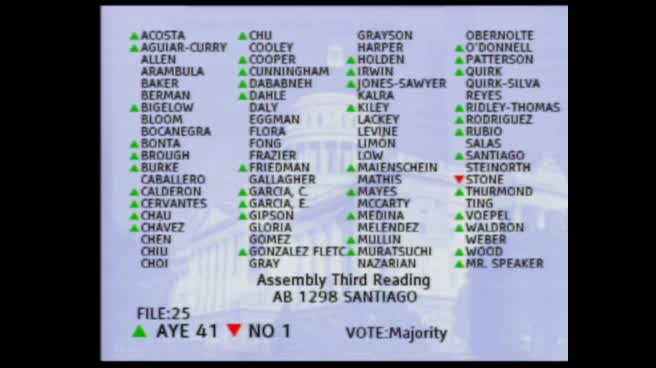 1MIN
Assembly Floor
 1H
Assembly Standing Committee on Appropriations
 12MIN
Assembly Standing Committee on Health

Bill Co-Author(s):