AB 421: Hazardous substances: liability: responsible parties.
- Session Year: 2017-2018
- House: Assembly
- Latest Version Date: 2017-02-09
Existing law, the Carpenter-Presley-Tanner Hazardous Substance Account Act, imposes liability for hazardous substance removal or remedial actions. Existing law provides that a cost incurred by the Department of Toxic Substances Control or regional board in carrying out or overseeing a response or a corrective action under the act or under the hazardous waste control laws is recoverable pursuant to state or federal law by the Attorney General, upon the request of the department or regional board, from the liable person or persons. The act defines responsible party and liable person for its purposes to mean those persons described in a specified provision of the federal Comprehensive Environmental Response, Compensation, and Liability Act of 1980, which includes persons who are, in specified ways, responsible for the disposal of hazardous substances.
This bill would require that, for purposes of that definition, for a cause of action that accrued on or after January 1, 1982, disposal, as it is used in that federal provision, includes emissions into the air.
(a)(1)Responsible party or liable person, for the purposes of this chapter, means those persons described in Section 107(a) of the federal act (42 U.S.C. Sec. 9607(a)).
(2)(A)Notwithstanding paragraph (1), but except as provided in subparagraph (B), a person is not a responsible party or liable person, for purposes of this chapter, for the reason that the person has developed or implemented innovative investigative or innovative remedial technology with regard to a release site, if the use of the technology has been approved by the department for the release site and the person would not otherwise be a responsible party or liable person. Upon approval of the use of the technology, the director shall acknowledge, in writing, that, upon proper completion of the innovative investigative or innovative remedial action at the release site, the immunity provided by this subparagraph shall apply to the person.
(B)Subparagraph (A) does not apply in any of the following cases:
(i)Conditions at the release site have deteriorated as a result of the negligence of the person who developed or implemented the innovative investigative or innovative remedial technology.
(ii)The person who developed or implemented the innovative investigative or innovative remedial technology withheld or misrepresented information that was relevant to the potential risks or harms of the technology.
(iii)The person who implemented the innovative investigative or innovative remedial technology did not follow the implementation process approved by the department.
(3)For purposes of paragraph (1), for a cause of action that accrued on or after January 1, 1982, disposal, as used in Section 107(a) of the federal act (42 U.S.C. Sec. 9607(a)), shall also include emissions into the air.
(b)For the purposes of this chapter, the defenses available to a responsible party or liable person shall be those defenses specified in Sections 101(35) and 107(b) of the federal act (42 U.S.C. Secs. 9601(35) and 9607(b)).
(c)Any person who unknowingly transports hazardous waste to a solid waste facility pursuant to the exemption provided in subdivision (e) of Section 25163 shall not be considered a responsible party for purposes of this chapter solely because of the act of transporting the waste. Nothing in this subdivision shall affect the liability of this person for his or her negligent acts.
|
Date
|
Status
|
|---|---|
| Feb 1, 2018 | From committee: Filed with the Chief Clerk pursuant to Joint Rule 56. |
| Jan 31, 2018 | Died pursuant to Art. IV, Sec. 10(c) of the Constitution. |
| Apr 24, 2017 | In committee: Set, second hearing. Hearing canceled at the request of author. |
| Apr 17, 2017 | In committee: Set, first hearing. Hearing canceled at the request of author. |
| Apr 5, 2017 | From committee: Do pass and re-refer to Com. on JUD. (Ayes 4. Noes 2.) (April 4). Re-referred to Com. on JUD. |
| Mar 14, 2017 | In committee: Set, first hearing. Hearing canceled at the request of author. |
| Feb 21, 2017 | Referred to Coms. on E.S. & T.M. and JUD. |
| Feb 10, 2017 | From printer. May be heard in committee March 12. |
| Feb 9, 2017 | Read first time. To print. |
|
Date
|
Description
|
Location
|
Votes
|
|
|---|---|---|---|---|
| Apr 4, 2017 | Do pass and be re-referred to the Committee on [Judiciary] | Assembly Standing Committee on Environmental Safety and Toxic Materials |
Passed |
This list shows positions taken on this bill by organizations on the date displayed, which is linked to the original source.
Positions by individuals are not included.
Date of Hearing: March 21, 2017
ASSEMBLY COMMITTEE ON ENVIRONMENTAL SAFETY AND TOXIC MATERIALS
Bill Quirk, Chair
ABPCA Bill Id:AB 421 (
Author:Santiago) – As Introduced Ver:February 9, 2017
SUBJECT: Hazardous substances: liability: responsible parties
SUMMARY: Provides that for a cause of action under the Carpenter-Presley-Tanner Hazardous Substance Account Act, the term "disposal" also includes emissions into the air.
EXISTING LAW:
1) Establishes a program to provide for response authority for releases of hazardous substances, including spills and hazardous waste disposal sites that pose a threat to the public health or the environment. Provides that this is known as the Carpenter-Presley-Tanner Hazardous Substance Account Act (HSAA). (Health and Safety Code (HSC) § 25300 et seq.)
2) Defines a "release authorized or permitted pursuant to state law" as any release into the environment which is authorized by statute, ordinance, regulation, or rule of any state, regional, or local agency or government or by any specific permit, license, or similar authorization from such an agency, including one of the foregoing, that recognizes a standard industry practice, including variances obtained from the agency which allow operations for facilities during a period of time when releases from the facilities do not conform with relevant statutes, ordinances, regulations, or rules. The term includes a federally permitted release, and releases that are in accordance with any court order or consent decree. (HSC § 25326)
3) Provides that nothing in the HSAA shall be construed as authorizing recovery for response costs or damages resulting from any release authorized or permitted pursuant to state law or a federally permitted release. (HSC § 25366 (b))
4) Creates a Federal "Superfund" to clean up uncontrolled or abandoned hazardous waste sites, as well as accidents, spills, and other emergency releases of pollutants and contaminants in to the environment, under the Comprehensive Environmental Response, Compensation, and Liability Act (CERCLA). Provides the United States Environmental Protection Agency (US EPA) with the authority to seek out those parties responsible for any release and assure their cooperation in the cleanup. (42 United States Code (U.S.C.) § 9601 et seq.)
FISCAL EFFECT: Unknown.
COMMENTS:
Need for the bill: According to the author, "In July 2016, the U.S. Court of Appeals for the Ninth Circuit ruled that contamination caused by aerial emissions does not qualify as a disposal of hazardous substances under CERCLA. The Court concluded CERCLA does not specifically impose liability for hazardous substances that are emitted into the air and then migrate by wind to land and water, as opposed to circumstances where hazardous substances are deposited directly onto land or into water. Although the state cannot amend CERCLA, the HSAA may be amended. AB 421was introduced to clarify that contamination caused by aerial emissions is eligible for cost recovery…
This measure may help address cleanup of contamination at various locations throughout the state, including those in LA County such as the Exide facility in Vernon, Quemetco in the City of Industry, and the City of Paramount."
Hazardous substances/hazardous waste: The potential public health and environmental harm that can be caused by various hazardous substances used in industrial, manufacturing, and other processes has drawn widespread national attention. Information provided by the US EPA advises that over the next several decades, federal, state, and local governments and private industry will commit billions of dollars annually to clean up sites contaminated with hazardous waste and petroleum products from a variety of industrial sources. A US EPA report projects that as many as 355,000 contaminated sites will require cleanup over the next 30 years and that the cost of this cleanup may amount to as much as $250 billion.
Hazardous substance is a broad term that includes many chemicals and materials that present an imminent and substantial danger to public health or welfare. Improper use and disposal of these products can result in hazardous waste. According to the US EPA, hazardous wastes or substances are potentially hazardous to human health or the environment when they are improperly managed. They possess at least one of following characteristics: ignitability, corrosivity, reactivity, or toxicity, or they appear on special US EPA lists.
The Comprehensive Environmental Response, Compensation, and Liability Act (CERCLA): CERCLA or Superfund, provides a Federal "Superfund" to clean up uncontrolled or abandoned hazardous-waste sites as well as accidents, spills, and other emergency releases of pollutants and contaminants into the environment. Through CERCLA, US EPA was given authority to seek out those parties responsible for any release and assure their cooperation in the cleanup.
US EPA cleans up orphan sites when potentially responsible parties cannot be identified or located, or when they fail to act. Through various enforcement tools, US EPA obtains private party cleanup through orders, consent decrees, and other small party settlements. US EPA also recovers costs from financially viable individuals and companies once a response action has been completed. US EPA is authorized to implement CERCLA in all 50 states and U.S. territories. Superfund site identification, monitoring, and response activities in states are coordinated through the states’ environmental protection or waste management agencies.
CERCLA defines liable parties as current owners and operators of a facility, former owners and operators of a facility at the time of disposal, persons who arranged for treatment or disposal of hazardous substances, and transporters of hazardous substances who selected the disposal site. A person who falls within the definition of one of these classes may be held liable under CERCLA.
Carpenter-Presley-Tanner Hazardous Substances Account Act (HSAA): State law provides the California Department of Toxic Substances Control (DTSC), with general administrative responsibility for overseeing the state’s responses to spills or releases of hazardous substances, and for hazardous waste disposal sites that pose a threat to public health or the environment. DTSC utilizes the HSAA for cleanup of contaminated sites and the Hazardous Waste Control Law for the regulation of hazardous waste sites. The HSAA is intended to provide compensation for out‑of‑pocket medical expenses and lost wages or business incomes resulting from injuries caused by exposure to hazardous substances. Additionally, DTSC ensures that the state meets the federal requirements that California pay 10 percent of cleanup costs for federal Superfund sites and 100 percent of the operation and maintenance costs after cleanup is complete. The HSAA, provides DTSC with the authority, procedures, and standards to investigate, remove, and remediate contamination at sites; to issue and enforce a removal or remedial action order to any responsible party; and to impose administrative or civil penalties for noncompliance with an order. Federal and state law also authorizes DTSC to recover costs and expenses it incurs in carrying out these activities.
Pakootas v. Teck Cominco Metals: On July 27, 2016, the United State Court of Appeals, 9th Circuit, filed a decision under CERCLA. The court’s decision is as follows, "When a smelter emits, lead, arsenic, cadmium, and mercury compounds through a smokestack and those compounds contaminate land or water downwind, can the owner-operator of the smelter be held liable for cleanup costs and natural resource damages under CERCLA (42 U.S.C § 9607(a)(3))? All parties agree the answer turns on whether the smelter owner-operator can be said to have arranged for the disposal of those hazardous substances within the meaning of CERCLA. Bound by a previous en banc case’s interpretation of deposit, the only theory of disposal urged by plaintiffs in this interlocutory appeal, as not including the gradual spread of contaminants without human intervention, we must answer no."
Permitted versus unpermitted air emissions: One of the arguments against AB 421 is that many businesses have received a permit to emit pollutants into the air from an air quality management district or an air pollution control district and as a result should not be liable for any contamination their air emissions may cause. However, current law already states that HSAA does not authorize a recovery action for costs or damages resulting from any release authorized or permitted pursuant to state law or a federal permitted release. If there is additional confusion with issue, the author may wish to consider further clarifying this issue.
Exide Technologies: The Exide Technologies (Exide) battery recycling facility in Vernon, California recycled lead from used automotive batteries and other sources. For 33 years, Exide operated the Vernon facility without a full permit. The facility had been allowed to operate on "interim status," a temporary designation intended to give companies time to qualify for permits and meet legal standards for safe handling and disposal of toxic materials, as well as time for DTSC to review and approve full permit applications. During that time, inspectors documented more than 100 violations, including lead and acid leaks, an overflowing pond of toxic sludge, enormous cracks in the floor, and hazardous levels of lead in the soil outside. In March, 2015, Exide was forced to close the facility for good.
DTSC estimates homes, including those up to 1.3 and 1.7 miles away from the facility, may potentially be affected by Exide's lead contamination. That equates to somewhere between 5,000 - 10,000 properties. According to DTSC, cleaning each contaminated home costs about $45,000. The cost of cleanup in and around the Exide facility is expected to top $500 million dollars. In 2016, the Legislature passed and the Governor signed AB 118 (Santiago, Chapter 10 Statutes of 2016) which appropriated $176,600,000 from the state’s General Fund to DTSC for activities related to the cleanup and investigation of lead-contaminated properties in the communities surrounding the Exide Technologies facility. This bill requires DTSC to pursue all available remedies against potentially responsible parties.
Who pays to clean up contamination? Under state law and federal law: generally speaking the entity that caused the contamination is held responsible for cleaning it up. The government has some funding as a backstop in the event the responsible entity is not identified or cannot pay. If a result of the Pakootas decision is that a facility that emits contaminants into the air and contaminates someone else’s property is not held liable for the cleanup costs, then who pays for the cleanup? It is either the property owner, whose property was contaminated by someone else, or the government.
Should California law be further clarified? Under CERCLA, the liability for a responsible party includes joint and several liability, basically meaning that if an entity is found to have contributed some or any of the contamination they could be held liable to pay for the cleanup of the contamination. The HSAA was patterned after CERCLA and incorporates CERCLA definition by reference. As a result some would argue that joint and several liability exists under state law and some would argue the reverse. To date, this particular question has not been settled in the courts. Since the intent of the HSAA was to be at least a stringent as CERCLA, should California law be clarified to specify joint and several liability?
Narrow scope of recent court decision: There are multiple categories of potential responsible parties under CERCLA and HSAA: present owner/operators, past owner/operators, arrangers, and transporters. Within each category there is a different scope of potential liability. It is important to note that in the Pakootas case, the issue of liability for Teck Cominco Metals was as an arranger, meaning the decision is likely to be specific to arrangers and may or may not impact any liability of responsible parties of the other categories. Without a specific court case, it is difficult to ascertain if the liability for present owner/operators, past owner/operators or transporters has been impacted by the Pakootas decision.
AB 421 brings up a fundamental question, if a person contaminates someone else’s property, that person should be held liable for the contamination. Of course, the tricky part is always proving that someone caused the contamination, which this bill does not touch on and which is ultimately left up to the courts. It is important to note that in many cases, the State Attorney General on behalf of DTSC, files recovery actions against potential responsible parties under CERCLA, therefore, any change in state law will not affect a case filed under federal law. However, the question before the Committee is whether state law should be changed to state that all potential responsible parties could be liable for contamination caused by air emissions.
Arguments in Support: According to the County of Los Angeles, "In July 2016, the Federal Ninth Circuit Court of Appeals ruled that contamination caused by aerial emissions does not qualify as a disposal of hazardous substances under CERCLA. The Court concluded that CERCLA does not specifically impose liability for hazardous substances that are emitted into the air and then migrate by wind to land and water, unlike circumstances where hazardous substances are deposited directly onto land or into water. Because CERCLA is used to interpret the State’s HSAA, State courts are likely to follow suit and may preclude such claims under the HSAA. Until this ruling, contamination by aerial emissions was generally presumed to have been included as a disposal of hazardous substance when the HSAA was enacted on January 1, 1982; this ruling now leaves a loophole for polluters. "
Arguments in Opposition: The California Chamber of Commerce, in addition to concerns with the inclusion of emissions into the air under the HSAA asks, "Does the provision apply to permitted and unpermitted air emissions? While there is a HSC excluding permitted emissions under the HSAA, it is unclear how/if that provision would apply to this bill. If it applies to permitted emissions, what is the point of a permit? If it does not apply to permitted emissions, how could one distinguish between permitted and unpermitted air emissions for purposes of liability? How would the bill apply to clean-up operations relating to accumulated permitted emissions? How would it apply to Title V permits? Would the bill apply to clean-up at residences? If so, it could apply superfund and related impacts on marketability to homeowners or other property owners. Would the bill apply to land disturbances that result in the emission of a substance into the air?"
REGISTERED SUPPORT / OPPOSITION:
Support
Los Angeles County (sponsor)
Opposition
Associated General Contractors
Associated General Contractors – San Diego County
California Chamber of Commerce
California Independent Petroleum Association
California Manufacturing & Technology Association
California Metals Coalition
Chemical Industry Council of California
Construction Employers’ Association
Industrial Environmental Association
National Federation of Independent Business
Western States Petroleum Association
Analysis Prepared by: Josh Tooker / E.S. & T.M. /
Date of Hearing: April 4, 2017
ASSEMBLY COMMITTEE ON ENVIRONMENTAL SAFETY AND TOXIC MATERIALS
Bill Quirk, Chair
ABPCA Bill Id:AB 421 (
Author:Santiago) – As Introduced Ver:February 9, 2017
SUBJECT: Hazardous substances: liability: responsible parties
SUMMARY: Provides that for a cause of action under the Carpenter-Presley-Tanner Hazardous Substance Account Act, the term "disposal" also includes emissions into the air.
EXISTING LAW:
1) Establishes a program to provide for response authority for releases of hazardous substances, including spills and hazardous waste disposal sites that pose a threat to the public health or the environment. Provides that this is known as the Carpenter-Presley-Tanner Hazardous Substance Account Act (HSAA). (Health and Safety Code (HSC) § 25300 et seq.)
2) Defines a "release authorized or permitted pursuant to state law" as any release into the environment which is authorized by statute, ordinance, regulation, or rule of any state, regional, or local agency or government or by any specific permit, license, or similar authorization from such an agency, including one of the foregoing, that recognizes a standard industry practice, including variances obtained from the agency which allow operations for facilities during a period of time when releases from the facilities do not conform with relevant statutes, ordinances, regulations, or rules. The term includes a federally permitted release, and releases that are in accordance with any court order or consent decree. (HSC § 25326)
3) Provides that nothing in the HSAA shall be construed as authorizing recovery for response costs or damages resulting from any release authorized or permitted pursuant to state law or a federally permitted release. (HSC § 25366 (b))
4) Creates a Federal "Superfund" to clean up uncontrolled or abandoned hazardous waste sites, as well as accidents, spills, and other emergency releases of pollutants and contaminants in to the environment, under the Comprehensive Environmental Response, Compensation, and Liability Act (CERCLA). Provides the United States Environmental Protection Agency (US EPA) with the authority to seek out those parties responsible for any release and assure their cooperation in the cleanup. (42 United States Code (U.S.C.) § 9601 et seq.)
FISCAL EFFECT: Unknown.
COMMENTS:
Need for the bill: According to the author, "In July 2016, the U.S. Court of Appeals for the Ninth Circuit ruled that contamination caused by aerial emissions does not qualify as a disposal of hazardous substances under CERCLA. The Court concluded CERCLA does not specifically impose liability for hazardous substances that are emitted into the air and then migrate by wind to land and water, as opposed to circumstances where hazardous substances are deposited directly onto land or into water. Although the state cannot amend CERCLA, the HSAA may be amended. AB 421was introduced to clarify that contamination caused by aerial emissions is eligible for cost recovery…
This measure may help address cleanup of contamination at various locations throughout the state, including those in LA County such as the Exide facility in Vernon, Quemetco in the City of Industry, and the City of Paramount."
Hazardous substances/hazardous waste: The potential public health and environmental harm that can be caused by various hazardous substances used in industrial, manufacturing, and other processes has drawn widespread national attention. Information provided by the US EPA advises that over the next several decades, federal, state, and local governments and private industry will commit billions of dollars annually to clean up sites contaminated with hazardous waste and petroleum products from a variety of industrial sources. A US EPA report projects that as many as 355,000 contaminated sites will require cleanup over the next 30 years and that the cost of this cleanup may amount to as much as $250 billion.
Hazardous substance is a broad term that includes many chemicals and materials that present an imminent and substantial danger to public health or welfare. Improper use and disposal of these products can result in hazardous waste. According to the US EPA, hazardous wastes or substances are potentially hazardous to human health or the environment when they are improperly managed. They possess at least one of following characteristics: ignitability, corrosivity, reactivity, or toxicity, or they appear on special US EPA lists.
The Comprehensive Environmental Response, Compensation, and Liability Act (CERCLA): CERCLA or Superfund, provides a Federal "Superfund" to clean up uncontrolled or abandoned hazardous-waste sites as well as accidents, spills, and other emergency releases of pollutants and contaminants into the environment. Through CERCLA, US EPA was given authority to seek out those parties responsible for any release and assure their cooperation in the cleanup.
US EPA cleans up orphan sites when potentially responsible parties cannot be identified or located, or when they fail to act. Through various enforcement tools, US EPA obtains private party cleanup through orders, consent decrees, and other small party settlements. US EPA also recovers costs from financially viable individuals and companies once a response action has been completed. US EPA is authorized to implement CERCLA in all 50 states and U.S. territories. Superfund site identification, monitoring, and response activities in states are coordinated through the states’ environmental protection or waste management agencies.
CERCLA defines liable parties as current owners and operators of a facility, former owners and operators of a facility at the time of disposal, persons who arranged for treatment or disposal of hazardous substances, and transporters of hazardous substances who selected the disposal site. A person who falls within the definition of one of these classes may be held liable under CERCLA.
Carpenter-Presley-Tanner Hazardous Substances Account Act (HSAA): State law provides the California Department of Toxic Substances Control (DTSC), with general administrative responsibility for overseeing the state’s responses to spills or releases of hazardous substances, and for hazardous waste disposal sites that pose a threat to public health or the environment. DTSC utilizes the HSAA for cleanup of contaminated sites and the Hazardous Waste Control Law for the regulation of hazardous waste sites. The HSAA is intended to provide compensation for out‑of‑pocket medical expenses and lost wages or business incomes resulting from injuries caused by exposure to hazardous substances. Additionally, DTSC ensures that the state meets the federal requirements that California pay 10 percent of cleanup costs for federal Superfund sites and 100 percent of the operation and maintenance costs after cleanup is complete. The HSAA, provides DTSC with the authority, procedures, and standards to investigate, remove, and remediate contamination at sites; to issue and enforce a removal or remedial action order to any responsible party; and to impose administrative or civil penalties for noncompliance with an order. Federal and state law also authorizes DTSC to recover costs and expenses it incurs in carrying out these activities.
Pakootas v. Teck Cominco Metals: On July 27, 2016, the United State Court of Appeals, 9th Circuit, filed a decision under CERCLA. The court’s decision is as follows, "When a smelter emits, lead, arsenic, cadmium, and mercury compounds through a smokestack and those compounds contaminate land or water downwind, can the owner-operator of the smelter be held liable for cleanup costs and natural resource damages under CERCLA (42 U.S.C § 9607(a)(3))? All parties agree the answer turns on whether the smelter owner-operator can be said to have arranged for the disposal of those hazardous substances within the meaning of CERCLA. Bound by a previous en banc case’s interpretation of deposit, the only theory of disposal urged by plaintiffs in this interlocutory appeal, as not including the gradual spread of contaminants without human intervention, we must answer no."
Permitted versus unpermitted air emissions: One of the arguments against AB 421 is that many businesses have received a permit to emit pollutants into the air from an air quality management district or an air pollution control district and as a result should not be liable for any contamination their air emissions may cause. However, current law already states that HSAA does not authorize a recovery action for costs or damages resulting from any release authorized or permitted pursuant to state law or a federal permitted release. If there is additional confusion with issue, the author may wish to consider further clarifying this issue.
Exide Technologies: The Exide Technologies (Exide) battery recycling facility in Vernon, California recycled lead from used automotive batteries and other sources. For 33 years, Exide operated the Vernon facility without a full permit. The facility had been allowed to operate on "interim status," a temporary designation intended to give companies time to qualify for permits and meet legal standards for safe handling and disposal of toxic materials, as well as time for DTSC to review and approve full permit applications. During that time, inspectors documented more than 100 violations, including lead and acid leaks, an overflowing pond of toxic sludge, enormous cracks in the floor, and hazardous levels of lead in the soil outside. In March, 2015, Exide was forced to close the facility for good.
DTSC estimates homes, including those up to 1.3 and 1.7 miles away from the facility, may potentially be affected by Exide's lead contamination. That equates to somewhere between 5,000 - 10,000 properties. According to DTSC, cleaning each contaminated home costs about $45,000. The cost of cleanup in and around the Exide facility is expected to top $500 million dollars. In 2016, the Legislature passed and the Governor signed AB 118 (Santiago, Chapter 10 Statutes of 2016) which appropriated $176,600,000 from the state’s General Fund to DTSC for activities related to the cleanup and investigation of lead-contaminated properties in the communities surrounding the Exide Technologies facility. This bill requires DTSC to pursue all available remedies against potentially responsible parties.
Who pays to clean up contamination? Under state law and federal law: generally speaking the entity that caused the contamination is held responsible for cleaning it up. The government has some funding as a backstop in the event the responsible entity is not identified or cannot pay. If a result of the Pakootas decision is that a facility that emits contaminants into the air and contaminates someone else’s property is not held liable for the cleanup costs, then who pays for the cleanup? It is either the property owner, whose property was contaminated by someone else, or the government.
Should California law be further clarified? Under CERCLA, the liability for a responsible party includes joint and several liability, basically meaning that if an entity is found to have contributed some or any of the contamination they could be held liable to pay for the cleanup of the contamination. The HSAA was patterned after CERCLA and incorporates CERCLA definition by reference. As a result some would argue that joint and several liability exists under state law and some would argue the reverse. To date, this particular question has not been settled in the courts. Since the intent of the HSAA was to be at least a stringent as CERCLA, should California law be clarified to specify joint and several liability?
Narrow scope of recent court decision: There are multiple categories of potential responsible parties under CERCLA and HSAA: present owner/operators, past owner/operators, arrangers, and transporters. Within each category there is a different scope of potential liability. It is important to note that in the Pakootas case, the issue of liability for Teck Cominco Metals was as an arranger, meaning the decision is likely to be specific to arrangers and may or may not impact any liability of responsible parties of the other categories. Without a specific court case, it is difficult to ascertain if the liability for present owner/operators, past owner/operators or transporters has been impacted by the Pakootas decision.
AB 421 brings up a fundamental question, if a person contaminates someone else’s property, that person should be held liable for the contamination. Of course, the tricky part is always proving that someone caused the contamination, which this bill does not touch on and which is ultimately left up to the courts. It is important to note that in many cases, the State Attorney General on behalf of DTSC, files recovery actions against potential responsible parties under CERCLA, therefore, any change in state law will not affect a case filed under federal law. However, the question before the Committee is whether state law should be changed to state that all potential responsible parties could be liable for contamination caused by air emissions.
Arguments in Support: According to the County of Los Angeles, "In July 2016, the Federal Ninth Circuit Court of Appeals ruled that contamination caused by aerial emissions does not qualify as a disposal of hazardous substances under CERCLA. The Court concluded that CERCLA does not specifically impose liability for hazardous substances that are emitted into the air and then migrate by wind to land and water, unlike circumstances where hazardous substances are deposited directly onto land or into water. Because CERCLA is used to interpret the State’s HSAA, State courts are likely to follow suit and may preclude such claims under the HSAA. Until this ruling, contamination by aerial emissions was generally presumed to have been included as a disposal of hazardous substance when the HSAA was enacted on January 1, 1982; this ruling now leaves a loophole for polluters. "
Arguments in Opposition: The California Chamber of Commerce, in addition to concerns with the inclusion of emissions into the air under the HSAA asks, "Does the provision apply to permitted and unpermitted air emissions? While there is a HSC excluding permitted emissions under the HSAA, it is unclear how/if that provision would apply to this bill. If it applies to permitted emissions, what is the point of a permit? If it does not apply to permitted emissions, how could one distinguish between permitted and unpermitted air emissions for purposes of liability? How would the bill apply to clean-up operations relating to accumulated permitted emissions? How would it apply to Title V permits? Would the bill apply to clean-up at residences? If so, it could apply superfund and related impacts on marketability to homeowners or other property owners. Would the bill apply to land disturbances that result in the emission of a substance into the air?"
REGISTERED SUPPORT / OPPOSITION:
Support
Los Angeles County (sponsor)
Opposition
Associated General Contractors
Associated General Contractors – San Diego County
California Chamber of Commerce
California Independent Petroleum Association
California Manufacturing & Technology Association
California Metals Coalition
Chemical Industry Council of California
Construction Employers’ Association
Industrial Environmental Association
National Federation of Independent Business
Western States Petroleum Association
Analysis Prepared by: Josh Tooker / E.S. & T.M. /
Discussed in Hearing
 20MIN
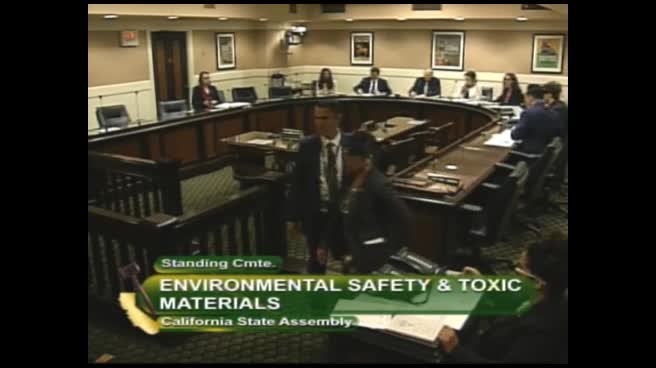
Assembly Standing Committee on Environmental Safety and Toxic Materials
Bill Author

Bill Co-Author(s):